Design principles
Impermeable concrete slab as waterproofing layer 1 2 3 4 5 6 7
1 2 3 4 5 6 7
1
Ballast (water- and diffusion-permeable) Separating membrane (diffusion-permeable) Thermal insulation (XPS) with shiplap joints Waterproofing Rigid foam insulation Vapour barrier Loadbearing structure (preferably reinforced concrete)
1 2 3 4
1 2 3 4
1
1
D 2.21
1
Ballast (water- and diffusion-permeable) Separating membrane (diffusion-permeable) Thermal insulation (XPS) with shiplap joints Impermeable concrete slab D 2.22 1 2 3 4
1 2 3 4
Protective finish Impermeable concrete slab Mineral fibre insulation Smart vapour barrier D 2.23
104
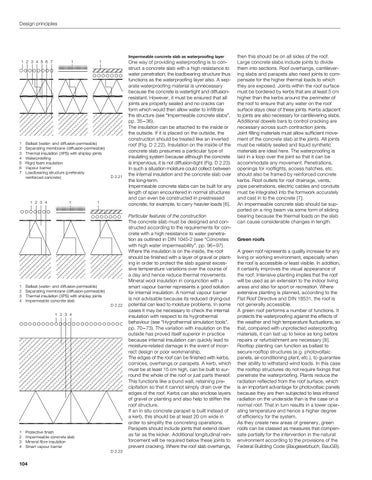
One way of providing waterproofing is to construct a concrete slab with a high resistance to water penetration; the loadbearing structure thus functions as the waterproofing layer also. A separate waterproofing material is unnecessary because the concrete is watertight and diffusionresistant. However, it must be ensured that all joints are properly sealed and no cracks can form which would then allow water to infiltrate the structure (see “Impermeable concrete slabs”, pp. 35 – 36). The insulation can be attached to the inside or the outside. If it is placed on the outside, the construction should be treated like an inverted roof (Fig. D 2.22). Insulation on the inside of the concrete slab presumes a particular type of insulating system because although the concrete is impervious, it is not diffusion-tight (Fig. D 2.23). In such a situation moisture could collect between the internal insulation and the concrete slab over the long-term. Impermeable concrete slabs can be built for any length of span encountered in normal structures and can even be constructed in prestressed concrete, for example, to carry heavier loads [6]. Particular features of the construction The concrete slab must be designed and constructed according to the requirements for concrete with a high resistance to water penetration as outlined in DIN 1045-2 (see “Concretes with high water impermeability”, pp. 96 – 97). Where the insulation is on the inside, the roof should be finished with a layer of gravel or planting in order to protect the slab against excessive temperature variations over the course of a day and hence reduce thermal movements. Mineral wool insulation in conjunction with a smart vapour barrier represents a good solution for internal insulation. A normal vapour barrier is not advisable because its reduced drying-out potential can lead to moisture problems. In some cases it may be necessary to check the internal insulation with respect to its hygrothermal behaviour (see “Hygrothermal simulation tools”, pp. 70 – 73). The variation with insulation on the outside has proved itself superior in practice because internal insulation can quickly lead to moisture-related damage in the event of incorrect design or poor workmanship. The edges of the roof can be finished with kerbs, cornices, overhangs or parapets. A kerb, which must be at least 15 cm high, can be built to surround the whole of the roof or just parts thereof. This functions like a bund wall, retaining precipitation so that it cannot simply drain over the edges of the roof. Kerbs can also enclose layers of gravel or planting and also help to stiffen the roof structure. If an in situ concrete parapet is built instead of a kerb, this should be at least 20 cm wide in order to simplify the concreting operations. Parapets should include joints that extend down as far as the kicker. Additional longitudinal reinforcement will be required below these joints to prevent cracking. Where the roof slab overhangs,
then this should be on all sides of the roof. Large concrete slabs include joints to divide them into sections. Roof overhangs, cantilevering slabs and parapets also need joints to compensate for the higher thermal loads to which they are exposed. Joints within the roof surface must be bordered by kerbs that are at least 5 cm higher than the kerbs around the perimeter of the roof to ensure that any water on the roof surface stays clear of these joints. Kerbs adjacent to joints are also necessary for cantilevering slabs. Additional dowels bars to control cracking are necessary across such contraction joints. Joint filling materials must allow sufficient movement of the concrete slab at the joints. All joints must be reliably sealed and liquid synthetic materials are ideal here. The waterproofing is laid in a loop over the joint so that it can be accommodate any movement. Penetrations, openings for rooflights, access hatches, etc. should also be framed by reinforced concrete kerbs. Roof outlets for roof drainage, vents, pipe penetrations, electric cables and conduits must be integrated into the formwork accurately and cast in to the concrete [7]. An impermeable concrete slab should be supported on a ring beam via some form of sliding bearing because the thermal loads on the slab can cause considerable changes in length.
Green roofs A green roof represents a quality increase for any living or working environment, especially when the roof is accessible or least visible. In addition, it certainly improves the visual appearance of the roof. Intensive planting implies that the roof will be used as an extension to the indoor living areas and also for sport or recreation. Where extensive planting is planned, according to the Flat Roof Directive and DIN 18531, the roof is not generally accessible. A green roof performs a number of functions. It protects the waterproofing against the effects of the weather and high temperature fluctuations, so that, compared with unprotected waterproofing materials, it can last up to twice as long before repairs or refurbishment are necessary [8]. Rooftop planting can function as ballast to secure rooftop structures (e.g. photovoltaic panels, air-conditioning plant, etc.), to guarantee their ability to withstand wind loads. In this case the rooftop structures do not require fixings that penetrate the waterproofing. Plants reduce the radiation reflected from the roof surface, which is an important advantage for photovoltaic panels because they are then subjected to less infrared radiation on the underside than is the case on a normal roof. That in turn results in a lower operating temperature and hence a higher degree of efficiency for the system. As they create new areas of greenery, green roofs can be classed as measures that compensate partially for the intervention in the natural environment according to the provisions of the Federal Building Code (Baugesetzbuch, BauGB).