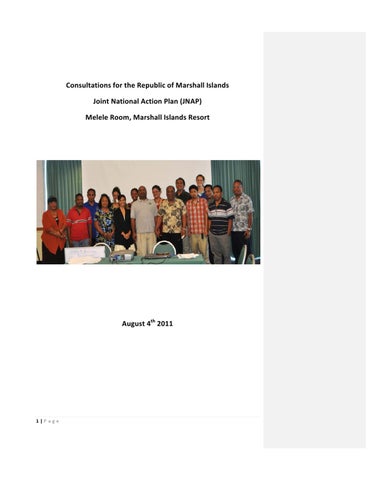
Consultations for the Republic of Marshall Islands Joint National Action Plan (JNAP) Melele Room, Marshall Islands Resort
August 4th 2011
1 | P a g e
Introduction: The workshop was opened at 9.00am by Desmond Doulatram, Policy Officer for the Office of Environmental Planning and Policy Coordination (OEPPC). Desmond provided a background to the Climate Change Policy and JNAP Development process and gave an explanation of how the Joint National Action Plan would serve as a joint action plan, both for the RMI National Climate Change Policy, as well as Disaster Risk Management in RMI. Purpose of the workshop: This workshop was designed to build upon the results of previous consultations (including the public consultation taken in April 8, 2011), and would provide attendees a further opportunity to comment and revise on the DRAFT JNAP. The full agenda for this workshop is attached as Annex 1 below. Revision of the JNAP Copies of the updated JNAP were provided to all participants, which incorporated comments from the consultations held previously. The participants worked in groups, each focusing one of the key six goals of the JNAP. Each group worked to finalise the wording of the goal itself, as well as its objectives, actions, indicators and agencies. The results of these exercises are reflected in Annex 2 below. A full list of participants who attended and provided comments is also attached, as Annex 3. General Discussions and comments: Direct comments on the text were incorporated into the revised JNAP (see Annex 2). Additional to textual changes, some additional comments and recommendations were made, which included: a) The JNAP should include a glossary of all the acronyms which are used within the document. b) The JNAP should have a definitions section. c) The JNAP should define the term ‘community based’. How will a community be defined in RMI. For example, is a community defined as an atoll, or a village? One working group suggested that a community could be defined in terms of church groups, or local municipal governments, but also noted that the definition of community will differ between Majuro and the outer islands. d) The JNAP needs to be consistent in its use of terms such as Disaster Risk Reduction (DRR), Disaster Risk Management (DRM) and Climate Change Adaptation (CCA). It was recommended that the JNAP apply the term DRM instead of DRR, and that this should be applied consistently across the entire document. e) A discussion was also held, on where or not there is a need to add a seventh goal to the JNAP – one of resettlement and relocation. The group was unsure as to whether or not this be a stand‐alone goal, or incorporated under existing goals, but there was agreement within the group that the issue of resettlement was one that needed to be discussed by leaders, 2 | P a g e
and recommended that at the very least an action be added, asking both political leaders and traditional leaders to start discussions on future options, and the potential need to re‐ settle in the longer term. It was felt that while this is a very sensitive issue, that internal discussions were needed to ensure that any future actions in this area were proactive, as opposed to reactive, and to ensure that all RMI people were empowered make their own decisions in this regards. The workshop closed at 12.30pm. All comments captured in this workshop will be incorporated into the next draft, which will then be discussed and reviewed at the level of the National Climate Change Committee (NCCC) before it is submitted to Cabinet for formal endorsement.
3 | P a g e
List of Annexes: • • •
Annex 1: Workshop Agenda Annex 2: Revised JNAP Matrix – with participants comments incorporated from August 4th Annex 3: Participants list
4 | P a g e
Annex 1: Workshop Agenda Time 9:00am‐9:30am 9:30am‐9:40am
9:40am‐ 10:00am 10:00am‐ 10:40am
10:00am‐ 10:30am 10:30am‐ 11:30am
11:30am‐ 12:00pm 12:00pm‐ 12:15pm 12:30pm‐ 1:30pm
5 | P a g e
Session
Lead
Welcoming Remarks CHAIR Desmond Introduction to the CCPF and JNAP process, and progress thus far, including: • Justification for an RMI JNAP • Purpose of this workshop Morning Tea
Input
Outcome
Slide Presentation
5 Working Groups Facilitators: • Goal 1: Candice Guavis • Goal 2: Helpy Mote • Goal 3: Julian Alik • Goal 4: Helpy Mote • Goal 5: Candice Guavis, Doreen de Brum • Goal 6: Julian Alik
Revision of Goals , Objectives, activities, and identification of additional agency input
CHAIR
GROUP Activity 2: Review Remaining 3 Goals
Working Group Facilitator(s)
Plenary report back
CHAIR
Revision of Goals , Objectives, activities, and identification of additional agency input
CHAIR
GROUP Activity 1: Review first Three Goals
Plenary report back
Q&A/Final Feedback Wrap Up/Next Steps Lunch
Annex 2: Revised Matrix with participants comments
Draft Results Matrix: 4th August, 2011
Joint National Action Plan for Climate Change Adaptation and Disaster Risk Management Goal 1: Establish and support an enabling environment for improved coordination of disaster risk management /climate change adaptation in the Marshall Islands Outcomes: • •
•
•
Strengthened coordination of DRM/CCA decision making processes and institutional arrangements including government, private sector, NGOs and civil society Natural hazard risk considerations (climate‐related, geophysical and others) are mainstreamed in all relevant processes of development and budgetary planning at all levels and in all relevant sectors, resulting in an integrated response to building resilience to climate change and disasters Key organisations are adequately resourced and avenues for sustainable financing are secured through improved policies, capacities and institutional arrangements (incl. National Trust Fund) Socio‐economic and cultural causes of vulnerability are addressed and people’s capacity to adapt to climate change impacts are improved
Goal 1: Establish and support an enabling environment for improved coordination of disaster risk management / climate change adaptation in the Marshall Islands Objective
Actions (DRM NAP + CC)
Outputs
1.1 Strengthen DRM/CCA and organizational and institutional arrangements at national and local government levels and civil society
1.1.1 Complete the review of all relevant policies and legislation (including the Disaster Assistance Act 1987) to assess, clarify and/or establish integrated DRM and climate change organizational arrangements and responsibilities which also include recognition and compliance with principles and practices of International Disaster Response Law (IDRL)
Strengthened integrated CCA and DRM organizational arrangements supported with appropriate policy and legislative framework
1.1.2 Implement DRM and CCA organizational arrangements as
6 | P a g e
Lead Agency
Objective Indicator(s)
CSO & OEPPC
Percentage of JNAP actions mainstreamed into key organizations mandates at the national and local levels in the first three years of JNAP implementation
Collaborate with all relevant
agencies and NGOs
endorsed in the Climate Change Policy framework 1.1.3 Draft new legislation or amendments to effect organizational changes 1.1.4 Establish a working group to address DRM and CCA issues regularly 1.1.5 Establish a national platform for DRM/CCA to facilitate a biennial dialogue of stakeholders and partners with a view to enhancing advocacy and mainstreaming efforts at all levels and to ensure wide support 1.2.1 Assess the resource needs of key 1.2 Adequately resource organizations for DRM/CCA, key organizations for including the possibility of bank DRM/CCA at national loans for emergency situations and local government levels,and civil society 1.2.2 Develop resource requirements including securing and implementation program for avenues for sustainable key organizations for DRM/CCA financing and the option 1.2.3 Review budget planning and of a trust fund to reporting processes to account address DRM/CCA for management and forecast of climate change‐related funding. 1.2.4 Develop a Climate Change/DRM trust fund 1.2.5. Establish a mechanism to ensure an equitable access to funds that would cover different needs and address different vulnerability (based on gender, age, location, disability, etc.)
1.3 Strengthen human resource capacity of key organizations for DRM/CCA including at the national and local government levels, and key local community leaders and NGOs
1.3.1 Assess the existing capacity of the human resources and develop minimum standards for human resource capacity to be analysed in line with the organization mandate 1.3.2 Review job descriptions of DRM/CCA focal points key staff at responsible organizations 1.3.3 Conduct DRM/CCA training needs assessment of key responsible
7 | P a g e
Key DRM/CCA agencies are resourced with priority needs to enhance organizational performance
CSO & OEPP C
Percentage of resource needs as identified by the assessment acquired annually
Equitable distribution of funds for addressing different needs and build capacity to respond to natural disasters and climate change impacts
Differential vulnerability and needs are identified and used to develop a mechanism for ensuring an equitable access to funds Incentives are in place for staff with the right skill and experience to be recruited or stay in the organization
CSO & OEPPC
Local community groups and NGOs more
Level of improved performance from agencies involved in DRM/CCA as reported in annual reports following JNAP implementation
Level of integration of
organizations 1.3.4 Develop and implement a long‐ term DRM and CCA training program which include social and gender analysis and identification of local knowledge
active in local‐ level risk management
MIA
Programs for building capacity in conducting social and 1.3.5 Assess the role and capacity of gender key local community groups in analysis in Majuro and the Outer Islands that relation to are playing a role in DRM/CCA and DRM and CCA develop and implement programs are developed to strengthen capacities as may and training be required are provided on a regular 1.3.6 Recruitment of a climatologist to basis the National Weather Station to provide assistance in synthesizing and analyzing climate data
appropriate traditional knowledge identified in DRM/CCA programs by local community groups, NGOs and national and local government responsible agencies DRM and CCA adaptation programs are taking into account socio cultural dimension of vulnerability and adaptation and plan appropriate adaptation measures that address different roles, vulnerability and needs
1.4.1 Need to agree to standardized 1.4 Build capacity for language for describing disaster mainstreaming and climate change terms (ie DRM/CCA by DRR, DRM, CCA etc) strengthening coordination, inter‐ 1.4.1 Improve the level of awareness sectoral partnerships amongst all national and local and collaborative efforts level stakeholders and decision for DRM/CCA across all makers that DRM and CCA are levels of government, key development issues, needing non‐government, the to be mainstreamed into all private sector and civil sectoral and community level society (particularly with strategic plans traditional leaders) 1.4.2 Review existing planning, decision making and budgetary processes and identify where and how DRM/CCA could be mainstreamed
8 | P a g e
Organizations EPPSO, CSO, MIA have capacity for DRM/CCA mainstreaming DRM/CCA is an integral component in planning, decision making and budget processes at all levels
Number of staff from each key organization responsible for DRM/CCA that successfully completed mainstreaming training
1.4.3 Conduct risk management capacity building training programs with key officials to facilitate DRM/CCA mainstreaming within the national development planning and budgetary processes 1.4.4 Engage more effectively with non‐ government counterparts (NGOs, civil society and the private sector), to build upon their success in community based risk reduction at the local level 1.4.5 Designate a DRR/CCA “champion” to assist in the challenge of mainstreaming and financing, and highlight the importance of DRR/CCA and its relevance to all sectors 1.4.6 Share lessons learned to raise the profile of best practice methods for DRR/CCA mainstreaming, and what DRR and CCA actually means to the people of the RMI 1.5.1 Collect data and information on 1.5 Establish a visible and cost and risk of disasters and coordinated approach to climate change for incorporation mainstreaming natural in the macroeconomic and fiscal hazard risk considerations into policy, forward projections and development planning, monitoring of economic growth macroeconomic policy, 1.5.2 Explore green packages for bank fiscal management and loans: i.e. MIDB, BOMI national budgetary processes which allows for clear entry points for international support
1.6 Continue to raise the understanding of climate change and DRM mainstreaming as a development issue within the Nitijela
1.6.1 Provide ongoing support to the advocacy work of the Climate Change Champion in the Nitijela 1.6.2. Raise awareness about socio cultural practices and gender issues that can enhance climate change resilience and capacity to respond to natural disasters 1.6.3 Nitijela to have discussions on future options, including the possibility of resettlement
Organizations at all levels are proactive in DRM/CCA DRM/CCA practices are implemented in planning and budgetary processes at national and local levels Increased understanding and support for DRM/CCA policies amongst members of the Nitijela DRM/CCA priorities are high in consideration for funding Conduct
9 | P a g e
MoF,, EPPSO, R&D, MoFA, PW, OEPPC
DRM/CCA programs feature explicitly in macroeconomic policy, fiscal management and national budgetary processes
CSO, OEPPC
Sustained level of support for DRM/CCA programs at the Nitijela Socio cultural and gender perspective issues in relation to CCA and DRR are addressed through CCA and DRM
programs
studies to identify socio cultural practices and gender issues affecting positively and negatively CCA and DRM 1.7 Ensure the JNAP is effectively managed, monitored and evaluated for adaptive management
1.7.1 Establish effective reporting, monitoring and evaluation mechanisms
CSO, OEPPC
1.8 To strengthen and collaborate and build networks with countries that have similar CCA/DRM challenges, to learn from each other and share lessons (eg Maldives, Tuvalu, Kiribati)
10 | P a g e
Goal 2: Public education and awareness of effective DRM/CCA responses from local to national level Outcomes: • • • •
• • •
Technical, scientific and management skills and expertise for climate change and DRM are improved and retained in the RMI Effective climate change and disaster communication strategies are tailored for the RMI both in urban centres and Outer Islands Increased discourse on climate change and DRM in planning for sustainable development at national, local and community levels Awareness of the causes and impacts (including social and cultural causes) of climate change and disasters in the RMI is improved, including what constitutes an effective adaptation response Equitable participation of women and men in responses to climate change and disasters Development planning and budgeting increasingly reflects understanding higher level of investment in climate change and disaster risk information, traditional knowledge and science as the basis for decision making
Goal 2: Public education and awareness of effective DRM and CCA responses from local to national level Objective
Actions (DRM NAP + CC)
2.1 Develop an effective, 2.1.1 Review existing capacity for integrated and consistent raising public awareness of communication strategy DRM/CCA among all potential for climate change, DRM partners including churches, and and sustainable across all sectors and all levels of development issues society
2.1.2 Provide a coordinated approach to training in communication and media skills for all agencies (including NGOs and private sector partners) that engage in public awareness for DRM/CCA 2.1.3 Develop and implement a wide‐ reaching DRM and climate change communications strategy and partnership network between the Weather Station, OEPPC, members of public safety, existing radio networks, TV stations, Marshall Island Journal etc. 2.1.4 Develop national partnerships with non‐government organizations (NGOs) and the
11 | P a g e
Lead Agency
Objective Indicators
Improved capacity for staging coordinated DRM/ CCA public awareness campaigns
CSO & OEPPC
Number of staff in key agencies that completed training on DRM/CCA communication and media skills
Improved access to information about climate change impacts and natural disasters’ risks for all sectors of the society
Improved responses to disasters and resilience to climate change
Language Commission
Output
CSO & OEPPC, MIMA, MIA, WUTMI
Alele
private sector to raise awareness and target special interest groups such as community bodies, village councils, youth, business community and vulnerable groups such as women, the elderly and those with special needs 2.1.5 Translate key RMI climate change information and plans into Marshallese
impacts Equitable participation of women and men in planning, decision making, and response to climate change and disasters
Comment [d1]: 4 of August group suggested deletion th
Improved 2.1.6 Support outreach activities and approach to community plans, such as the Bob climate Festival, Alele Festival, and local change conservation plans etc adaptation 2.1.7 Develop a program to record traditional knowledge / preserve vulnerable cultural resources and through consultation, identify appropriate mechanisms to integrate traditional knowledge in DRM/CCA at the appropriate level 2.2 Build the knowledge base for decision makers at all levels (national and Local Government; landowners, private sector, church groups and civil society etc.) regarding the link between land‐use and settlement planning and vulnerability to climate change and disasters
2.2.1 Develop a coordinated public awareness program regarding the link between landuse and settlement planning to reduce vulnerability to disasters and climate change for RMI
12 | P a g e
CSO, MIA
Greater public awareness of DRM/CCA issues
MoE
Monitoring reveals greater understanding among students of linkages between human actions, disaster risk and climate change
A public that is well prepared to
CSO
Disaster assessments (preparedness
2.3.1 Integrate DRM/CCA into the 2.3 Develop and implement school curriculum, and conduct an ongoing climate regular drills change and DRM education and awareness 2.3.2 Increase funding/review curriculum of existing awareness program through the and education programs such as formal education system, the annual training workshops including traditional ways of communicating held by the National Weather Service, in partnership with regional organisations specifically on climate data interpretation and application for development planning 2.4 Inform and train public about emergency communication and
2.4.1 Conduct ongoing public awareness campaign on basic emergency response procedures
emergency response procedures, giving priority to the needs to selected institutions (e.g. hospitals and schools) and the needs of vulnerable groups such as women, children, the elderly and those with special needs (e.g. detainees and the infirm)
13 | P a g e
(e.g. location of safe shelters, need to save official documents, etc.) and ensuring the incorporation of IDRL principles and practices
report and react to disasters
reports, emergency drills and post‐ disaster reports) indicate a timely and effective response by the public
2.4.2 Conduct drills regularly amongst Ministries, and all ministries to develop SOPs for such drills.
Goal 3: Enhanced emergency preparedness and response at all levels Outcomes: •
• • •
Appropriate governance arrangements and resources are in place to provide enabling environment for disaster preparedness and response & coordination at all levels and for all agencies and organisations People focussed early warning systems and emergency communications are effectively implemented and maintained, including between Majuro, Ebeye and the Outer Islands Needs of vulnerable groups are given priority in emergency preparedness and response planning & implementation External support from partners complements and enhances national arrangements and mechanisms for disaster response preparedness
Goal 3: Enhanced emergency preparedness and response at all levels Objective
3.1 Strengthen preparedness and response capacity amongst relevant ministries and agencies at national and local levels to ensure in particular a focus on addressing the needs of the most vulnerable groups such as women, children, the elderly and those with special needs
Actions (DRM NAP + CC) 3.1.1 Actively maintain a database of emergency response resources and conduct an annual audit of emergency response resources (shelters, emergency equipment, etc.) held by relevant Ministries at national and local levels 3.1.2 Ministries to procure emergency response resources and equipment as needed 3.1.3 Support NEOC and relevant Ministries to prepare, or update, Emergency Response Plans and SOPs 3.1.3 Promote awareness of the SOP amongst relevant focal points and agencies 3.1.4 Conduct regular emergency drills at all levels, including Outer Islands, including drills in every school 3.1.5 Ensure all focal points and agencies have contingency plans in place for equipment failure 3.1.6 Community‐based communication infrastructure and protocols designed and established
14 | P a g e
Outputs
Lead Agency
Ministries well prepared to respond effectively to disasters
CSO, MIA, Public Safety, Public Works, NWS
Public Works (PW), MoH
Gender responsive emergency response plans Improvement in response time of Local Government Population warned within 12 hours of available notice
CSO
Objective Indicator(s) Disaster assessments (preparedness reports, emergency drills and post‐ disaster reports) indicate timely and effective response by Government
CSO, Disaster collaborative assessments agencies (preparedness reports, CSO and emergency drills collaborative and post‐ agencies disaster reports) indicate timely CSO, NWS, and effective MIA, TNC, communication NTA with Local Government 95% of population reached through tests of community based communication system
3.2 Strengthen the capacity of locally appropriate early warning system (EWS) for all hazards
3.2.1 Assess the EWS capacity and information needs at national and local levels for all key hazards and links to international early warning systems
Early warning systems for key hazards strengthened
NWS, MIA and collaborative agencies CSO, NWS, MIA
3.2.2 Develop technical and human capacity for early warning systems for all hazards at the national and local levels as required (including the possibility of SMS alert systems)
Number of functional early warning systems established, tested and made known to the public is within a year
3.2.3 Review the results of the 2011 Post Tsunami survey (conducted by CMI) which identifies gaps in early warning systems, and use this as a basis to address these gaps 3.3 Assist communities in the Outer Islands to develop their own mechanisms to supplement the national and local government plan for emergency preparedness and response
3.3.1 Assist and build upon the extensive capacity and reach of NGOs and local community groups to conduct awareness programs and disaster preparedness in the Outer Islands
Capacity of isolated communities to respond to disasters strengthened
IA
Number of casualties and affected people at the community level
CSO
3.3.2 Community preparedness and response plans developed by all groups in community and exercised 3.3.3 Conduct feasibility for the establishment of a national Red Cross Society
3.4 Improve and strengthen communications and transportation infrastructure at all levels and build capacity for effective use and maintenance
3.4.1 Review infrastructure and policies for emergency communications ensuring resilience to climate and disaster risks 3.4.2 Train mayors, teachers, church leaders, traditional leaders and relevant council members in emergency communications procedures once every two years 3.4.3 Continue to provide technical training on radio maintenance for Outer Island radio operators (incl. a handbook in Marshallese and including customary law and commissions) 3.4.4 Regularly conduct tests to check
15 | P a g e
Effective early warning communication between Majuro, Ebeye and the Outer Islands at all times
CSO, MoTC, Public Works, NTA MIMA MIA TNC, NTA, NWS, CSO CSO, MIA, NTA, TNC TNC
Disaster assessments (preparedness reports, emergency drills and post‐ disaster reports) indicate consistency in communications with Outer Islands
on all the communications systems 3.4.5 Restrict access to the official emergency broadcasting HF channel 3.4.6 Transport policy and plans incorporate natural hazard and climate change risk considerations 3.5 Strengthen procedures and emergency response capacities between RMI and external partners (e.g. donors and development partners)
3.5.1 Promote understanding of external emergency response assistance and procedures
16 | P a g e
CSO, NWS, OEPPC, EPA, MoFA
Goal 4: Improved energy security, working towards a low carbon future Outcomes: •
• •
Effective implementation of the RMI National Energy Policy and Action Plan (2009), in part supported through access to international finance for emissions reductions, technology transfer and capacity development Improved resilience of the Outer Islands by increasing the availability of on‐island renewable energy sources Increased access to gender responsive energy efficiency technologies
Goal 4: Improved energy security, working towards a low carbon future Objective
Actions (DRM NAP + CC)
Outputs
4.1 Effective implementation of the RMI Energy Policy targets to achieve energy efficiency, security and a low‐carbon future, partly through access to international finance dedicated towards emissions reductions and other opportunities, including technology transfer and capacity development
4.1.1 Formal endorsement of OEPPC as designated CDM Focal Point and conduct feasibility study on how much CDM potential exists
4.2 Effective implementation of Outer Islands Energy Program to reduce reliance on off‐island energy sources for Outer Islands by developing on‐ island renewable energy sources
Objective Indicators
CSO, OEPPC
4.1.2 Register the RMI National Energy Policy and Action Plan as a National Appropriate Mitigation Action (NAMA) with the UNFCCC Registry, with a view to securing international funding to meet energy security needs.
OEPPC, MoFA, CSO and R&D
4.1.3 Update of the existing RMI Energy Policy 4.2.1 Review the potential for renewable energy production and practices in Outer Islands, including the use of canoes to reduce reliance on fuel and as an alternate form of transport
Affordable and more reliable supply of energy
R&D, Mayors in OI, MIA, Local Govt
4.2.2 Support and strengthen existing initiatives (e.g. ADMIRE) aimed at the local production of biofuel derived from coconut oil in Outer Islands
R&D, OEPPC, MEC, MoF, TOBOLAR
4.2.3 Support and strengthen existing initiatives aimed at the use of solar electrification in Outer Islands, including the possibility of upgrading solar units, as well as ensuring their maintenance and safe disposal 4.2.4 Ensure energy infrastructure is
17 | P a g e
Lead Agency
R&D, CSO, OEPPC
More houses electrified Decrease in the price of energy Increased income per household (baseline data provided by 2011 census) Quality of life improved, especially women and children
CSO
Increase in number of small
TOBOLAR, oil mills in the Outer Islands for R&D, oil production in Mayors the Outer Islands
appropriate to atoll environments and is designed in a way to increase resilience against CC/disaster impacts 4.2.5 Institutional strengthening / capacity building of TOBOLAR to improve the processing of copra and virgin coconut oil as an energy source / sustainable livelihood for the Outer Islands communities
TOBOLAR, OEPPC, R&D, Local Govt
4.2.6 Provide financial and technical support in outer islands for solar installation units.
Decreased amount of spoiled copra by increased availability of transport
4.2.7 Encourage cooperation in demonstration projects for copra mills and other coconut products to illustrate the necessary equipment and viability for Outer Islands development (4.2.8. Facilitate access to energy efficiency technologies that address the different energy needs of women and men which would contribute notably to reduce women’s drudgery and improved health conditions)
Comment [d2]: Group suggested for deletion (August 4th)
4.2.9 Urban areas to lead in the adoption of renewable energies and energy efficiency standards and practices 4.3 Reduce fuel dependent cars in the urban areas
4.3.1 Look at appropriate technology, including bio‐fuels and coconut oil for fuel in cars
18 | P a g e
MOTC
Goal 5: Enhanced local livelihoods and community resilience Outcomes: • • • •
The resilience of community livelihoods (including health and wellbeing) and vulnerable groups including youth and children are strengthened Vulnerability to water and food related hazards and shortages resulting from hazards and climate change impacts is reduced Reduced vulnerability to coastal hazards Effective management of coastal resources including land and marine biodiversity
Goal 5: Enhanced local livelihoods and community resilience Objective
Actions (DRM NAP + CC)
5.1 Strengthen national and local coordination and collaboration mechanisms and technical capacity of the water services to improve management of freshwater resources
5.1.1 Develop and implement an Improved ongoing capacity building program planning and for staff at MWSC and KAJUR coordination of water 5.1.2 Strengthen sewerage collection services to and treatment infrastructure on residents of Majuro and Ebeye; and Majuro and subcenters on wotje, Jaluit and Ebeye Arno. 5.1.3 Equip communities with the means to test, purify and report on water quality/quantity on the Outer Islands 5.1.4 Acquire (centralized) solar‐ powered reverse osmosis (RO) units and solar powered water purification systems for the Outer Islands 5.1.5 Develop a policy for installing rainwater catchment tanks in all new public and households buildings. 5.1.6 Supply all households in Marshall Islands with rainwater catchment tanks 5.1.7 Improve garbage‐dump and sewage facilities, including consideration of potential climate change driven risks 5.1.8 Address wave action overtopping waste infrastructure, including waste management and sewage facility 5.1.9 Address substantial
19 | P a g e
Outputs
Reduced wastage and contamination of water linked to failing infrastructure
Lead Agency
Objective Indicators
EPA
A proactive national water committee established with broad representation
MWSC, KAJUR EPA, MWSC EPA, R&D, MWSC
Improved management of sewerage and solid waste
Access to sufficient amounts of clean water during droughts and other disasters
MWSC
MWSC MWSC
Number of technically competent staff in MWSC and KAJUR increased by 50% following the first year of implementation of the capacity building program Number of contamination cases reported decrease in every reporting year Number of households reported to be suffering from water shortages decreased
leakage/waste/evaporation (immediate issue) 5.1.10 Address failing and climate‐ exposed infrastructure (e.g. underground pipelines, airport catchment, reservoirs) 5.1.11 Examine the feasibility of various desalinization options to supplement existing water sources, including Reverse Osmosis Units in the Outer Islands
5.2 Raise the level of public education and technical awareness about water‐ related risks and the links to climate change
5.2.1 Conduct an awareness raising campaign of linkages between water, pollution and public health 5.2.2 Facilitate regular consultation meetings between landowners, private sector and regulatory agencies on issues relating to water and climate change
Comment [A3]: Need to link to Water Summit outcomes: to be updated by OEPPC / EPA
Improvement in water management at the household level
EPA, MoH
Number of reported cases of water shortages, contamination and related sickness decreased from the previous reporting year
5.2.3 Increase technical capacity on the impacts of climate change (linked to 2.1) 5.3 Address the issue of climate related health impacts, including socio‐ economic impacts
5.3.1 Conduct assessment on the potential impact of climate change on health, 5.3.2 Provide institutional strengthening of the health sector on the issue of climate change and other risks relating to health 5.3.3 Provide institutional strengthening to MOIA and relevant organizations to address impacts on socio‐economic issues.
20 | P a g e
5.4 Strengthen policy and technical capacity for Integrated Coastal Area Management (ICAM) to improve environmental management and reduce vulnerability to climate change and natural hazards, including monitoring and enforcement of regulations
5.4.1 Strengthen policy for integrated management of coastal natural systems 5.4.2 Integrate DRM/CCA criteria in EIA regulations 5.4.3 Develop, implement and support targeted on‐the‐job training on coastal ecosystem monitoring (e.g. CMI’s coastal ecosystem monitoring summer programme) 5.4.4 Undertake a study of possible structural interventions (such as sea walls) and consider environmental/social impacts 5.4.5 Upscale conservation and ‘living shorelines’ initiatives (e.g. Reimaanlok) including particular attention to vulnerable species and ecosystems 5.4.6 Protect coral reef environments to enhance resilience against storm surge, sea level and other coastal hazards 5.4.7 Provide training on regulations for managing coastal ecosystems, coastal natural and man‐made hazards and on other regulations relevant for sustainable development of the coastal area for enforcement agencies 5.4.8 Appoint dedicated environmental personnel in the Attorney General’s Office
Strengthened enabling policy in place for ICAM Management plans for improved coastal area management to reduce human impacts on the environment and to reduce disaster risk Skills exist for effective integrated coastal management and planning to reduce natural hazard risk
EPA
Timely approval of integrated policy for ICAM implementation
EPA, MIMRA, CMAC
Number of ICAM plans approved in a year
CMI,
CM AC Established monitoring EPA, PW, program is MI carried out A during JNAP implementation MIMRA, EPA, CMAC EPA, CMAC
Improved level of compliance as reported annually
CSO Improved compliance EPA, with disaster CMAC risk reduction and environmental regulations
5.4.9 Facilitate regular consultation meetings between landowners, private sector and regulatory agencies 5.5 Strengthen local capacity for food production and preservation as a means of increasing economic self‐reliance and decreasing dependency on the urban centers during periods of isolation caused by natural hazards and climate change
21 | P a g e
5.5.1 Assess scope for increased local food production and preservation (link to National Food Security and Sustainable Livelihoods Programme (FAO / R&D supported)) 5.5.2 Identify and implement key practical strategies for increasing and diversifying local food production, including climate‐ resilient crops and replanting traditional foodstuffs to reduce
Increased levels of local food production and preservation
R&D
Fewer requests for Government food relief at times of hazard events compared to previous hazards
import dependency 5.5.3 Assess the need to address marine food security and coral reef protection (refer to 5.7) 5.6 Strengthen and diversify income generating activities for communities in Outer Island as a means to reduce vulnerability to climate change and disasters
5.6.1 Review current income generating activities on Outer Islands and identify alternative financially viable income generating activities suitable for local conditions 5.6.2 Identify key constraints to alternative income generating activities and develop appropriate response strategies, including group savings and micro‐credit systems 5.6.3 Develop program to promote alternative income generating activities (e.g. commercial pandanus fruit products for the local market and for export), including a resilient tourism sector and developing capacity in small businesses by extending Small Business Development Program to Outer Islands 5.6.4 Identify a new niche in the climate tourism market to increase climate conscience visitors to improve awareness of the vulnerabilities of the islands due to climate change and sea level rise
Greater resilience due to diversified livelihoods and income sources
R&D
Increase in household incomes
R&D, Marshall Islands Visitors Authorit y (MIVA)
Promote the RMI as a climate conscience destination Develop eco‐ friendly tours, activities and small scale resorts Increased awareness of climate change through tourism promotions and activities Increased capacity and income generation from tourism related activities Contribute to the further development of agriculture, aquaculture, conservation and preservations
22 | P a g e
of natural, traditional, cultural and historical resources 5.7 Strengthen the resilience of the fisheries sector to withstand climate related and other disasters
5.7.1 Assess the readiness of the fisheries sector to address climate change related risks by developing partnerships with relevant regional organisations (e.g. SPC, Parties to the Nauru Agreement (PNA))
MIMRA
5.7.2 Consider climate‐adaptive approaches for a sustainable fisheries sector 5.8 Address the issue of loss of land in the RMI
5.8.1 Support activities under the Food Security and Sustainable Livelihoods Programme (FAO) that deal with coastal erosion and enhancing buffer zones
Goal 6: Integrated approach to development planning including consideration of climate change and disaster risks Outcomes: • • • •
All landuse policies and settlement planning processes reflect DRM/CCA RMI has an updated building code for disaster and climate‐proofing that is backed by appropriate legislations Improved national and local capacity to undertake vulnerability and adaptation assessments and planning Key stakeholders are integrated into the planning and implementation of adaptation programmes at all levels
Goal 6: Integrated approach to development planning including consideration of climate change and disaster risks Objective
Actions (DRM NAP + CC)
Outputs
6.1 Strengthen land use and settlement planning processes and systems (including lease arrangements) at all levels from community,
6.1.1 Review the current situation regarding landuse and settlement planning (including lease arrangements) and vulnerability to disasters and climate change impacts
Decision makers more receptive to need for building codes and formalized
23 | P a g e
Lead Agency
Objective Indicators
CSO
Government re‐ introduction land‐use planning and building codes policies during the first three
PW, MIMA, NC3
local to national
Need to review who is responsible for enforcing and implementing the zoning act and building 6.1.2 Improve zoning act to reflect the sensitive land issues of the RMI 6.1.3 Examine zoning procedures and implementation to account for climate change 6.1.4 Review building codes to take account of climate change, particularly for public buildings and evacuation centers
planning
PW
years of JNAP implementation
Increased collaboration of the land users and land owners in promoting climate and disasters’ proof land management system
6.1.5 Promote and support a dedicated strategy to support the training of civil engineers and architects to build capacity to oversee appropriate building and planning in the RMI 6.1.6. Build capacity of communities to integrate climate change adaptation and disaster risks reduction strategies in land use management.
Comment [d4]: Entire section needs to be reviewed to give clearer guidance…SEE MARK
code. 6.1.7 Strengthen and empower the land owners capacity to manage their land, and to enforce and implement building codes and zoning acts in their respective lands, to build resilience to climate change. 6.2.1 Improve national and local 6.2 Ensure CCA/ DRM capacity to undertake technical planning reflects an vulnerability, adaptation understanding at all assessments and planning, levels of climate change including the local interpretation and disaster risk information, traditional and application of climate data knowledge and science and information and cost‐benefit as the basis for policy analysis of various adaptation decision‐making and options appropriate and effective 6.2.2 Enhance use of GIS, remote adaptation responses sensing, and develop models to simulate weather events and impacts
24 | P a g e
EPA OEPPC, NWS, MIMA
6.3 Develop sound and accurate baseline information to support adaptation and risk reduction planning via an integrated approach for data management
6.3.1 Establish a 'one‐stop' resource center for information on DRM/ CCA 6.3.2 Establish and actively maintain a DRM/CCA website and other public communication tools 6.3.3 Compile baseline information on coastal ecosystems (baseline to be based on EPPSO’s method of information dissemination)
Up‐to‐date and easily accessible DRM/CCA knowledge base
CSO, NC3, EPA, EPPSO, MIMA
DRM/CCA information is easily accessible by the public
Informed decision making on coastal area management and development improved in every reporting year
High‐quality scientific and spatial 6.3.4 Map high risk coastal areas information exists to 6.3.5 Conduct coastal hazard and vulnerability assessments of high inform decision risk areas makers for 6.3.6 Review existing data collection sustainable and storage, including options for development consolidating different types and of coastal sources of data and applications areas 6.3.7 Develop an integrated approach for data management which will help to ensure national ownership of the data (e.g. NOAA sea level rise data) 6.3.8. Conduct a study on the socio cultural dimension of vulnerability to natural disasters and climate change and integrate the findings in adaptation strategies 6.4 Ensure key stakeholders, including traditional leaders, are integrated in the planning and implementation of adaptation programs at all levels
6.4.1 Develop a model to encourage and support an inclusive approach to the implementation of adaptation programs (e.g. annual meetings with all relevant representatives)
6.5.1 Develop a model for applying 6.5 Strengthen the role of ‘green design’ criteria to major the private sector, infrastructure projects government agencies and policy makers in ensuring the adoption of safe and risk sensitive building practices and a building code for disaster proof buildings
25 | P a g e
EPA
Comment [A5]: Relates to 5.4.5
EPA
Multiple causes of vulnerability are identified and addressed through national and local plans
CSO
OEPPC, NC3, MIA, MIMA
Public more receptive to need for landuse and settlement planning and building codes
CSO, NC3, PW, Chamber of Commerc e, MICNGO, MIMA, MIA
Reduced resistance to initiatives to introduce planning
Proposal to add Goal 7: Resettlement as a future adaptation option to climate change To include actions on using education as a tool, to ensure that if/when people must move that they empowered to integrated into jobs in their new society. Build climate change knowledge, so that RMI people become experts on climate change and can export these skills to other communities, ie coral reef management etc. Action to look into the legal implications – ie status of those who move. Must have an action to ensure that RMI leaders (including traditional leaders) have these discussions and take a proactive approach to this issue. TO ADD: Glossary of all acronyms used in the Matrix:
26 | P a g e
Annex 3: List of Participants
Workshop Participants Full Name
Workplace/Job Title
Kennedy Glanry Doug Anjain Antari Elbon Carlton Abon Donovan Morris Helpy Mote Mack John Doreen de Brum
Office of the Chief Secretary Ministry of Finance
kennysunshine@hotmail.com
Ministry of Internal Affairs/V7AB Marshall Islands Conservation Society Majuro Water & Sewer Company Youth to Youth in Health
elbonantari@gmail.com
Dolores de Brum‐Kattil Mabel Peter Candice M. Guavis Joseph Cain Biram Stege Murray Ford Roena Allen Monique Graham Francis Horiuchi Albon Ishoda Hillia Langrine 27 | P a g e
douganjain@gmail.com
cabon25@gmail.com Donovan.morris13@yahoo.com
H28gm@yahoo.com
YTYIH
Mack.john0109@gmail.com
Ministry of Resources & Development/ FAO Coordinator Marshall Islands Visitors Authority Ministry of Internal Affairs
doreendebrum@gmail.com
dolores@visitmarshallislands.com doloresdekat@gmail.com Mabelpeter1984@yahoo.com
MIMRA
cmguavis@gmail.com
OEPPC/PACC Coordinator
cnjsph@gmail.com
Jannor Project
biramstege@yahoo.com
UH Sea Grant
Ministry of Transportation & Communication WUTMI
asenaallen@yahoo.com
Council of Iroij/Clerk Marshall Islands Conservation Society/MICS Ministry of Health
Wutmi26@gmail.com mlevystrauss@gmail.com taishoda@gmail.com hconou@yahoo.com
Mark Stege
ADB
Julian Alik
RMI EPA
Diane McFadzien
SPREP
Desmond N. Doulatram
OEPPC/Policy Officer
28 | P a g e
markhstege@gmail.com julianalik@ntamar.net
dianem@sprep.org desmonddoulatram@gmail.com