TABLE OF CONTENTS
I. Organizational Bylaws
II. Membership
A. Contestant Membership
B. Associate Membership
C. Lifetime Membership
D. Loss of Membership Privileges
III. Permits
IV. Insurance
A. Membership/Permit Holder Insurance
V. Passes
VI. Specialty Acts/ Contractors/ Staff
A. Contract Specialty Acts
B. BPIR Staff/Contractors
VII. Media/Photographers
VIII. Sanctioned Rodeos/Fees
IX. BPIR General Rules
A. Releases
B. Conduct
C. Dress
D. Postponements and Cancellations
E. Rodeo General Rules
F. Bareback/Ranch Bronc Added Money
G. One Header/Two Header
H. Rookie of the Year Qualifications
X. Pre-Rodeo Administration.
A. Online Entry System
B. Rodeo Executive Assistant – Rodeo Sec.
C. Rodeo Entries
D. Drawing Out & Entry Fee Refund
E. Registration
F. Drawing Stock
G. Misdraws
XI. Rodeo Operations
A. Timers
B. Judges
C. Announcers
D. Humane Rules
E. Equipment
XII. Grand Entry/Color Presentation
XIII. Riding Events
A. General Rules
B. Bareback/Ranch Bronc Riding
C. Bull Riding
D. Re-Rides
XIV. Timed Events
A. General Rules
B. Bull Dogging (Steer Wrestling)
C. Tie Down/Calf Roping
D. Ladies’ Barrel Racing
E. Ladies’ Steer Undecorating
F. Ladies’ Breakaway
G. Team Roping – Dally
H. Pony Express Riding
XV. BPIR Finals/Points
I. ORGANIZATIONAL BYLAWS
A. Said Organization shall be named and known as the Bill Pickett Invitational Rodeo; hereafter referred to as BPIR.
B. All BPIR rodeos will be operated in accordance with the BPIR Rule Book and if there is a rule not specifically addressed, the rules of the IPRA will be the governing rule.
C. The general nature, purposes, and objects for which this organization is formed are:
1. To organize the Black/African American rodeo contestants of America for their mutual protection and benefit, and to:
a) ensure a competitive amount of prize money.
b) require that all entry fees be added to prize money; and
c) to secure competent, honest Judges, and officials in all events.
2. To raise the standards of Black/African American rodeos so they shall rank among the leading in rodeo sports.
3. To protect the members against any unfairness on the part of any rodeo official.
4. To bring about honest advertising for the sponsoring organization(s) or committee(s) so that the public may rely upon the truth of advertised events in which it is claimed that members of BPIR will participate.
5. To work for the betterment of conditions in accordance with the rules governing Black/African American rodeo events in which the members of the BPIR participate.
6. To adopt and approve official rules for the BPIR and for sponsors, promoters, and contestants of Black/African American rodeos sanctioned by the BPIR.
D. Office: The principal place of business for the BPIR will be Denver, Colorado, until just cause is shown and a change of locations is approved by the Producer.
E. Appointment of the BPIR rodeo staff: The rodeo staff shall be appointed by the BPIR Executive Staff at the end of each year before December 31st. The staff will assume their appointed position for one year, unless extended. Only members with current good standing status with the BPIR may be appointed for a staff position.
F. Official Rodeo Year: The official rodeo year the BPIR will be from January 1st through December 31st.
II. MEMBERSHIP
A. Contestant Membership
Contestant Membership will be open to any Black/African American contestant of good character and reputation who is interested in competing in rodeo events, providing his/her application is accepted by the BPIR Association.
1. Contestant Open Membership will be comprised of members who compete in major rodeo events: Bareback/Ranch Bronc Riding, Bull Dogging, Calf Roping, Team Roping, Bull Riding, Ladies’ Barrel Racing, Ladies’ Breakaway, and Ladies’ Steer Undecorating.
2. Open New and Renewing Membership dues shall be $100.00 per year (January 1st through December 31st). Junior’s new and renewed Membership (15 and under) will be $50.00. Peewee barrel age is 7 and under and their membership is free.
Please note: Peewees, if you choose to move up to the Junior Barrel Racing you must remain in that event for the remainder of the year. For the Junior Breakaway roping, if you chose to move up in Junior Tie down, you must remain in that event for the remainder of the year.
New Memberships include access to the online rulebook and online membership to Joinit.org for account management and updates to renewal membership, hotel discounts, rodeo ticket discounts, the right to work or officiate at BPIR rodeos, right to participate in finals rodeo (top 10 in each
event that meet the BPIR participation requirements as outlined in Section XVI BPIR RULES). Designated guest pass(es) for the finals championship rodeo are also included.
a) Membership dues are payable in full no later than the entry deadline for their first rodeo entered for the year, along with all required paperwork. Any member who does not reinstate his or her membership will automatically become a non-member and lose all membership privileges until renewed. To earn BPIR points at any rodeo, you must be a current member and in good standings.
b) Any cowboy or cowgirl who became a champion for any event in the previous year, will be extended a complimentary membership renewal for the following year.
3. Members accept and agree to abide by all rules contained herein and subsequent rules and/or policies hereafter adopted by BPIR.
4. For all Members, an application, accurate Form W-9, Release Form, Bio and Head Shot must be completed and submitted before or by the entry deadline of your first rodeo.
a) A minor’s Release Form for all contestant member applicants under the age of 18 years old must be signed by a parent or legal guardian, notarized and received by the BPIR office before membership is accepted.
B. ASSOCIATE MEMBERSHIP
Associate Membership will be open to all individuals interested in the general advancement of BPIR, the sport of rodeo and DOES NOT qualify you for general membership or participation in any rodeo event.
1. Associate membership fees are $50.00 per year.
2. An Associate Member will receive a membership number and is entitled to special benefits as determined by the BPIR Executive Staff.
C. LIFETIME MEMBERSHIP
Any member upon attaining the age of 50 years or older and has two years of consecutive participation with BPIR in the most current two years prior are entitled to purchase a Gold Card membership in the amount of $40.00 for the first year. Once a person obtains Gold membership status, the membership is lifetime with no annual fees.
D. LOSS OF MEMBERSHIP PRIVILEGES
All BPIR members shall READ and KNOW the prevailing rules of the BPIR association and each individual event they are participating in.
1. Any member accused of a rule violation shall have the right to know their accuser and the specific rule they allegedly violated.
2. Should violation of any rule result in the loss of membership privileges, your failure to know the rules will not be accepted as an excuse to justify such violation.
III. PERMITS
Permits will only be sold at the California and Atlanta rodeos and can be purchased by any non-members who wish to participate. Permits must be purchased on a per rodeo basis.
1. Permits shall cost $25.00 unless otherwise specified.
2. Non-members must purchase permits, and the permit fee must be paid online through Joinit at the time the entry fee is paid.
3. Permit application, an accurate Form W-9, and Release Form must be fully completed by the rodeo entry deadline before competing in any BPIR rodeo.
4. Permit holders (non-members) must enter online using the NextGen Rodeo system. All entries of permit holders must be paid according to the published entry dates.
5. If a Permit Holder earns money during a rodeo and elects to purchase a membership during payoff, the cost of their membership is $100.00 minus the permit amount paid. Points (earnings) won under a permit will not count towards any standings. Points earned under the newly purchased membership will begin at the next BPIR rodeo with money earned.
6. Permit holders will not be eligible for any prizes other than money earned at BPIR rodeos in which permit holder participates. Permit holders will not be eligible for the finals.
7. All permits are “non-transferable” to any person.
8. A minor’s Release Form for all permit holders under the age of 18 years old must be signed by parent or legal guardian, received and approved by the BPIR office before the minor permit holder will be allowed to compete.
9. It will be the responsibility of the permit holder to read and know the prevailing rules of the BPIR and of each individual event participated in. Failure to know the rules will not be accepted as an excuse to justify violation of any rule which may result in disqualification or suspension.
10. Permit holders may access the BPIR rule book online at www.billpickettrodeo.com/contestants/rulebook.
11. Disqualification and/or suspension of any permit holder from any BPIR will be determined and enforced at the discretion of any Judge or member of the BPIR Executive Rodeo Staff.
a) It will be the responsibility of the permit holder to contact BPIR headquarters to verify the specifics of the disqualification and/or suspension (e.g., reason for disqualification/suspension, amount of fine, if any, length of suspension, etc.).
b) It shall be the responsibility of the permit holder to discuss any grievances regarding the disqualification and/ or suspension with the staff member(s) who made the decision.
IV. INSURANCE
A. Membership and Permit Holder Insurance Contestants acknowledge that rodeo is a dangerous activity and participation in a rodeo exposes the participant, his or her property and/or stock to a substantial and serious risk of injury or death, or damage. BPIR strongly recommends that all PARTICIPANTS have their own medical insurance prior to competing in any rodeo as BPIR does not provide insurance to contestants.
V. PASSES
A. BPIR members shall be entitled to admittance for themselves, and 1 guest pass for the finals championship rodeo only.
B. All other passes (for officials, labor, photographers, media, etc.) shall be given/sold at the discretion of the management.
C. BPIR members misusing their membership number or benefits, contestant number, wristband, or pass(es) for gaining entry for others into a BPIR rodeo will be fined $25.00 per violation.
VI. SPECIALTY ACTS/CONTRACTORS/STAFF
A. Contract Specialty Acts
1. Persons presenting contract specialty acts (trick ropers, trick riders, clowns, etc.) must be approved by BPIR Executive Staff.
2. Contract specialty acts must sign and adhere to the contract provided by BPIR. Failure to do so may result in immediate cancellation of contract and nonpayment.
3. Members and/or staff of each contract specialty act must sign a Release Form provided by the BPIR prior to rodeo performance. Failure to do so may result in immediate cancellation of contract and non-payment.
4. Contract specialty acts will be issued a BPIR pass and must show this pass to the BPIR Rodeo Executive Assistant prior to their first rodeo performance. Those failing to do so will be subject to a fine. Pass members and names of contract specialty acts must be recorded by Rodeo Executive Assistant and submitted to Producer prior to first performance.
B. BPIR STAFF/CONTRACTORS
1. BPIR rodeo staff and contractors (Rodeo Executive Assistant, Arena Director, Performance Director, Timer(s), Judges, Bull Fighter(s), Announcers, Gatemen, Pickup Men, Flag Men, etc.):
a) must be current BPIR members in good standing. b) must be approved by BPIR Executive Staff.
c) will be responsible for reading, knowing and adhering to the BPIR rules contained herein.
2. BPIR rodeo staff and contractors must complete and sign a Form W-9. All staff and contractors understand that they are operating as independent contractors and are responsible for reporting all monies/ payment(s) to the IRS.
VII. MEDIA/PHOTOGRAPHERS
Any and all persons representing the media, and any and all photographers (whether representing the media, or contracted by BPIR), who plan on entering the rodeo arena must be approved by BPIR Executive Staff and must sign a Release Form provided by BPIR prior to receiving a media pass in order to gain access. Passes may be acquired from the BPIR Public Relations Director, Rodeo Producer, National Marketing Director
or Coordinator only. Any violators will be removed immediately from the rodeo grounds.
VIII. SANCTIONED RODEOS/FEES
A. If BPIR sanctions a rodeo, the sanctioned rodeo must have six(6) of the BPIR standard events to qualify for sanctioning by the BPIR association. The standard events are Bareback/Ranch Bronc Riding, Bull Dogging, Calf Roping, Bull Riding, Ladies’ Barrel Racing, Team Roping, Ladies’ Breakaway, and Ladies’ Steer Undecorating. BPIR Rodeo Executive Assistant or Rodeo Secretary shall be responsible for collecting membership fees and remitting to BPIR. The Rodeo Executive Assistant is also responsible for record keeping, which includes recorded winnings, tracking points and posting to the BPIR website for those eligible BPIR members.
B. It is the responsibility of the contestant and the sanctioned rodeo to provide the BPIR Executive Assistant with information within one week of the sanctioned rodeo that is both verified and certified by the sanctioned Rodeo Executive Assistant for money and points to count. No exceptions.
IX. BPIR GENERAL RULES
BPIR provides its own rules for rodeo contestants and will insist that all contestants and rodeo staff adhere to them. BPIR reserves the right to disqualify or withdraw any contestant from competition at any BPIR rodeo who does not conform to its rules.
A. RELEASES
BPIR members, permit holders, staff, labor contract acts, media, and photographers (hereafter referred to as “participants”) acknowledge that rodeo is a dangerous activity and that participation in a rodeo exposes the participant, his/her property and/or stock to a substantial and serious risk of injury or death, or damage.
Being fully aware that such participation in BPIR rodeos will expose participants to substantial and serious risk of personal injury or death, injury or death to participant’s stock or damage to participant’s personal property, said participants hereby release BPIR, its sponsors, their affiliated, related or subsidiary companies, and the officers, directors, employees, and agents of such entities or organizations from liability for any and all property damage, personal injuries, or other claims arising from participation in BPIR rodeos, including claims that are known and unknown, foreseen and unforeseen, future or contingent. All members, permit holders, staff, labor, contract acts, media, and photographers shall be required to sign a release before participating in any BPIR rodeo.
B. CONDUCT
1. Participating members and Permit Holders will always conduct themselves in an exemplary manner, upholding the BPIR purpose, and shall present themselves in a neat, clean, orderly, and professional cowboy or cowgirl manner.
2. Any BPIR member or Permit Holder involved in a dispute, argument or confrontation with a rodeo sponsor, venue personnel, security, rodeo staff member or official in an argument will be fined $25.00 or disqualified from the rodeo. Fines must be paid before a person is allowed to compete or participate in a future BPIR rodeo.
3. Any BPIR member will be disqualified for being in a pen with livestock at any time except when accompanied by the stock contractor.
4. There will be a $25.00 fine for anyone (other than BPIR staff) that are inside the arena when not performing. A fine of $50.00 for the second offense. Fines must be paid before being allowed to enter another BPIR rodeo.
5. Any member will be fined, disqualified, and/or suspended immediately (depending on the severity) for any of the following offenses: failure to pay hotel/motel bills; smoking in
non-smoking rooms or causing damage to the hotel, arena or any property of others associated with the rodeo. Other offenses subject to fine, disqualification and/or suspension include but are not limited to:
a) quarreling and/or fighting in the arena
b) attempting to fix, threaten, bribe, influence or harass the Judges at any time, in or out of the arena or for talking with a Judge or timer while an event is in progress.
c) mistreatment of stock
d) not being ready to compete when called upon
e) drinking during performance or taking alcoholic beverages into the arena during the regular performance of the rodeo.
f) Excessive drinking after rodeos events while on the rodeo grounds, at host hotel or sponsored rodeo function.
g) failure to abide by or disobedience of any BPIR rules
h) non-payment of entry fees or fines
i) any conduct, speech, or appearance detrimental to the best interests of the BPIR or the sport of rodeo
6. If there is an issue pertaining to any event prior to the rodeo, the contestant should go to the appropriate Event Director first. The Event Director will resolve the issue with the Judges and contestant.
7. If a contestant wants to dispute a call, they must immediately declare themselves and go to the appropriate judge before the next contestant competes, with the specifics of their concern or disagreement. The judge(s) will decide, and the judge’s decision is final.
C. DRESS
1. When a contestant is participating in a rodeo performance, contestants’ numbers are issued, and all participants must wear their back numbers to enter the arena and to receive their stock. Any contestant competing without a back number during a performance will be asked to exit the arena and/or will be disqualified. (Contestants MUST wear their numbers on their backs).
Failure to comply with the dress code, while competing will result in disqualification.
2. If you are not entered in a rodeo event, you cannot be in the arena, unless you have secured an armband from the rodeo secretary based on a legitimate need to be in the arena. NO BASEBALL CAPS or TENNIS SHOES may be worn at any time, in the arena. Please note if you are in the arena, you must adhere to the BPIR dress code and all rules and fines will apply.
3. Long-sleeved shirts (sleeves must be rolled down, shirt tails tucked in, NO T-shirts). Pull-over shirts with a collar and button down are allowed for women only. Western hats and boots must be worn in the arena, on the back of the bucking chutes, on the back of timed event chutes, and on the rodeo grounds by all participants 30 minutes prior to and during performance time and slack. NO BASEBALL CAPS or TENNIS SHOES may be worn at any time, in the arena.
4. Announcers are required to wear western hats and long sleeve shirts while in/on the announcer’s stand. While it is recommended that timers and Rodeo Executive Assistants wear western hats, it is mandatory that timers and Rodeo Executive Assistant and Secretaries wear long-sleeved shirts while on the announcer’s stand.
5. Failure to comply with items 2 to 4 will result in a fine of $50.00. The fine of $50.00 will have to be paid before they are able to enter another BPIR rodeo or will be deducted from winning if applicable.
D. POSTPONMENTS AND CANCELLATIONS
1. No cancellation of a performance will be permitted unless, in the opinion of the Stock Contractor, the Producer, Judges and the General Manager, it would be impractical to hold the performance.
2. In the event of inclement weather, if a performance is postponed/cancelled and contestant cannot be present for the makeup performance, they will be refunded their entry fee as long as contestant notifies Rodeo Executive Assistant/ Secretary within 48 hours after new date has been posted.
E. RODEO GENERAL RULES
1. Any contestant who is disqualified from the rodeo after stock has been drawn, will not receive a refund of his/ her entry fee. Should a disqualified contestant also be fined, his/her entry fee (or any portion thereof) may not be applied toward the fine. The full entry fee will remain a part of the total prize money.
2. No person shall be allowed in the arena during a rodeo performance unless entered in an event or unless he/she has signed a waiver releasing BPIR, producers, sponsors, and venue from liability. This rule is to be enforced by BPIR staff, officials, and/or whomever has been so designated by BPIR.
3. Contestants must be present at the rodeo they have entered, and must compete (backing in the box, putting a rigging on the horse or bull and nod) to obtain a rodeo count and score. Contestants may request to see the records of each event in which they take part at the end of each goround, provided said requests be made at a time convenient to the Rodeo Executive Assistant/Secretary or Judges, who must be present at the time of review.
4. No contestant shall talk to the Judges during the rodeo except after each event unless the contestant is declaring a challenge. If violated, the contestants may be disquali-
fied and/or fined at the discretion of the Judges. Fines can range from $15.00 to $25.00, depending on the egregious nature of the violation.
5. On a contested call, once the Judges FINAL decision has been made in accordance with the BPIR rule book and a contestant continues to object and confront them or a staff members, the contestant will be severely fined or suspended.
6. Stock charges will be properly identified on all BPIR, MLK and Associated Rodeos entry forms or documents.
After the books have closed and the draw out deadline has passed, if there are open spots as a result of a draw out/ turn out, any BPIR member will be allowed to enter and pay their fees prior to the stock draw based on availability of spots. Note: After draw out/turn out, no monies will be refunded and will remain in the pot.
BPIR 2026 MULLIGAN POLICY
Due to the strict timelines and requirements for participation in the Bill Pickett Invitational Rodeo (BPIR) and in recognition of our contestants’ busy schedules, BPIR will offer a one-time Mulligan for the 2026 season.
A Mulligan provides contestants with a one-time, penalty-free opportunity to complete a missed registration entry/payment deadline, or to draw out after the deadline has passed, without incurring disqualification, penalties, or late fees. Mulligans cannot be rolled over to the following year and cannot be transferred to another participant.
MULLIGAN USAGE GUIDELINES
Entry/Registration:
A Mulligan may be used after the original entry deadline, up to 24 hours after the Draw is posted, to complete your entry.
Draw Out:
A Mulligan may be used up to 24 hours after the official draw out time has expired (as stated in the BPIR Rule Book).
General Rules
Each participant is limited to one (1) Mulligan for the entire 2026 season.
Any participant using their Mulligan, will be first to go in all events except barrel racing.
The Mulligan must be requested directly by contacting Stephanie Haynes.
The Mulligan does not excuse participants from meeting all other BPIR rules, regulations, and rodeo requirements.
This policy is intended as a one-time courtesy for contestants, not a substitute for meeting established deadlines.
BPIR strongly encourages all participants to meet original deadlines to ensure smooth operations and fairness for all contestants.
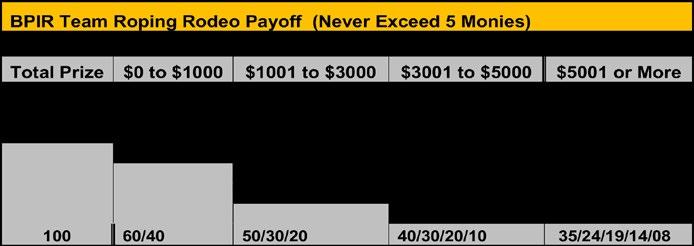
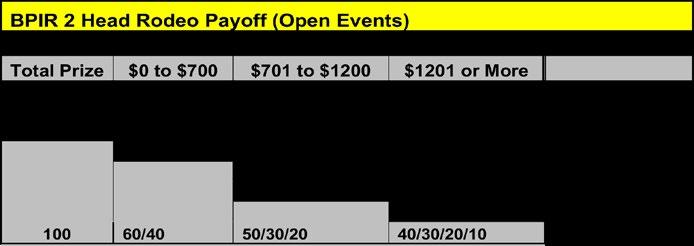
7. Payoff for each BPIR rodeo will be structured as follows:
The BPIR Finals payoff scale will be announced each year once the finals added money is determined. * In the event we pay 5 monies, the 5-money payoff will be 35%, 24%, 19%, 14%, 8%.
8. RFKS Entry Rule: Timed events (Calf Roping, Steer Wrestling, Ladies Breakaway, Jr. Break Away, Team Roping, Ladies Steer Undecorating) are last to ENTER first to go EXCEPT Ladies Barrel Racing.
9. Stalls and RV Hook-Ups: Contestants, Staff and Specialty Acts are responsible for fully paying their Stall, RV and Electrical Hook-up Charges in each market. If anyone leaves a market without paying their charges, they will not be allowed to enter another BPIR rodeo until all charges are paid.
F. BAREBACK/RANCH BRONC ADDED MONEY:
There must be a minimum of four paid contestants for the event to take place by the close of books. If there are not 4 paid contestants when the books close, the added money can be adjusted, or the event can be eliminated. If the event is eliminated, entries will be refunded to those paid.
G. ONE HEADER/TWO HEADER RULES:
For timed events, the contestant has 3 attempts to set their animal to contest their stock. After the 3rd attempt, the Judge will allow 45 seconds before your stock is released. The following pertains to whether the rodeo will be a one header or two header:
1. Bareback/Ranch Bronc and Bull Riding at the Bill Pickett Invitational will always be a two header unless specified differently after the books are closed.
2. Steer Wrestling will be a one header if there are 14 or more paid contestants. If less than 14 paid contestants, it will be a two header.
3. Calf Roping will be a one header if there are 14 or more paid contestants. If less than 14 paid contestants, it will be a two header.
4. Team Roping will be a one header if there are 14 or more paid contestants. If less than 14 paid contestants, it will be a two header.
5. Ladies’ Steer Undecorating will be a one header if there are 14 or more paid contestants. If less than 14 paid contestants, it will be a two header.
6. Ladies’ Breakaway will be a one header if there are 14 or more paid contestants. If less than 14 paid contestants, it will be a two header.
7. Ladies’ Barrel Racing is a two header until there are 16 or more paid contestants. If the ladies barrel racing defaults to a one run, the running order will be split in half. Contestants 1 through 8 will run in the first performance and 9 through 15 will run in the second performance.
H. ROOKIE OF THE YEAR QUALIFICATIONS:
To be eligible for Rookie of the year, a participant must compete in one more than 1/2 of BPIR rodeos according to the BPIR
published requirements each year. The one more than 1/2 creates an interesting dilemma when there are an odd number of rodeos. To clarify, if there are seven rodeos, the participant would have to compete in a total of five rodeos (Example: ½ of seven is 3.5 and one more would be 4.5; since one cannot compete in half a rodeo, the number required to compete in would round up to the next whole number). A Rookie contender must be a NEW Open Rodeo member and have not participated and competed previously as a BPIR member in any BPIR open event. Please note that the BPIR National Championship finals does not count towards the rodeo count.
X. PRE-RODEO ADMINISTRATION
A. ONLINE ENTRY SYSTEM
1. All entries for BPIR rodeos will be taken through the NextGen Online Entry System. Only those members and permit holders in good standing may enter.
2. All memberships for BPIR will be done through the Join it Online System.
Contestants can always access information through the BPIR website, BPIR Facebook contestant page or the Rodeo Talk app.
B. RODEO EXECUTIVE ASSISTANT/RODEO
SECRETARY
1. Rodeo Executive Assistant shall be hired, designated or appointed by BPIR Executive Staff.
2. A Rodeo Executive Assistant/Secretary are the only person(s) who can accept entries outside of the online system.
3. The Rodeo Executive Assistant will be responsible for any errors made on the contestant part and will be responsible for correcting such errors.
4. The Rodeo Executive Assistant shall deduct six percent (6%) of the total prize money (entry fees plus added money) and shall remit this money along with rodeo results and any
collected fines to BPIR Executive staff before payoff. Any prize money not collected must also be submitted to the BPIR Executive staff immediately following payoffs.
5. The Rodeo Executive Assistant will be held responsible for payment of the above total amount (6% plus collected fines, and any uncollected prize money) to the BPIR Executive Staff. Failure to comply will result in a fine plus the total unremitted amount being due and payable from the Rodeo Executive Assistant.
6. The Rodeo Executive Assistant/Rodeo Secretary will receive a current list of suspensions and fines and shall be responsible for checking that list and rejecting the entry of any person who currently is on the suspension list or who has an unpaid fine. The Rodeo Executive Assistant/Rodeo Secretary will be fined per offense for allowing any such person to enter and compete.
7. It is required that the Rodeo Executive Assistant/Rodeo Secretary be at the rodeo arena a minimum of one hour prior to each performance or the designated time based on the rodeo market. Failure to do so will result in a fine which will be deducted from pay.
8. The Rodeo Secretary will remain at the announcer’s stand or surrounding area for the entire rodeo performance and slack except when competing, and official timekeepers will be responsible for recording official times and scores, , at which time the Rodeo Executive Assistant shall appoint a designee to record times.
9. Ground rules (not in conflict with the BPIR Rulebook) must be posted, in the same area where livestock draw is posted before contestants will be required to comply.
10. The draw for each rodeo must be typewritten or recorded in ink. Times must also be recorded in ink. Notation must be made in ink by Rodeo Executive Assistant/Rodeo Secretary of any changes along with an explanation of each change.
11. If it is found that Rodeo Executive Assistant/Rodeo Secretary has mishandled prize money or entry fees or has falsified rodeo records in any way, they will be fined and disqualified from working any future BPIR rodeos until stated fine has been paid and a $5,000 cash bond has been posted for a minimum period of one year.
C. RODEO ENTRIES
All rodeo contestants will be required to use the NextGen Rodeo online system to enter a BPIR rodeo. The Rodeo Executive Assistant/Rodeo Secretary is required to verify entry information. Any member for whom entry Information cannot be verified, WILL NOT be entered.
1. BPIR will not honor and will not accept any entries taken by anyone other than the online system or Rodeo Executive Assistant/Rodeo Secretary in special circumstances.
2. The Rodeo Secretary will be required to verify contestants are current BPIR members prior to every rodeo. Any member contestant who is unable to produce their membership number or prove membership must obtain written approval from a BPIR executive staff member and present it to the Rodeo Executive Assistant before they can register and compete.
3. The Rodeo Secretary will also be responsible for verifying all membership paperwork prior to every rodeo to ensure all forms are signed and properly documented. Failure to do so will result in a fine that will be determined by CEO.
4. The Rodeo Executive Assistant shall deduct six percent (6%) of the total prize money (entry fees plus added money) and shall remit this money along with rodeo results and any collected fines to BPIR Executive staff before payoff. Any prize money not collected must also be submitted to the BPIR Executive staff immediately following payoffs.
5. Entries shall not be accepted by the Rodeo Executive Assistant/Rodeo Secretary before the books officially open, which shall be two weeks prior to the first performance of each rodeo.
6. The Rodeo Executive Assistant/Rodeo Secretary will receive a current list of suspensions and fines and shall be responsible for checking that list and rejecting the entry of any person who currently is on the suspension list or who has an unpaid fine. The Rodeo Executive Assistant/Rodeo Secretary will be fined per offense for allowing any such person to enter and compete.
7. Ground rules (not in conflict with the BPIR Rulebook) must be posted, in the same area where livestock draw is posted before contestants will be required to comply with same.
D. DRAWING OUT AND ENTRY FEE REFUND
1. Any contestant may draw out of a BPIR rodeo and receive a full refund of their entry fee(s), if Rodeo Executive Assistant is contacted by contestant within 48 hours after online entries has closed.
2. No entry fee for an event shall be returned to a contestant who has competed in that event during a rodeo in which there are multiple go-rounds.
3. If a contestant is injured while competing in one of two or more events entered, his or her entry fee will not be refunded for the event(s) in which contestant could not compete due to injury.
E. REGISTRATION
1. Registration (membership paperwork and entry) for every rodeo is done online using our Join it and Next Gen Rodeo online systems.
2. Every contestant must register online and complete the entire registration process, which includes paying entry fee, completing all paperwork, providing bio and headshot.
3. Contestants will receive their back number and wristband at the rodeo prior to competing. Every contestant must wear their rodeo back number and wristband throughout the duration of the rodeo, unless you are competing in the slack performance. Contestants without a back number and/or wristband will not be allowed into the arena. All contestants must wear their back numbers during the rodeo performance. Failure to wear the back number in the arena will result in a fine of $50.00 or disqualification while competing during rodeo performance.
F. DRAWING STOCK
1. If there is any rerun in any timed event, rerun positions will be given in the order the reruns were granted by the Judges. (Example: The person granted the first rerun goes first).
2. All stock in riding events must be drawn for by BPIR Judge(s). Drawing must be done so that any contestant may witness the draw. In all riding events a complete go-round must be drawn for at one time.
3. In a complete go-round, all stock must be drawn for the first day’s performance and a carry-on of a complete go-round until herd is drawn out. Then all stock is put back in a hat and the go-round is finished. No contestant may compete on the same head of stock twice at the same rodeo.
4. A contestant must compete on every head of stock drawn to place in the average.
5. Any stock in the original draw that is turned out (this means not bucked exhibition or contested), may be returned to the re-ride, if needed. If the animal has run off three consecutive times, it must be taken out of the draw.
6. Stock for re-rides must be drawn before the go-round or designated by stock contractor. Featured animals may be held out of this drawing then returned to draw for the goround. No more than two featured animals will be allowed
for each performance or go-round. Contestant re-rides are to be drawn for by Judges or designated by Stock Contractor.
7. When an extra is drawn, the extra will be used regardless of slack or performance.
G. MISDRAWS
1. Any animal which must be replaced will be considered one mis-draw. If more than two heads are misdrawn, all stock shall be put back in the draw box and all redrawn.
2. Extras: If pens are drawn from the predesignated herd, at least one more animal than the number of contestants should be drawn to be used in case of a misdraw.
Following the cattle draw, that animal(s) remaining shall be considered the extra(s). In case the extra is not used for that given performance or section of slack, said extra shall be placed with those animals not already included in a competition or pen draw.
a. In case of a misdraw discovered prior to a performance or any time during the slack, if an extra is available, all animals below the misdraw up to the end of the run on the cattle are used; one animal is drawn, that being the animal assigned to the contestant with the misdraw. The contestant who originally had that animal will be assigned the extra.
b. If no extra is available, all animals below the misdraw up to the end of the run on the cattle are used with the last animal drawn in that run designated the extra. In this instance, the last man to have originally drawn an animal in that run requires a repeat of the misdraw procedure which applies but will not be considered an additional misdraw.
c. If no extra is available, the contestant involved will not compete as scheduled, but later in the performance or
immediately after. A replacement animal will be drawn from all animals left in the run.
XI. RODEO OPERATIONS
A. Timers
1. All BPIR timers must be experienced and approved by BPIR Executive staff.
2. Timers who time the first performance in a particular event shall be required to time all competition in that event. If this cannot happen for some reason, the BPIR Executive staff must be notified immediately, and they will decide how to proceed. If a change is needed, the contestants should be advised before the beginning of the next performance.
3. The main timekeeper time will be used as the official recorded time and the backup time will be recorded as back up unless there was a malfunction with the main time being recorded.
4. The use of automatic timers is required in the Ladies’ Barrel Racing. Times must be recorded as the most complete time shown on the timer.
5. Two timers are required in the Bull Dogging, Calf Roping, Ladies’ Steer Undecorating, Team Roping and Breakaway events.
6. The Ladies’ Barrel Racing event shall have two electrical timers for the barrel racing and one manual backup. Readout box times must be read and recorded by official timer in 1000ths of a second. One timer will record the times that appear on the electric eye readout. Additional timer will operate the manual stopwatch and will add one zero to have time recorded in thousandths. They will operate from the flag man’s signals to start and stop time.
7. The use of automatic buzzer is recommended in all events.
B. JUDGES
1. All Judges and flagmen must be BPIR, CPRA, PRCA or IPRA members in good standing. Judges and flagmen must have the following qualifications, (i.e. obtained judging certification and/or have judging experience for the last five years). If a Judge competes in a timed event, they cannot judge the event in which he or she competes. Judges will be selected by BPIR Executive Staff.
2. A member who is on the ineligible list cannot accept any judging job until his name is removed from the ineligible list.
3. If a contestant has a disagreement about a call, they must immediately declare to the Judge their intent to challenge. If such declaration is made, the Judge must immediately address the issue at the end of the event and resolve by making a final decision prior to the beginning of the next event according to the rules in the BPIR Rulebook unless the decision effects the continuation of the event. Once the Judge has issued a ruling in accordance to the BPIR Rule book, the decision is final and there will be no additional discussion concerning the issue. Any contestant violating this regulation will be reported to the BPIR office by the Judge, the arena director or other BPIR staff members of the rodeo. A contestant who is found to have violated this rule or delayed the rodeo will be fined $50.00 for the first violation, $100.00 for a second violation and suspended from any future BPIR Rodeos for additional violations until they are notified by BPIR Executive Office of their eligibility to compete.
4. Judges are required to mark on their contestants’ sheets anyone turning out stock and which animals were mounted out or ran in the timed events. Judges should provide
contestants sheets in their entirety with recorded penalties only to the Rodeo Executive Assistant/Rodeo Secretary. The Executive Assistant is required to report any infractions concerning contestant sheets to the BPIR Executive Staff along with the results of that rodeo.
5. Markings in the riding events shall be totaled by both the Judge and the Rodeo Secretary and posted after each performance.
6. Barrier Judges shall keep a record of all barrier fines. They will be provided a complete list of contestants by the Rodeo Secretary. Their records and the Rodeo Secretary must correspond.
7. BPIR Judges are required to enforce all rules pertaining to the competition according to the BPIR rules outlined in the BPIR Rulebook.
8. A Judge has the authority to request any person be excused from the arena, if that person in the Judge’s opinion, is interfering with any event.
C. ANNOUNCERS
1. It is a violation of the rules for an Announcer to deliberately misinterpret any contest action.
2. If injury of stock is mentioned during the rodeo, the Announcer may advise audience how injury is being handled.
3. Announcers are to reframe from using profanity or making any disparaging or offensive comments during the rodeo or any interaction with the public.
D. HUMANE RULES
1. Calves must be strong, healthy, and weigh no less than 225 pounds and not more than 275 pounds.
2. Humane livestock prods shall be used only when necessary and only on appropriate areas of the animal.
3. No contract performer will abuse rodeo stock.
4. Arena help may be terminated and/or contestant may be disqualified for any mistreatment of stock. Judges, Directors, Stock Contractors, Producers, or other contestants will be responsible for enforcing this rule.
5. All horse and bull flanks are to be provided with protective lining. Horse flanks shall be of the release type. Flank straps are to be fastened onto the animal so that the protective lining portion covers belly and both flanks and shall be kept in good repair. No foreign objects will be allowed on flanks or tied to tail.
6. Animals will be inspected, and objectionable ones eliminated before drawing. Judges who fail to comply with this rule will be subject to a fine.
7. Any individual deliberately abusing livestock in a BPIR rodeo arena, regardless of whether the abuse happens during a qualified or unqualified run will be removed from the arena and totally disqualified from that rodeo and fined.
8. Any member tampering with competition livestock will be disqualified for the remainder of that rodeo and will be subject to a fine and suspension.
9. Only the Rodeo Judge will be allowed at the score line and must be to the roper’s left.
10. Hazer must not hit the steer or have contact that affects the forward motion of the steer before catch is made or render any assistance to contestant while he is working steer. Failure to observe this rule will disqualify contestants from competing and NT will be recorded.
E. EQUIPMENT
1. Equipment must meet the following humane specifications as well as those in the event rules.
a) A leather covered hair pad MUST be on the entire underside of the bareback rigging next to the animal
and extend a minimum of four inches from the back of the rigging. Pads must be loose (can be attached to rigging, but not permanently, so that rigging may be moved to a new area on the pad for better protection to horse if rigging has broken down the contents of the pad), kept in good repair, and not smaller or larger than a minimum of 15 inches and maximum of 25 inches. Stock contractors will have the right to furnish pads. Pads are to be no thicker than standard hair pad nor larger than 25 inches. Cinch must be at least eight inches wide on all bareback riggings.
b) Bull Riding will be done with one hand and a LOOSE rope. Knots or hitches to prevent rope from coming off of the bull when rider leaves bull will not be permitted.
c) In Bareback Riding, contestants will be disqualified for riding with locked rowels or rowels that will lock during ride. Judges will be responsible for inspecting rowels and enforcing this rule.
d) In all riding events, contestants will be disqualified for riding with rowels too sharp in the opinion of the Judge.
e) In Calf Roping, contestants MUST adjust neck rope and reins in a manner that will prevent horse from dragging calf. If a horse turns his tail to the calf and drags the calf after roper has dismounted, Field Judge may stop the horse and disqualify roper
f) There will be no exposed wire in any of the horse bats or other equipment used on horses in the arena.
XII. GRAND ENTRY/COLOR PRESENTATION
A. BPIR urges that all colors and grand entries be handled by competing horsemen or horsewomen, and that BPIR members ride in the grand entry if needed or requested to do so.
B. Any contestant having a horse on the grounds may be
asked for their assistance in the grand entry or to carry a flag when asked to do so by the BPIR Executive Staff.
C. Grand Entry Director shall be responsible for enforcing the rule. Rider may be excused by the director with good reason. Any contestant competing in the first event of each performance will automatically be excused from riding in the Grand Entry or bearing a flag.
XIII. RIDING EVENTS
A. GENERAL RULES
1. Rider and animal are to be marked separately. Rider must be marked according to how much riders spurs the animal. Figures used in marking the riding events shall range from 1 to 25 on both bucking animal and rider using the full spread.
2. Judges in the riding events at all BPIR rodeos will hand in their markings for that event for the performance and these shall be termed the official markings. These markings shall not be changed.
3. To qualify, Bareback Rider must have spurs above the break of the shoulders and when horses front feet hit the ground in his initial move out of the chute.
4. If the horse stalls coming out of the chute, either Judge shall tell rider to take his feet off of the horse’s neck and first jump qualification will then be waived.
5. Rider shall be disqualified for not following Judge’s instructions to take feet from neck of horse stalled in chute.
6. If in opinion of the Judge, the rider is fouled at the gate, a re-ride may be given or the spurring out rule be waived at the Judge’s discretion.
7. Rodeo Judges will use red flags to indicate a violation of the spurout rule and all other disqualification violations. Judges are to also indicate disqualification violations by using already established hand signals.
8. Contestants may pull rigging, cinch saddles, and pull ropes from either side in all riding events.
9. If an animal that is drawn in a riding event, or is drawn in a pen, becomes sick or crippled before it is out, a Judge must verify and advise staff of the animal’s inability to be used before it can be shipped or replaced in the draw.
10. All riding events shall be timed for eight (8) seconds; their time is to start when the animals inside front shoulder passes the plane of the chute.
11. At the judge’s discretion, and with prior notice to the contestant, a 30-second timer may be started if the rider is taking too long. If the contestant exceeds the time limit, a disqualification may occur. Stock must be standing for this to apply.
12. Rider must tell one judge, flank man and/or stock contractor if he does not want his draw touched with the hotshot unless hotshot is prohibited. If a contestant requests that no hotshot be used, no re-ride will be awarded if the animal stalls or runs off. However, if the animal stops or falls or the rider is fouled a re-ride may be awarded.
B. BAREBACK/RANCH BRONC RIDING
1. Riding is to be done with one-handed rigging.
a) Rigging shall not be less than ten inches in width at the handhold and not over six inches at the “D” ring. Latigo cannot be blocked in “D” ring. Riggings will use a standard “D” ring to be set to sit flat on horse’s back when cinched.
b) Rider may have single layer of leather, not to be skived under handhold, which will extend at least one inch on both sides of the center of the handhold. It shall be glued down.
c) No fiberglass or metal in riggings or handhold. Only leather or rawhide allowed for handhold. Flathead
rivets and/or screws and “t” nuts allowed to secure handhold; only other metal allowed will be in the “D” rings.
d) Cinches on bareback riggings shall be made of mohair and shall be at least eight inches in width at the center but may be tapered to accommodate cinches “D” or rings.
2. Required bareback pads are to completely cover the underside of the rigging and are to extend a full two inches behind the rigging.
a) Pads used under riggings must be leather covered on both sides. If they are hair pads, they must be at least 1 1/4 inch thick.
b) In addition to the pad, a piece of leather a minimum of 1/8 inch thick and four inches square must be glued or sewed to the pad and centered in comparison to the total body length of the rigging. This piece of leather shall be placed so that 1/2 inch of it extends behind the rigging and the remaining two inches are under the rigging.
3. Stock contractors will have the right to have Judges pass on whether riggings are objectionable. Judges are to decide on all riggings and pads.
4. The rider’s glove will be a plain glove with no flaps, rolls, wedges or gimmicks.
5. A palm piece may be used in glove, which will be at least one inch wide and three inches long and glued in.
6. There will be no adhesive material other than dry resin used on rigging or on rider’s glove. Benzoin may be used.
7. Riders may be given a re-ride on same horse if flank come off or breaks, provided he completes a qualified ride. The matter of re-rides shall be decided by the Judge.
8. Any of the following offenses will disqualify a rider
a) Riding with rowels too sharp or locked in the opinion of the Judge.
b) Being bucked off.
c) Touching animal, equipment, or person with free hand. One arm must be free at all times.
d) Rigging comes off horse, with or without breaking.
e) Not having spurs above the break of the shoulders and touching horse when horse’s feet hit the ground in initial move out of the chute.
f) Taking finger tuck, finger wrap, or using finger tape are violations. Violators shall be disqualified and may also be subject to a fine.
g) Judges shall disqualify bareback rider who has been advised he is next to go, if he is not above the animal with his glove on when previous horse leaves the arena.
9. If, in the opinion of the pickup men and/or Stock Contractor, a bareback rider is unable to free his hand from the rigging at any point after the eight second whistle, he shall be fined. Judges are to report the offense.
C. BULL RIDING
1. Riding is to be done with one hand and loose rope, with or without handhold.
a) No knots or hitches can prevent rope from falling off bull when rider leaves him.
b) Rope must have bell.
c) Hooks or posts shall not be used on bull ropes.
d) A ring may be used on a bull rope.
2. Riders who are knocked off at a chute, or if the bull falls, will be entitled to a re-ride at the discretion of the Judge.
3. A bull rider may have the option of a re-ride, or of accepting
a marking, if flank comes off the animal, providing the contestant has completed a qualified ride. The re-ride may be given on the same animal if the Stock Contractor is willing or if requested by the contestant. The matter of re-rides shall be decided by the Judge, regardless of performance.
4. If rider makes qualified ride with any part of rope in rigging hand, he is to be marked.
5. Contestant will have the right to call Judge to pass on whether the bull is properly flanked to buck to the best of its ability.
6. Bell must be under belly of bull.
7. Rider cannot use sharp spurs.
8. No more than two men may be on chute to pull contestant’s rope.
9. Head-fighting bulls having bad horns must be tipped or kept out of the draw.
10. No bull may be put in the draw until his horns have been cut back a reasonable distance.
11. Rider will be disqualified for any of the following offenses:
a. Being bucked off.
b. Touching animal, equipment, or person with a free hand.
c. Using sharp spurs or placing spurs of chaps under the rope when rope is being tightened.
d. Not having a bell on bull rope.
e. Judges may disqualify a bull rider who has been advised he is next to go if he is not above the animal with his glove on when previous bull leaves the arena.
12. Membership Waiver (2026 Season)
For the 2026 season, BPIR will waive the annual membership fee for Bull Riding contestants only.
13. Finals & Year-End Eligibility (Group 1)
Any Bull Rider who competes in a minimum of five (5) BPIR Rodeos during the 2026 season will:
a. Be eligible to compete at the BPIR Finals
b. Be eligible for year-end awards
c. Have their BPIR Finals entry fees paid by BPIR
14. Alternates (Group 3)
Any Bull Rider who competes in a minimum of five (5) BPIR Rodeos during the 2026 season will:
a. Contestants wishing to compete in any additional BPIR events must purchase the appropriate BPIR membership(s) for those events.
b. Participation in Bull Riding does not grant eligibility to compete in other events without proper PAID membership.
15. Event Limitation
This membership waiver applies exclusively to Bull Riding.
a. Contestants wishing to compete in any additional BPIR events must purchase the appropriate BPIR membership(s) for those events.
b. Participation in Bull Riding does not grant eligibility to compete in other events without proper PAID membership.
D. RE-RIDES
1. Refer to “Drawing Stock” and to individual riding event categories for additional information.
2. Re-rides will be given at the discretion of a Judge. Reasons for possible re-rides are
a) If an animal stops.
b) If animal fouls rider.
c) If Stock Contractor’s equipment fails.
d) If performance of animal is inferior.
3. Contestant may take same animal back, providing Stock Contractor is willing, or contestant may demand a re-ride animal be drawn. If contestant takes same animal, he must take that marking. The only exception will be if contestant is fouled or there is an equipment failure.
4. If pickup man or horse comes in contact with a bucking horse before qualified time has elapsed, re-ride will be given on same animal unless contestant demands a re-ride animal be drawn. Only exception to this rule is if it is that rodeo’s last day. On the last day, contestant may have same animal if Stock Contractor is willing, or re-ride draw is requested. If Stock Contractor is not willing, a re-ride will be drawn.
5. If a re-ride is given, the Judge shall inform contestant of his marking and an option of a re-ride. Contestant may refuse the re-ride and take markings. Contestant must notify Judge immediately of his decision to accept or reject the option.
6. Contestant shall not influence the Judge by asking for a reride at any time.
7. If an animal that runs off is already drawn for another contestant, that contestant must qualify on that animal before a re-ride is given.
a) If in the opinion of the Stock Contractor and the Judge, that animal needs to be taken out of the draw, the second contestant who had him drawn will automatically get the designated re-ride.
8. If in the opinion of the Judge, a rider makes two honest efforts to get out on a chute-fighting animal and is unable to do so, he may have a re-ride drawn for him.
9. If an animal that is drawn for a re-ride is already drawn for another contestant in that or a later go-round, the contestant with the re-ride in the prior go-round will take the animal first.
10. No re-ride will be given if a cowboy’s own equipment breaks. If Stock Contractor’s equipment breaks, contestant may have a re-ride.
11. In the case of a riding-event stock injury after the draw has been made, replacement stock should be the designated re-ride for the performance the injured animal was scheduled for competition. A replacement designated reride should be drawn immediately from the notified turnouts for that performance. If there are no turnouts, a re-ride should be drawn from all available animals.
12. If a riding-event animal stops after an initial start and any outside help is used to start it again, contestant will not be required to qualify to be awarded a re-ride.
XIV. TIMED EVENTS
A. GENERAL RULES
1. A ten-foot tape must be on hand for the Barrier Judge. Height of the barrier in timed events shall be from 32– to 36 inches, measured at the center of the box. In timed events where automatic barriers are used, automatic slack catchers are to be eliminated. Knot behind pulley is required on all barriers.
2. Barrier Judge is responsible for changing barrier string whenever it may have been weakened, or on request of next contestant.
3. Barrier Judge shall keep record of length of the barrier trip rope each performance, to assure the same start for contestants each performance. Adjusting length of barrier trip rope will be accomplished only by tying knots in rope on either end.
4. A ten second penalty will be added for breaking or beating the barrier. In all timed events, a barrier will not be considered broken unless ring drops within ten feet of post.
5. Barrier equipment must be inspected by the Judge before each timed event. If equipment is faulty, it must be replaced. Should barrier break at any point other than designated breaking point, decision is up to the Barrier Judge. If contestant obviously beats barrier, but the staples are pulled, or barrier rope is broken and string unbroken, Barrier Judge may assess a ten second penalty. Otherwise, this will not be considered a broken barrier.
6. If barrier flagman is used, animal is to be flagged when animal’s nose crosses the starting line or deadline in front of flagman.
7. Barrier Judge shall be sure that no one can stand close enough to barrier or barrier equipment to tamper with same.
8. Once score has been set in timed events, it will not be changed at that rodeo, nor can length of box be changed.
9. For time to be considered official barrier flag must operate.
10. If automatic barrier does not work but time is recorded, contestant will get time, but there will be no penalty for broken barrier providing Judge rules barrier was not broken.
11. If automatic barrier fails to work and official time has not started, contestant will get stock back if stock is qualified on infield.
12. If in the opinion of the Line Judge, contestant is fouled by barrier ropers shall get their calf or steer back providing contestant declares himself by pulling up immediately.
13. In any timed event, if an animal escapes from the arena a flag will be dropped, and watches stopped. Contestants will get animal back with lap-and-tap start and time already spent will be added to time used in qualifying. If time is not recorded the decision of the Flag Judge shall be final.
14. If rope is on the animal, roper will get the animal lap-andtap, with rope on it in chute.
15. A Field Judge must ask contestants if they want a second loop or jump. Once a man has been flagged out, he will receive no stock back.
a. If time is not recorded when a field flagger flags out a contestant who has a second loop or jump coming, the contestant has the option of taking the animal back, lap- and-tap, with ten (10) seconds added to the new time.
16. During any performance, if an animal in timed events escapes the chutes or pens before it is called for by contestant, or if the automatic barrier fails to work, the contestant will run the extra already identified and penned on the timed event end.
17. The decision of whether the timed-event cattle are to be lined will be made by the respective Event Director, or designated person, who will notify the Barrier Judge. If cattle are to be lined, it shall be accomplished by one designee to be stationed at the same position on all contested cattle, including supplementary contesting. Violators will be subject to punitive action.
18. Flag Judge shall position himself for calf roping at the end of the arena allowing him to come towards the roper. In bull dogging, field flagger shall place himself against the wall on the left-hand side of the timed event box.
19. If an animal that is drawn in a pen in a timed event becomes sick or crippled before it is out that time, a Judge must verify and advise staff of the animal’s inability to be used before it can be shipped or replaced in the draw.
20. All performance competition order changes must be made with Rodeo Executive Assistant or timed-event chute boss prior to start of that performance, or a later time if agreeable with the Rodeo Executive Assistant.
21. Within the confines of the timed event box, it is the privilege of a contestant to dismiss someone from the box or have up to three people in the box for assistance. He may instruct the Judge to either remove or allow other people in the box.
a. The man pushing the cattle in the timed events cannot leave the mouth of the box until the animal has crossed the score line. Failure to abide by this rule will result in a fine to the contestant.
22. Stock Contractors shall bring at least three head of stock in the timed events into the chute, according to the position drawn, at the start of each go-round.
23. In timed events, provided there are other qualified horses on the rodeo grounds, no consecutive runs shall be allowed on the same horse, or horses, unless approval is granted by the General Manager/Arena Director and/or Stock Contractor.
24. In roping event, a dropped rope that must be recoiled to be rebuilt is considered a thrown rope.
25. Neck ropes must be tied with string. No metal snaps or hardware shall be used on neck ropes in the timed events. Adjustable slide shall be used on all neck ropes for cattle used in the timed events.
26. Animal belongs to contestant when he calls for him, regardless of what happens, except in cases of mechanical failure. If contestant accepts animal, he accepts it as sound.
27. There shall be two timers for all timed events, a Barrier Judge and a Field Flag Judge, except for Ladies Barrel Racing.
28. Animals used for these events should be inspected, and objectionable ones eliminated prior to the start of each performance and/or slack.
29. Any timed event contestant who fails to heed an initial warning from the field flagger that he is mistreating an ani-
mal will be fined for the first offense and disqualified for the second offense.
30. The rider has two attempts to position their horse in the corner. However, on the third attempt, a 25-second timer will begin. If the rider fails to complete their setup within the time limit, a disqualification may occur. Stock must be standing for this to apply.
B. BULL DOGGING (STEER WRESTLING)
Contestants must furnish their own hazer and horses. Only one hazer allowed.
1. Stock belongs to contestant when he calls for him, unless the timer misses his time(s), or the Gateman/Line Judge declares gate man fouls the contestant by not releasing the steer when called for by contestant. The contestant will be awarded a rerun if he declares himself immediately. The rerun as a result of a missed time will be awarded with barrier penalty, if applicable. Reruns due to gate fouls will be awarded rerun with no penalty. There will be no rerun given due to hanging of horn(s) in chute.
2. Stock must cross scoreline in front of line judge in their initial move after leaving chute. Failure to do so will result in animal being brought back and rerun. In the opinion of the Rodeo Judges, if that failure to cross scoreline in the initial move out of the chute was caused by contestant, hazer or heeler, a ten (10) second penalty may be assessed on the rerun. Add a clarification: Not crossing in initial move may include but not limited to‐ Animal turning back before crossing scoreline behind line judge or lineman opposite the line judge, stumbles, falls or not pulling the barrier or neck rope not breaking off of animal’s neck.
3. Steer must initially be caught from horse back. If the steer gets loose, dogger may take no more than one step to catch steer. After catching the steer, dogger must change direction or bring steer to a stop and twist down. If a steer
is accidentally knocked down or thrown by dogger putting animal’s horns into the ground, it must be let up on all four feet and then thrown. Steer will be considered down only when it is lying flat on its side or on its back, with all four feet stretched out in the same direction. Dogger must have hand on steer when flag drops. The fairness of catch and throw will be left to the Judges, and their decision shall be final.
4. Hazer must not render any assistance to contestant while contestant is working with steer. Failure to observe this rule will disqualify contestant. Contestant and hazer must use the same two horses they leave chute with. Hazer will be disqualified for jumping at steer.
5. When a barrier is used in the bull dogging, an automatic or manual barrier must be used and there must be at least a 12 foot box. If box is shorter, bull dogging must be lap and tap.
6. It is the Stock Contractor’s responsibility to produce a uniform set of steers. The privilege of eliminating uneven steers, when necessary, will be retained by Judge and or Steer Wrestling director. All new or fresh steers in this event must be caught from horse and thrown at least one time and this arrangement is the responsibility of the stock contractor.
7. If lap and tap contest, contestant’s feet must hit over scoreline, or he shall be penalized ten (10) seconds.
8. Steer must be caught from horse. If steer is missed or gets loose after each catch, no more than one (1) step can be used to re-catch steer. If contestant misses or loses steer, flagman must ask contestant if he wishes another jump. Contestant must reply at once.
9. Bull dogging chute must have at least 30 inches clearance inside the chute, and at the gate when in open position.
10. In bull dogging, the score may be no longer than the length of the bull dogging box minus six feet unless the box is less than 14 feet. In that instance, the length of the score would be a maximum of the length of the box minus five feet, unless deviations are approved by the Event Director (or designated person). Length of the box is to be measured from center of back end of box to center of barrier. There shall be two or more timers, a Field Flag Judge and a Barrier Judge.
11. Field Flagger is required to watch contestant and steer until animal is turned loose. Contestant is required to turn steer’s head so he can get up. General Manager or Arena Director may report infractions.
12. In the Steer Wrestling, contestant has a 30 second time limit to complete his run in a one-head contest. In a two or more-go-round contest with an average, calf roper has a 30 second time limit to complete each run.
13. If there is an average, and if a steer wrestler misses or loses steer, contestant should continue a forward motion to signal judge that he wishes another jump.
14. Steer Wrestling cattle will have a minimum weight of four hundred fifty (450) pounds.
15. Tie breakers will be determined based on a 3-digit timing format.
C. TIE-DOWN ROPING RULES – CALF ROPING
1. Contestant must catch calf, dismount, go down the rope and throw the calf by hand, cross and tie three legs. If calf is down when roper reaches it, calf must be stood on at least three feet (calf maybe helped by roper but at least three feet must be dangling straight underneath calf) and calf must be re-thrown. If roper’s hand is on calf when calf falls, calf is considered thrown by hand. Tie must be finished with half hitch or “hooey”.
2. There must be an honest effort to tie down calf during a paid performance. Failure to comply with this rule will result in a fine.
3. Tie must hold for five seconds and THEN be passed on by the Field Judge. Judge will start this five second period as soon as the roper finishes the tie and clears the calf.
The Field Judge will start the time once the roper completes the tie, stands up, and takes one step clear of the calf toward their horse.
The calf must remain securely tied for five seconds with a clean tie. If the calf becomes untied before the five-second period expires, or if the judge determines during inspection that the tie is incorrect, the roper will be disqualified.
4. Roper must not touch calf after giving finish signal until after Judge has completed his inspection.
5. Catch as catch can. Any catch is legal. Rope must hold until roper catches calf. Untie man must not touch calf until the Judge passes on tie.
6. Calves must be strong, healthy, and each calf shall weigh not less than 225 pounds and not more than 275 pounds. Calves’ horns cannot be more than 1/2”. The calves must be pre-conditioned, this means they must be roped and tied at least two to three times before coming to the rodeo. All herds shall be of even characteristics, all the same type or equal cross, weight, height and age. Judges and/or Calf Roping Director shall retain the privilege of eliminating uneven calves when necessary. The Stock Contractor/ Producer’s failure to comply will result in a fine.
7. Automatic barrier will be minimum of the length of the box minus six-foot score line. Maximum will be length of box given to arena length and cattle (fresh or all runners) and/or a very deep box. Once score line has been set, it will not be changed during that go-round, nor will roping box, chute or barrier be changed in any manner.
• A stopwatch will be used by the Field Judge. Calf must stay tied securely for five seconds. Judge will start this five second period as soon as the roper finishes the tie and clears the calf.
8. Calves used for tie-down roping cannot be used for any other event. There will be an automatic fine for infraction of this rule. Judges will be responsible for enforcing this rule and reporting infraction of same.
9. Disqualifications: Two loops will be permitted during BPIR Finals if roper is carrying two loops. If he misses with both, he must retire, and no time will be allowed. Roper cannot rebuild first loop. Roping a calf without releasing loop from hand is not permitted. Contestant must adjust neck rope and reins in a manner that will prevent horse from dragging calf. If a horse turns his tail to the calf and drags the calf after roper has dis-mounted, Field Judge may stop the horse and disqualify the roper.
10. If a tie comes loose or calf gets to his feet before the tie has been examined and ruled a fair one, the roper will receive no time.
11. A fine shall be imposed if a calf is roped in a manner which causes the animal to land on its back or head with all four feet in the air. A minimum fine of $100 may be imposed if the calf is roped or handled in an intentional and rough manner. Fines for unintentional jerk downs may be waived if fresh or unconditioned calves are used.
12. Dragging of calf will result in a fine as follows: Unintentional fine is $50.00, while an intentional fine is $100.00 or disqualification at judge’s discretion.
13. If an animal is injured in the process of contesting in the timed events, the contestant shall not receive another head during that go-round.
14. Judge may stand on the right providing a suitable person will stand on the score line on left side.
15. In the tie-down roping, the contestant has a 25 second time limit to complete his run in a one-head contest. In a two or more-go-round contest with an average, calf roper has a 30 second time limit to complete each run.
16. Tie breakers will be determined based on a 3-digit timing format.
17. Animal belongs to contestant when he calls for him, except when barrier hits rope or contestant, timer misses time, or in the sole opinion of the Line Judge the gateman fouls the contestant by not releasing the animal when called for by the contestant. The contestant will be awarded a rerun if he declares himself immediately. The rerun as a result of a missed time will be awarded with barrier penalty, if applicable. Reruns due to gate fouls will be awarded rerun with no penalty.
18. If the Line Judge does not feel contestant was fouled, anotime will be allowed, and contestant will retire from the arena.
19. Timed event cattle will not be considered a legal run until drawn and contested.
20. In any timed event, if it is necessary to bring an animal back, several head of stock will be brought back together. No animal will be penned separately.
21. In the timed events, the Line Judge will drop a flag as soon as he determines the barrier is broken.
22. If wrong animal is given to a contestant, he shall be given the correct animal drawn for him and time on incorrect animal shall be disregarded.
23. If animal gets out of arena, the flagman is to stop the time and roper will get the same animal back, lap and tap (roper to start in chute) with the time he had when animal got out.
The timer(s) will start the new time at the breaking of the neck roper and that time will be added to the previous time, including any penalties that may apply.
24. If barrier equipment fouls contestant in calf roping, he will be entitled to a rerun if he declares himself immediately.
25. If roper breaks barrier before he declares, foul roper will receive cattle lap and tap with ten second penalty added to time.
26. If contestant breaks or beats the barrier, a ten second penalty shall be enforced.
27. Stock must cross scoreline in front of line judge in their initial move after leaving chute. Failure to do so will result in animal being brought back and rerun. In the opinion of the Rodeo Judges, if that failure to cross scoreline in the initial move out of the chute was caused by contestant, hazer or heeler, a ten (10) second penalty may be assessed on the rerun. Add a clarification: Not crossing in initial move may include but not limited to Animal turning back before crossing scoreline behind line judge or lineman opposite the line judge, stumbles, falls or not pulling the barrier or neck rope not breaking off of animal’s neck.
28. In the Tie-Down roping event, time is to start when animal crosses score line.
29. A contestant shall compete in the performance in which they are entered and be ready when called upon to compete or be disqualified from the go-round of competition.
30. In all timed events, when the Judges draw positions for a rodeo performance and more than one contestant riding the same horse draws up in consecutive positions, the Judge may change another contestant to fill a position splitting contestant who are riding the same horse. In Ladies’ barrel racing, BPIR will draw at least five contestants, splitting the contestants riding the same horse. Splits must be made by specified trade deadlines advertised for each market.
31. Roper must have a neck rope on the horse with tie down rope ran through the neck rope when competing in the Tie Down event.
D. LADIES OPEN, JUNIORS & PEEWEES BARREL RACING
1. The contestant is allowed a running start. Gate(s) must be safe and fair for all contestants. If the pattern is centered to the gate, contestant must keep forward motion to first barrel and forward motion when leaving the arena (i.e. if you run in, you must run out). If the pattern is not centered on the gate, the contestant can set up her run as necessary, without circling. A fine of $50.00 will be charged for circling, which will have to be paid before they are able to enter another BPIR rodeo or will be deducted from winning if applicable. A spin or pivot is acceptable
2. Bars in the alleyway will be removed or buried so the center of the alleyway is completely level.
3. If barrel covers are used, they should be used in the slack as well as the performance. Arena signage should remain in place during slack. The same barrels must be used throughout entire rodeo.
4. If all barrels are standing when contestant crosses eye after completing a qualified run, it is considered a qualified run, even if a barrel falls after she is flagged.
5. Barrel must be set back on marker if barrel is moved.
6. A contestant will not be disqualified or penalized for touching a barrel, but there will be a five second penalty for each barrel knocked over.
7. After the arena has been staked, no one will be permitted to go around the stakes for the duration of the rodeo or slack.
8. Should there be a timer malfunction, and there is no backup timer, barrel racer shall be granted a re-run with no penalties assessed for said performance.
9. The use of automatic timers is required in the ladies’ barrel race. Times must be recorded as the complete time shown on the timer. The automatic timer must be backed up with a second automatic/electric timer (when available) and one stopwatch (manual). The manual times must be recorded in hundreds and one zero added to have a time recorded in thousands. Manual times will be used for payoff only when the automatic timer is no longer operable.
10. Two timekeepers are required in the steer wrestling, calf roping, team roping and ladies barrel racing. All hand flagged times must be recorded in tenths (i.e., 9.6) except in ladies’ barrel racing, time must be recorded in hundreds and one zero added to have a time recorded in thousands.
11. If the electric eye fails to work for more than three of the contestants who competed in an entire go-round, the backup (electric/manual) recorded time will be the official time for all contestants in that go-round. If we must go to back up times because of electric eye(s) malfunction, announcer will make an announcement to that affect.
12. Contestant will not be given a rerun due to malfunction of timer. Backup time will be the contestant official time. If back up time is a manual time which is in tenths, timer will add a (0) to official time to be presented in thousands.
13. Reruns in the barrel race will be taken at the barrel racers discretion, either at the end of the barrel race or immediately following the performance with no penalties added. The same rule applies to slack. If contestant chooses to make rerun immediately after performance, the ground must be worked regardless of number of horses that run during the performance.
14. Contestant will be disqualified, if after crossing the timer and being flagged by the flagman, she re-crosses the timer before completion of a true cloverleaf pattern.
15. No one other than the contestant can be on horseback in the arena during contestant’s run.
16. All Barrel racers must cross the Timer line with hat on head or secured on their body or contestant will receive a fine of $50.00. This rule applies to all groups (Peewees, Juniors and Open barrel racers.
17. Committee is required to have necessary equipment in the arena to prepare the ground for the barrel race, the ground should be prepared immediately before the barrel race, so it is consistent throughout the event.
18. If the arena conditions are deemed at any time to be unsafe by the Judges, or the primary Stock Contractor, competition may be stopped until such time the arena conditions are deemed satisfactory by the individual or individuals who originally deemed the arena conditions unsafe. If arena conditions cannot be changed and improved to make conditions safe, event may be cancelled by Judge, or Stock Contractor.
19. Event is a two header until 16 or more contestants are paid. If Ladies’ Barrel Racing defaults to a one run, the running order will be split in half. 1 through eight will run in the first performance, and 9 through 16 will run in the second performance. Contestants will be notified as soon as run order is determined.
20. Once the barrel stakes have been placed, no person will be allowed to work any horse on stakes until all performances and slack have been completed. A fine of $50.00 will be charged for first offense, which will have to be paid before they are able to enter another BPIR rodeo. If there is a second violation, it will result in a disqualification.
21. Equipment necessary: Stakes, 55-gallon metal barrels, (2) com- plete electric eye timer, and one stopwatch to be operated manually.
22. A standard pattern is always preferred. The standard pattern for Barrel Racing is: 90 feet between barrel one and
two; 105 feet between barrel one and three and between barrel two and three; and 60 feet from barrels one and two to the score/starting line. Score/Starting line should be at least 60 feet from end of arena, if arena allows. Barrels will be staked at least 15 feet from the fence. There should be at least 25 feet between the third barrel and the back fence. In small arenas, it is recommended the pattern be reduced proportionately to the standard barrel pattern.
E. LADIES STEER UNDECORATING
1. There shall be a main timer, a back-up timer, Field Flag Judge and Barrier Judge. The time limit shall be 30 seconds. In a two or more-go-round contest with an average, steer undecorater also has a 30 second time limit to complete each run.
a. Contestant time will be recorded to include the onehundred digit. Example: 2.63
b. Both the Main timer and Back-up timer must coordinate start and stopping qualified time at the same points.
c. Judges are required to coordinate timers start point before the rodeo in the event a judgement barrier decision has to be made.
d. Main timer and back-up timer times MUST be recorded for all contestants for all performance and slack.
e. Tie breakers will be determined based on a 3 digit timing format.
2. Contestant must furnish their own hazer. Hazer must not render any assistance to the contestant in removing the ribbon from the stock’s body. Failure to observe this rule will result in disqualification and recorded as No Time.
3. Once a contestant signals for his stock it belongs to the contestants and no reruns will be granted unless granted from the Judges for safety purposes. Example: Judge may notice after the contestant nod her head a portion of the barrier is improperly connected.
4. When the contestant calls for stock, she must reach down, remove any portion of the ribbon from the stock’s back and raise her hands above her head with the ribbon to receive a qualified time. Judges can confirm the contestant has tape after the time has been stopped if there is a question. If the contestant raises her hand and does not have tape in her hand, she will be disqualified and receive a No Time. (If the tape breaks or contestant knocks it off, that is your tape).
a. Fall-Off Rule: If a contestant falls off her horse with the ribbon in her hand, her time will not stop until she signals above her head. She must have the ribbon before falling off.
5. Contestant can get her tape from either side of the stock.
6. All stock will be drawn prior to the performance EXCEPT at the RFKS events. All stock should be of equal size and weight, large enough to ensure safety. Heifers and Steers should not be mixed. All stock should be run through arena chute before rodeo.
7. Barrier will be set by appointed Judges. There will be a ten second penalty if the barrier if broken by contestant while competing. The barrier must always be placed behind the tape on stock back to avoid a malfunction of tape.
8. The Event Director has the authority to present any questions or concerns with barrier set up and/or stock on behalf of contestants during the set up.
9. Reruns
a. Contestant will be entitled to a rerun if:
I. the timer(s) and/or Judge malfunctions.
II. the barrier malfunctions.
III. the ribbon comes loose from one side before the contestant reaches/contest defaulted ribbon and contestant must declare themselves immediately and ask judges for a rerun immediately.
The rerun as a result of a missed time will be awarded with barrier penalty, if applicable. Reruns due to gate fouls will be awarded rerun with no penalty. There will be no rerun given due to hanging of horn(s) in chute.
iv. If the ribbon comes off due to barrier or defaulted tape, Contestant will NOT get a Rerun after the stock has been contested during the 30 second time limit.
b. Rerun should not automatically be granted by a Judge to a contestant without immediate declaration.
c. If the stock gets out of the main arena, the field Judge should stop the contestant time with a signal from the flag. The contestant should get a rerun with designated extra, with recorded time plus any barrier penalty (if applicable) lap and tap.
d. Lap and Tap time will start from the barrier line which is determined from the length of the neck rope.
e. Judge will be required to put a neck rope score line at each rodeo.
10. Gorilla Tape should be of a light color such as gray, white, or pink for visibility and to avoid conflict when there may be two performances, one is a day performance and other is a night show.
11. Judges should use Gorilla quality tape for both the base and the handhold. This will avoid the ribbon from potentially breaking in the center at its weakest point.
12. Event will be a one-header if there are (14) fourteen or more paid contestants. If there are (1) one to (13) thirteen paid contestants, the event will become a double header and the position order will reverse for the second performance.
13. Stock must cross scoreline in front of line judge in their initial move after leaving chute. Failure to do so will result in animal being brought back and rerun. In the opinion of the Rodeo Judges, if that failure to cross scoreline in the initial move out of the chute was caused by contestant, hazer or heeler, a ten (10) second penalty may be assessed on the rerun. Add a clarification: Not crossing in initial move may include but not limited to animal turning back before crossing scoreline behind line judge or lineman opposite the line judge, stumbles, falls or not pulling the barrier or neck rope not breaking off of animal’s neck.
F. BPIR LADIES & JUNIOR BREAKAWAY
1. Ladies Breakaway Roping is an event for Females only.
2. A barrier must be used at all rodeos for Breakaway Roping. At indoor rodeos, the length of score will be the same as the Calf Roping.
3. All score lengths are subject to Judges and BPIR Breakaway Roping Director approval.
4. The individual pushing the cattle cannot leave the mouth of the chute until the animal has crossed the score line. Penalty for failure to abide by this rule can result in a fine.
5. There shall be two or more timekeepers, a field judge, a barrier judge and as many other officials as the local management finds necessary.
6. Only One (1) loop will be permitted. Roping the calf without releasing the loop from the hand is not permitted.
7. Ropes are tied at the very end of the rope, to saddle horn
with nylon string. Bright cloth with dimensions of six inches by six inches (6’’x6’’) must be attached to end of rope.
8. Breakaway calves must not weigh over two hundred (275) pounds and weigh a minimum of two hundred (200) pounds and must be healthy and usable.
9. Horned cattle shall not be used in the breakaway roping. Horned cattle are defined as horns longer than three inches (3”) measured from the base of the horn. Only one (1) horn has to be over three inches (3”) to be classified.
10. The calves whole head must pass through the loop, or the contestant will be disqualified.
a. The loop must be drawn up around the neck (Bell Collar) with no extremities in the loop and in front of the tail head when string breaks.
b. If any extremities are in the loop when string breaks, ex. Figure 8 a tail or leg, rope dropped below tail head, etc., the run will be considered a no time. If the string breaks with the extremity in loop and then goes back around the neck of the calf, the run will still be a “no time.” If an extremity gets in the loop after the flagger has dropped flag; the run will be legal. For example: If the slack pops high and the loop feeds back out and a calf step into the loop.
c. If an official is available (at BPIR events, 3 or more judges), a spotter will be positioned on the opposite side from the judge, to watch for extremities in the loop, when the string breaks.
11. The field judge will flag the contestant when the rope breaks away from the horn.
12. Contestant will receive no time should she break the rope from the saddle horn, by hand, by touching the rope or string after catch is completed. However, if the rope should
dally around the horn, the contestant may ride forward, usually the rope, and then stop her horse to make the rope breakaway.
13. Ten (10) second penalty applies for breaking the barrier.
14. There will be a twenty-five (25) second time limit. In a two or more-go-round contest with an average, Break Away has a 30 second time limit to complete each run.
15. Breakaway roping calves must be numbered and drawn for.
16. Timed event contractor must have a minimum one third (1/3) the number of stock.
17. Breakaway ropers will only be allowed to use one (1) loop during competition at all BPIR rodeos unless it is the BPIR Finals where there’s two go rounds and an average. Contestants will be able to rebuild only one loop at the finals.
18. The contestant will be awarded a rerun if he/she declares himself/herself immediately. The rerun as a result of a missed time will be awarded with barrier penalty, if applicable. Reruns due to gate fouls will be awarded rerun with no penalty.
19. Stock must cross the scoreline in front of line judge in their initial move after leaving chute. Failure to do so will result in animal being brought back and rerun. In the opinion of the Rodeo Judges, if that failure to cross scoreline in the initial move out of the chute was caused by contestant, hazer or heeler, a ten (10) second penalty may be assessed on the rerun. Add a clarification: Not crossing in initial move may include but not limited to animal turning back before crossing scoreline behind line judge or lineman opposite the line judge, stumbles, falls or not pulling the barrier or neck rope not breaking off of animal’s neck.
20. Any rules not covered by the above rules shall be assumed by the BPIR Tie-Down Roping Rules
G. TEAM ROPING - DALLY TEAM ROPING
1. Both contestants must pay an entry fee. Contestants may enter twice, with a different partner or switch ends with the same partner. All team roping will be dally. Please note that Contestants aged 55 & over and Ladies have the option to tie onto to saddle horn or dally.
2. Multiple Entries
a. Team Roping contestants may enter TWICE with a different partner or switch ends with the same partner, per BPIR Team Roping rule G. 1.
3. Points/Standing Allotment
a. If a team roper places twice, both monies will count towards the Team Roping standings only.
b. Only the higher monies out of the two places from that rodeo will count toward the All-Around points.
c. Under no circumstances will points from multiple entries be combined or accumulated from the same rodeo in the All Around.
4. Entry fee shall be per man, not per team. Number of entries will be determined by teams.
5. Team roping cannot be entered open; a team (two) must be entered as one entry at the time of entry.
6. Minimum automatic barrier length will be length of box minus five (5) feet. Maximum length will be the length of box minus two (2) feet. Consideration will be given to the arena length and cattle or a very deep box. Once the scoreline has been set it will not be changed, nor will the box be changed during the go-around in any manner. A neck rope will be used to slide down tight on the steer’s neck.
7. Only 2 loops are allowed regardless of the number of gorounds.
8. There will be no supplementing team roping steers from the steer wrestling herd unless previously roped.
9. The steer must make a switch before he can be heeled. Crossfire rule will be enforced.
10. Steers cannot be held over a 12- month period for use in the team roping event, unless approval is granted by the event director.
11. Steers used for team roping cannot be used for any other event. Steers will have a minimum of five hundred (500) to a maximum weight of seven hundred (700) pounds. There will be a fine for infraction of this rule.
12. Stock contractors shall endeavor to keep an even set of steers (meaning weight and height). However, the privilege of eliminating uneven steers, when necessary, will be retained by the judge and/ or team roping event director. Failure to comply will result in a fine. All new and fresh steers must have been run and roped at least once.
13. In the team roping, there will be no mixed sets of cattle. Steers will be of either all Brahma, all Mexican or all Native. No combination steer herds. Stock contractor/ producer failing to comply will be subject to a fine. Judges will be responsible for reporting infraction of this rule.
14. Plastic horns foam lined above and underneath the nose may be used in the team roping ONLY if special permission is granted by the Executive Committee. If the Board approves plastic horns, steers must all be mulies.
15. All steers must have horn wraps when roped. These wraps must be of a nature that protects the steer’s head from rope burns. Failure to comply with this rule will result in a fine per offense to the stock contractor. Judges will be responsible for reporting infraction of this rule.
16. There shall be two timekeepers, a scoreline judge a field judge and a qualified person to tie jerkline around steers neck and feed jerkline from box and as many other officials as are necessary.
17. Header and proper heeler are considered together as one contestant. If header who is entered twice runs his first steer with
his second partner, he has, in fact, run the wrong head of stock and is entitled to a rerun on the correct steer.
18. Animal belongs to contestant when he calls for him; except when barrier jerks rope out of contestant’s hand or timer misses time.
19. Animal belongs to contestant after crossing scoreline. (Exceptions: If animal gets out of arena, flag will be dropped and time will be stopped. Contestant gets animal back, lap and tap, with same head catch if animal has been roped. Time when animal left arena will be added.)
20. Contestants must hold dallies until flagger passes catches. Dally will be one complete wrap around the horn.
21. Contestants are not allowed to remove or change an illegal head catch except by fishing.
22. Time is to be taken when steer is roped by both ends in a direct line and horse is on all fours. Horses facing steer in “L” or better, with ropes tight, dallied or tied. Clarification: Direct line refers to head rope being directly from saddle horn to head of steer, and heel rope directly from saddle horn to heels of steer.
23. Only Three Legal Catches: Around the horns, around the neck and a half-head. All other head catches are illegal.
24. Any heel catch behind both shoulders is legal if rope comes on from around heels.
25. Dew claw catches are legal if catch holds for f lagger inspection.
26. Disqualifications: When one member fails to be on hand for contest, the other team member will be disqualified in that event for the remainder of the rodeo unless he is entered on another team (See Rule 26).
a. Animals must be on feet when roped by either end.
b. Using more than three (3) loops per team.
c If a team roping steer sets up, the header must initiate forward movement of the steer before heel loop can be delivered.
d. Steer must be completely turned & in tow before heeler may throw rope.
e. Unnecessary rough treatment of steers.
f. Illegal head catches.
g. Lost or broken rope.
h. If contestant intentionally dismounts during the contest run, team will be disqualified.
i. Front feet in heel catch.
j. Rope must be released from roper’s hand prior to making contact with animal.
k. Heeler must start in box for Team roping.
27. If one partner in the team roping does not show, contestant can choose a partner from a team that is only entered once or any contestant that is already entered in another event in that rodeo. (If you are entered twice as a header or a heeler and your partner does not show, you can switch ends to replace the partner that did not show up.) New partner will be responsible for entry fees for said run. If a contestant that is entered in the Team Roping is injured and provides a proper Doctor’s Release his/her partner or partners entered at the rodeo where Doctor’s release is used will use one of the following options: #1: Replace the injured partner with someone who is entered in the rodeo in another event or is not entered the maximum number of times in the Team Roping allowed at that rodeo. #2: Be excused from competing at the rodeos that their partner uses the Doctor’s Release without being assessed any turnout fine or pay entry fees. If any of the rodeos are “entered twice “and the non-injured partner is also entered with someone besides
the injured contestant they will not be excused from those runs.
28. There will be a five (5) second penalty for roping one heel.
29. If a wrong animal is given to a contestant, he shall be given the correct animal drawn for him and time on incorrect animal shall be disregarded.
30. If animal gets out of the arena, the flagman is to stop the time and roper will get the same animal back; lap and tap, (roper to start in chute with same head catch in team roping) with the time he had when animal got out, added to that time.
31. Timed event cattle will not be considered a legal run until drawn.
32. There will be a twenty-five (25) second time limit for all contestants to catch his livestock after official time begins. In the team roping, both ropers will complete catch during twenty-five (25) second time limit.
33. Non-injured partner is also entered with someone besides the injured contestant they will not be excused from those runs.
34. There will be a five (5) second penalty for roping one heel.
35. If a wrong animal is given to a contestant, he shall be given the correct animal drawn for him and time on incorrect animal shall be disregarded.
36. If animal gets out of the arena, the flagman is to stop the time and roper will get the same animal back; lap and tap, (roper to start in chute with same head catch in team roping) with the time he had when animal got out, added to that time.
37. Timed event cattle will not be considered a legal run until drawn.
38. There will be a twenty-five (25) second time limit for all contestants to catch his livestock after official time begins. In the team roping, both ropers will complete catch during twenty-five (25) second time limit.
39. In any timed event, if it is necessary to bring an animal back, several head of stock will be brought back together. No animal will be penned separately.
40. If barrier equipment fouls contestant in any timed event he will be entitled to a rerun if he declares himself immediately.
41. If contestant breaks or beats the barrier, a ten 135(10) second penalty shall be enforced.
42. Stock must cross scoreline in front of line judge in their initial move after leaving chute. Failure to do so will result in animal being brought back and rerun. in the opinion of the Rodeo Judges, that failure to cross scoreline in the initial move out of chute was caused by contestant, hazer or heeler. A ten (10) second penalty may be assessed on the rerun. Add a clarification: Not crossing in initial move may include but not limited to - Animal turning back before crossing scoreline behind line judge or lineman opposite the line judge, stumbles, falls or not pulling the barrier or neck rope not breaking off of animal’s neck.
43. No reruns will be given due to the hanging of a horn or horns in the chute.
44. Team ropers must trail steer to let out gate and not stop steer to take off rope in arena, unless instructed by field judge. Anyone throwing a loop at a steer after a completed run or after header misses the head loop, or removing ropes in the arena without permission of the f ield judge could be subject to a fine.
45. Team ropers may only enter one time in the team roping event at the BPIR finals and partners must be picked from top 10 qualifiers.
46. In the team roping during the BPIR finals and you have qualified in the top 10 as a heeler and header, you must declare which end you will rope at the BPIR finals.
47. If in the sole opinion of the line judge the gateman fouls the contestant by not releasing the animal when called for by the contestant, the contestant will be awarded a rerun if he or she declares him or herself immediately.
48. A contestant shall compete in the performance in which they are entered and be ready when called upon to compete or be disqualified from that go-round of competition. Once a contestant is determined to be a “Turn Out” then the contestant will not be allowed to compete.
49. In All timed events, when the CES draws positions for a particular rodeo performance and more than one contestant riding the same horse draws up in consecutive positions, the judge may change another contestant to fill a position splitting contestants who are riding the same horse, in girls barrel racing, judges will draw at least five (5) contestants, splitting the contestants riding the same horse. Splits must be made 30 minutes prior to each performance. See drawing of livestock
RULES FOR FINALS
1. Team roping is a team sport but to make the finals it is qualified on an individual basis.
2. Roper is permitted one rope. The team is only allowed 3 loops. Extra loops, by either the header or heeler, must be built.
H. PONY EXPRESS RELAY RACE
1. All Relay teams MUST register online. If there are any changes to your team members, you must notify the secretary before competing in order to avoid disqualification. Please note, team members cannot change from one run within the same rodeo.
* Each contestant will be allowed to compete on TWO
TEAMS ONLY. If a person is found to have competed on more than the TWO TEAMS, ALL the teams will be DISQUALIFIED. ALL THREE TEAMS will be disqualified, and NO MONEY will be REFUNDED.
2. BPIR reserves the right to determine how relay teams will run. Runs for Relay Teams will be determined by production time and/or # of teams.
3. If a barrel is knocked down there is a 5 second penalty added to the time.
4. In the Pony Express Relay event, rider must go on the outside perimeter of barrel #4 to receive the baton between barrel # 4 and Barrel #1.
FOR BPIR FINALS:
Relay teams will be split between shows. No more than 4 for each show.
XV. BPIR FINALS RULES/POINTS
To qualify for the BPIR Finals, a participant must compete in one more than 1/2 of BPIR rodeos including sanction rodeos in each event, prior to the BPIR Finals according to the BPIR published requirements each year. If a rodeo event is not included in all rodeos, the one more than half will be based on the number of rodeos the event was included in. The one more than half creates an interesting dilemma when there are an odd number of rodeos. To clarify, if there are nine rodeos, the participant would have to compete in a total of six rodeos. If a rodeo event is not included in all rodeos, the one more than half will be based on the number of rodeos the event was included.
The top 10 point (money) leaders who are BPIR members and have met the rodeo requirement rule of (one more than half) will qualify for BPIR Championship Rodeo. The top 10 leaders in each event will be invited to compete in the finals for that event. Please note: The BPIR Final’s main shows and Final’s RFKS does not
count as a qualifying rodeo. However, any money won at the RFKS show at the finals will count towards the All-Around standings.
If a BPIR member competes and wins money in two or more events during the current rodeo year, they qualify for All-Around Cowboy/Cowgirl competition. However, mere qualification alone does not guarantee a spot in additional events at the finals. For example, if a contestant is NOT one of the top 10 leaders in one of their events, they may not be a BPIR finalist in that event merely because they competed in a second event and/or won money in that event. Monies won in each event will count towards All-Around Cowboy/Cowgirl points.
If a contestant is invited to compete at the BPIR finals as an alternate and DID NOT compete in one more than half of the rodeos, he/she WILL NOT be eligible for any year-end awards, however anyone who competes will be eligible for Bill Pickett Invitational Rodeo Finals awards (i.e. average event winners). To be eligible for a BPIR Championship title, you must compete in the BPIR Finals.
Please note, contestants will be grouped according to how they qualify to compete at the finals as follows:
1. ONLY Group 1 (Qualified Rodeo requirements & earned money) will be eligible for Year End Awards and finals entry fee will be paid by BPIR.
2. Group 2 (Qualified Rodeo requirements & No Money) will be considered Alternates. Alternates for this group will be identified first by rodeo count.
3. Group 3 (Money & Not Enough Qualified Rodeos) will be considered Alternates. Alternates for this group will be identified by rodeo count first, then money earned.
4. Alternates (Group 3)
Any Bull Rider who competes in a minimum of five (5) BPIR Rodeos during the 2026 season will:
a. Contestants wishing to compete in any additional BPIR events must purchase the appropriate BPIR membership(s) for those events.
b. Participation in Bull Riding does not grant eligibility to compete in other events without proper PAID membership.
Any tie breakers for finalist spots will be done by a draw.
Group 2 and 3 Alternates will be notified of the alternate position and must pay fees by the specified deadline to secure their position.
All deadlines for the BPIR Finals will be announced at the end of the rodeo season. You must pay your Finals’ entry fee/ deposit prior to the deadline to secure your position.
The BPIR Rulebook is posted online at www.billpickettrodeo.