CASO CLÍNICO el escaneo, la cofia fue creada virtualmente y luego fresada; en seguida fue prematizada y sinterizada para lograr su dureza final. Después fue pintada con un modificador de marco (GC Zr inicial) para ayudar en la modificación de la coloración basada en el color final deseado de la restauración y se coció. La anatomía básica se desarrolló utilizando la porcelana del color de la dentina (GC
Initial Zr), seguida por la aplicación de una capa fluorescente clara y finalmente esmalte de porcelana de la tonalidad deseada (GC Zr inicial). Al igual que con la corona con base de metal fabricada para el segundo molar inferior, la corona recibió su cocción final, se afinó con instrumentos rotatorios, se pulió y se esmaltó. Las restauraciones fueron devueltas para su inserción en el paciente.
Fase clínica 2
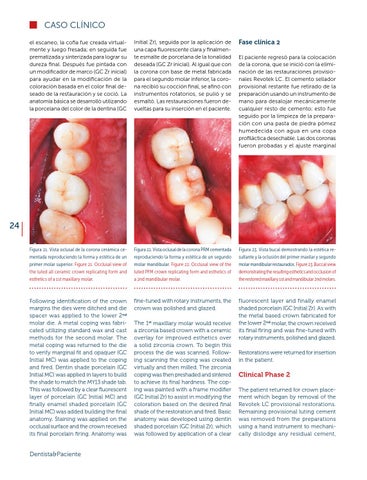
Figura 21. Vista oclusal de la corona cerámica cementada reproduciendo la forma y estética de un primer molar superior. Figure 21. Occlusal view of the luted all ceramic crown replicating form and esthetics of a 1st maxillary molar.
Figura 22. Vista oclusal de la corona PRM cementada reproduciendo la forma y estética de un segundo molar mandibular. Figure 22. Occlusal view of the luted PFM crown replicating form and esthetics of a 2nd mandibular molar.
Figura 23. Vista bucal demostrando la estética resultante y la oclusión del primer maxilar y segundo molar mandibular restaurados. Figure 23. Buccal view demonstrating the resulting esthetics and occlusion of the restored maxillary 1st and mandibular 2nd molars.
Following identification of the crown margins the dies were ditched and die spacer was applied to the lower 2 nd molar die. A metal coping was fabricated utilizing standard wax and cast methods for the second molar. The metal coping was returned to the die to verify marginal fit and opaquer (GC Initial MC) was applied to the coping and fired. Dentin shade porcelain (GC Initial MC) was applied in layers to build the shade to match the MY13 shade tab. This was followed by a clear fluorescent layer of porcelain (GC Initial MC) and finally enamel shaded porcelain (GC Initial MC) was added building the final anatomy. Staining was applied on the occlusal surface and the crown received its final porcelain firing. Anatomy was
fine-tuned with rotary instruments, the crown was polished and glazed.
fluorescent layer and finally enamel shaded porcelain (GC Initial Zr). As with the metal based crown fabricated for the lower 2nd molar, the crown received its final firing and was fine-tuned with rotary instruments, polished and glazed.
El paciente regresó para la colocación de la corona, que se inició con la eliminación de las restauraciones provisionales Revotek LC. El cemento sellador provisional restante fue retirado de la preparación usando un instrumento de mano para desalojar mecánicamente cualquier resto de cemento; esto fue seguido por la limpieza de la preparación con una pasta de piedra pómez humedecida con agua en una copa profiláctica desechable. Las dos coronas fueron probadas y el ajuste marginal
24
Dentista&Paciente
The 1st maxillary molar would receive a zirconia based crown with a ceramic overlay for improved esthetics over a solid zirconia crown. To begin this process the die was scanned. Following scanning the coping was created virtually and then milled. The zirconia coping was then preshaded and sintered to achieve its final hardness. The coping was painted with a frame modifier (GC Initial Zr) to assist in modifying the coloration based on the desired final shade of the restoration and fired. Basic anatomy was developed using dentin shaded porcelain (GC Initial Zr), which was followed by application of a clear
Restorations were returned for insertion in the patient.
Clinical Phase 2 The patient returned for crown placement which began by removal of the Revotek LC provisional restorations. Remaining provisional luting cement was removed from the preparations using a hand instrument to mechanically dislodge any residual cement,