DCD34305_booklet

Page 1


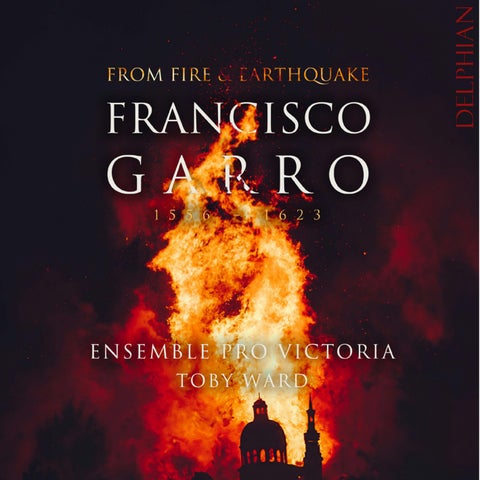
From fire & earthquake

Francisco Garro ( C .1556–1623)

ENSEMBLE PRO VICTORIA / TOBY WARD

Fiona Fraser, Hannah Ely, Áine Smith soprano

Lissie Paul, Anna Semple. alto

David De Winter, James Robinson tenor

Humphrey Thompson, Gavin Cranmer-Moralee baritone

Piers Connor Kennedy, Stuart O’Hara bass

Jeremy West cornett

Stephanie Dyer sackbut

Oliver Wass baroque harp

Toby Carr lute

Matthew Farrell bass viol/violone

Richard Gowers chamber organ

Toby Ward conductor

In April 1581, Philip II of Spain was crowned King Philip I of Portugal. He had claimed the throne the previous year in the succession crisis that followed the death of the childless Cardinal-King Henry. In the ensuing power vacuum his troops marched into Portugal, defeating a loyalist army near Lisbon at the Battle of Alcântara on 25 August 1580. With this victory, Philip had achieved what many Christian rulers before him had set out to do and failed: to unite the entire Iberian Peninsula under one crown. Portuguese resistance would continue in the Azores under another claimant, Henry’s nephew Dom Antonio, for two years, after which Antonio went into exile for the rest of his life. Among Portuguese composers of the age, there is a noticeable trend for setting texts of lamentation, as well as ones associated with Advent and John the Baptist (that often herald the coming of the Messiah), as they grieved their kingdom’s fate and waited with longing for a native ruler to return.

Despite its subjugation, Portugal maintained something of its own distinct identity within the so-called ‘Iberian Union’, which lasted until 1640. The Cortes of Tomar – an assembly of the Portuguese nobility and clergy – recognised the accession of Philip as king of Portugal but only on the condition that Portugal and its overseas territories did not become mere provinces of the Spanish Hapsburgs. Under Philip and his successor,

Portugal retained independent laws, its own currency and government, and Portuguese nobles were promoted to significant positions within the Spanish court. The city of Lisbon was a thriving metropolis, the centre of a world-wide trading network.

It was in this political climate that the music on this album was born, most of it recorded here for the first time. Francisco Garro is a little-known figure today but in many ways he and his music exemplify the relationship between Spain and Portugal in the late sixteenth and early seventeenth centuries, and the 400th anniversary of his death in 2023 has offered a fresh chance to explore his life and works. As with so many musicians of the era, biographical details are somewhat sketchy. He was born around 1556 in Alfaro in the Spanish region of La Rioja, and his first employment appears to have been maestro de capilla at the collegiate church in Logroño in 1570, possibly alongside his organist brother Domingo. He then went on to hold similar positions in Tudela (1572) and Valladolid (1580), though his time at the latter was very short indeed and on 17 October of the same year he had been appointed to the equivalent post at Sigüenza Cathedral.

However, his most significant position was as mestre of Lisbon’s Royal Chapel, a post he held from 1592 until his death (probably in early 1623 when Filipe de Magalhães

was appointed to the position). Here he would have enjoyed a well-resourced musical establishment, complete with instrumentalists as well as singers, and it seems likely that the bulk of his compositional activities took place at this time. Although he was not as prolific a composer as some of his contemporaries, nineteen works printed across two collections in 1609 survive (several psalm settings and villancicos that circulated in manuscripts have been lost).

These collections are some of the earliest examples of printed polyphony from Portugal and were created by the Flemish printer Pedro Craesbeeck, who resided in Lisbon – a reminder that the Spanish Hapsburg territories included Flanders, offering a hint of their cosmopolitan nature. The two prints offer a wide range of musical material. One contains music of the more modern polychoral style, with Masses and music for the Office for between eight and twelve voices and basso continuo (sadly no complete set of partbooks has ever been found for this collection). The second is printed in the more traditional choirbook format and so, barring some damage to one exemplar, the music of this print can be presented complete. It is from this choirbook that the music recorded here is drawn, performed by singers and instrumentalists as was the Spanish practice.

Unlike elsewhere in Europe, books of Masses printed in Spain and Portugal often included

several other liturgical items as well as Mass settings. As well as four settings of the Mass Ordinary – two for four voices, one for five and one for six – Garro includes the two antiphons for the sprinkling of water at Mass (Asperges me and Vidi aquam, the latter sung in Eastertide) and a short selection of motets for five and six voices – Parce mihi, Domine, In principio erat verbum and O magnum mysterium, the latter two for the Christmas season. It might seem strange that such a small collection of motets should include two for the same liturgical season but Christmas music was prominent in contemporary Portuguese composers’ outputs (Duarte Lobo even chose to dedicate his first publication entirely to it, in 1602), so it seems likely that Garro was conforming to local tastes and practice. The other motet, Parce mihi, belongs to the great canon of Spanish and Portuguese music for the Office of the Dead and so the choice of content itself seems emblematic of the Iberian Union.

Asperges me stands at the head of the Choirbook and broadly paraphrases the plainchant melody. At first it seems conventional and appears to reach an expected conclusion at ‘dealbabor’. However, at this point Garro changes to a compound metre and offers an almost playful extension of the section. The same change occurs in the next section and is maintained in the ‘sicut erat’, resulting in a unique setting of this penitential text.

The Missa Saeculorum (primi toni) is scored for five voices The vast majority of Renaissance Masses were written as ‘parodies’ of pre-existing sacred or secular works or ‘paraphrases’ of plainchant melodies. Missa Saeculorum is a paraphrase Mass but draws its musical material from an unusual source: the ending of the first psalm tone for the words ‘saeculorum, Amen’. Such a choice may seem restrictive but there was a precedent in Francisco Guerrero’s final Mass, the Missa Saeculorum Amen, published in Venice in 1598. Whilst Guerrero’s motets were the most popular source of parody material for Iberian composers in this period, no other composer had sought to emulate this Mass, requiring as it does a great deal of contrapuntal invention.

Garro relishes the challenge posed by such a small palette of material (just nine notes in the original) and it appears in various forms throughout the Mass: as a straightforward melodic line (as at the opening of the Kyrie in the twin superius parts), as a cantus firmuslike statement (sometimes in very drawn-out note values, such as the first fifteen bars of the Agnus Dei), and in inversion. As such, the exploration of the material seems much more thorough than Guerrero attempted –indeed, Guerrero’s Mass is one of his simpler settings – and Garro continues to develop his material throughout the Mass, culminating in a splendid final Agnus Dei, where Garro

expands the texture to six voices with the addition of a second altus, with a three-in-one canon in the top three voices derived initially from an embellished inversion, and later a retrograde, of the plainchant.

The Mass also includes a double polyphonic Christe eleison (one for four voices, one for all five), implying a nine-fold Kyrie, alternating plainsong and polyphony. This was another Portuguese custom that Garro appears to have adopted whilst in Lisbon (three of the four Masses in the choirbook have a double Christe). Within the original context of performance in the liturgy the choice of chant was dictated by the Missal according to the status of the day, festal or ferial. To give an impression of what a liturgical performance might have sounded like, we have supplied chant from the Mass XI (Orbis factor).

In principio erat verbum is a setting of the first words of the Gospel for Christmas Day. Its atmospheric opening is notable for its economy of musical material, using a single point of imitation in inversion (listeners may also notice a resemblance to Alonso Lobo’s setting of Versa est in luctum), and also the clarity of the text-setting, fully embracing the Counter-Reformation ideals of Palestrina’s music. This is hardly surprising, given the subject matter of the text. Towards the end, the music bursts into life in almost madrigalian fashion at ‘Omnia per ipsum facta

sunt’ before returning to the opening mood of serenity.

Parce mihi Domine showcases some of Garro’s most expressive writing. Again, the piece opens with inversions of a single melodic figure in long drawn-out phrases, resulting in many aching suspensions. Garro then explores the further reaches of the ‘flat’ side of the Renaissance tonal gamut as the text (from the Book of Job) sinks into despair. Finally, he shows his awareness of the developing Baroque style and its penchant for expressive immediacy with a sudden, even jarring, change of character at ‘et subito probas illum’.

Garro’s Eastertide music is all scored for six voices and is some of his most lavish polyphony. Unlike the setting of Asperges me, much of Vidi aquam is less closely modelled on its plainchant, developing into a sonorous polyphonic tapestry – including some unexpected harmonic progressions – which is followed by grand homophonic statements of the psalm and ‘sicut erat’ verses.

The Missa Maria Magdalena is in the same bright mode; it is a more traditional parody Mass, again using Guerrero’s music as its model, in this case his Eastertide motet Maria Magdalena. Dramatic narrative is not an idea normally associated with complex polyphony but in this motet Guerrero effectively tells

the story of the two Marys going to anoint the body of Jesus and finding the tomb empty through distinct and varied musical ideas that propel the story forward. Only in the two Alleluia sections does Guerrero truly elaborate his ideas (motifs which Garro would later adopt prominently in his Mass). This abundance of material perhaps explains why Garro saw it as a good source for a parody Mass. Garro preserves Guerrero’s six-voice scoring with doubled superius and bassus, but seems less bound to the original than is the parody of the same motet by his contemporary Alonso Lobo, which develops the musical ideas more gradually, beginning the early movements with statements almost identical to the motet. Garro, by contrast, brings in developed material almost immediately: the very opening of the Mass uses a motif derived from Guerrero’s opening, but we must wait until the start of the Gloria for a more clear-cut statement of Guerrero’s music. Similarly, Garro’s own countersubjects are given a greater prominence at the start of the Sanctus and first Agnus Dei.

Changes of scoring and texture also make this Mass distinctive. The ‘Domine Deus’ in the Gloria reduces to four upper voices, requiring an additional altus voice, which returns in the final petition of the Agnus Dei alongside an extra tenor to finish the Mass with eight voices. As was common practice, Garro writes the movement in canon: four in

Notes on the music

two at the octave between the two bassus and altus voices. The resulting antiphonal effect between upper and lower voices makes a suitably monumental conclusion to a Mass for Easter. Unusually, Garro does not restrict canonic writing to this final movement; the Osanna is an inverted canon between the twin superius voices whilst the Benedictus is a simple two- in-one canon at the fifth. It is notable that Lobo, a renowned composer of complex canons, chose not to include any such devices in his Missa Maria Magdalena. Lobo had been taught by Guerrero and

perhaps he could not bring himself to alter his revered master’s work here. Garro clearly had no such qualms, and in this Mass we see the work of a gifted contrapuntal craftsman.

© 2026 Gareth Thomas

Gareth Thomas leads a varied musical career encompassing singing, editing and teaching. He regularly collaborates with leading ensembles, including Stile Antico and The Queen’s Six, to bring neglected Renaissance music to light.

Texts and translations

1 Asperges me

Asperges me Domine hyssopo et mundabor: lavabis me et super nivem dealbabor. Miserere mei Deus secundum magnam misericordiam tuam. Gloria Patri et Filio et Spiritui Sancto: sicut erat in principio et nunc et semper et in saecula saeculorum. Amen.

Antiphon for the sprinkling of water at Sunday Mass outwith Eastertide; Psalm 50: 9, 1 (Vulgate) and

2/12 Missa Saeculorum / Missa Maria Magdalena

Kyrie eleison. Christe eleison. Kyrie eleison.

3/13 Gloria

Gloria in excelsis Deo et in terra pax hominibus bonae voluntatis. Laudamus te. Benedicimus te. Adoramus te. Glorificamus te. Gratias agimus tibi propter magnam gloriam tuam.

Domine Deus, Rex caelestis, Deus Pater omnipotens.

Domine Fili unigenite, Jesu Christe; Domine Deus, Agnus Dei, Filius Patris.

Qui tollis peccata mundi, miserere nobis.

Qui tollis peccata mundi, suscipe deprecationem nostram.

Qui sedes ad dexteram Patris, miserere nobis.

You will sprinkle me with hyssop, Lord, and I shall be cleansed: you will wash me and I shall be washed whiter than snow. God have mercy on me, according to your great mercy. Glory to the Father and to the Son and to the Holy Spirit: as it was in the beginning, and is now and will be forever and throughout all ages. Amen.

Lord have mercy. Christ have mercy. Lord have mercy.

Glory to God in the highest, and on earth peace to men of good will. We praise you. We bless you. We worship you. We glorify you. We give you thanks for your great glory.

Lord God, heavenly King, God the Father Almighty.

Lord, the only-begotten Son, Jesus Christ; Lord God, Lamb of God, Son of the Father: Who takes away the sins of the world, have mercy upon us. Who takes away the sins of the world, receive our prayer.

Who sits at the right hand of the Father, have mercy upon us.

Quoniam tu solus Sanctus, tu solus Dominus, tu solus Altissimus, Jesu Christe. Cum Sancto Spiritu in gloria Dei Patris. Amen.

For only you are Holy, only you are Lord, only you are Most High, Jesus Christ. With the Holy Spirit in the glory of God the Father. Amen.

5/15 Sanctus

Sanctus, Sanctus, Sanctus. Dominus Deus Sabaoth: Pleni sunt caeli et terra gloria tua. Hosanna in excelsis.

6/16 Benedictus

Holy, Holy, Holy, Lord God of Sabaoth. Heaven and earth are full of your glory. Hosanna in the highest.

Credo in unum Deum, Patrem omnipotentem, factorem caeli et terrae, visibilium omnium et invisibilium. Et in unum Dominum Jesum Christum, filium Dei unigenitum, et ex Patre natum ante omnia saecula, Deum de Deo, lumen de lumine, Deum verum de Deo vero.

Genitum non factum, consubstantialem Patri; per quem omnia facta sunt. Qui propter nos homines et propter nostram salutem descendit de caelis. Et incarnatus est de Spiritu Sancto, ex Maria Virgine; et homo factus est. Crucifixus etiam pro nobis sub Pontio Pilato passus et sepultus est. Et resurrexit tertia die secundum scripturas, et ascendit in caelum, sedet ad dexteram Patris, et iterum venturus est cum gloria iudicare vivos et mortuos, cuius regni non erit finis. Et in Spiritum Sanctum, Dominum et vivificantem, qui ex Patre Filioque procedit, qui cum Patre et Filio simul adoratur et conglorificatur, qui locutus est per prophetas. Et unam sanctam catholicam et apostolicam ecclesiam. Confiteor unum baptisma in remissionem peccatorum, et expecto resurrectionem mortuorum, et vitam venturi saeculi. Amen.

I believe in one God, the almighty Father, the maker of heaven and earth, of everything that can and that cannot be seen. And in one Lord

Jesus Christ, the only-begotten Son of God, born out of the Father before all ages: God from God, light from the light, true God from the true God; begotten, not made; of one and the same substance as the Father; by whom everything was created. And for us men, and for our salvation, he came down from heaven. And he became flesh by the Holy Ghost out of the Virgin Mary, and he became man. And he was crucified for us under Pontius Pilate; he suffered and was buried. And on the third day he rose again in accordance with the Scriptures, and ascended into heaven. He sits at the right hand of the Father, and is to come again with glory to judge the living and the dead; and of his kingdom there shall be no end. I believe in the Holy Spirit, the Lord and life-giver, who proceeds from the Father and the Son; who is worshipped and glorified together with the Father and the Son; who spoke through the prophets. And in one holy catholic and apostolic Church. I profess one baptism for the remission of sins, and I await the resurrection of the dead, and the life of the world to come. Amen.

Benedictus qui venit in nomine Domini: Hosanna in excelsis.

Blessed is he that comes in the name of the Lord: Hosanna in the highest.

7/17

Agnus Dei

Agnus Dei, qui tollis peccata mundi, miserere nobis.

Agnus Dei, qui tollis peccata mundi, miserere nobis.

Agnus Dei, qui tollis peccata mundi, dona nobis pacem.

8 In principio erat verbum

In principio erat verbum et verbum erat apud Deum et Deus erat verbum. Hoc erat in principio apud Deum. Omnia per ipsum facta sunt: et sine ipso factum est nihil.

John 1: 1–3; Gospel for Christmas Day

9 Parce mihi Domine a 6

Parce mihi Domine, nihil enim sunt dies mei. Quid est homo, quia magnificas eum? Aut quid apponis erga eum cor tuum? Visitas eum diluculo et subito probas illum.

Job 7: 16–18 (from the first lesson at Matins of the Office of the Dead)

Lamb of God, who take away the sins of the world, have mercy upon us.

Lamb of God, who take away the sins of the world, have mercy upon us.

Lamb of God, who take away the sins of the world, grant us peace.

In the beginning was the Word and the Word was with God and the Word was God. It was in the beginning with God. Everything was made by him: and nothing was made without him.

10 Vidi aquam

Vidi aquam egredientem de templo a latere dextro. Alleluia. Et omnes ad quos pervenit aqua ista salvi facti sunt et dicent Alleluia. Confitemini Domino quoniam bonus: quoniam in saeculum misericordia eius. Gloria Patri et Filio et Spiritui Sancto: sicut erat in principio et nunc et semper et in saecula saeculorum. Amen.

I saw water coming from the temple on the right-hand side. Alleluia. And all whom this water touched were saved and will say Alleluia. Trust in the Lord, for he is good: for his mercy is everlasting. Glory to the Father and to the Son and to the Holy Spirit: as it was in the beginning, and is now and will be forever and throughout all ages. Amen.

Spare me, Lord, for my days are as nothing. What is man that you glorify him? And why do you set your heart on him? You visit him at daybreak and suddenly test him.

Antiphon for the sprinkling of water at Sunday Mass in Eastertide; Psalm verse 117: 1b (Vulgate)

11 Maria Magdalena

Maria Magdalena et altera Maria emerunt aromata ut venientes ungerent Jesum. Et valde mane una Sabbatorum veniunt ad monumentum orto iam sole. Alleluia. Et introeuntes in monumentum viderunt iuvenem sedentem in dextris coopertum stola candida et obstupuerunt. Qui dicit illis: Jesum quem quaeritis Nazarenum crucifixum: surrexit, non est hic. Ecce locus ubi posuerunt eum. Alleluia.

Mark 16: 1, 2, 5, 6; Gospel for Easter Day

Mary Magdalene and the other Mary bought spices that they might come and anoint Jesus. And very early in the morning, as soon as the Sabbath had begun and the sun had risen, they came to the tomb. Alleluia. And going into the tomb they saw a young man sitting on their right, covered in a white robe, and they were dumbfounded. And he said to them: Jesus, whom you seek, the one from Nazareth who was crucified: he has risen, he is not here. See the place where they laid him. Alleluia.

Translations © Henry Howard

Biographies

Founded in 2015 at Cambridge University by Humphrey Thompson and Toby Ward, Ensemble Pro Victoria is established as of Britain’s leading early music ensembles. Named after a favourite Spanish Renaissance battle mass by T. L. de Victoria, the Missa Pro Victoria, the ensemble put down roots in the rich tradition of combined historical research and performance. It won joint-first prize at the London International Festival of Early Music’s Young Ensemble Competition in 2020 and a first album, Robert Fayrfax: Music for Tudor Kings and Queens (Delphian DCD34265) was received with critical acclaim in 2021, winning five stars from Choir and Organ and being praised for ‘outstanding vocal energy and stylistic elan’ in Cathedral Music Major highlights for the ensemble include Monteverdi Vespers in the chapel of King’s College, Cambridge, and a live Tudor Vespers on BBC Radio 3 from Hampton Court Palace. Ensemble Pro Victoria collaborates extensively with musicologist Magnus Williamson to fulfil its vision of stimulating performance combined with cutting-edge research; the most recent fruit of this collaboration is the album Henry VIII on Tour: Music from Tudor Royal Progresses (Delphian DCD34335), released in 2025. The ensemble is one of the few groups in the world to practice choir-book performance from one manuscript, while researching the effects of this lost manner

of performance. The ensemble also runs workshops and joint concert days to educate, inspire and develop love for early music and music-making.

Toby Ward was born in Otley, Wharfedale, in 1993. He was one of the last choristers of Leeds Parish Church, studying organ with David Houlder and Simon Lindley before joining the choir of Gloucester Cathedral under Adrian Partington. He read music as a choral scholar at King’s College Cambridge under Sir Stephen Cleobury, followed by postgraduate studies in singing at the Royal College of Music, studying with Alison Wells, and continued studies in conducting and choir training with Paul Brough.

A versatile conductor, singer and organist, he is director of music for the Grand Priory of England and a specialist in liturgical provision. He regularly sings with vocal ensembles Tenebrae Choir and Contrapunctus, and is known for his work with boy trebles, having taught at Westminster Abbey, Durham and Newcastle Cathedrals. Future projects with Ensemble Pro Victoria expand on his research interests including the combined liturgical and musical traditions of Catholic worship and the use of instruments in Renaissance polyphony.

Robert Fayrfax (1464–1521): Music for Tudor Kings & Queens

Ensemble Pro Victoria / Toby Ward DCD34265

In that golden age of British choral music half a millennium ago, when polyphonic voices soared in the vaulting of the great late-Gothic churches and chapels that seemed to have been built for them to fill, one composer was in especial favour with the royal family: Robert Fayrfax. A newly reconstructed movement from a mass for the private wedding of Henry VIII and Catherine of Aragon, later treasured in darker times by the recusant gentry for its Catholic associations, sits here alongside exuberant masterpieces from the Eton Choirbook and, in intimate contrast, Fayrfax’s seven surviving courtly songs, brought together on a single recording for the first time. An exciting new signing for Delphian, Ensemble Pro Victoria’s young professionals bring both freshness and individuality to Fayrfax’s music in the five hundredth anniversary year of his death.

‘one of Britain’s finest young vocal ensembles … supported by musical scholarship of the highest order’ — Early Music Review, October 2021

Tudor Music Afterlives

Ensemble Pro Victoria / Toby Ward, Toby Carr lute, Magnus Williamson organ

DCD34295

Following the freshness and vigour of their quincentenary portrait celebration of Robert Fayrfax, Ensemble Pro Victoria’s second Delphian album brings a similar boldness of approach to a wider-ranging collection, charting some rarely explored territory from a time of great religious, societal and musical change. Broken fragments of huge pre-Reformation works, preserved only in lute tablature; the first reconstruction and recording of some of the earliest Anglican psalm settings ever written; French chansons and motets once popular in England; improvisatory organ verses within Lady Mass movements by Ludford; and an English-texted version of a much-loved Tallis anthem that shows it in a quite different light: these forgotten ‘afterlives’ of earlier Tudor music help build a much more complete picture of music in sixteenth-century England.

‘a recording of the highest quality, apt for edification and pleasure’ — Early Music Review, September 2022

Henry VIII on Tour: Music from Tudor Royal Progresses

Ensemble Pro Victoria / Toby Ward

DCD34335

Under Henry VIII, royal progresses were both journeys and sonic experiences. Solemn polyphony accompanied the king’s devotions; jubilant songs rang out in great halls; charming miniatures were shared in the intimacy of the privy chamber. Made in collaboration with the Henry on Tour research project that brought together Historic Royal Palaces and the universities of Newcastle and York, Gramophone Award-nominated Ensemble Pro Victoria, under the direction of Toby Ward and guided by Professor Magnus Williamson, vividly capture these Tudor soundscapes in a programme of glorious but often littleknown music, including a number of premiere recordings.

‘everything is more intimate, more personal, simply one or two musicians entertaining the king or the dozen or so singing men and boys of the Riding Chapel providing music at mass. As might be expected … performances are stylish and engaging’ — Robert Hugill, June 2025

Christmas in Puebla

Siglo de Oro and instrumentalists / Patrick Allies

DCD34238

By the early 1620s, when Juan Gutiérrez de Padilla migrated from Cádiz what is now Mexico, the colony was an important and wealthy outpost of the Habsburg Empire, keen to maintain the religious and musical customs of its mother country. At the cathedral of the young, thriving city of Puebla de los Ángeles he had at his disposal a sizeable body of men and boys who not only sang but also played instruments – including guitars, sackbut, dulcian, and simple percussion such as the cajón. Siglo de Oro’s programme explores the rich sound-world of this time and place, evoking a Mass at Christmas Eve to include a number of villancicos – energetic, dance-like pieces whose captivating mixture of Mexican, Afro-Hispanic and Portuguese influences would have invigorated even the most sober churchgoer.

‘11 singers of clarity and colour glitter and glow … a sonic festive feast … The addition of local dance rhythms brings a rustic earthiness to Renaissance Mass from Mexico’ — Choir & Organ, December 2020, five stars

Adriatic Voyage: Seventeenth-century music from Venice to Dalmatia

The Marian Consort / Rory McCleery; The Illyria Consort / Bojan Čičić

DCD34260

Two of Delphian’s most admired ensembles join forces for this imaginative programme of sacred and secular music by composers working along the Dalmatian Coast – now largely in Croatia, then mostly the territory of Venice – in the decades around 1600. It was a time in which constant movement of people and trade of goods created linguistic and cultural cross-currents, in contrast to the sharp distinctions encouraged in later centuries by the emergence of modern nation states. The journey points up intriguing differences between the composers and pieces presented, many of them in premiere recordings, while violinist and director Bojan Čičić’s interactions with cornettist Gawain Glenton – and the rich ornamentation contributed by all the musicians here – bring the period back to vivid, unforgettable life.

‘A cornucopia of sacred and secular instrumental and vocal music, performed with arresting, period-evocative beauty’ — Gramophone, January 2022

Gesualdo: Sacrae Cantiones

The Marian Consort / Rory McCleery

DCD34176

Carlo Gesualdo, Prince of Venosa and Count of Conza, has become notorious for the eccentricities and excesses of both his life and his music. The gruesome murder of his first wife and her lover in flagrante, his mistreatment of his second wife, his isolation at his family seat and his penchant for masochism and flagellation have all fuelled the myth of Gesualdo as madman, deviant and tortured pariah, qualities seen to be replicated in his rule-defying music. Yet his compositional talent was prodigious, and this idiomatic and committed reading of his five-voice motets – marking the composer’s 450th birthday year – invites us to marvel at their pictorial immediacy, surprising chromaticism, and unique blend of melisma and homophony, in music that betrays his obsession with his own personal sin, remorse and need for absolution.

‘These are impeccable performances, easily the finest on record’ — Gramophone, October 2016

Pater peccavi: Music of lamentation from Renaissance Portugal

The Marian Consort / Rory McCleery

DCD34205

Biblical texts of lamentation were embraced by composers of the late Renaissance for their artistic and expressive potential. But in Portugal – a kingdom without a king, its people governed by a foreign power – such settings gave life, as well, to a rich expression of covert political commentary. Rory McCleery’s ongoing interest in this field of polyphony bears fruit for the first time in a groundbreaking programme – a clarion call for music that deserves, and with his advocacy should now receive, far wider recognition.

‘as richly expressive as it is politically poised … This beautiful new album from The Marian Consort is surely one of the best one-to-a-part ensemble recordings of this repertoire’ — Gramophone, December 2018

Jean Maillard (fl. 1538–70): Missa Je suis déshéritée & Motets

The Marian Consort / Rory McCleery

DCD34130

Jean Maillard’s life is shrouded in mystery, and his music is rarely heard today. Yet in his own time his works were both influential and widely known: indeed, the musicologist François Lesure held him to have been one of the most important French composers of his era. Who better, then, than The Marian Consort and Rory McCleery, a scholar as well as a performer of rising acclaim, to give this composer’s rich and varied output its first dedicated recording? Their characteristically precise and yet impassioned performances bring out both the network of influence in which Maillard’s music participated – its Josquinian pedigree, and influence on successors including Lassus and Palestrina – and its striking, individual beauty.

‘The performances are models of discretion and musical taste, every texture clear, every phrase beautifully shaped’

— The Guardian, October 2013

Turn static files into dynamic content formats.
Create a flipbook
Issuu converts static files into: digital portfolios, online yearbooks, online catalogs, digital photo albums and more. Sign up and create your flipbook.
DCD34305_booklet by Delphian Records - Issuu