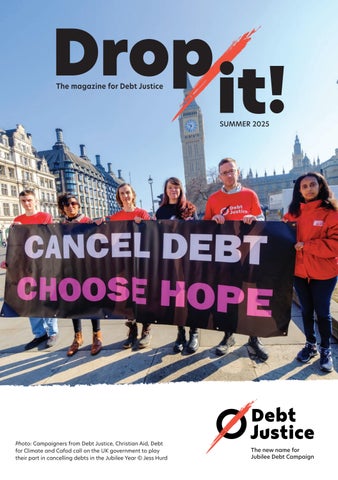
The magazine for Debt Justice
Jubilee Debt Campaign
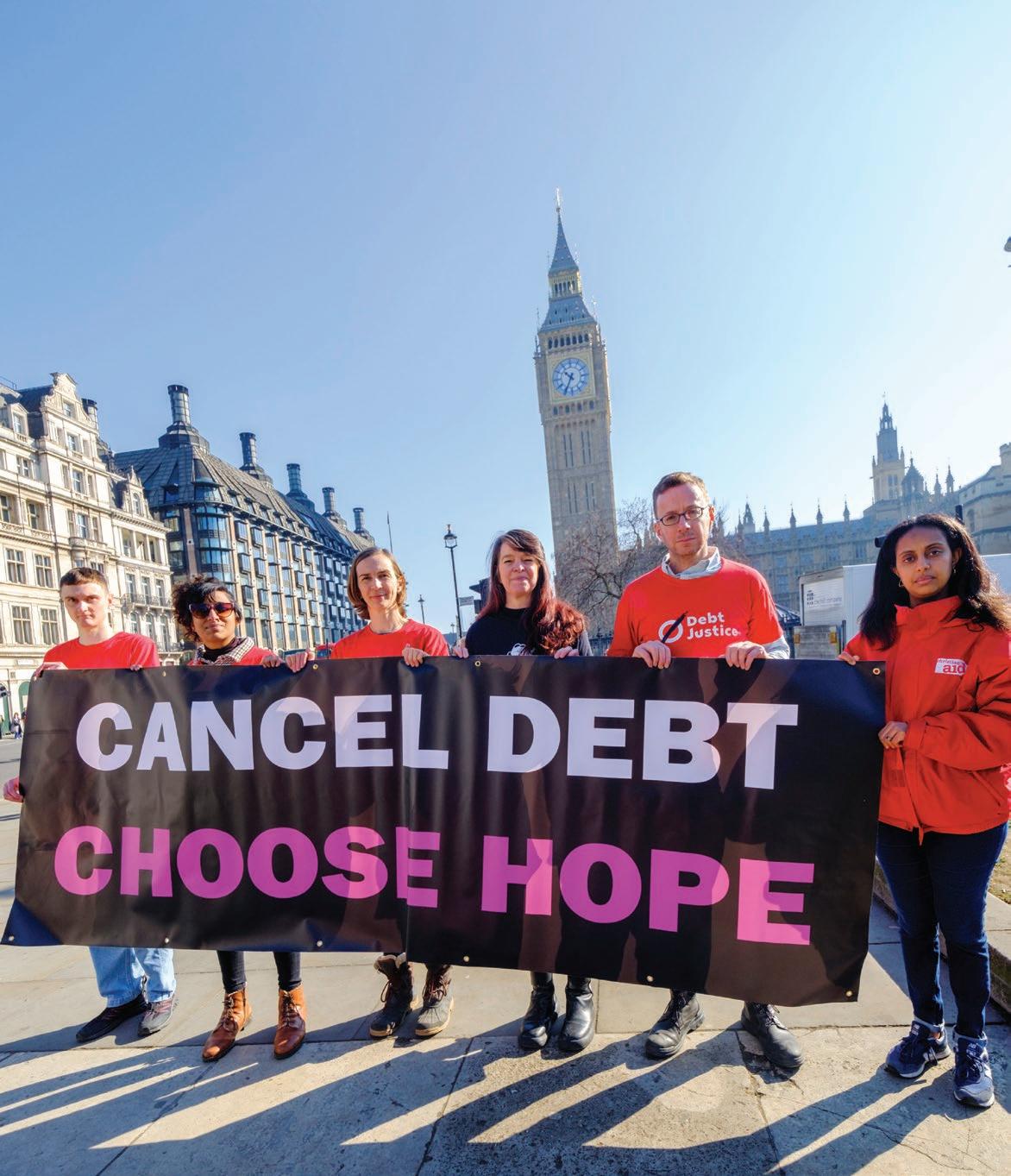
Photo: Campaigners from Debt Justice, Christian Aid, Debt for Climate and Cafod call on the UK government to play their part in cancelling debts in the Jubilee Year © Jess Hurd
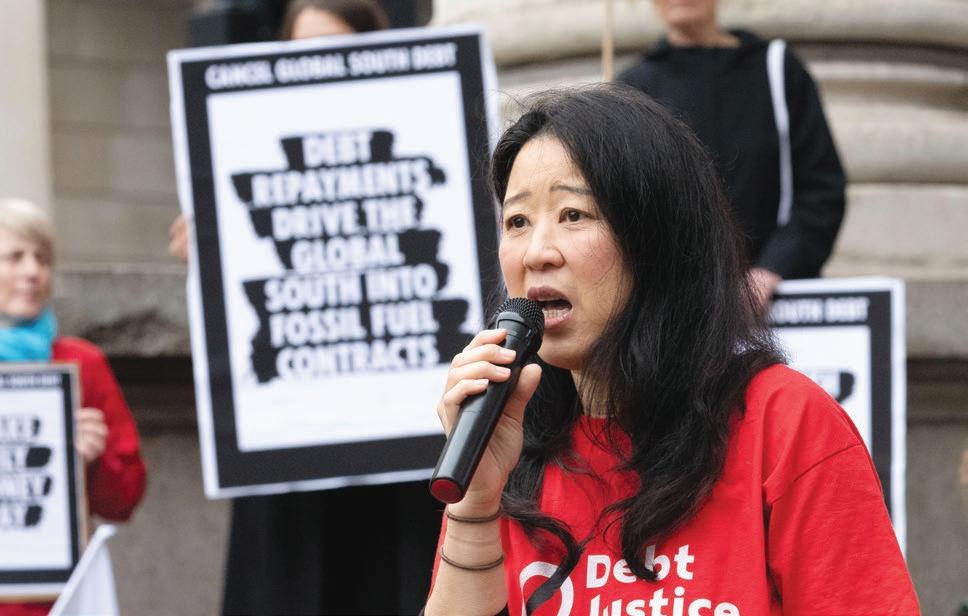
Executive Director of Debt Justice
The first half of this year has been tough in the fight for economic justice, with the relentless onslaught of shock tactics from the US presidency from aid cuts to tariffs. The UK government has also sacrificed its aid budget and slashed disability benefits which will worsen poverty and inequality both at home and globally.
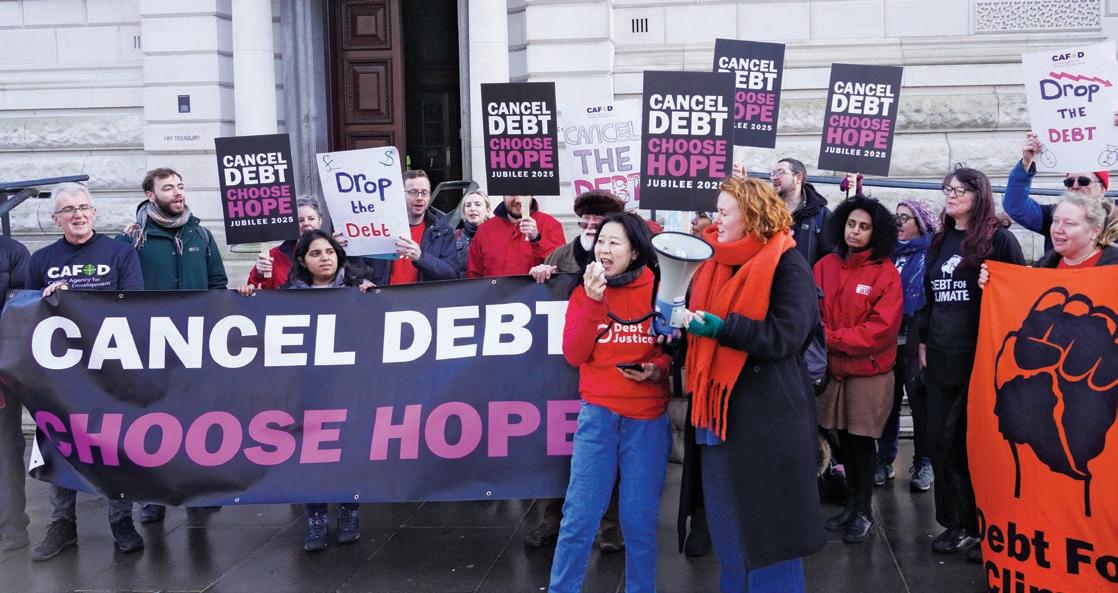
Through these times, I’ve been reminded of how how important it is to look after ourselves and our community. It can be easy to feel overwhelmed by political forces that we can’t control but taking time to care for ourselves and each other builds our resilience so we can sustain the fight over the long-term. It is our act of resistance to forces that aim to wear us down. And in the meantime we continue to build solidarity, strengthen movements and target the areas where we can win change. That’s why I’m so excited about the next stage of our Cancel Debt, Choose Hope campaign as we work with debt campaigners across the world to force debt cancellation onto the global political agenda.
I’m also energised by our new campaign to end the use of bailiffs for council tax debt collection. Their role in the household debt system is outdated and cruel and exemplifies the systemic dehumanisation of people in debt. I hope that you will join me to take action in these campaigns as our collective act of resistance and solidarity.
This is the first Jubilee Year since campaigners won $130bn in debt cancellation a generation ago. It’s the biggest global debt movement in decades, with people around the world uniting to demand action on the debt crisis. Campaigners and activists of all faiths and none are uniting to demand that world leaders take action for debt cancellation. Now’s the time to get involved in our Cancel Debt, Choose Hope: Jubilee 2025 campaign. Urgent action on debt couldn’t come a moment too soon. The Jubilee Year is coinciding with the biggest global debt crisis in thirty years, with 54 lower-income countries currently in crisis. Our recently
The debt crisis in Zimbabwe has had a devastating impact in communities, which is exacerbating poverty and limiting access to basic services. The burden of debt is not unique to our country –it’s a global issue that requires a unified response.
Absolom Jim, Debt for Climate Zimbabwe
published research has exposed the devastating impact on public services for countries in crisis, with public spending lower in 2023 than in 2015. In Angola, the country with the highest debt payments in the world, spending on social services including health and education has fallen by more than 55% since 2015.
Countries in debt crisis spent less on public services in 2023 than in 2015.
It’s a depressing picture. But there is hope – because the biggest debt crisis since the turn of the century is coinciding with key international meetings this year where lowerincome countries will have the chance to force their priorities onto the agenda.
The United Nation’s Financing for Development conference (FfD4) at the end of June could be a pivotal moment for debt justice. While lender-dominated spaces and processes are failing countries in crisis, FfD4 is a critical space for lower-income country governments and campaigners to make their voices heard. Civil society, along with the G77 – a coalition of developing countries within the United Nations – are pushing hard for a new debt framework that would help end the crisis and prevent future ones.
It’s a big opportunity for us to stand together with allies around the globe who are demanding action from world leaders at this critical juncture. We’ll be joining thousands of others who are mobilising for action on debt during the conference in Seville.
But of course the debt crisis is not happening in a vacuum. It’s an injustice that’s combining with the climate emergency to wreak havoc in lower-income countries. These same countries have done the least to cause the climate crisis, but extreme weather events are hitting them first and hardest. The failure of the global community to provide adequate climate finance to help countries rebuild after disaster hits is forcing them ever deeper into debt.
An incredible 93% of climate vulnerable states are now facing debt crisis – and lower-income countries are spending five times more on debt repayments than fighting the climate crisis.
Climate finance refers to the finance that rich countries provide to lower-income countries to compensate for their role in creating the climate crisis. The amounts provided have been woefully inadequate and have been mostly in the form of loans, pushing countries deeper into debt.
93% of climate vulnerable states are now facing debt crisis.
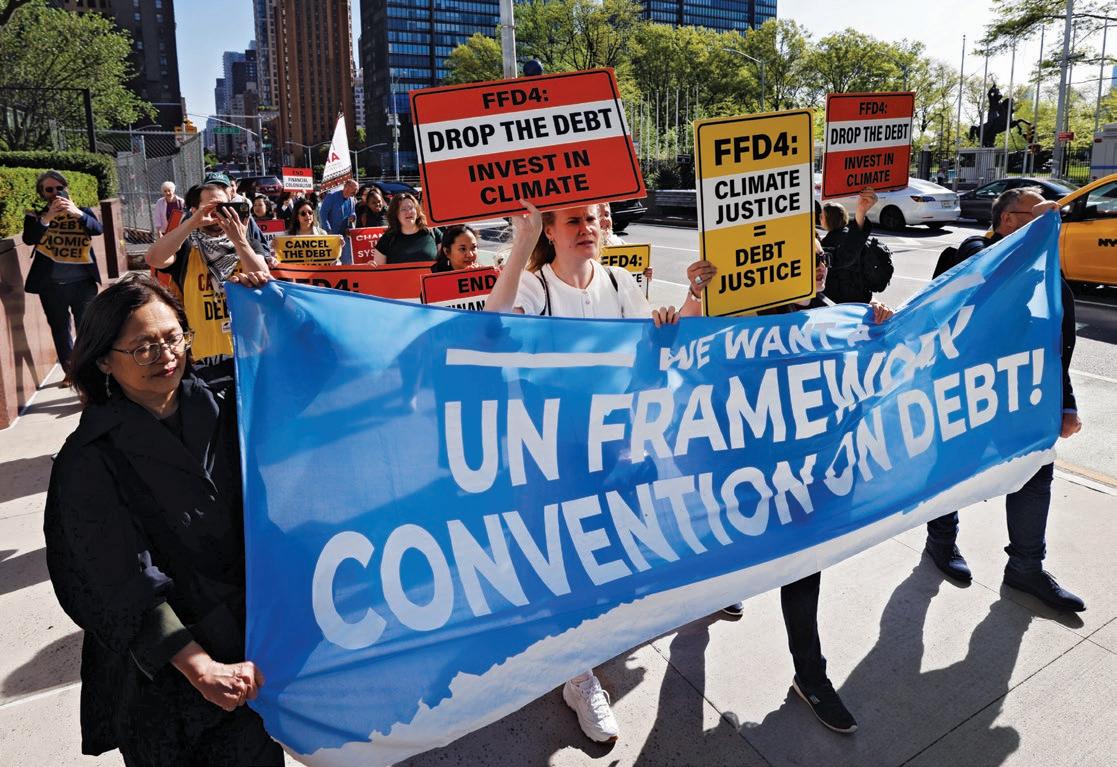
With nine in ten of the debt contracts between private lenders and lower-income countries overseen by UK law, a new law here could help get debt cancelled for countries in crisis, freeing up funds to help lower-income countries pay for public services and deal with the climate emergency.
A bill going through parliament right now – the ‘Debt Relief Bill’ –aims to do just that. Thousands of you have already emailed your MPs to ask them to support it. And on Wednesday 9 July, we’ll be joining thousands of others for The Climate Coalition’s mass lobby of parliament, to demand leadership from our MPs on the debt and climate crises.
On Wednesday 9 July, a coalition of nearly 150 organisations will join forces for a mass lobby of parliament. It’s a time for hope – and a time a time to demand action on the debt and climate crises. Join us for this pivotal moment to demand leadership from our elected politicians.
Register for the mass lobby of parliament on 9 July by visiting: www.debtjustice.org.uk/lobby
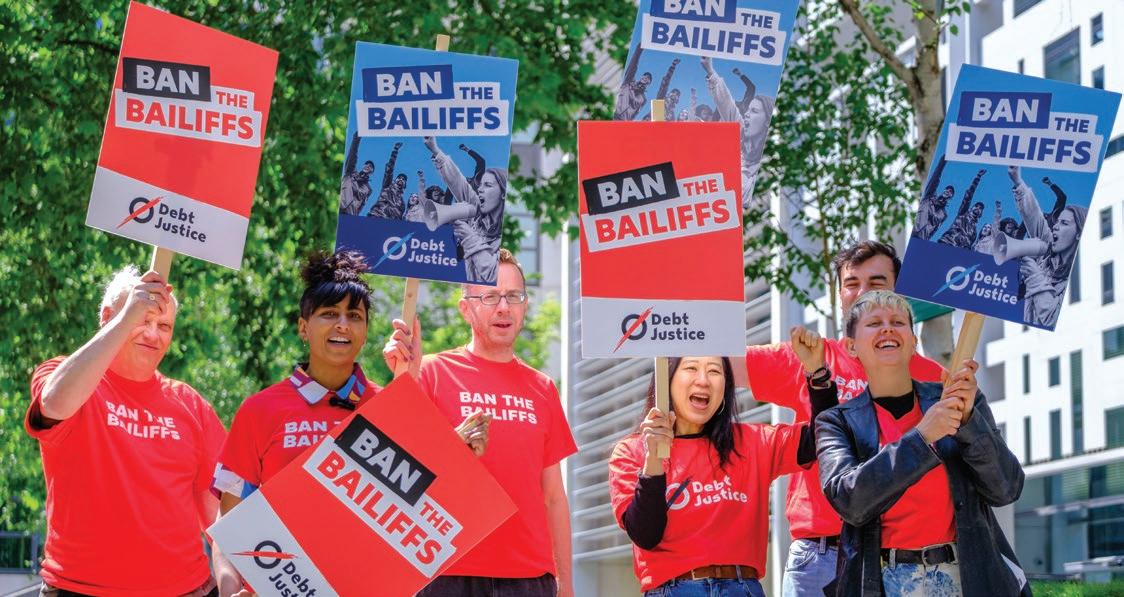
When households face unpayable debts, a knock at the door from bailiffs can be hugely traumatising.
Council tax debt has soared in recent years, and rates just keep going up. 4.4 million people are now in council tax debt. For many, it’s just not possible to pay when the cost of living crisis and economic turmoil have squeezed budgets to the limit.
But instead of supporting families to get out of debt, councils are using violence, harassment and intimidation by sending in the bailiffs. Worse, the cost of a bailiff visit is added to people’s debt –leaving them hundreds of pounds worse off. Recently, over 1.3 million orders were made for bailiff visits. But there is another way. Some councils have stopped using bailiffs to collect council tax debt, and introduced new support to help
people get out of debt for good. And this hasn’t even affected their bottom line.
The bailiffs are the worst in the world, because people are scared by bailiffs, scared to open letters. And that fear gets bigger and bigger. You hit people with sticks, people will hide, you talk to people, people will listen. The council need to actually speak to people, and let them know there is support.
Paul, Mancester
That’s why we’ve launched a campaign calling for local councils to stop using bailiffs. It’s completely unjust that the government are using a form of legalised harassment and humiliation to try and collect debts. No matter what people’s financial circumstances are, everyone should be treated with dignity and respect.
Members of our local Together Against Debt campaign groups, have consistently told us that a visit from the bailiffs is one of the most stressful and traumatising parts of being heavily in debt. Last year we successfully campaigned to stop Manchester City Council sending bailiffs to almost 50,000 of the most vulnerable families. Now we’ve launched a national campaign to end the trauma of bailiff visits
across the country, for good. Will you add your name to our petition calling for a ban on bailiffs?
TAKE ACTION:
Add your voice to the campaign at: debtjustice.org.uk/BanTheBailiffs
Support this campaign AND get your donation doubled from 23-30 June at debtjustice.org.uk/BigGive
Last year, our Together Against Debt group in Manchester won an important campaign, a ban on bailiffs for almost 50,000 households in the city.
Jo is a member of the local group and talks below about her experience with bailiffs and why she thought it was so important to take action.
I ended up going to court, which was completely alien to me, an absolutely terrifying experience because I didn’t want the bailiffs, I didn’t even understand really what a bailiff was, but just that they were going to come to my house and take my stuff. I had a three-year old child and I just thought I need to stop this.
What we don’t know about them is that they charge a fee, so the person that they’re collecting from is then in negative debt again to the bailiff. It’s a layer of horror that you never get out of. I think it’s a threatening way to collect money and it’s also ineffective. We’ve got figures that say that it doesn’t do the job it’s supposed to do, so stop doing it.
My alternative would be to consult with communities. I think we should use data that already exists to track people who are more likely to fall into problems and stop it. Prevention is always better than a cure.
The biggest thing that we really need to do in terms of public services is we need to listen to where people are because there’s a blanket application of how things are dealt with. For me, nobody listened, nobody was kind, nobody made space. If they would have offered me a scheme to pay off the debt over time, that would have been great.
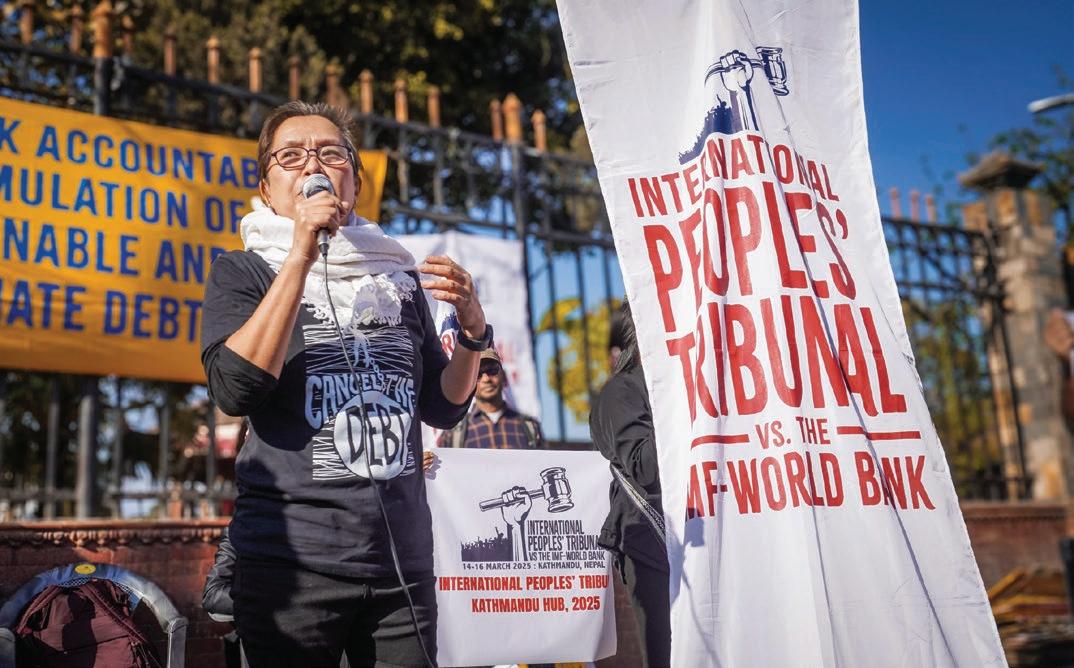
President Trump’s first months in office have already created monumental shifts in the global economy. Sweeping changes by the US to trade, aid and multilateral relations are already having far reaching consequences – especially for people in lower-income countries.
In April, President Trump announced major tariffs on exports to the US and then shortly after announced a 90 day pause. Whatever happens after the pause, lower-income countries will be facing higher tariffs on their exports, rising interest rates and falling export prices. We’re already facing the worst debt crisis in thirty years – this seismic shift will likely make it even worse.
Following this announcement, borrowing costs for lower-income countries immediately increased. For the 20 with the highest external debt payments, borrowing costs for their governments were already high – now they’re going even higher.
The largest impact of rising tariffs might not be directly on exports, or changes in currencies, but the wider global economic impact. Recessions can hit us all hard, especially in countries with fragile economies. Many of the countries with the highest debt payments are dependent on raw materials for their exports, whose prices are notoriously volatile. A change in these prices often triggers intensified debt problems.
The tariff announcements came after sweeping cuts to overseas aid by both the US and UK. Trump’s dismantling of USAID has involved cutting 83% of
the US overseas aid programmes, with huge consequences for lower-income countries globally.
The proposed 40% cuts to UK aid which followed the US announcement will only exacerbate an already difficult situation.
The combined impact of sweeping trade tariffs and monumental aid cuts will only serve to worsen the debt crisis. Lower-income governments will be forced to cut even more spending on vital public services,
like healthcare, with more people at risk of being pushed into poverty.
The news may seem to be getting worse, but resistance is building. Campaigners all over the world are coming together and calling for debt cancellation. Now is the time for us to stand in solidarity with lower-income countries calling for action and accountability on debt. Together, we can turn the tide on this crisis and make 2025 the year we Cancel Debt, Choose Hope.
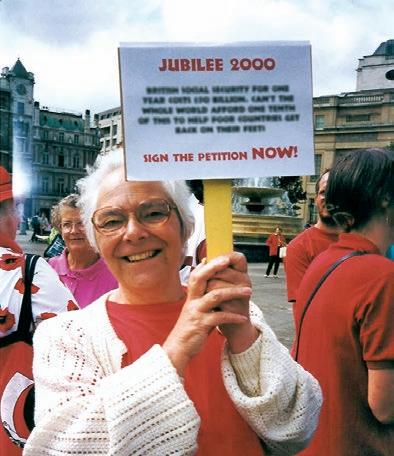
Debt Justice is powered by people. From Jubilee 2000 to Jubilee 2025, it’s your passion and generosity that have driven our campaigns. Over a generation, we’ve fought together and won billions in debt cancellation for lower-income countries.
But there’s more to do – and we must keep fighting unjust debt for as long as it exists.
One way you can make that possible is with a gift in your will. Did you know that a gift of even 1% of your estate could make a significant impact on our campaigning?
To find out more about how you can leave a gift in your will to Debt Justice simply visit www.debtjustice.org.uk/legacy
Or you can email matt@debtjustice.org.uk or call us on 07450 875495
We don’t provide debt advice, please contact the organisations below if you need debt advice or support.
Advice:
Christians Against Poverty
www.capuk.org
Tel: 0800 328 0006
Citizens Advice
www.citizensadvice.org.uk
Tel: 0808 223 1133
StepChange
www.stepchange.org
Tel: 0800 138 1111
National Debt Line
www.nationaldebtline.org
Tel: 0808 808 4000
STAY CONNECTED
@debtjustice Debt Justice
www.debtjustice.org.uk info@debtjustice.org.uk
Order campaigning materials and more editions of Drop It! at: www.debtjustice.org.uk/materials
Support:
These organisations can help with the worry and stress that often accompanies problem debts.
www.samaritans.org
Tel: 116 123
www.mind.org.uk
Tel: 0300 123 3393
You can also search free and independent advice agencies in your community using: www.advicelocal.uk and advicefinder.turn2us.org.uk
We are a campaigning organisation dedicated to ending unjust debt and building a fair economy for all, here in the UK and across the world. Debt Justice, Oxford House, Derbyshire Street, London, E2 6HG, United Kingdom Registered Charity no. 1055675 Company limited by guarantee no. 3201959
Campaigners and activists around the world are uniting to demand action on unjust debt. It’s a huge year for the campaign – the first Jubilee since we won $130bn in debt cancellation is mobilising people of all faiths and none, all over the world.
We know it’s possible. It’s a moment to hope –and a moment to act.
Action on debt can’t come quickly enough – not in thirty years has the
world seen a global debt crisis on this scale.
This crisis is coinciding with key international meetings this year where lower-income countries will have the chance to force their priorities onto the agenda. It could be a pivotal moment for change.
Add your name to the global petition and let’s show world leaders that now is the time for action on the debt crisis.
I’m calling on world leaders to:
1. Stop the debt crisis now by cancelling unjust debt.
2. Support debt justice laws to make private lenders take part in debt relief.
3. Prevent future debt crises through a new debt framework within the UN.
Order materials for this campaign:
Send me copies of this magazine Send me campaign postcards
Tick if you want to find out more about leaving a legacy to Debt Justice
Tick if you would like to hear about Debt Justice’s work: by email by post
You can unsubscribe at any time. Please see our privacy policy at: debtjustice.org.uk/privacy

Freepost Plus RUEB–REHA–YBHU
Debt Justice
Oxford House
Derbyshire Street
LONDON
E2 6HG