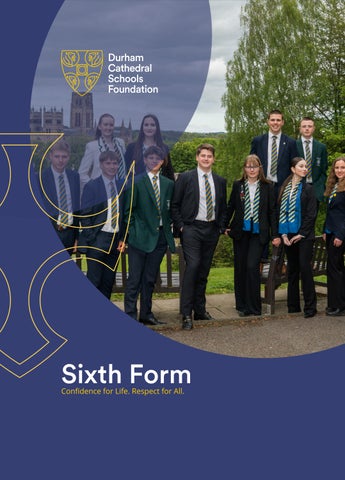
Sixth Form Confidence for Life. Respect for All.
Confidence for Life. Respect for All.
Pupils demonstrate an extremely high level of achievement in their academic studies and through their co-curricular commitments. This reflects the successful realisation of the school’s ambitious aims to cultivate in pupils a desire to succeed in all that they attempt. - ISI Inspection Report (2023)
Contents Sixth Form at a Glance
5
Overview
6
Entry Requirements
6
Leavers Destinations 2025
7
A Level Exam Results 2025
8
10 Reasons to Choose Durham School Sixth Form
10
What Can I Study?
22
Student Case Studies
24
Preparing for University Life
26
A Level Curriculum
27
BTEC Level 3 National Diploma in Business
28
BTEC Level 3 National Diploma in Sport
30
BTEC Level 3 National Extended Certificate in Sport
31
Business
32
Art & Design (Fine Art)
33
Biology
35
Chemistry
36
Classical Civilisation
37
Computer Science
38
Drama & Theatre
40
Design Realisation
41
Economics
42
English Literature
43
Geography
45
History
46
Latin
47
Mathematics & Further Mathematics
48
Modern Languages: French, German & Spanish
49
Music
50
Physics
53
Politics
54
Psychology
55
Religious Studies
57
Learning Support
58
Life & Wellbeing Education
59
Extended Project Qualification (EPQ) Academic Support Academic Enrichment
60 62 64
Sixth Form Prospectus | 2026-2027
3
4
www.dcsf.org.uk | 2025-2026
Sixth Form at a Glance
126 A Level pupils With average class size between 6 - 14 pupils
Independent School of the Year
Passionate teaching staff in all subjects
25+ different nationalities
33.3% Grade A*/A at A Level
Exceptional pastoral care
(2025)
Rated Excellent ISI Inspection Report 2023
Outstanding co-curricular options
Development
Christian ethos
Pathways to Leading Universities and Careers
inclusive and welcoming
Elite Sports
Boarding
Pupils compete in British Championships, professional cricket and more
Weekly, full and flexiboarding places available
Sixth Form Prospectus | 2026-2027
5
Overview The Sixth Form at Durham School is based on a traditional academic model of a broad A Level curriculum with the opportunity to develop the character of a Sixth Former through numerous enrichment activities. While academic success is our core purpose, within our co-educational day and boarding community our pupils receive a multitude of opportunities to gain Confidence for Life. Pupils are empowered to become independent and responsible learners and encouraged to think for themselves as they approach the next stage of their academic lives. After achieving A Level success, a significant majority of our pupils move onto higher education. International students can benefit from a three-year Sixth Form course by undertaking a One Year GCSE which is designed to introduce pupils for whom English is a second language to A Level study.
Entry Requirements Pupils need a minimum of 5 GCSEs at Grade 6 to study a course of A Levels in our Sixth Form. They must also have a Grade 4 in both Mathematics and English. Ideally, Sixth Formers need at least a Grade 6 in the subjects that they are studying at A Level. In many subjects a Grade 7 is strongly recommended. International pupils must have an IELTS score of 5.5 to enter into the Sixth Form. It is our aim that by the time our international pupils graduate from our Sixth Form they will be at IELTS 7. This is the standard required by universities for overseas students to study in the UK. To progress from Year 12 to Year 13, pupils must satisfy the School’s attendance requirements as stipulated in our School’s Sixth Form policy, as well as achieving satisfactory results in the end of Year 12 exams.
6
www.dcsf.org.uk | 2026-2027
Leavers’ Destinations 2025
67%
Russell Group Universities will gain Durham School pupils
82%
choice university
3xProfessional Awarded International Universities in the Middle East & North America
Sixth Form Prospectus | 2026-2027
7
A Level Exam Results 2025 A Level results 2025 Subjec t
8
Grades
Cumulative percentages
Entries
A*
A
B
C
D
A*/A
A*-B
A*-C
Art & Des ADV (Fine Art)
5
2
2
0
1
0
80.0
80.0
100.0
Art & Des ADV (Photography) Art
2
0
0
1
0
1
0.0
50.0
50.0
Craft and Design
7
0
2
1
2
1
28.6
42.9
71.4
Biology
10
0
4
1
4
1
40.0
50.0
90.0
Business
14
0
2
7
1
3
14.3
64.3
71.4
Chemistry
13
0
2
6
3
1
15.4
61.5
84.6
Chinese Cantonese
2
0
0
2
0
0
0.0
100.0
100.0
Chinese Mandarin
3
2
1
0
0
0
100.0
100.0
100.0
Classical Civilisation
3
0
1
2
0
0
33.3
100.0
100.0
Computer Science
5
0
0
1
1
3
0.0
20.0
40.0
Drama and Theatre
6
1
0
2
1
2
16.7
50.0
66.7
Economics
13
1
5
0
4
3
46.2
46.2
76.9
English Language and Literature
7
1
0
1
3
2
14.3
28.6
71.4
English Literature
2
1
1
0
0
0
100.0
100.0
100.0
Extended Project
3
1
1
1
0
0
66.7
100.0
100.0
French
3
1
1
1
0
0
66.7
100.0
100.0
Further Mathematics
5
0
4
1
0
0
80.0
100.0
100.0
Geography
22
1
5
9
5
2
27.3
68.2
90.9
H istor y
6
1
3
1
0
0
66.7
83.3
83.3
Latin
2
0
1
0
1
0
50.0
50.0
100.0
Mathematics
17
4
5
2
2
1
52.9
64.7
76.5
Music
1
0
0
1
0
0
0.0
100.0
100.0
Physical Education
13
0
1
1
7
2
7.7
15.4
69.2
Physics
11
1
3
2
2
2
36.4
54.5
72.7
Politics
3
0
1
0
1
1
33.3
33.3
66.7
Psychology
19
0
3
2
6
3
15.8
26.3
57.9
Religious Studies
7
0
3
1
1
2
42.9
57.1
71.4
Totals
204
17
51
46
45
30
33.3
55.9
77.9
www.dcsf.org.uk | 2026-2027
Sixth Form Prospectus | 2025-2026
9
Reasons to Choose Durham School Sixth Form
10
www.dcsf.org.uk | 2026-2027
11
1. All-Round Achievement Pupils at Durham School are encouraged to excel both in the classroom and beyond. Academic achievement is strong, with 55.9% of all results in the grade A*-B range in 2025. Many of our pupils progress to leading Russell Group universities, including the University of Oxford, Bristol University, Durham University, the University of Edinburgh, the University of Leeds, University College London (UCL) and the University of Warwick. Excellence extends well beyond the classroom too. Pupils have gone on to compete in sport at the very highest levels, from British championships and professional cricket to representing their country at the Olympics. Our pupils also excel in the arts, with opportunities to develop their creativity through Art & Design, Drama, Music and Design Technology at A Level. We regularly stage unmissable musicals and plays in The Luce Theatre as well as professional theatres such as the Gala Theatre in Durham, as well as host stunning art exhibitions.
Sixth Form Prospectus | 2026-2027
11
2. Values in Action TheFoundation’s values ofMoralIntegrity, Ambition, Responsibility, and Kindness underpin everything we do. These values are not just taught in lessons; they are lived out by both pupils and staff each day, shaping the way we learn, work and grow together as a community. We do not just talk about our MARK values — we weave them into daily life, encouraging pupils to practise them in class, in Chapel and beyond the school gates. Moral integrity is about having the courage to do what is right, both in public and in private. It means standing firm in your beliefs, being open to challenge and taking responsibility for your actions and outcomes. Ambition encourages every pupil to strive for excellence in all they do. It is about making the most of every opportunity at Durham School and Foundation, growing not only in achievement but also in character. Responsibility calls pupils to be active members of our community, to take ownership of their choices and to develop their leadership potential in ways that benefit others as well as themselves. Kindness reflects the Christian ethos that underpins our values. It means treating others with respect and tolerance, embracing diversity and working together as one Foundation family. Our motto — Confidence for life. Respect for all. — captures exactly what we hope to instill in every pupil: the confidence to pursue their goals and the respect to value the voices of others.
12
www.dcsf.org.uk | 2025-2026
3. Your Path, Your Way AtDurham School, youdon’thave to choosebetween your passions –youcanbe a sports champion and a talented musician, a promising actor that excels in mathematics. Here, you’re encouraged to be everything you want to be, and more. Our wide range of co-curricular clubs and activities means there’s something for everyone, from animation and debate to sport, music, drama, and beyond. Whatever your interests, you’ll find opportunities to explore them and discover new talents along the way. We’re committed to supporting every pupil on their own unique journey. All pupils are encouraged to take part in a wide range of co-curricular activities, not only to support their personal development but also to promote relaxation and wellbeing after periods of study.
Sixth Form Prospectus | 2025-2026
13
4 4
4. Dedicated Staff At Durham School, our teachers are not only highly qualified but also deeply passionate about what they do. Many have experience in their fields, which brings learning to life in the classroom. Their enthusiasm makes lessons engaging and enjoyable, helping pupils feel inspired and supported as they learn. Teachers take the time to get to know each pupil as an individual, building confidence and encouraging a love of learning. They are also available outside of lesson time for bespoke support. We have a brilliant team of Learning Support Staff who work closely with pupils to ensure that every individual’s learning needs are met with care and expertise. Additionally, we offer EAL support to international pupils who may need it. Our House staff create warm and welcoming spaces where pupils feel at home. Whether you are a day pupil or a boarder, you’ll quickly get to know them. They are there to support you, listen when you need it, and share in your successes. The close relationships built within the Houses mean that every pupil feels part of a caring community, with staff who know them well and are always ready to celebrate their achievements or offer a helping hand.
14
www.dcsf.org.uk | 2026-2027
5 5
5. House System At Durham School, our House system is at the heart of school life. Each House develops its own identity, built by its community, and every pupil represents their House with pride. Because each House includes pupils from every year group, you’ll build friendships across ages – connecting with people you may not otherwise meet. Younger pupils benefit from the guidance and support of older peers, while older pupils enjoy the chance to mentor and share in the fun of school life with their younger peers. Our Houses are not just communities, but physical spaces where pupils can spend time outside of lessons. They provide a true “home from home,” with common rooms to relax and socialise, kitchens for snacks, and study areas for focused work. Throughout the year, Houses join in a wide range of events – many organised by pupils themselves – that bring everyone together, build teamwork, and create a real sense of community. From House Music and House sports competitions to House barbecues and regular socials, there’s something for everyone to get involved in.
Sixth Form Prospectus | 2026-2027
15
6 6
16
www.dcsf.org.uk | 2025-2026
6. Boarding Boarding at Durham School is more than just a place to stay, it’s a vibrant community. You’ll form friendships across year groups, creating bonds that last well beyond school. With no daily commute to worry about, you’ll have more time and energy to focus on your studies and enjoy school life to the fullest. Boarders enjoy a full programme of activities and trips each week, from exploring Newcastle and shopping to go-karting, hiking, and even catching musicals at the theatre. In your House, you’ll enjoy cosy evenings by the fire pit toasting marshmallows, fun movie nights, and lively board game sessions with friends. You’ll always be known and supported as an individual, with caring staff on hand to listen and guide you. In our boarding community, there is always someone to talk to.
A million thanks to dearest Durham School that has become a second home for our daughter. Thank you for your special attitude to all international students and the support you provide them with. It means a lot to our family. - Durham School Parent
Sixth Form Prospectus | 2026-2027
17
77
7. Connection Across Cultures Durham School is home to a thriving international community, with pupils from over 25 countries. We are proudly diverse and welcome many international pupils each year. As an international pupil at Durham School, you will have the opportunity to strengthen your English, experience local culture, and gain a global perspective through your peers. Our diverse boarding community offers a welcoming environment where pupils build meaningful connections across cultures.
18
www.dcsf.org.uk | 2026-2027
8. Beyond the Classroom As a Durham School pupil, you’ll have the opportunity to enrich your learning experience through a wide range of insightful events and trips. As part of your A Level courses, you can experience Geography field trips, English trips to Stratford-upon-Avon and much more. Outside of lessons, your learning and development can be supplemented through exciting trips like our international Sports Tours. These opportunities not only enrich your studies but also help you build confidence, develop independence and create lifelong memories. In daily school life, you’ll have the chance to cheer on friends at sports fixtures, celebrate their talents on stage in the Luce Theatre, support them in concerts held in Chapel, and share in many more memorable moments. Additionally, we are located on the doorstep of Durham, which pupils may visit after school with friends. Our boarders often spend some time on the weekends here, exploring Durham Cathedral, walking by the riverside or browsing in the Durham University Library.
9. Dedicated Pastoral Care Our Houses act as the heart of pastoral care at Durham School. Each morning, pupils meet in their House for roll call and have the opportunity to speak with staff about any concerns or challenges they may be facing. As our House system ensures that every pupil is known as an individual, pastoral needs are more easily recognised, and there is always a trusted member of staff available to offer guidance and support. Pastoral care is led by a dedicated team of specialist staff who oversee this vital area. They also ensure that all members of staff are equipped with the knowledge and skills needed to provide effective, appropriate care, so that every pupil feels supported throughout their time at Durham School.
Sixth Form Prospectus | 2026-2027
19
10 10
20
www.dcsf.org.uk | 2025-2026
10. Building Your Future Many of our pupils go on to study at leading universities across the country and overseas. We have a strong connection with Durham University, giving our pupils opportunities to visit for educational events and to access the Bill Bryson Library. This provides valuable insight into a prestigious local university, and many of our pupils progress there after A Levels. For those applying to highly competitive courses such as Medicine, Dentistry, Veterinary Medicine at Oxford and Cambridge Universities we offer tailored support. Under the guidance of Mr Hope, Coordinator of Elite Applications, pupils receive personalised help with personal statements, additional submissions, mock interviews and even selecting the right college. Pupils also benefit from opportunities to meet Oxbridge admissions officers and to attend open days at Oxford and Cambridge during Years 12 and 13. Our pupils pursue a wide range of courses, from STEM subjects such as Medicine and Chemistry to the Social Sciences including Geography and Economics, as well as the Arts and Humanities, such as Modern Languages and Fine Art. Equally, we recognise that university is not the right choice for everyone. We provide just as much support to pupils who are pursuing other routes, whether that be apprenticeships, employment, or specialist training. Each pupil is guided on their individual journey so that they leave Sixth Form confident, ambitious and prepared for their future.
Offers recieved by Durham School Sixth Formers in 2025 included: University of Oxford
English Language and Literature
University of Oxford
French and Linguistics
Durham University
Modern Languages and Cultures
Durham University
Geography
Durham University
Business and Management
King’s College London
Chemistry
University of Warwick
Classical Civilisation
University of Southampton
Civil Engineering
University of Leeds
Economics
University of Leeds
Biomedical Sciences
University of Leeds
History
University of Sheffield
Psychology
Newcastle University
Fine Art
Newcastle University
Urban Planning
University of Sunderland
Medicine
Northumbria University
Sport, Exercise and Nutrition
Sheffield Hallam University
Physiotherapy
York St John University
Human Geography Sixth Form Prospectus | 2026-2027
21
What Can I Study? We offer a broad range of subjects, with 24 A Levels and the BTEC in Business taught in our Sixth Form, so there really is something for everyone. All subjects offered at GCSE continue to be offered, while there are a number of subjects which are available exclusively in Sixth Form, such as Business, Economics, Politics and Psychology. Therefore, we teach the traditional humanities and science subjects alongside the social sciences and subjects with a more practical element, including Art & Design, Drama & Theatre, and Music. We offer a free range of options and then construct our option blocks and timetable based on pupils’ submitted choices, so we try to cater for almost all desired combinations. Some A Levels have GCSE grade requirements, as shown on page 23, while our staff discuss choices and subject combinations with pupils to help them choose the right set of options for them. The table opposite summarises the entry requirements to study specific subjects at A Level.
22
www.dcsf.org.uk | 2026-2027
Subject
Specific Entry Requirements
BTEC Level 3 National Diploma in Business BTEC Level 3 National Diploma in Sport BTEC Level 3 National Extended Certificate in Sport
Recommended - at least 5 GCSEs including English and Maths
BTEC
4-5 GCSEs at Grade 9-5
BTEC
4-5 GCSEs at Grade 9-5
BTEC
Business
Minimum of 5 GCSEs at Grade 6
Art & Design (Fine Art)
A Level
Minimum of 5 GCSEs at Grade 6
Biology
Grade 7 Biology or 7-7 in Double Award Science
Chemistry
Grade 7 in Chemistry or 7-7 in Double Award Science and Grade 7 in GCSE Maths
Classical Civilisation
Minimum of 5 GCSEs at Grade 6
Computer Science
Grade 7 in GCSE Computer Science/ICT and Grade 7 in Maths
Drama & Theatre
Minimum of 5 GCSEs at Grade 6
Design Realisation
Minimum of 5 GCSEs at Grade 6
Economics
Grade 6 in GCSE Maths and English
English Literature
Minimum of 5 GCSEs at Grade 6
Geography
Minimum of 5 GCSEs at Grade 6
History
Minimum of 5 GCSEs at Grade 6
Latin
Minimum of 5 GCSEs at Grade 6
Mathematics
Grade 7 in GCSE Maths
Further Mathematics
Grade 8 in GCSE Maths
Modern Languages: French, German & Spanish
Grade 7 in GCSE
Music
Grade 6 in GCSE Music. Grade 5 on one instrument desirable. Ability to read music from staff notation is essential.
Physics
Grade 7 in GCSE Physics or 7-7 in Combined Science and Grade 7 in GCSE Maths
Politics
Minimum of 5 GCSEs at Grade 6
Psychology
Minimum of 5 GCSEs at Grade 6, including at least one Science at Grade 6
Sixth Form Prospectus | 2026-2027
23
Pupil Case Studies Lucy
Achieved AAA at A Level (2025) Burkitt Scholar Coming to Durham has benefitted me more than I can articulate. Without the brilliant teaching, extra-curricular and sporting opportunities and the constant support, I don’t think I would have performed so well in my exams.
James
Current Year 12 Pupil Achieved 10x Grade 9 GCSEs (2025) The teachers are approachable and know how to get the best out of everyone. I’ve really enjoyed taking part in regional and national chemistry and maths competitions, and I’m currently involved in a research project with Durham University alongside my A-level chemistry course. Musically, too, the opportunities to compose, arrange and perform have been excellent here. I’m looking forward to leading the Caffinites in House Music this year... hopefully to a long-overdue victory!
24
www.dcsf.org.uk | 2026-2027
Ed
Former Head of School (2024/25) From the moment I arrived, I knew Durham wasn’t just a school it was something far more. A community. A rhythm. A legacy. It’s a place that gives you confidence for life, not just through grades or results, but through the experiences that challenge and shape you.
Emily
Former Headof School (2024/25) In the Sixth Form there are so many opportunities; academic, sporting and a wide range of others. There is support from staff every step of the way and this definitely helped me in my roles as Head of School and Boat Club Captain. My A-levels were the final and most important part of my Durham School journey, and I am so grateful to all the staff who helped me achieve what I needed, helped me with my university applications and gave me the confidence to succeed.
Sixth Form Prospectus | 2026-2027
25
Preparing for University Life At Durham School, we are very proud of our Sixth Form. It is the final stage before our pupils become Old Dunelmians and leave our School community to go and make their own contributions to the world. Our pupils are encouraged to be independent learners which is a vital skill if they are to make the best use of the freedom offered by life at university and beyond. This is even more critical if you consider that, in many cases, we are preparing our pupils for jobs that potentially do not exist yet. As a Sixth Form, we offer traditional academic A Levels and a BTEC qualification in Business. The majority of our pupils after completing these A Levels will move on to higher education. Whilst academic success is our core purpose within our co-educational, day and boarding community, our pupils receive a multitude of opportunities to practise our school motto “Confidence for Life. Respect for All.” We are proud of the wide range of academic and cocurricular opportunities that we have to offer.
Selecting Your Subjects Some courses at university will require you to study certain subjects at A Level. For example, Medicine requires you to have studied Chemistry or Biology, if not both. Many university courses, however, will only ask for three A Levels or BTEC with no stipulation on the subjects studied. Staff are available to discuss Sixth Form subject choices at any time, and Mr Macnair, Head of Futures, offers one-on-one meetings for this, during
26
www.dcsf.org.uk | 2026-2027
a bookable, timetabled slot. Motivation is important too as it is much easier to study a subject you enjoy.
Private Study Periods Private study periods are included in the timetable for silent supervised private study in Year 12. These are staffed lessons held in the Sixth Form Centre in the Vallance which take place between periods 1-4 (all periods before lunch), to help the pupils adjust to Sixth Form expectations and work habits.
Assessments We are data-rich with our information on our Sixth Form pupils as we track their progress through their Sixth Form careers. The CEM Centre ALIS test is used to help us set Year 12 minimum expected grades (MEGs). Progression tests are set on a half-termly basis. These results form part of an extensive
A Level Curriculum These subjects have become two year, or linear, A Levels. This means that pupils will complete all of their unit exams at the end of the Year 13. All content will be assessed at A Level standard and there will be no opportunity to retake units. It is important to note that, for subjects with a coursework component, there may be some coursework deadlines in Year 12. Pupils who are joining the Sixth Form in 2026/27 have a number of options available to them.
Option 2
Option 1
*September 2017 was the first year where all A Levels were reformed.
4 A Levels This offers the possibility of studying four A Level subjects. It is likely that only pupils making outstanding progress in Year 12 will continue with all four subjects.
3 A Levels + Extended Project Qualification Thisoption allowsa pupilto studythree ALevels, but with the added advantage of taking the EPQ in Year 12. The EPQ is worth 50% of the UCAS points of an A Level and is a valuable addition to a pupil’s academic portfolio. Further details on the EPQ can be found on pages 58-59.
Option 4
Option 3
3 A Levels + Co-Curricular Commitments Thisoptionis primarilyforpupilswhohaveheavyco-curricular commitments e.g. sport, music, drama). Here, a pupil can opt to study just three A Levels, thus releasing them from academic teaching in one of the option columns. In the free option column, the pupil is allocated some time during their private study periods for their other pursuits; this enables them to stay on top of their academic work commitments while allowing them to participate fully in their co-curricular activities.
BTEC + A Level(s) We teach two BTEC qualifications: the BTEC in Business, which is the equivalent of two A Levels and is taken alongside one A Level; and the BTEC Sport, offered as both a Single option (equivalent to one A Level) and a Double option (equivalent to two A Levels), combined with two A Levels or one A Level respectively. There is less of an emphasis on performing under examination conditions in these BTECs, as both have non-examined units, with practical elements also included in the Sport qualifications.
Sixth Form Prospectus | 2026-2027
27
BTEC Level 3 National Diploma in Business Pearson:Exploring Business(720GLH) 601/7157/1 (Internally set and market assignment, 90 GLH)
BTECs in Business are alternative academic qualifications to A Levels. The qualification can be studied post-16, the same as A Levels, but they are more flexible and have a more vocational content (more focus on developing skills and knowledge specifically for the workplace). The BTEC in Business course can be equivalent to two A Levels and is respected and accepted by the vast majority of universities. Instead of being graded in the traditional sense, BTECs have grading criteria of pass, merit, distinction and distinction*, with distinction* being the highest achievement.
Course Content The National Diploma in Business BTEC course allows learners to study elements of Traditional Business Theory such as Marketing and Finance, whilst also introducing modern themes such as Event Management and pitching business ideas.
28
Unit 1
Exploring Business (internally set and marked assignment, 90 GLH)
Unit 2
Developing a Marketing Campaign (externally set and marked assignment, 90 GLH) Personal and Business Finance (exam, 120 GLH) Managing an Event (internally set and marked assignment, 90 GLH)
Unit 3
Personal and Business Finance (exam, 120 GLH)
Unit 4
Managing an Event (internally set and marked assignment, 90 GLH)
Unit 5
International Business (internally set and marked assignment, 90 GLH) Principles of Management (externally set and marked assignment, 120 GLH) Recruitment and Selection (Optional unit, internally set and marked assignment, 60 GLH)
Unit 6
Principles of Management (externally set and marked assignment, 120 GLH)
Unit 8
Recruitment and Selection (Optional unit, internally set and marked assignment, 60 GLH)
Unit 9
Team Building in Business (Optional unit, internally set and marked assignment, 60 GLH)
www.dcsf.org.uk | 2026-2027
Preparation for University The assessment tasks on the BTEC Business course may take several forms: written projects, presentations and practical activities. There is scope for a wide variety of assessment methods to be used which will stand learners in good stead for the future. They provide progression to the workplace either directly or via study at a higher level. Over 100,000 BTEC students apply to UK universities every year, and their BTEC Nationals are accepted by over 150 UK universities and higher education institutes for relevant degree programmes, either on their own or in combination with A Levels.
Course Entry & Qualifications
There are no specific course requirements, although it is recommended requirements, although it is recommended by Pearson that students have achieved at least five GCSEs (preferably including Maths and English) to a good grade. Head of Department: Mr A J Graham
Sixth Form Prospectus | 2026-2027
29
BTEC Level 3 National Diploma in Sport Pearson:603/0460/1GuidedLearningHours: 720
The BTEC Level 3 Diploma in Sport is a two-A-Level equivalent qualification designed for learners who want a deeper understanding of the sports industry through a blend of theory and practical application. The course covers a wide range of topics, including anatomy and physiology, fitness training, coaching, sports psychology, and professional development. Students complete a mix of coursework, practical assessments, and externally examined units, gaining strong industry-focused skills and knowledge. This qualification is ideal for those interested in progressing into careers such as sports coaching, fitness instruction, sports therapy, teaching, or higher education in sport-related fields.
Course Content Unit 1
Anatomy & Physiology (Exam)
Unit 2
Fitness Training and Programming for Health, Sport and Well-being (Exam)
Unit 3
Professional Development in the Sports Industry
Unit 4
Sports Leadership
Unit 22
Investigating Business in the Sport and Active Leisure Industry
Unit 23
Skill Acquisition in Sport
3 Others
Fitness Testing, Coaching, Research Methods, Sports Psychology or Leadership
Preparation for University
BTEC Sport focuses on hands-on learning, meaning you don’t just study theory—you apply it. This is valuable for university because many sport-related degrees involve practical assessments, lab work, coaching sessions, and applied science.
Course Entry & Qualifications
4-5 GCSEs at Grade 9-4 usually including English Grade 4+, Science Grade 4+ (preferred), PE Grade 4+ (desirable). Head of Department: Mrs L Stewart 30
www.dcsf.org.uk | 2026-2027
BTEC Level 3 NationalExtendedCertificate in Sport Pearson: 601/7218/6 Guided Learning Hours: 360
The BTEC Level 3 Extended Certificate in Sport is a practical, career-focused qualification designed for learners who want to develop their knowledge and skills in the sports industry while also preparing for further study or employment.
Equivalent to one A-Level, the course explores key areas such as anatomy and physiology, fitness training, sports leadership, and professional development in the sports sector. Through a combination of coursework, practical activities, and externally assessed units, students gain a strong foundation in both the theoretical and applied aspects of sport. This qualification suits individuals who enjoy hands-on learning and are interested in future pathways such as sports coaching, fitness instruction, physiotherapy, teaching, or sports management.
Course Content Unit 1
Anatomy & Physiology (Exam)
Unit 2
Fitness Training and Programming for Health, Sport and Well-being (Exam)
Unit 3
Professional Development in the Sports Industry
1 Other
Fitness Testing, Coaching, Research Methods, Sports Psychology or Leadership
Preparation for University
BTEC Sport focuses on hands-on learning, meaning you don’t just study theory—you apply it. This is valuable for university because many sport-related degrees involve practical assessments, lab work, coaching sessions, and applied science.
Course Entry & Qualifications
4-5 GCSEs at Grade 9-4 usually including English Grade 4+, Science Grade 4+ (preferred), PE Grade 4+ (desirable). Head of Department: Mrs L Stewart
Sixth Form Prospectus | 2026-2027
31
Business Edexcel:Business9BS0,Level 3 Advanced GCE
Business is an exciting, forward-thinking A Level. We aim to develop an understanding of business issues and to foster thinking, analysis and evaluative skills. We welcome visiting speakers from various industries, go on field trips. A keen and lively interest in business affairs contributes greatly to success in the academic study of Business.
Course Content The Business course is built around the four functional areas of Business: Marketing, Finance, Operations Management and Managing People. Pupils develop their skills and knowledge across all topic areas.
Paper 1 (33%) 2 hours Paper 2 (33%) 2 hours Paper 3 (33%) 2 hours
BUSS1 - Marketing, People and Global Businesses
BUSS2 - Business Activities, Decisions and Strategy
BUSS3 - Investigating business in a Competitive Environment
Preparation for University The course will be of direct value to pupils considering a degree or a career in Business, Management, or Accounting and Finance. To this end, pupils intending to enter careers such as engineering and other science-based areas will find that business provides a good insight into the way their future organisations operate. Business combines well with other subjects and because there is little direct overlap, it is possible to take it with Economics.
Course Entry & Qualifications
Standard Sixth Form entry requirements - an ability to interpret data and financial figures is useful throughout the course. Head of Department: Mr A J Graham
32
www.dcsf.org.uk | 2026-2027
Art & Design (Fine Art) The course is designed to promote awareness and understanding of all aspects of art and design. It aims to develop a wide range of skills, including competence in observational drawing as well as expertise in an extensive range of media and techniques. It develops knowledge of the History of Art and Design in our own and other cultures.
Course Content The course consists of two components, a Personal Investigation and an Externally Set Assignment. The Personal Investigation requires students to conduct a practical investigation into an idea, issue, concept or theme supported by written material of 1000-3000 words. It should demonstrate a coherent and in-depth response and reflect the student’s ability to construct and develop a sustained line of reasoning from an initial starting point to a final realisation. The Externally Set Assignment requires students to respond to a question paper issued by the examination board on 1st February of the final year. Pupils produce a response to one of eight questions. Preparatory work is developed over the course of several months and the final outcome is created during 15 hours of supervised time after Easter. The course provides access to foundation courses and to a wide range of degree courses in related subject areas. Some universities accept students directly onto a degree course in Art and Design, while others require them to have undertaken a foundation course at a college of higher education. Degree courses which pupils have chosen include Fine Art, Graphics, Sculpture, Teacher Training, Web Design, Multi-Media Design, Fashion Design, 3D Design, and more.
Course Entry & Qualifications
Standard Sixth Form entry requirements. Head of Department: Mrs L E Thompson
Sixth Form Prospectus | 2026-2027
33
34
www.dcsf.org.uk | 2025-2026
Biology Biology is a dynamic subject and recent advances in medicine, food technology, and environmental issues have been reliant upon scientists with a sound grasp of Biology. The course is primarily aimed at candidates who are likely to apply for a degree course with a biological emphasis.
Course Content There are eight topics that are to be covered throughout the two year linear course. Topics 1-4 will cover the first year of the course (biological molecules, cells, exchanging substances and genetic information). Topics 5-8 cover the second year of the course (energy transfer, homeostasis, inheritance and gene expression). There is also a significant practical component throughout the course.
Unit 1 (35%)
Topics 1-4, including any relevant practical skills (2 hours)
Unit 2 (35%)
Topics 5-8, including any relevant practical skills (2 hours)
Unit 3 (30%)
Topics 1-8, including relevant practical skills (2 hours) There is a separate practical skills endorsement. This is assessed by teachers and will be based on direct observations of students’ competency in a range of skills that are not assessable in written exams.
Preparation for University A Level Biology offers a broad spectrum of topics and experimental skills and as such is an appropriate stepping stone for university courses. Completing the course in Biology would demonstrate that candidates have a variety of practical and intellectual skills. These can be applied to scenarios or tasks that the candidate may be set in their chosen course, whether it be Accountancy or Zoology.
Course Entry & Qualifications
Grade 7 Biology, or 7-7 Double Award Science is the GCSE recommendation. It should be worth noting that 10% of the awarded marks are for Level 2 Maths (GCSE), so a pass in Maths is also beneficial. Head of Department: Mr M F Burke
Sixth Form Prospectus | 2026-2027
35
Chemistry Chemistry is the study of the substances that help to make our life more comfortable. Materials developed by chemists can be seen in the clothes we wear, the fuels that we burn in our homes and cars, fertilisers used in the production of our food and in the medicine we take. Chemists need also to study how and why substances react together and how they can change the properties of compounds so as to produce those characteristics that will be beneficial to humans.
Course Content The course develops those skills learnt at GCSE and develops the pupils’ interest and enjoyment of Chemistry. It aims to produce an appreciation of the interlinking patterns that exist amongst the chemical elements so that predictions can be made. The course is challenging, but is also lots of fun, and it is expected that pupils carry out extra reading in their study time. Unit 1: Practical Chemistry. Unit 2: Foundations in Chemistry. Unit 3: Periodic Table and Energy. Unit 4: Core Organic. Unit 5: Physical Chemistry and Transition Elements. Unit 6: Organic Chemistry and Analysis. All modules are examined at the end of the course in two 2hr15 exams, and third synoptic paper 1hr30. The assessment will be in the form of long and short answer questions, multiple choice and synoptic questions.
Preparation for University Chemistry A Level is a well-respected qualification, highly regarded by universities and employers alike. Other subjects which complement Chemistry at advanced level are Biology, Physics and Mathematics; however, an increasing number of pupils following arts or humanities subjects choose to continue with Chemistry to broaden their studies. A qualification in Chemistry may lead to the following careers: Engineering, Nursing, Management Consultancy, Chemistry, Pharmacology, Accountancy, Biochemistry, Environmental Science, Veterinary Science, Dentistry, Food & Drug Industries, Medicine, Law, Sports Science, Forensic Science.
Course Entry & Qualifications
Grade 7 in Chemistry and grade 7 in Mathematics or 7-7 in Double Award Science are required to study Chemistry at A Level. Head of Department: Mrs F J Gowland
36
www.dcsf.org.uk | 2026-2027
Classical Civilisation Classical Civilisation is a fascinating subject in its own right, but in addition, a knowledge and understanding of the classical world will enable you to understand better our own culture and civilisation which owes so much to Greece and Rome. This course is open to all pupils, requires no previous study of classical subjects and offers students a chance to make a fresh start on a new and exciting specification. We aim to give an insight into the glorious civilisations of Greece and Rome, exploring important aspects of life through history, archaeology, art, architecture and literature. It encourages candidates to develop a range of analytical, interpretative and communication skills that can be applied to a wide variety of subjects.
Course Content The emphasis is on learning a range of different aspects of studying the ancient world. The A Level is made up of three units, one of which is compulsory. One module of three is chosen on the topic of Culture & the Arts and another on Belief & Ideas. All three units are externally assessed in May/June.
H408/11: The
2 hours 20 mins (40% of A Level)
A study of books of Homer’s Odyssey plus
World of the Hero*
Virgil’s Aeneid.
H408/24: Greek Art
An analysis of the development of sculpture and pottery through the examination of many ancient artefacts.
H408/31: Greek
An overview of the varied religious practices and their origins through the ancient Greek
Religion
world. (* compulsory unit) Examination Board: OCR specification H408.
1 hour 45 mins (30% of A Level)
1 hour 45 mins (30% of A Level)
Preparation for University As an academic A Level, Classical Civilisation gives excellent preparation for many courses at university due to the strong investigative skills, critical interpretation, source analysis and information assimilation that students develop throughout the course. Apart from students of Classics and Archaeology, those of English, Politics, Law, History and many others will find an A Level in Classical Civilisation a great support for their studies. Graduates in Classics enjoy success in a huge variety of careers including Public Relations, Marketing, the Civil Service, Law, Journalism and the Diplomatic Service.
Course Entry & Qualifications
Standard Sixth Form requirements. Head of Department: Mr C J Hope
Sixth Form Prospectus | 2026-2027
37
Computer Science Computers infuse every aspect of modern life. Modern society simply could not function without computers. Computer Science at A Level will give pupils a general grounding in Computing, including an understanding of computer systems, the principles of programming, and the solving of problems. The course is designed to develop an understanding of computer science as students can develop the capacity to think creatively, innovatively, analytically, logically and critically. Over the two years, pupils will develop a strong ability to analyse problems, deconstruct them, spot patterns and formulate solutions, all of which are skills that are extremely valuable for further study and employment.
Course Content •
The characteristics of contemporary processors, input, output and storage devices.
•
Software and software development.
•
Exchanging data.
•
Data types, data structures and algorithms.
•
Legal, moral, cultural and ethical issues.
•
Elements of computational thinking.
•
Problem solving and programming.
•
Algorithms to solve problems and standard algorithms.
Pupils will lead a project from inception to solution based on a suitable topic of their choosing. They will ensure the project covers research, planning, development, implementation and evaluation, demonstrating their ability to manage an independent project and communicate their findings effectively. •
38
Analysis of the problem.
•
Developing the solution.
•
Evaluation.
Module 1
A written paper including short answer, longer answer, and some higher tariff questions that will test the quality of extended responses.
2 hours 30 mins (40% of A Level)
Module 2
A written paper including short answer, longer answer, and some higher tariff questions that will test the quality of extended responses.
2 hours 30 mins (40% of A Level)
Module 3
The project will be internally assessed & externally moderated. 20% of A Level
www.dcsf.org.uk | 2026-2027
Preparation for University If you are considering a career in Computing or Engineering, Computer Science is an excellent subject to consider. It complements a wide range of subjects at university and beyond.
Course Entry & Qualifications
A Grade 7 in GCSE Computer Science/ICT and a Grade 7 in Mathematics is recommended in order to successfully pursue this course. Head of Department: Mrs L Fox
Sixth Form Prospectus | 2025-2026
39
Drama & Theatre Drama is one of the oldest and most profound of human activities and its rich potential for developing confidence, expression, and teamwork is obvious. Whilst GCSE Drama is not an essential requirement, you should have some performing or technical experience. You must also have an appetite for going to the theatre.
Course Content
Component 1
Drama and Theatre (written exam) 40% of A Level. We will undertake the study of two set plays, and you will answer one question on each play. Our programme of theatre visits prepares you of the written exam where you will answer a question on the work of theatre makers in a single live theatre production seen.
Component 2
Creating Original Drama (practical) 30% of A Level The creating and performing of an entirely devised piece which must be influenced by the work and methodologies of a prescribed practitioner or theatre company. You will also submit a working notebook on the devising process. This component is marked by your teacher and moderated by the exam board.
Component 3
Making Theatre (practical) 30% of A Level Practical exploration and interpretation of three extracts (Extract 1, 2 and 3) each taken from a different play. The methodology of a prescribed practitioner must be applied to Extract 3. Extract 3 is to be performed as a final assessed piece (students may contribute as performer, designer, or director). A reflective report analysing and evaluating theatrical interpretation of all three extracts will also be submitted. This component is marked by the exam board.
Preparation for University The course is academically exacting, and its combination of a written exam, practical work and evaluation and analysis of both the interpretative and creative processes enables pupils to gain an entry qualification for university courses in a host of subjects.
Course Entry & Qualifications
Standard Sixth Form requirements. Head of Department: Mrs A V Brownlee
40
www.dcsf.org.uk | 2026-2027
Design Realisation This course follows the ‘Art Craft and Design’ qualification and is an exciting opportunity for Sixth Form pupils who wish to follow a Creative Design route at university, or wish to refine skills of a practical nature. Developed by Edexcel, it provides pupils with knowledge, skills, and in-depth understanding of Design processes. The course is mostly practical in nature, allowing pupils to develop creativity and their own areas of interest. Project work reduces exam stress too, as this course focuses upon the production of a Portfolio and has a grade scale that suits pupils across the full ability range. All pupils can pursue high grades without having to worry about revision or exam nerves. This qualification is fully recognised by universities as a great way of developing key skills needed to proceed to the next stage.
Course Content In this course, pupils will follow a route where they initially follow the acquisition of new skills and then use these within a series of projects. For example, Graphic Design, Product Design, or even Environmental architecture. Candidates will learn to design and modify new and existing products. They should explore a wide range of materials and processes, and work produced should adhere to a design brief and demonstrate ability to research, develop, and test ideas. Candidates should also demonstrate their understanding of environmental issues.
The portfolio consists of a skill booklet, charting progression, a series
Component 1
Component 2
of small projects based in several fields of Design. And an extended project in the pupils’ specialism where they will also include a written investigation on a design theme. Work can include research, observation, exploration, analysis and evaluation of working practices, ideas and contexts of designers and creative practitioners. (60%) Portfolio & Investigation Pupils will respond to a starting point set by the examination board. They are required to develop project work which culminates in a fully resolved piece within a 15 hour Controlled Assessment. (40%) Externally Set Task
Preparation for University The course will provide access to degree courses in many areas but especially; Architecture, Product Design, Industrial Design, Graphic Design, Fashion Design, Web Design, Mechanical or Design Engineering to name a few.
Course Entry & Qualifications
Standard Sixth Form requirements. Head of Department: Mr M J Clayton Sixth Form Prospectus | 2026-2027
41
Economics ‘The ideas of economists, both when they are right and when they are wrong, are more powerful than is commonly understood. Indeed, the world is ruled by little else’. J.M. Keynes Economics is a long-established discipline whose relevance to the world of Business, Government, International Relations and Academia is widely acknowledged. Many pupils find that studying Economics opens up new areas of interest in which they previously had little knowledge.
Course Content •
Theme 1: Introduction to Markets and Market Failure
•
Theme 2: The UK Economy - Performance and Policies
•
Theme 3: Business Behaviour and the Labour Market
•
Theme 4: A Global Perspective
Paper 1
Paper 2
Paper 3
Theme 1: Introduction to Markets and Market Failure *Paper code: 9EC0/01 Theme 2: The UK Economy – Performance and Policies *Paper code: 9EC0/02 Theme 3: Business Behaviour and the Labour Market *Paper code 9EC0/03 Theme 4: A Global Perspective
Preparation for University Economics graduates are eagerly sought by employers because of the analytical, problem solving skills, and organisational expertise which a study of this discipline provides. The Bank of England, Stock Broking, the Civil Service, Management Consultancies and major national and international companies all employ Economics graduates as professional Economists and Economic Advisers.
Course Entry & Qualifications
Grade 6 in Mathematics and English at GCSE are required. Head of Department: Mr A J Graham
42
www.dcsf.org.uk | 2026-2027
English Literature Studying English Literature allows pupils to evaluate their experiences and develop their opinions through a range of different texts. The course encourages the development of skills such as analysing, comparing, evaluating, structuring and supporting an argument. The study of Literature discusses the contexts of production of texts and the contexts of reception. This makes us think about our role as readers as well as the author’s role in writing.
Course Content The course requires pupils to read widely and to engage in discussions about the characters, themes and ideas presented in the texts. The texts required for the syllabus range across drama, including study of a Shakespeare play, modern, post modern and Victorian novels, and poetry. Authors featured on the syllabus write in English but come from all over the world. We approach texts through individual reading and responses; class and group discussions; presentations; performances and visits where possible.
Paper 1
Drama and Poetry. Candidates answer two questions: one from section A Drama and one from section B Poetry.
Paper 2
Prose and unseen. Candidates answer two questions: one from section A on studied Prose and one from section B unseen.
Paper 3
Pre-and post - 1900 Poetry and Prose. Candidates answer two questions: one from section A Pre1900 Poetry and Prose and one from Post - 1900 Poetry and Prose All papers are externally assessed and contribute 25% of the A Level.
2 hours (50 marks) 2 hours (50 marks)
2 Hours (50 marks)
Preparation for University This course offers an excellent grounding for the study of academic subjects at university; for example, English, History and Law. Indeed, many universities ask specifically for an A level in English in order to apply to their Law degree courses. As the skills acquired are transferrable, the study of Literature is compatible with the study of other academic subjects such as Classics, Art History and Modern Languages, Psychology, Philosophy, Sociology, Anthropology and others. The course develops strong analytical skills, critical interpretation and communication skills. The ability to develop a line of thought and convincing argument is enhanced through discussion and considered essay writing. The course itself allows students to consider periods in history and consider different theoretical approaches to Literature. English Literature is also a good introduction to creative courses such as script writing, creative writing, or media courses.
Course Entry & Qualifications
Standard Sixth Form entry requirements. A reading habit is also advisable. Head of Department: Mrs F Swan Sixth Form Prospectus | 2026-2027
43
44
www.dcsf.org.uk | 2025-2026
Geography The A Level Geography course gives learners the knowledge, understanding and skills necessary to become engaged global citizens. It combines well with both arts and science A Levels. Contemporary and dynamic content allows pupils to understand and interact with issues which affect people and places from local to global scale.
Course Content The Physical Geography component covers Tectonic Hazards, Coastal Landscapes, Ecosystems, and Global Water and Energy supplies. The Human Geography component investigates Diverse Places, Global Connections and Superpowers. Fieldwork is carried out as an essential part of the course. The Coursework component allows learners to undertake an independent investigation of their choice. This encourages learners to deepen their knowledge and understanding of their chosen topic whilst developing a number of study skills relevant ot Higher Education and the world of work. There will be a residential field trip in either Spring or Summer Term of Year 12. There are 3 externally examined papers and one coursework component. Pupils complete all assessment in the May/June of Year 13.
2 hour 15 mins
Paper 1
Physical Geography
Paper 2
Human Geography
Paper 3
Synoptic Decision Making
2 hour 15 mins (20% of A Level)
Independent Investigation (non-examination assessment)
2 hour 15 mins (20% of A Level)
Geography Coursework
(30% of A Level) 2 hour 15 mins (30% of A Level)
Preparation for University Geography is a popular choice at university. Geography graduates are in a strong position when applying for jobs because careers in Development, Planning, Environmental Management, Travel and Tourism and many other areas incorporate geographical knowledge and skills. Many employers also recognise the wide range of transferable skills that geographers have, such as the ability to collect, process, present and analyse data, work in a team, interpret maps and satellite images and use geographical information systems (GIS).
Course Entry & Qualifications
Standard Sixth Form entry requirements. Head of Department: Dr C H Scott-Warburton Sixth Form Prospectus | 2026-2027
45
History The History Department’s aims are many and varied. History is a subject that is important to everyone and should be accessible to everyone. The department strives, therefore, to create a stimulating environment in which to engage pupils of all abilities. The increased challenges presented by A Level study provide pupils with the opportunity to develop the crucial skills of analysis and evaluation of historical evidence, and the effective communication of ideas through reasoned argument, as well as promoting academic rigour and critical thought as valuable ends in themselves. Furthermore, through the Historical Investigation (the coursework), the department seeks to encourage intellectual curiosity in pupils, and hopes to engender in them the confidence to become effective independent learners. Finally, it is hoped that pupils will continue to read and enjoy History throughout their lives.
Course Content Breadth Study
British Empire, c.1857-1967
Depth Study
Italy and Fascism, c.1900-1945
Coursework
The Crusades, 1095-1204
AQA’s A Level History course is divided into three units. Two culminate in a final examination in the summer of Year 13: the breadth study, the British Empire, and the depth study, Italy and Fascism. Each examination is 150 minutes long and is worth 40% of the overall A Level grade. The coursework, worth 20% of the A Level, comprises an essay of around 4000 words.
Preparation for University The Russell Group of leading universities identifies History as a ‘facilitating subject’, in that it leaves open many options at university. It provides pupils not simply with knowledge and understanding of the past, but also with a range of skills that are applicable to a wide range of degree courses. The A Level can lead to study of History at university, but it also acts as background for other arts subjects. It meshes well with, for example, Economics, English, Philosophy and Politics, while its skills are very helpful in Law. There are specialist ‘History’ careers such as archive work or teaching, but it is also a springboard for International Business, Diplomatic and Media Careers.
Course Entry & Qualifications
Standard Sixth Form requirements. Head of Department: Mr S P Wright 46
www.dcsf.org.uk | 2026-2027
Latin
OCR: LatinH443 (TheALevelismade up of four units which are externally assessed in May/June)
Building on the grammar and literature of Latin GCSE, the A Level is the time to study even more exciting and fascinating literature and engage more closely with the workings of the language. Whether it is Cicero blackening the character of an enemy with all manner of insults and innuendo and trying to warn his fellow Romans of dangerous individuals, Virgil relating to the sorrow of a father losing his son in war, or the poet Horace extolling the virtues of the Emperor Augustus in some of the most beautiful and lyrical verse ever composed, you will find something of interest and something to challenge.
Course Content The A Level course: grammar is consolidated in Year 12 with much work on translating unseen passages of real Latin, and work on Prose Composition (writing in Latin) starts in earnest if that route is to be followed. Some of the set texts will be started too, usually starting with one of the Verse texts such as Virgil before moving on to some Prose with Cicero. The other Latin Verse and Latin Prose set texts are primarily the focus of study in Year 13; each unit contains a mix of set text and context reading in English. Set text study also develops the skill to write critical literary essays. Work continues on Prose unseen translation and the challenge of Verse unseen is introduced and studied carefully; those wanting to do Prose Composition (English into Latin) hone their skills in this, otherwise comprehension passages are studied (for Paper 2). The authors of the unseen passages are known beforehand so pupils can get used to their style.
Introduction Assessments H443/01: Latin Unseen Translation: Latin unseen (one prose, one verse) translation into English. 1hr45 exam 100 marks 33% of A Level. H443/02: Latin Prose Composition or Comprehension: A passage of English to be translated into Latin or a Latin comprehension passage. 1hr15 exam 50 marks 17% of A Level. Latin H443/03: Latin Prose: Two prose set texts and additional context reading in English. 2hr exam 75 marks 25% of A Level. H443/04: Latin Verse: Two verse set texts and additional context reading in English. 2hr exam 75 marks 25% of A Level.
Preparation for University Pupils may continue their Latin and/or Classical studies at university. This can be a Literature degree, Classical Civilization, Ancient History or Archaeology. Classical subjects develop a tremendous variety of skills and graduates are recognised as well-trained in clear thinking, research skills, adaptability, independence, and the ability to understand people and situations in the world at large. As such, they are eagerly sought by employers. Pupils of Latin enjoy success in a huge variety of careers from Journalism to Accountancy, from Management to Publishing.
Course Entry & Qualifications
Standard Sixth Form requirements. Head of Department: Mr C J Hope Sixth Form Prospectus | 2026-2027
47
Mathematics & Further Mathematics Edexcel:Mathematics:9MA0,FurtherMathematics 9FM0 ‘Mathematics is the language with which God has written the Universe’. Galileo Galilei Mathematics is a fascinating academic discipline with innumerable links to the world around us. Indeed, is said that if you go down deep enough into anything, you will find Mathematics.
Course Content Mathematics is one of the most powerful and influential disciplines in the modern world. From engineering and medicine to economics, computing and the sciences, mathematics underpins our understanding of how the world works. Studying Mathematics at A Level develops analytical thinking, logical reasoning and problem-solving skills that are highly valued by universities and employers alike. Our Mathematics courses are designed to challenge, inspire and prepare students for success in higher education and beyond. Students develop a deeper understanding of mathematical concepts, learn to communicate complex ideas with precision, and gain the confidence to tackle unfamiliar problems independently.
Assessment: Mathematics (Edexcel) • Pure Mathematics 1 (2 hours) • Pure Mathematics 2 (2 hours) • Statistics & Mechanics (2 hours) Further Mathematics (Edexcel) • Further Pure Mathematics 1 (1 hour 30 mins) • Further Pure Mathematics 2 (1 hour 30 mins) Option 1: FP3, Further Statistics, Further Mechanics (1 hour 30 mins) Option 2: FP4, Further Statistics, Further Mechanics (1 hour 30 mins)
Preparation for University
Mathematics is a highly regarded subject and is a prerequisite for many university courses.
Course Entry & Qualifications
A minimum of a Grade 7 at GCSE is required to study Mathematics at A Level. A Grade 8 at GCSE is recommended for Further Mathematics. Head of Department: Mr T N Middleton
48
www.dcsf.org.uk | 2026-2027
Modern Languages French, German & Spanish Edexcel: French 9FR0, German 9GN0, Spanish 9SP0
An A Level in Modern Languages offers the opportunity to study for a respected academic qualification while developing a very practical skill, preparing pupils well for future study and living abroad.
Course Content The Modern Languages course covers a variety of current affairs topics alongside traditional grammar and translation; each course also offers the opportunity to study literature and/or film in the original language, while developing essential listening, reading, speaking, and writing skills. At the end of Year 13, the course will be assessed across several different skills.
Unit 1
Written Examination (2 hours) Listening, Reading and Translation
40% of A Level
Unit 2
Written response to works (literary or film) and Translation
2 hours 40 mins
Unit 3
Speaking Examination
30% of A Level
30% of A Level
Preparation for University Any Modern Language is a well-respected qualification regarded by universities and employers alike, and is actively preferred by Russell Group universities as a facilitating subject; ultimately, the ability to speak an additional language opens up the opportunity of work placements throughout the world. A language at A Level shows you have the ability to analyse language and thought as well as be an independent learner. Study of the subject at GCSE is essential preparation for A Level, and you should aim to have completed the higher tier reading and listening papers.
Course Entry & Qualifications
Grade 7 at GCSE is strongly recommended to study a language at A Level. Head of Department: Mrs K L Wilkinson
Sixth Form Prospectus | 2026-2027
49
Music All candidates will enjoy and succeed at Music A Level if they can fulfil the following: •
Enjoy performing both as soloist and as part of an ensemble.
•
Be prepared to practise regularly to improve instrumental or vocal technique.
•
Have some experience of composition and show a willingness to improve compositional techniques.
•
Enjoy listening to a very wide variety of musical styles, be prepared to analyse critically and to build up aural skills.
The course develops further the skills acquired during GCSE: performing, composition and appraising (listening and analysis). The course develops further the skills acquired during GCSE: performing, composition and appraising (listening and analysis).
Course Content Component 1
Appraising Music
40% of A Level
Component 2
Performing
35% of A Level
Component 3
Composing
25% of A Level
Preparation for University A Level Music is amongst the most respected A Levels by universities as it tests a variety of challenging skills. It is acceptable as a subject for any degree application.
Course Entry & Qualifications
Normally, at least a Grade 6 at GCSE Music is a prerequisite, and it is important that potential candidates have reached approximately Grade 5 standard on one instrument (or voice) by the end of the GCSE year. Grade 5 theory would be an additional, though not essential, benefit. The course is open to pop and rock musicians as well as those with a classical background, though the ability to read music from staff notation is essential.
Director of Music - Mr S Walker 50
www.dcsf.org.uk | 2026-2027
Sixth Form Prospectus | 2025-2026
51
52
www.dcsf.org.uk | 2026-2027
Physics Physics ‘is a way to teach how something gets to be known, what is not known, to what extent things are known (for nothing is known absolutely), how to handle doubt and uncertainty, what the rules of evidence are, how to think about things so that judgments can be made, how to distinguish truth from fraud, and from show’. Richard Feynman, Nobel-Prize winning physicist.
Course Content •
Mechanics
•
Thermodynamics
•
Materials
•
Nuclear Physics
•
Waves
•
Oscillations
•
Electricity
•
Astrophysics
•
Light
•
Practical Skills
•
Fields
•
Analysis
•
Particle Physics
Unit 1
Advanced Physics l (90 marks)
Unit 2
Advanced Physics ll (90 marks)
Unit 3
General and practical principles in Physics Practical – internally assessed throughout year (pass/fail – 120 marks)
1 hour 45 mins (30% of A Level) 1 hour 45 mins (30% of A Level)
2 hours 30 mins 30% of A Level
Preparation for University Physics as a subject is highly respected by universities and employers alike. It is one of the few A Levels which will allow you access to specialist degrees, such as Engineering and Medicine, and also allow you to keep your options open with relevance in other areas such as Finance and Politics.
Course Entry & Qualifications
Minimum Grade 7 in Physics GCSE or 7-7 in Combined Science and Grade 7 in Maths are a requirement to study Physics at A Level. Head of Department: Mr A P Smith Sixth Form Prospectus | 2026-2027
53
Politics Politics is a dynamic and ever-evolving subject, making it one of the most captivating areas of study at A Level. It bridges the gap between theory and reality, inviting pupils to engage with the pressing issues shaping our times. Unlike other subjects confined to textbooks, politics thrives in the real world, offering insights far beyond the printed page. Pupils who choose politics often pair it with diverse A Level subjects, enhancing their academic profile and equipping them with a broader perspective.
Course Content Embarking on the journey of A Level Politics requires no prior knowledge – this course is designed for everyone, whether a novice or just curious about the mechanisms of governance. We start by unravelling the fundamental concept of democracy, exploring its workings in the UK. Year One is an exciting dive into UK Politics, where pupils tackle eight engaging modules. From uncovering the intricacies of the UK Constitution to investigating how social media sways voter behaviour, every topic is an exploration of contemporary relevance. Towards the end of Year One, we delve into Political Ideologies – the powerful philosophies that have influenced political parties and societies for centuries. This section of the course is particularly enthralling, as pupils trace the origins and impacts of socialism, conservatism, and other transformative ideas. Year Two shifts the spotlight across the Atlantic, providing a comprehensive overview of US Politics. Pupils are immersed in the workings of the American political system, discovering the similarities and contrasts with the UK. By exploring US Politics as it unfolds, the course ensures a vibrant and dynamic learning experience. To keep pace with the fast-moving world of politics, pupils have access to an abundance of resources, including textbooks, documentaries, and podcasts. These diverse tools make staying informed and engaged an enriching and effortless endeavour. Each paper is designed to assess pupils’ understanding, critical analysis, and ability to apply learned concepts to real-world scenarios. Paper 1
UK Politics (9PL0/01) 2 hours (33%)
Paper 2
UK Government (9PL0/02) 2 hours (33%)
Paper 3
Comparative Politics (9PL0/3A) 2 hours (33%)
Preparation for University Studying politics equips pupils with invaluable skills in investigation, eloquent communication, and persuasive analysis – qualities that open doors to a wealth of exciting career opportunities and make a real-world impact.
Course Entry & Qualifications
Standard Sixth Form requirements. 54
www.dcsf.org.uk | 2026-2027
For full course specifications, follow this QR code.
Head of Department: Mr S Macnair
Psychology Psychology is an exploration of the most complex machine on earth – the human mind. Literally defined, Psychology is the ‘scientific study of the mind and behaviour’, and during your A Level course you will cover a varied and challenging syllabus, considering questions such as: Where do mental illnesses come from and how do we treat them? What makes people aggressive? Are we a product of our genes or our environment? How does our memory work? What are the consequences of childhood neglect? What do Psychologists actually do?
Course Content Nearly all pupils who study A Level Psychology have little to no experience of the subject; this is certainly not a disadvantage, and the content of the Psychology syllabus is designed with this in mind. There are three examined units in the Psychology A Level. In Unit 1, pupils study Social Influence, Memory, Attachment and Psychopathology. Unit 2 covers classic approaches in Psychology, Biopsychology and Research Methods. Unit 3 involves a consideration of issues and debates in Psychology and three additional optional topics – Schizophrenia, Relationships and Forensic Psychology. Teaching and learning is varied and includes aspects such as lectures, small group activities, discussions, videos and independent learning tasks. You will also conduct your own small-scale studies at various points, which helps develop a better understanding the methods and requirements of psychological research. As the A Level is assessed entirely through external examinations, you will also spend time developing your exam skills and critical essay writing.
Unit 1
Introductory Topics in Psychology
2 hours (33% of A Level)
Unit 2
Psychology in Context
2 hours (33% of A Level)
Unit 3
Issues and Options in Psychology
2 hours (33% of A Level)
Preparation for University Psychology develops literacy and numeracy skills as well as critical and analytical thinking. Its status as a scientific discipline means that it is an A Level which serves as a good basis for a number of degree courses, especially those of a scientific nature. Beyond university, the diverse nature of the Psychology course means that it is an attractive qualification for many career paths, including those in the fields of Education, Business and Health. At A Level, Psychology combines well with both the traditional sciences as well as humanities subjects.
Course Entry & Qualifications
Standard Sixth Form requirements, but must include at least a grade 6 in any Science. Sixth Form Prospectus | 2026-2027
55
56
www.dcsf.org.uk | 2025-2026
Religious Studies Studying Religion is an excellent vehicle for refining high level thinking skills in preparation for university and beyond. Issues related to the ethical themes studied at GCSE are explored in greater depth and augmented, but the GCSE qualification is not a prerequisite to studying this course.
Course Content The OCR A Level course includes three papers, each worth one third of the A Level. Philosophy includes the study of ancient philosophical influences, arguments for and against the existence of God, the nature and influence of religious experience, and the challenge for religious belief of the problem of evil. Ethics includes the study of normative ethical theories, the application of ethical theory to contemporary issues (e.g. business ethics), the idea of conscience, and sexual ethics. Developments in religious thought includes the study of contemporary religious expression, religious diversity, religious identity, and the relationship between religion and society.
Unit 1
Philosophy of Religion
2 hours (33% of A Level)
Unit 2
Religion and Ethics
2 hours (33% of A Level)
Unit 3
Developments in Religious Thought
2 hours (33% of A Level)
Preparation for University An A Level pass in RE is highly regarded by leading universities around the world. Top-ranking universities offer degrees in Theology/Religious Studies and Philosophy. The high-level thinking skills developed in Philosophy are exceptionally valuable to students in any subject. Ethics, and the debating skills that this course develops, are important elements in many university courses, including Medicine, Law and Business. Religious understanding is invaluable in the increasingly globalised world we live in.
Course Entry & Qualifications
Standard Sixth Form entry requirements. Head of Department: Fr S A McMurtary
Sixth Form Prospectus | 2026-2027
57
Learning Support AccessArrangements,Reasonable Adjustments and Special Consideration Where necessary and applicable, Durham School will seek to gain further support for pupils during key examinations. Access Arrangements Access Arrangements are pre-examination adjustments for candidates with special educational needs, disabilities, or temporary injuries. All Access Arrangements must be assessed by a qualified Specialist Teacher or Educational Psychologist and approved by JCQ (Joint Council for Qualifications) and must be based on evidence of need and normal way of working. Access Arrangements allow candidates to access the assessment without changing the demands of the assessment; for example, candidates may be granted a reader, scribe or braille question papers. In this way Awarding Bodies will comply with the duty of the Equality Act 2010 to make ‘reasonable adjustments’. At Durham School, we are able to offer appropriate in-house assessments in order to quickly and efficiently identify need. This means that external professional reports are not required, reducing both time and cost for parents.
Reasonable Adjustments The Equality Act 2010 requires an Awarding Body to make Reasonable Adjustments where a disabled person would be at a substantial disadvantage in undertaking an assessment. A Reasonable Adjustment for a particular person may be unique to that individual and may not be included in the list of available Access Arrangements.
Special Consideration
Special Consideration is a post-examination adjustment to a candidate’s mark or grade to reflect temporary injury, illness or other indisposition at the time of the examination/ assessment. Request for Special Consideration will be made by Durham School as necessary. Head of Department: Mrs C L Bennett
58
www.dcsf.org.uk | 2026-2027
Life & Wellbeing Education By definition, Life and Wellbeing Education covers a broad range of topics relating to the community locally, nationally and globally. We seek to educate our pupils so they can learn to appreciate a wider perspective within which they can develop the skills necessary to make wise and informed decisions as they grow towards independent living. Durham School is proud of its LWE programme, and this framework ensures we offer the skills based around self-awareness, responsibility, financial capabilities and how to become a more active citizen.
Course Content The programme is delivered through a set scheme of work, and lessons are creative, stimulating, and encourage discussion and critical thinking. Topics within the year range from democracy, politics and voting, charity work, society, media and influences, United Nations and World Trade Organisations, peer feedback, teamwork, debate and presentation skills.
Preparation for University We also offer slots to visiting speakers to come and talk about physical and emotional wellbeing, real-life stories and experiences, which are crucial in assisting young adults in understanding the new challenges ahead.
Head of Department: Mrs N J Thompson
Sixth Form Prospectus | 2026-2027
59
Extended Project Qualification The Extended Project Qualification (EPQ) is an optional addition to the academic programme offered in the Sixth Form; it does not replace one of the pupil’s A Level choices. It is designed to provide pupils with an opportunity to extend their studies beyond the A Level syllabus and help prepare them for university or their future career. Pupils have the freedom to select their own area of research; this might be related to their planned career, such as medicine or law, or perhaps a particular personal interest, such as film or sport. Each candidate receives supervision from appointed staff, but their project must be the result of independent study, and they will be responsible for researching the topic, producing their project, maintaining a continuous production log and, finally, presenting to a small audience. It is not usually recommended to pupils who take four A Levels. The EPQ is equivalent to half an A Level, so carries the added benefit of providing an additional qualification and UCAS points. In addition, some universities may reduce their A Level grade offer subject to a particular level being achieved in the EPQ. Other more competitive institutions may not include the EPQ in their conditional offer, but they recognise that it helps develop the skills which are required at undergraduate level, and it is a useful focus for entrance applications and interviews.
60
www.dcsf.org.uk | 2025-2026
Course Content Pupils begin with the taught element of the EPQ, where they will participate in group sessions which are designed to develop specific academic study skills which can be utilised at the various stages of the project. Each pupil will be responsible for designing a title, planning and completing their individual project, before presenting to a small audience. Pupils will be assigned a staff supervisor who will oversee and facilitate throughout the project, but can not give specific directed support. The EPQ is known as a process qualification because in addition to assessment of the final outcome, marks are gained for evidencing how they manage and monitor their time and resources, as well as appropriate decision-making and review, through maintaining a production log. Pupils are given a hand-in deadline, and it is up to them to arrange meetings with their supervisor and plan their time to meet it. Examination Board: AQA Assessment is based purely on the evidence produced during the project which is marked internally and moderated by the exam board. This is comprised of: A completed production log and assessment record. The project product - this is a 5000-word report on their research, or an artefact (such as a model or short film) accompanied by a 1000-word report.
Preparation for University The EPQ allows a pupil to demonstrate their academic passion and interest in a certain area, as well as providing the opportunity to develop research and academic skills which are vital at undergraduate level. As such, it is viewed extremely favourably by many universities and offer forms the basis for questions during admissions interview.
Director of EPQ: Mrs A M Warne
Sixth Form Prospectus | 2025-2026
61
Academic Support The Sixth Form Study Centre The Sixth Form Study Centre, located in the Vallance building, is the ideal environment for pupils to work. With large desks and full WiFi access, the SFC provides a spacious area away from the hustle and bustle of the School which is conducive to the requirements of Sixth Form study. It also contains key materials for pupils in the Sixth Form, such as university prospectuses and open day information, gap year opportunities and possible work experience placements.
The offices of the Head and Assistant Head of Sixth Form are located in this area. Pupils can drop in at any time of the day to discuss any issues they have. When pupils in Year 12 have private study periods, they are required to go to the SFC for supervised study in the mornings, periods 1 to 4. This helps develop their study skills and ensures pupils remain on top of their academic commitments. At other times of the day all Sixth Form pupils are encouraged to use the SFC, and many do just that!
Year 11 Surgeries Sixth Form support actually begins while pupils are in Year 11. Following the Information Evening, pupils and parents are assigned to individual surgeries; these provide an opportunity for pupils to speak with a key member of staff about A Level choices, allowing a discussion on which subjects are required for certain university courses, the nature of A Levels, which subjects are particularly suitable, thoughts on careers and any other questions relating to life as a Sixth Former.
Academic Monitoring and One-to-One Tutorials Academic monitoring is key to success at A Level. Pupils need to be aware of their current standard in each subject and what they need to do to improve. To support the pupils in this at Durham School, subject staff will provide regular assessed work with detailed feedback in accordance with exam board criteria. Individual discussions are also offered, where teachers and pupils can discuss recent work and areas for improvement. Finally, whole-group tutorials are largely replaced with regular one-to-one interviews, which allow tutors and pupils to discuss progress across all subjects. In this way, tutors become a key support structure as they have
62
www.dcsf.org.uk | 2026-2027
an overview of the students’ performance in all subjects and can provide specific targets which recognise the needs of individual pupils.
UCAS and University Choices Following the Year 12 exams, pupils are introduced to the UCAS application procedure with a two-day induction programme delivered by the Sixth Form team during the final week of term. During these days, pupils have the opportunity to research their university choices, work on personal statements, visit local university open days, hear talks from university representatives and admissions officers and start completing their UCAS forms. While this can be a very daunting experience for the pupils, support is provided every step of the way by Sixth Form staff whose expertise in the area guides them through the process.
Elite Course Applicants (Oxbridge, Medicine, Dentistry and Vet Med) All pupils who wish to apply for Oxford, Cambridge or medical courses (including dentistry and veterinary science) are required to submit an early application to UCAS, and this is also strongly advised for students wishing to apply for very competitive courses at the top universities. Mr Hope (Coordinator of Elite Applications) provides specific support to pupils wishing to apply for these courses, including personal statement help, advice on choosing the right college, help with completing additional submissions and finding work experience, and organising all-important mock interviews. There is also the opportunity to speak to Oxbridge admissions officers at various events in Years 1113, and to visit both Oxford and Cambridge for their Open Days in June/July of Year 12 and in September of Year 13.
Academic Development Sixth Form is challenging, and pupils soon realise that the work is a significant progression from GCSEs. Subject staff support and challenge pupils, providing individualised feedback, workshop sessions and exam focused assessment and differentiated learning opportunities, all of which ensure pupils can realise their potential in each of their subjects. However, there are many additional provisions which will significantly contribute to the academic development of pupils at Durham School.
Sixth Form Prospectus | 2026-2027
63
Academic Enrichment Durham University Library (Bill Bryson) Early in Year 12, pupils are inducted at the Durham University Library nearby on South Road. A member of the Library staff comes to School and speaks with the whole year group about using library systems, referencing and plagiarism and shows ways to research materials online and with books. Subsequently, we take all Year 12 pupils to the library for an induction session, where they are given a tour of the facilities and learn how they can use this fabulous resource for their coursework, to enrich their studies or just for fun! At the end of the induction, pupils receive a card that entitles them to access the library for future use.
Creighton Society The Creighton Society is the Sixth Form History Society. It is run by pupils who invite visiting speakers, including academics, to address the group, in addition to hosting pupils’ talks and debates on historical topics.
Heretics Society The Heretics Society gives pupils the opportunity both to present and debate heretical subjects. In each session, one pupil will present a defence of a controversial viewpoint before opening the subject up to debate and, ultimately, defending the argument, often against fierce opposition. The Heretics Society is supervised by Mr S P Wright, Director of Scholars, but is run by the pupils.
Tristram Society Aimed specifically at potential scientists, but open to all pupils with an interest in this discipline, the Tristram Society offers targeted sessions focused on the world of science. Lectures from leading academics, seminars and visits allow pupils the opportunity to explore various scientific fields from a real-life, practical and hands-on perspective which will develop their understanding of the subject far beyond the confines of the A Level syllabus. The Tristram Society is supervised by a member of staff, but is run by the pupils.
Durham Student Union Debating Society The Chaplain informs Sixth Form pupils of the topics of debate and regularly takes groups of pupils to attend these events; The Chaplain has even taken part in them himself. Pupils get to see the importance of informed argument and debate, and learn that there are multiple perspectives and sides to any discussion.
64
www.dcsf.org.uk | 2026-2027
Lectures and Talks During their time in our Sixth Form, pupils will hear lectures and talks delivered by a whole host of speakers. Staff invite specialists to talk about their chosen field to classes. Trips to conferences and subject-specific events are a regular occurrence, and we have ODs, current staff and guest speakers come to speak to our Sixth Formers on their lives and careers, important topics or academic research. These opportunities also foster the sense of community extending beyond our School, as ODs and speakers help pupils develop networks of contacts on whose advice they can draw as they seek to forge their own path.
Monitor Selection All pupils in Year 12 are invited to apply for Monitor roles in Year 13. The initial stage of this is a written application, which is followed by a formal interview with two senior members of staff. For many, this is the first time that they will have had to put themselves forward and to think about how to create the right impression in a competitive and selective environment. All pupils receive feedback on their application and interview and whether or not they are successful in their application. The School views either outcome as a positive learning experience for the pupils as they mature into adulthood. At the end of this process, either a Head of School with Deputy Heads of School or two Heads of School are selected, as well as Heads of Houses and School Monitors, to be the pupil leaders for the following academic year. In certain circumstances, some students who have not been appointed as School Monitors will be given additional leadership roles based on their skills and personality. These pupils will be expected to provide a significant contribution to the School by leading other students in a variety of events – for example as Captain of Outdoor Education, Coordinator of Environmental Projects or Chorister Link Monitors.
Leadership Opportunities All Sixth Form pupils accept that they are leaders and role models for the younger students in the School. Their achievements, behaviour and attitudes to staff, each other and their academic work are powerful, aspirational incentives for the younger students as they grow up in our community. Sixth Form pupils also chair and run various School Councils, organise and coordinate charity work in the community, help the Chorister School with various activities (such as their Sports Day), act as ambassadors for the School at external events and (very importantly) guide new and prospective pupils and parents on tours of the School site and the Houses.
Co-curricular Many other leadership opportunities exist in the Houses, in sport, in music, in drama, with the Durham Eye, School and House Councils, Boarding and Food Committees, the Duke of Edinburgh Award, World Challenge and adventure training.
Sixth Form Prospectus | 2026-2027
65
66
www.dcsf.org.uk | 2026-2027
Sixth Form Prospectus | 2026-2027
67
Further Information Forfurtherinformation on anymattersconcerning our Sixth Form please contact: Head of Sixth Form – Carl Hope: c.hope@dcsf.org.uk Assistant Head of Sixth Form – Andrew Graham: a.graham@dcsf.org.uk Head of Futures – Stuart MacNair: s.macnair@dcsf.org.uk Get in touch Telephone: 0191 731 9270 email: admissions@dcsf.org.uk
www.dcsf.org.uk