mixed and applied with a flannel. Rub the leather well with a soft, dry cloth.
To clean linoleum
If the linoleum be wiped first with a cloth dipped in warm water, and wrung as dry as possible, then wiped over with skimmed milk once a week, the colors will be lightened, and the varnish, which protects the colors, will be longer preserved. Soften obstinate spots with a little linseed oil. If the whole floor is treated once a month with linseed oil, using as little as possible, and rubbing all superfluous oil off, it will wear longer and the color will be brighter. If the varnish is entirely removed in any part, a mixture of one part lac varnish and three parts oil will restore it.
To renew cane-seat chairs
Cane chair seats that have sagged may be tightened by washing in hotsoapsuds and leaving to dry in the open air.
How to keep patent-leather shoes
Put them on, and as soon as they are warmed by the natural heat of the foot, rub with the palm of the hand until you are sensible that the moisture of the skin is lubricating the leather. Five minutes spent in this way whenever you wear the shoes will keep them in good order. About once a week put three drops of neat’s-foot oil into your hand, hold it until blood-warm, and rub it thoroughly into the leather. Cold weather induces cracking in patent leather. Gentle warmth prevents it.
To clean russet shoes
Russet shoes may be kept clean and bright by rubbing them with a slice of banana and polishing with a cloth.
To clean black cloth
Use warm water and alcohol in the proportion of about one or two tablespoonfuls of alcohol to a pint of water; goods sponged with it and pressed will look like new. Alcohol is not harmful to any goods, but ammonia will leave certain colors streaked unless evenly distributed. Alcohol is excellent for cleaning and brightening jet trimming.
To remove grease spots from cloth
Get at the back of the spots; i. e., the wrong side of the stuff, and rub into each spot as much powdered French chalk as it will hold. Leave it all night. Then lay soft blotting or tissue paper over the chalk and press with a warm iron, changing the paper as the grease “draws” through. Brush out the chalk, and the spot should have disappeared, unless a trace remains on the right side of something, which is not grease, but adherent dust. Sponge this with household ammonia.
To take out mildew
Make a thick paste of table salt and buttermilk, and cover the mildew with it. Lay in the hot sun for a day, renewing the paste at the end of four hours. If obstinate, repeat next day. Should a trace of the stain remain, cyanide of potassium will eradicate it. Moisten the spot with water, rub in the powder and lay in the sun for four hours, moistening the place twice in this time. Then wash at once with pure water. You can get the cyanide of potassium from the drug store. It is a deadly poison, if taken internally.
How to dry-clean a lace curtain
Pin a sheet snugly to the carpet, and pin the curtain smoothly to the sheet. Go all over it with flour you have dried in the oven, rubbing it
into the lace with what is known as a “complexion brush” until the whole surface is coated and the curtain will hold no more. Throw a sheet over all and leave for twenty-four hours. At the end of this time unpin the curtain, lift carefully, shake out the flour and hang in the outer air and sunshine (the day must be dry) to let the flour blow out of it. Lastly, lay it upon the ironing-table, wrong side up, cover with clean cheese-cloth, or thin muslin slightly dampened, and press firmly with a warm, not a hot, iron.
Powdered starch may be used instead of flour. Curtains treated carefully in this way will look almost as fresh as when new.
A trio of useful hints
Perfumed olive oil sprinkled on library shelves will prevent mold on books.
Mud stains can be removed from black cloth by rubbing them with a raw potato. The juice of a raw onion applied to the sting of an insect will remove the poison.
How to add to one’s stature
If you will take simple stretching exercises two or three times a day for a year your height will increase. Rising on toes and stretching the tips of the fingers as far toward the ceiling as they will go, and sweeping hands over front, touching tips of fingers or palm of hand to floor, keeping both knees straight, are excellent exercises if one would grow.
A skin tonic
A bag made of cheese-cloth, doubled and filled with bran, a teaspoonful of orris root and a half cake of Castile soap, chopped
fine, makes an excellent skin tonic for the bath. After using it for several weeks the skin will be smooth, firm and white.
How to care for the hands
When the hands are stained by fruit or vegetables, remove the stains before the hands come in contact with soap or soapy water. Remove the stains with an acid, such as lemon, vinegar or sour milk, then wash in clear water.
When using soap and water for any purpose, rinse off all the soap before wiping the hands. Always wipe the hands perfectly dry. Do not change soaps if you can avoid it, and always use a good soap.
To soften and whiten the hands
Use some sort of cream on them at night, then powder them and put them in loose gloves kept for this purpose.
Habitual use of Holmes’ Fragrant Frostilla will keep the hands smooth, white, and prevent chapping in the winter.
To keep piano keys clean and white
Dampen a piece of muslin with alcohol, and with it rub the keys. If this does not remove the stains, use a piece of cotton flannel wet with cologne water. The keys can also be bleached white by laying over the keys cotton flannel cloths that have been saturated with a solution of oxalic acid.
A washing compound
Shave a pound bar of good, common laundry soap; put it into a kettle holding about six or eight quarts. Add two quarts of water to the soap, and boil until all of it is dissolved. Take it to the dooryard, or on the porch outside of the house in the open air, and add one-
half pint of gasoline before the soap cools off. It will immediately foam and boil up until the kettle is full. Let it stand until it has cooled off somewhat.
The clothes should be soaked first in lukewarm water, or even cold water, wrung out and put into suds made of this compound and quite hot water, then rubbed as usual; or it can be used in the washing-machine. Some may also be put in the boiler without the least danger.
It softens the water and loosens dirt, and the clothes keep white. It does not injure colored goods any more than the laundry soap by itself would.
As usual, in using gasoline, be sure to take proper precautions about mixing it anywhere near fire.
Starch for black lawns, etc.
Boil two quarts of wheat bran in six quarts of water for half an hour. Let it get cold, then strain. You will need neither soap nor starch if you use this. If thick, add cold water. This preparation will both cleanse and stiffen.
Whitewash that will not rub off
Dissolve glue in hot water and add in the proportion of a pint of this water to four gallons of whitewash; or dissolve an ounce of gum arabic in a pint of boiling water and stir in, observing the same proportions. Before applying this or any other wash, scrape the wall clean and smooth. Do not leave any of the old on.
How to clean a straw hat
Go all over it with damp corn-meal, rubbing it in well. Next apply dry meal, work thoroughly into the straw and leave it on for some hours.
Brush out the meal and wash freely with peroxide of hydrogen. Let it dry in the shade.
The care of hardwood floors
The daily care of the hardwood floor is very simple. A room that is much used must first be swept with a soft-haired brush, then wipe with a long-handled dust-mop or with a cotton flannel bag put over a broom. If there are spots on the floor they should be rubbed with a flannel cloth. If this does not remove them, clean with a little turpentine on a piece of cloth. The floor should be thoroughly cleaned and polished twice a year. If any water should get spilled on them it must be wiped up at once. Any liquid spilled on a waxed floor will produce a stain if left to dry, which can only be removed by hard rubbing and the encaustic.
A good floor polish
Melt not quite half a pound of beeswax and pour it into a quart of turpentine, then add five cents worth of ammonia. Put it in a tin pail and set it in another vessel containing hot water, and leave it on the back part of the stove to heat. Keep warm while using, for it goes on better. Apply with a flannel cloth, and polish with a piece of Brussels carpet.
To clean hairbrushes
Put a tablespoonful of ammonia into a basin of tepid water and dip the brushes up and down in it until they are clean. Dry with the bristles down, and they will be like new.
To wash blankets
Pour into a tub half a pint of household ammonia and lay a blanket over it; cover immediately with lukewarm water. This sends the
fumes of the ammonia through the blanket and loosens the dirt. The blanket should then be stirred about with a stick and pressed until all the dirt seems to be in the water, then rinse in a tub of clear water of the same temperature as the first, run lightly through a wringer and hang out to dry.
To keep tinware from rusting
If the tinware is new rub over carefully with fresh lard and heat thoroughly before it is used.
How to clean marble
To two parts of common baking-soda add one of pumice-stone and one of fine salt. Sift the mixture through a sieve and mix it with water, then rub it well all over the marble and the stains will all be removed. Wash with a strong solution of salt and water, rinse with clear water and wipe dry.
To remove old tea and coffee stains
Wet the stains with cold water, cover with glycerine and let stand for two or three hours, then wash in cold water and soap. Repeat if necessary.
To wash windows and mirrors
A little turpentine dissolved in warm water is the best thing with which to wash windows and mirrors. A little alcohol will also do wonders in brightening glass.
To remove grass stain
Cover the stain with common cooking molasses and let stand for two or three hours. Wash in lukewarm water. Repeat the process if necessary.
To take out machine grease
Cold water, ammonia and soap will take out machine grease where other things would fail on account of making the colors run.
What to do till the doctor comes
Croup: Hot fomentations, flannels wrung out of boiling water, should be applied to the throat, and, if necessary, a warm bath given. Give a teaspoonful of wine of ipecac, or the same quantity of powdered alum stirred into syrup, molasses or honey. Sometimes a few drops of kerosene on brown sugar will relieve the tightness.
Whooping cough: Steaming the throat with thirty drops of pure carbolic acid in two and one-half pints of boiling water is said to be an excellent remedy. A half teaspoonful of kerosene will often relieve the paroxysms of coughing when nothing else will do it.
Antidotes for poisons
For laudanum, morphine and opium: First give a strong emetic of mustard and water, then very strong coffee and acid drinks; dash cold water on the head, and keep in constant motion.
For arsenic: Give, just as quickly as possible, an emetic of mustard and salt, a tablespoonful of each in a cupful of warm water; then follow with sweet-oil, warmed butter, or milk. You may also use the white of an egg in half a cupful of milk or lime water. Get a doctor as soon as possible.
For ammonia: Give lemon juice or vinegar.
For acids: Give magnesia, soda, or soap dissolved in water every two minutes; then use the stomach-pump, or an emetic.
For belladonna: Give an emetic of mustard, salt and water; then drink plenty of vinegar and water, or lemonade.
For “white lead” and “sugar of lead”: Give an emetic, then follow with castor oil, epsom salts or some other good cathartic.
HOW TO BUILD A FIRE
Before attempting to use a range (or stove) one should know something about its construction, and the appliances that are afforded for its regulation. An ordinary cooking range is supplied with dampers, drafts and checks to regulate the direction and intensity of the heat. When the range is clean and cold examine it carefully. A lever will be found (often directly above the oven door) which when pulled out or pushed in (or turned to right or left) will allow the heat and the smoke to go directlyinto the chimney flue, or through the range and around the oven indirectly into the flue. Well down below the firebox is the draft(a door), which when open allows the outside (cold) air to rush in and force the fire to burn more rapidly. Above the firebox, near the top of the stove, are the checks (a door with slides) that allow the outside (cold) air to come in above the burning fuel, and depress its combustion.
It is readily seen when the smoke damper and the draft are open, with the checks closed, that the greatest intensity of heat and the most rapid combustion are obtained. In this way the top part of the stove directly over the fire-box may be heated quickly and intensely. When an emergency arises this is the quickest way to boil the water in the kettle or to cook immediately on the top of the stove. However, the tax on fuel is excessive and wasteful when the damper and drafts both are open. When damper and drafts are closed and
the checkopen, the fire burns most slowly and the heat radiated is least intense.
A wood fire
When ready to lay the fuel and build the fire in a cold stove, be sure that the fire-box and ash-pits are clean and free from ashes and clinkers. Then open the damperand the draftsand close the checks. The fuel should always be put in from the top after removing the lids over the fire-box. Place the paper, slightly crumpled (never a number of sheets flat together), on the grating in the bottom of the fire-box. Lay the kindling on the paper loosely with the sticks across one another so that air may circulate freely between them. Place stove wood on the kindling in the same manner. Light the paper from below after replacing the lids on the stove. When the fire is burning freely close damperand drafts.
A quick wood fire
When a quick wood fire is required for only a few moments’ use, lay the fuel as usual, except to use about one-third the amount of paper and kindling and only two or three sticks of stove wood. Build the fire well back in the fire-box next to the oven, with the smoke damper and drafts wide open. The draft is much stronger in the back of the fire-box and the fire therefore burns more readily.
A hard-coal fire
If hard coal (anthracite) is to be used, wait until the wood is burning well and then cover with a thin layer of coal. As soon as this is thoroughly ignited put in more coal and close the damper into the chimney flue. The fire-box should never be filled more than twothirds full.
A soft-coal fire
A soft-coal fire is laid in the same way, except that this fuel requires less kindling and ignites more readily than anthracite. The stove wood may be omitted if the kindling is of good size. In using bituminous (soft) coals the flues need cleaning oftener; but in any case these should be kept free from soot. Especially the flues around the oven should be cleaned once in ten days. If neglected the oven does not bake well, becomes too hot or will not heat at the bottom, and causes much annoyance.
Kerosene and other explosive oils should not be used to kindle the fire. When the stove wood or kindling is damp, patience and an extra supply of paper will be more effectual and less dangerous.
Bricks for kindling
Common building bricks, that can be obtained from any mason, make a good substitute for kindling wood. Put half a dozen into a covered tin slop pail in the corner of a closet in a box, where there is no danger of fire, and keep them well covered with kerosene. All that you have to do to start the morning fire is to lay a brick thus soaked in grate or stove or upon the hearth, pile other fuel upon it and apply a match. The brick will burn well for forty minutes. If it is in the way, remove it then. The same brick may be used for months.
FINAL FAMILIAR TALK
EMERGENCIES, BROKEN CHINA, AND—“IN CASE OF”—
A ready command of expedients is the hall-mark of the canny housekeeper. The ability to snatch safety from apparent ruin, like a brand from the burning, is a faculty with some. It may be acquired by many, if not all. The experienced housemother is slow to believe in the possibility of irreparable disaster. There is no such word as “defeat” in her dictionary. Absolute success is not always to be had, but there are grades of success in cookery, as in political preferment. When Mrs. Faintheart sits down to weep over spilt milk, Mrs. Resolute bethinks her of something that will take the place of the milk.
She reminds herself also that milk is greasy, and the spot not easily removed if it is allowed to soak into the silk, woolen or other unwashable fabric. By the time the milky-way spreads itself over carpet or gown she has a soft brush, warm water and household ammonia in hand, sponges, scrubs and rinses—this last with warm, clear water—then rubs dry with a soft linen cloth.
In case of a broken ink-bottle, or upset inkstand upon a carpet, wash immediately with skim-milk, using a clean sponge. Soak the ink and the milk up together, squeezing the sponge hard each time. When the ink disappears, cleanse the sponge well and wash the place again with warm water and ammonia. Lastly, scrub with a clean, stiff brush dipped in warm water and ammonia, following the threads of the carpet. If these directions are obeyed faithfully the carpet will be brighter than before the accident.
In case of claret or fruit stains upon table-cloth or napkin hold the stained part tightly over a bowl and pour boiling water through it for
three or four minutes, using clean water every time.
In case of mildewed linen, rub together equal parts of white soap (old Castile is best) and powdered starch. Make a soft paste of these with lemon juice, and coat the mildew on both sides of the linen thickly with the paste. Lay in the hot sun for several hours, wetting the paste well with lemon juice every hour. Wash off the coating with clear water, and if any sign of the mildew remains renew the application.
In case of ants in cupboard or refrigerator, scour the shelves well with hot water and borax. Dry in the sun if the shelves are portable, then sprinkle thickly with dry borax. It is odorless and harmless, and may be used freely.
In case of soured dough, stir an even teaspoonful of bicarbonate of soda, better known as baking-soda, into a cupful of warm water; turn the over-risen dough upon a board and work in the soda-water, gradually, until all is absorbed. If the dough is so soft that it runs, add a little sifted flour as you go on. Knead thoroughly and set for the last rising, taking care this is not in a hot place. I have seen an apparently hopeless batch of dough redeemed in this way.
In case of meat that has a “close” smell, yet is not actually tainted, wash well in soda and water, rubbing it well into every crack and line; wash off with fresh iced water; leave in salted iced water for half an hour, wash again with fresh, wipe quickly until perfectly dry, and cook at once.
In case of boiling milk more than eight hours old in summer, or twelve in winter, drop in a bit of baking-soda the size of a pea for each quart when you put the milk over the fire. I have boiled cream in this way without curdling it. Bear in mind that the first stage of decomposition is acid, and treat suspected food with soda as the most convenient and harmless of alkalies.
In case of curdled mayonnaise, whip the yolk of a fresh egg smooth and thick and stir into the curdled dressing.
Nothing brings me more closely in touch with my sister housemother than the request, “Will you tell me what to do in case of”—let the exigency be a shattered hope, an aching heart, a hankering after a mission, or broken china.
The dismay of the housewife over the destruction of her brittle treasures dates far back of the poetical precision who makes her ability to be “mistress of herself though china fall,” the test of breeding. I suspect, if the truth were known, we should learn that the potsherd, picked up from the ash-heap by hapless, skin-smitten Job, marked an evil day in the calendar of his shrewish wife and the unlucky servant through whose carelessness pot, or cup, or platter came to grief. Furthermore, that the broken utensil belonged to a set that could not be matched in any china-shop in the length and breadth of Uz.
I read, yesterday, in one of the “Be-thrifty-and-you-will-beprosperous” essays, that are as rusty needles in the thick of the thumb of the woman of experience, an anecdote of a notable manager who still uses the same “snow-drop figure” napery affected by her mother and her grandmother before her, and the same pattern of china and cut-glass that set forth their tables. Hence—the hateful “Hence” that breaks off the needle-point in the flesh!—“she has no difficulty in matching worn-out and fractured articles of household use.” Queen Victoria had a similar fad. When the chair and sofas of Windsor got shabby they were spirited away, one by one, without her knowledge (presumably), and recovered with stuff of the same design and color, artistically dimmed and frayed so as to resemble the old exactly. Queens can afford to have expensive and almost impossible whims. The drawback to imitation of Mrs. Guelph’s and Mrs. Notable’s sentimental economics is that crockery, glass and linen merchants do not carry dead stock. When a pattern becomes unfashionable it disappears from the market. The moral and exasperating “Hence” should have a corollary in the shape of a card, telling us where Mrs. Notable finds benevolent tradesmen who replenish her stores with snow-drop damask and fifty-year-old designs in “fragiles.”
A friend writes to me of the death of her colored butler, after twentythree years’ service in her family.
“He was not particularly bright or brisk,” she says, “and had some grave faults. But he did not break or chip one piece of glass or china while he was with us. Do you wonder that we mourn him?”
Considered as a means of grace and of daily discipline in the fine order of breeding indicated by our poet, our waitress—whatever her race, age, or previous condition of sovereignty—leaves little to the liveliest imagination. She “blazes” her trail through our households by nicks, cracks, breaks and “crazed” glazing.
There is a hill near Rome composed entirely of broken pottery. The modern housekeeper does not enter into the social speculations of archæologists as to its origin and history. Women loved china in those older days as fondly as we love it. Perhaps—for it was an age of idols, many and curious—they set it among their household goods. At any rate, when it was shattered, they gave it decent burial. If the dust-heaps and ash-barrels of Christian America were made to give up the like relics deposited in guilty haste and secrecy within their unhallowed depths the woeful pile would dwarf the Tower of Babel by comparison, and represent as many tears as any national cemetery.
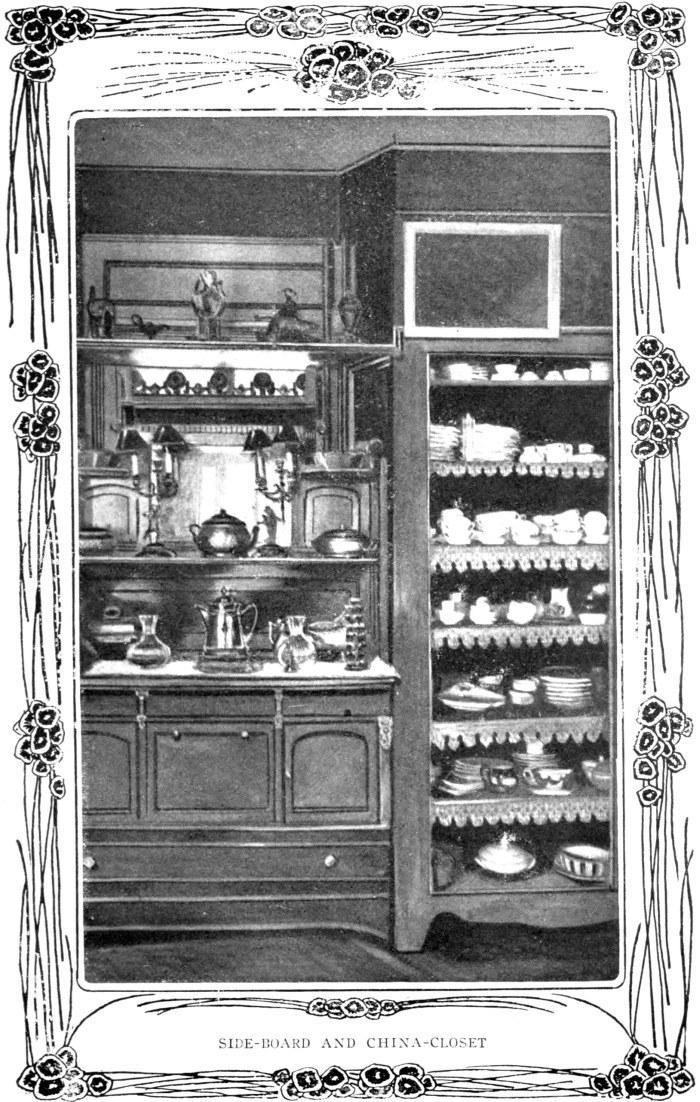
In view of the frail constitution of our well-beloved china, we ought not to set our hearts upon it any more than we ought to love our babies, whose tenure upon life is more slight than spider’s silk. One and all, we do set our affections, and feast our eyes, and pamper our souls’ desires upon the adornments of buffet and china-closet. Tea, coffee and chocolate are more delicious when sipped from Sevres and Limoges; our sensitive finger-tips recoil from the blunt edges of pressed glass. To set stone china and thick tumblers before tired and hungry John would insult one who deserves the best of everything.
Since, then, we must, in justice to him and to ourselves, have fine china and glass, and our waitress’s tumultuous voyagings among
them will strew back yards and vacant lots with the worthless flotsam and jetsam of what was dear and precious, what shall be done? To the housekeeper whose time has not a prohibitive monetary value, my advice is simple and direct: Havechoice china— the choicest you can afford—andtakecareofityourself.
SIDE-BOARD AND CHINA-CLOSET
SOME CULINARY TERMS
“Aspic”—Meat jelly.
“Au Gratin”—Dishes covered with crumbs and browned.
“Au Naturel”—Plain, simple. Potatoes cooked in their jackets are “au naturel.”
“Barbecue”—To roast any animal whole, usually in the open air.
“Bisque”—Soups made thick with mince and crumbs.
“Blanch”—To parboil, to scald vegetables, nuts, etc., in order to remove the skin.
“Blanquette”—Any white meat warmed in a white sauce, thickened with eggs.
“Bouillon”—A clear broth.
“Bouquet”—A sprig of each of the herbs used in seasoning, rolled up in a spray of parsley and tied securely.
“Café au lait”—Coffee boiled with milk.
“Café noir”—Black coffee.
“Camembert”—A brand of fancy cheese.
“Canapé”—Usually toast with cheese or potted meat spread upon it. Sometimes made of pastry.
“Cannelon”—Meat stuffed, rolled up and roasted or braised.
“Capers”—Unopened buds of a low trailing shrub grown in southern Europe. Pickled and used in sauces.
“Capon”—A chicken castrated for the sake of improving the quality of the flesh.
“Caramel”—A syrup of burnt sugar, used for flavoring custards, etc., and for coloring soups.
“Casserole”—A covered dish in which meat is cooked; sometimes applied to forms of pastry, rice or macaroni filled with meat.
“Champignons”—French mushrooms.
“Charlotte”—A preparation of cream or fruit, formed in a mold, lined with fruit or cake.
“Chervil”—The leaf of a European plant used as a salad.
“Chillies”—Red peppers.
“Chives”—An herb allied to the onion family.
“Chutney”—A hot acid sauce made from apples, raisins, tomatoes, cayenne, ginger, garlic, shalots, lemons, vinegar, salt and sugar.
“Comfitures”—Preserves.
“Compote”—Fruit stewed in syrup.
“Consommé”—Clear soup.
“Cream sugar and butter”—Is to rub the sugar into the butter until they are well incorporated, then beat light and smooth.
“Creole, A la”—With tomatoes.
“Croquettes”—A savory mince of meat, or fowl, or fish, or mashed potatoes, rice or other vegetables, made into shapes and fried in deep fat.
“Croustade”—A kind of patty made of bread or prepared rice.
“Croutons”—Bread dice fried.
“Crumpet”—Raised muffins baked on a griddle.
“Curries”—Stews of meat or fish, seasoned with curry powder and served with rice.
“De Brie”—A brand of fancy cheese.
“Demitasse”—A small cup; term usually applied to after-dinner coffee.
“Deviled”—Seasoned hotly.
“Eclair”—Pastry or cake filled with cream.
“En Coquille”—Served in shells.
“Endive”—A plant of the composite family used as a salad.
“Entrées”—Small made dishes served between courses at dinner.
“Entrements”—Second course side dishes, including vegetables, eggs and sweets.
“Farcie”—Stuffed.
“Fillets”—Long thin pieces of meat or fish, generally rolled and tied.
“Fines herbes”—Minced parsley, etc.
“Finnan Haddock”—Haddock smoked and dried.
“Fondant”—Melting. Boiled sugar, the basis of French candy.
“Fondu”—A preparation of melted cheese.
“French dressing”—A simple salad dressing of oil, vinegar, salt, pepper, and sometimes mustard.
“Galantine”—Meat, boned, stuffed, rolled and boiled, always served cold.
“Glacé”—Iced.
“Glaze”—Stock boiled down to a thin paste.
“Grilled”—Broiled.
“Gruyére”—A brand of fancy cheese.
“Hors d’œuvres”—Relishes.
“Jardinière”—A mixed preparation of vegetables stewed in their own sauce; a garnish of vegetables.
“Julienne”—A clear soup with shredded vegetables.
“Koumiss”—Milk fermented with yeast.
“Lardoon”—The piece of salt pork used in larding.
“Lentils”—A variety of the bean tribe used in soups, etc.
“Marrons”—Chestnuts.
“Mayonnaise”—A salad dressing made of oil, the yolks of eggs, vinegar or lemon juice, salt and cayenne.
“Menu”—Bill-of-fare.
“Meringue”—The white of eggs whipped to a standing froth with powdered sugar.
“Mousse”—Ice cream made from whipped cream.
“Noodles”—Dough, cut into strips or other shapes, dried and then dropped into soup.
“Nougat”—Almond candy.
“Paprika”—Hungarian sweet red pepper.
“Pâté”—Some preparation of pastry, usually a small pie. Hence “patty-pans.”
“Pâté de foie gras”—Small pie filled with fat goose liver.
“Pièce de résistance”—Principal dish at a meal.
“Pilau”—East Indian or Turkish dish of meat and rice.
“Pimento”—Jamaica pepper.
“Pimolas”—Small olives stuffed with pimento—i. e., sweet red pepper.
“Piquante”—Sharply flavored, as “sauce piquante,” a highly seasoned sauce.
“Pistachio”—A pale greenish nut resembling the almond.
“Polenta”—An Italian mush made of Indian meal, or of ground chestnuts.
“Potage”—A family soup.
“Potpourri”—A highly seasoned stew of divers materials—meat, spices, vegetables and the like; a Spanish dish.
“Purée”—Vegetables or cereals cooked and rubbed through a sieve to make a thick soup.
“Ragout”—Stewed meat in rich gravy.
“Ramakins”—A preparation of cheese and puff paste or toast, baked or browned.
“Rechauffé”—Anything warmed over.
“Rissoles”—Minced meat, made into rolls covered with pastry or rice, and fried.
“Rissotto”—Rice and cheese cooked together; an Italian dish.
“Roquefort”—A brand of fancy cheese.
“Rôti”—Roasted.
“Roulade”—Meat stuffed, skewered into a roll and cooked.
“Roux”—Butter and flour cooked together and stirred in a smooth cream. A white roux is made with uncooked flour; a brown, with flour that has been browned by stirring it upon a tin plate over the fire.
“Salmi”—A warmed-over dish of game, well seasoned.
“Sauté”—To fry lightly in hot fat or butter, not deep enough to cover the thing cooked.
“Scalpion”—A mince of poultry, ham, and other meats used for entrées, or it may be a mixture of fruits in a flavored syrup.
“Scones”—Scotch cakes of flour and meal.
“Shalot”—A variety of onion.
“Sorbet”—Frozen punch.
“Soubise”—A sort of onion sauce eaten with meat
“Soufflé”—A “trifle” pudding, beaten almost as light as froth, then baked quickly.
“Stock”—The essence extracted from meat.
“Supreme”—White cream gravy made of chicken.
“Tarragon”—An herb the leaves of which are used for seasoning and in flavoring vinegar.
“Tartare”—As a “sauce tartare”—tart, acid.
“Timbale”—A small pie or pudding baked in a mold and turned out while hot.
“To braise meat”—Cook in a covered pan in the oven with stock, minced vegetables, and peas, beans, etc., whole, and with savory herbs.
“To Marinate”—To cover with lemon juice or vinegar and oil, or with spiced vinegar.
“Truffles”—A species of fungi growing in clusters some inches below the surface of the ground. Used in seasoning and for a garnish.
“Tutti-frutti”—A mixture of fruits.
“Veloute”—A smooth white sauce.
“Vol-au-vent”—Light puff pastry baked in a mold and filled with chicken, sweetbreads or other delicate viand.
“Zwieback”—Bread baked twice.
FOR READY REFERENCE
WEIGHTS AND MEASURES
It is so much easier to measure ingredients than to weigh them that the housewife saves time and work by acquainting herself with certain equivalent measures and weights. Without burdening her memory with a dry array of items and figures, I have collected here certain details to which she can refer quickly and confidently.
“One cupful” of flour, milk, etc., means half a pint.
Two scant cupfuls of packed butter make one pound.
Two and a half even cupfuls of powdered sugar are one pound.
Two cupfuls (one pint) of water or milk make one pound.
Three even cupfuls of Indian meal make one pound.
Four even cupfuls of dry flour make one pound.
Two cupfuls (one pint) of water or milk make one pound.
Ten eggs of ordinary size make one pound.
Two cupfuls of minced beef, packed closely, make one pound.
A gill of liquid is half a cupful.
One heaping tablespoonful of granulated sugar is one ounce.
Two heaping tablespoonfuls of flour make one ounce.
Two heaping tablespoonfuls of powdered sugar make one ounce.
Two heaping tablespoonfuls of ground coffee make one ounce.
One tablespoonful of milk, vinegar or brandy make one-half ounce.
The juice of an ordinary lemon is about a tablespoonful. A breakfast cupful of bread-crumbs well pressed in equals about four ounces. Very finely chopped suet, slightly heaped up, weighs about the same. A heaped breakfast cupful of brown
sugar represents half a pound, and stoned raisins well pressed in weigh about the same.
TIME-TABLE
Baking and roasting
FISH AND MEATS
Baked beans with pork 6 to 8 hours.
Beef, fillet, rare 20 to 30 minutes.
Beef ribs or loin, well done, per pound 12 to 16 minutes.
Beef ribs, or loin, rare, per pound 8 to 10 minutes.
Chicken, per pound 15 minutes or more.
Duck, domestic 1 hour or more.
Duck, wild 12 minutes per pound.
Fish, whole, as bluefish, salmon, etc. 10 minutes per pound.
Goose, 8 to 10 pounds 2 hours or more.
Grouse 25 to 30 minutes.
Ham 15 minutes per pound.
Lamb, well done, per pound 15 to 18 minutes.
Liver, whole 12 minutes per pound.
Mutton, leg, well done, per pound 15 minutes or more.
Mutton, leg, rare, per pound 10 minutes.
Mutton, saddle, rare, without flank, per pound9 minutes.
Mutton shoulder, stuffed, per pound 15 to 25 minutes.
Partridge 35 to 40 minutes.
Pork, well done, per pound 20 minutes.
Small fish and fillets 20 to 30 minutes.
Turkey, 8 to 10 pounds 12 minutes per pound.
Veal, well done, per pound 18 to 20 minutes.
Venison, rare, per pound 10 minutes.
Boiling MEATS
Chicken 1 to 1-1/2 hours.
Corned beef (rib or flank) 4 to 6 hours, according to size.
Corned beef (fancy brisket)5 to 8 hours.
Corned tongue 3 to 4 hours.
Fowl, 4 to 5 pounds 15 minutes per pound, if tender.
Fresh beef 4 to 6 hours.
Ham 4 to 6 hours.
Mutton 15 minutes per pound.
Turkey, per pound 15 to 18 minutes.
FISH
Clams and oysters 3 to 5 minutes.
Codfish and haddock, per pound 10 minutes.
Bass and bluefish, per pound 10 minutes.
Halibut, whole or thick piece, per pound 15 minutes.
Lobster 30 to 40 minutes.
Salmon, whole or thick piece, per pound10 to 20 minutes.
Small fish 6 to 8 minutes.
Broiling
Bacon 4 to 8 minutes. Lamb, or mutton chops8 to 10 minutes. Liver 4 to 8 minutes. Quail 10 to 15 minutes. Quail in paper cases 10 to 12 minutes. Steak, 1 inch thick 8 to 12 minutes. Steak, 1-1/2 inch thick 9 to 15 minutes. Shad, bluefish, etc. 15 to 30 minutes. Slices of fish 12 to 15 minutes.
Small fish, trout, etc. 8 to 12 minutes. Spring chicken 20 minutes. Squabs 10 to 15 minutes.
Frying
Bacon fried in its own fat2 to 3 minutes. Chops, breaded 8 to 10 minutes. Doughnuts and fritters 3 to 5 minutes.
Fillets of fish 4 to 6 minutes. Potatoes 2 to 5 minutes.
Boiling vegetables
Asparagus 20 to 25 minutes. Beans, string 1 to 2 hours.
Beans, Lima 30 to 40 minutes.
Beets, new 45 minutes to one hour.
Beets, old 4 to 6 hours.
Brussels sprouts 15 to 25 minutes.
Cabbage 30 to 80 minutes.
Carrots (old) 1 hour or more.
Cauliflower 20 to 30 minutes.
Celery 20 to 30 minutes.
Corn 10 to 20 minutes.
Macaroni 20 to 50 minutes. Onions 45 minutes to 2 hours.
Oyster-plant 45 to 60 minutes.
Parsnips 30 to 45 minutes.
Peas 20 to 50 minutes.
Potatoes, white 20 to 30 minutes.
Potatoes, sweet 15 to 25 minutes. Rice 20 to 30 minutes.
Squash 20 to 30 minutes.
Spinach 20 to 30 minutes.
Tomatoes, stewed15 to 20 minutes. Turnips 30 to 45 minutes.
Steaming
Brown bread 3 hours.
Puddings, one quart or more2 to 3 hours. Rice 45 to 60 minutes.
Baking of bread, cakes, custards and pudding
Fruit cake 2 to 3 hours.
Layer cake 15 to 20 minutes.
Loaf bread
40 to 60 minutes.
Muffins, baking-powder 20 to 25 minutes.
Muffins, yeast about 30 minutes.
Pie crust
Plain loaf cake
30 to 45 minutes.
30 to 90 minutes.
Potatoes 30 to 45 minutes.
Rolls, biscuit 10 to 30 minutes.
Scalloped and au gratin dishes10 to 20 minutes, according to size.
Sponge cake, loaf 45 to 60 minutes, according to size.
Timbales about 20 minutes.
The instructions given above must be modified by circumstances: the age and quality of meat, vegetables and fish, the size of loaves and so forth. It is not possible to make out a table which shall be absolutely accurate. Experience is the one trustworthy teacher.