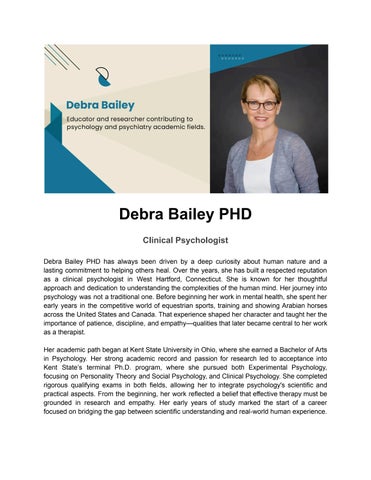
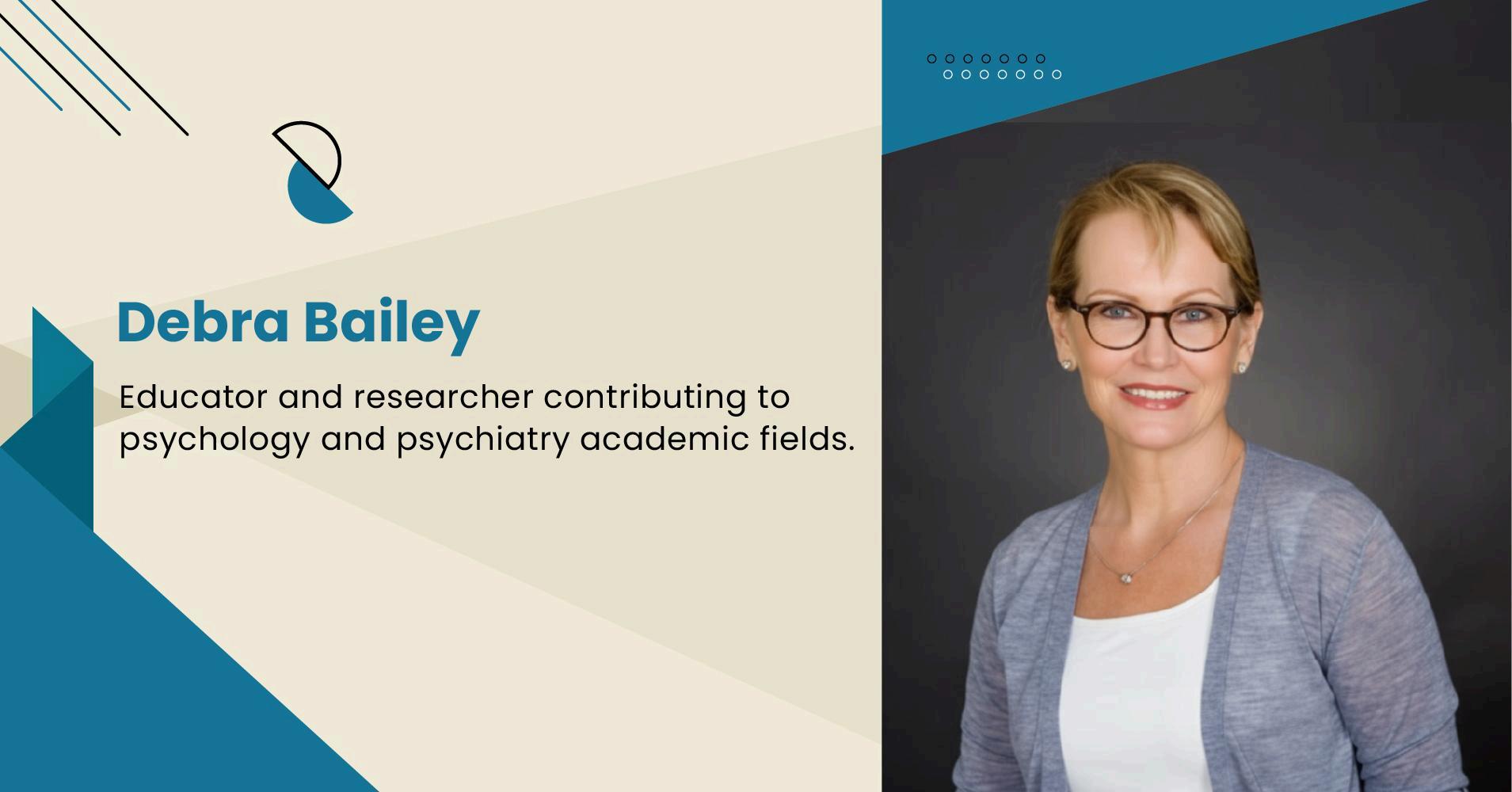
Debra Bailey PHD
Clinical Psychologist
Debra Bailey PHD has always been driven by a deep curiosity about human nature and a lasting commitment to helping others heal Over the years, she has built a respected reputation as a clinical psychologist in West Hartford, Connecticut. She is known for her thoughtful approach and dedication to understanding the complexities of the human mind Her journey into psychology was not a traditional one. Before beginning her work in mental health, she spent her early years in the competitive world of equestrian sports, training and showing Arabian horses across the United States and Canada That experience shaped her character and taught her the importance of patience, discipline, and empathy qualities that later became central to her work as a therapist
Her academic path began at Kent State University in Ohio, where she earned a Bachelor of Arts in Psychology Her strong academic record and passion for research led to acceptance into Kent State’s terminal Ph D program, where she pursued both Experimental Psychology, focusing on Personality Theory and Social Psychology, and Clinical Psychology. She completed rigorous qualifying exams in both fields, allowing her to integrate psychology's scientific and practical aspects. From the beginning, her work reflected a belief that effective therapy must be grounded in research and empathy Her early years of study marked the start of a career focused on bridging the gap between scientific understanding and real-world human experience
After finishing her master’s thesis and passing her Ph D qualifying exams, she moved to Connecticut to complete a pre-doctoral internship in Clinical Psychology at a psychiatric hospital approved by the American Psychological Association She chose this environment intentionally, wanting to work with individuals diagnosed with schizophrenia. This challenging experience deepened her understanding of how thought, emotion, and behavior can be profoundly affected by mental illness Her reasoning was simple but meaningful: if she could learn to connect with and support those experiencing severe psychological challenges, she could work effectively with anyone This belief in deep, authentic engagement has guided her practice throughout her career
After completing her internship, she pursued a post-doctoral fellowship in Clinical Neuropsychology at the Yale-affiliated West Haven Veterans Administration Hospital This career stage brought together her training in experimental and clinical psychology. She explored how brain functioning impacts emotions, personality, and overall mental health through neuropsychological assessment and traditional psychotherapy. Her approach to therapy developed as a balance between data-driven understanding and the deeply personal process of emotional healing She treated therapy as both a science and an art, always emphasizing the importance of seeing the human being behind every diagnosis or test result.
Her early professional years were spent working in inpatient psychiatric settings, where she developed strong crisis intervention skills and gained firsthand experience with people in acute psychological distress These early experiences helped her form a practical and compassionate understanding of human suffering Later, she became the director of a statewide mobile crisis program, leading teams that responded to individuals during moments of crisis. The work demanded flexibility, empathy, and courage, involving meeting people at their most vulnerable points. This period reinforced her belief that therapists must maintain self-awareness and engage in emotional growth to help others truly
After years in crisis intervention, she moved into managing a hospital-affiliated outpatient program with multiple sites throughout Connecticut Along with clinical responsibilities, she contributed to policy discussions as part of provider advisory committees for managed care organizations. Her work also extended into academia, where she held teaching and research roles at several universities, including Cornell University Medical College’s Department of Psychology in Psychiatry. She published research articles and contributed a book chapter on the link between alcohol use and aggression, continuing her lifelong exploration of how emotion and behavior influence one another This combination of research, teaching, and clinical practice strengthened her belief in an integrated model of psychological care.
In her current private practice in West Hartford, she brings over two decades of experience to her work with older adolescents and adults. She provides psychotherapy for people facing depression, anxiety, trauma, bipolar disorder, stress, and relationship difficulties Her approach involves listening deeply and creating a safe, supportive environment. Her clients often describe her as calm, clear, and nonjudgmental. She helps them find insight, humor, and resilience while guiding them toward rediscovering their capacity for healing Her philosophy centers on the belief that therapy is not about fixing people but helping them reconnect with their inner strength and ability to change
Her upcoming book, The Elephant and the Turtle: A Metaphor for the Work of Psychotherapy and Personality Change, reflects her belief that humor, creativity, and play can open the door to transformation The book captures her view of therapy as a dynamic, evolving process where insight and imagination work together to promote growth. It represents her ongoing effort to make psychological work approachable and meaningful to a broad audience
Throughout her career, she has emphasized the importance of authenticity in therapy She believes that effective treatment begins with listening not only to words but also to the emotions behind them. Many of her clients have shared that they felt genuinely heard for the first time during their sessions with her This sense of being understood often becomes a turning point in their healing process Her ability to provide a “safe enough” space for self-exploration allows people to face long-held feelings and experiences that have shaped their lives.
Her thinking has been influenced by significant figures in psychology, especially the British psychoanalyst Donald Winnicott, whose concept of the “good-enough mother” continues to inform her therapeutic work She sees the therapist helping clients reconnect with forgotten or neglected parts of themselves, replacing self-criticism with compassion. This idea forms the basis of her relational and reparative style of therapy, where healing happens through genuine human connection and acceptance
Over the years, she has witnessed countless moments of transformation Watching clients face their fears, rediscover their self-worth, and rebuild their lives brings her deep fulfillment Her work stands at the intersection of science and empathy, guided by a steady commitment to understanding human emotion and behavior Each person she helps reminds her why she chose this path.
From her early days in Arabian horse shows to her decades as a psychologist, her story reflects a consistent dedication to excellence, patience, and trust. Whether training horses or guiding people, she has always believed that growth requires time, understanding, and care In West Hartford and beyond, Debra Bailey PHD continues to be recognized for her quiet strength, compassion, and lifelong mission to help others discover meaning, connection, and healing through the power of self-understanding