
OdenseUniversityHospital
Kløvervænget6
Entrance93,8th floor
5000OdenseC,Denmark
For the year 2024, we wish to highlight the following:
DDEA saw changes in leadership with Allan Flyvbjerg stepping down as Chair of the Board of Directors, replaced by Troels Krarup Hansen.
DDEA organised 36 educational and networking activities including PhD and postdoctoral courses, symposia, webinars, networking and collaboration activities, across the diabetes and classical endocrine research field. The activities attracted around 1000 participants from universities, university hospitals and the life science industry in Denmark and from abroad and received high participant satisfaction rates.
DDEA allocated 45 grants across eleven different schemes, including new funding streams such as strategic partnership grants and thematic grants focused on classical endocrinology.
DDEA continued collaborations with the Danish Cardiovascular Academy (DCA), Danish Data Science Academy (DDSA), and Neuroscience Academy Denmark (NAD), co-organising PhD courses, networking events, and cross-academy initiatives
DDEA met the majority of its current measurable success criteria
Tore Christiansen Managing Director

Danish Diabetes and Endocrine Academy´s (DDEA) mission is to foster early-career research talent through education, networking, and funding in diabetes and classical endocrinology
In 2024, DDEA underwent the following organisational changes in its governance.
In June, Professor Allan Flyvbjerg stepped down as Chair of the Board of Directors. The Novo Nordisk Foundation subsequently appointed Professor Troels Krarup Hansen, CEO of Steno Diabetes Center Aarhus, as the new Chair, effective from 15 June 2024.
In the end of December 2024, Professor and head of research at Steno Diabetes Center Odense, Kurt Højlund stepped down from the BoD Head of Research and Consultant, Herlev Hospital, and Associate Professor, University of Copenhagen Martin Blomberg Jensen was appointed to replace Kurt Højlund.
Three members of the Committee for Education stepped down from their positions as of 1 July. Their replacements will be appointed in spring 2025.
DDEA established in March a Public Advisory Panel consisting of nine individuals with diverse lived experiences related to diabetes and classical endocrine diseases. The aim with the Public Advisory Panel is to provide recommendations, ideas, and feedback to the DDEA Secretariat on strategy for connecting early-career researchers with society through education, networking activities, and funding and communication activities.
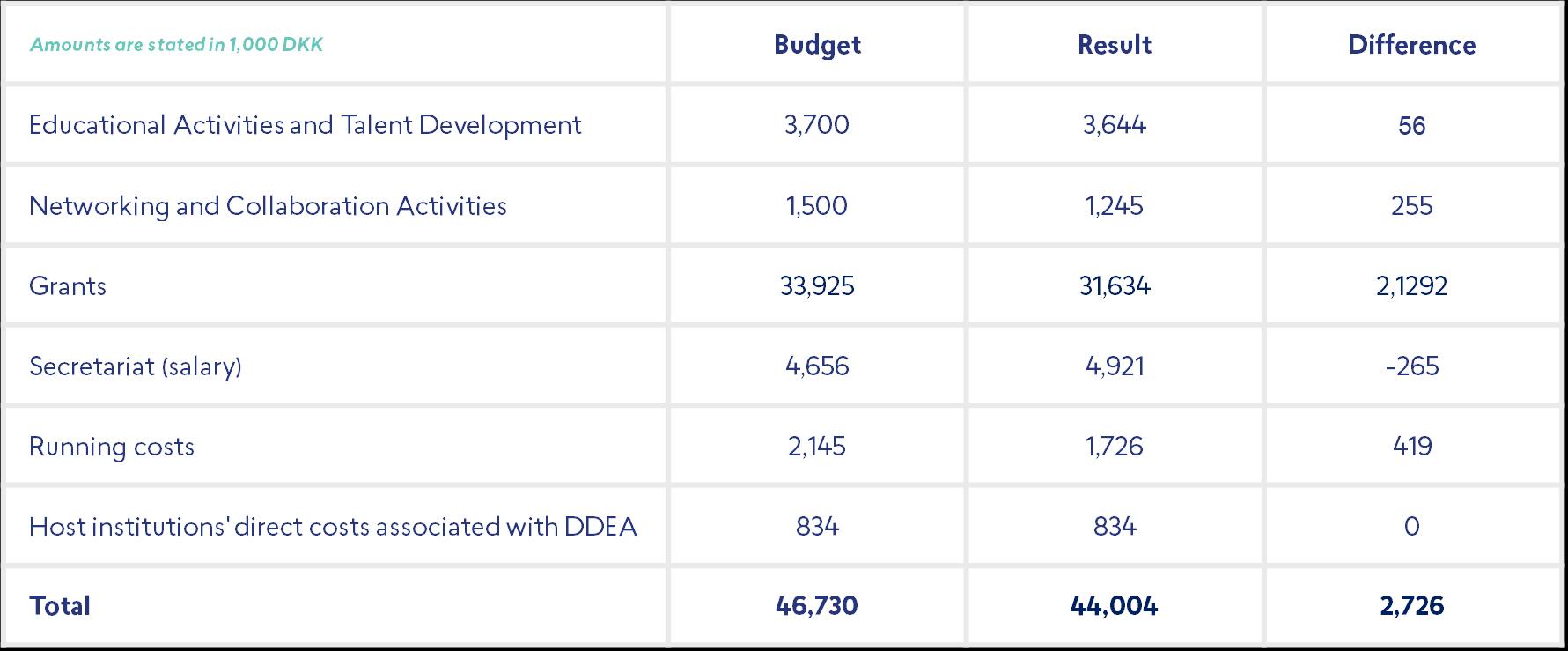
The financial results for 2024 show an expenditure of TDKK 44.004 against a budgeted expenditure of TDKK 46 761 resulting in a lower-than-expected expenditure of TDKK 2 761 (Table 1)
The majority of the underspending can be attributed to fewer grants awarded than planned, including industrial postdoctoral fellowships and strategic PhD and Postdoc partnerships
Table 1. The financial results for 2024
In 2024, DDEA organised 36 educational and networking activities, ensuring alignment with its four strategic themes: digitalisation and new technologies, public involvement and outreach, strategic partnerships, and translational research. These themes were actively incorporated into the programme to foster interdisciplinary collaboration and strengthen research impact.
Across all educational and networking activities, more than 1,000 participants engaged in DDEA’s programme, with around 100 national and international contributors helping to organise the events. These contributors represented diverse sectors, including academia, university hospitals, industry, NGOs, and individuals with lived experiences. Participants responded positively to the activities, with an average satisfaction score of all education and networking activities of 4.4 out of 5.
DDEA’s flagship events, the PhD Summer School and Postdoc Summit, remained central to the educational programme, bringing together early-career researchers from research institutions in Denmark and from abroad for intensive training, career development, knowledge-sharing, network and collaboration.
In 2024, DDEA continued its focus on classical endocrinology with activities on bone metabolism, neuroendocrine tumors, transgender health, and nutrition. DDEA also strengthened international collaborations through joint activities with e.g. Cambridge University and the German Center for Diabetes Research while expanding national partnerships with Danish Data Science Academy, Neuroscience Academy Denmark and Danish Cardiovascular Academy, including initiatives on navigating as a researcher in the era of artificial intelligence, career development and PhD course on Basic Cardiometabolic Research. Further DDEA also deepened its focus on public and patient involvement (PPI), integrating user perspectives into research and education through collaborations with the Public and Patient Ignite Network (Ireland) and non-governmental organizations in Denmark.
A full overview of all activities, listed in chronological order, can be found in Appendix 1
In 2024, DDEA’s grant activities were shaped by the work of BoD committees, which focused on classical endocrinology, strategic partnerships, and industry collaboration. As a result, new grant schemes were introduced, broadening research opportunities and fostering interdisciplinary cooperation. DDEA awarded 45 grants across 11 different programmes, supporting both national and international researchers.
In relation to classical endocrinology funding supported projects in bone metabolism, adrenal and pituitary disorders, and endocrine tumour biology. The Strategic Partnership Grants facilitated research collaborations with leading international institutions including the Broad Institute (Harvard/MIT), and the Baker Heart and Diabetes Institute in Australia In relation to industry,s collaborations grants supported projects with Novo Nordisk A/S, Eli Lilly, and Arla Foods.
DDEA awarded eight Cross-Academy PhD Scholarships in collaboration with Danish Cardiovascular Academy and Danish Data Science Academy. These grants strengthened integration between cardiovascular, diabetes, endocrine research and advanced computational approaches to disease prediction and treatment. Additionally, visiting researcher grants brought international experts to Danish institutions, supporting projects on diabetes epidemiology, metabolic regulation, pituitary tumours, and digital diabetes care
Through these funding opportunities, DDEA reinforced its commitment to supporting early-career researchers, ensuring financial support across key research areas and strengthening collaboration between academia, industry, and clinical environments nationally and internationally
A full overview of the 45 awarded grants is available in Appendix 2 and on the DDEA website.
Our commitment to keeping our target group informed and engaged was conducted through our monthly newsletters (3600 subscribers), and engagement with our community through weekly updates on LinkedIn, X and Instagram
Table 2 presents the number of followers on our social media platforms as of 31 December 2024, along with the development compared to 31 December 2023
Table 2. Number of followers on DDEA social media platforms
At the end of 2024, we decided to close our account on X Moving forward, our external communication efforts in 2025 will, in addition to our newsletters and website, primarily focus on LinkedIn, Instagram and podcasts. These platforms serve as key channels for engaging with our network and sharing updates on our activities, research initiatives, and opportunities for early-career researchers.
DDEA has achieved most of the set success criteria for 2024 in the areas of education and talent development:
The targets for organising six PhD courses (including a summer school), four symposia, and five postdoc courses (including a postdoc summit) have been met. Additionally, eight activities have been organised within endocrinology beyond diabetes, surpassing the initial goal of five.
Evaluations show that 90% of DDEA-funded researchers and attendees of two selected activities have acquired new, applicable skills, knowledge, and competencies.
The participant satisfaction with the scientific program of each education and talent development activity was 4.5 surpassing the goal of minimum 4.0 of a scale from 1 (unsatisfactory) to 5 (very satisfactory).
The long-term goal of 30% of DDEA-funded early-career researchers becoming principal investigators, research leaders, or securing tenure positions remains to be assessed after 2030.
After meetings with graduate program leaders at the universities of UCPH, SDU, AU, and AAU, it was concluded that establishing a national DDEA PhD graduate program across Danish universities is not feasible at this point. Consequently, this success criterion has not been met.
DDEA has successfully met its networking and collaboration targets for 2024. A total of 19 PhD networking and collaboration activities were organised more than doubling the initial goal of eight annual activities. Additionally, 11 activities were conducted in collaboration with DCA, DDSA, the life science industry, or international research institutions, exceeding the set targets.
Participant satisfaction with the networking aspect of each networking and collaboration activity was 4.3 surpassing the goal of minimum 4.0 of a scale from 1 (unsatisfactory) to 5 (very satisfactory).
DDEA also met its target for collaboration with NGOs, organising two activities in partnership with NGOs in 2024, surpassing the annual goal.
Two success criteria remain to be assessed. The impact of DDEA’s networking and collaboration activities on fostering new research partnerships among early-career researchers will be evaluated through a planned survey in autumn 2025
Similarly, DDEA’s overall impact on the diabetes and endocrine research environment specifically in research education, networking, and grants will be assessed through a stakeholder survey in autumn 2025.
If classical endocrinology is defined as including thyroid disorders, calcium metabolism and bone, pituitary and adrenal gland diseases, and gonadal diseases, but excluding nutrition and obesity, DDEA did not meet the 2024 target of allocating 40% of all grants to classical endocrinology, as outlined in the success criteria.
Of the 24 awarded PhD grants, 5 (20.8%) were allocated to classical endocrinology. Among the 14 awarded postdoc grants, 3 (21%) were allocated to classical endocrinology. Additionally, of the 7 visiting researcher grants, 2 were awarded to classical endocrinology (28.6)
Several success criteria related to research impact and career progression remain pending assessment. A bibliometric analysis planned for 2026 will evaluate the proportion of DDEA-funded publications in top-tier journals, while longer-term metrics on career trajectories, industry collaboration, and innovation engagement will not be measurable before 2030. Further evaluation in 2026 will assess the citation of DDEA-funded research in clinical guidelines, policies, and textbooks, as well as external funding obtained by DDEA-supported researchers.
DDEA met its success criterion of organising at least one activity annually in collaboration with NGOs.
Several communication and outreach targets remain pending assessment. A bibliometric analysis, scheduled for 2026, will evaluate the citation and media impact of DDEA-funded researchers. Additionally, a survey in 2025 will assess the effectiveness and reach of DDEA’s online presence, including website visitor satisfaction and engagement.
Data from ResearchFish will provide insights into the dissemination activities of DDEA-funded early-career researchers, including keynote speeches, conference presentations, and public engagement efforts.
A full overview of all success criteria can be found in Appendix 3.
The establishment of the Danish Advanced Research Academy (DARA), announced in late 2024, marks a significant development for the Danish research landscape and for DDEA. DARA aims to foster world-class, transformative research across Denmark by building a vibrant, interdisciplinary community of PhD students. It will centralise the administration of PhD scholarships, training, and educational activities within six scientific tracks, including those of the Danish Data Science Academy, the Danish Cardiovascular Academy, and DDEA.
While DDEA recognises the potential of DARA to strengthen PhD education and interdisciplinary collaboration, this transition also means that DDEA, in its current form, will not submit a renewal application for funding beyond 2027.
This shift requires a new strategic direction. Rather than defining a future structure for DDEA as an academy with PhD students, the focus must now be on identifying how DDEA’s expertise, network, and strategic initiatives can complement and add value to DARA particularly in areas not currently covered. One such area is postdoctoral training and career development, which remains a central need within diabetes and classical endocrinology research but is not part of DARA’s current scope.
To ensure continued support for this community, DDEA will initiating discussions with the other academies, whose current grants expires in 2026, to explore the feasibility of a coordinated funding strategy. This process should begin promptly and involve active input from the broader research environment.