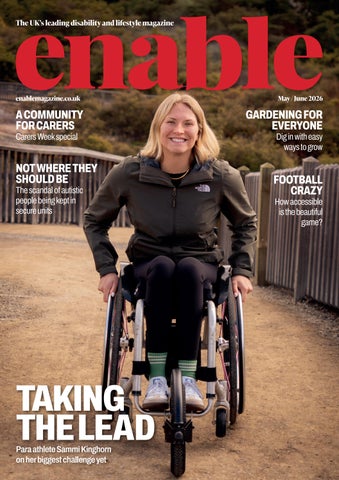
Enable May / June 2026

Page 1


A COMMUNITY FOR CARERS  Carers Week special NOT WHERE THEY SHOULD BE

The scandal of autistic people being kept in secure units

TAKING THE LEAD

Para athlete Sammi Kinghorn on her biggest challenge yet

GARDENING FOR EVERYONE Dig in with easy ways to grow

FOOTBALL CRAZY

How accessible is the beautiful game?

COVER PRICE £3.00

PUBLISHER

Denise Connelly denise@dcpublishing.co.uk

EDITOR

Melissa Holmes melissa.holmes@dcpublishing.co.uk

STAFF WRITER

Kate Stevenson kate.stevenson@dcpublishing.co.uk

EDITORIAL CONTRIBUTORS

Jane Hatton

Samantha Renke

Tim Rushby-Smith Alisdair Suttie

DESIGN AND PRODUCTION

Lucy Baillie lucy.baillie@dcpublishing.co.uk

SALES

Marian Mathieson marian.mathieson@dcpublishing.co.uk

ENABLE MAGAZINE www.enablemagazine.co.uk

DC Publishing Ltd,

198 Bath Street, Glasgow, G2 4HG

Tel: 0844 249 9007

hen it comes to the great British summertime, are you an avid sports fan, busy gardener, or festival goer? We’ve got all three covered in this issue! First up, I speak to Paralympic gold medallist and Commonwealth Games Athlete Ambassador Sammi Kinghorn about her amazing wheelchair athletics career and her next great challenge: motherhood. In the run-up to the World Cup, we learn more about what football teams are doing to support access to the beautiful game, and I chat to one West Ham fan about his tireless work to improve the experience for disabled fans. Staying with sport, I also catch up with Darren Awolesi, who used sport to rediscover his purpose after a spinal cord injury.

Music festivals are a cornerstone of summer here, but how accessible are they to disabled music lovers? And, no summer is complete without a trip to a beautiful garden… So if your outdoor space is less stately home and more wheelie-bin wilderness, you’ll want to read this issue’s article on how everyone can make their green space gorgeous.

With a focus on men’s health, first-person stories on Functional Neurological Disorder, Tourette syndrome, and carer-friendly communities, a look at how to combat loneliness, and a run-down of the best wellness apps for disabled people, there’s plenty to keep you busy this issue.

So, till next time –

18

20

What's inside

Interview

08 TAKING THE LEAD Paralympic gold medallist and Commonwealth Games

Athlete Ambassador Sammi Kinghorn reflects on her journey in sport as she undergoes a new challenge: motherhood.

23 I NEVER GAVE UP HOPE

Liam Virgo talks to Editor Melissa Holmes about his experience of becoming disabled as a teenager, and his work to raise awareness of Functional Neurological Disorder.

36 A SURVIVOR’S STRENGTH

In March 2011, Darren Awolesi’s life changed in an instant after he was shot in the back during an unprovoked attack. He explains how he’s found his purpose after experiencing a spinal cord injury.

66 THE MUSICAL COMEDIAN Sharp, self-aware and refreshingly honest: Robert White on building his comedy career his own way.

Care

12 CARERS WEEK

This year, Carers Week is focusing on building carerfriendly communities. We speak to carers to learn more about their support networks and how they find strength.

Health

38 MEN’S HEALTH MATTERS

In conversations around men’s health, we often miss a crucial perspective: the health experiences of disabled men. To mark Men’s Health Week 2026, we delve deeper.

Life

15 MAKING IT CLEAR

In the run-up to Tourette’s Awareness Day, we chatted with Luke Manton about his work to counter stereotypes and encourage acceptance.

20 NOT WHERE THEY SHOULD BE

Across the UK, thousands of autistic people remain in mental health hospitals and secure units – often far from home, and for years. Our Editor investigates.

30 GARDENING FOR EVERYONE

Now that summer is on the horizon, let’s look at how to make our green spaces more accessible.

33 CONNECTING LIVES

Thanks to modern technology, the world has never felt more connected. But many of us have never felt so lonely. We learn more about the impact of loneliness – and how to combat it.

44 SMART SUPPORT

We look at the science-backed apps –from meditation to medication tracking – helping disabled people and carers feel better every day.

47 ACCESSING JOY

The work of organisers and specialist charities who are making festivals more accessible.

50 PRODUCTS

Useful products and innovations that have caught our attention.

53 THE DIARY

The latest disability-focused and accessible events to fill your calendar.

Voices

18 TESTING,TESTING…

Tim Rushby-Smith shares his experience of taking part in medical research.

26 BONES I CAN DO

Columnist Samantha Renke reflects on the impact a recent episode of ill health has had on her self-perception as a Disabled person.

Sport

41 FOOTBALL CRAZY

We’re all set for a summer of the beautiful game. But how accessible is football for disabled fans?

47

Motoring

56 REVIEW: KIA EV4

The Kia EV4 injects the small family car class with a shot of electricallycharged brilliance. Check out our review to see if it's worth a test drive.

Finance

28 IN WITH THE NEW

The new tax year brings changes to the benefits system. Ease your worries and find out the facts: what’s happening for disabled people's finances?

Employment & Education

61 SELL YOUR STRENGTHS

Jane Hatton, Enable’s employment expert, shares her advice on how you can find confidence in your job search.

63 WHERE OPPORTUNITY BEGINS

What if the problem isn’t that young people with SEND can’t work, but that we’ve never built the right pathway? Supported internships are changing that, one job at a time.

SAMMI KINGHORN

TAKING THE LEAD

Paralympic gold medallist and Commonwealth Games Athlete Ambassador

OBE reflects on her journey in sport as she undertakes a new challenge:

When Sammi Kinghorn was 14 years old, an accident on the farm she grew up on changed her life forever. Crushed by a forklift, she sustained a spinal cord injury that put her in a wheelchair. What happened next is a story of transformation rather than tragedy – a journey that’s taken her to Paralympic podiums, primetime television and, most recently, to the cusp of motherhood.

“I think because I was so young, and kids are so resilient,” Sammi reflects. “I think that helped with getting on with things.” Sammi’s resilience and positivity shine through during our interview. She still smiles even when

talking about the tough stuff – like spending six months at Glasgow’s spinal unit before emerging into a world she hadn’t known existed.

BETTER AND FASTER

Before leaving hospital, she went to the Spinal Unit Games, where she encountered wheelchair racing for the first time. She was transfixed. “I remember seeing this girl going around in a racing chair and me being speechless,” Sammi recalls. “She looked really ripped and cool, and had pink stars on her chair. She was overtaking the runners. I remember thinking: I’m gonna be better and faster than I was before.”

Sammi Kinghorn

motherhood

That spark became a fire. Within a year, Sammi had her first racing chair. By 2012, she was competing at the London Mini Marathon. Watching the home Paralympics that summer – with the electric atmosphere in the stadium and stars like Hannah Cockcroft and David Weir (who she now counts as friends) on the track –deepened Sammi’s conviction. “I was so incredibly lucky that I started my journey around then. It made things seem a lot more possible.”

What followed is a career that’s seen Sammi become one of the world’s most decorated wheelchair racers, collecting medals at World Championships and Paralympics. But, alongside her successes, she’s fought a battle that’s had nothing to do with her disability.

MENTAL PRESSURES

“The toughest parts of my career have been dealing with the mental pressures,” she explains, candidly. “The physical side was always easy for me. But racing – I found it really difficult. I would be sick before every single race.”

At the Tokyo 2020 Paralympics, when Sammi ranked number one in the world in the 100 metres, she threw up at the start line. “I always struggled with self-belief,” she admits. “I never really believed I deserved to be there.” Sammi recognises the pressure she puts herself under is internal, and it all goes back to her injury. “After having something traumatic happen, I automatically didn’t want anyone to feel sorry for me,” she reveals. “I felt like I had to achieve something big. I was piling on pressure that was completely unnecessary. Some people thrive under pressure… while I’m just throwing up in the corner!”

Paris 2024 marked a turning point. Working with a sports psychologist and delving deep into coping mechanisms, Sammi’s been able to reframe her relationship with competition. “I tell myself that I’m nervous because I care. And I’ve

Sammi at prep camp for the Paris 2024 Paralympics

I always struggled with self-belief. I never really believed I deserved to be there

learned to control the controllables. All I can control is myself – not the weather, not anyone else.” She still gets sick before races, but says: “Now I just tell myself: that’s me, that’s the way I am, and that’s fine.”

SO FRUSTRATING

Her role as a presenter on Countryfile has changed the rhythm of her life – and, she hopes, the way disabled people are perceived. Having grown up on a farm, she says: “I love the countryside, but it’s so frustrating that it isn’t more accessible. Kissing gates are the bane of my life!” She laughs at some of the online comments her appearances have generated. “Someone watched Countryfile and saw me on a boat and wrote: ‘You can’t put a disabled person on a boat –what if she falls off?’ And I was like... I can swim!”

The reaction reflects a broader frustration. “If kids don’t get their questions answered, they become ignorant adults who just assume what I can and can’t do. That’s my biggest pet peeve – being told what I can and can’t do by someone who doesn’t even know me.”

QUITE AMAZING

Sammi is now expecting her first child with husband Callum, entering her third trimester as we speak. Far from finding pregnancy at odds with her athletic identity, she’s found something unexpected in it. “For the first time, my body is doing something it’s supposed to do. A lot of the time, with a disability, your body doesn’t do what it’s meant to. But this… It’s quite amazing. I feel so grateful.”

She’s taking a measured, pressurefree approach to the idea of returning to sport. “I’ve achieved everything I could have ever thought possible. So if it comes to the point where I can’t get back into racing, I wouldn’t feel I’d missed out. But I don’t feel done when it comes to sport yet.”

Her advice to other disabled people contemplating sport, parenthood or simply a life fully lived? “Try to be confident in yourself – it’ll get you through most things. And don’t be afraid to ask for help. The world isn’t accessible and, if you don’t ask for help sometimes, you’ll miss out on so many beautiful things it has to offer.”

As for what comes next for Sammi Kinghorn – Paralympic champion, television presenter, soon-to-be mother – whatever it is, she’ll keep pushing for lead position.

Pay gap reporting

THE GOVERNMENT IS COMMITTING to introducing mandatory ethnicity and disability pay gap reporting for large employers. In a bid to increase transparency and help tackle barriers in the workplace, firms with 250 or more employees will be required to publish pay gap metrics along with data on workforce composition. This is likely to be introduced in 2027/28, via the

Equality (Race and Disability) Bill. Rt Hon Sir Stephen Timms MP, Minister of State for Social Security and Disability, said: “Disabled people deserve the same chance as everyone else to be rewarded fairly at work, but the fact is that pay gaps exist. Pay gap reporting will give organisations the data they need to reduce these gaps and improve fairness and inclusivity in the workplace.”

CALL FOR BETTER SUPPORT FOR SIGHT LOSS

BLIND AND PARTIALLY SIGHTED people took part in a cane walk to Westminster with a message for Government: it’s time to end the postcode lottery of support for people with sight loss. They handed over a petition signed by more than 48,000 people addressed to Health and Social Care Secretary, Wes Streeting. The petition calls for an improvement to vision rehabilitation, a service that people are legally entitled to when they lose or are losing their sight.

Research by the Royal National Institute of Blind People (RNIB) has revealed patchy provision of vision rehabilitation across England, with some people waiting more than a year for an initial assessment of their needs by local authorities. Eleanor Thompson from RNIB said: “Too many people are having their lives put on pause, unnecessarily. No one should have to wait to receive vital support after sight loss.”

TAP THE NHS APP

PEOPLE IN ENGLAND ARE being encouraged to download the NHS App via an accessible campaign offering information on how to use the app, including instructional BSL videos, and large print and Braille leaflets. The NHS App lets you quickly and easily request repeat prescriptions, view your GP health record, and receive messages and appointment reminders. You can also get test results before they arrive in the post, use NHS 111 online, and access the NHS 111 BSL interpreter and text relay service. Learn more at nhs.uk/nhs-app

MS: Abused for using facilities

Almost half (48%) of people living with multiple sclerosis (MS) in the UK have been questioned or challenged for using accessible facilities – like Blue Badge parking spaces, accessible toilets, and priority seats on public transport.

To mark this year’s MS Awareness Week campaign, MS Think Again, more than 1,600 people living with MS were surveyed by leading MS charities, to understand the full impact of public judgements, and to challenge assumptions about MS. One in five people with MS said they had been questioned or challenged for using an accessible toilet and 22% for using a Blue Badge parking space, with many reporting being shouted at, harassed, or even spat at.

A Home Designed for Life

Established in 1993, Harron Homes has grown while staying true to its roots as a local business that genuinely cares. From first enquiry to moving day and beyond, the focus remains on creating a straightforward, personal homebuying experience. The Shackleford reflects this approach perfectly. Designed with accessibility and adaptability in mind, it offers step-free access, wide doorways, and thoughtful details that make everyday living easier.

THE SHACKLEFORD

The Shackleford is designed for comfort, ease, and adaptability, creating a home that works around your life. Step-free access, wide doorways, and well-placed switches ensure effortless everyday living. Built with the future in mind, it can easily accommodate features like a lift, wet room, or ceiling hoist without major changes. Reinforced walls and pre-wiring add further flexibility.

The kitchen can also be tailored, including lower worktops for convenience. Located in welcoming communities, The Shackleford combines thoughtful design with a true sense of home offering comfort, independence, and the freedom to live well for years to come.

Speak to our sales team or scan the QR code to explore our latest Yorkshire developments and find a home that feels just right. 0113 204 4670

A CARER-FRIENDLY COMMUNITY: What does it look like?

Carers Week takes place from 8 to 14 June this year, with a focus on building carer-friendly communities. We speak to carers to learn more about their support networks

“I’ve made my own community”

Liz’s story

“I cared for my husband until he passed away last year. Two of my adult children have physical disabilities, and our granddaughter, who’s 27, is autistic and dyspraxic. I’m a full-time carer.

“ While I was in hospital with my husband, no one asked if my disabled children needed help with anything. But why would they? They’re so wrapped up in their own lives. Carers get forgotten. So I’ve made my own community – I’m a member of four different churches, and I send out a morning prayer every day to 200 different people and organisations. I work within my church to raise awareness of carers’ needs.

“I help people fill in PIP forms and benefits applications, I’ve helped set up a community café, I signpost people to places that can help their particular situation. I never stop. I get into trouble for that, because I’m a giver and I’m not very good at letting people take care of me. I do have one friend who I met at church years ago who is absolutely brilliant, she takes me out once a month. One church prays for us every week and, when my husband died, one of the elders at the URC church helped us financially as well.

“I think every community could do better. They could acknowledge the stress and mental load that carers face. Not just physically –physically it’s hard, but it’s nowhere near as hard as the mental strain. And when they see a carer they could ask: ‘Would you like a coffee?’, or they could drop a cooked meal on the doorstep.

“If I didn’t have a faith, I don’t think I’d be here. Whether through church, or through online or real-life groups, carers need to find their communities too. We need to be there for each other: it opens your eyes and makes you more aware of other people’s struggles.”

“Understood, valued and supported”
Helen Walker, Chief Executive at Carers UK

“A truly carer-friendly community is one where caring is understood, valued, and supported as part of everyday life. This means that neighbours, employers, schools, and local services recognise what caring involves and respond with empathy and flexibility.

“Small, everyday actions can make a meaningful difference to carers’ wellbeing and their sense of belonging. This includes checking in, offering practical help, or simply showing patience and understanding.

“In the workplace, carers need an inclusive culture, supportive line managers and policies that enable them to balance responsibilities

“We’re stronger together”

Yvonne’s story

“I’m mum to Amali, who’s 26. She’s autistic and has a learning disability. 23 years ago, my best friend Lynn came to me with a problem. Her daughter, Leanne, had a learning disability and could see her cousins going out, putting their makeup on, going to discos. Leanne said to her mum one day: ‘I want to be able to do that, but there’s no way for me. I can’t go to all these amazing places. I’d rather be dead’. Lynn was shocked. She said to me, ‘We’ve got to change this. We can’t go on like this’.

“To cut a long story short, we set up Better Action for Families (BAFF), here in Leeds. We offer a wheelchair exercise group, relaxation, boccia, a walking group, and outings to the coast three times a year. We have our own allotment and, each week at our global family food day, our families use food from the allotment to cook vegetarian dishes from their home countries, like Estonia and Poland.

“We don’t close our doors to anybody. Different, not less – that’s what we believe. Whether you’ve got behavioural issues, mobility needs; whatever you come with, we’re here to help you.

“We host a quarterly Carers’ Reference

Group to steer BAFF in an effective way and make sure everyone’s voices are included. Our work is vital: if a carer has a question and we don’t know the answer, we signpost them to somebody who does. Word of mouth is important too – carers know they can come to us, and their loved one will have fun and they’re not sitting at home.

at home with those in employment. Within health and social care settings, professionals should work with carers by involving them in decisions, communicating clearly, and avoiding unnecessary stress caused by poor coordination or inflexible systems.

“Support should also be easy to find and access, whether that’s respite care, financial advice, or peer support, so carers are not left searching for help when they’re already under pressure. Together, these things send a clear message that carers are recognised, valued and included in their communities, encouraging them to seek support openly and confidently.”

“A lot of carers feel really isolated. Some of our people just sit on the side and don’t join in – and that’s absolutely fine. But they come back. Because if you make it fun, they’re going to come back.

“Lynn passed away suddenly last year. But she always used to say: ‘We’re stronger together’. That’s at the back of my mind all the time.”

ELEVATED LIVING, DESIGNED FOR YOU

DESIGNED BY FOSTER + PARTNERS, WITH INTERIORS BY MAWD | MARCH AND WHITE DESIGN, THE DEVELOPMENT BRINGS TOGETHER STRIKING ARCHITECTURE AND AN

One Kings Road Park is situated in a prime Zone 2 location and set within six acres of beautifully landscaped gardens.

A collection of accessible, spacious homes including one, three and four bedroom residences, each featuring generous layouts and carefully considered details to support comfort and independent living.

Residents can enjoy an exceptional range of amenities, all set within tranquil green surroundings in one of London’s most sought-after locations.

REGISTER YOUR INTEREST

Call: 020 3004 4112 Email: sales@kingsroadpark.co.uk

Visit our Marketing Suite at 1 Sands End Lane, London SW6 2FP

Prices from £1,020,000

MAKING IT CLEAR

In the run-up to Tourette’s Awareness Day on 7 June, Editor Melissa Holmes spoke with Luke Manton, a successful business owner and Tourette’s advocate, about his work to counter stereotypes and encourage acceptance

The recent release of I Swear – a film about John Davidson, who has Tourette syndrome – has opened up conversations around the complex neurological condition, as well as helping raise awareness. But Tourette’s is often associated with its most notorious stereotype: involuntary swearing, which was frequently highlighted in the film.

For people like Luke Manton, who lives with Tourette’s, the reality is far more nuanced. Luke’s taken it upon himself to challenge misconceptions through an innovative A to Z video series on his social media platforms. It’s just part of the work he’s been doing to raise

awareness and support people with Tourette’s to feel more understood and accepted in society.

MORE THAN SWEARING

Many people associate Tourette’s with sudden outbursts of offensive language. This symptom is known as coprolalia, and it’s present in around 10-15% of cases. Luke wants to expand the public’s knowledge around Tourette’s by highlighting the lesserknown aspects, because living with Tourette’s is about more than just dealing with vocal tics. He’s discussed his own experiences with pain from physical tics, such as neck spasms and motor tics, which also affect daily

I want to show that you can have a version of normal life with Tourette’s

enable life

activities like cooking and shaving. For those unfamiliar with Tourette’s, learning about these elements of the condition can be eye-opening.

Films like I Swear play a crucial role in making the public aware of Tourette’s, but they often fall short of depicting the condition’s true complexity. Luke feels “it didn’t go into the specific symptoms enough.” He’s working to fill that gap in representation. “We’re still taught that it’s just swearing, but that’s what gets the views.”

OPENING DOORS

Luke lives with coprolalia alongside other symptoms including motor tics, stammering, whistles, and ritualised tics that are linked with OCD (which is common in people with Tourette’s). He says: “The film raised general awareness, but my video series opens up that door to showing the depth of the condition.”

His A to Z series was born out of the realisation that “there are still so many gaps in people’s knowledge.” He explains: “It’s a quick, short way that I can get people to learn.” The response has been overwhelmingly positive. “What I’ve noticed is that people are being open, saying ‘I didn’t know this. Whereas before, I think it was almost like if you don’t know something, you would keep it quiet. But people are being open and honest, which is almost encouraging them to ask more questions.”

IGNORANCE TO ACCEPTANCE

Following on from his A to Z videos, Luke – who developed Tourette’s after a brain injury – will be doing a Q & A series, answering one question about life with Tourette’s every day. “We’re writing them down as they come in. Because if one person asks a question, you can guarantee that ten people wanted to ask it.”

It’s clear there’s far to go in raising awareness. “People still say ‘Tourette’s didn’t exist when I was young’… but it was discovered in the 1800s!” he laughs. Through his efforts, Luke hopes to foster patience and understanding, transforming ignorance into acceptance.

PLATFORM FOR CHANGE

Luke’s social media work has not only educated others but it’s also opened personal and professional doors. He says: “You do have to have a thick skin to be able to do it!” But his efforts are paying off. He’s founded his own successful, inclusive business offering virtual PA services to other businesses, plus his content catches the eyes of companies that now invite him to share his experiences.

INSPIRING THE FUTURE

Luke is especially passionate about the influence he might have on younger people with Tourette’s and their families. By showcasing his career achievements, personal milestones, and life as a proud dad, as well as working closely with the charity Tourette’s Action, Luke’s showing it’s possible to lead a fulfilling life with Tourette syndrome.

Authenticity is something of an overused buzzword, but Luke has it in spades, and his unique approach is helping him challenge public perceptions and encourage others with Tourette’s to advocate for themselves. All of this feeds into a bigger goal. Luke’s journey shows there’s no single path to success, and he wants to demonstrate that, with determination, people with Tourette’s can achieve their ambitions. He reflects: “I want to show that you can have a version of normal life with Tourette’s. Some people are surprised that I even have a job. I think the narrative today, especially with social media, is you have to be perfect – to look perfect, have the perfect body – to do well. But there’s a route for everybody. It’s just finding the right one. On paper, I should not have been successful, and this should never have worked. But here we are – so I’m clearly doing something right!”

People still say ‘Tourette’s didn’t exist when I was young’… but it was discovered in the 1800s!

Disclaimer: While writing this article, we’ve edited out any swear words, verbal tics, or stammers that took place during our interview with Luke. This has been done to aid readability of the article and make it as accessible as possible, and also because we are limited by the space we have. We have no intention of silencing the voices of people with Tourette’s, but wanted to explain our reasoning behind these changes. Thanks for your understanding.

Motability from Eastern Western Motor Group means:

The

Drive with confidence with a reliable new car every 3 years. Our brands available with Motability include...

Tim Rushby-Smith

Originally from London, writer, artist and paraplegic Tim Rushby-Smith is based in Australia. He is the author of two books: Looking Up and Beyond the Break

Follow Tim on X @trushbys

Testing, testing…

Tim

Rushby-Smith shares his experience of taking part in medical research

Over the last few years, I’ve been subjected to various indignities, even extreme discomfort, both in the real world and in a virtual one. I volunteered for this – I am a guinea pig who frequents the world of research trials.

In the 20 years since my spinal cord injury, I’ve willingly exposed myself to various medications, exercises and procedures, mostly in a bid to reduce the levels of neuropathic pain I live with every day.

Initially, it was a simple case of trying a variety of different medications that may help to reduce the pain (they didn’t), while also trying to maintain a level of cognitive function that would enable me to ‘get on with life’. On my first meeting with one pain management consultant, he explained to me that he could ‘make anyone’s pain go away; it’s just a question of how conscious you will be’.

HIGH ON RESEARCH

I did get to have an interesting afternoon with an iPod while receiving a ketamine infusion, and I can tell you that Goldfrapp’s album Seventh Tree never sounded the same

again. But, despite these interesting distractions, my journey through various pharmacological interventions did nothing to ease the pain.

Perhaps inevitably, I was introduced to the world of research. Once you enter the noble ranks of The Guinea Pigs, the offers come thick and fast. I guess there are limited numbers of people willing to put themselves forward for such fun.

And so it was that I found myself in an MRI machine with a hot ceramic disc on my cheek, while my forearm was injected with saline to induce cramp. This was to see whether the CBD capsules I was taking had any effect on how severely I felt pain. I wouldn’t say it was fun, but it did rule CBD out as an effective treatment.

The opportunity to understand more about my condition is hard for me to resist

It wasn’t long before I was taking part in another trial, this time at home, sitting with a headset on, flapping about as I negotiated a virtual world, picking up coins like a rather dull Super Mario. This also had no effect on my neuropathic pain.

NO RELIEF

I’ve also tried a breathing technique, botox injections, and other medications. I’ve had my brainwaves measured, my memory tested, my sleep studied, and several ultrasounds. I wouldn’t describe all of this as fun. But I am curious, and the opportunity to understand more about my condition is hard for me to resist. Which I think researchers have cottoned onto, hence why I keep getting invited to participate.

In truth, I keep going back for the same reason that some people buy lottery tickets. I am seeking a genuinely lifechanging result. As with lottery winners, I may find it doesn’t live up to my dreams. But the chance that I could one day go more than 30 minutes without pain keeps me coming back for more. If anyone else benefits along the way, then so much the better.

NOT WHERE THEY SHOULD BE

Across the UK, thousands of autistic people remain in mental health hospitals and secure units – often far from home, and often for years. Behind the statistics are families who feel unheard, and individuals whose lives are shaped by systems that weren’t designed for them

The latest NHS data for England shows there were 2,110 autistic people and people with a learning disability being kept as inpatients in a hospital setting at the end of February 2026. Roughly 73% of these are autistic.

Those are striking statistics. But what’s even more shocking is the long-term trend: The National Autistic Society (NAS) reports that the proportion of autistic people without a learning disability in these settings has increased by 146% since 2015. And these aren’t short stays: of those in hospital at the end of February 2026, 1,020 (48%) had been detained for more than two years. This number includes 305 people who have been in hospital for more than 10 years.

DAMAGING IMPACT

So how is this happening? The majority of autistic people and people with a learning disability who are detained in hospital are put there –sectioned – under the Mental Health Act 1983. This is despite the fact that inpatient care is rarely helpful for autistic people, and can in fact be damaging. NAS has said: “We continue to hear alarming cases of overmedication, seclusion, and unnecessary restraint.” Analysis by Mencap for ITV News revealed people with learning disabilities and autism make up about 16% of patients in mental health units, but they receive more than a third of the total restraints used.

North East Autism Society points out how unsuitable these

environments are for autistic people: “Noisy wards, alarms, bright lights, overstretched staff, unfamiliar routines and being miles from home can lead to a vicious cycle of distress and restraint, medication or segregation.”

Why do people end up sectioned in the first place? There are complex but interconnected issues behind the situation – chronic underfunding of social care, shortage of specialist autism support, fragmentation between health, housing, and local services, and risk averse decisionmaking within institutions.

The lack of community support for autistic and learning disabled people is a key reason why so many end up on mental health wards long-term – even though autism is not a psychiatric or mental health issue. In some cases,

Hospital becomes their safe space and there’s little access to therapeutic interventions

of miles from home,” “he was laid in his own urine,” “It’s not where they should be. It makes them worse,” and, heartbreakingly, “I need to get my boy out. It’s destroying him.”

It’s clear the situation is doing more to harm than help, with autistic people experiencing increased anxiety and trauma, loss of independence and daily living skills, and disconnection from family, community, and identity.

CHANGE IS COMING

patients have voluntarily gone to hospital for a medication review or care planning and ended up being sectioned, then stayed there. In others, a mental health crisis has spurred emergency care followed by inpatient care, with no definite end in sight. This can lead to people becoming institutionalised and reliant on staff. Hospital becomes their safe space and there’s little access to therapeutic interventions.

An inpatient stay can also be triggered by a regular health issue – perhaps the autistic person can’t communicate their pain or symptoms and, when faced with the sensory overload of a hospital environment, they end up lashing out or selfharming, which can lead to sectioning. Communication barriers with staff, autistic burnout and severe meltdowns can also contribute.

NEGLECT

Then of course there are the horror stories, like the Winterbourne View Hospital scandal. Patients at this privately-run, NHS-funded hospital were physically abused and bullied by staff members, as highlighted by BBC’s Panorama. This sickening mistreatment led to 11 care workers being sentenced after admitting 38 charges of neglect and abuse, with six of them being jailed for between six months and two years. It also raised awareness: the Care Quality Commission said more than 4,300 whistleblowers came forward in a period of 20 months after news of the scandal broke.

A quick glance at news reports on the use of inpatient mental health wards for autistic and learning disabled people throws out terms like “hundreds

Thankfully, change is on the horizon. After years of government targets being missed – mostly due to the increased numbers of autistic people being detained – a new Mental Health Act was passed in December 2025. This will be phased in over the next decade, and means it will become illegal to detain an autistic person in a mental health hospital for treatment unless they have a co-existing mental health condition. Care and treatment plans will become a legal requirement, and the government must create a roadmap outlining how community support will be improved.

All of this aims to prevent inappropriate admissions and reduce suffering for individuals and their families. But there’s one very big caveat: effective reforms depend on having sufficient community services in place first.

One parliamentary debate highlighted that, without proper investment, change risks being delayed indefinitely. “There is a danger of allowing, even unintentionally, the creation of a critical gap between what happens at a policy and legislative level and what happens on the ground,” explained Lord Touhig during debates before the Act was passed.

He continued: “Without setting up measures to ensure that what is said by government turns into real action on the ground, these reforms will not change the decades-long scandal of thousands of autistic people being detained inappropriately.” And behind these numbers, there is always a person – and a family – hoping for a way home.

TRUSTED BY 250,000+ CARD HOLDERS

Exclusively for disabled individuals and carers

Easy to carry - fits in your wallet

Accepted at 600+ locations

Save hundreds every year with exclusive shopping discounts

Get help & understanding quickly

Advanced security features

Emergency contact QR code

Lanyards & RADAR Keys available exclusively to card holders

Accepted by leading brands

‘I NEVER GAVE UP HOPE’

Liam Virgo talks to Editor Melissa Holmes about his experience of becoming disabled as a teenager, and his work to raise awareness of Functional Neurological Disorder

At the age of 13, when most teenagers are busy with school, friends, and exploring independence, Liam Virgo faced an unexpected and life-changing turn. Liam found himself grappling with what would eventually be diagnosed as Functional Neurological Disorder (FND), a brain network disorder where the brain can’t send and receive signals properly. This ‘software malfunction’ can cause limb weakness, paralysis, seizures, walking difficulties, spasms, sensory issues, and cognitive problems. For Liam, “It was like my mind switched off. I was locked inside my own mind and body. My brain and body were just slowly shutting down.”

A BLUR

Liam lost the ability to talk for a full year. He was unable to get out of bed for three years, and says: “I couldn’t do anything. I needed 24-hour care.” It was a huge shock to the now 23-yearold and his family, and he explains: “I don’t really remember the early days of my FND, or even life before it. It’s a blur.” Liam recalls the disorder’s sudden onset, which progressed over a couple of weeks: “Something did not feel right.” One day at school, he found he could barely walk: “I had to be held up by two members of staff… I couldn’t do anything.” Liam had to leave school when things took a dramatic turn for the worse and he became unable to walk or talk. He was rushed to hospital and spent four months on a children’s neurological unit.

“When I was bedridden, I watched the world through a window,” Liam reflects. “I missed most of my schooling because of FND, because I wasn’t well enough to return to school. It’s had a huge impact on my life. It’s been painful and very isolating.”

Becoming disabled as a teenager – when life is just beginning, and independence is starting to blossom –must have been a particular challenge. “I lost all my independence; all my abilities and freedom,” he recalls. So how does Liam feel when he looks at childhood photos? “I don’t really like looking,” he admits. “Because that’s not me, is it really? I’ve changed since then – I’m a different person now.”

SO MANY UNKNOWNS

Recognising and diagnosing FND is challenging – it doesn’t show up on standard brain scans. According to the charity FND Action: “Advanced imaging, such as functional MRI, has started to reveal differences in brain network activity in people with FND,” but it’s usually recognised by looking at symptoms and eliminating other conditions. Symptoms can be short-lived or last for many years, and treatment is based on rehabilitation – ideally by a neurologist working alongside physiotherapists, psychologists, occupational therapists and other specialists like speech and pain therapists.

Ten years on from his diagnosis, Liam uses a wheelchair. His rehabilitation has been driven by his dreams, like standing for a picture for the first time in nine years, to more adventurous aspirations such as visiting London, and meeting his favourite celebrities. These goals have been crucial in motivating him and helping chart his progress. “I never gave up hope on achieving

Liam’s rehabilitation has been driven by his goals, like standing for a photo, visiting London, and meeting celebrities.

It’s had a huge impact on my life. It’s been painful and very isolating

my dreams,” he insists. “When I was housebound, I thought ‘when I’m able to travel again, I want to explore’. So having goals has given me something to work towards. They pushed me to explore over a hundred towns and cities across the UK.”

While confined to his bed, Liam watched daytime TV shows like Loose Women. The programme gave him comfort: “Eventually, when I was well enough, the hosts sent me a video message,” he smiles. “Since then, I’ve met 16 of the panellists.”

His achievements have gone beyond personal milestones. Liam has enjoyed a tour of Parliament after writing a letter to the health secretary to raise awareness of FND at government level. “I wish more people knew it was a real condition,” he shares. “Just because you can’t see it, it doesn’t mean it’s not there.”

LOCKED IN

Liam still experiences challenging moments due to the traumatic impact FND has on his life. “I still feel the emotional scars of FND,” he reveals. “To this day, the impact of being locked inside my body… I still have difficult days. But, 10 years on, I’m now learning

to walk again. I can talk, I’m pushing to raise awareness, and I’ve been determined to achieve my dreams.”

Reflecting on his early days with the condition, he remains positive: “If I can get through all of that, I can hopefully get through anything.” A determined young man, Liam dreams of someday moving to his favourite city, London. He also wants to travel abroad to explore his Cypriot heritage, taste authentic keftedes (a meatball dish), and go in the ocean – something he’s been unable to do for ten years.

Importantly, Liam is keen to raise awareness of FND. “It’s a very real and debilitating condition,” he insists. “More education and support are needed.” He understands that increased awareness will lead to better support and recognition for people with invisible disabilities. And for anyone facing similar challenges? “Never give up hope,” he confides. “Even when something feels impossible, there’s always a way forward. Work through it, never give up on your dreams.”

Samantha is a broadcaster, actress, disability activist and the author of You Are the Best Thing Since Sliced Bread

Follow Samantha on Instagram @samantharenke

Columnist Samantha Renke reflects on the impact a recent episode of ill health has had on her self-perception as a Disabled person

BONES I CAN DO

B Samantha Renke

ones I can do. Brains? Not so much. That’s the blunt summary of an ordeal that’s made me re-evaluate life.

As someone with brittle bones, I’ve become an expert in the art of breaking them. A fall, a wrong move, or even an overly enthusiastic sneeze… snap! Arm, rib, collarbone – take your pick.

There’s the split second of realisation, followed by blood-curdling pain. Then I have three seconds to manoeuvre myself into a vaguely tolerable position before I’m completely immobile. Usually, I can even identify the exact bone, the severity, and whether it warrants a trip to A&E.

I know the week ahead will be miserable, and my home will need adapting to accommodate my new normal. I’m not scared. I know it’s temporary.

When you live with a pre-existing condition, it’s easy to become complacent about other health issues. Surely the universe can’t be that cruel, and give you yet another thing to contend with?

Disabled people are still people. We’re not exempt from illness or diagnosis: something I learned the hard way when what was initially dismissed as sinusitis turned out to be a severe brain bleed.

After multiple hospital visits and being fobbed off, I received a CT scan.

Doctors kept commenting on how alert and well I seemed, so I could never have imagined what came next. The doctor came to my bedside, drew the curtain, and asked: “Is your mum here?” Oh. I knew whatever followed wasn’t going to be good.

OUT OF MY DEPTH

Lying there, I tried to process what I’d just been told. I was being transferred to neurology to determine whether I needed emergency surgery.

Beneath my odd sense of calm (or was it shock?), there was fear, anger, and – for the first time in a hospital setting – a real sense of being completely out of my depth. I even felt a strange sense of injustice. Haven’t I been through enough?

My father sadly passed away at 38 from a brain haemorrhage. Lying in that same hospital years later, I found myself frantically messaging loved ones, sending words of love and appreciation, just in case.

The past few weeks have been about

I felt a strange sense of injustice. Haven’t I been through enough?

healing. Thankfully, my little-but-mighty body is doing what it does best and tackling the bleed on its own. I’m in awe of it – amazed by its quiet determination to keep going.

I’m writing this not just to share my experience, but to ask for compassion. Sometimes, life throws a curveball that no amount of ‘training’ prepares you for. And, in those moments, strength looks different. It looks like: I’m scared. I need support.

Because this experience has taught me something I’m still coming to terms with: I’m not invincible. And that’s a very human thing to feel.

IN WITH THE NEW

The new tax year brings changes to the benefits system. What’s happening for disabled people?

Remember the protests that took place last year against proposed changes to disability benefits? Well, some of those changes (and some which have been amended, thanks to protesters) have now come into force.

6 April marked the start of the new tax year, so Enable readers may have recently seen some new figures on their benefits statement.

BENEFITS UPLIFT

One of the main changes disabled people are seeing is the increase

in social security benefits including Personal Independence Payment (PIP), Carer’s Allowance, Attendance Allowance, and New-Style Employment Support Allowance. These benefits have risen by 3.8%, in line with September’s CPI inflation figure.

Universal Credit (UC) has been increased by 2.3%, although you may not notice this change until June due to assessment periods for this benefit. For a single person aged 25 or over, this will mean a boost worth around £295 per year.

HEALTH ELEMENT HALVED

While this sounds helpful (especially during a cost of living crisis), it’s not all good news. For existing recipients of the UC Limited Capability for WorkRelated Activity element – often called the ‘health element’ – there’ll be no changes.

But new claimants will see the health element payment almost halved. They’ll now receive £217.26 per month, in a bid to create a two-tiered system that’s aimed at encouraging disabled people into work rather than being ‘incentivised’ to stay on benefits.

40% of families who were affected by the now scrapped two child limit included a disabled person

This is set to save taxpayers around £1 billion.

Thankfully, the cut is also happening alongside a £3.5 billion investment in employment support. The Department for Work and Pensions says 65,000 disabled people or those with health conditions have already been given tailored help since March 2025. Support includes a meeting with a Pathways to Work adviser, who can offer personalised appointments and signpost individuals to programmes such as Connect to Work, WorkWell, or their local Trailblazer scheme.

PIP CHANGES

2025’s disability benefit protests homed in on changes to Personal Independence Payment (PIP). The government’s Pathways to Work Green Paper proposed a tougher “4-point system” criteria for eligibility, with PIP awards “requiring a formal diagnosis by a medical expert; and focusing much more on what condition you have, rather than its impact on your life,” according to Scope.

According to Disability Rights UK: “Following determined lobbying by Disabled people and a threatened rebellion by Labour MPs against its Universal Credit and Personal Independence Payment Bill, the government decided not to proceed” with its 4-point rule, and announced a PIP review.

The Disability News Service reported that the DWP has failed to clarify “whether the review could lead to cuts to PIP spending. Instead, a DWP spokesperson said: ‘We want a welfare state that is there for those who need it and supports people into work, while delivering fairness to the taxpayer. That’s why we’re launching the Timms Review to make sure PIP is fair and fit for the future’.”

The time between PIP reviews has been extended for most PIP claimants aged 25 and over, to at least three years for a new claim. This aims to free up health professionals to tackle the backlog of Work Capability Reassessments, according to benefitsandwork.co.uk. There’ll also be an increase in face-to-face assessments for PIP and the WCA, which is likely to reduce the number of successful claims.

TWO-CHILD LIMIT LIFTED

On 6 April, the two-child limit ended. This restricted the child element of Universal Credit payments to the first two children only, so subsequent children born after April 2017 weren’t counted in calculations. It was introduced by the Conservatives in 2017 to save the state money and reduce the number of people having large families – although Save the Children reports that 88% of affected families have three or four children, rather than the large families often implied in media coverage.

Named as a ‘tax on siblings’ by the Child Poverty Action Group, the two-child limit was controversial. While saving billions, it affected more than one in nine children and contributed to rising child poverty – even though 59% of families affected by the policy had at least one parent in work. Data shows that 40% of families affected by the limit included someone who is disabled. Worth £3,514 per child a year, removing the limit will lift 350,000 children out of poverty and mean 700,000 children are in less deep poverty. Contact, the charity for families with disabled children, welcomed the change, but advised: “In some cases, the additional child element will have an impact on the other parts of your award. This means some families won’t be better off overall, even though they receive extra child payments.”

MORE TO COME

Some changes are kicking in later in the year; for example, from September, all children from households in England receiving Universal Credit will receive free school meals, while VAT relief changes and Insurance Premium Tax changes will happen for Motability customers from July.

You don’t need to do anything to receive these changes. They’ll happen automatically for existing claimants. And, if you need support, don’t hesitate to contact the DWP, charities like Turn2us, or your local Citizens Advice or benefits advice line.

GARDENING FOR EVERYONE

Now that summer is on the horizon, let’s look at how to make our green spaces more accessible

As we move into late spring and early summer, gardens, balconies and even windowsills across the country start to come alive. Gardening is a simple pleasure for many people and, thankfully, it doesn’t have to mean digging up a lawn or spending hours on your knees weeding. It can be as simple as growing herbs on a windowsill or tending a single pot. With the right approach – and a few adaptations – it’s something almost anyone can enjoy. What’s more, it’s great for your wellbeing. As well as being a form of exercise which can help lower blood pressure and stress, gardening can even reduce symptoms of anxiety and depression. Research has found that access to a garden – even if it’s a few containers on a balcony – has a positive impact on stress. The act of nurturing a plant and taking care of green spaces can deliver real benefits for people’s mental health, whether they’re living with PTSD symptoms, using time in

nature as a way of managing pain, or relieving loneliness by meeting new people through a community garden project, for example.

START SMALL

You don’t need half an acre of lush lawn and blooming borders to be a gardener – you can create a calming green vibe with houseplants or even a mini greenhouse on your window ledge.

Starting small is often the best approach. If you have a windowsill, you can try herbs like basil, mint and chives. Don’t forget you can cook with these too! If you have a balcony or doorstep, pots are your pals – you can grow a wide range of flowers and even some vegetables like salad leaves or tomatoes. And, if you have a garden, you can start small by beginning with a raised bed or a few containers.

Accessible gardening is about adapting the activity to suit you. Removing barriers – whether physical, social, or environmental, means everyone can take part. So start with what you have, and consider how you can make it work for you. Gardening is as flexible and changeable as the seasons so, if one thing doesn’t work, you can always try something else.

GO GREEN

When planning what you’re going to do, as well as thinking about what’s manageable for you in terms of size, time and the amount of upkeep it will require, it’s a great idea to consider how you can garden to support wildlife. Eco-friendly gardening is great for you and the planet. And, although fake grass is popular and may look the part, it’s really not great for the environment. Using bee-friendly plants to attract pollinators, creating a simple bug

hotel, cutting a hedgehog hole into the base of your fence, and adding a bird feeder, bird bath or even a small pond (with all safety aspects considered) will enable you to welcome nature into your garden. Birds and insects can also help with pest control, reducing the amount of chemicals you need to use, and the level of work you have to do.

GET STUCK IN

Gardening is a simple pastime

Gardening should feel good, rather than feeling like hard work

– there’s no need to spend money to learn how to do it, and seeds, equipment and tools can be picked up cheaply. In terms of learning the skills needed, there are plenty of options. National charity Thrive offers advice on gardening for disabled people, including tools and techniques, and The RHS website provides beginnerfriendly guides and inspiration – plus its gardens are great to visit, if you have one nearby!

Your local council or community centre may also run free or low-cost gardening groups, which can be a great way to learn new skills, meet new people, and help make a positive difference to your area.

And there’s a world of tips and advice online via videos, tutorials and social media accounts, which are often focused on small spaces, easy methods like no-dig gardening, and accessible options. We love Gardener’s

World presenter Sue Kent (instagram. com/suekentathome), who has a limb difference, and Ben the Grower (facebook.com/BenTheGrower), who uses the no-dig method and has a spinal injury.

MAKE IT WORK FOR YOU

Making gardening more physically accessible is important. Simple adjustments will help reduce the strain of bending, reaching, or pressure on joints. Try raised beds or planters to bring plants up to a comfortable height, vertical gardening (using walls, shelves, or hanging pots), or sitting while gardening, using a stool or wheelchairfriendly layout.

You can also look into adaptive tools that are lightweight, easy to grip, and designed to reduce strain. These don’t need to be expensive, and you don’t need to invest in them straight away – just get what you need. You can also

improvise with tools – improve grip by adding foam or tape, for example, or lengthen the reach of a hose by inserting a bamboo cane into it.

Gardening should feel good, rather than feeling like hard work. Listen to your body (this activity can be very physical!) and don’t overdo it. Focus on the tasks you enjoy doing, whether that’s weeding, watering, or just being outside, and pick a time of day when your energy is highest.

Gardening offers more than just plants. It can improve mood, provide gentle movement, and connect you with nature – all at your own pace.

rhs.org.uk

CONNECTING LIVES

Thanks to modern technology, the world has never felt more connected. But many of us have never felt so lonely. To mark Loneliness Awareness Week, we learn more about the impacts of loneliness – and how to combat it

Remember when you used to wait at the bus stop and talk to other people about the weather? Or when you could pop to the shops and have a ten minute chat about something you’d watched on TV, or recent news headlines? The world has changed – with more people glued to their phones, and everyone seeming to be in a rush or in their own worlds.

For disabled people and carers, loneliness and isolation can sadly be part of life, thanks to the closure of support services and day centres across the country, as well as problems with accessibility and cost when it comes to using public transport and getting out and about.

Humans are wired for social contact. We need interaction; many of us thrive in company. Of course, some people prefer to spend time on their own, but when loneliness hits, it can hit hard.

This year’s Loneliness Awareness Week, which takes place from 15 to 21 June, aims to inspire conversation and promote connection, with activities happening across the world – from digital choirs to coffee mornings, and fireside chats to panel discussions.

IT’S NORMAL

Feeling lonely is a normal human emotion. But if solo time goes on for too long, you’re lacking in positive or supportive relationships, or if spending time alone has a negative impact on

your mood, then you might be feeling lonely. That can spiral, leading you to become isolated from society, which can cause mental health issues like depression or anxiety.

Chronic or acute loneliness brings increased risks of obesity, strokes and heart attacks, Alzheimer’s, dementia and other serious health conditions. It can even impact your immune system. And, over long periods, loneliness can also cause cognitive decline due to lack of social stimulation.

Chronic loneliness brings increased risks of obesity, strokes, heart attacks, Alzheimer’s and dementia

MOVING FORWARD

Thankfully, there are ways to combat loneliness so you can start to feel more connected to others. Meeting people and making connections can be daunting, but you can take comfort in knowing you won’t be alone with those feelings.

If cost and access are issues, the internet offers a host of opportunities to connect with like-minded people and help you find your tribe from the comfort of home. For carers, forums like the Mobilise Hub help carers connect online and get support from people who understand. For parents of disabled children, Contact is a great place to start – they can get you in touch with specific charities to support your child’s condition and lend an understanding ear.

And for disabled people, online communities can be found on platforms like Reddit and Facebook, enabling you to connect with people who are into the same things as you – such as specific bands, gaming, hobbies or local areas. Just remember to stay safe online – never give out your personal information (no matter how much you think you can trust someone), be on the lookout for scams, think before you share

I’ve made lasting friendships and become part of a community I never had before

pictures or videos, and learn how to use blocking and reporting features for people you don’t want to hear from.

IN-PERSON CONNECTION

If you’d rather meet people in real life, there are many options out there. Perhaps you have friends or family you’ve not been in contact with for a while – a simple text or phone call for a catch-up can make the world of difference. And, if you have the opportunity to arrange an in-person meeting, reach out and make that date – you may find your friend has missed you as much as you’ve missed them! If you don’t have many connections, seek opportunities to make them. Carers can head to their local Carers Centre to learn more about what’s on

CONVERSATION STARTER

Jenny Jones felt lonely and embarrassed after losing her hearing. “I didn’t know anyone my age with hearing aids,” she admits. “Deafness, in my mind, was something that happened to older people, not people in their twenties.”

When out shopping with her mum, Jenny spotted a group of puppies in burgundy jackets representing Hearing Dogs for Deaf People (hearingdogs.org.uk). “That was the first time it dawned on me that I might be able to live more independently,” Jenny recalls.

After further health hurdles, Jenny was matched with a poodle, Xander. “Having Xander has been absolutely lifechanging,” she says. “Through him and Hearing Dogs, I’ve made lasting friendships, learned BSL, joined a BSL choir, and become part of a community I never had before.” When they’re out and about, Xander’s jacket lets people know Jenny is deaf, and she says: “He’s a natural conversation starter. I’m no longer embarrassed about my deafness. I’m proud to say that I’m deaf.”

offer, from different support groups to coffee mornings or telephone helplines. If you’re disabled, you might try looking for your local Disabled People’s Organisation (check out citizensadvice.org.uk) to see if they offer any social activities, support in the community, or befriending schemes. You could even attend a Sociability Community Day to meet like-minded folk and explore local accessible spaces.

Remember, if loneliness is having a deep impact on your physical or mental health, you can always contact your GP for a chat.

Contact: contact.org.uk

Loneliness Awareness Week: lonelinessawarenessweek.org

Mobilise: mobiliseonline.co.uk

Sociability: sociability.app

Jenny and Xander

UNFLAVOURED TOOTHPASTE

A U TISM FRIENDLY

3 great reasons to smile!

1000ppm/ 1450ppm FLUORIDE PROTECTION NON FOAMING

UNFLAVOURED

OraNurse® is an unflavoured toothpaste specially formulated for people sensitive to strong flavours. It contains the daily recommended fluoride, is SLS free (non-foaming) and gentle on teeth with an RDA (relative dentin abrasion) value of 29.68

OraNurse Unflavoured Toothpaste is designed with sensory sensitivities in mind, making it a trusted choice for autistic individuals who find traditional toothpastes overwhelming.

Free from flavourings, colourings, and sodium lauryl sulphate (SLS), it offers a gentle, neutral brushing experience without strong tastes or foaming agents. This makes daily oral care more manageable and less stressful for those with heightened sensory awareness.

Despite its mild formulation, OraNurse still provides excellent protection against cavities and plaque. Recommended by dental professionals and carers alike, it is ideal for both children and adults. Whether at home, in schools, or care environments, OraNurse helps promote independence and comfort in oral hygiene routines. Make brushing a positive experience with OraNurse.

A survivor’s strength

In March 2011, Darren’s life changed in an instant. He shares how he’s found his purpose after experiencing a spinal cord injury

During an unprovoked attack 15 years ago, Darren Awolesi was shot in the back. Aged 28, he was left with a T12/L1 spinal cord injury and a prognosis that offered little hope. The bullet was lodged in his spinal cord, inoperable. According to medical textbooks, someone with his level of injury shouldn’t be able to walk, regain bladder control, or recover sexual function.

15 years later, Darren does all three. “I’ve done more since being injured than I’ve ever done in my whole lifetime,” he says with characteristic directness. And he means it. Today, Darren is a personal trainer, a life coach, a London Marathon finisher, and a passionate advocate for disabled people living fuller, happier lives. He’s also set to appear in an upcoming series with BBC Two.

Find your purpose. Keep going. Your disability doesn’t define you

His journey is a story that cannot be ignored. But the road to where he stands now was anything but straightforward.

In the early days of rehabilitation at Stoke Mandeville, Darren was in a dark place. Refusing physiotherapy, battling suicidal thoughts, and numbed by morphine-based medication, he struggled to accept his new reality. The emotional weight of losing independence – alongside the loss of physical functions nobody wanted to discuss – was immense.

WHAT’S NEXT?

The turning point came when Darren made a conscious decision to stop asking ‘why me?’ and start asking what came next. While lying in a hospital bed, he felt the need to urinate, so pulled out his own catheter and urinated. He hasn’t been catheterised since.

He came off the painkillers, took himself to the gym, and began treating exercise as extended rehabilitation. The chronic pain in his legs – a burning sensation from his feet upwards – has never fully left, but staying active has given him purpose, structure, and the

mental clarity to keep moving forward. “As long as I can keep moving,” he says simply. “I’m best being busy.”

His son, who turned two the day after Darren was shot, became a powerful motivator. So did his physio, Amy. Despite Darren giving Amy a few challenges while he was in hospital, they’ve stayed in touch. Together with Darren’s brother, they completed the London Marathon last year, covering four hours in a wheelchair and two and a half hours on crutches.

A DIFFERENT LIFE

Now, through his platform and his business, AWOL Motivation, Darren offers adaptive fitness coaching, practical guidance, encouragement, and proof that a different kind of life is entirely possible.

Rather than labelling himself as disabled, Darren describes himself and his clients as “people of determination” – a phrase he discovered while working in Dubai, where disability is reframed not as limitation but as resilience.

His advice to anyone facing a lifechanging injury is straightforward: “Find your purpose. Keep going. Your disability doesn’t define you.”

For Darren, it never has, and clearly never will.

FOR MORE INFORMATION Follow Darren: instagram.com/awol_motivation

MEN’S HEALTH MATTERS

When we discuss men’s health, we often think of obvious issues, like heart disease and prostate cancer. But we’re missing a crucial perspective: the health experiences of men living with disabilities. To mark Men’s Health Week 2026, which takes place from 15 to 21 June, we learn more

Men’s health is a complex beast. It’s widely known that men can be stubborn when it comes to going to the doctors about health concerns – and the stats back this up. Thanks to cultural attitudes and societal expectations around masculinity, many men prefer to ‘tough it out’ than seek help. Lack of time, not wanting to waste their GP’s time, or embarrassment around discussing health matters (even though we all know doctors deal with all sorts of examinations and issues every day) are some of the key reasons for this, according to the Institute of Cancer Research. Some men also have a fear of receiving bad news, or think that a problem will get better by itself.

PREVENTABLE DEATHS

This all has a huge impact on men’s wellbeing. According to men’s health movement Movember: “Men are dying on average 4.5 years earlier than women, and for largely preventable reasons.”

For many disabled men, visits to the doctor are unavoidable. A chronic health condition or disability means medical appointments are often necessary – but access barriers, communication challenges, and unhelpful assumptions can make it difficult to receive quality healthcare.

But healthcare is a right, not a privilege. So how can you make sure you get the support and treatment you’re entitled to?

THE KNOWLEDGE

Equipping yourself with knowledge

about health is a great place to start. Health literacy refers to a person’s ability to understand and use information to make decisions about their health. Research shows women are more health literate than men –possibly due to dealing with issues like menstruation and pregnancy, and also because they’re in caregiving roles more often.

Men are twice as likely to have inadequate understanding of health information. This can lead to problems, including ignoring symptoms (which can lead to late diagnosis), not taking part in regular screening, and poor mental health awareness. Poor health literacy even extends to disabled individuals who live with daily symptoms. A US study of 4,700 adults with MS who were taking disease-modifying medications (DMMs) found female MS patients reported better awareness of disease symptoms and had more positive perceptions of their ability to manage therapy with DMMs than male MS patients.

TARGETED CAMPAIGNS

The NHS and charities are working hard to target men with campaigns on many different health issues – from smoking cessation and mental health awareness, to Movember and Prostate Progress. These all aim to raise awareness, promote conversations and help ensure men live longer, healthier lives.

If you’re called for any sort of health screening, it’s vital you attend. Bowel cancer screening is offered

to everyone aged 50 to 74 every two years. And, if you’re aged 40 to 74, you can request an NHS Health Check to look at your heart health and cholesterol. Some GPs offer a well-man check, which might include blood pressure and cholesterol check, a blood test for prostate cancer, a testicular examination, BMI check, diabetes screening and lifestyle advice.

The majority of concerns can be treated quickly and easily, so there’s no need to endure pain or discomfort

BE PREPARED

Before any medical appointment, make your access needs known – the provider is legally required to make reasonable adjustments to ensure you can attend. This might mean step-free access or accessible examination equipment, a sign language interpreter, written information in alternative formats, or extra time during consultations – such as requesting a double appointment with your GP. Preparing before appointments can help, so write down your symptoms or concerns and how they’re impacting your life, or take someone along with you for support. You may find your symptoms are dismissed as being part of your regular condition. In that case, practise some wording you can use that will help you advocate for yourself, like: “This feels different from my normal symptoms, I want to explore it further,” or “I’m concerned something else might be going on.”

PREVENTION

We all know prevention is better than cure when it comes to health. Living with a disability may make accessing exercise or healthy foods more difficult, but there’s no harm in considering options such as adaptive sports clubs, meal delivery services, or local support groups like Men’s Sheds, to help reduce loneliness. Anything that helps improve your health is a bonus.

And don’t neglect your mental health. Thankfully, there’s a growing awareness of the need to support positive mental health in men since, according to Movember: “Across the world, one man dies by suicide every minute of every day, with males accounting for 69% of all suicides.” If you open up about how you’re feeling to a friend, to your GP, or at a support group like Andy’s Man Club, you’ll realise you’re not alone in feelings of low mood or anxiety, and can take steps on the path to recovery – whether that’s through talking

therapies, medication, or practical actions towards positive mental health.

Taking care of your health is important, as Dr Naveen Puri, Associate Clinical Director at Bupa Health Clinics affirms: “Delaying appointments or self-diagnosing online delays getting the support you need. The vast majority of concerns can be treated quickly and easily, so there’s no need to endure pain or discomfort while hoping it goes away on its own. What’s more, if you do need support, early diagnosis typically means faster access to treatment and quicker recovery, and can ultimately save lives.”

Velcro wristband

FOOTBALL CRAZY

With the World Cup kicking off in the US, Canada and Mexico on 11 June, and the English Premier League starting in August, we ask – how accessible is football for disabled fans?

Football is easily the most popular sport in the world, with some four billion fans globally. The game is known for its sense of community and fiercely loyal supporters. But, from playing to watching, how accessible is it?

Most major clubs have Disabled Supporters’ Associations, which are user-led groups working with clubs, the FA, and organisations like Level Playing Field to improve accessibility, inclusion and matchday experiences for all disabled fans.

One West Ham United fan has spent the past 25 years helping blind supporters enjoy matches, by providing live audio commentary. James Datson started out by describing what was taking place on and off the pitch to his brother Matt, who is blind. 25 years on,

he provides live audio description to visually impaired fans at home games, using special receivers that fans can borrow for matches to enhance their experience.

ATMOSPHERIC

“Our last game at Upton Park, before the team moved to London Stadium, was very dramatic,” James explains. “It was a late kick-off because there were so many fans. The atmosphere of that night makes it one of my favourite commentaries I’ve ever done.”

James’s audio description is more creative than radio commentary, and fans can sit anywhere in the stadium, using one of 70 special headsets, to hear it. The headsets are also used by people with reduced mobility, so they don’t miss key moments when other

West Ham United Women’s training session supporting Unite For Access

fans stand up during a match.

James has worked closely with West Ham’s Disabled Supporters’ Association over the years, as co-chair Cathy Bayford explains: “James has been a godsend in advising me on the way forward,” especially when the London Stadium – despite it being built for the 2012 Olympic and Paralympic Games – wasn’t the most accessible. From lowering counters at catering kiosks to introducing accessible matchday shuttle buses, as well as adding accessible search lanes and offering discreet passes for fans with hidden disabilities, the club has worked hard to be as inclusive as possible.

NATIONWIDE

The story is similar at clubs across the country, many of which have Disabled

enable sport

Supporters’ Associations. Several clubs offer live BSL interpretation and audio description, while stadium upgrades often include the addition of sensory rooms and accessible viewing platforms. In collaboration with Colostomy UK and Level Playing Field, clubs including Sheffield Wednesday and Motherwell have installed stomafriendly bathrooms in their grounds, featuring hooks, shelves, mirrors, and disposal bins.

And it’s not just physical changes –staff diversity training and increased awareness are changing the game, plus organisations like Kick It Out are working to stamp out discrimination in football – both on the pitch and online. As Cathy explains: “Disabled people have exactly the same right as everyone else to enjoy the matchday experience.”

LIFE-CHANGING

Inclusivity extends to players too. England Football’s Football Without Limits programme aims to grow disability football participation by more than a third by 2028, encompassing multiple playing formats like pan disability football, amputee football, powerchair football, and frame football. England Deaf footballer Claire Stancliffe didn’t know any other deaf people until a friend invited her to play in a five-a-side deaf football tournament. Claire explains: “Finding deaf football was life-changing for me. Deaf football allowed me to explore my deaf identity and the deaf community. It has given me a different outlook on life, and the confidence to achieve so much. I’ve also met my best friends through deaf football.” From a kickabout in the park to playing for your national team like Claire, getting involved at the grassroots level is a great place to start – contact your County FA to find out more.

ACCESS CRISIS

The FIFA Men’s World Cup, of course, is the ultimate football competition. Rarely free of controversy, this year’s tournament has upset many in the disability community, with matches in the USA, Mexico and Canada apparently not as accessible as previous World Cups. There’ve been no accessible tickets available to

disabled fans in the lowest-priced tier of the general allocations, and PAs have been told they’ll need to pay full price, with no concessions and no guarantee they’ll be seated next to the disabled fan they’ve accompanied to the game..

Chair of Level Playing Field, Tony Taylor, explains: “The current situation appears to expect disabled fans to gamble on cost and access. Each World Cup should bring everyone together in celebration and, at the moment, this failure to act on inclusion puts that at risk.”

Every World Cup game will be broadcast free-to-air by the BBC and ITV, so you can enjoy matches from the comfort of home – with audio description and subtitles – if you didn’t manage to bag tickets. But, if you did, James and Cathy advise you to plan your trip thoroughly. “Do your homework before you go,” recommends James. “If you want to experience the World Cup, nothing should stop you.”

James recognises that access outside the UK isn’t always easy,

Disabled people have the same right as everyone else to enjoy the match experience

saying: “If it doesn’t happen, it’s not your fault, it’s the system’s fault.” Cathy says addressing hurdles is the only way to push for change so disabled fans can keep enjoying the beautiful game: “Don’t sit back and think nothing’s going to change. You need to shout about it. Let people know what needs to be improved.”

A member of West Ham United’s Disabled Supporters’ Association

Dayplaces,indooraccommodationandcampingavailable

Sponsoredplacesavailable~seewebsitefordetails

For further information or to book

Telephone: 01206 383226

Email: info@merseafestival.org.uk

Website: www.merseafestival.org.uk

Mersea Island Festival Trust Reg. Charity No. 1097455

SMART SUPPORT

Wellness apps are everywhere, from meditation to medication tracking. We investigate the science-backed apps helping disabled people and carers feel better every day

STRESS

Many of us live with stress, and it can cause problems with overall wellbeing, impacting the immune system and increasing risk of heart disease, high blood pressure, depression, anxiety, insomnia, and metabolic issues. Mindfulness and meditation are great ways of managing stress. Mental health charity Mind recommends Gro Health (grohealth.com), a paid subscription app with guided meditations, breathing exercises, and mindfulness tools that help reduce stress, manage anxiety and improve your mood.

Headspace (headspace.com – free and paid-for versions) is an evidencebased mindfulness app that’s been downloaded more than 100 million times. 32% of Headspace users feel less stressed after 30 days’ use, while 70% experience improvement in depressive symptoms.

HEALTH TRACKING

Health tracking can uncover links between what you do and the impact it has on your wellbeing. Bearable (bearable.app – free and paid-for versions) has been developed with feedback from people with anxiety, CFS, bipolar, arthritis, Multiple Sclerosis and other conditions. The app helps you track factors like sleep quality, menstrual phase, screen time, physical activity, and caffeine consumption. By drawing together information on triggers, flare ups and trends in your health, you can stay on top of your wellbeing and feel more prepared when speaking to your doctor.

Many apps offer CBT techniques to help improve sleep and reduce stress

MEDICATION SUPPORT

If you or someone you care for has a complicated medication schedule, keeping track of what’s been taken and when, plus any side effects, can feel like a full-time job. Beyond the simple daily pill box, apps can remind you what to take, how much to take, and when to take your medication.

Medisafe (medisafeapp.com – free and paid-for versions) does this, as well as offering measurement trackers for things like blood pressure, blood glucose and peak flow, highlighting any potential drug interaction warnings, and notifying you when you have a medical appointment. This app is especially helpful for carers, and for people who struggle with executive dysfunction.

SLEEP

Getting to sleep and staying asleep – especially if you’re dealing with pain, regular waking, or worry – can impact your ability to manage day to day life. Pzizz (pzizz.com – the basic version is free) will lull you to sleep through ‘dreamscapes’ – a mix of music, voiceovers and sound effects. It’s proven to help users fall asleep fast, stay asleep, and wake up feeling refreshed, whether you’re aiming for a full night or a quick nap.

If you struggle with insomnia, Sleepio (sleepio.com – free to NHS patients in Scotland and parts of England and Wales) uses cognitive behavioural therapy to improve sleep. Its six-week programme is tailored to your symptoms, goals and lifestyle. Techniques like thought blocking and progressive relaxation help improve sleep, and research has shown Sleepio helps people fall asleep 54% faster, and spend 62% less time awake at night.

FOR MORE INFORMATION

Apps can be downloaded via your smartphone’s app store; some offer desktop versions. Always consult your doctor before starting something new, and don’t rely on apps for medical advice.

The Calf Shed

A contemporary quiet retreat comprises a spacious open plan living area and kitchen. Luxury accessible double bedroom with electric profiling bed (twin or king), and a mobile hoist. Looks out over stunning views. With underfloor heating throughout. A large BBQ patio and garden.

The opening glass facade allows guest to bring the countryside inside whilst living in luxury and enjoying the panoramic views of the historic downlands.

Gillie Strang - gilliestrang@gmail.com 07941 299 806 www.calfshed.net

Chipping Campden’s history in stone is the Cotswolds’ hidden gem - an idyllic centre for easy access to the local towns and villages, Stratford, Cheltenham, Gloucester, Oxford, Warwick & Worcester, etc.

George Barn is within no more than a 7 to 8 minute walk to the curved High Street, its inns, restaurants, shops & attractions.

649812

Email: info@cotswoldcharm.com Visit our website: www.cotswoldcharm.com

Michael Haines George Barn, Blind Lane, Chipping Campden, Glos. GL55 6ED Mobile/Text: 07889

Woodcombe Lodges & Cottages

Accessing JOY

From mud to Portaloos to crowd surfing, music festivals have never seemed very accessible to disabled people. But finally, the gates are opening and access is becoming a reality. We learn more

Whether it’s an intimate boutique gathering or a vast multi-stage weekend drawing thousands of visitors, live music events are a cornerstone of British culture. And there’s something almost elemental about music festivals – the bass thumping through the ground, strangers becoming friends over their shared love of a headline act, and the peculiar joy of eating overpriced, soggy chips in a field at midnight.

FEEL ALIVE

It’s a feeling that Sophie recognises: “Live music is the thing that makes me feel most alive.” Sophie, who sustained a spinal cord injury 15 years ago, recalls lying in Stoke Mandeville Hospital during early rehab, and seeing

photos pop up online of her at a festival – standing – from the year before. “That moment rocked me a little bit,” she explains. “It was very, very fresh.”

For decades, the music festival experience has been the preserve of people who could navigate muddy terrain, squeeze through packed crowds, and sleep on the ground in a tent. Lack of access to music festivals has left disabled people locked out of the full experience.

There are the practical challenges of navigating an event sited on parkland or farmland – with grass fields turning to mud baths after the inevitable summer rain – along with steep and uneven ground, and unclear information about site layout. Disabled festival attendees are often confined to a viewing platform to watch headline acts, only able

to attend during the daytime due to inaccessible sleeping arrangements, and – well – let’s not mention the ‘accessible’ Portaloo situation. But things are changing. For disabled music lovers across the UK, the festival gates are finally swinging open.

INDIE SOUL

Sophie is a lifelong music lover who attended festivals regularly before her injury, but she found herself feeling uncertain when thinking about returning. “Camping is the crucial thing,” she explains. “For me, I’m paralysed – the idea of getting in a tent and transferring from floor to chair... and I don’t have a carer. If I did, it might be different.”

The practical logistics – setting up a tent, managing equipment, navigating terrain alone – felt insurmountable. “I’m very independent,” Sophie says. “If I can, I like to be able to do things myself.” But the current festival infrastructure can make that feel impossible.

Organisers are responding, albeit with a patchwork of solutions. Matting across pathways, accessible viewing platforms, Changing Places toilets, and BSL interpreters on stage are increasingly common sights. As Sophie puts it: “Having choices – that’s really what it’s

all about as a disabled person. We all want choices.”

For those who want to take the plunge but don’t quite know how, Festival Spirit is quietly transforming the experience. The charity supports disabled people to attend live music festivals, providing accessible sleeping accommodation within a dedicated, staffed camp at events including Wilderness Festival in Oxfordshire.

SUCH A VIBE

Sophie first encountered the organisation through a friend who attended Wilderness with a group of wheelchair users. “I always thought, ‘Oh, that’s so cool. That would be amazing for me to do one day,” she recalls. She connected with the Festival Spirit team and was struck by the atmosphere. “They were so warm and friendly and enthusiastic. It was such a vibe.”

Sleeping arrangements are one of the most challenging parts of attending a music festival for anyone. Festival Spirit takes away that difficulty. Guests sleep in proper electric profile beds within private curtained off areas inside a large, fully equipped tent, which is positioned close to the festival’s

Live music is the thing that makes me feel most alive Sophie

accessible shower and bathroom facilities. “The opportunity to sleep in a bed is everything,” Sophie says. Unable to access a ‘regular’ campsite, she explains: “For me, crucially, it’s the floor-to-bed transfer. That’s the practical element.”

Festival Spirit has supported disabled people to attend a number of music festivals, including Wilderness, for which it has spaces available this summer. Applicants pay £300, which includes your necessary PA/ carer(s), all ticketing for festival entry, an arrival party, daily brunch, your accommodation, and access to Festival Spirit’s facilities. There’s also a nurse on site, electrical charging points, warm blankets, and a community of volunteers who, as Sophie describes, “totally get it.” When she forgot the screws for her powerchair attachment, the team improvised with heavy-duty cable ties. “They’re super resourceful,” she laughs.

TOTALLY OK

A crucial element of the Festival Spirit camp is that disability is normalised. “If you have a catheter bag you need to empty, or whatever, they don’t bat an eyelid,” says Sophie. “Being in a space with people who are so totally ok and comfortable and welcoming – it’s a really lovely experience.”

For anyone on the fence, Sophie’s message is clear. “Do it – without a doubt,” she says. “Even if you’re nervous and you want to go and try just one night and see how it is. Once you see the beds that are there? Game changer. You can always get in your car and go home if you’re freaking out. But trust me, you won’t.”

Sophie and friends

GET ROAR-GANISED

Designed by an autistic mum who wanted more routine, Roarganise sensory friendly stationery supports anyone needing to stay on top of life. These high quality modular A5 organisers have a discreet built-in stim tool, simple black and white layouts, and a range of inserts – including budgeting, weight loss, and workplace – designed to combat executive dysfunction, reduce fatigue, and aid neurodivergent people.

From £27 / roarganise.com

DRINK WITHOUT SPILLING

The innovative handSteady mug has been designed with a rotating handle and lid. The discreet mug has been engineered to reduce spills and restore control, and is ideal for people with arthritis, carpal tunnel, Cerebral Palsy, dystonia and Parkinson’s. Users have reported decreased pain and spasms, with one saying: “It makes me feel more confident in social occasions.”

£19.99 / handsteady.com/en

Product picks

MITTENS FOR ALL

Summer may be on the way, but many people still struggle with cold extremities. Mimitens have been designed to be universally accessible, created for people with limb difference. These colourful, practical accessories are available in a range of styles, including double fleece, flip mittens, and sturdy all-weather designs. They even offer single mittens, alongside pairs.

From £14 per pair / mimitens.com

MARVELLOUS MESSAGES

Join Rose Ayling-Ellis, her cool cat Halo, and their magical tour guide, Perky the Pigeon, on a time-travelling, globetrotting adventure to explore the story of communication as never before. Discover ancient language and decipher secret codes on a journey through time, and learn about all the different ways we can send or receive a message. Perfect for younger readers. £16.99 / from all good booksellers

CARRY ITEMS WITH EASE

Tired of things falling off your lap? The LapStacker is the world’s first and only retractable carry system for wheelchair users. The easily attachable strap provides a slip-free hold on almost any item, keeping bags, boxes, trays and more safe and secure on your lap. LapStacker Flex can be fitted to manual wheelchairs, while LapStacker XD is compatible with many top power wheelchair brands.

From £99.95 / activehands.com

Send us details of your products to editor@dcpublishing.co.uk

A HEAVENLY RIDE

Get out and about with ease and experience a new level of independence with this stylish and practical folding mobility scooter. The Halo combines portability, comfort, and smart technology. The fold-flat design means the scooter can be stored quickly and conveniently, and it weighs just 16.5kg including the battery – which offers a range of up to 11 miles on a single charge.

Price TBC / urathon.com

For internal & external doors

Suitable for all door types

5-year guarantee

Available in white, black, grey & anthracite grey

Fingers Safe Year After Year

Our Symphony home lift o ers a spacious, stylish platform, making it easier for wheelchair users to move independently and adding a modern touch to your home. Designed for smooth, reliable operation, it features a bright, inviting space that fits seamlessly into your living area. Coming this Autumn, Terry Lifts aims to combine beautiful design with practical innovation to make accessible living more comfortable.

Smooth-glide powered door system Full safety suite: pressure-sensitive surfaces, in-car emergency lowering and battery backup Whisper-quiet travel

Regular Exercise at a Low Price

Call our friendly team in Milton Keynes on 01908 564100 to arrange a FREE, no-obligation demonstration in your home

THERA-Trainer UK Ltd.

Active and passive movement (with or without motor support)

Increases mobility

Strengthens the muscles

Improves levels of stamina and flexibility

Encourages cardiovascular system

Exercising of legs and/or arms is possible

Improves metabolism and vitality

Exercising is possible from a chair or a wheel chair

Payment plan available to suit all budgets

We have moved to new premises

Come and visit our showroom By appointment only - call 01908 564100

Simply scan the QR-Code for more information about the THERA-Trainer tigo.

Visit our website for future updates, new products and much more –www.thera-trainer.co.uk

T. 01908 564100 | info.uk@thera-trainer.com | www.thera-trainer.co.uk

The diary

2 MAY TO 30 AUGUST

Special Olympics GB 2026 National Summer Games

Birmingham and nationwide / Free

The National Summer Games give Special Olympics athletes the chance to showcase their abilities, meet their friends from across the Special Olympics GB movement, and experience a high-quality event. A range of sports will take place, including boccia, gymnastics, football, tennis, equestrian and cycling. Spectators are welcome. specialolympicsgb.org.uk

15 & 16 MAY

Motability Scheme Live

Birmingham NEC / Free (ticket required) Drive towards independence at Motability Scheme Live. Featuring more than 150 cars – including EVs and WAVs – visitors can speak to advisors and partners, test drive cars, scooters, and powered wheelchairs, explore adaptations and conversions, and learn about the latest innovations in getting around. motabilityschemelive.co.uk

FROM 5 JUNE

Design and Disability

V&A Dundee / Free

This exhibition, hailed by The Guardian as “A worldshaping, boundary-breaking joy of a show", makes its way to Scotland to showcase the radical contributions of Disabled, Deaf, and neurodivergent people to contemporary design and culture. Featuring around 170 objects across three themes – Visibility, Tools and Living –within design, art, architecture, fashion and photography, it shows how Disabled people have designed for every aspect of life through their own experience and expertise. vam.ac.uk/dundee

12 MAY

Kidz to Adultz South

Farnborough International Exhibition & Conference Centre / Free

This exhibition is dedicated to showcasing expertise and support for disabled people, parents, carers and professionals. Kidz to Adultz features more than 100 exhibitors including industry experts, specialist services, and charity organisations. Attendees can also check out seminars, including 'sensory steps to toilet success' and 'understanding behaviour as communication', while young visitors can enjoy the event’s entertainment, fun and play zones. kidzexhibitions.co.uk

21 MAY TO 16 AUGUST

Flare-up

Goldsmiths CCA, London / Free Flare-Up brings together UK-based and international visual artists whose work engages with the poetics and aesthetics of illness, disability, neurodivergence and Deafness. Presenting work by 17 artists across Goldsmiths CCA, the exhibition includes sculpture, installation, painting, film, poetry, music and performance as tools of expression and activism. The pieces use light, sound and water to engage with transcendence, mourning and joy, and many works address the daily rituals of care – or survival – alongside the labour of access. Galleries open Wed to Sun, 12pm to 6pm. goldsmithscca.art/exhibition/flare-up/

The event that keeps you moving: Motability Scheme Live

otability Scheme Live is a relaxed, welcoming event where you can explore at your own pace. Discover more about the Motability Scheme, with friendly support, whenever you need it. Whether you stay for an hour or make a full day of it, these events are your chance to see, try, and discover how the Scheme could make everyday travel easier.

EXPLORE

Whether you’re new to the Scheme or thinking about your next vehicle, there’s something to discover at both events. See a wide range of cars, Wheelchair Accessible Vehicles (WAVs), and adaptations. Speak to Scheme specialists and partners about the Scheme. If you’re considering switching to electric, you can talk to Scheme specialists.

TRY SOMETHING NEW

Get behind the wheel of your next Scheme vehicle and see how it feels.

At Motability Scheme Live, you can test drive a standard or adapted car, including EVs. You need to bring along your full UK driving licence and sign the test drive declaration form on the day. Full terms and conditions can be found at motabilityschemelive.co.uk.

You can even try a range of scooters and powered wheelchairs on the event’s indoor track.

JUST FOR YOU

Motability Scheme Live has been designed just for you, with plenty of accessibility features to deliver a more relaxed day out when looking at your motoring options.

Visitors can park for free in accessible car parks, and there’s a free shuttle service to and from your vehicle. Each venue has a quiet room, where you can take some time away from the noise. Ear defenders are also available for anyone who needs them. You can book a British Sign Language interpreter for your visit (email events@mo.co.uk to book), or

use accessible facilities, including a High Dependency Unit. Assistance dogs are welcome too.

BOOK YOUR TICKETS

New for this year, Motability Scheme Live is introducing tickets, so get yours now at motabilityschemelive.co.uk

Not able to make it? We’ll stream our NEC event too, so you can catch all the best bits, including live demos and talks from Scheme specialists. Wherever you are, be part of it.

EVENTS

Motability Scheme Live, Birmingham

The NEC (Halls 17 to 19), Friday 15 and Saturday 16 May

Motability Scheme Live, Edinburgh

The Royal Highland Centre, Friday 11 and Saturday 12 September

Book your tickets at motabilityschemelive.co.uk

KIA EV4

The Kia EV4 injects the small family car class with a shot of electrically-charged brilliance

INSIDE

With the EV4, Kia has evolved its cabin design to come up with a dash that is even classier than those we’ve seen in the likes of the Sportage and EV6. There’s a broad sweep of main dash and infotainment screens, joined by a smaller one for the ventilation controls. This latter screen is always there so you don’t have to hunt through menus to find it, though it is partially obscured by the steering wheel.

That small misstep aside, the EV4’s front cabin is nigh on ideal thanks to an airy feel, wide opening doors, and an upright but comfortable driving position with plenty of adjustment. The view over

the driver’s left shoulder is slightly impinged by the thick rear screen pillars, but all-round parking sensors and reversing camera negate this. You also get blind spot collision assist for changing lanes safely. If space in the front of the EV4 is good, it’s positively fantastic in the back. There’s more than ample leg, head and shoulder room for adults, and you can fit three fully grown folk across the bench in comfort. Peek in the boot and it’s equally good news –the EV4 has 435 litres of storage with the seats up, and 1,415 litres with the rear seats folded, outdoing a Renault Megane. With the parcel shelf removed, a wheelchair will also fit.

DRIVE IT

The Kia EV4 150kW Air 81kWh 5dr Auto is available through Motability with an Advance Payment of £1,299, using the full weekly allowance of the higher rate mobility part of your Personal Independence Payment. To find out more, visit motability.co.uk

It’s brim full of safety kit, as well as almost every bit of luxury you could wish for

EQUIPMENT

Kia offers the EV4 in its usual spread of trims, though only the Air model with the larger 81.4kWh battery is offered through Motability with a £1,299 Advance Payment. Luckily, this is the trim we’d choose – it’s brim full of safety kit, as well as almost every bit of luxury you could wish for. This includes 17 inch alloy wheels, LED headlights, and rainsensing wipers. On top of this, you get cloth upholstery with heated front seats and steering wheel, air conditioning, Apple CarPlay and Android Auto. About the only things missing from the Air trim are wireless phone charging and the three-pin socket you can use to power external devices.

DRIVING

Any quibbles you might have about EV driving range are batted aside by the Kia EV4. In the trim available through Motability, it has a 388 mile range and, in warm weather, that is eminently achievable. Even in chillier months, you’ll easily see more than 300 miles on a full charge. Recharging is quick, going from 10% to 80% in half an hour using a 150kW charge point.

On its 17 inch wheels, the EV4 Air demonstrates real panache over jagged city streets, and this translates into fine comfort and control at higher speeds. A Renault Megane E-Tech is a shade more fun to drive, but the Kia

is the better all-rounder, courtesy of its hushed cabin.

With strong acceleration, the vehicle offers the choice of several brake regeneration modes, including a one-pedal option that suits the car and is easy for the driver to adapt to. This also helps maximise the battery’s range.

Summary

Kia’s EV4 shows that a small family hatch is not only capable of being your sole car, but it can also be a brilliant one as well.

toOrkney and Shetland

Your holiday in the beautiful Northern Isles begins as you set sail with NorthLink Ferries.

The comfortable and reliable service offers sailings from Aberdeen to Lerwick, Shetland, with regular calls into Orkney’s capital of Kirkwall.

Alternatively travel from Caithness to Orkney’s port of Stromness. This 90-minute journey passes the iconic sea stack, the Old Man of Hoy.

From booking, to boarding, then experiencing the journey onboard, we have a range of services and accessible facilities available that can be tailored to your needs.

Jarlshof, Shetland – A multi-period archaeological site which was occupied for 4,000 years.
The Italian Chapel, Orkney – A beautiful place of worship built in 1943 by Italian prisoners of war.

obbies has been helping the nation grow for more than 160 years and, with 53 gardening centres across the UK, it offers everything you need to make your green space look gorgeous.

From bulbs to raised beds, garden furniture to outdoor toys, there’s a lot in store! And one lucky Enable reader has the chance to win a £100 voucher to spend on anything they like from Dobbies, which has branches from Aberdeen to Ashford.

Choose to treat yourself to tools, houseplants, pet accessories, cookware, home décor, vegetable seeds, or even a delicious afternoon tea in a Dobbies restaurant.

If you’ve been inspired to get green-fingered by our feature on page 30, or you want to brighten up your garden, patio or windowledge before summer, enter now for your chance to win this brilliant prize!

£100 DOBBIES GIFT VOUCHER

HOW TO ENTER

Simply send us your name, contact details and where you picked up your copy of Enable magazine. All entries must be received by Monday 22 June 2026. Good luck! BY EMAIL competitions@dcpublishing.co.uk quoting ‘Dobbies 2026’

TERMS AND CONDITIONS: All entries must be received by Monday 22 June 2026. The prize is a £100 Dobbies gift card, which will be emailed to the

The prize is non-transferable, non-refundable, there is no cash alternative, and it cannot be sold to

The

from the images and descriptions included here. One entry per household. The publisher’s decision is final. If you do not wish to receive further communications from Enable magazine, include ‘opt-out’ in your entry.

Jane Hatton

Jane is the founder of Evenbreak, a social enterprise run by and for disabled people, with a specialist job board and a career hive.

Send your questions to editor@dcpublishing.co.uk

EMPLOYMENT Q&A

Sell your strengths

Enable’s employment expert, Evenbreak founder Jane Hatton, shares her advice on finding confidence in your job search

QI’m currently applying for jobs, unsuccessfully. Family members think I undersell myself, but I want to be honest in my applications. Do you have any advice?

AIt’s almost impossible to see ourselves as others see us. We can take many of our good qualities for granted. Right at the beginning of the job search process, you need to identify what you have to offer an employer in terms of skills, experience, knowledge and personality traits.

ASK OTHERS

It can be helpful to ask people you know and trust to share what they think your strengths are. They might point out strengths you may not have considered, such as dependability, kindness, honesty, or creative thinking. Consider their feedback and think about how this might help you in selling yourself to employers.

It’s common for disabled candidates to focus on the things we find difficult, and ignore the positive qualities we have.

People who know us well (friends, family members, colleagues and so on) are likely to have a more holistic view and will be more objective about what we have to offer.

GET IT WRITE

It’s a good idea to have someone you trust take a look over your CV and cover letter before sending them off. They may suggest adding or removing some content, or rephrasing it. You may have missed out relevant skills or experiences which someone else can remind you about.

INTERVIEWS

When preparing for an interview, anticipating the questions which may be asked and planning powerful responses is key. Again, this is where feedback can be helpful. Talking over possible questions and how to answer them can result in great suggestions on how to improve the answers (specifically by thinking of real life examples you can use to prove you have relevant qualities).

AFTER INTERVIEW

Most employers or recruiters will not give feedback on CVs, but if you reach

People who know us will be more objective about what we have to offer

interview stage it’s not unreasonable to ask for feedback. This can be incredibly useful in helping you improve your performance at future interviews. It may be that you failed to mention something that would have helped your chances. This can be a powerful reminder not to forget it next time!

EVALUATE

While it’s important to listen to feedback and consider it carefully, it needs to be taken in context. Sometimes it can be really useful, and at other times less so. Seek and value feedback from a range of sources, remembering it’s your decision which to take on board.

SUPPORTED INTERNSHIPS:

Where opportunity begins

What if the problem isn’t that young people with SEND can’t work, but that we’ve never built the right pathway? Here’s how supported internships are changing that, one job at a time

On paper, the journey from school to work seems straightforward: finish education, get a job, build your life. In reality, for thousands of young people with special educational needs and disabilities (SEND), that path is far from easy.

Each year, young people leave school or college full of potential, only to find themselves shut out of the workforce. The statistics are stark: fewer than 5% of people with a learning disability in England are in paid employment. For autistic young people and those with additional needs, the transition into work isn’t just difficult; it’s often structurally blocked.

A BRIDGE TO REAL WORK

Kirsty Matthews is the CEO of DFN Project SEARCH. She runs the successful supported internship programme for young people with a learning disability or autism, helping them into employment.

She describes the transition period as a critical point: “Supported internships are a vital bridge between education and meaningful employment.”

Normally, these are one-year programmes for young people aged 16 to 24, which combine education with structured experience in a real workplace. The aim is simple: to move young people into paid employment. At DFN Project SEARCH, interns

enable employment

spend up to 800 hours in the workplace across a full academic year. They rotate through different roles, build skills step by step, and are supported throughout by tutors, job coaches and workplace mentors.

Kirsty says the structure is key: “We operate a system where complex tasks are broken down into really small, manageable steps,” she explains. “Over time, as they repeat those tasks, young people build their skills, their confidence and their competence.”

Alongside this, interns learn practical employability skills such as writing CVs, preparing for interviews and understanding workplace expectations. It’s not just about doing a job, but learning how to work.

This kind of structured, on-the-job learning is particularly effective for autistic young people and those with learning disabilities because, instead of being told how something works, they experience it directly.

“They will have spent years being told what they can’t do, but this approach allows them to demonstrate to themselves that they are actually able to do the role,” smiles Kirsty.

BREAKING DOWN BARRIERS

The recruitment process can be one of the biggest barriers to finding a job for SEND young people.

“The information provided is often inaccessible,” reveals Kirsty. “It’s very rarely provided in an easy-read format. Even something as simple as having

interview questions in advance can make a huge difference.”

There’s also a lack of understanding among employers about reasonable adjustments. “Sometimes employers find it harder to think through what adjustments they might need to make for someone with a learning disability,” continues Kirsty. “It can feel like an insurmountable barrier, but actually those adjustments can be very simple.”

Supported internships help to overcome these barriers by removing the traditional recruitment process altogether. Instead of relying on interviews, employers see what young people can do over time.

“It’s effectively a year-long interview,” says Kirsty. “Employers can see the evidence of people’s skills, rather than focusing on qualifications or a one-off interview performance.”

POSITIVE OUTCOMES

The transformation during the training can be striking. At the beginning of the programme, some interns may struggle to speak in groups, avoid eye contact, or lack confidence in their abilities. By the end, many stand in front of a room full of people and deliver a speech about what they’ve achieved. “It’s incredibly emotional,” adds Kirsty.

Adam, a supported intern at London North Eastern Railway, says the experience has been transformative: “My supported internship has boosted my confidence massively by improving my social skills and work ethic. I’m now

Over time, young people build their skills, confidence and competence Kirsty Matthews

involved in LNER’s Neurodiversity Network, shaping how the company can better support its neurodivergent employees.”

HIGH SUCCESS RATE

But perhaps the most compelling argument for supported internships is their success rate.

While the national employment rate for people with learning disabilities sits below 5%, nearly 63% of DFN Project SEARCH graduates move into paid jobs.

Gurpreet, who completed a supported internship at King George Hospital, told us: “This internship has opened my eyes to how much I can do. I’ve already been offered a SEND coaching role at a hospital after my internship finishes, helping to train doctors to support people with learning disabilities better.”

That gap highlights a wider issue. The challenge is not whether young people with SEND can work: it’s whether the system is set up to support them into work.

It also demonstrates what is possible when employers are willing to adapt and engage. As Kirsty puts it: “We are creating that pathway so young people can move seamlessly from education into the workplace.”

Because, for many young people, the difference between exclusion and opportunity is not ability. It is access.

Purpose-built Accessible Accommodation

Introducing new

purpose-built accommodation for students with physical access requirements, located at the heart of the NFTS in Beaconsfield from January 2027.

Delivering world class training in film, television and games

enable interview

ROBERT WHITE

The Musical Comedian

Sharp, self-aware and refreshingly honest, Robert White has built a comedy career by doing things his own way

Robert White doesn’t pretend his journey into stand-up was some lifelong dream. In fact, he’s refreshingly blunt about it. “I got fired from every job,” he says, matterof-factly. Comedy, it turns out, was the only thing that stuck.

It wasn’t a grand plan. If anything, it was what he calls a “consequential progression rather than a deliberate line.” He’s a performer who found his place by doing the one thing people kept asking him back to do: make them laugh.

That accidental beginning still shapes how he works today. There’s no rigid formula, no polished persona. Instead, his comedy thrives on curiosity and connection: “It’s just a case of prodding the audience and seeing what’s going on,” he explains. Before stand-up, Robert imagined a future in music and composing, perhaps even writing musicals. But comedy offered something more simple, more immediate and, importantly, something he could do alone, and with his keyboard.

PURPOSE

Robert was diagnosed as autistic in his early twenties: “When I read about it, I thought, ‘wow, that is me’.” From there came a deeper understanding of himself and how he relates to others, both on and off stage.

Rather than seeing that as a limitation, he says, he’s built his own way of performing.

“I have sound and light pain issues on stage, but I’ve developed processes for dealing with them,

which I don’t think I could’ve done when I was younger,” he reveals. “But really, I think struggle is part of the process, and sometimes we have to be uncomfortable to move on and live a better life.”

And it’s those experiences that resonate. After Robert’s shows, people often approach him to share their own stories. For Robert, knowing that his work has connected, even in a small way, clearly matters. Those moments give weight to what he does. “It’s a precious thing to know you’ve touched or affected someone’s life positively.”

DETERMINATION

Robert’s not given up on his dream of becoming a composer yet; he’s still pursuing it and tells us to stay tuned. This quiet determination shows up in everything, as Robert says: “The idea is not to see a barrier as a barrier, but as something you turn into a bridge to go further from.”

Perhaps Robert might describe himself as someone just trying to get through a performance, but there’s more to it than that. His comedy is sharp, responsive, human, and built from connections.

And if there’s one takeaway from his journey into comedy, it’s this: “There’s always a way. Remember your worth, and keep going.”

Sometimes we have to be uncomfortable to move on and live a better life

Turn static files into dynamic content formats.

Create a flipbook