SURVIVE & THRIVE: Adaptations of Plants & Animals
TEACHER CURRICULUM GUIDE
Begin with our Survive & Thrive Introduction Video.
GRADES
2nd - 4th Grade
BIG IDEA
Plants and animals have many behaviors and physical characteristics that help them survive in the desert.
UNIT OBJECTIVE
Students will understand what plants and animals need to survive and how they adapt to live in specific environments. They will be able to provide examples of the types of adaptations plants and animals use to survive in desert habitats.
STANDARDS
Science
L1U1.5, 3.LU1.6, 3.L2U1.7, 3.L2U1.8
Language Arts
3.RI.7
Mathematics
3.MD.B, 3.MP.1, 3.MP.2, 3.MP.4
Physical Education
S2.E3.5, S2.E5.3, S2.E5.4, S4.E4
Visual Arts
Cr.1, Cr.2, Co.1
HOW TO USE THIS GUIDE
In this guide you will find curriculum to pair with your field trip and outreach with Desert Botanical Garden. Each program includes instructions, facilitation and standards connections. All activities support the “big idea.” Material lists are based on a class of 25 students with up to 3 hours of in-classroom programming included.
SONORAN DESERT SURVIVIORS
TABLE OF CONTENTS
Pre Visit
Sonoran Desert Survivors Game
The Garden In Your Classroom
Adaptation Stations
Field Trip to the Garden Plant Petting Zoo
Pollinator Play Leaf Lab
Post Visit New Desert Plant Challenge
Extension
Research Project
PREVISIT
SONORAN DESERT SURVIVORS GAME
Lesson Time: 1 hour or 2, 30-minute lessons
Prep Time: 15 minutes
Description
Learn about Desert Botanical Garden and explore the desert ecosystem with the game “Sonoran Desert Survivors” where kids can move, use critical thinking to overcome challenges and act out interactions of the Sonoran Desert.
Objectives
Students will be able to recognize plants and animals found in the desert. They will be able to identify survival needs and how plants and animals change and adapt to increase their chances of survival.
Materials
• An open space – a cleared classroom or yard
• Player nametags printed on paper
• Tape and scissors
Digital Resources:
Player Nametags
Rules & Game Play
1. Game Description
a. This game lets students explore survival in the desert. During the game they will play as animals and interact with the environment and other players as predators and prey. The game will pose challenges and rules to ‘adapt’.
i. The game is like tag/freeze tag. Challenges in the game play may result in players being ‘out’. Rules are added each round to make game play harder or easier.
2. Nametag Key
a. Predator Icon: Predators tag prey. Prey cannot tag predators.
b. Prey Icon: Prey must avoid being tagged by predators. If tagged, they are out. They cannot tag predators.
c. Burrow Icon: Players with a burrow icon have a survival adaptation in challenge 1
d. Sun Icon: Players with a sun icon have a survival adaptation in challenge 1
Set Up
1. Nametags
a. Print out nametags for each student. Cut them out and provide students with tape to stick their nametag on.
Vocabulary
• Desert – a biome that receives very little annual rain
• Predator – an animal that captures and eats other animals
• Prey – an animal that is eaten by another animal
• Adaptation – a trait that helps an organism survive better
Facilitation
1. Introduction (5 minutes)
a. We are embarking on an adventure to the Sonoran Desert. As players, you will get to be an animal surviving in the desert. Let’s play.
i. Assign roles to your students with the Players List.
2. Game Play (20 minutes per challenge)
a. Each challenge highlights a threat to survival and includes rounds with rules. Play one challenge and one round at a time. Use the discussion section to compare how the rounds changed the game. Continue playing the challenges to create one large lesson or play the across many class periods.
b. Challenge 1 - Environment
i. Round 1: Standard Play
1. All players walk around the room pretending to look for food and water. When the teacher shouts ‘heat wave’, all players must freeze. End the heat wave and players can walk around again. Try this a few times to see how heat interrupts daily life.
ii. Round 2: Adaptation - Burrowing
1. In this round, all players with a burrow icon can crouch and crawl when the teacher shouts ‘heat wave’ but all the other players stay frozen.
iii. Round 3: Adaptation – Heat Resistance
1. In this round, all players that have a sun icon on their nametag have an adaptation to survive out in the heat and can continue walking around through the heat wave. When the teacher shouts, “heat wave’ players with burrows and sun icons can stay active while the others must freeze.
c. Challenge 2 - Predators
i. Round 1: Standard Play
1. Predators will tag prey players to ‘eat’ them. Prey need to avoid being tagged to survive. When prey are tagged, they are out. If predators don’t tag anyone, they are out too.
ii. Round 2: Attack Adaptation – Predator Speed
1. In this round, predators can walk fast, but all prey must now move in slow motion.
iii. Round 3: Defend Adaptation – Prey Warning Colors
1. In this round, prey can now put their thumbs to their temples and wiggle their fingers as a warning display. Predators must stop and walk five steps backwards.
3. Discussion (15 minutes)
a. Escaping predators, surviving weather and finding resources are just a few of the situations plants and animals encounter to survive.
i. What were some of your takeaways from the game? What did you find difficult in your role? Easy? How did the rules change the game? Did anything surprise you? Why?
ii. How did it feel when you didn’t have an adaptation that helped you? How about when you did? How did those adaptations help you survive?
Background Information
Background 1, 2 and 3
Background Information
Science
3.L2U1.7, 3.L2U1.8
Physical Education
S2.E3.5.a, S2.E5.3ab, S2.E5.4b, S4.E4
THE GARDEN IN YOUR CLASSROOM
Opt-in to a one-hour outreach facilitated by Garden staff to explore adaptations with hands-on activities and games.
ADAPTATION STATIONS
Description
Experience adaptations by trying out some tactics that help animals survive! Participate in three hands on mini activities to explore structures, behaviors and systems used by living things in the desert.
FIELD TRIP TO THE GARDEN
In your two-hour field trip, you and your students will join us for a facilitated hands-on activity and two trail activities led by our staff. Before your visit, watch our Welcome Video
PLANT PETTING ZOO & DEMONSTRATION
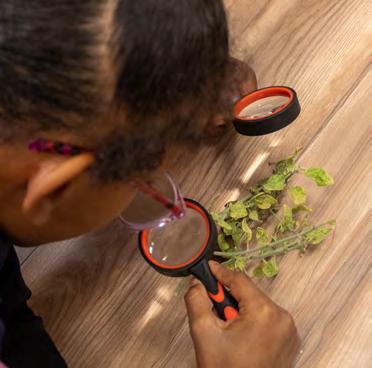
Explore real plants and their unique adaptations up close! Make observations with the five senses and use science tools like scopes to enhance observation. A Garden facilitator will show these adaptations with a science demonstration.
POLLINATOR PLAY
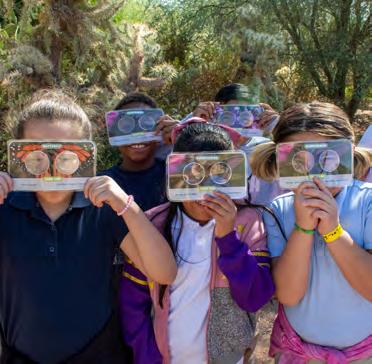
Let’s play pollinators! Observe plant and animal adaptations on the trail. Participate in a role-playing game where you become a “pollinator” and find your preferred “host plant” based on the characteristics on your card.
LEAF LAB
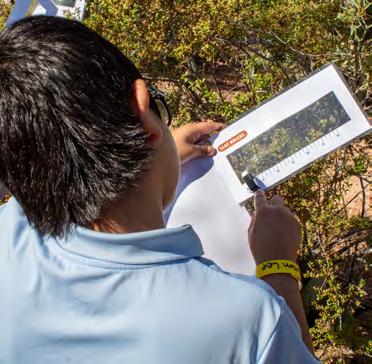
Explore the trail to search for leaves – big and small! As a group, discuss that in the desert we might find more small leaves than large.
POST-VISIT
NEW DESERT PLANT CHALLENGE
Lesson Time: 1 hour
Prep Time: 30 minutes
Description
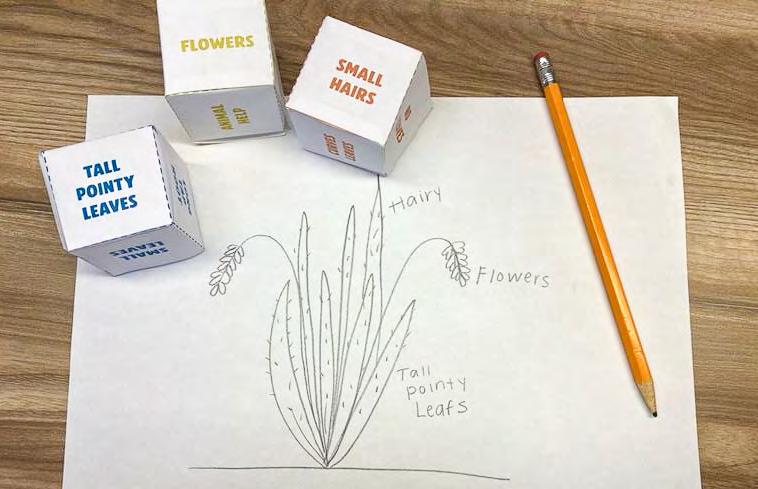
Let’s build a plant! Using desert plant adaptations as inspirations, students will create a new plant model that can survive a set of conditions and challenges given by rolling dice.
Objectives
Students will be able to design and develop a model that illustrates plant structures for survival. They will synthesize environmental constraints to construct solutions with the creation of an adapted plant.
Materials
• Desert plant dice (3 Conditions: Water, Sunlight/Heat, Reproduction)
• Tape or glue
• Paper and pencils
• Model magic or clay
• Other craft materials are optional (paints, popsicle sticks, toothpicks, etc.)
Digital Resources
Desert Plant Dice Templates
Adaptations Examples Sheet
Set Up
1. Print and cut out the Desert Plant Dice. Fold along the dotted edges and glue/tape.
2. Assign students small groups or host as an individual activity.
3. Each group/student will receive dice, paper, pencil, coloring materials, model magic/clay and craft materials.
4. Print or display on the board the Adaptations Examples Sheet.
Vocabulary:
• Reproduction – the process of a living thing creating offspring and passing on traits
• Natural Selection – the process where living things with traits that are best adapted to their environment survive and pass those traits on to their offspring
• Pollination – plant reproduction where male and female parts of the plant are combined.
Facilitation:
1. Introduction (5 minutes)
a. We are going to learn about a real research project at the Desert Botanical Garden. Saguaros are well adapted to living in the desert – from the heat to the low water and even to the soil! Researchers at the Garden wanted to see if a saguaro grows better in certain soils. Let’s see what they found!
2. Facilitation
a. Introduce Project (10 minutes)
i. A Saguaro Cactus needs sun, water and a place to grow. We plant seeds in soil, but some soil is sandy, rocky, or hard. Some have a lot of vitamins and nutrients while others have very little. Do you think some soils are a better than others? Researchers wanted to see how many seeds sprouted or germinated in different types of soil. They picked four medias to grow seeds in.
ii. In your groups, talk about each media type on the Saguaro Growth Worksheet – then we will review all together their strengths and weaknesses.
b. What challenges do plants and animals overcome when living in the desert? Low water and high heat can make it tricky to live in this environment, but living things have become well adapted over time and they thrive by surviving and passing these traits on to their offspring.
c. Set the Challenge
i. Next, we are going to design a plant that can survive in the desert too! Your challenge is to create a plant that is adapted to survive the heat/sun, with little water and reproduce. You will roll three dice to give your adaptations to design a with. After rolling write down your adaptations and use all three for your plant design.
3. Scientific Sketching (15-20 minutes)
a. Next, brainstorm what your plant will look like. How can you make your adaptations come alive? You must use the three adaptations you rolled, but you can be creative with how your plant looks.
i. Try to let students figure out solutions for themselves - ask inquiry questions like “What do you think it needs to look like to be picked up by the wind? Should it be light or heavy? Should it be small or big?”
ii. Use the Adaptations Example Sheet to provide ideas and examples.
4. Model Design (30 minutes)
a. Now that your scientific sketches are done, we are going to make a craft 3-D model. Follow your scientific sketch like a blueprint for your new plant creation.
5. Design Discussion (15 minutes)
a. In small groups, or presentation style, students can discuss their plant design. Which adaptations did you roll? How did you use those features in your plant? What does learning about plant adaptations teach us?
Background Information
Background Information
Science
3.L1U1.5, 3.L2U1.7
Visual Arts
Cr.1.a, Cr.2.a, Co.10.a
EXTENSION
RESEARCH PROJECT
Lesson Time: 1 hour
Prep Time: 15 minutes
Description
Join one of the Garden’s researchers, Ali, in her lab to learn about how she uses science to conserve plants. Analyze real data from her project as a class and learn about how you can be a scientist too.
Objectives
Students will recognize real-life application of STEM research through the lens of a career connection and hypothesize and draw conclusions from a data set.
Materials
• Saguaro Growth Worksheet
• Pencils
• Optional: Media samples of agar, caliche, potting mix and sand
• Extension Materials: Seeds, small cups and a few media to grow (soil, rocks, sand, cheerios, get creative!)
Digital Resources:
Researcher Highlight Video
Site Photos & Saguaro Growth Data Worksheet
Set Up
1. Assign students to small groups of three to four students.
2. Optional: Place samples of agar, caliche, potting mix and sand, in small bowls on tables.
3. Extension Materials: Plant seeds in small cups with a variety of media to grow in.
Vocabulary
• Agar – clear, moist, jelly-like substance with no nutrients
• Caliche – native soil in desert regions, often hard, dense and water retaining
• Germination – the process of a plant growing from a seed
• Population – a group of living things of the same species in one area
Facilitation:
1. Introduction (10 minutes)
a. We are going to learn about a real research project at the Desert Botanical Garden. Saguaros are well adapted to living in the desert – from the heat to the low water and even to the soil! Researchers at the Garden wanted to see if a saguaro grows better in certain soils. Let’s see what they found!
2. Facilitation
a. Introduce Project (10 minutes)
i. A Saguaro Cactus needs sun, water and a place to grow. We plant seeds in soil, but some soil is sandy, rocky, or hard. Some have a lot of vitamins and nutrients while others have very little. Do you think some soils are a
better than others? Researchers wanted to see how many seeds sprouted or germinated in different types of soil. They picked four medias to grow seeds in.
ii. In your groups, talk about each media type on the Saguaro Growth Worksheet – then we will review all together their strengths and weaknesses.
1. Agar: Jelly-like material, no nutrients, holds water.
2. Caliche: Hard native soil from the Sonoran Desert, has nutrients, holds water for a long time.
3. Potting Soil: Chunky soil like we might find in a garden bed, lots of nutrients, holds water.
4. Sand: Smooth like at the beach or playground – low nutrients, doesn’t hold water.
a. Which do you think would grow the most saguaros? Why?
iii. Optional: Have media samples on the table to feel.
b. Researcher Highlight Video
i. Let’s meet one of the Garden’s researchers – Ali! She is going to show us the baby saguaros and talk about their research. Then, we will look at her results and help the Garden find some answers.
c. Data Worksheet (15 minutes)
i. Let’s look at her data and answer some questions. Students work in table groups, looking at the Saguaro Growth Worksheet together to answer questions. Explain the features of the graph to your class.
1. Y Axis = how many seeds grew/germinated
2. X Axis = the four media types (agar, caliche, potting mix and sand).
ii. Which media grew the least saguaros? Which bar is the smallest? The sand grew the least seeds. Why? Sand is low in nutrients and doesn’t hold on to water well. This makes it hard for a Saguaro to grow!
iii. Which media grew the most saguaros? Which bar is the largest? Hint: Two of them are tied! The caliche and potting soil grew the most saguaros. Why? Both of these have good nutrients and hold on to water really well. It doesn’t rain often in the desert, so soil that helps the Saguaro hold on to water keeps it surviving.
3. Discussion (10 minutes)
a. What does this study tell us? This experiment shows scientists that soils with different nutrients or water levels can change how many plants grow. Some plants, like the Saguaro, are adapted to living in the desert, so a specific soil is needed to help it grow.
i. Our climate is changing - learning more about how plants grow gives us clues on how plants will survive if temperatures change, if we get less water and more. The more we learn, the easier it is to protect plants and animals and take care of nature.
b. Discuss with your class about their thoughts on the video and career connections. What do they wonder about the desert or the world around them? If they were a scientist, what would they want to learn more about?
4. Optional Extension
a. As a bonus project, plant seeds in small cups in a variety of media to test what grows and what doesn’t. Collect seeds from fruit or purchase a small pack and get creative with media. Use expected soils like sand, rocks, potting soil, or use unique media like crushed cheerios or sawdust. Get creative!
Background Information
Background 4
Background Information Science
3.L1U1.5, 3.L1U1.6
Mathematics
3.MD.B.3, 3.MP.1, 3.MP.2, 3.MP.4
Language Arts
3.RI.7
BACKGROUND INFORMATION
BACKGROUND 1: THE DESERT
Deserts
There are many different biomes, or regions with plants and animals adapted to a specific climate. Deserts are a biome that receives less than 10 inches of rain per year and can feature hot or cold weather. They cover around 20 percent of the planet and include a variety of types from coastal deserts to polar deserts, to dunes
The Sonoran Desert
Arizona hosts four different deserts – the Sonoran, Chihuahuan, Mojave and Great Basin Deserts. The Sonoran Desert crosses southern Arizona, including Phoenix and stretches through Mexico and part of southeastern California. This desert is extremely diverse and is home to over 2,000 species of native plants, 350 birds, 100 reptiles, 60 mammals, 30 fish and 20 amphibian species. Some species like the saguaro cactus, Carnegiea gigantea, are endemic to the Sonoran Desert, meaning they don’t grow anywhere else in the world.
While the Sonoran Desert is home to an abundance of flora and fauna, it also features extreme conditions. Annually, the Sonoran Desert receives an average of 3-20 inches of rain and temperatures can range from 18-118˚F. This desert also receives strong summer thunderstorms, or monsoons, which are characterized by heavy rain, lightning, flash floods, dust storms and high winds.
With extreme conditions and lack of water, desert plants and animals need to have unique adaptations to help them survive. Plants like cactus have developed characteristics that allow them to store water, capture water better, lose less water, or change how they grow and reproduce to reduce environmental stress. Animals have adapted both traits and behaviors to protect themselves. Some animals capture all the water they need from their food, or burrow during the day to keep cool. Other animals like jackrabbits have large ears to pass heat and keep their body temperature low.
BACKGROUND 2: LIVING THINGS
Essentials for Survival
All living things have requirements for survival. In general, most organisms need food, water and shelter, or an environment to grow. The specific needs vary depending on the kind of organism, its environment, interactions with other living things and barriers to survival. Challenges can arise from environmental conditions, weather and temperature changes, predation and the ability to reproduce. Human influence may also cause barriers for an organism’s survival with habitat loss and pollution.
Plants
Most plants live by creating their own energy through a process called photosynthesis This allows them to capture light energy, water and carbon dioxide, to produce energy. The plant then releases oxygen and water vapor through tiny holes in the leaves called stomata , like our skin’s pores. These pores are on the leaves of the plant and they can also serve for plant protection, shade and water collection. Water is transported into the plant via the roots, which anchor the plant and funnel nutrients and water to the stem. The stem of a plant provides support, storage and houses other important features and processes for the plant.
Animals
Animals have great variety in survival needs and are heavily impacted by interactions with other organisms. Plant eating herbivores predate plants and prey animals like deer and rabbits are predated on by carnivores like cougars and wolves. Meat eating predators consume these prey animals and while these animals may not be eaten by others, they encounter challenges like competition for mates, territory and access to resources.
BACKGROUND 3: ADAPTATIONS
Adaptations and Natural Selection
Plants and animals experience barriers to survival from the environment and other organisms and may change over time in response to these challenges to improve their rate of survival. An adaptation is a characteristic or trait that helps an organism survive better. Adaptations begin as traits, or genes, that are random mutations in the DNA. Some of these traits, characteristics and behaviors can aid them in survival success. Organisms that are better adapted to their environment are more likely to survive and pass these traits and behaviors on to their offspring. The process of these traits passing along to future generations is called natural selection . Over time, these adaptations can result in new species and results in the evolution of a living thing.
Reproduction
To pass traits on to offspring, living things must survive long enough to reproduce, or create new organisms or offspring. Many animals will mate with others and many plants can reproduce on their own or with the help of external sources like dropping fruit, pollinator assistance, or wind.
Types of Adaptations
Adaptations may benefit organisms in a variety of ways like improving reproduction, reducing predation, increasing success in their environment, or making food and water collection easier. There are three main categories these adaptations fall into. Physical adaptations, or how an organism looks, can include traits like coloring and body structures. Examples range from blending into their environments with patterns on their fur, to special beak shapes that make their food source easier to eat. Behavioral adaptations evolve a way an organism acts – hibernation, migration, burrowing and relationships to other organisms are all behaviors that arise and are passed down over generations. Physiological adaptations are inside systems such as special metabolic processes, temperature regulation like sweating, or toxicity and chemical defense.
Plant Adaptations
Plants have a variety of defenses and adaptations. To prevent predation from animals, plants have evolved traits like physical defenses like thorns and spines and chemical defenses like toxins. Plants have developed unique traits that help them survive predation.
Desert plants specifically have adapted to the extreme heat and low water in their environment. With deserts receiving such little rain, plants need to store water, lose less water and get water more efficiently. Many desert shrubs like creosote have small leaves that reduce water loss through the stomata , or pore-like holes on leaves, during photosynthesis. Other plants have smaller stomata, open their stomates at night, or have deep stomates to evade loss of water. Desert plants like palo verde trees drop their leaves in times of the year when water is scarce. Cactus and succulents often have a waxy exterior that helps hold water inside the plant. Under the ground, roots are also important for water collection, but desert plants adapt special root structures to be more successful. Shallow, wide roots, allow for plants to collect from a greater
surface area. On the other hand, some plants like the night blooming cerus feature one very long taproot that collects deep groundwater.
The intense sun and heat in the Sonoran Desert of Arizona has also resulted in creative solutions to keep plants cool and shaded. Spikes, curled leaves and hairs, or trichomes, allow the plant to provide micro patches of shade. Color can also keep a plant cooler, like desert sage which features a silvery-gray leaf color that can reflect light.
Animal Adaptations
To protect from predators, animals have adapted tactics like camouflage to hide and blend in with their surroundings and special coloration to scare off animals trying to eat them. In response, predator animals that consume prey have also adapted to be better hunters, stealthier walkers, or more deadly attackers. In extreme heat and drought animals have adapted specialized digestive systems where they get all the water they need from their food and cooling thermoregulation to protect them from the heat. Other tactics and behaviors include burrowing underground and nocturnal activity to hide during hotter parts of the day.
Relationship Adaptations
Some flora and fauna have co-adapted to each other and their relationships aid in the rate of survival. One example of mutual beneficial co-adaptations are pollinators Many desert plants rely on animal pollinators to work together in the harsh desert environment. Animals like bees, butterflies, bats, moths, wasps, beetles and hummingbirds pass pollen from plant to plant and in return receive benefits like nectar, pollen and shelter.
BACKGROUND 4: LEARNING FROM NATURE
Career Connections
Exploring how plants live and survive and the interesting features they have can have many career connections. The scientists who study plants and how they interact with their environment and other organisms are called botanists. They may locate and study endangered plants, conduct experiments and observations on plants, restore plant environments and more. One example of an applied plant scientist is a biotechnologist, who studies living things to make products. For instance, these scientists may change the genes in food to make them more desirable, like making watermelons without seeds.
With such unique plants and animals in the desert, researching their adaptations, survival and interactions with other living things gives us great insight into the unique intricacies of this habitat and how climate change may change this environment in the future. The saguaro cactus is a keystone species, meaning many organisms in the ecosystem rely on it and removal of the keystone species would negatively change the ecosystem. Keystone species like the Saguaro can give scientists insight into the health of an ecosystem too and studying the growth and death of these cactus allows researchers to predict how the Sonoran Desert will change with extreme temperatures and longer periods of drought.