CENTRAL ARIZONA URBAN DESERT LANDSCAPE GUIDE
How to Use Native and Desert Adapted Plants in Ornamental Horticulture, Identify Invasive Plants, Capture Water, and Other Landscaping Tips & Recommendations

How to Use Native and Desert Adapted Plants in Ornamental Horticulture, Identify Invasive Plants, Capture Water, and Other Landscaping Tips & Recommendations
Horticulture, Identify Invasive Plants, Capture Water, and Other
Authors
Lead Author
Desert Botanical Garden
Haden Pittson
Co-Authors
Desert Botanical Garden
Mary Chisholm
Melanie Buathier
Marisol Ortiz
Challie Facemire
Emma Lohman
Arizona Department of Forestry and Fire Management
Megan Lansley
Madeline Burton
Desert Botanical Garden
Challie Facemire
Natalie Melkonoff
Mary Chisholm
Arizona State University - School of Geographical Sciences and Urban Planning & School of Sustainability
Kelli Larson
Arizona State University - Arizona Water Innovation Initiative
Harry Cooper
This project was made possible with generous funding from Stanley Smith Horticultural Trust. Reprint made possible by in-kind support from APS, and funding provided by Desert Botanical Garden.
Published in 2025
Online version: bit.ly/desertscape
Arizona Sustainability Alliance
William Donoto
Bureau of Reclamation
Lisa Rivera
City of Phoenix
Heather Finden
City of Tempe
Kaci Fankhauser
McDowell Sonoran
Conservancy
Mary Fastiggi
Maricopa County Flood Control
Joseph Hubbard
Central Arizona Conservation Alliance cazca.org
Desert Botanical Garden 1201 N Galvin Parkway Phoenix AZ 85008
Galaxy Gardens
Clint Culberson
AZ Landscape Designer
Paige Maloney
TransPlanter
Rafaela Crevoshay
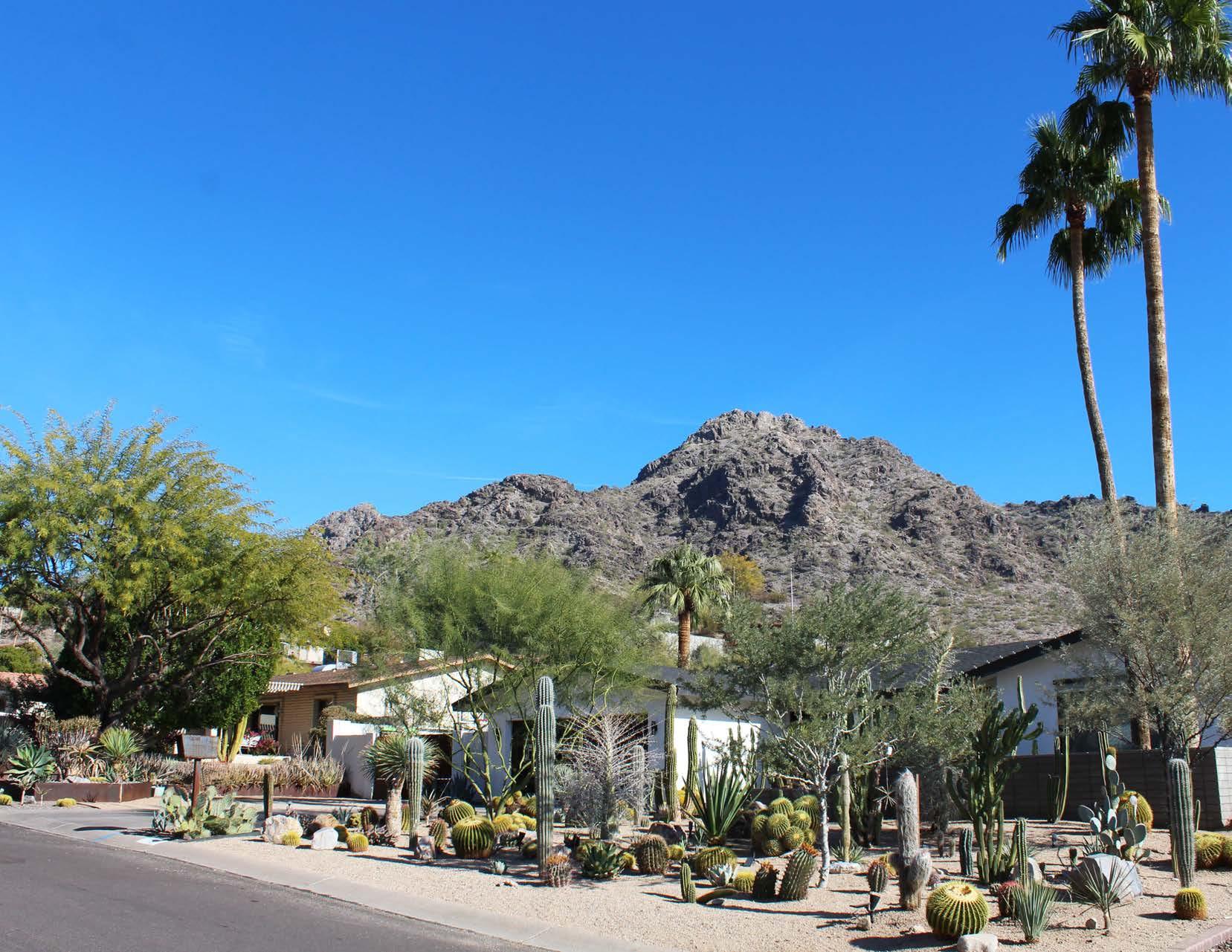
In Arizona, up to 70 percent of our residential water use is used outdoors. To cut down on the substantial use of water outdoors, try incorporating low water use landscaping. There is a vast array of beautiful plants that have adapted to desert climates and require very little water use. Utilizing low water plants in residential landscapes will progress Arizona towards a sustainable future for years to come. By planting low water use plants property owners can also save a lot of money; desert landscaping can reduce water use up to 50 percent.
This chapter includes a list of native and non-native plants perfect for landscaping across central Arizona. The lists of native and non-native plants include brief descriptions of each plant along with introductory care instructions. At the end of the chapter is a simplified list of all the chapter’s plants along with quick information such as care, pollinators, and hazards. With this chapter you will be able to make informed decisions about which native and low water use plants would be the right choice for your urban desert landscape.
While there are a lot of benefits in choosing native and low water use plants, it is important to keep in mind that these plants will still require care and maintenance like all plants. To make decision making easier, we’ve included known hazards of the plants listed here like thorns/spines, known allergens, etc. It is also important to note that when plants get more water they can grow faster, which requires more trimming. This is especially true for trees (which is covered in the next chapter). Shrubs also require trimming and maintenance; however, when looking to prune shrubs keep in mind that shaping them into balls and squares is not good for the plant (for guidance see “Pruning Shrubs in the Low and Mid-Elevation Deserts in Arizona” in the Plant Resources section. Native shrubs in particular should only be pruned lightly, if at all. For particulars on pruning shrubs you should look up the individual plant for guidance as one size does not fit all.
Finally, when purchasing plants please visit a reputable nursery. Plant trafficking and poaching is a big problem that has contributed to the decline of wild plant species.

Full sun

Moderate to Partial sun

Low sun to shade

Flower color

Very low water use

Low water use


Moderate water use
Higher water use (of the low water use plants)

Pollinator: bee



Pollinator: butterfly
Pollinator: hummingbird
Pollinator: wasp

Pollinator: bat

Pollinator: moth

Hazard: messy

Hazard: allergy

Pollinator: birds

Hazard: spines/ thorns

Hazard: irritant and/or toxic
Arizona is home to the wondrous Sonoran Desert. The Sonoran Desert is recognized for its iconic desert plants and hot arid climate. The desert’s climate has shaped the plants that inhabit it, making desert plants well adapted for intense heat and infrequent rainfall. The insects and animals that live alongside these plants rely on them for food and shelter.
Planting native plants on your property will conserve water, help the environment, and lower water bills. Native Sonoran plants’ unique ability to survive the arid desert allows them to thrive with infrequent watering. Native plants will also benefit the Sonoran ecosystem as a whole. Using native plants in your landscapes can bring the beauty of the Sonoran Desert to your home while supporting the local ecosystem and conserving water.
The following is a list of native Sonoran Desert cacti and succulents, annuals, perennials, shrubs, and trees that would be perfect addition to a landscape in yards across Central Arizona.
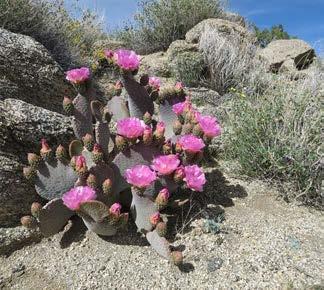
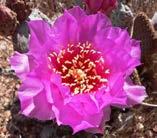
The beavertail prickly pear, or Opuntia basilaris, is a perennial prickly pear cactus native to the Sonoran and Mojave Desert. This cactus typically spreads wide if given the opportunity and grows around 4-6 feet wide and up to 16 inches tall. The beavertail prickly pear consists of hundreds of broad flat pads which resemble the tail of a beaver hence giving the plant its name. These pads have a green to blue/gray color which can take on a slightly purple hue in response to sun or cold exposure. While generally spineless the cactus’ pads are covered in glochids, which are barbed bristles. These pads bloom with bright pink flowers from February to June then turn to edible green/brown fruits. This cactus thrives with full sun exposure and requires little water use once established. The beavertail prickly pear can bring beautiful color and Sonoran character to an urban desert landscape.
Attributes



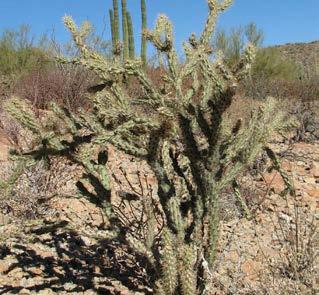
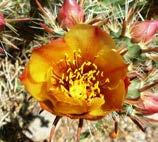
The buckhorn cholla is a perennial cactus native to Arizona and is one of the most common cholla in the Sonoran Desert. This cholla is comprised of a central stem with many cylindrical branches that reach out and intertangle with each other taking on a shrub like appearance. Growing up from 4-10 feet wide reaching 3-6 feet tall these cacti require ample room to grow. The branches are covered in thorns, and bloom with flowers in the spring from March to June. These chollas blooms range from yellow to maroon and can attract pollinating bees. The buckhorn cholla can also provide homes for desert birds such as the cactus wren. This cactus requires minimal water use and thrives in full sun exposure or with partial shade. The buckhorn cholla can add bright colors and a striking form to an urban desert landscape.
Attributes


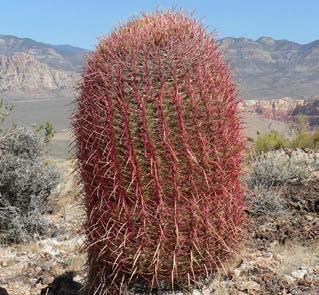
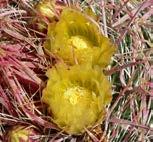
California barrel cactus is a perennial cactus native to the Sonoran and Mojave deserts and can be found in central Arizona. These barrel cacti are typically cylindrical or spherical and grow straight up. These cacti can grow to 2 feet in diameter and as large as 7 feet tall. The California barrel cactus’ ribs are covered in long spines which are straight and red as they grow and turn curved and gray as they mature. This cactus blooms around April to May with funnel shaped yellow flowers with maroon accents or red flowers on the outside. These cacti require very low water use and thrive with full sun exposure. The native California barrel cactus can bring added life to an urban desert landscape while requiring very low water use. Also called compass barrel cactus.


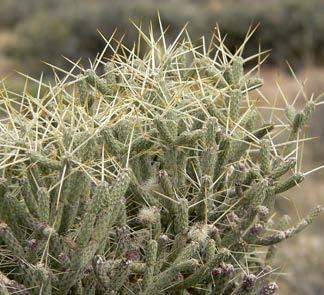
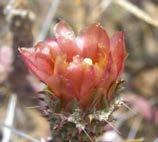
Darning needle cholla, or Cylindropuntia ramosissima, is a shrubby, perennial cactus native to the Mojave and Sonoran Deserts. It is also known as a diamond or branched pencil cholla. It has relatively thin, green stems with a diamond patterned texture due to the diamond shape areoles that bare the tan-red brown-purple spines. Flowers are small, copper colored, and inconspicuous and the fruit is small, dry, and spiny. Grows 6-10’ tall. Blooms in April to August and is pollinated by bees.
Attributes

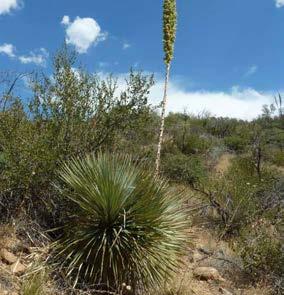
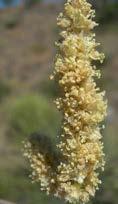
Desert spoon is a perennial succulent in the asparagus family, native to the arid regions of northern Mexico and the Southwestern US. The small, straw colored flowers grow in inflorescences that are either male or female (plant is dioecious) and are about 10-20 feet tall. The leaves are tipped with fibers and they have sharp-toothed margins. Their pollinators are bees and they bloom from May-July. Desert spoon grows best at 3000-6000 ft elevation, has low water requirements and likes full sun.
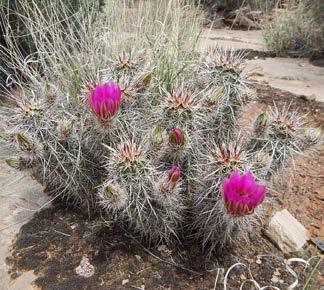
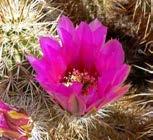
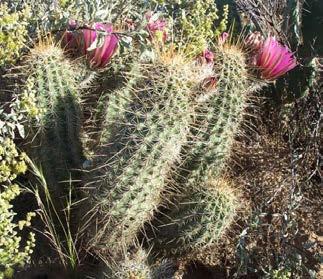
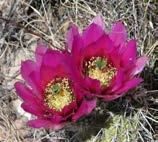
Engelmann’s hedgehog cactus, or Echinocerus engelmannii, is a perennial cactus native in areas across the desert southwest including the Sonoran Desert and can be grown in the Phoenix area. These cacti take the shape of a clumping mass of columnar stems covered with spines. The Engelmann’s hedgehog cactus can vary from 8 inches to 30 inches diameter and grow to 18 inches tall. Large showy flowers bloom from the stems in the spring from April to May, turning into edible red berries. The flowers vary from magenta to light pink, occur en masse, and last for about five days. The cactus’ blooms will also attract native leaf cutter bees for pollination. Engelmann’s hedgehog cactus requires little water use and thrives in full sun exposure with well-draining soil. It provides striking color to an urban desert landscape while being very drought resistant. Attributes


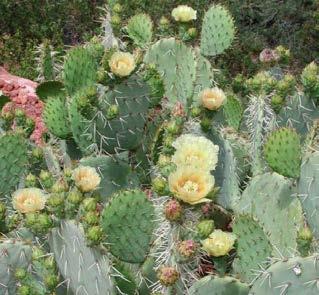
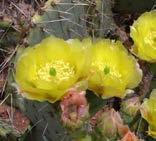
Engelmann’s prickly pear is a perennial cactus native to Arizona and found throughout a variety of elevations. The plant is a bushy prickly pear cactus with thin light green pads. These pads have diagonal rows of areoles (small bumps) that house the cactus’s spines. Engelmann’s prickly pear grows to about 3 to 6 feet in height and width but can spread if given the opportunity. From April to July, these cacti bloom with bright yellow flowers on the outer edges of their pads. The cactus’ flowers can attract bees and bring a bright pop of color to a desert landscape. The flowers are then followed by edible red fruits, which are commonly used to make jams or syrups. Adapted to the Sonoran Desert, this cactus can tolerate partial to full sun exposure and require low water use. Engelmann’s prickly pear can be a beautiful addition to an urban desert landscape while providing delicious native fruits.
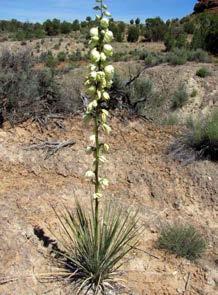
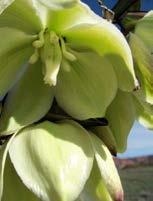
Fine-leaf yucca (also known as the narrowleaf yucca), or Yucca angustissima, is a perennial that is native to the Sonoran Desert. This succulent has yellow-green leaves that extend a few feet out from the base of the plant and a stalk that shoots up from the center of the plant 3 to 6 feet in height; this stalk hosts the yucca’s white flowers, which can bloom from May to June. The fine-leaf yucca thrives in environments where elevation is between 3000 and 7500 feet and requires full sun and low water. This plant is also a great host for Strecker’s giant skipper butterfly larvae and is often pollinated by yucca moths.
Attributes

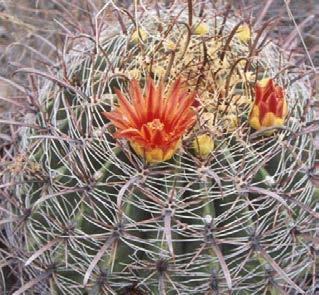
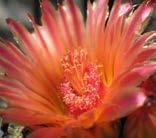
The fishhook barrel cactus (also known as the Arizona barrel cactus), or Ferocactus wislizeni, is a cylindrical cactus native to Arizona, Texas, and parts of Mexico. It can reach up to 5 feet (or more) tall and 3 feet wide. Its spines are yellowish-red or purplish-red in groups of 12-20 and 1.5-4 inches long, where the upper 3 spines are straight and the 4th is usually hooked downwards and much heavier. Flowers can be red, gold, yellow, or orange, often striped and are 2 inches by 3 inches. Fruits are bright yellow and attract birds and small mammals. Blooms in July-Sept and attracts bees. Requires full sun and little water. This plant can be difficult, but not impossible, to find at local nurseries.
Attributes
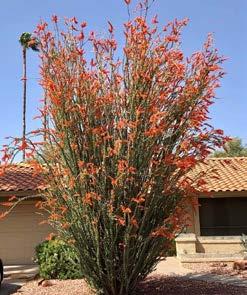
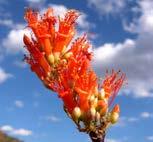
Ocotillo is a perennial succulent native to Arizona and found throughout the state’s lower elevations. The ocotillo is comprised of multiple thin upright branches that can reach 10 to 20 feet in height. These snaking branches are covered in thorns, and sprout green oval leaves when given moisture, such as after periods of rain. In the spring, between February and May, the ocotillos bloom with bright red/orange tubular flowers at the tip of their stems. These blooms attract hummingbirds and signify the start of summer. The ocotillo prefers full sun exposure and is drought adapted, requiring infrequent watering. The ocotillo’s unique and vibrant display make it a great focal point for a desert garden.
Attributes
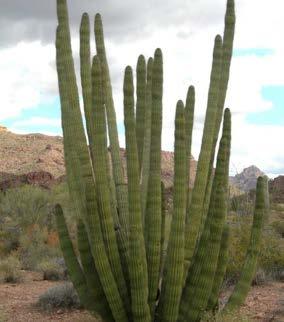
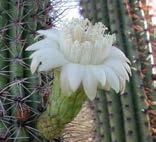

Organ pipe cactus, or Stenocereus thurberi, is a slow growing species of cacti native to Northwestern Mexico that has naturally migrated to Arizona. This plant reaches heights up to 15 feet by 12 feet in width. It is multi-branched at the base with olive green columns that have thorned ribs running the length of the branch. Large, creamy white flowers bloom at night during the late spring-early summer once the cactus reaches maturity (around 35 years old). The fruit is bright red and splits open when mature. Attracts nectar-eating bats. Attributes

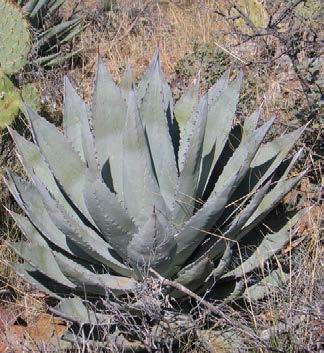
Parry’s agave, or Agave parryi, is a perennial succulent native to Arizona that reaches 1-3 feet in diameter. Also known as a “Century Plant” this agave spends most of its life as a rosette of green succulent leaves with black accents on the spines. At the end of the agave’s 10-to-30-year life span, a giant flowering stalk arises from the plant reaching up to 20 feet tall. Clusters of hundreds of bright yellow flowers branch out from this stalk, creating a beautiful display iconic to Arizona landscapes. Following the agave’s death, an offspring is often left behind in its place to repeat the cycle. Adapted to Arizona climates, this agave can be planted in full sun or partial shade and require infrequent watering. Parry’s agave is pollinated by moths and bats and flowers between June and August. Given the plants several varieties, it is possible to find a Parry’s agave suitable to almost any Arizona climate. Parry’s agave’s low water use, and beautiful flower display make this plant a great staple for any Arizona garden. The sap of this plant is an irritant, though it is not listed as toxic.
While the flowering of agave plants signal the end of the life cycle, this is actually an opportunity to gain new plants. Agave put off pups or bulbils that can be harvested. They show up at the base of the plant (pups) or along the flower stalk (bulbils), so don’t cut off the stalk when it starts to grow as this will not keep the mother plant alive and could keep you from gaining new plants.
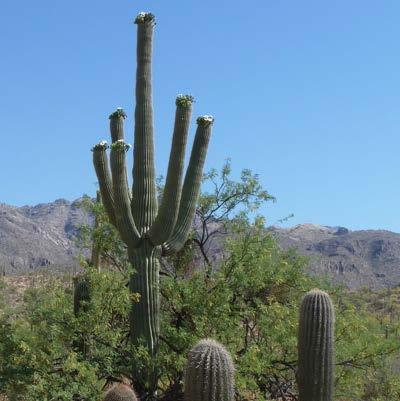
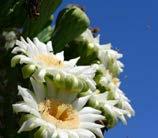
The saguaro cactus might be the most recognizable icon of the Sonoran Desert. It is a perennial cactus native to the Sonoran Desert and is found in the lower elevations of Arizona. These desert giants grow to be over 40 feet tall and are easily recognized by their branching arms. Saguaros have a long-life span and can live for 200 years. The saguaro grows slowly, first flowering at around 50 years old, and are around 75 years old when they grow their first arm. Around May to June the saguaro blooms with beautiful white flowers, attracting pollinating bats, bees, and birds. Saguaro flowers mature to red fruit in June to early July, providing a food source for birds and mammals. The fruit is also edible for humans, and can be eaten raw. Saguaro fruit can be eaten raw or cooked and contains very sweet pulp with nut-like flavored seeds. Mature saguaros provide shelter for a variety of birds in Arizona. These cacti prefer full sun exposure and well-draining soils and require minimal water use. Smaller and younger saguaros do benefit from light shade, and do best with a nurse plant (which is why they are seen growing under other plants in the wild). The iconic saguaro makes for a grand center piece in a desert landscape garden.
Attributes
Attributes

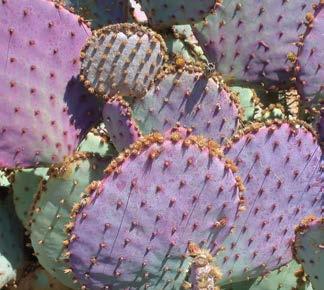
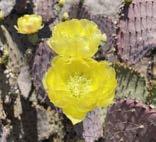
The Santa Rita prickly pear, or Opuntia santa-rita, is a perennial prickly pear cactus native to Southern Arizona, and suitable for landscaping in gardens across much of the state. The Santa Rita prickly pear is beloved and recognized by its purple pads and upright form. These shrub-like cacti can grow about 7 feet high and can spread if given the opportunity. The cacti have flat oval pads covered with barbed glochids. These pads are green with a violet-red tinge and turn a deeper violet purple in the winter and times of drought. In the late spring from April to June these prickly pears bloom with bright yellow flowers, followed by edible purple fruits. The Santa Rita prickly pear requires little water and can survive on Arizona’s infrequent rainfall. Additionally, the prickly pear thrives under full sun exposure. Santa Rita prickly pear’s unique purple color in the winter and yellow blooms in the spring make this cactus a vibrant choice for urban desert landscapes.
The strawberry hedgehog cactus, or Echinocereus fasciculatus, is a rare cactus found only in Arizona, New Mexico, and Sonora, Mexico. Its growth habit is shrubby, growing in clumps of 3-20 cylindric stems, 1.5 feet by 2 feet. Spines grow in clumps of 8-16 and are straight and yellowish or reddish brown. Flowers are rose pink to magenta, large and showy, usually 6-10 per plant. Fruit is bright red. Blooms May-July and attracts bees. Requires full sun and little water.
Annuals (If buying wildflower seed mixes, ensure they are native by checking scientific names)
Attributes
Attributes
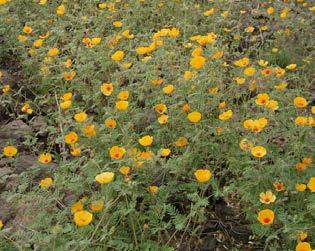
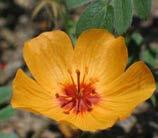
The Arizona poppy, or Kallstroemia grandflora, is an annual wildflower native to the Southwest U.S. The annual flower grows to 1 foot tall and 3 feet wide. This wildflower has small hairy leaflets, and blooms with showy flowers that arise after summer rains. The Arizona poppies bloom from February to September with bright orange yellow flowers that attract pollinating bees and butterflies. As annuals, the Arizona poppies germinate, flower, and die within a year. The Arizona poppy prefers full to partial sun exposure and requires low water use.
Attributes
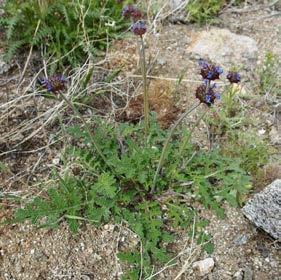
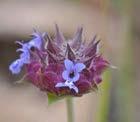
Chia sage, or Salvia columbariae, is an annual plant in the mint family, native to the Southwest US and Sonoran Desert. It grows up to about 2 feet tall with tiny blue/purple flowers that grow in balls on top of the square stems. Leaves are once-twice pinnate (feather shaped) and velvety. The leaves also have a sage-like or minty smell. The flowers appear in March through July and attract bees, hummingbirds, and butterflies. A beautiful addition to any landscape, these plants require low water and full sun.
Attributes

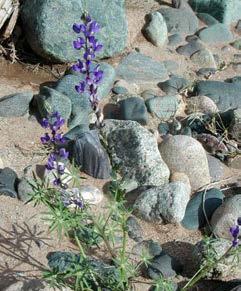
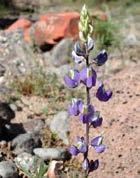
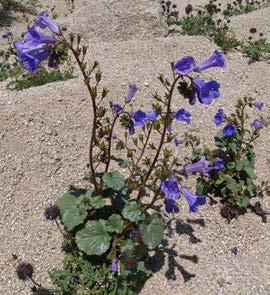
Coulter’s lupine (also known as desert lupine), or Lupinus sparsiflorus, is an annual plant in the legume (pea) family, distributed across Arizona, California, New Mexico, Nevada, and Utah. The stems are slender and grow straight up to 15 inches tall, when end with blue-purple flowers in open racemes (flower clusters). Bloom appear in late winter to spring and are of special importance to native bumblebees and also attracts butterflies. Requires full sun and low water.
Attributes

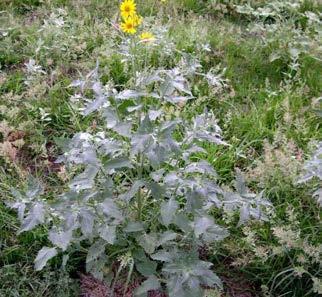
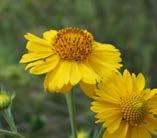
The cowpen daisy, or Verbesina encelioides, is an annual in the Asteraceae (daisy) family that occurs largely across the western and central US. This plant grows up to 4 feet tall, has distinct, bright yellow daisy-like flowers, and hairy, silvery-green, triangular leaves with toothed margins. Cowpen daisy thrives in disturbed soils (along roadsides, fence lines, and in gardens), and requires low water and full sun. When it blooms from April to October it attracts bees, moths, and butterflies.
Attributes
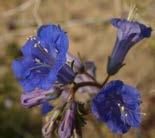
The desert bluebell, or Phacelia campanularia, is an annual wildflower native to the Sonoran Desert. This native wildflower grows to around 6 inches in height and width. The desert bluebell has rounded dark green leaves and blooms with beautiful blue-purple flowers in the Spring from March to May. The blue-purple flowers bring vibrancy to a garden and attract pollinating bees and butterflies. As the desert bluebell’s leaves have irritating hairs, it is best to plant these wildflowers away from walkways. It requires low water use and thrives in full sun exposure. If allowed to reseed, desert bluebells may reemerge in the next fall or winter.
Attributes
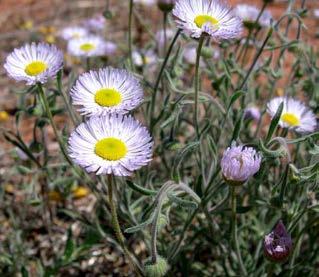
Fleabane, or Erigeron divergens, is an herbaceous annual that can sometimes be a short-lived perennialbiennial herb in the Asteraceae (sunflower) family. It is native to the Sonoran Desert that is commonly found across the US and Canada. This plant can grow in a variety of habitats, where elevation ranges from 1000-9000 feet. It grows between 0.5 inches to 2 feet tall and has showy flowers that can vary from white to purple with a bright yellow center, and are accompanied by velvety green leaves that alternate up the stem. The flowers typically bloom from July to October and are excellent at attracting butterflies. Fleabane grows best in moderate sun and requires low water. It has hairs that can be irritating so it is best to keep it away from walkways or high traffic areas. This plant is not widely available at nurseries, but is not impossible to find.
Attributes

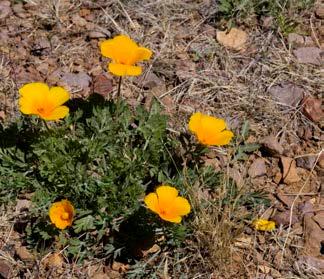
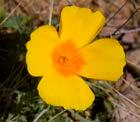
The Mexican gold poppy is an annual wildflower native to the Southwest U.S. These annual wildflowers grow to around 3-9 inches in width and height. The Mexican gold poppy has green lobed leaves and bloom with showy gold flowers. These flowers bloom from February to May and attract pollinating bees and butterflies. As annuals, the Mexican gold poppies germinate and die within a year but reseed readily providing reliable flowers yearly. The Mexican gold poppy thrives in full sun exposure and requires low water use.
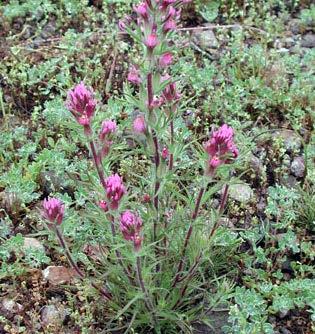
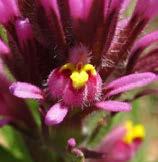
Owl’s clover, or Castilleja exserta, is an annual plant native to the Southwestern US and Baja California. It can grow up to 15 inches tall and has narrow very hairy leaves. Flowers can vary from pink to purple with yellow tips that grow in clusters with 5-9 linear lobes (club shaped). Blooms appear between March-May and attract bees and butterflies. This bright addition to your yard does best with full to partial sun and very low water.
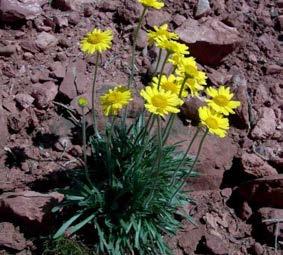
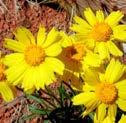
Angelita daisy, or Tetraneuris acaulins, which is native to plains from Canada to Texas. It is a perennial daisy growing up to 1-2 feet by 8 feet. Bright yellow daisy flower on slender stems. This plant blooms year round except in colder climates. It is ideal for sunny rock gardens, borders, or containers. Requires full to partial sun and moderate water with good drainage.
Attributes
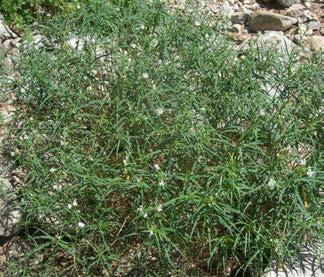
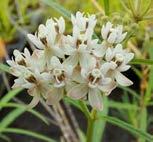
Arizona milkweed, or Asclepias angustifolia, is a perennial shrub growing 2-3 feet by 2-3 feet and is found in Arizona and Mexico. It has thin stems, narrow leaves growing all along the stem, and small white flowers that grow in clusters at the top of the stem. Arizona milkweed bloom in spring to late summer and are an essential host plant to monarch and queen butterflies. This plant likes full sun to partial shade and rocky soils.
Milkweeds (like several other common landscaping plants such as oleander and lantana) contain some components that can be irritating to the skin and/or eyes. Use care when handling and planting these plants. These components also make the plant distasteful, meaning that many animals – especially pets – tend to avoid milkweed and will not consume large quantities that could make them ill.

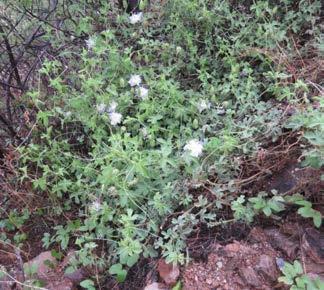
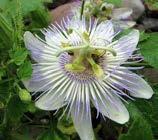
Arizona passion vine, or Passiflora arizonica, is perennial vining flower native to southern Arizona and northern Mexico. It can grow up to 10 feet tall in adjacent shrubs or be trained to climb a trellis or latticework. The leaves have 3-5 lobes, and the flowers are purple/blue and white and very showy. The fruit produced by this plant are small oval-shaped berry about 1 inch around. Flowers appear JuneAugust or October and open from late afternoon into the night, attracting moths and butterflies (it is the host plant for the gulf and fritillary butterflies). The leaves and unripe fruit are toxic to humans and animals when ingested. This native passion vine (and its other native subspecies) can be difficult to find at nurseries.
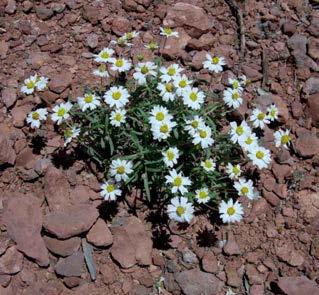
The blackfoot daisy, or Melampodium leucanthum, is a perennial wildflower native to Arizona. Blackfoot daisies grow to about 12-18 inches wide and 8 inches tall. The plants have thin, long leaves, and bloom with daisy-like flowers March through October. The flowers are white with a yellow center, honeyscented, and attract bees and butterflies. They prefer full sun exposure to partial shade and require low water use. Additionally, blackfoot daisies prefer well-drained to rocky soils. Blackfoot daisies can be a beautiful addition to garden walkways and patios, be used as ground cover, or planted in containers.
Attributes
Attributes
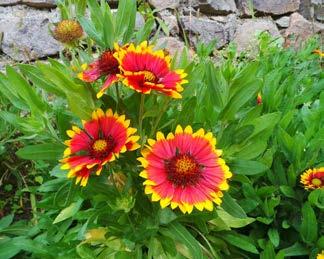
Blanketflower, or Gaillardia aristata, is a perennial flower in the Asteraceae (sunflower) family and is native to Arizona. This plant grows in most western states, reaching as far as the Great Plains and parts of New England. It can grow 1.5 feet tall and 1.5 feet wide, and has daisy-like flowers with petals that are yellow at the tip and red-orange in the center. Rich in nectar, the flowers bloom late-spring to fall and attract bees and butterflies. Blanketflower is easy to grow and requires full sun and moderate water.
Attributes
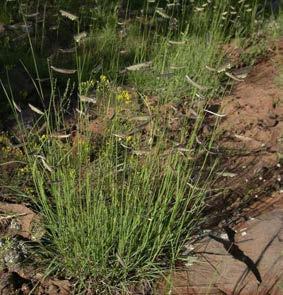
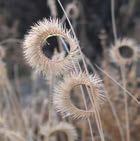
Blue grama, or Bouteloua gracilis, is a perennial grass that is native to the Sonoran Desert. This tufted grass is best known for its slender green stems with broom or eyelash-like seed heads at the ends. The purple-brown seed head grows straight out and curls when mature. Blue grama thrives in environments where elevation is between 4000 and 8000 feet, does well in Phoenix landscapes, and requires low to moderate water and moderate to full sun.
Attributes

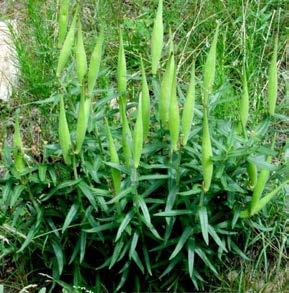
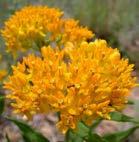
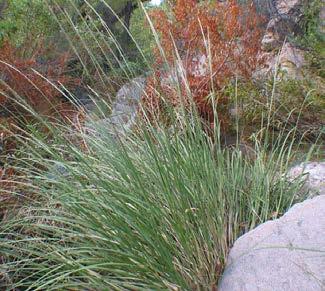
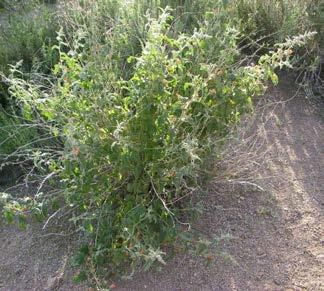
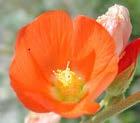
Butterfly milkweed is a perennial shrub that grows across the US and Canada. It is most notable for its showy, bright orange, large flowers that grow in clusters at the top of its stems. The leaves are deep green, long, pointed, and smooth edged. Requires moderate water, sun-partial shade, well drained, sandy soils, and is drought tolerant. Blooms from May to September and is a great pollinator plant, attracting bees and hummingbirds, and is a host plant for monarch and queen butterflies. Milkweeds (like several other common landscaping plants such as oleander and lantana) contain some components that can be irritating to the skin and/or eyes. Use care when handling and planting these plants. These components also make the plant distasteful, meaning that many animals – especially pets – tend to avoid milkweed and will not consume large quantities that could make them ill. Attributes
Deer grass, or Muhlenbergia rigens, is a perennial bunch grass native to Arizona. Deer grass can grow up to 4 feet in width and height and takes a mounding shape. The bunches of grass consist of very long and narrow gray-green leaves. From July to October, deer grass flowers with whip-like flower spikes with a light brown to cream pink color. This plant can tolerate full to partial sun exposure and requires low water use. However, deer grass benefits from weekly to bi-weekly watering during summer months.
The desert globemallow is a perennial shrub native to deserts across the Southwest and can be found in Phoenix. The desert globemallow is comprised of thin upright branches with small green leaves, growing to 1-4 feet in width and height. In the spring, they blossom with bright colorful flowers. The desert globemallow are found with orange flowers, the subspecies Sphaeralcea ambigua subsp. rosacea can flower purple, pink, white, and red. While profusely blooming in the spring, this plant can grow flowers throughout the year. To aid the performance and health of the desert globemallow it is best to prune back the plant once a year in the late spring to early summer. This desert plant requires low water use and can thrive best in the heat with full sun exposure or partial shade. Desert globemallows can make for a beautiful colorful backdrop in an urban desert garden.
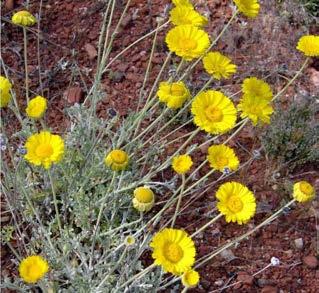
The desert marigold is a perennial wildflower native to Arizona. Desert marigolds are fast growing and grow to 10-12 inches wide and 6-12 inches tall. This plant has gray fuzzy leaves and attractive yellow daisy like flowers. These flowers bloom year-round and attract bees and butterflies. Desert marigolds also have the potential to reseed in gardens. They prefer full sun exposure or partial shade and requires low-water use. Desert marigolds can tolerate most types of soil except fertile soils. The desert marigold can make a great companion to use around succulents or other perennials to add bright spots of color.
Attributes
Attributes
Attributes
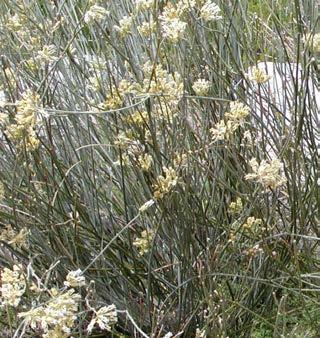
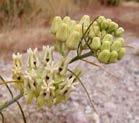
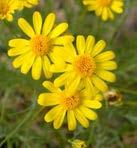
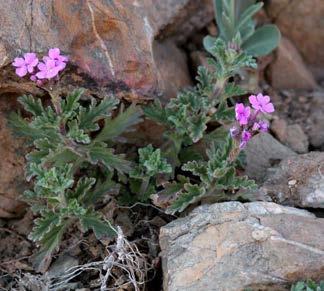
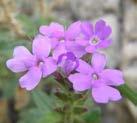
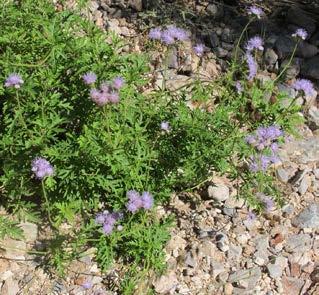
The desert milkweed, or Asclepias subulata, is a perennial plant native to the Sonoran Desert. This milkweed grows 2-3 feet wide and 4 feet tall, and is comprised of thin green vertical stems that arise from a woody base. From the spring to fall, clusters of creamy-yellow flowers bloom from the top of each stem. These flowers attract pollinators (bees, butterflies, and the pepsis wasp) and support monarch and queen butterfly populations as host plants. The desert milkweed prefers full to partial shade, is tolerant to most soils, and requires low-water use. The desert milkweed creates a strong vertical accent in urban desert gardens.
Milkweeds (like several other common landscaping plants such as oleander and lantana) contain some components that can be irritating to the skin and/or eyes. Use care when handling and planting these plants. These components also make the plant distasteful, meaning that many animals – especially pets – tend to avoid milkweed and will not consume large quantities that could make them ill.
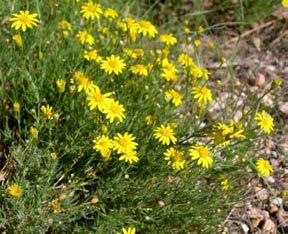
Dogweed is a perennial or subshrub in the Asteraceae (sunflower) family, native to Southwestern US and Mexico. Its small, aromatic, daisy-like yellow flowers grow on leafless stalks, bloom March to October, and attract bees and butterflies. The leaves are deep green and needle shaped with oil glands that emit a sharp, pungent odor. It is a fairly low growing plant, getting up to 9 inches tall. Dogweed does well on gravely slopes and in rocky washes, requires low water and tolerates full sun.
Goodding verbena is a densely hairy and glandular herbaceous perennial native to the Southwestern US. It has spikes of purple flowers that cluster at the branch tips. This plant is very closely related to lantana but it is herbaceous, not shrubby. It grows to be up to 2 feet by 3 feet, with deep green leaves that are opposite and simple on the stems and are deeply lobed. The plant produces purple-pink flowers, which can be present all year long but blooms typically dwindle as temperatures rise. This plant is very similar to mint plants (Lamiaceae family). It attracts pollinators such as butterflies and hummingbirds. Goodding verbena requires low-moderate water and can tolerate full sun-moderate shade. This spreading ground cover is suitable for planters, borders, walkways, and courtyards. It prefers a rocky and sandy desert habitat and flowers throughout the year. This plant can be difficult, but not impossible, to find at local nurseries.
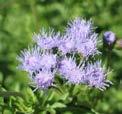
Gregg’s mistflower, or Conoclinium greggii, is a perennial flower native to west Texas to southeastern Arizona, through Durango and Zacatecas, Mexico. Grows up to 12 to 18 inches tall and spreads to about two feet wide with palm like leaves that have 3 deep lobes. Flowers are light purple-blue and grow in clusters to form puffy, 2 inch cushion-like flower heads. Blooms March to November and is great at attracting butterflies, especially monarchs and queen butterflies. Requires sun to part shade and moderate water.

Attributes
Attributes
Attributes
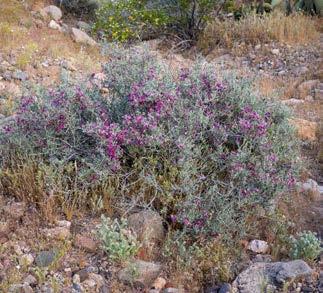
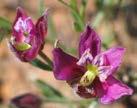
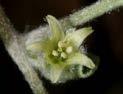
Littleleaf ratany, or Krameria erecta, is a low growing, gray, very twiggy shrub native to many southwestern US states including Arizona, California, Texas, and Northern Mexico. Flowers are bilaterally symmetrical (can be divided into two equal parts), reddish-lavender, and bloom April to October. Instead of pollen, the flowers produce oils, which are carried by certain species of bees. In the wild these plants are commonly found near a creosote bush. Requires full sun and low water.
This plant can be difficult to find at nurseries, and is difficult to propagate.
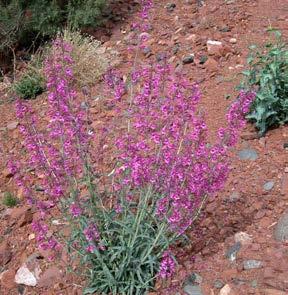
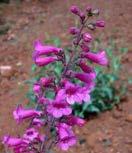
Parry’s penstemon is a perennial wildflower native to southern Arizona. Parry’s penstemon grows to around 2 feet in width and height. These perennials have long pale green leaves and bloom with hot pink tubular flowers from March to May. These bright flowers grow together on long stalks and attract hummingbirds, butterflies, moths, and bees. Parry’s penstemon dies back in the late spring and lies dormant in the summer and winter as a cluster of leaves. The perennial may also reseed themselves in a garden. Parry’s penstemon prefer full to partial sun exposure, well-draining soils, and require low water use.
Attributes
Attributes
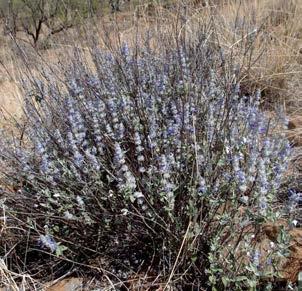
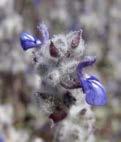
Parry’s sage is a perennial subshrub endemic to Northern Mexico, southwest New Mexico, and southern Arizona- growing 3,500-5,000 ft elevation. It grows 1 to 4 feet tall, with slender stems. Purple/dark blue flowers with 2 prominent lips grow in interrupted spikes along the stem in groups of 3 or more flowers per inflorescence (the flowering stalk). Its leaves are velvety, small and opposite, with small white hairs covering them. The flowers appear April-August and attract butterflies and hummingbirds. Tolerates full sun to partial shades and has low water requirements.
Attributes
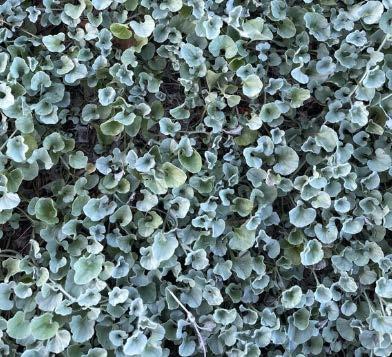
Silver ponysfoot, or Dichondra argentea, is a perennial herbaceous ground cover. It occurs in Arizona, New Mexico and Texas. Silver green foliage has a metallic look and grows 3-4 inches tall, and it spreads across an area quickly (up to 3-4 feet in one season). This plant has small ovate leaves, and tiny white flowers that bloom April to October Requires sun/part shade and moderate water.
Attributes
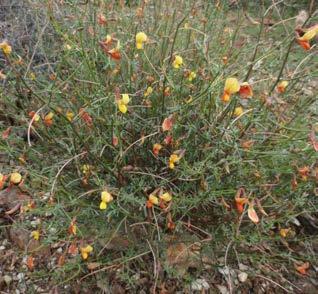
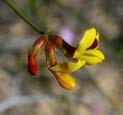
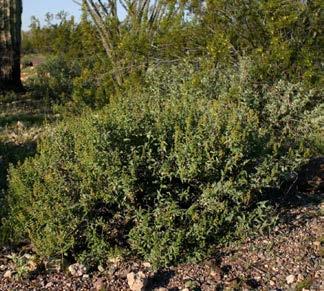
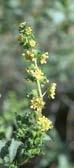
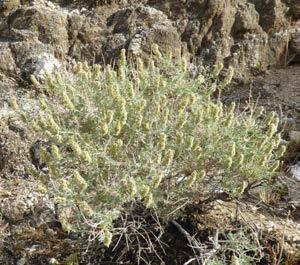
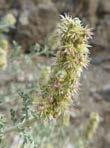
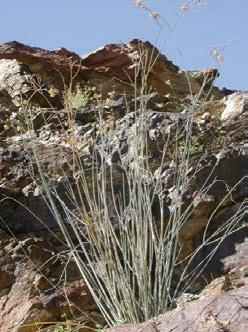
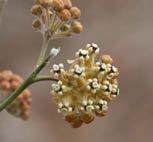
Shrubby deervetch, or Lotus rigidus, is a perennial subshrub that is native to the Sonoran Desert. This herbaceous plant grows 1-2 feet tall, and features small green leaves and yellow flowers that turn orange-red as they mature; these flowers can be seen from February to May. Shrubby deervetch thrives in elevations under 5000 feet and requires very little water and full sun. This plant is also pollinator friendly and can act as a host for acmon blue and funereal duskywing butterfly larvae.
Triangle-leaf Bursage is a perennial subshrub in the Asteraceae (sunflower) family native to the Sonoran desert. It is a low shrub, growing 1.5-2 feet tall and has toothed, narrowly triangular leaves that are greenish-gray above and grayish-white below. Flowers are inconspicuous, dull greenish-yellow thats fruit turn into burrs that attach to animals for seed dispersion. In the wild, this plant is found on rocky hillsides, dry plains, mesas, and sandy washes. Blooms from late April to early December. This plant is a close relative of ragweed, which is known for causing allergic reactions for some people.
White Bursage is a perennial subshrub, growing 2-3 feet tall, native to the Sonoran Desert and Southern California, Utah, and Nevada. Leaves are light gray-white green and elliptic to ovate shaped, lobed, and densely hairy. Flowers are inconspicuous, greenish-yellow and appear in late February to early December. The fruit is a burr that attaches to animals for seed dispersal. It grows well in dry, rocky soil and sandy washes, and needs little water when established. This plant is a close relative of ragweed, which is known for causing allergic reactions for some people.
The white-stem milkweed is a perennial plant native to Arizona. Growing to around 3 to 4 feet wide and 8 to 10 feet tall, the white-stem milkweed is the tallest of all U.S. milkweeds. This plant has a woody base and waxy gray vertical stems. From February to November, the white-stem milkweed grows clusters of small cream/yellow flowers atop its long stems. These plants are host plants for queen and monarch butterflies and attract pepsis wasps and bees. The white-stem milkweed handles full sun exposure and requires little water use once established. Well-draining soil is best for the milkweed to replicate the plants rocky natural habitat.
Milkweeds (like several other common landscaping plants such as oleander and lantana) contain some components that can be irritating to the skin and/or eyes. Use care when handling and planting these plants. These components also make the plant distasteful, meaning that many animals – especially pets – tend to avoid milkweed and will not consume large quantities that could make them ill.
Attributes

Attributes

Attributes

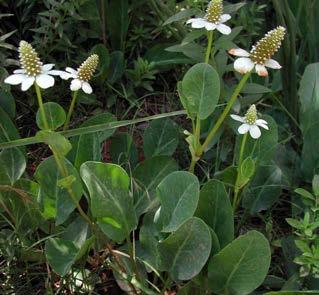
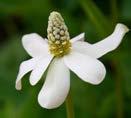
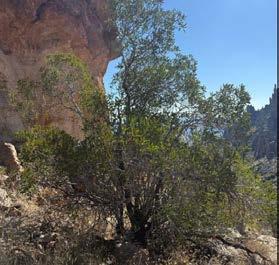
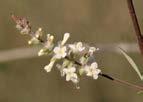
Yerba mansa, or Anemopsis californica, is a perennial herb growing in wet, alkaline marsh and creek edges below 6500 feet in Arizona, California, Colorado, Kansas , New Mexico, Nevada, Oklahoma, Oregon, Texas, and Utah. It has woolly stems growing 4-30 inches tall with large, waxy, dull green basal leaves that lie flat on the ground. Stems root as the grow, forming a ground cover. Flowers are white spikes at the top of the plant which are fragrant on warm days. Blooms February - October and prefers high sun and soil moisture.

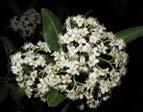
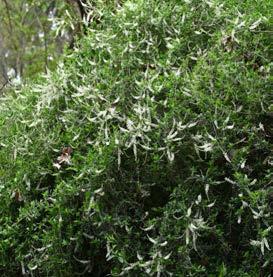
Arizona rosewood, or Vauquelinia californica, is a perennial shrub (can grow into a tree) that is native to the Sonoran Desert. This plant is known for its dark green foliage and clustered white flowers which can be seen from May to July and attract pollinators such as bees and butterflies. Arizona rosewood grows best in areas where elevation ranges from 2500 to 5000 feet and requires low water and full sun.
Attributes
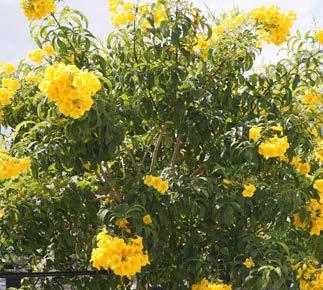
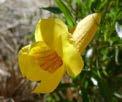
Arizona yellow bells are perennial shrubs native to the Sonoran Desert and found in gardens and landscapes in Phoenix, Arizona. The Arizona yellow bells have narrow green leaves and can grow from 4-8 feet wide and 3-8 feet tall. During times of frost in the Arizona desert, the plant may drop some leaves. From May through October this shrub blooms with dense clusters of bright yellow flowers resembling a bell or trumpet. These flowers attract pollinators such as bees and hummingbirds. Established yellow bells can be rejuvenated by pruning thinned damaged branches to the ground every five years. These desert plants require low to moderate water use and perform best with full sun exposure or partial shade. The Arizona Yellow Bell can make for a colorful backdrop or provide a natural barrier or screen in urban desert gardens.
Bee brush, or Aloysia gratissima, is a perennial shrub growing up to 10 feet and occurring in Arizona, New Mexico, and Texas. It has vanilla scented, fragrant, small, white flowers growing in spikes up to 3 inches long above the leaves. It has long, straight stems with light gray bark and branches that sometimes have sharp tips. Small green leaves grow along the stems. Blooms appear in March-November and attract bees and butterflies. This plant prefers full sun and moist soil.
Attributes
Attributes
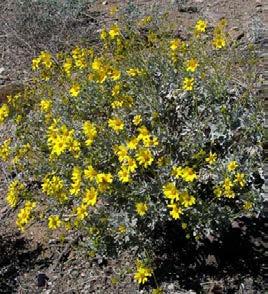
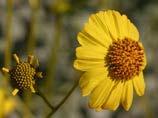
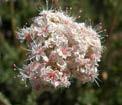
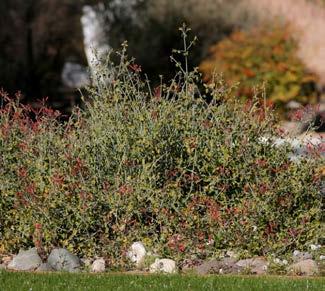
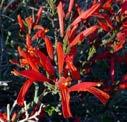
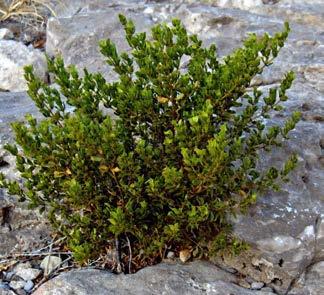
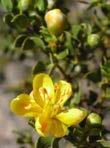
The brittlebush is a perennial shrub native to Arizona found across the Sonoran Desert. This drought resistant shrub has a round shape and grows to around 4 feet in width and 3 feet in height. It has evergreen silver-green leaves and sprouts yellow daisy like flowers during the spring from March to May. These flowers shoot from the shrub connected to long stalks and attract pollinators such as bees and butterflies. The brittlebush requires well-draining soil and can rely on Arizona’s rainfall once established. It performs best in full or reflected sun exposure and may reseed once established in a garden. The brittlebush can make a great background plant in a natural desert garden and stand out with its vibrant flower display when in bloom, but it also can be messy.


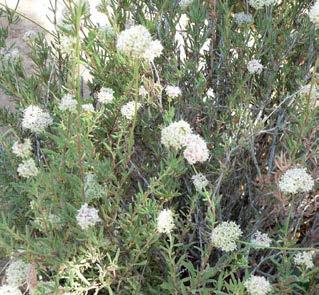
California buckwheat, or Eriogonum fasciculatum, is a perennial shrub that is native to the Sonoran Desert. This shrub is known for its white-pink flowers that grow in clusters, bloom from March to June, and attract bees, butterflies, and birds. California buckwheat grows best in areas where elevation ranges from 1000-4500 feet, and requires low water and moderate to full sun. This plant can be difficult, but not impossible, to find at local nurseries.
Attributes
The chuparosa (from the Spanish name for hummingbird) is a perennial Sonoran Desert plant that can be grown in Phoenix. It can take on a long and lanky look, growing 4-6 feet in width and from 3-6 feet in height. The plant’s appearance, however, can be tamed to resemble a traditional shrub through careful pruning. The branches have small green leaves which can be dropped in times of drought. It can be easily recognized by its bright red tubular flowers blooming in the spring from March through June. chuparosas are also well-known for attracting hummingbirds with their bright showy flowers. The plant requires little water use and grows best in well-draining/rocky soils with full sun exposure or partial shade. These bright and pollinator-attracting Sonoran Desert plants make great additions to urban desert gardens
The creosote bush is a perennial shrub common throughout the southwestern deserts. Creosotes have small olive-green leaves and grow up to 10 feet in height and width. In spring, from February to April, the creosote blooms with yellow flowers followed by white fuzzy pea-sized seed-capsules. Oils on the plant’s foliage give off a distinct fragrance following rain. Creosote prefers full sun exposure and low water use and tolerates most soil types. Creosotes are hearty plants once established, making them great additions to naturalistic desert gardens. Creosotes can be planted en masse for natural screening.
Attributes
Attributes
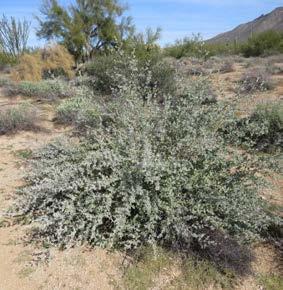
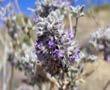
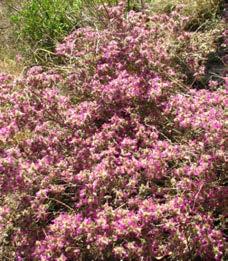
The desert lavender is a perennial shrub native to Arizona. This is a medium sized shrub that grows from 3-5 feet in width and 4-6 feet in height. The shrub has silver leaves with a pleasant lavender aroma (despite the fact that it is actually in the mint family), which can be harvested and used for the same purpose as Eurasian lavenders. The desert lavender has a long flowering period, blooming with purple flowers from February to November. Additionally, the plant may develop spike shaped branches reaching from the brush packed with the purple flowers. The desert lavender’s blooms can attract pollinators such as bees and hummingbirds. This shrub requires low water use and prefers well-draining soils and full sun exposure. The desert lavender can bring beautiful color and fragrance to an urban desert garden while demanding very little water in return.
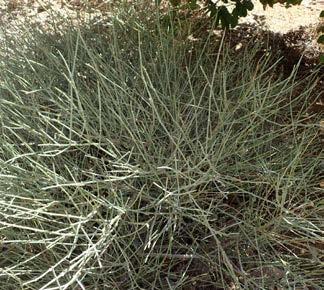
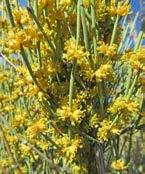
Desert tea, or Ephedra nevadensis, is a perennial shrub native to Southeastern California to Utah and Arizona. It grows up to 5 feet tall and has yellowish gray-green, very straight branches. Tiny paired leaves split and fall off early in its growth, leaving a leafless, broom like shrub (which makes it messy during that single shedding of leaves). Small, individual yellow flowers cluster together. Blooms appear February to May. Requires full sun and low water. This plant’s pollen can trigger allergic reactions in some.
Attributes
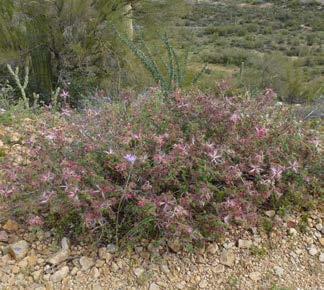
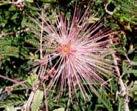
The fairy duster is a perennial shrub native to Arizona and a beautiful addition to many landscapes across Phoenix. It grows to 2-4 feet in width and 2-3 feet in height, with branches containing tiny green leaflets. These plants flower from February to April and September to October, with pink puffball flowers. This gives gardens beautiful color in the late fall when other plants are coming out of dormancy. The showy display of flowers gives the fairy duster its name. These flowers can attract hummingbirds, butterflies, and bees. The fairy duster requires very little water use and can thrive in full sun exposure or partial shade. This is a beautiful and unique desert shrub that makes a great addition to a low water use garden.
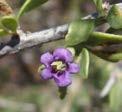
Fremont’s wolfberry, or Lycium fremontii, is a perennial shrub that is native to the Sonoran Desert. This shrub exhibits rounded green leaves and purple flowers which can be seen from January to March. Fremont’s wolfberry is an excellent pollinator plant and thrives in areas where elevation is 300 to 4300 feet and requires low water and moderate to full sun.
Attributes
Attributes
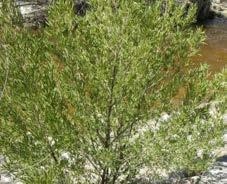
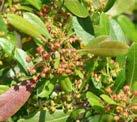
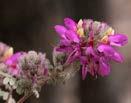
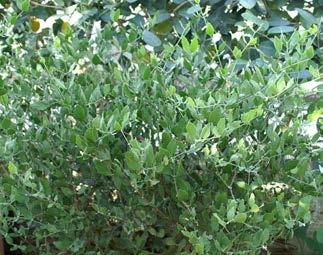
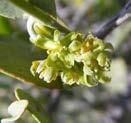
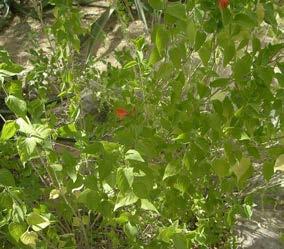
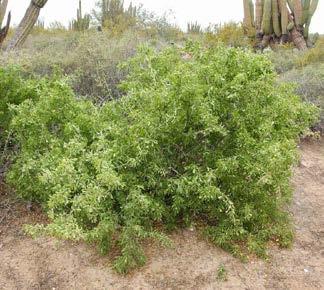
Hopseed bush, or Dodonaea viscosa, is a perennial shrub (can grow into a tree) that is native to the Sonoran Desert. This plant is an excellent alternative to oleanders, exhibiting similar long green leaves and white-yellow clustered flowers, which can be seen from February to October. Hopseed bush grows best where elevation ranges from 2000 to 5000 feet and requires low water and full sun.
Indigo bush, or Dalea pulchra, is a perennial woody shrub native to southern Arizona, New Mexico, and Mexico and grows to be about 4-6 feet by 4-6 feet. Leaves are delicate, feathered and compound, and silvery blue and slightly hairy. The flowers are deep purple and held on a terminal spike of the branches, and are densely packed. This plant is in the Fabaceae (pea) family, so the fruit is a legume. Blooms can be present in winter to spring, attracting bees and butterflies. This plant prefers full sun and low water. This plant can be difficult, but not impossible, to find at local nurseries.
Jojoba is a perennial shrub native to Arizona and common throughout the Sonoran Desert. Jojoba grows to 4-7 feet in width and height and is recognizable by its gray-green, leathery, oval leaves. The jojoba is dioecious, meaning there are separate male and female plants. This plant blooms with small greenish flowers from February to March. Jojoba with female flowers produce an acorn-like nut that can attract birds and mammals. These nuts have been used for centuries by Indigenous communities for medicinal or edible purposes. The jojoba is a very drought tolerant shrub and thrives in full sun exposure. Minimal pruning is ideal for the most natural and healthy-looking jojoba shrubs. The jojoba makes for a great naturalistic shrub for a desert garden.
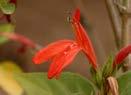
Red justica, or Justicia candicans, is a flowering shrub native and endemic to Arizona, and Sonora and Western Chihuahua in Mexico. Flowers are bright red and showy, attracting hummingbirds as pollinators. This plant can grow up to 3 feet by 3 feet, and it blooms fall-spring. Requires partial shade and moderate water.
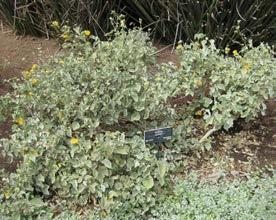
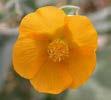
Superstition mallow, or Abutilon palmeri, is an evergreen shrub native to the Southwestern US and Northern Mexico. The flowers are small, about 1 inch, and cup shaped. The stems are hairy with a reddish brown coloring to the twigs, and the leaves are pale green, velvety, and serrated. Superstition mallow prefers rocky-sandy well drained soils and light watering. It blooms March to May.
Attributes
Attributes




Attributes
Attributes
Attributes






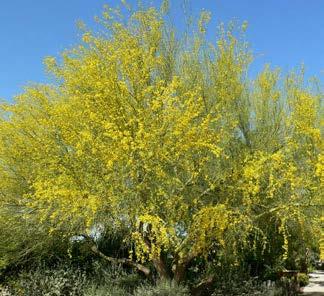
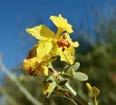
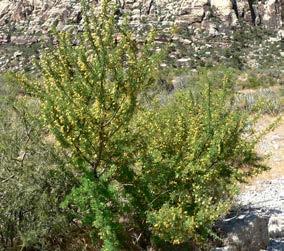
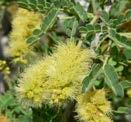
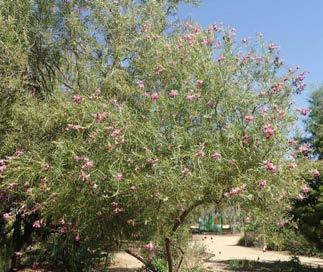
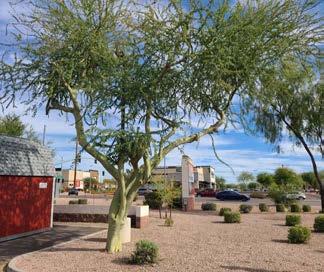
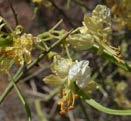
The blue leaf palo verde (Spanish for green stick), or Parkinsonia florida, are trees native to the Sonoran Desert of Arizona. It is a large shade tree growing to around 25 feet in height and 30 feet in width. This palo verde is set apart from the foothill palo verde with its bluish-green bark and more upright form. The blue leaf palo verde has pinnately compound leaves (leaflets on either side of a stem) bluish-green leaves with thorns on the branches. The blue leaf palo verde is the first of the palo verdes to bloom, growing bright yellow flowers in the spring from March to April, attracting pollinators such as bees. This tree can be “messy” dropping foliage, flowers, and beans. However, this litter can be raked under the tree or into nearby basins to take advantage of the material’s nitrogen richness. The blue leaf palo verde can thrive in full to partial sun exposure and requires little water use. This tree has also been noted to cause allergies for some and has thorns.
Catclaw acacia, or Senegalia greggii, is a shrub growing around 5 feet tall but can also grow up to 20 feet as a tree. Leaves are arranged on either side of the stem as tiny, gray-green leaflets. Its branches have cat-claw shaped thorns. Flowers are creamy white and grow in fragrant, bushy 2 inch spikes that bloom May-July. This tree is in the Fabaceae (pea) family, so the fruit are a legume. It is resistant to wildfire and can re-sprout after a fire. Distribution is Arizona, California, New Mexico, Nevada, Texas, and Utah. It can be very messy and is known to cause allergies for many.
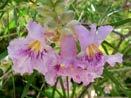
Desert willow, or Chilopsis lineraris, is a 15-40 foot, slender-twigged, tree. It often has a leaning, twisting trunk and an open, spreading crown that grows in Arizona, California, Texas, New Mexico, and Baja California. Its leaves are deciduous, willow-like, and light green. The flowers are dark pink or purple, often with white or yellow and purple streaks within the throat. By early fall, the violet-scented flowers, which appear after summer rains, are replaced by slender seedpods. The seedpods are 6-10 inches long, which remain dangling from the branches and serve to identify the tree after the flowers are gone. Blooms May-September. Requires full-partial sun and high-moderate water. The flowers and seedpods can cause a mess when they fall, but are easily raked up.
The foothill palo verde, or Parkinsonia microphylla, is the state tree of Arizona and native to the Sonoran Desert. The tree is slow growing and grows up to 20 feet in height and 15-20 feet in width. Foothill palo verdes have thin green bark with branches close to the ground, and minute green leaves connected to stems with a thorny tip. The tree blooms with bright yellow flowers from April to May, attracting pollinators including bees. It prefers full sun exposure and requires little water. The tree drops its flowers, which some consider a mess.
Attributes
Attributes
Attributes
Attributes
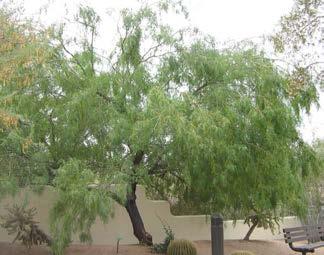
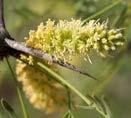
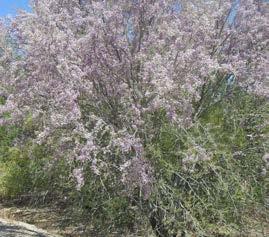
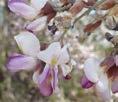
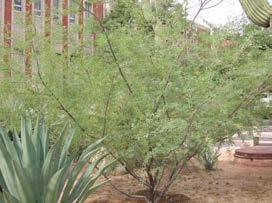
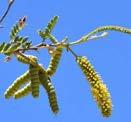
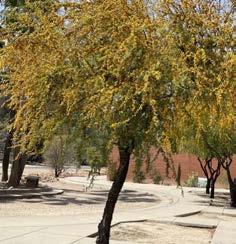
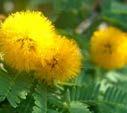
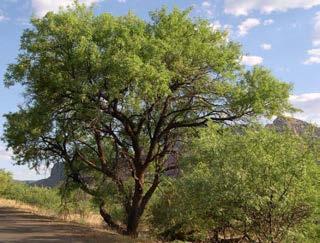
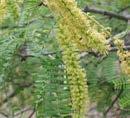
Honey mesquite, or Neltuma glandulosa (formerly Prosopis glandulosa), is a shrub or small tree growing up to 30 feet and is native across southern US including Arizona and extreme Southwest Utah. The crown spreads a distance equal or more to the height. Twigs are armed with sharp thorns up to 2 inches long, especially on young plants. Twice-compound, deciduous leaves are bright-green and feathery. Tiny, yellow-green, fragrant flowers occur in dense, spike-like clusters, and bloom in April until August during wet summers. The fruit is a long, yellowish brown pod. This tree attracts birds and bees. Requires fullhigh sun and low water. It can be messy and can cause allergic reactions.
The ironwood, or Olneya testota, is a native Arizona tree found across the Sonoran Desert. This tree is slow to moderate growing and grows to around 25 feet in height and 30 feet in width. The ironwood’s bark is thin and light gray, and its branches have thorns. The tree’s leaves are pinnate (feather like) with a gray-green color. In the late spring from April to May it blooms with a beautiful display of pink to violet flowers, which attract pollinating bees. This tree thrives best in full sun exposure and with low water use. The ironwood can provide dense to filtered shade and can make for a large focal point within a garden. It can be messy when it drops flowers.
Screwbean mesquite, or Strombocarpa pubescens (formerly Prosopis pubescens), is a spiny shrub or small multi-trunked tree with long, slender branches and odd, spiral seed pods. It grows up to 30 feet tall, and can be found in Arizona, California, New Mexico, Nevada, Texas, and Utah. It has very fine, graygreen leaves and narrow clusters of pale-yellow flowers. The tightly coiled tan seedpods are bunched in clusters. This tree blooms May to early summer. Requires full-high sun and low water. It has thorns and it can be messy.
The sweet acacia, or Vachellia farnesiana, is native to Arizona and other desert regions of North America. It is a very drought tolerant tree (or large shrub). This tree can reach 16 to 20 feet in height and 16 to 20 feet in width. It is fast growing, and thus takes extra maintenance, and it is messy. The leaves are divided into matching stems of bright green leaflets, and the flowers are small orange puffballs. This tree attracts a wide variety of bees and some butterflies. The branches have 1 inch long thorns, so they are best suited for areas away from sidewalks and patios. The leaves can be toxic in times of drought and the beans are toxic to dogs. The flowers’ pollen may trigger allergic reactions in some. It thrives in full sun and requires low water.
The velvet mesquite, or Neltuma velutina (formerly Prosopis Velutina), is a staple Sonoran Desert native tree and makes a great addition to gardens across central and southern Arizona. The velvet mesquite is a large shade tree growing to around 30 feet in height and width. The tree has brown bark with deep fissures, and light green bipinnate (fern-like) leaves with thorns at the leaf nodes. The velvet mesquite blooms with spikes of pale yellow to creamy white flowers in the spring from April to July which attract pollinating bees. The tree then produces edible tan bean pods. Velvet mesquites are great in landscape for providing shade for humans and nursing the growth of young plants. The velvet mesquite needs low water use and thrives with full sun exposure.
Attributes
Attributes
Attributes
Attributes
Attributes
Non-Native plants that have been adapted to desert environments can help progress water conservation efforts in Arizona. If you are unable to find what you are looking for in a Native Plant species opt for looking for plants that are also have adapted to desert climates and require low water use.
The following list includes low water use desert adapted Non-Native plants used in ornamental horticulture across Central Arizona.
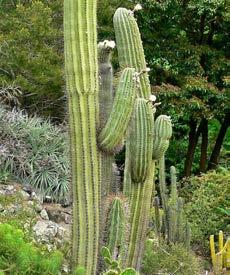
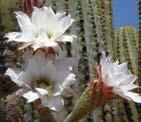
The cardon grande, or Echinopsis terscheckii, is a tree-like cactus native to Argentina and Bolivia, growing 20 feet tall to 8 feet wide. It has several erect columnar branches and distinct trunks. The stems are cylindrical, and have 8 to 18 ribs. As it matures, the growth pattern becomes more branching, and produces large golden spines. Blooms are white and are three inches long, and the fruit is blue-green. It blooms in the spring and attracts bats. Requires full sun and low water.
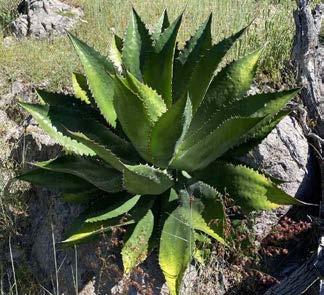
Cows horn agave, or Agave bovicornuta, is a medium sized, perennial succulent native to Sierra Madre, Mexico. Growing up to 5 feet by 5 feet, it forms a solitary, unbranched and open rosette made up of medium-light green, fleshy, highly ornamental, broad leaves. The leaves are widest at or above the middle and much more narrow toward the base. Yellow flowers bloom in spring and attract birds, bees, and bats. Requires full sun and low water. This plant attracts a variety of pollinators, but is also known to cause allergies in some. The sap of this plant is an irritant, though it is not listed as toxic.
While the flowering of agave plants signal the end of the life cycle, this is actually an opportunity to gain new plants. Agave put off pups or bulbils that can be harvested. They show up at the base of the plant (pups) or along the flower stalk (bulbils), so don’t cut off the stalk when it starts to grow as this will not keep the mother plant alive and could keep you from gaining new plants.
Elephant’s food, or Portulacaria afra, is a low-maintenance succulent shrub native to Kenya, Mozambique, and South Africa is often used in Phoenix landscaping for its hardiness and versatility. This plant’s leaves are a small, circular, ornament on thick, reddish-brown stems, and it can even be cultivated as a container bonsai. Because this plant’s leaves are edible, rabbits, javelina, and other herbivores in the area may make a pit stop to snack on elephant bushes growing outdoors. This plant thrives in varying levels of sun, and uses low water in the cool season and moderate water in the hot season.
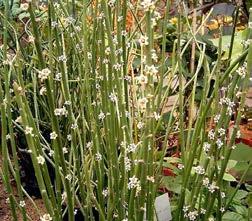
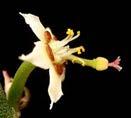
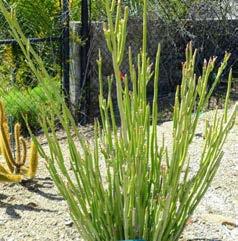
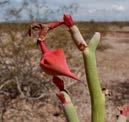
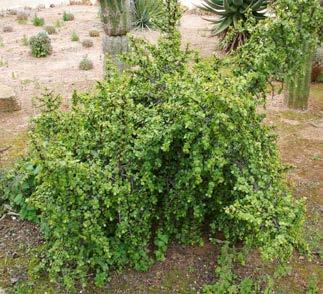
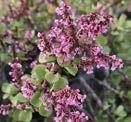
Candelilla, or Euphorbia antisyphilitica, is a twiggy looking perennial native to Texas and Southern Mexico that grows up to 1.5 feet by 4 feet. It has many waxy pale green stems with tiny, narrow leaves. Present only on new growth, the leaves fall off early. The leaves, along with the flowers, are inconspicuous. The small flowers are deep pink at the base and fade up to white at the top, they grow near the tips of the stems. This plant blooms spring-summer and attracts nectar insects. Requires fullpartial sun and low water. This plant, like other Euphorbia plants, has toxic sap. It can cause a rash on contact and temporary blindness if it gets into the eyes.
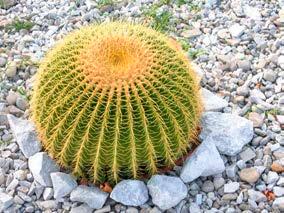
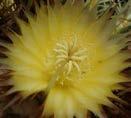
As an easily recognizable cactus, the golden barrel cactus is a staple to anyone’s garden in the Southwest and is native to Mexico. This beautifully round cactus with golden spines is nearly disease free and requires minimal water, though gardeners should be mindful to avoid wetting the cactus itself. Echinocactus grusonii is easily available in nurseries and botanical gardens globally, but due to its high demand and illegal poaching. It is endangered in the wild so please be sure to purchase from a reputable nursery (not online through sites like Etsy, Instagram, and eBay).
Lady slipper, or Euphorbia lomelii, is a succulent perennial native to California, Baja California, and Sonora and grows to 3 feet by 3 feet. It has thick, jointed, sometimes branched, light green stems with a waxy coating. Small, oval leaves drop quickly leaving bare stems. Unusual red-orange flowers bloom spring to summer, and sometimes into the fall, in clusters at the tips of the stems. When cut, the stems exude a toxic, milky sap, and this plant has been reported to cause allergic reaction of the skin in some when they handle the plant and if skin comes into contact with the sap. Requires full to partial sun and low water.
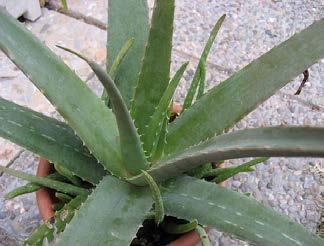
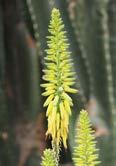
Medicine plant, or Aloe barbadensis, is a succulent perennial native to Sub-Saharan Africa but now is very widespread. This plant grows up to 2 feet by 5 feet. Thick, lance-shaped gray-green leaves are filled with aloe vera gel, and have small white teeth along the edges. The plant grows in a rosette shape. The flowers are a bright yellow tall stalk that blooms in spring and attract bees, butterflies, and hummingbirds. Requires full-partial sun and low water. This plant (like other aloes) spreads over time and can take over an area. It is given the messy attribute as it can be difficult to control once it spreads.
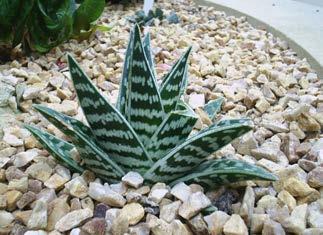
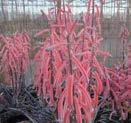
Partridge breast aloe (also known as tiger aloe), or Aloe variegata, is a now widespread smaller aloe. It grows up to 1 foot by 1 foot. It is a slowly spreading, clump-forming plant with 3-ranked leaves terminating in a blunt point. The leaves have a rough and bumpy texture, and are marked with irregularly spaced white cross bands along the leaf (these bands are what give the aloe it’s name). The flowers are bright pink/orange clusters of spikes that bloom in winter-spring and attract bees, butterflies, and hummingbirds. Requires shade-partial sun and very low water. Since this plant spreads it can take over an area over time.
Attributes
Attributes
Attributes
Attributes
Attributes
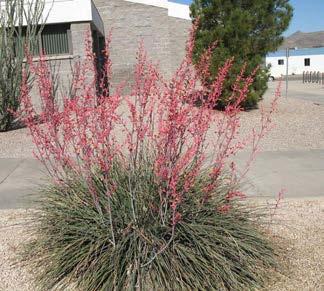
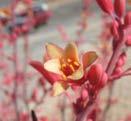
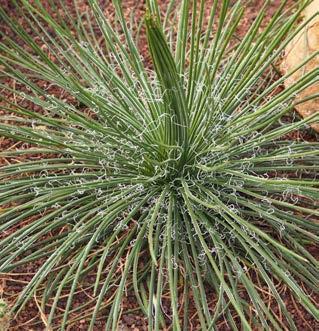
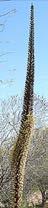
This bright-red, evergreen succulent is the perfect plant to attract hummingbirds to your landscape. Red yucca is native to the Chihuahuan desert and is essentially maintenance free as a result of its fit for the climate of the Sonoran Desert. This plant produces flower stalks with red flowers running up the stalk (though some cultivars of this species bloom yellow flowers and are called “Buttercup.” The tips of the thin leaves are slightly sharp. It is mildly toxic and can cause nausea, but is not noted as fatal to humans or animals if ingested.
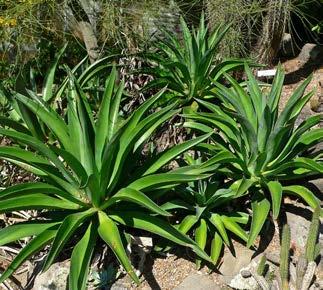
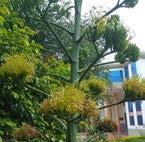
Smooth agave, or Agave desmettiana, is a perennial rosette forming succulent native to Southeastern Mexico that grows up to 4 feet by 4 feet. Dark blue-green leaves are thick, rigid, fleshy and long and narrow, going from wide at the base to a small tip. The leaves have a single reddish sharp terminal spine (up to half an inch long). New plants can clone from the root at the base of the rosette, forming a colony of rosettes over time. Each rosette will flower only once, usually at some point between 8-10 years. The flowering rosette dies after flowering, but new rosettes formed from the base of the mother plant will remain. The flowering stalk rises from the center of a rosette to 8 feet tall, producing side branches containing clusters of pale yellow flowers. This plant blooms in spring and attracts moths, bats and butterflies. Requires partial sun-shade and very low water. The sap of this plant is an irritant, though it is not listed as toxic.
While the flowering of agave plants signal the end of the life cycle, this is actually an opportunity to gain new plants. Agave put off pups or bulbils that can be harvested. They show up at the base of the plant (pups) or along the flower stalk (bulbils), so don’t cut off the stalk when it starts to grow as this will not keep the mother plant alive and could keep you from gaining new plants.
Twin flowered agave, or Agave geminiflora, is a small, rounded succulent perennial native to Mexico that grows up to 5 feet by 5 feet. It has densely packed and symmetrical green leaves that grow up to two feet long and are less than a half inch wide. The leaves are not toothed, but along the margins are loose fibers that look like thick hairs. The leaves droop downwards as the plant grows. Twin flowered agave blooms only one time after it is established, producing tall unbranched stalks, 8 to 12 feet tall, with twin bright yellow flowers. Blooms in winter and attracts moths, bats, and hummingbirds. Requires full-partial sun and low water. The sap of this plant is an irritant, though it is not listed as toxic.
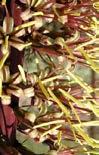
While the flowering of agave plants signal the end of the life cycle, this is actually an opportunity to gain new plants. Agave put off pups or bulbils that can be harvested. They show up at the base of the plant (pups) or along the flower stalk (bulbils), so don’t cut off the stalk when it starts to grow as this will not keep the mother plant alive and could keep you from gaining new plants.
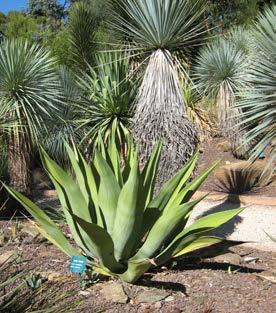
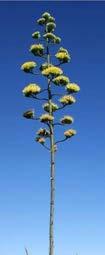
Weber agave, or Agave weberi, is a perennial agave native to Central Mexico that grows up to 5 feet by 5 feet. It has grayish-green to shiny, bluish-green, long, fleshy leaves and a sharp spine. The leaves are five to seven inches wide, with fine teeth along the top of the leaf. The foliage produces a large rosette with upright growth. At maturity, grows a 20 to 26 feet high, branched, flower stalk with clusters of yellow blossoms. Requires full sun and low water. The sap of this plant is an irritant, though it is not listed as toxic.
While the flowering of agave plants signal the end of the life cycle, this is actually an opportunity to gain new plants. Agave put off pups or bulbils that can be harvested. They show up at the base of the plant (pups) or along the flower stalk (bulbils), so don’t cut off the stalk when it starts to grow as this will not keep the mother plant alive and could keep you from gaining new plants.
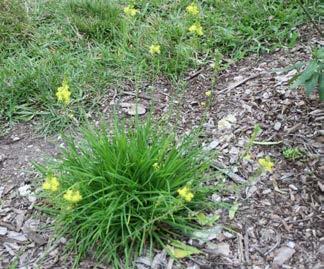
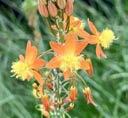
Yellow bulbine, or Bulbine frutescens, is a perennial succulent groundcover native to Southern Africa but now widespread, growing in arid places with shallow, rocky soils, growing around 1 to 2 feet. Fleshy, narrow, gray-green leaves grow upward from basal clumps. Yellow or orange flowers, with six pointed petals and long, fluffy stamens along the upper part of stalks. Blooms spring through summer, with a dormant period mid-summer in hot regions, then re-blooms in the fall into winter. The fruit is a small capsule with black seeds. Requires full sun and low water.
Attributes
Attributes
Annuals (If buying wildflower seed mixes, ensure they don’t contain invasive species by checking scientific names.)
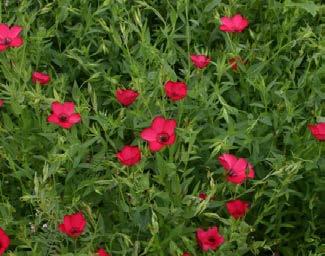
grandiflorum)
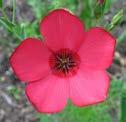
Red flax, or Linum grandiflorum, is an annual herb native to Northern Africa, which is now widespread and grows to 2 feet by 2 feet. Red, saucer shaped flowers with dark centers opening in clusters at the top of stems with narrow gray-green leaves. This plant blooms late winter-spring and attracts bees and butterflies. Requires full to partial sun and moderate water.
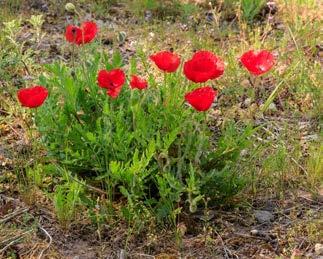
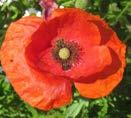
Shirley poppy, or Papaver rhoeas, is an annual herb native to parts of Europe and Asia. Red, pink or white blooms last only a day but are numerous in spring and again in fall. It has feathery leaves and grows to 1 to 2 feet. Bees visit this plant. Requires full to partial sun and moderate water.
Attributes
Attributes
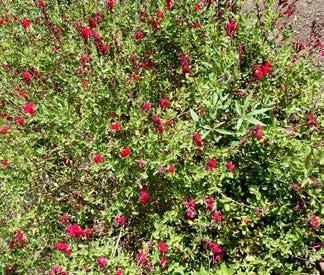
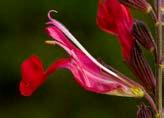
Autumn sage, or Salvia greggii, is a perennial shrub native to Texas and parts of Mexico. Flower clusters on short stalks can be red or pink (and sometimes other colors) and are fragrant, attracting hummingbirds and other pollinators. Leaves are green, small, and oval. This plant does produce fruits, which are nutlets. It blooms between March and November. Requires full sun and low water.
Attributes
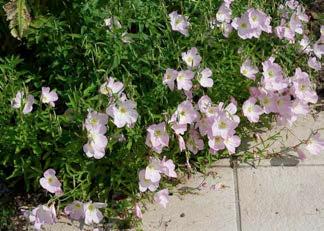
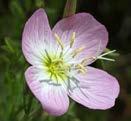
Mexican evening primrose, or Oenothera speciosa, is a perennial flowering plant native to central grasslands from Missouri and Nebraska, south through Kansas, Oklahoma, and Texas through northeastern Mexico. It grows up to 1 to 2 feet tall. Large, four petaled cup shaped flowers are light pink and the plant has downy stems. The leaves are long and narrow with ruffled edges. Blooms February to October and commonly opens at night. Requires moderate sun and water.
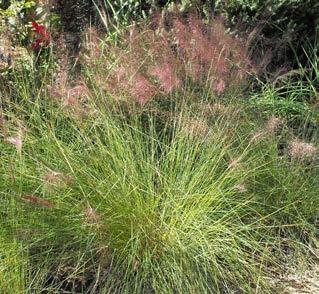
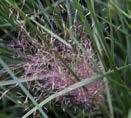
Muhly grass (also known as pink muhly grass, hairawn, or gulf muhly), or Muhlenbergia capillaris, is a perennial grass with a large, airy, and branching seed head that is up to half as long as the entire plant. The spikelets of seeds are purple. In the fall the plant takes on a feathery, deep pink hue. It grows to about 5 feet tall. This plant is native to a large range of Eastern US, from Massachusetts to Southern Illinois and down through Southeastern Kansas, and from Texas to Florida in the Southern US. Its range also crosses south through Mexico to Guatemala. Blooms in October. Requires moderate sun and water.
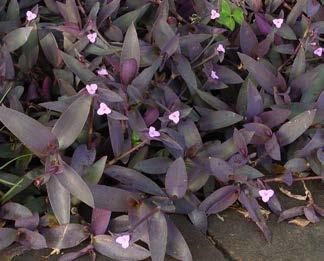
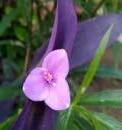
Purple heart, or Tradescantia pallida, is a perennial herb and groundcover, native to Mexico. It typically grows to 8 feet tall with a trailing habit (it spreads over the ground). It features thick but fragile stems clad with pointed, narrow-oblong, v-shaped leaves (4-6 inches long) that are sheathed to the stems. Stems will trail to 18 inches or more. Three-petaled, pink flowers (up to 1.5 inches diameter) bloom at the tips of the stems. This plant blooms midsummer through fall. The sap from leaves or stems may mildly irritate the skin (or the mouth and stomach if ingested) in humans and dogs. Requires full sun to part shade and moderate water.
Attributes
Attributes
Attributes
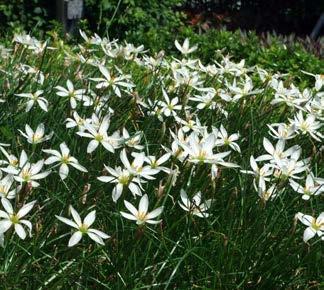
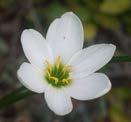
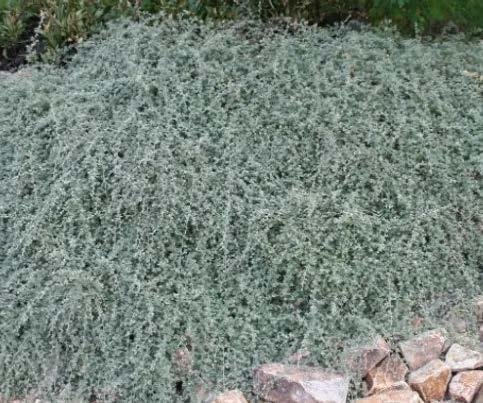
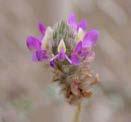
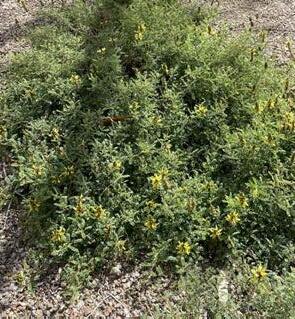
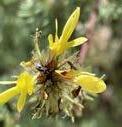
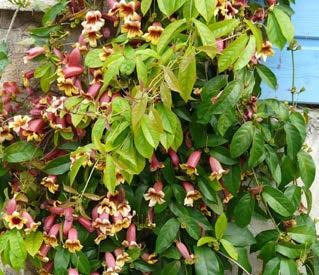
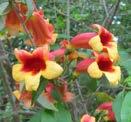
Rain lily, or Zephyranthes candida, is a perennial herb native to northeast Argentina, southern Brazil, Uruguay, and Paraguay. It grows up to 6-12 inches tall and wide, and boasts silvery white flowers that are 2 inches wide and have bright orange stamens. It has grass-like bright green leaves. This plant blooms late summer and early fall. Requires full sun and moist, well drained soil. All parts of this plant are toxic if ingested.
Attributes
Trailing indigo bush, or Dalea greggii, is a perennial trailing sub-shrub native to New Mexico, Texas, and southeastern Mexico. It grows from a few inches to 3 feet tall and spreads over 2 to 4 feet, making it a good groundcover option. It has silvery, blue-green, delicately compound leaves. The plant is awash with clusters of tiny, pea-shaped purple flowers in spring and early summer. Blooms May to September. Likes full sun and las low water requirements.
Attributes
Yellow dalea, or Dalea capitata, is a perennial low-mounding ground cover that grows up to a foot tall and spreads 3 to 4 feet in width, and is native to Mexico. The tiny foliage is tightly packed on trailing branches, the branches have red tips where new growth has occurred. The lime-green foliage occurs in small leaflets arranged on each side of the central stalk, and are finely textured. The yellow, pea-like flowers grow on top short spikes, and blooms in the spring and fall. Both the leaves and flowers emit a strong lemony scent. Requires moderate sun and water.
Attributes
Crossvine, or Bignonia capreolata, is a climbing woody vine that grows widely across the US, and can reach up to 50 feet long. Long, showy orange-red trumpet shaped flowers grow to about 2 by 2 inches in size and hang in clusters of 2 to 5. Holdfasts (adhesive discs) at the end of its tendrils allow the vine to cling to things. Leaves are opposite and grow in pairs, the individual leaves are 4 to 6 inches long, glossy, and turn purplish in winter. Blooms March-May and attracts hummingbirds and butterflies. Requires full sun to partial shade and moderate water.
Attributes
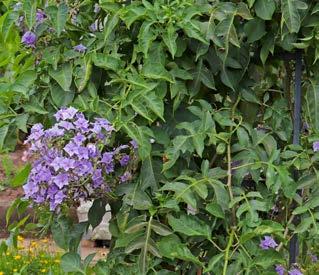
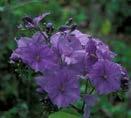
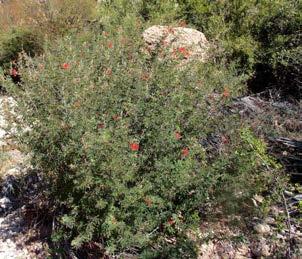
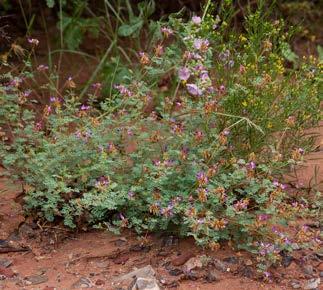
Giant potato creeper, or Solanum wendlandii, is a perennial vine native to Southern Mexico, Costa Rica, and Guatemala. It grows up to 10 to 15 feet tall and wide. It has 4 to 8 thick, dark green, ovate leaves with hooked thorns on the midrib on the underside of the leaf. The stems branch at the end where deep purple-lavender flowers that fade to white are when the plant blooms. Blooms in spring and fall. Requires full sun and moderate water. All parts of this plant are toxic to pets and humans when ingested.
Attributes
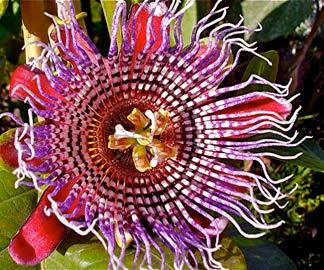
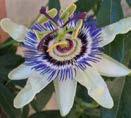
Passion vines (the Passifloraceae family aside from Passiflora arizonica), grow in the southern US, Mexico, Central America, South America, and other locations around the world. They are a perennial vining flower. These plants grow up to 10 feet tall in adjacent shrubs, and up to 9 feet wide. The leaves have 3-5 lobes, and the flowers are varying shades of purple, pink, blue, and white, and are very showy. Since this entry is covering a variety of species in this genus, the pictured flowers don’t cover all of the possibilities of flower iterations. The fruit is a small oval shaped berry about 1 inch around. Flowers June-August or October in the late afternoon through night. This family of vines attract bees and are a host for gulf fritillary butterflies. The leaves and unripe fruit this vine produces are toxic. The passion vines aside from Passiflora arizonica are easier to find in nurseries.
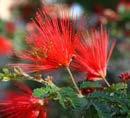
Baja fairy duster, or Calliandra californica, is a woody evergreen shrub that is native to Baja California and Northern Mexico and can grow up to 5 by 5 feet. The leaves are grouped into matching small stems of opposing leaflets, that are small, dark, and fern like. Branches droop down and create a vase shape. The long-lasting flowers are pin cushion or poof shaped, and vibrant red to fuchsia. The plant creates oblong, thin, light green seed pods. Blooms in spring. Requires full sun and moderate water.
Black dalea, or Dalea frutescens, is a small shrub, growing about 3 feet tall and is native to New Mexico, Oklahoma, Texas, and Northern Mexico. Leaves up to 1 inch long, divided into as many as 8 pairs of small leaflets and a terminal one on the central stem. This plant flowers in dense heads or spikes at the ends of branches. The flowers are small and purple. Blooms from July to October and attracts butterflies. Requires full sun and low water.
Attributes
Attributes
Attributes
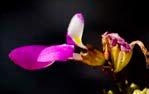
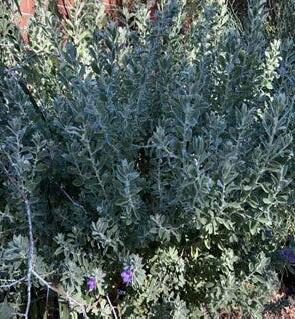
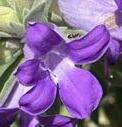
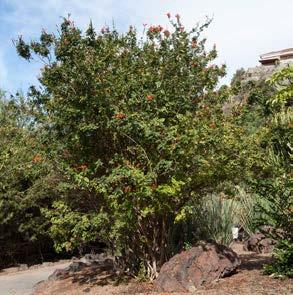
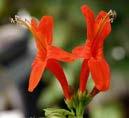
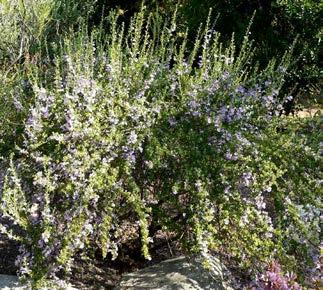
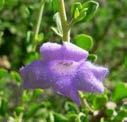
Blue emu bush, or Eremophila hygrophana, is an evergreen perennial shrub native to western Australia but now a widespread ornamental. It grows to about 3 feet tall and spreads. The leaves are light gray, 2 inches long, lance shaped, and alternately arranged on the stem. The flowers are violet blue and tubular shaped, about 1 inch long, and upright. Flowers stay on the plant almost year round. Requires full sun and moderate water with good drainage, and can be drought tolerant.
Attributes
Cape honeysuckle, or Tecoma capensis, is a large shrub native to South Africa that usually grows to around 6 feet by 5 feet, but can get up to 20 feet. Shiny leaves are divided into 5 to 7 toothed and pointed leaflets, similar to a rose leaf. Orange-red long tubular flowers bloom in clusters during the fall and winter. Attracts hummingbirds. Requires full sun-part shade and low water.
Attributes
Chihuahuan sage, or Leucophyllum laevigatum, is an evergreen perennial shrub native to parts of northern Mexico and grows to 4 by 5 feet large. The leaves are small and cling tightly to stiff branches. Many light purple flowers bloom on new wood at the base of leaves and are fragrant. Blooms summer to fall and attracts birds, butterflies, and hummingbirds. This plant can trigger allergies in some. Requires full-partial sun and very low water.
Attributes
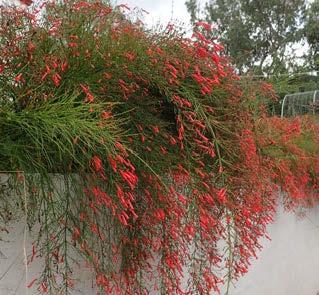
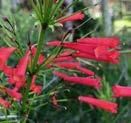
Coral fountain, or Russelia equisetiformis, is a perennial shrub native to Mexico that grows up to 4 feet by 4 feet. It is a many branched, asparagus-like shrub with bright orange-red tubular flowers and needlelike half inch thick green leaves. Blooms spring-fall and attracts hummingbirds. Requires full sun and low water.
Attributes
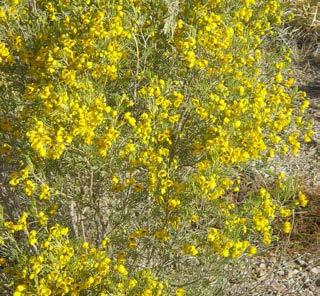
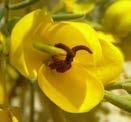
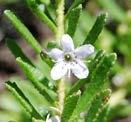
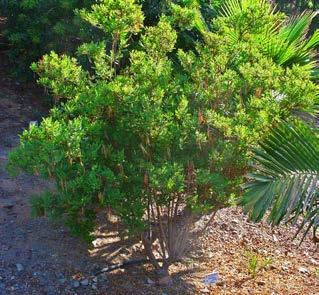
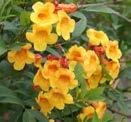
Feathery senna, or Senna artemisioides, is a dense evergreen shrub that hosts light gray-green narrow leaves and clusters of fragrant yellow flowers that bloom all year round. Blooms are followed by pea pods that start green and dry into a dark brown; if unsightly, these pods can be pruned. Although native to parts of South Australia and New South Wales, this plant can function as a pollinator plant for bees. The pods can cause some mess when they fall.
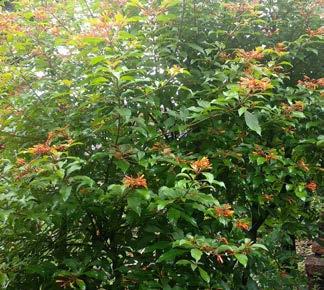
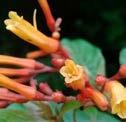
Firebush, or Hamelia patens, is a perennial shrub native to Southern and Central Florida and grows to 4 feet by 4 feet. Terminal clusters of five-lobed, tubular, bright-red flowers are followed by dark-red berries. The leaves are showy, bright green, and can be opposite or whorled along the stem. Blooms in the summer and attracts hummingbirds, bees, and butterflies. Requires full-partial sun and moderate water.
Attributes
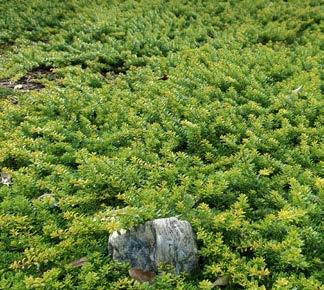
Myoporum, or Myoporum parvifolium, is a perennial evergreen shrub that forms a dense, trailing groundcover (somewhat like rosemary). Old stems become woody while new stems root as they touch the ground. The leaves are small, fleshy, and bright green. This plant produces tiny, white, star-shaped flowers that bloom in the summer. Myoporum is reported to be toxic, but due to its bitter taste animals only rarely ingest it. Requires full sun and low to moderate water.
Attributes
Orange bells, or Tecoma hybrid, is a very common ornamental plant in landscapes. It is a large perennial shrub growing up to 8 feet by 5 feet. This plant is native to the American tropics (Florida, the Caribbean, etc.) and is tolerant of moderate drought. Lush, showy green foliage and bright orange tubular flowers attract hummingbirds. Blooms year round. Requires full sun and moderate water.
Attributes
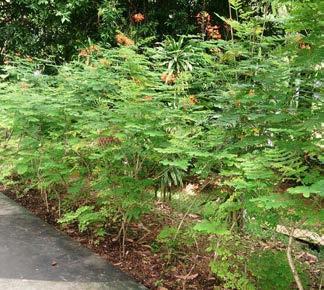
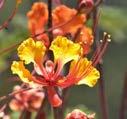
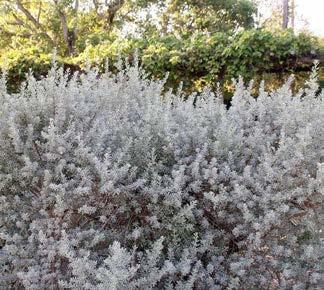
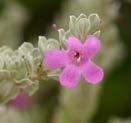
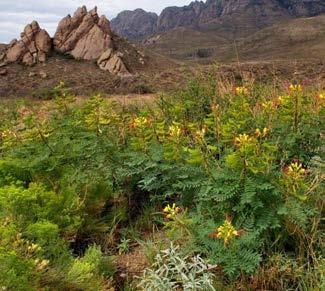
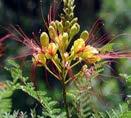
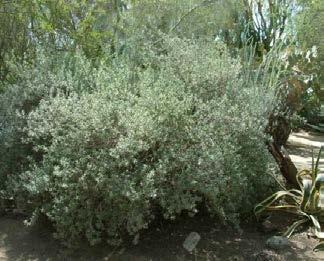
Peacock flower, or Caesalpinia pulcherrima, is a perennial shrub native to the tropical regions of the Americas. Peacock Flower is a large shrub growing up to 6-10 feet by 6-10 feet, and has feathery pinnate leaves. Bright red and orange flower stalks grow up to 20 inches and are characteristic of the species. It is a very heat tolerant plant and can withstand full sun, making it popular in AZ. Peacock Flower is in the Fabaceae family, so its fruit is a legume. Flowers bloom from May-October, and attract bees, birds, butterflies, and hummingbirds. This plant does have small spines. It requires full sun and moderate water.
Texas ranger, or Leucophyllum frutescens, is native to New Mexico, Texas, and Northern Mexico. This compact, ornamental shrub contains soft leaves that range from a silvery gray to greenish and bright pink-purple flowers that bloom for a few days at a time and are sure to attract butterflies to your home garden. This shrub should not be sheared (trimmed to remove new growth), as it will create openings in the naturally dense structure of the plant and will reduce the plant’s lifespan. Since the plant is native to Texas, it is adapted to high heat, full sun, and alkaline soils. It has been reported to trigger allergies in some.
The yellow bird of paradise, or Erythrostemon gilliesii, is a flowering shrub native to South America and is now distributed across southwestern US. This plant grows 6-8 feet by 4-6 feet with compound leaves that are about 6 inches long. Showy yellow flowers with red stamens form on racemes (separate branch spikes) that grow up to 20 inches long. This plant is in the legume family so the fruit is a pod. Blooms in spring and attracts butterflies and hummingbirds. Requires full sun, moderate water, and soil with good drainage.
Attributes
Attributes
Violet silverleaf, or Leucophyllum candidum, is a perennial shrub that occurs in Texas and in Mexico. Densely branched, compact form with silver stems and tiny silver leaves. Blooms repeatedly during the summer and fall with deep violet flowers. Requires full to high sun and very low water (it is prone to rot if over watered). It has also been reported to cause allergic reactions in some.
Attributes
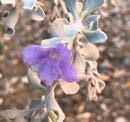
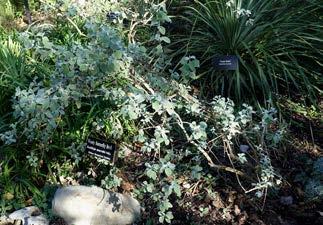
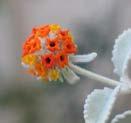
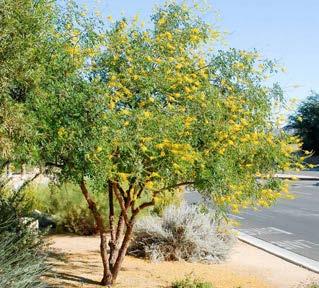
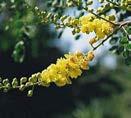
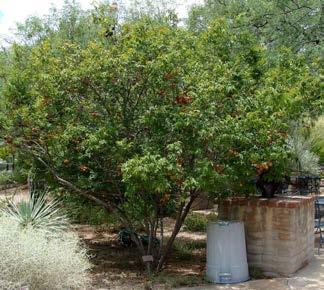
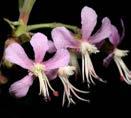
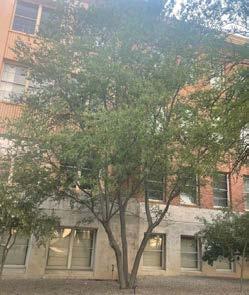
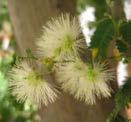
Wooly butterfly bush, or Buddleja marrubiifolia, is a perennial/evergreen shrub native to Southern TransPecos, Mexico and also grows in Texas. Can grow up to 5 feet by 5 feet. Leaves are velvety, ash- gray to silvery white and fuzzy. The fragrant, tiny orange flowers are arranged in ball-shaped clusters about 1/2 inch across, and bloom sporadically spring to fall. The thornless, herbaceous stems turn woody slowly from the bottom up. Provides nectar for butterflies. Requires full to high sun and very low water.
Cascalote, or Caesalpinia cacalaco, is a evergreen small tree or shrub native to tropics of Mexico, which is now also found in the Southwestern US. This plant grows to be 20 feet by 20 feet. Leaves are medium green color, twice pinnate, and alternately arranged. The stems are thorny. Yellow flowers bloom from a spike at the terminal point of branches. Blooms from winter through spring and attracts butterflies and hummingbirds. Requires full sun and low water.
Attributes
Mexican buckeye, or Ungnadia speciosa, is a deciduous tree native to Texas, New Mexico, and northeastern Mexico. It grows up to 10 feet by 10 feet. It is often multi-trunked with gray-brown bark. Compound leaves grow up to 12 inches long, with leaflets each 5 inches long, ovate shaped, with a toothed margin. Flowers grow in clusters and are bright pink and fragrant. The fruit is a reddish brown, 3 lobed capsule and is poisonous. Blooms in spring and attracts butterflies, bees, and moths. Can be messy. Requires full sun and low water.
Tenaza (also known as huajillo), or Havardia pallens, is a tree native to Texas and Mexico. This tree grows to 15 feet tall and wide on average, but can grow up to 30 feet tall and wide. It has feathery leaves, and the branches can have spines. The tenaza’s flowers are creamy-white small puffballs, like the fairy duster feathers, that grow in 6 inch clusters. The pollen from the flowers may trigger mild allergies in some. The tree blooms from May to August, and is visited by bees and butterflies. It prefers partial shade and requires low amounts of water. Due to it’s potential height and low water use, this is a good shade tree option for houses.
Attributes
Attributes
This and the subsequent low water use plant quick guide are meant to convey quick facts about the plants found in the description section. We’ve included all the facts we could gather about those plants here, and have listed the page number for full descriptions. This list is not exhaustive, but includes plants most likely to be found at nurseries. Please ensure you are buying from a reputable nursery.
Cacti and Succulents
Perennials (cont.)
These are plants that have lower water needs, are adapted in such a way to likely survive the Sonoran Desert summer heat, and not invasive. This list, like the native plant list, is not exhaustive but highlights common options. Please ensure you are buying from a reputable nursery.
Breslin, P., Romero, R., Starr, G., & Watkins, V. 2015. Field Guide to Cacti & Other Succulents of Arizona. Printed by Tucson Cactus and Succulent Society at Arizona Lithography.
Desert Botanical Garden. 2017. Desert Landscape School: A Guide to Desert Landscaping & Maintenance. Courier Graphics Corporation.
Mathura, K. 2007. The Arizona Low Desert Flower Garden A Seasonal Guide to Bloom, Height, Color, and Texture. Gibs Smith, Publisher.
Tillman, W. 2022. The Dehydrated Gardner: A Desert Dweller’s 3 Step Guide to Xeriscaping.
Thomas, G. 2024. Milkweeds of the United States. Pollinia Publishers.
Arizona Cooperative Extension | Backyard Gardener Archive https://cales.arizona.edu/yavapai/anr/hort/byg/
Arizona Municipal Water Users Association | How to Conserve / Plants for the Arizona Desert
https://www.amwua.org/plants
The Arizona Native Plant Society | Native Gardening https://aznps.com/native-gardening/
The Arizona Native Plant Society | The Plant List https://aznps.com/the-plant-list/
Arizona-Sonora Desert Museum | Sonoran Desert Fact Sheets https://www.desertmuseum.org/kids/oz/long-fact-sheets/
Arizona State University | Virtual Library of Phoenix Landscape Plants
https://www.public.asu.edu/~camartin/Martin%20landscape%20 plant%20library.htm
Arizona Wildlife Federation | Certified Yards Support Biodiversity: Proven by the Science of Wildlife Gardening! by Alexandra (Lexi) Cegielski (ASU Student Researcher)
https://azwildlife.org/blog/13442225
Arizona Wildlife Federation | Who Is Gardening for Wildlife, How and Why? by Kelli Larson (ASU, Professor of Geography and Sustainability)
https://azwildlife.org/blog/13438031?emci=b48a4a47-b6b1-
ef11-88cf-6045bdfe8d29&emdi=0a282825-00b4-ef11-88d0000d3a9d5840&ceid=19474267
Arizona Wildlife Federation | Wildlife-Supporting Yards: Balancing Aesthetics and Maintenance to Create Ideal Designs by Sharika Kapur (ASU Student Researcher) Kelli Larson (ASU, Professor of Geography and Sustainability)
https://azwildlife.org/blog/13448287
Arizona Wildlife Federation | Yard Wildlife Habitat Certification
https://www.azwildlife.org/wildlife-habitat-certification
AZ Plant Lady
https://www.azplantlady.com/
Desert Botanical Garden | Great Milkweed Grow Out
https://dbg.org/partner-initiatives/great-milkweed-grow-out/
Desert Botanical Garden | Is Saguaro Cactus Fruit Edible?
https://dbg.org/edible-saguaro-fruit/#:~:text=Saguaro%20fruit%20 tastes%20very%20sweet,dried%20and%20ground%20into%20flour
Desert Botanical Garden | Jojoba Plants in Arizona
https://dbg.org/hello-jojoba/
Desert Mountain Homeowners Association | Approved Indigenous Plants
https://www.desertmthoa.com/248/Approved-Indigenous-Plants
EcoRestore Portal: Restore Arizona’s Native Plants | Plant List
https://ecorestore.arizona.edu/plant-list
Galaxy Gardens AZ
https://galaxygardensaz.com/
Gardenia Creating Gardens | Arizona Native Plants: Expert Tips for Gardening Success
https://www.gardenia.net/guides/native-plants/ arizona#:~:text=Conserve%20Water%3A%20While%20native%20 plants,communities%20by%20planting%20in%20groups.
Green Things | Plant Catalog
https://greenthingsaz.com/plant_database/
Horticulture Unlimited Inc. | Plant Guide
https://horticultureunlimited.com/plant-guide/
iNaturalist
https://www.inaturalist.org/ Lady Bird Johnson Wildflower Center | Find Plants
https://www.wildflower.org/plants/ Loma Verde Landscapes
https://www.instagram.com/lomaverde_landscapes/
Maricopa Community Colleges Libraries | Plant Lists
https://libguides.maricopa.edu/lists/shrubs#s-lg-box-24350862
Monarch Watch | Milkweed Profiles
https://monarchwatch.org/bring-back-the-monarchs/milkweed/ milkweed-profiles/
The National Gardening Association Plants Database | Plant Search
https://garden.org/plants/search/text/ Paige Maloney AZ Landscape Design
https://paigesplantsaz.com/
Pruning Shrubs in the Low and Mid-Elevation Deserts in Arizona | Ursula K Schuch, University of Arizona Cooperative Extension
https://extension.arizona.edu/sites/default/files/2024-08/az1499-2016.pdf
San Marcos GROWERS | All Plant List
https://www.smgrowers.com/products/plants/alphabetical.asp
SEINet
https://swbiodiversity.org/seinet/ SEINet | Plant Collections Map
https://swbiodiversity.org/seinet/collections/map/googlemap. php?usethes=1&taxa=Fouquieria+splendens
Southwest Desert Flora
https://southwestdesertflora.com/
SRP Free Shade Trees and Workshop
https://www.srpnet.com/energy-savings-rebates/home/shade-treeworkshop
Strategic Habitat Enhancements (Native and pollinator garden information and resources)
https://www.strategichabitats.com/
Summer Winds Nursery Arizona | Native Plants for the Valley of the Sun
https://www.summerwindsnursery.com/az/plants/native/
University of Arizona | Campus Arboretum
https://arboretum.arizona.edu/
University of Arizona Division of Agriculture, Research & Extension | Plant of the Week
https://www.uaex.uada.edu/yard-garden/resource-library/plant-week/
U.S. Fish & Wildlife Service | Spreading Milkweed, Not Myths
https://www.fws.gov/story/spreading-milkweed-not-myths
U.S. Forest Service | Wildflowers / Plant of the Week
https://www.fs.usda.gov/wildflowers/plant-of-the-week/
Water Use It Wisely | Plant of the Month Blog
https://wateruseitwisely.com/blog/
Waterwise Botanicals | Plant Catalog
https://www.waterwisebotanicals.com/plants/
A & P Nursery
Arizona Cactus Sales
Desert Botanical Garden Biannual Plant Sale
Desert Foothills Gardens Nursery, Inc.
Desert Horizon Nursery
Desert Tree Farm
Elgin Nursery and Tree Farm
Jackrabbit Nursery
Moon Valley Nursery
Mountain States Wholesale Nursery
Native Seed Search (online only)
https://www.nativeseeds.org/
North Scottsdale Nursery & Cactus
Phoenix Desert Nursery
Richard’s Garden Center
Scottsdale Community College, Center for Native and Urban Wildlife
Biannual Plant Sale
Summer Winds Nursery
Treeland Nurseries
Western Tree Company (wholesale)
Whitfill Nurseries
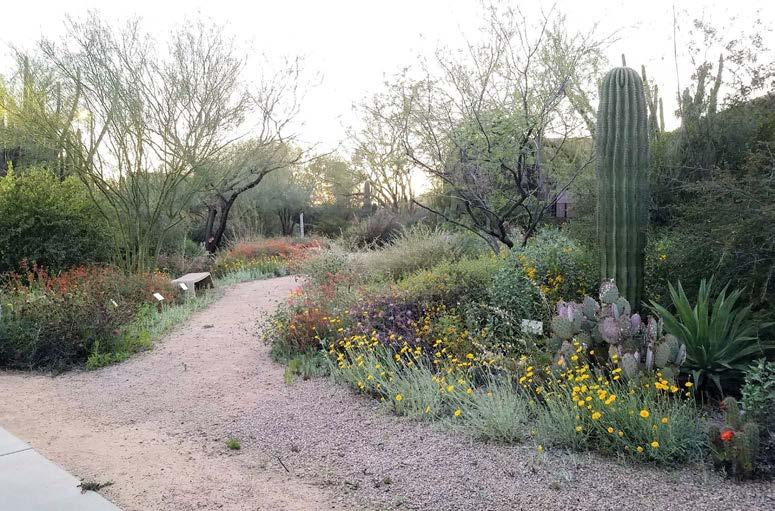
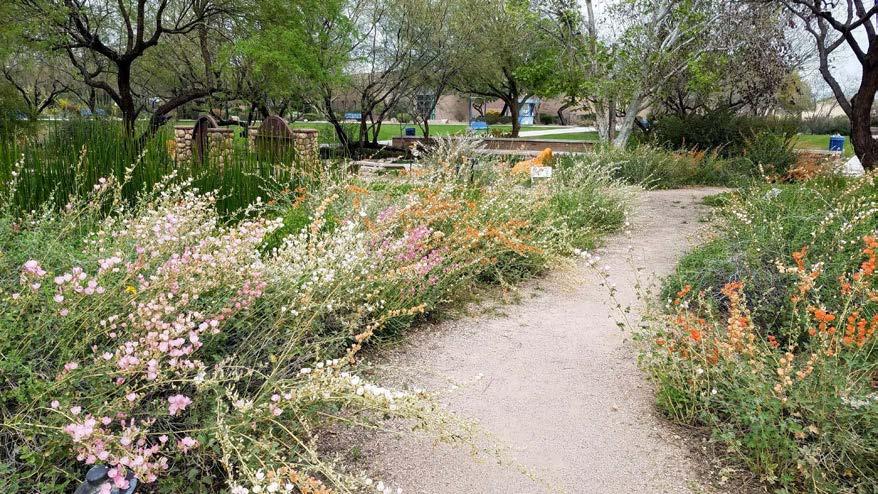
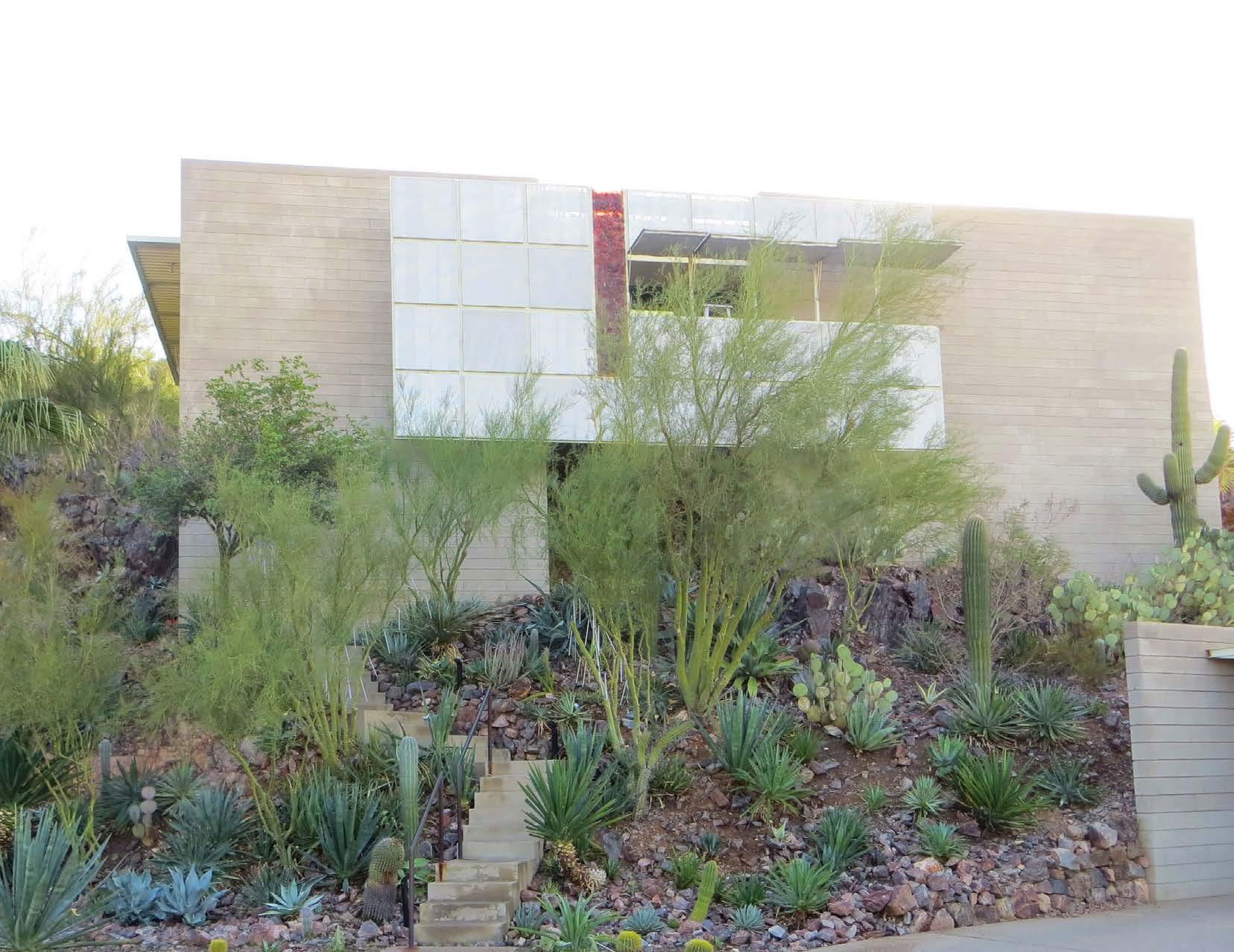
Trees play an important role in our landscape and provide a multitude of benefits for humans, wildlife, and the environment. They provide shade, habitat, oxygen, food, and can help us conserve energy and water if properly selected and cared for. Trees are woody stemmed, perennial plants that are typically long lived. The more mature the tree, the greater the amount of benefits they provide. It’s important to remember that they are a living organism that needs to be cared for properly throughout its life cycle.
If you are looking to add trees to your landscape, the planning process starts before you get to the nursery. It’s important to think about why the tree is being planted and what purpose it will serve. Are you looking for shade, food, privacy? It’s also important to understand the space in which you plant the tree. How much space do you have, what is the soil like, are there pipes underground to avoid? If you have a certain species you want to plant, how tall does it get? How wide is the canopy, and what is the typical root structure?
Before you decide to plant a tree, consider the following.
Is there anything overhead or underground? What is the size of the space? Call 811 before you dig to ensure there are no utilities buried at that spot (see http://www.arizona811.com/ for details).
Make sure to pick a species that is compatible with the factors of the site, and that there is water and nutrients available for the tree. Know the Hardiness Zone of your area (check the resources page for where to find this information), and make sure the tree can survive the year-round climate.
When selecting a species, make sure to consider the future growth of the tree, both above and below ground. Mature canopy size, shape, height, and characteristics like fruit or thorns can all play a role in determining the best tree for a location.
When a tree species and location for planting are properly selected, trees can contribute to energy savings in our home by shading our structures from the hot sun, and capturing stormwater runoff, slowing down the water and allowing it to benefit the local ecosystem. These features also support a healthy understory of plants and provide refuge for wildlife.
Major funding for this chapter was provided by CAZCA, the Arizona Department of Forestry and Fire Management’s Urban and Community Forestry Program, and the USDA Forest Service. These institutions are equal opportunity providers and employers.
Native plants work together to protect biodiversity and stewardship of cultural heritage. Arizona native trees are better suited for the Sonoran Desert climate and soil conditions, are more resistant to drought, and require little care. Aside from the benefits native trees provide to us, they also create habitat for native wildlife and pollinators, and contribute to genetic diversity; more genetic diversity results in more resilience to environmental stresses such as pathogens and pests.
Velvet Mesquite (Neltuma velutina)
Screwbean Mesquite (Strombocarpa pubescens)
Desert Ironwood (Olneya tesota)
Cat Claw Acacia (Senegalia greggii)
Sweet Acacia (Vachellia farnesiana)
Foothills Palo Verde (Parkinsonia microphylla)
Blue Palo Verde (Parkinsonia florida)
Desert Willow (Chilopsis linearis)
Honey Mesquite (Neltuma glandulosa)
Arizona native trees possess many unique characteristics including distinctive structures and aesthetically pleasing color palettes. Native trees also have large root systems that help reduce soil erosion.
Once you’ve selected a good location for a tree, and what species is a great match for your space, you’re ready for the exciting part: planting a tree! When and how you plant a tree is extremely important to its health and lifespan. It is best to plant trees during the dormant season, during the fall or early spring. This is when weather conditions are most favorable; allowing the tree to establish roots in their new location before the summer heat stimulates new growth and can cause excessive stress on the tree.
1. Dig a shallow, wide hole that is only 90% as deep as the root ball, but 3-5 times as wide. You want the trunk flare to be 1-2 inches above the surface. Note: If you can, dig the hole in advance and fill it with water two times within 24 hours to test the soil’s drainage capacity. If the
water doesn’t drain in that time, dig multiple chimney holes beside, not beneath, the root ball to avoid root rot from excess water. Fill the chimney holes with the same soil used in the planting hole.
2. Gently remove the tree from the container. Inspect the root ball and straighten or prune any circling, kinking, or girdling roots.
3. Place the tree in the hole – lifting the tree by the root ball, not the trunk. The root ball should rest on undisturbed, native soil. Make sure the tree is not sitting too deep or too shallow.
4. Before filling the hole, make sure the tree is straight from multiple angles.
5. Backfill the hole with native soil, packing the soil gently but firmly. You want to remove air pockets and make sure the tree is stable. Do not fertilize at the time of planting.
6. Remove the nursery stake. Use additional stakes only if necessary – if you use stakes, make sure they are placed outside of the root ball and the tree is able to flow in wind to ensure that it can build taper.
7. Apply a 2-3 inch layer of mulch around the tree, but make sure there is a 1-2 inch mulch-free zone around the trunk.
8. Water immediately after planting and frequently during the tree’s first year or more in its new location.
The process of being transplanted can be stressful on trees. To best support newly planted trees:
Water frequently – young trees will need extra attention and water for the first 3-5 years of their life. The frequency of watering will depend on site factors such as soil composition and sun exposure, and you should check the soil moisture before watering. You’ll want the soil to dry out in between each watering to prevent bacteria and pathogen build-up, but you should water young trees once the soil dries out to promote root growth and minimize stress to the tree.
Limit pruning – you should limit any pruning at the time of planting, unless branches were damaged during the process. Minimize pruning during the first few years of a tree’s life to encourage strong trunk growth and stability. You should always prune with a purpose, and a young tree should only be pruned if necessary for the health of the tree.
Drip irrigation systems are highly recommended for arid/desert climates because they water plants slowly, at low pressure, over a long period of time, which allows the plants to absorb more water, thus reducing excess runoff and evaporation. These systems are ideal because they can be easily regulated and are placed strategically to avoid watering unwanted plants.
Watering frequency will vary depending on the tree species, and it is advised that you group species with similar watering requirements together when designing your landscape to ensure effective irrigation.
Pruning is an important part of regular tree maintenance, but it can also be one of the most intimidating parts as well. Understanding why we prune is fundamental in tree care; we do not prune for the sake of pruning, instead we determine why a tree might need to be pruned. Are there dead branches? What about a fungus or some mistletoe? Any cut made on a tree leaves a wound that the tree has to expend energy trying to heal. That energy is taken away from other important functions of the tree. Knowing what to remove minimizes the amount of cuts needed to meet our why objective.
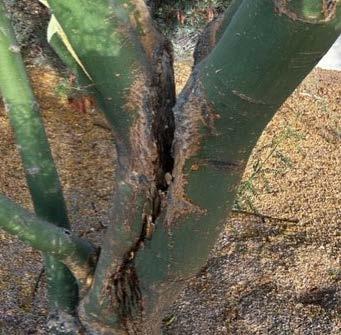
Structure, safety, biology, and aesthetics all need to be considered when developing a plan of what to prune on your tree, and understanding the facts about why, when, and how to prune will help the tree live a longer, healthier life.
Tree Health: Removing dead branches can help speed up the healing process of closing off the trunk from the lost branch. Disease progression can be prevented by removing a branch that has evidence of an infection. Rubbing, crossing, or inwardly growing branches can be removed to prevent future wounds from developing.
Structure: Young trees are selectively pruned to encourage the development of a strong, central leader and preserve lateral branches that have strong attachments. At the initial planting and several years after, branches that are larger than half the trunk diameter should be shortened or removed since they will compete with the central leader and could form weak attachments as the tree matures. When done properly, structural pruning can reduce the need for frequent pruning as the tree matures and doesn’t respond to pruning as well as a young tree.
Risk Mitigation: Trees can hold various risks, and recognizing potential conflicts is a main component of tree care. While removing large, dead branches is an obvious way to reduce risk, pruning can be also done for visibility and street clearance, reducing weight over structures, and tip reduction/wind resistance.
Aesthetics: This can be done by enhancing the natural tree form, creating symmetry, clearance, or even selectively pruning to enhance flower production.
Tree maintenance is inevitable, but it is important to remember that trees are living organisms. Removing branches affects trees by reducing a trees ability to photosynthesize, reallocating stored resources, and impacts future growth. Trees react to their environment and stressors so a balanced maintenance plan is important. If a tree is requiring an excessive amount of maintenance, it is likely that the tree is not suitable for where it is planted.
Trees have specialized tissue at the base of every branch called the branch collar. This specialized tissue is a protective chemical zone that equips the tree with the ability to ‘wall-off’ the wound to prevent decay and pests from invading inside the tree. You can recognize the branch collar by a slight bulge. It is important to make sure that this area is not damaged while pruning so that compartmentalization of decay in trees is able to take place.
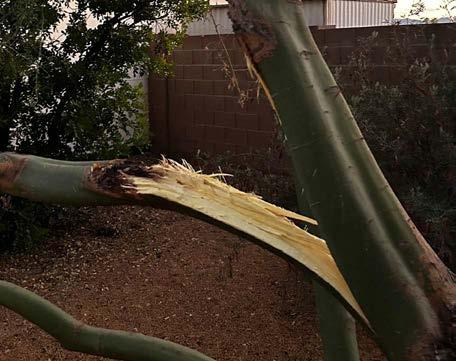
• Pruning shears – These are one of the most common tools to have in the garden shed. Also referred to hand pruners or clippers, these should be used for branches up to ¾ inch thick depending on the tool specifications.
• Loppers – There are different strengths of loppers, but they are typically for branches 1”-2”.
• Pruning saws– These are handheld saws that vary in size. Depending on the size and shape of blade and species of tree, these saws are used to prune branches between 1-6 inches in diameter.
• Pole pruner– The pole pruner is used for pruning limbs that you cannot reach from the ground otherwise, and is used for removing branches up to 2 ½ inches in diameter.
• Pole saw – Just like a pole pruner, a pole saw lets you reach parts of the tree you wouldn’t otherwise be able to access. Like a hand saw, a
pole saw is typically used for branches up to 6” in diameter. Much like the pole pruner, the benefit of this tool is the extended reach.
• Chainsaws and other power tools – if there is tree maintenance that requires the use of a chainsaw, it is best to leave that to the professionals and you should contact an International Society of Arboriculture Certified Arborist (more info on the next page).
Tools should be cleaned and sterilized between trees to reduce the chance of infection. Diluted bleach or isopropyl alcohol are a couple of examples of suitable cleaners to sterilize your tools.
Make your first cut on the bottom of the branch away from the branch collar. This is typically about a foot away from the branch attachment, and prevents your second cut from stripping the bark from the trunk of the tree. Your second cut should be on the outside of the first cut and leave a stub. Your third and final cut should be cut right outside the branch collar to preserve it completely. This gives the tree the best chance to heal the wound.
The cuts made should be smooth. In the event that the cut leaves a jagged edge, an effort should be made to smooth it out.
Flush cuts are cuts that damage or completely remove the branch collar which destroys the tree’s natural defense mechanisms against decay. You can prune up to 25% of a tree’s canopy, but ideally you wouldn’t want to prune more than 10-15% if you don’t have to.

Topping is the poor, uninformed practice of removing the living crown (top) of the tree. While this practice is detrimental to the health of the tree, it also makes the tree riskier in the future. Topping sends a tree into survival mode and causes rapid growth of shoots to compensate for the loss of food source. This not only depletes the tree’s energy stores, but as those shoots grow larger they become prone to failure due to their weak, sharp angled attachments. The tree has a difficult time healing these cuts since they occur outside of the branch collar, and can leave tissue exposed to insects, disease, and decay.
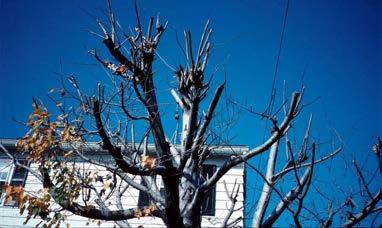
Lions-tailing is the practice of over pruning the inner branches of a tree leaving the limbs stripped which causes the tree to resemble a lion’s tail. The excess removal of the tree’s foliage starves the tree and can increase the risk of sun scald. This method also increases the risk of failure since it ruins the structure of the tree. Retaining internal branches allows limbs to dampen the force of winds, but when a tree is lion’s tailed it risks limbs snapping from high winds or excess tip weight.
Proper tools for the proper cut. It’s important to make sure you are using the correct equipment to prune trees. Having sharp, well-kept tools will give you clean cuts that are desired while pruning a tree. Dull tools or using tools that aren’t adequate for the size of the cut can lead to poor cuts that can be detrimental to the health of a tree.
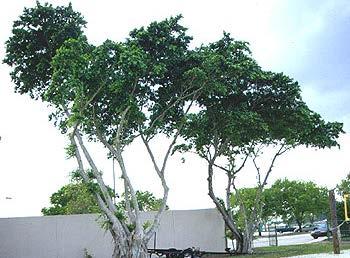
Palms are not trees but require a similar maintenance schedule. The dead leaves of a palm, fronds, can become dangerous if they are not regularly removed. As the fronds die, their attachment to the palm becomes weak and can fall to the ground. A palm frond can weigh up to 100 pounds, and people have been severely injured and even killed from falling fronds. Palms can also be pruned in the spring to remove flowers to keep them from fruiting (e.g., dates). Allowing palms to fruit is undesirable to most due to the mess and potential hazards they can create.
While simple, light pruning can be accomplished by the tree owner, more often than not a professional will need to be called. Here are a few of reasons why you might need to call a professional arborist:
• Large tree that requires climbing or and aerial lift
• Extensive pruning
• Presence of insects, disease, or decay
• Risk mitigation or storm damage
• Tree removal
• Plant Health Care (PHC)
Working with and around trees can be dangerous, and if there is any hesitancy in work that needs to be done, it is best to call an ISA Certified Arborist. They will be able to perform the technical work that goes into tree maintenance and removal as well as give diagnosis and prescription for tree health issues.
No matter how much care and attention you’ve given to the trees in your yard, there are times that you just need to contact the professionals. Trees are living organisms that require the proper care and diagnosis from a tree professional. More often than not, questions regarding their health and safety are too complex for the average person to answer, and a professional needs to be called. Not all landscape companies are equipped with the technical and scientific knowledge required in tree care, which makes finding the appropriate company important. There are several questions that you can ask when hiring someone to take care of your trees.
• What sort of certifications do you have in house? There are two main certifications in the arboriculture world, International Society of Arboriculture (ISA) Certified Arborist and Tree Care Industry Association (TCIA) accreditation. ISA Certified Arborists are individuals who
are qualified in tree care, while TCIA recognizes excellence in tree care companies. Both recognitions require a standard of excellence to receive.
• Do you use spikes while pruning trees? Individuals educated about proper tree care will not use spikes (sharp boot attachments that assist in climbing) to prune a tree. Spikes leave wounds in the bark that allow for the introduction of pests, disease, and decay. The exception would be palms, since they can be inaccessible without spikes.
• Do you have proof of an up to date insurance policy? While some companies advertise that they are insured, it is important to always get proof. If someone or something was to get damaged on your property and they aren’t insured, it could leave you on the hook for damages.
• What sort of safety measures do you practice? If they hesitate on this answer- think twice! Tree care can be dangerous, and safety should be at the core of every tree care professional. Personal protective equipment like helmets, safety glasses, and chainsaw pants or chaps should be mentioned. Ask if they follow the ANSI A300 standards, the accepted safety standards of the tree care industry.
• Do you advise topping a tree? Topping is the removal of the living crown (top) of the tree, and it is a poor practice that can be detrimental to the health and longevity of your trees.
• How will you minimize damage to my yard? A qualified tree care company will have a thorough answer for this question and will have questions for you regarding avoidable damage to things like sprinkler heads.
• Can you give me a detailed job scope with an estimated cost and duration? What seems like a simple job to someone not knowledgeable in tree removal or maintenance, might end up being a complicated and time consuming job under a trained eye. A reputable company will be able to give you a detailed estimate that covers the scope of the job and the amount of time it takes to complete.
It is beneficial to provide the history of the tree and surrounding property to the best of your ability. Has there been a recent disturbance, construction, or other human activity near the tree? Maybe you added on to your house or installed a new irrigation system? Perhaps you removed a tree that was previously shading other trees in your yard. Evidence of bugs, decay (fungus/cavities), new lean, leaf color changes, all of these factors can aide an arborist in decision making and recommendations.
Arizona Department of Forestry and Fire Management | Tree Care
https://dffm.az.gov/tree-care
Arizona Sustainability Alliance | Tree Steward Program
https://www.facebook.com/AZSustain
International Society of Arboriculture | Find an ISA Certified Arborist / Verify a Credential Tool
https://www.treesaregood.org/findanarborist/arboristsearch
USDA Plant Hardiness Zone Map
https://planthardiness.ars.usda.gov/
Waibel & Associates Services | Training for landscape professionals
https://waibel-la.com/services/
Janet L. Waibel | Sustainable Landscape Management. (Available in English and Spanish)
https://waibel-la.com/our-books/
When to Dig, Arizona 811
http://www.arizona811.com/
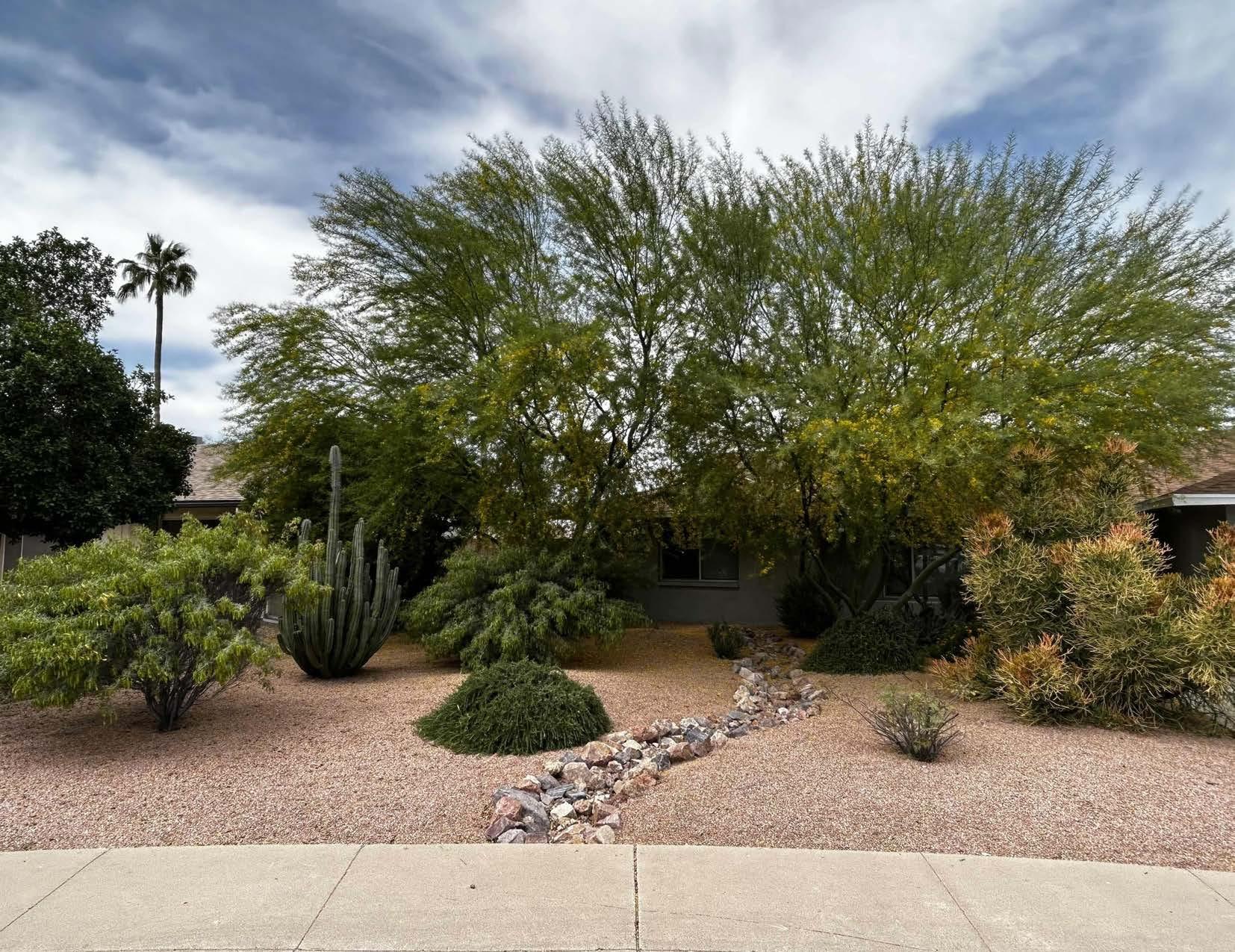
Invasive plants cause a variety of problems:
• They take over an area creating a monoculture and edge out native plants
• Many are fire prone, and fill spaces in the desert that would act as a natural break for wildfire
• They reduce biodiversity
• They can alter ecosystems and reduce natural resources and ecosystem services
Removing invasive plants from your property can help the entire region by reducing their spread. Following are common invasive plants found in Central Arizona that you should watch for and remove.
When you remove invasive plants you should do the following:
• If possible, cut off any seed heads first to reduce the spread of seed while you handle the plant, place these in a plastic bag (so they can’t spread in landfills)
• Pull the plants or use a weeding tool (for the small plants)
• Try to get as much of the root as possible (particularly important for plants like buffelgrass that can grow from rhizomes)
• Bag the plant with the seeds so they can’t spread through landfills
• For trees removal can be more difficult (especially if they are large) and you may want to consult a professional
• Remove invasive plant sprouts that come up after the initial removal, eventually plant native or low water use plants in their place
We recommend manual removal to reduce the amount of chemicals being introduced to the environment.
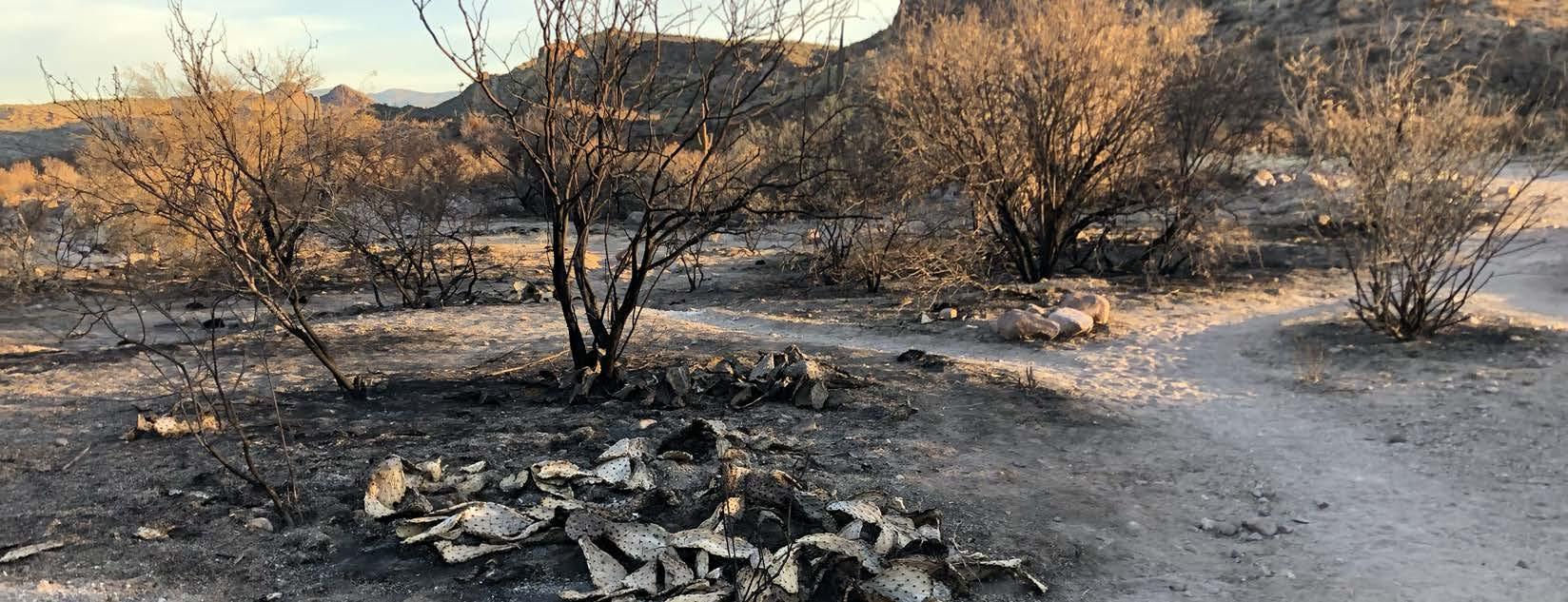
Other Common Names:
Willow rhus, Karee
Family:
Anacardiaceae
Native Region:
South Africa
Habitat:
Introduced as a shade tree and ornamental in Phoenix and Tucson. Has escaped cultivation and become established in desert riparian areas.
Blooms: Winter
Description:
• Evergreen, multi-trunked tree that reaches heights of 15-30 feet.
• Tree is not deciduous but can lose many leaves during the summer months due to heat stress.
• Dark gray trunk with fissures that can be a orange underneath.
• Leaves form in groups of three and are slender and lance shaped reaching 2-3 inches long.
• Leaves are dark green and shiny on top and pale green beneath.
• Whitish-green flowers with reddish twigs.
• Yellow or red berry-like fruit that grows in clusters.
• Drought tolerant with extensive root system.
• Added to the Arizona Noxious Weed List in 2024.
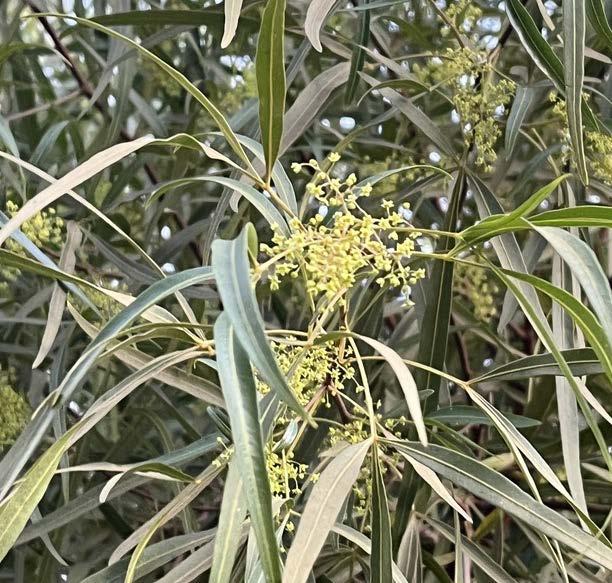
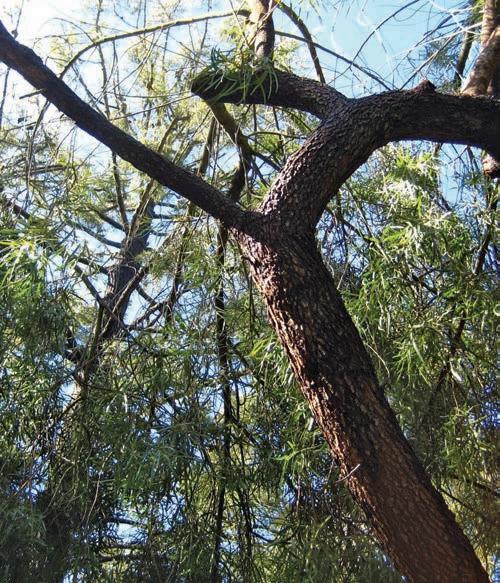
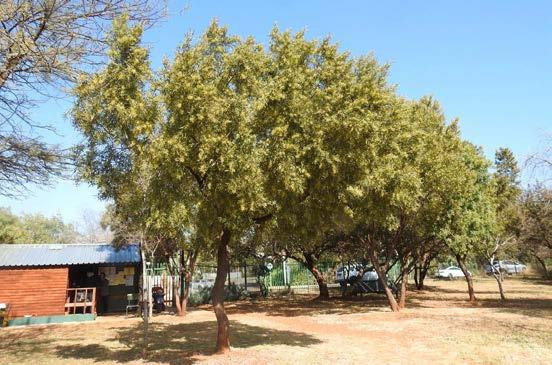
Other Common Names:
Zacate buffel, Pasto buffel
Family:
Poaceae - Grass Family
Native Region:
Widespread in Africa, the Middle East, Indonesia, and tropical Asia. Introduced as livestock forage in the 1930s.
Habitat:
Found up to 3000 feet, widespread in disturbed habitats, along roads and trails, and in washes.
Blooms:
July to October
Description:
• Perennial shrubby bunchgrass up to 3-5 feet. tall and 3 feet wide.
• Flower heads are brush-like, plump with brown to purplish color when fresh, turning straw-colored.
• Profuse branching in older plants gives them a messy, tangled appearance.
• Spreads aggressively and patches double in size every 2-3 years forming dense monotypic stands of thickly matted plants.
• Increases fuel load and fire risk; re-emerges readily after a burn.
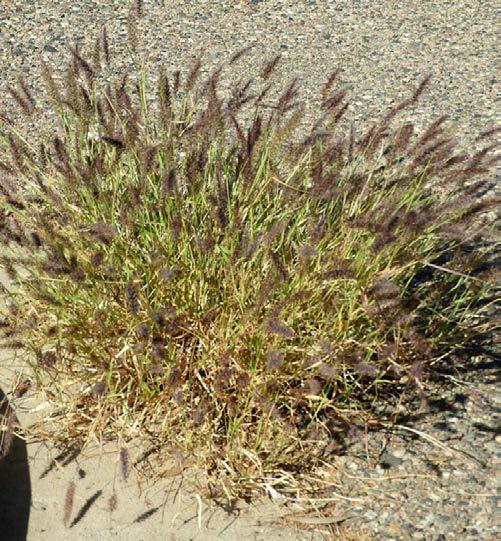
• The US Fish and Wildlife Service named P. ciliare a foremost threat to the Desert Tortoise populations due to changes in forage,temperature, and fire frequency.
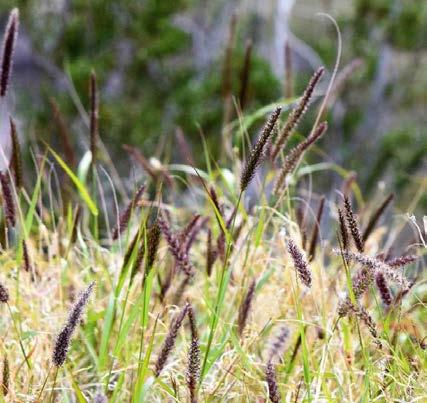
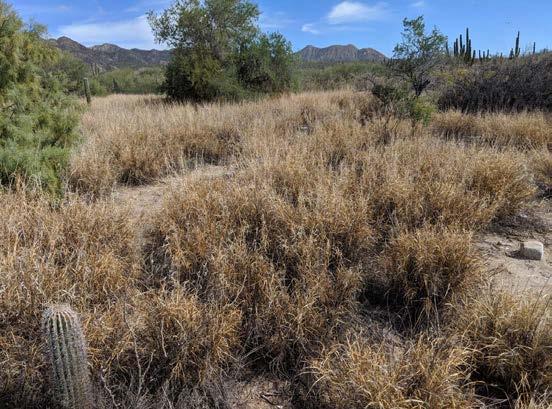
Other Common Names:
Common cow thistle, Chinita, Achicoria dulce, Muela de Caballo
Family:
Asteraceae - Sunflower Family
Native Region: Europe
Habitat:
Found readily along trails, fields, roadsides, and other disturbed areas, and occurs between 500 and 4,500 feet in elevation.
Blooms:
March to September
Description:
• Has large basal leaves, branching leaves extend upward from 1–5 feet, these leaves have spiny lobed edges. The leaf lobes can be distinguished by the base, which will nearly encircle the stem.
• Milky sap can be found within all parts of the plant. Forms a deep taproot.
• Weathers through the heat fairly well; can complete life cycle before it’s too dry or hot.
• Inflorescences (flower heads) are 0.5-1 inch, yellow, with similarity to a dandelion.
• Seeds are wind dispersed, with 80-250 seeds per flower head.

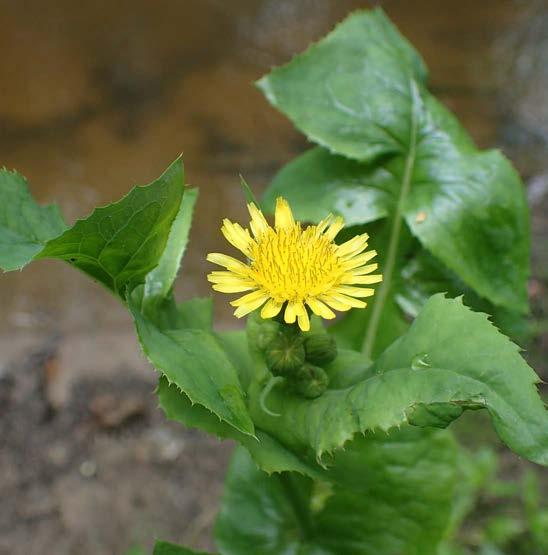
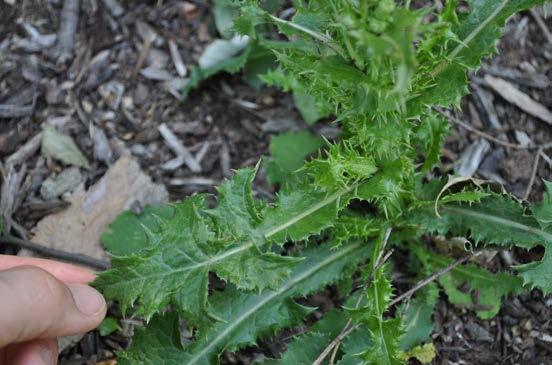
Other Common Names:
Crimson fountain grass, Green fountain grass, Purple fountain grass
Family:
Poaceae - Grass Family
Native Region:
Native to open, scrubby habitats in East and tropical Africa, Middle East and SW Asia. Seeds first available in the US in 1880s, and as ornamental in 1940s.
Habitat:
Found mainly in washes, riparian areas, in grasslands, on disturbed roadsides, on rocky outcrops, and in canyons, from 2000 to 3500 feet in elevation.
Blooms:
May to October
Description:
• Tufted perennial bunch grass grows up to 5 feet tall.
• Flower heads are showy pink to purplish, wide with a brush-like appearance.
• Long, narrow, green leaf-blades, have hairy edges, and arise from the base of the plant.
• Prolific seed producer and spreads rapidly from cultivation into nearby disturbed & undisturbed areas.
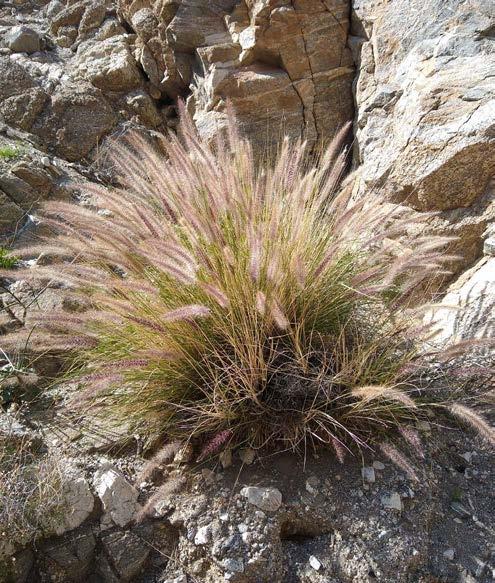
• Although some nursery varieties are considered “sterile”, especially the red variety, none are recommended for landscaping.
• Forms dense stands, outcompeting native plants and is highly flammable, increasing wildfire risk.
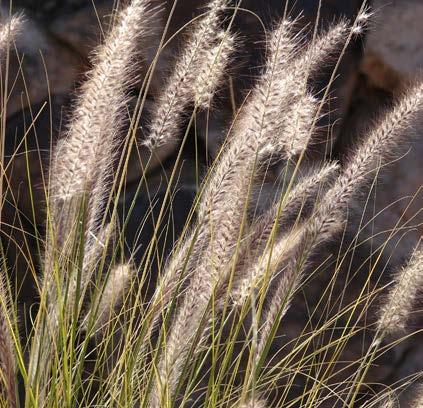
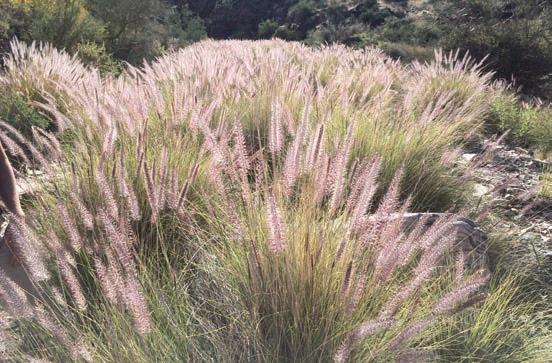
Other Common Names:
Arundo grass, Reed grass, Giant cane, Spanish reed
Family:
Poaceae
Native Region:
Eastern Asia
Habitat:
Grows along river banks and streams as well as culverts, ditches, and roadsides where water accumulates.
Grows from elevations to 1,600 to 8,000 feet.
Blooms:
Flowers in late summer but rarely reproduces viable seed in North America.
Description:
• Introduced for erosion control along water banks in the early 1800s.
• Perennial grass with thick and fibrous stems that can grow very tall, ranging from 6-30 feet.
• Leaf blades are evenly spaced along the stem and are elongated and flat, can grow over 12 inches and 1-3 inches wide.
• Vegetative reproduction through rhizome sprouts and stem nodes.
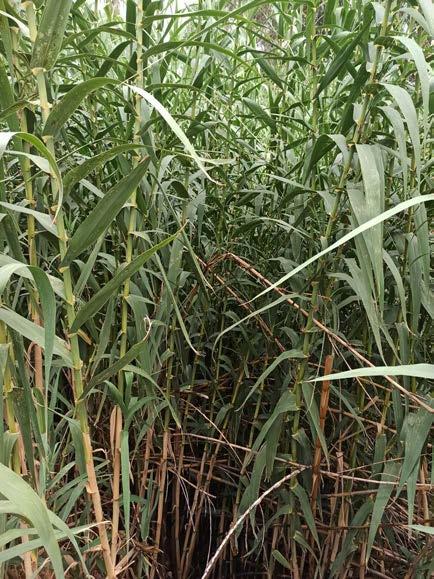
• Inflorescences- or flowers- are very dense and plume-like reaching up to 2 feet long with a tan or white color.
• Grows very rapidly (under optimal conditions 1.5-4 inches per day) forming large patches along waterways.
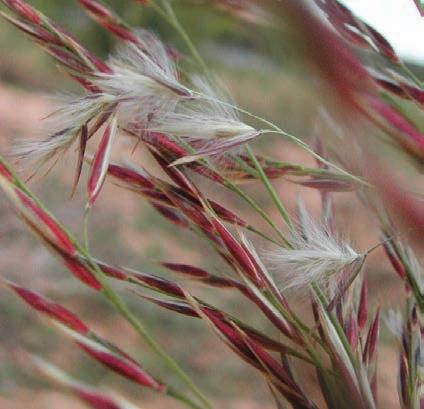
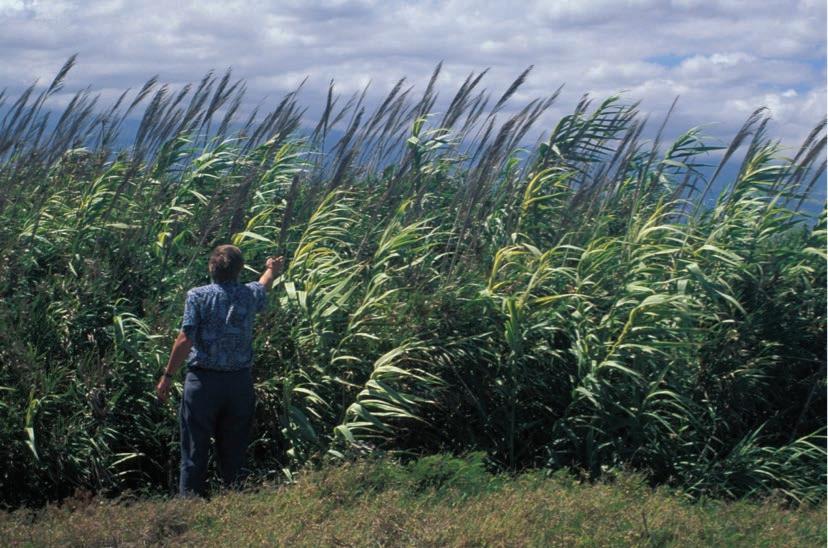
Other Common Names:
Desert mustard, Rocket mustard, or Tumble mustard
Family:
Brassicaceae - Mustard Family
Native Region:
Southern Europe, North Africa and temperate Asia
Habitat:
Found in growing in irrigated areas, open fields, disturbed areas and desert landscapes. Occurs in elevations below 4,500 feet.
Blooms:
December to March
Description:
• Winter annual/biennial with erect stems, branched at the base, that grows to about 20 inches tall.
• Lower leaves grow to 6 inches long, upper leaves are usually smaller, narrow in shape, with smooth edges and one or more pairs of elongated lobes at the base.
• Bright or pale yellow flowers, 0.2-0.3 inches in diameter become slender green to brown seed pods that ascend up the flowering stems.
• Like Sahara Mustard these seed pods also burst open releasing about 80 seeds per pod!
• This plant spreads by seeding itself across the desert landscape.
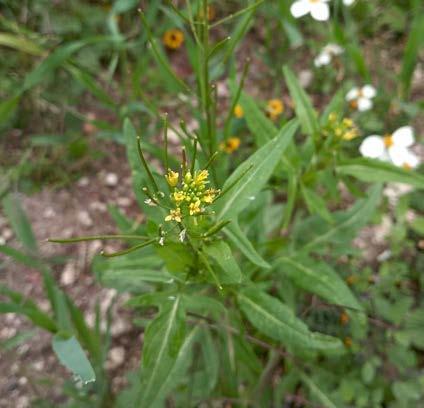
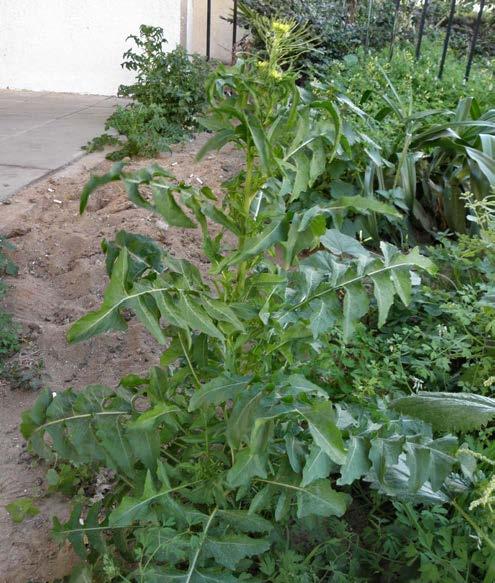
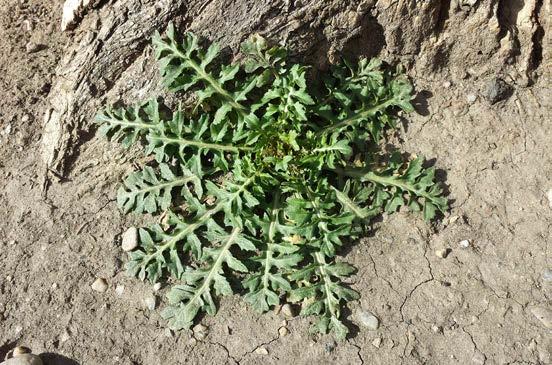
Other Common Names:
Napa starthistle, Tocalote
Family:
Asteraceae - Sunflower Family
Native Region:
Europe
Habitat:
Found in disturbed, open sites such as grasslands, roadsides, and fields. Can also be seen by trail sides. It ranges to 7,200 feet in elevation.
Blooms:
April to July
Description:
• Winter annual, in early growth in a basal rosette, then bolts in spring to 2 feet high.
• Leaves are lobed at the base and have prickly hairs, and winged stems.
• Inflorescences (flower heads) are a 0.5 inch or less, yellow with sharp spines.
• There are up to 100 flowers per plant and 60 seeds per flower head.
• Can form dense stands, outcompeting other plant species.
• Listed as a noxious weed in Arizona.
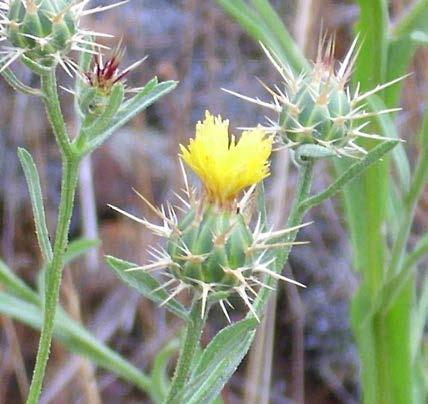
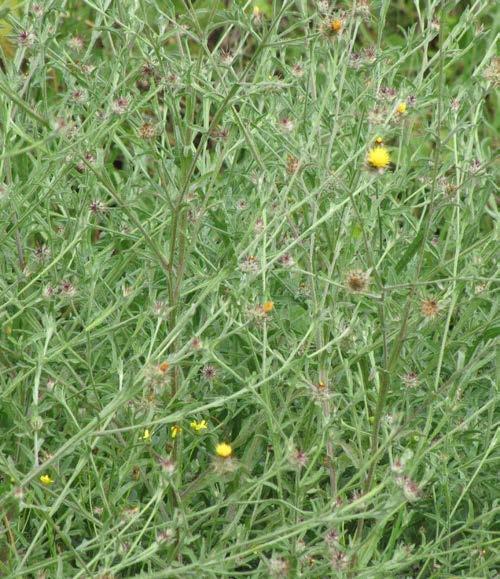
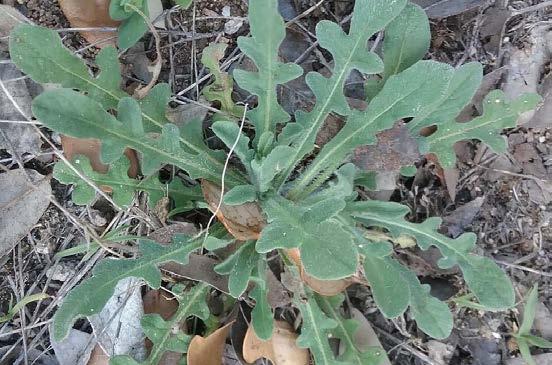
Other Common Names:
Foxtail chess, Foxtail brome
Family:
Poaceae, Bromeae tribe
Native Region:
Mediterranean region
Habitat:
Red brome prefers open spaces within shrub and grassland communities.
Blooms:
March to June
Description:
• Cool season, tufted, annual bunchgrass; 8 to 20 inches tall.
• Each plant has several stems growing from an erect or slightly spreading base; the stems have narrow, short, flat, hairy, prominently-veined blades and a hairy sheath.
• Roots are very shallow; it grows slowly in the winter and more rapidly as soils warm in spring.
• Panicles (2 to 3 inches long) are dense, compact, and brush-like with 7 to 11 upright florets.
• Reproduction is solely by seed; germination is highest during the fall months.
• Mature seed remains mostly dormant through the hot, dry summer.
• Added to the Arizona Noxious Weed List in 2024.
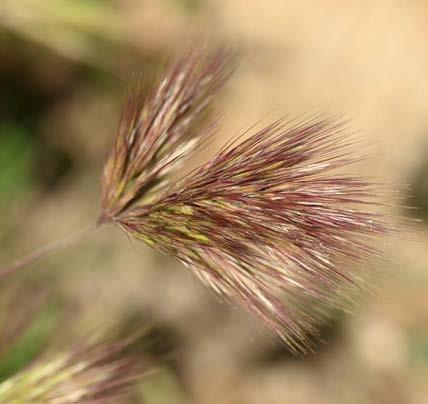
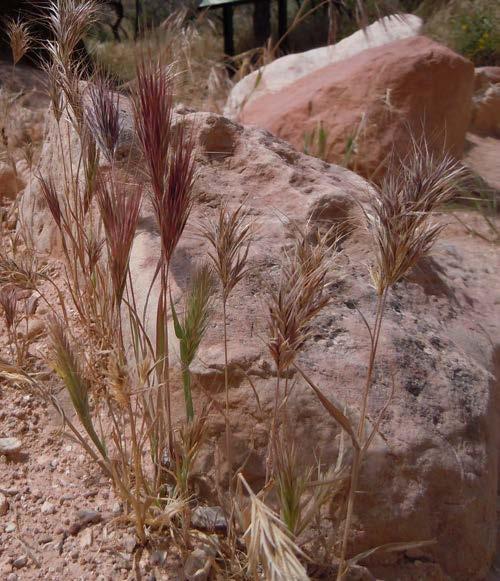
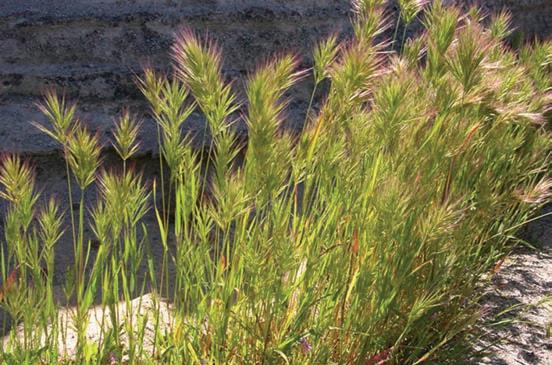
Other Common Names:
Tumbleweed, Tumbling thistle
Family:
Amaranthaceae
Native Region:
Eurasia
Habitat:
Semi-arid disturbed ecosystems
Blooms:
Late Fall to Winter
Description:
• Warm season, annual forb.
• Grows erect and rounded, up to 3 feet tall and 6 feet in diameter.
• Stems grow opposite each other and are very branched with red to purple striations.
• Leaves are alternate and long, thick, and end in a sharp spine, can be semi-succulent to succulent.
• Leaves are soft when immature but harden into stiff spines with maturity.
• Inflorescence is a solitary flower or a cluster of 2-3 flowers with sharp bracts.
• Deep taproot that can grow over 6 feet deep.
• Seed production is prolific with large plants producing up to 250,000 seeds.
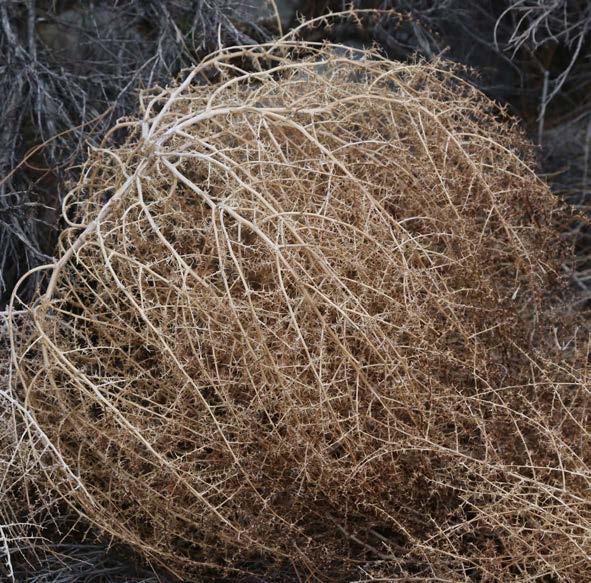
• Wind tumbling seed dispersal mechanism contributes to its fast growing and wide reaching populations.
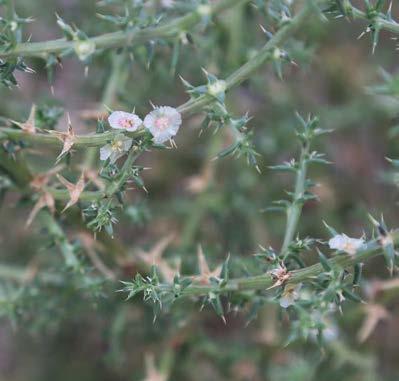
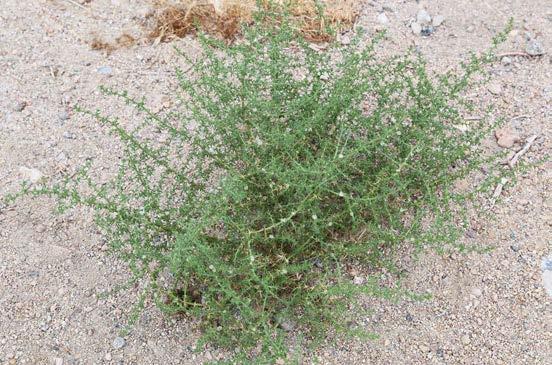
Other Common Names:
Asian mustard, African mustard
Family:
Brassicaceae - Mustard Family
Native Region:
North Africa and the Middle East
Habitat:
Found in sandy soil, dry washes, and along trail edges. It occupies a variety of disturbed habitats from roadsides, washes, open fields, grasslands, coastal sage scrub and the upland desert.
Blooms:
December to March
Description:
• Winter annual, in early growth it forms a large basal rosette, its leaves are 3-12 inches and are lobed and toothed.
• Stem and leaves are covered with simple hairs.
• Flower heads can vary in size and consist of 6-20 small dull yellow “butterfly” shaped flowers.
• Fruit are specialized structures called siliques that burst open when mature!
• They can contain 14-30 seeds in each pod.
• This plant spreads by seeding itself across the desert landscape.
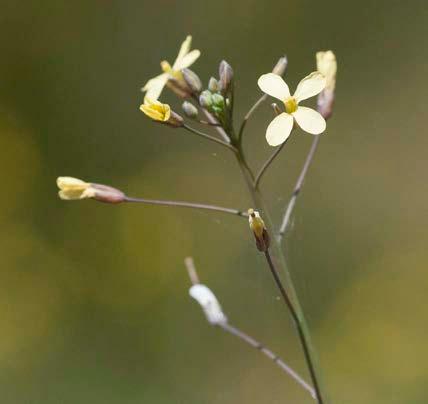
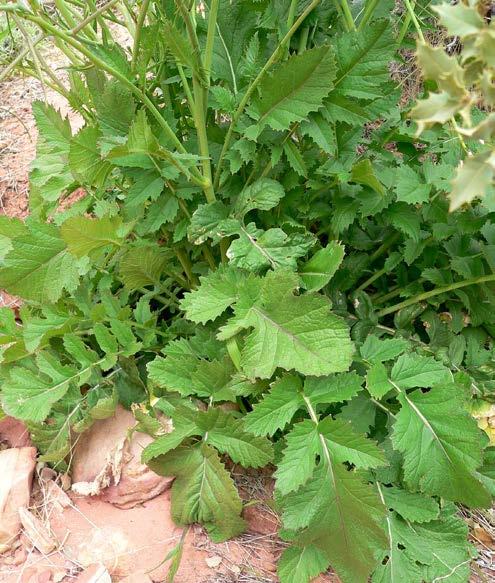
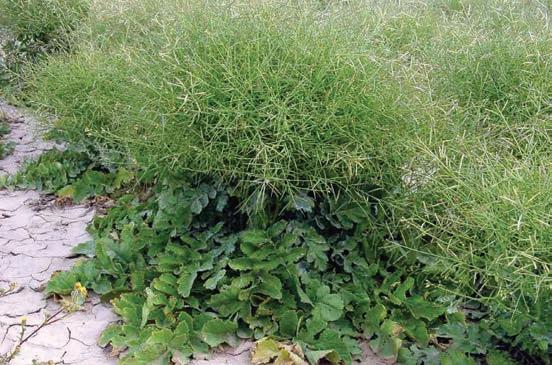
Other Common Names:
Tamarisk
Family:
Tamaricaceae - Tamarisk family
Native Region:
Eurasia
Habitat:
Found along watercourses and riparian areas widely below 5,000 feet. Brought to the US in the 1820s as an ornamental, later used for windbreaks.
Blooms:
April to August
Description:
• Grows quickly and can create large, dense stands that displace native vegetation like cottonwoods, willows and mesquite.
• These large shrubs or trees can grow 10-15 ft, but have been known to reach 50 feet.
• Flowers are spikes, pink or white, feathery with many smooth reddish brown branches.
• Changes stream bed hydrology, lowers water tables and increases soil salinity.
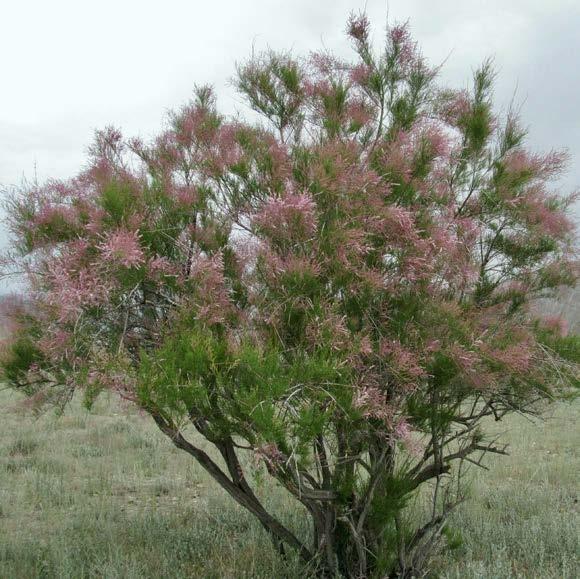
• The USDA introduced Tamarisk leaf beetles (Diorhabda spp.) in 2007 as a biocontrol for Tamarix populations in the West.
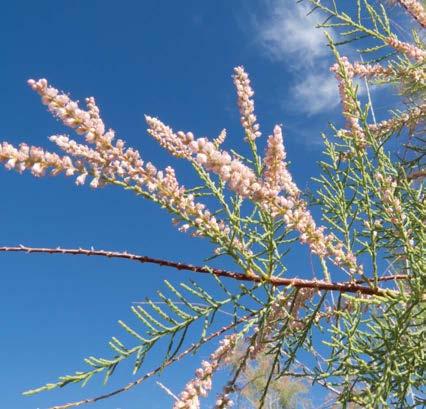
Other Common Names:
Globe chamomile
Family:
Asteraceae - Sunflower Family
Native Region:
Native to South Africa
Habitat:
Found on roadsides and in disturbed areas, river bottoms, agricultural areas, riparian areas, and washes in clay, sandy and gravelly soils typically 1500 to 3000 feet.
Blooms:
February to May
Description:
• Annual herb with numerous small flower heads appearing like bright yellow or gold spheres.
• Erect stems; sparsely covered with stiff, slender bristles.
• Stems and leaves are strongly scented.
• Has been reported to cause skin and/or allergic reactions - use caution when handling the plant!
• Rapidly spreading across central Arizona and SW California (San Diego, Orange Counties).
• The species was added to the Arizona Noxious Weed List in 2020.
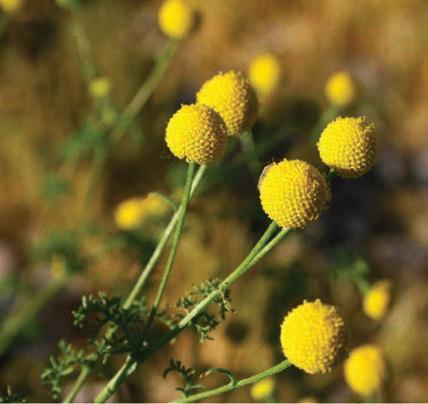
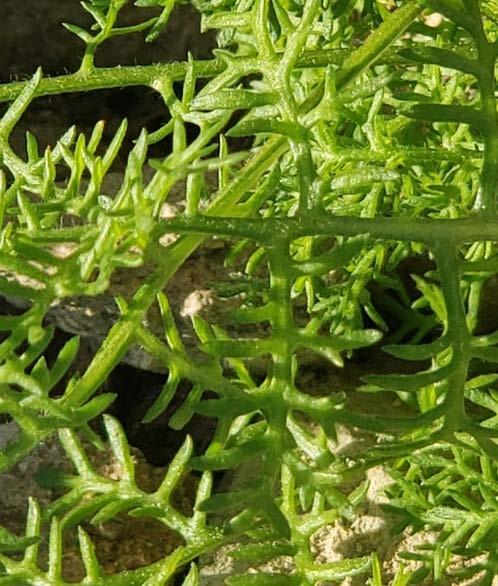
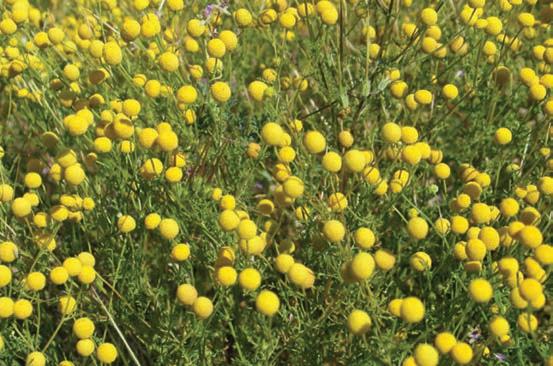
Other Common Names:
Turkestan beard grass; King ranch bluestem
Family:
Poaceae - Grass Family
Native Region:
Native to Southern Europe, Northern Africa, and Asia; introduced for forage and erosion control.
Habitat:
Found in disturbed areas, roadsides, and grasslands. Elevation range was up to 4,000 feet but has recently been spotted growing in Northern AZ.
Blooms:
Late June through July
Description:
• Perennial grass that grows up to 4 feet tall .
• Flower heads are a silvery, reddish purple. Seed heads are shaped like a “turkey foot.”
• Leaves are flat or folded, usually smooth and a yellow-green color. Scattered hair, parallel veins.
• Spreads aggressively with extremely dense roots.
• Increases fuel load and fire risk; re-emerges readily after a burn.
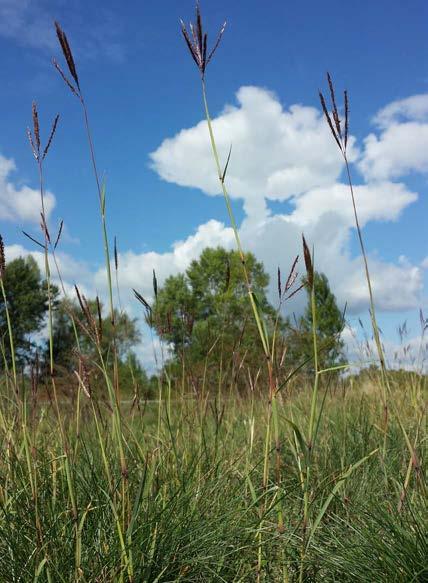
• This species forms huge monocultures, it is not favored by animals for forage, and it sheds chemicals that make the soil inhospitable for native plants.
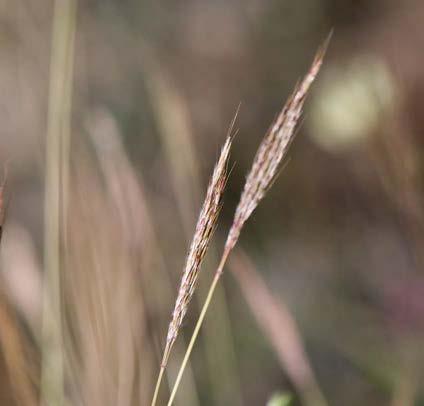
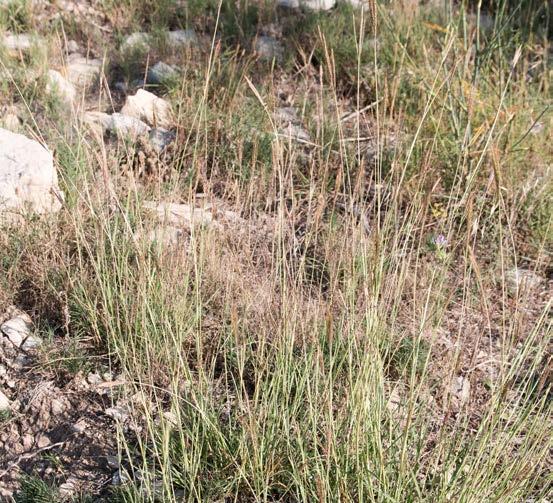
This chapter will introduce you to water harvesting and conservation concepts with a wide range of technical complexity to create vibrant landscapes on your property. Once you understand how you can capture and utilize rainwater and gray water, you can begin to implement these concepts around your landscape or confidently pursue further research and seek out experienced professionals. By incorporating these concepts around your property, you can reduce your irrigation costs and overall water use, and keep its benefits close to your home.
There are a variety of ways to harvest and capture water on your property. We’ve put the information here so it is easy to revisit when looking at how you can harvest and retain water on your property. Below are some common starting points you should consider before any project’s implementation:
• Observe how water flows across your property. Note the highest points and catchment surfaces, and how water moves off these surfaces.
• Create a diagram of your property. Include the property lines, buildings, vegetation, hardscape, and underground and aboveground utility lines. Draw how water flows into and out of your property.
• Map the catchment surfaces (roofs, sheds etc.) and calculate the volume of rainwater runoff. (Catchment area (ft^2) x Avg Rainfall (ft) = Total Rainfall (ft^2))
• Estimate your water use and consider how much vegetation the rainwater could support.
• Estimate secondary sources/waste waters ( gray water).
There are strategies you can employ to save and retain water without the need for major infrastructure or earthworks. These strategies focus on minimizing the water lost to evaporation. In the desert heat, water can be lost quickly, depriving your landscape of this precious resource. Utilize these strategies across your landscape wherever applicable to conserve water and protect your harvested rainwater within your water retention systems.
Mulching is the process of spreading organic or inorganic material onto the surface of your soil. This material will help build a porous layer of soil that is better equipped to infiltrate water. Mulching will also help retain water by reducing the amount of water lost to evaporation and protect the plants by moderating extreme temperatures at the soil’s surface.
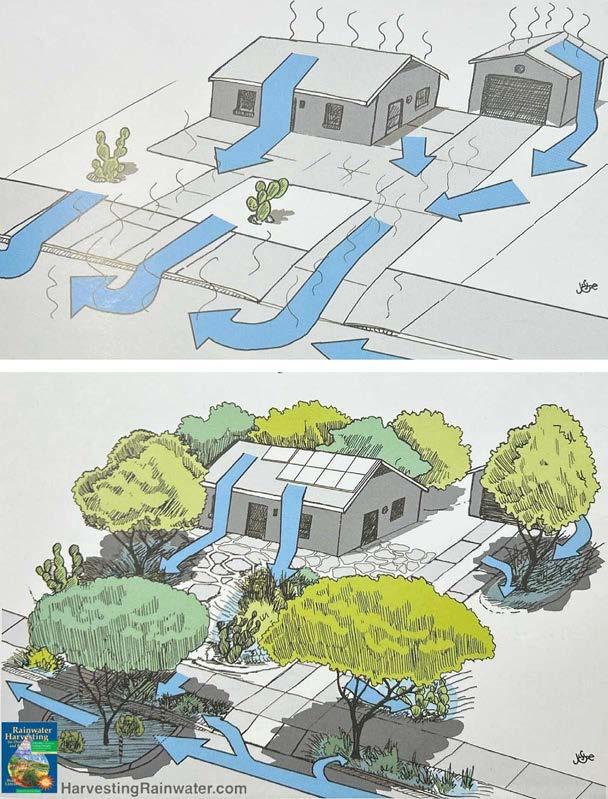

Organic mulch consists of living or once living material such as compost, dried leaves, straw, wood chips, or vegetation. It can provide additional benefits to your soil beyond water retention. Placing carbon rich organic material on the surface of your soil will enhance your soil’s nitrogen content, aiding plant growth. As organic mulch decomposes, your soil will gain beneficial organic matter. Organic matter supports soil microorganisms that boost soil fertility and increases the soil’s ability to intake water. These microorganisms can also help to break down pollution in water sources such as street runoff or gray water. Plants prefer mulch that is similar to the plant itself and share physical qualities. Long living perennial plants will prefer woody mulch like woodchips or plant clippings, and short-lived annuals or vegetables prefer mulches such as straw. Instead of disposing of your plants’ fallen foliage or clippings, maximize this organic material by using it as mulch and placing it beside the plant from which it came from.
Inorganic mulch can include materials such as gravel or a thin layer of rock. While not providing soils the benefits of organic material, inorganic mulch still increases the amount of water infiltrated and protects the water from evaporation. Inorganic mulch is heavier and better suited for areas that experience a heavy flow of water as it is unlikely to be displaced. Inorganic mulch can also capture moving sediment or organic matter moving through the mulch, which improves the soil’s ability to hold water and support plant growth. Inorganic mulch should be thin as to let in enough sunlight to support the growth seedling beneath the mulch. Rock mulches should be roughly one rock deep, and gravel shouldn’t be thicker than an inch. The sun heats inorganic mulch to higher temperatures than organic mulch, so inorganic mulch can be used in colder climates to facilitate plant growth earlier in the spring. However, without proper shade coverage inorganic mulch can significantly heat the surrounding area, especially during summer months. This is why desert landscaped yards with a lot of rock and gravel can feel hot; with more coverage from trees and large bushes less heat will be retained on these types of yards.
The types of plants you pick for your landscape will greatly impact your water use. In the Arizona climate, choosing plants that require minimal irrigation, and hold on to moisture is critical to conserve our limited water. Fortunately, Arizona and the Sonoran Desert are home to a wide variety of native plants that are experts at retaining water and surviving in the hot climate. Our native plants are uniquely adapted to survive the arid desert with infrequent watering, and once established can primarily or solely rely on naturally occurring rainfall. As well as saving water, native plants help support native wildlife and preserve our unique and beautiful environment. For a list of native Arizona plants that can be grown in gardens across central Arizona see the Plant Chapter.
Newly planted plants need supplemental water to get established, and should be planted in the cooler months of the year (consult with a nursery or plant expert for more information about proper planting times). One plants are established, particularly native plants, they can use very little water beyond rain.
However, even desert adapted plants may need supplemental watering in times of drought or extreme heat. When watering your plants by hand, there are a few ways to minimize water lost to evaporation. Watering in the early morning or evening (especially during hot months) can allow the water to soak into the soil, losing less water evaporated by the sun. Ideally watering should be done in the morning, allowing water to dry before night. Excess water sitting by a plant’s roots during the night can lead to rot or fungal diseases.
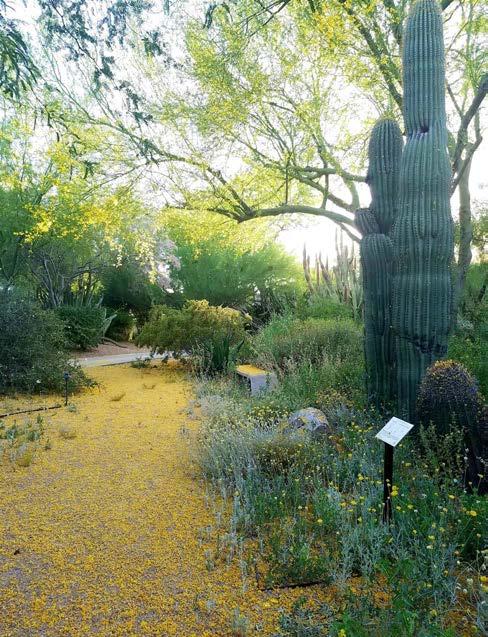
Earthworks are manipulations of the ground that best control the flow of water and enable water to infiltrate into the ground. Earthworks need not cost anything and require little equipment other than a shovel.
When beginning your water harvesting system it is effective to start small and simple. Starting small is a great way to begin water harvesting and allows you to experiment and learn how water moves around your landscape. Expensive and elaborate systems come with the risk of making large mistakes and installing a system that may not be ideal for your landscape.
Try to place your earthworks in areas that will provide additional benefits. For example, placing earthworks along with shade trees along the east and west sides of your house can provide the home with passive cooling. Use of earthworks can greatly minimize the use of irrigation of your landscaping, especially when you use native and low water use plants. However extreme heat and periods of drought may necessitate additional watering from municipal or gray water sources. Consider installing drip irrigation systems within your earthworks to supplement your plants in times of need.
Water can be guided into earthworks with or without gutters. If you have gutters or can install them, place earthworks by the water outlet and guide water out towards the rest of your landscaping. If you don’t and can’t have gutters identify portions of the roof that experience a heavy down flow of rainwater. Strategically place earthworks beneath these spots, building your roofs natural flow of water into earthworks and landscaping.
The berm and swale (a basin or depression) is an earthwork designed to capture rainwater running down slopes, and infiltrate water into a localized area. This earthwork consists of an excavated swale and a raised berm located downslope of the swale. The raised berm can be constructed of the soil excavated from the swale or brush, rock, or additional soil. The swale holds onto water running downslope, and the berm allows for the swale to hold more water. The berm and swale can be constructed on sloped land up to a 20:1 or 5% grade.
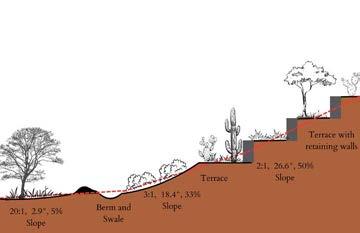
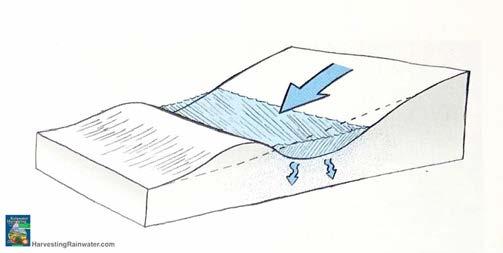
Terraces are earthworks that retain water moving downslope but lack a depression like a swale. A terrace is a flat shelf of soil built parallel to the contour of slopes. To retain water terraces, need to be bordered by low walls or raised berms. Terraces can be used on sloping land up to a 2:1 grade. Terraces built on slopes exceeding a 3:1 grade will likely need a retaining wall for stabilization. A terrace is a good option for orchards or gardens and can help control erosion on slopes. However, they are not appropriate in soils prone to waterlogging where rain infiltration can lead to saturated subsurface conditions which can impede movement of water further down through the soil.
An infiltration basin is a shallow depression that retains and infiltrates rainwater. This earthwork functions best on flat land where all surrounding rainwater can drain into the basin. On moderate slopes infiltration basins can be used for terraced basins, interconnected stormwater basins, or water-harvesting tree wells. When used with plants, an ideal infiltration basin’s diameter should be 1.5 times the size of its associated plant’s
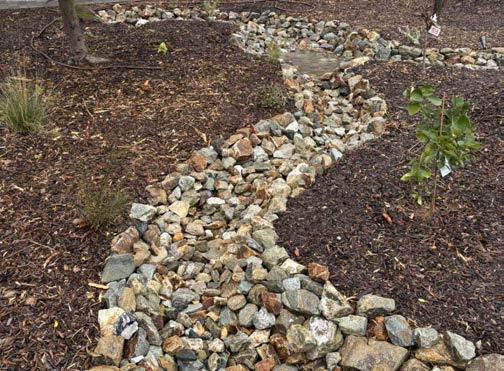
canopy dripline as most of the plants water is drawn from the outside of its dripline. However, any size infiltration basin is better than none, and multiple smaller infiltration basins can work as well as one larger one. To limit the amount of sitting water infiltration basins should ideally be mulched and filled with plants so that they quickly infiltrate the captured water, or filled with rocks if plants are not used to reduce sediment getting pulled into the basin.
Infiltration trenches are earthworks that captures water into a trench filled with porous materials such as gravel, pumice stone, or organic material. These materials provide air space within the trench that allows water to quickly infiltrate and spread to the surrounding root zone, while making a stable surface to stand on. An infiltration trench can be built with or without a perforated pipe (the pipe helps move water along faster and is important for high volumes of water), usually placed horizontally within the porous material to fill the trench. Infiltration trenches can be used
on flat or gently sloped land and can support plants and landscape that require deep subsurface irrigation. This earthwork should only harvest water from relatively sediment free sources such as roof gutter downspout or edge of a paved patio to prevent the trench from filling with silt.
A diversion swale is an excavated linear basin with a raised berm built from excavated soil downslope. The purpose is to guide and slow the flow of water from one point to another. It is constructed slightly off-contour allowing a portion of the water to infiltrate locally and move excess rainwater down slope infiltrating along the way. They can also capture and move sheet flow and channelized water and can slow the flow of water coming from an outlet. Diversion swales can also lead water into water harvesting berm and swales and infiltration basins. Diversion swales are fit for the built environment but should not be used in natural drainage ways or in alkaline soils prone to salt buildup and water logging.
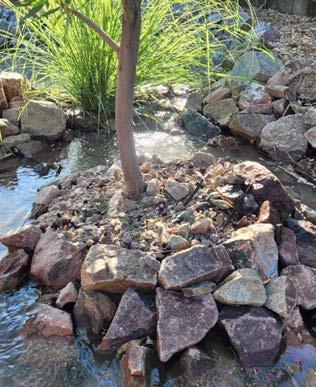
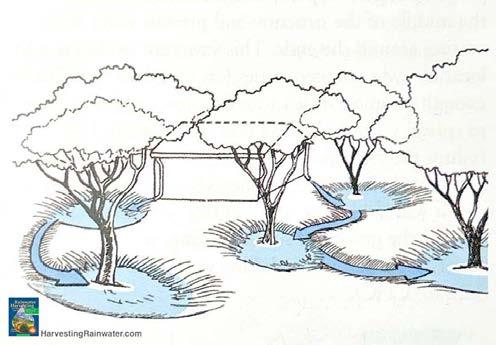
Vegetation is an important piece of any water harvesting earthwork and can bring vibrancy and various services to your landscape. Planting vegetation within and around your earthwork will increase water infiltration and provide soil stabilization through the vegetation’s roots. In earthworks such as infiltration basins, vegetation can help quickly infiltrate water and minimize standing water that can attract mosquitoes. When picking vegetation to plant in your system it’s important to choose a plant which can rely on Arizona’s naturally occurring rainfall (see plant chapter for low water use native to Arizona).
Hardscape refers to hard materials used in landscaping such as concrete, asphalt, brick, or stone. These are impervious surfaces, meaning they have no gaps or holes that allow water to soak into the ground beneath the material. Within neighborhoods across Arizona, paving is a dominant feature. This causes water to run off the impervious hardscape, flow out of your landscape, and contribute to downstream pollution and contamination. It can also allow water to quickly
evaporate off the hardscape’s surface, making you lose out on maximizing the desert’s precious resource. An abundance of hardscape will also make your property hotter. Concrete pavement and asphalt will hold on to the intense summer heat and release it into the night creating warmer temperatures. Instead of allowing water to run off your property or evaporate off hot pavement, try employing the following strategies to retain and control the flow of water in your landscape.
Permeable Pavement refers to various paving materials that allow for gaps in which water and air can pass through into the soil. This can include porous brick, cobble pavers, or stabilized gravel. Utilizing permeable paving within your property is a strategy that can effectively provide benefits of traditional hardscape while conserving water. While infiltrating water, the increased pervious surface also dissipates the sun’s heat, reduces soil compaction, allows for plant roots to breathe, and reduces the need to install additional storm drainage infrastructure. You can best utilize this captured water by placing earthworks by the permeable pavement and slope pavement towards earthworks and associated vegetation.
Permeable pavement is ideal for infiltrating direct rainfall at heavily developed sites with little unpaved surfaces. When planning for permeable pavement it is best to raise the material above the surrounding landscape to prevent the pavement from displacement and prevent the pavement from being clogged by sediment from storm water runoff. Permeable pavement is not appropriate for natural drainage ways.
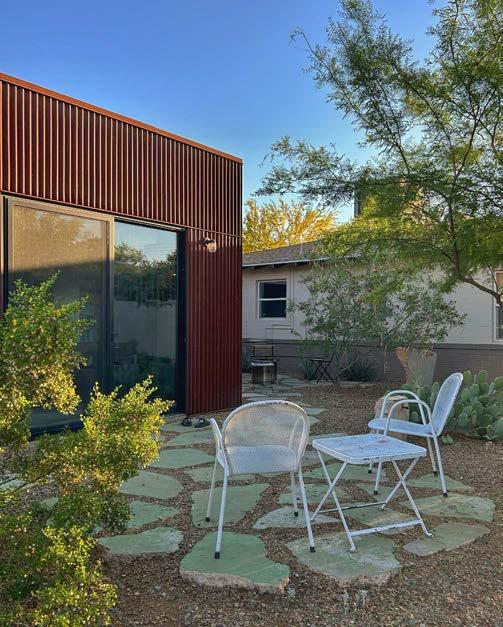
Curb cuts are features in which concrete is removed from a curb to direct some rainwater runoff into your property, ideally into a swale, retention basin, or other earthwork. This will provide your plants with rainwater irrigation and conserve water that would have otherwise washed down into the storm drain system.
When considering installing a curb cut ensure your street is crowded (the highest point is in the middle). The curb cut openings should be sloped away from the street and toward your property and into the water harvesting area. Locate one spot for a curb cut upstream to allow for water inflow and a second spot for a curb cut downstream to allow for outflow back into the street.
Curb cuts are mostly likely within a city’s right of way, thus requiring a review process. Cities may require permitting and government licensed contractors for this work. Consult with your local government before beginning your process to install curb cuts.
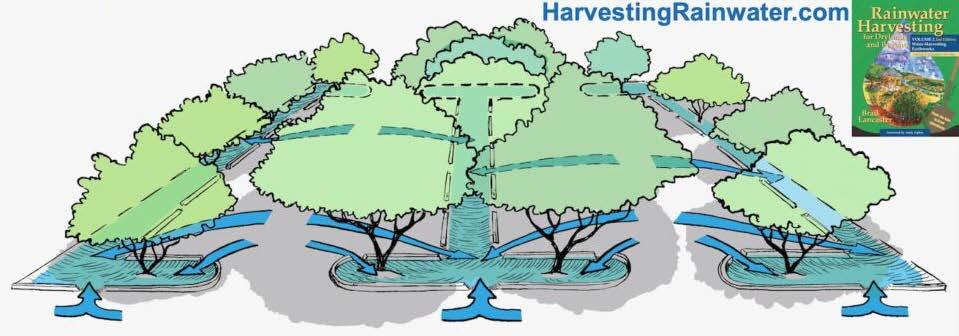
Rainwater is a precious resource that can be captured and stored within your landscape. Rainwater capture systems allow you to harvest rainwater as it falls off your roof to save it for later use. Using captured rainwater for irrigation will reduce your need for municipal water, saving you money and allowing you to conserve our water sources. This section will outline the basic components of a rainwater capture system and provide you with foundational information to prepare you on your rainwater capture journey. Before you install a rainwater capture system, be sure to consult with your HOA or neighborhood association if applicable. Also, you may wish to contract with a professional to confirm your system is safe and effective.
Utilizing cisterns can allow for more opportunities to harvest rainwater than earthworks alone. Cisterns are water storage tanks that capture rainwater to water gardens and indoor plants or used for washing outdoors. The long-term storage capabilities allow you to spread out the use of the captured water and reduce the need to use municipal water sources. Cisterns can be made yourself or purchased from local hardware stores or specialized merchants. If you decide to construct a cistern system yourself, use these guidelines as a starting point to make sure you are harvesting high-quality water. If you are looking to purchase a more complete system, check that the product adheres to these guidelines to confirm you purchased a quality product.
Cisterns come in two main varieties, gravity fed and pressurized. Gravity fed systems use the natural pressure of gravity to dispense the captured water from the cistern. Pressurized systems use an electric pump to create additional pressure, expanding the amount of irrigation opportunities. With pressurized systems water can be easier fed to irrigation lines farther away from your tank. However, these pressurized systems are more complex and will require experts to help plan and install your system. Gravity fed tanks are simple in nature and could be installed with less technical knowledge. The following section outlines the basics of a gravity fed cistern system as installing this type of system is less costly and can be done with less professional help. If a pressurized system sounds more appealing, we recommend seeking professionals to help begin and build your project.
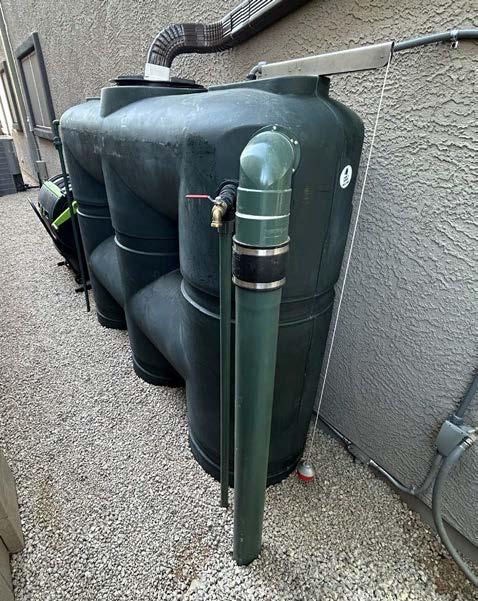
To start collecting water within a cistern you first need to capture it at the top of your landscape before directing the water downstream. The most common surface in urban areas used is a house’s roof. Rainwater that falls on your roof or outside structure can then be directed out towards your cistern. Rainwater can be captured from any material (shingles, tile, etc.), although some materials flow water better than others. The materials that make up your catchment area’s surface can affect harvested water quality. Materials rated for contact with potable water will collect the highest quality of rainwater. However, any rainwater captured is not potable and shouldn’t be used for drinking and should not come into contact with edible plants.
Once landing on your catchment surface, the water will need to be directed through gutters and downspouts. Gutters should be placed around the roof or section of roof to guide the rainwater towards the entrance of your cistern. The gutters will then funnel the water into a downspout, the pipe that directs it into a cistern. It is important to protect your rainwater capture system from the sun
and create a closed system where algae, bacteria, and insects cannot reproduce within your system. Construct your downspout with at least a 45-degree bend going into your cistern to prevent sunlight from entering.
Your system should filter out large debris from the rainwater before it flows into a downspout. Micro mesh gutter guards or a first flush diverter system can be installed before the entrance of the down spout. These systems divert the first and most contaminated portion of rainwater out of the cistern.
A screen should be placed at the entrance of the downspout to keep out leaves and insects. These filtration methods block large debris from entering the tank, but smaller contaminants are still likely to enter. It is normal for a layer of silt to accumulate at the bottom of your tank. This layer will not harm the quality of your rainwater and can be cleaned out occasionally.
A cistern is the tank that will hold your captured rainwater. When deciding the location, consider where your catchment area is and where you will want to use the water. Ideally you should place your tank close to your catchment area and near your area of use to reduce the amount of piping, while making your use of rainwater convenient.
You can also place your cistern strategically to serve as part of a privacy screen or fence. When placing your cistern, it’s helpful to add elevation to the tank to increase the pressure of water moving out of the spigot. For example, constructing a gabion or rock cage to serve as a foundation for your cistern can give the tank the necessary elevation to ensure ample water pressure.
To protect the quality of water and prevent the growth of algae and propagation of insects, your cistern should be closed off from the elements. Outfit your cistern with a cover to block out sunlight and insects while preventing water loss from evaporation. With a tight-fitting cover, it is necessary to include an insect proof vent at the top of your tank to prevent a vacuum from forming when a large amount of water is quickly drawn from the tank.
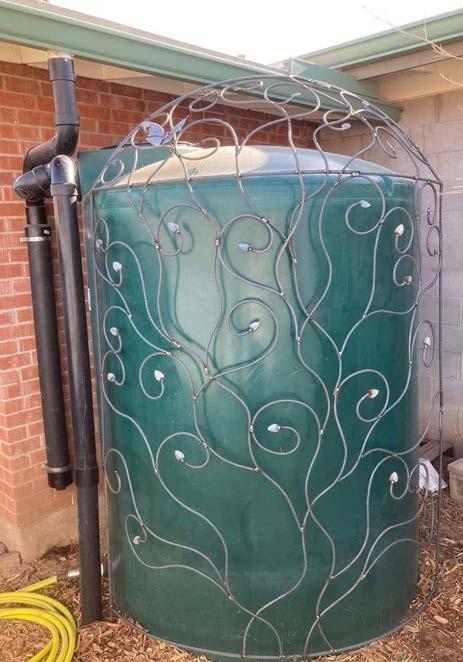
Another essential aspect of a rainwater cistern is an overflow pipe. The overflow pipe redirects the excess water out of the cistern. Given the large amount of water that can fall during monsoons, overflow will be likely within your tank. It is best to utilize the overflow water within your landscape, and potentially redirect to another cistern or into earthworks and vegetation. The diameter of the cistern’s overflow pipe is the same diameter as your inflow pipe to prevent your system from backing up.
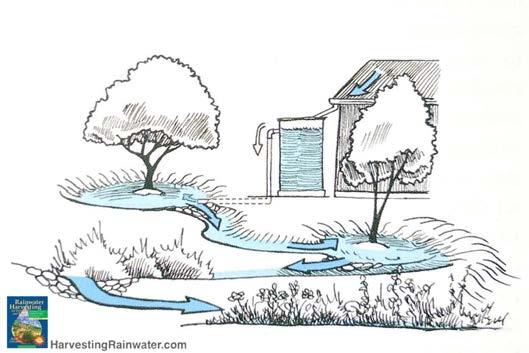
Lastly, your cistern needs an outflow faucet or valve to use the harvested rainwater. For this you should use a full-port valve which does not constrict the outflow of water. Position the valve slightly above the bottom of the tank as a layer of silt and debris will likely gradually form at the bottom. Placing your inflow pipe opposite your outflow valve can allow debris to sink to the bottom layer and stay out of the water that flows out from your valve.
If HOAs and local rules and regulations prohibit the installation of rain gutters and extensive rainwater capture systems, there are still opportunities for you to harvest rainwater for future use. These smaller DIY rainwater harvesting methods can be utilized in your backyard and require no alterations to your home.
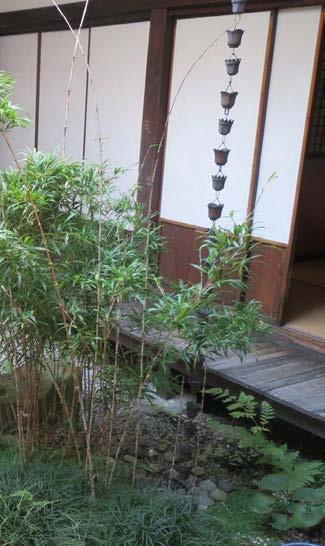
Rain barrels are a simple rainwater harvesting method that can work without gutters or a comprehensive cistern harvesting system to hold captured rainwater. Without gutters, a rain barrel can be placed next to the roof in an area that experiences a heavy flow of water runoff such as a corner of the roof. The rainwater will then flow into the barrel through a screened opening to prevent large debris from entering the barrel. The simplicity of rain Like with cisterns, this water can be used to supplement landscape irrigation but is not potable or safe for washing.
Rain Barrels typically hold less water than cisterns and harvest lower quality rainwater. The lack of filtration mechanisms and protection from the sun will necessitate frequent maintenance. Rain Barrels can be purchased from hardware stores and specialty websites.
The Rain chain is a chain of interconnected cups or rings that slow the flow of rainwater and directs water down from a roof. They are a very aesthetically pleasing rainwater harvesting feature that can be utilized even without the use of gutters.
It is best to place a rain chain in areas that experience a heavy flow of water such as a corner where two roofs intersect. A corner leaderhead, which is the device that directs water down the rain chain, can be used in a 90-degree angle corner of roof.
Creative methods to harvest rainwater around your property are still possible without cisterns and gutters. Hardscape and landscaping features can be strategically placed around your home to best utilize rainwater. Pay attention to how rainwater flows off your roof and identify areas where large amounts water collects on the ground or where the flows are concentrated. In these areas you can strategically place planters or garden boxes or install landscaping features. Diversion swales on the ground can redirect water falling from your roof and direct flow into infiltration basins. These diversion swales can be lined with river rocks or hold plants.
Gray water is the untreated water that drains from your house’s washing machine, bathtubs, showers, and sinks. (Water drained from toilets is not included in this category and referred to as blackwater.) Gray water is typically used once in your household, then sent via the sewer to a wastewater treatment plant. Reusing your gray water creates a positive impact by conserving water and retaining water within your local ecosystem. Using gray water also reduces the need for municipal water which will lower utility bills and save money.
Gray water is safe for non-edible plants and can be utilized with flood or drip irrigation on your landscape. Plants and microorganisms within your soil help to filter bacteria and nutrients out of the gray water leaving clean water to be retained on your property and returned to the water cycle. However, some chemicals can damage the chemistry of your soil or harm plants so plan on using gray water safe detergents and hygiene/ cleaning products and avoid using wash water from greasy or oily rags, diapers, or solvents.
The first step in planning for this type of system is to check that your city (and HOA if you have one) allows you to install the necessary infrastructure and utilize gray water. Installing a gray water system will require additional plumbing and installation, so utilizing windows of
opportunity such as renovations or building the house may make the process easier. When considering this option, examine how close your water source will be to the destination (for example, is your laundry room close to the outside of your house).
A common plumbing method for using gray water is a three-way valve diverter. The diverter allows gray water to be diverted from the sewer into a gray water line leading into your landscaping outside. Gray water can be diverted solely assisted by gravity and can be discharged into earthworks such as retention basins to maximize water use. The diverter can then be switched off if the landscaping outside does not need water or if you expect the water to come into contact with hazardous materials or chemicals. It is important that the gray water line is diverted upstream of black water line (toilet sewage) because of the high risk of contamination by bacteria or other pathogens.
To learn more about gray water and gray water systems, or to find help installing a gray water system it is best to find a professional that is knowledgeable in these systems.
Laura Allen. 2015. The Water-Wise Home: How to Conserve, Capture, and Reuse Water in Your Home and Landscape. Storey Publishing, LLC.
Andy Clayden & Nigel Dunnett. 2007. Rain Gardens: Managing Water Sustainability in the Garden and Designed Landscape. Timber Press.
Brad Lancaster. 2022. Rainwater Harvesting for Drylands and Beyond. Volume 1, 3rd Edition. Rainsource Press.
Wes Tillman. 2022. The Dehydrated Gardner: A Desert Dweller’s 3 Step Guide to Xeriscaping.
Arizona Department of Water Resources | Water Conservation Tips for Arizona Residents
https://www.azwater.gov/sites/default/files/media/Conservation_ Tips_2015_2.pdf
City of Phoenix Green Stormwater Infrastructure Information and Handbook
www.phoenix.gov/pdd/gsi
Fresh Water Systems | Rainwater Harvesting 101
https://www.freshwatersystems.com/blogs/blog/rainwaterharvesting-101?srsltid=AfmBOorVXUTYcBv5vXp7j6Zzear0dybFrgom yh_xxR-rOkPANEbzVl9_
Galaxy Gardens
https://galaxygardensaz.com/gallery
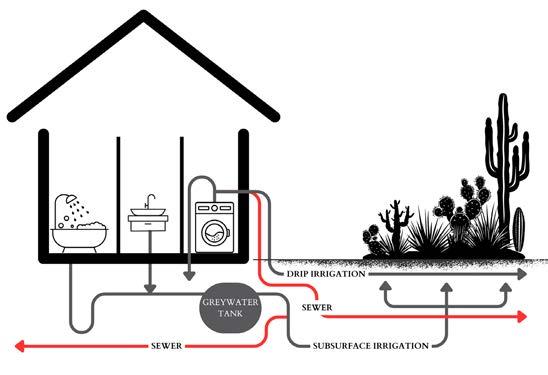
Rainwater Harvesting for Drylands and Beyond
https://www.harvestingrainwater.com/
SRP | Saving Water at Home
https://www.srpnet.com/grid-water-management/water-conservation/ saving-water-at-home
U.S. Department of Energy | Rainwater Harvesting Systems Technology Review (has a rainwater harvesting calculator)
https://www.energy.gov/femp/rainwater-harvesting-systemstechnology-review
City of Avondale | Water Conservation Resources and Programs (rebate active at 8/13/2025)
https://www.avondaleaz.gov/government/departments/public-works/ water/water-conservation
City of Buckeye | Rebates (active at 8/13/2025)
https://www.buckeyeaz.gov/community/residents/water-resources/ water-conservation/rebates
City of Buckeye | Water Conservation
https://www.buckeyeaz.gov/community/residents/water-resources/ water-conservation
City of Chandler | Residential Water Conservation Rebates (active at 8/13/2025)
https://www.chandleraz.gov/residents/water/water-conservation/ rebate-and-incentive-programs/residential
City of Chandler | Water Conservation
https://www.chandleraz.gov/residents/water/water-conservation
City of Glendale | Water Conservation Rebates (active at 8/13/2025)
https://www.glendaleaz.com/live/city_services/water_services/water_ conservation_and_sustainable_living/water_conservation_rebates
City of Peoria | Water Conservation
https://www.peoriaaz.gov/government/departments/water-services/ sustainability-water-conservation/conservation
City of Peoria | Water Conservation Rebates (active at 8/13/2025)
https://www.peoriaaz.gov/government/departments/water-services/ water-conservation/rebate-programs
City of Phoenix | Water Resources and Conservation
https://www.phoenix.gov/waterservices/resourcesconservation
City of Scottsdale | Residential Rebates (active at 8/13/2025)
https://www.scottsdaleaz.gov/water/water-conservation/rebates/ residential
City of Scottsdale | Water Conservation Tips and Guides
https://www.scottsdaleaz.gov/water/water-conservation
City of Tempe | Conservation Rebates (active at 8/13/2025)
https://www.tempe.gov/government/public-works/water/waterconservation/rebates
City of Tempe | Water Conservation
https://www.tempe.gov/government/public-works/water/waterconservation
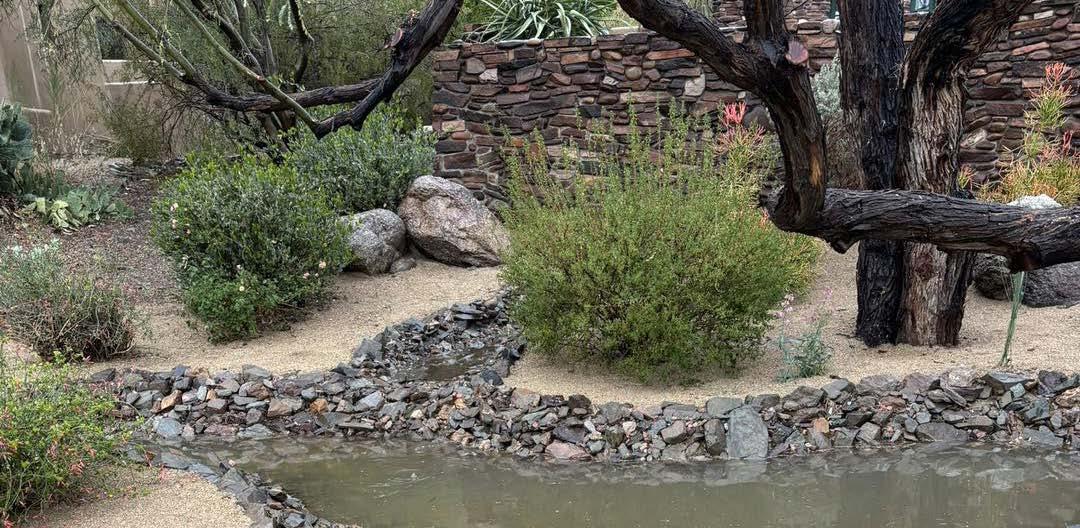
Reducing water use in Arizona is necessary to ensure our state has a long-term sustainable water supply. One big way to help this goal is by reducing the amount of water-intensive nonfunctional turf grass in yards and landscapes. Turf grass is very water intensive and is the United States’ most irrigated crop. According to a 2019 Cities of Phoenix, Glendale, and Gilbert study, the average property landscaped with moderate (about 12%) to extensive (20% or more) grass on their lot spend 426,685 – 538,375 gallons of water per year on their lawns (Phoenix Metropolitan Area Multi-City Water Use Study: Single-Family Residential Sector Executive Report, 2019). This massive amount of water puts stress on Arizona’s water supply and offers little in return. Avoid high water bills and help protect Arizona’s water supply by removing non-functional turf grass and replacing it with low water use landscaping. As an added benefit, check with your city or town to see if they have a rebate program for the removal of turf grass.
When removing turf, remember to protect the trees, shrubs, and other plants you want to keep. There are resources for this in the resources section.
When removing your lawn, we recommend these physical and non-chemical options as the first line of approach. This can reduce the risks of coming into contact with hazardous chemicals, avoid potential health and environmental risks, and prevent the killing of unintended plants. Physical methods of turf removal work by either tearing the grass from the ground or slowly kill the grass over long periods of time.
Digging out your lawn is simple and cost effective, but time and labor intensive. To dig out your lawn all you will need is a shovel and some physical labor (or a manual sod cutter). Using personal tools can allow you to be precise and dig around other plants or water lines. If the ground is dry, water the lawn a few days before digging to make the ground softer. Slice down through the top layer of the turf with your shovel until you reach below the grass’s roots and lift a section of the turf. Cut off this small section with the shovel and lift it from the ground. This removed section of turf still contains soil with beneficial microbes and should be kept. Repeat this process until your entire lawn is removed. To save the dug soil you can shake off the section of cut turf until only the grass and roots remain.
You can then collect the grass and roots in a wheelbarrow. Alternatively, to save the beneficial soil you can place the removed section of lawn and place it in another area of your yard. Wait until the grass is completely brown and dry, then mix the material back into the soil.
To avoid throwing this material in the trash to end up in a landfill, try at home composting methods and reintegrate the material back into the new landscape. You can also inquire about your city’s yard waste pick up or disposal programs.
One of the drawbacks of this process is that digging requires hard work and can take potentially days when removing larger lawns. Digging may also be ineffective against resilient and invasive grasses such as Bermuda grass. These hard to kill lawns may require additional removal methods along with digging and care should be taken with on-site composting. The composting processes may not be enough to kill Bermuda grass and could appear again once integrated back into the soil. Keep a watchful eye on the site to spot the reappearance of grass.
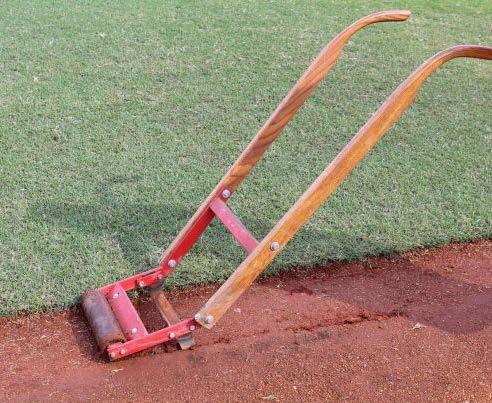
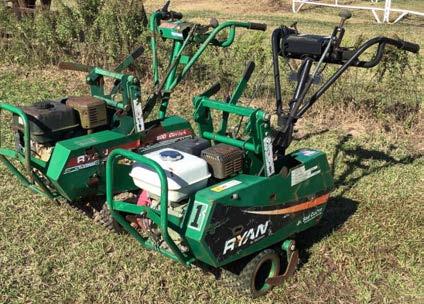
Power operated sod cutters can remove turf grass with much less effort than digging by hand and can be rented from a local hardware or equipment rental company. This will allow you to remove the turf in long strips where they can be rolled up and disposed of at your local city’s lawn waste disposal facilities or green waste pick-up. Alternatively, the sod can be composted for further use around your property. To compost sod, it should be laid upside down and left in place or moved to create a mound or berm. Cover the sod with a thick layer of newspaper, 4-6 inches of compost, and 3-4 of mulch to prevent the grass from reappearing and to create good soil.
When operating the machine, follow all safety protocols outlined in the operating manual. Identify sprinklers and other features that need to be avoided when using the sod cutter. With tough to remove invasive grasses like Bermuda Grass, sod cutter will often not cut deep enough to remove the plants roots. For this type of grass, you will likely need to use methods that aim to eradicate the grass to its roots like solarization.
Arizona’s intense sunlight can be used to remove your lawn through a procedure called solarization. Solarization is the process of laying sheets of plastic on top of your lawn to eradicate your grass to its roots. The plastic sheets trap the sun’s energy and heat the surface of the lawn to effectively cook the grass and eliminate the turf. This process takes about four to eight weeks to remove your lawn and is most effective during the hot spring and summer months. Solarization is a low-effort method to remove your lawn with little environmental impact. It also has the added benefit of eliminating soil pathogens and diseases.
Mow your lawn as short as possible and water well before laying down the sheets of plastic. Clear or opaque black plastic sheets can be used to trap heat and eliminate grass. Clear plastic sheets will typically eliminate your lawn faster, letting in more solar energy to heat the grass. Opaque black plastic will prevent grass from using photosynthesis and may be already owned and have more opportunity for reuse. Hold down the plastic sheets with heavy rocks or metal stakes and ensure the entire lawn is completely covered and the plastic is airtight with no holes. After four to eight weeks the grass should be dead and look dry and yellow. After the grass has died, it can be reused and composted in place. With resilient invasive grasses, like Bermuda grass, solarization alone may not be enough to completely remove your lawn, so a combined approach may be required.
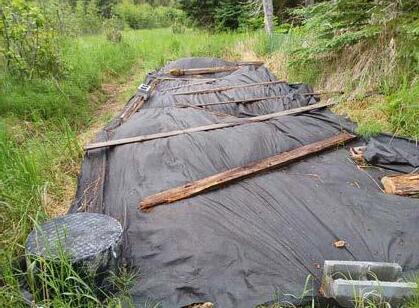
Sheet mulching is a method of creating soil using different layers of compost and mulch to deprive the turf grass of light. This can smother your lawn and prevent it from growing back, while creating healthy soil. This method requires time and patience as the decomposition process can take three to six months.
Begin by mowing the grass as short as possible. Then dig a border around the lawn to create a small ditch in which to tuck in the layer of cardboard. For the first layer, spread a 1-to-2-inch layer of compost over the lawn and water thoroughly. Next, spread a layer of cardboard or newspaper (5-8 sheets thick) over the lawn, overlapping materials and tucking edges into the ditch making sure there are no gaps or holes. This helps prevent the grass from reappearing around the edges. Wet the cardboard or newspaper thoroughly. Next, spread about three or more
inches of compost. Finish off with a final layer of mulch roughly two to three inches deep. After completing all of the layers, occasionally water to keep the soil moist. Be patient as the organic material decomposes and creates soil. After three to six months the paper layer should be mostly decomposed, and the lawn should be removed. You are now left with fertile soil that is ready for new plants.
With highly resilient invasive grasses such as Bermuda grass, sheet mulching may not be enough to completely eradicate the grass. To increase the chances of removal, you can combine methods and try solarization before sheet mulching over the lawn.
Grass and lawn removal has often been recommended through the application of chemicals. Applying chemicals can kill grass in a short amount of time and allow one to remove a space of turf. However, many chemicals and herbicides can have harmful health and environmental effects. To learn more about chemical lawn removal and the risks and usage of herbicides consult a professional. Alternatively, consider using plant based organic alternatives.
A full-strength vinegar is a plant based, organic solution that is an alternative to chemical herbicides for removing turf. This solution strips away the grass’s moisture and immediately kills off the leaves. However, use caution when using full-strength vinegar as it can still be harmful. Household vinegar typically has a 5% concentration compared to the 20-30% concentration of weed-killing full-strength vinegar. The full-strength solution can burn your eyes and skin, and shouldn’t be inhaled
First, it is important to choose a non-windy day to minimize the spread and avoid coming into contact with the vinegar solution. When applying the vinegar, follow all product instructions and wear protective clothing and closed toed shoes. To apply, fill a pump sprayer with the fullstrength vinegar along with a few ounces of dish soap. As vinegar is a non-selective herbicide and will kill any plant it touches, cover and protect nearby vegetation that is not being removed. Then spray the solution across the entire lawn. In a few days the grass should dry and shrivel. If grass reemerges, reapply the vinegar solution until the grass no longer comes back. For invasive and resilient grasses such as Bermuda grass. The vinegar solution alone will not be enough to kill the grass’ deep roots. In these cases, spraying vinegar may have to be combined with additional physical removal methods.
Artificial turf may seem like an obvious replacement for a grass lawn. Many opt for this alternative as it is similar in appearance and doesn’t need regular watering. In reality, artificial turf may not be as great an alternative as it may seem.
Artificial turf is made of plastic and rubber, materials that can make your yard hotter. Living plants evaporate water into the air creating a cooling effect. As artificial turf is not living it produces no such cooling effect. Instead, plastic and rubber will absorb the sun’s heat throughout the

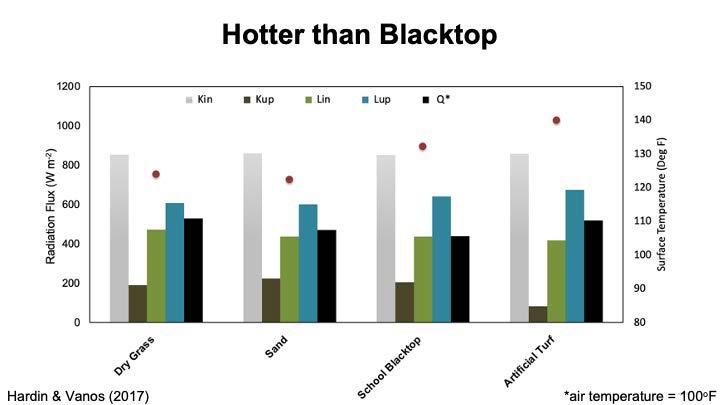
day and release it into the night, creating warmer temperatures. During the day the surface of artificial turf will be uncomfortably hot to the touch, especially in warm summer months.
Artificial turf will eventually need to be replaced. The expected lifespan is roughly 8 to 10 years with unique vulnerability to damage in Arizona’s extreme summer heat. Installing new turf can be expensive with installation costs ranging from $5 to $20 per square foot. Artificial turf also requires frequent maintenance and cleaning to upkeep its quality and appearance.
Installing artificial turf is not an environmentally friendly choice for your yard. The creation of artificial turf results in carbon emissions as it is comprised of plastic and rubber which are primarily made from chemicals sourced from fossil fuels. The artificial turf is also difficult to reuse and recycle, and likely to end up in a landfill.
Instead, try opting for a landscape with living native and desert adapted plants. Native and desert adapted plants can provide many natural services such as cooling and shade while cutting down water use. With the many logistical and environmental problems tied to artificial turf, it is best to avoid synthetic plastic landscaping and instead embrace beneficial desert adapted living plants.
Pam Penick. 2013. Lawn Gone!: Low-Maintenance, Sustainable, Attractive Alternatives for Your Yard. Ten Speed Press.
Wes Tillman. 2022. The Dehydrated Gardner: A Desert Dweller’s 3 Step Guide to Xeriscaping.
Arizona Municipal Water Users Association | 10 Reasons to Take Out Your Grass
https://www.azwater.gov/sites/default/files/media/Good%20 Reasons%20to%20Take%20Out%20Your%20Grass_0.pdf
Arizona Municipal Water Users Association | How to Conserve: Grass https://www.amwua.org/what-you-can-do/grass
Ask a Biologist | How Much Water Are We Using Per Year in the Phoenix Area?
https://askabiologist.asu.edu/questions/how-much-water-are-weusing-year-phoenix-area
City of Chandler | How to Remove Grass
https://www.chandleraz.gov/residents/water/water-conservation/ education-and-resources/for-residents/outdoor-water-savings/how-toremove-grass
Phoenix Metropolitan Area Multi-City Water Use Study: Single-Family
Residential Sector Executive Report, p. 22
https://www.azwater.gov/sites/default/files/media/2019-3073_ CityofPhoenix_MultiCityWaterUseStudy_ExecutiveReport.pdf
Southern Nevada Arborist Group | Protecting Established Trees During Lawn Removal
https://www.lvsnag.org/wp-content/uploads/2022/12/ProtectingEstablished-Trees-During-Lawn-Removal-12-2021.pdf
Southern Nevada Water Authority | How to Protect Your Trees During Turf Removal
https://www.snwa.com/assets/pdf/wsl-tree-protection-checklist.pdf
TruGreen | Learn All About Sod Cutters
https://mytrugreenlawn.com/resources/sod-cutter/
UC Davis Arboretum and Public Garden | Break Up with Your Lawn, Use Cardboard to Say Goodbye with No Regrets
https://arboretum.ucdavis.edu/news/break-up-with-your-lawn-usingcardboard
UC Invasive Plant Management | Bermuda Grass
https://ipm.ucanr.edu/PMG/PESTNOTES/pn7453.html
UC Master Gardeners of Butte County, The Real Dirt Blog | Lawn Removal: Do It Right
https://ucanr.edu/blogs/blogcore/postdetail.cfm?postnum=18225
UC Master Gardener Program of Sonoma County | Grass Removal Methods
https://sonomamg.ucanr.edu/Lawn_Replacement/Grass_Removal_ Methods/
UC Santa Barbara | The Lawn is the Largest Irrigated Crop in the USA
https://legacy.geog.ucsb.edu/the-lawn-is-the-largest-irrigated-cropin-the-usa/#:~:text=%E2%80%9CEach%20year%2C%20we%20 drench%20our,corn%20%E2%80%93%20America’s%20largest%20irrigated%20crop.
University of Maryland Extension | Lawn (Turfgrass) Removal Methods
https://extension.umd.edu/resource/lawn-turfgrass-removal-methods Water Use It Wisely | 10 Reasons Why Artificial Turf May Not Be What You’re Looking For
https://wateruseitwisely.com/saving-water-outdoors/grass-artificialturf/10-reasons-why-artificial-turf-may-not-be-what-youre-looking-
for/?gad_source=1&gclid=Cj0KCQiAi_G5BhDXARIsAN5SX7oL4l3uE5xwk wS1WBDCan_3arQvXZzWkZsM-wlVplou-ObHr2krsi0aAhNSEALw_wcB
City of Avondale | Rebate Programs (active at 8/13/2025)
https://www.avondaleaz.gov/government/departments/public-works/ water/water-conservation/rebate-programs
City of Buckeye | Rebates (active at 8/13/2025)
https://www.buckeyeaz.gov/community/residents/water-resources/ water-conservation/rebates
City of Chandler | Residential Water Conservation Rebates (active at 8/13/2025)
https://www.chandleraz.gov/residents/water/water-conservation/ rebate-and-incentive-programs/residential
City of Glendale | Water Conservation Rebates (active at 8/13/2025)
https://www.glendaleaz.com/live/city_services/water_services/water_ conservation_and_sustainable_living/water_conservation_rebates
City of Peoria | Turf Reduction Program (active at 8/13/2025)
https://www.peoriaaz.gov/government/departments/parks-recreationand-community-facilities/parks-and-trails/turf-reduction
City of Phoenix | Non-Residential Grass Removal Program (active at 7/17/2025)
https://www.phoenix.gov/administration/departments/waterservices/ supply-conservation/save-water/conservation-incentives/nonresidential-grass-removal-program.html
City of Phoenix | Residential Grass Incentives (active at 7/17/2025)
https://www.phoenix.gov/administration/departments/waterservices/ supply-conservation/save-water/conservation-incentives/residentialgrass-incentives.html
City of Scottsdale | Residential Rebates (active at 8/13/2025)
https://www.scottsdaleaz.gov/water/water-conservation/rebates/ residential
City of Tempe | Grass Removal and Conservation Rebates (active at 8/13/2025)
https://www.tempe.gov/government/public-works/water/waterconservation/rebates
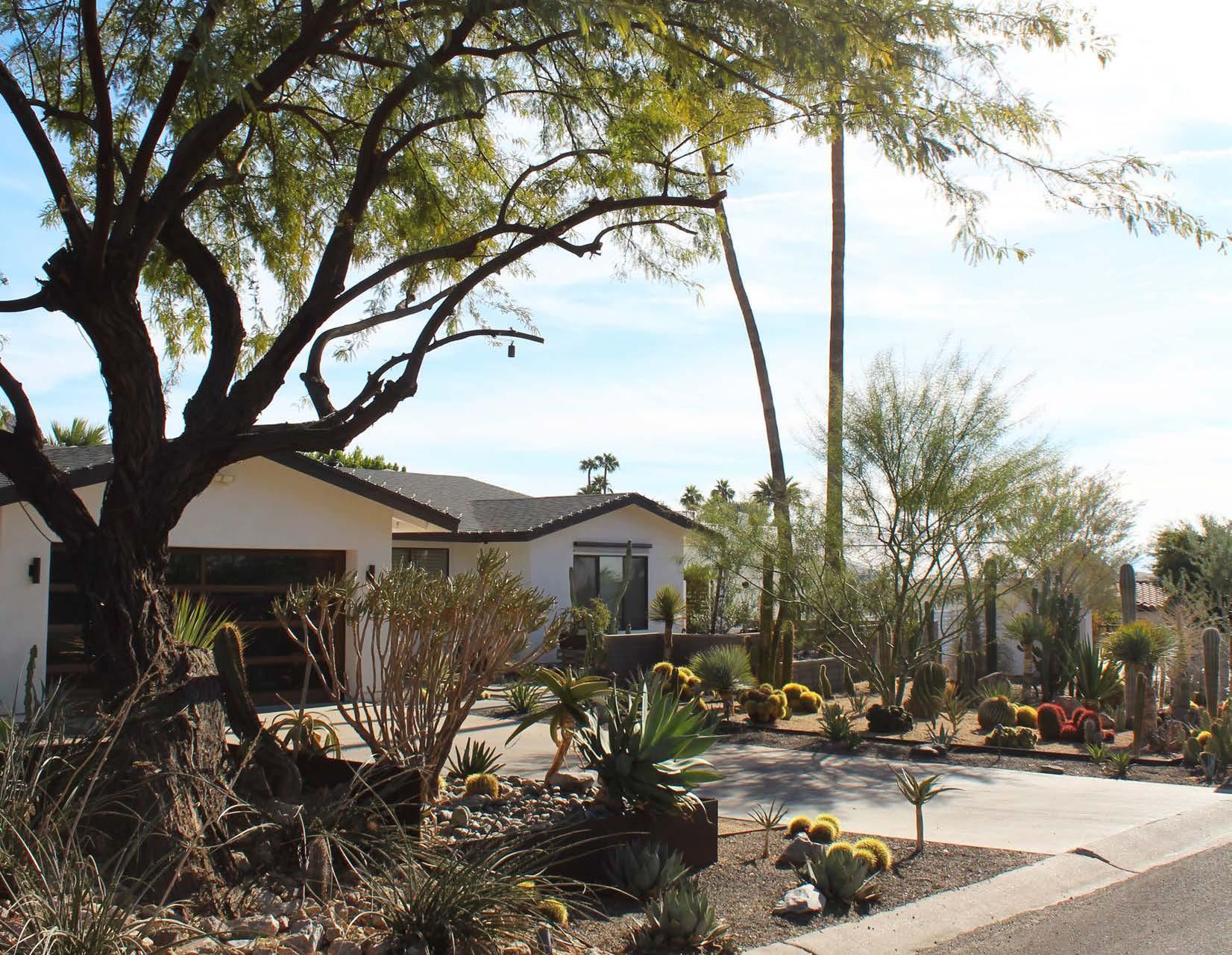
Compost is a soil amendment made up of decomposed organic matter (such as food scraps, grass clippings, plant material, and manure). Adding compost to soil drastically enhances water retention, nutrient levels and microbe content which helps plants grow and thrive.
The basic composting process is simple and consists of three basic components: materials, moisture, and maintenance. First, it is important to have the proper ratio of “browns”- carbon-rich materials (dried leaves or wood chips or shredded paper) to “greens” - nitrogen-rich materials (food scraps and grass clippings). Avoid adding meat scraps or bones, cooked food, salt, and oils to your compost pile as they take a while to break down leading to larger particle size and may attract pests. Second, as part of your compost “recipe” you’ll want to maintain sufficient soil moisture levels (about that of a wrung out sponge), oxygen flow, particle size, and temperature- all which help microorganisms break down organic matter and turn it into compost. Finally, turn your compost with a rake or shovel every few days, if possible, to maintain oxygen flow and help things break down. If you don’t turn the material, it will still break down into compost, but at a slower rate. All in all, if you toss your kitchen and garden scraps in a pile and turn it every few days, within a couple of weeks to months you’ll have your very own compost and a very happy garden!
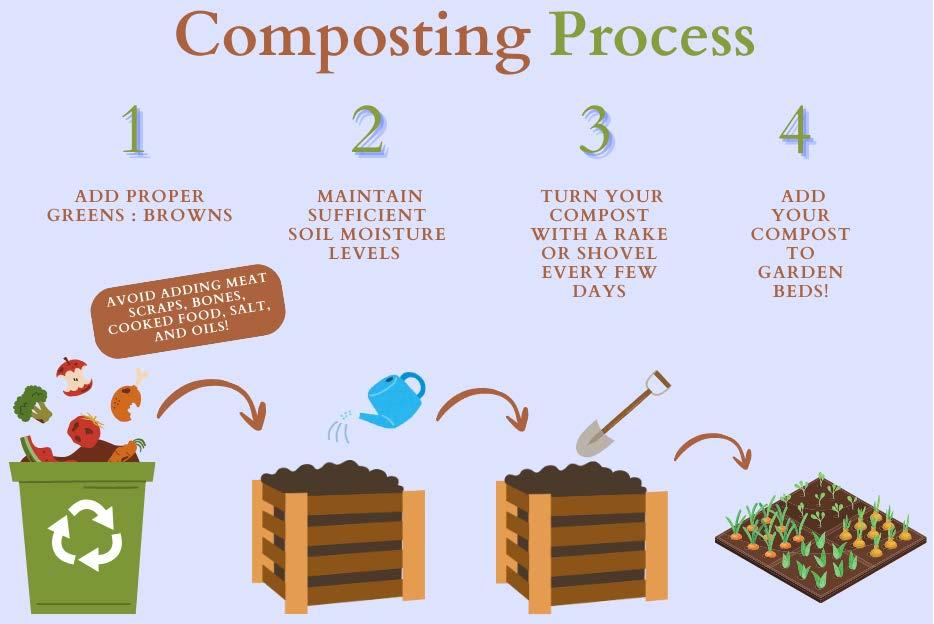
For a traditional pile or bin, you can build a pile directly on the ground or use a 4-sided bin made from pallets, wire, or purchased materials. Adding a lid helps keep moisture in and critters out. This method works well for larger quantities of materials and allows for easy turning. Start with a 3’x3’ base of coarse browns, then alternate layers of greens and browns. The City of Phoenix and the City of Tempe offer composters made from old garbage cans at transfer stations for $5-$6. Not in Phoenix or Tempe? Check your city’s website to see if they participate in a similar composting program! For in-home composting, check out options like a private subscription based company Mill.
If you’re purchasing your compost instead of making it yourself, you’ll want to be sure that what you purchase is US Composting Council (USCC)Certified. You can buy compost and other soil amendments from a local compost manufacturer, like Arizona Worm Farm or Gro-Well.
Overall, all composts contribute positively to soil and plant health, regardless of which method you choose. Once you’ve made your choice based on your garden needs, it’s time to apply it to your planting site!
Note: do not add invasive plants to your composting. They could sprout and cause a lot of problems for you.
In desert climates, timing compost applications around seasonal temperature extremes is crucial for success. Fall is the ideal time to add compost, as cooler temperatures and occasional winter rains help it integrate into the soil without the stress of intense summer heat. Work compost into beds in October or November, giving it time to improve soil structure before the spring planting season. Spring applications should be done early, before temperatures climb above 85°F, and always work compost into the soil rather than leaving it on the surface where it can create a heat-trapping layer. During the growing season, use compost sparingly as mulch
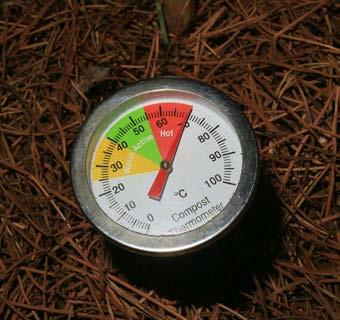
around established plants, but only during cooler months, and always keep it several inches from plant stems. Avoid adding fresh compost during summer months, as the combination of heat and organic matter can create conditions that stress desert-adapted plants and encourage pest problems.
While the basic principles of the composting process are the same, there are several types of composting methods, each with their own uses and benefits. Factors such as size and scale of the planting site as well as the type of materials handy are what will help to determine which composting method is right for you and your garden!
This one is exactly what it sounds like… adding a manure as a base to your compost (50-90% manure). Manure-based composts offer some of the richest sources of plant nutrition. Manure-based thermophilic compost (MBTC) refers to the extreme heat produced by the compost (temperatures over 140°F within just 24-36 hours) and staying at that temperature for about a week. You can make your own manure-based compost by combining manure, some straw, and your homemade compost recipe (above) in a compost bin or heap and turning it approximately once a week.
Some things to note about manure based composting:
• It can be impractical for some backyard situations so alternatively, you can buy MBTC from a local, US Composting Council certified source. Manure-based compost tends to be on the cheaper side and is also nutrient rich so your plants will love it!
• If you do want to make your own MBTC at home, you can get manure locally. For example, you can bulk order fresh cow manure through AZ Sand and Gravel. Make sure to vet the source as some farms use pharmaceuticals with their horses which can contaminate the compost and become dangerous. Cow manure tends to be safer.
• Air temp does not matter for MBTC. Even though it may be over 100° in Arizona when you start your compost, it will still take 24-36 hours to reach that golden 140°.
• MBTC takes about a month to cool down. Once it’s cooled it is ready to be used as compost or be fed to worms to make vermicompost.
Vermicompost is a process that utilizes earthworms to eat soil organic matter which then passes through their digestive tract. This creates humic acid which contains a plant hormone that stimulates plant growth. These worm castings in vermicompost act as an amazing fertilizer for plants and can create lush garden beds! There are an estimated 1 million microorganisms in a cubic centimeter of vermicompost. Vermicompost is one of the most nutrient rich and effective compost, however, if you’re planning on buying it from the store, it is also one of the more expensive types of compost. To make your own vermicompost at home, start with MBTC, put in premade beds/compost pints and add worms (approximately 1 pound of worms per cubic foot of bin space). Depending on the size of your pile, let the worms eat and digest the compost for about several weeks to a few months.
Relatively simple and inexpensive worm compost bins can be constructed from rubbermaid
tote bins or even plastic buckets. Moistened shredded paper is used as the bedding material, fruit and vegetables scraps are mixed in for food. In the Central Arizona region, it may be best to this indoors as outdoor temperatures can be too extreme for these types of bins.
Traditional compost as described above is best used for garden beds. When gardening cacti and succulents, traditional compost is not the best option as these plants require specific conditions. You can make your own compost that mimics desert soil conditions (excellent drainage and low-nutrients levels) that help cacti and succulents thrive here. Using your compost as a base, you can add-in different ratios of organic and in-organic matter (often called grit) to provide the drainage and nutrient levels required by our prickly desert pals. There are many different ingredients to use and recipes to follow. For more information on materials and mixes to use for making cacti and succulent compost at home visit the site Maximize Your Cactus Growth with the Right Compost Mix - Simplify Gardening (more information in the resources section).
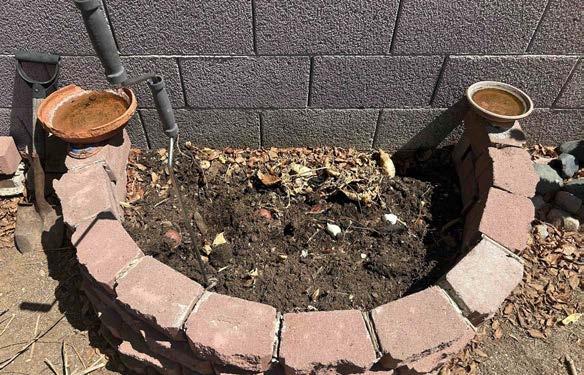
Pile won’t heat up: Usually means too much brown material, not enough moisture, or insufficient size. Add greens, water lightly, or combine with another pile to reach critical mass.
Bad odors: Typically indicate too much moisture or not enough air. Add browns, turn the pile, and ensure proper drainage.
Pests: Avoid adding meat, dairy, or oily foods. Bury fresh scraps in the center of the pile and maintain proper heat through regular turning.
Mary Appelhof & Mary Frances Fenton. 2003. Worms Eat My Garbage: How to Set Up and Maintain a Worm Composting System, 2nd Edition. Flower Press.
Michelle Balz & Anna Stockton. 2017. Composting for a New Generation: Latest Techniques for the Bin and Beyond. Cool Springs Press.
Charles Dowding & Jonathan Gibbs. 2024. Compost: Transform Waste into New Life. DK.
Grace Gershuny & Jerry Minnich. 1992. The Rodale Book of Composting: Easy Methods for Every Gardener. Rodale Books.
Arizona Composting Council
https://www.arizonacompostingcouncil.org/
Arizona Department of Environmental Quality | Composting
https://azdeq.gov/composting
Arizona Sand and Gravel | Manure
https://arizonasandandgravel.com/p/Cow-Manure/300996
Arizona Worm Farm
https://arizonawormfarm.com/
Compost Magazine | Types of Compost (Plus How to Choose the Right One)
https://www.compostmagazine.com/types-of-compost/ Gro-Well | Amendments
https://www.gro-well.com/lawn-garden/amendments/
Mill x R.City Composting Program
https://www.mill.com/
Simplify Gardening | Maximize Your Cactus Growth with the Right Compost Mix
https://simplifygardening.com/what-is-cactus-compost-and-how-is-itmade/
The TransPlanter
https://www.transplanter.guru/
The TransPlanter | Videos, the wonderful world of composting webinar presented by Rafaela Crevoshay
https://www.transplanter.guru/videos
University of Arizona Cooperative Extension | Small Scale Composting in the Low Desert of Arizona
https://extension.arizona.edu/publication/small-scale-compostinglow-desert-arizona
US Environmental Protection Agency | Composting
https://www.epa.gov/sustainable-management-food/composting
US Environmental Protection Agency | Composting at Home
https://www.epa.gov/recycle/composting-home
City of Avondale | Community Compost Program
https://www.avondaleaz.gov/government/departments/public-works/ sustainability/compost-program
City of Chandler | Backyard Composting
https://www.chandleraz.gov/residents/recycling-and-trash/ composting
City of Gilbert | Composting
https://www.gilbertaz.gov/departments/public-works/solid-waste/
composting
City of Mesa | Backyard Composting
https://www.mesaaz.gov/Utilities/Trash-Recycling/ResidentPrograms/Backyard-Composting
City of Phoenix | Composting
https://www.phoenix.gov/administration/departments/publicworks/ residential-trash-recycling/composting.html
City of Scottsdale | Food Waste and Composting
https://www.scottsdaleaz.gov/solid-waste/trash-recycling/food-wasteand-composting
City of Tempe | Tempe’s Compost Program
https://www.tempe.gov/government/public-works/solid-waste-andrecycling/bulk-uncontained-garbage-and-green-organics/tempe-scompost-program
* Disclaimer: The inclusion of products and non-partner references does not constitute an endorsement or referral of the products or services. They are meant to serve as information and reference only.
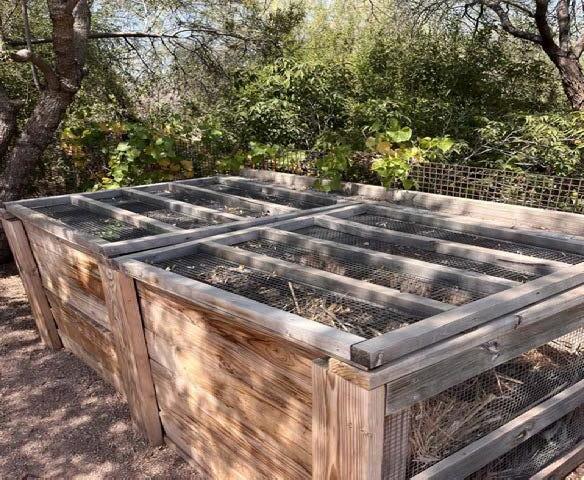
First Place UDE Landscaping Contest Winner’s House – Challie Facemire
Native Plants
Page 2
Beavertail Prickly Pear
Opuntia basilaris (plant) - Chris Hunkeler, CC 2.0, Wikimedia Commons
Opuntia basilaris (flower) - Stan Shebs, CC 3.0, Wikimedia Commons
Buckhorn Cholla
Cylindropuntia acanthocarpa (plant) - Rollad Franck, CC 3.0, Wikimedia Commons
Cylindropuntia acanthocarpa (flower)Miwasatoshi, CC 4.0, Wikimedia Commons
Page 3
California Barrel Cactus
Ferocactus cylindraceus (plant and flower)Stan Shebs, CC 3.0, Wikimedia Commons
Cylindropuntia ramosissima (plant) - Ries Lindley, SEINet
Cylindropuntia ramosissima (flower) - Stan Shebs, CC 3.0, Wikimedia Commons
Spoon
Dasylirion wheeleri – Max Licher, SEINet
Dasylirion wheeleri (flower) - Ries Lindley, SEINet
Engelmann’s Hedgehog Cactus
Echinocereus engelmannii (plant) - Blake Wellard, SEINet
Echinocereus engelmannii (flower) - Stan Shebs, CC 3.0, Wikimedia Commons
Page 4
Engelmann’s Prickly Pear
Opuntia engelmannii (plant and flower) - Max Licher, SEINet
Fine-Leaf Yucca
Yucca angustissima (plant and flower) - Wendy Hodgson, SEINet
Fishhook Barrel Cactus
Ferocactus wislizeni (plant and flower) - Liz Makings, SEINet
Ocotillo
Fouquieria splendens (plant) - Galaxy Gardens
Fouquieria splendens (flower) - Max Licher, SEINet
Page 5
Organ Pipe Cactus
Stenocereus thurberi (plant) - Ries Lindley, SEINet
Stenocereus thurberi (flower) - pompilid, CC 3.0, Wikimedia Commons
Parry’s Agave
Agave parryi (plant) - Liz Makings, SEINet
Agave parryi (flower) - Max Licher, SEINet
Saguaro
Carnegiea gigantea (plant) - Max Licher, SEINet
Carnegiea gigantea (flower) - Liz Makings, SEINet
Page 6
Santa Rita Prickly Pear
Opuntia santa-rita (plant) - cultivar413, CC 2.0, Wikimedia Commons
Opuntia santa-rita (flower) - Chris Roll, SEINet
Strawberry Hedgehog Cactus
Echinocereus fasciculatus (plant) - Xiao Li, CC 2.5, Wikimedia Commons
Echinocereus fasciculatus (flower) - Frankie Coburn, SEINet
Arizona poppy
Kallstroemia grandiflora (plant) - Max Licher, SEINet
Kallstroemia grandiflora (flower) - Liz Makings, SEINet
Chia Sage
Salvia columbariae (plant) - Sue Carnahan, SEINet
Salvia columbariae (flower) - Eugene Sturla, SEINet
Page 7
Lupine
Lupinus sparsiflorus (plant and flower) - Max Licher, SEINet
Cowpen Daisy
Verbesina encelioides (plant) - Max Licher, SEINet
Verbesina encelioides (flower) - Liz Makings, SEINet
Desert Bluebells
Phacelia campanularia (plant) - Greg Goodwin, SEINet
Phacelia campanularia (flower) - Liz Makings, SEINet
Erigeron divergens (plant and flowers) - Max
Licher, SEINet
8
Mexican Gold Poppy
Eschscholzia californica (plant and flower)Cecelia Alexander, SEINet
Owl’s Clover
Castilleja exserta (plant) - Michael Plagens, SEINet
Castilleja exserta (flower) - Frankie Coburn, SEINet
Angelita Daisy
Tetraneuris acaulis (plant and flower) - Max Licher, SEINet
Arizona Milkweed
Asclepias angustifolia (plant) - Ries Lindley, SEINet
Asclepias angustifolia (flower) - Pamahon, CC 4.0, Wikimedia Commons
Page 9
Arizona Passion Vine
Passiflora arizonica (plant) - Rich Hoyer, CC 4.0, iNaturalist
Passiflora arizonica (flower) - José Jesús Sánchez Escalante, SEINet
Blackfoot Daisy
Melampodium leucanthum (plant and flower)Max Licher, SEINet
Blanketflower
Gaillardia aristata (plant and flower) - Syrio, CC 4.0, Wikimedia Commons
Blue Grama
Bouteloua gracilis (plant and seed head) - Max Licher, SEINet
Page 10
Butterfly Milkweed
Asclepias tuberosa (plant and flower) - Max Licher, SEINet
Deer Grass
Muhlenbergia rigens (plant) - Liz Makings, SEINet
Muhlenbergia rigens (flower and seed head)Cecelia Alexander, SEINet
Desert Globemallow
Sphaeralcea ambigua (plant) - Anthony Mendoza, SEINet (flipped image horizontally)
Sphaeralcea ambigua (flower) - Max Licher, SEINet
Desert Marigold
Baileya multiradiata (plant and flower) - Max Licher, SEINet
Page 11
Desert Milkweed
Asclepias subulata (plant) - Stan Shebs, CC 3.0, Wikimedia Commons
Asclepias subulata (flower) - Sue Carnahan, SEINet
Thymophylla pentachaeta (plant and flower) - Max Licher, SEINet (plant photo flipped horizontally)
Glandularia gooddingii (plant) - Cecelia Alexander, SEINet
Glandularia gooddingii (flower) - Anthony Mendoza, SEINet
Gregg’s Mistflower
Conoclinium greggii (plant) - Frankie Coburn, SEINet (flipped photo horizontally)
Conoclinium greggii (flower) - Liz Makings, SEINet
Page 12
Krameria erecta (plant) - Andrew Cattoir, National Park Service – Lake Mead National Recreation Area
Krameria erecta (flower) - Liz Makings, SEINet
Parry’s Penstemon
Penstemon parryi (plant and flower) - Max Licher, SEINet
Parry’s Sage
Salvia parryi (plant and flower) - Sue Carnahan, SEINet
Dichondra argentea (plant) - rossdhu62, CC 4.0, iNaturalist
Dichondra argentea (flower) - Cecelia Alexander, SEINet
Shrubby Deervetch
Lotus rigidus (plant) - Max Licher, SEINet
Lotus rigidus (flower) - Liz Makings, SEINet
Ambrosia deltoidea (plant) - Cecelia Alexander, SEINet
Ambrosia deltoidea (flower) - Leslie Landrum, SEINet
Ambrosia dumosa (plant and flower) - Max Licher, SEINet
Whitestem Milkweed
Asclepias albicans (plant) - Christopher Christie
Asclepias albicans (flower) - Liz Makings, SEINet
Page 14
Yerba Mansa
Anemopsis californica (plant) - Max Licher, SEINet
Anemopsis californica (flower) - Liz Makings, SEINet
Arizona Rosewood
Vauquelinia californica (plant) - rickg91, CC 4.0, iNaturalist
Vauquelinia californica (flower) - Leslie Landrum, SEINet
Arizona Yellow Bells
Tecoma stans (plant) - Treeworld Wholesale
Tecoma stans (flower) - Fred Fisher, SEINet
Bee Brush
Aloysia gratissima (plant) - Krzysztof Ziarnek, Kenraiz, CC 4.0, Wikimedia Commons
Aloysia gratissima (flower) - Cecelia Alexander, SEINet
Page 15
Brittlebush
Encelia farinosa (plant) - Max Licher, SEINet
Encelia farinosa (flower) - Cecelia Alexander, SEINet
California Buckwheat
Eriogonum fasciculatum (plant) - Stan Shebs, CC 3.0, Wikimedia Commons
Eriogonum fasciculatum (flower) - Ries Lindley, SEINet
Justicia californica (plant) - Cecelia Alexander, SEINet
Justicia californica (flower) - Mark Dimmitt, SEINet
Creosote Bush
Larrea tridentata (plant) - Homer Edward Price, CC 2.0, Wikimedia Commons
Larrea tridentata (flower) - Max Licher, SEINet
Page 16
Desert Lavender
Hyptis emoryi (plant) - larivera, CC 4.0, iNaturalist
Hyptis emoryi (flower) - Fred Fisher, SEINet
Desert Tea
Ephedra nevadensis (plant) - Krzysztof Ziarnek, Kenraiz, CC 4.0, Wikimedia Commons
Ephedra nevadensis (flower) - Andrey Zharkikh, CC 2.0, Wikimedia Commons
Fairy Duster
Calliandra eriophylla (plant) - Chris English, CC 3.0, Wikimedia Commons
Calliandra eriophylla (flower) - NPS Photo
Fremont’s Wolfberry
Lycium fremontii (plant and flower) - Sue Carnahan, SEINet
Page 17
Hopseed Bush
Dodonaea viscosa (plant) - Anthony Mendoza, SEINet
Dodonaea viscosa (flower) - Forest & Kim Starr, CC 3.0, Wikimedia Commons
Indigo Bush
Dalea pulchra (plant) - National Parks Gallery
Dalea pulchra (flower) - Alexander Cecelia, SEINet
Jojoba
Simmondsia chinensis (plant) - David J. Stang, CC 4.0, Wikimedia Commons
Simmondsia chinensis (flower) - Anthony Mendoza, SEINet
Red Justica
Justicia candicans (plant) - Anthony Mendoza, SEINet
Justicia candicans (flower) - Cecelia Alexander, SEINet
Superstition Mallow
Abutilon palmeri (plant) - Raffi Kojian, CC 3.0, Wikimedia Commons
Abutilon palmeri (flower) - Curtis Clark, SEINet
Page 18
Blue Palo Verde
Parkinsonia florida (plant) - Stan Shebs, CC 3.0, Wikimedia Commons
Parkinsonia florida (flower) - Sue Carnahan, SEINet
Cat Claw Acacia
Senegalia greggii (plant and flower) - Stan Shebs, CC 3.0, Wikimedia Commons
Desert Willow
Chilopsis linearis (plant) - Krzysztof Ziarnek, Kenraiz, CC 4.0, Wikimedia Commons
Chilopsis linearis (flower) - Stan Shebs, CC 3.0, Wikimedia Commons
Foothill Palo Verde
Parkinsonia microphylla – Bigmacthealmanac, CC 0 , Wikimedia Commons
Parkinsonia microphylla (flower) - Max Licher, SEINet
Page 19
Honey Mesquite
Prosopis glandulosa (plant) - Don A.W. Carlson, Wikipedia, CC 2.5 (flipped photo horizontally)
Prosopis glandulosa (flower) - Cecelia Alexander, SEINet
Olneya tesota (plant) - Anthony Mendoza, SEINet
Olneya tesota (flower) - Max Licher, SEINet
Screwbean Mesquite
Strombocarpa pubescens (plant) - University of Arizona, University of Arizona Campus Arboretum
Strombocarpa pubescens (flower) - Zachery Berry, SEINet
Sweet Acacia
Acacia farnesiana (plant) - University of Arizona, University of Arizona Campus Arboretum
Acacia farnesiana (flower) - Jason Hollinger, CC 2.0, Wikimedia Commons
Velvet Mesquite
Neltuma velutina (plant) - Max Licher, SEINet
Neltuma velutina (flower) - Liz Makings, SEINet
Page 20
Echinopsis terscheckii (plant) - Photohound, CC 3.0, Wikimedia Commons
Echinopsis terscheckii (flower) - Efraimstochter, CC 0, Wikimedia Commons
Cow’s Horn Agave
Agave bovicornuta (plant) - R.A. Villa, SEINet
Elephant’s Food
Portulacaria afra (plant) - Frank Vincentz, CC 3.0, Wikimedia Commons
Portulacaria afra (flower) - Sue Carnahan, SEINet
Page 21
Candelilla
Euphorbia antisyphilitica (plant and flower)Frank Vincentz, CC 3.0, Wikimedia Commons
Golden Barrel Cactus
Echinocactus grusonii (plant) - AlixSaz, CC 4.0, Wikimedia Commons
Echinocactus grusonii (flower) - Forest & Kim Starr, CC 3.0, Wikimedia Commons
Lady Slipper
Euphorbia lomelii (plant) - Daderot, CC 0, Wikimedia Commons
Euphorbia lomelii (flower) - Sue Carnahan, SEINet
Medicine Plant
Aloe barbadensis (plant) - Roberto Pla, North Carolina State Extension
Aloe barbadensis (flower) - Agnieszka Kwiecień, Nova, CC 4.0, Wikimedia Commons
Partridge Breast Aloe
Aloe variegata (plant) - Kurisu rs, CC 3.0, Wikimedia Commons
Aloe variegata (flower) - Leonora Enking, CC 2.0, Wikimedia Commons
Red Yucca
Hesperaloe parviflora (plant and flower) - Fritz Hochstätter, CC 3.0, Wikimedia Commons
Smooth Agave
Agave desmettiana (plant) - Stan Shebs, CC 3.0, Wikimedia Commons
Agave desmettiana (flower) - Akshaya Govindasamy, CC 4.0, Wikimedia Commons
Twin Flowered Agave
Agave geminiflora (plant) - Agnieszka Kwiecień, Nova, CC 4.0, Wikimedia Commons
Agave geminiflora (plant and flower) - Arizona State University, ASU Virtual Library of Phoenix Landscape Plants
Agave weberi (plant) - Matthieu Sontag, 4.0, Wikimedia Commons
Agave weberi (flower) - Matthieu Sontag, 4.0, Wikimedia Commons
Yellow Bulbine
Bulbine frutescens (plant) - David J. Stang, CC 4.0, Wikimedia Commons, SEINet
Bulbine frutescens (flower) - Paul Rothrock, SEINet
Linum grandiflorum (plant) - Sten Porse, CC 3.0, Wikimedia Commons
Linum grandiflorum (flower) - Cbaile19, CC 0, Wikimedia Commons
Shirley Poppy
Papaver rhoeas (plant) - H. Zell, CC 3.0, Wikimedia Commons
Papaver rhoeas (flower) - Robert Flogaus-Faust, CC 4.0, Wikimedia Commons
Salvia greggii (plant) - Krzysztof Ziarnek, Kenraiz, CC 4.0, Wikimedia Commons, CC 4.0, Wikimedia Commons
Salvia greggii (flower) - Cecelia Alexander, SEINet
Oenothera speciosa (plant) - Wouter Hagens, Wikimedia Commons
Oenothera speciosa (flower) - Liz Makings, SEINet
Muhlenbergia capillaris (plant) - Stickpen, Wikimedia Commons
Muhlenbergia capillaris (flower) - David J. Stang, CC 4.0, Wikimedia Commons
Purple Heart
Tradescantia pallida (plant) - PapiPijuan, CC 4.0, Wikimedia Commons
Tradescantia pallida (flower) - PapiPijuan, CC 4.0, Wikimedia Commons
Zephyranthes candida (plant) - Kai Yan, Joseph Wong, SEINet
Zephyranthes candida (flower) - Dinesh Valke, CC 2.0, Wikimedia Commons
Dalea greggii (plant) - Civano Growers, Civano Growers Site
Dalea greggii (flower) - Cecelia Alexander, SEINet
Yellow Dalea
Dalea capitata (plant and flower) - University of Arizona, University of Arizona Campus Arboretum
Crossvine
Bignonia capreolata (plant) - Père Igor, CC 4.0, Wikimedia Commons
Bignonia capreolata (flower) - Robert Barber, SEINet
Solanum wendlandii (plant) - Don McCulley, CC, 4.0, Wikimedia Commons
Solanum wendlandii (flower) - Forest & Kim Starr, CC 3.0, Wikimedia Commons
Passion Vines
Passiflora (flower large) - Jebulon, CC 3.0, Wikimedia Commons
Passiflora (flower small) - Sue Carnahan, SEINet
Baja Fairy Duster
Calliandra californica (plant) - Sue Carnahan, SEINet
Calliandra californica (flower) - Liz Makings, SEINet
Black Dalea
Dalea frutescens (plant) - Patrick Alexander, CC 0, Wikimedia Commons
Dalea frutescens (flower) - Cecelia Alexander, SEINet
Page 27
Blue Emu Bush
Eremophila hygrophana (plant and flower)Allthingsnative, CC 4.0, Wikimedia Commons
Cape Honeysuckle
Tecoma capensis (plant) - H. Zell, CC 3.0, Wikimedia Commons
Tecoma capensis (flower) - Paul Rothrock, SEINet
Chihuahuan Sage
Leucophyllum laevigatum (plant and flower)Stan Shebs, CC 3.0, Wikimedia Commons
Coral Fountain
Russelia equisetiformis (plant) - Krzysztof Ziarnek, Kenraiz, CC 4.0, Wikimedia Commons
Russelia equisetiformis (flower) - Sue Carnahan, SEINet
Page 28
Feathery Senna
Senna artemisioides (plant and flower)Anthony Mendoza, SEINet
Firebush
Hamelia patens (plant and flower)Vijayanrajapuram, CC 4.0, Wikimedia Commons
Myoporum
Myoporum parvifolium (plant) - cultivar413, CC 2.0, Wikimedia Commons
Myoporum parvifolium (flower) - dracophylla, SEINet
Orange Bells
Tecoma fulva subsp. Guarume (plant) - H. Zell, CC 3.0, Wikimedia Commons
Tecoma fulva subsp. Guarume (flower)anniesannuals, CC 2.0, Wikimedia Commons
Page 29
Peacock Flower
Caesalpinia pulcherrima (plant) - Mokkie, CC 3.0, Wikimedia Commons
Caesalpinia pulcherrima (flower) - Zachery Berry, SEINet
Texas Ranger
Leucophyllum frutescens (plant) - David J. Stang, CC 4.0, Wikimedia Commons
Leucophyllum frutescens (flower) - Cecelia Alexander, SEINet
Yellow Bird of Paradise
Erythrostemon gilliesii (plant) - Cecelia Alexander, SEINet
Erythrostemon gilliesii (flower) - Gene Sturla, SEINet
Violet Silverleaf
Leucophyllum candidum – Mountain States
Nursery
Leucophyllum candidum (flower) - University of Arizona, University of Arizona Campus Arboretum
Page 30
Wooly Butterfly Bush
Buddleja marrubiifolia (plant) - Daderot, CC 0, Wikimedia Commons
Buddleja marrubiifolia (flower) - Liz Makings, SEINet
Cascalote
Caesalpinia cacalaco (plant) – Robert Perry, Southern California Water Conservation District, Waterwise Garden Planner
Caesalpinia cacalaco (flower) - Dick Culbert, SEINet
Mexican Buckeye
Ungnadia speciosa (plant) - Arizona State University, ASU Virtual Library of Phoenix Landscape Plants (flipped photo horizontally)
Ungnadia speciosa (flower) - Cecelia Alexander, SEINet
Tenaza
Havardia pallens (plant and flower)- University of Arizona, University of Arizona Campus
Arboretum
Page 43
Scottsdale Community College Center for Native and Urban Wildlife Campus Plantings
Page 44
Second Place UDE Landscaping Contest Winner’s House
Page 47
Installing a drip system (middle right) - Galaxy Gardens
Page 48
Diseased tree (lower left) - Challie Facemire
Broken branch - Challie Facemire
Page 49
Tree pruning cuts - Janet Waibel, Sustainable Landscape Management
Topped Tree - Penn State Extension
Page 50
Lions-tailed tree - Edward F. Gilman, UF/IFAS
Page 52
Desert Landscaped Yard
Page 53
Wildfire aftermath - unknown
Page 54
African Sumac trunk and branches (upper right) - Bri Weldon, SEINet
African Sumac leaves and flowers (lower left)Rohan B, CC 4.0, iNaturalist
African Sumac full tree (lower right) – Matthew Fainman, CC 4.0, Wikimedia Commons
Page 55
Buffelgrass plant (upper right) - Michael J. Plagens, SEINet
Buffelgrass close up (lower left) – Zachery Berry, SEINet
Buffelgrass in the landscape (lower right) –Zachery Berry, SEINet
Page 56
Common Sow Thistle leaves and flower (upper right) - Krzysztof Ziarnek, Kenraiz, CC 4.0, Wikimedia Commons
Common Sow Thistle flower and seed head (lower left) - Nativeplants Garden, CC 4.0, Wikimedia Commons
Common Sow Thistle rosette of leaves (lower right) - NY State IPM Program at Cornell University, CC 2.0, Wikimedia Commons
Page 57
Fountain Grass plant (upper right) - Yasuko Hirata
Fountain Grass seed heads (lower left) - Forest & Kim Starr, CC 3.0, Wikimedia Commons
Fountain Grass in landscape – Steve Jones, CC 4.0, iNaturalist
Page 58
Giant Reed plants (upper right) - Juan Carlos Fonseca Mata, CC 4.0, Wikimedia Commons
Giant Reed seeds (lower left) - Max Licher, SEINet
Giant Reed landscapes (lower right) - Forest & Kim Starr, CC 3.0, Wikimedia Commons
Page 59
London Rocket plant (upper right) - Eitan F, CC 3.0, Wikimedia Commons
London Rocket flower (lower left) - Juan Carlos Fonseca Mata, CC 4.0, Wikimedia Commons
London Rocket leaf rosette (lower right) - Stefan Lefnaer, CC 4.0, Wikimedia Commons
Page 60
Malta Starthistle plants (upper right) - Forest & Kim Starr, CC 3.0, Wikimedia Commons
Malta Starthistle flower (lower left) - Javier Martin, Wikimedia Commons
Malta Starthistle leaf rosette (lower right)Moadeeb, CC 4.0, Wikimedia Commons
Page 61
Red Brome plants (upper right) - Matt Lavin, CC 2.0, Wikimedia Commons
Red Brome flower/seed head (lower left)Krzysztof Ziarnek, Kenraiz, CC 4.0, Wikimedia Commons
Red Brome young plants (lower right) - Max Licher, SEINet
Page 62
Russian Thistle tumble weed (upper right)Dcjsr, CC 3.0, Wikimedia Commons
Russian thistle flower (lower left) - Dcjsr, CC 3.0, Wikimedia Commons
Russian thistle plant (lower right) Dcjsr, CC 3.0, Wikimedia Commons
Page 63
Sahara Mustard leaf rosette (upper right) - Stan Shebs, CC 3.0, Wikimedia Commons
Sahara Mustard flower (lower left) - Zeynel Cebeci, CC 4.0, Wikimedia Commons
Sahara Mustard plant (lower right) - Unknown
Page 64
Salt Cedar plant (upper right) - Dr. Alexey Yakolev, CC 2.0, Wikimedia
Salt Cedar flowers (lower left) - Unknown
Page 65
Stinknet leaves (upper right) - Rainonreddirt, iNaturalist
Stinknet flowers (lower left) - Liz Makings, SEINet
Stinknet plants (lower right) - Liz Makings, SEINet
Page 66
Yellow Bluestem plants (upper right) - Stefan Lefnaer, CC 3.0, Wikimedia Commons
Yellow Bluestem flower/seed head (lower left)Daniel Villafruela, CC 4.0, Wikimedia Commons
Yellow Blustem plants in landscape (lower right – Daniel Villafruela, CC 4.0, Wikimedia Commons
Page 67
Figure 4.24 A & B in Rainwater Harvesting for Drylands and Beyond, Volume 1, 3rd Edition, p. 119 - Brad Lancaster
Page 68
Organic and inorganic mulch (top left) - Galaxy Gardens
Scottsdale Community College Center for Native and Urban Wildlife Campus Plantings (middle right)
Page 69
Figure 3.2 Berm and basin (right) in Rainwater Harvesting for Drylands and Beyond, Volume 1, 3rd Edition, p. 65 - Brad Lancaster
Terrace (bottom left)- Haden Pittson
Page 70
Infiltration trench and basin (top left) - Galaxy Gardens
Figure 3.20 Diversion swales (right) in Rainwater Harvesting for Drylands and Beyond, Volume 1, 3rd Edition, p. 79 - Brad Lancaster
Vegetation in an infiltration trench (bottom left) - Galaxy Gardens
Page 71
Third Place UDE Landscaping Contest Winner’s House, permeable pavement example
Curb cuts in a parking lot in Rainwater
Harvesting for Drylands and Beyond, Volume 1, 3rd Edition, p. 118 - Brad Lancaster
Page 72
Pressurized cistern - Galaxy Gardens
Page 73
Cistern with decorative trellis made by Ryan Coykendall from Tucson, Arizona - Galaxy Gardens
Cistern overflow into earthworks in Rainwater Harvesting for Drylands and Beyond, Volume 1, 3rd Edition, p. 35 - Brad Lancaster
Page 74
Rain Chain - Mr. Barry, CC 3.0, Wikimedia Commons
Page 75
Model of gay water system - Haden Pittson
Page 76
Water harvesting - Galaxy Gardens
Page 77
Manual Sod Cutter - SAF Products
Page 78
Motorized sod cutter - BigIron Auctions
Killing grass with solarization - Beeblebrox, CC 4.0, Wikimedia Commons
Page 79
Turf Talk turf heat infographic - Jennifer Vanos, ASU
Page 80
Hardin, A. W., & Vanos, J. K. (2018). The influence of surface type on the absorbed radiation by a human under hot, dry conditions. International Journal of Biometeorology, 62, 43-56.
Page 82
First Place UDE Landscaping Contest Winner’s House – Challie Facemire
Page 83
Composting infographic - Mary Chisholm
No title (compost and scoop) - Neslihan Gunaydin, Unsplash
Page 84
Compost thermometer - Dino, Pexels
Sifted vermicompost vermicast - Renatotcm, CC 4.0, Wikimedia Commons
Page 85
Arizona home compost - Challie Facemire
Page 86
Bin compost system at Desert Botanical Garden - Mary Chisholm