

INVESTMENT OUTLOOK



COVID-19 STILL THE MAIN ISSUE FOR EQUITIES
The equity market experienced some turbulence in late September, but has bounced back in early October.
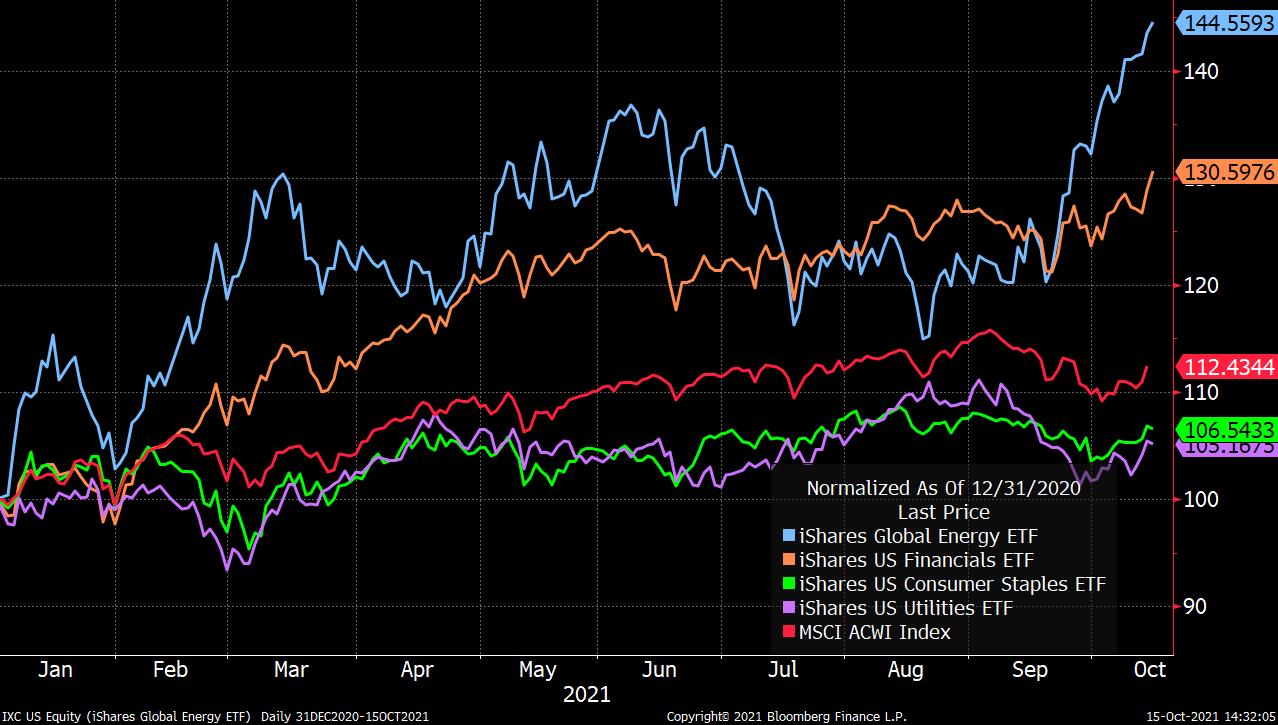
The MSCI All Country World Index, a measure of the global stock market, returned -0.95% in the third quarter but is up 15.2% year-to-date through mid-October. Domestic stocks have outperformed international stocks so far this year, with the Russell 3000 index (which includes only U.S.-based companies) returning 19.5% through midOctober, and the MSCI EAFE (international developed) and MSCI Emerging Market indices returning 9.8% and 0.0%, respectively. The energy, technology, and financial sectors have been the best performers, while utilities and consumer staple stocks have underperformed.
The COVID-19 health crisis remains the most important issue for the equity markets, with
investors continuously analyzing its ramifications and attempting to forecast its most likely paths. The most negative possibility would be the emergence of a new variant that threatens the efficacy of vaccines. Investors would see this as an extremely detrimental scenario and the equity market would likely face a sharp correction. The risk is real, of course, but given the effectiveness of vaccines so far, and the technological advances the healthcare industry has made in recent years, most investors don’t believe this to be the most likely outcome. Instead, the aggregate expectation today is that the
COVID-19 crisis will enter a final “endemic” phase (the timing is uncertain but possibly in late 2022 or 2023) in which a high percentage of the world is either vaccinated with an effective vaccine or has some degree of immunity after having been infected. Reaching this outcome, in which hospitalization rates eventually decline, would result in less impact on people’s behavior and would be positive for stocks. While acknowledging the risks, we share the view that this appears the most likely path forward.
The economy remains quite strong, with consumer demand continuing
Source: Bloomberg
to bounce back from last year. The bigger issue today is supply, as logistical networks are strained and the labor market remains deeply impacted by the health crisis. Supply-side issues are likely to work themselves out during the next 12 months if the world continues to move toward the long-term “endemic” COVID-19 outcome, however, while aggregate demand is likely to remain strong even if there are more infection waves during the next few quarters. People are venturing out of their homes more and more, even in the face of high infection rates (the continued efficacy of vaccines is a crucial factor here, it must be said).
Monetary policy is the other major issue confronting the equity markets, as the U.S. Federal Reserve (Fed) is set to begin a cycle of tightening in the fourth quarter. In response to heightened inflation expectations after 18 months of stimulus, it appears that virtually all of the Fed’s main policymakers have now accepted the idea that the time has come for a policy change.
Investors expect this to begin before year-end, with the Fed decreasing U.S. Treasury and agency mortgagebacked security purchases by roughly $30b per month (the exact figure has not yet been announced) until the current bond purchase regime is completely wound down sometime next year. Actual interest rate hikes aren’t expected until the second half of next year, but the long-anticipated “taper” of bond purchases will be an important development for equity markets during the fourth quarter.
Equity valuations, with the Russell 3000 Index and the MSCI All Country World Index trading at 20.9 and 17.6 times expected 2022 earnings, respectively, appear close to fairly valued given the risks and opportunities explained above. With that said, the variance of potential outcomes for equities – both positive and negative – during the next 12 months is larger than usual, primarily due to uncertainties regarding the evolution of the COVID-19 health crisis.
FIXED INCOME: FED’S “TAPER” LARGELY PRICED IN
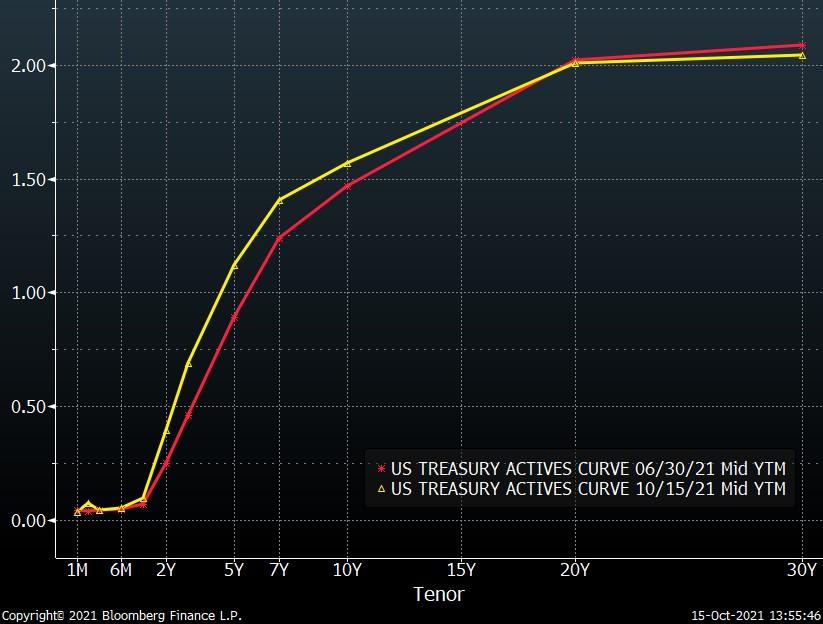
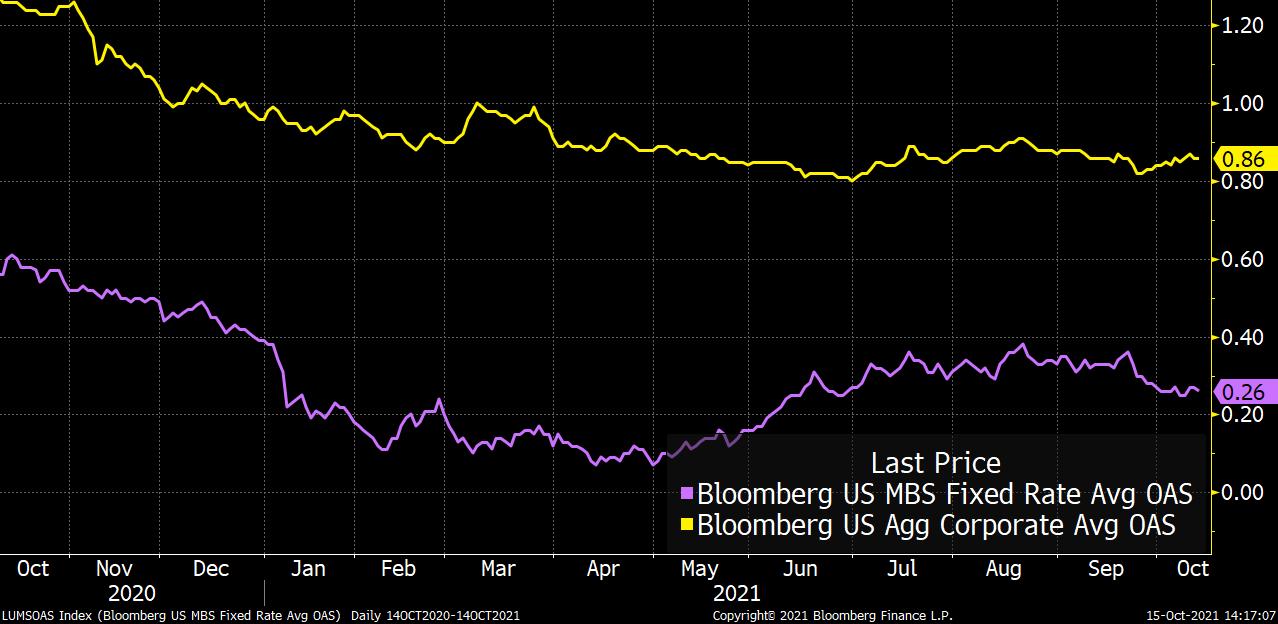
Despite uncertainties caused by the persistence of the COVID-19 health crisis and the approaching “taper” of U.S. Federal Reserve stimulus, the 10-year U.S. Treasury bond yield has risen only modestly since June 30th. Spreads on corporate bonds and agency mortgagebacked securities are also little
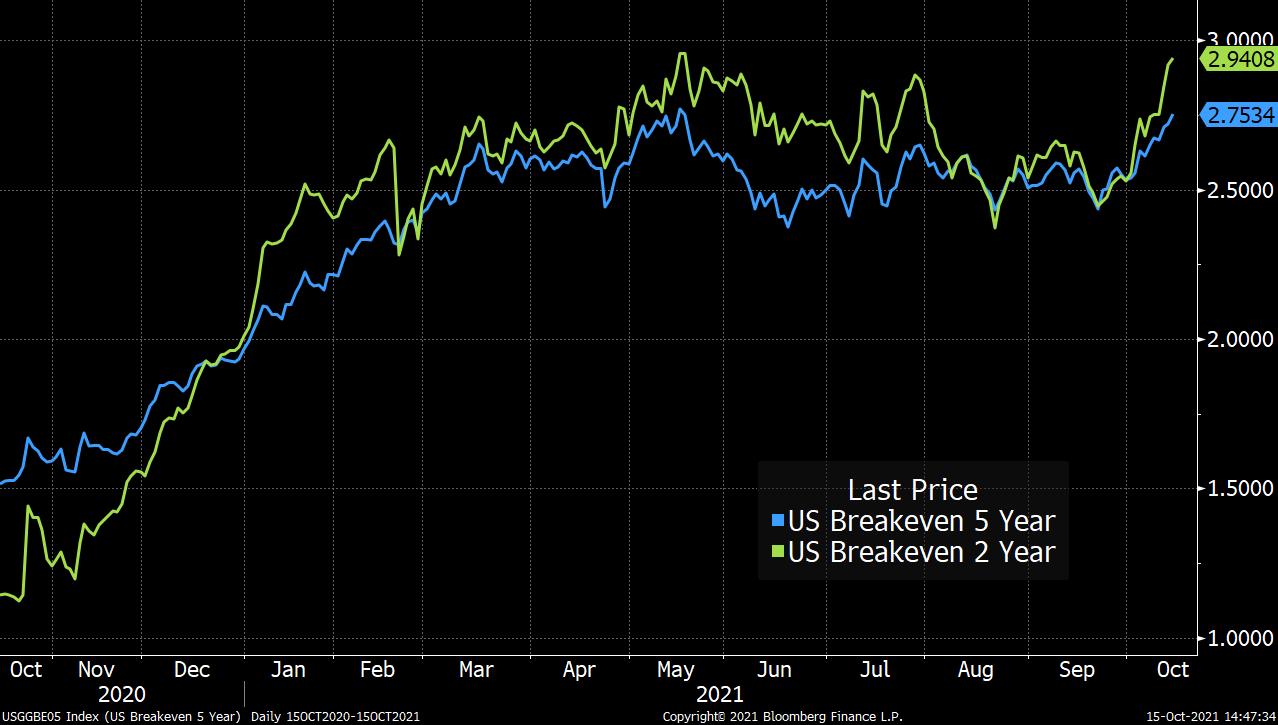
changed, while they remain very tight. Inflation breakeven rates, on the other hand, are up significantly after a jump in early October.
Barring an extreme event occurring during the next few weeks, it’s very likely that the Fed will begin to lower its current $120b monthly pur-
chase of U.S. Treasuries ($80b) and agency mortgage-backed securities ($40b) in November or December. This policy change has been well communicated to the markets and is widely expected. Many bond investors expect the Fed’s new policy to push Treasury yields higher and MBS spreads wider, but we believe
that most of the Fed’s upcoming moves are already reflected in the bond market. The Fed appears to be planning to maintain the size of its balance sheet – at least for a while – once the taper is complete next year.
The evolution of the COVID19 health crisis will be a key driver of interest rates during the next few months. Positive developments, including a move toward COVID-19 becoming more of a manageable “endemic” issue, are likely to push real rates higher, though the potential impact of this on inflation is ambiguous. One thing, however, can be said with confidence: a significantly negative turn in the health crisis (a new variant threatening the efficacy of vaccines, for example) would be highly likely to push Treasury yields lower and would be very negative for risky assets, including corporate bonds. Additionally, it would throw the Fed’s taper plans into turmoil. Unfortunately, this is an outcome that cannot be ruled out.
Source: Bloomberg
We hold more U.S. Treasury exposure in our fixed income portfolios than is typical for us, and we are underweight corporate bonds. Our MBS positioning has been tilted toward higher coupon bonds in most of our intermediate duration strategies, and this aided performance during the third quarter. Short duration strategies remain close to benchmark duration,
Source: Bloomberg
though these strategies have a yield advantage given their overweight position to MBS. We have positioned our fixed income portfolios conservatively in terms of credit exposure and duration, and will be looking to take advantage of short-term dislocations should turbulence in the markets create opportunities in the fourth quarter. The Fed’s plans are clear enough, but there will still be a lot for fixed income markets to digest in the coming months.
Brandon Fitzpatrick

THIS PUBLICATION IS FOR INFORMATIONAL PURPOSES ONLY. THIS PUBLICATION IS IN NO WAY A SOLICITATION OR OFFER TO SELL SECURITIES OR INVESTMENT ADVISORY SERVICES, EXCEPT WHERE APPLICABLE, IN STATES WHERE DB FITZPATRICK IS REGISTERED OR WHERE AN EXEMPTION OR EXCLUSION FROM SUCH REGISTRATION EXISTS.
INFORMATION THROUGHOUT THIS PUBLICATION, WHETHER STOCK QUOTES, CHARTS, ARTICLES, OR ANY OTHER STATEMENT OR STATEMENTS REGARDING MARKET OR OTHER FINANCIAL INFORMATION, IS OBTAINED FROM SOURCES WHICH WE AND OUR SUPPLIERS BELIEVE RELIABLE, BUT WE DO NOT WARRANT OR GUARANTEE THE TIMELINESS OR ACCURACY OF THIS INFORMATION.
BLOOMBERG FINANCE L.P. IS THE SOURCE UTILIZED FOR GRAPHS THROUGHOUT THIS PUBLICATION. THE GRAPHS ARE USED WITH PERMISSION OF BLOOMBERG FINANCE L.P. NEITHER WE NOR OUR INFORMATION PROVIDERS SHALL BE LIABLE FOR ANY ERRORS OR INACCURACIES, REGARDLESS OF CAUSE, OR THE LACK OF TIMELINESS OF, OR FOR ANY DELAY OR INTERRUPTION IN THE TRANSMISSION THEREOF TO THE USER. THERE ARE NO WARRANTIES, EXPRESSED OR IMPLIED, AS TO ACCURACY, COMPLETENESS, OR RESULTS OBTAINED FROM ANY INFORMATION CONTAINED IN THIS PUBLICATION.
NOTHING IN THIS PUBLICATION SHOULD BE INTERPRETED TO STATE OR IMPLY THAT PAST RESULTS ARE AN INDICATION OF FUTURE PERFORMANCE.