
INVESTMENT OUTLOOK


EQUITIES RISE AS HEALTH CRISIS IMPROVES
Throughout the second quarter, we saw markets accompany the continued reopening of the U.S. economy by adding to a series of record highs in indexes across the world. The economic recovery appears to be on solid ground and most of the sectors hardest hit by the pandemic – transportation and hospitality, for example – are bouncing back. The news with COVID-19 is not all good, of course, as most emerging market countries will continue to face daunting challenges with the virus for some time to come. Investors are optimistic, however, that the virus is on its way to becoming manageable in the U.S., Europe,
and Japan, with things eventually improving in the emerging markets.
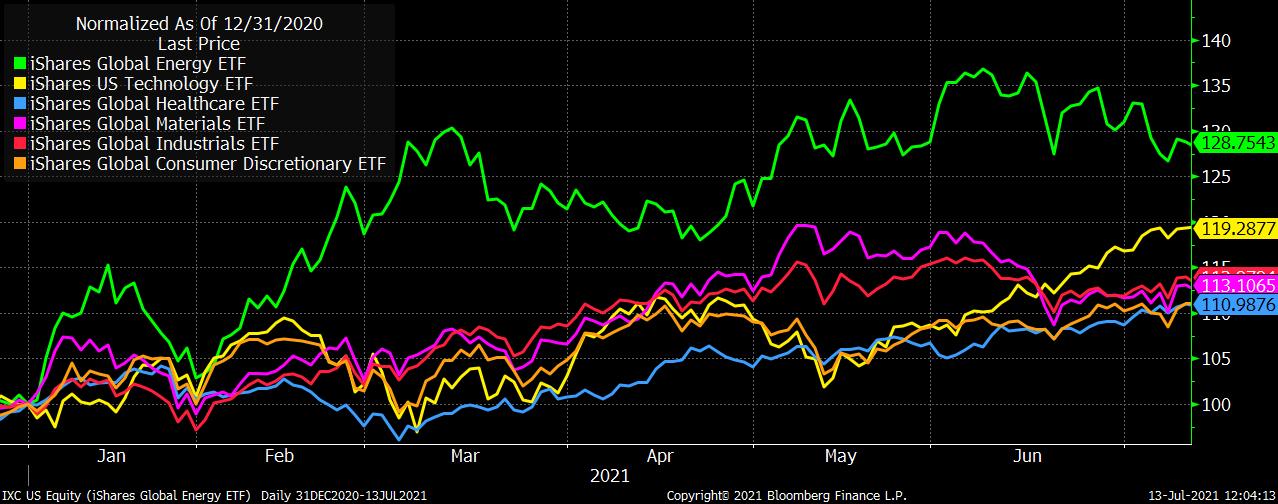
The MSCI All Country World Index, a measure of the global stock market, returned 7.5% in the second quarter as corporate earnings results have largely lived up to investors’ expectations. Growth stocks (generally defined as companies with higher longterm growth prospects and, consequently, higher valuations) outperformed value stocks during the quarter, with the Russell 1000 Growth Index returning 11.7% and the Russell 1000 Value Index returning 4.7%. The energy and
technology sectors outperformed the broader market during the second quarter, while the healthcare and consumer discretionary sectors underperformed.
Inflation has become an issue of increasing importance for investors in the past few months, as many worry that the economic reopening, combined with continued fiscal and monetary stimulus, will result in inflation becoming unmoored from the Federal Reserve’s (Fed) historical target of 2.0%. The 5-year inflation breakeven rate – roughly what investors expect inflation to be
Source: Bloomberg
U.S.InflationBreakevenRates
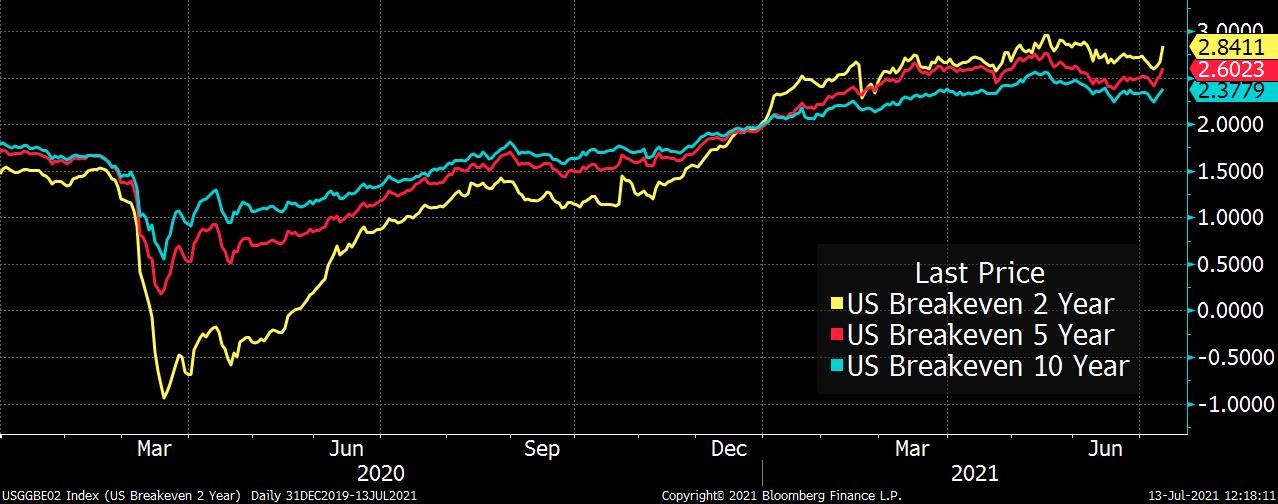
during the next five years – was close to 3.0% in May as inflation worries reached their recent apex, though this figure fell to 2.5% at quarter-end.
In light of these inflation worries, U.S. Federal Reserve policymakers have begun to debate the timing and scope of monetary policy tightening (a more hawkish monetary policy has the potential to lead to higher interest rates and could pressure the stock market). We believe that a slower pace of Fed purchases of U.S. Treasury bonds and agency mortgage-backed securities later this year is already discounted in the markets. The exact timing and nature of this monetary tightening cycle is subject to change, however, and investors will be paying close attention to economic data and policymakers’ comments during the remainder of the year. The good news for equities is that this Fed leadership team has proven quite wary about surprising investors with sudden policy changes. And, of
Source: Bloomberg
course, the risk of higher interest rates pressuring stocks must be balanced against the possibility of a continued strong economic recovery, which would be positive for the stock market. These factors appear roughly in balance today and we believe the stock market is fairly valued.
In addition to issues regarding inflation and monetary policy, there will be a lot for investors to work through as the health crisis winds down and the contours of the post-pandemic world begin to take shape. Equity sector valuations, for example, are likely to be impacted by the shape of the economic recovery, and this is something we’ll be closely monitoring in the coming months. A recovery faster than investors currently expect would likely benefit the consumer discretionary, energy, and industrial sectors. The technology sector is likely to do relatively better if the recovery were slower than what is expected today.
As the third quarter begins, our equity portfolios are overweight the healthcare and industrial sectors, and have underweight
positions to the financial, energy, and consumer discretionary sectors. We view most of our equity positions as long-term core
holdings, but monitor and screen for opportunities that present good value in companies that we have strong convictions in.
YIELD CURVE FLATTENS AS BOND INVESTORS LOOK TO FED
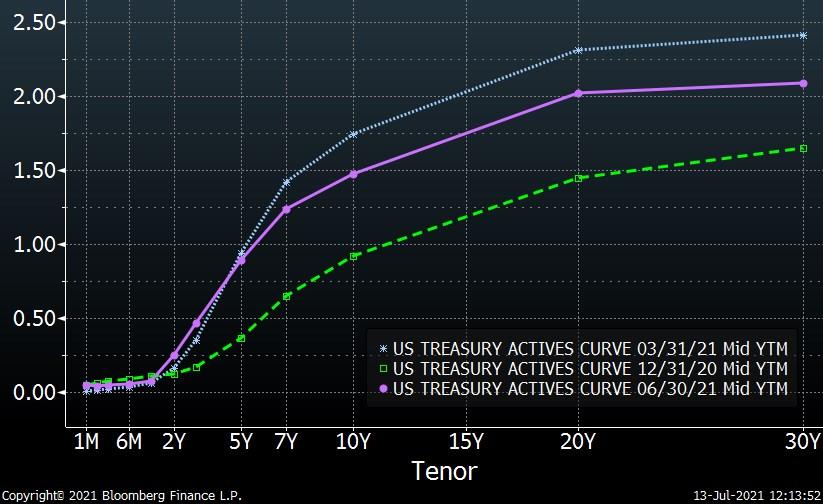
The U.S. Treasury yield curve flattened during the second quarter, with the long end of the curve falling moderately and the short end largely unchanged. Many bond investors began to worry in May that higher inflation breakeven rates might move U.S. Federal Reserve policymakers to tighten monetary policy faster than had been previously expected. These worries eased in June, however, after economic data showed the recovery to be weaker than booming numbers earlier in the quarter indicated. The weaker data were consistent with the consensus view of the Fed’s policymaking team that higher inflation is a short-term phenomenon, and the long end of the yield curve fell accordingly. It now appears likely that the longanticipated “tapering” by the Fed of monthly agency mortgage-backed se-
curity and U.S. Treasury purchases will begin sometime this fall. Higher short term interest rates will eventually be a part of the Fed’s toolkit as well, though this is unlikely to be utilized for at least another year. As ever with the Fed, the pace of monetary tightening will be data dependent, with a skew toward the dovish side this cycle as many policymakers remain skittish about the continuing risks of the COVID-19 health crisis. We forecast that the Fed will begin this tightening cycle in a measured and cautious way even if inflation breakeven rates again rise toward 3.0%.
Credit spreads in the fixed income markets are tight today, even tighter than before the pandemic struck in the spring of 2020. Corporate bond investors are bullish on the economic recovery and are happy that the Fed appears unlikely to dramatically decrease bond purchases this fall. Agency mortgage-backed security option-adjusted spreads are also relatively tight, though they have risen a bit in recent weeks as interest rate volatility increased.
We have positioned our fixed income portfolios conservatively with regards to credit , with an underweight to the sector and an emphasis on highly rated corporate bonds. Additionally, during the second quarter we continued to add to our Treasury exposure in portfolios with mandates not restricted to agency MBS, as we think it likely MBS optionadjusted spreads will eventually widen from today’s
levels. Such widening could occur later this year as the Federal Reserve refines its monetary policy plans.
Our intermediate duration portfolios have an overweight to higher coupon agency mortgage-backed securities, which offer additional yield and lower durations than lower coupon MBS. We expect this tilt to higher coupons to benefit our portfolios should interest rates rise. Our short duration portfolios are overweight seasoned mortgage-backed securities, which are of older vintages and have somewhat lessened liquidity than many recently issued MBS, though they have lessened refinance risk and attractive yields.
- Brandon Fitzpatrick, CFA

THIS PUBLICATION IS FOR INFORMATIONAL PURPOSES ONLY. THIS PUBLICATION IS IN NO WAY A SOLICITATION OR OFFER TO SELL SECURITIES OR INVESTMENT ADVISORY SERVICES, EXCEPT WHERE APPLICABLE, IN STATES WHERE DB FITZPATRICK IS REGISTERED OR WHERE AN EXEMPTION OR EXCLUSION FROM SUCH REGISTRATION EXISTS.
INFORMATION THROUGHOUT THIS PUBLICATION, WHETHER STOCK QUOTES, CHARTS, ARTICLES, OR ANY OTHER STATEMENT OR STATEMENTS REGARDING MARKET OR OTHER FINANCIAL INFORMATION, IS OBTAINED FROM SOURCES WHICH WE AND OUR SUPPLIERS BELIEVE RELIABLE, BUT WE DO NOT WARRANT OR GUARANTEE THE TIMELINESS OR ACCURACY OF THIS INFORMATION.
BLOOMBERG FINANCE L.P. IS THE SOURCE UTILIZED FOR GRAPHS THROUGHOUT THIS PUBLICATION. THE GRAPHS ARE USED WITH PERMISSION OF BLOOMBERG FINANCE L.P. NEITHER WE NOR OUR INFORMATION PROVIDERS SHALL BE LIABLE FOR ANY ERRORS OR INACCURACIES, REGARDLESS OF CAUSE, OR THE LACK OF TIMELINESS OF, OR FOR ANY DELAY OR INTERRUPTION IN THE TRANSMISSION THEREOF TO THE USER. THERE ARE NO WARRANTIES, EXPRESSED OR IMPLIED, AS TO ACCURACY, COMPLETENESS, OR RESULTS OBTAINED FROM ANY INFORMATION CONTAINED IN THIS PUBLICATION.
NOTHING IN THIS PUBLICATION SHOULD BE INTERPRETED TO STATE OR IMPLY THAT PAST RESULTS ARE AN INDICATION OF FUTURE PERFORMANCE.