
INVESTMENT OUTLOOK



EQUITIES RESILIENT ON VACCINE HOPES
The markets have begun the year largely following the trends that ended 2020, with bets on a robust recovery continuing to underpin investor confidence. Investors are increasingly optimistic that life in the U.S. will begin moving toward prepandemic routines sometime later this summer, with other wealthy parts of the world following suit in short order. The news is not all good, of course – new virus strains could threaten vaccine efficacy, and the task of controlling COVID-19 in poorer parts of the world is certain to go into 2022 and will probably go beyond this – but on balance there is considerable optimism in the markets that better days lie ahead later this year.
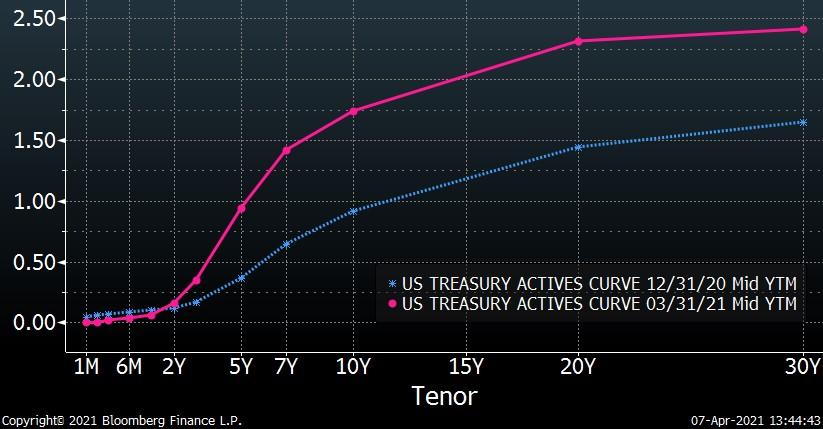
This sanguine outlook has been most evident in the bond market, as longer term U.S. Treasury bond yields rose meaningfully during the first quarter. The 10-year Treasury bond yield rose 81 basis points in the quarter to 1.74%, while the 30year U.S. Treasury yield was up 76 basis points to 2.41%. Longer term Treasury yields are correlated with expectations for economic growth, and better growth prospects have been a major force pushing longer term yields higher. Higher inflation expectations have played a role as well, with investors expecting inflation to rise as the pandemic winds down and increased fiscal stimulus takes effect.
Higher interest rates have the
potential to negatively impact the equity market, but to this point investor optimism regarding economic growth has been the stronger force for stocks. Broad equity indexes rose modestly in the first quarter, with the MSCI All Country World Index, a measure of the global stock market, returning 4.68%, and the large cap domestic S&P 500 returning 6.17%.
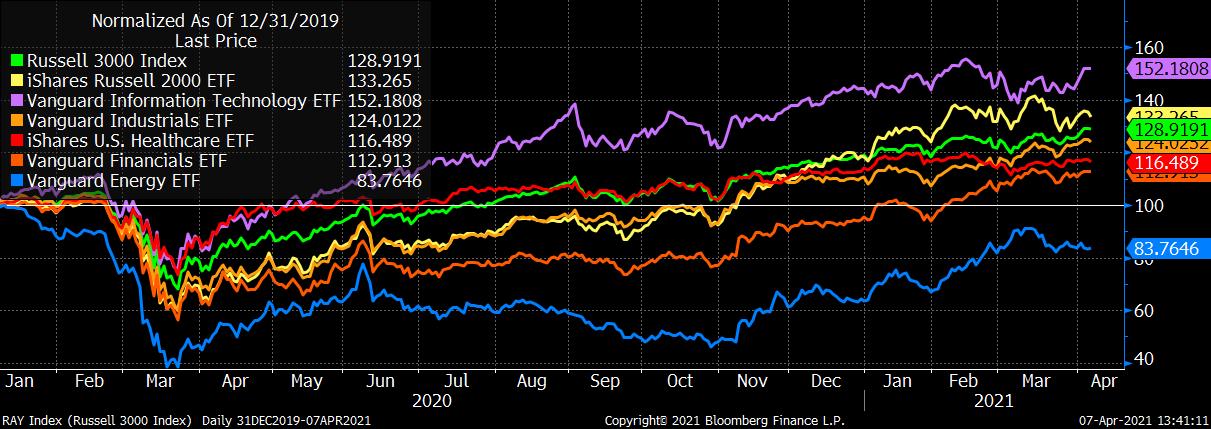
There was significant disparity of results across sectors, however, as higher interest rates and the prospect of economic reopening affected industries in different ways. The financial, energy, and industrial sectors all outperformed the broad equity market during the first quarter, while the technology,
Source: Bloomberg
healthcare, consumer staple, and utility sectors underperformed. Higher interest rates have benefitted bank and insurance stocks, while expectations for faster economic growth have benefited many industrial stocks. Small cap stocks also outperformed the market during the first quarter as investors rotated away from large cap positions. On the other hand, higher interest rates have been a negative factor for consumer staples, utilities, and technology stocks, whose valuations had extended outside typical ranges. The ramp-up of vaccines has had a mixed impact on the healthcare sector. Some healthcare companies will be negatively impacted by lessened need for COVID-19 testing and pandemic-related research, while others will benefit from increased demand for medical procedures not related to COVID-19.
The short-term outlook for equities is cloudy. Economic growth will pick up considerably by midsummer, but this expectation is already discounted in the markets. The impact of economic growth on equities during the remainder of the year will depend on deviations from current market expectations, and this is difficult to forecast with much confidence today.
Interest rates will remain a crucial factor for stocks this year as well, with higher rates having the potential to threaten still elevated valuations across sectors, and lower rates benefitting stocks (all else equal). There are many factors at play and in our view the short-term bullish and bearish forecasts for equities are roughly in balance, with no obvious direction for stocks in the second quarter.
Our equity portfolios are positioned with the long term in mind. We have overweight positions to the healthcare and industrial sectors, with underweights to energy, materials, and consumer discretionary stocks. We have recently added slightly to our technology and consumer discretionary positions, while decreasing exposure to the energy and financial sectors. Given the significant macro factors at play in the economy and financial markets, it’s likely that sector allocation will remain a major driver of equity returns during the remainder of the year. We’ll be looking to adjust sector positioning as broader trends in the economy and financial markets create opportunities. There will be much for the market to digest in the coming months.
FIXED INCOME: STEEPER YIELD CURVE AS INFLATION EXPECTATIONS RISE
The COVID-19 vaccine rollout combined with continued monetary and fiscal stimulus has many investors expecting faster economic growth and higher inflation in the
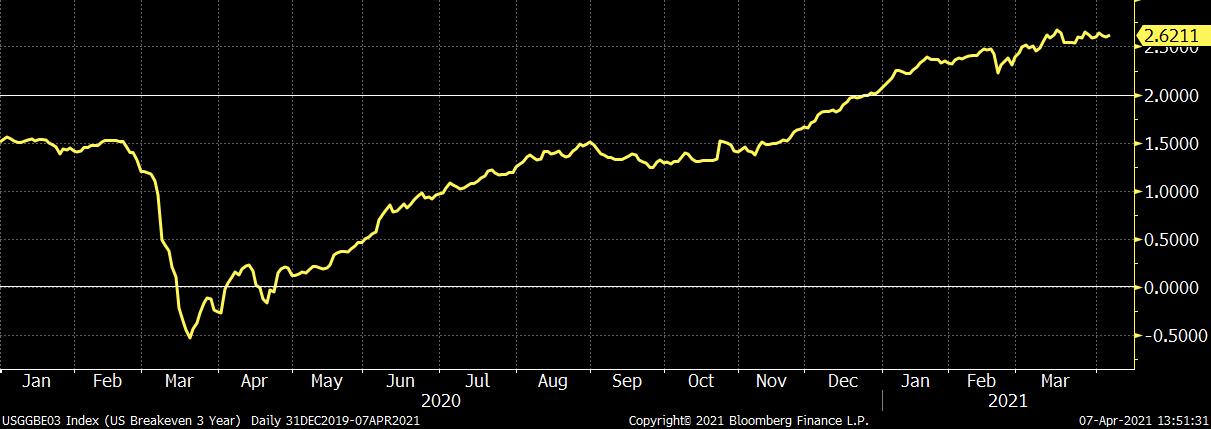
near future. Consequently, the U.S. Treasury yield curve steepened significantly in the first quarter. Higher inflation expectations contributed to this steepening, with the 3-year
breakeven inflation rate rising 53 basis points during the first quarter to 2.60%. U.S. Federal Reserve (Fed) policymakers had great difficulty coaxing inflation expectations
U.S.TreasuryYieldCurve
toward 2.0% in the decade after the financial crisis, but now breakeven inflation rates are well above 2.0% for all tenors.
This expected jump in inflation, combined with a strong equity market and tight spreads throughout the bond market, has led to increased speculation that Fed policymakers will choose to scale back monetary stimulus sometime soon. Currently the Fed is purchasing $80 billion of U.S. Treasuries and $40 billion of agency mortgage-backed securities each month as part of a broader stimulus package in effect since last spring. Despite the speculation, Fed policymakers continue to insist that they see significant risk of economic malaise in the coming years as a result of the pandemic, and as of yet have given no hints of slowing down stimulus. They will find it increasingly difficult to maintain this position if investors’ expectations for inflation continue to rise, however, and we
Source: Bloomberg
expect some curtailment of bond purchases by the Fed this summer.
Agency mortgage-backed securities outperformed Treasuries during the first quarter, as would be expected given the sharp rise of longer-term interest rates. The Bloomberg Barclays U.S. MBS Index returned -1.10% during the quarter, while the Bloomberg Barclays U.S. Treasury Intermediate Index returned -1.76%. Rising long-term interest rates have led to some notable movement within the agency MBS market, as negative convexity decreased and duration extended for lower coupon securities. Higher coupon securities with prepayment protection did very well early in the quarter, but underperformed a bit in February when the 10-year Treasury yield rose above 1.50%. At levels here and above, the inherent prepayment protection these securities offer becomes less valuable to investors.
Source: Bloomberg
Mortgage-backed security spreads are reasonably tight, but these securities are still attractive given their higher yields compared to similar duration U.S. Treasuries. That said, MBS spreads are tighter than historical averages and we have decreased our underweight position to Treasuries slightly in fixed income strategies in recent weeks. We’ll be looking to add to Treasury positions early in the second quarter in intermediate duration portfolios, while staying close to current weights in short-duration strategies. If market sentiment turns more pessimistic for any reason – decreased monetary stimulus from the Fed, lower economic growth than the market expects, or some other reason – we will look to take advantage of higher spreads by selling Treasuries and rebalancing back into agency MBS.
BrandonFitzpatrick,CFA

THIS PUBLICATION IS FOR INFORMATIONAL PURPOSES ONLY. THIS PUBLICATION IS IN NO WAY A SOLICITATION OR OFFER TO SELL SECURITIES OR INVESTMENT ADVISORY SERVICES, EXCEPT WHERE APPLICABLE, IN STATES WHERE DB FITZPATRICK IS REGISTERED OR WHERE AN EXEMPTION OR EXCLUSION FROM SUCH REGISTRATION EXISTS.
INFORMATION THROUGHOUT THIS PUBLICATION, WHETHER STOCK QUOTES, CHARTS, ARTICLES, OR ANY OTHER STATEMENT OR STATEMENTS REGARDING MARKET OR OTHER FINANCIAL INFORMATION, IS OBTAINED FROM SOURCES WHICH WE AND OUR SUPPLIERS BELIEVE RELIABLE, BUT WE DO NOT WARRANT OR GUARANTEE THE TIMELINESS OR ACCURACY OF THIS INFORMATION.
BLOOMBERG FINANCE L.P. IS THE SOURCE UTILIZED FOR GRAPHS THROUGHOUT THIS PUBLICATION. THE GRAPHS ARE USED WITH PERMISSION OF BLOOMBERG FINANCE L.P. NEITHER WE NOR OUR INFORMATION PROVIDERS SHALL BE LIABLE FOR ANY ERRORS OR INACCURACIES, REGARDLESS OF CAUSE, OR THE LACK OF TIMELINESS OF, OR FOR ANY DELAY OR INTERRUPTION IN THE TRANSMISSION THEREOF TO THE USER. THERE ARE NO WARRANTIES, EXPRESSED OR IMPLIED, AS TO ACCURACY, COMPLETENESS, OR RESULTS OBTAINED FROM ANY INFORMATION CONTAINED IN THIS PUBLICATION.
NOTHING IN THIS PUBLICATION SHOULD BE INTERPRETED TO STATE OR IMPLY THAT PAST RESULTS ARE AN INDICATION OF FUTURE PERFORMANCE.