
INVESTMENT OUTLOOK


EQUITIES RESPOND TO “ENDEMIC” HOPES
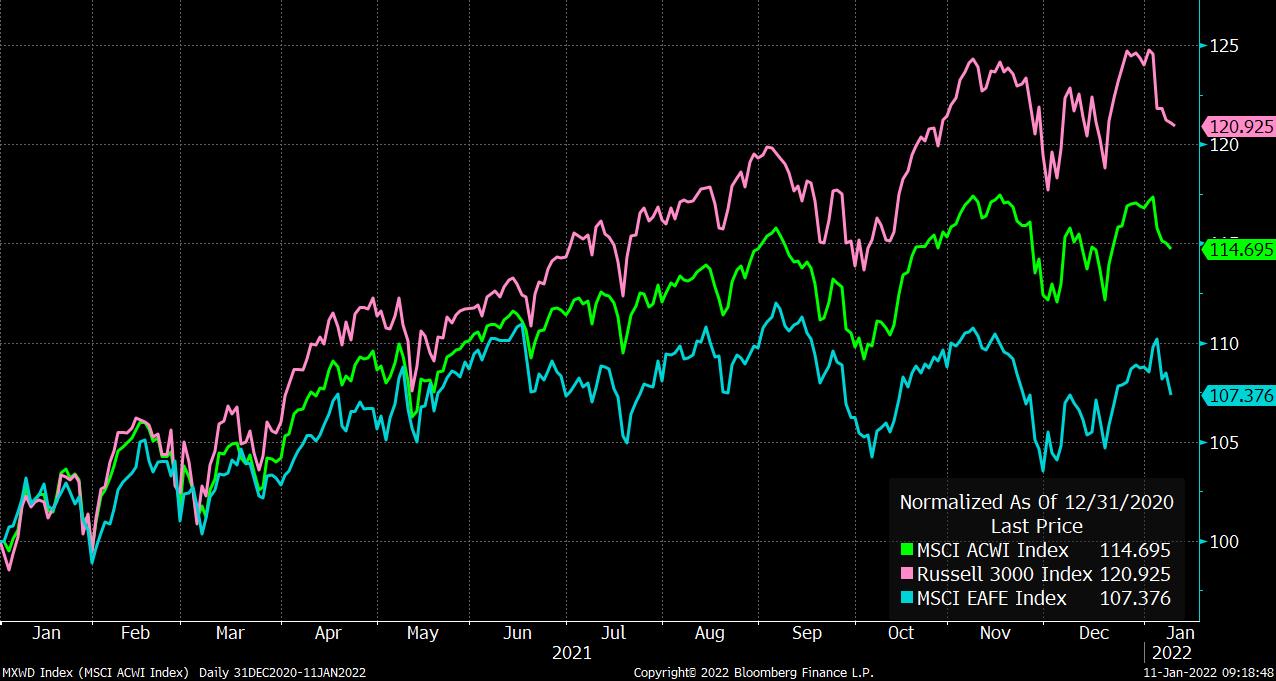
The Omicron COVID-19 variant appears to be highly infectious, but investors have taken heart from the fact that currently available vaccines continue to offer good protection against serious illness. This has decreased fears of widespread lockdowns – the market’s main worry – and has many looking to a future in which the world learns to live with the virus. Reflecting this sanguine outlook, most broad equity indices rose in the fourth quarter (even after Omicron was discovered), closing out a strong 2021. The MSCI All Country World Index, a measure of the global stock market, returned 19.0% last year, while the Russell 3000 Index, a measure of the U.S. equity market rose 25.7%. The MSCI EAFE Index (international developed stocks) returned 11.9% in 2021.
The COVID-19 pandemic remains the most important issue for
the financial markets. The pandemic’s impact on consumer and worker behavior remains significant, while the risk that new variants will render vaccines ineffective at lowering hospitalization and death rates continues to cast somewhat of a shadow over investor sentiment. Such an outcome would be very negative for equities, but most investors continue to believe it more likely that vaccines will remain effective, with economically damaging lockdowns around the world this year limited in number and scope. The capital markets are forecasting that the world will find a way to muddle through the pandemic until COVID-19 becomes
EquityReturnsSince Startof 2021
a more manageable endemic illness, with the majority of the world vaccinated sometime in 2022. While cognizant of the risks, we continue to agree with the consensus that this outcome is the most likely.
The risks to investor sentiment today are significant, but it’s important also to consider the possibility (we would say likelihood) that the pandemic will eventually become less impactful to the global economy as global vaccination rates climb this year. There is considerable pent-up demand among consumers that will continue to be released if COVID-19 transforms into a more manageable
Source: Bloomberg
endemic illness, and there is a good chance that the world will take significant strides in 2022 toward this outcome.
Our equity portfolios have an overweight position to domestic stocks, though we have added to international
positions in recent weeks. Additionally, our portfolios have overweight positions to the industrial, healthcare, and materials sectors, with underweight positions to energy, consumer discretionary, and financial stocks.
INFLATIONARY PRESSURES LIKELY TO EASE
Higher inflation, especially in the U.S., is an important issue confronting the capital markets as 2022 gets underway. The Consumer Price Index jumped during the fourth quarter to 6.8%, reflecting pandemicrelated supply bottlenecks and labor shortages. Inflation breakeven rates also rose. 2 and 5-year inflation breakeven rates were 3.21% and 2.91%, respectively, at the end of December, near multi-year highs. The pandemic is the ultimate cause of this, as labor supply remains constrained and many logistical bottlenecks around the globe that sprung up during the last year are not yet resolved.
The outlook for inflation going forward is cloudy and characterized by an unusually wide distribution of po-
tential outcomes. Much depends on the course of the pandemic, but there’s reason to believe inflationary pressures will ease in 2022 if vaccines remain effective and new treatments limit hospitalizations and lower death rates. This would help reverse logistical bottlenecks and constrained labor supply. Additionally, the U.S. Federal Reserve (Fed) announced in December that it would quicken the pace of the previously announced “taper” of Treasury and agency mortgage-backed security
(MBS) purchases, which was previously scheduled to be completed in June. The end date has now been moved up to March. And in another change from previous messaging, several Fed policymakers indicated in December that multiple hikes to the fed funds rate may be appropriate in 2022. The Fed has only begun to set its sights on controlling inflation and with more aggressive action should be able to bring market expectations closer to the 2.5%2.75% range by late 2022.
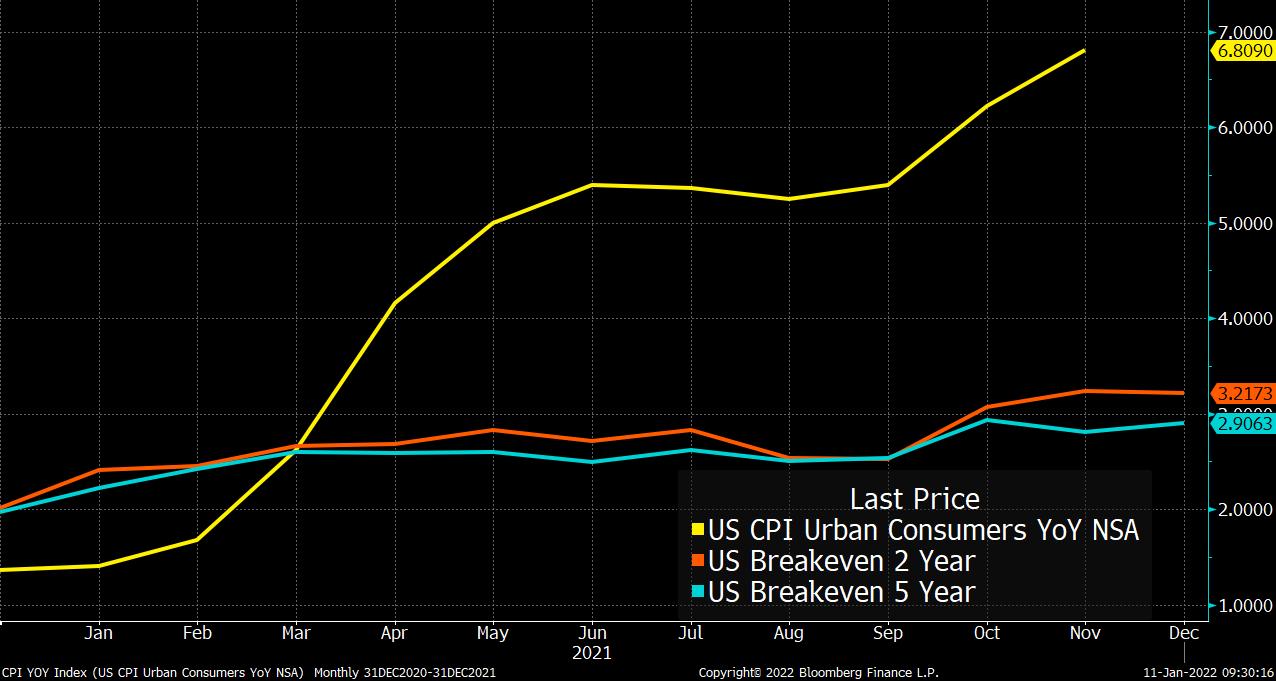
InflationWasUpin2021
The continued COVID-19 pandemic leads to significant uncertainty with this forecast, however, as a deterioration with the health crisis could prolong inflationary pressures even in the face of aggressive Fed action. There is much debate in the market about this, but we
take the view that it’s more likely that inflationary pressures will ease in 2022, with increased global vaccination rates and improved COVID-19 treatments helping the pandemic transition to its endemic phase.
YIELD CURVE FLATTENS AS FED TURNS HAWKISH
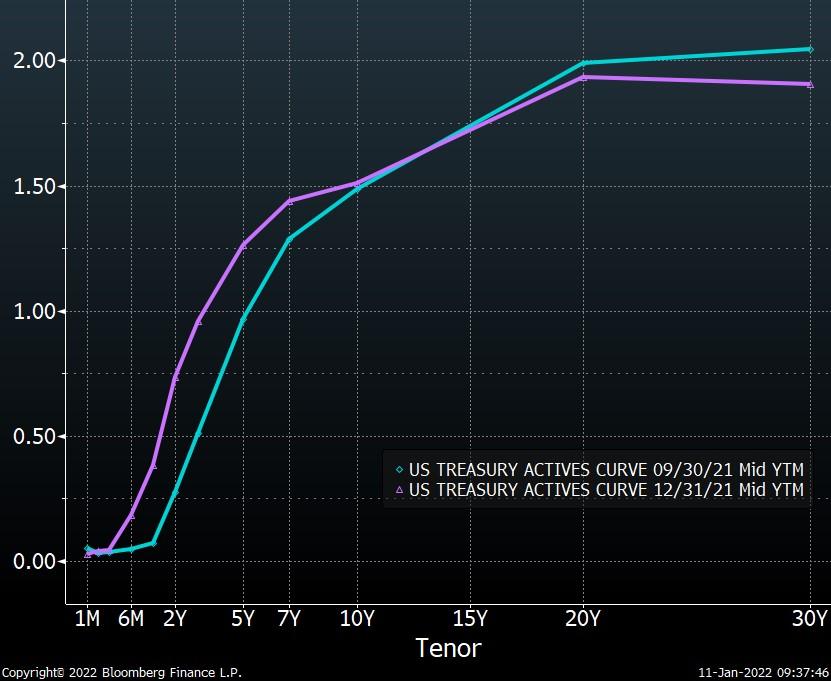
U.S. Treasury bonds saw heightened volatility during the fourth quarter, with the Treasury yield curve ultimately flattening by the end of December. Short-term Treasury yields rose as the U.S. Federal Reserve began communicating a more hawkish tone, with longer term yields falling a bit as inflationary expectations fell during the last weeks of December. The yield of a 2-year Treasury bill increased 46 basis points to 0.73% during the quarter, while the yield of a 30-year Treasury bond fell 15 basis points to 1.90%.
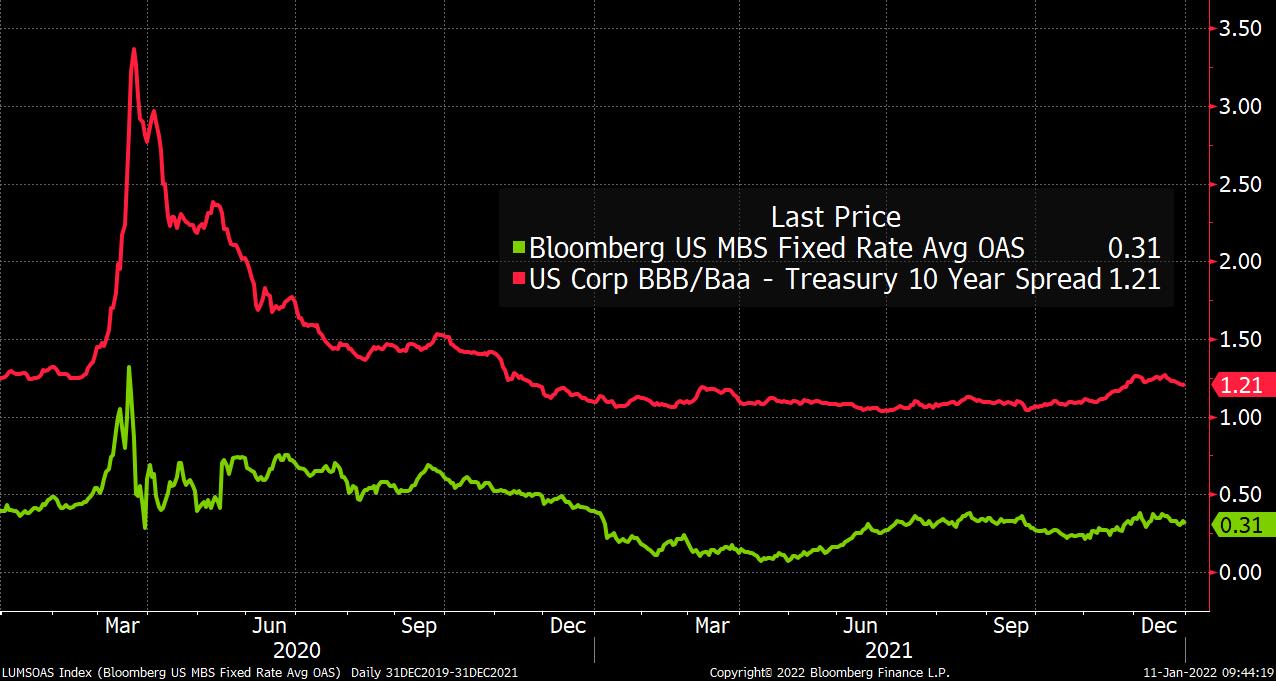
Spreads on corporate bonds remain quite tight and we expect widening in 2022 as the Fed continues down its recently announced hawkish path. Agency mortgage-backed security spreads increased slightly during the fourth quarter, but less
than many expected after the Fed announced the speeding up of the taper of MBS purchases in December. We continue to see relative value in agency MBS versus corporate bonds and durationequivalent Treasuries.
Our fixed income strategies are conservatively positioned, with
underweight positions to corporate bonds and U.S. Treasuries, and overweight positions to agency mortgage-backed securities. Both intermediate duration and short duration strategies are close to their benchmark durations, though they are slightly up in yield given their overweight position to MBS. We’ll be looking to increase exposure to
MBS further should optionadjusted spreads widen and will consider additional corporate exposure should risky assets falter in the coming months.
BrandonFitzpatrick,CFA
Source: Bloomberg

THIS PUBLICATION IS FOR INFORMATIONAL PURPOSES ONLY. THIS PUBLICATION IS IN NO WAY A SOLICITATION OR OFFER TO SELL SECURITIES OR INVESTMENT ADVISORY SERVICES, EXCEPT WHERE APPLICABLE, IN STATES WHERE DB FITZPATRICK IS REGISTERED OR WHERE AN EXEMPTION OR EXCLUSION FROM SUCH REGISTRATION EXISTS.
INFORMATION THROUGHOUT THIS PUBLICATION, WHETHER STOCK QUOTES, CHARTS, ARTICLES, OR ANY OTHER STATEMENT OR STATEMENTS REGARDING MARKET OR OTHER FINANCIAL INFORMATION, IS OBTAINED FROM SOURCES WHICH WE AND OUR SUPPLIERS BELIEVE RELIABLE, BUT WE DO NOT WARRANT OR GUARANTEE THE TIMELINESS OR ACCURACY OF THIS INFORMATION.
BLOOMBERG FINANCE L.P. IS THE SOURCE UTILIZED FOR GRAPHS THROUGHOUT THIS PUBLICATION. THE GRAPHS ARE USED WITH PERMISSION OF BLOOMBERG FINANCE L.P. NEITHER WE NOR OUR INFORMATION PROVIDERS SHALL BE LIABLE FOR ANY ERRORS OR INACCURACIES, REGARDLESS OF CAUSE, OR THE LACK OF TIMELINESS OF, OR FOR ANY DELAY OR INTERRUPTION IN THE TRANSMISSION THEREOF TO THE USER. THERE ARE NO WARRANTIES, EXPRESSED OR IMPLIED, AS TO ACCURACY, COMPLETENESS, OR RESULTS OBTAINED FROM ANY INFORMATION CONTAINED IN THIS PUBLICATION.
NOTHING IN THIS PUBLICATION SHOULD BE INTERPRETED TO STATE OR IMPLY THAT PAST RESULTS ARE AN INDICATION OF FUTURE PERFORMANCE.