



ARATEHIKEISLIKELY
Low interest rates have provided fuel for equities and other risky assets in 2016, and all eyes are on the Federal Reserve as we enter the final months of the year. Fed policymakers originally wanted to raise the fed funds rate (their target interest rate) four times this year, but were forced to hold rates steady in the spring after the dollar surged and equity prices fell in January and February. The unexpected ‘Brexit’ vote in June, in which voters in the United Kingdom opted to leave the European Union, made a rate hike during the summer inopportune as well, and in the end the fed funds
rate has not been changed all year. An increasingly vocal group of inflation hawks is clamoring for a return to ‘normal’ interest rate policy, however, and, barring an unforeseen shock to the financial markets, a policy change is in the offing. We are forecasting a rate hike in December, and believe that this will lead to heightened volatility in the equity and bond markets in the fourth quarter, as the hike is not fully factored into today’s prices. The hike is bullish for the U.S. dollar and bearish for commodities and more risky sectors of the equity market.
FIXEDINCOME
The bull market in fixed income has continued unabated this year. Europe has been a major factor, with the European Central Bank’s €80 billion monthly purchase of sovereign and corporate bonds pushing global interest rates lower. Bond yields in Europe have fallen significantly this year, with yields of 10-year sovereign bonds of France, Germany, and Holland all below 0.30% today. Remarkably, a 10-year Swiss government bond today yields -0.55%. This dearth of yield available in Europe has pushed money into the U.S. bond market, and the yield on a 10-year Treasury bond fell from 2.27% at the start of the year to 1.36% in
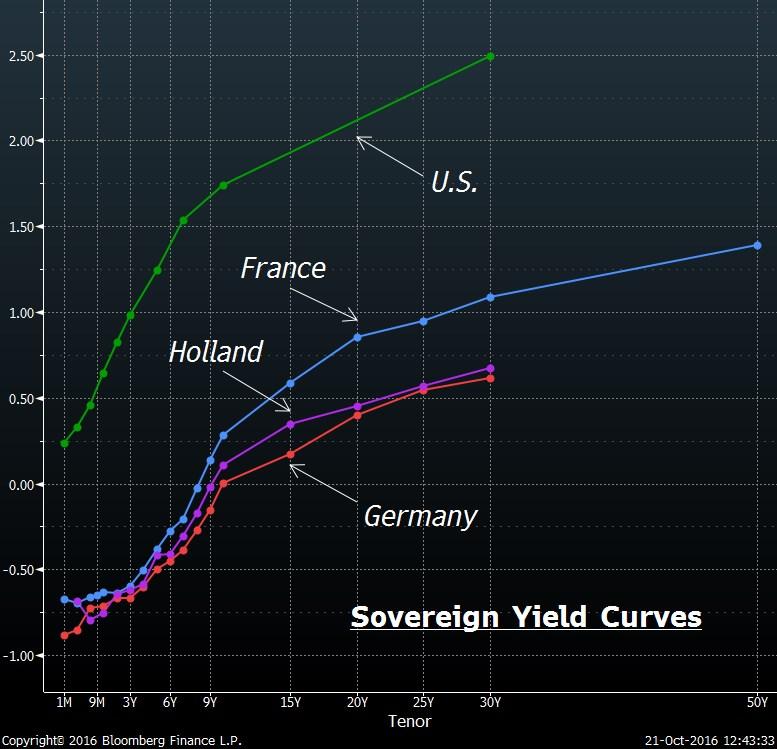
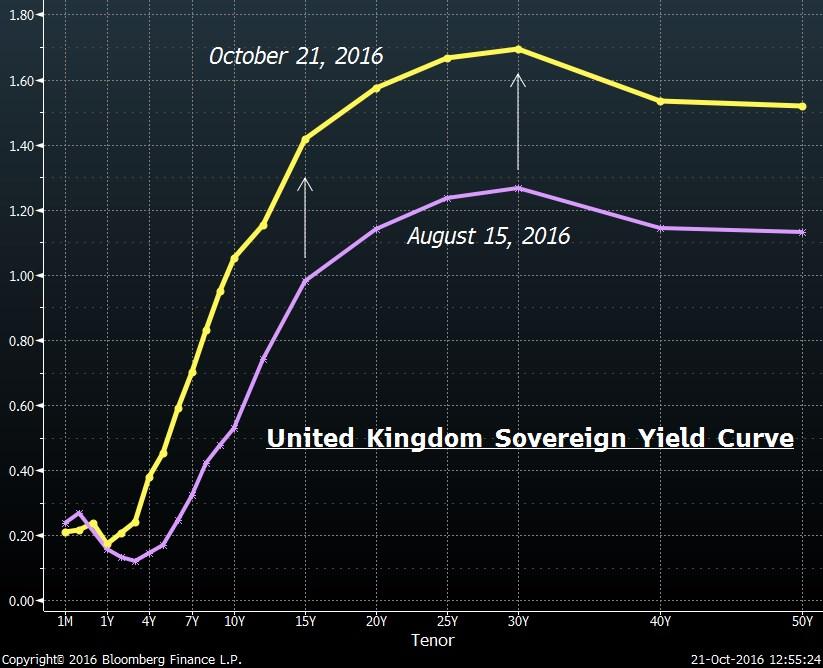
July. The yield of a 10-year Treasury bond today sits at 1.74%. The United Kingdom represents a special case in Europe, as its yield curve has risen significantly since August. The British pound has sold off, and is down 18% against the U.S. dollar since the day the Brexit vote was held. Inflation in the U.K has spiked since June, with investors expecting inflation during the next five years to be 3.0%, up from 2.2% in June.
As yields of safe haven bonds have fallen, credit spreads have tightened. The spread of the 5-7 year BBB U.S. Corporate Index fell from 2.80% in January to 1.80% at the end of September, and higher rated corporate indices have shown similar, if less pronounced, moves. Agency mortgage backed securities have also performed well this year, as spreads over Treasuries have held steady in spite of falling Treasury yields.
Whether this dynamic continues during the next year will depend largely on the decisions of central bankers in Europe and the U.S. The bond market received a minor jolt in early October, with yields rising, as media reports stoked rumors that European Central Bank policymakers were considering a slowdown of their bond purchase program. The bond market has calmed since then, however, as ECB leaders have reassured investors that no immediate policy change is forthcoming.
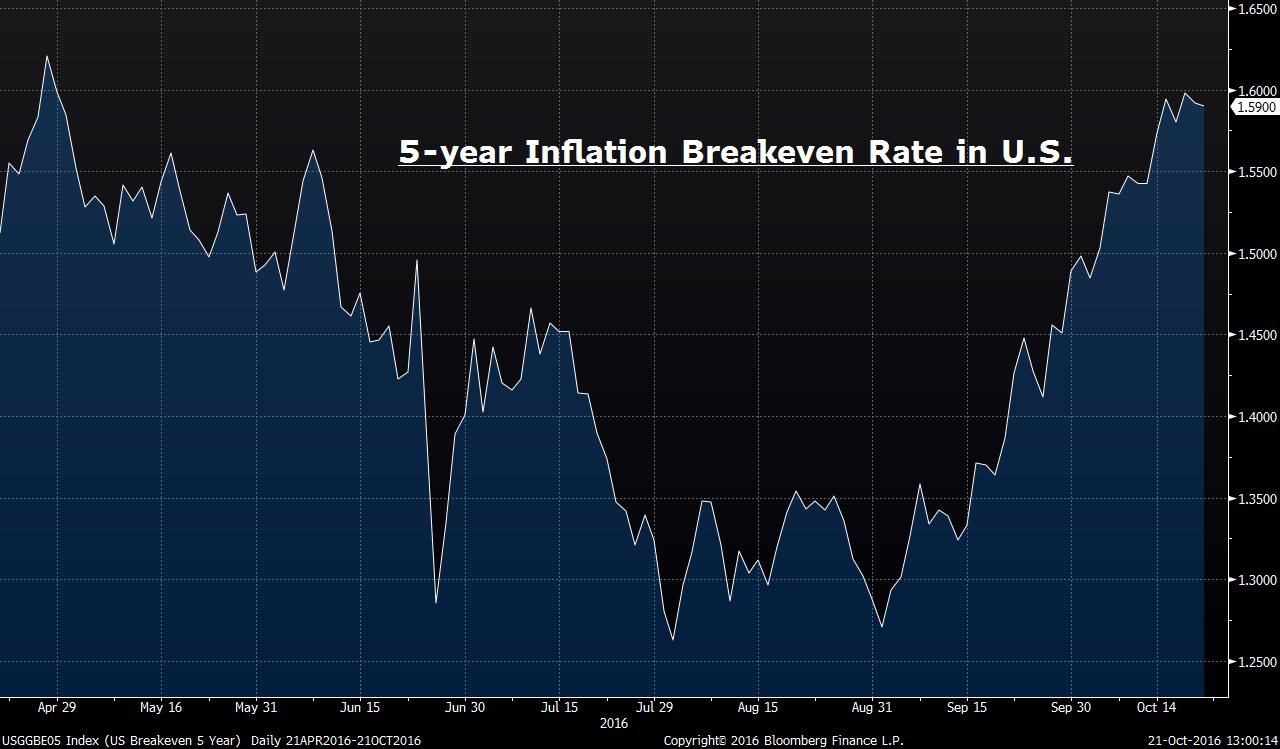
Monetary policy in the U.S. will also play an important role. The Federal Reserve has faced a familiar pattern during the last few years: inflation breakeven rates – the inflation rate investors are predicting for the future – have typically fallen as the Fed neared a decision to raise rates. As the inflation hawks at the Fed have grown louder during the last six weeks, however, inflation breakeven rates have risen. The 5-year inflation breakeven rate rose from 1.29% at the end of August to 1.59% in mid-October, while the 10year inflation breakeven rate rose from 1.47% to 1.68% during the same period. Much of this increase is explained by the rising price of oil, with the price of a barrel of WTI crude rising above $50 today versus $44 at the end of August. Even so, higher inflation breakeven rates might convince some Fed governors that a rate hike in December would be palatable for investors. Additionally,
‘core’ inflation in the U.S., which removes the effect of food and energy prices, was up 2.2% at the end of September, near a 5-year high. Fed leaders closely watch core inflation, and this number gives the hawks at the Fed additional ammunition in their push for a rate hike this year.
EQUITIES
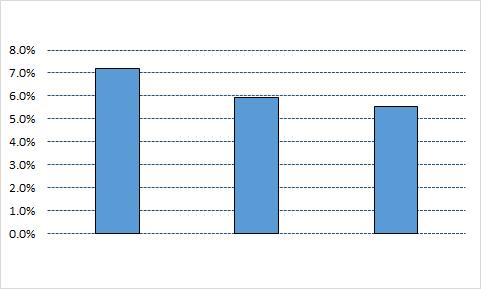
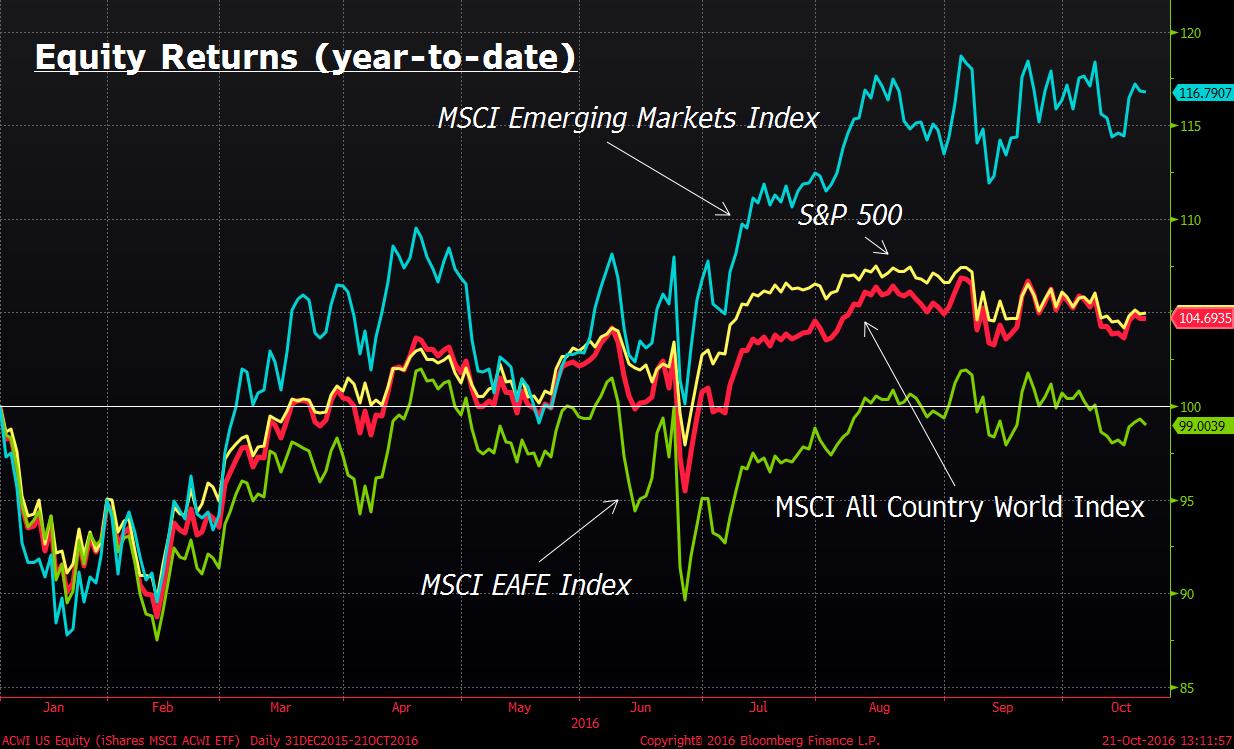
The stock market was up in the third quarter as global interest rates remained low. The MSCI All Country World Index, which measures the global stock market, returned 5.4% in the quarter and 7.1% year-to-date through the end of September. The S&P 500 returned 7.8% year-to-date through September while the MSCI Emerging Markets Index returned 16.3%. All of these indices have benefited from falling safe-haven bond yields, with emerging market
stocks benefitting most of all. The earnings yield of the broader stock market has followed bond yields lower, and the earnings yield (using 2016 earnings) of the S&P 500, MSCI All Country
World Index, and MSCI Emerging Market Index is currently 5.5%, 6.0%, and 7.3%, respectively. These yields are reasonable given the state of the bond market, and we think equity
valuations today are reasonable, though not cheap.