15





15
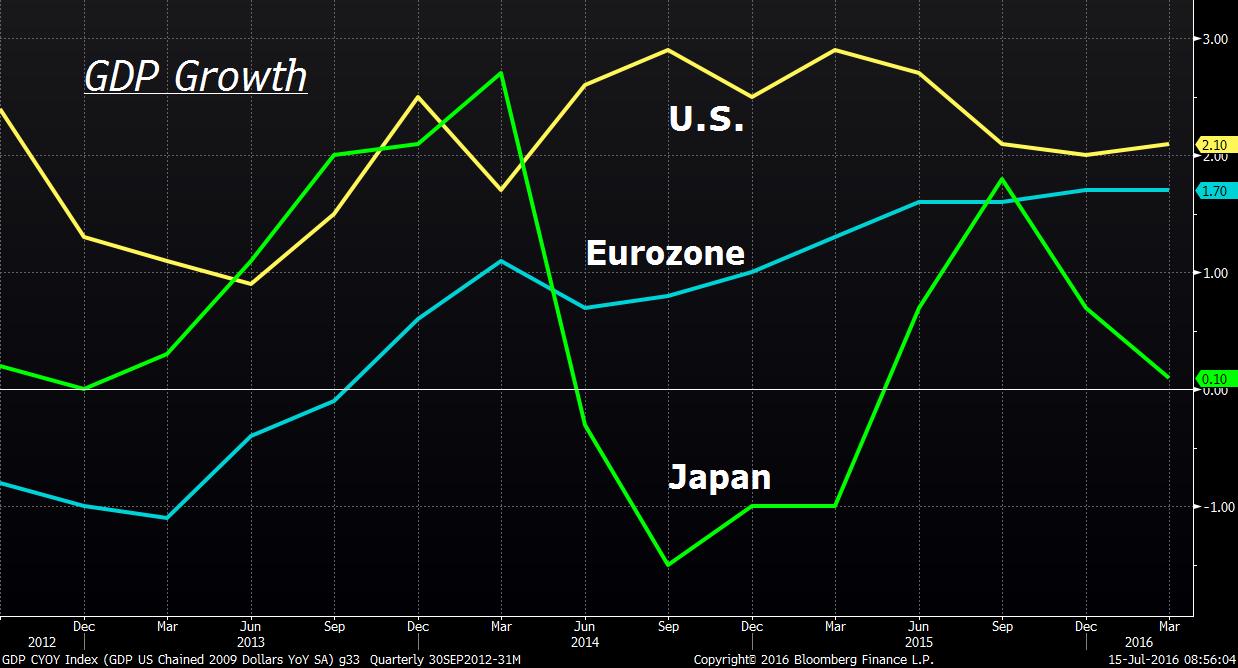
Global economic growth remains lackluster, but in an ironic twist this has been positive for equities as falling interest rates have provided fuel for the stock market. The U.S. economy grew a disappointingly slow 2.1% during the last year, while the Eurozone’s economy expanded 1.7% and growth in Japan was close to zero. China’s economy grew 6.7% (at least according to the government’s official figures), but this is down from previous years and the government has been repeatedly forced to lower its economic growth target. With this backdrop of disappointing growth, investors are also grappling with the U.K.’s unexpected decision to leave the European Union, and a renewed protectionist movement in the U.S. All of these factors have conspired to push interest rates downward, and this has sent ripples throughout
other areas of the financial markets, including equities, commodities, corporate bonds, and even commercial real estate. All of these groups have benefitted as yields on safe-haven bonds sit at rock bottom levels and investors rotate into more risky, and potentially more lucrative areas of the capital markets. We think this is a good time to be cautious, however, both in bond and equity portfolios. We favor mortgage backed securities in the fixed income market and healthcare, consumer staples, and industrials (one of the last sectors with attractive valuations) in the equity market.
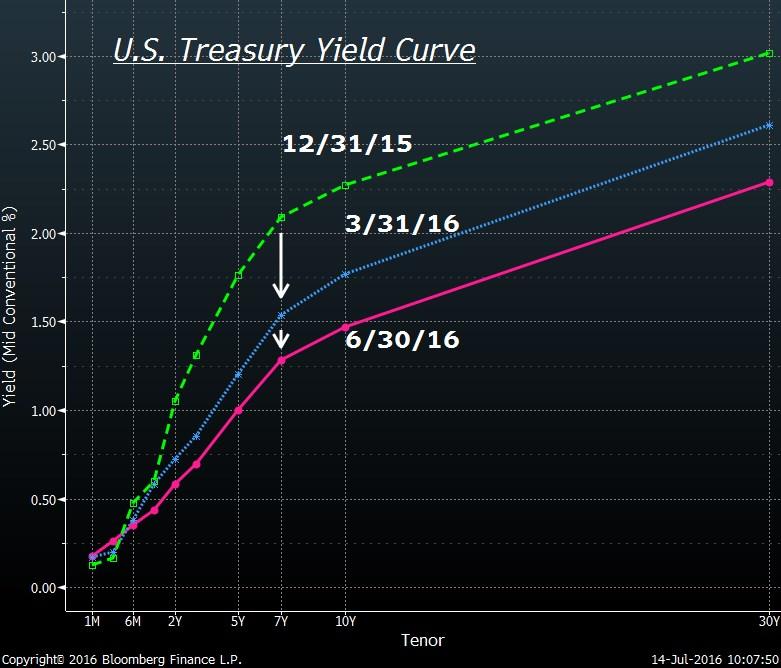
The bull market in fixed income continued in the second quarter, with yields falling on all but the shortest tenors of the yield curve.
The U.S. Federal Reserve’s stated plan in late 2015 to raise interest rates four times this year is now a distant memory, as disappointing economic data in the U.S. and continued weakness in Europe have convinced Fed policymakers that holding rates
steady is a safer bet. The Brexit decision in late June further cemented the Fed’s new strategy, and now bond investors see a roughly 40% probability that the fed funds rate will be unchanged through all of 2017.
Continued malaise in Europe has been an especially important factor in the fixed income market this year. GDP growth in the Eurozone has not reached 2.0% since 2011 and the unemployment rate remains in the double digits. The European Central Bank has been buying at least €60 billion per month of euro-area bonds from central governments, agencies, and European institutions since early 2015 in a bid to jumpstart the economy, and plans to continue the purchases until at least September of this year. This quantitative easing program has pushed European sovereign yields downward, while the Brexit vote and the uncertainty it unleashed in late June pushed yields even lower in the last week of the quarter. Many of the shorter tenors of European sovereign yield curves are negative, while Swiss sovereign bonds the most extreme case have negative yields on all maturities less than 50 years. The extremely low yields in Europe’s bond market have depressed yields in virtually all sectors of the U.S. fixed
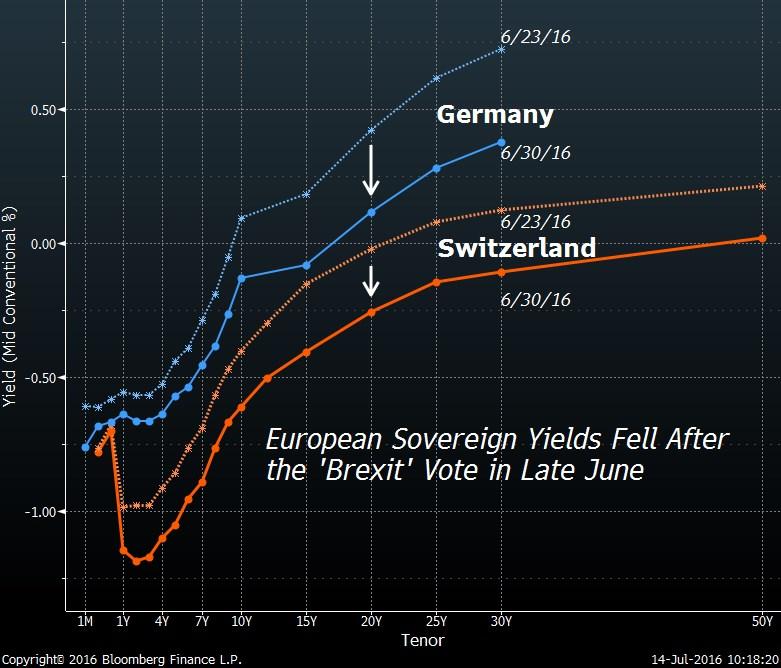
income market.
Despite the sluggish global economy, corporate bonds have performed well this year as investors have looked to credit in the increasingly difficult search for yield. The Barclays U.S. Investment
Grade Corporate Index returned 7.7% year-to-date through June, outpacing the Barclays Aggregate Index, which returned 5.3%. The Barclays U.S. MBS Index returned 3.1% year-to-date through the
second quarter, underperforming the Barclays Aggregate, as investors expect MBS prepayments to increase in the third quarter, and this has subdued price gains. MBS are attractive today, however, and it’s highly likely that they will outperform the broader bond market if interest rates bounce back from their current very low levels.
Given the significant drop of bond yields during the last month, this is the time to be defensive in the bond market.
There was heightened activity in the stock market during the last weeks of the second quarter, as investors grappled with the implications of the Brexit vote. Equities were down sharply in the immediate aftermath of the decision, but have gained back all their losses as it became clear that monetary authorities worldwide, in an effort to stimulate growth, will keep interest rates low for the indefinite future. Brexit and its
implications for Europe represent a cloud over the stock market as the third quarter begins, but investors believe (correctly, in our view) that interest rates remain the dominant factor for equities.
After all the tumult of the last week of June, the stock market was up in the second quarter.
The MSCI All Country World Index, a measure of the global stock market, ended the second quarter up 1.2%, and has returned
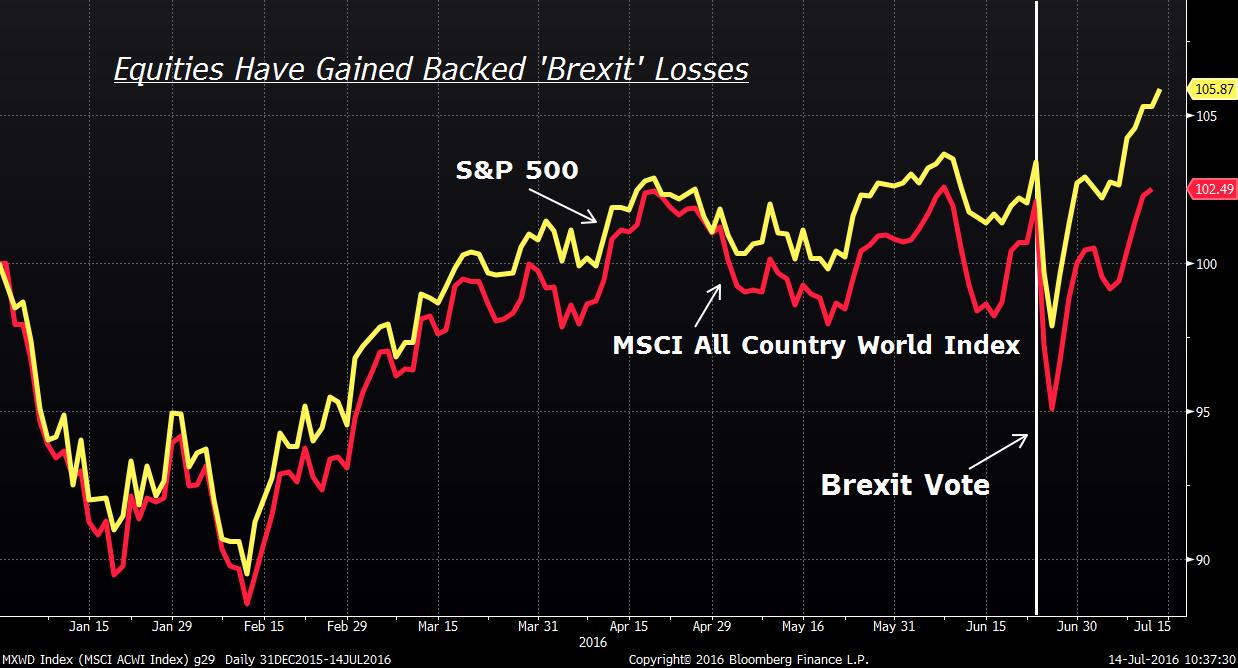
4.8% year-to-date. The S&P 500, a measure of U.S.-based companies, returned 2.5% in the second quarter and is up 7.1% this year.
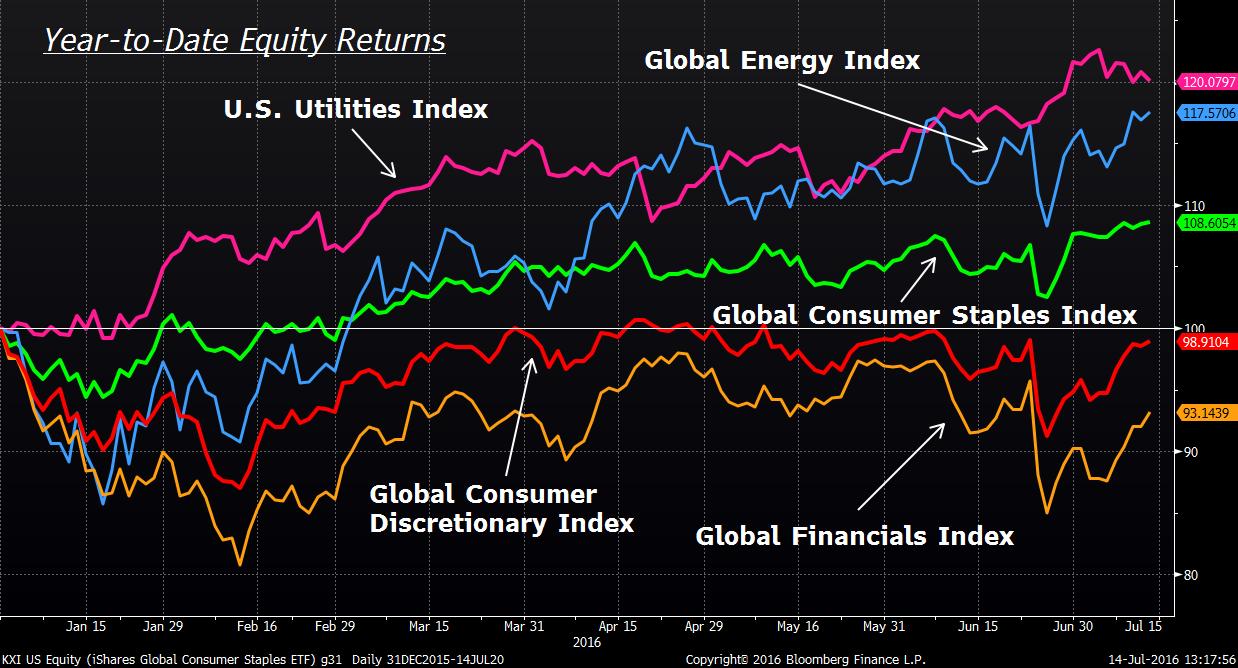
Consumer staples, utilities, and energy stocks have outperformed the broader market, while financials and consumer discretionary stocks have underperformed this year. We think it’s best to stay somewhat defensive in this environment, and we favor healthcare and consumer staple stocks, despite their lofty valuations. Industrial stocks are also attractive today, as their valuations remain depressed.








Equity valuations are above historic averages (the MSCI All Country World Index is trading at 16.7x expected full year 2016 earnings, while the S&P 500 is trading at 18.4x), though these valuations are roughly neutral when considered in the context of extremely low interest rates. That said, given the recent run-up caution is advised.

THIS PUBLICATION IS FOR INFORMATIONAL PURPOSES ONLY. THIS PUBLICATION IS IN NO WAY A SOLICITATION OR OFFER TO SELL SECURITIES OR INVESTMENT ADVISORY SERVICES, EXCEPT WHERE APPLICABLE, IN STATES WHERE D.B. FITZPATRICK & COMPANY IS REGISTERED OR WHERE AN EXEMPTION OR EXCLUSION FROM SUCH REGISTRATION EXISTS.
INFORMATION THROUGHOUT THIS PUBLICATION, WHETHER STOCK QUOTES, CHARTS, ARTICLES, OR ANY OTHER STATEMENT OR STATEMENTS REGARDING MARKET OR OTHER FINANCIAL INFORMATION, IS OBTAINED FROM SOURCES WHICH WE AND OUR SUPPLIERS BELIEVE RELIABLE, BUT WE DO NOT WARRANT OR GUARANTEE THE TIMELINESS OR ACCURACY OF THIS INFORMATION. NEITHER WE NOR OUR INFORMATION PROVIDERS SHALL BE LIABLE FOR ANY ERRORS OR INACCURACIES, REGARDLESS OF CAUSE, OR THE LACK OF TIMELINESS OF, OR FOR ANY DELAY OR INTERRUPTION IN THE TRANSMISSION THEREOF TO THE USER. THERE ARE NO WARRANTIES, EXPRESSED OR IMPLIED, AS TO ACCURACY, COMPLETENESS, OR RESULTS OBTAINED FROM ANY INFORMATION CONTAINED IN THIS PUBLICATION.
NOTHING IN THIS PUBLICATION SHOULD BE INTERPRETED TO STATE OR IMPLY THAT PAST RESULTS ARE AN INDICATION OF FUTURE PERFORMANCE. ALL RETURNS ARE MODEL RETURNS FROM A COMPOSITE.