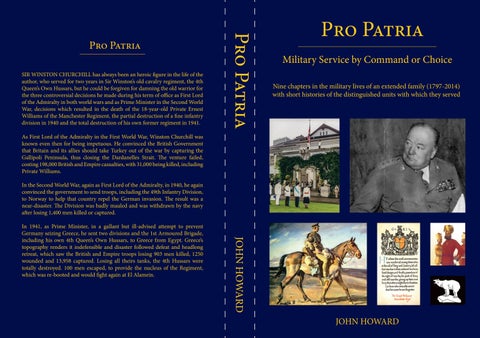
SIR WINSTON CHURCHILL has always been an heroic figure in the life of the author, who served for two years in Sir Winston’s old cavalry regiment, the 4th Queen’s Own Hussars, but he could be forgiven for damning the old warrior for the three controversial decisions he made during his term of office as First Lord of the Admiralty in both world wars and as Prime Minister in the Second World War, decisions which resulted in the death of the 18-year-old Private Ernest Williams of the Manchester Regiment, the partial destruction of a fine infantry division in 1940 and the total destruction of his own former regiment in 1941.
As First Lord of the Admiralty in the First World War, Winston Churchill was known even then for being impetuous. He convinced the British Government that Britain and its allies should take Turkey out of the war by capturing the Gallipoli Peninsula, thus closing the Dardanelles Strait. The venture failed, costing 198,000 British and Empire casualties, with 31,000 being killed, including Private Williams.
In the Second World War, again as First Lord of the Admiralty, in 1940, he again convinced the government to send troops, including the 49th Infantry Division, to Norway to help that country repel the German invasion. The result was a near-disaster. The Division was badly mauled and was withdrawn by the navy after losing 1,400 men killed or captured.
In 1941, as Prime Minister, in a gallant but ill-advised attempt to prevent Germany seizing Greece, he sent two divisions and the 1st Armoured Brigade, including his own 4th Queen’s Own Hussars, to Greece from Egypt. Greece’s topography renders it indefensible and disaster followed defeat and headlong retreat, which saw the British and Empire troops losing 903 men killed, 1250 wounded and 13,958 captured. Losing all theirs tanks, the 4th Hussars were totally destroyed. 100 men escaped, to provide the nucleus of the Regiment, which was re-booted and would fight again at El Alamein.
Pro Patria Pro Patria
Military Service by Command or Choice
Nine chapters in the military lives of an extended family (1797-2014) with short histories of the distinguished units with which they served
This book is a limited first edition and is dedicated to SSAFA (Soldiers’, Sailors’, Airmen’s Families Association). The Armed Forces’ Charity
All rights reserved. No part of this book may be reproduced in any form, or transmitted by any means, without written permission from the copyright owner.
This book is not for general sale. However, a further publication may be considered
First edition 2026
Typeset, printed and bound by Beamreach Book Printing, www.beamreachuk.co.uk
Pro Patria
Military Service by Command or Choice
Nine chapters in the military lives of an extended family (1797-2014) with short histories of the distinguished units with which they served
JOHN HOWARD
BOOKS BY THE AUTHOR
More Lees Than Cheshire Fleas With Tinker, Tailor, Soldier, Restaurateur (2011)
Gallantry and Greed (2021)
This is 60 King Street (2022)
THE AUTHOR
John Howard was born in Knutsford, Cheshire, to parents with extensive involvement in the inn-keeping business. Indifferent wartime schooling led to a five-year apprenticeship as a bespoke men’s tailor. On completion, National Service with the army beckoned and he joined the 4th Queen’s Own Hussars in 1954. The regiment was serving in West Germany and was located 30 miles from the border dividing East and West Germany. This was at the height of the Cold War with Russia and tensions ran high. The 4th Hussars were based at Hohne, one mile from the former notorious Nazi death camp at Belsen.
On demobilisation John joined the Harrods Group, becoming a buyer of men’s leisure and fashion clothing, plus skiwear. After leaving Harrods in 1965, he opened The Tavern, one of only three Danish restaurants in the UK. He, then, in 1973, opened the La Belle Epoque, a fine-dining French restaurant. Retiring in 1990, he was offered the position of custodian of Arley Hall, ancestral home of the Egerton Warburton family. He retired in 1996 due to ill health and took to writing several self-indulgent books. His passion is cricket, a game at which he served administratively at club and county level. He is a life member of Cheshire County Cricket Club.
He now lives with his partner Wendy, who has been a source of strength to him in his writing. He has a son, Clive, three grandchildren and three greatgrandchildren.
ACKNOWLEDGEMENTS
The book, although comparatively easy to write, has been devilish to compile and is an attempt to present something a little more original in the form of military writing. It will be up to the reader to determine this.
As ever, I have relied on the tenacity and skill of the ‘Yorkshire bulldog’ that is photographer Peter Spooner, to get his teeth into some decidedly ‘iffish’ material.
Ever more so, I have relied on my partner, Wendy, to bring the book together with her knowledge of word-processor book production and grammar – all plus the downright toil of deciphering and typing my manuscript. Thank you, Wendy.
We are again most grateful to David Exley of Beamreach Printing for his knowledge and the advice given, which has enabled this the book to be brought to the table.
SSAFA
SSAFA was founded in 1885 by Sir James Gildea (28/6/1838-6/11/1820). The organisation supports former members of the Royal Navy, Royal Marines, British Army, the Royal Air Force and their families in need of physical or emotional care. Thid can include debt, relationship breakdown, homelessness, post-traumatic stress, depression and, not least, life-changimg injuries obtained in wartime conflict.
Sir James Gildea was born in County Mayo, educated at St Columba’s College and Pembroke College Cambridge. He worked variously in aid of the sick and wounded in war in the late Victorian period and raised money for families of those killed in the Zulu War of 1879 and the Second Afghan War of 1880. He founded the Soldiers Sailors Families Association in 1885, which became the Soldiers’, Sailors’ and Airmen’s Families Association in 1919.
More good works followed, which led to his appointment of Companion to the Bath (CB) in 1898 and Commander of the Royal Victorian Order (CVO) in 1901. He was knighted in 1902 and was later appointed Knight Commander of the Royal Victorian Order (KCVO). In 1920 he was appointed Knight Grand Cross of the Order of the British Empire (GBE).
SSAFA
Patron His Majesty King Charles III
President HRH Prince Michael of Kent
The Armed Forces’ Charity 4 St Dunstan’s Hill London EC3R 8AD
CONTENTS
Preface xi
Introduction 1
Chapter One: The Earl of Chester’s Yeomanry Cavalry I 19
Private Joseph Lee – Regimental Farrier
Chapter Two: The Earl of Chester’s Yeomanry Cavalry II ?
Sergeant George Lee
Chapter Three: The Manchester Regiment I ?
63rd Foot 1758, 96th Foot 1824
– amalgamated 1861
Private Ernest Williams 1/6th Battalion
Chapter Four: The Manchester Regiment II ?
Lance Corporal Sidney Howard
Chapter Five: The Royal Regiment of Artillery
Bombardier Oliver Lee
Chapter Six: The Mahratta Light Infantry (British-Indian Army) ?
Major Robert Kenneth Lee
Chapter Seven: The 49th (West Riding) Infantry Division
Private Geoffrey Lee
Chapter Eight: The 4th Queen’s Own Hussars ?
Raised 1685 as Princess of Denmark’s Dragoons
Lance Corporal John Sidney Howard
Chapter Nine: The Duke of Wellington’s Regiment (West Riding) ? 33rd Foot 1751, 76th Foot 1787
– amalgamated 1881
Second Lieutenant Clive Jonathan Howard
PREFACE
Being a military historian has given me the maximum amount of pleasure and the opportunity to be able to consider the histories of the various Regiments, Divisions and Corps of the British Army that my family were involved with over the course of time. Time, in fact, is not what many, indeed most, of the fine old County Regiments have. Times have indeed changed, particularly in the 21st century. The army is smaller, more mechanised and digitilised. The Regiments, with their history, tradition, Battle Honours and County affiliation, are largely no more, absorbed into Brigades within Divisions, be they Infantry or Armoured. It is, then, a delight to recall their stories, this potentially for posterity and in the hope that my self-indulgence is not too intrusive. But is it so?
There is, after all, an underlying truth that all the family members mentioned in the book, be they conscripted or volunteers, were doing so to prevent some foreign malpractice threatening peace, and to maintain peace. With the exception of the Boer farmer striving to protect his home and family, the chapters of the book are concerned with the fight against the forces of downright evil. Both World Wars were fought against the conquest and subjugation of other nations and their peoples.
As a twenty-year-old National Service soldier, I was not so high minded in 1954, serving, as I was, my two years with an Armoured Cavalry Regiment in a dark and dreary region of the then Western Germany – this at the height of the Cold War with an aggressive Communist Russia seeking to achieve the conquest of Western Europe. The politics and significance of this was not too obvious to us young soldiers until one bitterly cold Sunday afternoon in late 1954.
My Regiment, the 4th Queen’s Own Hussars, was located at Hohne Barracks as part of the British 7th Armoured Brigade. The postal address was Bergen Belsen. The name Belsen did resonate with us as the site of the infamous Nazi concentration camp, the grotesque images of which were
indelibly fixed in the minds of all who had seen the newsreel pictures or photographs of the camp in 1945, which showed hundreds, if not thousands, of naked skeletal figures both dead and dying, lying together in the open and the dead being bulldozed into long deep burial pits, most of them devoid of any means of identity, more reminiscent of cattle being burnt and buried in the foot-and-mouth disease.
The 4th Hussars were located a little more than a good mile from this former death camp, situated, as it is, on heathland on the edge of a forest. It made sense to a small group of Hussars from HQ Squadron, including myself, that they were duty bound to visit the former camp, which they duly did on an off-duty Sunday afternoon. They found little or nothing had been done to humanise the site of the camp, which had been burnt to the ground in 1945. All that remained was a 12-foot-high monument dedicated to 30,000 Jews who had perished there and a few small stones dedicated to 2,500 or 3,000 dead. What was most disturbing were the elongated mounds of raised earth, under which, we knew, were the burial pits of many thousands of the former inmates. On the very edge of the camp one of the last few fires had been lit. In this were the tattered half-burnt remnants of the grey and white striped pyjamas that inmates wore. Our initial horror was followed by sadness, then anger. It was a subdued bunch of young soldiers that returned to barracks that cold Sunday afternoon.
It did not occur to us then that opposing the Regiment and indeed the British Army of the Rhine, across the heavily fortified border which divided East and West Germany, which Winston Churchill so aptly named the ‘Iron Curtain’, not 30 miles away was the Russian 10th Armoured Division lying in wait. We, the 4th Queen’s Own Hussars, being part of the British 7th Armoured Division, were in turn ready for them, as was the vast American military force in its own particular zone of authority and occupation. The Western Allies stood firm – this to prevent the repetition of the Belsen, Buchenwald, Auschwitz, Treblinka nightmares, which would most certainly have occurred if Russia had been able to gain ascendancy. They must stand firm now, as Russia’s Vladimir Putin threatens world peace.
INTRODUCTION
Although admittedly a student of British military history, I must immediately and most emphatically state that I have no love of war and its dreadful consequences. Even as I write, Vladimir Putin is waging a war of terror and illegal occupation of Ukraine. Amongst its many victims are innocent families including children and the elderly, thousands of whom have been killed, maimed or made homeless. A newly elected president of the USA, Donald Trump, is acting like a bull in a china shop, boasting to be able to end the world’s wars and looking more likely to instigate the next one. Aggressive Israel and trouble-seeking Iran flirt ever more dangerously. Military pundits in the Western and Free World are predicting that China will attack Taiwan in the very near future. If the conflict is not resolved in the Ukraine by then, we shall have a World War III situation, which in all probability would see the random use of nuclear weapons. If we take the end of the Second World War as a horrendous example of how world wars are finalised, this, mainly by a huge nuclear device, will not change. After nearly 80 years of comparative world peace, give or take localised wars in Korea, Vietnam, Afghanistan and Iraq and an assortment of conflicts simmering away in the Middle East, nearly all of which are promoted by the evil hand of Iran, a doomsday scenario looms large over the world. A period of 80 years has been ample time for the practitioners in the development of weapons of total destruction to hone their deadly skills. Regretfully these weapons are available to the most dangerously ambitious and unbalanced dictators, nearly all displaying the characteristics of the man responsible for World War II, Adolf Hitler, a man with a huge appetite for territorial gain and total power.
Wars, of course, have to be fought for freedom of thought and expression and for liberty and are fought by upholders of these ideals – the sailors, soldiers and airmen of free nations, It is to these that this book is dedicated. I might just, of course, add that on many occasions they were the tool that
our mainly Victorian ancestors used to conquer, colonise and extend the British Empire.
This, then, is a story of soldiers and their regiments and corps. Over the centuries mothers have seen their sons leave home to join the armed forces of this United Kingdom – to both the army and the navy. All concerned here were to become soldiers. Moreover, all were members of my greater family – the Howards and the Lees. They are nine in number and all have a close association with the ancient and attractive former market town of Knutsford in the county of Cheshire. Their roots in the town extend back to the turn of the 19th century. Seven of these men were born in the town and two spent their youthful years there. Only two of them could be considered career soldiers. Three volunteered to serve in time of crisis and the remaining four were conscripted in time of war or in anticipation of it.
I have to confess that, as a very small boy, my toys were legions of lead soldiers who spread across my bedroom floor and fought endless battles. I was born in 1933, the year that the aforementioned Adolf Hitler came to power in Germany. The reader can calculate that by the age of six this country was at war with Germany and it would mean that this soldieradmiring boy might just get an innocent’s taste of war, most of which was going to arrive at his own front door and, indeed, to his home and his life in it. Why so?
I had the good fortune to have been born in a public house, a ‘pub’, if you wish. It was not just any old public house. The White Bear is a charming black and white, half-timbered thatched 18th-century coaching inn that once catered for the passengers of the Aurora, a stage coach that operated daily between London and Liverpool. This delightful eye-catching building stands boldly in the view of the traveller approaching Knutsford from the north and west, on main roads from Chester, Warrington and Manchester. It is an inn of irresistible charm. Its popularity was never more in evidence than in the Second World War, when it was a honey pot that attracted soldiers from around the world and played a very small part in major events in the war, to be more precise, of course, as did the town of Knutsford itself, which could be said at one time approached the character of a garrison town.
In the spring of 1940, at the end of May and at the beginning of June, the now-seven-year-old soldier-minded boy met the real thing when the courtyard walls of the White Bear were lined with sitting soldiers, nearly
all in various degrees of undress, to whom my mother was serving cups of tea. These were some of the 330,000 survivors of the military debacle that was Dunkirk. These men would shortly be taken to nearby Tatton Park, then a designated temporary holding destination. In the December of that year, my four-year-old sister, Jeannette, and I were carried down to beds in the ancient cellars of the inn by off-duty Royal Artillery gunners, whose battery of anti-aircraft guns were located at nearby High Legh as part of the defensive ring protecting Manchester and Liverpool. Unfortunately, they failed to do so and both cities were badly blitzed.
The next contingent of soldiers to appear in numbers at the White Bear were members of the many regiments of the British Army who were volunteers seeking to join the recently-proposed formation of the Parachute Regiment. Ringway Airport (later Manchester Airport) and nearby Tatton Park were selected as the places where training would take place: Ringway where aircraft could take off and then land after depositing the trainee paratroopers in Tatton Park itself. All very well, but there was the urgent need to accommodate a proposed battalion of between 500 and 1,000 men. This presented a huge problem for there was little in the form of military barracks in this rural corner of north-east Cheshire.
The problem was resolved by billeting the men with the good citizens of Knutsford, all of whose houses would be no more than three quarters of a mile from Canute Square, where the White Bear was situated. Fledgling paratroopers then assembled early in the mornings for roll call before being transported by lorry to Tatton Park and Ringway. Thus Canute Square became a barrack square for an hour or so every day, where I, in my bedroom eyrie, would watch the proceedings with huge excitement. Thus was the Parachute Regiment formed unofficially in Knutsford and the White Bear was recorded severally in print as its unofficial headquarters; it was visited by veterans long after the war.
More pure delight was enjoyed by myself when two rookie paratroopers were billeted with us at the White Bear. Privates Jimmy Gray and Larry White were both Londoners. What a treat it was for a small boy to watch them in the early morning as they sat in our lounge, waiting for assembly and dressed to kill, so to speak, in their smocks and padded helmets, carrying such equipment as was required, including tommy guns, hand grenades etc! All of the equipment was kept in the understairs cupboard.
In 1943 the American Army arrived in Knutsford – this proving to be the headquarters of a newly forming American Third Army. This army was to be commanded by the celebrated General ‘Blood and Guts’ George Patton, whose personal headquarters was located at nearby Higher Peover Hall, the home of a family whose pedigree stretched back to the Norman period. Patton’s whereabouts were no secret. After his success in North Africa and Sicily, he was greatly feared by the Germans. His presence in England as commander of a division was an indication to them that he was still in disgrace after a disciplinary incident in Sicily. This, of course, was a successful ploy on behalf of the Allies. Patton was, in fact, the intended commander of the American Third Army, whose encircling drive through Normandy in 1944, led by his 2nd ‘Hell-on-Wheels’ Armoured Division, turned the course of the war in Western Europe in favour of the AlliMeanwhile, back in Knutsford in 1943, the town’s Heath was requisitioned to become the 2nd Division’s supply depot, the contents of which were flown in from the USA via Iceland to Warrington’s Burtonwood Airbase and from there on to Knutsford. By now, at the age of 10/11, I was becoming more savvy. The nearness of the depot, as seen from my bedroom window, meant that I observed the regular visits to the White Bear’s private accommodation by the colonel commanding the depot. Even colonels are in need of home comforts.
Victory by the Allied armies in Europe in May 1945 had meant that the Americans had been long gone and brought an end to Knutsford’s connection with war and soldiers. Life became less exciting for a growing boy but it had become obvious that the seeds of interest in war and in the soldiers who fought in them had been sown. However, soldiers and armies were still very much needed. The so-called Iron Curtain had come down in Europe. A line had been drawn across Europe where fighting had stopped – this mainly in Germany. Essentially, this was the line drawn to prevent further Russian expansion. Our former wartime ally was showing no sign of stopping, having already over-run Poland, Czechoslovakia, Hungary, Austria, Bulgaria, Romania and the Baltic States. It then showed no intention of handing back to them their democratic rights for self-government. This situation continued for 43 years, ending with the fall of the Berlin Wall in 1989 and a Europe free of communist control at last.
The implications of all this were of little concern to a youth whose senses, it could be said, were being sharpened at the prospect of National Service, a military necessity, made so by the Cold War and even more so by the Korean War of 1950-53. It might be imagined that I would have been pleased to join the army, given my stated interest in soldiery and war, but normal life intervened. A job of work was needed (post-school days), firm friendships were forming; at age 18 I was courting a young lady and so the prospects became intrusive and less appealing. A protected apprenticeship meant, however, that my military service commenced at the age of 21. As such, when I eventually joined the army, I was three years older and much more mature than my fellow comrades. Also, with a lively hotel home background, I think I could claim to being quite perceptive and observant.
I was conscripted to attend a Catterick training regiment on the lovely Yorkshire Moors, after which I was posted to Germany to join the 4th Queen’s Own Hussars, located at Hohne military base at Bergen-Belsen, situated on moorland roughly between Hanover and Lüneburg. The 4th Hussars were part of the 7th Armoured Brigade in the British Army of the Rhine (BAOR). I was fortunate to be allocated to the Regiment’s Headquarters Squadron, the very beating heart of the Regiment and an opportunity to obtain an overall picture of how an armoured regiment of heavy tanks functioned. I thoroughly enjoyed my years with the 4th Hussars. I made a lifelong friend and was adopted by a fine Lutheran family. One could hardly not enjoy serving with a historic cavalry regiment whose battle honours included Balaclava and which was one of the regiments that comprised the famed Light Brigade that charged so gallantly and misguidedly towards the Russian artillery guns in the Crimean War of 1854-56. As I write, it is hard not to reflect on the way history repeats itself. Russian artillery is presently firing at Ukrainian positions in the current invasion of that country. It is, also, a matter of pride to have served in the regiment in which Sir Winston Churchill served during the late 19th century. I was privileged to have paraded for Sir Winston when he visited his old regiment as its Colonel-inChief in May 1956.
This was the moment in time when I commenced to build my small library of books relating to war and the British involvement in it, this from the time of the Duke of Marlborough, circa 1700. More recently I have added the earlier period of the Hundred Years’ War (1337-1453). However,
it is the Second World War (1939-1945) that continually fascinates me. But I digress. This book is about soldiers and the regiments and corps they served with. I have, however, narrowed the field practically, reducing it to members of both my paternal and maternal families, the Howards and the Lees. The deaths of two of them in the First World War (1914-1918) had a marked effect on my senses. Gathering dust in the then-redundant lofted rest rooms, used by passengers travelling on stage coaches calling at the 18th-century White Bear Inn, was the rough wooden cross that had marked the resting place where my uncle Sidney Howard had lain in a muddy Belgian field. Sidney was killed by shellfire in the Battle of Passchendaele in 1917. He was just 21 years old. He was my father’s older brother and my father and I visited his eventual resting place in the peace of the War Graves Commission cemetery at Westvleteren in Belgium. My father, who had been just 14 years old at the time of his brother’s death, was terribly moved by the occasion. In memory of Sidney’s death, I had been named John Sidney. Equally emotive was that next to the wooden cross was Sidney’s khaki service cap, still bearing the badge of his regiment, the Manchester Regiment. Both the cross and the cap were left behind when, after 45 years at the White Bear, the Howard family moved on; in 1955 I had been with my regiment in Germany and had thus been unable to rescue the items. They were sadly lost. Rather appropriately, after the Second World War, the coaching loft was adopted by veterans of the Parachute Regiment as their HQ and club.
Equally sad was that earlier in the war, in 1915, Sidney Howard’s cousin, Ernest Williams, was killed in action. Ernest Williams’s mother was Annie Howard, a divorcée, my great aunt and my grandfather’s sister. She had remarried Edward Williams, whose sister, Kathryn Williams, had conveniently married my grandfather, Albert Howard.
Unlike his conscripted cousin, Ernest Williams was fascinated by soldiers as a small boy, becoming an army cadet and then a youthful Volunteer with the 6th Territorial Battalion of the Manchester Regiment. He was killed in action, by machine-gun fire, during an attack on the Turkish trenches during the ill-considered Gallipoli Campaign. He was 18 years of age; his body was never found. Like thousands of other British and Colonial soldiers with no known grave, he is commemorated on the war memorial at Helles, erected in their honour on the Gallipoli Peninsula. These sad losses to the Howard family during the Great World War served to further stimulate my
interest in wars and in the soldiers of both the Howard and Lee families who served in them, as well as those who suffered at a later time of danger to world peace – all this as far back as is appropriately recorded.
The story begins in 1797 when Sir John Leicester of Tabley House in Knutsford, in response to threat of invasion by Napoleon Bonaparte’s army, formed the Earl of Chester’s Yeomanry, a volunteer regiment. Fortunately, the threat faded and ultimately, in the early 19th century, the Regiment became heavily involved in enforcing public good order and the Riot Act. Industrial unrest was manifesting itself in the mill towns of East Cheshire –Stockport, Macclesfield, Stalybridge and elsewhere. Industrial property was being threatened by mobs of angry workers. This culminated in the infamous Manchester massacre, or the Peterloo Massacre as it became known, when a crowd of 50,000 in St Peter’s Fields were charged into by the 15th Hussars and the Manchester Yeomanry. The Cheshire Yeomanry was, fortunately, not called into action. They sat passively in a side street. Amongst them was Trooper Joseph Lee, a Knutsford blacksmith and twin brother to my great-great-great uncle, Joshua Lee.
Next in line of duty we meet George Lee, a youthful horse dealer. After leaving Knutsford Grammar School, he joined the Yeomanry as a trooper in the Knutsford troop of the Cheshire Yeomanry. He much later sailed to South Africa as a 40-year-old sergeant with what was then the 22nd Company of the Imperial Cavalry Yeomanry. This was to fight in the so-called ‘Boer War’ (1899-1900). An aggressive and immensely strong man, he achieved later fame as a bare-fist pugilist, being so proficient as to be offered the position of Master of Ceremonies and Referee in the Boxing Ring at Blackpool Tower ballroom – this until the outbreak of the First World War in 1914.
The mention of the above 1914-1918 war concentrates the mind. This unfortunately named ‘Great War’ brought death and destruction to Europe on an unimagined scale. It destroyed the flower of the manhood of the principal participants – France, Germany and, not least, Great Britain, not forgetting Italy, Austria and Russia – with so many thousands of family lives being decimated. Our family, the Howards, felt the losses of the young Ernest Williams and of Sidney Howard, whose sad deaths have already been mentioned.
We remain with the First World War and meet Oliver Lee, a nephew of the aforementioned George Lee. Oliver was a conscripted soldier, who was
initially posted to the Veterinary Corps, probably due to his and his family’s involvement with the horse business. He was, however, soon transferred to the Royal Artillery to become a driver/gunner in a battery of horse-drawn 18-pounder guns. He survived the war and then served in the occupational British Army of the Rhine, returning to Knutsford in 1919. He became a close companion to his uncle, the veteran George Lee, the wartime experiences of both men bringing them closer together.
We move now to the more familiar matters of the Second World War of 1939 to 1945 and to Oliver Lee’s eldest son, Robert (Ken) Lee, who, when war broke out, was working for a British industrial company in Bombay, now Mumbai. He promptly volunteered for service with the British Indian Army and soon rose to the rank of major with the 5th Maratha Light Infantry, part of the 10th Indian Division, commanded then by Major General William (Bill) Slim, who was later to command the British 14th Army in Burma (1944-1945).
Now to another conscripted member of the Lee family, Geoffrey Lee, my mother’s brother, son of Tom Lee, who was the elder brother of Oliver Lee. Geoffrey was posted to Iceland to join the 49th Infantry Division as a Royal Army Service Corps motorcycle dispatch rider. He went, with the Division, to arrive on day two of the Allied Landing in Normandy in 1944 and advanced with them through France, Belgium and Holland before being wounded in October of that same year and invalided out of the war.
The next man was another conscript or, to be precise, a National Service man and to be included with the utmost humility as a representative of the young men of this country whose lives were fractionally disturbed for two years. This was principally to provide protection against the aggression of mainly- communist countries in a then fractured world. I speak humbly of myself. I shall, of course, also be maintaining the theme of this book and the opportunity to research and relate, in this instance, the history of a famous old British cavalry regiment.
We arrive now at the last of the soldiers from Knutsford who were members of that Howard-Lee family. I write with an amount of pride but also with the reticence necessary when presenting the military and also, in this case, the upholding of law and order in the Hong Kong Police. I write of my son, Clive Howard. Although officially retired, he is retained by the United Nations as a lecturer on aircraft security. Clive had little opportunity of not
becoming a soldier. When he was a small boy on holiday in Pembrokeshire, I took him to a local cinema to see the highly regarded military epic Zulu. From that point, I am sure that the die was cast and that one day he would become a soldier. To compound the matter, it so happened that our nextdoor neighbour at home in Knutsford was a Major Edward Nicholson, a former Royal Engineer officer who was also the captain of the British Army Rifle Shooting Team. The major’s marriage was, unfortunately, childless and Clive, a presentable little boy, became as a son to him. The major allowed him access to the array of rifles that he owned. As soon as was possible, the boy was shooting on Saturday afternoons at the firing ranges at Altcar, near Liverpool and, by the age of 14, Clive was the Manchester Rifle Club’s junior champion. Clive and I holidayed by car in Europe, touring battlefields which included those that the Lee and Howard soldiers had fought in during the First World War and, when visiting the American members of the family in Pennsylvania, we were shown George Washington’s encampment at Valley Forge. Back again in Belgium, we took in Huguemont Farm, besieged by the French at Waterloo in 1815.
While at Leeds University, Clive joined the Yorkshire Volunteers, a territorial regiment affiliated to the West Yorkshire Regiment. Obtaining a commission in that unit, he was later recommended for Sandhurst and duly passed the course. He then joined the Duke of Wellington’s Regiment, serving with them as subaltern in Gibraltar. Discovering that he could ill afford the life of a serving officer, he relinquished his commission and left the army to join the Royal Hong Kong Police, where, I think I can safely say with a smidgen of pride, he excelled.
It was my intention to make this a book of nine stories but, in so doing, with time not on my side, I have had little of it to spare to pay tribute to other members of the two families. There are five in number, three of whom have the Knutsford connection. Two have a story worth recording, one of whom has quite possibly had his story told and, if so, better read in the USA. Briefly, then, in loose chronological order, we introduce Harold Howard, Manchester-born, one of six brothers (including my paternal grandfather) and one of three who emigrated to America in the 1890s. Harold had married and was living in Florida with a new-born baby boy, named John Nelson. He could not resist the call to arms, left his wife and child and rushed to join other members of the Howard family (Sidney Howard and Ernest Williams),
who were fighting (and dying) with the Manchester Regiment in Europe. Severely wounded when serving with the 23rd Battalion of the Regiment at Arras in 1917, Harold returned to America, I think with a wooden leg.
Now we have a different story to tell, this of my maternal grandfather, Tom Lee, regretfully it must be said, one of the lesser species of manhood. Knutsford-born, he was conscripted in the First World War, allocated to the Royal Army Service Corps and driving a vehicle for the duration of the war, at a safe distance from the sharp end of it, it must be said. An alcoholic, Tom was later killed in a motor accident while attempting to drink Chester dry on Good Friday in 1934.
Next, to the Second World War and to Neville Lee, Knutsfordborn younger brother to Indian Army major Robert (Ken) Lee. He was conscripted to serve in the Royal Electrical and Mechanical Engineers, a wartime offshoot of the Royal Engineers. His field squadron was attached to the 7th Armoured Division (Desert Rats) of the British Eighth Army in the North African deserts of Libya, Egypt and Tunisia. His section was an ARV one (armoured recovery vehicle). Their job was to recover tanks not too badly damaged in battle, so as to enable them to be reconditioned for further service. A sergeant, he was once given leave to Cairo and, looking forward to being temporarily reunited with his elder brother, Major Ken Lee, this at the Officers’ Club, but where, as a mere sergeant, he was denied admission.
We turn again now to our American Howards and to John Nelson Howard, born in Florida, son of the Great War veteran, Harold Howard. Obviously very intelligent, he graduated with a science degree from Harvard. He became an authority on space and the stratosphere, in which field, in the post-war period of the space race and expertise such as rocketry, his knowledge was to be of such considerable value to America that he was gifted the honorary rank of a general in the United States Army Air Force. I confess to total lack of knowledge of the achievements of John Nelson Howard but must endeavour to redress this, if at all possible. I have some paperwork concerning him but the content was so far above my head as to be stratospherical! He died at his house at Cambridge, Massachusetts, in 2020.
Finally, we meet Brian Lee, the youngest brother to Major Robert and Sergeant Neville Lee. Knutsford-born but moving to Sale with his
family in 1932, Brian was educated at Sale Grammar School. At some time he met and married Betty, moved south and obtained a prominent position with the Oxfordshire Health Authority. True to family form, he obtained a commission in the Territorial Battalion of the Oxfordshire and Buckinghamshire Light Infantry (the Ox and Bucks). He retired early and sadly died too early.
I sincerely hope that in the telling of these stories I have not overemphasised their content. I relate them with the greatest humility. I prefer to think of them as representative of the many families in this country who, possibly, for many good reasons, have no knowledge of the parts their ancestors played over the past century and a half in the service of their country. Certainly, there is clear evidence, as the Veterans march past the Cenotaph on Remembrance Sunday, that they do not forget comrades with whom they served and those who served before them and did not return. Their cap badges and regimental ties are proudly displayed. They represent the regiments and corps of the British Army, some of whose histories are recorded here.
It was with this in mind that this book was written. I was provided with the opportunity to pay tribute not only to the British soldier as represented by the aforementioned members of the Howard and Lee families but also to the regiments and military units they served with. Equally and briefly, with their histories.
In CHAPTER ONE we learn of the formation of the Earl of Chester’s Yeomanry Cavalry in 1797, raised to meet the Napoleonic threat at that time; instead, it served in aid of the civic power at the time of industrial unrest, waiting then for many years for active service. This eventually arrived in the form of the South African (Boer) War of 1899 to 1901, when the regiment was trimmed into two companies of the Imperial Cavalry Yeomanry.
In CHAPTER TWO the regiment had a role in the early days and months of the First World War as part of the Coastal Defence Force in East Anglia before being shipped to the Middle East as part of the Welsh Border Mounted Brigade. It was then dismounted and amalgamated with the King’s Shropshire Light Infantry as its 10th Battalion. Now, as an infantry regiment, it moved to Palestine in 1917, then becoming engaged in the war with Turkey.
Eventual victory in the Orient saw the regiment shipped to France in 1918, where it fought to the end of the war in November. In the Second World War, now re-formed and re-mounted, the Cheshire Yeomanry renewed its acquaintance with Palestine as part of the 1st Cavalry Division in 1940. In 1941 it played a part in the successful Syrian Campaign in a country that was governed by Vichy France. Unfortunately for the regiment, it was then converted to a Signals Regiment, serving then with the British Eighth Army in North Africa, Sicily and Italy where its war ended in August 1945.
CHAPTER THREE is the first of two chapters concerning the Manchester Regiment and concentrates on the part that the 6th Territorial Battalion played in the ill-considered and disastrous Dardanelles/Gallipoli Campaign which culminated in the death of young Ernest Williams. After this campaign the Regiment, as part of the 42nd Division, was shipped to Egypt and Palestine to engage in the Campaign against the Turks. Victory there in 1917 saw the 42nd Division shipped to France and Belgium where it had to withstand the ferocity of the German offensive in March 1918 – this before the tide turned and the British counter-offensive ended on the River Sambre in November 1918.
In CHAPTER FOUR we stay with the Manchester Regiment but choosing to turn our backs on the blood and mud of the First World War and look at the regiment’s early history. It was raised in 1757 as the 63rd Foot and again in 1824 as the 96th Foot but it is essential that I bring its wars together – this for clarity’s sake. It fought in the Seven Years’ War with France (1756-1763), both in the American colonies and the West Indies. It then distinguished itself in the French Revolutionary Wars of 1793-1802. It fought with the Duke of Wellington’s army in the Peninsular War (1808-1814). New Zealand (1846-1847) must be one of the most exotic wars fought by the British Army – this against the gallant and fierce Maori nation. Inevitably the regiment would play a part in the Crimean Campaign, winning the battle honours of The Alma, Inkerman and Sevastopol. To the war, then, in South Africa (1899-1902) where it excelled in the relief and defence of Mafeking, where its soldiers earned two Victoria Crosses. Enough has already been written of the miseries of the First Great War and the horrific casualty rate. Sufficient to say it cost the life of Lance Corporal Sidney Howard.
CHAPTER FIVE: it is impossible to be able to pay sufficient tribute to the Royal Regiment of Artillery, this vital and mighty arm of the British Army. It does not display battle honours, having fought so many campaigns with the Army, and it could be said that its firepower was the deciding factor in battles such as Normandy and El Alamein. It could also be said that it fired its guns almost every day in the First World War to hugely destructive effect. Equally efficient was the German artillery, as seen by the shell that killed Lance Corporal Sidney Howard at Passchendaele in 1917. Bombardier Oliver Lee was a driver/gunner of a team of six horses pulling an 18-pounder field gun and limber as part of a Battery of four to eight field guns. Bombardier Lee lived a precarious life but survived the war, albeit avoiding the ghastly trench war. The regimental motto of the Royal Regiment of Artillery is ‘Ubique Quo Fas et Gloria Ducunt’ and translates as ‘Everywhere, Where Right and Glory Lead’, which, of course, is more than appropriate.
CHAPTER SIX takes us from the hellish battlegrounds of Europe to the continent of Africa. Strictly speaking, we are not with a British Army unit but, instead, we are going to war with a British Indian Army one. At the time of the declaration of the Second World War, the British Indian Army was officered by British soldiers, as was the case with Robert Lee who, although commissioned with the Maharatta Rifles, was head-hunted by the British Army and spent the North African Desert Campaign with the intelligence arm of the army in Cairo before rejoining the Indian 10th Division in Italy, to see the war out. This does not prevent us from following the fortunes of the 10th and, in particular, the very fine and famed 4th Indian Divisions in their campaigns in North Africa and Italy. With the War with Japan still raging in Asia, Robert Lee returned to go to Burma, to become ADC to his old 10th Division chief, General William (Bill) Slim, now commander of the British 14th Army in Burma.
In CHAPTER SEVEN we return to Europe and follow the fortunes of a British Infantry Division, namely the 49th West Riding of Yorkshire Division, amongst whose ranks were numbered such fine regiments as the King’s Own Yorkshire Light Infantry and the Durham Light Infantry, representing the north east of England. The 49th Division landed in France on D-Day plus Two and fought in the dense and uncompromising bocage countryside of
Normandy, incurring severe casualties. They joined in the Allied breakout that trapped the Germans at Falaise in August 1944. They followed ‘The Swan’ through Northern France and Belgium, before being halted by the enemy and by the severe winter in mid-Holland, before triumphantly seeing victory achieved in May 1945 minus the services of Royal Army Service Corps Dispatch Rider Geoffrey Lee who, wounded in southern Holland, saw the war out in ‘hospital blue’.
In CHAPTER EIGHT we join a regiment, not infantry but a cavalry regiment, with a history so illustrious as to be barely believable. I refer to my old regiment, the 4th Queen’s Own Hussars, now long gone after several post-Second World War amalgamations with the 3rd, 7th and 8th Hussars. They are now the Queen’s Own Hussars. The regiment’s battle honours are magnificent. They charged at Dettingen in the War of the Austrian Succession (1740-1748), played their part in the Duke of Wellington’s Peninsular Campaign in Spain (1839-42), skirmished with the Russian cavalry at the Battle of the Alma in the Crimean War (1854-5) and charged disastrously with the Light Brigade at Balaclava. In the Second World War they sadly retreated in disorder and were nearly obliterated in Winston Churchill’s honest and misguided attempt to save Greece from German conquest. Rebooted, they returned to the Desert Campaign in North Africa, where they triumphed at El Alamein, going on to fight with the British Eighth Army in Italy – this to the end of the war. A particular claim to fame was that Winston Churchill served as a young subaltern with the regiment and would always be a 4th Hussar.
In CHAPTER NINE we return to the infantry and to Clive Howard’s regiment, the Duke of Wellington’s (West Riding) Regiment, which, like the aforementioned Manchester Regiment, was raised from two regiments – as Huntingdon’s Regiment in 1702 (33rd Foot in 1751) and the 76th Foot in 1787. Again, it is essential to bring both regiments’ wars together. The history of the ‘Dukes’ is quite long and glorious. It, too, fought at Dettingen in the War of the Austrian Succession, manifold times in India, in Wellington’s Peninsular War, and in the great battle and victory over the re-emergent Napoleon at Waterloo. It fought in the Crimean War in the uphill slog that was The Alma and the colossal melée that was Inkerman. It fought in
wars in South Africa (1899-1902), variously and painfully in the numerous battlefields of the First World War. At Ypres, the Somme, Arras and more. In the Second World War it fought in the Retreat to Dunkirk, suffered greatly in Normandy, fought in the jungles of Burma with the Chindits and in the Korean War in 1950-1953, winning an honour at the Battle of The Hook. It could be said that it had had a busy history.
Let us not forget the former ‘Royal’ Hong Kong Police. Possibly then, and why not now, regarded as the finest police force in the world except for the probability that it has, by now, been politicised by the communist Chinese Government.
Chapter One
THE EARL OF CHESTER’S YEOMANRY CAVALRY
The formative years from 1797
PRIVATE JOSEPH LEE (Regimental Farrier)
Chapter One
PRIVATE JOSEPH LEE
The Earl of Chester’s Yeomanry Cavalry
Historically, the first cavalry of note charged at the Battle of Hastings in 1066, playing the major part in the battle that determined William I’s conquest of England, such as it was. The introduction of the Feudal System meant that the kingdom was divided into Baronies for military purposes. Each barony was obliged to furnish men and money at time of war. Thus were born the Yeoman Archers and Armoured Knights of the 13th, 14th and 15th centuries. The armoured knights of those periods were well horsed and played minor roles in the victories at Crécy and Poitiers in the 14th century.
It was not until the English Civil War (1642-1648) that the greater use of cavalry was seen, well illustrated by Prince Rupert’s charge at the Battle of Edgehill in support of Charles I. Oliver Cromwell was quick to learn success, fully incorporating cavalry into his New Model Army. After the restoration of the monarchy, Charles II favoured a Standing Army, only for Parliament in 1679 to declare it illegal. In 1685, under James II, a Regular Army of 7.000 foot soldiers and 1,700 cavalry was formed. By 1689 this was made of 25 numerically ordered Infantry Regiments, known by the names of their commanding colonels; later they were known by their county name, our own Cheshire Infantry being numbered the 22nd.
The cavalry, in addition to the already-raised Life Guards and Blues and Royals, was increased by a further ten regiments of Dragoon Guards and Hussars, some of which will feature in the ensuing chapters.
The strength of the militias throughout the kingdom at this time was, incredibly, estimated at 150,000, under the direction of the Sovereign and officered by the Lord Lieutenants of each county. This sounds most impressive but it is difficult to imagine it acting as a national force. More likely is it that it would be used on occasions of local unrest. Troops of cavalry (or light horse) were provided by the county hundreds of Wirral, Bucklow, Macclesfield, Broxton, Northwich, Nantwich and Eddisbury, the latter troop commanded by Sir Philip Egerton in 1666. The Northwich, Nantwich and Eddisbury troops contained names of historic note.
During the late 1770s several troops of Light Horse were formed throughout the country, largely due to Lord Chatham and with the blessing of George III. In 1779 the Light Horse of London and Westminster was formed to help suppress the Gordon Riots of 1780.
More significantly, the French Revolution of 1789, shortly followed by the aggressive French Wars, stirred the nation and stimulated its need for self-defence. George III suggested to William Pitt that the land forces should be augmented and Pitt responded by proposing the formation of troops of Yeomanry or Voluntary Cavalry to be attached to the county in which they were formed; they were to be called out in case of invasion or for the suppression of industrial riots.
In 1796 Sir Peter Warburton of Arley in Cheshire presided over a meeting arranged in Northwich in ‘the interest of the inhabitants of the County of Chester’ and convened by the Lord Lieutenant, the 5th Earl of Stamford, ‘in order to receive offers of service from gentlemen willing to accept commissions in a body of Provisional Cavalry, to be raised in the county’. This was to comprise six Troops, to be commanded by a colonel, a lieutenant colonel, one major, three captains and six cornets.
Thus the regiment known as The Earl of Chester’s Yeomanry Cavalry was formed in 1797, commanded by Sir John Fleming Leicester, baronet of Tabley, as its Colonel. Among its first senior officers were such historic names as Thomas Crewe Dod Esq as its Lieutenant Colonel, Thomas Langford Brooke Esq (then the High Sheriff of the county) as Major, and
Founder commander of the Cheshire (Earl of Chester’s) Yeomanry. Picture courtesy of The Tabley House Collection Tabley House
John Shakerley Esq, Ralph Leycester Esq and Henry Augustus Leicester Esq among its Captains.
It must be recorded that, at this time, troops of yeomanry cavalry were formed in Knutsford and Macclesfield which had no connection with Sir
John Fleming Leicester’s regiment, although they eventually would be so at not too later a date.
War with the French Republic was still being waged in 1797, which served as the root cause for the growth of voluntary yeomanry and militia involvement. No sooner had this ended in that year than Napoleon Bonaparte’s aggression in Europe led to war again in 1798, which went well for Great Britain, when Napoleon’s attempt to conquer Egypt and Syria ended in disaster with French defeats at the Battles of the Nile and Alexandria.
The Peace of Amiens (1802) brought a short-lived end to the war and. with it, an end to the threat of invasion that Napoleon had posed. Subsequently, the military volunteer corps, that had been raised to counter an invasion, were stood down. Lord Hobart, Secretary of State, sent a circular letter to the county lord lieutenants, thanking them for the service of their volunteer corps rendered during the war along with directions for their disembodiment. However, with the cooperation of the Prime Minister, William Pitt the Younger, an act of parliament was passed on the 22nd of June 1802, whereby George III declared it lawful for ‘His Majesty to accept offers of service of any Corps of Yeomanry that had served during the war and, also, to accept offers of service of any Corps of Yeomanry that may at ay time hereafter be formed’.
War with Napoleon broke out again in 1805, the French being ready to attempt an invasion of England with a fleet of gunboats and an army of 100,000 poised at Boulogne. The nation was saved by Nelson’s victory over the combined French and Spanish fleets at the Battle of Trafalgar.
In 1803 among the first to second government measures had been Sir John Fleming Leicester, who, like many others, offered to renew the services of his disbanded regiment. Sir John offered to raise three troops of yeomanry cavalry, to be incorporated with the Knutsford Troop, which, for some reason, had fortunately not been disbanded; equally so, neither had the Macclesfield Troop of 1797. It could be said that these two troops were exceptionally patriotic, possibly warriors by nature or just enjoying the camaraderie that soldiering encompassed.
Six troops were formed by government decree to comprise no less than 40 corporals and privates along with their officers. The six troops formed were:
Tabley Troop, with Ralph Leicester Esq as captain
Mere Troop, captained by Edward Venables Townshend
Ashton Hayes, captained by Bell Ince Esq
Knutsford Troop, captained by John Hollins Esq
Macclesfield Troop, captained by John Smith Daintry Esq
Northwich Troop, captained by John Marshal
Note that the close proximity of the Tabley, Mere and Knutsford troops could have meant that recruitment in the Knutsford area was easy to come by and that, within a radius of a couple of miles, this small area had provided half the strength of the Regiment, say 150 men, which, for that time, is quite staggering. Given that this was an agricultural area, these were truly yeomen – patriotic and spoiling for action.
The first officers of the re-formed Regiment were Sir John Fleming Leicester Bart as Colonel, Thomas Langford Brooke as Lieutenant Colonel and Henry Augustus Leicester Bart. as Major. In addition, the staff included: as Adjutant, John Hatchett, as Assistant Surgeon, William Stone, and as Chaplain, Revd Oswald Leycester. Most prominent, however, was
the Surgeon, Peter Holland, uncle to Victorian novelist Elizabeth Gaskell, and an influential figure. As well as being a local doctor, he cared for the apprentices at Gregg’s ‘model’ cotton mill at Styal as well as the inmates of Knutsford Prison. He is thought to have been with the Cheshire Yeomanry at the ‘Peterloo Massacre’ incident in Manchester in 1819. A compassionate man, it would have caused him considerable anxiety. His son, Henry Holland, also a Knutsford resident, was to become surgeon to King William IV, Queen Victoria and Prince Albert. All members of the Regiment took an oath of allegiance.
In addition to Sir John Fleming Leicester’s Yeomanry Cavalry, the County furnished another corps of six troops titled ‘The West Cheshire Volunteer Cavalry’, to which Lord Grosvenor generously subscribed. Its colonel was Thomas Crewe Dod, who served as Lieutenant Colonel to the Regiment formed in 1797. Included, also, were several celebrated individuals, such as Sir Thomas Stanley Massey Baronet, William Henry Worthington Esq and Richard Congreave Esq. There can also be added a troop of 60 men titled The Stockport Independent Gentlemen and Yeomanry and another troop, also of 60 men, from Norton, commanded by Brigadier General Heron until 1807, when he was succeeded by Lieutenant Sir Richard Brook of Norton Priory.
Altogether, in this hectic period, the County of Cheshire provided 14 troops of cavalry with a total strength of 730 horsemen and, also, 58 companies of infantry with a strength of 4,841 men, plus an artillery company of 105 men.
Sir John Fleming Leicester, the first Baron de Tabley, was born at Tabley House and was the fourth and oldest-surviving son of Sir Peter Byrne, an Irish baronet, who, in 1744, assumed the name of Leicester through his mother, Meriel, the only child of Sir Francis Leicester, whose wife Catherine was the third daughter and co-heiress of Sir William Fleming, baronet of Rydal. He inherited his father’s title and estates in 1770, when only eight years old, and lost his mother when only twenty-four – this after completing his education at Trinity College Cambridge, where he was awarded an MA degree.
The Grand Tour meant visits to Italy, where Sir John spent time sketching and visiting the major art galleries. He developed a love of fine art which made him determined to devote his money and energy to the promotion of
the English school of painting and sculpture, as the same time becoming a major collector of British art, which he displayed in the gallery of his home in Berkeley Square and which the public were often invited to view. In 1805 he and Sir Thomas Bernard formed the British Institution for the Promotion of the Fine Arts in the United Kingdom.
He was elected, variously, as Member of Parliament for several constituencies (in all probability rotten boroughs), including Yarmouth in the Isle of Wight, Heytesbury in Wiltshire and Stockbridge in Hampshire. As we now know, he supported the Prince Regent in parliament, who, along with William Pitt, was responsible for the raising of the Yeomanry Cavalry regiments to meet the Napoleonic threat. In so doing, Sir John became one of the prince’s closest friends, so much so that the prince, as a mark of his affection, became godfather to his son, who was named George after the prince.
It makes sense that the prince took little persuading to allow Sir John to use the Prince of Wales’s feathers as his regiment’s badge and. later, for such obvious reason, his title of the Earl of Chester in the eventual title of the regiment Cheshire (Earl of Chester’s) Yeomanry. All this is not to take into consideration the formal events taking place within the blossoming organisation of the regiment. Needless to say, on receiving permission for the Regiment to wear the Prince of Wales’s feathers as its badge, Sir John threw a grand party for the whole of his Yeomanry in Tabley House grounds. Such necessary formalities were conducted at a meeting of the officers of the regiment at the George Hotel in Knutsford on the 3rd of September 1803, where it was decreed:
(1) that Knutsford be the home of the Regiment and that it should assemble on Knutsford Heath
(2) that the Regiment should seek the use of artillery
(3) that the regimental uniform should be the colours red and blue
(4) that the Regiment should meet for nearly a week, to exercise at Chester
The meeting adjourned, resolving that, as colonel, Sir John should apply to the Lord Lieutenant of the County, who, in turn, should apply to the Secretary of State to obtain the permission of His Majesty to permit the
corps to take the name of The Earl of Chester’s Regiment. With formalities duly observed, Sir John could be allowed a self-congratulatory smile. In November, in answer to this request, the Secretary of State wrote to Sir John, granting the title of the Earl of Chester’s Regiment. This was followed by a further letter from the same source, advising Sir John that the title granted should now be The Earl of Chester’s Regiment of Cheshire Yeomanry.
Shortly afterwards, on the 24th of January 1804, the Regiment was reviewed in Tabley Park by His Royal Highness Prince William Frederick who, at that time, was commanding the North Western Military District and who took the opportunity of presenting the Regiment with a standard. The Prince was attended by the Earl of Stamford, Lord Bulkeley and Lord Penrhyn. The regiment, I think, should have been congratulated on the speed with which it gathered itself in preparation for this event, it being a matter of only ten weeks, which included the Christmas period. It must, however, be remembered that the warrior men of Knutsford, Tabley, Mere and Macclesfield had never been stood down since the foundation of Sir John’s earlier regiment of 1797.
It may be of some interest to recall the more illustrious residents of the county who were commissioned into the regiment since its resurrection in 1803; in this instance, from its reformation that year through to 1848, which included the troublesome period when it was mustered to act in aid of the Civil Power, to help to contain the riotous situations, which arose in the Cheshire industrial towns and those of neighbouring counties.
1812: Peter Langford Brooke (captain, Mere)
Charles Leicester (Tabley)
1816: Henry Edward Howard (cornet, Stockport)
1817: John Howard (cornet, Knutsford)
1819: Wilbraham Egerton
Joseph Barra (captain, Tabley)
Sir Henry Mainwaring
Richard Legh-Trafford (lieutenant, Altrincham)
1820: Peter Legh (cornet, Adlington)
1823: James Calverley (cornet, Ashton Hayes)
1825: Thomas Legh (captain, Adlington)
Sir Peter de Malpas Egerton (captain, Ashton Hayes)
1828: Lord William Arden Alvanley (cornet, Macclesfield)
1845: George Harry Grey, Earl of Stamford and Warrington (captain, Dunham Massey)
1847: Hugh Lupus Grosvenor, Duke of Westminster (cornet, Dunham Massey)
1848: Charles Banastre Legh (captain, Morley)
An aristocratic and historic assemblage of the gentlemen of the County indeed! This illustrates how closely knit, as always, was the county hierarchy and how willing to don uniform and serve shire and country.
Worthy of mention among those illustrious names is that of Captain Joseph Barra in 1819. He was a professional soldier of considerable experience in the Duke of Wellington’s armies that fought throughout the Napoleonic Wars in the early 19th century. Commissioned in the 16th Queen’s Lancers, he served throughout the Peninsular War of 1808-1814, in which he was wounded. He commanded a troop at Waterloo in 1815, in pursuit of Napoleon’s broken army. Barra joined the Yeomanry in 1819, becoming its adjutant, then resigning in 1836, to be succeeded by an equally distinguished old soldier, Captain Henry Hill, late of the 11th Hussars.
Perhaps it was because of the service that The Earl of Chester’s Yeomanry rendered the country during the industrial unrest of the early-to-mid 19th century that Queen Victoria issued an edict to Lord de Tabley, which was converted to a Regimental Order dated the 26th of January 1849, the content reading “Lieutenant Colonel Lord de Tabley announces to the officers, noncommissioned officers and privates of the Regiment a signal from Queen Victoria that she wishes to bestow on them the title designated by the name of her royal son, that it should re-assume the original designation of 1903 as ‘The Earl of Chester’s Regiment of Yeomanry ’. The Regimental Order was
issued at its headquarters and is signed ‘H. Hill, Captain and Adjutant, Earl of Chester’s Yeomanry Cavalry’.
The gist of this, of course, was to establish that the current Prince of Wales and Earl of Chester was now Edward, the future King Edward VII; it was a necessary formality.
What, then, of H. Hill, Captain and Adjutant, E.C.Y.C, possibly a drummer boy in the earlier part of the Spanish Peninsular War? He rose through the ranks and fought with the 11th Prince Albert’s Own Hussars with Wellington at Waterloo, eventually resigning his commission and coming to live in King Street, Knutsford, in a house provided at a peppercorn rent by Lord Egerton. He was a somewhat impoverished character but obviously well thought of by the Egertons, and the Leicesters at Tabley House, with whom he enjoyed card games. He succeeded Captain Barra as Adjutant in 1836. He is, also, said to be representative of the fictional character, Captain Brown, in Elizabeth Gaskell’s classic novel Cranford, which is based on country-town life in Georgian and Regency Knutsford.
Having written at length about the military associations of the County’s great and good, it is high time that we introduced the lowly local yeomanry hero and subject of this chapter, Joseph Lee. Twenty-one years of age in 1800, a volunteer yeoman in that year and one of twin brothers, living in Brook Street, Knutsford, newly married and a country blacksmith, Joseph is shown on the muster roll of the Regiment in 1812 as Private Joseph Lee, farrier. Farriers we know as regimental blacksmiths and, apart from routine horse husbandry, they were charged with the unpleasant duty of dispatching severely wounded horses. It is interesting that all subsequent muster rolls of the Regiment did not list a farrier.
Nelson’s victory at Trafalgar in 1805 removed the immediate threat of French invasion of the country. Napoleon had turned his attentions eastward, winning a stunning victory over the allied armies of Austria and Russia at Austerlitz that same year. Nevertheless, yeomanries and militias up and down the country remained on the alert and in good order, sufficient for His Royal Highness Prince William of Gloucester to present a standard to the Regiment at Tabley Park in 1804.
The aggressive and ambitious Napoleon, however, after winning a great victory at Marengo, decided to fight back-to-back campaigns by attacking his former ally, Spain, then turning his attention to Portugal, then regarded
as England’s greatest ally. England felt obliged to go to the aid of Portugal and, thus, the Peninsular War commenced in 1808. It was not decided until 1814, after a series of brilliant victories won by Sir Arthur Wellesley, later created Viscount (the Duke of Wellington).
Sending the army to fight in the Spanish peninsula greatly reduced the country’s capability to defend itself. Thus, there was all the more reason to maintain its volunteer forces. However, other than developing a splendid esprit de corps, the regiments’ services wouldn’t be required but, as we shall see later, they would be, in circumstances they would have preferred not to have been in.
Napoleon’s military adventures had come to a disastrous end. After defeating the Russians at Borodino, he reached a Moscow that had been burnt. This forced him to retreat in the depth of winter, before being finally defeated at Leipzig in 1813. In the meantime, Wellington had invaded France, eventually crushing Marshal Soult’s army at Toulouse. It is, of course, well known that Napoleon, though taken captive, escaped from Elba and reinstated himself in one last deadly attempt to conquer Europe. He was destroyed by his nemesis, the Duke of Wellington, at Waterloo in 1815. So, after 22 years of war with France, a long-awaited peace was attained in Europe and the Earl of Chester’s Yeomanry was, so to speak, without a raison d’être. Not so!
A period of peace, that is peace without war, would now last for 40 years in Europe but that peace would be marred, starting in 1816, by a period of general distress and discontent. The army was reduced in size, leaving many former soldiers without employment. Rioting occurred in both the agricultural and manufacturing sectors of the country. Taxation, as ever, appeared heavier in peace than in war. Trade had stagnated due to the exhaustion of the various European countries caused by continuing wars. As these nations gradually recovered and began to produce their own goods, so did the demand for British manufactured merchandise. Additionally, it did not help the agricultural industry that the harvest of 1816 failed, as had previous harvests. Moreover, the Corn Laws were passed, forbidding the import of foreign corn – this to the benefit of the landowners and farmers but to the disadvantage of the poor.
Of more concern was the rioting caused by the introduction of machinery at the expense of hard labour. Although rioting took place over many parts
of the country, it was in the industrial cotton towns of Lancashire and the woollen towns of Yorkshire that most unrest occurred. The rioting workforce or Luddites, as they became known, were intent on the destruction of the machinery that they saw as a threat to their future livelihood.
We in Cheshire may think of ourselves as inhabitants of lush green pastures and green hills. At the time of the Industrial Revolution, however, our hill towns had become heavily populated, industrialised and productive. Stalybridge, Hyde, Congleton and, in particular, Stockport and Macclesfield were cases in point. Up and down the country and where appropriate yeomanry regiments were stood by in readiness to aid the Civil Power. As early as 1818 the whole Earl of Chester’s Yeomanry Cavalry was mustered for three weeks to quell or prevent disturbances in Macclesfield and Stockport. As a war with France was still being waged at that time, this must have been one of the earliest incidents. What, we wonder, were the feelings of the dissenting industrialised citizens of the county, when confronted with the booted, mounted and uniformed fellow Cestrians?
Of course, our man Joseph Lee, in his role of Regimental Farrier, would have been well to the fore on these occasions. Reprisals against horses as well as yeomen were to be expected. By the end of the war, in 1815, public disorder in the industrial towns had gathered momentum. In 1816 rioting was occurring in agricultural areas of England, particularly in East Anglia, but by 1817 considerable unrest was created by secret societies of a republican nature, which were causing disaffection and contempt for law and order, culminating in one major incident in which the window of a carriage in which the Prince Regent was travelling on return from parliament was broken by a missile.
That year, the whole Regiment, including our man Lee, mustered for a whole week from the 9th to the 15th of March, to deal with disturbances, again in troublesome Macclesfield and Stockport. The whole regiment was again called out on the 29th and 30th of the same month, this time, in addition to Macclesfield and Stockport, to Ashton-under-Lyne and Manchester. Obviously, disorder was becoming more widespread.
It was in 1817 that the famed ‘Blanketeers’ marched from Manchester, draped with blankets in which to sleep. The Yeomanry muster of the 29th and 30th of March of that year was the last occasion that Joseph Lee mustered and marched with the Earl of Chester’s Yeomanry Cavalry, for in 1819 he
reached the age of forty, the cut-off year for service in most active military units. No doubt it will have pleased his wife. His career as a blacksmith was, perhaps, continued but he is shown on later census returns as 19living and working as a weaver in Higher Town, Knutsford. The twice-married Joseph died in 1856 and is buried in Knutsford Parish Churchyard with his successive wives and a daughter Hannah, who had sadly predeceased him. Within three months of Joseph’s death in 1856, his twin brother, Joshua, my great-great-great-maternal grandfather also died and is buried in a nearby pauper’s grave. My great-great-grandfather, Tom Lee, was obviously not well enough established in his public-house businesses to afford a decent headstone for his father.
It is, perhaps, as well for Joseph Lee that he left Sir John Fleming Leicester’s Yeomanry in early 1819 for in that year a vast crowd of 50,000 people, most of whom were short of work, gathered in St Peter’s Field Manchester, to listen to a popular agitator known as ‘Orator’ Hunt. Trouble was anticipated by the authorities and a force of mounted Cheshire and Manchester Yeomanry, supported by the 15th Hussars, a regular cavalry regiment, stood by in adjoining streets, supposedly to suppress any rioting and to capture Mr Hunt. Disastrously, an order was given for the cavalry to charge, which resulted in the deaths and injuries of many innocent men, women and children. The incident became known as the Peterloo (or Manchester) Massacre. Joseph Lee must have been much relieved not to have been associated with the dreadful affair.
The Earl of Chester’s Yeomanry Cavalry remained on standby, rather surprisingly, for a further 29 years, according to regimental records until 1848. The full regiment, in aid of the Civil Power, turned out on eight occasions and on eleven occasions various troop combinations turned out, depending on the dangers presented. When the whole regiment first turned out in 1812, it comprised the original Tabley, Mere, Ashton Hayes, Knutsford, Macclesfield and Northwich troops. Subsequently, as disturbances spread throughout North East Cheshire, South Lancashire and North Staffordshire, so more localised troops of yeomanry mushroomed. The Stockport Troop was formed of absolute necessity, as was the Congleton Troop. Many troop musters were not necessarily called out in aid of the Civil Power, dependent on the local situation. Troop combinations of two or three would prevail but occasionally a local troop would be sufficient. In 1848 the Earl of Chester’s
Artist’s impression of the ‘so-named’ Peterloo Massacre in Manchester’s St Peter’s Field 1819
Yeomanry was required to turn out for the last time, when the Tatton and Congleton Troops were called to Macclesfield, where the first disturbances had taken place in 1812. Thiry six years of service and preparedness!
Before Queen Victoria’s edict was translated into the Regimental Order, issued at the Tabley House Headquarters in January 1849, in which the Queen bestowed on the officers and men of the regiment ‘the titles designated by the name of her royal son (namely Edward Prince of Wales)’ and that the regiment should ‘re-assume the original designation of 1802, as the Earl of Chester’s Yeomanry Cavalry’, another Regimental Order, no. XX, was issued in 1836. This dictated the Regimental Oath of Allegiance, which Joseph Lee, a soldier who had served only in the reign of George III, would obviously not have signed. The Oath reads:
“I, having become a member of the Earl of Chester’s Yeomanry Cavalry, do make oath that I will be faithful and bear true allegiance to Her Majesty. her heirs and successors, and that I will, in duty bound, honestly and faithfully defend Her Majesty, her heirs and successors, and the generals and officers set over me So help me, God!”
SIGNED
DATE WITNESS
Having had their pledges of loyalty witnessed in the early Victorian period, there was very little the volunteer soldiers of the Earl of Chester’s Yeomanry Cavalry had to do after their involvement in the riotous, industrially disturbed times that had followed the Napoleonic Wars. From 1850 onwards, however, they were kept well on their military toes by very frequent inspections by distinguished professional officers who were either serving with or had served with the famed Regular Cavalry Regiments or with the British Army. Some of them would, shortly, in 1854 and onwards, add renowned Battle Honours to their Regimental Standards.
It is interesting to note the historical names (in Cheshire) of the officers serving with the Cheshire Yeomanry when they were thus inspected. In 1856 the Honourable J B Leicester Warren, the 3rd Lord de Tabley, was a cornet when Lieutenant Colonel Hogg of the 1st Royal Lifeguards inspected. In 1858 Sir C W Shakerley Bart was a lieutenant when Colonel McMahon of the 5th Dragoon Guards inspected. In 1861 Piers Egerton Warburton was a cornet; the Regiment, however, was not inspected. He went on to become Colonel of the Regiment, crucially prior to the start of the Boer War of 1899. In 1863 George Barbour was a cornet when Lieutenant H de Ros of the 1st Lifeguards inspected. In 1864 Robert Stapleton Cotton was a cornet but not inspected. In 1865 Ralph Leycester was a captain when Major General Lord George Paget, late of the 4th Light Dragoons, inspected. Lord Paget had been the Colonel of the Regiment when they so disastrously charged with the rest of the Light Brigade at Balaclava in 1854. In 1866 Thomas Langford Brooke was a cornet. Also serving in 1866 were Charles Petersham (Viscount), 8th Earl of Harrington, cornet, and James Tomlinson (a regular cavalry soldier of some note). In 1867 Charles Cecil de Trafford was a cornet and Thomas Egerton Tatton was a lieutenant; the regiment was not inspected. In 1870 the
Honourable R W Grosvenor was a captain and Henry James Tollemache was a cornet, the regiment being inspected by Major General Sir John Garvock. In 1871 Hugh Birley was a cornet. In 1875 William Brocklehurst and Charles Edward Thorneycroft were sub-lieutenants. In 1879 George Henry Hugh Cholmondeley, Earl of Rocksavage, was a 2nd lieutenant and Lord Arthur Grosvenor also a 2nd lieutenant. In 1884 the Honourable Alan Egerton de Tatton was lieutenant. In 1885/86/90/92/94/95 Gilbert Greenall, Edward Swettenham, Oswald Mosley Leigh, Hugh Cholmondeley, Lord Delamere, Harry Barnston, William H France Hayhurst and Sir P H B Grey Egerton all served as lieutenants. Also, and finally, in 1897 Richard Norman Harrison Verdin was a 2nd lieutenant who would go on to serve the Regiment as its Colonel in a time of war.
At the end of the 19th century and when the Earl of Chester’s Yeomanry Cavalry had frustratingly been endlessly inspected for a period approaching 50 years, the soldiers of Queen Victoria’s Regular Army had, over the same period, fought in no less than 29 wars on every world continent excepting the Americas, not least of all in India, where Sir Charles Napier in 1843 and our own 22nd Cheshire Regiment defeated a vast Baluchi army at Meeanee, resulting in the conquest of the Scinde.
In 1897, however, war was looming in South Africa against the Boer nation and would erupt in 1899. In 1897, as if expecting involvement in this coming conflict, the Earl of Chester’s Yeomanry Cavalry mustered on the Roodee in Chester in front of its Colonel-in-Chief, the 8th Earl of Harrington, and its Colonel, Piers Egerton Warburton. The scene is splendidly depicted in a painting at the head of the staircase in Arley Hall, the ancestral home of the Egerton Warburtons.
Mustered on that day were the four squadrons of the regiment. Each squadron contained two troops:
‘A’ Squadron – the Tatton Squadron
‘B’ Squadron – the Eaton Squadron
‘C’ Squadron – the Arley and Bostock Squadron
‘D’ Squadron – the Forest (Macclesfield) and Congleton Squadron
On parade were 336 men, a great number of whom would eventually volunteer to serve with two Companies raised to serve as Yeomanry Cavalry
in the coming war. Amongst ‘B’ Troop in the Tatton Squadron is listed a Corporal George Lee, whose uncle Joseph Lee, late of the Earl of Chester’s Yeomanry Cavalry, was long dead. An extraordinary and controversial character, we shall pick up his colourful story in the coming chapter.