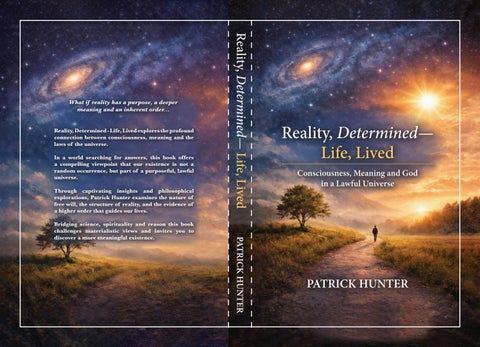
What if reality has a purpose, a deeper meaning and an inherent order...
Reality, Determined - Life, Lived explores the profound connection between consciousness, meaning and the laws of the universe.
In a world searching for answers, this book offers a compelling viewpoint that our existence is not a random occurrence, but part of a purposeful, lawful universe.
Through captivating insights and philosophical explorations, Patrick Hunter examines the nature of free will, the structure of reality, and the evidence of a higher order that guides our lives.
Bridging science, spirituality and reason this book challenges materialistic views and invites you to discover a more meaningful existence.
Reality, Determined— Life, Lived
Reality, Determined— Life, Lived Consciousness, Meaning and God in a Lawful Universe
All rights to the content of the book belongs to Patrick Hunter and cannot be reproduced or copied without permission of the publisher.
All rights reserved. No part of this publication may be reproduced, stored in a retrieval system, or transmitted, in any form, or by any means, mechanical, electronic, photocopying, recording, or otherwise without the written consent of the author, nor be otherwise circulated in any form of binding or cover other than that which it is published and without a similar condition being imposed on the subsequent purchaser.
Formatted, printed and bound by www.beamreachuk.co.uk
Reality, Determined—
Life, Lived
Consciousness, Meaning and God in a Lawful Universe
PATRICK HUNTER
For my children— Sarah, Thomas, Lilly, Jake, and Maddison
This book is for you.
It is not an attempt to give you answers to every question you will face, nor to tell you how to live. Life will teach you far more than any philosophy ever could. What I hoped to offer instead is something quieter: a way of facing the world honestly, without fear of its limits and without needing illusions to make it bearable.
You will each find your own meanings, your own values, and your own paths through a world that does not arrange itself for our comfort. When it feels difficult or unfair, I hope you remember that clarity can be steadier than certainty, and understanding can be a form of strength.
This book is a record of how I tried to make sense of reality as it is—lawful, fragile, and still capable of meaning—so that you might feel less pressure to explain everything, and more freedom to live thoughtfully within it.
Whatever you believe, wherever you go, and whoever you become, know this:
Your lives matter because you live them. Your experiences matter because they are felt. And you matter—not because the universe says so, but because you are here.
With my love always - Dad
Where this Philosophy Begins
While this work shares certain surface commitments with classical deterministic systems—most notably those associated with Spinoza, such as the identification of God with necessity and the rejection of libertarian free will—it diverges at a foundational level. Where Spinoza conceives individual minds as finite modes of a substance whose attributes include thought, this framework locates conscious experience exclusively in epistemically bounded nodes through which an otherwise non-subjective reality is locally realised. Subjectivity, emotional valuation, and lived deliberation are not treated as illusory or ultimately dissolvable into objective understanding, but as structurally irreducible features of realised reality. The similarities, therefore, are historical and structural rather than doctrinal, and the account offered here is intended as a contemporary reconstruction of determinism that takes seriously modern concerns in the philosophy of consciousness and lived experience.
I did not arrive at this philosophy through abstraction, metaphysics, or the pursuit of theoretical elegance. I arrived at it through suffering.
Suffering is not a concept to be debated. It is a lived certainty. It is felt directly, subjectively, and without the possibility of dismissal. Any philosophy that attempts to deny suffering, reduce it to illusion, or explain it away fails at the most basic level of contact with human experience. I could not accept such systems, no matter how internally consistent they appeared.
Life, as it is actually lived, is not a steady progression toward happiness or optimism. It is characterised by effort, limitation, loss, and vulnerability— interspersed with rarer moments of connection, love, insight, and meaning. These moments do not erase suffering; they derive their significance from contrast with it. Without pain, joy would be indistinguishable from neutrality. Without loss, love would carry no weight. Without constraint, meaning would dissolve into indifference.
This recognition shaped everything that followed.
I do not regard suffering as something noble, nor as something to be sought. But I also reject the idea that it is a flaw to be eliminated entirely. Suffering is a necessary structural condition of subjective existence. It arises from embodiment, from temporality, from exposure to a world that is not arranged around our desires. To remove it completely would not liberate human life—it would empty it of significance.
For this reason, I reject any framework that treats optimisation as the highest aim. Perfect efficiency, perfect safety, and perfect equilibrium would produce not fulfilment, but emptiness. Meaning requires contrast. Feeling requires vulnerability. Life requires stakes.
From this starting point, several conclusions became unavoidable. Consciousness cannot be an illusion, because illusions do not suffer. Subjectivity cannot be reduced to mechanism alone, because mechanisms do not experience meaning. Determinism, even if true at the level of structure, does not erase experience; it merely provides the conditions under which experience unfolds.
I came to understand reality as a single deterministic structure that gives rise to localised points of subjective actualisation—nodes through which reality is experienced from the inside. Each node is constrained, partial, and vulnerable. Each interprets the same objective reality differently, shaped by its own path of development, attachment, and loss. This localised subjectivity is not noise in the system; it is the mechanism by which reality becomes meaningful at all.
This philosophy therefore does not seek comfort, escape, or transcendence. It does not promise the elimination of suffering, nor does it sanctify it. It seeks coherence without denial, structure without erasure of experience, and understanding without sacrificing what it feels like to be alive.
When people have asked me what life is about, my answer has often unsettled them: life is a great deal of suffering, interspersed with a smaller number of moments that make it worth enduring. I do not say this cynically. I say it honestly. Those moments matter precisely because they are not constant. Their rarity gives them weight.
This work is an attempt to articulate a view of reality that takes that fact seriously. Any philosophy that cannot account for suffering without lying about it is not merely incomplete—it is false. I was unwilling to accept such falsity. What follows is the result of that refusal.
A Note on the Structure of This Book
This volume contains one philosophical work presented in two complete forms.
The first part offers a concise and formal articulation of the framework. The second part presents the same philosophy again, chapter by chapter, in a slower and more accessible voice intended for readers without a background in philosophy.
The second part is not a summary, commentary, or simplification of the first. It is a complete restatement of the same ideas, written to be read independently and in full.
Readers may begin with either part. Some will choose to read only one. Others may return to the work from the alternate perspective. No reading order is required or privileged.
Both parts stand on equal footing. Both aim at the same clarity. They differ only in pace, tone, and mode of address.
Book
Introduction
This book presents a unified philosophical framework that integrates determinism, consciousness, meaning, ethics, and theism into a single coherent account of reality. Its central claim is that reality is fully determined and complete, while conscious experience is local, finite, and irreducible. These two facts, often assumed to be in tension, are shown here to be complementary rather than contradictory.
The framework developed in the chapters that follow rejects several deeply ingrained assumptions: that freedom requires metaphysical indeterminacy; that responsibility depends on ultimate self-authorship; that meaning must be grounded in cosmic purpose; and that God must be conceived as a personal agent who chooses, intervenes, or reacts within time. In place of these assumptions, the book advances a position in which God is identified with objective reality itself, consciousness is understood as the reflexive localisation of that reality, and value arises only within subjective experience.
This is not a work of speculative theology, nor a denial of scientific explanation. It accepts without qualification the lawful, deterministic structure of the universe as described by contemporary science. Its concern is not with revising empirical accounts, but with clarifying how such accounts coexist with lived experience, moral seriousness, suffering, and existential meaning. The problem addressed throughout is not whether determinism is true, but how life is to be understood if it is.
The chapters proceed systematically. Early chapters establish the deterministic framework and the irreducibility of conscious experience. Subsequent chapters reinterpret choice, responsibility, and meaning without appeal to indeterminism. Later chapters examine God, religious experience, mortality, suffering, identity,
time, and epistemic humility, culminating in a view of reality that requires neither metaphysical escape nor consolatory illusion.
This book does not aim to persuade through rhetoric or promise comfort. Its aim is clarity. It is written for readers willing to follow an argument to its conclusions, even where those conclusions unsettle familiar beliefs. What is offered is not a doctrine to be adopted, but a way of seeing—one that holds together necessity and experience without contradiction.
Chapter 1
The Determinism–Consciousness Problem Reopened
The tension between determinism and conscious experience is not a relic of an earlier philosophical age, nor a temporary puzzle awaiting dissolution by scientific progress. It is a persistent structural problem that continues to reassert itself despite changes in vocabulary, method, and disciplinary emphasis. The reason for this persistence is not that the problem has been insufficiently addressed, but that it has rarely been framed correctly. What appears, on the surface, to be a conflict between two doctrines is in fact a misalignment between two modes of description whose relationship has never been fully articulated.
Modern thought is saturated with deterministic explanation. Across the natural sciences, events are understood as arising from prior conditions according to lawful relations. Even where prediction fails, explanation does not. Uncertainty is increasingly treated as epistemic rather than ontological, a reflection of complexity rather than indeterminacy. This commitment is not ideological but methodological: to explain is to show why something occurs rather than not, and this presupposes *sufficient conditions. Determinism, in this sense, is not a metaphysical excess but the background assumption that makes explanation possible at all.
Alongside this commitment stands the equally unavoidable reality of conscious experience. There is something it is like to exist as a subject, to encounter the world from a particular position, to deliberate, to suffer, to value, and to act. This fact is not inferred but lived. It does not arise as a conclusion of inquiry but as its precondition. No account of the world, however comprehensive, can
dispense with experience, because every such account is apprehended, assessed, and employed within it.
The difficulty arises not because determinism and experience are individually problematic, but because they appear to resist integration. Determinism seems to leave no room for genuine agency or meaning, reducing action to consequence and choice to inevitability. Conscious experience, by contrast, appears irreducibly first-personal, structured around perspective, limitation, and temporal unfolding in ways that resist capture by objective description. When pressed, each seems to undermine the other. Determinism threatens to flatten experience into mechanism; experience threatens to puncture the completeness of deterministic explanation.
Philosophical responses to this tension have followed predictable paths. When determinism appears too constraining, it is softened or qualified. Indeterminacy is introduced at crucial junctures, often under the banner of freedom or creativity. Yet this move replaces necessity with arbitrariness. An event that occurs without sufficient grounding is not thereby authored by an agent; it is simply unaccountable. Randomness does not confer meaning or responsibility. It dissolves them.
When conscious experience proves resistant to explanation, it is often reduced. On some views, experience is identified outright with physical or functional states. On others, it is treated as an illusion generated by underlying processes. These strategies differ in rhetoric but converge in effect. They attempt to explain experience by explaining it away. Yet any such attempt relies, implicitly, on the very phenomenon it denies. The claim that experience is illusory is itself an experiential claim. Reduction succeeds only by quietly presupposing what it officially excludes.
A third strategy divides reality. Mind and matter, appearance and reality, subjective and objective domains are treated as distinct ontological regions, each governed by its own principles. This preserves experience at the cost of unity. Interaction becomes mysterious. Explanation fractures. The world is saved, but intelligibility is compromised. Such dualisms rarely resolve the problem; they merely relocate it.
These responses persist not because they are satisfying, but because the alternative appears daunting. To accept that neither determinism nor experience can be abandoned is to accept that something fundamental has been misdescribed. It suggests that the conflict is not between two facts, but between two ways of understanding how those facts relate.
Appeals to future science do not remove this pressure. Advances in neuroscience and cognitive science have transformed our understanding of the mechanisms underlying perception, memory, and behaviour. They have illuminated causal pathways and functional architectures with extraordinary precision. What they have not done—and cannot do, given their explanatory remit—is explain why these processes are experienced rather than merely instantiated. A complete account of neural dynamics could, in principle, leave untouched the question of why there is something it is like to undergo those dynamics. This is not a temporary gap in knowledge but a difference in descriptive level. To point this out is not to oppose science, but to recognise its scope.
The persistence of the first-person standpoint is the central obstacle to elimination. Objective descriptions can be multiplied indefinitely, but they are always descriptions for someone. They are understood, evaluated, and acted upon within experience. The first-person perspective is not a metaphysical decoration added to an otherwise complete picture of the world. It is a structural feature of how the world is encountered. Any framework that treats it as optional will either reintroduce it implicitly or collapse into contradiction.
Freedom provides a particularly clear diagnostic case. We experience ourselves as deliberating, weighing reasons, and deciding how to act. At the same time, we increasingly understand these processes as arising from prior causes: biological endowment, developmental history, social context, and neural state. Traditional debates oscillate between defending freedom by positing breaks in causation and redefining it so narrowly that it no longer resembles lived agency. Both strategies miss the point. The experience of deliberation is real regardless of whether the future is fixed. The pressing question is not whether alternative futures are metaphysically available, but why it feels as though one is deciding at all.
This question cannot be answered by adjusting causal theories. It requires an account of how experience itself arises within a world that does not pause or branch for its sake.
The concept of God has historically functioned as a way of stabilising this tension. If reality is governed by a conscious, purposive agent, then meaning and value appear secured at the highest level. Determinism becomes providence; necessity becomes intention. Yet this move introduces difficulties of its own. A personal God raises acute problems concerning freedom, responsibility, and suffering. Moreover, attributing consciousness and agency to the absolute risks projecting human features onto what is supposed to ground them. The divine becomes a magnified subject rather than an explanatory terminus.
Conversely, eliminating God altogether often leaves the metaphysical picture oddly unfinished. Questions about why reality exists at all, or why it has the structure it does, are deferred rather than resolved. The issue, once again, is not whether God is affirmed or denied, but how the absolute is being conceived.
When stripped of inherited terminology, the underlying problem can be stated plainly. Reality appears to be objectively complete and causally sufficient. Experience appears to be subjective, partial, and temporally unfolding. Both appear unavoidable. Neither appears reducible to the other. Most philosophical frameworks treat this as a clash between two descriptions of the same thing. This book argues that this assumption is the source of the difficulty. The tension does not arise because objectivity and subjectivity are rival accounts of a single level of reality, but because they occupy different structural roles whose relation has not yet been properly understood.
This book will not deny determinism, nor will it dismiss conscious experience. It will not appeal to mystery where explanation is possible, and it will not invoke supernatural intervention or metaphysical gaps. Its aim is not to choose sides, but to reframe the problem at a level where the apparent conflict dissolves without remainder.
To do that, a more basic question must be asked than is usually posed. Instead of asking how consciousness fits into reality, we must ask what reality must be like for consciousness to arise at all. That question cannot be answered immediately. It requires a careful examination of what is meant by explanation, necessity, and completeness. It requires an account of reality that does not already assume the standpoint it seeks to explain.
Chapter 2
Why Reduction Cannot Succeed
If the tension between determinism and conscious experience is to be resolved, it is tempting to assume that the solution must come from further reduction. History encourages this expectation. Many phenomena once thought mysterious—life, heat, motion, inheritance—were eventually explained by showing how they arise from more basic processes. It is natural, then, to suppose that consciousness will follow the same path: that what appears irreducibly subjective will, with sufficient scientific or conceptual refinement, be shown to be nothing over and above objective structure and function.
This chapter argues that this expectation is misplaced. The failure of reductive accounts of consciousness is not due to incomplete data, insufficient computational power, or immature theory. It arises from a category mistake about what reduction can and cannot explain. Conscious experience resists reduction not because it is supernatural, but because it does not occupy the kind of explanatory role that reduction is designed to address.
Reduction works by identifying higher-level phenomena with lower-level processes. To explain digestion is to show how chemical reactions break down nutrients. To explain heredity is to show how molecular structures encode and transmit information. In each case, the explanandum and the explanans occupy the same descriptive mode: both are objective, third-personal, and fully capturable in structural terms. Reduction succeeds because nothing essential is lost when the phenomenon is redescribed.
Conscious experience does not fit this pattern. What is at issue is not behaviour, function, or information processing, but the presence of a point of view. A complete account of neural activity, however detailed, remains an account of what happens in a system. It does not become an account of what it is like to be that system. This difference is not one of degree, but of kind.
This is why appeals to correlation do not settle the matter. It may be true that every conscious state corresponds to a neural state, and that altering the brain reliably alters experience. None of this shows that experience is nothing but neural activity. Correlation explains dependency, not identity. To say that experience depends on the brain is not to say that it is exhausted by brain description.
Some reductive approaches attempt to close this gap by identifying consciousness with functional organisation rather than physical substrate. On these views, what matters is not the material out of which a system is made, but the roles its parts play. If the right functional architecture is present, experience is said to follow. This move shifts the focus, but it does not resolve the underlying problem. Functional descriptions specify what a system does, how it transforms inputs into outputs, and how internal states relate to one another. They do not specify why any of this should be experienced rather than merely executed.
A system could, in principle, perform every function associated with consciousness—discriminating stimuli, reporting internal states, adapting behaviour—without there being anything it is like to be that system. Functional adequacy does not entail experiential presence. The question of experience is not answered by multiplying roles or refining architectures, because experience is not itself a role within a system. It is the manner in which the system is encountered from within.
More radical reductive strategies concede this difficulty and attempt to eliminate experience altogether. On such views, consciousness is treated as a cognitive illusion: a story the brain tells itself, a byproduct of introspective error. What exists, fundamentally, are neural processes and behavioural dispositions; experience is a misleading way of talking about them.
This position has a certain rhetorical appeal. It promises theoretical economy and avoids metaphysical complication. Yet it fails at the point where it claims victory. An illusion, to be an illusion, must appear to someone. The claim that experience does not exist is itself made from within experience. One cannot coherently argue that there is no such thing as experience without relying on the very phenomenon being denied.
More importantly, illusionism explains at most why we talk about experience. It does not explain why there is something it is like to be mistaken. Error is still an experiential state. Eliminating experience by redescribing it as illusion does not remove the explanandum; it merely changes its label.
The persistence of these reductive strategies reflects a deeper assumption: that anything real must be capturable in third-person terms. On this assumption, if experience cannot be reduced, it must be illusory or epiphenomenal. But this assumption itself requires scrutiny. It treats objectivity as the only legitimate mode of reality, and subjectivity as a defect to be eliminated rather than a feature to be understood.
The difficulty is not that subjective experience lacks structure. Experience is richly structured: it has unity, temporal flow, affective tone, and intentional content. The difficulty is that this structure is indexical. It is always organised around a “here,” a “now,” and a “for me.” Objective descriptions deliberately abstract away from such indexical features. They describe the world as it is independent of any particular standpoint. This is their strength, but also their limitation.
Reduction fails because it attempts to explain indexical phenomena in nonindexical terms. No amount of structural description yields the fact that the description is being encountered from somewhere. This is not because something mystical is missing, but because localisation is not a property that can be read off from global description alone.
Attempts to deny this typically slide, unnoticed, into equivocation. When reductive accounts speak of “information,” “representation,” or “self-models,” they import experiential notions under technical names. Information is always
information for a system. A representation represents to something. A selfmodel is a model used by a subject. When these relational features are stripped of their experiential anchoring, the explanatory force evaporates.
This is why the problem does not disappear when the vocabulary changes. Whether one speaks of qualia, phenomenal character, subjective awareness, or cognitive architecture, the same gap reappears. The problem is not linguistic. It is structural.
Reduction also fails to account for the unity of experience. Objective descriptions decompose systems into parts and processes. Experience, by contrast, is given as a unified field. We do not experience disjoint neural events; we experience a single, continuous perspective. This unity is not inferred from parts; it is immediate. Any account that explains experience by appealing solely to distributed mechanisms must still explain why those mechanisms are encountered as one.
Temporal experience presents a similar difficulty. Objective accounts describe time as a dimension along which events are ordered. Experience presents time as flow: a moving present, retention of the immediate past, anticipation of the near future. This lived temporality is not captured by static descriptions of temporal relations. Once again, the issue is not lack of detail, but mismatch of descriptive mode.
The failure of reduction is sometimes taken to motivate a retreat into dualism. If experience cannot be reduced to physical or functional terms, perhaps it belongs to a different kind of substance or property altogether. This move preserves experience, but at a cost that Chapter 1 already foreshadowed. Dualism fractures reality. It introduces interaction problems, explanatory gaps, and a metaphysics that sits uneasily with the success of the natural sciences.
The lesson to draw is not that experience floats free of the world, but that it has been placed in the wrong explanatory slot. Conscious experience is not a component of reality alongside particles or processes. It is a mode of access to reality. Treating it as something to be reduced is like trying to reduce perspective itself to a physical object. The project misunderstands what it seeks to explain.
At this stage, the reader might be tempted to conclude that consciousness is simply a brute fact: something that exists but admits of no deeper explanation. This conclusion is premature. The failure of reduction does not entail the impossibility of explanation. It entails the impossibility of a particular kind of explanation.
What is required is not further descent into smaller parts, but a shift in explanatory focus. Instead of asking which mechanisms generate experience, we must ask under what conditions experience arises at all. Instead of treating subjectivity as an anomalous product of complex systems, we must understand it as a consequence of how reality is encountered when certain constraints are in place.
This shift has not yet been made. Most existing frameworks either attempt to force experience into an objective mould or retreat from explanation altogether. The result is a philosophical stalemate in which consciousness is either denied, mystified, or cordoned off.
The failure of reduction, then, is not a reason for despair. It is a diagnostic result. It tells us that consciousness does not belong where we have been trying to put it. It tells us that the relation between objective reality and subjective experience has been misconceived from the start.
If reduction cannot succeed, the question becomes unavoidable: what kind of reality could give rise to experience without reducing it, eliminating it, or placing it outside the world altogether? Answering that question requires a clearer account of reality itself—of necessity, completeness, and explanation— before consciousness enters the picture.
Chapter 3
Why the Escape Routes Fail
If reductive strategies cannot succeed, it is natural to look elsewhere for relief. Philosophical pressure rarely disappears; it is redirected. When consciousness resists reduction and determinism threatens meaning, several familiar escape routes present themselves. Each promises to preserve what reduction seems to destroy: freedom, depth, significance, or transcendence. Yet each does so by introducing costs that ultimately outweigh the benefits. This chapter argues that these alternatives fail not because they are poorly developed, but because they misunderstand the nature of the problem they are meant to solve.
One such route is indeterminism. Faced with the apparent suffocation of agency under determinism, some philosophers insist that the future must be genuinely open. On this view, not all events are fixed by prior conditions; some occur without sufficient cause. Freedom is located precisely in these gaps. Where causation ends, choice begins.
The appeal of this move is understandable. It promises to secure authorship by breaking necessity. Yet it collapses under scrutiny. An event that occurs without sufficient grounding is not thereby authored by an agent. It is merely ungrounded. Randomness does not transform an outcome into an act of will; it severs it from explanation altogether. If a decision is not determined by who one is, what one values, or how one reasons, then it is less one’s own, not more.
Moreover, indeterminism does not explain the experience of deliberation. It replaces a determined process with a stochastic one, but the phenomenology remains the same. The question of why it feels as though one is weighing
reasons and resolving possibilities is untouched. Indeterminism changes the metaphysics of the outcome while leaving the structure of experience unexplained. It solves the wrong problem.
A related route attempts to preserve freedom by introducing causal exceptions at the level of the self. On these views, agents are not fully embedded in the causal order. They possess a special capacity to initiate actions independently of prior states. This move, often associated with forms of agent-causation, seeks to secure responsibility by elevating the self above the chain of causes.
Yet this elevation comes at the cost of intelligibility. A cause that is not caused by anything else is not an explanation; it is a terminus. To say that an agent causes an action without being caused to do so is to posit a metaphysical stop sign. Nothing about the agent’s character, reasons, or history explains why the action occurred rather than another. The action is attributed to the agent, but not explained by the agent. The sense of authorship is preserved rhetorically while explanation is abandoned.
More importantly, this move merely relocates the mystery. Instead of asking how conscious experience arises in a deterministic world, we are asked to accept an undetermined source of action within the self. The problem of consciousness is not solved; it is insulated from inquiry. The agent becomes a black box whose outputs are declared free by stipulation.
Another escape route takes the opposite approach. Rather than weakening determinism, it weakens the reality of the problem itself. On such views, the tension between determinism and experience is a conceptual illusion generated by misuse of language or intuition. Once we abandon misleading ways of speaking, the problem is said to dissolve.
There is truth in the claim that language can mislead. But dissolution is not explanation. The persistence of the problem across cultures, traditions, and vocabularies suggests that it is not merely a verbal confusion. Replacing one set of terms with another does not remove the underlying pressure. If anything, it risks obscuring it.
A more radical variant of this approach retreats into mysticism. Here, the failure of explanation is embraced rather than resisted. Consciousness is said to be ineffable, beyond conceptual capture, accessible only through direct
experience. Determinism, on this view, applies to the surface of things, while the true nature of reality lies elsewhere, untouched by causal analysis.
This stance has the virtue of humility, but it achieves peace by surrender. To declare a phenomenon ineffable is not to explain it; it is to exempt it from explanation. Such exemptions may have existential or spiritual value, but they cannot serve as philosophical resolutions. They halt inquiry precisely where it becomes difficult.
Dualism offers a more systematic alternative. Instead of placing freedom in causal gaps or mystery, it posits two kinds of reality: one governed by physical law, the other by mental or experiential principles. Consciousness is preserved by being assigned its own ontological domain.
Yet this division reintroduces the problems it was meant to solve. If mind and matter are fundamentally distinct, their interaction becomes obscure. How does a non-physical experience influence physical behaviour? How does a physical event give rise to a non-physical state? Attempts to answer these questions either collapse back into reduction or invoke unexplained correlations. The unity of experience and action becomes an accident rather than a consequence of structure.
Furthermore, dualism does not clarify why experience has the particular features it does. It labels consciousness as non-physical, but it does not explain its localisation, unity, or temporality. The explanatory burden is shifted, not discharged.
A final escape route returns us to theology. If the world is created and governed by a conscious, purposive being, then experience may be understood as participation in a larger meaning. Determinism becomes a form of providence; necessity becomes intention. The problem appears reframed rather than resolved.
Yet this move introduces tensions of its own. A personal deity who determines the course of events inherits responsibility for their outcomes. Suffering, injustice, and error become features of divine will or tolerance. Appeals to mystery reappear, now clothed in religious language. Moreover, attributing consciousness and agency to the absolute risks making the divine a competitor with human subjects rather than the ground of their existence.
More subtly, this approach assumes that consciousness must originate in consciousness. It treats experience as something that can only be explained by appealing to a larger or more fundamental experiencer. This assumption is rarely defended; it is inherited. Once questioned, it loses its force. Explaining consciousness by positing a supreme consciousness does not resolve the problem; it duplicates it at a higher level.
Across these diverse strategies—indeterminism, agent-causation, dissolution, mysticism, dualism, and personal theism—a common pattern emerges. Each attempts to resolve the tension by altering one of the terms: weakening determinism, insulating consciousness, or elevating agency beyond explanation. None asks whether the relationship between objectivity and subjectivity has been misconceived from the outset.
The persistence of failure is instructive. It suggests that the problem does not arise because determinism and experience are incompatible, but because they have been placed in the wrong relation. Treating them as rival features of the same explanatory level forces a choice that should never have been posed.
At the end of these escape routes, we are left with a narrowed field of options. We cannot deny determinism without undermining explanation. We cannot reduce or eliminate experience without contradiction. We cannot divide reality without sacrificing unity. We cannot appeal to mystery without abandoning philosophy. We cannot resolve the tension by positing a conscious absolute without reproducing the difficulty we sought to escape.
What remains is not a void, but a demand. If neither reduction nor escape can succeed, then the structure of reality itself must be reconsidered. The question is no longer how to fit consciousness into a pre-existing picture of the world, but what kind of world could give rise to experience without exception, reduction, or rupture.
That question does not yet concern consciousness directly. It concerns reality as such: its necessity, its completeness, and the conditions under which explanation is possible. Only once those conditions are clarified can the place of experience be understood.
With this, the problem stage of the book is complete. The pressure has been established, and the familiar exits have been closed. The argument can now proceed to its next unavoidable phase: an examination of reality itself, prior to experience, agency, or meaning.
Chapter 4
Determinism as Necessity
Having closed the familiar escape routes, the argument now turns to the structure of reality itself. This turn is unavoidable. If neither reduction nor indeterminacy nor metaphysical division can resolve the tension between determinism and experience, then the assumptions governing our understanding of reality must be examined at their root. The first of these assumptions concerns determinism—not as a scientific hypothesis, but as a condition of intelligibility.
Determinism is often misunderstood as a narrow doctrine tied to mechanical predictability or outdated physical models. On this caricature, to affirm determinism is to imagine the universe as a rigid machine whose future could, in principle, be calculated in advance. This picture invites resistance, not least because it bears little resemblance to the complex, probabilistic, and often chaotic systems studied by contemporary science. Yet this resistance is misdirected. Determinism, properly understood, does not assert predictability. It asserts necessity.
To say that an event is determined is not to say that it could have been predicted by any finite mind, or even by any conceivable algorithm. It is to say that the event occurred because the total state of reality prior to it was sufficient for its occurrence. Determinism, in this sense, is the claim that nothing happens without sufficient grounding in what already is.
This claim is not an empirical generalisation waiting to be falsified. It is a presupposition embedded in the practice of explanation itself. To explain something is to show why it occurred rather than not. This “why” need not take the form of simple causal chains or linear laws, but it must appeal to
conditions that make the event intelligible. An event that occurs without sufficient reason is not merely unpredictable; it is inexplicable.
Attempts to deny determinism therefore carry a hidden cost. If some events are said to occur without sufficient grounding, then explanation reaches a limit not because of epistemic constraint, but because reality itself has become discontinuous. At that point, inquiry does not merely pause; it loses its footing. There is nothing further to ask, not because the answer is known, but because no answer exists.
This is why appeals to indeterminacy in physics do not threaten determinism at the metaphysical level. Probabilistic descriptions reflect limitations of modelling or the structure of measurement, not the absence of grounding. Even where outcomes are described statistically, the framework within which probabilities are assigned presupposes lawful structure. Chance, in scientific practice, is never metaphysical arbitrariness; it is controlled uncertainty.
Determinism, understood as necessity, is therefore compatible with complexity, emergence, and unpredictability. A system may be deterministic without being tractable. Its future may be fixed without being foreseeable. The denial of determinism does not introduce freedom into such systems; it introduces opacity.
This point bears emphasis because determinism is often rejected for moral or existential reasons rather than philosophical ones. It is feared that necessity leaves no room for novelty, agency, or meaning. Yet these fears arise from conflating determinism with fatalism. Fatalism holds that outcomes will occur regardless of intervening processes. Determinism holds the opposite: outcomes occur because of intervening processes. Effort, deliberation, and action are not bypassed; they are among the conditions that make outcomes what they are.
Once this distinction is kept in view, much resistance dissolves. Determinism does not flatten reality into a static block in which nothing happens. It affirms that everything happens for reasons, even when those reasons are opaque to us. Change, development, and transformation are not denied; they are necessitated.
To accept determinism, then, is not to endorse a particular picture of causation, but to affirm a minimal ontological principle: reality is such that its states are not independent of one another. The world does not restart
at each moment. What is later is conditioned by what is earlier. Without this continuity, explanation becomes impossible, and reality fragments into unrelated occurrences.
This continuity also underwrites the very distinction between illusion and truth. To say that something appears misleadingly is to imply that there are conditions under which it would not appear that way. Such counterfactuals presuppose lawful relations between states of affairs. Without determinism, even error becomes unintelligible.
It may be objected that determinism, even if necessary for explanation, cannot be affirmed as a feature of reality itself. Perhaps explanation is a human imposition on a world that is, at bottom, indifferent to our conceptual schemes. On this view, determinism would be a methodological convenience rather than an ontological commitment.
This objection collapses upon reflection. If explanation is merely imposed, then there is no reason to think it tracks reality at all. The success of explanation across domains would become a coincidence. More importantly, the very distinction between imposition and discovery would lose meaning. To claim that explanation is merely a human projection is to explain its success in human terms, thereby reintroducing the very explanatory structure being denied.
Determinism is not a projection. It is the condition under which projection and correction make sense.
At this point, it is tempting to ask whether determinism entails that reality could not have been otherwise. This question is often framed in modal terms, invoking possible worlds and alternative histories. While such frameworks have their uses, they can obscure the central point. Determinism does not require that reality be the only conceivable reality. It requires only that this reality unfolds necessarily from its own structure.
Whether other realities are logically possible is a separate question. What matters here is that explanation within any given reality presupposes necessity within that reality. Without it, there is nothing to explain.
This brings us to an important consequence. If determinism is affirmed as necessity, then reality, taken as a whole, must be internally sufficient. There can be no gaps, external interventions, or ungrounded intrusions. Everything
that occurs must arise from within the structure of reality itself. This does not yet tell us what that structure is, but it constrains what it can be.
In particular, it rules out any account of reality that depends on sporadic suspension of necessity. Miracles, in the metaphysical sense, are excluded— not as violations of physical law, but as violations of intelligibility. If something occurs, it must occur for reasons internal to reality. To appeal to something outside that structure is not to explain the event, but to abandon explanation.
At the same time, affirming determinism does not yet commit us to reductionism, materialism, or any specific ontology. Determinism is neutral with respect to what kinds of entities exist. It tells us only that whatever exists does not float free of the rest. The nature of the structure remains to be determined.
The argument has now reached a stable point. Determinism has been established not as a scientific conjecture, but as a requirement of explanation itself. If reality is to be intelligible at all, it must be necessary in this sense. This necessity does not simplify the world; it deepens it. It demands that whatever exists, exists as part of a continuous, self-conditioning whole.
The next step follows directly. If reality is necessary in this way, then it cannot be ontologically fragmented. A world governed by necessity cannot be composed of fundamentally independent domains. To understand what determinism truly commits us to, we must examine whether reality can be divided at its base—or whether unity is itself a requirement of explanation.
Chapter 5
The Non-Uniqueness of
Deterministic Reality
If this reality exists as a deterministic structure capable of generating conscious witnesses, then its existence alone demonstrates that such instantiation is possible. Determinism accounts for the necessity and unfolding of events within a given structure, but it does not entail that only one such structure may exist. To assert the uniqueness of this universe would therefore require an additional axiom—one not supplied by determinism itself. It follows that the existence of other deterministic realities, whether governed by identical or distinct laws, cannot be excluded on principled grounds. However, objective existence alone is insufficient for subjective reality. Only deterministic structures capable of producing localized witnessing—nodes through which reality is experienced—can be said to exist in the sense that is meaningful from within experience. The question is therefore not whether other universes exist in an abstract or mathematical sense, but whether other deterministic structures exist in which reality becomes aware of itself. Under this framework, plurality is not an extravagant hypothesis, but the natural consequence of rejecting an unjustified assumption of uniqueness.
Chapter 6
Determinism Without Elimination: Why Subjective Experience Cannot Be Removed
Any philosophical system that affirms strict determinism immediately encounters a familiar objection: if all events are fixed by prior states of the universe, then conscious experience appears either redundant or illusory. Thoughts, feelings, deliberations, and choices seem reduced to byproducts—decorative phenomena with no genuine role to play in the causal structure of reality. This chapter confronts that objection directly. It argues that while consciousness does not introduce indeterminacy into the universe, it cannot be eliminated without collapsing the very framework within which determinism is articulated, understood, and recognised as real.
The impulse to eliminate consciousness from a deterministic ontology usually arises from a confusion between causal redundancy and ontological dispensability. It is true, within the framework developed so far, that consciousness does not alter the objective course of events. No decision, intention, or reflection modifies the deterministic unfolding of reality. However, it does not follow that consciousness is therefore unreal, epiphenomenal in the dismissive sense, or theoretically optional. Consciousness is not an extra force added to the universe; it is the manner in which the universe becomes locally present to itself. Removing it does not simplify the picture—it removes the picture entirely.
To see this clearly, we must recall the distinction established earlier between objective reality and subjective realisation. Objective reality is complete, timeless in its totality, and fully determined. Subjective realisation, by contrast, is partial, temporally ordered, and perspective-bound. Determinism belongs entirely to the objective description. Experience belongs entirely to
the subjective description. The mistake of eliminativism is to assume that because determinism is complete at the objective level, the subjective level must be either false or reducible. This assumes, without justification, that there is only one legitimate descriptive mode of reality.
But determinism itself is not accessible from the objective perspective alone. The objective description of reality does not contain within it the fact that it is known, recognised, or even describable. Those facts arise only within subjective realisation. The very claim “the universe is deterministic” is not a property the universe asserts about itself; it is a judgement formed within conscious experience. Thus, consciousness is not something that competes with determinism. It is the condition under which determinism becomes meaningful, articulable, and conceptually present at all.
This leads to a crucial asymmetry. Objective reality does not depend on being experienced in order to exist. Subjective experience, however, depends entirely on objective reality for its structure and content. This asymmetry tempts some thinkers to regard consciousness as secondary or dispensable. Yet dispensability in causal terms does not entail dispensability in explanatory terms. Consciousness is not required for the universe to function, but it is required for the universe to appear as a universe rather than as an unarticulated totality devoid of perspective.
Attempts to reduce consciousness to purely physical descriptions encounter a similar limitation. Neurobiological accounts can, in principle, trace every neural correlate of experience. They can explain how specific patterns of activity give rise to perception, memory, emotion, and thought. What they cannot do is replace the first-person fact of experience with a third-person description. No accumulation of objective facts ever produces the subjective fact that those facts are present to someone. This is not a gap in scientific knowledge but a structural distinction between descriptive modes.
In a deterministic universe, this distinction becomes sharper rather than weaker. Because every physical process is fixed, the emergence of consciousness cannot be attributed to chance, randomness, or metaphysical spontaneity. Consciousness must be understood as a lawful outcome of deterministic conditions—an inevitable feature of sufficiently complex systems. Yet inevitability does not imply reducibility. A phenomenon can be fully determined and still irreducible in description. Temperature is determined by molecular motion but not identical to any single molecule.
Consciousness, likewise, is determined by physical processes but not identical to any physical description of those processes.
This framework allows us to reject both libertarian accounts of free will and eliminative materialism without contradiction. There is no need to posit a metaphysically free self standing outside causation, and there is no justification for denying the reality of experience. Instead, conscious agents are understood as nodes: localised points within the deterministic structure where reality is realised subjectively. These nodes do not steer the universe, but they are the sites at which the universe is encountered, evaluated, and emotionally inhabited.
From within a node, the future appears open, alternatives appear meaningful, and deliberation appears causally relevant. These appearances are not illusions in the sense of being false; they are accurate features of subjective limitation. A node cannot access the total deterministic structure in which it is embedded. It therefore experiences its own unfolding as a process of consideration and choice. This experiential structure is not something to be explained away. It is precisely what a finite perspective within a deterministic totality must be like.
Eliminating subjective experience would not yield a cleaner metaphysics; it would yield an incomplete one. A universe with no perspective is not merely a universe without minds—it is a universe in which concepts such as explanation, law, necessity, and determinism themselves lose their footing. There would be no standpoint from which the universe could be described as deterministic or otherwise. Consciousness is therefore not an optional embellishment on a deterministic cosmos. It is the mode through which determinism is disclosed.
This chapter establishes a central claim of the book: determinism does not threaten the reality of experience, and experience does not threaten determinism. They occupy different but complementary roles within a single, coherent metaphysical structure. Consciousness does not break the causal chain; it illuminates a segment of it from within. In the chapters that follow, this understanding will allow us to address responsibility, meaning, and value without retreating into indeterminism or illusionism.
Chapter 7
Choice Without Freedom: Responsibility in a Deterministic World
If determinism does not eliminate subjective experience, it nonetheless appears to threaten something many regard as equally indispensable: moral responsibility. If every action is fixed by prior causes, then how can praise, blame, obligation, or guilt be justified? This chapter addresses that challenge directly. It argues that responsibility does not require metaphysical freedom from causation. Instead, responsibility arises from the structural features of subjective agency within a deterministic framework. What must be abandoned is not responsibility itself, but a mistaken account of what responsibility requires.
The traditional conception of responsibility assumes that an agent must have been able to do otherwise in an absolute sense. According to this view, responsibility demands a metaphysical branching point at which multiple futures were genuinely open, and the agent freely selected one. Determinism, by definition, rules this out. Given the total state of the universe at any moment, only one future is possible. If responsibility depends on absolute alternative possibilities, then determinism would indeed dissolve it.
However, this conception rests on a confusion between objective possibility and subjective deliberation. From the objective perspective, there are no alternative futures. From the subjective perspective of a node, alternatives are not only present but unavoidable. Deliberation, evaluation, hesitation, and resolve are intrinsic features of finite cognition operating under epistemic constraint. An agent does not experience the future as fixed, even though it is. Responsibility emerges within this experiential structure, not outside it.
To understand this, we must distinguish between causal origination and rational authorship. A deterministic account denies that agents originate their actions independently of prior causes. It does not deny that agents act for reasons, that their actions express their character, values, and dispositions, or that those actions are responsive to considerations. Responsibility attaches not to being an uncaused cause, but to being the kind of system whose behaviour is guided by reasons as they are subjectively apprehended.
Within the nodal framework, a responsible agent is a node whose internal states—beliefs, desires, intentions, emotional valuations—play an essential role in the causal pathway leading to action. These states are themselves determined, but they are not bypassed. On the contrary, they are precisely what mediates between environmental input and behavioural output. To remove responsibility because these mediating states are determined would be to remove responsibility for any system capable of learning, reflection, or self-regulation.
This becomes clearer when we consider how responsibility actually functions in human practices. Moral evaluation is not a metaphysical audit of alternative universes. It is a social and psychological process aimed at regulating behaviour, expressing values, and shaping future dispositions. Praise and blame operate by engaging the agent’s evaluative and emotional capacities—capacities that are fully compatible with determinism. Indeed, they presuppose determinism, since they rely on the fact that responses to evaluation will have predictable effects on future behaviour.
Responsibility, then, is forward-facing as much as backward-facing. It concerns how agents are to be addressed, responded to, and engaged within a shared normative space. An agent is responsible insofar as they are sensitive to reasons, capable of understanding norms, and able to integrate evaluative feedback into future action. None of these capacities require metaphysical freedom. All of them require consciousness.
Within subjective experience, choice is unavoidable. Even if the outcome is fixed, the process of choosing is real. The agent must weigh reasons, imagine consequences, feel conflict, and resolve uncertainty. This process is not an illusion layered over a mechanical reality; it is the lived form of deterministic cognition. To say that the choice was determined is not to say that the agent did not choose. It is to say that the choice occurred lawfully rather than spontaneously.
This reframing allows us to preserve a coherent notion of moral language. Statements such as “you should not have done that” or “you ought to act differently in the future” do not assert that the agent possessed metaphysical freedom at the moment of action. They function as normative inputs into the agent’s ongoing development. They are part of the causal fabric that shapes future conduct. Moral discourse is therefore not undermined by determinism; it is one of determinism’s operative mechanisms at the level of social interaction.
Guilt and remorse can be understood in the same way. They are not punishments for metaphysical transgressions against an indeterministic self. They are affective responses that signal misalignment between one’s actions and one’s values, prompting behavioural revision. In a deterministic framework, such emotions are not cruel ironies. They are functional components of a system capable of self-assessment and growth.
Importantly, this account avoids both fatalism and moral nihilism. Fatalism assumes that because outcomes are fixed, effort and deliberation are pointless. This is a mistake. Effort and deliberation are themselves among the determining factors. The fact that they are causally necessitated does not render them inert. Moral nihilism assumes that without metaphysical freedom, values lose their authority. This too is mistaken. Values arise within subjective experience as expressions of what matters to conscious beings. Their authority does not derive from causal independence, but from their role in organising lives, relationships, and social worlds.
Within Nodal Theistic Determinism, responsibility is thus grounded in the structure of subjectivity itself. Nodes are not free in the sense of being uncaused, but they are accountable in the sense of being responsive, intelligible, and evaluable. They are loci where reasons matter, where norms are understood, and where future behaviour can be shaped through reflection and engagement.
This chapter completes a crucial transition in the book. Having shown that consciousness survives determinism, and that responsibility survives without metaphysical freedom, we are now positioned to address a deeper question: how meaning and value arise in a universe that is fully fixed. The next chapter will turn to that question directly, examining purpose, significance, and existential orientation within a deterministic reality that nonetheless contains conscious nodes capable of caring.
Chapter 8
Meaning Without Escape: Value and Significance in a Fixed Reality
If determinism neither abolishes consciousness nor dissolves responsibility, a deeper unease still remains. Even if we act, choose, and respond within a fixed universe, what ultimately gives those actions significance? If every event is inevitable, does anything truly matter, or does meaning collapse into a mere psychological by-product of processes that could not have unfolded otherwise? This chapter argues that meaning does not require openness in the structure of reality. Meaning arises from within subjective realisation itself and is fully compatible with a universe whose total history is fixed.
The assumption that meaning requires indeterminacy rests on a mistaken picture of value as something injected into the universe by free choice. On this picture, if the future is already determined, then value seems hollow, as though significance depends on metaphysical slack. Yet this confuses contingency with importance. Something can be inevitable and still matter profoundly. Birth, death, love, and suffering are all unavoidable features of human life, yet none are rendered meaningless by their necessity.
Within the nodal framework, meaning is not a property of the universe considered as a whole. Objective reality, taken in its totality, does not contain values, purposes, or reasons. It contains only facts and lawful relations. Meaning emerges only at the level of subjective realisation, where reality is encountered from a finite perspective. To ask whether the universe “has meaning” independently of any perspective is therefore to ask a categorymistaken question. Meaning is always meaning-for someone.
This does not reduce meaning to arbitrariness. Subjective meaning is constrained by the structure of the world and the nature of conscious beings. Pain matters because of how it is experienced. Flourishing matters because of the kinds of creatures we are. Relationships matter because we are socially constituted nodes whose identities are shaped through interaction. These values are not freely chosen from nothing; they are discovered within the conditions of conscious existence.
A deterministic universe does not undermine this discovery. On the contrary, determinism explains why value structures are stable and shared. Because human beings have broadly similar cognitive, emotional, and social architectures, patterns of meaning recur across cultures and histories. Care, loss, aspiration, and belonging are not arbitrary inventions but predictable features of conscious life under certain conditions. Their inevitability does not cheapen them; it anchors them.
From within subjective experience, the fact that an outcome is fixed is inaccessible. What is accessible is the process of living toward that outcome. Meaning resides in this process rather than in hypothetical alternative histories. A life is not meaningful because it could have been otherwise; it is meaningful because it is lived, felt, and evaluated from within. The unfolding of experience, with its anticipations and recollections, is where significance is generated.
This allows us to distinguish existential seriousness from existential anxiety. Existential anxiety arises when individuals imagine that unless their choices carve new paths into reality, their lives are insignificant. Existential seriousness, by contrast, recognises that significance lies in how events are inhabited rather than in whether they could have been avoided. The question is not whether one could have lived differently in an absolute sense, but how one lives the life that one necessarily lives.
Within Nodal Theistic Determinism, value is inseparable from embodiment and limitation. A node’s finitude is not a defect to be overcome but the condition of all significance. Only a being who does not know the future, who experiences time as unfolding, and who is vulnerable to loss can find things to matter. A godlike perspective, in which all events are equally present and necessary, would not be a perspective of meaning but of completeness. Meaning requires incompleteness.
This insight allows us to reconcile determinism with existential commitment. Loving someone matters even if that love was inevitable. Acting with compassion matters even if the action was fixed. Suffering matters even if it could not have been avoided. These experiences are not rendered trivial by necessity. They are rendered intelligible by it. They are parts of a lawful story that is lived from the inside.
Importantly, this account resists both nihilism and false transcendence. Nihilism claims that without ultimate freedom or cosmic purpose, nothing matters. False transcendence seeks to escape finitude by appealing to indeterminism, hidden souls, or metaphysical exceptions. The nodal framework rejects both. It affirms that meaning is real, local, and grounded in experience, without pretending that it floats free of causal structure.
Meaning, then, is not something added to a deterministic universe; it is something that emerges when a deterministic universe is realised subjectively. Conscious nodes are the sites at which facts become significant, events become personal, and time becomes lived. Without nodes, there is no meaning. With nodes, meaning is unavoidable.
This chapter completes the existential core of the book. We now have a framework in which consciousness, responsibility, and meaning all survive within a fully deterministic reality. The next step is to address the theological dimension explicitly: if God is identified with objective reality itself, how does value, care, and significance relate to the divine? The following chapter will turn to this question, examining God not as a chooser among possibilities, but as the total structure within which all possibilities are realised.
Chapter 9
God Without Choice: Objective Reality and Deterministic Theism
At this point in the argument, the contours of a deterministic metaphysics are firmly in place. Consciousness is preserved without indeterminism, responsibility is grounded without metaphysical freedom, and meaning arises without appeal to contingency. What remains is the most delicate and often most misunderstood dimension of the framework: the role of God.
Traditional theism conceives of God as a personal agent who chooses, intervenes, commands, and responds. Determinism appears to place this conception under severe strain. If all events are fixed, then divine choice seems either redundant or illusory. This chapter argues that the difficulty lies not with determinism but with the inherited picture of God. Once that picture is revised, determinism and theism are not only compatible but mutually illuminating.
The central claim of Nodal Theistic Determinism is that God is not a being within reality but is identical with objective reality itself. God is not one agent among others, not even an infinite one. God is the total, complete, necessary structure of what is. To speak of God is to speak of reality in its objective, non-perspectival form—fully determined, timeless in its totality, and lacking all subjective limitation. This identification removes at a stroke many of the paradoxes that arise when divine agency is modeled on human agency.
If God is objective reality, then God does not choose among alternatives. There are no alternatives at the level of the whole. The complete structure of reality contains all events, relations, and laws in a single necessary totality. To ask why God chose this world rather than another is therefore a category error. There is no standpoint outside reality from which such a choice could
be made, and no unrealised possibilities waiting to be selected. Reality is what is, and God is that reality.
This conception may initially appear austere or impersonal, but it gains philosophical clarity by abandoning anthropomorphism. A God who deliberates, decides, and reacts would be subject to temporal sequence and internal change. Such a being would no longer be ultimate but would instead occupy a position within the causal order. By contrast, identifying God with objective reality preserves divine ultimacy. God does not act within time; time unfolds within God.
Within this framework, determinism is not a constraint imposed upon God. It is an expression of divine necessity. The laws of nature are not external rules that God obeys; they are the structural features of God as reality. There is no tension between divine sovereignty and causal necessity because sovereignty is not understood as the power to do otherwise, but as the fact that nothing exists or occurs outside the total structure of reality itself.
This reinterpretation also clarifies the relationship between God and conscious beings. Nodes are not fragments of God in a mystical or pantheistic sense, nor are they external creations standing apart from the divine. They are localised sites within reality where objective structure is realised subjectively. From the divine perspective—if such language can be used without distortion—there is no subjectivity, no emotion, no uncertainty. From the nodal perspective, there is finitude, valuation, and lived time. The difference is not one of substance but of mode.
This allows us to speak meaningfully of a relationship between God and creatures without invoking divine psychology. The relationship is not dialogical in the ordinary sense. God does not listen, respond, or intervene. Instead, God is the condition under which all listening, responding, and intervening occur. Every experience of meaning, suffering, or joy unfolds within the structure that God is. Divine presence is therefore not episodic or selective. It is total and inescapable.
Within this view, prayer, worship, and religious language require reinterpretation. They are not attempts to persuade God to alter the course of events. They are subjective practices through which nodes orient themselves within reality. Prayer becomes a form of alignment rather than petition.
Worship becomes recognition rather than praise offered to a responsive agent. Religious devotion is not directed toward changing God, but toward situating oneself rightly within the whole.
This also reframes the problem of evil. If God is not a choosing agent, then evil is not the result of divine decision or negligence. Suffering is not permitted by God; it is a feature of reality’s structure as experienced by finite nodes. This does not trivialise suffering, nor does it explain it away. It relocates the question. The problem is no longer why God allows suffering, but how suffering fits into a reality that is necessarily structured as it is. That question cannot be answered from the objective perspective alone; it is a question that arises only within subjectivity.
Crucially, this conception avoids fatalism without reverting to indeterminism. Fatalism imagines that if God and determinism are identified, then human life becomes insignificant, swallowed by necessity. But within Nodal Theistic Determinism, significance does not belong to the whole; it belongs to the parts as they are lived. God does not experience meaning, but meaning exists because nodes do. God does not suffer, but suffering is real because subjectivity is real. The divine completeness of reality does not erase the seriousness of lived experience; it grounds it.
This chapter marks a decisive turning point in the book. Theism is no longer an add-on to a deterministic worldview, nor is determinism a threat to the divine. Instead, they are integrated into a single metaphysical picture: a necessary, objective reality that becomes locally present to itself through conscious nodes. In the chapters that follow, this framework will allow us to examine religious experience, mortality, and transcendence without abandoning determinism or reintroducing metaphysical escape routes.
Chapter 10
Transcendence Without Departure: Religious Experience in a Deterministic Reality
With God understood as objective reality itself, and conscious beings understood as finite nodes of subjective realisation, religious experience must be re-examined from the ground up. Traditional accounts often interpret such experience as contact with a transcendent agent who stands outside the causal order and intermittently enters it. Visions, revelations, feelings of awe, unity, or surrender are taken as evidence of divine intervention or communication. Within a deterministic framework that rejects divine agency in this sense, such interpretations can no longer be sustained. Yet the experiences themselves remain. This chapter argues that religious experience is neither illusory nor metaphysically disruptive. It is instead a distinctive mode of subjective orientation toward the whole of reality, arising naturally within finite consciousness.
Religious experience is often characterised by a sense of transcendence: the feeling of standing in relation to something greater than oneself. This is frequently misunderstood as implying a literal departure from the natural order. In fact, no such departure is required. Transcendence, as it is lived, is not spatial or causal. It is perspectival. A node does not leave reality when it experiences transcendence; it apprehends reality under a different aspect, one in which its own finitude is placed against the background of totality.
This perspectival shift is fully compatible with determinism. Awe, reverence, surrender, and existential humility are not disruptions of causal order but lawful psychological states that arise under certain conditions. Vastness, complexity, beauty, suffering, and finitude reliably produce such states in
conscious beings of our kind. That they are caused does not make them artificial. It makes them intelligible.
Within the nodal framework, religious experience can be understood as an affective recognition of objective reality’s completeness from within subjective limitation. The node does not perceive the total structure directly—such perception is impossible—but it becomes aware of its own partiality. This awareness is often accompanied by a profound emotional response: a sense of dependence, gratitude, fear, or peace. These responses are not revelations of new metaphysical facts. They are transformations in how known facts are lived.
This explains why religious experience so often involves silence, surrender, or the dissolution of egoic concern. In such moments, the ordinary preoccupation with choice, control, and personal narrative loosens. The individual recognises, not abstractly but viscerally, that their life unfolds within a structure they did not create and cannot command. This recognition does not negate agency or responsibility; it reframes them. Action is no longer experienced as self-grounding but as participation.
Importantly, this account preserves the seriousness of religious experience without reintroducing supernaturalism. There is no need to posit external messages, suspensions of natural law, or divine intentions directed toward particular individuals. What is experienced is real, but what is experienced is not a being who chooses to appear. It is reality itself, apprehended through the emotional and cognitive capacities of a finite node.
Mystical experiences, often described as experiences of unity or oneness, fit naturally within this framework. They need not be interpreted as literal mergers with the divine or escapes from individuality. Rather, they can be understood as temporary alterations in the boundary conditions of subjectivity, in which the usual sense of separateness weakens. The individual does not cease to be a node, but the contrast between self and world becomes less salient. Such experiences are striking precisely because ordinary consciousness is structured around distinction and limitation.
Near-death experiences, altered states induced by meditation, and spontaneous moments of existential clarity can all be accommodated in the same way. They are not windows into another realm. They are variations in
how this realm is subjectively realised under extreme or unusual conditions. Their content is shaped by culture, expectation, and neurobiology, but their existential impact is often profound because they reorganise the node’s relationship to finitude, mortality, and value.
This perspective also clarifies why religious traditions persist even in highly scientific cultures. Science describes objective structure with increasing precision, but it does not address how that structure is lived from within. Religious practices, narratives, and symbols function as tools for orienting subjectivity toward totality, necessity, and limitation. They are not competing theories of physics. They are existential grammars.
Within Nodal Theistic Determinism, transcendence is therefore redefined. It is not a matter of escaping the deterministic order, but of recognising one’s place within it. The transcendent is not elsewhere; it is the whole, apprehended indirectly through the experience of being a part. This preserves the depth of religious life without sacrificing intellectual coherence.
This chapter completes the reinterpretation of religious experience initiated in the previous chapter. God has been removed from the role of cosmic decision-maker and relocated as objective reality itself. Religious experience has been removed from the realm of supernatural intrusion and relocated within lawful subjectivity. What remains is neither disenchantment nor reductionism, but a sober and humane account of why human beings continue to experience awe, reverence, and existential seriousness in a fully determined world.
The next chapter will turn to mortality. If consciousness is finite, and if individual nodes dissolve at death, what, if anything, survives? How should death be understood within a framework that rejects both immortal souls and nihilistic finality? Chapter 11 will address death, finitude, and the meaning of personal cessation within deterministic theism.
Chapter 11
Death Without Annihilation:
Finitude, Cessation, and the Meaning of an Ending
No philosophical account of consciousness, value, or religion can be complete without confronting death. Within many traditional frameworks, death is either denied its finality through doctrines of personal immortality or stripped of significance by reductive materialism. Deterministic theism rejects both strategies. If conscious beings are finite nodes within a fully determined reality, then individual subjectivity has a beginning and an end. This chapter argues that acknowledging the cessation of personal consciousness does not entail nihilism or existential despair. On the contrary, finitude is the very condition under which life acquires seriousness, urgency, and meaning.
Within the nodal framework, death is the termination of subjective realisation at a particular location within reality. The node ceases to function. There is no further experience, no continuation of perspective, no hidden observer that survives the dissolution of the bodily conditions that sustain consciousness. This claim is often resisted, not because it is incoherent, but because it is emotionally difficult. Yet philosophical clarity requires us to distinguish what we wish to be true from what follows from the structure of the theory.
Importantly, this account does not describe death as annihilation in an absolute sense. Objective reality does not lose anything when a node ceases to exist. The total structure remains complete. What is lost is a particular perspective—a way in which reality was being realised subjectively. Death is therefore not the destruction of something independent or self-subsisting. It is the closing of a viewpoint. From the inside, this is the end of experience. From the outside, it is a reconfiguration of the total.
This asymmetry between perspectives is crucial. From within life, death appears as a looming absence, a negation of all that matters. From the objective standpoint, there is no such absence, because the standpoint itself does not experience loss. This does not trivialise death. It explains why death matters only to the living. Significance arises within subjectivity, and death marks the limit of that domain.
The fear of death often arises from the idea that something is taken away unjustly—that one is deprived of experiences one might otherwise have had. Determinism reframes this fear. There are no unrealised lives stolen by death, no futures that were available but denied. The life that unfolds is the only life that exists. Its length, shape, and ending are not truncations of an infinite possibility space; they are the necessary contours of a finite existence.
This perspective does not ask us to celebrate death or deny its tragedy. Loss, grief, and sorrow are appropriate responses to the cessation of a conscious node. These emotions are not philosophical errors; they are expressions of attachment and value. What is rejected is the idea that death renders life pointless. A story does not lose its meaning because it has a final chapter. Indeed, a story without an ending would lack structure altogether.
Within deterministic theism, mortality acquires a distinctive role. God, identified with objective reality, does not experience death. There is no divine grief or divine loss. Yet death is fully real at the level where meaning exists. The seriousness of death is not diminished by divine completeness; it is made possible by it. Only in a reality that is stable and lawful can finite lives emerge, unfold, and conclude.
This also clarifies why appeals to personal immortality are so tempting. They promise to preserve subjective meaning by extending it indefinitely. But indefinite extension would not solve the problem it aims to address. Meaning does not arise from duration alone. It arises from limitation, vulnerability, and irreversibility. An endless life would not intensify significance; it would dissolve it into repetition and postponement.
What, then, survives death? Not the individual perspective, but the reality of having lived. Every experience, action, and relationship that occurred remains part of the total structure of reality. Nothing that has happened is erased. While this offers no comfort to the individual who ceases to exist,
it offers a metaphysical reassurance: existence is not wasteful. Lives do not vanish into nothingness. They are completed.
For those who remain, death reshapes meaning rather than extinguishing it. The absence of the deceased becomes part of the living world, altering relationships, values, and priorities. Memory, legacy, and influence are not substitutes for survival, but they are real continuations of significance within other nodes. Death ends a life, but it does not end the web of meaning in which that life was embedded.
This chapter marks a sobering but stabilising moment in the book. The framework does not promise escape from finitude, nor does it demand resignation to absurdity. It affirms that life matters precisely because it ends, that consciousness is precious precisely because it is local and temporary, and that meaning does not require permanence to be real.
With mortality clarified, the next chapter will turn to what follows from it ethically and existentially. How should one live, knowing that one’s perspective will cease? What orientation toward time, action, and others becomes appropriate within a deterministic reality of finite nodes? Chapter 12 will address how this framework informs a coherent way of living.
Chapter 12
Living Without Illusions:
Orientation, Ethics, and the Shape of a Finite Life
With mortality acknowledged and neither denied nor romanticised, the question of how one ought to live becomes unavoidable. If conscious life is finite, determined, and situated within a reality that does not bend to personal desire, what orientation toward action, time, and others is appropriate? This chapter argues that a coherent way of living follows naturally from the nodal framework—one that rejects both escapist illusions and existential despair, and instead embraces clarity, responsibility, and care.
The first implication of determinism for lived orientation is the abandonment of self-creation myths. One does not choose one’s character, circumstances, or ultimate fate. These are given. Yet this givenness does not absolve one of engagement. It defines the field within which engagement occurs. To live well is not to author oneself ex nihilo, but to inhabit one’s determined life lucidly and responsively.
This lucidity involves recognising the limits of control without falling into passivity. While outcomes are fixed, effort remains indispensable. Decisions, deliberations, and commitments are among the causes that shape the future. Living as though one’s actions do not matter is not humility but confusion. Determinism does not instruct us to withdraw from life; it explains why involvement has effects.
Ethically, this leads to a grounded form of responsibility. One is not responsible for having been the kind of person one is, but one is responsible as that person. Moral evaluation does not demand that one could have been
otherwise in an absolute sense. It demands that one’s actions express one’s reasons, values, and responsiveness to others. Ethical life becomes a matter of alignment rather than purity.
This alignment is inseparable from empathy. To recognise oneself as a node within a deterministic structure is to recognise others as nodes as well. Their actions, like one’s own, arise from conditions they did not choose. This does not excuse harm, but it reshapes how harm is addressed. Retribution loses its metaphysical justification. Understanding, prevention, and restoration come to the fore. Justice becomes forward-looking rather than vengeful.
Time, within this framework, is not a resource to be mastered but a process to be inhabited. Because the future is fixed but unknown, anticipation retains its emotional force. Planning, hope, and anxiety are not rendered irrational by determinism; they are unavoidable features of finite cognition. What changes is one’s relationship to regret. Regret need not fixate on impossible alternatives. It can instead function as recognition—an understanding of how one’s values and circumstances interacted to produce an outcome.
Living without illusions also transforms ambition. Achievement is no longer understood as proof of metaphysical self-sufficiency, nor is failure interpreted as cosmic injustice. Both are outcomes within a lawful structure. What remains meaningful is the sincerity of effort, the integrity of response, and the degree to which one’s actions reflect care for others and attentiveness to reality.
Within deterministic theism, this orientation acquires a further depth. If God is objective reality itself, then living well is not a matter of pleasing a divine will or conforming to external commands. It is a matter of fittingness—of living in a way that coheres with the structure of reality and the nature of conscious beings. Ethical life becomes an expression of understanding rather than obedience.
Practically, this means cultivating dispositions rather than chasing absolution. Patience, honesty, compassion, and humility are not virtues because they earn reward, but because they facilitate stable, humane forms of coexistence among finite nodes. They are strategies for living well together in a world that is neither tailored to our desires nor indifferent to our suffering.
This framework also supports a sober form of acceptance. Acceptance is often mischaracterised as resignation. In fact, it is the recognition that resistance to what cannot be changed consumes energy without producing value. Acceptance does not negate grief, anger, or protest. It situates them within a broader understanding of necessity. One can oppose injustice while recognising that its occurrence was not metaphysically avoidable.
The ethical stance that emerges is neither heroic nor quietistic. It does not demand that individuals transcend their nature, nor does it excuse them from care. It asks instead that they see clearly: that they recognise themselves as finite, determined, and significant precisely within those limits. To live well is to participate fully in the life one has, rather than longing for a life that could never have been.
This chapter brings the book close to its practical culmination. A way of living has been articulated that flows naturally from the metaphysical commitments developed earlier. The final chapters will now draw the threads together, addressing common objections, clarifying the scope and limits of the framework, and reflecting on what it means for reality itself to become locally aware through conscious nodes.
In Chapter 13, we will turn to the most persistent objections to deterministic theism and nodal subjectivity, responding to them directly and without retreat.
Chapter 13
Objections and Clarifications: What This Framework Does—and Does Not—Claim
Any philosophical position that challenges entrenched intuitions about freedom, God, and consciousness must confront predictable objections. Nodal Theistic Determinism is no exception. Some criticisms arise from genuine philosophical pressure points; others from misunderstandings of what the framework is committed to. This chapter addresses the most persistent objections directly, not in order to defend every intuition the framework disrupts, but to clarify its scope, limits, and internal coherence.
A common objection is that the theory collapses into fatalism. If all events are fixed, it is said, then effort, deliberation, and moral concern are pointless. This objection mistakes inevitability for inefficacy. Fatalism assumes that because outcomes are determined, the processes leading to them are irrelevant. Determinism asserts the opposite: outcomes occur precisely because of the processes that lead to them. Effort, reflection, persuasion, and resistance are among the causes that shape the future. To abandon them would not reveal the truth of determinism; it would introduce a new cause—passivity—into the causal chain.
A related objection claims that the framework denies freedom altogether. This is only true if freedom is defined as metaphysical independence from causation. That conception has already been rejected as incoherent. What the framework denies is libertarian freedom, not agency. Agents act, choose, deliberate, and respond to reasons. These activities are real, structured, and causally efficacious. They are not undermined by being determined. Freedom, in the sense that matters for lived life, consists in acting in accordance with one’s reasons and values, not in escaping necessity.
Another objection targets the identification of God with objective reality. Critics argue that this move evacuates theism of everything that makes it religious. A God who does not choose, intervene, or respond appears indistinguishable from impersonal nature. This objection reveals a deep attachment to anthropomorphic models of divinity. The framework does not deny that such models are emotionally powerful or culturally significant. It denies that they are metaphysically coherent in a deterministic universe. By identifying God with reality itself, the theory preserves ultimacy, necessity, and omnipresence without importing psychological traits that generate contradiction.
Some object that this conception of God cannot ground morality. Without divine commands or intentions, it is said, values lose their authority. This assumes that moral authority must come from an external will. The framework rejects that assumption. Moral norms arise from the conditions of conscious life—vulnerability, interdependence, and the capacity to suffer. Their authority is not imposed from outside reality; it is discovered within it. God, as objective reality, grounds morality not by issuing commands, but by being the structure within which moral relations arise.
Another line of criticism concerns the status of consciousness. If consciousness is fully determined, critics worry that it becomes epiphenomenal—a mere spectator with no real role. This objection relies on a narrow understanding of causation. Conscious states are causally efficacious precisely because they are realised in physical systems whose behaviour depends on representational, evaluative, and affective processes. Consciousness does not float above causation; it is one of the forms causation takes in complex systems.
Others argue that the framework cannot accommodate religious diversity or conflicting spiritual claims. If religious experience is reinterpreted as subjective orientation rather than divine communication, then how can truth be preserved amid pluralism? The framework responds by distinguishing existential truth from propositional exclusivity. Religious traditions are not competing scientific theories about the structure of the universe. They are culturally evolved practices for orienting subjectivity toward finitude, necessity, and totality. Their diversity reflects differences in historical context and symbolic vocabulary, not incompatible metaphysical realities.
A more subtle objection claims that the framework drains life of hope. Without an afterlife, without ultimate vindication, without cosmic justice, it is said,
existence becomes bleak. This objection confuses comfort with coherence. The framework does not promise consolation beyond what reality supports. It offers instead a form of seriousness that does not depend on illusion. Hope is not abolished; it is relocated. One hopes not for escape from necessity, but for alignment, understanding, and the reduction of unnecessary suffering within the lives that do occur.
Finally, some critics suggest that the theory is unfalsifiable or merely redescriptive. If everything is reinterpreted rather than explained, does the framework add anything substantive? This objection underestimates the role of philosophical integration. The framework does not compete with empirical science; it unifies insights from metaphysics, ethics, theology, and phenomenology into a coherent picture. Its value lies not in prediction, but in clarification—showing how determinism, consciousness, meaning, and theism can coexist without contradiction.
This chapter is not intended to close debate. Philosophy advances by sustained engagement, not by final answers. Its purpose is to demonstrate that the core claims of Nodal Theistic Determinism are neither evasive nor careless. They are deliberate responses to long-standing tensions in our understanding of reality.
With the major objections addressed, the book now enters its final phase. The remaining chapters will draw the framework together, reflect on its broader implications, and articulate the sense in which reality itself can be understood as becoming locally aware through finite conscious nodes.
Chapter 14 will explore this idea directly, examining consciousness as reality’s reflexive dimension rather than as an accidental by-product.
Chapter 14
Reality Becoming Aware: Consciousness as a Reflexive Phenomenon
Having addressed determinism, responsibility, meaning, theism, mortality, and practical orientation, we are now positioned to articulate the deepest unifying claim of this framework: consciousness is not an accidental byproduct of reality, nor a foreign intrusion into it. Consciousness is reality’s reflexive dimension—the manner in which a fully determined universe becomes locally aware of itself. This chapter develops that claim carefully, avoiding both mystification and reduction, and clarifying what is meant by reflexivity without collapsing into metaphor.
In ordinary discourse, consciousness is often treated as something that appears late in the story of the universe, an emergent curiosity arising from biological complexity. While this is correct in a temporal sense, it can obscure a deeper structural point. The emergence of consciousness is not merely one event among others; it is the emergence of perspective itself. With consciousness, the universe does not merely change state—it acquires a point from which it is present.
This presence does not alter the objective structure of reality. The universe does not gain new causal powers when consciousness arises. What changes is not what happens, but how what happens is realised. A conscious node is a location within reality where facts are no longer merely facts, but experiences—felt, interpreted, valued, and remembered. This transition from occurrence to appearance marks the reflexive turn.
Reflexivity, as used here, does not imply that reality globally observes itself or possesses a unified cosmic mind. There is no overarching subject
corresponding to the whole. Objective reality, identified with God, remains non-perspectival. Reflexivity occurs locally and finitely. It is instantiated wherever conditions give rise to conscious organisation. Each node is a site at which reality folds back upon itself, not by duplication, but by internal representation.
This internal representation is not passive. Conscious systems model aspects of their environment and themselves in ways that guide behaviour. These models are constrained, partial, and often inaccurate, but they are sufficient to generate awareness, anticipation, and evaluation. Through such modelling, reality does not merely unfold—it is encountered. The universe is no longer silent, because within nodes it speaks in the only way it can: as experience.
Importantly, this reflexivity is lawful. There is nothing miraculous about it. Given the deterministic structure of reality, certain configurations will inevitably give rise to systems capable of representing, evaluating, and experiencing. Consciousness is not added to matter; it is what certain forms of matter do. Yet this “doing” cannot be captured exhaustively from the outside. No objective description, however complete, contains within it the fact that it is being experienced. Reflexivity marks the limit of third-person description.
This limit is not a failure of science or explanation. It is a structural feature of reality itself. Objective descriptions are complete in their own domain. Subjective descriptions are complete in theirs. Neither reduces to the other, and neither competes with the other. Together, they form a single, coherent picture of a reality that is both fully determined and locally present to itself.
Seen in this light, consciousness is not a mystery hovering over the physical world. It is the physical world, organised in such a way that it generates perspective. Nor is consciousness an epiphenomenal shadow. It is causally embedded, shaping behaviour through representation, emotion, and evaluation. What it does not do is interrupt necessity. Reflexivity is not freedom from law; it is law expressing itself inwardly.
This conception also clarifies why consciousness is singular in perspective but plural in instantiation. Each node experiences only one stream of awareness, because subjectivity is inherently indexical. There is no view from nowhere within experience. Yet across reality, many such nodes exist, each providing
a distinct vantage point. Reality does not become aware once; it becomes aware many times, locally, incompletely, and without coordination at the level of subjectivity.
There is a quiet profundity in this picture. Reality does not need consciousness in order to exist. But with consciousness, existence becomes encountered. The universe gains no new facts, but it gains significance—because significance exists only where there is experience. This does not elevate consciousness above reality; it situates consciousness within reality as its reflective surface.
This also resolves a lingering tension between humility and importance. From the objective perspective, any given conscious life is negligible—one pattern among countless others. From the subjective perspective, that life is the entire world. Both perspectives are true, and neither cancels the other. Reflexivity allows us to hold this duality without contradiction.
This chapter articulates what may be the book’s most distinctive claim: that consciousness is not something reality contains, but something reality does when structured in particular ways. The universe does not merely exist; in and through conscious nodes, it becomes present to itself. This presence is finite, fragile, and temporary—but it is real.
With this reflexive understanding in place, the final chapters will move toward closure. The remaining task is not to introduce new concepts, but to draw together what has been established, clarify the limits of the framework, and articulate the sense in which this view offers neither salvation nor despair, but understanding.
Chapter 15 will begin this closing movement, reflecting on unity, plurality, and the absence of a cosmic subject in a reality that nonetheless becomes locally aware.
Chapter 15
Unity Without a Center:
Plurality, Finitude, and the Absence of a Cosmic Subject
If reality becomes locally aware through conscious nodes, a natural question follows: is there a single subject to whom the whole of reality is present? Many philosophical and religious traditions have answered this question affirmatively, positing a cosmic mind, world-soul, or divine consciousness that unifies all experience. Nodal Theistic Determinism rejects this conclusion. This chapter argues that reality is unified without being conscious as a whole, and plural without fragmenting into metaphysical disunity. The absence of a cosmic subject is not a loss, but a consequence of taking both determinism and finitude seriously.
Unity, within this framework, belongs to objective reality. There is one reality, one total structure, one complete set of facts and relations. This unity is not achieved by coordination or synthesis; it is primitive. Reality does not need to be unified—it already is. What is plural are the modes of subjective realisation within that unity. Conscious nodes multiply perspectives without dividing the world they inhabit.
The temptation to posit a cosmic subject arises from a misunderstanding of reflexivity. If reality can become aware locally, it is assumed that it must also be aware globally. But this inference is unwarranted. Reflexivity does not scale upward automatically. A system can contain representational subsystems without itself being a subject. A city contains minds, but it is not a mind. A brain contains neurons, but no single neuron contains the brain’s perspective. Likewise, reality contains conscious nodes without itself being conscious in the way nodes are.
This distinction preserves a crucial asymmetry. Subjectivity is always finite, indexical, and bounded. It requires limitation in order to exist at all. A subject must occupy a perspective rather than encompass all perspectives. A cosmic subject, lacking limitation, would lack the conditions required for experience. Total presence would collapse experience rather than complete it. There would be nothing to encounter, no distinction between knower and known.
The absence of a cosmic subject also clarifies the role of God within this system. God, identified with objective reality, does not experience the world. God is the world in its completeness. Experience arises only where completeness is broken into perspective. This is not a defect in divinity, but a structural necessity. To be all is to experience nothing; to experience is to be partial.
Plurality, then, is not a problem to be solved. It is the inevitable outcome of reflexivity occurring under finite conditions. Each conscious node is sealed within its own perspective, unable to access the experiences of others directly. Yet this isolation is not absolute. Communication, empathy, and shared practices allow partial alignment between nodes. While no perspective can be merged with another, perspectives can resonate.
This resonance grounds intersubjective reality. Language, culture, morality, and shared meaning emerge not from a collective consciousness, but from coordinated interaction among distinct nodes. The world we share is not a single mind thinking collectively; it is a stable structure navigated by many minds in parallel. Unity is achieved at the level of structure, not experience.
Recognising the absence of a cosmic subject also dissolves certain existential anxieties. There is no ultimate observer to whom one’s life must justify itself. There is no final audience that evaluates existence from outside. Meaning arises where it always has: within lived experience, relationships, and finite commitments. The seriousness of life does not depend on being witnessed by the whole; it depends on being lived.
At the same time, this view resists solipsism. Although each node is confined to its own perspective, it is embedded within a reality that vastly exceeds it. Others are not projections or constructions; they are equally real centres of subjectivity. Ethical life emerges precisely from this recognition: that one’s own perspective is not privileged by metaphysics, even though it is existentially central.
This chapter sharpens the balance that runs through the entire book. Reality is unified without being personal, meaningful without being purposive at the cosmic level, and reflexive without being self-conscious as a whole. Consciousness is real, but it is local. Divinity is ultimate, but it is nonsubjective. Meaning is profound, but it is finite.
With this clarification, the framework avoids both mystical inflation and reductionist flattening. It neither dissolves individuality into an absolute mind nor denies the depth of subjective life. Instead, it presents a world in which many lives unfold within one necessary structure, each illuminating a fragment of it from within.
The next chapter will turn inward again, examining identity over time. If there is no enduring soul and no cosmic subject, what does it mean to be the same person from moment to moment? Chapter 15 will address personal identity, continuity, and the self within a deterministic, nodal ontology.
Chapter 16
The Self Without Substance: Identity, Continuity, and the Nodal Person
If there is no enduring soul and no cosmic subject, the question of personal identity becomes unavoidable. What, if anything, persists through time when we speak of a self? Everyday experience suggests continuity: we remember past events, anticipate future ones, and regard ourselves as the same person across change. Yet this continuity must be reconciled with a deterministic universe in which all processes are in flux and consciousness itself is momentary. This chapter argues that personal identity is not grounded in a metaphysical substance, but in lawful continuity within a nodal process.
Traditional accounts of the self often posit an inner core—an ego, soul, or essence—that remains numerically identical through time. Such accounts promise stability, but they do so at the cost of metaphysical obscurity. If the self is a substance, it must either exist independently of physical processes or be identical to them. The former introduces dualism; the latter collapses into redundancy. Nodal Theistic Determinism rejects both options.
Within this framework, the self is understood as a dynamically sustained pattern of conscious and bodily processes. Identity over time is not a matter of strict numerical sameness, but of continuity of organisation. Memory, character traits, emotional dispositions, and bodily persistence together generate the experience of being the same person. There is no further fact beyond this continuity that constitutes identity.
This view may initially appear to weaken the self, but it in fact aligns closely with lived experience. Introspection reveals no unchanging core beneath the flow of thoughts, feelings, and perceptions. What we find instead is an ongoing
narrative—a structured succession of mental states, each conditioned by those that came before. The sense of “I” emerges from this succession, not from something standing behind it.
Determinism strengthens rather than undermines this account. Because the unfolding of a person’s life is lawful, the continuity between earlier and later stages is robust. The person one is today arises necessarily from the person one was yesterday, given the intervening conditions. Identity is therefore not fragile or illusory. It is the predictable persistence of a pattern through time.
Memory plays a central role in this persistence. Through memory, past experiences are integrated into present awareness, shaping expectation and response. But memory does not guarantee identity by itself. Severe memory loss disrupts personal continuity without annihilating the person. This shows that identity is distributed across multiple dimensions—psychological, bodily, and social. No single strand carries the entire weight.
This distributed account of the self has important ethical implications. Responsibility does not require an immutable core; it requires sufficient continuity for actions to be intelligibly attributed to a person over time. Where continuity is disrupted—through illness, injury, or coercion—responsibility is correspondingly mitigated. This reflects actual moral practice more accurately than substance-based accounts of identity.
The nodal self is therefore neither a fiction nor a metaphysical absolute. It is a real, temporally extended process with fuzzy boundaries rather than sharp edges. Birth and death mark the emergence and cessation of this process, but within those limits, the self is continuously reconstituted. One does not possess a self; one is a self, moment by moment, as long as the conditions sustain the nodal organisation.
This view also reframes existential concern about survival. To ask whether “I” will survive tomorrow is to ask whether the nodal process will continue with sufficient continuity. In ordinary cases, the answer is yes. To ask whether “I” survive death is to ask whether that process continues beyond its terminating conditions. Within this framework, it does not. But this does not imply that the self was ever more than the process itself.
Importantly, the absence of a metaphysical self does not entail alienation. On the contrary, it encourages a gentler relationship with oneself. Change is
not betrayal of an essence; it is the normal evolution of a pattern. Growth, regret, and transformation are intelligible precisely because the self is not fixed.
This chapter reinforces a theme that runs throughout the book: reality does not contain hidden substances beneath its appearances. What exists are structures, processes, and perspectives. The self is one such structure—a finite, determined, reflexive node within a larger whole.
With identity clarified, the book now turns toward its final synthesis. The remaining chapters will reflect on the implications of this framework for understanding reality as a whole, drawing together determinism, consciousness, theism, and finitude into a unified closing vision.
In Chapter 17, we will examine time itself—how it is experienced, structured, and understood within a deterministic, nodal universe.
Chapter 17
Time Without Flow:
Determinism, Experience, and the Structure of Becoming
Time occupies a peculiar position within human understanding. Objectively, it is treated as a dimension within which events are ordered and related. Subjectively, it is lived as a flow—an unfolding from past to future through the present. Determinism intensifies the tension between these perspectives. If the future is fixed, in what sense does time genuinely pass? This chapter argues that temporal flow is not an illusion, but a feature of subjective realisation arising within a static objective structure.
From the objective standpoint developed throughout this book, reality is complete. All events—past, present, and future—belong to a single, necessary totality. Time, at this level, does not “move.” It is a relational structure that orders events without privileging any moment as now. This view is often described as a block universe, though that metaphor can mislead by suggesting rigidity rather than necessity.
From the subjective standpoint, however, time is inescapably dynamic. Consciousness is always located at a particular temporal index. Memories are retained traces of earlier states; expectations are anticipations of later ones. The present is not a thin slice of objective time, but the locus of awareness within the unfolding of the nodal process. Temporal flow arises because consciousness itself is sequential.
These two descriptions do not conflict. They describe the same reality under different modes. Objective time is the complete ordering of events. Subjective time is how that ordering is encountered from within a finite system that updates its internal states as events occur. The sense of becoming
is not imposed upon a static world; it is generated by the lawful operation of conscious systems embedded in that world.
Determinism strengthens this account. Because the sequence of events is fixed, the updating of consciousness is reliable. Memory, anticipation, and learning are possible precisely because the future unfolds lawfully from the past. If reality were indeterminate in a radical sense, temporal experience would lose coherence. The predictability of change is what allows time to be lived meaningfully.
The present moment, often treated as metaphysically special, requires careful handling. Objectively, there is no privileged present. Every moment exists equally within the total structure. Subjectively, the present is everything. This is not a contradiction. The present is not a feature of time itself, but of consciousness. It marks the point at which information is integrated, decisions are formed, and experience occurs.
This perspective dissolves the anxiety that determinism renders the future already “over.” From within experience, the future is not yet lived, regardless of its objective status. Anticipation, hope, and fear remain grounded in uncertainty. That uncertainty is epistemic, not metaphysical, but it is no less real for that. A node cannot step outside its temporal position to survey the block of time as a whole.
Regret and nostalgia are similarly clarified. Regret does not require that the past could have been otherwise; it requires that one’s present values conflict with past actions. Nostalgia does not depend on the past being recoverable; it depends on memory’s power to re-present earlier experiences. Both are intelligible responses within a deterministic temporal structure.
The nodal account of time also reframes change and permanence. Nothing changes at the level of the whole; everything changes at the level of the part. Reality, in its totality, is timelessly complete. Conscious lives, within it, are inherently temporal. Becoming is local. Eternity belongs to structure; time belongs to experience.
This duality has profound existential consequences. It allows us to affirm both acceptance and urgency. Acceptance arises from recognising that the shape of one’s life is fixed. Urgency arises from recognising that one is
currently living it. These attitudes are not opposed. They are complementary responses to different aspects of the same reality.
This chapter brings temporal understanding into alignment with the rest of the framework. Time is neither an illusion to be dismissed nor a metaphysical force that overrides determinism. It is the form in which finite, reflexive nodes encounter a determined world.
With time clarified, the book now approaches its final synthesis. The remaining chapters will draw together the metaphysical, ethical, and existential threads into a closing vision of reality as a lawful whole that nonetheless becomes locally meaningful.
In Chapter 18, lwe will examine suffering, compassion, and the ethical weight of experience within a deterministic universe.
Chapter 18
Suffering Without Justification:
Compassion and Moral Weight in a Deterministic World
Any philosophy that takes consciousness seriously must confront suffering without evasion. Determinism complicates this confrontation. If suffering is inevitable, lawfully produced by prior conditions, how can it retain moral urgency? Does necessity drain pain of its claim upon us? This chapter argues the opposite: suffering acquires its full ethical weight precisely because it is experienced, regardless of whether it could have been avoided. Determinism explains suffering; it does not excuse it.
Within the nodal framework, suffering is a mode of subjective realisation marked by aversion, distress, and disruption. It is not an abstract quantity or a metaphysical stain on the universe. It is lived. Its reality consists entirely in how it is felt by conscious nodes. This gives suffering an immediacy that no objective description can dilute. A complete causal account of pain does not lessen the pain itself.
The temptation to morally downgrade suffering under determinism stems from a misdirected appeal to justification. If no one ultimately chose the conditions that produce suffering, it may seem that no one is responsible. But moral weight does not depend on ultimate responsibility. It depends on impact. The fact that harm arises necessarily does not make it morally neutral. Fire burns necessarily; this does not make burns insignificant.
Compassion arises naturally within this understanding. To recognise another as a node—finite, vulnerable, and determined—is not to see them as a mechanism, but as a site where reality is being felt. Their suffering is not a defect in the cosmic order; it is a local catastrophe. Ethical response does not
aim to correct the universe, but to alter the conditions that shape experience within it.
This reframing also dissolves certain theological defences of suffering. There is no higher plan in which pain is secretly justified, no divine calculus in which anguish is redeemed by future goods. God, identified with objective reality, does not intend suffering and does not experience it. This does not make suffering meaningless; it makes it unprotected. There is no metaphysical alibi.
This absence of justification intensifies rather than weakens ethical seriousness. If suffering cannot be redeemed at the cosmic level, then its mitigation becomes an urgent local task. Moral action does not aim at fulfilling divine purposes or preserving metaphysical harmony. It aims at reducing distress and enabling flourishing where possible, within the constraints of necessity.
Determinism also clarifies the scope and limits of moral demand. One cannot be required to prevent all suffering, only to respond appropriately to the suffering one encounters or can foresee. Moral obligation tracks capacity and proximity, not metaphysical authorship. This aligns ethical expectation with psychological reality, avoiding both moral paralysis and grandiosity.
Importantly, compassion does not require optimism. One can recognise that suffering will continue to occur without believing that efforts to reduce it are futile. Local improvements matter, even in a world where global perfection is impossible. A life made less painful is a real achievement, regardless of whether pain remains elsewhere.
This framework also supports a compassionate understanding of wrongdoing. Harmful actions are themselves products of suffering, limitation, and prior conditions. This does not excuse them, but it contextualises them. Response can be firm without being vindictive. Accountability can coexist with understanding.
Suffering thus occupies a central place in the ethical landscape of Nodal Theistic Determinism. It is not a puzzle to be solved or a test to be passed. It is a fact to be addressed. Its moral weight arises not from cosmic injustice, but from lived experience.
This chapter completes the ethical arc of the book. With consciousness, identity, time, and suffering clarified, the remaining chapters will move
toward final integration—reflecting on knowledge, humility, and the limits of what can be claimed within this framework.
In Chapter 19, we will turn to epistemic humility: what it means to know, to theorise, and to accept limits in a deterministic, reflexive reality.
Chapter 19
Knowing Without Mastery: Epistemic Humility in a Deterministic, Reflexive Reality
As the framework of Nodal Theistic Determinism approaches completion, one final attitude demands articulation: epistemic humility. Any attempt to understand reality as a whole risks overreach. Determinism, reflexivity, and the identification of God with objective reality together invite a posture of seriousness without pretence—of inquiry without the illusion of final mastery. This chapter argues that genuine understanding requires not the elimination of limits, but their recognition.
Human knowledge is always situated. Every act of knowing occurs within a finite node, constrained by perspective, embodiment, history, and cognitive capacity. Determinism does not remove these constraints; it explains them. The fact that beliefs, theories, and insights arise lawfully from prior conditions does not undermine their validity. It situates them. Knowing is not a view from nowhere; it is a local achievement within a larger structure that exceeds comprehension.
This has immediate implications for metaphysical ambition. While objective reality is complete, no node can grasp it in its entirety. Any model of the whole is necessarily partial, abstract, and selective. Philosophical systems, including the one developed in this book, do not mirror reality as it is in itself. They organise understanding within a perspective. Their success lies not in total correspondence, but in coherence, explanatory power, and existential adequacy.
Determinism reinforces this point by dissolving the fantasy of ultimate intellectual control. One does not arrive at truth by stepping outside
causation, bias, or limitation. One arrives at it through lawful processes of inquiry, correction, and refinement. Error is not a moral failure; it is an expected feature of finite cognition. Progress consists not in eliminating error entirely, but in reducing it locally and provisionally.
Within this framework, epistemic humility is not scepticism. It does not deny that knowledge is possible or that claims can be better or worse. It denies only that any finite perspective can close inquiry. Even the most comprehensive theory remains open to revision, not because reality is indeterminate, but because access to reality is constrained.
This humility also reshapes the relationship between science, philosophy, and religion. Science excels at describing objective structure. Philosophy integrates and interprets. Religion orients subjectivity toward totality and limitation. None of these domains can replace the others, and none can claim exhaustive authority. Conflict arises when one domain oversteps its proper scope, mistaking its methods for universal access.
Understanding God as objective reality further sharpens this humility. If God is the total structure of what is, then no claim captures God exhaustively— not theological doctrines, not scientific laws, not philosophical systems. To know reality truly is not to possess it conceptually, but to be appropriately oriented toward it. Clarity replaces certainty; reverence replaces domination.
This orientation also guards against ideological rigidity. When theories are mistaken for total explanations, they harden into dogma. Determinism itself can become such a dogma if wielded as a blunt instrument to dismiss experience, value, or meaning. The framework developed here resists that flattening. It insists that explanation and experience occupy different but complementary domains.
Epistemic humility further implies a moral dimension. Recognising one’s own cognitive limits fosters patience toward disagreement and restraint in judgement. Others do not err because they freely choose falsehood, but because they occupy different positions within the same deterministic structure. This does not make all views equal, but it does demand proportion and care in response.
Ultimately, this chapter affirms that the goal of understanding is not omniscience, but orientation. To know where one stands within reality—
to understand one’s finitude, necessity, and embeddedness—is already a profound achievement. Mastery is neither possible nor desirable. Participation is.
With this recognition, the book is nearly complete. The final chapters will draw together the metaphysical, ethical, and existential threads into a concluding vision—one that neither promises salvation nor succumbs to despair, but offers a clear-eyed account of what it means for reality to exist, to be determined, and to become locally aware.
In Chapter 20, we will move toward closure by reflecting on silence, acceptance, and what remains once explanation has reached its natural limit.
Chapter 20
After Explanation: Silence, Acceptance, and the End of Why
Philosophical inquiry is often driven by a hunger for explanation. We ask why events occur, why suffering exists, why reality takes the form it does. Much of this book has been devoted to showing how determinism, consciousness, value, and theism can be rendered intelligible within a single coherent framework. Yet there comes a point at which explanation reaches its natural limit. This chapter explores what remains when that limit is reached—not confusion or despair, but a form of acceptance grounded in clarity rather than resignation.
Within Nodal Theistic Determinism, many traditional “why” questions are dissolved rather than answered. Why this universe rather than another? Why these laws rather than alternatives? Why existence at all? Such questions presuppose a standpoint outside reality from which comparisons could be made or choices explained. No such standpoint exists. Objective reality is necessary and complete. There is no deeper reason beneath necessity.
This does not render inquiry pointless. It clarifies its proper domain. Explanation operates within reality, tracing relations among events, causes, structures, and experiences. It does not extend beyond reality to justify its existence as a whole. When explanation attempts to cross that boundary, it produces pseudo-problems that generate anxiety without insight.
Silence enters at this boundary—not as ignorance, but as acknowledgement. To say that reality is necessary is not to say that it is inexplicable in principle, but that it is inexplicable in the sense that no further grounding is possible. This silence is not mystical in content, but philosophical in discipline. It marks the end of a certain kind of questioning, not the end of understanding.
Acceptance follows from this recognition. Acceptance is often mistaken for passivity or defeat. In fact, it is the appropriate response to necessity once illusion has been abandoned. To accept reality is not to approve of every event within it, nor to cease responding to suffering. It is to stop demanding that reality answer questions it cannot coherently answer.
This acceptance has a distinctive emotional tone. It is neither comfort nor despair, but steadiness. One no longer seeks metaphysical guarantees, cosmic vindication, or ultimate explanations beyond structure and experience. What remains is the immediacy of living within a reality that is as it must be, and within which one’s own life unfolds lawfully and finitely.
Silence also reframes religious language one final time. In many traditions, the highest religious response is not proclamation but quietude—the cessation of speech before what cannot be spoken without distortion. Within this framework, such silence does not signal access to hidden truths. It signals respect for limits. God, identified with objective reality, is not encountered through revelation, but through recognition of necessity.
This recognition does not negate wonder. On the contrary, it purifies it. Wonder is no longer directed toward imagined alternatives or supernatural interventions. It is directed toward the fact that reality exists at all, that it is structured, and that within it there arise conscious nodes capable of reflection, care, and understanding. That this occurs necessarily does not make it banal.
At this stage, philosophy yields to life. The work of articulation has done what it can. What remains cannot be captured in further theory without repetition or distortion. One returns to action, relationship, and experience, carrying with them a clarified orientation rather than a set of metaphysical demands.
This chapter therefore marks a turning inward rather than forward. The framework is complete enough to stand; it does not need to be extended indefinitely. The silence it gestures toward is not emptiness, but sufficiency. Nothing essential has been left unsaid—not because everything has been explained, but because the boundary between explanation and acceptance has been reached.
Chapter 21
Objectivity, Subjectivity, and the Meaning of “Union”
Many philosophical and spiritual traditions describe the end of individual existence as a form of union with the One. This language is powerful, but it is also ambiguous. Within the framework developed in this book, such expressions require careful translation if they are not to introduce confusion or unintended metaphysical commitments.
This philosophy draws a strict distinction between objectivity and subjectivity. Objective reality exists necessarily and completely, independent of any perspective. Subjective experience, by contrast, exists only where reality is locally realised through a conscious node. Consciousness does not stand apart from reality; it is the manner in which reality appears from a limited point of view. Subjectivity therefore depends upon structure, limitation, and perspective.
When those conditions cease, subjectivity ceases with them.
From this standpoint, what is often described as “merging with the One” cannot mean the continuation or expansion of conscious experience. Experience itself requires boundaries: a here rather than a there, a now rather than a then, a self rather than a world. Pure objectivity admits no such distinctions. There is therefore no subject left to experience unity, bliss, or awareness once the node dissolves.
To speak of “union” in this framework is not to describe an event that happens to consciousness, but the end of consciousness altogether. The individual perspective does not survive death in an altered form; it ends because the
conditions that made it possible no longer obtain. What remains is not a greater consciousness, but objective reality itself—unchanged, complete, and impersonal.
In this sense, spiritual language gestures toward a real distinction but mislocates it. The error is not in recognising that individuality is temporary, but in assuming that something personal remains to enjoy its disappearance. Within this framework, there is no surviving self that joins God. There is only the cessation of subjectivity and the persistence of objectivity.
This interpretation does not deny the depth or seriousness of spiritual insight. Rather, it reframes it in ontologically precise terms. The longing for unity reflects an intuitive recognition that the self is not fundamental. What this philosophy denies is that the loss of self is itself an experience.
Thus, if God is understood as pure objectivity—reality as it exists in full, without perspective—then “becoming one with God” cannot be something that happens to us. It is what remains when there is no longer an “us” at all. God does not absorb subjects; subjects end, and God remains.
This clarification does not offer consolation, promise survival, or resolve the fear of death. It does something more modest and more honest: it explains what death means within a deterministic and non-dual framework. Consciousness matters because it is lived. When it is no longer lived, there is nothing left to account for—only objective reality continuing as it always has.
Chapter 22
A Reality Lived From Within: Closing Reflections
This book has pursued a single guiding aim: to show that determinism, consciousness, meaning, ethics, and theism can coexist without contradiction when each is understood in its proper place.
Along the way, familiar assumptions have been relinquished—about freedom, divine agency, personal immortality, and ultimate explanation— not to impoverish our understanding of reality, but to clarify it.
What remains is not a system that promises salvation or certainty, but one that offers coherence, seriousness, and intellectual honesty. At its core, the framework developed here rests on a simple but demanding insight: reality is fully determined, yet locally experienced. Objective reality is complete, necessary, and nonperspectival. Subjective life is finite, partial, and temporally lived. These are not two worlds, nor two substances, but two irreducible modes of description of the same reality. Confusion arises only when one mode is forced to do the work of the other.
Within this picture, consciousness is neither a miraculous exception nor a dismissible illusion. It is the reflexive dimension of reality—the way a lawful universe becomes locally present to itself through organised, finite systems. Conscious nodes do not alter the structure of reality, but they transform structure into experience. Without them, there would be no meaning, no suffering, no value, and no understanding. With them, these phenomena are unavoidable.Freedom, responsibility, and choice have been reinterpreted accordingly.
The absence of metaphysical indeterminacy does not abolish agency. It relocates it within the lawful processes of deliberation, evaluation, and response that constitute conscious life. Responsibility does not depend on being able to do otherwise in an absolute sense; it depends on being the kind of being for whom reasons matter. Moral life survives determinism because it arises within subjectivity, not outside causation. Meaning, likewise, has been disentangled from contingency and cosmic purpose. A life is not meaningful because it could have been different, nor because it serves a transcendent plan. It is meaningful because it is lived—felt, valued, and inhabited from within a finite perspective.
Mortality does not negate significance; it makes it possible. An ending does not empty a story of sense; it gives it shape.
The theological dimension of the framework has required the most radical revision. God has been identified not as a personal agent who chooses and intervenes, but as objective reality itself—necessary, complete, and nonsubjective. This reidentification removes long-standing tensions between divine omnipotence and determinism, while preserving what matters philosophically: ultimacy, necessity, and totality. God does not experience the world; the world exists within God. Experience arises only where finitude appears.
Religious experience, awe, and transcendence have been reinterpreted in light of this shift. They are not encounters with a supernatural will, but affective orientations toward the whole from within limitation. They retain their depth without demanding metaphysical exception. Silence replaces revelation; acceptance replaces petition.
Throughout the book, a consistent ethical orientation has emerged. Suffering has been taken seriously without justification. Compassion has been grounded without sentimentality. Justice has been reframed without retribution. Living well has been understood not as self-creation or obedience, but as lucidity, care, and alignment within necessity. There is no cosmic guarantee that suffering will be redeemed. There is only the local responsibility to reduce it where possible.
The final chapters have emphasised humility—epistemic, existential, and moral. No node can grasp reality as a whole. No theory can exhaust what it seeks to understand. The aim of philosophy, on this view, is not mastery
but orientation. To know where one stands within reality is already to have achieved something rare and difficult.
What, then, is ultimately being offered? Not comfort. Not escape. Not transcendence in the sense of departure from the world. What is offered is clarity without cruelty, seriousness without despair, and acceptance without resignation. A vision of reality that does not flatter human wishes, but does justice to human experience.Reality, on this account, does not ask to be explained beyond itself. It does not promise meaning beyond what conscious life can sustain. It simply is—and within it, there arise beings for whom being matters. That this occurs necessarily does not diminish its significance. It secures it.
The book closes, then, not with a solution to every question, but with a stable place to stand. A determined reality, lived from within. A finite life, taken seriously. A silence at the boundary of explanation. And within all of this, the quiet fact that reality, through conscious nodes, has become aware enough to ask what it is—and to live, however briefly, inside the answer.
Chapter 23
The Next Level of Realisation
Throughout this work, I have treated the world/reality as a closed and lawful structure, and consciousness as a localized way in which that structure becomes present from within it. When the conditions that sustain such a perspective come to an end, that perspective comes to an end with them. From the standpoint of experience, this is the end of a life. From the standpoint of structure, the totality remains unchanged.
I do not claim to know what, if anything, lies beyond that boundary. The framework I have developed does not require a doctrine of survival, and it does not supply one. It only leads me to a modest recognition: if experience arises here because the conditions for it emerge and prevail, then I cannot rule out that experience may arise wherever similar conditions emerge and prevail, even if those conditions belong to a different form of reality than this one.
When I speak of a “next level of consciousness,” I do not mean the continuation of my own story, my memory, or my identity. Those belong to this finite perspective and end with it. What I allow, as a possibility rather than a claim, is that the capacity for experience itself may not be confined to this single instance of realization.
At the same time, I acknowledge the limits of my own reasoning. It remains possible that I am wrong in this assumption, and that some form of memory or recognition might cross whatever boundary exists between one realisation and another, even if I cannot currently see how such continuity would be structured within a deterministic world.¹
My life, like every life, is one way the world has been felt. It matters to me because I am the one who lives it. The whole may matter in a different way, simply because it can still, in other places and in other forms, be lived at all.
With this, I leave the system as I found it: intact, closed, and complete in its description. I step forward only long enough to stand within it as a person, and then step back. If there is a next level of realisation, I do not expect to arrive there as who I am now. I only allow the quiet possibility that experience itself may continue, even when this experience has come to its natural end.
1. This concession is offered as a speculative possibility rather than a formal implication of the framework. The system, as developed, remains neutral on the persistence of memory or identity beyond nodal closure and does not require any form of psychological continuity for its internal coherence.
Book
Chapter 1
Reality, Determinism, and the Question of Perspective
Most of us move through life with an unspoken assumption that the world is partly open and partly fixed. We believe some things are determined—our birth, our past, the laws of nature— while other things remain genuinely undecided until we choose them. This assumption feels natural. It fits our daily experience of deliberation, uncertainty, and responsibility. We feel as though the future is, at least in part, waiting for us to make it real.
Yet when we look carefully at how the universe actually operates, this picture begins to fracture.
Every physical process we know follows lawful rules. From the motion of galaxies to the firing of neurons in the brain, events unfold in strict accordance with prior conditions. Physics does not pause to ask what might happen. Chemistry does not hesitate. Biology does not improvise. Given a complete description of the state of the universe at any moment, the next moment follows necessarily.
This is what determinism means at its most basic level: not that life is meaningless or mechanical, but that reality unfolds as a single, continuous causal process.
The problem is not determinism itself. The problem is that determinism appears to clash with our lived experience of being conscious agents. We feel ourselves to be choosing, deciding, valuing, regretting, hoping. We feel responsible for our actions. We feel praise and guilt as something more than illusions. Any philosophy that simply dismisses these experiences as
mistakes fails to account for the most intimate aspect of reality we have: our own awareness.
This book begins from a simple but often overlooked observation: there are two irreducible ways in which reality presents itself.
From the outside, reality appears complete, objective, and fixed. Every event has its place in an unbroken causal chain. Nothing is missing. Nothing is waiting to be decided. From this perspective, reality simply is.
From the inside, reality appears partial, unfolding, and uncertain. We experience time as something that passes. We do not know what we will do before we do it. We feel emotions, attachments, fears, and hopes. From this perspective, reality is something that is lived through
These are not two different realities. They are two perspectives on the same reality.
This distinction—between objective reality and subjective realisation— forms the foundation of Nodal Theistic Determinism.
Objective reality is the total structure of existence as it is in itself. It does not think, choose, hesitate, or wonder. It simply exists, fully and necessarily. In this sense, objective reality lacks perspective. It has no viewpoint because it already contains everything that can occur.
Subjective realisation, by contrast, occurs locally. It happens at specific points within reality— points we ordinarily call conscious beings. These beings do not create reality, nor do they alter its structure. Instead, they realise it from within. They experience reality as limited, temporal, and emotionally charged because their access to the whole is constrained by their position inside it.
A helpful way to think about this is to imagine a vast, completed book. From the outside, the entire story exists at once. Every chapter, every sentence, every ending is already there. From inside the book, however, a character experiences events page by page. The character does not know what comes next, even though the story is already written.
The character’s ignorance does not make the story incomplete. But the character’s experience is nonetheless real.
Human consciousness functions in a similar way. Each conscious individual is a node within reality—a local centre where the universe is experienced rather than merely existing. These nodes do not stand outside determinism; they are expressions of it. Consciousness is not an exception to physical law but a lawful outcome of it.
This is where the theological dimension of this philosophy emerges, though not in a traditional sense.
If objective reality is complete, necessary, and lacking nothing, then it already possesses the attributes historically ascribed to God: unity, necessity, and totality. What it lacks is subjectivity. It does not feel, value, or experience itself. That role is fulfilled by nodes—by conscious beings.
In this framework, God is not a person who makes choices in time. God is reality as a whole, understood objectively. Conscious beings are not creations placed into reality from outside. They are the means by which reality becomes aware of itself from within.
This does not diminish human significance. On the contrary, it places conscious experience at the very centre of what it means for reality to matter at all. Without subjectivity, reality would exist but would not be experienced. It would be complete, but silent.
Freedom, within this view, is not the ability to escape determinism. It is the experience of acting without knowing the future that one is inevitably going to enact. Choice is real as experience, even if it is fixed as structure. Responsibility arises not from metaphysical indeterminacy, but from identification: we are the beings through whom actions are lived, valued, and owned.
This book will argue that once we accept this dual-aspect view—objective reality and subjective realisation—the traditional conflicts between determinism, consciousness, and theism dissolve. What remains is a single, coherent picture of existence: one reality, unfolding necessarily, yet experienced locally, meaningfully, and emotionally by the nodes within it.
That is where our journey begins.
Chapter 2
Why Determinism Feels So Difficult to Accept
If determinism were merely a technical idea confined to physics textbooks, it would provoke little resistance. Most people are perfectly comfortable accepting that planets follow fixed paths or that chemical reactions proceed according to strict rules. The difficulty arises when determinism moves closer—when it touches human thought, emotion, and decision-making.
It is one thing to say that a falling stone obeys physical law. It is quite another to suggest that our own choices do as well.
The discomfort many people feel toward determinism does not come from logic alone. It comes from something much deeper: the way determinism appears to threaten our sense of authorship over our lives. We do not merely experience events; we experience ourselves as the ones doing things. We speak in the language of intention. We say “I decided,” “I chose,” “I could have done otherwise.” These expressions are woven into everyday life, morality, and personal identity.
When determinism is presented carelessly, it can sound as though all of this is being declared meaningless. It can sound as if human beings are being reduced to passive machines, pushed forward by forces they neither understand nor influence. Unsurprisingly, this picture provokes resistance.
But this resistance is not evidence that determinism is false. It is evidence that determinism is often misunderstood.
One common misunderstanding is the belief that determinism implies compulsion. People imagine that if events are determined, then we must be forced into our actions, as though some external power were pushing us against our will. But this image is misleading. Determinism does not say that actions occur against our desires. It says that our desires themselves arise lawfully.
When you choose to speak, to act, or to remain silent, you do so because of who you are, what you value, what you know, and what you feel in that moment. Determinism does not deny this. It explains it. Your decision flows from your character and circumstances rather than from nowhere at all.
Another source of discomfort lies in how we imagine alternatives. We often think that freedom requires the genuine possibility of doing otherwise in an absolute sense. We picture branching futures, each equally real until we select one. This image feels intuitive, but intuition is not always a reliable guide to how reality works.
From the perspective of objective reality, there are no branching futures. There is one continuous unfolding of events. From the perspective of subjective experience, however, the future appears open precisely because we do not yet know what we will do. The feeling of openness arises from limited knowledge, not from metaphysical indeterminacy.
This distinction matters enormously.
We do not experience the future as fixed because we do not have access to the total structure of reality. We experience uncertainty because our perspective is local. That uncertainty is not a flaw. It is a feature of being a node within reality rather than the whole of it.
Time itself contributes to this confusion. Objectively, time is part of the structure of the universe. Events are ordered, related, and causally connected. Subjectively, time feels like a flow—a movement from past to present to future. We feel ourselves moving through time, encountering moments as they arrive.
This feeling of movement is not an illusion. It is the way temporal reality is experienced from within. But it does not require that the future be
undetermined in order to feel real. A story can be fully written and still be experienced sequentially by its characters.
Determinism becomes threatening only when we assume that experience must mirror structure. When we expect the world to feel fixed simply because it is fixed, we set ourselves up for confusion. The universe does not grant us access to its totality. It grants us a perspective.
This is why attempts to defeat determinism by appealing to experience alone always fail. Experience tells us how reality is lived, not how it is structured. The mistake is to assume that because something feels open, it must be open in an absolute sense.
The opposite mistake is equally damaging: to assume that because reality is determined, experience must be meaningless. This view strips consciousness of its role and reduces life to a cold abstraction. It treats awareness as an unnecessary byproduct rather than as a central feature of existence.
Nodal Theistic Determinism rejects both errors.
It does not deny the fixed structure of reality. Nor does it dismiss the reality of lived experience. Instead, it recognises that these belong to different descriptive levels. Objective reality is complete and determined. Subjective experience is partial and unfolding. Both are real. Neither can be reduced to the other.
Once this distinction is clearly seen, much of the emotional resistance to determinism begins to dissolve. The fear that “nothing matters” is revealed as a category mistake. Meaning does not arise from metaphysical randomness. It arises from valuation, identification, and experience—all of which occur at the nodal level.
You care about your actions because you live them. You regret because you remember. You hope because you do not yet know. These features of life do not vanish in a deterministic universe.
They exist because of how determinism is realised locally through conscious nodes.
In the chapters that follow, we will examine consciousness more closely—not as a mysterious interruption of physical law, but as one of its most profound consequences. We will see how subjectivity fits into a deterministic reality without contradiction, and why reality without subjectivity would be incomplete in a way that matters deeply.
Determinism, properly understood, is not the enemy of meaning. It is the structure within which meaning becomes possible.
Chapter 3
Consciousness as a Local Event
Consciousness is often spoken about as though it were something added to the universe, an extra ingredient sprinkled onto an otherwise complete physical world. This way of thinking creates immediate problems. If the universe already follows strict laws, where does consciousness fit? Does it interrupt those laws, or does it float above them, somehow detached from the physical processes that give rise to it?
Both options lead to confusion.
If consciousness breaks physical law, then the universe is not truly deterministic. If consciousness is completely separate from the physical world, then it becomes difficult to explain why brain damage alters experience, why drugs affect perception, or why consciousness fades when the brain sleeps. Neither picture matches what we observe.
A more coherent approach is to recognise that consciousness is not something outside the causal structure of reality. It is something that happens within it.
In this framework, consciousness is understood as a local event: a specific way in which reality is realised at particular points. These points are what this philosophy calls nodes. A node is not a substance or a soul in the traditional sense. It is a location within the causal structure of the universe where experience occurs.
Everywhere else, reality simply unfolds. At nodes, reality is felt.
This does not mean that consciousness exists independently of the physical world. On the contrary, it arises only when physical systems reach a certain level of organisation. Brains are not containers for consciousness; they are the conditions under which nodal experience becomes possible. When those conditions change, experience changes with them.
Yet acknowledging this does not reduce consciousness to mere mechanics. There is a crucial difference between describing how a process works and accounting for what it is like to be that process. No amount of external observation can capture the felt quality of experience from the inside. Pain, joy, fear, and love are not abstractions. They are immediate realities.
This is why consciousness cannot be eliminated from our account of the universe without leaving something essential out.
From the objective perspective, neural activity can be described in terms of electrical signals, chemical exchanges, and physical structures. From the subjective perspective, the same activity is lived as thought, sensation, and emotion. These are not two separate processes. They are two descriptions of one event.
A useful analogy is sound. From one angle, sound is a pattern of air vibrations. From another, it is music, noise, or speech. The physical description does not cancel the experiential one. Both are necessary to fully understand what is happening.
Consciousness functions in the same way. It is the experiential aspect of certain physical processes when viewed from the inside.
Because nodes are local, no single conscious perspective has access to the whole of reality. Each node experiences a limited slice, filtered through memory, perception, and biological need.
This limitation is not a defect. It is what allows experience to exist at all. A perspective that included everything at once would not be a perspective. It would be indistinguishable from objectivity itself.
This is why individual consciousness feels separate and personal. The boundaries of experience are defined by the boundaries of the system
that gives rise to it. You experience your thoughts and not mine because your nodal position is different from mine. Yet the underlying reality is shared.
Importantly, nodes do not direct reality from outside. They do not steer the universe like pilots guiding a vehicle. They are the universe, locally realised. When you think, decide, or act, it is reality acting through you, experienced from within rather than observed from without.
This idea can initially feel unsettling. It seems to blur the line between self and world. But it also dissolves a long-standing tension. If consciousness is part of reality rather than an exception to it, then there is no need to explain how the mental and the physical interact. They are two aspects of one process.
Death, sleep, and unconsciousness can also be understood within this framework. When the physical conditions that sustain nodal experience break down or temporarily disengage, subjective awareness ceases. Reality continues, but it is no longer realised from that particular point. Nothing mysterious is required. Experience does not float free; it depends on structure.
This does not mean that subjectivity is insignificant. Quite the opposite. Without nodes, reality would exist only in the objective sense. There would be events, structures, and laws—but no felt meaning. No suffering. No joy. No understanding.
Nodes are where reality becomes something it is like to be.
As we continue, we will explore how this nodal view of consciousness reshapes traditional ideas about identity, selfhood, and moral responsibility. If the self is a local realisation rather than an independent substance, what does that mean for who we are? And how does responsibility survive in a fully deterministic universe?
These questions lead us directly to the nature of identity itself.
Chapter 4
Identity Without Illusion
We tend to think of identity as something solid and enduring, a kind of inner core that remains the same throughout our lives. We speak as though there is a single “self” that moves through time, accumulating experiences while remaining fundamentally unchanged. This way of thinking feels natural, but it quietly carries assumptions that do not survive careful examination.
If everything in the universe unfolds according to lawful processes, then identity cannot be something that floats above those processes. It must itself be part of the unfolding.
This does not mean that identity is an illusion or a mistake. It means that identity is dynamic rather than static.
From the objective perspective, a human being is a continuously evolving physical system. Cells are replaced, neural connections shift, memories are formed and fade. There is no fixed substance that remains untouched by change. What persists is not a thing, but a pattern—a lawful continuity linking earlier states to later ones.
From the subjective perspective, this continuity is experienced as “me.”
You do not feel yourself to be a sequence of disconnected moments. You feel like a single person moving through time. This feeling arises because memory binds experiences together, creating a narrative thread. Identity is not something you possess in addition to experience; it is the way experience is structured across time.
In the nodal framework, identity is understood as nodal continuity. A node is not a point frozen in time. It is a process. It persists as long as the physical and informational conditions that support it persist. When those conditions change gradually, identity feels stable. When they change abruptly—through injury, illness, or trauma—identity can fragment or transform.
This explains why people can feel “not like themselves” after certain experiences, and why profound changes in circumstance can reshape values, beliefs, and personality. These are not failures of identity. They are expressions of how identity actually works.
Importantly, this view avoids two extremes. It avoids the idea of an immortal, unchanging self that stands outside nature. And it avoids the idea that the self is a mere fiction with no real existence. Identity is real, but it is real in the way a wave is real: as a pattern sustained by ongoing conditions.
Responsibility fits naturally into this picture. We hold people responsible not because they are metaphysically independent of causation, but because actions flow from their character, memories, and values. Praise and blame are directed at the nodal process itself, not at some imaginary uncaused chooser.
This understanding also helps dissolve confusion around personal change. You are not required to be identical in every respect to your past self in order to be the same person. What matters is continuity, not sameness. The present self inherits the consequences of the past self because they are linked within the same unfolding process.
Death, viewed through this lens, is not the destruction of a thing, but the end of a process. When the conditions that sustain nodal continuity cease, the node no longer realises reality subjectively. Objective reality continues, but the local perspective ends. This is neither comforting nor frightening by default; it is simply what follows from the nature of identity as process.
Some readers worry that this account makes life feel impersonal or diminished. In practice, it does the opposite. When identity is understood as something lived rather than possessed, attention naturally shifts to the
quality of experience itself. Meaning is not found in clinging to a static self, but in how life is actually experienced from moment to moment.
This perspective also deepens compassion. If identities are shaped by causes rather than created ex nihilo, then understanding becomes as important as judgement. Responsibility remains, but it is tempered by insight into how people come to be the way they are.
In the chapters ahead, we will explore how this view of identity connects to freedom and choice. If the self is a lawful process rather than an uncaused agent, what does it mean to choose? And how can freedom be preserved without breaking determinism?
These questions lead us to the experience of decision-making itself—the place where determinism and lived agency most visibly intersect.
Chapter 5
Choice, Freedom, and the Experience of Deciding
Few experiences feel as immediate or as personal as the act of choosing. We pause, consider alternatives, feel the weight of options, and then act. From the inside, this process feels active and open-ended. It feels as though the future genuinely depends on what we decide in that moment.
This feeling is so central to everyday life that any philosophy which appears to deny it is often rejected instinctively. If our choices are not truly free, people ask, then in what sense are they ours at all?
To answer this, we must be careful not to confuse two very different ideas: freedom as experience and freedom as metaphysical independence.
In a deterministic universe, actions do not arise without causes. Thoughts, intentions, and decisions emerge from prior states of the individual and the world. This is often taken to mean that freedom must therefore be an illusion. But this conclusion only follows if freedom is defined as the ability to act in complete isolation from causation.
That definition of freedom is not only unnecessary—it is incoherent.
If a choice were truly uncaused, it would not be your choice in any meaningful sense. It would not arise from your values, your memories, your understanding, or your character. It would be arbitrary. Such randomness does not enhance freedom; it destroys authorship.
What we actually care about when we talk about freedom is whether our actions express who we are.
In the nodal framework, choosing is understood as a process that unfolds within the node. Information is gathered, possibilities are represented, emotional weight is assigned, and an outcome emerges. This process is lawful, but it is also lived. From the inside, it feels like deliberation because deliberation is exactly what it is.
The crucial point is that not knowing what you will do is not the same as not being determined to do it.
You experience alternatives because your mind is capable of representing them. You experience uncertainty because you do not yet know which option will be realised through you. The openness you feel is epistemic rather than metaphysical. It arises from limited access to the future, not from indeterminacy in reality itself.
This distinction allows us to preserve the reality of choice without abandoning determinism.
When you decide, the outcome is fixed in the structure of reality. But it is fixed as your decision. No external force overrides you. Nothing bypasses your reasoning or your values. The decision emerges from within the node, shaped by everything that makes you who you are.
This is why coercion feels different from ordinary choice. When someone is coerced, the causal pathway bypasses their evaluative processes. Their actions no longer reflect their own priorities and judgments. Determinism does not eliminate this distinction. It explains it.
Freedom, then, is not about escaping causation. It is about acting in accordance with one’s own internal structure rather than being overridden by external constraints.
Moral responsibility follows naturally from this. We hold people responsible not because they stand outside the causal order, but because their actions express their character and understanding. Consequences matter because they shape future behaviour, both in the individual and in society as a whole.
Importantly, regret and reflection remain meaningful in a deterministic world. When you look back and wish you had acted differently, you are
not wishing that reality had been metaphysically open in the past. You are recognising that a different internal configuration—more knowledge, greater patience, deeper insight—would have led to a different outcome. Reflection alters future decisions precisely because it is part of the same causal fabric.
This view also helps explain why deliberation is not pointless, even if outcomes are determined. Deliberation is one of the processes through which outcomes are determined. To say “it was always going to happen” does not make thinking irrelevant. Thinking is how it happens.
Once this is understood, the fear that determinism renders life passive begins to dissolve. You are not a spectator watching events unfold. You are one of the processes through which they unfold. Your experiences, values, and decisions are not side-effects; they are integral to how reality realises itself locally.
In the next chapter, we will step back and examine the larger picture once again. If reality is deterministic and consciousness is local, what does this mean for the idea of God? How can theism be understood without invoking intervention, choice, or personality at the cosmic level?
To answer this, we must reconsider what we mean when we speak about divinity at all.
Chapter 6
God Without Intervention
For many people, the word “God” immediately brings to mind a personal being—one who thinks, chooses, plans, and intervenes in the course of events. In this familiar picture, God stands apart from the universe, occasionally stepping in to alter outcomes, answer prayers, or suspend natural law. This image is deeply rooted in religious tradition, but it sits uneasily alongside a fully deterministic view of reality.
If the universe unfolds according to fixed laws, there is no room for interventions that break those laws. Either the laws are truly universal, or they are not. A philosophy that tries to hold both positions at once inevitably collapses into contradiction.
Nodal Theistic Determinism resolves this tension by re-examining what the concept of God is meant to capture in the first place.
Historically, the idea of God has been used to point toward something ultimate: the ground of existence, the source of order, the reason there is something rather than nothing. Over time, these abstract qualities were often blended with human traits—intention, emotion, preference— until God came to resemble a vastly amplified person.
This anthropomorphic move made God relatable, but it also created problems. A personal God must deliberate, decide, and act in time. Yet deliberation only makes sense where the future is open. Decision only makes sense where alternatives are genuinely available. In a deterministic universe, these conditions do not apply at the level of total reality.
Objective reality does not choose what will happen. It already contains everything that will happen.
Within this framework, God is not a being inside the universe, nor a mind directing it from outside. God is the universe understood as a single, complete, necessary whole. God is not conscious in the way humans are conscious, because consciousness requires limitation and perspective. God has neither.
This does not strip God of significance. It clarifies it.
Objective reality possesses attributes traditionally associated with divinity: unity, necessity, completeness, and inevitability. Nothing exists outside it. Nothing can oppose it. Nothing can alter it. In this sense, God is not powerful among other powers. God is what power ultimately refers to.
What God lacks is experience.
Experience requires partiality. It requires not knowing the future, encountering events as they unfold, and valuing outcomes emotionally. These features cannot exist at the level of totality. They exist only locally, within nodes.
This is where conscious beings enter the picture—not as servants or creations in a hierarchical sense, but as the means by which reality is experienced from within. If God is objective reality, then nodes are the subjective faces of that reality.
God does not intervene in the world because there is nothing for God to intervene in. There is no external position from which to act. What appears as action, change, or response occurs entirely within the deterministic structure of reality itself.
This reframing also transforms the meaning of prayer, hope, and meaning. Prayer is not a request for intervention that alters the course of events. It is a nodal act: a way of aligning oneself emotionally, cognitively, and ethically with reality as it unfolds. It changes the one who prays, not the structure of the universe.
Hope is not faith in divine interruption. It is trust in the intelligibility and coherence of reality, even when its unfolding is painful or opaque from a local perspective.
Meaning does not come from being specially favoured by a supernatural agent. It comes from participation. To be conscious is to be a point at which reality knows itself, feels itself, and values itself.
This view may feel unfamiliar, even unsettling, especially to those raised with more traditional theological images. But it preserves what those images were often trying to protect: the idea that reality is not arbitrary, that existence has structure, and that conscious life is not an accidental afterthought.
In the chapters that follow, we will explore how this understanding of God reshapes questions about suffering, morality, and purpose. If God does not intervene, how are we to understand pain and injustice? And what role do conscious nodes play in a world that unfolds necessarily?
These are not easy questions, but they are unavoidable once we take determinism seriously.
Chapter 7
Suffering, Meaning, and a World Without Rescue
One of the strongest objections to any non-interventionist view of God is the reality of suffering. If the universe unfolds according to fixed laws, and if God does not step in to prevent harm, then how are we to understand pain, loss, and injustice? For many, this question is not philosophical at all. It is personal.
Suffering feels like something that should not be. When we encounter it—especially in its most extreme forms—it appears to demand an explanation, or at least a justification. Traditional theology often responds by appealing to divine plans, hidden reasons, or future compensation. These answers can provide comfort, but they also risk making suffering feel instrumental, as though it exists for a purpose beyond itself.
Nodal Theistic Determinism takes a different approach.
In a deterministic universe, suffering is not sent, permitted, or withheld by an external agent. It arises from the same lawful processes that give rise to everything else. Biology produces vulnerability. Consciousness produces the capacity to feel harm. Social structures produce inequality. None of this requires intention at the level of objective reality.
This does not make suffering unreal or trivial. It makes it structural.
Pain matters because it is experienced. Loss matters because it is lived. These facts do not depend on whether suffering serves a higher plan. They depend on the existence of nodes— centres of experience for whom things can go better or worse.
A world without suffering would require a world without limitation. But limitation is the condition of subjectivity itself. To be a node is to be exposed: to risk pain, error, and loss in exchange for awareness, meaning, and connection. A perfectly safe consciousness would not be consciousness as we know it. It would be indistinguishable from objectivity.
This does not mean that suffering is “good” or “necessary” in a moral sense. It means that suffering is inseparable from the kind of world in which experience exists at all.
Importantly, the absence of divine rescue does not imply the absence of value. If anything, it intensifies value. When there is no cosmic intervention waiting in the wings, what happens within the world matters more, not less. Compassion, care, and responsibility do not become optional extras; they become central.
From this perspective, moral progress is not about aligning ourselves with divine commands handed down from outside reality. It is about reducing unnecessary suffering where we can, using the understanding we have gained as conscious nodes within the system. Ethics becomes a human task, grounded in empathy and knowledge rather than obedience.
This view also changes how we relate to tragedy. Not every loss can be redeemed. Not every pain leads to growth. To insist otherwise is often to impose meaning where none can honestly be found. Sometimes, the most respectful response to suffering is not explanation, but presence.
Yet even in a world without rescue, meaning is not absent. Meaning arises in how suffering is met, shared, and responded to. It arises in solidarity, in care, and in the refusal to look away. These responses do not erase pain, but they transform what it does to us.
Within Nodal Theistic Determinism, God does not eliminate suffering. God is the totality within which suffering occurs. Nodes are where suffering is felt—and where it is answered, to the extent that it can be answered at all.
This places an immense ethical weight on conscious beings. We are not passive recipients of a divinely managed world. We are participants in a reality that becomes kinder or harsher through the ways we act within it.
The universe does not guarantee justice. Justice is something that must be realised locally, or not at all.
In the next chapter, we will turn to purpose. If there is no cosmic plan unfolding toward a predefined end, what does it mean to say that life has purpose? Is purpose something discovered, or something created within experience itself?
To answer this, we must look more closely at what purpose actually is.
Chapter 8
Purpose Without a Script
When people ask whether life has purpose, they often imagine purpose as something assigned from outside. A plan. A destination. A role written into the fabric of the universe in advance. In this picture, to have purpose is to be heading somewhere specific, guided by an intention greater than oneself.
Within a deterministic universe, this idea becomes difficult to sustain. If reality unfolds according to fixed laws, then there is no overarching script being revised as events occur. There is no cosmic intention deciding, moment by moment, what each life is for. This absence can feel like a loss, as though meaning itself has been taken away.
But this feeling arises from a misunderstanding of what purpose actually is.
Purpose is not something that exists at the level of objective reality. Objective reality does not aim, intend, or strive. It simply unfolds. Purpose belongs to the level of experience. It is something that exists only where there is awareness, valuation, and concern. In other words, purpose exists only at the nodal level.
This means that purpose is not discovered in the structure of the universe like a hidden message. It is generated through engagement with life as it is lived.
A simple example makes this clearer. A river has no purpose in itself. It flows because of gravity, terrain, and rainfall. Yet within that flow, purposes
emerge. The river can sustain life, provide water, shape landscapes, and connect communities. These purposes are not written into the river as intentions. They arise from how the river participates in larger systems of value.
Human life works in much the same way.
You do not need the universe to have a goal in order for your actions to matter. What matters is that you care. Caring is not a cosmic property. It is a feature of conscious experience. To care about something is to assign value, to treat certain outcomes as better or worse, meaningful or empty.
In a deterministic universe, this caring is not undermined. It is explained. Your values arise from your history, your biology, your relationships, and your understanding of the world. They are shaped, not chosen from nothing. But they are no less real for that.
Purpose, then, is not about fulfilling a preassigned role. It is about living in a way that is coherent with what you value and understand. It is about reducing suffering where possible, cultivating understanding, and participating honestly in the shared reality you inhabit with others.
This view also frees us from the pressure to find a single, all-encompassing purpose. Life does not have to mean one thing. Purposes can change over time, just as identities do. What matters at one stage of life may give way to something else later. This is not failure. It is responsiveness to circumstance.
Within Nodal Theistic Determinism, the universe does not promise fulfilment. It offers conditions. Meaning arises in how those conditions are inhabited. Purpose is not guaranteed, but it is available wherever awareness and care exist.
Seen this way, purpose is neither arbitrary nor imposed. It is relational. It arises in connection—to other people, to shared projects, to understanding itself. To seek purpose is not to search for a hidden answer written into the cosmos, but to ask how one might live in a way that feels truthful, responsible, and engaged.
In the next chapter, we will return to the idea of perspective and explore how different nodes relate to one another within a single deterministic reality. If each of us experiences the world locally, what connects us? And how should we understand our relationship to other conscious beings?
These questions lead naturally to the social dimension of nodal existence.
Chapter 9
Many Perspectives, One Reality
Although each of us experiences the world from a unique point of view, we do not live in separate realities. We inhabit a single, shared world, structured by the same laws and unfolding in the same causal order. Yet from within our own consciousness, it can be easy to forget this. Experience feels private. Thoughts feel personal. Pain and joy feel as though they belong to us alone.
This tension—between the privacy of experience and the unity of reality—has shaped much of human philosophy. How can there be many centres of awareness without fragmenting the world into countless subjective universes?
Nodal Theistic Determinism resolves this by keeping a firm distinction between perspective and structure.
The structure of reality is one. It does not multiply simply because it is experienced from different locations. What multiplies are perspectives— local realisations of the same underlying world. Each node is a point at which reality is encountered, interpreted, and valued, but not re- created.
An analogy can help here. Imagine a landscape viewed from many different angles. One person stands on a hill, another in a valley, another beside a river. Each sees something different. Each description is partial. None contains the whole. Yet they are all describing the same place. No single perspective cancels the others, and none replaces the landscape itself.
Human consciousness works in the same way. Your experiences do not compete with mine for reality. They coexist as different ways in which the same reality is lived.
This understanding has profound ethical consequences. If other conscious beings are not separate worlds but other perspectives on the same world you inhabit, then their experiences matter in the same fundamental way that yours does. Suffering does not become less real simply because it is not felt by you. Joy does not become irrelevant because it occurs elsewhere.
Empathy, in this light, is not merely an emotional response. It is a recognition of shared structure beneath different perspectives. When you take another person seriously, you are acknowledging that reality is being realised there too.
Conflict often arises when perspectives are mistaken for truths about the whole. When individuals or groups assume that their local view exhausts reality, disagreement hardens into hostility. Each side treats its experience as definitive rather than partial. Understanding breaks down not because perspectives differ, but because their limits are forgotten.
Nodal Theistic Determinism encourages a different posture. It invites humility—not as self-denial, but as realism. No node sees the whole. No individual possesses a privileged viewpoint on total reality. What we have instead is a patchwork of perspectives, overlapping and interacting within a shared world.
Communication becomes the bridge between these perspectives. Through language, gesture, and shared practice, nodes exchange partial views, building a richer understanding than any single perspective could provide alone. Knowledge advances not because one viewpoint triumphs, but because many are integrated.
This also sheds light on disagreement and moral diversity. Differences in belief and value are not necessarily failures of reason or will. They often reflect different histories, environments, and informational access. Recognising this does not require abandoning moral judgement, but it does require resisting the urge to treat disagreement as evidence of bad faith.
Within this framework, society is not a collection of isolated selves negotiating a fragile truce. It is a network of nodes co-realising reality, shaping one another through interaction. What we do affects others not only causally, but experientially. Actions ripple outward, altering how reality is lived elsewhere.
In the next chapter, we will turn inward once more and examine how awareness itself functions over time. If consciousness is local and reality is determined, what does it mean to be present? How does attention shape experience, and why does awareness sometimes feel deeper or more vivid?
These questions lead us toward the phenomenology of being conscious at all.
Chapter 10
The Nature of Awareness
Awareness is so familiar that it often escapes examination. We wake, think, feel, and act without pausing to consider what it actually means to be aware. Yet awareness is the condition that makes every experience possible. Without it, nothing would be felt, remembered, or understood.
Within Nodal Theistic Determinism, awareness is not treated as a mysterious force hovering above reality. It is treated as the way reality is realised from the inside of a node.
To be aware is not simply to register information. Machines can register information. Awareness involves presence. It involves there being something it is like to undergo a process. This “something it is like” is not an added feature. It is the experiential side of certain physical and informational activities when they are organised in the right way.
Awareness unfolds in time. You are not aware of your entire life at once. You are aware of this moment, shaped by memory of the past and anticipation of what may come next. This temporal structure is essential. Awareness without succession would not feel like awareness at all.
Attention plays a crucial role here. At any given moment, countless processes are occurring within your body and environment, yet only some enter awareness. What you attend to becomes vivid; what you do not fades into the background. Attention does not create reality, but it shapes how reality is experienced.
This helps explain why the same external situation can feel very different at different times. A familiar place can feel welcoming one day and oppressive the next. The structure of reality has not changed, but the configuration of attention, memory, and emotion within the node has.
Awareness is also continuous in ordinary waking life. There are gaps in memory, but not usually in awareness itself. You do not experience yourself blinking in and out of existence. Instead, consciousness feels like an unbroken stream. This continuity reinforces the sense of a persisting self, even though, as we have seen, the underlying process is constantly changing.
Disruptions to awareness—through sleep, anaesthesia, or injury— reveal how dependent experience is on physical conditions. When the supporting structures are altered, awareness fades or disappears. This does not diminish its importance. It grounds it.
Awareness is not fragile because it is unreal. It is fragile because it is local.
From the objective perspective, awareness is one process among many. From the subjective perspective, it is everything. There is no contradiction here. The significance of awareness lies not in its cosmic scale, but in its role. Awareness is where reality becomes meaningful. Without it, there would be no joy, no suffering, no understanding—only structure without experience.
This also helps clarify why awareness cannot be replaced or duplicated in the way objects can. You can copy information, but you cannot copy a perspective. Each node realises reality from its own position. Even if two systems were structurally identical, their experiences would still be numerically distinct because they would be realised at different locations in the causal network.
As we move forward, we will explore how awareness relates to unusual or altered states of consciousness. Experiences such as deep meditation, dissociation, or near-death states often feel as though they reveal something fundamental about reality. How should these experiences be understood within a deterministic framework?
To address this, we must examine how changes in awareness can reshape the sense of self and world without breaking the underlying structure of reality.
Chapter 11
Altered States and the Limits of
Perspective
At certain moments in life, awareness shifts in ways that feel profound and unfamiliar. Time may seem to slow or disappear. The boundary between self and world may blur. The sense of being a separate individual may weaken or dissolve altogether. Such experiences can occur through meditation, trauma, illness, psychedelics, or near-death states. They often leave a deep impression, as though something fundamental has been glimpsed.
For many people, these moments feel revelatory. They appear to point beyond ordinary reality, suggesting access to a deeper or truer level of existence. Others dismiss them as mere malfunctions of the brain. Both reactions miss something important.
Within Nodal Theistic Determinism, altered states are neither supernatural revelations nor meaningless distortions. They are changes in how reality is realised from within a node.
When the usual patterns of perception, memory, and bodily orientation are disrupted, awareness does not disappear. Instead, it reorganises. The familiar structure of experience loosens, and different aspects of awareness come to the foreground. This can feel expansive, disorienting, or intensely meaningful because it departs from the everyday configuration that normally defines the self.
The key point is that these experiences alter perspective, not structure Objective reality continues to unfold according to the same laws. What changes is the way that unfolding is experienced locally.
This helps explain why altered states often feel ineffable. Language is shaped by ordinary experience, by stable selves moving through time in predictable ways. When those assumptions temporarily fall away, words struggle to keep up. The experience feels deeper not because it accesses a higher reality, but because it bypasses familiar cognitive filters.
Near-death experiences are a particularly striking example. Reports often include a sense of detachment from the body, heightened clarity, or profound calm. These features can be understood as consequences of how the brain behaves under extreme stress. As normal sensory integration breaks down, awareness can become less anchored to bodily signals, producing the feeling of separation or transcendence.
Importantly, explaining how such experiences arise does not explain them away. The experiences are real as experiences. They can reshape values, reduce fear of death, and deepen a sense of connection. What they do not do is grant access to a perspective outside reality itself.
No node, however altered its state, escapes its position within the deterministic structure of the universe.
This recognition provides a useful grounding. It allows us to take altered states seriously without elevating them into metaphysical proofs. They reveal something genuine about the flexibility of consciousness, the constructed nature of ordinary identity, and the ways awareness can be reorganised. They do not reveal a hidden realm detached from physical reality.
At the same time, these experiences can soften rigid attachments to the everyday self. When the sense of “me” loosens, even briefly, it becomes easier to see identity as a process rather than a possession. This insight aligns naturally with the nodal view of selfhood developed earlier.
In this way, altered states can serve as experiential confirmations of philosophical ideas rather than as foundations for new metaphysics. They show, from the inside, how perspective can change while reality itself remains intact.
In the next chapter, we will return to the question of death—not as an altered state, but as the end of nodal realisation. What does it mean
to cease to be a perspective within a deterministic universe? And how should such an ending be understood without appeal to rescue or continuation?
These are difficult questions, but they follow directly from everything we have explored so far.
Chapter 12
Death and the End of
Perspective
Death is often approached with either fear or avoidance. Even when we discuss it philosophically, there is a tendency to soften it with metaphors or to surround it with promises of continuation.
Within Nodal Theistic Determinism, death is neither denied nor transformed into something else. It is understood clearly, and in doing so, it becomes less mysterious, though no less serious.
If consciousness is a local realisation of reality, then death is the end of that realisation at a particular node.
This does not mean that something “goes somewhere else.” Nor does it mean that something is destroyed in the way objects are destroyed. What ends is a process. The conditions that made awareness possible at that location cease, and with them, experience itself.
From the objective perspective, nothing special happens at death. The universe continues unfolding. Matter and energy remain within the causal network. From the subjective perspective, however, there is no longer a perspective. There is no awareness of absence, no darkness experienced, no transition witnessed. Experience does not continue into nothingness; it simply stops.
This is often difficult to imagine because imagination itself requires awareness. We try to picture being dead, but there is no such state to picture. There is only the absence of experience, which cannot be experienced.
Importantly, this absence is not something to be endured. There is no suffering in the absence of awareness. Suffering requires a subject. Where there is no subject, there is no harm being felt.
What makes death troubling is not the state of being dead, but the anticipation of dying and the loss experienced by those who remain. Fear belongs to the living. Grief belongs to the living.
These are real and meaningful responses, but they do not describe the condition of the one who has died.
Within this framework, immortality is not achieved through persistence of the self. There is no enduring node that carries on indefinitely. What persists is the universe itself, and within it, the consequences of a life lived. Memories, influences, relationships, and changes to the world remain part of the ongoing structure of reality.
This does not trivialise life. It intensifies it.
If awareness is finite, then moments matter precisely because they occur at all. Meaning does not depend on eternity. It depends on presence. A short life can be as meaningful as a long one, not because of its duration, but because of how it is lived and experienced.
This perspective also reframes the fear of nonexistence. Nonexistence is not an experience. It is the absence of experience. To fear it as though it were a state of deprivation is to project awareness where none exists.
What remains ethically significant is how we treat one another while awareness is present. Death draws a clear boundary around responsibility. It reminds us that care, understanding, and compassion matter now, not later.
In the next chapter, we will turn from endings back to life as it is lived. If awareness is finite and suffering is real, how should we orient ourselves day to day? What kind of stance toward life follows naturally from this philosophy?
The answer lies not in resignation, but in a particular kind of acceptance.
Chapter 13
Acceptance Without Resignation
Acceptance is often misunderstood. It is sometimes taken to mean giving up, becoming passive, or withdrawing from engagement with the world. Within Nodal Theistic Determinism, acceptance means none of these things. It means seeing reality clearly and responding to it honestly, without denial or false hope.
To accept that the universe is deterministic is not to say that effort is pointless. Effort is one of the ways determinism expresses itself. To accept that suffering exists is not to approve of it. It is to recognise its presence so that it can be addressed where possible.
Acceptance begins with relinquishing the demand that reality be other than it is.
Much human distress arises not only from pain itself, but from resistance to the fact of pain. We ask why this had to happen, why things could not have been different, why reality did not bend to our expectations. These questions are understandable, but they often keep us locked in frustration rather than guiding us toward response.
Within this framework, the past is fixed. It cannot be altered. But the present is alive with processes that shape the future. Acceptance clears the ground for action by removing the illusion that reality owes us a different history.
This does not mean emotional numbness. Acceptance allows emotion to arise without being amplified by denial. Grief can be grieved. Anger can
be felt. Fear can be acknowledged. What changes is that these emotions are no longer compounded by the belief that reality has somehow gone wrong.
A deterministic universe has not betrayed us. It is simply unfolding.
This clarity creates a distinctive ethical stance. Rather than acting out of resentment toward how things are, action is guided by an understanding of how change actually occurs. We focus on causes, conditions, and consequences. We intervene where intervention is possible. We let go where it is not.
Acceptance also reshapes how we relate to ourselves. Regret is natural, but self-condemnation often rests on the fantasy that one could have acted from a different past. Reflection becomes more constructive when it is oriented toward future understanding rather than retroactive blame.
This attitude is not cold or detached. It is compassionate—both toward oneself and toward others. When we see people as processes shaped by history rather than as isolated choosers standing outside causation, harsh judgement softens. Responsibility remains, but it is informed by understanding.
There is also a quiet freedom in this stance. When the demand for metaphysical openness is released, attention shifts to what is actually within reach: care, clarity, patience, and honesty. Life becomes less about proving freedom and more about exercising it in the only sense that matters—through lived engagement.
Acceptance does not promise peace in every circumstance. But it does offer steadiness. It offers a way of standing within reality rather than struggling against it. This steadiness can coexist with grief, effort, and deep concern.
In the next chapter, we will explore how this stance affects our relationship with time itself. If the past is fixed and the future is determined, how should we understand anticipation, planning, and hope? What does it mean to live oriented toward what has not yet occurred?
To answer this, we must look more closely at how time is experienced from within a node.
Chapter 14
Living in Time
Time is one of the most familiar features of experience, yet one of the most difficult to understand. We plan, remember, anticipate, and regret. We feel time passing, sometimes quickly, sometimes painfully slowly. Yet when we look at reality objectively, time appears less like a flow and more like a structure—an ordering of events rather than a moving present.
This difference lies at the heart of how nodes experience existence.
From the objective perspective, time is part of the universe’s structure. Events are ordered in relation to one another. Causes precede effects. Nothing “moves” through time; rather, everything has its place within it. The universe does not wait for the future to arrive. The future is already part of the total pattern.
From the subjective perspective, however, time is lived as passage. We experience a present moment that feels special, framed by memory of what has been and anticipation of what may come. This sense of flow is not an illusion. It is how temporal reality is realised from within a limited perspective.
Because nodes do not have access to the future, anticipation plays a crucial role in experience. We imagine possibilities, prepare for outcomes, and orient ourselves toward what has not yet been realised through us. Planning is not rendered meaningless by determinism. It is one of the processes through which future states are brought about.
Hope, in this framework, requires careful redefinition.
Hope is often understood as belief that things could turn out differently in an absolute sense, as though the future were genuinely open. But hope does not actually require metaphysical openness. What it requires is uncertainty from within experience. As long as you do not know what will happen, anticipation remains meaningful.
You can hope for a good outcome even if that outcome is already fixed in the structure of reality. Hope is not about altering the universe. It is about how you stand in relation to what is coming.
This understanding frees hope from superstition. Hope is not faith in intervention or cosmic adjustment. It is an orientation of attention and care toward the future as it will be lived, even though it is already determined.
The same applies to anxiety. Worry arises from imagined futures that have not yet been realised through experience. Knowing that those futures are fixed does not make worry disappear. But it can soften its grip. You are not responsible for shaping the universe as a whole. You are responsible for how you meet what arrives.
Living well in time, then, involves a balance. We remember the past without becoming trapped in it. We anticipate the future without trying to control it absolutely. We act in the present, where influence is actually possible.
This stance also reshapes our understanding of patience. Patience is not passive waiting. It is the recognition that unfolding takes time, and that some processes cannot be rushed without distortion. Acceptance of temporal structure allows effort to be better directed.
Within Nodal Theistic Determinism, time is not an enemy to be escaped, nor a puzzle to be solved. It is the medium of experience itself. To be conscious is to be temporal. To be temporal is to encounter life moment by moment, without access to the whole.
In the next chapter, we will explore how this temporal perspective shapes our relationship to knowledge and understanding. If we are always limited in what we can know, what does it mean to seek truth? And how should humility and confidence coexist in a deterministic world?
These questions bring us to the nature of understanding itself.
Chapter 15
Knowing Without Certainty
Human beings have always sought understanding. We want to know how the world works, why things happen, and where we fit within the larger picture. Yet our desire for certainty often exceeds what our position within reality can provide. We want final answers, complete explanations, and absolute assurances.
Within Nodal Theistic Determinism, this desire is understandable—but it must be tempered by realism.
Because each node occupies a limited position within the universe, no individual perspective can access total truth. Knowledge is always partial, situated, and shaped by the tools we use to acquire it. This does not make knowledge arbitrary or meaningless. It makes it provisional.
Truth, in this framework, is not a single sentence or doctrine waiting to be discovered. It is a progressively refined understanding of how reality behaves, built through observation, reflection, and shared inquiry. Scientific knowledge advances in this way, not by reaching final certainty, but by improving reliability.
Philosophical understanding works similarly. Concepts are tested not only against logic, but against lived experience. Ideas survive when they illuminate rather than obscure, when they reduce confusion rather than multiply it.
This view encourages intellectual humility without sliding into relativism. Not all perspectives are equally accurate. Some explanations track reality
better than others. The fact that knowledge is limited does not mean that anything goes. It means that claims must remain open to revision.
Determinism strengthens this stance rather than weakening it. If beliefs arise from causes, then understanding how those causes operate—education, culture, evidence, reasoning—becomes essential. Disagreement is not a failure of will, but often a reflection of different informational histories.
This recognition fosters patience in dialogue. Persuasion becomes less about winning and more about sharing perspectives, clarifying assumptions, and expanding understanding. Minds change not through force, but through exposure to better explanations.
Within this framework, faith is also reinterpreted. Faith is not belief without evidence, nor commitment to fixed conclusions. It is trust in the intelligibility of reality itself—the confidence that understanding is possible, even if never complete.
To seek knowledge, then, is not to aim for omniscience. It is to engage honestly with the limits of one’s perspective while remaining open to refinement. This balance—between confidence and humility—is one of the defining virtues of a nodal existence.
In the next chapter, we will explore how this approach to knowledge affects our relationship with science and explanation. If reality is deterministic and intelligible, how far can explanation go? Are there limits beyond which understanding must stop?
To answer this, we must examine the relationship between explanation and meaning.
Chapter 16
Explanation and Its Limits
Modern science has revealed an extraordinary amount about how the universe works. We can trace the origins of galaxies, map the structure of cells, and model the activity of the brain with increasing precision. This success can make it tempting to believe that explanation, given enough time, will eventually leave nothing unexplained.
Within Nodal Theistic Determinism, this optimism is both justified and limited.
Explanation is powerful because reality is lawful. Determinism means that events do not occur arbitrarily; they arise from prior conditions in systematic ways. This is what makes scientific inquiry possible. Patterns can be discovered because patterns exist.
Yet explanation always operates from a particular level of description. Physics explains motion, energy, and structure. Biology explains life, adaptation, and development. Psychology explains behaviour, cognition, and emotion. None of these levels replaces the others. Each reveals something different about the same reality.
Problems arise when explanation is mistaken for elimination.
To explain how consciousness arises is not to explain it away. To explain how moral behaviour develops is not to strip it of significance. Meaning does not vanish when causes are identified. It emerges at the level where experience and valuation occur.
This is why a complete account of reality requires more than one kind of explanation. Objective descriptions tell us how things happen. Subjective descriptions tell us what those happenings are like. Both are necessary. Neither can be reduced to the other without loss.
There are also principled limits to explanation. Because no node has access to the totality of reality, some questions cannot be answered from within. “Why does the universe exist at all?” is one such question. Any answer would already presuppose the existence of what it seeks to explain.
This does not mean such questions are meaningless. It means they mark the boundary of what explanation can provide. Beyond that boundary lies not ignorance, but acceptance of necessity.
Within this framework, God does not function as a gap-filler for unexplained phenomena. God is not invoked when explanation fails. God is the totality that explanation presupposes. Objective reality is not something that can be explained by something else, because there is nothing outside it.
This reframing allows science and theism to coexist without conflict. Science investigates how reality unfolds. Theism, properly understood, names what is being investigated as a whole. One does not compete with the other because they operate at different descriptive levels.
Understanding this distinction prevents a common error: the belief that increased explanation diminishes wonder. In fact, the opposite is often true. As understanding deepens, the coherence and inevitability of reality become more apparent. Wonder shifts from mystery to structure.
In the next chapter, we will return to the personal level and explore how this view shapes everyday life. How does one live differently once determinism, nodal consciousness, and non- interventionist theism are taken seriously? What changes, and what remains the same?
These questions bring us back from abstraction to practice.
Chapter 17
Living the Philosophy
A philosophy matters only insofar as it changes how life is lived. Ideas that remain abstract may be interesting, but they do not earn their place unless they reshape attention, behaviour, or understanding. Nodal Theistic Determinism is no exception. Its value lies not in novelty, but in what it allows one to do differently.
One of the most immediate changes this view brings is a reduction in unnecessary inner conflict. When the universe is no longer seen as something that might have gone differently in some ultimate sense, energy is freed from regret and redirected toward response. Life becomes less about arguing with reality and more about meeting it.
This does not make life easier in a shallow way. Difficult situations remain difficult. Loss still hurts. Effort is still required. What changes is the tone of engagement. There is less self- reproach for having been shaped by circumstances, and more focus on what can be done next.
This perspective also alters how success and failure are understood. Achievements are no longer taken as proof of absolute merit, nor failures as proof of absolute fault. Both are outcomes of complex causal histories. This does not cheapen accomplishment. It grounds it. Gratitude replaces arrogance. Learning replaces shame.
In relationships, the nodal view fosters patience. When others are seen as processes rather than isolated choosers, reactions soften. This does not excuse harmful behaviour, but it encourages responses that aim at change
rather than punishment alone. Accountability becomes forward- looking rather than retributive.
Daily decision-making also shifts subtly. Deliberation is still necessary, but it becomes less fraught. You act with care because care matters, not because you believe you are single- handedly steering the universe. The pressure to be perfect loosens, replaced by a commitment to be attentive and honest.
Even ordinary moments take on a different quality. Awareness itself becomes something to be noticed rather than taken for granted. Conversations, shared meals, quiet reflection—these are no longer stepping stones toward some higher purpose. They are expressions of purpose as such.
This philosophy does not ask for withdrawal from the world. It asks for fuller participation in it. Understanding determinism does not lead to passivity; it leads to alignment. You move with reality rather than against it.
In the next chapter, we will examine one final tension that often remains: the fear that such acceptance leads to emotional flattening or loss of passion. Does seeing the world clearly drain it of intensity, or can clarity deepen feeling?
To answer this, we must look closely at the relationship between understanding and emotion.
Chapter 18
Clarity and Feeling
A common worry about deterministic or non-interventionist philosophies is that they drain life of colour. If everything is fixed, if nothing could have been otherwise, does emotion lose its force?
Does love become mechanical? Does joy fade into mere process?
This worry misunderstands the relationship between explanation and experience.
Understanding how something arises does not diminish how it feels. Knowing how music is composed does not make it less moving. Knowing how the heart works does not make love less real. In the same way, understanding that emotions arise lawfully does not flatten them. It grounds them.
Emotion exists because experience exists. To feel joy, grief, fear, or love is not to malfunction. It is to be alive as a node within reality. These feelings are not added to existence from outside.
They are the way existence is lived locally.
Clarity does not remove emotion. It removes confusion about emotion.
When we believe that emotions should not exist in a certain way, or that they indicate cosmic error, we add suffering to suffering. When we believe that joy must be permanent, we fear its loss even as we feel it.
Understanding determinism allows emotions to arise and pass without being burdened by false expectations.
In fact, clarity can deepen feeling.
When moments are no longer taken for granted as endlessly repeatable, their presence sharpens. When awareness is understood as finite, attention naturally intensifies. Love is not weakened by impermanence. It is made precious by it.
This philosophy also allows emotions to be held more gently. Instead of being overwhelmed by them or resisting them, one can observe them as part of the unfolding process. This does not make them distant. It makes them workable.
Passion, too, survives intact. Commitment to projects, people, and ideals does not require belief in metaphysical freedom or cosmic scripts. It requires care. Care arises naturally wherever experience matters.
What falls away is not intensity, but drama. The sense that everything hinges on absolute control fades. In its place emerges a quieter but steadier engagement with life.
In the next chapter, we will draw together the threads of the philosophy and return to the question that often lingers beneath everything else: if reality is one, deterministic, and complete, what role do we ultimately play within it?
This brings us to the idea of participation.
Chapter 19
Participation in Reality
At this point, a pattern should be clear. Nodal Theistic Determinism does not place human beings outside reality, nor does it reduce them to insignificant bystanders within it. Instead, it understands conscious life as a mode of participation. We are not spectators of the universe. We are among the ways it is lived.
Participation is a subtle idea. It does not mean control. It does not mean authorship in the absolute sense. It means involvement. When you think, feel, decide, or care, reality is not merely unfolding in front of you—it is unfolding through you.
This view dissolves the opposition between self and world. You are not a detached subject looking out at an external reality. Nor are you a powerless object being pushed along by forces beyond you. You are a local expression of the same reality that includes stars, oceans, and time itself.
Seen this way, participation carries responsibility without burden. What happens through you matters because it is experienced, not because it determines the fate of the universe. The weight of existence does not rest on your shoulders, but your actions are not inconsequential either.
This balance is one of the strengths of the framework. It avoids both grandiosity and nihilism. You are not the centre of everything. But you are also not nothing.
Participation also reshapes how we understand contribution. You do not need to leave a lasting mark on history to have lived meaningfully. To have cared, understood, and responded honestly within your circumstances is already a full participation in reality.
This perspective can be deeply settling. When life is seen as participation rather than performance, comparison loosens its grip. Success is no longer measured against imagined alternatives or unreachable ideals. It is measured in coherence: did your actions align, as best they could, with your understanding and care?
As we approach the end of the book, one final question remains. If everything we have discussed is true, how should we think about the future of humanity, progress, and collective life? Does a deterministic universe allow for improvement, or are we merely watching patterns repeat?
To answer this, we must shift from the individual node to the network of nodes across time.
Chapter 20
Progress, Change, and the Collective Node
When people hear the word determinism, they often imagine stasis. If everything is fixed, they ask, how can anything genuinely improve? Does history simply repeat itself in different forms, with no real movement toward anything better?
This concern arises from equating determinism with inevitability in the narrowest sense. But determinism does not mean that patterns cannot change. It means that change itself follows lawful pathways.
Human history is not static. It is one of the most complex unfolding processes we know. Knowledge accumulates. Technologies reshape societies. Moral sensibilities evolve. These changes do not occur randomly, nor do they require metaphysical freedom to be real. They occur because human beings are nodes that learn, remember, communicate, and transmit understanding across generations.
In this sense, humanity itself can be understood as a collective nodal process.
No single individual determines the direction of history. But patterns of thought, behaviour, and value propagate through populations, shaping what becomes possible next. Progress is not guaranteed, but it is intelligible. It arises when conditions favour learning over repetition, cooperation over fragmentation, and understanding over fear.
Determinism does not undermine this process. It explains it.
When suffering is recognised as unnecessary rather than divinely mandated, efforts to reduce it intensify. When ignorance is seen as a causal condition rather than a moral failure, education becomes more effective. When violence is understood as arising from identifiable pressures rather than inherent evil, prevention becomes possible.
This does not mean humanity is on a straight path toward improvement. Regression, conflict, and collapse are all part of history as well. But even these setbacks contribute to learning, altering future conditions in ways that shape what follows.
Progress, then, is not movement toward a predetermined ideal. It is the gradual refinement of how reality is realised at the human level. It is uneven, fragile, and always partial—but it is real.
This view also reframes responsibility at the collective scale. Just as individuals are responsible within their circumstances, societies are responsible for the structures they maintain. Laws, institutions, and norms are not abstract forces. They are extensions of collective nodal activity.
To participate responsibly in the future of humanity is not to control outcomes, but to influence conditions. Small changes in education, communication, and care can propagate far beyond their point of origin. Determinism does not erase this influence. It clarifies it.
In the next chapter, we will turn toward the deepest implication of this collective view: what it means for reality itself to “know” itself through conscious beings. If nodes are not accidents, but lawful expressions of reality, what role does consciousness ultimately play in the universe as a whole?
This brings us to the reflexive heart of the philosophy.
Chapter 21
Reality Knowing Itself
Throughout this book, a quiet idea has been developing beneath the surface: that consciousness is not an accidental by-product of the universe, but one of the ways the universe relates to itself. This idea does not require mysticism or supernatural agency. It follows naturally from everything we have already seen.
Objective reality exists as a complete, lawful structure. It does not observe itself. It does not experience itself. It simply is. Yet within this structure, conditions arise under which parts of reality become aware. At those points, reality is no longer only something that exists. It becomes something that is known.
This knowing is local, partial, and limited—but it is real.
Each conscious node is a place where reality is encountered from within. Thoughts, perceptions, emotions, and values are not floating additions to the universe. They are reality reflected inward, shaped by perspective. In this sense, consciousness is reflexive: reality looping back on itself through experience.
This reflexivity does not imply intention at the cosmic level. The universe did not “aim” to become conscious. Consciousness emerges because the laws of reality permit it. But once it emerges, something new is present— not a new substance, but a new relation.
Reality is no longer only structured. It is also felt.
This helps explain why consciousness feels so central to meaning. Meaning does not exist in bare structure. It exists where there is awareness capable of valuation. Without nodes, reality would still exist, but nothing would matter to anything. There would be no significance, only fact.
Within this framework, conscious beings are not separate from God, nor are they fragments of God in a mystical sense. They are the subjective realisations of objective reality. God does not think or feel. God is thought and feeling realised locally through nodes.
This idea can feel both humbling and affirming. Humbling, because no single perspective captures the whole. Affirming, because conscious experience is not an afterthought. It is one of the ways reality becomes meaningful at all.
Seen this way, knowledge, art, love, and understanding are not merely human activities. They are modes of reflexivity—ways in which reality comes to recognise its own structure and consequences.
As we approach the final chapters, one last concern often arises: if everything is determined, if reality knows itself through us, is there room for awe, mystery, or reverence? Or does clarity dissolve these entirely?
To answer this, we must revisit wonder itself.
Chapter 22
Wonder Without Illusion
Wonder is often associated with mystery. We tend to think that to preserve awe, something must remain unexplained or unreachable. There is a fear that understanding drains the world of its depth, leaving only dry mechanisms behind.
This fear confuses mystery with ignorance.
Within Nodal Theistic Determinism, wonder does not arise from what we fail to understand. It arises from what we do understand: that reality exists at all, that it is coherent, and that within it, experience is possible. Explanation does not flatten this fact. It sharpens it.
To recognise that the universe unfolds according to lawful necessity is not to reduce it to something trivial. It is to confront something extraordinary: a reality that exists without contingency, that requires nothing outside itself, and that gives rise to awareness within its own structure.
This recognition can deepen reverence rather than diminish it.
Reverence, in this framework, is not directed toward a being who intervenes or rewards. It is directed toward reality as such—the totality within which all experiences occur. It is expressed not through submission, but through attention, care, and honesty.
Awe survives clarity because clarity does not remove scale, complexity, or depth. Knowing how stars form does not make the night sky less overwhelming. Knowing how consciousness arises does not make experience less intimate. Understanding replaces superstition, not significance.
There is also a different kind of mystery that remains, even when explanation reaches its limits. It is not the mystery of hidden mechanisms, but the mystery of necessity itself. Why this reality rather than none at all? Why these laws rather than others? These questions do not admit of answers from within reality. They mark the boundary of explanation, not its failure.
Within this boundary, wonder becomes quieter but more stable. It does not rely on surprise or incomprehension. It rests on recognition: that existence is not arbitrary, that awareness occurs, and that meaning arises where reality is lived.
As we approach the final chapter, it is time to draw these ideas together— not as a system to be defended, but as a perspective to be inhabited. What remains, once the arguments are complete, is not a doctrine, but a way of seeing.
Chapter 23
A Way of Seeing
By now, it should be clear that this book has not been offering a set of beliefs to adopt so much as a way of seeing reality. Nodal Theistic Determinism is not a doctrine that demands agreement at every point. It is a framework for understanding how determinism, consciousness, and meaning can coexist without contradiction.
At its heart is a simple shift in perspective. Reality is not divided between a mechanical world and a separate realm of value. Nor is it animated by a hidden will intervening from outside. There is one reality, unfolding lawfully, within which experience arises locally. Meaning does not hover above this reality; it emerges from within it.
To see the world this way is to let go of certain expectations. The universe does not promise fairness. It does not guarantee happiness. It does not arrange events for our benefit. But it does offer intelligibility. It offers coherence. And within that coherence, it offers the conditions for care, understanding, and responsibility.
This way of seeing also dissolves many false conflicts. Science and meaning no longer compete. Determinism and responsibility no longer cancel each other. Acceptance and action no longer pull in opposite directions. What replaces them is a quieter alignment between how the world is and how it is lived.
Importantly, this perspective does not demand emotional detachment. On the contrary, it allows emotion to arise without distortion. Grief can be grieved without cosmic resentment. Joy can be felt without clinging. Love can be given without illusion.
Nothing in this framework tells you what to value. Values arise from within experience itself. What it offers instead is a way of holding those values without contradiction—without needing the universe to bend around them.
As the book comes to a close, one final chapter remains. Not a conclusion in the traditional sense, but a return to the individual reader. What does it mean to live as a node, here and now, with this understanding in place?
That is where we end.
Chapter 24
Being a Node
At the end of all explanation, what remains is not an answer but a position. You find yourself here—aware, limited, embodied, and alive—within a reality that did not ask for your permission and does not revolve around your preferences. This is not a flaw in existence. It is the condition that makes experience possible at all.
To be a node is to occupy a point of view within a larger whole.
You do not stand outside reality looking in. You are not a guest in the universe. You are one of the places where it is lived. Your thoughts, emotions, doubts, and insights are not interruptions in the order of things. They are part of how that order is realised locally.
Nothing in this framework asks you to transcend your humanity. There is no requirement to rise above emotion, to escape time, or to dissolve into abstraction. On the contrary, being a node means accepting limitation as meaningful rather than regrettable. Finitude is not a failure. It is the price of awareness.
You will not see the whole. You will not know the final shape of things. You will not control outcomes in any ultimate sense. But you will feel, understand, respond, and care—and that is enough to matter.
Living as a node means engaging fully without demanding mastery. It means acting responsibly without imagining yourself as the author of reality. It means recognising that while you cannot change the structure of existence, you are one of the ways that structure expresses itself.
This perspective invites a particular kind of peace. Not the peace of certainty, and not the peace of withdrawal, but the peace that comes from alignment. When resistance to how things are loosens, attention sharpens. Life is no longer something to solve, but something to inhabit.
You are not here to complete the universe. The universe is already complete. You are here to experience it—locally, temporarily, and meaningfully.
If there is anything that deserves to be called sacred within this view, it is not a distant power or hidden plan. It is the simple fact that reality is capable of being experienced at all, and that for a time, it is experienced through you.
That is what it means to be a node.
Chapter 25
The Possibility of Ascension
Up to now, I have tried to describe the world as a place that follows its own rules — a reality that holds together whether anyone is here to notice it or not. Inside that world, I see myself, and everyone else, as small points of awareness. We are places where the universe becomes conscious and feels itself from the inside.
When the body and mind can no longer support that awareness, that point of view ends. From the inside, it feels like the end of everything. From the outside, the larger world continues on.
But the same way of thinking that led me to this view also leads me to a quiet question.
If this form of reality exists because it can exist — because its structure allows it — then I cannot rule out that other forms of reality may also exist. Alternatively the universe/reality might be arranged in such a way that experience could arise again in this reality. I do not say that this is true. I only say that my way of thinking does not close the door on it.
When I speak about a “next level of consciousness,” I do not mean becoming a better version of myself, or carrying my memories and my life story forward. I mean something simpler. If experience can happen here because the right conditions exist, then experience could, in principle, happen again wherever similar conditions exist, even if that place is not this world/ reality and that experience may be in another form than this life.
I tend to believe that my memories, my personality, and my relationships belong to this one, short window of awareness. They begin here, and they end here. **But I also accept that I may be wrong. It is possible that some form of memory, recognition, or connection could move forward across whatever boundary lies between one experience and another, even if I cannot see how such a crossing would work within the way I currently understand the world.**¹
What matters most to me is this: my life is one way the world has been felt. It matters because I am the one who feels it. And even if my own view comes to an end, the universe may still, in other ways and in other places, continue to be felt from the inside.
So when I think about consciousness moving forward, I do not imagine a destination or a reward. I imagine only the possibility that another universe or another form of reality could open new windows of awareness, and new ways of knowing and experiencing, even if they are never known by the person I am now.
This book does not tell me what will happen when my own window closes. It only helps me see more clearly what it means that it is open at all. And for me, that is already something worth holding onto.
1. This suggestion is offered as a reflective and speculative possibility rather than a formal implication of the framework. The system, as developed, remains neutral on the persistence of memory, identity, or recognition beyond the closure of a localized perspective.
Postword: On Living with the Framework
This book has been written with care, restraint, and deliberate discipline. Throughout, I have resisted the temptation to overstate claims, to romanticise conclusions, or to substitute metaphor where structure was required. That was not because metaphor is without value, but because the framework presented here depends on clarity more than persuasion.
Yet philosophy is not only something we construct. It is also something we inhabit. And after living with these ideas for a long time, it would feel incomplete not to acknowledge how sustained engagement with this framework has quietly shaped the way the world now appears to me.
What follows is not a further argument, nor an extension of the theory. It introduces no new claims and asks for no agreement. It is simply a reflection on what it can feel like to stand within a deterministic view of reality once it has settled fully into one’s thinking.
The framework developed in this book treats reality as lawful, complete, and objective, while understanding consciousness as the localised realisation of that reality — the place where it becomes present. Over time, holding this distinction steadily has altered my intuitive apprehension of the universe. Increasingly, the world presents itself to me not as a collection of disconnected objects, nor as a narrative in progress, but as something closer to a fully specified structure — coherent, ordered, and internally consistent.
In that sense, the universe can come to feel as though it is a form of pure objective thought.
I want to be absolutely clear about the status of this statement. I am not claiming that the universe is thought, nor that reality depends on being imagined, nor that consciousness generates existence. I make no metaphysical assertion here. Rather, I am describing a mode of perception — the way reality can appear to a mind attuned to law, determinism, and structure.
When one spends long periods thinking in terms of necessity rather than contingency, constraint rather than intention, and lawful emergence rather than creation, the universe can begin to feel less like something happening and more like something already complete — something being locally revealed rather than continuously brought into being. In that phenomenological sense, reality can resemble objective thought: not a thinking agent, not deliberation, but a finished, internally coherent totality.
This way of seeing is not required to accept the arguments of the book. Nor does it follow inevitably from them. It is simply one possible experiential consequence of sustained engagement with the framework — a shift in how the world appears, not in what the world is.
Importantly, this perception does not drain the world of meaning. If anything, it has had the opposite effect. To experience reality as lawful and complete, while knowing that awareness is local, fleeting, and finite, has deepened my sense that conscious presence is a privilege. In a universe that may be vast, ancient, and structurally indifferent, the fact that anything is ever experienced at all — that there is a “now” in which reality is encountered — becomes quietly precious.
Determinism, when properly understood, need not feel cold or alienating. It does not negate care, responsibility, or value. It simply relocates them. Meaning does not belong to the universe as a whole; it belongs to the places within it where experience occurs. To be conscious is not to stand outside the laws of reality, but to be one of the rare configurations through which those laws are felt.
If this book has succeeded, I hope it has done more than present a coherent philosophical position. I hope it has also demonstrated that rigor and humanity are not opposed, that restraint can coexist with wonder, and that clarity need not come at the cost of care.
This postword is offered in that spirit — not as doctrine, but as honesty. It is the voice of someone who has thought carefully, lived quietly with the consequences of those thoughts, and found in them not detachment from the world, but a deeper attentiveness to being present within it.
This book was not written to provide answers, certainty, or comfort. It was written because some questions do not go away, and some forms of suffering cannot be made sense of in isolation.
Over the years, I have found that writing is how I restore clarity when the weight of experience becomes difficult to carry internally. In giving these thoughts form, I have also discovered that others carry similar questions — about suffering, meaning, God, consciousness, and what it means to live honestly — often without language for those feelings. It’s called the human condition.
If this work helps, it will not be because it resolves those questions, but because it recognises them. If it confuses, that too is understandable. Not all writing is meant to reassure; some writing exists simply to say, you are not alone in seeing this.
This book is offered quietly. It makes no demands. Take from it whatever is useful, and leave the rest. Its purpose is not to persuade, but to accompany — and if it does that for even a few readers, it has done what it was meant to do.