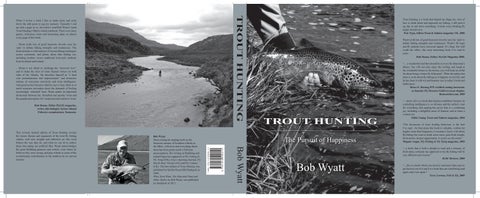
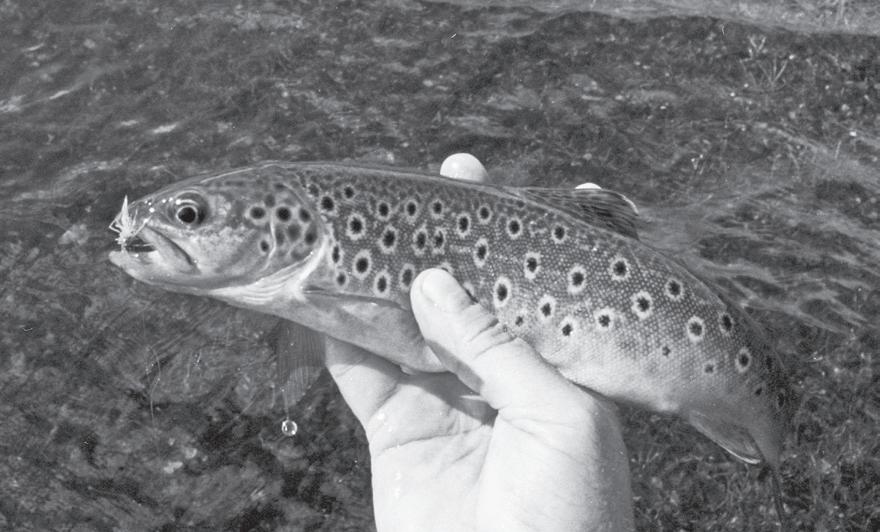
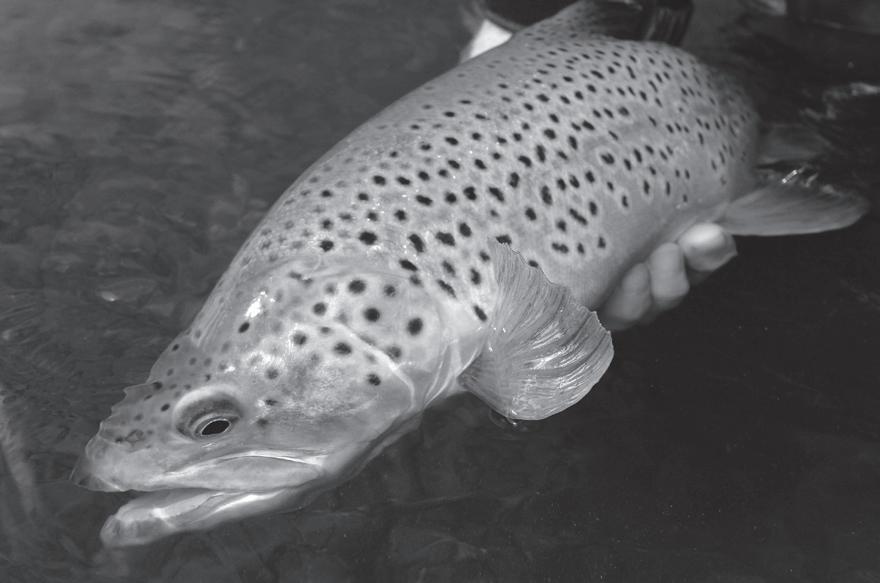
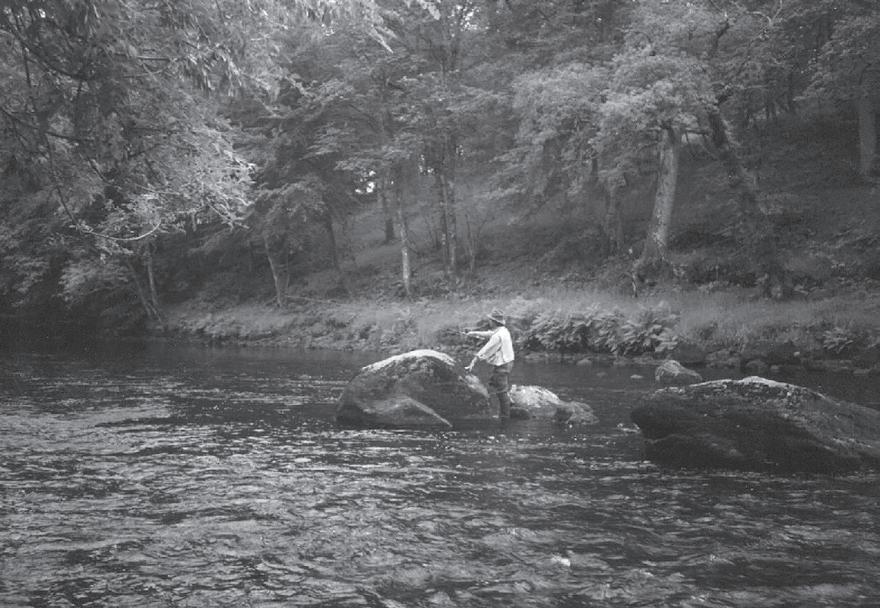
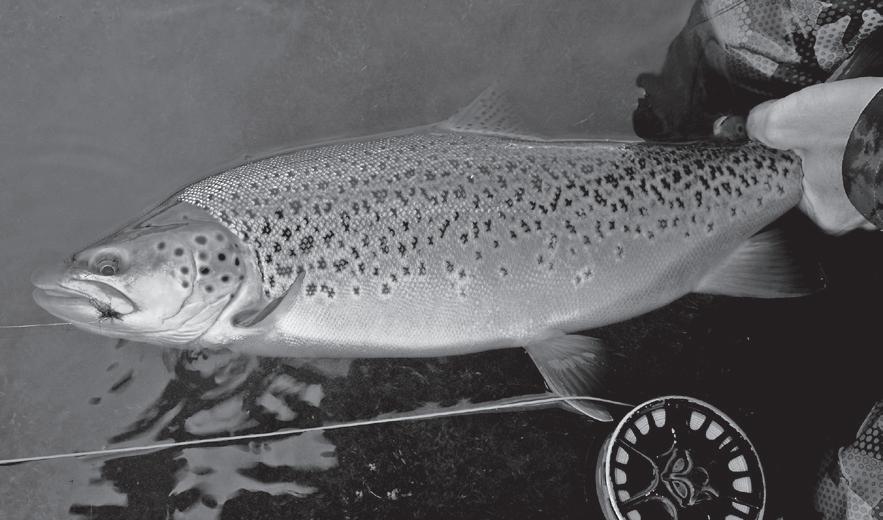
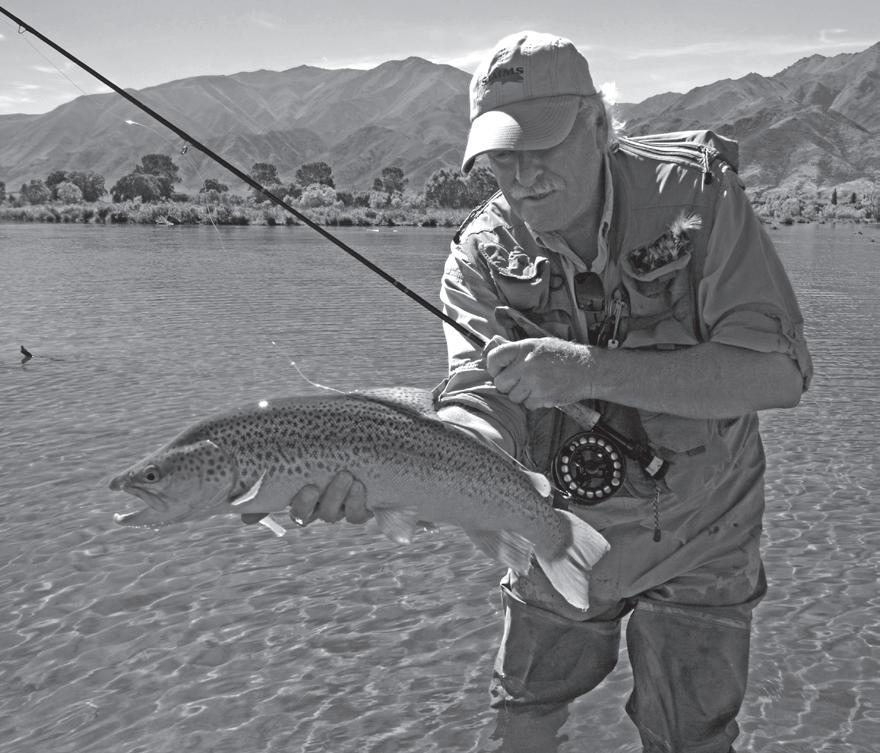
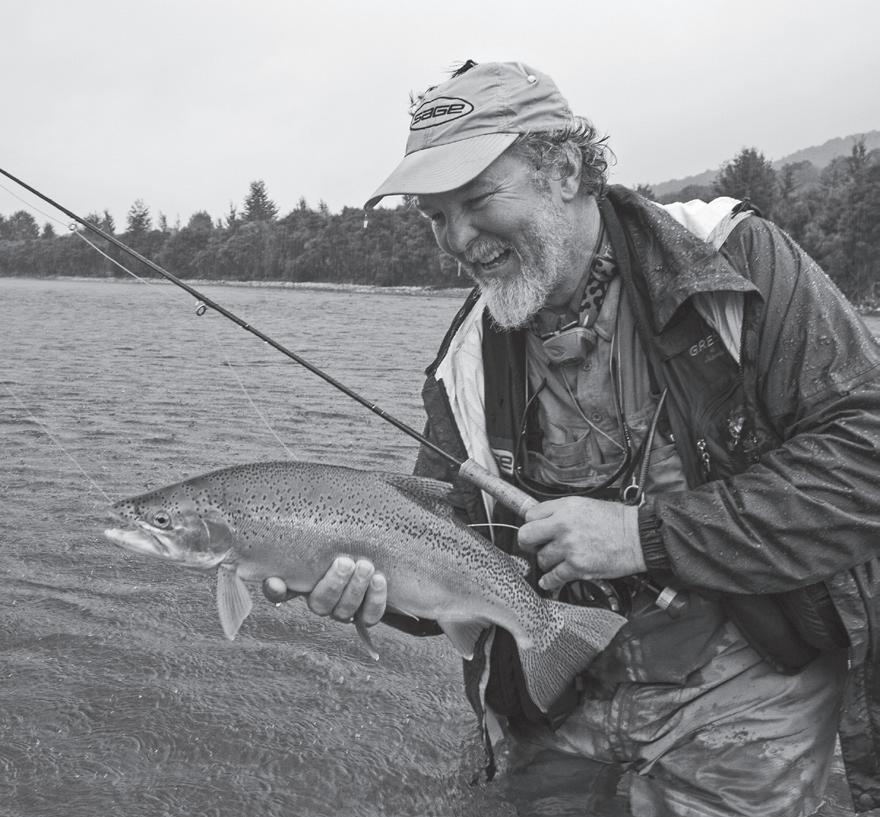
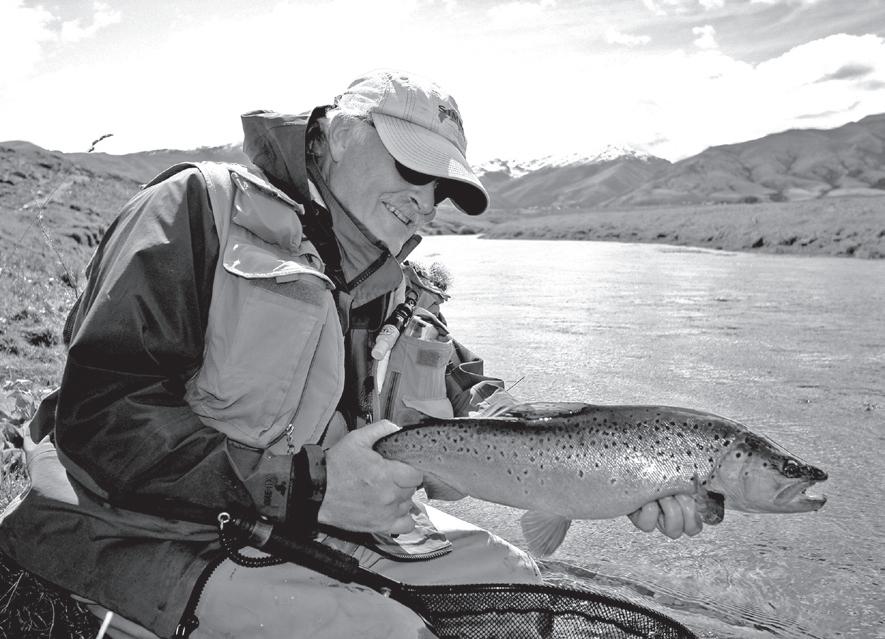
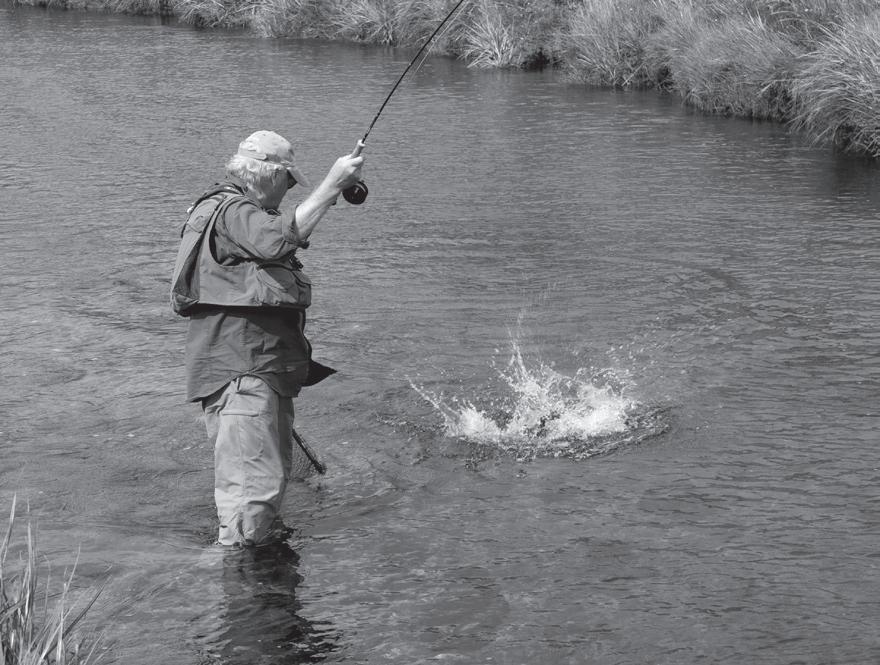
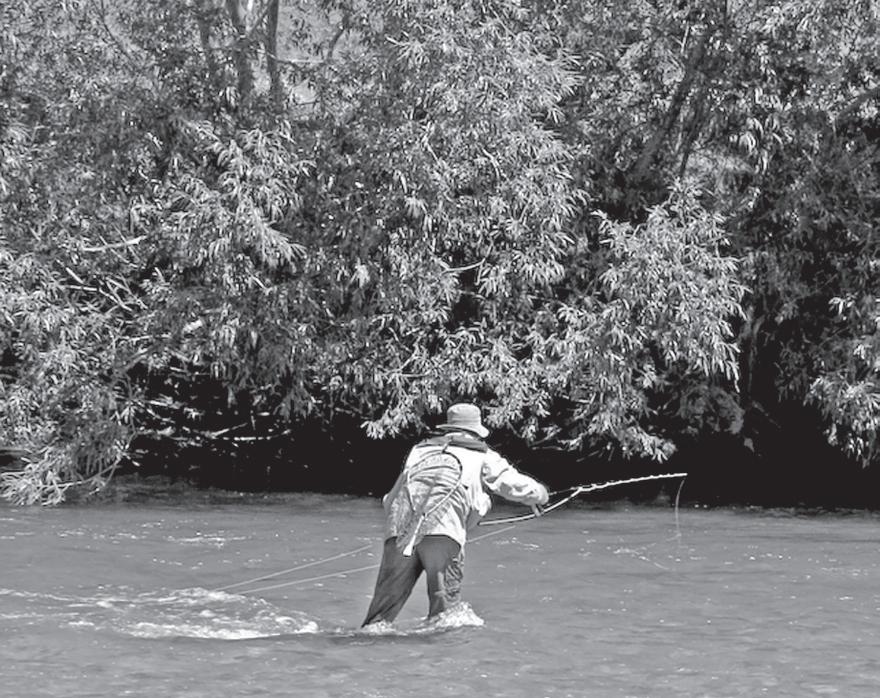
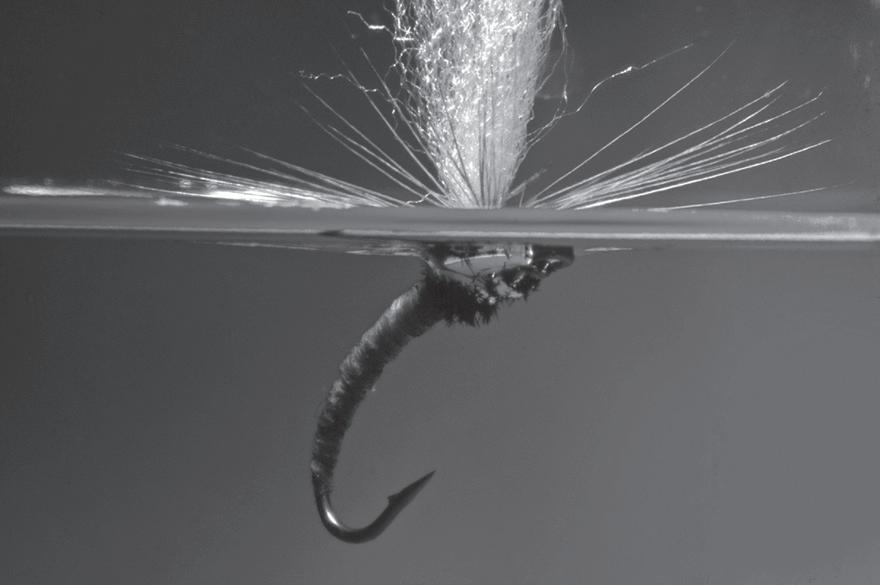
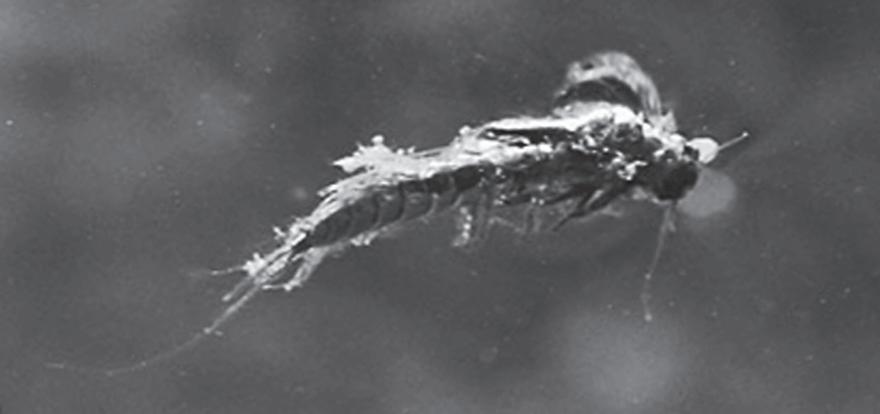
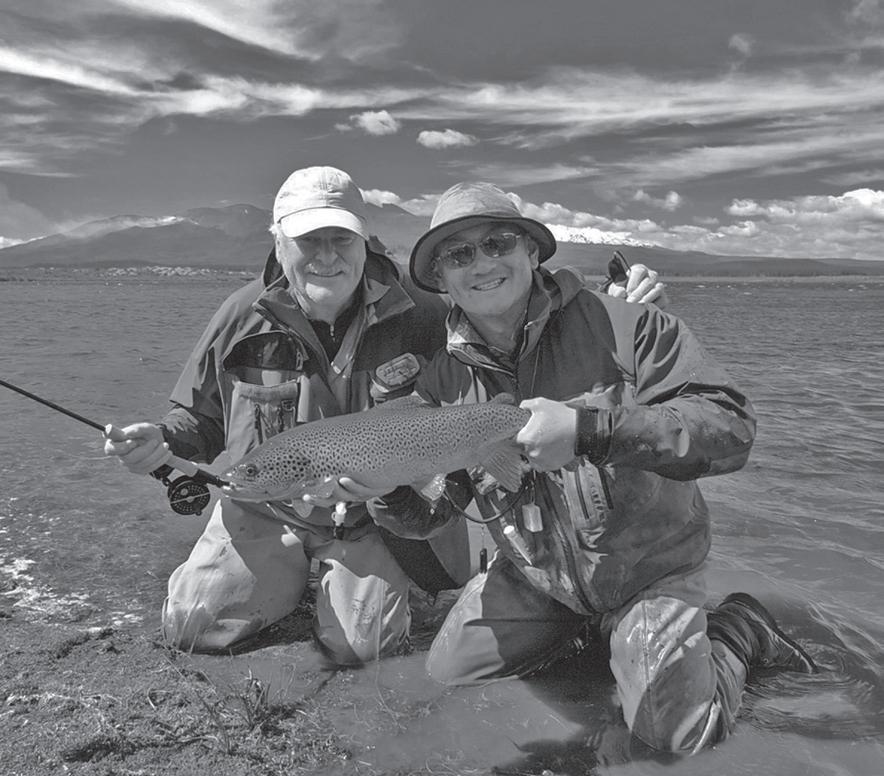
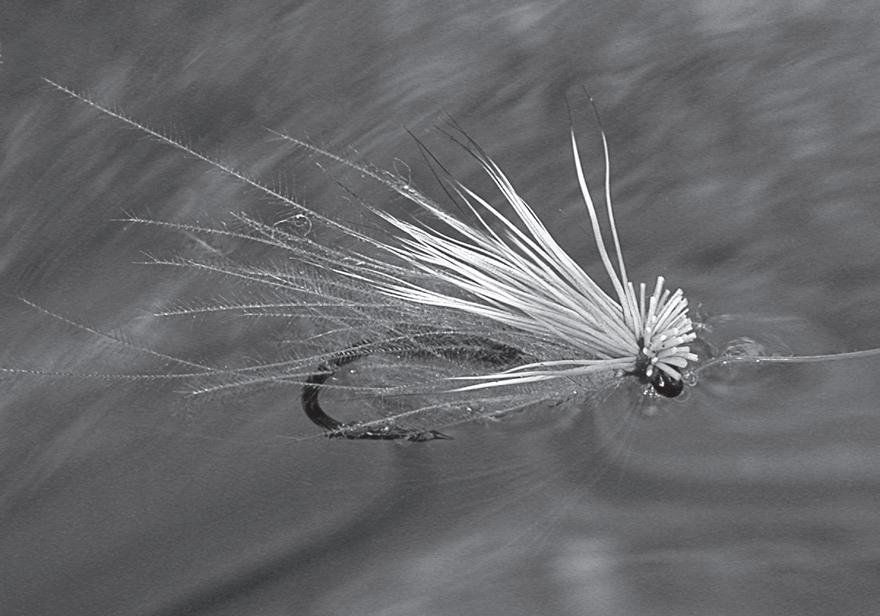
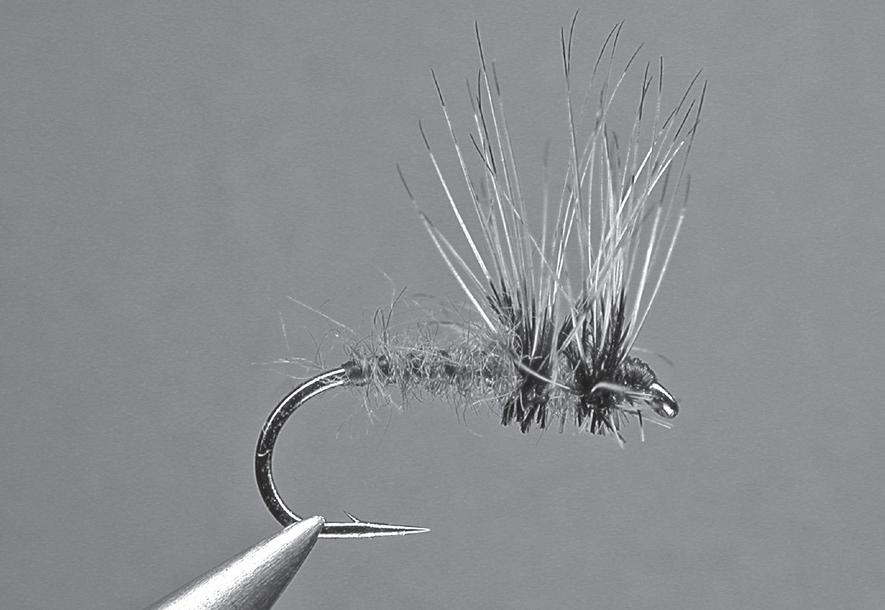
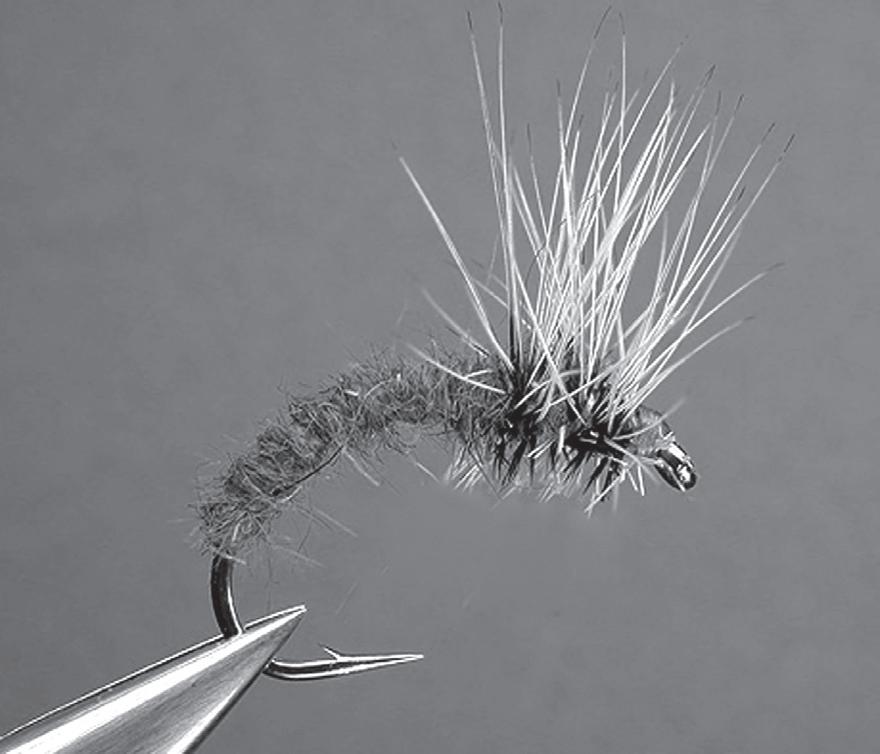
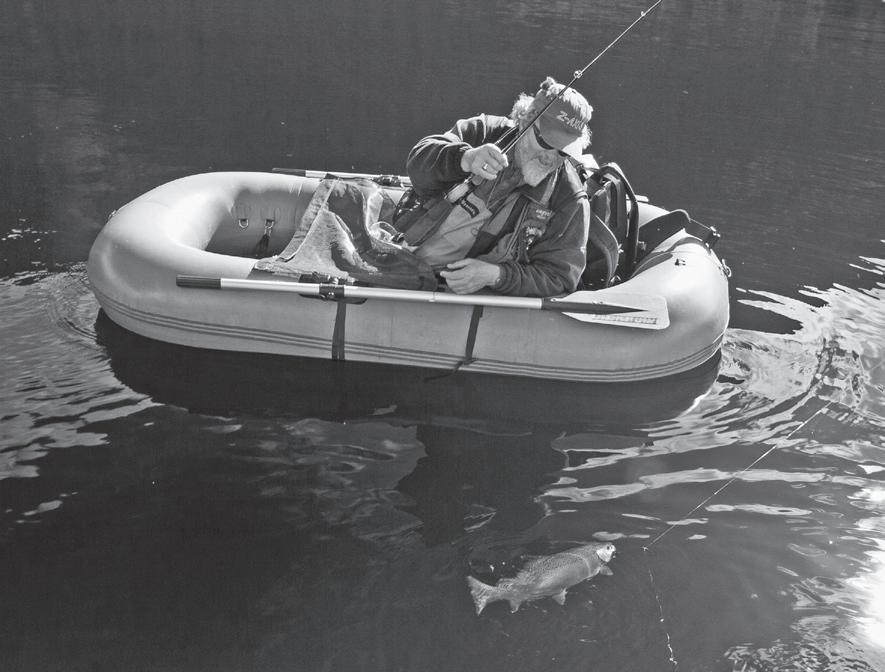
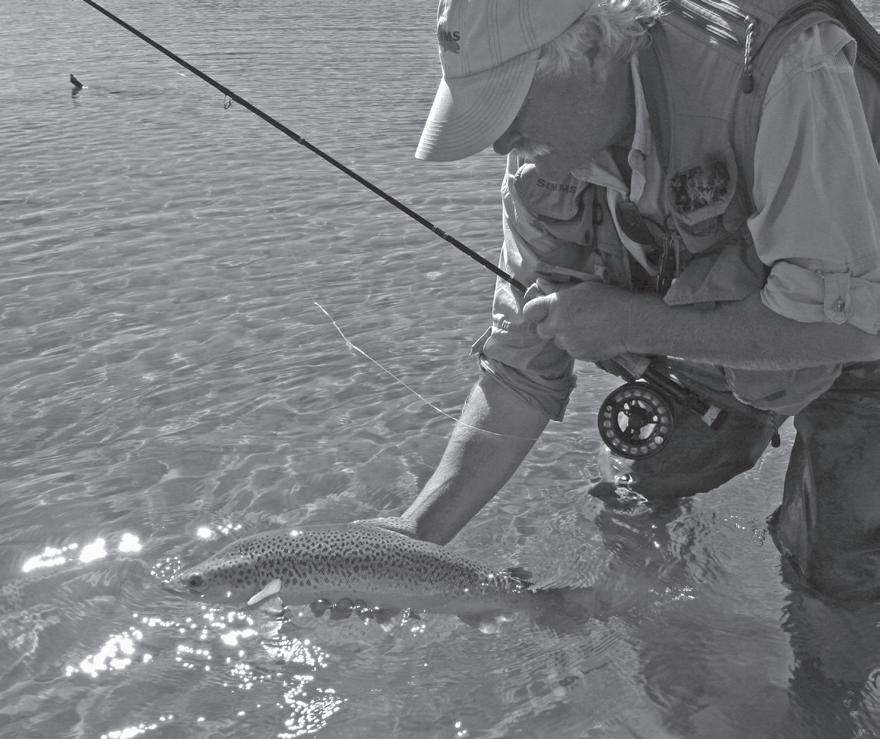
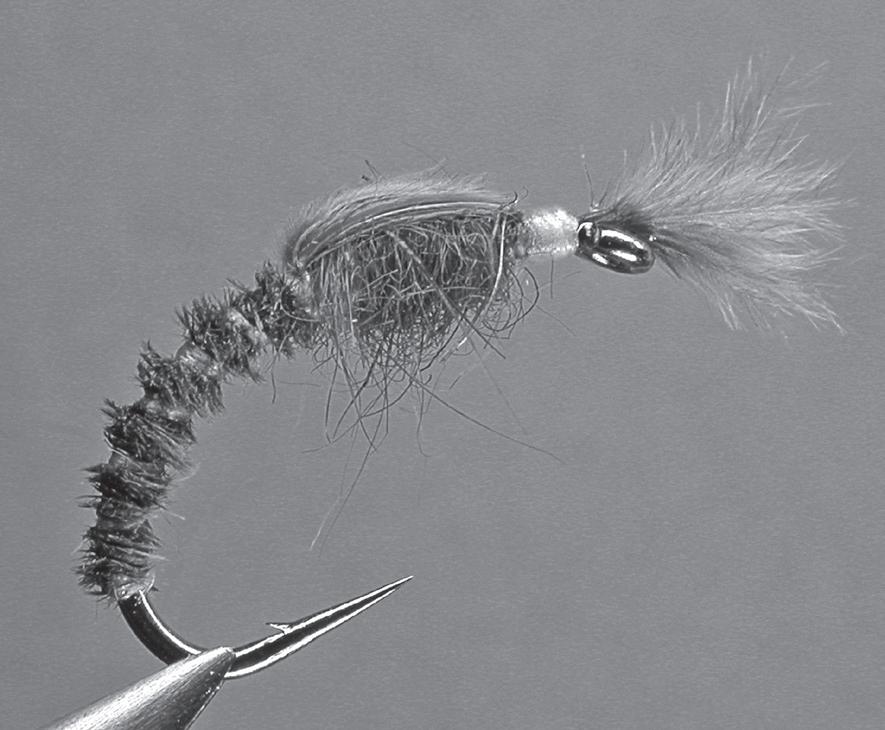
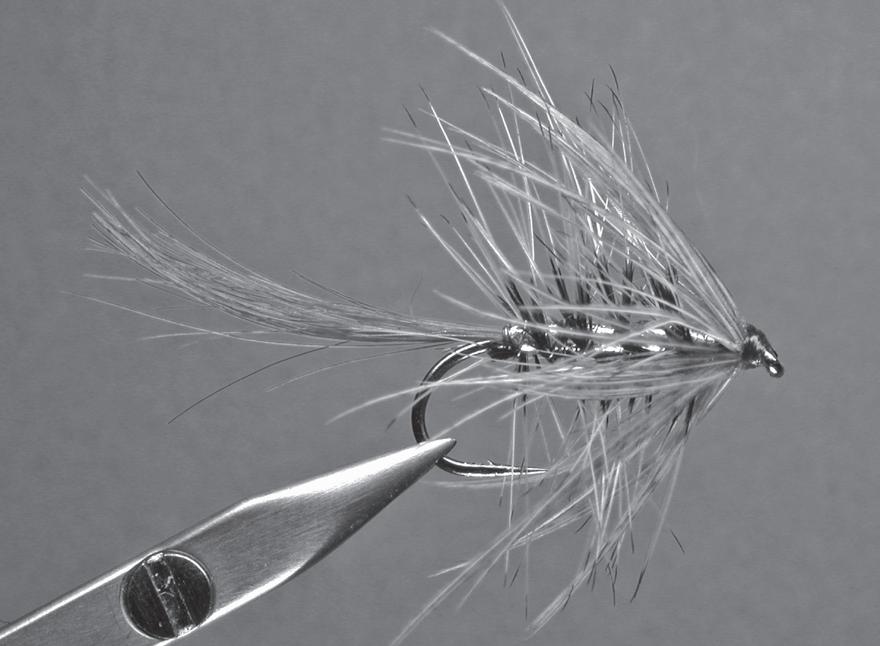
When I review a book I like to make notes and write down the odd quote to jog my memory. Typically I end up with a page or so, but when I read Bob Wyatt’s book Trout Hunting I filled a whole notebook. There were juicy quotes, references, hints and interesting ideas on almost every page of this book.
…Wyatt (with lots of good humour) cleverly uses his ‘pals’ to debate fishing strengths and weaknesses. The book includes a solid analysis of stream fishing techniques across continents, and plenty about lake fishing too, including modern versus traditional loch-style methods from Scotland and Ireland.
…Wyatt is not afraid to challenge the “received view” and to shake the trees of some famous writers on both sides of the Atlantic. He describes himself as “a hard core presentationist and impressionist” and dismisses notions of conscious selectivity and trout intelligence. And good on him because what he says is true; there is so much nonsense nowadays about the demands of fooling increasingly ‘educated’ trout. Wyatt makes an important distinction between the ‘disturbed and spooky’ trout and the popular perception of a ‘suspicious and selective’ trout.
Rob Sloane, Editor FlyLife magazine, writer, fish biologist, former Inland Fisheries commissioner, Tasmania.
This revised, limited edition of Trout Hunting revisits the classic themes and arguments of the trout fly fishing culture, with new insights and reflection on why trout behave the way they do, and what we can do to seduce them into eating our artificial flies. Wyatt acknowledges the great flyfishing pioneers and writers, even where he believes they were wrong, and pays tribute to some of the revolutionary contributions to the tradition by its current masters.
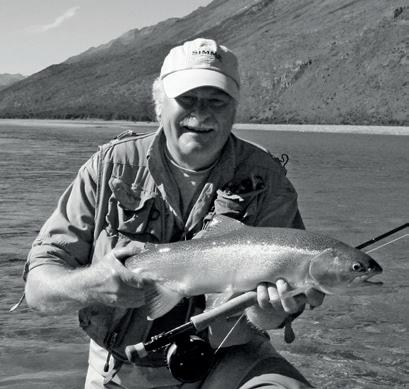
Bob Wyatt
Since cutting his angling teeth on the freestone streams of Southern Alberta in the fifties, wild trout and everything about them has been pretty much a full-time preoccupation. His writing on flyfishing and related topics has appeared in Fly Fishing & Fly Tying (UK), Gray’s Sporting Journal Fly Rod & Reel, FlyLife (AU) and Fly Culture (UK). The first edition of Trout Hunting was published by Quiller/Swan Hill/Stackpole in 2004.
What Trout Want: The Educated Trout and Other Myths, by Bob Wyatt, was published by Stackpole in 2013.
Trout Hunting is a book that helped me shape my view of how to think about and approach my fishing. I still pick it up, dip in and learn something. A book every thinking fly angler should own.
Pete Tyjas, Editor Trout & Salmon magazine UK. 2006 Wyatt (with lots of good humour) cleverly uses his ‘pals’ to debate fishing strengths and weaknesses. Wyatt’s fly logic and fly patterns have universal appeal. It’s deep, but well worth the effort—the most interesting book I’ve read in years.
Rob Sloane, Editor, FlyLife Magazine 2005.
“… a wonderful read that should be in every fly fisherman’s library. You will not only enjoy the writing, and laugh at the wonderful humor in the stories, you will learn an awful lot about being a better fly fisherman”. What the author has done is write about fly-fishing as it happens in real life, and he has done it with wit and humour rare in today’s hook and bullet press.
Bruce E. Harang FFF certified casting instructor, co-founder Fly Dressers Guild overseas chapter, Beaucatcher.com, 2005
“…above all it is a book that inspires confidence because its controlling intelligence is so obvious and the author’s zest for everything that angling has given him is a continuing joy, including a delightful sense of humour and at times a wicked wit.
Eddie Young, Trout and Salmon magazine, 2004
TROUT HUNTING
“The discussion of trout feeding behaviour is the best I’ve read for that alone this book is valuable...written for anglers more than beginners, it assumes I know a bit about fly-fishing but want to think some more, gain fresh insight, fresh tactics, deeper appreciation. It scores on all counts.” Magnus Angus, Fly Fishing & Fly Tying magazine, 2005
“...a book that is both a delight to read and a treasury of fresh ideas; certainly my approach to dry fly fishing will be very different next season.”
BASC Reviews 2005
“…this is a book which you need to read more than once to get the best out of it and it is a book that can stand being read again, and even again.”
Terry Lawton, Fish & Fly 2005
TROUT HUNTING
Bob Wyatt
TROUT HUNTING
The Pursuit of Happiness
For John Dean, a generous and loyal fishing pal
Grateful acknowledgement is made to the following for permission to reprint excerpt from these books:
Simon and Schuster Publishers, New York, and D A Ortega Klein, Herederos de J Ortega y Gasset, for the quotations from Meditations On Hunting, by Jose Ortega y Gasset, (1986 edition, Charles Scribners Sonts NY)
Harper Collins Publishers, New York, for the excerpt from Annie Dillard’s Pilgrim At Tinker Creek (1998 Perennial Classics Edition)
Valerie Haig-Brown, executor of the Roderick Haig-Brown estate, for the closing quotation from A River Never Sleeps
This revised edition published in 2026 by Crowsnest Publishing. First edition published in 2004 by Swan Hill Press.
A catalogue record for this book is available from the British Libary.
All rights reserved. No part of this book may be reproduced or transmitted in any form or by any means, electronic or mechanical, including photocopying, recording or by any information storage and retrieval system, without permission from the publisher in writing.
ISBN: 978-1-9195092-1-1
Formatted and printed by www.beamreachuk.co.uk
The Pursuit of Happiness TROUT HUNTING
Bob Wyatt
Happiness is a life dedicated to occupations for which that individual feels a singular vocation. Immersed in them, he misses nothing; the whole present fills him completely, free from desire and nostalgia…For that reason we want them never to end.
Jose Ortega y Gasset Meditations on Hunting Lisbon 1942
TROUT HUNTING
The Pursuit of Happiness
Revised edition
People say time is money. It’s not true. Unlike money you can’t save time, you can only spend it. At eighty years, you’re aware that life is not a rehearsal. After seven decades of thinking about flyfishing I’m still just getting some things surrounded. Back in the eighties, I was rethinking my ideas regarding trout behaviour and how they react to our flies. In the nineties, I wrote a few articles for the UK’s Fly Fishing & Fly Tying and a few other magazines. YouTube had not yet been created, and one thing led to another. My fishing pals encouraged me to gather these ideas together into a book - this one. In 2013, I followed this book up with What Trout Want: The Educated Trout and Other Myths. I thought it was important to research them both as well as I could, which took me into some unfamiliar but fascinating waters.
Pointing out what I believe are honest but mistaken interpretations of trout behaviour meant I had to back up my ideas as best I could. I dug up some science that raised a few questions. Science, after all, is an endless journey of questions, challenges, heresy and proof. Conclusions are always open to what scientists call falsification, which leads to even more questions and further discoveries. It’s how science works.
The flyfishing literature is a long empirical study of anglers’ experiences, interpretations and traditional attitudes. I had to familiarise myself with some challenging but undisputed conclusions about the relationship between predator and prey, which is, after all, the relationship between us and the trout. In the quarter century since it was written, this book has been overtaken by the online flyfishing culture but I’ve pretty much stuck to my guns on its main arguments. Some of the more challenging and, to some, outright offensive ideas could have made been a bit clearer. I’ve dialled down or walked back a forthright opinion or two. New information has changed my mind on some things, but the philosophy and aesthetic that the great tradition of flyfishing is built on remains the same.
One thing I hope to clear up here is my respect for the giants of the flyfishing literature, my heroes, especially G.E.M. Skues, Vincent Marinaro, Gary LaFontaine, Joe Brooks, Swisher and Richards and some others not so well known, who profoundly informed and improved our approach to this wonderful sport and the fish we pursue. Some of the important books are highlighted here to possibly encourage a young angler who can still read to get acquainted with them.
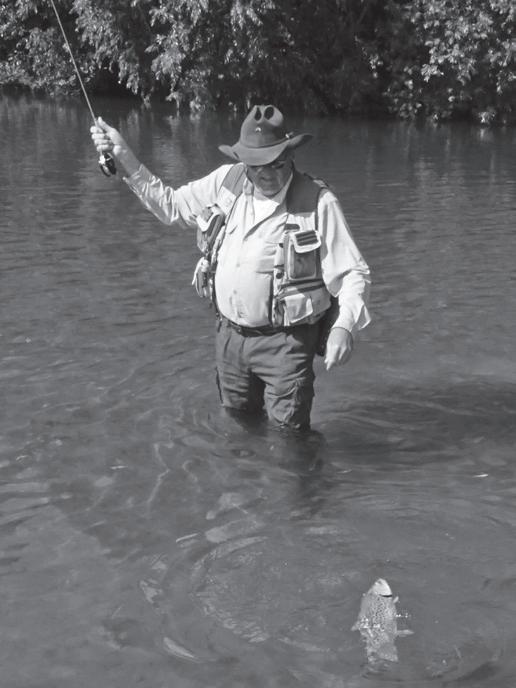
This “director’s cut” edition of Trout Hunting essentially remains the pre-digital and pre-social media original, so can justifiably be considered old school. The photographs are a mix of poorquality scans of predigital snapshots on the river with old style pocket cameras, and somewhat better shots by guys who know their way around a camera. Most of today’s young guns will be well out ahead of me on a lot of technical stuff now, but it never hurts to review the old ways, some of which might help someone new to the pursuit. While not a purist, I’m still pretty much a dry fly guy just because I think it’s the most fun, so we won’t get into the technical weeds of contact or euro-nymphing, jig streamers, or bobber tactics, all of which have been embraced by a new generation of fly fishers. A bit late to the party, I’m only now getting serious about fishing large streamers for big trout. So, the book is not so much a “how to” as it is a “why to”.
Flyfishing revolves around the people you fish with. My fishing pals, my father, uncles, and brothers, and many others have contributed so much to the best in a long life. I hope they all know how I feel about them.
Tight lines. Have fun, Bob Wyatt, 2025
5. Stillwaters – Bank and Boat
6. Fly Design
7.
Tradition
“When one is hunting, the air has another, more exquisite feel as it glides over the skin and enters the lungs, the rocks acquire a more expressive physiognomy, the vegetation becomes loaded with meaning… the axis of the whole situation is that mystical union with the animal, a sensing and presentiment of it that automatically leads the hunter to perceive the environment from the point of view of the prey.”
World-making
Jose Ortega y Gasset Meditations
on Hunting
Most of us will agree that flyfishing not only about catching fish. There are many ways to catch fish, so from some angles flyfishing doesn’t make a lot of sense. Like the art-world or the sportsworld, it can’t be observed accurately from the outside. That means outsiders usually don’t understand it. It’s complicated.
To an insider, flyfishing is more than just an interest, a (mere) sport, hobby or pastime. It’s “my world”, a complicated matrix of desire, experience and associations. It involves your finances, your emotional relationships, your taste and your children. It normally includes your closest friends. It’s fun, but involves wild creatures, so it’s serious. As a serious pursuit it’s integrated into our very concept of self, as real as our personality.
Flyfishing embodies one of the few western cultural narratives to have survived modernity intact. I stop short of using the phrase grand narratives, because when describing one’s own enthusiasms, it’s too easy to slip into that type of hyperbole. Grand should maybe be reserved for major cultural narratives like democracy, Christianity and football. On the other hand, it’s not unreasonable to compare flyfishing with what philosophers of culture call the “master narratives” of art. Several art forms and cultural practices such as Elizabethan theatre and opera have simply
In flyfishing we sometimes find ourselves in a pure self-aware state of happiness.
been preserved - high-brow curiosities in a 21st century cultural theme park. Flyfishing, neither art nor game, has developed aesthetically and practically at an astonishing rate, and appears to be gathering momentum around the world.
Writers on flyfishing often trot out AElian, the 2nd century Roman who described the Macedonian practice of catching fish with speckled skins, on a lure made from red wool and feathers from a cock’s wattles (there, I just trotted him out again myself). We all recognise the significance of that historical moment. Flyfishing had been invented, the beginnings of an unbroken narrative that spans two millennia. Offhand, I can’t think of another like it. Hunting with horses and dogs, the only so-called blood sport that surpasses flyfishing in terms of longevity is, to all appearances, over in Europe after thousands of years of unbroken tradition.
Flyfishing appears to have survived modernism not as some quaint cultural relic but as a vital and creative activity that is only now entering its golden age. The equipment associated with it is efficient and elegant, and often expensive. The codes of behaviour and practice are selfregulating but progressive. Who, a hundred years ago, could have imagined the current embrace of catch and release?
The better heeled and more fanatic among us are putting flies in the way of every species possible in every conceivable type of water, all over the planet. It no longer seems exotic or strange when we read the latest photo-essay on the sporting qualities of some unheard-of fish in the swamps of New Guinea. Somebody says, “Man, those Honduran bat fish
will spool you in seconds flat!” We just go, “Okay! What’s the airfare?”
This is such a prevalent attitude that everyone I fish with, regardless of economic circumstances, feels that sooner or later they’ll fish for tarpon, permit, or bonefish. We weigh up the relative costs and benefits. Hmmm. Let’s see...the dental work, or the trip to the Kola Peninsula?
Anyway, it’s also apparent that many are beginning to recognise the degree that flyfishing has penetrated daily life. The literature has never been so reflective or philosophical, although it’s always been pretty romantic. Americans, as usual, put the new ideologies into action, but reflexivity and the self-constructed life are as American as biscuits and gravy.
With fewer ancient cultural narratives to worry about, Americans have always displayed no hesitation toward making some up. The North American angler has been re-invented, from a bucolic and somewhat puritanical Ted Trueblood character, to a suave, athletic, articulate, well informed, politically aware, sympathetic and somewhat ironic world adventurer…and she looks good. British anglers are by and large a little more conservative, but that’s changing fast.
Every July, for over twenty-five years, I fished with a group of guys in northwest Scotland. One year we had an after dinner reading of the fishing poetry of Ted Hughes, the British Poet Laureate, to commemorate his death. It didn’t seem pretentious or embarrassing (well, maybe
Flyfishing provides a way to connect with nature that sports other than hunting don’t provide.
just a little) and I realised we were in a new world. The fact that the next session typically degenerated into a sexist joke workshop didn’t diminish the previous night’s experience.
I think it’s important to recognise that these developments are not the result of simple snobbery or trendiness as some complain (although Forbes magazine announced that flyfishing is the chosen leisure activity of most company CEOs). The maturity of the sport and its scope for broadening the North American experience was evident back in the sixties in the popularity of the writings of Joe Brooks, A J McLean, Haig-Brown and others.
Initially, book publishers regarded this as a cult following, but soon it was clear that a generation had embraced flyfishing in a way that could not have been anticipated. The new generation of fly fishers are maybe not so bookish, but the great old books hold the wisdom of the tradition. Nevertheless, there’s been an enormous explosion of enthusiasm for flyfishing since the seventies.
Which came first; A River Runs Through It (the movie) or the public readiness for it? Clearly, director Robert Redford had an eye for the mix of romance, political correctness and stylish environmentalism that he packaged so effectively into that movie. People were not only ready
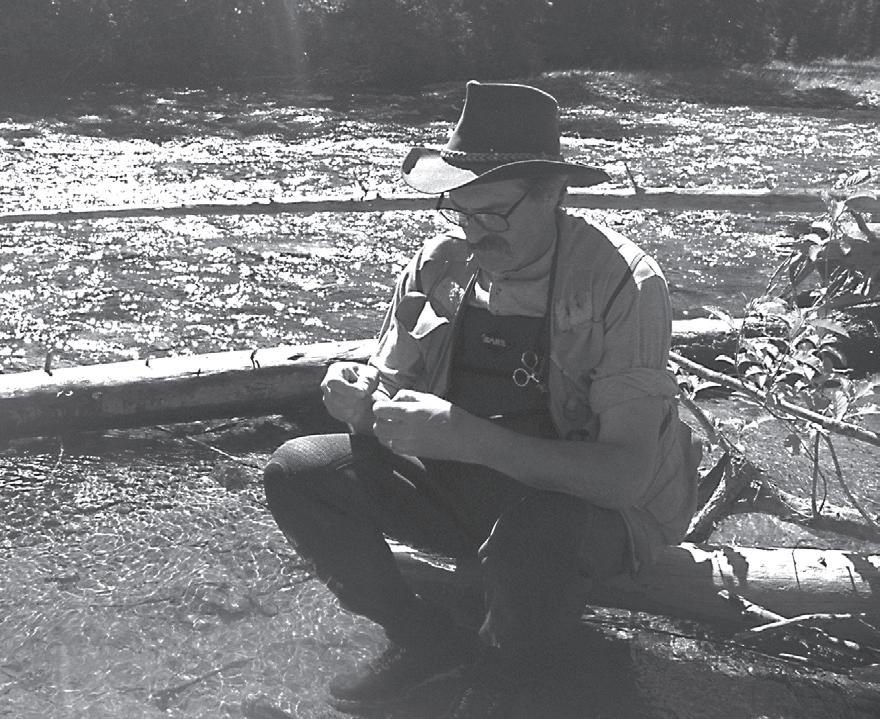
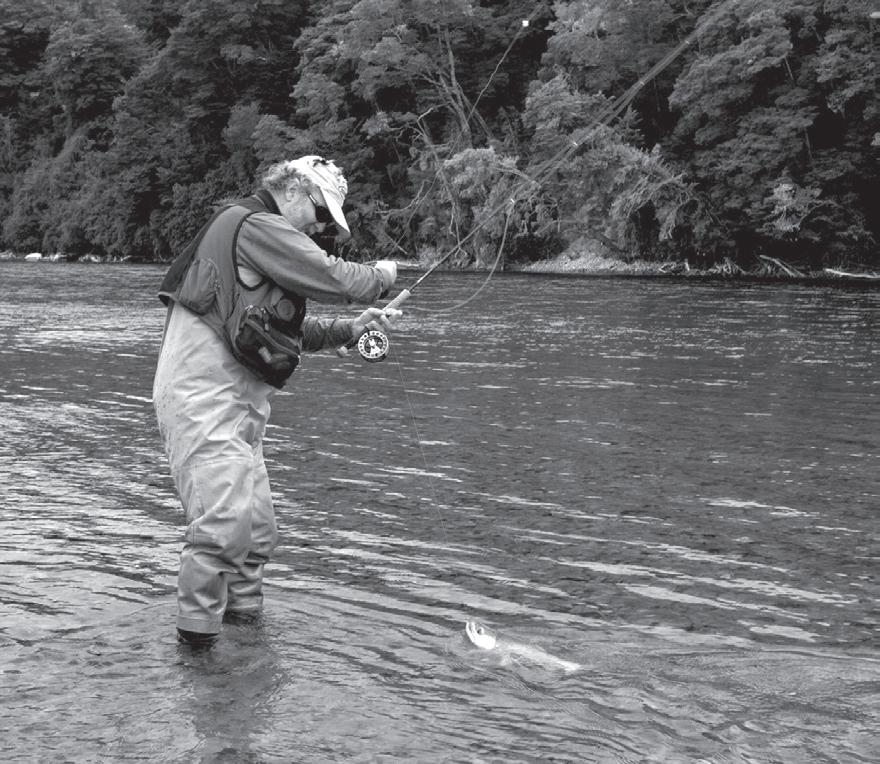
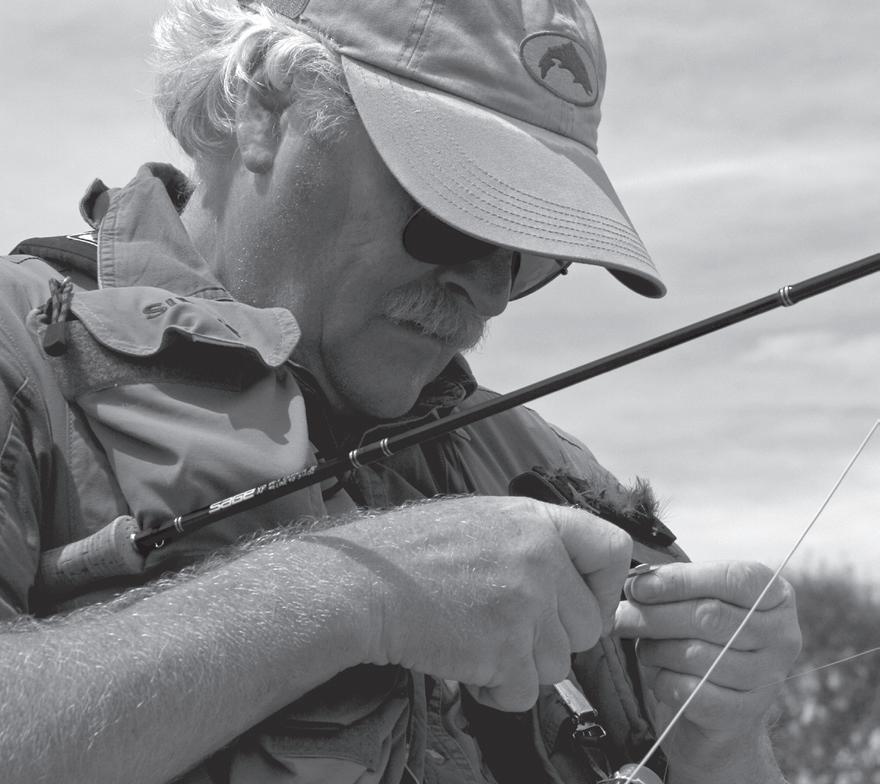
Time out on a western Cutthroat stream. Brother Billy reties.
for it; they were hungry for it. It was no more than a marker for the way things had changed. There has been an ongoing explosion in the numbers of folks keen to become fly fishers, largely because it’s now regarded as cool, but also because it provides a way to connect with nature that sports besides hunting don’t provide.
Flyfishing’s first principle is “fair chase”; essentially just giving the animal a decent chance. It places flyfishing into a different category of activities, removing it from the objective of obtaining fish by any means, that is, nets, set lines, poisons and explosives, etc. You can take this idea as far as you like, as long as it’s legal, and some regard chumming the water or even bait fishing as crowding the line of fair chase. Even some recent flyfishing tactics are deemed to be pushing the limits. Most tactics however are comfortably within the customary boundaries and remain a matter of taste.
Fly fishers are not mere observers but participants in the natural order of things.
Happiness
The literature reflects the evolution of the flyfishing life. I remember what I was doing the day that Roderick Haig-Brown died like I remember the day President Kennedy was shot. I wasn’t prepared for the feeling of loss. I felt I knew him and thought there was even a chance to meet him one day on the river. This was always less than a real possibility, but when fishing Vancouver Island’s Stamp, the Gold or the Englishman I was on his water. He had conditioned my experience of those rivers, and all rivers. I was fishing in a more self-conscious way, the correct way, with more care and restraint than I had on the rivers of my predatory youth.
Reflexivity is baked into the experience; we reflect as we do the thing not only after the fact. We are not mere observers but participants in the order of things. We shape ourselves as we shape the experience, and we add that experience to the sum of a world of our making.
The important thing is that we feel integrated with the real world as we wish it to be - a
Where you are one among the bears. A Kootenay back country Cutthroat stream.
spacious world of fresh air, clear water and wild creatures that we search for with our artfully created fly. The experience conditions our sense of beauty and proportion and gives us some purchase on what seem like true values. Immersed in the act of flyfishing we sometimes find ourselves in a pure self-aware state of happiness.
In his final interview before his death, Ted Hughes described it as our search for the “original lost conditions, a place where you are one among the bears”. Flyfishing is certainly that, but it’s not only the reification of our primitive ur-self. It’s also a deep integration with the aesthetic traditions, which, as Haig-Brown put it, have their foundation in the first guy who sneaked away to the creek when the tribe did not really need fish. Another Hughes, Robert this time, a fly fisher for twenty-five years and the art critic for Time magazine, makes the claim in his book A Jerk on One End that Hemingway was obsessed with fishing not because he was a killer but because he was an aesthete, a stylist.
We fish for pleasure and the aesthetics of flyfishing are a deep and reliable source of that pleasure. Essentially non-competitive, flyfishing is so elegant that it is difficult and inaccurate to classify it as a sport, and it’s certainly no game, although it can quickly be turned into one. Flyfishing is a style of fishing. Despite the popular attribution, flyfishing has never really attained the status of an art - until now that is, when its purposes are truly nearing the condition of art.
Philosophers of art have pronounced (again) that art is dead; that is, the traditions and master narratives of fine art have been severed and are now meaningless. With the breaking of the
When you’re in it, you’re in it.
cultural thread of meaning in the traditions of art, religion and many other ethnic and cultural narratives, it is not surprising that a pursuit as coherent and beautiful as flyfishing should be embraced by so many. Few arts and sports have unbroken traditions as long, a philosophy so well developed, or roots so deep in our essential humanity.
Philosophers of flyfishing have described it as a pursuit of innocence. In his classic book, What The Trout Said, Datus Proper quotes Annie Dillard from Pilgrim at Tinker Creek, and it’s worth repeating…”It is possible to pursue innocence as hounds pursue hares: single-mindedly, driven by a kind of love, crashing over creeks, keening and lost in fields and forests, vaulting all hedges and hills wide-eyed, giving loud tongue all unawares to the deepest, most incomprehensible longing, a root flame in the heart.”
Flyfishing is far more than just another way to catch fish, although catching a few is important.
Apperception, to be aware of our own awareness, makes us incapable of achieving or recuperating lost innocence. Hunting - and flyfishing is certainly a form of hunting - maybe brings us closest to that original state.
The unsettling thing is that the appeal of flyfishing is so self-evident and growing that we can imagine a situation where there are just too many fly-fishers. This is already the case on some of the highly publicised waters, and there are almost no “last good places” left undiscovered. Places where one can be one among the bears are still out there, but the bears are getting used to living on our leftovers.
The world is changing, and fast, and there will always be those who want to get theirs before it’s all gone. The rest of us, who usually fish behind someone else, will find that the condition of true wilderness will disappear, but also that the original lost condition is not a preserved patch of Eden accessible only by wealth and helicopter. It’s really a state of the mind and spirit.
Form follows Function
“And this is what concerns us: what does a man do when, and in the extent that he is free to do as he pleases?”
Jose Ortega y Gasset Meditations on Hunting
the
or not.
For many, the traditional approach is simply the correct way to fish. Essentially the orthodox view, it has as much to do with self-presentation as catching trout. If you’re a fly fisher you are already in this camp to some extent. I mean, why flyfish if not for the pleasures of tradition, its aesthetics, elegance and personal style, of viewing yourself as part of a great code of practice extending back at least to early Roman times? It surely isn’t because it’s a just good way to catch fish. If it were, the tackle and literature would probably look and read differently. It’s hard to duck
Flyfishing is essentially hunting with built-in fair chase restraint, and
choice to kill
the accusation that we consider flyfishing for trout aesthetically superior to soaking a stink-bait for catfish.
All fishing is great, but experienced fly fishers would say that, in terms of pleasure alone, flyfishing is higher on the scale of experience than bait fishing. They would also likely say that dining on a rare Aberdeen Angus steak with a good wine in a nice restaurant is higher on the experience scale than a Big Mac and a chocolate shake in a bus station. This invites the objection that it’s a class thing and all about snobbery. Snobs will be snobs, and one meal can be more expensive than the other, but the important difference is simply that one is more pleasurable. Whether you can afford them or not, some experiences are just more enjoyable than others, and anyone who has tried flyfishing usually likes it more than bait or spin fishing. To find that out you just need to do it.
For starters, bait fishing means messing around with bait. Apart from just being cleaner, everything about flyfishing is a source of pleasure and interest. It’s this way partly because it’s a great tradition. The beauty and function of a modern fly rod or reel is appreciated because we have a history and tradition to measure it against, a context. The techniques and strategies are codified in the philosophy of flyfishing, an ethical philosophy of aesthetic form and restraint.
Having said that, if flyfishing were only tradition, and form over function, we might still be using brass reels and twelve-foot greenheart rods. Who is to say where tradition begins or ends? A strong core of traditionalists regards the bamboo rod and the dry fly the pinnacle of the art. Their reason is the understanding and respect for hand crafted elegance and style in the tools, although there are plenty of boo enthusiasts who will argue on performance alone.
Finally, the main thing is the quality of the experience.
Good Gear
A friend, who fishes with a quiver full of creaky bamboo Hardys and worn Perfect reels passed down to him by his father, insists on referring to graphite rods as “those chemical johnnies”. To him, I’m just another gimmick-obsessed tackle junkie who can’t resist the increased performance of the new tackle. My dozen or so trout rods (all essential, I hasten to add) are all chemical johnnies, and my fly reels are the technically best I can afford.
This kind of thing, including the good-natured snobbery, is all part of the fun. For all its pretensions to being an art, if not a religion, flyfishing is at the very least a broad church. On the other hand, we would not be enjoying the fabulous experiences we do today if it were only a matter of respect for tradition. Could we have seen the growth of saltwater flyfishing if we had been limited to greenheart rods?
Developments in tackle, tactics and fly design have placed the next to impossible Permit, Roosterfish and Yellowfin Tuna on the list of flyfishing quarry. Bruisers like the giant trevally, marlin are now the focus of a specialist branch of the tradition. Fish such as the grayling and pike, once considered vermin by trout anglers, have societies centred on their pursuit and protection, with their own emerging traditions. Flyfishing is not only a tradition but a bona-fide sub-culture with a philosophical and ethical system, not to mention the inevitable branches, hierarchies, exclusive social elites and avant-gardes.
Looking beyond the superficial aspects, the real difference between flyfishing and bait fishing is not simply in the artificial nature of the bait, but in the angler’s attitude and approach toward the quarry. Bait fishing is setting a trap for the fish, real food with a hook in it, and is comparatively passive. Flyfishing is true hunting, active and seeking.
Unlike soaking a worm and waiting for a bite, flyfishing requires no patience at all, despite the common misconception by those who don’t fish. This will enrage all those expert worm fishermen, but I practised it long enough myself to know the difference between upstream worming and snoozing under an umbrella. Anyway, we’re talking fundamentals here.
That said, in terms of the quality of the experience, not all flyfishing is equal. At one end of the flyfishing spectrum is the repetitive game of pulling a lure past the nose of a confused farm animal that has no experience beyond competing for food pellets in a herd of identical fish. At the other end is the stylish, expensive and often exclusive world of private water, restrictive rules, and international destination angling. Between those two extremes is a world of fascinating experience that can occupy your mind through a lifetime.
The art and craft of flyfishing have been driven rapidly into their current state by American anglers and tackle designers but the model for the world-wide philosophy of fair chase, as well as the basic design of flyfishing equipment, is old-world British. Elegant and simple, combining superb craftsmanship with functional design, the whole thing based on the idea of built-in restraint. In other words, there are more efficient ways to catch fish. To many it still sums up a romantic view of Englishness, along with cricket, plummy accents, country pubs and warm beer. After a century of American developments, especially in dry fly fishing, British river strategies and stillwater tactics are informing American approaches again. What goes round…
The quality of the experience, rather than the way to catch the most fish, is the bedrock of the flyfishing tradition. When one understands that ethos, the difference between flyfishing and all other forms of fishing becomes clear. Tradition, embodied in the tackle, the theory and the practice, is a great part of what makes the flyfishing experience meaningful. Although flyfishing is often the most effective way to catch trout, with no knowledge or understanding of its traditions it’s a less interesting and enjoyable pursuit.
Tradition is a source of deep pleasure for flyfishing’s enthusiasts. The problem with a tootraditional approach is that it can narrow the creative and open-ended inquiry in favour of tried and tested methods and crystalise into orthodoxy. Sometimes tradition can be so hide-bound that it seems like empty form, practiced in an atmosphere of reactionary conservatism, style for its own sake. A good fly-fisher builds his or her strategies on sound traditional theory and practice, but with a creative and experimental attitude and an eye peeled for opportunity.
Only when it stands in the way of your own pleasure or understanding does tradition become a problem. It could be argued that it’s ultimately a matter of style - you choose to limit your activities to a narrower and stricter code, or not. Many people get as much satisfaction as they want from the strictest codes of behaviour. It’s best to be mindful that not everyone will be interested in the stipulations of your personal code. Despite a few cranky Halfordians, the flyfishing tradition is a generous and inclusive one. So, we have the no-expense-spared luxury destination angler to the sleep-in-the-dirt trout bum, and everything in between.
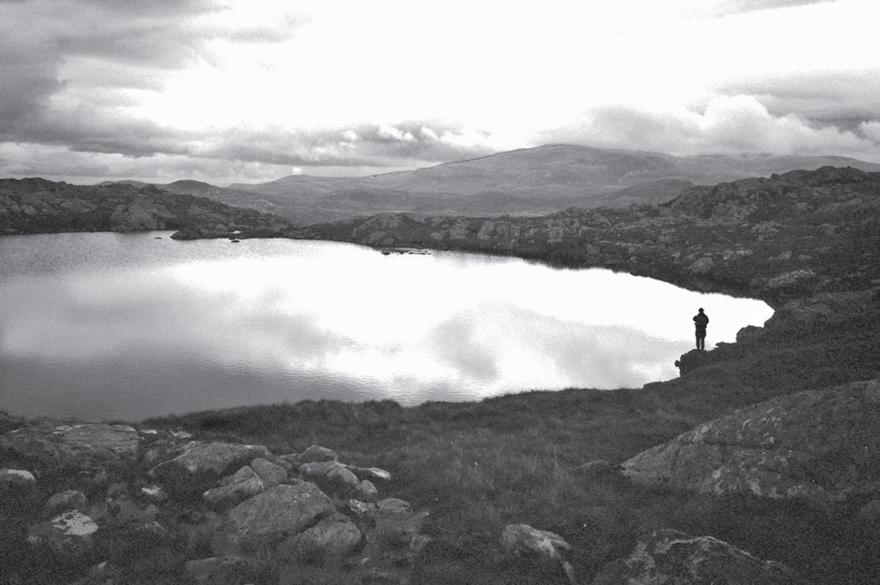
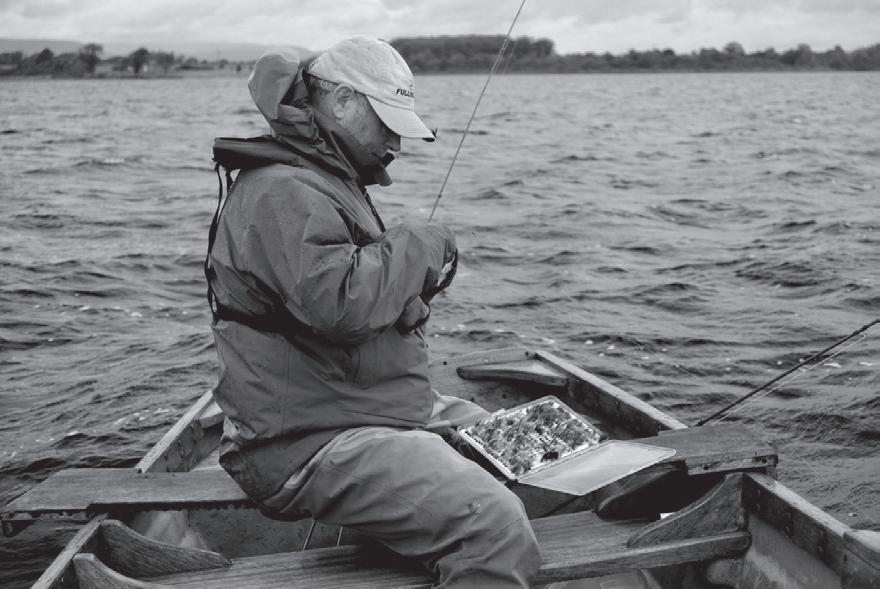
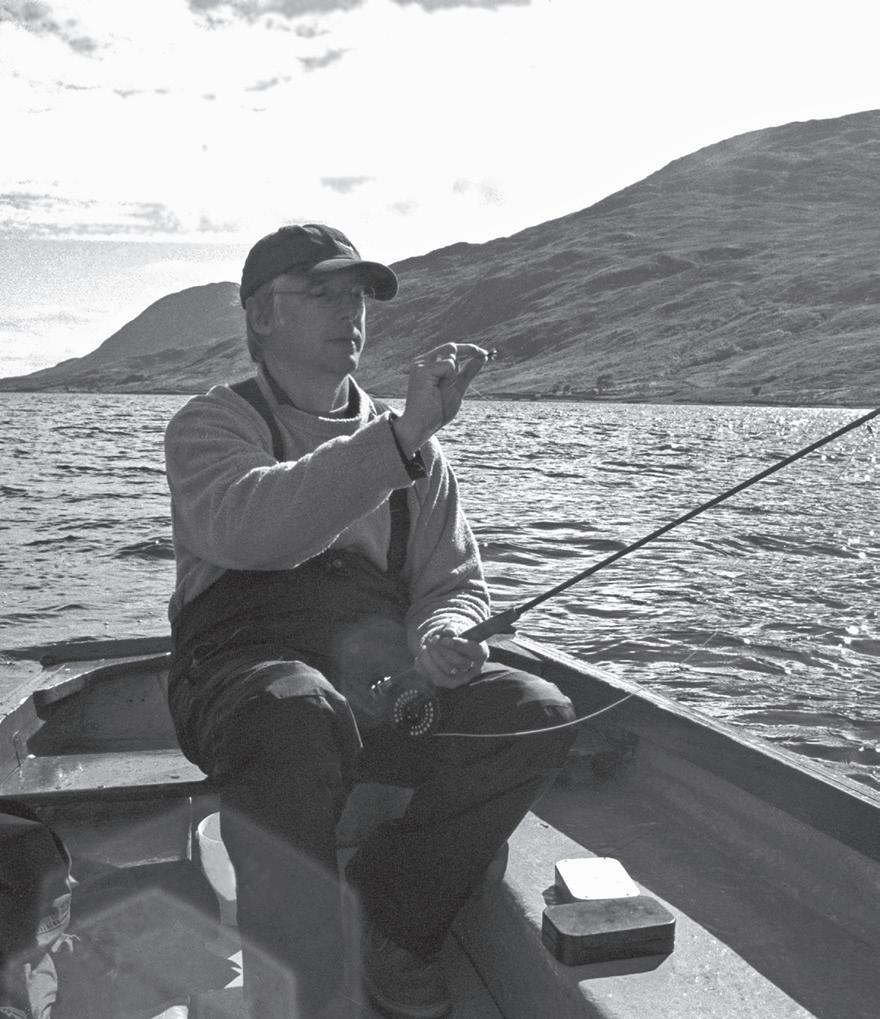
Tradition runs long and deep, Joe Creane rigs up for a drift on an Irish lough.
The Books
“The book is like the spoon, scissors, the hammer, the wheel. Once invented, it cannot be improved. You cannot make a spoon that is better than a spoon.”
Umberto Eco
Flyfishing has a history, and a long one. For anyone interested in its history, it is found in the books, thousands of them. Since there are so many books written on flyfishing tactics, to begin with the basics would make for another how-to book in a crowded field. So, this book is not so much a how-to as it is a why-to. On the other hand, it never hurts to review one’s approach, and a fishing book worthy of the name should add something practical to the body of knowledge, even if it’s just a few new twists or a slight difference of perspective. I promise to not include a gear section.
All of us have occasionally found ourselves in the wrong end of the boat, our partner inexplicably getting all the action, even when the anglers involved are relatively even in terms of skill. I relate a few such stories here when things went my way rather than the other way around - not to brag but to analyse why it happened.
The pleasure increases with the difficulty. John Dean works an afternoon mayfly spinner fall.
Falling far short of a proper how-to, and occasionally repeating findings from other books, my observations may just help get someone started or round off an established trout hunting approach. So, as Edmonds and Lee say in Brook and River Trouting for similar reasons, I’ll just emphasize a few essential points - with the caveat that in flyfishing for wild trout, even the variables have variables.
There’s plenty of technical information available to the fly fisher today, certainly more than we need for successful fishing, and it just keeps coming. The Internet is a firehose source for flyfishing information now, but without the context of the tradition all this how-to information might create an impression that flyfishing is a simple matter of technology, tactics and pursuit or, worse, just a game played with live animals. The ethos and craft of flyfishing is always accessible to those who read the flyfishing literature and, although some have come close, no single book or video can present the thing in a piece and any attempt to do so usually collapses into entry level generalities.
The unreasonable allocation of time and effort with no practical outcome.
Offline
The Internet has been a spectacular resource for fly fishers and likely threatens the existence of the printed book. One thing you can still say for the book is that you don’t have to plug it in. And it’s always there, on the shelf or beside the bed, on pause, to pick up and return to anytime. You can write notes in the margins or stop reading to just reflect on a sentence for a minute. So, a book is a different kind of input than a video, contemplative and quiet, like flyfishing used to be before the online video, heavy metal soundtracks and high fives. Remember when Fly fisherman magazine had “the quiet sport” on its masthead? Old school.
The best books outline and permit a workable and effective approach to flyfishing, based on personal experience and add some specialised wrinkles to the tradition. Whether one is a reader or not, the flyfishing literature provides the context for the activity and makes sense of it. That said, books and YouTube won’t make you an expert fly fisher; only experience will do that.
Some books are purely technical and attempt to give an objective analysis of why and how to use specific tackle and tactics. Some are not great literature, but they often make up for that by accurate observations of the fish, its prey, and the tactics and flies that work. There are a lot of them in print, and since each is usually an account from an individual’s perspective there’s an unavoidable amount of repetition (as there is in this one) and conflicting advice.
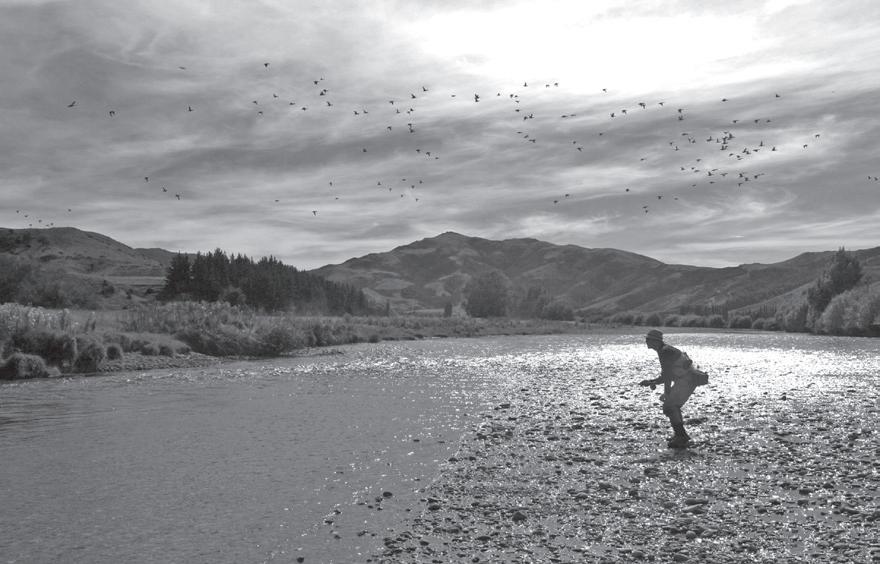
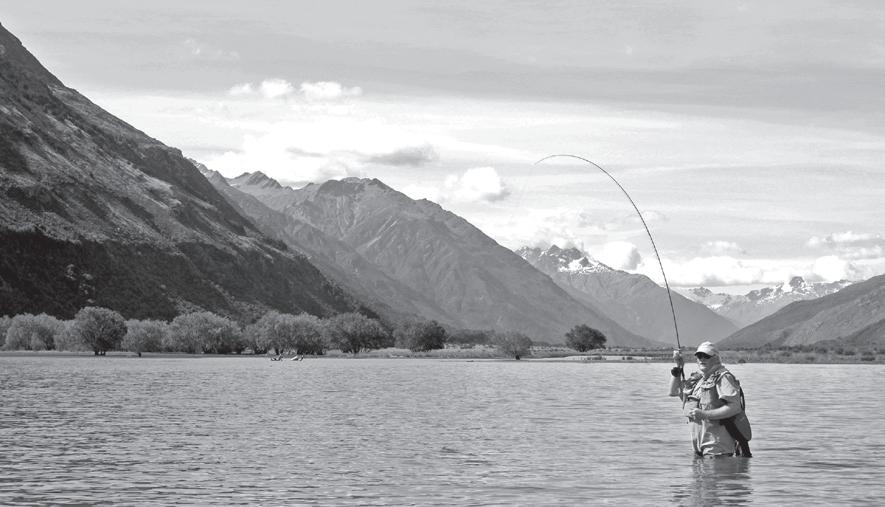
Low and slow. Stalking a sighted trout on a sunlit run, Dougal Rillstone takes his shot.
The good books will help you get your strategies organised. Some books are accounts of observations and experience in language that, except for the subject, present what might be called the philosophy of flyfishing. Some are wise and reflective, some rather solemn, even pious. Some, like Robert Traver and John Gierach are pithy, ironic, and funny Others are simply hilarious. The best have the clear ring of truth, forged on the anvil of success and failure.
Finding words to describe the physics of flycasting makes modern art journalism read like a recipe for pancakes. This sometimes leads frustrated beginners toward live tutorials by a professional casting instructor and the casting video, of which there are hundreds on YouTube. Some of the older videos repeat the errors and language of the old books but have been superseded by some excellent demonstrations by people who understand the physics involved.
Download a good casting video or two, then go to the park and practice what you see. If the park has water on it, even better. No one would take up golf without practicing their swing, but it’s surprising how many fly fishers do no practice at all and quickly hit a performance wall out on the water. If they do practice, it’s almost always distance casting, which for practical purposes has no place in trout fishing, especially on a river. Maybe save the sixty-foot stuff for that bonefish trip and work on your slack line and reach casts. In an actual trout fishing situation, casting is about controlling the loop, accuracy and line handling.
You don’t have to read the great old books to catch fish, but it can’t hurt.
The writer and publisher Nick Lyons considered Roderick Haig-Brown to be the one author “indispensable to the literate angler, through whom the mainstream of flyfishing culture runs most clearly”. A River Never Sleeps and The Western Angler were my first serious fishing books. I was thirteen and it was thirty degrees below zero. I found the book in a converted school bus, the Bookmobile, a mobile library that prowled the frozen winter suburbs of Calgary to provide the rudiments of culture to the inhabitants, who had yet no concept of what it meant to be a TV addicted couch potato. Already crazed with the flyfishing obsession, indulged by a father and
Alberta’s Oldman River, where the Wyatt boys cut their flyfishing teeth in the fifties.
uncles who believed it a wholesome and harmless interest compared to doing the hand-jive to Martha and the Vandellas, I was astonished that such books existed.
I had a flyfishing Yorkshireman for a grandfather, but knew nothing of England, or for that matter British Columbia, a mythical place beyond the Rocky Mountains as fantastic as Atlantis or Haig-Brown’s gentle prose conveyed pictures of places and events that were as concrete to me as the ice patterns on the bookmobile windows. The places he described were exotic and wild, populated by cougar hunters and forty-pound Chinook salmon. He described events that involved silver bright summer steelhead and saltwater Cutthroats running into a sea pool on the flooding tide, or big Kamloops trout rising to travelling sedge on the green lakes of the interior plateau.
Other books followed; Fisherman’s Spring, Summer, and Fall took me through the North American seasons in three wonderful volumes. Fisherman’s Winter described a season in South
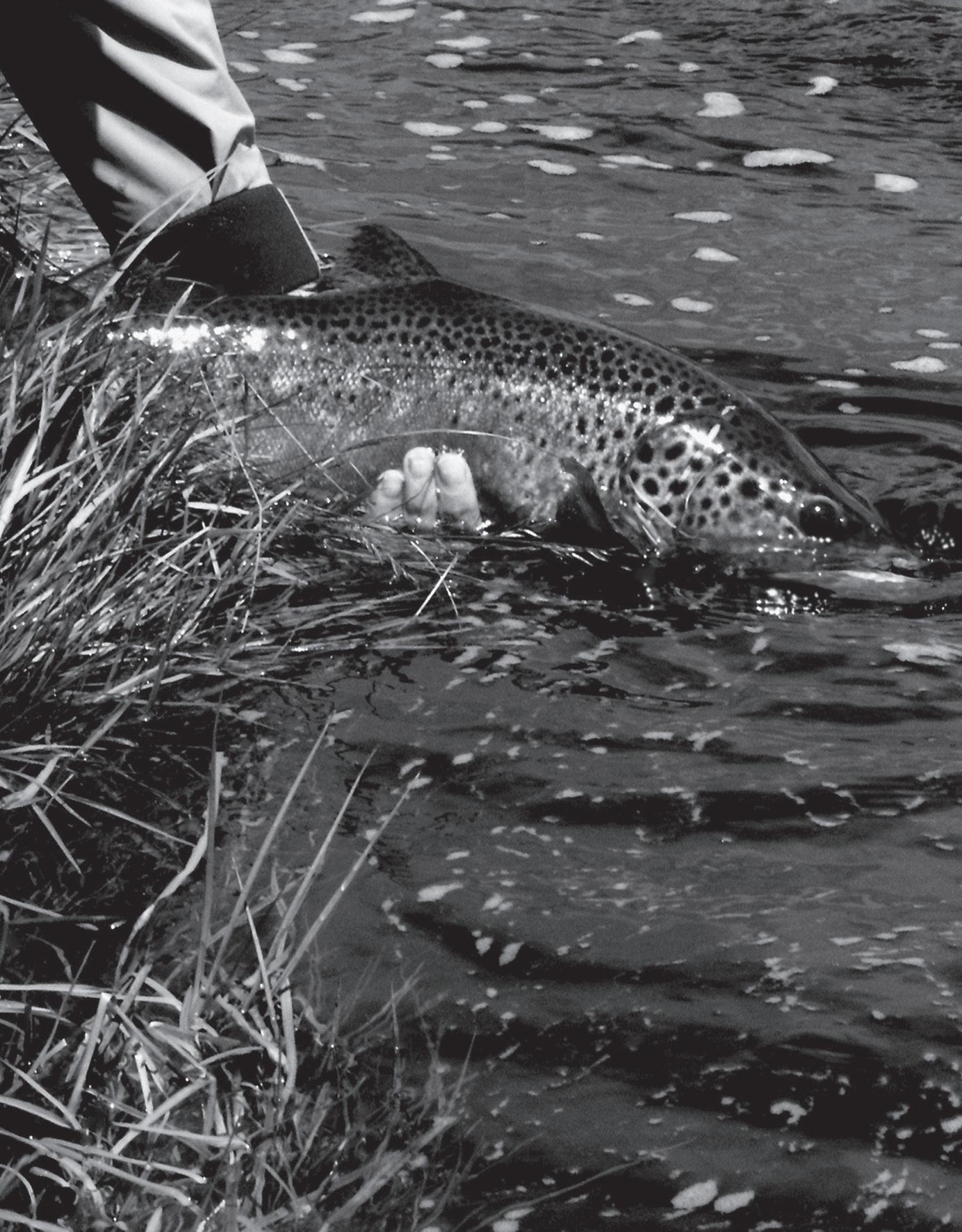
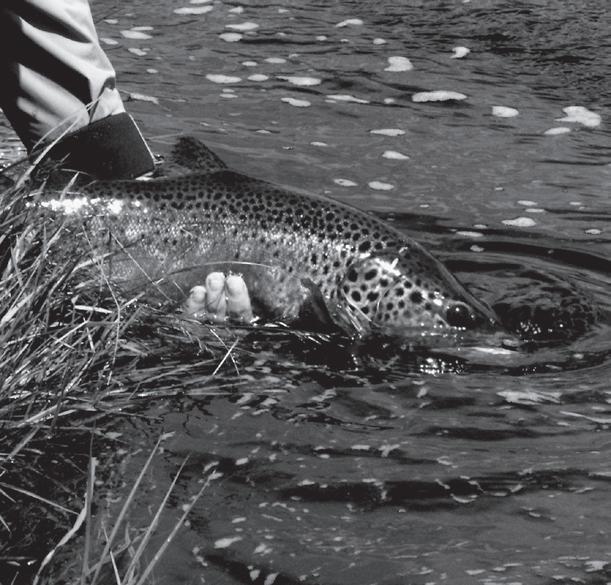
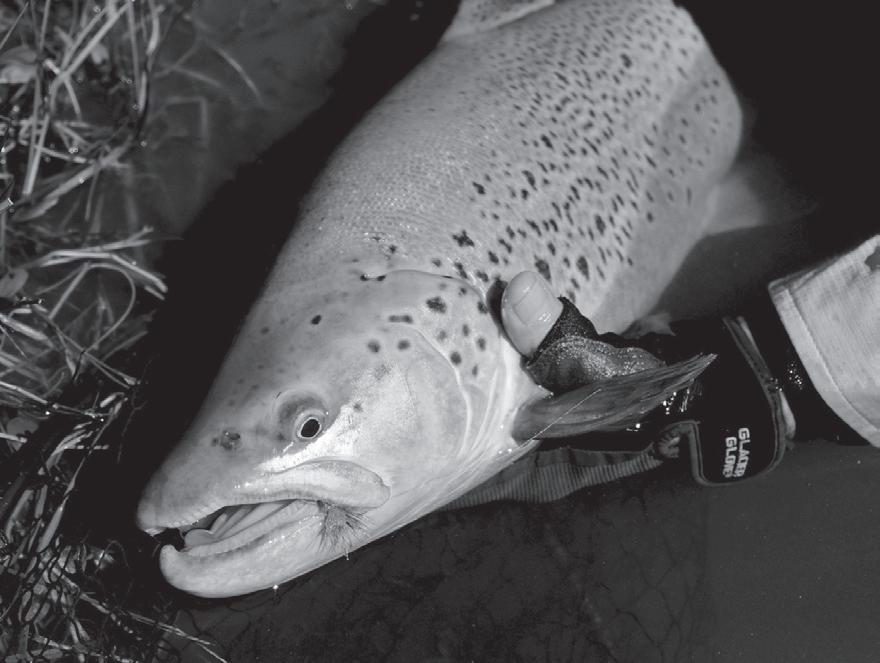
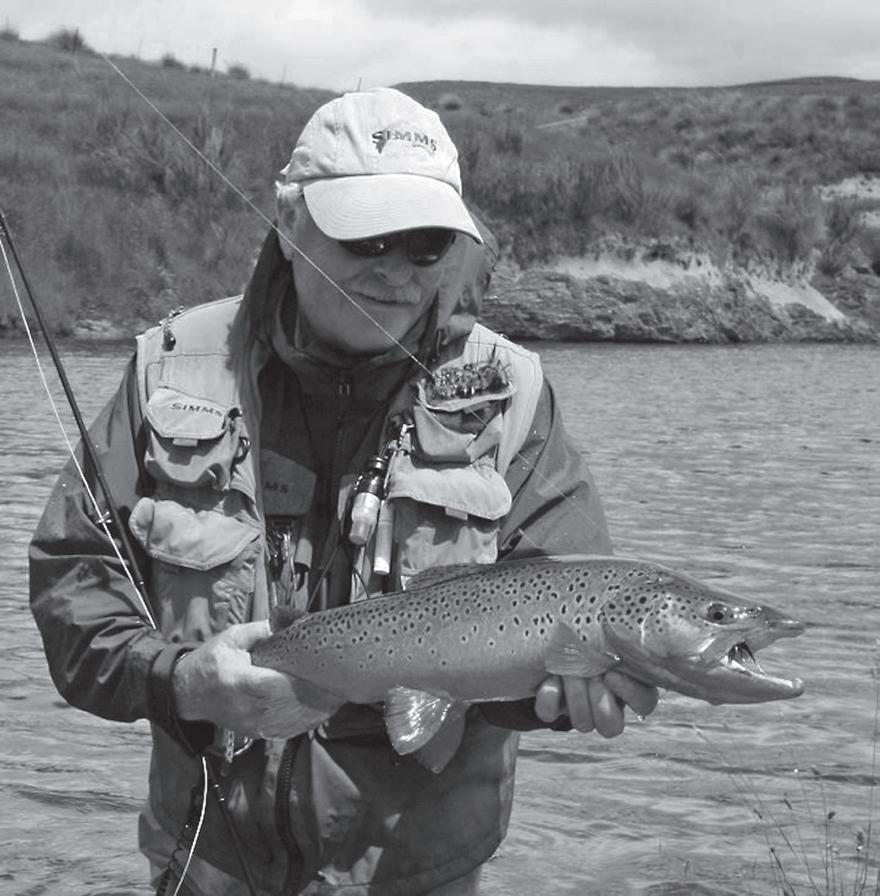
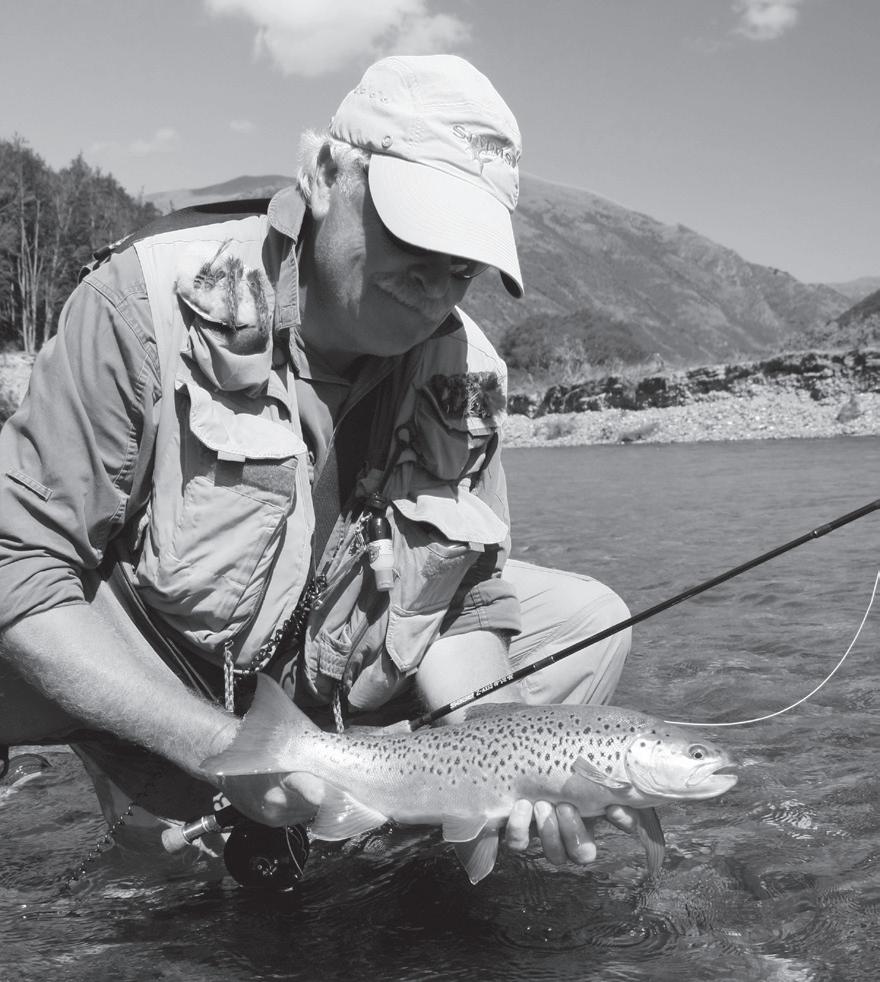
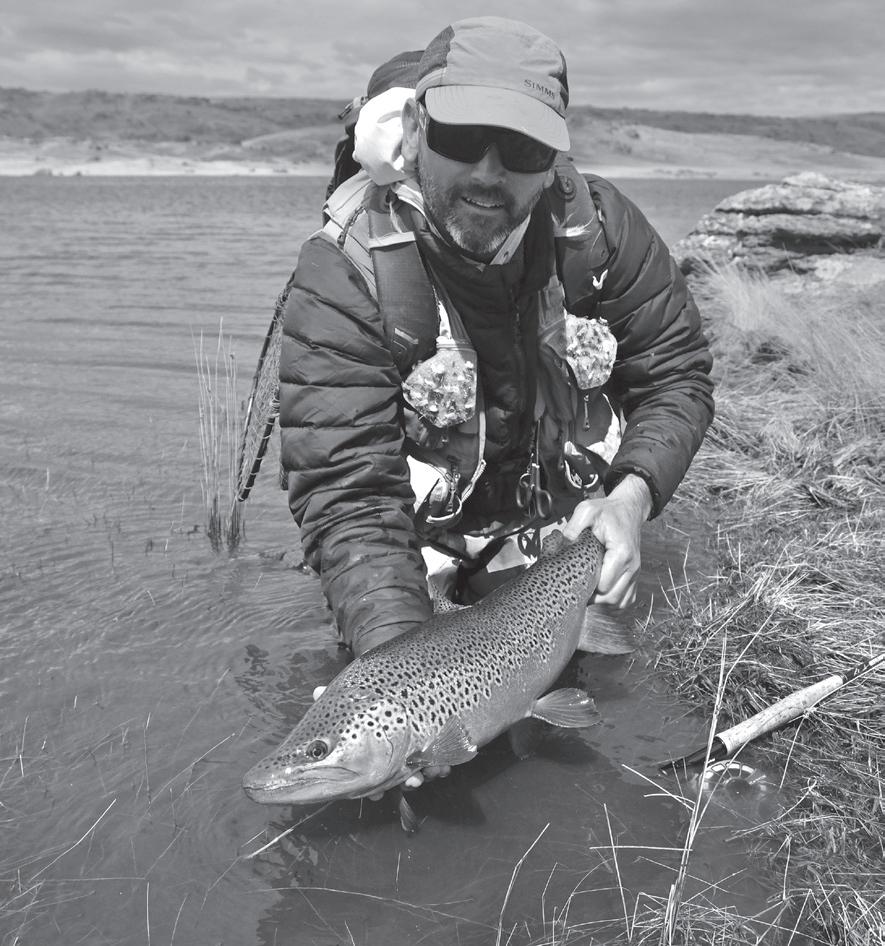
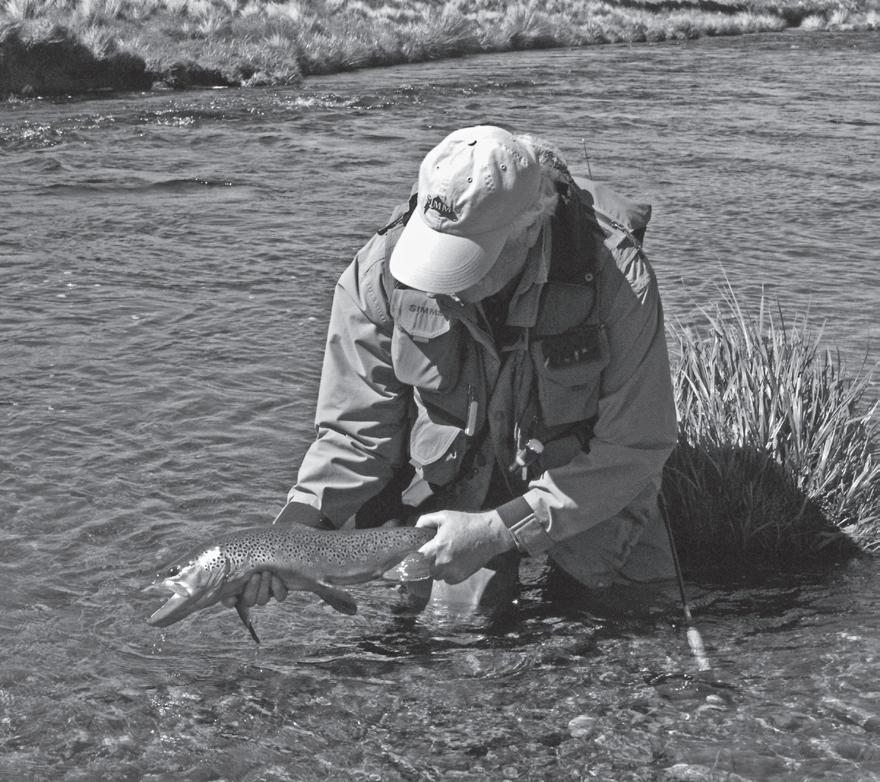
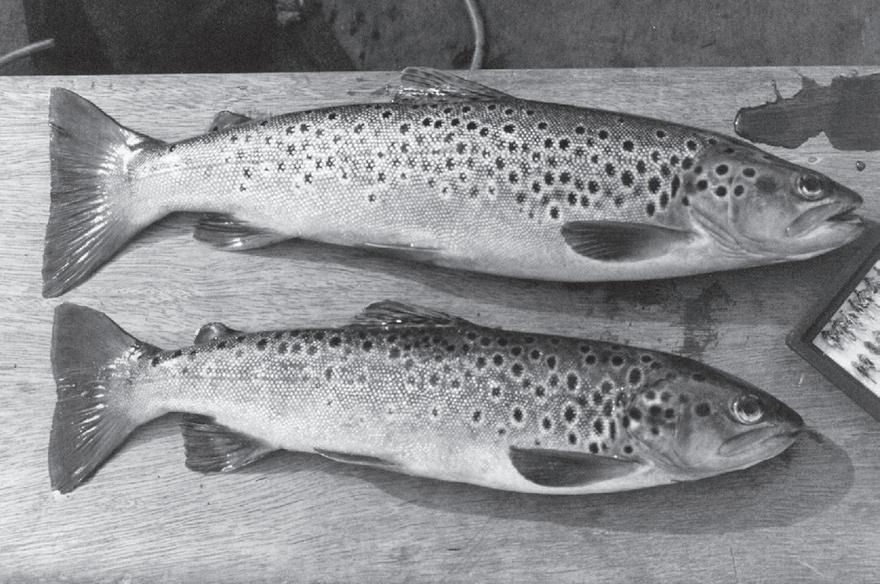
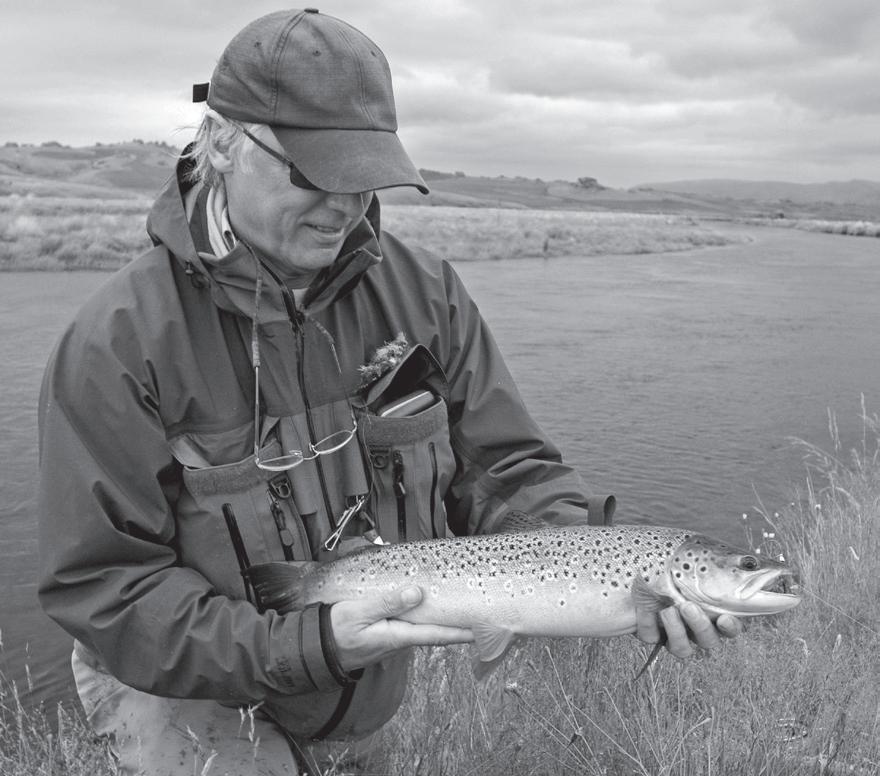
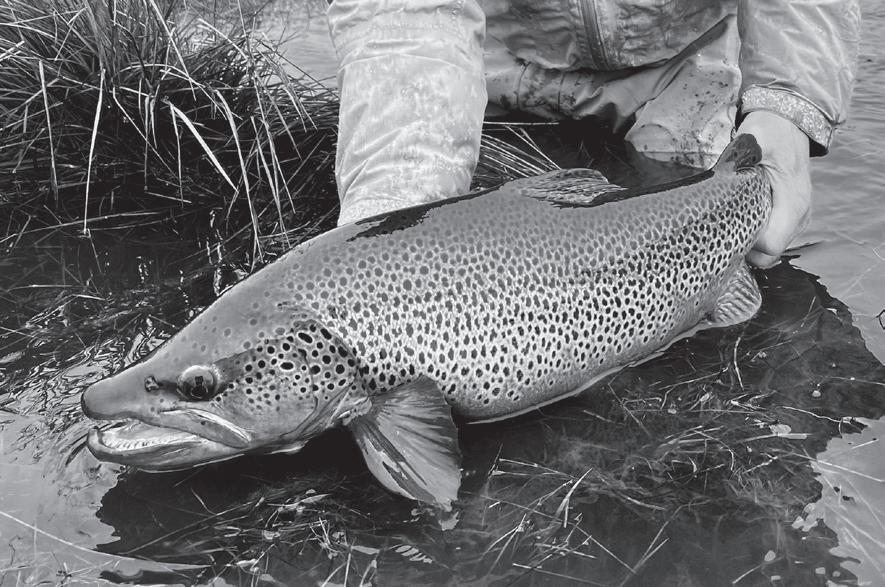
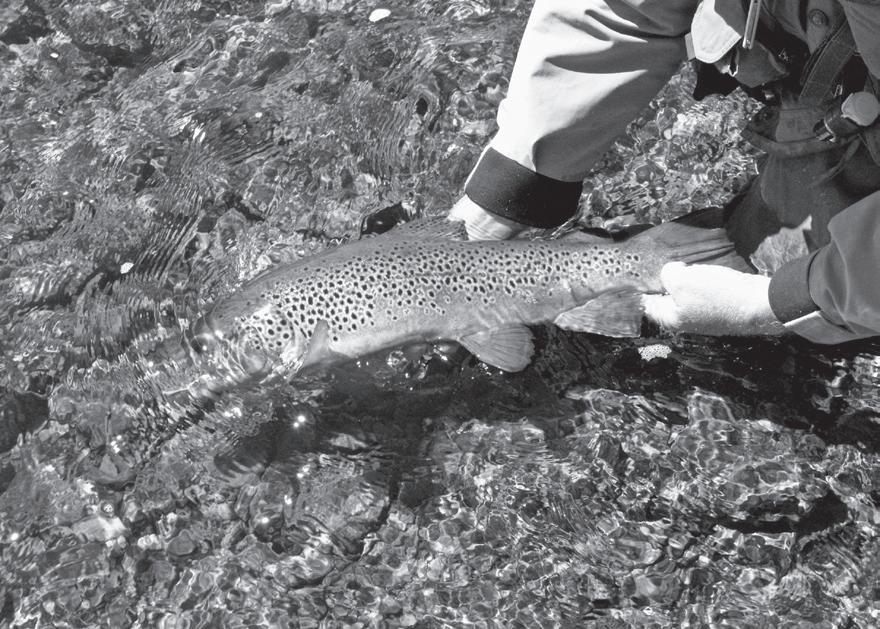
Bruce Masson admires a back country brownie before release.
America, the first account of “destination” flyfishing I ever read, which ruined any sensible career path before it had a snowball’s chance in hell. Haig-Brown spoke of fish, tackle and methods in a way that put you right there, on the water, the line curling out toward the cedar stump where the big sea run Cutthroat trout had just showed himself, the gleam and solid live weight of the fish as it turned down with the fly. Well, I mean to say, that was me…gone.
The Old Magazines
Before encountering the great British flyfishing literature my main contact with tradition was through the American outdoor press. There were three big magazines, Sports Afield, Outdoor Life, and Field & Stream. Field and Stream, the comparatively stylish New York based magazine, boasted names such as A J McLean and Ed Zern on the masthead and catered to what eventually became known as the international destination angler. One suspected that you wanted your comfortably frayed canvas fishing jacket to have an Abercrombie and Fitch label and should at least be able to recognise Ernest Hemingway on sight. It wasn’t exactly Arnold Gingrich’s Esquire, but you suspected the editors drank their lunchtime martinis at the same Madison Avenue watering holes and didn’t buy mail order pump-action duck guns.
Outdoor Life was a westerner’s magazine, and Joe Brooks was its most famous fishing editor. The illustrations always showed some guy in a cowboy hat, usually Brooks himself, holding enormous Montana brown trout. A western boy myself. these articles meant the most to me during my formative years, but they didn’t quite have the je ne se quoi of the Field &Stream pieces. Sports Afield was the bass fisherman’s mag; Jason Lucas busting lunker largemouth bass and crappie on the mid-western farm ponds. You’d get good ol’ boys spearing bayou bullfrogs under a miner’s headlamp and classified ads for starting your own worm farm.
Lately, the technical aspect of the seventies and eighties gave some ground to more subjective writing, concerned with flyfishing’s intangibles. Nick Lyons, a fine writer himself, almost singlehandedly revolutionised American sporting writing, his publishing contributing enormously to the current literary taste among American fly-fishers. The pithy and intelligent books of Robert Traver in the sixties, to authors such as Datus Proper, John Gierach, and Thomas McGuane exemplify the contemporary approach.
North American writing: Marinaro, Swisher and Richards, Caucci and Nastasi, Joe Brooks and LaFontaine (America’s Mottram) brought some practical rationality to the conventional British perspectives. This has fed back into and broadened British tactics. While writing the first version this book (late nineties), I acquired a copy of LaFontaine’s The Dry Fly – New Angles and received a copy of the “revisited” edition of Rob Sloane’s The Truth About Trout, both providing definite nudges to rethink my strategies. Good fishing books provide a way to compare and evaluate one’s ideas and to work new ideas into a practical approach.
You don’t have to read the great old books to catch fish, and just about any of the recent books will get one started, as will any number of good YouTube videos. But by skipping Skues and the other angling greats, one would not get the feel for the tradition, its context and breadth of experience, and consciousness of the debt we owe to great angling thinkers of the past.
Where to Find Them
“If game were superabundant there would not exist that peculiar animal behaviour which we distinguish from all others with the precise name ‘hunting’”.
A Place Known to Contain Trout
Jose Ortega y Gasset Meditations
on Hunting
George Leonard Herter was an entrepreneurial type now extinct in corporate America. Herter's catalogue was the size of an old-time phone book and offered an array of hunting and fishing gear that was clearly an extension Herter’s personality. Salted throughout the supporting text for the items in the catalogue were gems of lore, horse sense and pithy insight into the outdoor life. There was also a considerable amount of bullshit. The idea was that with the know-how and Herter's gear, both of which Herter provided in his catalogue, success was guaranteed - a quintessentially American can-do attitude.
Herter knew the part that dumb luck plays in success, no matter how expert and tooled up we are. For example, Herter's book on deer hunting, entitled characteristically, How to Hunt Deer, contains the instruction; “Go to a place known to contain large numbers of deer”. This is akin to the cookbook recipe for cooking an elephant that begins, “Take one elephant….”.
Herter's catalogues have gone the way of the tailfins on a Cadillac, but his principle that good fishing depends on known quantities of fish seems to withstand the test of time. Confidence is built on knowledge and skill, and it’s essential to know that the water you intend to fish has trout in it. In fact, the put-and-take trout fisheries are founded on this insecurity, and they trade on the clear and certain knowledge that the water not only contains fish, but lots of them, and big ones to boot.
Know-how for many anglers has been replaced simply and sadly by know-where. In the worst cases, the elegant techniques of flyfishing have been dumbed down to a matter of chucking a lure into the path of some bewildered farm animal whose last meal was dispensed with a shovel. The difference in required skill between catching a big newly released stockie and a small one is meaningless and completely artificial.
So, just to make worthwhile the inevitable indignation over elitism, snobbery, or differences in taste, I may as well add that at its worst, put-and-take fishing is not only badly off-plumb it's not really trout fishing at all. It just looks like trout fishing. If you applied the put-and-take model to some other domesticated animal, chickens maybe, the point becomes clear. It’s rather like the difference between going out for a romantic evening with a woman whom you find interesting and attractive, and hiring a hooker. There may be superficial resemblances, and a certain amount of fun involved, but the distinctions are important and not only a matter of taste.
Apart from conditioning us to expect fish that are uniformly bigger than nature would normally provide, the relative ease by which they are caught doesn’t permit us to learn much about nature, the trout, or anything else for that matter. So, put and take trout fishing is just a game, fun but sort of like mini golf. But, hey, it’s still flyfishing, right? Wild trout hunting is another thing altogether.
“Two Pies” Dean takes a spinner feeding brownie from a glassy glide.
That may seem a tad harsh toward our stockie-bashing colleagues and a bit like a Sunday paper rant on slipping standards. Not everyone can get to British Columbia or New Zealand for a bit of fishing, but I hope it’s clear that I’m referring to the worst examples of put and take trout fishing. The stocked trout that has had a chance to adapt to natural feeding - the “free-range” trout of the large lakes and reservoirs - is a different matter. A naturalised, grown-on trout achieves the state of wildness as its evolutionary genetic traits are re-established.
The concept of “wild” is itself an issue. In Britain, almost all so-called wild strains of brown trout have been genetically mixed through artificial stocking since the early 19th Century. All North American and New Zealand brown trout were originally stocked, for instance. So, rather than argue over wildness in terms of genetic purity, it’s maybe more useful to think of wildness as a state rather than a trait. In natural conditions, trout will vary in size, and a certain amount of experience and specialised know-how is required to catch them. It’s real trout fishing, and that’s precisely what makes it interesting.
You match your ambitions to the potential of the water. If a wild water normally grows halfpounders, you are not disappointed if you do not catch any three-pounders. Finding a twelve-inch brookie in upstate New York is as challenging and satisfying as nailing a twenty-inch brown on the Madison. Unlike stockie-bashing, as you learn about the fish and its environment you gradually catch the bigger fish, so you can bore people at dinner parties with at least some justification.
Wildness is a state, not a trait. Outside of Europe, the wild brown trout is an introduced species.
The Potential of the Water
No angler I’ve ever met is uninterested in bigger fish. However, not all trout waters contain big trout. This seems self-evident to the point of banality, but it’s possibly the most important thing to understand if one wants to find where the larger fish live.
The next most important thing to know is what constitutes a “big” fish for a particular water. For instance, on a typical Scottish highland loch you will expect few trout over half a pound in weight and a one pounder is a very nice fish. With light tackle you can spend a great time catching nothing larger than this and feel that you have had excellent fishing.
Most rivers and lochs have a few big old trout swimming in them, but it can be a disheartening task to narrow your endeavors to the pursuit of these challenging fish. They have become so specialised in their feeding habits that normal angling methods just don’t affect them. That’s the reason they’re still in there. They may be nocturnal, certainly fish-eaters, and they may live in some inaccessible bit of cover, usually all three. Except for a few highly skilled specimen hunters, these are near impossible fish for the average fly fisher.
Wild as the wind. A mountain Cutthroat on a pristine wilderness stream.
A determined bait-fisher may be able to catch one of these tough customers, but it would require some specialised and inelegant techniques to catch one on a fly, defeating one of the main objectives of flyfishing: to do the difficult thing well, with maybe some grace and style. In terms of taste, style and tactics, you decide for yourself where you draw the line. After all, the point of golf is not simply to get a ball in a hole but how you do it. With some willingness to change up, streamer fly tactics make these big fish-eating trout possible and still fit comfortably into one’s approach, expanding rather than reducing the aesthetics and pleasure of flyfishing.
A fly-fisher’s perfect quarry is the big young trout, the free-rising, fast-growing, insect eating trout of one to three pounds found on exceptional water. There are rivers and lakes like this all over the world, but they have become popular places. British Columbia’s Elk, Alberta’s Bow, Montana’s Madison and New Zealand’s Mataura are this type of water.
Good Water
Somewhere between Scotland’s acid, relatively barren moorland lochs that hold a superabundance of smallish old trout, and the alkaline, food-rich basins of the Irish limestone country or the high Kamloops lakes of the BC interior plateau, is the simply “good water” where we spend most of our time. Our home waters are usually a kind of compromise; a place we can get to easily on a weekend or an evening after work or for a week’s fishing holiday, and which has a reasonable stock of trout. If the water is a healthy one with no serious pollution or natural predator problems, only the angling kill will affect the range of sizes.
On hard-fished small streams where anything is routinely killed, the fish will be mostly small with a very few old nocturnal lunkers hidden beneath the banks. On medium-sized waters where catch and release is not practiced anglers will relentlessly pick off most of the trout of eating size. Big rivers and lakes with more places to hide and a wider and abundant range of food types will always have more large fish. The fly-fisher looking for trout of a better average size should narrow the field to these places.
Big is a relative term. On some lakes and streams a big trout might be a foot long, not a bad fish anywhere, but might also be one of a very few old fish of that size. Many small moorland streams or Scottish “burns” are like this, and although it’s certainly a pleasant way to spend a day this is not the type of water for the hunting of larger trout. The best type is the medium-sized stream that flows through alkaline country, rich with food and cover. In Europe, and increasingly in North America, waters like these are well preserved and often expensive to fish.
A good bet is the medium to large river where fish may be fewer and harder to find but where there is a chance of an occasional two-pounder. There is a lot of lightly fished water that falls into this middle band in terms of quality. These are the rivers that may or may not have salmon fishing. British salmon rivers make excellent trout hunting grounds. Because the owners do not think the trout important or are simply pests, they have a lot of cheap and accessible association water. A salmon river often has a lot of water that’s not fished at all by anyone. Salmon anglers stick to the known salmon lies, and these days most British trout fishermen stick to the stocked reservoirs. This leaves a lot of undisturbed river for some serious trout hunting.
I’ve been surprised by the quality of the fishing I’ve had on some very public water, not least because I normally have it to myself and a pal. Even when it is fished, most public water is not fished effectively, and most of the fish taken are the young trout. I’ve seen hatches on popular association water bring on rises of trout that in terms of numbers and quality would not look out of place on New Zealand’s lower Mataura. It's clear that once wild trout reach a pound or so, and there are plenty of them on these rivers, they are in the too-hard file for many anglers today. Nobody said flyfishing had to be easy.
For the stillwater angler a good rule of thumb is also to locate waters that have relatively neutral PH values; the more alkaline the better, up to a point. Alkaline water produces the rich feeding necessary for good populations of invertebrates and larger trout. Very alkaline lakes can be full of big fish, but they can also be extremely difficult. The prey base can be so good or so specialised, and the water so clear, that the fish are very resistant to conventional flyfishing techniques. Scottish anglers call this type of loch “dour”, and they should know.
The best stillwaters have a wide range of food available at different times, and the trout are forced to be more opportunistic. The Irish loughs are good examples; a broad range of chironomids, sedges and mayflies, as well as big and varied baitfish populations. This makes for active and opportunistic trout of a relatively large average size for their age.
Many large reservoirs have resident, naturalised trout living in a wild state. Even the heavily stocked waters have good populations of naturalised trout, fish that for one reason or another have avoided capture, found good feeding and ways to survive. These fish are true trout hunter’s
Easy does it. Simon Chu brings a good brownie to hand from a glassy pool tailout.
quarry. It’s around these fish that the stillwater tradition is evolving on the big English lakes. Sharing the experience is a big part of flyfishing. There’s a free and rapidly growing traffic in information between inquisitive stillwater trout hunters.
If the fishing you can get to on a Saturday or an evening after work is a tiny moorland beck or a concrete lined reservoir, it can provide the satisfactions of an exclusive chalkstream. The important thing is to gauge your expectations to the potential of the water you have and enjoy yourself.
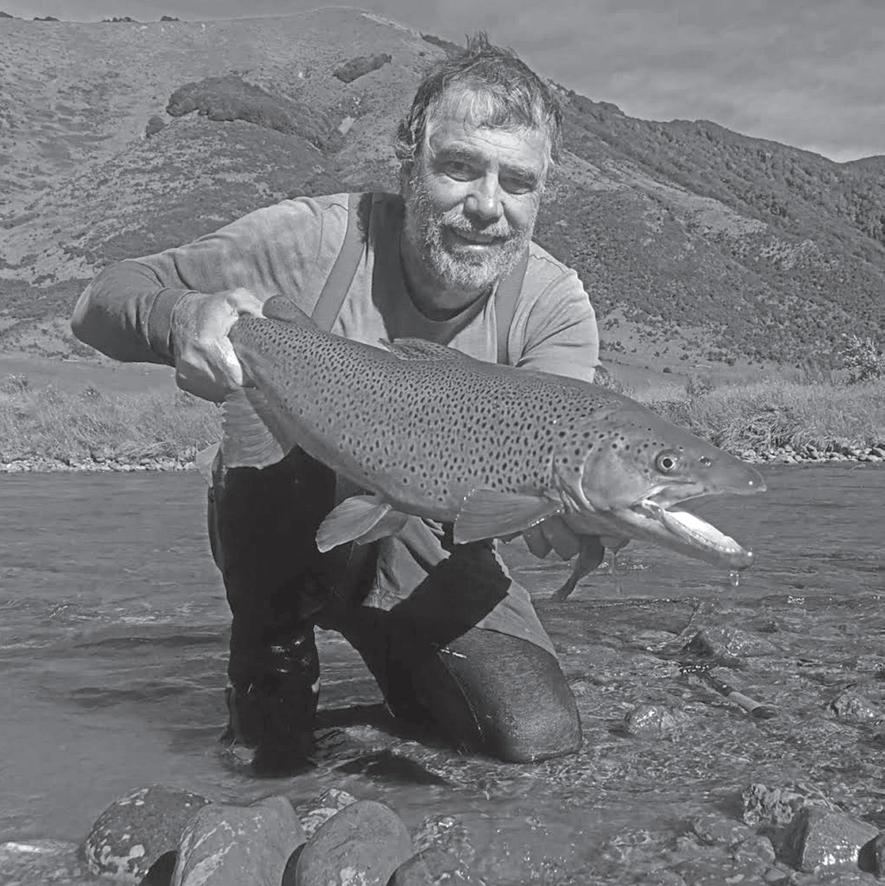
Germany’s cane rod maestro Christian Strixner returns a wild brownie that ate my DHS.
Almost as important is to enjoy it without bragging about it. As much as I wish my fellow anglers’ good luck, tight lines and all that, I get a little cagey when it comes to public boasting about my favourite waters. Not that they are particularly hot - I doubt Doug Swisher would change out of his street shoes to fish my best spots. They are, however, places I can get to in an hour or so from home, and that means so can the entire trout fishing population of Central Scotland. The fact that these spots have any fish in them at all is a miracle. So, you know, I like to keep these places safely in the shade.
Private water is not the issue. That's safe enough. It's the accessible public water that one needs to think about before opening one's beak. It may not be the Madison, but it's still pretty good fishing and I usually have it to myself and a pal. That's just the way I'd like to keep it. A little fish and tell is good for a water. Some attention is protective, but it can go the other way, and fast.
Intensity breeds expertise
As a young blood in western Canada, I used to shoot my mouth off all the time, gave away good fishing spots like they were old Neil Diamond albums. The important thing was to have been there first. Back then, there were plenty of places to fish and few other fishermen to worry about. Well, that changed fast enough. As the military axiom goes, Intensity breeds expertise. By the late 70s it was clear that there was a new kind of angler evolving - tooled up, aggressive, and increasingly expert.
Accuracy counts. Hans Weilenmann puts his CDC&Elk where he wants it.
Worse, they don't just brag to their buddies, they write about it in national magazines, with glossy photographs that make flyfishing look cooler than formula-one racing. Worse yet, they post their big fish on the internet. If you haven’t noticed the change, consider this; fishing clothes now actually look cool. Flyfishing is now a small but thriving commercial industry and social media community, so open your cake hole and your best fishin' hole could become a “destination” overnight.
If you’ve visited a North American blue-ribbon trout water recently you will know what I'm talking about. Some days, when a hatch is on, anglers queue up on the famous stretches of the Snake, the Firehole or the Bighorn. On some waters you encounter combat fishing, with confrontations unheard of fifty years ago. Any summer weekday on the Bow, my own home water in Alberta and now a popular destination fishery, the drift-boat queue at the Fish Creek boat ramp looks like a two-for-one burger special at Wendy's.
As far the welfare of the fish themselves is concerned there is maybe no problem. So far, the trout are fine, increasingly wide-awake and lip-sore, perhaps, but healthy and in substantial numbers. But, speaking for myself and as good as the fishing is, it's not really what I have in mind when I think of a quality experience. If that sounds a tad snobbish, well, okay. Only yesterday
Ronan puts back a nice one. Bragging has consequences. Don’t ask.
it seems, fishing the Bow didn't involve being run down by a drift boat, the guide glaring at you from under the brim of his outlaw bull-rider's Smithbilt, encouraging his somewhat nervous sport to fish a rod length away from where you stand. That may not happen often, but when it comes to the precise locations of your favourite spots, you might want to practice the art of dissembling, a polite word for bullshit. At least take Patrick McManus’ advice; for any report of good fishing always mention a bear.
Some limestone lochs, like the Durness lochs in Scotland and Ireland’s western Loughs, are hard waters in more ways than one. Knowing when surface action is most likely to occur is everything on waters like this. The timing of the local mayfly, buzzer or olive emergence is critical. Otherwise, without the equipment and technique to fish streamers, deep nymphs or scud imitations effectively, you may as well be plumbing the village duck pond.
Where to start on medium to large waters is a problem. A big lake or reservoir can be daunting to even an expert angler. Many successful anglers regard the big water as a collection of smaller ones. The job for the angler is to search out the main feeding lanes and the best holding places in these streams. The best fish will always take up the best position in a stream. Likewise, on stillwaters, the first thing is to find those places that are suitable for flyfishing and provide trout with the best access to food and safety. Once the search has narrowed to these places the hunt can begin in earnest.
Find a feeding fish. The first job for the angler is to recognise the main feeding areas.
Rivers I: Fishing the Water
“So, leaving aside the magic of the primitives of the glacial period and their counterparts still living, the first task of all hunting is to find the prey, and to ‘raise’ it”.
Jose Ortega y Gasset Meditations on Hunting
Invisible Trout – the Informed Guess
The Angler and the Trout, a little book on chalk stream fishing written in 1941 by Huish Edye, or Distoffer to his readership in Britain’s The Field magazine, introduced me to a term I haven’t seen since; the “master fish’’. This is a specimen trout that Edye says approaches “glass-case” proportions. He outlines “the living conditions to which a big trout aspires”.
Distoffer lists these as:
1. “A holt in deep water, with cover of bank, an undercut rock, or a dense patch of weed.
2. A feeding station, preferably shallow water, with line of retreat as easy as possible to (1). The shallowness probably gives a sense of security on the blind or under side.
3. A set of the current at (2) that brings concentrated food (especially surface food) within his reach.
4. And if he is elderly, spacious shallows accessible for the hunting down of minnows or other small fish.”
Distoffer’s next important statement is, “quarters which provide all of these amenities are scarce and are taken more or less in order of seniority. That is to say, they are taken by the most aggressive trout, which generally but not always means the biggest trout”.
Find this set of conditions on any trout water and you are likely to have found the big fish in that stretch. Depending on the carrying capacity of the water, this fish will be anything from a feisty ten-incher to a thuggish ten-pounder. My uncles never read a fishing book in their lives and called it reading the water. As a ten year old in the early season between ice-out and runoff on Alberta’s foothill streams, I learned to read the water by fishing an un-weighted worm or stonefly larva with a fly rod made from a war surplus tank aerial. We hooked the bait onto a wet fly, a Royal Coachman or Blue Upright, so there was some backup if the bait was lost or taken by a fish.
It was a good school. Just collecting the bait was a learning experience. The rivers I grew up on had plenty of good-sized trout, so if you learned your lessons there was the rare reward of a thumping wild rainbow or Cutthroat. It was a short step to the unbaited wet fly when the weather warmed up, although it did not go unnoticed that the size of the fish went down instantly.
My brothers and I employed an annoying tactic we called “hole-hogging”, which was basically moving quickly into the best spot on any pool before anyone else had a chance. We discovered that being first on a pool often resulted in a better than average fish, right off the bat. There was no one else on those rivers to worry about, and this primitive filial competition evolved into the accepted leapfrog pas de deux of polite stream etiquette.
It wasn’t long before we learned to assess what was probably the best spot in any pool. Being a hole-hog meant that you selfishly put yourself into the best position for getting the biggest trout
Prospecting with the big deer hair dry fly on a mountain Cutthroat stream.
in the pool. With a brother or two breathing down your neck, one soon learned to assess a pool’s amenities at a trot. When I reflect on those days, I realise that despite its wholesome appearance, a small gang of motivated pubescent boys with bait tackle represents the most intense predation a river will ever sustain.
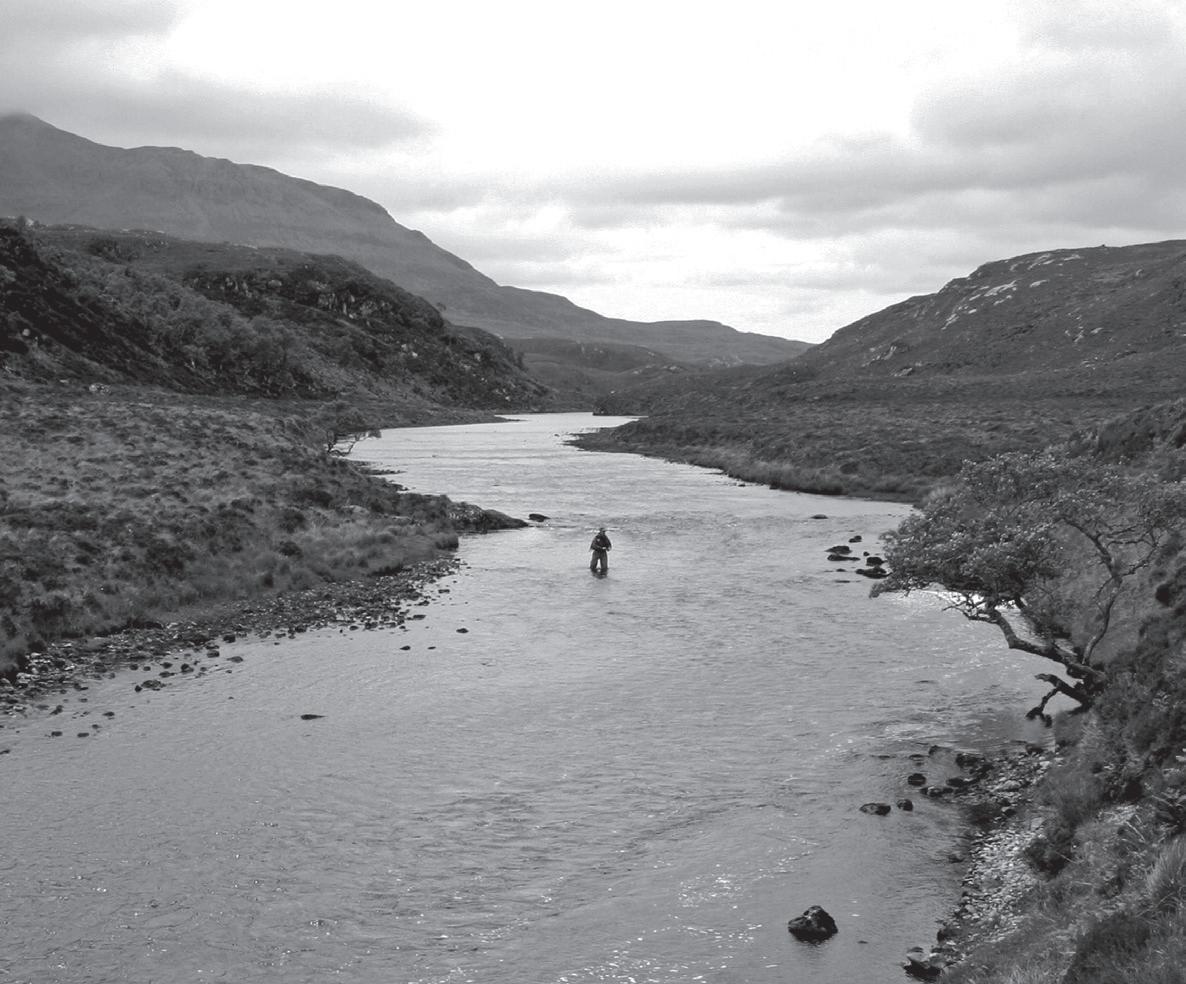
Half a century later, my pal Bob Morton demonstrated Distoffer’s principle of the master trout. We were in Assynt, in northern Scotland for our annual total-immersion trout therapy week, where we rented a big old farmhouse on the estate. After the first few eighteen-hour days on the water we tended to take it easy, the morning coffee ran to several pots and the map briefing collapses into reminiscence rather than strategy.
On one of these mornings after a very wet night, Bob Morton, Al Pyke and I were the last ones left in the lodge. The others had set off for the boats or to the stream inlets on several lochs in anticipation of good fishing after the spate. We decided to just fish the small stream, or “burn” behind the lodge down to the loch head about two miles downstream. We knew that the burn mouth fished well after a spate, sometimes bringing a run of salmon grilse up the glen.
The plan was for Al to take a car to the loch head, and we would fish down to him, then we would get a lift back to the lodge. Bob headed downstream ahead of me, but on second thought,
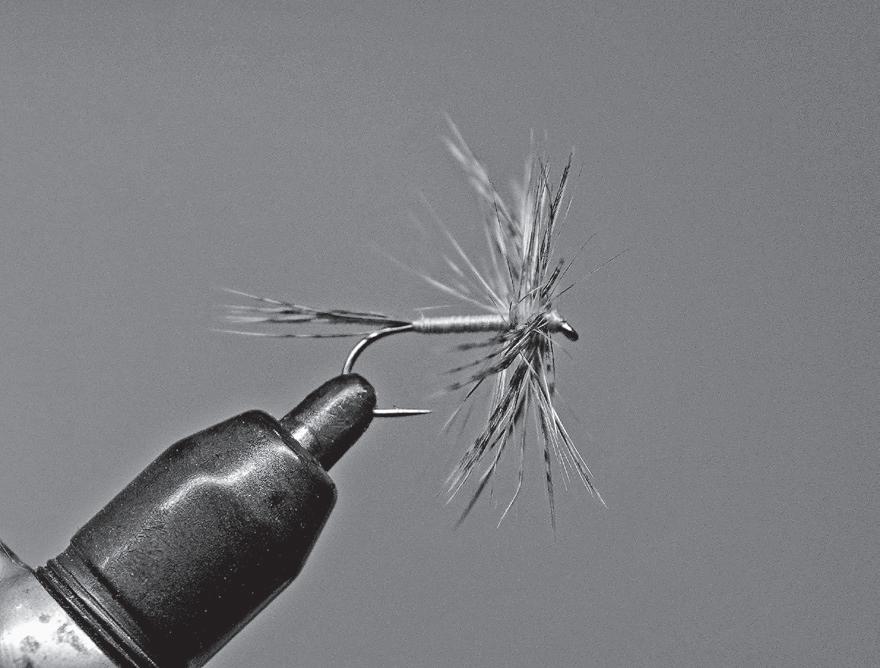
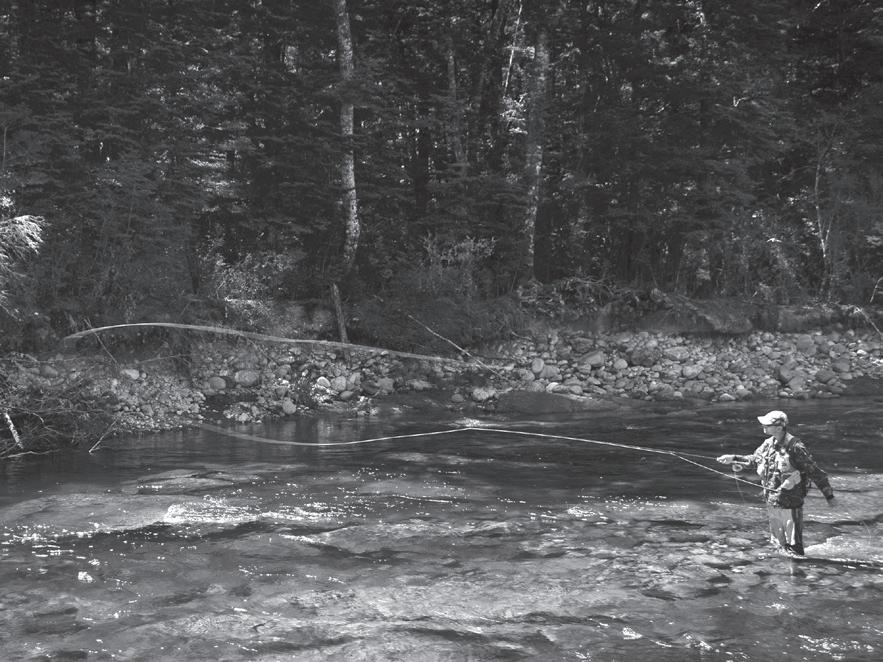
Fishing the soft hackle wet fly on a Scottish highland stream.
Bob Morton swings a big wet fly on a highland stream in a falling spate.
rather than fish down behind him, a strategic mistake, I decided to take my car down to the loch and fish upstream.
I started fishing at the burn mouth; Al was nowhere to be seen. The sun was out, the stream was falling fast, and I began to pick up a few nice trout right away. I worked around the shore of the loch, hoping for a grilse or a sea trout, thinking of a wild day two years previous when we took five nice salmon grilse from the surf in the teeth of a warm sou’wester. They weren’t there on his day, but at the tip of the sand spit where the current dissipates into black loch water, I did get a thick-shouldered brownie of a pound-and-a-quarter to my Irish style Veyatie Black. I fished my way back to the burn and headed upstream to find the other boys.
After an hour working up the stream with a big DHE (Deer Hair Emerger), I met Al coming downstream looking mighty pleased with himself. When I opened the lid of his creel I beheld a beautiful basket of trout, maybe six fish of a pound and more. He had been picking them up on a team of dark wet flies, his usual claret bodied palmers. We looked upstream just as Morton hove into view. When he saw us, he reacted like a deer at the report of a rifle and instantly bolted back upstream. We didn’t see him again. Later, at the lodge, he said that when he spotted us he knew we would be thinking of heading back. There was just no way he was going home.
When he finally showed up, we understood his reluctance to quit. He had an amazing basket of trout, with several fish pushing the two-pound mark. One was a solid two-and-a-half pounds, and it was clear that these were certainly not resident burn trout. In an intense debriefing, Bob provided some fascinating information.
He said he took the biggest fish just below the lodge, while he was still in sight of me at the gate. The fish was holding at the head of short pool that has a deep run on one side, with a protecting Rowan tree over the deepest spot. I knew the pool well. The fish took Bob’s fly in the sweet-spot where the current funnelled all the water-born food into a column only three or four feet across. The trout only had to hold in the lower centre of this column to have first crack at any food entering the pool and could easily defend it against any smaller fish. The pool’s “amenities” met all the conditions for the lie of a “master fish”.
Feeding Range
What fascinated me was the fact that on the rising spate this trout had run all the way up from the loch to take up this position, two miles from its usual haunts. In a spate this burn rises and falls in a matter of hours. These big trout reacted instantly to the flood and ran like sea trout, taking up the best positions according to their size and aggressiveness.
When Bob started out the water was still coloured by peat run-off from the hills. He fished the first stretch of water swinging a team of size ten wets, but in consideration of the dark water changed his point fly to a larger Black Pennell, an old English standard hackle pattern. On his first cast into the pool something snatched his fly, but the barb did not sink home. Two more casts into the exact spot brought two more vicious pulls at the fly, the hook catching momentarily but coming free.
On the fourth pass Bob pulled the hook home. He said it was certainly the same fish, a yellow bellied two-and-a-half pounder. It was impressed upon Bob that this fish was not about to let anything alive and small enough to eat get past it. Being repeatedly pricked by the hook didn’t faze the trout at all.
Bob repeated this scenario on each pool as he fished downstream. What also became clear was that the fishing deteriorated as the water level fell and cleared. By the time he got down to where he saw us the big fish were simply no longer there. This makes sense, if they will run up the burn that quickly, they’ll return just as quickly as conditions revert to normal. A two-pound trout is at a severe disadvantage in that burn at normal height; the reason for being there in the first placefood - has disappeared, and security becomes job-one.
We had some excellent fishing in similar conditions a year later. A good spate was just beginning to clear, and we were fishing where a substantial stream joins two lochs. We know that the fish from the lower loch will nose into the narrows at the mouth and many will run up the stream. The most effective way to fish it is downstream from the upper loch until you hit the running fish.
In some pools they will be found in pods, with the best fish in the eye of the pool and the others ordered in descending rank toward the tail. Sometimes a big trout is taken at the very shallow tail of the pool, but normally this is in the evening. It might also be a fish that has remained into daylight at the tailout after its nocturnal feeding, or a fish that is moving up from downstream or dropping back.
The interesting thing here is that the trout’s movements to feeding positions and escape routes have been extended in the spate conditions - in some cases a matter of miles. It’s important to
know that big trout are not stationary residents. As soon as the flood falls away and the abundant food begins to thin out, these larger fish waste no time in seeking the safety of the loch, behaviour ingrained over thousands of years. The principles remain the same; it’s up to the angler to read the water and see which conditions apply at a specific time. It’s essential to know that the activities of trout are opportunistic and constantly changing with conditions.
Small but perfectly formed. A jewel-like Scottish loch brownie.
Trout need to eat. Big trout need to eat a lot. The fact that they are harder to catch does not mean that they are necessarily smarter. Once the conditions for escape and optimum feeding are met, the type and availability of the trout’s food is the true reason behind its behaviour, not its intelligence. The so-called smart trout are simply those that have developed protective feeding habits, the main reason why they are big. They may be wary, but they’re also aggressive. If you find a way to present a fly that looks like trout food without spooking them it’s likely that they’ll take it.
The water where we expect to find feeding trout is clearly defined. We learn to look for changes in depth where the water shelves along rock and gravel bars, seams between fast and slow water, and where the current eases in front of and beside rocks and other obstructions. These are the classic stations for a feeding trout. On slower, deeper water it is more difficult to recognise feeding stations except for when we see a trout rise. It’s essential to know that these classic positions and food lanes are where we will normally find the average trout, but that larger fish do not usually take up a fixed feeding station except in a strong hatch or for an ambush position. Big trout are the neighbourhood bullies and roam around quite a bit in search of prey. A study on Michigan’s Au Sable River demonstrated that big brown trout range up to a mile or more from
their security holt during low light periods. On rivers with adequate and sustained insect hatches, these larger trout might take up a semi-permanent lie in a feeding lane where a stream of insects is carried to them, but generally big trout tend to look for larger prey. This all means that if we going to concentrate on the larger fish, some thought should be put into our angling habits as much as the trout’s habits. If big trout were where we normally fish for them, and susceptible to our normal tactics, we would catch them more often.
River Tactics: Sunk Fly
Most urban anglers don’t have a chance to get out regularly to a wild water. In Britain it’s usually a stocked pond that at best provides a limited and specialised experience. Unless there is reasonable access to a large reservoir or stream where one can find naturalised fish, fishing for wild trout is reserved for a holiday to Ireland, Scotland or maybe some international destination. An angler needs a flexible repertoire of tactics that can be adapted to any situation, anywhere. In Britain and Ireland, trout fishing is increasingly a stillwater pursuit. It’s common in the British Isles to meet anglers who have not developed much river technique, relying essentially on a simple downstream wet fly approach to running water. This is commonly referred to as the traditional wet fly style, despite its being at complete odds with the classic upstream wet fly techniques of Stewart, Pritt, Edmonds and Lee, et al, not to mention Skues’ arguments for its use
If your fly is of reasonable size and presented well, it’ll usually work.
on the southern English chalk streams. Nicholas Fitton makes strong case for it in his, Gently Down the Stream: The Forgotten Art of Wet Fly Fishing (2004)
Most Scottish anglers I’ve met are of the across-and-down persuasion. Put them on a river and they’ll almost invariably face downstream. The intermittent reinforcement of an occasional fish and the positive feel of the tight line are what keep them from turning around and facing the current. The tug is the drug.
My pal Bob doesn’t really believe in the upstream wet fly. Says it’s a myth perpetuated by angling writers mining flyfishing’s worked-out seams. He’s tried it - doesn’t work. Bob isn’t afraid to take a position on things that matter. There’s something to his point. On the Scottish rivers he fishes, big ones such as the Tay, the across-stream wet fly is a proven and undisputed method to catch trout, especially in the spring.
Not an enthusiastic downstream wet fly man, I protest that surely it can’t be the case that all those who uphold the upstream wet fly tradition are talking through their hats. What would be the point of sticking to a method if it didn’t get results? Bob says, yeah, well, it’s probably a water thing. You know, works on their water, for their trout.
This is the kind of discussion that takes place between fishing friends who know each other very well and respect each other’s point of view, but Bob is just blowing smoke here. I think he’s just trying to fit his experience to his theory rather than the other way around.
Bob Morton fishes the “lift” on a Scottish stream.
You get the same thing among dry fly purists, although to a lesser extent these days. An accusation I take no small amount of pleasure in making to Bob over a pint is that the average wet fly angler is an orthodox traditionalist, if not a reactionary fundamentalist. His defence, of course, is that his method gets results so he must be right…right? Maybe, but I think it’s high time we analysed what’s going on here.
My approach to trout hunting is based on simple fly design, good presentation and the belief that even a trout’s short memory depends on a context. If the fly’s appearance or behaviour is entirely out of context, the fly will often be ignored. Certain triggers may override the context issue, of course, which is why most of our “attractor” flies work. Much of flyfishing’s traditional methods are about expecting the trout’s behaviour to fit our personal codes of practice. It’s important to try and meet the trout on its terms.
A trout’s only concerns are safety, food, territory and reproduction. When a trout “rejects” our fly it may not necessarily be frightened or suspicious. It possibly just doesn’t recognise the fly’s appearance or behaviour as food or has been discouraged by something about your presentation. In fact, due to the structural aspects of trout vision, it may not even have seen the fly in the first place.
As a prey-animal, wariness is part of a trout’s daily life. On hard-fished waters the trout are constantly disturbed, and the bigger trout will often spook at a clumsily cast fly even if the angler is well concealed. Even if it doesn’t know the cause, any unnatural disturbance will usually send a large trout to ground. Hard-wired sensitivity to danger is how these fish grow big. Presentation is a matter of your fly operating within the normal parameters of the prey’s appearance and behaviour, while you stay “out of context”.
I put the emphasis on presentation, but good flies are important, and fly design far outweighs pattern. There are thousands of fly patterns, and almost all of them work, but most are patterns or variations on a few basic designs. By design we mean the basic form of the fly as seen by the fish – consisting of outstanding triggers like shape and posture, and whatever contributes to its behaviour or action. Pattern is the arrangement of details that differentiate a particular trout fly from another of similar form, like the difference between a Ginger Quill and a Blue Upright, which is colour. This doesn’t mean that creating new flies, or tweaking and improving on existing ones, is a waste of time, but good flies can be very simple things.
This goes for wets as much as for dries. A traditional winged and hackled wet fly doesn’t make a lot of sense, and they are fast falling out of use. On the other hand, my old fishing pal Bob has a schema worked out in which the wet fly’s wing still plays a meaningful role. His favourite early season fly is a beautifully tied, winged Woodcock and Hare Lug. It’s a great traditional pattern and I can’t dispute that he gets fish on it, but I reckon he’s being a tad romantic. He just likes the look of them.
What I question is the general usefulness of this type of fly and method - just where and when is it most effective? I think, despite its widespread use, particularly on the rough streams
The tug is the drug, but you’ll “lip” a lot of fish on a tight downstream wet fly swing.
of Scotland and the north of England, the downstream wet fly should be regarded as a highly specialised technique, with a much narrower window of opportunity than is generally realised.
Bob fishes hard - full on. He has enough Scottish Presbyterian in him that a big part of his approach is the old “flee in the water” attitude. As any guide will affirm this counts a lot toward maximising one’s chances. The fact that you are fishing when the trout begin to feed, rather than just thinking about it, or worse, complaining about it, is possibly the most important thing you can control.
By fishing, I also mean the biggest part of any hunt, which is watching and waiting. When things aren’t happening, I tend to stop casting and try to get some indication of what the trout are doing, if anything, and what I might do next. Sometimes this means just taking a break. Bob just likes to do his watching and waiting with his fly in the water. For Bob, the eternal optimist, the fish are always just about to “come on”.
Bob selects water that fits his method, a sweet spot on the water he is working. He knows from experience where he has taken trout before, and the type of water where he is likely to encounter another one. He contrives to get his team of wets working just right as they pass through that spot and are the first flies the trout have seen. As they enter the sweet spot in any stretch of water, we both agree that his flies are beginning to come round at the end of the swing. Bugs can’t swim against a current so, strictly speaking, a downstream wet fly on a tight line stimulates a chase response. On the other hand, downstream fishing with a slack line, drag-free presentation is effectively the same thing as the upstream wet fly and fits in with other imitative techniques. The slack line tactic just makes it hard to detect a take.
The fly’s curving ascent toward the surface is a strong stimulus to a feeding trout.
Watching Bob, as I often do during one of my watch-and-wait periods, I can see his normal wet fly cast is pretty much directly across the current, and he immediately throws an upstream mend along his line as it drifts downstream. An immediate mend is practically automatic for most fly fishers today, but there are some issues that should be considered that we’ll look at later here. As this mostly drag-free period ends and the flies rise on the tightening line, Bob expects a fish to take.
The true across-and-down swing is a traditional and reliable, and easiest, sea trout and salmon approach. As we know, salmon and sea trout are not true feeders once they enter fresh water, but we exploit their hard-wired chase response to a prey stimulus. Part of their response to the swinging fly is an instinctive and irresistible chase impulse, something like a kitten’s impulse to chase a bit of yarn, and any savvy salmon or steelhead angler knows that fresh run fish are as innocent as kittens. Also, they have spent several years feeding at sea, where all prey must be chased. There are some unreliable techniques for catching stale salmon, but most of the problems in catching fresh-run fish revolve around giving them a sporting chance to get the hook in their mouths once they decide to go on the take.
I don’t throw in with the “play” idea when it comes to trout. What we call play in a kitten is really an instinctive and adaptive hunting response. Like kittens, trout sometimes can’t resist the escaping-fly stimulus either and that’s why it works on trout, especially young trout. Really big river trout will seldom move for a tiny, moving wet fly.
The bob fly moving on the surface presents the vulnerability of a creature in trouble, a very strong stimulus discussed elsewhere in this book. Although the impulse to take the bob fly is a factor in lake fishing, most experienced fly anglers agree that except for night fishing, the larger river trout, territorial and wary, will usually spurn a dragging fly. Like the old cat that regards the teasing bit of yarn with no more than a twitch of its tail. However, there is more to this than meets the eye.
Before the line begins to tighten and swing, a take is likely to be missed without some kind of indicator, especially if an upstream mend has been made. This produces a lot of slack line drift, which is useful for a good dry fly presentation, but not so much for a wet fly swing. The recent tight line, contact nymphing tactics reinforce the point that many takes are missed on a slack line drift.
Here we find the source of Bob’s displeasure with the upstream wet fly. It’s not that it doesn’t work, it’s just that it's hard to know when it works. He can’t feel the take, and in the fast dark streams of the rivers he fishes he can’t see the take either, so he turns around and faces downstream. Now, he argues, he is fishing traditional across-and-down. I say he’s employing the induced take.
In 1941, in The Art of the Wet Fly and Fishing the Flymph, James Leisenring described a method to V.S. Hidy that he called “the lift”. What the lift involves is a quartering upstream throw with a slack line and a drag-free drift, terminating in an intentional tightening of the line just ahead of a seen or suspected trout. The effect of the current on the tightening line results in what is normally regarded negatively in fishing - drag. The fly or flies begin a curving and accelerating ascent toward the surface.
This presents a complex stimulus to the waiting trout, which by now has noticed the flies drifting toward it. Compared to a lake trout’s feeding habits, a river trout is relatively passive. Unlike a stillwater or marine fish, a river trout has no pressing need to hunt or chase food, it merely intercepts it.
Dougal Rillstone nets a six pounder from a riffle edge on a nymph and indicator rig.
The Leisenring Lift is a version of Frank Sawyer’s upstream induced take, Czech grayling anglers developed a specialised version of the induced take, employing short lines and extraheavy fly designs, the flies fishing beneath the rod tip. American’s have a category for a range of short-line presentations under the rubric of “high-stick” tactics, which includes this and upstream indicator nymphing.
These tactics describe actions based on the same principle - drag free drift to acquire depth and an ascending fly at the end of the drift. In Nymph Fishing for Larger Trout, Charles E. Brooks described similar tactics for catching large trout in western North American streams back in the seventies. While mending the line has become practically an automatic move by modern fly fishers, and certainly by almost all wet fly and nymph anglers, the automatic mend should really be resisted.
Torridge Fishery, a great little 1957 book by L.R.N. “Lemon” Gray, contains an observation regarding the swinging wet fly for sea trout. Gray advises that one doesn’t just let the fly swing round uncontrolled, producing the inevitable speed-up and drag as the line tightens, but that the rod should “lead the fly” with the rod as it progresses downstream. This means that the rod tip follows the drift of the line, not slack but staying in light contact with the fly. It means keeping the rod tip at an angle to the line, as opposed to keeping it directly in line with the rod.
This controlled drag tactic effectively combines several aspects of the Wood’s greased line tactic and Joe Brooks “broadside float”, presenting the fly side-on to the fish and eliminating much of the overly fast, curving drag as the line tightens downstream. Gray maintained that
this presentation tactic made all the difference in triggering a take and hooking fish. Several Atlantic salmon anglers employ the same leading the fly tactic to great effect and hold that it has uncreased the number of takes and hooked fish enormously for them. Part of this is obviously because the initial dead drift portion of the swing is eliminated and takes at that point are no longer missed by the angler.
Apart from resemblance to the natural, the only thing that distinguishes an artificial fly from other debris in the water column is its behaviour. Although Clarke and Goddard make a distinction between Sawyer’s induced take and Leisenring’s lift, they are in principle the same thing. Putting aside Sawyer’s upstream, dead-drift wet fly and nymph technique where the take is observed, all sunk-fly presentations impart the response-inducing action at some point.
The differences in these techniques are the weight of the flies employed and their direction of travel. Tie on a team of soft-hackled emerger style wets and chuck it straight upstream, you have Stewart’s classic upstream or, more correctly, up-and-across wet fly. It’s the most difficult tactic of all, and for that reason has nearly vanished from the repertoire of most contemporary anglers. Leisenring’s lift prescribed unweighted, imitative soft-hackled flies, rather unfortunately named “flymphs”, and a more leisurely downstream action. Tie on a wire-bodied pheasant tail nymph, watch your leader knot or the tell-tale “wink” of a taking trout as you start the fly moving just ahead of its nose, and you have Sawyer’s induced take as described by Oliver Kite. Tie on a
We have a perfect picture in our heads of what flyfishing is, and sometimes it really is perfect.
heavily leaded bug or two, inches apart on a short line under a high rod tip, and you’ve got your rolling or Czech nymph technique. Add a piece floating yarn or foam to your leader and you are indicator nymphing.
Split shot will also get the flies down where you want them, but you’re now tending away from some of the pleasures of unencumbered flyfishing. Today’s complete angler should be able to employ all these techniques; they all work in different situations, for essentially the same reasons.
The traditional northern wet fly methods, described by W.S. Roger Fogg in his excellent The Art of the Wet Fly, emphasize the natural movement of the fly. As far as drag-free and ascending nymph actions are concerned, the great Yorkshire soft-hackle wet fly tradition incorporates the take-inducing lift as the fly moves on a tightening line. To be a bit too simplistic and, ignoring for the moment the design of the flies, it’s only the depth being fished that distinguishes these techniques. However you manage it, the thing to achieve is the controlled, take-inducing ascent of the fly as the line tightens.
The trout often move around very quickly during an emergence or spinner fall, and placing your fly ahead of a bulging fish does not mean the fish will be there by the time the fly has landed. This is often regarded as a “refusal” and prompts desperate and futile fly changing.
The Jingler, an old Scottish Tweed fly, is always reliable fished wet or dry, upstream or down.
The greatest difficulty when fishing a spinner fall is drag, when movement will usually cause the fish to ignore the fly. A classic wet spider fished as a “sunk spinner” is used to great effect during otherwise difficult rises to a fall of spent spinners. An old-school wet fly man will recognise the sunk spinner tactic as Stewart’s classic upstream wet fly, right down to the design of the flies. Stewart described his method as drawing the flies by raising the rod as they drifted downstream toward him, but we don’t know how much movement was imparted to them, and he was fishing for three to the pound trout.
The unweighted nymph or wet fly can be a very effective method when trout are feeding excitedly on the ascending nymph in the early stages of a hatch. The bulging subsurface rise is the telltale of this type of behaviour, and it can be very frustrating for the dry fly angler. A very good all-rounder fly for this is the Jingler, an old River Tweed hackle pattern with a leggy partridge shoulder hackle used as both a wet or dry fly. Many of those who fish the Jingler regard it as the best fly in the box.
As a rule, the swinging across-and-down wet fly on a tight line tends to attract smaller fish, and you’ll “lip” a lot of them. The tendency to “trout strike” is an issue. Big trout are ambushers and deliberate risers, not chasers. The smaller, faster trout get to the fly first. When the line begins to tighten as it swings the fly accelerates at such a speed that big trout usually won’t chase it. There will always be exceptions, but as the saying goes; the exception proves the rule. Keeping a high rod tip and a slack line, watching the tip of the line or a dry dropper will provide many more hookups and larger trout.
Simon Chu stalks a fishy edge in the early evening. Trout activity increases with the falling light.
The tight line, contact nymph, euro and mono techniques, employing monofilament or very thin rather than a conventional fly line, is a whole other story that has revolutionised flyfishing, but at a cost. It’s not so much the flies, but the but rigging and fishing style. Euro, mono rig and drop shot nymphing can get a tad gear oriented and techy. It’s deadly in the right hands, and similar in many ways to the English style centrepin rig developed for coarse fishing with bait. A large part of classic flyfishing’s attraction is its simplicity, so keeping my nymphing outfit clean and simple increases the pleasure.
Pleasure
At eighty years, I am now officially an old bastard, so I claim the old guy’s privilege to rant about anything I damn well please. So, here goes. But first, let’s agree on something we don’t have to argue about. The objective of a game of golf is to get the ball in the hole, but the point of the game is how you do it, right? You don’t just walk down the green and drop the ball into the hole. We’re good on that, okay?
Fly fishing evolved over centuries as a method to present a near weightless fly to a trout by means of a heavy line. The early fly lines were horsehair, then greased silk evolving to the superb nylon and plastic lines of today, but the principle remained the same. The rods got shorter, lighter and better. Accuracy, manipulating the line to control drag, and casting distances up to a hundred feet or more are real and intensely satisfying skills, not to mention tremendous fun. And we haven’t even got to catching fish yet.
Tight line contact and euro nymphing started in eastern Europe and is now sweeping America. For catching large numbers of trout, the tight line, contact nymph, euro and mono techniques have revolutionised flyfishing, but at a cost. For efficiency you just can’t beat it, but contact/mono nymphing is just a bit too one dimensional for me as my go-to-first method. I’ll use it, but only when the fish aren’t playing in the upper levels. That’s not just snobbery; for me it’s all about pleasure and pace. A large part of classic flyfishing’s attraction is its simplicity, so keeping your outfit simple increases both its operational “bandwidth” and the pleasure. It just does.
About fifteen years back, a friend got interested in tight line contact nymphing and went out on a local river with a young champion comp guy - let’s call him the kid - to see how it’s done. They fished a long riffle together, staying only a cast or so apart. My pal did rather well with conventional indicator nymph tactics, getting twenty trout, a good day by any measure. Over the same elapsed time, the competition kid took eighty wild trout from the same riffle with the tight line mono rig. My pal was amazed there were so many trout in that riffle, and he reckoned the kid must have caught all of them when the action ended. Sharing the water with a pal is source of real pleasure, but I would definitely not want to be fishing behind that lad.
I talked to the kid later at a talk I gave. He was giving a tying demo of his favourite nymphs and was open and generous with his knowledge of the method. He showed me his best fly, a white tungsten bead with a couple of short white rubber legs cross-mounted behind it. That’s it. He also likes a red one, same construction. Not even a nod toward imitation or representing any kind of bug. It’s all trigger. I believe in this trigger stuff, so that didn’t bother me so much. I’m
thinking, the kid was maybe out there a little but not quite staring into the abyss and in need of an intervention.
A few days later I watched him fish from a boat on probably the best trout lake I’ve ever fished. He used the flies he showed me, four of them on droppers, suspended by a large plastic bubble float called a Thingamabobber. I was fishing dries from another boat. I got a few trout, but the kid caught a lot of trout, of all sizes, moving his boat hardly ten feet for several hours. There’s a trout. Netted. Released. Another one. Netted. Released. Another one. Netted. Released. Another one. Another one… I felt like the old cowboy watching a rattlesnake slowly swallow a gopher, thinking, “Damn, I couldn’t live like that”.
Short line contact nymphing was developed to its current state by competition anglers, where numbers are the whole point. Casting is at the heart of fly fishing. When you remove casting, accuracy, distance, and feel of a fly line from the equation, not to mention the pleasures of the dry fly, you’ve significantly narrowed the scope of the experience. And by achieving your objective, catching trout, you’re heading toward missing the point.
It’s not so much the weighted flies, but the rigging, casting and fishing style. Contact and euro nymphing, employing monofilament or a special “euro” line rather than a conventional tapered fly line, can get a tad gear oriented and technical. It’s a great method for fishing riffles and pocket water, deadly in the right hands, and similar in many ways to the English style centrepin rig developed for coarse fishing. When things get awkward and techy you begin to feel you’ve crossed a line somewhere. Not to get too preachy here, but for me the use of mono rigs, split shot and plastic bobbers crosses the fuzzy boundary into “that ain’t fly fishing”. It just comes down to the experience you’re after.
One of classic fly fishing’s pleasures is its pace. “Two Pies” Dean waits for a trout to rise.
Spinner and bait gear involves a weighted lure or bait on a weightless line. The difference between a centrepin float rig and a mono and bobber nymph rig is essentially just a matter of scale. The variations in the mono nymph rigs differ primarily in where you place the weight on your leader. Weight is either built into the flies or added with shot. When you introduce bobbers, added weight, and “long-line” mono tactics, a light centrepin outfit is maybe better suited for it, especially on larger rivers.
I fished winter steelhead for years on the west coast of British Columbia with an old Super Silex centrepin, bobber and yarn flies, and loved it, but we didn’t think of it as flyfishing. A light centrepin outfit is practically identical to a tight line mono rig but has several advantages on medium to large rivers. Variations of the Wallace or the BC Swing cast and a free running reel dovetail nicely with contact nymphing and give tremendous water coverage. I know, crazy talk. Cats and dogs living together. But, seriously, why not?
The answer of course is that acquiring the skill to overcome the difficulties and limitations of fly fishing is the point. We don’t want to just walk across the green and drop the ball in the hole. But let’s not quibble over style. Whatever gets you out onto the water, right? Pick a lane and go for it.
Speaking of steelhead, the fish of a thousand casts, you’d be forgiven for wondering just what the hell is going on there. Atlantic salmon fishing is even worse, or better, depending on how you look at this business. Saltwater flyfishers have the next to impossible permit to humiliate
It's not that other methods won’t catch more fish; you just might prefer to fish the dry fly.
themselves against. Clearly, it’s not a numbers game but the totality of the experience, including its difficulty, and likely why fishing lodges and camps tend toward a bit of comfort to compensate a day on the water. That said, even one fish in a week of casting would be more than welcome. But if they’d caught no fish, and you asked steelhead, permit, or salmon fishers if they enjoyed themselves, or if they’d even want do it again, ever, they’d look at you as if you were referring to sex.
The best thing about contact nymphing is it requires you to read water, learn where the fish are, and control fly depth and drift. These aren’t small things, on a river they’re essential, and for acquiring these skills I doubt you could find a better method. But here lies the problem. Once you start getting takes it’s almost impossible to try anything else. And why would you? I doubt if I would. I’m just glad nobody thought of euro nymphing in 1956.
It’s hard enough to break a downstream wet fly swing addiction. The tug is the drug, sort of thing. The fact that the trout are generally small and you miss or lip most of them just isn’t enough deterrent to give it up. In contact nymphing it’s hard to resist that get ‘em all while the getting’s good impulse. When you get good at it, the results can blind you to anything but a phenomenal rise of trout. Some anglers realise this and carry two rods on the river, just in case they stumble into a rise. This is a good idea if you know how to use that dry fly outfit.
I’ve occasionally taken two rods but usually carry only one and do my best to adapt the outfit and tactics to the situation. This means I’m going to miss some opportunities to catch a few more trout. I just don’t care. At eighty years I know what’s coming, and it’s coming fast. Seven decades of trout fishing feels like an enchanted dream and the pleasure came in small packages. The moments that stand out aren’t the numbers or size of the fish I caught, but the pure pleasure of doing the difficult thing well in the company of my friends.
Even sensitively fished flies will get a response from a high percentage of small to mediumsized trout once the flies start to swing. Lots of action to be sure, but I’m certain that a swinging wet fly tends to discourage older, bigger, and more wary trout - except after dark. Darkness is a different situation and one of the real windows of opportunity for the big downstream wet, streamer or waking surface fly. I stick mainly with upstream dries, emergers and upstream nymph tactics for daylight river fishing. I’m convinced it gets me more and better sized trout over the season. It just means that I maybe spend more time waiting and watching than keeping my “flee in the water”.
Spring is a glorious time on the river; bank-full streams bursting with life and promise, ranks of eager trout forming up to intercept flurries of hatching fly under a benign cobalt sky of sun and cloud. We all have this perfect picture in our heads of what flyfishing is really like. Well, I reckon this has been the situation on maybe a dozen spring days in the last fifty years. Spring in Scotland is usually a miserable affair, with cold rain down your neck and stubborn trout that refuse to rise to thin hatches of olives. When the flies do show it’s at noon, for maybe fifteen minutes in a long cold day.
After a few of these typically cold and almost fishless spring days, I began to wonder just what it was the fish were really doing if they weren’t eating flies from the surface. One answer is nothing, something that many anglers find hard to accept. After all, if you’ve made the effort to get out on the river on a cold spring day, the least you expect is that the trout reciprocate. Scottish anglers use the word “dour” to describe this situation.
It’s hard for us to accept the idea that they might be lying dormant on the bottom while you search the water so earnestly, but in certain weather conditions that’s precisely the case. This disturbing fact was revealed to me in an old book, Murray and Pullar’s, 1897, Bathymetrical Survey of the Freshwater Lochs of Scotland. This huge study on 562 lochs of Scotland concluded that where food is relatively scarce brown trout spend long periods of time, most of it in fact, just lying doggo. They discovered that trout spend much of the year basically dormant, and don’t move until there is good reason to do so.
When an emergence of some insect such as lake olives or chironomids begins, even on cold days, the trout are roused from their torpor and feed aggressively until the food is all eaten or otherwise disappears. If you think about it, this makes perfect sense and conforms to what we know about predator/prey relationships and the conservation of energy. It explains the phenomenon of the rise or “bite” on all waters, still or moving.
The old chalkstream dry fly tradition of fishing only to rising trout is not just a matter of style and orthodoxy, although that’s certainly part of it. It’s also based in good old angler’s pragmatism. Once Halford had commanded that the dry fly was the only way to fish on pukka trout streams, anglers like Skues and Marryat, who knew a thing or two about trout, understood that fishing “blind” would just spook everything in those clear, smooth chalkstreams.
We know that the nymphs of the prevailing hatch will be moving for a period before they appear at the surface, what we call the pre-hatch phase, and appears to be related to light and water temperature. Generally, this up and down movement is of short enough duration that we can wait for fish to show on the surface before we present the fly. The reason we wait is not because other methods won’t work, we just might prefer to fish the dry fly for the pure delight of seeing the surface take.
Always have a few black and olive Woolly Buggers in your box, wherever you fish.
The best time for a wet fly or nymph is also during the emergence, so it often makes little difference which method is chosen. Once the fish begin to move to the successive phases of the hatch, flyfishing works. It works all day if there is insect activity all day and the trout remain in a feeding mode.
Big trout will generally don’t move to sparse, sporadic hatches, and ignore surface insect sunless there is a large and sustained supply. The question is whether they will take flies at all during the periods between hatches. During the prime period of spring and early summer when insect activity is highest, it pays for a trout to be alert to feed throughout the day, and it pays us to fish hard. In the cold torrents of spring or late autumn when food is scarce and sporadic, you might have to lower expectations or change tactics.
On British rivers, so far at least, streamers have not taken hold to any extent. I suspect it’s because of that traditional attitude again. Besides, a trout angler fishing big streamers on a salmon river would likely be considered a poacher. Recently, some Scottish and northern English anglers have been experimenting with streamer designs and made interesting findings, one being
Good buddy and fly rod designer Carl McNeil, with a big nocturnal brown in a mouse “hatch”.
that streamers work as well in the UK as they do in Michigan and Montana. The American Brown Trout is a direct descendant of German and Scottish Loch Leven strains introduced into Michigan’s Pere Marquette system in 1883-5, so are the same animal.
In terms of nutritional value, one small minnow is worth several hundred insects, a mouse or frog worth several thousand, so it makes sense. There are always exceptions, like the huge chironomid feeding browns of Iceland, but over their natural range, trout that attain large size have preyed on other fish at some period of their life history.
After the spring hatches, daytime river flyfishing begins to tail off and we enter the dog days of summer. There are a few specialists who get some pleasure by crawling around in the nettles, sweating into their sunglasses and casting flies the size of dust-mites at trout with the temperament of Maria Callas. As interesting as this might seem in the abstract, the realities of this kind of fishing have tended to discourage me and prevent me from becoming any good at it. Summer dawn is at something like four AM, so being on the water at daybreak just seems a bridge too far. This leaves the prospect of fishing at night.
Apart from spate fishing, the big sunk fly after dark is one of the most reliable ways to catch the larger trout in a river. Some nights are perfect for the dragging surface fly, but conditions must be right, normally warm, dark nights. Over the past few seasons, Bob Morton and I have been making a determined study of this summer evening thing. After sweating it out through the sullen afternoons, disappointed by the repeated failure of the classic evening rise to take place, we decided to wait them out until full dark. We experienced the rather odd delight of being on a river while millions of responsible grown-ups are asleep.
The usual view of summer rivers is of depressingly low water, algae growth on the stones, and choking weed in the runs, the ebullient riffles of spring now only frog-water. While this is hopeless for the salmon angler, it’s an advantage for the nocturnal trout angler on a large river. It concentrates the flow and the fish into narrow channels, which make it much easier to cover any feeders that show. The fish are often out in the broad shallow tailouts, which can make for long casts that result in problems with drag, but this is testing, totally absorbing and intensely satisfying trout fishing. It’s also worth noting that big trout spend a lot of time in so-called frog water that normally gets little attention from fly anglers.
The thing about night fishing - it's dark. Stumbling around at midnight, mid-current, with a flashlight in your mouth, trying to extract your dropper fly from both your waders and your landing net, whimpering in rage while a squadron of midges sink their mandibles into your eyelids, is usually enough to knock sense into any but the hard-core enthusiast. On most rivers it's dangerous to life, limb and tackle. Any riverbank in the dark is an obstacle course. One night recently, I managed to bash my knee, hole my waders and smash the tip of a pet fly rod, all in about two seconds of unseen but highly audible drama. Obviously, if you can’t see the bottom, wading demands some extra care. The rivers I fish for trout in Scotland are primarily salmon rivers, so they have considerable flows even in low water. A wading stick helps.
Once the sun is down the river begins to stir into life. The evening fishing develops by stages, beginning with an evening hatch of some sort if you’re lucky, probably sulphurs or Pale Evening Duns in June and July, and Blue Winged Olives throughout the summer and early autumn. Some egg laying caddis may be flying about and, while the salmon parr attack anything that hits the water, the larger fish usually ignore all this.
The first serious phase of activity, if it happens at all, is the evening spinner fall. It isn’t always met with enthusiasm by the trout. The spent flies will be invisible on the water and much smaller than you used for early season fishing. An eighteen is standard size for the BWO of mid and late summer, but you might have to consider going even smaller. Stateside anglers regularly go to size 20 to 24 or 28 to meet the summer hatches. The larger caddis appear at dusk and make things a bit easier for old eyes.
Drag is the problem in a spinner fall, especially when reaching across the varying and deceptive currents in a glassy slick. Any unnatural movement of the fly, although it might not spook the fish, can cause it to be ignored. An across-and-down slack-line cast will simplify this to an extent, even if it shortens the over-all length of the drift. Keeping your tippet from crossing a fish is essential. Those fancy curve, reach, and slack-line casts that you see in the how-to diagrams should be part of your evening repertoire.
Presenting from downstream makes a decent drift difficult, so squaring up to the fish as much as possible without spooking it allows for much longer drifts. Learning ways to put some slack into your leader and tippet is essential, the most useful and easiest being the simple pullback
Imperceptible to us, micro-drag on the fly or tippet can cause a trout to ignore or avoid your offer.
on the forward throw. These drag and micro-drag issues are often interpreted as refusals to the fly itself, but it’s not necessarily the dragging fly that’s the problem. Another big and often not recognised problem is the fish are moving around quickly, searching for spent spinners. A rise in one spot doesn’t mean the trout will still be there a moment later, often misunderstood as a refusal to the fly.
Beyond a concern for size and silhouette, a simple, medium contrast hackle pattern like the Blue Upright or Grey Duster with the underside hackles clipped so the fly sits flat in the surfacewill often do the job nicely. A skinny Comparadun or Craig Matthews’ Sparkle Dun are always releiable. I usually stick with a sparse Snowshoe Hare Emerger (SHE) which shows up extremely well in low light. The sunk-spinner tactic, fishing a slim, soft hackle wet fly just below the surface, is also a good one. Size, silhouette, and a drag-free drift are what matters in a spinner situation.
The rise-forms are almost imperceptible in the gathering gloom, the fish barely exposing the tips of their noses as they quietly suck down the spinners. At a casual glance it is just the tiny rises of salmon parr, but if you watch closely, you might see that much larger fish are at work in the glass-smooth slicks, often in inches of water. The places you see them are usually devoid of life in daylight. The big trout move into these shallow stations once the light goes.
Something that has surprised me to discover in recent years is the distance large trout will travel to feed. If you suspect a stretch of river to hold larger specimens it pays to station yourself
Ronan Creane takes large trout with big, simply constructed streamers like his possum fur Bruiser.
at the most likely spot, as in sea-trout fishing, then let the darkness develop. By keeping still and limiting rod and arm movements, the fish will gradually move near to you on their feeding beat and save you from some problematic wading.
As the dusk deepens and the sky doesn't go clear and cold, the caddis shows up in force. You feel them on your hands and face before you see them. It’s time to move upstream and start covering the streamy throat of the pool with a larger fly. The trout there will likely be keyed on to emergers, so a big damp-dry emerger style or sunk wet palmer is a good bet. Silhouette is the thing. Drag is actually a help. A waking fly across the dark stream can bring some very aggressive takes. I’ve had many solid takes just as the fly begins to drag.
When the last light fades and there is only the glimmer of the summer night sky to indicate the river’s surface, the big trout move out into the open flats and tail-outs, and into the shallow edges of the stream. Morton usually fishes the Smithy, our favourite sea-trout pattern, and does good work with it including a few nice salmon at dusk. I use either a Smithy or a big number six Medicine, a Falkus-style Silver Blue, substituting hair for the teal wing. I normally put the size eight or ten Smithy in the bob position, and this accounts for a lot of young sea trout and mediumsized brownies before full dark.
Depending on the air temperature, I’ll use either a floating line or an intermediate double taper for this work. I prefer the full DT or long belly for continuous tension spey type casts and for all- round “feel”, and just upline a weight or two for the rod rating. The fly is fished without much slack in the line, and I keep a bit of an angle between rod tip and line to absorb the vicious takes. I could design a more up to date fly for this work, but I reckon if it ain’t broke don’t fix it.
These trout take the big Smithy, Woolly Bugger or Medicine style fly for something fishlike, no doubt. I have yet to fully investigate the use of a big surface fly for warm dark nights, something that pushes water like Falkus’ surface lure, but I haven’t got around to it. I’m sure that any big fly with a distinct shape in the water will pull the nocturnal brown trout. Kelly Galloup’s evolved muddler/sculpins with large deer hair heads seem likely candidates. Galloup’s Woolly Sculpin and Kiwi Muddler, and Russ Madden’s Circus Peanut have great potential. My very fishy Irish friend Ronan builds similar water pushing bulk into his streamers with Australian possum fur.
Whitlock style muddlers, and various marabou and rabbit strip lures are simple and proven designs that have big trout written all over them. It’s not simple imitation of a specific prey item, but a stimulating suggestion of life including how they behave - how the big flies are fished is crucial. All these flies incorporate the concept of the “supernormal stimulus” to trigger a predatory or territorial response. Big stimulus, big response.
The darkness seems to release these fish from their normal inhibitions; they don’t take the fly so much as nail it. Trout are usually solidly hooked on the big fly. They jump wildly and run all over the shop, but the big hook takes a good hold. One of the memorable sounds of night fishing is the distinctive whir of a big trout’s fins as it goes airborne in the darkness.
This last period is quite intense as you employ senses other than sight for information. When it's over the night will suddenly seem to descend into a deeper silence. You will feel that whatever goes on out here from now on, it doesn't include you. It's time to go home and disrupt the slumber of your loved ones.
For all its strangeness and stumbling around, night fishing has its rewards. Depending on your code of values these rewards might even compensate for the inevitable deterioration in your domestic relations. You might be hoping that your hunter’s prowess will be appreciated, but don't kid yourself. The crime of dragging your cold wet butt into bed at two in the morning is only compounded by leaving the gift of a couple of un-cleaned trout in the kitchen sink. When you find yourself investigating these marginal possibilities you realise, as you suspected, flyfishing is not just a sport, it's a condition.
This solid brown grabbed a rubber legged Woolly Bugger.
Dry Fly
Few things in life are more satisfying than seeing a trout take your fly on the surface. I regularly pass up opportunities with the sunk fly to be ready for a chance with the dry. It should be remembered, however, that the dry fly is not only an aesthetic preference but an exceedingly practical means to catch feeding fish. When food is available on the surface the trout are looking up. Dry fly fishing is generally not a big fish strategy but is centred on the younger trout under twenty inches. Until they get to three pounds or so, trout are surface sight feeders to a significant extent, particularly in rivers.
The dry fly is based on periods of aquatic insect surface activity; the emerger and adult stages when mayflies and caddis are at the culmination of their life cycle. In the case of the ephemerids, this ends in the most testing situation in fly fishing – the spinner fall. The spring and early summer period is undoubtedly the best of it.
As summer deepens and we enter the dog days, the aquatic insect activity thins out rapidly and the fish turn to terrestrials, if available, and other aquatic creatures like minnows and crayfish. It's essential to understand that dry fly fishing has its prime times, and we need a repertoire of tactics for the rest of the season to avoid some blank days.
The classic dry fly presentation is the upstream cast to a sighted fish, but the standard method on the rivers of North America and northern Britain is known as “fishing the water” to unseen trout. In New Zealand they call it “fishing blind”, which it certainly isn’t. Kiwi anglers place
Sunshine and the dry fly on a Rocky Mountain pool tailout.
great importance on seeing the fish, and depend on sunny conditions, but are at somewhat of a disadvantage in cloudy weather. Overcast days make sighting trout difficult to impossible, especially if there’s a breeze riffling the surface. An ability to read the water, identify where fish may be, and fish it accordingly is a tremendous asset.
Hatches on rain or snow fed rivers are often sporadic and unreliable, the trout opportunistic feeders. Many of the world’s best known fly patterns have been created for this type of fishing: the Wulff, the Adams, the Elk Hair Caddis - impressionistic searching flies that will pull fish on almost any water they are fished. Although they don’t resemble any specific insect, they project enough of the essential triggers to stimulate a response.
Top NZ guide Steve Tedesco knows the advantage of the ability to read water in bad light conditions.
Much of the flyfishing literature over the past century or so has been devoted to the classic presentation of the dry fly. There is little point going into it here in detail, but we can cover some essentials. The dry fly approach is based on two big things, fly design and avoidance of drag. The importance of unintended drag to dry flyfishing cannot be overstated. The trick is to know when or if it’s happening and how to control it. An upstream cast is the conventional way to avoid the current’s influence on the line and leader, but it’s not guaranteed.
Fishing the upstream dry fly on fast, turbulent streams requires clever hands, quick reflexes, and line control. It’s busy work, and no job for the angler who likes to passively let the current fish the fly. Drag develops almost instantly in these situations, and the better fish will ignore the fly just as they do on the smooth surface of a spring creek or chalkstream. Fish take suddenly, often imperceptibly, so a sharp eye must be kept on the fly during its short drifts. Although small trout in rain-fed rivers can be suckers for a dragging dry fly, the angler who can control drag will consistently take the best fish in any stretch of water.
Line control means you manage the friction of the current on the fly line and leader, placing your fly so that it covers the water where trout expect to intercept their food. Keeping the fly line and leader in water of the same speed is the essence of controlled drag. Managing the amount of slack in your leader plays an important part.
There have been some interesting experiments done on the effect of light or heavy leader tippets on trout. A couple of New Zealand anglers kept records of results with heavy or light tippets for several years and published their findings in FlyLife magazine. The only significant finding, unsurprisingly, was that light leaders tended to break more often. Otherwise, I’ve found
Casting is at the heart of fly fishing. John Dean targets a trout rising under the willows.
the visibility of the tippet itself does not deter fish from taking the fly, even in the air-clear water of the South Island. My very fishy friend and top NZ guide, Steve Tedesco, uses nothing finer than six-pound, 0.22mm Maxima for his tippet, in all light and water conditions. He fishes dries and simple Pheasant Tail style nymphs down to size 18, on, in and under the surface. With modern co-polymer, I seldom go below eight-pound test, at 0.18 to 0.20mm. The trout don’t mind, and with good knots they don’t break off.
What’s better than a superbly conditioned, fighting fit, two-pound brownie on a perfect dry fly day?
What does make a difference is the effect of the current on the heavier tippets. That’s drag. The larger surface area of a tippet means that there is more friction between the water and the tippet. I’ve had many of my best trout on flat, glassy water where the imperceptible movement of the tippet can cause a trout to ignore the fly. It may not spook the fish; they just go “nope” and resume watching for the next bit of food that’s behaving properly. The tippet straightening on the surface during its drift can also just be a distraction to the trout, interrupting the feeding response. Obviously, a thicker mono will cause a greater disturbance if it moves, so skilful presentation is the answer. For me, this is the definition of “technical” dry fly fishing, and beyond fly size has little to do with the pattern.
In 2001, Joseph A. Kissane wrote Drag-Free Drift, the definitive work on leader construction and reducing the unnatural and disturbing effects of drag on the fly as much as possible. His ideas on the responses of trout jibe more or less with mine, but he has spent considerably more time thinking about ways to improve presentation by concentrating on what he regards as the greatest deterrent to hooking a wary trout. His leader formulae are based on George Harvey’s experiments. They make sense if you’re serious about presentation, but for me they involve a lot of knots and too much work.
To a trout, if your fly looks like food but doesn’t behave like food, it just isn’t food.
Knots are important, but they are very visible and often distracting to a trout, more so than the tippet diameter. Make no mistake, trout see knots well and will often rise and eat a knot instead of the fly. I use store-bought knotless tapered leaders and find them satisfactory in almost all circumstances. I do some chopping and changing of butt diameters and add tippet, but it adds up to fewer knots than a hand-made leader. The diameter of the tippet is basically a compromise between reducing friction and breakoffs.
Fish have a wider perceptual window when they lie deep, so I stick with knotless tapered leaders of up to fifteen feet or more. In a world where things are continuously floating overhead - grass, twigs, strands of weed. A trout has no idea of what a leader is and cannot cognitively associate it with the fly or danger, unless it moves. Movement means life. To a trout anything that moves is either food or a threat. If your leader has no slack in it, it will drag. If it’s floating, it will create a distracting disturbance on the surface, the reason for many “refusals” to the fly on a flat surface.
Clipping the underside hackle on a dry fly makes an effective and visible mayfly spinner imitation.
Not so long ago a dry fly fished downstream to the trout would get you banned from any English chalkstream, and it’s maybe still the case on some pukka stretches. At best, it has been usually considered a minor tactic for the exceptional situation - a brushy under-cut bank, a fish under a bridge or overhanging tree, etc. Back in the day, it was considered a sneaky wet fly tactic and therefore poaching. Having misspent most of my youth in a kind of moral grey area when it comes to these distinctions, I didn’t realise the downstream dry was frowned upon. The western Alberta freestone rivers are fast and full of pocket water, difficult water to affect a drag-free float.
To us, drag was not the same thing that worried Halford or Skues, and wasn’t subtle. We only noticed it when the fly was whipped downstream and threw up a roostertail of spray. We quickly learned that when the fly did this, we tended to catch fewer trout. The obvious way to counter this effect was to wade into the river and cast upstream. If that was impossible, the next obvious thing to do was to float the fly down to the trout. It wasn’t brain surgery.
I learned early that I could get a better float with a downstream cast than an upstream one. This is because on most pocket water the current catches the fly line almost immediately and the fly is zipped away, no matter how deft your line handling. Fishing a slack line downstream meant a longer drift. The only problem is that of being seen by the trout, but by keeping relatively low, out of the trout’s perceptual window and moving slowly, this is not hard to avoid.
Skaters and Wake Flies
There’s a tactic that can be regarded as a surface version of the induced take. Leonard M. Wright’s, Fishing the Dry Fly as a Living Insect was the possibly first to prescribe it as a major tactic, and pretty much sums it up. Basically, it’s giving your fly a life-like twitch on a downstream cast, which Wright presents as “heresy” with a wink. If I recall correctly, Wright’s experiments were made on stocked trout. He threw chopped-up beef lungs, politely referred to as “lights”, into the stream to condition his trout to feed on floating food. It doesn’t surprise me that his trout might enthusiastically attack a twitched dry fly or, frankly, if they produced the rise-form of a school of piranha.
On the broad slicks of rivers like the Bow, Snake or lower Mataura, a long quartering downstream, slack line cast is often essential for a drag-free float. It permits much more control than a long, quartering upstream cast. Apart from the possibility of the angler being seen by the trout, it does make for some difficult hooking problems. Squaring up to the fish helps immensely and will give you may more feet of natural drift. A full repertoire of slack line presentations is something to work toward.
A lot of attention is paid to fly pattern for these spinner-fall situations, but it’s usually not the pattern that’s the problem. With good presentation a simple clipped-hackle dry fly of the right size will always catch fish, and for me is the best spinner design of all.
Prey movement is a strong innate predatory trigger. There’s a place for the twitched dry fly in river fishing, but it doesn’t pay to rely on it, especially on a calm, flat surface. A subtle twitch is one thing, but even on western North American Cutthroat streams and the lochs of northern Scotland and Ireland, where a dragging or waking fly in a good wave is a basic tactic, it’s not the bigger trout that tend to go for it. As usual, there are exceptions to this and, as usual, how you
Bob Morton assists on a big Swedish brownie that ate a dry DHS just as it began to drag.
do it is the important thing. Wright employed a subtle twitch to his rod tip, imparting a small movement to the fly to get the trout’s attention, followed by a drag free drift.
Before recasting, Charles Ritz waited for a slight drag on his fly after it passed over a fish and expected a take at that point. LaFontaine regarded it as a reliable tactic, and it makes some sense for the legendary “slashing rise” to egg-laying caddis. Skating Crane flies and Stoneflies also bring fish up when they are on the water. Another slashing rise situation is to low flying adult damselflies, but that’s a whole other set of presentation problems. Usually, only younger fish waste energy chasing flies that are taking off. So much expended energy demands a big pay-off. That said, I’ve had many takes just at the point where my dry fly started to drag.
Very large skater type flies, such as the venerable Loch Ordie, are a traditional dapping design on Scottish and Irish lochs. Dr William Baigent of Yorkshire created the earliest dry “spider” designs in the 1850s; extremely long hackles, palmered on a relatively small, short shank dry fly hook. They were meant to be skated on the surface, and about a dozen variations of this design became known as “Variants”.
Edward Hewitt tied a very similar skating fly he called the Neversink Skater in the 30s. Hewitt’s Skaters were featured in Martin Bovey’s film, Hewitt on the Neversink. Art Flick popularised them for American anglers in his 1947 Streamside Guide. Ed Shenk tied similar Skater Spiders for Joe Brooks, who used them successfully on western streams in the early 70s, and appeared to regard them as a Hail Mary fly. Brooks also used big deer hair skaters successfully for large Argentinian trout.
In The Dry Fly – New Angles, LaFontaine says that drag discourages trout from taking because they have learned that a moving fly is often a fly that is missed. For me this is a better explanation for “refusals” than the fish suspecting that the fly is a fake. How LaFontaine reconciled that observation with the twitched fly tactic we’ll never know. I think it’s simply one of those exceptions that proves the rule. Trout, like any animal, are not infallible. Despite arguments to the contrary, trout can and do miss the fly - especially dry flies - and it’s often mistaken for a refusal. This is one of those endless debate things, but I resist ascribing missed fish to “suspicion” of fake insects or other prey. I put “refusals” down to insufficient stimulus, distraction, or spookiness. Missed takes may have an explanation in something called the gaze heuristic, used by animals and humans to intercept a moving object or prey item.
The waking surface fly or lure is another matter, a reliable stillwater and night fishing tactic and a specific technique for big fish. When the giant Golden Stonefly, Salmonfly, or Crane Fly are present in numbers on western North American streams, or the big travelling sedge or Murrough on the Irish loughs, the moving surface fly will pull some big trout. One trick to know about the waking fly, especially when employing the Portland or Riffling Hitch tactic on moving water, especially flat water, is to not stop or pause the wake. This can interrupt the trout or salmon’s response to the wake stimulus itself, not to the fly. Changing flies is not the answer. The deadly sub-surface “roly-poly” retrieve is a good example; you want to keep things moving. The pause or hang at the end of the retrieve gives the trout a final chance to eat the fly.
A big semi-dry deer hair fly is always good medicine for western Cutthroats.
Another thing about skaters and wake flies is fly size. Like most predators, fish just can’t hold more than one thing in their brains when concentrating on prey. Limited attention; the same reason that trout are less spooky when actively feeding means that moving a large fly on the surface is more likely to be eaten than a small one. Leader and tippet movement on a flat surface is distracting, and I reckon it’s the reason for many apparent “refusals” to the fly. But a large fly on the smooth surface concentrates holds the trout’s attention, over-riding any distraction by the tippet. On broken water a large skater is just that much more visible than a small one and the trout locks onto it for the same reason. The fly’s wake is the prime stimulus, not the pattern.
The accessible east slope streams of Alberta still produce excellent fishing for wild trout.
Lessons from Western Canada
I spent the summer of 2001 back where I cut my angling teeth in southern Alberta and British Columbia’s East Kootenays. It was the best fishing I’d had on those waters in living memory. I had to ask myself…what’s going on here? There are more anglers and more river traffic than anyone could have dreamed of in the sixties, and the fishing just seems to get better every year.
The good fishing is largely due to the no-kill regulations, in place since 1995. Devastating floods in BC and Alberta that year, caused by sudden heavy rain on a big snowpack, scoured the rivers so badly that the fish and wildlife people slapped a no-kill regulation on a lot of streams to allow stocks to rebuild. Rebuild they did and seem to be going from strength to strength. The number and average size of Cutthroat trout in many east and west slope drainages has never been higher.
Go big or go home. On western North American streams, you might rethink ideas about fly size.
Although there is no doubt about the benefit of leaving more fish alive in the water, part of this rebound is the effect of suppressed populations reacting to a good food supply. This is well known by scientists and by a lot of anglers so I’m not giving anything away here. At the time of writing (2000) about fifty guides were operating out of Fernie, all beating the drum about the excellent fishing. The drift boat traffic on the Elk is, for want of a kinder word, relentless. One day, I wade-fished a mile-long stretch of the Elk between Sparwood and Fernie, and for six hours was never out of sight of a guided boat. The surprising thing is how trout get accustomed to endless boats passing over them and keep feeding.
One thing is certain; this level of use is not going to get any lighter. If you want solitude, North American flyfishing does not offer the scope for solitary contemplation it once did - at least not on the more accessible rivers. You can’t ignore the fact that North American wild fisheries are receiving heavy and increasing angling pressure, and many anglers worry that some streams are being loved to death. It’s clear that trout are being caught and released many times over a season. This is especially true for the west and east slope Cutthroat.
A recent survey on a small west-slope Cutthroat stream that I know showed that the trout were predominantly from four to eight years old, and almost all had been caught and released many times. One big trout had been caught and released three times in three days by the same angler. This speaks highly of the hardiness of the trout, but on a couple of wilderness rivers in
On some streams the big Cutthroats are caught several times, sometimes on the same day.
the Kootenays I caught several fish that were quite obviously just tired out, had been caught previously and handled roughly, with lost scales, torn maxillaries, split fins, and other wounds. It appears some of us are still dragging trout onto the rocks and “ripping lips”.
Many drift boat anglers just twist the hook out of the trout’s jaw at the boatside, often tearing off the Maxillary Process and disfiguring the fish. We can’t present ourselves as sensitive users of this wild resource if we are so keen to get onto the next fish that we can’t handle a trout with a little more care. To handle them gently and briefly, keeping them wet, and ensure they are fully revived is only a matter of a few extra seconds. It’s not an everyday thing so what’s the rush? Besides, it’s kind of nice to be in contact with the fish for that extra moment or two.
Smart Trout
The sun climbed in a cloudless sky as I worked my way down an east-slope Alberta stream one morning. The trout were just getting going as the day warmed. My companions were doing well upstream with a nymph and indicator rig, but the fish were not responding to the dry yet. It seemed like too perfect a day to bother with weighted nymphs and indicators, but I saw several trout drop back under my fly, nose-up, and flatly refuse my offerings, right down to a size eighteen.
Even for dry flies on a flat surface fine tippets aren’t as critical as many think. This is 0.20mm, 9lb test.
At face value, this appeared to be nothing less than “selective” feeding behaviour. I changed flies a few times but reckoned that I was probably getting drag early in my drifts, enough to put the fish off. I picked off a few trout by some careful line control before I came onto another angler who had been nymph fishing and was just getting out of his waders. He watched as I worked on a fish that was rising regularly in an emerald-green slot, tight against a limestone wall.
I had some trouble getting a natural drift even from straight upstream, but after a dozen or so casts I finally got him, a plump fourteen-incher on a no-hackle Deer Hair Sedge. Not an exceptional fish by any means, but I had the satisfied feeling that you get when you do the difficult thing the way you think it should be done.
As I turned the trout loose, the guy on the bank said, “It’s fun, but they’re too easy, aren’t they? I’ve had enough of the Cutts for today. Going over to the Crowsnest for some rainbows. They’re more interesting.”
I heard myself agreeing, laughing at the hare-brained naivety of these fish. Then, as I moved downstream, I felt guilty, as if I’d betrayed something. I didn’t really believe that at all. Everything that morning had shown the fishing to be quite “techy”. It had been interesting enough, but then I don’t regard trout fishing as a game of chess. There’s a story that someone explained fishing to Ezra Pound as a battle of wits, to which he replied that was certainly the way he regarded it.
The guilty feeling went away soon enough. My companions were far upstream, and I had the water to myself. The dry fly fishing picked up with the mid-day heat and the trout began to cooperate. Soon I was enjoying one of those rare interludes in life when everything has conspired in my favour. The bright, thick-shouldered Cutthroats were zeroing on my hare’s ear DHS like it was their last meal, which a few years back it certainly would have been.
Every pocket bigger than a wash basin seemed to hold at least one fish of twelve to fourteen inches, and a couple of green-water slots produced trout over eighteen. On one deep run I saw a yard-long dark shape charge out to intercept a fish I was playing, miss it, then retreat to a thin slice of shadow beneath the shale ledge opposite. My fish put on the afterburners and stayed up in the head of the pool until I reached down to release him.
To the Cutthroat I was no threat compared to that bull trout lurking downstream, demonstrating that evolution is a far stronger influence on behaviour than recent developments like anglers. I also realised that I hadn’t seen anything like that on this stream for over forty years. Bull trout had nearly disappeared from these streams until they became a protected species. They’re back.
Over that summer, I heard a lot of that kind of remark regarding Cutthroat trout as innocent dumb bunnies, beautiful no-brainers, the blondes of the trout world. By inference the rainbow is a rocket scientist, the brownie a quantum physicist. Since living in Scotland, I’ve come to realise that the brown trout in wild conditions can be as gullible and voracious as a mackerel, so I started to rethink this idea of trout intelligence.
I’m not convinced of the reasoning behind the perception of the mountain Cutthroat as “dumb”. If you compare the relative weight and structure of brain among these types of trout, you don’t get any measurable difference. All of them have a tiny brain and most of that is optical and olfactory, and there’s no neo-cortex, not much room in there for ratiocination. We won’t get into discussing a “theory of mind” regarding fish brains here, but we should at least note that most expert opinion concurs on the need of self-awareness for emotional states like suspicion and fear.
What we do know is that the brain of a trout does not have the structure or the cognitive horsepower to make associative judgements or feel emotions like suspicion, fear, or pain as humans understand it. Prey animals exist in a perpetual state of readiness for an attack, so what we call “fear” is really a day-to-day business as usual.
The reason we think these wonderful trout aren’t playing with a full deck is their enthusiastic response to just about anything that floats, or so it sometimes seems. Wild rainbows do not do this, right? They are much more selective and clearly more intelligent. Brown trout, those sophisticated Europeans, are not only educated and selective but they have taste.
Brownies are not only connoisseurs but, as everyone knows, they can count. So, it stands to reason that you’ve got to tie in the correct number of tails on your size 22, close-copy, colour system-matched, turkey biot-abdomen, shaped wing, genetic parachute hackled, thorax-style Paradun onto your 7x tippet, or your doomed to certain humiliation. Sociologists use the term “received wisdom” for opinions that we get pre-packaged from the culture. Let’s unpack some received wisdom regarding trout intelligence.
In 1857, that resolutely practical Scotsman W C Stewart wrote, “trout are not the profound philosophers as the notions of some would lead us to suppose”. The great G.E.M. Skues spoke affectionately of the trout as a “rather stupid person”. Stewart was a professional market fisherman,
A big brown trout will eat just about anything it can catch. In this case, a big deer hair dry fly.
Skues a paid-up member of the English bourgeoisie. Both knew a thing or two about trout. Apart from some occasional lawyering, Skues apparently spent all his time fishing or thinking about it and was arguably the founder of modern flyfishing theory.
Good science tells us that what we are observing is not intelligence in the chalk stream brown and spring creek rainbow, and not stupidity in the freestone Cutthroat - not in human terms at any rate. It’s all down to the feeding regimes of trout populations. Cutthroat trout and northern European brownies in a food scarce environment have a limited period in which to get enough nutrition to survive a winter and spawning, so must feed more aggressively. Brown trout in a food rich environment tend to eat what’s most available, high in nutrition, and easy to catch.
Fish are capable of a certain degree of learning, as demonstrated by Mottram as early as 1920, but it’s more accurate to call it conditioned behaviour. Behavioural scientists Nikolaas Tinbergen and Konrad Lorenze proved that innate behaviour is not directly affected by learning. When a trout takes our fly, we can be sure that it’s an innate survival response. Anything that doesn’t look like food and doesn’t behave like food, just isn’t food. It’s either a confident attack on something the trout is pretty sure is food, a testing response to something that might be food, or a territorial attack on an intruder.
Once the big hatches begin to appear on the food-train slicks of the great trout streams, the fish, being efficient, don’t recognise much apart from what’s being served up regularly and in the largest quantities. Otherwise, the trout is a general and opportunistic predator.
Selectivity
In their hugely influential book, Selective Trout, Doug Swisher and Carl Richards maintain that a realistic copy of the insect on the water is the most important factor in flyfishing success. I’ve had trout ignore my offerings countless times, but I can’t say that the reason for the refusal was that my fly did not correctly imitate the natural. With so many variables in play at the same time, and you consider the many problems of presentation, there is really no way to ascertain that.
Even with the most scientific attitude, the perception of what is taking place on a trout stream is unavoidably subjective. Historically, the way of a trout with a fly has been treated as a sort of “black box” situation. We understand what we do, and we observe how the fish responds, but what happens in between is a mystery, which goes a long way toward explaining the astronomical number of fly designs and patterns.
For all that has been written about how a fish responds to an artificial fly, including any number of supposedly scientific accounts, just why a fish should behave so fastidiously has been given surprisingly little attention. One thing is certain: feeding behaviour must be adaptive in some way or an organism will not survive. The fish we normally regard as selective are trout up to about three pounds and twenty inches, which make up the largest part of the trout population, are still primarily insectivorous. Bug eaters provide the focus of most of our flyfishing effort. If you eat bugs for a living and something looks like a bug, why not eat it? Beyond the natural wariness necessary for a predator, one that is also prey to other predators, what is adaptive about selective feeding behaviour?
The popular concept of the selective trout is of a fish that is warily choosing between kinds of food for some reason or, because of angling pressure, suspicious of our offering. The most extreme version of this idea is the “educated” trout, that is, a trout that has seen too many specific fly patterns and has become suspicious of what might be fake insects.
The only way I can see suspicion as an adaptive characteristic is if the trout really were worried about the fly being an imposter. Some anglers hold religiously to this flyfishing shibboleth and go so far as to claim that trout remember and avoid certain patterns because they associate those flies with being caught. You want to drill down into this idea to analyse what it really means for a fish to be suspicious of a fly’s authenticity.
Swisher and Richards often use the more accurate term “keying”, which suggests that they are aware of the semantic problems raised by the term “selective”. This intriguing behaviour has been described for two centuries by most if not all the great angling authorities. Occasionally, more than one species of fly is on the water at one time and the trout are observed to eat only one of them, ignoring the others.
Mouser. Large trout will readily eat anything alive up to a third of their own size.
One old theory for the trout’s apparent preference of one insect over another was that trout have taste buds, like we do, and simply prefer the flavour of one species to another. The taste-bud theory has been offered as an explanation for the trout’s perceived rejection of several species of fly, from the Grannom caddis to the March Brown, although both are enthusiastically fed on by trout whenever they appear.
Robbie McPhee puts back a big one. Really big trout don’t get that way by being “selective”.
Faced with the trout’s occasional indifference during a good hatch, several authors have even suggested that trout become sickened or sated by a particular insect. Having witnessed many times the extent to which trout will glut themselves on everything from snails to field mice, I’m sceptical. Trout have often been seen to ignore the thanksgiving turkey of mayflies, the big Danica Green Drake dun, which has had experts scratching their heads for an explanation. Fear of the big duns has even been suggested. So, trout are either intelligent, self-aware, educated, rational, cunning, choosy, suspicious, fickle, and increasingly wise to our tricks – or they’re not. I believe there is a simpler explanation that accords with predatory behaviour throughout the animal kingdom. Where the prey is varied and/or scarce, the wily brownie can be just as “dumb” as the mountain Cutthroat - an opportunistic predator that tests and eats food as it’s encountered. Something floating down the stream that’s small enough to eat just might be food, so it gives it a try. Call it stupid if you must, but in fast water anything that looks like it might be food has to be tried quickly by mouth. This puts the trout at a bit of a disadvantage when there are anglers around.
If your fly projects a reasonable prey image, presentation and behaviour decide the outcome.
When a specific food form is superabundant, even the Cutthroat will sometimes key on it and ignore almost anything that doesn’t resemble it - displaying what we call selectivity. As a working principle, I split hairs and say what we are observing is not true selection but the limited attention of a very simple predatory brain. In a practical sense the difference might not seem important, but it is.
In a sustained hatch situation, the small to medium size wild brown trout displays the singleminded behaviour that made its reputation, but outside of these windows of apparent selectivity it’s as voracious as a mackerel, on the lookout for anything small enough, vulnerable enough, or plentiful enough to eat with no danger to itself. For this reason, the traditional “pulled” attractor wet fly, that looks like nothing that flies or swims, still does business on Scottish and Irish loughs, fools thousands of brown trout, and has done for two hundred years. However, it takes a lot of bugs on the water to induce a big brownie to rise.
For example, over the past few seasons and defying all reason, a fast-stripped Octopus - a sort of fluorescent chartreuse-butt Irish mega-Bumble - is the lure of choice on the famous drifts of Lough Corrib. There is nothing and never has been anything in the ecology of the Corrib that looks or moves like the Octopus. Judging by how many fish are caught on it, there are days when you might conclude that the fish were “selecting” the Octopus exclusively over other flies.
The same goes for the wild rainbow trout. On Alberta’s Bow, by all accounts an increasingly technical river, a pattern of choice these days is a big, wire-bodied San Juan Worm trundled along the bottom below an indicator. It doesn’t look that much like a chironomid bloodworm to me, but it works. When hatches are sparse and the fish uninterested, it’s sometimes the only thing catching fish on the river. With so many anglers on the river, it makes you wonder just how many of these things the Bow River trout have seen over a season. As to the fastidious of the Bow River browns, examine a three-inch marabou Egg-sucking Leech, in purple, which on a downstream swing looks and behaves like no leech under the sun.
Big trout that have been around for a while on heavily fished water have a few characteristics that work against being caught. They are wary of any kind of disturbance, whether they understand it or not, because that’s how they happened to get big. They are in or near difficult to fish escape cover, or water simply overlooked by anglers. They are only moved to eat when there is a plentiful supply of familiar food.
Gary LaFontaine described a study that indicated a trout had to see a particular food form a thousand times or so before it reacted to it as food. Ignoring territorial aggression for the moment, and presuming we haven’t spooked the fish into inactivity, it doesn’t take much to make our fly look unfamiliar and unfood-like. On the other hand, what we anglers have going for us, is it doesn’t take that much to make our fly fit the parameters of the trout’s search image. A good thing too. If the trout were as rational as they are cracked up to be, by now on our hard-fished waters they would be so wised-up we wouldn’t stand a chance.
Cutthroats are great dry fly fish. Some say they’re dumb, but like any trout they have a limited capacity to learn from their mistakes. I prefer to think of it as innocence. John Gierach wrote that he too loves Cutthroats for this reason, and that he fished for them in the hope that their innocence might somehow rub off on him. Anyway, for me the Cutthroat trout represents the original condition of the west, along with the Sharptail Grouse, the Mule Deer and the Pronghorn Antelope. It’s not all just about size, fighting abilities or “intelligence”. It’s romantic.
In my experience Cutthroats can at times be as focused as any chalk stream brown trout. As the season wore on over the five weeks I fished the Kootenay streams, I often had to go down to size eighteen to match the Pale Morning Dun emergence (it usually hatches in the afternoon in that region). Drag-free presentations, only an inch or less from snags and overhanging brush, were the only way to convince the bigger trout, the fish of eighteen to twenty inches.
Only weeks earlier, with a wider range of food available, these same fish would have smashed a big, dragging Elk Hair Caddis or Turck’s Tarantula as soon as they laid eyes on it. Had these fish become educated and suspicious of artificial flies over the preceding three weeks? These bigger fish usually didn’t move until sundown. Although I had several good fish to large deer hair floaters, all my best fish came late in the day to small flies – mostly to the sunk abdomen DHE. I put it down primarily to fly size and the visibility of the abdomen in the surface. When there was no hatch and little sign of fish activity, I found that a small semi-dry, no-hackle DHS or DHE made the difference time after time.
By my own subjective account, although other anglers were getting plenty of fish, I am convinced I got more and larger Cutthroats by fishing smaller, roughly suggestive, no-hackle patterns that matched a specific stage of the prevailing hatch. More importantly, in the ultralow and clear water, presentation had to be near perfect. I don’t mean that they were more wary of anglers per se, but just generally spookier. High angling pressure makes the trout jumpier, obviously, but it’s a big stretch to think they begin to suspect the existence of fake insects. The point here is that in the low water these Cutthroats had become accustomed to the size and behaviour of the food that was available.
It can be argued that it makes no difference whether one calls it selectivity or tunnel vision, but it affects your whole approach if you believe your quarry is capable of suspicion and rationality. This is a fork in the road that many take without realising it, but it makes all the difference to how we approach our quarry. Once we believe that trout are capable of reason and cunning, we are down the road into the enchanted woods of anthropomorphism and Brer Rabbit. A suspicious mind implies a degree of self-awareness and knowledge of the world beyond its immediate environment that trout can’t possibly possess. Some even say they reckon a big trout is about as smart as a dog. If I thought for a moment that they possessed such self-awareness I’d reconsider fishing for them. I mean, we wouldn’t fish for dogs, right?
It just doesn’t figure that the same trout that is as indiscriminate as a bluefish in July is a suspicious and choosy connoisseur two weeks later. Nevertheless, I still meet good anglers who attribute high levels of cunning and learning to fish, and will even make a strong argument for trout learning and remembering specific patterns, rejecting flies because they recognise the hook for what it is, etc. The fact that trout simply do not have the necessary associative cortex in their brains to do all that reasoning doesn’t faze someone who wants to believe in the intelligence of their quarry.
In The Dry Fly – New Angles, LaFontaine makes a case for trout intelligence based on his idea that a trout’s responses to stimuli are essentially like ours, in kind if not in quality. He says that the simple decisions trout make are a low-level version of the same things we do, including play. I disagree. Trout brains have very little in common with ours, and I don’t think fish play. What LaFontaine regarded as playfulness I think are confused or incomplete predatory responses.
Sometimes they just miss the target, with dry flies certainly. A trout has a blind spot just ahead of its nose. The fly it is momentarily out of sight just as it is about to be eaten. Not only that but intercepting a target moving on the surface involves some tricky judgements, and something called a tracking heuristic. Trout are good at it but they do miss. Paul Kenyon gives a good account of this and the effects of drag on his Fly Fishing Devon site.
Often the appearance or behaviour of the fly, or a sudden awareness of danger, interrupts or conflicts with the prey response, and the fish sometimes spooks. The fly is perceived as either a prey animal that is repeatedly uncatchable, such as wind-blown duns - a negative Pavlovian response - or is not recognised as food at all, a kind of visual “noise”, like all the other water born debris. If the angler remains out of the picture, and the fly is a reasonable impression of familiar food, it will be the fly’s behaviour that will decide the issue.
Rain or shine. Peter Morse says, find a feeding fish.
Many years ago, on Ireland’s Lough Carra, I killed a beautiful, leopard-spotted, September brown trout of about three pounds. When I inspected its stomach contents, I was astonished to find it absolutely stuffed with Corixa, or water boatmen. The trout’s stomach was so full it resembled a thick sausage. There were many hundreds of Corixa and absolutely nothing else. No olives, caddis, shrimp, bloodworm, terrestrials - nada. I’ve seen few better examples of a “selective” trout. The only trout I caught that day, it took a size fourteen wet olive bumble, unlike a Corixa in any obvious way. The only resemblance was in the fly’s movement, slow, short strips after being allowed to sink on a long leader.
Carra trout are notoriously difficult, but we’d be mistaken to assume they are normally selective. In Carra’s then ultra-clear water, that fish had every opportunity to inspect my fly and reject it as a poor imitation of a Corixa beetle. Movement, and maybe colour to some extent, induced a take from an apparently selective trout in gin-clear shallow water and bright sunshine. Incidentally, that fish, poached lightly and eaten with boiled new potatoes and fresh peas was the best tasting trout I’d had in years.
Former Commissioner of the Tasmanian Inland Fisheries, and a trout biologist with a lot of flyfishing experience, Rob Sloane contends that trout have evolved as generalist, opportunistic feeders. In The Truth About Trout, Sloane makes a good case against the selective behaviour of
Because of its limited attention, a trout that is actively feeding is not very spooky.
trout and the received view that has informed flyfishing discourse for over a century. Trout are optimal foragers, and what we call selectivity occurs when a specific food is super-abundant or is the only food available. Even in those situations it does not mean that striving for a perfect imitation of the natural should be our main objective.
Sloane gives an interesting description of the extreme preoccupation of trout feeding on scuds in a shallow Tasmanian lagoon. The normally spooky trout were so absorbed in their head-down feeding that they could be approached and prodded with a rod tip before they woke up to the fact that someone is looking over their shoulders. Rob’s example is more instructive than it may seem. It indicates that the trout’s brain is capable of processing only so much information at one time, and that its window of understanding is quite narrow or more likely non-existent. The animal behaviourists call this “limited attention” and is a big part of what makes flyfishing possible.
Sloane’s suggestion also answers the old question of why trout sometimes appear to prefer one species over another. He thinks that, like other predators, the trout must zero-in on one target to not become confused by many available targets. Through repeated success, the predator’s brain creates a search image of a particular food-form. All predators do this. A search-image does not consist of a complete picture of the prey but on certain outstanding cues, or stimuli.
You don’t have to think long on this to see it’s an accurate description of all predatory behaviour. Cheetas and wild African hunting dogs have been observed to do this when hunting zebras and wildebeest among large herds. Something like it is probably the main factor in what we call “selectivity” when referring to the behaviour of simple-brained creatures like trout. Franklin Russell gives a fascinating observation of prey-selection behaviour by predators in The Hunting Animal (1985).
The Darwinian principle of survival of the fittest has been popularised as the wolf or lion selecting only the crippled or old from a herd. Like a gardener weeding his carrots. This is somewhat romantic and attributes a social consciousness to the wolf it likely doesn’t possess. The crippled deer stands out from the herd through some difference in appearance or behaviour, and the wolf locks on to it. It’s just a matter of the best chance of a meal. If there is no crippled animal, we can be sure that the hungry wolf will select a healthy but harder to catch one.
Fyfishing’s central mystery is that trout will select an artificial fly out of hundreds of naturals on the water. It’s logical to think that the successful fly must have imitated the natural to a high degree, which incidentally flatters the fly tier and lends credibility to that pattern. This was the founding principle of Frederic Halford’s school of “precise imitation”. Anyone with eyes can see the most precise of Halford’s patterns have large and obvious differences to the natural, but that’s not necessarily an obstacle to its success.
Like a zebra without stripes, abnormal appearance or behaviour is just bad luck for a prey animal. Once the predator has noticed it and zeroed in, that animal is lunch. Here we have the explanation for why it’s important for your fly to conform roughly to what is being eaten, but that differing in some respects gets your fly noticed.
An angler with long experience, Sloane believes that presentation is far more important than the fly used. If you haven’t alerted a trout to your presence, and haven’t frightened it by your casting, a fly with the general size and shape of some familiar food that is presented well is usually not refused. If you have alerted the fish or spooked it, the most realistic fly will not help.
Most fishing guides recognise the moment a trout “stiffens”, ready to flee for cover at the next cast or movement. Some call this stage “pre-spooked”. The next stage is gone.
Fly-fishers have known since the earliest times that an impression of an insect is far more reliable than an attempt at close-copy of the natural. Slavish attention to detail in an artificial can work against the fly’s effectiveness. Many mayfly spinner patterns have this defect. The problems of delicacy, translucency and vitality make exact imitation practically impossible. The top trout anglers I know tend to be in the general impression and primary trigger camp, with an emphasis on basic design rather than details of pattern. The great dry flies of the world are invariably of this type, and for every Grey Duster, Adams, or Elk Hair Caddis there are a thousand forgotten “realistic” patterns. It’s not about the details.
Some hatches are famous for the extreme selectivity shown by the trout. The North American Tricorythodes hatch is probably the most difficult of these and is regarded as a situation where the real expert anglers earn their stripes. The Trico hatch has its own lore, some of it approaching mythic proportions. There have been accounts of trout scrutinising and selecting only the females from a midst of a mixed fall of both males and female spinners, although this claim has met with scepticism by some experienced anglers.
The range of variables makes such a claim impossible to prove or refute, but it should be kept in mind that the experience of many expert anglers on the same rivers varies widely. The proof is always that the trout finally accepted a specific pattern after ignoring all previous offerings. The last thing I’d want to do is diminish another angler’s triumphs, but I’m more interested in the real reasons for my success than an ego-boosting interpretation.
Most experienced anglers have their own special and often quite distinctive designs for the same situation, including Trico spinner patterns tied on relatively large hooks to be fished subsurface – the sunk spinner. When the dry fly is proving especially difficult, those who fish the sunk spinner have found the same super-selective fish that have been steadfastly ignoring their dry flies to be sometimes quite catchable. Some very successful anglers assert that colour is not important if the size and shape of your fly are near enough. I throw in with that view, at least where dry flies are concerned.
If you make repeated and accurate presentations to specific fish that is actively feeding, the trout will eventually see it, zero onto it, and should take it. Some presentationist anglers fish a fly a size larger than the natural simply because it’s easier to see on the water. I’d argue that it makes it easier for the trout to see it too, a tactic often employed with variable success by British fly-fishers for the very difficult Caenis hatch. These miniscule mayflies resemble Tricos but are normally smaller and are referred to as the “angler’s curse”. Incidentally, Marinaro once mistook Tricos for Caenis.
A realistic Caenis imitation is practically impossible, so it becomes a presentation and stimulus issue. One of my few reliable flies for the Caenis hatch is a small, unweighted Hare’s Ear nymph. In a Caenis hatch, trout move around at the surface so erratically that they are near impossible to target. Get a small Hare’s Ear on their noses and you have a chance.
The Willow Grub
Because of its limited attention, a trout that is feeding hard is not that easy to spook. An angler lucky enough to encounter a pod of New Zealand brown trout feeding hard on willow grubs knows that the fish are almost unspookable. Many visiting anglers go home thinking that the New Zealand trout are too hard or too easy, depending on the conditions and feeding opportunities the trout were exploiting.
During the spring and autumn mayfly hatches, experienced anglers have a great time, everything accords to what they know about trout fishing. If they arrive in time for the highcountry cicada hatch it’s a pushover, but between hatches or during the late summer period when the only thing going is the willow grub, it can be frustrating with some very tough days.
The willow grub is the larvae of the willow Saw Fly, which emerges from its protective leaf gall or blister and drops into the water from overhanging branches. The trout get zeroed in on these little grubs and present the most “selective” feeding situation the angler will encounter. For many decades Kiwi anglers tried to imitate the grubs as best they could, following the “match the hatch” codes of Halford and Schwiebert. The flies worked but most Kiwi fly fishers struggled to find a pattern to answer to the willow grub question. Many are attempts at realism, most are exaggerated suggestions of the grub. A few “refusals” drive everyone back to the tying bench
Steve Tedesco’s very fishy looped micro-chenille Willow Grub, size 16.
and no conclusive answers regarding pattern. Eventually, one realises that almost 100% of the problem was, and still is, presentation.
As flyfishers become more skilled at presentation, the willow grubbing trout gets easier. These days the willow grubbing trout is many anglers’ favourite quarry. I rate it right up there with the mayfly spinner fall for pure enjoyment and results. While there are many “proven” willow grub patterns, my own couldn’t be simpler - essentially a Sawyer’s Killer Bug, just some yellow seal’s fur dubbed on white thread. I use a dab of paste mucilin to keep it up. It’s not down to fly pattern. I get as many willow grubbing fish to a small SHE as I do to grub flies. The grub designs of my fishing pals are all different in some way but they all work, depending on who’s driving.
It’s also worth knowing that a trout “on the fin” near the surface has a very narrow perceptual window. Everything outside of the window is hidden by the reflection of the bottom on the underside of the surface. Called Snell’s Window, this attenuated cone of vision makes it possible for the angler to stay out of sight, but also for the fly to be out of sight to the trout. A trout has good vision both ahead and behind, but if one avoids big and sudden movements you can stand in full view without spooking it.
The skill, as Rene Harrop says, is to watch the trout’s feeding rhythm and to keep presenting the fly until it’s noticed among the hundreds of naturals. These accounts support the prey/search image/presentation model rather than belief in a suspicious mind. The reason is that when the trout’s attention is focused on a its prey there is simply not much room for anything else. It’s not selectivity we’re observing, it’s tunnel-vision.
My most reliable willow grub couldn’t be simpler, just yellow seal’s fur dubbed on white thread.
Rivers II: Sight Fishing
“There is one of the hunter’s senses that must work indefatigably at all times. That is the sense of sight. Look, look, and look again; at all times, in all directions, and in all circumstances”.
Jose Ortega y Gasset Meditations on Hunting
Looking vs Seeing
One day many years back, Al Pyke called, looking to get in a day's fishing somewhere, anywhere, with the stipulation that it be wild, close by and easy to access. We discussed the options, narrowed it down to a couple of association waters, and decided to run up the Tay. We knew these things; it’s a big river, it’s by all accounts heavily fished, the trout in it are few, wild, and hard to catch. It sounded perfect for cheap day out on the river with no serious expectations of success.
It was a brilliant, cloudless, lazy Sunday morning. After a full-fat truck stop breakfast, we tackled up as we looked out over the broad expanse of the river, running low in the dazzling sunshine. The estate gillies had their shirts off and were desultorily painting the boats. A holiday weekend and not an angler in sight.
There were a few caddis and what looked like some Pale Wateries about, but just a few parr rising for them. In the first hour I coaxed up two pan-sized brownies and a foot long grayling on a dry Blue Upright and, all things considered, felt pretty good. The first flotillas of canoeists paddled by and Al managed to catch an eel on a Hare’s Ear nymph, which bit him on the knuckle as he tried to unhook it. So far, apart from the eel attack, things were turning out better than expected.
Hunting trout is very much like hunting any animal and depends primarily on sight.
We strolled upstream along the high bank, remarking at the beauty of the river and watching for rising trout. It was now noon, and the sun was straight overhead, but there seemed to be a rise or two, so we walked down to a pool and split up. I worked upstream to a beautiful area of boulders and trouty looking water. Wading out into the strong current as far as I dared, I began to search the pockets and riffles with a dry Grey Duster. The few caddis had now become a substantial hatch, which quickly grew into a blizzard of flies, drifting upriver in clouds.
A trout rose twenty feet in front of me, and after a dozen accurate casts rather pointedly ignored my fly.
So, I said to the trout, it's gonna be like that is it?
I worked my way up the stretch and saw my Grey Duster drag under in a small eddy - then my line suddenly twitched forward. I struck, and a good brownie flung itself straight up into the air then tore off downstream for maybe twenty yards. This was a hot trout. It was several minutes before I got the fish to hand and carefully lifted it out of the water. A still green two-pounder is hard to hold, and it twisted out of my grasp, popping the light tippet.
Okay, I said to the river. There’s my wake-up call. Time to go to work.
The caddis hatch was now so thick that the river downstream seemed to be steaming in the sunlight. Here was a major food form on the move. Several trout were now up and feeding and to my eye they all looked big. The fish were ignoring the adult flies. They certainly ignored my Grey Duster and dry caddis patterns, and everything else I tried. Waiting for the correct synapses to
fire, I had the paranoid suspicion that the caddis blizzard was masking another hatch. Too much trout theory will do this to you. After an hour of neurotic fly changing, I had still not cracked it, and the trout rose steadily.
Only then did I notice the shucks, thousands of transparent shucks visible in the fast water visible only from directly above. If only I had thought to look down an hour earlier. The fish were obviously fixed on to the emerging pupae and I felt like an idiot for wasting so much time in such a hatch - I may have even slapped my forehead. What had been going on under the surface all this time doesn't bear thinking about.
I quickly knotted on a size sixteen dry Hare’s Ear, chewed off the wing, touched the wing stub with paste Mucilin and covered a fish. It took instantly and blew up when it felt the hook. It tore off downstream just like the first one. I promised to be a better person and praised out loud the disc drag on my reel, not usually a concern with river trout. The fish was smaller, maybe only a pound and a half, but I managed to fumble it, popping the tippet, so it too was soon back with its people.
I was excited now and beginning to whimper as I retied a heavier tippet. There was a pod of big feeding trout occupying the riffle, but I noticed anxiously that the hatch was thinning out. I could feel a great opportunity slipping by. Story of my life. Honey, won't you give me just one more chance?
Caddis hatch. Lots of adult insects in the air can be misleading. What are the trout doing?
On went another improvised emerger and within five casts I was into another fish, a hot sixteen-incher. With the sun behind my shoulder, I saw the fish take perfectly - the tan shape of the fish in the dark water and the yellow gleam when it turned down with the fly. After a wild fight and another spectacular round of one-handed fish juggling, I managed to get hold of this fish. To quell any doubts about my masculinity and expertise, I decided to whack this one to confirm that it was not all just a bad dream. I also made a mental note regarding the widely recognised virtues of the landing net.
I finally got a good look at what the fish were feeding on; it was all over my hands after handling the trout. It was, of course, the pupa of Brachycentrus, or Grannom (you can all put your hands down), called the Mother’s Day Caddis in the States, which had only been hatching in astronomical numbers for two bleeding hours.
Blindingly obvious and, if one was needed, yet another warning of incipient senility. The fly on but penetrating the surface spelled the difference between success and failure. The fish were noticing the sunk abdomen sooner than my dry flies and locking on to it. A more imitative pattern for the caddis wasn’t the problem. The posture of the fly made all the difference. I hooked one more trout of the same size that I gallantly released at long distance. I snatched the fly away from another much bigger one, spooking it and denouncing it roundly as a coward and a bastard. Then it was over.
My Wee Hare Emerger fishes both sunk and in the surface film. (Hans Weilenmann photo)
I was reminded for the hundredth time of the importance of seeing what is before my eyes. In that situation I was blinded by a combination of overwhelming evidence and conventional thinking. In fact, I wasn’t thinking at all, I was panicking. I’d wasted the best part of that hatch trying different flies. If I’d stopped sooner to analyse what was happening, match my fly to the correct phase of the hatch instead of frantically changing dry fly patterns, I’m sure I would have had one of the better afternoons of my fishing career.
When I reflected on how many times I have been flogging away during a heavy spring hatch of olive duns, with rising trout all over the place and getting only an occasional sniff at my exquisitely tied dry olives, I realise that I’ve been an idiot for a large part of my life. The rises were not to the high riding, fluttering and escaping duns at all, but to the emerging nymphs and occasional crippled dun in the surface film.
Since that day, and in anticipation of a repeat of that situation, I’ve been working on emergers. In fact, for several decades now, I have seldom tied on a conventionally hackled dry fly. I no longer think trout eat as many perfect “dry” duns as I once did. What I am sure of is that they eat a lot of nymphs, emergers, cripples and spinners – the sitting ducks.
Watch and learn. Observation is the hunter’s essential skill.
Reconnaissance
Driving down from our annual pilgrimage to Assynt, which the boys refer to as the “holy land”, my old fishing pal Bob Morton was in a reflective mood.
“I have to examine the way I fish”, he said.
“How’s that?” I responded, “You fish hard, put in more rod time in than anyone I know. Catch a lot of fish”.
“That’s what I mean”, says, Bob, “I fish harder, but you often catch more big fish”.
“I dunno about that,” I said, bashfully, “probably evens out”.
Bruce Masson at close quarters with a terrestrial feeding brownie.
What Bob was talking about was the difference in our fishing styles. Bob fishes hard, and I mean all day. You know what I’m talking about - everyone is ready to quit and head for the pub, it’s like, where’s Bob? He’s got that remarkable quality that a lot of good anglers have; he’s relentless. Flee’s in the water, so to speak. Pays off. I tend to hang back a bit, mostly because I’m lazier than Bob, prefer the dry fly, and have learned to wait for the fish to show before going after them. Pays off too.
Bob’s point was that by hanging back to target the larger rising fish, usually with a dry fly, it appears that I sometimes get more big fish over the day. I tend to agree, or I wouldn’t do it. I prefer the dry fly to anything else, but it’s not the method for the biggest trout. Averaging things out, the dry fly catches bigger trout - insect eaters of one to maybe three pounds, tops - not the really big ones that require specific tactics. Part of that is in the targeted way the dry fly is fished. That doesn’t mean I’m not interested in big trout, just that there aren’t as many of them. In terms of return on effort, pursuing the really big ones means putting in a lot of time between bites.
If I occasionally do get a larger trout or two, it’s because I’m being choosier and generally fishing across from the fish as much as possible, which requires extra stealth but greatly reduces lining fish. If there’s some fly on the water this approach will usually lead to a few more of the larger fish than “fishing the water” downstream. Bigger fish are generally just spookier. That’s how they got to be big in the first place, right? So, we want to keep movements slow and minimal while getting into position. On hard fished public water, where we do most of our fishing, that’s important. The water may have plenty of big fish, but they aren’t chasers and are intolerant of random presentation and don’t make up much of a day’s bag. Logically, by specifically targeting individual and bigger feeding trout, you will tend to catch more of them.
There are a couple of good reasons for a restrained and selective approach. The first one is the larger trout’s inherent shyness. On public water, but really on any water, the big fish is a cautious animal with peculiar feeding habits. Fishing the water can always pick up a good fish, especially if you’re the first rod on a pool or run. But if your swinging wet fly or broadcast dry fly does not get the bigger fish on its first pass, it’s likely that fish will just go to ground. One sure thing that will put a big fish off his feed is a fly line passing overhead.
Many anglers feel that their best chance is the first pass through the pool, and they’re right. This is the basis for some unseemly efforts to always be first onto the water, which can be dispiriting if one is forced to follow them. It’s not that they catch all the fish, and they never do, but they put the rest down for themselves and anyone following behind them. This is why bank angling etiquette was invented, basically a polite leapfrog pas de deux. If observed, everyone relaxes and has a good day - having been given space and time to explore the water any way he or she wishes, reducing to some extent the greedy anxiety that someone else might be catching your fish.
Waiting and watching pays off during a hatch or an evening rise to a fall of spinners. This is nothing new, being the basis for the whole dry fly tradition. The beauty and pleasure of it is in the long periods of contemplation that attend the waiting for fish to show. You get the full floor show of river life; birdsong, deer moving through the woods, the scent of wildflowers and hay fields, light effects on the water, if you’re sensitive to that sort of thing.
Reacting only to these environmental phenomena, I’ll often find myself going into action only moments before fish begin to show. This makes me think that we respond to some of the same environmental cues that the fish do, and this is the source of that “I knew I was going to get that
fish” feeling. The best description of this phenomenon is in Kingsmill-Moore’s, A Man May Fish; after a depressingly dour and fishless period, he finds himself singing as his mood changes with a change in atmospheric conditions - and immediately hooks a fish.
Once you have located your fish or water that you think holds a fish, maybe even a big fish, you have a decision to make. If you are an across-and-down traditionalist, you already know what you’ll do - go to the top of the pool and start fishing. You will do this whatever the type of water and whatever the time of year. All you need to decide is what patterns to fish and what size. Who knows? If you don’t spook the fish this might work, but even a good across-and-down wet fly fisher has significantly reduced their chances of taking a big fish.
The reasons are simple; trout face up stream and big trout aren’t chasers. On exceptionally clear and placid waters, like British chalk streams and many New Zealand rivers, a downstream approach can be difficult. Trout have pretty good peripheral vision as well, at least as far as movement is concerned. In my mind’s eye, I can still clearly see a pod of large Ahuriri trout ghosting away from their shallow water lies as I approached casting range from downstream. They had begun to move to deep water long before I ever saw them, as soon as my head and shoulders entered their perceptual window.
Why should it be any different on out northern hemisphere rivers? The reason we don’t pay as much attention to stalking trout on our northern rivers is simply because we can’t see them. We therefore and incorrectly assume that the trout can’t see us. To offset the disadvantage of the downstream swing approach, one tactic is to fish a long line, but by doing so we have reduced our chances even further.
Although the downstream cast-step-cast metronome does not actually sweep all the fish from the pool, the effect can be similar. It’s a traditional salmon and steelhead fisher’s method and generally works on small trout and the occasional good one on the first pass, otherwise no one would do it. In daylight it will certainly reduce the chances of connecting with the larger trout in the pool. Another thing is that long swinging downstream line spooks all those trout in the shallows you’re walking through. If a large fish does not go for your swinging fly on the first pass, your fun is probably done. Like dry fly fishing, anglers like the swing because they simply enjoy doing it.
Apart from night fishing, the best opportunity for the downstream wet is in a spate. Big aggressive fish take the prime ambush spot in the pool, what Kiwis call the eye of the pool. In spate conditions they will often chase and grab anything that looks like food. As for night fishing, the best fly in this case is usually a big one; a fry imitation like a large Woolly Bugger or Galloup style streamer.
On the other hand, if you have a larger tactical repertoire you will prepare to fish the water according to its particulars. These range from the time of day, the quality of light, colour of the water, the depth and speed of the current, to the phase of the prevailing hatch, if any. These should be the governing factors in selecting the approach, not whether you are a traditional wet fly angler or a Halfordian dry fly man.
Preparations will include your leader type, the rigging of the flies and the type or design of the fly. You must decide whether to stalk your fish from shore or wade, big considerations in themselves. The traditional British caveat against wading is another bit of traditional ideology that bears analysis. Due to soft bottoms and weed growth on chalk streams it often makes sense,
Dog days. High summer usually means the best fishing will be very early or late in the day.
but in my experience it’s the shore-based approach that is more likely to spook fish. Fish are remarkably sensitive to vibration as well as movement. While the sweeping downstream wet fly has one good chance at the better fish, the up or across stream approach keeps you in business, until you hook or otherwise spook the fish by a bad cast or sudden clumsy movement.
Approaching from downstream slowly and quietly, without splashing or creating pressure waves, and not skylining yourself, does not usually bother fish at all. It’s important to fish the near shallows first, especially early and in the evening. Even up to your waist in the river you often discover good fish rising within a rod tip’s distance from you, if you keep your movements to a minimum. The reason is the trout’s cone of vision, or “window”. And anyway, they don’t know what you are. Low and slow is the deal here.
Casting from shore, within the trout’s perceptual window where danger is most likely to appear, is far more likely to spook them. When stalking from shore one should be mindful of background cover. If you can’t stay out of sight, get down on your knees, something I don’t do anymore because I’d never get up again. Once you are in position, it’s important to take time to observe any insect activity and watch for any movements of the fish. Keeping still is and moving slowly are the most overlooked tactics in the fly fisher’s repertoire.
During your waiting and watching period, you have also been analysing the currents to get some idea of how your fly will proceed once you have made your cast. You will have worked out the required length of line while you wade or creep up on the target, careful that you have not been sky-lined and have obscured your outline against a backdrop of shaded bank or trees.
Remember that a trout’s eyes are so placed that it can see behind as well as forward. Accuracy counts. The shotgun approach will cut your chances down immeasurably.
False casting over or near the target area is a very bad habit. Line can be worked beyond the rod tip any number of ways, and a simple downstream water-haul will load the rod for the forward throw. If more anglers paid attention to the natural wariness of their quarry and worried more about presentation, they would discover that their waters held more and better fish than they imagined.
Find a feeding fish. Hunt like a heron. Watch and wait. False casting can spoil things fast.
Fishing the Hatch
To your hard-core dry fly man, the hatch is what it’s all about, the classic situation; to have approached the water stealthily, taken up a comfortable observation post somewhere on the bank, and wait for the rise to begin. River watching is a source of deep pleasure to those who have ever spent much time at it, but it goes without saying that it’s best practised on water that you have to yourself.
Few things are more annoying than another angler jumping in ahead of you, upstream “High holing”, or “low holing” you as you work downstream. The usual situation these days is to have at least one other angler pounding his way up the stream behind you and the new etiquette, such as it is, probably demands that you either let the other angler fish through or urgently get to it yourself. Use it or lose it. If not a barbarian, the other angler will politely walk around and leave some upstream water to you, but these days you can’t count on etiquette. But chilling and waiting for him to move on has advantages. The fish usually return to business pretty quick.
The upstream nymph in fast water demands sharp eyes and quick reflexes. A dry dropper rig helps.
You can learn more in a half hour of watching than in a week of just fishing the water. Apart from any obvious rising fish, the first thing to look for is the telltale flash of a trout’s side as it works sub-surface on ascending nymphs. Surprisingly, this is not as rare or unlikely as it might sound. In fact, I couldn’t count the number of times I have spotted feeding trout in just this way when there was no other sign of life on the water. It is your first and best indication of the prehatch phase of the feeding period, or the diurnal movement of nymphs and larvae biologists call the “invertebrate drift”. A dry fly is a poor choice for this phase of the hatch, the ideal situation for the upstream wet fly or nymph.
In mid to late summer, terrestrials provide most of the dry fly opportunities.
The induced-take tactic was developed for fishing to a fish seen to be feeding subsurface. It’s a specific method for imitating the action of a nymph or pupa as it rises toward the surface. The angler may be able to watch the fly as it sinks and drifts toward the trout, but usually what he observes are the actions of the fish. Any movement will be some kind of response to the fly - fight or flight. The trout may suddenly appear to “stiffen” or begin to move forward or fall back with the current or just bugger off. A quick movement to either side is almost certainly an indication that the trout has taken the fly and should be struck immediately. If the trout is visible, several good trout hunters I know judge the time to strike entirely by its movements.
Other tell-tales are Skues’ famous “cunning brown wink” of the trout, an almost imperceptible show of colour as the light catches its movement, or the white flash of its mouth as it opens and closes on the fly. On rain fed streams, however, the only telltale is a quick golden or white gleam as the fish takes.
It doesn’t sound like much to rely on, but it’s surprising how good you get at spotting these subtle indicators of a take. In fact, over time, your response to a take becomes almost semiconscious. You find yourself reacting to fish you didn’t quite see or didn’t realise that you saw. Believe me, it happens. My fishy Zen-master pal Simon Chu, who is very good at it, calls it “the force”. Athletes describe this heightened state of awareness and performance as being “in the zone”. It isn’t developed by watching fishing videos.
There’s no doubt that a nymph or soft hackle wet fly could be fished throughout a hatch, but that would mean missing out on one of most satisfying experiences in flyfishing, a rise to the surface fly. I usually switch over to the semi-dry emerger as soon as I see a surface rise. If I think the place holds a big trout, I’ll sometimes forego fishing through the pre-hatch period and wait until the fish shows itself. The chance of putting a big trout down by lining it outweighs the pleasure of picking up a couple of smaller fish.
If you intend to stick with the surface fly, the thing to reconcile here is that you might miss some fishing. The hatch may not really develop, and a well fished wet fly or nymph will pick up a trout or two and save a blank day. This kind of risk taking is just part of it, but in the prime time of the season a surface rise is reasonably reliable and worth the wait.
The main reason for waiting is that it gives the bigger fish a chance to take up their preferred positions as the hatch develops and settle into a feeding rhythm, or for you to identify the trout’s feeding beat. If you are already fishing the water, they may not do this at all. Once the fish are settled and feeding it’s possible to approach them quite closely, making long casts and the risk of lining the fish unnecessary.
Once we have identified the insect that is hatching it’s always tempting to try a dry fly, but it pays to look a little more closely to those rise-forms. A rise form will indicate whether the fish is taking bugs on or just below the surface. Much has been written on the study of the rise-forms of trout and some of it is still viable today. Basically, it breaks down to sub-surface head and tail or sipping rises, with some nuances. Vincent Marinaro’s, In the Ring of the Rise is still an excellent source for anyone fishing the smooth currents of the spring creeks and chalk streams. Paul Schullery’s, The Rise is the modern textbook on the subject.
Swisher and Richard’s Selective Trout contains enough information on trout behaviour to be considered the contemporary bible on the subject. The best of the mid-20th century British books includes Goddard and Clarke’s influential The Trout and the Fly, and John Roberts’ To Rise a Trout.
Clarke and Goddard’s 1981 book is the account of their efforts to mimic the “footprint” of the emerged sub-imago rather than the overly precise imitation of the natural. This is sound thinking in the footsteps of Marinaro, and a change of direction from trying to replicate the physical details of a specific insect. Despite their enthusiasm for the design of their Upside Down Paradun, for me it is still a little off target. It’s the emerger, not the dun, that should take centre place in our thinking about fishing a hatch. It’s where most of the surface action is.
If I had taken a moment to observe things a little more closely during that River Tay Grannom hatch so many years ago, I would have caught several big trout. Those fish were ignoring the blizzard of adult flies and feeding on the emerging pupae, the most abundant and accessible prey. The trout can only process so much sensory information in that little brain and if you don’t get the correct phase of the hatch right, your exquisitely tied dry fly will float by like so much stream debris. Call it “selectivity” if you must, but the fish aren’t being suspicious or choosy, just efficient. They just don’t register your hackled dry fly as food. This isn’t just splitting hairs, either. Understanding this seemingly insignificant point affects the way we approach flyfishing.
Bright sun and glassy water can be a very tough situation. Line shadow is a dependable spoiler.
Rob Sloane thinks along the same lines regarding what constitutes a good dry fly. Although he also emphasizes the dun phase of the mayfly in his book The Truth About Trout, it’s revealing that his favourite dun imitation, Rob’s Dry, is a simple, semi-palmered hackle pattern with the underside hackle clipped off. In fact, all of Sloane’s favourite dry flies appear to be clipped hackle or flush floating designs, no matter what they are intended to imitate. A fly with the underside hackle trimmed is going to fish flat in the surface film, like an emerger, a trapped still-born dun, or a spinner. So even Rob’s favourite dry isn’t a dun imitation at all. Sloane is a confirmed sight angler, and like many expert anglers puts presentation well ahead of the particulars of fly pattern in terms of importance.
Sloane says that with perfect presentation you can convince a trout to eat what it doesn’t really want. Combine good presentation with a reasonably good fly design, one that incorporates one or more of the primary stimuli of the prevailing food, and you have a combination that is nearly irresistible to a feeding trout.
A degree of learning can influence a trout’s reactions, but the popular selective trout model just attributes too many inexplicable preferences and far too much fishy ratiocination for me. I throw in to the search/prey image model because it provides some workable rules of thumb and some avenues for investigation, and an improved understanding of our quarry.
Lessons from New Zealand
My first visit to the South Island was in 1999, toward the end of the tourist trout season. The lateness made for sub-optimal conditions according to most of the locals I met but had the advantage of few other anglers on the rivers. That sublime situation has changed dramatically, by the way. I arrived in the late stages of a six-week drought. The rivers were down to their bones, the water transparent under a dazzling sun, not the conditions in which I would expect to find even poor brown trout fishing. In Scotland, these conditions would normally be considered downright impossible.
The country of the south and central Otago exerts a strong emotional pull on me. It is visually much like the landscape of my youth, but in a way that existed long before I ever laid eyes on a foothills river valley. Drought or not, when my partner and I crossed the bridge at Omarama and first I caught sight of the Ahuriri valley, I pulled into the first motel we saw and didn’t move again for five days.
The motel office had a small flyfishing shop, so I reckoned I had chosen the right place to set up headquarters. The proprietor, David, was submitted to intense questioning as I filled out the guest register. He said the fishing had been poor recently because of the drought, that the dry fly fishing was finished for the season. He said that a small, weighted nymph was probably the only way to go and showed me a tray of local favourites. I had about a thousand flies with me on this trip, but I bought a few more for diplomatic reasons. What I noticed about the flies on sale was their design. Most of them looked like conventional attractors to me.
David’s chunky nymphs had names that suggested caddis larvae, etc, but they looked more like all-round bugs to me, like those used on western North American streams such as the Zug-
bug and Prince Nymph. Many of the effective New Zealand nymphs are heavily weighted, a necessity in the fast currents. A rough Hare and Copper nymph is a standard. The trout on these back country rivers are opportunistic feeders; anything that looks remotely like food must be checked out. This opportunism works in the angler’s favour and almost offsets the trout’s remarkable sensitivity to danger.
We can theorise about the reasons a trout takes an artificial fly, but in the end we’re left with the subjective data of experience and many questions. After many years of what LaFontaine would call empirical experimentation, my own conclusion when it comes to flyfishing theory is that even the variables have variables.
Mos of the voodoo has been taken out of my fly choices. I believe that attraction is always based on simulation to some extent. You could say that my fly boxes are more of the reductive kind, as opposed to LaFontaine’s broad and inclusive variety of attractors. With so many variables to consider, my few basic designs make choices possible. I’ve never felt handicapped by a relatively limited selection, which means in most situations my few designs meet the trout’s feeding criteria. Either that or I have compensated for any inadequacy in fly design by fishing harder and better.
Large trout are not fussy feeders, but in daylight they can be extremely spooky.
Ronan works a fishy pocket. In flyfishing, even the variables have variables.
It’s impossible to say where one aspect of an approach overlaps with the other, skill with luck. Even when matched in terms of fishing skill, the number of variables in any two anglers’ performance, on any day on any stream, is too great to make conclusive judgements on the reasons they caught trout. The best way to avoid fly anxiety is to keep it simple.
The way you choose to fish has as much to do with your choice of pleasures as it does with the relative chances of hooking fish. Usually, your choice of pleasures has something to do with a history of success. This is why someone else’s flies and theories are never quite as convincing as your own. The more successful your methods, the more you tend to believe your own theories.
As far back as 1921, J. C. Mottram wrote about his experience with the dry fly in New Zealand. In Fly Fishing: Some New Arts and Mysteries, there is a telling passage on how one’s presumptions can skew the perceptions of even the most observant of anglers. Mottram was faced with a river full of furiously rising trout that he could not catch on his Halford style, “exact imitation” dun patterns. Throughout the rise, he did not see even one floating dun taken by a trout, and he made the logical conclusion that the trout weren’t interested in the dun. He reckoned that the fish were eating only the emerging nymph, but he went further, jumping to the conclusion that rainbow trout preferred nymphs to duns, period.
The implication was that if it had been English brown trout in the river, they would have eaten his dun patterns and provided “proper” dry fly fishing. It’s clear to us today that those ignorant New Zealand rainbows were displaying the very same “selectivity” that his sophisticated chalkstream brownies did back home. They just weren’t playing by old Halford’s rules and were keying on the emergers, ignoring the duns. This was very mysterious to many Kiwi anglers for decades and was behind the famous and frustrating “mad Mataura rise”, when the trout appeared to be almost impossible to catch on the standard dry patterns.
Kiwi anglers place stalking skills high on the list of requirements to catch big trout.
New Zealanders have their own traditions and theories based on the opportunistic feeding habits of their quarry, like the western North American freestone river trout. The New Zealand trout fishing style is all hunt. What the Kiwis took to heart, long before we Brits and North Americans had to, is the importance of stealth and observation. Kiwis tone down and camouflage their garments, even their fly lines, which until recently they often dyed to a dull olive or grey. They use very long leaders, up to twenty feet. Moving slowly upstream only when they know they are out of sight of a possible fish; they stalk their fish as if they were hunting deer or wild turkeys. Mind you, their trout aren’t far off the size of deer and wild turkeys.
South Island fly patterns, as evident from David’s motel shop collection, aren’t closely imitative. For the most part, they are standard patterns that have been used for nearly a century, although this is changing fast. Old South Island hands like guide David Murray-Orr use more contemporary emerger style dries and place heavy emphasis on design, size, and presentation for the hatch situations of the Mataura River. The standard Kiwi mayfly patterns such as Dad’s Favourite are based on the Halfordian or Theodore Gordon model, and the nymphs are often variations on the Hare’s Ear, like the ubiquitous Hare and Copper. Having said that, the dry fly most visiting American anglers use on New Zealand rivers is the Royal Wulff, certainly an old pattern and possibly the best example of a general attractor in existence. And it still works.
Robbie McPhee with a big one. The Kiwi approach to trout fishing is all hunt.
I travelled to the other side of the world to catch trout on the dry fly just because that’s the way I like to do it. To hear that there was no dry fly fishing was a disappointment to say the least. Maybe it was just wishful thinking, but it being autumn I had a hunch that one of the reasons David thought the dry fly season was over was simply the fact that his usual dry flies weren’t working this late in the season.
Flies like the Royal Wulff weren’t pulling fish, he said. He reckoned it was because the trout had seen too many of them. That’s quite unlikely on a river like the Ahurriri, where on that visit I never saw another angler. The fact that the hatches were over meant that the standard dry patterns were likely to draw little response from those big fish. Terrestrials are still on the menu, but it takes a sustained source of surface food to get big fish looking up. I was prepared to fish weighted nymphs if I had to, but I was still hoping to get a fish or two on dries, you know, just because.
David directed me to a stretch of the Ahuriri upstream of a big ranch, and my partner and I walked across the big open pasture to the river to find it running clear and fast down the middle of a great shingle channel. It was obvious that it was going to be tough. The water was low, and the sun was blazing, although the air was cool. There were no mayflies or terrestrials I could see. The drought had dried those up as well. The river was obviously shrunk to less than half its normal size and I reckoned the fish would be holding in the few deep pools remaining.
Mag set up her beach chair in a little gravel scour, out of the rapidly increasing wind, and got out her book. I walked upstream until I came onto a wide exposed pool. As I strolled slowly up the shingle bank, almost immediately my eye caught a movement in the shallows to my left. I
After eating a 16 DHE, a big Ahuriri trout charges for the midstream snag.
saw the unmistakeable shadow of a big fish moving away toward deep water. I stopped cold and backed up a few yards. Damn, I said out loud. I had already blown my first chance.
I collected myself and resumed my slow progress up the beach. In no time I saw four more trout in a pod, but by the time I saw them they had already seen me and were drifting away to the emerald-green centre of the pool. Even with the polarised glasses, the angle of the light made it impossible to see the fish before I had come about even with them. Too late, I walked away from the river and circled wide through the scrub to the broken water at the head of the pool.
Keeping low, I sneaked along to where I could see the bottom of the river. It was a sandy bottom, and I could see every foot of it. I slowly straightened up, scanning the amazing green water. I froze in mid-crouch when I saw the vague tan shape of a big trout laying just at the edge of a gravel shelf at the throat of the pool. I had on a size 16 DHE with a slim tan/grey dubbed body, tied to imitate the Deleatidium mayfly common to these waters, although I could see no flies on the water.
Working out the angle and enough line by rolling it downstream next to shore, I reckoned I had only one shot at this fish. When I thought I had enough line out, I used a water-haul to load the rod rather than an aerial false-cast. Luckily, the surface was not completely smooth above the fish and the sixteen-foot leader rolled out perfectly. Stopping hard on the forward throw, the little emerger dropped about ten feet upstream of the fish.
Expecting it to bolt for cover at any moment, I couldn’t take my eyes off the trout. I saw the big fish react and begin to drift back under the fly. Then, unbelievably, with a flick of its tail, it started to come up. The trout was in deep water, maybe six feet or so, and crystal clear. The time it took to rise was dreamlike and nearly unbearable. It was clearly locked onto the little emerger as it drifted downstream, keeping pace with the fly. Rising in slow motion, the trout stuck its nose through the surface and ate the fly with a “clip” sound. As a demonstration of a big trout’s reaction to a dry fly, it was one of the most remarkable sequences I had ever witnessed.
It’s important to keep in mind that the trout is actively trying to see food among the many things that are drifting in the water column. To survive, a trout is innately “programmed” toward testing things that might be food. This helps us to remain positive, rather than fearing some untrout-like suspicious behaviour from the trout. I could imagine the way the trout’s stimulus/ response mechanism was working, the fly’s positive stimuli triggering the predatory response, over-riding any “not-food” input. Once its brain recognised possible food, the fish was entirely focused on that fly. By the time it reached the surface, the trout was straight across from me, and I must have been in full view but it didn’t matter. It ignored me and was locked on like a surface to air missile. The only thing that was in that trout’s brain was my fly - if I didn’t spook it by sudden movements.
At the bite of the hook, the fish boiled and surged back to its holding spot. My old RPL 590 was suddenly hooped over as it absorbed the live weight of the fish. I felt reasonably okay about that because I had tied on a five-pound tippet, with respect for the possibility of big trout and with an eye toward the sunken snags on this flood-scoured river. This trout weighed at least five pounds, and after a moment of ponderous head shaking in clear view at the bottom of the pool, it turned downstream in a heart-stopping rush. Since those days I’ve relied on 3X, eight-pound and even heavier tippets in New Zealand for most of my dry fly work, even on heavily fished waters. The trout don’t appear to mind at all.
Trotting downstream, I tried to pressure the trout away from a big sunken snag in mid-pool. The fish made one jump completely out of the water and came down with a crash that sounded like a canoe paddle smacking the water, sending waves to both banks of the pool. Then it charged for the snag. I held on tight, but as the trout reached the snag, I palmed the spool rim a bit harder, the light wire hook straightened and pulled free. I caught one more trout before the wind blew me off the river, a nice four-pounder, again on the little sixteen emerger. Not bad results for hopeless conditions between hatches, I thought.
The next morning as the sun came up over the hills, I was out again, fully expecting the wind to rise with it. The emerald pool looked empty, a common enough situation on these New Zealand waters for while after being fished but discouraging when you can see every pebble on the bottom.
Crossing the river, I sneaked up a side channel of the river that looked deep and protected by a big wall of willows and reeds. Staying low, I crept up to the tail of a long pool from directly downstream, raising my head by inches until I could see most of the bottom of the narrow channel. As the surface welled up in a smooth boil, I saw a big tan shape near the head of the pool. It was lying almost exactly in the same situation as the previous morning’s fish, with its nose on the edge of a gravel bar. To disappear, all it had to do was drift back into the deep pocket in the shade of the far bank.
I ducked back and made one careful cast to the head of the pool. The fly drifted perfectly with no perceptible drag over the trout’s position. Nope. Another two casts to the right and the left. Still no sale. I reckoned I’d spooked him somehow, and I moved cautiously upstream to take another look. The fish was still there, so I hadn’t driven him off his station. I decided to give him a rest and come back in half an hour.
Lift off. A pod of good-sized trout was feeding on emerging mayflies in inches of water.
I walked to the next run downstream and raised a fish of about two pounds to the emerger, missing him. Then, unable to suppress my excitement, I returned to the little reed-fringed side channel. I set up a size sixteen, gold-head Hare’s Ear nymph below a tiny white yarn indicator on a very long leader. I didn’t look to see if the fish was there, but waded waist deep to stay low. I worked out enough line downstream for a water-haul to lob the rig well above him without false casting. The long leader ensured that the end of the fly line stayed out of the trout’s view.
The little indicator floated down toward the drop off and suddenly it was no longer there. It took a moment for the relevant synapses to fire, but I eventually reacted and stripped hard to pick up slack. The rod tip was jerked almost to the surface as the trout blew up. It was a big trout of six or seven pounds. I was up to my belt in water and the trout threw itself head high several times, coming down each time with a terrific crash. It bolted for the willow roots under the bank, and I held as tight as I could. The hook straightened and everything went slack. I chalked it up as another long-distance release and made a mental note regarding light wire hooks and big fish.
Because of “Snell’s Window”, a trout feeding in shallow water permits a cautious, close-up approach.
By now, the northwest wind was roaring down the river, so I packed up and headed back to get some lunch and do some reflecting.
I returned to the river that evening as the wind began to slacken a bit. As soon as we got to the bank, I noticed a fish rising only feet from the bank. I got well below it and watched it for a while. The trout was working in water so thin its tail and dorsal fin were sticking out of the water in perfect silhouette. Its back came out of the water when it rose. Against the setting sun, I strained see what it was eating and then noticed a small dun pop straight out of the riffle at my feet. I watched for more and was surprised to see that a hatch was just beginning.
There were no duns floating on the water. In the dry air they were getting airborne instantly upon emerging. Jettisoning their shucks immediately, they seemed to pop straight out of the water fully formed. More flies appeared in the air, the tiny late season Deleatidium. The situation looked perfect for a skinny DHE, so I put on a size sixteen. I made a few casts with no apparent change in the trout’s demeanor, but at least I didn’t spook it.
In such shallow water the trout’s perceptual window is very small, so it couldn’t see my fly unless it floated right onto its nose. I lined up the fish’s tail and dorsal fin like the sights on a rifle and put the fly a foot upstream. That big nose just tipped up and he was on. The fish threw water for yards as he ploughed across the shallows for deep water but shook loose on the first jump. Shaking a little myself, my excitement was heightened by the sight of a pod of trout working on the far side of the shallow pool tail. I waded across and moved up slowly to within range of the fish. The extremely shallow water permitted me to get very close to the fish without spooking them. All of them were feeding in shin deep water, their dorsal fins and tails were sticking up like little sails. I hooked three more beautiful trout out of that shallow pool tail, popping another one off on the strike.
It confirmed for me that observation, stealth, and presentation are the primary concern if one expects to catch exceptional trout, wherever they live. I’ve applied what I learned in New Zealand to Scotland’s difficult rivers, where sight fishing is practically unknown.
Another thing it confirmed was the necessity to sometimes disregard conventional wisdom even on unfamiliar water. Although the best of the New Zealand dry fly season was considered finished, and conditions were tough for any method, that evening’s fishing was simply superb.
Stillwaters – Bank and Boat
“If we are to enter into the moods of Nature, we must bring with us some vigour and elasticity and spirit. A feeble mind looking upon fair scenes with a languid eye will not feel the joy of them, and it is with nature as it is with friendship – we cannot take all and bring nothing,”
Viscount Grey of Fallodon Fly Fishing 1899
Loch-style
It was commonplace among the old-time writers to treat loch fishing with contempt. For them, drifting helplessly in a boat at the mercy of the wind and rain, the midges, and the implacable objectives of some dour highland gillie, mindlessly repeating the same short cast, was intolerable. To a dry fly river angler, wielding an eleven-foot cane or greenheart rod all week long, boating an uncountable number of identical three to the pound brownies, in the rain, must have been pretty hellish.
It's easy to see why whisky played such an important part in these proceedings. Judging from descriptions by some of its enthusiasts, I think the effect of three days or more of it tended to distort reality to the point of hallucination. Some of the early accounts of heroic battles with halfpound trout are clearly the product of an over-stimulated imagination, undoubtedly fired by no small amount of the highland malt.
You can still have this, but if you’ve a bent toward mortification of the flesh and psyche you could really achieve the same sort of penance by other means. If you’re disposed toward the pleasurable aspects of flyfishing, even if you prefer the more conservative approach, there is no need to conform to 19th Century conventions quite that rigorously.
For the most part, at least in the British Isles, you can usually forget about being guided. There are situations where a guide is appropriate and even necessary, on the big Irish lochs for instance, and there are a few good guides operating in the Scottish north and the western islands. Most of the hotel and estate keepers in Scotland these days are concerned mainly with salmon, grouse
Bob Morton blesses his point fly for a drift on a western Irish lough.
and deer, usually lumping trout with mink, raptors and other vermin. They usually lump trout anglers right along there with them. That’s not just a joke. One Tay gillie said he’d like to kill all the trout in his water just to discourage the trout fishermen. He was serious! And as far as upland gamekeepers are concerned, trout fishing just spooks the deer.
Anyway, it’s so much more satisfying to figure it out for yourself. If heading for the lochs of Scotland all you really need is a local permit, Bruce Sandison’s Rivers and Lochs of Scotland, and a map and compass. You’ll also need to do some sleuthing - Bruce’s map co-ordinates are spot on, but his descriptions are general, and I suspect purposefully vague as far as the actual fishing is concerned. Fair enough. I’m not that big on giving away my best spots either. A close reading will produce clues to some very good lochs. You will find that there is a great variety among the thousands of trout lochs and the quality of the trout they contain. This detective work, the first phase of the hunt, is part of the fun.
It’s safe to say that trout fishing in Britain is predominantly a stillwater activity. This has not always been the case. The British flyfishing tradition known to the world is the one of Stewart, Halford, Mottram, Sawyer and Skues - a riverman’s history. However, the growth of twentieth century flyfishing among the ordinary British angler has been on the stocked reservoirs. Because many of these waters are large and provide good natural food sources, the fishing has often little to distinguish it from wild fishing. The trout are healthy and naturalised, and a big grown-on fish is genuinely something to brag about.
The first thought in the mind of anyone new to stillwater trout fishing is, “Where do I start?
Size isn’t everything. A brace of wild, pink-fleshed Irish brownies for breakfast.
Many of the new techniques employed in the pursuit of truly wild fish have been developed on Rutland and other semi-natural reservoirs of England. On a recent trip to Lough Corrib in western Ireland, it was clear that the prevailing methods owed a lot to modern reservoir techniques developed by competition angling on English reservoirs.
Faced with a featureless expanse of water, the first thought in the mind of anyone new to stillwater trout fishing is, “Where do I start?” A good question, and the right one. To ask it implies the realisation that there are probably good spots and bad spots out there. In truth, if one knew how little of the total water available contained trout, one would think of a lake as little different than a stream. If one considers how much of the stock of trout is easily accessible to flyfishing, the problem reduces to manageable proportions.
Flyfishing is primarily a shallow water method. Even the recent sinking line technology is limited to relatively shallow water. Luckily for us, the practical limits of fly tackle closely approximate the limits of the food bearing water in most lakes, the littoral zone. Most of the bugs and small fish live their lives in the littoral zone, and so do the things that feed on them, including trout. The trout is at the top of the food chain, sharing it with other predators like pike. Big trout are pretty pike-like themselves, and if one is serious about big trout the tactics should reflect that.
Over most of their natural range the real fly-fisher’s trout is a fish of one to three pounds. These are the trout that have not yet turned exclusively to fish eating and are looking up for a significant part of their foraging. Young fish will react almost instantly to a hatch of fly, unlike
big trout that often need a sustained hatch over a period of days to get them to expend energy on surface feeding. The extended and prolific hatches of the western loughs of Ireland are known for bringing up large trout. These hatches are mirrored by those of North America, with some regional differences due to climate.
The “duck fly”, the early chironomid of March and April, overlaps the lake olive hatch, which in turn segues into the famous mayfly hatch. Then, it is understood, the trout go off the fly and turn to summer fry feeding, returning to the surface during big evening caddis hatches or blowdowns of heather beetle and crane fly or “daddies” in late summer and autumn when conditions permit. Normally, trout over three or four pounds expend their off-peak energy sparingly in productive ambush attacks on massed minnow and perch fry. Occasionally, after a hatch has been ongoing for a while, maybe weeks, a really big fish gets into a surface feeding habit. A consistent supply of food in large quantity will sometimes get even double figure fish looking up. This is often the case on waters with a big fall of “spent gnat”, the mayfly spinner. On Irish loughs such as Sheelin, trout of up to ten pounds will sometimes be found working a raft of olives or spent mayfly in the wind lanes, and anglers make a specialty of hunting these spectacular fish.
There is really no mystery to finding the areas that support the best populations of trout. If one narrows the search for what the Irish guides call shallows, you will soon be in position to catch fish. Like the Inuit’s hundred types of snow, the Irish lough fisher has a taxonomy of water and light conditions, including the curiously Irish “deep shallow”. The deep shallow is the place to look for your better than average fish, for all the reasons specified for finding good fish in a river. Depending on water clarity, the deep shallow is an area that provides food in abundance as well as security. On big waters like Corrib, these shallows run for hundreds of yards, the bottom just perceptible in six to ten feet of water.
A lake’s littoral “deep shallows” are the wading fly fisher’s primary hunting grounds.
Once located, the angler sets the boat to cover the shallows in long parallel drifts. If there is a wave running, the drift will end in very shallow water near shore, since the trout can be expected to take advantage of the cover provided by the broken surface and are often taken in the “smother” of the waves. The best drifts will run along the line where the shallow breaks into deeper water. This is a favourite haunt for the larger than normal trout, hunting along the dropoff with an eye on its escape route. A productive drift depends on judging the wind direction and staying a cast’s length away from the drop-off, so fish are not spooked by the boat. A good man on the oars is the boat’s most important asset.
The principle is the same for moorland lochs, but there the littoral zone is usually much narrower because of the poor light transmission in the peat-stained water. The best highland lochs are shallow throughout, providing a littoral zone extending over the whole loch. These shallow lochs are usually well known for the quality of the trout. However, many northern Scottish lochs sometimes have a littoral zone width measured in mere feet, which necessitates a stealthy approach if fishing from shore. This, in my opinion, is the greatest reason most people think the Scottish lochs hold only small fish.
There may be plenty of decent trout lying in very shallow water, but splashing along the shore, sky-lined with no background cover, waving your arms in excessive false casting and lining the Ronan Creane adds small eye-catching details to the same basic chironomid design.
best holding areas, is a sure way to send everyone packing for the security of deep water. If the loch bottom permits it, slow and careful wading is far less disturbing and allows the angler to approach below the trout’s angle of vision to fish a short line to good effect.
A well-handled boat is much more productive, of course, and permits the fly to be fished tight into the bank where often the largest trout are found during the peak of the fly season, or when summer terrestrials are being blown onto the water. The North American enthusiasm for the floattube hasn’t yet caught on in Europe to the same extent, but it has loads of potential for highland lochs.
One shouldn’t underestimate the effect of lining the fish with excessive casting. I put it right at the top of all the things you can do to spoil your own chances. Although there is something to be said for traditional methods, there is no point going to a trout loch with a traditional attitude, whether you expect to fish in a traditional style or not. Everything depends upon conditions. The most important of a trout hunter’s skills is an open and enquiring mind.
Ronan employs UK style stillwater tactics to New Zealand lakes to great effect.
Lessons from Corrib – the Colours of Murt Folan
There has always been a special regard for Ireland’s boatmen. Kingsmill-Moore’s Jamsie, who featured prominently in A Man May Fish, is a prime example. These days, like their American counterpart, they prefer to be called professional trout guides, in keeping with that concept of rugged individualism. If you’ve never been sure just what a rugged individual looks like, spend a day with a Corrib trout guide. This was instantly made clear when we met up with Murt Folan.
Murt’s getting to know you approach is to fire a verbal shot across your bow to see how you’ll take it. If you laugh and shoot back, you’re in for a hilarious day on the water with a singular character, even by Corrib guide standards. If you go all red and stiff necked, it’ll be, yes sir, sure that was a grand trout you frightened away with your line again there, sir, allow me to unhook your backside once more, sir. All day long. Within about three minutes of meeting him, Murt was calling me “that big prick up in the bow”.
The first thing you realise when you set out with Murt is that immediately and in no uncertain terms he is letting you know that it’s a waste of time to mess with anything other than his method or his flies. He’s got Corrib taped, okay? Even to the most cautious and sceptical of anglers, this has the effect of raising morale to a fever pitch.
If you know Lough Corrib, you’ll understand that you need confidence bordering on hubris to even tackle it. It’s a vast thing, over forty thousand acres. Humility is just not the appropriate attitude. Anyway, crashing through a two-foot chop on the crossing to Greenfields that morning, the only thing missing in our boat was a loudspeaker blaring Wagner’s Ride of the Valkyries.
If there’s a trout to be caught in Corrib, well, Murt’s your man. If you haven’t heard this from someone else, don’t worry, you’ll hear it from Murt himself soon enough. He’s the man with the plan. He’s got the experience - over forty years on Corrib - and he’s got the flies. He’s got the theory, and he’s got the method. Confidence? That’s not the word for it. Murt Folan has certainty. I almost never fish anyone else’s flies, but somehow when we arrived at our first drift of the morning, I found myself with three of Murt’s patterns on my leader. I also never fish three flies on a cast, but I figured that, you know, when in Rome. Murt had me in his thrall. I had not the slightest reservation in throwing those flies out into the downwind waves, and what flies they were.
I was fascinated by Murt’s running commentary as we began fishing. He didn’t miss a thing. A guide is supposed to influence the way things happen, but it’s rare when you feel that he is fishing through you, that you are acting as a kind of medium for him. That’s exactly what I felt that morning. Murt was inside my head, in touch with his flies almost to the same degree that I was, as if he was feeling the rod and line and the action of the flies himself. There was a constant feed of information and corrective advice from the stern. I’m sure a blind person could fish perfectly well with Murt as the guide. Proof this was the case was soon forthcoming.
Murt spotted the first trout to come to my fly before I did. It was good one too, but it didn’t close its mouth on the fly and didn’t come again to a series of bracketing casts. Although we couldn’t know it at the time, this was to be pattern throughout that day … and the next. It’s a testament to the force of Murt’s personality and strength of conviction that we didn’t collapse into a desperate fugue of fly anxiety and pattern changing from that point on.
If a good fish refuses, the conventional wisdom is to try him again with another fly. Murt just said to take it easy, the flies are good, it’s the trout and the light that are variable. This coincides nicely with my own way of thinking. When they are going to take, he said, they will take these flies. I was, however, interested in his comments on the light. It soon became clear that light and colour were the bedrock of Murt’s method.
Murt describes himself as a “traditionalist”. When I hear someone call himself that, it usually means I am about to be preached at, like when you meet one of those born-again folks with the beatific smile and the bullhorn. No one can be as evangelistic as a flyfishing traditionalist. What’s the big deal, anyway, do they need disciples? I don’t know about Murt needing a congregation, but he’s like no traditionalist fly-fisherman I’ve ever met. For one thing, his method is deeply mysterious and is rooted in the theories of colour and light, handed down through generations of Irish lough fishers.
A man with a plan. Murt Folan on Ireland’s Lough Carra.
Like Kingsmill-Moore, Murt believes in colour. He refers to them as “the colours”, so we know he’s not talking about ordinary colour. The Irish tradition is an aesthetic one; they have the most artistic and colourful approach to fly tying in the world. Kingsmill-Moore’s series of lough flies are good examples, although he was at pains to describe his rationale as a scientific one, with one hypothesis based on the effects of light beyond the human visible spectrum.
Kingsmill-Moore believed in unexplained attractive powers in the colours themselves. Even the ubiquitous Golden Olive Bumble, one of the most popular lough patterns in western Ireland, shares no obvious resemblance with the natural fly in colour, form or movement. The Irish tradition is probably one of the best examples of how flyfishing practice is influenced by the expression of a cultural character. In effect, the Irish lough tradition has been a long empirical study on the reactions of a trout to colour and movement.
We’ve seen it before, the fantastic traditional salmon fly arrangements of Kelson were regarded as deriving directly from the “gaudy Ballyshannon” fly to the dour consternation of William Scrope and his high-born contemporaries. It’s hard to account for why the colourful fly won in the rivalry between the severe and drab Presbyterian dressings and the wild “excesses” of the Irish style. With the return to simplified dressings on Scottish rivers in recent times, it’s probable that the fancy fly was an expression of human aesthetics as much as it’s a result of any real preference by the fish. The Victorian predilection for ornament clearly influenced fly making. It’s arguable that fly tying allowed expression and indulgence through colour that might have otherwise been frowned on among the black-coated Scottish gentry.
By now we know that the fly in general use will be the fly that is catching the trout. Ally’s Shrimp, a very colourful fly, reigned supreme among Scottish salmon patterns, displacing trusted and relatively sombre killers like the Willie Gunn. Clearly Irish in spirit and style, Ally’s Shrimp seems to have everything going for it, colour, form, and movement. Good fly that it is, the more anglers that use it, the more famous and more killing it becomes.
What I find interesting about Murt’s method is his approach to trout fly design. It’s herethat we see that he is indeed what he says he is - a traditionalist. Murt’s flies are exquisite models of the Irish wet fly tradition, beautiful in their symmetry and attention to detail. His hackles are brilliant, a result of Murt’s critical selection of hackle necks with an eye for hue and translucency. His mallard shoulder hackles and golden pheasant crest tails are perfectly proportioned. Datus Proper would say that Murt has an artist’s eye.
The bob fly I fished for those two hard sunny days on Corrib was Murt’s Father Ronan. All the fish I raised came to that fly, fished fast on a long floating line. The Father Ronan is beautiful, and without doubt the most colourful trout fly I have ever tied on a leader. I’ve used the standard Scottish colour patterns such as the Dunkeld and the Blue Zulu, but Murt’s predominantly red and gold fly seems to be powered by an electric current. He takes particular care in the selection of his dyed hackle capes, and the bright hues of the Father Ronan fairly radiate in the greenish limestone water of the Corrib.
Murt’s fishes a very fast wet fly, just under the surface. I find it tiring and a little monotonous to keep the pace up all day long. It goes against my hunch that the bigger fish are too deliberate for the fast fly to be a reliable method in all circumstances. Murt’s idea behind the colourful flies is to give the fish only a glimpse of shape and a flash of colour.
“Make him chase it”, said Murt.
This, it seems to me, is a kind of revved-up lough version of the river angler’s induced-take technique. The fly is pulled quickly so that it travels just under the surface film, often creating a slight bulge in the surface as it moves. It undoubtedly does a good deal of reflecting in the overhead mirror as well, even on rough days. The whole thing is a matter of flash, movement, colour and fleeting impression, giving the trout no time to inspect the fly and just go for it. The chase impulse is reinforced by the team of flies – at least according to my crack-pot hypothesis regarding the response of trout to the bob fly position.
Murt says his choice of colour is a compromise, the best choice for wide range of light conditions. His certainty is based in his fierce belief that his is the best possible choice. As far as fly design goes, Murt is solidly classical, literally putting everything on red. Murt attributes great powers to “the colours”, part of a personal expressive system. Speaking of theories, compared to my simple bob fly hypothesis, Murt’s approach to colour in trout flies would not be out of place in the great German philosophical discourse of einfuhlung, or empathy, which analysed the expressive powers of aesthetic form including colour.
Murt, of course, built his colour system on experience not theory, so although he has been urged repeatedly to write a book, he says he finds it difficult to find “the words”. This is not due to a deficiency in language skills; a day in his boat will demonstrate the extent of Murt’s rhetorical range. The difficulty is in the illusive, mystical properties of the colours and the infinite range of light effects as conditions shift and change. You may even have to factor in the aspect of belief. This is art, not science.
After two tough days of pulling flies, I’d caught a couple of half-pounders and had maybe a dozen quick pulls from fish, but that was it. Murt was philosophical; the trout were just “coming short”in that brassy light. We needed cloud and soft pearly light. I feel that since they don’t play or waste effort, if a trout shows to a fly he’s on the verge of taking. If he hasn’t been spooked, a change of fly or size or, more importantly, some change in presentation will make the difference. Murt’s certainty is built on having the time for conditions to become favourable to his method.
As an intriguing postscript to the Corrib lessons, we were left with a big question posed by a big trout. As we were winding up our operations on the last day the sun was, if possible, even harder and brassier. My pal, Bob Morton was feeling defeated. He hadn’t enjoyed the constant hard graft of pulling wet flies for two days and was itching to experiment. I heard him remark that a Murraugh, the big red sedge, had just landed downwind of him, the first we had seen on that trip.
It was last cast time, we were tired, the pub beckoned. I didn’t even think really; I just hauled in, removed the Father Ronan, tied a big, hare’s fur bodied Deer Hair Sedge onto the bob position and re-cast. The fly looked good out there in the light ripple – and it suddenly disappeared in a boil the size of a washbasin. After so much inaction, I struck too quickly and felt the hook prick the fish. There was a long moment’s silence in the boat.
“Now, that was a grand fish there”, said Murt.
True Colours
In my first few Scottish seasons back in the mid-eighties, I tried to make some sense of the frankly bewildering range of loch trout patterns, until very recently regarded as the essential battery of the northern loch angler. Back in the day, a boxful of traditional trout flies resembled a Bavarian cavalry regiment turned out for the king’s birthday. I love the look of those fancy ranks of blues, reds and gleaming silver, and the fact that some of those great old patterns have been catching trout on the northern lochs for a two hundred years.
My boxes still display a range of colours, but these days they look more like a camouflaged special forces unit - lots of dull olives, dun greys and earthy browns. This isn’t an expression of my psychology, but just that the flies that keep their position on the player’s bench are the ones that catch the most fish for me, most of the time. Despite the intriguing theories, over my life as a fly fisher I’ve found an impression of some food form to be a more reliable approach than provoking the trout’s curiosity, shooting for general characteristics rather than the specific details of natural insects.
Most dry flies tend to be impressionistic, barring a few attractors and super-realistic imitations, so it’s no surprise that my fly boxes have a rather buggy look. Some flyfishing authors have maintained that colour in a dry fly is relatively unimportant. In 1982, Datus Proper wrote in What the Trout Said. that “when colour matters, it matters least”. Proper emphasised design over pattern, and maintained that size, shape, and things like translucence are the things that make a good surface fly. Since a surface fly is seen by the trout against the light background of the sky, this makes perfect sense to me.
Most of us just ignore all that common sense and try to capture something of the body and wing colour of the thing we are trying to imitate to some extent. The impressionistic approach is widely accepted in principle, but the logic of realism and precise imitation still exerts a strong pull. However, there are enough instances where colour appears to make a difference, so it shouldn’t be discounted completely.
Gary LaFontaine expressed some strong opinions regarding the effectiveness of certain colours in different light conditions and the possibilities of exaggerating them, echoing Murt Folan’s approach. There’s something there to ponder but, with so many variables to consider, keeping the colours roughly imitative isn’t a bad way to go. This brings us to the matter of dubbed bodies.
Traditionally, dubbing was made from the fur of animals. These days, synthetics have largely displaced natural fur from the list of tier’s materials. Although some new synthetic fibers are very good, especially the finer dubbings for small flies, so far, no synthetic matches the translucency of natural seal’s fur or the bugginess of hare’s mask. Mink or rabbit is good for finer work and makes an excellent binder and tonal mixer for a range of muted colours. Since fur coats and stoles went out of fashion, an unlimited supply can be found in second hand shops for next to nothing.
I use hare and seal fur as the base for most of my surface and dry dubbings, and nearly all my nymphs and grayling bugs. Hare’s mask is my favourite dubbing; it’s got the magic ingredient – buggy trout appeal. The European Brown Hare is protected in parts of its natural range, but there are millions of them in New Zealand where they are exterminated as pests. A good hare’s
mask, a winter mask especially, has an amazing range of textures, hues, and tones. The best and buggiest material is found on the front of the face and the ears, and there is not much of it. In fact, I usually replace a mask long before I use it all up. With careful clipping a nice mix of fur and glossy guard hairs can be gleaned from the other parts. Whenever and however it’s available, I recommend acquiring some.
Despite the prevalence of the new synthetics, especially in commercially tied flies, there is nothing like real seal’s fur when it comes to texture and translucency. Unfortunately, it is becoming harder to get but if it’s available I’ll continue to use it. Seal comes in a wide range of colours, but I use far more claret, golden olive and black than any of the other hues available. I much prefer seal to the best and most translucent of the softer synthetics. A bit harder to dub than synthetics, natural seal retains volume better, producing a “halo” effect caused by light through the translucent fibers.
This halo is something observable in emerging insects and may be a confirming stimulus to the trout, signalling the insect at its most vulnerable. Sometimes mistaken for a bubble of gas, an emerging nymph produces a layer of “moulting gel” between its new skin and its old exoskeleton, or shuck, producing something like a glow in some light conditions. For my northern surface
A dry fly’s posture in the surface film can make all the difference.
The DHS fishes best semi-submerged in the surface film. (Hans Weilenmann photo)
patterns, I also like the way a seal’s fur body retains water, fishing down in the surface rather than on it. My sheet-anchor bob fly, the Deer Hair Sedge, is a prime example. To get the DHS to fish the way I like it, I use hare’s mask or a mixture of hare and seal. I touch Mucilin paste floatant to the wing and none on the fly’s body to ensure it penetrates the surface film.
When it comes to the Deer Hair Emerger and Snowshoe Hare Emerger, colour does enter my thinking to some extent because the fish get a look at the fly’s abdomen, especially in bright conditions. Although size and shape are the most important considerations for this fly, it’s reasonable to assume that the submerged abdomen makes colour a factor, especially during a hatch. For ephemerids like the Danica mayfly, March Brown and lake olives, I’ll use straight hare’s fur. I use seal mixed with the hare for a more robust abdomen on caddis imitations. For the northern lochs or the Western Green Drake, a shade of olive, usually a mix of golden olive seal’s fur and hare’s mask under fur, or a dark, brownish-olive mix of the same materials.
My battery for the northern lochs displays a drab range of colours, for a couple of reasons. First is that colour is greatly affected by the strength of the light on any day, as well as the depth we are fishing. So simple visibility is a factor in fly colour. The other reason for a drab range is a kind of purposeful vagueness, rather than an attempt to imitate the colour of a particular bug or other prey.
For June and July, although I don’t really see why other than outright visiblity, a good dark claret, a 70-30% proportion of black to claret seal’s fur is by far the fishiest combination for
northern brownies in conditions of cloud and low light. Interestingly, this near black body works best during the Green Drake hatch. The high contrast of that dark body is clearly the main factor, but the claret mix seems to work better than pure black for some reason.
Once the trout is at the surface within eating distance of the fly maybe those translucent wine fibers are a confirming stimulus. During a Danica mayfly hatch in sunny weather, a big dirty mustard DHE is reliable. Not incidentally, claret and subdued golden olive are traditionally used to great effect on the Irish loughs, so there’s an empirical aspect to fly choice.
It’s hard to beat a robust and spiky hare’s mask body for a sedge hatch. For fair weather, a deep blue and grass green seal’s fur can be excellent for some reason. LaFontaine said that the amount of green light in mid-day light makes green show much more intensely than other colours, but that doesn’t fully explain why the fish react to it. A full red body has proven ineffective for me on northern lochs, but some anglers differ on that. The old Soldier Palmer was a standby for a century on those lochs and it’s primarily red. The even brighter red Grenadier still works on the English reservoirs, so go figure. Both are used on the surface where red light is strongest, so maybe that’s all there is to it.
Sydney Spencer found the Donegal Blue to be a killer on what he called a “blue day” on the Irish Loughs, and I’ve had days on northern peat-stained water when a Donegal Blue did especially well. It’s not really a common insect colour. Then again, blue is the colour that retains the most strength underwater at any depth or distance. It maybe has an explanation in Murt Folan’s mysterious system of colour and light. I say it’s a fish thing; we wouldn’t understand.
Bob Fly Voodoo
The dropper or bob fly is a bit of a mystery. What is it about that position on the cast that makes it so attractive to trout? Most anglers have their favourite bob flies; mine is the Deer Hair Sedge. For others it may be a Greenwell, Muddler, Soldier Palmer, Claret Bumble, Butcher, Blue Zulu, or Kate McClaren - the litany of personal deadliest bob flies is a long one. What makes the concept of a specific irresistible pattern in the bob position slightly suspect is precisely the fact that the list seems endless. Everybody’s got their personal deadly favourite. That suggests that the position is at least as important as the pattern, and probably more so.
One of the fascinating and maybe ultimately unknowable mysteries of flyfishing is that we can observe the fish’s reactions, but we can never really know why it’s reacting. Since we can’t interview them, we only read the clues in the trout’s behaviour, seen through a glass darkly, the reasons only dimly discerned. Dimly or not, I have discerned what seems to be at least a glimmer of why a trout will usually scoot past a perfectly good point fly and chomp down on the dropper.
During periods of particularly heavy action on the Scottish trout lochs I have done some experimenting. The findings may be crude and subjective, even fanciful, but a pattern is beginning to take form out of the murky mysticism of flyfishing tradition. Let’s face it; our traditional reasoning can be pretty murky. Much of what we do is because that’s the way our daddies did it. You know, it works, it’s always worked, shut up and fish.
Despite Lee Wulff’s famous aphorism that in flyfishing we fish to a salmon’s mind, a trout or salmon is mostly a cluster of instinctive responses to changes in its environment and its prey, not really a thinker as such. Wulff was doing some head scratching himself there, pondering just why the hell a salmon would bother to rise for something as unnatural as a salmon fly when it doesn’t need to eat.
As a boy, I noticed that if more than one trout went for a fly a hook-up was almost certain. One of the fish would always race ahead of the other fish to catch the dropper fly. Back then, we often fished a team of two or three wet flies, down and across the current, the classic wet fly sweep. Many times, on those trout filled creeks and rivers of my youth, I noticed that two trout would not only race for the flies but get into a dead heat for the dropper fly, passing right on by the point fly.
Dave Whitlock’s explanation for the trout’s reaction to the dropper fly is similar to my own. Whitlock is one of those anglers who approach the subject with a scholarly rigour and an artist’s creative leaps of the imagination. His idea is that the use of more than one fly simply excites the fish. This idea is close to my own admittedly off-plumb notion that the trout almost invariably goes for the bob fly because it is competing with the point fly, triggered by the point fly, which looks like it’s chasing the bob. I know, it’s ridiculous, right? But a trout’s brain is a pretty simple organ, certainly in terms of mental horsepower. In fact, the term “mental” implies a mind at work, which isn’t the case.
You’d think in a situation like that one of the fish would first go for the point fly, it being the easiest to catch. There are enough flies to go around, why fight over them? You might argue that the fish are competing against each other, which makes sense, but the bob will trigger a lone fish just as strongly. We always put it down to the special deadliness of the particular bob fly on a certain water, maybe a Golden Olive Bumble on Lough Corrib, rather than its position. To this day, I still impute special pulling powers to certain patterns because of these early experiences. Many anglers put specific patterns in specific positions, and there might seem to be some kind of logic to it, but it’s really a kind of roulette.
What I now believe, along with Dave Whitlock it turns out, is that excitement and competition are the prime movers here, not the pattern. I have proven this to my own satisfaction by putting the same pattern in both bob and point positions. Both flies produce the same stimulating disturbance on the surface when moving, but the bob fly invariably catches far more fish. The Deer Hair Sedge in both the bob and point positions - which I have done plenty of times - is still the best bob fly. When presented with identical offerings, both doing the same thing on the surface, the trout will almost always ignore the point fly and surge toward the bob.
While proof seems a bit strong, I’ve done this often enough that it’s conclusive for me. Keeping in mind the size and make-up of the trout’s brain here, my idea is that, to the fish, one fly seems to be “chasing” the other, which is clearly nonsense, right? With respect to Mr Whitlock, and certainly without his consent, I would like to propose this as the Whitlock/Wyatt Theory of Bob Fly Seductivity. Like a cat, a trout has a built-in chase response to prey - it doesn’t think about it, it just reacts. When there are two or more prey objects, the trout, with its simple reactions to a stimulus, gets excited, triggering a competitive chase response. It’s a stretch and I’m not going to bet the farm on it, but until someone finds a way to ask the trout what’s going on, that’s my story and I’m stickin’ with it.
The wake created by any swimming prey, like this mouse, is a strong trigger to all predatory fish,
The surface wake is a powerful trigger. The use of bushy bob flies moving in the surface is the loch-styler’s supreme tactic. On rivers, a double dry fly set up can induce drag when the current acts on the downstream fly, but on stillwaters it’s all about that surface disturbance. The fish may see the tail fly first and make its initial attack on it, but the powerful predatory stimulus of the struggling, vulnerable looking bob fly on or just under the surface just overrides everything.
A bob fly is built to create that surface disturbance. All the fancy jay hackles, tags and ribs, etc, are just a kind of angling necromancy. Pattern and colour are important only insofar as they help create an impression of something that the trout will decide to eat; beyond that, it’s magic. That said, certain patterns are unarguably better bob flies than others, but it’s about design more than pattern.
During June and early July, in a good fishing wave, the simple, dark claret, no-hackle Deer Hair Sedge is the best bob fly I know for northern loch brownies. It has silhouette, contrast and vulnerability going for it. The clipped deer hair head/thorax and soggy seal’s fur body of the DHS make a dynamite combination. It beats any other pattern that I know of, traditional or otherwise, barring my Deer Hair and Snowshoe Hare Emergers, which sometimes out-fish it in calm conditions.
The traditional Irish “bumble” design of lough flies is certainly worth analysing. There is no arguing with the fact that they work. Thousands of British and continental anglers rig their cast with two or three of them as soon as they cross the Irish Sea, although most wouldn’t
dream of using one on their home waters. This makes me think that there is more “when in Rome” orthodoxy here than meets the eye. Top guides like Basil Shields have brought some fresh thinking into the lough tradition, but no one would suggest that the Irish fly is obsolete.
My view is that the basic bumble design is a good one, essentially a seductive mix of light effects, colour and “significant form”. The bumble is fished in the surface film, barely submerged so that it causes a bulge in the surface as it is pulled. The hackles of the bumble are resistant to the water as it is moved in the surface, like a struggling and vulnerable insect or other small animal. All predatory fish in salt or fresh water are susceptible to this stimulus.
Everything from mosquitoes to field mice are eaten by trout as they try to swim across the surface. Pike and even large trout are commonly seen to prey on ducklings. Fish soon learn that the best meal they are likely to get is associated with the surface wake. Fishing the “hitched” fly on the surface is an established tactic for Atlantic salmon and steelhead.
The original wake patterns are the sedges. Classic Irish wet flies have a palmered hackle for maximum effect. Many Irish anglers have turned to deer hair wings on their semi-dry sedge patterns like the Green Peter. For moving flies this makes a lot of sense, and for more static presentations I think the no-hackle style is better. Old hands among wild trout anglers such as England’s Malcolm Greenhalgh and Mike Weaver have often found the no-hackle elk or deer hair caddis to be a better fly than Al Troth’s palmered version; Greenhalgh considers it one of his best dry flies. That’s been the case everywhere I’ve used it and, like Datus Proper’s Hair Wing Sedge, I believe that the clear outline of the sodden body of the no-hackle fly gives a stronger signal to the trout as a sure thing.
The Static Dry Fly
On arrival in Scotland in the eighties I made a determined effort to get to grips with the traditional loch style approach. Every fly angler I met fished this way, and it worked. I retooled with longer rods than I was used to in western Canada, eventually working my way up to an eleven-footer, which most loch stylers were using back then. I quickly decided that two extra feet of leverage was making a lot of unnecessary work for myself. I learned the classic bob fly technique from good anglers who had done it all their lives, and who had learned it from anglers before them. We caught bags of fish and could have fished happily on forever - but didn’t.
Not that the old loch style no longer works as well as it ever did, at least on lightly fished waters with a decent wave, it’s just that my range of tactics for stillwaters has evolved. The old loch style pulled wet fly method is now just one of a repertoire of techniques, and a relatively minor tactic. There’s no doubt that competition angling has made a great contribution to the strategies of stillwater trout anglers. On hard-fished waters, in situations where the number of trout caught is the only measure of success or failure, new tactics are developing that catch fish when conventional methods blank.
In his definitive book, The Pursuit of Stillwater Trout, Brian Clarke outlines the imitative approach to contemporary lake angling, particularly the dry fly and nymph. Aimed at British reservoir anglers, Clarke’s book influenced my own ideas on how to catch wild trout in stillwaters anywhere. On the big English reservoirs, a reliable tactic has been the use of the static dry fly.
Even stocked trout quickly become boat and line shy when teams of anglers work the water continuously. On many lakes the angling effort is continuous from dawn to dark.
To get the edge in tough conditions, resourceful competition anglers found that fishing with static dry flies and damp dry emerger patterns can pick up a few extra fish, making the difference and often winning the contest. Experienced loch anglers use fewer and shorter casts for less disturbance on hard-fished waters, targeting fish that have become inured to both the old shortline “dibbled” fly and the stripped wet fly. Those methods still get fish, and the trout occasionally like to chase a fly, but there are many times on heavily fished water when pulled wet flies will get nothing at all.
The traditional loch style wet fly still holds sway in Scotland and Ireland, but things have changed there too. On stocked reservoirs the conventional tactic is stripping sunk lures or buzzer tactics, but on wild trout lochs the team of wets is still the choice of most anglers. On the big Irish loughs, pulling “bumble” style wets is a standard technique. The Dabbler is a cruder version of the Irish Bumble with a long dark mallard collar hackle or “cape”. Like the old Canadian Carey Special, it’s not at all clear what it imitates, if anything, but it catches fish, particularly when the fish are feeding aggressively. On those bluebird days with sun and no wave to obscure the boat and line, the pulled sub-surface wet fly is usually harmless to trout.
Several prominent guides on the Irish loughs make the static dry fly a standard tactic, turning to it when conditions don’t suit the pulled fly or when targeting difficult fish. Some radicals among them regard the static dry as a specific tactic for the larger fish. Like the reservoirs of England and Scotland, the fish on the popular loughs see a lot of boats, lines and flies. Rutland and Corrib accommodate thousands of anglers over a season. When things go quiet, many anglers will accept that the fish are just not on and don’t do much other than change flies or the speed of the retrieve to coax up a fish or two.
If you’ve done much stillwater fishing on calm days, you will have been frustrated by the way the trout seem to rise just beyond casting range of the boat. You might put this down to the natural wariness of wild trout but are surprised that even recent stockies will exhibit this frustrating behaviour. Freshly stocked trout, conditioned by fish farm routines, are sometimes attracted to a boat, but with sustained pressure they soon start to avoid the commotion produced by fly lines. Wild trout are naturally wary of danger from above or from the shore, even if they don’t know what is causing the disturbance.
On the northern Scottish lochs, the trout are not always as daft as they are reputed to be. It’s certainly the case that the small desperate brownies of the overpopulated lochs can seem positively suicidal, but the better fish are usually as “canny” as brown trout everywhere. Many loch anglers don’t realise that by refining their technique and fishing as they would on a heavily fished reservoir, they will catch fish of a quality that will surprise them. A team of big traditional attractor flies and coarse leaders will still get them a bag of three to the pound fish, and this is what many northern anglers are content with. They leave the loch believing that it is full of wee brownies so have reason to be content. But they have missed an opportunity.
One day, I watched visitors to a well-known loch work down a shoreline, guided by an estate gillie on the oars. Two anglers fished a half mile of water, casting and pulling wet flies in the traditional manner. They caught three or four small trout in two hours and retired to the lodge. They undoubtedly reckoned the loch was “off” or there were no worthwhile fish in it at all. The gillie probably reckoned that his sports just couldn’t fish for toffee.
Conditions maybe weren’t ideal, but my partner and I had been doing pretty well. We had about a dozen trout from a pound to a pound-and-a-half between us and had returned over thirty trout from ten to twelve inches. Not a great day on that loch, but good fishing anywhere. We even got a two-pound sea trout to cap things off. All the fish that day had come to a Deer Hair Sedge or a Deer Hair Emerger, fished static on a long, fine leader.
Results like that tend to change the way you fish. I’ve found that fishing a near or dead static, damp/dry sedge or emerger will out fish any other method in June and July on the Scottish lochs, in terms of both numbers and size of fish. I’m so convinced of this that I’ll go even further; the
static dry fly is a selective technique for the larger fish. You’ll get as many smaller fish at times, but your average weight will jump. If it’s feeding, the bigger trout that might take a pulled wet fly will almost certainly take the static dry, although the converse is not true. It may simply be a matter of the bigger fish going for the sure thing. A static fly just gives them enough time to eat it.
Allowing the flies to pause at the end of the retrieve is a proven stillwater tactic. Depending on conditions and technique a slight movement and pause is a good tactic for loch trout. If there is a ripple or good wave, I’ll work the bob fly a little, but only enough to cause a subtle disturbance. Even in a rough wave, I’ll do little more than keep up with the slack line as the boat drifts downwind. While the waking bob fly has a place in my repertoire of tricks, the stripped wet fly has been relegated to my desperate measures file. If conditions demand a sunk fly, I usually go directly to fishing nymphs or baitfish flies.
During a mayfly hatch, the static or near-static semi-dry fly is the deadliest technique I know for loch trout, and it will pull the larger fish. If the trout are showing themselves, it always pays to take a moment to figure out what a particular fish is doing before going into action. Broadcasting all around the boat is always less effective than targeting a specific fish.
A fish that is feeding will stay near the surface until the food is gone or it is spooked, so again, presentation is the thing. Judging the path a trout is taking on its feeding cruise will allow you to have your flies in its way when it arrives within range. Having someone on the oars who is
A nice brownie to a sparsely tied SHE during an autumn spinner fall.
friendly to your desires is undoubtedly the best situation, but not everyone is content to row while the other fishes. A good fishing buddy who will take turns on the oars is worth his weight in Gold Ribbed Hare’s Ears.
My own impressionistic designs have replaced the old standards almost completely, except for the good old Grey Duster and the Blue Upright, excellent hackle patterns that will match any dun or spinner on the water. A few hackle spiders and sparse emergers for chironomid hatches are essential, and for terrestrials I’ll always have a range of peacock-bodied flies like the Red Tag and the Grey Hackle, palmered or otherwise. Other anglers rely on impressionistic emerger designs like Dave Shipman’s Buzzer.
When the trout are feeding on ephemerids and terrestrials, the static dry fly to be by far the best tactic. For a mayfly emergence or spinner fall I’ll always start with a -hackle or SHE. A skinny SHE works just as well as any spinner pattern I know and is easier to see on the water. The clipped Dirty Duster is about as reliable. There are several reasons for this, but the most important is the attractive appearance of the fly in the surface film. The dry fly is obscured by the distortions of the surface film, and that’s a good thing. A wet fly is in full view and must rely on other factors for its pulling power. The dry fly only needs to present a couple of primary aspects of resemblance – size, basic shape, maybe some colour– to do its job. The rest is down to the angler’s skills of observation, stalking and accurate casting.
The biggest obstacle to catching fish on busy waters is the disturbance caused by boats and fly lines. Trout in a heavily fished lake are just as spooky as a fish in a New Zealand river or a Hampshire chalkstream, it’s just that we can’t see them react to us in the same way. The trout are conspicuous by their absence, and what we make of that will decide a good day or a blank. Equally important is to not expect a blank because of seemingly adverse conditions.
Fishin’ Impossible – lessons from Tasmania
The great expanse of Arthur’s Lake looked as placid as bird bath. The sun flashed like an arc welder as it rose through the branches of the gum trees.
“Looks pretty good,” said Brett Wolf, who had come up beside me in front of the big picture window.
I’m thinking, what are you, nuts?
He was clearly doing some “guide talk”, wherein the guide tries to pump the client’s morale up to a level that it becomes sustainable for the rest of the day, like a WWI trench sergeant trying to get his grim-faced men over the top.
“Dunno, Brett,” I said. Looks kinda flat and bright to me”.
“Yup,” said Brett, “just needs some bugs on the water as it warms up.”
He walked over to the gallon pump container of sunscreen that sat on the end of the bar and squirted about a cupful into his hand, then spread a thick white coat of the stuff over his face and neck. His grinning death mask visage served to drive the day’s prospects home.
Great, I sighed, just my luck. Travel to one of the best trout lakes in the southern hemisphere for a sunburn. My heart sank as I looked out of the big picture window of the Blue Lake Lodge’s dining room. Not that it wasn’t a beautiful scene; it’s just that I’d seen fishing days begin like
that many times and it always spelled disaster. I was recently skunked on two consecutive trips to Ireland for precisely these reasons. The memory of similar mornings on Corrib was still raw. It was going to be another one of those days - gorgeous, cloudless, and fishless.
We all know this, right? Brown trout lochs and bright weather just don’t mix. We have pet theories for why this is so. Fish don’t have eyelids, we say; they hate the light; it hurts their eyes, and so on. These explanations seem to jibe with experience. We see that bright brassy light that accompanies a big high-pressure system, and we feel hopeless. We go through the motions and expect the worst.
I had come to Tasmania to hook up with Brett and Rob Sloane, publishing editor of FlyLife, the smart Australian flyfishing magazine. It was a great opportunity, to fish with two of the hottest rods in Australia on one of the world’s best trout lakes. Arthur’s is famous for its sight fishing, hunting big, cruising and tailing brown trout in shallow water. Rob and Brett are both from fishery biology backgrounds, Rob being District Manager for the Tasmania inland fishery for many years before starting FlyLife, which he runs with his attractive wife Libby. Brett and his attractive wife Simone run the excellent Blue lake Lodge. It seems to me that these guys have got it, you know, sorted.
Rob had told me that Brett was a superb guide, the best, and I had been getting progressively more excited as this trip drew closer – it was looking more and more like a sure thing. Until, that is, I looked out onto that lake. I know better than to trust my own excitement. My finely tuned sense of irony, developed over a lifetime of fishing disasters, allows me to view it with a sense of detachment. I know that the chances of success are in inverse proportion to my sense of an impending sure thing.
In minutes we were sliding across that mirror surface in Brett’s roomy and very serious looking boat. For these guys, sight fishing means dry fly fishing. Oddly, Rob and Brett seemed unconcerned by the conditions. All they wanted to find was some food on the water. There wasn’t any. I reckoned we were in for a boat ride.
I decided to relax and adopt the tourist attitude, the fallback position for anglers, in the knowledge that millions of people happily regard something like a sightseeing boat ride as value for money. If the fishing is crap you just go tourist, lay back and enjoy it. Liquor helps. My partner conducted these trips on that basis. The fishing has to be pretty damn good for her to get out of a beach chair and pick up a fly rod. To her, sunshine, a glass of wine and a good book is a sure thing. With a veteran’s eye for the main chance, she decided to stay at the lodge and work on her tan.
Don’t get me wrong. It was still a fishing day, and even a bad fishing day is worth a month of the other kind. Arthur’s Lake is a big natural lake that had its level raised in the sixties. I guess, gum trees weren’t worth anything, so they just left the surrounding shore fully treed. Now, forty years later, the skeletons of these great trees stand all around the shore in a few feet of water. The scenery was strange and beautiful, a wee bit weird maybe, but like all good fishing places you begin to admire it quickly enough.
Brett took the boat into a broad shallow bay, where the weedy bottom was visible for fifty yards in all directions. Nothing stirred. He manoeuvred the boat by operating a silent bowmounted electric motor, and we prowled offshore looking for life. Since it was so late in the year, the boys didn’t expect to see much this early in the day. Nevertheless, we probed among the gum trees, pot-shotting any likely looking holes in the weeds.
Brett Wolf releases a cracking Tasmanian brownie taken on the good old dry Red Tag.
Brett set me up with a two-fly rig; a Red Tag on the point and his “guide fly”, a mahogany parachute dun on the bob. There were no mayflies on the water, and Rob reckoned that if anything were on the water it would be beetles. The Red Tag, the old Brown Hackle Peacock with a red wool tag, looked roughly beetle-like to me, so when Brett wasn’t looking, I cunningly replaced Brett’s dun with another Red Tag.
The flies apparently looked good enough to a fish, because one was taken in a large boil when I dropped it into a little hole among the weeds and tree trunks. This fish came out of the water three times, and we saw it was a real cracker. It weeded up immediately, which quietened it down some and Brett got hold of it, a beautiful a three-plus pounder. I’m thinking, now that was encouraging. It wasn’t ten minutes before I had another one of the same size to the Red Tag. By now, the sun was even more dazzling and the water, if anything even flatter, so Brett decided we should head for open water.
Okay, I’m thinking. He is nuts. Why leave the shaded pockets among the trees for the desolation of open water? The reason, it turned out, was that Brett wanted to find some scum lines. Scum lines are created by wind lanes; the first thing that Brett wanted to find.
There was no wind, so Brett figured that we’d maybe find some fish picking the leftovers of an old wind lane. I’ve known plenty of guys like Brett. Enthusiasts. Optimists. The glass is always half full. Two decades of fishing with a gang of dour Scot bastards has knocked that sort of gee-whiz Pollyanna attitude out of me. I know a grim proposition when I see one. But damned if he didn’t find a fish. Way out on that featureless blue expanse, he spotted a trout rising. I didn’t believe him, because I couldn’t see zip. Finally, after creeping along for a hundred yards with the electric motor, he pointed out the tiniest, insignificant blip on the surface, still seventy yards away.
“He’s a good one!”, said Brett. “Look at that nose! He’s coming this way! Get ready!”
I’m going…eh?
I thought, how could he even tell if that was a trout out there, let alone a good one? Second, if it was a trout, how in the hell were we supposed to catch it in these conditions? A rifle maybe? But no, I was clearly expected to make a cast at this fish, and Brett urged me to stay low as we slid silently toward it. We stopped the boat, and we waited. The lake was like a sheet of glass. Then, almost imperceptibly, the “nose” poked out of the glassy surface fifty feet away.
“Watch him”, said Brett, “there, he’s moving right! A cast and a half, go, go!”
I managed a good thirty-foot throw, putting the flies about six feet ahead of the last tiny blip. We waited. A new minnow-like blip appeared at one of the flies, I lifted, and he was on. I couldn’t believe it. It was not a wee minnow at all but a chunky two-pound plus brown trout, and he was bouncing all over the place. We brought him to the net after a spirited tussle and let him go, the beginning of a memorable session. Rob did just as well up in the bow, and the action was steady. Okay, I’m thinking, what’s going on here? Bright sun. No wave. No hatch. Brown trout don’t have eyelids. This was not supposed to be happening.
An occasional zephyr ruffled the surface as the afternoon convection built over the lake. These died away almost immediately, but if you used your imagination they created something that you could call a wind lane. If one appeared, say a mile or so off, Brett would fire up the big 150 and we’d speed toward it. When we got into casting range we shut down and watched. Every time, somewhere out there, Brett or Rob would spot a fish.
Now, I think I’m pretty good at spotting fish, but for the first couple of hours I saw nothing. It always took one of the boys to act as rangefinder and call out co-ordinates. Eventually I got so I could spot one without their eyes, but it taught me that I’ve undoubtedly been ignoring catchable fish all my life. What began looking like impossible conditions gave us a spectacular day’s fishing, giving us over thirty trout of two to three pounds, all on the dry fly. If I hadn’t done it myself, I wouldn’t have believed it.
The wind lanes did not have to be well defined to attract trout. The slightest breeze would form some kind of path of debris and terrestrial bug life, no matter how sparse. These fish took advantage of very little food on the surface out of necessity; it was all there was. The reward for loafing along, sipping the occasional beetle or other vulnerable bug trapped in the surface film, was greater than that of searching for and chasing minnows, etc. The important thing was not to spook the fish, and I spooked several good ones with just one false cast. I didn’t even know they were there until Brett pointed them out.
One might expect the trout in conditions like these to be pretty picky, but a fly in the surface film is an indistinct thing, after all. It’s really a matter of getting the size right. These fish were expecting gum beetles, and the Red Tag was close enough. In that region some gum beetles have a spot of bright red on their underside, so maybe the red wool tag was a confirming trigger. It made me think of the UK’s red-legged Heather Fly or Bibio, usually associated with bright sunny weather on Scottish lochs in late summer. I don’t think it made much difference.
In “impossible” glassed-off conditions, Rob Sloane nets another good fish on the static dry fly.
I remembered conditions almost identical to our day in Tasmania; flat calms and the hopeless feeling in the boat. I resolved to be less negative in my approach to trout behaviour. After all, trout are usually quite positive. They just want to eat bugs. That day on Arthur’s Lake reminded me that too often the greatest obstacle to success is your own state of mind.
The Lochs of Northern Scotland
“There are times when I have stood still for the joy of it all, on my way through the wild freedom of a highland moor, and felt the wind, and looked upon the mountains and water and light and sky, till I felt conscious only of the strength of a mighty current of life, which swept away all consciousness of self, and made me part of all I beheld.”
Viscount Grey of Fallodon Fly Fishing 1899
Space being the world's last great luxury, Assynt is a place where you can indulge yourself.
You don’t really choose your home waters - they choose you. Mine have changed several times over the years. I grew up in southern Alberta, learned to fish on the Sheep, Highwood, Crowsnest and Oldman rivers, graduating to the Bow in my teens, all serious flyfishing waters that became international destination rivers.
The Skeena country in northern British Columbia chose me for a few years, an example of how flyfishing can exert an irresistible influence on a young man’s life. I fell in love with the Bulkley and Kispiox steelhead rivers, and especially the Stellako, a superb trout river that I had in my back yard for a few years. Then, as fickle as a schoolgirl, I had a lengthy crush on the steelhead rivers and tidal reaches of Vancouver Island; but it wasn’t to last. Although I’ve had an affair going with the crystalline rivers of New Zealand’s South Island, for the last couple of decades, I’ve been chosen by the dark, whisky-tinted waters of Scotland. I now feel is that it is all one place. Home waters are where the heart is.
The old Gaelic name for the area I visit most often is Assynt, but on the maps this region is called Sutherland, named after the Duke of Sutherland, who ruthlessly swapped peasants for sheep in the 1800s. My fishing pals and I refer to it as the Holy Land. Space being the world's last great luxury, this is a place where you can indulge yourself. It’s glacier country, or was, and it has that sculptured quality to the landscape. A prairie boy can feel at home there because you can see so much.
A northern Scottish burn in a clearing spate can produce some surprisingly good-sized trout.
It's open grass country, visually much like the open prairie country I grew up in except this land is wet, or should be. The wetness and the calcinate up-thrust known to geologists as the Durness Limestone make parts of it good trout country. The terrain is mostly rock and bog, so until they develop better ways to sell bog the only commercial use of it involves deer, sheep, tree farming or, lately, wind farms and tourists. Despite a shameful level of tax-shelter conifer afforestation, there is still a vast area of open space and the legal freedom to roam and be alone.
The emptiness is palpable and somewhat forbidding, seeping into your consciousness and giving proceedings a certain edge, as J.C. Mottram described in 1921…
“Can one forget the lonely, barren, brown tarn up among the mountains? A few stunted rushes grow at the shallow end; islands of grey granite dot its surface; little foamy waves beat its rocky shores; the grey solemn face of a mountain bends over it, looking always steadfastly into its sepia depths, watching, watching day and night, year in year out, spellbound. At first you see nothing of this, but as the day passes you begin to see and feel that there is some subtle force keeping these two, the mountain and the tarn, thus mesmerised.”
It's a landscape that must be engaged with at some deeper level. This is its appeal to the thousands of hill walkers and climbers who head north every year, some of whom do not return to their urban lives again through underestimating the very real dangers in this brooding landscape. It looks like what it is. After a period alone in a wild landscape you tend to renew your appreciation of other people. A week of this solitude and the whisky will turn the sourest misanthrope into a regular Sammy Davis Jr.
When the mayfly is up, the northern brownies make the best of it.
To anyone familiar with the huge expanses of the North American west, Scotland may seem tiny. I suppose it is, but the thing about Scotland is that it’s dense. By that I mean that you get a tremendous variety of terrain and micro-cultures packed into an area the size of a decent north American shopping mall. It takes less than five hours to drive from Glasgow to Lochinver, in Sutherland. In that time, you travel through what seems like at least three distinct geographical and cultural zones.
The nearest village to our favourite waters is Lochinver, about as close as we get over here to a fishing town like West Yellowstone in the States. There are, however, big differences. Lined out primly along the top of the River Inver estuary, Lochinver is just a place where you can buy some supplies and liquor, eat a cheap breakfast at the Fisherman's Mission, or get a pint at the Culag bar. In fact, it’s closer in some respects to what existed before the big leisure and flyfishing boom of the late 1970's and 80's, like the old coal mining towns of Alberta’s Crowsnest Pass, without the slag heaps.
There are no specialist fly shops, guiding services, float trips, fishing contests or international flyfishing conventions. There are several reasons for this, some of which are specifically cultural, but it's mostly because most folks over here just haven’t twigged to the concept of trout fishing as a business. I think of this as a sort of golden age, which, because things inevitably get worse, will certainly be regarded by the boys and me as the Good Old Days.
Those who fish the hill lochs are kin to the mountain climber and the solitary hill walker. The objectives may be different, but the engagement with that landscape certainly stems from the same source. Good fishing means you come close to a meeting between your desire and the potential of the water.
In Alaska or New Zealand, we know that a big fish means bigger than anywhere else. However, in most of North America and Europe, the natural range of the wild trout, a foot long brownie is a decent fish. Big starts at about fifteen inches and weighs maybe a pound and a half. By these criteria the fishing in Sutherland is much better than flyfishing for brown trout ordinarily gets.
In June and early July there is a hatch of Mayfly on some lochs. This isn't the ordinary large Lake Olive or Summer Dun, although those flies are also common. These northern Scottish lochs have an honest to goodness hatch of Ephemera Danica, the legendary Green Drake. These critters are big, with bodies at least an inch long, and I've seen nymphs over an inch and a quarter. In July, you will also see the Murraugh, or the Great Red Sedge, some of which are grey blue. In flight, these things look more like small birds than flies, and when one has you in its flight path it’s hard not to duck. These animals may explain the northern trout's penchant for huge flies dragged over the surface.
The first day or two, you might indulge the base desire to catch a ridiculous number of trout, those of low character might even keep score just so they can swagger about and brag. By the third day you will probably be thinking about how to find those big fish and begin scrutinizing the topo maps. There are hundreds of trout lochs here, and many hundreds more across the north of Scotland. All have trout in them, but some are better than others.
The lochs with the best fish often lay on rock with some limestone in it, and some have only a few big old lunkers sharing a good food supply. These lochs have a good reputation for good sized trout but will test your commitment. Boggy lochs are normally, but not always, too acidic
for quality trout. Look for weed beds not reeds. Lochs with a mud or silt bottom produce the Mayfly hatches.
Look for lochs with limited spawning. Lochs with good spawning usually have huge populations of small, if perfectly formed, trout. In these waters, you will have to sort out the bigger fish from the hundreds of half-pounders - not unpleasant work. This kind of fishing sets you up for the inevitable tackle-buster that will come sooner or later. You can get pretty cavalier after a run of half-pound fish and will pop a leader on a two-pounder before you know what hit you.
The Limestone Lochs of Cape Wrath
Al and I had decided to cap off our week in Assynt with a couple of days at the Cape Wrath Hotel. I’d never fished the famous limestone lochs, and we thought it would be a way to decompress after our annual total-emersion trout camp experience, not to mention chance to reconfigure our blood chemistry. Also, a day or two in the company of polite folks couldn’t hurt before we returned to the world.
The best northern lochs produce a good hatch of Ephemera danica, the true Green Drake.
Things got off to a great start. After living in Scotland for so many years, I reckoned that was probably a bad sign. The trouble with great starts is that they lead to high spirits and hubris. In their Calvinist hearts, Scottish anglers know this is just wrong, and will lead to certain and welldeserved humiliation.
However, the loch was alive with rising fish and on the second drift Al Pyke covered a prodigious rise and felt the weight of a solid two-plus pounder. The fish spent most of the next minute or two in the air and then fought it out right to the boat. It took a size eighteen wet spider and was one of the handsomest trout we had seen over the previous eight days on the Sutherland trout lochs.
The rise boiled away for over two hours and we had only one more trout to the net, a onepound fish that would have inspired effusions of admiration only days before, but which now received summary treatment at the boat side and sent home to grow up. We were after bigger stuff. Those two and three-pound trout, chugging away out there, completely ignored our increasingly anxious efforts. We understood our penance was at hand.
Charging back to the hotel to scoff down some dinner, we were back on the water by nine. It was blowing and raining harder than ever - they don’t call it Cape Wrath for nothing. At near midnight Al stuck another trout, an even bigger one this time, and played it out in the blustery twilight. This fish took a dark claret, no-hackle Deer Hair Sedge dragged through the waves in the rain and gloom. Given our level of discomfort, we reckoned that we had probably got what we deserved and squared things up with the fish gods, so we squidged our way back to the darkened hotel and collapsed into our beds.
I looked up from my breakfast to the smiling face of Jack Watson doing the rounds of the tables and co-ordinating the day’s fishing. Nobody is more polite than Jack Watson, erstwhile proprietor of the hotel, who spent almost twenty years trying to keep large groups of anglers happy. At his side was the new owner, Michelle, observing Jack’s performance with pleasant anxiety. It is, after all, her first venture into the hotel business - and a famous old fishing hotel at that. Her smile was fixed like a first-time father scrutinising a new baby for familiar body parts. It was clear that she was trying to make sense of the codified language of flyfishing as Jack expertly counselled each party on the choices and opportunities for the day. Judging by the look on Michelle’s face, he may as well have been speaking Chinese. Somehow, we drew the straw for another day on Caladail, the Eiger of Scottish wild trout lochs. This suited me, since I was now in the serious big fish groove. After a week of fifty trout days, I was in the mood for something more challenging. I dunked my toast in my egg and thought to myself, okay Cape Wrath, bring it on.
Of the several lochs fished from the hotel, Caladail is the premium water, but not because it produces most fish. Borralie is better in terms of numbers, giving up good catches of trout averaging around a pound with a sprinkling of two-pounders to keep things serious. This is excellent trout fishing by any standard and has the added opportunity of being fishable from the bank. If you tire of sitting in a boat all day, as I do, the chance to fish on your legs is inviting. Deeper than Caladail, it provides a more definite drop-off that can be fished well by careful wading.
You won’t find a better class of trout anywhere. The fish are superb in colour and condition, glowing with health and vitality. When hooked they “light up” and throw themselves all over the
Last light. Al Pyke boats a nice wild brownie on Scotland’s Loch Caladail.
place, resisting vigorously right to the boat. There are some seriously big trout in Caladail, up to five pounds and more. Loch Lanlish, a pond out on the hotel golf course, has even bigger ones, sometimes caught in the wee hours by fanatics.
Pyko’s twenty-incher spent almost as much time out of the water as it did in it, throwing itself all over the surface like a fresh run sea trout. Al wore a kind of stunned expression throughout the
next day and had trouble coming to terms with the fact that he had caught two such specimens in one day. It’s just as well, because over the next day he had only three rises to his flies. We skipped dinner to stay on the water, and Al was so worn out by his day’s frustration that he balanced himself on the gunwale and went to sleep for almost an hour.
At the other end of the boat, I had a reasonable day’s fishing, with five beautiful fish brought to hand and released and maybe a dozen hooked out of twenty rises or so. Almost all the trout were in the pound class, with only two bigger ones hooked and lost. Tough going maybe, but good fishing for that water. I possibly pricked a couple more of the larger ones, but it’s hard to say. Harder still to figure out why I should have got all the action, but I’ve got a few ideas.
After the first afternoon, watching those big trout plunging for three hours and making probably a thousand futile casts, we talked it over in the hotel de-briefing room (the bar). Speaking of fanatics, Neil Toft and his pal Dave had fished the other boat and had about the same result. They’d had some smaller fish before lunch, but once the fish started working the surface the responses fell to almost zero.
Dave reckoned it was maybe our flies. Like us, they watched the big flock of black-headed gulls and terns wheeling for the olive duns and reasoned that the trout were onto them too. We all noticed a lot of big dark buzzer shucks in the water as well and thought that maybe the olive hatch was masking the reality of the situation.
Dave, who has clearly pondered this type of thing too often, feared there might have been even another level of masking going on, with an inscrutable third player in the form of “wee small black things” on the water. Fighting back that kind of fly fisher’s paranoia - a slippery slope - I decided that the trout were zeroed on the buzzers, which at least accorded with the irreducible fact of Al’s two-pounder on the spider.
The second day we had better conditions, less wind for one thing, and no real rain by the previous week’s standard. The fishing was slow until after lunch when the birds started searching the middle of the loch again. A few olives appeared and a few trout followed them up, but there was no big buzzer activity like on the first afternoon. By three o’clock there were enough trout rising to make it interesting, and I made sure to pay strict attention to what was happening this time.
I got almost all the action even though only a couple of the larger fish rose to my fly. I had switched to one dry fly, a size eighteen Comparadun with no tails (I didn’t have an eighteen DHE). At the time I didn’t feel confident that the flies were exactly right, but I now believe that it wasn’t the flies at all. They were good enough. I’m convinced it was technique and presentation that let us down. With hindsight I think I know what was going on.
Caladail is a goldfish bowl, except it’s not the fish that are under scrutiny, it’s the anglers. You never see the trout, although the pale marl bottom is clearly visible over the whole loch. The water is literally gin clear, and you might expect to see an occasional fish dart from beneath the boat. Not so. That’s because they casually swim out of your way by the time you reach the area in which they were last seen. Time after time we drifted down to a pod of rising fish, only to have the area go quiet when the boat reached it. It was like someone blew a whistle - everyone out of the pool.
The loch gets fished constantly throughout the season. It’s not much more than twelve feet deep anywhere. There are three boats on it, all rowing up wind and drifting back down the wind,
rods waving and lines thrashing the water like a team of combine harvesters working a big wheat field. Many loch anglers don’t realise that trout can be made line-shy by repeated casting, line splash and shadow.
Observing the fishless zone around the edge of most of our heavily fished stillwaters, where during daylight the trout cruise just beyond normal casting distance, is instructive. Although deep wading that is usually blamed for this effect on the trout, casting, especially unnecessary false casting, is well ahead of wading in the trout-spooking sweepstakes.
This is not a new idea. A century ago, Mottram wrote that he considered the rod and line to be the greatest factor in spooking trout, much greater than the angler himself, who is usually positioned below the angle of the trout’s perceptual window. Trout react instantly to movement and objects overhead whether they recognise them or not. The shadow or flash of a long line might trigger a genetic memory of predators from above, and even the traditional high rod tip of the loch-style angler can defeat the intended purpose.
Fly anxiety strikes. Bob Morton and Al Pyke on a Scottish limestone hill loch.
I got some action for several reasons. I was throwing thirty to forty feet of line with an eighteen-foot leader and a single fly. I was casting much less often than Al. He threw about three casts to my one. I was fishing my flies dead static on the surface, while Al was pulling his team of wets in a relatively quick, loch-style retrieve. I was also stopping my cast well above the surface so the long leader would straighten out before the line touched the water, trying to avoid line splash as much as possible, and fishing with a lowered rod tip. There might have been other small differences; maybe my three-pound co-polymer tippet didn’t make as much disturbance. Maybe the static fly induced more confidence in the trout. Whatever it was, it wasn’t magic.
These are all small things, but they added up to more responses from the fish. Something must account for the difference in results at opposite ends of the boat. It also possibly accounts for why we didn’t get any big fish. With little wind to give us cover, they just stopped rising as the boat neared and avoided the area disturbed by our lines. It appears the fish are not so much put off by the boat so much as by being lined. The younger fish, about a pound in weight and possibly not yet as shy of the line effect, were still agreeable to the fine and far-off dry fly technique.
Normal high-rod, short line, loch-style techniques are a non-starter on flat water, as is belting out twenty-yard casts. I think the drifting boat is a handicap, and next time will maybe try to anchor discreetly near one of the weed beds and wait for things to begin. Returning to the head of the loch for each drift should be done up the shoreline in shallow water or well out in the middle, not by ploughing through the prime fishing areas, which were the silt-bottomed “buzzer holes”. Stalking the shoreline on foot is another possibility, as is a float-tube. In calm conditions, the usual approach, beating a swathe down the loch like an aquatic threshing machine, is a no-hoper.
We didn’t get a chance to try it again with these considerations in mind, but I will approach that water differently next time. Fishing at night holds the greatest potential, but before arriving you’d need to prepare yourself by staying awake for a few nights. Tacking an overnighter onto a full day’s fishing would be gruelling. A cozy bed is a hard thing to pass up after a long day in the boat.
Fly Design
“There is a difference between the perfect imitation and the perfect fly (the former not desirable and the latter unattainable)”.
Gary LaFontaine, The Dry Fly – New Angles
A prime Elk River Cutthroat that succumbed to the sunk abdomen DHE.
Never-fails
One of the persistent puzzles for a beginner is the vast and bewildering number of trout fly patterns. If you are new to flyfishing this is a problem. At least until you have come away skunked a few times and begun to suspect the reason might be the wrong flies - and not the weather, the water temperature, the time of year, the time of day, your wading, your casting, your leader, your concentration, whether you have spooked the fish, whether someone else may have spooked them or has caught them already, or whether the water you are fishing has now, or ever has had, any fish in it.
A trusty approach to the “which fly” problem has been the “if I was limited to six (or three, or one) fly only” concept. This idea has been taken to extremes in recent years in Jack Dennis’ famous Jackson Hole One-Fly fishing competition, in which contestants fish all day with one fly only, no changing whatsoever – you know, as if flyfishing isn’t hard enough. Predictably, contestants have cunningly developed the Swiss Army Knife version of the trout fly; with extra wings, tails, hackles, rubber legs, etc, that can be clipped, snipped and shaped to the basic characteristics of any emerger, dun, spinner, nymph, fish or terrestrial bug known to Ernest Schwiebert.
The one-fly contest only serves to illustrate the depth of our looniness, rooted in the basic mystery of angling. Ortega y Gasset explains it in terms of the primitive hunter’s anxiety regarding the scarcity of the game – it’s the prey’s absence that gives the hunt its essential character. Put simply, the fact that game is scarce is why we have to hunt it in the first place. Further, if game had been plentiful and easy to catch, socio-biologists claim that we would not be the kind of being we are today.
Early hunters were baffled about how, when, why, or if the game would show up, but it was clearly a magical appearance for the benefit of humans. This view gave rise to what is known as anthropocentrism, our humanistic “central position” view of the world and, incidentally, society, religion, and art. So, next time someone asks why you fish, you can assert with confidence that civilisation as we know it depends on it.
In other words, what we are doing as we anxiously finger those Parachute Adams and Gold Ribbed Hare’s Ears is the same ritual performed in the caves of Lasceaux 40,000 years ago - to evoke the absent prey, to “make it real” in our imagination, so we can begin our hunt with at least a degree of confidence or, failing that, hope.
This is where the voodoo comes into it. A lot of flies imitate fish food and some are just attractors, but a few, in our expert hands, are special. They seem to possess special powers. So, we weave our personal fabric of magic, art, science and simple bloody-mindedness, and damned if it doesn’t work.
But, let’s face it, there is never going to be a reason to take only six flies, anywhere. Flies don’t take up much space, and they weigh next to nothing, but you want to have that little group of what we call our go-to flies. If there is no hatch or things are just slow, with these at the ready you don’t get trapped in one of those desperate three-hour fly changing episodes. When things get like that I just fish with the flies I know would catch fish if conditions were perfect. That may not sound like much of a strategy but it’s surprising how often it works. You just say, okay, I’m going to fish with this one.
My personal go-to line-up is fleshed out with plenty of other patterns for specific situations, and usually one of these will fill the bill. They are extremely simple flies and there’s a reason for it. I include a particularly good design by my friend Hans Weilenmann. It’s fairly easy to tie and I know it works. If I didn’t have my own go-to flies, and a couple of issues with CDC, it would be right up there on my front bench. Hans and I have something of an inter-continental rivalry thing going - whose is the best go-to fly in all circumstances, his CDC&Elk or my DHE, as if we really did only have one fly. It’s a no-win contest but a lot of fun and it leads us nicely to the concept of “originality” in fly design.
A big rubber-legged DHS, up to size four, is a great fly for the Golden Stonefly hatch.
Originality
The traditions of flyfishing are fluid and constantly evolving, like the rivers and lakes where they have evolved. Tradition is an older word for an historical context, and things only make sense when seen in a context. All the recent and spectacular developments in technique and equipment have taken place against and within a framework of tradition. In most respects, a fly rod, no matter how high tech the material, tends to look like a fly rod always did, a graceful blend of elegance and function. That’s tradition at work. It must be said, however, that the modern fly rod is to nineteenth century examples what the F-16 fighter is to the Sopwith Camel.
Just because their rods still look like fly rods always have, no one would say, that the pioneering graphite work of Gary Loomis, Don Green or Jerry Siem isn’t original. It’s just that the improvements they brought to the tools are important only within a functional and aesthetic tradition. So it is with fly-tiers, but rod design is considered technology and fly tying is thought of as something akin to an expressive art form.
Hope is one thing, but no one likes to think it’s all down to dumb luck.
Hans Weilenmann has a good fly and he’s very enthusiastic about it. So much so, in fact, that he uses it for just about every situation encountered on a trout stream. Says it’s his best dry, emerger, nymph, wet fly and streamer - certainly a broad remit, what you might call an all-rounder. Hans calls his fly the CDC&Elk and says modestly that it’s based on Al Troth’s classic Elk Hair Caddis. Not shy about extolling his fly’s virtues, Hans always acknowledges its bloodlines despite the only similarity to Troth’s fly being the wing, and even that has some significant differences. Hans’ fly is not simply a pattern but, as Datus Proper points out in What the Trout Said, it’s an original design, an important distinction.
Instead of the hare’s fur body and the palmered hackle of the Elk Hair Caddis, Hans’ fly has a CDC feather wound as a body. The fibers that stick out from the CDC as it is wound serve as a kind of body hackle. The wing isn’t elk hair but medium deer hair, the butts clipped to form a nice semi-muddler thorax or head. There are some fine points to its tying, but even by this description you can see that it’s got all the ingredients of a good fly, most importantly the illusion of life. The innovative use of that CDC feather, by the traditional criteria for fly design, makes the CDC&Elk about as original as a trout fly gets.
The earliest fly patterns were simply variations in colour and lesser details of established form. Halford’s dry fly series were extreme examples of this narrowly codified form. Salmon flies are another classic example. Until recently, patterns are conventional variations on a basic design. In a black and white photograph very few traditional salmon flies would stand out in terms of form and design.
Ally’s Shrimp, Collie Dog/Sunray Shadow, the Francis Fly, the Temple Dog, the dry Bombers are good examples of unconventional salmon fly design. Like Hans’ CDC&Elk, these flies represent significant originality in the thinking behind them. Great trout fly designs are the Pheasant Tail Nymph, the Comparadun/Haystack, Klinkhåmer Special, the Muddler, the Zonker, the Woolly Bugger and the Humpy. There are plenty of others, but you get the idea.
Most fly-fishers view the culture as a free exchange of ideas. The literature has always spoken in terms of a ‘brotherhood’ of anglers - which by now includes more than a few sisters. When somebody comes up with a good fly, most people want to hear about it. It’s also a real charge when you hear that somebody has done well with a fly you made up. The internet has turned this into an explosion of information and shared experience. As Hans says, the effect of this explosion is that there are no more local patterns. It’s becoming clear how originality really works.
I had a few run-ins with the fly originality police while seeking out patterns similar to a design of my own, the DHE. I’d been fishing it for a number of years, and I wrote a few magazine articles that featured it. It was basically a variation of Fran Betters’ Haystack, with no tail and a curved hook. Maybe not huge in terms of originality, but Just to make sure I wasn’t treading on anyone’s creative toes, I reckoned I should do as much research as possible to see if it was already in circulation – you know, before I started blowing off about what a genius I am. I’m pretty enthusiastic about the DHE. My fishing pals are sick of hearing about it. They go, “Pu-leez, Wyatt, don’t start!”
I’ve had plenty of positive and helpful advice from anglers and tiers all over the globe, some reports of success with my fly on difficult fish, and a few responses apparently intended to keep my ego in check. I heard about a New Zealand fly called the First Choice that turned out to be a
straight-up cover of the Klinkhåmer Special. The DHE has been described as identical to Fran Betters’ Haystack, to Al Caucci’s Compara-Emerger and several similar flies.
I heard about guides with fly boxes stuffed full of “my” fly from Oregon to Norway and New Zealand. As I tracked them down, I found that these creations shared only some similarities with my fly or were imaginary. All had the same thing in common. Back then, apart from the Klinkhåmer Special, the Comparadun, Fran Betters’ Haystack and Usual, and possibly Craig Mathews Sparkle Dun, none had been published in any magazine, book, video or fly catalogue, and only the Klinkhåmer incorporated the curved shank hook and sunk abdomen. Many have appeared since the DHE’s first appearance in a magazine, but at the time I found none. That doesn’t mean there wasn’t another fly out there, tied by someone on another continent thinking along the same lines at about the same time. I mean, fly tiers gonna tie, right?
When the fish start to feed, the fly on the leader is often the “only fly they’d take”.
W H Lawrie’s floating nymphs and hatching duns, and Mike Monroe’s Paratilt are likely the earliest of “dry” flies intended to penetrate the surface film. Lawrie was onto this emerger business in the early 1940s. In 1947 he wrote, In or On the Surface for The Salmon and Trout Magazine, where he says, “…it begins to dawn on one that it may not be intelligent to present a well-cocked floater to a trout selecting mature nymphs floating in the surface film…”.
In 1947, Lawrie published The Book of the Rough Stream Nymph, which has a colour frontis plate and tying instructions for his “Hatching Dun” series of what we’d call emergers or “damp/ dry” flies now. This little volume contains experience and tactics as fresh as the most up to date of 21st Century how-to books. Lawrie was also an early believer in the dry/dropper rig, which was not at all widely used in Britain and Europe until the nineties, although G.W. Soltau was a strong but lone proponent of the dry/wet fly method as early as the mid-1800s.
Lawrie’s Hatching Duns introduced the concept of the ‘emerger’ to British anglers.
The DHE’s design is largely a result of the availability of curved shank, “scud” style hooks, the earliest example being the old Partridge K2B Yorkshire Caddis hook, a stout caddis larvae design made in the seventies. Hans van Klinken first tied his revolutionary Klinkhåmer Special on that hook in the eighties. His design centred on one big thing; the sunk abdomen. When the superb Japanese, fine wire, down and straight-eyed emerger hooks appeared, it all just came together.
To those who object that I’m re-inventing the wheel here my only defence is that, as far as I could discover, I just worked up a couple of significant improvements on some excellent fly designs, which is the way the trout fly tradition has always worked. Apart from big shake-ups like Galloup’s big “reactionary”streamers, developments in fly design are naturally quite small. The DHE is a stripped-down, reverse-engineered progression from van Klinken’s original concept, basically Better’s Haystack with no tail, a rib, and a sunk abdomen. These tweaks do not seem a big thing now, of course, but thirty years ago they were relatively significant.
Al Troth, originator of the Elk Hair Caddis, once said to me, “Good flies make themselves famous”. If these nearly identical flies have been around for years, I wondered, why hadn’t we heard about them. My research confirmed that no single fly, at least none circulating in the public domain at that point in time, incorporated all the features of “my” fly. The curved shank hook, sunk abdomen, prominent thorax, and the lack of a hackle being the most important. The differences might seem small in themselves, but you could say that about any trout fly.
Hmmm, I’m thinking, so far, in the fly originality sweepstakes the DHE was looking good. I really was excited - tempered by the realisation that somewhere along the line excitement for me had changed.
If you’ve been around the track long enough you know that any fly, no matter how good you think it is, is no magic bullet. With a few notable exceptions like the Elk Hair Caddis, the Royal Wulff, the Adams, and the Woolly Bugger, most great new flies eventually join the ranks of “good flies”. Why this is I can’t say, except that it’s probably got something to do with the fact that, when the fish start to feed, the “only fly they’d take” is often the one on the leader.
For instance, on Scottish salmon rivers these days, eight anglers out of ten will have some variation of Ally’s Shrimp or a Willie Gunn on the leader, so they continue to hold position as hot flies. Trout flies are different, of course. Imitating the food of an actively feeding trout is a different matter than stimulating a predatory or territorial reaction from a salmon or steelhead, but the principle still holds.
The point of this epistle, I guess, is just to say that there really is no such thing as true originality in fly design. Nothing is created, godlike, from a vacuum. Claims of originality in fly design are no different than originality in art, including so called avant-garde art, which has had very little avant about it for a hundred years. Innovation is dependent upon well-established traditions of form. Something new is always consequent on something that preceded it – in other words, something old.
In the current world of the internet and the information culture, we understand more than ever that information is pointless unless it’s shared in a context, otherwise it’s just noise. As we enter the age of what might be thought of as the digital collective or “hive” mind, the thing to remember is the point of it all; to share one of the finest experiences in the world - simply trying to catch a wild fish in natural surroundings with a fly of your own making.
The Prey Image
“The balance of probability, I think, leans to the theory that the trout is so obsessed by the pressure of appetite that he sees only what he wants to see - his supposed insect prey.”
G.E.M. Skues
Historically regarded as a sophisticated and fussy grazer, a trout should be considered no less a predator than, say, a lion. We all have all seen enough TV nature programmes to know that the king of beasts does not normally waste much time or energy chasing things it can’t catch. Big male lions don’t waste much time chasing anything. They just let the women do it. Lion cubs, on the other hand, are always trying to pounce on birds, grasshoppers and flies. It’s how they learn to hunt and pounce.
The truly selective trout, if it exists, is a rare fish in exceptional and temporary circumstances.
What they are learning is not only what they can catch but just as importantly what they can’t. By the time you are a full-grown lion you know that the best bet is the prey that shows signs of slowness, weakness, or just lack of awareness. If it looks like dinner can outrun you, forget it. As a corollary, all defensive decoy behaviour among animals, such as a hen-bird’s dragging of a wing to lure a predator from her nest, is based on triggering a predator’s hard-wired impulse to attack a defenceless target.
We all know having the right fly is important, but putting too much emphasis on the appearance of our fly is the source of what I call “fly anxiety”. With good presentation skills we can do good work with very basic flies, but some just work better than others. Gary LaFontaine reckoned that good flies have salient features that trigger an instinctive response from the trout. In 1921, on the problem of getting a trout to select your fly from among a hatch of naturals, Skues wrote, “On such an occasion there must be something special about your fly to attract the trout’s attention from the stream of natural insects.” In The Art of Fly Fishing for Trout on Rapid Streams, 1867, H.C. Cutliffe called this property of a trout fly “conspicuity”. Work that one into a fishing conversation sometime.
Scientists call these triggers “behavioural releasers”, an explanation for genetically determined responses to certain stimuli. Partridges drag a wing to lead a predator away from the nest. All partridges do it instinctively, and all its predators react to it instinctively.
Stream trout are interceptors and ambushers rather than chasers. A single mayfly does not contain that much nutrition, so a trout needs a lot of insects to make up for the expenditure of energy required to catch them. As trout grow, they learn through experience that the emergers, cripples, and spinners are a more certain food item. The larger fish have usually found an easy way to catch their food. It doesn’t take that many misses to modify the trout’s behaviour negatively, to the extent that the dun is often completely ignored.
To put it positively, through repeated trial and error the trout learns to go for the sitting ducks. It’s important to note that this has nothing to do with suspicion, a negative response. It’s a positive response to recognised prey after repeated successes.
Manipulating the food supply can modify the behaviour of animals. A trout can learn to some extent so, like any predator, after repeated failures it learns to focus on the helpless prey. By the time it reaches any size, a trout recognises a sure thing when it sees one. The positive reinforcement of catching the easier nymphs and emergers is a strong behavioural modifier. That’s why I reckon it’s a waste of time to strive for the impossible, perfect representations of adult mayflies and caddis, which any comparison between the most realistic of imitations and the natural will demonstrate.
All predators all have one thing in common; they’re suckers for a sure thing. People involved in predator control know that if you want to lure a fox, make a noise like a wounded rabbit. It’s an irresistible audible stimulus. This narrows the dry fly field to hatching nymphs, emergers and spent spinners as the phases of the hatch for study (I’m including the stillborn duns and cripples with emergers). If you’ve got everything right but the phase of the hatch that the trout are currently keyed to, your fly is likely to be ignored. It's not so much a sitting duck as it is, say, a rubber duck.
In 1966, W. H. Lawrie wrote in Scottish Trout Flies, “ …on particular occasions, trout will ignore both the dry fly floating cocked high on the water surface and the sunk wet fly or nymph - a
circumstance which has baffled many a fly-fisherman….This is far from being over-refined theory, trout have demonstrated time and time again without number that they can and do distinguish between flies floating on, in or under the film that constitutes the surface of the water.”
In 1982, Rene Harrop wrote an important article for Fly fisherman magazine, Emergers: The Other Stage, the earliest American piece on the emerger I’m aware of, in which he discussed the development of surface fly designs almost identical to W H Lawrie’s floating nymphs. Lawrie, Monroe and Harrop turned traditional dry fly theory on its head and opened a rich seam that has since produced countless good emerger patterns.
For most of my adult fishing career I’ve felt mildly embarrassed about not being more involved with insect identification and serious hatch matching. I’ve secretly feared that one day on some high-profile trout stream, I’d get what I deserved for being so lazy - thoroughly skunked and humiliated, surrounded by sneering experts wearing those little half-moon spectacles.
Fly pattern won’t convince a spooky trout. Two Pies Dean shows that careful presentation will.
So far, I’ve made it through several decades as a fly fisher without this happening. I think I get my share of trout and just accept that, out there in selective trout country, the real hatchmatchers must be catching one hell of a lot of fish. This kind of thinking is just a rationalisation for behaviour that one has no intention of changing. Now that I can count my remaining good trout seasons on the fingers of one hand, I’ve begun to wonder about necessity.
The philosopher Schopenhauer proposed that freedom is the recognition of necessity, and I’ve cunningly rolled that idea into my theory of trout behaviour and fly design. I feel like a great burden has been lifted from my shoulders. For one thing, I am no longer embarrassed by not knowing the latin names for mayfly subspecies. I just go, “Okay, emerger, skinny, size fourteen”. I can be so cavalier about it in the knowledge that some truly great trout anglers have only a few favourite flies that they use in almost any situation, and their go-to flies look pretty much like mine.
The premise for my hypothesis for fly design (I hesitate to call it a full-blown theory) is that any selectivity going on in a trout’s brain is in it noticing a sure thing and locking on to it. This behaviour is necessary and adaptive - it gives the trout its best chance of success. It also gives us a reasonable chance of tricking it into eating our fake bug. Like the wounded or infirm caribou, the natural fly that presents the aspects of difference and vulnerability is doomed to stand out from the herd.
Ethology, the behavioural science of animals, includes the theory of the search or searching image. The original version of this concept in the 1930s, by ethologist Jakob von Uexküll, is that an organism has an “imagined object in mind” when it searches for something. We recognise this ability in ourselves when we search for, say, our partner in a crowd. We have in mind specific features that differentiate our partner from all the other people in the crowd, and all it takes is a partial glimpse. All predators including trout do this to separate their food from all the other debris in the water column.
This leads to the idea that our artificial fly should in fact stand out to some extent from the prevailing food form but not look so different that the fly is unrecognisable as food. LaFontaine makes a similar argument for exaggerated features to get the trout’s attention. It’s the most likely explanation for why a trout will often choose our relatively crude impressions from out of hundreds of perfectly good naturals - they get noticed. This idea happens to coincide with LaFontaine’s thinking on the reasons a trout will select an artificial from among a hatch of naturals, and with the behavioural science concept of the predatory search image.
When you compare a conventional dry fly to the natural mayfly subimago, it’s clear that among a raft of natural duns even our best close copy artificial stands out like a goose in a hen house. Nevertheless, trout confidently take our artificial from among many available naturals. It can’t be the case that your nice parachute Adams looks more lifelike than the naturals, right? It must be that within certain parameters the trout will accept a variety of things that look roughly like familiar prey, but which stand out enough to attract its attention.
What we call sign stimuli or triggers are the significant aspects of a trout fly, not the minor details fly tiers spend so much effort to achieve. A branch of behavioural science called ethology is the study of animal behaviour. Nobel Prize winners Nikolaas Tinbergen and Konrad Lorenz researched what they called sign stimulus (triggers) and behavioural releaser, and an extraordinary concept they called the supernormal releaser - an exaggerated stimulus produces a stronger response.
They found that that an egg is a natural behavioural stimulus to a goose, which is common sense. What wasn’t common sense was the finding that a football sized egg is many times stronger. A goose would spend all its energy trying to hatch a super-sized egg even when a real, normal sized egg was present. It’s an innate response; the goose can’t help it. It’s called a fixed action pattern. The goose certainly doesn’t suspect the big egg is fake.
Innate behaviour is not affected by the learning process, which gives us something think about regarding the so-called “educated” trout. A supernormal stimulus triggers a stronger and more intense innate response. It’s been observed and studied in nature and scientifically replicated through experiment. The red portion of an adult seagull’s beak triggers a chick’s feeding response, which is to peck at the red spot. A much larger red stick or pencil triggers an even stronger response and the chick pecks much harder. Australian Jewel Beetles will try to mate with a brown stubby beer bottle. Male humans respond strongly to female facial features with
A nice fish to straight shank Snowshoe Hare Emerger, fished as a spent spinner.
make-up, exaggerating the eyes and lips. Lorenz observed that Siamese fighting fish responded aggressively to red. In a tank situated in his London window, a fighting fish reacted and displayed aggressively every time a red double decker bus passed by. Big stimulus, big response.
A very interesting point about stimuli is that they are additive. The term Heterogenous Summation refers to how shape, colour, texture, and size of objects combine to release fixed action patterns. Ethologist Gordon Burghardt found that the effect of a combination of sign stimuli is stronger than the sum of its parts. especially supernormal stimuli such as exaggerated size. An excellent source for evolutionary science as it relates to trout and trout flies, I recommend Paul Kenyon’s website, Fly Fishing Devon. Paul is a flyfishing instructor and retired lecturer in ethology, evolutionary psychology and behavioural neuroscience, and makes the science of trout and flyfishing fascinating and accessible.
In 1974 New Zealand’s Tony Orman, inspired by fellow angler Jim Ring, wrote Trout with Nymph, the first flyfishing book I’m aware of that dealt with the ethological concept of the supernormal releaser. Orman acknowledged Ted Trueblood’s early idea of trout recognising “insectness”, rather than whole insects. In America, Terrestrials, 1994, by Harrison Steeves and Ed Koch dealt with ethological concepts of search image, sign stimuli and fixed action pattern. Terrestrials sort of slipped under the radar of most fly fishers but should be on their reading list.
These guys all took a distinct fork in the road, leaving traditional “precise imitation” on its track into the enchanted woods. It all jibes perfectly with Gary LaFontaine’s ideas about exaggerated features in our flies. If your fly accords roughly with the trout’s search image you have a winner. If the fly contains some exaggerated features that stimulate an even stronger response, you have a real go-to fly.
The Fork in the Road
“The balance of probability, I think, leans to the theory that the trout is so obsessed by the pressure of appetite that he sees only what he wants to see - his supposed insect prey.”
G.E.M Skues
What I call the fly’s prey image is the fly’s combination of outstanding “sign stimuli”, or triggers, to a predator’s feeding response. It isn’t really a recognised scientific term in the literature because I made it up to describe the combination of behavioural releasers our fly, or a natural prey item, projects to the trout’s search image. These triggers are fewer than we have been led to understand and have little to do with the number of abdominal cerci on your spinner pattern. My prey image hypothesis accounts for several aspects of trout feeding behaviour that have traditionally been treated as mysteries or attributed to very un-troutlike capacities like reason and even taste.
This approach to fly design is just seeing the problem from a different angle than Brian Clarke and John Goddard in The Trout and the Fly, or John Roberts in To Rise a Trout. These expert and innovative anglers emphasize the close imitation of the fully emerged dun. In both these books the authors remark that they found that no-hackle designs don’t really work that well on the trout in their waters. The unlikely implication for this difference in experience is that maybe the English chalk-stream brown trout are more interested in the dun than American trout. Putting too fine a point on it, that’s like saying American foxes are more interested in garbage dumpsters than their sophisticated English counterparts.
In his 1950 book, The Guileless Trout, H.B. McCaskie wrote, “The belief, or delusion, that the trout is a highly intelligent creature is of comparatively modern origin, since it is a by-product of the4 development of the modern dry fly.” Frederick Halford inaugurated the modern tradition of “exact imitation”, and Ernest Schwiebert popularised the taxonomic approach with his book, Matching the Hatch.
Trout’s eye view. An emerging mayfly presents a wide and changing range of shapes and postures.
Trout are positive creatures and will see what they expect to see.
Doug Swisher and Carl Richards framed the contemporary concept of selective trout with their hugely influential book, Selective Trout. Since its publication in 1971, well over 150,000 copies of Selective Trout have crystallised the concept in anglers’ minds. In its opening chapters Swisher and Richards lay down the premise for their approach by stating emphatically that the single most important factor in an angler’s success is in the fly’s capacity to convince a trout that it is a real insect.
You certainly can’t argue with that, but they go further in stating that close imitation far outweighs the role of presentation, which they lump into a handful of “excuses” for not catching fish. They claim that trout are getting more selective as more trout are being fished for, caught, and released, and that the antidote for this is better, more realistic imitation. Despite the tremendous amount of important and sound information that Selective Trout contains, especially its emphasis on essential triggers in a successful fly’s design, I think there is something fishy about the theory that underpins it.
The idea that fishing pressure and spookiness produces heightened discrimination in trout is common currency in flyfishing discourse, and to question it is to challenge some of angling’s preeminent authorities.
So, here goes.
Although trout may develop narrowed feeding habits where the food supply is restricted to a single type, or for short periods during one phase of an abundant and sustained hatch, the “educated”, exclusively selective trout is a rare beast at the extreme end of the spectrum of flyfishing problems, if he exists at all. What you are far more likely to encounter these days are disturbed and spooky trout. My scepticism is strengthened by the knowledge that some of the great authorities of a century ago, Stewart, Sawyer and Skues, challenged the primacy of precise imitation over impressionistic suggestion and presentation.
Swisher and Richards claim that selective behaviour is increasing on hard-fished streams, and link trout selectivity to spookiness and leader shyness. In fact, they don’t separate these behaviours, making it difficult if not impossible to say which is the primary behaviour. I claim that spookiness and selectivity are distinct unrelated behaviours and, if they exist, exclusively selective feeders are a tiny fraction of the fish one will normally encounter over a lifetime of fishing. Not only that, but so-called selectivity isn’t what we think it is.
Closer imitation will not overcome a disturbed trout’s spookiness; only careful presentation can do that. In my experience, presentation far outweighs exact imitation even in heavy and sustained hatches, for which Swisher and Richards maintain that close-copy imitation is essential. A generalised size, shape, and an appearance of vulnerability are far more important in a trout fly than insignificant details of physiognomy. As Skues wrote, “The balance of probability, I think, leans to the theory that the trout is so obsessed by the pressure of appetite that he sees only what he wants to see - his supposed insect prey.”
With regards to the discriminatory powers of trout, what we are observing is not true selectivity but the occasional preoccupation of a very simple predatory brain to an abundant food supply. The window for what we call selective behaviour is quite narrow, observed only when the trout’s prey is super-abundant or on waters where a single type of food predominates, so “choice” is narrowed down to no choice at all. Keyed to a specific food-form, the trout’s brain simply ignores anything that does not fit its established search image and lacks the essential triggers for a response. It’s not “selecting” anything.
This idea accords with the theory that the human brain is innately hard-wired to respond to certain prime visual stimuli called “representational primitives – basic forms that stimulate certain brain cells. Incidentally, this idea has a lot in common with some early art theory on what makes an effective image. Art theorist Herbert Read coined the term “significant form” in art,
a useful term for fly tiers. Trout have a far simpler brain than we do, with some big structural differences, but it’s likely that the principle of significant form holds for them as well.
Survival demands that the trout’s search image has fuzzy boundaries that permit the fish to accommodate the rang of shapes and postures presented by the insect throughout a hatch. That’s a way of saying that close is good enough. Let’s pursue the logic of the African predator analogy a bit further. Let’s say a Zebra had stripes that ran horizontally rather than vertically, or worse, had no stripes at all, or was a bit bigger than the other zebras. A strict interpretation of the
What we call the “selective” trout, if he exists, is at the extreme end of our angling problems.
selective behaviour theory would suggest that a lion might reject such an animal as prey. Such an outstanding zebra would simply attract a predator’s attention. Among prey animals, individuality is not an adaptive characteristic.
During a specific hatch, a single insect presents a wide range of shapes and postures, all of which fit a generalised and inclusive search image, and all are eaten by trout. Experienced anglers, including the authors of Selective Trout, acknowledge that trout will frequently select an artificial emerger or surface nymph when the water is covered with natural duns. This by itself is proof that primary triggers such as the fly’s size and posture will over-ride an insect’s physical details. The fly’s posture in or under the surface film is more important.
Al Caucci says it’s simply the lack of a hackle that makes his Comparadun and ComparaEmerger so effective, and I agree completely. To traditionalists his sounds radical but it’s not a new idea. The Gold Ribbed Hare’s Ear dry fly has been fished since the early 1800’s, originally called the Hare’s Ear Blue Dun. Its picked-out hare’s mask body is the prototype of the modern no-hackle dry or emerger. In its many contemporary versions, the GRHE is still among the greatest seducers of trout.
Swisher and Richards based their fly designs on the same essential aspect that Fran Betters exploited in his no-hackle Haystack, his Ausable Wulff, and his rough snowshoe hare Usual. Their book Tying the Swisher and Richards Flies is a good source for their range of emerger style patterns. Caucci derived his Comparadun from Fran Betters’ Haystack, which had been fooling the Au Sable trout for years, a perfect example of the flyfishing tradition at work. Swisher and Richard’s hair-wing No-hackle Paradun is for practical purposes identical. All these flies are out of the same kennel. Simple and rugged, I’d fish them anywhere.
In To Rise a Trout, England’s John Roberts is quite dismissive of the Comparadun and believes that it does not give an adequate impression of a floating dun’s body and none of the leg signature - its ‘footprint’ - on the surface. He’s right about that. Roberts admits it catches trout but, he says, so would a cigarette butt. A tad harsh you might think, since the cigarette butt objection can really be applied to any design, and it’s rather like criticising a butcher for not selling doughnuts.
Caucci and Nastasi did not intend the Comparadun to do what Roberts asks of it, that is, imitate the fully emerged or perfect subimago. The Comparadun does not really imitate anything specific but presents several essential sign stimuli or triggers to predatory behaviour. The cigarette butt remark possibly says more about the hatchery origins of the trout in some venerable English chalk streams than it does the attractions of the Comparadun.
In The Trout and the Fly, Clarke and Goddard establish that the trout does not see much of a natural dun except for the tips of the upright wing as it enters the trout’s perceptual window and the impression of the legs in the surface film. They designed their Up Side Down Paradun to avoid the hook and body penetrating the surface, effectively destroying the “footprint” of the perfect dun. The tail and hackle are supposed to keep the upside-down hook and body clear of the water. It’s logical, in theory, and the USD Paradun undoubtedly catches lots of fish, but some of their conclusions are maybe open to question.
For one thing, it presumes the fish are selecting only the perfect dun from all the other forms available in a hatch. For another, it presumes that the hook is a problem. Even if the exposed hook might act as a deterrent, which I think is maybe never, it can be over-ridden by the salient, or primary triggers in our fly’s design.
Otherwise, the whole English north-country and Scottish-style tradition of fly tying, in particular the Clyde and Tummel styles would not exist - essentially a bare hook, a mere wisp of dubbing or silk, and a single sparse turn of hackle. These minimal wet flies were designed for maximum effectiveness by professional anglers on hard-fished public rivers. And I mean hard fished. That old pro trout catcher W C Stewart regarded twelve pounds of trout a “required” day’s bag. That’s every day and a lot of six-ounce trout, which is about how big a trout was allowed to grow with that much fishing pressure.
With no surface distortion to mask it, the trout get a clear view of a wet fly’s make-up and it’s plain that the Tummel-style wet spider is all hook. This design gives a small fly the increased hooking power of the relatively large hook. It also raises the question why trout on one river should react to the sight of the hook on a dry fly, while equally wary trout on another equally hard fished river will take a wet fly with a clearly visible hook. Are we to accept that trout display selective and suspicious behaviour only to dry flies?
William H Lawrie’s, Scottish Trout Flies is a remarkable little book, apart from being one of the few books that analyse the Scottish traditions. Lawrie made some telling observations regarding fly design that are universal in application. Discussing the extreme austerity of the River Tummel style wet flies, he encapsulates a theory of trout behaviour that seems right on target today.
Lawrie writes, “The Tummel fly, in fact, seems to lend support to a theory that provided a fly is lightly dressed and correct in form and general colouration, and is fished at the proper water level so that it is noticed, trout will see what they wish to see and accept such a fly on that basis”
A simple, well-presented emerger takes fish in most surface feeding situations.
On the face of it this may not seem such an important statement, but it’s possibly the most important thing we can understand about trout behaviour and fly design. I don’t think trout wish anything, but if you put Lawrie’s theory against the concept of the prey/search image there is not a hair’s width of difference between them. It accounts for several hundred years of flyfishing success and still holds water, even after trout got smart.
Several very effective trout flies are extremely simple in design: the Welsh Daiwl Bach, the original Pheasant Tail nymph, and any number of the best modern dry flies. In fact, the very best are almost always the simplest and minimal in design. The success of San Juan River style bloodworm patterns on very “technical” rivers - simply thread wrapped up a hook shank - is another example of trout seeing what they expect to see.
With close-up underwater scrutiny, the fish can easily compare these flies to the natural bugs. It’s clear that the very visible hook is over-ridden by some essential feature of even this simple design, and that it accords roughly with the trout’s established search image. Incidentally, Oliver Kite famously demonstrated that by employing the induced take technique, trout readily accepted a bare hook, solely because of its movement.
The only parts of a dry fly that are clearly visible to a trout are whatever penetrates the surface film and possibly the wing tips, first observed by Mottram and others early in the 20th century and backed up by the observations of Vincent Marinaro and Clarke and Goddard. It seems to me that more thought should be given to exploiting these two primary aspects rather than fighting with the hook’s tendency to penetrate the surface.
Clarke and Goddard are right in their analysis of how most dry flies are presented; hookdown and penetrating the surface. John Roberts admits that the tail of the standard dry fly bears no resemblance to the tails of the natural dun and is probably not even seen by the trout. Roberts defends the use of the hackle fibre tail in the construction of dun-imitating dry flies, including the USD Paradun, on the grounds that it is necessary to support the body of the fly above the surface, although no healthy dun rides the surface with its tail in the water. Right about here, in the effort to make reality fit the selective trout theory, the precise imitation concept starts going pear-shaped.
In real world fishing situations, your orthodox dry fly is often fishing awash, the hook and body penetrating the surface. Much of the time the fly is suspended hook-down, the nice expensive genetic hackle supporting the body like a little life preserver. Even when treated with floatant, the hook and hackle tips will penetrate the surface film. To my eye, the posture of the USD Paradun, and all no-hackle dries, is not that of a dun at all but an emerger or stillborn dun. Trout take it simply because it’s near enough. Intended as an imitation, it falls roughly within the range of shapes and sizes that the trout recognises as belonging to the prevailing food form.
Although he does not state it so baldly, Roberts’ inference that trout might be keyed to the perfect duns in preference to the emergers, stillborns and cripples just does not seem reasonable and something I’ve never witnessed. I’ve watched rafts of duns being completely ignored by trout too often for that to make sense. If the duns were the preferred prey, trout would certainly take advantage of such a plentiful food source as long as it was available. They often don’t, contributing to the old idea that the trout have become sated and gone off the feed, or are suspicious of our fly as a “fake”.
Frontis Plate from G.E.M. Skues’ 1921, The Way of a Trout with a Fly, showing ten successful fly designs for different British waters, all tied to imitate the same natural Blue Dun.
With respect for Brian Clarke and John Goddard, to my mind their approach is conflicted by its preoccupation with the dun. I think the design of their USD Paradun is barking up the wrong tree. It’s the same tree that Swisher and Richards surrounded back in 1971, in Selective Trout Swisher and Richards base their scientific approach on a single premise, that close imitation is the most important factor in getting a successful response from a trout.
In the introduction to their influential book, they put close-copy imitation well ahead of what they call angler’s “excuses” regarding presentation. As a hard-core presentationist and impressionist, I’d argue that surface penetration and a clearly presented body outline in the surface film, something dry fly anglers have historically regarded as bad form, is the reason why most conventional dry flies work at all, not because they make a good imitation of a fully emerged dun.
Roberts states that Swisher and Richards are attempting to do the impossible, to catch 100% of the trout. He states that trout will become preoccupied with duns but takes the uncharacteristically defeatist position that a percentage of such selective trout are simply uncatchable. To me, this seems to be at cross-purposes with his support of the efforts of Clarke and Goddard in their USD Paradun, a design aimed specifically at the most difficult of selective trout – dry fly purism taken to the extreme.
On regularly fished English chalk streams and American limestone creeks, where selective trout theory reached its height, trout have been observed to rise, inspect and reject dry flies that fail to meet their critical scrutiny.
Frontis Plate from G.E.M. Skues’ 1921, The Way of a Trout with a Fly, showing ten successful fly designs for different British waters, all tied to imitate the same natural Blue Dun
Although it is always closely linked to trout wariness and fishing pressure, this behaviour has been popularly regarded as a display of suspicion and discrimination regarding the genuineness of the dry fly. Since the observers have been anglers of the highest calibre, I must respect the established view to some extent. But the sheer number of different designs and patterns proven to be successful on so-called selective trout weighs heavily against their version of trout behaviour.
It's not a new idea. Skues’ 1921, The Way of a Trout with a Fly, opens with a photograph depicting ten very different regional fly designs, all intended as imitations of the same natural dun, hatching at the same time on rivers around the country. It’s clear that Skues was putting the question out there. When you note the considerable differences in successful flies designed to represent identical insects, the selective trout concept gets even more interesting.
There are many explanations for a trout’s refusal besides its suspicion that the fly is a fake, the most important being that our fly lacks signs of life. Leonard Wright’s “sudden inch” strategy, imparting life to a dry fly by suddenly moving it will often spook a fish that has shown interest in the fly. This means we must depend on the visual behavioural releasers in our fly’s design. I think what appears to be suspicion and discrimination is much simpler stimulus/response behaviour. For opportunistic predators the search image must necessarily be a broad and inclusive one. The number of successful trout fly designs in existence supports this argument.
There’s also a popular idea that trout on highly technical waters become educated to artificial flies, to the point that they reject the fly because they see the hook or even associate certain patterns with being hooked.
Having no associative cortex in the physical make-up of its brain, how the trout can understand the function of a hook remains to be explained. We can allow the possibility hook might conflict with an established search image; however unlikely it may be. In principle, this at least makes some sense. What doesn’t make sense to me is the implication that the selective trout will scrutinise and pass up our fake dun because it doesn’t achieve the “footprint” or some other physical aspect of a dun and then proceed to select only perfectly formed natural duns - or an artificial that more closely imitates a perfect dun.
This stretches the credibility of the selective trout concept too far for me. John Roberts’ own explanation for the effectiveness of the no-hackle duns is that even a trout preoccupied with duns will almost never pass up the vulnerable looking emerger, still-born dun or cripple. If he believes this to be the case, why damn it with such faint praise? There’s a conflict here, and I believe it’s the result of what researchers call theory perseverance and confirmation bias.
Unlike Roberts, I’ve found the Comparadun to be an excellent and rugged fish catcher, along with Betters’ Haystack and Swisher and Richards no-hackle Paradun, but I agree with him that it’s a poor representation of a dun. LaFontaine called it “an absurd imitation” but one of his favourite flies.
To many anglers, a truly convincing imitation of the ephemerid dun is a kind of holy grail. There’s nothing wrong in that, but we’re really talking about a matter of personal preference. It’s one’s own business if one chooses to narrow the objectives to that extent, if only to make the pursuit more interesting and challenging. However, if we take the pragmatic approach, even if a trout is temporarily preoccupied with the duns, it’s immaterial if you want to catch it on a surface fly. Given an acceptable presentation, the thing that makes a truly difficult trout possible for the fly-fisher is the trout’s hardwired susceptibility to the vulnerable emerging, crippled or spent insect.
It’s not that trout don’t eat the duns - they obviously do - it’s just that they will usually eat the imperfect and helpless insect when it’s available. If the selective trout concept has validity, it must surely rest squarely on this biological axiom. A trout that has developed feeding habits so narrow that it eats only fully emerged duns even when emergers were available must be the exception that proves the rule. I’ve watched trout ignore so many fully emerged duns, and I’ve wasted so much effort in presenting dun imitations to trout that appeared to be taking duns, that I’ve begun to question the extent they do eat them.
LaFontaine mentions a study that found trout took twenty emerging nymphs for each dun taken during a hatch. His own observations were that this ratio improved in favour of the duns as the hatch progressed, to a point where the trout were taking 40% duns to 60% emergers. This increase in the percentage of duns eaten is logical. The emergent phase of the hatch thins out as it approaches its end, and the trout switch to the next most available food source - the remaining duns.
It stands to reason that switching to a good dun imitation in the later stages of a hatch can catch some extra fish, but it’s also true that as the hatch thins out the larger fish will likely cease feeding altogether. On some streams where the dun remains on the water in large numbers, big fish might stay on the fin, but I’ve seen flotillas of duns totally ignored on countless occasions. For a preferred food-form this is curious to say the least.
The trout’s search image might shift from the emerger to the dun, although research has shown that once accustomed to a plentiful food source, trout are not that flexible in their feeding
habits and do not easily switch over to a new food form. This seems to be the best explanation for all those ignored duns – a trout temporarily keyed to the emerger phase simply doesn’t quickly recognise the duns as food because the duns do not fit its current search image. This is not the same thing as “suspicion”, “choice” or “selectivity”, but the narrow focus of a simple brain. Presenting a more realistic dun imitation isn’t the answer. This makes a practical difference to understanding what makes trout tick and changes our approach to them.
It’s not necessary to have all the answers to why a trout takes a fly, but it is important to have a few rules of thumb. Rules of thumb allow you to go forth and fish with the confidence that your
The simple Grey Duster is a great fly for a mayfly emergence. The Dirty Duster is even better.
approach is a good enough most of the time. My rule of thumb for designing trout flies is that trout don’t take our dry flies because they mimic accurately the form or footprint of the perfect insect, but precisely because they don’t
I reckon that the reason traditional dry flies work is because they fit within the fuzzy boundaries of the trout’s generalised search image. Most artificial flies don’t look much like the bugs they are supposed to represent. My best flies don’t look like any specific bug or fish. They do, however, look something like most bugs and fish.
Since The Trout and the Fly was published, followed by the advent of Hans Van Klinken’s revolutionary Klinkhåmer Special, John Goddard changed his ideas on fly design and appears to have concentrated less on the dun and more on the hatching nymph. His sunk-abdomen Poly May is a good example of a fly based on the emerger phase, which Goddard says he now fishes throughout a hatch of duns. He also says the Poly May has accounted for most of his fish over recent seasons. All this thinking is tending in one direction.
The old Grey Duster is a simple hackle pattern practically unknown in North America, but one of the most reliable patterns in a mayfly hatch. It’s one of those flies that should hold a prominent position in our dry fly box, like the Adams, the Elk Hair caddis or Pheasant Tail nymph. In 1949, Courtney Williams wrote in A Dictionary of Trout Flies that he regarded it as better than any specific mayfly imitation. This appraisal was based on empirical evidence, not fly-tier’s theory. Williams admitted that he did not understand why the Grey Duster worked so well in a mayfly hatch situation, echoing Halford’s annoyance with the dry Gold Ribbed Hare’s Ear. John Roberts acknowledges the Duster’s effectiveness in his Guide to River Trout Flies, although he says he prefers the parachute-hackled version.
Parachute hackles have largely displaced the conventional collar hackle in North America, even on old American favourites like the Adams. The parachute-hackled dry fly does not represent the winged dun, since it presents the body of the fly in the surface like a semi-emerged dun or cripple. Incidentally, in River Trout Flies, Roberts also introduces the parachute hackle with faint praise, again for not being a good imitation of the perfect dun, although he allows that it makes a fair representation of the emerger. We’ve got a pretty good idea today why the old Grey Duster works so well. The posture of the tail-less Duster is such that the dubbed fur body penetrates the surface - like an emerger.
W.H. Lawrie, a particularly good observer of trout behaviour, published The Book of the Rough Stream Nymph in 1947. In it he says, there’s “an important distinction between the manner the hatching dun floats and the way the dun floats after discarding the nymphal shuck… However superficial the distinction may seem to the angler it is almost certainly appreciated by the trout, and the hatching dun, partly emerged from the shuck, floats with only the head and shoulder parts through the surface film, the remainder of the nymphal casing being below or in the surface film…No doubt many a badly cocked dry fly has been accepted by trout as a dun emerging from the shuck, although the deliverer of the fly may not have suspected it.”
From inspection of trout stomach contents a century ago, Mottram observed that even sophisticated chalkstream trout would eat bits of stream debris, seeds, bits of straw, etc. Where that fits into the selective trout concept is hard to say, but despite what we like to believe about the intelligence of our quarry, when a trout fails to eat our fly it’s not out of suspicion. Because an insect on the water takes a variety of forms the trout must respond to anything insect-like, or
looks like roughly like the prevailing bug and is vulnerable. As Brian Clarke points out, a trout doesn’t reason, it simply recognises a fly either as food - or not.
My other rule of thumb is that when a fish rejects what appears to be a reasonably good artificial, it’s because I’ve caused it to behave unnaturally in some way or otherwise interrupted the predatory response. Rene Harrop, doyen of Henry’s Fork trout hunters, says as much. Even at the height of trout selectivity during the late summer PMD hatch, Harrop advises anglers to not blame their fly when a trout refuses it (presuming it is of roughly the right size and basic shape), but to have confidence in it and make repeated and better presentations
A factor in refusals, often attributed to the trout’s suspicious nature, is unseen “micro-drag” (unseen by the angler, that is). If it behaves naturally, a fly that incorporates the three essential aspects of size, shape and posture is likely to be eaten. For the trout to recognise it as food, however, presentation of the fly also must mimic the behaviour of the natural. A suggestion of life is one thing, but if you think about it, seeing your burger suddenly start moving off your plate would probably make you hesitate too (Um…cheque please!). That said, on smooth water I regard a dragging tippet as more of a distraction than a dragging fly.
You’d think a spinner fall is maybe more obvious, but I’ve spent many hours flogging an evening pool-tail with beautifully hackled flies while the spinner-eating trout were almost
During a hatch, a poll would find a wide range of different flies that caught trout.
McNeil sorts out some tricky drag issues.
shouting at me to switch on my brain. When the correct synapses fire, I’ve been inspired to trim the underside hackle off my nice Blue Upright or Red Quill and managed to catch some fish. Oliver Edwards, master fly tier and advocate of close-copy imitation, not someone we would regard as unobservant, has admitted to the same thing - looking, but not seeing.
What surprises me is how often I persisted with conventionally hackled dry flies when it was obvious that the trout were picking off the helpless emergers and still-born duns, the sitting ducks. Worse, I’d just keep repeating the same casts and drifts until the trout was put down. We all do it, including the experts who should know better.
This is the point where fly design overrides pattern, and where the pattern-oriented selective trout theory gets muddled up and angler’s start digging through their fly box instead of correcting their presentation. How many times have I regarded a big trout’s apparent refusal as a cunning appraisal and rejection, rather than my fly behaving unnaturally, not presenting sufficient triggering stimuli for the trout to recognise it - or the fly simply not being seen? Paul Kenyon argues that a trout taking a moving surface fly involves tracking or gaze heuristic, an example is when we catch a ball. It’s more complicated that it appears, but it doesn’t involve anything like suspicion.
Carl
Tying for Vulnerability: Trout Ammo
"I
am continually astonished by the fact that the most killing flies in fly-fishing history are of very simple construction"
Vincent Marinaro, A Modern Dry Fly Code
I – The Deer Hair Emerger
The classic Halfordian collar hackle dry fly design is passing into history. For most anglers, it’s being rapidly replaced by surface designs that present the body or abdomen in or under the surface film. When heading for strange waters I’ve always made sure my boxes were stuffed with Comparadun variations and no-hackle Deer Hair Sedges in different sizes and shades. Just to round things out, I throw in some simple hackle dries like the Blue Upright, Grey Duster and Dirty Duster, Garey Hackle, Red Quill (for duns and making clipped hackle spinners), and a clipped hackle version of Dave Bair’s Noseeum.
The Comparadun/Haystack and Swisher and Richard’s no-hackle flies, and for that matter all parachute-hackled duns, represent emergers and stillborn duns, not the perfect duns for which they are generally intended. Apart from small details of pattern, the one big thing in common is how the body of the fly presents in the surface film. These fly styles will cover practically any surface situation, and I know I’ll catch fish anywhere with these flies. The only gap in this otherwise foolproof selection was a simple and reliable emerger design that could be tied easily and cheaply and would make a difference in a hatch.
I reckoned that the Comparadun could be improved by taking the triggering aspect of vulnerability a bit further - getting that abdomen to penetrate the surface. A submerged abdomen enables the trout to see it sooner and from further away. It presents the insect in its most vulnerable form, the moment of ecdysis, when it is struggling to escape its nymphal skin.
Introduced to British anglers by John Roberts, the Klinkhåmer Special took European fly fishers by surprise. While the conventional wisdom was that big grayling and selective trout tended toward small flies and tiny nymphs, Van Klinken discovered that his unusual looking fly in startlingly large sizes pulled fish in almost any situation, even Atlantic salmon. The special ingredient is no mystery; it’s obviously that submerged abdomen that does it. Make no mistake, the Klinkhåmer is a great fly. The enthusiasm for this fly had some prominent anglers remarking that the parachute hackled Klinkhåmer Special is the best “dry” fly ever designed.
It’s not important that a fly do any more than project an indistinct and roughly generalised form that falls within the range sizes and of shapes that the real insect presents. The sum of these physical aspects, the fly’s “prey image”, triggers the trout’s feeding response. After all, an emerging mayfly or caddis is something of a mess and takes a wide variety of forms during the process.
GISS is a twitchers’ (bird watchers) acronym for General Impression Shape and Size. Originally used in WW2 to identify military aircraft, birders use GISS for identifying birds they see in the wild. They even have a book for it, with impressionistic silhouette images of birds rather than the detailed textbook images we are all used to seeing in bird books. These silhouette images have proven more useful for spotting birds than the detailed profiles.
Something like this is going on with trout flies. I think the simple buggy and fishy patterns present a strong, generalised rather than an “accurate” simulation. Reflecting this, there are hundreds, even thousands, of flies proven to be extremely good catchers of supposedly selective trout. On any given day during a hatch on any great trout river, a poll would find a wide range of different flies that caught trout. Every time one of these flies does well, the angler believes the particulars of that fly to hold the secrets of success.
During a specific hatch on even a “technical” water there will be dozens of successful flies. Although the best of them will share certain features and size (sign stimuli), many will be quite different in detail. This fact alone indicates that beyond the essential triggers of size and shape the particulars of any fly are relatively unimportant. The difference in success is usually due to the angler’s experience and presentation skills.
Beyond variations to accepted patterns, the design of trout flies has not really been a concern of fly tiers for that long. Frederic Halford, the great colour and pattern fundamentalist, was certainly responsible for the hackle fetish that’s become a million-chicken industry. Halford simply varied
Hans van Klinken’s Klinkhåmer Special’s deadly “iceberg” fishing posture. (Hans van Klinken photo)
the hues of hackles and bodies on his rigidly standardised dry fly design, to the extent that he ultimately bounced that great trout catcher, the Gold Ribbed Hare’s Ear, off the bench because it didn’t have a nice stiff hackle. He admitted that he just couldn’t explain why the trout showed such enthusiasm for the GRHE during a hatch of duns, so he just chose to ignore it completely. There’s your theory perseverance, right there.
Over the 20th century some good anglers, and in some cases teams of good anglers, started thinking about the design of flies rather than pattern. Marinaro, W.H. Lawrie, Clarke and Goddard, Caucci and Nastasi, Hans van Klinken, Marc Petitjean, Craig Mathews. Kelly Galloup, Bob Clouser, Gary LaFontaine, and Rene Harrop are pre-eminent innovative fly designers.
There are innovative designers in France, Spain and Scandinavia, where there are remarkable divergences from tradition but whose books are not available in English. The thing all these people have in common is their concern with form rather than metaphysics - in other words, an approach based on experience, observation and reason rather than convention and art.
By doing some concentrated observation, putting in more river time than is usually possible, and working up his “general theory of attraction”, Gary LaFontaine brought further clarity and many questions to our thinking about fly design in his The Dry Fly – New Angles. He reduced the sequence of a trout’s response to a fly to recognition, confirmation and acceptance. LaFontaine asserted that recognition requires one primary aspect such as the wing for the trout to become interested in a fly.
Marinaro had already shown that the wing was a primary trigger in extensive on-stream testing, a finding backed up by Swisher and Richards. LaFontaine then looked for a secondary trigger to confirm the artificial as food to the trout. He looked at surface effects caused by the fly’s hackle and body in the surface film (its footprint) and considered the importance of having the body show beneath the film but curiously did not make much of this aspect when putting together his working selection.
The Klinkhåmer Special shares one important and obvious stimulus with the natural emerger.
My criteria for a great trout fly are that it is made of abundant and easily acquired materials, easy to tie and, above all, catches a lot of fish. For me, the Klinkhåmer Special, and most other parachute hackled or CDC emergers for that matter, just don’t meet all these criteria. For one thing, a good parachute hackle is expensive and relatively tricky to tie, and I don’t like the blunt profile of those shaving brush polypropylene wing-posts. I set out to design a simple and rugged fly that incorporated the proven triggers of a couple of great emerger/cripple designs.
Borrowing the essential features of Fran Betters’ Haystack and Usual, Al Caucci’s Comparadun, and Hans van Klinken’s Klinkhåmer Special, the DHE is designed to present a strong prey image. It incorporates a couple of primary sign stimuli or “triggers” - a visible wing and a sunk abdomen. While suggesting natural aspects of an insect, these exaggerated features ensure that the fly will be noticed. By the way, for you science geeks, Paul Kenyon of Flyfishing Devon introduced me to the theory of Heterogenous Summation that accounts for the stronger combined effect of two or more sign stimuli.
The sunk abdomen is the DHE’s most important feature. (Hans Weilenmann photo)
The DHE incorporates the significant triggers of several excellent flies, combining the high vulnerability factor of the Klinkhåmer Special’s sunk abdomen with the ruggedness and simplicity of the deer hair wing Comparadun. Fran Betters’ earlier Haystack and his more recent Usual, Swisher and Richards’ no-hackle Paradun, and the classic no-hackle Gold Ribbed Hare’s Ear, all look especially vulnerable to a trout simply because of the absence of a hackle. Although less attractive to anglers who believe a fly just doesn’t look right without a hackle, my most effective flies are no-hackle jobs. The results have changed my idea of what makes a good dry fly.
The only variance from the basic Comparadun/Haystack formula is in the tail-less, curved abdomen and the rather spiky hare’s mask thorax. Like John Roberts, I’ve never been completely happy with the way the Comparadun presents its body to the trout, but for different reasons. Because the Comparadun sits flush in the surface, propped by the widely flared tail filaments, it does a good job of representing a crippled dun or spent spinner. For me, the DHE’s sunk abdomen does a better imitation of the most vulnerable phase of the insect’s metamorphosis, the moment of ecdysis when the nymph struggles out of its exoskeleton as an emerging dun.
An overlooked factor in so-called refusals is that the trout situated high in the water column with an extremely narrow perceptual window just hasn’t seen or loses sight of the fly. The simple reason the DHE and Klinkhåmer Special work so well is that the sunk abdomen gets the trout’s attention sooner and holds it. The DHE’s thorax is important for the fly’s fishing posture and prevents the abdomen hanging at a more perpendicular angle like a chironomid pupa. The thorax helps the abdomen to be well submerged but held at a less acute angle, just under the film.
Fran Betters likes a substantial tail on his flies to aid what he calls “floatability”. The DHE, on the other hand, is tied to float semi-submerged, like Lawrie’s “Hatching Nymphs” with the head and shoulders in the film. The sunk abdomen makes the fly visible to the trout earlier and from a greater distance. This is the most important feature of this design. The sunk abdomen penetrates the surface mirror and is visible to the trout from much farther away. The upright wing makes the fly very visible to us, and to the fish as it enters the Snell’s Window. A tail or shuck might interfere with the way the abdomen sinks and hangs, so I leave those off. The fish clearly don’t care about such niceties as much as we do, and I suspect the shuck is another fly tier’s trope like the collar hackle. It’s possible that the DHE can be improved by the addition of some secondary confirming trigger, but I prefer to keep it as simple as possible and let the trout connect the dots – a purposeful vagueness.
There are some very good emerger patterns that have CDC tied in at the eye, which makes the sunk body hang from the surface film like a Chironomid pupa. My New Zealand pals all use a very simple CDC emerger that consists of a simple dubbed body and a tuft of Grey CDC tied in shuttlecock style. It works great, but it’s got CDC’s problem of sliming up, which means changing flies.
Goddard incorporates a trailing translucent shuck in his Poly May and regards it as an important secondary stimulus. Maybe so, since whatever penetrates the surface is clearly visible to the trout and the hook could, in theory at least, be something of a deterrent if not over-ridden by some compensating aspect. On the other hand, in 1921, J.C. Mottram opined that the best way to represent the transparent parts of the natural was to omit them altogether.
Like the Klinkhåmer, or any fly really, the DHE works despite the visibility of the hook. It’s possible that at the surface film the hook just looks like a stray leg or part of the insect’s shuck or
is simply an attractor. Whatever, it clearly doesn’t matter. For a good look at an emerging mayfly or caddis, Selective Trout has some excellent photographs. We should keep in mind that the emergence from nymph to adult is a process, not a static snapshot, and throughout the duration of the metamorphosis the insect presents a variety of shapes and postures. Even in a heavy hatch of a specific species, there is a broad and inclusive range of the forms acceptable to the trout.
The DHE and Klinkhåmer Special work in unusually large sizes for trout. This is certainly because to the trout the submerged abdomen looks enough like the dark body and shuck of the hatching nymph. The total length of the emerger while escaping the shuck is almost twice that of the finished subimago, and the large Klinker probably represents that phase quite well. To me, adding a shuck to the DHE seems to be gilding the lily.
I use natural fur for the abdomen of the DHE. Some furs are naturally oily and tend to float, but hare underfur or seal, or a combination of those two materials tends to soak up water quickly. I tie a full seal’s fur abdomen for chunky caddis emergers, and soft hare underfur for the slimmer ephemerids. The halo effect created by an emerging nymph is an important confirming element, and the translucent seal’s fur provides a good simulation of that feature. I use the tying thread as a counter-wrapped rib on the dubbed abdomen for added durability.
The DHE works even in calm conditions where trout have a chance to inspect it closely.
The original version of the DHE. (Hans Weilenmann photo)
Abdomen: natural fur; fine underfur for ephemerids, bulky hare’s mask and/or seal’s fur for bulkier sedge pupae. Stripped quill, floss or thread for a slimmer abdomen.
Rib: tying thread.
Wing: medium to fine deer hair, tied long or short. Colour and shade according to hatching naturals and light conditions (white or dark grey for more visibility).
Thorax: spiky hare’s mask.
Updated Tying Sequence: DHE 2.0
My updated tying sequence is much quicker and straightforward, and even more durable. Unlike the conventional back to front dubbing method, after laying a thread base I start the fur dubbing of the abdomen from a point about one third of the shank length behind the eye of the hook and wrap the dubbing back around the bend.
Updated tie of the DHE (chunky caddis version). Easier and more rugged. Note the clipped deer hair butts behind the wing.
• I rib the abdomen with the tying thread, in open turns back to the starting point behind the eye. Leave enough room for the wing and thorax, about 30% of the hook shank.
• Tie in the wing tips forward over the hook eye, keeping hold of the hair butts as you tie the wing down. Clip the deer hair butts behind the wing, forming a wedge that supports the wing.
• Wind the tying thread up to the hook eye. Wax and dub the tying thread with spiky hare’s mask fur.
• Wrap the thorax dubbing back to the wing base, forcing the wing into an upright posture with several turns of dubbing. Wind the thread forward again, through the dubbing to the hook eye and whip finisPick out the thorax for a spiky appearance.
• Tie them sparse or chunky, depending on water conditions or which insect is hatching.
*Important: To ensure the abdomen sinks, add floatant to only the wing and top of thorax. I always wet the abdomen with saliva before adding floatant. I use paste Mucilin melted into empty lip balm tubes for more precise application. Orvis used to sell a handy paste floatant tube which unfortunately has long been discontinued.
The DHE has two powerful triggers going for it: the sunk abdomen and the upright wing. The trout sees the abdomen penetrating the surface mirror long before the wing comes into view, grabbing the trout’s attention early.
For me, a surface fly’s posture is far more important than any specific physical detail, like colour. Trout readily take emerger patterns when there are no natural emergers hatching. The fish aren’t “selecting” the emergers when they appear, it’s simply that the partly submerged body of the fly gets their attention. When the upright wing enters the window, it just confirms “food”, reinforcing the response, and the trout eats the fly. Why wouldn’t it?
The upright wing is more like Fran Betters’ Haystack than the flared arc wing of the Comparadun. Deer hair permits good light transmission and breaks up the outline, as opposed to a solid shaving-brush wing post, or the opaque feather wing-slips of Swisher and Richards Paraduns. The high wing is maybe noticeable to the trout, but it more importantly gives my aging eyes something to see. I use a white or light-coloured deer hair wing in fast water, and a dark one in certain glare conditions. As LaFontaine noted, a white wing reflects the ambient light on any given day and almost always does well.
Successful flyfishing is in the details. The primary role of a dry fly hackle is floatation, which means the no-hackle DHE usually requires floatant especially in fast water. As W H Lawrie wrote, I want the DHE to float with only the head and shoulder parts on the surface film. To get the DHE to fish correctly, I apply the floatant only to the wing and upper thorax, avoiding the abdomen and hook, which I want to penetrate the surface. I melt paste Mucilin (red can) and pour it into a screw-up type lip balm container to make its application easy and ensures the fly doesn’t ride on its side. It’s good to keep in mind that the trout\s view of a dry fly or emerger is from below, not directly from the side as it is seen in the fly-tying vise.
Science has strong and weak versions of theories, a strong theory being one that has the most possible conclusions and counter-intuitive and far-reaching implications. Once you have your short-list of basic designs and your hypothesis of why they should work, in scientific terms, you want some “replicable findings” to generate your working theory and draw some conclusions. Plenty of flies work, but the DHE has edged other good patterns in many situations, fished in some very good company. Everyone says this kind of thing about their favourite go-to fly, but the DHE has repeatedly made the difference for me. Before it was published in any magazines, the DHE was road-tested for years in western Canada, New Zealand, Scotland, and the USA. In the absence of a hatch, I don’t hesitate to stick with it throughout the day as a searching fly. So, it’s reliable.
On one of its early trials in the mid-nineties, my old pal Stuart Mackenzie fished a big DHE on a Sutherland brownie loch in very tough conditions, and made the best catch seen on that loch in forty years. All good-sized trout, too.
Stuart said they took it like they were taking live bait, with absolute confidence. That same day, another boat with two anglers and a gillie fished the same water with traditional loch flies and took exactly nada. A hard situation for those other guys to be sure, but they can console themselves in the knowledge that they served science as our control group.
Fuzzy boundaries. A vague impression is usually more effective than a close-copy imitation.
Durability is always a concern. It saves time and annoyance, and the DHE is rugged. I’m no production tier and usually have only a few of the fly that’s working, especially once my pals cotton on to it and start raiding my fly box. One afternoon, on my first New Zealand trip in 1999, I took twelve biggish trout in a row on one size sixteen DHE, and it still went back in the box. I’ve never seen a parachute hackled fly withstand that kind of punishment - none I’ve tied at any rate. On a trip to British Columbia’s Elk Valley, I got the number of big toothy Cutthroat trout up to over a dozen on one fly on several occasions. In all cases, the fly was still in perfect working order at quitting time.
My original DHE is not commercially available, but there are lots of YouTube tyings of it out there, all slightly different and I’m sure they all work. Many tie in the wing a bit too far forward, leaving too little space for the hare’s mask thorax. Omitting the thorax tends to make the fly hang vertically like a shuttlecock, not a bad thing but not what I intended.
Some create a very bulky abdomen by dubbing over the hair butts. Others use synthetic dubbing that tends to float, unlike natural hare or seal fur, which soaks up water and sinks the abdomen. Pheasant tail is always good, if fragile. A quill abdomen is great and makes for a great hatching chironomid or buzzer. Naturally, everyone likes to make any fly their own, which is great, so add anything you like to it; sparkle, shucks, whatever. I know some good anglers who add shucks, flash and colour to the DHE, even hackle, but there’s really no way to knowing if it works better than the basic, no-frills version. Simplicity confirms to me why the fly works, and the lack of specific details gives the fly a broader working bandwith.
A white wing DHE is very easy to see in sunny broken water.
The SHE, a version with a wing of snowshoe hare foot fur, has proven extremely successful, especially in sizes 16 or smaller. As Fran Betters discovered, the snowshoe hare wing floats better and longer than CDC, but I touch it with paste Mucilin to help it. The SHE also has the advantage of being highly visible to the angler. and shows up extremely well in low light situations. It’s even more durable than even the DHE. Interestingly, a skinny SHE is a good a spinner pattern, although it doesn’t conform to the usual spinner pattern shape. The SHE works for the same reason that sunk spinner patterns work; the trout see the sunk abdomen much sooner than a surface floating fly and lock onto it early.
Tied sparse and skinny, or thick and scruffy, to my mind, the strength of the design is its no frills simplicity. Its triggering features are obvious. I’ve had the chance to test the DHE and SHE against some good flies, fished by very good anglers, and the sunk-abdomen, no-hackle fly has often held an edge over other surface patterns. Parachute hackled emerger patterns like the Klinkhåmer Special might have worked as well, but I doubt if they could have worked better than the no-hackle jobs. Modesty restrains me from further claims.
In small sizes the hi-vis wing of the SHE (Snowshoe Hare Emerger) is easier to tie than deer hair.
During an emergence of Green Drakes in the early weeks of summer, the DHE scores heavily on the Cutts and rainbows. Smaller, skinnier versions work great for the PMD hatch. Later in the summer, when the hatches have thinned out and most anglers are fishing huge rubber-legged hoppers or heavily hackled caddis patterns and Stimulators, the no-hackle DHE consistently caught more and larger trout. I’ve made a point of following behind good anglers and have repeatedly taken fish that had ignored their dry flies, even great standards like the Elk Hair Caddis and Parachute Adams. The fish weren’t being selective, but they were ignoring big flies and avoiding poor presentations. A careful presentation with a small no-hackle fly made the difference.
The DHE, SHE and DHS fall into line with Fran Betters’ ideas of simplicity, and Kelly Galloup and Al Caucci’s views on building triggers and vulnerability into fly design. Except for clipped hackle versions, I haven’t used a conventionally hackled dry fly for many years. Nothing significant has changed in my approach other than the flies I’m using, so to some extent the increase in my catch rate must be due to the flies, not some leap in skill that I can really brag about.
Catching more fish can be accounted for in several ways, but I really believe that what made the difference for me is that little extra visibility and vulnerability built into the prey image of the no-hackle, sunk-abdomen DHE. These flies are very simple, extremely rugged, and quick to tie. What I think is that the half-submerged abdomen of the DHE and SHE triggers the hard-wired predatory response to familiar helpless prey. What I know is that, since getting serious about designing flies for vulnerability, employing significant triggers rather than focusing on details, dry fly fishing got simpler and better for me.
A step-by-step for the original version of the DHE can be found in Tying Emergers, 2004, by Jim Schollmeyer and Ted Leeson. Check out Morgan Lyle’s Simple Flies, 2015.
Hans Weilenmann has an excellent tying video for the updated DHE 2.0 on YouTube: https:// www.youtube.com/watch?v=wn-WIbi_5ck.
II – The DHS (Deer Hair Sedge)
The deer hair caddis (or sedge) is not really a specific pattern but a design that has many variations in colour and body material. Troth’s Elk Hair Caddis is the best known of several similar patterns tied with an elk or deer hair wing. It’s one of the most widely used trout flies on earth. Most sport hackles, both collar style and palmered. In What the Trout Said, Datus Proper rated the no-hackle, hair wing caddis as one of his few indispensable designs.
I rate the no-hackle versions much higher than Al Troth’s palmer-hackled Elk Hair Caddis. The no-hackle versions present a sharper outline of the abdomen. The version I prefer, the DHS, doesn’t employ a hackle at all and is more effective without it. Fished semi-dry, the body rides partially submerged in the surface film, emerger style. The simple, no-hackle DHS is my sheet anchor on Scottish brown trout lochs, western North American streams, and anywhere that trout have varied feeding. It is unquestionably the best bob fly I know.
The DHE is intended primarily for a specific phase of a hatch, the hatching nymph, but the DHS fulfils more of a general attractor/searching role, so has a broader remit. It does excellent duty in a variety of situations. It says, “I’m a bug, eat me”. For me there is no better fly for the bob position in loch-style fishing for wild brown trout, bar none.
My dad’s family lived in the old coal mining towns of the Crowsnest Pass, forty miles from the Montana border where, in most respects, life resembled Norman Maclean’s early days in A River Runs Through It. Bitten early by the flyfishing bug, for me it was more like a river ran over it, then backed up and ran over it again, just to make sure.
It’s the early fifties we’re talking about here. In those days, the roads into the southwest back country were just tracks, with grass and mountain wildflowers growing between the ruts. And the fishing? Well, “unspoiled” does not really convey an accurate picture and implies an awareness of even the possibility of loss. In the limitless dream that was western Canada in the fifties, this was trout fishing at its most innocent and sublime.
One thing about trout fishing in southern Alberta watersheds between 1956 and 1970, before fly fishing attained its current popular cachet, is an angler had plenty of scope for solitude. Most of the time it felt like I had the eastern slope of the Rockies to myself. That's an exaggeration, of course, there were certainly some other fishermen sneaking around, but for nearly twenty years
I'm sure I was on speaking terms with most of them. Some were members of Calgary's venerable Hook and Hackle Club, which I joined in the early 60s. Orville Griffith, Archie Malcolm, Dave Leeman – great fly fishers I knew but never once met up with while fishing. I guess they were more your central watershed types.
Then there were the men I fished with, my father, brothers and my uncles; Jack, Ernie and Wilf from the Crowsnest Pass, and a few of their pals; Fred Cox, Willie Gregory, Matty Parker, Jerry Avoledo.
Jerry's Sportshop still trades in Bellevue, my father's birthplace, although Jerry's daughter Lillian runs the shop now. Avoledo showed me how to tie flies for the southern Alberta streams.
There’s a story by my uncle Hornets of the genesis of a favourite trout fly for the southwestern Alberta streams. His story is set on the upper reaches of the Oldman River, at the confluence of several freestone streams in the Gap, a notch in the Livingston Range that funnels the combined waters onto the grassy south flank of the Porcupine Hills. We called this area the North Fork.
I recall my uncle Jack, admittedly at the tail-out of a long night of drunken rhetoric, stating categorically that the female Jock Scott was useless on the North Fork. The Jock Scott, as you know, is an old Scottish Atlantic Salmon fly named after a famous gillie. It bears no relation to anything that ever flew or swam, male or female. According to Jack, you could tell the female Jock Scott from the male by the white wing tips.
“The trout on the North Fork, you know what I mean, Bobby, won't even look at the female”
I'm not sure if the male that had the white, you know what I mean, tips, or the female. Uncle Jack had an infectious way of speaking, and by the end of a fishing trip we'd all be going you know what I mean about three times a sentence. Drove my mother nuts.
Provenance
Here’s a bold claim for you. I have a hunch that Jerry Avoledo invented the Deer Hair Caddis. You’d be excused for calling bullshit on that. Like many things, it’s maybe the case that a couple of guys came up with the same basic idea at roughly the same time, but I do know that Avoledo came up with his in isolation during the late forties. I first saw one, tied by Jerry, in 1958, and he had been tying it for years by then. Remember, this is back when flyfishing’s “social media” was Field & Stream magazine. I don't know of an earlier version, although there are a few American deer hair flies of roughly the same vintage. In any case, it was a startling innovation to guys who thought in terms of female Jock Scotts.
Avoledo was the fishing pal of my uncle Ernie, who everyone called Hornets after he was nearly stung to death as a child by a nest of Yellow Jacket wasps. Even his mother called him Hornets. They fished all the southwest streams together or alone and what they didn't know about those watersheds wasn't worth knowing. Something I'll always regret is not finding out about the Chain Lakes, a series of big beaver ponds before they dammed Willow Creek. Hornets knew and kept it to himself for twenty years. Even now, at eighty, he gets all suspicious and circumspect when I mention it. I want to say, “It's okay Hornets, you can tell me about Chain Lakes now. It's been under eight feet of water since 1962.”
Jerry's tying for what he called his “Bucktail” was a simple fat body of orange wool - later he used chenille - a thick wing of mule deer body hair, and a brown hackle collar. Uncle Hornets had a hand in it, so he said, and here’s his story. According to Hornets, he and Fred Cox were on the North Fork of the Oldman for an extended period of fishing and drinking. One afternoon, the fish were rising but unusually hard to catch. Hornets insists that the trout were taking tufts of thistledown, being blown onto the water, although it’s more likely to have been something that would sustain life. You are possibly beginning to appreciate the poetic turn of mind common to these characters, but you should factor in the hallucinogenic effect of serial campfire piss-ups.
Old newspaper photo of Jerry Avoledo on Alberta’s Castle River in the early fifties.
By Hornets’ account, Fred Cox spied a raw deer hide nailed to the wall of an old cabin, and in an inspired moment decided to match the hatch. Employing yellow wool and thread from his sweater, Fred whipped up what must have been a pretty crude imitation of a tuft of thistledown. It worked, so the legend goes, and they proceeded to make heap meat with that fly.
Avoledo began producing his Bucktail on Hornets’ request to tie a tidier, more durable version from Fred’s prototype, although, if this story has any basis in fact at all, I doubt Jerry had any illusions that it was imitating thistledown. Now, to be honest, Uncle Hornets was no stranger to the embellished truth and would not let a good story suffer for lack of art. For crude historical purposes, precisely how and why the fly was conceived is probably of less importance than who first tied it with serious intent, and when.
By the time I first saw it on the Crowsnest River in the late fifties, Avoledo's fly was already a big hit on the Oldman and Castle watersheds. The fact that Jerry always called it a “Bucktail” rather than an Elk or Deer Hair Caddis, lends some credence to my claim that he came up with it by himself. If it weren't original, Avoledo would have used its proper name, like he did for the Blue Upright and Royal Coachman, or the Jock Scott for that matter.
On the Crowsnest River seventy years ago a fly's provenance was not the issue it is now. Some old boys in the Crowsnest Pass still call Avoledo's deer hair fly a “bucktail”, with the exception of the folks at the new fly shop down the road from Jerry's Sportshop. Back then nobody ever fished a proper fish-imitating bucktail on those rivers. Jerry's Bucktail was a dry fly.
We’re probably justified in calling it a local pattern, but I don't recall seeing a deer hair caddis pattern in the national fishing magazines for over a decade. They certainly don’t feature in the revised, 1952 edition of Ray Bergman's Trout, and there’s no mention of a deer hair winged dry fly in Joe Brooks very comprehensive, 1958 or 1968 editions of The Complete Book of Fly Fishing, which is surprising for an angler so familiar with western waters. One of the earliest deer hair flies was the Humpy or Goofus Bug, created by Jack Horner of California in the forties. The Tom Thumb, a very similar deer hair fly tied “fore and aft” was used in western Canada, some say as early as the 1920’s, although I’m suspicious of that claim. Someone I knew would have seen it and used it. I didn’t see a Humpy or Tom Thumb until the mid-sixties.
Don Harger tied his Buck Caddis, practically identical to Troth’s EHC but probably earlier, which would put it about the same vintage as Avoledo’s Bucktail. Oregon’s Polly Rosborough of Jerry Avoledo (left) and pals on the north fork of the Oldman in the early forties.
The Crowsnest rainbows have fallen for the no-hackle DHS for over sixty years and still do.
“fuzzy nymph” fame, had his Dark Caddis, very similar to Avoledo’s fly but I haven’t found its dates. Some later hair wing dry flies are Sid Neffs Hairwing Caddis, Larry Solomon’s Hairwing, and Leonard M Wright’s Skittering Caddis, all found in Eric Leiser and Larry Solomon’s, 1977, The Caddis and the Angler. Craig Mathews’ X-Caddis didn’t appear in his 1987 book, Fly Patterns of Yellowstone, so I’m assuming it was developed between then and the publication of his Fishing Yellowstone Hatches (1992).
Jerry’s Bucktail was an established favourite for local anglers when I first saw it. I doubt Jerry would even have understood the idea of a trout fly as intellectual property, and to my knowledge never claimed the fly as “his”. Anyway, if there's more than whisky fumes to that thistledown story, even Fred Cox and Hornets have a partial claim, but I’ll reserve judgement on that.
Al Troth told me he developed his Elk Hair Caddis for a Pennsylvania stream around 1958, based on Skues’ Little Red Sedge, but it wasn’t sold in Bud Lilly’s Livingstone, Montana fly shop until 1972. I don’t recall seeing Troth’s Elk Hair Caddis in Alberta until the mid-seventies at the earliest. It’s certain that Avoledo developed his version in the late forties or early fifties. Unlike Jerry’s Bucktail, Troth’s Elk Hair caddis had a palmered body hackle like Skues’s Little Red Sedge, Harger’s Buck Caddis, and Rosborough’s Dark Caddis, which gives some support to my claim that Avoledo was thinking for himself.
As a seller of English tied flies, it’s possible but unlikely that Jerry was familiar with Skues’ Little Red Sedge. If so, he ignored the palmered hackle. At that time, nearly everybody in those parts was a deer hunter, so the sheer availability of deer hair would suggest it as a winging material without much imagination. It may just be another case, familiar to Canadians, of an American idea arriving by a kind of cultural osmosis but, however he came up with the pattern, Avoledo was certainly decades ahead of any Canadian tier.
I grew up with this fly, so it's my story too. It was Jerry’s Bucktail that got me started as a serious fly tier in preparation to our annual visits to fish with my uncles in the Crowsnest Pass. I was only twelve years old and I got started in fly tying with a library copy of the Family Circle magazine’s Guide to Trout Flies
I dreaded the first words I’d hear as we arrived at my granddad’s house in Bellevue, Alberta, for our annual two-week fishing trip.
“Roll me a couple dozen Bucktails there, Bobby. Orange. And give ‘em plenty of, you know what I mean, wing”. Anticipating these demands I would stock up weeks before each trip, but it was never enough. Once my uncles saw that I was capable of significant production they began to supply their pals.
I used to sit for hours at one end of my grandmother’s kitchen table, rolling Bucktails. My granddad sat at the other end with a tumbler of whisky and milk and a big can of Sportsman tobacco, rolling cigarettes and smoking like a grass fire. That experience was enough for me to eliminate fly tying as a commercial enterprise and vow to never smoke, but tying flies certainly made me a better fly fisher.
Jerry Avoledo’s Bucktail provided me with something like a conceptual platform for my approach to fly-tying and fishing, working with general characteristics rather than slavish imitation of the natural. Fishing Jerry’s Bucktail, I learned to love the surface fly, watching a trout appear from nowhere and turn down with it in water as clear as mountain air.
By my mid-teens in the sixties, its hackle was being chewed off so often that I just started to leave it off entirely. It worked even better. LaFontaine believed that no-hackle designs imitate the actual body profile of the natural maybe too closely and preferred hackled flies for his waters, but like Datus Proper I think otherwise. If I thought for a moment that a hackle would improve this fly, I’d tie one on. The well-defined body silhouette, with one or more outstanding triggers like a wing or sunk abdomen, makes for a much more compelling prey image.
This no-hackle business is likely not music to the ears of producers of fine dry fly hackle, but we’re talking fish catching here, not fly tying as a hobby or business. The hackle farms should keep going for a long time to come. Hackles are still important, and the conventions of style, pattern and orthodoxy, not to mention fly anxiety, will undoubtedly continue to influence fly design. For most of us, however, catching trout usually takes precedence over fly tying. So, in my reductive approach to fly design I just leave out anything I see as non-essential or can be simplified further.
The differences between my tying and several other deer-hair caddis patterns are small but significant, most importantly the lack of a hackle. Craig Matthews’ X Caddis is nearly identical but for the added shuck, which many anglers reckon makes a difference. Another successful nohackle fly similar in shape and posture is the Racklehanen, tied by Sweden’s Kenneth Boström, but has a polyester yarn wing instead of deer hair.
In summer, the Crowsnest River rainbows love a big rubber legged version of the DHS.
As a teenager, my favourite material for the Alberta streams was a black wool body. I pilfered a ball of black darning wool with a subtle silvery fiber in it from my mom’s sewing box. I tied the DHS with wool that for many years. For my trips to the Scottish lochs, I fill a box with only the dark claret seal’s fur fly in a couple of sizes and another box full of variations: dark hare’s mask, green, and a few dirty mustard for bright days. Except for the dirty mustard, a mix of hare’s mask and golden olive seal’s fur, the other colours are straight seal’s fur. For the northern lochs, seal fur is by far the best dubbing for this fly, combining bulk with a translucency not found in any other material and producing a nice halo effect. It also soaks up water like a mop and sinks the body through the surface film, to my mind the most important point in the effectiveness of the DHS.
anywhere.
DHS (No-hackle Deer Hair Sedge):
Hook: medium wire dry fly hook, size 16 - 4
Body: Hare’s Ear or seal’s fur, mixed to desired colour and shade. Dub the thread and wrap the fur body from the shoulder back to the hook bend.
Rib: tying thread, wound through body from hook bendback to the shoulder. Leave enough room for the deer hair wing and clipped “thorax”.
Wing: deer hair, bunched or stacked. I usually use hair of a relatively light tone – it’s easier to see on the water. A dark wing is useful in an overcast glare or evening. White is good for visibility in fast broken water and sunshine.
Head or thorax: butts of deer hair clipped to semi-muddler style. I wind the thread forward through the flared hair butts, whip finish and clip to shape.
The green body is a true intense grassy green hue, and why it works is beyond me. It has made the day on bright sunny afternoons for reasons known only to the trout. The egg laying Grannom, or Mother’s Day Caddis, has a green egg sac, so for that hatch it makes sense. The Irish Green Peter makes use of a green body, but I really can’t say that it’s because it has much likeness to the
Trout ammo. The hare’s mask body DHS is especially good on clear water and sunshine,
natural Green Peter caddis. LaFontaine’s colour “theory of attraction” gives an explanation that mid-day light has a lot of green in it, making a green body more intense.
This doesn’t fully explain why trout should be attracted to intense green, but LaFontaine says that it’s simply because in greenish light they take notice of it earlier, which fits with my thinking. He backs up this claim with the example of the bright lime-bodied Trude doing so well on western streams at mid-day, and it’s hard to argue against thousands of hours of river time. I haven’t yet got around to giving a lime green seal’s fur body a thorough try-out, but sooner or later I will. There’s a Scottish sedge pattern tied with a lime green wool body and a palmered grizzly hackle that makes me think there might be something in it.
The only aspect of this fly that requires thinking is its bulk or sparseness. The DHS fishes well in a broad range of circumstances depending on the colour and profile of the body. The wing does not vary much, except for the shade of deer hair employed and its relative bulk or sparseness. Over the years I’ve narrowed the variations down to about four colours, but I depend on just two.
Why a specific colour should make a difference at all is worth questioning, particularly when it doesn’t seem to bear any relation to the colour of a natural fly on the water. Since anything below the surface gets a good look from the trout, my guess is that the body penetrates the surface film so in certain lights colour becomes significant.
The all-round favourite for the northern Scottish lochs is unarguably the robust body of dark claret/black seal’s fur dubbing. It’s especially deadly during the Danica Mayfly (Green Drake) hatch. This fly is inevitably in the bob position and among the gang I fish with goes simply by “The Sedge”. We just assume that means the dark claret seal’s fur body and accept the undeniable fact that in most conditions the black/claret seal’s fur mix works better than anything else. I reckon this is down to its high contrast in low light conditions.
As imitation goes, the hare’s mask and dirty mustard make more sense, but in normal conditions on the Scottish lochs they don’t work better than the dark claret. The exception is on days when there is a lot of sunlight, unfortunately few in the far north, when the hare body seems to make a difference. The plain hare’s mask body is a good choice for clear water streams in western Canada, where there is usually plenty of sunlight.
In a range of sizes, the DHS looks like nothing in particular but a lot like everything. I reckon this is a strength, not a weakness. I vary the degree of bulk in this fly, sometimes I fish it tied very sparsely, only a few strands of deer hair over a skinny body of Hare’s Ear. In an appropriate size it will do as well as any dry fly in a mayfly hatch. I like a big rubber legged version for the Stonefly hatch on western Canadian streams, in size six to four. It’s faster and easier to tie than Randall Kaufmann’s popular Stimulator, and I prefer the posture of the big no-hackle DHS. At other times, say in a big wave on a lake, I’ll use a robust body of seal’s fur and a good thick shock of deer hair for maximum disturbance.
The Wrong End of the Boat
Everyone knows how to fish their own flies, which is probably the strongest argument for tying your own. If you’ve spent time trying to design a fly that fishes a certain way, or do something that others don’t, it’s you’ll likely incorporate some moves that are particular to that fly. As in any sport, some of these moves might be pretty subtle and not immediately obvious, even to yourself.
A final “wrong end of the boat” anecdote involving the DHS reinforces the point that it’s not all down to the fly. No matter how good it is, it’s all about making a great fly work for you. With the number and size of the trout encountered on that day, all over four pounds, it should have been an outstanding life event. It was, but not in a good way.
I was on a famous North Island big trout lake with my old pal Simon “Bhudda” Chu, and it was odd for several reasons. Simon is among the best anglers I’ve ever known, so this has nothing to do with comparative skill. Simon will out fish me every time, and I’ve learned a tremendous amount from fishing with him. This thing was all about nuances of presentation.
We were in my boat and making long drifts over relatively shallow ground. We were getting the occasional take but so far the fishing was slow. There was what we in Scotland and Ireland call a “good fishing wave” and an overcast sky, perfect conditions for “loch style’ tactics. Scots/ Irish loch style surface tactics aren’t widely employed in New Zealand, where lake fishing is usually relegated to weekend trollers.
Buddha Chu shows off a nice fish I managed to land from shore, after testing my knots.
Seeing the conditions were looking good for it, I rigged up two size ten DHS on a long leader and eight-pound tippet. Results were immediate and a large fish swirled at the bob fly on the first cast. We looked at each other in surprise, but Simon stuck with his nymphs until he had more reason to change. Two casts later another trout came to the DHS on the bob, and I missed it again. We repositioned for another drift and it happened again, but this time I set the hook. The fish surged and as I tightened up the tippet parted.
Simon asked what flies I had on and I gave him two DHS from my box to re-rig. Then, as in a waking nightmare, proceeded to lose ten big fish in a row, six clean breaks at the knot, a rolling disaster that still keeps me awake. No one likes to leave flies in fish, but this was unheard of. Simon was disgusted with me and demanded I rig up with good old reliable Maxima. I trusted my mono, I’d used it for years, but maybe this was a bad spool. I stubbornly cut my tapered leader back to what must have been 15 pounds and tied a twelve-pound tippet with two more DHS. I rose one more fish and managed to boat it before things quieted down.
Inexcusable but it interesting was that as this catastrophe was unfolding, fishing identical flies and watching closely what was happening at my end of the boat, Simon didn’t get a fish. Not being Si’s first rodeo, this was incredible. The only differences we could make out was that Simon was casting further and possibly retrieving differently.
The boat’s downwind drift was fast and making thirty-foot casts I kept my retrieve just barely ahead of the speed of the drifting boat, barely moving the flies. I could clearly see both flies as they slowly puddled along in the waves. I gave each cast about six or so feet of drift, covering water in a quartering fan shape. Simon’s retrieve was maybe too, long, too fast, or not fast enough. The difference in the number to takes between us seemed solely due to undetectable differences in the speed the flies were fished, not the flies themselves.
III – The CDC&Elk
All dry flies have a “footprint”, the disturbance pattern that the fly makes in the surface film of the water. The no-hackle DHE and DHS are designed to exploit the fact that the bodies of most dry flies contact or penetrate the film to some extent and present to the trout an impression of an insect at its most vulnerable.
Hans Weilenmann’s CDC&Elk incorporates a killing combination of visual triggers, the built-in floatability and mobility of cul de canard feathers and deer hair. The CDC&Elk is another impressionistic design, suggesting no particular insect. Its posture is flush to the surface, so has the strong body silhouette, supported and enhanced by mobile, water-resistant, and lively CDC feather used as a body material rather than for the wing. Lifelike movement is a strong stimulus, so the fly has a couple of strong triggers going for it. As the old saying goes, the man with one gun probably knows how to use it. You wouldn’t call Hans a one-gun guy by any means, but he tends to start and finish with this fly. https://www.youtube.com/ watch?v=7iXWIS9dprM
Anyone who has used the CDC&Elk regards it as a killer, and that includes some very expert anglers worldwide. I’d use it more often myself but for my laziness as a fly tier and the CDC
feathers in its construction. I don’t use CDC only because it gets slimed up quickly. When things are going well, I don’t want to be messing with changing or drying flies. Anyway, I’ve sort of established the DHS, the DHE, SHE and Dirty Duster as my go-to dry flies. It’s hard to change habits reinforced by results and stubbornness.
IV – The Clipped-hackle Dry
Good news for hackle growers is the fact that there will always be a place for good quality dry fly hackles. If we stick to our criteria that a good fly should be simple to tie and rugged, the hackle dry fly meets both. The simple hackle fly is a venerable and indispensable design, and when the hackle is clipped below the hook shank often does a better job than the winged patterns designed specifically for imitating both duns and spinners. The hard part is our resistance to chopping up those beautiful and expensive hackles, but once we get over that it’s a whole new ball game. Since anything above the surface is generally indistinct to the trout, especially in broken water. An accurate wing silhouette is maybe important only on the glass smooth water of spring creeks and chalk streams, although I haven’t found that to be the case. The wing is undoubtedly a primary trigger, but a feather wing is too opaque and solid for my taste. Feather slips, as used on Marinaro’s thorax duns, are bad for leader twist.
The CDC&Elk has built-in floatability, shape, and lifelike movement. (Hans Weilenmann photo)
All things considered, feather dry fly wings just aren’t worth the candle if, like me, you regard trout flies as ammunition rather than art. I have a hunch that they are the reason for John Robert’s disaffection with no-hackle duns, rather than the fly’s posture. Hackle tips make decent wings but are tricky to tie so they don’t twist. The transparency of most ephemerid wings is better suggested by good hackle, hair, or CDC fibers than by opaque feather wings. Besides, the surface so distorts anything above the surface that all we really need is enough.
Old Halford is probably spinning in his grave every time I butcher a nicely tied dry fly hackle, but I keep a couple of boxfuls of hackle dries just for that purpose. My best patterns are old standards: the Blue Upright, Grey Duster, Red or Ginger Quill, Black and Peacock, and Grey Hackle - with variations on this basic theme with quill or dubbed bodies in a complete range of sizes. For a spinner fall, a quick snip of the bottom hackle gives a nice thorax profile. I tie Dave Bair’s excellent, thread body No-see-um with a clipped hackle. If it helps you fish more confidently, on those occasions when you have convinced yourself that the trout are selecting only the perfect dun, by all means tie on some wings.
For a fall of spinners, clipping the hackle above and below the hook, leaving fibers only at the sides, is about as good a representation of the transparent wings of a spent spinner as you can devise, something that has been noticed by many excellent anglers, particularly W.H.Lawrie. The natural translucency of good glassy dry fly hackle is more appropriate for this job than it is for imitating an insect’s legs.
The clipped hackle Grey Duster is a great all-rounder for most hatches. (Hans Weilenmann photo)
The colour can be chosen for any species of fly expected, if you think colour is important. Four capes; one blue dun, one grizzly, a badger and a ginger, will cover everything. These all have a high degree of translucency. A clipped hackle does a better job of suggesting the delicate and transparent spent wings than polyester or hair wings.
Lower grade necks, so-called wet fly capes, are great for clipped hackles since they don’t have to support the fly’s body above the surface. For spent spinners, a decent dun or badger cape will provide cheap material for hundreds of flies. Clipping the underside hackle, leaving the dorsal hackle complete gives you something to see out there on the water, especially in low light, and doesn’t put spinner feeding trout off at all.
For purely aesthetic reasons, we can delay the clipping until we are on the water, so our fly boxes are acceptable in polite company. My clipped hackle dries have the hackle wound through the thorax area rather than simply as a collar at the shoulder, to provide a convincing silhouette.
The Dirty Duster, my “improved” Grey Duster. Easy to tie and works everywhere. (Hans W photo)
Blue Upright:
Hook: fine wire dry fly, all sizes
Tail: stiff hackle fibers from good quality cape, splayed with a couple of turns of thread at bend of hook.
Body: slim dubbed dun fur, or stripped peacock herl or turkey biot, varnished lightly for strength
Thorax: slender dubbed blue dun fur
Hackle: good quality blue dun hackle, light or dark, clipped on underside.
Grey Duster:
Hook: fine wire, dry fly
Tail: none
Body: dubbed fur, mole, muskrat, or hare
Hackle: Badger, wound through thorax section, clipped.
Dirty Duster: (Improved Grey Duster)
Hook: Curved shank, fine wire emerger style
Body: Grey Hare’s Ear or other fur, built up to a thorax shape.
Rib: Tying thread
Hackle: Badger, wound through the thorax and clipped below the shank.
The clipped hackle Blue Upright serves very well as a dun or spinner. (Hans Weilenmann photo)
Grey Hackle:
Hook: fine wire,
Tail: Optional. Red wool tag, or dyed red hackle fibers
Body: bronze peacock herl
Hackle: grizzly, wound through thorax section; clipped if desired
Ginger Quill or Red Upright:
Hook: fine wire, dry fly
Tail: light red or ginger hackle fibers
Body: stripped peacock herl, varnished lightly for strength, or lightly dubbed tan fur
Thorax: slender dubbed tan fur
Hackle: light red or ginger, wound through thorax, clipped as a spinner pattern.
Badger and Black
Hook: fine wire dry fly, size 16-14, short shank for small terrestrials.
Body: black ostrich herl or black seal’s fur, tied in at the shoulder and wound back toward the bend
Rib: tying thread wound counter-wise up the body
Hackle: Badger, clipped below the shank.
New Arts and Old Mysteries
“Of all sportsmen probably the angler knows the habits of his quarry least: possibly because a great gulf separates hunter from hunted, their worlds are different… the solution, instead of coming nearer, seems, like the mirage, to keep ever receding before him as time passes by, until at last he must leave the problem unsolved, fortunately for the everlasting pleasure of those who follow”.
J.
C. Mottram Fly Fishing – Some New Arts and Mysteries 1913
Napi, the native Crow name for southwest Alberta’s Oldman River. Homewaters.
The Contemporary Wet Fly
Until I saw Jerry Avoledo’s “Bucktail” as a kid in the fifties, flyfishing meant the wet fly. Back then, every mom and pop hardware store sold wet flies on little cards of three. Ten to fifteen cents each. The flies were pre-snelled on a short, looped dropper of stout nylon. We looped these on both point and droppers, often three at a time. Crude, but those trout had no reason to think the flies were anything but an exotic new food form worth trying out. Some were quite exotic, too, like the Parmachene Belle, the Dark Montreal and Red Ibis, which as far as I knew never caught anything. Admittedly, we didn’t catch many big trout.
My brothers and I knew nothing of the great northern English and Scottish wet fly tradition, despite my grandfather being a trout fishing Yorkshireman. He undoubtedly knew everything about it but was such a mean old bastard he couldn’t even bring himself to give away advice for free. I have a clear image of the old man on the Crowsnest one afternoon, the one and only time I ever saw him fish. He was fishing a rod’s length of line in a quartering upstream cast, and he followed the flies’ drift with the rod tip held high, playing the bob fly on the surface.
I’d never seen anything like it before, nor did I until I found the description of it in W.C. Stewart’s The Practical Angler. The old man was fishing the classic upstream wet fly. If he hadn’t put the rod away forever that day, to husband his remaining years for drinking and starting arguments, I might have been a different angler, even a traditional wet fly man.
Our dad bought us each a cheap Japanese cane fly rod, the ones that could be converted to a bait caster. They came in those nice wooden boxes with a selection of very untrouty flies. The flies we used that actually caught fish were the usual type for those days on North American waters; down-wing wets; Royal Coachman, Blue Upright, Queen of the Waters, Black Gnat – all the old North American favourites, and some strange ones to boot. There was a dry fly with a salmon-pink hackle and what looked like divided hen pheasant wings, called a “Stone Fly” but looked like no stonefly we ever saw. In retrospect, it was the first indication that unorthodox colour was maybe worth investigating. We fished it wet, and it was a killer on the Crowsnest for reasons known only to the fish.
Interestingly, there was also an olive version of the so-called Stone Fly on the shelves, identical but for a dark olive hackle, that didn’t work for us at all. Another was a trout version of the Jock Scott, the old Scottish Atlantic salmon fly, in a reduced dressing but still fancy enough. Uncle Jack used to state emphatically that the Jock Scott was useless for the North Fork Cutthroats unless it had the white wing tips. You can see that our fly selection was pure voodoo.
I started catching bigger fish when at thirteen I began tying my own flies. Avoledo’s so-called Bucktail was the only dry fly we used, and the only fly not intended to be fished downstream and sunk. Tying wings was a bit of a chore for a while, so my early wets were wingless hackle wets, what W.C. Stewart called wet “spiders” back in 1857, and what we now call “soft hackle” flies. Hackle versions of old standards such as the Blue Upright are still among my favourite dry flies, but these days I use soft hen or game bird hackles on my wet flies.
Wet flies have been somewhat neglected over the latter half of the twentieth century. They’ve always been with us but have become somewhat unfashionable. The Americans have generally preferred the nymph, at least since mid-20th Century. Sylvester Nemes reheated it for American
anglers with a book on the wet spider style, although they were still alive and kicking on the rivers of Yorkshire and central Scotland.
The soft-hackle fly is a good one for Stewart’s upstream dead drift and fishing the “lift”. It has life and translucency provided by the mobile game bird hackles and the use of dubbed fur in the bodies. The old-time patterns are still excellent catchers of trout. Among the oldest that’s still in wide use is the Partridge and Orange, first documented in 1496, about the time Columbus bumped into Cuba and called it China.
I generally rely on five patterns of the same basic design, all of which can be varied in terms of colour and bulk with an eye toward some resemblance to the prevailing hatch. I hackle them sparsely in the Stewart style, with webby game bird or hen hackle tied in at the hook eye and wound back through the thorax of the fly in open turns. This opens the hackle and contributes to the profile of the fly. The soft fibers lie back along the body of the fly, and the whole thing looks very nymphlike. By winding the wire or tying thread-tag rib forward from the bend of the hook, through the hackle, you reinforce the tender hackle stem and get a very rugged fly
I like to build a bit of bulk into the thorax section of my wet flies by dubbing some extra fur and think it gives the desired profile of the ascending nymph. A sparse tail of the same feather as the hackle or a few hare’s guard hair fibers finishes the fly off nicely, but I usually leave this out. Although creepers such as the stonefly drift helplessly with legs outspread, a mayfly nymph or caddis pupa’s legs do not stick out from its body while swimming. The soft hackles envelope the body of the fly, presenting the shape of a rising nymph or pupa while providing a bit of subtle life and translucency.
Less is more. The simple wet “spider” patterns will take trout anywhere.
Another standard British pattern is the Black Pennell, a simple hackle fly tied entirely of black materials and a gold or silver rib. I usually tie dub the body with dyed black seal’s fur, but wool or floss can be used for a different profile. The only ornament is a tail of golden pheasant tippet or crest and a silver or gold wire rib. Tied with either a sparse palmer or collar hackle this old standby will catch fish anywhere, but especially in spate conditions or at night it shows up well.
The literature on the wet fly is thin but long. An excellent book by W.S. Roger Fogg, The Art of the Wet Fly, Magee’s, Fly Fishing: The North Country Tradition, and Dave Hughes’ Wet Flies are the best of the few relatively recent books that deal with the wet fly at all, and they place the early classics of Edmonds and Lee, and Pritt into a contemporary context.
Fogg bases his approach on Stewart’s somewhat prescriptive one. Fogg’s preference for the sparse soft hackle “spider” dressings is not a result of conventional thinking but the result of a close personal study of the habits of trout and their prey.
In The Art of Tying the Wet Fly and Fishing the Flymph, James Leisenring promotes V.S. Hidy’s nymph-like soft hackled wet flies. He called them “flymphs”, which is hard to say with a straight face. Scotland’s W.H. Lawrie also gave us a very fishy group of wets that are sadly neglected these days. His Rough Stream Nymphs are based on specific phases of specific hatches, conforming closely to the style just described, but with the soft hackle clipped on the top and underside of the fly. Lawrie designed his flies to be fished barely submerged in the surface, more like modern emergers than classic nymphs. His surface nymphs led directly to his “hatching dun” series. Despite Lawrie’s designs being unnecessarily complex for my liking, this is the kind of thinking I like in trout fly design, clearly the result of years of thoughtful experience on the river.
The important thing to know about wet fly fishing is that these simple fly designs are truly all one needs, the rest is down to the way they behave when fished. Most nymphs and pupae are extremely simple in form, and except for some colour variations they are very similar. Size, colour, and basic form are the important things. Some simple Hare’s Ear or Pheasant Tail variations and a handful of skinny spider style wets are enough to approach any water with confidence. Bob’s Bits, from English stillwater legend Bob Worts, is another extremely simple and very effective example fished semi-dry in the surface.
Hare’s Ear Spider (Woodcock and Hare Lug)
Body and thorax: hare’s mask or ear fur, colour as appropriate
Hackle: partridge, woodcock, or webby hen hackle. Stewart style.
Rib: fine gold wire or yellow tying thread wound through hackle
Partridge and Orange Spider
Body: yellow/orange silk
Thorax: Hare’s Ear
Hackle: partridge, Stewart style
Rib: fine gold wire or tying thread, wound through hackle
Black and Peacock Spider (B&P)
Body: peacock herl
Hackle: black hen, tied Stewart style, back toward the bend
Rib: tying thread or fine gold wire wound through hackle
Bob’s Bits
Body: black seal’s fur or other dubbing, scrubbed out for bugginess.
Rib: tying thread, pearl mylar, or wire
Hackle: (optional) black hen, very sparse. Not needed with seal’s fur dubbing.
Although I always go fishing in the hope that the trout will rise to a surface fly, I’m prepared for it not to happen. Even on prime dry fly water at the prime time I’ve often found the trout ignoring surface flies. I always hope this means that they are feeding subsurface, and sometimes it is the case. The trout are at times preoccupied with the pre-emergence movements of a hatch, the behavioural drift, and the good old wet fly is still good medicine. Sometimes they just don’t eat anything. That’s fishing.
Woodcock and Hare Lug Spider, tied W. C. Stewart or “Flymph” style. (Hans Weilenemann photo)
The Modern Irish Lough Fly
It’s a short hop across the Irish Sea from the United Kingdom, insignificant in terms of destination flyfishing today but a long distance culturally. If any persuasion is needed about the cultural aspect of flyfishing, a day on one of the western loughs will dispel the idea that it’s simply a technical matter. In Ireland there is a characteristic way of doing things, and flyfishing there has a distinctive flavour.
When we speak of the traditional Irish wet fly we usually mean the ‘bumble’ style dressings popularised by T.C. Kingsmill-Moore in his wonderful book, A Man May Fish. Kingsmill-Moore based his improved bumble on the old English style of tying a palmered hackle along the body of the fly, referred to as tying “buzz”. This style has been around the Irish loughs since the days of Francis Francis and has appeared in several sub-styles like the Gosling Kingsmill-Moore’s Bumbles are rugged flies, tied with a reinforcing rib of wire up the body of the fly and through the palmered hackle. He added a collar hackle of jay to finish these very attractive and artful flies. The bodies are fulsome, of well picked out seal’s fur, the whole thing a symphony of colour, translucence and movement.
Peter Morse takes a wild lake rainbow on a Muz Wilson Fuzzle Bugger, a fuzzy Woolly Bugger.
What is notable about the Irish tradition these days is that it doesn’t look so traditional anymore. A perusal of Peter O’Reilly’s Trout and Salmon Flies of Ireland will illustrate that point. The classic bumble style wets are in wide use, but the influence of recent competition angling is evident.
The Dabbler, cousin to the Bumble with a heavier shoulder hackle or collar of bronze mallard but tied long so it shrouds the body hackles. There is also a stout tail of mallard. Overall, the dabbler is what Kingsmill-Moore would probably call a “shameless lure”, but there is no denying its effectiveness on the big loughs. Primarily a pulling fly, it’s hard to say just what it represents, in several versions it is used for everything from fry imitations to caddis.
A recent twist on the traditional Bumble theme is the Octopus, a leggy, heavily dressed pulling fly tied with golden olive hackles and a bright fluorescent chartreuse floss tag. A lure no doubt and normally fished on an intermediate line at a brisk pace. I’ve seen this fly outfish everythingespecially what I was using. I’ve spent whole days fishing the surface with classic bumbles and drawn a blank, while others were stripping Octopuses (Octopi?) on sunk lines for good catches.
The Grey Boy Buzzer is a reliable nymph for stalking lake flats and estuaries for cruising trout.
Stripping lures on a sunk line all day is not really to my taste, but a fish or two on the end of the line is a great tonic against the funk of a blank day.
The Dabbler:
Hook: size eight to twelve
Tail: bunched bronze mallard fibers
Body: mylar, silver or gold tinsel; or any coloured body material
Body hackle: any soft hackle wound palmer style
Rib: silver wire
Wing or Shoulder hackle: bronze mallard fibers. tied sloping backward as a full ‘cape’. Also tied underneath as beard. I prefer a wound shoulder hackle.
The Octopus:
Hook: size eight to twelve
Tag: fluorescent chartreuse synthetic yarn
Body: golden olive seal’s fur
Hackle: golden olive cock hackle, palmered from hook eye toward the tail
Rib: gold wire, wound up though the hackle.
Collar hackle: Mallard, partridge or other game bird, tied long
In the old days, flyfishing on the great western Irish loughs meant a few weeks from the end of April to the end of June. Now, there are hundreds of boats out on any weekend on Corrib and the flyfishing season has been extended from March to the end of September. The chironomid hatch, or “duck fly” is first on the fly-fisher’s calendar, bringing the trout to the fly as early as the beginning of March. The duck fly, or “buzzer” to UK anglers, is the most important fish food on Irish loughs and British reservoirs, and practically all trout lochs world-wide. The Irish loughs have fabulous hatches of olives in April followed by the Mayfly, both appearing in better weather, so the duck fly hatch is missed by most visiting anglers.
The traditional Irish approach to the duck fly has been to use rather more sparsely tied traditional wet flies, and there is no doubt that the wet fly does well enough when the duck fly is up. Contemporary Irish tiers are designing flies that suggest the chironomid more specifically, and for conditions that don’t suit the pulled wet fly. These buzzers are pretty big, so some of the flies used for what they call the Grey Boy are usually a size ten and even an eight. Long leaders and static presentations are increasingly the order during the duck fly hatch on the quiet mudbottomed bays of Corrib, Melvin and other western loughs, certainly when there is no wave.
Grey Boy Buzzer:
Hook: size 16 to 10, medium wire, emerger style.
Abdomen: grey goose herl or any grey fur. Tied in reverse from thorax to bend.
Rib: white tying thread wound back toward thorax.
Thorax: dark hare with guard hairs
Wing case: grey goose feather slip stretched over thorax, with aftershaft pinched off for breathers.
Shipman’s Buzzer:
Hook: size 10 to 14, fine wire dry fly
Fore and aft ‘breathers’: snowshoe hare foot fur or CDC tufts
Body: Hare’s Ear, seal’s fur, or any similar dubbing
The simple Shipman type buzzer, nothing more than a body of seal’s fur, is reliable for surface work in any buzzer hatch. Intermediate lines and a very slow hand twist retrieve of a pair of buzzer patterns is very effective.
The use of a yarn indicator or bobber and a long leader with a team of sunk buzzers is seen with increasing frequency, a deadly tactic imported from the English reservoir scene, in turn derived from the bobber tactics of British Columbia’s lake gurus Brian Chan and Phil Rowley. Chan’s rigs involve leaders of twenty feet or more, with flies hung just above the bottom under a bobber. It’s not everyone’s cup of tea, but there’s no denying it’s a deadly tactic.
My Grey Boy Buzzer is a simple and effective Chironomid pattern. (Hans Weilenamann photo)
The Magical Smithy
The Irish “Bumble” style wet flies don't really imitate anything but catch thousands of trout. They must suggest something, but you must admit they're pretty Irish. Not flies so much as metaphors for flies. Poetic. They’ve got soul.
I fell under their Celtic spell soon upon arriving in Scotland. After thirty years of no-nonsense, match the hatch fly-tying, I was fascinated by the aesthetic approach to Irish fly design, something Kingsmill-Moore exemplifies in his one great book, A Man May Fish. Despite his inclination toward amateur science and logic, Kingsmill-Moore was as much a creature of the Irish romantic tradition as Jamsie, his archetypical Corrib boatman. For proof of this, read his analysis of the effectiveness of his own go-to point fly, the Kingsmill. It's only a short step away from leaving the fly out in the moonlight to increase its powers of enchantment. Kingsmill-Moore was a judge. I wonder if he ever accepted a full moon as an argument for the defence.
The same thing holds for Kingsmill-Moore’s famous Bumbles, proven fish catchers that have in them as much sorcery as science. Compare his Golden Olive Bumble with a natural lake olive at any stage of its development. What's with that barred jay collar hackle and golden pheasant crest tail, for instance? Or try to figure out why his jewel-like Claret Bumble works so well later in the season. It's got to be some kind of fairy thing.
Necromancy notwithstanding, the operative phrase is “fish catchers”- these flies work. They continue to evolve as good flies always do, and everyone who fishes the Scottish and Irish lochs has their favourites. Most of us have worked up some little variation of our own, which to us just makes all the difference.
My own two favourites for many years are the Veyatie Black and Veyatie Silver, which do the business when the northern brownies are on to a pulled wet fly. The Veyatie Black is a sort of deconstructed Connemara Black, tied in the bumble style and a badger body hackle. The Veyatie Silver is the same fly with a silver body.
A variation of the Veyatie Silver, identical except for a long tail of dyed fluorescent red G.P. crest, is a fly we named after the wife of my fishing pal, Bob Morton. Bob is married to Scottish television celebrity, Elaine C. Smith, and we named the fly the Smithy in a pathetic attempt to curry favour. The colour scheme is essentially that of the old Priest, except for the collar of long hen pheasant covert feather for that special Irish kick. The Smithy is one of those magical patterns that find their way onto a cast in a wide range of circumstances for no reason other than it usually works, and only the fish know why.
The Smithy is a good estuary pattern, and for that work I can see some logic to it. It makes a passable impression of a small shrimp. It’s caught many Scottish sea trout and sea-run Cutthroats off the west coast of Canada. It has a nice broken transparency in the water, and the long hen pheasant covert feathers in the shoulder hackle pulse seductively with each pull. The silver body reflects the surrounding colour and light, adding to the “pale and interesting” effect.
The Smithy is my go-to for sea trout and night-feeding brownies on a summer river. It’s got all the features that made the great old flies great, and the confident feeling of working with a well-tested form helps when you’re fishing at night. In fact, I am so confident in the Smithy for this purpose that when I'm tooling up for a late session I'll often tie on two, point and dropper, normally an eight on the dropper but I'll use six for the point.
I have more faith in the Smithy than Falkus’ Medicine style for sea trout in the waters we fish. For some reason, even at night, the dyed red tail fishes better than the natural yellow GP crest feather. I can't venture a reason that makes any sense for that, because red shows least in low light, but on a warm mid-summer night when the river is gleaming silver in the thick-scented darkness the Smithy just looks right. I reckon it's just another fairy thing.
Smithy
Hook: size 10 through 6, medium weight wire
Tail: dyed fluorescent red, golden pheasant crest
Rib: silver wire
Body: silver tinsel
Body hackle: silver badger saddle, wound 'bumble-style' from shoulder toward tail. Trap hackle at the tail with the wire rib. Wind the wire through hackle toward head.
Shoulder hackle: long, light coloured hen pheasant wing covert feather, tied in by the tip and wound as a collar. Wind the tying thread a couple of turns through the shoulder hackle for strength.
The Smithy; a reliable Irish style river and estuary sea trout fly. (Hans Weilenmann photo)
Veyatie Black
Hook: medium wire wet fly
Tail: golden pheasant crest
Rib: silver wire
Body: black ostrich herl, dyed black rabbit or seal’s fur, slim
Body hackle: golden badger, sparse, palmered toward the tail and trapped by the wire rib
Shoulder hackle: hen pheasant wing covert feather, long and sparse, tied in by its tip
The Indispensable Nymphs
Two nymphs are truly indispensable to the trout angler: the Hare’s Ear and Sawyer’s Pheasant Tail. In their many variations, these two will catch fish anywhere, and all you need is a range of sizes and a few weighted with lead wire to fish a little deeper. So universal is the HE’s remit. that, if pushed, I’d say I could live without the Pheasant Tail. In fact, a dry deer hair winged Hare’s Ear and a weighted Hare’s Ear nymph would be my survival kit selection for that desert island with the trout stream.
That’s not to say there aren’t a lot of good nymphs out there. Gary LaFontaine designed some good simple caddis pupae imitations that are best tied with translucent dubbing. The Sparkle Caddis Pupa, fished to represent the ascending pupa, is an excellent fish catcher. It is probably LaFontaine’s best-known design and is extremely popular everywhere. The sparkling dubbed body was intended to simulate sub-cutaneous gas produced by emerging caddis pupae. Despite being a popular idea among many angling authorities, this gas theory has been refuted by biologists (caddis specialists, too) who found no basis for it in nature. As the insect prepares to shed its outer exoskeleton, the moulting gel produced between its body and shuck is more likely what produces the effect.
Regardless of the scientific counter claim, thousands of fly-tiers and writers have been happily designing flies and catching trout based on the bubble concept ever since LaFontaine’s Caddis Flies appeared. Many claim to have observed this phenomenon themselves, and there are plenty of anglers out there who are convinced that the trout they have been catching were selecting only the pupa displaying the gas bubble. I suspect that it belongs with several other impressionistic designs that catch trout in a range of circumstances. Whether the science behind this design is sound or not, it’s an excellent catcher of trout.
A sunk line, stillwater fisherman should always include a damsel nymph imitation, but not the type of thing referred to as a damsel nymph by British reservoir anglers, a kissing cousin to the Woolly Bugger. A natural damsel nymph is a slim, delicate critter that’s imitated by an elongated olive Hare’s Ear nymph with a short tuft of game bird filoplume for a mobile tail. A few fibers of partridge suggesting legs would help in providing some movement, but the natural folds them back while swimming, so they are probably unnecessary. Sparsely tied, such a fly will take fish on most lakes and you’ll know the reason why.
A simple damsel nymph is a great all-rounder for any stillwater.
As a kid in Canada, I used skinny reduced versions of the old Doc Spratley and Carey Special to great effect on western lakes. The Doc Spratley is a colonial version of the Connemara Black, now usually tied with a long wing of cock pheasant tail fibers. The Cary Special, an early relative to the Irish Dabbler, originally called The Dredge by Col. Tom Carey in the 1930’s, was tied with a thick sweeping collar hackle of pheasant rump feather and a groundhog fur body.
Intended as a dragonfly nymph pattern for Kamloops trout, it was based on early BC guide Bill Nation’s Monkey Faced Louise. The Cary Special still produces trout today but is tied much more sparsely. These lures are included among nymphs only because they incorporate some essential triggers, not because they are particularly good resemblances to any natural bug.
I use nymphs primarily for fishing the mid to lower-level end of the water column, so usually incorporate a certain amount of lead wire or bead head for weight. For mid-depth to just subsurface, I turn to the spider style wets or simple unweighted nymphs. The low light periods before daybreak and after sundown are the prime times for the invertebrate drift, and consequently the prime time for fishing the nymph. It’s a good thing to remember, especially when the hoped-for evening rise doesn’t transpire. When things seem a little too quiet at dusk, a team of wet spiders or nymphs might kindle the spark of hope.
A springtime river Tay brownie on the bead head Hare’s Ear nymph.
Hare’s Ear Nymph (simplified):
Hook: size 10-18, light wire. Bead head for weight.
Body: Hare’s Ear or mask, tapered and well picked out at thorax
Rib: gold or copper wire
Pheasant Tail Nymph (Sawyer variant):
Hook: size 10-18, light wire, weighted with copper wire underbody
Tail: tips of cock pheasant tail feather fibers
Body: cock pheasant tail feather fibers wound as herl
Rib: tag-end of copper wire wound counter-wise to herl
Thorax: Hare’s Ear, wound over built-up copper wire
Wing case: butts of cock pheasant pulled over picked out thorax and tied off at head
Simple Damsel Nymph:
Hook: size 8-12, light wire
Tail: a few fibers of game bird filoplume or dyed marabou, sparse
Body: dark Hare’s Ear (or peacock herl) tied slim
Rib: tag-end of tying thread or fine wire
Thorax: picked out Hare’s Ear, slim
Legs: sparse partridge or other webby hackle wound back through thorax, thread rib.
Simple Caddis Pupa:
Hook: appropriate size, medium wire, weighted with lead wire.
Abdomen: green or golden yellow/orange seal’s fur, well picked out and quite robust
Rib: thread or wire
Legs: (game bird) wing covert feather, stripped on one side, tied in by the tip and wound back through the thorax. Bring the thread back and forth through the hackle for strength.
Stone Fly creeper
Hook: 3x long, size 10-6
Weight: tungsten bead if desired for depth.
Tail: any feather fiber or rubber legs
Rib: copper wire
Body: Dark hare fur, seals fur, chenille or wool
Hackle: sparse game bird or longish rooster hackle, stripped on one side and wrapped back from hook eye through thorax. Wrap ribbing wire up to the eye to trap hackle and whip.
Going Deep
The upstream cast is the basis for a wide range of techniques. The floating line permits a nymph or weighted bug to be fished much deeper and with a much more natural drift than a sinking line. A sinker is subject to all the force of the current along its length, causing inevitable drag.
The floating line allows considerable control over drag and acts as an indicator when a fish takes the fly. Handling the line as it floats back toward the angler is a bit more work than a down and across cast, but the rewards of the natural drift make the constant attention and busy hands worth it. Soon the line handling is as natural as the casting. It feels good to be fishing well whether you are catching fish or not. Boredom is not a problem in upstream flyfishing.
There are several floating line methods for fishing a deep nymph on a dead-drift. Clarke and Goddard describe a relatively complex technique in The Trout and the Fly, involving very long leaders and some tricky casting. Short-line upstream nymphing, or “high-sticking”, a term borrowed from ice hockey, refers to keeping the rod held at a high angle as the fly drifts downstream toward you, allowing as little fly line to contact the surface as possible. This is effectively W C Stewarts’ old upstream wet fly and Sawyer’s induced take with a new handle.
The idea is to keep in contact with the business end of the line. I prefer a compromise, fast line-handling as the rod point follows the line. Wading is a big help in this, as is a longish rod. A quick 9.5 or even a 10-foot rod is a useful deep-nymphing tool. The most common and effective deep-nymphing set-up these days is the indicator rig. This is a much simpler and more pleasant way to achieve depth and a natural drift than Clarke and Goddard’s minor tactic, which was probably designed for waters where an indicator is not allowed.
The float is made of plastic foam, cork, or just a bit of waterproofed yarn. There are lots of opinions on this method, pro and con, but make no mistake, it’s an excellent fish catcher. The arguments against it are usually of the “that ain’t real fly fishing” kind, but I tend toward the horses for courses attitude. Today it’s the case that most trout fly fishers are primarily indicator nymphers. For weighted flies on a fairly long line it’s hard to beat.
The simple and always reliable bead head Red Tag, tied on a jig hook.
For sub-surface nymphing in medium currents, I prefer the straight floating line with no indicator. I’d put anchoring a Booby on a Hi-D line at the lower end of flyfishing experiences. Stripping lures and turning oneself into a clumsy spinning outfit with a shooting basket and weight-forward sinking line is a little higher on the scale, I guess. A yarn indicator is comfortably above that and has much of the visual appeal of dry fly fishing. A high-floating dry fly serves as a polite indicator that will also take surface feeding fish.
Modern nymphers tend toward some variation on the monofilament mainline rather than a conventional fly line, and these range from the euro leader outfit to heavy flies and bobbers. All have advantages and limitations, mostly due to the inability to fish at any distance. The
Even the biggest trout will still eat a nymph. Robbie McPhee and a thumping South Island brown.
contact nymphing tactics really need a short line to be effective. Although you can use heavy mono for better handling, this begins to make things unnecessarily awkward. A solution is to carry two outfits with you; one mono rig and one with a conventional fly line for fly casting and mending.
Larger trout don’t often rise to the surface without good reason, spending most of their time feeding in the bottom to middle of the water column, so the upstream deep nymph is the logical way to reach them. The idea is to get the fly or flies down to that level and drifting as naturally as possible. The hard part is noticing the take. Even with an indicator this is not always as easy as you’d think. The contact Czech or euro nymph rigs are based on knowledge that your fly is deep enough and drifting naturally. Putting enough weight into that bottom fly helps, as does keeping the dressing simple and clean to cut quickly through the water column.
Controlling drag is as important under water as it is on the surface. A thin level leader from the line-end or indicator to the weighted nymph will help combat unnatural or excessive drag. The flies should be attached no more than a foot or eighteen inches apart, the point being to present them at the trout’s level. Some anglers use a heavy sacrificial fly for this work, expecting to lose it to a snag sooner or later. The cost of tungsten beads makes using a heavy fly only for weight is kind of silly and expensive. Recent jig style hooks reduce snagging quite a bit. If you really expect to hook bottom a lot it makes more sense just to crimp on a small shot or wire twist, “drop shot” style. This tiny bit of weight on the leader allows you to fish nymphs that are the right size and drift more naturally.
Casting with weight on the line takes a bit of practice, and a slow to medium-action rod helps. Very fast, tip-action rods require more precise timing, and can result in jerky casts, collapsed loops and flies in your ear. With weighted flies one wants to practice throwing a controlled wideopen loop. The oval and single hand spey continuous tension casts are essential skills.
Heavy flies needed for deep, fast water tend to do a bolo thing when they are cast, so a couple of small shot well spaced on the leader, rather than one big one, makes for easier casting. For easier currents, weighted nymphs will take things to the right level with some judicious mending of the line. Once you see the line reacting as the flies tick along the bottom, you know you’ve got the depth. Keeping in touch with the flies and avoiding drag are your main concerns from that point on.
The important thing is to get the scope between flies and indicator (or line-end) adjusted for depth. In fast water, you will want about one and a half times the depth of the water you’re fishing, to allow for the downstream travel of the indicator. Your line and indicator are pushed along by the faster water on the surface. The weighted flies are down there in the slower water along the bottom. In very fast water the flies will have to be dense, or shot applied to the leader, which requires a more substantial indicator to keep everything tight and responsive.
The use of heavily weighted nymphs is a relatively recent development, due to the natural resistance to methods that detract from the essential simplicity and elegance of old school flyfishing. The heavy bug and short-line or indicator methods do detract somewhat from the aesthetics of flyfishing, but they do make it possible to catch more and bigger trout. For me, the ultimate situation is to fish in shirt sleeves, wading wet, with only my rod, a spool of tippet and one box of dry flies, so I resisted these deep techniques for many years.
These days, the upstream, short-line, indicator and weighted nymph method is often the first and last choice of an increasing number of anglers. This is understandable if it’s the method
by which an angler is introduced to fly fishing. It makes sense, catches a lot of fish, and isn’t unpleasant once you get things going smoothly. However, you will certainly miss most of the enjoyment and charm of fly fishing if you don’t get some experience with other methods, not to mention being at a complete loss when conditions demand them.
Apparently blamed for drastically depleting the grayling stocks of several streams by the time the method reached its zenith, the original Czech nymph method has been much refined by competition anglers. The method has evolved into what’s we now call mono or euro nymphing, with some techy rigging and tweaks, and it’s deadly. Fishing behind one its expert practitioners would be a somewhat dispiriting experience.
As a rule of thumb, there are three nymphing situations where the weighted bug and indicator will make the difference between a successful or fishless day; short stretches of fast pocket-water, wide runs on big rivers, and cold deep water. On small to medium-sized rocky streams a weighted Hare’s Ear nymph and small yarn indicator has made the day for me on many occasions, so it’s not like I’ve ruled it out. On big rivers an indicator simply makes some water fishable, even with un-weighted nymphs. A fly line, however, allows the full scope of fly casts, mends and drift control, unlike a straight mono rig.
When throwing a long line, the take of a trout to a sunk nymph is often not detectable unless you keep in contact throughout the drift. A yarn indicator is not really that hard to cast and permits a drag-free drift or induced take lift to be fished at a distance. This opens up water that is normally off-limits to anything but an across and down swing, which of course misses most of the larger fish. The yarn indicator gives you something to sight on, and because it is nearer the fly, is much more sensitive to a subtle take and easier than straining to see the end of the line. The sudden disappearance of the yarn sight-bob is always stirring and unfortunately quite addictive. There are many great recent nymphs and jig style euro-bugs like the Perdigon, but I mainly rely on two weighted nymphs or bugs: the bead-head Red Tag and the bead-head Hare’s Ear. These two bugs will catch both trout and grayling anywhere. A bead head fly normally fishes upside down, hook up, so I’m not completely convinced of the advantage of a jig style hook. I’ll vary the bead head from gold to copper or black, depending on water clarity and light conditions. The peacock bodied Red Tag is an excellent grayling attractor bug and is pretty much all I use for them once the leaves are gone. It has the high contrast of the peacock herl body and a bit of flash. This is despite my understanding that red practically disappears with low light or depth underwater, for humans that is. I use no hackle on these bugs and just vary the size of the bead head. The Hare’s Ear is maybe the best and buggiest nymph in the world and needs nothing further said about it.
Bead-head Red Tag:
Hook: size 10-14, wide gape, standard or jig style
Bead head: gold, copper, or black
Tag: fluorescent red yarn, trimmed short
Body: peacock herl (I use some varnish on the thread base to strengthen the herl).
Rib: tying thread or wire wound counter-wise to the herl, from hook bend to eye
Hackle: none, or soft hen, grizzly or badger
Bead-head Hare’s Ear:
Hook: size 10-16, wide gape
Bead head: black, gold, or copper
Body: Hare’s Ear or mask, well picked out at thorax
Rib: fine silver, copper or gold wire
The Lady is a Fish
An outcome of the general expansion of the flyfishing experience that has swept the world is that people are waving a fly rod at pretty much everything that swims. It is no longer surprising to hear of some truly astonishing catches. It's hard to know just where to draw the line. Mammals, I guess. I caught a snake once, but I wasn't inspired to invent a range of snake patterns. Nor was I encouraged to seek bigger snakes. I once met a guy who fished for pigeons out of a hotel window, but he was a bait fisherman and admittedly a bit of a loner.
The great thing about flyfishing is that it makes any fish more interesting. Grayling fishing is similar enough to trout fishing to seem like a natural extension to the season. The techniques blend nicely with the strategies we use for trout with some interesting differences. The differences
Grayling techniques merge with the strategies for trout and nicely round out a season.
That’s no lady, that’s a fish. Bob Morton takes a winter grayling on a bead head nymph.
are important, and interesting enough that some anglers are addicted, become grayling specialists and, like all anglers, bores on the subject. I fished for a similar fish in western Canada, the Rocky Mountain Whitefish. The grayling, everyone agrees, is just prettier than a whitefish. When I discovered that the Scottish rivers I fished for trout contained some big grayling, it offered at least some compensation for the dearth of salmon. A couple of seasons ago on a perfect fishless September afternoon, I watched a rise of big grayling while I leaned helplessly on my fifteen-foot salmon rod and soberly put two and two together.
One of the first big lessons I learned about flyfishing for grayling is that, like a tax inspector, when they start counting beans you better offer them beans. Their rather single-minded and deliberate approach to feeding, and the way that grayling act as a school fish and not as individuals, earned them a degree of contempt from early British trout enthusiasts. This preoccupied feeding is essentially the same as the so-called selectivity demonstrated by trout and, if anything, is often more pronounced in the grayling.
What has been regarded as discrimination and even intelligence in the trout has been damned as a kind of lumpen stupidity in the grayling.mFrankly, I think those tweedy Edwardians attributed socialist tendencies to this fish. Occasionally, when you get on the grayling's wavelength it’s certainly possible to make some big catches, but this doesn’t strike me as a reason to complain.
Since the prime time for grayling comes at the end of the trout season, we are faced with cool nights and dropping water temperatures. Except for the occasional warm afternoon rise to small surface flies, grayling fishing is usually a matter of fishing deep. Traditionally, this has meant switching from fly to bait tackle. Today this means weighted flies and strategies for natural drifts.
A dubbed fur variation on Sawyer’s Killer Bug, with a tungsten bead and copper wire rib.
Once I became familiar with some of these deep-fly techniques I noticed that the size of the fish jumped. This says to me that big grayling don't waste much time looking up. Normal down and across swings will catch grayling, but only in mild temperatures, and then usually only the smaller fish. If you can get the flies on to the bottom and can react quickly to a take you will consistently catch grayling of a pound and more - sometimes a lot more. In Scotland, two and three pounders are common, four pounders possible. Perceiving and reacting to the take is the hard part and, as always, the trick here is line control.
My basic grayling rig is a level leader of ten feet or so, and a brightly coloured floating line, with a small but highly visible indicator - maybe both. I put two weighted flies about twelve to fifteen inches apart on the tippet, and sometimes a small wet spider on a dropper well up the leader. Some put the heaviest fly on the first dropper, but this results tangles so I put my heavy fly on the bottom. Another good rig is to attach a split shot to the bottom, “drop shot” style, and use unweighted more mobile flies on droppers.
A full mono “euro” set up makes casting a matter of a lob or wide-open oval cast rather than a roll, spey or overhead back-cast. Heavy flies and a bendy rod help. Overhead casting just leads to disaster. In cold weather a centrepin reel loaded with mono makes more sense. A centrepin permits far more water coverage and better drifts than a fly reel with a floating line but sacrifices the option to change up to “proper” fly fishing if the fish start to rise.
Most river insect life is quite small, so usually the smaller and denser your fly is the better. I have seen but haven’t used a reputedly deadly bug constructed of natural latex with an underlay of lead wire, an inch long or more, so size is an open question. However, size 14, leaded, with a 3mm tungsten bead is my standard in low clear water, but I'll go up to a size 10 in high, fast or coloured water. I like a combination of lead wire and a gold-plated tungsten bead for these bugs and find a peacock body with a fluorescent red wool tag to be my best all round pattern in clear water and full daylight. The Red Tag’s effectiveness has not diminished over a century. I don’t bother with a hackle on my river. Kiwi guide Chris Dore’s go-to Glister Nymph is pretty much identical to the simple bead head nymphs in my box.
In clear water, a Hare’s Ear nymph will. always pull some fish. So will the famous Killer Bug, with which Sawyer attempted to eradicate grayling from the River Avon in the 1930s, which tells you something about fly design.
Walt’s Worm, a somewhat fuzzier version of Sawyer’s Killer Bug, was popularised by Walt Young in the late 1980s to represent crane fly larvae in Pennsylvania streams. It’s now most often tied with a bead head. In low light or coloured water, a fluorescent green tag or hot spot can be good, but high coloured water is a poor bet for grayling on the fly.
Experimental anglers have found that pink bugs are especially good for British grayling, but I'm not sure quite what is meant by “pink”, or if it’s quite specific. Something else to figure out one winter. My fly tier friend Allan Liddle has offered to take me to one of his home waters in the Scottish borders to demonstrate the pink-thing’s appeal for big grayling. If it works better than the gold-head Red Tag it really must be a good bug. The real fly tiers among you might check out Davy McPhail’s excellent step by step videos for some other great grayling patterns.
In cold water, an upstream slack-line cast is essential, allowing the fly to get right down onto the stones. The rule is; if you don't lose some flies, you are not getting deep enough, so tie lots of them. Grayling usually “feed-down” so a fly too high in the water column can be ignored.
In Scotland throughout September and October, and again in the early spring when the Olives are hatching, the grayling is quite inclined to rise to the surface. Even big grayling will concentrate on surface food when conditions are right. A small dark dry fly can be effective on warm afternoons, and a swinging wet fly will take fish from the fast runs. A small dry Grey Hackle or Griffith’s Gnat is reliable. When grayling are rising the sport can be wonderful. It has been noted that the grayling in slow water often rises straight up from the riverbed, falling back downstream with the drifting fly in a vertical posture. I wonder if this is the case only in mild currents. The grayling I have watched rising in fast water seem to attack similarly to trout, making a trout-like head and tail rise form, possibly due to the need to swim horizontally against the pressure of the current. There is a bit of a trick to hooking a rising grayling, due to the shape of the grayling's slightly underslung mouth, and fishing a dry fly at a downstream angle is often best. This has the added benefit of reducing drag if one can throw some slack into the downstream leader.
The grayling is a fascinating and exacting quarry, held in highest esteem by European anglers, including Charles Ritz on rivers such as the exclusive Austrian Traun. The autumn and winter days on the river can be sublime, with few or no other anglers and frosty, sunlit afternoons. I think a sunny late autumn day is best, although a stretch of cold weather tends to concentrate the fish. If you locate a shoal, you can have some superb sport. The new techniques of deep-water flyfishing means there is no off season anymore. The year on the river feels more like a process of subtle changes without the abrupt finality of a season’s end, and one's lifetime seems lengthened. A faint dread is removed from the approach of winter, and I find myself eagerly anticipating the days of silent woods, frosty fields, low sun, and the cold dark river.
Big Trout
In the real world, a wild trout of twenty inches and three pounds is a big trout, and for many anglers a lifetime best. On most waters we can be sure that any trout over three or four pounds is a “cannibal”. Early writings attributed a moral aspect to the natural behaviour of trout by this epithet. Once they were spotted, the river keeper removed these brutes by any means. Unless a stream has extraordinary amounts of insects and crustaceans available, the reality is that a big trout simply must switch to preying on fish for survival. They also don’t eat as often, since one decent sized minnow or small trout provides a lot of nourishment.
This is especially the case on rain-fed streams, but also on fertile reservoirs and moorland lochs. In terms of units of nutrition per unit of energy expended, small trout and coarse fish just offer more bang for the buck. This is the main reason why big trout so seldom rise to flies except in a heavy and sustained hatch, the biggest trout usually never. It’s also the reason we should always have a few streamers in our fly box and know how to use them.
On American rivers and lakes, baitfish imitations have a long and deep tradition. In my early teens I fished my first baitfish imitation, although not a true streamer, Don Gapen’s Muddler Minnow. It was tied by Gapen in the early thirties to imitate a sculpin found in Ontario’s Nipigon River. Another old one that worked great for me on Alberta’s Bow but not seen much anymore was Dan Bailey’s Missoulian Spook, a Muddler Minnow in white with a red butt.
Ronan Creane works large streamers to great effect on big New Zealand brownies.
In 1950, Joesph Bates wrote Streamer Fly Tying and Fishing, the classic treatise on streamer flies detailing the history and tactics for these distinctive American designs. The Eastern Brook Trout, as it used to be called, is a char and an enthusiastic fish eater like its cousins the Lake Char and the western Bull Trout. The lake fishing history of upper New York state and Maine is a tradition of the streamer fly; exemplified by the beautiful hackle-winged smelt impressions of Carrie Stevens such as the classic Grey Ghost. These elegant long shank lures were and possibly still are trolled behind a boat or canoe for brookies and landlocked Atlantic salmon.
The flies are trolled is because these lake fish tend to follow for a long time before they take, much like the Pacific Coho salmon, often failing to grab hold before a retrieved fly reaches the boat. The long hackle “wings” on these streamers also tend to wrap the hook shank when cast, another reason for trolling them. The main problem with the long shank was its leverage. Hairwing streamers like the Edson Tiger were used in rivers for the same fish, but it was in Montana and Idaho that the bucktail streamer came into its own.
The western rivers held big brown trout, and anglers such as Joe Brooks found that except during the great Pteronarcys stonefly or salmonfly hatch when big dries like the Sofa Pillow would score, large brown trout seldom took ordinary dries and wets but would eat a well-presented baitfish imitation. Brooks was an early and influential proponent of large streamers for western brown trout. He rated large Muddler style streamers like the Spuddler, a large Spruce Fly with a muddler head, highly for big browns. Saltwater style bucktail streamers such as his Platinum Blonde were Brooks’ best producers of big trout.
I first saw streamers as a kid in the late fifties on Alberta’s Crowsnest river. They were used by two visiting American anglers. Interestingly, those guys said they were fishing for large brown trout, which they said had been introduced downstream of Lundbreck Falls. We thought the river held only rainbows and occasional Cutty. They were large flies, over three inches long on Atlantic salmon hooks, with a long yellow bucktail wing very like Joe Brooks “Blondes”. Those big yellow bucktails were utterly alien to our thinking. I’d never seen anything like them. We were only forty miles from Montana and I’ve always wondered if one of those anglers was Joe Brooks himself, on one of his western explorations.
Leeches are common forage items for trout in stillwaters and some anglers maintain that leeches are a significant prey for trout in rivers. I can’t remember ever finding one in a trout’s stomach, but I assume that I just wasn’t seeing the evidence that others are. It may be to do with the trout rivers I tend to fish. The fact remains that so-called leech patterns are good medicine for big trout.
Russell Blessing’s Woolly Bugger is the best known and most successful streamer fly in existence.
Many of the marabou leech patterns in use today on western rivers are better impressions of baitfish than they are of leeches. Leeches have a very slow, undulating movement, while these lures are normally fished in an across-and-down swing or stripped back fast on a quartering upstream cast. No leech under the sun ever moved like that. A stimulating combination of a strong prey image and the trout’s hard-wired predatory response makes these lures effective.
You can’t talk about streamers without acknowledging streamer guru Kelly Galloup. In Modern Streamers for Trophy Trout, Galloup and Bob Linsenman say they catch eighty percent of their big trout during mid-day. Although a big trout’s feeding activity is normally at dawn and dusk, their streamer designs project a stimulating presence and trigger an aggressive predatory response or a territorial attack from trout not in feeding mode. Galloup’s streamer designs incorporate many behavioural releasers or triggers, with an emphasis on colour. He calls these streamers his “reactionary” designs, and by reaction he means instant reaction. They get on them in a hurry.
Galloup employs an up and across presentation to keep his streamer broadside to the fish or heading downstream as much as possible, much like Joe Brooks’ “broadside float” and A H E Woods’ “greased line” tactic. Woods famously caught more Atlantic salmon than anyone deemed possible. Galloup employs less line mending and more action than Woods’ method did and allows the current to belly the line more, so the fly moves in a sideways or head downstream attitude to the fish on a tight line. These guys were demonstrating something important about streamer fly presentation.
Very big trout don’t stop eating bugs, but at three to four pounds begin to prey primarily on fish.
One might be forgiven for believing that British streams have no big trout in them. The reason for this mistaken belief is that big trout are not seriously fished for. In England and Scotland, the prime quarry for river flyfishing, the free-rising, bug eating fish is normally under a pound or so in weight. On lakes it’s different, but not by much.
Fry imitations are standard issue for late season work on the big UK reservoirs and they get the bigger trout. Seasonal surges in perch and roach fry populations make for major feeding opportunities once the cycle of emerging aquatic insects winds down. Many British rivers have huge populations of coarse fish fry and minnows. Trout will eat anything available, but unless there is an unusual supply of insect life, at about four pounds weight most river trout have switched to near exclusive predation on fish. The number of big brown trout taken by salmon anglers on Scottish rivers is informative. These fish are usually taken during the normal salmon fisher’s hours on big salmon flies, between nine in the morning and five in the afternoon; ghillie’s hours.
The design of “flies” for these situations has progressed from larger versions of classic wet flies, such as the Silver Invicta and Peter Ross. The Worm Fly, a very early articulated lure was two big Red Tags linked together. The old hackle-wing Matukas gave way to Rabbit-skin Zonkers and foam-bodied “floating fry” imitations. Before World War I, J. C. Mottram proposed some very fishy looking, transparent bead-head minnow designs that would look right at home in a modern fly box. Recent radical designs are excellent for river trout, especially after dark. Hugh Falkus whittled fly rod plugs out of balsa wood for sea trout work at night.
Mobile rabbit strip and marabou streamers catch big trout and are great fun to tie and fish.
Joe Brooks found bass plug type flies worked great on big trout and sea trout. Mark Bowler, publishing editor of Fly Fishing and Fly Tying magazine, uses foam bodied “poppers” for seatrout on Scottish rivers, taking fish up to nine pounds. Mark’s popper is just a short length of cylindrical foam tubing run lengthwise down a hook shank with a bit of bucktail or something for a tail. The popper is plug-cut for maximum surface wake disturbance and fished on a down and across swing. Just where this lure ranks on the fly fisher’s purity scale is hard to say, but in the dark, who cares? Fly size can be surprisingly large to those used to thinking in terms of size 18 dries. Richard Waddington reckoned that a three-inch fly was about right for Atlantic Salmon, and that also goes for trout. Even an eight-inch trout will nail a three-inch streamer.
Some excellent baitfish designs from New Zealand and Tasmania deserve a soaking in the northern hemisphere. Rob Sloane’s Fur Fly is an old standard down under. The bigger Tasmanian and Kiwi trout are inveterate fish eaters, and they have big runs of smelt and whitebait that make baitfish designs essential. Chris Beech’s transparent whitebait designs would certainly convince fry feeders anywhere. The flies developed down under have universal appeal, because all big trout are fish eaters if baitfish are available. I like to catch trout on the surface fly when it’s possible, so have never really developed my own line of lures and streamers, but I’m working on it.
This stunning estuary brownie fell for a well-fished streamer.
If for some reason you had to have only one streamer fly, it would have to be a black or olive Woolly Bugger. One that has saved many a cold day in the early season or dour days in August is a simple black Woolly Bugger with a weighted head, like that old British reservoir favourite, the Dog Nobbler. Forty years ago, I used pierced lead air-gun pellets because they are small, heavy, and cheap as chips.
These days, tungsten beads, dumbbell eyes, and cone heads are widely available. Weighting the front end of the fly produces tantalizing action to the marabou tail. Stripped on a sinking line, a black one will usually pull trout from deep water in cold spring weather. A recent UK variation is the Humungous, a Woolly Bugger variant with an extra-long tail. A mixed range of rabbit strip streamers have done great work for me and are hard to beat.
Streamers are great fun to tie and give you lots of scope for your creative impulses. You’re not constrained to mimic nature and can fully explore the building of behavioural triggers into your designs.
On The Beach
The west coast of British Columbia is a difficult proposition for a visiting fly angler. Not because it’s frightfully expensive or hard to get to, at least in comparison to places like Chile or Kamchatka, but because you are faced with thousands of miles of coastline. When you see all that water you feel defeated before you start. This is a common reaction to fly fishing the salt anyway and is the reason that it has not been much pursued until recently. I'm talking about trout fishing here, but really, when you think about it for a minute, there should be no more mystery to finding a trout in the sea than to finding a mullet.
The native Pacific sea trout is not a brown trout but a Cutthroat, found all along the Northwest coast in water more or less adjacent to rivers entering the salt. The sea-run Cutthroat fills the identical niche on the Pacific coast that the sea-run brownie does in Europe. Unlike the true sea-run rainbow or steelhead that roams far out to sea, the saltwater Cutthroat is a localised resident. For the fly-fisher, an important difference between the European sea trout and the searun Cutthroat is that the Cutty does not tolerate the proximity to human population that the sea-run brown trout does. This is possibly down to water quality. To find fishable populations of sea-run Cutthroats the further north you go the better.
The way to hunt saltwater Cutthroat is from a boat, and the way to catch them is with a fly. Well, not a fly so much as a lure, but there is no doubt that flyfishing is the way to catch them, despite the prevalence of an attitude that a spinner is more productive. This is absolutely the biggest mistake you can make after doing everything else right.
Saltwater Cutthroat are probably the shyest of trout, at least as shy as the European sea trout, and should be approached with the same degree of stealth and cunning. These fish are boat shy, line shy, you name it and Cutthroats are shy of it. A spinner flung into a pod of trout will bring a follow or two, maybe even a strike, but usually after that one fish you may as well start throwing stones at them, because your fun is done. The fly is the way to go.
Your biggest problem is arranging a boat and a guide, or someone local who knows their way around coastal waters. With salmon and steelhead being the big-ticket attractions, it is rare to find a guide who knows enough about fly fishing for Cutthroat trout to make it part of his programme, but plenty of them will say they know all about it. A good boatman is probably more important. Luckily, if there is anything that is not scarce on the Pacific coast, it's boats. But since you will be in waters with some fascinating tidal effects, beware of Cousin Dwayne and his sailboat no matter how eager he may be. Life is way too short to spend all day anchoring and belaying the mizzen topgallants, or whatever. You want a fast, spacious, hard-chined boat that can be run up to the shore so you can fish from the beaches. If you know anyone who owns such a vessel, get friendly.
The strategies and tackle for sea-run Cutts are pretty similar to other saltwater flyfishing. A rod of nine feet throwing a number seven or eight, long-belly floating or intermediate line is perfect for this fishing. Felt soles with prominent studs, even caulked logger’s boots, are a good idea and will help on slippery rocks and logs. Wading in shorts is great until the horseflies find you, and then you'll wish you had carried a baseball bat.
Flies are baitfish imitations for the most part, and a few shrimp patterns are sometimes useful. I have a flashy baitfish pattern derived from Bob Popovic’s generic Surf Candy family that evolved over the ten years or so of beach fishing. I call it the Desolation Baitfish, after a local tidal area in British Columbia’s Inside Passage. I also use a sparsely tied needlefish pattern (sandeel for Europeans). The main constituent of both is Polar Bear hair, which is beautifully translucent, and I like the fly to have eyes on it - they definitely make a difference. Tie the hair long and sparse when imitating needlefish
The saltwater Cutthroat is a resident of local beaches and tidal estuaries of the Pacific northwest.
Desolation Baitfish
Hook: stainless steel saltwater, size 4 to 1/0
Tie in pearl mylar tubing first at the hook eye, hanging forward from the eye.
Tail: polar bear hair, or equivalent, tied in sparse bunches above and below the hook.
Varnish all thread wraps.
Dorsal “wing”: polar bear, tied the length of the tail.
Roll the mylar tube back over the hair, toward the bend and fray the ends to mix with the bear hair. Use a felt marker to tone down the flashiness.
Add eyes, as large as will fit. Epoxy or UV resin the head and mylar body.
Stainless steel hooks give the fly some durability in the salt and allow you to keep flies in use for several trips. Sharpen the hooks and crimp the barbs for easy hook-ups and fast releases. I’ve caught a lot of cuttys by stripping the fly on the surface, and also stopping the retrieve to allow the fly to drop. Watch for any slack or tightening in your line for the take.
Now go to a place known to contain Cutthroat trout.
The Desolation Baitfish, my go-to for searching the tidal beaches. (Hans Weilenmann photo)
Right about here I start getting all sly and circumspect about specific places. A good Cutthroat beach is something whispered only to your best friend with your dying breath, maybe. By recognising the general features, you should not burn up too much time or fuel before getting stuck into some fish. Such a place will usually have one or more of the following amenities, and more is better: a clean river or creek entering the salt chuck; a stone or gravel (not sand) beach, preferably with oysters; a slough or estuarine marsh with an extensive tidal channel; no active logging or fish farms nearby; schools of needlefish (sandeel) or herring sild.
The best strategy is to find a place like this at the right stage of the tide and cruise the shoreline well back from the beach, then watch for signs of baitfish being chased by trout. A flooding tide is the right time, but the ebb can also be good. Fish through the tide changes but eat lunch or noise only during dead slack tide. The ability to see the bait in the water comes soon enough, and you learn to distinguish between the ripples caused by wind or tide from the “nervous” water caused by a balled-up shoal of herring or needlefish.
Needlefish streamer. Polar bear hair is translucent and very fishy.
Wheeling Black Headed Gulls are always a good indicator of bait at the surface, but deeper needlefish schools can be located by standing up on the bow and watching for the dark masses of moving bait. Don't be put off by the appearance of seals - they live on fish. When you find the bait and the seals, the trout will not be far away. Seal’s can be a pest with hooked fish, however. The tendency will be to put the vessel right on top of the bait, but you will have to impress upon your boatperson that the boat must stay well away from the target area. When the bait goes down, so do the trout. I've put down the fish so often in this way that I get out on my legs if it is possible to reach the fish from shore. Studded boots are a must. If you can get within twenty yards from bait activity and can reach it with a cast, you will be able to fish for considerable time without spooking everything. A long-belly line and a decent double-haul allows you to carry more line in the air while wading. Once the tide moves the bait onshore you should get out of the boat to wade the beach and wait for the fish to come into range. On a blue west-coast day when the bite is on, this qualifies as a form of happiness.
If there are no fish or bait showing, an obvious place to start searching is at the river mouth. If the place has most of the amenities listed earlier, and you have arrived at the turn of the tide, it would be unusual for no fish to show, but working along the beach down current will put you into fish soon enough. Sometimes these trout really like a chase, and you’ll find that you just can't strip the line fast enough.
At other times, the trout want the fly sinking as if dead, making it difficult to detect the take unless you watch your line closely. I recently discovered that skating the flies on the surface like a wounded baitfish is deadly, making me think that deer hair or foam-bodied poppers might be something to investigate. I’ve found a smooth, constant retrieve with pauses is the most reliable for solid hook-ups. They like that dying baitfish look and the falling fly is hard to resist.
As the tide floods the fish will often move into the river channel and you have to work quickly upstream to keep up with them. You’ll get a few fish and then everything goes dead. This doesn’t mean that the bite is over, only that the fish have moved on. Slack tide is the time to stop for a coffee or lunch and watch for eagles and killer whales while waiting for the ebb to begin. Time spent doing this will not be deducted from your allotted span.
Experience
“It is not essential to the hunt that it be successful.”
Jose Ortega y Gasset
Meditations on Hunting
The Big Fish-off
He started it. Just wouldn’t let it lie. Lance Filimek, of Elko, BC, threw down the gauntlet on Fly Fisherman Magazine’s Virtual Fly Shop Chat Room. He proposed that Hans Weilenmann and I fish together in a shootout, each with his favourite fly. Hans is a regular on the flyfishing internet boards, an expert caster and fly tier, and my friend. He’s got a great trout fly: his CDC & Elk. It’s a simple and deadly tie based on Al Troth’s Elk Hair Caddis, Hans says, but with no palmered hackle and employing a rope of CDC feather wound as a body. Hans isn’t shy about extolling its elegance, simplicity and effectiveness. Nor should he be. His fly’s a killer.
I’d been banging on about my own DHE for a few years to anyone who would listen, and to some who wouldn’t. Like Hans with his CDC & Elk, I don’t use much else and I’m catching more fish than I ever did. I’ll put it this way; you don’t have to use the DHE, but you maybe should. Hans feels the same way about the CDC & Elk.
With so many variables at play in flyfishing, it’s difficult if not impossible to know exactly why a trout takes your fly. Presentation is always a factor, even among experienced anglers. It’s even harder to know how much difference the details of a fly pattern really make. There are a few known unknowns here. We argue good naturedly and make claims for our favourite flies, but it’s a classic “black box” situation. All we really know is the trout ate our fly.
Anyway, Hans was feeling frisky that night. He picks up on Lance’s remark and says, “May the best fly win, Wyatt.” Put it right out there for everyone to see. Now, of course, being men, there’s no going back for him and no way out for me. We just have to macho this one out, right?
I have to say here that I think competition can turn one of life’s best experiences into a pissing contest and spoil everything. Even friendly contests have a way of putting an uncomfortable edge on one of the purest forms of pleasure and happiness. Besides, this is just the kind of pathetic male posturing that makes women pity us. On the other hand, over a few short decades, competition flyfishing and casting has informed and improved the sport beyond imagination. We chatted amiably that night while I tried to think of a way to allow both of us to climb down gracefully, avoid silly contests, and just fish together, like mature and sophisticated adults. Anyway, that’s what I was thinking.
What came out was, “OK, Hans…bring it on”.
So, two months later there we were, Hans, Fran Freisen, and me, rigging up on the banks of British Columbia’s Elk River on a warm August morning. Hans was over from Holland for the big flyfishing conclave in Livingstone, Montana. Fran was out from Vancouver, and they had been driving all over the western states for two weeks straight. They were both really excited at the prospect of finally getting in some serious river time.
Some flies just work a bit better than others. The question is why.
Just as we were slapping each other on the back, starting toward the water, Fran chirped, “So, this is the day of the big fish-off, huh, guys?” It was at that point that I wondered if the reason men are such idiots is because women make us that way.
Hans didn’t respond to that, but I saw a wee smile cross his lips as he turned toward the river. Confidence, I wondered? Superiority? Oh no, I thought, what if he really does have a better fly than me? I remembered grimly the old-time gunfighter’s maxim; beware the man with one gun. The worm of competition had begun to turn.
I looked down at the scrap of fur and deer hair hung in the keeper ring of my old RPL. Hans noticed this and said, in a tone pregnant with meaning, “So, Bob, you’re a keeper ring guy, I see”.
“Me?”, I answered, too quickly, ‘No! I mean, not usually, just today, because, you know, um, this is a cageless reel and the leader bites into the line when I bring it around the reel…” My voice trailed off. Hey, I thought, what’s this? Hans psyching me out here? With cool deliberation, Hans hooked his little CDC& Elk in the stripping guide of his GLX, tightened up on his rare and technically superb Lawrence Waldron fly reel, and fell in behind Fran and me.
Surely, he’s not doing anything, I thought, it’s just me. I’m the one who’s feeling competitive here. C’mon, Wyatt, cowboy up.
Just to show everybody that a fish-off was the furthest thing from my mind and that I was, you know, definitely not competing, I went into my chilled-out guide mode. I positioned myself casually downstream, pointing out seams and slots with my rod tip. Fran and Hans worked out their lines and limbered up. Fran hooked a fish immediately. “One for the CDC& Elk”, she cried – in case I had maybe forgotten this was a shoot-out.
A thumping Elk River Cutty to the DHE.
“Of course!” shouted Hans; then hooked a fish from the same riffle. With some relief, I saw that they were both ten-inchers, small fish on this river. Still…
Trapped in my phoney guide impersonation, I couldn’t just tear off downstream and begin frantically thrashing the water, like I wanted to, so I pointed out another particularly nice patch alongside a log jam.
Hans ambled over, waded into position and went to work, fishing downstream dry…expertly, I noticed with rising alarm. I watched him, a European FFF casting master, lay out a beautifully controlled loop and present the little fly perfectly with his hand-plaited furled thread leader, mending, fishing through the eye of the pool in an impeccably drag-free drift.
Nope.
Five more casts…still nope. I’m thinking, okay, that’s odd.
To give Hans plenty of room, I was well downstream of the run’s sweet spot. Limbering up with as much nonchalance as I could muster, I flipped out my leader and a few feet of line. The leader coiled on the surface like a frozen garden hose and the tippet doubled back in a sloppy tangle. Out of nowhere, a fifteen-inch Cutt sailed in and ate my DHE in a slam-dunk rise only two feet off the bank. He was on, and in a couple of minutes was unhooked and back where he came from.
“Nice fish”, I heard Hans say from upstream. Outwardly impassive, on the inside I was doing a clenched-fist Jim Carrie, “A-W-W-W-RIGHTY!” Then I thought… hey, these are guests here, on my home waters, that’s no way to act. Then again, I was ahead on size and must admit that felt good. See what I mean about competition?
We fished down the big river for a quarter mile. Fran took another fish, a nice one too, on the CDC& Elk. Hans had no more action but, still doing my guide impersonation, I managed to nail two more chunky trout before we had to meet Lance back at the bridge. Deciding we needed better water, we all headed downriver to a run I had reconnoitred the afternoon before. I had taken a cracking twenty-two-inch Cutty there, the best trout of my summer (on a Hare’s Ear bodied, white wing DHE, just for the record). I quit after that fish to leave things undisturbed for Hans’ arrival.
I indicated to Hans a spot where a couple of good fish had shown. He worked the run carefully and intently.
Nope.
Hans fished his way up the run, and I stepped in downstream of him. No more fooling around, I said to myself. I really wanted him to hook up with some fish now. However, at this juncture the planets swam into alignment and the great trickster gave a wink. The air was right, the light was right, the water was right, and the fly was right…everything.
I’d been fishing for five straight weeks, after two weeks in New Zealand and another in northern Scotland. Quite frankly, I had fished myself stupid, and right then couldn’t give a hoot whether I caught another trout all day. You know what I’m talking about, right? You’ve been there. I was in the zone. Couldn’t miss. All I had to do was put that DHE down somewhere, middle of the river, near the bank, anywhere, and…chug! Five fish hooked in a row, all good ones.
While this is going on, I noticed with concern that Hans had not hooked a fish. Uh, oh. I reeled up and climbed out of the river, walked up to Hans and told him to come down below.
I knew there were lots more trout in that stretch, but maybe they were all holding in the tail out. I’d started to have some real anxiety, sincerely regretting that we’d ever mentioned a stupid fly contest. “I’m rising a few”, Hans said, “but I’m missing them. Lipped a couple.”
“Well, your timing’s maybe just a bit off,” I said, “You’ll get ‘em, Hans. There are some nice fish down here. Don’t be too fast on the old trigger. These are Cuttys. Let ‘em take it.”
I didn’t need to tell him that, and I certainly didn’t want him to think I was being patronising, but I wanted him to know that I was genuinely feeling for him and that the fish-off was now officially off. I meant it too, but that kind of solicitude just makes things worse. Hans hadn’t done much trout fishing that season, didn’t have his eye in yet. This stupid fish-off was maybe making things worse, putting him off his game.
Apart from our flies, the only difference I could see in our approaches was that Hans was using a bright green furled thread leader. Maybe these pressured Cutthroats were somewhat lineshy, which I doubted, or maybe the straight turn-over of that furled leader was causing unseen drag, which made sense but there’s no way to be sure.
Other things being equal, it’s the fly that makes the difference and this was beginning to look like one of those cases. The only significant difference between the flies was the DHE’s surface
Hans drifts his CDC&Elk downstream to a rising Elk River Cutthroat.
penetrating abdomen, but with all the variables in play there’s no way to prove that. I suspect that in the fast broken water, the DHE’s surface penetrating abdomen gave the fish sight of the fly much earlier than Hans’ surface floater and more time to react and lock on to it. Otherwise, it’s hard to explain.
You know how this goes, right? Hans worked hard the rest of the day. He got some fish, one a cracking twenty-incher, but let’s face it, it was just my day. I fished behind him and continued to raise fish after fish. I should have cleaned out my bank account and headed for Las Vegas.
In the late afternoon, I put on one of Lance’s Filimek’s big, beautifully tied grasshoppers just to get away from the one-fly contest theme of the day. As we were wading across the river together, I casually tossed the fly toward shore. Chug! Another beautiful trout from an insignificant pocket, tight against the bank we were approaching. There was a collective groan from the group, including me.
I don’t want to give the impression I was in any way gleeful at the outcome of this shootout. In fact, I was feeling a bit anxious. I was prepared for Hans to wipe my eye with his CDC&Elk, and it could easily have gone the other way. Hans was just in the wrong end of the boat. I’ve been there plenty of times myself so I know what it’s like.
Lance, of course, was delighted. He hadn’t yet fished that sexy grasshopper pattern of his, and he just beamed. In fact, I’m sure I caught that glint in his eyes that said we’d be hearing more about that hopper, confirming that we’re a bunch of hopeless loonies.
Later in the trip, after I’d headed back to Scotland, Hans and Fran had some great fishing on the CDC& Elk, on the same water we fished that day and a couple of other streams in the area. I just wish we hadn’t started that ridiculous one-fly fish-off on the only day we had to fish together. It certainly didn’t prove anything with respect to the flies. Hans is a superb fly tier and angler, and as sure of his fly as I am of mine, maybe more so.
Dave Witherow coaxes a big autumn trout into shallow water.
So, who knows? We’ll never settle which fly is best. First, because it doesn’t matter. Second, because it’s impossible anyway. All that dumb one-fly shoot-out confirmed is that flyfishing just has too many variables and imponderables; and it’s way too subjective an experience for such a positivist approach. The main thing is, I’d fish with Hans anywhere and I’m sure he s the same way as I do about competition in something we love - and I’m certain he isn’t the slightest bit interested in a stand-up rematch.
You know, just to settle this best fly thing, once and for all.
The Big Sleep
“To the sportsman, the death of the game is not what interests him; that is not his purpose. What interests him is everything he had to do to achieve that death – that is, the hunt”.
Ortega y Gasset, Meditations on Hunting
Evidently, according to the sporting journals over the past few years, some British anglers still think catch and release is morally wrong. These guys believe that fish, if caught, should be killed. This, they reason, will keep us from playing into the hands of the anti-fishing lobby. Those who don't want to kill the fish they catch, but would like to go fishing all the same, are described as the type of person who would play football with a live hedgehog (and worse, presumably, once that moral line has been crossed). And, despite the growing opinion around the world that a wild trout is maybe too precious to be put to death the first time it makes the mistake of eating a Royal Wulff, those who fish for reasons other than food are all just a bunch of nasty hedgehog-kickers at heart.
Well, if that's the argument, I say horsefeathers. I fish for pleasure, and so do you. I like to argue that flyfishing is what wild trout and salmon are for, but even if you think that’s playing offside it seems to me that the whole fishing for food argument is just a little disingenuous, and more than a tad self-righteous. I should say here that I kill and eat a few fish from waters that will support or are even improved by an appropriate cull. One of my favourite eating fish is a pan-sized trout from Orkney’s Loch Harray. Beautiful, pink fleshed, and always worth keeping a dozen for a fish fry back home. The simple point here is that I just don’t want to eat all the trout I catch, but except for some vulnerable populations of fish like the Alberta west slope Cutthroat a reasonable kill won’t hurt most fisheries.
So, it's not that I’m arguing against killing, per se. I mean, if we go by the evidence, you’d be forced to acknowledge that killing things makes the world go round. The hedgehog and anti-fishing lobby argument sounds rather like a straw man set up to distract attention from a fundamental fact. What makes everyone go all puritanical and solemn is the fact that fishing, like sex, is deeply and naturally pleasurable.
I spent a summer fishing a region where fishing pressure has a whole new meaning for anyone used to the ordinarily sedate British experience. After five straight weeks in southern Alberta
and British Columbia and a lot of pondering, it confirmed for me the rather counter-intuitive realisation that, within reason, fishing pressure is ultimately good for fish.
I fished some of the old places, most of which are now catch and release fisheries. What I encountered is interesting. The rivers in Alberta and British Columbia are being intensively managed on a limited-kill, or a strictly no-kill basis. This is because the pressure of a kill fishery by a tooled-up and outwardly mobile public just became too great for a wild eco-system to support.
The rivers are “slot managed” on a sustained wild-fishery basis. They have kill sections and no-kill sections. The kill sections have rather severe daily limits on the size and number of fish one can kill - normally one or two fish in a certain size “slot”. An outcome of this is that the
Thanks for the memory. A superb brownie that ate a semi-dry DHS goes back where it belongs.
fishing is better, if more “technical”, because the large fish have been caught a few times are wide awake. There are probably still a few very big trout on the kill sections, but they are largely immune to sporting methods by the average angler. Days on the limited-kill waters are seldom better than fair to good, while on no-kill rivers I caught wild Cutthroats of a size and number that I hadn't seen for over forty years. So, catch and release has made a difference on those rivers. You have to factor in the natural rebound effect of a suppressed fish population after devasting floods of 1995. The rebound effect always levels out and stabilises over a few seasons.
One day, my brother Bill suggested a trip to a secret river - one that was designated “limited access, wilderness, barbless hook, flyfishing only, strictly no-kill”. I expected to find well-trodden trails, plenty of company, and some spooky trout with sore lips and pet names. It was one of the best day's flyfishing I’d ever had. To have a day like that and not have to fly to New Zealand for it is a balm for the soul.
The only trails were grizzly trails (which appeared to have a fast lane, by the way). The Cutthroat trout were big, wild, and free rising, just like it's supposed to be. They were just spooky enough to be challenging, so it was real flyfishing. The combination of limited access, strict tackle restrictions and an absolute no-kill policy, resulted in a superb day's fishing. At the end of the day, we all felt terrific, absolutely as high as kites. We didn’t kill a single trout and no one even mentioned it. It just didn't matter.
On no-kill rivers, the average size and numbers of trout have increased dramatically.
The famous western trout waters are fished relentlessly, from ice-out to freeze-up. A small army of professional guides, plying the larger rivers like the Bow and the Elk in a steady procession of Mackenzie style drift-boats, provides much of this constant attention (there are currently about fifty trout guides operating out of Fernie, BC, alone). A common occurance for wading anglers these days is to be nearly run down by a drift-boat, then glared at with annoyance by some hired gun, as if to say, “Look, buddy, you may be just out for fun, but goddammit I’m workin’ here!” Sometimes they do say it.
If we add to this the thousands of local recreational anglers, many of whom are now pretty good fly fishers, you begin to get the picture. Intensity breeds expertise. To a casual observer, these rivers look like they are being loved to death. Up-close, this is something of a nightmare for anyone who regards flyfishing as a contemplative activity, the quiet sport. A holiday weekend on the Bow and Elk can give one the impression of flyfishing as an organised sport; every pool and run seems to have someone earnestly thrashing away, under the polarised gaze of a coach.
At the height of the season, the Crowsnest, a river on which I spent countless solitary hours as a kid, now seems like a flyfishing theme park, with impatient queues of Orvis clad enthusiasts marking time on every riffle and run. The Bow flows right through the middle of a booming city of over a million avid and tooled-up fun-seekers, all of whom appear to own a fly rod and an SUV. One just can’t ignore this level of intensity, which, one must admit, looks to the uninformed eye disturbingly like persecution.
Wyatt and Bruce Masson briefly admire a nice wild brown taken on the dry fly.
The answer is maybe to leave the glamour rivers to the crowds, at least on the weekends, and seek out smaller, obscure, more intimate situations, in keeping with the reasons you fly-fish in the first place, usually for fewer and smaller trout. This approach has nothing to do with the opportunity to catch fish but is purely a matter of angling aesthetics.
If you want to catch fish and don’t mind the company, those high-profile rivers are the place to go. These wonderful rivers produce flyfishing of a high order, season after season. Naturally, living with the constant attention of anglers, the really big fish get somewhat harder to catch, but that just seems the way it should be.
Over the years, Alberta’s Bow and Crowsnest have become more technical. A three-pound Bow River “bullet” is really something to bark about; after trundling a San Juan Worm under an indicator for eight hours beneath a blazing sun, you’ve earned it. Recently I’ve heard anglers saying that the biggest Crowsnest rainbows just vanish as soon as an angler shows up, which is beginning to sound rather like the New Zealand back country experience to me. Man is just part of the picture, and nature always makes adaptive responses to a changing environment.
The Bow was one of the earlier Canadian experiments with no-kill angling. The policy has been extended to several other waters, especially since 1995, when devastating floods damaged several trout streams in Alberta and south-eastern BC. No-kill was established as a means of allowing the trout populations to recover and has remained ever since as an effective tool for
Like on many rivers, most summer days on the Kootenay Elk you won’t be out of sight of a drift boat.
quality management. In some cases, the recovery has been astounding, largely due to the trout population rebuilding rapidly after the floods, but C&R has been a big help. Anglers are asking themselves, just how good can the fishing get?
The slot-management of the North American streams is based on the understanding that eating trout is not a bad thing in itself, in fact it is one of life’s luxuries. You have to reduce the level of kill somehow. Even Alberta’s Bow and Crowsnest rivers have a kill-slot for a lip-smacking rainbow between twelve and sixteen inches long (on the Bow, I believe this has recently been adjusted downwards to one fish under fourteen inches). Apart from that unfortunate slot-fish, everybody goes home happy.
The results are conclusive. If you want great flyfishing, limited or no-kill is the way to go. The rivers of southern Alberta and BC, Montana and Idaho have always been pretty good. Now, however, they are spectacular. Considering that I grew up on these rivers, the fishing has never been better in living memory, despite the terrific growth in angling pressure.
On some rivers the fishing for wild trout now is better than it’s been in living memory.
You can’t have fishing this good without large and healthy populations of fish. The irreducible fact is that if you take a fish from the water, it is no longer there to catch. You’ve created a hole, one that might take years to fill. With today’s pressure possibly never. Put that fish back and it’s there to reproduce and live out its life, maybe for you or someone else to catch. Win - win. This is the sticking point. Many people sincerely agonise over the morality of this situation. Should we allow a fish to live only to be caught again, an object of a mere game for human pleasure rather than good old food gathering? Well, let's face it, those who say they fly-fish for wild trout primarily as food should have their heads examined.
Once you have seriously tackled up, organised and paid for your trip, the cost of fly-caught trout must come in at roughly the same as Beluga caviar flown in by chopper. If fish is that important to one’s diet, it clearly makes more sense in time and financial outlay to book a sea charter for some real freezer fillers. Anyway, since trout or salmon is considered a luxury food, how does one distinguish that from fishing for pleasure? On the ecological account, the energy and resources expended to catch the calories in a trout are ridiculous. The element of pleasure is undeniable. Otherwise, why choose flyfishing? The argument must be that the pleasure is unintentional and therefore guilt free - an intellectual conceit presented most sincerely in Fishing and Thinking, by religious scholar A.A. Luce.
The “innocent angler” posture amounts to something like Brer Rabbit’s briar patch. Once someone holes-up in there, you ain’t ever going to argue them out of it. Anyway, splitting philosophical hairs still gets you fishing as pleasure. Philosophically and morally, the strongest argument for flyfishing is as a form of happiness. Food for the belly is one thing - food for the soul is something else. Forget the worthy puritanism of the food argument. That dog won't hunt.
Carl McNeil eturns a well-conditioned wild brown, possibly not for the first time.
Some are worried about how this is regarded by the non-angling public, who clearly don’t understand it and don’t want to. The question of personal righteousness must be set against the greater question of steadily suppressing the natural population of a wild eco-system. This is a 21st Century question, a “post-modern” one if you will, but it certainly isn’t going to go away. It’s ironic that, with all the contemporary excesses and crimes against wildlife and the environment in the name of urban pleasure and comfort, the “animal rights” people should single out fishing for proscription. There is little point in even engaging in a debate with those who have already made up their minds and have no intention of considering another point of view. You’d have as much chance arguing with the Taliban to open a strip club in Kabul. The bigger issue, the pay-off for anyone who believes in the morality of no-kill fishing, is that it permits the best possible outcome for everyone, not least the fish.
Pragmatically, the current level of non-consumptive pressure is a good thing, as annoying as it is for cranky old bastards whining about the good old days before A River Runs Through It spoiled everything. The rivers receive constant attention and protection, simply because they are worth something to anglers and the economy. The fish are allowed to live and grow. We make contact with them and their environment in a meaningful way and, as far as I can make out, the fish aren’t really bothered that much. Because we only protect something we care for, on rivers and lakes where flyfishing is good the fish are doing just fine, thanks. The meaning of a fish changes from potential fry-up to the object of something like a spiritual quest, which isn’t diminished just because you catch a fish that has been caught before. In fact, landing an old veteran trout seems to increase the level of emotional attachment you have for
Simon Chu about to put one back. If handled carefully, trout survive being caught very well.
these creatures and the places they are found. As John Gierach says, what good is a sport if you can’t get all mushy about it? It all depends on what use you are managing for: salmon or trout; quality or quantity; food for the belly or for the soul. Take your pick but make no mistake, nature today is always managed, even when it’s being “preserved”.
Those who argue for a kill fishery often complain about the holier than thou attitude of those who practice catch and release. There is some truth to this. In North America and New Zealand no-kill is nearly a religion and there’s no longer even an argument, except among a few boomer die-hards who like an occasional fish fry. No-kill is just considered an essential part of good management policy and is here to stay, but we shouldn’t get too sanctimonious about it.
In Germany, it has been decreed that a dead fish is morally more correct than fishing for pleasure or spiritual contentment alone, making it illegal to let even an inedible fish live after catching it, and putting human self-righteousness before all other ecological considerations. It goes without saying that these people presume to speak for the fish but, surely, if we are sincerely going to consider the fish’s point of view, it begs the question - isn’t a short workout and a photoop a better deal than the big sleep? Somebody should find a way to ask the fish.
John Dean admires a cracking wild trout from a very accessible farmland stream.
In Britain, there are also anglers who argue that killing for food is somehow more morally correct, as if they weren’t fishing for pleasure. This bunch should maybe look into the devastating effects of ocean supertrawlers before they make the food argument. What the angling puritans apparently don’t realise is that they are philosophically getting into bed with the “anti’s”, who clearly want to put an end to all recreational fishing. This isn’t a moral question, or even one of taste, but one of appropriate management policies for the intended use.
As apex predators, what is moral for a killer whale must go for us too. Well-conditioned wild trout are great eating, but if you want to eat trout there are waters that could support kill fisheries indefinitely, so take your frying pan with you. The best eating trout are those under a pound anyway. But since, as food, wild trout must fall into the dietary category of, say, lark’s tongues, there is no good reason for killing a big trout other than predator management. By the way, eating a big river brown trout can be compared unfavourably to dining on a wet newspaper.
I’m satisfied that whatever the fish experiences when caught is nothing like what humans call “pain” or “fear”. A fish simply does not have the cognitive horsepower for sensations or emotions that have a psychological dimension for humans. Anyone with any angling experience has seen the trout that resumes feeding or is caught again only minutes after being caught and released, or the salmon with the fresh cormorant wound or seal bite that takes a fly. There’s nothing in their behaviour that indicates they reflect on these experiences.
Food for the belly or food for the soul. Take your pick. A superb wild brownie goes back.
I recall catching a big buck grayling one late summer day on the Tay. As I was releasing it, I noticed that its nose was raw and bloody, ground off at an angle like an old coal shovel, from grubbing for nymphs and caddis larvae among the stones of the riverbed. To me that nose looked sore. Nevertheless, it had risen confidently to my dry fly, feeding naturally. Evidently, the tiny hook in its lip was not painful at all, and the hook’s connection to me was beyond its comprehension.
To all appearances it swam away completely unaffected by the experience. How could it be otherwise? It had no knowledge or understanding of what had happened, no cognitive capacity to anticipate it, or sufficient memory to worry about it later. I know that grayling will not remember anything about that little encounter - it can’t. But I will, for the rest of my conscious life.
The philosopher John Harris argues, “In order to value life, a being would have to be aware that it has a life to value...something like Locke’s conception of self-consciousness, which involves a person’s being able to ‘consider itself in different times and places’ and is he says, ‘not simple awareness, but awareness of awareness. To value its own life, a being would have to be aware of itself as an independent centre of consciousness, existing over time with a future that it was capable of envisaging and wishing to experience.’”
So, can no kill flyfishing work in Britain? On all salmon waters, and a number of trout streams it already is. On certain heavily fished public rivers, where historically few trout lived long enough to reach any size, it’s clear to me that a no kill has improved the quality significantly. All we have to do is get off the defensive, stop beating ourselves up over how we are regarded by the implacable anti-angling extremists and some of the so-called wildlife “trusts” (there’s a post-modern irony for you), and forget the posturing on both sides of the catch and release argument. To have good wild trout fishing you have simply got to leave some fish in the water.
Put simply, a fish’s life matters more to you and me than it does to the fish itself. It has neither experience of itself as an individual, nor the cognitive equipment to envisage or wish anything. Because of the makeup of its brain, a fish cannot perceive pain or suffering in anything like
Brother Johnny brings a good trout to hand on an accessible and very popular stretch of river.
human terms, nor does it suffer mental anguish or post-traumatic stress disorder. A fish does not know love, hate or happiness. A fish does not dream, need counselling, or sing the blues. A fish just is - a quality a Buddhist can respect without imagining them in little hats and jackets.
In Meditations on Hunting, Ortega argued that hunting that does not end in the death of the animal is ridiculous. Ortega’s was a Spanish perspective of its time, an existentialist one written in 1942. He thought the British aberration of photographic hunting, in which the animal is not killed but merely “collected” by camera, removes the essential reality and meaning from the hunt, its tactile drama and inevitable tragedy.
There is clearly a qualitative difference between catching a fish and shooting a big warmblooded animal like a deer, but there is certainly something to his argument. The great thing about flyfishing is that the death of the fish is not inevitable; the drama of the hunt is real, but the angler usually has the choice to kill or not. Except in Germany, that is.
On the other hand, I fish for my own happiness, love fishing for them, especially wild trout and salmon, and cannot imagine my life without them or the strange and beautiful environments they inhabit. That human psychic need, not food, is our true basis of value for a wild trout or salmon, and why it is essential that we preserve wild fish and their environment.
Whether we kill and eat fish or not, that utterly selfish desire to be involved with them, to consider ourselves in those different places, wishing ourselves into that experience, is why fishing is good for fish.
Line Dances with Wolves
Waddy Dawson was a dear friend of my father. Waddy loved flyfishing but just couldn't catch fish. He had all the gear, including a nice bamboo rod and a beautiful wood and canvas canoe. He loved canoeing and camping and fished intermittently with my dad. There’s a type of angler who can be characterised as the perennial duffer. Waddy was my first experience of the type.
I really don't mean to sound harsh there and I'll try to explain. Even at age fourteen I was aware of this and would leave a pool to him, pointing out where I knew a trout would nail the first fly cast to it. Waddy would proceed to fish what was always for him a fishless pool. I would follow up or down the water he had just worked, taking trout after trout on identical flies. Waddy would just laugh. It was clear that he was a passionate outdoorsman but not a serious angler, at least with the intensity and determination we associate with that term. His death was deeply felt by my father, who never made another fishing pal.
A lifetime later, I see this type of angler as a source of relief in the face of the unrelenting pressures that are shaping what I regard as a condition of mind and a form of happiness into just another competitive “pro-sumer” leisure activity, with a hierarchy of expertise ranging from “entry-level” to “pro-guide”. In the worst cases it’s a dumbed-down, pay-to-play entertainment. I fish several times a season with a group of guys we call “the club” but is really just a gang. The few times we fish as a group are only to formalise what is really a social relationship, and we do this on some local stocked water that really isn't worth the candle. There is little enthusiasm among this bunch for the inducements of stockie bashing, which it must be said represents a big part of contemporary British flyfishing. To keep things in perspective and just for laughs, we
stage a competition once a year on some local stocked water, fishing for a bottle of whisky. It’s a hoot, but we know where we’re coming from.
There’s nothing wrong with just wanting to get out with the bubs and do some fishin'. Our group gets together for a week at a lodge in northern Scotland every summer. Though it doesn't involve handholding and drums, by the end of the week everyone has had an insight into how and why they fish, and who their friends are.
There is really no way to disguise one's character in such a situation. We’re exposed to one another for what we are: the body-counters, the closet competitors, the existentialists, the romantics, the Pollyannas, the Cassandras, the gearheads, the fly spongers, the braggarts, the blues singers, the clowns, the poets, the priests, and the drunks. The angling rules of combination permit two or more of these characteristics in any single persona, any of which may hatch at different times over the week.
One of the guys, exemplifies the angler who has arrived at a kind of philosophical destination in his journey, striking an early bargain with flyfishing's Wu-Li masters. In the ten years I have fished with him, it’s fair to say that I have seen no quantifiable change in technique. Since Davy is an intellectual and an aesthete, I have decided that this may be purposeful. Unlike old Waddy, Davy catches fish, but I suspect that he has arranged it so that every trout comes as a delightful surprise, a blank day is no more than one should expect, and a big trout is proof against the preening of the experts.
Slow down. Take it easy. It feels good to fish without the intensity sometimes attached to it.
Davy is a man for whom the word laconic might have been invented. To me, everything he says sounds ironic, although I know it can't be. He has the impassive and somewhat lunar face of one of those American Indian chiefs gazing inscrutably from the sepia prints of William Curtis. This attribution is reinforced by his habit of raising one flat hand in the air when he is about to speak. Not usually a big drinker, it’s deep into a long night of it that we see the inner Davy emerge like a caddis pupa. One memorable session provided us with Davy's spirit name, Line Dances with Wolves.
Sometimes Davy just seems to be tuned onto a different wavelength, and one not necessarily of this world. One spring day a couple of us watched while, like a slow-motion segment on one of those TV near-death encounters, Davy decided to calmly wade around the end of a stone croy in the river Tay. This is something you should never try, kids. The current deepens and accelerates around the end of these things, impossible to withstand, and you are suddenly gripped and swept into the middle of the river.
He didn't hear my shout to go back until he couldn't, and we were mightily relieved when he ran aground on a gravel bar downstream, still holding on to his rod and losing only his net. Later, of course, it was hilarious. Another time, Davy inexplicably let go of his rod while casting and watched it disappear like Excalibur into the depths of a trout loch. This rounded off an unusual sequence of events in which Davy caught an eight-pound pike on a nymph.
I shared a boat with Davy recently on a good northern brownie loch, and my appraisal of what makes him tick underwent an adjustment. The conditions were bad for fly fishing; a hard light and a cold north-east wind which had been blowing for days, flattening the waves in contrary iron blue gusts - what they call in these parts a scourie wind. The trout were dour and “coming short”, when they came at all.
A stiff and variable wind at your back is not the helping hand one might expect for casting a fly line from a drifting boat. What happens, if one is not putting enough speed and elevation into the back loop and proper timing into the forward throw, is you get a fly line and a two-fly leader in the back of the head. Doing this to yourself is annoying enough; having your partner do it to you twenty times in an afternoon is a severe test of one’s composure. This kind of thing usually strikes me as a lack of appropriate seriousness and dedication and brings out an insufferable side of my personality - the pissed-off high school football coach.
By the time I had heard Davy say “sorry”, like a respondent in some monastic litany, on every third cast for several hours, I was ready to send him to the showers. When he changed a fly, for reasons that seemed completely arbitrary to me, his rod would swing across mine, fouling my line mid-cast, striking the septum of my nose or knocking off my sunglasses. To cap it off, he began to complain about being cold. The fact that he had as many fish in the boat as I did, one bigger than any of mine, was a reminder to keep things in perspective, to just go with it.
My cantankerousness is based in the cold realisation that time is running out. Being on short time, each day on the water, even a bad one is becoming increasingly precious to me, and I take the view that pleasure in a thing deepens in direct proportion to one’s skill. Once casting and line handling reaches the level where it becomes transparent, action merges with thought, your eyes and ears and awareness are tuned to both a wider and more specific hunter’s world of detail. This is the kind of thing described by practitioners of Tai Chi, and I think it applies perfectly to
flyfishing. Admittedly, it’s also the kind of thing that leads non-practitioners to suggest that one should maybe get a life.
On our last northern trip, Davy fished with a new dedication and focus; he didn’t hook me even once, didn’t once complain about the cold on some truly nasty days, and got some remarkable bags of trout. He was a real pleasure to fish with, and it was plain to see the satisfaction he took in every aspect of his own performance. Whether Davy becomes another flyfishing expert remains to be seen. I rather hope not. What is evident is the love he has, if not for the clean brilliant flame of experience when everything goes impeccably, then certainly for the pleasures of just stepping out of daily life and into the world of water, wind, wild trout and the company of old friends. Who’s to say that isn't enough?
The Deep End
When you begin measuring your life by the number of fishing seasons left in it, a poor one provokes the worst sort of anxiety. Non-fisherpersons and those born yesterday don't understand this, as if a poor season could be made up in some other way - like “next year”. People say, “Oh well, there's always next year” when the future stretches out before them like a freeway with amusing stops of interest along the way. I already have plans for next year, friend.
Fishing is like some other pursuits that take on the aspects of an obsession in men's lives and can sometimes be taken a little too far. I say “men”, knowing that many women are becoming almost as crazed, but I have yet to meet the female equivalent of the extreme trout or steelhead bum. They may be out there, sleeping in the dirt and ruining their lives, but they seem to be relatively scarce. Most of the women anglers I’ve met seem to be well-balanced types who, while serious enough, seem to be fishing for pleasure and display little of the white-eyed fervour of the far-gone fish bum.
Most near-bums manage to stick together enough of the requisites of civilised life to carry their weight in polite company and regular employment. Some (not me) even manage to deceive women into something that has the appearance of a normal relationship - at least for a season or two. But you should know you're in trouble if you can argue that the Ted Jurascik saltwater reel is a better deal than the family holiday and think you're making sense. Her lawyer will make a pretty good case that those sensibilities are of a piece with turning every dinner conversation into a fishing report and spending so much time in the garage.
Another good indicator of social dysfunction is the proven relationship between fishing tackle and sex. The number of high-end fly reels is in inverse proportion to the quality of your sex life. My collection is the envy of all my pals.
My own hard-core period followed the break-up with my second domestic relationship and lasted only a year and a half. I look back on this part of my life fondly but consider myself lucky. It was, I can tell you, a near thing. As I remember it, there really was a moment when I took stock of my life and made a choice.
Out on the street, in front of what was no longer “our” house, loading the last of the duffle bags, guns, tackle, books and Emmylou Harris LPs into my pick-up, I realised that this was a juncture of existential purity. My loaded pickup was a concrete metaphor for my Nietzschean
Like hunting, flyfishing can become an obsession. It’s in our DNA.
will-to-overcome. Life was pure potential. I would now re-invent myself. My labrador, Buff, unimpressed by the headiness of the moment, trotted pragmatically back into the house without so much as a guilty tailwag.
I headed west to Vancouver Island. I had a few art school and hippie friends on the coast, some of whom were now dealing in real estate instead of controlled substances, albeit with the same degree of sang froid. More importantly, it was where the steelhead lived. Upon the selfless advice of a real estate friend, now languishing in a Mexican prison, I fetched up south of Campbell River at a place named, ironically, Fanny Bay. I had a nicely appointed (a real estate term for tacky) mobile home, a sort of plush shipping container on wheels, and a new dog.
I also got myself a boat, a snappy fifteen-foot aluminium death trap made in Texas in 1952. The previous owner described her knife-like prow and tendency to porpoise as “sea-kindly”. I quickly got down to business as an existential steelhead warrior and sporting artist. I painted in the morning and fished in the afternoon, mooching for salmon off Denman and Hornby islands or prowling the rivers and estuaries for steelhead and Cutthroat. There was a great oyster beach right out front of my trailer.
My rods were never taken down, just canted against the porch rail every evening - a salutation to myself of my new warrior status. This was also a way of signifying to passers-by and casual acquaintances that this was the no-frills base of operations for your dedicated Steelhead Bum, not the weed-infested redoubt of your Common Bum, which to the inexpert eye it may have resembled.
I was prepared for a period of adjustment to the warrior's life, but what spooked me was the shocking realisation that it was possible. Worse, after a few months of quiet evenings staring into the fake fireplace, I found myself hanging around the local “meat holes”. These are the spots on any west coast river that hold disproportionate concentrations of fish and attract fishermen in numbers usually associated with organised sports.
In this case, the local meat holes were on the Big Qualicum and Stamp rivers and each had a bunch of regulars, like a Glasgow pub. The regulars were those who lived near their respective river - the Homeboys. Visitors from the other river were known as Bastards. The Stamp, for instance, had more and larger fish than we did, so there was an air of patronizing superiority to the Stamp Falls Bastards. Tourists and out of town anglers were all called Mainlanders, which was somehow worse than being a Bastard.
Protocol demanded that you showed up at these places as if you were just checking on the current run of fish, trying out a new rod, or testing some new fly pattern. The idea was that, for you, this was just a day off from the real fishing on those legendary wilderness rivers. This performance was for the mainlanders, and especially the Bastards from the other rivers. The regulars, of course, were there for the same reason you were - human company. The thing about those wilderness rivers is, sure, they have lots of fish in them but, at that time at least, they were such lonely places.
I put the picture together pretty quick. First, there were no women out there. The few that had accompanied their man out to big fish country lasted a winter, maybe two, then high-tailed it for the nearest mall. There was a local race of women who for economic or ideological reasons did live in the region, but they seemed for the most part to be a flinty-eyed and practical bunch. They also lived at a high standard, provided by the large incomes of their men who were commercial fishermen, loggers, chopper pilots and real-estate agents. Many of these women worked at these jobs themselves. Not the kind to be impressed by some moron living like Robinson Crusoe.
Secondly, it was clear that, for the most part, the meat hole gang was made up of lonely guys on low incomes. If it had been a bowling alley, we would be the guys in the satin team jackets and the personalised bowling balls. The really sad cases did in fact adopt a kind of uniform; big floppy hats, beards, aviator sunglasses, Willie Nelson bandanas - the full video outlaw. The look, I guess, was supposed to mimic that of the contemporary fishing guide, who in turn was affecting the style of an old-west gunfighter, or maybe a bull rider. It was a conscious effort to separate themselves from the Mainlanders who, apart from the bandido chic, were doing the same thing as we were...fishing.
Finally, for all the talk of fishing the great wild rivers, these guys were always down at the meat hole. The guys fishing out there were mostly rich businessmen who flew into the best spots by chopper or float plane, often accompanied by sleek women who fished as well as the men without chipping a nail.
By mid-autumn, when things got really quiet at Fanny Bay, I was showing up regularly at these places myself. Like the guys who get together to shoot muzzle-loaders or practice Kung Foo, I would look forward to seeing old Mike or old Dave every afternoon down at the meat hole.
We would show each other some idiosyncratic improvement on the traditional rigs, compare reels, swap fish gossip, and try our best to look like battle weary veterans for the Mainlanders and Bastards. There was always some new report on the fabled big-time rivers, and we would make
plans to put together a trip up to the Queen Charlotte Islands or the Nass - this, while twentypound Chinooks wallowed like hippos in the pool at our feet.
Occasionally we took a turn down the pool, often hooking a fish, which we released with a studied nonchalance - just to prove to the Mainlanders and Stamp Falls Bastards that it was no big deal.
“Yeah Mike, that rig ought to work just fine up on the BABINE this year.”
Now, on the other hand, being within striking range of some world-class rivers, I did get in some spectacular fishing, so it quickly becomes relative. I mean, to whom could I brag...Mike and Dave? We'd get pissed in the camper, grin like idiots at each other, give rebel yells and punch each other on the shoulder, followed by a goofy silence. I think we realised that our social loop was maybe a teensy bit small.
Several times over that period, I would be visited by Mainlander friends and their wives who were making the Big Fishing Trip, and who would invariably express their envy at my new audacious and selfish, if celibate, lifestyle. I would, of course, role-play for them. We'd spend a few days out on the salt chuck, bucktailing for coho, a few more hunting steelhead or wading a beach for Cutthroat, then wrap it up with a big barbeque and oyster roast. I would pose heroically at the gate and wave them off as they went home to their real life, taking their wives with them. It seemed to me that they maybe had it right; a fishing trip should be a rare and magical event. These visits made me lonelier than ever, so within hours of my friends' departure I would show up down at the meat hole. There would be some awkwardness as my pals gave me the, “Well, look who's back!” treatment. As if I'd been cheating on them.
It ended when a group of friends from Vancouver arrived for a long weekend. Among them was Margaret, a rehabilitation psychologist who got me straightened out in several ways and quickly shut down my fledgling steelhead bum operation. I made the faux pas of proudly taking her down to the meat hole to show her off to my pals. I may as well have arrived wearing a tuxedo. The boys closed ranks and, with an exaggerated politeness usually reserved for the police, excused themselves, making a big show of examining the contents of their fly boxes. It may have been the look on her face, the one that said, “Are you guys serious?”
Limits
Marvel Lake sits, marvellously, at the foot of Wonder Pass, which leads to Mount Assiniboine, the Alberta Rockies’ lesser Matterhorn. It’s seven miles from the upper end of the Spray Lakes, a muddy trudge and a steady climb through thick timber, along a horse trail that follows Bryant Creek to its junction with Marvel Creek and finally Marvel Lake. The first time I walked it there was a bad washout on the road up the Spray, so it was closer to twelve miles and a real heartbreaker with forty-pound packs. I swear half that weight was in the old wood and canvas pack frames we used, primarily for reasons of style.
With me were my pal Jim and my father, who was making his last big hike as it turned out. Dad was going through his mid-life been there - done that phase, and the previous summer he and Jim had canoed the Bowron Lakes chain in British Columbia. On this walk he brought along five pounds of military surplus powdered eggs, which had been such a big hit on the Bowron trip
that he had twenty pounds of it left over. Still thinking of it as food, he was trying to use it up in camp meals. When we finally reached the lake and set up the tent, poor old Dad just crawled into it and lay down. He never laid eyes on Marvel Lake; said he just didn't have enough strength left to care. All he could think about was the twelve-mile walk out but decided that if he lay quietly in the tent for a couple of days he might just make it.
There was another camp at the outlet of the lake, two guys who had also learned of the big Cutthroats that could be caught after ice out. They’d packed in an inflatable rubber raft, and I watched one of them hook up with a fish out in front of the big logjam at the lake outlet. He played this fish for over half an hour. It pulled the raft around in big circles while he shouted to his partner on the shore. The partner was anxious to get down the trail for home and was making a big deal about his pal taking too long to land the fish. I think the guy on shore was a little jealous about the obvious size of that trout, so he was berating his pal as if it was utterly inconsiderate of him to be wasting time and holding them back. “Nice going”, he shouted with heavy sarcasm, “Oh, nice going.'”
When the guy got his fish to shore his buddy went real quiet. I saw the trout when it was held up for a photograph. It weighed twelve pounds, and it is still the biggest Cutthroat trout I have ever seen. I stood on the logjam to watch this event and observed the schools of big trout that circled regularly, occasionally swimming under the logs at my feet. The trout seemed to travel in platoons of a similar size, some containing trout that all looked like the one I'd just seen caught. These fish ignored my best efforts with the fly rod, but I'd seen enough to realise that Marvel Lake was something special.
The only other remarkable event, which cut the trip short, was when for about twenty minutes my father regained consciousness and left the tent for a pee and a discouraging attempt to get his legs to work. He hobbled almost as far as the lakeshore, and in that short time a bear got into the tent and ate all our food. This was obviously a bear with some experience at lightning raids and vandalism because, surprisingly, all that was left was one perforated and drool-slimed can of baked beans. The roof of the tent was ripped, and it was raining. Our clothes and sleeping bags and other gear were wet, torn, and tangled up. Everything smelled like bear. There was, of course, a thick damp scum of powdered egg over everything. Which was enough to make you want to set fire to the whole mess and just walk away.
It was too late in the day to walk out, and old Dad had a fixin' to die look on his face, so Jim and I walked around to an outfitter's horse camp on the lake's north shore. After hearing our story, the camp cook gave us a pot of boiled potatoes left over from the previous evening. She also let us borrow her big yellow dog to chase that damned bear out of the valley.
Our appetites whetted by a stimulating bear chase, for supper we made a kind of sticky Spanish omelette from the potatoes, beans, and some salvaged powdered egg. This was fried with no butter or bacon until it was well scorched, then divided among the three of us. Dad poked at this muck with the enthusiasm of a condemned man at his last meal. There was at least some coffee to wash it down with and thankfully enough for the morning. I hoped this might give the old boy something to hold on to through the night. Evidently, the project for the next day was to get Dad down the trail without having to carry him.
It was another six years before I made that walk again with my brother Johnny and a pal. The washout had been repaired so it was just a seven-mile slog this time. The signs of change were
everywhere and, although there was still snow in the shaded spots, in terms of human activity the season seemed a couple of weeks further on. The horse packers had obviously been busy, as the trail was a sloppy seven-mile river of ankle-deep brown mud and horseshit. The parks service had banned camping at the lakeside to control rubbish and environmental damage by the burgeoning numbers of hikers, as well as a partial curb on the inevitable entanglements with bears.
They’d erected a log chalet a mile from the lake on the Bryant Creek meadow, and the new rules posted on the door stated that campers had to bunk and cook in the building, with no open fires and no food or rubbish left outdoors. This new situation came as a shock to our party, and we grumbled mightily about the way things were going, the passing of the wild west and rugged individualism - not to mention the loss of freedom to camp anywhere we damn well pleased. To hear us you might have thought we were the last of the Mohicans. Brother Johnny noted that, so far at least, there was no dress code. There were already several hikers in residence when we arrived although, we noted with satisfaction, none of them seemed to be anglers. A guy who looked like John Denver was sitting on a rock in front of the chalet, rather ostentatiously reading a book of poetry by E.E. Cummings through round, wire- rimmed spectacles.
On this trip we really got stuck into some trout. I found a small wooden pram that Floyd Smith's outfitters had packed in to the lake. Johnny and I rowed out into the lake to enjoy one of the best day's flyfishing I've ever had. The pram was too small for both to fish comfortably, so we took only one fly rod out with us, one built on the old time, yellow Lamiglas blanks. We found the trout already feeding hard on small black Chironomid midges emerging from the emerald-green surface. I found a decent imitation in a size 16 Grey Hackle, which the trout acknowledged with confident, porpoising, head-and-tail rises. Since we had no net, Johnny would hook a fish and I would get it into the boat by hand or release it in the water, then he would pass the rod to me and help boat my fish. He tried to light up a smoke while I fished, but action was so fast he held an unlit cigarette in his mouth through three fish.
Seeing that a big catch was imminent, we quickly established the rule that no fish would be kept unless it was bigger than the previous one. We lost several fish at the boat and put back many more than we killed. Even with this constraint and sharing the rod, when we added our catch to those of our other pal, we finished up with a heavy bag of trout up to five pounds. I think it was the realisation that we had to carry the fish out rather than any concern for numbers that caused us to stop.
The rise had begun to tail off anyway, and our thirst for action had been thoroughly slaked. I’d had few days fishing as good before that. Now, over fifty years later, I see it as one of the best in my lifetime. Sharing the rod and the fun with my brother, the straightforward enthusiasm of the trout combined with the spectacular beauty of the place, makes this one of my all-time great life events. We strung the fish onto a peeled sapling and packed them up the hill to the chalet.
We proudly laid the fish out on a snowdrift at the side of the chalet, feeling full of that good cheer that accompanies the bringing of heap meat into camp. A few of the hikers gathered around to express amazement at the catch. It obviously came as a surprise to them that such fine creatures lived in the lake. They really were handsome trout; thick bodied and heavy shouldered, profusely spotted with iridescent gold backs and flanks and tangerine bellies.
The characteristic flaming red chevron blazed under each jaw. They were the perfect type of the wild native trout of the alpine lakes.
As we admired the fish, John Denver said, “Why did you have to kill so many?”
To that point in my life, I had never been faced with such a question, which was clearly not a question but an accusation. We’d never paid much attention to the idea of limits other than just a reasonable point to stop fishing, you know, like the number of rounds in a boxing match. It was accepted that one didn't intentionally try to meet the statutory limit, but if you reached it you knew you'd had a good day.
Our catch was well within the bag limit at that time, so numbers were of no concern, other than the weight for the hike out. To us, if there was any moral consideration to the killing of fish, it was only that the means employed were reasonable and legal. I mean, we didn't resort to nets, set lines, live bait or dynamite, and we even sniffed at the use of spinning gear. Presented with a seemingly endless supply of fish and game, the restraints we imposed on ourselves were more a matter of aesthetics and style than a concern that we might be doing harm.
We knew we weren't fishing out of necessity. These were superb fish to eat, but this was sport. I hadn't yet worked out my fishing as a form of happiness philosophy, but the idea that the pursuit of trout by fair sporting means was anything other than the righteous, red-blooded behaviour of an upstanding chap had never entered my mind.
That day at Marvel Lake was the day I first felt the real meaning of public ownership. I had the distinct and uncomfortable sense of having taken more than my share. I wasn't the only one, because from that point on the other hikers really gave us the cold shoulder. John Denver was obviously the alpha male of the group, so the others were quick to register their distaste for what was apparently regarded as a middle-sized crime against nature and the commonweal.
We looked at each other and without a word started to pack up the fish and make ready for the walk out. I wondered what these folks would have done if we had dragged a moose into camp. Our sullen departure was ameliorated somewhat by the sudden appearance of a park ranger on horseback. He was young but cut from the old cloth, and he was impressed by the catch of trout and quite congratulatory. I figured him for a romantic, since he had the look and demeanour of a full-time cowboy rather than a park official. He must have clocked the atmosphere around the chalet, because he made a big show of hefting and admiring a couple of the bigger trout, and then he offered to carry them out for us on his packhorse.
This was too good an offer for even a polite protest, and we jumped at it. The ranger was riding out that day and we had only to walk over to his line-cabin and wait while he packed his horses. We saw then that he really was a romantic because when we got to talking about hunting and bears he showed us his big single-action Colt pistol, certainly against the prevailing laws. The established park protocol even back then was distinctly pro-bear. Defence strategies were limited to wearing bells, shouting, climbing trees and playing dead - all sure-fire methods to increase a hungry bear's interest in you. There are few better baits for a hungry grizzly than a nice fat saddle horse, but the parks service wouldn't allow him to carry a rifle. Our boy said he was damned if some bear was going to get him or his horse without a fight. I hope he made out okay in the brave new world, but he was clearly born too late.
By the time we were on the trail we were fully restored to high spirits, and as we walked down behind the horses we laughed and joked about the fishing and what a great day we'd had. I think we knew even then that it was one of the best we could ever expect, and we were delighted that
we could say it was so good that we needed a horse to pack out the fish. The ranger was party to these high spirits and laughed at us when we remarked again and again on the two sacks full of trout that hung from the packsaddle. (I realise that I've been bragging a little here, so I guess I'm still only partly reconstructed).
Back in the day. Brother Johnny with part of a big catch of wild Rocky Mountain Cutthroat trout.
That was my last hike into Marvel Lake, and by now I'm sure that there have been even more developments to accommodate the increasing numbers of visitors and the changing use of the Canadian national parks. For all I know, they’re holding arts festivals on Bryant Creek.
That wasn't my last big catch of fish either, though for many years now I have taken very few fish home. I still like to eat a small wild trout now and then, but they taste best when fried in butter over a campfire. Also, over time, I've come to accept that one man's meat is someone’s Bambi. Wild fish and game are not in limitless supply, they don’t belong to me, and are partly owned by everybody, including those who don't want to take their “share”.
Most people would like to know that the lakes still have wild trout swimming around in them, even if, because they aren’t anglers, they never get the chance to know wild fish in their natural state. For them, just thinking that the fish are there is enough. Others think of wild things as sacred. I don't subscribe to that brand of soulful pantheism, and although I'm one of the people who like to argue that fishing is what fish are for, I'm in sympathy with those who just want some things to stay wild and healthy and undisturbed.
Some good country has disappeared forever through the frightening growth of population and use, and some achingly good angling water and hauntingly beautiful hunting ground has been nearly loved to death by enthusiastic sports just like me. I don't have any answer to that problem other than to treat it all with ever more care and restraint or just stay home and watch the outdoor channel.
What I'll never hear again, at least directed at me, is the question, “Why did you have to kill so many?”
“We fish for pleasure, and fishing becomes pleasure from within ourselves in proportion to the skill and knowledge, to the imagination and flexibility of soul that we bring to it. Like the hunter, the hawker and the fowler, the fisherman takes life in finding his pleasure. It is reasonable to ask him that he make it as keen and thorough and satisfying, as productive of growth in himself as he reasonably can. For only then can it be the strong and sensitive pleasure of a civilised man”.