Copyright © 2026 Surinder Kaur Hothi (All rights reserved).
This book is an original work created entirely by the author and is based on her own personal memories and perspectives as a child, teenager, and adult. No artificial intelligence, templates, or external sources were used in its creation.
All photographs in this book are the sole work of Safia Hothi-Bellamy (also known as Safia Bellamy), unless otherwise indicated. Any additional photographs are by Surinder Kaur Hothi (Bellamy).
All intellectual property in this book, including text and images, remains the exclusive property of Surinder Kaur Hothi (Kaur Bellamy) and Safia Hothi-Bellamy (Bellamy).
No part of this publication may be reproduced, distributed, or transmitted in any form or by any means, including photocopying, recording, or other electronic or mechanical methods, without the prior written permission of the copyright holder, except in the case of brief quotations used for review or scholarly purposes.
Disclaimer: This book is a work of personal memory and reflection of the author. The events are described as the author recalls them and represent her own perspective. While real individuals may be mentioned, their inclusion is incidental to the author’s story. Names, details, or identifying characteristics may have been changed to protect privacy.
The author makes no claims as to the accuracy of others’ recollections, no claims to represent their perspectives or viewpoints and does not intend to defame, misrepresent, or cause harm to any person, living or deceased.
The advice, content and opinions herein are not intended to replace the advice of health professionals or replace medical advice. You are advised to consult with your own health professional for any matters relating to your health or medication. The information in this book is the recounting of a personal journey and not intended to be replicated by any other individual.
ISBN: 978-1-9192550-1-9
First Edition
Formatted and printed by www.beamreachuk.co.uk
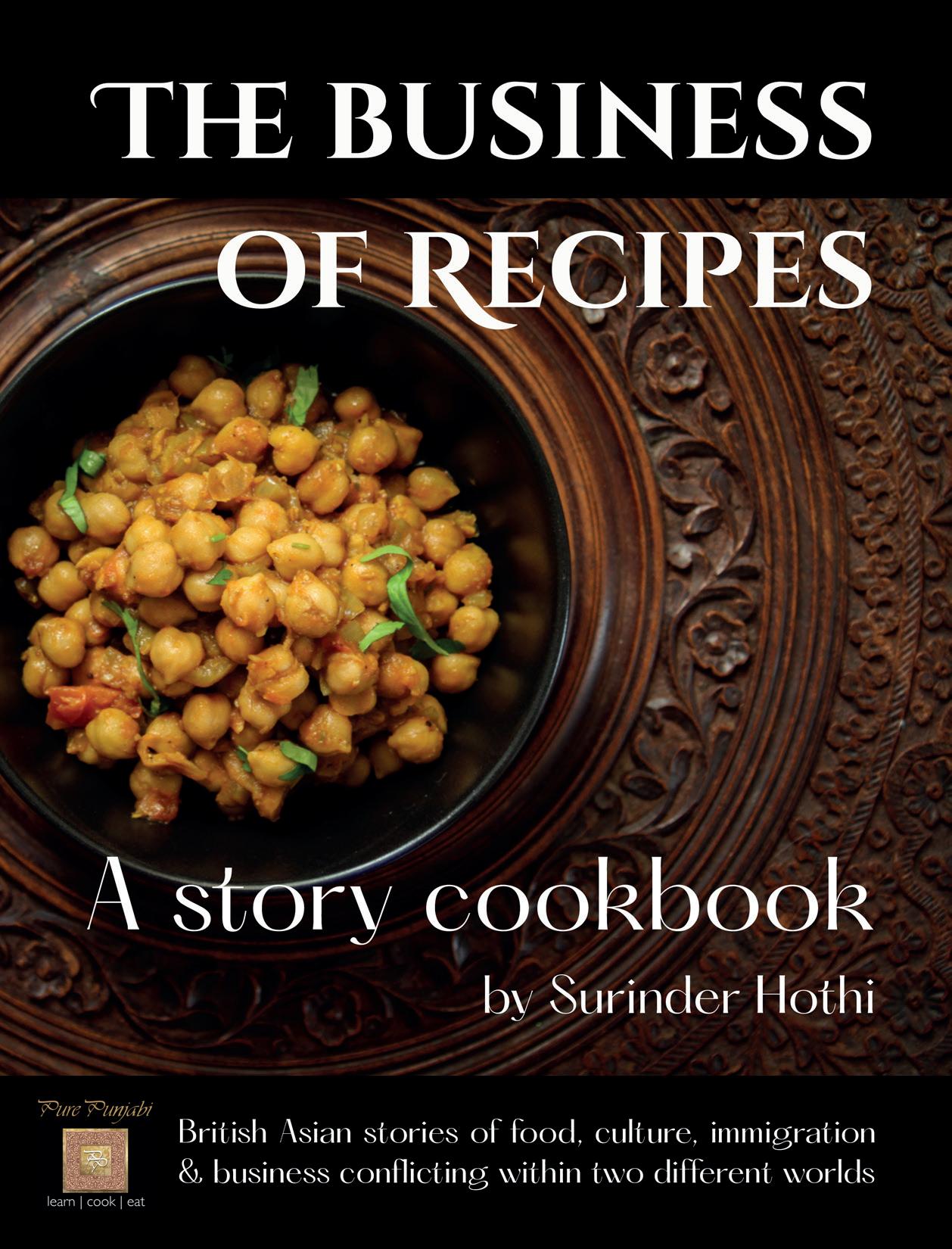
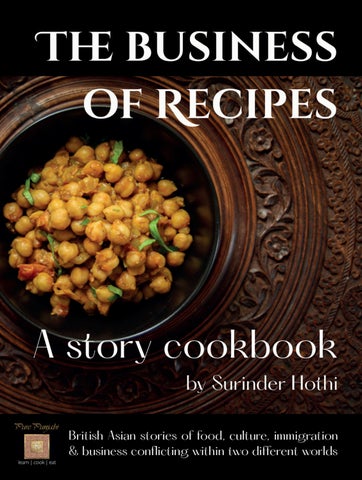
An Indian cookbook of Punjabi home recipes wrapped within British Asian stories of food, culture, immigration & business conflicting within two different worlds
Surinder Hothi
Hothi Publishing
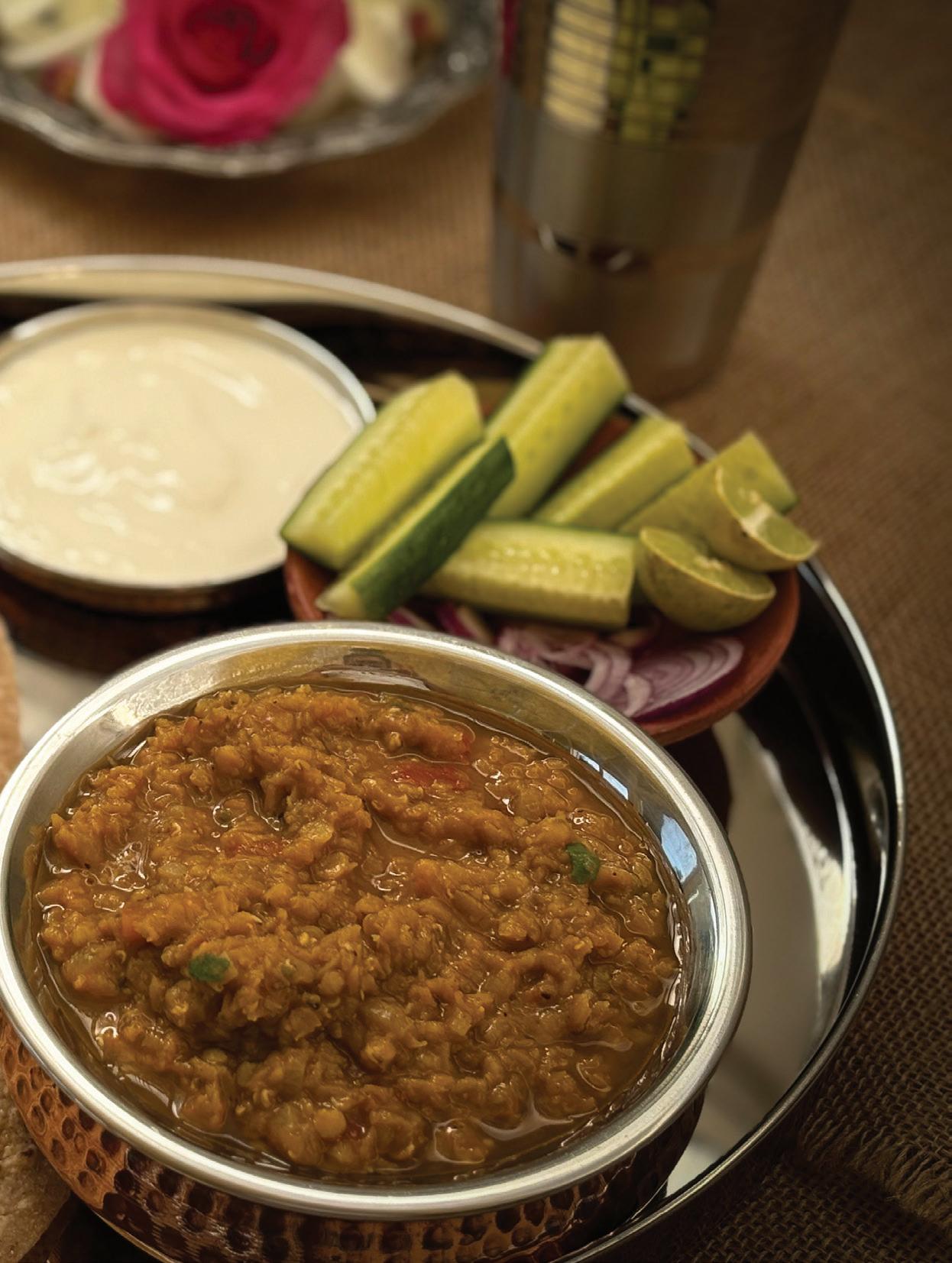
low res image (237 dpi)
Chapter
Chapter 2
Chapter 3 “Her screams rang out…. and no one came to help”
…Crime & Punishment
Chapter 4 Pink fingers
‘…a baptism of fire’
Chapter 5 Roots
“You need to see where you come from…”
Chapter 6 Open all hours
Fairdeal…or an ordeal!
Chapter 7 “Don’t let the bastards bullshit you” …
…the business of arranged marriages…
Chapter 9 “They were right, but they were wrong”
…failures…
Chapter 10 Brown, White, Caramel, Toffee, Mocha…or zebra-striped…
…a natural curiosity?
Chapter 11 “Mummy went to the restaurant and no one’s there” 215 …international dining
Chapter 12 “If you don’t eat Indian food, you’ll lose your Indian blood” 233 …returning home…
Chapter 13 “Mum, we can’t eat the bricks”! 249 The Post Office…’Bent or incompetent’?
Chapter 14 …and then the penny dropped…I was my own answer…
– Flaky savoury biscuit
– ‘Bombay Mix’
da Saag – Mustard greens
Biriyani – Layered spiced chicken, rice & nuts
– Sweet cheese dumpling
–
– Chickpea dhal
– Crispy fried Roti
Panjeeri/Pinni – Winter sweet crumble/dumpling
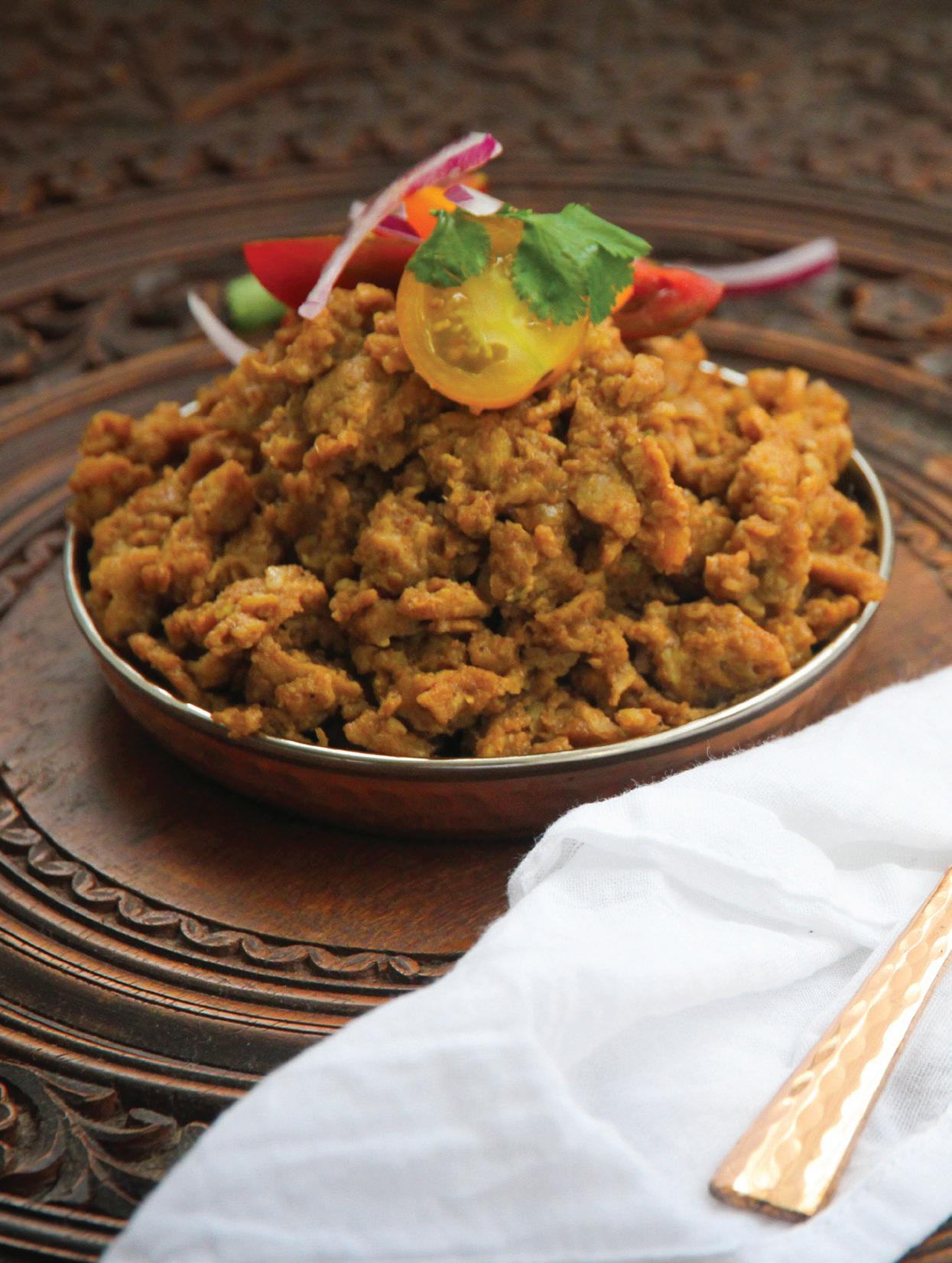
– Spiced minced lamb
– Vermicelli pudding
Jamun – Sponge dumpling in syrup
Dhal – Kidney bean
–
Tikka Masala’ – Fusion chicken ‘curry’
The Business of Recipes is a cookery book about the world of home-style Punjabi food and recipes, but more than that, it is also about growing up as a child of immigrants, our work ethic, self-employment and the business of making money, the importance of the acquisition of property, Sikhism, family life and arranged marriages, the social standing of girls and the social ostracising of widows.
This story, through the recipes, takes us from the time that my paternal Grandfather took my 16-yearold father for a walk, from which he did not return… that walk took him from the villages of Jalandhar, Punjab, and ended up in Bristol.
This walk caused my Punjabi-speaking mother to be running an English guest house in Southsea, Hampshire, throughout my primary school years, and is the reason I am here today.
With my mother running a bed & breakfast business, all the while that I was at junior school, so I saw food cooked and served and eaten from two different cultures in two different ways…or three ways if you count school-dinners. Her delicious Punjabi food, her excellent British food cooked for the guest house, and the school dinner version of British food!
From Bristol our recipes travel between Portsmouth, Heathrow, Mombasa & Nairobi, Southampton to Brussels & Johannesburg, to The New Forest/Wiltshire, onto South Somerset.
Food has been a constant theme in our working and business life. We’ve made a good and hard-earned living from the tough business and long hours of food and hospitality. As a child, the guest houses turned into acquiring more property, those properties became what we would now call HMO’s (houses of multiple occupation). Six commercial property acquisitions turned the small corner shop into the first big Indian-owned supermarket in the area to be open 7 days a week from 7am-10pm, a super ‘corner shop’, that produced income and jobs, off the back of our non-stop work and collective non-salaried family labour.
Later, as an adult, for a further 20 years, I ran a very successful health & wellness business as a private personal trainer & life coach, that again involved food – changing the diets, health and lives of hundreds of people. That business, alongside using bricks & mortar as investment and income, enabled me to single-handedly raise and support three children.
You may be surprised at the simplicity, purity and goodness of traditional Punjabi home-cooking, and in the recipes will discover that the secrets to the taste and flavour are all in the methodologies and key principles we give you. Here you can discover how we really cook and eat at home. It’s not complicated, but it does require care and patience.
As you read through the stories around the recipes in this book, I hope you will enjoy the background to the food, understand more about the culture and heritage of our region and about the remarkable hardworking, extremely brave & pioneering people like my parents who ventured into new and often hostile worlds, with language & cultural barriers, and paved the way for the 1st and 2nd generations born and living in countries like Britain, The USA, Canada and Australia.
They also lay the groundwork to later pave the way for the very soft-landing of those migrants who followed, often exploiting and living off the backs of these first generations
As well as the wonderful, difficult, and conflicted upbringing that children of very different cultures juggled, managed and mostly resolved, and the background of so many British Asians in business.
This is the story of very many of us, who… in the words of Satnam Sanghera, “are here because you were there”.
Punjab is a farmland region, and the heritage and background is in farming and from farmers. The name Punjab means The Land of Five Rivers, (Panj means Five, and Ab, means River), so it is a region of abundant irrigation. The British divided Punjab in 1947, and three rivers now sit in The Punjab of Pakistan and two in The Punjab of India. (Panjab is the correct spelling but changed by The British to be pronounced correctly as Punjab. -it’s something we didn’t change back, as the pronunciation of it as ‘pan, as in frying pan, is too much to bear).
The agricultural prosperity of the region is greatly due to these rivers, and it is a major food producing region of India. For this reason, Punjab is known as the ‘Bread Basket’ of India. The food is hearty, nutritious, food of the land and full of goodness. Punjab is also homeland to the Sikhs, a warrior race, and Punjabis are known to be very formidable and tough, yet friendly and hospitable people. Note…Women wear [the] trousers.

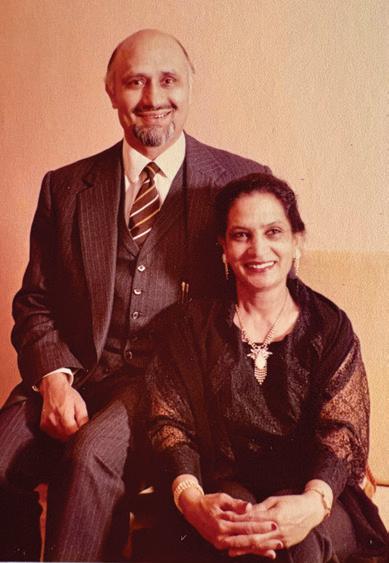
Surinder, the founder of Pure Punjabi, embarked on this culinary journey to honour the memory of her extraordinary parents. Her beloved, kind yet feisty, mother’s delicious home-cooked food and her father’s fearless and often harsh entrepreneurial spirit are the cornerstones of her business.
Born and raised in Hampshire, Surinder’s childhood revolved around the warmth and love of her mother’s traditional Punjabi food, the British food of the Bed & breakfast business her mother ran, and her father’s business & property ambitions. Both parents instilled in her a deep work ethic. Her mother, Seso, teaching her to cook from scratch, making, creating and multi-tasking across food, business and home, passing down generations of traditional skills.
From a very young age, Surinder was kept at her mother’s side, helping with jobs for the bed & breakfast her mother ran, being taught to cook, sew and knit and watching her prepare delicious meals and sweets, a skill that would later become a contributing factor of her successful ventures. All the while being heavily encouraged by her father to succeed in school and pursue academic achievements.
After a diverse career spanning retail, property, personal training & life coaching, hospitality & events, Surinder’s passion for preserving her mother’s legacy and her culinary heritage led her to establish Pure Punjabi in 2010. Initially focusing on producing the Garam Masala taught to her by her mother. In 2013, she partnered with her daughter, Safia, to expand the business and offer a wider range of products, with the twist of culinary & cultural experiences. Leading to becoming a multi-award-winning business comprising cookery school, meal kits, and food events. This unique venture focuses on preserving and sharing the original recipes of her mothers, and the grandmother’s cooking, from the region of Jalandhar, Punjab, North India, with the wider UK population and beyond, and, increasingly for the British-born Punjabi children who are losing the original culinary traditions.
From founding Pure Punjabi in 2010, both Surinder and the business have been recognized for the integrity of the food offering, by…The Telegraph and other publications, named a Top 8 UK cookery course by Olive Magazine, won Great Taste Awards, and were winners of the Federation of Small Business ‘Family Business of the Year South West, with Surinder named on the F’Entrepreneur list of female founders. Today, Surinder continues to uphold the legacy of her parents and the preservation of artisan production, through cookery workshops, no-waste Indian meal kits systems and creation of unique cultural events, combining hospitality, property, and business from the Pure Punjabi HQ in the South-West of the UK. In Punjabi extended-family tradition she also lives with her three adult children: her daughter, (& business partner), Safia, and two sons, Samir & Arun.
For whom is this book intended? Well, firstly it might not be for Indian restaurant food fans,
Not because there’s anything wrong with that – it’s just that rich sauces and gravy are not what we eat at home - it’s just not our daily home food. If you want the wedding food, celebration foods, treat food and more complex dishes that we eat occasionally, then that is not in this book, but will be more so in the next one.
This book is for the family, for home cooks, Asian and British, people who want good simple old-school Punjabi… ‘Ma’s food.
And even more so, it’s for children and grandchildren of Punjabis – those who now eat mainly western foods. It’s also for those Punjabis, adults younger than me, who suddenly have to be able to or now want to cook for their elderly parents and don’t know or are not sure how to make them their traditional foods – they’ve forgotten how or never learned.
This is for ‘apne’, and for all people who are interested in nutritious home-food.
My food business, Pure Punjabi, and this book immortalise my loving mother and her food and it keeps her alive for me. It is also my parent’s legacy and recognises how hard they tried, not only to teach, but to support, more than I even realised, even though for an Indian parent that is in a controlling way.
They were better than their parents in accepting changes and a new life, so they probably felt they had made enough adaptations. In the conflict of growing up in Britain, I did not feel that they had…back then, and this book recognises that in my youth, I didn’t always understand the conflicts they faced.
Finally, if my mother hadn’t taught me herself…this is the book my she would give me. If I hadn’t taught my children, this is the book I would give them, to understand some family background and the journey that originally brought our food to this country.
Why did I write this book? It was always there, waiting to be written, and something I always intended. However, for a lot of reasons, including feeling a conflict with the formation of my business Pure Punjabi, in partnership with my daughter, it didn’t seem right.
Then I joined a global business group and realised I was wrong. Some things should be documented, and some stories should be told. It was a quick process to get the basics drafted out, as they were already in my head and waiting. It’s been more complicated to organise and make it presentable! The person I was most worried about, my daughter, wasn’t keen on a cookbook, but has since been instrumental in helping to complete this book. She is the sole provider of all the food imagery, photography, and greatly contributed to the visual identity that I wanted in honour of my mother’s food.
When you lose your mother, as a young adult and a young mother of babies, watching her slowly die, when she was still too young, the effect, certainly on me, was catastrophic. I felt I would die from the grief and yet still had 2 babies to care for. It was the beginning of the end of my marriage and the path to increasing self-reliance and preparation for my own end. The grief manifested itself physically after her death in the form of terrible chest pains in my heart. It sounds ridiculous, but my heart was broken and heart break, at least for me, was a physical pain.
In defence of those around, they were mostly unaware of my internal devastation, and for my father and the one other person, who was also devastated and deeply affected, they were dealing with their own grief in their own way, which divided us all. The thing I learned about death, is that it is divisive. It does not bring people together, but breaks them apart, and everyone handles it in their own way.
Around a year or so after her death, I felt that almost everyone carried on as if she had never existed, and I found this impossible.
I saw her everywhere – in bright colours and jewellery, in every rose, and in every marigold. I couldn’t visit a garden centre for years.
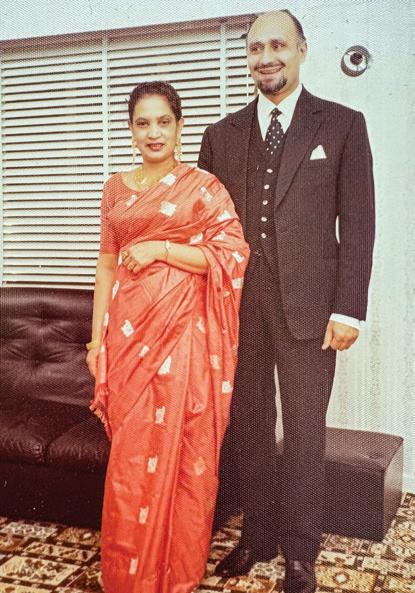
To my late mother, a loving angel who lived her life for her children and always tried her best – super-strong, super-loving & a gutsy little firecracker! She had a spark and an energy – eternally optimistic and hopeful – always interested and so positive, and forgiving…even against the horrible treatment she often received…
…and even when she wasn’t always right, her intentions always were. She was a good woman.
To my late father: an amazingly conflicted, brilliant and awfully difficult man, equally domineering, aggressive, as well as loving, who without doubt gave me the foundations to achieve and, who paradoxically, gave me the lessons to rise-up and stand against him from controlling my life. He had a drive and determination to progress but somehow lost a bit of his soul in that quest, but despite that he never flagged in his ambitious outlook.
As the saying goes ‘your parents did the best job they knew how to do’.
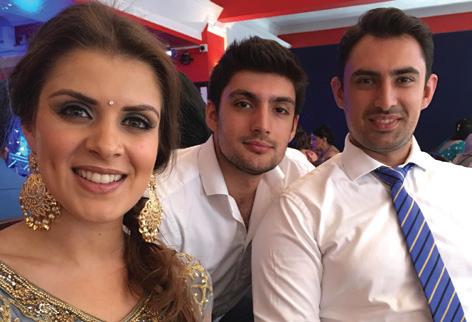
…and to my own three musketeers & my complete life purposes, standing by me through thick and thin…willingly, and also unwillingly, and that’s when you know the love…
They are my most delicious dishes – I could eat them all up – though some are saltier than others and quite often hard to digest! No matter…they have the Punjabi essentials deep within them… ‘sugar and…quite a bit of spice!
Why were strangers in my house?
Why did we give them dinner in a dining room we weren’t allowed to eat in and to sleep in bedrooms we weren’t allowed to use? I was very little, maybe 6 or 7 years old, and I wondered this…
We lived in a 3-storey house, in a seaside town called Southsea, in Portsmouth, Hampshire, which my mother ran as a guest house, offering bed, breakfast and evening meal throughout my Infant and junior school years.
In the entrance hallway hung a black and white photo of Mount Everest, along with another of the Taj Mahal. It was called ‘Everest Guest House’, because my father had decided to name our guest house after the mountain. Looking at the framed black & white picture of Mount Everest in the entrance hallway, my father would proudly tell us the story of how great this mountain was and that was why our business was called Everest! This was an early indication of my father’s pride and the contrast between his very confident attitude, what British people would regard as ‘boastful’ against their British reserve.
Most of the house was given over to the guests and was therefore the rental income from which my mother brought in some of the family income. Meanwhile, my father worked at Heathrow, doing double the work shifts of every other worker, 7 days on, then 4 days off, when he would return home. During this time, he would sort out all manner of issues, such as repairs, and do all the paperwork and admin as my mother didn’t read or write much English.
The downstairs part of the house that we occupied, was 3 steps down from the entrance and hallway, it was the small back room, with a tiny kitchen off the back, and an outside toilet and garden. This tiny and basic kitchen was from where my mother produced fantastic food, an English menu for the B&B guests and our family food – of two types. Our English family food varied between sausage and mash, chips and fish-fingers for when we came home from school, but before my father would be returning, a great variety of Indian dishes were prepared, not only savoury dishes, but also Indian sweet treats and savoury snacks.
The back room was our little world. It was a small room with a sofa, a small table and chairs were opposite, under a little window, with a small TV in the corner. There was a little paraffin heater, which my mother was always anxious about us going anywhere near, and from a very young age, I knew to stay well-away from it! I remember it as a warm, cosy, happy place, and our safe place. We were never cold. My mother was always cooking or making, whether for the guests, or for us as a family.
Our guest house provided bed, breakfast & evening meal. I can still remember parts of the menu. There was always a weekly roast, with all the trimmings, although I remember wondering why British people had a sweet apple sauce with their roast pork. I also thought it was the best bit! My father at some point in my junior school years had told me that the menu had been written with what I would now later see as professional help, and that my mother had attended a cookery course to learn how to cook traditional British food. I remember my parents belonged to an organisation called something like ‘The League of Friendship’, which I think was an organisation that welcome new immigrants and helped them to settle in and integrate into a new way of life. They had a friend called Mary through this connection, who was very active in all sorts of Rotary-like activities. She was sophisticated and glamourous and supremely confident. She looked and behaved like a Hollywood film star, of the ‘Rita Hayworth type”, and I greatly admired her!
One of my earliest memories is standing on my tiptoes, with arms reaching up overhead, folding the sheets to help my mother change the rooms over, and do the laundry. I was probably around 4 years old and remember struggling to keep my arms up and trying my very hardest. One day I recall my mother looking at me as she held the other end of the sheets I was stretching and trying to be as tall as I could, and she was smiling at me, and my efforts, her eyes full of love.
I was always around her in the kitchen, doing small jobs and tasks, one of which was being sent to lay the table in the guests dining room. Sometimes I would have to take something into the dining room when guests were eating and I was always very self-conscious about it, but also remember, even at that age, telling myself not to be.
My mother also had girls that came in to help her in the kitchen and to serve the food to the guests in our front dining room. I particularly remember Coleen, who was tall and slim, with very long straight blonde hair – a sort of ‘cool hippy chick’, and she had a baby boy called Samuel, who she frequently brought with her during the long hot summer holiday months. Samuel was a delicious 6-month-old with coffee coloured skin. I remember my knowing that Samuel’s father was not English, and the implication seemed to be that they were not married.
It was my first awareness and observation of a baby with parents of different colour. I played peek-a boo with Samuel on the grass, and made him laugh and laugh, his baby gurgles delighting me so much that I carried on to the point that he almost tipped backwards. Looking up I saw my mother and Coleen, both watching us through the kitchen window, and both smiling in the exact same way – with their eyes full of love and kindness.
The front room of our house was the dining room for the B&B guests, where breakfast and evening meal were served, and there was another room which was a guest’s bedroom, often an ongoing ‘lodger’. Up the stairs was another guest/lodger bedroom and a small toilet, a sort of mezzanine/landing floor. Then up again, was another bedroom, and the main big bedroom in which the five of us all slept.
Then up again, right at the top of the house, and what felt a very long way up to me, was a small attic type bedroom, next to the main bathroom.
It was an impressive size house for an immigrant boy from the rural villages of Jalandhar.
When my father first arrived in Portsmouth, he took lodgings in a small guest house somewhere near Albert Road in Southsea. He never spoke of any difficulty getting lodgings or ever mentioned the ‘no blacks’ etc rule of many lodgings’ houses, so from his references to the character of the landlady, she was a good woman. This was where he was living, when he sent for my mother to join him from Punjab.
Years later I learned that many immigrant men never sent on for their wives and cruelly abandoned them in the villages and took second wives in the new lands – something my father’s parents tried to pressure him to do. He told me that because she had borne no children, they wanted him to leave her and take another wife – something which he refused. He said, “you married me to her…and now I will stay with her”. Her fate… had he done otherwise would have been to remain in the home of her in-laws as a ‘servant’ with no status, having produced no children for 11 years.
My mother told me stories of her arrival to England and to these lodgings as a young foreign woman who spoke no English and had never left the rural villages of Punjab. As my father would be away at work, she was by herself, however, as luck and the kindness of a stranger, would have it, not left alone all day. She spoke with very, very fond recollections of the landlady of this house – the good woman who took my mother under her wing and looked after her. My mother use to say … “she so good to me”. The lady took her to the greengrocers, and out and about shopping for whatever she needed, and treated my mother with such kindness that my mother never forgot her.
This was obviously where my father first saw the dual use of a property as home as well as potential for income and came up with the idea of using their first property as a guest house – a home and a business combined! That first lodging with the kind landlady made him realise that the acquisition of property, served not only the purpose of providing ‘a roof over the head’, but was also a means to earn income, and was an early ‘working from home’ option, which of course he knew my mother would be able to do. There’s something in the pioneer and early immigrant mentality that is always looking and learning from the new ways of the new life and new world and exploring the possibilities. How to be creative, how to make more of every potential avenue and see beyond their upbringing.
In our guest house, the small attic type room at the top of the house, was for a long time, the room of our longterm lodger Charles. Charles came from South India and was a very quiet and gentle young man. Occasionally, he would come into our family ‘back room’, which was always a time of interest, meeting one of the ‘guests’. On one occasion, discussing the differences between ‘curries of our different regions of India, he offered to cook a South Indian curry for my parents. I remember vividly the sweat on my father’s forehead as he alone persevered with eating the very hot curry!
It was very different from our chicken ‘curry’ that we would find a little bit hot, but fine when mixed with rice on the plate and yogurt on the side. I remember not being allowed to try it, because it was so chilli hot!
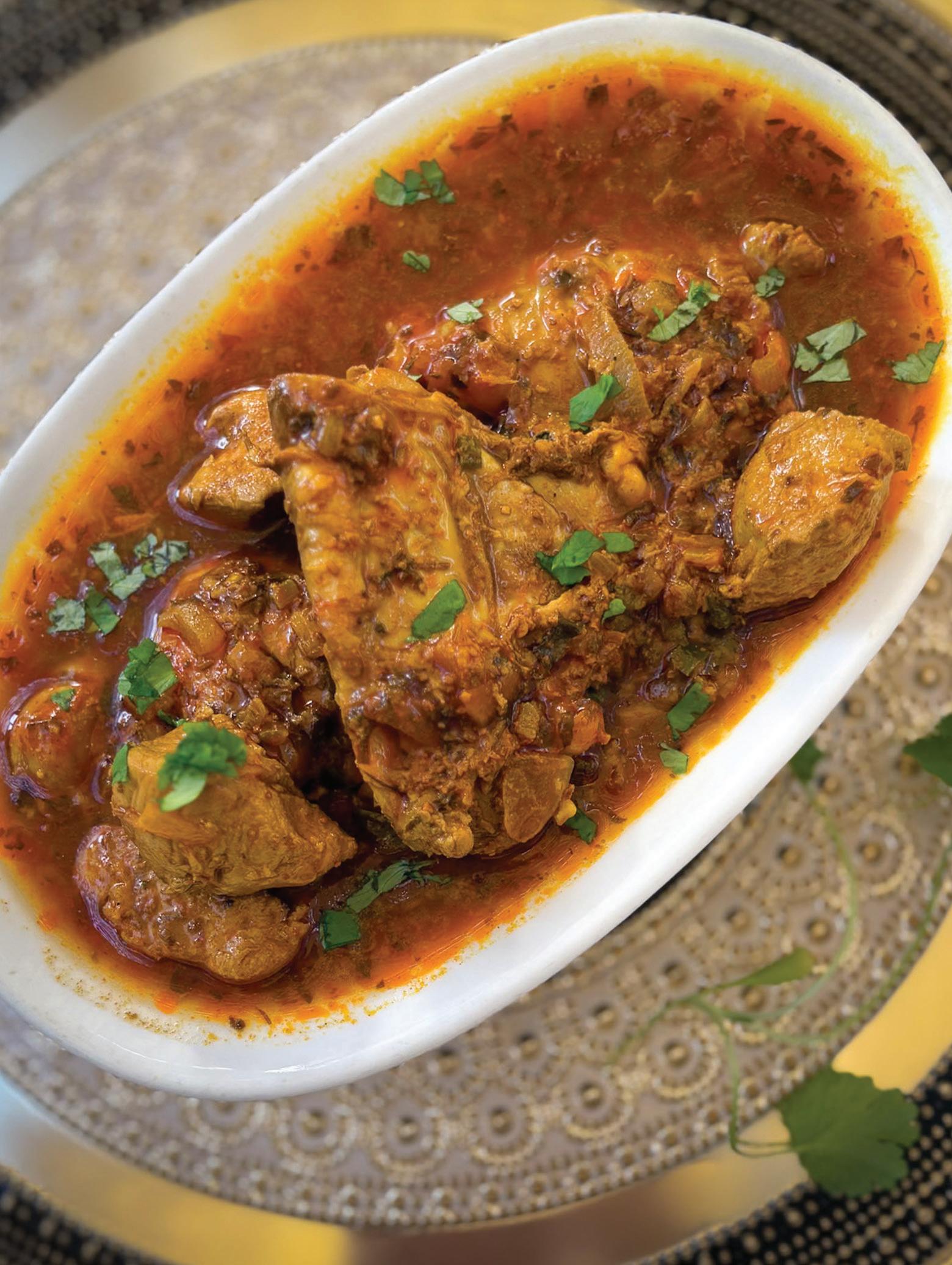
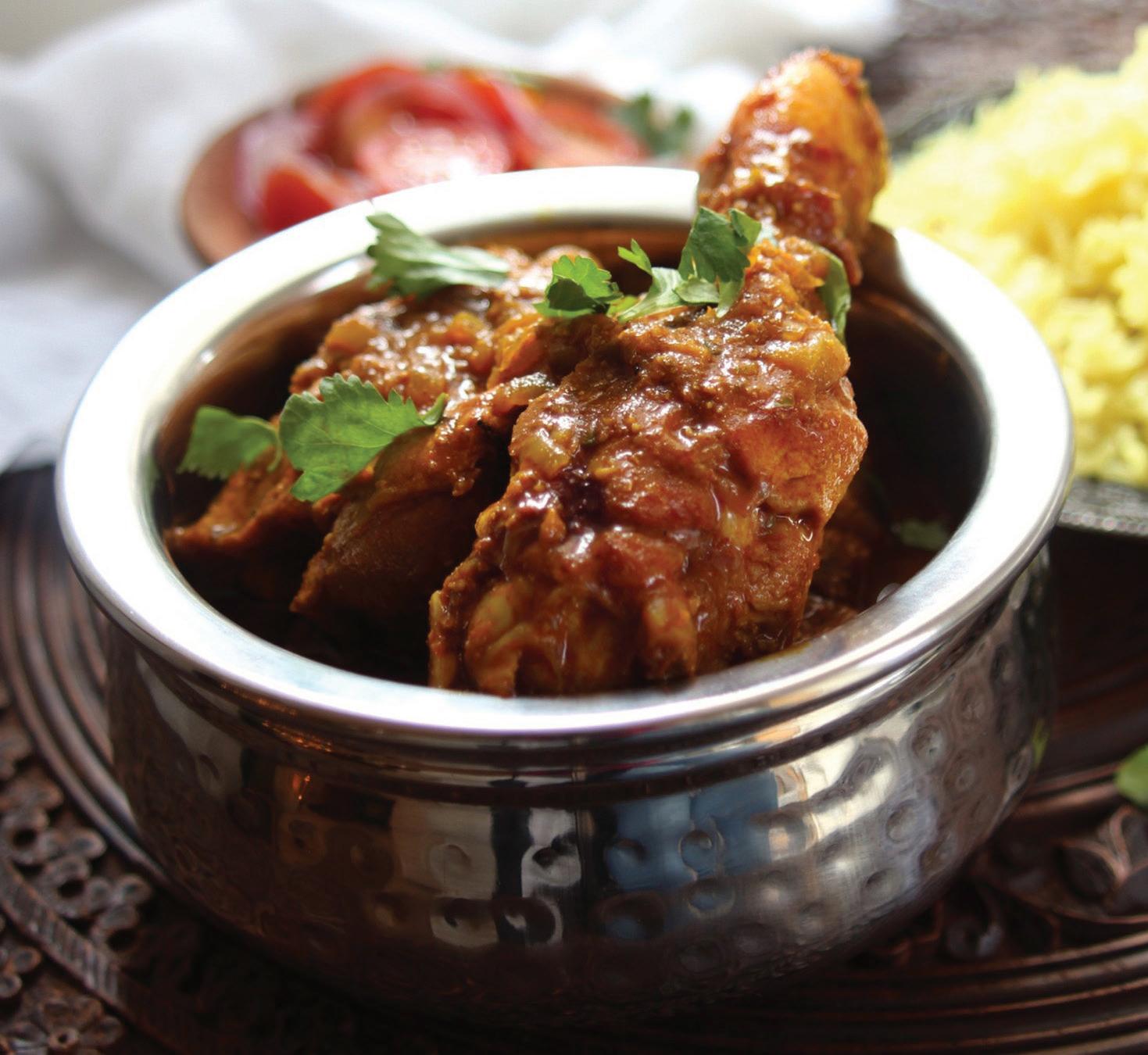
This was our Saturday night chicken ‘curry’.
For Punjabi cooking you must remember – giving it proper time to cook gently is essential. Cook over a low heat, it brings out the natural sweetness or flavour in the ingredients. Much like the process of marinading – the magic happens when you give it time.
I’d recommend starting to cook this after you’ve eaten lunch so that it can just slow cook until dinner time. Alternatively, something my daughter now does, is to make the base/sauce in a saucepan, and then at the point of adding the chicken, she transfers the entire dish to a slow cooker.
1 batch of tarka starter (see page 305)
1 heaped teaspoon ground cumin
1 teaspoon ground coriander
½ teaspoon Garam Masala – see Garam Masala page
½ teaspoon turmeric
1 heaped teaspoon paprika
1 teaspoon salt
a big pinch of dried fenugreek leaves
20g tomato puree
Approximately 200ml recently boiled water
Approximately 600g of a mix of chicken breast and thigh or drumstick
300g chicken breast, cut into bite size pieces
300g skinless meat on the bone - either drumsticks or thighs. This is because bone meat enriches the flavour and gives a depth to the gravy that isn't the same without the bone. If you only want to use breast, see if you can put some bone in for the 'stock'.
2 or 3 coriander leaves, roughly chopped (optional garnish, please note, this really would be a very small amount)
Optional: a couple of potatoes (cut these into quite small bite-size pieces and add raw when adding the chicken)
Begin with the Tarka starter of onion, garlic, ginger & chilli (see The Tarka page 305)
Now add Spices to the warm Tarka mix and stir them into the onion base and cook them on low heat for 2 to 3 minutes. Then add the tomato puree and incorporate it into the onions and spices.
Add the recently boiled water a bit at a time, to loosen the base and create a sauce for the chicken. Add the chicken to the saucepan. If using a mixture of breast meat & bone meat, put the bone meat in the saucepan first, and then lay the breast meat on top as the bone meat will take longer to cook. This way the bone meat is closer to the base of the pan (the heat) so it will balance out the rate of cooking (as the chicken breast will cook through faster).
Put the lid on the saucepan, leaving it at a slight angle so that it’s not completely covered. Let the chicken slowly cook through, turning it every 10 minutes or so, so that all of the chicken cooks through evenly. It will take approximately 25-40 minutes for the chicken to cook through. It is done when the chicken is cooked all the way through to the centre.
Note: The lower the heat, the more tender the meat will be once it is cooked, you just need to allow more time for it to cook through.
We often cook this on a weekend and start cooking it in the morning, (often making a double or triple batch), and just let it slow cook. Then when it is cooked, we turn it off and let it cool. You can then gently re-heat dinner portions when you want them. We then tub up leftovers and freeze them so we can always have home-cooked food mid-week.
Tips: Using bone meat (such as chicken drumsticks or thighs) will add extra flavour to this dish. We would recommend using a mixture of bone meat and chicken breast.
Tips: Try to always cook meat dishes in a pan with a wide base. This allows you to put the heat really low but for the meat to cook our evenly, whilst also cooking gently. Do not use a narrow/tall pan as this won’t let the heat circulate properly in the pan.
Tips: For really tender meat once you have made the base/sauce, put the flame/heat as low as possible and very, very gently cook through.
This was also my first realisation that the people and the food from different parts of India, were different. In contrast, our own home-made ‘chicken ‘curry’ although it had chilli, had nowhere near the heat level of the South Indian version.
We always referred to that Saturday night dinner as ‘Chicken & Rice’ as kids and even still as grown-ups. Of course, it should be ‘Murgh for chicken and Chawl for Rice.
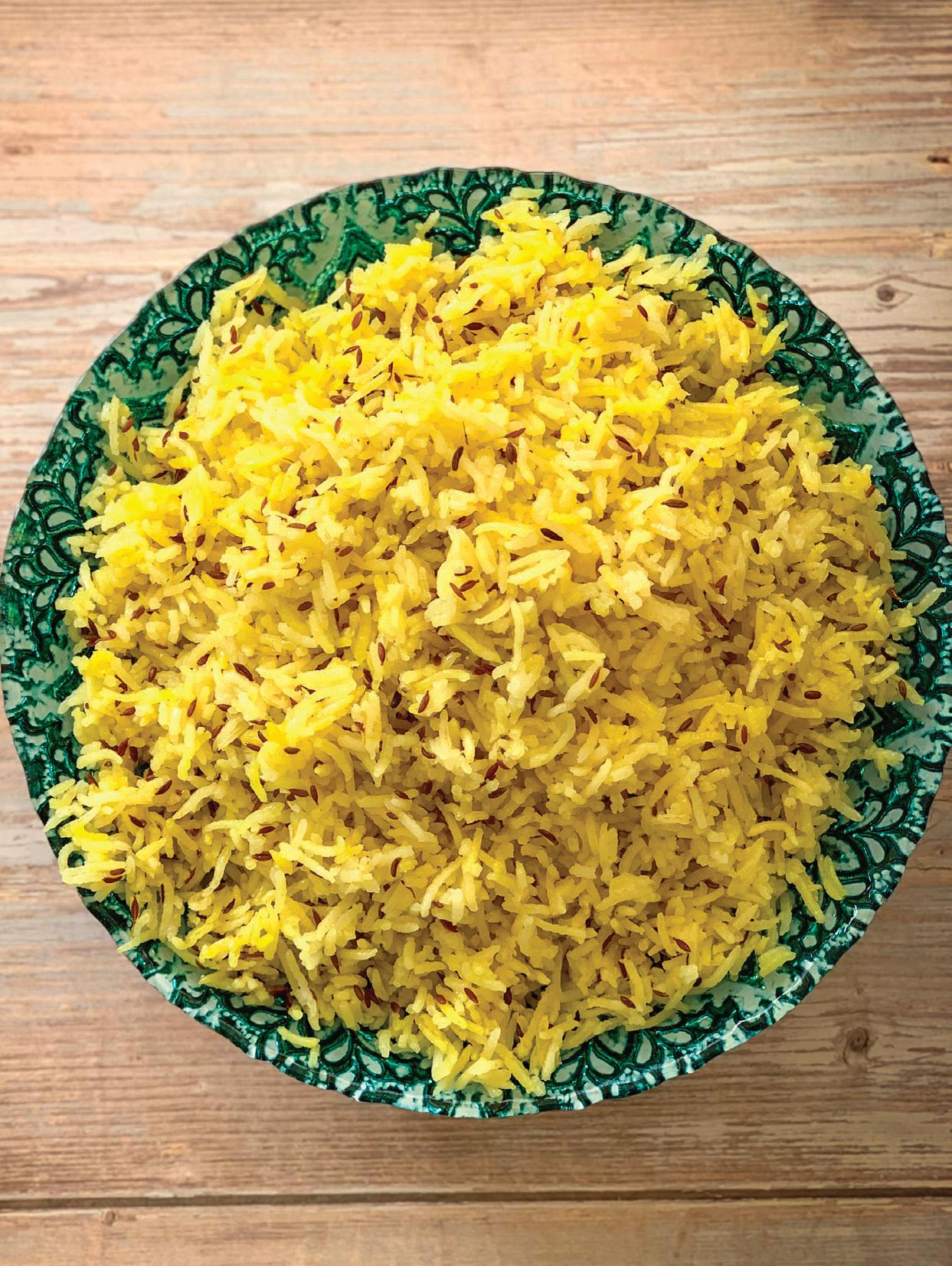
Ingredients
1 large teaspoon ghee
1 tablespoon Cumin seeds
¼ teaspoon Turmeric
¾ teaspoon Salt
1 mug white Basmati Rice (approx..250g) - we always use white Basmati Rice.
1 ¾ mugs water (cold tap water) (approx. 475ml)
Some people do also add a handful of peas to this dish when making it, but that is optional.
Method
Wash the rice 5-6 times (or till the water runs clear). Once the water runs clear, drain the rice well and set aside. You must not skip this step.
Heat a saucepan over a low heat. Add the ghee to the pan. Once the ghee has melted, add in the cumin seeds. Stir and gently cook for a couple of minutes. They burn very easily, so keep the heat low.
Add the turmeric, salt and drained rice, and dry cook the rice over the heat for 1-2 minutes to make sure all the grains are coated in the spiced ghee. The rice will almost become sticky - this is normal. Keep the rice constantly moving during this dry cooking process.
Add water and stir. With the saucepan uncovered, turn the temperature to the highest setting to bring the rice to the boil. As soon as it has come to the boil, turn the temperature to the very lowest setting and put the lid on the saucepan.
As soon as all the water has been absorbed into the rice, it is cooked. Run a fork through the rice, this stops it from going sticky and forming a solid clump at the bottom of the saucepan and keeps it light and fluffy. Serve hot.
The ratio of rice to water is essentially: two-parts water, to one of rice, however we always knock off a bit of water in the second mug, as we find doing double the water volume can end up a bit mushy, so experiment with this. If you find that the rice is not quite cooked, then slightly increase water.
One thing to note, is that if you double up on the quantity of rice – say 2 cups of rice, you should slightly reduce the water again, so say, 3 ½ cups water. For some reason, as you make a larger quantity, you need a little less water.
Another thing to note, is that rice is not the standard daily accompaniment to main meals in Punjab and the north, whereas that is more so in South India. For us the daily staple and side dish is Roti.
Our rice was always made with cumin seeds, ‘dry frying’ the rice in ghee and using the absorption method, and I never knew any other way to make it. It’s fragrant, light and delicious.
Add image or text – cumin seeds sizzling.
Then I tasted school dinner - plain white boiled rice – badly-cooked, bland & stodgy!
Who knew you could take the same food ingredient and by a process and a methodology totally transform, or destroy the resulting dish
Every so often I would hover on the stairs, usually when my father was home, listening to my parents talking at night, and I would hear the sound of the 10 o’clock news! The familiar gongs of the clock striking 10 meant my parents were sitting down - my father watching the news and my mother always knitting, sewing or ironing.
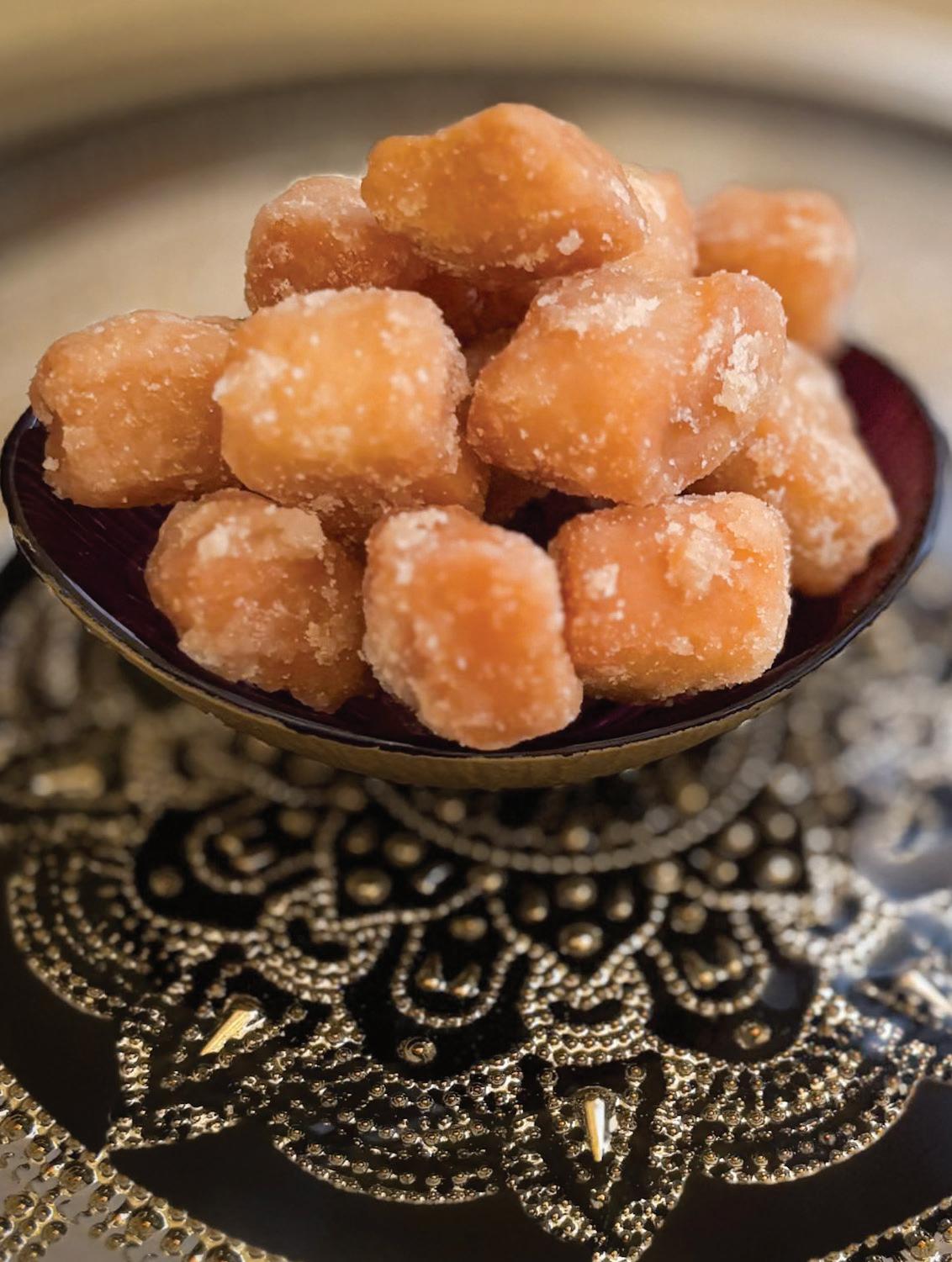
The lure was the sweets that she would have made earlier - namely Shakkarpara! These sweet diamondshaped tea-time treats are delicious. They are a sort of biscuit with a pastry/doughnut-like sugary coating quality.
Simply made from pastry rolled out, pressed into a large round stainless-steel tin and cut into diamond shapes as she did, (or more often seen nowadays, shaped into cubes,) then carefully lifted out and fried until golden then dipped and coated into sugar syrup and laid out to dry and for the sugar to crystalise.
The traditional diamond shape requires more processes, which could be why nowadays one more often sees the cubes. This only requires making the dough and cutting or shaping by hand, into cubes. Whether diamonds or more cube-like, either shape is fine.
I do indeed remember the process seemed lengthy – making the dough, rolling out, pressing into a couple of round stainless tins, cutting into triangles, frying the pastry diamonds, preparing the sugar syrup, soaking the pastries in syrup.
Maybe it was the fact that my mother made what seemed to be vast quantities. In. fact visiting other Indian households, this seemed common practice and the huge quantities seemed to be universally made and then stored in tins.
When it came to the frying and also the process of boiling the syrup, my mother would always urgently instruct me to move away from her and stand well-back, such was her fear that I should even slightly be splashed by boiling oil or syrup. I always wanted to see these dramatic moments up close but could only stand next to her by the cooker, when it was on a low heat.
I learned early on that Indian parents and culture prize their children, and the protection and fear of harm and of ‘going wrong’, would later become over-sheltering and a conflict in a Western world.
Ingredients
1 cup Maida (plain flour – approximately 250g)
¼ cup of melted Ghee
½ teaspoon Baking Powder
¼ teaspoon Baking Soda
Tap water
Sunflower oil, for frying (1 to 1 ½ litres)
Method
Put the Maida, baking powder and baking soda into a mixing bowl. Pour in the melted ghee and rub it into the flour until it’s been completely rubbed in/mixed through
Add water little by little until you have a firm dough - the sides of your bowl should also be ‘clean’ (i.e. No sticky dough left around them). Cover with a tea towel and leave to rest for 10 minutes. As the dough is resting, pour the sunflower oil into a Karai (or wok) and heat over a medium to low flame –the heat for frying these is much lower, so the heat should be on the lower side.
After is has rested, uncover the dough and roll out to a half inch thickness with a rolling pin, then cut either into squares to make chunky cubes, or cut criss-cross to make diamond-shapes. Whether you roll out a thicker dough, and cut them fatter and more cube-like, (as pictures), or as diamond shapes, is your preference, and you will see Punjabi women making both types. My mother preferred diamond shapes, and I still have the stainless-steel platters in which she lined the pastry, with the knife marks from scoring the shapes.
Once you have your shapes, use a spatula to carefully lift them and lower them into the oil. The oil is warm, and they should look fairly still when you put them into the Karai. The lower temperature allows for the ‘Pare’ pronounced paa-reh (biscuits) to cook out and expand/swell as they cook – if the oil were too hot it would set their shape almost instantly, whereas they’ll now slowly puff out a little as they cook. Fry them for about 10 minutes over this medium to low heat until they are golden brown.
To make the syrup
1 cup Sugar
½ cup Tap Water
Put the water and sugar into a heavy based saucepan and turn the heat on to medium. Let the sugar dissolve into the water to form the syrup. Once it is bubbling, dip a spoon into the syrup, and very carefully dib you index finger into the syrup. Press your index finger against your thumb and as you separate them, a thread of syrup should remain – the syrup is now thick enough.
Add the fried ‘pare’ into the syrup and gently toss them around to make sure they are completely coated in the syrup. Now pour the ‘Pare’ (biscuits) out into a tray, and over the next 5-10 minutes, the syrup will crystalise over them – and you will have Shakkarpare (sugar biscuits!)
Shakkarpara, (plural Shakkarpare), is a sweet snack that is universally seen across India as well as the wider diaspora, and not only Punjab. They are also known as Shankarpali in other areas of India.
Add image or text – blue saucepan
Another one of my childhood jobs was the task of removing the skins’ of Badams, (almonds). My mother used to buy large bags of everything – I think that must have been possible with my father working at Heathrow, as we certainly couldn’t buy Asian size bags at the Co-op.
It was always a marvel to me as a small child, having the comparison of English families all around me, to note how large the sizes of all of our dried ingredient’s supplies were, as compared to my friend’s mothers, who had dainty packets and small bags of flour and sugar – the standard size of the 1kg or 1.5kg supermarket packet. We had, and still do, enormous sacks of 10kgs bags, and even 20kgs.
From her stash of bulk provisions, my mother would produce a large bag of whole almonds in their skins, ready for me to do the necessary skinning. She would pour the required amount into a bowl, then I would watch as she poured boiling water over the almonds to cover them. When the water had cooled enough to place my hands into it, she would tell me to remove all of the skins form the almonds – it was a fun process. My mother showed me how to slide the Badam through your fingers so that the skin slid off with almost no effort. In a jiffy I would have a bowl of white shiny peeled almonds.
Sometimes I would be required to split them - -I could double up on this job by pressing harder on the split line, when removing the skin, to also split them at the same time!
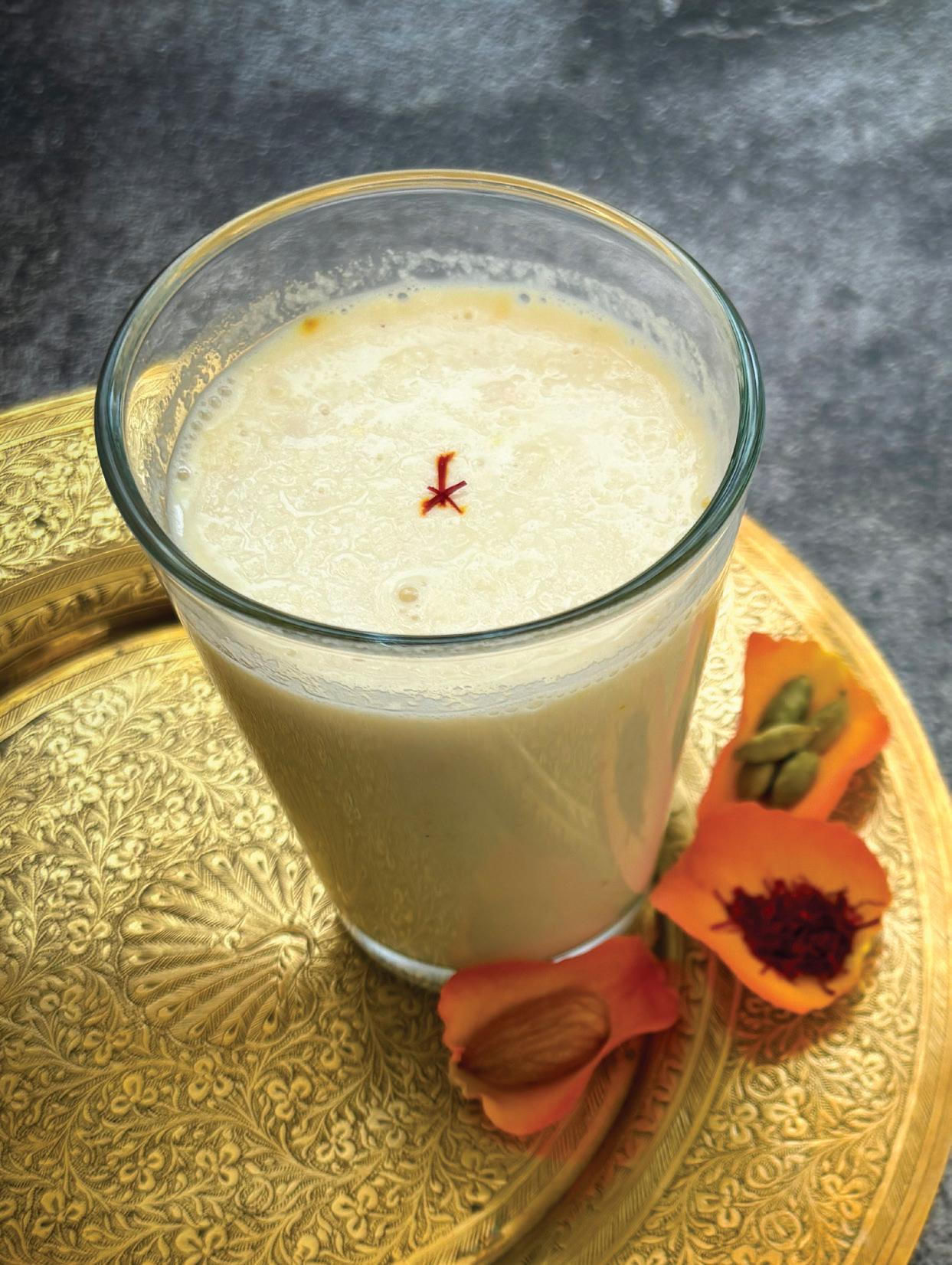
From this point, almonds were on hand for almost any and every sweet dish being made at the time, however one of the regular things it was used for was Badam Dudh - the hot milk she would make at night - bringing the milk gently to the boil, then adding almonds that had been crushed and ground to a paste.
She would make me drink this, and one of the reasons for this, was her insistence that it was for brain health. She knew that this was a culture where girls were being educated equally with boys and also with high expectations and she was very keen that I get a good education, and this meant feeding of the brain!
She knew that I absolutely loved my primary school and loved reading, and my father was delighted with my school reports and read them out proudly. My mother in her sweet and loving way contributed by feeding me with nutritious goodness and love, and her way was of doing this was with Badam Dudh.
Ingredients
20-24 almonds (about ½ cup)
500 ml (2 cups) whole milk
2-4 tablespoons sugar (or any sweetener of choice, to taste)
1 pinch saffron strands
⅛ teaspoon green cardamom powder (from about 2-4 pods)
Optional: chopped almonds or pistachios for garnish, a few drops of rose water
Preparation
Method
Soak the almonds in water off the boil in a heat-proof bowl. When the water is tepid, test whether you can slide an almond between your fingers and 'slip' the skin off. It should slide off easily. If it doesn't then leave to soak for longer. Put the skins in your food recycling.
Making the paste
Grind the almonds down to a paste. My Mother used to use a pestle and mortar, but you can use a blender or small food processor. If you are adding the cardamom, throw in 1-2 small green cardamom pods to grind and blend down into a paste with the almonds.
Add in the sugar and saffron strands (if using). Add about ¼ cup of the total milk and blend into a very smooth, fine paste.
Making the milk
In a heavy-bottomed pan, bring the remaining milk to a boil over a medium flame, stirring occasionally to prevent burning.
Once the milk is boiling, stir in the almond paste completely. Add any extra sugar if desired. Reduce the heat down to low and let the milk simmer for about 2-3 minutes, (Don't boil at this stage.), or until it is slightly bubbly and the flavours have infused well, then turn off the heat.
Badam Dudh can be served hot, and we always had it this way but nowadays, you can chill it and serve it as a cold milk drink. You can also garnish with slivered almonds or pistachios before serving.
“We’re here to make money”
This was something my father said to us from as long as I could remember as a child. Making money from long hours, doing more and extra, no set hours, no work/life separation.
I learned from my parents at an early age, that there is a living in food and bricks, and that they are both a source of income. It was more learning by absorption, but I saw that immigrants must come and set up a business…or two, or more, and all the family must work and have input – we were a collective unit. Asian families get ahead this way.
I grew up not seeing any end or divide to my parents’ working day, and that I was a big part of that, whereas I saw that British children had parents who went to work Mon to Fri 9-5pm. Weekends for British families were strictly for leisure, and their children had no part of their working world.
Another reason for this was that my parents came from rural farming communities from the region of Jalandhar, Punjab. They weren’t city people, and the educated middle classes in India would have probably also had 9-5 admin office jobs, and something nearer to a British or middle-class lifestyle.
My parents and grandparents were used to rising with the sun and not with the alarm clock and similarly the working day and routine followed the seasons, the animals and the weather, making money from and around these factors.
They were a product of their time and culture, and I was a product of my time and culture which was evolving and questioning, but still complying, for the most part. There is not and should not be any judgement, as we each adapted to changing environments.
A working way of life, from its time, but is it relevant anymore for the grandchildren of the Punjabi immigrants of the 50’s and 60’s to immerse themselves in the ‘family business’, additionally when the digital age and tech options increasingly exclude their parents and grandparents?
Food for Thought ...
Reflections on two cultures, ways & worlds
‘On the one hand…but on the other?’
The early first generations Punjabi immigrants were built of strong stuff! They had a strong backbone, determination and perseverance, as well as extraordinary entrepreneurial drive. Those first arrivals contributed value to the economy and society.
When you look at a country like the USA, built almost entirely off the backs of early pioneers and immigrants, these were people who took risks, faced fears, left the familiar to head out into strange and hostile worlds where they would have to fight, (and in some countries, wrongly appropriate/steal the lands of the indigenous population), to gain a place and forge a life.
Is it a wonder it’s known for success and strength?
In the US, Indians are one of the highest earners out of all ethnic groups, as well as across most of the diaspora. Is this due to the Asian model of working? The hierarchy of elders, the clear and strict rules of the home and the ‘we’ before ‘me’ culture. This has changed and evolved somewhat now, and the first generations of children born here fought for the freedom to choose their own path yet still hold onto the principles of the extended family.
In stark contrast…are later 2nd and 3rd generations getting a much softer lifestyle, and the recent immigrants getting a very soft landing? Whether that is from the ready-built infrastructure and network of the early immigrants, or the state? Generations who benefit greatly from the sacrifices and graft of their pioneering ancestors, through access to superior education and standards of living, yet often take this for granted.
Much like the older ones always pave the way for the younger ones…often to their annoyance .
‘British work vs Indian work habits’
I grew up, even as a small child, seeing the very opposing lifestyles of mine and my friends and that our family norms and dynamics were very different.
My experience as a small child was that playing and working were both activities and were intermixed. I was happy ‘playing’ and happy ‘working’ at my mother’s side. I didn’t really know the difference, as our kitchen was also our business, and our home was also our business, with most of the bedrooms occupied through the bed & breakfast business… so we were at home and at work.
The key theme for South Asians seemed to me as a child, that family is at the core of the ‘wheel of life’ and the details around that are revolving and mingling, lines merging and blurring between work, family, and relatives, whereas I noticed that British people had a very strict routine and that they get upset if this is broken. There were set times for everything, and a separation to many of the components of life, although this was possibly because we were living in a very middle-class area, and I hadn’t yet seen any other aspects of British family life – that exposure to British regional and class differences was to come!
The whole concept of work/life balance isn’t something that Asian parents understood back then, and still today, is something that is seen as ‘lazy’ by older generations, though many now are addressing the popular and all-pervasive phrase of ‘mental health’.
Many South Asians are increasingly afflicted with this ‘western condition’, something that would have confounded Asians only a generation ago?
Good or bad...excuse or justification…or just confusing?
Food for Thought ...
Reflections on two cultures, ways & worlds
‘Something sweet’
After the end of every Indian dinner, my father would often say…
“Bring me something sweet Putt”…
…and so, in my mind, the contrasting flavours of the sweet treat would be to offset the chilli of the main dish, but in addition it was the appropriate time to consume something sweet, as in simple carbohydrates – when the body was replete and the stomach lined with proteins, fats and carbohydrates.
I always noticed that the something sweet was a very small quantity – more for the palate than the stomach, and very often, now living in the western world, my father would often ask for a coffee with sugar, or our sweet masala cha, always with or after food, which would sometimes suffice in place of Indian sweets.
This was something I always told my personal training clients later in my life – don’t deny yourself that sweet thing but think of your blood sugar levels and don’t release sugars into the blood stream on an empty stomach – you’ll eat an endless quantity and wreak havoc upon your body.
Consuming a sweet treat after having ‘fed’ the body with nutrition, automatically reduces the amount that is eaten. There’s nothing worse than denying yourself that treat, but knowing when and how to consume it is a key factor in health and weight control.
Funnily enough as our family diet gradually changed to incorporate more of a western diet, we all started to gain weight, and for the first time…we all undertook that western habit, so curious to the rest of the world…and would announce…
‘I’m going on a diet’…
My junior school years were halcyon days of the long hot summers of Kenya and UK. Happiness at my little primary school and happiness of always being at my mother’s side working in the guest house.
She fed us well on good Indian and British food, however, for the British food she made a couple of very Punjabi additions.
It’s customary to serve the Indian dish of Saag with a big dollop of butter in the middle. My mother extended this to any other dish that could possibly allow for the addition of a dollop of butter at serving.
Our baked beans on toast had a knob of butter on top of the hot beans. Our porridge- (always Scots Porridge Oats) -had a big dollop of butter in the centre, (and always made with sugar added).
For herself, she became an early adopter of ‘fusion food’ with her baked beans, and this is a very ‘desi’ thing to do and known amongst our community as a ‘thing’ to do with baked beans. She would make a tarka base and essentially have ‘curried’ baked beans! Not a hit with me but she found the tinned beans too bland otherwise.
On the other hand, most first-generation British born kids did a thing that is very common amongst Asian children born in England, which was to add Heinz tomato ketchup onto any Indian snack food that was too hot, such as samosas or bhajis. In fact, at a recent wedding for which my business Pure Punjabi provided the food, the bride was Indian and the groom English, the bride specifically requested a ‘secret’ tomato ketchup station for the Indian menu, which we found very amusing!
My father was a very proud man – very proud of the fact that he had arrived in England as a young man with nothing, had supported and sent back his money to support 5 younger siblings, and his parents. Then pay dowries for his 3 sisters to be able to be married and pay for his 2 brothers to come to the UK,
and support them. He also supported my mother’s sister in coming to the UK, and she lived with us while he helped them to buy a house and provided a safe place as home for my mother’s young student brother in his holidays. This was in addition to supporting his own young family and buying his own property, while both he and my mother worked long hours.
He came from a poor family and was very driven to succeed. This was why he worked double shifts at Heathrow airport, in addition to setting up the guest house. This continual drive to work as much and as long as possible was why he so often told us … …“We’re here to make money”
He worked as an aircraft engineer at Heathrow. He would regularly ask me… did I know what to say if people asked me what my father did? Then he would make me repeat the phrase, to tell anyone who might enquire, although no one ever did… that ‘my father is… ‘a qualified aircraft engineer’. I was about 6 or 7 years old and didn’t understand any of those words. I used to repeat these three long words in my head over and over again, to memorise them. What I did understand, was that this was very important to him, and that he was proud of it! He told me that in all of his exams he was always top of his class! I got it, that winning and being ‘top’ was clearly a big deal. Great value was placed upon working hard, achieving and excelling, but also being ‘top’.
One of the perks of being an engineer at Heathrow was discounted flights. We were the only children in the school that flew abroad every year and sometime twice a year. My mother was the eldest of 7 children. The first four born in Punjab India, and the youngest three born in Kenya. Her parents emigrated there with 5 of the children, (her and the second child -a sister -remaining in India), and her father set up a furniture-making business in Mombasa.
Every summer holiday we flew from Heathrow Airport to Nairobi Airport and made the 5-hour car journey to Mombasa in a hot cramped old banger, pre-air-conditioning days, driving along very dusty roads to spend the summer holidays with my mother’s family. When we were very small they first lived in what seemed a very rural place and we would arrive late at night, tired, hot and dusty, where strange relatives would squeeze our cheeks and pat our heads while we wriggled to avoid the contact, then tea would be made and I would sit and watch occasional lizards running up the walls and listen to the sounds of crickets – I was both fascinated and ‘grossed out’ by the insects and creatures inside the living room. I remember the house as ‘the one next door to Malika’ – the daughter of the neighbouring family.
Then at one point some of the family lived in Nairobi, in what was a very exotic looking set-up…to me. I remember white buildings, green lawns and bright flowers and water sprinklers and an almost tropical lazy relaxing feel. It seemed very grand. Later on, during my junior school years, my grandparents and the whole extended family had moved to a very large and busy main road in Mombasa. We always knew we had arrived when we got to the ‘elephant tusk road’
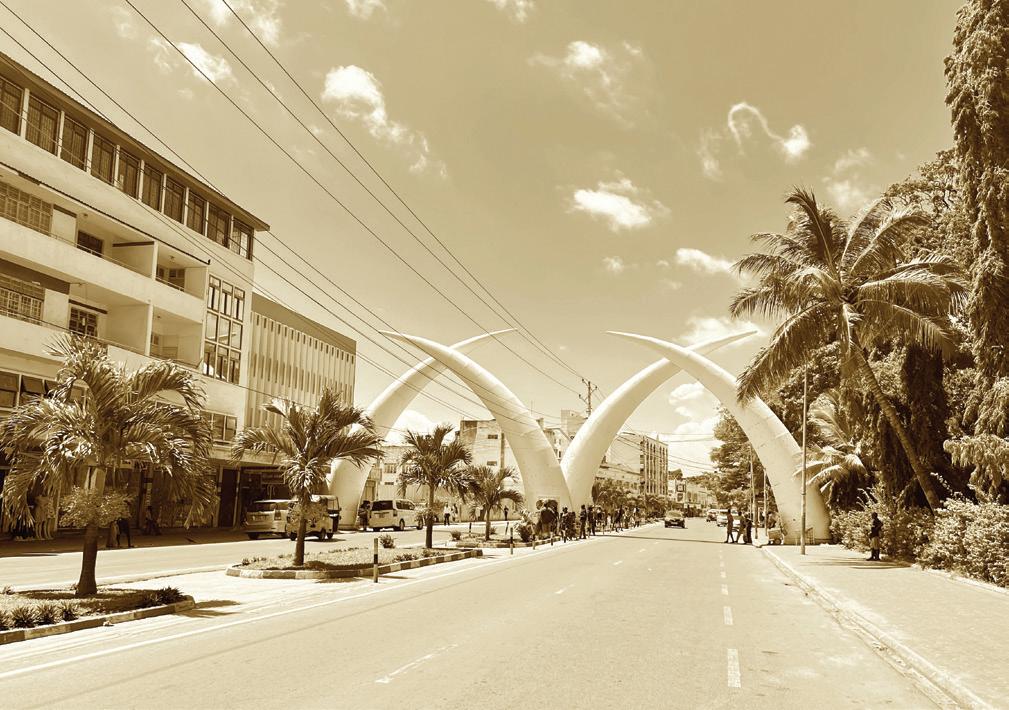
Mombasa was busy! A very different feel to Nairobi and I seem to recall a lot of traffic – lots of cars on the busy main road. My grandparents lived in a huge top floor apartment with an open-air balcony looking out onto this busy “elephant tusk road”, where my grandfather’s furniture-making shop was also located further down the road.
The summer days were long, hot and fun.
Lots of aunts, uncles, cousins and an air of excitement, I suppose because we had come as visitors from England, and so it really was a ‘holiday’ time. It was city and rural, bustling and tranquil, beautiful beaches, and night-time excursions buying hot roasted corn on the cob covered in butter from cheerful street sellers. Coconuts were everywhere and my parents particularly loved to buy the coconut from the night-time stalls and watch the vendor crack open the coconut - glasses quickly held out to catch the coconut water, and my father would sing... “Coconut water is good for your daughter” and give it to me to drink. I didn’t really like it but drank it partly to please him and partly too small and timid to say so, (my western stroppiness not yet developed).
Another delicacy was mangoes and watching my uncles knock the ripe mangoes off the trees. Then they would be cut up and all of the children given juicy mango to eat.
Regularly we went out and about, one of the most frequent places being the swimming pool, where we would have fun jumping in and splashing about in – large numbers of cousins in the joy of a young extended family, however danger was never far away, and a significant memory, was that of never being allowed to leave the apartment or walk anywhere alone, even in the daytime. If we wanted an ice-cream or Coca-Cola, (sold in the original glass branded bottles with the metal cap that the vendor would remove for you), we had to be accompanied. Another danger was being told that in certain shopping areas, Asian ladies would remove their gold earrings, as there was a spate of jewellery thefts, which was men running by and ripping the dangling earrings from the ears of Indian women. It was a far cry of walking to school or the shops on your own, but then there was always a grown-up ready and willing to take you, so we had no restrictions in that sense but were aware of the ‘going out alone’ danger when not in the UK.
One of interesting and accompanied local excursions, would be to go down the road to the furniture shop and see my grandfather with his workers, all smiling African men who would speak to us in Swahili and try to teach us words. They tried to teach us the word for ‘hello’, Yambo…but we thought they were saying Jumbo…and like silly children ran around yelling jumbo, jumbo to the thin air, and anyone!
We went to Malindi and Kalifi and took trips out ‘on safari’. One day one of my uncles and his friend, who was also the driver that day, decided to get nearer than they should to a rhino. Somewhat risky, especially given that we children were sitting loose in the open back of a truck with the adults all inside the truck. The rhino suddenly took exception to this intrusion and without warning turned and charged our vehicle. It was literally an ‘in the nick of time’ escape, as the rhino charged so fast at our escaping vehicle that he was on us and almost horn to bumper with us and not slowing down and I clearly recall looking right at the rhino up close! The vehicle wasn’t managing to accelerate any faster than the rhino and we might have been in serious trouble – certainly the kids in the back! Fortunately, the rhino decided that having seen us off, he would abandon the chase.
I don’t remember being the slightest bit frightened at all, or even thinking anything of it, but then when we stopped, realised it was serious, and then more interested in watching the adults. It was a very near call. My mother was scared and very angry and shouted at her brother, and I remember him laughing it off, but could see the sweat and nervousness in his pretence of casualness.
I always remember after these long hot dusty days out we would all pile into the bath and my mother would wash the red earth out of my long hair. I would watch the red water running down, swirling towards the plug hole and marvel at the vivid redness of the water – as if it had been dyed! Back home in the UK I would always be a bit disappointed at the general dirty grey of the bathwater!
Back in the UK, one of my occasional tasks, (in addition to doing the regular weekly co-op shop), was to go down to the co-op to collect the wholesale box of New Zealand Anchor butter that my mother had ordered. I would be handed a case of 48 blocks of butter, and the shop staff would always look at me, whispering to each other, assessing with their eyes…thinking their thoughts.
They probably thought we did some weird foreign ritual with this wholesale amount of butter! Perhaps I was some Indian Cleopatra and going to bathe in it?
In fact, what we were doing was making ghee .
It was a long slow process, and my job was to unwrap the blocks from their paper. We always made sure that we scraped every bit of butter off the wrappers, as there was no waste!
I would hand them to my mother, who added them into a huge blue saucepan that she only used for ghee and dessert-making. She would turn on the electric ring of our cooker and slowly the butter would start to melt. It was a slow, unhurried process.
I watched as they slowly melted and turned to a thick liquid gold. and then gently started heating up and begin to bubble and splutter. My mother never shouted – I only remember calm instruction and kind smiles. I liked being with her. This process would continue for a while, until we would see froth appearing on the top of the liquid butter. As more froth appeared, my mother would carefully tip the saucepan, and skim off the froth, telling me to stand well back while she did this.
Eventually, when there was no more froth on the top of the liquid, she would turn off the cooker and leave the hot ghee to cool. We would always be doing other jobs in the kitchen and checking when the ghee would be cool enough to pour into containers.
My mother kept large 5-litre empty containers of Walls Vanilla ice cream, that she had washed out, to keep for storing all her home-made produce. (having the guest house meant that jelly and ice-cream was a regular dessert on the English menu). She would then carefully pour the golden liquid into the tubs, being careful not to pour in any of the sediment that was at the bottom of the saucepan.
The sediment she discarded. I wonder now, if there might have been another use for it? Had we been in the villages of Punjab, maybe it would have been used in animal feed? As it was, living in Southsea, she couldn’t have had another use for it, because nothing was ever thrown away!
During the 70’s or 80’s tins of Ghee started to become readily available in Asian supermarkets, and eventually we started to buy it. It is one of the few products that we do think is acceptable to use readymade.
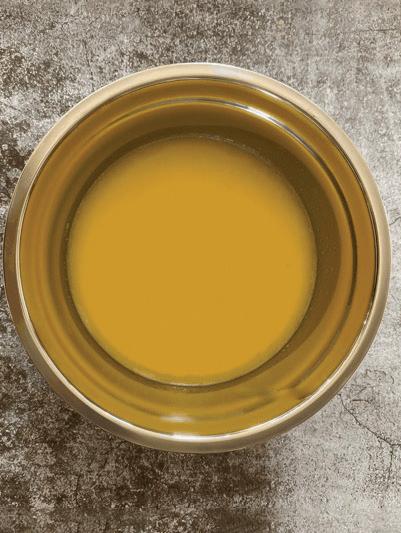
In the U.K. cow’s milk butter is what is used. However, in Punjab, buffalo milk, and therefore buffalo butter, is what is used across the region (some families also keep goats, so occasionally goats’ butter would be used).
Growing up in England, my mother used cow’s butter to make our ghee. My daughter cannot digest cow’s milk, so we now use goat’s butter or buffalo’s butter to make our family ghee. Regardless of which butter you are using, the process is the same…
This is using one block of cow’s butter in a small saucepan, that has been quartered, for faster melting.
Slowly heat up the butter on a medium heat, until melted and gently simmering. It will splutter, so make sure that the saucepan is high-sided. Eventually an increasing amount of froth will appear on the top as the butter starts to separate.
When there is enough froth forming, start to skim it off into a bowl, to be discarded. keep skimming until you have removed all of the froth. DON’T pour it down the sink. Usually, it can be put into kitchen paper and disposed of with food waste.
Now carefully pour the liquid ghee into a container or ideally a tub with a fitted cover.
There is sediment at the bottom of the saucepan, so you should be careful not to pour this into the tub of ghee. When you have poured off all of the ghee, discard the sediment. This can also be wiped up with kitchen paper and thrown away again with food waste. Again – DO NOT pour down the sink.
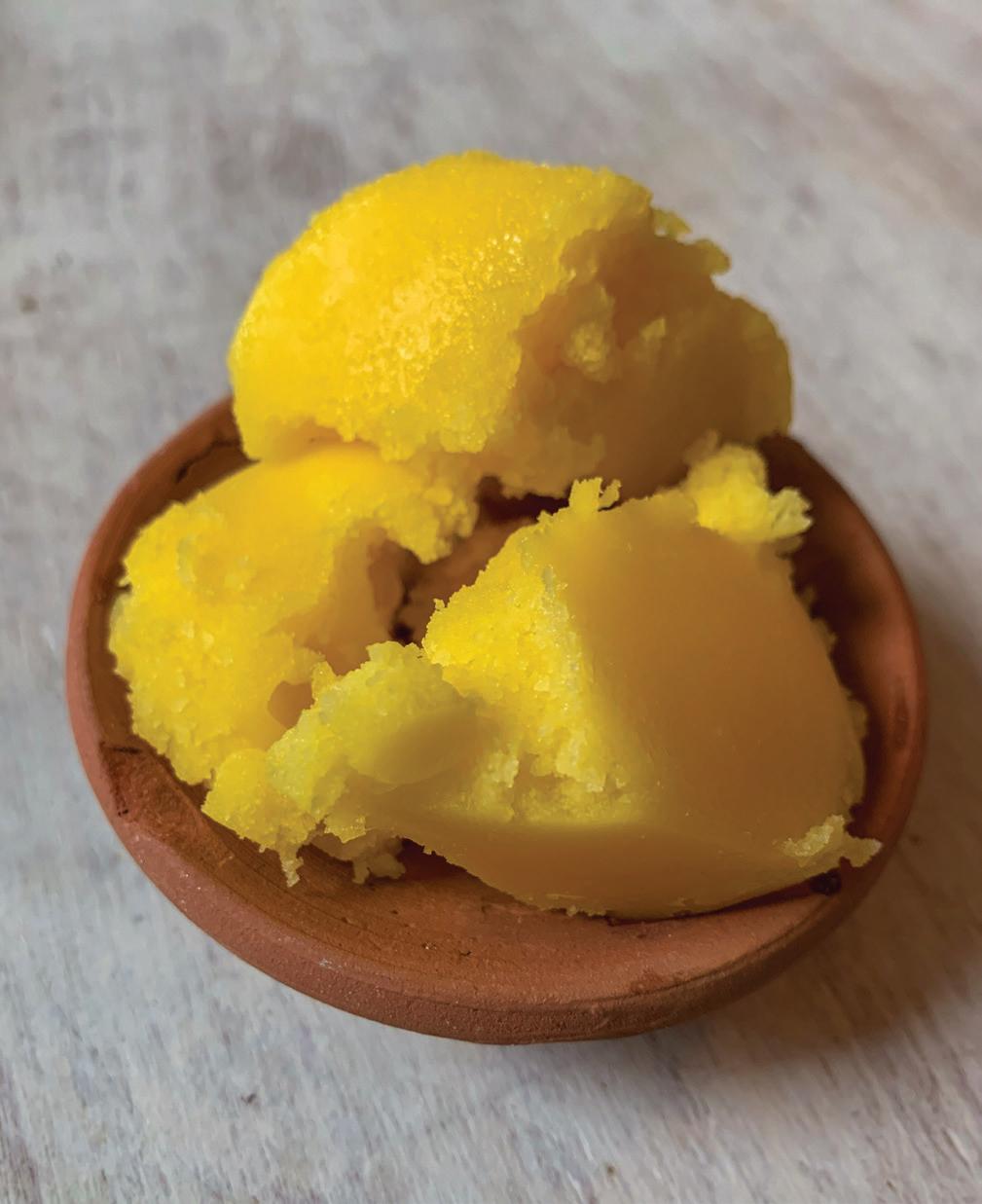
As the ghee becomes cold it will start to set but will remain soft at room temperature. It can be stored at room temperature and will have a soft-set consistency. However, like butter it will last much longer if kept in the fridge, where it will set solid.
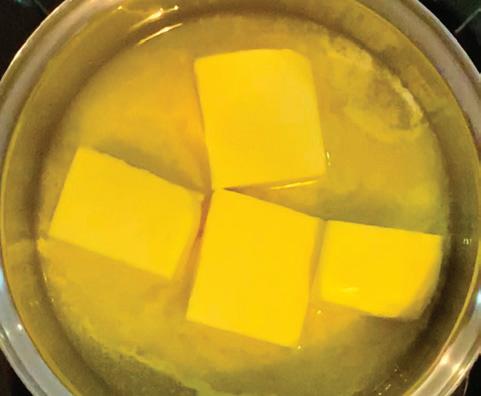
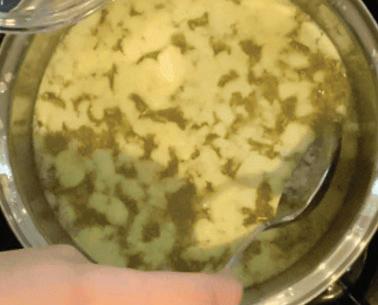
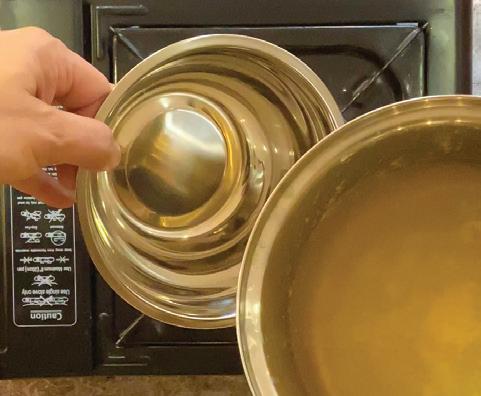
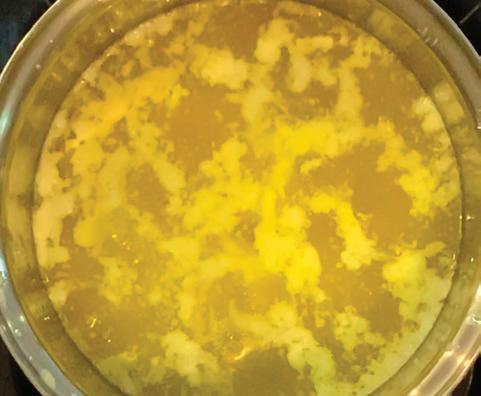
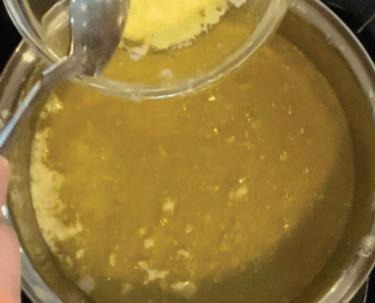
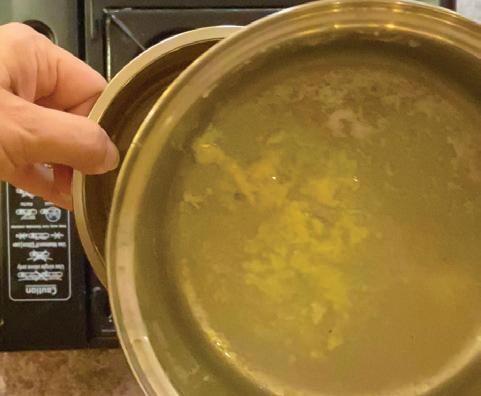
Ghee is widely used in all sorts of Indian cookery. We do not use large amounts in our own cookery and always err on the side of good health.
The one time we use it generously is when making Parathas, which are an occasional ‘treat’ bread. We use it to shallow fry them, which is essential for making Paratha.
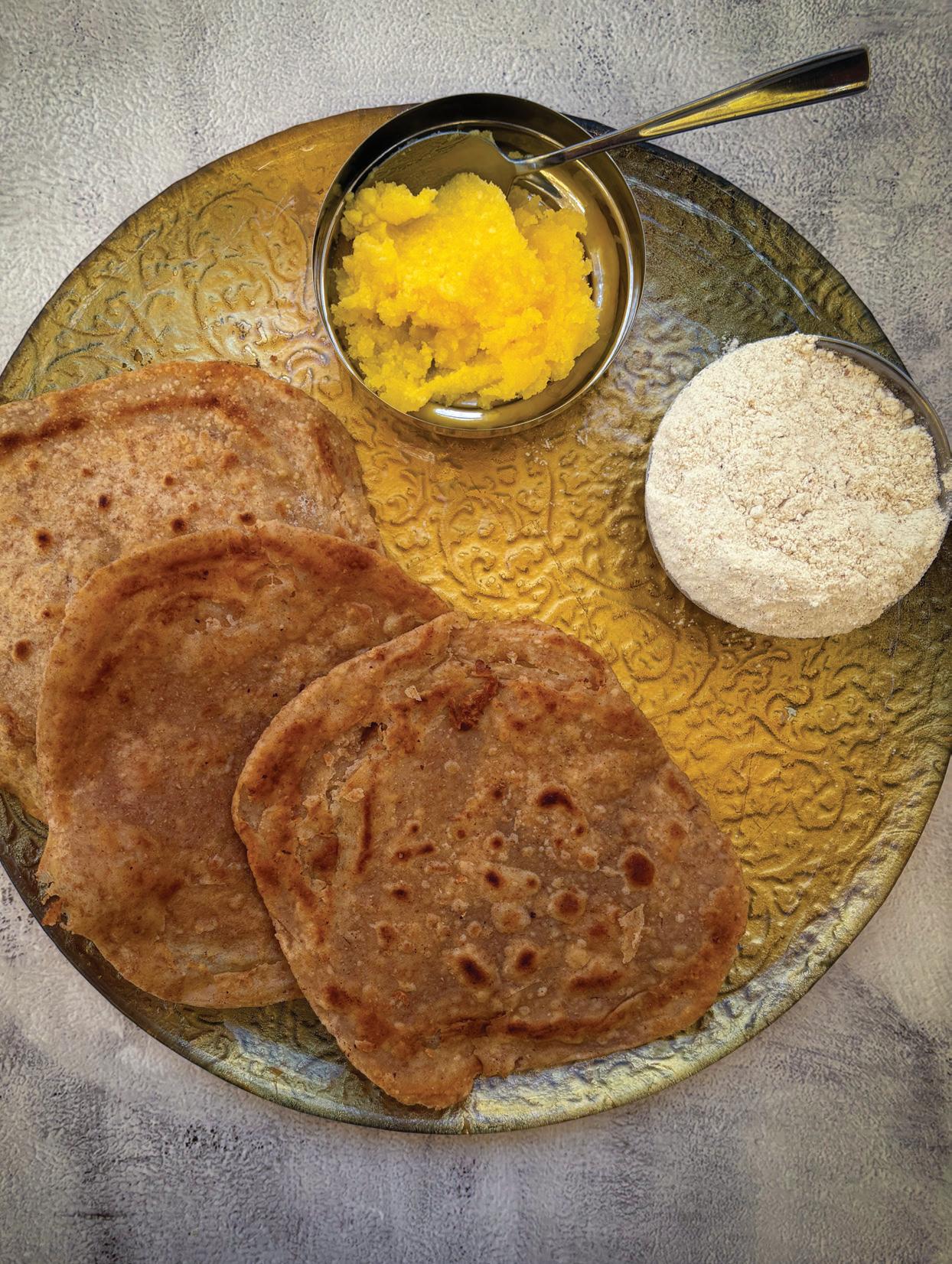
Paratha is the delicious crispy shallow-fried version of a roti and is a very popular Punjabi bread and is often served as a breakfast, brunch or lunch time bread. It is layered with butter, and then shallow-fried in ghee and therefore, is quite a filling bread.
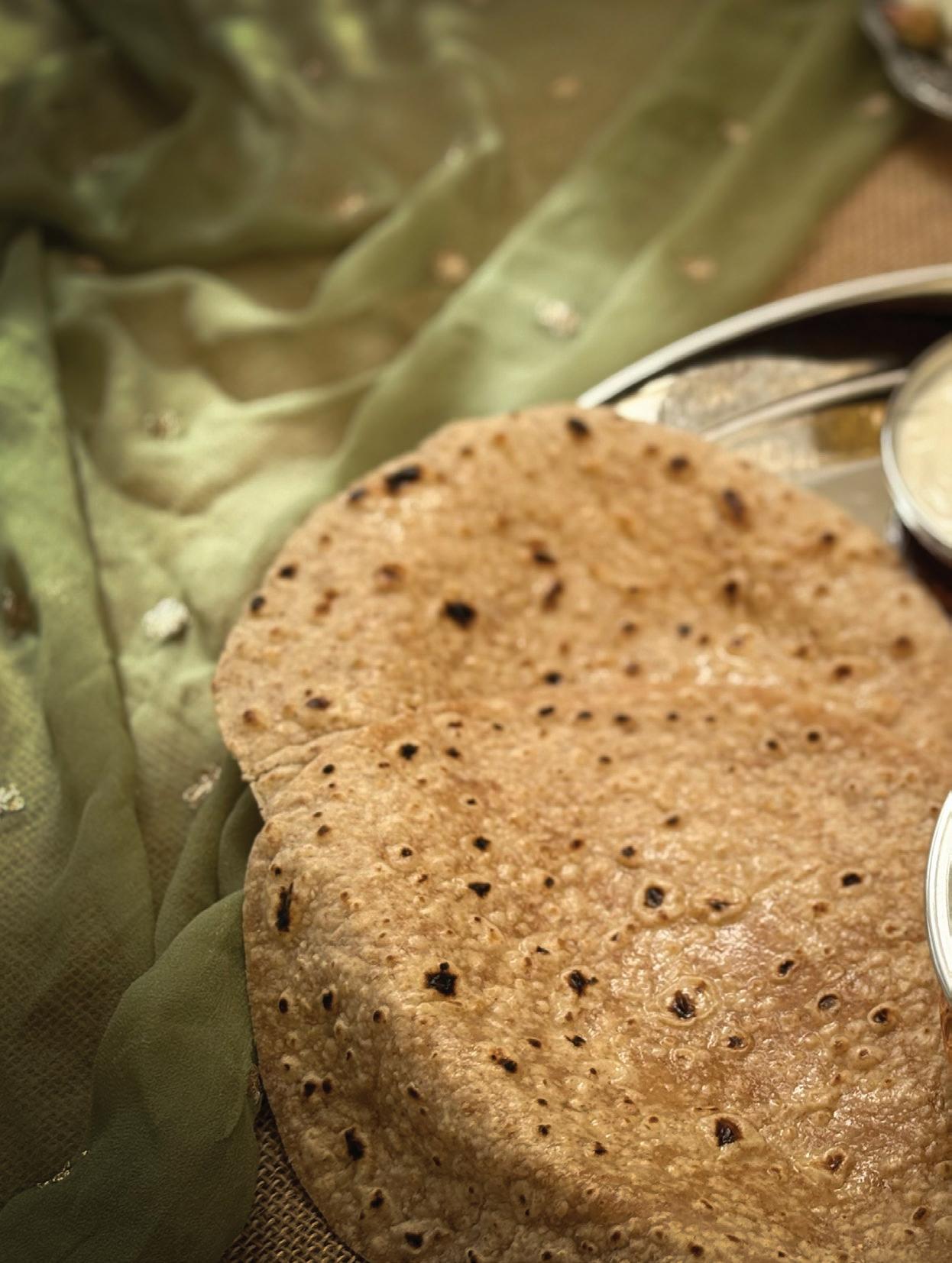
Paratha bread is actually made from the same dough for Roti/Chapattis (the daily bread eaten throughout Punjab & India and in various forms across South Asia. To make parathas, the first stages are the same as for Roti making, then in the second half of the process, the steps change and butter is layered, folded and coiled into the dough and rolled out, then shallow fried in ghee until light brown and crispy.
One of the most delicious Sunday Brunches is Paratha & Indian Scrambled eggs! When we have made this for friends, they had so enjoyed it that said they preferred it to the traditional Sunday brunch of a ‘fry-up’!
Paratha is such a famous and widely known Punjabi dish. Once I was reading an article and Joanna Lumley was asked to name the most delicious dish she had ever eaten, and to my delight, she said… Paratha. She said they had been trekking somewhere and the porters or cooks travelling with them stopped to cook Paratha. Now… eating Paratha after some physical exertion is about right! That’s when you deserve and earn it, and the reward is how delicious it is!
Paratha is a breakfast food, a brunch and lunchtime food, a Sunday food and ‘an any excuse to eat it’ food, and can be served with, and stuffed with any combination of dishes. Aloo Paratha is a favourite, and involves taking an Aloo based Sabjhi, or use any leftover Sabjhi and either using as a filling when rolling out before frying or using a hot filling to lay over the cooked Paratha and rolling up, (like a Swiss roll). There as many variations and ways of making stuffed Paratha as there are fillings and accompaniments, but here we are looking at making a traditional Punjabi home-made Paratha
We always ate Paratha in Mombasa, which we had for breakfast with butter, (yes…more butter), and jam. Occasionally, my mother made it at home when we were small, and we ate it with Sharwood’s Mango Chutney which was a very sweet and a westernised version of a Mango Chutney, and we loved it.
I always served it to my children, with Indian scrambled eggs, as well as the original Sharwood’s Mango Chutney. Years later we discovered a more Indian product – Geeta’s’ Mango Chutney, which has Kalonji seeds in it, and which we absolutely love!
1 cup (tea mug) of Atta (approx. 200g)
Tap water (approx..120ml-130ml)
Butter, must be cold from the fridge
Ghee
Follow the method for making Roti (see page 79), up until it is first rolled out, but only roll out to the size of a saucer.
Method
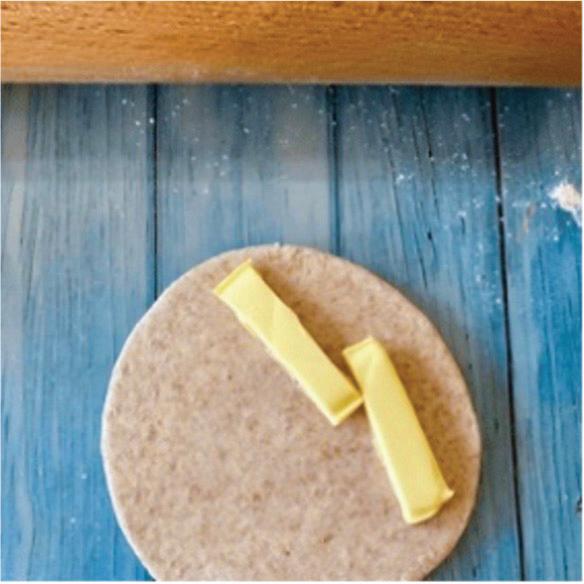
Using a rolling pin, roll out the flattened Pera/disc of dough, HOWEVER… for paratha-making only roll out to a SMALL sized roti, approximately 10cms diameter. From this point it changes from rotimaking to Paratha-making.
Get a cold block of butter out of the fridge. Cut a slice and cut that into a couple of sticks of butter and place them on the small disc of roti and then roll it up into a sausage shape. Try to keep the block of butter in a cool place away from the heat of the cooking, when you start to cook the paratha.
Pre-heat a frying pan or tawa on a low to medium heat.
Roll the sausage length into a coil, so that you are starting again with the process of making the small round of dough (Pera). It’s important to overlap and press the coil together so that it doesn’t fall apart when rolling out again or separate when cooking!
Start to roll out your Pera, but as you roll it, the butter will start to press through the dough, so lightly flour, as needed. It may start to stick to the worktop or board, so it is ok to lightly push out into a circular shape but keep it lightly floured. Unlike the roti, which must always be a perfect ROUND shape, the paratha can often be slightly square-ish. It should not, however, be mis-shapen. The paratha should be rolled out to the size of a large side plate. It is slightly bigger than a standard size roti.
Turn up the heat of your pan or tawa to a medium heat and melt a tablespoon of ghee in it. There will be a small amount of smoking from the butter inside the paratha. Ghee is always used to prevent excessive smoking and because it is suitable for frying/cooking at high heat.
Shallow fry, making sure the underside of the paratha is completely covered in ghee. When you see the colour change coming through the uncooked butter, place approximately a half tablespoon of ghee on the top of the paratha and spread it across all sides and then carefully turn over, using a spatula, to fry the other side.
Let this side fully fry to become brown and crispy and then turn back over to finish the first side. Stack on a warm plate lined with kitchen roll, though ideally serve as they are being cooked.
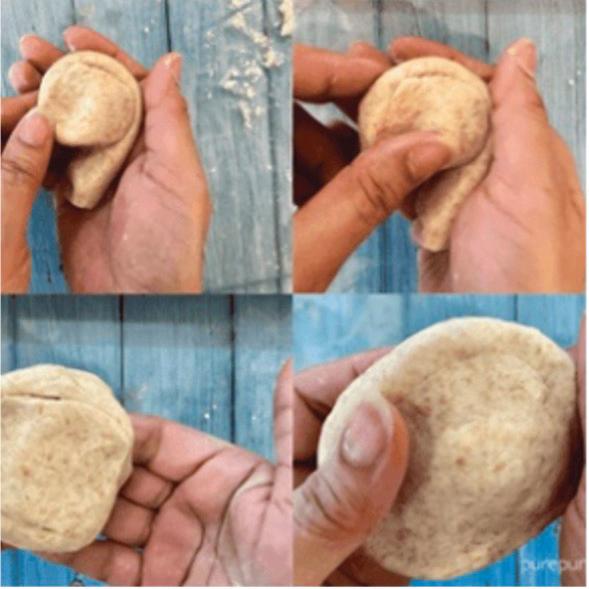
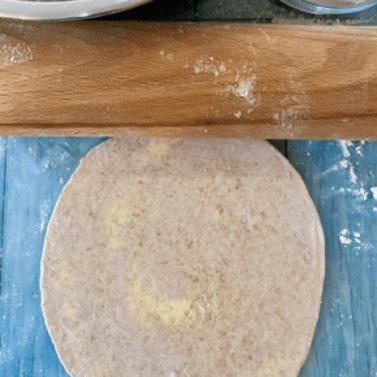
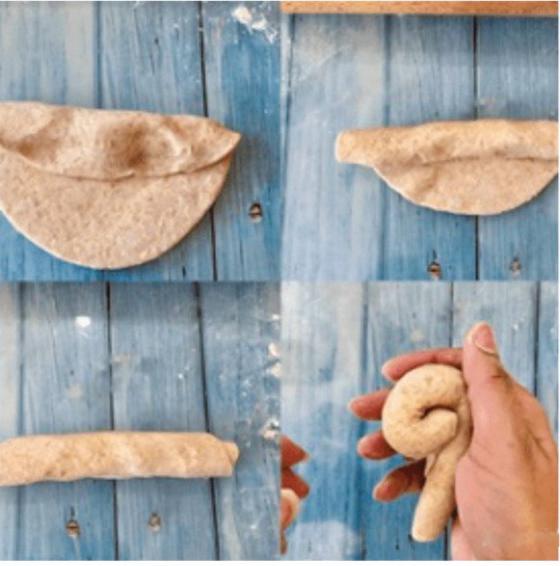
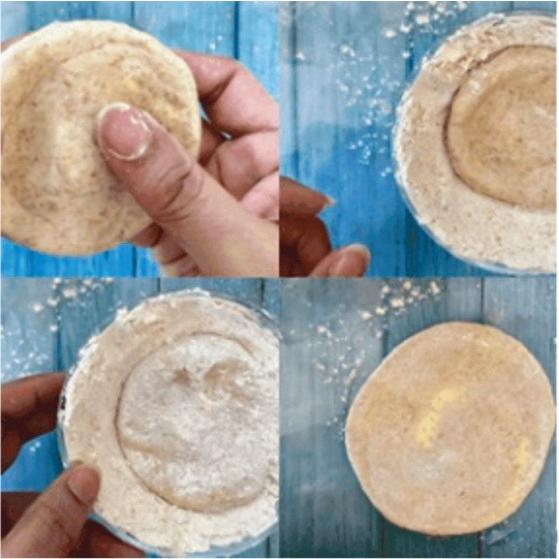
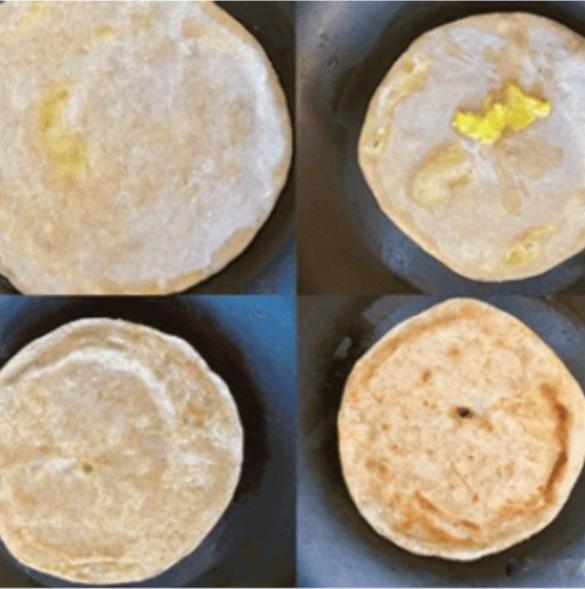
all low res and not sharp images
Ingredients
1 batch of Tarka starter (see page 305)
1 tablespoon Garam Masala
¼ teaspoon turmeric
1 teaspoon salt
1 teaspoon of tomato purée
8 eggs, cracked into a bowl and gently whisked (to incorporate the whites and yolks together)
Method
Begin with the Tarka starter base only (see page 305)
Add the garam masala, turmeric, salt and stir through. Cook over a low heat for a couple of minutes
Add the tomato purée and stir through till incorporated.
Now pour in the whisked eggs and stir into the Tarka base. Over the gentle heat, scramble the eggs. Indian scrambled eggs, when cooked, are not wet (like in western cookery) but are drier, (as in oriental cookery and stir-fry cooking). Just a note that the colour may look a little unappetising, but disregard this – it’s delicious.
Once cooked, you can also serve this with a little finely chopped red onion, finely chopped cucumber and tomato (we call this mix 'kachumber').
Delicious served with hot Paratha! If serving together, prepare your Tarka base, whip the eggs and keep them aside. When you are halfway through cooking your paratha, whisk the eggs into the Tarka, and scramble them while finishing your Paratha.
Note: We eat with our hands. Tear of a small piece of Paratha, and using it as a scoop, pinch up as much of the egg dish as fits and pop it into your mouth. That means that the size you tear off is going to be what you can nicely fit into your mouth! Extra note – we use one hand only…if you can!
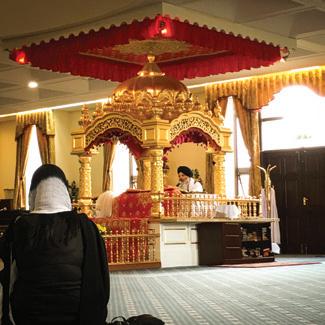
One of my vivid memories when I was at junior school, is of walking with my mother to the Gurdwara, (Sikh temple), that had been set up on the corner of Marmion Road, in Southsea. In those early days, houses were bought to convert into Gurdwaras, and this was an old property on the corner, with a courtyard and an outside kitchen area. The kitchen was absolutely freezing and there was no hot water.
On our walk from our house to the Gurdwara, I used to ask my mother two questions repeatedly… Why do we have to go, (meaning only she and I, and that I wanted to stay at home like my father and siblings…
Why was she taking bags of flour and sugar to the Gurdwara, when I knew that my English friends didn’t go to their church with ingredients or ‘produce’ of any kind?
The answer would always be the same. ‘’because…we have to do our ‘Seva’, …and
…“For ‘Langar’…
Neither of these really meant anything to me then, other than, it ‘wasn’t fair’, as no other child that I knew had to do this!
Seva means ‘service’, and in my case at that age of about 8 or 9 years old, this meant shivering in the freezing cold kitchen and doing the washing up in cold water. I disliked it intensely!
In reality, the principles of Seva and Langar are so beautiful and admirable, that it is, for me, aweinspiring that a religion could be conceived, that has, as part of its essence, the communal call for every man, woman and child to offer and to give their service in any form, shape or kind that they can -to any and every one regardless of religion or ethnicity. The fact that this is not just a theory or in principle but is totally carried out worldwide in practice!
Now the beauty of the practices and system of Sikhism, only increases with the principle and practice of Langar!
Before I start raving about this custom, deeply connected to Seva—let me say that I am not religious and not practicing, however, I still deeply identify as a Sikh for its humanitarian and egalitarian principles and acceptance of all.
If I could choose a religion to be—it would be a Sikh!
Now Langar is communal kitchen – how fitting for us as a food business
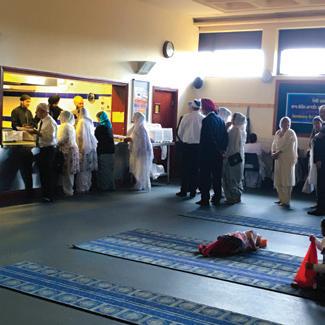
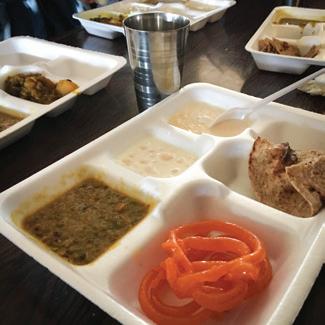
Every day, in every Sikh Gurdwara (temple) in every city, town, village and place in the world, each and every single day food is prepared and served by volunteers in the community, (doing their Seva), and cooking a healthy nutritious meal – always vegetarian!
In the early days, everyone who arrived at the Gurdwara, would be carrying some kind of dried nonperishable produce, so the ingredients were perpetually and continually in abundance.
Some while ago, Langar kitchens became subject to EHO inspections and all the rules that go with it, so due to traceability and record-keeping of batch numbers and best before/use by dates, this was no longer permitted, however this made no difference because on arrival in the prayer room, every person, children included, makes an offering of any amount of money that they wish.
Partway during the prayer service, a sweet thick semolina pudding, hand-formed into a small dumpling, was always placed into the hands of the entire congregation, which was a variety of a sweet pudding my mother made at home particularly when guests were coming – she had a special set of golden bowls that were for always used for Karah.
The version we had at home was always made with semolina only, whereas the version at the Gurdwara always had wheat flour added to it. This was known as Pershad.
When my father would invite his business connections for dinner, my mother would spend an extensive amount of time cooking, and it might be different dishes for the mains, but for the dessert, it would nearly always be Karah…the home version of Pershad.
If I say it’s a semolina pudding, that would be a bit of an insult, only because of what I had experienced as any kind of English semolina offering – disclaimer it was always a school offering, so I’m sure there is many a wonderful English mother/grandmother/person making a wonderful semolina pudding or dessert…
I just never had it!
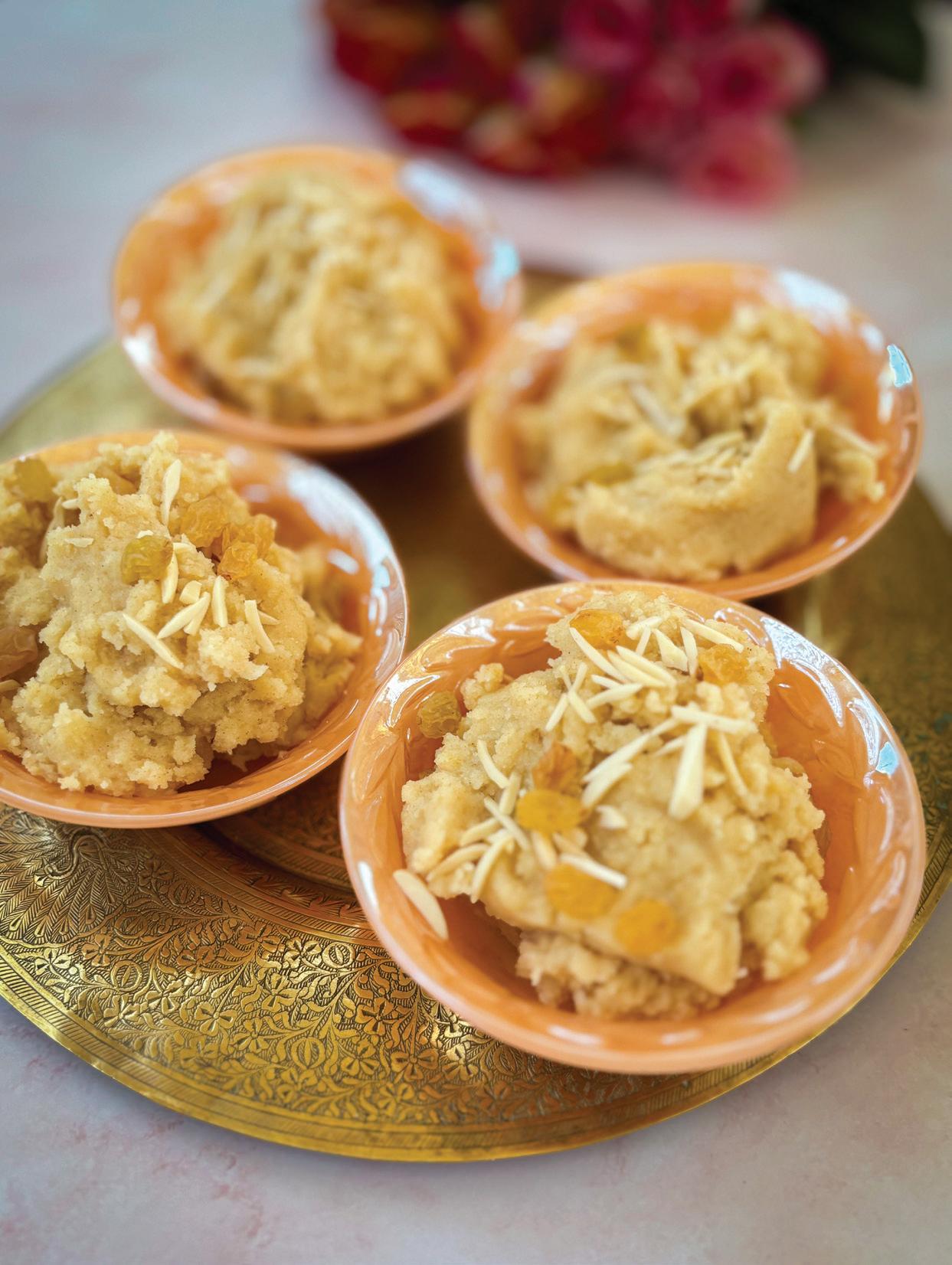
As we had it at home… we never measured any of the ingredients, so the quantities below are a guide.
Ingredients
2 tablespoons Ghee
1 cup of Semolina
Boiling water from the kettle
Caster Sugar, to taste
A small handful of flaked or sliced almonds - optional
A small handful of sultanas - optional
Method
Heat a saucepan over a medium to low heat and melt the ghee in the pan
Add the semolina, and very gently toast over 3 to 4 minutes. Once the colour has changed to a light golden colour, we are ready to…
Turn off the heat and add the hot water from the kettle. You must stir quickly so that the Karah does not become lumpy. Once you have a smooth, silky mixture, you can add the sugar (if you want to add sultanas as well, you may need less sugar)
Should you wish to add almonds and/or sultanas, add them now as well.
Add image?
Pershad is a heavier version of Karah, and uses either all wheat flour (Atta), or mixes wheat flour with the semolina. It is served in the Gurdwara (Sikh temple) at the end of the Paath (reading). A member of the congregation or someone doing Seva walks through the rows of the congregation, going to everyone sitting in the prayer room, carrying a huge stainless-steel tray containing the Pershad – and offers a handful to each person individually.
Today, due to the growing numbers of dietary requirements, they now only give this to those who hold their hands out, and the warm Pershad is placed in the middle of your cupped hands, which you eat straight away, however it is very disrespectful to refuse Pershad. As a child I didn’t want to eat it, but my mother was adamant that I held out my hands and accepted the offering. I didn’t understand then the deep significance and meaning of Pershad and why it is given.
Pershad is given as a blessing, a symbol of equality and of hospitality. It changes from Karah to Karah Pershad after it has been blessed. After preparation, it is taken to be sanctified by the Guru Granth Sahib,(Holy Book), and only after this ritual it is offered to the congregation.
Now traditionally, the ratio is 1/3rd each of wheat flour, ghee and sugar to symbolise equality, which means the resulting mixture is very heavy in butter and sugar, so I thin k this was too much for me as a child, plus I didn’t understand the significance or appreciate the importance of this offering. It was an era and a generation when commands to do something were enough, without giving a ‘why’, which I only learned later in life.
Ingredients
1 cup Ghee
1 cup Atta (wheat flour) (Add some semolina if you wish)
1 cup Caster Sugar
3 cups Boiling water from the kettle
Method
Heat a saucepan over a medium to low heat and melt the ghee in the pan
Add the semolina & atta, and very gently toast over 3 to 4 minutes. Once the colour has changed to a dark golden colour, we are ready to…
Turn off the heat and add the hot water from the kettle. You must stir quickly so that the mixture does not become lumpy. Once you have a smooth mixture, you can add the sugar.
Add image?
I went to a small primary school, where the only other brown faces were my siblings, (although I remember there was great excitement when it was announced that a ‘foreign’ Canadian girl was coming to our school. When she arrived, there was a great deal of fuss and attention over her. She had straw coloured short hair and freckles and was a tomboy, causing us all great curiosity and intrigue with her ‘American type accent.
Primary school was also a very happy time. I liked school and did well. When we entered the last year, we all knew that the 11+ exams were coming up!!
On the day of exam results, I rushed home from school, the weight of the bulky A4 packet, lay reassuringly heavy in my hands. The size and weight were somewhat alleviating the anxiety of the words of my father that were ringing in my head.
You had better pass! I’ll kill you if don’t pass!! It sounds extreme, but he was dead set upon a child of his going to the prestigious Grammar Schools and was worked up at the prospect of being let down
At the end of the school day on a hot summer’s afternoon, the teacher was passing out beige A4 envelopes to the class. You could clearly see they were of two different thicknesses. The whispers were going around the classroom that if you got a thin packet, you had failed the 11+ and if you got a thick packet you had passed.
The teacher had issued the instruction that these packets needed to be taken straight home and given to our parents. Astonishingly, some children were actually bold enough to come out of the classroom and open their packets despite the words of the teacher, that these were to be taken home to be opened by our parents only!
As I held the bulky packet, I rushed home as fast as I could, yet equally I wanted to delay, but got home to dutifully handover the packet and await my father’s expression.
At the same time, having the pressures of doing well at school lay heavy. The words of my father hovering in my head….“I’ll kill you if you don’t get into the Grammar School” … …what the police call “a throw-away comment”. ,
I was under a LOT of pressure to achieve a pass in the 11+ exams and get into the prestigious girl’s grammar school. I took it seriously but also understood the desperation of his words. I was anxious, but at the same time, fairly calm. At the age of 11, I worked very hard both at home and at school, so had an inner feeling that I might be ok.
I watched with quiet confidence, (and a tiny amount of anxiety in case the thick packet assumption was untrue), as my father opened the envelope. His face was triumphant as he loudly announced that I had passed the 11+ and now that I was officially confirmed as a ‘clever girl’ and would be going to the prestigious girl’s grammar school!
However, out of nowhere… this victory quickly had cold water poured on to it, as his face suddenly turned serious with the thought…
… I would now, no longer, be the only ‘clever girl’…that they would, in fact, all be clever girls!!! It was a school of amazing clever girls….
I then remember enduring a great long lecture… I had better watch out and work harder, I had better not expect to be top anymore, I had better get ready, I had better not fail, blah, blah blah, as I zoned out and my conscious inner voice told me it was fine and I would be alright and I firmly shut down my, ‘but what if he’s right’ voice!
Along with the Asian parent pressures of my father, the additional expectations of my mother and the weight of the responsibility to help carry some of her heavy domestic and working burden were also present.
Another, amongst the many, of the delightful jobs allocated to me as eldest girl and most compliant, (at that time!), was washing potatoes covered in mud, bought loose and from the market - this was a regular Saturday afternoon job for me! Thank goodness Marigolds eventually came along!
Another of my jobs was removing the grit and stone from lentils and the rice. These were not the days where you bought your produce already washed and cleaned! The market from where we bought the
mud-covered potatoes were free poured loose into the shopping trolley that I pulled along for my mother every Saturday at the Charlotte Street market, selling fruit and vegetables, (which didn’t come in plastic bags at that time). Note – even though they now come cleaned - we still always rinse our lentils and rice!
This was one area of shopping that I was not allowed to do on my own, though I suspect now that it was because of the hustle and bustle, rough types, cheeky chappies, and number of potentially unsavoury people that I might meet at the market, packed with burly men, yelling C’mon darlin…pound o’t-maherrs’, as opposed to going to the quiet little Co-op, frequented mostly by middle-aged ladies and gentle folk.
Once, when I was around 15, at The Charlotte Street market, a down-and-out man, clearly very hammered, staggered drunkenly and went flying, laying sprawled across the pavement. I instinctively rushed forward to pick him up and help pick up his things, but as I moved, my mother very quickly and very firmly grabbed my arm with a vice-like grip I had never experienced from her before. I was already in a half-stoop, bending down towards the man, when she had gripped me, and as I stopped mid-motion and twisted back to look at her and try to release myself, she kept her grip and with a steely look I had never seen before, hissed ‘NO’, and pulled me back! I desperately wanted to help this man get up, but she pushed me on with real fury.
I was very disappointed in her and angry that she could turn away from helping someone. Under different circumstances she would have had trouble pulling me or holding me back physically as she was only 5’1” and I was bigger than her when I was 11, but the strength she used that day was a determined strength. Later on in life I learned quite frequently and quite badly the English expression of…’no good deed goes unpunished’. I later learned that helping and kindness, often came with the most unexpected ingratitude, if not hostility and resentment.
Every week I was given part of the weekly shopping allowance to go to the Co-op on a Saturday morning and buy the groceries. I had to pull along the ‘old lady’ shopping trolley, which caused me some embarrassment, as I was increasingly becoming interested in fashion and looks, and this wasn’t ‘cool’!
It never seemed odd to me that my mother gave me all the cash as a 10-year-old, (what would now be the equivalent of around £150), to go and do the family supermarket shop. I remember the ladies who worked there always stared! I would come home, put away the shopping, give my mother the receipt –which she never asked for, and give her the change.
Once a school friend, on discovering that my mother never checked the receipt, very excitedly asked me if I could pocket all the change as my mother would never know! How curious? Why on earth would I want to do that! It was all for our family, and all of our money, so I didn’t need to steal from…what would essentially be myself?
“Pooled resources”
Seva & Langar carried out at the Gurdwara demonstrated the pooling of resources, the combined community wealth, power and growth of affluence in the Sikh Community, and this carried through into business.
Once, sitting in the prayer room of The Gurdwara with my adult daughter and cousin, we were watching people as they walked in. The custom is to walk up the central aisle, approaching the Holy Book, The Guru Granth Sahib, bow down before it, and make the customary financial offerings, which is absolutely any amount you wish, and can afford to give. The offering is placed into a large silver rectangular box, with an opening at the top of it, for money and coins, to be deposited in such a way that no one should see what you are giving.
Such was the affluence of the Sikh community, that we would watch, and comment when notes were visibly placed in the receptacle - if there were a purple note, we would nudge each other – look a purple one – on occasions you would see the flourish of a ‘red one’ oooh! we would say and inspect the clearly wealthy donor as he went to be seated on the men’s prayer side. And yes -we were all grown women sitting and giggling at the £20’s and £50’s going into the Gurdwara coffers…or maybe more amused at the proud demeanour of the donor!
This practice of shared and community wealth, extended to entire families setting up businesses together, and using that combined power and strength in numbers, achieved more in wealth than many indigenous people.
There’s something about the collective resources of a community that, when it works, is impressive, though like all the world over, there were always whispers about some profiting more than others…
Food for Thought ...
Reflections on two cultures, ways & worlds
“The greater good”
Visiting my mother’s collective family in Kenya I saw how this extended family living meant the faster and greater acquisition of wealth, but at a cost – women marrying-in, living with in-laws, having to get on with the other females of the house, lots of bickering and falling-out and ultimately the individual having to be squashed down if they had ambitions, or a personality, which weren’t for the greater good.
On the other hand, the British way of living meant a very clear-cut separation from each generation of the family. Children left home as soon as possible, set up their own homes and three generations of families lived separately and visited each other. Often, I saw a lot of selfishness and ‘me’ focus – the elderly living alone, and ‘latch-key kids’ coming home after school to no one, whereas Indians had to focus on ‘us, and ‘we’, often conflicting with personal desires and coming home to almost no privacy, free or me time.
They were two opposing ways of life that, in their harshest form, caused great unhappiness.
Too much selflessness and sacrifice for the family, and you are surrounded and in misery. Too much selfishness and ‘me’ obsession, and you are alone and in misery.
I decided to try and do my best to aim for a course that would navigate both extremes into my life, I tried hard and hopefully achieved something of an attempt to incorporate the best of both sides from my two worlds and two countries… into a working family and work model.
The culture of preparing food, cooking, eating and sharing together in Seva & Langar, has been the fundamental difference for me between the indigenous Christian churches and our Sikh Gurdwaras.
I went to a C of E School, so participated in the Christian ceremonies at school. This included the daily assemblies, and singing of The Lord’s Prayer and hymns, including that well-known and popular Christian hit… ‘While Shepherds washed their socks at night’… (how those boys got into trouble for their lyrical interpretation)! However, I was not allowed to attend any school function at an actual church…initially anyway.
At school rehearsals, our music teacher had been making all of the children sing and had selected me for the choir, from those children singing that day, however I was not allowed to attend as my parents didn’t allow us to attend a church.
She called at our house and spoke with my parents, and I remember feeling very awkward at this unexpected colliding of my two opposing worlds…but surprise surprise! I was allowed to attend the church on that Sunday morning and sing the Christian songs, and… my mother stayed in the church. She once told me that no matter the religion, she always felt at peace in any religious building.
Watching the ‘collection plate go around at church was very different to the way we mixed money and faith. In addition, seeing the concept of food charity via ‘soup kitchens seemed very at odds with the daily seva & Langar of Sikhs and the permanent concept of giving consistently and in perpetuity. It seemed to me the less people gave, in time or money the more they thought it was a big deal and the more they thought they were something special – ‘look at me volunteering at the church’. Whereas I watched this steady and constant ‘doing and giving in the Sikh religion where no one was a big deal or special for ‘helping’, no one felt they were a ‘saint’ for doing something because it was just the norm. On this point, my takeaways and lifestyle I wanted to retain landed with the Sikh principles and customs.
Food for Thought ...
Reflections on two cultures, ways & worlds
“Buttery goodness”
Punjab is a farming region. The value & importance of butter, the love of butter and of dairy is engrained within us Punjabis; however, it should be noted, originally not from the cow, (which is the hardest to digest, but from buffalo and goat).
I grew up to understand that in our Indian culture butter was much-loved, always present and applicable in almost all Indian culinary situations, and to be transferred to as many Western dishes as possible.
Not so much in western culture, where butter has been demonised by the food industry, originally promoting synthetic ‘margarine products, which used to be reputed to be one molecule away from a plastic, and nowadays more ‘fake-butter’ products?
As a former personal trainer, of 20 years, I used to ask my clients to discontinue from all forms of ‘diet food’ products, and any which had a list of ‘ingredients’ as long as your arm. Stick to nature and a product that has 3-5 on its list of ingredients. Dairy & fats, in moderation are healthy and contain goodness.
Additionally, there are considerable health benefits in butter and the Butyric acid in butter supports gut health by nourishing colon cells, reducing inflammation, and maintaining the intestinal lining. It may also aid insulin sensitivity, weight management, and overall metabolic function. While butter provides some butyric acid, most is produced in the gut when beneficial bacteria ferment fibre, but it is still a good source and an important natural product.
Healthy, natural fats are not an issue when balanced by the original old-fashioned physical labour. The issue is that almost no one needs that intensity of calories and sustenance anymore, so balance is key!
Chapter 3 – “Her screams rang out…. and no one came to help”
…her body hung lifeless…and from that day, my father had said to himself… “I will never touch my children.”
One of the standout things about my Punjabi upbringing from parents raised in the villages was never being hit or smacked.
Instead, given the combustible nature of my father, he increasingly unleashed epic and violently verbal onslaughts of rage upon us, my mother, and anybody who happened to come up against him on the wrong day.
This was rare when we were young, and almost never happened, but in teenage years the frequency increased greatly. Frustrations at the growing idiot children who just weren’t listening, who were challenging him, disappointing him. You give up everything for these children, and they just don’t listen! All parents fill in the blanks….
With age and maturity and experience behind me, I do in part, commend him and his memory greatly, for his fury and frustration not manifesting in physical beatings.
My father grew up within a family where all 6 were thrashed regularly. He grew up only seeing a beating as the resolution to any behaviour that annoyed or displeased his parents.
The reason for this breaking of the cycle, was the story of his sister, about a year apart in age from him. I was around 11 or 12 years old when he told me this story.
He was the eldest of the 6 children, and this sister was the second child. At the time of this happening, he and his sister were around the same ages of 9-11 years.
One day the family noticed that this sister was losing her appetite. Dinnertime would come and she didn’t want to eat, or she couldn’t finish her dinner. My father said this went on for some time and they were all thinking it was odd, and not sure why she wasn’t hungry.
They weren’t well off at all, and would certainly be hungry at dinner time, and most certainly want dinner. At around the same time my grandfather had been noticing that money in the form of loose change/coins was missing.
One day, inevitably, my grandfather discovered that his daughter was stealing the coins. What she was doing was going to the market and buying Mithai – Indian sweets. If you have ever had Mithai, such as Barfi or Besan or Laddu, you will know they are very rich and heavy – extremely filling. She then got into the habit of craving these sweets every day and kept stealing the odd coin here and there, but what gave her away was being too full to eat her dinner.
My father told me how she was punished, and that they were all made to watch.
In the courtyard was a tree. My grandfather tied his daughter/my father’s sister by her feet and strung her up hanging upside down from the tree.
He then proceeded to relentlessly beat her with a big stick; such was his fury at the loss and ‘theft’ of his money.
My father said that his sister’s screams rang out across the village, but her father continued to flog her. He continued the beating until eventually she had stopped screaming and her body hung lifeless.
My father said that he thought that his father had killed her.
I remember silently watching my father’s face as he recalled this – I could see that he had gone back in his head to that moment, reliving having to watch the beating, as a powerless 11-year-old unable to stop it. I think it was an extreme and exceptional form of beating that was administered that day, and beyond the usual thrashing they would receive, but it left an indelible mark on my father’s psyche – a video recording that remained in his brain, with no erase button.!
As my father was recounting this story, he quietly said, in a very reflective, low and defeated voice…“no one came…no one came to help”, repeating this to me twice.
As he was telling me and reliving this story of his sister’s body hanging lifeless, there was still absolute incredulity in his face and voice, that no one intervened. No one helped. No one tried to stop his father. No neighbouring villagers came to stop it. The whole village stayed out of it.
He said that that was the moment that he swore to himself that when he had children, he would never ever hit his children. And in that, with maybe two exceptions that I can recall, he succeeded… almost entirely, even though I think he internalised his rage and vent his fury & ferocity in verbal explosions, with fists clenched.
You could always see him struggling to hold himself back during his explosions! He always just about managed!
What he was good at, was being completely insensitive to people’s feelings, especially those of his own family. It is part of Indian and Punjabi culture, especially back then, to freely comment on a younger member of their family’s appearance habits, failures and achievements.
At about the age of 11 hormones kicked in, primarily in the way of weight gain. I went from being a skinny stick to becoming ‘plump’. I was also starting to have a much harder time at home as another consequence of starting to ‘grow up physically’ and so my demeanour became quite sullen as my life started to become more controlled and restricted. I hated the girl’s grammar school, was becoming plump and looking very drab.
My father would occasionally sit, and I could see him watching me, then he would start chuckling to himself and tell me I was quite a ‘plain Jane’. I was fairly indifferent to this because I had a personality type that was strong and quietly confident, and for some reason it didn’t really bother, but it annoyed my mother and in hindsight, I think this was why she started the re-application of Surma!
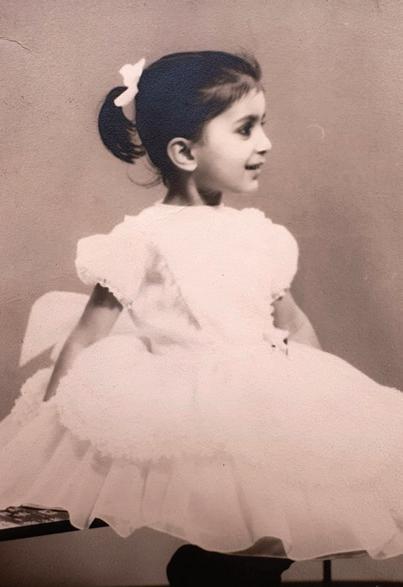
Surma, also known also as Kajal or Kohl, Indian mothers apply ‘eyeliner’ to babies to protect them from evil spirits and so as a baby and young child, I wore what is… eyeliner, which I am wearing in both of these photos, at 6 months old and again at 6 or 7 years old
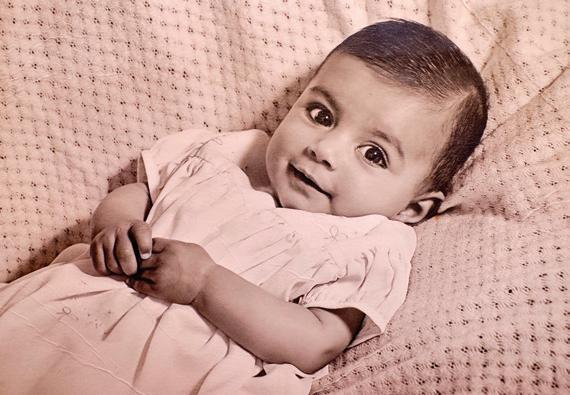
When I started nursery school my father stopped her from this practice saying she could not do this in England. So, she stopped for school days only applying occasionally, as for the photos, but I think this was what made her take me to her dressing table one day and apply ‘Surma to me.
Thus, from the age of about 12 years old, I was wearing Surma daily. The school, didn’t say anything, although make-up was forbidden – they possibly saw it as a weird foreign tradition? Oddly my father said nothing – he was very vocal about whether he thought people, females especially, were looking good and dressed to his liking. He used to voice his approval greatly when my mother dressed up to go out with him. She always looked fantastic in bright sarees, jewellery, and matching bag and shoes.
Both my parents didn’t like being overweight, struggled with their own weight and tried always to lose weight or at least not gain weight. As I became a hormonally plump teen, he found another hugely amusing name for me. This was based upon Disney’s Nellie the Elephant. I would see him watching me and laughing to himself, from wherever he was sat, and highly amused at his own joke, would look at me and yell out in a playful way…’Nellie!!!’ Then continue to chuckle away, greatly amused at his observations. In addition, if he thought I were gaining weight, he would say to me, again very amused and chuckling, ‘you’re getting hefty Nellie”.
To this day it still makes me laugh. At the time, it partly annoyed me but also made me reluctantly laugh which further annoyed me. I couldn’t help laughing at him, so delighted was he with his own comedy performance. He knew that I wouldn’t be able to stop myself from laughing or keep a straight face.
Someone once asked me in a pseudo-psychologist manner… and how did that make you feel” (huge ‘concern’ about my ‘feelings being hurt”). What do you mean? I asked, knowing where they were leading with their question. That I should claim some kind of emotional trauma, on which I could lay all of life’s disappointments?
I said, “it made me feel…high time to stop stuffing your face”, (which I did on occasions, and I had a sweet tooth), “and get on a diet”!
I felt then and still feel now, that he did me a favour- for I never got bigger than a size 12, possibly 14, which was so important for me as I loved clothes and make-up and hair stuff and all that vain lightweight fluff, in addition to being serious and understanding that I had to work hard and succeed in life.
This really soon seriously backfired on him as I became a boy-magnet, and this caused a lot of trouble. With my mother’s input of teaching me the daily application of Surma, encouragement for my interest in fashion, nail varnish, earrings etc, and my father keeping me from becoming fat, it meant by 13 I was attracting the attention of men, and not just boys. The fact that, at age 11, I behaved like an adult, and had those responsibilities, and was fully grown to my adult size at age 11, did not help.
One day he came home from the pub, looking a combination of proud, bemused and troubled. He told me that there had been a conversation in the pub about me. It had started with the men joking about a local boy who was crazy about me and other such conversations where they complimented him on his daughter. He said. “I don’t know how to feel – an American father would be proud if everyone is chasing his daughter – an Indian father would be ashamed” I grinned, and he wandered off deep in contemplation on how to position his internal conflict!
Throughout my life at home, one of my father’s favourite dish combinations was the classic Punjabi dishes of Saag and Makki di Roti, so, every so often, my mother would prepare Saag, and then carefully make the Corn Roti, using boiling water.
This was a dish I did not have to make – partly because Saag was a dish deemed too complex and special to be entrusted to me, so I never made it as a young girl, but watched and assisted. By the time I was a teenager, the habit of only my mother making it was in place.
Equally the making of the corn Roti was the only one she would not allow me to make when I was young, because the dough had to be handled hot using boiling water from the kettle and she was too protective of me to risk that level of burn, (pink fingers acceptable though!).
This bothered me not in the slightest, as I disliked Saag throughout my junior and teen years, so I was happy to be ‘let off’ this task. I was also not a fan of the Makki di Roti. Knowing this, my mother would wait until everything was made, and all the Corn Roti were made, and then after making the last couple of Corn Roti, she would take a couple of them and quickly and quite gingerly shred and rip them apart, (they were very hot straight off the griddle), but had to be shredded at that point
She then dropped the very hot pieces into a bowl of butter and sugar!! Then using her hands, she would crush and pulverise the pieces of corn Roti into a mash, incorporating all of the butter and sugar, until there was a completely blended warm, sweet yellow, very large dumpling, glowing with her love.
She continued to do this for me, even as a big teenage girl!
Words cannot convey how much I loved and looked forward to this rare treat - for it was only produced for me if Saag were being made, requiring the necessary Makki di Roti, (Corn Chapatti), to be made, which was not that often.
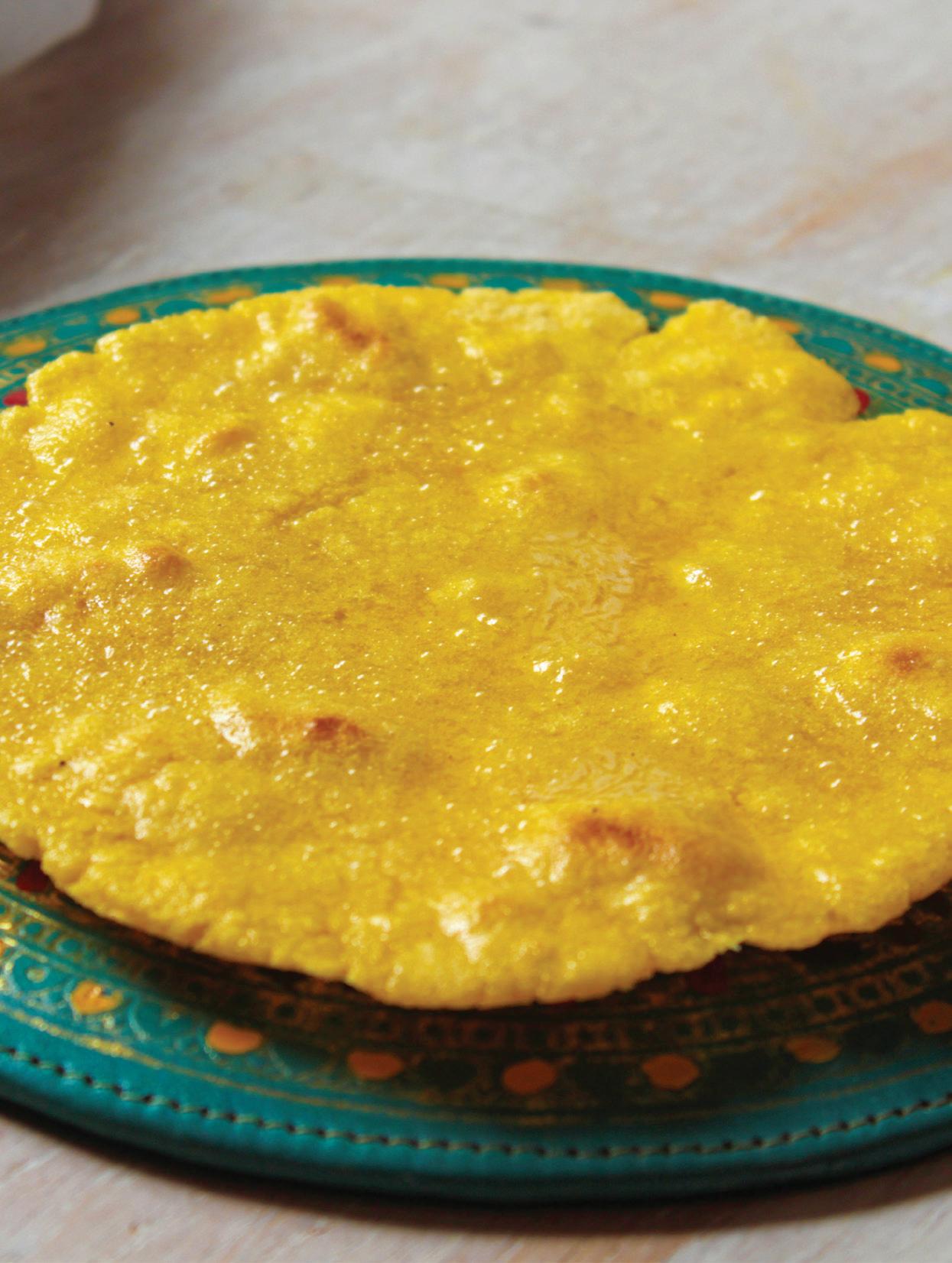
The traditional way to make these flatbreads, is to shape the dough in your hands. The dough is crumbly and can be tricky to handle, because of this, many families use an ‘easy method’ of rolling the dough between parchment paper. We use traditional way to make Makki di Roti, which you can see my daughter showing in the method photos below.
Ingredients
1 large mug of Makki di Atta (fine cornmeal - approximately 200g)
Between 60ml and 120ml boiled water
Butter, for buttering
Method
Start heating a flat plate or wide frying pan over a medium heat.
Take a couple of tablespoons of the Makki (cornmeal) to the side (you’ll use this later), then put the rest of it into a mixing bowl. Using a fork, gently pour in the boiling water, a bit at a time, into the bowl. Stir until you can start to form a dough Once you have a firm dough, stop pouring in the water and then knead it as soon as you can handle the hot dough. *Note: This dough is kneaded and handled while hot, so start handling it straightaway, according to your tolerance for touching heat.
Take the dough and divide it into 4 equal portions. For the next step you can either use the traditional method or the easy learner method...
Note: Heat the tawa (hot plate) on a medium to high setting as you are going to shape/roll out the flatbreads…
Take one of the pieces of dough, form it into a round and start to press it between both of your hands. Start flattening the dough between the palms of your hand.
As the flattened dough turns into a bigger disc, start to rotate it in between the palm of your hands, whilst flattening it. This motion is like a pressing/close clapping motion. The dough can start to fall apart so don’t rush this process, take your time flattening it between your hands. See the images below of Safia doing this method. You can lightly dust your hands with the additional Makki that you put to one side. Be careful not to use so much & dry out the dough.
Once the disc is between 3mm and 4mm thick, you are ready to move cook the breads. Put the flatbread on the hot plate/frying pan and cook both sides till all the raw dough is cooked and you have light char marks. Butter once cooked and serve hot.
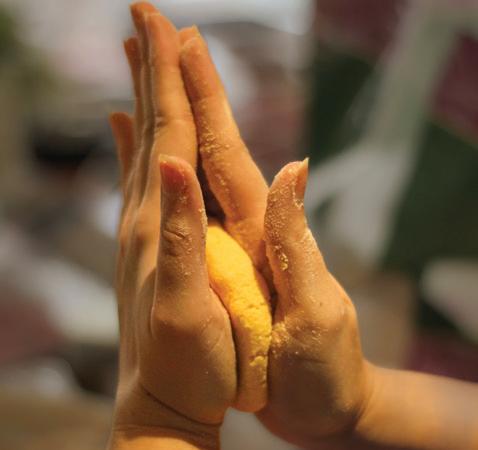
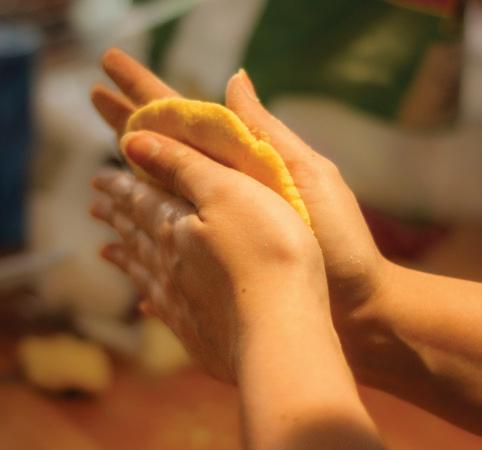
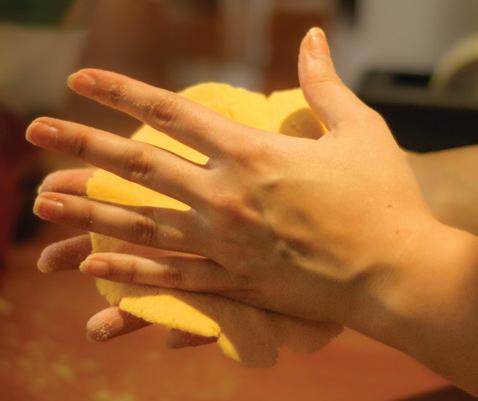
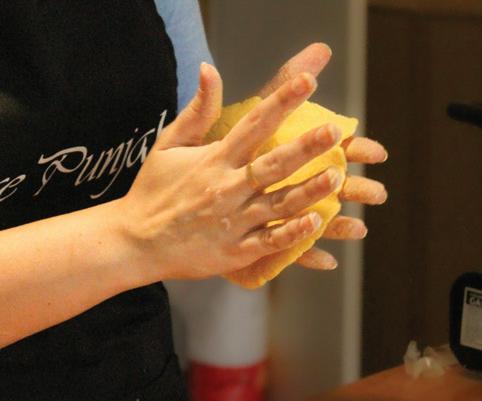
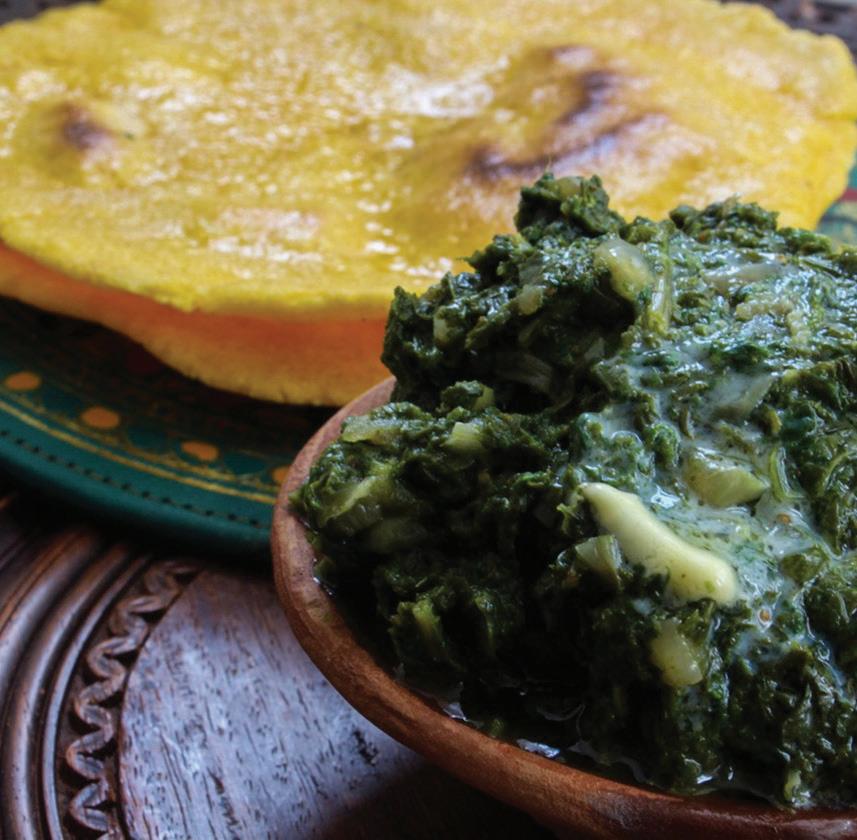
Take one of the large pieces of parchment paper, lay in on the work top and put one of the pieces of dough on top of it. Place the second piece of parchment paper on top of the dough.
Use a rolling pin to evenly flatten the dough, till the flatbread is roughly 3mm to 4mm thick.
Put the flatbread on the hot plate/frying pan and cook both sides till all the raw dough is cooked and you have light char marks. Butter once cooked and serve hot.
Makki di Roti eaten with Saag is a famous dish of Punjab and a traditional combination.
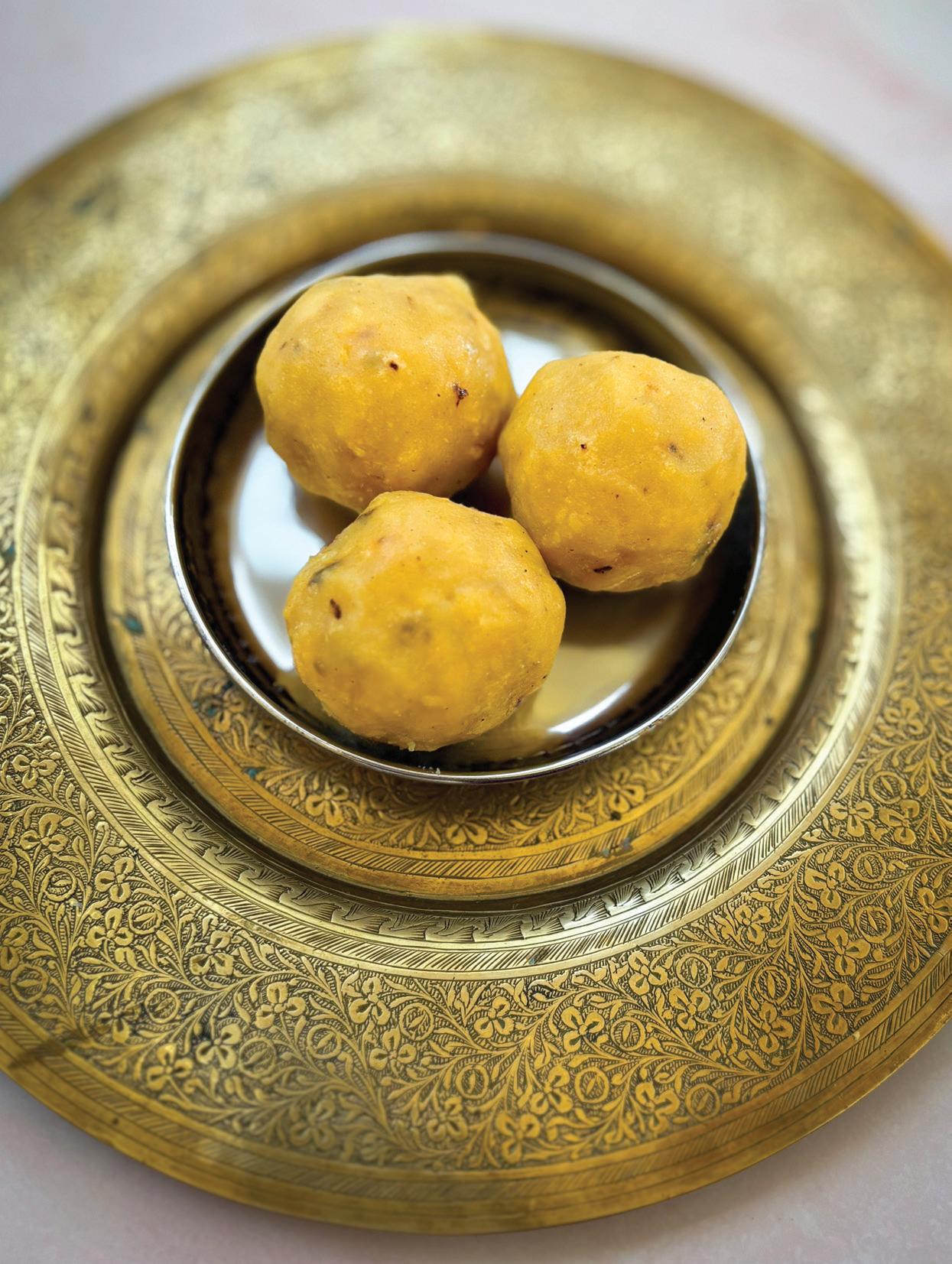
Ingredients
1 hot, freshly cooked Makki di Roti for a small dumpling, or 2 hot, freshly cooked Makki di Roti for one large dumpling
Butter, room temperature/soft
Caster sugar
Method
Put 3-4 large tablespoons of butter or ghee and 3-4 tablespoons of castor sugar into a warm bowl, or double the amount if making two dumplings, or a very large one!
Shred the corn chapatti whilst hot from the Tava – do this as soon as you can handle it. Shred it as finely as you can so that the mashing process is easier
Start to mix the pieces of shredded Roti into the butter, which will be melted now and the sugar and when well-mixed, start to pulverise the mixture by squeezing it, until it becomes a mash.
Then form and shape the mixture into a dumpling. Eat while warm.
The size of the dumpling is up to you, and… if we’re looking at portion control, it probably wants to be just under the size of a tennis ball, that you can cup in one hand. What would traditionally be Ladoo size, if you have seen the Ladoos available in Indian sweet shops – they are about 4-5 centimetres in diameter.
My mother used to make mine the size of a small football, (using two large Roti), requiring cupping and shaping with both hands. It was a struggle to eat it, but I usually managed!!
In contrast to my happy junior school years at the little primary school that I loved, the first couple of years of grammar school and those pre-teenage years changed to miserable days – restrictions came in and suddenly, I wasn’t allowed to be a part of things. At this age, there were now after-school activities and also no requirement for any of the other grammar schoolgirls to be back home, and so they would dawdle home, idly chatting and gossiping. No pressures and nothing to do when they got home, because their mums put ‘tea on the table’.
I tried this a couple of times and got into huge trouble, with a Spanish inquisition about ‘where had I been”, “what took so long”, “what was I doing”, and. “who was I with!!!.. Meaning it had better not be boys! I’d better not do it again.
At about this early pre-teenage stage around 11-12 years old, two things happened to cause this disruption to my happy world. The first was that my father had left his job as an aircraft engineer at BOAC at Heathrow and had retrained as an insurance broker and set up his own brokerage. Unfortunately, he set up his office from home, which meant he was there to check on what time I got home, and was around all the time. This completely changed the dynamics of my life, and of our family life.
Our previous pattern of life had been looking forward to his return, so coming back after 7 days off meant everyone was excited, and I was still a young child so could do no wrong. Once my father was permanently home, this holiday-feeling quickly disappeared, and we discovered that… he was strict. This lifestyle change, coinciding with reaching puberty and teenage years, was doubly unfortunate in its timing as he didn’t like growing children. He was a great father to small children who played and were cute and sweet, however, these big lumps who started thinking for themselves and growing into their own personalities was just too much.
He noticed my independent thinking.
I was only supposed to achieve academically, meaning get top grades and pass exams and have qualifications. I was to be a credit to my parents as a new super species of Punjabi girl. A subservient, compliant, domestically excelling female of the village type, however, super endowed with educational qualifications and professional status - a new breed… which actually does exist… of the professional career woman excelling in her corporate career rushing home to batch-cook Roti and serve her in-laws, husband and her nowadays loafing gadget and games fixated children. I was not supposed to be independent, and… under no circumstances, break the Mark II version of this traditional good-Punjabi girl mould, fused with modern-day good Punjabi girl, excelling at degree level, gaining top marks, but above al, never letting her brothers or husband know she was cleverer than them, and locking up her talents and abilities in the presence of men. We want clever girls…just not too clever!
And, above all never …to think for yourself!
At around this same time of my sullen and suppressed indepenence, my Nanni (my mother’s mother), visited the UK from Kenya. She came to stay with us for what was probably a short time -maybe a few weeks, but it seemed like an interminable hell for me. She continually complained about me, looked at me with critical, judgemental unloving eyes, kept moaning to my parents about me – why was I wearing a skirt and showing my legs, why was I dressing this way and it seemed to go on and on and on…
One day, I was walking home from school with a friend, and we were stopped by two young French men asking for the Promenade. We had only just started learning French, so weren’t very good, but we tried to describe how to find the Promenade on Southsea seafront. In the end, after much gesticulating from the young men, we deduced that they were asking us to show them, so we walked along with them towards the seafront to point out the direction. Eventually we realised that they meant ‘faire une promenade’ with them, so they wanted us to go for a walk with them!
By this time, we’d walked too far and were about an hour late home, which was not a problem for my friend, but I was going to be in real hot water. We ran back home as quickly as possible, and I got in to be greeted by an atomic explosion from my father about where I had been, dinner was now late, who was I with, blah, blah blah…
All the while he shouted at me and ranted on and I zoned out looking past him into the distance, where I could see my grandmother sitting in the living room, giving me ‘evils’ and also screaming and ranting on at both me and my father in Punjabi. It was a double chorus of ranting. I think she was directing the complaints about my errant ways towards both of us, and warning my father that I was no good, up to no good, he had better get me under control, she had told him so…more blah, blah blah.
I think my mother had not yet got home.
At some point shortly afterwards, while my Nanni/grandmother was still staying with us, I muttered sulkily to my father, “who does she think she is…she thinks she runs this house”! Very happily, that comment struck a nerve with my father. He was not a man to be told what to do in his own home. No one was going to tell him what to do in house or take control of his decisions about his daughter, which then saved me somewhat as I sensed that he became a bit sharp with her and… I got the impression, put her in her place.
There was only room for one alpha male in our house… …and he and I were already in that battle
I spent most of her visit avoiding her as much as possible. She was nothing like my mother. Once, I carefully asked my wonderful mother about her upbringing, (trying to ascertain how my mum was so lovely and her own mother was…let’s just say…not). She told me that she was mostly raised by her grandmother, who was a warm and loving woman. I asked why, and she said that her mother was out a lot and mostly entertaining! What a lucky escape for my mum! Should I say that? Probably not…but I thought it.
Food for Thought ... Reflections on two cultures, ways & worlds
“Work hard...play work harder”
We were one of the only children at junior school who flew abroad every year.
At that time, British tradition was that holidays were typically, ‘by the seaside’ for two weeks and then transitioning later to package holidays in Spain.
Flying abroad every year and sometimes twice a year was almost unheard of, however we saw that my father’s drive and ambition to succeed and to work hard, meant regular travel and big holidays. I understood that studying hard and working hard were the thing to do, and in that age and time, the conventional means of achieving and working hard were to go to university, get a corporate job or work in an institution of some kind. It was more of a ‘job for life’ era.
Indians were also conditioned to aspire to this western model, however, since that time, the internet and the digital world have changed and the landscape is not the same.
Many of these business lessons no longer apply as physical hard work and long hours, no longer means being more successful than anyone else, and in the recent era of internet, online commerce and AI, it means that some kid sitting at a laptop is outearning and outsmarting all of the old-fashioned work principles!
My parents would have been amazed to see this changing world, and for sure my father would have been fascinated with it for business potential.
The lessons of ‘work hard’ are turned upside down!
Food for Thought ...
Reflections on two cultures, ways & worlds
‘Crime & parental punishment”
With my father’s childhood ‘promise to self’ that he would not “touch” his children’ and my mother’s soft and angelic disposition towards her children (often to her cost), we grew up not experiencing any physical punishment.
However, I noted the differing style of corporal punishment across the cultures – the British favouring the flat palm, ‘slap across the bottom’ method.
I once saw a British mother give her toddler a public smack across the bottom so violent I have never forgotten it. In readiness for delivering this, and knowing she would send the child into orbit, she tightly gripped the top of the child’s arm, as her arm swung down with such force that the child physically lifted into the air and almost spun around. It was surprising that she didn’t wrench the child’s shoulder off.
If I could have, I would have liked to deliver the same to the mother. Then they’re surprised when no one visits them in the old people’s home!
In those Indian families where the children were smacked, it was always with The Indian and Eastern method of taking off the shoe or sandal and going for any available part of the torso, (but no preference for the bottom ).
For jokes, you will sometimes see an Asian take off their shoe, or hold up their hand as if it were the sandal, and hold it up in amused mockery of the stereotypical Indian parent punishment, and a silent communication of … “I’ll get you”!
‘British family vs Indian extended family’
Living together as multi-generational unit makes perfect sense, as resources are pooled, finances are strengthened, child-care is permanently on tap, elders stay young and keep purpose and children learn more.
However, it needs to be managed with increasing skill and definitely provision of separate space. Many Asians families started to compromise by buying houses next door, or very near to each other so that young couples had space and children can still run between the houses.
It was not uncommon to see neighbouring houses, where the garden walls and back walls were knocked down so that the family could freely be ‘together’ and children belong to all houses, but each small family unit had some autonomy and privacy.
As my parents were immigrants we did not live within an extended family, but every summer I saw this on our visits to my mother’s family in Kenya – I saw both benefits and the considerable problems that arose with changing times and not evolving with this. On some occasions it was necessary for periods of separate houses.
This was always in stark contrast to British homes, where, it seemed to me, that the aim of both parent and child seemed to be that the child should leave home as soon as possible and get their ‘own place’. Similarly, grandparents lived separately or…to our horror…were in these places called… ‘old people’s homes’!
Food for Thought ...
Reflections on two cultures, ways & worlds
‘The western diet’
One the things that started to happen to our diet was the increase in western food and the ratios began to change with a predominance for English dinner over the Indian dinners. Traditional Punjabi food is super healthy, consisting of onion, garlic, ginger, chilli, spices, tomato, pulses or vegetables, (assuming the moderate and controlled use of ghee or oil, which my parents did).
Makki di Roti – the traditional Punjabi farmers staple of corn Roti, so well-known to Punjabis but not so well-known to the British community.
As my parents became wealthier, and we no longer had the guest house business, meaning the guest evening meals of good solid traditional British fare were gone, we started to buy more convenience food, have chips, more chocolate style snacking and getting the bus to school or getting dropped off in the car meant less physical activity.
My mother continued to have dhal most days, and this is now something I try to do as a means of having food cooked from scratch that has all the goodness of Real Punjabi food.
It continues to be a battle, and one that is really a dilemma across a life that is nowhere near as physical as it used to be. One has to make a real effort to get some movement into the day, but a world where most of us are seated and quite sedentary, and myself on a laptop for hours and hours, especially writing this book it has required some real planning and the use of a treadmill set up against a drop down desk to get that step count up!
…you have to never stop trying in life!
‘…a baptism
I vividly remember, sitting in French class aware of a stinging sensation in my fingertips. I can remember looking down at my fingertips which were pink.
Having now turned 11 and going to ‘big girls’ to Grammar school, it was now my daily duty to be home promptly by 4pm and have dinner on the table for 6pm.
It was not always the full Indian dinner, but when it was, it was nearly always a dhal & Roti or Sabji & Roti in the weekdays, with the chicken & rice nearly always being the Saturday evening dinner.
Roti (Chapatti) must always be made and served fresh, so usually 3-4 times a week after school I had to make Roti.
Having always been working with my mother when small, being taught to roll the Pera (dough balls) but not being allowed to roll out or touch the Tawa (hot plate), this had now progressed to my doing all of it.
In my Roti-making lessons, my mother had told me that the way to know if the hot plate was ‘hot enough’ or ‘to temperature’, was to place your fingertips on it.
She meant just touch lightly and quickly remove, but it was enough for me to have pink stinging fingertips for some time. It was also tricky to turn hot roti using your fingers on the hot plate and then handling it, to pick it up and place it under the grill to puff, then taking it out. They had to be buttered immediately in pairs when still very hot, so it also meant being able to handle them as quickly as possible. It took a little while for my hands to adapt to the heat of the kitchen, and soon the pink fingers and stinging hands were gone!
The first dish I made to accompany the Roti was actually Aloo Gobi. My mother came home and tasted it and enthusiastically nodded her approval. She then declared that it was so good, surely, I had not made it all by myself, speaking to me indulgently as if I were a 5-year-old…
“You make youself?’ she exclaimed in her broken English, after tasting. I nodded.
She feigned mock disbelief and turned to my father who was sitting at his desk in his office opposite the kitchen.
“You no help her?”. My mother asked him.
“No no” he said – she did it all herself”, in his grammatically perfect though heavily-accented English”
It was funny how pleased they were.
Thereafter I regularly made different types of Sabji, according to whatever vegetables I had been told to use. Please note – the vegetable decision making process was out of my hands!
A popular combination was Aloo, Mutter Gujera, (potato, peas & carrots). Others are aubergine & potato, and my mother was especially fond of Bhindi Sabji (ladyfingers) which I really disliked so she did not ask me to cook this.
The dhal made most frequently was Masoor di dhal, as I loved this one and still do, so the only other times a different dhal were made, was if my mother intervened and chose it, otherwise, left to me it would have always been this one, and still is!
Nowadays, we make it in a triple batch, portion it into single serve containers and freeze it! Lunchtime happiness!
Add image?
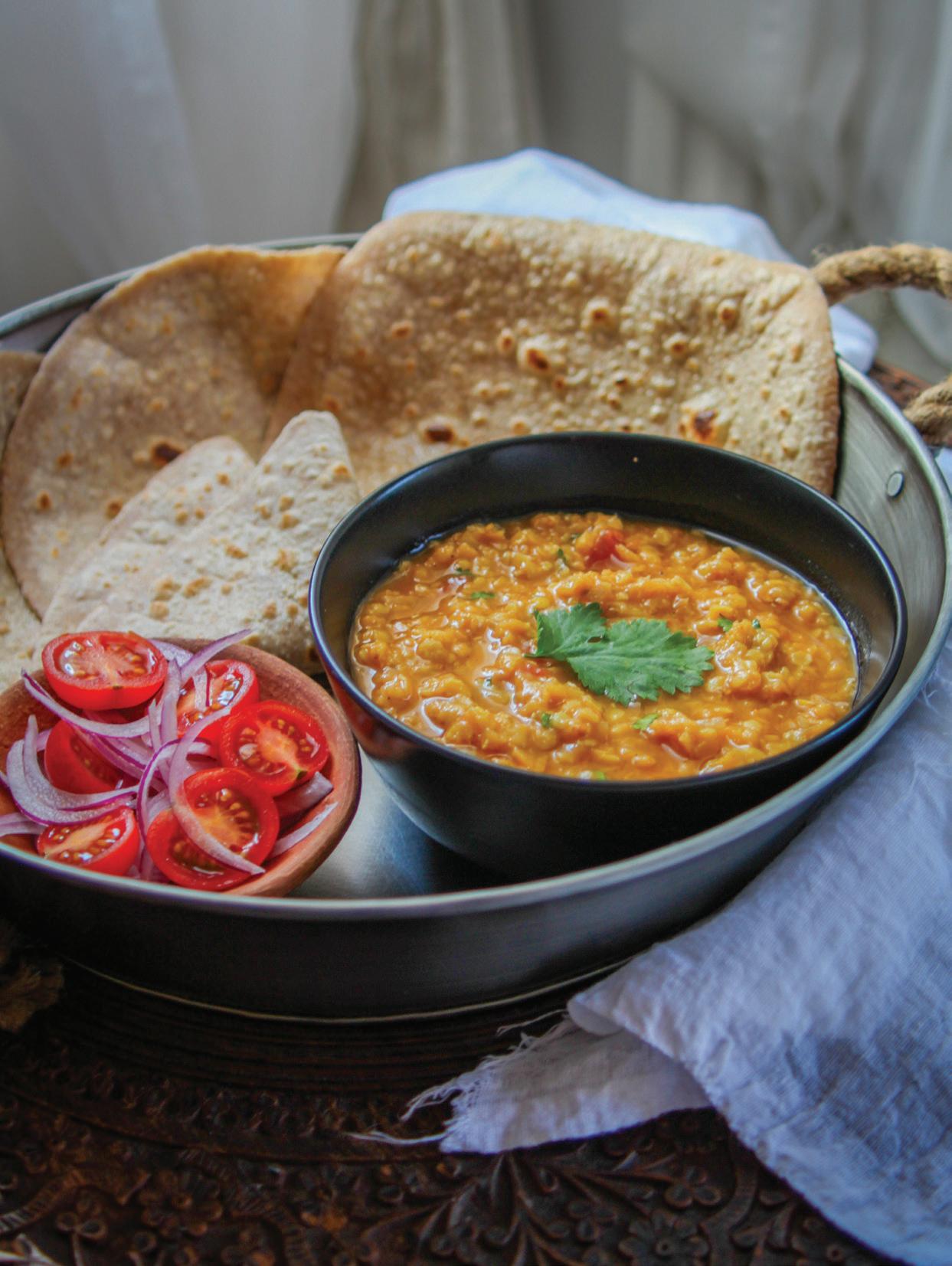
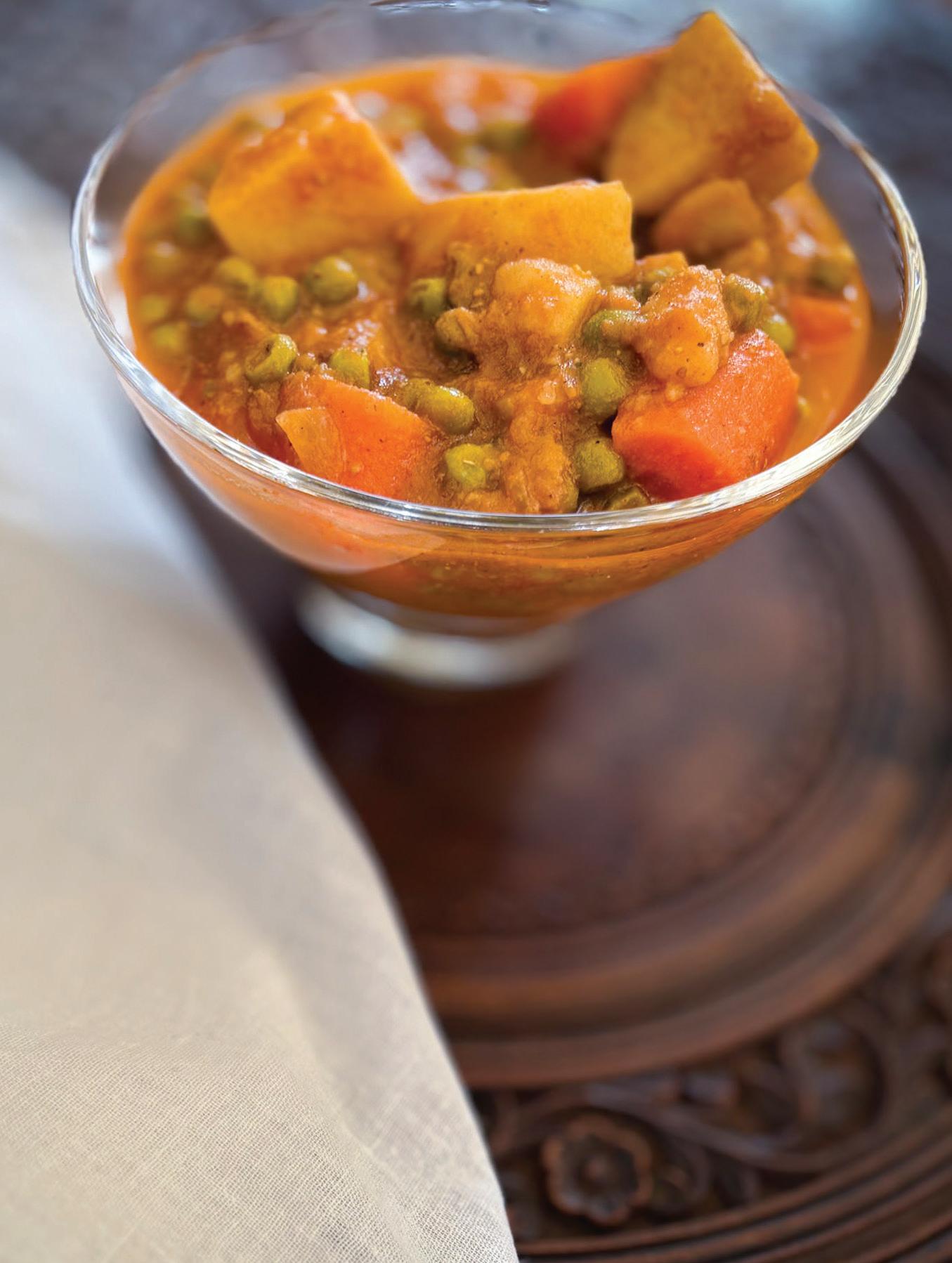
One of the very usual Sabjis, (vegetable curries), that was regularly made was potato, pea and carrot.
Ingredients
1 batch of Tarka starter (see page 305)
1 tablespoon Garam Masala
¼ teaspoon turmeric
1 teaspoon salt
1/3 tin of chopped tomatoes (approximately 130g)
4 medium sized potatoes – floury varieties, not waxy (my mother always used King Alfred, we often use Maris Piper)
2 medium sized carrots
A large handful of peas – frozen or fresh – never tinned.
1 tablespoon of chopped coriander
Method
Begin with the starter Tarka onion base (see page 305)
As you begin making the tarka base, you will prepare the potatoes and carrots alongside this process. Peel the potatoes and carrots. Cut them into bitesize pieces – try to cut both the potatoes, and the carrots into equally sized pieces. As you are cooking out the tarka base, put the potato & carrot pieces into a separate pan with salted boiling water, and bring them to a rolling boil. Once they have boiled, drain them and keep them to the side until we need them later in the cooking.
Now, turn back to the saucepan with the tarka base…once the base is ready, add the Garam Masala, turmeric & salt. Cook over a gentle heat for a couple of minutes.
Add the chopped tomatoes (be sure to crush any chunks of tomato, so that they blend nicely into the base). Now add the potatoes, carrots and peas. Stir everything so the vegetables are coated in the base and add a water – enough so that the water covers the base of the pan and comes a couple of centimetres up the sides of the pan. This water will allow the vegetables to cook out properly and not burn as you cook the dish.
Put the lid on the saucepan and bring the vegetables to a rolling boil. Once they have boiled, turn the heat down to a low setting and check the water levels. If the water has almost completely evaporated/ absorbed into the vegetables and you don’t really have much of a ‘gravy/sauce’ then add a little more water to keep it as the photo.
Place the lid back on the pan at a slight angle so it creates a little gap for steam to escape. Cook the Sabji on a low heat, until the potatoes and carrots are soft and cooked through (cooked – not mushy!). Once cooked, serve with chopped coriander scattered on top.
Add image?
(or save 2 pages by taking the above text back to P73 and delete the picture on the right)
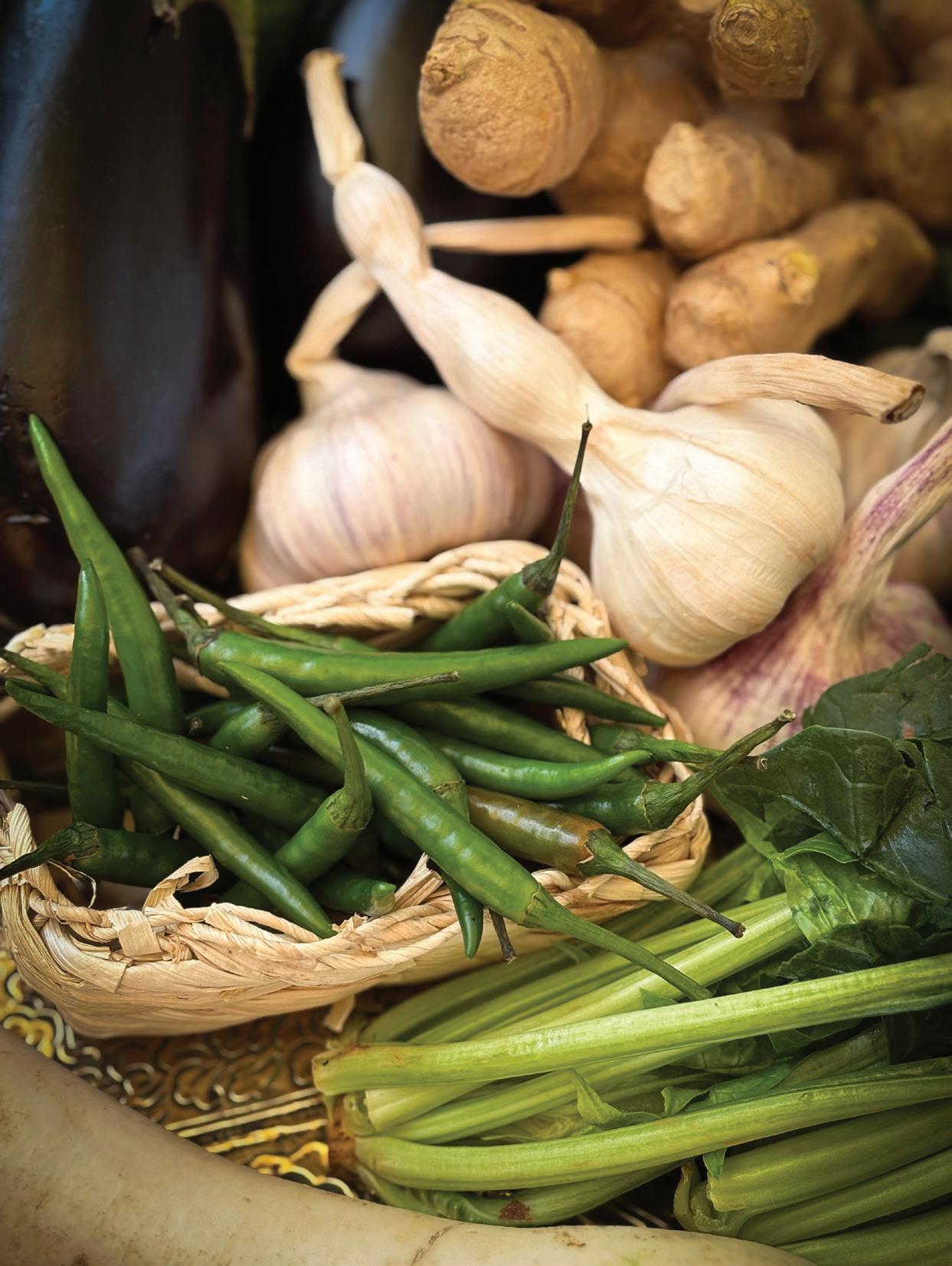
Ingredients
1 batch of Tarka starter (see page 381)
1 tablespoon Garam Masala
¼ teaspoon turmeric
1 teaspoon salt
1 large mug of red split lentils (approximately 250g)
1/3 tin of chopped tomatoes (approximately 130g)
1 tablespoon of chopped coriander
Method
Begin with the starter Tarka base
As you begin making the tarka base, you will wash the lentils. Put the lentils in a large bowl and wash them until the water runs clear.
Tips: make sure to use the force of the water to help agitate/clean the lentils
Tips: keep your fingers loose when you run your hands through the lentils, don’t rub them, or you will start to break the lentils down and will end up with a mushy Dhal
Tips: Don’t’ pour the water down the drain when washing the lentils! Keep a large bucket nearby and pour off the water into that instead. You can then use this for watering the plants/the garden.
Now, turn back to the saucepan with the tarka base…once the base is ready, add the Garam Masala, turmeric & salt. Cook over a gentle heat for a couple of minutes.
Add the chopped tomatoes (be sure to crush any chunks of tomato, so that they blend nicely into the base). Now add the washed lentils along with water – enough so that the water covers the lentils.
Put the lid on the saucepan and bring the lentils to a rolling boil. Once they have boiled, turn the heat down to a low setting and check the water levels, if the water has evaporated/absorbed into the lentils and isn’t covering the lentils anymore, top it up. The water must always be covering the lentils – it is very important that you keep topping up the water! Dhal should be the consistency of a thick soup.
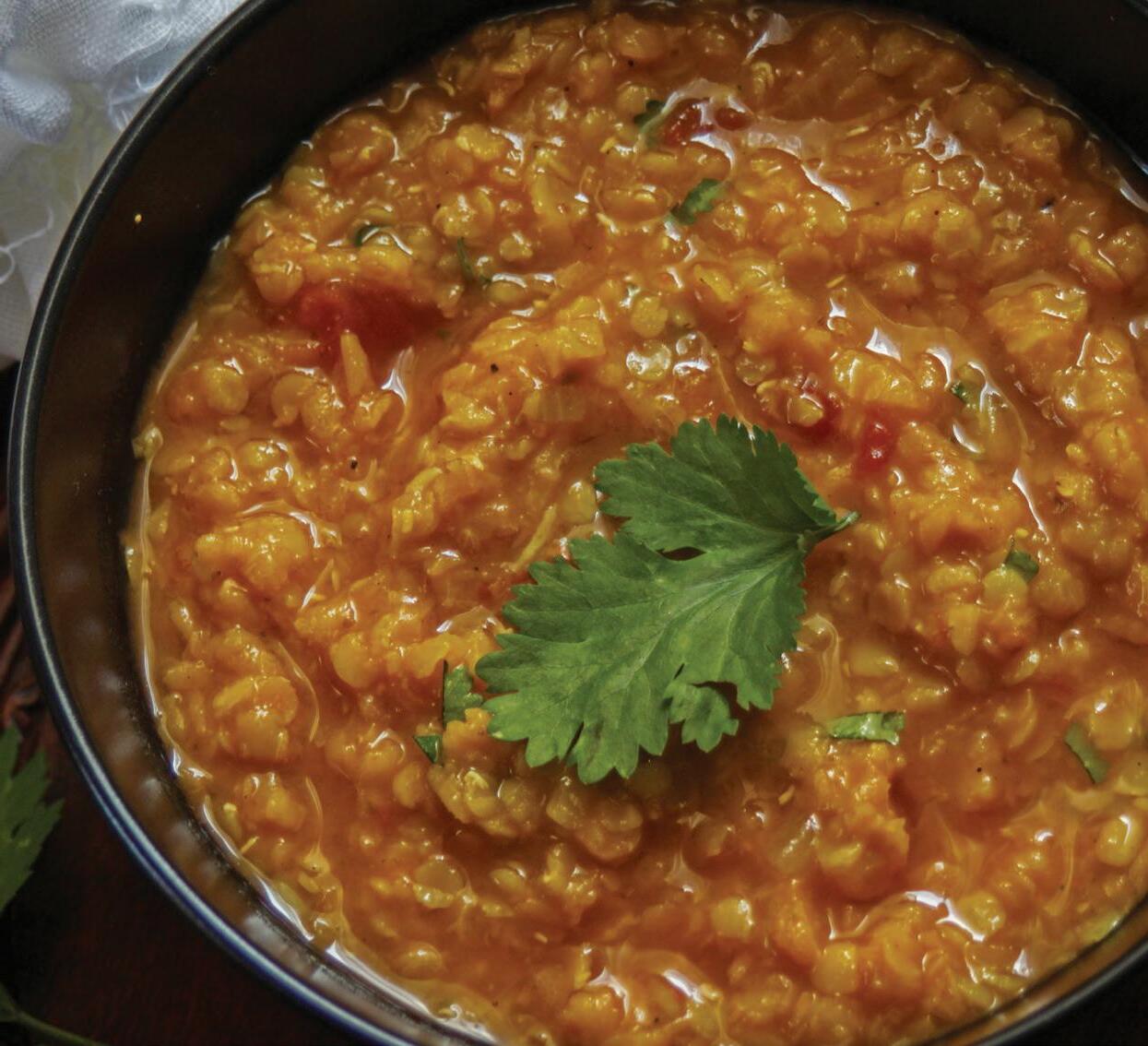
Tips: when your stir the lentils, it should be more of a ‘folding’ action, rather than a stir, or you can make the lentils go mushy
Place the lid back on the pan at a slight angle so it creates a little gap for steam to escape. Check the lentils every 10/15 minutes or so, as you will need to top up the water as some will evaporate off and the lentils will soak up the rest.
Cook the Dhal on a low heat, until the lentils are soft and cooked through (cooked – not mushy!). Once cooked, serve with chopped coriander scattered on top.
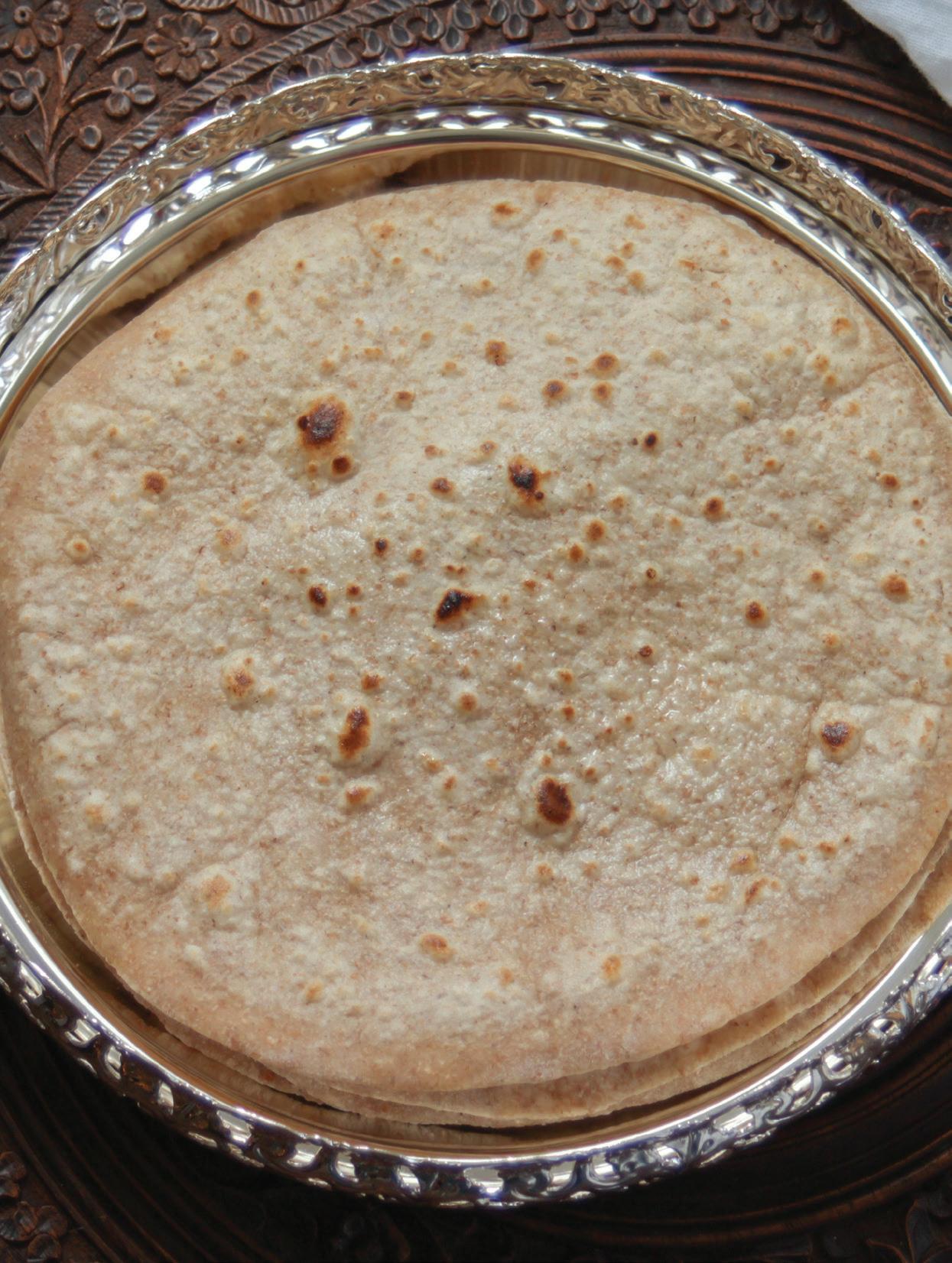
For making roti, we never really measure anything, however, these measurements are there as a guide! A note on pronunciation…the word ‘Roti’ is pronounced as though it were spelt ‘Rutt-ee’, (the rutt rhymes with the English word ‘Put’), the vowels are short, sharp sounds, please don’t say ‘row-tea’!
Ingredients
1 cup (tea mug) of Atta – (approximately 250g -makes roughly 5 Rotis)
Water – room temperature (approximately 120ml-140ml)
Butter, a small amount for buttering hot Rotis
Method
Make the atta (dough) by mixing flour (this is often labelled as ‘atta’ or chapatti flour) and water till you have a soft dough. Slowly add water while mixing with your fingers in a continuous clockwise motion incorporating all of the dough as you mix.
After the addition of a little water the dough will start to take on a crumble like texture.
When your fingers start to feel wet, start rubbing the sides of the bowl. This will allow the dough to pick up any dry flour and so build a bigger dough ball.
Keep doing this process until you have one large dough ball, and a clean mixing bowl.
Knead once for a few minutes until well mixed, (it will be quite sticky). It does not need continuous ‘working’ and should not get warm, or hot, due to excessive handling.
After 5-10 minutes knead for a second time, (it will feel smoother). This is always taught and learned by ‘feel’, and so it may take some practice, but the finished dough will be firm but ‘give’ when pressed with a thumb.
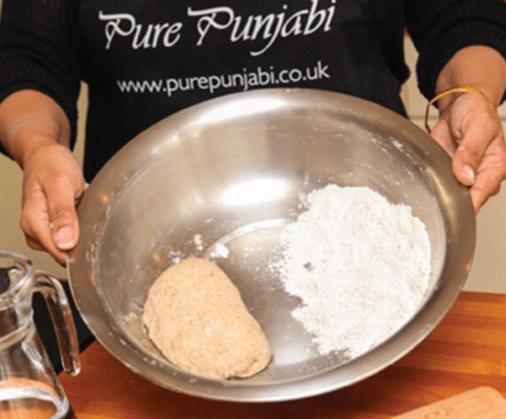
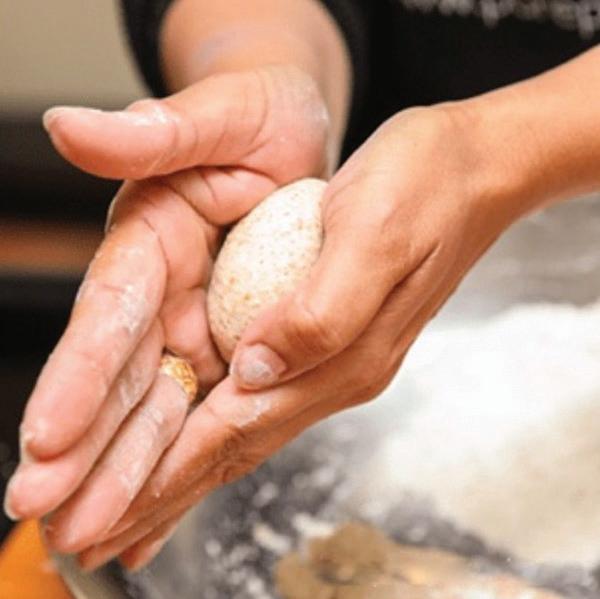
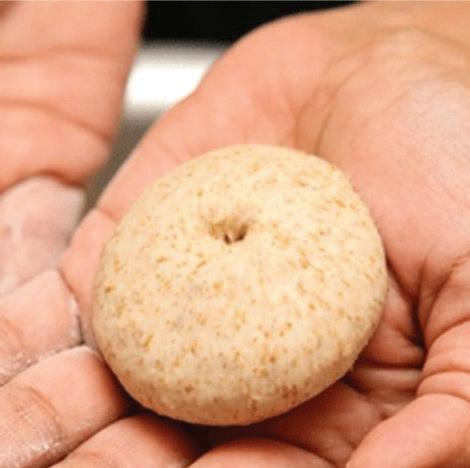
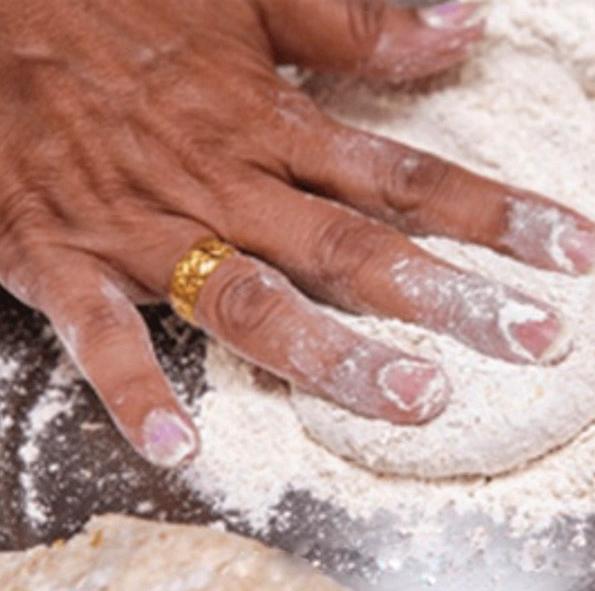
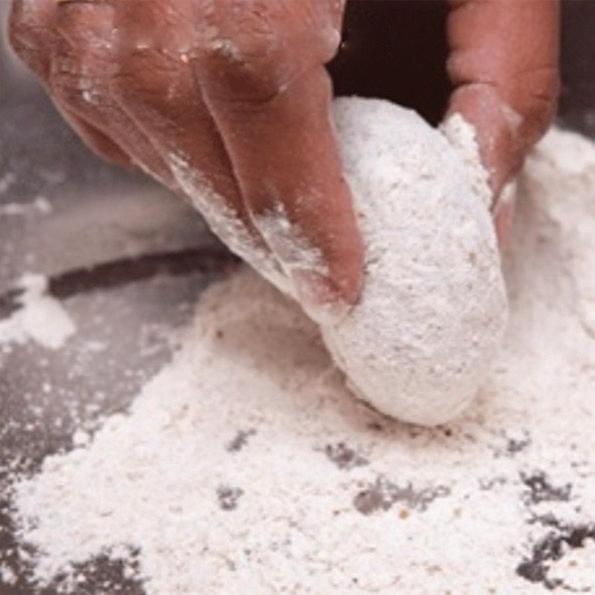
Now pre-heat the Tawa, over a low/medium heat to start coming to temperature. If you don’t have a Tava, then any flat smooth pan will do.
After the second kneading, take a piece of dough that is approximately the size of a satsuma. And start rolling it into smooth circle to from the Pera, (dough ball).
Roll the dough ball until there is a small dimple on one side. This is difficult to do, so is an aim as it does take a lot of practice. This round of dough is called a ‘Pera’ (pronounced peh-rah). Each Pera (round) should have a dimple on the top of it once you’ve rolled it out. This does take a lot of practice, but suddenly the dimple is there! It happens the more often you practice your Roti-making. Roll the Pera (dough ball) in some of the atta (flour).
Flatten the Pera (dough ball) on each side in the flour. Always shake off excess flour. It is most important to remove excess flour throughout the process.
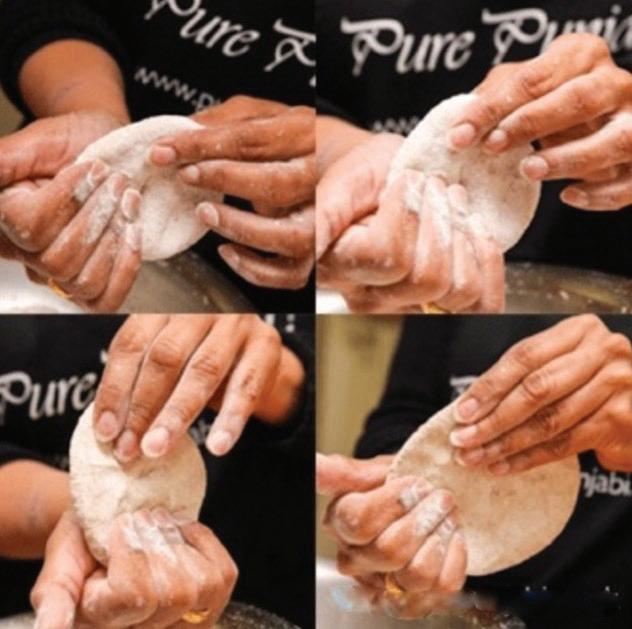
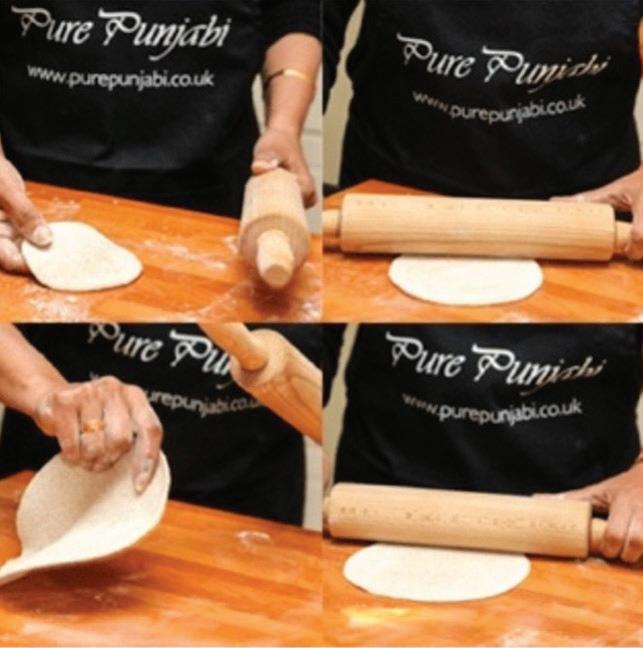
Take the flattened Pera (dough ball) and further flatten it by pressing it, and rotating it anticlockwise, between the palm of your right hand and the fingers of your left hand. This will also make the pera bigger in preparation for being rolled out.
Roll out the flattened pera to roughly the size of a side plate, ensuring that you turn the flattened disc often and apply even pressure when rolling to give a round shape! As you roll out, if the roti is sticking, dip both sides in the flour, but you must shake off the excess flour. You need just enough flour to prevent sticking but never too much as you will have a hard, dry roti when you cook it.
Take the rolled-out disc and firmly pass the disc from one hand to another. This helps to shake off any excess flour and make the disc a fraction bigger. Pass it back and forth roughly 10 times. This move is NOT a throw of the roti from hand to hand. The hands stay very close, and it is almost a slapping/clapping movement.
Take the roti and, in one firm motion, put one side down onto a Tava (flat plate). Do not throw it. Place it (slap it) firmly onto the Tava.
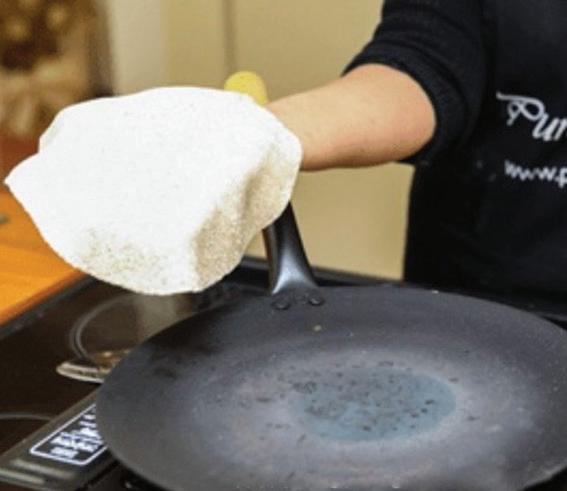
The moment you can see the dough cooking, (some colour change), turn the roti over. It’s important NOT to over-cook the first side, so this will be around 5-7 seconds – fairly quick! Look for the colour change…rather than count seconds (a guideline). As you can see from the picture below, the first side does not have any brown spots on it.
The second side stays on the heat until you have a number of brown spots.
Once the second side is cooked (as you see in the picture) remove it from the heat. You will now finish cooking the first side.
To finish cooking the first side, you apply fierce heat to it until it puffs, then remove it.
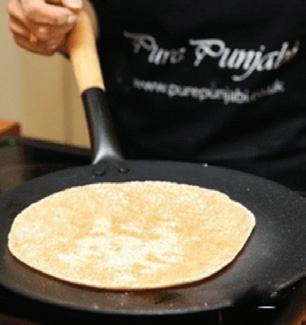
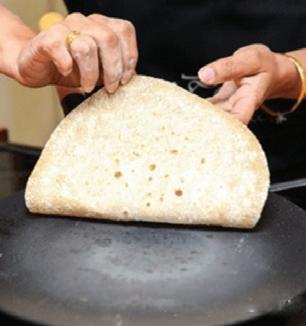
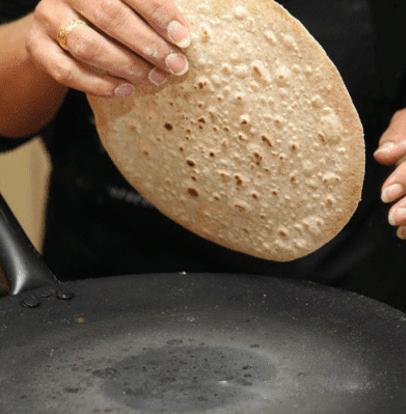
If you have a gas hob/cooker, this is done by placing the first (non-spotty), side of the roti directly over a lower flame, (spotty side faces up). The roti will then puff like a balloon!
As soon as it is puffed, remove it from the grill or flame. Do NOT let the underside brown or burn.
You can also puff the Roti directly on the Tava, which is the old-school way. When the spotty side is ready, turn it over and using a clean tea towel, press the Roti on the Tava and release, press and release, and it will start to puff, then work your way around pressing to force air through it. (This will leave a harder underside to the Roti).
If you do not have gas, but have an electric hob/cooker, put the first side of the roti (spotty side faces down), under the electric grill (it needs to be on the highest temperature) and again, it will puff like a balloon…
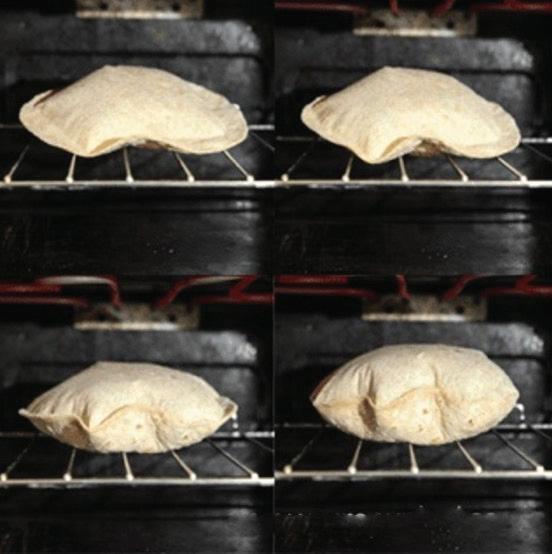
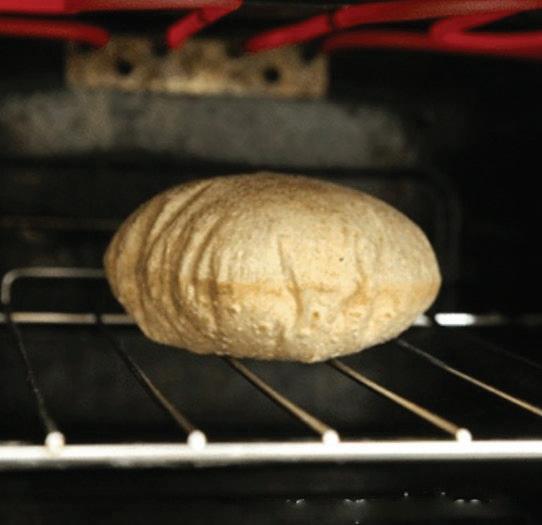
Note: The size of a Roti is a contentious thing and a cultural matter! Punjabi rotis are usually on the larger side – more of a small dinner plate size, however regions such as Gujarat, make much smaller Roti, more of a side plate size. One of my aunties was a Gujarati, and her Rotis were always so small and dainty. My father insisted that I make him a big Roti! He would say… “Putt! Make me a Punjabi-size Roti”!
Lightly butter the side with the brown spots and stack the cooked rotis in pairs – spotty sides facing each other (the two buttered sides facing each other). Wrap the stacked rotis in a clean tea towel to keep warm and soft.
Note: A Roti is like a French baguette – meaning that there is no preservative in the dough and it goes hard the next day. The dough is always made fresh each day, and Rotis are served fresh for each meal.
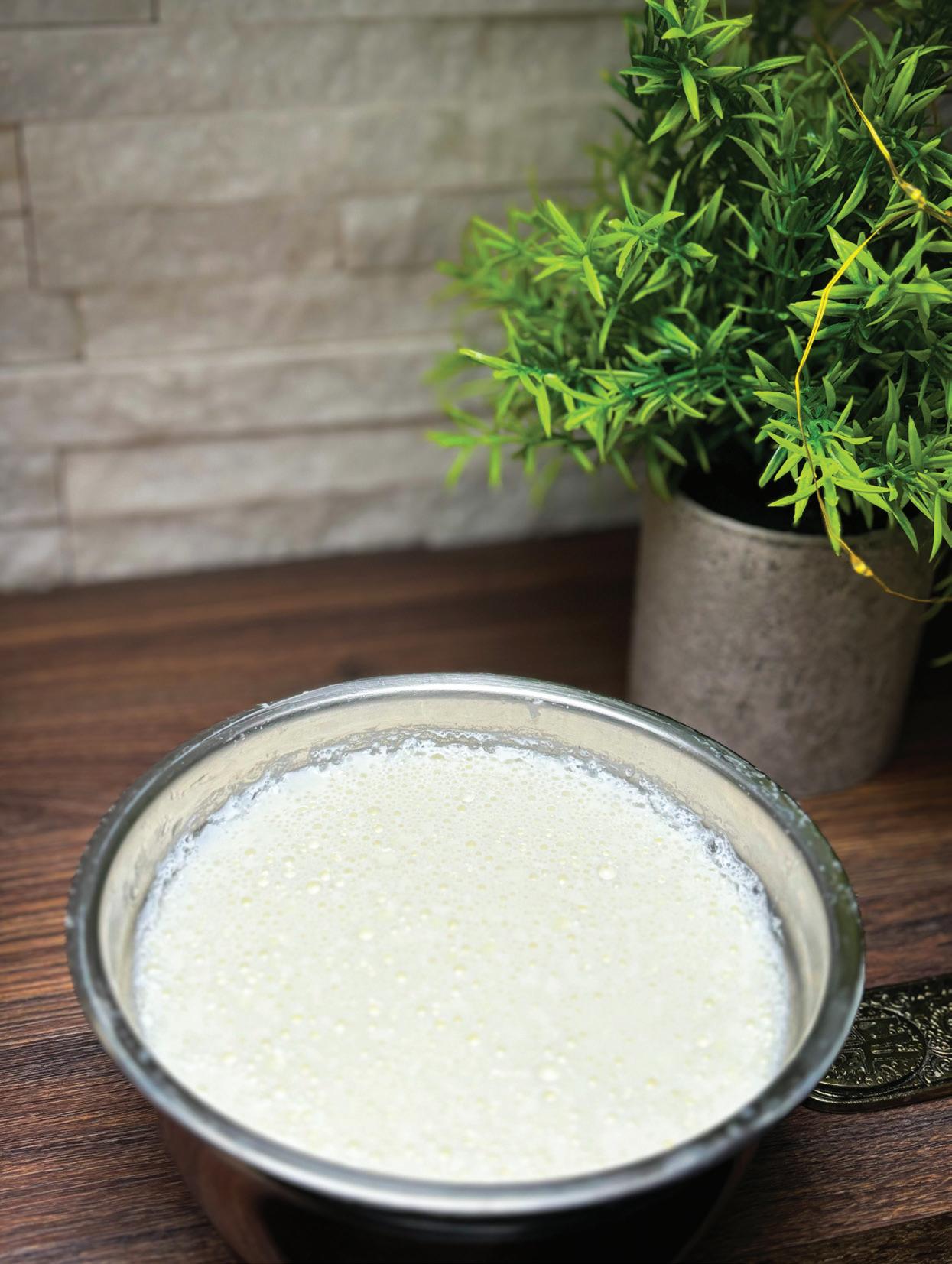
A very necessary requirement the night before/in the evening after dinners was the making of ‘Dahi’ (yoghurt), which is the Punjabi and Hindi (Indian languages), word for yoghurt, and pronounced ‘day’.
It was always freshly home-made. I had to do this last thing at night, so that the yoghurt could be put into the airing cupboard at around 11pm and taken out in the morning at 7am to be put in the fridge for that evening’s dinner. It’s a very simple and straightforward process, and requires no special equipment at all, so here’s how to make yoghurt…
All that was required was:
a pint of milk, (which was still in glass bottles delivered by the milkman), and… a small amount of the last batch of yoghurt, (or if none is available, then a small pot of shop-bought yoghurt, to be your starter).
The ability to feel temperature in your ‘pinky’ finger! 2 tubs with lids, and thick towels or blankets in which to wrap the bowls.
A warm place, (we used to use the boiler cupboard, pre-combi-boiler days). We placed it on a warm radiator for this batch.
The pint of milk was poured into the saucepan and brought to the boil. You had to be sure to watch it, as it would very suddenly come to the boil and could very rapidly boil over, causing quite an unpleasant burnt smell and mess.
Once the milk had come to the boil, it had to be successfully snatched away from the heat in the nick of time to stop the dreaded boiling over. On the occasions that ‘one’ was daydreaming and failed in this task, (leaving a burned mess on the hob), the requirement for the flat green scourer and ‘Jif’ cream cleaner to come into action was necessary, as part of the yoghurt-making process.
My mother would then leave the milk to cool, giving an occasional stir to prevent a skin forming and to allow for faster cooling. She would periodically check the temperature with her pinky finger, and instruct me to do likewise, so that I would understand when the temperature would be right for adding the yoghurt.
Once she deemed the temperature to be correct, both of us having done one last dip of pinkies to concur that the moment was right, she quickly added the small amount of yoghurt from the previous batch she had made. Sometimes she would have run out and would buy a small pot of yoghurt (and I never noticed any difference in the resulting batch, from not using her own batch).
She would then stir the yoghurt into the warm milk and then, with a Tupperware tub or bowl at the ready, she would pour the warm milk and yoghurt into the tub from quite a height. She then poured the milk back into the saucepan and continued with this back and forth between saucepan and tub. She did this quite a few times, explaining to me that it was important to mix the yoghurt well into the milk and to remove any lumps of yoghurt. This procedure was always my favourite part, and it was always impressive that she poured back and forth from quite a height creating a real froth of milk, without spilling any! This procedure was done quickly so that the milk stayed warm.
When the warm milk was thoroughly mixed well with the yoghurt, and there were no visible lumps and plenty of froth, she sealed the Tupperware tub with its lid. This was then placed into another plastic tub, one size up. (She had a set of different size plastic tubs and lids).
This larger tub, containing the smaller tub, which contained the warm milk and yoghurt, was then carefully carried upstairs and placed into the centre of a Razai (pronounced Rr-jye). A Razai is a handmade Indian quilt. The bowl was carefully wrapped in the Razai and placed in the warm airing/boiler cupboard and the door closed.
The next morning, my mother would go to the airing cupboard, carefully remove the Razai bundle and place it on the floor. She would carefully unwrap it, lift out the tub, and carefully peel of the plastic lid. Then very carefully, she would take off the smaller plastic lid.
This was always a moment of great suspense, because there were two possible outcomes: Firstly, the good one – that we would have perfect creamy Dahi with a yellow-ish film of watery yoghurt liquid. Sweet and tasty. This caused much nodding of the head and satisfaction. That evening my father would pronounce…“Dahi swad hai’ The yoghurt tastes good! My mother would look VERY pleased.
Secondly, the bad one – that she would look concerned, then sniff the yoghurt, then taste it, and then sadly declare it to be ‘Khata’, meaning ‘sour’ or raw. This was most disappointing. Later that evening she would discuss this with my father, and they would both shake their heads in a mixture of sorrow, disappointment and resignation. Sometimes they would even discuss the possibilities of what could have gone wrong, (left in the airing cupboard for just that bit too long). As a teenager growing up in Southsea, this exchange between my parents always caused me some mild amusement on the rare occasion that it happened.
Who cared, thought I…. until I made my first batch alone….
Dahi -Method
1 pint of full-fat milk.
1 to 2 tablespoons of yoghurt. – the colder the weather, the more yoghurt is needed, the warmer, then less. In very hot weather you may need 1 tablespoon. This is a judgement, feel and experience thing. Practice makes perfect so try with 2 tablespoons and see how it goes.
Bring the milk to the boil, allowing it to rise to a foaming boil. As soon as the milk has foamed up to the top of the saucepan, quickly remove the saucepan from the heat.
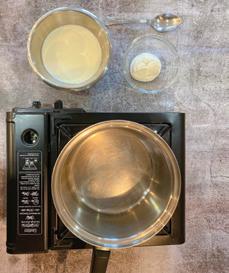

Leave the milk to cool, stirring occasionally to prevent a skin forming. The milk needs to be at the right temperature when adding the yoghurt. Keep checking with your baby finger for when it feels slightly warmer than body temperature.
Pour in the one to two tablespoons of starter culture of yoghurt. This is any plain yoghurt that you already have.
Pour the warm milk back and forth between the saucepan and the bowl. Pour back and forth from a height to break up and disperse the lumps of yoghurt.
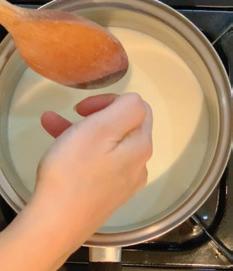
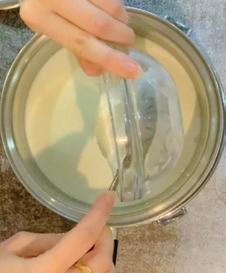
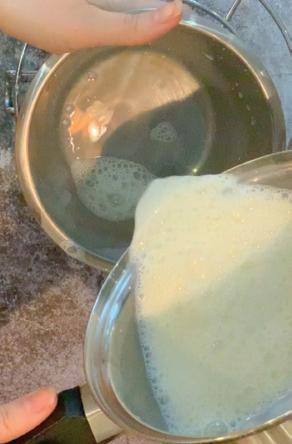
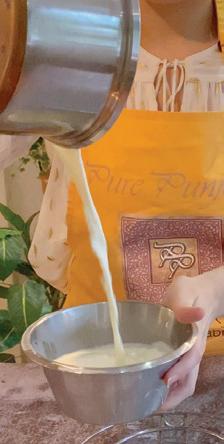
When there are no visible lumps and it’s completely mixed in and frothy, place the lid on the smaller bowl. Then place the sealed tub inside the larger tub and place the lid on it.
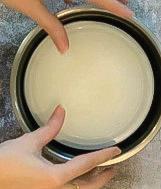
Wrap the tubs in towels or blankets or in any thick insulating fabric. Make sure to keep the bottom level, or your Dahi will set at an angle! Leave in warm place overnight. We usually did this at about 10:30/11p.m. We placed this batch on a warm radiator, that had an individual thermostat and was set to setting 3 out of 6.
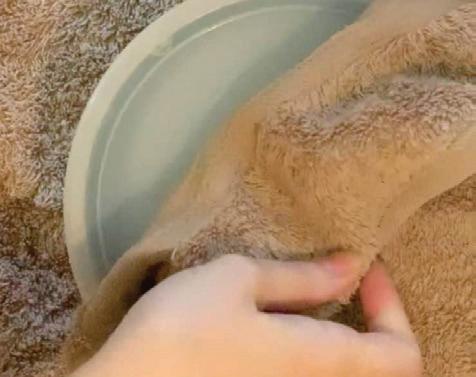

The next morning -first thing, around 7-8a.m.-ish, carefully unwrap and open the tubs. You will look with your eyes and smell with your nose, and you will know it’s right or… if it’s soured, (been left too long or conditions too warm).
Thick creamy Dahi (yoghurt). Refrigerate, eat and enjoy. Traditionally served with dhal and roti, and most of our meals, whether chicken and rice or Saag and Makki di Roti. Home-made yoghurt is also incidentally very good for gut health!
Save two tablespoons to make your next batch.
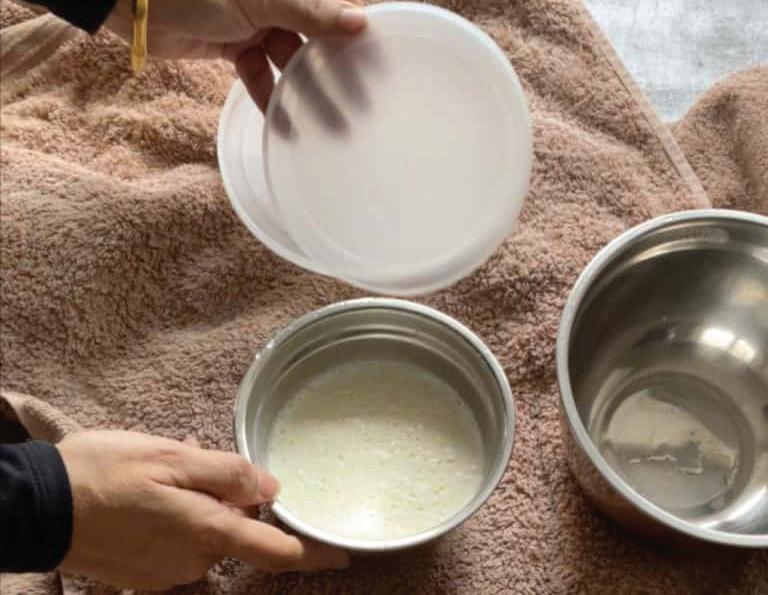
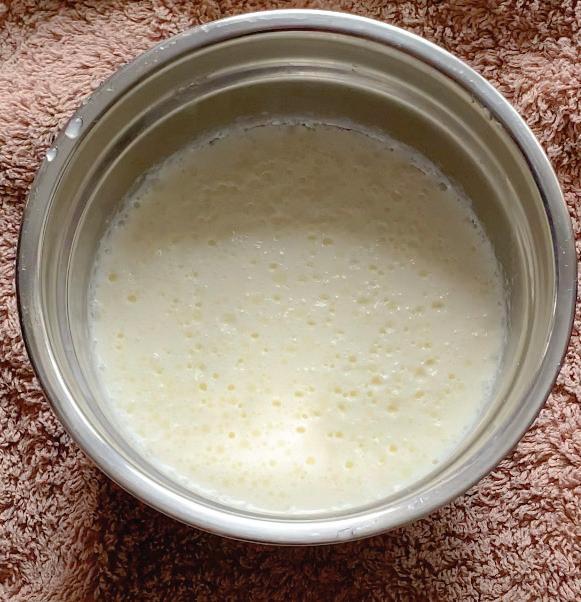
One, quite frankly disturbing and shocking story that my father told me about his childhood in Punjab, was of being taken for a walk by his father when he had just turned 16. He said that his father had told him to go with him, and they walked for quite some while, until eventually, they approached a wooden hut. They went inside, where my father saw a uniformed man sat at a desk with some papers, and two other uniformed men. There was some brief conversation, and then his father signed some papers and told my father to sign as well.
The uniformed men then put their hands on my father’s shoulders and his own father turned and walked out of the hut. As he walked away, he turned round and said, “send all the money home”. The uniformed men then took him away – he had no idea what was happening!
It appeared that his father, (who my father described as weak and lazy), had sold him into the navy (then the British Navy), for the absolute maximum term that he could –21 years!! There you had it - the eldest child was now the breadwinner and meal ticket for the next 21 years to provide for the family his own father had produced!
Even as a middle-aged man, my father told me the story with such disgust and hatred for his own father and what he did to him as a child of 16, and I quite agreed. He told me that he wasn’t even allowed to go home to say goodbye or to collect anything. The minute the papers were signed they took him … more or less never forgave his father, not so much for what he did, as it enabled him to escape and forge his own life, but for the deceitful and devious way in which it was done. Even when we went back to India, my father spoke to his father with disrespect. What parent exploits their child in that way?
A counter to my grandfather’s mercenary and shocking behaviour was explained away by the story being put around to everyone including the younger children, who were too young to know anything, that it was because my father was behaving badly and bringing… ‘shame on the family’. That wonderful Eastern parenting catch-all phrase for getting away with your own bad behaviour.
I was told that according to the grandfather’s version to the younger siblings, my father was a ‘bit of a player’…, bringing disgrace on the family. That would make sense…Umm… not! A child not behaving… so sentence him to what is effectively a 21-year jail term. After 11 years of ‘sending the money home’ to pay for three sister’s dowries, and two brother’s tickets and support in England, he managed to buy himself out of the navy after 11 years, (which was the period in which my mother had to remain with her in-laws).
Of course, that awful exploitation by my grandfather, led to him arriving in Bristol, however. His own will and determination made him turn that situation round.
Even back in England, in the old days of schools for wayward children and the days of young unmarried pregnant girls being sent to awful institutions run by nuns who were mean and then took their babies away, at least they were only interred for around a year!
Regardless that it was a different time back then, the key question is …would you do it to your own 16-year-old child?
Another weak excuse I heard within an English family where the father was an unpleasant character, and taking credit for the son doing well, claiming that because he had been harsh on him…he had made... a ‘man of him’, so to speak! Some behaviours are universal
By contrast my mother talked of an idyllic and happy childhood being raised by her grandmother in a much more affluent family.
At the age of 15, as was customary in those days and time, she was taken to be married. She told me she had a vague recollection of the boy at the marriage ceremony. A custom quite prevalent in those days was that of children, sometimes very young children, being married on the wishes of ageing grandparents who insisted that it was their last wishes to see the grandchildren married before they died—the selfishness of this appalled me. My mother said that after the wedding ceremony, she and the boy/husband were each returned to their own family homes, because the boy was still studying and required to finish his schooling. My mother never saw him again and a year later she heard that he had died. At 16 she was a widow. She had never left her family home or gone to live with her in-laws in the married home, but technically she was now a widow, and so unable to remarry.
Her family were not poor, as was my father’s; and it turned out that an aunt living in the village of my father knew of his circumstances... his engagement to a girl who then died. And so, it was arranged, that she, now having non status, would be married to my father, who came from a poor family, as the best she could hope to get.
This may have been some of the source of my paternal grandmother’s resentment, as I believe my mother came with refined manners into the household and did not fit in with their ways. My father reflecting on both sides, once said to me, that in some ways, because she had perhaps turned her nose up and been a bit too proud, and a bit judgemental, his family didn’t’ like that and though she was ‘stuck up’. A case of misfits!
I have memories of her face during an outing with my paternal grandfather, when we returned to Punjab in my later teens. We went somewhere to visit with some sort of priest or holy man. We were all sat crosslegged on the floor, which was covered with a white sheet.
There were fruits and snacks laid out before us, and as my paternal grandfather ate an orange, he spat the pith out in front of him, onto the white covered sheeting! My mother’s face could barely conceal her disgust. I smirked and thought it was funny and, but she did not! My grandfather appeared oblivious and carried on talking. The priest ignored it. My father looked angry.
Then…to my absolute horror…she grimaced, leaned forward and gingerly picked up the ‘gob’ into her hand and had to hold it! That wiped the smile off my face and now I too was disgusted!
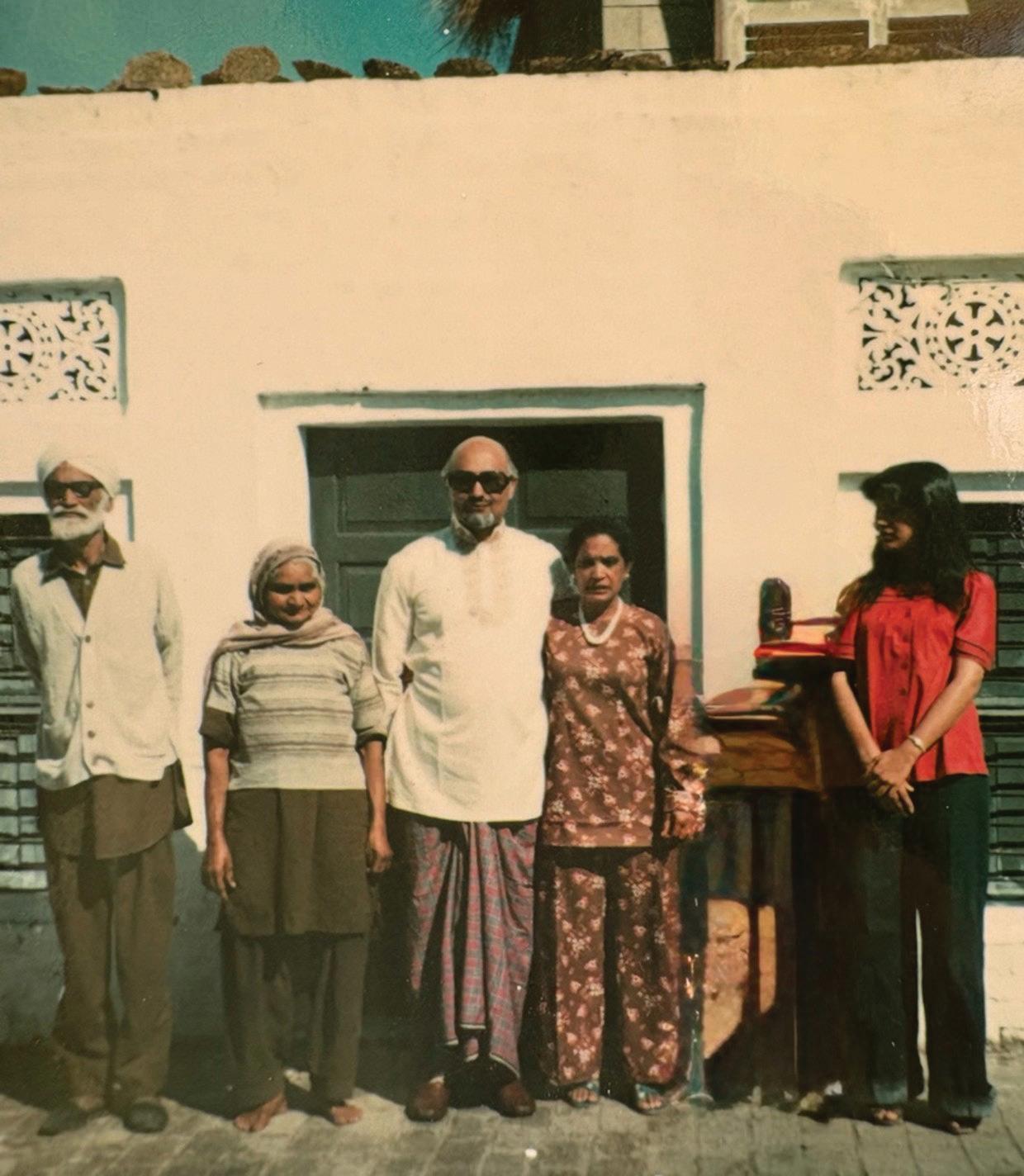
Myself, my parents and paternal grandparents
“A woman’s work is never done”
During my early teens, the realisation that work did end for a male but never for a female in Asian culture, and to some extent, in the wider world, was fully upon me.
To say it was unfair was an understatement, and ‘fair and equal’ treatment was very important to me. I had been an absolute bookworm through junior school, reading anything and everything, and was increasingly reading literature hugely, proudly and ironically encouraged by my father.
I began to resent that my father finished work, went off to the pub, for a ‘swift half’, sometimes for half an hour, and sometimes for three hours, and came home to dinner cooked by myself or if a weekend, my mother as well. She was working outside in a factory type job, getting a bus mornings and evenings, coming home tired, yet her day did not finish. Woman not only had to produce income, but they had to be cleaners, cooks and general labourers.
I didn’t see this as quite the same as in the working world of my English friend’s parents. In fact, one of my friend’s dads cooked their dinner every evening because he got home first. It was quite an eye opener that there were men who did household tasks.
Oddly, BOTH my parents thought this, not only odd, but wrong!!! In fact, they did initially pass this prejudice onto me, but reasoning and fairness prevailed in my head, and of course it was absolutely right that it should be…first in, dinner on!
I couldn’t see how genitalia came into it!
Food for Thought ...
Reflections on two cultures, ways & worlds
‘Ugandan
At around this period, there was not only a growing and increasing immigration from the ‘ex-colonies’, but Idi Amin was ruling in Uganda. Asians, as is often the case, were prosperous due to hard work and entrepreneurial spirit, however due to the growing wealth and dominance of Indians in Uganda, after Amin seized all assets of Ugandan Asians, there was an influx of them into Britain.
This situation was watched with great alarm by Kenyan Asians, (including my mother’s family), who had also become wealthy in Kenya…and so my mother’s three remaining brothers in Kenya, left and relocated to London.
Initially, Indian were welcomed with open arms, because no one wanted to do the jobs of working in the NHS or do the hours and work as bus and train drivers or other such jobs, and so they were welcome here to fill those roles.
This growing presence of Asian communities started to cause something I had never seen, which was the beginnings of resentment and backlash, racism. As Asians came, the work ethic, willingness to work long and hard hours, but…live frugally, and communally in extended families, meant a fast acceleration in the wealth of a people who came with nothing but the legacy of the colonial British Passport.
There was an element of ‘backbone’ about those who forged a new life in a new hostile land, compared to those that followed, with a soft landing, a place to stay and a ready-made support network.
“No change for brown girls”
Increasingly, during my early teenage years, I was impacted by the enormous difference in treatment between Asian daughters and sons, as well as between brown girls and white girls.
White teenage girls had a very different life. The parents seemed very strict when they were little and it confused me in the way little children were smacked or in trouble, say for breaking a plate, however, this went quite the opposite way as they became teenagers. Although they had to ‘ask’ their parents if they could go out, it seemed more of a back-and-forth negotiation.
Our experiences as brown girls were so opposite, so it was better as an Asian girl, not to ask for permission, only to end up facing the tongue-lashing lecture, before the certain ‘no’. Instead, there developed across almost all teenage girls a system of ‘brown lies’, ‘going to the library, staying late at school. Anything educational. In Southall the phenomenon of daytime discos among Indian youth became quite a popular secret event, because parents naively thought not allowing girls out after dark stopped them from ‘Western corrupting influences’.
During Covid, there was many a comical meme on Asian social media groups, referring to the social restrictions: not leaving the house, not seeing or mixing with others, staying in, being careful, following the rules, and dire consequences if you didn’t. -- - the Asian social media posts were awash with memes about how this was…
‘No change for brown girls’!
It was how we all had to live, mostly for the first generations born here. I made it my own mission not to accept this, and to stand up against, defy and break every inequality within our community regarding treatment and expectations as a girl.
Food for Thought ...
Reflections on two cultures, ways & worlds
“A
good gut feeling”
When I studied to train and qualify as a personal trainer, while living in South Africa for a couple of years, (just before the Millennium), our course nutrition lecturer was the nutrition advisor to the South African Olympic team. In one of our lectures, she told us that the combination of beans (pulses) and rice contained the complete set of amino acids that the body needed.
It was really at this point, studying nutrition, that I could appreciate the natural goodness and health benefits of the traditional Punjabi village diet. Fibre, greens, vegetables & pulses – all super foods that were the foundations of a rich, nutritious, delicious healthy diet.
Add to this our cultural requirement to always have Dahi/Yoghurt at mealtimes (always made fresh using culture from the previous batch). No Indian meal could be served without it. The importance of gut health and good bacteria was naturally and tastefully taken care of!
Once one of my adult children had very serious food poisoning, immediately after coming home from university. The hospital recommended that for recovery, I should buy ‘probiotics’ – yoghurt from the supermarket for the good gut bacteria. I told the doctor how we made our own live yoghurt and she said…
“Oh, that is just perfect”, and so I went back to nightly yoghurt making.
One thing we always notice when serving food at any of our Pure Punjabi weddings or events that have an Indian client and guests, is the demand for yoghurt to accompany all dishes.
On the other hand, we stopped serving it at our cookery workshop lunch as no one ate it.
“You need to see where you come from…”
My father had seen the TV series ‘Roots’ which was a series about the kidnapping of a black man from Africa by slave traders and his transportation and arrival in America as a slave. This long-running TV series had a profound impact on him. and this made him decide that we must make a return trip to India.
I knew that my parents had previously made a trip back to Punjab when I was about 6 months old, and according to them I had nearly died or been pronounced as dead or beyond saving.
At that time nobody had transportation within the village, yet somehow my father managed to get hold of a vehicle and get me to a hospital in the nearest city of Jallandhar miraculously… and as evidenced by my being here today, I did not die.
They had since never dared go back following that near fatal trip returning home, all those years ago, but then fast forward 16 years, later and not long after he had watched this series, he one day declared that we must all return to India and to Punjab to ‘see our roots’.
We must go and see where we came from to understand who we are!
At the time of making this trip to India, I was in sixth form at the girls’ grammar school, so shouldn’t have been out of school, however my father in his typical manner and delivery had informed the school that he would be taking me out of school for a six-week period. To say they were not happy at all would be an understatement, and I’m unsure quite how he delivered this news to them, but very probably with his typical bulldozing behaviour he presented it to them as a fait accompli’.
I remember the French teacher grumbling at me that my father wanted me to do well at school, yet he was taking me out for six weeks. Her irritated manner indicated that he didn’t give the school a choice, and as it was sixth form, it wasn’t compulsory that I was in school. I sometimes wonder if he threatened to withdraw me completely.
Before we left, there was quite a process of packing and setting up to get ready for this big trip ‘home’
My own preparations involved taking my two big French and German dictionaries and all of my work with me to try to set myself some kind of time to study. Additionally, it was most important to pack my jars of Nescafe Gold Blend and… toilet roll…to be prepared for everything!
My father made great preparations by putting the TV in the loft along with various other items of value and as we watched him close the loft trap door, he said, with great satisfaction, “now let the bastards try and steal from us”, which, as usual, I found amusing.
The return trip home to our roots, was combined with some cultural exposure as my father wanted us to see some of the country as well as see the villages where they came from, and so the trip additionally included a mini tour of three weeks of ‘The Golden Triangle, taking in Delhi, Bombay and the cities of Jaipur Udaipur & Jodhpur. Then onto the village of my father and my paternal grandfather and paternal grandmother.
During the first three weeks of the trip my father arranged for me to go and meet my pen friend at college in Delhi, with who had been writing for some years.
She was the niece of my father ‘s friend with whom he had served in the Navy. Prior to visiting my penfriend, my father gave me a massive lecture about how I could not be myself and not present myself in such a western way and not make a bad impression and therefore, much to my huge resentment on the day of the meeting, he insisted that I had to wear a sari.
So, we departed, with me in a sullen and awkward state, to meet with the ‘traditional and respectable Mitan. On arrival at the girl’s hostel in the college in which my penfriend was living in Delhi, we waited downstairs for her arrival, meanwhile noting the girls walking about, mostly in modern western clothing and jeans. We heard the noise of someone running downstairs and there appeared a slim, somewhat boyish girl, dressed in a ‘Western’ T-shirt, jeans and cropped hair.
Here was Mitan… A ‘thoroughly modern Millie’.
She looked at me and warmly greeted me with a hug but looked puzzled at my formal and old-fashioned attire! She said, “why are you dressed like that”?
With the question hanging embarrassingly in the air, I glared furiously at my father who looked dumbfounded and guilty as he could feel my eyes burning into him, and I hissed at him under my breath…. “SEE”!!!
My father had no idea of changing times in India. He had no idea of the changing ways in which girls were behaving, what they were wearing, what they were doing.
I think he fully expected a row of neat girls in traditional ribboned plaits and traditional Salvaar Kameez clothing and was not just absolutely shocked but also dumbfounded.
Seeing the shock and embarrassment on my father’s face gave me great advantage and much to my delight and of course for teenage payback, I used this experience to continually ‘poke the bear’ and remind him any time that he wished to let me know about something in India, to question… …but did he really know what was going on?
Maybe he didn’t and… should I…could I, believe him? He was quite embarrassed and never lived it down!
We spent the afternoon and evening together with Mitan, (I explained that I had been forced to wear the sari for the occasion of our meeting), who was a funny and lively girl and she regaled us with various tales that had us laughing. We continued to write for some years but then after she left college, and I had run away from the prospect of an arranged marriage, we lost touch…
Happily, after many, many, many years, both having adult children, Mitan and I regained contact after she found me online, and I’m very happy to say we are now reconnected, but no longer those giddy teenage girls!
While in India, we spent some time in Delhi and Bombay/Mumbai, and we were wined and dined and shown the privileged side of people with money in India.
Following on from Delhi, we then toured around Udaipur Jaipur and Jodhpur. One highlight was our stay at the incredible Lake Palace in Udaipur, which today as then, charged a very high price to stay on this fabulous floating palace hotel in the middle of a lake.
Interestingly, while we were staying in the city of Jaipur, having finally gone back to India, after 16 years, I once again, became very ill in the motherland! All I remember is seeing, in a haze, the sight of a doctor and my parents worried faces.
I survived
I had my 17th birthday during this time, and so my father took me shopping. I did like, and still do love wearing saris, (in the appropriate time, place and setting), and so he said he was going to purchase a special silk sari for me, for my birthday.
The shopping experience was interesting and my first experience of non-western shopping. At every shop we entered, we were seated and offered tea and snacks while staff came with an array of stunning silk saris, in every colour and hue possible, and laid them out before us. My mother was also buying a lot and so this shopping expedition took some considerable time.
When it came to choosing the sari that I would like, my father said that I could choose any I liked…, then, in true contradictory, conflicting and domineering style, proceeded to ‘yes and ‘no’ to all options finally selecting the one that apparently… I had ’chosen”! I still have it in every shade, colour and style I didn’t want or choose, and yet I love it!
Eventually, we left the cities and travelled by train to Punjab. Of course, the train was busy but we had seats booked and so it was nothing like the scenes portrayed on western TV and in fact quite orderly.
Arrival in Jalandhar was a blur as was the arrival at our ‘home’ Pind (village), and this was my first encounter with my Dadi the dreaded paternal grandmother. I had heard stories from my mother over the years about the ‘hell’ of living with her mother-in-law…
“11 year I live this woman”, she would frequently say whenever something had annoyed her, usually my father!
My grandmother was a stern sharp old woman who looked as if she had been good-looking as a young woman but was certainly no softie. Her eyes had a hardness to them that probably reflected her life. My mother had told me many tales of the misery of her life living as a daughter-in-law with her mother-in-law.
On arrival at my grandparents, relatives came to see us, and I recall when my Pua’s, my father’s sisters, (the two still remaining in India, the third in America) came to visit us. There was some great conversation, where I was openly inspected at length, and the debate continued on, in Punjabi, between one aunt that I was spitting image of my father to the other, who declared absolutely not. I was spitting image of my mother to which the other declared absolutely not, so they went off with me desperately trying to keep up with what they were saying in Punjabi.
My grandparent’s home was what might be described as a compound. It wasn’t a single house. It comprised of a large courtyard which a series of single storey buildings and outhouses around it. They had no running water and no electricity, and we had to pump water from a well, which I found quite novel, (though I’m sure that would have worn off in the long-term).
The sleeping quarters were on one side, an animal shelter for the goats on the opposite side and as I recall, in the bottom corner was the kitchen which had three walls, but the fourth wall which should have had a door was missing, and instead it had an open side to the elements, yet no rain or wind came in as it was built into the corner to protect it from the elements, but open so that the smell of cooking went out into the air and didn’t go into clothing and bedding. This seemed a very sensible arrangement to me, if a bit chilly in February. Having left the cities and travelled north to Punjab, it was noticeably cooler, if not a bit cold!
In the centre of the kitchen floor was a small low brick-built structure into which the fuel was placed to make the fire. The pot for cooking sat over this fire and my grandmother would squat at this and cook the food there.
One day, very soon after arrival, I experienced the animosity of my grandmother towards my mother, (though in fairness, both disliked each other). We were sat around the fire with the cooking pot, and my mother, father and grandmother were talking. I was trying to follow as best I could and all seemed well, when suddenly the mood changed and my grandmother shouted at my mother in the kitchen. My mother fell silent and said nothing.
I looked at my mother’s face, then at my father, then nodding towards my grandmother, told my father to tell her to ‘watch it’ and she had better be careful how she speaks to my mother. As I looked directly at my grandmother, I put my arm around my mother and hugged her - her face was flushed with pride. My father looked at a loss. His face was a mixture of uncertainty, embarrassment, pride. He looked awkwardly at his mother, still looking embarrassed and slightly laughing to play it down and said something…it didn’t happen again, and oddly, my grandmother was fine with me and seemed to bear no grudge.
Village life was fun and very different, the goat who lived on the other side of the courtyard, (and gave us fresh milk), had just had kids. Each morning, they would come springing into the sleeping quarters. Growing up as a city girl, coming back to farming roots, I had never seen anything like this. They were so enchanting that I have never forgotten the joy they brought! Later, after we had left, my father told me that my grandmother only kept them and let them feed form their mother while we were staying for the 3 weeks, otherwise they would have been weaned away from their mother and sold. I found this reality of rural life quite sad but also reflected that my grandmother had tried to keep up the romance and illusion of pretence for us!
During the mornings, a couple of times a week, I think, the vegetable seller would arrive in the village. From the courtyard you could hear him shouting out the produce he was selling for that day in a sing-song way! As he went around the village, he would sing out…“Aloo, Mutter, Gujera”. (Potatoes, peas, carrots), and people would go out and buy their fresh vegetables.
The vegetables would be made into a Sabji (vegetable ‘curry’) - many varieties of aloo: Aloo Gobi, Aloo Mutter Gujera, and any variety of vegetable and combination you can think of would be for dinner.
The mealtimes were quite different to what we were used to in England, as well as the pattern of the day. In the morning Cha was made but then there was…nothing!
Now I was used to Ready Brek and Weetabix, so I found this quite a shock. After what seemed a long time of tummy rumbling and hissing at my mother… “When are we going to get breakfast” … finally…and eventually, around mid-morning, the yoghurt drink of Lassi (Luss-ee), was given to us. Had I been able to go into the kitchen and open a cupboard, grab a bowl and some cereal I would have, but… there weren’t any cupboards, shops or supermarket food at all!
The Lassi would be downed instantly, and then we would not actually eat until somewhat later in the day. I seem to think it might not have been till about lunchtime or midday so again we found this quite a shock to our systems, especially as the day started early, governed by nature and sunrise. There were no clocks anywhere that I could see, but it felt like a 5 or 6am awakening.
This frugal breakfast was a far cry from my junior school years of breakfast cereal and the Kenyan holiday breakfasts, eating Paratha with butter and jam and chutneys at my mum’s family home.
Three styles of breaking fast– all of them unique…but I think Kenya won!
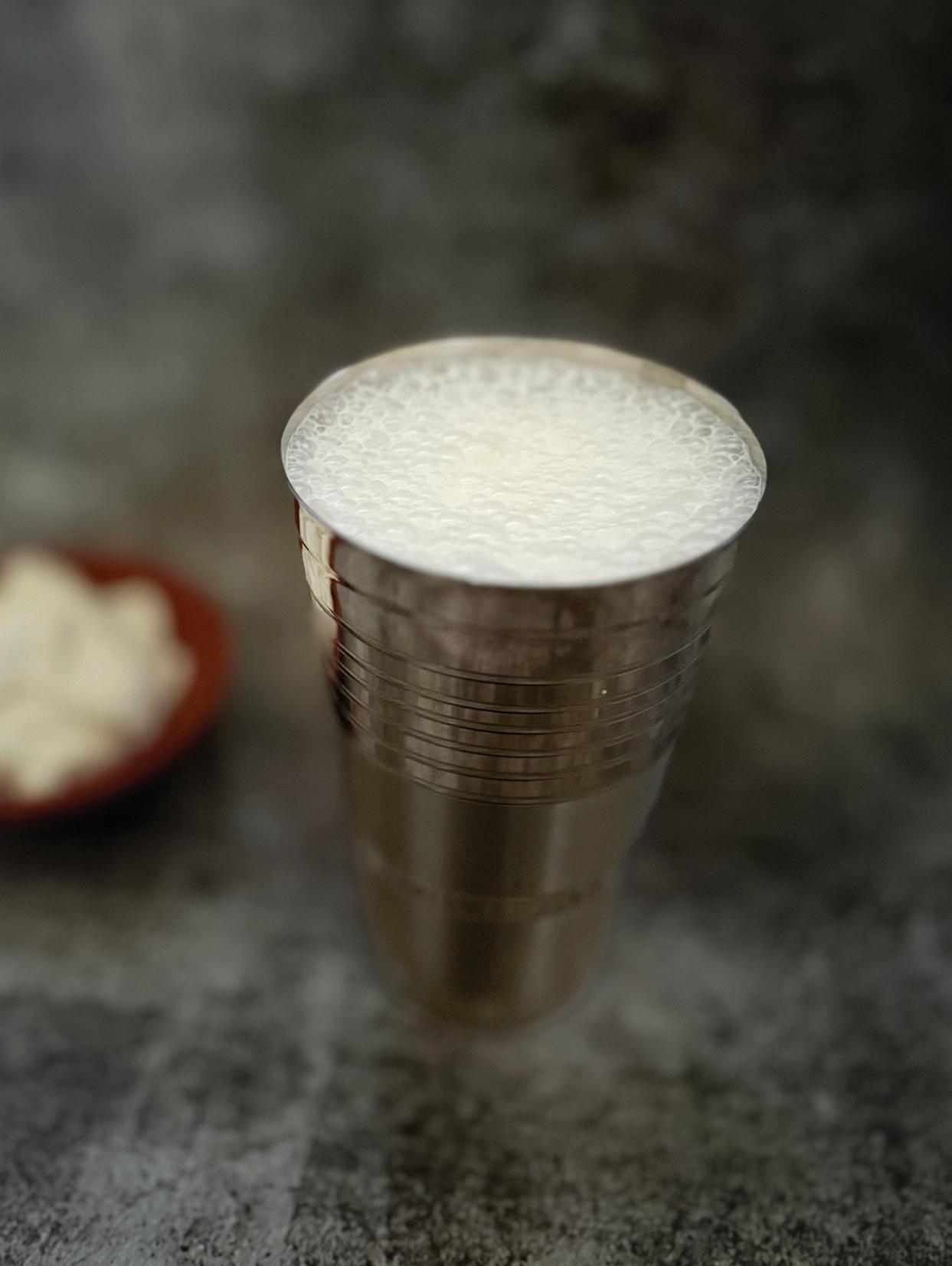
In the village, Lassi is traditionally made with buttermilk, however, everyone’s recipe for Lassi (pronounced Lah-see / Lu-see) is different. It begins with milk from the farmer’s gate – fresh milk which is natural (i.e. unhomogenised and unpasteurised), so the cream and milk are not blended. Since, from this natural milk, most homes will skim off the cream and then boil the milk (to deal with any bacteria) and then make their own yoghurt, butter (with the buttermilk as a byproduct), their Lassi recipe will usually be using some, or all, of these.
In the U.K. we normally made it with yoghurt, which is slightly thinned with milk. The key thing to remember is that this is always frothed heavily before serving – a Lassi should always be frothy! The measurements below are a rough guide, as this is normally made in great big pots, and would feed the whole household. The amounts below would make one big glass…
Ingredients
1 cup of Yoghurt
3 – 4 tablespoons of Milk
Sugar, to taste (a couple of tablespoons or so)
A pinch of salt (grab a pinch between your thumb and index finger)
Method
Take 2 large stainless-steel jugs (or plastic ones) and put all the ingredients in one of the jugs. Now, pour the entire contents into the empty jug, starting with the jugs quite close together and then lift the first jug higher and higher so that you end up pouring from a great height – do this carefully but also quickly. This mixes as the ingredients together properly and froths the Lassi correctly. Pass between the 2 jugs for a total of 10 times (or so) – you should have a nice froth on the top.
Tip: If you don’t have a froth, or very minimal froth, it means you are being too careful/slow in your pouring from one jug to another, in which case, pour a few more times, but really focus on confident pouring and lifting the 1st jug from as greater height as you possibly can.
In contrast, the daytime snacking made up for this breakfast hunger.
As returning visitors we were required to visit every relative and distant relative in the area. This meant drinking copious amounts of Cha and platefuls of snacks and Mithai (the Indian word for sweets), which were laid out in our honour at every single house that we went to visit. A huge array of food would be brought out – plates and plates of savoury and sweet snacks, dips & chutneys. I only had eyes for the Mithai and my hand reached out endlessly for these. There would be such a number of people and so much food and everyone so busy chatting that no one noticed how much I scoffed…a consequence being that I would be stuffed and unable to eat dinner!!
Another consequence was that I returned half a stone heavier and immediately placed myself on a diet.
It felt as if we went to many houses, where strange and unknown people would smile and stroke our faces and my parents would explain how we were related, but it was mostly a blur…however one visit stuck in my mind forever.
We went to visit a house and… at first, there was no difference between all of the other visits. My mother had disappeared for a while, and so I went to look for her, and found her with a woman who was crying. My mother was hugging her and speaking gently with her. I asked my mother what was wrong, and she explained that this woman was the first wife of a man who had left Punjab, as had my father, leaving his wife with his parents…her in-laws, on the promise to send for her when he had settled in a new life in America.
Then, to my disbelief, (as I shockingly later learned so many men did) – took another wife in America and abandoned this woman in Punjab! This woman remained in the home of her in-laws as a semi-servant, childless and therefore with no status, unable to have her own life or re-marry.
Add image?
I felt a mixture of disgust, combined with enormous pity for the plight of this poor woman. Years later watching the ‘West is West’ film, where such a scene is portrayed, I had a recognition of, and admiration for my father, who so very easily could have done this, but had not done this, and did not abandon my mother, even against the insistence of his parents to do so. He told me that on one of his return trips on leave from the Navy, his parents had told him to leave my mother and take another wife, and he told me that he said…“you married me to her and I will stay with her”. Of course, he was by now longer the small 16-year-old child ‘press-ganged’ into the navy to provide income for his father. Now he was a man and if they could not persuade him, then they could no longer force him.
One of the reasons for this dislike of my mother was because she failed to produce children – her only value of course! During these 11 years of her unhappiness in the home of her in-laws, being childless, my father being told to discard her and take another wife - the thing that surprised me was… if my father was away in the navy for extended periods during that time, then it’s a bit of no-brainer as to why she didn’t have children! It did in actual fact turn out be an issue that needed a minor medical procedure, and once she joined my father in England was able to have children.
Another of the possible reasons was explained to me by my father, when I later asked him why there had been such dislike between my grandmother and my mother. He pondered and said quite thoughtfully, (I caught him on a reflective and pensive day), that he thought it was because my mother came to a much poorer house with unrefined habits and he thought showed her disgust at some of the practices. My father said that he thought that his mother thought this new-daughter-in-law to be snooty and stuck-up, thinking she was better than them, with her refined ways and manners, and so the two women, from opposing backgrounds and classes looked down on each other. However, my grandmother had the upper hand and as my mother recalled, made her life a misery.
Of all the visits we had to make on our trip back home to Punjab, going to many houses, my main memories are firstly of this abandoned woman and her situation. Secondly, the great satisfaction, (but not on that day), of eating delicious Indian sweets.
Indian sweets are rich, heavy and filling – protein, fat and sugar laden. Not a simple process to make and often multi-stage and garnished with nuts, and silver leaf. The two sweets that mostly contributed to my holiday weight-gain were Barfi (bur-fee), & Besan! (beh-sun) - to be eaten sparingly and occasionally, unless you’d like to very quickly gain a few pounds!!
One of the lovely things about them, is the way they can be changed by the addition of nuts and other ingredients.
Besan, which is my absolute favourite, has the added advantage of naturally fitting so many dietaries, especially gluten-free, and is just as wonderful if the ghee is substituted for a neutral oil, making it naturally vegan and dairy-free. It’s very important to note that Punjabi food is not altered or adapted to make it fit a dietary but naturally has a lot of variety.
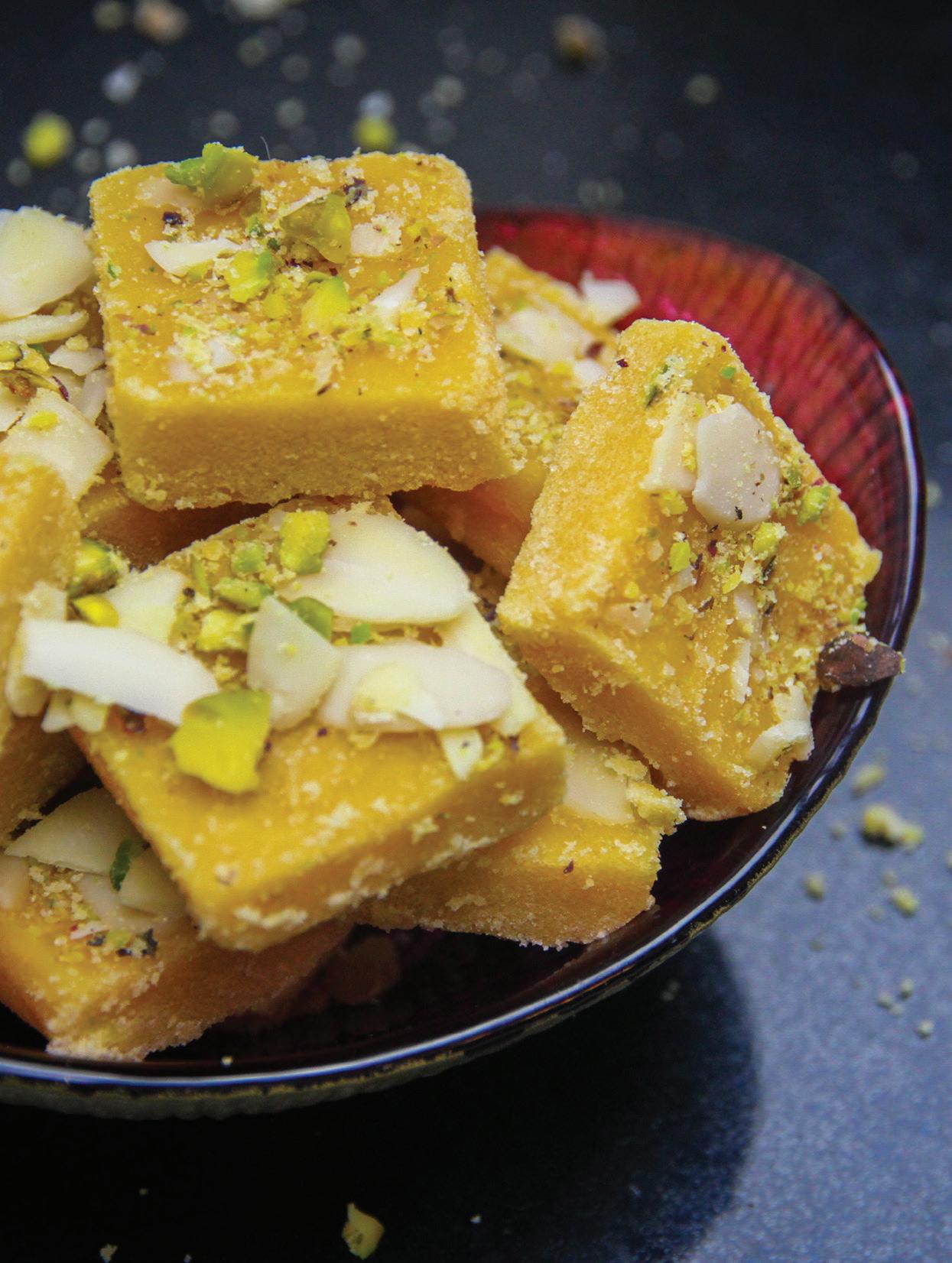
The ratios for making this delicious crumbly fudge are really easy to remember as they are 1:2:2 ratio –one part fat, to two parts flour, and also two parts sugar. If you avoid or can’t eat dairy, then sunflower oil is the best substitution. The sugar must be caster sugar – if you swap it for icing sugar, you will have no texture to the finished fudge. If you use granulated sugar, it will be gritty.
Ingredients
50g Ghee
100g Besan (Gram flour)
100g Caster Sugar
Method
Optional extras
Handful of crushed pistachios
Handful of crushed flaked almonds
Dark chocolate
Gold or silver leaf
Melt the ghee (or warm the sunflower oil) on a medium to high heat. Once the ghee has melted, add the gram flour – the flour should lightly sizzle (only lightly) as it is added – this means correct the temperature has been achieved.
Stir the ghee and besan thoroughly so that it is all incorporated.
Stir the mixture over a medium to low flame for just over 5 minutes, stirring constantly to ensure the mixture doesn’t burn. You want to cook the mixture without letting it brown. It is helpful to have a tablespoon to hand, as the mixture can coat the main stirring spoon, so scrape it down every so often to ensure it is all cooking through.
After about 6-7 minutes of cooking the mixture, you will notice that the texture will change from a crumble-like texture to more of a peanut butter texture. The smell will also start as a raw smell and become sweet. Once the mixture loses its crumbly texture and looks like glossy peanut butter, add the sugar and mix well. Taste the mixture - there should be no bitterness at all to the taste. If you have a slightly bitter aftertaste, then carry on cooking over the medium heat for 5 minutes, and taste again.
Once the mixture has a completely sweet taste, transfer it into a shallow, wide dish. Using the back of a metal spoon, smooth the top of the besan and sprinkle over the crushed nuts (if you want to use these).
If you used ghee in the dessert, allow it to set at room temperature for an hour. If you used oil, refrigerate for an hour or two, or until the besan has become firm. Cut into squares and serve.*
*If you prefer, you can roll the dessert into little dumplings (which are called 'Ladoo’s' in Punjabi, as seen in the picture above). Do this by taking an extra 1/2 teaspoon of ghee (or oil) and let it gently melt between the palms of your hands.
Take a tablespoon of the mixture at a time and squeeze it between your hands to press it into a round. Then gently roll this in your hands to make it into a smooth dumpling (Ladoo). You may have to regrease the palms of your hands every third Ladoo or so, if you have difficulty getting them to press into a round.
Once you've rolled all the Ladoos out, let them set. Again, if you used ghee, let the dumpling set for an hour at room temperature. If you used oil, put the Ladoos into the fridge to become firm.
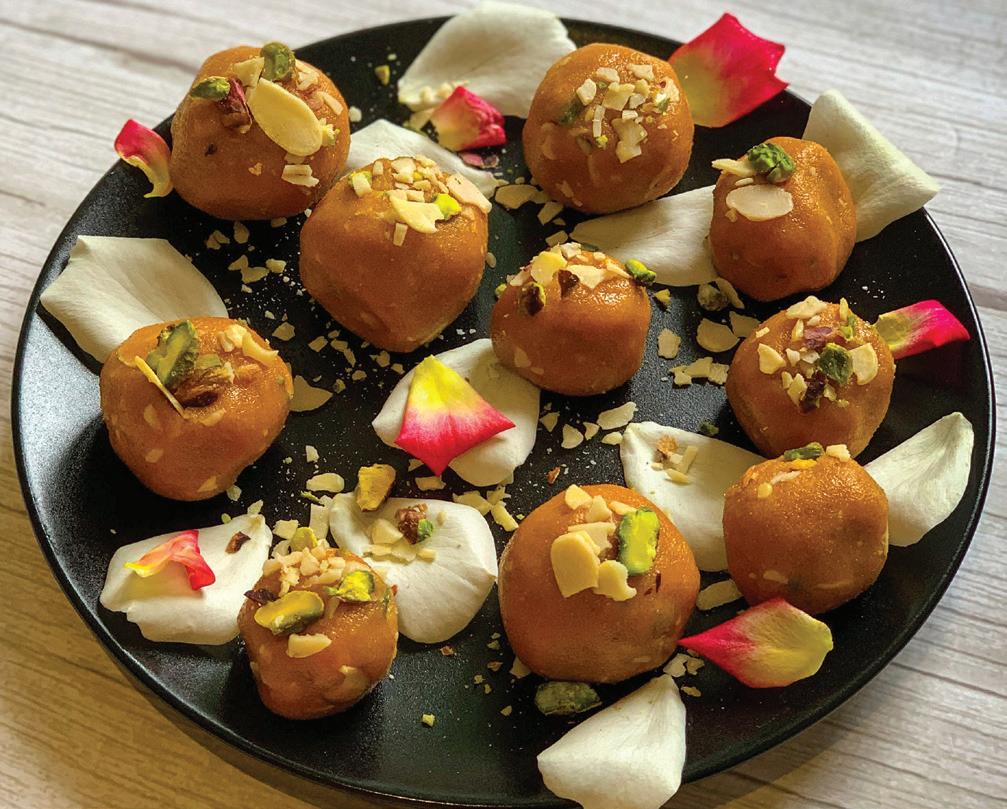
If you set the besan into a tin (double lined with cling film), you can top it with melted dark chocolate (it must be dark and not milk chocolate) and sprinkle the flaked almonds and crushed pistachios onto the melted chocolate.
Put the tray into the freezer for one hour to set.
To cut squares: Using the cling film to help you, take the chocolate covered besan out of the tin, and turn it upside down, so that the chocolate layer is now underneath. This way you don't squash the besan layer.
Keep in the fridge until serving.
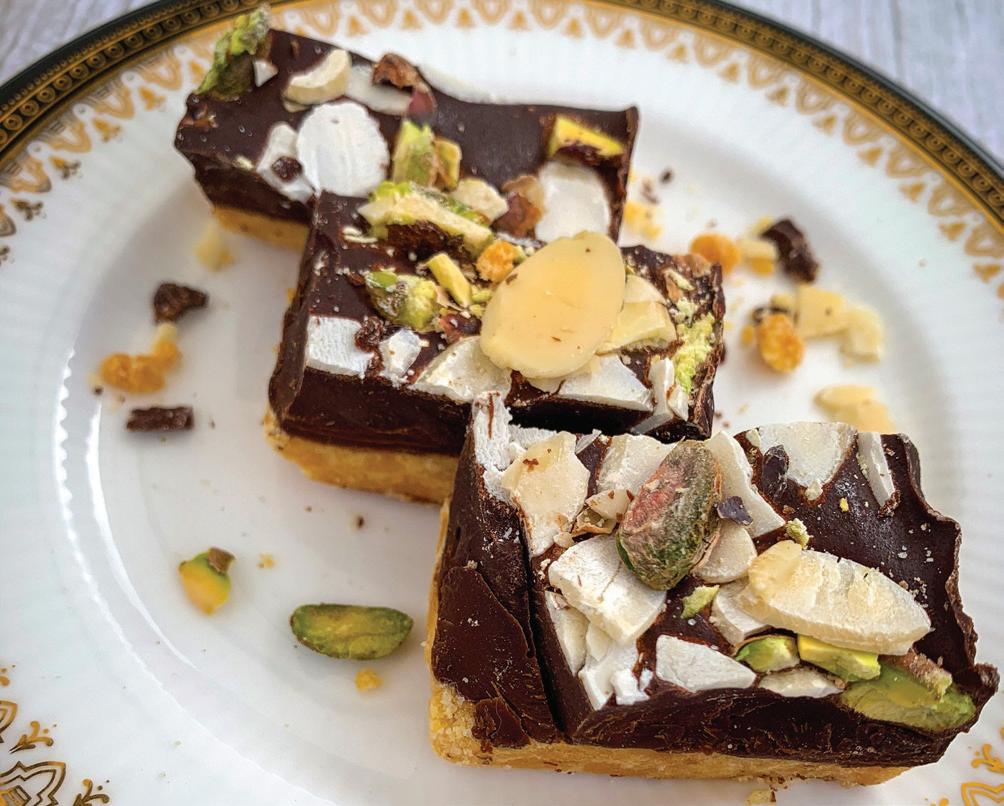
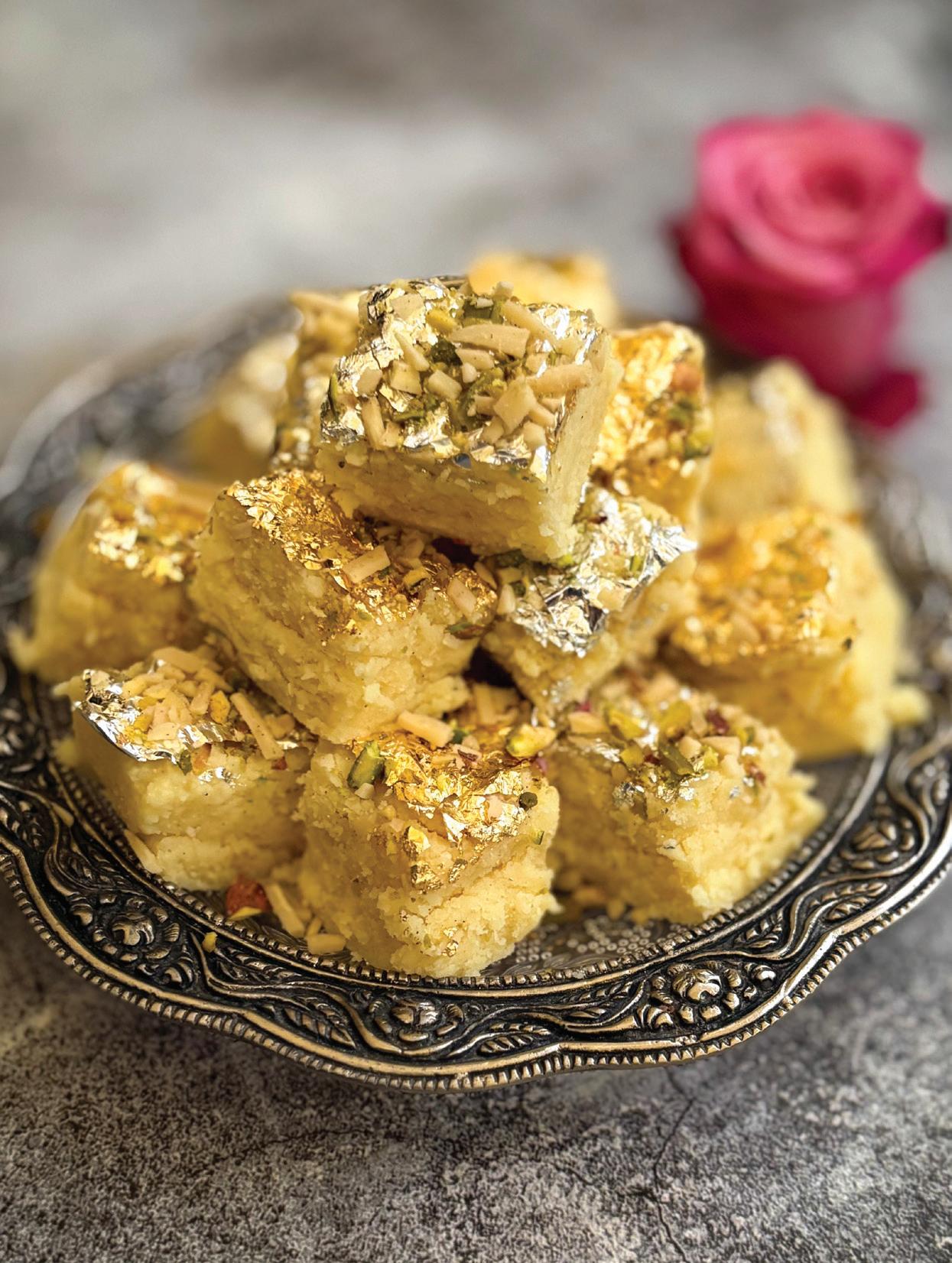
This milk-based fudge is very moreish but try to exercise restraint as it is filling! The addition of gold or silver leaf is normally for special occasions, but it really does look beautiful!
Ingredients
225g Granulated Sugar
225ml Tap Water
225g Milk powder
2 Green Cardamom pods
Garnish of crushed Pistachios and flaked Almonds
Optional addition of gold or silver leaf
Method
Put the sugar and water in a heavy based saucepan and bring to the boil.
Whilst the sugar is coming to the boil, lightly crush the cardamom pods in a pestle & mortar, to open them. Release the black seeds and grind these to a find powder (discard the outer green pod). If you don’t have a pestle & mortar, you can also put the black seeds into a zip lock food bag and use the base of a heavy based saucepan to crush them on the worktop.
Now that the syrup is boiling, fetch a cold side plate and fork. Dip the prongs of the fork into the syrup and drop the syrup on to the cold plate. You want the syrup to hold a ball shape for a couple of seconds and then burst. You may need to test it a few times to be sure.
Once it has reached this stage of holding a ball shape for a few seconds and then bursting, take the pan off the heat.
Add the milk powder and ground cardamom. Stir thoroughly until it is completely combined.
Line a dish or tin with 2 layers of cling film (or baking parchment) and press the Barfi into the tin using the back of a metal spoon - if applying gold or silver leaf, lay this on top first - and then scatter the almonds and pistachios. Allow to set for an hour and then cut into 12 or 16 squares.
A contentious issue in Punjabi culture, and really quite annoying, is the increase in the number of 2nd & 3rd generation British-born Punjabi children calling this Chai! It is not Chai…it is Cha!
Cha is the Punjabi word for tea. Chai is the Hindi word for tea.
Even more irritating is then hearing…Chai tea…meaning tea tea! Glad we’ve got that one straight!
Once again, we don’t strictly measure this – so these are a guideline. Generally speaking, 1 teabag will make enough for 2 mugs of tea.
Ingredients
1 teabag (black tea, unbleached teabags)
Milk to taste (always whole milk)
2 Green Cardamom pods
2 Cloves
2 pieces of cinnamon (something around 2cm per piece)
Sugar to taste
Method
Fill a medium sized saucepan with water (roughly enough to fill 2 large mugs) and put the heat on high.
When the water is on a high simmer, add the teabags and spices and place the lid on the saucepan. Bring the tea to the boil and when the mixture starts to boil over, lift the lid to pour the milk in to bring it off the boil…pour the milk into the centre, keep pouring until the milk clouds back into the centre.
Turn the heat down, add sugar to taste and simmer for a couple of minutes.
Before serving the tea, using a ladle, froth the tea to make sure the sugar has mixed
properly. To do this, take ladles full of Cha, lift them up from a height over the saucepan and pour them back in – do this 3 or 4 times. Pour the tea into your tea mug, with a tea strainer over the mug to catch the spices.
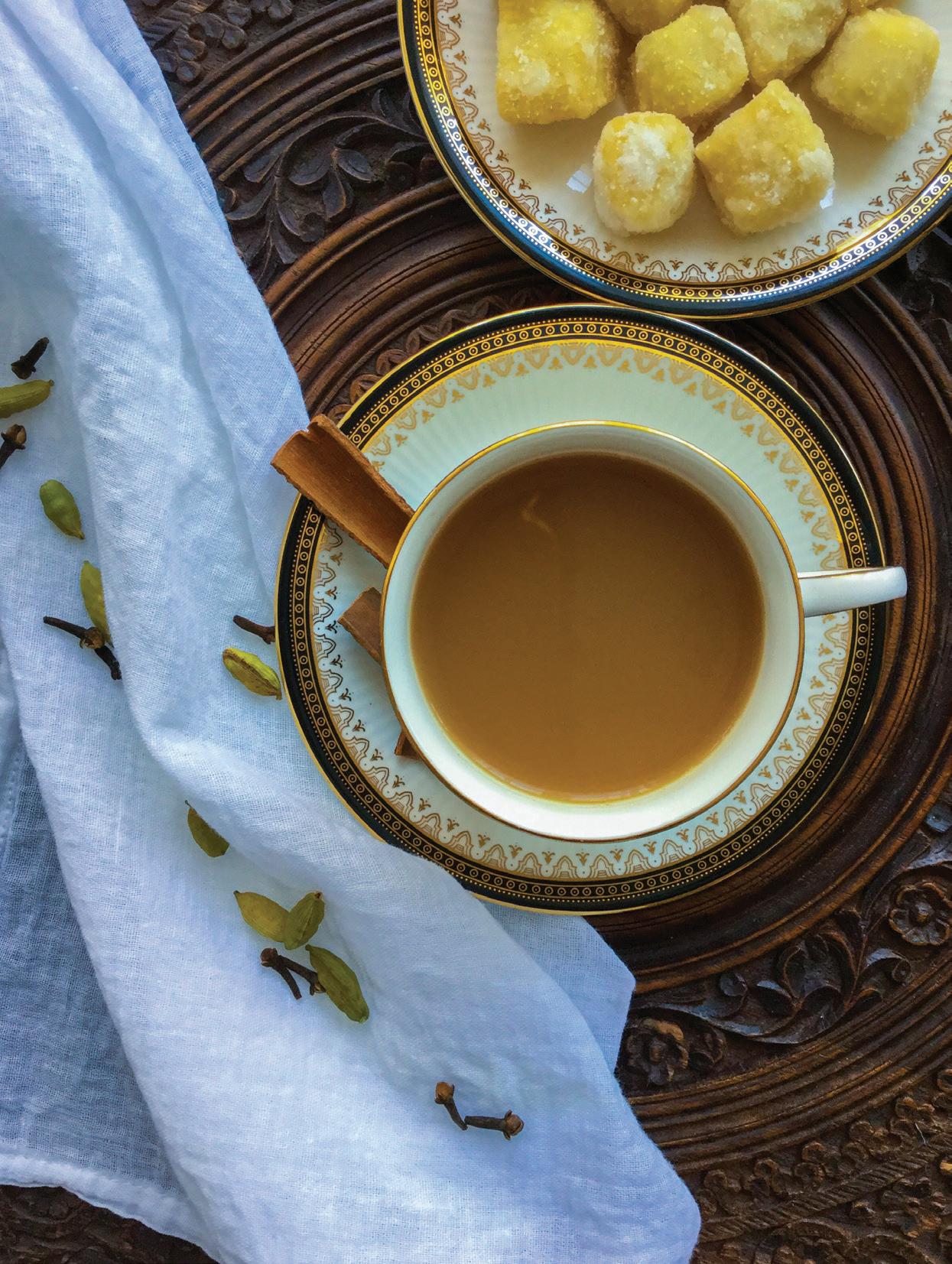
‘Love & money, or the love of money’
Further to the command of my paternal grandfather, my father sent home his Navy salary, which was used to support his family.
This was not unusual and something almost all first-generation immigrants did – money went back to support the family, to pay the education of his younger siblings, to pay for any of them coming over to new countries and to provide at that time, for the - now illegal - dowries for sisters.
I think it is something he would have done in any event, for all his siblings, and also helped in-laws.
He did all of this, and I know that when we went to visit his parents, he took care of financial arrangements for them and gave them money. I never thought anything of it and didn’t think it was especially a big deal. It never occurred to me to wonder why that money should be diverted from our family unit, and I never heard my mother question it. It was always a given that the profits of labour, being money, were primarily for the benefit of the family, not for personal gratification as the primary area of focus.
It was only seeing a different arrangement between western families who were squabbling over who owed whom, and how much… arguments over a few pennies or pounds were an eye-opener.
However, like everything I learned growing up in two worlds – both those extremes could be pretty bad. Resentment, bitterness, feelings of being cheated, and of being exploited were opened up more so on the Asian side...when the system didn’t work and it went wrong! Family love and the mixing of money really are a very delicate balance
Once, many years ago, an English builder doing some work for me, told me, as he was leaving, that he had to go and do an unpaid job for his in-laws. As he left, he said, “I hate love-jobs” –how funny, and what an expression, and what an oxymoron of a statement!
Food for Thought ...
Reflections on two cultures, ways & worlds
“Coconut”
Quite a new expression that came about in the UK around the time I was a late teenager, was a term used by some Indians if they thought other Indians were getting out of their place and behaving like a British person. This was mainly aimed at youngsters and particularly and especially, at girls who were becoming ‘jumped-up’ westernised girls, to keep them in their box and make them behave in a traditional way.
If a young Asian behaved in any sort of independent way, they were quickly called a ‘coconut’, which means to say, brown on the outside and white on the inside. I think it originally came about during Britain’s occupation and colonisation of India, , and a term directed at Indian civil servants who dressed and acted like the British.
It was and is a patronising assessment of one’s ‘Indianness’ and a term that is delivered by self-appointed guardians of the ‘Indianness’ quota and used to keep you in your place, for fear that their grasp or control will be eroded
It became clear that there was a claim to ownership of ‘Indianness’ and ‘Punjabiness’, mainly by males who for themselves wholeheartedly took advantage of drinking in pubs and dating ‘white girls, then shamelessly having the arranged marriage, and then, to their absolute and continuing shame, still dating said ‘white girls’.
This competition of Indianness and attempts to pass judgement had much deeper psychological aspects to it…fear being one and jealousy another. Primarily, the fear was of change but also fear of losing control. The more understandable fears were of losing culture and trying to preserve identity.
It’s a tough battle to retain one’s unique identity, collective culture and embrace and integrate with ‘foreigners’. The British in India as well as ex-pats worldwide, were as bad as migrants here for sticking to their own groups, clubs and societies. It doesn’t really matter whose land you are on – it’s the same primal instincts and base emotions that very easily spill out.
Guests in the Asian culture are traditionally revered, and the welcoming of guests is very important. Guests are honoured and it used to be that women of the house cooked snacks such as Matiyan biscuits and Chevdra (Bombay Mix), and different Mithai, and kept them specifically in readiness for guests, pre-the days of being able to phone and when it was fairly usual for visitors to drop by without warning.
Interestingly, the word for guest, which is Pronah, (pron-ahh) in Punjabi, is also the same word for sonin-law. How diametrically opposed that the arrival of a son-in-law meant special foods and pretty much laying out the red carpet, but a daughter-in-law was nothing special other than an extra pair of hands for household work.
The stark contrast between the value placed by a family on a son-in-law, and the low value placed upon a daughter-in-law, which increased if she were childless, never mind having complete non-status and total devaluation as a widow – historically reduced to being a cleaner and servant for the husband’s family.
The change in the status of young girls was just starting. Fashion and style and young beautiful girls (the young are beautiful), interest in them, was just the same across both countries– I looked through the movie magazines such as Stardust with the new cousins I met in India, only to read the same magazine in England, when we went to relatives in London.
As we were packing and leaving to go back to England at the end of our trip, a younger 2nd cousin arrived at our house in the evening – she spoke to my mother, who came towards me smiling to tell what the girl wanted. She wanted to ask if she could have a pair of ‘bell-bottoms’ the fashionable western trousers we were wearing. I was surprised that she was allowed, but she was, and they stayed in Punjab with her… they were a cool mint green!
The structure and hierarchy of the family and extended family was very interesting to me, especially going back to rural roots. It wasn’t just a contrast between east and west, but also between city and countryside.
Food for Thought ...
Reflections on two cultures, ways & worlds
‘Good for the blood… sugar’
One of the things I noticed was the way in which the very sweet and very ‘heavy’ Indian Mithai were consumed. Usually, a small square after a meal would suffice and because they are so very filling, not much is needed.
I remember as a child having what would be the English equivalent of fudge, usually pink and white and almost pure sugar. It was delicious, but at the time, I didn’t realise the difference…it was nutrient deficient, or ‘empty calories’, with very little nourishment.
Indian Mithai on the other hand has a completely different nutritional make-up. It’s not just sugar and ghee or butter. Many of the traditional Mithai are made from ingredients that are naturally rich in protein, healthy fats and essential micronutrients.
The nutritional goodness and high protein content of Besan, (Chickpea flour) is the base of many sweets – Ladoos and some Barfi, and has iron, fibre and plant protein. Some of the mithai use lentil flours, semolina or whole milk, which is a world apart from the refined sugar of western sweets.
Dairy is used in abundance: milk, paneer, yoghurt and they provide calcium, protein and fat-soluble vitamins. The nuts such as almonds, pistachios and cashews add real depth of flavour, with protein, healthy fats, minerals, and finally the spices such as cardamom and saffron or cloves, which provide antioxidants and digestive benefits.
The blood sugar high of the empty calories of Western fudge of pure sugar, compared to the slow release of the Indian Mithai means a much slower and steadier release into the blood stream, and make this biased preference on my part, a no-brainer…just saying …don’t shoot me…
One of the reasons that we went to India was that my father wanted to get that trip done as he had plans to open a shop on our return. Asians were becoming known for the ‘corner shop’, which was ‘open all hours’. He bought the first small shop in our road, then the one next door, and then the one next door to that. One had previously been a greengrocer’s shop, and I recall that the other two had been some kind of small shop.
Once he had acquired those three properties, he set about doing what he most loved to do with property… knock down walls and build an extension – the bigger the better.
Whenever he saw a building or room, he would always want to knock down the walls and generally open up any space that he could. I don’t know it this was coming from the open-air living in Punjab with vast open spaces. Houses having a large courtyard, and the kitchen having an opening to the courtyard, instead of the fourth wall? The typical layout of British terraced housing was quite tight and ‘walled-in’ and probably felt quite restricting. It wasn’t just a peculiarity I noticed in him but in most Punjabi people we visited in England – they had all, in some way, extended their houses or knocked down internal walls.
When my father talked about this shop, one of the things he always said, was … “people will always need to eat, people will always need food – no matter how rich you become, and what else you don’t need, you still need three meals a day”.
He set about getting the necessary planning to extend all three shops and so ended up with a vast space which housed our supermarket, which after a family meeting to consult and deliberate on a name for the shop, he disregarded all input and pronounced that the name should be ‘Fairdeal Shopping’.
In true ‘Father Hothi’ style he had to do it bigger and better than everyone else, and that we were soon to discover would include the opening hours. Builders coming and going, and all sorts of activity were going
on as the rear of all three buildings were removed and extended, not just outwards, but also three storeys upwards. Meanwhile internal walls were being removed and the internal shopfitting process underway in the planning. Deliveries were coming all the time and plenty to be done.
One day I remember standing at the back in the new rear extension, high up above was an open section of roof, where two builders were manoeuvring a steel girder. Lots of people were there and I had papers or a clipboard doing some kind of stock admin task. I’m not sure how it happened, (and health & safety would have been very relaxed back then, to the much stricter rules now), and that section should and would have been cordoned off nowadays, but it wasn’t. Somehow the two men dropped the steel girder directly over my head from the roof above.
At exactly that moment, busy with whatever job I was doing, I stepped aside to reach for something. Suddenly next to my feet, there was an almighty crash and the whole building shook as the steel girder fell to my side. The clanging and reverberating from this huge steel bar shook the building. I looked up to the open roof structure above to see the faces of the two men. Their expressions said it all – my third near death experience, and once again I didn’t even feel it – but looking at my father’s face – he did! I’m not sure what he did or said to those men, but I wouldn’t have wanted to be them. I wasn’t especially bothered and carried on with my work.
As building works were nearly done, my father announced that we would open our new shop at 7am in the morning and close at 10pm at night, apart from Sunday (because at that time, Sunday opening was limited to 10-4pm), and this would be 7 days a week. The only day we would close was Christmas Day, (and if he could have opened that day he would have). I think, had he said that in these times, there would have been mutterings about work/life balance, time-off etc but we didn’t even think about that – he said it, and so it was.
Consequently, most of my A-level revision was done on the shop till, with the exception of the Indian trip, pre-the shop, when it was done on the go. However, this was only probably a small factor in the fact that I didn’t do very well. I was just plain bored throughout the process of A levels, and did the minimum of schoolwork, which I used to think was the lazy streak that I have nowadays managed to squash. This was because teachers told me I was lazy. This wasn’t true – in fact I was acutely and chronically bored!
As our supermarket opened from 7 am in the morning till 10 pm at night, 364 days of the year, so it was a requirement that after school and at weekends, we had to work.
Growing up in an Indian family, there was no exchange of money as such. If I wanted something and my parent thought I should have it, then money was no issue. With free access to any amount of stock, and parents who were generous in the giving of material things like clothes & food, temptation was all around me. Thankfully my parents’ concerns with weight and obesity kept this all in check…one day idly sitting on the till reading a magazine, (I had a veritable library of trivia to read from the magazine racks, being very careful to keep it clean, and return for sale on the shelf), it was my turn to be on checkout. I
idly reached for a bag of chocolate Maltesers. Then another… and then… another – just small bags you understand. Absent-mindedly, my hand reached out for yet another…4th bag, when a voice interrupted my chocolate reverie….”my god!’’ I heard…to turn and look at my father looking at me laughing and feigning mock horror! “you pig”…I sheepishly returned 4th bag to its rightful home – note to self – don’t be a piggy!
I always remember a customer coming in the shop quite late one night, around 9pm, and I had my books out on the counter. He asked me what I was doing and I told him my A level work. His reaction was quite severe and both surprised and amused me.
He was almost outraged, which took me quite by surprise as it wasn’t his business! I remember him saying something about how terrible it was that I was having to do my schoolwork while working on a shop counter late at night on a school night. I was quite bemused, as well as amused at his western indignation. How did he think immigrants progressed? With hindsight, he was probably right, as it wasn’t conducive to good results, though it was fine for just getting homework done!
I did the usual thing during A-levels which was to apply to go to university but truthfully, although I sort of thought I did want to go, (because that was the conditioning that we all did go to university), a big part of it was the opportunity for the freedom to be able to legitimately leave home. Indian girls could not leave home before marriage, and the only exception was to go to university.
One day I was working in the shop, it would have been the summer holidays because it was the daytime, so I wasn’t at school (and I never missed school).
It was before my father was aware of my complete and spectacular lack of effort and ‘soon to be announced’ bad results in 2 of the 3 A levels, (good result in English, because that was easy and didn’t require much effort, plus I had a good tutor, arranged for me by my father, because I had explained to him that the A level English teacher was terrible -she was!)…
…and so it was, before I was in my father’s bad books, there was an occasion where a marriage was unexpectedly arranged for me, and this came about by chance.
It was a hot summer’s day, and I was working alone, at the shop till, behind the counter area. Several cars - three or four maybe - pulled up outside the shop, with…an unfamiliar sight in white Southsea… a party of Indian people!
Now this type of convoy for Asians was not unusual in those days, though mostly seen in less nonimmigrant areas. In fact, occasionally and suddenly, several carfuls of visitors would descend upon the house which would always cause some panic as everybody scuttled around quickly, and my mum would quickly order us to make tea and produce snacks or something to eat.
Indian households back then, and still today will keep food - snacks such as Chevdra, (pronounced Chébrah, known as Bombay mix), or Matiyan, (pronounced Mutt-ee-ahh, a flaky type of biscuit), pre-made in batches and stored in tins, to be able to serve unexpected callers.
On this particular day, my father was away on a business trip. The cars had obviously called at our house, which was in the same street, to find no one in, and so had driven down the road to our shop. Two older gentlemen came in and had a younger male, who was about my age, and standing behind them. They spoke to me enquiring whether my father was home.
I recall that I was my normal self with them. I didn’t really think much of it but was very polite as I always was when I spoke to anybody and explained that.my father was away for the day, and I would be sure to give him the message that they had called and went through all the pleasantries and smiles. They all smiled and departed, and I thought no more of it.
Upon my father ‘s return that evening I gave him the message that these people had called and of course he knew who they were and if I recall correctly, gave them a call on the old dial up phone.
A few days later on I learned that the conversation that took place between these friends and my father was that the young man, who was standing behind the older men, on leaving the shop walking back to the car with his father and his uncle, had said to his father, “I want to marry that girl”.
Thereupon my father, his father and obviously with the young man in the know, set about making the deal. The next thing I knew, I was informed that they were coming to visit and as always there were about 8 to 10 people that would arrive in convoy.
To say I was not happy would be an understatement and my face was like thunder, however I couldn’t really say much and had to be there all present and correct and wearing whatever outfit I had been instructed to wear.
My father was in an extremely jovial and relaxed mood. He was very pleased with himself and chatting with his friends. Now the young man had a brand-new Mercedes, (THE car of choice for Asians, along with BMWs), and it turned out that these people were, according to my father, millionaires, having done very well in property investments I believe. This probably explained the buoyant and celebratory mood of my father – he was already thinking ‘ka-ching’, the £££ signs showing in his eyes, and therefore supremely confident that this moneyed deal would of course be something that would sway me. How could I not want all that money? Error No 1.
The conversation led to talking about the boy’s brand-new Mercedes car and about showing me the car, and then my father made the suggestion of the young man taking me out for a drive in the swanky new car. Now the father of the boy was surprised at this offer and stated, that of course he would
never expect or presume that I would be allowed to go on my own in the car with this boy…his son, unaccompanied.
However, my father wished to show an indulgence and magnanimity, that he was a modern man and of course it would be absolutely fine. He was in a confident mood and said…“no no no… of course absolutely fine… no problem! Let the young people go for a drive and get to know each other”. He was keen to show that not only did he trust them and their son, but he had also assessed the boy…as had I... no risk there!
He also probably calculated that, let me get chauffeured around and chatting with the young man, and I might become all starry-eyed at the prospect of having this lifestyle…, and most hopefully, be swept off my feet by the expensive swanky car and the prospect of oodles of cash to fund my shopping habit!
So, it was cordially agreed that the young man and I should go for a drive. Error No 2.
I silently followed the young man and got into his brand-new Mercedes. He started to make conversation and as he was speaking, regardless of what subject he brought up, no matter what he said, I made sure to take the opposite stance and to be as objectionable as I possibly could. I contradicted everything he said, and I was as outright rude and unpleasant and aggressive as I could be. He endured about 30 minutes of this unpleasantness, before he cut short the drive and we made it back.
When we returned to my house, my father opened the door, and the boy… by now quite ashen, entered the house first, and walked straight back into the living room without a word. I followed in behind him, but as I entered and went to walk past my father, he stopped me, and looked at me, having noticed the less-than happy, face of the young man, and said to me, in a slightly embarrassed, but also faintly amused and intrigued voice…in exactly these words… “What did you do to him”?
I just looked at my father and said very coldly “well, you shouldn’t have left me alone with him”. And walked on past him. My father didn’t’ reply. He didn’t even look angry. He just looked completely unprepared and at a loss.
The family left quite quickly, and strangely nothing was said. There was no Spanish inquisition from my father, just the strange and silent void of nothing being said or asked.
I did my usual escape to my room.
The next day my father received a phone call from the family, to say that they would not be proceeding and that they didn’t think it was a suitable match.
As my father walked into the main family living room having taken the call in his office front room, he delivered the news in a quiet, matter of fact, and almost resigned way, as he looked at me with a sort of amused exasperation. There was almost a part of him that admired my defiance.
I grinned.
Once A Level results came out, I hadn’t done enough to get required points for university and ended up applying for an external degree at a college. This still required living onsite exactly like going to uni. There was a conversation between my parents about getting me a car so that I could commute daily between Portsmouth and Southampton. I then said I wouldn’t go if I couldn’t live in ‘halls’.
My father was absolutely set upon my gaining a degree, so he agreed once he had discovered that the hostel was ‘girls only’, and because most of the courses were teacher training, it was probably an overall intake of 80% female, so this swayed him, and it was agreed I could go in the September.
I was elated!
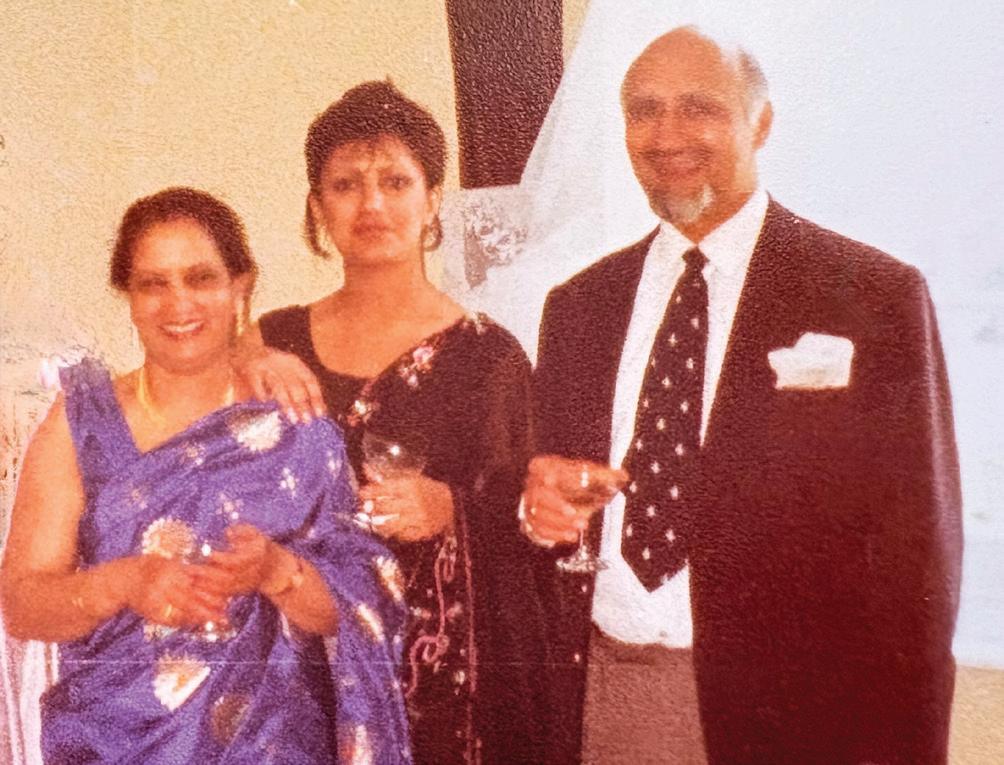
Add text / image?
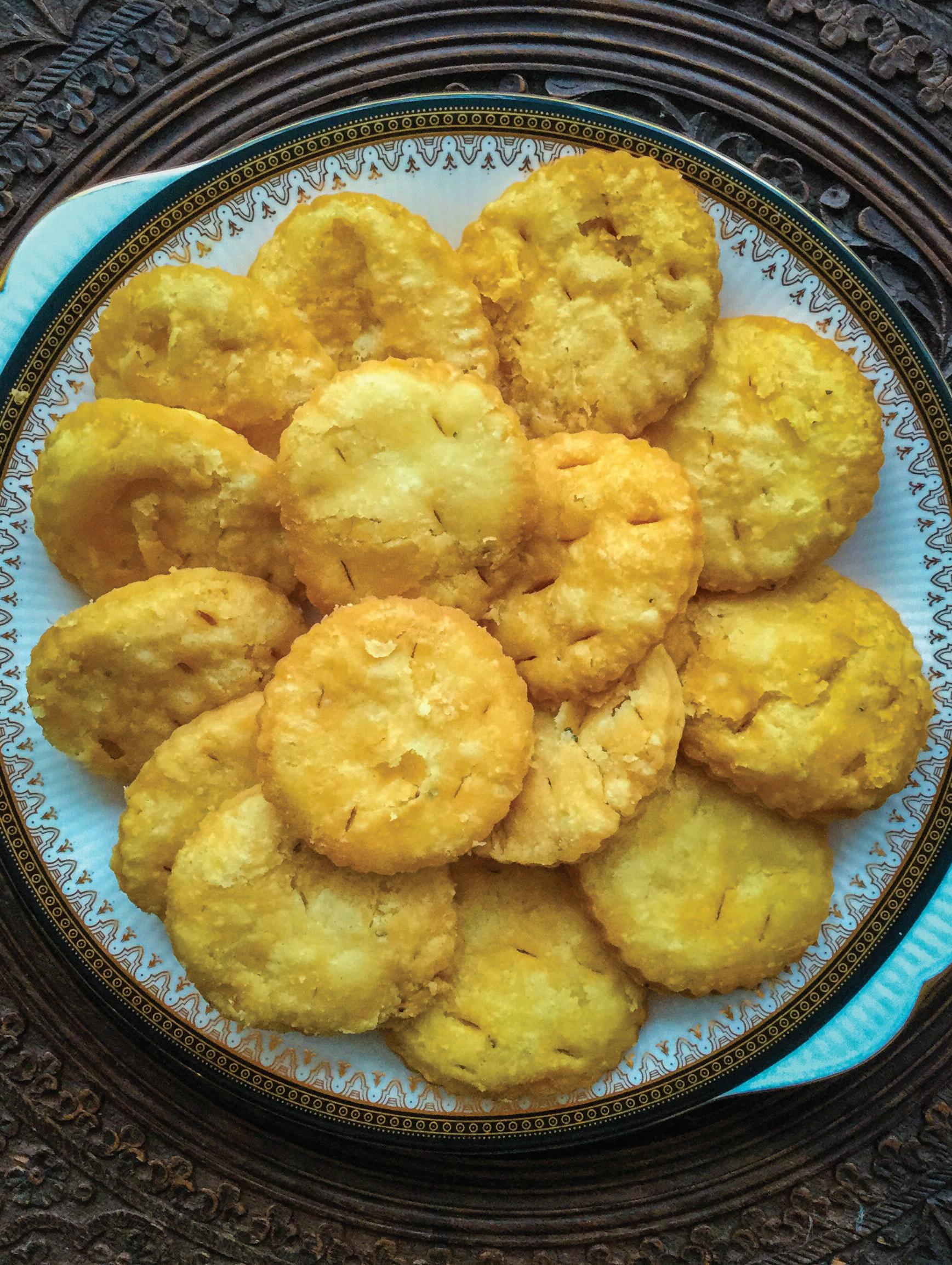
My mother made these biscuits quite frequently when I was small, probably because of my father returning home from his 7 days on, 4 days off shifts at Heathrow. They have a really lovely aroma, and the savoury ajwain flavour is just delicious. We started making them for some of our Pure Punjabi private dining and wedding bookings and they are a wonderful variation and addition to the biscuits on a cheese board. You will also see them called and spelt differently: Matiya, Mathri or Mathari
Ingredients
225g Maida (plain flour)
½ teaspoon ajwain – Caroway seeds
¼ teaspoon black pepper
½ teaspoon salt
125g butter, salted (and must be room temperature)
1/4 green birds eye chilli, finely minced
Approximately 40ml water (tap water is fine, and room temperature) Sunflower oil, for frying
You will also need a cookie cutter to make these. The one we use is 8cm wide (at the widest part).
Method
Put the flour, ajwain, pepper and salt into a mixing bowl. Cut the butter into cubes and add it to the mixing bowl – rub the butter completely into the spiced flour with your fingers, in the same way you would make crumble topping.
Now add the water, a little at a time, until a dough has formed - you may not quite need all the water.
Note: Do not over handle the dough once it has formed. Like most forms of dough/pastry, you want to keep it as cool as possible and don't handle it needlessly once it has come together. Avoid holding it too much in the palms of your hands, try to keep it in the fingers as there is less heat in the fingers.
You do not need to let the dough rest at this stage (we will do that later).
Roll it out to approximately 7cm wide and roughly 3mm thick. Take your cookie cutter and start 'cutting' the Matiyan. Once you 'cut' as many as you can, put the left-over dough back together and re-roll it out to 3mm thick and 'cut' as many as you can again (you may need to do this process a third time).*
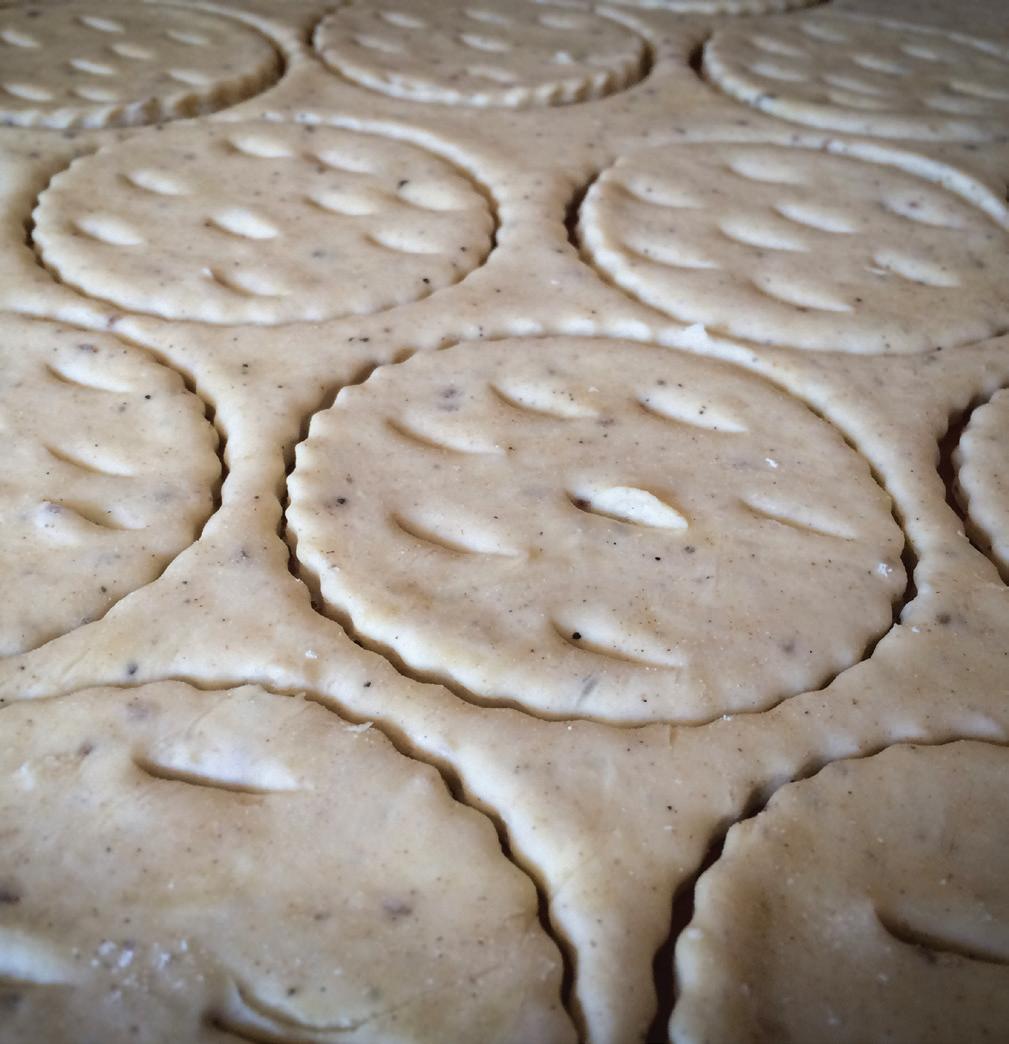
*If you have a little piece of dough left over at the end, keep this for testing the temperature of the oil).
Once this has been done, take a knife, and make little incisions in each uncooked Matiyan. This allows them to cook properly when frying.
Put them on a plate and put the plate in the fridge to chill for 20 minutes before frying. Like any dough, you do not want them to be too warm before cooking them. As you put the uncooked Matiyan in the fridge, pour some sunflower oil into a wok or saucepan, and warm this over a medium flame (approximately 180 degrees celsius), as this should take rough 15 - 20 minutes for it to warm through and reach the correct temperature
Note: you can slightly overlap the edges of the uncooked matiyan on each other, but don't stack them in one single pile one of top of the other
After roughly 20 minutes of refrigeration time, the oil should be at the right temperature. Take the piece of left over dough and drop a marble-sized piece into the oil. It should sink to the bottom of the pan/wok and then rise back up and bubble/fry (not ferociously, but at a regular & steady pace)...when you see this, the oil is ready. If you put the piece of dough in the oil and it sinks to the bottom, it is not warm enough. Leave it for a couple more minutes and then test it again.
Now that the oil is at the right temperature, gently lay the uncooked matiyan into the oil to fry. They will take around 5 - 6 minutes to cook. Whilst cooking, you will need to turn them over every couple of minutes to ensure both sides cook evenly. Once they are a golden-brown colour, they are ready to be drained - the better you drain them, the lighter and flakier they will be. Use a slotted spoon to take them out of the oil and shake well to remove excess oil and place on kitchen roll to drain. Allow to cool and serve.
Note: Matiyan will store in an airtight container for a week or two
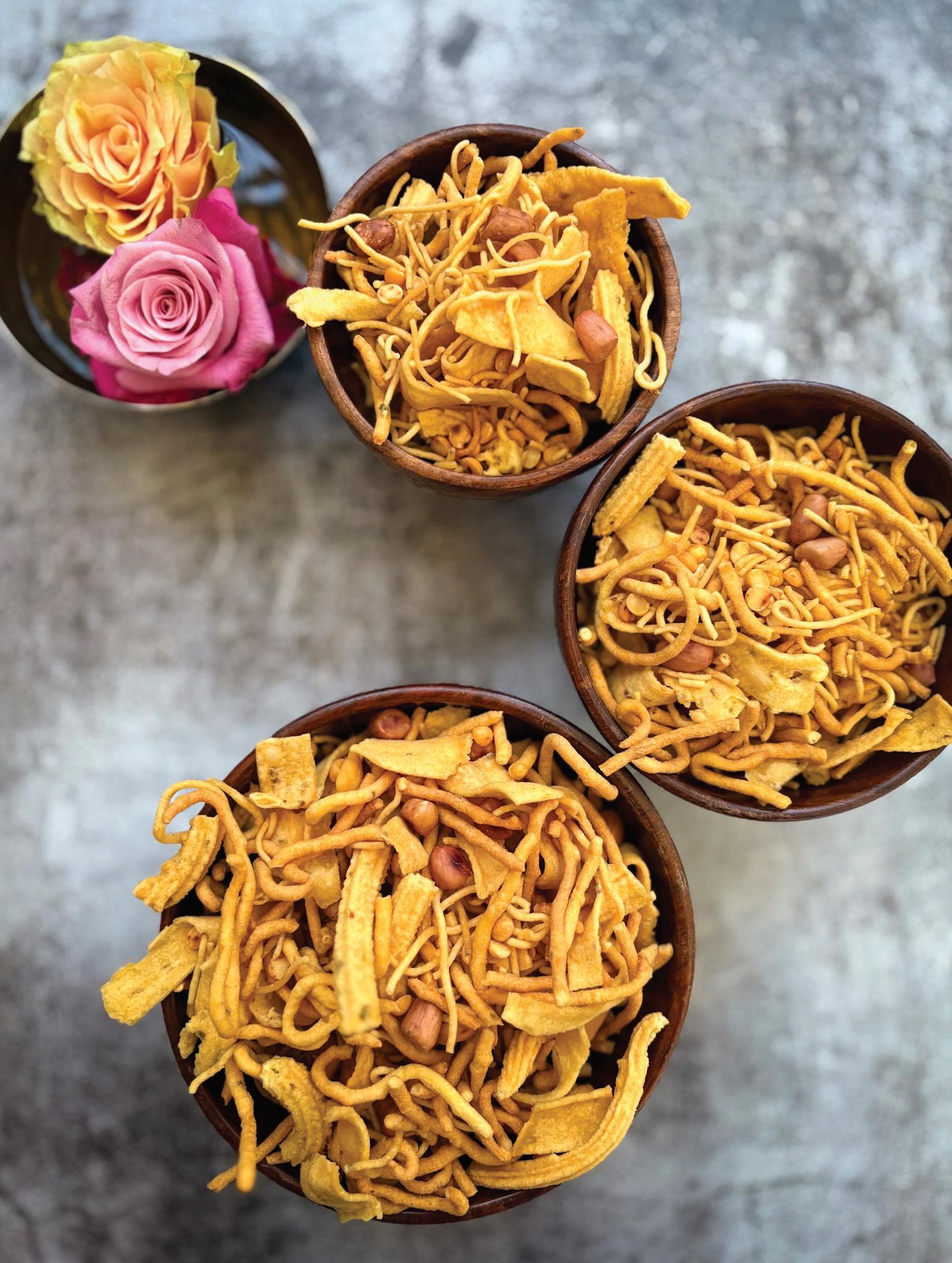
This is pronounced as Ché-brah and was another snack food made regularly by my mother when I was small and we lived in the guest house. I was fascinated by the old-fashioned, heavy brass gadget she had for making the different strands and lengths of Sev, the long crispy shapes, where dough is pressed through the gadget, by turning the handle.
I would watch as she changed the plates so that she could change the shapes. It took quite a while to make all of the different items to finally mix and add them all together. She would finish, always by adding in the peanuts and this was also another bit I loved.
When she had finished and I had patiently waited, she would smile at me and would let me pick out the bits I liked…peanuts first!
Ingredients
1 bowl of besan/gram flour
(approximately 300g)
¾ teaspoon salt
¾ teaspoon ajwain
1 green chilli, very very finely chopped
Tap water
Sunflower oil, for frying (around 1 to 1 ½ litres, depending on the size of your Karai/wok)
Additionally, you’ll also need…
A handful of peanuts (pink peanuts
– with the skins still on)
A handful of raw yellow split peas
A pinch of salt
Note: You will need the traditional brass press to make Chevdra (my mother’s original one is pictured here).
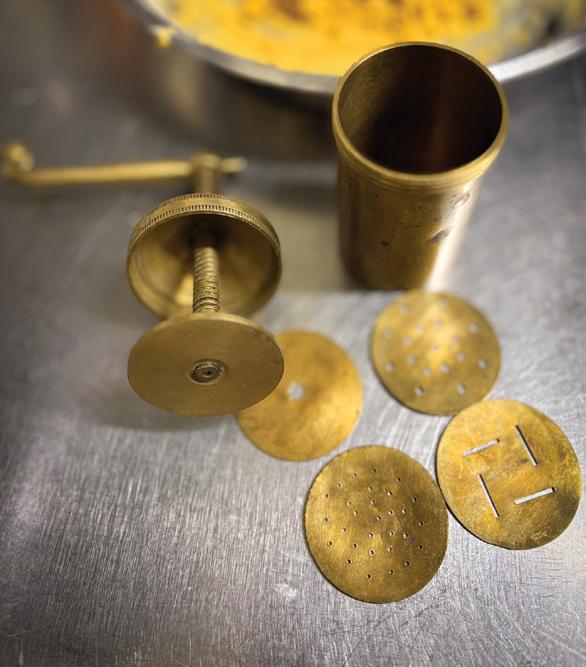
Begin by heating the frying oil – take a Karai (Indian wok, or a saucepan with a depth of about 10-15 centimetres) – and heat the oil over a medium flame. Whilst this is heating, you will mix the batter together…
Sift the gram flour into a large bowl (we use stainless steel), and then add the ajwain seeds, salt and green chilli and mix together to incorporate everything into the gram flour as evenly as you can.
Cultural note: traditionally, the right hand is used for ‘clean’ or food-based tasks, so don’t dive into the bowl with both hands or you’ll end up in a sticky mess…use only your dominant hand for mixing, and your non-dominant hand for holding the edge of the bowl and for pouring water
Now, using a tablespoon, take 2 spoonfuls of warm oil from the Karai, and add them to the spiced gram flour, start mixing this oil into the flour with your dominant hand, and then slow add a little water at a time. We don’t measure the water but add enough so that the batter looks like a thick peanut butter (it will be sticky and firm).
Now, take a small piece of the batter, and test if the oil is ready. The piece of batter should drop into the oil and rise back up fairly quickly and there should be nice, clean bubbles that come away from the sides of the batter at a steady pace. If not, wait a few more minutes, and test with another small piece of the batter.
Once the oil is ready, you will need to grease the brass press. Pour a little extra sunflower oil into a small dish and use it to coat your hands in the oil. Now grease the inside of the brass press, the ‘lid’ of the press, as well as each of the 4 plates. Place the first plate into the base of the press.
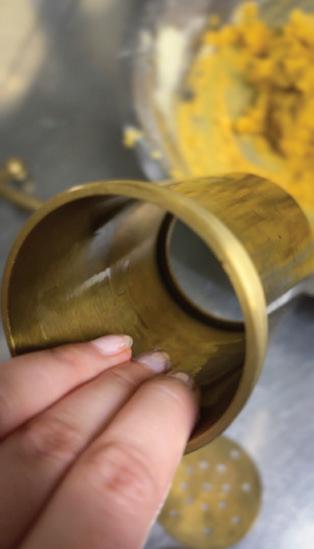
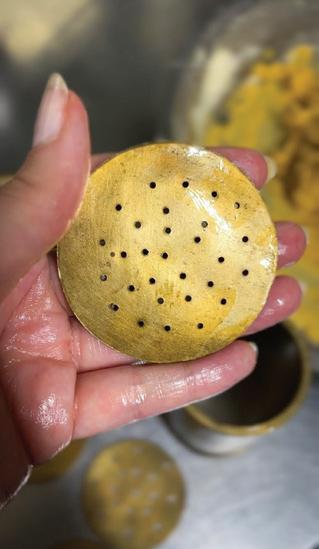
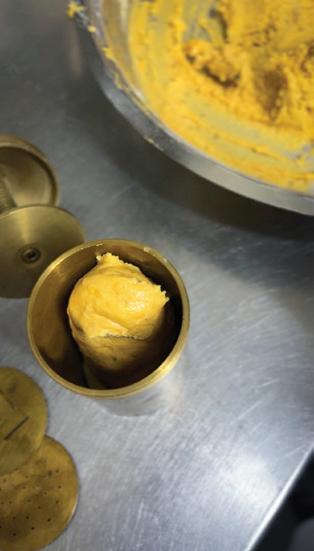
With your oiled hands, take roughly ¼ of the batter, and roll it into a rough sausage shape, that matches the shape of the brass press. Don’t worry if the batter looks sticky, with your oiled hands, it will be surprisingly easy to do so. Drop the batter into the press and screw the brass lid on.
Hold the brass press over the Karai, and start turning the handle, the batter will start to drop out into the oil. You can allow the batter to fall as a continuous piece. Fry for a few minutes, until the batter is a nice gold colour. Drain well and sit it on a plate lined with kitchen paper, whilst you fry the rest of the batter
Now, open up the brass press and change the plate at the base (I’d recommend soaking the used plate in water, so the washing up isn’t tricky later on!). Before you add the next plate into the base, re-oil the inside of the brass press, then you can drop the next plate into the base. Repeat the process for each of the different shapes.
Once you have fried all the batter and have the 4 shapes draining on the lined plate, allow these to cool a little, whilst you pan toast the other ingredients.
Heat a small pan over a medium flame and toast the raw yellow split peas until they are golden. Take them out of the pan, a very lightly salt them. Now toast the pink peanuts until they are also golden –once they are done, also very lightly salt them.
Now you will assemble the Chevdra…break up the shapes by lightly pressing on the long continuous fried strands, and they will naturally start breaking up. They will break into different lengths, which is perfect. Now mix in the toasted yellow split peas and pink peanuts. It is ready to serve/eat.
Chevdra will store in an airtight container for 4-5 months, and for this reason, women used to make large batches, and my aunt often makes a triple batch and keeps it in the cupboard (she still has a way of life where guests call upon her house unannounced and so she then always has something to offer them!)
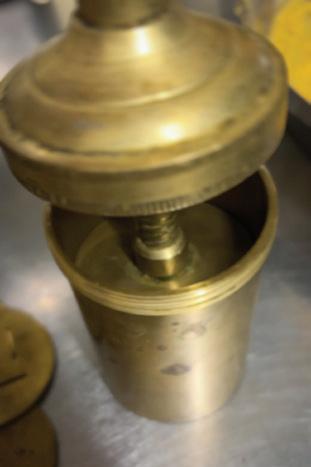
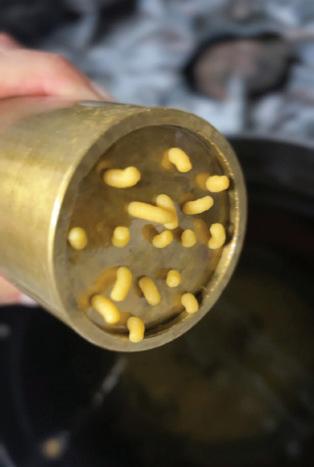
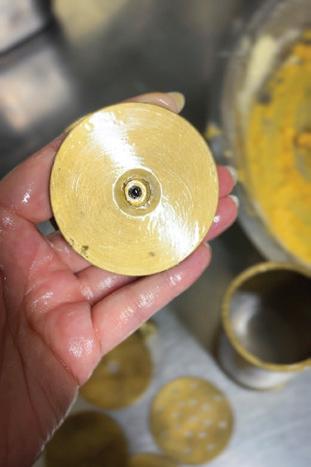
The 70’s & 80’s were an age when the supermarket did not reign supreme. People shopped daily and locally and small shops thrived. The Asian supermarket really thrived because Asians didn’t understand, let alone actually accept the concept of working Monday-to Friday, 9-5pm to make money. Money making is a 24-hour business and so customers flooded to shops that were open early in the morning, late night, and all weekend.
For the age and times, we lived in it was the right business model at the right time and at a stage when children were old enough to be useful, big enough to potentially be trouble unless fully occupied, and still young enough to be at home, and so the two biggest overheads – rent and staff were not a problem as we weren’t paid.
Having said that we also never paid for anything, other than with our time, our labour, our duty and our fidelity. This system of non-financial -transactions - give and take is one of the reasons Asians were and are able to build wealth, and a solid foundation in those early days.
In its day that business model of the small shop opens all hours was just at the right time – not a model that is so easy now and is it even relevant with online shopping?
The only reason Pure Punjabi grew through the early years is because of the foundations of this lifestyle, then further supported by endless input of the above-mentioned style of ‘giving’. Both sons, (not overjoyed but dutiful), provided, along with the two of us, endless hours of unpaid labour, support and graft. The early days of building traction, gaining customers and building a brand would not have been possible without a collective effort.
Alone we can go far, together we go further…
Food for Thought ... Reflections on two cultures, ways & worlds
“White Sheep”
The National Front were growing in popularity in the 70’s.
We started to receive occasional racist abuse, more from crowds of young white males who gathered together, disenfranchised, bored, envious and idle – as well as mindless – many of those boys were just followers – they just went with the herd…or, more the racist baa-ing of the flock! Amusingly, many of them would follow the leaders of the flock, gathering outside our shop, but then see me and gawp at me, open-mouthed...conflicted in the dilemma of their raging hormones!
We would get these occasional gangs of silly young men gathering outside our shop chanting racist rubbish, which didn’t last long, firstly because my father was an intimidating man, but also, we were all strong and confident, not particularly disturbed by it and not easily frightened. Eventually, they got bored, disappeared, and possibly grew up.
Of course, this has left a lasting and unfortunate taint on the purity of a national flag – both the St Georges Flag and the Union Jack. The sight of the flags still has connotations of that movement, and it’s a terrible shame as all countries should hold their flags up high with pride, as a representation of the entirety of their nation, but having a flag hijacked by racist thugs of low intelligence to such an extent, has left a surprisingly long-term mark.
The ridiculousness of people nowadays not being permitted to hang their national flag and having local authorities remove them is bizarre! Obviously, those authorities see it as an incitement to violence, and what a tragedy that a national flag has become spoiled in this way.
A reversal of that situation would be the answer, an ‘undoing’ of that sullying of both of the national flags and a return to the proper respect for them, but how?
“Changing times…or time warp”
Many Asian immigrants, especially those first arrivals back in the 50’s and 60’s, became locked in a time warp. They held in their heads a memory of home as it was when they left with the same way of life, acceptable behaviours and even home and kitchen ware. They didn’t even think that life back home had moved on without them
This came to be something that I noted, not just with Indians who had left India but it’s a general trend that those people who left their home countries, particularly from quite a different culture or standard of living, seem to be stuck in this time warp and the country, in their own minds, had not progressed from when they had left.
It was only on making a return trip home, that they saw a new way of life – people had moved on, and it was quite a culture shock for them, as they tried to raise children according to the ways back then, only to find that their children were different, and back home was different. They were being left behind.
Nowadays, a further change in culture – as 2nd and 3rd generation British Asians have changed and adapted lifestyles, have corporate jobs or relocate, this ‘modern living’ means, there are now more Indians not living with in-laws and extended family. The evolution and adaptation of buying house next to or very near each other, seems to me the perfect way to retain both the extended Asian family, and have the privacy of western couples. The knocking through of the garden walls, s so that children can run freely between the houses, is something which I find quite lovely.
The contrast in this, is with British attitudes, towards the close proximity of extended family. The thought of an in-law coming to live in the same street, never mind next door, evokes horror. I used to laugh when I would see or hear of people’s extreme reactions – grimacing at the thought of having them ‘too near’!
Food for Thought ...
Reflections on two cultures, ways & worlds
‘Mindless munching of the masses”.
The late 70’s was the start of a time when vast quantities of western convenience food and high sugar, empty calorie snacks became widely available and of course we had a shop full of it.
The influence of the USA on the national British diet was everywhere with colourful and exciting food adverts on TV. New types of sugary cereal and wonderful packets of cake mix and all sorts of convenience food. I was especially fond of Birds Eye Trifle packet mix, and ecstatic when I discovered Cheesecake mix! It never even occurred to myself or to my parents that this was at complete odds with our natural diet.
And so, we faced the problem of a society where food was not just in abundance, but junk food was proliferating, and TV bombarded us with temptation. Without the checks and balances of my parents, (and the happy fact that they came from rural farming communities), who cooked the nutritious mostly plant-based superfoods from scratch, our health and bodies could have gone the wrong way. It was interesting to note that when my parents helped themselves to food from the shop, they very often took fruit, or nuts. It is in fact something I always noted, not only about Indians, but anyone from Arabic countries, was the plates piled high with fruits, nuts and especially dates.
The savoury snacks of Chevdra & Matiyaan, contain gram flour, nuts, spices, butter, and the Mithai, (sweets), were also nutrient dense, with gram flour, or milk and healthy fats, so balancing the simple carbs of sugar and release into the blood stream.
Fortunately, the goodness of Punjabi food prevailed, rather than being lost as it is now in so many British Asian households, and my parents determined the weekly menu and so Punjabi food managed to maintain its position at least 3-4 times per week, ousted often by good British fare, a favourite being a Mixed grill dinner - a speciality introduced to my father in the pub, and which I had to replicate at home for him – a good old mix of proteins, fats and flavour.
let the bastards bullshit you” …
I remember my father, at great length describing to us the vast differences between British culture and Indian culture and particularly the importance of us being Sikhs.
One of the things he would let us know was how very different British parenting culture was from ours. An example that both he and my mother liked to give was that the British ‘threw their children out’ at the age of 16, or…if not… made them pay money to remain at home... (rent). He failed to see the irony in this judgement on British parenting, given what his own father did to him! At that time, it didn’t occur to me, otherwise I would have been hugely amused to point our his own parents casting him out him at 16, but worse still, taking all of his earnings.
My parents further illustrated this example of lack of parental devotion by saying that the British loved their dogs more than their children, and in fact, they loved their dogs so much, that they slept with their dogs.
All my friends were English, and I grew up with them, and I was at the girls Grammar school with them, so this would cause me to have quite a reaction by telling them this was absolute rubbish and absolutely ridiculous and of course this is not true, but they would always insist that this was the case. They firmly believed that if those children didn’t pay up at 16, they were thrown out!
Again…oh the irony!
Another example, and somewhat of a prediction…this time of racism, given to me was that it was easy to be friends with white girls and they with me, because he would explain, that at our young age these issues didn’t matter. He would patiently tell me that, as I grew, I would soon learn that these friends were not my friends. He would explain this to me in a sort of exaggerated display of patience as if talking to someone who were thick…
Add image: “Mister on bed”
“Listen… you don’t understand at your age… but you will learn when you grow up”.
This was based upon his own experiences of racism and life in Britain. An example always given was that as an employee, working as an aircraft engineer for BOAC in Heathrow, he never achieved the promotions or status he felt he deserved, despite excelling in all exams. He put this down to racism, and that white colleagues with lower grades and results than him were promoted over him. I partly wondered if it were also due to his ‘strong’ personality, though no doubt also due to his skin colour.
Dinner time conversations and mealtime conversations very often centred on and around the differences between our culture, the importance of being a Sikh, the importance of listening to my parents, the importance of respecting culture, and, one particular command from junior school years instilled into us… the importance of three sets of people to whom you must never, ever, speak back: one being your parents, second your teachers and the third, the police.
In fact, my father would stress the importance of this frequently, mostly about teachers when we were of school age, and later more so about the police when we were young adults and of driving age. He stressed that not ‘speaking back’ or, out of turn, or arguing back was extremely important. He was a great believer in working the system and not being ‘done over’ by the system. The corruptness of institutions was something he thought was not only an inevitable fact of life, but very important to know how to negotiate. He firmly believed that a teacher could and would push you down, or up a grade if they felt like it, and similarly a police office could decide to be lenient with a minor misdemeanour…or…choose to throw the book at you. We were instructed to speak very, very, respectfully to a police officer if we were ever pulled over!!
After-dinner conversations would often take more of a melancholy turn during my later teenage years. My father would sit in the front room with a glass of whiskey in his hands and reminisce about his childhood days, good and bad. Both pre and post our homeland trip - he would speak of the fields of Punjab, the vast open spaces and huge rivers, and tell us stories about where he, and we came from, all the while listening to music.
He loved music and played a wide variety of music from Jagjit & Chitra Singh LP’s, which he would translate for me, to his opposing tastes for western music as well, frequently playing Nat King Cole tunes, to which he would sing with a sad and soulful sincerity, telling me that as a youngster he had yearned to be a singer. I don’t remember if he said he hadn’t been permitted to make that choice or would not have been permitted and so never ventured to ask. Again, the irony was not lost on me of a person who had had their parent’s take control of their life, then himself choosing to do the same thing. I know the key identifying factor and justification for himself, was he truly felt he was making choices with our best interests at heart, whereas the comparison with his parents was that all their choices were for their best and selfish interests and not his at all. I never heard him say one good thing about his parents, which is sad.
After the return of the Roots expedition which had been timed just before the official opening of our multiextended supermarket, we now had a huge supermarket on the ground floor. On the middle floor was his large office space, a stock room for high-value goods (alcohol and tobacco) and a kitchen. On the top floor was a very lovely large and luxuriously furnished flat.
One very hot, very quiet day, around lunchtime mid-week in the school summer holidays, my father was working at his desk on the middle floor in his office, and I was working alone in the shop on checkout. It was one of those days when not many people were about, and the streets had a heavy almost southern states of America feel – shimmering heat. Probably everyone was staying indoors or down on the beach.
There were no customers, and I was sat behind the counter reading a magazine. A man wearing a dark suit, carrying a black briefcase walked in. He placed his briefcase on the floor, looked at me very seriously, in fact quite sternly, and proceeded to ask me… quite aggressively and rapidly… questions about… our fire regulations, our fire safety equipment, did we have various things in place, quoting codes and numbers… and that we could be in serious trouble.
Now I was not a shy panicky teenage girl and very socially confident, having run the household duties from the age of 11 and being mistaken for being much older, but this potential breach of the law, and the serious consequences, did really concern and alarm me. I think the fear that we were in breach of any regulations and that my father could have unwittingly broken any laws momentarily panicked me.
I told the man to give me a moment, and I’d run quickly and fetch the owner.
I raced up the stairs, sprinting up them two at a time, ran to the door of my father ‘s office, burst through the door and hurriedly informed my father that there was a man downstairs, blurted out most of what he had said to me, and that he needed to come very quickly.
Now my father had two modes, great…and very bad…and when he was in very bad/angry mode, he really was bad news, and on this particular day something must have already really annoyed him.
When I burst in, he was seated looking very serious and stern, yet also pensive and must have been troubled in some way. He had his reading glasses on and was reading some kind of business journal or letter.
He clearly had something on his mind and wasn’t in his jokey mood. I think he was then further annoyed that his calm, composed and confident daughter was so panicked. I’d never ever, in my life, run to him in any sort of panic, and then in such a panic.
As he looked at me and he looked at my face, something further – a deeper emotion -must have triggered him.
I can see the moment very clearly and in slow motion, as he looked at me, but saying nothing, he very deliberately and slowly put his reading glasses down…placed both palms flat on his desk to deliberately push himself to standing. He was a big man and a frightening man. He very silently, without saying a word in reply to me, walked towards me and straight past me and started to go down the stairs. He said nothing.
I ran down after him, in hot pursuit to see how much trouble we were in! I think I thought I could be some kind of support, but in any I case should be there with him, plus get back to minding the counter.
And so, I followed, on tenterhooks, as he walked through the door behind the counter. I then stopped behind the counter, but he walked on straight on, out from the counter, into the open shop floor space and approached the man in the dark suit, holding the suitcase.
The man immediately went into his dialogue starting to repeat the exact same things of… “you can be in serious trouble. Have you got this equipment? Have you got that equipment? Have you done this…?
My father didn’t say anything, as the man continued with his officious tirade of questions.
He then silently drew himself up to his full height and with his chest puffed out and standing overly close, almost on top of the man, he bellowed in his strong Indian accent… “are. you. from. the. council”?
I could see the man’s face drop and see from his eyes, the instant realisation that he had made a big mistake. This not-so-little ‘Paki’ shop was a bit different. And…oh dear, the not-so-little owner here was not timid.
He started to stutter and try and speak, and my father towered over him again in a very physically threatening way and bellowed again…
“Are. You. From. The. Council?
The Man stammered …“N…n…n…no….”
My father looked at him with a look of fury and disgust, and a mighty roar came out of his entire body… as he absolutely bellowed at the top of his voice, physically lifting his body to make the gesture, in the most frightening and astonishing fury, … “THEN F***-OFF….”
The words echoed around the shop. I felt that the whole street, if not all of Southsea, must have heard it. It was horrific.
My jaw dropped!!!
The man’s jaw dropped
… there was deadly silence… Time stood still and he and I were both frozen.
At this point I don’t think anyone else had come into the shop, (if they had they would have looked at the scene, turned around, and run), or who else might have been there.
My father just looked at him as if he were going to kill him and was literally holding himself back from some kind of physical removal, but then… he suddenly turned around and walked back towards me.
As he walked past me, he looked at me sternly, paused, and said in a completely contrasting and strangely soft, weary voice…“Putt”, (which means darling child), “don’t let the bastards bullshit you”, and proceeded past me back up the office and I heard his door slam shut.
I stood there, still frozen, staring at the suited man, who I then realised was actually a fire equipment salesman, using the tactics of fear mongering on immigrants who he thought probably didn’t speak much English and would be frightened of any official or legal situations.
The man was also still frozen to the spot and in shock. Then…after a few seconds, (which felt much longer), he very slowly bent down and picked up his briefcase and silently sloped out.
I was still frozen!
I was left there to digest what had just happened. I was 17 and had grown-up with my father, good and bad, but I had never seen anything like that.
He literally annihilated the man and then left him humiliated in front of me,
Should he have just said…’go away mate: get lost!’
Did the over-reaction and punishment fit the crime?
That encounter taught me a lot, made me think and reflect a lot, question what I would have done.
From then on, I learned to be my father’s gatekeeper, gathering relevant information from business callers before bursting in on his deep thoughts and contemplative moments.
I concluded that my father was right to do what he did, but, at that time, felt maybe not in the way he did it. For many years I said this to myself.
As I’ve become older, equally, I don’t know that I feel that way anymore. Having since had children, I think one of the reasons for his extreme reaction had been absolute fury that the man tried to frighten me, and that I had been, (very unusually for me), alarmed.
I think it was a protective instinct towards me and a good lesson to learn, that everything is not always as it seems when people tell you something is not always what it is, and you have to ask some probing questions of the person… and… a key one being…. are you from the council?
Later when we discussed this sort of thing, he would have told me to be careful of strangers who try to cheat you, believe no one, trust no one, and what he thought was other salient life and business advice.
It would not be surprising to know that my father was often given to quite pronounced mood swings. Sometimes raging in fury over something or grinding his teeth silently, or …quite contrarily and very often, chuckling and laughing to himself over some private joke with himself, at which my mother would always look at him with annoyance and say “Pagal hai”…he’s mad!
In between these mood swings, usually after listening to some Ghazals, (Melodic and poetic songs), he would become quite melancholic and philosophical.
If I came into the front room where he was sitting at these times, he would sometimes say…Putt…come and sit with me”, and so I would patiently have to sit and listen to him reminiscing. He would speak of Punjab and his childhood and tell me the stories of his youth and his family, and his days in the navy.
He was also a huge admirer of Tom Jones – (a manly man in his opinion). From my early years sitting in the small back room of the guest house, I would watch Tom Jones on the small black & white screen. I would look at my mother, who had an absolute crush on him as she gazed adoringly at the screen, I would then look at my father to see him also gazing adoringly at the screen in a man-crush! Such was his admiration, that he would refer to Tom Jones as… Thomas THE Jones’ to emphasise his worthiness. Too funny!
One of the songs that invoked a melancholy in him, was the song ‘The Green, Green, Grass of Home’. This song would stir memories of home, and he would recall the vast fields and huge rivers of Punjab.
I had never seen these places, and it didn’t mean much to me, but I dutifully stayed and listened as he played his music and talked of his childhood and Punjab, until such time I could slope off…
…how glad I am now that I stayed.
He would name the rivers, Sutlej, Beas, Ravi, Chenab and Jhelum - amazing rivers irrigating the fields of Punjab. He would talk about the vast expanse of fields filled with mustard leaves and crops. This would remind him of the gathering of mustard leaves to make the dish Saag, reminiscing about how people would pick the mustard leaves and any other dark leafy seasonal greens
Mustard leaves and dark leafy greens are what are used in the traditional recipe of Saag and what became known in Britain as Sagaloo.
When I first heard someone referring to eating something strange called…‘Sag-a-loo’, I couldn’t understand what on earth they were talking about?
Oh! Saaaaag!!! (pronounced Sarg).
When the first immigrants came from Punjab, mustard leaves, Fenugreek leaves and other non-standard leafy greens were difficult to find, and so many people substituted spinach to make Saag.
Palak is actually the word for spinach. I remember my mother had to buy big tins of spinach, to be able to make something resembling Saag. The smell always put me off and was in fact a reminder of horrible school dinner smells. For many years I wouldn’t eat it, but perhaps also because it’s a more adult taste?
The recipe we use is using the original mix of mustard leaves, Fenugreek leaves and seasonal greens, and NOT the substitution of using entirely Palak/spinach.
Most greens are readily available nowadays and so it’s good to understand the old-school dish using the stronger and heartier greens.
The traditional accompaniment to Saag is a bread called 'Makki di Roti' (a buttered cornmeal chapatti). Saag is the perfect expression of farmers’ food: nutrient-dense, sustaining, and deeply connected to the seasons and rhythms of the land.
Traditional Punjabi cooking techniques –(something we constantly teach and highlight in our cookery workshops)—slow simmering over a low flame, hand-churning to maintain texture, and finishing with a small amount of ghee—help preserve nutrients and make them more bioavailable. In the old days, Saag was eaten, not as a luxury, but as sustenance: the food that kept farmers strong through long days in the fields.
1 batch of Tarka starter (see page 305)
1 tablespoon Garam Masala
Salt
3 green grocer’s bunches of Saag (Mustard Leaves - approximately 10 stalks per bunch)
1 green grocer’s bunch of Palak (Spinach - approximately 15 stalks per bunch)
1 green grocer’s bunch of Methi (Fenugreek Leaves -approximately 15 stalks per bunch)
2 - 3 tablespoons Makki di Atta (Fine Cornmeal)
1 tablespoon butter, for garnish/serving
If you can’t get hold of these exact greens, here are some swaps that you can do…
Saag – use Kale instead
Spinach – use Spring Greens or Chard instead
Fresh Fenugreek – Spinach and then add a big pinch of dried Fenugreek leaves
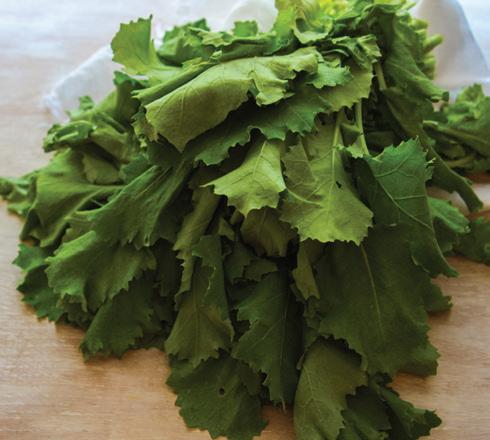
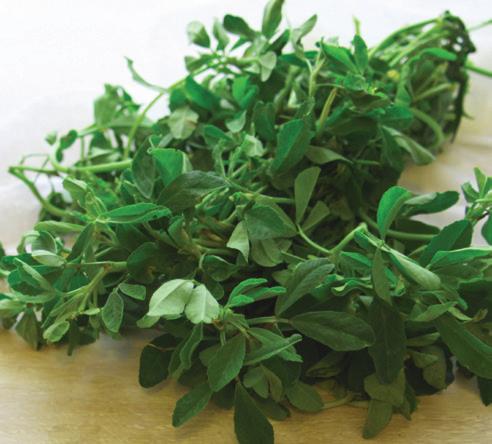
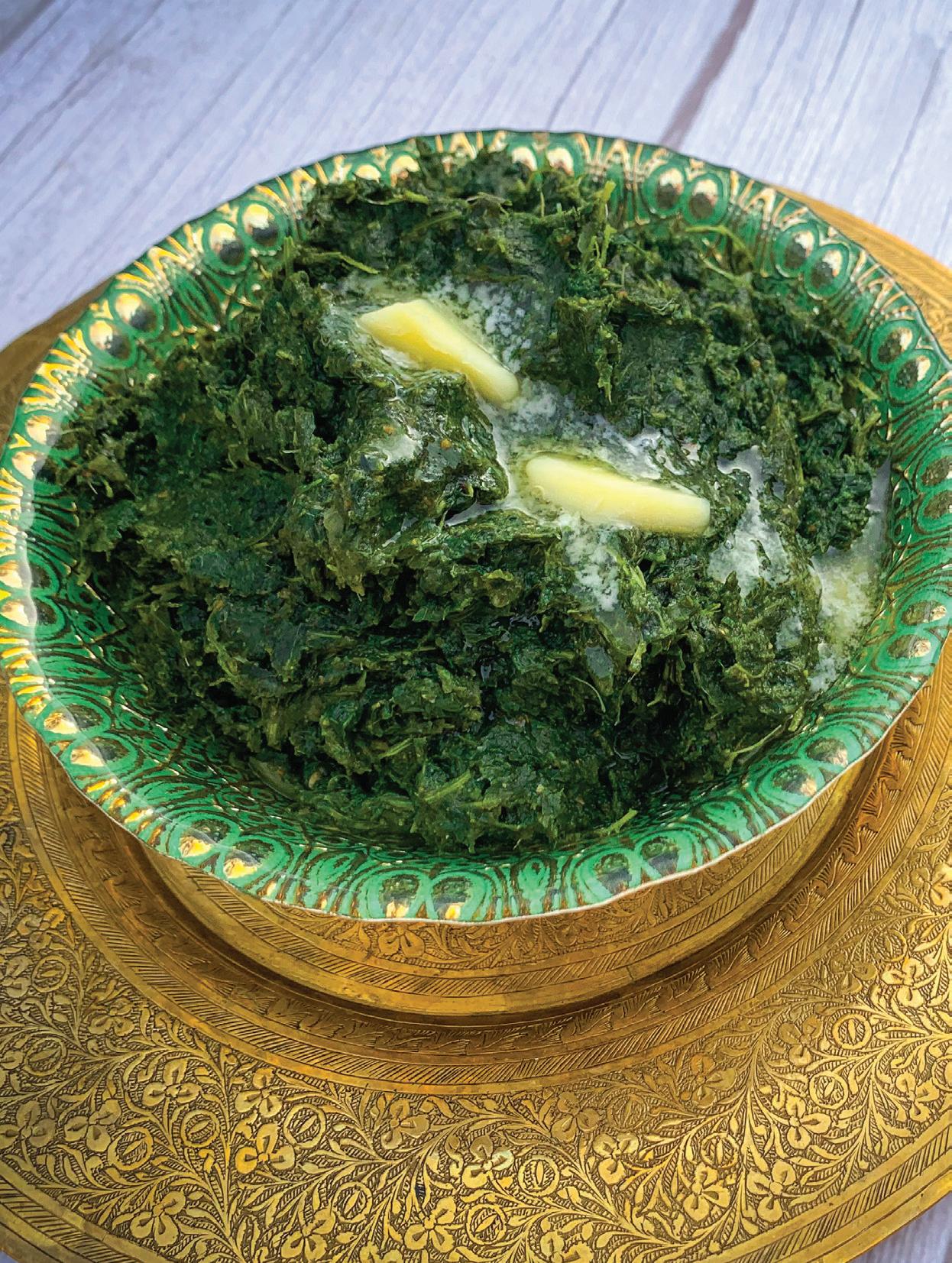
Cook the ‘toughest’ leaves first. Start by washing the mustard leaves, to remove any soil left on them. Pull off the stalks and discard them, keeping the leaves. Put the mustard leaves into a saucepan and fill with recently boiled water from the kettle and add some salt ( ¾ teaspoon or so). The water needs to come up approximately 5cm up the side of the pan (this is to stop the leaves from burning whilst cooking them). Put the saucepan onto the highest heat to partially boil/partially stem the Saag, have the lid on the pot but at an angle so a little steam can escape.
In a separate pan next to the cooking Saag leaves, now prepare the Tarka base (see page 305)
As the Tarka base and the saag leaves start to cook, prepare the spinach leaves and fenugreek leaves by washing them and then pull off the stalks, keeping the leaves.
Go back to the saucepan with the saag leaves. Once it has been boiling for 10-15 minutes, add the spinach and fenugreek leaves. Just check the water level in the pan at this point, if it’s looking a little low, top it up, as you always want there to be roughly 5cm of water in the base of the pan, so that the leaves don’t dry cook and stick and burn on the pan of the saucepan.
Add the Garam Masala to the tarka base and stir through. Turn the heat off and leave it to one side
Check the pan with the greens – take out a saag leaf. Using your thumb and index finger, try and completely smudge the thickest part of the stem at the base of the leaf. If you can completely smudge it, the leaves are ready. If the stem at the base of the leaf is still at bit firm, continue to cook the leaves till the stem is completely soft.
Using a pair of tongs, pull the leaves out of their saucepan, and add them to the pan with the spiced onions. Allow some of the water that’s coating the leaves to trail into the onion pan with them, as you don’t want the leaves to be completely dry/drained. Once all the leaves are in the pan, add the Makki di Atta (cornmeal). Take a large wooden spoon, and using a firm stir motion, beat the leaves around the sides of the pan, to get them to start breaking down. Do this for several minutes, till the leaves have broken down to your preferred consistency (there shouldn’t be any large chunks of leaf or stem). Once the leaves have broken down, the saag is ready to be served.
Note: Saag is traditionally served piping hot, with butter melting over the top (as seen in the picture).
Note: If you are having a lot of difficulty breaking down the leaves, it probably means that you didn’t cook the leaves for long enough. In this instance, take the entire mixture out of the saucepan, and put it into a food processor, so that the blades can break down the harder sections – but it must be on the ‘pulse’ setting and not continuously – you want to break the leaves down, but you are not making a purée/baby food! Pulse the saag mixture in the food processor till you have reached your desired level of consistency.
Add image or text?
At around my teenage years, more Indian now lived in the UK and family and Indian friends of family would come and visit every so often. One of my Masi’s, (Masi is a mother’s sister), raised in Kenya had a best friend there who was Muslim Punjabi, and both were now in England.
One day this Punjabi Muslim friend and her family came to visit, and the conversation turned to the dish of Biriyani and the preparation and cooking of this dish. As my parents came from rural farming communities, Biriyani would not be a regular dish at all. My father asked this lady, when she next came, to show my mother how she made her Biriyani, and so she did.
There was much excitement as we all milled around, variously trying to get a look, then becoming bored and wandering off, to come back again and see what was happening. I don’t recall too much about eating the dish, however, the one strong recollection and takeaway that stuck in my mind, was my parents talking about how great the Pakistani Muslim Punjabi cooks were…they were famed for their great cooking, and I noted again the admiration of producing food, and recognition of the skill and artisanal heritage that they conveyed to me.
Our Biriyanis over this time have developed across family and friends, and my childhood memories don’t remember how exactly everyone else made it, but we love it.
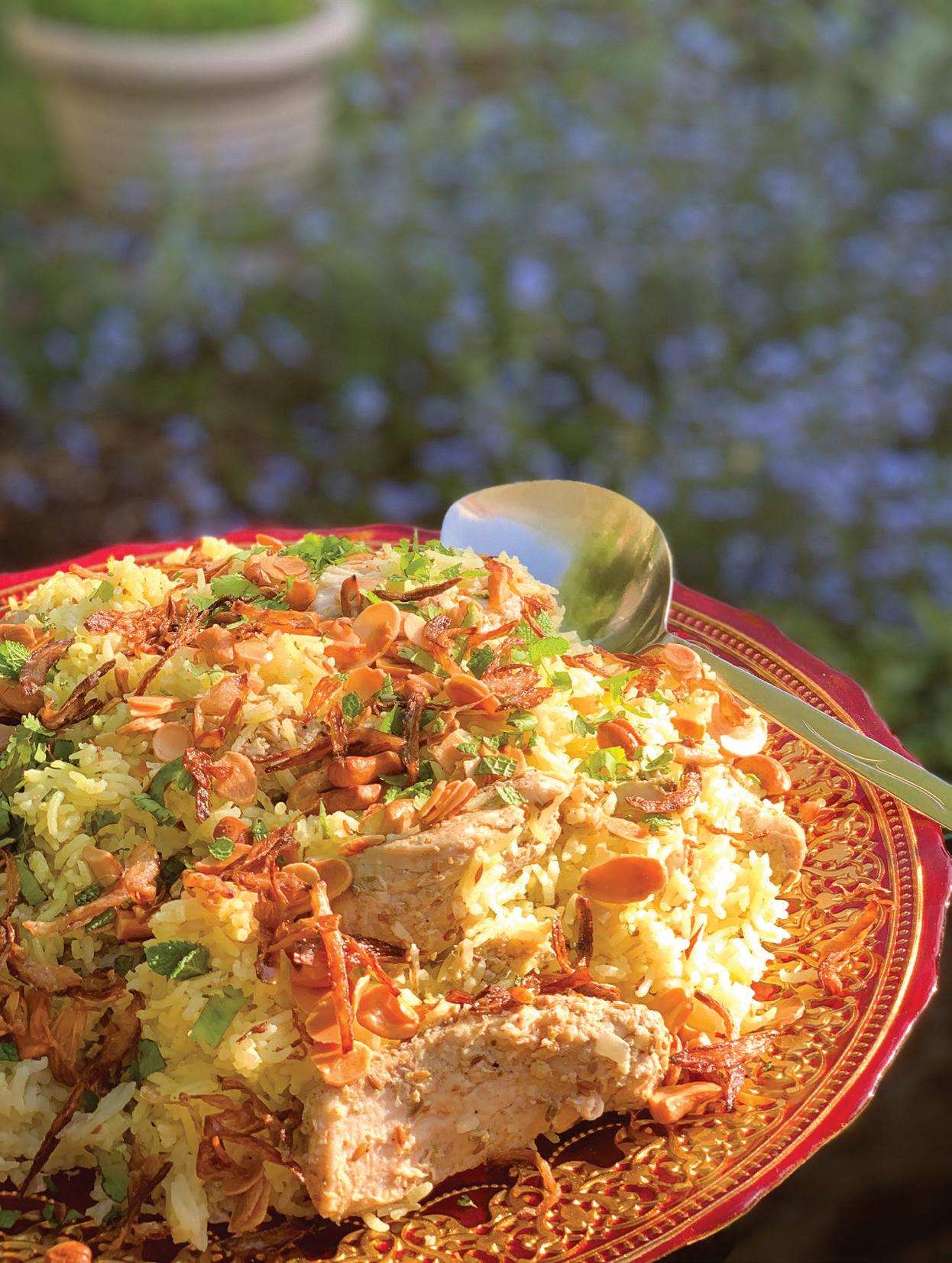
The Marinade…
Ingredients
2 small Onions
2 Garlic cloves
1 inch piece of Ginger
2 green Birds Eye Chillis
Method
Butterfly each chicken breast, and the cut into bite size pieces. Butterflying the chicken will ensure the pieces are more even in thickness, and that they will absorb the marinade better and cook through more evenly.
Top and tail the onion, dice the onions as finely as you possibly can and add them to the marinading bowl (where you have the chicken).
Peel the garlic and the ginger. Grate the garlic and ginger on the mincing plate and finely chop the chillis (they must be finely chopped to ensure even heat distribution. Add the garlic ginger and chillis to the cut chicken pieces, along with the Garam Masala, cumin & salt.
Now mix all the marinade ingredients together well. Cover and put it in the fridge to marinade for at least 2 hours, ideally overnight up to a couple of days if you can.
2 teaspoons Garam Masala
1 tablespoon Cumin Seeds
1 teaspoon Salt
4 chicken breasts (approximately 500g)
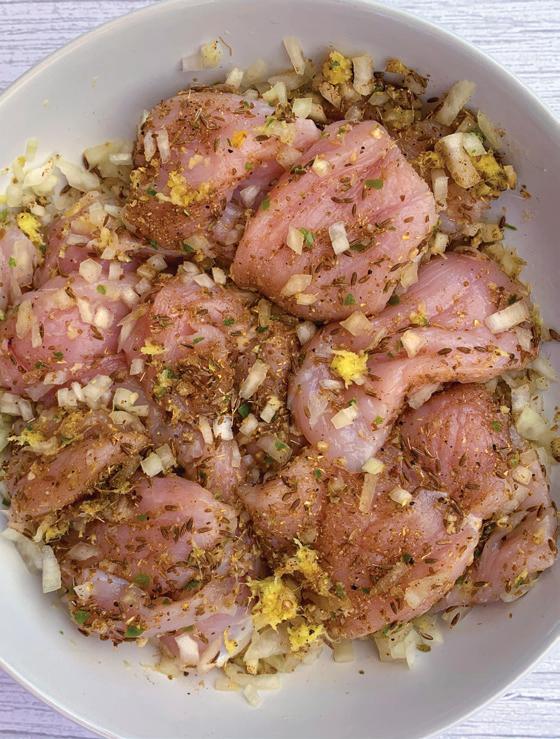
Making the Biriyani:
Ingredients
3 tablespoons ghee
1 medium onion
2 tablespoons raw cashew nuts
2 tablespoons flaked almonds
4 sprigs of mint (do not substitute for dried mint)
A handful of coriander leaves (do not substitute for dried coriander)
1 cup of white Basmati Rice (approximately 250g)
1 teaspoon Cumin Seeds
¼ teaspoon ground Green Cardamom
2cm piece of Cinnamon stick
A pinch of Saffron
¾ teaspoon Salt
1 tablespoon Kewra Water (pronounced Kev-rah)
Method (Garnish Prep)
Top and tail the onion and slice it in half. Cut each half into the very, very thin slices, as thinly as you can possibly manage. Place the thin slices into the small bowl and put them to one side for later.
Carefully slice the coriander leaves and the mint leaves. Be sure to ‘slice’ and not ‘chop’ the leaves (chopping bruises the leaves, whereas slicing them won’t). Keep the sliced herbs for use later on.
Heat a saucepan over a medium heat and add two tablespoons of ghee and allow it to melt, then add the onion slices and gently fry until they are almost golden brown (80% of the way to golden), drain them from the ghee and put them on a plate lined with kitchen paper.
Note: If the heat is too high, you will simply burn the onions, the key here is a consistent, steady medium heat, and to remove them once 80% done
Method
Using the same pan, toast the raw cashew nuts and the flaked almonds in the left-over ghee. Put the cashew nuts in first to give them a head start (as they are bigger/thicker), after 30/45 seconds, add the flaked almonds. Once they are almost golden (80% of the way to golden), remove from the pan and drain on kitchen roll
Start the Biriyani by cooking the rice, wash the rice thoroughly, till the water is clear (no longer cloudy) and drain well.
Over a medium to low heat, melt 1 tablespoon of ghee in a saucepan & add the cumin, cardamom, cinnamon & salt. Stir for a minute or so to allow the flavours to release. Then, add the washed drained rice, and dry cook it for 4-5 minutes. Then, add 470ml of tap water, along with the saffron, and bring the rice to a boil. Once the rice has boiled, turn the heat to the lowest setting, & put the lid on the pan.
Whilst the rice is cooking, it’s time to cook the chicken. Using the same pan that you used to cook the garnish items. Warm the leftover ghee (which is now packed with flavour) and over a medium heat, add the marinated chicken and gently brown the outside. Turn the heat down to the lowest setting and put the lid on the pan for 5-10 minutes. Cut a thick piece of chicken in half to double check that it is cooked through. Add the tablespoon of Kewra Water (make sure the heat is off when you do this, so it keeps the flavour and doesn’t turn the flower water bitter).
Now you need to check the rice. The rice is cooked when all the water has been absorbed. You will need to fluff the rice up with a fork
You will now assemble the biriyani in layers of rice – chicken* - garnish items (brown crispy onions, almonds and cashew nuts, then finally, the herbs), then repeat. *Note: Make sure to drain any excess liquid off the chicken before you scatter it onto the bed of rice.
Add image or text?
‘Don’t be bullied’
The business & life lesson I took away from that shocking encounter in our shop was, never let your first reaction be one of instant belief that what anyone in a suit, or any kind of professional looking ‘get-up’ was any kind of authority, or that what they were saying was true or correct. More importantly, don’t let someone’s attempt to assert themselves, speak in a domineering, threatening or bullying way, let you momentarily lose your ground or become uncertain.
So, I learned to question everyone and get some pertinent facts. It was essential to establish their identity and their credentials. The difference was I spoke politely, never letting the Punjabi nature show. The mistake here for course is that people mistake kindness for weakness, (in business as well as life), but that’s another story!
I noticed that there was a big difference between our people, or immigrants, who first arrived in the UK, with absolutely no one else, and nothing to welcome them, help them or support them. Almost immediately afterwards, relatives that followed to migrate to the unknown, still had a relative to come and stay with and help them settle.
I’ve often thought or wondered if the nature of the first and early pioneers was why America was and is so successful, as a land of early immigrants, (early being the factor, not the soft landing of following immigrants).
Of course, the need to migrate for hard-working entrepreneurial people is one of choice and not necessity – it’s now a laptop and iPhone world, and you can run a business from anywhere.
Nowadays, the diaspora is so widely spread and settled that the ethics of hard work and integrity seem to be reversed for newcomers. Everybody can live off somebody… or the state…
Food for Thought ...
Reflections on two cultures, ways & worlds
‘There are other places to go’
Those leaving Punjab, did not always choose Britain. Many went to Canada, (which was my father’s intended destination), and also, somewhat later, the USA and Australia. My awareness of this wider diaspora grew, after meeting village relatives, and hearing of many choosing the options of Canada & USA.
Pretty much wherever they went, success was forged from the standard issue Punjabi commandments of endless work, selfless service, the greater cause, family duty and obedience, and almost complete disregard for individual ambitions.
I used to watch my schoolfriends having discussions about career choices and other amusing possibilities such as choosing who you would marry! We all knew, as first generation born immigrants, what our career choices would be – the professions… or work in the family business…. then be married…and work in that family business.
I knew how my father came to England – having been ‘sold’ by his father and signed up into The British navy for the maximum term of 21 years, purely to provide a pay cheque, thus transporting him to Britain.
During the Idi Amin troubles in Africa, people were leaving Kenya and Uganda, arriving in England with nothing and starting again.
I would ask questions… How did they come to England?
…they had British Passports.
How did they have British passports?
…Well, the British occupied their lands, and in some kind of compensation as I understood it, gave these ‘subjects’ British passports.
Additionally, workers were needed to drive the buses and public transport, and I was told… the British didn’t want to work or do certain jobs, so immigrants were welcomed do the jobs they didn’t want to do…
“You show-off!”
One of the frequent playground cries heard at my English junior school, (and probably in any), ... “You show-off!”!!
The British attitude to ‘showing-off or ‘boasting’ was to squash that sort of cockiness right down – I noticed that it wasn’t acceptable at school, neither to the teachers nor the other children. Any child who had this precocious trait was quickly taught what was what!
By contrast, showing off, to many successful Indians was, and still is, second-nature. My father was a huge show-off, not just at home, but everywhere.
After leaving Heathrow, where he declared himself to be the best engineer, he then re-trained as an insurance salesman, first with Hambro Life, where he was proud and boastful to be top salesman, causing him to win prizes, (one of them a family holiday to Spain). He happily reminded us that daddy had done this for us, and we were proud too. There is no doubt that he would, and did, let any, and everyone, know of these accomplishments.
As he bought more property, he would be proud and ‘boast’ about the new assets. One day, coming back from the pub, someone had joked that as he now owned 6 properties in the road, perhaps the name of the road should be changed to Hothi Road. It was a joke, but he was delighted with the idea and rushed home to tell us.
Then he left Hambro Life, as he would, of course, have been above and beyond them now, to set up as an independent insurance broker. The logic was, quite rightly, if I’m top here and working for someone else, well then, I’ll do it for myself. We used to laugh at his proud announcements. We were stuck between the English ways we had developed of being more modest, being fairly quiet about achievements, and not… doing the dreaded, showing off.
With hindsight, we didn’t know the extent of his achievements and quite where he took himself from -coming with no soft-landing, and no one to help hm or support him.
Food for Thought ...
Reflections on two cultures, ways & worlds
‘Green Goodness’
Punjab is a land of Mustard leaves, fields and crops and abundance, and the region’s identity has long been tied to its fertile soil and farming people. Traditionally made from mustard leaves (Sarson = mustard), spinach, and a blend of seasonal greens, saag is a traditional and very Punjabi comforting winter staple. Nutritionally, Saag (the leafy greens of mustard) is an absolute powerhouse. Green leafy vegetables are among the richest natural sources of iron and calcium, two minerals essential for energy production, bone strength, and overall vitality.
Mustard greens, in particular, contain high levels of vitamin K, vitamin A, folate, and antioxidants that support immunity and cellular repair. The fibre content aids digestion and helps regulate blood sugar, making it a balanced food even in small quantities.
In contrast to Saag’s simple, soil-based origins, Biriyani offers a different kind of nutritional balance. Originally developed as a practical “all-in-one” meal for armies, Biryani combines carbohydrates, protein, and fats in a single pot. The layered rice provided steady energy, while the meat, yoghurt, and spices supplied protein, iron, and digestion-supporting compounds. Even today, a well-made biryani can serve as a complete meal, offering sustained energy and nourishment when eaten in sensible portions.
While Biryani delivers balanced macronutrients, Saag provides concentrated micronutrient density. Made from mustard leaves and other greens, saag is naturally rich in iron, calcium, folate, fibre, and antioxidants. Its slow cooking method makes many nutrients easier to absorb, and a small amount of ghee improves the uptake of fat-soluble vitamins.
Together, dishes like these, show how traditional foods can offer both flavour and genuine nourishment when prepared with whole ingredients and eaten in moderation.
The time came to set off for Southampton…what fun!
Within a few weeks of living in Halls and being there, although the social life was busy, I knew that the actual course itself, was not only acutely boring, but that I hated it. Given that time again, and in today’s era of freedom and choice for more Asian girls, I would have left.
I stayed, and used the time that I was there, to do the bare minimum of work and just spend my time in a cycle of endless socialising, mostly from chronic boredom.
This period was the first time in my life really, probably from the age of 4 years old, that I had nothing to do and loads of free time.
I was used to working almost continually – from that small child laying the table for guests evening meal, helping with the laundry, helping my mother most of the time, and from that 11-year-old having to prepare the dinner every evening, do all the family washing and ironing, the general food shopping and the cleaning, dusting and hoovering.
Looking back, I was so excruciatingly and acutely bored and would have been far better to have got a job.
A girl I made friends with in the first few weeks told me she hated it, and I was already in silent agreement, so she went home to her other life options.
However, my options would have been to go back to work in the shop under my controlling father, (I wouldn’t have been allowed to go and work somewhere else), and endure more attempts at an arranged marriage, I stayed and partied!
I spent my time, wasting time. Mindlessly going out and partying. In a sea of white faces, I was ‘exotic’ and different and the boys flocked round me. Mostly it meant nothing although there was a semi-serious one and a couple of serious ones. I made some lovely friends, who are still friends today.
One semi-serious was to be honest, eye-candy, blond and ‘dopey’, but he lived in a rented house with 4 other boys. This house of course had a kitchen, so this gave me an opportunity to cook my food. I recall going and getting all of the ingredients and making a ‘chicken curry’, just because I was dying for home food – I think all the boys thought I made it for them… No. Not.
I remember one day round at his place, said boyfriend had a pair of trousers that needed turning up. He fully expected that I would do this for him! I did eventually agree letting him know it was a major exception, and also very rudely and coarsely telling him that I was not his f**ing mother. In fairness, he was a chauvinist, and I was a super equal-rights possibly early-woke, female empowerment ‘job’.
Another time, a workman came to do some work on the landlord’s property requiring access to the room. Same said boyfriend offered the worker a beverage, to which the worker gratefully accepted. Said boyfriend turned to me and said, in only the way a spoilt handsome white son of moneyed people living abroad could say… “make tea!”
Had I been drinking a cup of tea myself I would have spluttered it out across the floor in shock. He’d never spoken in a commanding tone like that before.
Of course, the young chimp was showing off to big older gorilla, commanding his ‘woman’ to serve the men.
I silently got up and went downstairs, to all appearances, to make tea. I was fuming. I gathered my coat and bag, very silently opened the front door, stepped out, and walked to the bus stop. It amuses me still to think he must have been wondering… “she’s a long time…where’s that tea?”
Of course, my partying mindless behaviour eventually caught up with me at the end of the second year, and I failed to go through to the third year. During the end of that second year the second serious relationship had developed, and when I went home for that summer, I had to work out a way of staying in touch and trying to secretly meet. This was done via letters, (for which one of my school friends acted as courier), and trips to the phone box, or hurried phone calls from the house phone when my father was out.
However, despite best attempts at concealment of the white boy, later that summer, back at home, my father discovered that I was actually seeing ‘someone’. He did this by conducting a search through my things when I had gone to see a friend.
It was a ‘Show me the man and I’ll show you the crime’ situation – keep looking hard enough and you’ll find something – and so he did - a cleverly concealed photo of said ‘amour’ tucked deep within compartments of a purse within a bag.
Once again, all hell broke loose!! In fact, an atomic bomb exploded!
This fury… confirmation of his suspicions that I was ‘up to no good’, and the ‘seeing a boy” discovery, caused the knee-jerk reaction of him frantically and immediately trying to arrange a marriage. It probably wasn’t his best idea, especially as this time, unfortunately, the white boy was someone who I was serious about and wasn’t going to move on from.
One day a family arrived with three adult young men sons for a ‘viewing’ of myself. Having been prepared for this meeting with threats of being ‘killed’ if I didn’t behave (the ‘throw away’ police reference, as opposed to real probability of death),
I remember sullenly coming and sitting in the room, dressed up I recall in a sari, and just sitting in my best slumped manner, (but not too slumped in case of the evil parental eye), looking as undesirable, surly and unlikeable as I dared, whilst conversation was made and tea was brought in and served.
It was one of those comedy moments (now… but not at the time), when… if my father looked away from me, I dropped my face into the worst, blackest, most sullen scowl possible, and if he then looked at me I quickly changed to neutral poker-face, look away….then back to sullen face, and …repeat…
I don’t remember now if I made the tea or my mother did and I more or less sat there silently, with the variably scowling, switching to stone-like poker face. I do remember that the family were actually an extremely nice family and the three sons all extremely pleasant, but of course I was already seeing someone, and I wasn’t going to go down this road, so there was total non-participation and palpable hostility from myself in any of the proceedings and needless to say it went no further. I remember the mother of the boys was very nice with a kind face and kind eyes, and she was watching me intently – As she was looking at my face and body language, she was gently but sadly smiling, and I knew that she knew my walls were up, and it was a no-go. The family left and to my relief, and no surprises…there followed no proposition to make any agreement of marriage.
The funniest thing was that I remember sitting there and looking at the three sons who were all of a similar age, and thinking… “but which one is it?” I was too stubborn to ask afterwards, and so I never found out. After the family left, strangely, once again, nothing was said, my father possibly accepting defeat on this occasion, and my lovely mother probably torn between me and my father, and I’m sure very upset and unhappy, and so I sloped off to my room to read my corrupting western literature…Cosmopolitan magazine!!
Once the exam results arrived later that summer, which of course my father opened while I was away, once again, as scheduled, hell once more broke loose. I don’t recall much amidst the blur of shouting and fury as my father ricocheted off the walls and I took the verbal beating, but I did thereafter spend most of my time in my room, partly as being ‘persona non gratis’, and partly for self-preservation, avoiding all contact, and not speaking.
My father had already arranged a business trip to India, so before he went, I was summoned to stand to attention where upon he bellowed a stern warning, because somehow, I was returning to do my third year. I don’t know how this happened, or if my father had arranged that I re-sit, but I knew one thing… that once he had left…I was off!
Once my father had left, I knew that this was my opportunity, so I packed my bags and made all preparations for the return, however, I had no place or room to go back to. I think my mother wasn’t aware but somehow, I managed to convince her I was going back to halls. I knew that on my father’s return, and with me absconding, she would take the brunt of his fury. If I told her, then she would be colluding, an ‘aider and abetter’, so to speak, and also would be very distressed.
She was like all Asian parents regularly uttering the old cry of… “lok ki kende”..”what will people say… the absolute dread of all Asian parents… that their offspring should disgrace them and the community gossip about them.
Once I was back, I knew the layout of the girl’s hostel and knew that we had a large basement where all the suitcases and general luggage were stored. Looking back, it seems bizarre, but I lived and slept in this suitcase storage, large cupboard in the basement for about a week. During the day I would get the local paper and walk the streets and scour for jobs. Eventually I got a job in a small fashion retailer and following that, the landlady of the boyfriend took pity on me and offered that I could move in as well.
One of the things I was missing, apart from my mother, was the Indian kitchen and easy access to all of our Indian food, but handily, there were lots of Indian shops in Southampton very near to where I worked, where I could go and buy ready-made snacks and sweets. Two favourites being Samosas, bought from the Indian shops - so very yummily home-made, and not the disgusting Supermarket things, I had the unfortunate horror to once not enjoy.
Then one of my favourites…
…did I mention I have a sweet-tooth…- a dessert of sweet white dumplings that I particularly love for its spongy texture…Rasgulla. I was overjoyed to find you could, and still can, buy Rasgulla in plastic tubs by Royal sweets in a pack of six, (found in the chilled counter of all Asian shops), and later, also in large tins. I have never dared to buy these, being on a semi-permanent diet of some kind, so I don’t know how many there are in these, but it looks a lot! I used to buy the pack of six and eat them in two restrained servings of three dumplings, (as I try to squash down the greedy gremlin that I suppress within myself).
I will not lie, it is a process to make these, but really worth it, if even just once.
Give it a go once! Then if you have a taste for the delicious, yet strange texture, you could occasionally go and buy the ready-made ones! Just a further note…don’t do what my mother once tried – she tested this for us, and it failed.
She decided to add the sugar by placing a sugar cube in the centre of each dumpling, thinking that this would dissolve and permeate beautifully through the curds and impregnate them with sweetness. It didn’t and she was so disappointed. All that work and cooking for the whole morning, with me being maybe around 7 years old, and running in from the garden to check on progress and find out when a willing food taster would be needed.
I watched her concerned face as she tasted one. Then her disappointed face, as she opened up a Rasgulla to find a soggy but still hard cube stubbornly refusing to do what sugar is supposed to do and just dissolve.
I was ready and waiting to eat these, so remember our shared disappointment. As disappointed as I was, running away was not on the cards, and much later on, so back to that…
Add image or text?
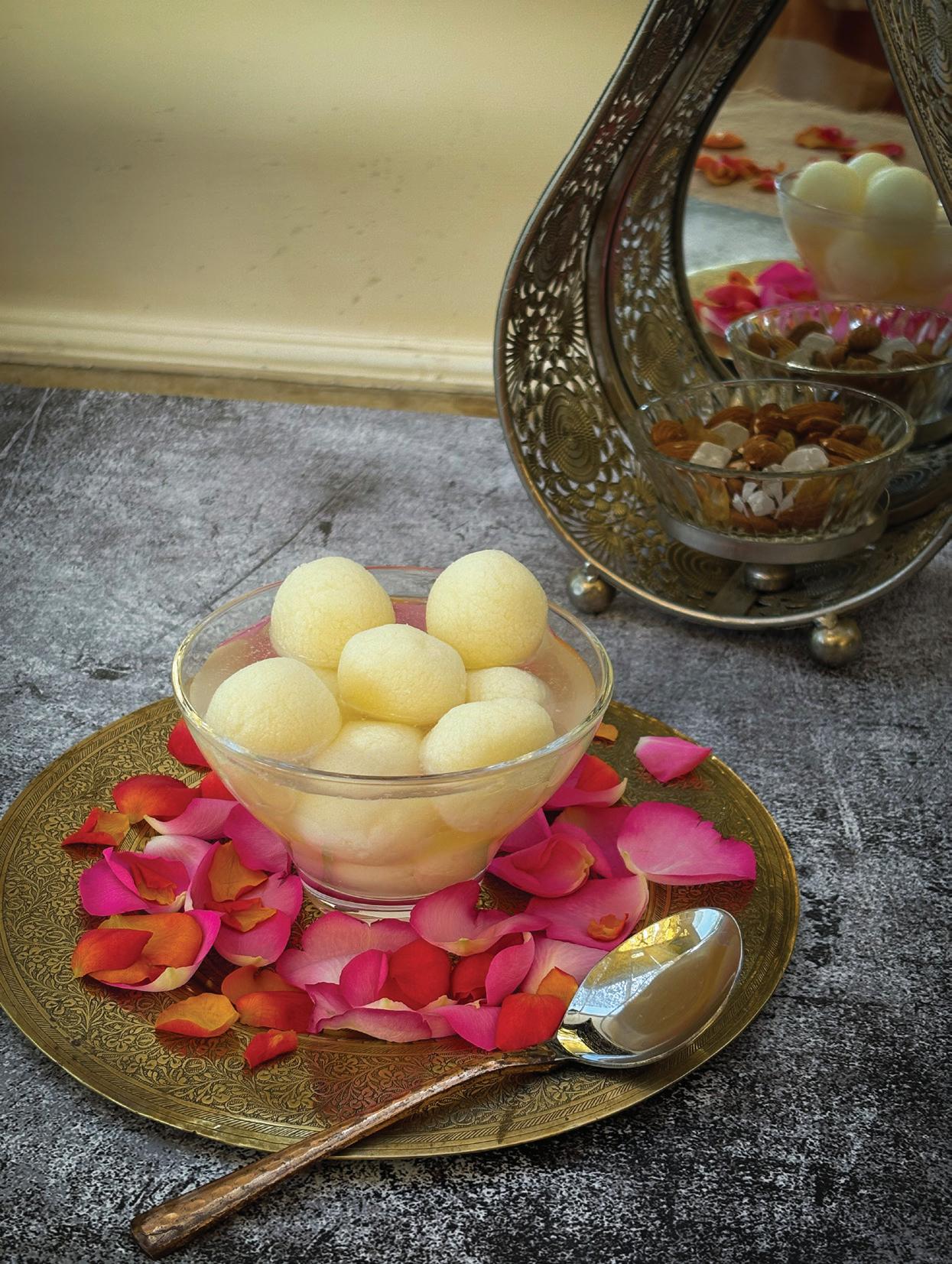
This sumptuous dessert is such a favourite of mine (and my children!). The texture is spongy, which we (and the entire nation of India) loves, but may take you by surprise if you haven’t tried them before. To make them, you need to start by making fresh paneer, which you immediately use to then make Rasgullas (the plural form of the word!).
Ingredients
One fresh batch of paneer (still hot and not weighed down) see page 299
375g granulated Sugar
4 ½ cups of Water
1 litre of water
Method
You will need to work quickly with freshly strained batch of paneer (still in the muslin cloth). Whilst it is piping hot, you will get the syrup started…
Put the sugar and water into a wide pan, put it on a medium heat so that the sugar dissolves, as this is happening, you will make the dumplings.
Now, check the temperature of the paneer. The moment it has cooled enough for you to handle – but is still hot – you need to work the cheese. Do this by smoothing the entire batch of paneer using the heel of your palm…push the paneer out on a clean work surface using the heel of your palm. Do this for about a minute or so, and you will have a very smooth mixture of paneer and should come together smoothly as one.
Divide the batch into 12 portions…do this by dividing it into quarters to begin with and then divide each quarter into 3. Try to get each one as similar in size to each other as possible.
Working at fairly quick pace, you will now roll each of the 12 portions into a smooth dumpling, make sure there are no cracks and the surface of each dumpling is smooth
Now drop the dumplings into the hot syrup, making sure there is plenty of space, as they will almost double in size. Put the lid on the pot so the rasgulla boil in the syrup, once that happens, turn the heat a little lower – to a medium heat – and then let them simmer for 10 minutes. Take the lid off, and they should have doubled in size. Now carefully transfer these to a dish and refrigerate them.
Once they have chilled the Rasgullas are ready to serve.
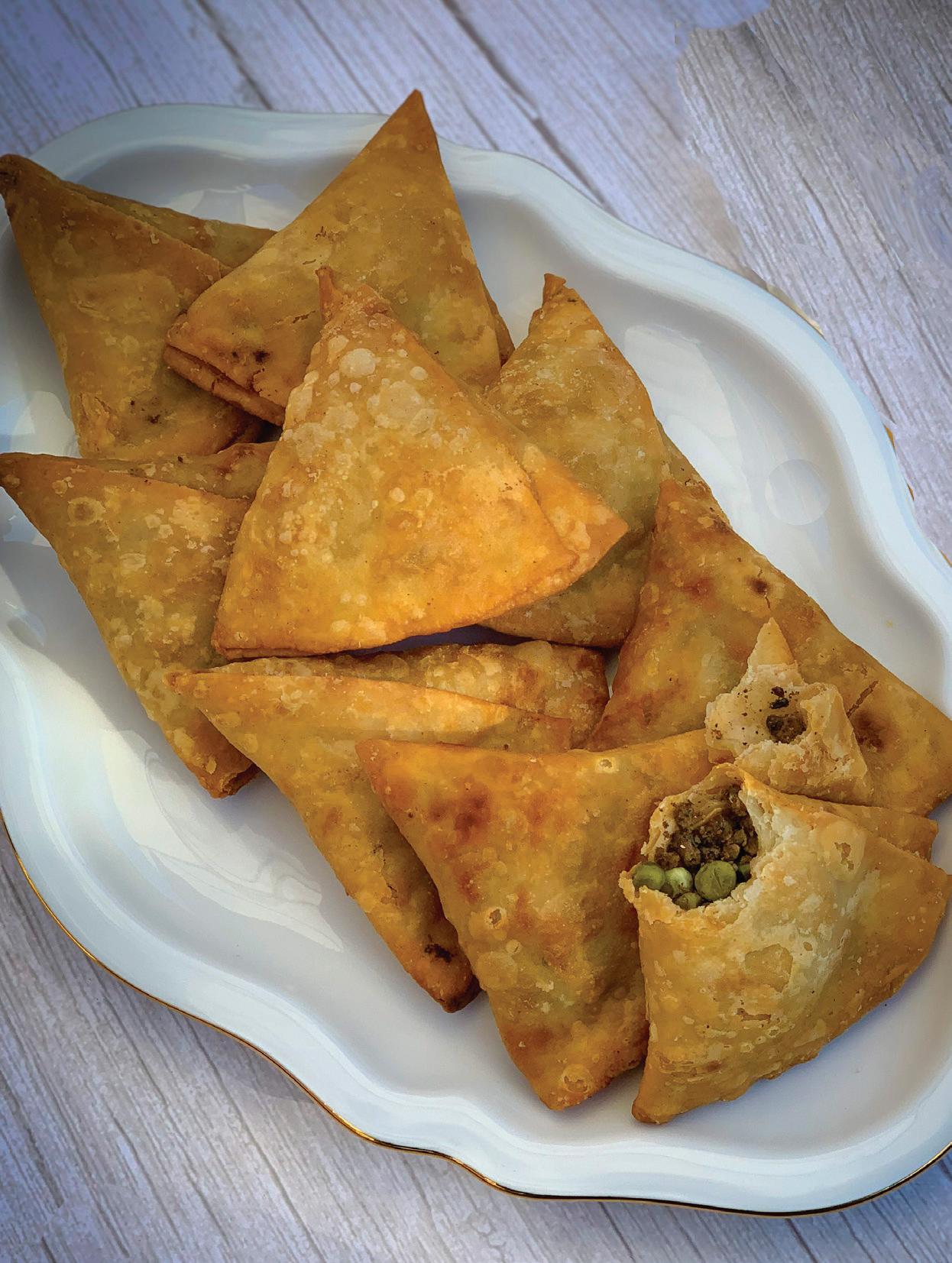
The vegetarian filling is the pea & potato Sabji (like the sabji on page 73 but without carrots, and 2 more potatoes), but cold leftovers. Don’t use hot Sabji made the same day as it needs to sit and become a bit more of a mash quality…
The meat filling is the leftover Keema (see page 221), again make it before as it needs to be cold.
Samosa Pastry
This starts as with making the Atta… Roti dough, but before adding water to mix the pastry, you spoon over three tablespoons of melted ghee, (or oil for vegan or dairy-free), and mix into the flour, then add water and continue as with Roti-making.
Ingredients
1 ½ cups Maida (plain flour – approximately 375g)or the same amount of sieved Atta (wholewheat flour)
3 tablespoons melted Ghee
Tap Water (roughly 120ml-160ml)
Cultural reminder: traditionally, the right hand is used for ‘clean’ or food-based tasks, so don’t dive into the bowl with both hands or you’ll end up in a sticky mess…use only your dominant hand for mixing, and your non-dominant hand for holding the edge of the bowl and for pouring water
Method
Put the flour into a mixing bowl, add 3 tablespoons of melted ghee and rub it into the flour mixture, till it resembles breadcrumbs.
Take water, add a little at a time (roughly 3 - 4 tablespoons worth - not an absolute, but a guide), and knead till a firm dough is formed. Cover the dough with a tea towel to rest for 10 – 15 minutes. Keep any leftover water for later.
Divide the dough into 6 portions. Roll each portion into a round circle. Each circle should have a diameter of approximately 21cm.
Go to the wok of oil, warm the oil over a medium heat (if using a deep fat fryer, set the temperature to 180 degrees)
Cut each circle of dough into a semi-circle. Take the rounded edge of the semi-circle and line it up with the edge of the workshop (i.e. with the flat edge facing away from your body).
Dip your finger into the container of water and brush the edges of the semi-circle with water. Put one tablespoon of the cold filling in the middle third section. Be careful NOT to over fill the samosas, as you'll find that the filling may burst open during frying, however, do not underfill. (Check the filling quantity in the step below).
Fold the first edge over from right to left to cover the filling in the middle third section, and check if you need to adjust the filling. Then fold over the other third, from left to right, leaving a short margin. Pinch/crimp the bottom edge closed and pinch the top corner triangle Repeat the process till all the samosas are ready.
Fry the samosas till they are golden. Serve with a section of chilli pickles or chutneys, or just as they are.
Add image or text?
or compress Samosa recipe onto one page?
Add image or text?
One of the biggest difficulties in making choices about how you earn your money as an Asian girl during the 70’s and 80’s, was the extreme control that parents had over those choices – to the extent that they would direct you into what career you should have.
The choices were always the same standard Asian options: doctor, dentist, accountant, lawyer, pharmacist… or… work in the family business! In this one area of life, Indian boys and girl were finally equal! Boys also, were directed into what they had to do, so that was some small comfort.
The problem of stepping out of the control of Asian parents and defying them, meant not having any money. This meant taking risks, standing up for yourself, going it alone, and relying on no one, however, the drawback there was being broke.
The majority of Asian children at that time complied with the direction of their working lives as well as their arranged marriages, primarily, because cutting yourself off from your community and the shame of what ‘people would say’, was too terrible to contemplate.
Equally financial independence was never something Asians had from their parents, and so unlike Western teenagers, could not have choices, and even the freedom to then make mistakes.
Money doesn’t bring happiness, but it brings opportunities and the freedom to make your own choices… or your own mistakes.
Food for Thought ...
Reflections on two cultures, ways & worlds
‘Tower blocks’
Having been born and raised in Hampshire, in an entirely white British society, the only Asians I ever really saw, apart from a very few in the area, were family, or people who came to visit my family.
We did go frequently to London, but that was so cosmopolitan, rather than Asian, and could have been any international city in some respects. We went once to Coventry and also to Luton only for Indian weddings and occasionally to Slough, but even then, we never went anywhere in the town, as we would be there for a specific gathering or event. Perhaps the closest to seeing a large group of Asians, would have been the very small area of St Mary’s in Southampton, so I never saw a large culture of Asians in the UK.
That is, until I went to Birmingham. It was an eye-opener in every way. It was the first time of being in a city and not only seeing the large immigrant populations of Asians and Africans, but also another side to British culture that I had never seen.
Tenement buildings and very tall tower blocks. A whole class of white people that didn’t live in semidetached houses with gardens. I had seen some of this in Portsmouth, but not much, so I was surprised by what was a ‘working-class’ population. I think I assumed that most British people had money and immigrants did not.
There were two big revelations.
Firstly, seeing a lifestyle where a pay packet with cash was handed out on a Thursday, shopping and rent and bills paid in cash and then the rest of the weekend spent in the pub, then wating for next payday.
I had never seen a life where you spent first. It was so opposite to the Asian immigrant experience of saving almost everything and then living on hardly anything.
The second revelation was also going into…a working man’s club!
First, and last time in one…thank you.
“A ‘love marriage - gasp!’
Occasionally when talking of marriage, in our culture, it was almost entirely about arranged marriageseveryone in the Asian world had either had an arranged marriage or were going to have one.
There was only one case I knew of, where an uncle had eloped…but only with an Indian girl! Uproar had ensued, just because she was not a Punjabi. This got sorted, and like the Borg in Star Trek, her assimilation into the Punjabi culture was required, but I was pleased to see that in line with Sikhism, there was and is never any attempt to force a change of religion, and she continued as a practising Hindu, but also attended all Sikh occasions.
This ‘choosing of your own partner’, would be spoken of as…’a love marriage’. My parent sometimes spoke about it, in conversation with each other. They would occasionally say that ‘so and so,’ was a ‘love’ marriage. There wasn’t any anger, but more a commentary that it was an unusual situation – the very thought of someone deciding for themselves was really too forward!
The expectations that parents almost owned your life and made your decisions as opposed to western children was a world of extreme opposites. I was the first girl to break with tradition, refuse attempts at an arranged marriage and, most dreadfully, and unheard of, ran away from home. I have since been blamed, (jokingly, but then also with an undertone of…actually meaning it), as having set a precedent for the wave of younger female cousins that followed suit and married outside of the Punjabi community.
Perhaps if the majority of old-school British Asian mothers had not continued to raise baby-prince-boys, there might have been more hopeful pickings. There was a culture of old Asian women who babied their precious sons and perpetuated the raising of men who treated women badly – a practice that is still sustained by these women! You only have to look to some communities where these men grow and can do no wrong! Protected by their mothers, and the patriarchy of their society.
Food for Thought ...
Reflections on two cultures, ways & worlds
“Better than Alka Seltzer”
One thing that Punjabis Sikhs and the British do have in common is a love of drinking. Sikhs are renowned for drinking, to a point where there is now an active campaign towards moderating this and addressing what is a publicly hidden and openly known issue within the Punjabi community.
As a child and young girl, every wedding we attended, meant full bottles of whisky plonked down at intervals along the trestle tables – all for the men, which outraged me. Women were expected to have water!!! Outrageous.
As I became much older, small changes started to happen, until painfully and oh so slowly and finally, we got to a situation of wine being publicly available at weddings for women to drink – oh the relief! Now all the girls could stop pretending that those cups had water in them and stop having to run out and get their secret stash of vodka, gin, and wine. The problem with me was that I wouldn’t pretend – pretend to conform and be a good girl and do the right thing – all the girls were out doing everything, but they all pretended they weren’t – once my mother actually said to me, following a defiant show-down with my father –can’t you just pretend…NO I said – how stupid of me! Lots of Indian girl, were very clever and concealed their drinking, (and dating), from their parents.
I once bumped into some very funny and attractive Punjabi girls when my children were teenagers—the girls were shopping with their mother but knew I had grown up- in England and knew I didn’t have the old-school attitudes.
We started to talk about how one of the girls was ‘feeling unwell’’ The mother was not born in the UK, so not very ‘with it’, so to speak. She started to explain to me in broken English… “she eat bad Kentucky”… meanwhile, standing behind her mother, belly-laughing silently, was the girl’s sister, tipping her head back and making mock gestures of ‘necking’ drinks. I could only smile at the mother, try to look concerned, and try not to laugh.
On that note, I present to you the best hangover cure! The Samosa. Why? It’s the perfect well-oiled blend of carbs, fat, protein and spices. Makes you feel better
p.s. To avoid further nausea…NOT supermarket ones...EVER!
Chapter 9 – “They were right, but they were wrong”
I hid for about a year, only meeting up secretly with my mother. I would call her from a public phone, at times when I knew my father would not be there. As the months went on, she had eventually let him know that I had been in touch and that she was meeting me, but that I refused to come home or to see him. She would try and persuade me, telling me that he wanted me to come back home and that he missed me and that he didn’t sleep at night. I always refused to see him and prolonged this ‘punishment’ for around a year, so that in the end the tables were turned, and he wanted me back and so I refused to reconcile.
One day, calling my mum, my father was there, and before I had a chance to hang up, he had taken the phone from her and said… “come home putt”
I remember saying… “I’m still with ‘him’…my father said…it doesn’t matter” … and so, I went home. I don’t remember details of going there but I remember that when I returned my parents had accepted the situation.
However, this posed a problem as I was ‘living in sin’. This meant my parents immediately declared that we must get married. In hindsight, for us as a then 21-year-old couple, this was an enormous mistake and probably left to our own devices would have naturally and eventually parted ways, being complete chalk and cheese. My parents had always said that a mixed marriage could never work – they ended up being right, but not for the reasons that they thought.
Different cultures that have the same aspirations, work ethic, morals and values are what align people together, and so any incompatibility on that level will never work, even with people from the same race and culture, so in that they were wrong.
When I had been very young, maybe around 7 years old, I had quite happily and innocently told my mother that I “wanted 20 children, but that I didn’t want to get married”! I can remember saying this in a chatty and carefree way, and I remember the shock on her face, and my realisation that I has said something wrong. She very seriously told me… “never say this thing again... this very bad”. I remember making a mental note to myself that this was not something to say out loud, but I do remember thinking… “but it’s true”.
I remember watching children in class playing ‘husbands and wives’, and pretending to get married. From a young age, it was like an out of body experience for me as it seemed to be an adult voice in my head watching them, and wondering why they wanted to play these games? Why was this desirable – why did girls so desperately want to get married – as in…to have the wedding dress and one day of dress up? It’s surprising that in this day, that there are girls whose sole aspiration is to float down an aisle in a wedding dress.
At the same time, I was starting to understand the expectations of society and particularly Asian society that marriage for a girl, at that time, was THE goal, and THE end destination.
However, my father was sending mixed messages and… being a highly inconsistent and contradictory man, was as usual, sending conflicting advice. At junior school, my school reports excelled, I was the school spelling champion, consistently winning the spelling bee held every Friday, and therefore winning ‘Red Team’ accumulating points. I was an avid reader and a real book worm. My father would start to express frequent disappointment and regret that I was not a boy.
I got very used to him saying to me, “you should have been a boy”. And…I wish you’d been a boy”.
There was a sadness often, and once he ruefully said to me when I was about 16 or 17 years old – “your life will be wasted…you’ll just get married and have children and not achieve anything” I remember looking at him and considering his words but then smiling – I knew it wouldn’t be so! But I understood what he was saying, and the world he had always known, was that up until then, girls, and especially Indian girls had never had the same opportunities, and statistically marriage and children would probably be all that was on the cards, no matter how clever they might be.
During my late teenage years, my father had always given me the warning, his instincts no doubt alerting him to the fact that I was potentially trouble and probably inclined to rebel and run away, that if I ever left home, I would never ‘make it’. That I would be ‘in the gutter’ and that I didn’t know how hard the world was. These scare tactics didn’t really have the desired results as I knew that I would… ‘make it’, so I stayed silent and thought my thoughts, though it did sometimes trigger the ‘what if he’s right’ thoughts, but as usual I locked this down, with, ‘no he’s not, and yes I will’!
During the time in the rented loft space, my single aspiration was to buy a property.
I was very determined to save for a deposit for us to buy a house, and so I quickly operated a strict system of saving. From the 2 wages of £70 pw, (£40 pw & £30pw), £20 went to ‘board & lodgings. £30 went to savings, £10 went to new home purchases and £10 was to live on.
My bus fare to work was an unbelievable 30p -this was during the 80”s, so I would walk the first 10p of the fare, then get the bus for the middle 10p of the fare, (as it was too far to walk all the way there), and then get off and walk the last 10p of the fare and put this into savings. I kept meticulous notes and planned down to every penny. Oddly it was probably one of the happiest times. ‘Young and in love’ doesn’t need much else. On a Friday night, we would walk very slowly to the pub, eke out 2 drinks all night, then slowly walk back, two twenty-year-olds in dead-end jobs, giggling and laughing, with nothing to our names.
Within a year, with my Indian system of scrimping, minimal spending and focused saving, we had enough for a deposit, (at that time we only needed £1000) and had bought our first home, a flat in a newly converted house. It was beautiful.
During most of this time I worked in town at what was then a clothes shop called Chelsea Girl, working as an assistant on the sales floor. It was great to be working in the middle of town, but I was constantly looking for jobs, and so every Thursday I would buy the local paper, which was ‘jobs day’, and scour the adverts looking for the next job.
One day I spotted an advert for the role of a telesales person. This was effectively making appointments from pre-qualified leads, which were printed out on computer paper. We would scour through the sheets of company names, call the right people and set up an appointment for the sales rep to call in. This was my first role in what I didn’t realise was a global corporation called, Dun & Bradstreet. I didn’t realise how huge they were or understand anything about credit and credit control or finances in medium and large businesses.
Not long after joining, I quickly noticed a few things. I was cleverer than some of the salesmen, but they got paid more. The girls made the appointments, set it up for the men to bowl in and clean up. Time to move on. I stayed there for about a year, and it was a great introduction to the working world, and a good grounding for the much harsher, ‘crying in the toilets’ ‘you’re fired’ world of sales, shortly to be experienced at Yellow Pages! I enjoyed my time there, made a lifelong friend and learnt a lot, but what I also saw was that the actual salespeople were making far more than me, and so I was ready to move on…
Not long after the purchase of our flat, my parents had sorted out the marriage arrangements, which was an Indian ceremony, but because that was not then recognised as legal, we also had to have an English court ‘Registry Office’ ceremony. Some of the Indian family came, but most boycotted as I was the first girl to rebel and marry outside the community.
The weather broke the day of the two weddings, (court ceremony, Indian religious wedding, reception of sorts), and overnight it went from a lovely early September summer to awful weather and blowing a gale.
The English side, coming in convoy, all stopped at a pub on the way down so were… somewhat late… and they had the groom. My father started just slightly panicking that they weren’t coming…and oh dear… he had ordered all of that food. The bad weather, the casual attitudes, the make-do of it all, and the chaotic shambles of the day and entire week were prophetic.
Life was no different after the shambles of the wedding, in the sense that I had a job and was now on the property ladder, so continued to look for ways to move onwards and upwards. There was always talk about those who managed to get into sales positions for ‘Yellow Pages’, who were then run by an American organisation called GTE Directories. They had big offices in Southampton and were known to have, not only a very good basic salary, but also high commission – it was difficult to get in as competition to get into advertising sales was tough because it was a ‘top payer’, but after an initial interview with the agency, and fuelled on by ambition to earn and prosper, I was passed through to a first interview with the employer and then onto the job offer. I remember the interview being quite lengthy and during the interview, it was the usual ‘sell me this pen’ stuff. I always enjoyed that back and forth of an interview and the verbal fencing. I soon discovered, that as well as tough competition to get in, it was also tough to remain, given the toxic work culture, and the ‘3 strikes and you’re out’ rule of the strict sales targets.
This was an interesting experience of the ruthless 80’s world of sales, which actually quite suited me. This world of advertising and sales targets, was the first western place where… in the words of my father…” we’re here to make money” was so unbelievably blatant and so blunt…
British reserve did not live here!
This was Indian territory – openly talking about money, about making more money and the dedicated acquisition of it, though I would soon learn, it was without the moral and ethical code of ‘behaving properly.
It was Western capitalism on steroids.
It was go fast, work hard, makes sales, close the sale, be better, which equalled more money on an upwards sliding scale. It was also a world of ‘get results or… you’re out’, and not a place for the tender.
Once I had received the job offer, I had to attend a special three-week residential training -it was telesales and field sales all together. It was noticeable how gender-separated the roles and behaviour were.
Mainly females as tele-sales, (having failed my driving test 3 times thus far so no option for field sales), and mainly all males for field sales. There’s a reason that there are stereotypes for almost every job type and character! This place fitted every single one, including all the guys, on the afternoon of receiving
their company cars, doing ‘doughnuts’ in the car park after drinking all evening, all the girls watching and tittering in admiration, and me watching the girls watching the guys with much amusement.
During the three weeks on the course, we were taught all sorts of sales techniques, and the corresponding names that went with them, such as, amusingly, the ‘half-Nelson’
We learned about AIDA: Attention Interest Desire Action, which was really very interesting, and about open-ended and close-ended questions and plenty of content to fill the 3 weeks. Interestingly an introduction to my future qualifications to become a life & performance coach.
Towards the end of the training course, we were all surprisingly told that the courses ran regularly, because out of the 30 or so of us on the course, they only expected maybe 5 of us to still ‘be standing’ at the end of the year. This was quite a surprise, especially given the expense of putting us all up in a hotel for 3 weeks!
By the end of the year that prediction proved to be true, and I was one of a handful of hard-nut, noncrying-in the toilets’ survivors remaining, albeit in a hard-boiled state, which I was increasingly recognising, and disliking.
When we had arrived, fresh off the course, we were told that sales targets were set within a fortnightly period, and we would all be given the first of the two-weekly period as ‘grace’ for failing to hit target. If we failed to hit target in the 2nd period, we would receive a verbal warning,
Failure on the 3rd period was a first written warning, and failure in the 4th period was final warning, and then you were out! To be honest most people, jumped before they were pushed. I found the challenge of the targets exciting but was not impressed by the working culture. It was a means to an end. I needed to earn. A. Lot.
It was also my first experience of the concept of targets and commission-based salary, and a fail or survive ethic, the difference being that this was in a non-immigrant space, and this was where I found it suited me down to the ground. My good old immigrant upbringing and work ethic of ‘head down’ and go for as long as required, meant that this was a rewards-based survivor system, and one I understood.
Once fully immersed inside the hallowed halls of the Yellow Pages offices, on top of the extensive conditioning of the 3-week course, I was further introduced to the concept of SHIT…otherwise known as, Special High Intensity Training. For those readers that don’t know The SHIT poem, feel free to google it.
The work culture was absolutely toxic, the management were bullying, and the dynamics were strange. You were expected and strongly encouraged to ‘spend, spend, spend’, as much of your income as possible, to buy a house, get a new car, flashy clothing, and throw cash about freely. You were also expected to attend all… ‘team meetings’.
Team meetings were a new work concept to me. They were a gathering in the pub downstairs where heavy drinking was encouraged. Not an issue for me, having attended multiple Sikh whisky-fuelled weddings as a girl. Despite active participation in these rowdy meetings, I still managed to save and work towards my financial goals.
One evening I had invited quite a few of my work colleagues back for dinner. I spent some time preparing dinner, which would be all Punjabi food. I carefully selected my menu which was mains of Chole, the Chickpea dhal, and a Sabji of Aloo Gobi. Of course, I made Jeera Rice, and I also made Roti and a few more items. It all seemed to go very well, and everyone enjoyed the food.
The next day arriving at the office, as I walked in, the girls were whispering and everyone looked up when I walked in. “What’s the matter I asked”? It turned out that there was some surprise and disbelief that the meal contained no meat or chicken! I hadn’t even realised!
Not only were they surprised, (and I was surprised, that they were surprised), but also, they were astonished that they had not missed the meat, and had all been full and enjoyed a meal without meat of any kind?
Who knew it could be possible! It was something that I always remembered to ensure … to include at least one chicken or meat dish for any future western work colleagues!
Add image or text?
or compress “…failures…” story onto five pages?
Add image or text?
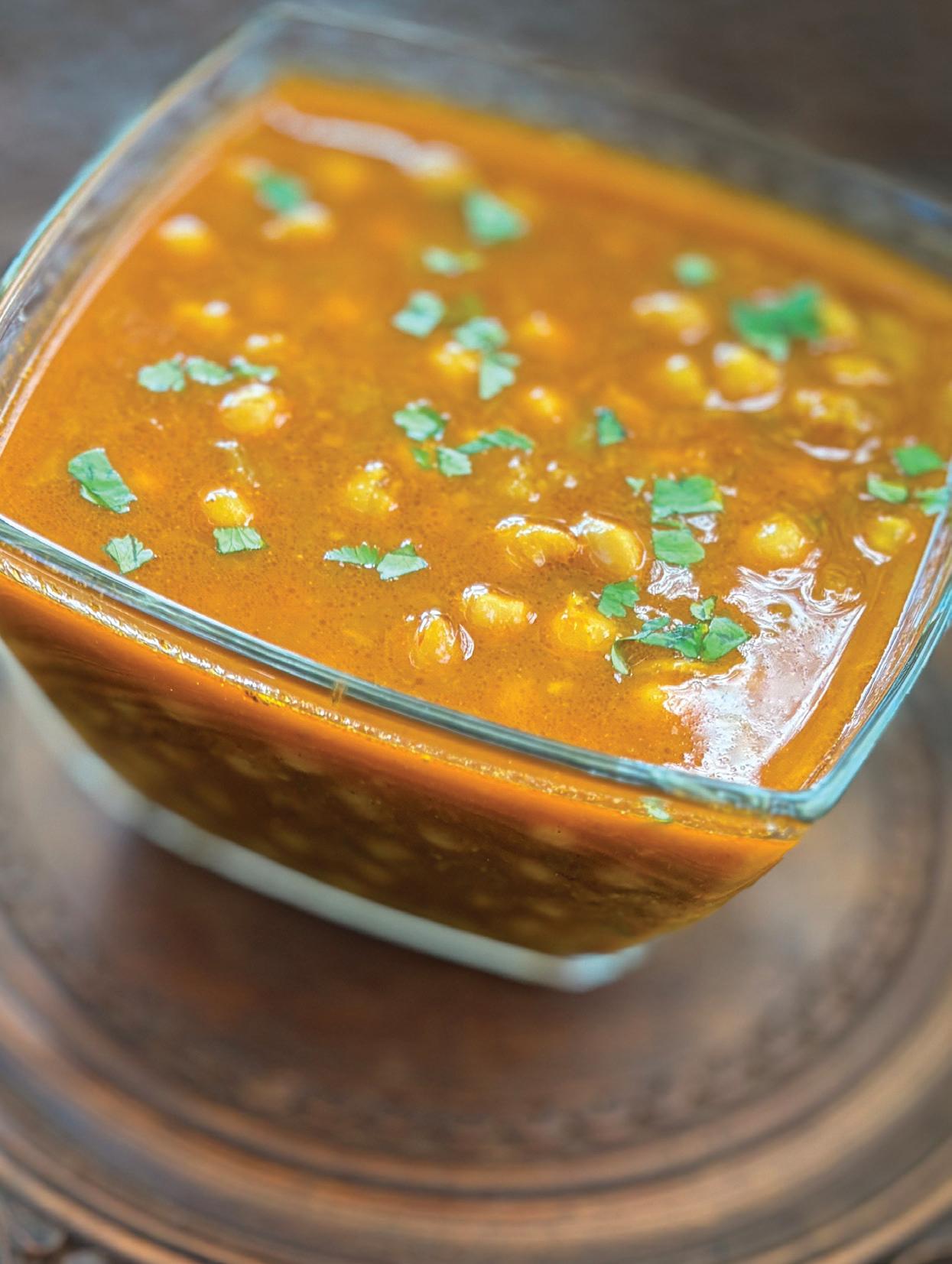
Pronounced ‘Shuh-leh’. There are two types of Chole that you can make: Pindi Chole or Chole Masala –the difference is the amount of water that you add, and therefore the amount of gravy.
Pindi Chole has much less water – just enough so that the spice base coats the chickpeas nicely, but nothing more. This is perfect is you want to make street food dishes, like Gol Guppe, that need all the flavour, but less liquid. (The front cover depicts Pindi Chole).
Chole Masala is usually what is made when you are serving Chole and want a ‘sauce’ or gravy around the chickpeas.
Ingredients
1 batch of Tarka starter – see page 305
1 tablespoon Garam Masala
¼ teaspoon Turmeric
1 teaspoon salt
1/3 tin of chopped tomatoes (approximately 130g)
1 cup of dried chickpeas (approximately 250g)
1 tablespoon of coriander leaves
Pre-prep: take the chickpeas and soak the contents for 8-10 hours (or overnight), in separate bowl. The bowl should be big enough to allow for the chickpeas to double in volume, fill with water to the top and cover with a tea towel and leave at room temperature.
Method
10 hours later (or in the morning) drain off the water. Put the dry chickpeas into a saucepan and cover with clean tap water and add a big pinch of salt.
*Note: you must change the water when going from soaking the chickpeas to boiling them.
Bring the chickpeas to the boil then simmer on low with the lid on for an hour.
Whilst the chickpeas simmer, you will make the Tarka base in a separate pan (see page 305)
Now add the Garam Masala, turmeric and salt to the tarka base, stir thoroughly. After that has cooked for a couple of minutes, add the chopped tomatoes. Crush down and chunks of tomato against the side of the pan so that you have a nice and smooth base.
Check the chickpeas, if you can almost break through it but just the centre is hard to the thickness of a red split lentil, they are ready. Drain them.
Add the chickpeas to the spiced tomato saucepan. Stir through so everything is incorporated well. Now you will add water – to make Pindi Chole, add enough water so that it comes up 5cm from the base of the pan. If you want to make Chole Masala, add enough water to cover the chickpeas. Now put the lid on the Chole, and bring the chickpeas to the boil, then turn the heat down, and simmer for roughly 20 minutes.
The Chole is now ready to serve
Add image or text? or compress Chole recipe onto one page and remove image on right?
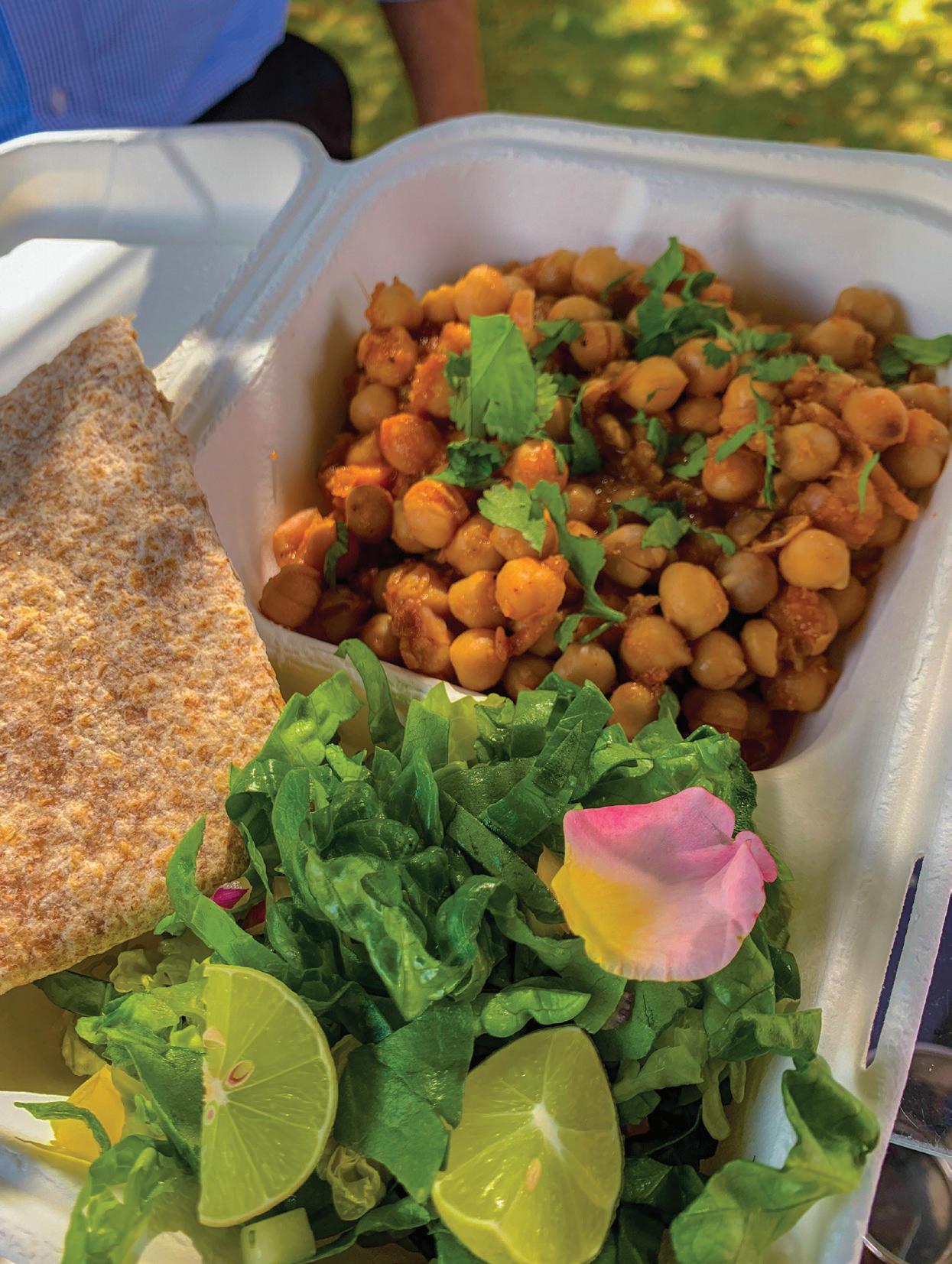
Puri is also known as Bhatoora, which is a larger puffier version.
Puri is what my mother made, and it is made from Atta , the wholewheat flour, and is the smaller crispier version, so this is that version. Bhatoora uses Maida, all-purpose flour and also yoghurt. I think it’s close to a fried Naan bread, but she never made that, so I’m fan of this light and crispy version.
Ingredients
1 cup of Atta (approximately 200g)
Approximately 120-150ml tap water
Sunflower oil, for frying (1 to 1 ½ litres)
Method
Before you start, pour the sunflower oil into a Karai (or wok) and put it over a medium heat
Follow the method for making Roti, (see page 79), right up to rolling out, but make the Pera size a bit smaller – more golf ball size.
When the circle of dough is rolled out to the size of a large saucer or small plate, (having made the Puris smaller than large Punjabi size Roti), then it is ready to fry.
Lift the circle of dough up onto the flat of your hand and lower it into the rolled-out circle of dough into the vat of pre-heated oil, being careful not to let the circle of dough fold on itself.
As the rolled-out dough goes under the oil, take a large, slotted spoon and gently push the dough down, then release and let it float up then push it down again and repeat until it puffs. This bobbing action forces the air through it and causes it to puff, but it does take some practice
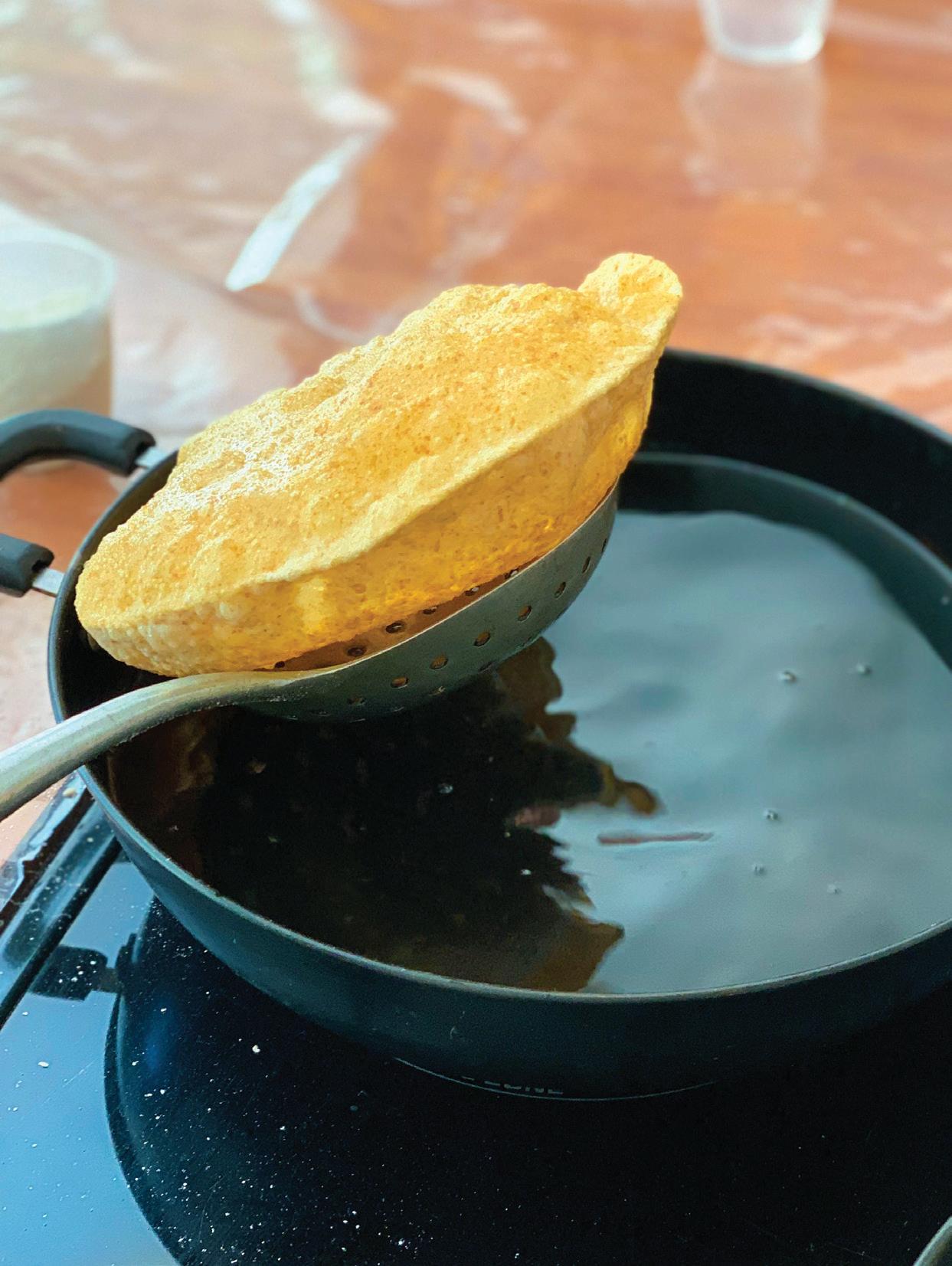
Yellow Pages was really great money -though you really earned it - given the toxicity and burnout. My ability to work endless hours, made this considerably easier. It came at a cost, and after a year or so, I didn’t like the person I was becoming. Eventually my sales performance and my ability to maintain the grind was failing, my heart wasn’t in it and my belief in the product was gone, and so I decided to move on.
I was raised quite strictly, financially speaking as well as in life, so did the solid immigrant thing of saving and paying in full. Credit terms were becoming widely available and one day I spied a fantastic silver-grey Italian three-piece-suite in a swanky furniture store. The price was prohibitive, but I enquired and found that with a deposit and ‘6 easy payment’ this divine and super-stylish sofa and armchairs would soon be in our flat. I was apprehensive about such a large sum and this whole borrowing and credit business, but it worked wonderfully, and I used it again for some other important purchase, but I never allowed it to become used for anything that was not a serious and considered purchase.
Yellow Pages had served a great purpose, in that I was able to earn such good money, that following on from the rewards of the bedsit scrimping and saving to be able to buy the flat, this continued saving from both salaries, meant that two years on from buying the flat, we were able to step up considerably and bought a 3 bed-semi, though the cracks were now appearing.
Such was our middle-class achievement in our early twenties, that both sets of neighbours were middleaged. This was in no small part, hugely helped by my angel mother, with regards to the lack of any suffering for some luxuries or treats, who ensured that whenever we were out, if I wanted to buy something she whipped out her purse and paid, and if I didn’t want to buy anything, she also whipped out her purse to suggest something. If I looked at anything, she was ready to whip out her purse…saying…” You want”?
Having left yellow Pages at a point where pushing or jumping were imminent, I went on very temporarily to a London based publication newly operating in Southampton, just for a few months, and then, always an avid reader of the job’s pages, moved on to The Echo, or what is now known as The Newsquest group. The Southern Evening Echo was Southampton City’s main newspaper, and the job was again in advertising telesales.
I remember going for the interview and after getting through the sales scenarios, the final issue was being asked… could I type?
The job required taking down advertising copy with a typewriter, and of course you had to be fast as ad copy details were being spoken as you typed them up and there was a deadline.
For this interview, I didn’t have to undertake the ‘sell me this pen’ scenario, but rather we had a group interview with two halves debating. The debate was about oxygenated water and whether boiling a kettle with fresh water or water already in the kettle made a difference. I remember that I absolutely loved this, especially coming from the world of girl’s grammar school where things like debating, and précis and old-school skills like ballroom dancing were considered skills that absolutely should be taught and learnt.
I remember the enjoyment of not only winning the debate but convincing many of the other half to come over to my side of the debate and agree with my proposal. It was a good game!
This was also a very easy continuation in the world of sales and advertising as it was a very nice place to work, and with good employers, and such a refreshing change after seeing so many girls ‘crying in the toilets’ and the ‘you’re fired’ world of sales at the American-style run, Yellow Pages.
Coming back to the question of… can you type …Well, I had always typed up my father’s letters, using the good old ‘hunt and peck two-finger bashing method, but I couldn’t type properly at all, or at speed.
However, I decided that as I wanted this job, so I would just say, ‘yes’, and figure it out later, intending to procure a second-hand typewriter from somewhere and spend my weekend practicing.
I also decided to build myself some leeway, and qualified my response, with… “but I’m very rusty”
“Oh, that’s no problem…we’ll just put you on a refresher course”, and so I discovered that… a…I had got the job, and b. that if the other person also liked and wanted you, that they would also make it happen, and that you could get paid on merit and results, plus receive free training!!
During this time, lurking at the back of my mind, was my mother’s 11 year wait to have her first child-initially and in part, because of a husband away in the navy, but primarily due to a simple procedure required, which on her arrival to the UK was performed and meant she was able to conceive. However, this concern about my mother not being able to have children for 11 years hung at the back of my mind, and so I decided that although I was happy to wait a couple of years, best not to take chances. This concern meant that I was now expecting my first child. It so happened that about 5 women had just had babies before I joined, so the office was full of baby talk punctuated with visits back to the office, of these ladies, with their newborns to proudly show them off to their former colleagues.
Thus, during my 8 and ¾ months of pregnancy at work, I was receiving lots of Western pregnancy and baby ‘advice’. During this time, I was also hearing my parents’ Eastern viewpoint and comments about childbirth and having a baby.
Firstly – these were very few, and also there was very little discussion or comment about the ‘do’s and don’ts’, which was quite the opposite to the Western office- world experience, which talked about baby books, birthing advice, birthing classes, pre-natal experts and a whole plethora and whirlwind of ‘baby and childbirth stuff’.
My philosophy regarding this was to listen to it all, from both sides, pick out and mentally store anything relevant or of interest and discard all other information.
I stayed on working for as long as possible, feeling well and fit, but eventually I left just 3 weeks before my due date. I had hung on until the very last moment, until they finally asked me to leave, possibly fearing I might give birth on the sales floor.
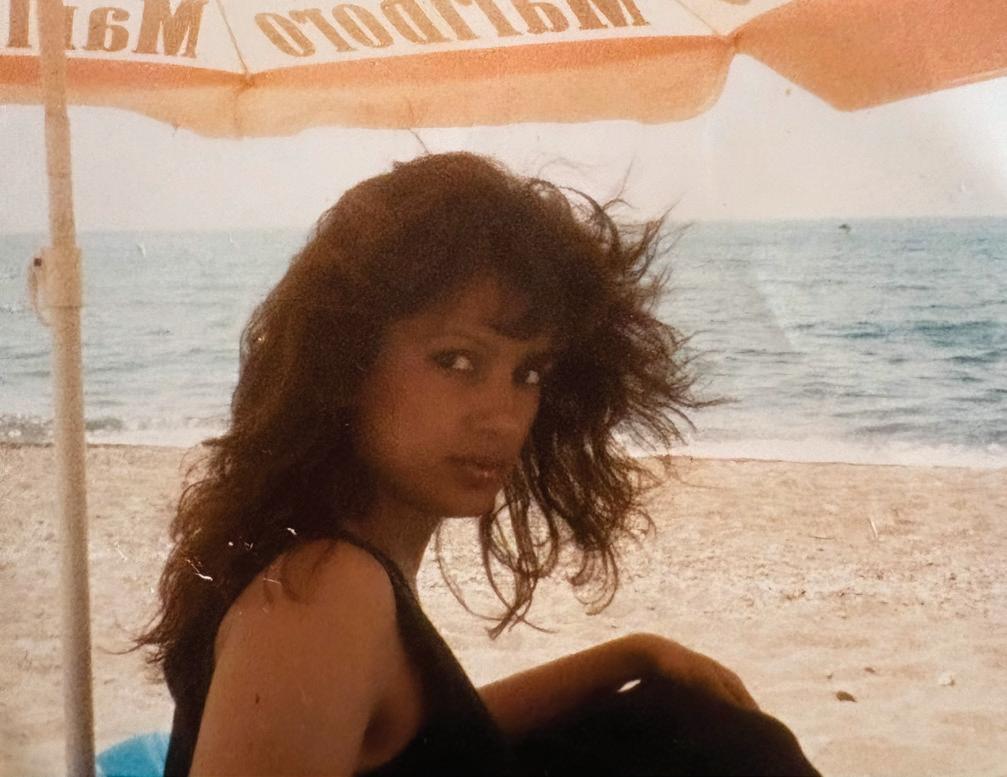
In my view, and perhaps because of my upbringing, and also not being someone of an anxious disposition, I decided to go with my father’s summary of childbirth.
He told me the story of a time when he was on leave from the navy and making his return trip home to his parents’ village. He was waiting in a rural area for a bus to continue his leg of the journey back to Punjab. I don’t recall the district or region he was in, but he recounted that it was more tribal and perhaps in the hills – more remote. As he waited at the bus stop, he watched a heavily pregnant woman walking some distance along on the other side of the road. As she approached a large boulder, she put her things down next to it and walked behind it. I’m not sure after how long, but my father said, she then appeared from behind the boulder, having given birth and delivered the child herself, wrapped the child up and then continued her walk.
My father said that these remote village people were known to be particularly hardy people. He told the story in a voice of awe and some incredulity, giving acknowledgement, that even in the tough areas of his background, this was quite some feat. His admiration of her toughness was very evident.
I decided that this no-nonsense get-on-with-it attitude would be my takeaway regarding the whole ‘giving birth’ thing, and not the wishy-washy pre-natal, Western sit-com style approach to the whole thing. Granted it was hit and miss if you needed medical intervention, and historically many women died however, there was no requirement for the hysterical wailing and screaming as seen in Western films.
I noted that we again did the opposite thing, and the wailing and screaming was reserved for death in our culture and not for birth, whereas in Western culture it was the reverse, with the ‘stiff upper lip’ repressive holding in of pain at death and the unchecked shrieking at birth? How interesting?
Initially, I was set upon having a home birth, however, the midwife, persuaded me that in the event that there might be any issue or requirement for medical treatment for the baby, this would potentially cause a critical delay. That was enough to change my mind, and so I informed the hospital that, given no incidents, I would in that case, immediately leave. They informed me that I was not allowed to leave before 24 hours, and so I had to stay for one night, much to my irritation.
‘Neither a borrower, nor a lender be…’
One of the rules in life that my parents drummed into me, was never ever to ask anyone for money –never borrow on a personal level. Equally as bad would be to lend. They didn’t want me to lend to anyone but rather said that if that person needed it and you really wanted to give it, then…just give it, with no expectation to have it returned. Make a gift but never a loan, but only if you could afford to do that and be prepared to part with the money, no comeback.
Borrowing did not apply however in business and my father often talked of ‘the overdraft’. He would come back from his ‘business lunches, talking of having arranged a loan for another property or an overdraft for another extension or building improvement.
The business of lending and borrowing extended itself in a new way that I hadn’t seen before, and that my parents would not engage in, which was, good old HP…or Hire purchase. The process of paying in instalments. This was quite common for the purchase of televisions, and enabled people to sensibly take some credit, pay a bit of interest and have their luxury goods. Years later credit cards were like confetti and huge numbers of consumers became heavily in debt for frivolous, ‘instant gratification’ type purchase. It was staggering how many companies and businesses provided products and service on free loan terms?
Lending… borrowing…the complications of it all. I once sat on a train with a couple who, for some considerable time, debated back and forth whether one of them owed the other one, £1? Who in fact, had paid for the coffee, and whose turn it was to pay! It was remarkable in its stupidity and that fact that they were married and sitting reckoning who had paid back whom and who owed the wretched £1!!
The stark contrast between the household management of money in Western homes was another thing that was so diametrically opposed to our traditional ways, and, on both sides, so damaging in its extreme forms.
Food for Thought ...
Reflections on two cultures, ways & worlds
‘Good families’
The society was becoming much more integrated, seemingly less racist and coming out of its National Front frenzy. My entire life was mostly spent around people, in a ratio of 99% white, other than when visiting extended family, but it interested me that none of my friends seemed to register particularly that I was not white, but also that there was no real curiosity about it. I had become naturally able at integrating so fully into whichever side I was with, more so on the white side, that it has turned out, that decades later many friends know almost nothing of my Indian upbringing and, my life behind closed doors.
Many have been surprised at how strictly and in line with much of my parents’ ways, I have raised my children. The only difference has been over the boy-girl thing – and the going out with boys-girls thing. Other than that, I have retained almost all of my upbringing, with absolute belief that my parents, mostly, did the right thing in their parenting.
Many children of immigrants see their parents as embarrassing and try to hide them form their friends. I partly had no choice as my parents insisted that all of my friends had to come to our house first, and so my friends always came over. I had nice girlfriends, (the same ones today), from ‘good families’, as my parents would say, and so they were respectful to my parents and our house.
I was equally very welcomed in all of their homes, and interestingly we all called each other’s parents, Mr & Mrs ‘Surname’. In the Indian families, we all called friend’s parents or any elder ‘auntie or uncle’. When Safia was a teenager, I met one of her friends and nearly fell over with shock when her friend called me by my name! I almost had a comedic physical reaction… What! What! What did she say!
Nowadays, all Western teenagers call their friends parents by their names, and the parents seem to like it? NOT for me and happily, I haven’t yet encountered it in British Asian society.
I found the differences between British and Indian approaches were so opposing in attitudes, and values, that it was a very noticeable contrast and quite difficult to process.
I noticed that Western parents, while loving their children also felt it a duty to prepare them to leave and form their own household, whereas Eastern parenting trained you to have a strong sense of duty and family commitment…but in the words of the Eagles song…’but you can never leave’…
The contrast went deeper than parenting. In Indian culture, respect for elders, family integration, and maintaining close-knit connections across generations was so important. Western culture, by contrast, encourages independence, and separation once children reach adulthood. These differences were not just about ethnicity or tradition— I noticed hey were also influenced by class, upbringing, and fundamentally different moral frameworks.
I believed in equality and egality, and that no one human was above another. But the opposing viewpoints of both cultures was very difficult because I could always see the point and validity of both, and both were well-intentioned. It was hard to know which side was right and which was wrong, and of course that view changed with age. As an older teenager the repressiveness of Eastern parenting became overwhelming, but now looking back, the majority of the decisions were, I feel the right thing to do, however, it was just that element that went too far that made me look to the Western side.
It wasn’t a fault situation, just deeply held beliefs and cultural differences and very different ways of expressing love…and love can be suffocating or liberating.
Food for Thought ...
Reflections on two cultures, ways & worlds
Another one of the most famous dishes and pairings of Punjab
It is said that the famous Punjabi ‘combo’ of Chole Bhatoora is the favourite dish of - the God that isShah Rukh Khan, the biggest film star in the world – move over Brad Pitt.
It is a pairing so deeply satisfying, and in addition so deeply nourishing, that you thank your parents for being Punjabi. In fact, once, Safia, when grown-up, was eating some Punjabi food, stopped, looked up at me, and said… “thank you for being Punjabi”. I said…. “You are most welcome”!
Here’s the thing – old-school homestyle Punjabi food ticks all the boxes. It actually ‘feeds you’. When I was a personal trainer, I used to tell clients that there is a difference in merely eating or consuming… but it’s different to actually feeding the body.
It is said that over eaters, continue to consume, and need to keep consuming cheap junk food, because they never feed the body with nutrition. The body receives an endless amount of junk food and empty calories devoid of nutrition and so the body screams to be fed, and they are never satisfied in the body and only very briefly in the jaded palate.
Eating cheaply with Punjabi food is easy – having dietaries is easy. High protein and energy values -sustainable, plant based.
Hearty food, satiety
I’m a fan.
…and so I had my first child.
Now tradition In Indian culture is that, most desirably, the first child should be a boy!
A boy was, and probably still is highly desired, though there are now active campaigns to remove this ridiculous and outdated prejudice.
For this reason, purely to be contrary and to irritate my parents, I insisted I wanted a girl first. In truth, I didn’t really care, other than to want to buck the system and do the ‘son rituals’ for a girl…and I liked to take the opposite position.
At my first scan, I was asked if I would like to know the sex of my child, and I declined.
By the time the 9-month due date was approaching, I couldn’t have cared less, other that the child be healthy. I was over the moon to produce my baby, no matter girl or boy. Interestingly, contrary to my expectations, he was not a wrinkly prune, but so beautiful and smooth-skinned that people pronounced him to be one of the most beautiful newborn babies they had seen. I was happy and celebrated with a cup of tea and slice of toast!
My mother was blissfully and dotingly happy, however, my father’s reaction was something else at the sight of his first grandchild! He was ecstatic! Stereotypically ecstatic. Actually, he was beyond ecstatic. For a reason he did not expect!
Not only was there the superior and desired male genitalia… but…additionally…the baby was BROWN! NO evidence of any ‘whiteness’
My amusement was too much as my father held my son in the manner of Mufasa in The Lion King! (Though his very public adoration caused some upset in some quarters!)
Throughout my pregnancy, my father had made little jokey-type comments about the possible colour of my yet-to-be child. He did this in a sort of pretending to make light of it, but I knew he was not-so-secretly panicking about a ‘white child’…what would people say…not something he ever normally cared about, however in this case he was ‘those people’
This, again, only caused me amusement! Quite honestly, I actually wondered myself, not only about the… ‘is it a boy…is it a girl’… but the added possibilities of … brown…,white…caramel….toffee…. mocha…zebra -striped…
Who knew!
Who cared
Reflecting back on this, given the Prince Harry, Megan, Archie blow-up, that people had commented on the colour of the child, I personally didn’t see the problem with my father voicing what he was wondering, because… so did I! How would the genetics play out?
Again, I personally didn’t care, was quite relaxed about the whole thing and fully confident in the whole process. I ended up with a very easy baby (though he gets me back a little bit later in life!).
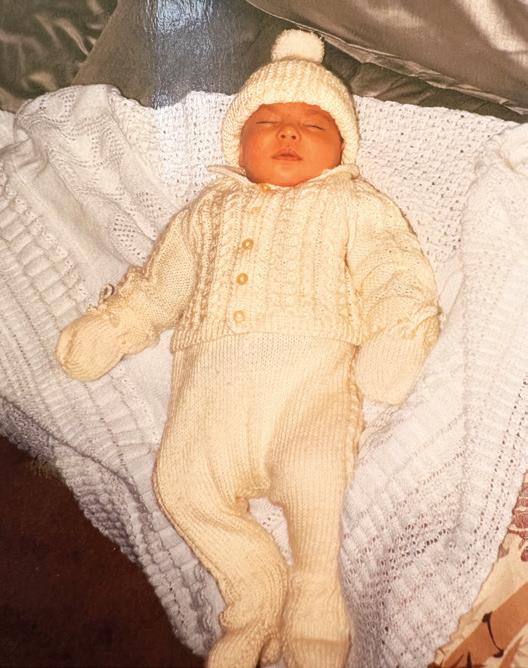
Just before my son was born, I was queried twice about the prospect of breastfeeding. Both queries were comically typical in that one was from the Eastern perspective and the other from the Western perspective.
Firstly, my father bluntly and quite aggressively demanded to know… although his query was always more of a command, “you are going to breastfeed, aren’t you? It was more of a statement, informing me that I would be and that there couldn’t possibly be any other option. I was in line with this thinking, so nodded assent, to which he was visibly relieved that I should not be deviating down the Western formula-milk route.
Conversely, one of my very good English friends quite innocently queried, with the very best of intentions and concern, ‘you’re not going to eat ‘curry’ when you’re breastfeeding are you”? Her consternation was genuine and well-meant, and in accordance with all the Western mid-wifery, (and in my opinion), nonsensical advice to avoid spices and chilli etc. This made me laugh, and I said… “What do you think the majority of the world’s pregnant and breast-feeding mothers are eating? Plain Boiled potatoes & cabbage (my mother’s favourite scathing and generalised description of English food when she was annoyed)? I could see the thought process going through my friend’s head as she registered this fact! “Oh yes, she said…I never thought of that!”
I suppose that the general principle would be, not to try new foods or alter your natural diet.
In the first few days and weeks of his life, when the midwife, and then it was health visitor called, and he was weighed, he was so thriving and gaining on the charts, that it was jokingly asked if I was producing doublecream
Tradition had it that back in the villages, that when a girl had her first child, (usually not long after being married), she should return home to her parents to have her baby. This tradition made sense, as essentially back in the villages, she would have been marrying a stranger and going to live with a strange family, and that custom would return her to the comfort of her childhood home and support of her mother, who could help her with her first experience of a newborn baby. My mother suggested that I should do this, but I soon put that idea down. The situation didn’t apply to me, (I was in my own home and not living with stranger in-laws, and as it was, I spent probably over half my week at my parents’ house anyway, so that was a good compromise. My mother was disappointed but was also resigned to the fact that she had never been able to persuade me over to cultural traditions that I didn’t want to include.
However, there were a lot of cultural traditions that I did like and one of those was the involvement of grandparents. There was also heavy expectation from my parents that they should not only be involved but freely offer their opinions and advice. This was in stark contrast to Western grandparenting as I saw it, which wanted minimal if any involvement.
When it came time for weaning, once again I listened to my mother and took her advice in all things natural and traditional, and so after pears, rice and plain pureed foods, Masoor di dhal and rice was one of the next foods for weaning, but you could do this with any of the different types of dhal, as long as you puree them thoroughly and dilute. My mother told me that I should puree a very small amount of dhal with plain boiled rice when I started weaning my son, and so he was weaned on whole fresh foods, including any Dhal & Sabji I was making. . Interestingly, she also told me that this was how the very elderly (when they had lost their teeth and were reduced back to their original gummy state), were fed, which was on puréed Dhal and rice
Dhals are made from pulses, such as lentils, beans and spilt peas, and they are one of the most important parts of the Punjabi diet. Some of the most common dhals, include Masoor, (red lentils), Moong, (yellow or green gram), Urad, (black gram), Chana, (yellow split chickpeas), and Rajma, - (kidney beans). These were everyday foods in traditional Punjabi homes, and are all eaten with Roti, with the exception of Rajma, which is eaten with rice
These are the five main Dhals we would have had, to add some variety. They are made with the same ‘wet’ Tarka base, as with Masoor di dhal in Chapter 4, so preparation of your lentils and the cooking time for each is the key thing here. Lentils should be fully cooked for Dhal but never mushy. Different types of lentils take a different time to cook, and the way we would do this, (apart from knowing from experience, which comes from practice and actually cooking Dhal regularly until you get it right), is the bite or nail split test. When cooking Dhal look at it as it changes form the boil into the simmer and see the texture and colour changing. When you think it looks cooked, pick out a few lentils and bite them and also split with the nail to see if there is still a hard centre or it is fully cooked but not overcooked.
Chana Dhal - Yellow split pea
Mung Dhal – Whole Mung bean
Urid Dhal – Whole black gram bean
Green Dhal - Whole green lentils
Brown Dhal - Whole brown lentils
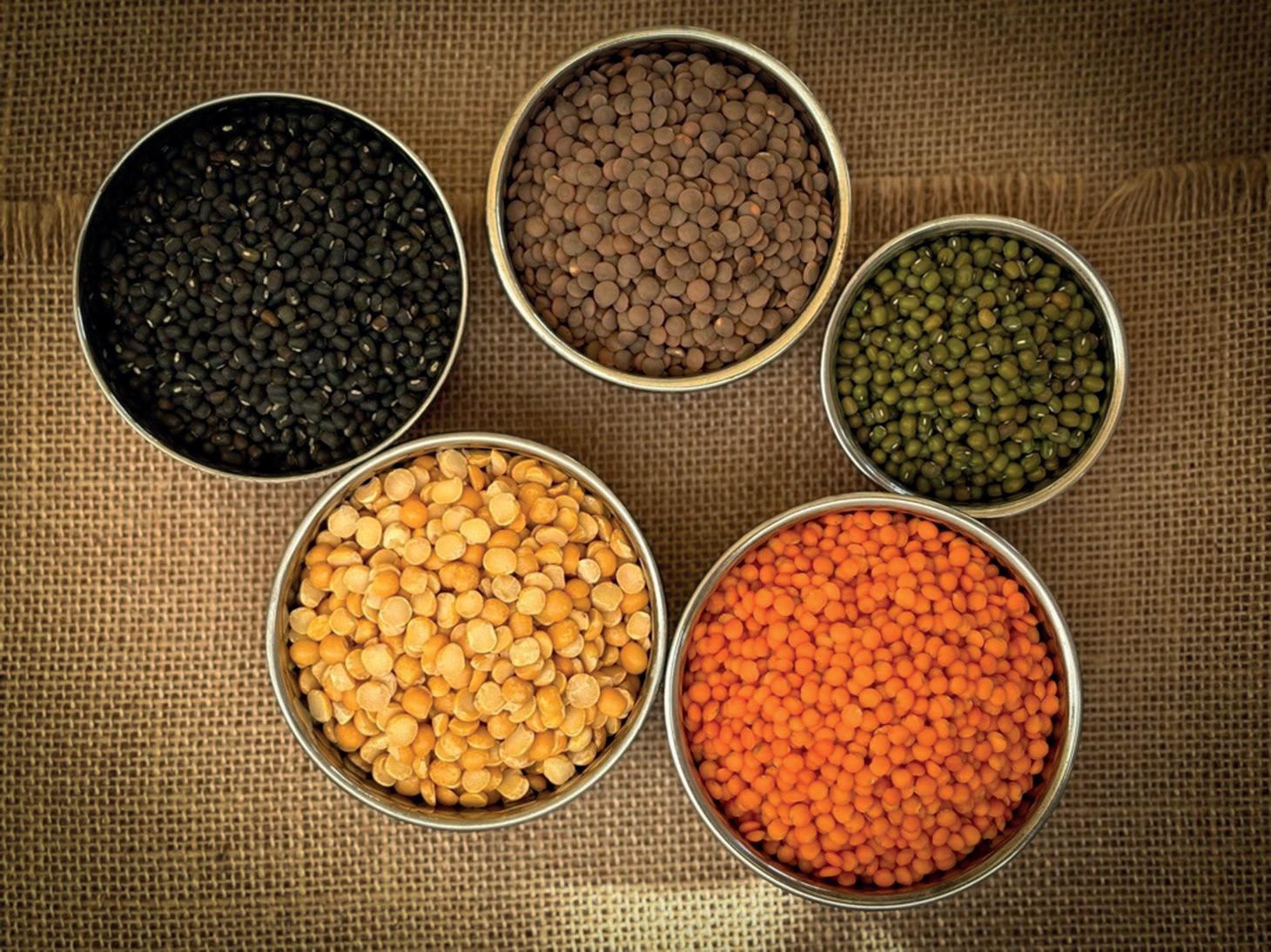
For these five dhals follow the Masoor di Dhal recipe, (for which red lentils need no pre-preparation other than washing), and then add the pulse of your choice to make these different dhals (see page 107??).
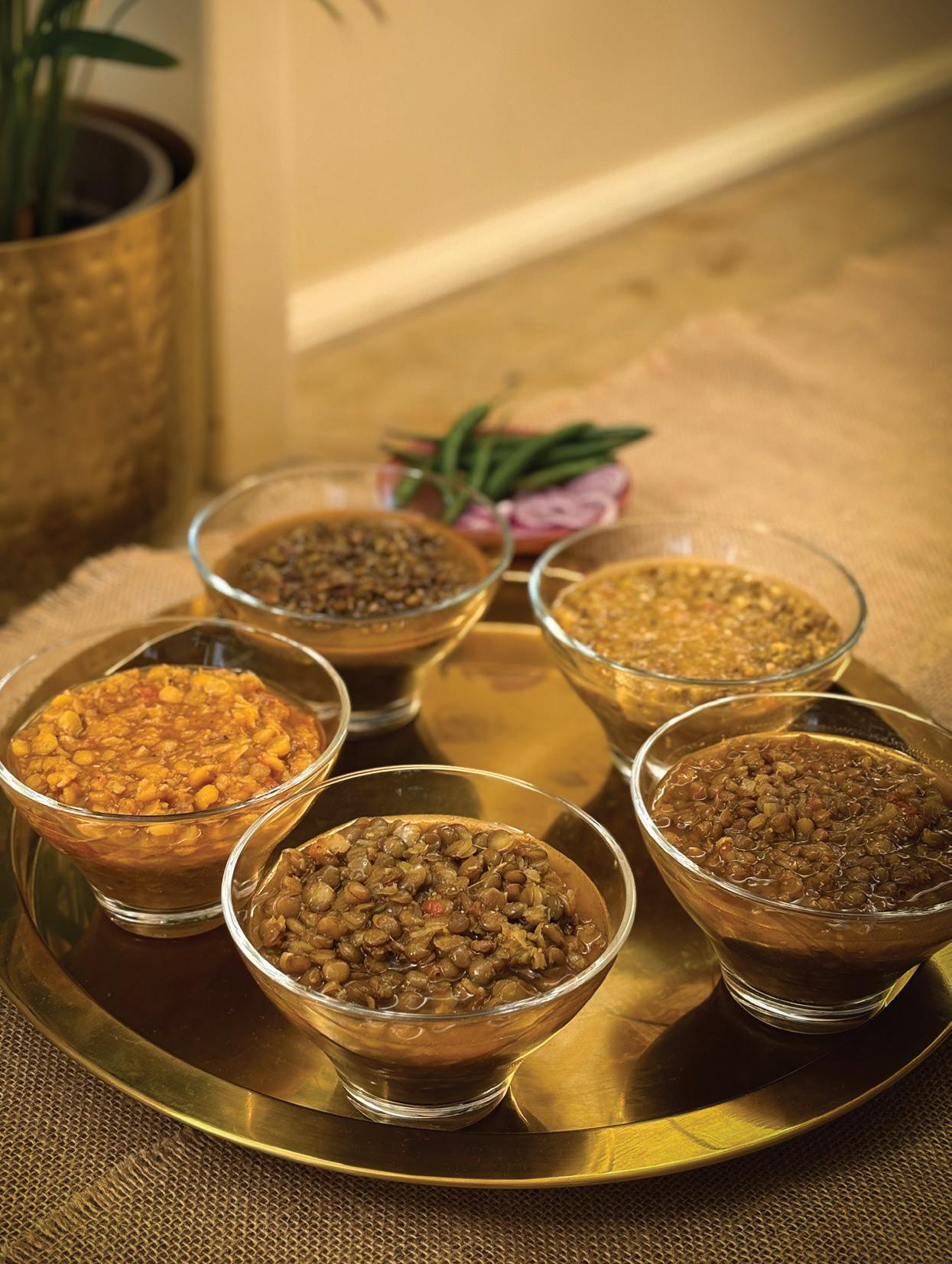
Method of dhal preparation and approximate cooking time:
For Dhal making, you will have two saucepans cooking next to each other: one with the tarka base, the other with the pulses.
The only two pulses that require pre-soaking (8-10 hours, or overnight) are Chole & Rajma (Chickpeas and Kidney beans).
All pulses, except a red split lentil, require some pre-cooking before you add them to the base (Tarka). This process is…put the pulses in a saucepan, cover with water and salt, and bring to the boil. As the pulses cook, a foam/scum will appear on the top – skim this off and discard it.
Once the pulses have boiled, let them simmer – anywhere from 15 minutes to perhaps 30 minutes, depending on the thickness of the pulse and the rate at which your hob distributes heat. Do NOT fully cook.
To test whether to pulse is nearly ready, take a lentil out of the water, and try to squash lentil/bean between your thumb and index finger. If you can almost break through it but just the centre is hard, this is the time to add it to the Tarka and let it finish on a very low simmer, until the pulse is fully cooked through, but not mushy.
Plant based as a natural term, would be a way to refer to Dhal, from time immemorial and not really as the modern catch-all phrase that is applied to anything that is not meat or animal product.
Food has always come from the land, and most people would not even have thought about categorising it in any way other than… it’s good, tasty food, mainly from plants or crops of all kinds.
Add image or text?
Although I appreciated the value of my mother’s information, I would always make the decision to look across traditions from both of my worlds, and adopt those I thought were sensible, relevant and valuable. Some stood the test of time and applied across all situations, for example the use of the masala dabba (spice tin – I’ve added this translation in) for minor ailments instead of pharmaceuticals.
With hindsight, it must have been very difficult for my mother to make out and understand such a headstrong and confident girl, raised and educated in a foreign world, though my mum was by no means a weakling, frequently and vocally ‘squaring up’ to my father. She was strong in herself but wouldn’t have broken traditions.
So, although I denied my mother the benefits, I instead profited from them because when the girl was at her parents’ home after the birth of her child, the mother would make a special food for her daughter.
This was Pinni or Panjeeri, often made after the birth of a child.
Still to this day I dream of this sweet dish and the goodness and love of my mother – denied more than a basic education but so trying her hardest in a strange. lonely and difficult world.
It a very traditional winter warming Punjabi recipe that words cannot describe! If you’ve had it once, you will always want it again.
Add image or text?
Pinni, starts as a sweet sort of crumble mix, (which can also then be formed and served as a Ladoo/dumpling). It is made for a daughter by her mother, after the daughter has given birth, this is a mixture rich in fats, proteins and sugar, meant to build you back up, nutritionally dense and calorific, to give you strength and energy for breastfeeding and looking after a new baby…. Oh, and did I say… dee…licious!!!!!
I liked it as the loose crumble called Panjeeri,(rather than formed into Pinni Ladoos), and used to free-pour the mixture into a cereal bowl, get a spoon and eat up!
It sort of looks like sand in appearance and texture…
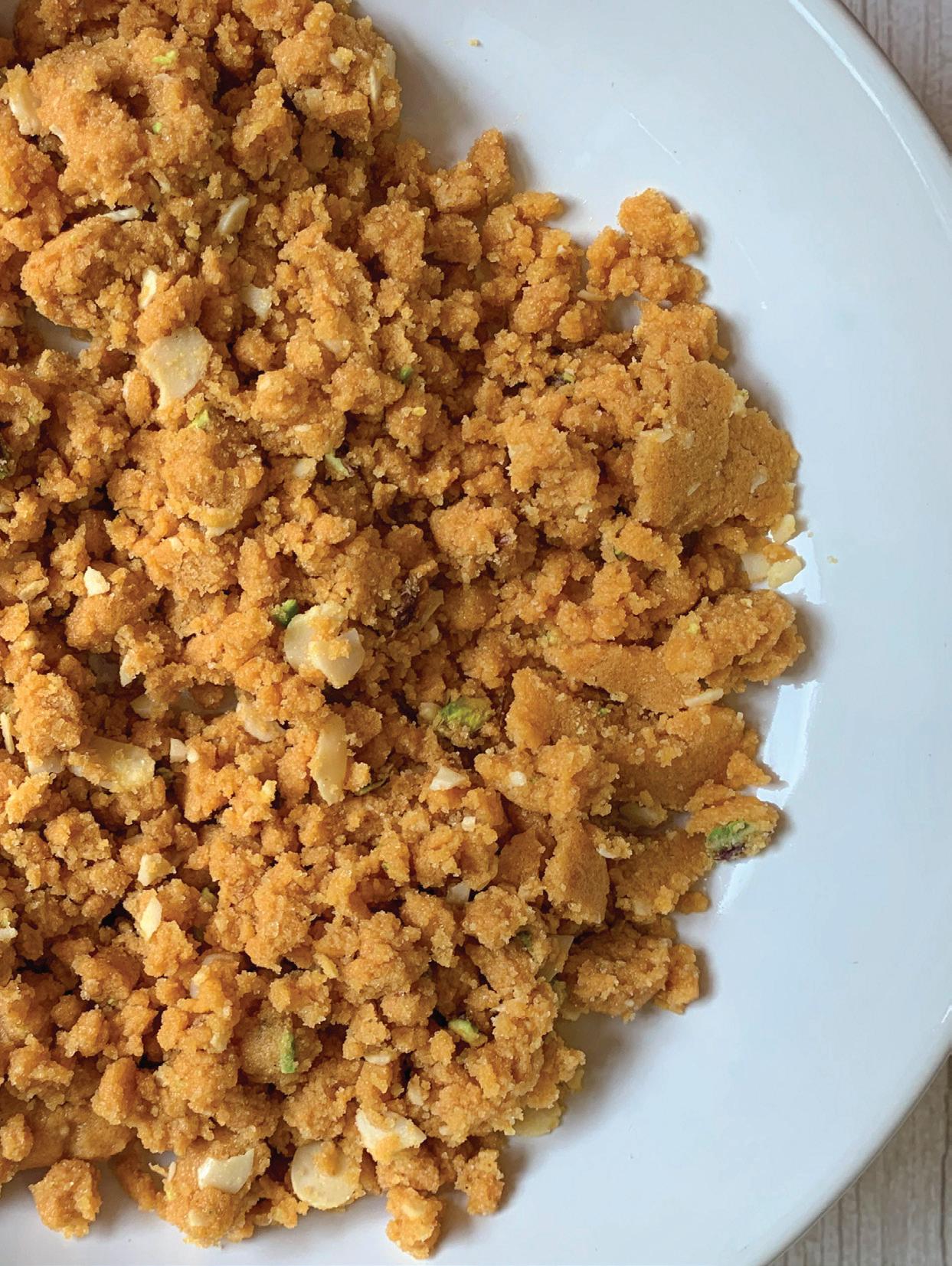
Ingredients
1 tablespoon Ghee
½ cup Almonds
½ cup Raw Cashews
¼ cup Pistachios
¼ cup Melon Seeds
¼ cup Raisins (optional)
5 tablespoons Ghee
¼ cup Besan (Gram flour)
1 cup Atta (Wheat flour)
1 cup fine Castor Sugar
3-4 Green Cardamom Pods, ground
Some people also add a teaspoon of ginger powder, ½ cup desiccated coconut, a cup of foxnut/lotus seed (Makhane an edible seed), and ½ cup of edible Gond (edible resin from the Acacia tree which has warming and medicinal properties), but my mother must have adapted her recipe to accommodate what she had, and I got used to that, plus I don’t like those extra items, but feel free to add them. I like that base mix of mostly nuts.
Method
The process starts by roasting all of the nuts until light golden brown -roasted, not burnt. This must be done one-by-one as they roast at different speeds. Start with roasting almonds 2-3 minutes on a low flame with a little ghee and when golden brown, transfer to a plate. Then add more ghee as required to roast cashews and add to plate, and then pistachios and add to the plate. Next roast melon seeds for about a minute & add to a bowl (if you are using raisins, roast these now for about a minute)
In the same pan heat 5 tablespoons of ghee and when it’s heated add the besan and roast on a low flame for about 3 minutes. Then add the cup of atta and roast on a low flame continuously for about 15 minutes until it tuns golden brown and smells delicious. This part does require fairly long slow roasting, and you have to cook it out for long enough, (the same as making the Besan sweet, on page 107), to cook out the bitterness, but don’t forget it and let it burn!
While the mixture is cooking, grind about 80% of your roasted nuts, keeping some back for garnish. If you have used Gond and Makhane, grind those with nuts. Now add all the ground nuts and other ingredients and stir into the mixture. Pour over the castor sugar and green cardamom, and raisins if used.
When all is mixed well, add in the reserved whole nuts for visual appeal. This can be stored in an airtight tin for some months – if it lasts that long. Enjoy with a cup of tea or anytime.
Being a stay-at-home mother, was conflicting. However, under no circumstance at all would anyone else be allowed to care all day for my son…
except for my mother, however, I wasn’t used to not working or being productive, and there was only so much decorating, home improvements and gardening I could do.
I was always looking to see what I could do to progress our financial situation -make more money, achieve and climb that ladder, and so followed the Western woman’s way of thinking – to go back to work, and to earn money! However, I wasn’t going to put my child in any sort of care, and in this followed the traditional Indian parenting model, and so I ended up going back to my parents 3-4 days of the week to work for my father. At this point, my father still had the supermarket. And so, I did his PA admin/ secretarial/ chauffeuring/goafer work.
Having watched my father buy more property and use that for business and income, I decided that we should also get a small rental and we got a small house on the outskirts of Southampton. My son was about 6 months old, and it proved quite problematic with difficult tenants, and having to keep going there and we quickly sold it. The market was on the rise and having bought and sold at right time, we made a good profit.
There was no question that my son would be left with anyone else except my wonderful mum. No asking on either side, and no expectation of any other way. Full assumption on both sides that she should have my child if I were working.
From the moment he could toddle, she had my toddler doing housework -dishwasher emptying, sweeping front garden, dusting. One day I walked in to find my one-year-old son lifting a glass out of the dishwasher, tottering like a drunk towards my mother and watched him semi-lunge towards her as he tried to hand the glass to her. I rushed towards him to take the glass, but my mother said “no – leave him – he’s fine” …and so he was.
He was Nanni’s little helper. He followed her around during her day, doing what she did! It was one of the best lessons I learned in raising children in this old-school way – keep them always at your side, let them
see how you work and what needs to be done in the day -let them learn naturally and organically, and by absorption. I noticed that Western parenting, when they tried to do this, would make a big deal about being very verbal about this, with a lot of ‘good job’ well done’ irritating comments!
Observing the differences in Indian style ‘chores’ and Western style chores’ I decided that the Indian style was by far the better one. My mother never made a ‘big show’ of ‘look at me’ teaching the young one – making a lot of noise about it, or doing it in the… “I am now training this youngster” – it was just a normal day, and she always gave praise in her usual way – a lot of hugs, cuddles, kisses and love –regardless of what ‘job’ was being done. It was how she had raised me. They worked alongside each other, and she kept a careful eye, to quickly and silently take any object if it was too heavy or to intervene if it was dangerous, but otherwise it was more about getting her day done and also looking after her grandson.
It was also easier as the mother of a daughter’s child to have more freedom to do this. In that I think this is true for both cultures.
Another thing I started to do at this point, was to use the house as an income stream. Having grownup watching my father buy successive properties in our road and then turn these into all manner of commercial enterprise, through various forms of rental, I one day saw an advert for host families… and so I applied and took what would be the very first of many students that passed through our home. Some short stay of a week, some longer stays of 3 weeks.
I always found this fascinating, especially their eating style and habits. Mainly from Europe, almost all of them had never eaten Indian food. They also had a habit of eating any salad or vegetables on their plates first, before touching meat or veg, which I had not seen before.
I found hosting to be a wonderful experience and mutually very enriching. It was also to be a good source of supplementing income when later paying for private school fees or any extras.
This continued when Safia was born. This time, with the arrival of my second child, after giving birth at the hospital, I walked out (this time refusing to bow to the hospital’s insistence that I had to stay for 24 hours), and within 6 hours after the paediatrician had done his checks on her and given the all-clear, I was back home with my newborn. I had researched the legalities and found that they could not force me to stay, and in fact I could have left immediately after my son’s birth!
The birth and first sighting of Safia was an interesting experience. This time the ‘though-out-loud’ ponderings as to the potential shade of this child were far less, as full confidence in the total Indian brown colour-gene dominance, of my son’s genetic make-up had given my father great confidence.
So, imagine our surprise at the sight of a milk-bottle-white, child, her face covered in blue/red/purple blotches! Not only that, but a face so squashed-up that when my father was first shown his ‘white’ granddaughter, he looked at her, said nothing. He then looked at me, and with great commiseration, and a
hint of amusement, and in true, blunt, to-the-point, no sugar-coating, ‘Father Hothi style’…offered me the condolences of … “never mind Putt”.
This offer of condolences and commiseration on the sight of this squashed-up, quite frankly unattractive white, blue, red purple blotched face, once again caused me some amusement, as I doted with equal joy upon my second, and yes…beautiful child.
I was pleased to now have a girl as this gave me a boy and a girl. I was also aware of the cultural traditions of having daughters and sons, an English expression that someone had told me…
“A son’s a son, until he gets a wife…a daughter’s a daughter all of her life”.
I had seen this to be mostly true all around me across both cultures in various formats.
In raising my children, I replicated exactly what my mother had taught me, except this time, I made a fundamental change, and extended this to include my son, keeping both my boy and my girl at my side, training them to work/play alongside me.
It was opposite to the Eastern way, making a girl’s life one of drudgery while the boys were spoilt indulged Princes. On the other hand, Western parents made ‘chores’ a punishment for both boys and girls, instructing children to do jobs alone, while they sat or did something else somewhere else.
Children love to be with their parents and to help them and have their kind and smiling approval.
As my children grew, I continued to find ways to generate revenue from the house by taking in the student lodgers to increase and supplement income.
Additionally, I did a lot of decorating and improving the house to increase value. I had done a lot of labouring type work for my father when he was working on his properties. I loved and still do love gardening and spent a lot of time making the garden pretty as well. Once, having saved very hard, I had paid for a painting and decorating job to be done. It was amateur to say the least, and I was very unhappy about the sum of money I had
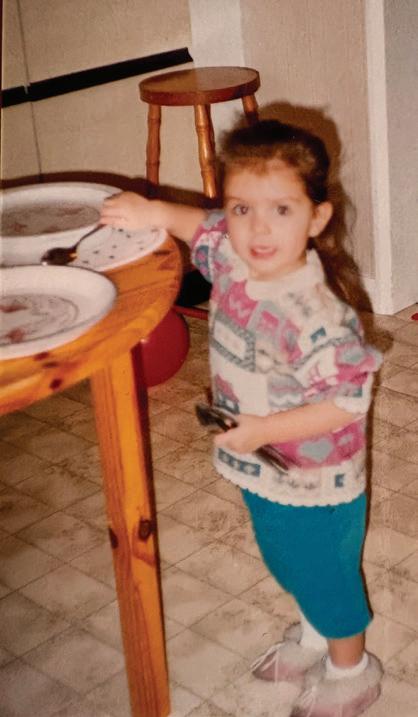
paid for the poor job. I decided that I would save money and do all the decorating myself. My logic was that …I didn’t need to pay someone for a rubbish job… I was quite capable of doing a rubbish job for free!
Still looking for more ways to supplement income, without compromising parenting, I started a little dried flower business. Dried flowers were all the rage at the time, and this led me to my first experience of the world of events, in the form of doing shows and markets. I had always loved attending craft fairs, and so I applied for a stall at the weekends making my flower displays and arrangements during the week.
I also continued to drive to my parents 2-4 days of the week to do the admin and shop work for my parents, going down the road to their shop and my father’s office and leaving the children in my mother’s house.
This continued after Safia joined her brother at his local prep school, (which was down the bottom of our road, (but living the nearest, we were always late and last to arrive). I would on these days drive to the school to drop them off and then hop on the M27 and go on to Southsea, then leave around 2.30 to get back to Southampton to pick them up.
Add image or text? or?
‘Enterprising
There’s always a way to earn, make money or generate some kind of income…if you really want to, and I grew up understanding that property, whether you live in it or not, needs to be put to use and so the house was used extensively for some kind if income generation. Had it been a time of the internet and the opportunities that were to come, I’m sure I would have started an online business, but that time was years away.
Working from home, (such a familiar phrase now), in the way that I knew it, was the way my parents did it. Make the home pay for itself. I took a steady stream of foreign students and temporary student lodgers, but never a long-term lodger, as this way the family home always felt like the family home, and the short-term visitors felt like guests, but would soon be gone, so it never got on top of you.
I operated it in a structured way, knowing how much would be used as expenses, and what would be for an identifiable purchase, or into saving, so that it was never wasted.
Being resourceful is a trait of the early immigrants who have no one to rely upon and no network around them. Reliance on the family and the children of the family is the strength of Asian families.
From the beginning, both children from a very young age, helped me, laying the table, clearing and tidying up and fetching and carrying. From very small toddlers they were taught the game of …putting toys away!
An essential life skill as well as an organisational one.
Food for Thought ...
Reflections on two cultures, ways & worlds
“You don’t know your own mind’
My father once told me, when I was in my mid-twenties, “no child knows their own mind until they are at least 30”. I laughed at this and said, “what rubbish”! I thought it was absolutely ridiculous. Now I think there is some measure of truth in this Asian attitude…
Looking at successful people, those from wealthy families, both Asian and wealthy Western or aristocracy, are very clearly steered by parents and elders and their community toward the ‘right’ career choice in the city, to the ‘right’ university, and into city jobs.
There was always an old Asian joke that the Royal family were Indian – kids live with the family, stayed in the family business and had ‘arranged marriages.
The concept that elders know better and, that the decision-making in business, life, marriage and, in fact, all major decisions were best left to elders who knew best for you. The vast difference between the two cultures was that in the West you were deemed on your own anywhere from age 16-18 and left to make quite life-changing decisions, for good or for bad... In Eastern cultures, you weren’t even allowed to think of having any decision and instead, those choices were left to elders -for good or for bad. I knew quite a few Asian girls who were married to really horrible men – lives ruined forever.
Ultimately should an elder potentially destroy your life or should you have the right to destroy it yourself?
Equally should they make the decision to benefit your life? Perhaps by fortuitously arranging a marriage that just happens to work.
I would say that it is weighted more towards ruining your life. Like doing DIY, maybe let you do a bad job yourself? Or not?
‘East will kill you (girl only), West abandon you (both)’
The worse-case scenario and absolute extremes of both cultures parenting styles is that Eastern parents could sometimes literally ‘kill you’, the more extreme, (and mostly uneducated), actually committing murder for some kind of ‘dishonour’, or the less extreme, disowning you, with concepts of shame, duty, honour etc being paramount…shockingly more important than the child!
The worst cases of Western parents were that they would throw you out and abandon you – the prime motivations seeming to be inconvenience and costs, and a desire to live one’s own life. When I was around 16, there was a girl at our school whose parents had thrown her out when she had turned 16, and she had nowhere to live. I almost couldn’t believe it!
There was at least, from what I saw, equality in the Western world between girls and boys in this abandonment.
Whereas there was a definite leniency, if not indulgence for the wayward, spoiled and entitled princelike behaviour of almost all Asian boys. The perpetuation of raising spoiled boys by women…their own mothers! The favouring of sons over daughters. The mistreatment of daughters-in-law. The reinforcing of stereotypes, and worst of all…the disloyalty of women to women.
Over a lifetime, I saw ‘baby’ Eastern men wanting their cake and eating it, having been hand-fed by their blindly doting mothers. They sat on sofa’s calling for a mother or wife to bring them tea, or whatever. I used to laugh and mock some of them, but interestingly, the females were the ones who didn’t like my taking issue with the spoiled baby boy behaviour?
Women raising bad sons and covering for them - a classic case being the protection of men such as the grooming gangs, all of whom, had the women in their family not only turn a blind eye but condone this behaviour. Until women… (or the primary stay-at-home parent – so mostly women) … raise good men to become fathers who also support the equality of raising girls and boys, and their equal status and value, this won’t end.
Food for Thought ...
Reflections on two cultures, ways & worlds
“Love Pulses”
Dhal is known as a superfood, and one of the reasons is its high protein content, as well as fibre content, iron and B vitamins and the slow release of energy from complex carbohydrate. In rural farming areas like Punjabi this has been a major and reliable source of protein for the population, as well as being affordable, ‘sustainable; before it was a fashionable term. It’s the sort of meal that fully satisfies without being heavy in the stomach and is my preferred lunch almost every day.
In 2016, The United Nations recognised the importance of pulses as a global food source and named it as the ‘International year of Pulses’. Asians always knew this, and pulses were in every home, but it was important to spread this message across the world and draw attention to what we have always known, that pulses are nutritious, sustainable, super healthy and versatile.
During this campaign, my daughter Safia, (and at this point business partner in Pure Punjabi), was asked to be a global ambassador for the campaign and represent the UK with a plant-based recipe using pulses.
Having used the red lentil - Masoor di Dhal as the first food I used to wean my son, I had already learned from my mother that this easily digestible dhal, was used for babies and the very elderly, pureed down and diluted with yogurt and rice. It’s so full of nutrients that it is ideal for young children.
Similarly, the winter staple of Pinni is the epitome of introducing nutrition and goodness into the bodies of new mothers and their babies. It’s such a wholesome tradition, and the recipe is considered a complete strengthening food for recovery, breast-feeding, delivering extra nourishment at this important time. It has so much goodness: protein, healthy fats, iron, calcium, essential micronutrients. Not much is needed as it is a ‘heavy’ food, so a small amount delivers all the benefits. It’s just such a bonus that this post-natal food as medicine is so delicious!
Chapter 11 – “Mummy went to the restaurant and no one’s there”
When Safia and my oldest son were 5 & 7 and I was expecting my third child, we relocated to Brussels with their father’s job. We rented out the U.K. house and flew out to view various houses and schools. My son Arun was born in Braine L’Alleud in the Commune of Lasne, near Waterloo, when the older ones were 6 and 8, and so we had to go into Brussels to the British Embassy to register him. For the first 3 weeks he had no name. This was because of the struggle to find names that would work across both cultures and potentially be names they would be ok with when they were adults.
Finally, I found the right first name searching through Indian baby names: ‘Arun’ for a first name, and for a middle name, ‘Joel’, both of which lent themselves perfectly to western equivalents.
In the ways of my mother, I knew no other way than to include my children in all aspects of everything I did as work, and play. The difference being boys as wells as girls – all being treated equally…or as equally as their very distinct personalities would allow.
The four of us spent long hours together and were a tight little team. My older son, once watching me try to breast-feed Arun, then mop the floor, told me at age 8, that he would do this task. And so, I showed him how to fill the bucket with the cleaning agent, wring out the mop and mop the floor. So, I went off to feed Arun and then took him up to put him in his cot. When I came down, much to my astonishment, every piece of freestanding kitchen furniture, including the kitchen table, was in the hallway. This was when I learned that this son was not only going to do a proper job but do what I did for my mother - help me out when I needed it.
Safia, meanwhile was delighted to have, as the newsagent in our Belgian village said to her… “une vrai poupée”…a real living doll!
I would wrap baby Arun up and pop him in his pram, and Safia would push him up and down the driveway, while I watched from the window. Mealtimes involved both the siblings taking turns to feed him in his highchair.
Occasionally I ventured off to some mindless and inane ex-pats wives gathering, all with the same types of women who did nothing all day. It only took a few of these to know that I hugely preferred the wonderful company of my interesting children, with their entertaining jokes.
One day the women were all discussing the various expat postings they had been to with their husbands, and how they had not liked them. One of the women started talking about how they had been posted to Pakistan or India. Another woman said she could think of ‘no worse place to be posted’ and proceeded to have a general moan about how she would dread ever having to go to a country as horrific as India or Pakistan and could think of nothing worse.
Something I had encountered most of my life was failure for almost everybody I met to realise I was Indian. I was aware of the very few women in the room, including the one who was talking about her time there, who all knew that I was Indian.
I stayed in my seat and said nothing, to allow the conversation to develop in the full delight and amusement of letting this woman continue and waiting for the wonderful moment when someone who knew I descend from the regions of her derision and scorn, would have to stop her.
They made valiant attempts. The woman who had been posted to Indian and Pakistan said it was the best. posting she had ever had – the social life was amazing! She so kindly tried to big it up, being well aware that I came from that heritage.
Yet Mrs Moaner would have none of it and continued on a diatribe of everything she thought was revolting about those countries.
A couple of others tried their best to divert the conversation and steer to another topic but failed. I made sure not to leave the room, and sat silently, being sure to pay full attention.
Eventually, it got to time for school pick up and unfortunately, I had to go. I could see the relief in the room, amongst those who knew I was Indian, as I got up to leave. I didn’t say anything but relished in the fact that as soon as I was out of the room someone would have hissed at her---she’s Indian’. I would have loved to have heard what was said after I left!
At about the same age of 7 years old, that my mother had started teaching me, I started to teach Safia and her older brother the basics of making Tarka and of making Dhals and Sabjis. The loss of my mother had hit home to me that she had taught me extensive life skills across all aspects of homemaking.
However, these were teachings that translated across life and business, being thrifty and economical, budgeting, no waste, teamwork, picking up the slack, passing on skills, empowering and training younger ones, mutual benefit and shared labour, and that everyone needed to put in with what they could.
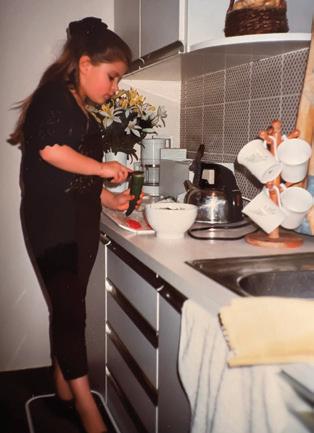
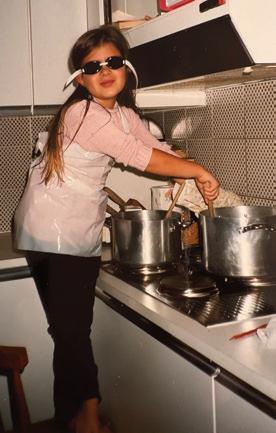
After some months of Safia cooking alongside me, she or we decided she would set up a restaurant for one night. So, Safia opened her “restaurant” – we all dressed up – we played restaurants as well as shops.
The boys were dressed in matching shirts and ties, and Safia wore a fetching black lace number with a massive velvet hair bow and little kitten heel shoes. She was very proud! I was very besotted with my hostess and the young gentlemen guests.
One of the consequences of being born and raised in a different culture is that change will happen, and what you lose and what you retain of your heritage, and the new world will vary. Ideally, I would say you strive to take as much of the best bits of both, as you can. It is also an opportunity to really assess both cultures and do your best to recognise the beauty in both cultures and to discard the prejudices or more backward practices. It’s a case of humanity.
Somethings are difficult to preserve, and one of the things that had always bothered me was the loss of fluency in my original native language. IN this case, unlike my mother managing to almost totally preserve all aspects of her upbringing across cooking, sewing, cleaning, embroidery, knitting and crochet work, this did not happen with our Punjabi language.
This came about by unfortunate design. My father had been told by the school that if you want your children to succeed academically you must stop speaking to them in your native tongue and only in English, because no child can master two languages, as was the thinking in those days. And so, my father had returned home to tell my mother that they must stop speaking Punjabi to us if they wanted us to be successful in English.
Now, the thinking these days, knows that this is not true at all and a child can master two languages and sometimes more, if key members of the family live with them. This was a tall order for my mother who continued to speak in a mixture of Punjabi and broken English, but we replied in English, thus passive use continued, and the active use of language was lost.
My father’s English was grammatically perfect and so he conversed with us in English. A mistake to be realised many years later as this left us with the Punjabi language abilities of a 10-year-old.
On arrival in Brussels, I had decided that after visiting the American School and The British school, that although the children were both moving out of private schooling in England, I was not going to place them in those schools. It seemed silly to be living in the French-speaking part of Belgium, and not put them into French-speaking school, with all the advantages that would give them, especially as I spoke enough French, (to a poor A level standard), so could help with schoolwork.
This loss of fluency in the Punjabi language and being truly bilingual, had always been on my mind and after some months, I realised, that after picking them up from school, we would talk to the teacher, then walk back home and Safia mainly, was continuing her conversations with me in French. Not only that, but she was also making errors when speaking English!
Mindful of the loss of my own maternal language and my mother tongue level remaining at a child’s level, I made the decision to stop speaking French at home, to prevent the same loss of maternal language. I also decided, much to their dismay, to engage an English tutor for after school!
During this time, with 5 months remaining of pregnancy with Arun, I was a regular gym-goer right up to the due date, and in fact did an aerobics class on my due date, jokingly telling the gym-owner to get the towels and boiling water ready as I walked into the class! He looked both alarmed and bemused, unsure if I meant it, stopping mid-action in drying glasses at the bar as I walked past him!
Not long after Arun was born, I had my first diagnosis of under-active thyroid, but the doctor was reluctant to prescribe thyroxine and I was in agreement, so we decided to monitor the situation. Something that would come back to me later.
After two years in the Belgian village, we relocated again with their father’s job to Johannesburg, South Africa. This required a stopover in England for medical checks, and so we took the opportunity to go to the ‘Indian area’ of Southall, where we bought some Indian outfits and some bangles, and then some Mithai (Indian sweets), as a reward for the vaccination injections.
I told the children, even when we move, we’re always ‘home’, as we have each other and our own things. It’s just different walls.
South Africa was not what I expected, having only seen the news and TV coverage of the country. I had initially said I would not go, as I imagined a life of apartheid and was also concerned that one child looked Indian, one looked European, and the other looked sort of Greek or Italian.
Would we all have to walk in a certain order behind each other, whitest first and darkest last, or even have to walk apart from each other! Ha ha! Imagine my surprise when I saw the most modern seemingly progressive
international and multicultural place. Admittedly it was near Sandton City, so we were not in a rural or out of the way place.
This was the start of my older son cooking the dinners at around the age of 10. He was only allowed to use the oven –with a grid to follow that I had written out for him, (and we still this same grid system for our Pure Punjabi weddings). The grid would layout the desired end time for all the food to be cooked and ready at the same time.
Start with the end in mind, was the rule and the lesson for cooking and for business. Note: I didn’t always follow this as well as I should have in business.
Once the children were settled into their schools – initially, for a shorter period at the French School in Johannesburg, which was full of wealthy bully ex-pat children, (from every French-speaking country I should say), and which they hated. I took the eldest out and home-schooled him for 4 months, before moving them both to a South African school, Crawford, where it was far more stable and in line with what I had done in Brussels, which was to put them in a school with local children from the country.
During this time, I continued my daily workout routine and loved the gym so much, I decided that I would now train as a personal trainer, so having researched the best course I could find, I enrolled with ETA/ SISSA (Sports Science Institute of South Africa, (which was based upon the American ACE qualification). It was year -long course part-time, or 6 months full-time. I chose to do the condensed 6 months full-time and managed this between school drop-offs The course was extensive and covered so many modules, my head was in the books at every possible moment.
To manage the large house, I decided I needed a part-time nanny mainly for Arun who was 2 years old, and so I interviewed 5 women. The two older children were 8 and 10, so sat in the interviews with me. It was great fun, and all the ladies were good. However, the youngest applicant walked in… a white Jewish girl of 20 studying to be a teacher and/or possibly in child education of some kind.
We three concluded that we loved her, and what a right gut decision that was! She became a wonderful part of our house, and I could rely on her to help me, especially with Arun who kicked off every time I tried to go out. In addition, she introduced me to the lady who cleaned for her mother and once I had that cleaner, also a lovely woman, (or as they called them in South Africa ‘the maid’), two mornings a week, plus had the gentle Zimbabwean gardener, who came with the house, my support network was in place.
I also took on my own personal trainer, and we became friends to the extent that I invited her and her partner to our house and decided to cook a meal for them that would be both delicious, but also high in protein. I was keen to show them how protein and vegetables as Indian food were not the greasy unhealthy and fattening takeaways they knew, and so I made them Keema and Aloo Gobi, so that they could sample a meat and a vegetarian healthy dish.
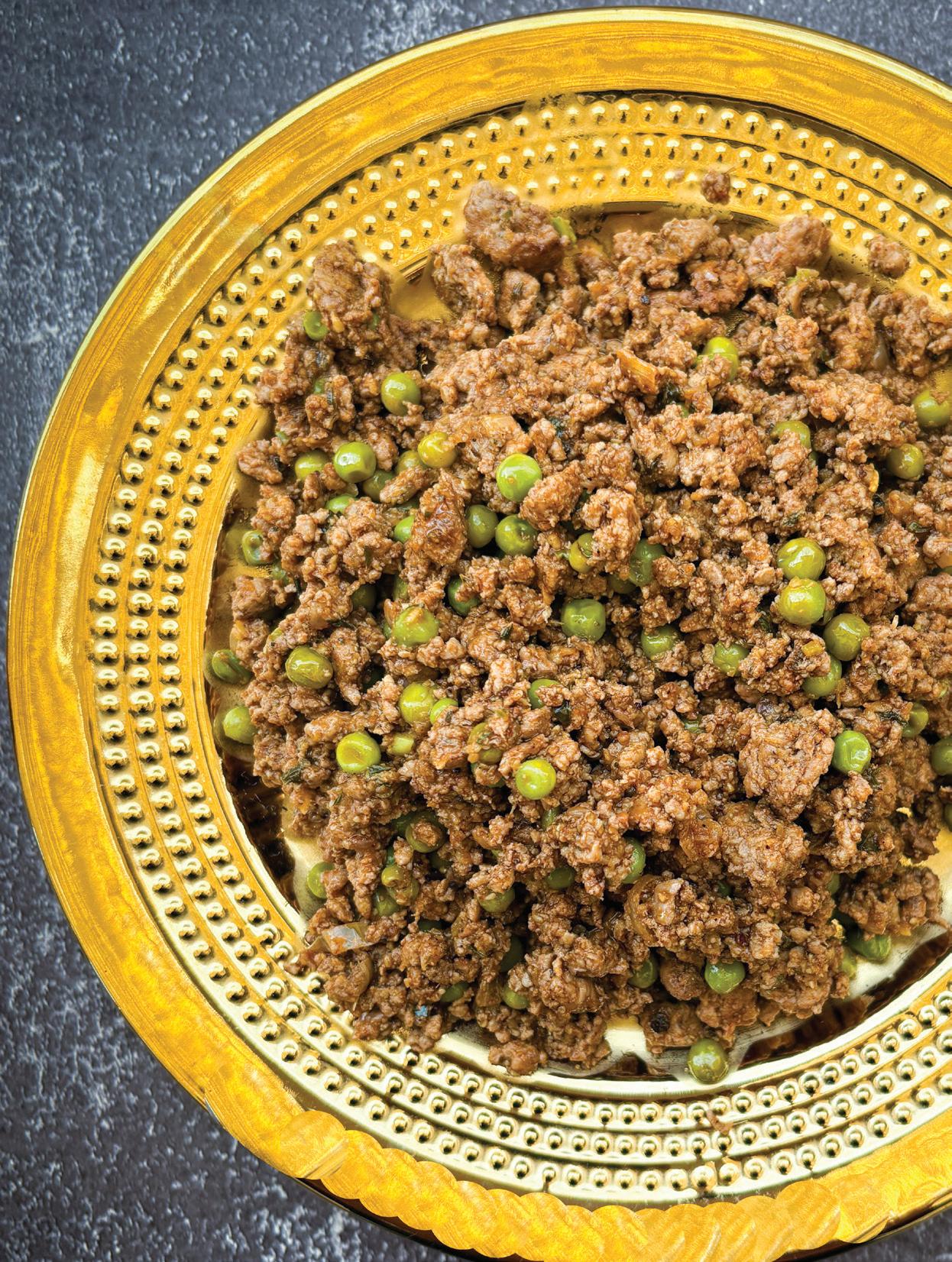
Many people know what we make when we have leftover Keema – which is meat samosas!
However, this dinner, which is normally eaten with rice, is the first meat dish that I taught my children to make. It is traditionally made with lamb, which has a higher fat percentage so do take note that the lamb should be cooked separately first to be able to discard the additional fat.
Some people make their Keema by cooking the raw mince in the main dish, but you will find that there is a slight greasy coating in your mouth afterwards, and the food won’t quite sit comfortably in your stomach once you’ve eaten and you’ll wonder why. The key – preparing the meat so that this unnecessary fat is removed.
Ingredients
1 batch of Tarka starter (see page 305)
1 heaped tablespoon Garam Masala (really as heaped as possible)
1 teaspoon paprika
1 teaspoon salt
1 teaspoon of tomato purée
500g Lamb Mince or beef mince if preferred
A handful of frozen peas
Method
Begin with the starter Tarka base (see page 305)
As you begin making the tarka base, you will prepare the lamb mince. In a separate saucepan, put the entire quantity of lamb mince in there, and brown it over a medium to low heat. Do this gently and be sure to break up the meat so it doesn’t clump together – Keema is mince, not chunks of meat. Once all the mince has browned, turn the heat off and keep the pan to one side until we add the meat later on.
Now, turn back to the saucepan with the tarka base…once the base is ready, add the Garam Masala, paprika & salt. Cook over a gentle heat for a couple of minutes.
Add the tomato purée and peas and stir so everything is evenly mixed together
Using a slotted spoon, drain the browned lamb mince to leave the fat behind and add the spoonfuls to the tarka base pan. You can discard the additional lamb fat (or like we do, use it for your pet’s food)
Once you have mixed the mince in and stirred everything thoroughly, turn the heat to the lowest setting and simmer the mixture for 15 minutes or so. Serve hot with Jeera Rice and a side salad of tomatoes, cucumber and Spring onions or red onions
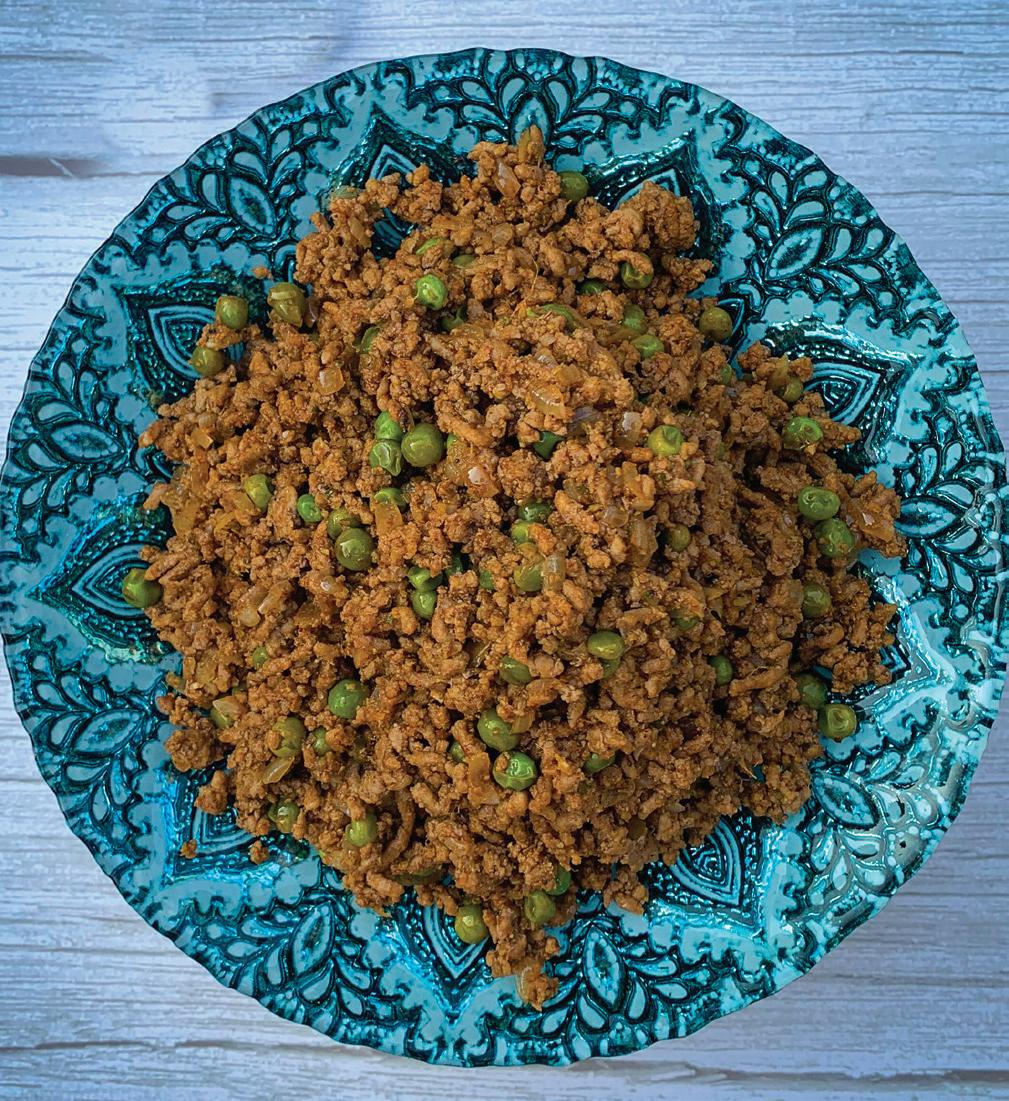
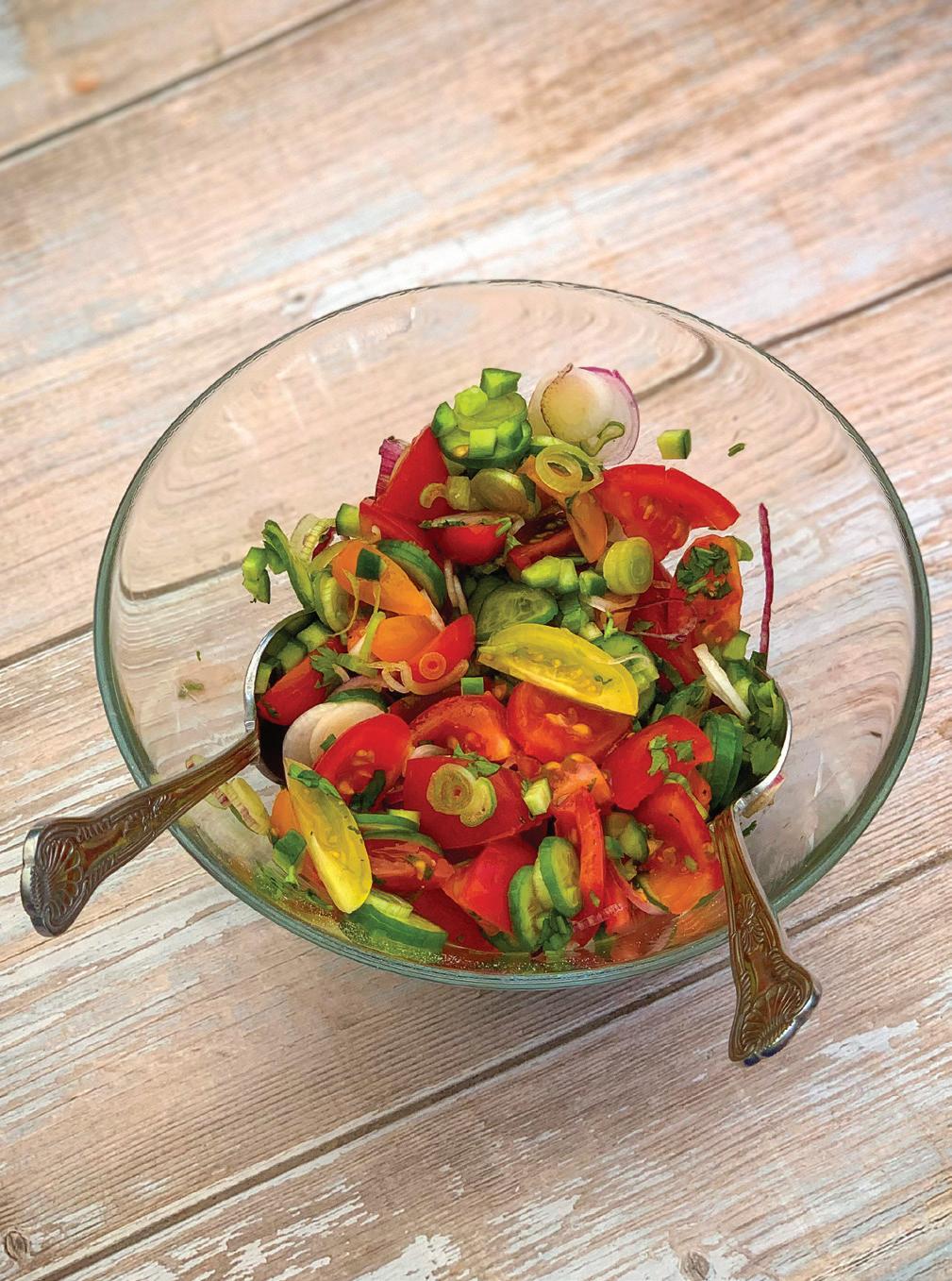
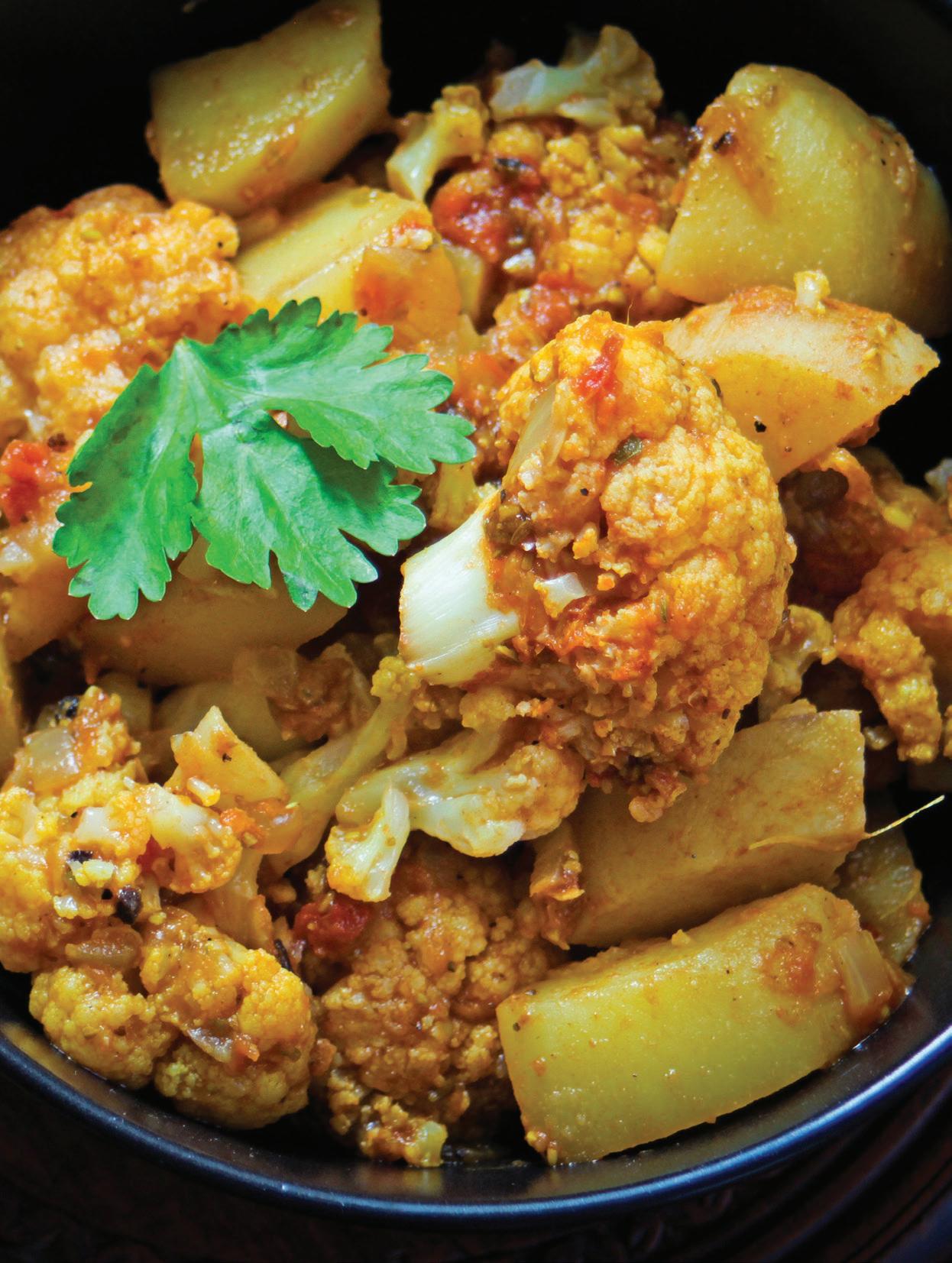
Ingredients
1 batch of Tarka starter (see page 305)
1 tablespoon Garam Masala
¼ teaspoon turmeric
1 teaspoon salt
1/3 tin of chopped tomatoes (approximately 130g)
4 medium sized potatoes – floury varieties, not waxy (my mother always used King Edwards
1 Cauliflower
1 tablespoon of chopped coriander
Method
Begin with the starter Tarka base (see page 305)
As you begin making the tarka base, you will prepare the potatoes and cauliflower alongside this process. Cut the cauliflower into bitesize florets and keep them to one side – these will remain raw for now. Peel the potatoes. Cut them into bitesize pieces – try to cut both the potatoes, and the cauliflower into equally sized pieces. As you are cooking out the tarka base, put the potato pieces into a separate pan with salted boiling water, and bring them to a rolling boil. Once they have boiled, drain them and keep them to the side until we need them later in the cooking.
Now, turn back to the saucepan with the tarka base…once the base is ready, add the Garam Masala, turmeric & salt. Cook over a gentle heat for a couple of minutes.
Add the chopped tomatoes (be sure to crush any chunks of tomato, so that they blend nicely into the base). Now add the potatoes and cauliflower. Stir everything so the vegetables are coated in the base and add a water – enough so that the water covers the base of the pan and comes a couple of centimetres up the sides of the pan. This water will allow the vegetables to cook out properly and not burn as you cook the dish.
Put the lid on the saucepan and bring the vegetables to a rolling boil. Once they have boiled, turn the heat down to a low setting and check the water levels. If the water has almost completely evaporated/ absorbed into the vegetables and you don’t really have much of a ‘gravy/sauce’ then add a little more water to keep it as the photo.
Place the lid back on the pan at a slight angle so it creates a little gap for steam to escape. Cook the Aloo Gobi on a low heat, until the potatoes and cauliflower are soft and cooked through (cooked – not mushy!). Once cooked, serve with a little chopped coriander scattered on top.
We do additionally eat a salad with a Sabji, as well as Dhai Yoghurt, and this is a noticeably ‘Indian’ thing to do!
South Africa is a very friendly culture and an absolutely beautiful place, with beautiful people. My life was mainly on my own with the children, but it was the happiest time. They went everywhere with me, even to the gym, where it became a novelty for the other gym-goers. People would smile and be good with the children. It wasn’t a Western-style culture where children were frowned upon. In addition, they were extremely well-behaved and would sit or stand where I told them to, get on with reading, and both the older two looked after the little 2-year-old Arun, who they would sometimes take into the swimming pool, and I would watch from the glass viewing area, while doing my workout.
I had regular sessions with my personal trainer while I was studying to be one, and one of the things I noticed, that differed amongst the cultures, was the fear of talking about money and the fear of asking for payment.
My trainer once said to me, “you’re my only client who pays me on time”.
She was quite regularly chasing clients for payment. It wasn’t that they wouldn’t pay – it’s just that it wasn’t at the top of their list and something they would get around to doing. I thought this was really unacceptable on many levels. Like going to a restaurant, eating the food and deciding you’d pay later, when you got around to it.
They had ‘consumed’ her services and taken her time, which was what she was providing, but not paid at the time!! Additionally, this was her living and sole source of income, which I thought was even more awful – she had bills and rent to pay! This and the teaching of my parents about money and bills, was something that stayed with me for when I set up my PT business.
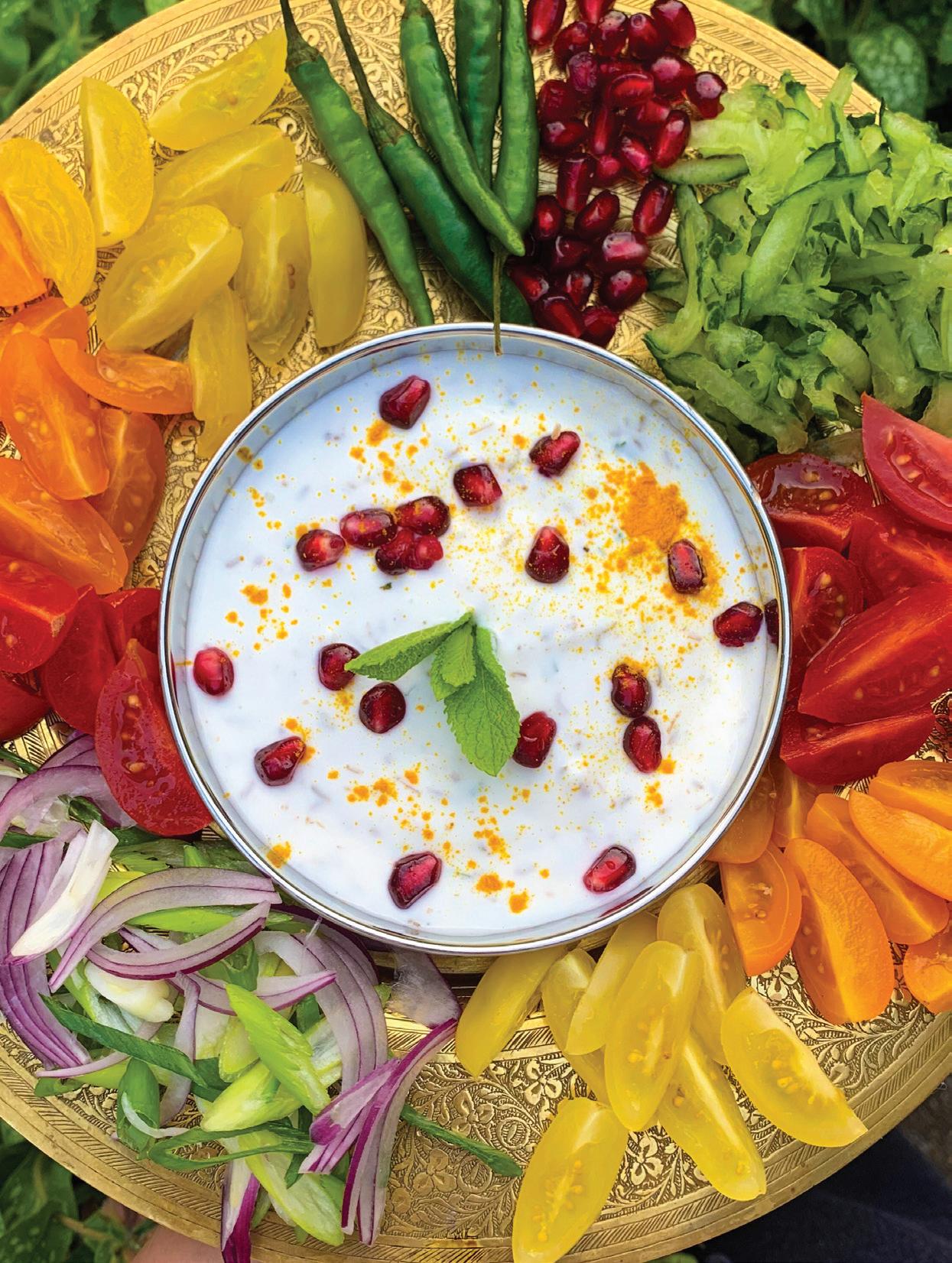
‘…and her bills are paid on time’
My father had always made a point of telling me to pay my bills on time, (in addition to the ‘never lend anyone money’ and ‘never borrow money’).
I always had cash on me, as my parents gave me access to almost any cash I wanted to go shopping. There was a dual system which I had to negotiate – from my father it involved an interrogation of… what did I need it for, and had to endure a lecture, but then did get the cash – with my mother it was just “here we are darling’ She knew how hard I worked and that I was sensible. It probably equated fairly well to the hours and hours of running the household and working in the shop, but we never counted the tit-for-tat of financial transactions. We gave what was needed in whatever form.
When I was a teenager, one of my friends asked if she could borrow £30 for an expensive pair of white jeans. Remembering my father’s words, I said no she could not. I said however that she could have the £30. She of course refused but I insisted I wanted to gift it. Gifting meant it was over. Lending would strain the relationship.
So, of course as a client, I paid my PT immediately. One of the lessons in ensuring a good relationship in what is a financial transaction, is to never let that become a point of conflict or even an issue. It’s dealt with quickly and efficiently with respect on both sides and then is never a problem. I set up my own PT business to be payment a month in advance and was very clear about this from the beginning. I never had an issue with anyone over the 20 years, from either side, but it was then a given, that the business or person taking the money is trustworthy, honest and ethical.
My clients had to trust, especially at the beginning, that I wouldn’t take the money and run! I once took on a very wealthy London client, down in Hampshire for the summer. I explained the T&Cs of my business, and payment in advance for monthly sessions.
She said she would pay for the whole summer. As she wrote me a very big cheque, she laughed and said…’you’re not going to disappear are you”…
Food for Thought ...
Reflections on two cultures, ways & worlds
‘The ex-pats – Brits abroad’
During my time in ex-pat circles, I quickly learned that white people’s behaviour abroad was quite different to brown people abroad.
There was a palpable attitude of superiority, lording it over the natives, and a certainty in their colonial ways. When we were making the move from Brussels, I was told by an English ex-pat, who had been in the Wallonian part of Brussels for 25 years, (and still didn’t speak French), to ‘watch it’ in South Africa, as … “they’’’ were different! What did she mean ‘different’. Clearly talking about the African native population. Her husband concurred and told me that they ‘just were,’ and I would soon see! I was astonished.
I observed a difference between immigrants in the direction of brown to white, coming to England,staying huddled in their groups, refusing to mix with the native locals, more so in places like Luton where there are distinct ‘areas’!
I observed a difference between immigrants in the direction of white to brown, – staying huddled in their groups, also refusing to mix with the natives. The main difference was that they wanted natives to be their housemaids, cleaners, car washers, and serve them their drinks.
I saw a social media clip where a tabloid-type journalist asked an Indian, what’s wrong with colonialism. It was the usual…we gave you the railways logic, (leaving out the built to transport out the stolen wealth of India). The stupid irony of the very thing she was crying about – foreigners coming over and taking the best housing, jobs, making the indigenous population have the less, was lost on her not very clever brain…but of course she meant British in India. Oh – that’s ok then. I find it a bit like watching a father who has beaten up a mother over a lifetime, and taken everything from her…
’Lead
In many traditional Eastern families, learning from a young age happens through closeness to the parents. Children stay by their parent’s side while they watch, help and work. The teaching happens naturally.
My own parents followed this approach while also practising something important: preservation alongside integration. They lived in a completely white area at a time when very few immigrant families were present. Yet they made every effort to integrate.
My mother learned English as best she could, even later when I was a teenager, taking lessons. My parents employed local people in their businesses and socialised widely. My father, in particular, attended many business events, dinners, and functions, often taking my mother with him so they could be part of the local community. but they still held firmly to their core values—family duty, hard work, and cultural tradition.
The one area where things became difficult was around arranged marriage and the expectation that daughters should not have boyfriends. For me, this eventually became a breaking point. Looking back, some of the tension was simply the natural friction between teenagers and parents, where independence meets protection. Much of it was simply the normal struggle of growing up.
A key cultural takeaway from this experience is the value placed on elders within Eastern traditions. There is a deep belief that older generations carry immense wisdom: practical knowledge, holistic remedies, and advice passed down verbally over decades. These insights are often based on lived experience rather than textbooks.
In contrast, British culture has, over time, moved away from this. There can be a tendency to dismiss “old wives’ tales” as outdated or irrelevant, even though many of these traditions contain practical solutions, natural remedies, and perspectives that modern life often overlooks. This difference in attitudes towards elders and inherited knowledge is one of the clearest contrasts between Eastern and Western ways of understanding the world.
Food for Thought ...
Reflections on two cultures, ways & worlds
‘Abs are made in the (Indian) kitchen’
Indian food is unfairly seen as being unhealthy, greasy and fattening, but this is often based upon the luxury foods served in restaurants, and the British consumer demand for gravy and sauces, which of course restaurants accommodate as Friday or Saturday night eating-out style, and that is fine for that occasion.
Traditional food in the Punjabi home is high in protein, fibre, iron and slow-releasing carbohydrates. Dhal when combined with rice or Roti provides complete protein, making them ideal for vegetarian athletes and body builders. They support muscle repair, stabilise blood sugar and give long-lasting fullness – key factors for weight management. Healthy fats are very important and small amounts of ghee provide fat soluble vitamins and satiety, which prevents overeating
Spices such as turmeric, cumin, ginger, and cinnamon are known for their anti-inflammatory, digestive, and metabolism-supporting benefits, making Indian food both flavoursome and functional.
A traditional Indian plate naturally balances macros and micros: whole grains for energy, vegetables for vitamins and minerals, pulses for protein, and occasional chicken or meat for additional nutrients.
This avoids the extremes of restrictive diets and keeps meals nourishing and enjoyable.
One of the biggest advantages of this diet is its affordability and sustainability. Pulses and seasonal vegetables are inexpensive and have a low environmental impact. High-protein meals do not require supplements when everyday foods like Dhal, yoghurt, paneer, eggs, and chickpeas already provide excellent nutrition.
For weight-loss, Punjabi home cooking offers everything needed: high fibre, high protein, nutrient density, and natural portion balance. By focusing on vegetables, pulses, and lean proteins—and reducing fried foods and heavy carbs, it becomes easy to manage weight without giving up enjoyment…
Chapter 12 – “If you don’t eat Indian food, you’ll lose your Indian blood”
…returning home…
After two and half years of living and loving South Africa, we were relocated back to England, just before the Millennium year. During that time in both Brussels and Johannesburg, I had made sure we lived well but thriftily and so we lived on half the salary and saved the other half. This meant that with strict money management and most specifically not living life the way the ex-pat wives did, a huge amount could be saved.
When I had taken the boys to have haircuts in the early days, I had carefully watched how the hairdresser’s cut their hair, and so I saved the money on hairdressers and cut their hair, as well as mine. During most of my life I had none of the beauty treatments that most of the women, had. I did my own, and people couldn’t tell – so it was always time over money. You saved one or the other.
It was important to consolidate the money into bricks and mortar but to do a form of flip or renovation and so I found a house that was very run down, and in probate, being sold by a couple, due to the loss of an elderly parent, and so it had a granny annexe/ extension.
The area was good, just outside of Romsey, very near to Broadlands, but the house was in need of complete updating, redecoration and major overhaul, and most especially needed a new kitchen, but the potential for the increase in value was huge, and again, the main agenda here for me, was using the property to enable us to do better, get on, advance, make more and prosper.
I was not deterred that it meant mostly DIY-ing the entire project, and so I ended up looking at 90 boxes of kitchen units with the prospect of assembling and fitting them… but by myself!
No help, until Samir joined me and started assembling all of the drawers and smaller sections. He knew I was having to do everything by myself and followed the Indian way of ‘us and we’, rather than ‘I and me’. Having paid for that previous decorating job, many many years ago, I remembered telling myself that I didn’t need to actually pay someone to do a rubbish job, because - I could do a rubbish job for free! So, I did it myself, and the only thing to pay for was electrics and plumbing and some help with the worktops. I didn’t see the summer of that year, but got the whole kitchen fitted, walls and floors tiled.
It was my first attempt at tiling, although I had been my father’s additional labourer during my teens in his property renovations, however I could see the two faults in my tiling that I always noticed when I looked at it. A builder later told me, wherever you say you’ve made a mistake, firstly, I can’t see it, and secondly, I’d give you a job!” It did save a huge amount of money as the kitchen fitting costs alone would have been considerable.
One of the reasons I was able to do so many DIY tasks, in addition to having watched my parents, was that I would plan it out, and then go off, most usually to B&Q, purchase the necessary items, and then ask a member of staff if the head of department were available. The staff member would go off and come back with the person in charge of that area of DIY. The first thing I did was show them my project and the plans I had drawn out.
The first time I did this I was unsure if what I had researched was correct. When the qualified head of department came out, he studied my plans, looked at me, looked back at the plans, looked back at me concerned, and said… “are you doing this by yourself”? “Yes” I said. I remember he drew breath, looked at me and said… “right…listen”…and proceeded to layout the entire project for me; the order in which to do things, where to start, how to start, best practice and which equipment.
During that summer, if any delivery men arrived, I would ask them just to pop in and hold up a cabinet or something I was trying to fit…and they always would. Once the postman came, and he and I did a two-person job in the kitchen before he went off on his way. People were so kind, and I don’t think I remember anyone not helping if they came across me up a ladder or lifting something heavy. Slowly but surely the whole house got done in between personal training clients and school.
During that summer of renovations, we had no working kitchen and so I had a little electric plug-in cooker, and a microwave. The children were off school and so were around during the day. They were 6, 12 & 14 then.
One of the things I made frequently, whenever I heard the… ‘mum…I’m hungry’ call, was a Punjabi milk pudding. Years later, Safia would tell me that at college, all the Indian kids would say…”do you remember when your mum made you Seviyan” - a bit of a joke as it was standard fare to fill them up quickly with something of nutritional value.
Basically, a milk pudding, which despite its simplicity, is delicious both hot and cold. Served as it is or with the addition of sultanas, flaked almonds or really anything else you might want to add. Being a fussy eater as a child, my mum always gave me the plain version, and this was what I gave my kids.
The secret is in toasting the vermicelli strands in ghee! It hits the spot for a quick, simple, cheap, warm and filling dish… for any number of young hungry bodies!
If you have children at the age when they are always hungry, plus they bring other hungry young bodies round, always keep a packet of vermicelli in the cupboard! The silence and focused concentration when they eat is a joy to watch!
Add image or text?
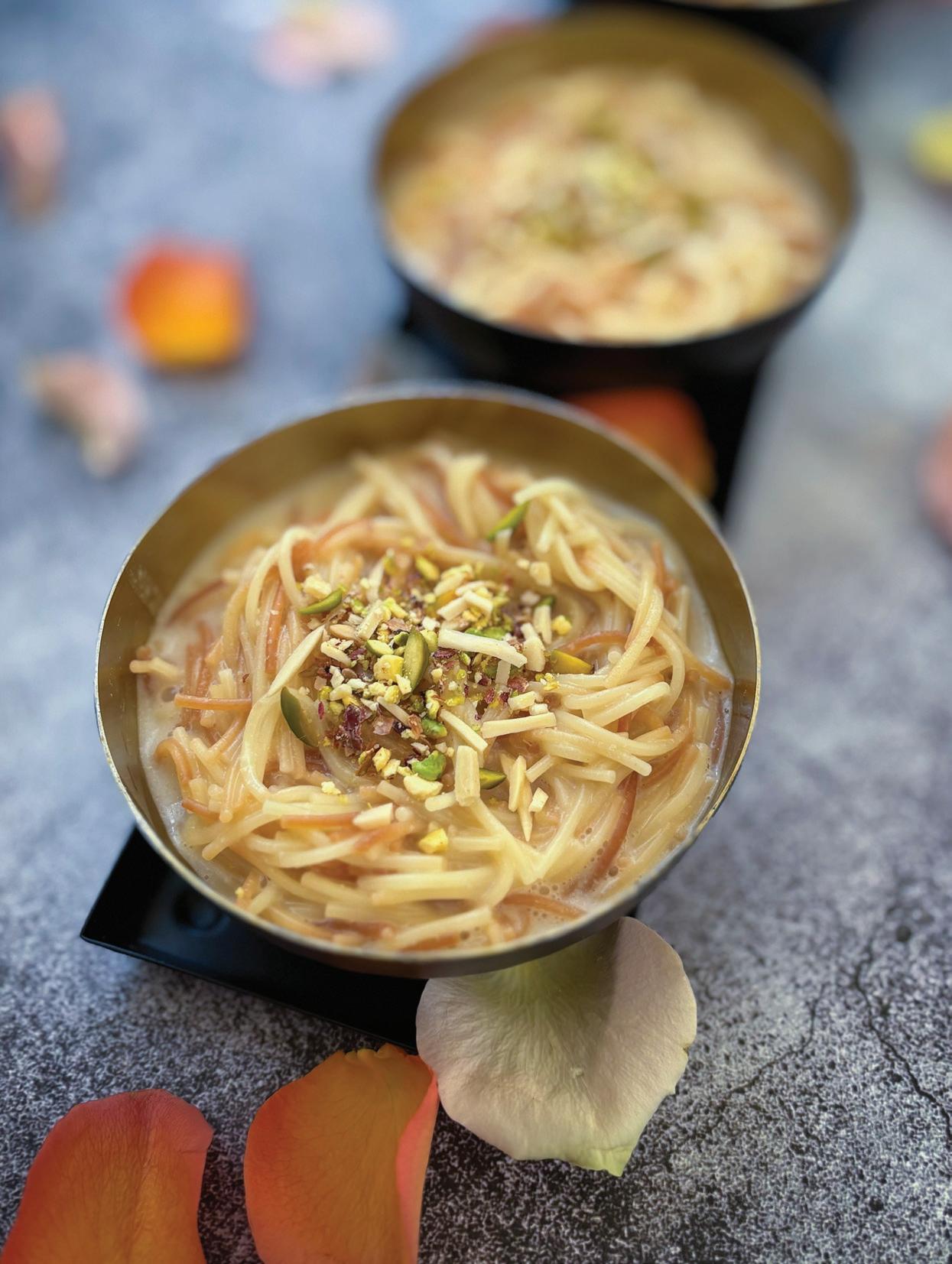
Ingredients
1 tablespoon of Ghee
4 Vermicelli nests
Whole milk (enough to cover the vermicelli when it’s cooking)
Caster sugar (added to taste)
A tablespoon of Kewra Water
Handful of crushed Pistachios (optional garnish)
Handful of crushed flaked Almonds (optional garnish)
Heat the ghee in a saucepan on a medium heat. Once the ghee has melted, add the vermicelli nests, by crushing them into the pot in your hands.
Stir the mixture over a medium to low flame for just over 5 minutes, The vermicelli will slowly start to colour, some strands will remain the same colour, some will go golden and some will go a slightly darker brown colour.
Once the vermicelli has changed colour and you have a nice tricolour mix of some deep golden, some light golden and some strands that haven’t gained any colour then add enough milk to cover. Be careful as the milk may splutter a bit when you add it.
Bring the milk to the boil and then simmer for 4-5 minutes, till the vermicelli is cooked through. Now add sugar to taste and taste test the Seviyan to be sure that the pasta is completely cooked through (and not ‘al dente’ in any way) and to make sure the sugar levels are right for you. If the mixture is looking a little dry, you may need to add an extra splash of milk, and it does carry on thickening (like porridge does).
If you are adding the Kewra water, add it once the Seviyan is cooked and hot, but heat is off. Serve hot and scatter the crushed nuts on when serving so they keep their crunch.
As soon as the children were settled into school, I also set about forming my own personal training business. I already knew that I would not be one of the gym-floor trainers that I had watched over the years.
Th going rate of pay for gym trainers in the gym was about £11 per hour, with clients paying the gym around £25, and of course this was about right as the gym was providing everything for them, the leads/ customers were all there, and the gym owners were providing equipment, insurance and everything, including the security of their positions, ensuring they were getting regular work.
This wasn’t for me. I set myself up with some business cards and placed an advert in the local paper. I gave a lot of thought about, not only how I would not position myself, but what kind of service I wanted to deliver.
What would I want for myself in a private trainer, I asked myself?… and I knew exactly what I would want!
I knew that anatomical adaptation was estimated at between 8-12 weeks. 8 weeks for a good result, which of course was what I was aiming for and so I advertised my 8-week weight-loss & fitness programme. This was to be one-on-one private sessions at the client’s home, with options for 1, 2 and 3 weekly sessions. Monthly fee paid in advance, contracts and screening as per my ETA SA course.
I knew what I personally would want to offer and to receive. A trainer who cares and was committed, and so I developed my programme to be comprehensive: having daily accountability, daily targets, entirely personalised and built to the customers personality, preferences, ability and will to achieve. I then advertised offering a free consultation so that I could clearly explain how we would be working and what both parties need to bring to the commitment.
I quickly got my first customer. The solid training and thoroughness of the South African ETA qualification also set me up in good stead, plus the advantage of being more mature, well-travelled and experienced. I had also observed all the other private school mothers with their gym routines and personal trainers, so I had already decided who my target market was and set about ensuring this by looking at the pricing across
all trainers and then charging at the top tier at that time of £45ph, aiming at a professional customer, and commensurate with the level of service I intended to provide.
As we now all know, abs are made in the kitchen and so we came back again to food. On my ETA course our nutrition modules were taught by the nutrition advisor to the South African Olympic Team, so we were in good hands. I knew that this was not only my downfall having struggled with weight since puberty and that my hormones made me an efficient fat storing body- when later I was tested and discovered that I convert T4 hormone to Reverse T3 fat storage, so I ate very little/semi-dieted most of my post-teen and adult life.
Quite soon I started to get more bookings. Once I had an enquiry, I almost always secured the booking. I had set my practice up to be completely in line with the high standards of the SA ETA training and included an extensive review and assessment process, before the client even started a programme with me. I also set up a contract whereby the client had to guarantee to follow to the letter all elements of our mutual agreement for a period of two months. However, at the end of each month, if the client or I were not happy we would terminate. We would agree a renewal for another month. Fees were to be paid a month in advance. I kept this monthly renewal system in pave for over 20 years, meaning that neither party could become complacent, and my client could fire me at any time, and I them. It enabled mutual respect.
One of the things that happens as a personal trainer, is that you become close to your clients and involved in their life, and so they confide in you and trust you, and as with the nature of any change or transformation process, this can bring about other issues.
Not long into my PT business, I decided that for ethical and professional reasons and for a more holistic perspective, I should further train as a life coach, to be in a better position to work in areas that were going beyond the physical and into more emotional and what would now be broadly and loosely be called with that ‘catch-all ‘and often exploited phrase… ‘Mental health’!
Looking to increase and grow my business, bearing in mind I worked hours around the children, always ensuring I was there for them before school, always there after school, I started attending local networking and business events.
At the events we would do the usual 1-minute presentation and introductions. At one of these events, I realised that the man introducing himself was the owner of the local free magazine, in which I had my personal training advert. I immediately introduced myself to him as one of his advertisers and then proposed to him that I could write monthly articles on health and wellness for him. He was quite open and receptive to this, and we agreed a plan, as long as I continued to remain an advertiser.
I ended up writing the monthly articles over a period of 8 years across most of his publications, which was a key contributor to the success of my personal training business. It was a win-win-win for everyone. I enjoyed writing, and gained a steady stream of new clients, The readers gained beneficial health and
nutrition information. The Magazine owner told me that he got a lot of positive feedback from his readers about how much they enjoyed the articles, which offered free and qualified health and nutrition advice for those who couldn’t afford private training. (Aware of this I later set up group private training, running a series of 8-week workshops with about 6-8 clients who could not afford ongoing private training, to set them up with the basics of a lifelong exercise and eating plan).
During this time, I was making a mix of Indian food for dinner, or various English dishes, such as a Roast, Cottage Pie, or ‘fast food’ , pizza, chips etc. I began to notice that my youngest son, was not wanting to eat his Dhal or Indian food in general, when that was the dinner for the evening. He was about 6 or 7 years old, and increasingly only wanted pizza.
I had repeatedly and patiently explained to him how good it was for him, etc, but all to no avail! One day in exasperation, I looked at him and said, “if you don’t eat Indian food, you’ll lose your Indian blood”.
His eyes opened wide in alarm! He stared at me and then at his bowl of Dhal – got his spoon and gulped down his bowl of Dhal as fast as he could!
Indian food later became the additional options I gave my training clients, when Safia took over a lot of the household cooking from the age of 13, and was a key reason why they kept to their eating plans – it also became the basis for our Pure Punjabi Indian meal kits Athletes Box.
In the late summer of 2002, I received the call that my father had passed away. We often had spells where we fell out and after a long period of another fall-out, I had visited my father the week before, having learned that he had cancer. There’s almost nothing in life that I regret, as life is not for regrets, but is for moving on with a fresh page each day. I regret the stupidity of being as stubborn as he was and not making up with him, as well as the grave mistake of not visiting him by myself, not being alone, and with others present, who had financially motivated agendas.
He was, to the end… explosive, aggressive and rude. The visit was a short and unhappy one with bitterness from him that I had not backed down from the last argument, although he had not either! I also made the mistake of not taking the children, thinking I would do that the following week, however, within that week, he had died.
However, as much as those financially wishing to benefit, had tried, he was never stupid. I was shortly to realise that, right to the end, he could not be played. I fully expected to have been disinherited, such was the volatile and head-butting relationship my father and I had in later life, (both being alpha males, ha ha), however my father had not done this, much to the shock of some who expected to gain from my expected disinheritance!
An old family friend had told me that she had asked my father if he would be leaving everything equally to his children or cut me out for having always disobeyed him. She told me that he said… “I made a promise
to my wife when she died that I will never do that”.
One thing he was, was a man of his word. He also knew and recognised that the family wealth had been built on a collective effort. Home as well as business.
In addition to my father’s promise to my mum, was his disgust at girls being excluded. He was a massive contradiction in being quite sexist and macho yet being extremely anti, such antiquated and stereotypically backward practices like the disinheriting of girls, favouring boys in education and prospects, his disgust at horrible old customs like Sati (burning of widows), ostracization and second-class treatment of widows, the backward and greedy practice of dowry, and the limiting and prevention of girls gaining higher education.
I recall a massive argument between my parents, when my Nanna – (my mother’s father), died and pressure was put on her and her two sisters to sign away their legal 1/7 share of the land in India. My dad was absolutely furious that she was being asked to do this, even though the law had been passed that girls could not be cut out from land inheritances. My parents had an even bigger argument… of epic nuclearlevel explosiveness, when he found out that she had gone ahead and agreed, with her sisters, to waive her share, so that only the 4 male siblings could inherit. I can still hear that shouting now!
I remember hovering outside the room knowing this was a biggie! I asked my father when he came out what had happened and he explained what my mother had done. I remember firstly thinking well who cares about land in some remote place, but my father explained that the law had been changed and it was illegal to steal from sisters, and regardless of opinion and what ‘boys’ wanted, girls could not be pressured out of any rightful inheritance. He was strangely chauvinist and contradictorily pro-equal rights for women, (as long as they kept their place).
It was understandable and desirable that family land be kept intact, however, with hindsight, there was never any mention from the main male perpetrator of doing the right thing and purchasing the 3/7th shares of the sisters, which would have been the correct and legal, decent and honest thing to do. Instead, was the demand that they should ‘hand it over’ and being born in a backward generation of being considered lesser as females, they disappointingly complied to appease the males of the family.
This whole period was one of great change as my non-marriage was finally and officially dissolved, and I set about taking the assets and lessons of my parents to consolidate my position.
I had effectively been a single parent for over 10 years of the 20-year marriage, and one of the reasons I had hung on in a non-marriage, was the old Indian tradition of not believing in divorce or second marriage, and the other was not wishing my father to know of this failure. Both of these restrictions now ended.
Continuing with my portfolio of clients I looked for other ways to further increase income. I had retained the family home with the children, solely due to the pooling of the inheritance. I decided to go back to
use of the property to provide income. I did this by going back to hosting foreign students as I had done when my first son was a baby.
During my children’ teens from around 13- 18 years old, we had a whole series of foreign students mainly from France, with a few from Italy, Spain & Monaco for periods of a week to 3 weeks and did this consecutively across the school holidays for several years. Most of the ages were the same age as my older two between 13-15 years old and it was a time of huge laughs and lots of noise and teenage energy – great fun. At dinner times to improve their English and general knowledge, we would play the ‘Alphabet game’, and countries/cities projects. Rapid fire naming alphabetically, anything along the theme, so for a city, Amsterdam, Brussels, Christchurch etc. Oh, the confusion between what was a city or a country!!
My youngest then around 7 would enjoy being part of this interaction with older children having older siblings.
In addition to telling my youngest son to eat up his Dhal to keep his ‘Indian blood’, I knew to say this because he made drawings of me in the gym as a superhero in a cape, who had knocked out everyone, so he thought Indians were superstrong workers. He’s also spent his infancy, and still was then at age 7, used as my weight training, being the weight I would use for my ‘at home’ leg press exercises. He would sit on my legs as I performed various exercises and giggle as I pushed and pulled him about!
One day my older son was taking his turn to do his sit-ups on the edge of the arm of the sofa, while I acted as the foothold by sitting on his feet, as he had just done for me. We’d been doing it for years but in that time my son had grown bigger and heavier and as he tipped back, lowering himself backwards, his weight was too great for me, and I catapulted off his feet, over his head, hit the wall and slid down head-first in a crumpled heap. Hysterical laughter & happy times!
Following on from my father’s death, I decided again to continue to do what my father had told me – put all your money into bricks – and so I used some of my remaining inheritance and bought a small terraced ‘two up-two down’ property that was (again), in probate with the intention to flip it. I budgeted £10 K on the total refurb of the entire house, both new kitchen and bathroom, and by doing nearly all of the straightforward renovations myself and with the children, did come in on budget, however when I redid my calculations, the figures worked out better that I should not sell, it but rather rent it out. I had that little house for 9 years, during which time I had lovely tenants and looked after the house, which meant repainting every two years if tenants changed, and keeping it as in the same way that I would if my own children lived there.
When we later sold up our home from Southampton, I was looking for a short-term rental in which we could live, so that I would be ready to buy. I wouldn’t have given my nice tenants notice to evict, however, at the same time, by a happy coincidence, this lovely couple of 2 years tenancy, unexpectedly gave notice to leave as they were buying their own place and moving out. So, we moved into my own little rental
house and spent a happy 9 months with 4 of us and our dog squashed up in this home, while we searched for the next home and business venture.
Although I was working as a self-employed personal trainer, studying to be a life coach, renovating the small rental, and the house we lived in, going to the gym 10 x per week in addition to my clients, raising three children completely alone, I was strong, fit and full of energy.
However, a few years later, I started falling asleep on the sofa after doing the school pick-up and couldn’t get up. I was sleeping more, was tired, and gaining weight despite a life in the gym, writing weight-loss programmes and diets and constantly being on the go. When a person is very fit, tiredness from training is different to an ‘unfit’ tiredness. Remembering the diagnosis in Brussels of the underactive thyroid, I did that rare thing and went to a doctor. She confirmed underactive thyroid and the only recourse, (believed at the time), was ingesting the pharmaceutical product of T4 medication. Each time I would go back and say symptoms were worse and so they would say that the dose should increase and… repeat…and repeat… Eventually I would end up with significant weight gain.
As my first child approached the time to go to university, I decided that this was the time to think about selling and moving. Part of the motivation to move on was concern over my being the sole support in all areas of the lives of these three young people. One of them had a friend of foreign ethnicity whose mother had suddenly died and whose father was absent, and the elder sibling had chosen to forgo university to remain home to look after the two younger siblings. I didn’t want this to happen to my children and with the youngest only 11, I had a bit of a way to getting him to through to 18, (or 21, if he also went to university).
I decided again on another business and property model that used the bricks as income and allowed me to have the option to remain a ‘work from home’, ‘stay at home’, ‘be there for them all the time’ parent. This time, it would also have an independent means of income being staffed, so should I become unwell, that model was not dependent upon myself doing the job. This ‘job’ was in the format of a franchise.
The franchise of becoming an agent for that institution called The Post Office, (POL)…but…what a world we were about to discover about the inner workings and machinations of that dreadful organisation!!!
for Thought ...
Put all your money into bricks my father would say, never mind savings accounts, pension pots, stocks and shares or any of that. My father encouraged the acquisition of property and the use of that property as one of the primary tools for building wealth, for getting on, and for making money. It was engrained into me and enable me to progress through and be the only single mother who upsized, instead of downsizing.
Obviously, people do make their fortunes on the stock markets, but they usually know what they are doing and have ‘insider knowledge’…allegedly. It’s their world of finance and they know how to operate within it.
My father was talking to me as an ordinary person whose best option was to climb the property ladder, and for me, his advice stood me in extremely good stead, against the unexpected prospect of being sole provider, educator and support for three children. It also enabled me not to have that awful prospect of having no option but to have latch-key kids, by my parents showing me that a woman who didn’t speak the language and had only primary school education could, with her friendly and smiling personality run a B&B and help towards the family income.
Another of his examples, was his frequent attendance at his many business and social events. He was a very sociable person and very funny…only when he was in a good mood. This networking did help him considerably. I think I intuitively knew to start attending events when the children were settled in school, and that very fortunate meeting and my proposal to write, enabled me to use my writing as a marketing tool, share my knowledge and ensured my ability to earn.
Food for Thought ...
Reflections on two cultures, ways & worlds
‘Put your feet up?’
There was a distinct difference between Asians and British attitudes to property. Once a house was acquired, the Indian attitude was that this was an asset as well as a home, and there was no conflict with that. However, I heard that the British viewpoint, was that being able to come home and put one’s ‘feet up’ was the priority. There’s surely a happy medium between the two, but to think you can prosper and have the benefits that Asians accumulate with a ‘put your feet up’ and relax after a 5-day week, 8-hour office day, doesn’t add up.
The British expression of ‘the early bird catches the worm’ was one of the sayings we learned at school.
I think there was great value in a lot of the old British sayings, which sadly seem to have disappeared – ‘a stitch in time, saves nine’, being another good one, which means more than repairing a tear quickly!
The early bird saying, seemed primarily to apply to the trades, who in those days were early starters and usually at the job by 7-8am with a day’s work complete by 4pm. This was the closest I saw a real work ethic apply, and unfortunately that seems to be gone with so many trades who don’t see to be able to turn up, or at an appropriate hour. No youngsters willing to get their hands dirty or work hard. A shadow of their fathers and grandfathers, with old-fashioned hard work and ethics hiding somewhere! Somehow, did the British culture lose its way with what is now seen as ‘controlling’ children, and what we would say is guiding?
Similarly, sleeping-in, and the ‘lie-in’ were also new ways for us, whereas in hot countries it is more of a siesta, but is also because of the weather, as it makes sense to get work done before the sun gets too hot, and then rest in the shade during the hotter part of the day. By contrast I saw a lifestyle where sleeping in was quite the thing…and must confess I became caught up in this as a teenager, but when it’s continuing into adulthood?? Is it a symptom of what life’s direction will be?
‘Protect the isolated’
Because my children and I both came from, and are living within two cultures, myself by birth, and they by heritage, I protected the culture which was absent, because they were going to school with mainly British children, were within this community and environment all of the time and in this circumstance, I felt it was important to preserve my Indian culture, not to resist British culture, in which I was fully integrated and immersed myself, but to maintain balance and actually, fairness between the two.
Had we been living in Punjab or anywhere in India or any other country I would have absolutely protected the British culture, as I did in Belgium with the insistence of an English teacher. I would have ensured we cooked and ate dishes like a Sunday roast, Cottage Pie and bangers and mash, (as we do here anyway), because the isolated culture needs to be protected to ensure a respectful blending that allows us to have and enjoy a part of each.
It's important to prevent an ‘either, or’ situation which I have seen where people of a heritage that is non-English have been assimilated into British culture at the expense of their own and almost have no knowledge of their grandparents or parents’ culture or lives. I have seen this come back to haunt these people in later life when youth has passed and they yearn to discover their background and roots but have no living person to help them. It’s better to make sure two cultures sit together, equally as fairly as they can and ensure children have a complete and richer sense of who they are and what they are.
Another cultural observation which is sadly common in many Punjabi and Indian families. Relates to the saying “où on a la terre, on a la guerre”—'where there is land, there is war’. Families living in England still find themselves involved in fierce disputes over land in India, sometimes land they have barely visited. Sisters are often written out of inheritances, while the same men who deny their sisters’ rights fully intend to pass that land on to their own daughters. Hmm….
Food for Thought ...
Reflections on two cultures, ways & worlds
“Healing in nature’
I’ve never really needed doctors or hospitals beyond breaking my arm and having my three children. Until my thyroid issue, I hadn’t realised how widespread the culture of pharmaceutical medication runs in the West. I had a bit of an idea when I took on personal training clients to find many were on continuing and lifelong prescriptions – very often blood pressure. Once a pharmacist told me that prescriptions were their biggest source of revenue. I’ve always believed that acute and emergency situations are where the NHS is absolutely exceptional. Its multicultural staff, compassion and skill save lives every day. But when it comes to chronic or low-grade conditions—the kind that drain you slowly over months or years—the solution is often medication that manages symptoms rather than addressing causes.
As a child, our masala dabba, (spice tin), was also our medicine cabinet. For so many minor ailments, my mother would look through her spices and make me chew or drink one or the other depending on what I was complaining about. These treatments came from nature and worked with nature…no side effects, no long leaflets listing warnings or side effects, no worry about what else they might cause.
Ayurveda and traditional Punjabi knowledge were simply part of life, not something separate or mystical. My mother didn’t discover ‘natural therapies’—they were just what she knew, and they worked.
Spices carry huge medicinal value. Cumin, coriander, black and green cardamom, turmeric, cloves, black pepper and cinnamon, in fact most of the base of all of our dishes, give us more than flavour. They are antiseptic, anti-carcinogenic, digestive, warming, calming or stimulating depending on how they’re used. They support immunity, gut health, circulation and inflammation, often without us even realising it.
Healing can often begin in the kitchen long before it reaches the pharmacy. Some of the most powerful remedies are the ones our grandmothers already knew. I seem to recall, somewhere in my memory that this may have been the case with English grandmothers. If it was, is it lost?
Chapter 13 – “Mum, we can’t eat the bricks”!
So why did I buy a Post Office?
I was very aware that I was the sole safety net for my children, with one now at university, the second one starting that year, and the third starting senior school.
Having grown up in retail and knowing the number of Indians that had shops with post offices, I already knew there was a basic payment structure to the postmaster/mistress, in the form of rental and that it was a form of franchise.
This would ensure that the mortgage would be paid, plus it was staffed, so I was able to continue with my personal training clients.
The shop that came with it, was the typical old-fashioned cards and stationery shop. The shop was ancillary to the post office, in that the post office paid the postmaster/mistress a monthly salary/rental for the use of their property to act as an agent for them and run a post office counter from their premises. What had historically become standard practice was that when people wished to exit the business, they sold their own property along with the franchise, but it was a two-part process. The incoming postmaster bought the property themselves and during that process, also applied to Post Office Ltd to become an agent.
Along with the process of moving home, was also the process of a 2-week training programme, so all in all it was quite a hectic time, scheduling the house move, with new senior school and new university, continuing with my personal training clients and taking on this franchise.
The general public didn’t understand, and had never understood, the Sub-post office model and how it worked…that Sub-post offices are privately owned houses and sub post-masters/mistress are agents under contract in a sort of franchise model.
Coordinating the purchase with a start date from POL was a nightmare, with delay after delay in getting a training date from them, holding up completion. I resolved this by going ahead with my purchase of the whole property in October and running the Post Office in November.
This was an unusual situation because normally completion of the property could not take place until POL had signed off the application, arranged the training and allocated the start day when the postmaster/ mistress could officially be handed the franchise, enter the counter area and have legal responsibility for Post Office cash and stock, and be given the alarm codes etc.
As the purchase process was going along, the bureaucracy, style of business and sheer slowness of the machinery and communication was slowing down the process to such an extent that both the vendor of the house and business and I, were becoming increasingly frustrated at the non-response or delayed responses, of when I could commence my 2-week training. It was holding up the property purchase, whilst we waited upon the great POL authority.
I put a proposal to the outgoing postmistress – why didn’t I buy her property now -we were both ready! I would move in, and she would become a tenant on a monthly basis, pay me rental and arrive each morning open up the Post Office and then lock up and leave each night. She was very amenable to this as she was also in limbo with her living arrangements. So, we arranged this to the satisfaction of both sides’ legal advisors, who drew up contracts, and the completion date went ahead – I of course now owned the shop but couldn’t enter the actual counter area.
I informed POL that we had gone ahead – I was now the owner of the building that their agent worked in and paid me rent. They had already agreed the contract for my position so I would be the next incoming agent… when they eventually got around to it. Their response was shock! Almost immediately my twoweek training date was suddenly available and within the month I took over the counter.
I very quickly saw that the sheer number of products, the accounting and inventory system was I thought, illogical, and things were not right! For example, stock, such as a type of stamp would arrive under one name on the paperwork, have a slightly different version for keying in to reconcile stock figures, and then another version for the sale button – this was quite a frequent occurrence.
Given that it was now November and full into the Christmas rush and queues, it was indeed a ‘baptism of fire’ not so much for work, but for the overly complicated and ridiculous processing systems in place.
I remember a time I was working at the counter and looked up to see a dour-looking person in a dark suit, just standing there with a briefcase watching me – a POL person ready to audit/aka ‘start inputting into the Horizon system’. From then on, I started to refer to the men and women who worked directly for POL as the ‘men in suits’.
It took just a few weeks to see the slot machine rolling of numbers to see Horizon system was ‘corrupt’. One day, a few weeks after purchase, we were closing down the system for the evening, the counter clerk who had previously worked there, pressed a button – numbers rolled – up popped up £2000 loss.
“Do not touch anything” I said to her while I got on the so called ‘help line’. As I was talking her fingers couldn’t stop themselves and she pressed another button – number rolled and it went to a £4,000 loss.
At this point she thought she had better listen. I don’t remember how it was resolved but I could see that it was, to say the least, not right!
I had quickly realised that it was best to cover ourselves and to make a call to the internal hotline, for any discrepancy, get the name of the agent, document everything and, most crucially… take a reference number. Every so often, sometimes months later, ‘they’ would try and pin imagined losses on us, and I would produce my book, quote the reference number. and say, “on such and such a date you instructed us to perform the following procedure” and the ‘loss’ would disappear. We knew the system was rigged within months, and the system never ever balanced.
One day, soon after taking over, when every single night there was a discrepancy with the balance on closing, one of the staff who had been transferred over with the business said to me that they never, “had any trouble with the balances before you came” …everything was always spot on. It was always correct and there was never a loss! I stated..., how would you even have known?
I had learned that previously, the private business sales from the shop space were being mixed with POL money…meaning shop sales were put with the POL sales and the cash from both businesses was kept on the same hopper, which held the Post office coins. At the end of each day, they would close up and do the balance, and the staff said whatever cash was over the balance amount -well that was clearly the shop money!!
When I had arrived, I didn’t have access to the Post Office counter for the month as we had to wait for the training and official takeover date, so staff then had to make a note of shop sales separately and give this to me. I insisted that this continue and installed a separate till for all shop sales. No one was ever allowed to take cash for anything from the shop and put it on the hopper. Staff were required to process a POL transaction first and then ask the customer to pay separately for cards, stationery, confectionery etc on a till that had each department clearly labelled. From then on, the Horizon system balances were incorrect every single day…bar one day!
That particular day was when POL had announced that there would be national upgrade to all Horizon system software. This would require that one day POL would arrive and make the necessary software changes. On the allocated day for our branch, the person arrived at close of day to perform the software changes. First, they had to balance to a zero, (i.e. no loss and no gain of cash), before performing the
task. On balancing each night, but always on the weekly balance, we would start the balance procedure at 5.30pm and often be there for anywhere between an hour to four hours trying to find out why we had unexplained losses, as we were meticulous about ringing up the right amount, especially we could be assured on a day when it was only myself or one of my children on the counter. The shop till balanced to the penny every night. As the person started the balance, we laughed and said “Well…good luck with that…you’ll be here hours”! Literally one minute later he walked out and said all done! The figures had magically rolled around to produce the required zero balance, like some rigged slot machine in Vegas, I looked at Safia and said… “well, if that’s not proof that’s fixed – they’ve fiddled that from their end!”. How right the TV show proved it all to be.
The Horizon fiasco continued on until our thankful, (though corruption-riddled and traumatic), exit from the institution. One outstanding moment was opening in the morning after a balance the previous night, confirmed and printed out, some small discrepancy of a few pounds. I watched the clunky old machine churn itself into a state of functioning and then declare a morning opening balance of a loss of thousands!!! I immediately called the ‘non-helpline’, and the non-help person said... well one of your family must have gone in there in the night and done it! I said …are you are telling me that one of my children has deactivated the alarm, opened the Post Office up -requiring lights to go on visible from the outside, opened the safe, taken money. He said –yes. It beggared belief. He wasn’t even bright enough to know that you could empty the entire safe – the system wouldn’t know that until another count and balance were done!
Stupidity met dishonesty in their frequent behaviours and choice of that employee and many more… allegedly.
One of the first things I did with the shop, while waiting for the training date, was to change the shop over to a speciality & fine foods shop. Firstly, I changed the range of cards, although retained the few ranges that were selling. I did a lot of this on a sale or return basis, meaning you held stock for the card company, and they would do a stocktake, charge only for what was sold, and replace the sold number with new stock – it was a good system. I introduced a range of more gifting food & drink items, specialty, artisan and different, as there was already a Co-op in the village
As time went on, I increased to fresh perishable produce, from local suppliers –salmon, fish & meat products, but knowing that customer loyalty can be fickle, I always did this on a pre-paid pre-order basis and customers would then place their order, pay for it and come in and collect it on a Friday. Always non-perishable long-life products or where fresh, on pre-order.
Even the fresh veg in my parents’ supermarket had no waste as the extent that the greengrocer whose property was incorporated within the shop had been offered a job to keep him active retain his interest and expertise and take care of our stock – it was a win-win-win.
During this time of battling with the peculiar processes of POL and the development of the shop to produce increasing income, both of my older children had graduated in the same year, one had changed
A levels, and the other condensing a 4-year degree into 3 years by doing the year-long study-abroad and dissertation over the summer, (the benefits of putting them into the local French speaking school).
We had a wonderful graduation and birthday party at the Trafalgar House Estate outside Salisbury, which was down the road and which I hired (from knowing the wonderful house-manager couple), for the triple occasion of my son’s graduation, and Safia’s graduation and birthday.
During both my two elder children’s time at university I had encouraged them to write and enquire for work, whether unpaid or paid, in order to gain experience and have something on their CV’s when finishing Uni. Safia ended up doing some paid work in hospitality/waitressing work at Trafalgar House when they had functions and weddings, but in addition, she also did unpaid work, where the house manager allowed her to shadow her in meetings with clients and to perform managerial level tasks as well as represent the business at a wedding fair, which stood her in good stead for the future years.
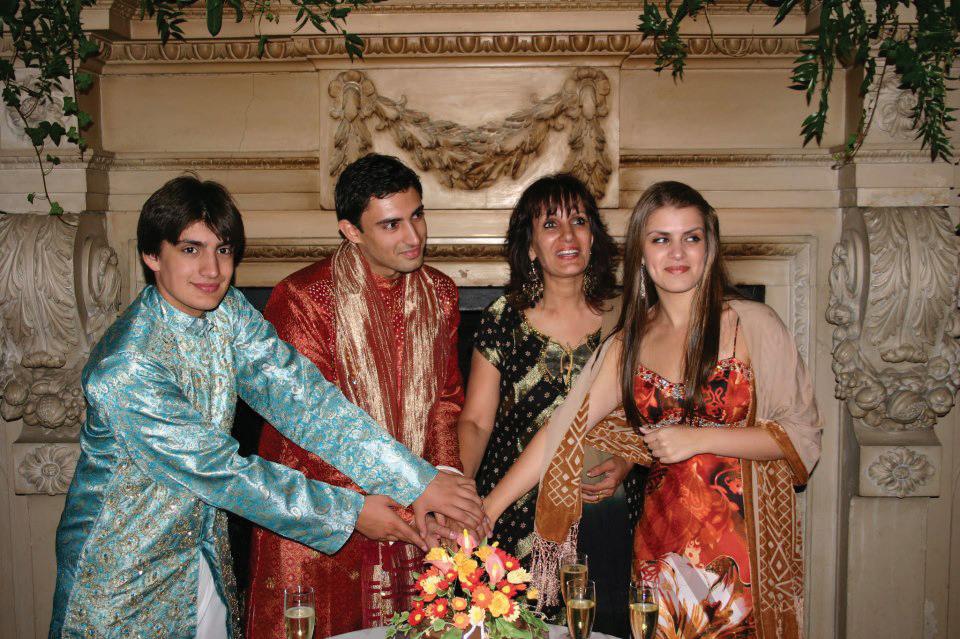
During this time, in the autumn of 2010, we took a trip to Punjab. I arranged three-week staffing cover for the P.O. counter, from former POL people who hired themselves out for holiday cover, (therein lies a dodgy tale), and off we went. It all started because I had asked Safia what she would like for her 21st birthday, and she had jokingly said…” a shopping trip to India”. Why not I thought, it would be good for the four of us, plus a convenient time and good opportunity before they found it difficult to leave with work commitments. I then spoke with my Mama, (maternal uncle) in Sydney, and happened to tell him
of our planned trip, and he said three weeks was far too long, and if I were going to be travelling that way, then I should also come to Sydney! We decided to change plans to have a week and a half in India and then go onto Sydney. In discussing this with my friends, they decided to join us, in India, as they were also planning to go to Australia. Another uncle had built a house on the maternal grandparent’s land in Punjab, so the itinerary was arranged to tour Delhi, taking in The Taj Mahal and the area around Agra, then go to the family house.
We landed in New Delhi around lunchtime on the first day to find a super clean and modern city. My uncle had arranged an air-conditioned mini-bus to pick up the six of us – the four of us and our two friends. The Commonwealth Games had just taken place, so the streets had been prepared for the event, and everything was spruced up and looking very tidy. Everywhere was full of life and movement, but the striking contrast was that cars, bicycles, rickshaw and animals just weaved their way around each other and there was no road rage.
The Mughal Palace and the Red Fort were our first stops during the day and then a beautiful light show at the Fort that evening. The next day we visited Jama Masjid Mosque, where we three women had to wear long gown-like cover-ups to enter, even though we were dressed fairly modestly… much to the indignation
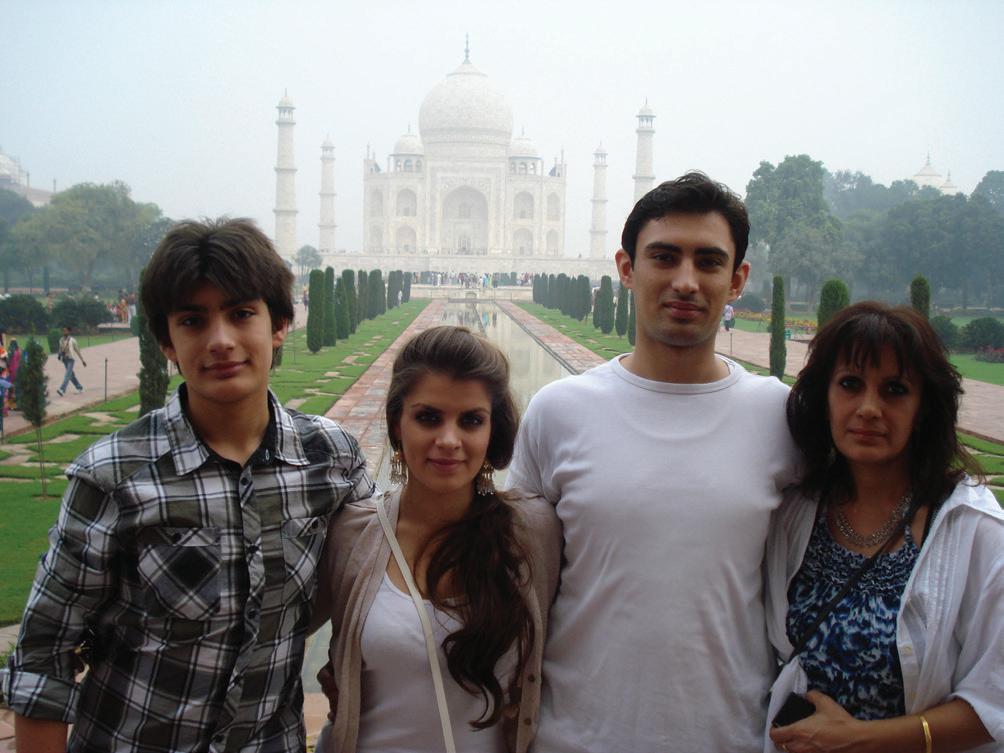
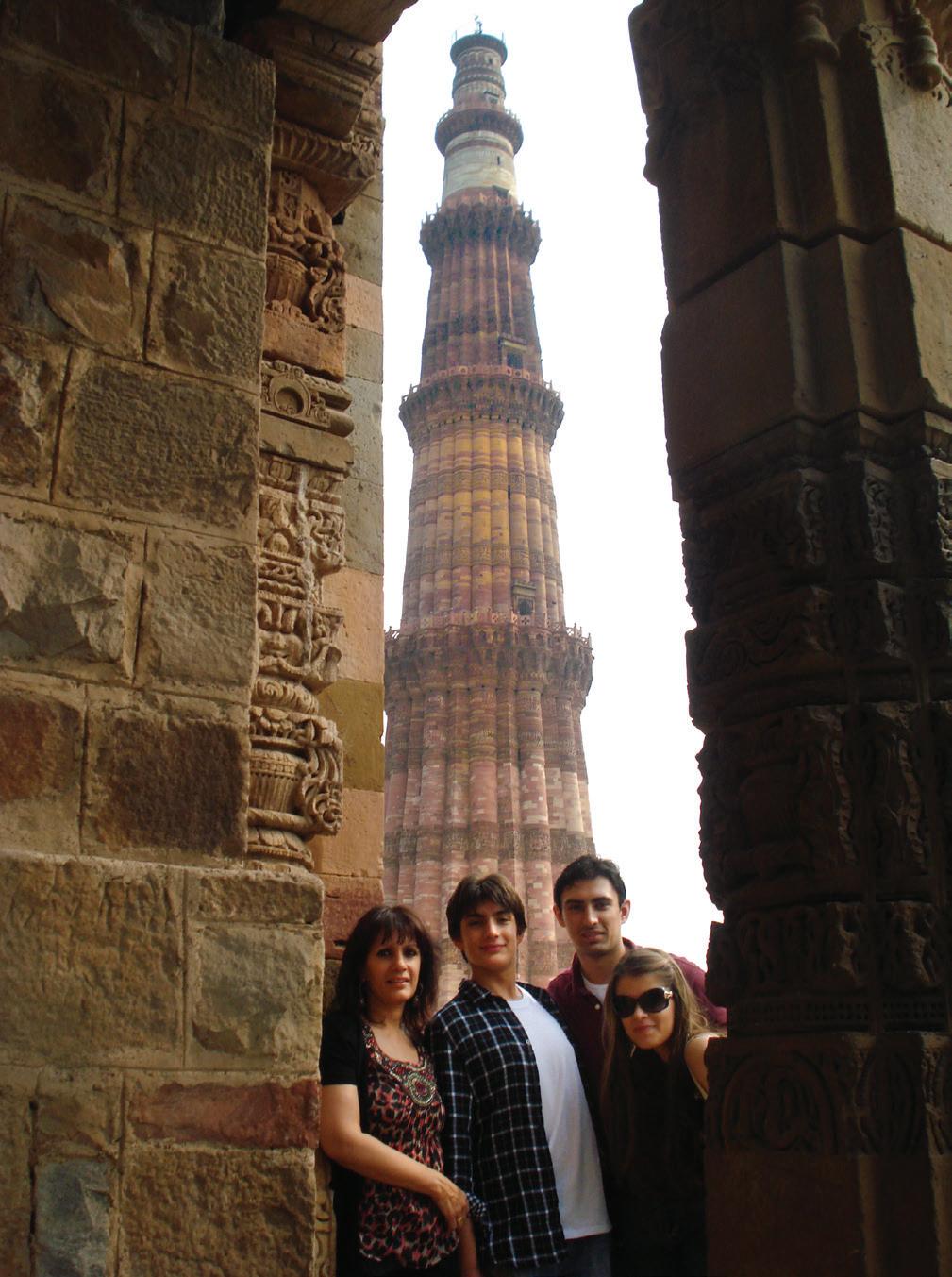
of my female rights! The males didn’t! I thought a head covering would have sufficed. The teenager in me wanted to refuse, but we were in high-spirits and so the adult in me complied with grace and amusement, instead of a scowl, as we looked very funny wearing these gowns, which were a combination of hospital gowns and old-fashioned housecoats in bright floral colours! After that we went to the Gandhi Memorial, India Gate, and Qutab Minar, a breathtakingly beautiful minaret.
Day three off was off to the Taj Mahal! We got there very early to avoid the crush and appreciate the beauty in the stillness of the morning. We then went on to the deserted city of Fatehpur Sikri, an abandoned city, and then to Agra Fort before heading back toward Delhi the next day. The drive was interesting and so much to look at all of the time — we spotted an elephant walking along the dual carriageway and coming off a roundabout suddenly got caught in a solid traffic jam that had just happened due to a collision further down. To our astonishment, our driver quickly and calmly did a U-turn and drove the wrong way up the dual carriageway, back onto the roundabout (the right way) and got us out of hours of delay. Somehow, he just got away with it, as we saw the police arriving to join the motorway hard shoulder just… as he made it onto the roundabout! We finished that day with a dinner at the lovely hotel we were staying at on our last night in Delhi, ready for us to part ways and the four of us to set off to Punjab
Early the next morning we took the early Shatabdi Express from Delhi to Jalandhar, a 5-hour journey, where my uncle was going to pick us up. Prior to this he had warned me not to think that this train would run on Indian timing, and it wouldn’t matter if we were booked on and late, thinking it would wait for us if we were running on the platform. He said to be very careful because this train would leave dead on time, so to be sure not to be late! All British Asians run on two time-systems – English timing -which means get there on time, as the event will be starting on time, and Indian timing which means get there whenever. We allowed extra time!
Once we had arrived in Jalandhar, my uncle met us at the train station and as we disembarked, we noticed a lot of different looking Indian children, (Punjabis have two distinct types of Punjabi look), and they were not Punjabi. They did the classic surrounding of the tourists asking for money, and as my uncle approached, he did the dismissive native-Indian-style hand gesturing to shoo them away and they scattered. He said that recently, because of work prospects a lot of Indians from the state of Bihar had migrated to Punjab.
He drove us back to the village home, where we settled ourselves in and had a quiet evening at home.
The house was staffed and was vast and all bedrooms en-suite with bathrooms so enormous that you could have had a pool party in some of them!
The following morning, we set off to see the Golden Temple in Amritsar, then Jallianwala Bagh, a site which was memorialised following the British slaughter of Sikhs, the gun shot marks seen everywhere and neat tidy and orderly rows of school children on an education school trip to learn of this atrocity. There was a museum like room with glass display cabinets and very typically like a room that has preserved
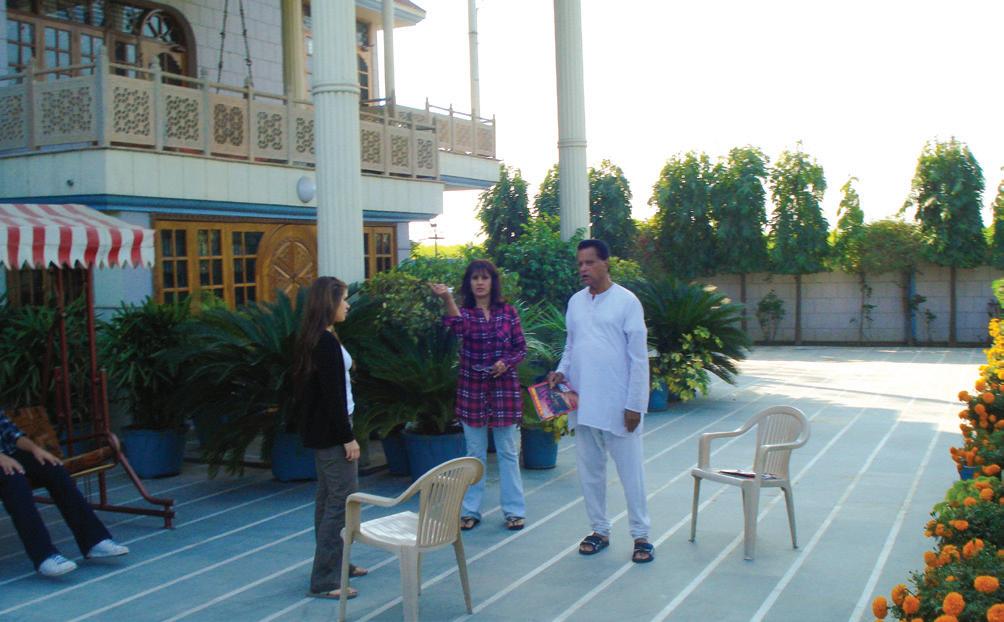
artefacts and objects from the era, and many photos of the victims, resistance fighters and perpetrators. There was one interesting photo which caught my eye. It was of the descendants of the killers. Stricken with guilt and remorse at the actions of their ancestors, they had, I thought, bizarrely, made a trip to make some odd kind of penance.
At the Pakistan/Indian Wagah Border ceremony: the man-made border built to divide and separate Punjab after Independence— it was such an amazing experience. My uncle had got us tickets right at the front in the VIP section by the gates. It was a cross between going to a concert and a football match, with all sorts of cheering and shouting, and parades happening. Each side would take it in turns to chant, but it all seemed in good spirits.
Looking across to the side in Pakistan, all of the women were segregated and covered up in a sea of black burqas, whereas on the Indian side, a constant parade of girls was displayed before the gates
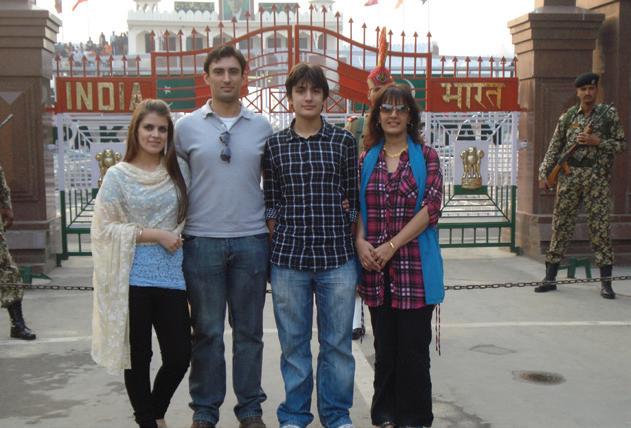
and Pakistani soldiers in two forms. Uniformed female soldiers who all suspiciously had the looks & stature of stunning supermodels, to the extent that it was beyond a coincidence?
I wondered if it were a psychological mind-game to make the Pakistani men not only see women’s faces on display, but in a ‘men role’ and in a tempting manner. This was continued in an interesting ritual, whereby a steady stream of girls or young women holding the Indian flag, ran from the far end of the seating, right up towards the gates and then turned and ran back to be replaced by the next set of females, in a strange sort of relay race -this went on for some considerable time and there was no shortage of girls ready to run the length of the grounds -go close to the gates with the soldiers and turn back . I was told that only girls were allowed to do this. Clearly making a statement! All the while the beats of the music blared out at top volume in tandem with the Pakistani music playing on the other side and their soldiers doing marches and their own thing – it was incredible!
Over the next few days, we visited family homes and farms, including my mother’s original maternal village where the old house had been converted to a school. We spent time walking around the village, noticing all the large new houses built by families who had gone abroad and returned to rebuild on their land. I even had a go at milking a buffalo at my Auntie’s farm!
We also managed to see some more of the region, including a day trip to Simla and the Vice Regal Lodge where the partition map was drawn up simply by drawing a random line and giving tens of millions of people two weeks to displace themselves.
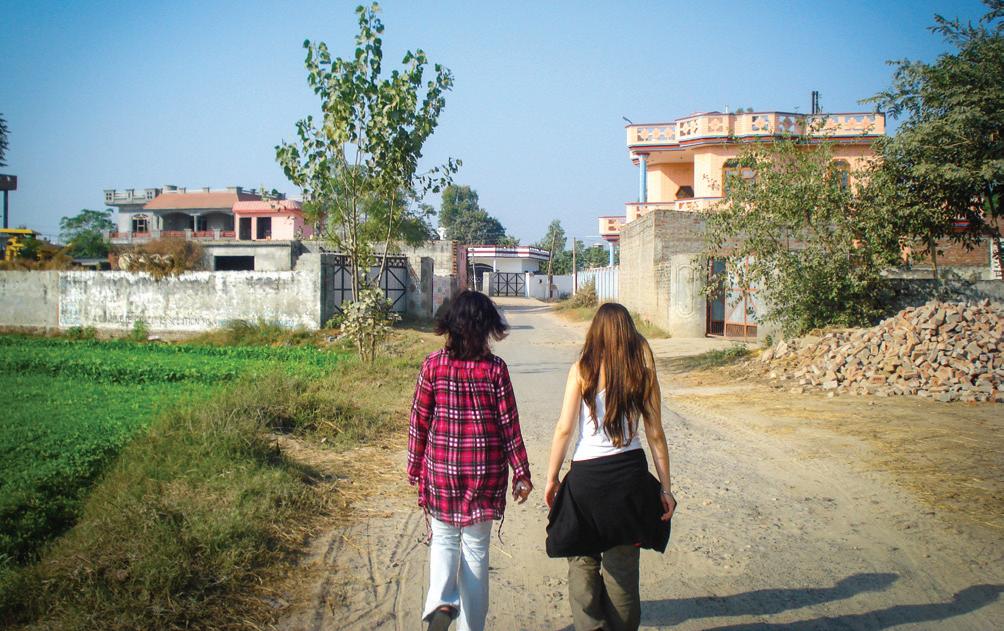
Simla looked like a picture postcard straight out of Switzerland, and another to Chandigarh, the capital of Punjab. The famous city layout was designed by Le Corbusier, but the merits of his design were completely lost on me, apart from the gardens.
My parents were around 15 and 17 years old at the time of Partition in 1947 and their families were already living on the side of Punjab that would remain in India, so although they did not undergo the horrors of partition in the way of losing their homes and the life they and their family had lived forever within living memory, they saw the atrocities and mass bloodshed.
My mother would not talk much about it, but my father would talk about it politically, getting worked up about the damage the British had done in India, and around the world often mentioning Palestine, and The Suez, where he says a ‘lesson was learnt’. It didn’t mean much to me, and when he referred to The British, I never absorbed this in any way to mean the people I knew and had grown up with, but more their ancestors. I was also aware that this was not taught in schools and that all of my friends would be completely oblivious to this. It was never anything I ever talked about with my friends, and, in addition, the national school curriculum ensured there was no mention at all of this.
After ten busy days, we flew back to Delhi and caught our onward flight to Sydney. We had a lovely stay there, taking in the sights and enjoying the laid-back and casual atmosphere, before finally heading home to England
I had arranged for Arun to be out of school and needed to clear this with his Head of Year. A fantastic and supportive person, she agreed with me that this would be a very educational experience indeed, and we took his books and work with us with the assurance from myself that I would sit each day with him and cover work set by teachers for the 3 week – which I normally did at home with all three anyway, and which we did do on the holiday.
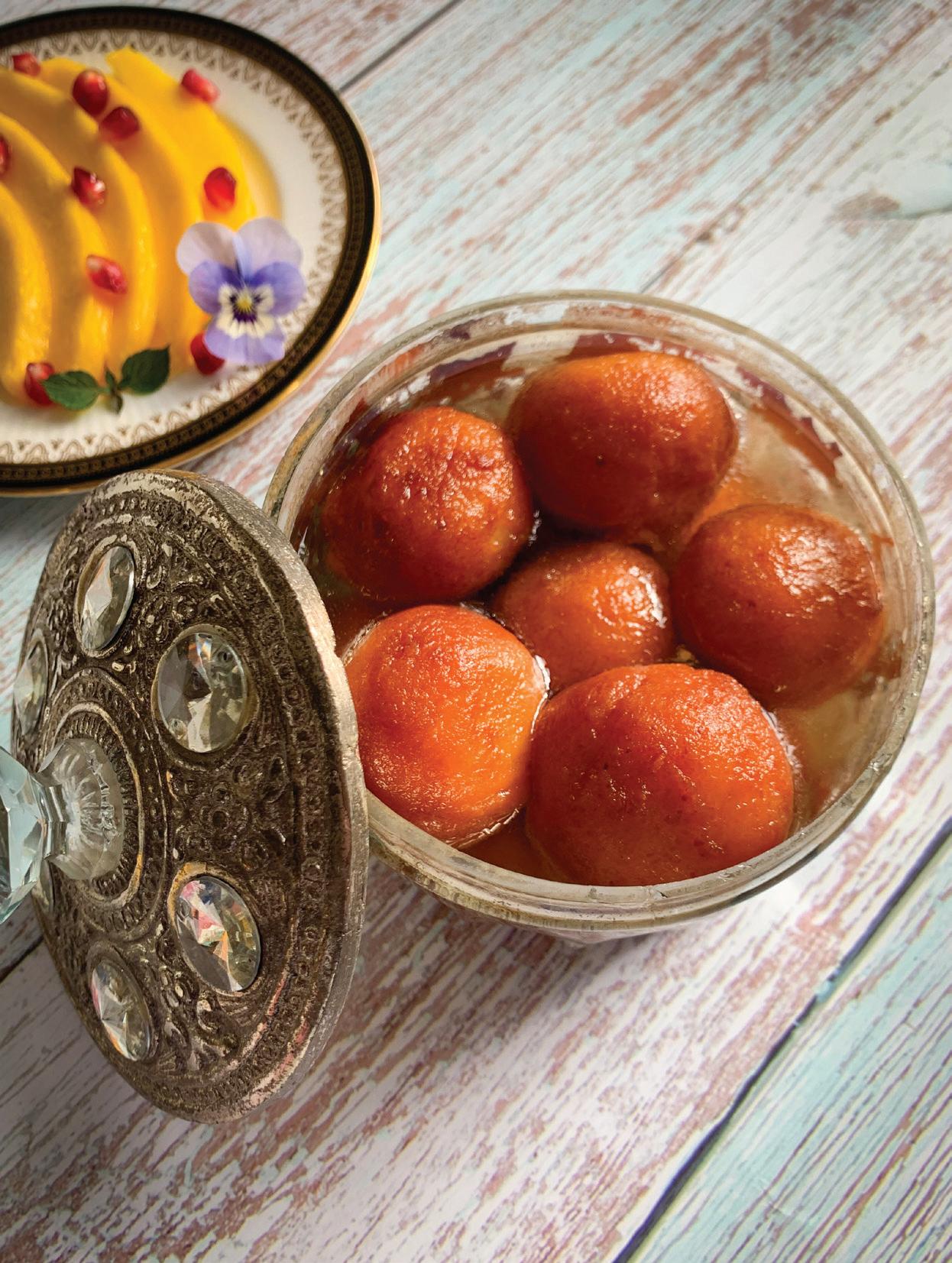
People say the Gulab Jamuns are very different in India and England. People also make much about who has the ‘best’ Gulab jamuns – it’s an odd thing because the cake/sponge-like dumplings sit in syrup, there for it rather depends on what day you are eating them, as in how long they have been sitting in syrup to become softer, or whether they are still too firm at the beginning.
It is advisable to give them a couple of days sitting in syrup, so these are ideal for making in advance. They are in addition a two-stage process as the dough has to be made, shaped and then fried. The syrup then has to be made but you have to be careful about putting the dumplings in when they are too hot, or when the syrup is too hot.
My mum used to make the syrup first, then while it was cooling, fry the Gulab Jamuns and leave them to cool, by which time they were both warm, and the dumplings could be lowered into the syrup to sit and absorb it
For the syrup
Ingredients
2 cups of Granulated Sugar (approximately 500g)
2 cups of Water (approximately 500ml)
2 Green Cardamom pods
1 tablespoon Kewra Water (pronounced Kev-rah)
Method
Put the sugar, water and green cardamom pods into a saucepan. Gently bring the syrup to the boil. Once it has boiled, reduce the heat, and let it simmer for 5 minutes, stirring it to make sure everything has mixed properly.
Turn the heat off, and let it start cooling…5 minutes later, once it has cooled a little, add the kewra water
For the Gulab Jamun
Ingredients
1 cup of Milk powder (approximately 110g)
¼ cup of Maida (plain flour – approximately 60g)
½ teaspoon Baking Powder
3 spoons of Butter, room temperature
Milk (approximately 50-60ml)
Sunflower oil, for frying (1 – 1 ½ litres or so)
Pour the sunflower oil into a Karai (wok or saucepan) and heat over a medium heat
Put the milk powder, Maida and baking powder into a mixing bowl, and using your hand as a whisk, mix the dry ingredients together.
Cultural reminder: traditionally, the right hand is used for ‘clean’ or food-based tasks, so don’t dive into the bowl with both hands or you’ll end up in a sticky mess…use only your dominant hand for mixing, and your non-dominant hand for holding the edge of the bowl and for pouring milk
Now rub the butter into the dry ingredients with your fingertips. Once you’ve rubbed the butter in completely and it has formed little ‘breadcrumbs’, add the milk a little at a time. The dough should be a little sticky. Cover it with a tea towel and let it rest for 5 minutes
Whilst the dough is resting, test the temperature of the oil by breaking off a little piece of bread and pop it in the oil it should be gently sizzling (if using a deep fat fryer, the temperature should be set to 160 degrees).
Now, knead the dough to smooth it out and it should be ready to roll. Divide the dough into 12 portions…do this by dividing it into 4 equal portions, then divide each quarter portion into 3.
Roll the dumpling out so they are smooth and don’t have any cracks at all, otherwise they will split when you fry them. Now gently fry the raw Gulab Jamuns, you may need to gently rotate them to ensure a nice and even golden colour. Drain them on kitchen paper for 5 minutes.
Check the syrup – this should now be warm, and after sitting for 5 minutes, so should the Gulab Jamun. Put the warm Gulab Jamun into the warm syrup. Let them come to room temperature and then put them into the fridge and they need to sit in the syrup to soak for 2 – 3 days. Over this time, they will more than double in size.
When serving, warm the Gulab Jamun up, as they should be served warm.
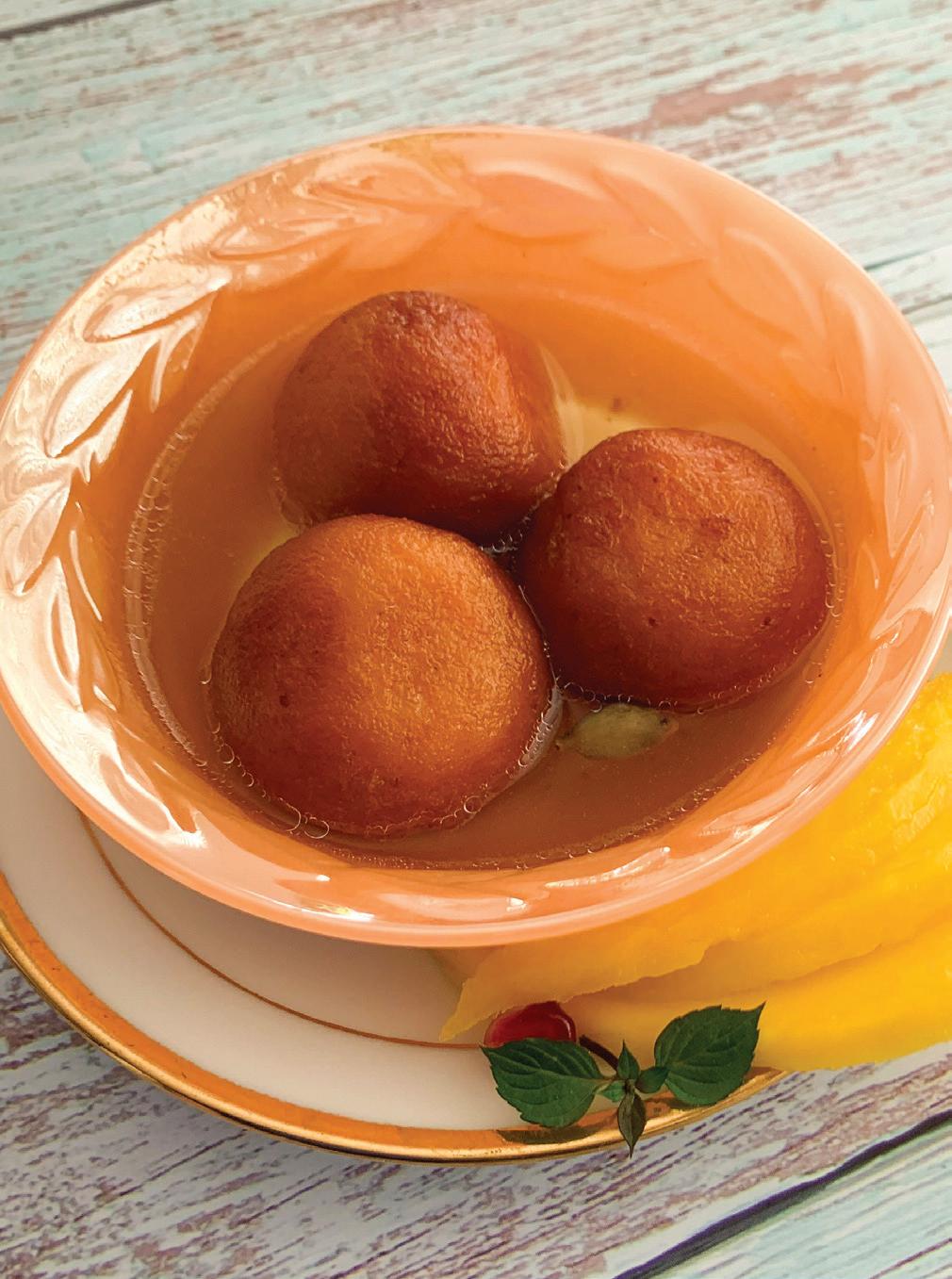
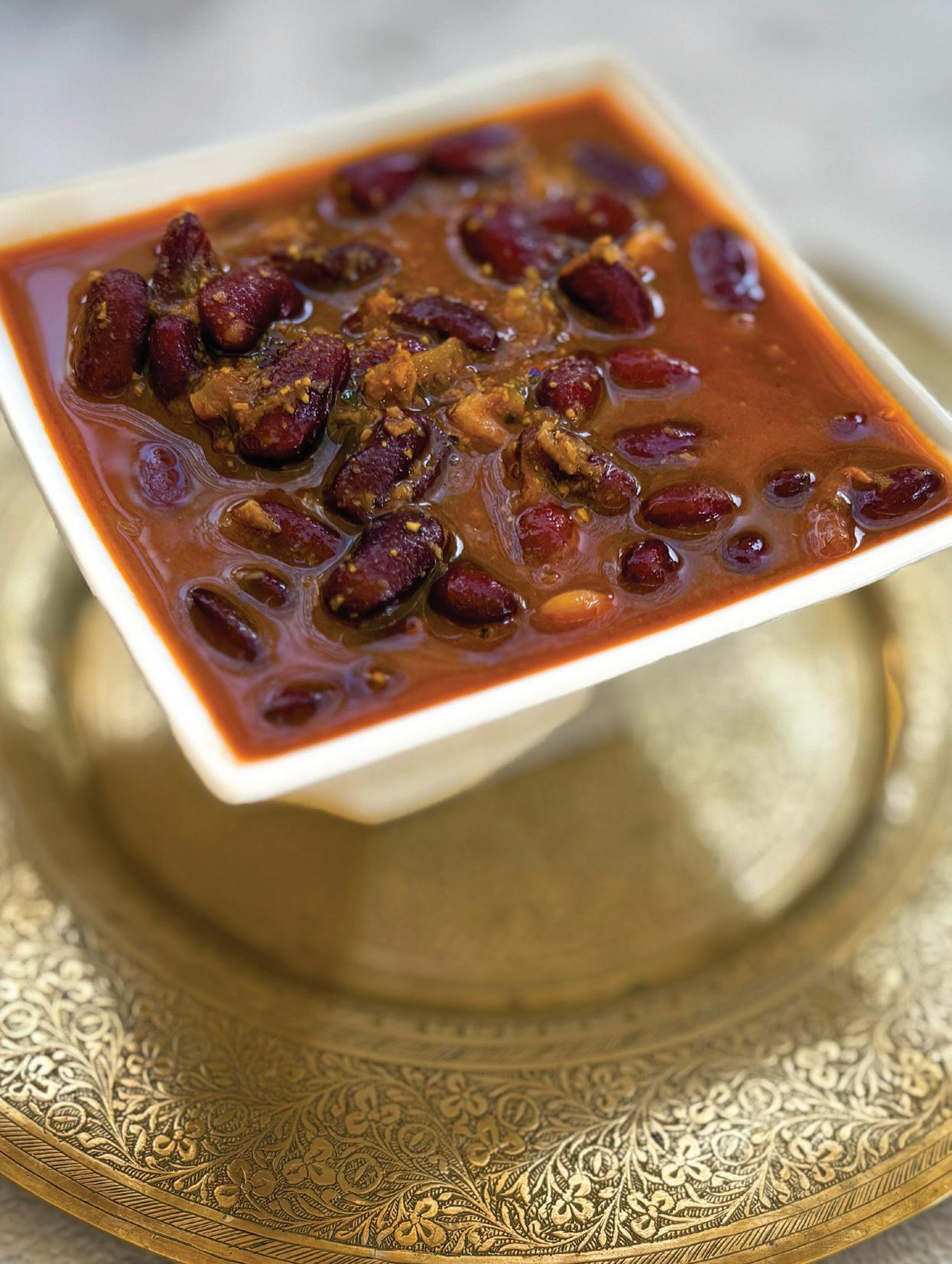
If I had to give a Dhal to a meat-eater – it would be this one – it is so filling and hearty that it confidently delivers when being -meat-free, for whatever reason, is required. This is the only Dhal that is paired with rice, and you will often hear people say “Rajma Chawl” because the two are always eaten together.
Ingredients
1 batch of Tarka starter (see page 305)
1 tablespoon Garam Masala
¼ teaspoon Turmeric
1 teaspoon salt
1/3 tin of Chopped Tomatoes (approximately 130g)
1 cup of dried Kidney Beans (approximately 250g)
1 tablespoon of Coriander Leaves
Pre-prep: take the kidney beans and soak the beans for 8-10 hours (or overnight), in separate bowl. The bowl should be big enough to allow for the kidney beans to double in volume, fill with water to the top and cover with a tea towel.
Method
10 hours later (or in the morning) drain off the water. Put the dry kidney beans into a saucepan and cover with clean tap water. *Note: you must change the water when going from soaking the kidney beans to boiling them.
Bring the kidney beans to the boil then simmer on low with the lid on for an hour.
Whilst the kidney beans simmer, you will make the Tarka base in a separate pan (see page 305)
Now add the Garam Masala, turmeric and salt to the tarka base, stir thoroughly. After that has cooked for a couple of minutes, add the chopped tomatoes. Crush down and chunks of tomato against the side of the pan so that you have a nice and smooth base.
Check the kidney beans, if you can almost break through it but just the centre is hard to the thickness of a red split lentil, they are ready. Drain them.
Add the kidney beans to the spiced tomato saucepan. Stir through so everything is incorporated well. Now you will add water – enough water to cover the kidney beans. Now put the lid on the Rajma, and bring the kidney beans to the boil, then turn the heat down, and simmer for roughly 20 minutes.
The Rajma is now ready to serve and is usually served with rice.
Back to having holiday cover for the Post Office counter and shop...so I arranged for staff cover by engaging people who were approved by POL as experience and trained staff. Their former employees!
It was the first and last time ever having cover staff – let’s just say the shop stock was missing and approaching bumper Christmas sales of the luxury stock we had in the shop; there were oddly very few shop sales. However, the shop till had multiple ‘no sale’ transactions registered, but…only on the day when the male of the pair covering, was working. When the female was working, there were sales and cash in the takings…meaning on the day the male was working, the till was repeatedly opened without a sale occurring – up to 17 times per day. When I phoned, to raise this with the female she was stunned into silence and then suggested that I phone the male – I think she actually gave me his number, as I had the contract with her. On calling the male he took the best line of defence, which was extreme aggression, shouting down the phone. His reason for multiple ‘no sale’ till openings, was that he needed change for the post office – when that is completely separate business and had a safe full of change!!!!
As with all Post Office dealings it was a dead-end and waste of time. The dealings were always torturous with people who seemed to have been trained to defraud – allegedly!
At this same time, ( with my underactive thyroid status), it was finally established that the T4 medication was the culprit in my weight gain, joint pain and new aches and pains and decline from super fit, and well.
Over three years, the GP had continually increased the dosage… and repeat… and repeat. I got worse and worse and gained a pound, another pound, until, in the end it was a 2 & a half stone weight gain. I had been to see an NHS endocrinologist at Salisbury Hospital -a waste of time. He wasn’t interested at all, dismissive and rude. I couldn’t wait to leave. For the first time I wondered how people who had health conditions managed with a world that treated them through medication and a complete denial of the role of nature. Meaning food and plants.
What I had never realised, or never occurred to me, is that nature cannot be patented, but a synthetic pharmaceutical version could be patented, meaning Big Pharma money. It was in the systems interest to dispense tablets. I also hadn’t realised and had separate reason to discover, that dispensing the drug Ritalin gave schools more money as well as a payment to parents. Wouldn’t this affect whether a child or person ‘really needed’ the medication?
Finally, I enquired about a specialist endocrinologist. I was told 7 months waiting list. I asked, what if I went private? Then it’s next week I was told. I went private.
Meanwhile I went online and ordered private blood test. The GP had said to me, ...well you’ve had all the blood tests available, so then I thought I had, but it was a lie by omission...meaning ‘all’ of the 3 blood tests that the NHS would provide. There were in fact 12 blood tests in a thyroid panel, and so I had them all. It tuned out that I had raging Reverse T3, and it was the T4 medication doing it! It should have been converting to active T3 for metabolism, but some people are known as non-converters and convert to fat storage Reverse T3.
I discontinued the medication immediately. Apparently, this is very dangerous and when I told the endocrinologist his face was ashen – “What’! he said. Completely! You’ve just stopped!”
I did minimal exercise that week, and changed nothing but dropped 5lbs immediately? The endocrinologist immediately ordered that I be prescribed direct T3 as I couldn’t process T4 to convert itself to T3.
Eventually the trauma of doing this through the system, which is designed to defeat you, meant I couldn’t get the T3, and so I discontinued any form of T4, and ordered direct grass-fed animal gland thyroid from the USA. My son Arun researched, and I started a vitamin and mineral protocol; and found a natural thyroid diet. I’ve never taken a pharmaceutical again.
I had had no choice during this process, but to close down my personal training business - a bitter blow as this was my true love and vocation in life.
Add image or text?
‘A peculiar franchise’
The Machinery of corruption and incompetence at systemised institutions like Post Office. Can’t beat the system – bent or incompetent – putting savings over living a life. Partnerships then were for life and often with people you couldn’t remove like family – different now with internet and temporary situations and arrangements,
“Never pay anyone rent – they pay you”! My father had drummed this into me form a young age – I had to buy my own home- never rent form anyone, and then I had to buy more property and rent it out.
And so, this property was a form of rental to a commercial entity. POL rented my space as they did with postmasters across the UK, to install their operation and have it run by agents operating their franchise models, successfully portraying a false cosy family-type ‘community’ business.
Most people who took this model ran them up to retirement or death, gratefully receiving the payouts as if it were a sort of enslavement. They seemed to forget that they were the owners of their property and of the ground the Post Office was running from, whether as freeholders or leaseholders. They could, with notice, evict this controlling and corrupt franchise at any time, but such was the pressure of the public, who really thought they owned the Post Office as the community, (like pubs and football clubs with their armchair managers and owners), and the institution which had an iron grip on these agents- these postmasters became scared and forgot they actually should have had the upper hand…
I wonder if it were a tactic to enslave them in losses and debt of hundreds of thousands to ensure they could never afford to sell up and leave or never be able to evict the franchise, because they were in huge debt to it!
A masterstroke of Machiavellian nastiness…allegedly!
Food for Thought ...
Reflections on two cultures, ways & worlds
“You must provide for the family’
It’s the goal of South Asian and Eastern parents to pass on and provide, often at all costs. It often appeared to me to be the goal of Western parents to spend it all?
I would very often hear expressions such as… “can’t take it with you”! NO, you can’t…you’re not meant to!… you’re meant to pass it on to your children! Another strange attitude I heard was, “well… no one helped me” …as if one’s own lack of support, loneliness and misery, should be passed along? Not exactly ‘pay it forward’!
Migration, whether across countries or internally—like the movement of Biharis to Punjab for work— has long been linked to the desire for economic improvement. Yet with it comes an outdated immigrant mindset that can linger across generations, shaping habits around business, family roles, sacrifice, and survival. This mindset is often rooted in scarcity and fear, even long after life has become more secure.
At the same time, questions of guilt, history, and inherited responsibility often arise in immigrant families. The wrongdoing of an ancestor or one’s people is not your fault; ignorance or denial of it, however, becomes a form of responsibility. Awareness matters—understanding what happened in history, accepting the consequences that echo down generations, and acknowledging them without assuming personal blame. The problem is most British people know almost next to nothing about Indian and the colonial history of their ancestors, other than tabloid fodder.
The difference in attitudes, gratitude especially between East and West struck me – almost no complaining, other than in an aspirational way, wanting to achieve more in life. British Asians reinforced to people that if they left, they would come back ‘rich’…but at a cost they didn’t see. To be honest, almost no one went ‘back home’.
Growing up a British Asian, I did operate on English timing, which meant I got to a function or appointment on time, but I also operated on Indian timing, meaning you got there roughly around the appointed time, or whenever, and it never really mattered if you were late, (although it was always annoying if you were hosting and not the guest).
‘Count the pennies…and back off’
Many immigrant habits stay with them for life – re-using tinfoil, mending torn clothing and repairing broken items. The drive to save money was strong. This was because all the money was being pooled into growth of the family’s collective wealth and assets – normally a plan to buy another house or business.
Being frugal with purchases, not wasting money and only spending where necessary, were habits that enabled a level of thriftiness, that often never showed. For myself, the skill was learning when to spend on that one expensive item, and make-do the rest of the time, and people would not notice.
Once I spend a huge sum of money on a very stylish Italian sofa – it was greatly admired. Because of the sewing training received from my mother, no one realised that all the cushion covers were handmade, curtains were altered to look custom made, and no one could tell. The same with a romper suit I made Safia from a bright piece of expensive remnant fabric – the shop assistant said to me-what a gorgeous outfit- -is it Laura Ashley – I smiled—no… it’s a ‘me’.
Personal space is another big difference between our cultures, as well as staring, considered so rude in the Western polite society, (though somewhat shameless now). Arun in particular, at 15, found it very irritating and annoying, as well as the loudness and hustle and bustle… the carefully orchestrated ‘toot toot’, and ‘beep beep’ - an almost continuous blaring of loud horns jangled his nerves, and one day he’d had quite enough.
We were in Jalandhar shopping in the Bazaar, crowds and traffic everywhere and he was already close to having had enough! Suddenly, a loud motor scooter, with two unruly youths whizzed rudely by, (aiming for the British Asian tourist I’m sure), almost on top of him, horns at full volume, and he said, “I hate this place”. It was an arrow to my heart as I so wanted him to feel some love for the Motherland.
Later, he said he didn’t mean it…who knows?
How hard the conflicts of cultural loyalty!
Food for Thought ...
Reflections on two cultures, ways & worlds
‘Rice & beans’ …
In the TV programme, “I’m a celebrity – get me out of here” contestants, have to and live on a plain restricted diet and face challenges to earn more or better food.
The losing teams continue on the same restricted diet, which is always ‘rice & beans’.
During my time on my personal training course in Johannesburg, our nutrition lecturer was the nutrition advisor to the South African Olympic team. In one of the lectures about amino acids, she had taught us that the combination of these two foods – rice and beans, formed the complete set of amino acids that the body needs.
Years later, seeing this programme and the severely restricted diet that contestants ate, and that explained a lot and made perfect sense – so no matter how little they ate they were not going to be nutritionally deficient given the addition of a few other items, to provide the 7 broad elements required in the diet: protein, fat carbohydrate, minerals vitamins, fibre & water.
The nutritional values of Punjabi food as main meals surpassed this with the super beneficial properties of spices and also provided all of the nutritional values for training, as well as the fantastic benefits of economically feeding a family… and so I incorporated the Pure Punjabi food business into the diets of my PT clients who loved Indian flavours. Clients would order dishes, which they would keep in their freezer for weekends ‘off the diet’, except it wasn’t breaking any nutrition plan.
When at the gym in the UK, other personal trainers would be mystified as to how I kept my clients on their diets. I chuckled to myself.
Indian food on a weight-loss diet!!! Who would have thought!
Chapter 14 – …and then the penny dropped… I was my own answer…
Now that the shop was nicely stocked with a selection of local produce such as honey, cheese, chocolates, biscuits and gifting items, one day someone from the New Forest Marque dropped in, with a list of local suppliers that they wanted to give to me.
On that list was an Indian kits/spices supplier. Looking at it, and checking this out, the supplier was a British person who had travelled to India for a 3-week holiday, picked up some recipes, come back and started a business making these recipes!!
There is a space and a place for everyone …just not on my shop shelf!
If I want a product from Portugal I want to get it from a Portuguese person. If I want a proper British roast, I want the real thing from a real English granny, not someone who visited, tried it, copied it and started selling their version of it in India, with no blood, heart or soul, heritage or history in it. There’s always been posts on social media circulating within the south Asian audience, about ‘selling our stuff back to us’ and it’s annoying!
I was looking for a producer of non-Westernised, non-generic premium blends of spices; made the way Indian mothers make it at home from their own region of India.
And so, I started my online search across the UK for a commercial or artisan producer of truly genuine, home-style, regional Garam Masala, i.e. as produced by an actual Indian who was raised and taught from childhood to smell the whole spices, blend and grind their family regions’ blend from scratch. I found nothing like that!
What I found were plenty of non-heritage brands and products inspired from travels to India, created from recipes online or modern-day fusion versions. It wasn’t what I was looking for…
Unable to find anyone that produced in the authentic old-school manner, appropriate to their own region and cultural heritage, and not generic ‘Indian’, I chose to not stock anyone, rather than have something I wouldn’t give to my own family.
I was sat down in the kitchen thinking… where can I find what we would happily use…and then the penny dropped… I had the solution to my own problem…
Having been taught from a young age how to cook and then later, as a 15 year old, how to make our original traditional family Garam Masala from our region of Punjab, North India, and also how to cook all our Punjabi dishes in the traditional way, (a typical training for marriage in that generation), I contacted Environmental Health and created our first product from our own kitchen table.
A Garam Masala which was... pure to Punjab… Pure Punjabi Garam Masala….and the business was born…
However, instead of mixing my spices and grinding for my kitchen and family, I had to work out the balance of increasing ratios, (as that doesn’t always work), and needs careful adjustment.
Safia was at university at the time, I formed and founded the company but knowing her interest in cooking and being most likely to agree to being pulled in, I added her name on to the business.
I then produced our second product – Pure Punjabi Tandoori Masala, initially with a modification of using powdered garlic and ginger because I just didn’t have the time for the lab testing required for making it with fresh ingredients. It was against my own ethos, but a necessary compromise at the time, with the idea of coming back to it later to do the lab testing.
At that time, I was a private personal trainer & life coach, as well as owning and running the shop & Post Office, looking after my rental property and a single parent supporting 3 children, two finishing university and one still at school. The two jars were sold in the shop and at a few local markets. I built a little website for it, and it remained like this for the next three years as I focused on my private training clients, running the shop and supporting my growing family. In 2013, things changed and I was joined by my daughter Safia….
She had gone to work in London and found that the company she was working for were not at all aligned to her ethics. The style of management was bullying, and it was once again a story of girls crying in the toilets. She applied and successfully got another position in the South of the country, however, an unexpected twist just before joining, was the formal letter of offer which included the condition of relocating to the rural outskirts of Petersfield which she was not prepared to do. Now she had already left the London job, so now…she had no job! Why don’t I give you the two jars and start up fund and see what happens with the year…
With Safia now joining me in the business, the first thing she did was return The Tandoori Masala to the original product using fresh garlic, fresh ginger, freshly squeezed lemon juice (and so arranged the lab testing). The business grew…
During this time, Safia was trying a dairy-free diet, but I would occasionally make Kheer, which is Indian rice pudding, which we make on the stove/hob and not as English rice pudding, baked in an oven to form a skin. As Safia wasn’t able to eat it during this time, I went back to making a sweet rice dish that my mother used to make…Mithe Chawl…literally meaning, ‘sweet rice’. Both of these puddings are fragrant and delicious and again so simple, following the important rules – meaning, it’s all in the methodology. Both puddings, with or without milk, have a lightness and digestive quality which make them ideal for a light nutritious bowl of something to eat, while being busy or active.
When we first arrived in the village, before Pure Punjabi had been founded, we learned of a big village Fair, that was apparently so big, that the roads in from both sides had to be closed, and essentially, the whole village was involved, (or people went away for the weekend). It was always on the first Bank Holiday weekend, and so we applied for a stall to set up a small shop showcasing lots of the speciality and local food & drink produce in the shop. A local cheese producer, who sold his cheeses at lots of markets and always had a stall at The Cuckoo Fair, gave us lots of advice and recommendations to prepare signage and ‘get ready’ for the influx of visitors! We thought it was an exaggeration! It wasn’t!
Somewhere in the region of 20-25,000 people came for a lovely day out, some even coming by coach! Fields at both ends of the village were used for parking, and minibuses shuttled people in and out. Residents also used the opportunity to have table sales outside their houses.
It was, and I believe still is, one of the largest village fairs, and still to this day, having since done many fairs, markets, shows, and events with Pure Punjabi, we maintain one of the best organised events, with the interests of all in mind (something we later realised was not the case with many event organisers).
We had done the Cuckoo Fair each year with a display of our shop products, but after we had started producing our own Pure Punjabi products and stocking our own branded jars in the shop, and with Safia now also in the mix…we decided to do our own home-cooked Punjabi food for the Cuckoo Fair that year, instead of taking our regular shop produce.
One amusing incident was that Keema sales were slow. I had put up a big sign saying, ‘Tandoori Chicken’, which everyone knew, and then another with, ‘Dhal’ which most people seemed to know, and then ‘Keema’. I mentioned to my son that no one was buying the Keema. He looked at my sign, took a pen, crossed out my sign and wrote in large letters… “Lamb Curry” …it sold! It’s not a word we use and actually do not like, however ‘needs must’ in the world of food sales! The queues were enormous and ran all day long. It was a great success.
So, what next project could Safia and I set up, after the successful Pure Punjabi Cuckoo Fair?
Friends told us about people they know who ran a series of ‘pop-up restaurant evenings – this was a new concept at the time and only really seen in London. We went with this idea of a pop-up restaurant, and Safia came up with the idea of 3 course dinner, but …layered with Indian dance performance between each course. She researched online and found a London agent and booked the dancers! Entertainment was in hand! She then wrote the menu, and we advertised our first pop-up with dance performance to be held at Downton Village Hall, with posters on the boards around the village, and at our shop. Tickets sold out quickly via bookings over the counter.
With hindsight, we went a bit overboard on the décor – we wanted to make it look really beautiful on the night, which we did, however… we would pay for that on clear down.
On the night there was great excitement as guests arrived, but we hadn’t at that point, been able to build a kitchen team and have proper support so it was a steep and unpleasant learning curve, leading to slow service and longer gaps than we should have had.
Once everyone was seated, starters were served, and then the opening dance set began, which was more on the classical side, with one memorable fusion performance set to a rousing Indian Irish music blend, which went down a storm. Then after the mains, we switched to Bollywood, and then after the desserts to the Bhangra of Punjab, significantly raising the tempo! We closed with a workshop teaching the very merry diners the well-known dance routine of Jai Ho, whereupon the brave and the bold and the tipsy, were encouraged to come up on stage to deliver a final performance of the night, leaving others to be the necessary audience and join in from their seats. It was great fun!
The post event clear-up was not!
It was actually a nightmare, because of the amount of props, and general stuff we had transported down there and had to remove, so we didn’t finish the clean-up and break down until 3 in the morning…and that was with the help of the valiant friends who remained to help us to the not-so-sweet end.
From that was a private dining booking in the village, and then we ran our first Indian experience cookery workshop that year as well. Safia had written the format of the Indian Experience based upon what a mother would first teach a daughter…but those dishes being ones that would lead to being able to make many more. There was one exception of adding Onion Bhajis/Pakoras – because we wanted to format it as a 3-course menu, but also appeal to what British people would want, and so we included Bhaji, as it’s known in Hindi, but as Pakora in Punjabi, though we went with the more popular name.
Then the surrounding local villages, hearing about the unusual pop-up event, started enquiring and we started on a series of pop-up event sell outs. The experience of working with various village organisations was tricky at the start but as we came across more potential issues we became better as setting out contracts and T&C’s and making sure everyone knew what their roles were and what they were doing.
Village politics, power struggles and differences of opinions, causing washing-up mayhem and seating plans changed!
We did however partner with some really lovely people, who were interested in the experiences of the guests and one ticketing partnership caused all of the tickets to be sold out in 36 hours, requiring a second night to be added on, which also sold out. During the pop-up set up, we had from the beginning introduced the concept of having a charitable cause, and a partnership with the village hall that they would run bar and take those profits.
The first wedding that we, as Pure Punjabi, delivered was also in 2013…but we didn’t know it was a wedding - -all the food was prepared as if for a private event - on the very same date of that event, we had stretched ourselves by my offering to provide a completely free of charge service – a mistake I didn’t ever repeat again -for a birthday where we were also supposed to be guests at Safi managed to get both events food prep done and then cater the wedding in the afternoon to rush back and cater the birthday
Even though the offer to prep food was as unpaid help, one of the things we learned was that there is something in food service where people think they can treat you like rubbish? Throughout the night, it appeared most of the guests didn’t know we were guests, and a few in particular treated us like ‘brown staff’ – it was very amusing collecting the dishes we had lent the next morning, to see the overnight guests red-faced, discovering we were neighbours and supposed to be friends! An early lesson in a food business with catering & event services – never offer to ‘help or gift’. as ‘no good deed goes unpunished’.
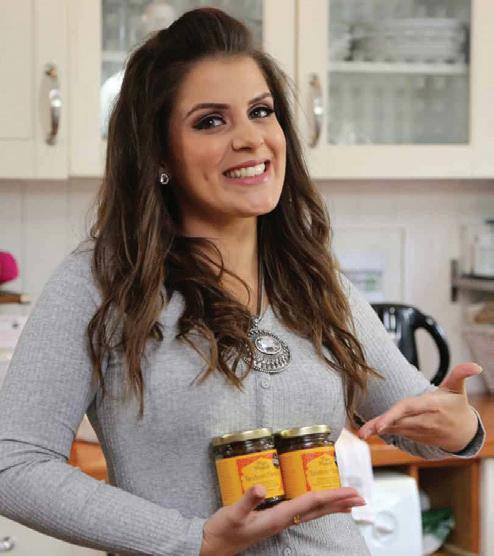
We went on to a regular events, markets and private bookings, especially over the weekends, ending up working fulltime on the Post Office, still running my personal training, and working all the hours on Pure Punjabi.
The year of 2013 ended with Safia selected as finalist in “The young Entrepreneur of the Year” category, in the Enterprising Wiltshire Awards, and
….with Safia having entered our Tandoori Masala into the acclaimed Great Taste Awards and winning us a Gold Star! She got us our first award, then our first pop-up event successfully, if painfully delivered, our first private dining event and first wedding!
This is delicious both hot and cold, but if you have it cold, have it really chilled and make it a bit sweeter as the chill will lose some of the sugar!
Ingredients
1 cup White Basmati Rice (approximately 250g)
I pint Milk, must be whole milk
2- 3 large tablespoons of Sugar
2-3 Green Cardamom pods
2-3 Cloves
A handful of Flaked Almonds
Method
Wash the rice until the water is clear, then drain off the water.
Put the washed rice in a heavy based saucepan and pour the milk in to cover to about an inch above the rice. Add the cardamom and cloves and stir to mix well.
Turn the heat up to medium high and start to gently bring to the boil. Stir regularly to stop the rice from sticking to the bottom of the pan.
When the milk is coming to the boil, allow the milk to start to rise, and then turn down to a simmer, for approximately 20 minutes.
Note: Stir during the simmering process to ensure the rice does not stick to the bottom. If by chance it has stuck and is caught and burnt at the bottom, do not ever scrape this as you will bring the burnt flavour into the whole pudding. Just gently stir above the burnt stuck-on bits.
Add the sugar to taste. Test that the rice is cooked by spooning out a few grains, and either splitting with your nail to see that it is soft and fully cooked or bite it. Otherwise take a whole tablespoon – let it cool and taste a mouthful to be sure it is soft and that the sweetness is to your liking – sweeter if you are Punjabi and less so if you are not!
You can add the flaked almonds in at the end or use them to garnish in the serving bowls.
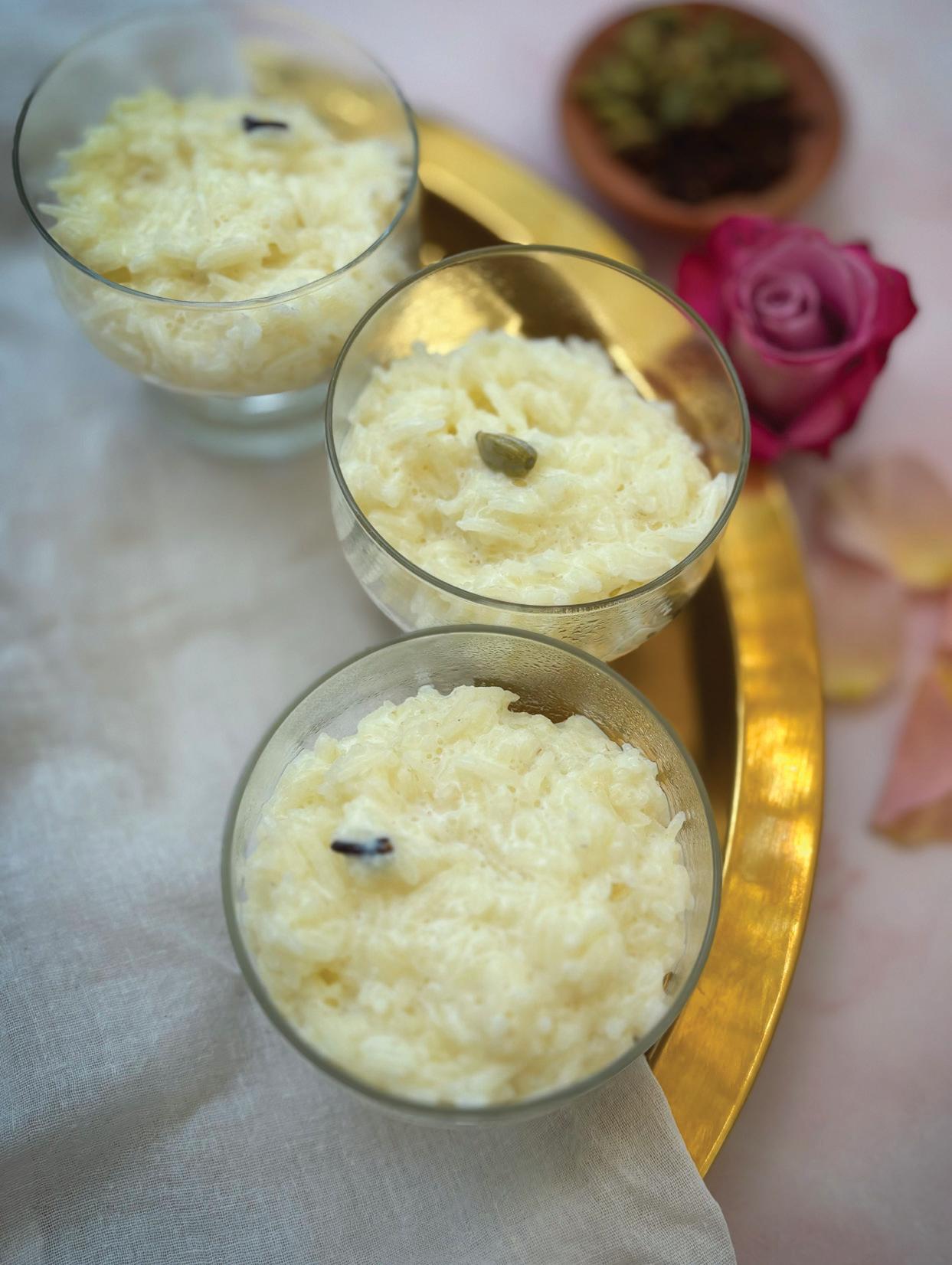
When we started the business, we were invited to speak by the BBC for their regional radio stations. On one occasion, they wanted to speak about rice, as it frequently appeared on lists as a food item that people struggled to make. My daughter travelled into the studio to do the interview, and she made this dish for the radio host to try on air. At the start of the interview the host tried it and described it as tasting like “someone came and gave you a warm hug”.
Ingredients
1 tablespoon Ghee
1 cup of rice (approximately 250g)
2/3 cup of caster sugar (approximately 165g)
3 Green Cardamom pods
2 Cloves
470ml water
Method
Wash the rice thoroughly, till the water is clear (no longer cloudy) and drain well.
Over a medium to low heat, melt the ghee in a saucepan and add the cardamom and cloves. Stir for a minute or so to allow the flavours to release. Then, add the washed drained rice, and dry cook it for 4-5 minutes. Then, add the sugar and water, stir to make sure the sugar has distributed evenly, and bring the rice to a boil. Once the rice has boiled, turn the heat to the lowest setting, & put the lid on the pan
About 15-20 minutes later check the rice. The rice is cooked when all the water has been absorbed, check this by carefully running a fork down the side of the pan and gently pushing the rice to one side to check the base of the pan…if you cannot see any water on the base of the pan, it is ready.
You will need to gently fluff the rice up with a fork and serve
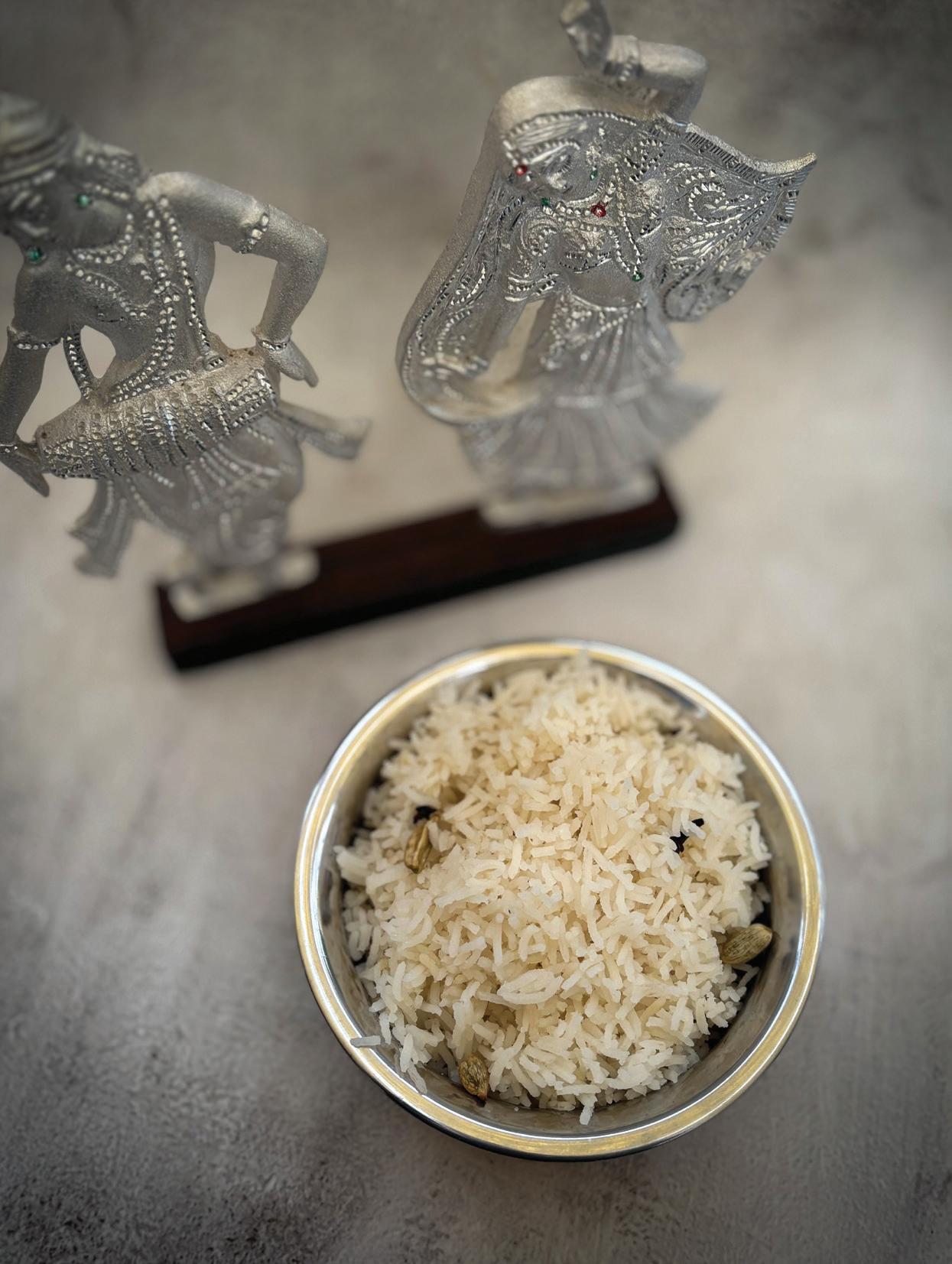
“An Asian family business… all over again”!
For many South Asian families in Britain, the tradition of building a family business or achieving a profession remains as strong in the second British-born generation. For those who grew up watching their parents’ run shops, takeaways or property ventures, the model feels almost inherited. Work for yourself, rely on your family, and build something that can’t easily be taken away.
The classic Asian structure of mixing family and business is both practical and cultural. Trust, shared goals, and a collective work ethic make it natural. Yet it also brings complications. My father had a firm rule: “never take a partner”. At the time, he believed it protected him—no disputes, no one walking away with half the profits. Whether that was good advice is still debatable.
In some ways he was right, but today collaboration, investment, and shared risk can be essential for growth. His unwavering beliefs were…“Put all your money in property”, and “never buy leasehold—own the land”. He built his future this way: buying one house, then another, and another—eventually six—often extending them to increase value and income. His business logic was sound: property meant stability, control, and long-term security.
He also believed in owning a food business because, in his words, “people will always need to eat”. That was the traditional immigrant model, and it worked for decades. Yet the business landscape has changed. The days of the corner shop gave way to supermarkets, who now dominate even more with delivery apps and internet ordering. The second generation must adapt quickly, shifting from bricks-and-mortar to digital platforms, branding, and social media visibility.
My father’s views were mixed about partnerships, as he relied on family to build the businesses. The truth is somewhere in between. Working with siblings or parents can be ideal while everyone is young and aligned, but once partners, spouses, and children enter the picture, priorities shift and relationships can strain. When it works, it is powerful; when it doesn’t, it can break more than just the business!
Food for Thought ...
Reflections on two cultures, ways & worlds
‘Instant gratification”
Something I noticed from a very young age, right up until adulthood, (but changing more so now amongst Asian youth), was the need to spend on self-first. We’ve all done that, but the difference is in the priorities
First-generation Indian immigrants didn’t think about short-term pleasure and instead prioritised savings and building something lasting—businesses and property. This meant long hours and lower initial disposable income, but the focus was on future independence and providing a stronger foundation for the next generation.
British habits, by contrast, frequently seemed to focus on more immediate comfort, with a greater reliance on credit, social systems, and not so much thought for the future. Entertainment often comes before essentials. The culture of “treating yourself” reinforces this immediate-reward mindset.
A landlord once told me that his South Asian tenants always paid their rent first, then bills and savings, and then only spent what was left. His British tenants tended to do the opposite: spending first and then struggling to cover rent or utilities, sometimes asking for delays.
This reflects two contrasting philosophies—one that sees necessities and long-term planning as nonnegotiable, and another that balances responsibility with lifestyle, sometimes tipping towards the latter.
Indians do enjoy luxuries, but for those first generations, only after financial security is established. British culture often encourages enjoyment alongside responsibility, with greater value placed on current experiences.
Ultimately, these differences reflect two approaches to time: one prioritising future stability, the other enjoyment in the present day. I thought I’d take both, leaning 90% towards one of them…
Meaning when you are searching for answers, look first to yourself for what you can do, and then outward to others. In many Asian cultures, the self-responsibility is rooted in the “we” and “us” mindset, rather than the individualistic “I” and “me.” Responsibility is shared, behaviour is reflected back by the group, and there is a sense that your actions affect more than just yourself. Although this collective mindset creates resilience, belonging, and a clear expectation of accountability, it’s also often at great personal sacrifice and unhappiness.
By contrast, Western culture emphasises personal freedom and individual choice. In theory, this should produce empowerment, yet it can also lead to isolation. Many people end up unhappy, complaining, or chronically dissatisfied, despite having complete ‘freedom’. The elderly, in particular, are often left to live alone, with minimal social connection—a stark contrast to Asian households where older family members remain central to daily life.
These cultural differences also influence how people interpret and react to concepts like cultural appropriation—a term that often provokes eye-rolling in Britain. This is usually because many have never been taught the history of colonialism, nor the economic systems built upon it. It’s no big deal for British cooks to “invent” their own versions of Indian food and sell it commercially, yet the idea of an Indian teaching his own locals how to perfect a roast dinner would create and outcry. The imbalance is historical, not personal.
For centuries, colonial powers took elements of other cultures—skills, crafts, traditions—repackaged them and sold them back to the very people they originally belonged to. Yoga is one of the clearest modern examples: a deeply spiritual Indian practice transformed into a global wellness industry, stripped of its context and marketed by people with no understanding of its origins.
The pattern is not new. British rule in India began with textiles, forcing Indians to buy back their own cloth while generating immense wealth in Britain.
Food for Thought ...
Reflections on two cultures, ways & worlds
‘Sweet,
sweet spice’
Indian sweets, desserts and puddings, including Masala Cha, all use the sweet digestive spices. Cloves, cinnamon, green cardamom are widely used in sweet dishes like Kheer, Mithe Chawl, Seviyan. Besan and Barfi and the add not just great flavour but health benefits.
Cloves have potent antioxidant and antimicrobial properties, known for helping with inflammation and supporting digestion. Cinnamon is a warm sweet spice, also very popular in Western countries, and is known for helping to regulate blood sugar levels and improving circulation and make a lovely addition to so many desserts and drinks.
Green cardamom is sweet in a refreshing and floral way, and very beneficial for aiding digestion and helping with bloating. It also acts as a natural breath freshener.
Spices add greatly to taste and health, however, they are not a substitute or a fix for lack of movement or a poor lifestyle and so should be looked at as an additional benefit to a healthy life and good diet.
Rice and milk—the foundational ingredients of many Punjabi desserts—also offer their own nourishing qualities. Rice provides a gentle source of easily digestible carbohydrates, offering sustained energy while remaining light on the stomach, which makes it ideal for puddings like Kheer and Seviyan, as well as a pre, or post-exercise food.
Milk contains protein, calcium, and essential vitamins, supporting bone strength and overall nourishment; its natural creaminess creates the rich textures so characteristic of Punjabi sweets.
When simmered together with the warming spices, rice and milk form a wholesome base that is both comforting and nutritious. In combination with cloves, cinnamon, and cardamom, these ingredients create desserts that are not only loved for their flavour but also valued for their gentle, sustaining benefits.
For a long time, the suffocation and frustration of working with POL was an issue particularity as Pure Punjabi was expanding rapidly, and I was still personal training.
I had put the combined property & business up for sale a few times. There was interest in the house, but no interest for the sub-Post Office that was appended to it – one estate agent summed it up – “the house is big and beautiful… and no one who can afford this house on the edge of the New Forest is going to want…”, and jerking his thumb towards the Post Office area – … ‘that… in their living room. Shut it down”!
So, on and off, it was up for sale, and then, news came across the network from POL with an offer in line with their plans for increasing the trading hours of sub–Post Offices by relocating or siting them within supermarket type shops that traded much longer hours. This was going to suit everyone. We could no longer run it, it would benefit another shop, and it would remain in the village. This was just the answer.
They issued the offer nationwide across the entirety of the Post Office network of an incentive for all postmasters on the original contract of a 9-to-5 Monday to Friday, Saturday mornings only, who could be incentivised to amend their hours to trade the hours of their retail side. For example, if the shop traded 7 am - 11 pm, seven days a week, then Post Office services could potentially be available within these hours.
There was some kind of financial incentive to take part in the program which I applied for and there was a further incentive that if you couldn’t do this as your shop was not of the 7-11 type…but there was an available shop in your area that did not have a Post Office, then if you agreed to the transfer of your Post Office into that shop, then instead of the incoming postmaster having to pay for that franchise which for them was in the region of about 38,000, then Post Office would pay that to the outgoing postmaster.
I immediately applied for this as the shop about seven doors down from us in the same street had continually gone in and out of business. People supported the Co-op, rather than a small independent. The shop at that time was empty, however, the owner of the shop informed me that he had a new lady that was going to be
buying the leasehold. She was very keen, not only on having the shop, but she also was very keen on having the Post Office located within it. This was all too good to be true!
I informed POL of this and set in action the process whereby one of their people would pay a visit to ascertain the facts, check out the village shop, make a visit to the owner of the shop, establish the facts and then make the arrangements.
I had never actually met the lady who was going to be purchasing because she wasn’t in the area and obviously the purchase had not happened yet. On the appointed day, Leighton, the POL person came and looked around our Post Office and went off to visit the owner of the shop who lives in the village. He then came back to relay the conversation and the situation to me. To my surprise and astonishment, he informed me that actually there was no interest, and that this lady absolutely did not want this Post Office in her shop. I was very disappointed but had no reason to doubt him.
We then went through a process to establish if it could go somewhere else. There was nowhere else for it to go that was viable or who would take it. I asked POL if I could offer it to the village by going to The Parish Council and proposing that it go into village ownership. At first, they said no, then surprisingly, they asked me to send them a statement of what I would offer the village, amended it at their end, and said that I could take it to the Parish Council. I asked the line manager what had happened to make POL change their mind. He laughed and said… “because when they refuse to take it, they’ll never have any comeback”. I laughed back and said… “they won’t do that”!
I approached the Parish Council and offered it to the ownership of the village. This was declined because the Post Office Ltd offer required that one person on the Parish Council would need to put their ‘name on it’ as in, be liable for the cash and no one was quite understandably prepared to do that, therefore the situation remained that in order to free myself from the Post Office which was a liability in every sense, so I informed Leighton and his POL people that we could not continue with it, if the lady purchasing the shop did not want it and the village would not take it and there was nowhere else to go we would have no option other than to close it and forfeit the sale purchase.
Over the course of that summer, we reduced the shop stock and cleared it very quickly!
And when we were almost there and everything was being boxed up, just a couple of days before POL were due to do the final exit, a lady walked into my shop.
She introduced herself as the new owner of the village shop and asked if I could help her. She said she had informed POL at the beginning that she definitely wanted to have the Post Office, but she had repeatedly phoned Leighton who had never called her back and repeatedly contacted POL to ask them to send her the application pack. It appeared that Leighton had mysteriously disappeared. She asked if I could help her find out why POL would not get back to her, why she couldn’t get in touch with anybody and why they weren’t putting into action the paperwork and the processes for which she had asked to transfer my Post Office to her.
I looked at her in amazement! I told her, that they had categorically told me, that she had refused to have it. She looked at me and told me she had absolutely told them she wanted it?
The next few days two POL people came for removal and final shut down and I told them the story.
They were actually a decent pair of people, and they looked equally astonished and reflective and the looks on their face indicated to me that they thought it was wrong. As I was relaying the story to them, they were glancing at each other, as if they were thinking the same thoughts. The expression on their faces, looked as if they thought it didn’t sound right, but equally looked very slightly guilty, as if they knew the shenanigans of POL and the dodgy practices and ways of working. They gave me some names, and they suggested I call to tell them what had happened.
At this point, it was too late to stop the removal, so I got in contact and informed Leighton’s seniors of the situation, and a meeting was arranged. Leighton was supposed to come as well as he was the key person! When they arrived, Leighton was missing. He had mysteriously ‘injured his ankle’, and his wife needed the car that day as well. How this prevented him being transported with the others, I’m not sure?
However, when entering the kitchen, the POL people saw that there was another person there. Who is this? That’s why he’s my lawyer -oh no, no, they said, oh no, no no - we won’t speak with him here, we won’t speak with him here, they reiterated, and refused to proceed or say anything and beat a very hasty retreat.
I went to see my local Salisbury MP who informed me that he was having a meeting with the stakeholders and will get back to me - of course as expected, nothing happened, however I had emails from POL senior people, who as we have seen from the TV show are not people you’d want to be dealing with, and again a threatening tone from them, for me to back off.
I went to speak to a local barrister and told him the story. His words to me were… “you are telling me one of two things… either that, Post Office limited are bent, or, that they are incompetent!”
I said, “what I am telling you…is that they are both!!! He said to leave it with him. It wasn't his area, but he knew someone who might be able to help. Very shortly after he came back to me to tell me that the person he had in mind had political aspirations and didn’t want to get involved.
Sadly, it’s a world where people do wrong and others watch and say nothing.
What a corrupt organisation and we knew all of this prior to the TV series, but no one would believe it. We gave up with waste of time that they were, and, at that stage, they were above the law. I corresponded with a Laura Tarling back and forth, however she dead-ended everything- -this was 7 years before the TV programme exposing the Horizon and the Post Office.
After the Alan Bates programme came out, lots of people asked me if we were victim to these tactics. Despite multiple attempts to entrap us with losses that would appear out of thin air, they could not get past our
documented reference numbers and extensive notes, whereby we ensured they signed off on every ‘press of the button’ on the hopeless Horizon system. However, in the end, they got us this alternative way, by deviously obstructing the transfer, and thereby escaping the estimated transfer payment in the region of £38,000
Result: POL -1. Me – 0
The new owner opened her shop in September 2014, just after we closed down in the August, and sadly, it didn’t remain trading much after a year or so. Had she been able to have the PO counter under the new model, (although POL were a veritable pain to deal with), the sad thing was that the public didn’t know the depth and detail of the scandal of POL behaviour, so that extra footfall and basic PPO salary might have helped?
When we ran our first Indian Experience cookery workshop in 2013, we had to start off always running them on a Sunday, because this was the only day that the Post Office was closed.
At this time, we were working 7 days a week…the Post Office, personal training, running Pure Punjabi and working at lots of different markets and events to get the word out. There was absolutely no time to cook, but our batch-cooking saved us, and we stocked up on food in the freezer. There was no way we would have wanted to cook after the long days we were doing, so we would make a triple batch of Tarka and then make different dhals and portion them up in the freezer in single or double serve tubs.
The reality of a food business is that it needs to pay. There’s a romantic perception that if you work in food, you are happy to spend hours working on creating and preparing dishes, in some ‘dreamy foodie’ happy state, with no regard to your hourly rate, if any. I’m not sure why this attitude exists towards producing food, as its quite possibly one of the hardest jobs to do - but must and will always exist, as people need to eat three times a day. So, the demand is always there, but quite how it is supplied is increasingly dictated by the supermarkets, which then affects those lower down the food chain.
With all businesses starting up there is always a sacrifice, for quite a long time at the beginning and working long hours to get the thing off the ground and up and on its way are necessary, but with food business’s especially, too many romantic films have given people dreams of ‘starting up my own bakery’ or ‘doing really great coffee’.
The actual reality is numbers, and primarily one number being much bigger than the other – that being the number of £’s coming in rather than haemorrhaging out!
I’ve met so many people who were told …oh you make great sausages or fantastic crepes or coffee—you should sell them!
Don’t. plus… don’t transfer your money to others.
Another person, seeing us start a food business had a ‘great food idea’, They came by to show me a property to rent from which they could run this great food business. I asked why would you rent somewhere and send
X number of sales of your product to the rent, then to the utilities, then to rates, then to everywhere else. I suggested, just open up small operation from your home kitchen and get EHO to check and inspect. Let it make money, meaning profit first. It didn’t happen.
Your two biggest killers are rent and staff.
The golden rule for me, as taught by my father and instilled into me, was to own the property from which your business operated. Be the landlord to your own business. Then get all of the family to help. That’s how you stay in business….and even then, it’s really difficult.
Once we no longer had to juggle several businesses, Pure Punjabi expanded to fit the hours available, as we were then able to expand the workshop offering to other days and now included two more workshops: Indian Street Food and Bread-making & Tasting experience.
In addition, we offered children’s cookery workshop, which Safia ran. This was a lot of work – something we were not unused to at all, however, what we found was that parents loved the idea of it, but it was all dependent upon the child – some children needed all of your focus to stop them from kicking the units as they swung their legs on the chairs, and instead of writing in workbooks, trying to write into my kitchen worktops. It was a shame because there were some children who genuinely wanted to cook and make the dishes.
In the end we worked out a compromise and the workshops were paused and relaunched as Parent/Child workshops. This made it the focus of the child being keen to come, and for the parents, or a supporting adult, being keen for them to learn, as opposed to looking for any activity to drop them off and get a few hours free.
We thought long and hard about what children would like, both as the children and for the parent/child workshop so we didn’t change that format: Naan bread of courses as it’s the easiest to make and kids of all ages would love it. Then Paneer- perhaps surprisingly, because there is a famous Italian dish of cheese on dough, which is always a winner with all ages, so cheesy naan bread would work, even though it was not how we would eat it, but at least they would make them both form scratch – the combo would be a modern take!
Then surprisingly, in a nod to modern times and western children’s palates, I agreed to that ubiquitous and generic Chicken Tikka Masala!! But… it had to be made from scratch using the spices… so there we had our three dishes that our pairs…the adult and the child, could make and enjoy.
So, we end here with two of these three dishes; one we occasionally eat, and one we never really eat, but for children we will do anything to encourage cooking from scratch, cooking as family, and for family.
It seems fitting to give a nod to the fusion dish, and not only the ‘what we eat at home’ dishes.
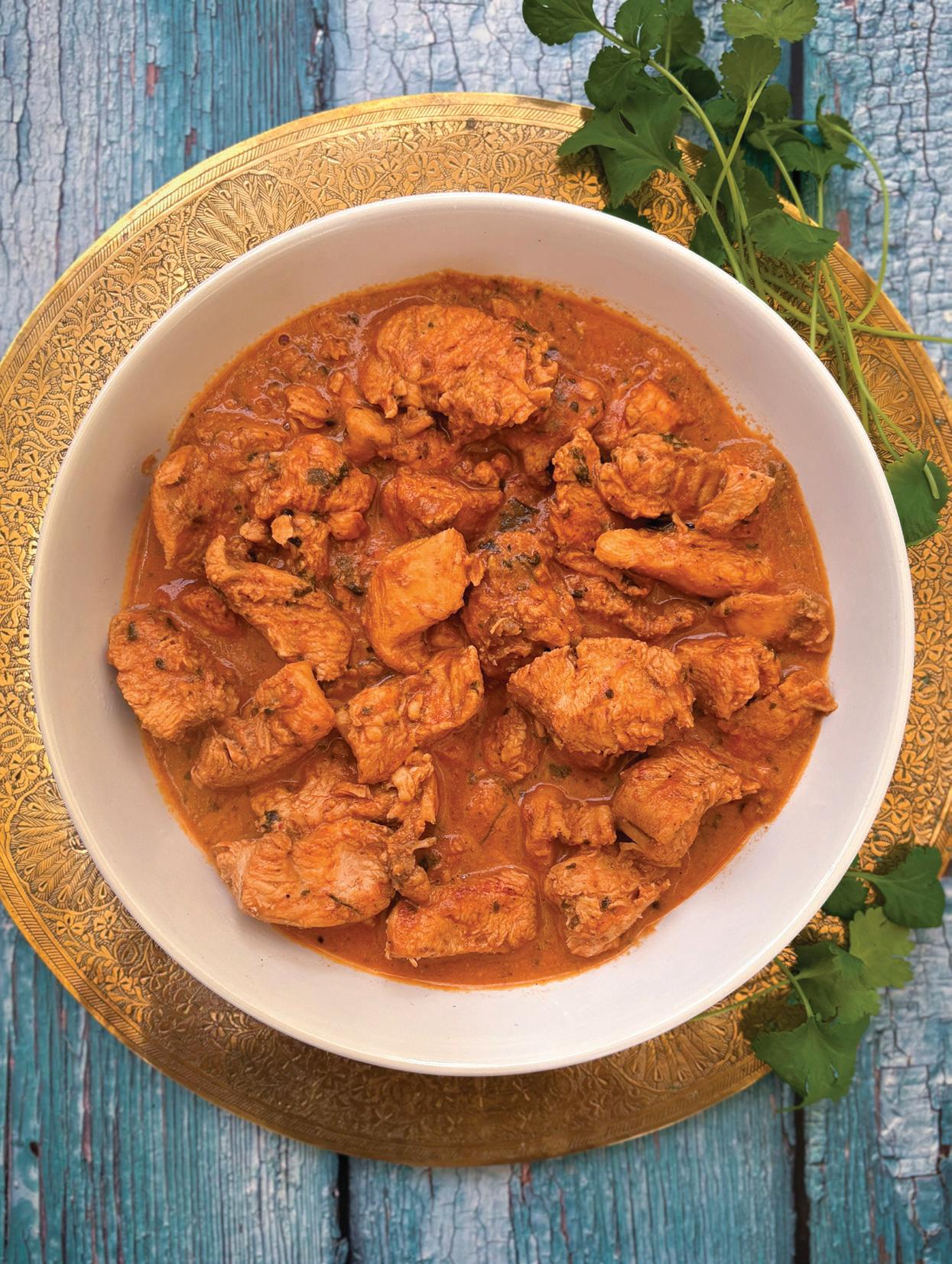
Just a note about the spices in this dish – many people think of a red colour when they hear Chicken Tikka Masala…however…traditionally Chicken Tikka – the marinated chicken dish without a gravy –should be pink, not red. So, when Chicken Tikka Masala is made – the dish with a sauce – it should have more a pink undertone than red, although once you add the tomato this will make is go a little redder in colour.
We don’t use anything artificial and food colours used can be really synthetic and so our family uses beetroot powder. It gives the natural pink hue but is also very good for you.
Ingredients
4 Chicken Breasts (approximately 500g-600g)
2 Garlic cloves
1 inch piece of Ginger
1 -2 green Birds Eye Chillis
1 teaspoon Salt
1 tablespoon Ground Jeera
½ tablespoon Ground Dhania
½ teaspoon White pepper
1 teaspoon Garam Masala
A big pinch of Dried Methi Leaves
½ teaspoon Beetroot Powder (in place of artificial colour)
Juice of ¼ of a Lemon
1 tablespoon Sunflower oil
1 tablespoon Malt vinegar
1 heaped tablespoon Yoghurt
1 tablespoon Ghee
20-25g Tomato purée
150ml Double cream, at room temperature
Butterfly each chicken breast, and the cut into bite size pieces. Butterflying the chicken will ensure the pieces are more even in thickness, and that they will absorb the marinade better and cook through more evenly.
Peel the garlic and ginger and grate them on the mincing plate (or the finest side of a grater). Finely chop the chillis for even heat distribution. Put the garlic, ginger & chilli into a mixing bowl along with the chicken.
Add the salt, jeera, dhania, white pepper, garam masala, methi and beetroot powder, and massage the ingredients into the chicken for a couple of minutes. This will ensure that everything is mixed well and also pushes the flavour into the meat and helps the marinade to take well.
Add the lemon juice, sunflower oil and vinegar and mix again, and then add the yoghurt and do one final mix. Cover the bowl and leave out of the fridge, as you will be cooking this now.
Heat a saucepan over a medium heat, add the ghee and let it melt.
Pour the spiced chicken into the saucepan and cook/seal the outside of the chicken. As soon as all the sides of each piece of chicken are no longer raw, add the tomato purée and stir. Now take the pan off the heat for a moment, add the double cream and stir well.
Now put the pan back on the heat and turn it to the lowest heat setting. Put the lid on the saucepan at a slight angle so you have a tiny gap for a little steam to escape. Let the chicken cook through gently, stirring/checking it every 10 minutes or so. After 20-25 minutes, the chicken should be completely cooked through (check by breaking the biggest piece in half to make sure it’s cooked all the way through to the centre).
The Chicken Tikka Masala is ready to serve and can be enjoyed with Naan or with any side of bread or rice, and of course, we always have our Dahi, (yoghurt) and a side salad.

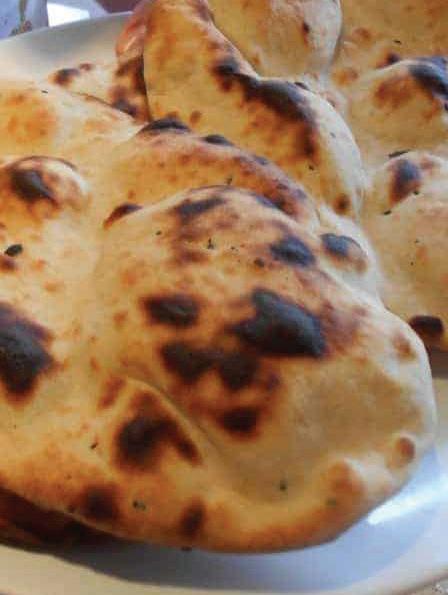
Ingredients
1 cup of Maida (Plain flour - approximately 250g), plus a little more for dusting
½ teaspoon Salt
1 teaspoon Baking Powder
2 teaspoons Caster Sugar
1 tablespoon of Kalonji (nigella seeds)
130ml Whole Milk (plus a splash more, if needed)
2 tablespoons. Sunflower Oil
Butter, for buttering the cooked naans
Cultural reminder: traditionally, the right hand is used for ‘clean’ or food-based tasks, so don’t dive into the bowl with both hands or you’ll end up in a sticky mess
Method
Put the Maida, salt, baking powder, kalonji and sugar in a mixing bowl and mix them together with your hand.
Making a small well in the middle of the dry ingredients, add the milk and oil, stirring with your fingers, in a whisk-like motion, as you go. You may need an extra splash of milk, just to combine all the flour, so the dough comes away cleanly from the bowl (but it should not be a sticky dough).
Empty the dough out onto a lightly floured work surface and knead for 5 minutes. The dough will start out quite tough and become smoother as you knead it.
Put the dough in a lightly greased bowl, cover it with cling film, and leave it to rest for 10 minutes.
Once the dough has rested, divide it into 4 equal portions.
Roll each piece into a rough circle, and then, slightly pull one edge to make more of a tear-shaped naan. The naan should be roughly 4mm thick. *Note: Too thin and the naan will not puff and will be brittle, too thick and it will be doughy in the middle.
Put your rolled out naan onto a baking tray and put it under the hot grill, be careful not to leave it as it can change colour very quickly. Once the first side has browned, turn it over. Once the second side is under the heat, it should start to puff. Be careful that the bread doesn’t touch the top of the grill (as it will pierce it) and just watch out for any steam (as you don’t want to burn yourself!).
Butter the first side that cooked, and serve hot
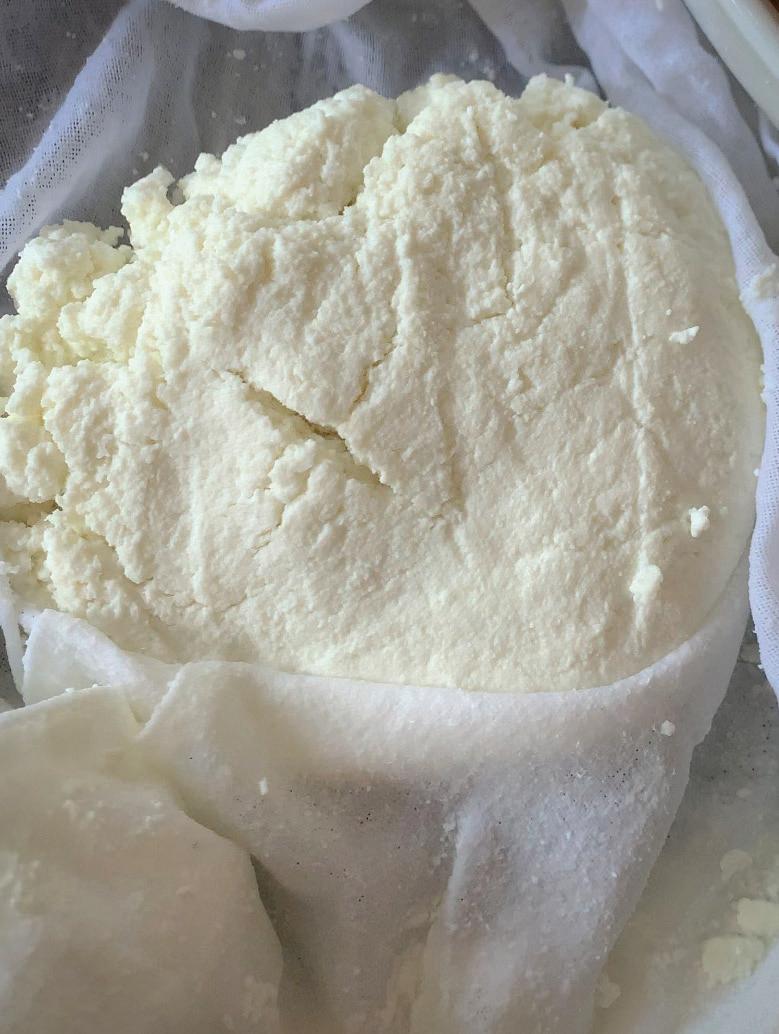
Paneer is Indian cottage cheese and is very simple and easy to make. In Punjab, buffalo’s milk is the main dairy, which has 50% more protein and 50% more fat than cow’s milk, and all dairy products are made from this, so it really is important to always use whole milk to get that creamy taste – just to keep it in perspective cow’s milk is 4% at ‘full fat’ , so buffalo’s milk sits at 6% ‘full fat’ …and 6 out 100 isn’t exactly huge!
Ingredients:
1 litre whole milk (must be whole milk)
Juice of 1 lemon, mixed with 1 tbsp water
Method
Put the milk into a heavy based saucepan and gently bring to the boil, stirring the milk so that it doesn’t stick.
As the milk is boiling, add the lemon juice and water mixture. The milk will start splitting straight away, and you will see solid lumps (curds) and the liquid will look like cloudy water (whey). If you milk starts splitting but hasn’t quite split fully, add some more lemon juice.
Line a colander with muslin cloth and strain the mixture, rinse with a little cold water to remove the lemon juice from the curds. Bring together the 4 corners of the cloth and twist them together, so you can squeeze as much liquid out of the curds as possible.
Leaving the cloth wrapped tightly around the curds, put it on a plate, and put something heavy, like a saucepan, on top of the curds to weigh them down. Put the curds in the fridge, with the saucepan on top, and chill for about an hour. Now, you have paneer!
‘Wrongful riches’
Do institutions and organisations that become so large ever really care about the people within it, and upon whom it impacts. They don’t seem to be for the greater good, but rather the ‘fewer good’…a select number of people at the top who profit and benefit at the expenses of many.
Wealth, stolen wealth, inherited wealth, it is estimated that the sum looted from India is in the trillions, much of which is sitting in the British museum? Should it be named the World Museum? India was forced to sell the cloth it made to Britain, consequently Britain had a booming textiles industry, and India was made to pay taxes for importing back in the clothing.
Did my friends do this -no -their ancestors did it – I don’t believe in making the children of wrong-doers pay, however should they know about that legacy? Yes. Maybe room in the curriculum for a little less of ‘WWII, we beat the Germans’, to more of what Britain did in India and around the world – apart from thanks so much for giving us the railways – enabling Britain to transport out all the stolen goods – that’s a genius system.
Partition was about separating Punjab not any longer on a divide and conquer basis, but more to destroy the power of possibly the most powerful state in India. Break it up, before leaving. Of course , this was 1947 where the British had started the same process in Palestine. A tragedy of the same time and still suffering!
I once asked someone why foreign aid is given…the answer … – it’s not foreign aid - its hush money and bribery – it’s to keep a hold of some power and influence in those parts of the world, it’s to enable foreign military bases to be set up in countries – it’s just called foreign aid for the public.
The same query when I first heard the term, ‘Bullets & Bandages’? Meaning, sell them the bullets, then sell them the repair - destroy a country at a profit, and then gain the lucrative building contacts for the rebuild of that land – who’s going to get the contracts for Gaza? The business of war - it’s too upsetting.
Food for Thought ...
Reflections on two cultures, ways & worlds
Double standards or a different situation?’
Talking with a friend recently about the current migrant situation, asylum hotels and British protests…
I said it was indeed outrageous that foreigners came over, took the best housing, had more than the native population, were starting to takeover, no one could freely express themselves or say anything against them, shocking that they had the ruling government support and worse, the native police shielded and protected them. The rules didn’t seem to apply to them, and the indigenous population had had enough and were becoming angry. These foreigners were even taking money out of the country, plus bringing in more of their kind!
She agreed – it was shocking!
I said…I’m not talking about what’s happening here in Britain—I’m talking about what The British did in India!
“Oh my god she said!” in realisation.
My friends didn’t do it and even their parents didn’t do it – so it never mattered to me or made me antiBritish, but it might be at the core of home-grown terrorists hate – a terrible revisiting of the ‘sins of the father’s? However, two wrongs don’t make a right, but on the other hand, what can make past wrong doings right?
A mirroring of centuries of colonialism? Is this Karma? Who knows?
I’m not sure why people and peoples collectively can’t do the right thing, success, ambition and the right thing are not mutually exclusive.
As the author of ‘Empire’ says… “We are here because you were there.” — Satnam Sanghera
Set an example and spend time with children. Keep them at your side, teach them young, show them how, and preserve worthwhile traditions. This is what my mother did with me as a young girl and my father when I was older.
Humanity is the key word and trying to be humane. That comes from a broad and deep education –being open-minded, taking the opposing view, the overview and matching with your personal view to be a considerate person and make considered judgements. Prejudices were shown to be by both worlds in ridiculous hurtful and harmful ways—so often from fear – fear of losing land.
A neighbour didn’t’ want me to paint my adjoining property because then it would show my property as twice the size of hers-. You can’t have it all. So, she showed me a forged copy of my title deeds, showing the red boundary line going through my living room, which would conveniently make her front window look as if the wall either side belonged to her!!! Astonishing.
A local gypsy man told me- “you’ll always have this with them---they think it’s their land”. And so, he was right, and so it goes on…
Jealousy and resentment make people feel threatened and stupid behaviour ensues. As with the current climate here, where the foreigner seems to be protected and the indigenous people are restricted from gathering and protesting, the general resentment spills over in an irrational and Neanderthal way.
However, charity does begin at home, but it’s problematic when your home might be full of deceitfully gained wealth. National Trust properties, being the quintessential representation of British life in its glory days of thievery– are built on the blood of empire.
Food for Thought ...
Reflections on two cultures, ways & worlds
When you are busy, it’s easy to end up not cooking properly, and so let nutrition fall by the wayside. That’s why the practice of cooking from scratch - and in bulk - can make a significant difference. Preparing meals at home, especially in larger quantities, allows for careful selection of ingredients, better control over nutritional content, and the ability to freeze or store portions for later.
Batch cooking also encourages communal effort, turning meal preparation into a shared activity that reinforces appreciation for the food we eat and the work that goes into it.
Certain dishes, like Naan, Chicken Tikka Masala, or Paneer-based recipes, may seem indulgent, but they offer nutritional benefits when made thoughtfully…and from scratch…not eaten from a ready-meal! These foods, rich in proteins, spices, and healthy fats, can serve as nutritious treats rather than empty indulgences, making them preferable to much of the processed or fast food that are the ‘weekend treat’.
There’s always been an understanding in the East that food itself can act as medicine, and increasingly, somewhat of a growing recognition in the West. While modern medicine is irreplaceable for emergency care and treating acute conditions, many chronic or low-grade persistent ailments respond well to dietary approaches. It’s just important to question and research options available in nature as well as understand pharmaceutical pressures to ‘dispense a cure’, in what is after all a ‘conflict of interests’, in a multi-billiondollar industry.
Holistic, food-based treatments - particularly when combined with conventional medicine - can support overall health, improve digestion, boost immunity, and even aid conditions like thyroid imbalance or mild inflammation. The key is awareness and intentionality: taking action to cook from scratch, preparing nourishing meals in bulk, and viewing food not just as fuel or pleasure, but as a vital component of health.
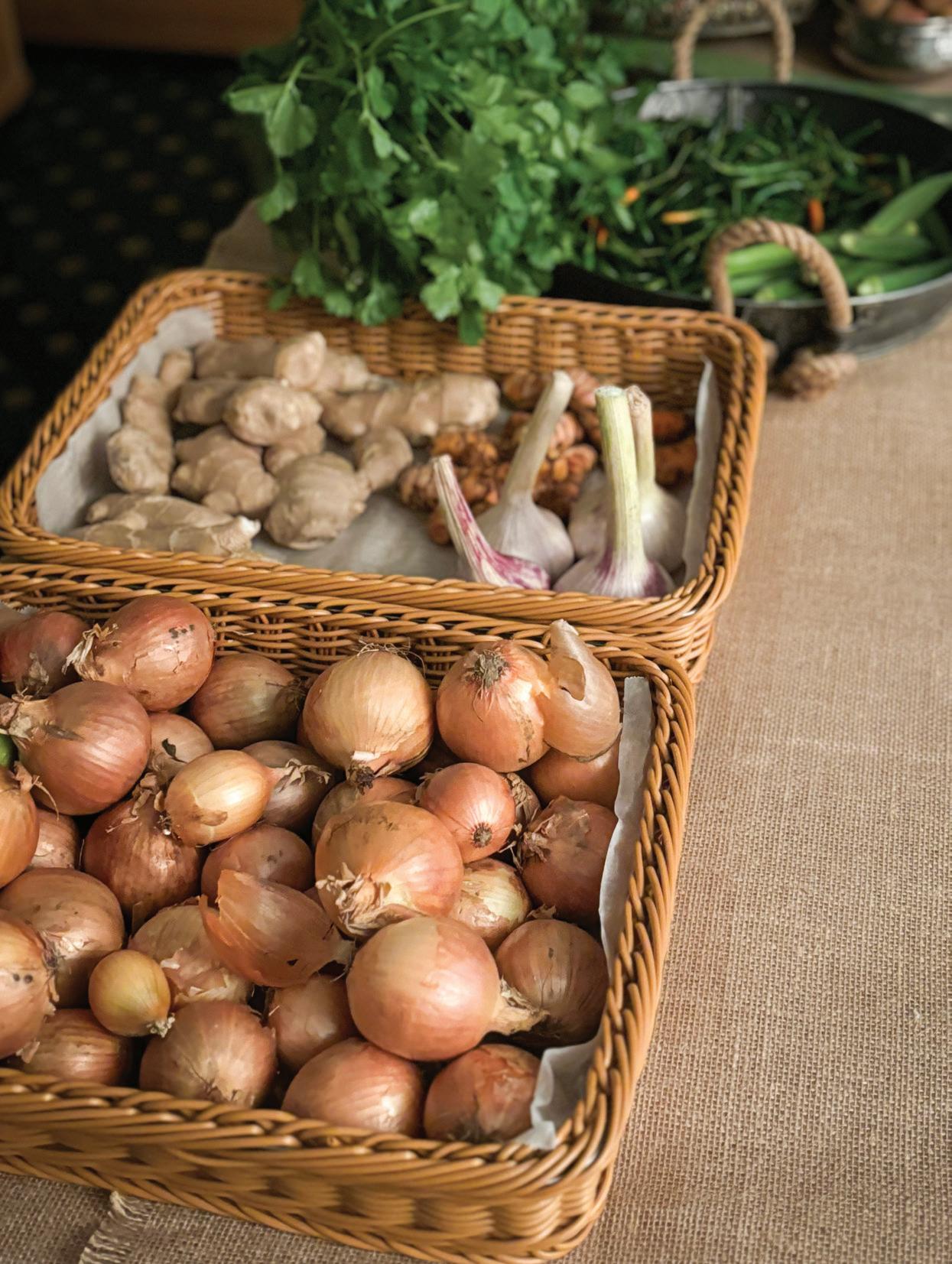
Tarka is what we call the base of onion, garlic, ginger, chilli and spices for making most of our everyday dishes, such as dhals and Sabjis. Although Tarka is not complicated - there are all manner of ways to go wrong, most of those being with timing and heat levels, or lack of precision in following the exact instructions.
Tarka is super-important! Knowing how to make this is the key part of being able to make Punjabi food.
We have a ‘wet’ Tarka, which is for making dhal and Sabji, and a dry Tarka, for making Keema and Indian Scrambled eggs.
As a girl having to cook dinner every night after school from the age of 11, when frying the onions, I would try to turn the heat up high to get it done more quickly. My father had his office at home, and he would hear the sizzling, walk over to the kitchen, turn the heat down, turn to me and say… “a slow fire Putt, and walk out (Putt means darling).
In exasperation I would have to let the Tarka take its time and so would then produce a lovely result.
I soon learned to listen and actually use the slow cook time of the Tarka to prepare the rest of the ingredients and to clear and wash-up. Getting in from school at 4pm, I would have the Dhal and Roti ready for when my mother came home at 6pm, and for dinner to be on the table for 6.30pm.
Tarka starts with the onions, garlic, ginger and chilli. Then Garam Masala, Haldi (turmeric), salt and tomatoes are added -either tinned/fresh for the wet base, or as tomato puree for the ‘dry’ base.
For the purpose of the recipes in this book, we are only going to tackle the first stage of the base, the onions, garlic, ginger and chilli – because the amount of spices we add will vary according to the dish, so we will pick that up in each recipe.
A note about fats/ghee/oil – or whichever you are using…please never ever use olive oil or rapeseed oil or any fat with its own flavour or from a different region of India (think using ghee for Italian food!!! Oh, the horror)! Preferably, please use Butter ghee. If cooking for a vegan or dairy-free person, use sunflower oil or lastly, vegetable oil, and nothing else is acceptable.
A tablespoon of ghee/oil is only a guide as we cook by sight, ears, smell and taste – that thing called the senses. I was never taught to cook by weighing on scales or measuring. (The only time I did and do this is for baking, when precision is required). The base of the pan should have a shine to it, the moment this ‘shine’ disappears, this is when you add a little more ghee or oil, to bring that shine back, however, as a reminder this is not shallow frying.
The base should not be swimming in fat or producing a dish thick with a layer of orange fat. Some people do this and free-pour the oil or ghee – we do not. When you are learning, add by sight, keep topping up as the base looks like it needs it. Eventually you will have worked it out and know how much to add. This also depends on whether you are going to be adding meat, and then what that fat content is, or whether its vegetables or pulses. This is every day, healthy food. If you find you get a thick oily layer on your food when the dish is cooked and cooled, you are using too much ghee or oil.
Now always choose small brown onions! Do not use large white onions – they have a higher water content and so do not have the strength of flavour needed when you have onion as a base ingredient – you want strength of flavour over quantity/bulk of onion. The small brown ones have a much stronger flavour and make all the difference to the dish. The next thing to note is to chop the onions very finely and by hand please! The onions must be very finely chopped due to the gentle cooking heat – if they are diced or cut chunkily, they will not cook out properly. Putting them into a blender or electric type chopper will make them watery and mushy. It can work with very large quantities, on a pulse setting, but not for a small amount. We always triple batch cook and still chop finely by hand.
These should be finely minced – not chopped. These are base ingredients and should be so small (puréelike) that they form a combined base flavour. You should not have a small chunk/piece of garlic, ginger or chilli and for someone to bite through this when they are eating the cooked dish. Equally, this goes for chilli. Even distribution of heat is achieved by finely mincing, avoiding one mouthful having no chilli heat, and the next mouthful overwhelmingly (and unpleasantly) burning, by contrast.
When I grew up, and when I taught my children our traditional cookery, we used to use a gadget called a rotary mincer. They don’t appear to make/sell these anymore in the U.K. and the next best thing for the garlic and ginger is a mincing plate. This is a stainless-steel plate with a series of ridges on it, you rub the garlic/ginger against the ridges, and it produces a beautiful purée.
Here’s a quick trick for helping in getting the chillis nice and finely chopped…place the knife just below the top of the chill, and run the blade down the length… repeat again so you have quartered each chilli length ways (the top of the chilli is attached still and holding the 4 lengths), now slice the chilli as thinly as you possible can, and you will have tiny little pieces. As you start from the tip of the chilli, and then work the blade of the knife up to the top stem, the pieces you cut will naturally become bigger – those will need a little further chopping down, but you’ve got far smaller pieces to being with so it’s a quick chop through to get everything to the same tiny size.
Please note, as a family, we do not use chilli powder and would not substitute the fresh green chilli for red powdered chilli. When chillis grow, they start out as a green colour, then as they ‘mature’ they become orange and then red…at the beginning (when they are green) the heat is fresh and light, the chilli also gives an important flavour, which comes through when the chillis are green. As the chillis turn orange/ red, the heat becomes a dry, intense heat and the flavour fades and the taste becomes a little bitter. Chilli powder is made from grinding dried red chillis, and so, if you’ve ever had Indian food and the heat of the chillis has been intense and won’t clear from your mouth, regardless of how much yoghurt / milk / water you have, this is most likely because the dish contains chilli powder. We always avoid the use of chilli powder and use the fresh green birds eye chilli for a gentle warmth, but also good flavour.
All the recipes in this book are made according to the quantities listed here…
1 small brown onion, very finely chopped
1 garlic clove, peeled and minced/puréed on mincing plate
1 inch piece of ginger, peeled and minced/puréed on mincing plate
2 green birds’ eye chillis, finely chopped into tiny pieces
1 tablespoon Garam Masala
¼ teaspoon Haldi (turmeric)
1 teaspoon salt
Tomatoes…
For wet Tarka base : 1/3 tin chopped tomatoes (approx. 133 grams).
For dry tarka base: 1 heaped teaspoon tomato purée
(Please do not add both types of tomato regardless of what you are making...and strictly use the chopped tomatoes for the wet tarka base and only use the tomato purée for the dry tarka base).
Method:
Heat a saucepan on a low to medium heat, add 1-2 teaspoon of ghee (or sunflower oil). When the ghee/fat is melted in the pan add the finely chopped onions. At this point, smell the onions raw (this is to later compare the smell to the cooked onions.) Cook the onions so slowly as to caramelise them and bring out the sweetness. Once the intensity of the ‘raw onion’ smell has mellowed, we move to adding the next ingredients…
Cook these out until the intense raw smell mellows and becomes sweet. This is going to be the longest part, of the prep, but if your heat is on so low, you can be preparing your vegetables, washing up and getting on with other tasks, though always standing at the saucepan to keep an eye on it and to give it a gentle stir.
When you have a soft brown, slightly stickylooking mix of onion, garlic, ginger & chilli and they smell sweet, you are ready to add spices,
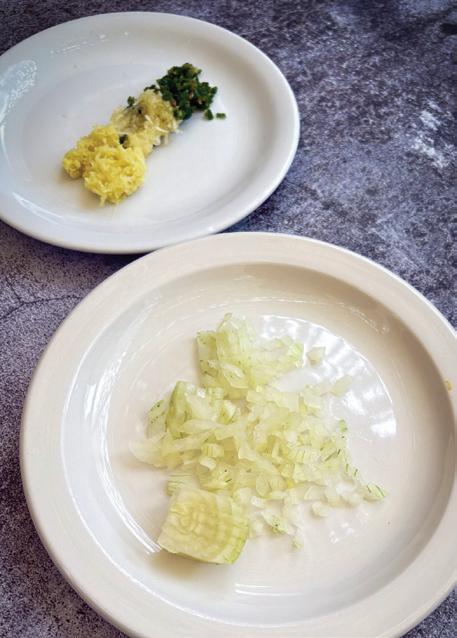
Stop here for the KEEMA & ANDA dishes and please pick this up from the individual dish page.
Continue here for all other recipes.
Add the Garam Masala, Haldi & salt. Stir through over the same low heat. Don’t forget – should your pan need a top up of ghee or oil, add another teaspoon to keep the base of the pan glossy.
After a couple of minutes, now add the tomatoes (chopped tomatoes for a wet base – dhals & sabjis. (Tomato purée is only for the dry base – keema & Indian scrambled eggs)
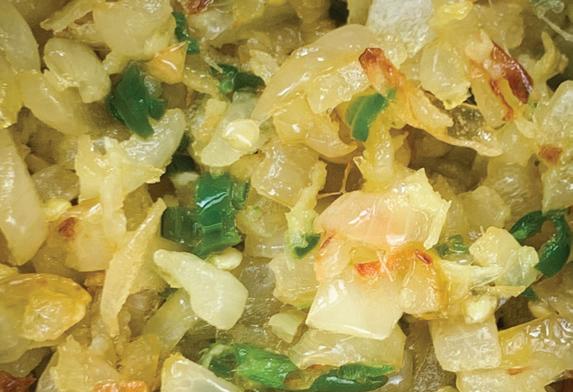
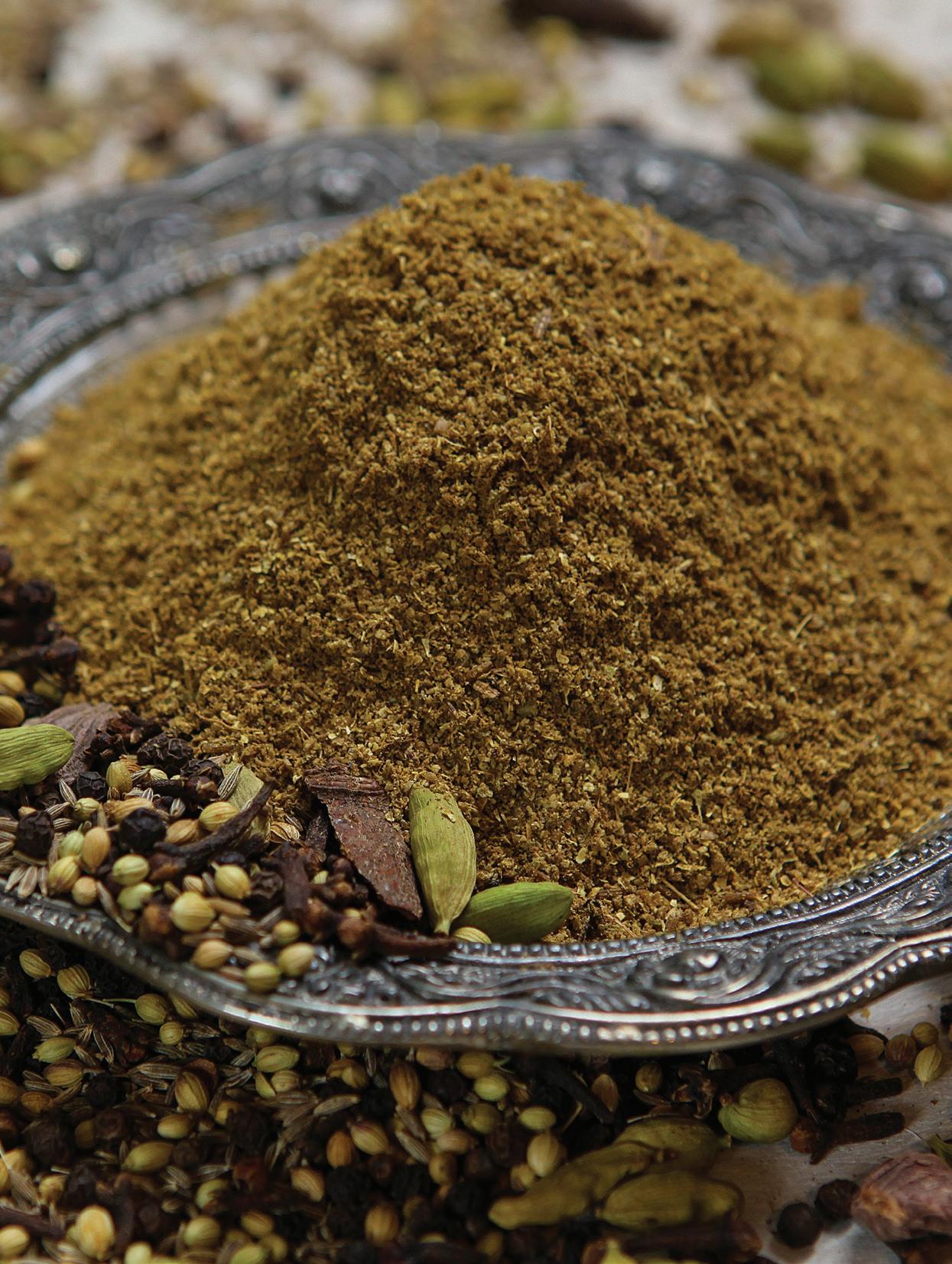
Garam Masala
Is a blend of the key spices used for making the base of the dish. Each Garam Masala varies from region to region, as well as within families and is passed down within families from mother to daughter. However, every family makes their own, and balances and ratios will vary. We grind ours from instinct, smell and feel, more so than by weight, but for these purposes, to make your own small batch, you will need the following whole spices:
Key ingredients for our Punjabi family and region are as follow, but this will also vary within family’s and different districts of Punjab as it is roughly the size of the UK, as well as the rest of India.
Cumin seeds – 1 cup
Corianders seeds – 1 cup
Green cardamom – a tablespoon
Black cardamom – a tablespoon
Cinnamon – 3-4 pieces
Cloves – a teaspoon
Black pepper – ½ level teaspoon
The grind is very important – you need to leave some texture and not grind to a dust. – pulse very slowly until you have a somewhat coarse grind. Store in an airtight jar.
We were not taught by a book or recipe but by feel and smell and watching over years. This was the last thing I was taught. We didn’t have weighing scales, and I did buy a set, only for following English baking recipes, but have never used them for Indian cookery.
Note! We never ever roast our spices. My mother didn’t and I have never seen anyone do this in the family. I’ve only seen this on television or in cookbooks. Maybe it’s from a different region? However, we don’t do it. Our Garam Masala is hand-made by us and will continue to be available via our website: indianmealkits.co.uk for those wishing to have very experienced blending and grinding.
Jeera Cumin seeds
Dhaniya
Coriander seeds
Haldi Turmeric
Dalchini Cinnamon
Laung Cloves
Elaichi Green cardamom
Bada elaichi Black cardamom
Methi
Kasoori Methi
Fenugreek (seed & also fresh leaf)
Dried fenugreek leaf
Paprika Paprika
Kala Mirch
Black pepper
Ajwain Lovage
Mirch Chilli
Urid
Mung
Masoor
Rajma
Chole
Chana
Black lentil, or black gram
Yellow split mung bean
Red lentil dhal
Kidney bean dhal
Chickpea dhal
Yellow split chickpea dhal
Atta Wholewheat flour
Maida White plain flour
Besan
Gram (chickpea) flour
Makki Corn flour/meal
Ghee
Dhal
Clarified butter
Pulses – beans lentils & peas
Sabji Vegetable ‘curry’
There’s not actually a huge amount of equipment that is needed in an old-fashioned Punjabi grandmother’s kitchen.
My mother only had these essentials in our small little kitchen:
A Tawa – (Ta-Vah), a tawa is concave pan used for cooking Roti. The quality of tawas can vary greatly so it is always best to use a good quality recommended brand or one that has lots of reviews. You can get two types of tawa: Metal or clay. Everybody in our family, as well as our friends, use metal tawas (us included). Clay tawas are the very original type of tawa that were used in village cookery (as clay was readily available), however due to the nature of clay when used for cooking, it can crack. Clay also changes the flavour of the food when you use it as the material in which to cook or serve food, so this is also a factor.
Rolling pin/Velna, -for rolling out the Roti into a perfect circle! Punjab is known as the breadbasket of India, and as such, flatbreads form an important part of our diet (Roti is the daily bread). A good rolling pin is worth its weight in gold. We would always recommend using one with handles, as this encourages even rolling!
Stainless steel cooking utensils– saucepans and shallow pans, colanders and mixing bowls – but they had to be stainless steel
A separate dessert-making saucepan. It is essential to have a completely separate saucepan, used only for sweets and puddings. and never used for meat or spiced food. My mum had her blue saucepan, which I still have and use - of course… only for sweet-making.
Pestle & mortar – she had a big old black stone mortar and a long wooden pestle, and she used to squat down and grind her spices in it, as well as fresh ingredients.
A sieve – used for washing pulses, my mother had an old sieve that I still have and use
A large ladle – she used this for deep-frying, and I still have and use this one.
Brass press for making Chevdra, (Bombay Mix) . My mother always made her Chevdra by hand and it was a LONG process as each item is made separately.
In my kitchen, we additionally have some other items that we use
A mincing plate – A mincing plate is a stainless-steel plate that works like a grater, which allows ingredients to be completely minced down. This is very important when cooking with strong flavours, to allow for the even distribution of the base ingredients. Therefore, the finer you can get them. a more even distribution you will have, which means you will have a far superior overall flavour to your finished dish. A mincing plate that is made from stainless steel is best, because it’s non-porous and so you will not get flavour contamination from one ingredient to the next.
A karai is a pot used in cookery, that is a little wok-like in shape, in that it is quite deep. Karais are great for cooking meat dishes, as well as for deep fat frying (both due to the shape of them). You can get some really beautiful Karais that have really ornate handles, equally you can get a basic one
A Chakla is a round board used as the base on which to roll out flatbreads before cooking them. Having said that, I don’t use one, as my mother didn’t use one, though we have a wooden and a marble one. We don’t use them because worktops in modern kitchens don’t require a special board, however, they are useful if you are perhaps cooking outdoors or don’t have a suitable or clean surface on which to roll the dough.
If you want to you one, even as a guide to for the rolling out size, then you can get wooden Chaklas, (which are most readily available and affordable). Be sure to get one that is smooth and good quality, so that you don’t get wood splinters in your flat bread as you roll. If you need to wash it, rather than wipe, do not immerse in water. Marble or stone Chaklas are also an option, as well as being a decorative item.
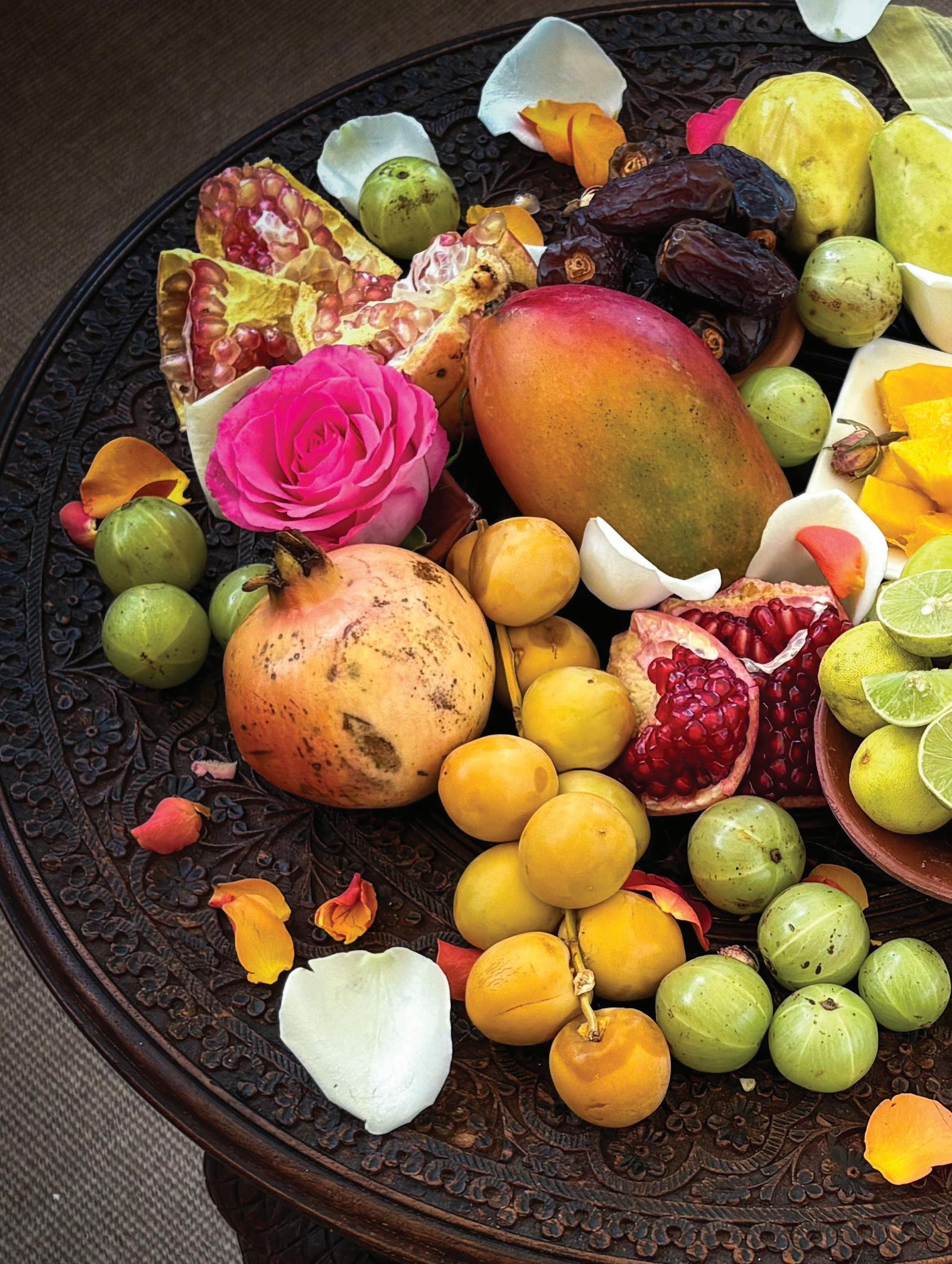
low res image (193 dpi)
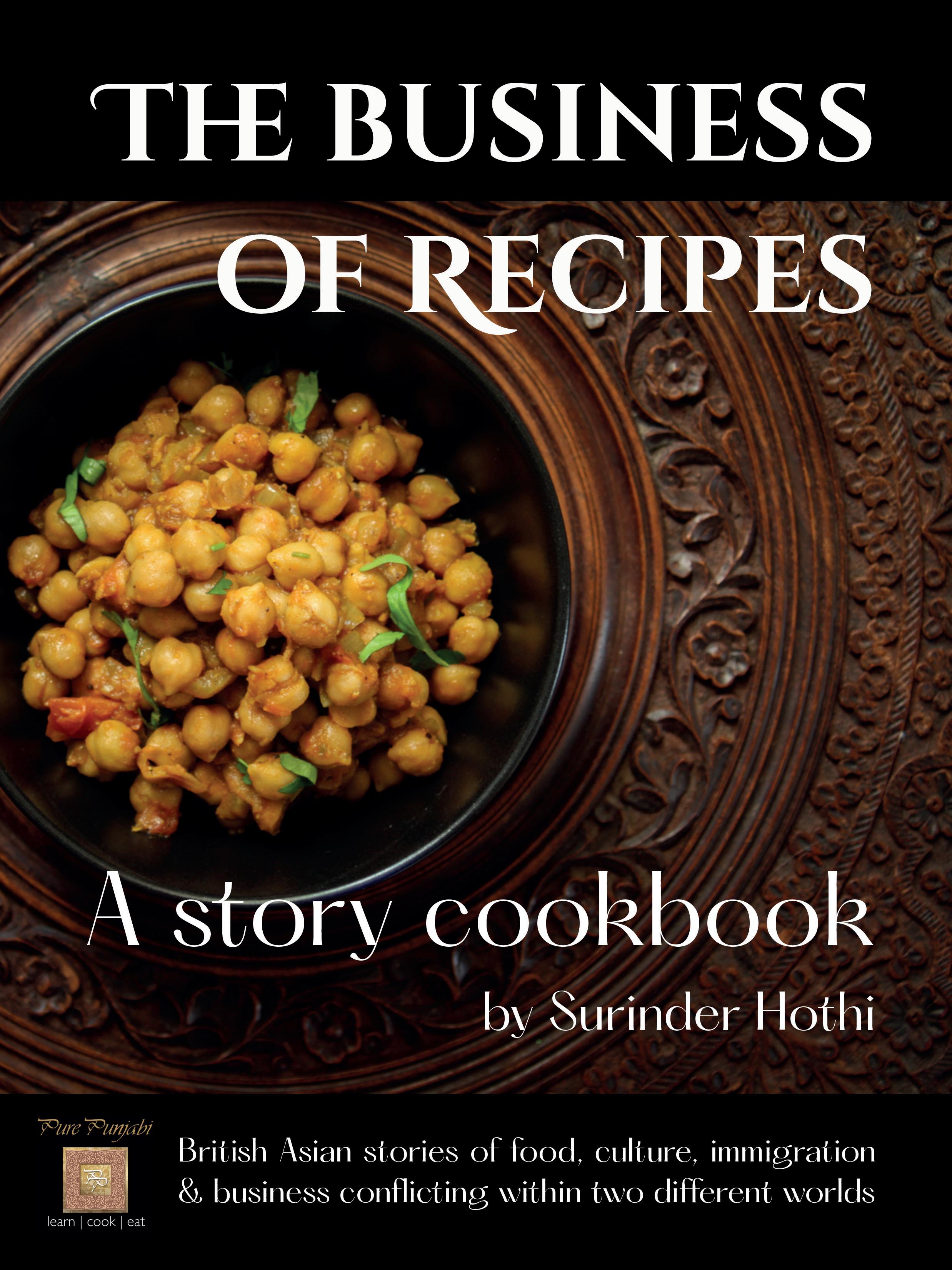
“Story is not telling the world what happened… Story is what happened because it happened”
Dennis Ross
And… so… this is what happened, and… what I thought about what had happened, and what is happening…
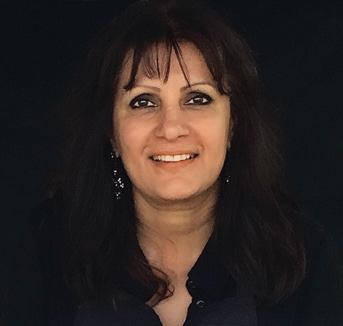
Personal Trainer Diploma. ETA (Exercise Teachers Academy), South Africa. Qualified through SSISA, (Sports Science Institute South Africa) 1999
Anatomy & applied anatomy | Exercise physiology | Applied kinesiology | Nutrition
Weight management | Concepts of health and fitness | Psychological benefits of exercise
Principles of motivation and adherence | Communication skills | Screening and assessment | Fitness testing
Exercise programming and prescription | Exercise for special groups (bad backs, knees, ante-natal, post-natal)
Children's exercises and workshop | Exercise technique | Gym equipment | Circuit and interval training
Stretching (static, ballistic, PNF, mobilisation, assisted) | Motivation and communication
CPR injuries and emergency management | Exercise modification | Sales, marketing and customer service
Legal issues | Professional responsibilities
UK qualifications - circa 2003
• Freestyle fitness yoga
• Certificate in life coaching
• Diploma in life coaching
• Diploma in performance coaching & conflict resolution
Client Exercise Experience 2001-2021
Weight loss & fitness | Strength training | Running training | Rugby training | Parkinson’s disease | Hip replacement
Knee replacement | Ante natal | Post natal | Back pain | Blood pressure management | Life coaching
Conflict resolution coaching | Parent/child coaching
I wasn’t commissioned to write this book, didn’t have an agent or any publishing house, so it was a struggle and a learning process, so will not be perfect, or anywhere near.
All the credits go to my three shining lights, Samir, Safia & Arun, just for being them… …and, for helping me in getting the recipes checked and for the fantastic photography, to my daughter and Pure Punjabi business partner: Safia
Food styling & photography: Safia Hothi-Bellamy
Recipe arrangements: Safia Hothi-Bellamy
Glossary: Safia Hothi-Bellamy
Sincere thanks to my Beta Readers, who took the time to read this book and came back to me with errors they had spotted, typos, and general first reader feedback.:
Susanna Winter, BA Hons, BSc, Jo Reynolds
Professor Isobel Armstrong Amanda Woods
2024 – Great Taste Award, 1 Gold Star for our Adraki chicken
2023 – Our bed & breakfast named winner in the Channel 4 hospitality TV Show ‘Four in a Bed’(Now self-contained letting)
2023 – Surinder appointed as judge for BBC Radio Somerset ‘Make a Difference Awards’
2022 – LuxLife Global Wedding Awards – Best Indian Wedding food caterers – South West England
2022 – LuxLife Travel & Tourism Awards – Best Traditional Food Events & Experiences Company – Wiltshire
2022 – Surinder listed in the #ialso 2022 which celebrates and showcases amazing female entrepreneurs from all over the UK and is brought to you by the f:Entrepreneur campaign, run by Small Business Britain.
2022 – Great Taste Award, 2 Gold Stars for our Butter Chicken
2022 – Surinder appointed as judge for BBC Radio Somerset ‘Make a Difference Awards’
2021 – Major relocation of business and family home from Wiltshire to South Somerset
2020 – Selected for the NatWest Entrepreneur Accelerator programme
2020 – Winners of the ‘Family Business of the Year’ 2020 South West of England awards from The Federation of Small Business
2020 – Finalists Wiltshire Life Awards 2020 “Food & Drink Producer’, achieving 2nd place in the county final.
2019 – Theo Paphitis #SBS Winners 2019
2019 – Great Taste Award for our Tikka Paste
2019 – Great Taste Award for our Punjabi Chicken
2019 – Lux Life Food & Drink Awards ‘Best Indian Cookery School UK’ & ‘Leading Purveyors of North Indian cuisine UK’
2019 – Through to first round of ‘The Pitch’ in London in October 2019 to pitch for potential investment and business growth.
2019 – Selected by a Los Angeles marketing company GroundSwell, on a worldwide search for a chef of Indian origin or descent to lead and provide an authentic culinary experience for their international client’s conferences Freshworks, on a European 10 city experience roadshow.
2019 – Trip Advisor Certificate of Excellence for consistently excellent reviews.
2017 – Olive Magazine named Pure Punjabi as one of the Top 8 Indian cookery courses in the U.K. with consistently high reviews and bookings
2017 – Safia appointed as an international ‘Gourmet Guru’ by the Love Pulses/ United nations initiative declaring 2017 “The Year of the Pulse”
2017 – FreeFrom Food Awards, Bronze in the ‘No Top 14” allergens for Pure Punjabi Masoor di Dhal. Launch of the Meal Kit Boxes at This Morning Tv Show at the NEC- created to enable customers to prepare and eat traditional, authentic Punjabi food, as taught on the workshops, but conveniently prepared and packaged to be quick & simple.
2016 – A Great Taste Award, 2 Gold Stars for our Tandoori Masala.
2016 – Future growth and expansion of the business saw the filming of the traditional cookery courses in 7 dietary versions, as an e-learning video course, to enable everyone to access the traditional learnings.
2016 – Pure Punjabi were selected as one of the ‘Small Biz100’, in The Small Business Saturday campaign – 100 small businesses selected every year to represent small business across the U.K.
2014 – Pure Punjabi in a National Lottery diversity project to ensure that children in the New Forest area grow up with cultural and gastronomic awareness, through teaching about traditional food, cultural similarities & celebrations.
2014 – Safia selected as finalist in “The young Entrepreneur of the Year” category, in the Enterprising Wiltshire Awards.
2013 – The food events launched with the first pop-up restaurant. An Indian food experience evening of traditional North Indian food, layered with professional Indian dance performance between the courses, each one having a charity and community fundraiser. Private event bookings followed, and the pop-ups later evolved into weddings.
2013 – A Great Taste Award Gold Star for our Tandoori Masala.
We provided the culinary experience, headed up by Safia, across London, Manchester, Madrid, Paris, Berlin, Munich, Bornem, Amsterdam, Stockholm & Helsinki. Read about it here.
Our next book will explore the more complex and luxury dishes of Punjabi food, continuing on with the theme of food, bricks and business. This is being written now by co-authors Surinder & Safia.
If you like to join the waitlist for the next book, scan the QR code
To join the Pure Punjabi newsletter/ mailing list, please got to: purepunjabi.co.uk
To see our range of Indian meal kits, where we have done the first half of the dish prep for you: the spice blending, leaving you to choose and add the fresh ingredients and cook, go to: indianmealkits.co.uk
To see our cookery workshops, go to: purepunjabicookeryschool.co.uk
Reviews
If you enjoyed reading this book, please consider leaving a review on Amazon or via the online bookstore where you bought it.
You can follow Surinder and Pure Punjabi
Surinder’s YouTube channel here: Surinder’s TikTok: @surinder_hothi
Pure Punjabi’s YouTube channel here: https://www.youtube.com/@purepunjabiltd
Pure Punjabi TikTok: @purepunjabiltd
Pure Punjabi Instagram: https://www.instagram.com/pure_punjabi_ltd/ Pure Punjabi Facebook: https://www.facebook.com/purepunjabiltd
Pure Punjabi Pinterest: https://uk.pinterest.com/purepunjabiltd/ Pure Punjabi Twitter: https://x.com/PurePunjabiLtd