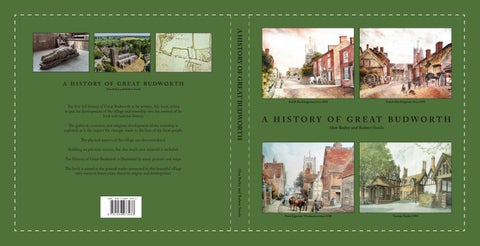
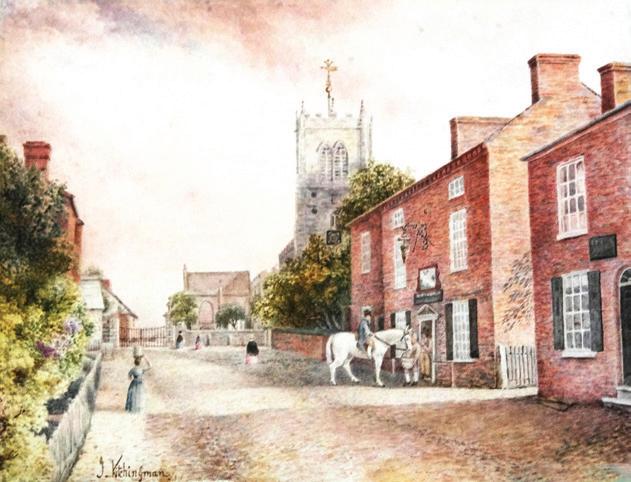
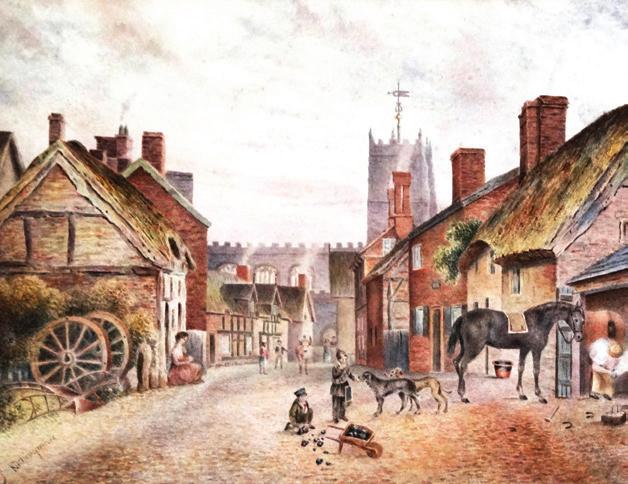
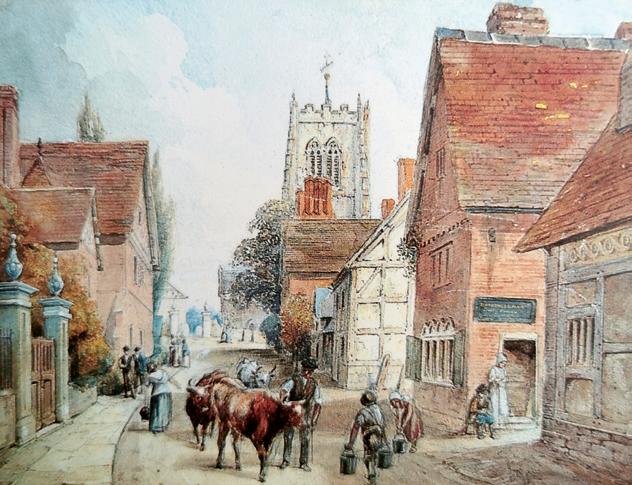
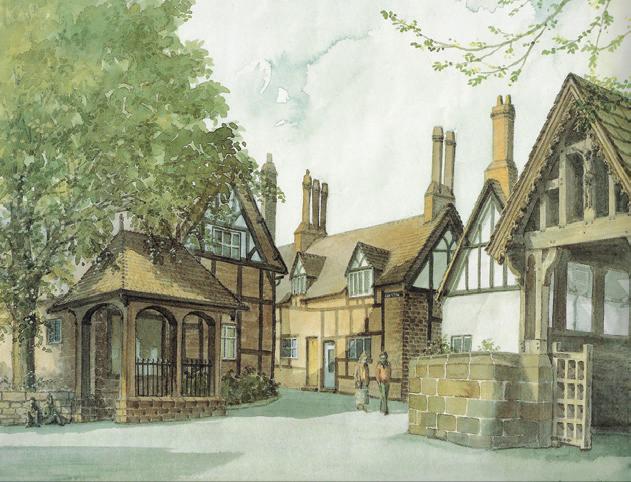
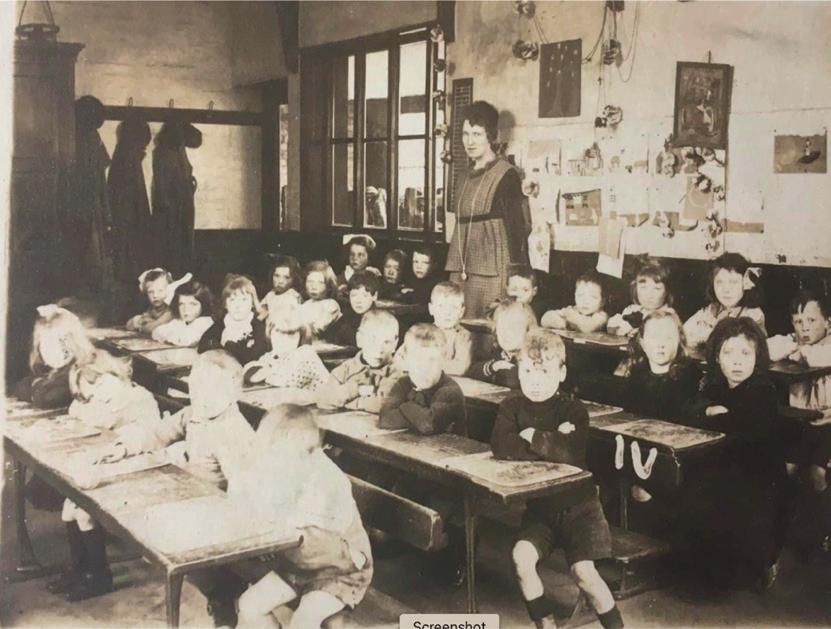
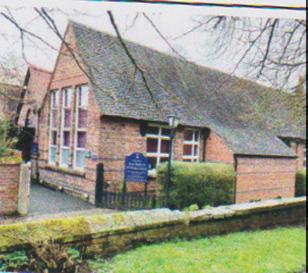
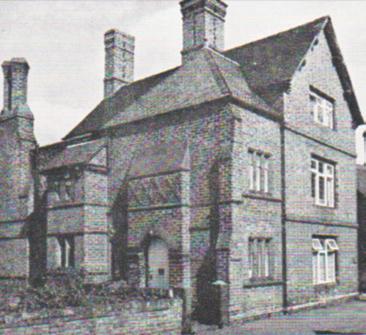
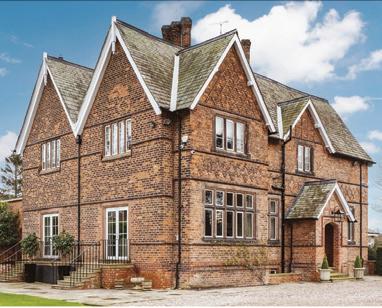
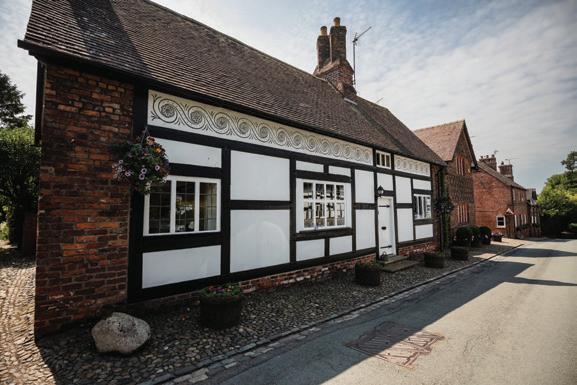
The first full history of Great Budworth to be written, this book strives to put the development of the village and township into the context of its local and national history.
The political, economic and religious development of the township is explored, as is the impact the changes made to the lives of the local people.
The physical aspects of the village are also considered.
Building on previous sources, but also much new material is included.
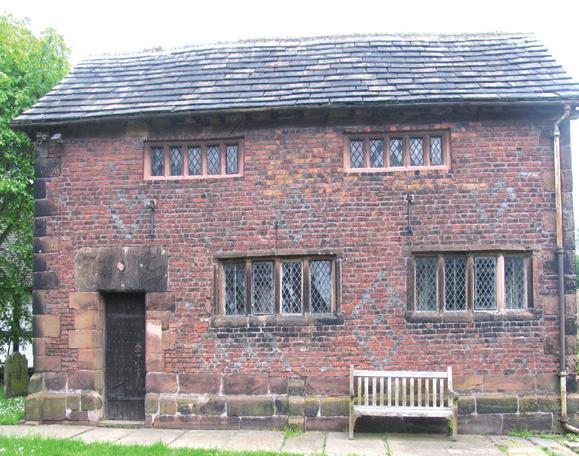
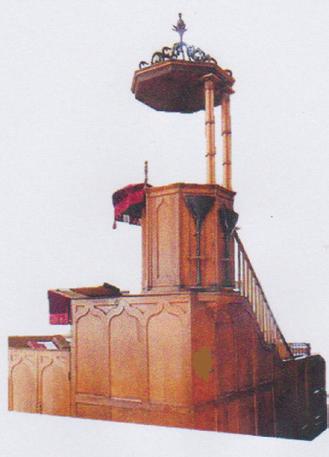
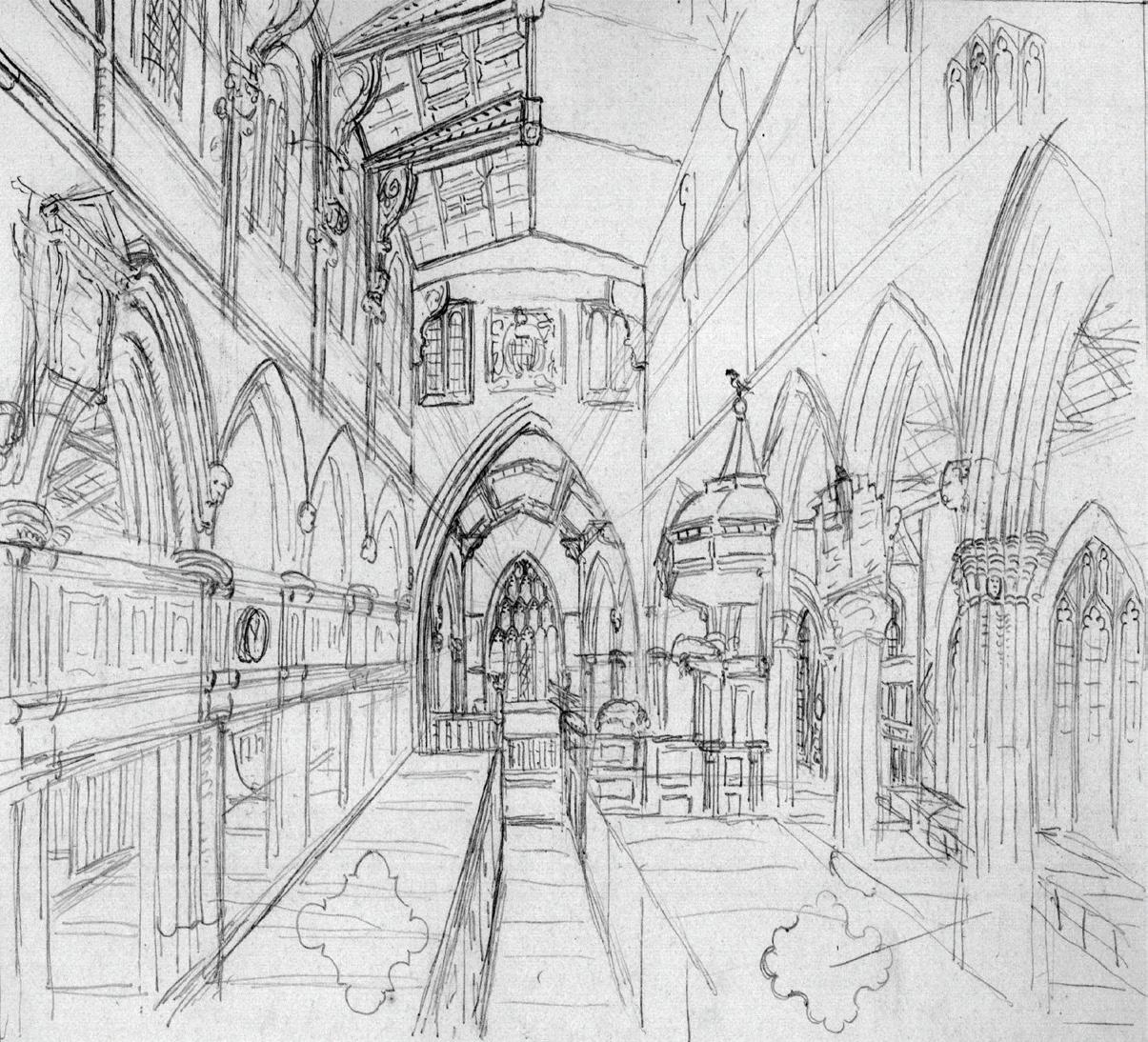
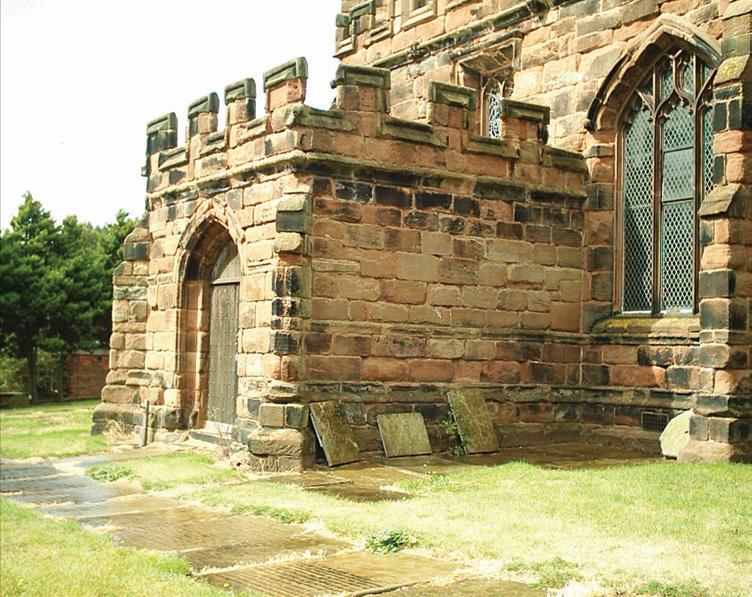
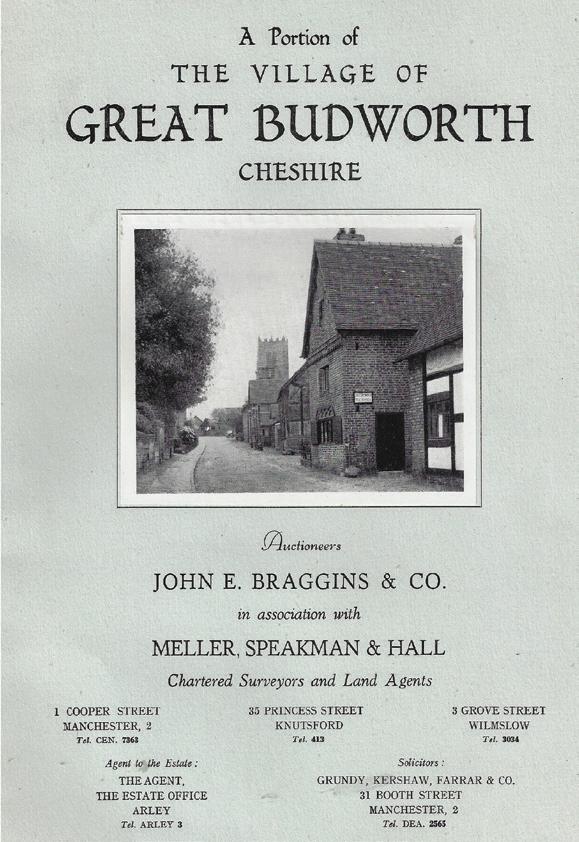
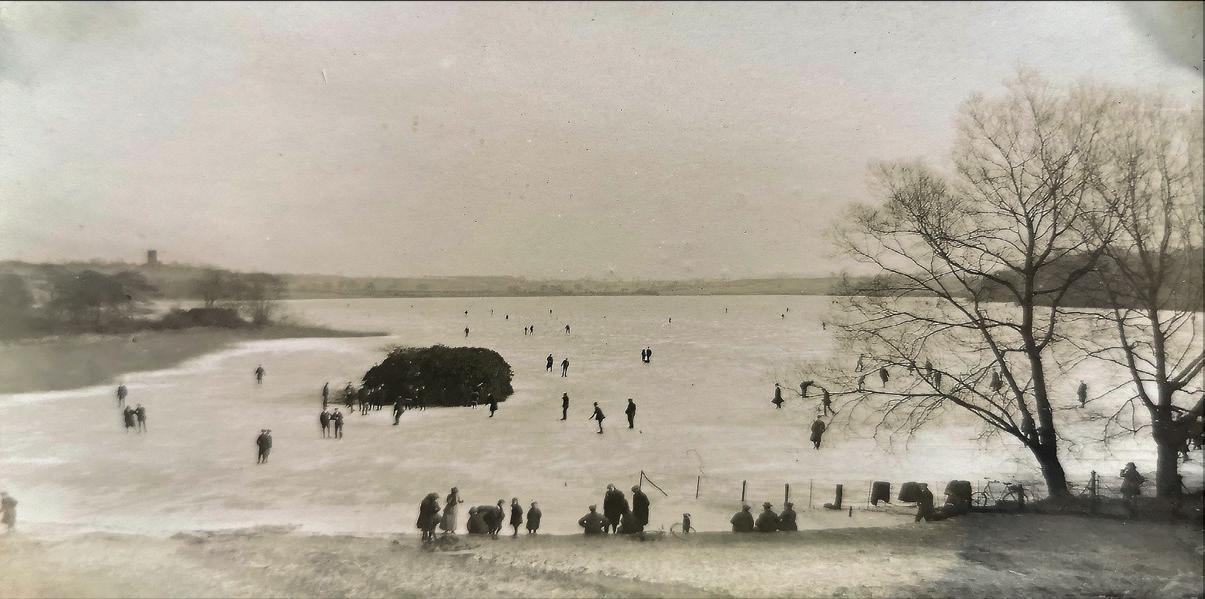
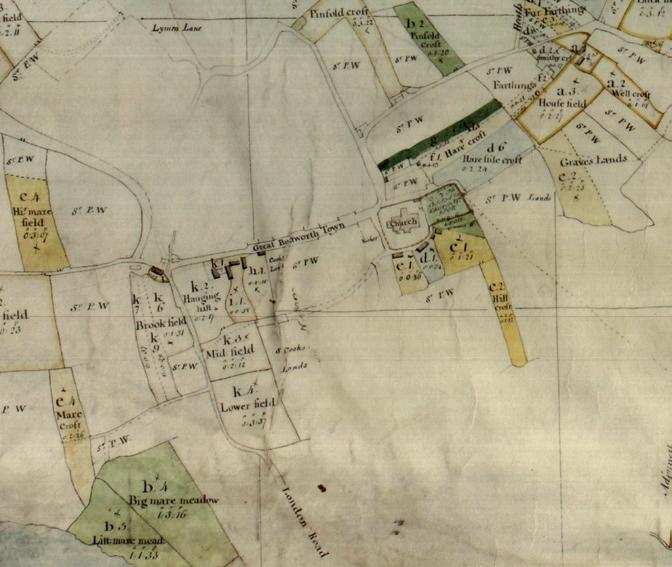
The History of Great Budworth is illustrated by many pictures and maps.
The book is aimed at the general reader interested in this beautiful village who wants to know more about its origins and development.
All rights reserved. No part of this book may be reproduced in any form, or transmitted by any means, without written permission from the copyright owner.
First edition 2026
ISBN 978-1-0369-7393-3
Printed and bound by Beamreach Printing, www.beamreachuk.co.uk
INTRODUCTION
To celebrate the Millennium, in 1999 a Millennium Exhibition of Great Budworth in was held in the Reading Room (or the Old School). Sue Ritchie and Alan Bailey put together a book The Memories of Great Budworth which recounted the memories of 10 residents of the village. In following years there were 12 editions of the Budworth Chronicles. It was later decided to produce this book A History of Great Budworth.
We have intentionally called the book A History of Great Budworth rather than The History of Great Budworth as we are conscious that there is still plenty to find out and we hope that the book encourages others to explore further about the history of our village.
Strangely, the parish and township of Great Budworth has not attracted much interest from past historians.
Some account of the church and township of Great Budworth was printed in 1884, probably the work of Rowland E EgertonWarburton, this gives a brief outline of Great Budworth.
Other short accounts appear in the works of the great Cheshire historians Sir Peter Leycester in his Historical Antiquities published in 1673 and George Ormerod in his The History of the County Palatine and City of Chester first published in 1816 and revised by Thomas Helsby in 1882.
In 1951 Arnold Boyd a naturalist who wrote articles for the Manchester Guardian and lived in Frandley House, Antrobus was commissioned to write a book in the New Naturalist series. This was called A Country Parish and is mainly about Great Budworth. He also edited The Great Budworth Churchwardens Accounts in the Eighteenth Century for the Lancshire and Cheshire Antiquarian Society in 1935.
In this book we have endeavoured to build on these foundations, adding new material found in primary sources and in the works of more recent writers.
Special mention must be made of the work of the late Charles Foster. His contribution about The Duttons’ and The Warburtons’ as well as mediaeval Budworth were invaluable in the writing of this book. His masterly studies of both local and regional development were inspirational. His cataloguing and curating of the Arley archives has exposed a wealth of information which has transformed the understanding of Great Budworth history. He has written five books Four Cheshire Townships , Cheshire Cheese , Seven Households , Capital and Innovation and Fabric of Society . Charles Foster’s accounts of The Flowers and Ashbrooks of Durrow is on PDF format in the Arley Hall Archives website.
Further, his willingness to share the archives and his encouragement of aspiring local historians shows not only his generosity of spirit but has been instrumental in the inspiration of the writing of this book. Charles Foster has made many useful inputs and suggestions and his clear perspective has solved many difficulties.
The authors owe much to his encouragement and support over many years. Any mistakes remain the responsibility of the authors alone.
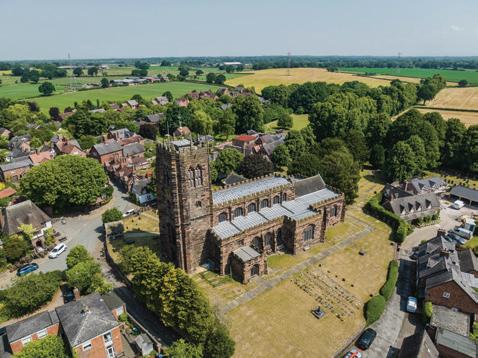
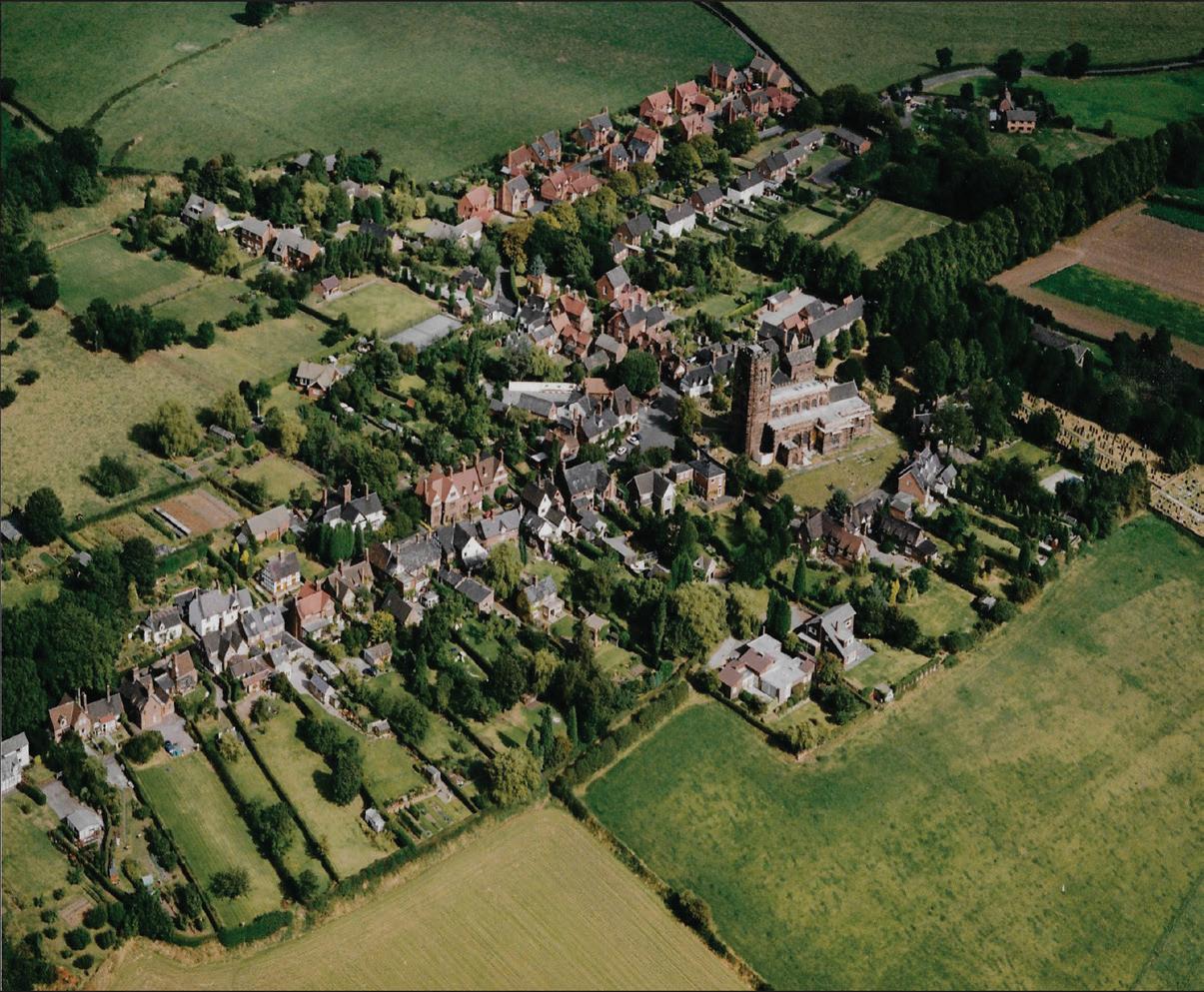
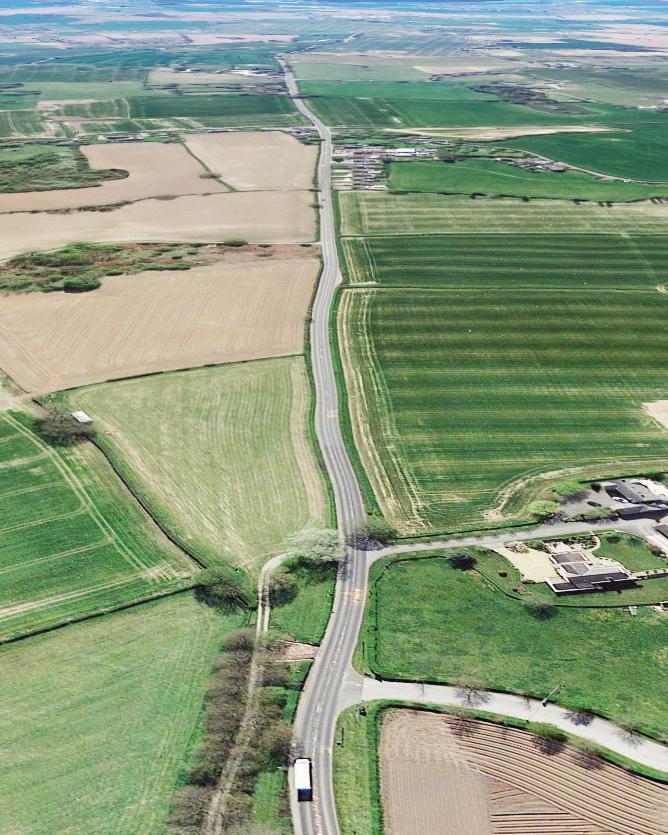
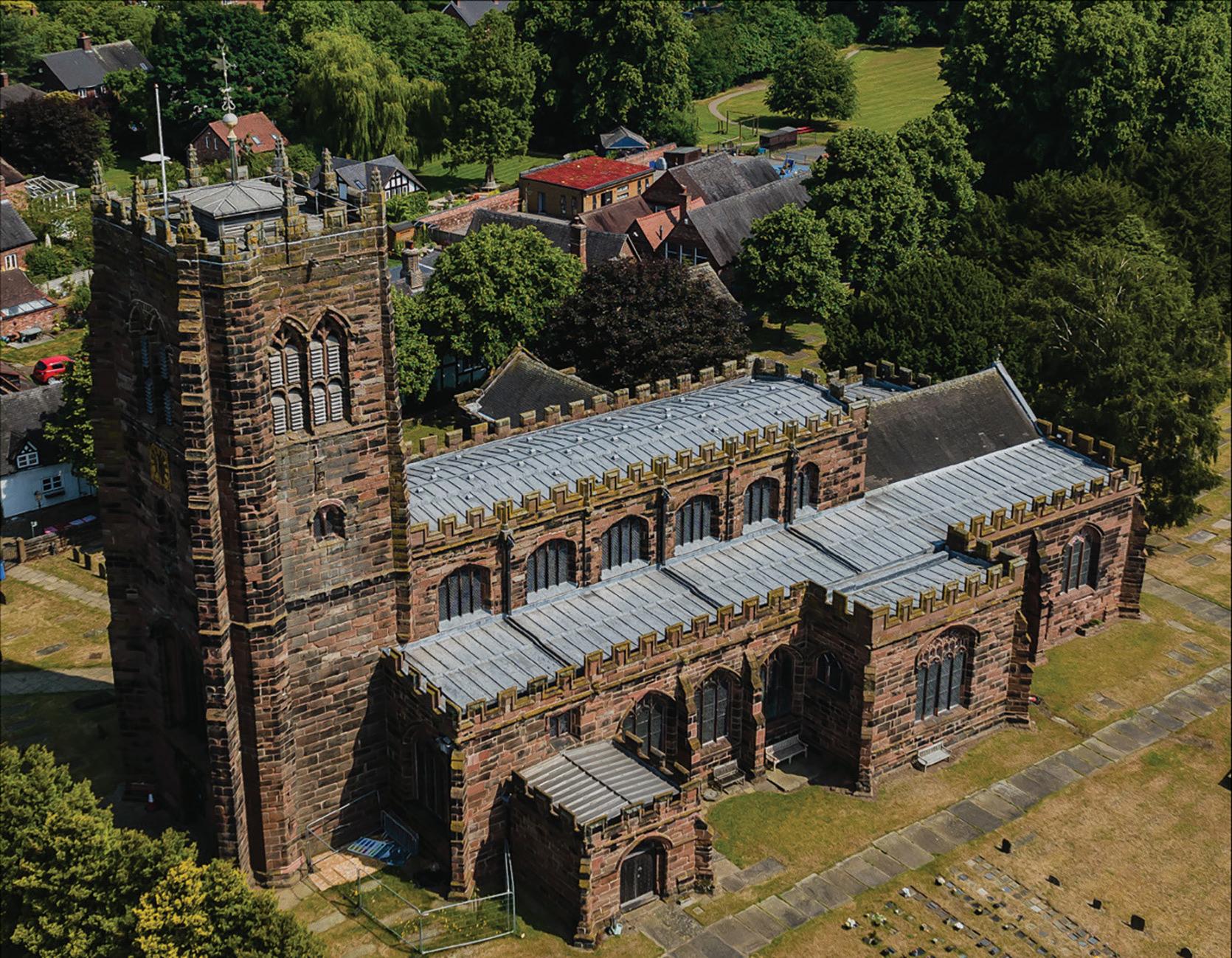
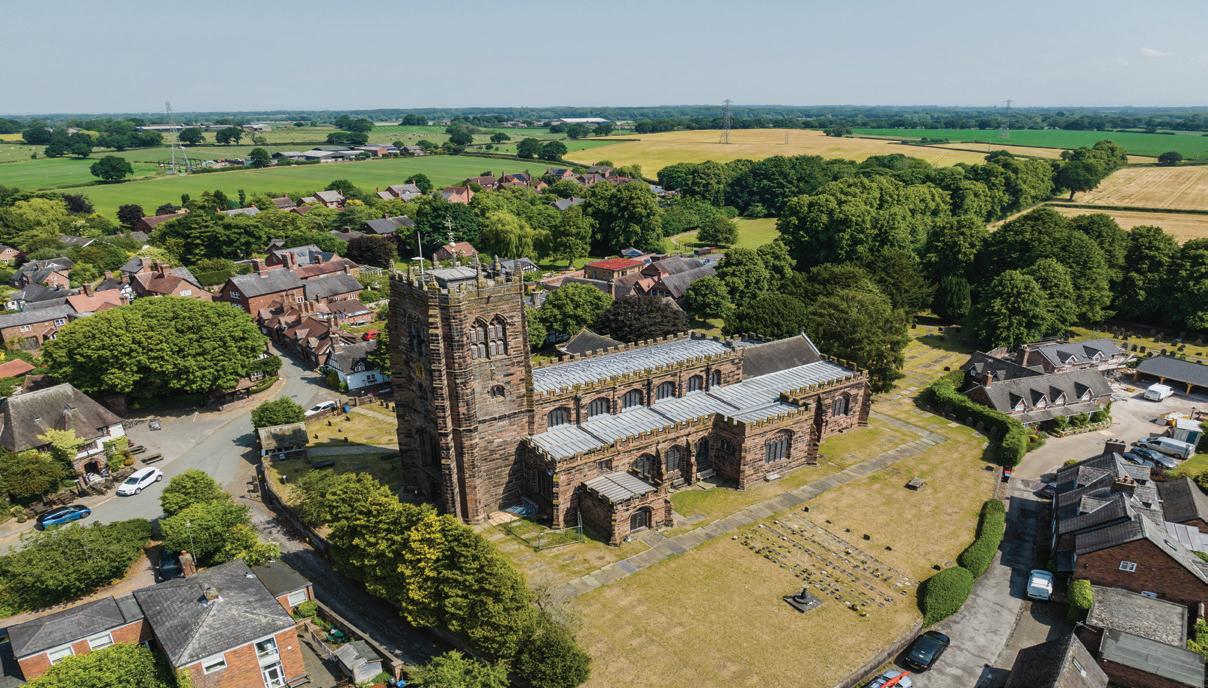
Modern Aerial View of Great Budworth
THE AUTHORS
Robert Steele
Robert gained a Bachelor of Divinity from King’s College, University of London.
After a career in teaching, Robert has spent much of his retirement researching the history of Great Budworth Church. His degree studies in theology and church history have enabled him to understand the reasons for the changes that affected the church and the parish and their impact both on the building and the community
Alan Bailey
Alan was a structural engineer but has always been interested in local history. He and his family came to Great Budworth in 1971 when they bought and built a house on a plot of land next to the Vicarage and later moved to Gold Mine House.
ACKNOWLEDGEMENTS
In addition the authors have had expert advice from the late Dr Geoff Thomas and Professor Jim Marshall from Liverpool University on the geology section. Tim Strickland made some useful comments on the Roman period. Alec York has helped tracing the routes of the Roman roads.
We have had help from many local residents including The Revd Alec Brown, June Wilkinson, Jane Robins, Lynda Giller, Geoff Buchan, John Hickey, Rod Bowman and many more.
We have had computer technical support from Graham Robinson and Graham Sumner has provided the large artistic illustrations in the book and Joe Damba took some of the photographs.
David Exley at Beamreach Book Printing has improved our amateurish edition into the copy you see. Based in Lymm, Beamreach, have made an excellent job of printing the whole book.
TABLE OF CONTENTS
Chapter 1 ~ To Start at the Beginning and Pre-History 9 to 14
Chapter 2 ~ The Romans to the Anglo-Saxons 15 to 23
Chapter 3 ~ The Normans 24 to 33
Chapter 4 ~ The Dutton’s 34 to 40
Chapter 5 ~ Medieval Budworth 41 to 45
Chapter 6 ~ The Saxon Church and Ecclesiastical Parish 46 to 50
Chapter 7 ~ The Augustinian Canons 51 to 56
Chapter 8 ~ Building of the Church we know 57 to 64
Chapter 9 ~ The Church ~ The Reformation Upheaval 65 to 67
Chapter 10 ~ The Church ~ Puritans and Dissenters 68 to 72
Chapter 11 ~ Houses developed from the Medieval Era 73 to 80
Chapter 12 ~ The Warburton’s to the Flower’s 81 to 90
Chapter 13 ~ Budworth ~ Post Reformation 91 to 100
Chapter 14 ~ The American Connection 101 to 105
Chapter 15 ~ Fairs, Wakes and Features. 106 to112
Chapter 16 ~ The Church ~ The Puritan Years 113 to 119
Chapter 17 ~ The Church ~ The Eighteenth Century Doldrums 120 to 123
Chapter 18 ~ The Church ~ The Victorian Church 124 to 141
Chapter 19 ~ The Church ~ The Victorian High Water Mark 142 to 150
Chapter 20 ~ The Village ~ The 18th and 19th Century 151 to 162
Chapter 21 ~ Budworth ~ The Roads 163 to 170
Chapter 22 ~ Budworth ~ The Schools 171 to 184
Chapter 23 ~ Budworth ~ Water 185 to 192
Chapter 24 ~ Budworth ~ A Picturesque Village 193 to 210
Chapter 25 ~ The Church ~ The 20th Century 211 to 220
Chapter 26 ~ The Village ~ The 20th Century 221 to 234
to 255
Chapter 1
TO START AT THE BEGINNING AND PREHISTORY
To understand the history of Great Budworth it is necessary to appreciate the topography of the village itself. This has had a great influence on its growth and it is only by understanding the topography that we can comprehend how the village grew up.
The hills and mountains of England were formed some 300 to 400 million years ago. Before that time the whole Earth was pliable and continually moving. Whole continents were moving and hills and mountains were being created. In this period a ridge was formed which stretched from Pickmere to Comberbach, although it would have been slightly higher than it is today, and the surface would be what is now the bedrock.
For the next 300 million years there were extremes of climate; there were times when the area was desert and other times when it was covered with ice.
The last time the climate deteriorated to a major extent was the last Ice Age, this started around 30,000 years ago. The existing glaciers which had come down to the Scottish highlands, advanced south into England and the northern Irish Sea basin, through the gap between the Welsh Mountains and the Pennines, and out across the Cheshire-Shropshire lowlands. The ultimate termination of the advance was in the Midlands around 20,000 years ago. At its peak this glacier of ice in Cheshire was between 1 and 2 kilometres thick.
So from the climatic perspective the Arctic ice stretched from the North Pole to the Midlands of England.
The glacier had moved slowly south through the lowlands, eroding the soft Perms-Triassic sandstone underneath it. This was deposited on the bedrock, resulting in debris of thick sheets of mud, sand and gravel, known as basal till across the interface between the ice and the underlying bedrock.
From the termination of the advance of the glacier some 20,000 years ago in the Midlands, the ice-sheet retreated northwards in a series of ‘retreat stages’ as the margin responded to climate building of linear ridges, or moraines, parallel to and forward of the ice margin. During the retreat of the glacier, enormous volumes of melt-water ran outwards from beneath the ice margin and transported very large quantities of mud, sand and gravel, termed out-wash, out beyond the ice margin in a series of very active pro-glacial sandur systems.
This created the geology of the Budworth area, where the soil is a mixture of sand and clay which had sedimentary origins. It isn’t evenly spread, there are pockets of solid clay and pockets of pure sand, but mostly it is a mixture of sand and clay.
Marl is clay and was dug out to be used for building and agriculture. The sand was used for building from Norman times until the nineteenth century. “Marling” was hard work, it was carried out by a group of five or six men, who dug out the marl in a part of the field which had a predominance of clay, it was then distributed on the fields before ploughing. It was believed that the marl was a fertilizer which increased the yield in the fields. Also if the field was very sandy by introducing marl it would improve the retention of rainwater.
There were also a lot of cobbles which are igneous rocks and were created by volcanic action in the Lake District and were made round and smooth by glacial action, as they travelled south with the glaciers from the Lake District. These were collected from the fields and used for roads and other hard standing.
There are three prominent geological features in the area of Great Budworth.
Budworth Ridge or Budworth Hill.
The Budworth Ridge extends from Pickmere to Comberbach. There is a 50 metre (160 foot) fall between the highest point in Budworth and Budworth Mere.
This may not seem very much, but it would have seemed a lot for a child in the middle of the 19th Century who was tasked with fetching water from the Running Pump to their cottage or house by the church. This hill has had a major effect on the life in the village.
There is only a small rise from Budworth Mere to the crossroads. The main road towards Warrington rises abruptly after the crossroads. There are also hills to Budworth Village and another towards Comberbach. All these were heavily excavated at the end of the 18th Century to reduce the gradients. This can be seen by comparing the height of the fields on either side of the roads.
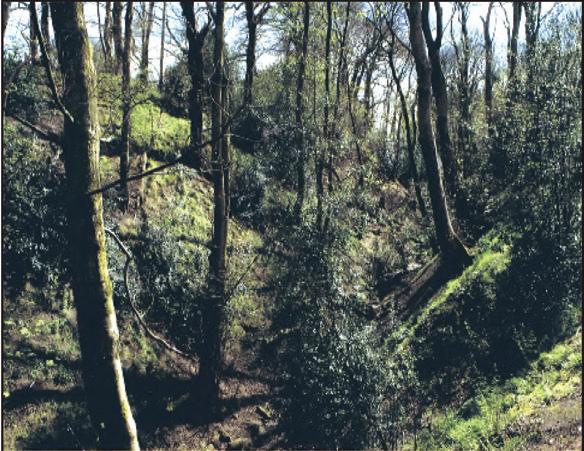
Just north of the village is a ravine called The Dene. It is about 50ft to 80 ft deep from the surrounding land and the sides are very steep
From several reference books on place names the word “Dene”, is derived from the Old English “Denu” ~ a valley especially one that is narrow and wooded.
The most detailed reference of a dene is(1) “a valley through which a burn flows” Later it says “in the counties of Durham and Northumberland a dene is a steep sided wooded valley through which a burn runs. Many of the incised valleys cut by small streams that flow off the Durham and Northumberland plateau into the North Sea are given the name dene as in Castle Eden Dene and Crimden Dene in Durham and Jesmond Dene in Northumberland”
1 “Northumberland Words, Vol. 1” by Rev Oliver Heslop, 189
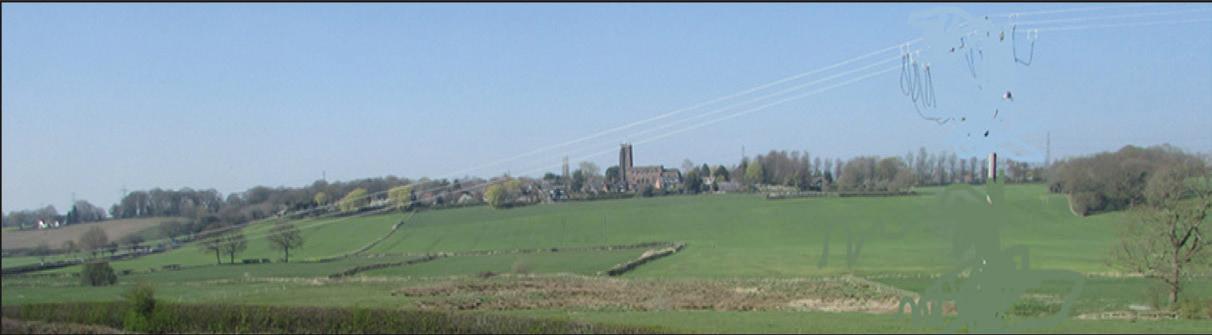
Budworth Hill stretching from Pickmere to Comberbach
The Dene
The Dene
There are 25 place names in the British Isles which contain Dene as a separate word and 15 of these are in the counties of Durham and Northumberland. It is remarkable that the name Dene ~ which is unique in Cheshire ~ is the same as that of similar topographical features as far away as North East England.
We have had expert advice from Professor Jim Marshall and the late Dr Geoff Thomas from Liverpool University about the origin of the Dene.
The Dene Gorge was cut by pro-glacial or sub-glacial stream erosion during retreat of the last ice age. The last Ice Age was between 30,000 and 15,000 years ago, at its peak the ice to the north of Budworth was between 1 and 2 kilometres thick, which weighed millions of tonnes. This enormous weight of ice sliding over bedrock eroded the surface to produce a till. This was the result of 15,000 years of rain and snow precipitation freezing when it fell in Cheshire.
At the end of the Ice Age, this enormous amount of ice melted very quickly and the meltwater streams then ran down the fronting slope of the moraine running east to west, to the north of Great Budworth. This melt produced a torrent of water which found its way to Budworth Mere and then on the River Weaver. The whole area would have been flooded. There was a quirk in the geology mixture of sand and clay, which caused the flow of water to create the deep ravine, which is the Dene. This was encouraged by the hill which increased the speed of the flow.
Gorges caused by the Ice Age are fairly common, but the Dene is probably one of the longest and deepest in Cheshire.
Today there is a small stream which flows in the Dene, this is because there are several springs in the steep sides feeding water from the water table. Depending on the rainfall, the flow varies so that at times it is almost non existent and at other times after heavy rainfall it gushes down the valley towards Budworth Mere.
The Dene Ravine - an alternative interpretation. While researching and preparing the section on the Dene ravine an interesting alternative theory was proposed.
Rather than being a glacial outwash gorge it was postulated that the stream flowed farther to the south and only changed its course when sand, easily accessible from the road cutting, was dug out and removed which created first a very deep sand pit whose side eventually collapsed causing the stream to flow into its depression and form the stream route we see today.
If this view is correct the whole shape of the topography was changed.
A ledge seen along the top of the southern edge of the ravine may be evidence of the old stream bed. This older stream had reached the crossroad area twenty to thirty metres east of the present route and then followed the present route down toward the Wash corner.
Certainly the road cutting was the obvious place to remove sand, easy for carts to load just off the road and right on the road for easy transport.
In 1733 Peter Harper, manager of the Arley estate, wrote to Sir Peter Warburton saying there was little sand left in the Dene and the estate would need it all.
This suggests years of sand removal had taken an extremely large amount of material which caused the road cutting to be widened to such an extent that the old stream was undercut and collapsed into the workings and found a new route down the hill effectively following the road.
A ready supply of sand was vital for the development of the village as we will see in the section on Housing on page 72 and onward.
The earlier stream route and sand digging may have been the reason why the village ceased to develop as it effectively stopped the widening of High Street toward the north and the southern side sloped down to wet, marshy area. This meant population growth and house building or road widening to accommodate markets or more traffic was not possible.
Thus Great Budworth never became a town and remained a picturesque survival.
The evidence is not conclusive on the origins of the Dene ravine stream and the reader will want to make their own judgement as to where the balance of probability lies.
Topographical Features
South of Budworth village is another important topographical features ~ Budworth Mere. Only about half of the mere is actually in Budworth, other parts of the Mere are in Marston and Comberbach.
It is also sometimes called Marbury Mere.
As the glacier advanced south, an enormous lump of ice separated and became static in a small depression instead of advancing south. This lump of ice is called dead ice. The glacier travelled over the dead ice. A till of mud and sand built up around the dead ice.
These linear depressions are called kettle basins.
There are many other meres in Cheshire, Pickmere, Tabley Mere, Shakeley Mere, Rostherne Mere, Tatton Mere and several more. These were all formed at the same time and in the same way as Budworth Mere.
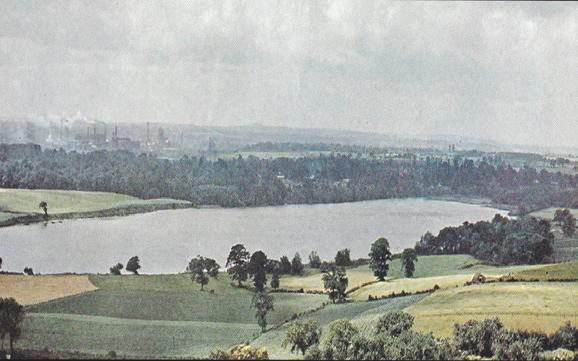
Budworth Mere
Before the Romans
Recent Excavations
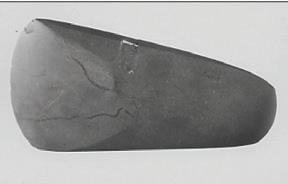
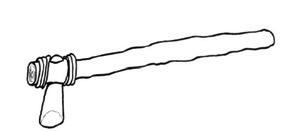
A stone axe head about 4½ inches long was found in Budworth by Mr Isaac Jackson in 1921; it is believed that he came from Greenock and that he worked at Belmont Dairy Farm, but we do not have any confirmation of this. The axe head was very well made, probably in the axe “factory” in Langdale, Cumbria, and it is unusual in that it was barely used. It is displayed at the Manchester Museum, who kindly provided this photograph. It was made in the Neolithic Period i.e. 4500-1700 BC. At this period people were still nomadic, so this axe was probably accidentally dropped by a hunter gatherer. This was described by Sir William Boyd Dawkins1 “another link in the evidence that Cheshire was inhabited in the Neolithic age by pastoral tribes using implements made of stone”(1)
How the axe head was fixed
However it is an excellent example and we cannot exclude the possibility that it was deposited as an offering to the Gods.
A Bronze Age tumulus known as “Robin Hoods Butts” was said in 16612 to contain “the armes of a man in the upright posture”. The field at the bottom of Smithy Lane is called “Robins Hood Butt” on some old maps.
It has been suggested that this is based on an erroneous source and there are some doubts that the tumulus ever existed
In 1998 when the new gas pipeline was to be laid from Winnington to Nether Tabley; one of the conditions attached to the planning permission was that PowerGen should fund an archaeological investigation. A specialist firm of archaeologists, Earthworks Archaeological Services, surveyed the route of the pipeline from Cogshall Lane to Aston Park by aerial photography, systematic field walking, metal detection and a geophysical survey. They then carried out a detailed survey on twelve trenches of the most promising sites within the actual construction corridor. Three of these trenches were in Budworth Heath, but nothing significant or anything prior to the Norman Period was found
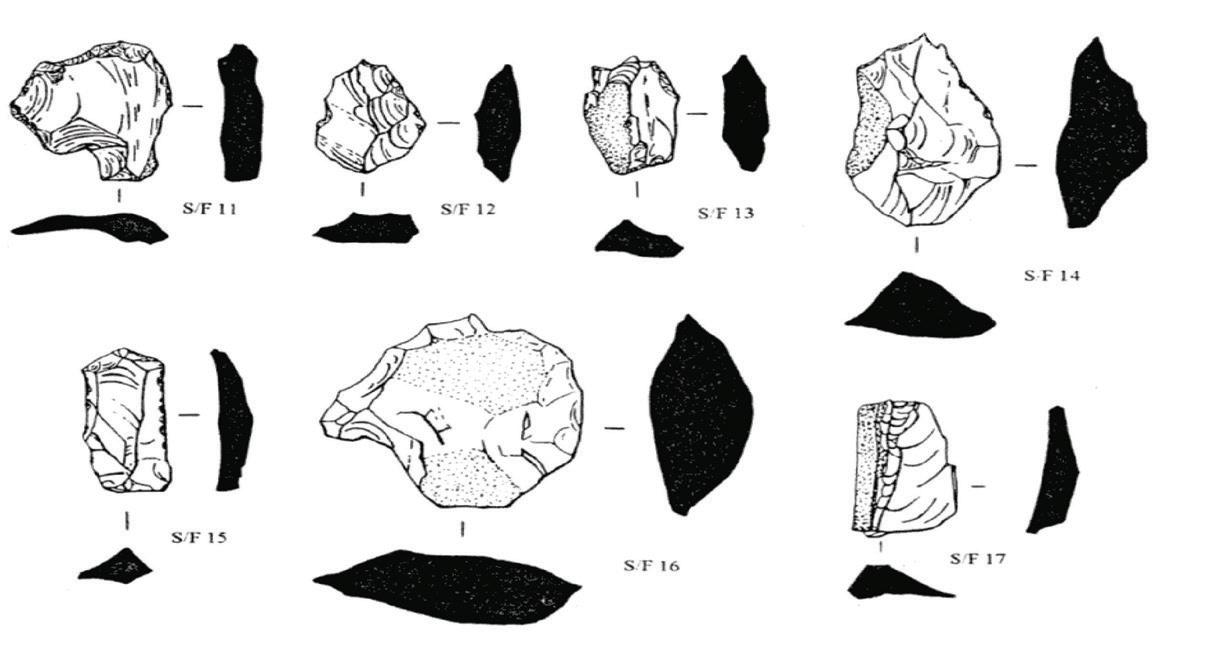
The other nine trenches were in Aston by Budworth, and in the field just south of Aston Park House seven small prehistoric flints were found, probably Bronze Age Period about 2000 BC. (see sketch right). These flints would have been used as scrapers or knives for kitchen utensils or tools. Strictly this site is not in Great Budworth. On the site there were also several Roman ditches and a Roman pit. There were many Roman artefacts discovered: pottery fragments, part of a brooch and three coins.
In all there were 21 pieces of Roman pottery. These fragments were identified as originating from a large number of sources, including South Gaul, East Gaul (both are in France), the Severn Valley, Wilderspool and Oxfordshire. All the pieces were small and broken, and by themselves had no intrinsic value. They were all dated between the 1st and 3rd centuries AD.
The part of the brooch that was discovered is particularly attractive. Again it is small and broken but there is sufficient left to appreciate its original beauty. An almost identical brooch was found in Owmby in Lincolnshire and identified as between mid 1st to early 2nd Century AD.
1 “A Country Parish” ~ Arnold Boyd ~ Page 15
2 Ashmole Mss No 854, Folio 322, Bodleian Library Oxford
The Budworth stone axe
In this small area, 3 Roman coins or parts of coins were found. 1) A copper alloy coin which was heavily corroded. It is probably an “as” or a “dupondius” of the 1st or 2nd centuries.
2) A “sesterce” coin which was broken in half. It shows the neck and shoulders of a female bust who was probably Lucilla, daughter of Aurelius, and wife of Lucius Verus. It is dated between 164-169 AD but because it was very worn, it was probably lost in the 3rd Century.
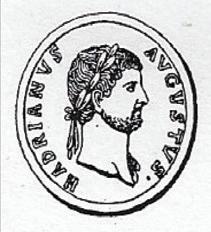
3) The most important coin was a silver “denarius” of the Emperor Hadrian dated 119-122 AD. Because it was solid silver as opposed to the other two copper coins it is very well preserved, and it carries the standard deeply sculpted portrait of the Emperor with a laurel wreath.
The denarius is the coin that gave us the “d” of lsd and it was also the coin referred to in the New Testament where it says “and on the morrow he took out two pence”.
Apart from this homestead found in Aston by Budworth, at present there is no evidence of occupation in Budworth, except for minor finds by metal detectorists.
A Roman coin has been found in Budworth Heath and two coins were found in the grounds of Belmont Hall.
Actual size drawing of the flints found on the Powergas Pipeline
THE ROMANS TO THE ANGLO SAXONS
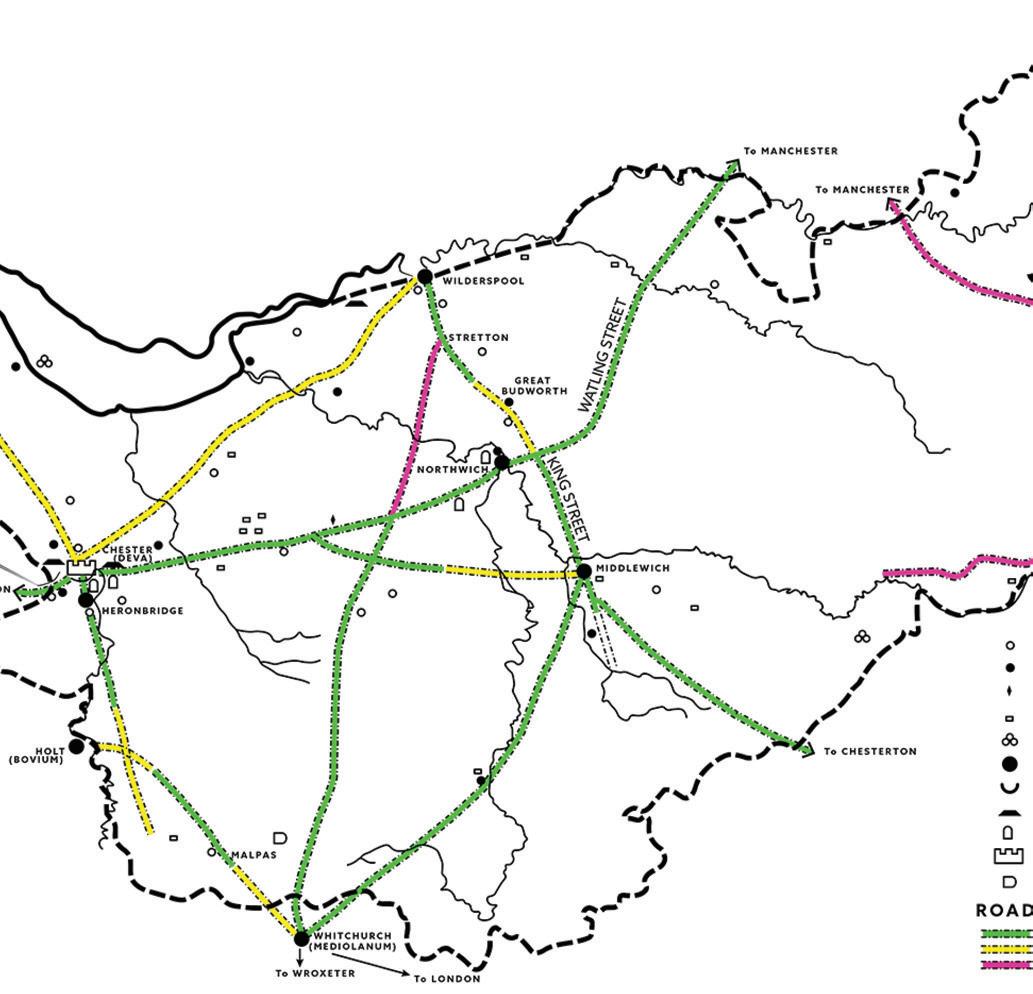
The Romans invaded Britain in 43AD, but it wasn’t until about 47AD that they reached Cheshire. Their objective was to create a port in this part of England and to conquer the whole of England as far as Hadrians Wall. They needed a port in Cheshire so that their soldiers could travel by sea to Northwest England rather than having to march from the south. Initially this port was Wilderspool, where a substantial settlement was built, but later they used Chester. In about 55 AD the Romans built a road called King Street (sometimes called Kind Street) from Middlewich to Wilderspool. Over the next 300 years they built a network of roads in Cheshire. See map on page 16.
Middlewich was a military town and a centre of the salt industry. Wilderspool was a military and a manufacturing base and a port. The purpose of the port was to transport soldiers and to import and export supplies and goods (especially salt). But most importantly it was the first narrow bridging point of the Mersey from the Irish Sea, and they needed a bridging point to travel further north.
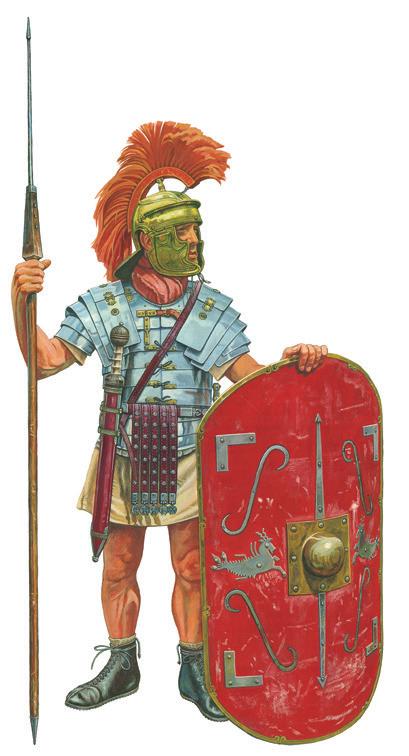
The reason the Romans built their roads was that when using them, a soldier could march up to 25 miles a day wearing all his armour and equipment or travel 60 miles by horse. Whereas without a good road they could only travel much smaller distances. Similarly it is much easier to move equipment and goods on a well made road.
The actual route of King Street is well documented from Middlewich to Broken Cross, Near Northwich, where it meets Watling Street. Watling Street is the Roman Road which runs from Manchester to Chester, this was built much later, the priority for the Romans was to develop a fast route up to the north and to Wilderspool.
Between Stretton and Wilderspool, there were many sections of the actual paving found in the nineteenth and early twentieth century, and when the M56 was built, and again in the 1990’s at Pewterspear Green. So the route is well known north of the M56
The name Stretton means “The Settlement by the Roman Road”. Of the 17 villages in England called Stretton ~ all but 2 are by a Roman Road.
However the route from Broken Cross to Stretton is not well documented and the exact route is not known, this is shown yellow on the map on the following page. In particular we do not know for certain the exact route of the Roman Road near Budworth.
There have been several unsuccessful attempts to find archaeological evidence of the Roman Road. Our conclusions are that the line of the Roman Road runs in line with the modern road, A559, and any evidence is under the actual road. This is confirmed by a study by the Roman Road Reearch Association who have studied the route using LiDAR.
A map showing the Roman Roads in Cheshire based on a map in Dorothy Sylvester’s Historical Atlas of Cheshire
The green roads indicate that the exact route is “certain”, the yellow roads indicate the route is “probable” and the pink roads indicate that the route is “possible”. Th e section from Broken Cross to Stretton (which includes Budworth) is classed as probable.
In the Roman Era, Cheshire and Budworth were very sparsely populated. If there was anybody living in the village at all, it would have been at the bottom of The Dene and near Budworth Mere.
The stream from the Dene would have been invaluable for the men building the Roman Road. After the road was built it would have made an excellent stopping place, as it is half way from Middlewich and Wilderspool with water for the soldiers, horses and other travellers.
Also it is possible that someone provided goods and services for the road builders, the soldiers and travellers using the Roman Road.
When the Roman surveyors and road builders came to Budworth from the south, they would have found the area around Budworth Mere was very marshy, Even today this area is known locally as Wash Corner and is prone to become marshy or flooded in severe wet conditions. The Romans probably built an embankment to elevate the road, east of Budworth Mere.
At The Dene they would have encountered a mini cliff ~ some 50ft high. Originally the mini cliff would have been as steep as the sides of The Dene. Prior to the Roman Road building programme there had been no need to change the natural hill as it had been eroded by The Dene.
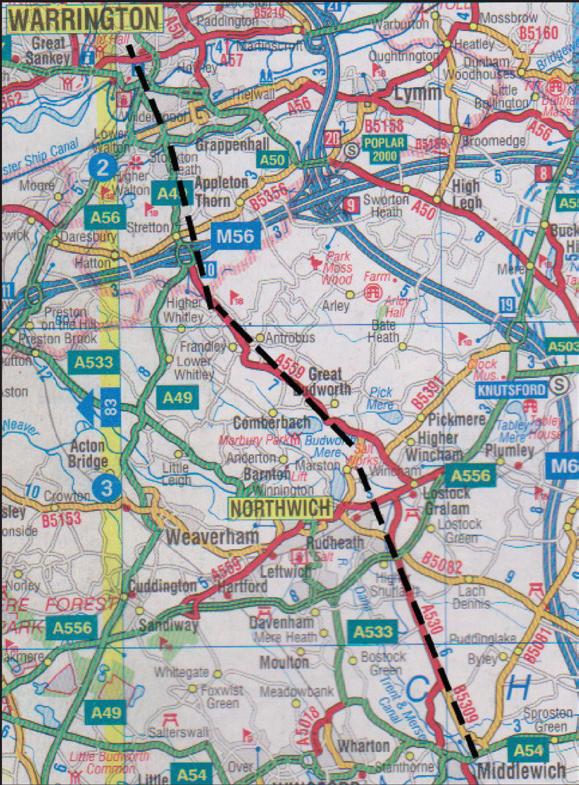
A modern map with the route of the Roman Road superimposed between Middlewich and Wilderspool.
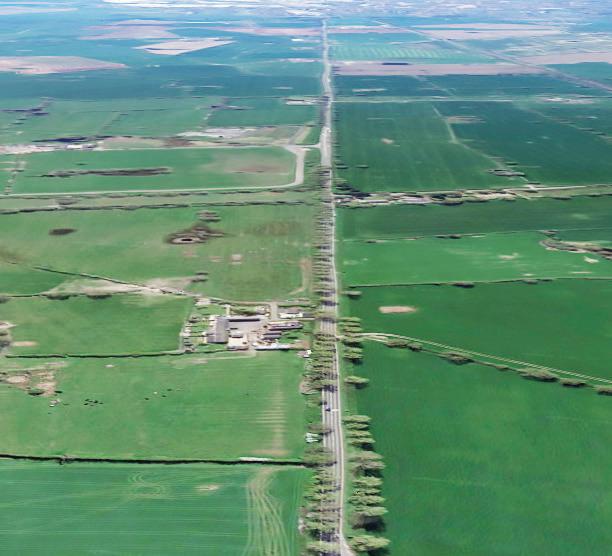
Modern view of the A559 in Antrobus looking south from Stretton towards Great Budworth
Modern view of King Street from Rudheath looking south towards Middlewich
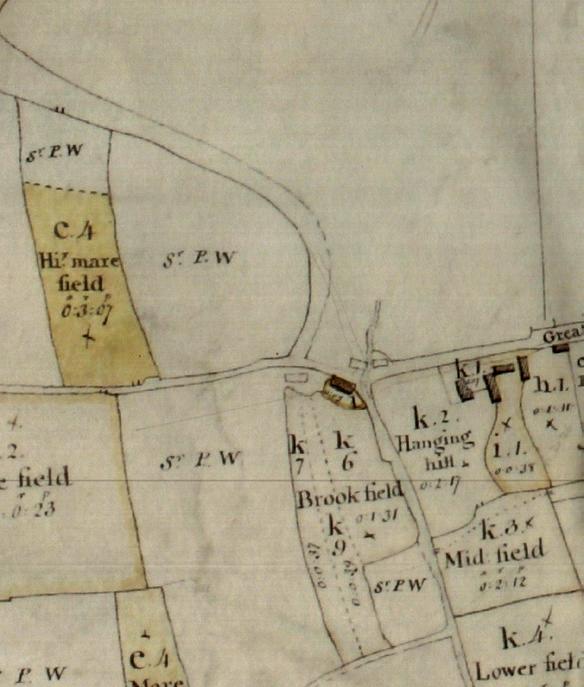
Leycester Estate Map 1757
The Romans generally built their roads straight, but they made an exception when they came to a hill.
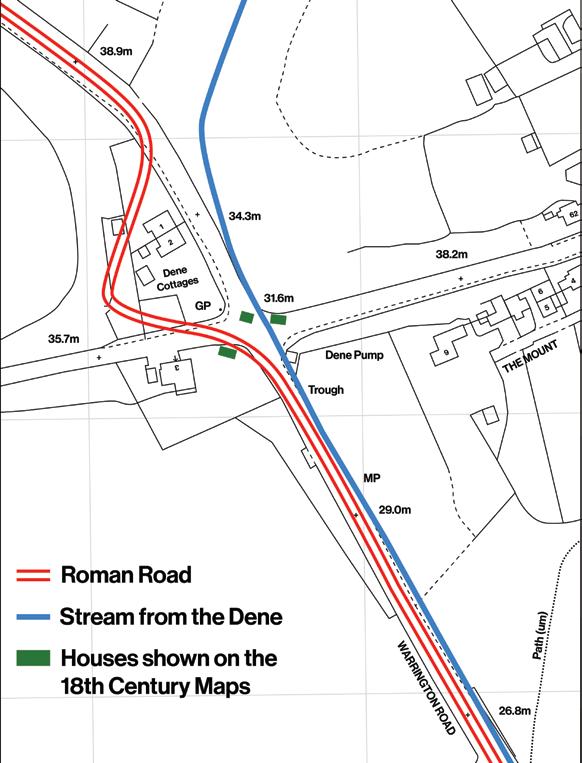
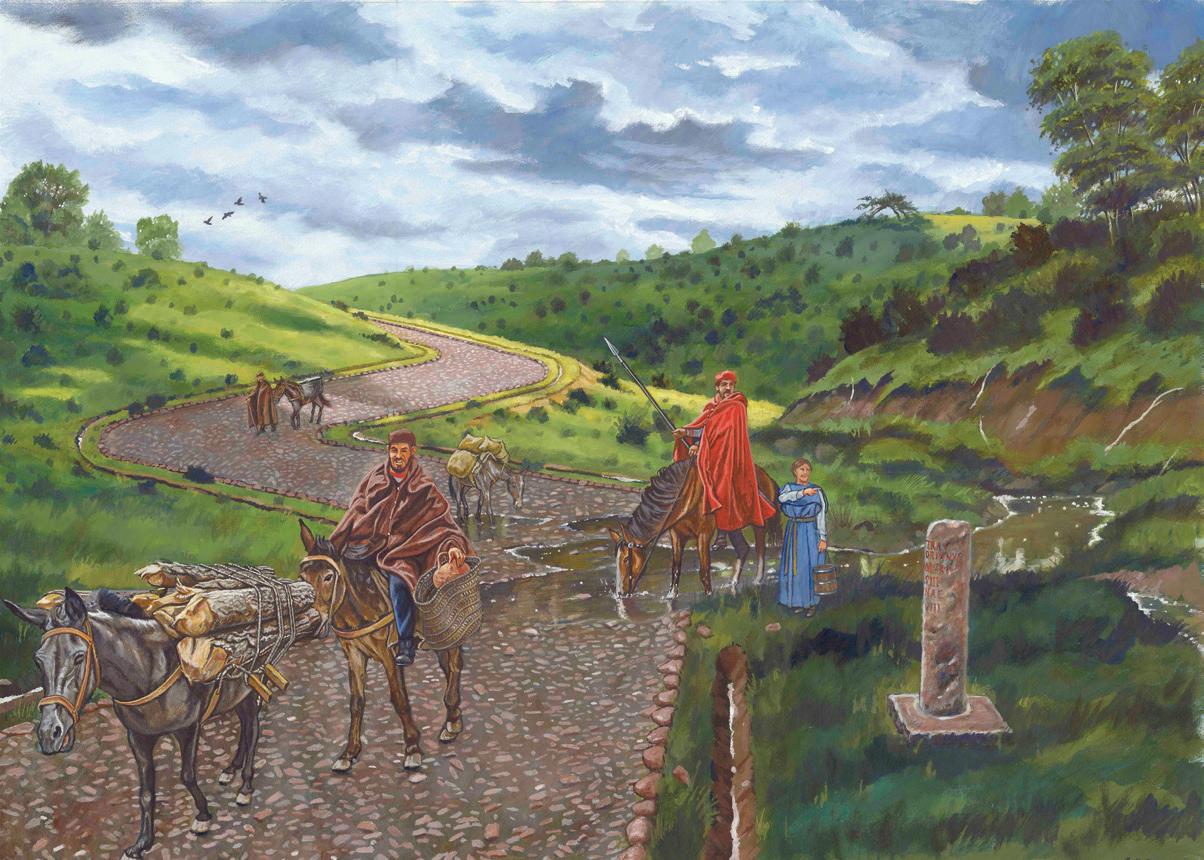
The Romans probably excavated a cutting for the top half of the mini cliff, but the excavation would have been too big to go to the bottom of the cliff. They used the spoil from the excavation to build a zigzag ramp, so that there was a more gentle gradient of the road to the higher ground north of The Dene.
The remains of this zigzag is shown on the Warburton and Leycester 18th century estate maps, the zigzag was straightened in the late 18th century when the road was upgraded by excavation and straightening (see page 168).
The Roman Road superimposed on a mosern large scale map, with a zig zag around the mini cliff
Artist impression of travellers on a Roman Road with a zigzag to reduce the gradient.
Note the milestone on the right of the road
After the Romans
The Romans started to leave Britain in 383 AD and left in various stages until 410AD. During the Roman occupation Britain was highly organised. Immediately after the Romans left the regime in Britain could be described as chaotic.
England was very sparsely populated and there were large area’s of land ripe for settlement. There were a number of incursions into England, which were not really invasions but raids by tribes from Europe. The Angles were a Germanic tribe who came to Northern England and Saxons came to Southern England.
This period was called the Anglo-Saxon period and different people lived and intermixed together with the native population; such that they even gave the name “England” which is derived from the Old English name Englaland, which means “land of the Angles”.
For about 400 years the country was broken up into local “kingdoms”, each with its own king or sub-king, some of whom were really little more than tribal chieftains.
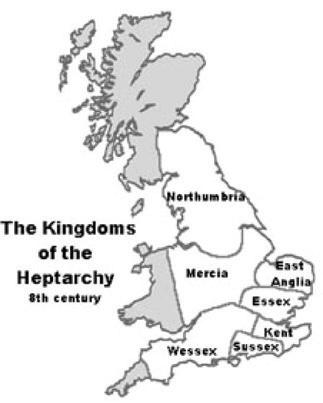
In the 9th century, seven main kingdoms evolved called the Heptarchy, these were East Anglia, Mercia, Northumbria, Wessex, Essex. Kent and Sussex. Through various wars, disputes, deaths and marriages the boundaries were for ever changing. The map above shows the borders in the 9th century, but it would be different a hundred years earlier or later.
Place Names
Budworth always remained in Mercia, the main population of Mercia was centred on Repton, Lichfield and Tamworth. Cheshire was sparsely populated during this time with a total population of about 1,500 throughout the whole county.
The name Budworth is the only legacy of the Anglo-Saxon reign. The 17th Century local historian Peter Leycester (his surname is either spelt Leycester or Leicester) said that the word “Budworth” (1) was a Saxon name “Bode” which signifies a dwelling, and “wurth” a place by a water; as it were, “a dwelling by a water”
However recent academic studies (2) have been undertaken on place names, this involves studying the common components of the place names throughout the country. Now it is considered that, Budda was the Saxon name of a local ruler and “worth” means “enclosure”, so the name Budworth originally meant “the enclosure of Budda”.
Furthermore nearly all the villages and towns ending in “worth” are to be found in or close to Mercia ~ Tamworth, Kenilworth, Letchworth, Bosworth, Bedworth etc. There are only a few villages or towns ending in “worth” in the rest of the country.
Towards the end of this period, there were Viking invasions in England but in Cheshire these were near the coast and in the west of Cheshire, again this is demonstrated by names. A common Viking ending is “by”. All the villages in Cheshire ending in “by” are in the west ~ Greasby, Irby, Frankby, West Kirby, Raby, and Whitby. The nearest “by” to Budworth is Helsby.
Later we will see that in the Domesday Book Budworth was called Budewrde, however Little Budworth was called Bodevede. Sometime before the 16th century both the names evolved into Budworth and in the 16th century they were given the prefixes Great and Little to distinguish between them.
1) “Some Antiquities of Cheshire” ~ Sir Peter Leycester page 225 2) Place Names in Cheshire ~ Part 2 ~ J. McN Dodgson Page 107
The hundreds in Cheshire
During the 400 years prior to the Norman Invasion, at the national level these regimes governing England were chaotic but on a local level there were some significant developments. As early as the seventh century there had been some form of hidation in Cheshire1. Hidation is a form of taxation by valuing the taxable assets in every estate, manor or township, in the medium of hides2 .
We will see in the Domesday Book that Budworth had an assessment of 1 hide, this was an assessment partly based on the agricultural land but also it had a mill which was a taxable asset. Halton (Runcorn) was assessed at 19 hides and Chester was assessed at 50 hides because they were ports and did not just have taxable agricultural assets.
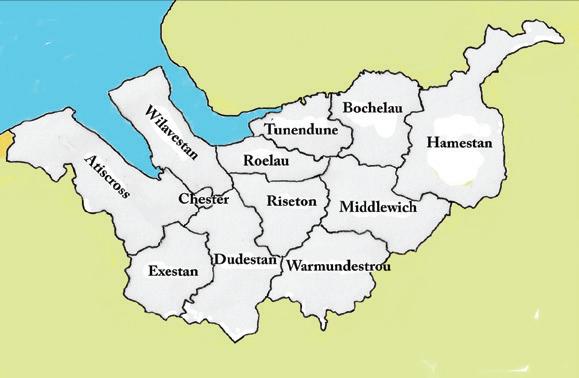
Sometime in the eighth century hundreds were created with several townships being grouped together, in such a way that the combined total of all the townships was a hundred hides. Hence the name “hundreds”. This was the original aim, but it became impractical as the townships grew or declined, and later most of the Hundreds had more or fewer than a hundred hides. The hundreds evolved before the shires. In Anglo-Saxon times Budworth was in a hundred called Tunendune. Tunendune which was part of Mercia.
During the Anglo-Saxon period there was the start of local administration in Cheshire.
A Constable was appointed for each hundred to maintain law and order Each hundred had its own court which met every four weeks. Reeves were appointed, whose main function was the collection of geld (the tax which was a combination of income tax and rates) and fines levelled by the courts.
1 Origins of Cheshire page 101~ N.J Higham
2 A hide is unit of assessment especially tax. In agricultural townships a hide was approximately 120 acres but other nonagricultural assets were considered for taxation purposes. A virgates was a division of a hide, with 4 virgates equalling a hide.
The earliest record of Cheshire as a separate area was in 980 AD in the Anglo-Saxon Chronicles “Legeceasterscir was harried by a pirate host from the North”1 .
In the Domesday Book Cheshire had become Cestrescire.
The hundreds and county boundaries usually followed rivers and other topographical features. Cheshire was mainly bordered by the Mersey and the Dee. Tunendune was mainly bordered by the Mersey and Weaver.
Each county was subdivided into hundreds2. Cheshire was divided into 12 hundreds ~ as the map above. The county had the same officers as in the hundreds. The reeve was the shire reeve hence the name sheriff evolved.
The term “hundreds” was still being used in the 20th Century despite its roots coming from the Anglo Saxon period.
1 The Anglo-Saxon Chronicles ~ A revised translation by D Whitelock
2 A hundred became an administrative subdivision of a shire with fiscal, judical and military functions.
The 12 hundreds in Cheshire before the Normans
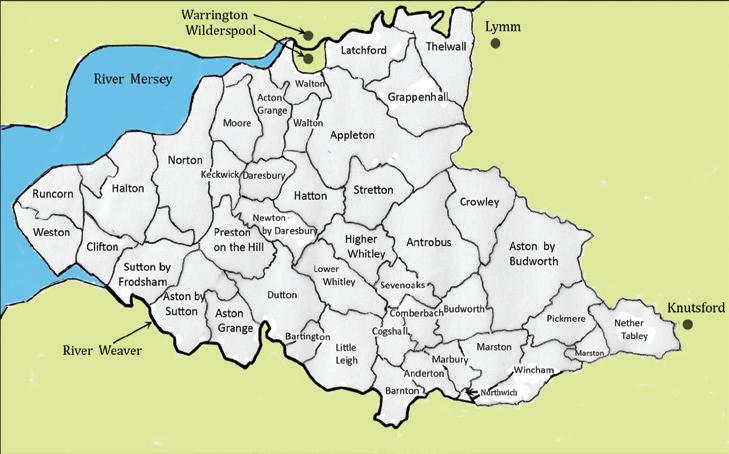
The Anglo-Saxon hundred of Tunendune
Note that the hundreds of Exestan and Atiiscross are now part of North Wales, but in Anglo-Saxon period they were in Cheshire.
This part of North Wales was mostly east of Wat’s Dyke and Offa’s Dyke; these Dykes were built in the 6th and 7th Centuries as a boundary between England and Wales. This area was highly valued by the Romans and Normans, because it contained iron and lead mines. Lead was an important building material in the Roman era and medieval period.
So undoubtedly Budworth existed as a small village during the Anglo-Saxon era, but there are no records or artefacts of this period.
The name is the main proof of Anglo-Saxon occupation. We will see in the Domesday Book that Budworth is named Budewrde ~ so it must have been given this name by the Anglo-Saxons.
Even after the creation of counties, hundreds still had an important role.
At various times between the Anglo-Saxon Period and 13th
Century, there were several changes with the hundreds in Cheshire.
1) Chester became a city and ceased to be a hundred.
2) Bochelau was amalgamated with Tunendune to form Bucklow.
3) Part of Northwich was in a separate hundred called Roelau, which was joined with Riseton to make Eddisbury.
4) Atiscross and Exestan were ceded to the Welsh and part of Dudestan became part of Shropshire.
5) A number of hundreds changed their names’. Hameston became Macclesfield. Middlewich became Northwich. Warmundestrou became Nantwich and Dudestan became Broxton.
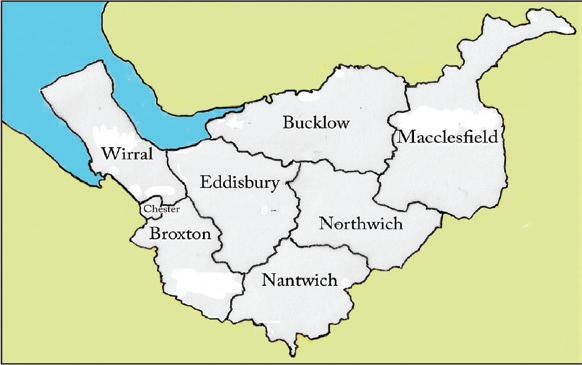
Between the Anglo-Saxon period and the 14th Century these 12 Anglo-Saxon hundreds became 7 hundreds as shown on the map below. These 7 hundreds remained an essential part of the administration of Cheshire until the Local Government reorganisation in the 20th Century.
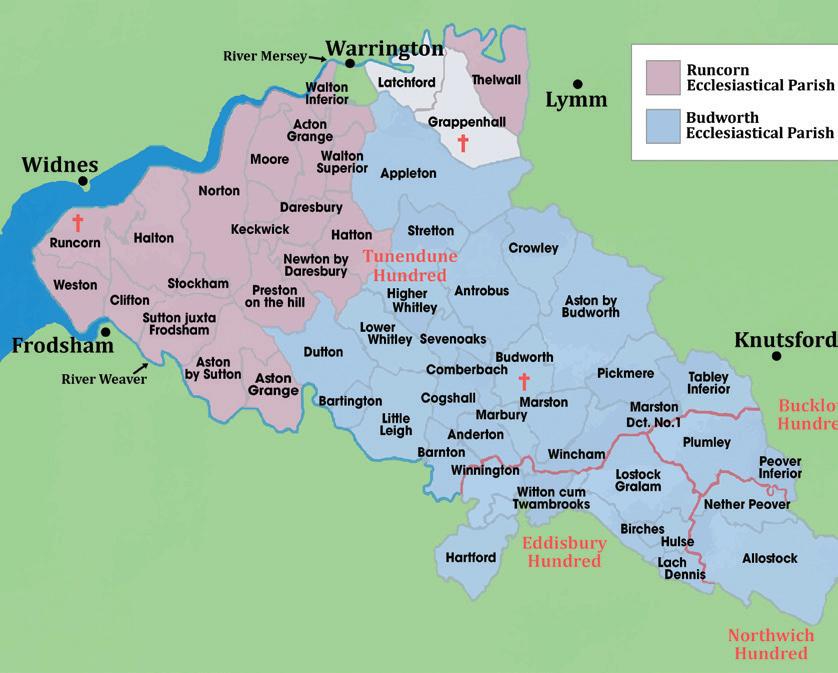
Budworth was in the Bucklow Hundred and although Budworth is much nearer to Northwich than Halton (or Runcorn), ever since Anglo-Saxon times, for administrative and ecclesiastical purposes, Budworth has been more closely aligned to Halton (or Runcorn) than Northwich.
The 7 Hundreds in Cheshire after the Normans
THE NORMANS
The Battle of Hastings
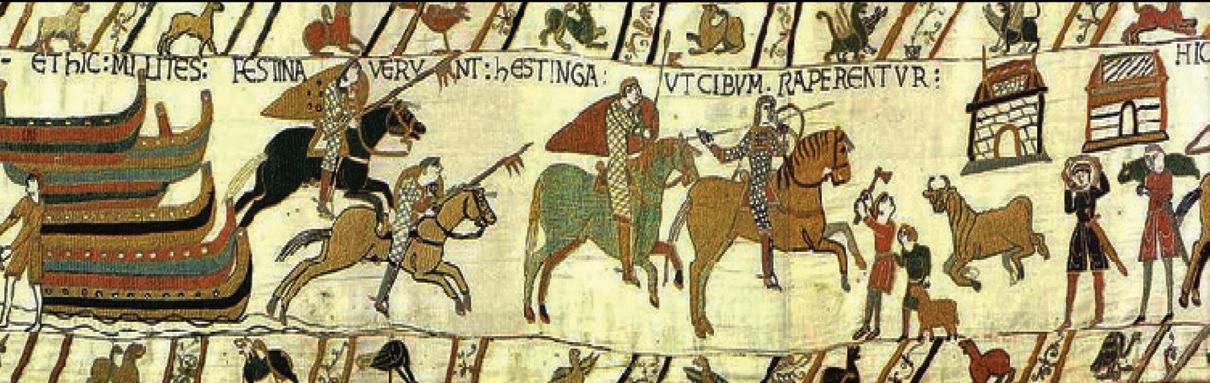
The Battle of Hastings was one of the most significant events in English history and it even had an influence on the history of Budworth.
When Edward the Confessor died in January 1066, he did not have a son or a close relative. Harold Godwinson was Earl of Wessex and Edward promised him the Crown on his deathbed. Harold was crowned King of England the same day.
William, Duke of Normandy believed he had a legitimate claim to the English throne. Edward’s mother Emma was William’s great aunt. When he heard that Harold had been crowned King of England, William started to prepare to invade England, to confirm his claim. In 8 months he assembled a force of about 10,000 men and 600 ships.
But at about the same time there were Viking claimants to the throne, who invaded Northumbria. On the 20th September 1066, they beat Earl Morcar of Northumbria and Earl Edwin of Mercia at the Battle of Fulford, near York.
King Harold quickly assembled an army and marched north and on the 25th September (only five days later) he beat the Vikings at the Battle of Stamford Bridge.
In the meantime William had assembled his force to invade England. The majority of these soldiers were from Normandy, but there were many mercenaries from Flanders, Brittany and other parts of France and Europe. These mercenaries were tempted by the thoughts of the spoils of battle.
This force arrived in Pevensey, Sussex on the 27th September 1066. Harold expected an invasion, but he did not know when and where it would land.
Harold marched back the 200 miles from Stamford Bridge to London. He assembled the biggest army he could. and then marched to Pevensey. Some of Harold’s army were the same troops who had fought at Stamford Bridge, supplemented by new troops; however they were disorganised and tired. Chapter 3
Harold engaged with William, Duke of Normandy on the 14th October 1066, at an area which is now called Battle, near Hastings. William had been established in England with his troops having spent 3 weeks organising themselves.
Not surprisingly William defeated Harold in the Battle of Hastings.
The Norman invasion and aftermath were brutal and thorough.
Prior to the invasion, the nobility of England owned land and buildings, but this was all confiscated by the Normans. After the Norman Conquest the only land owners were the King and the Church. William appointed earls who in turn appointed barons to rule the Country. The barons were tenants in chief, the lords of the manor were all tenants.
William was crowned the King of England on Christmas Day 1066. In the following years there were several rebellions throughout England against the Norman occupation, these were all savagely quashed by the Normans. This was known as the "Harrying of the North".
In 1069-70, the men of Cheshire rebelled against the Norman occupation, this didn’t please William.
King William governed England by appointing Earls who had complete control of their Earldoms. William Gherbod was the Earl of Chester for a short time, but in 1070 he died in France.
In 1066, William had asked his ally, Richard le Goz, Viscount d’Avranches, to stay behind in Normandy, to ensure that none of the rival Comtes and Vicomtes took advantage of William’s absence. Richard had provided sixty ships for William’s invasion to England, so William was indebted to Richard le Goz.
. Richard le Goz was married to Emma, who was possibly William’s sister. Richard and Emma’s eldest son was Hugh d’Avranches who probably fought at the Battle of Hastings. If Emma was William’s sister, Hugh was William’s nephew.
In 1071 William appointed his trusted nephew, Hugh d’Avranches, who is regarded as the 1st Earl of Chester although Gherbod was previously the Earl for a short time.
Between 1066 and 1071 Hugh d’Avranches had been put in charge of Tutbury in Staffordshire.
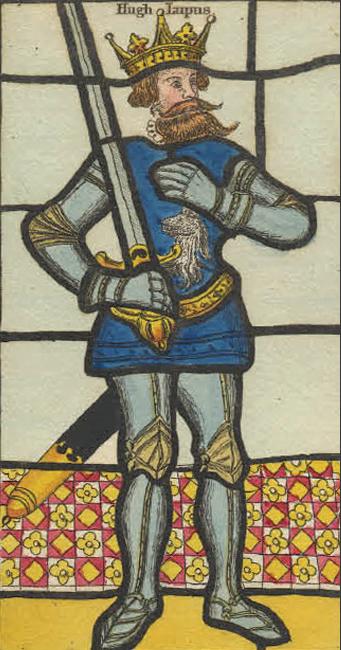
Hugh d’Avranches not only controlled Cheshire as we know it, but also parts of Lancashire, and a large tract of North Wales; he briefly raided Wales as far as Anglesey. Hugh was so ferocious ~ particularly with the Welsh ~ he was called Hugh Lupus ~ “Hugh the Wolf”.
In addition he became the Vicomte d’Avranches in Normandy when his step-father died in 1082.
Cheshire was unique, and had the most interesting administration in medieval England. Cheshire was made a county palatine, which meant that Cheshire was almost a separate country from the rest of England, similar to Wales today. There were only two other county palatines in England, Lancashire which achieved palatine status in 1351 and Durham which was an ecclesiastical palatine.
The reason for this importance was the geographical position of Cheshire. The main route to Scotland was on the east side of the Pennines, with a secondary route on the west side of the Pennines through Cheshire. To the north was Lancashire which was backward and poorly developed. However the route to Ireland was from Chester, sailing from Chester avoided the problem of crossing the Mersey. Cheshire had a border with Wales, the route to North Wales was along the coast through Chester.
This made Chester and hence Cheshire an important junction.
Hugh Lupus was like a dictator, given a free hand in running Cheshire. He could make his own laws to ensure he had total control, make his own charters, raise his own army and do virtually what he liked. Rebellions were quickly crushed.
In his early years his favourite pastime was hunting. and to further that he created three huge forests in Delamere, Macclesfield and the Wirral. These were not forests as we know today, they did not necessarily have any trees. The word “forest” is derived from the Latin “forestis” meaning outdoor. To the Normans a forest was an area of open countryside consisting of a variable mixture of woodland, heathland, scrub and agricultural land. Its purpose was to raise deer and boars for hunting, which needed a variety of land to breed, feed and rest and was governed by Forest Laws.
Hugh was ruthless in creating these forests and destroyed and laid waste many farms, houses or villages which lay in his way.
It is estimated that about 40% of Cheshire became part of his forests. There were some people living in the areas designated as forests but they were very restricted in what they could do.
If they broke any laws the penalties were severe. Anyone found killing a deer or boar was blinded for life. Or anyone caught stealing, had his hands cut off.
Luckily Budworth was outside any of these forests and so it was spared the forest law.
(1) “Cheshire under the Norman Earls” B. M.C.Husain
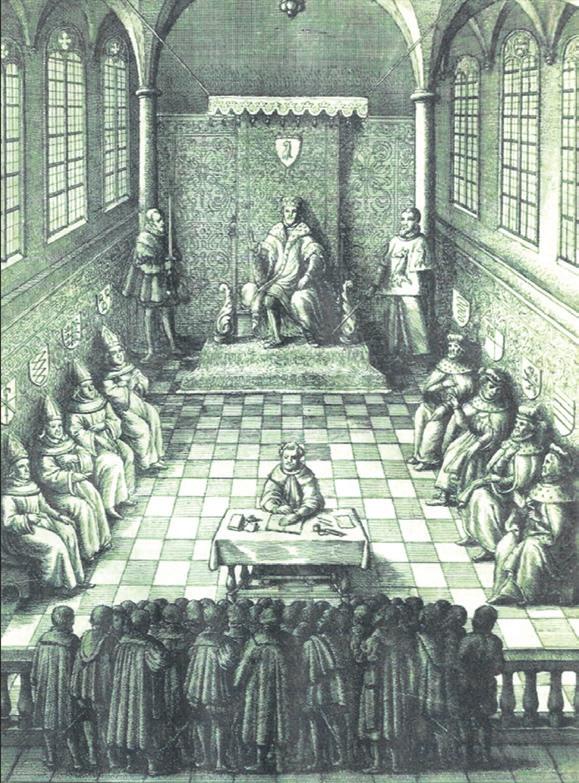
“Hugh Lupus, Earl of Chester, sitting in his parliament with the Barons and Abbots of that Countie Palatine”. Engraving in 1718 edition of William Dugdale’s Monasticon Anglicanum
Hugh Lupus ~ 1st Earl of Chester Window at Stoneleigh Abbey
Hugh Lupus was a ruthless and vicious man. His very name meant “Hugh the Wolf” but he was also called “Hugh the Fat”. He was described by a contemporary historian Orderic Vitalis
“This man with the help of many cruel barons, shed much Welsh blood. His retinue was more like an army than a household. Each day he devastated his own land and he preferred falconers and huntsmen to the cultivators of the soil and ministers of heaven. He was so much a slave to his own gluttony of his belly that, weighed down by his own fat, he could hardly move. From harlots he had many children of both sexes, who almost all came to an unfortunate end”
Hugh controlled Cheshire by sub-letting control of the land to 8 barons as tenants in chief. The Earl and his barons were hated and feared by the local population of Cheshire. This is not surprising, as they had confiscated all their lands Most of these barons built castles for security and prestige. Initially these castles were wooden but in time they were replaced by impressive stone structures. They were primarily built for security reasons but also as a status symbol.
The original 8 Barons were :~
Nigel Contentin ~ 1st Baron of Halton ~ Halton Castle
Robert de Montalt ~ 1st Baron of Montath ~ Mold Castle
William Maldenburg ~ 1st Baron of Malbank ~ Nantwich Castle
Richard de Vernon ~ 1st Baron of Shipbook
Hugh FitzHugh ~ 1st Baron of Malpas ~ Malpas Castle
Hamo de Masey ~ 1st Baron of Dunham ~ Dunham Castle
Gislebert de Venables ~ 1st Baron of Kinderton
Robert de Stockporte ~1st Baron of Stockport ~ Stockport Castle
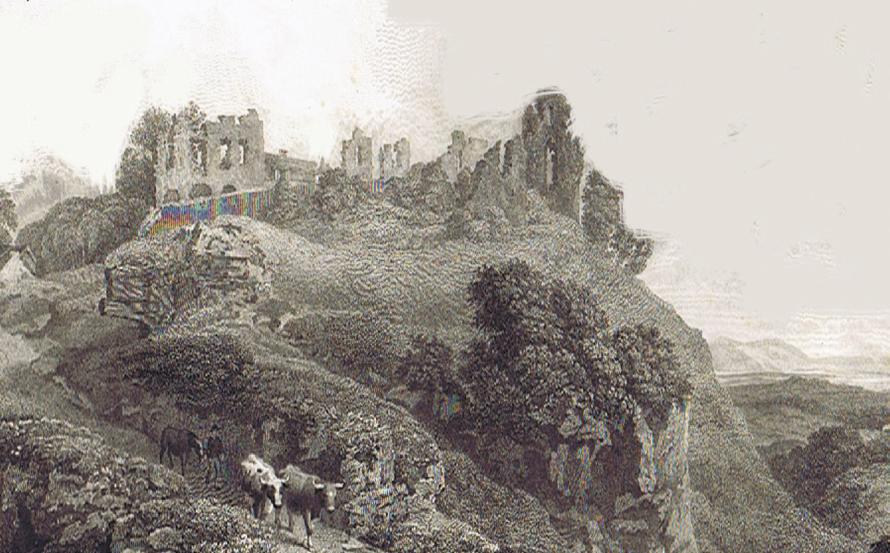
Nigel Contentin the 1st Baron of Halton was Hugh Lupus’s most powerful Baron and the hereditary Constable of Chester and he was granted the largest amount of land of any of the original barons. He built the first Halton Castle; a wooden “motte and bailey” castle. He died about 1080 and was succeeded by his son William FitzNigel. In the 13th century, this early castle was replaced by a sandstone castle. The castle overlooked the estuary of the River Mersey and was in a dominating and strategic position.
The ruins of Halton Castle in the 19th Century ~ Ormerod
The Domesday Book
At Christmas 1085, 19 years after the Norman Conquest, King William held a council with his most trusted Bishops and Earls in Gloucester.
They decided to commission a survey of the whole country. His commissioners were to go out in the country to interrogate all the Earls, Barons, Reeves and Clergy about every manor and township in England.
This was so that William;~
1) had a description of all his land
2) knew how much of the land he owned
3) most importantly ~ knew how much geld was due to him.
This survey is known as the Domesday Book. The geld was a mixture of what we know today as rates and income tax. It was first initiated under the Anglo Saxons with their system of hidations and Hundreds. Today the Domesday Book gives a wealth of information for the local historian, about the topography of the country, the names of tenants and the economy of the area. It is very important as it is the earliest document which gives any details about Budworth.
This enormous survey was completed in less than a year, which was a remarkable achievement. There are over 13,000 different towns and villages quoted. Obviously the commissioners could not undertake any actual surveys ~ all the information was gleaned by interrogation. For the year of 1086 nearly every literate person in the country was involved to some extent in the Domesday Book.
The standard questions (which applied to Budworth) were:~
1) What is the township called?
2) Who holds it now (i.e. in 1086)?
3) Who held it in the time of King Edward (i.e. before 1066)?
4) How many hides are there?
5) How many ploughs on the demesne (i.e., local lord’s own land) and among the men (i.e. rest of the village)?
6) How many free men, sokemen, villans, cottagers, slaves?
7) How much woodland, meadow, pasture, mills, fisheries?
8) How much was the whole worth (before 1066) and how much now (1086)?
All these questions to be recorded three times: in the time of King Edward (i.e. before 1066), when William gained it (usually in 1066), and now (1086).
Nearly every County in England (34 in total) is covered in the Domesday Book. Cheshire is in County Number 26 with pages 262 to 271. Cheshire is called Cestrescire and details Cheshire as we know it today, plus part of North Wales, part of Cumbria and the part of Lancashire between the rivers the Ribble and the Mersey.
The original Domesday Book was hand written in Latin shorthand, and very difficult to read and understand. In 1783 Abraham Farley published the whole Domesday Book in printed text, but, still in Latin shorthand, this is easier to read, but still difficult to understand. There have been several translations of this and the version we will use is the Victoria History of Cheshire.
The first section of the Cheshire Domesday lists all the laws of Chester that Hugh Lupus, Earl of Chester, created. These laws were different to other parts of England
The second section of the Domesday Book lists all the townships and it is divided into sections depending on which Baron holds it. The ninth part lists the 29 townships that were held by William FitzNigel, the Baron of Halton.
These are (with the 1086 Domesday geld value in brackets);~
This is actual hand written entry for Budworth in the Domesday Book in 1086. In Latin shorthand
The same William holds BUDEWRDE and Pagen [holds it] of him. Edward held it as a free man. There [is] 1 hide that pays geld. The land is for 2 ploughs. In demense is ½ plough and 1 serf and a priest and 2 villans and 1 border with 1 plough, and a mill serving the hall (aula) There[are] 1½ acres of meadow. T.R.E. it was worth 6s and now 8s
This is Abraham Farley’s printed version of the entry for Budworth in the Domesday Book in 1783. Still in Latin shorthand
Modern translation1 of the entry for Budworth in the Domesday Book.
The standard questions and answers for Budworth are:~
Standard Question 1) What is the manor/township called?
Budworth Answer “BUDEWRDE”
Standard Question 2) Who holds it now (in 1086)?
Budworth Answer “The same William holds BUDEWRDE and Pagen [holds it] of him”.
The Domesday Book says that William FitzNigel was the tenant in chief who holds Budworth and that Pagen was the tenant and Lord of the Manor for Budworth. Elsewhere in the Domesday Book it states Pagen was the tenant and Lord of the Manor for Aston by Budworth, and he was also joint Lord of the Manor for Whitley.
Pagen is not an Old English name so he must have been a Norman soldier and was rewarded with the Manors of Budworth, Aston by Budworth, Whitley and Cogshall.
1 Modern translation of Budworth entry in the Domesday Book.~ Victoria History of County of Cheshire Volume 1 page 357
Standard Question 3) Who held it in the time of King Edward (in 1066)?
Budworth Answer - “Edward held it as a free man”.
Edward held Budworth prior to the Conquest. (Edward was Lord of the Manor of Budworth prior to the Conquest ~ not to be confused with Edward the Confessor, King of England)
This confirms that Budworth was a village in Saxon times before it was confiscated from Edward and given to Pagen. According to other parts of the Domesday Book Edward held the following townships, all under Baron William FitzNigel
Township Hundred Anglo Saxon Owner Norman Tenant
Clutton Riseton Edward/Young Wulfrin Frenchman
Peover Bochelau Edward Not Known
Dutton Tunendune Edward Not Known
Leigh Tunendune Edward Not Known
Budworth Tunendune Edward Pagen
All under Baron Osbern
Lymm Bochelau Edward Edward
Dutton Tunendune Edward Edward Grappenhall Tunendune Edward and Dot Edward
Edward is a very common name, we are not completely sure that it was the same person who held a total of 7 townships before the Conquest. But if there was more than one Edward he would probably have had a suffix added to his name.
If Edward was the same person, he held 8 townships before the Conquest, but after the conquest he was deposed by the Baron of Halton from the 5 of the townships he held in Tunendune, but he retained 3 townships; Lymm, Grappenhall and jointly Dutton.
Only a few Saxons owners became Norman tenants. It must have been heartbreaking to lose the ownership of these townships and become a tenant of a small part of his former holding.
It should be noted that there were only 2 townships in Tunendune that had a priest, Halton and Budworth. In Bochelau priests were equally uncommon. However one of these was in Lymm. So in the Anglo Saxon period Edward had appointed priests in Lymm and Budworth and Grappenhall, maybe each had an early church.
Standard Question No 4) How many hides are there?
Budworth Answer - There [is] 1 hide that pays geld. If the only taxable asset was agricultural land a hide is nominally about 120 acres, but Budworth had a mill, which was a taxable asset. So Budworth would not have had a hide of agricultural land.
Standard Question No 5) How many ploughs (teams) on the demesne (local lord’s own land) and among the men (rest of the village)?
Budworth Answer - The land is for 2 ploughs. In demense is ½ plough.
The plough is an area of land, not an agricultural implement, the commissioners were not interested in agricultural implements. This is the agricultural capacity of the township, it is not necessarily the amount of land being cultivated. Again it is saying that there is about 120 acres and that 30 acres is held by the Lord of the Manor.
Standard Question No 6) How many free men, sokemen, villeins, cottagers, slaves?
Budworth Answer - “1 serf, a priest, 2 villans and 1 border with 1 plough
The serf (or slave) would have been owned by Pagen like a chattel, he would not be able to do anything without the permission of Pagen. He would not be allowed to marry without his permission, but if he did marry his wife and children would also be slaves.
The Domesday Book says there is a priest but it does not mention a Church. This is not unusual, a church is not liable to geld, so is no interest for fiscal purposes. In Tunendune the only townships with priests were Halton and Budworth.
The Budworth priest would have served the whole of the Eastern half of Tundendune.
The 2 villans were small tenant farmers, who were required to do work for the Lord of the Manor farming his land but also operating the mill.
The border with 1 plough would be a smallholder who would have paid rent to the Lord of the Manor.
Standard Question No 7) How much woodland, meadow, pasture, mills, fisheries?
Budworth Answer - 1½ acres of meadow, a mill serving the hall (aula) .
This meadow is the amount of land used to graze livestock
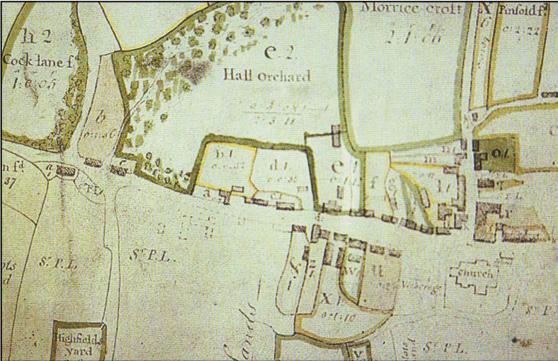
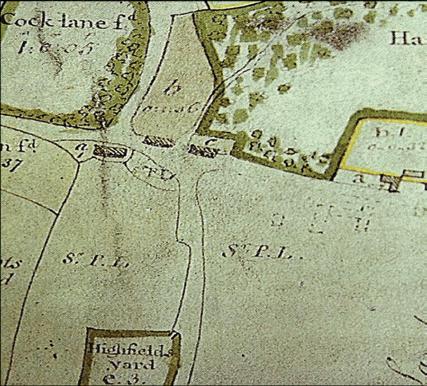
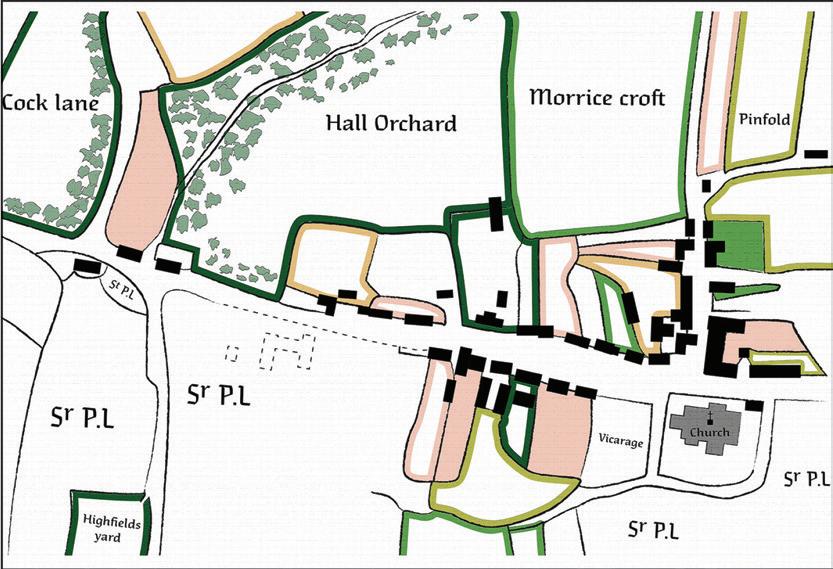
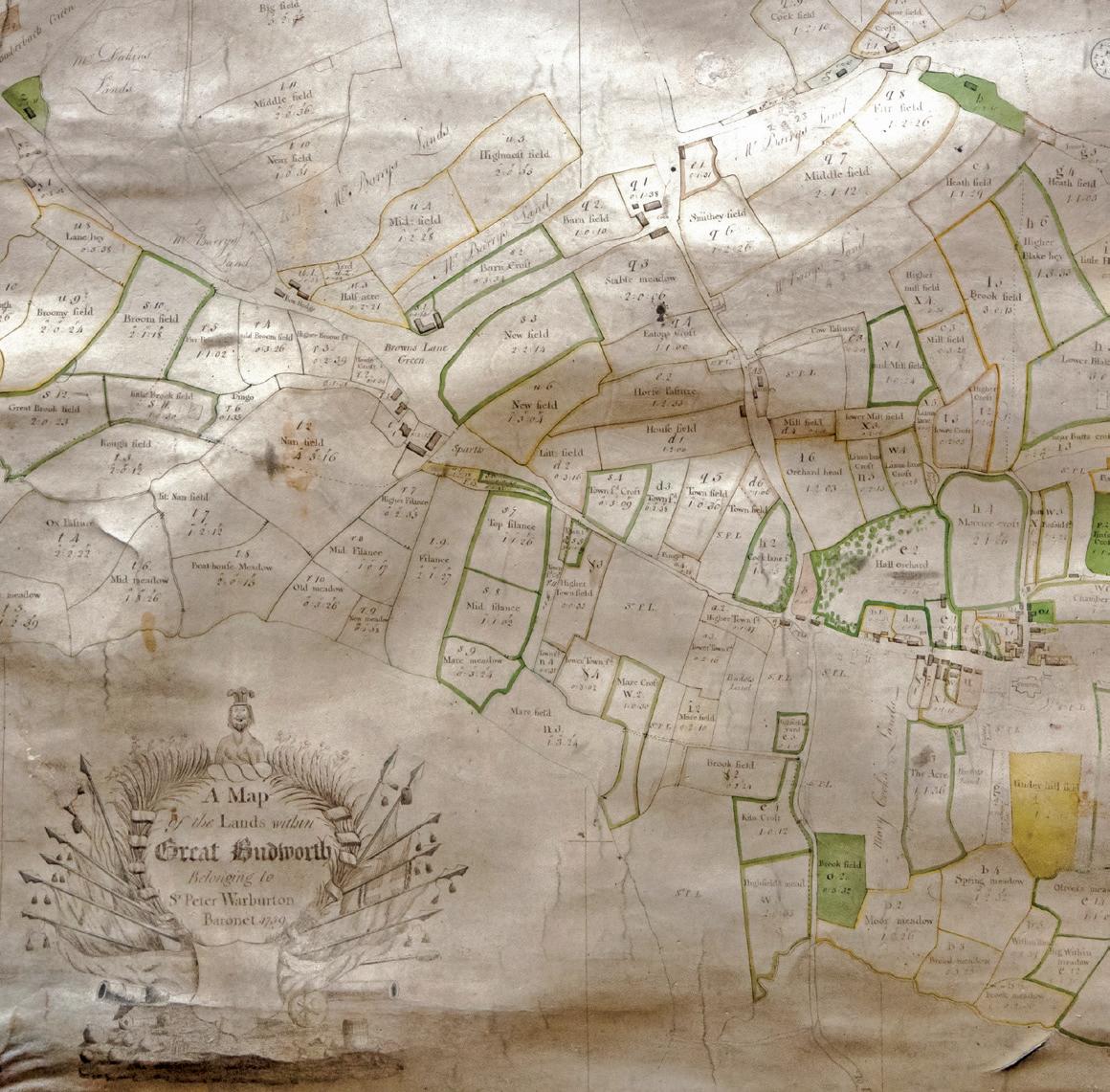
The Domesday Book says “a mill which serves the Hall” this means that there was a mill in the village. The mill would have been a water mill. This was quite unusual, there were only 18 mills in the whole of Cheshire and Budworth was the only township in Tunendune with a mill. It is likely that the mill used water from the Dene. Windmills were not present in Cheshire until the 13th century(1). Today the normal flow of water is not sufficient to drive a mill, So either the flow was different a thousand years ago or they could have built a dam to hold back sufficient water to operate the mill when needed. In medieval times they were quite advanced with water mills. Crude water mills were even operated in the Graeco-Roman Era (2). The Roman Road would have been used to transport crops to be milled from surrounding villages. The Warburton estate map (below) shows two houses with the stream running between them. This could be the site where the mill was.
2 Windmills and Watermills of Wirral ~ Rowan Patel p2
Standard Question No 8 How much was the whole worth (1066) and how much now (1086)?
Budworth Answer - T.R.E. it was worth 6s and now 8s
These initials are for Tempore Regis Edwardi which translates At the “time of King Edward”, King Edward the Confessor died in January 1066, he was followed by Harold. But William the Conqueror never acknowledged that Harold was his predecessor. The Domesday Book says that the geld of Budworth was 6s before the Invasion and 8s after the Invasion.
This confirms that unlike a lot of other villages in Cheshire, Budworth was not laid to waste by King William.
Note The Bank of England Inflation Calculator shows that 8s in 1209 is equivalent to £833 today. Thus the value of the Geld due from Pagen to King William was about £900 in todays currency
The Warburton Estate Map of 1759
1 Windmills and Watermills of Wirral ~ Rowan Patel p16
Conclusions from the Domesday
1) In a study H.C.Darby1 counted the number of people mentioned in the Domesday and then multiplied by 5 to give an estimate of the total population of each of the 8 counties of Mercia.
This shows the population of Gloucestershire as roughly 5 times that of Cheshire. Today they both have roughly the same population, this shows how sparsely Cheshire was populated, In 1086 it had the lowest county population in Mercia and was one of the poorest counties in England.
2) Within Cheshire the amount of geld paid gives an approximate idea of the prosperity of the townships in Tunendune. Budworth was the 7th most prosperous Township in Tunendune ~ measured by the amount of geld paid. The full list of neighbouring townships are Halton (104s), Weston (35s) Aston Nr Runcorn (20s) Clifton (10s), Hatton (9s 4d), Norton (9s 4d), Budworth (8s), Whitley (6s), Grappenhall (6s), Leigh (4s), Marston (4s), Dutton (3s 6d), Bartington (5s 4d), Appleton (0s), Wincham (0s) The following townships, and several others, are in the hundred of Tunendune but are not included in the Domesday Book Anderton, Antrobus Barnton, Comberbach, Crowley, Daresbury, Latchford, Marbury Pickmere, Stretton, Thelwall,
3) Budworth was important because it was the only Township in Tunendune that had a mill. Undoubtedly the Roman Road would have been important in facilitating farmers from neighbouring townships to bring their crops to be milled in Budworth
2 The Origins of Cheshire N.J.Higham P204
4) Budworth had a priest. The only other Township in Tunendune that had a priest was Halton that had 2 priests. The priest from Budworth would have been serving the surrounding Townships in eastern Tunendune. This would have been the foundation of Budworth being a major ecclesiastical parish in Cheshire.
5) At the time of Domesday, Budworth only had a population of about 30. They could only have cultivated a few acres of land, little more than a few allotments. But it would have been a small self sufficient agricultural community.
6) It is possible, that the whole population ~ all 30 ~ lived in the corridor either side of the Roman Road, between the Mere and The Cock o’ Budworth. This area had the Roman Road and a good supply of water.
Budworth Heath was scrub-land until the 16th century, it is possible that at the time of the Norman Invasion the area which is now the main village was still scrub-land. The Domesday Book only says there is agricultural land for 2 ploughs about 120 acres, 1½ acres of meadow. This could easily be accommodated in the corridor either side of the Roman Road.
7) It could be the Church was also to be in this area adjacent to the water and Roman Road.
We have no proof of this, and would need some archaeological evidence for confirmation.
Note. As stated in footnote on page 19. A hide is unit of assessment of tax. It was approximately about 120 acres but because it was used for fiscal reasons it varied. If the land is poor the area was larger and if it was good it was smaller. A plough is an agricultural description of the capacity land that can be ploughed by a plough with 8 oxen. It does not necessarily infer that it is being farmed.
The Earls and Barons of Cheshire. When William 1 conquered England he was an absolute ruler. Apart from the Church he owned all the land, he made all the laws and collected all the taxes for himself.
He ruled the country by appointing Earls and Barons. The Earldoms and Baronetcies were inherited by their heirs. Initially this feudal system continued after Williams death in 1087, but gradually there were changes making the monarchy less dictatorial, especially after the Magna Carta in 1215.
But land ownership had changed for ever, the Normans were now the landlords for all. Budworth was always under the Earl of Chester and the Baron of Halton. Although these Earls and Barons were not directly involved in Budworth, their history indicates how Cheshire and Budworth were run under the 300 years of Norman rule. Also it is interesting to see how the Earls of Chester and Barons of Halton were influential in the National picture. The Baron of Halton was the senior Baron in Cheshire and held the hereditary title of Constable of Cheshire and he was the leading military figure in the County.
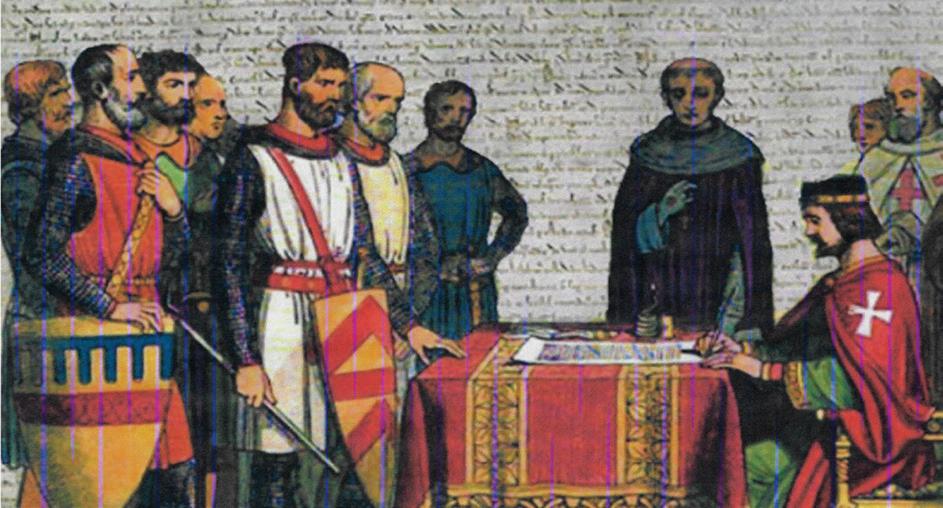
It shows the standing of the Earls of Chester and the Barons of Halton in England, that at the sealing of the Magna Carta at Runnymede in 1215, there were 25 Barons from the whole of England wanting to change the standing of the Monarch, one of these was John de Lacy, 8th Baron of Halton. On the other side was King John and he was supported by 25 Earls, one of which was Ranulf III, 6th Earl of Chester.
Because Cheshire was a Palatine County, the Magna Carta did not apply to Cheshire. There was a separate Cheshire Magna Carta made in 1215, between Ranulf III and the Cheshire Barons, this was rescinded by Henry VIII in 1530.
It is ironic that a later Baron of Halton became King of England and the Baron of Halton is now a minor title of the Monarch, whilst the Earl of Chester became a minor title of the Prince of Wales.
The full details of the Earls of Cheshire and Barons of Halton are listed in the Appendices.
King John sealing the Magna Carta
Chapter 4
THE DUTTONS 1066 ~1310
The Dutton’s laid the foundations for the Warburton’s who were responsible for the destiny of Great Budworth for the next millenium.
The Start of the Dutton/Warburton Dynasty
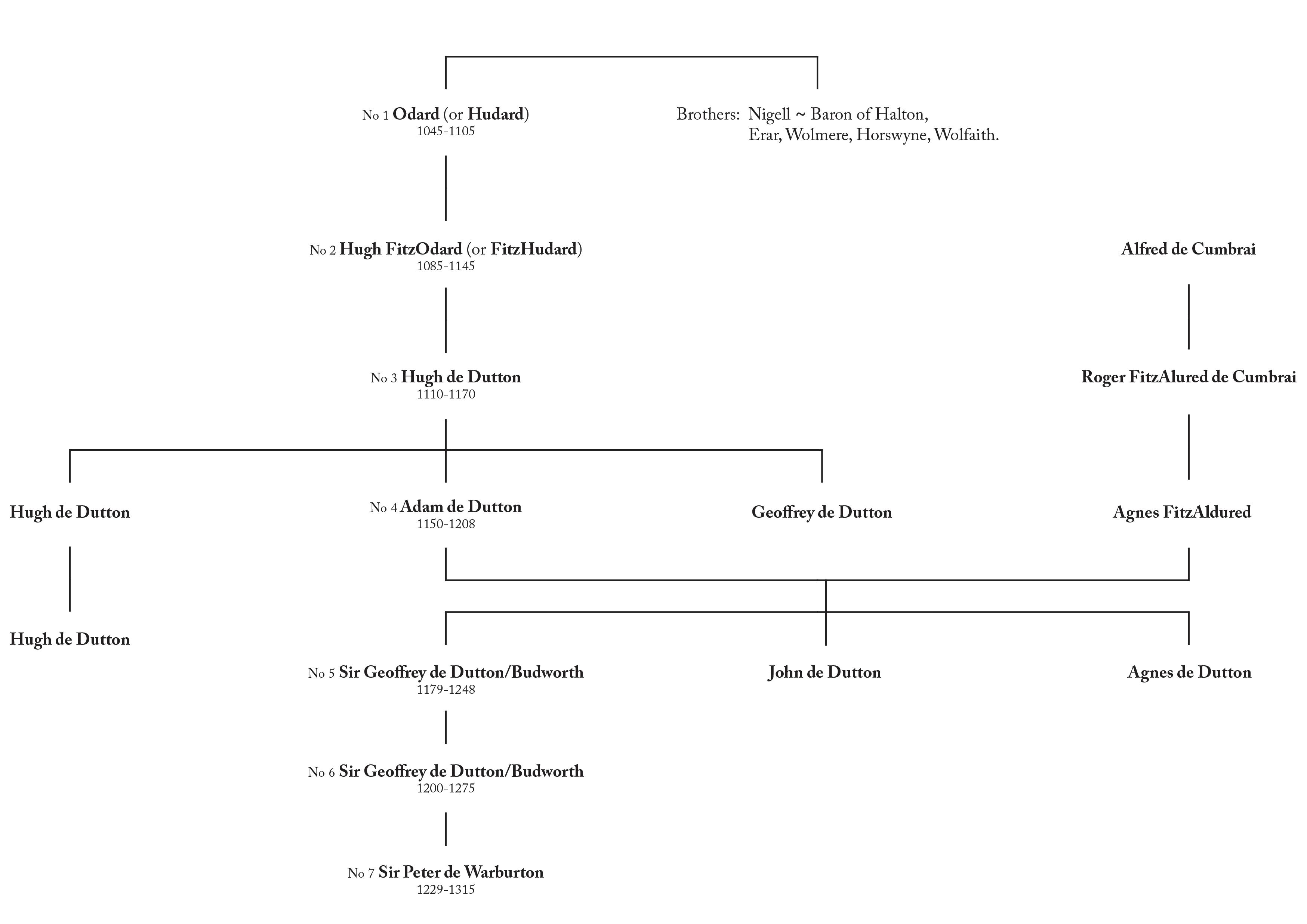
The chief of the supporters of the Earl’s of Chester and Baron’s were the Dutton’s. After the Earl of Chester, the most important man in Cheshire was the Baron of Halton who was also the Constable of Cheshire. A very early document tells us that when Nigel, the 1st Baron of Halton, came to Cheshire in the Norman Conquest in 1066, he came with 5 brothers and the eldest was Odard (or Hodard).
The Dutton Pedigree in Ormerod1 says
The ancient roll of the barons of Halton saith that with Hugh Earl of Chester came one Nigell a nobleman and with Nigell came five brethern to wit Hudard, Edard, Wolmere, Horswyne and Wolfaith.
Wolfaith was the priest at the Church in Halton.
Odard (or Hodard) held a hide of land in Halton and he was the joint Lord of the Manor with Brictic of Weston. Also he was the Lord of the Manor of Aston (nr. Halton) these were all townships under Nigel the 1st Baron of Halton. Odard (or Hodard) held Dutton directly under Hugh Lupus, Earl of Chester, it was unusual to hold a township directly under the Earl of Chester. There was usually a Baron between the Earl and the landholder.
A detailed examination shows that he had some lands virtually the whole way down the east bank of the Weaver from Runcorn to Northwich. Clearly his role was to hold a line of the Weaver against mounted bands of Welshmen who might try to get into the mainly peaceful heart of Cheshire and round up cattle and drive them back to the Welsh hills. Dutton was an old Roman settlement on high ground overlooking the main stretch of the river Weaver.
Odard was the start of the Dutton/Warburton dynasty that would be influential in Budworth and Cheshire over the next millennium. He must have had a close relationship with Hugh Lupus, the Earl of Chester and his brother Nigel, the Baron of Halton.
1 Dutton Pedigree Ormerod p 476
Odard lived in Keckwick, near Daresbury, Keckwick is a small hamlet and was in the township of Aston (nr Halton), He had a son, who was known as Hugh FitzOdard (1085-1145) and possibly named after Hugh Lupus
As Hugh FitzOdard had a large land holding in the area, he possibly helped William FitzNigel, the second Baron of Halton, to establish the first Priory of Runcorn in 1115. This was started by a community of Augustinian canons on the south bank of the River Mersey where it narrows to form the Runcorn Gap. This was the only practical site where the Mersey could be crossed between Warrington and Birkenhead.
The Priory was the second religious house to be founded in the Earldom of Chester, the first was the Benedictine Saint Werburgh’s Abbey at Chester, founded in 1093 by Hugh Lupus.
The Priory at Runcorn had a double dedication, to Saint Bertelin and to Saint Mary.
In 1134 the Priory was moved from Runcorn to Norton.
Norton Priory is about a mile from Keckwick (where Hugh FitzOdard lived). So it is probable that Hugh FitzOdard was involved in the moving of the Priory.
Hugh FitzOdard had one son, also called Hugh, he moved his seat from Keckwick to Dutton and styled his name to Hugh de Dutton. Hugh built a house which became Dutton Hall, which was a large farm with land going down to the River Weaver.
Hugh de Dutton (1110-1170) had three sons Hugh de Dutton, who was the eldest, then Adam de Dutton (1150-1208) and Geoffrey de Dutton who was the youngest. Hugh de Dutton (the elder) was left land in Dutton and gave his younger sons a part of his own lands, Adam was left land in Sutton Weaver. Sutton was beside Aston which had probably descended to an earlier younger son of the Duttons and Geoffrey was given land in neighbouring Clifton.
As these sons grew into adulthood in the late 1160’s and early 1170’s, they all married heiresses.
The eldest son Hugh (the younger) married the daughter of Hamon Massy, the Baron of Dunham Massey.
The middle son, Adam, married Agnes de Cumbrai, daughter of Roger FitzAlured son of Alfred de Cumbrai, who was a very large landowner. Roger FitzAlured’s second wife was Maud de Frodsham. On their marriage Adam became a very large landowner, including land in Warburton. He built and lived in Sutton Hall between Dutton and Halton.
The youngest son, Geoffrey, married Margaret de Chedle, the daughter of the Lord of Cheadle and his children inherited lands in Cheadle.
So the wider Dutton family was increasing in affluence in Cheshire.
The Dutton Branch descending from Hugh de Dutton In the early Medieval Period the major landowners were expected to provide the military with finance and personnel.
The Duttons, were the largest landowners in this part of Cheshire, and they would have been called on to provide men for the Cheshire Archers every time the Crown required them. All their more substantial tenants were required to follow their Dutton lord to the wars when called upon – (a condition of their tenure which was repeated in the surviving written leases to Tudor times).
So Budworth men would often have been among the men in the Cheshire Archers. The Cheshire Archers were a body of elite soldiers noted for their skills with the longbow that fought in many engagements in Britain and France in the Medieval Period.
In 1277 the King Edward passed a law that every man and boy, including the nobility, should learn to use long bows and practice its use in areas called butts. (The origin of The Butts in Budworth).
“Leycester’s Historical Antiquities,” pp. 248-260
In the Hundred Years War, between England and France there were several battles at which there were sizeable numbers of Cheshire Archers, these included Crecy (1346), Poitiers (1356), Agincourt (1415).
King Richard II was so impressed with the Cheshire Archers that he employed some of these yeoman as his personal bodyguard.
When Hugh de Dutton (the elder) died in 1170, his eldest son, Hugh, inherited Dutton Hall and an extensive estate in the area. This branch of the Dutton family had an interesting military history. Sir Thomas Dutton (grandson of Hugh de Dutton) distinguishing himself in the Battles of Poitiers and Agincourt. At Agincourt 6,000 Englishmen defeated 24,000 Frenchmen. These battles were notable by the prowess of the Cheshire and Welsh Archers, who were the finest exponents of the longbow in the country.
However on the 23rd September 1459, in one of the earliest battles of the War of the Roses, there was the Battle of Blore Heath in Staffordshire and amongst those killed were Sir Thomas Dutton (the grandson of the Sir Thomas Dutton, who fought at Agincourt), his eldest son, Peter Dutton, and his brother, John Dutton, and his father in law, Lord Audley. This had a devastating effect on this branch of the Dutton family,
Later there was great controversy, as the true succession was not clear, this was because Sir Lawrence Dutton did not have any children.
Litigation on this succession went as far as the House of Lords, who decided in 1534 the nephew of Sir Lawrence Dutton, Sir Piers Dutton of Hatton (Nr. Chester) should inherit Dutton Hall and a major part of the Dutton estate and the sisters of Sir Lawrence Dutton should inherit other parts of the extensive Dutton Estate.
His great grandson Sir Thomas Dutton, had two children, John Dutton who died in Tarvin when he fell off his pony on his wedding day and Eleanor Dutton. In 1609 Eleanor Dutton married the Hon. Gilbert Gerard at Budworth Church. Eleanor was just 13 years old when she was married It was not unique to be married at such a early age. Eleanors’ brother John, was only 14 years old when he was due to get married. When Eleanors’ father, Sir Thomas Dutton, died in 1614, he was the last Dutton in a direct line from Hugh de Dutton, thus ending the succession of this branch of the Dutton family. As with most of this branch of the Dutton family, Sir Thomas Dutton was buried in Budworth Church.
Over the previous hundred years Dutton Hall increased in size and grandeur and became one of the finest houses in the North West. Then in the nineteenth century it deteriorated and became a less opulent farmhouse, until in 1935, after being neglected, it was bought by Mr J A Dewar the whisky magnate, who demolished what was left of Dutton Hall. It was moved brick by brick, beam by beam to East Grinstead in Sussex and was incorporated into his house. This became Stoke Brunswick School, until it closed in 2009. It is now a residential property.
The Dutton Branch descending from Adam de Dutton
When Hugh de Dutton (the elder) died in 1170, his middle son Adam de Dutton, inherited an estate based around Sutton Hall near Frodsham and conveniently near to Halton Castle and Norton Priory. This was part of the Aston township in the Domesday Book.
Today Sutton Hall is an enigma, its land is a golf course and the house is a large brick built farmhouse converted into a clubhouse and several apartments. It would not have been brick built in the twelfth century.
It has the most amazing internal timber work. It is described by Figueredo and Treuherz 1 as “one of the most important and least known late medieval timber framed houses in Cheshire”
We have no record of military activity in this branch of the Duttons, but they would have had to provide finance and men for Military service. These men would have served in the Cheshire Archers.
The Legacy of Roger de Cumbrai
It is important to understand that very few documents created in this period were dated; the approximate dates have to be worked out by looking at the signatures.
The Cumbrai family were descended from Normans who took part in the Norman Invasion. Their seat was in Lee Cumbrai in Shropshire but they also had lands in Oxfordshire, Derbyshire and Cheshire. Around 1150 Alfred de Cumbrai was born, when he died his lands were inherited by his son Roger, who took the name Roger FitzAlfred or Roger FitzAlured de Cumbrai. Rogers second wife was Maud de Frodsham.
In about 1213 Roger FitzAlured died without male heirs, he had two daughters Parnel and Agnes. Agnes inherited a group of manors in Cheshire and Parnel inherited he other lands elsewhere in England.
1 Cheshire Country Houses Figueiredo and Treuherz
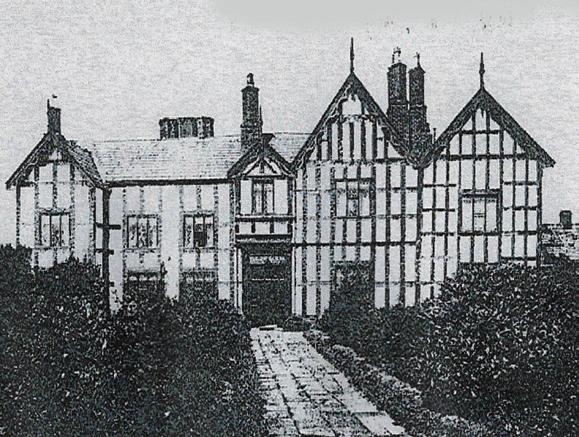
Dutton Hall before it was demolished in 1935
Agnes had married Adam de Dutton in about 1176. This marriage was extremely important for the future the Warburton’s
The title deeds or charters of Agnes’s manors that the family has preserved since 1200 (now in John Rylands Library) are in the form of gifts from the Baron of Halton to Adam made in the Hundred Court in Halton and approved (with their seals) by all the gentry there.
Presumably Adam thought this a better title than a deed made in London by somebody no-one in Cheshire knew.
Although Adam was the middle son of Hugh de Dutton (1111 to 1170), this addition to Adam’s lands made his branch of the family almost as important as his elder brother Hugh de Dutton. Normally the eldest son was the major landowner, but due to his wife’s inheritance, Adams’ and Agnes estate became as large as that of his elder brother Hugh.
The land that Agnes inherited included manors in Appleton, Lymm, Halton, Sale, Tabley and Stretton so in total it is estimated that Adam and Agnes estate increased by about 8,000 acres and they became one of the major landowners in Cheshire.
Sir Piers Dutton took over Dutton Hall, and demolished parts of the Old Hall and built an enormously lavish new Dutton Hall which was completed in 1539. Sir Piers Dutton hosted many events in the new Dutton Hall and even entertained royalty.
Purchase of Budworth
Adam de Dutton worked with the Barons of Halton and in about 1174 he bought the township of Budworth from Gilbert Brito, a descendant of Pagen who had owned Budworth at Domesday.
The reason why Adam bought Budworth in preference to the other townships in the area is unknown. It was possibly because Budworth had a priest and a church. Adam may have seen it as a way to promote his standing with God. He lived near Halton and would have known about Runcorn Priory being moved to Norton in 1134, and how Norton Priory was being developed into a major religious establishment.
Whatever the reason, it was probably the most significant event in the history of Budworth and had a lasting consequence for the next 850 years.
In 1174 Adam de Dutton was about 24, his eldest son Geoffrey de Dutton was born about 5 years later in 1179.
As Geoffrey de Dutton grew up and married, he needed his own house so he built a house in Budworth, and so the Dutton connection with Budworth began.
Geoffrey de Dutton or Geoffrey de Budworth
Adam de Dutton and Agnes had three children; two sons Geoffrey and John and a daughter Agnes.
Geoffrey de Dutton was an important member of the Dutton dynasty. When his father died in 1208 he became the owner of the 8,000 acres which Adam and Agnes had owned. In 1673, in Sir Peter Leycester’s1 says
“In the beginning of Henry the Thirds reign Geffrey Son of Adam was possessed of this Town....... This Geffrey, son of Adam, lived at this town of Budworth..... And I have seen him stiled Geffrey de Budworth in many deeds; and so was Geffrey his son often so stiled who lived there also.”
Lyson2 confirms this “Budworth........Geffrey, from his residence at that place, assumed that name de Budworth”
It is not clear where Geoffrey lived in Budworth, it is possible it was on the site of the Old Hall.
1 Sir Peter Leycester’s “Some Antiquities of Cheshire”p226
2 Lyson Magna Brittania p 519
The Crusades and Geoffrey de Dutton
The Crusades were a series of expeditions in the 11th to 13th Centuries, these were led by the Christians to recapture Jerusalem from the Muslims. Both the Christians and the Muslims regarded Jerusalem as their Holy Land.
The first of the Crusades began in 1095, when the armies of Christians from Western Europe responded to Pope Urban II’s plea to go to war against Muslim forces in the Holy Land. The First Crusade achieved its goal with the capture of Jerusalem in 1099.
Jerusalem was recaptured by the Muslims in 1187. In 1213 Pope Innocent III and his successor Pope Honorius III made an appeal for another Crusade to recapture Jerusalem and the Holy Land. This was the Fifth Crusade. (Pope Innocent III died 16th July 1216 and Pope Honorius III took over the direction of the Crusade)
The response was initially slow, but eventually there was a massive response with a total force of about 32,000 Crusaders from Austria, Hungary, France, Germany, Holland, England ~ virtually every country in Europe.
The Earl of Winchester, the Earl of Arundel and Ranulf III, the sixth Earl of Chester ~ three of the most influential nobles in England ~ all answered the Pope’s call to go on the Fifth Crusade.
John de Lacy, 8th Baron of Halton, was the Hereditary Constable of Chester. i.e. The Military Leader. As the Earl of Chester’s right hand man, he thought that he should accompany the Earl of Chester.
Geoffrey de Dutton, was one of John de Lacy’s principal officers, so no doubt he felt it was his duty to join them.
John de Lacy had been excommunicated by the Pope in 1216 for conspiring against King John at the time of Magna Carta in 1215. By becoming a Crusader he was, no doubt, restored to favour.
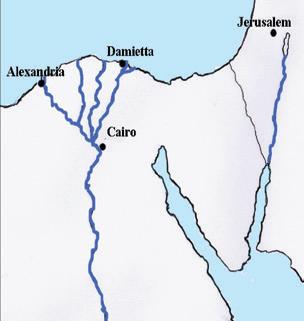
Thus Ranulf III, Earl of Chester, his Constable, John de Lacy, Baron of Halton and Geoffrey de Dutton enrolled as Crusaders in the Fifth Crusade. They arrived near the town of Demietta, at the mouth of the Nile on the 27th May 1218, and had little difficulty in capturing the town.
At this point, what to do next became a problem. Operations in the Holy Land had little effect and sunk into stalemate. And so a project to deliver a strong military response to the Cairo government was formed. No doubt they felt that having taken Damietta they would proceed up the Nile to Cairo as they were accustomed to sailing up the Seine to Paris. But the Nile had a huge Delta that they had never encountered before.
They made steady progress from island to island with the assistance of a fleet of small boats and rafts until they were perhaps 80 - 100 miles up the river, which was nearly half way to Cairo.
Then Egyptian solders attacked and burnt most of their boats. The crusaders were suddenly in a desperate situation on an island with only a small amount of food and forage for their horses. They managed to get a boat or two away to tell their friends in Damietta about their plight. Small quantities of supplies arrived.
Within a year there was sufficient transport to take the leading noblemen back to Europe, but Geoffrey de Dutton was left as one of the officers with the task of saving the rest of the army. It took them three years struggling with a few boats from island to island continuously harassed by the enemy to reach Damietta and return to Europe.
The Fifth Crusade ended on 8th September 1221.
The Nile Delta Basin
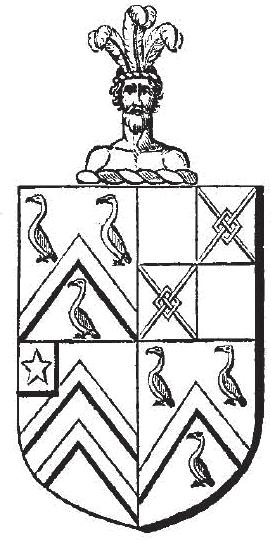
It was on this Crusade, that Geoffrey de Dutton distinguished himself in battle and is said to have severed the head of a Saracen leader, probably at the siege of Damietta in Egypt in 1218 and so he incorporated a Saracen’s Head as the crest to his coat of arms.
He was knighted for his service on the Crusade, so became Sir Geoffrey de Dutton
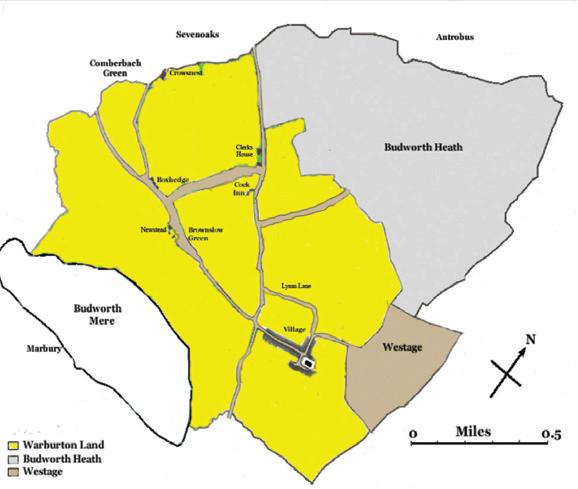
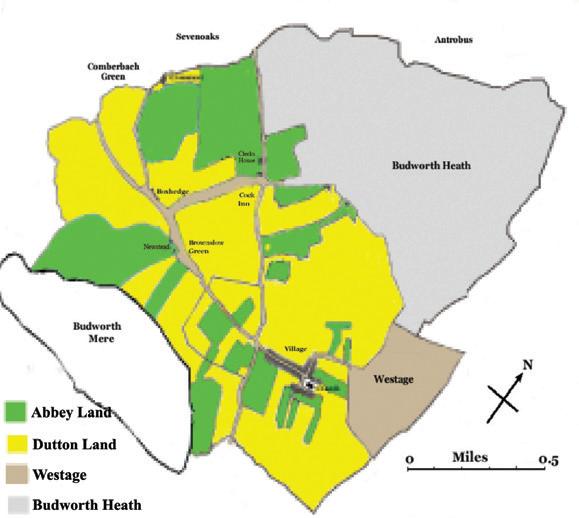
It is not surprising that when Geoffrey returned to Cheshire, he thought it right to thank God for his preservation by giving his house and some of the demesne lands in Budworth, together with the serfs who cultivated the land to Norton Priory, this was roughly a third of the Township.
This is shown on the map on page 42.
He was able to move into his fathers old house in Sutton.
It is believed that a prominent grave at Norton Priory is that of Geoffrey de Dutton/Budworth.
He is No 5 on the Dutton family tree on page 34, and adopted the gory emblem (above) for his crest.
He was also referred to as ‘of Buddeworth’ as was his son.
Chapter 5
MEDIEVAL BUDWORTH
For the first two centuries after the Norman Invasion, there was an excellent period of economic growth in England, and resentment and opposition to the Invasion waned. The nobility became more affluent, families grew larger and the population increased. In 1086 the population in England was about 1.7 million but by 1340 it had grown to about 4.8 million1 .
Agriculture became more active, with more cattle, pigs and sheep in the country. Climatologists say that there was a medieval warm period between 900 AD and 1200 AD, when the temperatures were slightly higher than in previous and subsequent centuries.
As we have said, in Budworth, at the time of Domesday Book there were about 25 to 30 people cultivating 20 to 30 acres in total. Possibly all the population lived adjacent to the Roman Road.
In the 12th Century the population had increased considerably and more land had been taken from Budworth Heath, so that at the start of the 13th Century the land being cultivated was roughly as shown by yellow on the map right
But from around 1250 across England, “labour services” were reduced to perhaps one day a week on average. Serfs were each allocated a number of strips or “lounts” in the common fields for which they paid money rent, and used to grow their own food.
The Lord of the Manor used the money to hire workers by the day, to till his lounts and fields. The same process was followed for housing and the serfs had, under the new system, to build and maintain their own houses on the land owned by the Lord of the Manor.
1 Herlihy, David, “Medieval Demography”
Slowly more and more land in the township was enclosed into fields and the Lord of the Manor got his share of the new lands.
But as the Lord of the Manor owned all the growing trees, he had to supply timber, and rent payers were entitled to housebot2, carbot2, ploughbot2, etc so they could have house, cart, plough etc as arranged with the Lords Steward. Fallen wood was available for burning on fires (and later peat)
2 Bots were the obligation for a lord to supply timber to his tenants for the maintenance and repair of houses and tools such as carts and ploughs. No one could cut the lords timber and only fallen wood could be collected to be burnt. It dated back to Anglo Saxon times when a lord had to ensure his tenants had the means to survive and farm effectively.
Budworth in 1200
In the next 170 years, to around 1250, the size of the area cultivated in the village increased steadily and so did the population. The “nativi” or serfs as the Latin is often translated (they were not allowed to leave the manor) usually worked most of their time “for the Lord” up to the mid thirteenth century so as to earn their share of the village harvest.
As explained in the previous chapter, in about 1230 Geoffrey de Dutton/Budworth gave a third of his land to Norton Priory1 . The map below shows the land that we believe Geoffrey de Dutton/Budworth gave to Norton Priory. (coloured green).
Budworth in 1230 after granting land to Norton Priory
These lands were part of the demense lands of Budworth including the house Geoffrey de Dutton/Budworth and his family had lived in before he went on the Crusade. His eldest son and his wife probably lived there while he was away.
1 The lands given by Geoffrey de Dutton/Budworth to Norton Priory in 1230. This is calculated from information on the 1841 Tithe Map. The roads are included to identify the position of the land.
“Demesne” lands were those surrounding the Hall, the produce of which provided the main food supplies of the large household in the Hall. In the 1230’s these lands were usually used for growing crops and the work was done by “serfs” “owned” by the Lord of the Manor.
The Lord’s cattle and sheep were pastured in the “common” lands in the township according to various “customs” and their winter feed was provided by the Lord’s share of the hay harvested in the common meadows. Some of the serfs were given to Norton Priory along with the demesne lands.
The map shows in green the extent of the land owned by Norton Priory. The land cultivated by the Dutton’s is shown in yellow.
Thomas Anderton owned 5 acres at Crowsnest but this is too small to show. The rest was uncultivated common land which was either Budworth Heath shown in grey or Westage shown in brown1
The gift which Geoffrey, made to Norton Priory apparently also included a number of serfs to cultivate the main farm and perhaps to look after the Church. In 1536, at the time of the Dissolution, Norton had 11 ‘small-holder’ tenants (P.R.O. Minister’s account 1535/6. Sc 6 Henry VIII /409).
These ‘small-holders’ all had houses in the village and ‘lounts’ in the common fields. We don’t know how many of them there were in the 1230s, but it seems that in the 1540’s they held a total of only about 56 acres between them in the common fields.
1 Charles Foster’s Capital and Innovation, pp. 100-2, for these calculations.
The Westage
In this map, (on the previous page), north east of the village the large areas of Budworth Heath and the Westage are also shown. These were still rough, uncultivated grazing land, with perhaps a few trees.
The Westage (meaning wasteland) was a large patch of sandy land, which was mostly in Aston by Budworth, where it was known as Aston Heath. Most of the rest of the area (which is shaded light brown on the map on the previous page) and is in Budworth was divided into a number of ‘common’ fields, in which all the villagers had strips, known as ‘lounts’ or ‘lands’.
References to these common fields and their ‘lands’ occur frequently in the Manor Court Rolls that survive from 1580 (in John Rylands Library, Warb. Mun., Boxes 6 & 7).
The written leases that villagers had for their farms after about 1540, do not normally describe these ‘lands’, but simply say - ‘all that tenement now in the possession of …’, assuming that lots of other villagers would know which ‘lands’ the family occupied.
But when, in 1703, Charles Henchman, who had been Vicar of Budworth since 1699, but was not a native, bought a lease from the Leycester’s, he evidently insisted on having full descriptions of his land written into his lease.
So we discover that the holding he was buying consisted of a hemp-yard and a croft, plus ten ‘lounts’ in eight different fields around the township, totally 9 ½ acres1 .
The Two Fourteenth Century Disasters
In the period from 1200 to 1315, Cheshire society was relatively prosperous. The population expanded and more land was cultivated. But in the fourteenth century two disasters occurred which had a devastating effect on the whole of Europe and Budworth was not immune.
1 (C.R.O. DLT/D9/6).
The Great Famine 1315-1317
From the spring of 1315, unusually heavy rain fell almost constantly throughout the summer and autumn and then through most of 1316. Crops rotted in the ground, harvests failed, grain could not ripen, leading to widespread crop failures.. The straw and hay for the animals could not be cured, so there was no fodder and much livestock either drowned or starved.
The cattle suffered murrains like rinderpest1, foot-and-mouth disease and anthrax. Food stocks depleted and the price of food soared in England, food doubled in price between spring and midsummer of 1316.
People began to harvest wild edible roots, grasses, nuts, and bark in the forests. As the cold, wet weather continued, the famine reached its height in the spring of 1317. Finally in the summer of 1317, the weather patterns returned to normal, but it was 1322 before the food supply recovered completely.
The result was the Great Famine, which is thought to have claimed over 20% of the English population, As the population of England was about 5 million, about a million people died in the Great Famine of 1315-17.
It was the same or even worse in mainland Europe. We do not know the effect in Budworth, but it would not have escaped the problem.
The Black Death 1349
Through the centuries there have been many plagues. These have often been called Black Deaths because often black blotches occur on the skin of victims.
There was an epidemic of bubonic plague in Hong Kong in 1894 and Dr Alexander Yerskin noticed that there were a lot of dead rats in the streets which was unusual. He deduced that the rats were dying of bubonic plague.
1 Rinderpest, also known as cattle plague, is a contagious viral disease affecting cloven-hoofed animals (mainly cattle and buffalo).
Fleas feasted on these dead rats and then bit humans, who then succumbed to the bubonic plague. It was believed that all plagues were due to rats being infected with the Bubonic Plague. The rats died and the fleas bit the humans, who then died a terrible death with the Bubonic plague.
In 2001, Dr Susan Scott and Professor Christopher Duncan from Liverpool University, examined the historical evidence of all the various plagues throughout history and throughout the world. They argued that they had been caused by a variety of reasons 1. They discuss all the various epidemics and plagues that have occurred. They believe that Black Death of 1349, was not caused by rats but was a viral fever ~ like Ebola and Covid 19 (which occurred in 2020).
However history books and websites still say that The Black Plague of 1349 was Bubonic Plague caused by fleas and rats. The more famous plague of London in 1665 was probably caused by fleas and rats. But this was concentrated in London and the effect in rural areas of England was not great. In 1349 the plague arrived in the port of Messina in Sicily by sailors who had come from Crimea on the Black Sea. Half the ships’ crew was either dead or dying. The Sicilians went to help the crew and caught the plague. The plague had travelled from China via the Silk Road to Crimea. The Great Pestilence (or Black Death as it was named in 1823) was recognised as a directly infectious disease. Michael of Piazza, a Franciscan friar, said “The infection spread to everyone who had any contact with the disease”. Indeed, they believed that priests who heard the confessions of the dying “were immediately overcome by death.” They realised that safety lay in fleeing but this, very effectively, served only to spread the infection.
The Black Death moved as a northwards wave through Europe at an average speed of about 4 km per day and reached England in 1348, but it reached the peak in 1349. This outbreak was a true pandemic on a scale never experienced before.
Even in the 14th century the doctors in Northern Italy had established the importance of a forty day isolation period, which became the standard for continental Europe for the next 300 years. Any ships which arrived at a port with sailors with the plague were required to isolate for forty days. The word “quarantine” evolved from the Italian “quaranta giorni,” meaning forty days.
It is estimated that 30% to 50% of the populations in Europe died and this rate was evenly spread in rural areas and urban in England, Europe and Asia. A lot of villages were completely annihilated and there was nobody left to bury the dead.
In 1349 the population of England was about 5 million and about 2 million people died of the plague.
We do not know how many people died in Budworth in the 1349 Plague, but there were so many deaths that farms lay untenanted for a few years and the wages of farm labourers increased because of the shortage of agricultural workers.
1 The Biology of Plagues ~ Susan Scott and Christopher Duncan
The Peasants’ Revolt, also named Wat Tyler’s Rebellion was a major uprising across large parts of England in 1381 which was probably an outcome of the Black Death. This led to serfdom being abolished in England
The Fifteenth Century Recovery
By 1450 the position in the country had recovered. Landlords were by then getting perhaps twice the rents they had been able to raise in the dark times of the plague in the 1360s. The fifty years up to 1500 seem to have been a period of stability and prosperity for ordinary farming families in this part of Cheshire. Every family had a house and about 1 to 2 acres of land, while some had 10 or 20 acres. Rents were 7d or 8d an acre per annum at a time when wages for an adult man were usually 4d a day, so it took only 2 days’ work to earn the annual rent of one acre.
Every family grew most of their own food and made their own clothes out of the hemp they grew and the wool from their sheep. In their ‘lounts’ in the common fields they grew barley and oats, and occasionally peas and beans, although these didn’t do well in Cheshire. They ate barley bread and made oatmeal porridge. They kept all kinds of animals - cattle, sheep, pigs, ducks and chickens. Much of the animals’ food was provided by grazing on the common land – Budworth Heath, the Westage, the wide roads and the common fields (when not in use for crops). Hay to feed the animals in winter was grown in the common meadows running down to the Mere. Wood for their houses, carts and ploughs was available with the permission of the Steward of the Manor. Firewood was obtained from fallen timber in the large area of natural woodland to the north of the township. This woodland included the area then known as Northwood Park, (now known as Crowley), owned by the Barons of Halton, the adjoining area of Aston by Budworth, north of the brook (later made into the Park at Arley Hall) and the Northwood area of High Legh. Villagers were also allowed to cut peat on Arley Moss.
Almost everything the villagers had was produced locally. Trade with distant places hardly existed. Iron, usually coming from Spain, was probably the only import they ever touched. The wine, spices and silks, also imported, were only for the very rich. Iron was scarce and expensive; even spades were mostly, if not wholly, made of wood.
Chapter 6
THE ANGLO-SAXON CHURCH AND ECCLESIASTICAL PARISH
The Anglo Saxon Church
As we have seen, the Domesday Book tells us that in 1086, in Budworth, there was a small settlement of five or six families, They were probably farming about 20 to 30 acres and the rest of Budworth would be scrub land. They appear to have been lucky and escaped the looting and wasting of the land which devastated so many townships in Cheshire as William the Conqueror and Hugh Lupus, Earl of Chster and their supporters crushed any opposition to the Norman Conquest. In fact the Township’s geld value had risen from 6s in the pre-conquest days to 8s
Of immediate interest is the presence of a priest and therefore the generally accepted presence of a church, this Saxon church was probably half timbered, made of a timber frame with wattle and daub walls like the two church’s on the right. It would have been the size of a garage. We do not know where it was. It could have been at the present site or possibly at the bottom of the hill adjacent to the Roman Road, as most of the present village site was covered in scrub. It must have been very important because in 1115 (only 30 years after the Domesday Book) William FitzNigel, Baron of Halton and Constable of Chester gave the Church and living of Budworth to the Augustinian Canons of Norton Priory. This was to help found their monastery first at Runcorn and then later at Norton. The Baron of Halton was the second most important person in Cheshire.
Medieval church’s were built as both practical places of worship carefully designed to meet the needs of the liturgy and also to reflect and bear witness to God’s glory and grandeur. To build them was an act of worship, to decorate and cherish them an expression of faith.
As building styles developed and changed so the churches were rebuilt. Equally as congregations grew, so the churches grew and all the time the sense of wonder and awe they could generate was enhanced.
To the medieval peasant the difference between their dwelling and the church was vast, clearly the church was “The House of God”.
When the Normans arrived, the age of the stone church also arrived and at some point the half timbered church would have been rebuilt in stone. Of course some buildings were partly the old style and timbered but also partly stone as we see at Warburton Old church today (above).
Marton Church,Cheshire. One of the oldest timber framed church in Europe
In fact some churches would remain in wood such as St James and St Paul at Marton, the half-timbered church being dated to 1343.
Warburton Old Church
Why these differences? Stone must have represented the pinnacle of wealth and commitment on the part of local congregations and Rectors. Rectors were the owners of the church and could be religious like the Canons of Norton Priory or secular like the Barons of Halton who gave them the Church.
The wealth of the Rector and the leading families was the source of the wealth that could be lavished on the church building.
The Ecclesiastical Parish
What can we add to this bare description? Can we gain any idea of the nature and importance of the priest and his parish?1
It is clear that the large medieval ecclesiastical parish of Budworth with its 35 townships was based on an earlier preconquest parish and as we would expect Domesday records no priest in the other townships in Tunendune. It is easy to see then if the Budworth Township had only 20-25 inhabitants that a single priest could serve 35 townships if they were of similar or smaller population. Throughout Central and Eastern Cheshire large parishes reflect a small, widely dispersed population2
The Ecclesiastical Parish of Budworth
1 Note that in this section the word “Parish” always refers to the ecclesiastical parish not the modern Civil Parish. Until the 1894 Local Government Act all civil roles such as road maintenance, public order, care of the poor and the setting and collection of local taxes were organised through each township in the parish attending an annual meeting and regular meetings in the Church called Vestry Meetings. In large parishes such as Budworth many roles such as parish constable and road maintenance were delegated to Township level and they were run locally. The 1894 Act set up the modern system of Civil Parish Councils.
2 Budworth Ecclesiastical Parish was the second largest in Cheshire and the third largest in the whole country, only Prestbury Ecclesiastical Parish was larger in Cheshire,
We saw that prior to the Norman Conquest, Edward held Budworth but he was dispossessed and it was then held by Pagen. However prior to the Conquest Edward also held half of Lymm. After the conquest he still held his half of Lymm. Domesday records that Lymm had a church and a priest. So in Saxon times prior to the Conquest, Edward had a priest in Budworth (one of only two priests in the whole of Tunendune) and a priest in Lymm. He must have been a very dedicated Christian.
And perhaps most significantly the church is set in curvilinear or oval churchyard.1 a major identifying feature of Saxon churches and perhaps even churches dating back to the British period2.
1 The church yard did not extend beyond the schoolhouse until 1805 and earlier maps clearly show the curvilinear churchyard.
2 Higham page 82
However, some scholars have seen a greater significance in this large parish phenomenon; that these parishes represent the echoes of an Anglo – Saxon Christian tradition which survived the upheavals of the Conquest. This is the tradition of a Minster church covering a large area sending out missionaries to minister to the needs of their scattered flock.
A group of several priests with a church and monastic quarters for them to live in at the centre, often on elevated ground and close to a major system of routes linking the dispersed communities is the characteristic pattern of a minster system. They see these parishes arranged in pairs covering the Anglo Saxon administrative areas or hundreds. In the case of Budworth they see it as paired with Runcorn parish and covering the Anglo Saxon Hundred of Tunendune1 .
Further if we look at the characteristics of an Anglo Saxon parish there is a good fit with Budworth. Firstly, as would be expected a Saxon parish should have a Saxon name. The name Budworth is Anglo-Saxon: Budda a personal name and “worth” meaning “an enclosure” so Budda’s enclosure2 and further the village is in a surrounding landscape full of Saxon names such as Comberbach, Aston, Wincham, Marbury etc.
A Domesday mention is vital and Budworth has that.
1 The Origins of Cheshire N.J.Higham 1993 pages 158-160
2 Place Names of Cheshire J.McN. DodgsonThe Origins of Cheshire N.J.Higham 1993 pages 158-160.
A Saxon church will normally have a waterside location overlooking lakes or marshes or rivers and usually an elevated position close to or on an existing road system usually an old Roman road. Again Budworth has all these features. Looking at the church itself its dedication to St Mary could represent a Saxon dedication as the cult of Mary became popular as early as 731. Further there is no mention of late Saxon or early Norman church foundations in the area which suggests the provision of churches and priests must have been well established and adequate.
So Budworth Church must be a strong candidate for a Saxon origin. Of course all this remains conjecture due to the lack of archaeological or documentary evidence.
Map showing the extent of the Runcorn and Budworth Eccliastical Parishes
The Norman Church
William the Conqueror had given most of Cheshire to Hugh of Avranches, Earl of Chester to reward him for his support and also so Hugh could pacify this remote, but strategic area. As the King’s tenant, Hugh was expected to uphold the King’s law, collect his taxes and most importantly to provide William with troops in times of trouble.
Hugh in his turn rewarded his knights and military followers with manors to provide them with a source of support and income. Budworth and 29 other manors were granted by Hugh to Nigel and then to his son, William Fitz Nigel. They were the greatest of all his tenants by virtue of their office as Hereditary Constables of Chester and held the title Baron. Their main base was the castle at Halton dominating the Runcorn gap and the river Mersey.
William Fitz Nigel granted the manor of Budworth to Payne (or Pagan) with six other manors, which when taken into account with his Old French name means we can deduce he was an important follower of William Fitz Nigel, Hugh and William the Conqueror, a Norman soldier settling to a new life in a newly conquered land. The Manors granted to him would support him and a band of soldiers that William Fitz Nigel, Hugh and ultimately the King could rely on to be ready when needed.
However, it is important to note that William Fitz Nigel did not surrender the gift of the living or church of Budworth to Pagan. He kept the rights to collect the Tithe from the parishioners (1/10 of their income both in terms of produce and money), the income of the land given to the church in return for prayers and intercessions for the dead and also the fees paid for baptisms, marriages and burials and the right to appoint a vicar.
However, we may speculate that the income, which would be limited, was not his primary interest, rather to keep a figure of local influence - the priest - under his direct control. In those times to many of the laity the difference between the words of the priest and the word of God was not always clear. Over the distance of nine centuries the local priest seems to have been poorly educated and parochial (most lived the same short, hard lives as their parishioners).
But, to the parishioners he was the local father figure, full of authority and able to put their lives into context as well as to interpret the word of God to them - he and the church and its sacraments were the gateway to eternal life.
At the present state of research into Budworth Church’s history we know little of the next 40 or 50 years. We can guess that the round of services and the churches seasons went on as they always had. The Norman peace was established and the assimilation of the Norman conquerors with the Anglo - Saxon conquered was slowly being accomplished.
If the normal pattern was followed the wooden church of the Anglo Saxons would have been replaced with a small stone church with small round arched windows and doors. This small unassuming building, without a tower or aisles, would have been at the heart of the small developing community.
If the Anglo Saxon church was possibly at the bottom of the hill by the Roman Road, this Norman Church was certainly in the centre of the village.
For the villagers the daily round went on; crops were sown, harvests gathered in and winters survived. Babies were born, young people married and by our standards people in early middle age died. Through it all the parish priest would have served God and his parishioners baptising the babies marrying the young and burying the old, bringing comfort with his kind words and the familiar cycle of services: the liturgy marking out the weeks and seasons and the progress of people’s lives.
Probably functionally illiterate and certainly poor this priest would have had his own fields and laboured as hard as his parishioners to grub a living from the land although, he could at least supplement it with fees from baptisms, marriages and funerals and of course, the offerings of the faithful. However , a change was on the way and the old ways were coming to an end in Budworth.
Chapter 7
THE AUGUSTINIAN CANONS
As the twelfth century dawned the Order of the Canons of St. Augustine, a new religious movement, was becoming fashionable among the rich.
The rich like everyone else in the twelfth century were keen to save their souls by ensuring their smooth entry into heaven. However to the medieval person this did not appear to be an easy task. The teaching of the Bible and the laws of the Church constructed an ethical and personal moral code that only a Saint could achieve and this combined with the fact that to each individual death was an experience that was common place and shockingly intimate.
This is a time that peasants had one room houses, shared sleeping platforms and had short lives, the sick and dying were very close. It was also very clear that lives were short and 30 to 40 years was a long life and most actually died in childhood.
The Church taught that Salvation and entry into Heaven and the ensuring ecstasy of eternal happiness was only available after a period in which sins were paid for with terrible psychological and physical suffering which purged the soul of these sins. This state was called Purgatory and it was a staging post for all souls on the journey to Heaven. The amount of time spent in this place of torment depended on the persons sins and could be measured in thousands or millions of years.
The medieval person believed this time in purgatory could be shortened or in some cases avoided altogether by a variety of ways. By living the exemplary life of a perfect Christian - not an option to these worldly folk or by doing good works. Or going on pilgrimage, even taking part in a Crusade. Most importantly by paying for Masses to be said to redeem them from their sins.
Tens of thousands of masses to be said forever and paid for by the giving of money, or more importantly land, to generate the income in perpetuity to pay the priests or frequently monks like the Augustinian Canons to say the services. The more Masses that were said the quicker the escape from the suffering of Purgatory.
This importance of this theological doctrine in the medieval mind cannot be overestimated, it was a basis of the society and a constant motivator to people in their actions.
As said earlier, in 1115 William FitzNigel, Baron of Halton and Constable of Chester gave the Church and living of Budworth to the Augustinian Canons of Norton Priory. This was to help found their monastery first at Runcorn and then later at Norton. Later Geoffrey de Dutton / de Budworth made a grant of one third of the township of Budworth, farmland, farms, houses and effectively the people who lived on them, to Norton Priory.
Over the following years more gifts of property were given, in Comberbach, Cogshall and Northwich to Norton Priory increasing their importance in the area.
What was the Order of St. Augustine?
They were founded in the 11th century and they were the first religious order to combine clerical status with a full common life for all its members. The Order of St. Augustine originated in Northern Italy, they came to England in 1104 with St Boltoph’s Priory in Colchester. The Order was held in high regard by King Henry 1 and Queen Matilda and therefore by the noble class. Eight more Priory’s were founded by 1114 and Norton Priory was the tenth foundation in 1115. eventually there were some 200 Priories in England.
Artist’s impression of the Master Mason discussing the building of Budworth Church with the Augustinian Canons
They were called the “Black Canons” from the habits they wore. They wore a black cassock with a white surplice to show their priestly status and the whole outfit was topped off with a hooded black cloak and tall hat.
The canons lived in Abbey’s or Priories and took vows of Obedience, Chastity and Poverty like monks, but, unlike monks they were all ordained priests with a good education and with a mandate from their superiors to go out and serve in the parishes to strengthen, guide and encourage Christian witness and behaviour.
So it was, that some Augustinian Canons came to Budworth from Norton Priory and played an important part of the township for the next 400 years.
The Augustian Canons were largely younger sons of the nobility or the upper - middle class. They considered themselves superior in education and effectiveness to monks, and in every way superior to parish priests.
Monks weakly countered by comparing themselves to the pious Mary who in the Gospel story sat at the feet of Jesus and listened to his words, and the canons to Martha, her practical sister who got on with her work.
The canons undertook teaching and pastoral work and which entailed everything from running hospitals such as St Bartholomew’s and St Thomas’s in London to the parochial duties of teaching and preaching in order to put parishioners on the path to heaven.
It is probable that many were graduates of Oxford University. It is interesting to note that after the Reformation Budworth was a “hot bed” of different theological views with different sects present in great numbers. Could this because the preaching of the Canons had generated a theologically literate congregation seeking truth in the new world?
In the fifteenth century the Canons were at the height of their popularity and Norton Priory was one of the foremost Augustinian Houses in the whole of England.
In 1391 Norton Priory was raised to the status of a full mitred Abbey with the Abbot having the same status as a Bishop and free from the interference of the local church authorities. (Strangely after 1391, we still refer it as Norton Priory although it should be called Norton Abbey). In 1395 one Richard who was Abbot of Norton was elected President of all the Augustinian Houses in the Province of Canterbury so wielding considerable power.
The parish of Budworth was part of this Monastic corporation and was drawn in even more closely when in 1399 the parish was appropriated to Norton by special decree of Pope Boniface IX1 .
This was a favourite policy for Augustinian’s it effectively made the parish an extension of the monastery with Canons serving as parish priests thus saving Norton money and ensuring the fees came to the monastery and not to a vicar.
It is interesting to note only four years later in 1403 Henry IV passed a law banning the practice insisting that only secular, that is non - monastic priests, could be parish priests. But, Great Budworth had slipped through before the law and was to have Augustinian Canons as vicars until 1550.
This presence was to radically change the nature of the Church and change the experience of the congregation.
1 Cal. Papal Reg. 5186 Pope Boniface IX also granted this right to the other Norton Churches at Runcorn, Castle Donington, Burton on Stather and Pirton.
An Augustinian Canon
To start with the building that we see, is the product of the Canons with nothing of any prior structure surviving. They seem to have continually updated the building adding more elaborate and dramatic extensions such as the nave and chancel aisles, clerestory, tower and new chancel.
We can also assume that equally lavish decorations and furniture were added to the interior most of which were swept away by the Reformation and while we can only wonder at the few surviving pieces such as the fifteenth century octagonal font and the misericord benches12 dated to the thirteenth century now in the Warburton chapel and believed to be some of the oldest woodwork in Cheshire.
1. At the beginning of the nineteenth century there were twenty five of these benches but, they were swapped for deal Sunday benches by a curate in the vicars absence. Only six were recovered by the Vicar. They show that there was once a monastic style choir and presumably a full round of services throughout the day and night.
2. A misericord (sometimes named mercy seat, like the biblical object) is a small wooden structure formed on the underside of a folding seat in a church which, when the seat is folded up, is intended to act as a shelf to support a person in a partially standing position during long periods of prayer..
Rib vaulted roof and rounded Norman arches of the undercroft at Norton Priory
The Misericord Benches
Also we can assume that the standard of the religious provision in Budworth became as good as was possible in the middle ages with sermons being preached, teaching being undertaken and beautiful awe inspiring services being delivered by probably two resident Canons1 supported by a full staff of church officials to ensure the music, decoration, pastoral visiting, upkeep of the church and the management of the canons property in the township were in top order. It is probable that our predecessors in Budworth had an above average Christian experience.
We have an idea of what the Order of St Augustine was aiming for in its parishes from a manual written by an Augustinian Canon called John Myrc in about 1400 called “How thow schalt thy pareshe preche”.2 It is instructions for Parish Priests and shows what was expected. An unvarying round of services accessible to all both rich and poor, the sacraments at the centre of worship, teaching of the congregation but especially the young, pastoral care and practical support for sick and old. Also preaching in English instead of Latin.
Perhaps this is why as the Protestant movement gathered strength in the country in the early sixteenth century. Budworth apparently remained committed to the old religion taught by the Canons right up to (and perhaps beyond) the Reformation.
The Augustinian Canons of Norton Priory controlled the destiny of Budworth Church from the middle of the twelfth century until the upheavals of the mid sixteenth century.
When the safe and clearly defined social and spiritual world of the average person was shattered to its very foundations. Let us imagine the average person living in the parish in the early 1500’s, many of the local farmers rent their farms from the Canon’s, others sold their surplus crops to the Priory’s local agents or worked on the Canon’s property or on church related tasks. The Church itself could well have had staff of 12 or so full time employees whose families lived in tied cottages possibly on Southbank, small one room houses with a small croft attached for growing crops and rearing a pig. Everyone is paying their tithe to the church, a nominal one tenth of their income.
Obviously the religious life of the parish is dominated by the Canons. Our villager lives in a clearly defined social, moral and religious atmosphere in which there is no need to think or question because for four hundred years the Canon’s have provided all the answers and structured his life.
The Church is thriving, in the memory of our villager the Church has always had building work going on, as the gifts of the faithful are converted into an ever more glorious and elaborate building their worship in stone.
In the previous century the aisles, clerestories, a new roof, chancel aisles and St Katherine’s Chapel have all been built and in the first years of the Sixteenth century the magnificent tower was being built. Equally ornaments and decorations were enriching the interior. In 1527 Richard Starkey left in his will 6s 8d.for the aisle, 6s 8d.for lead for the roof and more money to build a rood soler (a loft on the rood screen which separated the nave from the holy ground of the chancel)1. In the same year Lawrence Dutton left the considerable sum of 5 marks (1 mark = 13s 4d.) to repair the church and buy ornaments2
1 This was the usual practice of the Augustinian’s although no direct evidence is found in Budworth and sometimes just one Canon and a lay assistant.
2 The Augustinian s produced many of these manuals in the 15th Century as they strove to be as effective as possible.
It is a strange and perhaps sobering thought for us to reflect on, that this familiar and secure world was on the edge of extinction and would all be gone in twenty years.
1 Cheshire Record Office EDA2/1.15b
2 Memorials of Dutton pub 1901 page 171
Sanctuary in the Church
In the summer of 1368, a man called Thomas Dalton, had committed a capital crime in Cheshire, and to avoid arrest he sought sancturary in Budworth parish church. The neighbouring townships had to set a watch to prevent him from escaping, and the coroner of Bucklow Hundred was summoned to go to the church. He asked Thomas Dalton whether he was willing to give himself up - if not he had to abjure the realm of England and the county of Chester. He chose the latter, and the coroner sent him under guard to Northwich, to go by the nearest way to Holt, just across the Dee bridge from Farndon, and out of the County. There he was to make his way to the port of Caernarfon, travelling ‘‘with a bare head, body and feet, carrying a cross in his right hand.’’ At the port. he was to wade into the sea every day, until a boat was able to take him out of the country. It was a criminal offence to attack him on his journey (the cross symbolised the Church’s protection), but if he should stray off the direct road, or failed to sail from Caernarfon, or return to England, then he would be an outlaw.
The right of sanctuary in a church, and occasionally a wider area protected a criminal from being harmed or arrested and tried by the authorities. All cases were covered, including murder or treason. It was necessary to get into the church and to the altar area, preferably holding the altar cloth. To claim sanctuary to be in the nave was not enough.
As the extract outlines the law strict rules about the sanctuary - only bread and water could be provided to the fugitive and it should last no longer than forty days. Then the fugitive had the choice to come out and face the court and law or leave the country by strict rules outlined, and not return without a Royal pardon, which was almost impossible to get.
Sometimes sanctuary was ignored and the person illegally seized or harmed but generally it was respected. How often sanctuary was claimed in Budworth, we do not know. but it represents part of the ancient legal system that seemed to be out of date to many even at the time and was finally removed in 1623.
(ITA CHES 29/71 m 25)
BUILDING THE CHURCH WE KNOW
We saw in Chapter 6, that the early Saxon Church in Budworth was a small church which was first developed before the Norman Invasion and continued to exist for the first few centuries after the Invasion. Nothing of this early Church remains and multiple rebuilds have taken place. There is no documentary or archaeological evidence of the building of the original Budworth Church, all we have is the present building. It may be that the original church was on the present site and has been built over, or it could be that the original church was near the cross roads and was built over when the road was changed in the eighteenth century.
Norton Priory chose the highest part of Budworth as the most prominent site in Mid Cheshire to build a major Church for the glory of God. This site would be visible from the Roman Road, particularly for travellers travelling north. No other site in Mid Cheshire would be as prominent.
The Time-line
By examining the fortunes of Norton Priory, the Dutton’s, the Warburton’s, the Leycester’s and considering the Great Famine, the Black Death in the early fourteenth century, and the subsequent recovery, we believe the building of the Church today took place between the end of the fourteenth century, say 1390, and culminated with the building of the Tower in the early sixteenth century say 1520.
This is confirmed by the architectural considerations. Prior to the 13th Centuries the arches of buildings were typically Norman with a rounded arch as can be seen at Norton Priory. Later the arches became pointed in the Gothic or Perpendicular period.
The Sandstone
In North Cheshire there is a belt of sandstone bedrock which runs from Helsby to Stockton Heath. In the twelfth century this sandstone was used to build Halton Castle, later it was used to build Norton Priory.
Between the twelfth century and the twentieth centuries, many sandstone quarries were developed producing sandstone from this belt of bedrock. Eventually there were up to a total of 11 quarries in Runcorn, it was the major industry of Runcorn until the chemical industry came in the nineteenth century. It is almost certain that the sandstone for Budworth Church came from Runcorn in the fourteenth century. There were other quarries in Frodsham, Walton and Daresbury but these were developed later.
One of the reasons for the growth of quarrying in Runcorn was its proximity to the rivers Mersey and Weaver, but it is doubtful if these rivers were used to bring the sandstone to Budworth.
The Master Masons went to the quarry and selected the sandstone and had it cut by stone cutters to roughly the required size and shape. This was done at the quarry to avoid transporting an unnecessarily large stone. The stone cutters would cut slots into the rock face using a hammer and chisel or a narrow pick called a jadd or a racer. A series of wooden or metal wedges would have been used to split the stone from the rock face. The rock would have been squared by hammer and chisel, although some sandstone can be cut with a saw. The Roman Road would have been used most of the way to Budworth.
Horses and cattle were used for transport, in the medieval period. Horses were used for military purposes, however castrated bullocks, or oxen, were the preferred beasts of burden at this time.
Norman Arch at Norton Priory
Oxen (they were usually used in pairs) were cheaper and stronger than horses, but they were much slower. Oxen were used for ploughing, so ox carts were probably used to transport the sandstone from the quarries in Runcorn to Budworth.
Until the 17th century there was a road called Lymn Lane which came from the Roman Road just below the Cock o’ Budworth to Smithy Lane, roughly through where Dene House is today (as shown in red on the modern map above). This route avoided the steep hill in High Street and through Budworth Heath which was just undeveloped scrubland..
In a remarkable document about the building of Vale Royal Abbey in 1277 by Leonius, he notes that the biggest element of the building cost was the transport of the stone from Eddisbury to Vale Royal Abbey. It would have been similar in Budworth. It is about 12 miles from Runcorn to Budworth, it would take 2 days for the return journey to and from the quarry and the cart would only be able to carry one or two heavy sandstone building blocks, depending on the size of the blocks.
Timber Beams
Trees would be sourced by the Master Mason and felled by a sawyer using an axe in the local woodlands, they would be debarked, trimmed and squared to form a timber beam of the required size at or near to where the tree was felled. The trimming would be done with an axe or an adze soon after the tree was felled, because the timber is much easier to work whilst it is green, but also to reduce as much weight as possible for transportion. The beam would be brought to the Church site by ox carts or if it was very long it may have been dragged on a sledge.
Timber Scaffolding
There would have been timber scaffolding erected in the area of a lot of the work. This would have been built from timber poles tied together by rope. “Putlogs” were used, whereby some scaffolding was actually built into the blockwork, which was taken out after the building was completed and the hole was repaired. However building a scaffold was a major job and often ladders were used by workmen and standing on the completed stonework.
Arches are created using wooden scaffolding called ‘centring’ which is removed once the ‘keystone’ locks the arch in place. Roof timbers are added and the roof is covered in lead.
Timespan
The main building works of Budworth Church spanned well over a century, but this would not have been continuous, it would have been governed as the ideas developed and funds became available. Budworth Church could have been a building operation for five or ten years and there would have been a break before another building operation was started.
The route of Lymn Lane on a modern map
Ox Cart with a pair of oxen
Not only is the sequence of the development not clear but even how many times Budworth Church has been rebuilt is unknown.
One thing is for certain, there must have been a long period of building and or perhaps “stop and start” work caused by funding difficulties. Norton Priory had some hard times financially in the fifteenth century and local family gifts were by their nature spasmodic. Whatever the cause it is safe to assume that during that century the residents of Budworth would have been living alongside a building site.
Budworth Church is unusual as the arches on the south side of the nave are much bigger than those on the north side. The columns on most churches are the same size. This indicates That they were built at different times.
What we see today is a fifteenth century building but to the fifteenth century parishioners it would be a hollowed out shell of a church devoid of its intricate woodwork, plasterwork, paintings, statues, carvings and coloured glass all of which was essential part of their church experience.
Master Masons and Journeymen.
All the workmen and people who organised and financed the building believed the project was for the glory of God and their reward would be a place in heaven in the afterlife.
We know very little about the builders, even though they left their masons marks in several places in Budworth Church.
The building work was carried out under the overall charge of the Master Mason. He would have risen through the ranks from an apprentice to become a very highly skilled and valued individual.
The Master Mason would have to agree a design and price with Norton Priory and would have effectively been architect, procurer and buyer of materials, quality controller; and personnel manager and anything else to do with the project. Unlike today there would be no or very few drawings on paper.
The Master Mason would have hired a number of journeymen to actually build Budworth Church usually masons, apprentice masons, carpenters and labourers. At times specialists would have been hired such as glaziers and metal smiths (to sharpen and make chisels and various fittings) and plumbers to make roofs and down-spouts etc. There were the riggers who would have built and maintained the required scaffolding and constructed the treadmill hoists to move the stones and see to the lifting and placing of the stones for the setters. They would have used block and tackle to get the stone on the scaffolding and three legged lewises or tongs to grip the stones. This activity would have been supported by waggoners and carriers bringing the materials to site.
The Master Mason and senior tradesmen who would have been long serving employees would have been allowed to build small basic houses and to bring their families to Budworth. The Journeymen would be itinerant tradesmen who came from a wide area in the country, but the labourers and apprentices would all be local men from the Budworth area.
The work force would be at its largest in the summer and they would have worked long hours, with the masons, apprentices and labourers working to actually lift the stones ever higher up the wall and “set” them in place. In winter a skeleton team of masons would prepare stones and mouldings and window tracery inside out of the weather ready for the next spring.
They would have built a large temporary building which would have acted as a workshop and an amenity building for sleeping and eating for the seasonal workers.
Building Budworh Church could have doubled the population of the village and given a boost to farming and businesses. All these men would have needed domestic support, food and drink and the village would have been an ideal site for alehouses and bakeries and pie sellers to open for business.
It was essential that the building activity had the minimum interference with the everyday running of the church. There was still the need for services on Sundays, Saints Days and throughout the week. In addition the church needed to have funerals and weddings.
One of the main reasons to rebuild the church was that the population and congregation had grown so much that the church was not big enough to serve the Church.
There would have been a logical sequence to the building of Budworth Church, we do not have any record of how it was actually carried out, it was probably have been something like the following sequence. The original early church would probably have been where the chancel and the nave meet today, as shown in red on the plan of the church (below). This spot is the highest point in the village, with the land falling away in every direction.
The way this building extension would probably have been done would be to build around the previous structure, and when the new build was completed and watertight, the smaller structure inside the new structure would be demolished.
The priority would have been to increase the area for the congregation, the nave would probably have been extended in
stages. It would have had a simple gable roof, the roof line is clear to see today above the chancel arch and by the white arrows on the photograph. (right)
The pillars on the north side would probably be the first to be built outside the nave. These pillars are more slender than those on the south side. Then the new walls to the nave would have been built. These walls would have incorporated windows to provide light to the nave.
Building the Lady Chapel, the north aisle arcade was the next stage. This and several other patches of stonework can be dated to the Decorated Period of architecture in around 1390 in rest of the building throughout the fifteenth century in the Perpendicular Style. Then when the new nave had been extended to accommodate a larger congregation, the old nave in the original church would be demolished.
This is only a working hypothesis which raises as many problems as it solves. For instance, the Lady Chapel often said to be the oldest part of the church. It is a very unusual building, which was largely rebuilt during the nineteenth century. It was previously restored in the mid-1600’s when folk remembered the earlier usage as a Lady Chapel rather than its use as a family burial chapel separate from the church and owned by several local families. However, its remaining old stonework is not very revealing apart from some heavily worn external decoration.
Showing the old roof line
The site of the Lady Chapel is in a most unusual position and liturgically awkward ~ altars should face the east and dominate the orientation of the chapel. When the north arcade and Lady Chapel were complete and watertight, the connecting wall to the nave would have been demolished so that the nave and north arcade was connected.
The next stage was probably the building of the south arcade and aisle, the Warburton Chapel and south porch. The pillars would have been built outside the nave and when it was complete and watertight the dividing wall between the south arcade and nave was then demolished. The pillars on the south side are all the same but much heavier and more ornate than those on the north side, indicating that the two sides were not built at the same time.
The next priority was to build the new chancel around the chancel in the original church. With the new chancel having been built the original chancel would have been demolished.
It would have been very dark in the nave, with the only windows on the outside of the two aisles, so the roof was raised and clerestory windows built.
Finally the tower was built in about 1520. Thomas Hunter was the Master Mason who built the tower at Witton. Raymond Richards(1) says that Witton and Budworth are similar and therefore Thomas Hunter built the tower at Budworth, but this is just an educated guess.
The West Door with carvings of the Coat of Arms
It may be the carvings on the Tower give us a clue to the funding, certainly at the end, of the project for we see the coats of arms of Norton Priory and the two dominant families the Duttons and the Warburtons1
1 Cheshire Churches Richards p 11 2
1 The Duttons and the Warburtons both had Chapels in the Church by the end of the 1400’s
A medieval Gargoyle which has been carved on a column inside the Church. This is a fox with a duck in its mouth, which is symbolic of Satan stealing peoples souls.
Inset in the exterior stonework of the tower there are three carvings. The sandstone used to build Budworth Church has not proved to fully withstand the elements over 500 years and the carvings are very badly eroded and difficult to identify. Also they are quite high up, which is another reason they are hard to see.
On the West Tower Wall ~ A carving of an Angel holding the Warburton Coat of Arms. Originally this was the same height as the other two but when the new clock was installed in the nineteenth century it had to be raised so the new clock could strike on the bells
South Tower Wall ~ Blessed Virgin Mary in Majesty
North Tower Wall ~ St Christopher
The Church we know
Chapter 9
THE REFORMATION UPHEAVAL
The Reformation Upheaval
This dramatic change was caused by a new factor entering into European politics - the reformed view of the Christian religion. The Roman Catholic Church was centred on Rome and the Pope, whose absolute authority, was based on a succession back to St Peter. It was the only church to most people in the first decades of the 16th century. It had been much criticized in the past, most recently by the followers of John Huss in Bohemia1 and by the Lollards in England2; both had called for the dismantling of the hierarchical state of the Church, services in the vernacular instead of Latin and social justice, a heady mixture particularly when justified by the Bible itself. But, they had always been doomed to failure due to the fact that the powerful nobles and Kings and their rich merchant supporters had a vested interest in keeping things as they were and resisting political, social and religious changes. What opposition there had been to the Church was soon crushed by the temporal powers of the lords.
1 John Huss 1369 – 1415. A Bohemian churchman who rejected the traditional Catholic teachings and also the hierarchical view of society. He also attacked clerical immorality. He was seen as a threat to the church and the good order of society and he was imprisoned. On 6 July 1415, he was burned at the stake for heresy against the doctrines of the Catholic Church.
2 Lollards originally followed the teachings of John Wycliffe. They operated from the mid-14th century until the 16th-century They based their belief on the Bible and used English translations which were illegal at the time. They rejected most church doctrine and even the need for a church stressing instead a personal faith.
However, in 1517 when the German Augustinian Friar, Martin Luther1 had attacked the practices of the Roman Church and the political conditions were such that his statements were increasingly supported by the nobles and merchants, not solely for religious reasons but, for the way that they coincided with their own political ambitions. Luther was physically protected by the local German nobility who were prepared to fight for his defence and to pay for his upkeep.
Luther1 saw salvation as being achieved by individual faith in God and the intercessions of the church as intrinsically wrong. No need for a priest to be as an intermediary between men and God; a Bible and services in a person’s own language was all that was required and as Purgatory was not mentioned in the Bible it was another abuse by the church to be removed.
1 Luther was an extremely devout man who felt that he could not live up to the strict life and unquestioning faith demanded by the Catholic Church especially in the light of the corruption he saw around him. He stressed faith in Christ as the only real religious duty and rejected excessive ritual and elaborate non biblical doctrine. The whole business of escaping Purgatory had become a huge income generator. The whole concept had reached the point that large enough cash payment could buy escape from Purgatory. Special Papal projects would be funded by the issuing of Indulgences, for sins past and future, which were hawked around Europe by salesmen called Indulgence Sellers. Luther confronted by one such sales drive to raise cash to rebuild St Peters in Rome and condemned it in such strong terms that to the Papal officials he was to be stopped by any possible means.
John Huss
Martin Luther
This was something new and the ensuing uproar was to lead to a series of wars and risings that would tear Europe apart for the next hundred years. Religion became the flag of a person’s politics. To be a Protestant (a name used after 1523 and the Protestation of Augsburg - a list of Protestant demands) was to make the person an ally of certain political leaders and the deadly enemy of others.
In England Henry VIII ruled serenely on this tide of religious change. Protestant literature swept into the country inspiring many particularly the young and idealistic such as the students who met at the White Horse Tavern in Cambridge.
Demands for reformed worship were made and rejected but, persecution of the Protestants was mild. Henry had the trust of his people and avoided any real conflict. He was an antiLutheran and wrote a book "In defence of the Seven Sacraments," attacking Luther's views; this was so welcome to the Pope that he gave the English monarch the title "Defender of the Faith," still part of the Monarch's title and represented on coins by the letters “F.D.”
But things were to change and Henry was to lead the country into the same mire of religio-political violence as was evident in Europe. Henry needed a male heir; he was fearful that the country would slide into civil war again if there were not a clear, strong succession. Catherine of Aragon, his wife, gave him only a daughter and after a string of miscarriages and still births it became clear to Henry he needed a new wife if he was to have a son.
An annulment was to be arranged and the Pope was usually very helpful in these matters (for the right price), but, on this occasion the Pope was in great fear of Catherine's favourite nephew, the King of Spain, who had a large army only a couple of days’ march from Rome and so he had to refuse. Henry, thwarted by the Pope, decided to divorce Catherine by taking the Pope's powers for himself and making himself Supreme Head on Earth of the Church in England. He then divorced Catherine and married Anne Boleyn.
He could be sure of Protestant support, that the majority of his citizens would be uninterested and that the Catholic supporters of the Pope could be dealt with. Politics and religion in England were now one; to be a Protestant was to be loyal to the King (as long as you weren’t too extreme) and to be a Catholic made you almost certainly a traitor.
Henry now reinforced his position with the Protestants by introducing reforms of church life and practice although, it is also true to say that he was a luke-warm reformer who although prepared to support the removal of obvious abuses, to allow the introduction of English for services, to provide a copy of the English Bible to be placed in every church and to order the suppression of superstitious practices but, still he was a son of the Catholic Church and largely for the retention of its forms of worship and traditions. The real cleansing of the country of Catholic practices, was to start under his children Edward VI and Elizabeth I (with a brief attempt to reverse things by Mary between them) but it would only reach its completion with the ascendancy of the Puritans in the mid seventeenth century. As this process developed it meant that more and more Catholic ways of worship, decoration and beliefs were jettisoned and the suppression of Catholic worshippers increased.
The monasteries were the first to go and by 1539 all had been closed and a way of life that had lasted nearly a thousand years in England ended.
This was followed by Latin in churches and sung services.
Edward VI ousted chantry1 chapels and decorated churches and much of the “idolatry” of statues and paintings, preferring honest, clean whitewash. At Budworth the whitewash was only finally removed in 1915 and traces of it can still be seen around the medieval window in the vestry and by the west door if one looks carefully.
1 A Chantry was a private chapel for prayers for the soul of a deceased family member or members. A priest was hired with the income from land given forever to ensure this eternal flow of prayers.
All this was completed by the end of 1560 when all English churches were whitewashed, preaching barns and the old liturgy and practice either removed or forgotten and equally all the old certainties had disappeared.
In October 1536, in accordance with the Act of Parliament for the closure of the lesser monasteries, Norton Priory was closed but, the Canons and their supporters did not go peacefully into a secular life. There was vigorous opposition to the closure of the Abbey and Sir Piers Dutton, Sheriff of Chester, was informed that on October 8th the Royal Commissioners who had packed up the jewels and other valuables of the Canons and were preparing to leave Norton had been attacked by the Abbot and a mob of local people and been forced to barricade themselves in a tower1 .
Dutton had to take a party of soldiers to break up the mob. The Abbot and three Canons were arrested as ringleaders and imprisoned. Henry needed the wealth of the monasteries to buy support at home and to pay for arms and castle building to deter the European Catholic powers. The Monasteries were “ripe fruit waiting to be picked”, but in many places, especially in the North West, they had much popular support. Clearly at Norton people did not see the day of monastic style of life as over.
During this period William Hardeware was the Canon working at Great Budworth2. He had been Prior at Norton and was a colourful character who once drew a knife on his Abbot, William Merton. He was accused by the King’s Commissioners3, sent by Thomas Cromwell, who investigated the spiritual and moral health of Norton Priory, of living in Great Budworth with his mistress (or “housekeeper”) Margaret Kynance and their children.
1 Letters and Papers of Henry VIII 2 681 P 265
2 It was about this time that Budworth started to be called Great Budworth.
3 Richard Layton and Thomas Leigh. Interestingly they received information about Great Budworth and William Hardeware from Adam Becanshaw an agent of Thomas Cromwell sent to gather information to discredit people in Cheshire including nobles and the Religious. See Norton Priory Patrick Greene page 70.
However he seems to have understood “the way the wind was blowing” and did not fight the closure, rather he received a dispensation from the Archbishop of Canterbury to continue at Budworth as the secular priest1 .
His future and livelihood were therefore secure and he remained at Budworth until his death in 1550, weathering the storms of the Reformation and the changes in worship that it brought.
The properties of Norton Priory were taken by the King to fund his exchequer. Its local holdings, including more than one third of the Manor of Great Budworth, were sold to a John Grimsditch of London whose family lived locally at Grimsditch Hall, he represented a local consortium who bought the land from him.
The living with Rectory and the dependent Chapels of Witton and Peover were leased to one George Cotton in 1538 and so ends the era of Great Budworth and the Canons of St Augustine.
A final adjustment took place in 1546 when the Cotton lease expired and Great Budworth was granted to Christ Church College Oxford2. Christ Church was now to play a major part in the life of the parish of Great Budworth and it still does today.
The age of the Augustinian Canons had disappeared from Great Budworth and a strange and challenging world was now facing our villager. I wonder whether the villager ever pondered that it was all caused by the thoughts of a German monk and the infertility of a Spanish Princess.
1 See D.S.Chambers Faculty Office Registers page 59
2 The College had been set up Cardinal Wolsey and called Cardinals College. On the Cardinals fall the King had taken it over and renamed it Christ Church College. Livings like Great Budworth were meant to provide the income necessary to support the college. This income would come from tithes and fees for Baptisms, Marriages and Burials.
Chapter
10
THE CHURCH ~ PURITANS
AND DISSENTERS
The changes and disruption started in England by Henry VIII, and continued by his children were to bring an age of uncertainty, violence and changed political realities which were to dominate people’s lives for generations to come. The old religious settlement was swept away and new, and to many people, strange if not downright heretical views took their place. It is important to remember that the Old Roman Catholic Church with the central authority of the Papacy was replaced by a myriad of protestant sects and the power struggle between them was almost as great as the struggle with the Pope.
One example will serve to demonstrate this, the Baptists were seen as heretical by most Protestants and they had to face severe persecution. The simple fact that they believed in the baptism of adults was intolerable to most and the fact that new members from other traditions were baptised again led to them being denigrated as Anabaptists who did not accept the baptism of the other groups as effective in the washing away of sin and signalling membership of Christ’s Church.
We know they were very active in the Great Budworth parish, with known meetings in Little Leigh and Stockton Heath. The Consistory Court1 records contain several references to mothers from Budworth being dragged before the court for not having their children baptised in church within the prescribed time. A sure sign of an Anabaptist, as well as individuals being identified as Anabaptists which was enough to bring them before the court to face fines, possible imprisonment and at the least the humiliation of admitting their sin before the congregation.
1 Consistory Courts were Church Courts charged with enforcing the moral standards of a good Christian on all people. Sexual misdemeanour’s were commonplace as were failure to attend church and attending dissenter meetings.
At different times, various groups were seen to be threats to the stability of the state and steps were taken to control these groups. Laws were passed at various times that made weekly attendance at Church of England services and the use of Church of England sacraments compulsory. Non-attenders were fined, or in some cases imprisoned. In the case of those who actively tried to further the interests of the dissenting groups by preaching or offering alternative sacraments death was the punishment1. The obvious victims of this treatment were Roman Catholics for them non-attendance at the local church meant crippling fines and the partaking of Roman sacraments or sheltering the priests who administered those sacraments could lead to imprisonment or death.
The Church of England’s vicars were a major source of information on these people reporting to the Bishops the names and meeting places of offenders. Along with informer’s rewarded for information received and even spies, used to infiltrate the groups, contributed to an effective intelligence system to inform the legal authorities of targets for arrest and punishment.
As the 1500’s came to an end, Elizabeth had established a settlement to the disputes and political disruption that had become intertwined with religion from the reign of Henry VIII. In essence this was a middle way in which the moderates of both the Catholic and the reformed Protestant traditions could co–exist, but, the extremists of both sides were ruthlessly dealt with and non- attendance at church was not tolerated, with hefty fines for non–attenders.
1. Backsliders were tried in Chester where the Consistory Courtroom still exists. A range of punishments could be inflicted such as prison and fines (usually after referral to the Crown Courts) or much more usually public condemnation from the pulpit of the offender’s local church and then shunning by the community.
The Church of England was the national Church and represented national unity and was the justification of the role of the monarch. Elizabeth did not surrender the view of her father that the Monarch was the Supreme Head of the Church in England, but continued to see it as the spiritual duty and right of the Monarch and attendance at church as the public expression of the loyalty of the citizen. To be one of the extremists who wished to undermine the church or even to simply disassociate from it was to politically align yourself with the foreign enemies of the state and to be personally disloyal to the monarch. Yet a vast diversity of belief and practice continued to develop.
Even in the Church of England itself a wide variety of religious practice developed. In some parishes the Prayer Book description of seemly services was interpreted to suit local views. For instance, the Prayer Book refers to a white cloth on a holy table, so in a fairly radical parish the minister had a clean, unadorned white table cloth on a simple table moved far away from the East wall of the chancel which at communion the parishioners would sit around and pass the bread baked by the minister’s wife to one another and sip wine from a simple common cup. There were no candles, no special robes for the minister and no music. But a few miles down the road, a vestmented “priest” might approach an elaborate, holy table a few inches from the east wall; it has an array of gold candlesticks and a cross and is covered in an elaborate white lace altar cloth.
He would be carrying communion wafers baked in his oven in the church and his congregation would come forward to kneel to receive the blessed elements, believing they contain the real spiritual presence of Jesus, as a choir sings anthems in the background. And of course throughout the country every possible variant of church practice would be found somewhere.
At Great Budworth the Victorians found the stone altar buried under the floor having been replaced by a table the latest of which dating from 1703 is to seen in the south chancel aisle chapel of St Peter.
At the same time the font was found also buried under the floor.
Equally the teaching of these groups within the church would conform to the personal religion of the extreme protestant groups emphasising the need for spiritual purity.
And of course these views would be even more extreme outside the Church of England. For instance, one group reported to be in the parish of Great Budworth in the years after the end of the civil war, the Fifth Monarchy men, believed the only thing stopping the return of Christ and the establishment of the Kingdom of God on earth was the evil nature of both the government and the society around them. The only answer was to cleanse the country by the sword and destroy those who supported these institutions. Fortunately, an attempted coup in London was crushed and the Fifth Monarchy men were executed or imprisoned. In Budworth they quickly faded away but, we can assume that individuals suddenly appeared in other less radical groups of which most were strongly represented in the parish. This is another interesting puzzle -why this quiet, rural parish was such a hotbed of radical protestant thought during the seventeenth century.
We know that Baptists, Presbyterians, Fifth-Monarchy men, a handful of Roman Catholics and, from 1654, Quakers were present in the parish as well of course as was the mainstream national church. Sometimes people were members of more than one group and movement between groups was not uncommon and of course until the Act of Toleration nearly everyone attended the parish church. Some Quakers and Baptists chose not to and found themselves before the justices. If fines were unpaid, property and goods were confiscated and sold at auction.
The Fourteenth Century Font
Persistent offenders risked gaol. Further, their meetings were likely to be broken up and people arrested by the authorities. The Justice of the Peace, Sir Peter Leycester from Tabley, was extremely keen to crush the Quakers, famously taking the militia to break up a meeting of 200 or more men at Frandley on Midsummer’s day 1677. Sir Peter feared that their disregard of the national church was the precursor to rebellion and clearly saw his duty to stamp out all dissent as treasonous. (There is no doubt that he had some justification - England in those years after the civil war was nervous and unstable and groups like the Fifth monarchy men openly talked of rebellion and even the Quakers who epitomise peaceful conduct today in their early years were not always peaceful.)
Throughout this period, from the time of Elizabeth until the restoration of Charles II in 1660, terminology for these groups is more than a little confusing so here is a guide:
• Puritans – strictly speaking those who wanted to “purify” the Church of England and to reform it from within. All Protestants of varying beliefs and degrees of extremism, including Presbyterians who wanted to do away with Bishops and for vicars to be elected by their peers and appointed to parishes by the congregation. This group was strongly represented at Budworth with at least four vicars being Presbyterians.
• Separatists – as their name suggests, groups who wanted to separate from the established church and considerably more extreme and radical. This group would include Baptists and Quakers.
• Dissenters – A catch-all term for anyone who disagreed with the Church of England
• Non – conformists - Originally this was a 17th century term for those who agreed with the Church of England’s beliefs but not its form of ceremonies and worship. However, it is now commonly applied to any Protestant group who disagreed with the Church of England. The term started as a reference to those Ministers who would not conform to the 1662 Act Uniformity. Meanwhile many, of course, stuck to the reformed Church of England as laid down by the authorities, seeing it as having not only the correct religious doctrine but, as the only Church for the patriot.
And this is the key to understanding the 17th century, religion was politics. It was seen as the public expression of your political position just as it was until lately in Northern Ireland. The Church of England’s supporters represented those loyal to King and Parliament and the established order. Dissenters on the other hand were suspect. During the Civil War they had killed a King and ended the monarchy and equally when it was inconvenient they had ignored and dismissed Parliament and used the army to rule. At least this was the interpretation of their opponents.
At Great Budworth these years were equally difficult and contentious and as we shall see all the issues outlined above on a national scale were to face those living in the parish of Great Budworth.
With the death of William Hardeware in 1550 we enter a rather mysterious period in Budworth’s history: a period whose outcome was to change the whole life and appearance of the church yet a period whose processes of change are not clear.
In 1550 we see a rather remote religiously conservative village under a priest trained in a monastery and who lived the catholic life and who was perhaps prepared to change only to survive and who was not going to wholehearted embrace any Protestant reform and under whose benevolent eye the old catholic practices continued.
We are told that nine years after his death in 1559, the statue of Mary, that had stood in the Lady Chapel had been finally destroyed “hewed to pieces and burnt in the vicar’s oven”. This statue would have been against the spirit of the reforms since the time of Henry, with its real hair and gilded slippers an object of idolatry any reformer would have said. Certainly the parish had been happy enough to let it remain for twenty years since such things had been attacked and for ten years it had been forbidden by Act of Parliament. The priest (how he would have hated the title with its connotations of Rome, the mass and sacrifice upon the altar) whose oven cremated the image was John Braichgirdill, (who later would have his twenty minutes of immortality as the minister who baptised William Shakespeare).
However, his move to Stratford tells us more about the man because he replaced a catholic priest Roger Dyos who had been virtually dismissed by the Protestant Town Council this makes clear that Braichgirdill must have had impeccable Protestant credentials. (It is interesting to speculate how a country minister in Cheshire could be appointed to a parish like Stratford.) It is not in any way surprising that Braichgirdill destroyed the statue or idol as he would have called it, but we must consider how did it survive so long, not only during Hardware’s day but, also those of his successor Thomas Boswell and what was the catalyst that changed the religious nature of the parish.
We get some hint of the state of Great Budworth from the Bishop’s visitation of 1557. It is important to remember that we are in the reign of Mary who was trying to restore the Catholic faith to England; the visitation was by a Catholic bishop, Cuthbert Scott, which may explain a strange comment in the visitation about receiving a lack of hospitality. It may be that already there were sufficient Protestant sympathisers at Great Budworth for the Churchwardens and/or minister to be unavailable for a visitation and to greet a Catholic Bishop.
The visitation comments on the upkeep of the church and churchyard, pointing out that they are in need of repair and giving the wardens until All Saints Day to carry out the necessary work. The wardens are further warned not to frequent public fairs on a Sunday.
Another reason for the apparent contradiction in the parish of keeping an ex-canon as parish priest and the late destruction of the stained glass and Mary’s statue while at the same time very quickly becoming a Protestant stronghold may lie in a simple conflict between certain powerful yeoman families who were strong and determined Protestants who had overcome entrenched traditional conservative catholic views which were stiffened by the support of the local gentry.
This was in the shape of Sir John Warburton who was knighted by Queen Mary immediately after her coronation and which must point to his having very strong Catholic sympathies.
Boswell died in 1558; at that time there was an influenza epidemic in Cheshire and certainly mortality levels went up in Great Budworth. We do not know whether the ‘flu killed him but, it was a momentous year in the history of England for Mary died and her sister Elizabeth, the saviour of the unity of England, became Queen Elizabeth I.
As was mentioned earlier, Boswell’s successor was the Protestant John Braichgirdill who was first curate of the Chapelry of Witton from 1548. We are specifically told that Braichgirdill had no trouble in Mary’s reign because he was unmarried (Mary tried to reimpose a celibate priesthood.)
With Braichgirdill’s resignation a major event takes place for the next minister is one Richard Eaton, probably a member of a local family famous for their extreme Protestant views; from now on any Protestant reform at Great Budworth would be full-blooded in its implementation.
We are going to hear much more about Richard Eaton and his family.
In 1563 Richard Eaton signs the Three Articles of Faith along with most other clergy in Cheshire. These articles acknowledge and confess the supremacy of Queen Elizabeth in matters temporal and spiritual, acknowledge the Book of Common Prayer and the Sacraments authorized by Parliament. Whilst the Articles are apparently not radically Protestant, to Eaton signing them was a necessity for the only priests who did not sign were Catholic sympathizers who would soon be removed. To sign was a matter of practical political survival.
How would all this affect the church and its congregation? We can assume that all the last remaining traces of decoration and of statuary were destroyed by or soon after 1559. The coats of arms of the various kings and queens would have appeared on the chancel wall; going to church now became a simple act of loyalty to the crown. Elizabeth would fine anyone who did not attend church up to one shilling per absence and in many parishes the churchwardens would call on absentees to ensure future attendance with a “little gentle persuasion.”
It is probable that the chancel and side chapels would have been abandoned; in many places they were used for storage or the nave arch was blocked and the chancel roof removed.
Music was forbidden although the Psalms were chanted. In another tantalising fragment we are told the organ at Budworth was not destroyed until 1647 when Parliamentary troops “brake up the whistles in box.” How could it have survived the Eaton’s and others?
It is probable that on either side of the Royal coat of arms would be the Ten Commandments and other texts either painted on the wall or on boards (half of a later set of Ten Commandments survives on the vestry wall). All other walls would have been whitewashed.
Eventually at the end of the 1600s, in the centre of the congregation at Budworth, and on the third pillar from the chancel on the south side, a pulpit appeared which in the next 150 years or so would get higher and more elaborate ending in a “triple decker” twice as high as the present pulpit and with an angled sounding board to reflect the words of the preacher to the congregation. The pulpit was moved into the midst of the congregation both for symbolic and practical reasons. It symbolised the minister in the midst of the people, not delivering from the front but ministering in their midst; and practically speaking, it was easier for people to hear.
The main activity was the ministry of the Word: Bible readings prayers and responses, and most importantly the sermon whih typically lasted an hour or more.
Bearing that in mind it is not surprising that benches and later pews were provided for all for the first time.
As another means of being close to the preacher to hear his words it became usual to add balconies or galleries. At Budworth we know that there were galleries on the north aisle (the last was erected in 1733 but an earlier one existed). The places where the beams were fixed in the wall and pillars can still be seen. Another gallery was sited over the Warburton Chapel or St Katherine’s Chapel which was used by the family until the mid19th century. In 1802 a gallery was added at the West End of the south aisle. Another gallery crossed the nave at the West End of the church. Increasingly it became practice for the well to do to sit in the nave, often providing their own seats and the poor and servants to use the gallery. Eventually an annual rent was introduced for all the seats. This annual rent was sometimes commuted to a one-off payment or was a benefit of the tenancy of some farms and houses the seat already having been bought by the owner. Servants also had their seats provided by their Master.
Pew rolls listing who owned which pew and how many places it held became common and at least one survives for Budworth from 1775.
When considering church furniture or any but, the most major alterations it is important to remember that changes were made frequently as fashion and needs changed. It seems probable that at least two and possibly three galleries were successively fitted and in the churchwardens’ accounts we often hear of old furniture (and even the galleries) being sold off and replaced.
A Triple Decker Pulpit similar to the pulpit installed in Budworth
HOUSES DEVELOPED FROM THE MEDIEVAL ERA
The vernacular architecture of the peasant houses hardly changed from Roman times to the sixteenth century. It is misleading to compare these houses with modern houses. The peasant houses were very basic, they were more like sheds or huts than houses, they had very little except walls and a roof. Although the footprint may have been the same as a number of the present day houses, the actual houses have changed considerably. Houses were not “built”, as a new house would be built today, because they “evolved” from generation to generation.
The earliest indication of the number of these houses in Budworth, is the 1086 Domesday Book which shows there was a skeleton of a village. There may have been 4 to 6 houses and perhaps 30 people in all. These were possibly at the bottom of the hill, near the Roman Road.
After that time the village grew with medieval houses. The peasant, serf or villein had to work for the Lord of the Manor for most of the week. In return the Lord of the Manor allowed the peasant to live on his land and he provided either a house or materials to build a house.
The houses varied in size depending on their standing with the Lord of the Manor.. The smallest was a single room and held the family and a few small animals like hens and piglets, the larger houses had separate area for animals like cows, pigs and goats. These animals helped feed the family by supplying eggs and milk, as well as providing some heat in the houses. The animals owned by the family continually came in and out of the house.
The construction was limited to building materials which were locally available. Sandstone or bricks were not used for any peasant houses in the area.
The Lord of the Manor supplied trees to make timber frames for the building of the houses. The rest of the materials were those in the common fields and Budworth Mere.
There was a fundamental difference in how medieval houses were built. In medieval times there were little or no foundations below ground.
The builder would build the frame and then build the house on or around the frame. The timber would be hewn locally from trees grown by the Lord of the Manor. It would be debarked and squared near to where it was felled to minimise the task of moving it from the woodland to the village.
In early houses the timber frame would have been set in the ground and they would be subject to rotting. Later the frame could be set on padstones to spread the load and keep the timber dry so it did not rot.
Building Frame of a large medieval house
Wattle infill Padstones
Artists Impression of an large early medieval peasant house, most houses were smaller than this.
Note The open fire in the centre of the room and smoke hole in the roof.
Roof made of reeds from Budworth Mere. Walls made of a wattle frame of willow or hazel, daubed with marl or manure. There would be small animals like hens and piglets in the house free to roam
The timber frame would have columns and beams to support the walls. There would be timber rafters and purlins to support the roof. The timbers would be much flimsier than that in a black and white house we see today. Ideally the frame would be curved so the vertical columns and rafters would not need any joints. This is called a crucked frame.
In medieval times there were no bricks, so the walls would be a wattle and daub. A vertical timber strut would be wedged between two beams and then lattice of thin timbers (ideally hazel or willow) be woven between these struts. Then a mixture of clay or marl or even animal manure mixed with horsehair was daubed over the mesh. When smoothed, finished and dried this panel was called a “wattle and daub” wall.
A fire, in the middle of the house, would be used for cooking, heating and lighting, especially in winter. The smoke went out of a “smoke hole” or “lantern” in top of the roof. Without matches, the fire would be started by friction between two pieces of wood or by striking two stone flints. Cooking was done in a cauldron suspended over the fire. The floor was hard packed, consolidated bare ground with cobbles. It was made hard by people tramping on the ground. Straw was thrown on the ground to give a dry floor. Windows were small and rare. Glass only became cheap enough to be used by ordinary families at the end of the 18th century. So in order to let in light, some openings would be left open, these were covered with linen cloth made from flax, it was made partly waterproof with a clear oil or fat or animal skins. There may have been timber shutters to keep out the wind. Candles were expensive, so peasants usually used rush lights (rushes dipped in animal fat)
In the churches and large houses there were leaded light windows, where small panes of glass were joined together with lead, but this wasn’t for peasant houses. The door would be very crude and made of planked timber.
A small family slept on the floor on palliasses which were sacks filled with straw or hay. Hence the phrase “Hit the sack” or “Hit the hay” for going to bed.
In a larger family, the children had to sleep in a half height section which was accessed by a ladder.
It is important to remember that sand had many uses, from the cleaning of stone floors to being beaten hard to make cottage floors. It was used to clean metalwork and generally as an abrasive and of course in any building or construction project.
There were no toilet facilities inside the house, in a medieval home there was a pit outside the house.
There was no water laid on to the house. There was a stream running down from the Dene to Budworth Mere which provided excellent drinking water and a common washing place until the end of the 18th century.
Any furniture for the peasants would have been very basic. There would be a crude table, there were no chairs but there may have been a bench for several peasants to sit on.
The families were larger than today, some of the families had 8 or more children. Mortality was very high with children.
As the Lord of the Manor owned all the growing trees, except any on common land, he supplied the main timbers for columns and beams. The oak laths and hazel or willow were supplied to his tenants as arranged with the Lords Steward The roofs were thatched from local straw, hay or reeds. In Budworth they would have used reeds from Budworth Mere. The marl or clay used for daub was obtained locally from marl pits.
Fallen wood and peat was available for burning on fires.
The houses were very small and basic in the early medieval period but they evolved to be slightly bigger and better up to the fifteenth and sixteenth century as the inhabitants became more prosperous.
Each peasant had an area of ground of about a quarter of an acre where they farmed on the days they were not working for the Lord of the Manor and they had the right to graze their cattle on the common land in Budworth Heath and The Westage.
But the biggest change came in the seventeenth century with introduction of bricks into Great Budworth.
Bricks had been used in other parts of the world and in England since the Roman times, but not in Budworth. After the Romans left England and through the Dark ages, the art of making bricks was lost. It wasn’t until the late Medieval Period when bricks were used again in London and the south east of England especially after the Fire of London, these were made near to where the houses were built.. Skilled Flemish brickmakers came to England in the 15th century, and by the 17th century the art of brickmaking had reached Cheshire.
With timber as a fuel it is difficult to reach the temperatures necessary for firing bricks. In order to fire the bricks they need to be heated to about 1,0000F. But using coal as a fuel, it is easier to reach the temperature needed for firing bricks in the kilns or clamps.
Coal became more available in the 18th century,
The earliest use of bricks in Budworth was the building of the Old School in the churchyard.
Until this time, chimneys, fire places and second floors could only be built in houses built with stone and not for a peasants house. With walls being built of brick instead of wattle and daub walls, enabled chimneys to be built which could safely take the smoke through the roof, and for second floors to be built.
The poor condition of the roads, the use of horse carts and wagons made it difficult and costly to transport bricks, so it was better to make the bricks close to a source of clay or marl and near to where the bricks were needed. It was not until the Industrial Revolution that there were brick factories. From around 1600, itinerant brickmakers were employed to make bricks. This was the start of brickmaking in Great Budworth and Arley.
As can be seen in the Chapter 25 and the invoice on the right they also made special bricks in addition to the standard basic bricks.
Invoice (above) and Transcript (below) of an Itinerant Brickmaker
A Bill of work done for Sir Peter Warburton Bart. by Humphrey Walker as directed For making 168,160 of bricks £ s d burnt with Slack @5s p1000 42 0 9 For 40,000 of Do @ burnt in the Open Fire @ 6s per 1000 12 -0 -0
For dressing 5,000 of same at 2/6 thous 0-12-6
For 3,107 of Circles @ 10p 1-11-0
For 2,500 of bevels @ 1p 1-15-0 £57-19-3
Above is the top part of an invoice by an itinerant brickmaker called Matthew Walker to Sir Peter Warburton. This is one of many of the invoices in the Arley Archives(1). They do not say where they made the bricks, but some of them would have referred to bricks made in Great Budworth.
The firing of the bricks was carried out by itinerant brickmakers, the labouring and manual work was done by local villagers, including children and women. It was like harvest time.
1 www.arleyhallarchives
The Warburton’s had bricks made in a number of sites around Arley. In Budworth bricks were made in the field down Smithy Lane. In the autumn the labourers would clear the field of top soil down to the clay. Then they would dig the clay into lumps and leave for the frost to break up the clay during the winter. In the spring the labourers would start mixing the clay into a stiff paste. It was kneaded by hands or feet to give it flexibility. This was so that the clay could easily be formed in the wooden moulds to the shape of the required bricks. Sometimes coal slack was added to the clay to improve the firing. The moulds were sanded to help removal of the bricks from the wooded moulds after firing. The bricks were stacked with straw and had gaps to dry. They were left for about two months or so to dry out naturally.
The brickmakers built a rough kiln or clamp into which the air dried bricks were stacked. Initially in the 17th century the kiln was fired by wood, but in the 18th century, as transport became better, the fuel used was coal or coal slack. Turf sods enclosed the clamp or kiln. Then the kiln was fired, further fuel would be fed to keep the fire in the kiln going for several days. The total firing lasted up to a week.
A few days after the firing finished in the kiln and the bricks had cooled down, the kiln was dismantled and the bricks were ready for use.
There would be about 20,000 bricks made at one firing, this would be enough bricks to build about 2 small houses. Matthew Walker made a total of at least 200,000 bricks in 1759 this would be enough to build about 20 houses (depending on the size of the house).
Initially the kiln was fired with wood but later coal was used. Large quantities of coal were brought from Warrington or St Helens to Arley and Budworth. It was no mean task to transport 31 tons of coal slack from St Helens to Budworth on rough roads by horse and cart.
Invoice (above) and Transcript (below) for 31 tons of slack
Aug 8th Sir Peter Warburton To Mr Byrom & Co To 31 tons of Slack at 3s 6d a ton £5-8s-6d Oct 22nd 1760 Rscd Sir Peter Warburton Bart by the Hands of Peter Harper the sum of Five Pounds eight shillings and Six pence in full of this above bill by me
All the houses built in Budworth prior to the 1st World War had bricks made like this. The first bricks made in Budworth were for the Old School in the Churchyard in about 1600. There are many 18th Century invoices in the Arley Archives from various brickmakers and coal merchants. There are some invoices where Arley bought coal direct from the coal mine.
In the 1911 census, John Dickens, who lived in High Street, described his occupation as “Labourer in Brickfield”.
In 1961 Cecil Holden1 wrote “The field at the bottom of Smithy Lane is called Brick Hill field. The estate until, say fifty years ago (therefore about 1911), took clay from this field to make bricks for estate work. I believe that bricks used in the building of Dene House were made of clay taken from this field.”
Cecil Holden spent all his life building in and around Budworth so he was a good authority.
The bricks for building Belmont Hall were probably made from clay from Budworth Heath.
In 1948 Arnold Boyd2 wrote “Brickfield in Great Budworth was another brick-making site and women were employed to wheel the bricks away.”
1 Memories of Great Budworth page 25.
2 Country Parish Arnold Boyd
impression of
Note the men on the left digging out the marl or clay. The men in the foreground moulding the bricks and the man on the right taking the unfired bricks to the kiln. Note Budworth church tower on the horizon.
Artists
making bricks in the Brickfield in Smithy Lane, Great Budworth.
During the middle ages most of the cottages in Church Street and School Lane would have been terraced. There is probably nothing left of the medieval houses, although there are houses having the same footprint. The houses would have been a row of terraced houses with flimsy columns and beams which would have been replaced at various renovations. the walls would have been wattle and daub, with roofs thatched with reeds from Budworth Mere.
Then in the Seventeenth and eighteeneth Century bricks were used to build fireplaces and chimneys in the single storey thatched roof cottages to replace the timber lantern or smoke hole in the thatched roof.
This chimney might have been put against one wall or in a big room it could have been central, making the space into two smaller rooms. The purpose of the chimney was to allow the smoke to escape which became more important when coal started to be burnt rather than wood or peat. The coal produced nasty smelly sulphurous smoke and needed to be taken outside. Having a brick chimney was also much safer and prevented the thatch from catching fire.
Artists impression of how the houses in Church Street might have looked in the Medieval Period.
Church Street today.
Above are the cottages at the junction of Church Street and School Lane in Great Budworth. The yellow lines show how possibly the cottages were before bricks were introduced into Great Budworth. The bricks enabled the roof to be raised, and the thatch to be replaced with tiles. A tiled roof is much heavier than a thatched roof. Bricks also allowed chimneys and dormer windows and a second floor to be built into the cottages. Bricks could replace the wattle and daub walls with bricks walls ~ often laid between the main structural timbers. This made the house warmer and less drafty. Fire was a constant threat to the timber framed houses and it was good if a brick party wall in a terrace was built as it was stronger and less susceptable to fire.
In the seventeenth century glass became available in larger sheets, and it became possible to have windows which were not leaded lights, and thus more affordable in smaller houses.
From the eighteenth century people preferred to start afresh with a complete new brick house.
Slates started arriving from Wales and Lancashire in the 19th century.
Tiles were made alongside the bricks in Great Budworth kilns, but the clay for tiles had to be the very best quality.
Typical was a cottage in Belmont Lane, Budworth Heath (shown below and in A.W Boyds book “A Country Parish”) This was demolished in the 1950s and replaced with a modern house. This is how a medieval cottage would have looked with a thatched roof, small windows but with a chimney added.
THE WARBURTON’S TO THE FLOWER’S
Any understanding of the history of Great Budworth needs to include the history and influence of the Warburton family of Arley. During most of the period of study, until the twentieth century, the Warburton family owned the majority of Great Budworth and were a dominant force in local events.
As we have seen Adam de Dutton lived in the Sutton Manor which had been given to him by his father. His elder brother Hugh de Dutton lived in the main family house in Dutton.
Adam de Dutton (No 4)1 bought Budworth and established another house in Budworth for his son Geoffrey de Dutton (No 5), who sometimes styled himself Geoffrey de Budworth.
But both Adam de Dutton and Geoffrey de Dutton had another manor at Warburton and Geoffrey’s son, also called Geoffrey de Dutton (No 6), built a manor house there and this branch of the family increasingly became known as “de Warburton”.
When his father Sir Geoffrey de Dutton (No 5) died in about 1248, Sir Geoffrey de Dutton (No 6) moved the family seat from Sutton to Warburton.
By the next generation Sir Peter de Warburton (No 7) the name Warburton was settled and defined, a separate powerful family from the Dutton’s who lived at Dutton.
The Warburton family were well provided for by inheritance and marriage, at its height in 1208 it was a holding of 20,000 acres.
1
This was summarised by Ormerod2
“... the said Adam de Dutton and Geoffrey de Dutton, his son, about the reign of King John3, were possessed of the towns of Great Budworth, Aston juxta Budworth, Nether Tabley, Sutton juxta Frodsham, Appleton et Hull, Newta juxta Daresbury, Hatton, Stretton, Warburton, half of Lymme, half of Sale, half of Nether Walton”
The size of the estate has decreased in size through the centuries, particularly through daughters’ marriage settlements. In 1276 Margaret de Dutton married Sir Nicholas Leycester, the dowry was the township of Nether Tabley.
But also much land was used to endow religious orders or fund chapels, to support individuals and to raise cash when needed.
The ownership of townships or land needs to be understood at a variety of levels. Primarily, of course, it was about raising money through rents and leases. But also ensuring an orderly community by manor courts and magistrates, supporting the Church, indeed contributing to its building and maintenance, and its social mission.
But the Gentry like the Warburtons also had a political role. You will recall that in its origin the gift of land in the feudal system obliged loyalty to the Crown and its willingness to bear arms in the Crown’s wars.
1 The heads of the Dutton and Warburton Family are numbered to clarify the succession line, these are our own numbers unique for this book, starting with the Odard as No 1(page 30)
1 Arley Hall and Gardens Guide Book
2 History of Cheshire by Ormerod p 426
3 King John reigned from 1199 to 1216
Warburton Succession Line 1260 to 1934(1)
Note all the dates are approximate, especially the early dates.
The Warburton Succession was preceded by the de Dutton’s which is detailed in Chapter 4 and detailed in their family tree on page 34. Briefly the original de Dutton was Odard who arrived in Cheshire with the Norman Conquest. and is No1 in our list, after 5 generations this dynasty came to Sir Geoffrey de Dutton /de Warburton (No 6). His son Sir Peter took the name Warburton in about 1260 and so started the Warburton Dynasty. The full family tree is too complicated for this book, but the succession line is as follows:
Sir Peter de Warburton (No 7) was born in about 1229, succeeded his father (No 6) in 1275, and died in 1315.
Sir Geoffrey de Warburton (No 8) was born 1270, succeeded his father (No 7) in 1315, and died in 1343.
Sir Geoffrey de Warburton (No 9) was born 1290, succeeded his father (No 8) in 1343, and died in 1368.
Sir Geoffrey de Warburton (No 10) was born 1310, succeeded his father (No 9) in 1368, and died in 1383.
Geoffrey de Warburton was born 1329, and was his fathers eldest son, he predeceased his father in 1373, the succession passed to his younger brother. John de Warburton (No 11) was born in 1333, succeeded his father (No 10) in 1383, and died in 1390.
Peter de Warburton (No 12) was born in 1372, succeeded his father (No 11) in 1390, and died in 1415.
Sir Geoffrey Warburton (No 13) was born in 1408, succeeded his father (No 12) in 1415 (aged 7), and died in 1448.
Piers Warburton (No 14) was born in 1427, succeeded his father (No13) in 1448, and died in 1495.
Sir John Warburton (No 15) was born in 1459 succeeded his father (No 14) in 1495 and died in 1524.
Sir Piers Warburton (No 16) was born in 1489, succeeded his father (No 15) in 1524 and died in 1550.
Sir John Warburton (No 17) was born in 1523, succeeded his father (No 16) in 1550 and died in 1575.
Peter Warburton (No 18) was born in 1542, succeeded his father (No 17) in 1575 and died in 1626.
Peter Warburton (No 18) had 6 daughters and no sons and was succeeded by his 3 year old great nephew George Warburton(No 19).
Sir George Warburton (No 19) was born in 1623, succeeded his great uncle (No18) in 1625, and died in 1676.
Sir Peter Warburton (No 20) was born in 1642, succeeded his father (No 19) in 1676 and died in 1698.
Sir George Warburton (No 21) was born in 1675, succeeded his father (No 20) in 1698 and died in 1743.
Sir Peter Warburton (No 22) was born in 1708, succeeded his father (No 21) in 1743 and died in 1774.
Sir Peter Warburton (No 23) was born in 1754 succeeded his father (No 22) in 1774 when he was a student at Oxford and died in 1813.
Sir Peter Warburton (No 23) died without issue but he had 5 sisters. Only the youngest sister, Emma, had any children, one daughter also called Emma who was married to Rev Rowland Egerton. and she eventually had 10 children. The succession passed to her eldest 8 year old son Rowland. They changed their surnames to Egerton-Warburton.
So the succession passed to their son, Rowland Egerton-Warburton (No 24) in 1813.
Rowland Eyles Egerton-Warburton (No 24) was born in 1804, succeeded his great uncle (No 22) in 1813 and died in 1891.
Piers Egerton-Warburton (No 25) was born in 1834, succeeded his father Rowland (No 24) in 1890, and died in 1914.
John Egerton-Warburton (No 26) was born in 1883, succeeded his father (No 25) 1912, and died on 30th August 1915.
John Egerton-Warburton died of injuries received in the 1st World War.
He had one daughter Elizabeth, and for the first time, the Warburton succession passed to a female.
Elizabeth Egerton-Warburton (No 27) was born on 21st Sept 1911 inherited (aged 3) from father (No 26) 1915 and she died in 2002.
In 1934 Elizabeth Egerton-Warburton married Hon. Desmond Flower ~ thus ending the Warburton dynasty
Hon. Desmond Flower became 10th Viscount Ashbrook in 1936.
Lady Ashbrook died in 2002 aged 91 having been head of the family for 87 years
Note Nearly all of the Warburton christenings, marriages and burials were carried out at Great Budworth Church
1 The succession line is taken from many sources but most of the information is on the website http://warburton.one-name/clandocs/ArleyClan
For most of this time, the succession was usually passed to the eldest male son. This is called Patrilineal Primogeniture, today this could be considered elitist and sexist. But it served the Warburton dynasty well through the years.
In medieval times the gentry was expected to aid the Crown in times of war. This was the basis for passing the inheritance down through the male line as generally females did not go to war.
There were some large families and if the inheritance was divided equally the estate would soon be divided into small sections. In medieval times, power and influence was linked to the amount of land held. It was important that the estate was not diluted.
The largest family in the Warburton dynasty was Sir George Warburton (No 19) (1623 -1676). With his first wife Elizabeth Middleton they had 6 children, with his second wife Diane Bishop they had 13 children ~ a total of 19 children. It would be difficult to divide the estate equally between all of the children.
When Peter Warburton (1542-1626) died he had 8 daughters and no sons so the inheritance passed to his 3 year old nephew. When Geoffrey de Warburton died around 1382 he and his wife Nicola had only one daughter Margaret, so the succession passed to Geoffrey’s younger brother John.
When Sir John Warburton (1459-1524) died. He was survived by his eight children, the eldest four were girls but the succession passed to the fifth eldest child Sir Piers Warburton who was a the eldest boy.
Many of the marriages were between what we today consider as under age. It wasn’t until 1929 that there was a minimum age of 16 for marrying. An extreme case was the “marriage” between Sir Peter Warburton and Douce Massey, at the divorce in 1492 it transpired that Douce was just 5 years old(1) when she married.
In medieval times the obligation of loyalty to the Crown carried on throughout the hierarchy until it reached the tenant, he would be the archer or the pike man. The lord of the manor would enlist tenants to fight for the Crown and those not able to fight would be assessed for taxes to provide weapons, equipment and food.
As feudalism died away, this obligation continued in different ways such as the raising of the local militia and as late as the nineteenth century some farm leases contained a requirement to join the Cheshire Yeomanry, which was a part time volunteer force like the Territorial Army today.
We only have glimpses of how this military service actually affected the Warburton s and their tenants.
We do know that Peter de Warburton (No 12) did fight at the Battle of Shrewsbury in 1402 against King Henry IV, but after the King’s victory, he was able to retrieve his position and was pardoned.
Unlike the Duttons, there is little evidence of the Warburton s involvement in the major conflicts like the Hundred Years War between England and France.
But in 1461 Piers Warburton (No 14) signed a document with Sir William Stanley of Holt, who was the younger brother of Sir Thomas Stanley, the first Earl of Derby. The Stanley’s were the richest and most influential family in North West England. In the document Piers made an agreement with Sir William Stanley of Holt, “to do him services in peace and war before all other persons”.
The Wars of the Roses were a series of fifteenth-century English battles for control of the throne of England. It culminated in the Battle of Bosworth in 1485. This was between the incumbent monarch, King Richard III who was a Plantagenet and Henry Tudor who thought that he had a claim to the English Throne.
1 Cheshire in the Middle Ages. J T Driver P 135.
Sir William Stanley provided a force of about 8,000 men at Bosworth. Being pledged by the 1461 agreement, it is certain that Piers provided some men and funds to fight at the Battle of Bosworth in 1485. Piers Warburton would have been 58 at the date of the Battle of Bosworth and his son Sir John Warburton would have been 26. It is probable that his son Sir John Warburton and some of these 8,000 men came from Cheshire and a few possible even came from Budworth.
This was the final battle between the Lancastrian Red Roses and Yorkist White Rose. The Stanleys stood on a hill overlooking the valley between King Richard III (Lancastrian, Red Rose) and the young Pretender Henry Tudor (Yorkshist, White Rose). At a key moment, Sir William Stanley and his men, charged down and clinched the Battle and the crown for Henry Tudor who became HenryVII.
Richard III was killed in the battle which ended the Plantagenate Era and started the Tudor Era.
For his timely aid, Henry VII made Sir William Stanley, the Lord Chamberlain, Sir William Stanley became a powerful and wealthy man.
Piers son Sir John Warburton (No 15) married Joanne Stanley daughter of Sir William Stanley in 1489.
But in 1495 Henry VII suspected that Sir William Stanley was part of a plot to overthrow the monarchy by Perkin Warbeck. Sir William Stanley was executed for his part in the plot.
Piers Warburton steered a sensible line through these troubled times which would account for his nickname of “Wise Piers”.
Also Piers moved from Warburton to Arley and built the first Arley Hall in about 1469.
Piers Warburton’s (No14) son was John Warburton (No15) born 1459, was made “a Knight of the Body” to Henry VII, probably because of his Stanley connections, a potentially influential and important role and like his father he avoided any treasonous activities while striving to increase his family’s wealth and land holding, not an easy task in turbulent times.
These difficult times continued: the sixteenth century brought religious controversies and civil disorder. Sir John Warburton (No17), born 1523, was knighted by Queen Mary in 1553 after her coronation at Westminster Abbey. This demonstrated his Catholic faith very publicly, a brave move in the times of violent religious difference causing vicious political persecution to both Catholic and Protestant at various times.
Sir John Warburton died in 1575, but we know that Queen Elizabeth I’s spy-masters were still watching Sir John Warburton’s widow in 1583 and monitoring the movements of her servants long after her husband’s death.
The effigy of Sir John Warburton (N0 17) who died in 1575. This effigy is in Budworth Church.
But it was a century of opportunity with land coming to the wealthy families from the closure of the monasteries and the enclosure of Budworth Heath and Westage and Aston Heath between 1548 and 1555, this gave the Warburton’s 170 acres of new land. There was also a power struggle for local influence between the Dutton’s and Warburton’s.
The villagers of Budworth faced hard times economically, the poor were getting poorer and the political and religious turmoil made life uncertain for everyone. Peter Warburton was one of the largest contributors to the Armada fund, presumably to counter any doubts of the family’s loyalty to the crown engendered by his parents Catholicism.
Sir John Warburtons’ son, Peter Warburton (No 18), born 1542, was a stabilising factor who perhaps re-established the reputation of the family. Unlike his parents Peter was not a Catholic. William Webb, the seventeenth century writer, described him as “a gentlemen not affecting the style and title of knight, yet one who could never avoid that dignity, authority and worth which ever had been deservedly thrown on him for wisdom and government.” 1
Peter Warburton’s death could have caused a crisis as he had no male heir but he settled his lands on a great nephew and divided his cash between some of his eight daughters (although some of the daughters had predeceased him, at the time of his death there were five daughters). On his death £8,356 (£3,707 in silver £4,649 in gold) was found under his bed. This is nearly two million pounds in today’s money.
1 The Vale Royal of England William Webb page 98 1656
Dark times were ahead for the nation because of the English Civil War which was between 22nd August 1642 – 3rd September 1651 and the Warburton’s and their estate seemed to be in a difficult position; the new heir George Warburton (No 19) was only three years old on his succession.
But the routine of farming went on with careful management and the youthful George had one great benefit, when the Civil War broke out in 1642 he was still a minor of 19 and his youthfulness and good sense enabled him to take no part in the Civil War and its bloodshed.
Unlike many squires he did not march to war with his tenants. From the testimony of returning survivors the conflict in percentage terms was as bloody as World War I. However he and Budworth would have suffered from the demands of armies living off the land for food and animals.
The Warburton Chapel, Great Budworth
Peter Warburton 1542-1626
In fact George complained about the fact that both sides visited Arley to steal horses and the farmers and villagers would also have been visited. Recruiting parties would have visited Budworth and the various hamlets to enlist men and the danger of forced enlistment was always there. It was best that fit men were nowhere to be seen.
We hear of only four deaths of parish men who were killed at the siege of Warrington and were buried in the churchyard, but this is not surprising, if men died away from home, that is where they were buried in a mass grave with no message to families apart from the testimony of returning survivors and so no mention in the parish records.
With the end of fighting, George Warburton did accept the position of Sheriff of Cheshire from Oliver Cromwell. But he was also quick to welcome the restoration of Charles II with a gift to the Crown of £1,084. This gift earned him the reward of a Baronetcy. So he became Sir George Warburton, 1st Baronet of Arley.
Sir George Warburton had weathered this difficult time and avoided the catastrophes the Civil War had brought to many families and villages.
Sir George Warburton was married twice, by his first wife Elizabeth Middleton they had 6 children, with his second wife Diane Bishop they had 13 children.
Sir George Warburton left both the estate and the village in a good position.
As the eighteenth century progressed the Warburton’s continued to prosper. The third Baronet Sir George Warburton (No 21) was Member of Parliament and one of the main subscribers to the improvement to the River Weaver, to allow boats and barges to bring coal to Northwich and take salt down to the Mersey.
Between 1755 and 1763 the family lived at Aston Park, a smaller house on the estate about 2 miles away, while extensive building was done to modernise Arley Hall.
Sir Peter Warburton (No 22), the 4th Baronet, inherited the estate in 1743. He married Lady Betty Stanley, eldest daughter of the 11th Earl of Derby, in 1745 and they had five children who all grew to be adults; Ann, born in 1748, who died of smallpox in 1769, Margaret, b. 1753, Peter, b. 1754, Harriet, b. 1758, and Emma, b. 1759.
Sir Peter Warburton continued to invest in the Weaver Navigation and was active in agricultural reform, building several model farms to demonstrate best practice. Most of these are still standing.
In 1774, Sir Peter Warburton (No23) (right), the 5th Baronet, inherited the Arley Estate while still at Oxford. He was very friendly with his first cousin, Edward Smith-Stanley, who was two years older than himself, Edward became the 12th Earl of Derby in 1776. They enjoyed hunting, horse racing, cock–fighting and amateur dramatics together.
In 1781 Sir Peter married Alice, daughter of John Parker of Astle, they did not have any children.
Sir Peter Warburton 1754-1813
The Egerton-Warburton’s
When Sir Peter Warburton 5th Baronet died he did not have any children, this caused a problem. However his father Sir Peter Warburton, the 4th Baronet had 3 elder sisters Elizabeth, Anne, and Margaret, and 2 younger sisters Harriet and Emma.
Only Emma, who was his youngest sister, had any children, Emma had become Emma Croxton. She had a daughter also called Emma. This younger Emma married the Reverend Rowland Egerton of Oulton, they eventually had 10 children.
The eldest of their children was Rowland Eyles Egerton, who was born in 1804. So he was the nearest male relation to Sir Peter Warburton. When Sir Peter Warburton, 5th Baronet, died in 1813, he left his entire estate, which included most of Great Budworth to his eight year old great nephew Rowland Eyles Egerton.
Rowland Egerton-Warburton
One of the conditions in the will was that the Egerton’s include the name Warburton in their surname, so Rowlands’ parents, Emma and the Reverend Rowland Egerton, changed their name from Egerton to Egerton-Warburton. Their eight year old son became Rowland Eyles Egerton-Warburton.
Rowland Eyles
Egerton-Warburton was educated at Eton and attended Corpus Christi College, Oxford, in 1823. After making the grand tour of Europe and coming of age in 1825, he settled at Arley.
On 7 April 1831, Rowland Egerton-Warburton married Mary Brooke. They had three children, Mary Alice, Piers b 1834 and Mary. His wife died in 1881 and his younger daughter Mary and her family moved into Arley Hall to live with him. By 1874 he was suffering from glaucoma, and soon afterwards became virtually blind. He continued to take walks, led on a leather strap by his gardener. He had a path, Furlong Walk, constructed from the terrace at the hall with wire to guide him. His health began to fail from 1888 and he died in 1891 at the age of 87.
He was buried in the family vault at Great Budworth church.
Rowland’s mother Emma Egerton-Warburton lived until 1881 when she was 99.
Piers Egerton-Warburton lived at The Dene in Great Budworth, when his father died he moved to Arley Hall.
Piers had married Antoinette Elizabeth Saumarez in 1880. They had six children Dorothy b1882 and Eveline b1884, John b1883, Geoffrey b1888, Margery Antoinette b1890, and Lettice b1894.
Piers Egerton-Warburton “in the formal uniform of the Cheshire Yeomanry
In 1876 Piers Egerton-Warburton was elected Member of Parliament for Mid Cheshire. He held the seat until 1885.
Piers Egerton-Warburton died 24 March 1914 at the age of 74.
Piers son, John Egerton-Warburton was born in 1883. He was educated at Eton for whom he played cricket in the Eton XI in the 1901 and 1902 seasons.
In 1909, he married the Hon. Lettice Legh. They were living at 33 Eccleston St. London and in the 1911 census he was described as a “Lieutenant in the Scots Guards”. He was gazetted Captain in December 1914.
John Egerton-Warburton was one of the earliest soldiers who went to France in 1914 at the start of the First World War. He was wounded in May 1915, and was sent to the Manchester Military Hospital where he died from acute septicaemia on 30 August 1915. So he was the squire of the Arley Estate for just 17 months.
The Ashbrook Connection.
In the late 16th Century, George Flower from Chepstow, Wales, was commissioned in the English Army. He served in Ireland. The army’s major job was to control the Irish rebels. He was a successful soldier and was promoted to become Captain Flower. When he retired from the Army he stayed in Ireland and became Sheriff of Waterford County in 1606. About this time he was knighted and so became Sir George Flower. Future generations of the Flower dynasty, followed a similar path of serving in the Army and after retiring from the Army serving as administrators in the Irish government. They were very successful.
One of his descendants, William Flower (1685-1746) inherited a house near Finglas, near Dublin, which he extended and with land purchases and marriage dowries created an estate Castle Durrow, which when he died was about 15,000 acres. He became the 1st Baron of Castle Durrow.
He is buried in the family vault in St. Mary and All Saints Church, Great Budworth. His name is on the War Memorials at Great Budworth, Appleton Thorn, and the MCC Memorial at Lords.
He had a daughter, Elizabeth, who was born on 21st September 1911. She inherited the Arley Estate at the age of 3.
His son, Henry Flower (1720-1752) was married in St Paul’s Cathedral, London in 1740. When his father died, Henry took his seat in the Irish House of Lords. In 1751 he was created the 1st Viscount Ashbrook.
Later he represented County Kilkenny in the Irish House of Commons.
Unfortunately, with a promising career ahead of him, he died in 1752 at the age of only 32. He was praised by Jonathan Swift “as a man of great sense and wit”.
Captain John EgertonWarburton
Castle Durrow
Henry’s son, William (b 1744), became the 2nd Viscount Ashbrook at the age of 9, he later went to Eton and then on to Oxford Univesity. Whilst he was at Oxford he met and fell in love with a local girl, Betty Ridge, who was the daughter of a Thames ferryman. Despite the initial disapproval of both his guardian’s and Betty’s father, they married in 1786.1
After William and Betty married they lived in Shellingford, Oxfordshire, rather than returning to Ireland. But William died in 1780, aged 36, leaving a wife and 6 children. Betty’s brother William Ridge looked after the estate in Ireland. William and Betty’s eldest son, also called William Flower, became the 3rd Viscount Ashbrook on his father’s death, until he died unmarried in 1802. William was Viscount for 22 years.
The other younger son, Henry Jeffrey Flower became the 4th Viscount Ashbrook until he died in 1847. He lived in Beaumont lodge in Windsor, which was a grand house overlooking the river Thames. He had a full social life, mixing with royalty and other nobility in Windsor and London. He played a prominant part in George IV’s Coronation. He spent far more money than his income from rents of the Irish estate, so he sold land at Castle Durrow to raise funds for his spending. He was a classic absentee Irish landlord.
On his father’s death, Henry Flower became the 5th Viscount Ahbrook and he moved back to Castle Durrow in Ireland. Henry was the complete opposite to his father. The Flower family had not lived there since 1753. Henry was the perfect landlord and took an active part in running the estate. Henry and his wife Frances had three daughters and three sons. All the sons inherited the titles.
This was the time of abject poverty in Ireland. Between 1845-52 Ireland suffered a period of famine and starvation, that became known as the Great Famine. The potato crop, upon which most of Ireland’s population depended for food, was infected by a disease which destroyed the crops. They resorted to eating nettles, edible seaweed, roadside weeds and grasses. It was also the period of mass emigration, thousands of Irish emigrated to England, America and other Commonwealth Countries. In 1845 there were about 8 million people in Ireland. It is estimated that a million died as a result of the famine, and a further million emigrated from Ireland. So the population in 1852 was about 6 million.
Henry and Frances did everything possible to support their tenants. They relaxed the rentals due and even gave money to the Relief Fund. They undertook a lot of building projects, extending Castle Durrow, building a hotel and helped churches and schools to give employment to their tenants.
In addition to running the Durrow estate Henry and Frances had a busy social life in nearby Dublin, these included balls, dinner parties and shooting weekends Henry the 5th Viscount died in in 1871.
The 6th Viscount (also called Henry) was married to Emily in England. They had a very full social life both in Brighton and Ireland. In 1876 they had a very messy divorce which was expensive and very well publicised in the press. After the divorce Henry lived quietly in Castle Durrow until he died in 1882.
Henry was childless and so his younger brother William (a.k.a. Willie) became the 7th Viscount Ashbrook. Willie and Augusta lived mainly in Brighton with occasional visits to Ireland. They lead a very busy social life. They had two children who both died in infancy. So when Willie died in 1906, the youngest of his three brothers, Robert, became the 8th Viscount Ashbrook.
1 The full story of the romance and marriage of William the 2nd Viscount Asbrook and Betty Ridge is told in the ”Water Gypsy” by Julie Godson 2014.
For further details on the Flowers and Ashbrooks see Charles Foster’s account “The Flowers and Ashbrooks of Durrow” on the website www. arleyhallachives.co.uk
Robert was totally different from any of the other Flowers and his two elder brothers. He wasn’t interested in the Durrow Estate and did not pursue a social life. He was very practical, and started several businesses, including brick manufacturing, textile and carpet manufacturing. He made a number of inventions for which he obtained patents.
His sympathies were with the poor in his community. He endowed education in local villages and was happy to give advice to boys who wanted to follow a mechanical career. He was cited as both a “Man of Genius” and a “Friend of the Poor”.
Roberts eldest son was Llowarch (a.k.a. Lowey) who was born in 1870. He was spending far more than his income, so he took out a number of loans against the income when he would inherit the Durrow Estate. However Lowarch did not become 9th Viscount Ashbrook and owner of the Durrow Estate until 1919.
Previous Viscounts sold parts of the Durrow Estate, so the acreage and value was greatly decreased. By 1906 the loans amounted to nearly £100.000 about half the value of the estate.
These loans came to a head in 1913 when there was well publicised litigation in the Dublin Courts to recover these loans. After this, what little was left of the estate was sold to the Irish Land Commision. The end came in 1923 when Durrow Castle was sold and eventually became a school.
It is very impressive how the Flower dynasty was created. Starting with very little in the late 16th Century, in 200 years they created an estate of 15,000 acres, a stately home and were made Viscounts.
The same cannot be said for the demise in the 19th Century. The overriding problem was the Great Famine between 1845-52. It could not have been easy being English landlords in Ireland, with so much poverty. But on top of this several Viscounts led an extravagant social life and there was an expensive divorce. But the final straw was the litigations regarding the loans in 1913. All this decimated the size of the estate.
Llowarch Flower was the 9th Viscount Ashbrook and he moved to Wales. He had one son, Desmond Flower who was born in 1905. Desmond went to Eton (paid for by his maternal grandfather) and then to Balliol College, Oxford and he pursued a successful career as an accountant in London. In 1934 he met and married Elizabeth Egerton-Warburton. Desmond became the 10th Viscount Ashbrook when his father died in 1936.
When Desmond Flower died in 1995, Michael Flower became the 11th Viscount Ashbrook
Lady Ashbrook (she wasn’t called Viscountess) was much loved and respected by everyone in Great Budworth. She was a founder member of the Great Budworth WI and a keen supporter of the Church.
She had a great love of gardening as the gardens at Arley show. In earlier days she was often seen in the famous herbaceous borders helping the gardeners.
Her paintings of flowers and rural scenes are displayed in the Hall, as are fine examples of her tapestries and needle point work on the seats and cushions.
Lady Ashbrook died in October 2002 at the age of 91
Viscount and Lady Ashbrook
Chapter 13
BUDWORTH ~ POST REFORMATION
We saw that there was enormous change in England with the Norman Invasion. There was another major change in England in the 16th Century. ~ The Reformation.
Up till this time Budworth Church had been part of the Roman Catholic Church in Rome, and which was all powerful right across Europe.
This was challenged in 1517 in Germany when Martin Luther published “The Ninety-five Theses” which he nailed to the Castle Church in Wittenburg. These were written in Latin. This was really a list of ninety five items, which Martin Luther thought were wrong with the Roman Catholic Church.
In England the break with the Catholic Church in Rome finally came with Henry VIII’s Act of Supremacy in 1534, which made the English monarch head of the Church of England.
Shortly after followed the dissolution of all the monasteries in England and over a thousand years of history was eradicated in the five years 1536-1541. This included Norton Priory and the Church’s estate in Budworth which has been described earlier.
Privatisation of the Abbey Lands in Great Budworth
On the 1st July 1544, John Grimsditch of Grimsditch Hall, Lower Whitley, bought the Abbey Lands in Great Budworth from the Crown for approximately £246. In the same year, four of the tenants made a deal with John Grimsditch that together they would buy from him most of the Abbey’s lands in Great Budworth.
Sometime before 1500 Norton Abbey had split its holdings in Great Budworth into the two old demesne lands, and let these out for money rent, rather than farming the land themselves. Two of the tenants who bought land off John Grimsditch were farming these old demesne lands.
The Hall family were living in the house the monks had used. This house is referred to in the old rental books as the Clerks’ House because the monks were “Clerks in Holy Orders”. This was on the site of what is now Brownslow Farm, which is opposite Belmont Hall.
The Malbon family were living in what is now called Brownslow House on the road to Comberbach. Referred to as Newstead in the old rental books, this original house had probably been built around 1400. Each of these farms had about 60 acres of land, much more than anyone else in the village.
Also George Arrowsmith bought about 12 acres and Thomas Anderton, the fourth tenant, bought only about 3 or 4 acres. The other nine Abbey tenants were apparently not rich enough to buy their farms; and by 1548 eight of these small farms, having a total of about 56 acres, had been bought by the Leycester1 family of Tabley who became the landlords of the old tenants.
1 the family name Leycester is sometimes spelt Leicester. It has no connection with the city of Leicester
Henry VIII
In the seventeenth and eighteenth centuries, all the land west of the main road to Warrington was known as the ‘Brownslane’ part of Budworth. It may be that the long finger of land going west from Brownslane Farm and north of the Cock Inn was the original Brown’s Lane with the farm at one end and Brownslane Green at the other. It may have been that when the Halls bought this land they may have stopped people using Browns Lane and Warburton’s had to build a new lane just south of the Cock Inn. Browns may have been a name for the monks, although their habits were black.
All the rest of Great Budworth1 was either Common Land or it was owned by the Warburtons
Around 1540 there were probably about 40 houses in Great Budworth. These had all been built by the occupying families. There were two old freeholders, five or six large Warburton farmers and two large freeholders who had been Norton Priory tenants.
Three life leases were introduced which was an arrangement between a freehold and a simple tenancy. It gave the leaseholder an incentive to substantially improve their property. They could increase the size of their house and if their plot was large enough they could even build another house on their plot.
The population grew very quickly in the next 30 years and there were perhaps 64 houses in 1572. The old tenants all had at least 5 acres of land, they could grow crops on this land to feed themselves. The new cottagers mostly only had gardens.
1 It was about this time that Budworth adopted the prefix Great and became known as Great Budworth Map of land in 1550 showing how Budworth Heath was enclosed (Capital and Innovation P79)
Land ownership after the Norton Priory land was sold in 1544
The Enclosure of most of Budworth Heath and Westage. Around 1550 these 6 new ‘freeholders’ agreed with the Warburton’s, who as Lords of the Manor owned the ‘freehold’ of the rest of the village, to enclose a large part of Budworth Heath and the Westage. This was in accordance with the legal practice of the day, which gave freeholders the power to enclose the common “waste” land of the Manor.
The Halls and the Malbons got an additional 30 acres each making their farms up to 90 acres. The Leycesters got a new small farm in the Westage and the other freeholders got small extra lands. One farm had been bought by a man called Eaton from Whitley.
The Warburtons’ share of this enclosure was about 170 acres. They made a new large farm of 88 acres (which came to be known as Budworth Heath Farm) and leased it as a three life leasehold to the Acson family. The Warburtons added land to their Hill Top Farm in Aston by Budworth and made two farms of about 20 acres each.
The rectangular area at the north of the new Budworth Heath was wholly owned by the Warburton’s, and was probably used as additional common pasture for their tenants. It was not part of the final enclosure until 1807.
The Anderton family owned the Crowsnest freehold of about 8 acres. The old Abbey land they bought was near Boxhedge and their share of the enclosure was more land beside it. The lane from Crowsnest towards Boxhedge gave them access to it. These are too small to show on the map on the previous page.
Changes in Land Tenure
These changes were dramatic for a few families, but two other developments affected all the families who lived in Budworth. Between 1480 and the 1530’s the Law slowly recognised that the occupiers had customary rights. They were said to hold their lands “according to the Custom of the Manor” and this often included the right not to have their rent increased and not to be ejected.
In some ways they were similar to what were called “statutory tenants” during and after the 2nd World War. In the north west most of the resident landlords reacted to the dangers of these legal changes by giving all the tenants a document called “a three life lease” because it lasted for the lives of three named people - usually the farmer, his wife and his eldest son.
The rent was the same as it had always been but the tenant family had to pay a “fine” for adding a new “life” every time one of the old lives died. This allowed the landlord to share with the tenant the rising value of land and in the period 1545-1640 market rents rose dramatically from around 7 old pence to 11 shillings an acre - an increase of around 18 times. The creation of this privileged tenure of three life leaseholds meant that there were three types of occupiers of the farms in Budworth.
Firstly the freeholders, like the Halls and Malbons who received the full benefit of the increased land values. For example the Hall family’s farm of 90 acres which had cost them about £46 in 1544 was worth about £8 an acre or a total of £700-£800 by 1640.
Secondly the three life leaseholders who were paying only the old medieval rents and occasional “fines” whose land was worth about £3-£4 an acre.
Thirdly the tenants of the freeholders or three life leaseholders who were paying a full market rent so they had no capital invested in land.
Other Changes in the Wealth of Villagers.
As a result of these changes Great Budworth slowly became a different place between 1540 and 1640. Before 1536, Norton Abbey and the Warburton’s owned the whole of the township. Everyone living there was a tenant of one kind or another. Except for two small Warburton “freeholders” everyone was paying full market rent for their land so they did not have any capital invested in land.
After 1555, Budworth society was headed by two large freeholders, the Halls and the Malbon’s. The Arrowsmith’s and Anderton’s had smaller freeholds. John Acson with his 88 acre three life leasehold was nearly on a level with the Halls and Malbons and all the smaller leaseholders owned a little bit of capital.
It became a society of small capitalists.
The “advowson” - the right to nominate the Vicar - had passed from Norton to Christ Church College, Oxford. So even the Vicar, with his income from smaller tithes and other dues, was a much more independent person, with his patrons 150 miles away in Oxford rather than when they were 10 miles up the road at Norton.
So what did these mini capitalists do with their money? We do not know much about them until after 1600. There are only 5 Budworth wills surviving for people who died before 1600. One was a Warburton younger son, three were freeholders –Hall, Malbon and Anderton and the last was the widow of a Whitley freeholder. These wills demonstrate how the freeholders were so much richer than the others.
The People.
The gift which Geoffrey made to Norton Priory apparently also included a number of serfs to cultivate the main farm and perhaps to look after the Church. In 1536, at the time of the Dissolution, Norton had 11 ‘small-holder’ tenants (P.R.O. Minister’s account 1535/6. Sc 6 Henry VIII /409). These ‘small-holders’ all had houses in the village and ‘lounts’ in the common fields.
We don’t know how many of them there were in the 1230s, but it seems that in the 1540’s they held a total of only about 56 acres between them in the common fields (see Charles Foster’s Capital and Innovation, pp. 100-2, for these calculations).
The Malbons, The Halls and The Eatons
In order to understand how Budworth became a relative wealthy community in the seventeenth century, we need to look at the three richest Budworth families who lived and were very influential in Budworth, but also played parts on the wider stage of English and American history. These families were the Malbons of Brownslane Green Farm (now called Brownslow House), the Halls of Brownslane Farm (now called Brownslow Farm) and the Eatons who provided 2 vicars of Great Budworth and had farms in what used to be The Whitley Lordship and is now the civil parishes of Antrobus, Sevenoaks and Whitley1 .
The Malbons
The Malbons are descended from William Maldenberg who was the Baron of Malbank of Nantwich in 1071.
John Malbon farmed at Brownslane Green Farm which is now Brownslow House.
This land was given to Norton Priory by Geoffrey de Budworth in 1230. John Malbon was a tenant of Norton Abbey in Budworth in 1450. Edward and his son William were farming as market rent paying tenants of Norton in 1535. They were related to the Malbons of Nantwich, who owned a small freehold and rights to salt-houses in Nantwich.
1 Up until the early 19th century, the township we now know as Antrobus was called Over Whitley. There was another township called Lower Whitley. Omerod says “Over Whitley is a great township, comprehending the hamlets of Norcot, Anterbus, Middle Walk, Seven Oakes and Crowley, within the same.”
Later in the 19th Century the township of Antrobus was created incorporating the hamlets of Antrobus, Crowley, Sevenoaks and Middle Walk
Therefore they came from a slightly better off family than the ordinary villagers, and so had enough capital to buy animals and tools to run this 60 acre farm - at least twice the size of an average farm. They probably borrowed from their richer relations much of the £40 - £50, they paid to buy the freehold from the Crown in 1544. They increased the size of their farm to 90 acres by joining in the enclosure of most of Budworth Heath in the 1550’s.
The value of a cow rose from around 10 shillings to about £1-10s between 1540 and 1580; so not only did William Malbon make good profits on his farm but the value of his land also increased greatly. When William Malbon died in 1580, his will showed that he left farming and household goods worth £102 including 6 oxen, 11 cows and 15 other cattle worth a total of £471 .
It was an old fashioned farm whose principal business was rearing cattle. The ploughing and other work was still being done by his 4 yoke of oxen and bullocks (worth over £20) and his 3 horses which were only valued at £3. His stock of grain in June was only worth £5-8s-10d but his growing crops were valued at another £5 and there was another £5 worth of malt for brewing his beer. Potatoes had not yet been introduced from America. He was growing hemp and his women servants spun it on his two spinning wheels. William Malbon had two sons and five daughters, his two sons predeceased him so the farm passed to his grandson and heir apparent, a 16 year old boy (b 1564), who was also named William. They were attended by several servants who looked after them and did most of the farming.
In addition to his possessions William Malbon was owed nearly £25. Half of this was money he had lent to the two other rich men in the village, John Hall and the vicar Richard Eaton, and the other half was for grain grown which he had sold to his neighbours. From the profits of his farming Malbon had saved enough to buy himself a lease of the tithes of Middlewalk and Sevenoaks that yielded him between £7 and £14 a year2 .
1 Armitage G.J. & Rylands J.P. The visitations of Cheshire 1613— Harleian Society Vol 59 (1909)
2 Cheshire Records Office Wills and Inventories I.P.M in C R 63/1/226/32.
If all this income had been converted into cash, like most people’s incomes are today, it might have amounted to £40 -£50 a year - four times what a carpenter earned.
Another example of the clash between the old ways and the new is provided by the marital history of the 16 year old grandson William Malbon1 (whose father Edward had predeceased his grandfather) who inherited Brownslane Green Farm. In 1570 when he was only six, he had been promised in marriage to Margaret, the daughter of Hugh Crosby. Even more bizarrely, it was agreed that if Margaret died before William, then William had to marry Margaret’s sister Ellen2 .
Hugh Crosby was the copyholder (almost the same as a freeholder) of around 100 acres in Sevenoaks and Whitley3 . The Crosby’s were a major gentry family, and although Hugh was only a junior member, the traditional view would have seen a marriage into this family as a social advance for young William Malbon. Hugh Crosby had seen that the Malbon’s had acquired a valuable estate that would properly support his daughter. So when he was about 16, the young William Malbon (b 1564) married Margaret Crosby in 1580 and in the next few years she had 5 sons William, John, Peter, Richard and Thomas and 2 daughters Ellen and Catherine. The middle child was Richard Malbon (b 1589), who became a merchant in the City of London and accompanied Theophilus Eaton to New Haven. See page 105.
We don’t know what then happened to William Malbon’s wife Margaret - whether she became ill or whether they quarrelled but they lived separately. However in the 1590’s William Malbon took up with a mistress called Anne Taylor and in the 1590’s had a further 8 illegitimate children (2 sons Ralph and Edward and 6 daughters Elizabeth, Jane, Elinor, Marie, Margaret, and Frances) with her.
Margaret died about 1612 and William Malbon married Anne Taylor in about 1618
1 The Malbons Eight Hundred years of Family History ~ Barbaraa Lynch
2 The Malbon’s Eight hundred years of Family History Barbara Lynch 2005 page 48
William had a problem thinking how he could provide for Anne’s children. Almost certainly the original legal agreement with the Crosby’s had settled the Brownslane Green Farm on his children by Margaret.
But William had to provide several hundred pounds to support his illegitimate children.. William and Anne went to live on her family farm at Marsh in Dutton, four or five miles from Great Budworth.
When William Malbon died in 1619, his will provided generously for Anne and her children and appointed Anne and his legitimate sons Richard and William as executors. Anne died a few months later in 1620 also asking Richard and William to be her executors but both of them declined to act and it seems likely that her children didn’t receive much of their father’s wealth and they disappeared from history. William acquired Brownslane Green Farm and also the Crows Nest property which his father had bought. His legitimate sister Ellen, no doubt with a good “portion”, had married William French of the Cock o’ Budworth.
William III had been born about 1582. In 1606 at the age of 24 he married Elizabeth Markham of Woburn, Bedfordshire. (IGI) This was a big contrast with his father whose two wives were living within 5 miles of his house, and is perhaps an example of greater travel and trade in this period. They seem to have continued to live in Bedfordshire because his eldest surviving heir was born there about 1613. He may have stayed there, avoiding his stepmother until he inherited Brownslane Green Farm in 1620. He died in his “mansion” there in 1631 leaving William IV aged 18 to inherit1
We know a great deal more about his younger brother Richard than we do about William III. Richard was born about 1588, and was apprenticed to the Merchant Taylor’s Company in London in 16042. In due course he set up on his own as a woollen draper in the City and evidently prospered and married. Like so many of the young businessmen from the Northwest who were apprenticed in London he had probably been brought up as a Puritan and certainly became an enthusiastic supporter of that cause in London. He joined the congregation of St Stephens, Coleman Street. This was one of only six churches where the congregation was able to elect its own Minister. In the rest of the churches the appointment was in the hands of an institution or a rich individual. This brought these 6 churches into the forefront of the struggle against Archbishop Laud and the “personal” rule of Charles I. We will leave the story of this congregation’s emigration to New Haven, Connecticut in 1637/38 until we have brought the Eaton family story up to that point as Theophilus Eaton was the leader of that emigration.
Before we go on to the Eatons we must finish with the Malbons. William IV was 18 when he inherited Brownslane Green Farm on his father’s death in 16311. As the property was held directly from the Crown, he became a “ward”. As was the common practice, his mother, representing the family, bought the “wardship” from the Crown to prevent a stranger despoiling the estate. But unusually, she chose to insist on William, her ward, marrying a girl of her choice. He refused. A maze of lawsuits ensued.2
William was supported by his Uncle Richard, but the legal expenses overcame them and the property had to be sold to the Oasely family to pay off the lawyers and the Malbons left Budworth around the beginning of the Civil War3
1 Chester Records Office Executor papers W. Malbon 1631. Chester PRO Lawsuits 15/51
2 Merchant Taylors Records.
3 Warburton Muniments John Rylands Box 3 Oasely lawsuit.
The Halls of Brownslane and the building of Belmont Hall
The Halls lived in a farm or house called Brownslane, this was a large house which was on the opposite side of the main road to Belmont. It was on the site of what is now Brownslow Farm.
John Hall was a tenant of Norton Abbey before 1535 and he bought the property from the Crown in 1544. He was probably a younger son of the Hall family who had a small freehold in Lachford. Like the Malbons, his family had been able to provide him enough money to stock his 60 acre farm. The farm passed down to his son Humphrey who died in 1577.
Just like the Malbons he had built up a large establishment with six oxen and at least 20 cattle. His total possessions, excluding his property, as listed in his inventory (in the Chester Records Office) were worth over £160. He was clearly a prosperous man. His daughters married into the Middlehurst and Broome families who were well off small freeholders and leaseholders in Grappenhall and Tabley. He had bought two smaller farms in Mere and Plumley which he left to two of the younger boys among his grandchildren so spreading his inheritance widely among his descendants.
His son John inherited Brownslane but he and his wife Katherine had no children. They appear to have let the farm to her Pimlow relations which was the occasion of the Pimlow family’s arrival in Budworth. But John left the freehold back to Thomas Hall of Latchford who died in 1636. He too appears to have followed the practice of these families and divided his property among his children giving his Latchford farm to his eldest son John and the Brownslane Farm to his younger son Thomas. So Thomas, born about 1593, had a long tenure at Brownslane Farm before he died there in 1688. He actively pursued the farming and business life that was characteristic of these small capitalists in the seventeenth century.
His sister married William Gandy whose house in Frandley became the Meeting House of the Quakers in the area. It was here that Sir Peter Leycester in 1677 enforced the Conventicle Act against a Quaker Meeting where Margaret Fell (wife of George Fox) was preaching to about 200 people and fined her £20. Thomas Hall himself did not become a Quaker but he must have been sympathetic to them and their business activities because William Gandy described him as his good friend and made him a trustee for his children in 1684.
These two also co-operated in developing the cheese trade to London. In 1670 Sir George Warburton built a cheese warehouse on his Sutton Manor beside the Weaver estuary opposite Frodsham which allowed ships to call and load cheese for London. William Gandy sent 30 tons in the “Ann of Brighton” in October 1670 and “Thomas Hall and Partners” which probably included Gandy sent much larger quantities in the 1670’s (226 tons in 1674). Thomas Hall even bought a share in a cheese ship which usually made 3 round trips a year to London in the 1680’s (The ship the ‘Elizabeth and Judith’ appears in his inventory in 1688 and in Charles Foster’s “Cheshire Cheese” p 94; it could carry up to 31 tons) The starting of the cheese trade to London in the 1650’s was a vital ingredient in the development of the north west in the 17th century as by the 1680s it was bringing some 60 cargoes a year back to Liverpool and Chester. These included grain which allowed the farmers to concentrate on cheese for which their land was best suited and also new dyestuffs which transformed the textile manufacture in the 18th century. The story of the Halls shows that local people from Budworth played an important part in this.
Thomas Hall died in 1688, aged around 95, and passed the property to his grandson also Thomas, who died in 1697. He had no children so it descended to his 1st cousin John Hall who unfortunately went bankrupt in 1721-2. He was probably in trade.
The Halls had owned Brownslane Farm for nearly 180 years. They probably paid about £46 for it in 1544 and it cost John Lacy £1,545 in 1723/4. Most of this great appreciation occurred before the Civil War by which time it was worth about £800 to £1,000.
An agricultural labourer earned about 4d a day in 1544 and about 10d a day in 1723
Since early in the 16th century until 1722 Brownslane was owned by a non-conformist family called Hall. But in 1722 when John Hall was declared bankrupt. Brownslane was bought, for £1,545, by a rather intriguing character called John Lacy. John Lacy moved in with his mistress, Elizabeth Gray, and their four daughters (Elizabeth, aged 10; Priscilla, aged 6; Mary, aged 5; and Sarah aged 3).
We know little of John Lacy, how old he was and where he came from, but it must have caused plenty of gossip. This might not raise an eyebrow today, but eighteenth century Great Budworth, which was deeply religious, was totally different. Lacy was quite a rich man, £1,545 was an enormous sum in the early 18th century. Although he borrowed £500 on mortgage when he bought the estate in 1723, he provided the other £1,000 and still had enough money to live in the relatively large house.
We do not know what happened to Elizabeth Gray but John Lacy married Mary Denton in June 1728 in Great Budworth Church. The four teenage daughters of John Lacy and Elizabeth Gray were baptised together in Budworth Church in May 1729 (The year after he married Mary Denton). A few months later in November 1729 he put his estate in Trust to pay an annuity of £10 a year to Elizabeth Gray (so she was still alive) and give each of his daughters £80 on reaching the age of 21, while his wife was left the remainder.
Sadly, John Lacy died only 3 months later in February 1730, John and Mary had had only 18 months of married life, but she didn’t spend long grieving. As a rich widow she was married again in 1731 to Henry Frodsham. They began spending their money pretty freely, Mary died before the end of 1734, and Frodsham had got through all the money and forfeited the property to the mortgager by 1739. What a hectic sixteen years the old house witnessed to compare with its two centuries under the Puritan, Non-conformist Halls.
John Smith Barry and Belmont Hall
The Barrymore’s were a family of Irish Earls, whose family seat was Castle Lyons near Cork, but the 4th Earl Barrymore inherited Marbury Hall in 1715. The first Marbury Hall had been built in the 13th Century.
John Barry was the youngest of 4 sons of the 4th Earl of Barrymore and the younger brother of Richard Barry who became the 5th Earl of Barrymore. When the 4th Earl died he had debts of £58,000, but he left Marbury Hall to Richard Barry and some Irish property to John Barry. This property was nowhere near as valuable as Marbury Hall but John was the 4th son.
John Barry was educated at Westminister, and whilst in London he met Dorothy Smith who was the younger daughter of Hugh Smith a wealthy landowner of Weald Hall in Essex.
Hugh Smith and his wife did not approve of John Barry and when John and Dorothy decided to marry they insisted that the husband take the name Smith and that he did not directly benefit from his wifes’ inheritance, None the less they did marry in 1746 and became John and Dorothy Smith-Barry. Initially they rented Aston Park in Aston by Budworth, from Sir Peter Warburton. In 1749 John Smith-Barry bought the 109 acre Brownslane estate for £2,400 from the mortgagor of Henry Frodsham, he did not have access to his wife’s inheritance but he raised the money with a mortgage and selling some of his Irish property.
He then built Belmont Hall between 1752 and 1754. John Smith Barry commisioned the architect James Gibbs to build Belmont Hall “....a very convenient small house of six rooms,,,,,”
Belmont Hall1 may have been small compared with Marbury Hall and the houses James Gibbs was used to, but it was not small compared with the rest of the houses in Great Budworth. Belmont Hall was on the other side of the road to Brownslane House as the ground was slightly higher. Brownslane was demolished, this gave Belmont a better view of Marbury Hall and Budworth Mere. A new farmhouse. Brownslow Farm was built to replace Brownslane.
John Smith-Barry and Dorothy had six children, but sadly Dorothy died in 1758 at the age of 28. Dorothy’s considerable inheritance was left in trust to their eldest son James. After his wife died John Smith Barry carried on living at Belmont Hall with his six children.
1 Note for further details of the Smith Barry family and Belmont Hall read Geoffrey Buchan’s book The House that Jack Built
John Smith-Barry was a passionate devotee of hunting and active member of the Tarporley Hunt, he owned and ran a number of race horses. He was one of the founders of the Jockey Club in London and Newmarket. He built stables at the back of Belmont Hall and bred several successful racehorses. One of the horses was called Spinner and a public house in Comberbach took the name Spinner. His extravagant house and living was not matched by the income he received from rentals on properties in Great Budworth and Ireland. This shortfall was paid for by mortgaging his properties and other borrowings. His sons inheritance was on trust but John Smith Barry still managed to borrow from it, later his son had to take legal action to recover all his inheritance.
John Smith-Barry died in 1784, his son James Hugh Smith-Barry inherited Belmont Hall and his father’s extravagant lifestyle, but he had his maternal grandfather’s large inheritance to use. He followed his fathers love of horses, he was a member of the Tarporley Hunt and one of his successful racehorses was called Burgamotte and the pub in Comberbach became The Spinner and Bergamot. James loved classical antiquities and used his inheritance to buy numerous paintings and sculptures. He had five children but he did not marry his mistress, Ann Tanner.
The Earl Barrymore’s had been living at Marbury Hall since 1714. However when the 6th Earl Barrymore (the grandson of the 4th Earl Barrymore) died without issue in 1787, the hall passed to James Hugh Smith Barry.
So James Hugh Smith-Barry owned both Belmont Hall and Marbury Hall. As Marbury Hall was much larger than Belmont Hall he decided to sell Belmont Hall and to move Marbury Hall. He had a large collection of artworks and sculptures which he moved to grace Marbury Hall.
The move was complicated and Belmont Hall was leased to several tenants and it was finally sold by auction in Joseph Leigh, who was a wealthy merchant from Liverpool, he finally moved into Belmont Hall in 1816.
Joseph Leigh lived in Belmont Hall until he died in 1840. Belmont Hall passed to his son James Heath Leigh and his wife Frances Mosley Leigh, they had eight children. Frances was a daughter of Sir Oswald Mosley of Rolleston Hall, Staffordshire.
James died in 1848, and his widow Frances was described in the 1851 and 1861 censuses as head of the house and as a gentlewoman. In addition to running the house and looking after her eight children, (although she had 10 or 12 servants to help her) she started a girls junior school in Budworth Heath and had a small school built. The school was later converted to a house.
Frances died in 1881, 33 years as a widow.
Six generations of the Leigh family have owned Belmont Hall from Joseph Leigh who originally bought it in 1816 to the present owner Richard Leigh. They have either lived in the whole Hall, or lived in part of the Hall and leased the other part or leased the whole Hall.
At the end of the Nineteenth Century, Belmont Hall was leased to Geoffey Shackerley and his wife, together with their 10 members of family and extended family and 20 servants. Geoffrey Shakerley was a JP. and a trustee of The Weaver Navigation. He was very involved with the Tarporley Hunt Club.
Probably the most infamous tenant was Roscoe Brunner who lived in Belmont Hall between 1906 to 1926. Roscoe Brunner was managing director of Brunner Mond which was a chemical firm in Winnington, which was founded in 1873. This was one of the companies which amalgamated to form Imperial Chemical Industries in the the 1920’s. He felt he should have been a major part of the amalgamation, but he was overlooked. In addition to leasing Belmont Hall he also had a London house in Roehampton. He was so upset at being overlooked that in 1926 he shot his wife and himself, the inquests verdict was murder and suicide. It was a scandal that featured heavily in the national newspapers.
For further details of Belmont Hall read “The House that Jack Built” by Geoffrey Buchan
James Hugh Smith-Barry moved to Marbury Hall and lived there until he died in 1801.
It was extended and remodelled by Antony Salvin in about 1856 for James Hugh Smith Barrys’ grandson. It served as a family home for the Smith Barrys until 1932.
In the 1930’s Marbury Hall was sold and became a Country Club.
In 1940 the house was requisitioned and it was used by British soldiers as a Military Camp. They camped in the Park before huts and roads were built to serve the military including survivors from Dunkirk.
Later it became a prisoner of war camp known as Camp 180 including Bert Trautman who had been a German paratrooper who later became a well known goalkeeper for Manchester City.
After the War the house was sold to Imperial Chemical Industries and was used to house Polish workers.
It became in a poor state and was finally demolished in 1968. Nikolaus Pevsner called the demolition “A great pity”.
Marbury Hall
THE AMERICAN CONNECTION
Richard Eaton was the vicar of Great Budworth for 40 years between 1561 and 1601. He owned The Pole in Middlewalk (now part of Antrobus) which had been originally owned by his grand father Philip de Pole.
His son, also called Richard Eaton, was as we have seen, a strict Puritan and his family reflected his radical views. The Rev Richard Eaton was the Vicar of Budworth from (1604-1616), inherited his land from his father. In 1612 he also bought the freehold of two small farms with a total of 34 acres of land
Previously, like all the 78 tenants of the Crown (Duchy of Lancaster) on their Whitley Lordship, he and his family had been “copyholders of inheritance” which was a tenure almost equivalent to a freeholder. Threatened with lawsuits by the officials of James 1st, they had agreed to “improve” their titles. There had been seven families named Eaton in Whitley1 since 1526, so it is difficult to know who was related to whom.
In 1500 they had all been paying a market rent of 7d an acre for their land but the development of “copyhold” tenure in the 16th Century meant that their rents had not increased while market rents rose to 10-12 shillings an acre. They therefore became quite rich and were able to afford to send their children to Oxford and Cambridge, to become priests, or to be apprenticed to City of London Companies or to Inns of Court to become lawyers.
Richard Eaton had gone to University College, Oxford in 1581 and had served in Coventry before returning to Budworth. He had seven sons, the eldest was Theophilus Eaton who was christened in Stony Stratford in 1590. So Theophilus Eaton came to Great Budworth when he was 14.
1 List of Whitley tenants “Capital and Innovation” Charles Foster pages 87-96
Theophilus was apprenticed in the City of London, becoming a Freeman in 1611, and inherited his father’s lands in Whitley at his death in 1616.
Another son, Samuel Eaton, became a Congregationalist and radical Unitarian who set up a chapel in Duckinfield.
In London Theophilus Eaton became a member of the Eastland Company which traded in the Baltic area and in due course rose to be a deputy Governor of the Company.
Theophilus Eaton married Grace Hiller on December 3, 1622 at Saint Mary, Woolchurch Haw, in the City of London. They had two children, Elizabeth (b 1624) and Mary (b 1625)
Grace died in 1626 and then Theophilus Eaton married Mrs. Anne Yale (nee Lloyd) in 1627, who was the widow of Thomas Yale. Anne was the daughter of George Lloyd, Bishop of Chester. Thomas Yale died in 1619 and was buried in Wrexham, they lived in Chester.
Anne and Theophilus raised the three Yale children, David (b 1613), Anne (b 1615), and Thomas (b 1616).
Anne and Theophilus had six children, Samuel (b 1628), Sarah (b 1629), Theophilus Jr (b 1630)), Hannah (b 1632), Johnathon (b and d 1634) and Elizabeth (b 1637).
John Davenport, was the minister at St Stephens, Coleman Street, London. He had been baptized by Richard Eaton in Coventry in 1597. His congregation was made up of businessmen and ardent puritans opposed to the personal rule of Charles I. Theophilus’s father was a puritan vicar in Great Budworth and Theophilus was also a Puritan and he joined the congregation at St Stephens.
Archbishop Laud, (who was the Archbishop of Canterbury) targeted John Davenport and he had to flee to Holland, his congregation feared further harassment, fines and imprisonment for their beliefs.
Theophilus, who had become a rich man (worth at least £3,0002) had subscribed £25 to the Massachusetts Bay Company when it was founded in 1629 and had become one of 18 assistants to the Governor. Theophilus Eaton would have met Richard Malbon when Theophilus came to Great Budworth as the eldest son of the Rev Richard Eaton.
Richard Malbon was just a year older than Theophilius Eaton having been baptised in Great Budworth in 1589. Richard Malbon also was apprenticed in London to a member of the London Guild of Merchant Tailors and afterwards set himself up as a woolen draper and he was also part of the St Stephens congregation.
In 1636 John Davenport came back from exile in Amsterdam; Theophilus Eaton and Richard Malbon were among the leaders who suggested that the congregation emigrate to New England in America. In 1637 some forty families set sail in the Hector of London.
Theophilus Eaton was accompanied by much of his family ~ his widowed mother, his two Cambridge educated brothers Samuel and Nathaniel, his second wife Anne Yale, his children by both of his wives and Anne’s three children by her first husband Thomas Yale. Richard Malbon’s family was seven strong, his daughter Mary and her husband Richard Perry were also in the party.
2 ‘Three centuries of New Haven’ R.G. Osterweis 1638—1938. Yale University Press 1953
Fifty or so men who sailed with their families were committed financially as well as spiritually to the success of the undertaking, none more than the merchants among them. The merchants were vitally important members of the group, valued not only for their wealth and willingness to invest heavily in the venture but also for their experience in fitting out ships and assembling the necessary provisions for migrants to the New World.
Enormous quantities of supplies would be required to sustain the group, during its journey across the Atlantic and for some time after it reached its destination. In addition to all the food, beef, pork, dried vegetables, oatmeal, butter, cheese, water, wine, beer required for the voyage itself, they would need furnishings and other household equipment. Also they needed agricultural implements, seed for planting, live stock and other commodities not readily available in New England.
After a six week voyage the emigrants arrived safely in Boston in June 26th 1637. The group had John Davenport as their religious leader but there were disagreements and and they wanted to relocate.
John Davenport and Theophilus Eaton Sr made an agreement with Chief Momauquin, a Quinnipiack Indian, about some land at Quinnipiack on the northern shore of Long Island Sound. They agreed to protect the Quinnipiack Indians from the Mohawks and the Pequot and gave them clothing and equipment in exchange for right, title, and interest to their lands. An agreement was legally signed by Chief Momauquin, John Davenport, and Theophilus Eaton Sr.
On April 14, 1638 they moved from Boston to Quinnipac which later became New Haven. Theophilus turned to farming for a living.
Theophilus Eaton
New Haven eventually established an administration.
Theophilus Eaton, John Davenport, Robert Newman, Matthew Gilbert, Thomas Fugill, John Punderson, and Jeremiah Dixon were chosen as the “seven pillars of the church.”
Although the settlers were Puritans they were not rigidly egalitarian, their plots were in proportion to the amount invested in the venture.
Theophilus Eaton’s plot was the biggest being nearly six acres. The house he built on the plot was not small, records show it had seventeen fireplaces. But the New England egalitarian views discouraged English gentry from starting estates with tenant farmers in America.
This congregation was part of the huge migration of about 50,000 people who left England between 1630 and 1640 and settled in North America or the Caribbean islands. Unlike all other European colonial settlements in this period it was entirely financed by the people who made the journey. Rich men went with their whole families and considerable numbers of servants to build their houses and clear and farm their lands. Their wealth allowed them to take sufficient supplies to fortify their towns and to provide their food and shelter until they were able to grow their own. For families like the Eatons and the Malbons who had spent their lives in a comfortably off, well educated world to adventure themselves in middle age in this wild, uninhabited land demonstrates their determination to carve out their families destinies in free communities un-harassed by Kings and Bishops.
Edward Atwater’s map of the original layout of New Haven Colony
Theophilus Eaton’s land is edged in yellow
Richard Malbon’s land is edged in dark blue
John Davenport’s land is edged in red
Samuel Eaton’s (Theophilus’s brother) land is edged in light blue
Mrs Eatons (Theophilus’s widowed mother) land is edged in green
David Yale’s land is edged in purple
It was a considerable achievment to develop this layout between 1638 and 1644.
New Haven was one of the first planned cities in the U.S. A year after its founding by English in 1638, eight streets were laid out in a four-byfour grid, creating the “Nine Square Plan”.
In about 1650 Richard Malbon and his family returned to England and he died in the Savoy Hotel in 1659. A year before the Restoration of Charles II brought Puritanism once more in disfavour and seven years before the Great Fire of London devoured St Stephens Church in Coleman Street.
One of Theophilus’s major achievements was the creation of a written legal code for the colony called Blue Laws of Connecticut, he is sometimes thought of as being the Father of American Law. He died in New Haven in 1657. His epitaph reads
Theophilus Eaton Esqr
The central common block is the New Haven Green, a 16-acre square at the center of New Haven.
The organisation of this community was similar to that of Great Budworth and the other townships where they had been brought up. The “Town Meeting” which controlled the township, was a gathering of the heads of all the property owning households and it formed the model for the development of state and national government in America. It was the experience of these democratic organisations that allowed the colonists to evolve a much more broadly based style of government that was markedly different from the traditional European model where power was firmly in the hands of Kings, Church and landed gentry.
The congregation grew and 6 years later in 1643, Theophilus was elected the Governor of New Haven and was re-elected annually until his death in 1657. Richard Malbon was appointed the Captain of the Guard in 1640.
It was not all plain sailing. In 1644 Richard Malbon and two others made an application to build a wharf in New Haven. The wharf was duly authorised and constructed. A group of citizens bought a vessel to carry valuable cargo to England. Eventually the vessel set sail for England in January 1645. Unfortunately it vanished never to be seen again with the loss of some 70 New Haven citizens in this ill-fated venture.
Govr deceased Jan 7 1657 aged 67 Eaton so famed, so wise, so just.
The Phoenix of our world, here lies his dust
This name forget, New England never must.
Two of the townships in New Haven are called “Hartford” and “Cheshire”
Theophilus Eaton’s stepson was David Yale, who was in Theophilus’s party to emigrate to New Haven in 1637. David had a son, Elihu Yale, who was born in Boston in 1649, and came back to England in 1652. Elihu served with the British East India Company and was the Governor of Fort St George in Madras. He made a fortune trading in India, he returned to England in 1699 and retired to Plas Grono, Nr Wrexham, where he died in 1721. In 1718 he gave books and money to the value of £800 to the Collegiate School in Connecticut which was struggling, it was originally founded to train clergy and future leaders.
The Collegiate School was in the process of moving to New Haven. The school changed its name to Yale College in appreciation of Elihu’s gift and is still at New Haven. Today it is one of the foremost Universities in the United States.
Engraving of Theophilus Eaton’s house in New Haven
Richard Eaton’s youngest son, Nathaniel Eaton, another emigrant was first principal and professor at Harvard1 .
His older brother Theophilus was the founder and governor of New Haven Connecticut a protestant colony which was far more radical than the more famous Massachusetts colony which he and his followers left not liking its slackness!2
This places Theophilius views and presumably those of his family beyond Puritan and into the realms of extremist.
Richard, himself, was a national figure who had been vicar of Holy Trinity, Coventry, a curate of Stony Stratford, a prebend of Lincoln Cathedral and also of Lichfield Cathedral and who, on his death, was buried in London. To Great Budworth his presence can only have meant fiery Protestant preaching and strict moral teaching.
The Hector of London
The Hector of London was a ship originally built in about 1600 for the East India Company. Between 1616 and 1637 it was carrying goods to and from India, it sailed around the Cape of Good Hope to a port in India called Surat.
In 1637, Theophilus Eaton chartered the Hector of London so that the forty families could emigrate to America.
Afterwards larger ships were used for the route between England and India these were the tea clippers.
1 Nathaniel Eaton was described by Cotton Mather “through his avarice was notorious....yet his cruelty was more scandalous than his avarice” for he had to flee Harvard with scandal and constables hot on his heels after violent assaults on his students and cheating them over their fees. He travelled to other colonies to escape the law and then to Padua where he received doctorates of Philosophy and Medicine while living in the heart of the Popish beast.
He later returned to England where he became Vicar of Bishops Castle in Shropshire, later moved to be Vicar of Bideford in Devon. He married three times, was arrested for debt twice, he attempted to escape by perjury and bribery and died in the Kings Bench Prison, Southwark in 1674.
An exciting life, but hardly one to meet his father’s approval.
The Hector was used particularly by Scottish emigrants who were emigrating between Glasgow and Canada in the eighteenth century. It was so iconic, that their descendants recognised this by building a replica of the Hector which is moored in Pictou Nova Scotia (New Scotland)
Replica of Hector
FAIRS, WAKES AND FEATURES
Fairs and Wakes of Great Budworth
Fairs and Wakes celebrations were originally a prayer vigil associated with a Saint or Festival. The word fair is derived from the Latin word “feria” meaning “holy day”.
Great Budworth with its church dedicated to St Mary and All Saints originally had three celebrations in the Middle Ages. These wakes were a mixture of religious devotion, commercial opportunity with markets or fairs and social celebrations and entertainments which could last several days.
Originally in the Medieval period, Budworth had been licensed for two annual Fairs. These provided great trading opportunities for both buyers and sellers, as well as excitement and entertainment in the village.
The list at the right was published in the Modern Universal British Traveller in 1782 shows that there were only 15 towns and townships who were licensed to hold fairs in Cheshire. All the other 14 towns and townships in the list are much larger than Great Budworth. This shows the relative importance of Great Budworth. The fairs were started by the Church as a way of creating income. Fairs were held in Great Budworth and not in other townships of a similar size because of the presence of the Church.
Great Budworth’s first Fair in the year was on 2nd February, Candlemas, which more importantly was the feast of the Purification of Mary and the second fair was on 25th March, Lady Day, the feast of the Annunciation to Mary. Both of these were very important to a church dedicated to St Mary. The church would have been at the heart of these events.
The Modern Universal British Traveller 1782
Processions and ceremonies would have marked the beginning and the end of the fair day.
We know a little of how the fairs were run, shops were closed, but traders local and from farther away could hire a table or booth set up in the streets to sell from.
We know one local butcher, William Dutton who lived on High Street, tried to avoid the cost of hiring a booth by taking customers to an outbuilding behind his house to sell to them. He was caught and fined by the Manor Court.
Street entertainers and “fast food” sellers would have been part of the scene, contributing to a lively and very unusual day in the village.
List of Fairs in Cheshire
When the Reformation occurred in the 1530s, the veneration of Saints was banned and the income from these fairs no longer went to the Church instead went to the Monarch.
In the Middle Ages the dramatic presentation of their faith and its key events was widespread and a common part of worship.
An important stage in the history of Great Budworth fairs and markets was in 1696 when William III granted Peter Warburton the right to stage a market three times a year. Specifically this was to be for the selling of cattle and horses and other merchandise. The Fairs were timed for spring, summer and autumn and by the nineteenth century were sometimes described as Agricultural Shows.
The Fairs continued until the nineteenth century, but the dates had changed to 13th February, 5th April and the 2nd October. these are quoted in Ormerod and several trade directories.
The change in dates was due to the change from the Julian calendar to the Gregorian1 calendar with 11 days deducted in 1752. So the dates of the Fairs in Great Budworth were changed from the 2nd to the 13th February and from the 25th of March to the 5th April.
1 The original Julian Calendar was proposed by Julius Caesar in 45BC. It had similarities to earlier calendars but had a leap year every four years. This made the average year 365.25 days long. But this was slightly inaccurate as the earth’s rotation is actually 365.2425 days, so the seasons were getting earlier. In 1582 Pope Gregory XIII decreed there was a slight change to the leap year rule. He changed it so that it was a leap year every four years except when it is divisible by 100 but not 400. So 1700,1800, 1900 were not leap years, but 1600 and 2000 were leap years. To compensate for the inaccuracies between 45 BC and 1582 it was decided to subtract 10 days, so in 1582, Thursday 4 October 1582 was followed by Friday 15 October 1582.
However because this was proposed by the Roman Catholic Pope in 1582. Protestant England didn’t adopt it until 1752 by which time we had to subtract 11 days, so 2nd September 1752 was followed by 14th September 1752.
This meant that between 1582 and 1752 the dates on the calendars of England and Europe differed by 10 or 11 days.
The Wakes
However, one other medieval celebration continued after the Reformation, until the present day. The Wakes held traditionally on the 11th November, it is a celebration of All Saints Day, the other part of the dedication of the Church.
The Protestant reformers suppressed the celebration of Mary’s festivals but were quite happy to allow All Saints to continue.
As Sir Peter Leycester said in 1670 “our Wake is celebrated on the 1st of November being All Saints Day.”
The date of the Wakes is due to the fact that the villagers refused the calendar change in 1752 when eleven days were subtracted from the calendar and so 11th November became the 1st. The villagers stayed with the old calendar, hence the dating difference. Further custom made Wakes Sunday the first Sunday after the 8th November.
As late as the 1960s, the Vicar was forced to explain in the Parish Magazine any change to this formula.
Traditionally, the local writer A. W. Boyd tells us the Wakes celebration included “a Fair with the usual Sideshows and a free round of beer to the regulars in the village inn.”
The WI scrapbook of 1951 further tells us during the week after Wakes Sunday “a dance and parish social are held and the school children have two days holiday.”
In earlier times girls who were away in service would arrange holidays to come home for Wakes.
The Wakes seem to have been the centre of the village social activities.
However, it seems sometimes things could get out of hand. In 1810 a leaflet was printed in Northwich giving eight reasons why1
NO MORE GOING TO GREAT BUDWORTH WAKES
1. It draws people together for no good reason
2. Excessive drinking
3. Encourages all works of the flesh.
4. It loses much precious time.
5. Doing the works of the Devil
6. Cursing, swearing and blasphemy
7. Wasting a great deal of money
8. Those who attend go on with doing everything God forbids.
I extort you friend if you value your immortal soul do thou stay away
This tirade seems to have had no effect at all!!
The Wakes continued to the present, with only the odd missed year, although in a much reduced form.
The Wakes even had its own food tradition of making and eating (or drinking?) Frumenty or (locally Furmetry), a kind of thin porridge made of boiled wheat, milk, sugar, spice and treacle.
In some parts of the country rum was also added to make a very potent drink. Sometimes this could lead to terrible consequences - see Thomas Hardy’s “The Mayor of Casterbridge.”
The Mummers
Another integral part of the traditional activities included Mummers plays which were performed on or around the 2nd November, All Souls Day and known as Soul Cakers in this part of Cheshire.
Until 1914 each village had its own band of young men and a great rivalry existed to perform the best play. The longest lasting bands were at Antrobus and Comberbach.
1 Country Parish ~ Arnold Boyd p77
The plays are of great age, involving the restoration of a “dead” man, St George, Beelzebub and a wild horse represented by a figure beneath a cover but with a real horse’s skull sticking out! The bands would tour the township and perform in farms, inns and in the halls of the “big” houses. A good amount of drinking seems to have also been involved!
Scholarly study has tried to explain them in terms of fertility dances to bring successful crops next year or a world turned upside down where these strange figures act out the resurrection of good and the defeat of evil.
The truth of the meaning is lost in time.
The name Soulcaking refers to a medieval practice of baking special cakes and giving them to the poor and children in return for their prayers for your departed loved ones. Children and the very poor would tour the township collecting their cake at each house and hopefully remembering the dead. It may be that the plays were a mix of this and the mystery plays. This is the version of the Great Budworth Mummers1 .
We are two or three good hearty lads and we are all in one mind, This night we come a souling good nature to find Good nature to find as it would appear,
And it’s all that we soul for is your money and strong beer.
You lanes are very dirty and your meadows blow cold, And to try your good nature, this night we make bold; And to try your good nature as it does appear,
And it’s all that we soul for is your money and strong beer.
Then turn out all ye young men and your maidens also, And if you be right willing, with us you may go. We will bring safe back again, you’ve no need to fear, And it’s all that we soul for is your money and strong beer.
Then next that steps up Lord Nelson you’ll see, He’s a bunch of blue ribbon right down to his knee; He’s a star on his bosom like silver doth shine. And it’s all that we soul for is your money and strong beer.
1 Cheshire Folk Drama ~ Alex Helm
The Stocks
The stocks are an ancient feature which are located just outside the Church gates.
England’s Statute of Labourers 1351, prescribed the use of the stocks for “unruly artisans” and required that every town and village erect a set of stocks. This Act was repealed in 1863.
The Stocks
The Great Budworth stocks are one of the few still remaining in Cheshire.
Offenders would be punished by the Manor Court for a variety of offences. They would be sentenced to a number of days in the stocks.
It was used mainly for vagrants rather than villagers. The offenders would be exposed to whatever treatment those who passed by could imagine ~ a favourite was to take the offenders shoes off and tickle his feet.
The Mill and Mill Field
There is another feature on the 1759 Warburton estate map and Tythe map of Great Budworth these are the fields named Mill Field.
These are north of the village and the highest fields in Great Budworth, so the undoubtedly refer to a wind mill. This must have been the site of a windmill in medieval times.
Windmills came to England from the continent circa 1200 but the Budworth mill is more likely to date from 1450 to 1500.
The Mill that is mentioned in the 1086 Domesday Book was a water mill near where the Running Pump is today at the bottom of the Dene ravine
In the 1572 Warburton rental of Budworth there are two mills mentioned ~ a windmill and a horse mill (Ref WM Box 2) The entry “windmill” is crossed out and no rent is shown but the horse mill paid a rent of 10 shillings in the 1625 rental. The Manor Court Rolls which exist from 1580 record the fines imposed on tenants for failing to comply with the obligations of their tenancy, show that four people were fined for not grinding at the mill in 1587. One of their obligations was to grind at the Lord’s mill. An entry in 1604 makes clear that this mill was at Arley, and evidently the Budworth mill had closed.
But it appears from the 1572 rental quoted above that a windmill had been erected ~ presumably on the high ground above the village. The reason that these other mills were started in Budworth may have been that it was quite a long way for a poor villager to carry his grain to and from the Arley mill so he may have been willing to pay more to use the wind or horse mill in the village
The Quebec Circle of Trees
In 1759 General James Wolfe had a tremendous victory in Canada over the French, at the Battle of Quebec. It was fought on a plateau which had level ground on one side and a cliff on the other side. He completely outmanoeuvred the French, when his men climbed the Heights of Abraham, the French were expecting him to attack from the opposite direction.
The Battle only lasted a day, but both the French commander Louis-Joseph de Montcalm and the British Commander James Wolfe lost their lives in the Battle. The Battle expelled the French from Canada and made Canada a British Colony. When the news reached England there was much rejoicing, bells were rung throughout England including Great Budworth.
The Quebec Circle of Trees, Budworth Heath
We do not know of any involvement of Sir Peter Warburton (No22) but it must have made a tremendous impression on him. He decided to commemorate this Battle by planting a circle of trees in Budworth Heath, the Quebec Wood.
Now several of the properties in Budworth Heath have followed the tradition and have named their houses after this Battle ~ Wolfe House, Quebec Cottage, and Montcalm.
Nov: 29th 1759
Recd from Sir Peter Warburton Bar t by the hands of Peter Harper the sum of One Pound Three Shillings and Four Pence for Twenty Gallons of ale brought to the bonfire at Budworth Heath this Day in full by me.
Isaac Houghton
The Battle of Quebec was celebrated with a bonfire on Budworth Heath. There are two invoices1 for 20 gallons of ale from Isaac Houghton (above) and Samuel Heath (below) both for £1-3s4d Sir Peter Warburton. The invoices were paid by Sir Peter Warburton. The bonfire was held on 29th November 1759, the actual battle was 13th September 1759, so it took two and half months for the news to reach Great Budworth.
Nov: 29th 1759
Recd from Sir Peter Warburton Bar t by the hands of Peter Harper the sum of One Pound Three Shillings and Four Pence for Twenty Gallons of ale brought to the bonfire at Budworth Heath this Day in full by me.
Samuel Heath
Now the trees are overgrown but the old maps all have the Quebec circle of trees designated.
1 Arley Hall Archives
The Moated Site
On the ridge above the village in the grounds of Belmont Hall, there is a moated enclosure with associated water features on its north side. The “island” surrounded by the moat is five sided and measures 90 metres by 60 metres. (about the size of a small football pitch) The moat sides are near vertical and the water depth is around 1.5 metres. The associated water feature is a pool 90 metres by 30 metres. It is believed the pool has a raised bank dividing it into two. It is about a metre deep.
It is interesting that the north side of the moat is embanked to stop it draining into the lower pools.
The English Heritage Schedule listing the site, states that it was a monastic grange or homestead belonging to Norton Priory and the associated pool was a fish pond.
They believe it is on land granted by Geoffrey de Dutton, the returning crusader, to Norton Priory in about 1230 during the reign of Henry III.
However, they offer no real evidence, no deeds or wills or anything else.
It is clear that it took a lot of effort to build and such sites were high prestige sites in the thirteenth century. English Heritage describes the majority of moated sites as “prestigious aristocratic and seigniorial residences” with the moat being a sign of status, not for defence. It is on the edge of the area which was given to Norton and the land transfer of Norton property in 1544 into secular hands at the reformation does mention a “Clerks House” whose location is yet to be found.
The site was probably granted to Norton Priory by Geoffrey Dutton during the reign of Henry III. It was probably part of a medieval monastic grange. Field names Abbey Field and Abbots Meadow are associated with the site. Along side the site there were probably fish ponds.
In medieval times coarse fresh water fish like pike, eels, lamprey, bream, roach, chub and tench were eaten. These were also caught in Budworth Mere.
It is remarkable that the moat is on the highest part of the village. It is normal for the water to drain to a lower part of the village’ There must be a perched water table to prevent all the water from draining away to Budworth Mere. The water stays at a similar level in the winter and summer.
However there are real problems, namely no documents and nor any archaeological finds. Also the area was probably uncultivated heath land without roads. Even on the 1759 Arley map there is no Belmont Road and the Quebec stands in isolation in an open landscape. Only the footpath leading up from the village is marked which as a popular walk remains today.
An archaeological investigation is needed to solve this puzzle
Part of the Moat
Box-Hedge and Crows Nest
Returning to the map on page 92, one can see that there were at least two houses not in the main village. Crows Nest was a small freehold with its own land. Box-Hedge was an ordinary tenanted property which was probably also surrounded by its own fields rather than having ‘lounts’ in the common fields. The farm that had, by 1534, become the Cock Inn may have been another such property already by the 1230s. Before 1066, when villages were first settled, it seems to have been the practice to arrange them as a street of houses surrounded by common fields (now often known to historians as nuclear villages). After the Conquest, in Cheshire, when additional farms were created, they were placed outside the main village, with the farm-houses surrounded by their own fields. Crowsnest and Box-Hedge, probably built after 1066, could be examples of this new layout.
Conclusions
So Budworth became a self contained community. There were pubs, inns smithies and shops serving the local residents. In 1641 there were 4 licensed inns2 in the village of Great Budworth. Also Cock o’ Budworth was a coaching Inn for passing traffic from the 16th Century and it had a smithy, hay and water for the horses and refreshment and rest for the travellers.
2 Alehouses in Vale Royal McGregor
Chapter 16
THE CHURCH ~ THE PURITAN YEARS
So Rev Richard Eaton II had created a strict Puritan village in Great Budworth. He and his curate would not have tolerated immorality and would have condemned it by naming names from the pulpit and driving wrongdoers to either public repentance or to be shunned. We can certainly say that by this time the Church would have had a change of name to “God and All Saints,” The name St Marys would have been an affront to many Puritans, as it had been precious to the Canons of Norton with their dedication to Saint Mary. It is unlikely as has been suggested by some historians, that “God and All Saints” was the Church’s original name. Few precedents are known and it is simply based on Sir Peter Leycesters “Historical Antiqities of Cheshire” written at the end of the Puritan period with little regard to the earlier history of the Church(1) .
On the death of Rev Richard Eaton II in 1616, Great Budworth’s new pastor was Rev John Ley (Lee) who continued a Puritan line, though probably in a slightly modified Presbyterian way. Ley was not a Cheshire man, he had been born in Warwick in 1588 but he was to be significant both in Cheshire, especially in Chester and in London where he held several offices for the government, during the period of the Commonwealth.
At this point it is time to consider how puritan divines were getting their appointments in Cheshire: what brought a national figure like Ley to a remote spot like Great Budworth? Clearly the Eatons had strong family and local ties but, Ley the bright young minister destined for great things surely a London parish or at least a place in a puritan stronghold.
It becomes clear that Ley was placed by his powerful patron Sir Robert Harley of Brampton Bryan in Herefordshire whose grandson was to be Earl of Oxford and Prime Minister and who was himself Master of the Mint for both Charles 1 and Cromwell. Harley was a famous parliamentarian, a strict puritan and power broker whose Christianity was the basis of his politics. Harley opposed the King and his attempts to reform the Church seeing in them papist scheming and an attempt to subvert the true reformed religion and so he fought for Parliament during the civil war and yet he was also briefly imprisoned during the Commonwealth for voting to negotiate a settlement with Charles rather than try him. Harley was a zealot but, apparently also a man of principle.
1 In fact Sir Peter in his papers makes it clear that the church is called St Marys. Also it is significant that the town has two annual fairs on February 2 Candlemas but, significantly also the Festival of the Purification of the Virgin Mary and March 26 Lady Day the day of the veneration of Mary. It is likely that these days were chosen because of the churches dedication to Mary.
As part of the furthering of his brand of the Protestant faith, Harley actively sought to place the “right men in the right place” and Ley was one of his protégés. Harley used his family connections, his political power, his social contacts and not least his money to ensure he achieved as was said at his Funeral the “Planting of godly ministers and backing them with his authority.” Harley was an Oxford man as was Ley so one connection is made but, also he was a close cousin of John Bruen of Stapleford1 near Tarvin who was in turn a cousin of the Dutton’s of Dutton and was educated with his Dutton relative by the vicar of Great Budworth so a link is made to Great Budworth through the Dutton’s to the Bruens and so to Harley who was ever on the lookout to place a “godly minister”. The effect for Great Budworth was the establishment of a line of extremely effective well educated Protestant ministers supported by radical and gifted curates also from Oxford such as John Glendole and Thomas Ainsworth who were then quickly transferred to parishes in the largely anti puritan city of Chester where Ley was not only sub dean of the Cathedral but, also a close friend Bishop Bridgeman and darling of the puritan merchants of the city.
1 Patrick Collinson “The Religion of the Protestants”. page 167
Ley was a force to be reckoned with, successful not only in gaining appointments in Chester but, with Harleys help also in London.
In 1643 with Harley as his sponsor Ley was given the great honour to preach a special Fast day sermon to Parliament (Fast days were special days of prayer and national penance ordered by Parliament). His sermon entitled “The Fury of Warre and the Folly of Sinne” would have brought him to the attention of the powerful parliamentary puritans and it was the start of a series of prestigious and influential appointments.
Firstly, he was appointed to the Assembly of Divines, an assembly called by parliament to reform the Church of England and to provide not only new articles of government but also new services and a new prayer book. He was elected to the Committee of Printing that judged whether or not new works were suitable for printing or to be suppressed. From this group he was appointed to the Westminster Assembly which like the Assembly of Divines this assembly was to reform the religious practice of England but, unlike the Assembly of Divines it was a mixture of different groups and was dominated by lay politicians. This was a political assembly which would make things happen, to the politicians a religious settlement was essential to the future of the country and this assembly would set the kind of future it was going to be. (It is interesting to note that the Westminster Assembly produced a statement of the moderate reformed Protestant Faith which if ultimately rejected in the English Church settlement has been adopted by Presbyterian’s all over world finding in the “Westminster Confession”, a clear and beautifully concise summary of their beliefs).
Ley was a Presbyterian who believed that the church should be governed by ministers who had been nominated by the congregations and appointed by groups of Godly ministers. Not by patrons, who appointed vicars at slave wages or sold the living to a pluralist who would make a comfortable living by collecting benefices, nor by Bishops appointed by the King to further his political interests in the House of Lords or to represent the royal position in every part of the Kingdom.
So Ley represented a radical religious and political group trying to overcome the traditionally minded who opposed all change. The difficulty of this position cannot be under-estimated; to fall foul of the authorities at best could lead to being deprived of ones living, imprisoned or at worst executed. In Chester he was the champion of the Protestant parliamentary minority in an overwhelmingly royalist city. He was Sub Dean of the Cathedral from 1627 to 1662 with a brief gap during the Civil War when in 1644 his prebend was confiscated by the royalist governor Lord Byron. In 1646 Ley was reinstated and later persuaded the Committee of Plundered Ministers appointed by the victorious parliament to give him generous compensation for his loss. As the committee said he was “to have the profits of his prebendary in view of his great worth. Through the deeds of this man and his ministry and his extraordinary pains in the assembly and his suffering in estate for fidelity to the cause of God.”
The question might well be asked how he survived so long in such a hostile environment: firstly, Great Budworth would be a useful “bolthole” being in a strongly protestant and parliamentary area where he could retire if things got difficult and his reputation in London would give another safe haven to which to retire to. But, Ley was in a strong position for he had the friendship and sympathy of Bishop Bridgeman of Chester. (Ley was the godfather to one of his sons.) Bridgeman was not prepared to stand up publically for the reformers and parliament but he was prepared to protect Ley and those like him as well as being very slow to carry out the king’s decrees.
Ley moved his efforts from the Cathedral, close to the wider city when in 1640 he was appointed to a weekly lectureship, every Friday morning at St. Peters in the centre of Chester. This had been endowed by a rich brewer called Radcliffe who had endowed the sermons to spread the Protestant Faith (it is ironic that his brewery was built against the cathedral wall). These lectureships were extremely popular providing a heady mix for the onlooker of politics religion and an emotional performance.
Ley was a prolific writer of books some of which seem to have had an obvious intention such as “A pattern of pietie or the religious life and death of that grave and gracious matron Mrs Jane Radcliffe” the wife of his Chester benefactor! Other books were on matters of faith and several were direct full bloodied attacks on those who held different views from him pointing out the error of their ways.
Ley as already mentioned was a Presbyterian quite moderate in his views ideologically looking for a return to the practices of the early church and willing to accommodate any views that could be compatible with that for instance, in all probability he was like his friend and mentor Archbishop Ussher of Armagh who believed senior elected presbyters could quite easily continue to be called Bishops.
Ley was politically astute and also brave. He was a party of one in the cathedral in Chester and the city was increasingly hostile to those whose protestant theology brought them into conflict with the official line of the Kings party and that meant Ley.
In 1641 he attacked the erection of a new altar in the cathedral in an open letter to the authorities which was printed and widely circulated in it he gives us a glimpse of his beliefs and those of his brand of churchmanship; “I have not yet bowed head or knee either to or towards an altar or Holy table” demonstrating his Presbyterian hatred of the superstitious idolatry of Popery with its “creeping to the cross” and “bowing and scraping”
Leys fame or infamy even reached the ears of the King who wrote to Bishop Bridgeman telling him to silence Ley who spoke out against the Kings “Book of Sports”1 - Ley was briefly suspended from his lectureship at St.Peters but, quickly reinstated after a petition from the Mayor Alderman and Sheriffs.
A good servant of parliament but, never to receive high office probably because he was too radical for many and not radical enough for the rest. However, he was rewarded with several livings, in 1643 he was given the living of St. Marys on the Hill by the House of Commons, in 1645 he was given the Rectory of Charlwood in Surrey (which he passed to his son), the living of Brightwell and in 1646 we was handed the” poison chalice” of the living of Astbury near Congleton which was so attached to its former deposed pro-royalist priest Thomas Dodds that the parishioners refused to pay tithes and generally made things so uncomfortable that Ley gave up and returned to Budworth. (It is interesting to speculate why Parliamentary control was so weak as to allow this to happen, one might have expected Leys position to have been established by Sir William Brereton’s , the governor of the area ,parliamentary cavalry).
Ley remained at Budworth until 1648 and served his other benefices until retirement. He died in 1662 having escaped the possibility of difficulty with the restored Charles II and the Act of uniformity of 1660 which enforced strict conditions of belief and practice on ministers who wished to hold benefices.
After Ley in 1648 one John Holme a graduate of Merton College Oxford took over as minister. Probably from Kinderton little is known about him except that he was probably a good puritan as he had signed the Attestation of the Cheshire ministers in 16481 and earlier in 1643 the Solemn Oath of the Covenant2 By 1650 the parish is vacant and by 1653 we hear of Holme as minister of Brereton.
Why such a short tenure? Several explanations are possible perhaps the move to Brereton simply took him closer to home or perhaps Budworth was a difficult parish full of radical dissenters!
l The Book of Sports was first issued by James I and revised by Charles I, it listed the sports and recreations permitted on Sundaysand other Holy Days. A suggestion of the way people might enjoy the Sabbath to the Puritans the Sabbath was for prayer and worship alone.
1 The Attestation of the Cheshire clergy was drawn up by John Ley in 1648 as a statement of belief in and support for the Presbyterian and Reformed religion.
2 The Solemn Oath of the Covenant was a national agreement on the beliefs of the reformed religion and support for a parliament that would impose them to sign was a way to demonstrate your position and loyalty to the Parliamentary cause.
The only real evidence comes from a neighbouring minister, Adam Martindale of Rostherne, who noted in his diary about Holme “He a poor man, was soon excused by falling into such weakness that took him off all work, public and private, and soon after put an end to his days” apparently Great Budworth was no benefice for the weak in mind or body.
During this period a radical and really disruptive group was starting to be established in the parish - The Religious Society Of Friends or Quakers as they were more commonly known. From their earliest centres in North Lancashire and Cumberland their missionaries or publishers of truth as they were called were spreading throughout the Northwest. Their method was to use existing radical groups like the Baptists, address their meetings and win converts. But, also to address crowds and meetings with their fiery and uncompromising rhetoric. In this area, Knutsford Heath was a favourite location, but also the village greens throughout the parish.
Most disturbingly was their “direct action” to challenge those who disagreed with them - interruption of church services and attempts to shout down the vicar were often followed by violence and expulsion from the church at least once we are told in the consistory court records at Great Budworth this was followed by the church windows being broken and further violence.1
It was in 1654 that William Gandy a farmer from Frandley walked over to Little Leigh to his brother’s house to hear a Quaker Publisher of Truth called Richard Hubberthorne speak. So impressed was he that he was to become a Quaker and his house was to be the Quaker centre in the parish. Later he was to give land for a meeting house and many huge gatherings were to be held there1 .
With the departure of Holme, one Arthur Francis took over, again a man we know little about but one small tantalising fragment shows the potential for great interest, it is an extract from the minute book of the Manchester classis.2”A letter sent to Mr Marbury with the other gentlemen and parishioners of Great Budworth to signify unto them his having been before us and desired ordination. Your answers concerning his free and fair calling to Budworth desired 10 December 1650”.
1 Note that many of these early Quakers had been soldiers during the Civil war and were sure that radical change would only come by violence. Their leader George Fox realised that this was leading to conflict both with the authorities and many ordinary people and this would inevitably mean destruction of the movement and the elimination of its followers and so in 1660 he introduced the Peace Testimony and turned the movement into the pacifist organisation we know today.
Other groups without such an insightful leader were simply suppressed and disappeared from history.
This would appear to mean that he was not ordained by a Bishop but examined by a classis and then simply appointed to the living at Great Budworth by the local gentlemen and parishioners. This would be radical stuff indeed! A classis was a meeting of local clergy who were empowered to decide on the choosing of ministers and also matters of local discipline and order; they were part of the dream of getting rid of bishops and Kings as powers in the church. John Ley had probably formed a Cheshire classis and had ordained some Ministers but, it had failed and we can with our present knowledge only assume that there was too much local opposition. So it is very significant that the parish of Great Budworth was sufficiently radical as to be seeking a classis selected minister; twenty years before this would have been unthinkable and twenty years later it would be illegal.
1 A Quaker meeting house still stands on the site
2 Extract from Manchester Classis minute book for December 1650. In fact the parish may have rejected the offer of Francis for Vicar with Ley staying in post until replaced by Elcock.
Remember that during the civil war most Bishops had supported the King and with his defeat the discredited Bishops were an anathema to the puritan rulers this was compounded with a firm belief in the “priesthood of all believers” and a total hatred of the popish ideas of the of the sacredness of the special powers given to priests and bishops at ordination which were supposedly established by Jesus and handed down to the present time via the apostles. All this was just so much sinful superstition to the devout radical dissenters.
So when the parish searches out this kind of minister it is clear to see that the work of the puritans like the Eatons and Ley had comparatively quickly born fruit.
Sometime before 1656 Francis departed and Ephraim Elcock became the minister. He was the son of a Chester city gentleman and a graduate of Brasenose College, Oxford and previously the pastor at Runcorn and a return to traditional training and presumably an Episcopal ordination. During the civil war Elcock had served as chaplain to the Parliamentary regiment of Henry Brooke of Norton Priory from 1645 to 1646 and so he was well known to Brooke as his parish minister; in January 1646 a payment was made to “Mr Elcock, minister having been careful in the ministry before Chester where he had been serving during the siege of Chester.”
We are told that he was a good Presbyterian. Again he signed the Cheshire Attestation while at Runcorn. At Great Budworth he was commemorated by a small brass plaque in the Church. In a parish tradition repeated by Raymond Richards it was wrongly believed to be a memorial to his brother Richard who was schoolmaster in Budworth at about the same time. The inscription crudely done on poor quality brass bears testimony to the educational and intellectual strength of the author for the inscription is in Latin, Hebrew, Greek and English and is probably the work of the Reverend Adam Martindale who was a parson and schoolmaster and whose name is at the bottom of the plate.
Time has eroded the inscriptions, which were not well done originally and this is where the confusion has arisen. The classical language texts seem to have been written by someone who did not have a complete grasp of their vocabulary or grammar However,the best reading of the inscriptions we have at present is as follows:
Hebrew
A righteous man finds refuge in his death
Greek
After the spirit perfected, you gave your flesh to the earth, Christ above has raised the shepherd of his servants. You have a kingdom with the heavenly one. Honour and glory are the greatest gifts of God.
Latin
Ephraim (a true and glorious Polycarp) Entering the heavens left his bones in this ground. Met his death 5 days before the Kalends 1 of January in the year 1656 Buried 3 days before ……… aged 33 years.
English
The earthly parts of the heavenly Elcock lie here underneath, His active soul on high, having by learned paines soon split’s case, Beholds Jehovah in a blissful place.
Latin
With hope and mourning here laid to rest (once lost?) by his brother and loving wife.
Adam Martindale Hanna Elcock
The Kalends were the first day of the month in the Roman calendar. The reference to “Polycarp “is to an early church bishop famous for facing persecution and unbelievers. This may refer to the difficulties Elcock had with Quakers and other Dissenters in the parish. The plate was originally placed in the centre of the east wall of the church just above the altar and so we can assume that Elcock lies buried somewhere close by.
With Elcocks death in 1656, James Livesey who was ordained by the Bury classis in 1650, and not by a Bishop, takes the living. A friend of Adam Martindale of Rostherne, he was a moderate Calvinist who moved in dissenting circles. He married one of the daughters of William Chetham the nephew of the founder of Chetham’s hospital in Manchester.
On the restoration of Charles the Second in 1660 the forces of right-wing Protestantism began to re-establish their power and in 1662 the Act of Uniformity was passed to establish both liturgical and doctrinal orthodoxy in the Church of England and to force the more extreme Protestants into line or out of any position of authority in the church. In particular Episcopal ordination became a precondition of holding a living and ministers selected by Classis were in real danger. Martindale at Rostherne held to his principles and refused ordination and was ejected from his living and was forced to scrape a living for his family first as chaplain to Lord Delamere at Dunham Massey and then as a schoolmaster in High Leigh.
Livesey at Budworth, perhaps putting his family first, went to Chester on the 20th August 1662 and was ordained first as a Deacon and a few moments later as a priest and so retained his living until his death on the 7th February 1682 and to judge by his will his family retained their comfortable lifestyle for he left several houses as well as land and over two hundred pounds in assets. Also in his will we find he possessed 50 books to the value of twenty five pounds, remember this a time when a working man’s family would be trying to exist on a few shillings a week, and so it represents a considerable investment and underpins the wide learning we see in his sermons.
At the church there is a book of his sermons published in 1674 under the title “An Apology for the power and liberty of the Spirit; Three sermons for sacrament days in 1673.”
These sermons give us an interesting insight into both the character of Livesey and the nature of sermons in those days.
Firstly, the sermons are carefully structured for learning with clearly distinct sections dealing with key points.
Secondly, the scholarship is of the highest order; bible texts are carefully explained with reference to both their context and to the original language whether it be Greek or Hebrew. Quotations and exegesis from the early church fathers, medieval and pre-reformation scholars as well as contemporary English and Continental Protestant scholars In fact 29 scholars are quoted often repeatedly and interestingly three great Roman Catholic scholars are also quoted including the Jesuit Cardinal Bellarmine: what is a good protestant like Livesey doing using papist books?
And, finally the sermons are long, not less than one hour to read aloud and probably longer to deliver as sermons.
With Livesey’s death in 1682 James Penny took over. Penny was a man of impeccable radical protestant credentials. He was educated at Manchester Grammar School and Christ Church Oxford. He was from Bruton in Somerset and had probably been chaplain to the Earl of Warrington a protestant Grandee who in his household tried to continue a radical protestant tradition no matter how much the restoration authorities tried to eliminate such views in the rest of the country.
It is clear that Penny was another puritan and would have continued the traditions started by the Eaton’s a hundred years before but little is known about his period in Budworth.
In 1694 Penny was replaced by David Jones, a Welshman son of Matthew Jones from Caevalloch in Flint, another graduate of Christ Church. Previously he had been “a lecturer and Preacher in the great city (London).” His stay in Budworth was brief for he leaves in 1697 and by 1699 he is the Vicar of Marcham Bucks. And there he stays until his death in 1724.
The century was seen out by a local man, Peter Leigh the son of Thomas Leigh of High Leigh, who had been educated at Wadham College Oxford and who had previously been Vicar of Lymm. A tragically early death at the age of thirty-six years in 1700 ended a promising career.
As the seventeenth century came to an end the weekly cycle of services would have continued but, the national picture was changing; interest in religion was declining and a lethargy was overcoming the Church of England.
During the century little building or modernising had been done to the church, the simple whitewashed preaching barn remaining unchanged.
At Budworth the only major building undertaken was the Old School built as a grammar school in the first decades of the century to give a Grammar school education to those who could afford it. Its schoolmasters to be appointed and supervised by the Vicar.
The Old School
Chapter 17
THE CHURCH ~ EIGHTEENTH CENTURY DOLDRUMS
It may have been that all the turmoil of the previous years had led to an apathy or even a distaste toward both religious argument and even toward the practice of the religion itself. Toleration had been established for all and the expression of political loyalty through religion was no longer demanded.
The churches fell into disrepair, services were poorly attended, and it was the time of large box pews high enough to hide the squire dozing in front of a brazier of hot coals during a lacklustre sermon from a bored uncommitted minister. A time of poor vicars and absentee priests, a period of slackness, decline and despair for the devout or so the conventional view would have us believe and in many places it may have been so yet in others the sparks of committed, concerned faith glowed and would develop into revolutionary ideas which would yet again challenge the Church of England to consider its position and to renew itself in revival.
In the eighteenth century Great Budworth Parish certainly had stability during this period with three vicars covering the whole century. But it is interesting to note that each brought a different vision and different experience of the world to the role.
The first was the Rev. Charles Henchman who was appointed to the living in 1700 and held it until his death in 1746.
Charles Henchman was the grandson of the Bishop of London and was a career churchman, using his vocation to further his earthly and material standing.
Notably, he was also a Canon of Chester Cathedral with a house in the close and was for a time Treasurer of the Cathedral.
As Treasurer he was responsible for the restoration of large parts of the Cathedral including the Lady Chapel where he was to be buried1. Cowper describes him as “a gentleman of great knowledge and learning and an admirer of Antiquity well noted and esteemed for his generous public spirit”2.
He was also Headmaster of the Kings School in Chester from 1714 to 1741 which was based in the Refectory of the Cathedral.
Interestingly, he represented the diocese in several high profile legal cases with successful outcomes which led to his being rewarded with the living of St Mary’s, Alderley and another dwelling, Taplow’s Cottage, and a plot of land on Hare Hill.
Obviously he was a legally minded, dynamic man and very interested in his own self-aggrandisement. The National Archive lists the legal cases he was involved with during his time at Great Budworth, dealing with Tithes and their selling, property and its true ownership and also he sued over money matters.
When the parish of Witton in 1717 tried to establish its right to appoint its vicars rather than the living being in the gift of the Vicar of Great Budworth Charles Henchman destroyed their legal arguments so completely that not only did they lose but the subject would not even be raised again for a 100 years. (Only in 1900 was Witton finally recognised as an independent parish)
1 See Cheshire Sheaf October 1883 details of his restoration work
2 See RVH Burne Chester Cathedral
Yet no sooner had Charles Henchman established his rights than he agreed in 1723 to the right of appointment to Witton to be sold to Richard Vernon of Middlewich for £400 to be given for the payment of salary of the minister of Witton, presumably this lump sum was meant to ensure an interest that would pay the stipend in future years.
The Bishop of Chester also agreed and we must wonder what the details of the deal were for one would expect Charles Henchman to profit from it!
A man of business, he rebuilt the Vicarage which was to last until the 1960’s and when he leased land in the township of Great Budworth he took steps to ensure the plot was carefully defined and its details written into the lease so his rights were clear1 .
Henchman did much to improve and modernise the church. For instance the beaten earth floor that been covered with rushes was removed in 1707 and flagstones put down to replace it. Strangely the age old tradition of rush changing several times a year continued until 1711 when it was finally ended2 .
In 1713 a new clock was bought and fitted.
New glass was put into the church and schoolhouse: leaded square panes for the church and diamond patterns for the schoolhouse. The schoolhouse was refurbished in 1716 with a new “Kerridge” stone floor and new desks, seats and tables.
In 1733, and here we may see something of Charles Henchman’s entrepreneurial spirit, Hamlet Yate of Aston Park was given the right to build a north and west gallery in the Church and the right to sell seats to parishioners. The Church still possesses a deed of 1739 selling one seat to John Willet in the West Gallery for £4-4s. Yate makes the money from the sale but we can assume that Henchman and the church had received an “upfront” payment.
1 See Charles Foster Capital and Innovation page 109 2 Unless otherwise credited all details of building in the Church come from the Church Wardens Accounts for that year.
In 1734 a new three decker pulpit was ordered to complement the new sounding board which had been fitted in 1728 and the structure was topped off in 1735 with a carving of a dove and olive branch on top of the sounding board. This was a costly addition, costing 12s to be carved and 6d carriage to be brought from Manchester.
It is probable that most of the parish pastoral work and the running of the services would have been looked after by a curate appointed by Charles Henchman (Henchman collected the income of the parish, apart from the great tithes of corn which were owed to Christ Church College, Oxford, the Rector of the parish, and out of this he paid his curates)1 .
However, it is clear that the church prospered during this period, benefiting from Henchman’s connections and dynamism.
1 It is important to remember the Rector of the Living of Great Budworth from 1546 was Christ Church. Henry VIII had taken over Cardinal Wolsey’s foundation of Cardinals College and renamed it Christ Church and to ensure its survival he endowed it with property and churches to provide its income. Part of that endowment was St Mary and All Saints, Great Budworth. Christ Church would appoint the vicar, maintain the chancel and in return receive the greater tithes. The College throughout the sixteenth to nineteenth century had large numbers of graduates looking for benefices and so generally the College appointed its own to the parish and this was to be the norm until the twentieth century.
A Triple Decker Pulpit similar to the pulpit installed in Budworth
As Charles Henchman’s period came to an end a new spirit was being felt: the stirrings of a wish for a renewal in faith, of greater commitment and a more evangelical urge to win back the uncommitted and the back sliders. This movement was being felt in the Church of England, particularly in the cities, which would spread as the century progressed and was most notably represented by the emergence of Methodism.
Methodism was welcomed by some, feared and detested by others and certainly in its early days it was a wide ranging and often contradictory movement that was going to suffer many internal controversies and schisms before it became the Methodist Church as we know it today.
In 1746 on the death of Charles Henchman a new vicar was appointed who was to be a real contrast to the worldly and career minded Henchman. Richard Selby was very much a locally based vicar, centred on the parish. He married into the local family the Eaton’s of the Pole and changed his surname to Eaton in order that he and his wife Dorothy would inherit the Pole from her brother on his death. (It is strange to note that he has two memorials in the church, one as Selby and the other as Eaton.)
Again Great Budworth was lucky as he was a committed and conscientious minister who served the parish well, ably assisted by Dorothy and it was noted that they did not miss a vestry meeting in forty years. It is worth noting that this supervision of the Vestry would allow them to greatly influence if not control of the day to day life of the parish and its work.
Richard Eaton put the School on a firm footing: in 1750 further refurbishments took place with a second floor being added, probably as accommodation for the Schoolmaster and also providing him with coalhouse and chicken run and perhaps most importantly “a necessary house” all built in the churchyard.
Within the church itself the south aisle was reroofed and in the churchyard a sundial in the fashionable style was erected. It is worth reiterating that this work was paid for in a variety of ways: from collections and the Mize or local tax but most importantly from donations by the local wealthy. The more active the vicar (and his wife!) the more that could be done because more money was raised.
The round of services continued with an emphasis on preaching particularly as the new dissent in the form of the developing Methodists started to make an impact.
Several events took place during the incumbency of Eaton that illustrate typical issues in the church nationally.
In 1754 a major controversy arose over the ownership of certain pews in the church. It must be remembered that these are box pews with waist high sides holding six to eight people sitting facing each other. The problem was that a box pew in a prime location at the foot of the three decker pulpit was claimed by both Sir Peter Warburton and Richard Barry. Lawyers were consulted, evidence taken from dozens of witnesses and servants sent to occupy the seats and exclude the other claimants.
The Warburton’s had at this time vacated the pew to use a private gallery built over their own chapel and the Barry family had encroached on their seats. It appears that in earlier times the pew had been shared and the door had a carving of the initials of Arley and Marbury. But Sir Peter asserted that during the absence of his family from residence not only had the pew been taken over but the carving of the Barry Coat of Arms done! Eventually it was decided to get Mr Egerton of Oulton to adjudicate the problem and after two years it was settled with an agreement to share. Neither family actually used the pew themselves, having either better seats or galleries in which to sit and allowing their tenants to use them, but it illustrates to us very clearly the nature of the pews as property and the need to defend ownership as in the case of any property1 .
1 Arley Papers John Ryland’s Library
Other cases of disputes concerning pews are recorded in the records although they were usually settled without all the trouble outlined above. For instance, we have a copy of an agreement between Sir Francis Leycester and Henry Wright in 1736 agreeing to share the seats but a lot of trouble is taken to define that “upper” seats, presumably the best seats with a view of the preacher, go to Sir Francis1 .
The other lesson for us comes in the form of the 1767 Return of Papists1 filled in by Eaton and forwarded to Bishop Porteous in Chester. The detail is fascinating: Eaton is able to report that seven catholic families and “one wife” totalling fifty–three persons make up the catholic population of the parish. Names and addresses are given and he is able to give details on when the priest visits and the fact that a Catholic bishop has never visited. Just twenty–two years after the 1745 Jacobite rebellion, there was real fear and distrust of the Catholics. This gives us a real glimpse into the mind-set of the eighteenth century.
When Eaton died July 7th 1787 one of his memorials summed up his time at Great Budworth as follows: “He resided constantly in the parish and performed his parochial duties in an exemplary manner for upwards of forty years.”
The import of the first part of this memorial is lost on us today, but the career of the next vicar who held the living for thirty–eight years and rarely ever lived in the parish makes it clear2
1 Cheshire Archives and Local Studies DLT/A13/30 Pew Agreement Leycester/Wright.
2 More detail about the life of the Church during the eighteenth century can be found in the Transanctions of the Lancashire and Cheshire Antiquarian Society 1933 Vol XLIX pages 12-74. “The Great Budworth Church Wardens Accounts in the Eighteenth Century” by A W Boyd.
Chapter 18
THE VICTORIAN CHURCH
The Rev. William Hamilton–Warren, who was the Vicar from 1788 until 1826, was very rarely seen in his parish, being a near perfect example of the absentee Vicar and holding other parishes and choosing to live there.
These men would draw all the monies they could from their parishes and hire curates to look after the people. These curates were generally poorly paid and locked into the work, often they lived barely above the poverty line.
William Hamilton-Warren also held the living of St Andrew, Greenstead, Ongar in Essex and that was where he chose to live.
Great Budworth was ministered to by a series of curates but, in 1790, Richard Jones was appointed and he was to remain for the next thirty-six years until the death of William HamiltonWarren. Richard Jones was a Welshman, born in Llanfechell, Anglesey in November 1758. He attended Jesus College, Oxford and graduated in 1783, being an ordained priest by September 1784. His father is described in the Alumni Oxonienses as Pleb indicating a humble background. Having spent six years as curate in St Alkemunds, Shrewsbury, he moved to Great Budworth in 1790.
William Hamilton–Warren seems to have been as responsible as an absentee could be. He paid Richard Jones a reasonable wage and reviewed it several times: for instance, his opening salary in 1796 was £50 pa and surplice fees, Vicarage house and garden. By 1814 his salary had increased to £140 pa although, however, the living was worth over £200 to William Hamilton–Warren who also appears to have paid for repairs to the vicarage to be carried out when necessary.
William Hamilton-Warren periodically visited Great Budworth to check everything was being done as he wanted. But, it is difficult to see what influence he could have had on the parish. It is interesting to note that the sources rarely mention him and Jones is the point of contact for all members of the church and opposing dissenters alike.
The only points of interest about WilliamHamilton–Warren are firstly, he tried to exchange his living at Great Budworth for another the parish of Hampton in Worcestershire. Why he should want to do this is a mystery.
And secondly, a correspondence between Hamilton-Warren and the Bishop of Chester about his absence from his parish. Particularly the letter where he apologies for not knowing he had to live in his parish! Apology or not he still remained an absentee1 .
During the William Hamilton–Warren period little building work seems to have been undertaken with only essential repairs taking place.
In 1804 the churchyard was extended beyond the School House for the first time. Presumably, over-burying and working from one end of the churchyard to the other and then starting again, recycling the old graves was not acceptable any more. The paths and drainage were also renewed at this period.
The North door had a porch fitted (talked of again in recent years but, not yet adopted).
1 Cheshire Archives and Local Studies EDP/111 Great Budworth Parish Bundle ~ Clergy
Drawing of the interior of Great Budworth Church showing the galleries between the north arches and triple decker pulpit
In 1806 the south porch had new doors inner and outer.
And most dramatically in 1824 the Tower started to fail and massive metal plates had to be inserted to pull the stone into proper shape and support it.
Again it seems new galleries were fitted including for the first time one on the south side and again they seem to have been built by individuals who probably sold the seats.
On his death in 1825 William Hamilton–Warren was buried in Greenstead and a memorial tablet erected at the expense of the parishioners as a mark of respect. At Great Budworth his passing was barely noted and then only in the context of his successor.
Richard Jones who had run the parish for thirty–six years was highly regarded by his parishioners. Even by his opponents such as Uriah Plant, a dissenter who was born in Great Budworth, who wrote of him as someone “for whom I have great respect, which at first might arise from his situation, though his conduct and character as a Christian minister would doubtless tend to increase it” and again “Mr Jones would frequently be encouraging the humble penitent to a full trust in Gods mercy through Christ”1 .
Unfortunately it was not enough for the Patrons of the parish, Christ Church Oxford, who had the right to appoint the Vicar. They gave the living to the Reverend George Henry Webber a young Christ Church man.
Richard Jones remained as curate, before being given the living of the new parish of Little Leigh ~ which had been carved out of the old Great Budworth parish. Reverend George Webber as Vicar of Great Budworth was Patron of Little Leigh and as such he appointed Richard Jones to the new parish.
On his death Richard Jones’s body was taken in solemn procession from Little Leigh to Great Budworth where he was buried in the churchyard were his gravestone pointedly notes “For thirty-six years he habitually, solely, discharged the important duties of curate of this parish.”
The Reverend George Henry Webber was another Church “insider” from a long line of churchman who had previously served as a parish priest, in Sussex and as a Canon of Chichester Cathedral
1 The Life of Uriah Plant of Winsford by himself 1829.
The South Porch
He was born in 1801 and entered Westminster school in 1808 crowning his school career by becoming Captain of School in 1819. He went to Christ Church Oxford and graduated BA in 1824 and MA in 1826. Later that year he became the Vicar of Great Budworth.
His Family had inherited land in Yorkshire and he appears to have been a man of means. He obtained two other undemanding benefices firstly, in 1827 as Canon of Somerley in the diocese of Chichester (so becoming a canon of the cathedral like his father and Grandfather) and then in 1830 a canon of Ripon Cathedral where his inherited land and then marriage to a Yorkshire woman allowed him to move in the right circles to become known to the Bishop and the cathedral clergy.
George Webber seems to have been dedicated to his work in Great Budworth seeking no other benefices or preferments (in fact he gave up the Canonry of Somerley in 1840) and being active and effective in his parish making the necessary adjustments to the church and parish to meet the dramatic changes that were occurring in the country as a whole in the early Victorian period. But, as we shall see he was to face grave personal challenges.
Immediately George Webber, building on the work started by Richard Jones completed a thorough revision and extension of the education provision within the parish.
As early as 1805 Richard Jones was showing an interest in education by corresponding with those planning to establish the National Society for Schools1
There was also a Sunday school in Budworth in which the number of scholars varied with the weather, sometimes twenty to thirty at other times sixty to a hundred with girls somewhat less in number. The Sunday school was founded thirty years previously, in about 1775. It was supported by subscription, says Richard Jones, and books had been supplied by the National Society.
What is most interesting is that Richard Jones goes on to say that most of the children also attend the day schools. These schools would have been fee charging, termly for the better off ones and on day to day basis for the others. Those with enough income, there were the Grammar Schools and ultimately the public schools.
For the poor, there was nothing except the Sunday Schools whose religious teaching was seen as a means of the poorest children learning their letters as well as the basics of Christian Faith.
Webber was determined to provide a National Society supported day school and used the Old School room in the church yard as its site. The building was renovated and re-equipped in 1825 and an extension added in 1828. The extension was of two storeys with a classroom on the second floor later to be used as the girls’ school and the first floor was to be the “garage” of the parish Hearse. The Hearse was used to transport coffins from distant parts of the parish and occasionally to recover the bodies of parishioners who had died in distant places.
For instance, in the Church Wardens Books we read on one occasion of the overnight hire of horses and the travel expenses paid to recover a body from Middlewich.
1 The National Society for Schools founded in 1811. Properly titled The National Society for the promoting Religious Education. Its aim was to provide education to the poor by establishing a school in every parish. Along with its rival the British and Foreign Schools Society they eventually provided a near universal Primary school system that was absorbed into the newly founded state system in the years after 1870.
Old School
The churchyard was another major area of concern being in a derelict state. The walks were cleared of earth and made passable, surface drains put in to remove water to the lower parts of the churchyard and the church walls were cleared of piles of accumulated earth. In future graves were to be no closer to the church walls than one yard. At the same time the schoolmasters “necessary house” and chicken run were removed and from this time we can be certain that the schoolmaster did not live in the School and of course with the formal extension of girls education a Mistress was needed; in fact a married couple was to be preferred.
The details of the position are outlined in the Church Warden’s books for that year as said previously “the Schoolmaster shall be married and his wife capable of teaching the children to read and write and common needlework and knitting.” The Vicar, of course, had the appointment of the school teachers and the inspection of their efforts and was supported by National School Inspectors to insure standards were satisfactory.
But, a letter from his curate, Antony Singleton Atcheson, writing to Christ Church in Oxford about the state of the school in August 18281 mentions that George Webber is non-resident. Is this a permanent state or an indication of long term ill health?
Antony Atcheson does mention George Webber’s generosity in financially supporting the schools. And the terms of Atcheson’s curacy suggest the Vicar had a prolonged period of ill health and was absent from the parish as the curate was to have the Vicarage and gardens and all the income of the parish apart from £20 which was to be earmarked for the repair of the house. When Webber was in residence the Curates were provided with a “small unfurnished house rent free”. These appear to be the arrangements of a Vicar coping with his illness not an absentee like William Hamilton–Warren trying to improve his income.
The letter also highlights problems with the school and it is likely that they stem from the lack of decisive leadership with the Vicars’ absence.
For instance, Antony Atcheson says the school is “ill contrived, badly managed, its funds improvidently consumed and lukewarmness on the part of some has led many other subscribers to withhold their subscription”.
However, several pieces of George Webbers correspondence with the Bishop make the situation clear, George Webber was a sick man from 1846 to 1849, he received permission to recuperate at St Leonards on Sea for the year. The medical note attached suggests tuberculosis with the symptoms described as “an attack of spitting blood having been long subject to a cough and general weakness” and this may account for the earlier absence.
So it appears the Vicar was absent for a period in the late 1820’s and again during 1846 to 1850.
Antony Atcheson gives us more detail of the parish. Firstly, he points out the size of the parish and the “great exertion” needed on the part of the clergyman to fulfil his duties.
He adds “at the present time the dissenters continue their endeavours with unabated diligence not only to maintain the ground they have acquired in this district but, to obtain further footing”
The school is necessary to check the progress and counteract the principles and feelings the dissenters are disseminating and to improve the morals and habits of the people. ”He also mentions “the state of the lower class is deplorable and very degrading.”
Also he mentions he has a plan! And that all he needs is their support and money and all will be well and an education based on the principles of the established church will be in place. Now of course Antony Atcheson is writing to his superiors, with a sickly vicar and the possibility of a vacant living, and needs to portray his role in the most positive light and hope to achieve a promotion. The problems with the school seem to have been quickly overcome and by 1830 Antony Atcheson had moved on.
1 Christ Church Archive 146
The next curate Thomas Baker was to attack head on the other problem Atcheson had mentioned namely the dissenters in the parish.
In several sermons later published as Pamphlets and at public meetings he carried out savage denouncements of the dissenters.
“The opposition so generally manifested to the Church of England is indicative of ignorance, hypocrisy, irreligion and infidelity of the present generation”1 .
Churchmen like Baker saw themselves in a struggle to turn back the immoral groups who were threatening both the religious unity of the nation and also the acceptance of the previously accepted moral and cultural codes.
It is interesting to note that Webbers view of this is not known as there are no surviving records of his preaching or writing. It is probable that he was sympathetic to his curates view or he would have stopped it.
But, on the other hand many in the Church were sympathetic to the views of the dissenters, particularly the Methodists finding their beliefs and preferred forms of worship close to their own.
In fact one of Baker’s most bitter leaflets is a reply to another Anglican Ministers’ pamphlet outlining his view of the closeness between the dissenters and the established Church.
The parish of Great Budworth had always had a strong dissenter tradition and this would just be another skirmish between them and the Church.
But, we must not mistake the bitterness and hurt caused to both sides particularly when it is remembered at various times tenants found their conditions of lease included regular attendance at the Church. At least in theory a family could lose their livelihood and their house by being dissenters. Equally a dissenter might find a loved one refused burial in the churchyard or a grave amongst the paupers or an insultingly brief funeral. We have no evidence of this occurring at Great Budworth but it did occur in many places.
To the modern person understanding this problem is extremely difficult. Generally speaking, most people today believe in the freedom to worship as a person wishes or not worship at all. In the years we are considering this was not the case; beliefs were firmly held and the view that if you were right then those who held different beliefs must be wrong and to be wrong was an affront to God and unnatural, caused by personal immorality. Of course not all believed this but, enough did to make interdenominational encounters tense and sometimes very unpleasant.
This was a period of great change both in Economic terms and in terms of Faith.
A veritable “melting pot” of ideas was coming to the boil and change was happening.
In 1829 Roman Catholics had been emancipated and given civil rights, in 1834 the Test and Corporations Act had been repealed giving equality to dissenters. These groups could now Vote, hold Public Office, join the Professions, and become Officers in the Armed Forces. Generations of mistrust and fear were being challenged and the acceptance of the new views would take time and have some difficult times. It would be 1880 after a considerable battle before the atheist Charles Bradlaugh was allowed to take his seat in the House of Commons – the first atheist MP.
1 A Short Defence of the Service of the Church of England Thomas Baker 1833
As the nineteenth century progressed a multitude of dissenting groups prospered, each building its own Chapel and attracting its own congregation. Equally the Church of England entered its greatest period of church building especially in the towns to meet the needs of the teeming masses flocking to employment in the factories but, also in the countryside where parishes were divided and new churches built. In Great Budworth parish the churches in Antrobus, Little Leigh, Lostock Gralam, Marston and Appleton to name a few demonstrate the phenomena.
It would be interesting to know if the numbers of churchgoers ever filled these churches or their attendance was based on a comparatively small congregation and their building largely to do with enthusiasm on the behalf of an influential and wellfunded minority.
This was a time of great interest in religion and amongst vocal groups there were many differences of opinion and an unwillingness to tolerate alternative views. The Methodists split into different sections some of whose beliefs would have been unrecognisable to John Wesley. Independent churches from all dissenting groups appeared breaking away from their mainstream church’s.
The Church of England equally found itself with widely different concepts of how worship should be conducted and what was the relative importance of various key concepts. Although, this did not lead to a split it certainly led to many harsh words and a polarisation of different groups.
For instance, from the 1830s a group of Anglican clergy sought for a more Catholic view of worship and faith, to many others this was a complete horror and contrary to the founding principles of the church as enshrined in the 1662 Prayer Book and the Thirty – Nine Articles which defined the Anglican faith.
All these tensions and potential conflicts were starting to ferment in Great Budworth during the period of Webber’s ministry, Atcheson’s and Baker’s comments need to be seen in this national context.
At a more basic everyday level Webber carried on a series of restorations to the building. In early 1829 an “old Vestry” was demolished and its seats sold and a new Vestry room was constructed under the Tower. What either of these accommodations looked like is not known as nothing of them survives. It is worth remembering that the Vestry Meetings were up to fifty persons strong and so they must have been quite substantial.
In the 1830s the North Aisle became an area of major concern with water pouring in through the roof. In part the damage was caused by the dilapidated state of the Dutton Chapel whose roof was in a very poor condition amongst other problems.
The Church Wardens made repeated requests to the owners of the chapel, for it was a burial chapel privately owned jointly by the Leycesters of Tabley, Smith-Barry of Marbury and Astons of Aston by Sutton. It was not part of the church, was locked to keep parishioners out, and only members of the families could be buried in the three separate vaults beneath the floor. The chapel was divided into three areas by wooden railings one for each of the families to use for Funeral services. The Church Wardens were to be ignored for ten years during which time the deterioration got worse both in the chapel and in the church.
A most sad by-product of this deterioration was that a builder Mr Brittain, was brought in by a prominent parishioner Mr Jackson of Cogshall Hall, He condemned the North and South Aisle roofs as too rotten to remain in place and the beautiful panelled ceilings probably matching the Nave ceiling and dating most probably from the first quarter of the sixteenth century1 were ripped out and replaced with the rather plain and utilitarian roof without ceilings.
To some in the parish this was both unnecessary and an act of vandalism. Rowland E. Egerton-Warburton, who had recently moved to Arley, not only condemned it but, managed to buy some of the old timbers. These were being used as the bottoms of hay ricks and he would use them in the later restoration of his own chapel on the south side of the church.
This is a period of extensive restoration of the church fabric as Thomas Baker in 1833 in one of his pamphlets summarises the flurry of activity “our parish church recently had almost new roof, two east ends rebuilt and part of one side raised by new stones from the ground together with several other extensive repairs”1 .
George Webber was also overseeing an extensive interior restoration and modernisation. This of course entailed getting the necessary permissions, convincing the Vestry Meeting that it was desirable and raising the funds. To say nothing of the selection of suitable craftsmen and quality controlling their work.
For instance, church music was undergoing a revolution. Before the Reformation music had been provided by organs and Leycester in the 1670’s knew of stories about the destruction of the organ at Great Budworth during the Civil War, when the radical independents had seen music as another trick of the papists to deceive and tempt the congregations into sin.
They allowed only chanting of the psalms unaccompanied by music. As their influence declined and the years passed music returned to the parish church in the form of the playing of local people on whatever instruments they possessed and church bands were formed usually of string and reed instruments. At Great Budworth they played in the gallery and in time became part of the normal form of service. In fact they became “official” with the church buying replacement strings and reeds and occasionally new instruments.
Samuel Renn Organ
Funeral Bier in the Church
1 See Raymond Richards Old Cheshire Churches page 173
However, things were changing and churches were buying Organs to accompany worship and no matter how much traditionalists railed against this as the re-emergence of Popery or regretted the end of the church band it was irresistible and in Great Budworth a subscription was raised to purchase the new instrument. In 1839 an organ built by Samuel Renn was purchased at cost of £486 13s 6d. This fine instrument from the classical period of English organ building was the first and only organ to be placed in the church since the Reformation and has served the church ever since.
The addition of this new type of music was not just an issue of harmony it represented a change in the way worship and the liturgy were conducted and could be very divisive in a parish. The point of conflict could be described as the “Beauty of Holiness” - the idea of beautiful music dulling the senses and distracting people from the word of God had since the early seventeenth century made it an anathema to the radical protestant wing of the church and some would condemn it and try to stop its installation in a church.
How difficult this transition could be is described by Thomas Hardy in his novel “Under the Greenwood Tree” where the village players are ousted in favour of the new instrument and trouble follows!
The only trouble we hear of, in Great Budworth is the siting of the new organ. Webber seeks a site- the West gallery would be perfect but, Smith–Barry owns the seats and won’t give them up, at the East end in front of the window raised up on structure with a vestry underneath and the High Altar brought forward to accommodate it but, Christ Church won’t hear of it having seen the sketches Webber sent them with a plea for permission and funds.
The church cluttered with box pews owned by individual parishioners offers no easy options so a radical and dramatic solution is decided upon: the mighty Renn organ was placed on platform at the east end of the nave above the height of the side aisle arches and filling the height of the chancel arch. This platform would be so large it would not only hold the very large organ its pipes and console but also would have room for the choir. The access for the choir and organist would be up a steep ladder from the north aisle and through a doorway cut through the wall still to be seen today. A scheme so unlikely, expensive and difficult that many architectural historians seeing the doorway can only explain it as a medieval door to give access to a Rood Screen.
All this upheaval did not please everybody, Rowland Egerton Warburton of Arley remarked “Church improvement may be said to have degraded Budworth to the lowest state of paganism.” It is from this point that Egerton Warburton becomes increasingly active in guiding and sponsoring the development of the church.
We can also imagine it was not the reaction Webber wanted from one of his most prominent parishioners.
Webber continued to work on the restoration and repair of the church. In 1850 we read in the Church Wardens Books “a portion of the south side “torn down” and rebuilt with two new windows in the same style as the existing ones.”
In 1852 he calls for the East Window to be repaired and restored and begins a public subscription to which Christ Church makes a £20 donation. Also in 1852 the box pews are cleared away and replaced with the present pews.
It is clear at this point that Rowland Egerton Warburton is increasingly becoming a driving force in the restoration not just with financial support but also with directing the changes to an agenda of church reform.
Rowland Egerton Warburton was a high churchman, an Anglo Catholic. His vision of the future church lay in a return to the sense arousing “beauty of holiness” as witnessed in the churches and worship of the middle Ages and in 1857 began a major reordering of the church. Presumably, Webber was a willing helper in this change.
Anthony Salvin the famous London Architect was hired, (he had already done some work for Warburton and was overseeing the building of Peckforton Castle for Lord Tollmache), to redesign the chancel and chancel window1. As mentioned earlier money was already being raised for an East Window but, now fund raising efforts were redoubled to pay for the extra work.
The Chancel floor was lowered1 and the clutter of the old Rectorial and Vicarial Box pews removed. The old Three Decker pulpit was removed and a new pulpit fitted in its present position at the North – East corner of the nave. Some of the galleries were removed letting in light and restoring the beautiful medieval space.
The Organ was lowered from its platform and placed in the North east corner of the church where the fourteenth century window was blocked up2 . The platform was removed after barely fifteen years of use.
The East Window was fitted and plain glass inserted.
1 This is from as one would expect the floor to be being raised to give a heightened position to the Altar. Altar steps are to be added to do this and ten years later the massive undertaking of lowering the Nave floor was undertaken to give a higher position to the chancel and Altar. It may be a reference to complete rebuilding of the chancel and its footings.
2 Not to be rediscovered until the 1990’s when it was restored and re-glazed to its former glory. When viewing it note the whitewash on the stonework which shows how the whole church wouls have been coloured at this period
During this period of restoration the fifteenth century Font and altar slab were found under the chancel floor presumably hidden there at the Reformation to preserve them from the reformers and in the hope of their reuse in more tolerant days.
Strangely the North door was blocked and the West door used for entrance to the church this was found inconvenient and it was later reopened. It does illustrate the difficulty with the church plan with a beautiful fifteenth century entrance porch on the south side which never seems to have been used as an entrance.
Perhaps the most drastic restoration of this period was not carried out by Webber or the Church Wardens but.by the owners of the chapel now known as the Lady Chapel.
As mentioned earlier the Lady Chapel or Dutton Chapel as it was known then was in a state of decay with the roof leaking and causing considerable damage. The problem was the owners of the Chapel seemed indifferent to the problem and the Church Wardens’ requests for action.
Fifteenth Century Font
The name “Dutton Chapel” arose as the Chapel had originally been the burial place of the Dutton Family from the township of Dutton. Their main place of burial had been Norton Priory until the Reformation after which like many other Gentry and noble families they needed to find new burial places as the monasteries were closed and sold off.
It is clear from the evidence of wills some members of the family had always been buried at Great Budworth1 but, for a short time it became the main burial place for the family. However, in 1612 the direct line of Dutton of Dutton had died out and ownership of the chapel seemed to become confused. It seems as local families related by marriage claimed it as their own.
1 e.g. The Will of Lawrence Dutton
In fact when Sir Peter Leycester of Tabley1 was trying to claim his right to it through his wife’s family he found that other families claimed it and effectively it was divided into three parts2 .
By the 1840’s when serious efforts were being made to arrange for the repair and restoration of the chapel it was divided among three families: the northern half held the Leycester vault with a chapel space above divided from the rest of the Chapel by wooden railings on the evidence of a sketch from 18293 the floor was elevated by a set of four stairs from the rest of the Chapel. A small vault around eight feet square was held by the Aston Family of Aston by Sutton and the remainder which was in the shape of an “L” wrapped around the Aston vault was owned by the Smith-Barry’s from Marbury Hall.
From 1830 we repeatedly read in the Church Wardens books of letters and meetings with the owners but, not until 1845 do actually hear of the start of a restoration plan.
However, the pace was to be painfully slow. Firstly, the project ran into legal difficulties, Sir Arthur Ingram Aston agreed to sell his small vault to the others for the price of One Guinea remarking that his family had not buried anyone there for one hundred and ten years but almost immediately had to withdraw the offer pending legal opinion because it had been suggested that the vault was part of his estate entailed to his successors and so not his to sell. It was agreed that a London QC would have to decide. We are very fortunate that a copy of the letter and plan of the chapel sent to the QC was made4 .
1 Whether it was actually divided into three crypts in 1650 or the burals were intermixed is not clear. However, after Leycester’s restoration there were three distinct crypts with separate access, the largest and most convenient of which was the Leycester vault!
2 Within living memory Leycester tenants always referred to the Chapel as the Leycester Chapel.
3 Rev Samuel Remington Sketches held by the Borthwick Institute York.
4 Cheshire Archives and Local Studies Office DT 1366/ 10
The Dutton or Lady Chapel
Recently, a solicitor’s copy of the agreement with the QC’sJohn Wyatt Bencher of the Inner Temple - comments jotted on it has come to light - there was a problem but, he had found a way around which would probably work although it could be challenged by Sir Arthur’s heirs and Mr Smith-Barry would have to take the risk!
The second problem was the scale of the task was immense, not so much a restoring as a rebuilding. A new roof, new vaults beneath a levelled floor one for the Leycesters and one for the Smith-Barrys, two new windows, new stone at the top of the walls, new stone at the bottom of the walls and large areas of entirely new wall! Very little of the original chapel was left. The finishing touches were put in the late 1850s by Anthony Salvin with the building of the stone screen and ironwork separating the chapel from the church. The walls of the chapel at this time were covered with stone memorials and wooden Funeral Hatchments and the floor dominated by two large slabs marking the entrance to each of the vaults below1
From this time until after the Second World War this Chapel remained private property locked and bare of furniture until it was gifted to the church in 1955 and then after some years it was once again designated as a Lady Chapel for the first time since the Reformation.
When Rev Webber died in 1858 he was buried in the graveyard just to the east of chancel – a place of honour close to the altar the holiest part of the church. His tenure at Great Budworth had been one of great changes and great challenges and he had met them all. He had reformed and developed education within the parish into what was essentially the basis of today’s schooling, he had changed and modernised the liturgy in particular in terms of music introducing the organ and the church singers. And not least he had rebuilt and modernised the church and its furnishings to what we see now and had changed it out of all recognition from what he found on his arrival.
1 The Hatchments and memorials were removed in the 1960’s restoration when strangely the stone memorials were moved to the walls of the vaults.
In 1851 towards the end of Webber’s tenure a national Ecclesiastical census was taken to establish the actual state of the Christian faith in every parish and it provides us with some interesting insights to faith in Great Budworth.
The data collected on Sunday the 31st of March 1851 shows that the parish church had seating for nine hundred people and that one hundred people attended morning service and one hundred and fifty afternoon service, with sixty two “scholars” at morning Sunday school and fifty three in the afternoon. How many were double attenders or went to church especially for the census we do not know but, out of an ecclesiastical parish population numbered in thousands it throws real doubt on the usual myth about Victorian church attendance-far more parishioners were not in church than in church. Perhaps as few as 20% attended church on this special Sunday1 .
Great Budworth Methodist church recorded forty eight people attended the afternoon service and eighty five in the evening and the Sunday school had twenty two “scholars”.
Again it is not clear how many people attended both Methodist services and the parish church but, in many places the overlap was considerable. John Wesley had always encouraged his followers to attend the Church of England and the expectation of Anglican landlords to see their tenants in church was often a huge motivation to attend.
But, it is clear that church attendance in mid Victorian Great Budworth was not what we have been led to believe.
1 For more details see A New Historical Atlas of Cheshire A.D.M.Phillips and C.B.Phillips pages 40- 41
The Reverend Samuel Hay Cooke arrived in 1858 to replace Webber. Cooke was of a privileged background but, unlike so many of his predecessors not a church background.
His Father was the Sedleian Professor of Natural Philosophy (Science) at the University of Oxford and Samuel Cooke himself graduated from Christ Church with High Classical and Mathematical honours. His background was scientific and it was to be a lifelong interest. He was described as “an eminent student of Natural Philosophy” in his obituary and he formed collections in Botany, Shells and Minerals, the last of which before his death he gave to Brighton Museum.
Mr Egerton-Warburton did provide a new Hearse House by giving the church the cottage across the lane from the Old School for the agreed rent. The Old School had lost its purpose and from this point many attempts would be made to find it a lasting role but none would come close to the two hundred and fifty years it was the centre of education in the village of Great Budworth.
Samuel Cooke Cooke had hardly been in the parish a year when a major problem was to arise that would change everything.
As mentioned earlier throughout the 1800s various townships had been allowed to build chapels to give local and convenient centres of worship.
He was a Fellow of the Geological Society and in 1860 he was made an Associate of the British Association for the Advancement of Science.
He was comfortably off sending his sons to Public Schools. His family owned a manor at Benson just outside Oxford and built a church to serve the area.
His arrival at Great Budworth was at a time of real change. The Old School in the churchyard was redundant because of the opening of the new school across the lane on land donated by Rowland Egerton Warburton and paid for by public subscription including some money from the National Schools Society.
A Vestry meeting had adopted the proposal made by Rowland Egerton Warburton “to remove the present unsightly Hearse house and old school above it, using whatever part of the material may be required to keep the Ancient Grammar School in good repair.” It was agreed this should be accepted with the rather ungrateful addition “on condition that Mr Warburton provide at his own cost a new hearse house in a convenient position, with the parish paying 1s. Per Annum”.
The Church Wardens Book notes “For all of which the Rev. Geo H Webber had previously consented.”
The problem was that, understandably, these chapels and their parishes resented still having to pay church rates to the mother church and its Vicar. These new churches saw themselves as separate entities and legally that was the case as they had been created by Orders in Council and with the Bishop of Chester’s agreement.
Whereas many in the Mother church saw them as chapels of ease who had no right to either church rates or the Vicars fees for Baptisms, Marriages and Funerals. The situation was complicated by the fact that a transition period had been talked of but not formally agreed so each side had its own view.
In April 1858 Whitley had declared its refusal of church rate saying the twenty – five years since its establishment was a sufficient period of reparation to Great Budworth. Little Leigh follows saying it was created an independent parish by its Order in Council issued in 1838.
To Samuel Cooke this means both the loss of income and prestige as the townships making up these parishes are removed from his influence.
The New Hearse House
Worse was to follow by 1859 Barnton had joined the “rebellion” even though the previous cases were not settled with the Diocese, it followed and legal opinion was sought.
By 1861 the Vestry debated its course of action and the brief record states that some were in favour of legal action being taken against the Church Wardens of the parishes to recover the lost income and others caution against this and propose to do nothing for “the present.” On April 21st 1862 perhaps yielding to the inevitable a final settlement was agreed. The Townships of Barnton, Anderton, Little Leigh, Bartington, Dutton, Higher and Lower Whitley, Antrobus and Sevenoaks would in future pay nothing to Great Budworth.
However, the issue continues on into the next year when Lostock Gralam secedes taking the Township of Wincham with it1 .
This can hardly have been an encouraging first few years for the new Vicar.
It is clear that there were further tensions in the parish. In 1863 Samuel Cooke calls a meeting of the Vestry for “the Thirtieth day of July at two o’clock precisely for the consideration of the Table of Fees he is about to put up in the church2*.
The costs of burials and interments inside and outside the church are clearly stated and categorised so there can be no further argument and a large notice was put up in the church for all to see.
As usual the building was in need of repair and restoration. It is clear that upkeep of the building has and remains a neverending task for the Vicar and Church Wardens.
1 The foundation of these small rural parishes in the first half of the nineteenth century is a topic that raises many questions and needs more research.
2 The Table of Fee’s is displayed in the church to left of the South Porch entrance.
In 1860 the South Aisle was restored and stained glass is fitted. (It is probable that this was the first coloured picture glass to be fitted since the Reformation).
All the Clerestory windows are repaired and releaded and some of the stonework is replaced. In 1864 three windows in the North Aisle are restored and by 1866 Mr Warburton reports all the windows in the church have been restored1 .
In 1868 started another large restoration whose significance lies in its Liturgical intent, it would be overseen by the London Architect William Butterfield who specialised in High Church Gothic Revival architecture and Church Furnishings2 .
It is likely that he was recommended by Rowland Egerton Warburton whose tastes were of the same tradition. Also Butterfield designed some silver for Warburtons’ Chapel at Arley.
The floor of the Nave was lowered to its present level, a huge task involving the smashing down of brick burial vaults and crypts and filling them with the rubble of the floor and its flagstones3 .
There was so much spoil that even after that more debris had to be dumped in the church yard. The removal of the floor and the destruction of the vaults and presumably the stone memorial slabs that would have made up much of the floor demonstrates the lack of sentimentality of the Victorians in regard to the disposal of the dead (Similarly in the new vaults under the Lady Chapel there are no pre 1750 coffins, the bones of previous generations must have been reinterred elsewhere unmarked and forgotten).
1 Some Account of the Township and Church of Great Budworth.
2 Butterfield is described in the Dictionary of National Biography as one whose work “cannot be considered apart from the inner spirit of Church Revival.” DNB Supplement 1 p.362
3 An aside in the Church Wardens Books for 1868 tells us that “the bases of the Pillars had to be made good” when lowering the floors and “that all the vaults were lowered and filled with the lowered floors, the rest was deposited in the churchyard.”
Also an uncluttered Nave was thought to allow the worshipper to concentrate on the Altar so the last Galleries were removed and the North door blocked (again) with entrance to be by the West door.
Nothing should be allowed to distract the worshipper from the beauty and wonder of the services in front of them. The old Fifteenth century Font was restored and placed in its present position again mounted high up so as to allow clear sight of the ceremony and ritual of Baptism.
We can only speculate on Samuel Cooke’s position on these changes and his preferred churchmanship. The only clue lies in a comment by his Grandson made to the author of the Winnington Letters that his Grandfather was a “Broad Churchman” which generally identified a churchman who was liberal and tolerant in attitude1
His Grandson also tells us that he was “a very good preacher” and that he was more likely “to be respected than loved.”
In 1868 Christ Church sent a questionnaire to Samuel Cooke whose replies give a snapshot of the parish and its problems at that time. We learn that the Rev. Samuel Cooke had two services on a Sunday, communion twice a month and evening services on Saints days. (This illustrates his “Broad Church” position. “Low” churchmen would celebrate communion three or four times a year and exclude celebration of Saints Days. Whereas “High” churchmen would have daily services and celebrate communion several times a week and on the major Saints’ Days.)
Lowering the floor enhances the view of the High Altar and the ceremonies which use it, particularly the Eucharist, which was the centre of all important activity in the High Church way of looking at worship.
1 The famous Victorian philosopher and art critic John Ruskin often visited Winnington Hall where there was a girls school run by a Miss Bell to whom Ruskin was very close and as he had known Cooke at Oxford visited him at the Vicarage and received Cooke at the School and was involved in a correspondence with Cooke’s sister Julia.
See The Winnington Letters: John Ruskin’s correspondence with Margaret Alexis Bell and the children at Winnington School. Edited by Van Akin Burd pub.Allen and Unwin.
The first picture stain glass window since the reformation
Samuel Cooke says the ecclesiastical parish has a population of nearly two thousand but, in rweality it is closer to fifteen hundred as the rest are looked after by the Chaplains from Arley and Lower Tabley.
This population is described as “scattered” mainly farmers and salt boilers who are charmingly described as having “the usual moral condition” except they “drink at Christmas.”
There is “plenty of Wesleyan dissent in the parish and they have several Chapels.”
The Vicar is responsible for a school at Great Budworth with a Master and two Mistresses and a hundred scholars and one at Marston with one Mistress and seventy scholars.
The parish is worth a comfortable six hundred pounds year. In 1869 the church was redecorated, the walls scraped to remove previous layers of whitewash and new “colouring” painted on the walls and the wooden beams were stained.
Probably as part of the High church plan to restore the building to its Medieval glory two windows high up on the Chancel Arch giving light into the Nave were blocked up and decorative line of stone known as a stringer added. These windows whose Neo – Classical stone frames are still visible on the outside of the wall were probably put in place in the late Seventeenth or early Eighteenth century to add light to the Nave the centre of the most important services at that time and when the aisle windows were blocked from letting light in by the Galleries.
In 1870 after twelve eventful years Cooke left the parish. Unusually he arranged to exchange or swop parishes with the Vicar of Northbourne in Kent the Reverend William Robert Lyon Bennett.
The Bishop and Christ Church would need to agree to this and the leading parishioners would have been reassured about Bennett but, would have had no real say in the decision.
Cooke had been a good servant to the Church and cared for the building carefully but, he had a difficult and unrewarding time and this may be the reason for his speedy exit.
The Reverend William Robert Lyon Bennett1 was not a typical nineteenth century minister in that he was not a university graduate and came to the priesthood late in life, Northbourne was his first parish at the age of fifty –one and he had only been a curate briefly at Minister Sheppey in Kent. The exchange that brought him to Great Budworth seems to have been more in the interest of Cooke who also perhaps had the influence with Christ Church to persuade them to accept the exchange for Bennett does not seem to have been the kind of clergyman that Christ Church would normally choose.
His ten years at Great Budworth until his death in 1880 are difficult to describe as little in the general life of the parish seems to happen. For instance, very little work of repair or restoration is mentioned in the Church Wardens Books. The floor of the church is tiled. In 1871 a cupboard is bought to hold the tithe maps carefully labelled with all the townships in the parish at that time and bearing Bennett’s initials and the date2
1 William Bennett had been born at Prince of Wales Island,Penang in Malaysia in 1814 when it was a station of the East India Company. He had joined the Army, the 16th Regiment of Foot serving in India and stayed with them until around 1848 after which he became a Church of England minister ordained in 1851 and priested in 1853. After a few years as a curate in 1856 he went to Australia to be the Incumbent of Beechworth Melbourne. After four years he returned to Britain and became first a curate on the Isle of Sheppey and after six years he moved to Northbourne as Rector.
2 It still stands in the church today unfortunately without any Tithe Maps.
In a letter of the 25th November 18701 barely a month after arriving in Great Budworth William Bennett writes with alternative suggestions to the creation of a new parish at Marston (this had been previously agreed by Samuel Cooke and patrons and funds to set up the new parish had been sought) the area he suggests could be united with Lostock Gralam.
But, the main part of the letter is that “a new parsonage house is needed at Budworth, the present being in the middle of the village and overlooked. There are only four bedrooms and two attics2 which is insufficient for a moderate family.” William Bennett did have a large family of five children but, the 1871 census shows only one was still at home. The youngest of the other four was twenty years old and one can assume that they were either married or in careers that meant living away from Great Budworth.
Interestingly Rowland Egerton Warburton had obviously already been approached by Bennett and had offered a site for a new vicarage but, the fact that even though the site was free William Bennett was of the opinion that it would cost at least £1000 to build.
Of course if monies were freed from building a church and vicarage in Marston this was a much more likely prospect. Unfortunately for Bennett the Marston project went ahead and it remained an obsession with him to get a new Vicarage.
In May the Dean and Chapter received a survey of the Vicarage and the new site with a recommendation to reject the new site and keep the existing Vicarage.
By 1875 William Bennett again writes saying alterations are needed to “accommodate even a moderate family” and says he has already spent £332 on a pantry, scullery, coalhole etc”, again it is refused.
1 Christ Church Ms Estates 15/421 – 15/497
2 Rev. Samuel Cooke had counted these as bedrooms referring to the vicarage as having six bedrooms.
In 1877 Christ Church received another survey this time in response to another suggestion from Bennett namely that he would mortgage the living, in order to raise a loan to pay for an extension of a new Drawing room with bedroom over.
The report sums up things saying the Vicarage though not large is very comfortable and that “the Vicar’s proposal is injudicious, making it impossible for anyone to take the living who did not have a private income.”
However, a more serious problem had already arisen. In 1873 William Bennett nominated the Rev. P.H.Goode to the new parish of Marston and news of this gets to Samuel Cooke who writes promptly to Christ Church to point out that Goode is “a very extremist Calvinist”1 with views similar to those held by Bennett and Cooke did not suspect William Bennett’s views when he agreed to exchange livings with him2”.
This was very serious - an extreme Calvinist would not be in keeping with the parish nor Christ Church nor leading parishioners like the Anglo Catholic Rowland EgertonWarburton. It is worthy of note that Cooke’s informant was “a low churchman” and presumably even he was outraged by this outburst of Calvinism. Even more upsetting Samuel Cooke implies is that William Bennett had not made his views clear before the exchange.
The picture of strife in the parish becomes deeper with a correspondence at Arley in which it is clear Bennett is in dispute with Rowland Egerton-Warburton about the duties of the Arley Chaplain3
1 Calvinism , the theology advanced by John Calvin, a French Protestant reformer in the 16th century, and its development by his followers.
2 Christ Church Ms Estates 5/459
3 Arley Archive Small Box 8
It appears some time earlier the Vicars of Great Budworth had arrived at an agreement with the Warburton’s dividing the pastoral duties of the parish, with the Arley Chaplain taking responsibility for the area of the Arley Estate and some neighbouring areas. Presumably the Vicars saw this as a valuable support in the care of a large parish. In fact it was commonplace to refer to Arley Chapelry1 .
It is difficult to see why Bennett would challenge this help.
A letter of February 6th 1871 from Samuel Cooke to Rowland Egerton-Warburton affirms that “Mr Bennett was both apprised and agreed to the details of the Chapelry at the time of the exchange and of the arrangement that has so long been existent between the Vicar of Great Budworth and your Chaplain long before my time”.
Samuel Cooke adds again that William Bennett had agreed to undertake the arrangement. He adds that “he never would have exchanged if he had known his real opinions and theology” Again he states William Bennett is “a very Ultra Calvinist” Revealingly he adds that he knows Rowland Egerton-Warburton has “almost a horror of such vicars on moral as well as theological grounds”.
Finally, in 1874 the Bishop of Chester gets involved and sums up the situation “strictly speaking there is nothing to give the chaplain of Arley a right to pastoral visitation but, an honourable understanding between him and the Vicar of Great Budworth”. But he adds “this once arrived at ought, of course, to be permanently valid”.
In March William Bennett writes agreeing to the boundaries of the Chapelry and finally on April 1st 1874 the Bishop writes again to confirm the new agreement and adds a note to the effect that he could not understand William Bennett’s problem!!
1 The parish Magazine from its foundation in 1882 to well after the First World War was formally known as “The Parish Magazine of St. Mary and All Saints Great Budworth and the Chapelry of Arley.” The Arley Chaplain was often a regular contributor to the magazine.
All these problems with powerful stakeholders in the parish could not have helped William Bennett with his duties toward the ordinary parishioners: if he could alienate Rowland EgertonWarburton and continually refuse to accept Christ Church rulings on the Vicarage it is difficult to believe that he could have been a compassionate and listening pastor to his people.
“Election” was the theological concept that certain people are elected or chosen by God without reference to their faith or good works. When held with a Calvinist view of Predestination, which is that only the Elect are chosen for salvation and that those not chosen are condemned to Hell simply by not being elected and they are unable to influence that predestined fate by their actions. It is a combination that does not make for an easy or comforting approach to the dilemmas and failings that people experience and wish to overcome or at least come to terms with.
At its strictest those not of the Elect should not be helped or supported but, shunned and avoided. This of course would be made more difficult by the fact that for the last one hundred years the Vicars of Great Budworth had all been liberal and caring broad Churchmen.
All this may explain why in this decade so little work is done on the church and nothing at all is heard of Mr Bennett as “Shepherd to his Flock”.
It would be fascinating to hear of the parishioner’s experiences of Bennett and equally to hear of his view of things perhaps from a diary or from his sermons and we can hope that these things will be found in the future.
On his death in February 1880 a new priest was to be appointed. Christ Church might have thought it was necessary to compensate the parish for Bennett’s tenure, because the man they appointed could not have been more different.
Chapter 19
THE CHURCH ~ THE VICTORIAN HIGH WATER MARK
Robert Campbell Moberly was a return to a more usual type of clergyman for Great Budworth. He was another church “insider”: born in 1845 the third son of George Moberly the Headmaster of Winchester College and afterwards Bishop of Salisbury.
The family were close neighbours to Reverend John Keble and George Moberly senior was a friend to John Henry Newman who were both very influential members of the Oxford movement which was dedicated to bringing the Church of England back to its Catholic roots both in terms of its doctrines and its ways of worshipping1. This did not mean a move into Roman Catholicism but, rather in their eyes a recovery of the beliefs and forms of worship of the preReformation Church in England2 .
According to Robert’s sister Annie in a family memoir while they grew up they lived within walking distance of the Keble family and met with them almost daily3. This must have had a profound influence on the young Moberlys.
1 Sometimes referred to as Anglo Catholics, High Churchman or Ritualists. Although each term describes a different state of Churchmanship they are close enough to be often used interchangeably.
2 Although in Newman’s case it did eventually lead him to convert to Rome.
3 C.A.E. Moberly “Dulce domun: George Moberly his family and friends.”1911. She was the first Principal of St Hugh’s College Oxford.
Robert Moberly was educated at Winchester and earned a scholarship to New College Oxford. In 1867 he won the Newdigate Prize for poetry and graduated in the same year. He was also elected to a Senior Studentship at Christ Church College a type of lectureship and was engaged in teaching and lecturing in the Classical Subjects1868–1875.
In 1870 he was ordained priest and was appointed his Father’s domestic Chaplain which placed him at the centre of the administration of a Diocese giving him valuable experience for an ambitious young clergyman.
One of the most significant features of the Oxford Movement and the Catholic revival was its emphasise on and commitment to missionary work at home and abroad. Both the social care of the poor and their spiritual well being were of basic concern to these high churchmen.
In 1876 Robert Moberly accompanied his friend Reginald Copleston recently appointed Bishop of Colombo to his new diocese in Sri Lanka1. This appears to be a turning point in Robert Moberly’s life and he came home with a refined and perhaps clearer view of what he wanted to do.
In late 1876 he was appointed Principal of St Stephens House Oxford an Anglican Training College for priests, particularly those with a wish to express their vocation overseas. In 1878 he was called by his Father to reform and revitalise the Training College at Salisbury and was appointed Principal.
1 Copleston was to spent his entire career as a Bishop first in Sri Lanka and then in India as Bishop of Calcutta. He was only thirty –one years old when appointed and was sometimes referred to as the ” boy Bishop”
These teaching posts with their pastoral core enabled him once more to focus on the teaching and clarification of Christian doctrine and also on the social effort and missionary endeavour necessary to put that doctrine into practice.
In 1880 he was appointed to the living at Great Budworth after resigning his other posts and giving up his academic career and arrived in Great Budworth with his newly wed bride1 , to take up the post made vacant by the death of Reverend William Bennett.
I t must have been a big decision for Robert Moberly to give up his well-placed career with its potential to give him further honours in the academic and church hierarchy and take his new wife to a remote northern parish. As his obituary in the Church Times says2 , “This was a complete break from the academic life and practically a retirement into obscurity”. It can only be assumed that this was the result of his own commitment to the “Social Gospel” which was so fundamental to the high churchmen.
He soon gained a reputation as an exponent of philosophical theology in other words the explanation of points of doctrine as part of a coherent and philosophically logical system.
He was invited to contribute an essay to a collection by Charles Gore the leading figure in the national High Church movement who had formed a like minded group known as “Lux Mundi” whose aim was “to put the catholic faith into the right relation to modern intellectual and moral problems1.”
In 1891 he delivered a paper entitled “Belief in a Personal God” to a conference in Rhyl which set out his views and this was later published. In the same year he was awarded his Doctorate in Divinity by Oxford University.
It is clear that his preaching in the parish was also academic and challenging and there were worries that it was beyond his simple rural parishioners and even in his obituary this was expressed “his preaching - eloquent, earnest and refined was certainly above the powers of his congregation though deeply appreciated by some in the neighbourhood.”
His effect on Great Budworth, as we shall see, was to be immense but, he did not give up the academic side of his vocation, but continued to work hard on formulating his beliefs and outlining them in a series of books researched written and published while in Great Budworth.
1 He married Alice Sydney whose father had been Bishop of Salisbury before George Moberly and who was to be a most active partner in the work in Great Budworth parish.
2 Church Times June 1903
Yet his services were well attended and his talks popular and no negative comment about his preaching is to found in local material and the above worries may simply be the elitist and exclusive views of an Oxford cleric referred to only as an “outside critic.”
1 Charles Gore ed. Lux Mundi 1889 Preface.
The Chancel
His strengths were soon recognised in the Diocese and he was appointed in 1884 examining chaplain by Bishop William Stubbs of Chester which gave him the task of selecting the men who were to be trained to enter the priesthood. In this role he was retained by Bishop William Stubbs’s successor, Francis Jayne, who recognised his contribution by making him an honorary Canon of Chester Cathedral in 1890.
So how did this much respected academic “fit in” at Great Budworth?
The first thing to note is that his churchmanship was much closer to the pre William Bennett period and may well have been a welcome return to a more “high” type of service and preaching: certainly this would have been the case with many leading parishioners typified by Rowland E Egerton-Warburton himself a very committed high churchman.
Certainly there was an outburst of work on the fabric of the building which was to focus on the Chancel, which as Robert Moberly wrote to Christ Church had been left out of previous restorations and certainly would only have had a minor place in the liturgy under the Calvinist William Bennett. To Robert Moberly the Chancel must be the centre and the focus of worship and fittingly adopted for that place.
On arrival he founded the Parish Magazine which became a popular method of communication to the parish reflecting the life of the parish and the adoption of a Christian life.
During Robert Moberly’s period as Vicar the East windows would be filled with glass by C. E. Kempe perhaps the finest glass designer and maker of the period and a fellow High churchman.
The East Window (right) illustrates very clearly the thinking of men like Robert Moberly.
It was the gift of the Townsend Family from Wincham Hall and its theme is Atonement and its centrality to God’s message through the ages: the Old Testament prophets, Jeremiah, Zechariah, Isaiah and Joel are pictured as are the Fathers of the church Jerome, Ambrose, Augustine and Gregory. The highest light contains the traditional scene of the Annunciation of the forthcoming birth of the Christ to Mary and then the major part of the window is given over to the suffering and crucifixion the atoning act which offers redemption and salvation by Christ taking the consequence of Human sin.
It is true to say that this is Christianity distilled to its very essence.
This theme of Atonement was at the heart of Moberly’s beliefs and the subject of one of his most important books; Atonement and Personality 1901.
At a practical level new furniture was bought for the Chancel. In 1882 new Clergy Prayer Desks were commissioned by Mr Smith Barry of Marbury. They were designed by the famous Cheshire architect John Douglas and fitted in 1884.
Large Brass standard candlesticks were given in 1882 by Rowland E.Egerton-Warburton, they were made by Singer of Frome another firm earning a reputation by providing church metalwork for high church parishes.
After several cajolings of the parish in the parish magazine a Credence Table was bought to hold the Holy Vessels used in the communion before and after their use in an orderly and respectful way.
But, the biggest project was the restoration of the actual fabric of the Chancel. The famous London architect Sydney Gambier Parry was engaged and plans were drawn up. These plans which still exist were extensive and must have been controversial in the parish.
The Altar and East Window
To start with a dwarf or low stone wall would separate the Chancel from the Nave and mounted on this would be an Iron Screen with access through elaborate iron gates. The aim of this was to mark physically the division of the everyday world of the Nave and the congregation from the most holy part of the church and in particular from the altar where the Eucharist was celebrated.
The East Window was to be raised four feet, which may have involved removing a panelled ceiling and replacing it with the present one. Its glorious window would be supplemented by the painting of the entire East wall with colourful decorations and religious figures.
The organ which was in the bay of the north aisle closest to the east window was to be moved one bay westward allowing the creation of a vestry in its former place.
Behind the holy table was fitted a carved stone shelf or Retable to hold a carved stone Reredos or background to the altar, this could well have been painted and would probably been a representation of the Crucifixion with Mary and disciples gathered around.
The whole chancel was to be screened from the chancel aisles with carved wooden screens both north and south.
A brass altar rail was to replace the old seventeenth century wooden ones and the altar too was raised and stepped to add to the visibility and grandeur of the holy table. (This was the reason for raising the east window)1
1 It is strange to note the original eighteenth century holy table was to be kept and not replaced with a stone altar even though the original fifteenth century altar had been found during the floor lowering of the late 1860’s. The holy table now stands in St Peters chapel in the south chancel aisle
The aim was for whole east end of the Church to be a blaze of stained glass, paintings and stonework all elevated in order to make the focal point of the whole building the Altar which of course would have a beautiful embroidered frontal and be topped by a cross and candlesticks.
Some other suggestions were submitted such as colouring the entire interior of the church cream and then picking out the mortar lines in red. Fortunately this scheme was not adopted.
But, the Chancel and Chancel Aisles were cleaned of their whitewash leaving the walls of bare stone as we see them today.
Moberly in a very modern way made the plans available to all who wished to see them and had them on display in the vicarage. Many a nineteenth century Vicar would have considered this outrageous behaviour and the nature of the Chancel nothing to do with the congregation but a matter solely, legally and practically between him and the Rector: Christ Church. (Until of course it came to paying for it!!)
Altar and East Stained Glass Window
Much of the plan was adopted. In 1890 the east window was raised and the organ moved and a Vestry created. The Altar was elevated and stepped.
But, the view of the altar from the nave was left uninterrupted by screens and dwarf walls and no painting was done. Strangely, the shelf or Retable for the Reredos was fitted and is now hidden by a wooden Reredos brought from Marston church on its closure.
Years after leaving Richard B Rackham who was Robert Moberly’s last curate and fellow high churchman remembered with regret the lack of wall painting and the south chancel aisle screen 1 .
The fact is that it seems that money became short and in 1892 Moberly left Great Budworth and with his leaving all the impetus seems to have left the project to restore the Chancel.
As well as the development of the building Robert Moberly’s effect on the life of the Church and the parish was considerable. “The Services were raised in tone to decent Anglican”2. Holy Communion was celebrated every Sunday and every Holy Day and Matins and Evensong were said daily in the Church. Music was emphasised with the choir being formally robed for the first time. As already mentioned he was an eloquent and challenging preacher who invited leading academics and churchmen to visit and preach, invited neighbouring Vicars to take the Great Budworth pulpit and appointed a series of able curates culminating in Richard Rackham.
1 Reverend Richard Belward Rackham was a noted biblical scholar who produced an outstanding commentary on the Acts of the Apostles. He left his position as New Testament scholar at Worcester College Oxford to join Robert Moberly as Deacon Curate and then to be priested from Great Budworth. He was founder member of the Anglican monastic Order of the Resurrection founded by Charles Gore. He was a huge admirer of Robert Moberly and left shortly after him. Afterwards he frequently visited Great Budworth staying the weekend and preaching also, he continued to contribute articles to the parish Magazine. During his time in Budworth he lived in Southbank Cottage with his sister Kate as housekeeper. His closest neighbour was a Salt Boiler and his family.
2 From his Church Times Obituary July 1903
It was not an easy task to bring his version of the gospel to Great Budworth but, his continual encouragement and sometimes reprimands are witnessed in the Parish Magazine with his successes and disappointments being recorded. The numbers attending church were increased, particularly for Holy Communion.
Robert Moberly also applied a social theology to his parish work in a very modern way. He established “Cottage churches” in neighbouring townships for those who found travel difficult or inconvenient due to infirmity or harsh weather. These were simply services held in small houses or cottages where groups of parishioners could assemble and experience a service led by the Vicar or Curate. So far the sites of Cottage Church services held at Comberbach Common, Cogshall and Aston by Budworth have been identified.
Regular services were established at Pickmere and in Comberbach.
At the Mother church services on Saints days were arranged in the evenings at times convenient for working people to attend.
The usual Clothing, Blanket and Christmas Clubs were run by Alice Moberly supported by other ladies such as Richard Rackham’s sister Kate. These clubs allowed the poorer families to manage their financial affairs and provide the essentials for a more comfortable life. The funds saved, earned interest, and were increased by donations from church collections and in some cases also had the advantage of bulk buying - all making people’s1 incomes go farther. Alice also ran the Young Women’s Guild which had been a bible study group but, which under her guidance added a broader range of discussions and experiences. It is worth quoting the Church Times about Alice “an account of his parochial life would be incomplete without mention of his wife who, with a saintliness and beauty of character not inferior to his own, devoted herself to the service of the church and of the poor”1
1 It is interesting to note that when they left the Moberly’s received the practical gift of a tea urn from the parish but, Alice received an extra gift of a gold bracelet studded with pearls as a sign of the people’s affection for her. Moberly, also, insisted that in any collection for their leaving individual donations be limited to not more than two shillings and six pence.
The Vicar himself ran the Young Men’s Guild both groups met monthly, with some extra purely social events some of them joint!!! The Vicar also encouraged social events often as fund raisers. These could have speakers or Magic Lantern shows but, mostly the entertainment was provided by the Villagers and the list of performers is like a roll call of the village families with only a few missing. The accounts of the various events given in the parish magazine give a sense of the fun and neighbourliness of these events which involved all social classes both in attending but, also in performance.
The biggest of the fundraisers which happened was the Grand Bazaar of 1886. This was a day of stalls both selling goods and refreshments, sporting competitions and general good fun. This ran on into an evening of entertainments and dancing and was long remembered with great affection by the villagers. Choir outings and Sunday School Treats seem to have been biannual events and were well attended.
The Old School found a new role as a reading room. At Robert Moberly’s expense it was restored and equipped with chairs and tables and provided with newspapers, magazines and books. It opened in the evenings Monday to Saturday 6pm until 10 pm for the education and edification of the villagers and for a small subscription.1 It gave them somewhere to go in the evenings for relaxation and conversation other than the village ale – houses.
This was a period when many people were soaked in drink to the destruction of their own lives and those of their families.
Alfred Worrall recalling his childhood in Great Budworth around the turn of the century in “Memories of Great Budworth”2 noted that it was not uncommon to find drunks lying in the ditches in the morning and that it was common for women to stand at the ale -house door on pay nights to intercept their husbands and extract the week’s housekeeping before it was drunk away.
1 1d per evening or 2s. 6d per quarter.
2 Alfred Worrall in Memories of Great Budworth p 63-64
The Church of England “Temperance Society” was active in the village, with robert Moberly’s encouragement, providing entertainments and warnings about the dangers of drink. Part of this was a system of “Pledging” or swearing to give up the drink. Interestingly and not often mentioned the “Pledge” did not have to be total abstinence, a lower grade of oath could be taken to agree to be only a moderate drinker.
But, we read in the Parish Magazine that many who had taken the “Pledge” had lapsed and would now need to return their “Pledge” cards. It would seem these people, as with many heavy drinkers today recognised the damage the drink could do to them and their families, but, were still unable to resist it.
Another aspect of nineteenth century life often forgotten is that it was a time of emigration as people sought new opportunities and a new life in the Empire. Canada, Australia, South Africa and New Zealand were obvious and popular choices but, the most adventurous looked for openings in India and Malaya and other South East Asian colonies.
Once again we see the Church active in supporting this through the Church of England Emigration Society which encouraged emigrants by having talks and Magic Lantern shows about the possibilities of a life abroad and arranged contacts with the parishes to which they were going where the local Vicar could arrange housing and the necessary contacts to ease the transition. There were regular meetings of the society throughout the 1880’s and 1890s in Great Budworth.
In 1892 Robert Moberly was invited by the Prime Minister, William Ewart Gladstone to become the Regius Professor of Pastoral Theology at the University of Oxford and his time at Great Budworth came to an end.
In many ways this ended a “golden age”; Robert Moberly was an extraordinarily gifted and effective priest driven by his deeply held convictions about the nature of the Christian faith and the role of the minister in disseminating and demonstrating it.
The restoration of the building, liturgical reform and the pastoral care he demonstrated, and outlined above are testimony to both his faith and effectiveness1 .
His letter of farewell in the Parish Magazine sums up his character; “I desire once more to ask the pardon of all those whom I have at any time offended in church or out of church by my clumsiness or default …………in all sincerity I make this request for forgiveness. In conclusion I will venture to ask…………for the help of your prayers.”
At Oxford as Professor of Pastoral Theology he wrote a series of influential books before his early and untimely death in 1903 aged 58 years.
His work at Great Budworth was not completed in that his vision of the church being transformed was not finished: for instance, the work in the chancel was not completed and his successors through a mixture of circumstance, world events and perhaps lack of inclination were never able to finish it.
Nave from the Ringing Platform
However, he did leave a lasting legacy in the terms of a strengthened and active church forming the very centre of the village community.
After Moberley left Great Budworth in 1892, he was widely respected nationally. Proof of this respect is shown that on the 4th January 1901 he became the Chaplain in Ordinary to Queen Victoria. Sadly Queen Victoria died on 22nd of January 1901, so he only held the position for 18 days.
Moberley continued as Chaplain in Ordinary to Edward VII until Moberley died in 1903.
Although these were short periods the fact that he was appointed demonstrates how highly he was regarded.
The partnership with Rowland Egerton Warburton cannot be exaggerated. They were both high churchmen and members of the Oxford movement. Although Rowland was becoming elderly and disabled, during the 12 years together they made many changes to Great Budworth Church, this can be regarded as its high water mark. It ended when Rowland EgertonWarburton died in December 1891 and Robert Moberley moved from Great Budworth in 1892.
With his death the period of domination by Vicars who had been Christ Church, Oxford men came to an end and a priest of considerable experience working in the parish of Tattenhall was appointed and he was a Cambridge man to boot! Rev Arthur Phidias Holme was in many ways a strange appointment to replace Robert Moberley. He was fifty seven years old, a similar age as Robert Moberley when he died, and had been at Tattenhall for twenty two years and his reason for moving is not clear.
1 It is important to note that his establishment of the Parish Magazine with its journal of the life of the parish and its explanation of the aims of the church along with the encouragement and occasionally the reprimands to the parishioners have given us an invaluable source about the parish in this period. Once Moberly’s influence was removed the parish magazine becomes a rather empty vessel and the detailed editorial disappears.
Christ Church on the other hand was training less clergymen than it had once done and may have had no suitable candidate and they may have welcomed this solution particularly as Holme was recommended by the Bishop of Chester and as he had been Rural Dean of Malpas from 1888 and would be made Honorary Canon of Chester Cathedral in 1893 it is obvious he had the Bishop’s confidence.
The Rev Arthur Phidias Holme was the son of a successful Liverpool builder and railway contractor, he was educated at Bellerine School in Vesey in Switzerland and then went to Trinity College, Cambridge. He graduated in 1857, the same year he was awarded a rowing blue. He was ordained in1861 and appointed to St Andrews, Yarmouth first as a curate and then as the Priest in Charge. He remained there until 1870 when he was appointed Rector of Tattenhall, serving there until 1892.
A wealthy man and seemingly of the “old school”, expecting deference from his parishioners and probably a different view from Robert Moberley of his role as a Parish Priest. For instance, the parish Magazine continues but, as more of a list of forthcoming events and announcements: the long letters from the Vicar disappeared and daily morning prayers in the Church were dropped.
As Harry Walton1 remembers “the old Canon, Arthur Phidius Holme driving through the village with his high trap and grey mare. Any child who failed to touch his cap to the old Canon was likely to get a flick from his horse whip”
But a clue appears in the Parish Magazines where there are references to a shortage of money to pay for the East End restoration and the necessity to take out a loan to pay for a new heating system. These financial problems are first mentioned in 1890 but, it is not until an entry in the Church Wardens accounts for 1900 that we are told that the loan had been paid off. In 1893 the wall around the churchyard on Southbank collapsed and was replaced by the wall we see today.
1 Memories of Great Budworth p 37
In 1898 the Church was cleaned and some decorating was done and several windows in the clerestory modified to open.
In 1897/8 a new clock was fitted and placed in a higher position in the tower.
In 1906 the graveyard extension was walled as we see it today. The reason for this lack of work may simply lie in the fact of Holme’s increasing age combined with the shortage of funds and the need to pay off debts.
Little work was done on the church although, work initiated under Robert Moberley was completed such as the stone base for a reredos and the magnificent panelling of the south aisle the last gift of Rowland Egerton-Warburton fulfilled by his son Piers.
It is difficult to understand this lack of activity; it could be Arthur Holme was satisfied with the church as he found it and had no wish to “improve it” farther.
Chapter 20
THE VILLAGE ~ 18th &19th CENTURY
In the 18th century England in general, and Great Budworth in particular, was mainly engaged in agriculture. In 1700, 75% of the working population of England was engaged in agriculture, and in 1800 it was 50%
In Great Budworth the two main freehold farmers were the Hall’s and the Malbon’s. The Warburtons owned most of the rest of Great Budworth which was let out to tenants, a few of these were sizeable farms but they were mostly small farms. In Budworth there were at least 28 small farms between 5 and 25 acres in 17001. But all the farms employed agricultural labourers because all the farming was done manually. The only assistance was with horses; by this time horses had overtaken oxen as the favourite beasts of burden because they were faster than oxen.
There were various tenancies between landlord and tenants in Great Budworth.
The earliest available tenancy (1699) was between Sir George Warburton and Peter Dutton, who was the tenant farmer of Great Budworth. In return for his holding he is to perform certain duties set down
1) To provide musket, sword and bandolier
2) To fight in His Majesties Wars
3) To perform suit at court
4) To perform boon work, or payment in its place
5) To pay a heriot2
6) To grind all corn at Arley Mill.
The military aspects of this lease are a result of the landlords concerns after the English Civil War which had taken place barely fifty years before this lease.
1 Cheshire Cheese and Farming ~ Charles Foster P14.
2 A heriot a tribute paid to a lord out of the belongings of a tenant who died, often consisting of a live animal or, originally, military equipment that he borrowed.
In England, agricultural output grew faster than the population over the hundred-year period ending in 1770, and thereafter productivity remained among the highest in the world. This increase in the food supply, contributed to the rapid growth of population in England and Wales, from 5.5 million in 1700 to over 9 million by 1801.
This increase in output was largely due to better agriculture husbandry. It was found that crop rotation increased yields and lowered diseases and pests. A lot of drainage was done on fields which were waterlogged in the winters. The soils were neutralised by adding sand to fields with a lot of clay and marl was added to fields which were sandy.
The main crops that were grown were wheat, barley, potatoes, sugar beets, oats, turnips, ryegrass, clover, fruits and vegetables. The ryegrass and clover was used to make hay, which together with turnips was used to provide fodder for the livestock in winter.
The first potatoes were imported from America in the sixteenth century. They rapidly became more popular, by the nineteenth century it was one of the most important crops in agriculture. This was specially true in Cheshire and Great Budworth which was ideal for growing potatoes.
Farms in Cheshire, also specialised in dairy farming to produce milk to make cheese and take milk to Manchester and Merseyside. The cattle produced manure which fertilised the soil. Cheshire became the main dairy county in England.
Cheese was very important to Cheshire and Great Budworth. Undoubtedly cheese and butter was made on all the dairy farms of Great Budwoth. In 1650 the first ship loaded with cheese sailed from Chester to London.
For details of Cheese production in Cheshire, read Cheshire Cheese and Farming ~ Charles Foster
Sir George Warburton was the 3rd Baronet, and his son and grandson were both called Sir Peter Warburton They were the 4th and 5th Baronets. These were the landlords of the Arley Estate throughout the 18th century. They were very supportive of the farms in Great Budworth and they built several farmhouses and outbuildings in this period which are still standing today.
Sir Peter Warburton 5th Baronet. It is very appropriate that he has map of Arley Estate or a Canal on his lap
They commissioned the Warburton estate map of 1759 which is the earliest detailed map of part of Great Budworth.
The eighteenth century saw the Industrial Revolution evolve in North West England. This did not involve agriculture, which was still reliant on manual labour, aided with horses.
The steam engine was invented at this time but they were static engines and not used to drive farm imploment.
What was important was water transport. The Weaver Navigation Act of 1721 and the subsequent opening of the navigation to traffic between Winsford and Frodsham on 1st January 1732. The Weaver Navigation opened up Cheshire as being the largest producer of white salt in the country and helped to transport cheese to London. Several pubs in London are called “The Cheshire Cheese”
The Warburton’s joined other landowners with considerable investments to the Weaver Navigation.
The first Sir Peter Warburton was the Chairman of the Weaver Navigation.
The first canal to be built in England was the Sankey Canal which was opened in 1757, and went from the Mersey in Widnes to St Helens.
The Bridgewater Canal ran between Worsley and Runcorn and was opened in 1761 this was used to move coal from the Duke of Bridgewater coal mines to the coal merchants. Prior to this, coal could only be moved by horse and cart, on unmade roads or by pack horse. After the canal was built a barge could carry up to 25 tons of coal. In some cases this reduced coal to half its previous price.
Neither of these canals had any locks as they were both at the same level around the River Mersey.
The Trent and Mersey Canal - was built between Runcorn and Shardlow in Derbyshire via The Potteries, it was opened in 1777, this had 70 locks and 5 tunnels. It enabled salt and cheese to be transported cheaply to the Midlands and for goods to be brought easily and cheaply from the Midlands to the North West.
Great Budworth was relatively close to the canals compared with many villages and towns in England. The canals were very important and increased the prosperity in the North West and even Great Budworth.
How Great Budworth was different at the start of the nineteenth century to today, can be seen in the list of the populations in Appendix 10. In 1801 the population of Great Budworth was 540 in 100 houses or 5.4 people per house, it peaked in 1841 at 677 in 125 houses or 6 people per house. However by comparing the tithe map and modern day maps the footprint of the village has barely changed. See the maps on page 239.
When Sir Peter Warburton died in 1813 he left his entire estate, which included most of Great Budworth to his eight year old great nephew Rowland Eyles Egerton. Full details of this are included in Chapter 12 The Warburton’s.
This was an inspired choice, because this eight year old boy became a brilliant man and Great Budworth was very fortunate to have Rowland Eyles Egerton-Warburton as its squire throughout most of the nineteenth century.
Rowland was educated at Eton College, and he was admitted to Corpus Christi College, Oxford in 1823. He did not finish his course because he went on a Grand Tour of Europe. He returned to the life of a squire at Arley Hall, having gained control of the estates on achieving his age of majority in 1825.
.
The new squire was a very cultured and talented man, his skills included poetry and painting, also he was very knowlegable and interested in architecture and he supported several architects to beautify Great Budworth.
A simple way of demonstrating his artistic skills, is how he signed his name on many documents with the monogram of his initials REEW. These initials have been included in several places in Arley and Great Budworth.
Rowland undertook many projects in the area, one of the earliest of these was the rebuilding of Arley Hall. The old Arley Hall had been built by Piers Warburton in about 1469. It was originally a timber framed, black and white hall, although it had been encased with brick in the eighteenth century. By the early nineteenth century Arley Hall had become dilapidated and rat infested.
Rowland appointed George Latham, an architect from Nantwich, to design the new Arley Hall. Rowland was very “hands on” and accompanied George Latham visiting other stately homes to refine the design. The building of the hall was started in 1832 and finally completed in 1845.
Rowland was very religious and decided to build his own private chapel alongside Arley Hall. He thought the chapel should be in the Gothic style and commissioned Anthony Salvin, a leading architect of churches, to design the Chapel. The Chapel was consecrated in September 1845. When Rowland was at home he worshipped every day with the whole household for Choral Matins services, these were sometimes complete with a robed choir from Arley School.
In 1856–57, a north aisle and entrance porch to the Chapel were added which were designed by G. E. Street.
Rowland was very “high church” and a member of the Oxford movement. As a young man he became greatly interested in the Tractarian movement. He was one of the first members of the English Church Union in London, and became its chairman.
He even attended the Pimlico Riots in 1850-51, helping ardent Anglo-Catholic laymen, by protecting the worshippers from the violence of the Anti-Catholic mob.1
He initiated many improvements and restorations to Great Budworth Church in the nineteenth Century, he either financed the work completely or if there was a public subscription he led the list with the largest donation.
In addition to building the Arley Chapel, Rowland funded the building of St Werburgh Church in Warburton in 1883–85, where his nephew, the Reverend Geoffrey Egerton-Warburton was the incumbent and John Douglas was the architect. This cost £9,000 which he funded himself.
Despite being an ardent Anglican, Rowland financed the building of the Methodist Chapel in Great Budworth. Miss Beecroft’s chapel was very small, and it was built at the bottom of the garden of Providence House (near Farthings Lane). So a larger chapel was built in Westage Lane and the old chapel was demolished. Rowland stipulated that he should not see the new Methodist Chapel when he travelled to Great Budworth Church, so it was set well back from the road. Sadly he became almost blind about this time.
When Rowland Egerton-Warburton inherited the Arley Estate in 1825, Great Budworth had three main landowners, the Warburtons, who owned about two thirds of the village, the Smith-Barrys who owned Belmont Hall and about 150 acres of farmland and Sir George Leycester owner of Tabley Estate, who owned several houses and farms in Great Budworth.
The land owned by the Smith-Barrys and the Tabley Estate was land that had been originally owned by the Duttons, and given to Norton Priory in the thirteenth century and then sold after the Reformation in the sixteenth century.
He also funded the building of St Cross church in Appleton Thorn with Edmund Kirby as the architect.
Not content with building and restoring churches in Cheshire he donated £550 to the building of a church in Western Australia, where he had family connections.
There was a major auction on 26th July 1842, of Sir George Leycester’s land of the Tabley Estate. This sale comprised of most of their properties in Great Budworth and the neighbouring villages. All the properties in Great Budworth were bought by Rowland Egerton-Warburton.
Rowland then owned nearly all of Great Budworth.
1 Green Collars ~Gordon Fergusson P 383
Rowland Eyles Egerton-Warburton
In the nineteenth century there were two local taxes levied in Great Budworth.
The Tithe
The tithe payment was originally a tax of a tenth of all the incomes of landowners, which went to the Church. This was confirmed in the Tithe Commutation Act of 1836, which required a survey of each township putting a monetary value to be paid in each parish.
This act was a benefit to local historians because it required each township to make a “Tithe Map” with apportionments. This was the earliest comprehensive map of Great Budworth and many other townships.
The tithe in the ecclesiastical parish of Great Budworth was partly paid to Christ Church Oxford, and partly paid to the Vicar of Great Budworth.
The Church Rate or Mize
The other tax was a church rate (or mize) levied in each township in the ecclesiastical parish for the benefit of the parish church and the general running of the ecclesiastical parish. The rate was levied directly on the landowners who usually would have passed on the charge to their tenants.
This was administered by “Parish Vestries”, which evolved to cover the parish poor, the “Overseer of the Roads” i.e. road maintenance, and they appointed the Constable and his helpers to maintain law and order.
So the Parish Vestry virtually ran the ecclesiastical parish. The Parish Vestry covered the whole ecclesiastical parish of Great Budworth1 as well as the township of Great Budworth2 .
1. The Great Budworth Ecclesiastical Parish was the second largest in Cheshire. The largest was Prestbury Ecclesiastical Parish. 2. It can be confusing because there was the township of Great Budworth and the Ecclesiastical Parish of Great Budworth. (see map on page 47 to see the extent of the whole Ecclesiastical Parish).
The Parish Vestry comprised of 2 representatives from each township who were called vestrymen. As well as the vestrymen, the big families had their representatives (who are always first on the attendance sheet).
Because of the size of the Parish, certain duties such as Overseer of the Roads and Constable were delegated to the townships and funds diverted to the township.
A summary of the financial accounts of the Parish Vestry are recorded in the Great Budworth Churchwarden’s Accounts in the Eighteenth Century1 by Arnold Boyd. There are five of these Accounts surviving, the first two are missing (the third one says “two Parish Books besides this”).
The five cover the periods 1699-1738, 1738-1805, 1805-53, 1854-1914, 1914 -today.
The expenditure on these accounts covers the fabric of the Church, the parish poor, and the road maintenance.
The income was calculated by multiplying the multiplier for each township by the Mize.
The multiplier to calculate the local tax for each township
Great Budworth 10s 8d
Comberbach 10s 0d
Cogshall 4s 0d
Barnton 8s 0d
Little Leigh 15s 0d
Bartington 5s 0d
Dutton 16s 8d
Nether Whitley 16s 0d
Appleton
£1 0s 6d
Stretton 10s 0d
Antrobus
£1 18s 0d
Aston by Budworth 16s 0d
Pickmere 12s 2d
Nether Tabley 12s 0d
Wincham 12s 2d
Marston 10s 0d
Total
£11 16s 2d
1. In 1935 A.W.Boyd did an analysis of the five remaining books for the Lancashire and Cheshire Antiquarian Society Vol XLIX
This table is the multiplier to determine the amount each township was required to pay in the church rate. If the mize was fixed at 1, this raised £11 16s 2p for the ecclesiastical parish.
The main expense was the fabric of Great Budworth Church, items listed in A.W.Boyd’s analysis included whitewash, stone, timber, clay for the floor, communion rails, cushions, the bells and the ringing of the bells etc.
The Mize was agreed at the general meeting held in Easter Week.
The main item was to agree the Mize for the forthcoming year. The Mize was usually 5,6 or 7 but in 1733 and 1734 this was fixed at 20 and 35 because new bells were bought for Great Budworth Church.
However the Parish Vestries were not popular, each Ecclesiastical Parish had it own rules. One objection was that parishioners in other townships, who had built their own Anglican Church, objected to having to pay for the church in its own township as well as the Mother Church of the Ecclesiastical Parish.
The non-Conformists and Roman Catholics did not like the local administration of Great Budworth and other Townships being in the hands of the Church of England and they objected to being made to pay for the upkeep of Great Budworth Church.
The Methodist, George Slater wrote in 1891 “The living of the whole parish (i.e. Great Budworth) is supposed to reach three thousand pounds, more or less, and this enormous revenue has been received for centuries on the pretence of maintaining a great spiritual light in the parish, and on the further pretence of teaching divine truth and promoting religious life among the parishioners.
If all this money had been thrown into the sea for generations, it probably would have been none the worse for the people”1
The only paid official was the Vestry Clerk who was appointed for life. The Vestry appointed a constable or overseer, to enforce rulings. A lock-up and stocks were provided for miscreants.
1 Chronicles of Lives and Religion in Cheshire and Elsewhere Page 71
Out of the Church rate there were payments directly to help the poor, the blind and the sick. An important role of the Overseer of the Poor, was to use monies from the Church Rate to support those in need, and living in the Ecclesiastical Parish.
Additional help came from legacies charitable gifts given to support the work of the church.
A board in the church dated 1703 lists some of the donors and their gifts, with a few additions made in the twentieth century.
The sums given were considerable, for instance in 1617, Dame Elizabeth Booth gave £100, and £200 by Francis Piggot in 1694, both representing 15 or 18 years of income for a working man. Creating a charity with £100 in 1617 is equivalent to creating a charity today with £25,000.
The monies were invested and the interest was used to give aid to worthy causes
At some point most of the funds were massed together to form the “Poor’s Stock”, which was invested we read, in the Church Wardens Accounts in the River Weaver Navigation - £400 pounds paying an annual interest of £18.
Some of the gifts and legacies were tied to certain Townships and others specified the type of support to be given.
Hannah Selby of Berwick on Tweed gave £200 to support six poor men and six poor women aged over sixty.
Others stipulated their legacy should be used to buy and distribute bread.
A whole group of Legacies were given to providing clothes. Interestingly the money was used to buy cloth and to pay for it to be made up into clothes because of course there were no “ready mades”
There is some evidence that this was the origin of the Poor’s Stock mentioned earlier.
But by 1840 we read that another £100 had been added to the Poor’s Stock to raise regular funds for the school.
One of the legacies was for £100 for the school but the interest was only payable if the vicar preached an annual sermon on Death! This of course was done in living memory.
The interest of these legacies when combined with money raised from the Church rate seems to have been adequate to deal with poverty in Great Budworth.
However, in the teeming city parishes with swollen numbers due to factory working drawing people parish relief was failing.
The old parish system was called “outdoor relief” supporting people in their homes, but, it was going to replaced by “indoor relief” were people would only get any aid by moving into the Workhouses.
In the Victorian era, a workhouse was an institution that was intended to provide work and shelter for poverty stricken people who had no means to support themselves.
The Poor Law Act of 1834 required large townships to build workhouses and smaller townships to amalgamate to build more workhouses for the poor.
The Northwich Union Workhouse was built in 1837-39 (it is now the site of the Weaver Salt Museum)
The Dutton Union Workhouse was built in 1857-58 for the poor from townships in Bucklow Hundred (including Budworth). It later became the Dutton Hospital for Infectious Diseases and was demolished in 1970.
The census records show that only a few people from Great Budworth went to Dutton workhouse.
The Great Budworth Agriculture Association In 1838 Viscount Combermere was dismayed by the standard of farming in Cheshire when he compared it with other counties in England.
He persuaded his fellow Cheshire landowners to set into motion a whole series of competitions to encourage better farming methods. This spirit was also transferred to competitions for rural people to ‘improve the moral and industrious way of life’. So, together with other landowners he founded the Cheshire Agricultural Society. This was the forerunner of The Cheshire Show which was primarily to improve the growing of crops and animal husbandry. He encouraged the landowners to follow this initiative and many towns and villages had their own shows.
In 1841 Rowland Egerton Warburton started the Great Budworth Agricultural Association. They held annual meetings of an agricultural nature, until 1865. They were fully reported in the Northwich Guardian, with nearly a whole page of the newspaper.
Northwich Guardian September 1857
The entries came from a wide field not just Great Budworth. It was the most successful Agricultural Show in Mid Cheshire. The total admission takings were only about £10. The prizes were all monetary. Rowland Egerton-Warburton must have sponsored this exhibition because the prize money was very generous. Remember a pound in 1850 is worth £150 in 2025.
They were held in September in a field next to the Cock o’ Budworth. There was a large tent erected for the vegetable and small animals to be exhibited.
Afterwards there was a big dinner with numerous speeches and toasts ~ which are all reported in the Northwich Guardian.
The first of many sections of prizes were for the best farms and cottages. A few days before the exhibition date the judges went round various farms and cottages who had entered. There were 6 or 7 categories in this section. These three entries in 1863 are typical.
For the best cultivated farm. over 100 acres. There was only one entrant. It was won by Mr Percival of Gore Farm Aston. The judges commented on the farmhouse, farm buildings and fences. Also the crops of turnips, wheat and oats. The prize was £8
Mr Morrey from Appleton won the class for farms over 20 acres. He had crops of wheat, barley and meadow, and had livestock of 9 cows, 4 pigs and 6 horses. He won £2.
The class for the agricultural labourer whose cottage, outlet and garden are kept in the most exact order and productive state was won by George Boden from Great Budworth who received £1.
There was an exhibition stand of agricultural implements.
In 1862 they ranging from chaff-cutting machines, cheese-making apparatus. reaping and mowing machine plus ploughs, harrows and scarifiers. iron wheeled ploughs and a variety of dairy and farmyard implements. A 2½ hp portable steam engine. There were even a washing and wringing machine and a Singer Sewing Machine was demonstrated.
There were 4 or 5 prizes for Cheese and Butter for example.
The main cheese prize was «the best four cheeses averaging not less than 50lbs». Commended in this section for their 50lb cheeses were John and William Grange from Budworth Heath.
The trial of horses always took place at 2 pm. There were about 70 horses of 10 various types. These were hunters and horses for agricultural purposes, and were further split into classes for mares, fillies, colts, geldings etc. for example
Best gelding or filly for agriculture purposes under three years old 1st £2 John and William Grange, Budworth Heath. 2nd £1 Mr James Percival, Lower Whitley
There was a suprising amount of livestock.
A total of 80 cattle were brought from a wide area as far as Weaverham. This was remarkable because these were no horse boxes or cattle trailers, most of the cattle would have been driven on the roads. For example:
Best bull of any age over two years old,most adapted for this district; £5 Mr Thomas Wild , Weaverham
There were sections for sheep, pigs, ducks and poultry.
Best litter of six pigs under six months old. 1st £2 Mr William Glasford, Lostock Grahlam 2nd £1 Mr Samuel Moss Aston, Commended Mr John Horton Pickmere
Best three fowls (one cock and two hens) hatched since 1 st January 1863. £1 Rev G Eaton, The Pole
There were prizes for vegetables included Swedish turnips, common turnips, mangold wurzels, Scotch cabbages, potatoes, yellow and red wheat
Best six mangold wurtzels 1st 10s Mr Joseph Rigby, Little Leigh, 2nd 5s Miss Edwards Gib Hill Best three Scotch cabbage 1st 10s Mr William Darlington Aston, weight 126lbs
Following the original remit to ‘improve the moral and industrious way of life’ there was a section of rewards. These had all been judged prior to the exhibition.
To the labourer or servant who shall cut and lay a fence of one hundred yards in the neatest and most workmanlike manner won by Peter Brierley, Aston 7s 6d.
To the farmer’s labourer who has served the longest time in the same place not less than ten years won by Ephraim Eyes £1 10s
To the farmers maidservant who has served the longest time in the same place not less than seven years won by Catherine Pickering £1 10s
To the agricultural labourer who has brought up the largest family of children without parochial relief was won by George Peck Appleton. £2 10s He had had 13 children
To the agricultural labourer whose cottage outlet and garden are kept in the most exact order and productive state 1st £1 George Boden 2nd 10s John Jones.
At about 4 o’clock the culmination of the day was a dinner held in the large room at the Cock Inn which was decorated with evergreens and flowers. The dinner was made by Mrs Drinkwater the landlady of the Cock of Budworth.
In the early years the chair was occupied by Rowland EgertonWarburton but in the later years this was taken over by his son, Piers Egerton-Warburton. Amongst those present were Sir Harry Mainwaring, Major Townsend, John Smith Barry, Hon J B L Warren, and Rev Cooke, Vicar of Gt Budworth.
After the removal of the cloth there were numerous toasts to various officers of the Association and many others ranging from Queen Victoria and all her family, the Bishop of Chester and to the Cheshire Dairy Maids. There followed many several speeches by the judges on the exhibits, farming practices and quality of cereals and dairy products. One judge reported that if they continued to make such good cheese they need not fear competition from America. The dinners started at 3 or 4 o’clock must have ended quite late, but the time they finished is not recorded.
The 23rd meeting in 1864 was chaired by Sir Harry Mainwaring from Peover Hall. Rowland Egerton-Warburton wrote a song “The Rushes” which cleverly satirised Sir Harrys’ well known fondness of rush meadows, which wasn’t shared by others. He believed that cattle grazed on rush meadows gave better milk, and which made the better cheese, than cows who grazed on grass. The song was sung by Mr James Tompkinson of Willington Hall.
At Peover one day, as tradition discloses, An infant was found on the water, like Moses, In rushes wrapped up, as you wrap a cream cheese, Peover, they fed him, on cheese old and prime,
To the hall he was taken, and nurtured with care “Green grow the rushes” his lullaby there; When the nurse would the cry of this baby-boy hush, She had only to tickle his face with a rush
At Peover, they fed him, on cheese old and prime, So a mighty man he became in due time; To prove that tale which I tell is no myth, When he speaks you will find him a man of no pith.
Says he, “My good friends, the advice that I give, Is to stick to green rushes as long as you live; You may follow my counsel or not, as you please, But if not, you will ne’er make a good Cheshire cheese.”
Much mistaken are they who consider him slow, His crotchets as fast as a river stream flow; Wrong ways to condemn and false notions to crush, When he comes down upon us, he comes with a rush.
There is nothing so cheap as to farm in his style, ‘Tis a culture that needs neither bone dust nor tile; A green crop all grows without labour, and tends To produce the lean kind he so much recommends.
“A bird in the hand is worth two in the bush” Worth two to one acre well covered in rush; And a bull fed on rushes, depend upon that, Is worth more for a dairy than three that are fat.
We all have our tastes, and we know Mr. Dutton Prefers rook-pie, to a roast leg of mutton; So on Peover’s old pastures, each cow, it is said, Would rather on rushes than clover be fed.
Some think themselves mighty fine fellows indeed, When they win first prize for an overgrown swede; But we need not to Sweden for turnip we go, So long as green rushes in England will grow.
Testimonials are now quite the fashion we know, I will tell you the one we intend to bestow~ That he still may continue to guide us aright, We have bought him a lantern to hold his rushlight.
Long life to Sir Harry, the farmers’ best friend, May our riches increase as our rushes extend: And whenever he dines in Big Budworth take care That our landlady gives him a rush-bottomed chair.
It created “roars of laughter and deafening applause”
The Great Budworth Agricultural Association Meetings (they were not called Shows) were enormous affairs. They must have taken a lot of organising. The exhibits we have highlighted were only small part of the total number of exhibits. The judges often complimented the exhibitors on the standard of the entries, they often said they were the best they had seen. The main reason was the value of the prizes which were very generous. They must have been heavily sponsored by Rowland EgertonWarburton, this is probably why most of the entries came from the surrounding villages and in some cases they came from some distances.
The Great Budworth Agricultural Association meetings continued for 22 years until 1864 when disaster struck Cheshire dairy farming.
The first cases of Cattle Plague or Rinderpest struck Cheshire in 1865. Rinderpest is a highly infectious viral disease of cattle, similar to foot-and-mouth disease. However foot-and-mouth disease causes severe lameness and has low actual mortality but with Rinderpest the cattle suffer from diarrhoea and it causes high actual mortality.
Although the outbreak had taken hold in other areas of England by June 1865, it was October 1865 before it reached Cheshire, but once in Cheshire it raged until the middle of 1866. From then on fewer cases were reported each month until the end of 1866.
Cheshire suffered quite disproportionately compared with other counties. In England 5.6% of cattle were affected but Cheshire was the worst County with 84,159 beasts lost through death by disease or preventative slaughter, so 68% of cattle were lost.
Because of this outbreak of Rinderpest, the 1865 Great Budworth Agricultural Association Meeting was cancelled and it never resumed
We get a glimpse of Great Budworth in the nineteenth century from the work of an artist, Isaiah Kitchingman who lived in Great Budworth for about 5 years around 1850. He was born in Merfield Yorkshire in 1801 and lived in Liscard before moving to Great Budworth, he later moved to Tranmere where he died in 1877.
This picture (right) is Isaiah Kitchingman’s view of Church Street in the 1850’s. At this time the smithy was in Church Street. It was later moved to Smithy Lane where the Parish Hall is today. The blacksmith is shoeing a horse. The little boy is collecting the horse manure in his little wheelbarrow. A lady is sitting outside Cobb Cottage
This picture (left) is Isaiah Kitchingman’s view of the top of High Street looking towards the Church. At this time White Hart was a public house, so it must be before 1864, the pub sign can be see above the doorway. A customer has arived on a white horse.
This is an allegorical painting (above) of a girl who has just received a letter, her mother has stopped her cleaning. Meanwhile a magpie has stolen some lace, a single magpie is supposed to bring bad luck but a pair of magpies good fortune. So the letter must be bad news.
Budworth Church is in the distance through the window. We believe Isaiah Kitchingham lived in one of the block 51 to 55 High Street.
Cycling
Cycling became popular in the 19th century. the first bicycles were “swift walkers” with no pedal. These were superseded by the “penny farthings” then this was followed by “safety bicycles” with equal-sized wheels, bicycle chain drive systems, and pneumatic tyres.
Great Budworth became a popular destination of cycling clubs in Manchester. A couple of cafés sprung up to cater for these weekend visitors
Parish Councils
Up to the 19th Century all matters at a local level were largely decided by the Church, however things were about to change in a big way with the introduction of the Local Government Act of 1894. This stipulated that each township with a population over 300 in the 1891 census, should have a Parish Council to replace the Parish Vestries. Townships with a population less than 300 had to have an annual Parish Meeting.
Great Budworth had a population of 510 in 1891 so it had to have a Parish Council. It was stipulated that the first meeting would be held on Tuesday 4th December 1894, but beforehand there should be an election to form the Parish Council which was by a show of hands
Great Budworth Parish Council was part of Runcorn Rural District Council which in turn was part of Cheshire County Council.
Chapter 21 BUDWORTH ~ THE ROADS
The Roman Road.
The earliest road in Great Budworth was the Roman Road which was built about 55AD from Middlewich to Wilderspool. It was called King Street. When it was built, the land in Cheshire was not developed and mostly uncultivated barren land. The Roman Road was probably the start of any development in Great Budworth. It was roughly the same line as the modern main road and is detailed on pages 15 to 20.
Roman roads were constructed using a variety of materials, typically with a foundation of packed soil, followed by larger stones, then smaller stones mixed with a form of cement and finally a top layer of stones for the surface. They used whatever materials were locally available.
Stage Coaches
In the Mediaeval Period coaches evolved from wagons which had been used for many years. The wagons were very crude with the chassis mounted directly on the axles and they were open to the weather. The coaches were fully enclosed with a door at the side and leather straps between the chassis and axle which provided a crude suspension. The wheels had metal rims around the wooden wheels. But these coaches were only for the royalty and the wealthy.
The 16th or early 17th centuries saw the development of stage coaches. There were inns, stages or stopping places, which grew up throughout the country, they were about 5 to 10 miles apart. The passengers would alight from the stage coach, for refreshment and the horses were fed and watered and sometimes changed at the staging post. If the horses were changed, they were rested and then usually returned to their starting points with another stage coach the following day.
The passengers carried on their journey.
The stage coach travelled between 5 and 10 miles per hour depending on the quality of the road. It would take 2 or 3 days to travel from Cheshire to London.
An 18th Century stage Coach
The Cock o’ Budworth was one such inn. Ralph French “of the Cok nigh Budworth” and his mother are mentioned in a lease granted by Sir Peter Warburton in 15341 . It would have been a hive of activity with people looking after the passengers with refreshment and accommodation, there would be farriers and stable hands or grooms looking after the horses.
Barnaby Harrington alias The Drunken Barnaby
One such traveller was Barnaby Harrington, a graduate of Queens College Oxford. He was known as “The Drunken Barnaby” who undertook four journey’s around the North of England around 1640. They were really marathon pub crawls.
He stayed in the Cock o’ Budworth and his visit was recorded by an oil painting which used to hang in the Cock, it showed him being helped to his bed by porters with the landlady at the porch. The actual picture was stolen.
1 A Country Parish Arnold Boyd page 19
He wrote a book “Four Journey’s to the North of England” and wherever he stayed he always wrote six lines in Latin and English. He only travelled about 10 to 20 miles a day. His earlier stop was Warrington and his next stop was Holmes Chapel.
Road Maintenance
The Tudor period saw the increase in coaches and farmers’ wagons which imposed far greater wear on the roads of the time. There were deep ruts and potholes on the road surfaces over which they travelled, it must have been an uncomfortable journey for the occupants.
Veni Budworth usque Gallum Thence to Cock at Budworth, where I Ubi bibi fortum allam, Drank strong ale as brown as berry, Sed ebriotate captus, Till at last with deep healths felled Ire lectum sum coautus, To my bed I was compelled: Mihi mirus affuit status, I for state was bravely sorted, A duobus sum portatus. By two porters well supported.
Before 1555, road maintenance was primarily the responsibility of the local landlords, but the Highways Act 1555 Act shifted this responsibility to parishes, each parish having to elect “two honest persons” of the parish to serve as the Surveyor of Highways, who would be responsible for the upkeep of those highways within the parish boundaries.
The Surveyors would announce, on the first Sunday after Easter what maintenance work was to be carried out in the following summer, and for four days before 24 June, the whole parish was to work on the highways.
Every person, and every plough team in the parish, and every other person keeping a draught or plough there, was to provide a cart or wain equipped for the work, and two able-bodied men, on a penalty of 10s. per draught.
All labourers were to provide their own equipment, and bound to work for eight hours each day upon the roads.
The Highways Act of 1562 amended the original act by extending the provisions for a further twenty years, and made the requirement six days labour rather than four. Supervisors of highway work were empowered to take debris from quarries and dig for gravel without permission of the landowners.
In Budworth there were a lot of cobbles in the fields, these were collected by farmers when they were ploughing, whilst they were very strong, they were round which was not good for travelling over.
Barnaby Harrington being helped to his bed
There were many other Highway Acts, in subsequent years which amended these rules. In the 19th Century the Parish Vestry appointed a surveyor who was called the way-warden he was responsible for maintaining the roads in the township. In 1852 the way-warden was William Wilton.
Maintaining the roads in the 18th century and early 19th Century consisted of buying ash from the salt works of Mr Neuman of Northwich, carting with a horse and cart and laying it on the cobbles or muddy cart tracks.
Extracts from the way-warden’s accounts of road repairs in Budworth.
We are extremely fortunate that a remarkable document has come to light showing the details of how road repairs were carried out. An account of work done in 1851 tells us the cost of the labour needed, who did the work, the costs of materials and the cost of cartage or transport.
It shows that cinders from the salt boilers and spoil from the salt mines were used to repair the roads. Also it identifies the measured lengths of Township roads and the cost per job.
It is very unusual to find such a detailed descriptions of the work that was done and the cost to the Township.
The Township of Great Budworth Cinders from Mr Neumans Works
Brought Forward
1 Dec 16 Mr Read Carting Stone and Soil with one Horse
1 Ditto 19 George Hunt 2½ Days Work at 1/6 per day.
1 Ditto 22 Mr James Norman Carting 1Load of Cinders 2 Horses
1 Ditto 23 Mr James Norman Carting Cinders 2 Load 2 Horses
1 Ditto 24 George Hunt 1½ Spreading Cinders at 1/6 per day
1 Ditto 22 Mr James Norman 2 Loads of Cinders 2 Horses
1 Ditto 24 George Hunt 1½ Spreading Cinders 1852
Jan 5 Mr Leigh Carting Cinders 2 Loads with 2 Horses
1 Jan 7 Richard Ryder Jun 1 Day Spreading Cinders at 1/6 per day
1 Ditto 19 Richard Ryder 1 Day 1/8 & Samuel Littler one day 1/8 cash
1 Ditto 19 Rcd of Nat Leigh 30 Tiles for Draining
1 Ditto 24 Dau Dean two Loads of Cinders to Belmont had 2 Horses
1 Feb 20th Wm Taylor one days work at 2 Drains by Rag Wall
Transcript of the extract of the way-warden’s account (Left)
Paving on the Highway in Budworth Township 1851
Warrington Road
From the Roman Era to the eighteenth century the main road from London to Lancashire followed the Roman Road from Middlewich to Rudheath and proceeded north through Great Budworth, Antrobus and Stretton to Wilderspool crossing the Mersey at Wilderspool. The growing prosperity of Great Budworth in the Middle Ages was partly based on the inns and other services, it provided for travellers on the road.
By the late 1750’s it was clear that the new turnpike was being built northwards from Cranage Green to Knutsford and might go on towards Warrington as well as Manchester and so divert traffic away from the old road through Great Budworth.
Heading of Samuel Wrights invoice to Sir Peter Warburton for his work in negotiating the widening of the road between Budworth and Warrington.
Sir Peter Warburton had a meeting1 with Sir Peter Leycester who had just bought the manor of Marston. With his property in Great Budworth, Sir Peter Leycester had a significant interest in the prosperity of the villages through which the old road passed through their lands. They jointly instructed the Knutsford lawyer S.A. Wright2, to apply appropriate legal pressure on the townships of Sevenoaks, Antrobus, Over Whitley (in the Whitley Lordship) and Stretton to make them widen the road to more than eight yards as it passed through their lands. It took eight years, from 1761 to 1769, to bring this legal work to a full conclusion. Knutsford was much more important than Great Budworth and most of the traffic moved to the new turnpike, in spite of the efforts of the two Sir Peter’s.
1 Seven Households ~ Charles Foster ~ p 215 to p 218
2 Arley Hall Archives shows the work that Samuel A Wright did, the full invoice is several pages long the transcript above is just the heading. .
Originally there had been a mini cliff just north of the Running Pump. This was minimised by the Romans who made a zigzag to reduce the slope (see the picture on page 20)
In the eighteenth century Sir Peter Warburton and Sir Peter Leycester widened the main road and made the gradient straight and even from the Running Pump up to the Cock o’ Budworth.
The amount of work to excavate the road between the Running Pump crossroads and the Cock o’ Budworth was considerable and can only be appreciated by walking from Cock o’ Budworth to the Running Pump.
This was all done by hand with a spade, wheelbarrow and horse and cart.
1759 Arley Estate Map
1841 Tithe Map
High Street
Rowland Egerton-Warburton wrote a poem called “Arley in 1880” in which he recalls all his achievements as Squire of Arley. He says “ …..The hill I made straight….”: he did not say “The road” he said “The hill”. There is really only one hill in Budworth.
Incidentally, in the same poem Rowland Egerton-Warburton says “Macadam, that name in the Shire was scarce known Till the roads I broke up were paved with round stone; By the new one which pierces Park moss and the reed In safety you may now to Warrington speed…..”
John Loudon Macadam invented Macadamized roads in about 1820.
In the early nineteenth century, the whole of High Street would have been cobbled right down from the Church to the Bottom Pump-House.
The amount of work done in Great Budworth that Rowland did when said “ …..The hill I made straight….” was enormous.
The major project that Rowland Egerton-Warburton undertook was to change the slope of High Street from the Running Pump. Before about 1860 the hill from the crossroads towards the village was much steeper, as shown as the yellow line on the photograph below, the present slope is roughly as shown on the white line.
Change in slope of High Street.
The tithe map of 1841 (below) shows all the houses on the south side of High Street were accessed directly from High Street. About 1860 a short road called The Mount was created and these houses were accessed from The Mount. The entrance to The Mount was through the garden of the cottages numbered “368” on the tithe map. (With the blue arrow)
So we believe that originally between the two green lines on the tithe map, the High Street was level or sloping only slightly downhill.
There were two cottages referenced “320” on the tithe map and coloured yellow, these were demolished in about 1860. These could have only be accessed if the road was much higher. They were further down the hill than what we now know as no 62 High Street. Further, they were not set back, but built right up the road like numbers 61 and 60. These could only have been habitable if the road was much higher.
The black rectangle, just downhill from the green line represents what was the bride-well (the village lock up or prison), again accessed directly from High Street. This could not be accessed from the present gradient.
The bride-well was moved to 22 High Street which was the police house for the village policeman.
The cottage at the entrance to The Mount became what is now known as No 4 The Mount (see page 201).
When we walk up Budworth Hill (from the bottom pumphouse to the village), we can’t help but think how steep it is. Imagine what they thought in the nineteenth century when we believe it was much, much steeper.
Not only did people have to walk up and down the steep Budworth Hill, but until about 1880 the Running Pump was a main source of water for the whole village. Nobody had tapped water, some villagers had wells, but for many villagers, if they needed water, they had to go to the bottom of the hill and carry the water back to their cottage.
As with the main road at the crossroads, this was a major project as the excavation was all done manually. In the nineteenth century all this soil would have to have been dug out by hand with a pick and shovel, and carted away by horse and cart.
All the houses now on “The Mount” were accessed directly from High Street. The yellow line shows the approximate original line of High Street.
Lymn Lane.
When Budworth Church was being built, there was a road from the Roman Road to the site of the Church. It was called Lymn Lane but there was no connection with the township of Lymn. It started below The Cock of Budworth what is now, at the entrance to The Dene and joined up with Smithy Lane. The stone for building the Church was probably brought from Runcorn by ox cart and it would have been impracticable to bring it in any other route. Lymn Lane came out of use in the 18th Century but part of it is shown and named on early estate maps and the tythe map of the 19th century.
The route of Lymn Lane shown on a modern map
The south side of High Street, showing 10 and 11 High Street. The yellow line shows the approximate original line of High Street.
Chapter 22
BUDWORTH ~ THE SCHOOLS
Great Budworth has always been well provided with schools There have been a total of 8 schools in Great Budworth.
The Old Church School
Between the thirteenth and sixteenth centuries Budworth Church was under the jurisdiction of Norton Priory and the clergy were Augustinian Canons from Norton Priory. It is most likely that the Augustine canons carried out some form of education in addition to their religious activities at Budworth Church.
This education might have been on an individual basis or as a group. It was in the Canons interest to provide this education in order to recruit new priests or canons into the Church. The education would have been teaching how to read and write in English and Latin.
One thing that the Elizabethans were always famous for was their interest in education and their founding of schools.
The Old Church School Myth
According to local traditions and the previous editions of the church guide book, the Old Church School was built around 1600 with money donated by Sir John Deane.
John Deane was born in Shurlach, between Davenham and Rudheath, He was the son of Laurence Deane of Shurlach who was a yeoman 1 by status John Deane was probably educated at the grammar school attached to Davenham Church.
John Deane was ordained as a priest in 1519. In 1539 he became the parish priest of St. Bartholomews Church, Smithfield in London. Which was attached to the Augustinian Priory of St Bartholomew. After the Reformation John Deane rose to become Rector of St Bartholomew the Great with its hospital which still exist. He stayed there until he died in 1563.
1 a yeoman was a small landowner between a member of the gentry and the working class.
As he was Rector he received considerable income in tithes. It was unusual that he remained at St. Bartholomews before, during and after the Reformation in 1545. He was in the right place at the right time and bought several properties in Cheshire which had been confiscated in the Reformation.
He founded Witton Grammar School (now Sir John Deane’s Sixth Form College)1 in 1557 with an endowment of the properties he had bought whilst at Smithfield and also some family properties.
But the belief that Sir John Deane donated money to found Great Budworth School in 1600 presents us with difficulty because:
1) Sir John Deane died in 1563, nearly 40 years before the date when the school was built.
2) There is no mention in Deane’s very detailed will of a legacy to Budworth School.
3) His endowment was clearly of Sir John Deane’s School which was very well documented.
4) The earliest brick building in this area was at Arley in 1603 ~ the present Old School in Great Budworth could not have been built as early as 1600.
The origin of the erroneous connection with John Deane donating money for Budworth school is to be found in Bishop Gastrell's "Notitia Cestriensis" published in 1719, writing about Great Budworth he says:
"Here is a school built 100 years ago upon part of the churchyard, to which Mr Pickering of Thelwall gave £100, the interest for the master who is nominated by the vicar. The school was founded by Sir John Deane, Rector of Great St Bartholomews near Westminister."
However, as far as we are aware, no other early source or primary evidence of any kind connects Sir John Deane with the school in Great Budworth.
1 History of Sir John Deane’s Grammar School” Marjorie Cox.
Up to the nineteenth century the ecclesiastical parish of Great Budworth was very large, only second in size in Cheshire to Prestbury. It stretched from Witton in the centre of Northwich to Appleton on the borders with Warrington. It is probable that Gastrell made the mistake of assuming that as the Chapelry of Witton was in the ecclesiastical parish of Great Budworth, Sir Johns Deane’s school would be close to the mother church and so he assumed it was the school that stood in Great Budworth churchyard. This was a common mistake and as late as 1837 the Witton school was listed by the Charity Commissioners under the ecclesiastical parish of Great Budworth.
The first mention of any sort of education in Great Budworth is 1563. As Marjorie Cox points out, “there was a school at Great Budworth perhaps as early as 1563 when the clergy list names two schoolmasters at Budworth: James Roe and Richard Wode”1 .
John Bruen, the radical Protestant, attended Roe's school when living with his uncle, Dutton of Dutton, and it is certain that the sons of prominent squires and also Chester businessmen like Bruen would have attended a grammar school to learn their letters, Latin and Greek in preparation for a university education.
In 1578 a reference occurs regarding a schoolmaster, Thomas Farmer, going from Great Budworth to Witton which implies that he moved from one grammar school to another.
It is not known where this school was housed, it might have been part of the church, or the vestry, or the Vicarage or a different building in the churchyard. It certainly does not refer to the present building, as brick was not used for building in the seventeenth century in this area.
1 “History of Sir John Deane’s Grammar School” Marjorie Cox. P52
It is significant that the first headmaster of Witton School was John Braichgirdill who at the time (1558-61) was the Vicar of Great Budworth. This could indicate that there was education of some form also being carried out in Great Budworth. (He was the vicar who later baptised William Shakespeare)
Old Church School
One of the founders of Great Budworth Church School seems to have been Richard Worrall. He and his father had a three life leasehold of about 11 acres on the Leycester’s land from 1566. Richard Worrall died in 1611, without any children, leaving chattels valued at £232 in his inventory. His largest gift was “£20 for the founding of a free grammar school1 in Great Budworth or at least building a schoolhouse”2. Others would have joined the enterprise; and part of the original building still stands in the churchyard.
The Vicar had the power to appoint the Schoolmaster.
1 The phrase Grammar School literally means a school following a classical education based on learning Latin and then Greek and Hebrew. From the late 12th century this was the basis of the university curriculum and necessary for both entry and success at Oxford or Cambridge. However from the 16th century the phrase had been taken to mean those schools with a charitable foundation for local boys endowed by a wealthy merchant or corporate body such as a guild. It is this meaning that Richard Worrall used in his will.
2 Capital and Innovation Foster p130
The
From the 18th century parish records it is clear that the school was well established with repairs and improvement of the building being made and fees being charged, for example:
1699 - Slate was bought for the school
1716/7 - A whole mize (annual local tax assessment levied by the parish) was allotted to flagging the floor and providing desks and seats.
1753 - A coal house was built after leave had been obtained from the Hon Sir Peter Warburton.
1750 - Fees were set at:
Every scholar to read English 1s 6d.
Every scholar to read and write English 2s 6d. Every scholar learning Latin or Greek 5s 0d.
1758 - Mrs Pickering and Mrs Dorothy Glover are mentioned as benefactors. Mrs Glover gave £100 to the schoolmaster for four poor children from Aston to be taught to read and write and, unless disabled, to learn Latin
The Old Church School was the local school building until 1857 when the present Village school was opened which replaced the Old Church School.
Originally the Old Church School was a Grammar school, it had been used by a National School (operating from about 1812, supported by public subscription and diocesan grant).
The Church School had been used as the boys’ school and an adjoining building’s second floor had been used as a girls’ school (whose ground floor was used as the hearse house until it was demolished in 1858 and the hearse garaged across the way in the end cottage).
The two enhanced maps show the difference in size of the Old Church School.
The original building was about double the size of the current building. The map above left is the Warburton Estate Map 1759, the map above right is the modern map.
The Warburton Estate Map 1759
A Modern Map
The above is the account for running the Old Church School for the year ending 25th March 1851.
The pupils themselves paid £78 4s which was over half of the total cost for the year.
Village School
In the Schools Site Act 1852, provision was made by the government to build schools on the basis of 50% paid for by the Government and 50% by local contributions. This was to provide schools “for the educational training of the sons of yeomen or tradesmen or others”.
The incumbent at Budworth Church in the 1850’s was the Rev Webber, he strongly advocated the building of a new school. He wrote many letters campaigning that the new school be built and obtaining subscriptions. Not only would the government pay half of the building cost, but capitation monies (4s 6d per child, per annum) could be claimed from the Government. He was very successful and received an excellent response
The contributions were :~
Rowland Egerton-Warburton gift of site
cartage
£93 0s 0d
£20 0s 0d
Collections in Church
Money Contributions
Rowland Egerton-Warburton (Arley Hall)
Lord de Tabley (Tabley Hall)
Mr Smith-Barry (Marbury Hall)
Rev George Webber(Gt. Budworth Vicar)
Mrs Leigh (Belmont Hall)
Mr Joseph Leigh (Belmont Hall)
Mr Lee P Townshend (Wincham Hall)
Miss Jackson
Rev. Richard Greenall (Rural Dean)
Rev George Eaton (Eaton Lodge, Antrobus)
Mrs Eaton
Total
£13 0s 0d
£300 0s 0d
£50 0s 0d
£50 0s 0d
£25 0s 0d
£5 0s 0d
£2 0s 0d
£5 0s 0d
£5 0s 0d
£10 0s 0d
£3 0s 0d
£2 0s 0d
£583 0s 0d
To match this the Government provided £540 0s 0d, making a total of £1,123 0s 0d. This enabled the school and the school house to be built. The architect was William White from London, although the building was not designed specifically for Great Budworth the school buildings were semi-standardised throughout the country. It was described as a neat brick building, affording accommodation for 200 children. The estimate was £810 to build the actual school, £280 to build the school house and £140 to build the outbuildings and boundary walls.
There was much discussion on how to build a cheaper building and if it was necessary to build a schoolmasters house. Building work started in 1855, the contractor was a Mr Fairhurst. Great Budworth School was opened in 1857 and finally completed in 1858.
The early days of the school are vague. There was a trust deed dated March 24th 1857 which laid down the finances of the school and how the school should be run. For example it said “that no person shall be appointed or continue to be THE MASTER or MISTRESS OF THE SCHOOL who shall not be a member of the Church of England.’
The Education Act of 1870 introduced school inspections by Her Majesties Inspectors which make interesting reading, previously the inspections had been Diocesan Inspection Reports and concentrated on how well the Commandments were known.
In Her Majesty’s Inspectors report on 31st March 1870 it said “The infants must not be neglected—if this should not be moved forward at the next inspection I shall not be able to recommend the full grant be made” It appears that there were about fifty children of 6 years of age and under who were not receiving proper instruction. Thus the Managers were forced to appoint a female infant teacher, Miss Kewley.
In January 1871 John Nixon was appointed Master of Great Budworth School starting on March 25th 1871. Mr John Nixon was a remarkable character: He became a real stalwart of the school and the village. He was the headmaster of Budworth School from March 1871 until 1908, a total of 37 years. He was born in Ovingham in Northumberland, he and his wife moved to Great Budworth in 1871 and lived at the School House, next door to the school, until he retired in 1908, when he moved to 3 Dene Cottages. His starting salary was £60 per annum, but by the time he retired this had risen to £165 per annum. He created the school rules for Day School, Evening School and Sunday School.
DAY SCHOOL RULES
1. That the Schools shall be opened every week-day except Saturday, from Nine until Twelve o’clock in the Morning and from Half-past One until Four o’clock in the Afternoon
2. That the Children shall come to School five minutes before the appointed time for opening; with their hands and faces clean, and their hair brushed and combed.
3. That the rate of payment for Children of the Labouring Class, shall be Two-pence a week; but in case of there being more than one in the same family, the rate shall be Two-pence for the first child, and One-penny for every other.
4. That the rate of payment for Children other than labouring class shall be not less than Two-pence, and not more than Sixpence for every child; the amount in every case to be fixed by the Managers.
5. That the Weekly Payment for School Attendance shall be made every Monday Morning, in advance.
6. That parents who require leave of absence for any child, shall give notice to the Master and Infants’ Mistress, respectively, before they open the Schools, or else the child shall lose his or her place in the Class.
7. No child shall be marked “present” , who has not been in school two hours.
8. That no name shall be kept on the Schools Register after one month’s absence, unless a sufficient reason be given to the Vicar, through the School-
9. That an Annual Examination of the School shall take place by one of Her Majesty’s Inspectors in the month of June, when no child shall be presented for Examination, who has not attended at least two hundred and fifty times: in the case of Boys above ten years of age, and employed at work, one hundred and fifty times in the preceding twelve months.
10. That a School Treat shall be given after the Annual Examination to which the Children qualified to attend, and their Parents may be invited.
11. That any Child whose name appears in the school Registers during the preceeding twelve months, but who has not attended the requisite two hundred and fifty, and one hundred and fifty times, respectively; or that, without due cause shewn, has neglected to attend Her Majesty’s Inpector’s Examination. Shall not be entitledto attend the school treat.
12 That there shall be the following Holidays, viz; on Monday and Tuesday in Easter Week — Three Weeks at Midsummer— on Monday and Tuesday at Budworth Wakes – One week at Christmas.
13. That any Boy or Girl who damages any part of the Buildings, or other Property connected with the Schools shall be liable to such fine or punishment as the Managers shall direct.
14. That on admission of any Child into the Schools, its Parents shall be furnished with a copy of these
EVENING SCHOOL RULES
1. That the Evening School shall be opened under direction of the Master, from October 1st to March 31st in each year.
2 That the Evening School shall be opened for an hour and a half three times a week, viz : on Mondays, Wednesdays and Saturdays, at half past Six o’clock.
3. That Lads not under twelve. And Men of any age shall be permitted to attend the Evening School.
4. That the rate of payment for each person attending the Evening School shall be Three-pence a week.
SUNDAY SCHOOL RULES
1. That the Sunday School shall be open twice on every Sunday, Good Friday and Christmas Day, in the Morning at halfpast Nine o’clock, and in the Afternoon at Two o’clock.
2 That the scholars, whether Children or Adults, shall come to School five minutes before the appointed time for opening.
3.– That the Annual treat shall be given at Christmas to the Sunday Scholars.
4.– That those who have attended twice every Sunday, except with a reasonable excuse for any occasional absence shall be entitled to attend the Christmas Treat, to which their Parents may be invited.
It probably was not suprising that there had been a succession of teachers at the school, John Nixon had to look after the day school, the night school and the Sunday School. There were over 200 pupils at the school and only 3 or 4 teachers. How the school operated in 1871 is best explained in the Rules and Regulations issued in August 1871, which were drawn up by John Nixon.
In addition to being the headmaster
John Nixon was the Census Enumerator for the 1881,1891,1901 and 1911 censuses. He was the clerk to the Great Budworth Parish Council from 1894 to 1917.
John Nixon retired as headmaster in 1909 and Bert Sproston took over as the headmaster.
The school log book starts by showing that on November 11th 1918 the school took two days holiday to celebrate the Armistice and the end of the First World War.
The school undertook a number of changes in the buildings which were self funded. In 1911 there was a large bazaar in Marbury Hall.
These changes are recounted by Harry Walton1 I attended the village school until I was ten years old. When I first went to school the buildings were entirely different from what they are now.
I think it would be about 1909 or 1910 that the school was largely rebuilt and the new classroom added at the back. The children were given a long holiday – seven or eight weeks –while the work was in progress. Bert Sproston was appointed headmaster following John Nixon who retired.
After a stay of some four or five years Bert Sproston left to become headmaster of Victoria Road Council School in Northwich, and was succeeded at Budworth by Harry Smith who was a very keen disciplinarian and of whom I was frightened to death.
On his first day as headmaster this Harry Smith accused me of talking whilst lining up to go inside. Picking me up by the collar and the seat of my pants, he threw me down the step and into the school.
Harry Smith enlisted into the Army in the 1914-18 World War. There were a series of Acting Head teachers during the War.
1 Memories of Great Budworth p53
Harry Smith resumed his post as Head Teacher in 1919 following his demobilisation from the Army.
During this time there were about 140 children on the school books as pupils with 4 teachers.
Harry Smith left Budworth School on 30th June 1921. Ernest Southern took over as Head Teacher on the 1st July 1921
Among the regular visitors were the “Drill Instructors” who watched the various classes being drilled. Because Budworth School, was attached to Budworth Church, the diocesan inspector came annually and took a scripture examination. These inspections continued until the 1960’s.
The school dentist came complete with treadle drill, and actually did dentistry in the school. The doctor and nurse came regularly and examined the children for hearing, eyesight and for head lice.
In 1929 the prize giving and exhibition of the children’s work was preceded by a sports day.
The normal holidays were much shorter than now, but the school would have a days holiday for events like the Duke of York or Duke of Gloucester’s wedding.
A holiday for Empire Day was always held in May.
Schoolchildren Circa 1898
Ernest Southern was a very keen gardener and a lot of his entries refer to not having a gardening lesson because of the weather, or that the history lesson was replaced because the weather was ideal for sowing seeds.
It was decided that the girls would benefit from cookery lessons and so in 1925 arrangements were made for the senior girls to go to Stockton Heath Council School for cookery lessons. In 1929 the boys started going to Stockton Heath for woodwork lessons.
Every year there was a Prize Distribution and Open Day, parents would be invited to see the prize giving ceremony and look at the children’s work. Many prizes were given, including one for perfect attendance. In July 1930 Jean Birtles received a prize for 8 years perfect attendance, ~ Eight years when she was never late or absent.
Bill Martin wrote1
The top class was taught by the headmaster, Ernest Southern (Scutcher). He was called this because if we misbehaved he would say “Go to the school field and cut a nice hazel stick”. He would then hit us all over with it. He liked the lads to be good gardeners and we went into the school garden two or three times a week. The war was on now and all the older lads (12 upwards) had special cards for farm work. We were only supposed to go so many half-days a year but the farmers were always coming to school for us. I did very little schooling from the age of 12. The school leaving age was 14 then.
I was a few months older than Drinkie so left school before him. While at school, each of us would have a special pal or chum for a while at any rate and one such of mine was Drinkie, a mixture of a lad if ever there was one. Warm-hearted, pleasant, easygoing, always following the line of least resistance. Even so, there always seemed to be something stirring when he was around. The school headmaster arranged a weekly race for the boys, through both Avenues, back along Westage and Farthings Lane to school. Drinkie won the first two weeks but on the third it was discovered that he knew a gap through the hedge on the lone avenue which cut about one hundred yards off the distance. He never won again.
Resuming school one afternoon, the Headmaster called out “Drinkwater, come to the front I want a word with you” Drinkie, on the back row and out of the way as always, spluttered “p.p.p.p.please Sir, I’ve not been smoking!” The scene ended with him standing in front of the class with a cigarette in his mouth, a box of matches in one hand and a packet of Woodbines in the other.
An entry in the log book on March 28th 1923 which shows how conscientious Mr Southern was; referring to his fathers funeral he wrote “was absent from 2.45 to 3 30 to attend his fathers funeral”.
When the children came back from the Christmas holidays in 1933 they had the pleasant surprise of electric lighting.
1 Memories of Great Budworth p117 & p118
The infants class Circa 1920
The school carried on through the Second World War, although there were fuel shortages, it did not seem to have an effect on the running of the School. Numbers did reduce down to 90, with some children working on the land. Air Raid shelters were built, which were not taken down until the 1960’s. There were two days holiday on May 8th and 9th 1945 to celebrate the end of the Second World War in Europe. In September 1946 free school milk started to be issued. The school numbers reduced down to 64 because there were fewer children being born during the Second World War.
Ernest Southern retired on August 31st 1947 after 26 years as headmaster. Mrs Lewis came in as acting head for seven months until Mr William Winder was appointed Headmaster on April 1st 1948.
In 1950, six children went to Sir John Deans College having passed the Entrance Examination. At this time, all the children took the Grammar School Entrance Examination at the age of 11, those who did not pass stayed at Budworth School until they were 14. The school numbers had risen to over 110 in the early 1950’s. Mr Winder resigned on September 1st 1953. Ken Shallcross became headmaster in January 1954, later in that year he was joined by Colin Wheeler who came to Budworth as a teacher in November 1954. Ken Shallcross continued the musical tradition in Budworth School.
In May 1958 all the remaining senior pupils were transferred to the newly opened Barnton Secondary School. So from this time, Budworth became solely a Primary School, with everyone leaving at the age of 11. The school roll was then 78 with Mrs Carter teaching 33 infants, Mr Wheeler teaching 25 lower juniors and Mr Shallcross teaching 20 upper juniors.
Mr Ken Shallcross left Budworth School in July 1960, for the bigger school of Longford Primary School in Warrington. Mr Colin Wheeler took over as Headmaster in September 1960,
Briefly the school numbers went down to 40, but it usually remained about 60.
Up to 1980 there was a wall across the playground dividing it into two parts, this wall was removed in 1980, making the playground seem much bigger.
In August 1985 Mr Colin Wheeler retired as headmaster after 25 years and a further 4 years prior to that as a teacher.
There was major building work in 1989 when indoor toilets were built. Previously the toilets were across the playground. In 2000 the STAR (Science, Technology and Resources) room was opened, like the original school in 1857 this was financed by donations from parents and the community and grants from Cheshire County Council.
A school uniform was introduced for the first time in the 1990’s by then Head Teacher, Mrs Joy Coulbeck. The school emblem is a cross and three wheatsheaves, reflecting both the Christian ethos of the school and its rural location.
Mrs Sandra Finney (Headteacher from 2009-2021) introduced a nursery within the school for children aged 3 years and in 2020 oversaw the building of a new school entrance and a mezzanine level above the original infant classroom to house the school library.
The school continues in its rôle providing education to local children as it has for the last two hundred and fifty years.
The Beecroft Seminary Providence House ~ 41 Church Street.
The earliest references to this house are in the Land Tax records from 1780 to 1815 when Gerrard Bramhall was the leaseholder, but the property was occupied by John Vickers. This continued until 1805, then it was occupied by Mary Beecroft, she was a very keen Methodist and gave its name Providence House. This was because of the connection of Providence with the Methodists. John Wesley in particular, wrote books including “Works of God and Providence” and “On Divine Providence”.
At this time Providence House was owned by Sir John Leycester, Lord de Tabley.
In 1805 Mary Beecroft, who was 34 and came from Middlewich, opened a girls boarding seminary at Providence House. She always called it a seminary, which indicates it was religous school. She was helped by her sister Ann who was 20. Providence House was much smaller than the current house, but it must have been fairly big to accommodate a school.
In 1826 a three life lease was drawn up between Sir John Leycester and the sisters Mary and Ann Beecroft for a rental of 2s 8d per annum. The lives in the lease were Mary then 55, Ann then 40 and their niece Mary Ann then 15.
In 1836 Roland Egerton Warburton bought all the Tabley lands in Great Budworth which included Providence House. A new three life lease was drawn up in 1839 the new rent was £5 per annum. The terms of the lease were that it expired 21 years after the last named life died. When the lease was taken out, Mary was 68 and Ann was 53 and they did not use their own lives as they were getting fairly old. They used the lives of their three nieces Elizabeth 25, Frances Ann 23 and Anna then aged 10. The lease should have carried on until 21 years after the last of the lives. One of the conditions was that the Beecrofts were to erect a house to the value of at least £100. At the end of the lease the property would have reverted back to the landlord who would have benefited from the improvements that the tenant had made and the house which had been built.
Mary and Ann Beecroft were very keen Methodists and they built a Methodist Chapel at the bottom of the garden of Providence House.
The school must have flourished after its foundation in 1805. Many of the girls attending Providence House were fairly local, coming from Northwich, Lostock and Bucklow Hill. In the early 19th Century it was not easy to transport girls from the surrounding area to attend school every day and they boarded in the school during the week. But some came from some distances like the Isle of Wight, Lancashire and Anglesey. This was the time when there was high mortality of mothers in childbirth. It was common for the widowed fathers to send children away to a boarding school.
On the 6th February 1841 Mary Beecroft died, at the age of 70, leaving all her assets in trust to her sister Ann, while the ultimate beneficiaries were to be her nieces Elizabeth, Anna and Rachel Beecroft. The 1841 census (which was not as detailed as those of later years) shows that Ann Beecroft had 26 boarding pupils (3 boys 23 girls), with three teachers and four servants. These teachers did not include Ann herself, nor the four nieces who were living at Providence House at that time.
In the 1851 census Ann called herself “conductress” and it shows that there were three teachers, twenty four boarding pupils (three were boys) and four Beecroft nieces, it is not clear if these nieces were teaching, or just living at Providence House.
A major refurbishment of Providence House took place in 1857; it was greatly extended and probably doubled in size.. In 1857 Ann Beecroft retired (she was 71) and passed over the leases and all her assets to her nieces Anna Beecroft and Rachel Bailey Beecroft, in return for an annuity £30 per annum to Ann Beecroft and to give £350 to both of her other nieces Mary Ann Carrington (nee Beecroft) and Frances Ann Beecroft.
The 1861 Census shows Ann now aged 75, was still living at Providence House, Anna and Rachel were school mistresses; there were also 3 visitors, 4 other teachers, 17 pupils and 8 servants. At another house, 56 High Street, Frances Ann Beecroft was living with a boarder, 2 teachers, 1 scholar and a domestic servant. Frances Ann was described as Principal of a Seminary.
Drunkenness at Providence House.
In 1863 the troubles of the Beecroft nieces really came home to roost. There was a long drawn out court case which filled several pages of closely typed reports in the Northwich Guardian. The headline was “Extraordinary Case”, which was a very apt description. The full report is too long to fully recount.
Basically the case was what would now be classed as an industrial tribunal; Madame Cartisser was suing the Beecroft nieces for wrongful dismissal and loss of earnings.
Madame Cartisser said she had been employed for a few months and that she was dismissed. The Beecrofts said that she was on trial and she left of her own accord.
The interesting part of the case was the accusations that Madame Cartisser made, particularly against Rachel Beecroft. In the summer holidays Anna had gone away and a cousin Miss Jane Beecroft had come to stay at Providence House from Manchester.
Madame Cartisser accused Rachel and Jane of being drunk and being in bed with the cook. Further she said that she was sent out to Northwich and to Mr Norris at White Hart between 12 and 1 o’clock in the morning for considerable amounts of gin, brandy and whisky.
She talks about “2s worth of brandy”, “1s worth of whisky” etc and so we do not know the quantity this represents.
Rachel denied being drunk, apparently she was an invalid, and she said that the only alcohol she drank was a small amount for medicinal purposes. She counter claimed that it was Madame Cartisser who was drunk together with her cousin.
The whole case is quoted in full in the Northwich Guardian and most of it is tedious reading however one snippet was the statement by the defence counsel he said “...Probably your Honor (sic) does not know Great Budworth. It is a village, I believe, in which persons are extremely fond of slandering their neighbours— indeed I do not know any village that is exempt from that vice; I believe in most villages they have little else to do but slander one another—and in this village of Great Budworth, it is particularly the case. The people seem to live on slander……”
We will never know the truth but eventually the case was dismissed with costs against Madame Cartisser. The Northwich Guardian reports “The decision was received with cheers in the crowded court”
This court case must have had a devastating effect on the school at Providence House. Although the case was dismissed, undoubtedly some of the mud would have stuck. Remember that the Beecrofts were very keen Methodists, and the scandal of drunkenness at a girls boarding school associated with Methodism would not have been good for their reputation. In the 1861 census, as noted, the numbers had already been falling and the large number of domestic staff being employed would have eroded the profits or created losses.
The result was that in May 1864 the Beecroft nieces went bankrupt with creditors amounting to £1,700. Amongst these creditors the Aunt Ann Beecroft was owed £115 on her annuity (these was taken out in 1857 at £30 per annum, so she had only been paid £95 out of £210 over seven years)
A month later Ann Beecroft died on the 12th June 1864 at the age of 78.
Both Mary and Ann Beecroft are buried in Budworth churchyard.
George Slater1 wrote “The old ladies died and the establishment fell into the hands of some nieces who did not walk in the steps of their aunts, but gave themselves to vanity and pride and the certain consequence was that they came to grief…..” 1
Only six days after Ann’s death an advertisement appeared in the Northwich Guardian from the trustees offering the whole School for sale. A month later an advertisement appeared in the Northwich Guardian of an auction of all the furniture and fittings.
However in the same edition of the Northwich Guardian, another advertisement appeared saying that the Misses Bennett, having taken over a larger and more commodious house lately occupied by Misses Beecroft…….
Board and education were offered at £23 per six months, plus washing was £2, tea and coffee 30 shillings, and pen and ink a further shilling. Music instruction £4 4s, use of piano 10 shillings. Instructions for drawing a further £4 4s.
It must have been confusing to see two adverts saying that the school was looking for pupils and another saying all the furniture and fixtures and fittings were up for sale. The auction was on Monday 18th of July and the girls returned to school on the 25th of July. The Misses Bennett must have had a very busy week.
1 “Chronicles of Lives & Religions in Cheshire” George Slater
Palm Place 12 High Street
Even more confusing was another advertisement in the same newspaper from Miss Frances Ann Beecroft saying that she was re-opening a seminary at Palm Place (12 High Street), Great Budworth. Frances Ann Beecroft, who in 1861 was the principal of the school at Providence House and not one of the nieces involved in the drunkenness and bankruptcy. In the 1871 census she had 9 pupils at Palm Place. The fact that she says she was “re-opening” in 1864 indicates that she ceased being the Principal at Providence House and had opened another school at Palm Place between 1861 and 1863.
In the 1871 Census Elizabeth Overton had taken over as “the Principal of Ladies’ Seminary” she had only four boarding pupils. Although there could have been more pupils who were not boarding and not included in the Great Budworth Census By 1881 Mary Willett had taken over the school. Mary had been born in Budworth in 1846 at The Poplars where her father was the village doctor. She must have grown up knowing all about the school at Providence House.
The 1881 Census showed that Mary Willett was a teacher, together with her two sisters and they had 10 boarding pupils (two of which were their sisters). A report in the Northwich Guardian in 1883 shows that one pupil obtained a first class certificate in 9 subjects, 3 pupils obtained 2nd class certificates in 7 or 8 subjects and 3 pupils passed 3rd class certificates in 5 or 6 subjects.
In the meantime the bankruptcy trustees still held the three life leases on Providence House and Providence Cottage. In 1890 Roland Egerton Warburton bought back the outstanding 18 years on Providence House and 21 years on the lease for Providence Cottage for £200.
Mary Ann Carrington (nee Beecroft) died in 1887 and Anna Beecroft died in 1890 in Paris.
It is not surprising that with no lease and only about 10 pupils, in 1890 Providence House was closed as a school and became a residential house.
Sandicroft College
In 1847 Henry P. Stedman, aged 32, came to live in the Vicarage as Curate of Great Budworth.
The Vicar, George Webber, had become so ill that he had to retire to St Leonards on Sea in Sussex. To supplement his salary of £120, Stedman probably started teaching a few boys and thus he would have discovered the potential demand in the area for a boys’ boarding school.
In 1851 Henry Stedman leased land from the Arley Estate and built the school at Sandicroft, this consisted of living quarters, dormitories and school-rooms behind, for about £1000. It was much smaller than the present house.
The school opened in 1852 and was called the Collegiate Institution. There were three masters who lived in teaching mathematics, classics and languages.
There were dormitories for the 30 to 40 boys, with seven domestic servants. All the boys were residential. Henry Stedman, his wife and two sons also lived in the house.
In 1856 the London Gazette1 reported that Henry Plumer Stedman was insolvent.
Despite this the school prospered because in the 1860s the building was extended to its present size. The 1871 census shows there were 30 pupils coming from many parts of England, Ireland and even New Zealand.
Henry Stedman’s two sons, Harry and Reginald, attended the school before going up to St John’s College, Cambridge, where Harry played cricket for the University in 1871. This must have given the school considerable local fame.
Whilst at Cambridge, Harry and Reginald Stedman learnt to play the new sport of “association football”, they made a team from the pupils of the school, and they arranged a game with local lads from Northwich, which was played in Great Budworth. The Northwich lads enjoyed the game so much that this was the start of Northwich Victoria Football Club who were founder members of the 2nd Division of the Football League.2
In early 1875 Henry Stedman fell seriously ill and the premises were valued for disposal. A figure of £6,883 was put on the buildings with a further £617 for the furniture.
In June 1875 it was leased to Walter Hatch, aged 32, at a rent of £550 p.a. Hatch was a Fellow of New College, Oxford, and had been Head Warden of St Paul’s College, Stoney Stratford, for five years. He was given an option to purchase the buildings and furniture at the valuations.
Walter Hatch already had a connection with education in the area. He had been appointed Warden of St Paul’s College, Knutsford, This College seems never to have been built, perhaps because both the fund-raising and the potential supply of pupils were adversely affected by the depression. Walter Hatch ran the school for 2 years but in 1876, he decided to pay no more rent at Sandicroft and to look for another job. He was appointed Rector of Birchanger, Essex, in 1877, and died there before the end of the year.
Henry Stedman was probably dead by early 1876. His executors, unable to pay the mortgage interest, left the property in the hands of the mortgagor, James Knowles of Bolton, who paid the £6 p.a. ground rent to Arley for the next twelve years.
1 London Gazette 2nd April 1856
2 History of Northwich Victoria
Sandicroft College
He installed a cook and parlour-maid (shown in the 1881 census), to look after the property, and offered the place for sale or lease. But finding no takers in twelve years he finally sold it to the Arley Estate in September 1888 for £400.
This decline, within such a short time, from a valuation of £6,883 through a mortgage of £2,600 to a sale at £400 is unprecedented in our times and throws into sharp relief the hazards of capitalism in the Victorian age. J. Knowles foreclosed on two Stedman life insurance policies worth £1,000 that were an additional security for his mortgage, so he lost only £1,200, besides the 5% interest on his £2,600, and his costs in looking after the place for 12 years. Miss Amy Ainsworth, who had advanced £400 on mortgage in October 1875, when the school first ran into difficulties, got nothing.
At the start of the Second World War Sandicroft again became a boarding school as part of the national evacuation plan and was home to 50 boys and girls aged between 7 and 11 years old.
Sandicroft was a private house until the 1980’s when it was split up into several houses.
Mrs Mary Leighs School for Girls Budworth Heath
Mrs Mary Leigh from Belmont Hall built and started a girls primary school in about 1845 in Budworth Heath.
It was run as a day school until it closed on the 1870’s’
The School House became a private house.
Belmont Hall College ~ Belmont Hall
Belmont Hall College was founded by the owner of Belmont Hall, Captain Mosley Leigh and Thomas Stuart-Fletcher in 1950 and attracted boys from all over Britain and overseas, but it closed in July 1973.
Cransley School ~ Belmont Hall
Cransley School was founded in 1934 in Bowden as a girls’ preparatory school. It moved to Belmont Hall in 1977, still as a girls day school with pupils from 4 to 16.
It became an independent co-educational school in 2014 and now has about 180 pupils between aged 4 and 16.
Cransley school ~ Belmont Hall
Chapter 23
BUDWORTH ~ THE WATER
Water has always been a vital commodity, and the lifeblood of any community; the village of Great Budworth is no exception. In medieval times the availability of water governed where people lived. One of Great Budworth’s assets, throughout the centuries has been its supply of pure water.
This is due to its geological nature; there is a bedrock of clay below a layer of a sandy soil. The sandy soil filters the water and the clay gives a high water table. This has led to the emergence of a number of springs and wells around the village. Since the medieval years, pure water was an important factor in the growth of Budworth. There have not been any outbreaks of water borne diseases like cholera and typhoid, which afflicted many towns and villages. This is a good indication of a healthy water supply.
Also Great Budworth has been fortunate in having a brook of pure water, emanating from several springs in the Dene and running beside and later under the Roman Road down to Budworth Mere.
It is likely that this was used by the Romans when they were building the Roman Road. Also, after the road had been built, as refreshment for travellers between Middlewich to Wilderspool. Great Budworth is roughly halfway between the two towns. This could well have been the start of the village of Budworth. The Manor Court Rolls1 after 1580 regularly record fines on people for washing clothes, yarn or meat in the Dene Brook “above the stone”, and so polluting the water. These entries show that the Dene Brook was evidently an important source of drinking water that should not be defiled until it was leaving the village area “at the stone” after which it could be used for washing.
1 (Ref J Rylands Ref WM Box 6)
The importance of the stream to the life of the village is shown by entries in the Manor Court Rolls; the roll covering 1580 to 1677 is in the Warburton archives at the John Rylands Library, Manchester.
These rolls were records of the cases brought before the court and the decisions of the court. Manor courts were the lowest of the English courts, dealing with local issues that stopped the effective and equitable life of the Manor. They dealt with land disputes and tenancy issues and nuisances like breaking down a neighbour’s fence, and in some places went as far as dealing with fights or disturbances although anything that caused serious injury was dealt with by the King’s court.
The Warburtons as Lords of the Manor ran these courts, either personally or via a nominated representative. In the rolls we find many references to events in Great Budworth, often about letting animals wander or eating a neighbour’s crops but interestingly a large number are about the management of the Dene stream, in particular separating the area where drinking water could be drawn from any activity that might foul the water.
For instance, in 1594 “no one to wash or dress puddings or souse at the Dene Well to corrupt the water.” Presumably this refers to the preparation of sausage skins and meat for pickling.
In 1609 there were 12 offences of washing clothes, yarn or meat in the Dene brook. The washing of clothes is obvious and the washing of yarn might refer to the need to soak flax and hemp to get to the fibres which was a fairly noxious process.
Alison Mason was a repeat offender and fined several times that year. The washing of meat was a widespread activity. It improves the look and thus saleability of the meat while also giving it extra weight.
The Manor Court set out clear rules to protect the users; watchers were appointed to enforce the rules. A large stone somewhere in the crossroad area (now lost) marked a clear demarcation above which drinking water was drawn, at the stone women washed clothes and further down the other activities were allowed. These rules were enforced and the Manor Court records contain many examples of fines for those who disobeyed its rules.
Nearby was the “washing stool” whose use and meaning is now lost. It may have been wooden staging to kneel on while washing clothes in the stream.
In 1600 James Kerfoot is fined 2s for washing above the stone, a large fine which suggests he was a repeat offender. Other entries in the roll are in 1681 “cows in the Dene,” and in 1693 “children and women spoiling the water.”
The Manor Court thought this was such a problem that it appointed “Water Lookers” to ensure the rules were followed. Each looker was given a section of the stream to keep under observation. These lookers reported the transgressors to the court at the next meeting. Meetings were held frequently, in some manors every three or four weeks.
In 1653 horses are fouling the brook as well as meat being washed; the offender is fined and ordered “to fence or rail the water in the Dene to avoid animals defiling it.” In fact this became a more general instruction, being paid for by a third of the mize or local tax.
The dividing line for the different activities was marked by “the stone” which was described as being at Dene Bridge foot which was in the area of the crossroads where the Running Pump now stands.
As there are few surface stones in this area it is interesting to speculate what the stone was. One suggestion is that it was a Roman milestone. These milestones were used for a variety of uses after the Roman withdrawal: gateposts, roadways, buildings and many more.
The Romans had milestones all along their Roman Roads, like the milestone on the right. This enabled the marching soldiers to keep a measure of how far they had come and how far they had to go.
Today there is a cast iron milestaone which was possibly installed to replace the Roman Milestone in the late nineteenth century. It has a date of 1895 on it, which is when it was installed. It is about 50 yards past the Running Pump towards the Mere. Its position is consistant for the entries in the Manor Court Rolls for “the stone”.
However it is certain that the stream was vital to the life of the village. It provided water for people and animals, for washing clothes, the processing of hemp and even the washing of meat.
It is clear in the sixteenth and seventeenth centuries the purity of the drinking water was a priority and seen as essential to the health of the village. In addition to the stream there was some kind of pump from which to collect drinking water, it probably brought water directly from a spring as opposed to the stream.
In the nineteenth century this source of water became contaminated and a delegation went to see Rowland EgertonWarburton, who later wrote an amusing poem, which he recited at a dinner of the Cheshire Hunt, this caused much merriment. Undoubtedly the poet in Roland romanticised the facts to make a good poem, but there was some truth behind the story.
But it gives a great insight into the life in Great Budworth in the nineteenth century and the literary talent of Rowland Egerton-Warburton .
A Roman Milestone similar to the one that might have been in Budworth
The Modern Milestone just below The Running Pump
The Running Pump ~ Rowland Egerton Warburtn
The village of Big Budworth! You may travel England round, There is not such a village in the Kingdom to be found, It signifies in Saxon, “By the water an abode”, And still that water floweth, as in olden times it flowed.
So pure, so bright, both day and night it bubbles and it flows, The Running Pump they call it there, as everyone knows; But mind ye ‘tis the water that is running, not the pump, ‘Tis all the pump can do to stand upon its rotten stump.
His sweetheart there the lover meets, and tells her not to doubt, His love shall last as long as that water flows from the spout; And there old crones together flock, when summer evenings close, And faster than the Running Pump the village gossip flows.
In every sky there is a cloud, however bright the morn, In every sweet a bitter, and in every rose a thorn; So one fine day that fountain sweet sent forth a bitter smell, Each lass who held a can there, had to hold her nose as well,
How this befell tho’ none could tell, yet one and all declare, Their thirst to quench with such a stench was more than they could bear; Each school miss wrote to tell mamma, their tea they could not take, The more they fill’d the teapot, still more their stomach ache.
Of yore, if this had happen’d, they’d have sworn some wicked witch, Had dipped her broom and stir’d it up with brimstone and with pitch; That hag the doom of witchcraft had been fated to endure, They’d have burnt her into ashes to effect a water cure
Some laid the blame on Willett, he who doctors all the town, The physic which his patients could not swallow, had pour’d down; Some said it was a trick which Wright, the publican, had play’d, That water he had hocuss’d for the good of his own trade.
The master of the school he said it tasted of red ink; Said Newall, ‘tis the overflow of cesspool or of sink; John Lewis, when they told him, flatly said it was not true, They went and told the steward, but he only said “Pooh! Pooh!”
They resolved to hold a Meeting, and they call’d it then and there, Drinkwater was a proper man they said to take the chair; They borrow’d paper, pen and ink, and straightaway they began, To write to the Squire, and thus it ran:~
“We the undersigned inhabitants of Budworth, Budworth Big, Potatoes now we cannot boil, we cannot scald a pig; And those who send their milk away to Warrington for sale, Have not a drop of water fit to teem into the pail.
“If the Vicar bring an action, you will bring a “shot”, If you stint us in the cold water you will find yourself in hot; This petition its condition showeth plainly by the dirt, That we cannot wash our fingers, no-nor change our Sunday shirt.
The water like the pump itself, quite rotten is and stale, Of that berift we’ve nothing left but George and Dragon ale: We cannot mix our porridge with water in the pot, If we do not die of hunger, we shall perish of dry rot.
Our faith upon the Running Pump has hitherto been pin’d, But how, when short of water, can we hope to raise the wind? So Squire, unless we get redress, and pretty quick, too, We, your tenants of Budworth Big, we will wash our hands of you.
Cooke, Dutton, Burgess, Barber, Sumner, Bebbington and Platt All, young and old, their hands uphold, and say, “Aye Aye!” to that; Then these who cannot write their names, a cross upon it scrawl, And straight they went their document to carry to the Hall,
The Squire thought first the Fenians had from prison broke away, He look’d again and said, Good men, what come ye here to say? Has rinderpest broke out afresh? Is Budworth Church on fire?” Fire! Not a bit; read what we’ve writ, tis water we require.
A notion, as he read it, flashed like lightning on his mind, Or salt, or sulphur it might be, or both of them combined; Though the gold mine prov’d a failure, though the nugget was no go, Still gold in my pocket from the Running Pump may flow
I’ll draw a plan, and spick and span, build a new hotel, The world, forsaking Harrogate, shall fly to Budworth well, It may turn out a cure for gout, it may be full of steel, Weak nerves to cure, which all endure, who call them selves genteel.
Nay, who can tell, to try this well Her Majesty the Queen May condescend to come and spend a summer at the Dene: He bade his groom go saddle a hunter of good speed, And straight across the Arley moss he prick’d his fly steed.
He reached the pump, alas! When there he found himself at fault, It neither smelt of sulphur, neither tasted it of salt; The wry face he made o’er it told the things was past a joke, That sure enough was not the stuff for fashionable folk,
He bade them dig, and spadeful upon spadeful they up cast, And what do you think of all this stink the reason was at last? A marvel, then, no longer, how this strange thing came to pass, Some one there had been and gone and buried a dead ass.
The Running Pump ~ The Bottom Pumphouse Because of the problems, Rowland Egerton-Warburton decided to build a new pumphouse and he appointed the architect Edmund Kirby1 to design the pump-house and water system.
His design involved a brick chamber being built in the Dene gathering water from a spring, a cast iron pipe which takes the water continuously from this brick chamber to the pump house.
1 Edmund Kirby was articled to E. W. Pugin in London, then became an assistant to John Douglas in Chester, but had started to practice independently in Liverpool by 1867.
The pump-house was opened by Rowland and dedicated by the Vicar on May Day 1869. It was a big occasion. This was described in the Northwich Guardian dated 6th May 1869 as follows:~
A very neat and permanent structure of open and polished oak beams, thickly slated roof with projecting eaves, has been placed over the well. Which occupies the site of the time honoured running pump, the only supply of water available to the village of Budworth. We hardly dare venture to guess the number of gallons of water the spring is capable of yielding, but its perennial character may be inferred from the fact that throughout the drought of last summer, whilst other streams in the neighbourhood were dried up, this alone continued to give forth a daily and undiminished supply.
The dedication of a well for the use of the inhabitants of Great Budworth, was celebrated on May Day, by R.E.E.Warburton.The owner of Arley Hall and Budworth Estates. The day was lovely and fine; just such a one, in fact, to meet the requirements of blithe May Day - sunshine and flowers - and to excited feelings of gladness and delight. The proceedings commenced with the children of the village National School, numbering about 160, meeting in their schoolroom in the proximity of the Parish Church. The clergy and choirs of Arley and Budworth attired in surplices, met in the meantime in the old schoolroom opposite, from whence they were joined by the school children, and a large number of gentry and visitors from the neighbourhood. A special service in celebration of the occasion had been arranged by the Rev. F Terry, incumbent at Arley, and Mr Warburton.
They proceeded to the well, a procession hymn being sung “Come let us praise the name of God”. A large concourse of spectators had assembled in the vicinity of the well, the “Allelulia Hymn” was sung with fine effect, and the water floweth freely into the receptacle prepared for it. The ceremony at the well was concluded with a offering up of a short prayer.
True to form, Rowland Egerton-Warburton wrote a poem in honour of the Running Pump which he had had built. The inscription of the poem is still to be seen in the Pump today:~
Blessings in a never ending love Are on us poured from Heaven above This running stream with ceaseless flow Springs from bounteous earth below Alike in both his goodness shown Whom heaven and earth their maker own
The Running Pump was the only source of water until 1890.
Water from the Running Pumpis used by home made wine enthusiasts who claim that the modern additives in the mains water interferes with the fermentation process of wine making. Wine is about 85% water and 15% the juice of grape, so the quality of the water is very important.
Unfortunately in 1990’s the flow from the Running Pump slowed down and then in 1999 it completely failed. The Parish Council instigated an investigation: there is a small brick chamber in the Dene valley, which captures water from the surrounding springs. A cast iron pipe carries the water from this brick chamber, through the Dene and under the road and to the back of the pump house. This cast iron pipe had become blocked; due to nodules that form in the cast iron pipe in time. The only way to restore the flow was to replace the cast iron pipe with an alkathene pipe some 200 metres in length. This successfully restored the flow of water.
The restoration of the water was rededicated by a simple service conducted by the Reverend Alec Brown, and Lord Ashbrook who drank the initial sample of the water from the restored flow, in the same way as Lord Ashbrook’s great-great-grandfather, Rowland Egerton-Warburton did 134 years
Children playing around the Running Pump
Apart from wells and rain water the Running Pump was the only source of water until 1890. Then Rowland Egerton-Warburton commisioned Edmund Kirby to design a complex a new water system for Great Budworth. He was the same architect who designed the Running Pump House in 1869.
This was a much more complicated and ambitious scheme, which was instigated and paid for by Rowland Egerton-Warburton.
The source of the water were three springs in the field alongside Westage Lane. which was piped to a feed tank. (see map above) Water flowed by gravity through a pipe down from the Feed Tank to the Ram Pump Chamber in the Meadows. The feed tank was about 3 metres higher than the Ram Pump1 .
1 A Ram Pump is a device which converts a relatively large flow of water with a small head to a small flow of water with a much higher head. This enabled the water to rise and flow to a tank which used to be in the garden of Providence House. This tank was demolished in the Second World War to be used for munitions
The Ram Pump Chamber (above) can still be seen (with the permission of the farmer). It is currently flooded, but the 19th century ram pump is still inside the chamber. The Ram Pump continually pumped a small amount of water (about a two buckets full an hour) via a cast iron pipe to a water tower which was in the garden of Providence House. (see sketch left). This process was continuous for 24 hours a day.
The entrance to the Ram Pump Chamber in the Meadows
There were 5 taps around the village. (They were called pumps but they were actually just taps). If anybody left the tap on it would eventually empty the water in the water tower. The 5 taps were (see map on the opposite page.)
1) In the Top Pumphouse.
2) At the junction of Smithy Lane and Church Street
3) Outside The Old Hall
4) Down Southbank
5) In The Mount
Mrs Martha Scott who lived at 32 School Lane collecting water from the Top Pumphouse in about 1900. Martha and John Scott raised a family of eight children in 32 School Lane. Their youngest son also called John and Selina Scott raised a family of 12 children next door but one at 30 School Lane and later in Church Street
The Top Pumphouse
Edmund Kirby’s drawing of the Top Pumphouse
The Water Tower
In 1890 Great Budworth was fortunate to have taps with fresh water within walking distance of peoples houses. Most villages and towns didn’t have such a luxury. But in the early 20th century there were many schemes in England to enable water to be piped directly into houses. It wasn’t until 1936 that piped water came to Budworth, between 1890 and 1936, water only came via wells or one of the 5 taps around the village.
The water tower in the garden of Providence House was demolished during the Second World War, but the Running Pump has been a useful standby when the main water supply failed.
In 1788, a post-boy was riding a horse near the Cock of Budworth, he was carrying post from Warrington to Northwich. He was attacked by William Lewin, a robber who pulled him off his horse and he then mounted the horse and carried on towards Northwich. The post-boy followed on foot in pursuit. When the horse reached the Dene Brook the horse insisted on having its customary drink of water. This enabled the post-boy to catch up with them. With the aid of some locals he apprehended the robber, who was tried at Chester Crown Court for this robbery and some other similar robberies. He was found guilty and hanged on the gibbet at Helsby Tor, eight miles from Chester
Chapter 24
GREAT BUDWORTH ~ A PICTURESQUE VILLAGE
Rowland Eyles Egerton-Warburton took over control of the Arley Estate on his 21st birthday in 1825. In Great Budworth he inherited a very interesting village, it had a superb mixture of vernacular houses.
Vernacular architecture is building done outside any academic tradition, and without professional guidance.
After the introduction of bricks in the 17th century a few of the houses had evolved from the medieval houses (as detailed in Chapter 11) which were originally timber framed houses with infill’s of wattle and daub walls, and thatched roofs with reeds from Budworth Mere. With the aid of bricks most of these medieval houses were demolished and replaced in the seventeenth and eighteenth centuries.
Other houses were built on new plots solely from bricks made in Great Budworth.
For the first twenty years of Rowland‘s stewardship, there were few building changes in Budworth, probably because he was rebuilding Arley Hall and Arley Chapel between 1832 and 1845.
After the 1840’s he set about transforming Great Budworth into the “picturesque village” it is today. The fact that it is a “picturesque village” is no accident. It was actually designed that way. (The word “picturesque” is from the Italian “pittoresco” meaning in the manner of the painting).
The “picturesque” movement looked back to the pre-industrial rural age and rejoiced in the “joys and skills” of the creative craftsmen. Well-educated gentleman landlords would have read about this movement.
Rowland Egerton-Warburton had all the right ingredients to create the perfect picturesque village. The narrow cobbled street leading up the hill from the main road was flanked on either side by a variety of houses and cottages of different size, age and construction, with the majestic Parish Church at its summit. Immediately around the Church there are a particularly interesting variety of houses.
Although all these houses have been modernised in the last two hundred years, the overall general appearance has changed little since the start of the nineteenth Century.
Pevsner says “The immediate surroundings of the church make one of the best pieces of villagescape in the county” 1
The most important aspect of Great Budworth being picturesque is the overall view that visitors have when they see the combination of High Street, Church Street and School Lane together with the majestic Church and the interesting George and Dragon in the centre of the village.
1 Pevsner and Hubbard “The Buildings of England ~ Cheshire” p 227
Vernacular houses in the centre of the village
Some of the features of “picturesque” houses.
Much of the development work in the nineteenth century would have been carried out by estate builders under instructions of the agent and Rowland Egerton Warburton himself. Often he modernised the house in between tenancies. He had this done by replacing the wattle and daub with brick infill and replacing thatched roofs with tiled roofs.
But in addition Rowland Egerton Warburton made changes just to make the village more picturesque
A particular favourite was to increase the height of the chimneys. These chimneys could easily have been half the height. It would not have been easy to build chimneys to such a height. Some form of timber scaffolding would have been essential.
The brickwork in some chimneys is particularly ornate. This chimney at The Old Hall (left) could have been half the height and far less ornate but would not have been as “picturesque”.
Similarly other chimneys in the village could be much smaller and less ornate.
or Raised Brickwork.
The relief brickwork in Mere View (left) is remarkable, and was obviously done by a highly competent estate bricklayer in the 19th Century.
Some of the bricks are raised to produce a complex geometric pattern between the ground and first floors and above the first floor. He has laid the bricks very skilfully to produce excellent “picturesque” façade.
It would have been much easier, quicker and cheaper to lay all the bricks flush without the intricate pattern.
Relief bricks have been used to produce patterns like the heart shaped patterns in the Manor House.
It is appropriate that Doctor Love lived in the Manor House for many years
The date 1877 is shown by raised brickwork in 48 Church Street.
date 1725 is shown in a sandstone plaque on Hough Farm 49 Church Street.
Some of the tall chimneys in Great Budworth
Relief
The
Mere View, 14 High Street
Pargetting (sometimes spelt pargeting) is a decorative or waterproofing rendering applied to exterior walls. From the French “parjeter” (to throw about)
The bricklayer builds the wall with cement mortar, this provides the strength to the house. He then renders the wall with sand and lime. This doesn’t have the strength of cement mortar but is more pliable. Unslaked lime1 or quick lime makes the rendering pure white. It takes a few days to cure whereas cement mortar only takes a few hours to cure
There are many examples in Great Budworth where pargetting has been used to great effect. The above example combines a pattern of relief brickwork highlighted with white pargetting, the raised brickwork would not be so clear without the pargetting. Compare this example with Mere View on the previous page which has similar raised brickwork, but does not have pargetting.
1 Unslaked lime, also known as quicklime or burnt lime, is a white, crystalline, alkaline, and caustic solid that’s made of calcium oxide (CaO). It’s produced by heating limestone or other calcium-rich materials in a kiln, a process called calcination.
Note the semi circular windows above the main windows. It would have been easier to omit this detail but it would not be as picturesque. The bricks would need to be special bricks which were made in Great Budworth.
Incised pargetting or sgraffito (which comes from the Italian sgraffiare meaning “scratched”) which consists of putting down a preliminary layer of rendering to the brickwork. This rendering is usually black. Ash, soot or coal dust was mixed with the rendering plaster.
This black rendering is applied to the brickwork. After about a week when this is layer thoroughly dry another layer of white rendering is applied over the black layer.
While this white layer is still pliable it is incised or scratched in such a way that the pattern or shape that emergesis of the colour of the first layer. A paper template is used to define the pattern
Above is an excellent example of incised pargetting in Bakery Cottage, 15 High Street. The pargetting was done in the mid 19th Century but the house is an 18th century house.
Incised pargetting is not very common in Cheshire, but is familiar in the southern and eastern counties particularly in Suffolk and Essex, where a lot of raised pargetting has been sculpted over the brickwork.
There are several examples of pargetting in Port Sunlight.
Providence Cottage, Church Street
Polychrome brickwork (left) has been used to great effect at The Dene, and other houses in Great Budworth. All the bricks were made in the brick field down Smithy Lane.
Previously the medieval houses were built with wattle and daub. The daub was mud or even cattle manure. Usually this was rendered with slaked lime to produce a white rendering. These black and white cottages are very “picturesque”. They were not intentionally picturesque, but they were copied even when bricks became available and they were no longer wattle and daub. There are many examples of cottages in Great Budworth built this way.
The black and white was often imitated with black timber columns and beams and a white rendering over the brickwork.
An interesting example of how Rowland Egerton Warburton made an extension more picturesque was 22 High Street (below). A dormer was added to the previous plain façade.
They made the surround to the dormer window with black and white timber and rendering.
This blends in with the black and white of Noah’s Ark (on the right of No22) and White Hart brickwork (on the left of No 22).
Some individual “picturesque houses”
These are some of the most “picturesque” and vernacular houses in Great Budworth, which were built in the seventeenth and eighteenth centuries and although they have been modernised, they have hardly changed their external appearance in the last two hundred years. These were all established before Rowland Egerton-Warburton came to Great Budworth.
These are just a selection of the houses in the centre of the village, here are more picturesque houses in the centre of the village and in the surrounding ateas of Great Budworth. There are three houses with dates which provide reference 43 Church Street, 45 Church Street and 59 High Street.
Hilly Bank Cottage, 9 The Mount
Originally a late seventeenth century black and white farmhouse. It would have been a small holding, with the tenant growing his own food and working on larger farms. Originally the farmhouse was wattle and daub and thatched and much smaller than the current house. In the nineteenth century the wattle and daub was replaced with brick and rendering. The house was greatly extended in the 20th century with dormers inserted in the roof. It is unusual to have several courses of brickwork on the foundations, it probably means that the whole house was raised when it was extended in the 20th century.
Duncalf’s Cottage, 59 High Street
A late seventeenth century black and white farmhouse, built on sandstone plinth with a tiled roof. Originally wattle and daub and a thatched roof. It has date 1703 above the front door. In the 19th century the tythe apportionment says there was an abattoir at the rear.
The Old Hall, 58 High Street.
The Old Hall is a 17th century house which is on the site of an earlier medieval house and it was probably the residence of junior members of the Warburton family. It has been called he Old Hall for several centuries.
It has some very old timbers in the attic indicating part of the house is much older. It was much extended in the17th century. It was originally completely timber framed, but it is now built of rendered brick between the timber framing on the front elevation. It has a tiled roof and a very large and ornate 19th Century chimney stack. It has a sandstone plinth to front and mullioned and transomed windows.
Bakery Cottage 15 High Street
An early 18th century timber framed house, with rendered brick infill, standing on a brick plinth with tiled roof. On the front are casement windows with an incised pargetted frieze with Tudor roses and scroll work Cottage. Altered later in the 1800’s for Rowland Egerton Warburton. Brick chimney with shaped stack on ridge.
Saracens Head 20 High Street
An early 17th century timber framed house, formerly a public house (until the mid 19th Century) and a farmhouse, it has oak-framed gable ends with brick panels which has been rendered; it has a grey slate roof with 2 chimney stacks.
Noah’s Ark 21 High Street
A 17th century timber framed house with tiled roof on sandstone plinth. Originally wattle and daub with thatched roof, wattle and daub replaced with brick panels, which have been rendered with white render.
Manor House 52 High Street
Late 18th Century brick built detached house, which was extended in the 19th Century. 3 hearts in raised brickwork, grey slate roof with three corbelled chimney stacks.
Ring o’ Bells 50 High Street
This originated as a public house, and has been a post office, a shop and was later converted into a cottage. It is timber-framed on a partly rendered sandstone plinth. It was probably wattle and daub and thatched roof then rebuilt with brick infill and tiled roof. The windows consists of casements and has an eyebrow dormer.
30 to 35 School Lane
This terrace of 17th century houses was originally a terrace of single storey, timber framed wattle and daub with thatched roofs. The wattle and daub was replaced with brick panels and the thatched roof replaced with tiles. Dormer windows added and converted to a two storey house in the 18th century
36 to 39 Church Street.
Row of 3 cottages, probably originally part of a single storey terrace extending to Cob Cottage. The wattle and daub infil has been rebuilt in the 18th Century with brick panels and the thatched roof replaced with tiled roof and dormer windows installed and converted to double storey.
41 Church Street, Providence House
Built in the 18th Century as a house, converted to a girls’ boarding school in the 19th century. It is constructed in brick with a tile roof and was greatly extended in the 19th Century. The main part is in two storeys plus an attic. To the rear is a single storey wing, formerly the schoolroom. Features include a two-storey bay window, and zigzag brickwork between the chimney flues. Originally with mullioned windows, those on the right have been replaced with timber window frames. This was converted back into a house in the 20th Century.
42 Church St
Built in the 18th Century, probably on the site of an earlier medieval terrace, which extended to Cob Cottage. Brick built with a tiled roof.
The Old Smithy, 45 Church St.
Originally built in the 17th Century as the village smithy. (see the painting on page Converted to a house in the late 19th Century
Cob Cottage, 43 Church St
17th Century timber framed house also probably evolved from an earlier medieval house, with wattle and daub walls and thatched roof. Greatly extended in the 20th century at the rear.
Westage Farm
A late seventeenth century black and white thatched farmhouse. Originally the farmhouse was wattle and daub and thatched and much smaller than the current house. In the nineteenth century the wattle and daub was replaced with brick and rendering.
Architect designed houses
For any major work Rowland commisioned architects, who were often eminent. Between 1832 and 1845 he employed George Latham, a Nantwich architect, to design the rebuild of Arley Hall and Anthony Salvin to design the Arley Chapel. In 1855 he employed William White to design the village school and schoolhouse, although this was similar to many schools throughout the country..
When the hill in High Street was made less steep, The Mount was created (see Chapter 19). No 4 The Mount, the cottage at the entrance, became prominent. Palatial and spacious it may not be, but No 4 is a very interesting house, designed as it was by someone who became one of the most influential architects of the Victorian era, William Eden Nesfield (who was Anthony Salvin’s nephew). He designed No 4 The Mount in 1866.
Previously the cottage would have been a humble abode - and the drawings refer to ‘alterations’ - but it must have been a fairly drastic rebuilding.
The original architects drawing (left) is dated 1866, so it was completed when Nesfield was 31 and in the early stages of the influential Nesfield-Shaw partnership in London. This later became one of the most influential architectural practices of the Victorian era. The drawings that Nesfield produced are a remarkable example of a picturesque house.
The design incorporated a large amount of incised pargetting, which was the earliest example of this style in the village. Nesfield introduced incised pargetting into the village.
Pugin and Hubbard describe the house saying “It is an exceptionally early and interesting example of the style popularized , with such influential effect by Nesfield and Shaw.”1
(Nesfield also submitted designs for the bottom pump-house and 1 and 2 Dene Cottages which were not adopted.)
1 The Buildings of England ~ Cheshire Pevsner and Hubbard p 441
Nesfield’s drawing of No 4 The Mount
No 4 The Mount
In the nineteenth century Rowland Egerton-Warburton progressively closed some of the public houses in the centre of Great Budworth, these were the Saracens Head, the White Hart and the Ring o’ Bells. Although he was very much against alcohol, he wanted to replace them by a single impressive establishment.
In 1875 Rowland appointed John Douglas to remodel the George and Dragon and to completely rebuild the old three bay Georgian structure. This involved demolishing three cottages with their gardens which were between the George and Dragon and the Ring o’ Bells.
The new public house was a complex building. It has tall ribbed chimneys, moulded brick mullions to the four leaded light windows. There is plain pargetting to the first storey and a steeply tiled hipped roof. It had a large two storey porch at the front with an elliptically headed doorway and a steep pyramid turret roof of a Bavarian character.
There is an ornate hanging sign which was forged in Nuremberg1
All these features would have added to the cost of the remodelling but were just to make the building unusual and picturesque.
Rowland expressed his views on drunkenness with the poem
As Saint George in armed array
Doth the fiery dragon slay, So mayst thou with might no less Slay the dragon drunkenness
1 The Work of John Douglas ~ Hubbard ~ P92
George and Dragon ~ Architect magazine 1875 The original public house is top right
Remodelled
54 to 57 High Street
In 1870 Rowland commissioned John Douglas to remodel 54 to 57 High Street.
These were previously a terrace of four 18th century houses of equal size. The two houses at either end were made much larger than the two houses in the middle. The remodelling was mainly the façade at the front of the houses.
The two houses at either end have projecting gable ends. The windows all have brick mullions and there is a full array of patterns in the brickwork. In the gables there is a pattern of plain pargetting and relief brickwork. The chimneys are very tall.
The intricate brickwork was typically John Douglas. He was probably the most distinguished architect in Victorian Cheshire. They continued to be occupied by similar tenants after the alterations. The remodelling was solely to make the village more picturesque.
Providence Cottage
Providence Cottage was designed by Edmund Kirby for Rowland Egerton-Warburton in 1891. It is a two storey brick built house with a tiled roof. It is set back from the other houses in Church Street.
It has very prominent raised brickwork in the front elevation gable with pargetting between the raised brickwork. It has a 5-light red-brick mullioned window to lower storey; similar 4-light window to upper storey, each with a round-arched pargetted panel above each light. There are special bricks around the windows and doorways.
This would have needed special bricks to be made in the brickfield.
Providence Cottage
Goldmine House
John Douglas also remodelled Goldmine Farm (above) in about 1870. This was a working farm with some 50 acres, but Rowland commissioned the prestigious architect to redesign this farmhouse. It would have been much easier and cheaper to
build a plain farmhouse but Rowland was determined it should be picturesque.
The design was a farm house on the right hand side with a projecting gable and a dormer window with a black and white triangle above. There is pattern made of relief brick and pargetting running along the front elevation and three tall brick chimneys on a brick plinth.
There was a stable to the left hand side of an arch, with a black and white gable over the arch. The stable is now a separate cottage.
The farm ceased to be a working farm about 1960.
John Douglas also designed some stables at the Cock Inn and at Hield Famhouse Aston by Budworth.
1 and 2 Dene Cottages
Most of John Douglas’s commissions in Great Budworth were remodelling existing houses, but in 1867 he designed a pair of new houses which are now 1 & 2 Dene Cottages
These are remarkable because of the amount of incised pargetting in the houses.
At the front and under the 3 windows it says
“LOVE THY NEIGHBOUR NEIGHBORLIE” “TAKE THY CALLING THANKFULLIE” “SHUN THE ROAD TO BEGGARIE”
At the front and either side of the windows are intricate floral design.
Unfortunately because of the traffic on the main road the hedge and fence at the front obscures the full glory of the work
The most complicated incised pargetting is the north gable end of No 1 Dene Cottage (above). This probably the finest example of incised pargetting in Cheshire. It can only be seen from the garden with permission of the owners of 1 Dene Cottage.
Edmund Kirby included a large amount of polychrome brickwork in his design of The Dene. Also there are special moulded bricks around all of the doors and windows, these can just be seen on the photograph above.
Rowland Egerton-Warburton appointed Edmund Kirby an architect from Birkenhead and Liverpool to design a house for his nephew Geoffrey Egerton-Warburton who was the Steward for the Arley Estate. Edmund Kirby had been assistant to John Douglas, so he might have done some work in Great Budworth as an employee of John Douglas, and Rowland EgertonWarburton may have met him then, before he started on his own in 1863. He designed Dene House about the same time as he designed the Bottom Pumphouse.
Later The Coach House and The Old Barn were built but were separated in the 1960’s
Pevsner writes1 of Edmund Kirby “.......his brick details are his hallmark, especially many-moulded brick doorways and arches.”
Pevsner “Buildings of England ~ Cheshire” Note on p36
Not many houses have dates in the brick work, but The Dene has 3, the original house was built in 1868 and has the letters R M E W together with 1868, these stand for Roland and Mary Egerton Warburton. The above date of 1879, shows it was part of the extension in that year.
In 1961 Cecil Holden1 wrote “The field at the bottom of Smithy Lane is called Brick Hill field. The estate until, say fifty years ago (therefore about 1911), took clay from this field to make bricks for estate work. I believe that bricks used in the building of Dene House were made of clay taken from this field.”
Cecil Holden spent all his life building in and around Budworth so he was a good authority.
If this was true it demonstrates the skill of the brickmakers
1 Memories of Great Budworth page 25.
Dene House
Watercolour of Dene House by Piers Egerton Warburton
It was not convenient to carry water up High Street and so a complicated system was devised by Rowland EgertonWarburton and Edmund Kirby with a tap in the centre of the village. There were 4 plain taps strategically set around the village but the central tap was different. This was the top pumphouse.It could have been a lot simpler and cheaper but it would not have been as picturesque.
As detailed in the Chapter on Water, Edmund Kirby designed a water system for Great Budworth. This was the main water supply for the village from 1870 to 1890.
The final part of the system was the Bottom Pumphouse or The Running Pump which became an icon of the village. This was designed by Edmund Kirby and was an essential element of the picturesque village.
The original gate was stolen in the 1980’s and the replacement included the word “Great Budworth” to deter any thieves. This wasn’t on the original gate.
Edmund Kirby was a very talented architect not only did he design Dene House and Providence Cottage but he devised two very ingenious systems for collecting water.
The Top Pumphouse
The Running Pump
Not only did Roland Egerton Warburton make the buildings picturesque but he planted the Avenue of Trees. On a fine day his carriage left him at Westage Lane and he walked up the picturesque Avenue of Trees to Church.
In addition to the actual Avenue he planted 10 reserve trees opposite the Bottom Pumphouse and next door to 2 Dene Cottage in case any of the trees failed.
The 1901 census shows there were 108 houses in Great Budworth and the 2001 census shows there were 158 so there have been 50 houses built in the twentieth century, but not one has used any “picturesque” features that were used by our Victorian predecessors in the nineteenth century. Today the village is often used as a location for filming, because it is the most picturesque village in Cheshire.
The Avenue of Trees
THE CHURCH IN THE 20TH CENTURY
When the First World War ended the feeling of relief and thanksgiving was huge for some people, but for others who had lost loved ones or who had returned maimed in body or mind it was a very bittersweet experience. Twenty-eight Great Budworth men are recorded on the war memorial as killed but how many who returned were physically and/or mentally wounded is not known.
Anyone who had served in the trenches would never be the same again and two hundred and five men (and four women) of Great Budworth parish served and those who made the ultimate sacrifice are remembered on the memorial. These are the men from the Ecclesiastical Parish.
The names of those who made the ultimate sacrifice are recorded in appendix 4.. .
The Vicar, Rev Luke Smithett, had remembered each casualty in prayers and in the parish magazine. He would certainly have visited their families. Being Vicar from 1909 he would have known most village younger men, as most had been choir boys.
He was also active in what would later be called the Home Front, this supported families and the charitable groups that arose such as the Prince of Wales War Relief Committee. Sending parish contributions to Princess Mary’s fund for Christmas presents for soldiers, and a local branch of the Soldiers’ and Sailors’ Fund as well as supporting the local community with the Clothing Club.
Of course the Church as ever needed to raise funds for a restoration fund which in 1922 paid for the bells to be re-tuned.
More directly a Red Cross detachment was formed and also a platoon of the Volunteer Training Corps (the First World War version of the Home Guard) of which the Vicar was commander and commissioned with the rank of Lieutenant.
The church celebrated the end of the war with special services and bell ringing and in August 1919 the village held peace celebrations at Belmont Hall with a procession, Northwich Adelaide Band, speeches, entertainments and, of course, teas.
The final tragedy of this time was that as the war ended the Spanish flu epidemic started and after two years and four waves it killed 250,000 people in Britain. In 1919 the population was half it is today. The village doctor and the parish nurse must have had their work cut out at this time, although rural communities fared better than overcrowded city communities.
It is interesting to note that the nurse had prepared the village for home nursing by her articles in the parish magazine for the last ten years which had given practical advice on nursing including how to deal with highly infectious diseases. Flu had not been in her mind, but rather typhoid and scarlet fever.
The grief, melancholy and suffering of the war can only have been prolonged by this and Luke Smithett must have had an extremely busy and harrowing time supporting his parishioners.
Luke Smithett founded a branch of the Toc H, a Christian inter denominational group whose aim was to give comradeship and service to those in need. Its origins were on the Western Front and many soldiers found great solace in its meetings. Each meeting ended with “at the going down of the sun and in the morning we will remember them.”
As one early Great Budworth member parishioner wrote “we were still close to those who had not come home”
As the war ended a committee was formed to decide what type of memorial should be erected to remember the dead and the service of the veterans.
Eventually it was decided that a lych gate should be built with the memorial tablets inside which would replace the ornate eighteenth century gates to the churchyard. This would embellish the village and be a fitting memorial.
In March 1921 there was a service of dedication led by the Bishop of Chester and Lt Colonel Geoffrey Egerton-Warburton DSO unveiled the tablets of names.
The Twenties continued to be a challenging time, an agricultural depression lowered prices and affected farmers and their workers; this was combined with the great depression and national hard times.
The church continued with its round of services and pastoral care but things were changing. It was to be a century of change in worship.
Long had a minority of churchmen wanted to modernise worship.They felt the language of the Book of Common Prayer of 1662, the only authorised liturgy, and some of its emphases were out of touch with a changed world and in these years the movement to reform the liturgy grew in strength. As in many other areas of life the war was seen as the start of a new world with new or reformed institutions.
The Liturgical Movement in 1928 came up with a modern, reformed version of the Prayer Book with more accessible language and more welcoming to all sections of the Church of England. The Synod, the governing body of the Church of England, voted for it but when it was presented to the House of Commons it was rejected and the 1662 version continued to be the only licensed Prayer Book. In some churches vicars paid only lip service to 1662, introducing all kinds of alternative services.
This led to a period of uncertainty and disharmony with threatened court cases and condemnations from both sides.
Not until the 1960’s was a new liturgy licensed called Alternative Services Series 1, 2, 3, each different to suit different tastes. Again in 1980 the Alternative Service book was introduced and in 2000 Common Worship; each hoped to be accessible to all both in language and theology.
The Lych Gate War Memorial
At Budworth the altar was moved away from the east wall to allow the priest to face and address the congregation at the Eucharist as opposed to the traditional position facing the east. For a brief period an altar was moved into the nave right in front of the congregation, but this was soon moved back and the high altar position used again.
This is the background to the modern church with vicars and the congregation having to understand and accept all these changes; a complete change from the certainty of the previous three hundred years.
Equally social changes such as the provision of a village hall in 1922 and strict licensing hours had reduced the need for the Reading Room which had provided newspapers, magazines and a billiard table and other games and non-alcoholic drinks to entertain the village men and keep them out of the public houses and so it closed in 1929.
At a practical level in 1931 electricity came to the church and electric lights replaced the oil lanterns that been suspended throughout the church.
The Second World War again saw the church adapting to challenging conditions. The bells were silenced, only to be rung as an invasion warning until 1943 when they were rung to celebrate the battle of El Alamein on the instructions of Churchill.
The services and prayers were centred on the need for God’s love and care.
Again casualties affected the village community and the dead were remembered and their families grieved.
The Reading Room was designated as a Mobile First Aid Post, its ambulances to collect casualties being two horseboxes. The personnel were trained in first aid and anti –gas precautions which fortunately were never needed.
The WI also used the Reading Room as sugar distribution point for jam making. Extra sugar was provided to allow jam to be made but each jam maker had to provide a number of jars to be distributed nationally; these were stored in the Reading Room to await collection.
Church services also started to get the attendance of a number of service men from Marbury Hall or from men billeted locally and also a number of funeral services were held for the burial of German POWs from the prisoner of war camp at Marbury.
When peace came in 1945 thanksgiving services were held and the village celebrated; it seemed at last normality might follow and a new world of compassionate government with the NHS and socially sensitive policies might mean better times ahead.
The Church had several major changes in the 1950s which were challenging in very different ways.
Firstly, in 1955 the owners of the Lady Chapel decided to give it to the church. Since at least the Reformation and probably longer it had been a private burial chapel, locked away from the congregation and empty of furniture apart from two large crypt covers, one over the burial place of the Leycesters of Tabley and the other over the crypt of the Smith Barrys of Marbury. The question was what do with it?
To be a chapel certain building changes were needed and the necessary new furniture – an altar, pews, lectern, etc. needed to be bought and money was tight. So initially nothing happened and it remained locked and became a storeroom. How to adapt it and how to use it was the challenge.
The second challenge was much more serious, threatening the whole building, for in 1955 death watch beetle and dry rot was found to be attacking the timber in the church, particularly in the nave roof.
This could easily have led to the collapse of the roof and the beetle threatened all the wood in the church.
Only drastic steps and a great outlay of funds could stop it. An emergency appeal was launched and funds raised but the church had to close and in fact even with work underway only the Chancel could be used for worship with people accessing it by the priest’s door in the south chancel aisle; the rest of building was for workmen only. Each beam had to be treated and/or replaced, and much of the furniture submerged and soaked in canvas baths of insecticide or Cuprinol including the misericords which will give the reader an idea of the size of the baths.
Eventually the situation was successfully resolved and the building made safe although some fine details had been removed and burned such as the screen separating the Arley Chapel from the church and the historic Warburton funeral hatchments.
As usual in the background the work of the church continued - the services, the baptisms, weddings and funerals and the pastoral imperative of serving the congregation. It is interesting to reflect that in one parish magazine, a vicar only a year in post, apologises for not having visited all the families in the parish. Like the village doctor and village policeman, services and institutions were truly local.
As the 1950s came to an end, the church community continued to cherish the church and balance the books after the unexpected costs.
The Rev E.H.Carew who had come to the parish just in time for the death watch beetle problems had other problems to deal with.
The Vicarage was in a state of decay, with mould and fungi growths accompanying the damp and the rotting brickwork. It had been built in the early years of the eighteenth century. It was very large with seven bedrooms, it was built in the days when the Vicar had 2 or 3 servants and when visitors came to Great Budworth, they needed to stay the night.
The Old Vicarage in the snow
In a typical 1960s solution it was decided the building of a new vicarage was needed and the old vicarage should be knocked down.
However, as ever funding it was a problem. There were some suggestions to move the vicarage to a new site opposite the Parish Hall down Smithy Lane, which had been gifted by Arley some years earlier. This was fiercely objected to by a new vicar, Rev Leslie Foster, who was appointed in 1961, he insisted the vicarage should be in the centre of the village. It was decided to demolish the half of the old vicarage nearest to the church and the vicar moved temporarily into the other half of the old vicarage.
The new vicarage was built and when it was completed the Vicar moved into the new Vicarage.
The remaining half of the old vicarage was demolished and the site was sold and with the sale of the alternative site and with some funds from the diocese the cost to the parish for the new vicarage was under £1,000.
The church building in the sixties was having more restoration work on the tower but the Lady Chapel remained locked and a store for surplus furniture and the problem of restoring it as a place of congregational worship seemed insurmountable.
However in 1963 U.S.Industries Inc. were the major contractor at Burtonwood air base in north Warrington. This base was the largest US air base in Europe and at its peak there were 18,000 US servicemen at Burtonwood. U.S Industries bought Sandicroft as a residence for visiting executives.
The president of the company, Mr John Snyder took a great liking to the village and was prepared to fund the restoration of the Lady Chapel. A new roof was fitted and the floor levelled by lowering the crypt lids down into the crypts themselves and fitting lids which were flush making a level floor.
Old memorials were removed and fitted to the walls of the crypt and most dramatically new windows were added. The stained glass was designed by a French artist Pierre Fourmaintreax and manufactured by the Whitechapel Glass company in London.
The rear of the Old Vicarage with the New Vicarage on the right
Sadly Mr Snyder died before the project was completed and it had to be completed on a smaller scale. For instance plans were drawn up for furniture to be made - an altar, pews, priest desks and chairs and for advanced lighting, but these had to be abandoned. But certainly Mr Snyder’s generosity did give the Chapel a new life as a Lady Chapel and a place to worship again for the first time since the Reformation.
During Mr Snyder’s connection with the village he also arranged an extravagant and tremendous Garden Fete to raise money for the church.
. Held at Sandicroft, it included all the usual events plus swimming in the swimming pool, the roasting of whole ox which took an afternoon and night to cook and the absolute highlight, the international première of Murder Most Foul, an MGM Miss Marple film (MGM UK was a US Industries company.)
Margaret Rutherford was the star and she and her husband were flown in by helicopter to open the Fete and then to watch the film in a huge marquee set up for that purpose, followed by visiting the Fete, signing autographs and, as you would expect, tea.
It must be noted the top prize in the raffle was a new Mini motor car.
Margaret Rutherford
As if this was not enough disruption, the Rev. Foster in 1971 also embarked on the landscaping of the churchyard. The churchyard was overgrown and full of large tombs and gravestones of all types in various states of dereliction. A faculty was obtained to remove old gravestones and replace them with a lawn to enable easy maintenance.
Significantly the churchyard levels were adjusted, some 250 cubic yards being removed from the oldest part of the churchyard to be spread on the newer part. The path to the Reading Room (formerly the Old School) going past the Lady Chapel had become a sunken path, several feet below the level of the surrounding churchyard; this was rectified.
The old gravestones were turned into paths, buried or disposed of, apart from a few which were placed to give an aesthetic sense.
However as Mrs Foster said of the restored churchyard in her account of their time at Great Budworth “it certainly looked better but had lost character.”
Before the work began, a local Family History Society recorded all the gravestone inscriptions and related them to a plan – a huge job!!
As we saw earlier it was a time of change in worship and liturgies but also the church tried to redefine its position in society.
From 1962 there were experiments with united worship with the Methodists and a local council of churches was set up to establish closer links and understanding (nationally the hierarchies of both churches were trying to negotiate their way to union). Open meetings were held to introduce the move to closer links and joint services were held in which the church and local chapels were used in turn as well as joint social events.
These national talks were to linger on for years until in 1972 when they rejected the idea of unity. This was not the end and in 2003 the two churches signed a covenant which recognised they were both true churches with authentic preaching, sacraments and clergy. Many still strive for union and a cooperative relationship has been established.
.
At the same time there arose an interest in the international nature of the church and its outreach to distant communities. There had always been an interest in the support of missionaries and growing communities but this was heightened and became a major focus for the church, echoing the concerns of the Church of England as a whole.
This was a time of new concepts of church and community and also of new forms of worship.
Administrative changes were also afoot: in 1967 the parish of Great Budworth was formally united with Antrobus with one vicar serving both parishes. This would be changed in the 1990s with Great Budworth becoming one parish and Antrobus joined with a collection of small.parishes which had been carved out of Great Budworth parish in the nineteenth century, yet again this would be changed to the Vicar of Great Budworth serving both parishes without a formal union.
Sadly Marston church had been closed in 1965 due to subsidence after serving its community for ninety – one years and the parish had become part of Great Budworth.
Marston’s reredos and altar were transferred to Budworth to be the new high altar, the costs were paid by the Southern family who had donated the altar and screen to Marston originally. There was extensive restoration in the nineteen fifties and considerable work in the next two decades. This included work on the tower, replacing rotten beams one of which was inscribed with the name of the churchwarden William Southern and the date 1774, A quinquennial inspection in 1982 showed the building was in dire need of a comprehensive restoration.
All external stonework needed complete restoration, all the lead coverings on all roofs needed replacing as well as many minor problems of wear and tear.
Once again this was a massive project that would require very large expenditure.
A restoration appeal was launched in 1983 and by 1992 considerable progress had been made on the first six phases of restoration but four more phases were needed, including the reroofing of the nave. Again the money was raised and by 1999 the work was completed and a Thanksgiving Service was held.
It is important to state that many organisations contributed to the cost such as the Getty Foundation of California who paid a third of the cost of the last four phases, Christ Church College, Oxford, English Heritage, the Lottery Fund, Cheshire Historic Churches Preservation Trust and Vale Royal Borough Council but perhaps the most impressive contribution was described as coming from local contributions which raised £245,981 of the nearly £700,000 total raised.
So the church fabric entered the new millennium in excellent condition to face its next six hundred years.
North Window in the Lady Chapel (see p 215)
Modern and Victorian stained glass windows
Chapter 26
THE VILLAGE ~ 20th CENTURY
In the nineteenth century Rowland Egerton-Warburton, inherited the Arley estate as an eight year old boy. He was the squire of Arley from 1825 until 1891, when he died at the age of 87.
In the twentieth century there was a similar occurrence. Piers Egerton-Warburton died in 1912 and his son John EgertonWarburton inherited the estate. He died in 1915 from injuries sustained in the First World War. His only child was his daughter, Elizabeth Egerton-Warburton, who inherited the Arley Estate as a four year old girl.
In 1934 she married the Hon. Desmond Flower, who became the 10th Viscount Ashbrook in 1936 when his father died. Thus Elizabeth became Viscountess Ashbrook. She was the head of the Arley Estate, for 87 years until she died in 2002 at the age of 91, although she handed over the running of the estate to her son, Michael in 1981.
In the twentieth century, there were more changes in Great Budworth than in any other century.
The 1901 Census shows that Great Budworth had a population of 476 living in 108 houses ~ 4.4 people per house. The 2021 Census shows that there were 302 people living in 156 houses ~ 1.9 people per house.
In 1901 nearly everyone lived in a house rented from the Arley Estate; today nearly everyone is an owner occupier.
Economically, the 20th century was vastly different to the 19th century. In the 19th century there was deflation not inflation. The pound appreciated across the century, and was worth more in 1900 than it was in 1800. On average, something costing £100 in 1800 would have cost £68 in 1900. By contrast, in the 20th century the economy was dominated by inflation, which amounted to about 7,000%. On average, something costing £100 in 1900 would cost £7,100 in 2000.
Services to the Village
At the start of the twentieth century, no houses in Great Budworth had running water, electricity, gas, a telephone or mains drainage. Today nearly all houses have these facilities.
The first motor car was owned by Doctor Love in the village in about 1908. Today motor cars are one of the biggest problems in our village. In the inter war period the railways were a good means of long distance transport, as can be seen by Harry Walton’s comment1 . “Early in 1931 my wife and I travelled to London leaving Northwich at 5.35pm ... arriving in London around 8.50 pm which was considered a very good time in those days.” In the early nineteenth century it took 2 days to travel to London.
Initially the only method of communication was postal. At the start of the twentieth century the postman came twice a day, seven days a week. It was possible to receive a letter by the first delivery in the morning and to write a reply and give it to the postman on his second delivery.
Apart from the motor car, surprisingly the first modern innovation in Great Budworth was the telephone. The daughter of the village tailor, Harry Walton, recalled that the first telephone came in 1912. This was a single line for the whole village. There were six party lines to different houses. The operator rang the phone to all six phones, for between one and six rings depending on who the call was for. The Walton’s were number five, so when the phone rang five times they answered the phone; any of the other party lines could listen to the call. Today most houses have a land line and many residents have a mobile phone, a computer and access to wi-fi.
1 Harry Walton ~ Memories of Great Budworth page 34
Electricity eventually came to Great Budworth in 1932. All the main cables were above ground and the cables trailed from poles to the eaves of the houses.
There was often a problem with power cuts.
There is a story that Matty Moores came to the George and Dragon from Northwich late one night by bus, there were no lights in the pub. He asked why there were no lights and was told there was a power cut. He said “That’s funny, I’ve just come up the hill on the bus and there were lights on the bus.”
In 1971 the street lighting was completely updated. Eventually all the main cables were put underground by 1980.
In an earlier chapter, the history of the water supply in Great Budworth was detailed. Up until 1936, if a house didn’t have a well, or the use of rain water, the water had to be carried home from the top or bottom pump houses. If a lot of people were using water at the top pump house, it ran dry and you had to go to the bottom pump house to get water.
Eventually a village supply was provided by Mid Cheshire Water in 1936. At first, all the underground pipes were cast iron and the pipes in houses were lead. These have been gradually replaced with plastic and copper pipes.
In about 1930 Harry Walton described the prevailing facilities at the start of the century. “Each cottage had a pail closet which was emptied into the garden or into a large hole called a bog hole which was usually emptied once a year”.1
Annie Littler said “A vivid memory is of the householders wheeling their buckets in a barrow up past the Church on a Sunday morning to tip their human waste at the sandpit on the other side of the village”2 This was very unhealthy as it could spread cholera and other deadly diseases.
Later most houses were served by septic tanks, either to an individual house or to a joint septic tanks shared by several houses.
1 Harry Walton ~ Memories of Great Budworth page 35
2 Annie Littler ~ Memories of Great Budworth page 114
It is hard to believe, but until 1972 quite a few houses in the village still had their sewage removed by the “poo cart”, This came round the village weekly and collected a bucket containing the week’s sewage. There was a good reason for it to be nicknamed the “poo cart”.
Mains drainage didn’t come until 1972. Obviously mains drainage needed a running water supply.
From the 1920’s a bus service came through the village, several times a day. This took the residents of Great Budworth to and from Northwich or Warrington. This service ceased in the 1980s.
The gas supply came to the village in 1987.
Shops in the Village
At the beginning of the twentieth century there were several shops in Great Budworth.
At the end of the nineteenth and early twentieth century, William Cook and his son Arthur, had a butcher’s and grocer’s shop at 42 Church Street. William Cook was also a farmer.
In the second half of the nineteenth century Thomas Platt was postmaster at the Ring o’ Bells, 50 Church Street which earlier had been a public house. When he died in 1895 his daughter, Emma Platt took over as post mistress. In 1898 she married Adam Boardman who was 21, and 17 years younger than Emma. He was very go ahead and secured the contract to take post from Northwich to Crewe for several years1. They later moved the post office to 16 High Street. This remained the village post office, with several different postmasters. In 1978 it became the last shop in the village and sadly closed in 2004.
In about 1918, Jenny and Fred Hubbard moved to the Ring o’ Bells, which had become a house after the post office moved to the High Street. They opened it up as a grocers shop in about 1920. It served as the main village grocers shop for most of the century. Jenny Hubbard was joined by her daughter, Enid Kelly who took it over until it closed in 1978.
1 Cecil Holden ~ Memories of Great Budworth page 21
Elizabeth Adair had a bakery and grocers shop at 15 High Street. She baked bread there until the 1930s. Electricity didn’t come to the village until 1932, so before that time the bread ovens were fired by wood and coal.
Mrs Hart had a cafe at Providence Cottage, which catered especially for cyclists. In the inter-war years cycling became very popular. In 1993, Bob and June Wilkinson opened the Ice Cream Farm at New Westage Farm in Heath Lane.
Employment
At the start of the twentieth century there were only a few professional people living in Great Budworth, the village doctor, a veterinary surgeon, the vicar, etc.
In addition there were several farmers and tradesmen, but the majority of residents were labourers, working in agriculture, or in building or in the salt and chemical works in Northwich. These labourers were attracted by the houses which were very cheap to rent. Also many men and women were in service at Arley Hall or other large houses.
It was possible to have a suit made to measure by the village tailor (who employed eight staff) or have furniture made to your exact requirements by the village cabinet maker.
At the start of the century, agriculture was very basic. Virtually everything was done manually. Sowing of potatoes was done in the spring with a fork or spade and they were manually picked in the autumn with a fork, then put into a skip or basket. Corn or barley, was cut with a sickle or a scythe and collected with a rake and put into sheaves. The sheaves were taken to the farmyard to be threshed with a threshing machine. The straw was baled there as well.
Horses were the only aid to the farmer, these were used for ploughing and transporting crops from the fields.
The threshing machines were too heavy to be taken to the fields and the threshing was done in the farmyard. Oil seed rape and maize were not grown and grass was made into hay and was not silaged.
There were about ten large farms in the whole of Great Budworth, each employing several full time labourers, there were several more smallholders who farmed just a few acres. Some of these were part time farmers, supplementing an occupation by farming a small plot of land.
At the end of the Second World War, there were 4 working farms in the centre of the village, Tommy Howard at Gold Mine Farm, Fred Renshaw at Saracens Head Farm, Sydney Holland at Hough Farm and Roger Wilkinson at White Hart Farm. They farmed land outside the village mainly at Budworth Heath. The farmers brought tractors, farm machinery and even cows through the village. This was inefficient and uneconomic, so when the tenancies finished, the land at Gold Mine Farm was added to Hield Farm in Aston By Budworth and the farmhouse became a single residence. In 1953 Saracens Head, Hough Farm and White Hart all became single residences and a new farm was created with the land of all three farms. It was mooted to call it Coronation Farm but it became New Westage Farm with Roger Wilkinson as the farmer.
Five men and a horse and cart haymaking in the early 20th century
At harvest and haymaking times, everyone who could, helped the farmers to gather the crops. Labourers did a shift in salt or chemical works then a few more hours helping the farmers. in the evening and weekends. When they were old enough, children helped the farmers after school and at holidays. The farmers’ wives provided the “baggin” several times a day. Irish men came to England, including Great Budworth, for seasonal employment.
In the inter-war years the larger farmers began using early tractors to replace horse drawn ploughs and carts. But it was only after the Second World War, that there were significant changes in farm equipment.
Tractors became more sophisticated and common.
Potato harvesters were able to dig up potatoes, sort out the stones, remove the soil, and bag the potatoes in the fields.
Combine harvesters cut the growing corn, barley or oil seed rape, separate the grain, and bale the straw all in one operation.
However the machinery was so expensive that most farmers employed contractors who specialised in ploughing, sowing seeds or planting potatoes and harvesting the corn or picking the potatoes. By working on several farms, the contractors got full use of the expensive equipment.
A contractor with a combine harvester was able to harvest perhaps 50 acres in a day which would have taken 10 men a week at the beginning of the century.
At the end of the twentieth century virtually all the residents were professionals commuting out of the village every day.
Parish Council
In the early part of the nineteenth century any problems with housing, footpaths or roads were sorted out by the landlord’s agent.
This all changed with the Local Government Act of 1894 when the first elected Parish Council was created. This provided a new democratic local tier of government. This wasn’t as important in Great Budworth, where we had an excellent landlord and agent, but it was important to other townships who had bad landlords.
From 1894 until 1949 there were elections by a show of hands at the Annual General Meeting. There was a pause for ten minutes in case anyone wanted a poll. A poll was never called. From 1949 the elections were carried out by a secret ballot.
Ever since 1894 there have been 8 Parish Councillors for Great Budworth.
At first, elections were held every year. This changed in 1901 when they had to be held every three years and it was changed again in 1978 to every four years.
At first, Great Budworth was part of Runcorn Rural District Council, which was part of Cheshire County Council. This changed in 1974 with Great Budworth becoming part of Vale Royal District Council. It changed again in 2009 when it became part of Cheshire West and Chester Council.
Initially, under the 1894 Act, two of the parish councillors were appointed as overseers, who administered the distribution of charities. These were the charities which applied only to the township of Great Budworth and were carried over from Parish Vestries.
The Charities were
1) The Clothing or Blanket Charity paying £12 18s 4d p.a.
2) The Selby Charity paying £7 15s p.a.
3) The Booth Charity paying £4 12s 6d p.a.
4) The Lawrenson Charity paying £2 p.a.
5) The School Charity paying £3 2s 6d p.a.
These charities paid out only a few pounds, but a pound in 1900 was equal to over seventy pounds a hundred years later. In the early twentieth century the charities were important and a careful check was made that the money was fairly distributed. But later in the century, because of inflation, the charities were no longer of any value and about 30 years ago they were wound up and incorporated into the United Charities.
One parish councillor was appointed as the burleyman or waywarden. The Burleyman settled disputes about boundaries and arranged the maintenance of roads and footpaths
Originally the annual meetings of the Parish Council were held in the School and the normal meetings were held in the Old School or Reading Room. Since 1960 all meetings have been held in the Parish Hall.
Up until the Town and Country Planning Act of 1932 it was not necessary to have planning permission to build a house or make any alterations to houses. At first, after 1932, the Parish Council was not informed if a planning application was submitted to Runcorn Rural Council. There were not many planning applications before the Second World War.
The concept of listed buildings was introduced during the Second World War as a way of determining which buildings should be rebuilt if they were damaged by bombing. Later the Town and Country Planning Act 1947 was introduced which led to the compilation of the first list of buildings of special historical or architectural importance.
Because Great Budworth is architecturally important it has a disproportional number of listed buildings. A list of the listed buildings in Great Budworth is on Appendix No 2.
The legislation was reinforced by the introduction of Green Belts in 1955 and Conservation Areas in Civic Amenities Act 1967.
The law defines conservation areas as “areas of special architectural or historic interest, the character or appearance of which it is desirable to preserve or enhance”. Most of Great Budworth became part of a conservation area.
Today much of the business of the parish council concerns the various aspects of planning.
These are a few of the larger applications:
In 1960 there was an unsuccessful outline application for 32 houses behind the bowling green, and there have been other outline applications on this land in 1967,1970 and 1975.
In 1967 there was an application for a caravan site by Budworth Mere, and in 1968 there was an application to convert Sandicroft into an Old Peoples Home with 30/36 self contained flats.
From 1943 until 1951 there were repeated requests for Runcorn Rural Council to build some council houses. Several sites were suggested including at the Heath Lane cross roads in Budworth Heath, and Smithy Lane. Eventually in 1952 ten council houses were built in Westage Lane.
In 1966 six old peoples bungalows were built.
The Two World Wars
Clearly the most important events in the Twentieth Century were the First and Second World Wars. These caused tremendous heartache throughout the country and Great Budworth was not immune from their effect.
However agriculture was an exempt occupation, so most of the farmers and farm labourers did not serve in the wars.
There are three tablets in the Lych Gate Memorial of Great Budworth Church, specially erected in tribute to those who died and served in the First World War.
The largest tablet records all the men and women who served in the First World War. There were a total of 205 men and 4 women recorded.
Another tablet records the 28 men who made the ultimate sacrifice in the First World War.
On the smallest tablet there are 8 names recorded who made the ultimate sacrifice in the Second World War.
These tablets include soldiers from the surrounding villages as well as Great Budworth.
There must have been much heartache for the mothers, wives and families of those serving in Europe.
The names of all those who lost their lives in both World Wars are listed in Appendix 5.
After the First World War, Dr Love, who lived at the Manor House, gave a rousing speech at the 1919 Fête of Welcome to our soldiers returning home. This was responded to by Major Renwick who lived at Sandicroft. These speechs were reported in the Northwich Guardian and were as follows:~.
“Dr Love, in welcoming the men home, harked back to the dark days of 1914, when the clouds of war were lowering over the country, and when England had decided to take her place among nations fighting for freedom. How proud they were in that village when they heard about the war that men were rushing to the recruiting office in hundreds. They wished them “God Speed” when they went to training camps in various parts of the country, there to undergo the miseries and discomforts incidental to the winter in the camp. They in the village followed with interest their careers in the trenches throughout the weary years that followed. I well remember passing through London with Mrs Love on our way to bid “God Speed” to our boy in 1915, visiting St Paul’s Cathedral. Where we read with added interest the following epitaph on the tomb of General Gordon “Greater love hath no man than that he lay down his life for his friends.” Let every sorrowing mother read this and say “Aye my lad did that”.
And now, officers, N.C.O.’s and men, may I ask you one last time to stand to attention. You are welcomed back again on behalf of the residents of this Parish with open arms, with affection, with joy, and by love to your homes in that peaceful little hamlet on the hill (applause)”.
Major Renwick, in replying on behalf of the returning soldiers, thanked Doctor Love and the Peace Celebration Committee for their kind words of welcome. It was a privilege of the soldier to grouse and the more he did so the harder he fought” There was not one present but hated War with all his heart, and if asked, would say “Never again”
But he knew his soldier, and in spite of this, if the country called again for volunteers they would answer the call to a man.”
Northwich Guardian July 1919
The Second World War was different, although there was still terrible fighting abroad in which many Great Budworth men served.
It was different because preparations were made in case the action came close to home. During the Second World War the Parish Hall was used as the headquarters of the Great Budworth Home Guard. Air raid shelters were built at the school. The bowling green fell in disuse in the Second World War and an air raid shelter was built on the land.
The WI made as much jam in the Old Hall as their supply of sugar would allow.
A lot of wrought iron railings and the cast iron water tower in Providence House taken as scrap to make munitions.
Sports Day at the School in the Second World War. Note the air-raid shelters in the background.
Budworth Fêtes
After the First World War it was decided to have a big celebration Fête at Belmont Hall in July 1919 (where Doctor Love and Major Renwick made their speeches).
These fêtes continued on an annual basis until 1939. They were enormous affairs with the whole village and indeed the surrounding villages taking part. Spectators came from miles around to attend.
The procession formed on the school field, at the appointed time the procession set off down the hill and along Warrington Road to Belmont Hall. It is said that when the lead reached Belmont Hall, the tail had not left the village.
Anne Scott1 describes “......and here again the school chose a “Queen of the Revels”. Mrs Southern would rehearse with the schoolchildren, out of hours, choose the costumes and train Morris Dancers and they performed the Sailors Hornpipe too. The traditional Maypole Dancers were trained by Mrs Nancy Platt from Hield Farm. The procession was lined up on the School Field and the Barnton Silver Band was hired for the day. We danced down High Street, which was decorated across the Street from bedroom window the bedroom window opposite with flags and bunting. Everyone put out a Union Jack. We proceeded to the bottom of the hill turning right towards the Cock Inn and on to Belmont Hall gates. The village policeman, wheeling his bicycle headed the procession and the Morris Dancers, 12 of them plus the leader partly danced and marched to the tune usually “Bonnie Dundee” with the Band behind us.”
The Queen of the Revels was elected by all the schoolchildren. (Not a Rose Queen at the Budworth Fête) In every subsequent year a different Queen of the Revels was elected, it was a much sought after position by all the children at Budworth School.
1 Memories of Great Budworth page 133
The Queen of the Revels and her Retinue
The Fêtes are well documented in the Northwich Guardian. In 1930 they made a profit of £400, equivalent to £12,000 in today’s money. In 1939 it is reported that 1,600 teas were served. In 1932 two of the leading English tennis players, Max Woosnam and Fred Perry, gave a demonstration of the game of tennis at Belmont Hall.
The final Fête at Belmont was held in 1938, and they were not resumed after the 2nd World War.
Church Fêtes have been held in the summer on the school field in recent years, but nothing like the enormous affairs in the inter-war years at Belmont Hall. A highlight has always been maypole dancing by the children of the village.
The 1930 Souvenir Programme
The Bowling Green and Tennis Court
Shortly after the First World War, Arley Estates donated land for a Bowling Green down Smithy Lane as a permanent memorial to those killed in the War. It was laid professionally in 1927 and was first used about 1928. It was used in the 1930’s until the Second World War when it became derelict. There was an air raid shelter built on the land in the Second World War
The original site of the Bowling Green, without car parking in front and before the tennis court and houses in Smithy Lane were built.
After the Second World War the Bowling Green was completely overgrown and it was used for car parking. In 1964 it was suggested to build garages on the land, but this was objected to because it was originally a permanent memorial to those killed in the First World War.
In 1965 it was levelled and a hard standing provided for car parking. In 1966 deep ruts were made by heavy vehicles by MANWEB. In 1968 it was decided to bring it back to its original function as a Bowling Green. Work started in 1971 with voluntary labour and it was reopened in August 1972. In 1975 the pavilion was built, again by voluntary labour.
For many years the land at the side of the Bowling Green was used as a garden allotment. Part of it was sold to MANWEB for a sub station in 1965 for £50. In 1983 the allotment was used to build half of the tennis court. The other half was donated by Dp Peter Love as a memorial to his mother and father, from part of the garden of Morrice Croft.
The tennis court was opened by Dr Peter Love on 9th September 1984.
The Bowling Green today.
Parish Hall
In the 1920’s, about the same time as the bowling green was laid, the village smithy stopped being used as such. (The village smithy was originally in Church Street and had moved to Smithy Lane around 1880).
Arley Estates offered it to the village for a Village Club. The smithy was converted in 1928 from a smithy to a Village Club, at a cost of £350, and until the start of the Second World War it was used as a Lads’ Club complete with a snooker table. During the Second World War it was used as the headquarters of the great Budworth Home Guard.
After the War it was rented to Mr & Mrs Burrell (the village postmaster) who ran the Boys’ Club and whist drives there. Up until 1972 it was also used as a village library run by Miss Love and open on Thursday nights.
In 1930 the Bowling Green and the Village Club were sold by Arley Estates to the Parish Council for £150. This was held by three trustees who were members of the Parish Council. However this was not conveyed very well and gave the trustees responsibilities they did not want, and the Bowling Green and Parish Hall were transferred directly to the Parish Council in 1958 with the deeds being signed in 1959.
In 1960 the Parish Hall Committee was initiated to run the Parish Hall on behalf of the Parish Council. In 1972 an extension was built which provided toilets and a kitchen.
The Parish Hall was modernised and extended in 1990. This was initiated by Cheshire County Council who offered 25% of the cost for parishes to improve their parish halls. The balance was raised by contributions from the residents of Great Budworth and the building work was carried out by Cecil Holden. It was extended at the rear almost to the boundary fence, the toilets and kitchen were modernised.
This photograph shows the width of the Parish Hall before it was extended in 1990. The oak column on the right was the line of the exterior wall
This photograph shows the extent of the 1990 extension. The oak column on the left was the line of the exterior wall.
Celebrations
There have always been celebrations for National events.
Indeed even going back to 1759, the Battle of Quebec which was celebrated in the eighteenth century. The house names in Budworth Heath still continue this celebration.
The Parish Council arranged collections for the Indian Famine in 1898 and a memorial for Queen Victoria in 1901, when £24 10s was given to Northwich Infimary.
However the Coronation of Edward VII in 1902 provided an excuse for an enormous party at Belmont, this was a combined party with Great Budworth, Comberbach, Cogshall, Aston, Pickmere and Tabley a total of 1,127 attended there were sports for the children, dancing, bands etc.
The old folks who could not attend received a pound of tea which was distributed by the Vicar.
There were similar celebrations for George V’s coronation in 1910
There was much rejoicing at the end of the First and Second World Wars.
There have always been celebrations for Coronations and Jubilees. In the church magazines the Golden and Diamond Jubilees of Queen Victoria are detailed. As are the Coronations of Edward VII and George V.
The Silver Jubilee of George V in 1935 and George VI’s Coronation in 1937 was marked with big celebrations at Belmont Hall with sports, dancing and free teas for children and pensioners.
Throughout the country the Silver Jubilee of George V was marked with the installation of about 15,000 K6 telephone kiosks, one of which is in Great Budworth. This kiosk is now a classed as a “listed building”
The Coronation of Queen Elizabeth was celebrated in 1953 and the subsequent Silver, Golden, Diamond and Platinum Jubilees have all been celebrated.
In 2000 there was a large Pageant in the Church to commemorate the new Millennium. The script recorded all the events of the previous thousand years in Great Budworth. There were over a 100 residents taking part in the two performances on New Years Eve and New Years Day.
The village has been used as a location for several television programmes and films, including Hinge and Bracket, The War of the Worlds and Chester Zoo.
Penguins brought to village for a film about Chester Zoo
1948 Auction
In 1948 many of the houses in Great Budworth were sold by Arley Estates. In the nineteenth century Rowland EgertonWarburton had a relatively good income from the rentals paid by his tenants. This was not the case in the twentieth century.
During the First World War the Rent Control Act 1915 was introduced which meant that rentals could not be increased from the 1914 level. Originally this was intended as a temporary measure and it was to be abolished six months after the end of the First World War. This did not happen and rents were forced to remain static until 1994.
So although costs had increased considerably in the first half of the twentieth century Arley Estates were not able to increase rents in line with these increased costs.
The houses were not an attractive economic proposition to third parties because the rents were frozen at very low levels, and the tenants had security of tenure, so nearly all the houses were sold to sitting tenants. It was originally intended that all the properties would be sold by auction, an auction catalogue was even produced by John E Braggins & Co.. The auctioneers set up an office in the George and Dragon and the properties were nearly all sold prior to the auction.
In 1948 Arley Estates were receiving a total of £320 18s 6d annual rent for 36 properties in Great Budworth. After the “auction” Arley Estates received a total of £9,085 for the 36 properties.
The results of the “Auction” are listed in Appendix 6
1948 Auction Catalogue.
Another way Great Budworth has changed, is skating on the Mere. With global warming it is a long time since Budworth Mere has frozen sufficiently for people to skate on it, let alone have a bonfire on it. But this happened in February 1912.
The photograph is taken from the Comberbach end of the Mere because Great Budworth Church tower can be seen in the distance. It might seem folly to have a bonfire on the ice, but it was self regulating because if the wood at the bottom of the bonfire got hot, the ice also melted and the steam stopped the wood from burning.
Probably only a few of the skaters would have been from Budworth, and they would have also come from the neighbouring villages.
In the nineteenth century and early in the 20th century the Mere did freeze over most winters and there were several deaths of children drowning when the ice gave way.
Today the Mere is used in the summer by the Budworth Sailing Club In 2022 they won the RYA Club of the Year Award. There are several other voluntary organisations in the village,
The Church has a number of active groups.
The Women’s Institute was formed in 1932, Lady Ashbrook was a founder member.
The Heritage Society which evolved from the Amenity Society.
The Garden Club which was formed in 2000.
The Bowling Club existed before the Second World War and was reformed when the Bowling Green reopened in 1972.
The Tennis Club was formed when the court opened in 1984.
Cricket was played at Arley at the end of the 19th century but the Great Budworth Cricket Club was formed in 2007
The Great Budworth Church Magazine has been published every month since the 19th Century and Budworth Bulletin has published every month since July 1983.
Budworth Mere February 1912
Appendix 1 ~ Maps of Great Budworth. Although there were many maps of Cheshire dating back to the sixteenth centrury, these were not very detailed.
The oldest detailed map of Great Budworth is the estate map of Sir Peter Leycester dated 1757. This shows all the properties of Sir Peter Leycester held in Great Budworth and several other townships.
The section which shows Great Budworth is shown on the opposite page, the properties which are owned by Sir Peter Warburton are labelled "Sir P W" these are only outlined.
This map is well preserved and deposited in Chester at the Cheshire Records Office.
To make it easier to identify properties a enhanched version is shown below
Note "Lymm Lane"in small writing at the top
The Leycester Estate Map ~ the part which shows Great Budworth.
Two year’s later, in 1759 Sir Peter Warburton had an estate map produced of the property owned by the Warburtons. Unlike the Leycester map this was soley on Great Budworth. Conversley the property which was owned by Sir Peter Leycester is labelled «Sir P L».
It is in a fragile condition and difficult to read. It can be seen on the opposite page. The part which shows the centre of Great Budworth is shown opposite page 15 in Capital and Innovation and a copy can be seen right with an enchanced version below it.
The painting of Sir Peter Warburton on page 152 shows Sir Peter holding a large roll of paper which could well be this map of Great Budworth.
Modern interpretation of the above Warbuton estate map.
Note Only the
Original 1759 Warburton Estate Map.
property of Sir Peter Warburton is detailed. Property of Sir Peter Leycester is labelled Sr P.L.
There is a map of 1826 in the Chester Record Office which seems to an updated map of the Warburton Estate
1826 refP41/3315/14/1.
Enhanced version of the Tithe Map 1841 (Top) and a modern ordnance version (Below) Note Old School and The Mount
The earliest map which is accurate and detailed of the whole township of Great Budworth is the tithe map 1841. Tithes were originally a tax which required one tenth of all agricultural produce to be paid annually to support the local church and clergy. The 1836 Tithe Commutation Act required tithes in kind to be converted to more convenient monetary payments called tithe rentcharge.
The Tithe Survey was established to find out which areas were subject to tithes, who owned them, how much was payable and to whom. Each parish had to have a map of the parish with an appoitionment giving details of the use of the land.
This map gives a wealth of information. The Tithe map of Great Budworth is at a scale of 12 inches to the mile, It is held at the Cheshire Record Office and can be viewed on line.
By the middle of the 19th century tithe payment in kind seemed a very out-of-date practice, while payment of tithes per se became unpopular, against a background of industrialisation, religious dissent and agricultural depression.
The main tithe map is the whole of the whole township there is plan of the actual village at much larger scale and this is on page 230.
The Tithe Map of the Township of Great Budworth
The Tithe Map of Great Budworth Parish
The most accurate maps are the modern ordnance survey maps. The origins of the Ordnance Survey lie in the aftermath of the Jacobite rising of 1745. Prince William, Duke of Cumberland realised that the British Army did not have a good map of the Scottish Highlands to locate Jacobite dissenters
The first ordnance survey map was of Kent in 1805 to a scale of 1 inch to 1 mile. Cheshire was completed about 1820.
The first large scale maps 12 inches to 1 mile were published in 1870.
Great Budworth
Ordnance Map of the Village of Great Budworth
Modern
Appendix 2 ~ Earls of Chester from 1071 to 1237 William the Conqueror appointed Hugh Lupus as the first Earl of Chester in 1071. The Earl of Cheshire was very important and he was one of the most powerful of all the Earls in England.
The early Earls did not own any land in Cheshire, all the land was owned by the monarch. But they controlled the “honour of Chester,” which included the City of Chester and a large part of the county. They were the supreme feudal lord, and their power was so great that a separate version of Magna Carta was issued for Cheshire, as the national Charter did not apply in Cheshire.
The Earls held and granted large parts of the land to feudal vassals, who were known as Barons.
The Earls’ power led to the creation of the “County Palatine” of Chester, meaning they held royal powers within their domain. Due to their exceptional power, Cheshire was exempt from many English laws, including the Magna Carta, and the Earls had their own version of the charter.
Hugh Lupus was the 1st Earl of Chester ~ (1071 to 1101).
Hugh Lupus married Ermentrude and they had one son, Richard . At the end of his life Hugh Lupus turned to the Church and in 1092 he founded St Werburgh’s Abbey in Chester, and three days before his death in 1101, he even became a monk. Sub
Hugh Lupus was succeeded by his son Richard d’Avranches 2nd Earl of Chester ~ (1101~20) but when the “White Ship” sank off the coast of Normandy, everyone on board was drowned including Richard, and Prince William Adelin, King Henry’s son who was the heir to the English throne.
Richard’s cousin Ranulf I ~ 3rd Earl of Chester ~ (1120~29) married Lucy, heiress of the Bolingbroke estates in-Spalding, Lincolnshire. These estates were very large and Ranulf became a major landholder in Lincolnshire as well as in Cheshire.
Ranulf II (also known as Ranulf de Gernon), 4th Earl of Chester (1129–1153), was an Anglo-Norman baron who inherited the honour of the palatine county of Chester and the viscountcy of Avranches upon the death of his father Ranulf le Meschin, 3rd Earl of Chester.
Hugh II ~ 5th Earl of Chester ~ (1153-81) ~ inherited the Earldom at the age of 6. He inherited a large amount of land in England and France. In 1173, however, he joined the revolt to overthrow Henry II, he was imprisoned and his lands were confiscated.
But his lands were returned in 1177. He died in 1181.
Hugh was succeeded by his son Ranulf III who became the 6th Earl of Chester (1181-1232) at the age of 11. When he became an adult he was an ally of King John and stood by King John at the signing of the Magna Carta in 1215. Between 1218 and 1222 Ranulf went on the 5th Crusade to Egypt. Although he was married twice he did not have any children
Matilda, Ranulf’s sister, was married to the Earl of Huntington and her grandson “John the Scot” 7th Earl of Chester ~ (1232-37) died at the age of thirty, with no issue, in 1237, leaving his four sisters as his co-heirs. The sisters came to an agreement to share the estates between them.
However King Henry III intervened saying “ He did not want the title to be a dispute amongst the spindles” and decided that the Earldom should be annexed to the Crown and the title Earl of Chester became a minor title of the Prince of Wales.
Barons of Halton from 1071 to 1413
Nigel Contentin was the 1st Baron of Halton (1071 - 1080) was also the Constable of Chester and probably the most powerful of the 15 Barons of Cheshire. He started the building of Halton Castle. on Halton Hill. He was granted By Hugh Lupus 1st Earl of Chester, much of the land between Halton and Northwich including Budworth.
He was succeeded by his son William FitzNigel who was 2nd Baron of Halton ~(1080-1134). He established a priory at Halton for the Augustinian Order of Canons
The 3rd Baron of Halton ~ (1134 to 1150). was William FitzWilliam, who held the title from He was the son of the second Baron, William FitzNigel. He moved the priory at Halton to Norton. He died childless in Normandy.
Eustace FitzJohn ~ (1150-1157) 4th Baron of Halton. He inherited the Baronacy as the husband of the elder sister of William FitzWilliam.
He also had the Baronacies of Knaresborough Malton and Alnwick. He died fighting the Welsh at the Battle of Ewloe, Flintshire in 1157. He patronised the Benedictine Abbey at Gloucester and the Augustinian Priory at Bridlington.
Richard FitzEustace (1157-1171) 5th Baron of Halton was the son of Eustace Fitzjohn. He married the eventual heiress to the De Lacy family of Pontefract.
John FitzRichard (1171-1190) 6th Baron of Halton
John was Governor in Ireland for Henry II. He founded a Cistercian Monastry at Stanlow. Being a patron of science he had a an observatory at Halton Castle. He went with King Richard 1st on the 3rd Crusade. He died in the Holy Land at the siege of Acre.
Roger de Lacy (1190-1211) 7th Baron of Halton. He adopted the name de Lacy (from his grandmother) He went with his father on the 3rd Crusade. He was a renowned soldier and served in Normandy.
John de Lacy (1211-1240) 8th Baron of Halton inherited his fathers estate (which had become considerable) John was one of 25 barons who forced King John to sign the Magna Carta. By marriage he gained more titles including the Earldom of Linoln and the Manor of Bolingbroke.
Edmund de Lacy ~ (1240 - 1258) little is known about Edmund de Lacy.
Henry de Lacy (Son) (1258-1311) 10th Baron of Halton served at the Court of King Edward I. Henry was the last Baron to live at Halton Castle. He transferred the Stanlow Priory to Whalley.
Thomas Plantagenet was the 2nd Earl of Lancaster, Leycester and Derby and he married Alice the daughter of Henry De Lacy and became Thomas 11th Baron of Halton (1311-1322) when his father in law died. For him this was a minor title. They didn’t have any children.
Thomas was the grandson of Henry III of England. He led a rebellion against King Edward II. He was imprisoned in his own Pontefract Castle and beheaded outside the City and his titles were forfeited to the Crown.
Henry 3rd Earl of Lancaster 12th Baron of Halton (13221351) was the nephew of Thomas Plantagenet. Thomas was posthumously pardoned by Edward III. All his titles were restored and granted to Henry. He was appointed the Duke of Lancaster. He died of the plague.
Henry’s son Henry Grosmont inherited all his titles including the minor title of 13th Baron of Halton (1351-1361)
John de Gaunt (Son in Law) (1361-1399) 14th Baron of Halton gained the baroncy by his marriage to Blanche, daughter and heiress to Henry Grosman. He was appointed regent during the infancy of King Richard II.
John de Gaunt’s eldest son was Henry Bolingbroke (1399-1413). He was banished from England by Richard II, and at the time of his father’s death in 1399 he was in exile in France. When he returned to England to claim his titles and estates the people rallied round him. They captured Richard II when he returned from Ireland. Richard II was deposed and Henry was crowned King Henry IV of England in 1399. One of his minor titles was the 15th Baron of Halton. Henry procured an Act of Parliament that the Duchy of Lancaster would remain in the personal possession of the monarch and The Barony of Halton is now vested in that Dukedom.
Appendix 3 A list of the Vicars of Great Budworth:
1300
1320
1355
1376
1411
1433
1455
1498
1526
1550
1558
Peter de Middleton
Thomas de Colton*
David Heles ,or Hulse*
Thomas de Wemme*
Richard Dunham*
Thomas de Hale*
Ralph de Salley or Walley*
William Norton*
William Hardware*
Thomas Boswell
John Braichgirdill 1561
Richard Eaton
1601
Thomas Cooper 1604
1617
1648
1650
1656
1657
1682
Richard Eaton
John Ley
John Holme
Arthur Francis
Ephraim Elcock
James Livesey
James Penny 1694
1697
1700
1741
1787
1826
1858
1870
1880
1892
1909
1931
1947
1953
1961
1975
1980
2001
David Jones
Peter Leigh
Charles Henchman
Richard Selby (changed his name to Eaton)
William Hamilton Warren
George Henry Webber
Samuel H Cooke
William Robert Lyon Bennett
Robert Campbell Moberly
Arthur Phidias Holme
Francis Luke Smithett
Leslie Stanley Brasnett
Leslie E. Evans
E.H.Carew
Leslie J. Foster
John Annet
Gordon Derek Mills
Alec George Brown
*Indicates a canon of Norton Priory.
Appendix 4 ~ The men listed of the First World War Memorial in Great Budworth
John Egerton-Warburton 31 Scots Guards Arley Hall (Lady Ashbrook’s father)
Robert Adair 21 Royal Field Artillery Crowley (born at 22 High Street, Great Budworth)
Samuel Adair 39 Cheshire Regiment 22 High Street, Great Budworth
Allen Atkinson 27 Cheshire Regiment Crossfields, Aston by Budworth
John Bramhall 26 Cheshire Regiment School House, Comberbach
Edward Cook 29 Cheshire Regiment Timperley Cottage, Wincham
Albert James Dale 24 Kings Light Infantry Birkin Heath Cottage, Rostherne
Frederick Dickens 25 Cheshire Regiment Southbank Cottage, Great Budworth
Henry Dixon 20 Cheshire Regiment Marbury (on the memorial as Dickson)
Joseph Goulding 22 Manchester Regiment Belmont Smithy, Great Budworth
Thomas Henry Harrison 37 Welsh Regiment Mount Pleasant, Pickmere
Herbert Hartley 18 Kings (Liverpool) Regiment Poplar View, Comberbach
Harry Victor Hubbard DCM 29 Cheshire Regiment Southbank Cottages, Great Budworth
John Hulme 31 Canadian Army Service Corp. Senna Lane, Comberbach
Albert Kettle 26 Cheshire Regiment Yew Tree Cottage, Pickmere
Sydney Leicester 25 Manchester Regiment Green Lane, Tabley
Peter Maddock 29 Cheshire Regiment Gibb Hill, Comberbach
William Millington 29 Machine Gun Corp Great Budworth
Frederick Naylor 27 Cheshire Regiment Crabtree Cottage, Aston by Budworth
John Percival 20 Royal Engineers West Feldy Farm, Aston by Budworth
Joseph Radcliffe 25 Monmouth Regiment Rose Cottage, Comberbach
William Rathbone 26 Cheshire Regiment 45 Church Street, Great Budworth
John Cyril Rigby 19 Machine Gun Corp Holly Bank, Comberbach
Reginald Smith 19 South Lancashire Regiment Arley, Aston by Budworth
Edgar Percy Staples 35 Cheshire Regiment The Dene, Great Budworth (footman Mrs Ussher)
Robert Henry Stanley 30 Cheshire Regiment Gibb Hill, Antrobus
John Turner 23 Cheshire Regiment Moss Square, Comberbach
George Whittaker 26 Manchester Regiment Parkside, Tabley
The men listed of the Second World War Memorial in Great Budworth
(Roland) Sidney Byram 22 Merchant Navy Marbury Road, Anderton 8-10-42
Hubert Evans 20 Royal Marines Comberbach 18-11-1943
George Holland 47 Royal Army Medical Corp s Arley 10-01-1945
(William) Roger Hubbard 19 Royal Navy Southbank Cottages, Great Budworth 12-2-1944
Peter (James) Mosley-Leigh 27 Royal Air Force Belmont Hall, Richard Leigh’s brother. 31-7-1944
Thomas Robinson 21 Merchant Navy Comberbach 18-4-1945
Walter Scott 26 Military Police Jasmine Cottage, Great Budworth 28-2-1942
Kenneth Wright 22 Royal Air Force Brook House, Cogshall 3-3-1941
Most of the information is from “The Great Budworth Lads who never came home” ~ Tony Davies
Appendix 5 ~ 1948 Auction
The following is the list of the houses, tenant, rent paid, purchaser, and the purchase price in the 1948 Auction.
Lot 1 1 Dene Cottage
Mrs E Brent £7 0s p.a.
Lot 2 2 Dene Cottage Mr H Carter £7 0s p.a.
Lot 3 4 The Mount Mrs J Eaton £5 10s pa
Lot 4a 7 The Mount Miss A Mellor £5 10s pa
Lot 4b 8 The Mount Miss A Littler £9 2s pa
Lot 5 10 High Street Mr F Platt £12 0s pa
Lot 6a 12 High Street Mr E Birtles £15 0s pa
Lot 6b 13 High Street Mr J Platt £7 16s pa
Mrs E Brent £300
Mr Harry Carter £400
Mr Sam Littler £350
Mr Sam Littler £200
Mr Sam Littler £200
Mr F Platt £180
Mr E Birtles £550
Mr E Birtles £180
Lot 7 21 High Street Mr S Rose £5 0s pa Not Sold
Lot 8 22 High Street Mr S Garner £7 15s pa
Lot 9a 27 Southbank Mr J Hughes £6 10s pa
Lot 9b 28 Southbank Mr W Hubbard £6 0s pa
Lot 9c 29 Southbank Mrs H Dickens £6 0s pa
Lot 10a 32 School Lane Mr A Birkin £8 0s pa
Lot 10b 33 School Lane Mr J Cocksey £6 10s pa
Lot 11a 34 School Lane Mrs E Kelly £5 3s pa
Lot 11b 35 School Lane Mr S Simpson £6 0s pa
Lot 11c 36 School Lane Mr W Martin £4 10s pa
Lot 11d 37 Church Street Mr A Billington £5 0s pa
Lot 11e 38 Church Street Mr C Simpson £4 10s pa
Lot 11f 39 Church Street Mrs J Walker £9 0s pa
Lot 12 40 Church Street Mr F G Tankard £7 10s pa
Mr F Platt £325
Mr J Hughes £200
Mr W T Hubbard £200
Mrs H Dickens £200
Mr A Birkin £200
Mr J Cocksey £200
Mrs E Kelly £130
Mr S Simpson £110
Mr W Martin £140
Mr A Billington £140
Mr C Simpson £140
Mrs J Walker £160
Mr F G Tankard £200
Lot 13 Providence House Dr G L Love £20 5s pa Dr G L Love £750
Lot 14 50 Church Street Mr F Hubbard £7 10s pa
Mr F Hubbard £200
Lots 15 to 21 were sale of allotments not houses £5 1s pa £280
Lot 22 The Manor House MissA Love £4 2s 6d pa Not Sold
Lot 23 55 High Street Mr A Gandy £7 0s pa Mr A Bowle £300
Lot 24 56 High Street Mr H Holland £7 0s pa
Mr H Holland £300
Lot 25 57 High Street Mr F Eaton £20 0s pa Mr F Eaton £300
Lot 26 The Old Hall Dr G R Love £7 0s pa Dr G R Love £300
Lot 27 59 High Street Mr W Duncalf £13 0s pa Mr Thos Duncalf £300
Lot 28 60 High Street Mr P Wilkinson £7 0s pa
Lot 29a 61 High Street Mr A Billington £10 0s pa
Mr P Wilkinson £300
Mr A Billington £300
Lot 29b 62 High Street Mrs J Clarke £11 14s pa Mrs J Clarke £300
Lot 30 Wheelwrights Shop Mr A Johnson £7 0s pa
Mr A Johnson £750
Appendix 6 ~ Listed Buildings In Great Budworth
The officially listed buildings in Great Budworth.
There are several Buildings which surprisingly are not listed
Grade I Listed Buildings
Church of St Mary and All Saints. High Street 1139156
Belmont Hall Warrington Road 1139129
Grade II Listed Buildings
Dene Cottage, No 1, Warrington Road 1329854 (Joint)
Dene Cottage, No 2, Warrington Road 1329854 (Joint)
Guidepost Junct Budworth Lane Warrington Road 1086998
Dene Wellhouse, Northwich Road 1139126
No 4, The Mount 1087068
No 5, The Mount 1329886
No 7, The Mount 1087071
No 8, The Mount 1139125
Hilly Bank Cottage, No 9, The Mount 1087073
No 10, High Street 1329866 (Joint)
No 11, High Street 1329866 (Joint)
Palm Place, No 12, High Street 1139153 (Joint)
No 13, High Street 1139153 (Joint)
Mere View, No 14, High Street 1145844
Bakery Cottage, No 15, High Street 1139154
The Old Post Office, No 16, High Street 1145950
Telephone Kiosk 1096862
Corner Cottage, No 17, High Street 1329867 (Joint)
Tailors House, No 18, High Street 1329867 (Joint)
Saracens Head, No 20, High Street 1318899
Noah’s Ark, No 21, High Street 1139155
No 22, High Street 1318903 (Joint)
No 23, High Street 1318903 (Joint)
White Hart, No 24, High Street 1329868
Goldmine House, No 26, Southbank 1329888
Field Top Cottage, No 27, Southbank 1135872 (Joint)
No 28, Southbank 1135872 (Joint)
No 29, Southbank 1135872 (Joint)
Churchyard Wall 1087075
Sundial (12m south of South porch) 1145899
The Stocks 1139157
The Old School 1139127
Lychgate to Churchyard 1329869
No 32, School Lane 1335844 (Joint)
No 33, School Lane 1335844 (Joint)
Grade II Listed Buildings ~ Continued
Rose Cottage, No 34, School Lane 1329887
No 35 School Lane 1087049 (Joint)
No 36, School Lane 1087049 (Joint)
No 37, Church Street 1139149 (Joint)
No 38 Church Street 1139149 (Joint)
No 39 Church Street 1139149 (Joint)
No 40 Church Street 1329864
Providence House No 41 Church Street 1139012
Providence Cottage 1139150
No 42, Church Street 1329938
Cob Cottage No 43 Church Street 1139151
Methodist Chapel, Westage Lane 1139130
Westage Farm & Shippon, Westage Lane 1329855
Smithy Cottage No 44, Church Street 1138986
The Old Smithy, No 45, Church Street 1329865
No 46, Church Street 1139451 (Joint)
No 47, Church Street 1139451 (Joint)
Hough Farm, No 49, Church Street 1139152
Ring ‘o Bells, No 50, Church Street 1145839
The Upper Wellhouse 1139116
George and Dragon, No 51, High Street 1329885
Manor House, No 52, High Street 1139117
Jasmine Cottage, 54,High Street 1139118 (Joint)
No 55, High Street 1139118 (Joint)
No 56, High Street 1139118 (Joint)
No 57, High Street 1139118 (Joint)
The Old Hall, No 58, High Street 1139119
Garden Wall and Gate Piers No 58 1139120
No 59 High Street 1139121
No 60, High Street 1139122
No 61, High Street 1139123
Hawthorn Cottage, No 62, High Street 1139124
Heath Farmhouse, Budworth Heath 1329863
Fairfield Cottage 1139128
Main Lodge, Belmont Hall 1087026
Belmont Moated Site and Fishpond 1018593
North Lodge Belmont Hall 1320304
Box Hedge Hall Barn 1139007
Cock Inn, Warrington Road 1087002
Appendix 7 ~ Principals at the Great Budworth Fêtes 1922 to 1939
1 Harry Burgess, 2 Harry Dickens, 3 Sam Worrall, 4 Edward (Ted) Dickens, 5 Arthur Lea, 6 –9 Not known, 10 Albert 16 Not known, 17 Dorothy Hughes, 18 –20 Not known, 21 Miss Aileen Love ~ Manor House, High Street 22 Mrs 27 Harry Mathers ~ (died after being kicked whilst shoeing a horse), 28 George Shingler ~ Providence House, Street, 32 Harry Walton (Sen) The Poplars, High St., 33 Mr Shaw (Mulberry House, Comberbach), 34
Dickens 37 Church Street, 11 –14 Not known, 15 Miss Minnie Mathers (Later became Mrs Minnie Cocksey), Alice (Peggy) Love, The Old Hall, High Street 23 Mrs G Love Sen., 24 Peter Scott, 25 –26 Not known, 29 Rev. F.L. Smithet ~ The Vicarage, 30 Mr Gibbon, Marston, 31 Dr Gilbert Love~ Manor House, High Cecil Holden (Senior), 35 Not known, 36 Jim Scott (Sen), 37 Jim Scott (Junior) 38 Not known.
All these names were provided by the late John Scott.
Appendix 8 ~ Children at the Great Budworth Fêtes 1922 to 1939
The Principal Children for the 1930 Rose Queen Festival 1930
You can see how important the Rose Queen Festival was from the photograph of the 1930 Festival. This was typical of all the Festivals between 1922 and 1939. On the back row there was the Crown Bearer ~ Edwin Walker on the left with the Rose Queen ~ Linda Worrall in the centre. The Maids of Honour ~ Annie Newport and Mabel Tompkinson on either side of the Rose Queen. On the front row are Kathleen Scott, Roger Hubbard, Vera Scott, Florence Webster, Raymond Garner, Pearl Jones, Nancy Birtles, Alan Riley.
Note Roger Hubbard, the little boy on the front row (left) in 1930 is the same Roger Hubbard honoured on the Second World War Memorial in 1944. Appendix 4
Principals at the Great Budworth Fetes 1922 to 1939
Year Rose Queen Maids of Honour Train Bearers Crown Bearer Sceptre Bearer
1922 Dora Duncalf D Cocksey B Scott N Platt M Holden H Simpson T Walker
1923 Phyllis Whitlow Isobella Scott, Marjorie Walker Joan Newport Elizabeth Ford John Holden James Scott