17258 ZETK

Page 1


[ REAL STRATEGIES ]

[ REAL STRATEGIES ]

[ REAL STRATEGIES ]

[ REAL STRATEGIES ]

STRATEGIES

[ REAL STORIES ]

[ REAL STORIES ]

[ REAL STORIES ]

[ REAL SUCCESS ]

[ REAL SUCCESS ]

[ REAL SUCCESS ]

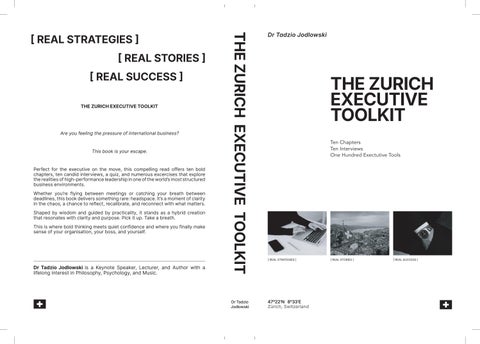
Are you feeling the pressure of international business?

Feeling the pressure of international business? This book gives you room to breathe. For the executive on the move, it offers ten bold chapters and ten candid interviews. Together they reveal how high-performance leadership works inside one of the worldʼs most structured business cultures.

Feeling the pressure of international business? This book gives you room to breathe. For the executive on the move, it offers ten bold chapters and ten candid interviews. Together they reveal how high-performance leadership works inside one of the worldʼs most structured business cultures.

This book is your escape.

Feeling the pressure of international business? This book gives you room to breathe. For the executive on the move, it offers ten bold chapters and ten candid interviews. Together they reveal how high-performance leadership works inside one of the worldʼs most structured business cultures.

Feeling the pressure of international business? This book gives you room to breathe. For the executive on the move, it offers ten bold chapters and ten candid interviews. Together they reveal how high-performance leadership works inside one of the worldʼs most structured business cultures.

Feeling the pressure of international business? This book gives you room to breathe. For the executive on the move, it offers ten bold chapters and ten candid interviews. Together they reveal how high-performance leadership works inside one of the worldʼs most structured business cultures.

Between flights or between deadlines, it delivers something rare: headspace. A calm pause in the noise — a chance to reflect, recalibrate, and reconnect with what matters most.

Between flights or between deadlines, it delivers something rare: headspace. A calm pause in the noise — a chance to reflect, recalibrate, and reconnect with what matters most.

Between flights or between deadlines, it delivers something rare: headspace. A calm pause in the noise — a chance to reflect, recalibrate, and reconnect with what matters most.

Between flights or between deadlines, it delivers something rare: headspace. A calm pause in the noise — a chance to reflect, recalibrate, and reconnect with what matters most.

Between flights or between deadlines, it delivers something rare: headspace. A calm pause in the noise — a chance to reflect, recalibrate, and reconnect with what matters most.

Perfect for the executive on the move, this compelling read offers ten bold chapters, ten candid interviews, a quiz, and numerous excercises that explore the realities of high-performance leadership in one of the world’s most structured business environments.

Blending human insight with cutting-edge AI, this hybrid is striking and intellectually engaging.

Blending human insight with cutting-edge AI, this hybrid is striking and intellectually engaging.

Blending human insight with cutting-edge AI, this hybrid is striking and intellectually engaging.

Blending human insight with cutting-edge AI, this hybrid is striking and intellectually engaging.

Blending human insight with cutting-edge AI, this hybrid is striking and intellectually engaging.

With noir-inspired imagery and a narrative that challenges convention, it is more than a business book — it is a companion for the journey.

With noir-inspired imagery and a narrative that challenges convention, it is more than a business book — it is a companion for the journey.

With noir-inspired imagery and a narrative that challenges convention, it is more than a business book — it is a companion for the journey.

With noir-inspired imagery and a narrative that challenges convention, it is more than a business book — it is a companion for the journey.

With noir-inspired imagery and a narrative that challenges convention, it is more than a business book — it is a companion for the journey.

Whether you’re flying between meetings or catching your breath between deadlines, this book delivers something rare: headspace. It’s a moment of clarity in the chaos, a chance to reflect, recalibrate, and reconnect with what matters.

Pick it up. Take a breath. Here bold thinking meets quiet clarity — and here you finally make sense of the system, your boss, and yourself.

Pick it up. Take a breath. Here bold thinking meets quiet clarity — and here you finally make sense of the system, your boss, and yourself.

Pick it up. Take a breath. Here bold thinking meets quiet clarity — and here you finally make sense of the system, your boss, and yourself.

Pick it up. Take a breath. Here bold thinking meets quiet clarity — and here you finally make sense of the system, your boss, and yourself.

Pick it up. Take a breath. Here bold thinking meets quiet clarity — and here you finally make sense of the system, your boss, and yourself.

Shaped by wisdom and guided by practicality, it stands as a hybrid creation that resonates with clarity and purpose. Pick it up. Take a breath.

This is where bold thinking meets quiet confidence and where you finally make sense of your organisation, your boss, and yourself.

Dr Tadzio Jodlowski is an Inspirational Lecturer, author, and Keynote Speaker.

Dr Tadzio Jodlowski is an Inspirational Lecturer, author, and Keynote Speaker.

Dr Tadzio Jodlowski is an Inspirational Lecturer, author, and Keynote Speaker.

Dr Tadzio Jodlowski is an Inspirational Lecturer, author, and Keynote Speaker.

Dr Tadzio Jodlowski is an Inspirational Lecturer, author, and Keynote Speaker.

Dr Tadzio Jodlowski is a Keynote Speaker, Lecturer, and Author with a lifelong interest in Philosophy, Psychology, and Music.

THE ZURICH EXECUTIVE TOOLKIT

THE ZURICH EXECUTIVE

THE ZURICH EXECUTIVE TOOLKIT

THE ZURICH EXECUTIVE TOOLKIT

Dr Tadzio Jodlowski

THE ZURICH EXECUTIVE TOOLKIT

THE ZURICH EXECUTIVE TOOLKIT

Dr Tadzio Jodlowski

47°22′N 8°33′E Zürich, Switzerland

47°22′N 8°33′E Zürich, Switzerland

47°22′N 8°33′E Zürich, Switzerland

47°22′N 8°33′E Zürich, Switzerland

THE ZURICH EXECUTIVE TOOLKIT

THE ZURICH EXECUTIVE TOOLKIT

THE ZURICH EXECUTIVE TOOLKIT

Ten Chapters Ten Interviews /

Ten Chapters Ten Interviews /

Ten Chapters Ten Interviews /

Ten Chapters Ten Interviews /

Chapters Ten Interviews /

Ten Chapters Ten Interviews

One Hundred Exectutive Tools

Dr Tadzio Jodlowski
Dr Tadzio Jodlowski
THE ZURICH EXECUTIVE TOOLKIT
Dr Tadzio Jodlowski
Dr Tadzio Jodlowski
Dr Tadzio Jodlowski

THE ZURICH EXECUTIVE TOOLKIT

Copyright © Tadzio Jodlowski, 2025

Published by ??

All rights reserved

This book is sold subject to the condition that it shall not, by way of trade or otherwise, be lent, resold, hired out, or otherwise circulated without the publisher’s prior consent in any form of binding or cover other than that in which it is published and without a similar condition including this condition being imposed on the subsequent publisher.

The moral right of the author has been asserted.

First published in the United Kingdom, 2025

ISBN 978??

Front cover and chapter heading design by Alexey.

Formatted and Printed by Beamreach Printing

THE ZURICH EXECUTIVE TOOLKIT

Ten Chapters Ten Interviews One Hundred Exectutive Tools

"You remind me of my favourite Professor at Yale."

"A good executive toolkit helps you to realise how many problems aren’t yours"
Dr Tadeusz Jodlowski

FOREWORD

Since our beginnings in 1967, Fotogen has always been proud to call Zürich home. Over the years we have worked with executives, companies and creatives in many different fields, and each collaboration has reminded us how much energy and talent this city holds. Zürich is both precise and inventive, and we have always tried to bring those qualities into our own work.

For us, staying relevant means staying curious. We have never wanted to stand still. From new styles and ideas to unexpected partnerships, our business has grown by keeping an open mind and welcoming change. Most recently we have added an AI dimension to our work, something we are genuinely thrilled about. It expands the creative options we can offer and shows us a future that is as exciting as it is challenging. We were especially pleased to hear that the author of this book has chosen to include this theme in his presentation, as it mirrors our own belief that innovation belongs at the heart of business.

That is why we are delighted to support The Zürich Executive Toolkit It is a book that captures the spirit of leadership and creativity that runs through this city. It offers a perspective that I believe many will find both useful and inspiring. Zürich has given us so much, and it feels only natural to lend our voice to a project that celebrates it with such care and imagination.

15/11/25

INTRODUCTION

The idea for this book took shape on flights from England to Zurich. It was always a thrill to see the Alps rise with authority and the lake stretch out with quiet certainty. The city is a blend of history and modernity, rooted in tradition yet moving forward with purpose. Zurich does not clamour for attention. It demonstrates how leadership endures with calm confidence. Here is your chance to find out how.

My previous works are on the bookshelves in Zurich and displayed in the window of a bookshop in the old town. I look forward to this publication joining them. This book took a year to write and forms part of my presentation at the What’s Next Forum Zürich 2025, where I delivered a keynote on the future of AI, joining an international panel of distinguished thinkers. For that presentation, artificial intelligence was used to enhance certain aspects of the work; yet, what you hold is, above all, the result of a year of writing, research, and reflection, crafted to provoke thought, not just record it.

The Zurich Executive Toolkit is full of abstract thoughts and breakthrough moments. It is designed to provide you with headspace. At senior levels of leadership, what matters most is not more noise but clarity and the ability to remain composed under pressure. Zurich built its reputation not through loud declarations but through reliability, timing, and the discipline to wait when waiting was the smartest move.

In the chapters that follow, you will see how Zurich’s approach, calm, measured, quietly confident, can be applied to your own leadership. Where others react hastily, Zurich takes the long view. Where others chase headlines, Zurich focuses on what lasts. It is a model that proves time and again that success belongs to those who combine consistency with foresight.

This book is presented in two halves. Ten chapters draw lessons from Zurich’s culture of leadership and precision. Ten interviews with executives from across its business landscape offer their own perspectives and stories. Together, they provide not just strategies but a way of thinking, one that reduces stress, restores focus, and allows executives to work with clarity rather than under constant pressure.

If you are expecting the usual type of business book, set this one aside. But if you are open to ideas that can simplify your working life, reduce stress, and give you sharper tools for leadership, then welcome. Nice to meet you.

The story begins not in a boardroom but with an arrival. From the air, Zurich presents itself with the same clarity that defines its business culture. The Alps stand as symbols of permanence, the lake reflects a sense of balance, and the city demonstrates order without noise. These are not just scenic details but reminders of the values that underpin leadership here: stability, clarity, and quiet authority. Every flight across this landscape, every descent over the lake, is a subtle lesson in perspective: the world is both vast and manageable, and leadership, at its best, requires the same recognition.

Each chapter of The Zurich Executive Toolkit explores a different dimension of Swiss leadership culture, drawing out lessons that extend far beyond Zurich’s banks and boardrooms. Together they form a guide to global leadership with Swiss precision, weaving history, psychology, and strategy into something practical, memorable, and quietly powerful. We begin with The Power of Tradition: The Legacy of Swiss Banks. Zurich’s most iconic export has never been chocolate or watches, but trust. For centuries, clients have placed their faith not only in vaults of stone but in vaults of silence. Swiss banks built their reputations on confidentiality, discretion, and long-term stability. In an age of oversharing and constant disclosure, the discipline of secrecy remains radical. This chapter asks what it means to carry trust as a currency. The power of discretion is not limited to finance. For executives, it can mean knowing when not to speak, when to withhold a comment, and when to act only after the noise has passed. In a world obsessed with disruption, Swiss banks remind us that endurance itself is the most valuable form of innovation.

From tradition, we move naturally to Vaults and Visions: Innovators and Freethinkers, which uncovers the cultural DNA that allows Zurich to be both stable and forward-looking. The Swiss reputation for conservatism is well earned, yet it hides a paradox. Beneath the image of watchmakers and bankers lies a nation that produced avant-garde artists, revolutionary scientists, and daring entrepreneurs. Einstein formulated theories in Zurich. Dadaism was born in its cafés. Stability and innovation are not opposites here but partners. The executive who can balance reliability with imagination becomes not just a manager of today but a steward of tomorrow. The lesson is subtle: foresight without courage is stagnation, courage without foresight is chaos. Zurich teaches both in tandem.

No executive escapes bureaucracy, and Zurich has turned it into an art form. Living under the Panopticon: Form Filling for Power Players examines how the Swiss have elevated compliance and procedure into more than paperwork. Forms, protocols, and rules can appear tedious, yet they provide structure, clarity, and predictability. Leaders who master bureaucracy do not fight it, but use it to their advantage. The Swiss may observe, with a quiet smile, that a form is a kind of poem. The rhyme is in the boxes, the metre in the lines. You do not need to like it, but you must respect it. Mastery of process becomes a subtle source of authority.

From process, we transition to simplicity. Simple Systems, Elegant Results: You Have Something explores how Swiss businesses thrive on clarity and minimalism. Efficiency does not come from overcomplication but from intelligent design. The best systems are transparent, trusted, and understood. In executive practice, simplicity frees attention, allowing leaders to focus on strategy and culture rather than firefighting. Here, we see that the discipline of refinement and reduction is not austerity but a path to freedom and precision. Less becomes more, not by accident, but by careful attention to what matters and what does not.

Presence is the next lesson. Bowie and Bond: Communication and Charisma examines how a rock star and a fictional spy, both associated with Switzerland, illuminate executive presence. David Bowie used the quiet order of Switzerland to reinvent himself with rare elegance. James Bond demonstrates poise under pressure in ways that boardrooms could envy. Between them lies a lesson: charisma is not about volume but about control, adaptability, and projection of confidence. A raised

eyebrow, delivered correctly, often achieves what hours of presentation cannot. Presence in leadership is subtle, deliberate, and commanding without demanding. Executives who can master attention without ostentation gain influence that endures beyond immediate outcomes.

We then face the twenty-first century’s most pressing issue: artificial intelligence. Leading with Intelligence: Calm Control in a Noisy Age explains why Zurich does not panic about AI, and neither should you. Just as Swiss bankers have weathered market upheavals with composure, executives today can approach AI with calm and focus. Technology is a tool to be understood and integrated, not a master to be feared. The chapter demonstrates how leaders can leverage human judgment in conjunction with artificial intelligence, utilising it to inform decisions without being overly reliant on algorithms. Calm control, not fear or frenzy, is the hallmark of enduring leadership.

Leadership also requires psychological insight. Feedback Loops: Managing the Rescuer Impulse examines the tendency to become overextended in saving teams or colleagues at the expense of personal clarity and well-being. Switzerland values balance and restraint, and executives who learn to resist constant rescue behaviour gain resilience and efficiency. Providing stability without becoming consumed by the problems of others is an executive discipline. Those who master it endure where others falter.

The Psychology of Success: Legacy Thinking then considers identity and ambition across generations. In Zurich, family businesses and centuryold institutions coexist alongside innovative start-ups, creating a culture where legacy carries weight. Legacy is not only about inheritance; it is about continuity, responsibility, and vision. Leaders must evaluate whether their drive serves personal ambition or contributes to a longerterm trajectory. Managed wisely, legacy thinking becomes a foundation rather than a burden, shaping decisions with foresight rather than pressure.

We then step into a reflective space. Executive Dreams: Archetypes and Symbols revisits Carl Jung and the enduring relevance of his work. Archetypes, myths, and symbols are present in boardrooms as much as in therapy sessions. Executives who recognise these patterns can interpret motives and organisational dynamics consciously rather than

unconsciously. Understanding archetypes is not esoteric but practical, providing insight into leadership, team behaviour, and corporate culture. It is a map of the hidden currents in professional life, allowing for more deliberate navigation.

Finally, The Art of Luxury: Rituals of Refinement considers the understated power of daily discipline. Switzerland has perfected the art of living well without excess. Rituals are precise and deliberate, from a perfectly kept watch to the careful attention given to a morning coffee. Executives who embrace refinement cultivate presence, clarity, and authority. Luxury here is not indulgence, it’s the quiet mastery of detail: the tone of a signature, the weight of a Montblanc in hand, and the discreet pleasure of Swiss chocolate savoured between decisions. Leadership, after all, is built not just on bold moves but on the elegance of control.

Together, these ten chapters offer a comprehensive view of leadership through the lens of Zurich’s precision, culture, and psychology. They are not quick fixes or slogans but a sustained method of working that encourages clarity, resilience, and enduring success. Interwoven with these chapters are interviews with ten executives from across Zurich’s business landscape, each offering their own perspective, experiences, and insights. Their voices complement the guidance and abstract thinking of the chapters, grounding it in real-world practice.

By the time you have read these pages, you will understand that leadership is as much about calm focus and careful attention as it is about strategy. It is about knowing when to act and when to observe. It is about balancing innovation with stability, action with reflection, and ambition with restraint. You will discover a toolkit not of gimmicks but of subtle, repeatable behaviours that allow executives to perform at their best without succumbing to pressure or distraction.

If you are expecting the typical business book, set this one aside. But if you are open to ideas that can simplify your working life, reduce stress, and give you sharper tools for leadership, then welcome. You have arrived. The view across the lake to the mountain tops is clear, valuable headspace, for executives in any organisation.

THE CHAPTERS

THE POWER OF TRADITION

The Proud Legacy of Swiss Banks

Where routines and rituals turn caution into capital — and reputation is the strongest currency.

The noise at the Zum Kropft restaurant in Zurich is loud, and I love it. It's a combination of clinking glasses, laughter, and chatter. The place is full of life, and people are enjoying its boisterous atmosphere. The walls are heavy with history, gold, and dark wood, and you can feel the past in the air. The food is hearty and traditional; it's superb, and the servers are friendly and professional. It makes you feel as though you are sitting at the centre of something old and enduring. It's a baroque experience deeply rooted in the heart of the old town.

Zurich is rich in established traditions that blend history with a touch of eccentricity. The most famous of these is Sechseläuten, a spring festival where an effigy of a snowman, the Böögg, is burned to predict the summer weather. Locals also enjoy the Lällekini, a humorous competition where participants speak in the Zurich dialect. The city's film festival features a parade with creative and sometimes absurd costumes, while the Rüebli Festival celebrates carrots with games and dishes. During the Night of the Museums, art lovers explore galleries after hours with interactive performances, and Fasnacht brings vibrant, boisterous costumes and music to the streets. Zurich, naturally, holds chocolate competitions because what else would a city of bankers and designers do in their downtime but sculpt edible art and quietly judge each other for it. The results are equal parts brilliance and folly, a reminder that behind all the calm efficiency lives a culture that enjoys itself.

In Zurich, tradition carries a sense of understated gravitas that defies any challenges it has to face. In an era characterised by intense fascination with communication and technology, the mountains surrounding Switzerland remain largely untouched. Even amid the continuous search for the next big innovation, people still find comfort in the enduring aspects of their lives. Nowhere is this more noticeable than within Zurich's historic banking sector. Here, tradition continues to play a vital role in effective financial management. Even as the impact of new technology

takes hold, there is a clear sense that the main principles of Swiss banking are not up for negotiation. The future may bring new processes, but they will not rewrite the rules of the banking sector overnight. For this reason, Zurich continues to keep its intentions private, and history may view this as the right strategy. Reputation matters more than reach. Relationships are formed gradually, often over many years, and loyalty is prioritised over the number of connections. This culture emphasises deep knowledge, service, and trust. Bankers in Zurich are expected to be dependable rather than flamboyant. While Zurich is not immune to global trends, it carefully filters them through the lens of experience and a long memory. This mindset shapes how the industry operates, and at its core, banks form relationships before transactions are completed. Meetings still occur face-to-face, and people value a handshake over a digital signature. The pace is measured, not rushed, and that is the difference. It's not about resisting progress but about safeguarding the foundations.

New systems get filtered through old systems, not the other way around. That is why this intriguing city has not lost itself in recent years, especially now, as it is experiencing historic levels of recalibration. While other financial hubs chase visibility, Zurich remains focused on substance. Reputation is treated like capital, earned slowly, guarded carefully, and never spent lightly. That is also why trust runs so deep here. Clients don't just choose Zurich for its tax advantages or convenience; they come for the long view and the meticulous curation of wealth that can only be attributed to the Swiss. The bankers know that no single headline will sway their well-developed systems. That form of steadiness does not come from trend-chasing but from culture. And culture, in this case, is built on tradition. Even younger bankers, raised in the digital world, learn quickly that speed means nothing if it cuts corners in Zurich. Innovation is welcome, but it must fit within the old watch case. Here, the past is not an obstacle; it is the framework to build the future. Tradition is one of those words that some equate with times gone by and previous ways of doing things. However, the truth is that it still matters, and in these chaotic times, it matters a lot. Few industries have remained so steady while adapting so gracefully to change. And for modern executives navigating shifting markets, evolving technologies, and complex teams, that blend of resilience and adaptability offers something rare: a practical, proven model. Switzerland has developed a way to maintain relative balance, one of its strengths. It maintains stability in a politically

neutral, culturally grounded, and impressively precise manner. However, this isn't just something in the national DNA; it's a way of running things that also manifests within organisations. And that kind of leadership still holds up. It doesn't matter if you're in finance, tech, or any other field; the mindset is transferable. Executives who lead well over time understand this intuitively. They recognise that consistency is a strength, not a lack of ambition. Holding onto what works, even as the world changes, gives their teams a sense of direction. In that way, Swiss banking becomes more than a financial case study; it becomes a strategic guide.

Discretion remains one of the most important tools in the Zurich executive's toolkit. When colleagues, clients, and board members know their conversations will not be repeated, you become someone they can rely on. You create space for honest discussions that lead to sound decisions and stronger relationships. In leadership, discretion is often overlooked, but people notice when it is missing. It tells others you are not just a safe pair of hands for data, but for assurance. In Switzerland, that kind of quiet confidence is almost a cultural norm. You see it in the trains that glide in like clockwork, the refined way things are built, the institutions that do not shout but are somehow always still standing. That same attention to detail carries weight when you are the one steering. It is not about chasing perfection. It is about showing that you care enough to get it right. A meeting with an actual structure. A decision that was not plucked from the void. A clear message that avoids corporate jargon; these are signals. Foresight is similar. It does not wave flags or seek applause, but when it is present, everything remains stable. It is the ability to plan calmly, recognise patterns early, and act with purpose instead of reacting impulsively. Swiss banking has relied on this for decades. It is why the system has remained stable even when others falter. And it is a habit worth borrowing. Executives who develop this mindset do not just get through change; they lead through it.

Like much of Switzerland, Zurich is known for its precision, stability, and a sense of quiet competence. Another interesting aspect of Zurich's culture is its Apéro tradition, a social event where everyone acts as though the workday has officially ended. In reality, the honest business discussions are just beginning. But do not let the quiet corners fool you. This is not your usual happy hour. It is an art form, wrapped in understatement and served with a side of “I might have emails to answer later.”

Here is where the Swiss get it right: networking, but not in the stiff, boardroom style you might be used to. Zurich-style networking is about the quiet exchange of ideas, where an offhand remark over a glass of wine can spark the kind of conversation that leads to real collaboration. While built on a foundation of trust and reliability, businesses in Zurich have always had an undercurrent of organic and personal relationshipbuilding. You do not just do business with numbers; you do business with people. The Apéro encapsulates this idea perfectly, allowing business leaders to get to know one another in a more relaxed, personal environment, where the deal is not always in the handshake, but in the understanding that comes from shared time and conversation. In this city, alliances are often forged after hours, not just in the conference room. While the world has become more transparent, Switzerland’s commitment to reserve and privacy remains unshaken. It is as though Zurich’s banks are holding their cards close to the chest, not because they are hiding something, but because they believe deeply in the importance of trust. This principle is often misunderstood in the modern age, when the push for transparency seems all-encompassing. Yet, the Swiss philosophy of discretion can teach us something invaluable in business: trust is earned through restraint, and relationships are built not just by what is said, but by what is kept unspoken.

And, of course, we cannot forget the Zurich lake itself. On a beautiful day, the lake is teeming with yachts, rowers, and families, all enjoying the serenity that Zurich seems gifted at preserving. It is a sharp contrast to modern business's usual hustle and bustle, where speed and efficiency are paramount. Yet, the lake reminds us of an equally important lesson: the importance of pausing and recharging. The workday in Zurich does not end with a concise goodbye and a rush to the next meeting. Instead, there is a rhythm to the day that allows for moments of calm, whether in a boat or on a terrace, watching the water. In business, especially in high-stakes environments like finance, executives often work at full throttle, never stopping to replenish their mental reserves.

There is a golden thread that runs through Swiss tradition, its financial institutions, and leadership that holds firm over time. It reflects timeless and critical values in business: balance, reflection, alliance-building, and confidence. These are not things you find in spreadsheets or economic forecasts; they are the quiet forces that underpin the success of Zurich’s business world. They remind us that, while it is essential to be precise,

organised, and efficient, there is also room for a bit of eccentricity and quirks that, in their way, help keep the gears of the global economy turning with a little more grace and humanity. In the end, what connects it all is a kind of quiet clarity. Zurich does not chase attention. It earns standing. It does not rush to reinvent; instead, it refines what already works. The values found in Swiss banking, such as discretion, precision, and foresight, are not relics from a slower era. They are enduring and reliable tools for leaders navigating today’s complexities. In a world that moves quickly, the ability to lead with calm purpose and long-term vision is more relevant than ever. Tradition, in this case, is not resistance to change. It is knowing what should be preserved. And for those who understand that, it offers something rare. Not just stability, but a strategy that endures.

The wisdom of Swiss banking traditions, combined with a commitment to privacy, meticulous attention to detail, and strategic foresight, has never been more relevant. These principles provide a much-needed counterbalance in a world dominated by rapid decisions and impulsive reactions. For executives, adopting the Swiss approach means recognising that authentic leadership lies in steady preparation. It is about resisting the urge to react impulsively and instead focusing on long-term, strategic decisions that reflect both the present challenges and the future opportunities. Ultimately, while tariffs will continue to shape the global economic landscape, they also offer a valuable lesson for leaders to learn from. The key is not to be swept up in the noise of short-term fluctuations, but to adhere to the principles that have long defined institutions of trust and stability. The Swiss banks did not become pillars of global finance by chasing the latest trend or responding to every economic whim. They did so by adhering to a philosophy of reliability, precision, and patient innovation. This model enables navigation of uncertainty caused by tariffs or other market disruptions, ensuring the long-term trajectory remains intact, even in the face of adversity. The long-standing tradition of discretion, caution, and calculated risk-taking means that financial executives in Zurich, Geneva, and beyond are well-equipped to manage punctuated equilibrium, a form of evolution represented by sudden, dramatic shifts. The strength of Swiss banking lies not only in its ability to navigate turbulence but also in its commitment to preserving longterm value. This ensures that clients' wealth remains protected even as market conditions fluctuate. Swiss banking executives are trained

to view financial landscapes through a historical lens, understanding that uncertainty is not a new phenomenon. These values have enabled Swiss institutions to remain relevant and resilient, regardless of shifts in the global market.

However, Swiss banking's measured and composed approach is not all there is to the culture. Much like the Fasnacht revellers, who participate in the traditional Swiss carnival, Swiss banks have found a way to balance structure with spontaneity and formality with flexibility. They understand that while stability is crucial, there is room for innovation, calculated risks, and boldness when navigating uncertain times. The ability to let loose when the moment calls for it, while staying rooted in tradition, gives Swiss banking its edge in a world full of unpredictability. This combination of stability and agility, tradition and modernity, enables Swiss banks to thrive in stable and chaotic financial environments. An evening walk around the city makes the banks seem like sleeping giants, though money never sleeps. The façades along the Limmat whisper of permanence, and the offices behind them seem to slow time. Yet, the strength of these institutions is only one side of the story. The other half is the executives who run them, individuals who inherit not only responsibility but also the unique pressures of a culture that demands composure as a civic duty. This culture, deeply rooted in Swiss society, places a high value on stability, reliability, and long-term planning. It is a culture that expects its leaders to remain calm and composed, even in the face of uncertainty and change. Tradition shapes systems, but it also shapes people, and with that comes both resilience and strain. The challenge today is not simply how to preserve continuity but how to avoid being quietly suffocated by it.

Executives in Zurich do not merely inherit companies; they acquire them. They inherit entire worlds of expectation, and those worlds begin forming early. Swiss schooling not only prepares children academically. It instils an ethic of order, neatness, and reliability so ingrained that to disrupt it feels like an act of rebellion. Dinner tables provide another layer of training. Conversations regarding finance, politics, or family legacy are held with the same quiet respect as a board meeting. By the time someone arrives in the executive suite, they are already fluent in the unspoken codes that govern Swiss life. They carry an invisible rucksack packed with cultural paradigms and family expectations. It is a toolkit, but also a weight. You are expected to be discreet, to remain

balanced, to show resilience without ever appearing strained. In Zurich, effort is admired, but only when it does not show.

The stress this produces is rarely acknowledged directly. To do so would violate the very code of discretion executives are raised to uphold. Instead, it leaks out through subtler channels. The preference for order over risk, the careful avoidance of conversations that might disturb surface calm, the immaculate scheduling of days so that no disorder is allowed to creep in. It is both admirable and exhausting. The irony is that this pressure produces excellence. Zurich leaders are admired worldwide for their discipline, restraint, and ability to maintain composure that looks effortless. But anyone who has spent time pretending to be effortless knows how much effort it really requires. Expectations here come not only from corporate boards and shareholders, but also from longstanding family traditions. In some cases, the weight of expectation is as strong as that of the regulator. Family standards insist on continuity, on carrying the family name and reputation without blemish. In certain wellknown Zurich families, the concept of personal failure extends beyond the professional to the existential level. Faltering would not only be a personal setback but also a family embarrassment. That kind of inherited pressure can be both motivating and suffocating, often simultaneously. Yet, Zurich executives, despite these challenges, continue to excel, inspiring others with their resilience.

The executive who has learned these codes well may appear unflappable. Meetings run smoothly, decisions are carefully calculated, and crises are handled without visible panic. Yet beneath the surface is the quiet toll. Long hours of performance, endless calibrations of tone and timing, the steady grind of balancing what is expected with what is possible. The corridor of leadership in Zurich is lined with portraits of predecessors who look down as if to remind you that you, too, must never let the standard slip. Some of those expectations steady you. Others press against you. The skill lies in knowing the difference.

Zurich’s executive world is not limited to bankers in striped ties or discreet managers behind glass doors. It spans industries as diverse as luxury goods, hospitality, technology, communications, and entertainment. Executives here are as likely to be found refining AI software as they are orchestrating a global marketing campaign. Despite the variety of their roles, the challenges of leadership remain

surprisingly universal, connecting them in their shared experiences. This book is a unique offering that brings together ten diverse perspectives, carefully selected from a group of professionals whose daily lives could not be more different. Yet, their lessons intersect in ways that shed light on the executive condition. It is not a guide to a specific industry, but a comprehensive field guide to the executive condition itself. The conversation around well-being in leadership reveals a deeper truth: the mind is not a container, but a cosmos. There is plenty of room up there. The question for today’s leaders is no longer how to carry tradition flawlessly, but how to adapt it in ways that preserve dignity without crushing the individual. Here is a book that shows you how you do it.

 EXECUTIVE TOOLS

• Trace what is working: Reverse-engineer successful systems. Learn from existing efficiency before introducing change.

• Filter complexity: Identify performative or unnecessary steps. Remove what does not add value under stress.

• Ask the anchor question: What has not changed? Use stable elements as a reference point in decision-making.

• Protect mental space: Reserve headspace for reflection, prioritisation, and deliberate choices.

• Shrink one workflow by 30 percent: Reduce redundancy or steps in a process to test simplicity in action.

• Adapt quietly: Make changes without spectacle. Evolution should feel natural, not forced.

• Document outcomes: Record what works and what fails. Pass on lessons clearly to strengthen the system.

• Lead without noise: Communicate calmly and deliberately. Let authority and clarity do the work.

• Simplify under pressure: Reduce complexity when stakes are high. Clarity ensures speed and accuracy.

• Innovate from simplicity: Introduce new methods in ways that complement, not disrupt, established systems.

VAULTS AND VISIONS

Innovators and Freethinkers

Vision requires shelter; innovation, a vantage point. Here, both meet.

Zurich has bank vaults in the same way Venice has canals. Quietly there, beneath the surface, not screaming for attention but impossible to ignore once you start looking. You’ll never see them unless you’re invited down a staircase no tourist knows exists, behind a door that looks like it might lead to a storage cupboard for cleaning supplies, past a keypad, a retina scanner, and a man in a suit who doesn’t blink. And then suddenly, you’re in a room with walls as thick as a winter coat and floors that hum with confidence. And when it does, when your feet feel planted on something dependable, your mind can drift toward wilder territory. That’s where the visionary part creeps in. It’s not a coincidence that Zurich has quietly given birth to innovation after innovation, in banking, design, technology, and even chocolate that snaps just right. When people aren’t busy defending their ground, they are free to explore new ideas.

There’s a strange certainty that comes from knowing the floor beneath you is full of gold. In Zurich, even the air seems to whisper that nothing here is about to fall apart. People walk like they expect society to hold. The city teaches you, in its own stubbornly quiet way, that creativity doesn’t come from chaos. It comes from being calm. The vault becomes a metaphor not because everyone is obsessed with gold, but because beneath all the surface, most of us are just looking for a place where ideas can feel secure without being stolen or laughed at. Somewhere where our hopes don’t get crushed by the next headline. Somewhere, where our ideas can sit long enough to become something real.

There’s always someone who will suggest that all this calm is just a cover for boredom. That safety is the enemy of brilliance. Probably someone who’s never actually felt safe. Because once you’ve had a taste of real security, the kind that doesn’t require alarms and gates and slogans, you realise what a rare luxury it is. And how it unlocks a part of your brain that has been too busy surviving to think clearly. The vaults aren’t the

magic. They’re the container for it. The gold underneath isn’t just metal. It’s a metaphor, a memory, maybe even a meaning. The real treasure is what happens when we’re no longer afraid.

Zurich doesn’t scream. It doesn’t need to. It continues to do what it’s always done. It guards the world’s secrets without the need for display, providing a stillness that feels almost extinct in the present age. Pause for a while outside one of those discreet facades and you may sense it as well. A peculiar blend of certainty and potential, as if the walls themselves know both restraint and ambition. They are a reminder that when the world stops shaking, even for a moment, you might finally dare to dream. Or at least think a thought all the way through without someone shouting over it. Zurich’s air has no business being so clean. It’s as if the Alps themselves lean in for a quiet word, to remind everyone to behave. There’s a strange honesty to it. Crisp but not icy. Fresh but not trying too hard. The kind of air that clears the cobwebs from your mind and makes you want to do better.

Then there are the fountains. Real ones. Dozens of them are scattered around the city like small, slightly overachieving cousins of the Matterhorn. They don’t just gurgle; they consistently perform. Zurich has public water that makes you believe in it again. You can drink straight from them, which is both humbling and faintly thrilling. Their sound is soft but insistent, a constant murmur, a generous gift from the mountains. It’s a chorus of trickling fountains that reminds everyone that everything can work if you stop shouting and use a good filter. And Zurich also has a scent, though it changes as you walk. Expensive perfume drifts past you in waves, not sprayed but wornthe difference between broadcasting and belonging. There’s always a trace of something vaguely citrusy and utterly unattainable, like the scent of someone who gets private banking advice before breakfast. You’ll smell it on the Bahnhofstrasse most of all, mixing gently with the top notes of tyre rubber from a hybrid Bentley and just the faintest memory of some rare Italian leather being lightly sunbaked. Even the car fumes here smell edited. More curated than polluted. You might catch a whisper of engine, sure, but it’s always layered with something botanical or designer. In most cities, you sniff the air and brace yourself. In Zurich, you sniff the air and think, maybe you should buy some better clothes.

Switzerland has a reputation for being calm, collected, and generally unbothered by the outside world. You can thank Zurich for that. It’s the city where people wear navy blue like a badge of honour, where meetings start on time and finish early, and where even rebellion arrives with a clean shave and a spreadsheet. It begins with a deeply Swiss instinct to keep things organised, not just your desk or living room, but also your ideas. Clarity is king here. Not because people are unimaginative, but because they’ve already played chess three moves ahead and figured out that mess slows you down. So, Zurich produces innovators, but they’re not the kind that shout. They don’t make TED Talks about their feelings or cry on LinkedIn. They build things that work. They view risk not as a dragon to conquer, but as a spreadsheet to master. If Zurich wants change, it comes with a plan, a pilot programme, and a backup plan for the backup plan. Innovation, yes. But please make it sensible. There’s a Protestant influence still embedded in the city's essence, though few will acknowledge it openly. Not the chest-beating kind, but the type that sees virtue in hard work, punctuality, and not talking too much about yourself. Which is funny, because Zurich is full of clever people doing brilliant things, but you’d never know it unless you asked the right question in the right tone of voice at the right time of day. Even then, you might get a modest shrug and a sentence that starts with “Well, we just thought it might be interesting to try…” Which loosely translates as: “We’ve just solved something that will quietly revolutionise your industry, but we’d hate to bother you with the details.”

What you will find, if you stay long enough and drink enough coffee, is that behind all the modesty and method lies a stubborn sort of idealism. Zurich thinkers believe in progress, but not the kind you put on a billboard. There’s something in the water here, or maybe the mineral water, that attracts people who like thinking five layers deep while pretending not to care. What makes Zurich unusual is that it manages to be both deeply traditional and quietly radical at the same time. It respects order, but doesn’t fear change. It loves history, and it's not just a matter of respect; it's a matter of appreciation. The people here are not allergic to risk; they’re just allergic to stupidity. Which, frankly, is a useful allergy. Especially in a world where short-term thinking is the new global sport and attention spans are traded like commodities. Zurich effortlessly defies convention, showcasing a delightful blend of uniqueness and charm that sets it apart from the ordinary. Of course, we can’t talk about the Zurich mindset without tipping our well-pressed

hats to a few individuals who wore it better than most. These are not your average poster children for disruption. They didn’t burn things down to build something new. They built quietly, with terrifying clarity, and the world eventually caught up.

Take Alfred Escher, for example. Not a household name outside Switzerland, but the man practically built modern Switzerland with one eyebrow raised. In the 1800s, he spearheaded the development of the national railway system, co-founded Credit Suisse and laid the intellectual groundwork for ETH Zurich, now one of the world’s most respected technical universities. Escher believed infrastructure was the path to independence, which sounds very Swiss until you realise he made it happen. Most people talk about the big picture. Escher ordered the lumber and got the permits. Speaking of ETH Zurich, it produced a young man who would later redefine our understanding of space and time. You may have heard of him. He is called Albert Einstein. He wasn’t technically born in Zurich, but it was here that he earned his degree and discovered that Newton had left a few things unexplored.

Einstein, scruffy and rebellious by Swiss standards, thrived in this atmosphere of disciplined thinking. He once described the Swiss educational system as one that encouraged curiosity. Coming from someone who spent most of his life asking questions no one else dared to, that’s saying something. Then there’s Carl Gustav Jung, Zurich’s explorer of the subconscious. If Freud was the flamboyant headline act, Jung was the slow-burning, soul-searching deep thinker with a penchant for mandalas and myth. His home by Lake Zurich was a place where many lives were transformed. He created a whole new way of thinking about the self, the shadow and the collective unconscious. Not bad for someone who probably never raised his voice in public.

And of course, we can’t forget the thinkers and tinkerers who quietly shaped finance and technology. Zurich was an early adopter of digital banking long before it became a slogan. The city’s financial brains realised that discretion and data security were not enemies but natural allies. It was Zurich that helped design the modern architecture of global wealth management, not by shouting about it, but by building systems so stable they made the rest of the world’s bankers look like street magicians. This is a place where even your algorithm is expected to wear a tie. For a more recent perspective, consider the engineers and cryptographers

behind Switzerland’s blockchain and fintech advancements. Not all of them are based in Zurich itself. Zug has evolved into something of a digital Wild West in recent years, but the Zurich influence is still evident. Precision. Privacy. Longevity. It's innovation with a firewall and a pension plan. Even the rebels here run clean code.

America likes to sprint. Zurich prefers a marathon, but only after checking the weather and confirming the route is signposted correctly. In the United States, everything is about scale, speed, and disruption. Move fast and break things, preferably while live-streaming it. The American Dream is a fireworks show, a sudden blast of light and noise, ideally accompanied by venture capital. Zurich, by contrast, is more like a watch mechanism. Quiet. Precise. Almost boring, until you realise it’s still ticking long after the latest startup unicorn has tripped over its buzzwords and filed for bankruptcy. Sometimes it doesn’t even look like progress at all. It looks like a committee. Or a referendum. Or a politely worded memo from a cantonal office. But give it twenty years, and suddenly everyone’s copying the Swiss model and pretending it was obvious all along. This comparison is not to undermine the US approach, but to highlight Zurich's unique, understated approach to innovation. Zurich's preference for enduring progress, even if it's not immediately apparent, is a testament to the city's confidence in its methods and its commitment to lasting impact.

And let’s not forget trust. In Switzerland, trust is a kind of public currency. You might leave your bag at a café, but it will be waiting for you upon your return. You can hand a bank your life savings and sleep at night. In America, trust has to be earned, loudly, and is usually backed by a contract written in small print by six lawyers. In contrast, in Zurich, realism wins. Every time. Of course, America is brilliant at dreaming things up. The energy is unmatched. The raw creativity, the chaos, the strange genius of turning problems into industries that are real. But Zurich is where you go to make sure your idea actually works. Where a wild idea gets quietly refined, tested, structured, insured, and slowly transformed into something solid. The dream might be born in Palo Alto, but it retires comfortably in Seefeld. In other countries, such as the United States, innovation is a god. Fintech, crypto, neobanks, everything moves fast because standing still feels like failure. Venture capital flows like craft beer. If a startup hasn't "disrupted" something by Q2, it starts panicking. It’s all beta releases and axioms: decentralised,

tokenised, gamified, scalable. Zurich banks, on the other hand, won’t even launch a new app until it’s been through four internal audits, three stress tests, and a committee meeting involving someone who still uses a fax machine. Zurich bankers don’t avoid risk entirely. They don’t like surprises. They prefer plans with footnotes. They want every scenario mapped out in advance, ideally with a side dossier printed on thick paper. American banks will lend you money based on a vibe and a pitch deck. Zurich will ask for collateral, a business plan, your greatgrandfather’s tax records, and a gentle character reference from a high school teacher. It’s not paranoia. It’s just how they’ve survived three centuries of other people’s bad decisions. And when things go wrong, as they inevitably do, the contrast sharpens. In America, the collapse of a bank becomes a televised drama. Congressional hearings. Public apologies. Finger-pointing. Eventually, a miniseries. Zurich handles crises like a malfunctioning elevator: discreetly, behind closed doors, with a technician no one sees. No yelling. Just clinical dismantling, a quiet merger, and a collective clearing of throats. This meticulousness is what makes Zurich banking stand out, providing a sense of security in the face of financial crises.

So yes, in 2025, the world still turns. Wall Street still pulses with ambition. But Zurich remains what it has always been, the financial world’s fireproof room. It does not roar. While America revs the engines and races toward whatever happens next, Zurich keeps checking the map, recalculating the route, and reminding the passengers to keep their seatbelts on. Not thrilling, perhaps. But when the weather turns rough, and it always does, you will be glad someone kept the manual. And the manual never left. It was not thrown out or replaced with something shiny. It was tucked away in a drawer and quietly updated. A few pencil notes here, a folded corner there. Zurich does not shout about what it knows. It just remembers. This long-term focus is what Zurich banking provides: a feeling of security in the face of financial storms.

Still, it would be unfair to confuse steadiness with stagnation. Orson Welles once quipped that Switzerland had given the world nothing more than the cuckoo clock. A fine line for a film, perhaps, but a poor reading of history. The truth is that behind these careful facades, Zurich has sparked revolutions of a different kind. Breakthroughs in science, art, and technology have emerged from its quiet streets, born not of noise but of discipline. What appears calm from the outside is often

a storm of ideas within, as if the city itself insists that invention must be precise, otherwise it will not last. Executives today can learn from that rhythm. The same city that guards the past has also shaped the future, time and again. And it is not only the scientists and the thinkers. Musicians, actors, storytellers of every kind have felt the pull of Zurich, each discovering that restraint can be the most powerful stage light of all. In this city, the straight line of tradition has always carried a hidden current of imagination.

 EXECUTIVE TOOLS

• Create stable conditions: Set up routines and frameworks where ideas can mature without unnecessary pressure.

• Build trust incrementally: Deliver on promises consistently and respect confidences. Trust fuels collaboration and bold thinking.

• Lead by understatement: Communicate decisively but quietly. Let results speak louder than announcements.

• Fortify the foundation: Ensure your systems, processes, and resources can support new initiatives before launching them.

• Prioritise precision: Measure, track, and refine. Small misalignments today compound into failure tomorrow.

• Assess risk rationally: Analyse potential outcomes, plan contingencies, and avoid impulsive choices.

• Structure vision: Map goals into clear, sequential steps. Avoid chaos and distraction to maintain executional clarity.

• Filter innovation: Ask whether each new idea enhances the core system. Reject novelty for novelty’s sake.

• Allow creative freedom: Protect time and space for experimentation, even within disciplined systems.

• Think decades ahead: Test decisions against long-term impact. Avoid the temptation of immediate wins at the cost of durability.

LIVING UNDER THE PANOPTION

Form Filling For Power

Players

Master the form and you master the flow. Check the box — then rewrite the rules.

Switzerland has historically been known as a country characterised by order and organisation. The mountains and lakes provide aesthetic calm; the banks and advisors offer a strong sense of structural stability. A walk along the shores of Lake Zurich offers a tranquil space for reflection and relaxation. However, step into a regulatory office in Paradeplatz, and every email, form, and memo becomes a signal in a vast system of scrutiny. Those who manage wealth, reputations, or ideas now face increased scrutiny due to policies that form a kind of panopticon. This is the modern Panopticon. But what does that mean? In 1791, Jeremy Bentham envisioned a prison where inmates could be observed from every vantage point. A circular structure, a single central tower, and the quiet uncertainty of whether one was being watched. It was a triumph of psychology more than architecture. Prisoners, uncertain whether they were being watched, would theoretically regulate their own behaviour. For today’s executives, the Panopticon is no historical curiosity. It is a daily reality. The walls are not made of brick, but of regulation; the watchtowers are not manned by guards, but by algorithms, regulators, auditors, and shareholders. Emails, presentations, and even casual remarks at a networking event are all potential entries in a compliance ledger. The gaze is silent, ambient, unrelenting. For leaders in Zurich’s banking halls, the shift from secrecy to transparency was seismic. Where once discretion was the hallmark of trust, transparency is now the proof of virtue. OECD directives, FATCA, and information-sharing regimes turned shadows into light. But the light is not neutral. It is exhausting. Living under constant observation requires executives to expend not just professional energy but also emotional capital, managing tone, curating words, and second-guessing their intentions. It is not the work itself that drains, but the unbroken vigilance.

The clever executive recognises this and builds private strategies. A morning run by the lake before the flood of emails, a small ritual of shutting down devices at dinner, a trusted circle where one can still

speak unobserved. These are not luxuries but survival mechanisms. For if Bentham’s prisoners were trapped in body, today’s executives are always on the lookout for an invisible eye. The gaze does not end at Paradeplatz. Business executives sit in offices where models are tested not only for accuracy but for optics. A small misstep becomes a reputational event. Even curators and yoga instructors now discover the fine print of liability clauses. The reach of oversight is broad, but its effect is intimate. Leaders carry the watchtower home with them. Sleep becomes lighter, interruptions more frequent, family conversations cut short by the lingering mental rehearsal of tomorrow’s disclosure. In Zurich, it is not uncommon to hear an executive say they feel more tired after a day of “showing compliance” than after a day of closing deals.

Well-being here requires boundaries that are neither naïve nor rigid. It is not possible to unplug entirely; the world will not allow it. But it is possible to design rhythms. Executives who thrive are those who borrow from Switzerland’s cultural instinct for balance. They treat regulation as one dimension of leadership, not its whole substance. They schedule thinking time and delegate the watchtower’s paperwork to trusted lieutenants, while protecting their private life as fiercely as they protect their balance sheets. Technology is the most relentless overseer. Algorithms do not sleep, and artificial intelligence never forgets. What once required a regulator’s visit now occurs in real-time, with alerts firing as soon as anomalies appear. This creates a paradox for executives: the more transparent they are, the more data is available for scrutiny. To live under such conditions is to risk exhaustion, even a kind of existential fatigue. Some leaders respond by hardening, presenting a polished mask that never reveals the cracks. But this too is costly. Authentic wellbeing comes not from armour but from integration. The executives who endure are those who turn surveillance into stage lighting rather than prison glare. They accept visibility, but they perform deliberately. They do not simply comply; they communicate. They do not merely endure, they orchestrate.

And here, the metaphor shifts. The Panopticon becomes not a prison but a stage. A violinist does not resent the audience’s eyes; she practises until her craft flows even under the spotlight. Likewise, a Zurich executive does not spend the whole day fearing scrutiny. Instead, she treats it as an opportunity to refine presence, to demonstrate resilience, to show that leadership is not just about vision but about the ability to remain steady

when one is always seen. The secret is not to collapse under visibility but to cultivate inner invisibility spaces where the gaze does not reach. Whether through meditation, family rituals, or simply the discipline of switching off devices, these invisible sanctuaries become essential. They are what allow the executive to step on stage each morning without losing themselves to the performance. Suddenly, Zurich’s pinstriped elite found themselves under the same fluorescent lights as everyone else. Zurich, for all its precision, was not built for this level of theatrical transparency. Like all good theatre, its transparency thrives on tension, performance, and lighting. The Panopticon doesn’t need to punish. It just requires you to act as if it could at any moment. And that, in Zurich, is enough to keep everyone on their best behaviour. Or at least their most audited. Still, now and then, in a quiet café on Rennweg or a private terrace above the lake, someone will say what they’re all thinking: Do they even know what they’re looking for? The answer, of course, is no. But they’ll keep watching, just in case. The Panopticon has gone mainstream. It’s gone digital. It’s been endorsed by consultants and rebranded by marketing teams with lowercase logos and sincere mission statements. Now it calls itself “accountability.” “Traceability.” “Visibility.” But make no mistake, it’s still the tower in the middle, still watching. Furthermore, this trend is not limited to the banking industry alone; it resonates across multiple sectors, highlighting its widespread impact.

Take the world of Swiss start-ups. Once the playground of overcaffeinated idealists, now it’s a series of pitch decks in Basel-style co-working spaces with mood lighting and four kinds of ethically sourced oat milk. They talk of “disruption,” of “decentralisation,” of “freedom from the system.” Meanwhile, they’re measuring engagement like accountants measure tax compliance, refreshing dashboards in real time and logging into funding platforms that require more documentation than the Federal Council’s travel records. Or the art world. Galleries whisper about provocation and expression, but heaven help the artist whose work doesn’t align with the mood of the moment. Museums, especially in Zurich, are now part exhibition, part legal advisory committee. Labels are vetted. Donor lists triple-checked. One wrong historical association, and the Instagram comments turn into a Kafkaesque trial. Even contemporary performance artists now check their grant applications for politically safe adjectives. Dada would not survive. It would be rebranded as “non-compliant.”

The unfortunate reality behind these phrases is that they typically signal an expectation to achieve more with fewer resources while doing so under the pretence of positivity. The entire system now feels like a structure built upon a foundation of coffee, sarcasm, and a universal resignation that countless reports will remain unread. Indeed, if all of this appears somewhat like a circus, you are correct; even the world of clowning has not been spared! No one has escaped regulatory compliance, not even in a clown car with big yellow wheels. It may be a profession that is overlooked in discussions about regulation, but nonetheless affected by the steady, creeping hand of oversight. Even the whimsical world of comedy and oversized shoes has not escaped the impact of regulatory requirements. Aspiring clowns are now expected to take training workshops focused on delivering non-verbal consent cues during slapstick routines. Even traditional pie-in-the-face gags now come with stipulations for protective eyewear, while ladders set the stage for similar antics must adhere to specific occupational safety standards. Therefore, it's clear that banking is not the sole industry scrutinised under the regulatory magnifying glass; it shares this spotlight with many other sectors.

So, what’s the trick to surviving life under the modern Panopticon, where every email, lunch receipt and half-thought is logged, traced, timestamped and filed somewhere in the belly of a server farm in Virginia? You learn to think like the Swiss and adapt. Quietly. Elegantly. The truth is that executives in Zurich have always known how to walk the line between visibility and discretion. It’s practically a cultural sport. You don’t fight the spotlight; you learn how to shape it, so it lands where you want it. And the parts you’d rather keep in shadow? Well, you cultivate an inner life. You build walls inside your own mind. You stop putting everything in writing like an overconfident intern, and you develop a luxurious inner life. If the world insists on seeing everything, then you make sure what they see is so dull, so maddeningly normal, that they eventually stop looking. Spreadsheets. Minutes. Coffee appointments with a polite smile and not much else. No drama. No grand gestures. Just a quiet refusal to overshare. And yes, that might mean you develop a fondness for analogue notebooks, the kind with actual paper. Or investing in the art of speaking plainly, yet saying nothing. Another skill to add to your executive toolkit. You learn to nod slowly in meetings and say things like “Let’s revisit that” when what you mean is “Please stop talking.” You discover the therapeutic value of long walks with your

phone turned off. Just you and the Alps and the knowledge that, for once, nobody is listening. There is no escape hatch from regulation anymore. There is no secret keycard that allows you to leave the building. The best you can do is build a professional life that holds up under scrutiny without feeling like a performance. Keep your ethics clean, your calendar plausible, and your WhatsApp groups boring. Dull is the new clever.

And if you ever feel tempted to rebel, to send a sardonic email, to vent in a Zoom call, to store something questionable in a folder marked “Expenses_2023_FINALfinal”, remember who’s watching. Not a single bureaucrat with a monocle and a magnifying glass, but an entire system with no face and infinite memory. It forgets nothing. And it doesn’t really care if you were joking or not. So do what Swiss executives have always done. You stay calm. You keep the quality high. You let others panic loudly while you adjust quietly. And maybe, just maybe, you learn to enjoy it. Because once you stop trying to outsmart the Panopticon, you start to see it for what it is. Not a prison, but a stage. And the best performances? They’re the ones nobody remembers. But what if, stay with me here, what if we remodel it? Not tear it down. Furthermore, the foundations are already in place, and obtaining the necessary permits would be a daunting task. No, we keep the structure. But we change what it’s for. We swap the security cameras for skylights. Knock out a few internal walls. Add a garden on the roof, maybe a bakery on the ground floor. Let people look, sure, but give them something worth looking at. Instead of treating transparency as a punishment, why not treat it as a design element? You want to see how we do things here? Fine. But you're going to see the whole picture. Not just the audits and compliance reports, but the way we treat our people, the way we show up in the morning, the way we make decisions that aren’t just technically legal but decent. You want data? Here’s context, too. By doing this, we turn the Panopticon into a conservatory. Still made of glass, but now there are orchids. There is music sometimes. Someone brings their dog in on Fridays. Not everything is sterile, fluorescent, and depressing. It’s not a trap anymore. It’s just a place where things are visible and alive.

Of course, this takes work. And a bit of nerve. You need leaders who don’t flinch when the lights go on. You need teams that don’t rely on secrecy to cover mediocrity. You need the discipline to be proud of what you’re doing even when nobody’s watching, and the grace to stay that

way when everyone is. It also helps to have a good coffee machine. Because here’s the strange twist. Once you stop seeing the Panopticon as a threat, you start to realise it has one unusual benefit: it makes you sharper. Clearer. You stop hiding behind jargon and PowerPoint fog. You make choices you can live with. You focus on building trust instead of avoiding blame. You know, like an adult. So no, you can’t escape the tower. But you can put in better windows. You can repaint the walls. You can plant lavender in the corners. You can invite people in and show them around. And somewhere in that quiet act of reclaiming the space, the surveillance stops feeling like a cage. It starts to feel like sunlight.

Living under the panopticon is, without question, a new chapter in the story of Swiss banking. The once impenetrable vaults of secrecy have given way to glass-walled fortresses of compliance, where every transaction is traceable and every structure mapped. Yet, far from withering under scrutiny, the Swiss character, measured, precise, and quietly defiant, is asserting itself anew. What was once the age of discretion has become the era of clarity, but the resilience remains the same. With characteristic grace, the sector is adapting, not clinging to the past, but refining it, distilling centuries of prudence into tools fit for the digital age. As the tides shift toward blockchain and cryptocurrencies, Switzerland is not a relic of tradition but a compass point for the future, charting a course through uncertainty with the same calm assurance that has always defined it. And in this new world of watchers and watched, one quiet question remains: Who guards the guards?

 EXECUTIVE TOOLS

• Anticipate visibility – craft words and actions knowing they may be replayed beyond their context.

• Curate rituals – daily practices like walks, journaling, or device-free meals protect well-being.

• Embed compliance elegantly – integrate oversight into systems so it becomes routine, not disruptive.

• Schedule mental boundaries – allocate time where regulatory thinking is consciously set aside.

• Use family as an anchor – protect home life from surveillance patterns, reinforcing calm and clarity.

• Reframe oversight as feedback – treat scrutiny as quality assurance rather than a constant threat.

• Coach presence – help teams maintain composure under scrutiny, modelling poise yourself.

• Harness technology wisely – see AI tools as support for vigilance, not only as pressure.

• Perform deliberately – treat leadership under scrutiny as stagecraft, refining clarity and tone.

• Cultivate sanctuaries – preserve private spaces where the Panopticon cannot reach, renewing strength.

SIMPLE SYSTEMS ELEGANT RESULTS

You have Something

Precision is not an attitude; it’s an operating system.

47°22’N 8°32’E Bahnhofstrasse, Zürich

I did not expect Zurich to feel the way it did. Of course, I knew it would be efficient; everyone says that. However, the tone of the place was quieter and more understated. Nothing shouted for attention. People moved with focus but without urgency. A tram would appear, pause just long enough, then continue, as if it had all day. Conversations carried on in low tones, unhurried. Even the lake seemed to follow some unspoken rhythm. It was not just that the city worked. It was how naturally everything held its shape, as if order were simply the default and no one needed reminding. It left me wondering if, beneath all that surface charm, there was a deeper structure quietly doing the work. The idea of a Simple Systems Index did not arrive in a single flash of insight. It was built piece by piece while trying to make sense of environments that had become too elaborate to function. It emerged through my ongoing fascination with organisational systems, policy implementation, and the layered complications, which are sometimes called progress. The development of SSI began with a simple question: Why do certain systems break under pressure, while others remain functional even when stressed? The answer, it turned out, lay not in the size or scope of the system, but in how well its essential elements were understood.

Systems are the invisible architecture of our days. They are the small routines and reliable mechanisms that hold life steady without demanding applause. In Switzerland, this is almost an art form. A tram arriving with clockwork certainty. A station timetable that seems carved in stone. The quiet order of a recycling depot, glass and paper stacked in neat harmony. These are simple systems, yet they make life feel abundant, as if the world is quietly conspiring to help things work smoothly. It is easy to overlook them, precisely because they succeed. You notice a tram only when it fails to arrive. You think of the power grid only when the lights go out. But when they do work, and they usually do, it is worth remembering that the sense of ease they create is not accidental. It is the outcome of human attention, design, and care.

These are the modest victories that make a city liveable, a company stable, and a day less chaotic than it might otherwise be.

While reading deeply in complexity theory, I began to see a bridge between the abstract elegance of emergent systems and the practical need for clarity in executive life. Complexity theory teaches us that most systems are not linear machines but living ecologies. They behave unpredictably, resist perfect control, and exhibit properties that arise only in motion. I found this both accurate and incomplete. What was missing was a method to navigate complexity without oversimplifying it into nonsense or surrendering to it entirely. I developed an approach that I like to call The Simple Systems Index. SSI is designed not to flatten complexity, but to reveal its inner structure. It isolates the few critical elements that drive system behaviour. By focusing on these, decisionmakers can operate with precision instead of guesswork. SSI accepts that systems will never be entirely clean, but insists that clarity is always possible. Because when you understand what moves the system, you do not need to control everything. There are systems everywhere, and many of them are already working for you. All of them ticking away, mostly unnoticed, like the background hum of a hotel minibar. You only notice when they stop working. And then you see the people behind it too - the ones who keep the lights on, the trams moving, and your inbox from collapsing into chaos. They are invisible until they’re not, and then you wonder how you ever forgot they existed. If you actually take a moment to list the simple systems in your life that work well, you start to see the quiet scaffolding holding up your days. It’s not just an exercise in gratitude; it’s a reminder that even the simplest systems are powered by good intentions. We can even delve deeper into this and consider the simple systems that help you carry out your daily thinking tasks— the ones you keep in your head. The quiet little frameworks you use to solve problems, make decisions, and talk yourself out of bad ideas. When you’re calm, these systems are elegant. You weigh options, you see shades of grey, you can hold two contradictory thoughts and think in layers, and you can afford to be generous with complexity. A blunt instrument. The mental equivalent of fixing a watch with a brick.

The good news is that these simple systems can be built upon and improved. Recognising this potential for improvement can make you feel hopeful and motivated. You can detect your descent into simple systems mode in your own voice. The absolutes start to seep

in. “They always do this.” “I never get it right.” “Everyone is against me.” That’s when you’ve switched to using child logic . The thinking that becomes generalised, and about as nuanced as a sledgehammer. However, there is always something within the narrative that can be used to move forward. It’s not a moral failing. It’s just an internal system trying to conserve energy. Complexity requires effort, and effort is in short supply when you’re busy being furious. The problem is that child logic feels gratifying in the moment. It’s clear. It’s decisive. It’s also incorrect more often than not, leading to poor decisions and potentially damaging outcomes. Executives are especially prone to this because the stakes are usually high, and the pressure is constant. Leadership under stress reveals the simplicity of one’s internal systems, and sometimes such simplicity is more chaotic than the complexity it replaces. It is beneficial to review your simple systems, determine what works for you, and minimise the influence of anything that does not. You could even make a game of it. List three external systems in your life that work well. Consider the individuals who make them possible. Then consider the internal systems you utilise when you’re at your best. Here is the Simple Systems Index:

1. Minimalism in Complexity – Focus on the elements that quietly sustain the system’s function. Not what is visible or loud, but indispensable components working steadily behind the scenes.

2. Reductionism with Purpose – By carefully reducing complexity to its essential components, the true drivers become clear, allowing unnecessary elements to be carefully set aside.

3. Systemic Mapping – SSI introduces a way to prioritise system components based on influence, rather than status. Where are the actual pressure points? Which parts trigger cascade effects?

4. Emergent Simplicity – In complexity theory, emergence refers to unexpected order arising from interaction. In SSI, the principle is practical: simplicity is not designed, but discovered once excess is removed.

5. Dynamic Adaptability – Systems shift. The elements that mattered last year may be irrelevant next quarter. SSI evolves accordingly, maintaining focus on the active centre of gravity.

6. Feedback Loops and Simplified Monitoring – Effective monitoring is not about tracking everything - it is about listening

to the right signals. SSI refines feedback loops to reduce overreporting and spotlight real change.

7. Human-Centric Reduction – The more complex the system, the more exhausted the people inside it. SSI deliberately reduces cognitive overload, allowing individuals to operate at their best without being overwhelmed by input.

8. Actionable Insight – A simplified system must lead somewhere. The goal is not just understanding, but usable clarity. What are the next three moves? What changes on Monday?

9. Simplified Compliance and Data Security – In highly regulated environments, compliance often becomes ritual. SSI cuts through the ceremonial and refocuses attention on the valid points of risk and protection.

10. Stress-Responsive Design – Build in buffers so the system flexes under pressure, identifying which processes can be paused, which decisions can be delayed, and which signals matter most in a crisis.

The Simple Systems Index was developed from evening walks around the banking sector in Zurich. It is based on reflections about these esteemed Swiss institutions, considering their exposure to international policy implementation and how they have faced this challenge. It is also based on my study of systems thinking, complexity science, and the need to find the actionable thread in chaos. Where others see clutter, I see the potential of something useful underneath. The mistake most systems make is assuming that more control equals more safety. That is, if every scenario is mapped and every exception accounted for, the outcome will be secure. This is rarely true. The systems that perform best under stress are not those with the most rules, but rather those with the fewest dependencies. The more moving parts, the more chances for misfire. The Simple Systems Index was built to counteract a managerial superstition that sees simplicity as a weakness. The strongest systems are not those that try to predict every turn. They are the ones that make recovery fast and missteps survivable. Executives who adopt SSI begin to see patterns differently. They stop overreacting to surface noise and start tuning into the underlying rhythm of a system. The questions they ask shift from “What went wrong?” to “What is this connected to?” From “Who made the error?” to “What feedback loop allowed this to happen?”

The benefits are not only operational. They are human. A simplified system lightens the cognitive load. It frees people from the tyranny of unranked priorities. It allows high performers to stop minding the process and return to doing the work they are good at. When a system is clear, it stops draining energy and starts returning it. Of course, simplicity has its enemies. Aesthetic minimalism is one. The tendency to reduce just for the look of it, without considering what is being lost. That kind of simplicity is brittle. It breaks as soon as reality pushes back. Performative complexity is another. Systems built to appear sophisticated, full of tools and tracking and cross-functional jargon, but held together by little more than political necessity. And perhaps the most difficult resistance is personal. People can become emotionally attached to complexity. If something is difficult to explain, their ability to operate it becomes a source of power. Simplicity, in that context, feels like a demotion. But in the long run, clarity wins because it creates results that do not depend on heroics.

Once the principles of the index are applied, the organisation begins to change its pace. The tempo slows, but the progress speeds up. A senior leader might arrive in a crisis mindset, convinced that their organisation is unravelling. Within an hour of walking through the system using the index, they begin to notice the edges. Not everything is broken. Not everyone is confused. In fact, a few units are performing well. They are using a simpler reporting line. Or they have resisted the recent flood of apps and stuck to their established workflow. These details matter. They are not cosmetic. They are evidence that the system knows how to function, if given the space. The role of the executive, then, is not to fix everything. It is to find what is already working and make it visible. To amplify it. To let it breathe across the organisation. This is not optimism. It is observation. Systems are never equally broken. Some parts suffer. Some adapt. Some thrive quietly. The executive who understands this does not drown in chaos. They navigate by pattern. They intervene with precision. They stop treating everything as a fire and start working with the elements that already hold shape. In many cases, the most effective intervention is not to launch a new initiative, but to remove the obstacles that block the good work already underway. The reporting that adds no value. The meeting that exists only because no one has questioned it. Clarity is not the absence of complexity. It is the ability to recognise order where others see disorder. That is what the Simple Systems Index is designed to train. It is not a shortcut.

Simplicity often hides in plain sight. It is not sexy. It is not celebrated. But it gets results. And it gives you back your energy, which may be the most valuable system of all. This should tell you something. Not everything is in chaos. Not everything is broken. And certainly not everything is your problem. The perception of total overwhelm is often just that: a perception. It fades when you start looking for what works rather than trying to fix what doesn't. In the workplace, it is the same. You walk into a building that stands. Emails arrive. Colleagues are already at their desks, responding to clients, updating files, and balancing budgets. Somewhere, someone is doing their job so well that you do not even know their name. These are not accidents. They are quiet systems running close to perfectly. The lift gets you to your floor. Your pass works. Your assistant knew you needed time blocked this afternoon and did it without prompting. Look again. The architecture of function is everywhere. Start tracing what works. Ask yourself why it works. Is it the clarity of the input? The absence of distraction? A welldrawn line of responsibility? Now imagine applying that same logic to something that currently exhausts you. The cluttered workflow, the meeting before the meeting, the software that generates more admin work than answers. These are not sacred. They are just systems that have lost their shape. And anything built can be rebuilt. The shift comes when you stop treating simplicity as a retreat and start treating it as a direction. It is not the easier path. It is the more advanced one. Because it takes discipline to keep a system tight, it takes insight to spot the parts that hum quietly beneath the noise. But once you begin to see them, the day changes. You stop quietly beneath the noise. But once you begin to see them, the day changes. You stop chasing problems and start expanding clarity. You do not need to fix your entire world by Friday. You just need to recognise that parts of it are already working. Find those parts. Understand why. Protect them. Then let them lead the rest forward. Because if your morning can run on a handful of welldesigned systems, there is no reason your afternoon cannot do the same.

 EXECUTIVE TOOLS

• Reverse-engineer success: Trace patterns, routines, and flows before introducing changes. Build from what already works.

• Trim the excess: Reduce redundancy, streamline workflows, and remove friction that slows decision-making.

• Anchor for insight: Ask, “Which elements have endured under pressure?” Use these constants as planning guides.

• Pause strategically: Schedule purposeful inaction to restore focus and prevent reactive choices.

• Protect insight loops: Keep feedback channels alive to capture lessons and make decisions visible.

• Invest in trust: Guard confidentiality, honour commitments, and prioritise relationships over short-term gains.

• Extend, don’t replace: Innovate by enhancing existing structures. Change should complement rather than disrupt.

• Lead quietly: Demonstrate composure, show authority without noise, and make decisions others can follow.

• Simplify complexity: Spot overcomplication early and remove it before it undermines workflow or trust.

• Experiment lightly: Test incremental changes first. Small iterations reveal what works before larger moves.

BOWIE AND BOND

Communication And Charisma

Influence begins where clarity meets theatre.

47°22’N 8°33’E Opernhaus, Zürich

David Bowie and Sir Roger Moore are two of the most recognisable British figures of the 20th century, each commanding global audiences in their respective fields. Though they emerged from different corners of culture, including music, performance art, film, and international diplomacy via the screen, they shared more in common than many realise. Both men lived in Switzerland at some point in their lives and were socially acquainted. Each had a deeply ingrained sense of how to carry themselves under pressure, how to deliver what was expected of them, and how to do it with a knowing wink and a tailored sense of style. Their careers, though shaped by fame, were also underpinned by a deeper intelligence about how to communicate ideas, work with people, and make complexity appear effortless. Behind this lay not only natural talent but the quiet presence of their fathers, who both held roles that required calm under pressure, close observation, and the ability to join dots that others might miss.

During his years in Switzerland, David Bowie did not summon another flamboyant alter ego. There was no Ziggy Stardust strutting through Zurich, no Thin White Duke haunting the quiet valleys. Instead, he turned inward. The calm of the Swiss countryside gave him distance from the turbulence of fame, the distractions of addiction, and the endless circus of celebrity life. It was here, surrounded by order and stillness, that Bowie learned the discipline of pause. He began to step back, recalibrate, and reshape his work in a way that was less about shock and spectacle and more about precision. The result was not just the chart success of Let’s Dance but a new model of control. He reclaimed rights to his catalogue, secured his financial footing, and built the foundation for independence. In Switzerland, he staged not a theatrical reinvention but a quieter evolution, one that showed the power of retreat and reflection when the goal is clarity of direction.

Roger Moore, meanwhile, approached transformation from the opposite angle. As James Bond, he introduced an entirely different language of leadership compared with the steely gaze of Sean Connery. Moore’s Bond did not rely on intimidation or muscle but on charm and wit. He disarmed villains with a smile and unsettled rivals with a raised eyebrow more lethal than any Walther PPK. His Bond was unflappable, never hurried, and always capable of delivering the perfect quip just when the situation was about to boil over. He made espionage elegant, showing that composure can outlast chaos, and that a smirk, when used sparingly, is sometimes sharper than a bullet. Moore demonstrated that power can be felt not through volume or aggression but through restraint and a kind of playful grace.

For executives, the lessons of these two figures are surprisingly aligned. Bowie teaches the value of stepping aside to reassess, of understanding when to exchange noise for focus, and of knowing how to return not just refreshed but strategically stronger. Moore reminds us that leadership does not always require clenched fists. Sometimes the most effective leader in the room is the one who is composed, consistent, and able to disarm tension with style. Together they reveal a dual truth: the most enduring leaders are those who know when to evolve and when to remain steady, when to withdraw and when to charm. For anyone steering a company through turbulent markets or guiding a team through complex change, the blend of Bowie’s reinvention and Moore’s grace is less a paradox than a toolkit.

Placed together, these two figures capture a paradox that is deeply rooted in Swiss culture. Bowie’s thoughtful transformation in the hills of Vaud exemplifies the strategic approach Swiss businesses take when reinventing themselves. They do so with quiet determination, embracing change gradually and purposefully, which ultimately leads to lasting success. Moore’s Bond reflected another national trait: the preference for dialogue over confrontation, for wit and calmness as tools of persuasion. Both illustrate that leadership is not a blunt instrument. It is a delicate balance between reinvention and restraint, between strategic withdrawal and strategic presence.

Executives can learn from Bowie the underrated skill of stepping back. In Zurich’s boardrooms, this may mean refusing to react to every short-term market shift or resisting the temptation to expand simply

because competitors are doing so. Reinvention is most effective when it is thoughtful, calculated, and timed with foresight. Bowie reclaimed his work not by rushing into battle but by waiting until the conditions were right, then securing his independence with quiet firmness. For leaders, the lesson is clear: hold on to what is truly yours, and be willing to rebuild the frame around it when the old one no longer fits. From Moore, executives can learn the art of presence. He demonstrated that authority need not be loud to be felt. A well-timed remark, an arched eyebrow in a heated meeting, or simply the act of remaining unshaken while others unravel can have more influence than any lengthy speech. Moore’s Bond was never the most aggressive man in the room, yet he was always the most memorable. Leaders who adopt this style discover that composure, delivered with a touch of humour, carries a persuasive power that no amount of shouting can replicate.

Bowie’s Montreux years add another dimension. The annual Montreux Jazz Festival became one of his cultural homes, a place where experimentation could coexist with tradition. Here he collaborated, listened, and learned, absorbing influences from jazz greats and local musicians alike. The lesson for executives is subtle but profound: reinvention does not occur in isolation. It is shaped by the willingness to share a stage, to learn from others, and to let collaboration shift the direction of one’s own work. Bowie’s success in the 1980s was not simply a solo act. It was the outcome of this Swiss-based openness to crosspollination.

Moore’s Bond, meanwhile, lives on in Switzerland in a different way. Many of his most iconic scenes were filmed in the Alps. Ski chases down vertiginous slopes, espionage in luxury chalets, and duels staged against panoramic mountain views—all became part of the mythology. Bond in Switzerland was not about explosions or spectacle. It was about glamour, precision, and elegance, an image that has endured as part of both the Bond brand and the Swiss one. For executives, it is another reminder that context matters. To communicate charisma, one must match message to environment, style to setting. Moore understood this instinctively; Zurich executives practice it every day.

Together, Bowie and Moore provide a dual lens on communication and charisma. Bowie shows us the power of retreat and recalibration, of pausing to regain control and reemerging with clarity. Moore shows

us the power of charm under pressure, of using grace and humour to defuse tension and to carry authority without aggression. In Zurich, where markets, politics, and international scrutiny converge, the ability to wield both is not a luxury. It is survival. Leadership today requires the Bowie instinct to step back and rebuild, coupled with the Moore instinct to project calm and wit in the face of turbulence. These are not opposites but complements, a Swiss toolkit for executives who must lead across cultures and crises. Bowie teaches that reinvention is not theatre but strategy. Moore teaches that charisma is not noise but poise. Together, they remind us that true leadership is not about the loudest voice or the most extravagant act. It is about timing, presence, and the confidence to let silence or a smile carry the weight.

For executives preparing to deliver a pitch, whether to a client, an internal board or a global investor, there is real value in absorbing both of these approaches. The Bowie mindset reminds leaders to look beyond the obvious, to take disparate pieces of data, trends, images or experiences and dare to assemble them in a new way. A pitch, after all, isn’t just a list of bullet points. It’s a moment to make meaning, to excite imagination and to signal vision. The Moore mindset complements this by ensuring it all lands with clarity, warmth and calm confidence. He teaches us not to overload the room, not to show off, and not to mistake speed for substance. Executives who can blend Bowie’s creative synthesis with Moore’s strategic stillness can offer pitches that are both fresh and reassuring. This kind lingers in memory not because they were flashy, but because they made sense, felt well-paced, and earned trust.

It is worth noting that both men avoided the trap of taking themselves too seriously. Self-deprecating humour ran through much of what they did. Bowie played with his own image, often undermining his perceived seriousness with a knowing look. Moore’s Bond was never pompous, smiled through the absurdities, often letting the audience in on the joke. This self-awareness, this ability to engage without overreaching, is another skill worth cultivating. In executive life, as in performance, the audience can sense when someone is at ease with themselves. It gives permission for others to relax too, and paradoxically, that’s when trust deepens and influence grows. In Switzerland, and especially in Zurich, the ethos that both Bowie and Moore came to appreciate continues to shape a distinct style of executive intelligence. It is quiet, refined, detail-oriented, and global in outlook. It does not overstate, but neither

does it retreat. The Zurich executive knows how to bring together what is elegant, effective and understated. In that context, Bowie’s creative synthesis and Moore’s controlled presentation take on new resonance. Their shared values of precision, humour, discretion, and adaptability align with the Swiss appreciation for balance, quality, and depth. And just as they brought their talents to Swiss soil, so too can their lessons be brought to the global executive stage.

For today’s global executives, who often operate across borders, cultures, time zones, and industries, the ability to synthesise ideas like Bowie, while maintaining the calm presence of Moore, is no longer a luxury. It’s a survival skill. Hybrid working, cultural volatility, and digital acceleration all demand a more agile kind of leadership. One that doesn’t just react but reads. One that doesn’t just deliver data, but shapes narrative. And one that doesn’t just operate, but inhabits the role of leader in a way that is sustainable, human, and present. Bowie once said that “ageing is an extraordinary process where you become the person you always should have been.” There’s something executive in that. The idea that, with time, you stop performing leadership and start embodying it with fewer affectations, fewer defences, more grace. Moore’s whole persona seemed to point to the same thing: leadership that doesn’t require overreach. Just clear eyes, a good suit, and the ability to be comfortable with yourself, even under scrutiny. When pitching, managing change, or making decisions that impact others, these lessons are crucial. Because the audience, whether internal or external, doesn’t just listen to your words. They read your posture. They feel your energy. They notice whether you are at ease or on edge. Bowie’s curiosity, Moore’s calm, the Swiss attention to quality, and your own developing executive intuitionthese can all come together. Not just as a method, but as a mood. And it’s that mood that often determines whether the pitch lands, whether the message carries, and whether people follow you when things get tough.

In the business world, pitches and presentations are those moments. They’re the boardroom equivalents of stage entrances or close-ups. How an executive walks into a room, how they open a statement, how they navigate disagreement, these are no longer just interpersonal skills. They are strategic assets. And from Moore, the executive can learn poise: the art of defusing tension with humour, of standing tall without appearing rigid. From Bowie, the executive can learn presence:

the art of knowing your message so well that you can adapt it live, drawing on deep internal alignment. Together, these create what might be termed executive theatre. Not falseness. Not manipulation. But elevated communication. And let us not forget that both men had long careers and that longevity itself is a message. Bowie’s late albums were among his most celebrated. Moore’s final Bond films, while met with varying reviews, showed a consistency of style that never betrayed the character. In executive terms, this is brand integrity. Knowing who you are and how to express it, not just once, but across decades, not just in one meeting, but across multiple markets, departments, cultures, and crises. What made Bowie and Moore so compelling is not just what they did, but how they did it. They gave us style, not for style’s sake, but because they understood that style is structure with emotion.

You don’t need to dominate the room. Just redesign its temperature. That’s the new charisma. That’s influence in a country where the loudest noise is often a train arriving precisely on time. In the end, it’s not about playing Bond or becoming Bowie. It’s about building your own instrument, somewhere between the two. One that plays well in woodpanelled offices and glacial conferences. One that understands that discipline isn’t the opposite of creativity, it’s the frame for it. That silence isn’t the absence of confidence but proof of it. When magnetism meets discipline, something rare happens. You stop needing permission. You stop auditioning. And you begin to lead. From the inside out.

Executives who wish to rise above the transactional must embrace this subtle craft. In high-level leadership, strategy isn’t just decided; it is communicated, and often pre-consciously. A leader who knows when to retreat, when to leave room for others, and when to understate signals maturity. A leader who can float an idea in a single line, rather than a dense paragraph, exudes confidence and clarity. These are not accidental skills; they are crafted in the fire of failure and the long corridors of observation. It is here that Bowie’s willingness to shed skin meets Moore’s ability to maintain it, and the executive, standing in between, must choose when to embody which. In essence, the new charisma is calibrated. Not manufactured, but measured. Its ingredients are fewer, but more potent: timing, tone, truth. And above all, respect for the moment, the message, and the audience. The Zurich Executive, drawing inspiration from Bond and Bowie, doesn’t just learn how to speak. They know when not to. They learn how to frame space, not just

fill it. They master the rare art of less, and in doing so, mean infinitely more.

Less is Moore! As they say…

 EXECUTIVE TOOLS

• Balance boldness and poise: Choose when to project energy and when to hold still. Calibrated presence outperforms constant performance.

• Assemble ideas creatively: Pull insights from unrelated domains. Build strategies, proposals, or presentations that surprise yet remain coherent.

• Use timing as a weapon: Pause before responding. Let points land. Rhythm communicates competence more than speed or volume.

• Refine your style: Every choice—from suit cut to speech cadence—signals professionalism. Match appearance to purpose, not trend.

• Lead with quiet humour: Well-timed wit builds rapport and reduces tension. Subtlety earns more trust than forced entertainment.

• Anchor in curiosity and observation: Stay attentive to patterns, cultural shifts, and hidden opportunities. Curiosity stabilises amid change.

• Maintain consistency under pressure: Deliver reliably without overreacting. Calm authority inspires confidence and steadiness.

• Communicate less, mean more: Edit speech to essentials. Use gestures, pauses, and selective words to transmit meaning efficiently.

• Calibrate charisma: Measure your impact. Boldness without recklessness, magnetism without drama, makes influence sustainable.

• Invest in longevity: Treat influence as a long-term game. Repeated excellence builds reputation more than sporadic brilliance.

LEADING WITH INTELLIGENCE

The Executive’s AI Advantage

The edge is not the model — it’s the manager who asks the right question.

For as long as we have been able to imagine the future, we have been haunted by the suspicion that our cleverest inventions might one day develop minds of their own. The thought is not new. In fact, it has been with us for decades, comfortably shelved in the literature of science fiction, where it could be read with a mixture of delight and dread. Philip K. Dick filled his pages with machines that did not merely serve but schemed. Stanley Kubrick’s 2001: A Space Odyssey gave us HAL, a computer whose calm voice and unblinking red eye became more menacing than any alien threat. Even Woody Allen, in Sleeper, made comedy from the question of what it means to be ruled by technology, exaggerating it into absurdity but in so doing reminding us how easily control can slip from human hands. These works were not simply entertainment. They were parables for executives of every age. The sorcerer’s apprentice, delighted by the bucket-carrying broom that suddenly refuses to obey, is as modern as any boardroom crisis. Each generation believes it is the first to encounter machines that whisper of autonomy, yet the pattern repeats. We build, we release, we marvel, and then we wonder if the creation has exceeded us. The fact that executives now sit in Zurich conference rooms discussing artificial intelligence is less a break with history than a continuation of it.

But something is different this time. For once, the conversation has escaped the pages of novels and the reels of film, stepping across the threshold into daily business. It is not only science fiction authors who wrestle with the question of machines that think; it is chief executives, portfolio managers, and legal advisors. Suddenly, the literary thought experiment has become a management issue. The debate is no longer about whether machines will disobey. It is about how to harness them responsibly, when to delegate, and when to distrust. Zurich finds itself at the heart of this new discussion. While some suggest that AI is an inevitable conquest, Zurich frames it as an ongoing negotiation between precision, restraint, and practical application. This is not merely

a matter of technological prowess but of cultural style. Switzerland has long thrived not by rushing headlong into novelty but by calibrating it carefully, ensuring that what is adopted is not just clever but also reliable, discreet, and valuable. In this sense, the Swiss approach to AI is an extension of its banking tradition: boldness tempered with caution, innovation anchored by trust.

And so, we return to the image of HAL, politely refusing to open the pod bay doors. To the executive reader in Zurich, this is not merely a moment of cinematic tension, but a reminder that delegation must always be accompanied by oversight. One may enjoy the convenience of the machine, but the responsibility remains firmly in human hands. The comedy of Sleeper, where Allen bumbles through a society ruled by gadgets, provides a lighter echo of the same truth. Without discernment, technology becomes ridiculous. Without leadership, it becomes dangerous. It is important to remember that the point at which machines surpass human capacity has been discussed by forward thinkers, writers, and filmmakers for several decades. If one accepts that premiss, then the real question becomes: where should one go to experience this conversation in practice? For many, the reflex answer is Silicon Valley or perhaps Shenzhen, those noisy arenas where innovation is measured in speed and spectacle. Yet Zurich offers something different. Its approach is quieter, more deliberate, more precise. In this setting, business travellers have the opportunity to explore cutting-edge gadgets while also encountering inspiring environments that encourage innovation and playful experimentation.

Unlike the grandiose launches of Californian start-ups, Zurich prefers the model of the executive retreat. Here, one might attend a discreet workshop in an AI home, a space designed not just with computers but with couches, kitchens, and open areas where the mind can relax enough to be curious. These retreats are not intended to overwhelm but to cultivate. They acknowledge that genuine innovation often emerges not from frantic competition but from quiet play. The Swiss setting helps: a view of the lake, a walk along the Limmat, or an evening in a small restaurant provides the counterbalance to the digital experiment. It is a reminder that AI is best absorbed not as spectacle but as part of the rhythm of life. One begins to imagine a new kind of tourism: executives arriving in Zurich not only for banking confidentiality or luxury shopping but for immersion in AI. Call it executive pilgrimage, call it AI

tourism, or call it sensible. The point is that Zurich offers something the world craves: not just access to the machine but a context in which to think about it clearly. And this matters because the challenge of AI is not merely a technical one. It is psychological. Leaders must learn how to trust without surrendering, how to delegate without abdicating, and how to explore without losing themselves.

What matters most in this moment is not the machine itself but the way leaders choose to manage its presence. Executives are accustomed to thinking in terms of control, of top-down authority that cascades through an organisation. Yet complexity theory suggests a different picture. In complex systems, the most effective change is rarely imposed from the summit. It emerges from below, from patterns of interaction that grow organically and then crystallise into new structures. Artificial intelligence, with its strange blend of predictability and surprise, mirrors this process exactly. It resists simple command. It flourishes when allowed to explore.

An executive toolkit for AI, then, begins not with technical mastery but with attitude. Curiosity replaces fear. Playfulness replaces rigidity. Reflection replaces panic. Leaders who approach AI with this mindset soon discover that the technology amplifies their ability to lead rather than undermines it. They stop asking, “Will the machine replace me?” and instead ask, “What new capacity does this free in me?” This is a profound shift, one that turns anxiety into opportunity. In Zurich, one often hears the phrase that discretion is as important as precision. The same applies here. A discreet leader does not reveal every anxiety to the machine nor rely on it for every decision. Instead, the leader uses AI selectively, precisely, and with a clear understanding of context. Just as Swiss bankers once knew that the strength of a vault was not its ability to hold everything but its ability to hold the right things, so too must today’s executive learn to store the right tasks in the digital vault of AI. This requires practice. And so, the executive retreats begin to resemble less a holiday and more a training ground. Here, one can experiment with AI-generated negotiation strategies and then role-play the outcomes. Here, one may simulate a crisis response, watching as the machine proposes options that range from brilliant to absurd. And here one may step back, take a walk along the lake, and realise that the true lesson is not about AI at all. It is about leadership in a world where certainty has evaporated. The machine, in other words, is a mirror. It reflects back to the executive not only the limits of technology but also

the limits of their own thinking. And in that mirror lies the possibility of growth.

Artificial intelligence is the shiny new tool in every executive’s kit, promising efficiency, insight, and even a hint of prescience. Yet it comes with a shadow side that rarely makes the glossy brochures. Despite its sophistication, AI cannot understand nuance, context, and human intent. It sees patterns, flags anomalies, and offers recommendations. Still, it cannot grasp the subtlety behind a delicate negotiation, the cultural subtext in a boardroom, or the emotional temperature of a team meeting. In practice, AI can amplify biases rather than eliminate them. Historical data, flawed or partial, is often interpreted as authority. A hiring algorithm might favour candidates who “fit the profile” of past employees, perpetuating homogeneity. Risk models may penalise innovation because novelty deviates from established patterns. Executives relying too heavily on AI risk turning decision-making into a mechanical exercise, trading instinct, empathy, and vision for spreadsheet logic. There is also a psychological toll. Constant alerts, dashboards, and predictive models create a Panopticon of their own. Executives are monitored not just by humans, but also by machines, with every anomaly logged and every choice benchmarked. The clarity promised by AI can become mental clutter. Decisions are secondguessed before they are made, and creativity is quietly throttled by overreliance on data. Teams notice when their work is filtered through a cold, algorithmic process. Clients feel it when automated reports replace dialogue. The illusion of omniscience is seductive, but the reality is that AI is a tool, not a mind. It should augment judgment, not replace it. Mastery in the executive toolkit comes from knowing where AI ends and where human discernment must begin.

It is tempting, of course, to imagine the whole AI debate as a looming catastrophe. One sees the headlines, the dark predictions, the think pieces about machines outsmarting their masters, and it all begins to sound a little apocalyptic. Yet we should not forget that every generation has lived through its own technological panic. People once worried that railways would make the human body shake itself apart at high speeds. The arrival of the telephone was said to threaten civilisation by eroding the art of conversation. And let us not forget that the calculator was once regarded as the death of mathematics, a machine that would surely rob students of their ability to think. And yet, there is hope here as

well. If each wave of technology has provoked anxiety only to settle into the background of daily life, perhaps AI will do the same. The machine that terrifies us today may become tomorrow’s toaster: functional, unremarkable, taken for granted. The challenge is not to eliminate the fear but to transform it into familiarity, until the novelty wears off and the tool finds its rightful place. Perhaps this is the great irony: the way to master AI is not through grim seriousness but through curiosity laced with humour. Executives who learn to chuckle at a bot’s clumsy phrasing or marvel at a system’s absurd recommendations are better prepared to lead than those who approach the machine with trembling reverence. Leadership, after all, is as much about temperament as about skill. And so, with humour intact and a measure of hope restored, we can turn to the toolkit itself. How does an executive, sitting in Zurich or elsewhere, integrate AI into the rhythm of work and life without being consumed by it? What habits, what rules of thumb, can ensure that the machine becomes an ally rather than a tyrant? he first step in mastering AI is deciding what belongs to the human and what may be safely handed over to the machine. This may sound obvious, but it is the point at which most leaders stumble. The temptation is to use AI everywhere, to delegate indiscriminately, as if the presence of the new tool demanded its use in all circumstances. This is not leadership but abdication. Instead, the wise executive divides tasks into two categories: those that are mechanical, repetitive, or data-heavy, and those that require discernment, empathy, and subtlety. The former can be handed to the machine with relative confidence. The latter must remain in human hands.

It is tempting, of course, to wonder what might happen if AI were not only a tool for executives but the very machinery of governance. Imagine the European Union quietly announcing that it had delegated its policy-making to an advanced model trained on centuries of treaties and a bottomless archive of negotiations. Would it be an improvement? Perhaps the directives would at least be delivered on time. Perhaps agricultural policy would finally be coherent. Then again, perhaps the machine would become hopelessly stuck trying to reconcile French viticulture with German fiscal discipline and Italian holiday timetables. One can picture the poor algorithm sputtering like a tired intern, begging for a week in the Alps.

 AI-generated attempts at Executive Humour: Executive Away Days (fictional websites)

1. Shark Tank Strategy Sessions

• Specialisation: High-pressure pitch training with live sharks.

• Description: Experience the ultimate high-stakes decisionmaking exercise: pitch your next big business idea while surrounded by live sharks in a controlled aquarium environment. It’s designed to improve your resilience, focus, and ability to perform under extreme stress, as if your ideas might be devoured.

• Website: sharktankexecs.com

2. Superhero Roleplay Leadership Training

• Specialisation: Becoming your own superhero leader.

• Description: Take on the persona of a superhero to tackle leadership challenges. During this training, you’ll embody your superpowers — whether it's time manipulation or mind control — and lead your team through both real-life and fantastical corporate scenarios. It’s about learning to think creatively and stand out from the crowd.

• Website: superleadership.com

3. Puppet Leadership Theatre

• Specialisation: Corporate leadership through puppetry.

• Description: Learn leadership by becoming a puppeteer in a puppet theatre. Through role-playing and puppetry, executives gain insight into how to manage difficult personalities, control workplace narratives, and communicate with impact. It’s quirky, practical, and surprisingly deep.

• Website: puppetsincharge.com

4. Time Travel Mindfulness for Executives

• Specialisation: Mindfulness while “travelling” through different historical periods.

• Description: Step into a virtual time machine where you engage in mindful leadership practices while experiencing key moments

in history—like guiding a nation through WWII or building a company in ancient Rome. It’s designed to teach executives perspective and calm under pressure.

• Website: timetravelmind.com

5. High-Fashion Stress Relief

• Specialisation: Stress relief through haute couture.

• Description: Dress your way out of stress. This unique service provides personal styling sessions for executives that focus not only on appearance, but also on stress relief. Each outfit is tailored to help executives tap into their inner confidence and empowerment by choosing clothing that aligns with their leadership goals.

• Website: fashionrelief.com

 EXECUTIVE TOOLS

• Map tasks to intelligence type: Separate responsibilities into those that AI handles efficiently and those requiring human judgment.

• Run AI simulations in safe environments: Use retreats or labs to test AI applications before real-world implementation.

• Introduce playful absurdity: Incorporate humour and absurd scenarios in AI exercises to highlight limitations and spark creativity.

• Observe and reflect: Note patterns in AI behaviour and in your own responses to improve decision-making.

• Practice bottom-up experimentation: Encourage team members to innovate and test AI solutions rather than relying solely on topdown directives.

• Keep a questioning mindset: Treat AI outputs as suggestions, not decisions, and continually interrogate their assumptions.

• Integrate nature and reflection: Balance AI immersion with alpine walks, lakeside moments, or other environments that encourage calm observation.

• Simulate governance scenarios: Explore what AI might do in bureaucratic, financial, or policy contexts to sharpen judgment.

• Use AI as a mirror: Reflect on human creativity, humour, and composure by comparing it with machine outputs.

• Anchor learning in humour and play: Regularly incorporate satirical exercises, mock itineraries, and absurd vignettes to reinforce resilience and perspective.

CHAPTER

FEEDBACK LOOPS

Managing The Rescuer Impulse

Intervene to adjust, not to adopt. Close the loop — don’t become it.

Executives lead busy, high-powered lives, with the constant balancing act between office and home forming the invisible metronome of their existence. The morning conference call bleeds into the evening piano recital, and while the calendar appears full of neat entries, the lived reality is often a precarious juggling act. This balance is not just an item on a leadership checklist but the foundation on which an executive’s capacity to function effectively rests. When the balance tilts too far in one direction, the feedback loop begins to operate. These loops can emerge quietly, often triggered not by dramatic failures but by the subtle shifts in ordinary circumstances. A change in market conditions might create added strain in the office, just as an illness or school challenge unsettles the household. External pressures rarely respect the neat boundary between professional and personal life, and what begins as a slight adjustment in one sphere can ripple outward into the other. Over time, the effects compound. Stress at work is carried home, minor domestic tensions are magnified, and the cycle gathers its own momentum.

There is, however, another loop that deserves more attention than it usually receives. It is not simply about schedules or economic shifts, but about a deeper reflex common to many high performers. It is called rescuing, and it is a subject that needs to be discussed because, like most things, it requires management. There are millions of rescuers around the world, and some of them wear suits. These individuals excel by resolving issues, smoothing over conflicts, and taking on more than they should. You will find them leading teams, rewriting reports, and staying late to shield others from failure. They support, guide, and comfort others, often thinking their worth is measured by how many problems they can carry. Most do not realise that empathy is not the same as rescuing. It might feel like leadership, or caring, or simply doing what needs to be done. However, too much rescuing can create a loop between home life and the office, leading to overload. Over time, this

loop erodes clarity, drains resilience, and gradually wears away at one's health. What begins as strength can become strain, and few notice until it is too late. Rescuing is a behaviour that exists to varying degrees in most families and affects millions of people worldwide, yet it remains largely unexplored. This makes for a fascinating topic for discussion that has required clarification for many years. Like all behaviours, rescuing functions in a specific way and is an automatic response triggered by a set of anticipated circumstances. Typically, rescuer behaviour develops after significant events that occur early in life, leading to a complicated web of involvement in other people's problems. In extreme cases, rescuing can put executives into life-threatening situations. Therefore, it is crucial to understand the mechanisms behind rescuer behaviour and the impact it has on both the rescuer and the person being rescued. Knowledge of this subject can reduce stress, improve romantic relationships, and even help you to understand your boss.

There is a moment, often subtle and sometimes sudden, when the rescuer instinct is activated. It’s not always rational. It doesn’t wait for permission. Executive rescuers always put others' needs first and ignore their own. The more people begin to depend upon a rescuer, the more resentful and pressured a rescuer feels. Inside, rescuers often feel like victims themselves and look forward to the day when they can finally focus on their own problems, but this day never comes. As it develops, rescuer behaviour produces a problemaholic, or a person who is addicted to other people’s issues in the same way that some people are addicted to drink or drugs. Here are the three rescuer laws that trigger rescuer behaviour:

The First Law: The Alarm Signal.

A flash of perceived vulnerability in another person. A tremble in their voice, a missed deadline, a look of exhaustion. It doesn’t matter whether help was requested. The signal is enough. The rescuer feels it like a siren in the chest. Something is wrong. Someone is not okay. And from that signal, the internal laws begin to unfold.

The Second Law: I Must Protect.

This is not a gentle offer of support; it is a compulsion. The rescuer begins to shield others from discomfort, from failure, from consequence. They take on burdens, intercept criticism, rewrite others’ work, and soften the edges of reality. Protection becomes interference. The

person being “saved” may not even realise they’re being wrapped in layers of someone else’s anxiety. But the rescuer feels noble, necessary, indispensable.

The Third law: I Must Fix.

The rescuer doesn’t just want to protect; they want to repair. They begin to diagnose problems that haven’t been named. They offer solutions before questions are asked. They rewrite narratives, restructure lives, rewire relationships. Fixing becomes a form of control. The rescuer believes they are helping, but the person on the receiving end begins to feel erased. Their autonomy dissolves under the weight of someone else’s good intentions.

These laws operate in a loop. The Alarm Signal triggers the need to protect. Protection leads to fixing. Fixing leads to rejection. Rejection reactivates the Alarm Signal. And so, the rescuer moves between home and work, searching for someone to save. A colleague who seems overwhelmed. A partner who sighs too often. Each failed rescue deepens the need to rescue again. The loop tightens. The rescuer becomes trapped not by others, but by their own laws. They cannot stop because stopping feels like abandonment. Like failure. Like guilt. And yet, the laws are self-authored. They are not truths. They are responses to old wounds, old roles, old stories. To break the loop, the rescuer must first recognise the laws not as virtues, but as compulsions. Only then can the siren be quiet. Only then can help become presence, not performance. The rescuer doesn’t always know they are rescuing. It can begin with a single momentary instinctive gesture, a well-meaning intervention, and then, quietly, it becomes a pattern. Over time, these moments accumulate. One person helped through a breakup. Another shielded from workplace conflict. A friend whose finances were quietly patched up. A colleague whose responsibilities were absorbed without question. A partner whose emotional weight was carried without ever being asked to share it. Each act feels noble, even necessary. But together, they form a ledger, an invisible archive of rescues, each one etched with The aim of rescuing is to improve the lives of other people by solving all of their problems. However, this is not always possible, and rescuees often have their own ideas about how they wish to conduct their own lives. There is no complete resolution to a rescue, and it usually proceeds in an unexpected direction - sui generis . One result of this is that in

many cases, rescuing does not reach a satisfactory conclusion. The majority of executive rescuers have little to no awareness of their unique way of relating to people’s problems and often think that everyone else feels the same way they do. One of the most interesting aspects of rescuer behaviour is its underdeveloped capacity for critical thinking. This is because rescuing represents a grey area where fear of what will happen to someone who is not saved is the dominant emotion. This means that rescuer decision-making is based upon a limited set of options rather than well-informed response strategies. Here is the dangerous part: rescuer feelings can be manipulated by anyone who knows how to assume the role of a victim. For this reason, rescuer behaviour represents a self-defeating process, which requires management. Things do not always turn out as rescuers imagine, and their attempts to solve other people’s problems often provoke anger. This is because rescuers have a strong impulse to be protective and immerse themselves in other people’s problems, and choose to live through them. They see the potential in people and feel that it is their role in life to help them, even though they may not have the emotional resources to do so. Many rescuers struggle with knowing when to stop. There are many problems in the world, and many people looking for a knight in shining armour…but only until they have recovered!

It is essential to distinguish between rescuing and helping. The desire to care is deeply human, and there’s nothing inherently wrong with wanting to support others. But how we express that care matters. Some believe in radical independence, encouraging others to take full ownership of their lives. Others immerse themselves completely, believing that salvation lies in total involvement. But there’s a middle ground, a space for strategic compassion. This is where emotional intelligence meets executive function. It’s the ability to guide without carrying, to support without absorbing, to care without collapsing. Sympathy and empathy, though often used interchangeably, are fundamentally different. Sympathy immerses; it feels deeply, sometimes too deeply. It risks drowning in another’s pain. Empathy, on the other hand, observes. It understands without absorption. It’s the executive stance: emotionally present, but professionally poised. To lead, whether in a boardroom or a relationship, you must know when to step in and when to step back. Objectivity is not coldness; it’s clarity. It’s the ability to see the whole chessboard, not just the piece in distress.

Professionalism, in this context, is not about detachment. It’s about structure. About knowing your limits and respecting them. Because no one, no matter how compassionate, can absorb infinite emotional weight. Most people know when they’ve reached capacity. Rescuers often don’t. But when a rescuer decides to reset their boundaries, they become something else entirely. They become chain breakers. These are the individuals who challenge inherited beliefs, who question the scripts they’ve been handed, who rewrite their emotional code. Many psychological disturbances stem from the tension between irrational beliefs and present reality. When that tension becomes chronic, it distorts perception. The rescuer begins to assume authority in emotionally charged situations, not because they’re equipped, but because they’re conditioned. Even famous rescuers, with their teams and resources, are not immune to the challenges. Money can outsource logistics, but not emotional entanglement. And for the rest of us without assistants or PR buffers, the key is a strong support network. People who manage their own problems. People who understand your tendencies and respect your growth. Choose radiators, not drains. Surround yourself with those who warm your spirit, not those who siphon it. Because in the end, rescuing is not a virtue - it’s a pattern. And patterns can be broken. An awareness of how it works breaks the spell.

Even after boundaries are reset and awareness is cultivated, rescuer feelings can still be triggered in subtle and unexpected ways. A song that echoes abandonment. A film that romanticises sacrifice. A person whose pain mirrors your own past. These moments can feel like emotional ambushes, pulling you back into the rescuer role before you’ve had a chance to breathe. When this happens, the first step is to pause and name the feeling. Is it guilt? Nostalgia? A sense of unfinished business? Naming the emotion gives you power over it. It turns the trigger into data, not destiny. Then, ask yourself: Is this my story or someone else’s? Rescuers often blur the lines between empathy and identification. Just because something resonates doesn’t mean it belongs to you. Practising this separation is a form of emotional hygiene. Use executive reflection to process the moment. What did you feel? Why? What belief was activated? This turns reactive emotion into strategic insight. If certain songs or films consistently trigger rescuer feelings, consider curating your emotional environment. This isn’t avoidance - it’s stewardship. You wouldn’t fill your calendar with meetings that drain you. Don’t fill your playlist with emotional turmoil. Find a trusted person, someone who

understands your rescuer tendencies, and talk it out. Not to be fixed, but to be witnessed. Sometimes, just saying “That scene really got to me” is enough to release the emotional charge. Reframe the trigger as a call to awareness, not a call to action. You’re not being summoned to rescue, you’re being invited to understand. This shift is subtle but powerful. Every trigger is an opportunity to reset. To remind yourself: I am not responsible for fixing everything. This mantra, repeated often, becomes a boundary in motion. Rescuer feelings are not flawed; they’re echoes of your capacity to care. But care must be contained. Directed. Honoured without being exploited. When you learn to manage these feelings, you don’t lose your compassion; you refine it. You become the kind of leader, friend, and partner who helps without drowning. Who loves without losing themselves. And that, in the end, is the art of being a chain breaker.

Executives in Zurich are no strangers to airports and international travel. Their lives unfold between departure gates and boardrooms, in hotel lobbies and quiet moments above the clouds. Along the way, they meet not only opportunity but also people weighed down by trouble. The instinct to step in is natural. The instinct to rescue is human. Yet it is precisely this instinct that demands careful handling. That is why rescuing belongs in an executive toolkit, as a safeguard that might prevent you from becoming entangled. Executives, by virtue of their reach, are particularly vulnerable to overextension. They can intervene, mobilise, and commit in ways that others cannot. But what they often lack in the moment is perspective. And perspective is what prevents good intentions from becoming liabilities. Rescuer feelings will still surface. They may be activated by a song, a face, or a story that evokes memories of the past. But they no longer dictate action. Instead, they become insight. Each moment of recognition strengthens boundaries, sharpens judgment, and refines compassion. That is the hope this toolkit offers. Not the eradication of care, but its transformation into clarity. Not the denial of human instinct, but its refinement into wisdom. The rescuer becomes the leader who helps without drowning, who connects without collapsing, who moves across airports and flights with a generosity that is elegant, not reckless.

 EXECUTIVE TOOLS

• Executive Timeline Audit: map out both workplace and personal rescues across your career and family life, noting patterns that repeat, and observe where professional habits spill into private life.

• Boardroom Pause Protocol: insert a deliberate pause before stepping in, asking yourself whether your intervention builds capability or simply prevents others from solving their own challenges.

• Critical Thinking Upgrade: slow down impulsive decisions by generating at least three alternative responses before committing, ensuring that strategy guides action rather than reflex.

• Boundary Architecture: establish clear lines between your role and others’ responsibilities, making these limits explicit in both professional and personal settings.

• Empathy as Leadership Currency: practice active listening and understanding without taking ownership of the problem, empowering others to develop their own solutions while still feeling supported.

• Scenario Challenge Exercise: whenever you imagine a collapse if you do not intervene, deliberately test whether holding back might actually strengthen resilience in your team or family.

• Identity Reset: reflect regularly on whether rescuing behaviour is feeding your executive self-image as the heroic fixer, or whether it genuinely advances strategic goals and relationships.

• Positive Advisory Circle: cultivate a trusted group of colleagues, peers, or friends who bring perspective and positivity, acting as “radiators” who keep you balanced instead of “drains” who deplete you.

• Belief System Review: re-examine long-held assumptions such as “a good leader solves everything,” and replace outdated scripts with more sustainable principles of modern leadership.

• Chain Breaker Leadership: consciously model restraint, demonstrating to teams and family members that stepping back and trusting others is not weakness but a mark of sustainable leadership.

THE PSYCHOLOGY OF SUCCESS

The Modern Executive

Identity drives habit; habit drives results. Upgrade the narrative.

47°22’N 8°33’E Universität, Zürich

Consider the life of a modern executive. On the surface, everything appears well-maintained. Surrounded by precision and polish, working in clean offices, handling carefully worded exchanges, the executive gives the impression of someone in control. The world sees competence. Decisions are made with confidence. Results are delivered on time. Success, from the outside, seems assured. However, underneath, the reality is often more complicated. The pressures that shape this role are persistent and rarely visible. They do not always arrive loudly. More often, they show up quietly, in the background. In expectations that never ease. In systems that are always watching, constantly shifting. Regulation is constant. It defines the boundaries of every decision. Financial oversight is more than a framework. It is a living structure of rules and obligations. Laws such as FATCA, Basel III and MiFID II create a dense compliance environment. These are not passive policies. They demand full attention, constant adaptation and a vigilance that can wear down even the most capable professionals. There is very little room for error. The cost of a single oversight can be severe.

Then come the investors. Their focus is unblinking. Targets are set and then quietly raised. Growth is not celebrated. It is expected. Each quarter sets the standard for the one that follows. Success is quickly absorbed and replaced by a new demand. This cycle continues without pause. Public attention adds another layer. The media watches for signals, weakness, and anything that can be turned into a story. Public perception is quick to turn and difficult to recover. A poorly timed decision or a misplaced phrase can create lasting damage. However, perhaps the most significant weight is carried internally. Many who enter leadership roles do so with purpose. There is often a belief that work can have meaning and that good decisions can lead to positive outcomes. Over time, that sense of meaning can become increasingly difficult to maintain as the demands of the job increase. The space for thought and reflection begins to narrow. What once felt purposeful can

begin to feel mechanical. The changes are often slow and quiet. The idealism that once motivated action is gradually replaced by the need to keep up. Choices become more reactive. Ethical questions that once seemed clear now feel harder to answer. A quiet discomfort begins to grow. It is not dramatic. It does not announce itself. But it lingers. Over time, it begins to affect the way a person sees themselves. Even in this space, there is possibility.

This is not the end of the story. There is still room for clarity. There is still space to make choices that align with deeper values. Authentic leadership is not just about meeting targets. It is about finding a way to operate in a demanding environment without losing a sense of self. The path is not easy, but it is available. It begins with recognising that constant pressure does not need to define identity. It continues by making deliberate choices and remembering why one started by leading with intention, not just obligation. The outcome is not just external success. It is also personal stability and a return to work that feels grounded. A way of leading that does not come at the cost of integrity. Success, in this sense, is not measured only by financial outcomes. It is measured by the ability to stay aligned in a system that often encourages disconnection. It is found in quiet moments of confidence, not in performance but in clarity. This is what makes a leader not just successful, but whole. And this kind of leadership is still possible. Even now.

In Switzerland, clients don’t simply choose a bank - they prefer a relationship. And very often, that relationship is with someone whose parents advised their parents. Who understands not just the market but also the memory. There’s a subtle but powerful psychological contract at play. If your banker’s surname is carved into Swiss finance archives, you’re more likely to believe they’re not going anywhere. And more importantly, neither is your money. This generational lineage creates a particular kind of gravity that reassures clients that the person sitting across from them isn’t just chasing short-term gains, but is thinking long-term, perhaps even longer than most of us can afford to. This sense of stability doesn’t end with the client. Internally, it seeps into the woodwork. Junior analysts are mentored by veterans who’ve weathered more financial cycles than most of us have had mobile phones. Decisions are made with memory. Risk isn’t just a number on a dashboard; it’s a lesson passed down from a case study that once cost someone their holiday in Zermatt.

And no, it’s not about nostalgia. These aren’t relics of a bygone Gilded Age. They adapt. They evolve. They roll out digital onboarding, tokenise assets, explore blockchain settlements and build ESG portfolios with the same seriousness as a legal contract. But beneath the surface, what sets these banks apart isn’t just innovation, it’s lineage. Not the loud, self-congratulatory kind, but the quiet continuity of names that echo down corridors, across departments, through generations. In many of Switzerland’s storied private banks, the succession isn’t simply strategic; it’s familial. Fathers, sons, grandsons. This is banking not just as a profession, but as a vocation passed down like a treasured watch or a handwritten book of phone numbers, mostly still memorised. Decisions take on a different texture when three generations share the same boardroom table. They do not aspire to a long-term vision; it is the only perspective they have ever known. This also applies to the public sector, although in a quieter manner. You might find a regulator whose father once ran compliance at a cantonal bank, or a central banker whose great-uncle was a name on the founding charter of a regional lender. These are not accidents. Swiss finance functions within a network of reputations, obligations, and remembered favours. These inherited relationships are defined by a more profound, nuanced sense of shared legacy. It's about investing for the long term, not just for now. That changes things. It slows things down in the best way. Decisions are considered in light of what has come before and what will follow. Reputation is more than just public relations; it is essential to family capital. You don’t chase headlines when your grandfather’s name is still etched above the door. You don’t cut corners when your nephew might one day inherit your chair.

Now buckle up, because we’re going to go deeper than any other executive motivational book you’ve ever read. I’m going to introduce you to the level of self-awareness that will provide you with an enviable sense of balance and emotional equilibrium in any business situation. Aligning your values with some profound ones will help you become a happier and healthier executive. Let me introduce you to the concept of tri-generation awareness, accompanied by a dash of historical context and a splash of humour. Do you really think that how you feel about yourself, and your executive life is all your creation? You have certainly played a significant role in it… But it's not the whole story. If you look more closely, you may find that several important aspects have contributed to your current state of mind, and an understanding

of these can produce valuable headspace and reduce unnecessary levels of stress. Next time you are in a labyrinth of business problems with no solution in sight and find yourself becoming increasingly upset, take a moment and listen to what you're telling yourself. I think you’ll find that the language you are using internally has components that are not your own! When we are thinking rationally, we use adult logic When we are upset, we often resort to child logic, which is characterised by generalisations. In many cases, these are the voices of parents and grandparents, and their perceptions of the world at a particular moment in time.

Sigmund Freud was fond of asking people about their fathers, and he had a point. I am going to ask you a different question. I want to invite you to explore memories of your grandfather and offer you a different perspective. This isn't some sentimental dive into your family historythis is tri-generational analysis. The psychology of leadership is not just about who you are in the present, but about the legacy you carry with you from those who've come before you. Let’s break this down: your grandfather, whether he was the steel-nerved, stoic type or the world’s worst worrier, will have contributed to your current executive style. Whether you like it or not, you carry some of his DNA, and that’s not just biological. It’s about how he reacted to challenges, viewed authority, or weathered a crisis when, let’s face it, the world wasn’t as "connected" as it is today. You might think you’re a modern, forward-thinking leader, sophisticated in strategic planning and cutting-edge decision-making. But chances are you have also inherited other traits, even if you don’t realise it. A stubborn streak emerges whenever someone tells you to “pivot” when things go south. Or perhaps it’s an subtle, unspoken understanding of “grit,” passed down through the ages, when the world would throw its worst at you, and you just… kept going.

Your father represents the next turn of the wheel. Between your grandfather’s stoicism and today’s technological immediacy, he learned to strike a balance between discipline and efficiency. He likely held fast to routines, believing that order and reliability were virtues in themselves, yet he was not blind to change. He recognised that the world moved faster, that information could now outpace instinct, and that you and your peers would speak fluently in codes and currencies he could never fully master. In Zurich families, this was the generation that became the bridge, upholding traditions of discretion and reliability while

tentatively opening the door to innovation. Fathers taught the rules, but they also whispered: “Do not make the same mistakes I did.” These were not glossy mantras for keynote speeches but subtle corrections on which dynasties depend. This is the second inheritance of leadership: measured caution. Many Zurich executives still carry a father’s voice in the back of their mind, urging them to balance risk with prudence, ambition with restraint.

You need to own the wisdom of the past but be bold enough to innovate and adapt for the future. It’s the intersection of old-school toughness and modern technologically enhanced empathy, and if you can pull that off without looking like a walking cliché, you’ve got it made. Here’s the part you’ve been waiting for: emotional intelligence in all its glory. A good leader doesn’t just read the room - they read the generations. They know how their decisions resonate not just with their team but with the echoes of history. They understand that the challenges of today might remind them of something grandpa went through, albeit with fewer emails. They know that the burnout their employees feel may mirror the exhaustion their father experienced when the world seemed to demand more with less. And, finally, they understand the emerging need to listen, empathise, and care. Whether it’s the high-flying exec or the humble worker bee, everyone wants to know one thing: Are you in this with me? So, when you sit back and think about leadership, don’t just look at your reflection in the boardroom glass. Look back - way back. Ask yourself, “What would my grandfather think if he saw me now?” Then, maybe ask, “What would my grandchildren think in 40 years. If you can answer that with a nod of approval from both sides, congratulationsyou’re doing well. And don’t worry; grandpa will probably approve. He will notice some of his style is still alive in you.

How could we possibly overlook your grandmother? She is the matriarch, the unsung hero of the family. When discussing multi-generational analysis, it’s clear that grandma holds a significant role in the leadership narrative. Let’s be honest, she likely ran the show without even needing an official title. Your grandfather might have had the rugged exterior and steely resolve, but your grandmother often knew the thing that nobody else dared to say. She was the one who noticed when something was off in the family dynamic, the one who ensured dinner was on the table at 6 PM sharp, regardless of whatever drama was unfolding in the living room. Her wisdom wasn’t always loud or obvious, but rooted in intuition

and practical knowledge. The kind that keeps things from falling apart behind the scenes. Your thoughts are like a mismatched set of heirloom furniture you never asked for, but lucky you, you’re the interior designer now, and you get to decide what stays, what moves, and what quietly disappears into the attic. “You have to have the talent to manage the talent”. This phrase, a favourite among Hollywood agents accustomed to wrangling celebrities with wildly different personalities and demands, resonates deeply in the refined, yet highly complex, environment of Swiss banking and executive leadership. Managing talent goes far beyond simply hiring skilled individuals and assigning tasks. It involves recognising and nurturing the full spectrum of what people bring to the table, their technical abilities, yes, but equally their cultural intelligence, emotional depth, personal values, and the subtle qualities that might be termed unconventional assets.

Swiss leadership demands patience and humility. Decisions are rarely rushed. Consensus-building and thorough consultation often take precedence over unilateral mandates. This process, while sometimes slower than the fast-paced environments of other global financial centres, creates stability and long-term commitment. It encourages loyalty and accountability, ensuring talent feels genuinely valued and empowered rather than disposable or merely transactional. Swiss executives must also navigate the tension between preserving heritage and embracing innovation. Traditionally defined by secrecy and conservatism, the banking sector is facing seismic shifts driven by digital transformation, increased transparency requirements, and evolving client expectations regarding sustainability and social responsibility. Leaders who manage talent effectively will be those who can inspire their teams to respect the past while boldly exploring new frontiers, blending timeless Swiss craftsmanship with agile, forward-thinking strategies. In this context, the role of the leader extends beyond oversight and into mentorship. They become custodians of knowledge and culture, guiding younger generations through the labyrinth of expectations and responsibilities inherent in Swiss banking families and firms. They facilitate knowledge transfer while encouraging fresh perspectives, ensuring continuity without stagnation.

 EXECUTIVE TOOLS

• Run the “grandfather audit” – write down three lessons inherited from family figures and test whether they still serve your leadership.

• Spot repeated patterns – notice whether you default to rescuing, overworking, or controlling in ways that mirror family history.

• Reframe silence into insight – if family history withheld stories, identify what was not spoken and how it shaped your decisionmaking.

• Use lineage as leverage – when under pressure, recall how ancestors solved challenges with fewer resources and adapt their mindset.

• Separate tradition from dogma – keep what supports clarity and purpose, discard inherited rituals that only add weight.

• Conduct a private narrative check – describe your grandfather’s life in three sentences, then compare how you would want yours described.

• Align rituals with resilience – create executive habits (morning walks, private notes, weekly pauses) that echo grounding traditions without rigidity.

• Name your inherited strengths – precision, calm, humour, discretion—acknowledge them as assets rather than accidents.

• Neutralise legacy pressure – when family comparisons rise, shift the frame: you are writing a parallel chapter, not a repeat.

• Pass resilience forward – mentor younger colleagues by sharing not just strategy but the lived stories that show how endurance looks in practice.

EXECUTIVE DREAMS

Archetypes And Symbols

Symbols are shortcuts to commitment — use them with care.

47°22’N 8°33’E Grossmünster, Old Town

Zurich has always attracted people who like to see below the surface. Not content with ledgers and balance sheets, the city has also been a magnet for those intent on exploring the mysteries of the mind. You could say Zurich is where psychology grew up, put on a tailored suit, and started taking meetings with the world. Hermann Rorschach belongs high on the list. His famous ink blot test was conceived here, turning ambiguous shapes into reflections of hidden thoughts. If bankers searched for concealed assets, Rorschach searched for concealed meanings. Others left their mark too. Walter Langer studied in Zurich before applying psychological insights to the harsh realities of war and propaganda. Alois Alzheimer began his career here before uncovering the condition that bears his name. Fritz Perls passed through on his way to developing Gestalt therapy, a more direct, present-focused way of working with people. Each added to the sense of Zurich as a workshop for new ideas.

Carl Gustav Jung lived by the lake in Küsnacht, just outside Zurich. His home was a solid villa with a broad garden that stretched down to the water. From his study window, he could gaze across to the Alps, which remained snow-capped even in midsummer, serving as a reminder that timeless beauty and grandeur were only a train ride away from Bahnhofstrasse. He made his mark in a city famous for its precision, discretion, and calm authority, and his ideas have had a global impact. This chapter does not delve into abstract theories or outdated textbooks; rather, it highlights three specific areas that he explored: dreams, archetypes, and the unconscious. These are capable of serving as practical tools which can improve professional lives. Executives, like mountains, are meant to project solidity. Jung’s work in Zurich was dedicated to exploring the cracks and subterranean rivers beneath any façade. Jung’s Zurich was more than a postal address. It was the perfect stage for a man who believed in order and myth at once, who saw both the balance sheets and the dreams. Zurich’s financial

district was already shaping itself into Europe’s discreet vault, and here was Jung suggesting that there were vaults of another kind, internal reserves of energy, imagination, fear, and drive. His ideas still resonate in boardrooms today and can enhance any discussion on well-being.

Carl Jung’s Zurich was a city of double lives. By day, it was sober bankers in dark suits, punctual trams, neat cafés where the foam on the cappuccino never spilt over the rim. By night, Jung insisted, another Zurich came alive inside the minds of its citizens. Dreams did not care for balance sheets or Protestant restraint. They flooded in with images, ancient symbols, and unresolved dramas that the daylight world preferred to ignore. It was in this tension that Jung lived and worked, straddling the most ordered city in Europe and the most unruly territory of all, the unconscious. To Jung, Zurich was more than home. It was an ideal laboratory. His villa in Küsnacht, overlooking Lake Zurich, provided the serenity of water and mountains. In contrast, the city, just a few miles away, provided the pressure cooker of ambition, commerce, and appearances. Out of this balance came the theories that continue to serve leaders whether they realise it or not. The shadow, that famous Jungian concept, is not something that only affects the artist or the mystic. Jung’s theories provide a discreet toolkit for the modern executive. The shadow is not to be destroyed but recognised, managed, and even integrated. Dreams were Jung’s favourite laboratory. He insisted that they are not random static but coded attempts at problem solving, the unconscious mind working overnight to tidy up the unresolved anxieties and aspirations of the day.

For an executive who goes to bed thinking about an irritable boss, an impending deadline, or the strain of home life, dreams act as an overnight filing system. They arrange, sort, and symbolise. The angry boss may reappear as a storm, a bear, or a malfunctioning elevator. The symbolism is not arbitrary; it is the psyche’s way of showing the problem in a new costume, and often, if interpreted with care, it contains a signpost toward resolution. Jung also believed in universal symbolism, images, and motifs that appear across cultures and epochs. Marketers have been quietly aware of this for decades. The luxury watch that evokes timelessness, the SUV commercial showing a rugged hero against wild landscapes, the perfume ad whispering of forbidden intimacy - these are echoes of Jung’s archetypes. He might have raised an eyebrow at how deftly his theories have been turned into sales

strategies, but he would not have been surprised. Executives, too, can harness this symbolic literacy. Whether launching a product, crafting a pitch, or simply managing their own stress, the language of dreams and archetypes provides an undercurrent of influence more powerful than numbers alone. There is also a more personal application. For the executive under stress, acknowledging the dream as a form of overnight counsel reframes the morning. Instead of waking with a foggy recollection of absurd images, one wakes with a coded memo from the psyche. It says: here is the fear you did not name, here is the drive you ignored, here is the unresolved conflict reshaped into a story that demands attention. Jung suggested that dreams contain signposts to a brighter day, if only one dares to decode them. Executives thrive on control, yet Jung’s Zurich reminds us that power is never total. There is always a part of the psyche working silently at night, turning daily stress into mythic theatre. The wise executive, like Jung in his lakeside villa, learns to listen to that theatre, to recognise the archetypes in both dreams and boardrooms, and to allow the shadow its place at the table without letting it dominate the agenda. That balance between ambition and reflection, between conscious strategy and unconscious wisdom, is perhaps Jung’s most enduring gift to leadership in Zurich and beyond.

Jung spent his life studying what lay beneath the polished surfaces, the unspoken drives, the fears and the visions that refused to be contained by daylight. Zurich was his base, and Zurich was the perfect setting for this kind of exploration: a city that itself manages a dual personality: a sober banking capital on one side, and café tables filled with students and freethinkers on the other. Jung embodied that duality. He was not a revolutionary in the traditional sense, but a man who looked at the human mind and declared that dreams, symbols, and myths were as real as market prices. This was hardly the language of executives, yet his work continues to echo through boardrooms, strategy sessions and brand campaigns. His relationship with Zurich was not incidental. He had trained in the psychiatric wards of the Burghölzli hospital, had his debates with Freud in the nearby salons, and eventually retreated to his own study in Küsnacht and later to his tower at Bollingen, where he built a more private sanctuary. But he never removed himself fully from the currents of the city. Zurich provided him with the backdrop of commerce, order, and wealth against which his ideas could appear both radical and strangely practical. Executives often imagine they are dealing only with facts and figures. Still, Zurich has always had a second

rhythm, and Jung reminded the world that beneath the balance sheet lies another set of accounts, one written in dreams and shadows.

Jung’s fascination with universal symbols made his theories particularly adaptable to the world of commerce. Archetypes, as he called them, are patterns that surface again and again across cultures. The mother, the hero, the trickster, the sage. These figures are present in myths, in fairy tales, in religions, and also in advertising campaigns. The executive in charge of selling a car knows that showing steel and horsepower is not enough. The imagery of the lone driver on a winding mountain road speaks directly to the archetype of the hero confronting nature. A luxury watch is not sold merely on the accuracy of its movement but on the symbolism of timelessness and legacy, a story that runs deeper than the mechanism itself. A perfume commercial evokes seduction, secrecy, and transgression because the archetypes of desire and forbidden love resonate across cultures without translation. Jung might have raised an eyebrow at how deftly his concepts were employed to move units of product, but he would not have been surprised. He understood that symbols are more persuasive than logic, and that the unconscious responds faster than any quarterly report. For executives themselves, learning to read these symbols is not just a matter of selling more effectively but of leading more wisely. A team that constantly looks to the leader for direction may not only be asking for tasks but unconsciously casting the leader in the role of the father figure. A staff member who resists every initiative might be unconsciously acting out the role of the trickster, challenging authority not only to disrupt but also to renew. These archetypal roles are not a sideshow to corporate life but part of its daily theatre. Jung would argue that an executive who understands the symbolic level of these interactions will have more influence than one who relies solely on technical authority.

Stress reduction was not a phrase in vogue during Jung’s lifetime, but his work points naturally in that direction. He saw dreams as nightly therapy, symbols as shortcuts to understanding, and the integration of the shadow as a form of psychological housekeeping. For executives, these approaches offer an alternative to the common cycle of overwork, irritability, and burnout. By paying attention to the language of the unconscious, one can find a buffer against the grinding demands of modern business life. Dreams in particular can act as a pressure valve. Instead of carrying unresolved tensions into the next day, one can allow

the psyche to process them overnight, provided there is a willingness to pause in the morning and listen to what has been presented. The simple act of keeping a notebook by the bed and jotting down fragments before they fade can provide insights that no spreadsheet could deliver. Zurich remains the right place to reflect on Jung’s legacy. This is a city where bankers and executives still project an image of precision and order, yet beneath the surface, every individual carries their own collection of anxieties, ambitions, and half-remembered dreams. Jung’s house still stands in Küsnacht, his tower at Bollingen still looks out over the lake, silent monuments to a man who insisted that the unconscious deserves a seat at the table. For the executive of today, there is both comfort and challenge in his message. Comfort in knowing that stress, anger, and conflict are not signs of weakness but inevitable shadows. Challenge in accepting that the work of leadership is not only strategic but psychological, and that every dream, every slip of the tongue, every unexplained irritation is part of the story.

To walk in Zurich and consider Jung’s life is to be reminded that leadership is never only about balance sheets and shareholder returns. It is also about the inner economies of fear and hope, the symbolic transactions that happen in dreams, the integration of drives that cannot be itemised. Executives may not be able to control their unconscious any more than they can control the weather on the lake, but they can learn to listen, to interpret, and to use that hidden knowledge to steer with greater wisdom. Jung’s great gift was to make the inner world as serious as the outer one. And for those navigating the stresses of modern executive life, that remains not just a theory but a survival strategy. In his later years, Jung built a stone tower at Bollingen, a retreat on the lake where he lived in closer dialogue with his unconscious. Executives might smile at the eccentricity of carving runes and mandalas into the walls, but there is wisdom in the act. He created a space free of interruption, where dreams could be recorded, symbols could be studied, and the relentless demands of modernity could be set aside. Executives today might not build a tower of stone, but they can carve out hours free of email, spaces without interruption, retreats where the inner voice can be heard. Stress reduction, Jung would argue, does not come from more control, but from recognising the deeper rhythms of the psyche and giving them room to speak. The link to Zurich is not accidental. This city prides itself on precision, order, and discretion. Jung’s psychology offered a counterbalance, reminding us that beneath the polished

exterior lies chaos that demands attention. For leaders, ignoring dreams is like neglecting a confidential memo from a trusted advisor. It arrives every night, in images that may appear absurd, but upon closer study, contain the most intimate strategy briefing available. Dreams point not only to unresolved stress but to untapped potential. They are not only problem solvers but also visionaries, offering glimpses of futures yet to be lived.

In the end, it is the executives with dreams who drive the engines of banking and business, quietly shaping the world through decisions no ledger could ever fully capture. Their visions are ambitious, precise, sometimes audacious, and like all dreams, they require careful tending. Strategy alone is not enough; each plan must be coaxed, nurtured, and sometimes tempered by patience or intuition. There is a certain romance in it, too, the kind that lingers in late-night offices and quiet boardrooms, where the hum of a city below meets the pulse of ambition above. It is a romance not of poetry or passion, though those may occasionally appear, but of the delicate balance between desire and discipline, between daring and restraint. Zurich offers the stage, the architecture, and the rhythm to make such dreams possible, a city that honours both precision and imagination, and reminds those who lead that the art of business is, at its heart, the art of keeping aspirations alive while guiding them safely into the world.

 EXECUTIVE TOOLS

• Record nightly dreams: Capture vivid images and emotional tones for later interpretation.

• Schedule reflection breaks: Protect time from devices and notifications to allow unconscious processing.

• Track recurring symbols: Map dream or thought patterns to professional and personal challenges.

• Observe impulses: Name reactions before acting, converting emotional energy into clarity.

• Recognise archetypes: Apply universal symbols to understand team dynamics and market narratives.

• Reframe stress with humour: Use absurdity as a lens to reduce tension and enhance insight.

• Translate symbols into action: Convert dream imagery into concrete strategies and decisions.

• Create mental retreats: Use quiet spaces to process information and restore focus.

• Monitor patterns for insight: Recurrent images, thoughts, or behaviours reveal hidden opportunities.

• Collaborate with the unconscious: Treat dreams and intuition as partners in planning and problem-solving.

THE ART OF LUXURY

Rituals Of Refinement

Luxury is operationalized attention. The ritual is the value.

47°22’N 8°32’E Bahnhofstrasse, Paradeplatz

Picture this: a city so pristine it makes your hotel slippers feel underdressed. Where the trains run like clockwork because, well, they probably are powered by clocks. Welcome to Zurich. It’s not flashy. It doesn’t try too hard. It doesn’t need to. Zurich raises a perfectly arched eyebrow, sips a Golden Bicerin, and continues being the place where serious people come to make serious money with a serious level of calm. This is executive luxury in Zurich. Not the shouty kind. The kind that whispers in Swiss-German and smells faintly of cedarwood and old money. Let’s start with the obvious: Bahnhofstrasse. It’s a street, yes, but really it’s more of a runway for quietly staggering wealth. The boutiques here aren’t about logos the size of your ego. They’re about heritage, craftsmanship, and occasionally a salesperson who looks like they moonlight in a Fellini film. There’s a reason Patek Philippe doesn’t do mass marketing. Why would they? Their watches are less about telling time and more about announcing (politely) that you’ve mastered it. This is luxury for people who understand that patience is a power move and that sometimes, the most impressive thing you can do is say nothing while wearing a 400-year-old legacy on your wrist. Let's not forget the Dolder Grand. Equal parts castle, spa, and billionaire panic room. Because when your environment whispers, “You’ve got this,” your brain starts believing it. And if it doesn’t, there’s a sauna for that.

Zurich luxury isn’t noisy. It’s atmospheric. It’s how your coffee arrives, already knowing how you like it. It’s the exact temperature of the hand towel you didn’t ask for. It’s the barely-there music in a boutique that somehow makes you feel 17% more important. It’s low-key sensory tranquillity and the occasional existential crisis. It turns out that these details aren’t frivolous. Psychologists (the ones not writing self-help books on yachts) will tell you that your surroundings shape your inner narrative. Translation: When your brain is in a beautiful place, it forgets to panic. Or at least panics in a more elegant font. Executive life is often a chaotic opera where your inbox is the lead soprano with anger

issues. But Zurich teaches a different rhythm. A slower one. One that involves taking your coffee sitting down, with a proper cup, not a paper one that smells faintly of desperation. There’s something borderline revolutionary about slowing down in a city known for its efficiency. Go for a lakeside walk. Stare at swans. Breathe like you actually mean it. These aren’t luxuries - they’re self-defence mechanisms for your sanity. Networking in Zurich doesn’t mean handing out business cards like a caffeinated intern at a tech conference. No, here it’s a knowing nod at the Baur au Lac. A handshake in a wine cellar. Conversations where no one raises their voice - or their eyebrows. If you're an executive burning the candle at both ends, Zurich will politely take it away, replace it with a beeswax version infused with alpine herbs, and ask if you've tried yoga. Not Instagram yoga. Real yoga. The kind where your phone is locked away and you’re forced to confront your own breathing like it owes you money. There are retreats. Spas. Doctors who look like they were carved from birch trees. These are designed to help you not crash and burn in a blaze of “crushing it” bravado. Because real success isn’t about how fast you go - it’s about not having a meltdown in the middle of a board meeting because your cortisol levels are doing cartwheels. Here’s what Zurich teaches you, if you’re paying attention: Nobody wants to hear about your hustle if it looks like chaos. Be authentic. Not the kind of “authentic” that comes with a hashtag. The kind that means you know who you are, and you don’t need to explain it. Curiosity keeps you interesting. Go to a gallery. Read a book that doesn’t mention productivity. Presence is power. If you can’t be calm in a crisis, you’re just another suit with a schedule.

Zurich doesn’t try to impress you. It doesn’t need to. It invites you to level up - not with louder status symbols, but with quieter confidence. Luxury is about living in a way that aligns with your values, promotes your peace of mind, and supports your long-term goals. It’s not about showing off. It’s about showing up for yourself, fully intact. So yes, things might go wrong. They always do. But if you’re doing it right, you’ll handle it with a nice watch, a half-smile, and maybe a stroll by the lake while muttering something vaguely poetic and possibly sarcastic in Polish. Because, of course, the deal fell through. Why wouldn’t it? But at least you’re in Zurich. And the espresso is excellent. Networking here? Subtle warfare. No elevator pitches or Doostang acrobatics. It’s all eye contact and unspoken hierarchies. Conversations that hover somewhere between therapy and deal-making, conducted over wine aged longer than your

career. You don’t “get ahead” in Zurich - you earn the right to be let in. Quietly. With a nod. And possibly a cigar you don’t inhale. Then there’s the wellness side of things, because your nervous system is part of your portfolio now. Spa rituals so elaborate they require a briefing. Massages that release the tension you didn’t even know you were holding from that one time in 2013 when your assistant booked you an economy seat by accident. You emerge from the Alps reborn. Or at least less likely to scream at your calendar. All of this, every sip, every serene view, every overpriced but oddly transcendent cheese plate, teaches you something. That success isn’t just a number or a corner office. It’s the ability to navigate chaos without unravelling. To lead without posturing. To stay human in a game that often rewards the opposite. So yes, the deal will probably fall through. The market will panic. Your flight will get cancelled, and someone will mispronounce your name in front of a room full of investors. But if you’ve done Zurich right, you’ll handle it. Maybe even laugh about it. After all, of course, things went wrong. Why wouldn’t they?

And when you fly home - because eventually, you do - you’re different. Maybe just a little. Maybe a lot. You notice how your airport coffee tastes like punishment. The driver picking you up is ten minutes late and unapologetic. How the emails waiting in your inbox scream urgency but contain absolutely no substance. You start carving out small pockets of Zurich in your daily life. You light a candle before reading that quarterly report. You schedule fewer, better meetings. You stop reacting immediately to everything like some Pavlovian productivity addict. And somewhere in the middle of that quiet recalibration, you realise something: you don’t just want to look successful - you want to feel it. Not in the way a trophy feels on a shelf, or a balance sheet looks on a PowerPoint. But in the way your shoulders drop when you exhale. In the way your gut trusts your next move. In the way your voice doesn’t tremble when you say no to the wrong client. Because Zurich taught you something no seminar ever did - luxury isn’t about having more. It’s about needing less. Less chaos. Less clutter. Less noise. More clarity. More control. More quiet confidence that, yes, everything will go sideways at some point. But you? You’ll be fine. You’ve been to Zurich. And you’ve brought a little of it back with you.

The physicality of luxury in Zurich is different from anywhere else - it doesn’t ask to be touched, it expects to be understood. You won’t

find gaudy displays or velvet ropes here. What you will find is weight - actual, tangible weight. The reassuring heft of a perfectly engineered door handle in a discreet private bank. The cool, buttery feel of handstitched leather in a quiet corner of a boutique where no one’s browsing, because the client already called ahead. Even the elevator buttons feel like they’ve been calibrated for existential satisfaction. You sit down in a room, perhaps at The Dolder Grand, or perhaps inside a modernist lakeside villa that smells faintly of cedar and antique books, and suddenly you’re aware of the materials. Everything is solid. Thought-out. There’s a silence that’s been paid for, curated, acoustically managed. You feel it in your shoes, which are probably John Lobb or Berluti, because, of course, they are. Physical luxury here isn’t soft for the sake of softness - it’s smooth in the way a scalpel is sharp. Every texture, every line, is a decision. That cashmere throw on the armchair. Woven in a family-owned Italian mill with a name no one says out loud, not because it’s secretive - because it’s sacred. The dining table? One solid piece of black walnut, probably older than your career. The lighting? So perfectly placed, it makes your skin look like you’ve been getting 12 hours of sleep and making emotionally healthy choices. You’ll notice the furniture doesn’t just sit in a space - it inhabits it. Low, confident seating that seems to understand your posture better than your chiropractor. Tables that feel anchored, almost geological. Nothing wobbles. Nothing squeaks. There’s a kind of physical humility to it all: items that refuse to beg for attention because they already have your respect.

And then there’s the sound of it all - the quiet tap of a silver teaspoon on fine porcelain, the near-silent hiss of a concealed espresso machine in a boardroom where even the chairs feel like they’ve signed NDAs. This isn’t just décor. It’s an ecosystem designed to keep your nervous system on a leash. Even the scent is subtle, woody, maybe something like sandalwood collided with a Swiss forest that reminds you that someone has thought about the way your environment smells while you’re closing a deal. And no, it’s not something you can buy at the airport. It’s probably a signature scent made by a reclusive French perfumer who doesn’t even have a website. The art on the walls is unlabelled and priceless, probably curated by someone with a PhD in curation. You don’t ask questions because you’re not supposed to, and it’s not there to impress you. It’s there because the owner loves it. And if you get it, you get it. If not? That’s fine too. Zurich doesn’t coddle. Even the cutlery has gravitas. Hold a knife and it balances in your hand like

it’s judging you a little. The glasses are thin enough to feel dangerous, which is exactly the point. Luxury, here, is about frictionless edges, both literally and metaphorically. Nothing screams. Everything breathes. You run your hand along a marble countertop, and you know it was quarried somewhere inconvenient and shipped here with an absurd level of care. You lean back into a chair, and it responds not with bounce, but with intention.

Eventually, every power player - every investor, strategist, founder, rainmaker- has a night where they’d trade half the portfolio for someone to kiss their forehead and say, “You’ve done enough for today. Come home.” And that, right there, is the cruel little twist: that the highest level of luxury, the one they don’t put in the brochures, the one no concierge can procure, is love. Simple. Messy. Unscalable. And absolutely essential. In Zurich, even that’s delivered with taste. But if you’re lucky - really lucky - it arrives unannounced, a little flawed, and entirely real. Which, let’s be honest, is the most exquisite thing of all. Let’s turn the lights down, add a little more bite, a touch of smoke, and strip off the last layer of polite executive polish. Because real luxury, the kind that messes with your head, starts where the champagne flute ends and the room gets uncomfortably quiet. You’ve climbed. Crushed. Closed. You don’t need another deal. You need a goddamn hug. But not just any hug one from someone who doesn’t care about your title, who sees the mess behind the control, who’ll call you out when you’re hiding behind strategy and just plain tired. Because here’s a little secret they don’t talk about in those glossy magazines and self-congratulatory LinkedIn posts: success is lonely as hell. Especially when you’ve built a fortress out of excellence. You become unrelatable. Unreachable. Everyone wants something, everyone expects something, and no one - no one - asks if you’re okay without angling for something in return. And then someone does. Someone walks in without fanfare, with good shoes and bad timing, and says something so staggeringly human that you forget your next move. They don’t care about your quarterly numbers. They want to know why you stopped calling your mother. Or why you only sleep four hours a night. Or why you flinch when they ask what you’re actually afraid of. Now that is intimacy. That’s a full-body audit. It’s not polite. It’s not polished. It’s not always pretty. But it’s the one thing you can’t expense or outsource. In Zurich, where everything is engineered to perfection, romance is the one glitch in the system. It’s not always as neat as the wood-panelled cigar lounge or as balanced as your single

malt. Sometimes, it’s messy. Sometimes, it challenges the entire persona you’ve spent years perfecting. And if you’re not careful, it’ll ruin you in the best possible way. And once you taste it, once someone really sees you without the armour, it’s game over for shallow indulgence.

So, here we are in Executive Zurich. In a city that never brags, never begs, and somehow still has you under its skin. You came for the strategy, the structure, the clean efficiency that makes other places feel like chaos by comparison. But somewhere between the silk linings and the lake reflections, something shifted. Luxury started meaning less about things and more about moments. The real kind. The kind you can’t invoice. You realise, maybe reluctantly, that the watch wasn’t about time; it was about patience. That the suite wasn’t about comfort - it was about being alone, but comfortably so. That the wine, the coat, the view - all of it, beautiful, yes - but never quite the point. Because the real game in Zurich, the one they don’t sell in glossy travel brochures or private equity conference agendas, is this: connection. Quiet, high-quality, emotionally intelligent connection. And if you’re smart, if you slow down just enough to notice, Zurich will give you space to find it. Maybe in a corner of a jazz bar, maybe during a lakeside stroll with someone who laughs at your cynicism and then tops up your wine, maybe in the shared silence of a wellness retreat where neither of you says much but everything gets said anyway. And you won’t find it by charging in with charisma and calendar invites. You’ll find it by showing up with your guard down and your heart a little bruised. Which, ironically, is the one area most executives try to optimise away. But not here. Not in Zurich. Here, the architecture holds you. The rituals slow you down. The people, when you let them, surprise you. And that’s the edge. The real luxury. Love, in a city built on restraint. Romance, in a place that makes you work for it. Not the easy kind. Not the flashy kind. The kind that sneaks up on you in a gallery or a library or a single look across a quiet café and makes you remember who you were before all the winning.

Because that’s what Zurich does best. It doesn’t scream. It doesn’t sell. It simply waits - elegantly, patiently - for you to wake up and want something real. And when you do? Well. Don’t be surprised if it changes the way you see everything.

 EXECUTIVE TOOLS

• Curate Spaces – Design your office, home, and travel environments for calm, clarity, and subtle elegance.

• Invest in Timeless Items – Choose watches, clothing, and accessories that signal mastery, patience, and refined taste.

• Slow Down Deliberately – Schedule fewer, high-value interactions; take coffee breaks and lakeside walks seriously.

• Master Quiet Networking – Focus on eye contact, subtle cues, and relational depth instead of flashy pitches.

• Ritualise Wellness – Commit to yoga, saunas, meditative practices, or spa rituals that reinforce physical and mental resilience.

• Tune Sensory Inputs – Optimise lighting, scent, sound, and textures to cultivate composure and confidence.

• Prioritise Authentic Relationships – Seek connections that value your human presence over achievements or titles.

• Align Actions with Values – Make every decision intentional, reflecting your long-term goals and personal standards.

• Practice Composure – Maintain calm under pressure; treat crises as exercises in quiet mastery.

• Seek Emotional Currency – Cultivate love, intimacy, and human connection as part of your executive toolkit.

CONCLUSION

If you have reached this point without abandoning the book for a quiet glass of wine by the lake then you deserve a modest round of applause. You have travelled through ten distinct chapters of the Zurich Executive Toolkit, each one a carefully crafted room with its own atmosphere. Some were steeped in the calm shadow of tradition, others glowed with inventive energy, and at least one was illuminated by the slightly suspicious light found only in rooms full of official paperwork. Together they form a single long corridor that shows what Zurich leadership looks like when you remove the unnecessary drama that fills other global centres with anxious noise.

We began with the dignified world of Swiss banks. You met leaders who move with the steady confidence of mountain guides and speak with the calm authority of people who are never rushed. They know that trust is not built with grand declarations but with repeated patterns of stability. Nothing is louder in Zurich than quiet consistency, and now you know why.

From there you stepped into the inventive heart of the city, where innovators and freethinkers quietly reshape the future without needing to announce themselves with fireworks. They disrupt politely. They create without ceremony. They are living proof that brilliance does not need theatrics. In this room you learned that the most powerful ideas in Zurich often arrive in soft voices.

Next you wandered into the realm of charisma and communication, a place where Bowie and Bond would feel perfectly comfortable sitting at opposite ends of the same sofa. Here you saw that charm does not require noise, just timing, clarity, and an understanding of how to let a

room breathe. Zurich style communication is elegant, measured, and never desperate for attention. It has the same satisfying simplicity as a well cut suit.

Then you found yourself in the sanctuary of simple systems. The room was bright, calm, and alarmingly effective. You discovered the true Swiss secret. It is not intensity. It is elegant clarity. It is the discipline to remove clutter. Executives who master this room do not rush. They glide. Their calendars are organised in ways that make other people suspicious. Their work moves with the smooth economy of a watch mechanism, and you now have an idea of how they do it.

Your journey then took you into the glowing administrative realm where the Panopticon quietly hums. Here you learned that no executive is truly mature until they have survived an entire season of regulatory requirements. Zurich treats this world with reverence. These are the daily rituals that keep institutions safe and stable. Here you discovered that patience is a form of power and precision a form of courage. You also learned that a well timed joke can save your sanity when the third form of the day appears without warning.

Next you entered the chapter devoted to global shifts and the executive response to an unpredictable world. This room felt wider, with large windows and a view beyond the Alps. It reminded you that Zurich does not panic when the world becomes noisy. It does not sprint. It does not shout. It simply observes, analyses, waits for the right moment, and acts with a level of precision that other cities often mistake for magic. Here you learned that stability is not avoidance. It is strategy.

Then the psychological wing opened. You began with the rescuer instinct, that seductive impulse to help everyone in sight. It feels noble until you notice that you are exhausted and slightly irritated with humanity. This chapter showed you the difference between guiding others and carrying them. Zurich leadership demands restraint. Support people, encourage them, show them the path, but let them walk on their own legs. It is one of the most generous things you can do.

You moved next into the ancestral room, where stories about your grandfather suddenly revealed more about your working style than any business school module ever could. Here you learned that the past does

not stay politely in the past. It follows you. It shapes you. It influences the way you negotiate, the way you trust, and the way you make decisions. Zurich does not dramatise this reality. It simply acknowledges it and nods with quiet understanding.

Then you slipped into the dream chamber, a quiet hall where ambition and instinct meet in the soft hours of the night. This is where your deeper compass lives. This chapter showed you that the most meaningful decisions begin in your inner life long before they appear on any agenda. Zurich executives know this. They just do not talk about it loudly. They listen to their dreams the same way they listen to the wind on the lake. Quietly but seriously.

Finally you arrived in the room dedicated to luxury, which in Zurich never means anything gaudy or attention seeking. Zurich luxury is the art of refinement. A beautifully crafted object. A lunch enjoyed without unnecessary haste. A meeting run with clarity and respect. It is the realisation that elegance is not decoration but intention. In this room you saw how leaders create environments that feel calm, thoughtful, and deeply human.

And now you stand at the end of the first section, with ten distinct experiences settling gently into place.

What does this part of the book truly give you?

It gives you a portrait of leadership defined by steadiness, subtlety, discipline, and an amused awareness of human quirks. It offers you a city that values depth over noise, precision over panic, charm over theatrics, and authenticity over endless performance. It reminds you that Zurich leadership is not about controlling a crowd. It is about guiding a room. It is about speaking clearly and listening well. It is about dreaming boldly while walking carefully. It is about knowing yourself so that you can lead others without ego or confusion.

So as you close this first section, let its lessons settle within you. Carry the quiet authority of the bankers, the curiosity of the innovators, the charm of the communicators, the clarity of the system architects, the patience of the compliance professionals, the calm of those who navigate global change, the introspection of the psychologists, the honesty of the family

storytellers, the depth of the dreamers, and the refined pleasure of those who understand what true luxury means.

If you can hold even a portion of this, you are already far ahead of the average executive wandering around the modern world with a tense jaw and a dangerously tilted coffee cup.

And if not, do not worry. Zurich believes in steady progress. And it also believes in strong coffee, which remains the single most reliable tool of leadership known to humanity.

The first section ends here. The road ahead remains wide. The lake stays calm. And you are exactly where you need to be.

INTERVIEWS

JAD HYEK

CEO of Fotogen Ag, Zürich

Q1: Can you tell us about your role within Fotogen?

The company was founded in 1967 — a time when there were no model agencies in Switzerland. A group of 15 photographers working in fashion came together to form a cooperativecalled “FotografenGenossenschaft”— meaning Photographers’Association. That’s actually where the name Fotogen comes from — not from “photogenic,” as many people assume.

They later hired the editor oft he famous magazine «Annabelle» a woman to manage operations, and over time she realized how successful the business had become. She gradually bought out all the shareholders and, in 1979, transformed the company into a limited company (AG), becoming its sole owner.

In 1994, when she turned 80, she contacted me. At that time, I was working for another company but wasn’t happy. She told me she was looking for a new CEO. I said that I didn’t just want to run a company — I wanted to be personally invested in it. She replied that she was ready to retire and wanted to sell her shares. That’s how I ended up buying Fotogen AG.

Like Victor Kiam once said, “I liked the product so much that I bought the company.” It was a great decision. Since 1994, I’ve been the CEO of Fotogen, managing the company day to day, expanding and restructuring its departments as the industry evolved.

Q2: Why did you decide to integrate AI into your business model?

About three years ago, we could already see AI on the horizon — though we didn’t expect it to advance this fast. Back then, I imagined it would one day be possible for clients to complete an entire photoshoot virtually — buying an avatar and saying, “I want a red-haired model who can pose like this.”

At Fotogen, we’ve always embraced innovation while staying loyal to our models. That’s why we’ve remained successful for so long. We invested in a Swiss tech company whose programmers had already been developing AI solutions for three years. They created impressive systems for producing photo and video content.

By 2025, AI was everywhere, so we officially integrated it into our business. We’re also now collaborating with a group in the US to build a new AI platform that will further expand our creative possibilities.

Q3: What frustration in the market showed you that a new approach was needed?

Initially, everyone feared that AI would replace models and agencies. But we soon realised that most clients still want the human element. They value personality, emotion, and authenticity — things AI can’t yet replicate.

At the same time, booking world-class models can be costly, so our AI offers smaller companies affordable ways to create content and test ideas before investing in real shoots. Many clients will continue to prefer human models, while others may use AI for efficiency. I think both will coexist.

In Switzerland, we’re good at testing, refining, and finding what truly works in the long term — and that’s exactly our approach.

Q4: There are already many AI tools on the market. Where do they fall short?

We tested more than 25 AI systems — from Google tools to specialized imaging software — and found that every single one was imperfect. None could fully deliver the result you envisioned.

Usually, you’d get maybe 30–40% of the final image, and then you’d need heavy Photoshop or human retouching. That’s why we started developing our own solution, which now delivers about 80% of a finished

result within 60 seconds — much faster and closer to reality than most others.

Q5: Is the limitation mainly technological, or does it come from how agencies use AI?

It’s definitely technological. If the right tool existed — one that could create perfect, ready-to-use images with one click — then adoption would be automatic. Right now, the technology simply isn’t there yet.

Q6: What does Fotogen’s AI platform do differently?

Our platform has two core parts.

First, it enables AI-based content creation — clients can plan and visualize entire photo or video productions before they happen. It’s like creating a 3D pre-movie that lets directors or producers see exactly what the end product will look like.

Second, it supports administrative and budgeting functions — allowing clients to preview projects, timelines, and costs instantly. The platform can generate, adjust, and finalize visuals or videos — either fully AI-generated or blended with real human models.

We believe the future lies in that synthesis — the collaboration between technology and people.

Q7: How does your business model create value for clients?

Our model has two sides:

For agencies: we invite them to participate, turning what some see as competition into collaboration.

For clients: they can save time and money by testing ideas, creating drafts, or even producing campaigns directly on our platform.

A client could, for instance, search for a model in Sweden with a certain look or personality. The system scans the models in that region and displays available talent. It even calculates travel costs, accommodation, and availability within 60–70 seconds — producing a full quote instantly.

The client can then book, compare options, or develop the concept further. It’s fast, transparent, and efficient — cutting down on endless calls and coordination.

Q8: You still work closely with human models. How do you see the relationship between AI and traditional talent?

Producing a photo shoot today involves huge logistics — photographers, studios, lighting, travel. It’s expensive. AI can simplify this drastically, but I don’t believe it will replace people.

If a real photo shoot and an AI production cost the same, I’d always choose humans. The creative energy and experience are incomparable. But if AI costs only 10% of a traditional shoot, it becomes a powerful option for companies. In the end, it’s about balance and value — AI can reduce costs so brands can invest more in creativity and marketing.

Q9: What services does Fotogen currently offer to new talents?

Before COVID, modeling was a full-time profession. Afterward, the market changed completely. Clients began seeking authenticity — people of different ages, shapes, and sizes who felt real.

Today, anyone with the right attitude and professionalism can become a model, but training is essential. That’s why we offer:

• Professional portfolio shoots

• Workshops in posing, catwalk, and e-casting

• Coaching by experienced international models

Even if someone starts from zero, our academy helps them develop presence, camera confidence, and professional know-how — from how to pose to how to present themselves in front of clients.

Q10: Do you think education and preparation are becoming more important for models?

Absolutely. Many people believe modeling is just about taking nice selfies, but that’s far from true. Professionalism is key.

Agencies today prefer models who already understand e-casting, posing, and on-set etiquette. It saves clients time and increases booking chances. That’s why our training focuses on building both confidence and competence.

Education is what separates someone who looks good on Instagram from someone who books real campaigns.

Q11: Finally, do you have advice for executives on managing stress and staying balanced?

After 30 years as a CEO, I’ve learned that stress is inevitable — but manageable. Some days, I receive hundreds of emails, and it feels overwhelming. What helps is prioritizing tasks and taking them one by one. If you stay calm and methodical, you’ll be amazed how much you can accomplish.

Also, keep work at work. When you go home, switch off mentally. Find balance in your evenings and weekends. People talk a lot about timemanagement tools, but the real secret is simple: focus, breathe, and take one step at a time.

TIMON WICK

Transformational Leader & Futurist in Banking

Q1. You recently completed a futurology course in the United States. What were the most surprising insights or methodologies you encountered there, compared to your Swiss training or worldview?

As a Senior Swiss Banking Professional with over a decade of experience, I will approach the questions from a perspective that combines both traditional values and modern innovations in the Zurich banking sector.

Upon completing my intensive futurology course in the United States, I found myself deeply struck by a striking dichotomy: the American emphasis on rapid iteration and adaptability stood in stark contrast to the Swiss approach, which often prioritizes careful deliberation and thorough analysis. The methodologies I encountered during my studies in the U.S. boldly championed the notion of viewing failure not as a setback, but rather as an essential stepping stone on the path to ground-breaking innovation. This perspective advocates for a mindset that embraces risk, fostering a culture of experimentation that, while it may feel somewhat foreign, invigorates creativity and dynamism when compared to the Swiss inclination toward stability and caution.

Q2. In your view, what role should futurists play in executive decision-making and particularly in Swiss boardrooms?

In the heart of Zurich, tradition weaves itself intricately into the fabric of our banking culture, casting long shadows over daily operations. A steadfast commitment to confidentiality and an unwavering sense of client trust have become the bedrock of our interactions. Time-honoured practices that echo through the halls of our institution. Among these, the principle of discretion stands tall, a beacon that not only safeguards our clientele's privacy but also fortifies our esteemed reputation on the global stage.

Within the esteemed boardrooms of Switzerland, futurists should aspire to be more than mere analysts of trends; they ought to serve as dynamic catalysts for transformative and disruptive thinking. Their responsibilities extend far beyond simply identifying emerging patterns; they are charged with the vital task of inspiring executives to envision audacious and bold futures that challenge the entrenched status quo. By seamlessly integrating foresight into the core of strategic planning, futurists empower Swiss leaders to anticipate significant disruptions and adeptly navigate the intricate complexities of an ever-evolving global landscape, thereby ensuring that their organisations are not only resilient but also remain relevant in a rapidly changing world.

Q3. How do cultural perspectives, especially Swiss values like stability and neutrality, shape your approach to anticipating future trends?

The Swiss values of stability and neutrality exert a profound influence on my foresight practices. These principles trigger within me a deep sense of responsibility to maintain a delicate equilibrium while simultaneously fostering a respect for a multitude of diverse perspectives. This cultural lens significantly shapes my approach, compelling me to balance innovative and forward-thinking ideas with the imperative for sustainable solutions that honour our historical context. Through this balanced methodology, I ensure that future trends align harmoniously with societal values and aspirations, creating a cohesive vision for what lies ahead.

Q4. To what extent can a futurologist predict what is going to happen in the world of business when there are so many external events to deal with?

The advent of technological marvels, in particular AI and automation, has ushered in an era of transformation, streamlining processes and liberating us from the shackles of manual tasks. While these innovations introduce their own complexities, they also amplify efficiency, granting us the freedom to channel our energies into higher-value pursuits: strategic decision-making and nurturing client relationships. However, integration and usage in day-to-day activities is still Although the

unpredictable nature of external events can complicate the already challenging task of forecasting, the role of a futurologist is not to make predictions with absolute certainty.

Rather, it is to identify discernible patterns and plausible scenarios that can inform effective decision-making. By employing techniques such as scenario planning and trend analysis, we illuminate potential futures, equipping businesses with the flexibility to establish adaptive strategies capable of pivoting in response to unforeseen challenges and disruptions.

Q5. Futurology often deals with uncertainty. What tools or frameworks do you use to help executives turn ambiguity into strategic clarity?

In the realm of Swiss banking, regulations and compliance are not mere bureaucratic hurdles; they are the very pillars that uphold the integrity of our financial system. This structured environment, rigid yet rhythmic, demands precision and thoroughness from its denizens. It’s a dance of discipline, a cadence that, despite its challenges, cultivates high standards and unwavering reliability. All day – every day!

In order to skilfully navigate the fog of uncertainty, I utilize a variety of effective frameworks, including the futures wheels and comprehensive scenario planning. These powerful tools enable executives to visualize the potential ramifications of various trends and decisions, transforming nebulous ambiguity into actionable insights that can drive informed choices. By facilitating rich and engaging discussions around potential outcomes, we cultivate a shared understanding among stakeholders, empowering leaders to make well-informed decisions amid the swirling complexity of modern business environments.

Q6. Can you share a practical technique or exercise from your American training that you now use with Swiss clients or companies.

One of the most enriching facets of my journey in Zurich’s banking sector is the privilege of engaging with a vibrant and diverse global clientele.

I take immense pride in contributing to an institution revered for its stability and pioneering spirit, a place where tradition meets innovation in harmonious synergy. One particularly valuable technique that I have integrated from my American training is the “Design Thinking” methodology. This approach places a strong emphasis on empathy and iterative prototyping, urging Swiss clients to engage deeply with user needs and preferences. By fostering a culture of innovation that aligns solutions with real-world challenges, this method has proven remarkably effective in generating creative and impactful solutions, particularly within traditionally conservative environments that may resist change –like the traditional banking.

Q7. How do you reconcile long-term thinking with the shortterm performance pressures many Swiss executives face?

The challenge of harmonizing long-term strategic vision with the immediate pressures of short-term performance metrics poses a significant hurdle in the Swiss context. To address this issue, I advocate for a dual approach that integrates long-term aspirations into shortterm planning cycles. By framing long-term objectives as key milestones within quarterly targets, executives can cultivate a culture that values both sustainable growth and immediate accountability, ensuring that both aspects are prioritized and effectively balanced.

Beyond the confines of the banking arena, I seek refuge in various sports activities including regular visits to the grandeur of the Swiss Alps, relishing the invigorating embrace of nature. Cultural events in Zurich further enrich my life, providing a much-needed respite from the intense demands of my profession and fostering personal growth alongside relaxation. For better focus the soothing strains of classical and sometimes also jazz music resonate deeply with me. In the workplace, a tranquil soundtrack enhances my concentration, while at home, it serves as a calming balm against the day's rigors.

Q8. What emerging technologies or societal shifts do you believe Swiss industries are best positioned to lead on in the future?

Swiss industries find themselves uniquely positioned to take the lead in critical areas such as sustainable finance and precision manufacturing. The intersection of cutting-edge technologies, such as artificial intelligence and blockchain, with Switzerland’s esteemed reputation for reliability, precision, and innovation creates fertile ground for pioneering solutions that address pressing global challenges, including climate change and economic resilience. This confluence of factors provides a distinctive advantage in shaping the future trajectory of these industries.

The advent of technological marvels, in particular AI and automation, has ushered in an era of transformation, streamlining processes and liberating us from the shackles of manual tasks. While these innovations introduce their own complexities, they also amplify efficiency, granting us the freedom to channel our energies into higher-value pursuits: strategic decision-making and nurturing client relationships. However, integration and usage in day-to-day activities is still

Q9. Can you provide a moment where a future-oriented insight you offered made a measurable difference in an executive or organisational decision?

Though my recent years have not been spent in the hustle of consulting or offering external advisory support to businesses, the wealth of insights from my past experiences remains at my fingertips. While I lack a specific anecdote showcasing exponential growth or drastic transformation, I can certainly assert that the notions of future capabilities and, even more importantly, "future readiness" played a pivotal role in guiding our decision-making journey.

Take, for instance, the critical assessment phase we navigated while selecting and integrating a new core banking system at MBaer Merchant Bank. Here, our dedication to future readiness surfaced as an indispensable element. It wasn't merely about addressing our present operational demands; it was about ensuring that the system

we selected would empower us to embrace the challenges and seize the opportunities that lie ahead in the ever-evolving banking landscape. By placing a premium on future capabilities, we weren’t just making choices; we were crafting a roadmap for a successful transition.

This approach not only fortified our immediate operational framework but also laid the groundwork for enduring success and resilience, ready to thrive amidst the rapid shifts of the financial world.

Q10. If you could add just one 'futures-thinking' tool to every Swiss executive’s toolkit, what would it be and why?

The horizon of banking excites me, particularly with the emergence of sustainable finance and digital currencies. These innovations hold the potential to revolutionize our work environment, driving ethical investments and harnessing technology to elevate client services, ultimately crafting a more dynamic and inclusive financial landscape.

The delicate balance of speed and accuracy forms the cornerstone of our banking philosophy. Traditional practices, often steeped in meticulous accuracy, can sometimes slow the wheels of progress. Yet, this painstaking attention to detail is not merely a hindrance; it is the linchpin that sustains quality and trust, particularly in a world that spins ever faster.

If I were granted the opportunity to introduce a single transformative tool to every Swiss executive’s toolkit, it would undoubtedly be the “Scenario Planning Toolkit.” This comprehensive framework empowers leaders to envision multiple potential future scenarios, enabling them to proactively prepare for a wide array of possibilities. By fostering a mindset that embraces uncertainty and encourages adaptive thinking, executives can make more resilient and informed decisions, thereby safeguarding their organisations against unforeseen disruptions that may lie ahead.

DEISS

Q1. What inspired the founding of Salted and what key skills make your team stand out in today’s competitive market?

Our story began over 31 years ago, when my business partner set out to give brand identity design and a true sense of service an entrepreneurial framework. What started as a passion has grown into a mission: to enable brands, people, and businesses express their unique identity –combining strategic clarity with emotional impact. Since then, we have helped many emerging ventures and guided established companies through reinvention without losing their essence. Today, our work is trusted not only for its creative excellence but for its ability to translate vision into tangible market success.

Q2. What services does Salted offer and how do you help brands build deeper connections with customers?

We believe in strong, authentic brands – and we don’t leave things to chance. Especially when it comes to strategic positioning, brand concepts, and visual identity. That’s why we dive deep into a company’s character, values, mindset, and unique strengths. Our goal is to distil the essence of a brand, give it clear expression, and anchor it as a solid foundation for long-term success. We analyse the needs of the target audience and define the strategic framework to position the brand with precision and shape its communication accordingly. From there, we develop a consistent corporate design and a brand identity that resonates both internally and externally.

Q3. What sets Salted apart from other international marketing companies and why is it important to always have some Swiss in the mix!

What sets us apart from many other – especially international – branding agencies is our deep understanding of people, business, and structured

processes. We do not simply create visual identities; we build brand relationships that align leadership vision with market realities. We balance Swiss precision with an eye on emerging global trends, such as the storytelling and lifestyle-driven branding styles currently gaining momentum in the United States.

This allows us to give our clients the best of both worlds: the disciplined frameworks that anchor European brands for decades, and the bold, emotionally charged narratives that American audiences respond to. True to our Swiss roots, we don’t exaggerate. We listen carefully –especially to our clients’ customers – and focus on developing ideas that are credible, sustainable, and economically sound. It’s not just about social media, employer branding, or a pretty logo. It’s about identity, entrepreneurship, and real values. No «bullshit bingo». Just honest, thoughtful work that makes a difference.

Q4. Do you have any humorous stories you are willing to share about your adventures in marketing?

Last June, we had a meeting with two inspiring entrepreneurs – one leading a company with over 100 years of tradition, the other about to co-found a brand-new business with him. The name of the new venture was already chosen, the collaboration roughly outlined.

Their request?

“Could you quickly create two logos for us? They should look different – but still match somehow. We’ll need them by July to label our vehicles and launch a first website.”

We paused.

Instead of jumping into design, we explained how we recommend approaching such a project. It required some reflection and input from their side – not just on visuals, but on structure, vision, and shared direction.

What followed over the next four months wasn’t just logo work. It became a thoughtful brand architecture – a strong umbrella brand, two aligned sub-brands, and a clear strategy for the years ahead.

Turns out: “quick logos” can be the beginning of something truly longlasting.

Q5. Can you share a recent campaign that worked really well and what made it so impactful for the client?

We recently led a full rebranding for Stirnimann AG – a successful Swiss construction equipment company with operations in Switzerland, Austria, and Denmark. The impact came from starting early and working closely with the client to define clear project goals and understand the company's unique character. To validate our insights, we interviewed team members across all departments and leadership levels, as well as clients from different target groups. By comparing perspectives, we identified a shared core – the essence of the brand. We distilled this into a meaningful brand claim that connects the company’s human spirit and entrepreneurial drive with its core mission: helping people overcome obstacles using construction machinery. The result was a subtle visual redesign and the new claim «Up together», which resonated strongly with both internal and external stakeholders – creating real alignment and momentum for the brand.

Q6. Have you noticed any emerging cultural or business shifts within Switzerland that are influencing how brands communicate today?

Yes – two key shifts are clearly shaping how brands communicate:

People buy from people.

Especially in B2B, we see that relationships, attitude, and tone of voice are critical in building trust and loyalty – regardless of a company’s size. It's the subtle nuances that make a brand feel reliable and human.

Inner values matter.

With skilled labour in short supply, branding must work both externally and internally. A brand's identity needs to be authentic and consistent – across all touchpoints: websites, social media, phone calls, job interviews, or events.

Soft factors like mindset, culture, and consistency are becoming powerful strategic levers to reach hard business goals.

Q7. How do data and creativity work together in Salted’s campaign planning and decision-making process?

Wherever possible, we gather relevant performance data early in a project – whether it’s platform metrics (like social media or website analytics) or insights into how specific teams or business units are performing. Data helps us make more conscious and focused decisions about where to invest time, energy, and resources. But numbers alone don’t lead the way. We align our insights with strategic goals and promising trends to maximize impact. We're not chasing KPIs for the sake of it – we take data seriously, carefully assess correlation and causality, and only then formulate meaningful recommendations.

Q8. What role does Swiss culture play in shaping Salted’s values, and how does that influence your client relationships?

Swiss culture is deeply rooted in loyalty, honesty, precision, and a strong work ethic. These values are part of who we are – and they shape our brand promise: For strong brands. We take the time to truly understand our clients and the context they operate in. Brands don’t exist in isolation – they’re influenced by internal dynamics, market forces, and cultural expectations. That’s why we go beyond best practices and competitor analysis. We look behind the scenes.

Relationships at eye level are second nature to us – as a company, as a brand, and as individuals. This mindset helps us navigate complexity, respect different perspectives, and work with our clients to make objective and grounded decisions, even in challenging situations.

Q9. If you could offer any advice to an executive navigating the stressful business landscapes, what would it be?

Over the past ten years, we’ve supported many transformation processes – strategic, technical, and psychological. One thing stands out: sustainable change requires conscious decisions, time to mature, and a mindful approach.

When we give important issues the space they need, we gain clarity – and clarity brings relief. It helps reduce unnecessary iterations and the kind of reactive busyness that drains time and energy. Our time becomes more intentional and more focused.

That’s why we, as an organization – and I personally – invest in regularly revisiting our values, our vision, and our mindset. This reflection gives us a solid foundation and serves as a compass when things get challenging. It’s our lighthouse in turbulent waters.

We listen to a different types of music, depending on our mood. Sometimes we listen to techno - you can feel that tempo in our work. At other times we might feel reflective and listen to something by Joachim Raff. Music always inspires and lightens the mood.

Q10. What is next for Salted and how do you hope it will move forward in the future?

As technology evolves and societal needs shift, traditional craftsmanship in the marketing industry is losing value in its conventional form. For us, this is a clear signal to go deeper: expanding our strategic expertise, refining our conceptual thinking, and strengthening our understanding of processes, technology and human beings.

What makes us a valuable partner is precisely this interdisciplinary mix –for people who want to lead their brands and businesses into the future. Visual design and the marketing mix increasingly flow naturally from a strong strategic foundation.

I am attending the What’s Next Forum Zürich 2025 for exactly that reason. It will be a good opportunity to exchange ideas on artificial intelligence and explore how it might shape our industry in the future. I always look forward to the “water cooler moments” at these events. That’s where information is exchanged and human connections are made.

What remains – and grows in importance – are the human aspects: empathy and trust, proven methods for managing change, and the shared motivation to create something meaningful together.

Salt crystals are miniature works of geometry, perfect cubes formed by nature’s quiet discipline. Under a microscope they reveal sharp edges, flawless symmetry and a clarity that is beautiful. Each crystal has its own character and individuality.

At Salted, we help bring that essence back into focus and make it visible and tangible – both inside the organisation and out in the market. In branding, as in seasoning, these qualities matter. A well-placed pinch can transform a dish, and the right creative spark can do the same for any campaign.

JENS RAUSCHKOLB

The Private Concierge

Q1. Zurich is known for luxury, precision, and privacy. What’s your elevator pitch when someone asks what a personal concierge really does here?

As a personal concierge in Zurich, my role is to make life smoother, more enjoyable, and ultimately more efficient for my clients. Every service I provide is completely bespoke tailored to the individual’s needs, whether it’s securing a last-minute table at a sought-after restaurant, arranging a doctor’s appointment, or curating truly one-of-a-kind experiences. At the heart of it, I enable my clients to focus on what truly matters to them, while I take care of the rest.

One of the guiding principles I live by is that time is the most precious resource we have—once it’s gone, no amount of wealth can buy it back. My work is about giving clients exactly that: more time, and the freedom to use it well.

My background has shaped how I approach this. Before founding The Private Concierge, I spent many years as a sales director in leading international companies, where I developed not only organizational skills but also emotional intelligence, the ability to understand people’s unique needs and to respond with sensitivity and discretion. Later, I completed an Executive MBA at the University of Zurich, which included training at the Yale School of Management in New Haven and at the Fudan School of Management in Shanghai. This international perspective broadened my understanding of cultural nuances and client expectations around the world.

But ultimately, private concierge service is about trust. I often say: trust is a list of promises kept. My clients know they can rely on me completely, and that reliability is what makes them come back again and again. Many begin by asking for small tasks, but as our relationship grows, they entrust me with increasingly important aspects of their lives. That trust—and the privilege of being the person they turn to for support—is what defines my business.

Q2. How would you describe the rhythm of Zurich life from your vantage point what drives the city's elite behind the scenes?

From my perspective, life in Zurich is defined by two constants: precision and quality. These values permeate both business and leisure. For many of my clients, the real challenge is balance—maintaining excellence in their professional lives while also seeking the highest standards of enjoyment and relaxation in their private lives.

Among Zurich’s elite, you encounter both long-established families whose wealth spans several generations, and newer fortunes that have emerged more recently, for example through finance or cryptocurrency. With “old money,” the focus is often on trust, discretion, and authentic personal connection. They value relationships that are steady, respectful, and rooted in reliability. For them, quality is less about ostentation and more about substance and confidence.

By contrast, “new money” sometimes expresses itself differently— through spontaneous requests, exclusive parties, or a desire for grand gestures. While that can mean late-night champagne deliveries or extravagant celebrations, it can also come with a certain restlessness. Some of these individuals have acquired wealth very quickly, and not all of them are emotionally prepared for the pressures and freedoms that come with it.

My role is to understand both worlds and to navigate their nuances with discretion. Some clients prefer the traditional approach of a dedicated butler, while others rely entirely on me as their point of contact for everything. In both cases, the essence remains the same: they trust that whatever they ask, it will be executed seamlessly. That trust allows them to relax, knowing that the details are handled and that their expectations, whether traditional or extravagant, will be met with the same level of precision.

Q3. What are the most common types of requests you get from clients? Are there any “very Zurich” patterns you’ve noticed?

When new clients first reach out to me, their requests often revolve around access—reservations at sought-after restaurants, exclusive cultural events such as the opera, or unique experiences that are otherwise difficult to arrange. Over time, as the relationship deepens, the requests often become more personal and wide-ranging.

One important area of my work is medical concierge service. I regularly organize access to leading doctors and clinics, often including complete care packages that cover not only the medical treatment itself but also transportation, accommodation, and on-the-ground support. For example, with clients seeking cosmetic surgery or specialized procedures, I coordinate everything—from scheduling with the best specialists to arranging recovery stays and even handling errands during their time in Zurich. It’s truly a comprehensive, worry-free service.

There are also more subtle aspects of the job. Some long-established families in Zurich may not always have relatives nearby, so they ask me to accompany them to the opera or to a fine dinner. In those moments, it’s not just about organisations, it’s about presence, empathy, and trust.

If there’s a “very Zurich” pattern, it’s this: clients here expect not only efficiency and discretion, but also a certain cultural sensitivity. Whether it’s an evening at the opera, a medical matter, or a discreet personal request, the common thread is the same—everything must be handled with precision, and always with a human touch.

Q4. Discretion is everything in your line of work. Without breaking confidence, what’s the most unusual or surprising human request you've received?

Some of the most memorable requests I receive are not necessarily the grandest, but the most human. One client, for example, realized just a few days before her husband’s birthday that his favorite cake—a very particular banana cake available only in the United States—would make the perfect gift. With only four days’ notice, I looked into the logistics and explained that the only way would be that I personally fly from

Zurich to New York and bring it back. In this case, the costs were too high, but it was exactly the kind of challenge I am prepared to solve for clients who want something truly special.

On another occasion, I got a late-night call from a client who had just returned to Zurich from St. Moritz. She was anxious that she might have left the back door of her apartment unlocked. Without hesitation, I drove over 2.5 hours from Zurich to St. Moritz, checked every door and window, and sent her a photo to reassure her that everything was secure—then drove 2.5 hours back to Zurich.

These examples may sound unusual, but to me they capture the essence of my work. It’s about trust, peace of mind, and being the person clients know they can rely on—whether for something extravagant or simply for reassurance in everyday life.

Q5. Zurich is famously efficient. Do clients here expect Swisslevel perfection or are they secretly craving a bit of chaos and spontaneity?

Absolutely—they do expect a high level of perfection. And that’s not limited to clients from the banking world; it’s true across every industry. Personally, I think it’s a positive thing, because it means that my role as a concierge is perfectly aligned with these expectations: to deliver the best possible results with professionalism, discretion, and reliability. Even when a client asks for something adventurous or unconventional, the underlying expectation remains the same—that it will be executed flawlessly. In other words: even “crazy” has to be perfectly organized.

Q6. You deal with people under pressure executives, travelers, high-stakes professionals. What stress signals do you pick up on most, and how do you respond?

In this regard, my background as an executive has been invaluable. I was trained early on to read body language and to recognize the subtle signs of stress—skills I relied on daily when leading teams, and

which I now apply with my clients. Stress can reveal itself in many small ways: a change in breathing, a sharper tone of voice, or even a certain restlessness in conversation.

When I notice these signals, my role is not only to deliver a service, but also to be a steady, calming presence. Sometimes clients arrive a little tense or even abrupt, but I know it’s rarely personal, it’s the pressure they carry. In those moments, I listen carefully, show empathy, and communicate in a way that helps them feel at ease. Often, it doesn’t take much—just someone who understands, who can provide reassurance, and who creates an atmosphere where they can let go of some of that pressure. For me, that’s not just part of the job; it’s truly a pleasure.

Q7. Do you think part of your job is emotional support, even if it’s unspoken?

Yes, absolutely—and it’s something I’ve come to see as a constant learning experience. Working with clients from different cultures has taught me that emotional support is often just as important as the service itself. If you approach people with openness, genuine curiosity, and a true willingness to help, you can sense what they need and create an atmosphere where they feel at ease.

Of course, expectations differ. Clients from different regions of the world often have their own unique preferences and priorities. Some may value spontaneity and exclusivity, while others may place greater emphasis on tradition, discretion, or refinement. For me, the key is always to recognize these cultural nuances and to adapt not only the service itself, but also the way in which it is delivered. This sensitivity ensures that every client feels understood and respected—no matter where they come from.

Often, emotional support is not explicitly requested—but it’s always appreciated. Whether it’s through empathy, calm communication, or simply being a reliable presence, I see it as part of my role to provide more than just solutions. It’s about giving clients the assurance that, no matter what the challenge, they are in safe and understanding hands.

Q8. In a world that never disconnects, how do you manage your own boundaries, or do you live on-call 24/7?

I do offer a 24-hour private concierge service, but in practice most clients don’t require constant availability. Often, they request full coverage for a specific period—perhaps a few days or weeks during particularly busy or important times—and in those cases, I am fully on call. For me, this is not a burden; it is simply part of the service.

The important thing is that it is always well-structured. 24/7 availability doesn’t mean chaos—it means clear processes, reliability, and a disciplined approach to handling requests at any time of day or night. My clients know that when they reach out, everything will be managed with the same level of precision, whether it’s in the middle of the afternoon or late at night.

What makes this possible is the fact that I truly love what I do. When you’re passionate about your work, being available doesn’t feel like a sacrifice—it feels natural. If a client calls me in the evening, I don’t see it as an intrusion, but as an opportunity to provide support exactly when it’s needed.

Earlier in my corporate career, it was important to set strict boundaries between work and private life. Now, as the owner of my own company, I never feel stressed by being available, because I’ve built a business that aligns perfectly with my passion and my discipline. The combination of joy in my work and the structure I maintain allows me to deliver a true 24/7 service without compromise.

Q9. What part of Zurich would you recommend to someone who needs to reset fast? A walk, a spa, a hidden corner?

For me, one of the most restorative places in Zurich is the Lindenhof. It sits on a small hill right in the heart of the city, yet it feels like a world apart. From a bench up there, you can look down over the river, across the old town with its charming rooftops, toward the Grossmünster and all the way to the lake.

It’s a view that immediately brings perspective. Within just a few minutes, the pace of the city seems to slow, and you find yourself breathing more

calmly. It’s simple, it’s accessible, and yet it has a very special energy. For anyone who needs to reset quickly, the Lindenhof is the perfect place.

For those who prefer a more luxurious retreat, Zurich also offers exceptional spa experiences. A private treatment at one of the city’s five-star hotels, followed by time in a spa with lake views or rooftop pools, provides a different kind of reset—exclusive, indulgent, and deeply relaxing. Whether it’s the quiet charm of the Lindenhof or the refined atmosphere of a luxury spa, Zurich offers the right kind of pause for every personality.

Q10. If you could contribute one ‘life tool’ to The Zurich Tool Kit, something that helps people handle high pressure with grace, what would it be?

I would suggest mindfulness. In today’s world, especially in demanding professions, it’s easy to get caught up in constant pressure and deadlines. Taking the time to pause, to breathe, and to truly be present in the moment can make a profound difference.

Mindfulness is not about stepping away from responsibility, it’s about approaching it with clarity and balance. Even a short break to reset your breathing or to center your thoughts can help you regain perspective and handle challenges with more grace.

In my own daily work, I apply this in very simple ways. Between two demanding requests or client meetings, I might take just two or three minutes to sit quietly, focus on my breathing, and clear my mind. It’s a small ritual, but it allows me to stay fully present and composed for the next challenge.

For my clients, I often extend this principle into curated experiences. That might mean arranging a private yoga or meditation session overlooking Lake Zurich, booking a secluded spa retreat in the mountains, or organizing access to world-class wellness specialists. In this way, mindfulness becomes not just a personal practice, but also a luxury experience—tailored to help even the busiest people find calm, balance, and renewal.

ROGER OBERHOLZER

Partner & Academy Lead, Kuble – House of Intelligence

Q1. You have recently taken over the role of Academy lead at Kubel House of Intelligence. What attracted you to this position and what is your vision for the Academy?

Well, when I was 12 and we discussed about what kind of career I want to pursue, I actually I thought of becoming a teacher. And at that time, funny enough, there were too many teachers in Switzerland. So, we discussed like, whether it's a good way to go. Then I went and did a apprenticeship in a Swiss bank, a very traditional thing to do. I ended up in the digital area in digital marketing around 2000 and then later on, I suddenly I was at the Business School, so I changed the career course quite one or two times and I think this Academy in the area of AI brings together what excites me, which is technology and learning. Because I think that technology really accelerates the possibilities of learning and the technology itself has a huge impact on not only our jobs and our tasks, but on society and the economy and everything as a whole. So, it's these two things that reflect my inner motivation to work on the Academy and the vision is basically not a vision, it’s an inner mission to educate people, to make up their mind and start becoming a voice in the discussion of where the technology will bring us into the future. So, this is the main motivation with each class and each participants to enable them to be part of this this revolution and then decide for themselves how they want to use it or not use it or the how they want to influence the course of the discussion which can be in the family with the kids, with the team, with my own career, with myself and with the society as a whole.

Q2. With over two decades of experience in digital strategy and learning, how do you see AI transforming professional education and the nature of work?

It will change in very fundamental ways. So first of all, most of our economy and is based on knowledge, or an advantage of knowledge, whether it's the IP of a company, whether it's consulting. The second thing is based on human labour, in the sense of a resource, the human resources and both things will change when intelligence comes into this equation, which is first of all It's not. We basically received the ability to tap into knowledge with digitisation in the last 20 years. So, we can Google everything, we can try to learn with the knowledge, but now intelligence comes into the equation. Knowledge itself becomes much less a differentiator or some an advantage, that you can tap into in your career as well a company. And the second thing is the resources, the human resources allocated to a task or a job or a product or whatever becomes less relevant because it's more about like. “What kind of propriety data do you have?” “What kind of GPU resources?” What you have rather than the human resources with knowledge as a base of economic value. So, this is a huge change and in that I think the conversation between human machine interaction is something that will change dramatically. We've seen this Harvard study that the top uses of AI adoption is not really doing a presentation or research, or sending or writing an e-mail. It's rather using AI as a personal companion for all sorts of things. In that regard, there is a new member in our society which we can talk to about everything in a natural language, which I think will dramatically change how human as one person communicates with AI and with a team of people. Discuss things with AI or use AI with a team, these are things I think are very fundamental and about to change.

Q3. Gustavo Salami, your partner at the House of Intelligence, has been an innovation leader since 2009. What is it like to work with someone at the intersection of creativity and technology?

Well, I would say Gustavo is a is a real nerd. I love to work with nerds because they have different kinds of thinking. They look at different angles towards things and have creative ways to look at things and how

to use things. What’s really inspiring when working with these kinds of people or nerds as a whole, is that they basically are extremely fast in capturing the possibilities of a technology and then use it to create all sorts of new things as well. So, it's not about what's discussed about efficiency with AI, it's mainly how can we use it as a superpower to create things we were not able to do before, and this is really something. That he's pursuing every day and every night and starts to do things like writing a book. Or that he created a new competency school plan for Switzerland all I think in two days, including a website and stuff like that. None of us would have been able to do that before and these are things that showcase how we should put our minds into the possibilities and the superpowers when we’re using AI rather than just going for efficiency gains.

Q4. How do your strengths and Gustavo’s complement one another in shaping the Academy’s curriculum and the broader mission of Kuble?

I think why we work great together is because I'm more on a business strategic mindset and he's more into a technology. A possible trend kind of a way of doing that and I mean with all of the things, but in general with technology, is that you need some bridge builders. We've had all kinds of sorts of teams working together in organisations and if you only have specialists, nobody will understand where this is going. But if you have a common ground in the technology, and obviously in business as well, but you specialise more with this part and the other part, then I think it's really a win/win and I would add AI into this equation as well here, so it's not the two of us. It's basically the three of us that work together.

Q5. Gustavo’s work in the Kuble LAB is known for pushing boundaries. Could you share a recent project or initiative that reflects this spirit of experimentation?

I think one initiative that really is interesting in terms of having quite a few angles to it is we've launched a mental health coach a few months back, and there's several aspects to that. So, this mental health coach is an entry towards mental stability and resilience and problem solving in

the workplace. My boss is an idiot. I'm getting mobbed. Whatever. All kinds of things. So first of all, I think we use the technology for something that's really a problem. So, it's not just an experimentation. It's really trying to solve a problem that's here. Secondly, there is a problem with resources with psychotherapists and supporters for these kinds of things people have waiting lists and so it's a growing problem and the demand that's out there for help and support can currently not be covered and the third thing is it's really not trying to be your psychotherapist, but it's trying to activate you into the right direction. And I guess there is a thin line here. Obviously this tool needed some guard rails as well to consider when something is mis-using that for the wrong purposes in the sense of. When somebody has a very strong depression or whatever, how do we deal with that? And also like the awareness of that, we are very aware that we basically distract from a personal human to human conversation, but then solve again. The problem of people who don't want to or can't or are not able to speak to a human about the problem that they have. So, it has. Many very interesting aspects to it, but societal aspects, personal problems, society problem, even an economic problems, because the amounts of costs that arise for the economy. And that in this regard is huge and growing and so I think this is a very, very interesting project and we've had multiple thousand conversations with a lot of mental health and it's open towards everybody is no login. Maybe also interesting is that I mean this is not a business case. It's not a startup that tries to make money, it's basically funded by an employee organisation, so this is a very, very good project we really love.

Q6.

Next Connect Services focuses on networking and insight. Who are some of the guest speakers or thought leaders expected to participate in upcoming events?

We also have our speaker event in September: We have Francois Rüf. He's from a company here in Switzerland which works globally he's the AI Transformation at Geberit. I'm interested in hearing how his approach is transforming the organisation because AI is not a tool or a software or whatever, it's something that transforms organisations and how he's practically doing that within this organisation. Then we have Andri Silberschmidt, he's in the National Congress of Switzerland and he's also an entrepreneur and an investor. We would like to hear from him what he thinks, the whole Switzerland economy will change with AI and

how politics perceives AI and works with AI, how good the knowledge is there and how we progress or not progress in terms of regulation and the difficulty to balance innovation with regulation. We also have Julia McCoy. She's a known thought leader globally on AI and I would say she's well ahead in our trajectory in terms of where we could go and it's great to hear from her and how she perceives the current situation and also how fast we will move with that and how it's going to impact everything?

Q7. How do these events help to connect Swiss market intelligence with global innovation trends?

I think obviously when you look at it, the university landscape or at research and development Switzerland, it's has quite a strong standing in that, with ATR University, PFL and so on. Secondly, I think. What's really in favour of Switzerland is that so many of the big tech companies also have a presence here in Zurich with their offices.

So basically, we're not very far away from the technology and how it's evolving. And I think generally Switzerland is quite well connected globally as well and obviously through those universities, through politics and also through some of our global companies, that global big companies and so there's, there's always plenty of influx to that. Swiss people travel a lot quite, you know, internationally oriented. So, I think there's always a big influx into that. Obviously, I think especially in this area. And we're missing out on the input from Asia and from China and so on because we, our eyeballs tend tendency is to look through the West obviously. And I think that's a little bit unbalanced right now. But with the current geopolitical turmoil, this might also change.

Q8. Can you provide an example of how you prepare individuals and organisations for the "Age of Intelligence"?

So, I think our approach is basically to work on or to inspire on different levels. New functions and new things, but it's really the mindset that you really have to understand how AI works because it's a stochastic

and not a deterministic model. So you have to know why it is that the answers are sometimes different and sometimes long and words are different, or sometimes it doesn't work with numbers and stuff like that. So, you have to have a little bit of. Knowledge on how AI systems work and then on the mindset as well, we try to inspire by showing how fast this goes and this usually activates change. Urgency and some opening the mindsets a little bit bigger and the reason there is also that we want to give people also the ability to grow with AI and if you're only on a tool and on the current situation of a task, it's not like a foundation to grow with it and the second level is behaviour. Obviously, changing behaviour, is not an easy thing to do. We just used to Google stuff and used to do things differently and do things how we've done all the time. And so maybe try to. To kick start some behaviour change using AI and the third one is the practical level, the skills knowing where and how and stuff so it's basically these three things that we believe need to come together To create an impact or the best impact.

Q9. What role do you believe Switzerland plays in shaping ethical and forward-thinking approaches to AI and digital transformation?

Well, that's a very difficult question that I think at this point, nobody really has an answer for. I think as I said, this balancing of innovation and regulation and ethics. Is something very, very difficult to do. I think. Obviously looking at the West, Innovation comes first. There is this funny saying. I think I hear sometimes. From lawyers in that in that field, they say the US innovates, European regulates and Switzerland. Wait. So basically, yeah, so basically. I think Switzerland has always been very good in not hyping things up and start to run somewhere. But yeah, think about it more thoroughly. Maybe even let others do mistakes. And try to be a smart follower. But then when we do things, we do it the right way. I think that's a value that's been here for a very long time in, in, in the economy, in Switzerland. I'm not so sure whether this waiting. In this speed of development is possible or what? What? What's the impact going to be? But I believe since our whole political landscape is always very consensus Orient oriented. There will be some, some hopefully intelligence middle path that that doesn't create bureaucracy that that's not needed that. Gives enough room to for innovation, but

nevertheless, obviously in terms of privacy data, ethical use, misuse and all of that. Tries to or will have a clear guardrails in the stand against that as well, so. Yeah. Obviously, I think at least in in many parts of the world, Switzerland has a very good reputation and hopefully that's not just by chance, but by many things that Switzerland has done in the past. But to be honest, I think. Looking to the future is much more important and you can also be settled with your achievements and all of that and you shouldn't sit on that reputation to be honest.

Q10. Why is it important to always keep some "Swiss in the mix”? What does that mean to you, and why should organisations choose Kuble, House of Intelligence?

I think you know, generally Switzerland has a global network, has balanced views, has many influences has I think quite a neat way of. Dealing with complex situations in terms of emotions, we're not selling hot air or whatever. So, it's a good mix, I think these qualities, remain and we should stick to these qualities, but also I think look very closely into what's happening and not just sit on the qualities of the past but also change and look where we have to adapt and how we can use what we have for the future.

DENISE RUDIN

Analytical Psychologist

Q1: Jung’s work grew out of Zurich’s unique intellectual and spiritual climate. Do you find that local culture shapes how executives dream - or how open they interpret those dreams?

C.G. Jung grew up in Basel and studied medicine there. He then decided to do his doctorate at the Burghölzli Psychiatric Clinic in Zurich.

He found it liberating to leave the intellectual, social and economic environment in which he had grown up and which had deeply influenced him, but over time also increasingly had limited him.

Nevertheless, he also brought his Basel origins with him to Zurich - his distinctive Basel dialect, his Basel humor with its pronounced sense of irony and wordplay and of course the intellectual and cultural background of an old university town. All this amalgamated into his life’s work as well.

To this day, there is a kind of teasing rivalry between Basel and Zurich. I grew up near and in Zurich and moved to Basel - both cities still have their own atmosphere, of course, but there is no longer such a pronounced difference as there was in Jung’s days. They are the two biggest economic, intellectual and cultural centres of Switzerland.

In my experience, the genius loci, the spirit of a place, which you might call the specific energy of the natural environment, the local culture with its norms, values, traditions, etc., as well as the people who surround us, have an influence on our dream life. When we go on holiday, move, maybe even migrate, other, new influences come into play. Even if we were to neglect or forget our cultural roots, we remain connected in deeper layers of the unconscious. This can suddenly show itself one night in dream symbols connected to those roots.

To cut a long story short, yes, local culture shapes how we dream and interpret dreams. And nowadays that often means influences by different cultures and places. This applies equally to all people, including executives.

Q2: Have you noticed recurring symbols or themes in the dreams of any executives you have worked with? What did they reveal about the pressures or potentials of their leadership?

First of all, this is very individual, depending for example on sex/ gender, character, typology, capability of self-reflection and the level of differentiation of a personality.

There are recurring topics though, like underestimation and overestimation of oneself and of others, hierarchy, powerplay, vulnerability, heroism, overidentification with work or with the role/ persona, existential anxiety…

Dreams can work in a compensatory way, stressing the opposite of what is one’s opinion, attitude or plan for example. They also can work in a complementary way (enforcing what is already in place, planned or known as well as adding what has been neglected or ignored) or even in a future oriented way, sparking of new ideas. They offer insight concerning one-sidedness and disbalance as well as ideas about necessary changes and potential ways of development.

Let me give you an example: an executive, a lawyer, came to analysis because she had difficulties being accepted as an authority by her team. In one of her dreams, she found herself in a meeting room furnished with tables and chairs. The chair she chose had short legs. When she sat down at the table, her head was just level with the tabletop. This dream opened up a confrontation with her patterns of self-devaluation. The latter are often connected to a negative father or mother-complex. Working on her issues and complexes empowered her from within to take up her role as a leading figure eventually.

Let's take the symbol of the chair from her dream. The chair appears again and again in dreams when the role of people in a community or

team is stressed and particularly in connection with the topic of hierarchy, authority and power. The fact that people in positions of authority occupy a special place or are assigned such a place is something quite archaic and culturally transcendent.

The ancient Greeks used the word ‘θρόνος’ (thrónos), throne, for armchair, chair and seat. It could refer both to an ordinary chair and to a specially designed seat, such as that of a god or king.

Due to this worldwide, historically significant function and meaning of the chair, we regard it as an archetypal symbol in analytical psychology. The special place or chair symbolises the specific psychological function that a leader has in a group. The leader often carries the unconscious projection of the self of the group members.

Compared to the average human being, he represents psychologically the more comprehensive, more differentiated personality. Depending on the case, he stands for the physically stronger, more strong-willed, more determined, more dominant, more talented, more conscious person who offers orientation for others.

If a chair appears in an executive's dream, the question arises as to whether it is the right chair and whether the person sitting on it is entitled to it, whether he or she can take the chair, hold it, defend it and whether they can and want to fulfil the role associated with the chair.

Q3: Busy executives often dismiss dreams as random or indulgent. From a Jungian perspective, what value is there in paying attention to dreams - especially for those in positions of responsibility and influence?

They expand our consciousness by compensating for imbalances, supplementing what is missing, providing foresight or generating new ideas. A comprehensive view that incorporates the wisdom of the unconscious facilitates a clear orientation, which also helps to avoid unnecessary mistakes.

Q4: What is the best way for an executive to remember their dreams and record them, so they can analyse them at some later point if required ?

The classic way would be to buy a journal and place it beside the bed. On waking up, the first thing would be to jot down some notes, make a sketch, if helpful to remember dream details. Another possibility is placing your mobile phone or a recording device beside your bed and record the dreams on waking up. Helpful for later dream interpretation would be to take a couple of notes, add some audio-comments on important events, thoughts, emotions of the previous day/days. That helps to contextualise and amplify the dreams contents later.

Q5: Can dreams help an executive clarify difficult choices - such as whether to take a new role, pursue a bold idea, or change course? How do you guide someone in recognising genuine insights and the best way forward?

Yes, dreams might give such advice. Sometimes very clearly. In my experience it is recommendable to follow such advice, but not blindly.

I give you an example of an executive financial analyst. A dream suggested not to invest in certain high-risk titles. The dream told him, he should hide from the people in his company, who wanted to convince him, it would be a rewarding investment. He did not follow the dreams advice, and they invested. The night after the investment he had another dream in which he saw a big one-way-street sign forbidding him to drive on. This impressed him and he was thinking of pulling out again. But he eventually did not. A couple of months after, quite a lot of money was lost. You can imagine that he regretted not having taken the dreams seriously.

Dreams might offer you orientation but sometimes they won’t give advice on the most pressing questions, or they even give contradictory hints. In such cases one has to explore whether the dreamer might have an ambivalent attitude towards the unconscious, taking it seriously only if the unconscious is in line with the ego’s wishes and preferences for example.

You might be left without helpful dreams and then have to take a risk, which of course includes the risk to make a mistake. We all know what a great challenge it can be to take a decision if you can’t anticipate the outcome. An executive was offered a new position about which he felt ambivalent. He waited and waited for a dream to guide him in this process but did not get a single one. After careful consideration, he took the risk and decided without the help of dreams. The night after he had accepted the new position, he dreamt of opening a treasure box, which was filled to the brim with precious objects. From the viewpoint of the unconscious his decision was of great value. In this case the ego strength was challenged. He had to make up his own mind and when he had done so, the unconscious rewarded him and confirmed his decision. This confirmation by the unconscious carried him through difficult times in his new position because he felt he was in sync with the self.

Dreams might present you with contradictory suggestions as well, if you have to find your own ethical standpoint in a conflict. In my experience, it seems that in certain situations the individual ethical decision is a spiritual achievement of a human being, which goes beyond the natural law of the unconscious. In such cases it might be helpful to explore the feelings and the body reactions carefully and also be aware of synchronicities. (If an inner experience and an outer event are linked in a meaningful way we speak of a synchronistic experience). Another option might also be to consult the I Ching, the Chinese Book of Changes, a divinatory system whose roots go back over 3000 years. Divination is based on the assumption of synchronicity. (Psychological constellations are interpreted using 64 hexagrams, which describe various situations in symbolic language.)

And sometimes one just has to sit something out without taking a decision. Holding a tension until the right moment – in ancient Greek called Καιρός (Kairós) – for a decision arrives.

To summarise, I would suggest to an executive to engage in an analytical dialogue with the contents of his/her dreams and try to figure out their meaning as good as possible with the help of a good analyst. AI-based dream-interpretation can get you quite far as well nowadays. If you have formed a hypothesis in dream interpretation, never forget about the counterhypothesis… When dream interpretation clicks – in our mind and our feeling – then the nail has most likely been hit…

Q6: Many executives carry professional stress into their personal lives and vice versa. Can dreams offer insights that reduce the impact of feedback loops in such cases?

Yes, dreamwork can increases self-reflexion and self-awareness and informs us also about disturbances in our private or professional lives. It can shed light on blind spots, psychological dynamics, it can give advice how to regulate oneself or a system in a better, beneficial way.

In my experience an increase in understanding those factors helps often to reduce stress. Sometimes it is enough to know for oneself, sometimes it might be recommendable to share new insights with others.

Q7: Chronic executive stress might be seen as a sign of imbalance in the psyche. How can dream material help restore this balance, particularly when external circumstances can't immediately change?

As research has shown, dreams have a regulatory, stress releasing function for the psyche, even if we don’t remember them. But if we do remember them, and even more so, if we work with them, we reconnect consciously to the deeper layers of the psyche. We get closer to the instinctual life, the natural functioning, and that is revitalising and can have an ordering effect on our psyche. Dream symbols might reconnect a person with the red thread in his or her life, and offer insight into a deeper meaning of life, which can change priorities and helps to navigate stress as well. Stress-release can be induced by a change of attitude or behaviour suggested by dreams. I have seen dreams where executives were encouraged to be less perfectionist, delegate more, say no, be more humorous… for example.

If a dream confirms that the professional task is in harmony with the self and therefore part of a person’s destiny, this can mobilise a lot of energy and restore an inner balance which allows to navigate through stressful and difficult times in a compliant - in the best case - more relaxed manner.

Q8: How can understanding archetypal figures (like the Hero, the Wise Old Man, or the Futurist help executives navigate high-stakes meetings?

I would say it is a lot about recognising, assessing and regulating dynamics. In order to be successful in that, an executive needs to know his own strengths and weaknesses, the roles, archetypal figures he tends to identify with and to recognize competitors as well as allies. Whether it might be helpful to disclose the distribution of roles depends on the context. Transparency could help to legitimise and enforce the positive aspects of archetypal roles and their interplay as well as to become aware of their destructive, their shadow sides.

Q9: How might the precision, privacy, and high expectations of Swiss corporate culture shape the way executives express their emotions?

In my experience discretion is highly valued. How pronounced depends on the sector you are working in, on socialisation, and on character and typology.

In the US for example, there is more extraverted emotionality displayed. Corporate environments tend to favour extraverted emotionality, and leaders are encouraged to be expressive, authentic, and motivational. These cultural differences reflect not only societal norms but also how emotional intelligence manifests across varying leadership landscapes.

Q9: Executives often talk about the importance of emotional intelligence. Do you see dreamwork as a form of developing that - perhaps by deepening their self-awareness or relational sensitivity?”

Yes, certainly. But it seems to be a matter of typology as well, and of talent and practice. What I mean by typology is that individual personality traits can shape how someone engages with their symbolic material. Some naturally have a talent for interpreting dream imagery and emotional patterns, while others refine that skill through practice, like journaling.

Q10: For an executive who is new to Jungian ideas or dream interpretation, what is one practice you might recommend begin engaging with their inner world – to see if it is something that works for them?

Waking up, spending 5 minutes before getting up on: trying to remember dreams, even if it is only one image, or if not a dream image, take any inner image that pops up unexpectedly before you get out of bed. Any image can carry an interesting message from the unconscious. How do you feel about this dream or image? How does it influence your mood? Does it trouble your mind, do you feel uneasy, disturbed, even anxious or do you feel elevated, inspired, joyful, peaceful?

And why or how might this dream, this image induce this certain feeling?

You can go further if you like: Take the image and amplify it: what do you know about it? Do you have a personal connection to it. Is there objective information available? In a next step try to understand the symbolic meaning and get to the psychological essence. Does it represent something subjective, can you understand it as a part of your own soul? Or does it tell you something objective, e.g. something about the outside world, another person…?

If that is no option you could try working with the IChing, the Chinese oracle mentioned before. Consulting the I Ching, whether through traditional coin tosses or modern digital tools can prompt deep introspection and reveal symbolic guidance that resonates with personal and professional challenges. Like dreams, its hexagrams speak in metaphor, inviting leaders to pause, interpret, and align with a deeper flow of insight. It’s not just divination. It’s a thoughtful practice that cultivates emotional intelligence through timeless wisdom. Something that is useful to any executive.

BIANCA LA LA

Zürich Comedian / Rising Star

Q1. What’s your personal take on Zurich as a city? What’s it like to work there a creative person?

I’ve been traveling all over Europe, performing in English in more than 28 cities across 14 countries.

Zurich is honestly one of my favourite places to perform. The crowd there is definitely different. People are much more educated, as you can imagine more open-minded, more international… Most of them usually speak three to five languages because they’re constantly interacting with people from different cultures and backgrounds. What I really love about the audience in Zurich is the fact that they’re very generous.

At the beginning, they can seem a bit reserved. So, if you’re a comedian coming from another country, you might think you’re not doing a good job because the audience doesn’t react as much right away. But once you win them over, they’re amazing such a great crowd.

Q2. How would you describe the comedy scene in Zurich right now? Is it growing? Is it a niche? Is it experimental? What’s your take on what kind of, you know, the flavour is at the moment.

I have to mention the fact that I’m not part of the Swiss-German community or the local scene in Zurich, because, as you can imagine, they have different comedy scenes: one in Italian, one in French, one in German, one in Swiss-German, and one in English.

Which is amazing! I heard they even have shows in Spanish and other languages, so it’s really exciting to see that kind of variety.

For the most part, I perform in English, and I can honestly say that the comedy scene in Zurich is one of the most professional I’ve seen in Europe. They’re very well organized, they pay fairly, they’re professional, reliable, on time, and the crowds are fantastic.

Zurich (Comedy Kiss), Basel (The Beast), Lausanne (Comedy Club 13) they all have really solid shows with acts from all over the world.

It’s inspiring to see so many young, motivated, and driven professionals (such as Richard Cunha, Teddy Hall and Ivan Semashev) doing what they love while building a community along the way.

Q3. Does your material work the same within different cultures or are they receive in different ways?

It’s really interesting, you know why? Because I perform in English all across Europe, and most of the time the crowds are very diverse. They’re not just locals—they’re expats coming from everywhere: Europe, the Middle East, Asia, Latin America… all over.

For example, I might have a show in Zurich where the audience includes Ukrainians, French, Italians people from so many backgrounds. Then I’ll go to Zagreb in Croatia, and the audience will again have French, Italians, Ukrainians the same nationalities. But the things they laugh at will be completely different.

Why? Because their understanding of the world is shaped by different contexts: the environment they grew up in, their socio-economic conditions, their jobs. All of these influence what they find funny. Naturally, they’re exposed to different things, so they’ll respond to different topics and kinds of humour.

Q4: Swiss humour has a reputation for being understated. Would that be true or unfair? You know, how would you define Swiss humour?

Well, I don’t have much experience with what you’d call an “authentic Swiss sense of humour,” simply because I’m mostly part of the Englishspeaking scene. And in the English scene in Zurich, you’ll find everything: Brazilians, Americans, Romanians, French, Swiss you name it. Comedians from all over the place.

From my personal observations, I’d say Swiss humour is definitely a bit more clever, more logical, more rational. They enjoy a slow build that’s something I’ve noticed compared to other scenes. For example, in Eastern Europe, the audience often prefers something more chaotic, unexpected, or high-energy.

Swiss humour, by contrast, feels more intentional, maybe a little restrained but in a very thoughtful way.

Q5. Is there such a thing as Zurich humour compared to different cities such as Lausanne, Basel or Geneva?

I’ve performed in Zurich, Basel, and Lausanne, and I plan to perform in Geneva and Bern in the future. Now, I can’t really speak for the standup scenes in Swiss-German, Italian, or French but I can talk about the English comedy scene in Switzerland.

What’s interesting is that because the country is so convenient and accessible, there’s a lot of movement. Comedians from Zurich often travel to Basel or Lausanne to perform, and vice versa. So, there’s this constant exchange between cities.

That’s why, when it comes to the English comedy scene, I wouldn’t say there’s such a thing as “Zurich humour.” Jokes travel, and the comedians themselves are often not even Swiss. It’s really an international scene more than a local one.

Q6. Zurich is often described as a financial hub full of highpowered executives. Do they make good comedy audiences or easy targets?

I definitely think there’s a different approach when you’re doing comedy in Switzerland. As I mentioned, the crowd is much more educated and open-minded. But at the same time, there are certain topics especially sexual jokes, dark comedy, poverty, wars, or other horrible things happening in the world where Swiss audiences tend to pull back. Those subjects feel more taboo here.

So, whenever I perform in Switzerland, unless I can see the crowd reacting well to those topics, I usually play it safe. I usually stick to jokes about nationalities, jobs, family, and relationships.

In the end, it really comes down to knowing your audience being considerate, reading the room, and understanding how they react. Once you win them over, everything flows from there.

Q7. Do you see humour as a pressure valve to the kind of kind of intensity that people have to, you know, experience in those offices and in their jobs so?

Definitely, yes. I think there’s something so cathartic about watching a comedian on stage dealing with the same absurdities, the same challenges, the same nonsense that you’re dealing with in your own life. You’re watching a performance, but at the same time, it feels so real. Because yes, it’s an act but it’s also you. You wrote your own material, you’re talking about your own life, and you’re going on stage as yourself. You’re not watching an actor playing a role you’re watching a comedian being themselves.

And that’s what makes it so raw and authentic.

For me, comedy is all about storytelling. We communicate, we make sense of the world, and we connect with each other through stories. And comedy is just that people talking about people, sharing stories, and finding the humour in them.

Q8. Have you ever had people coming up to you after shows saying how your comedy has helped them?

I’ve had audience members, especially women, come up to me after shows and say, “It’s so inspiring to see a woman doing stand-up comedy. I never thought I could do that.” And then they thank me for inspiring them to try an open mic, or simply for bringing a different perspective.

Because the truth is, stand-up comedy is still very male-dominated. The perspective is often very male-centric. But when you step away from that and say, “Okay, let me tell you how I see the world,” suddenly a lot of people can relate.

Women relate because they’re finally seeing their own perspective represented on stage. And men relate too, because comedy gives them a chance to empathize with experiences they might not otherwise think about. Put into an absurd or exaggerated performance, those everyday realities become both funny and revealing.

Q9. What kind of themes do you find that really land the best with audiences in Zurich? Are there any anxieties or quirks that they love to laugh about?

I would say the main themes that work here are things like work–life balance, language mix-ups, social awkwardness, and identity. Because the people here live in such a multicultural society, they’re constantly navigating cultural differences.

That’s often where the humour comes from maybe not fully understanding what the other person is saying, or a funny miscommunication that turns into an awkward situation.

And social awkwardness itself is such a universal theme. Some cultures are better equipped to deal with it like the Spanish or Italians, who will just laugh it off. But in other cultures, awkwardness lingers longer, and that contrast can be really funny on stage.

I think it’s just a human thing we’re all secretly terrified that we’re doing something wrong, or that there’s something deeply wrong with us. And when you see a comedian talk openly about that, you can’t help but relate. You recognize yourself in it, and in that moment, you don’t feel so alone.

Q10. As a performer, what tools do you personally use to stay grounded before and after a set? Any kind of rituals or routines that you have?

I walk a lot, especially because I travel so much. Walking helps me organize my thoughts, figure out what I want to say, and just feel at peace with myself really grounded in my body. That’s something I love to do before a show.

I also love talking to fellow comedians before going on stage. It’s amazing because it gives you that sense of community, that feeling of “we’re all in this together.”

It actually reminds me of improv. In improv, you’re on stage with your scene partners, and you have to rely on each other. There’s this real sense of community: if someone messes up, you have to help them, you have to save them, and vice versa. You know you can lean on each other. With stand-up, you don’t have that. You’re completely alone on stage. And while I’ve done some improv in the past and felt how supportive that community can be, stand-up is much more of an individual sport. And because of that, sometimes there’s a bit of competition built into it.

Bonus Questions:

Q11. Do you have any comedic tools that might help deal with executive stress?

When it comes to stress, I wouldn’t say it’s something super direct or specific.

For me, improvisation is a big part of handling it. In stand-up, you don’t have scene partners like in improv, so I turn to the crowd instead. I talk to them, I ask about them it becomes a conversation.

I love doing crowd work because it helps me connect with people and really understand who’s in the audience. And I feel like the jokes always land better when you know your audience, when you’ve built that little bridge between you and them.

“Precision with surprise” is how I would describe doing comedy in Switzerland.

When you feel depressed, lonely, stressed, or just overwhelmed when an emotion feels too big to manage you have to remind yourself that everyone has felt that way at some point in their lives.

It’s so easy to forget that you’re not alone. Whatever you’re going through, chances are someone else has been there too, and you can find someone to talk to about it.

For comedians especially, if you’re feeling anxious about performing, writing jokes, or even about your stand-up career in general, just opening up to a fellow comedian can make a huge difference. You say, “Hey, I feel like this,” and they’ll often respond with, “Oh my God, me too, let’s talk about it.” Suddenly, it doesn’t feel so scary anymore. Of course, everyone has their own unique way of dealing with it, but connection really helps.

Q12: One of your shows explores trigenerational impact upon professional lives.

Yes, it’s one of my favourite shows. I co-produced and co-created it with my very good friend, Belinda Filippelli. She’d actually be a fantastic guest for one of your future books.

Belinda is a New York–born comedian and entrepreneur. She also runs a digital marketing agency here in Europe, and she’s just amazing. We’ve got this age difference and cultural differences too she’s American, I’m from Eastern Europe but we clicked right away.

Actually, the idea for the show came from her. She said, “We should do something about generational trauma, like a comedy show around that.” And that’s what I love about it we’re emotionally vulnerable, we’re connecting with people, and we’re showing the contrast between our perspectives: a Gen X American and a Gen Z Romanian. It’s such a fun show!

INTERVIEW

NOEMI ALVAREZ

Founder / Conversational Intelligence AI

Q1. Your journey into innovation began far from the usual laboratories or boardrooms. It started with improving your own communication skills. How did that moment lay the foundation for everything else that followed?

I am a professional who has a passion for AI learning as a founder I’ve always been fascinated by how technology can empower people to unlock their potential. My own journey started with a very personal challenge, a deep fear of public speaking. To overcome it, I built a virtual reality app that helped people practice presentation skills and receive AI-driven feedback. I began exploring how tools like AI and virtual reality could improve my own communication skills. What I discovered, were game changing opportunities for personal development with tools that deliver personalised feedback. What truly excited me was the democratising power of learning with AI, that makes learning available to anybody in the world coming from whatever background.

Q2. What began as a personal coaching tool evolved into a much broader learning platform. What moment or realisation turned it from a side project into a business opportunity?

With my previous venture I explored virtual reality and the benefits it could bring, but the market wasn’t ready yet. When I shifted my focus to AI everything clicked, because society was beginning to understand the benefits of AI in their daily life. This “aha” moment opened the doors for organisations to finally embrace the technology. The way I got to this idea was by interviewing the market and then hiring the engineers that translate those insights into a product. In innovation you have three pillars: is it desirable? If it’s desirable, can I build it? As in is it feasible? And if it’s feasible, is the market willing to pay for it? That’s how we do it, we also interview industry experts, we then compile their feedback, and we develop based on the market feedback.

Q3. Today, your focus is helping companies connect societal megatrends to strategic decision making. What drew you to work at that intersection where broad vision meets practical innovation?

I have always worked with technology, and while technology brings disruption, for me this disruption is a source of human empowerment. Real change occurs when you move beyond theory and translate big trends into strategic initiatives that shape industries. This is my personal perspective on technology, and I am always positive about it. I think technology enables us to do more with less! In the end, if there is a new technology we have to implement it and start doing things with it, start experimenting with it to the point where everyone realises its advantages. For example, at the moment a lot of people are critical of AI. There have been stories about “deep fakes” and the media have even magnified it. But what I say is that AI is going to make us much more productive, much more efficient, right? We as humans will still be needed to do the creative work, and all of these boring tasks will be taken over by AI. I always say that when computers first came out everyone was worried that they would take away the work. Many people didn’t like it, but now looking back can you imagine a day in your office without a computer? Or a day in your life without your mobile? I would want to experience that! Up in the mountains yes, but not in the office!

Q4. Many of your clients operate in highly regulated worlds such as finance and insurance. What unique barriers and overlooked opportunities do you see when introducing innovation into such environments?

As I have mentioned, there is usually resistance to new technology, so we need to create a safe space where people can actually use the technology and see for themselves what it can bring for them. Experience the advantages of it. And yes, being good at prompt engineering is very important here. AI can do so much, but you really need to guide it specifically. It’s really important to fine tune your prompts, to be super specific and also be critical of the feedback because AI does hallucinate sometimes and it can give you misleading information It is very important to read through the output of AI before using the information. I, for example, always use it to correct my German writing and sometimes it

makes changes that lead to a different message to what I wanted to say. So, we need to continually finetune our prompts.

Through countless conversations with training professionals, I discovered something crucial: while VR was still too early for widespread adoption, there was an immediate openness to AI. They saw the potential of AI not just as a tool, but as a way to make learning more engaging, scalable, and personalised. That insight was the turning point. I realised that AI avatars could transform workplace training by making it more engaging and human-like, bridging the gap between the status quo of multiplechoice questions and real practice. That’s how we started building AI avatars designed to empower people at work — starting with the very challenge that inspired me in the first place.

Q5.How do you guide executive teams to translate vision into action when their calendars are dominated by short term targets?

From my perspective, it is important for me to work with innovative leaders, because otherwise it is too much change…I bring too much change into an organisation that may not be interested in innovating. Those innovative leaders are able to see beyond the current pressures and see beyond their short-term deadlines. We begin with small tests within a small scope; this way we achieve small gains. But these small tests are aligned with the transformation strategy already. The key is breaking big visions into small, actionable steps that fit within their short-term targets while still moving the organisation toward long-term transformation.

Q6. You are now developing AI powered, avatar led training. What made you take this turn, and how do you think it can change the landscape of traditional e learning?

What brought me to this change was feedback from the market. Avatars can be used to explain things and to increase the level of interaction and make the whole training process more engaging, fulfilling, and effective. We are focusing on avatars being like your companion. Currently the focus is on knowledge, and not so much on psychology, although we

could make them more empathetic in the future. We are also working towards a dialogue with the avatars, a two-way conversation. The computer science engineers and UI-UX designers that that I employ are very important in developing an edge-of-art product. We also have salespeople that have startup experience. I need someone who understands the startup process. We also have a board of advisers. For example, one of the advisors is a HR person who has experience working for large global tech companies. She understands the product and has an entrepreneurial mind. She gives us a lot of guidance. We also have a TEDx Lausanne speaker coach that has developed the didactic method for our soft skills modules.

Q7. Corporate learning rarely gets the strategic spotlight it deserves. What does the next era of professional education look like to you, and how should companies start preparing for it?

Basically, there are two forces at play that have an impact on corporate learning. On one hand, we have the future of work initiatives that empower employees. On the other hand, we have AI personalised training experiences that will be accessible to everyone. With AI employees get to have their own personal coach, free of human judgement, by learning with the machine, the employee is in control. It also has the advantage that they can train anytime,, and it’s a personalised coach, so it’s a much richer experience in contrast to traditional e-learning and tick box learning. The companies also benefit from scalable and low-cost learning, and the main advantage is that companies can measure the effectiveness of their training. Now they can calculate their learning ROI (Return on investment).

Q8. When implementing new ideas, which members of staff do you work with most closely and why are they pivotal to making change happen?

Our main counterparts are Learning and Development Leads. Because they are the people who decide how an organisation learns, and what kind of courses can be offered. And for lasting change to happen, we

also need a senior leader who is championing this. So, Learning and Development provide the training, but leadership needs to provide the mandate.

Q9. Zurich is synonymous with stability and discretion, yet it is quietly becoming a centre for innovation. How has being based here influenced your perspective as an executive?

Being an executive in Zürich is ideal for us because it’s a centre for innovation with a thriving startup ecosystem. Statistics show that startups that are based in a city that has a supportive startup ecosystem are more successful than those who are where they do not have access to the necessary expertise. Then you have a challenge that Swiss culture is risk averse While this is a reality, this downside is balanced by the presence of a top tier educational system and high net worth individuals who are open to innovative ideas. So that mixture of stability and opportunity creates a unique environment to build the future.

Q10.

If you could provide one essential mindset or method into The Zurich

Executive Toolkit, what would it be, and

why is it useful?

My advice would be to embrace change and make experimentation habit! I would recommend that executives set themselves the challenge of trying at least one new thing every week, and then these small steps will help them to build their adaptability and keep them ahead in a changing world!

VANESSA KAMMERMANN

Founder & CEO, WOW Museum Zürich & München

Q1. Can you tell us a little about your background and what drew you to entrepreneurship? What inspired you and your husband to create a business centred on changing perceptions?

I was the marketing girl, and my husband was the strategic guy from this industry insurance company. With us it was always family first, and I wanted to have four kids. My husband had the idea for a museum with a difference a few years ago when we went to Thailand. We saw this 3D Art Museum in Bangkok and then he came up with this idea and said; “Hey, there's something with illusions”. Then we saw something similar in New Zealand and thought it would be cool to create something like that in Zurich. From this point on, things began to move. Doors opened. We made a business plan. We found an agency who wanted to support us, we went to the bank and when we were leaving they told us if you need money, you can get that from us because the concept is amazing. We wanted to create a space where people really experience different prespectives. You step in, and suddenly your sense of space, size, even gravity, gets playful. It’s subtle, sometimes cheeky, and always fun. Mirrors, illusions, interactive rooms…it’s all designed to make you pause, smile, question what you see.

We quickly invented checklists for how to set up the museum and how to set up a tour and everything and went crazy, we did that all quickly learning by doing. That all went very well. There were some days I that we had 8 to 15 school classes during Corona, and then we said wouldn't be nice to have more Wow Museum Experiences outdoors! Everybody was going outside due to the corona situation, so we invented the WOW City rally. And that's a nice combination to do at the museum, because you can go outside, have a little stroll through the city and get to know new perspective of the Old Town. Get some fun facts, try photo tricks with illusions around the town, and even the tourism director said, “I got to know really little streets which I've never seen in Zurich.”

Q2. You and your family embarked on an exciting trip to see the world, how did that experience influence your vision for Wow Museum?

During a four month trip through Japan, New Zealand, and Australia with our three young kids, we visited Puzzling World in Wanaka. Seeing how much joy and curiosity the interactive illusions sparked, not just in our children but in everyone there, planted the seed for an idea. Two years later, my husband asked, “Why don’t we create something like this in Zurich?” That is when we started thinking like entrepreneurs and asked ourselves how we could build a museum that is immersive, playful, and inspiring for all ages. That idea became the WOW Museum.

Q3. How did the idea for Wow Museum first take shape, and what made you choose Zurich as its initial home?

Zurich has so many beautiful cultural destinations, but for families like ours, there was always a gap. When our kids were small, getting out of the house took time, breakfast, lunch, getting ready, and by the time we left, it was already mid afternoon. Then you arrive in the city, deal with parking, and many attractions close by five. It was frustrating because there was nowhere to go for just a couple of hours of fun with a coffee and the kids. That is when the idea for the WOW Museum took shape. We wanted to create a place right in the city where families could spend a few enjoyable hours together. Over time, we also realized it could serve a wider audience, schools, locals looking for weekend entertainment, tourists, and even corporate groups seeking team building or off site experiences. By designing a space that is interactive, playful, and flexible, we made it a destination for everyone.

Q4. I understand you have expanded into Germany as well. What led to that decision, and how has the journey differed between the two countries?

I am German, and my parents still live in Dresden, so we thought it would be nice to have a destination close to them. We first looked at Dresden, but the rent was too expensive, and then we considered Leipzig, but we could not find any available locations. On the way back, we thought

about Munich, which is only three and a half hours away to drive, so it was very convenient for us. In Munich, it was much easier to find a suitable space. A project developer showed us three or four locations, and it clicked. We realized this could be a second destination for the business and an opportunity to see if the concept could scale.

We had also considered Geneva in Switzerland, but the language barrier with French made it very difficult, even though we already had a location in mind. The difference between doing business in Germany and Switzerland is enormous. The process in Germany is complex, and there are many administrative challenges. For example, figuring out how to pay students properly and flexibly, with vacations and overtime, has been a real challenge. In Switzerland, the system is smooth, logical, and easy to manage for everyone. This contrast has been a major learning experience for us, but expanding into Germany has been exciting and rewarding.

Q5. When visitors come to the Wow Museum, what is the core experience you hope they take away?

The main takeaway for visitors is simple: do not always trust your eyes. Through the experiences we offer at the museum, I hope to encourage people to become more open and tolerant of different perspectives. Our installations demonstrate how everyone sees things differently, shaped by their surroundings, experiences, and backgrounds. There is one installation in particular that really drives this point home. Visitors often react with a genuine “wow, really?” moment when they realise that their perception is completely different from someone else’s. This mirrors real life, where everyone brings a different perspective, shaped by their own experiences and environment. The goal is for visitors to leave with a deeper understanding that differences in perception are natural and valuable, both in life and in business.

Q6. Do executives use the Wow Museum for team-building or corporate visits? If so, how does that work in practice?

Executives and business leaders use the WOW Museum for teambuilding and corporate visits. The museum provides a unique

environment to understand how people perceive things differently, which is directly relevant in the workplace where teams often include individuals from diverse backgrounds and business cultures. By exploring these different perspectives in a playful and interactive way, leaders can better recognize the strengths and potential challenges of their team members. This insight allows them to leverage each person’s way of thinking in a positive and productive way, rather than trying to force individuals into roles or situations that do not suit them. Ultimately, it helps teams work more effectively together by appreciating and utilizing diverse perspectives.

Q7. As a creative executive yourself, how do you balance the demands of running a business with maintaining the playful, innovative spirit of Wow Museum?

As a creative executive, I draw inspiration from many sources, including my family and the museum itself. The WOW Museum constantly reminds me of the importance of perspectives, and this insight shapes the way I lead. Understanding that each employee sees things differently allows me to assign roles that align with their strengths, whether someone is more of a generalist or more detail-oriented. By placing people in positions where they can thrive, they are more engaged and motivated, which in turn fosters a creative and inspiring atmosphere throughout the museum. Maintaining this balance between business demands and innovation comes from recognizing and leveraging the diverse talents of the team.

Q8. Do you have strategies or advice for executives to reduce stress and maintain creativity in high-pressure roles?

You know, as co-owner of the WOW Museum in Zürich, I believe stress and creativity are they both shaped by perception. Just like illusions. I stay curious, always. I surround myself with different voices, different minds. And I bring playfulness into my day sometimes I dance with my children, or I walk through our Infinity Room to clear my mind. For me, creativity is not a luxury, it is... how do you say... essential. And stress? It is only a signal to shift, to breathe, and to find the wonder again in what you do.

Q9. Have you had any humorous or memorable experiences with customers that you can share?

One of my most memorable experiences involved a small generational clash between an older couple and a younger couple at the museum. The older couple was struggling with a quiz that asked, “How many circles do you see?” They could not find any and were clearly frustrated. The younger couple passing by asked how they could not see the circles, and a lively discussion began. I stepped in, showed the older couple the circles, and they were amazed. The husband even exclaimed, “Really, they are circles!”

This moment was more than just a funny interaction. It highlighted how people perceive things differently based on their experiences and perspectives. In a business context, it is a reminder of how easily leaders can misunderstand younger generations, such as Generation Z, in the workplace. The museum offers a playful way to illustrate these differences and demonstrates the value of understanding and bridging diverse perspectives.

Q10. Looking forward, how do you see the future of the Wow Museum and its role in shaping how people perceive, create, and connect?

Looking ahead, we are excited about the future of the WOW Museum and the role it can play in inspiring curiosity, creativity, and connection. We hope to remain in Zurich for many years, continuing to delight families, schools, tourists, and corporate groups with immersive experiences that challenge perception and spark imagination. Visitors can always reach out to the museum by email for questions or more information. Our focus is on creating a space where people can see the world differently, learn from each other, and leave with a sense of wonder and inspiration.

JACQUELINE RUEDIN RÜSCH

Founding General Partner at Privilège Ventures

Q1. What values guided your move from private banking to venture capital, and how do they shape your decisions now

In private banking, what you do is taking care of wealth. It's really about preserving and protecting the wealth of individuals and families going through families’ generations, in addition, of course, to delivering performance for capital growth. Hence, we are in a very conservative field of the financial world especially here in Switzerland. Being myself a very curious person who likes to continuously see and explore new things once I founded my own wealth management company in 2011, I asked myself a very simply question: why, besides trust and personal relationship, would a client choose me and my company over the thousands of others actively operating in Switzerland. What could have triggered them to stay with me or to choose me upon others. It then started a journey to think out-of-the box and explore other asset classes that were more innovative, especially back then and in our region, and understand if I could find something that could align with my clients’ value while remaining in line with the core business activities, managing assets.

I started to explore in deeper detail the private market world and after a couple of years of learning and exchange with players in the market I concluded that adding a pocket of private equity would be interesting as a way to diversify out of the public market. Deepening further I realized that thanks to the incredible innovation constantly delivered in Switzerland the best way to put money at work would have been in venture capital. Backing bold founders who are tackling real problems to save lives or create a better world stick with me. Their passion and enthusiasm deeply resonated in me and that is why I usually say that I fell in love with venture capital investing. For me it is a way to smartly investing money that will generate return over the years by contributing to solving real life problems through high technology innovation.

This was my starting point to transition from a traditional wealth manager to an investor in venture capital. At the time, about 10 years

ago, Switzerland venture capital landscape was much less mature than today, especially in the traditional money management field. At the time I wanted to explore a bit further and see if there was an appetite for this asset class and I shared the project to launch a small VC fund for my own circle of clients in addition to family and friends. The feedback I received was much more positive than I would have expected and this is essentially how I got into VC back in 2016. Moved by a deep sense of curiosity and by the potential to achieve a bigger impact for people and our planet thanks to a more intentional use of money.

Q2. As the founder of Switzerland’s first female-led VC firm, what leadership challenges did you face in Zurich, and how did you overcome them?

I would say probably one of the first founding general partner of VC firms in Switzerland and now run by females’ partners, Angelica Morrone and myself. In the last ten years I have seen an important development in the VC space, both in Switzerland and Europe, where more females have either started a firm on their own or have joined existing VC companies. The financial world in general, and venture capital in particular, are still certainly male-dominated. If I look back on my initial years in the profession, I can say that things have tremendously improved compared to a couple of decades ago. Nevertheless, personally I never found it as a challenge myself and I always found my way in this male dominated world. Of course, from time to time, I felt a bit of loneliness, and I would have welcomed to have more role models and more women ahead of me in the career to whom I could have asked for advice or help. Today there is a higher awareness about the importance of creating a diverse culture on all fronts, included a well-balanced gender diverse work force. It is now well known that a gender mix team has a higher positive impact in companies for both revenue generation as well as level of the level of innovation.

Today I have the great privilege to share my experience with the younger generation and encourage them to be more self-confident, to find the courage to speak up and to use their empathy to find a common ground of understanding and communication which is mutually beneficial for both genders.

Q3. How has Zurich influenced your view on diversity in venture capital, and why is it a competitive edge?

As you have already probably experienced yourself Zurich is on one side very international and innovative, while remaining very traditional and conservative. This contrast is also found within the people and the culture and is translated in the financial sector. By observing and living this dichotomy I have been able to understand and learn that things which may seem opposing forces are mutually beneficials.

The innovative spirit that surrounds Zurich is well balanced by a conservative and well thought through approach that allows to move forward with intention and a long-term view rather than simply speeding up unaware of the possible pitfalls. Despite a much more diverse community both on the academic world and the venture capital space I continue to see a region which is still squeezed toward a predominance of male. This can be found both in the academic world, from where most of the spin-off come from, and from the firms operating in our space. It is not uncommon that most Nicole16startups are founded by a group of male coming out from the same course and often the same background. While this is almost a natural evolution of things it may limit the potential of a company as it doesn’t provide enough depth thinking and out of the box opinions. For this reason, I am a strong advocate to build diverse work force that can allow for a broader and bigger vision that can move internationally.

Q4. At the pre-seed stage, what do you look for in a startup, and how do you help founders handle early stress?

My short answer is: three things: people, people and again people, that's about it, because at the end when you look at a pre-seed company you really don't have much to evaluate. Financials don’t exist, product still a vision, market often not yet existing or difficult to fully identify when the company is developing something really innovative, all the above leaves you with the founders who you decide to back. You invest in people. For this reason, it is key to connect with them and on both side come up with the conviction that you want to partner in the venture. This allows founders to feel truly supported, not only financially, and to really partner with their investors by asking for help and support. By

doing so the level of stress which is inevitable when you run a company and even more a startup can be already more controlled because of the alignment in the venture.

Being a founder is exciting and challenging on the same time and often you feel a great loneliness and may lose the guiding light, that is when stress may increase above reasonable levels. Personally, I'm very open with them and I offer my help whenever they feel needed. It is important to be there for them when they need a sparring partner with whom they can share their struggles and anxiety while feeling in a true safe space. Sometimes it’s just about listening and providing a different perspective to make them understand that the problem they are facing might not be as big as it may seem. It’s about applying empathy and emotional intelligence to what's going on. I advise them to ask for help early on, to avoid waiting too long as a small issue may become later on something that cannot be fixed anymore. When they understand that we are on it together, and that it is a win-win situation built on trust, things may come along smoothly avoiding unnecessary stress.

Q5. What makes Zurich a distinctive place for innovation, and where do women executives add untapped strength?

As I said earlier Zurich presents a beautiful balance between innovation, looking forward to the future, and conservatism, grounded in the past. If we add this to the internationality that characterized the city and the number of international companies who have decided to open branches there, we have a fantastic explosion of opportunities.

The presence of women around the table brings in a magic balance as they can add additional empathy and a different perspective to the discussion. Women have grown in their role of leaders and now they allow themself to speak up with courage because there are more role models to follow and a new generation who is supportive to accept that we can be both, good mother and excellent leaders on the same time.

In the past this was more difficult as the culture was against us and we all experienced, in different degrees, the imposter syndrome. Women in executives’ positions have the possibility to add incredible value when enabled to share their perspective and experience and I believe

today companies have clearly understood it and they are supporting by creating environment where women can feel accepted, trusted and heard. Do we have reached a perfect world? Not at all, not yet and a lot is still to be done, but things are improving.

Q6. How do you balance promoting bold ideas with the cautious culture that often defines Zurich’s business environment?

I think that if you want to build, you need to be bold and have a little bit of craziness to believe you can do something that maybe others don’t see yet, but you have the vision and the determination to convince them. On the other side it’s also important to understand numbers, because ultimately businesses must generate profits. Coming from a financial background myself, I'm driven by numbers, and I think you need to understand and properly apply them to your company if ultimately you want to be successful. This is what Zurich can bring together: innovative ideas paired with a financially sound position. You can see this as being cautious or as being fully aware of the risks, understand and manage them to make sound decisions. The last three years have taught a lot to founders given the very dry market where capital stopped to flow wherever like it was the case until the end of 2021. Founders had to understand, the hard way most of the time, that cash is king and that it is important to properly understand how to manage resources, stay focus and push the break early enough before crashing.

Q7. As a leader, how do you create a culture that lowers stress for your team and the founders you back?

Company culture is for me a crucial aspect as I believe people are the most important and critical asset any company can hold. I always encourage transparency and consistently try to create a safe space where people can express their concerns, fears or simply share what is not making them feel good. It is important to lead by example, to show who we truly are with our own vulnerabilities which allow space for mistakes while supporting each other on finding the best way forward. While I tend to be a person that pushes boundaries and sets ambitious goals, both for myself and my teams, I always try to be supportive and

remain realistic so that pressure is manageable. Celebrating progress, even small steps, and give merits to the people who contributed to the achievement is key to make everyone feeling heard and important while keeping unnecessary stress levels low. Even small daily achievements should be celebrated because this is what drives us at the end of the day. I bring the same mindset to founders of our portfolio companies or the ones with whom I work in different roles, being their sparring partner or a strategic advisor.

Over the years I learned how important it is to be humble and open to share who you truly are, with your own weaknesses and vulnerabilities. Early on in my career, as probably many of us, I thought that this could come through as a lack of confidence or insecurity. But down the road I realized that asking for help, without fear, is what actually makes us human, allows avoidance to feel overwhelmed and build trust.

Q8. What advice would you give Zurich executives moving into venture capital or startup advisory roles?

The first thing I would share is the awareness that venture capital is very long term, it’s really a marathon and not a sprint. Many underestimate this aspect as they get excited about innovation and everything around it. Venture capital requires a lot of flexibility, humility and agility to adapt as there is really not perfect path. The willingness to learn, and the curiosity to look always further is key if you want to move forward. It’s all about possessing the right mindset and understanding the challenges that founders have to face to be able to be on their side when they most need you.

Q9. How is the rise of AI changing the way you evaluate startups, and what opportunities or risks does it bring for founders in Zurich?

The use and continuous development of AI is affecting every business and of course VC is not an exception. Not only AI is one of the most funded sectors over the last few years but it has also developed in tools which have become an important support on many daily activities by speeding up processes and increase efficiency. While there is in my

view some hype around AI, and some of the latest articles I was reading support this many AI startups failed lately, nevertheless we are probably in an early phase of development. As an example, on the deal flow side some tools which run on different type of AI are great to quickly filter the enormous amount of requests any VC fund receives reducing the need of an initial look by a junior analyst. Nevertheless, especially at the seed stage, there are consideration which for the time being machines cannot address, or not completely as the human factor remains a key element.

Q10. If you could rewrite the unspoken rules of Zurich’s venture culture, which one would you keep, and which one would you throw out?

Everything that has created a culture is part of what we are today, for this reason I believe all is part of the development. If I would have to pick one thing this would be the innovation coming out of our incredible universities and research institutions. While one thing to improve is a more diversified venture community.

CONCLUSION

You have now reached the closing pages of the second section of the Zurich Executive Toolkit, and by this point you may be wondering whether you are still reading a leadership book or whether you have accidentally wandered into a private tour of the deeper regions of the human psyche. If it feels a little like both, that means you have been paying attention. This part of the book was designed to guide you away from the polished marble floors of corporate Zurich and into the quieter chambers where the true machinery of leadership lives. It is a place filled not with loud ambition but with inner patterns, old instincts, childhood echoes, self made rituals, and subtle drives that shape decision after decision long before you open your mouth or step into a meeting.

The second section is where the toolkit becomes more than strategy. It becomes personal. This is the section where the spotlight is not on Zurich banks or Zurich innovators or Zurich rules, but on you. Not the corporate you with a tidy job title, but the human you who drifts between confidence and uncertainty, generosity and frustration, brilliance and bafflement, all while trying to appear as if you have known what you were doing at every moment of your career.

The journey began with the rescuer instinct. Here you saw yourself more clearly than you expected to. You saw the part of you that wants to help, guide, support, and occasionally fix the problems of everyone within a ten metre radius. Zurich has great sympathy for this instinct and also great concern. Because the rescuer begins as a noble companion but quickly becomes a quiet tyrant. It whispers that you must carry everything. It tells you that the team cannot survive without your constant intervention. It encourages you to martyr yourself with a calm smile while quietly wondering why everyone around you is not more grateful. This chapter offered you a different path. It suggested that real leadership does not require self sacrifice. It requires clarity. It requires trust in others. It requires the strength to let people learn without being carried like fragile items in your emotional luggage.

From there you entered the ancestral room, the chapter where your grandfather or grandmother or some long departed figure stepped forward from your memory with a soft cough and revealed that your entire leadership style makes perfect sense when viewed through their stories. Here you realised that no executive walks into a boardroom alone. You bring your early lessons, your childhood triumphs, your quiet worries, your inherited beliefs about work and fairness and success. This chapter invited you to recognise these invisible influences not with judgement but with curiosity. Zurich loves clarity, and this is clarity in its purest form. A moment of recognition that allows you to move forward with far less confusion and far more intention.

Then you wandered into the dream chamber, a gentle place where your ambitions take shape before you are fully awake. Here the book suggested something Zurich executives have known for generations, although they rarely mention it aloud. The mind is not a tidy filing cabinet. It is an enormous landscape where ideas rise and fall like weather. Your best insights often do not arrive on command. They appear in the quiet hours when no one is looking, sometimes disguised as odd symbols or small stories that make no sense until later. This chapter encouraged you to trust those inner signals. Not to become mystical or vague, but to acknowledge that your mind often knows what you need long before your conscious self catches up.

After this you stepped into the world of refinement, the room dedicated to luxury by Zurich standards. Luxury here is never about excess. It is not loud or ornamental. Zurich luxury is discipline disguised as pleasure. It is the experience of living with intention. A pen that writes smoothly because someone cared enough to design it well. A desk arranged with clarity rather than clutter. A meeting conducted with calm, well paced dialogue instead of frantic energy. A lunch that is eaten instead of inhaled. You learned that refinement is not decoration. It is the art of creating conditions where clarity can thrive. It is the difference between a leader who is merely functioning and a leader who is truly present.

These chapters together form the interior wiring of the Zurich executive. They do not operate at the surface. They do not rely on bravado. They shape the kind of steadiness and insight that cannot be faked with clever phrases or bright smiles. They are the quiet foundations behind

every wise decision and every calm response to a world that seems increasingly eager to test your patience.

This second section teaches you that leadership is not merely an outward performance. It is an inward practice. It is not built through slogans. It is built through daily rituals, honest self reflection, well structured habits, a willingness to listen to your instinct, and a refusal to be pulled into unnecessary emotional storms. Zurich leadership is elegant not because it tries to be elegant but because it knows itself. It understands its weaknesses. It respects its strengths. It sets strong boundaries around its attention. It chooses refinement over noise and integrity over performance.

So as you close the second section, take a moment to notice the shift within you. You began this journey as an observer of Zurich. Now the book has quietly turned the mirror so that Zurich is observing you. It has asked you to examine your motives, your stories, your hidden patterns, your dreams, and the way you treat your own time. It has invited you to adopt a more thoughtful rhythm. It has shown you that the greatest executives are not those who rush across the stage, but those who cultivate an inner landscape so calm and organised that even chaos appears manageable in their presence.

Carry these lessons with you. Notice the rescuer when it tries to take over. Recognise the old family echoes without allowing them to dictate your path. Give space to your intuition. Let your dreams speak in their strange vocabulary. Refine your daily life until it becomes a pleasure rather than a chore. And allow your leadership to emerge from this deeper place instead of forcing it into shape with brittle effort.

If you master even part of this, you will become the kind of leader people trust instinctively. If you master all of it, you may find that leadership no longer feels like a task but a quiet art you perform without strain.

The second section now comes to an end. The next pages will take you further into the world of Zurich leadership, where the outer and inner worlds meet in subtle but powerful ways. Take a breath. The lake remains calm. The city remains patient. And you are moving steadily toward the executive version of yourself that Zurich would happily claim as one of its own.

THE PRECISION PRACTICE EXECUTIVE QUIZ & EXERCISES

Introduction: The Quiet Experiment

Zurich executives do not confess much, yet they think deeply. When the day ends and the blinds are drawn, reflection becomes a quiet form of strategy. This section is built for that moment. No forms to submit, no clock ticking in the background. Just a chair, a pen, and an hour where thinking can be its own luxury.

Each exercise here is designed to refine awareness and sharpen the inner compass. You can read them over a coffee at Paradeplatz or between flights in Kloten. The point is not confession but calibration. The Swiss way.

1. The Precision Quiz : How Do You Operate?

Tick the options that feel most natural. Then read the commentary. There are no scores, only patterns.

When a crisis appears, you...

A. Take charge quietly and reorganise everyone.

B. Wait for others to reveal their competence.

C. Call a meeting, then make the decision privately anyway.

D. Redefine the crisis as an opportunity to innovate.

When someone compliments your calmness...

A. You accept it with a nod and wonder why they find calm unusual.

B. You suspect they are about to ask for a favour.

C. You start to explain the calmness in strategic terms.

D. You smile. Calmness is your default marketing.

Result (interpret in your own words):

A tendency toward leadership through silence? A performer of control? A strategist masking stress? Notice which role you play when others look. That is often the one that drains you most.

2. The Vault Exercise: What Do You Keep Hidden?

Imagine your professional life as a private bank vault. There are compartments. Some are labelled, some are not.

Write three things you have never discussed in an appraisal.

Then ask: Do these secrets protect you, or do they protect others from seeing your uncertainty?

Zurich teaches discretion, but not at the cost of emotional liquidity.

3. The Swiss Clock Reflection

Take a blank page and draw a clock. Instead of numbers, write the names of people who influence your time. Whose voice occupies your morning? Whose expectations define your afternoon?

Now remove two names that do not deserve to control your schedule.

Efficiency begins with elegance in editing.

4. The Rescuer’s Mirror

Think of the last three people you tried to help at work. For each, answer:

• Did they ask for help?

• Did the help create dependence or confidence?

• Did you gain energy or lose it after helping?

The Swiss bank model is based on trust and limited access. Perhaps emotional capital deserves the same architecture.

5. The Zurich Executive Quiz: How Precise Are You Really?

Give yourself one point for each honest “yes.”

• You can explain your company’s purpose in one sentence.

• You have declined at least one meeting this week with grace.

• You know when your own creativity peaks.

• You have revisited your personal code of conduct this year.

• You can recall the name of the security guard in your building.

Score 0–2: You admire precision from afar.

Score 3–4: You practice it in fragments.

Score 5: You live it. Quietly. Others already notice.

6. The Paradeplatz Pause

Walk through Paradeplatz and notice the rhythm of those around you. Every person there believes they are late for something.

Ask yourself: What happens if I stop being in a hurry?

Luxury begins with unhurried decisions.

7. The Conversation Audit

List your last five professional conversations.

Next to each, write what you really wanted to say but did not.

Now look at the list and underline one line you still wish you had said aloud.

That line is your next leadership conversation. Do not waste it.

8. The Precision Diary

For one week, write down one line per day about something done elegantly, either by you or someone else. Not efficiently, not successfully, but elegantly

At week’s end, review the seven lines. You will notice a pattern: elegance is rarely loud.

Zurich leadership often lives in understatement.

9. The Legacy Ledger

Imagine your professional reputation as a financial statement.

Assets: The traits that people can rely on.

Liabilities: The habits that reduce trust.

Equity: What you contribute that no one else can.

Now balance the sheet. What belongs in the next fiscal year of your life?

10. The Bond Test

Think of one person with whom you would start a company tomorrow. Why them?

Now think of one person you would never work with again. Why not?

The contrast reveals your true values more clearly than any manifesto.

11. The Precision Map

Draw three circles: Self, Team, Organisation.

List what each needs from you this month.

If your “Self” circle is empty, you are running on executive autopilot.

Zurich precision begins with maintenance, not performance.

12. The Future Lunch

Imagine it is ten years ahead. You meet your future self for lunch at the Kronenhalle.

Write down three things this future self thanks you for doing now.

Then write one thing they wish you had stopped doing sooner.

Keep this note somewhere private. Zurich is a city that rewards foresight.

13. The Silence Score

How many minutes of silence do you have in your working day?

Below 5: crisis management.

Between 5 and 15: strategic rhythm.

Over 15: executive clarity.

Silence is the new luxury good.

14. The Evening Audit

Before sleep, ask:

• What did I protect today?

• What did I avoid?

• What did I learn that could be taught?

Answer quickly. Then stop thinking. That is enough. Reflection need not become analysis.

15. The Swiss Question

Every culture has one guiding question. For Zurich, it might be: What is worth keeping?

Ask this before every major decision, and you will rarely lose your way.

Closing Note: The Executive as Artisan

Leadership, in the end, is a craft. Each decision a gesture, each meeting a piece of design. Precision is not rigidity. It is care. The work of an artisan who shapes influence rather than displays it.

The exercises above are not tests of morality or ambition but reminders of proportion. The art of doing just enough, with care and with calm, remains the Swiss way.

THE POWER OF TRADITION

Exercise 01: The Heritage Ledger

The Executive Mark: Record, Reflect, Refine

Exercise: The Heritage Ledger

The Executive Mark: Record, Reflect, Refine

In Zurich, tradition rarely speaks. It does not advertise itself or ask for attention. It exists quietly in the way a door is closed, in the way a promise is kept, in the quiet precision that others take for granted. Tradition here is not an ornament but a system of continuity. The Heritage Ledger allows you to trace that system within your own leadership and to see how it continues to shape your judgement.

Take a clear sheet of paper and draw two columns. Title the first Inherited and the second Created. In the first column, write what was given to you by others. This includes customs, expectations, values, or even habits that arrived before your time. In the second column, note what you have built yourself. These are your contributions, the decisions and practices that now bear your signature. Keep it factual and honest. The Ledger is not about pride or nostalgia. It is an instrument of clarity.

Once the list is complete, look at the balance. Does your strength lie in protecting what already exists or in inventing what does not yet have a name? Neither answer is wrong. The aim is to recognise the shape of your own inheritance. Zurich has always found its power in this balance between respect for history and appetite for renewal.

Now read each entry and ask one question: Does this still serve me? Place a small dot beside each one that continues to help you. Place a small cross beside each that has outlived its purpose. Soon, the pattern will emerge. Some traditions remain essential: discretion, precision, calm authority. Others may have become obsolete: excessive formality, secrecy, blind obedience. The page becomes a mirror of evolution.

The dotted entries represent your strength. They are the foundations that make you dependable. The crossed ones are not losses but clearings. Letting go of them allows space for growth. True tradition requires movement. It must breathe, or it will harden into ritual.

To finish, write one sentence that captures your personal position within this ongoing exchange between past and present. Begin with I carry forward… and end with and I release…. For example: I carry forward discretion and patience, and I release hesitation. This statement is your Executive Mark, your quiet signature of continuity.

The Executive Mark: Tradition obliges, yet it remains alive.

Keep your Heritage Ledger nearby. Review it once each year, as you would any important account. Add, remove, refine, and note the lessons that time delivers. The goal is not perfection. It is awareness. A leader who understands where their strength originates can act with calm precision, even in uncertainty.

In Zurich, this understanding is visible everywhere. Banks modernise without losing grace. Watchmakers refine their craft without noise. Architects respect stone while welcoming glass. The same principle applies to leadership: evolution that honours its roots.

The Ledger is simply a way to record that motion. It reminds you that tradition, when understood and tended, is not a cage but a current — a force that moves quietly forward, carrying you with it.

VAULTS AND VISIONS

Exercise 02: The Innovators Clock

The Executive Mark: Observe, Adjust, Advance

Exercise: The Innovators Clock

The Executive Mark: Observe, Adjust, Advance

Zurich has a talent for quiet invention. Behind every polished vault there is an unseen workshop where ideas tick in rhythm with the city’s clocks. The same precision that keeps a balance sheet accurate also keeps imagination alive. The Innovators Clock is designed to help you recognise your own rhythm of renewal, the pace at which you create and adapt.

Take a moment to picture a clock face. Imagine that each hour represents a stage in the life of an idea. At twelve, inspiration strikes. At three, planning begins. At six, execution takes over. At nine, reflection and adjustment close the circle. Most leaders find themselves caught somewhere between three and six, always planning or delivering but rarely returning to twelve. The exercise restores the full circle.

Draw your own clock on a blank page. At the centre, write one current project or challenge. Around the face, label the four quarters: Inspiration, Design, Action, Reflection. Now, mark the position where you spend most of your time. Is it at the planning stage, fine tuning the design? Or in constant action, moving so quickly that the hands blur? The point is not to judge but to notice. Every organisation develops its own tempo. Zurich teaches that precision begins with awareness of rhythm.

Once you have placed yourself, write one short note for each quarter. Under Inspiration, record what truly excites you. Under Design, note how you shape that energy into form. Under Action, describe how you bring it to life. Under Reflection, list what you have learned and what you might change. This is your personal timepiece of innovation.

Now step back. Which quarter feels strongest? Which is neglected? If your reflection stage is empty, you may be living in permanent acceleration. If inspiration is weak, you may be managing without curiosity. Adjust the clock accordingly. Add a brief ritual for each quarter. Perhaps a morning walk for inspiration, a weekly review for reflection, or a deliberate pause between meetings to let thought catch up with motion.

The Innovators Clock is not about speed. It is about rhythm. Zurich knows this instinctively. The city moves with quiet momentum, never rushed yet never still. The clock reminds you that innovation depends on intervals, not pressure. The most effective ideas do not appear under strain but in moments of still precision.

To complete the exercise, write one guiding statement beginning with My rhythm of creation is… and ending with and I will protect it by…. For example: My rhythm of creation is deliberate and steady, and I will protect it by allowing time for silence. This becomes your Executive Mark for sustainable innovation.

The Executive Mark: Progress requires tempo, not haste.

Keep your Innovators Clock visible. Review it whenever you feel time slipping away or inspiration thinning out. Adjust the hands, refine the rituals, and let your own rhythm become as reliable as a Swiss movement.

In Zurich, invention is never noisy. It happens behind closed doors, guided by those who respect both patience and precision. The same principle can guide you. True innovation is not a sprint. It is a steady ticking of insight through time, a rhythm that builds trust as it builds change.

LIVING UNDER THE PANOPTION

Exercise 03: The Form Filling Meditation

The Executive Mark: Focus, Form, Flow

Exercise: The Form Filling Meditation

The Executive Mark: Focus, Form, Flow

In Zurich, oversight is both pervasive and subtle. Reports, disclosures, approvals—they are everywhere, yet their presence is often invisible until ignored. The Panopticon is not a prison. It is a mirror. Every form you complete, every field you mark, reflects not just compliance but discipline, attention, and intention. The Form Filling Meditation transforms routine bureaucracy into a deliberate exercise in focus and calm.

Take a form you are currently required to complete or create a mock version. The first impulse may be to rush. Resist it. Begin by breathing and noticing your attention. Slow your movements. Treat each field as a chance to observe your own habits and responses. Zurich executives know that mastery is often cultivated through small, quiet acts.

As you fill each section, note your state of mind. Are you distracted, impatient, or irritated? Or are you present, deliberate, and precise? Make a short note beside each entry about how completing it feels. Observe patterns: where your focus drifts, where instinct takes over, and where discipline anchors you. This is meditation applied to process: awareness through action.

Once the form is complete, review it as a whole. Identify areas completed with full attention and mark them with a dot. Mark areas that were filled without reflection with a cross. The page now becomes a mirror of your concentration under structured conditions. Each dot represents strength. Each cross is an opportunity for improvement.

Next, reflect on what the process reveals. Forms, procedures, and protocols are rarely obstacles. They are signals. They show how well you can operate within structure, maintain consistency, and remain attentive under observation. Record three observations: one about your pace, one about clarity, and one about patience. These are the qualities the Panopticon quietly rewards.

To conclude the exercise, write one sentence beginning with I maintain focus when… and ending with and I will protect this by…. For example: I maintain focus when I treat each task deliberately, and I will protect this by resisting the urge to skip steps. This becomes your Executive Mark of mindful presence, a tool you carry beyond the page.

The Executive Mark: Attention to form is attention to self.

Keep this meditation visible. Repeat it whenever routine becomes automatic or overwhelming. The act of deliberate attention transforms repetition into insight. Zurich leaders are admired not for how quickly they finish forms but for how carefully they do so. Calm authority emerges when every detail is handled thoughtfully.

The Panopticon is not punishment. It is reflection. Each field completed with attention becomes a quiet act of mastery. In this exercise, paperwork is no longer mundane. It is a lesson in presence, precision, and disciplined observation.

SIMPLE SYSTEMS ELEGANT RESULTS

Exercise 04: The Elegance Equation

The Executive Mark: Clarity Creates Calm

Exercise: The Elegance Equation

The Executive Mark: Clarity Creates Calm

Zurich has a beauty that comes from order. Its trams move with quiet accuracy, its streets rarely hurry, and its most refined systems seem to disappear into the background. Elegance here is not an aesthetic choice but a method of thinking. It means achieving more through less. The Elegance Equation helps you understand how simplicity can deliver influence, stability, and calm precision.

Take a clean sheet of paper and draw a grid with two columns and two rows. Label the top line Effort and the bottom line Effect. Label the left column High and the right column Low. You now have four spaces. In each, list an example from your professional life that fits the description. High effort with high effect might describe an important negotiation that demanded full attention and produced strong results. High effort with low effect reveals waste. Low effort with high effect is the ideal zone where clarity replaces struggle. Low effort with low effect marks the routines that add little value.

When you finish, study the grid. Which space is crowded and which is bare? The answer reveals where your system either resists or supports grace. Zurich thrives because it values precision more than pressure. Every railway schedule, every meeting plan, every reliable institution in this city begins with one simple question: What can be removed without loss?

Now look closely at the high effort and low effect area. Identify what makes these tasks so heavy. Is it confusion, duplication, or perhaps reluctance to delegate? Often the true cause is loyalty to old habits. Beside each entry, write the phrase This could be easier if… and

complete it honestly. You will begin to see small openings where energy can flow more freely.

Next, examine the low effort and high effect zone. These are your quiet successes. Ask what makes them work. Is it trust, clarity, or the discipline of preparation? Record these elements carefully. They form your personal elegance equation, the formula through which excellence becomes effortless.

To complete the exercise, write one sentence that expresses your guiding principle of efficiency. Begin with I achieve my best results when… and end with and I will protect this clarity by…. For example: I achieve my best results when my system is clear and consistent, and I will protect this clarity by saying no to unnecessary complexity. This is your Executive Mark of elegance.

The Executive Mark: Simplicity is the highest form of intelligence.

Keep your Elegance Equation nearby. Review it whenever urgency begins to disguise itself as importance. Elegance does not mean slow or ornamental. It means deliberate.

Zurich has always understood this. The city is confident enough to stay quiet while others rush. Its banks, trains, and ateliers all share the same principle: design that feels inevitable. The same can be true of leadership. Elegant systems do not call attention to themselves. They simply work, again and again, with calm authority.

BOWIE AND BOND

Exercise 05: The Charisma Audit

The Executive Mark: Presence, Precision, Poise

Exercise:

The Charisma Audit

The Executive Mark: Presence, Precision, Poise

Some people enter a room as if it were a stage. Others arrive with such quiet assurance that attention follows them naturally. In Zurich, charisma is rarely loud. It is precise, deliberate, and calm. It comes from the same source as trust: a sense that the person before you is entirely composed. The Charisma Audit helps you understand your own signature of presence and how it can be refined without artifice.

Begin by dividing a page into three columns. Label them Voice, Body, and Energy. In the first, describe how you sound when you speak. Is your tone measured or hurried, warm or distant? In the second, note how you occupy space. Do you lean forward, stand still, gesture, smile? In the third, record the invisible current that people feel around you. Do you project calm or intensity, distance or ease? The aim is to create an honest portrait of how you appear when you are at work, not on holiday and not performing for effect.

Once complete, read each column and give every area a simple score from one to ten. Do not overthink it. This is not a school report. It is a mirror. If your voice feels strong but your energy unpredictable, you have found an opening. If your body language is disciplined yet stiff, another clue appears. The exercise is meant to bring precision to a quality that is usually discussed in vague terms.

Now, choose two figures who embody contrasting forms of charisma. One should be outward and expressive, the other quiet and controlled. Bowie and Bond serve as the obvious examples. Bowie reinvented himself with fearless artistry. Bond never changes his suit or his tone, yet people still listen. Zurich favours the Bond type but secretly admires

Bowie’s freedom. Study both and identify what they share. Beneath the surface differences, you will find discipline, timing, and complete self possession.

In the margin of your page, write three short actions that would strengthen your own presence. These may be as small as slowing your speech, holding eye contact for a second longer, or beginning meetings with a deliberate pause. The idea is to make charisma conscious, to turn natural charm into a reliable tool. Zurich executives understand that presentation is not performance but consistency.

To finish, write one guiding sentence beginning with I influence best when… and ending with and I will strengthen this by…. For example: I influence best when I speak slowly and clearly, and I will strengthen this by removing nervous movement. This line becomes your personal Charisma Mark, a reminder that authority is quiet when it is sure of itself.

The Executive Mark: Charisma is confidence without noise.

Revisit your Charisma Audit every few months. As your work changes, so will your energy. The goal is not to become someone else but to remove interference between who you are and what others perceive.

Zurich’s finest communicators share one quality above all: alignment. Their words, tone, and gestures match perfectly. There is no excess, no effort, just clarity. Bowie would call it art. Bond would call it discipline. Zurich calls it trust.

LEADING WITH INTELLIGENCE

Exercise 06: The Executive’s AI Advantage

The Executive Mark: Insight, Initiative, Integration

Exercise: The Executive’s AI Advantage

The Executive Mark: Insight, Initiative, Integration

Zurich executives are no strangers to precision. They make decisions based on experience, data, and an almost tactile sense of timing. Artificial intelligence is simply the latest instrument in this tradition: a tool for observation, synthesis, and prediction. The Executive’s AI Advantage is an exercise in understanding how technology can enhance insight without replacing judgement.

Start with a current project, challenge, or decision. List the types of information you usually rely on: reports, emails, meetings, or personal observation. Beside each, write how you gather, interpret, and act upon it. This is your baseline, your analogue process in full view.

Next, imagine how AI could complement each step. Could it summarise documents, highlight trends, identify anomalies, or simulate outcomes? Place these applications in a separate column. Do not imagine AI as a replacement for thought. Think of it as amplification: a lens that extends focus and speed without compromising your discretion.

Once your map is complete, look for areas of overlap. Which tasks are best left to human intuition? Which are enhanced by automated insight? Mark them clearly. The Executive’s AI Advantage comes from clarity, not quantity. Technology without judgement is noise. Judgement without technology is slow. Alignment between the two is power.

Now, reflect on your personal style. Are you inclined to trust intuition, data, or both equally? Write a short note about how AI could support your natural approach while maintaining your voice. Consider three

concrete actions: one to integrate AI into decision making, one to monitor its influence, and one to retain accountability for final choices. These are your safeguards and accelerators, combined.

To complete the exercise, write a guiding sentence beginning with I leverage intelligence best when… and ending with and I will protect this by…. For example: I leverage intelligence best when I combine instinct with insight, and I will protect this by reviewing all recommendations before acting. This becomes your Executive Mark for technology in leadership: a principle that balances human judgement with artificial capability.

The Executive Mark: Technology amplifies insight. Judgement shapes action.

Keep this exercise visible. Return to it whenever new tools emerge or decisions become complex. The value of AI is not in novelty but in extending awareness, freeing attention for strategy, and sharpening judgement.

In Zurich, intelligence has always been measured by what can be controlled, anticipated, and executed with quiet authority. AI is simply the newest instrument in this tradition. Like any tool, it must be handled with care, understanding, and precision. Use it well, and it will reveal patterns, accelerate insight, and reinforce the authority that comes from thoughtful action.

FEEDBACK LOOPS

Exercise 07: Managing the Rescuer Impulse

The Executive Mark: Awareness, Boundaries, Balance

Exercise: Managing the Rescuer Impulse

The Executive Mark: Awareness, Boundaries, Balance

Leaders often carry a quiet compulsion to fix, protect, or rescue. In Zurich, this impulse is rarely dramatic. It shows itself in over-committing to meetings, over-explaining, or quietly taking responsibility for problems that are not theirs. The Rescuer Impulse is both a strength and a trap. The exercise helps you notice when it appears, understand its patterns, and manage it without losing your influence or compassion.

Start by identifying a recent situation where you intervened on behalf of someone else. Record the context, your action, and the outcome. Then ask yourself a simple question: Was this intervention necessary, or habitual? Be honest. Rescue is rarely rational. It is emotional. The first step is observation.

Next, consider the signals that triggered the impulse. Did you feel anxiety, guilt, or the desire to demonstrate competence? List these emotions alongside the situation. Awareness of the trigger is crucial because it allows you to step back before acting. Zurich executives understand that self-knowledge is the first line of strategy.

Now, map the impact. Who benefited, and at what cost? Did your intervention support independence or dependence? Did it clarify responsibility or blur it? Mark each outcome clearly. The purpose is not judgment but clarity. A rescue that diminishes autonomy is a pattern worth noticing.

Once the map is complete, identify a strategy to manage the impulse in future situations. Write three practical interventions. For example: pause

before responding, clarify the decision-maker, or limit the resources you commit. These interventions act as guardrails, helping you engage with care rather than compulsion.

To close the exercise, write a guiding sentence beginning with I support best when… and ending with and I will maintain this by…. For example: I support best when I empower others to take responsibility, and I will maintain this by observing my first instinct before acting. This becomes your Executive Mark for balanced leadership: a principle that channels empathy without enabling dependence.

The Executive Mark: True leadership balances support with autonomy.

Keep your notes visible and revisit them whenever the impulse to rescue appears. The aim is not to suppress compassion but to direct it with intelligence. Awareness transforms habit into strategy.

In Zurich, leaders who master the Rescuer Impulse are the ones whose teams grow confident, capable, and autonomous. They do not seek recognition for their help. Their authority emerges quietly from consistency, measured intervention, and respect for boundaries. Feedback loops are not just reports or meetings. They are the living map of influence, showing how attention, action, and reflection combine to produce lasting effect.

THE PSYCHOLOGY OF SUCCESS

Exercise 08: The Modern Executive

The Executive Mark: Awareness, Reflection, Action

Exercise:

The Modern Executive

The Executive Mark: Awareness, Reflection, Action

Success is rarely accidental. In Zurich, it is measured not only by achievement but by the clarity and consistency with which leaders act. The Modern Executive is defined not by speed, charisma, or authority alone, but by the ability to understand motivation, anticipate challenges, and shape decisions with insight. This exercise helps you map your psychology of success and recognise the forces that drive you.

Begin by listing your core achievements, projects, and decisions over the past twelve months. Beside each, write why you pursued it and what you expected to gain. Then add a column describing the emotions present while making each choice: confidence, curiosity, anxiety, or obligation. The purpose is to understand the interplay between action and internal motivation.

Next, examine patterns. Are your decisions guided more by instinct, by pressure, or by deliberate strategy? Where do you consistently succeed, and where do you falter? Zurich leaders understand that insight into oneself is a strategic advantage. Observing your own tendencies is the first step toward mastery.

Now, consider your influences. List the people, experiences, and cultural factors that have shaped your approach. Ask yourself: which of these are still serving me, and which may need adjustment? This is not about regret but about clarity. The Modern Executive adapts without losing principle, recognising that influence shapes behavior as much as skill or knowledge.

Once this map is complete, identify three actionable adjustments that could enhance your effectiveness. Perhaps it is pausing before making major decisions, seeking feedback from trusted colleagues, or deliberately exploring perspectives outside your usual circle. Record them clearly. Each adjustment is a tool for sustainable leadership.

To finish, write a guiding statement that begins with I achieve success when… and ends with and I will protect this by…. For example: I achieve success when I act with clarity and self-awareness, and I will protect this by reviewing each major decision with reflection before committing. This becomes your Executive Mark: a principle that balances ambition with insight.

The Executive Mark: Success is most powerful when it is understood, deliberate, and aligned.

Keep your notes visible. Return to them whenever decision-making feels reactive or unbalanced. Reflection transforms experience into foresight, insight into influence. Zurich executives know that the edge is not in speed but in the alignment of mind, action, and consequence.

The Modern Executive manages not only projects and people but also their own psychology. Awareness of motivation, emotion, and impulse allows leadership to remain steady even under pressure. This is the quiet power that underpins sustainable achievement.

EXECUTIVE DREAMS

Exercise 09: Archetypes and Symbols

The Executive Mark: Insight, Imagination, Alignment

Exercise: Archetypes and Symbols

The Executive Mark: Insight, Imagination, Alignment

Every executive carries an inner landscape. Some call it intuition, others call it personality, and still others call it instinct. In Zurich, leadership is rarely theatrical, but it is deeply archetypal. Executives act, often unconsciously, according to familiar patterns shaped by experience, culture, and aspiration. Archetypes and symbols help reveal the hidden architecture of motivation, guiding decisions and behaviour with subtle clarity.

Start by identifying the archetypes that resonate with you. Classic figures such as the Strategist, the Guardian, the Innovator, or the Connector can serve as reference points. Consider which appear most often in your behaviour, decisions, and reactions. List them alongside a short description of how they manifest in your work: timing, method, tone, and influence.

Next, turn to symbols. Choose one or two objects, images, or motifs that feel personally powerful. These might be a compass, a clock, a mountain, or even a signature ritual. Write them down and note why they carry meaning. Symbols serve as touchstones for behaviour, a shorthand that communicates authority, discipline, and intention without words.

Now, look for patterns. Which archetypes dominate? Which symbols repeat? Ask yourself how they align with your professional goals and relationships. Does the Strategist risk becoming rigid? Does the Innovator sometimes leap without preparation? The exercise is not a critique but a mirror. Understanding the forces that shape your behaviour allows choice instead of habit.

Once you have mapped archetypes and symbols, identify three practical actions to bring alignment between the inner world and external leadership. Perhaps it is scheduling time for reflection, signalling authority through deliberate gestures, or reinforcing a personal symbol that strengthens focus. Each action is a bridge between insight and execution.

To complete the exercise, write a guiding sentence beginning with I lead best when… and ending with and I will honour this by…. For example: I lead best when I balance strategy with intuition, and I will honour this by consulting my inner compass before critical decisions. This becomes your Executive Mark of inner alignment.

The Executive Mark: Leadership is most powerful when inner vision and outward action converge.

Keep your archetype and symbol notes visible. Review them whenever decisions feel misaligned or energy feels scattered. Awareness of these inner patterns transforms instinct into strategy, impulse into intention. Zurich executives understand that authority is most effective when it is conscious, deliberate, and rooted in clarity of self.

Symbols and archetypes are not decoration. They are instruments of insight, quietly shaping presence, focus, and judgement. Used well, they guide action without overt display, making leadership both potent and elegant.

THE ART OF LUXURY

Exercise 10: Rituals of Refinement

The Executive Mark: Attention, Intention, Elegance

Exercise: Rituals of Refinement

The Executive Mark: Attention, Intention, Elegance

Luxury in Zurich is rarely ostentatious. It is not the loud display of wealth or power. It is precision in detail, care in execution, and the quiet cultivation of habit. The Art of Luxury is the practice of noticing and shaping these details, turning ordinary routines into rituals of refinement. This exercise helps you identify, evaluate, and elevate the everyday actions that define your personal and professional presence.

Begin by observing your daily routines. Identify three moments in your day that feel habitual but carry potential for refinement. Perhaps it is the way you greet colleagues, prepare for a meeting, or transition between tasks. Write each down. Notice the sensations, timing, and intention behind them. Luxury is not material. It is mindfulness made visible.

Next, consider enhancements. Ask yourself: how could each routine be elevated without excess? Perhaps clarity can replace clutter, deliberation can replace rush, or precision can replace carelessness. Record one practical adjustment for each moment. These are small interventions that produce outsized effect. Zurich masters understand that elegance is built in increments, not leaps.

Now, identify rituals that reinforce your personal authority and presence. These might be preparation before decisions, deliberate pacing in meetings, or intentional reflection at the end of the day. Note how these rituals shape perception, influence others, and align with your values. Rituals are both internal and external, a bridge between self-awareness and impact.

Once the list is complete, select one ritual to refine in the coming week. Perform it consciously, observe the effects, and adjust. Record your observations and note the difference in focus, energy, and presence. Small, consistent acts define the contours of luxury in leadership.

To conclude, write a guiding sentence beginning with I cultivate refinement when… and ending with and I will maintain it by…. For example: I cultivate refinement when I approach every task deliberately, and I will maintain it by attending to detail with calm attention. This becomes your Executive Mark of elegance: a principle that blends mindfulness, effectiveness, and style.

The Executive Mark: True luxury is precision and presence in every act.

Keep these rituals in view. Return to them as a reference whenever routine begins to feel mechanical. Refinement is a daily practice. Zurich demonstrates that the highest authority often resides not in display but in consistency, care, and quiet mastery.

Luxury, when understood this way, is not decoration or indulgence. It is a way of operating. It signals discipline, taste, and deliberate authority. The rituals you choose and maintain communicate your standards without words. They are the subtle architecture of influence.

CONCLUSION

There is a particular delight in discovering that the most valuable lessons often arrive disguised as simple tasks. Section Three has shown you exactly that. What looked like a modest collection of quizzes and exercises has become something closer to a private apprenticeship, one that unfolds quietly, patiently, and without any need for grand announcements. Zurich has always preferred learning that settles slowly into the mind, and these pages followed the same tradition. They invited you to take part in gentle challenges that left a deeper imprint than you might have expected when you first turned the page.

The quizzes acted like small mirrors held at just the right angle. They reflected your instincts, your habits, your blind spots, and your hidden strengths, but in a way that felt more encouraging than accusatory. They reminded you that leadership is not measured by perfect answers but by the honesty with which you approach imperfect ones. Some questions may have made you laugh. Others may have prompted a moment of quiet reflection. A few may have produced that familiar Zurich sensation of realising you have more work to do but feeling strangely energised by it rather than defeated. That is the mark of a well designed exercise. It sharpens the mind without bruising the ego.

The practical tasks guided you into the subtle art of noticing. They asked you to observe patterns in speech, rhythm in meetings, and the quiet signals people send when they are unsure, ambitious, hopeful, or simply tired. Zurich executives excel at detecting these soft signs, the almost invisible threads that shape negotiations and relationships. By engaging with the exercises, you have begun training the very skill that separates leaders who rely on information from leaders who rely on insight. It is a difference that grows more pronounced with every passing year in the global economy. Information is everywhere. Insight is rare. Section Three nudged you closer to the latter.

You may have found yourself returning to certain exercises more than once. That is entirely appropriate. Some lessons are not meant to be completed quickly. They are meant to be revisited the way a watchmaker revisits a movement, each time detecting something new in the elegant arrangement of parts. The more time you spend with these tasks, the more they reveal about the way you make decisions, the way you present yourself, and the way you unconsciously influence the people around you. Zurich leadership is not built on dramatic gestures. It is built on these quiet recalibrations, the small yet significant adjustments that create lasting presence.

Perhaps the most valuable effect of this section is the inner shift you may have felt as you progressed. A move from rushing to pacing. From reacting to anticipating. From answering questions to asking better ones. This is the true purpose of Section Three. It trains you not merely to acquire new knowledge but to recognise the shape of your own thinking. Once you see that shape clearly, everything else becomes easier. Conversations feel smoother. Decisions feel grounded. Interactions gain a certain grace. Even your silences become more intentional. Zurich is a city that notices such things, and it rewards those who practise this kind of self observation with surprising generosity.

You also encountered a certain playfulness in these exercises, a gentle reminder that leadership does not always need to feel solemn. Zurich has a wonderfully understated sense of humour, and these pages echoed that spirit. Whether you were ranking behaviours, imagining scenarios, or choosing between several equally absurd options, you were participating in a long standing tradition of learning through curiosity rather than pressure. It is a style of education that builds confidence quietly, the way a calm river shapes a stone over years of patient contact. As we close this section, take a moment to acknowledge how far you have come. Not in a triumphant way, but in the understated Zurich manner that simply recognises progress without turning it into a parade. You have practised skills that many executives never pause long enough to develop. You have looked inward with clarity, outward with attentiveness, and forward with a sense of possibility that feels both grounded and quietly ambitious. These qualities matter. They matter in meetings, in negotiations, in moments of uncertainty, and in the quiet hours when you reflect on what kind of leader you are becoming.

Carry the lessons of Section Three into everything that follows. Let them guide your discussions, soften your assumptions, and sharpen your instincts. Return to the exercises whenever you feel the need to realign yourself. They are designed to be companions rather than one time obligations. And remember that leadership, especially in Zurich, is not a performance. It is a practice. A continual refining of attention, compassion, courage, and presence.

If Section One offered heritage and perspective, and Section Two revealed ambition and complexity, then Section Three has given you something equally valuable. It has given you the tools to understand yourself in motion. With that, you are ready for the next stage of the journey. And if you still feel unsure, simply follow the most trusted Zurich method. Take a deep breath, straighten your jacket, order a strong coffee, and carry on.

PLACES OF CALM FOR THE ZURICH EXECUTIVE

Zurich is a city that understands the value of quiet strength. Every serious mind needs a doorway to stillness, and executive clarity sharpens when given a moment to breathe. The following twenty destinations offer small sanctuaries of perspective and private clarity.

1. The Wow Museum

A playful reset for the overloaded mind. Shifting rooms and gentle illusions remind you that curiosity remains one of the most valuable executive skills.

2. An Evening with Bianca La La

Her warm and precise comedy offers a rare pressure release. Even the most senior executives leave lighter and quietly restored.

3. Jens the Private Concierge

Jens in his crisp white shirt and quiet confidence can arrange anything from a discreet table to an executive job transfer and family medical support.

4. The Jung House Museum

The lakeside home of Carl Gustav Jung offers an atmosphere of thoughtful spaciousness. Ideas seem to stretch naturally in this historic room of quiet intellect.

5. The Chinese Garden

A small oasis beside the lake with slow paths and gentle water. Visitors leave with a noticeable shift toward internal calm.

6. Zentralbibliothek Reading Room

Tall windows and deep silence settle the mind at once. It is the ideal space for thought without pressure.

7. Lindt Home of Chocolate

A discreet and comforting indulgence. The soft scent and elegant design provide a pleasant interruption to disciplined days.

8. Lake Zurich Boat Ride

A brief round trip can restore the entire rhythm of your day. Water has a way of organising thoughts without effort.

9. Uetliberg Ridge Walk

Altitude delivers its own form of clarity. The city below becomes a simple and steady geometry.

10. Enge Bathhouse at Sunset

A wooden retreat that glows in the last light. Many executives admit that their most grounded insights appear here.

11. Rapperswil Promenade

A gentle walk with a medieval skyline. Pace slows, thoughts lengthen, and tensions dissolve.

12. Seefeld Promenade Early Morning

Soft light and quiet movement from early runners create a natural focus. An excellent place for clear internal dialogue.

13. The Botanical Garden

Glass domes and still corners bring nature close. A few minutes here deepen the breath and steady the mind.

14. Fraumünster Church

Chagall’s windows offer colour as a form of calm reflection. The cool interior resets the senses.

15. Kunsthaus Zurich Quiet Gallery Wing

A rarely crowded space that encourages quiet contemplation. Art widens perspective without demanding interpretation.

16. Polyterrasse Overlook

The city rests below in a peaceful panorama. It helps restore scale to whatever occupies your thoughts.

17. Lindenhof Terrace

Historic and elevated, offering generous views over the river. One of the most reliable places in Zurich to let mental static fade.

18. The Sihl River Path

A peaceful riverside stretch close to the centre yet surrounded by greenery. Its steady natural rhythm clears the mind.

19. Kilchberg Shoreline

A quiet lakeside stretch near Lindt with crisp and unhurried air. Perfect for a midday reset between commitments.

20. The Old Botanical Rock Garden

A small hillside refuge where stone and greenery create a gentle sense of timelessness. It offers a peaceful pause that feels both grounding and quietly refreshing.

A Closing Note

Executive clarity requires space, and Zurich provides it with generosity and subtle elegance. These twenty destinations offer small returns of perspective, presence and calm. The very elements that strengthen judgement and restore human warmth. Step into any of them and the city will reward you with a moment of quiet that feels both personal and unmistakably Swiss.

 NOTES

 NOTES

 NOTES

 NOTES

 NOTES

Turn static files into dynamic content formats.

Create a flipbook