Solutions to Questions and Problems
NOTE: All end of chapter problems were solved using a spreadsheet. Many problems require multiple steps. Due to space and readability constraints, when these intermediate steps are included in this solutionsmanual, rounding may appear to have occurred. However, the final answer for each problem is found without rounding during any step in the problem.
Core Questions
1. Total dollar return = 100($41 – 37 + 0.28) = $428.00
Whether you choose to sell the stock or not does not affect the gain or loss for the year; your stock is worth what it would bring if you sold it. Whether you choose to do so or not is irrelevant (ignoring commissions and taxes).
2. Capital gains yield = ($41 – 37) / $37 = 10.81%
Dividend yield = $0.28 / $37 = 0.76%
Total rate of return = 10.81% + 0.76% = 11.57%
3. Dollar return = 500($34 – 37 + 0.28) = –$1,360
Capital gains yield = ($34 – 37) / $37 = –8.11%
Dividend yield = $0.28 / $37 = 0.76%
Total rate of return = –8.11% + 0.76% = –7.35%
4. a. average return = 6.2%, average risk premium = 2.5%
b. average return = 3.7%, average risk premium = 0%
c. average return = 11.7%, average risk premium = 8.0%
d. average return = 17.5%, average risk premium = 13.8%
5. Cherry average return = (17% + 11% – 2% + 3% + 14%) / 5 = 8.60%
Straw average return = (16% + 18% – 6% + 1% + 22%) / 5 = 10.20%
6. Cherry: RA =8.60%
Var = 1/4[(.17 – .086)2 + (.11 – .086)2 + (–.02 – .086)2 + (.03 – .086)2 + (.14 – .086)2] = .00623
Standard deviation = (0.00623)1/2 = .0789, or 7.89%
Straw: RB = 10.20%
Var = 1/4[(.16 – .102)2 + (.18 – .102)2 + (–.06 – .102)2 + (.01 – .102)2 + (.22 – .102)2] = .01452
Standard deviation = (0.01452)1/2 = .1205, or 12.05%
7. The capital gains yield is ($59 – 65)/$65 = –.0923, or –9.23% (notice the negative sign). With a dividend yield of 1.2 percent, the total return is –8.03%.
8. Geometric return = [(1 + .17)(1 + .11)(1 - .02)(1 + .03)(1 + .14)](1/5) – 1 = .0837, or 8.37%
9. Arithmetic return = (.21 + .12 + .07 –.13 – .04 + .26) / 6 = .0817, or 8.17%
Geometric return = [(1 + .21)(1 + .12)(1 + .07)(1 – .13)(1 – .04)(1 + .26)](1/6) – 1 = .0730, or 7.30%
1-4
Intermediate Questions
10. That’s plus or minus one standard deviation, soabout two-thirds of the time, or two years out of three. In one year out of three, you will be outside this range, implying that you will bebelow it one year out of six and above it one year out of six.
11. You lose money if you have a negative return. With a 12 percent expected return and a 6 percent standard deviation, a zero return is two standard deviations below the average. The odds of being outside (above or below) two standard deviations are 5 percent; the odds of being below are halfthat, or 2.5 percent. (It’s actually 2.28 percent.) You should expect to lose money only 2.5 years out of every 100. It’s a pretty safe investment.
12. The average return is 6.2 percent, with a standard deviation of 12.2 percent, so Prob( Return < –6.0 or Return > 18.4 ) ≈ 1/3, but we are only interested in one tail; Prob( Return < –6.0) ≈ 1/6, which is half of 1/3 .
95%: 6.2 ± 2σ = 6.2 ± 2(12.2) = –18.2% to30.6%
99%: 6.2 ± 3σ = 6.2 ± 3(12.2) = –30.4% to42.8%
13. Expected return = 17.5% ; σ = 36.6%. Doubling your money is a 100% return, so if the return distribution is normal, Z = (100 – 17.5)/36.6 = 2.25 standard deviations; this is in-between two and three standard deviations, so the probability is small, somewhere between .5% and 2.5% (why?). Referring to the nearest Z table, the actual probability is = 1.209%, or about once every 100 years. Tripling your money would be Z = (200 – 17.5)/ 36.6 = 4.986 standard deviations; this corresponds to a probability of (much) less than 0.5%, or once every 200 years. (The actual answer is less than once every 1 million years, so don’t hold your breath.)
14. Year Common stocks T-bill return Risk premium 1973
–
a. Annual risk premium = Common stock return – T-bill return (see tableabove).
b. Average returns: Common stocks = 12.84 / 5 = 2.57% ; T-bills = 31.67 / 5 = 6.33%; Risk premium = –18.83 / 5 =–3.77%
c. Common stocks: Var = 1/4[ (–.1469 – .0257)2 + (–.2647 – .0257)2 + (.3723 – .0257)2 + (.2393 – .0257)2 + (–.0716 – .0257)2] = .072337
Standard deviation = (0.072337)1/2 = .2690 = 26.90%
T-bills: Var = 1/4[(.0729 – .0633)2 + (.0799 – .0633)2 + (.0587 – .0633)2 + (.0507–.0633)2 + (.0545 – .0633)2] = .0001565
Standard deviation = (.000156)1/2 = .0125 = 1.25%
Risk premium: Var = 1/4[(–.2198 – (–.0377))2 + (–.3446 – (–.0377))2 + (.3136 – (–.0377))2 + (.1886 – (–.0377))2 + (–.1261 – (–.0377))2] = .077446
Standard deviation = (.077446)1/2 = .2783 = 27.83%
1-5
–14.69% 7.29% –21.98% 1974 –26.47% 7.99% –34.46% 1975 37.23% 5.87% 31.36% 1796 23.93% 5.07% 18.86% 1977 –7.16% 5.45% –12.61% sum 12.84% 31.67%
18.83%
d. Before the fact, the risk premium will be positive; investors demand compensation over and above the risk-free return to invest their money in the risky asset. After the fact, the observed risk premium can be negative if the asset’s nominal return is unexpectedly low, the risk-free return is unexpectedly high, or any combination of these two events.
15. ($324,000 / $1,000)1/50 – 1 = .1226, or 12.26%
16. 5 year estimate = [(5 – 1)/(40 – 1)] × 10.24% + [(40 – 5)/(40 – 1)] × 12.60% = 12.36%
10 year estimate = [(10 – 1)/(40 – 1)] × 10.24% + [(40 – 10)/(40 – 1)] × 12.60% =12.06%
20 year estimate = [(20 – 1)/(40 – 1)] × 10.24% + [(40 – 20)/(40 – 1)] × 12.60% =11.45%
17. Small company stocks = ($21,997.36/ $1)1/87 – 1 = .1218, or 12.18%
Large company stocks = ($3,247.50 / $1)1/87 – 1 = .0974, or 9.74%
Long-term government bonds = ($112.14 / $1)1/87 – 1 = .0557, or 5.57%
Treasury bills = ($22.39 / $1)1/87 – 1 = .0364, or 3.64%
Inflation = ($12.83 / $1)1/87 – 1 = .0298, or 2.98%
18. RA = (–.09 + .17 + .09 + .14 - .04) / 5 = .0540, or 5.40%
RG= [(1 – .09)(1 + .17)(1 + .09)(1 + .14)(1 - .04)]1/5 – 1 = .0490, or 4.90%
19. R1 = ($15.61 – 13.25 + 0.15) / $13.25 = 18.94%
R2 = ($16.72 – 15.61 + 0.18) / $15.61 = 8.26%
R3 = ($15.18 – 16.72 + 0.20) / $16.72 = –8.01%
R4 = ($17.12 – 15.18 + 0.24) / $15.18 = 14.36%
R5 = ($20.43 – 17.12 + 0.28) / $17.12 = 20.97%
RA = (.1894 + .0826 – .0801 + .1436 + .2097) / 5 = .1090, or 10.90%
RG= [(1 + .1894)(1 + .0826)(1 – .0801)(1 + .1436)(1 + .2097)]1/5 – 1 = .1038, or 10.38%
20. Stock A: RA = (.08 + .08 + .08 + .08 + .08) / 5 = .0800, or 8.00%
Var = 1/4[(.08 – .08)2 + (.08 – .08)2 + (.08 – .08)2 + (.08 – .08)2 + (.08 – .08)2] = .000000
Standard deviation = (.000)1/2 = .000, or 0.00%
RG= [(1 + .08)(1 + .08)(1 + .08)(1 +.08)(1 + .08)]1/5 – 1 = .0800, or 8.00%
Stock B: RA = (.03 + .13 + .07 + .05 + .12) / 5 = .0800, or 8.00%
Var = 1/4[(.03 – .08)2 + (.13 – .08)2 + (.07 – .08)2 + (.05 – .08)2 + (.12 – .08)2] = .001900
Standard deviation = (.001900)1/2 = .0436, or 4.36%
RG= [(1 + .03)(1 + .13)(1 + .07)(1 + .05)(1 + .12)]1/5 – 1 = .0793, or 7.93%
Stock C: RA = (–.24 + .37 + .14 + .09 + .04) / 5 = .0800. or 8.00%
Var = 1/4[(–.24 – .08)2 + (.37 – .08)2 + (.14 – .08)2 + (.09 – .08)2 + (.04 – .08)2] = .047950
Standard deviation = (.047950)1/2 = .2190, or 21.90%
RG= [(1 – .24)(1 + .37)(1 + .14)(1 + .09)(1 + .04)]1/5 – 1 = .0612, or 6.12%
The larger the standard deviation, the greater will be the difference between the arithmetic return and geometric return. In fact, for lognormally distributed returns, another formula to find the geometric return is: arithmetic return – ½ variance. Therefore, for Stock C, we get .0800 – ½(.047950) = .0560. The difference in this case is because the return sample is not a true lognormal distribution.
1-6
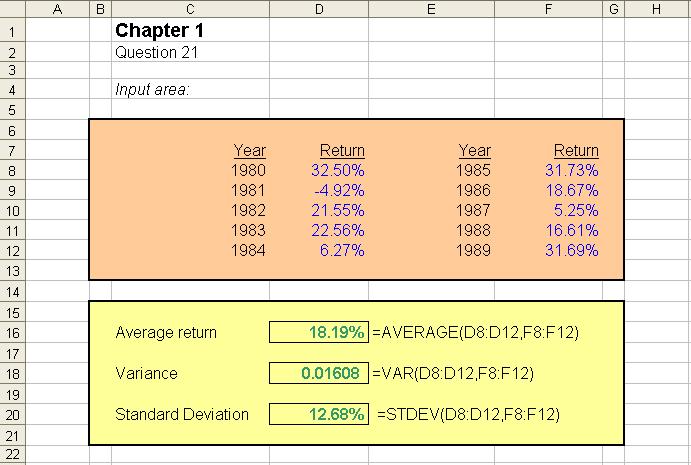
1-7 Spreadsheet Problems
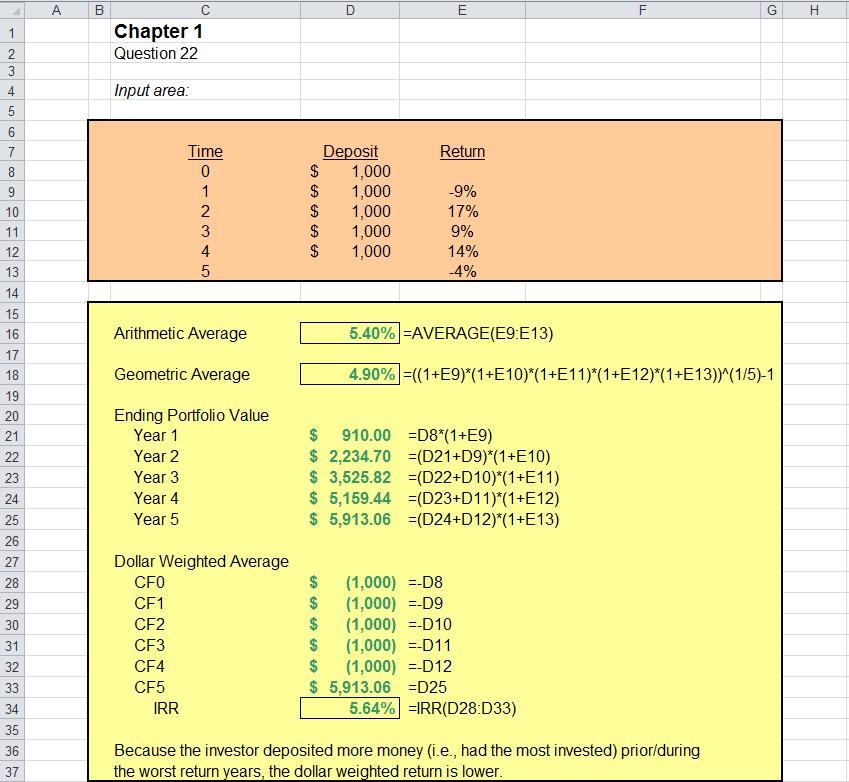
1-8
a Geometric average return = [(.9)(1.25)(.95)(1.30)(1.05)]1/5-1 = 7.85%
CFA Exam Review by Schweser 1.
2. b
IRR 7.96% 7.78%
Scenario 2 Ending MV
End of Year 2 = 100(.9)(1.25) + 20 = 132.5
End of Year 5 = 132.5(.95)(1.30)(1.05) = 171.8194
Scenario 3 Ending MV
End of Year 2 = 100(.9)(1.25) - 10 = 102.5
End of Year 5 = 102.5(.95)(1.30)(1.05) = 132.9169
3. c Annualized return = (1.0163)12 – 1 = 21.412%
4. b
Geometric returns provide the best estimate of a portfolio manager’s return because it neutralizes theimpact of the client’s cash flow decisions. For theclients themselves, the dollar weighted return would be appropriate.
1-9
Scenario
Scenario
0 -100 -100
1 0 0
2 -20 +10 CF3 0 0 CF4 0 0 CF5
2
3 CF
CF
CF
171.82 132.92
Another random document with no related content on Scribd:
he, too, intended for an innocent dupe. The fate of every rich and lonely woman!
It was under the Christmas tree at Lakemere that Harold Vreeland learned for the first time why the Queen of the Street had held him for months in a glittering quiescence in the rapidly built-up firm.
The merry guests were already assembled on the other side of the curtain when the breathless Justine drew Vreeland into a dark corner.
The French woman’s panting bosom heaved as she whispered: “She wants to see you in there, first of all. Now is your time, but don’t forget me, Harold.”
There was the pledge of an infamous pact in the meeting of their guilty eyes. Justine now stood, with flaming sword, between her secret lover and those who would approach the woman who held both their fortunes. Her dark fidelity was doubly bought.
It was a robed queen who stood waiting there by the fragrant Christmas tree and held both her hands out to Harold Vreeland. The Lady of Lakemere at her very best!
With beaming eyes, she handed him an envelope and whispered: “The time has now come when you will have your own part to play, under my sole orders.
“I know your whole record. You have been my own faithful knight.
“Listen! All these merrymakers will go away with the old year. Judge Endicott brings me the firm’s settlement papers on New Years. I will then send for you and make you my secret representative in a momentous affair.
“To protect my interests you must at once leave the Waldorf.
“Trust to me!” she smiled. “I will have your bachelor apartments ready. And no one, not even Wyman, must ever learn of your ‘secret service.’ Silence and obedience, and your fortune is assured. You
alone shall battle for me and drive this fool Hathorn forever from the Street.
“Go now! You will leave with the first departing guests, but await my telegram at the Waldorf to come to me here. And so, I have your plighted word. Never a whisper to a living soul. You are to be still only the office partner—to the world!”
Vreeland snatched her trembling hand and kissed it.
It was burning in fever.
But he sped away, and before the curtain rose to a chorus of happy laughter and shouts of delighted surprise, a glance in a corner of the hallway where Justine awaited him showed him a check for twentyfive thousand dollars as his Christmas gift. His patroness had handed him the precious envelope in silence.
In a low whisper he opened the gates of paradise to the French woman, who watched her lover with flaming eyes. “Five thousand dollars of this to you, if you find out for me the secret of that child.”
And he left her, panting with the thrill of a sated avarice.
“I will go through fire and water to serve you,” she faltered. “I will steal the secret from her midnight dreams.”
That night, after the gay dances were done, when the house was stilled, Elaine Willoughby sat before her fire, while Justine laid away the regal robes.
There was the glitter of diamonds and the shimmer of pearls everywhere. With her hands clasped, the lonely mistress of Lakemere gazed into the dancing flames.
“I must crush him—to leave the past buried—that I may yet find the path trodden by those little wandering feet.
“Ah, my God!” she moaned, “it is not revenge that I want. It is love— her love—I burn to know her mine alone. And the past shall be kept
as a sealed book, for her dear sake. It must be so. It is the only way For, Vreeland is brave and true!”
The handsome hypocrite was even then dreaming of a “double event,” a duplicated prize, one beyond his wildest hopes.
“By heaven! I’ll have both her and the fortune!” His busy, familiar devil “laughed by his side.”
BOOK II—WITH THE CURRENT.
CHAPTER VI.
IN THE “ELMLEAF” BACHELOR APARTMENTS.
Mr. Harold Vreeland silently wondered at the protean character of womanhood as he watched Mrs. Elaine Willoughby’s almost feverish gaiety in the few days which followed their new relation. “I can believe anything of a woman’s subtle arts after this,” he wonderingly said, as he made himself a graceful factor in the joys under holly and mistletoe.
Not a single reference to the coming business had ever escaped her, and she was as merrily impartial in her favors as a girl at her first ball.
There was hardly a financier in the house party, Noel Endicott’s visit of a day being a mere duty call. “She evidently wishes to hide our intimacy from all, and to publicly impress only the social character on our friendship,” mused Vreeland.
“Lady mine! you are a deep one!” he mused. Never had he been placed next to her at dinner, and even at the cotillion’s trifling favors she had only sought him among the very last.
He was aware that all New York knew of how Hathorn had been coached up by her into financial glory. “That mistake she will not repeat. It’s a case of blood and the secret warpath, now,” reflected Vreeland.
But with the check for twenty-five thousand dollars in his pocket, he felt that his silence was paid for in advance. He was swimming gaily on with the current now.
He had calmed Dr. Hugo Alberg down into an expectant friendship by agreeing to dine with him once a week and to exchange regular reports at Martin’s.
“So far, I have found out nothing, Doctor,” said the lying Vreeland; “but I have written out West. I understand that she has immense properties in Colorado. If I get a clew, you and I will work it up together.
“In the meantime watch over her yourself, and then tell me all.”
Alberg was in high glee at his social début, and confided to Vreeland that their patroness was in the most brilliant health.
“Well,” good-humoredly answered Vreeland, “between you and me we will manage to guard her and take care of her property, if she will only let us.”
The miserly German’s eyes gleamed as they drank to their private pact.
“The great thing is to keep every one else away from her,” whispered Alberg. “I of course watch her professionally. You must keep off all those society sharks like that upstart Hathorn.”
“Trust to me. I know my business,” laughed Vreeland.
When Vreeland left Lakemere on the last day of the old year, his only reminder was the whispered word, “Remember!”
“I will wait at the Waldorf,” he answered, with a last meaning gleam in his eyes.
Standing now on an almost secure pedestal, Vreeland never dared to dream of the sentimental approach upon the woman who was now the sole arbiter of his destiny.
“That would be the clumsiest mistake of all,” he decided. “Only— when she comes into the net—I will tighten it.”
He well knew that the bachelor apartment was to be the scene of some veiled financial strategy and not a rosy Paphian bower.
Mean and low at heart as he was, he knew that her soul towered above all low deceit, as the rosy Jungfrau lifts its unsullied peaks to the blue skies.
The one rare virtue of this scoundrel in embryo was that no inane self-conceit clouded his clear and mercilessly direct reasoning.
“I am only her tool as yet,” he reflected.
“But the Endicotts, Aubrey Maitland, and Wyman are to know nothing! This, of course, excludes Senator Alynton. She trusts me then alone—of the whole world.” And so, he panted for the coming solution of the enigma.
As he departed for New York, he left one lynx-eyed aid behind him.
It was the hot-hearted Justine, who already knew what her étrennes would be—a second thousand dollars.
“Remember, my own Justine,” he urged, with glowing eyes, “I want you to earn that whole five thousand dollars. Spy on Alberg.
“He is only a fool. But catch every whisper of this wary old Endicott. He alone knows what you must learn. There lies your fortune—in those pretty ears.”
“I have made my plan,” smilingly whispered the brown-skinned maid. “I am going to earn that money. Remember, I am vraie Française!”
There were but two plausible explanations of Madonna’s strangely secret course. Some “deed without a name” was in the plot.
And none of her old friends, no one of the financial world, not even her advisers, tried and true, were to share the secret of the two for whom the “bachelor apartment” was to be the veiled headquarters.
“Either Hathorn has surprised the secret of her early life and spirited away her child, hoping to have drawn her down to his will, or—can it be that she means to sell out the sugar syndicate?”
He gazed reflectively at the winter landscape flying by, as he pondered over the first. “No!” was his correct deduction. “Hathorn is powerless. He would surely have held on to her business, by fear or force, and gained the inside track in the great gamble, Sugar.
“He would have bent her to his will, and carried on the old hideous gilded sin—to make his light o’ love his young wife’s best friend.
“That’s quite fin de siècle in New York, they tell me.
“His crime was only the bull-headed folly of preferring another and a younger woman to the one woman whom he could have gratefully and logically married.
“There is a man’s fatuous vanity to look for her support in chasing down a younger and prettier rival under her very eyes. And yet, she hastened on the marriage. By Jove! she did. It’s a mystery to me!”
The puzzled schemer never knew of the real foundation of his own blossoming fortunes.
The lightning flashes of Elaine Willoughby’s mad anger came when Judge Endicott had found out that Frederick Hathorn was secretly shadowing his loving and trusting employer and tracing back her past life. Then, Elaine Willoughby became a wolf on the trail.
All of social life is but a hoodman blind game. The stern old lawyer was only carrying out a secret quest, and he could not divine that Hathorn’s real object was to trace down to a direct connection Elaine Willoughby’s secret alliance with the heads of the great Sugar Trust. It was but a mean money greed, after all.
Keenly alive to every pointer of the Street, Hathorn had not learned, for all his five years of florid devotion, that his lovely patroness had sealed that one treasured secret in her soul. And, meanly, he had tried to dig under her mines. But it was the thirst for gold alone that fired his veins.
Hiram Endicott alone knew of the coolly-devised scheme by which the woman whom he had deceived had made Hathorn’s marriage and enforced absence the epoch for a complete break-off of all business relations.
But she, deluded, as even the keenest mortals are, in stocks, love, or war, only feared for the one darling secret of her heart—that veiled sorrow which lay behind Hiram Endicott’s useless search of years.
And in the defense of that one pure and unsullied memory, she would have torn herself from Hathorn’s arms even at the altar. For there is a love which can tear the face of any man from a true woman’s heart—the mother love.
Before Harold Vreeland reached New York he had decided upon the “Sugar speculations” as the secret reason for setting up the “bachelor apartment.”
It was now a matter of gossip on the Street that the great Standard Oil Company was reaching its octopus arms out for “safe investments,” as well as sure new speculative fields.
To use a huge surplus of idle money and an inexhaustible credit, it was rumored that they proposed to sneak into a quiet mastery of the American Sugar Refinery Company’s outside stock, and even in time to gather in all the great Gas monopolies of Manhattan Island.
“That’s my lady’s game!” gleefully cried Vreeland. “She could crush Hathorn at will. Their business is ruined. The ugly rumors as to his shabby behavior to her have hurt that firm.
“And Potter, too, is about to draw out. Wolfe has no money to speak of. ‘Missie VanSittart’ will not pay her husband’s stock losses, not she.”
Harold Vreeland grinned, for the young woman’s name was even now lightly bandied by the club jackals, but only sotto voce, in deference to her social rank.
“That’s her little game! She dares not let Alynton know that she proposes to dally with the other side in this coming fight of giants.
“She proposes to ‘copper’ the game of ‘more sweetness and light,’ as well as play it for a sure winner.
“And I am to be her left hand, and the right (our firm) is to be ignorant of what the left doeth!”
He was well aware that in some way she was always early possessed of all the Sugar Syndicate secrets. Whether Endicott, Alynton, the statesman, or Conyers was her coach, he knew not.
“Perhaps all three—the law, the senate, and journalism,” he grinned.
“Or, is she going to betray these people to the newcomers? There would be enormous profits in that ‘sweet surrender.’
“I shall enjoy the run, and be in at the death,” he gaily cried, as he sought his hotel in a vastly enhanced good humor.
When he entered the Waldorf, a sudden encounter made him think that angels of light had invaded the crepuscular gloom of the long hall in the early winter evening.
He scarcely credited his senses when Mrs. Frederick Hathorn motioned him to a corner of the Turkish room, after his startled but gravely polite salute.
The lady was a ravishing example of the “survival of the fittest” in the line of Worth, Pingât, and Redfern.
With a wave of her slender hand she swept away the flood of easy lies that were trembling on his lips, and then, her bright eyes, deep and searching, seemed to delve into his very soul.
“Remember, you need not answer, if you don’t care to; but you must give me the right to feel that you are a gentleman. My husband’s enemies may or may not be mine!” She burned a Parthian glance into his trembling heart.
“Why did you conceal from him that you were going into banking, and let him go on and parade you as his best friend, and all that?” she curtly demanded.
“Mrs. Hathorn,” earnestly pleaded the accomplished liar, “another man had my promise of partnership long before I left Montana. He was already making arrangements as to offices and several confidential matters on which our firm’s future depended.
“I was only asked to give your husband an answer on October 1st.
“And I did give one early enough—a friendly declination—which your husband made me repeat too forcibly You should not blame me for our little estrangement.”
“And you did not scheme to supplant him with—with—”
“One word, Madame,” meaningly said Vreeland. “I have opened my heart to you. Noblesse oblige! Your question was one I could honorably answer, just as I could not honorably forewarn men whom fate had made our business rivals.
“Remember, all’s fair in love, stocks, and war And it’s every man for himself in New York.”
“And every woman, too,” added Mrs. Alida, with a little snaky smile.
“I always liked you,” she hesitatingly said, and then, her eyes dropped before the ardent and merciless gaze of a man who now saw “a new way to pay old debts.”
“Then let me volunteer a hint that I have never supplanted your husband with anyone nor sought to. My capital alone gives me weight in our firm. I have never even opened a ledger or made an individual transaction.
“Pride and old comradeship should temper each other in your husband. I have only avoided the distressing embarrassments which he alone has brought upon himself, and you will always find me your secret friend, though I can not seek you out in this witches’ parade of Gotham. You know all the reasons why I can not range myself openly at your side.” His devilish familiar was now whispering in his ear.
The victim was young, fair, and foolish.
The luxurious woman sighed. All her allures had been baffled.
“If I should need to tax your friendship?” she slowly said, her breathing quick and fierce, telling of her agitation.
It was now Vreeland’s eyes which “burned into her spirit’s core.”
“Yes; if you make the place where we can meet without a foolish risk and placing us both in a false position.”
He glanced around the debatable ground of the Turkish room. Any notable, from Chauncey Depew down to the last “Western bonanza beauty,” might surprise them there at any moment.
“Will you come, if you need me?” he whispered, taking her hand, with insidious suggestion.
“Perhaps,” she faltered, with pale and trembling lips, and when he looked up he was alone, but a knot of lilies of the valley from her corsage lay in his hand.
He dreamed strange dreams that night, for he well knew of the seraglio secrets of the bachelor apartments of New York.
He knew the light vanity that might lead her feet to the “Castle Dangerous” to solve the riddle which was as yet a mystery to himself.
But he whistled “Donna è Mobile” very contentedly, as he awoke to find a telegram on New Year’s morning from his sly partner in an
already plotted treason. Justine’s words were pithy, and Justine was on guard.
“Watch in South Fifth Avenue for news!”
The simple signature J followed the words: “Lawyer here. See me first on your arrival.”
“I think that I am a pretty lucky devil,” was the flattering unction with which Vreeland regaled his soul, as he drove down to Wall Street and found the two responsible men there on duty.
Noel Endicott, with Aubrey Maitland, were in a secret junta busily opening the new set of books.
The finely assumed carelessness of Vreeland covered his desire to trace and locate the only man he feared—Mr. Horton Wyman.
“Just write your dispatch,” calmly said Endicott. “I’ll send it down to Washington to Alynton’s private secretary, and you’ll have Wyman’s answer at once. They are inspecting some of Alynton’s West Virginia properties.”
And, in truth, an open answer to Vreeland’s holiday greeting was at the Waldorf when the schemer finished his New Year’s dinner, and slipped out to visit the lair where a wrinkled hag guarded Justine Duprez’ convenient pied à terre.
He marveled long over a second dispatch which awaited him there. Its words were ominous, and yet, Elaine Willoughby was firm and steadfast in her purpose.
“She has been greatly excited. Doctor Alberg has been telegraphed for. You are to come to-morrow. Lawyer leaves to-night. Dare not communicate by letter. I have the most important news.”
And all night Harold Vreeland was tossed about in a vain unrest.
He knew that his greedy accomplice Justine would easily handle and draw out Alberg, for, not of a jealous disposition, Vreeland was
perfectly willing that the doctor should be made a tool of the facile Parisienne.
“You know how to lead him on, Justine,” was Vreeland’s easy-going hint, whereat the demure maid dropped her lashes and smiled. And after all, even the artful Justine was only means to an end.
The recurring excitement of the tortured lonely rich woman was only a new phase of the old invincible mystery. “Can it be a gigantic game of blackmail, the infamous price of someone’s silence—the bribe to her quiet enjoyment of a station not her own? What hideous Frankenstein hides behind the dropped arras of her life?”
Vreeland knew how many dark shadows lurked behind the bright curtains of New York’s Belgravia and Mayfair.
“By God! I shall know soon!” he growled, as the second day of the new year brought him the dispatch confirming Justine’s watchful foresight. There was no uncertain ring to the words of the Lady of Lakemere.
“Come to me at once! Immediate action necessary!”
“It seems to be something recurrent—something, too, that even golden-massed money can not help! She would quickly brush this trouble away, if the ‘long green’ would do it. And, it must be something which that old fox, Endicott, can not help, or he would stay up there on guard and help it, instead of leaving her to Dr. Hugo Alberg’s chloral, chlorodyne, and phenacetine. There must be an ugly snarl—some olden shame, some hidden disgrace.”
Vreeland very well knew that the sly German practitioner’s drugs had brought his patient “no surcease of sorrow,” but only “pushed the clouds along” to a new day of reactionary misery. For, the proud heart was sealed and yet surcharged almost to its breaking.
“I wonder what our opinion of each other would be if we all had to walk abroad with our life stories openly branded on our faces?” mused the anxious Vreeland, as he drove away to the station. The flying wheels of the coupé seemed to clatter “Not much! Not much!
Nothing at all!” He meanly believed all men and women to be as base at heart as himself.
“Thank Fortune for the decent lies of a smooth appearance and a still tongue!” was the schemer’s cheering conclusion, as he finally dismissed all vain moralizing, and then, wondered how he would meet the crafty Justine first, and so be able to gain her budget of stolen tidings before he faced the watchful Lady of Lakemere.
The provokingly suggestive face of the French woman met him at the front door, on his arrival. “I am to see that you have your breakfast,” she smilingly said, “while Doctor Alberg, now upstairs, prepares Madame for your visit!”
And, as she drew him into a coign of vantage, she whispered, “He is now my very slave! For he, too, is hunting for an ally, and I had him all to myself last evening! Now for the news! You can afford to be liberal to me!”
Her eyes were beaming with that vicious triumph of an unfaithful underling discovering the naked soul of her helpless mistress.
The household traitor is the lowest of all human spawn.
“Tell me everything,” was Vreeland’s hurried response. “When I marry her, I will be the King of the Street, and you shall stay with us as long as you wish—it
will be always the same between us.”
The woman’s gleaming eyes softened in a glow of triumph.
“And, your house at Paris shall be my pied à terre. But, give me every word—remember!”
His bosom was rent with thronging hopes and fears.
Justine smiled, as she pressed herself close to the handsome scoundrel.
“It is a bargain, then. I will hold you to every word, and I will never let you go. How I secreted myself so as to hear them, is my own business. But I did. In their fear of Doctor Alberg, whom Endicott
heartily despises, they fell easily into my hands. There was much talk of the child—a girl—a missing girl—her child—but no time or age was given—no whisper of the father’s name.”
Justine paused, while Vreeland hoarsely whispered, “Go on! Go on! Quick! She may send any moment for me, now!”
“It appears she had placed her child, to get rid of it, in a ‘private Orphan Asylum’ here, in the city. Just why—I can not tell. But, they have lost all traces of the girl.
“The old man said, ‘I have followed up every “private inquiry” possible, since your orders of last summer. These detective fellows all come to me for their money on the New Year. Now you must be brave, Elaine,’ he said, and I could hear her choking sobs.
“‘I have very bad news.’
“‘She is dead?’ almost screamed Madame.
“From my little peep-hole, I could see the old lawyer take her hands.
“‘We have been led away on a blind trail. And I have only just now found the right one—but to lose it forever, I fear. For one of my best agents has discovered that Doctor McLloyd’s private Orphan Asylum was chased out of New York City by some angry rivals, and a bevy of too inquisitive reporters.
“‘The Doctor was making money too fast, and there was a very suspicious mortality among the little girls. It reappeared as the “House of the Good Samaritan,” at a little village in Westchester County. The old Doctor has gone either to his reward, or punishment. Probably, the latter.
“‘But the sly hypocrite who sported a D. D., as well as a medical title, left the Westchester property to a buxom grass widow, who long officiated as his matron.
“‘This woman is now forty years old—well-to-do—and is married to a thrifty young farmer—a man who is not particular as to how she earned the handsome property which they enjoy.’
“Mrs. Willoughby was softly sobbing when he finished.
“‘By the lavish use of money and a compact of immunity, she agreed to privately examine the books and records. Of course she has not got them. “It is a friend—and so on.” We did not dare to force her. For, she is a very sly bird.
“‘She was only twenty-two when she eased the good Doctor’s lonely hours, and she is a remarkably cool hand at the game of life.’
“The old man sighed, as he said, ‘It appears that the enthusiastic childless woman, who first adopted the child, died in two years after your babe was taken away from the “private Orphan Asylum,” and, as her young husband remarried in a year, he brought the pretty child back and left her again on McLloyd’s hands—with a handsome present.
“‘The girl was a beautiful three-year-old fairy, and the “matron” remembers her especially. But, McLloyd, always anxious for profit, gave her to the first decent applicants, a respectable childless couple, from Western New York.
“‘Under the name of “Alva Whiting”—full orphan—she was sent away for the second time.
“‘I must find her! You must advertise!’ cried Madame.
“‘Ah!’ said the old lawyer ‘There is no hope. The young widower came back, after his second wedding was all safe, returning from a three years’ visit in Europe. By a strange chance, his later union was also childless.
“‘Rich, and now thoroughly independent, he, too, wished to trace “Alva Whiting,” and to reclaim her.
“‘But the matron says that even the wily McLloyd, tempted by a handsome reward, failed to find her. The Western New York people may have given a false name, to prevent the child from ever knowing that she was not their own.
“‘That is all—the matron would gladly earn our offered money—she knows nothing.
“‘And now, God alone can, in his infinite mercy, ever reclaim “Alva Whiting.”
“‘I have tried to induce this woman to meet me. She flatly told my agent that she would have all the books burned—and then, deny everything—if her prosperous middle age was connected with old McLloyd’s baby farm. She cried, “I’m as fond of money as anyone— but there’s the end of it.”
“‘No more would she say. I fear there is no hope.’ The old lawyer was almost in tears, as he saw Madame’s sufferings.
“Now,” whispered Justine, “I merely saved my place by that agility of body which you have so often praised. When Madame fell in a dead faint, and the old lawyer screamed for help, I just ran around the hall, knocking over a table, and—the rest has been left in Doctor Alberg’s hands. So, you now know all.” The schemer’s brain was working like lightning as they parted in silence.
After the breakfast, it was Justine who conducted Vreeland to Madame Willoughby’s morning room—but not until Doctor Alberg had first waylaid him.
“The same old mystery!” the German sighed. “Money trouble it can not be.”
He flourished his arm in the direction of the fortune in art and bibelots scattered around.
“Her general system is without disease. Her mind and self-control are perfect. She has no concealed bad habits, like the ‘suffering New York dames,’” he sneered. “But always periodical violent storms of sorrow, these violent attacks following old Endicott’s business visits.
“There must be some old bug-a-boo. Now, I know lonely women are often apt to be hysterical.
“Marry her Take her away to Europe. Make her happy She is a Venus de Melos, yet in her prime. Break off the domination of this old legal crab.
“Marriage reveals all secrets, finally. You will surely break his hold on her. You are no sentimentalist. I will prescribe marriage—do you see? We will work together. I will be your ally—your slave—your friend.
“You can well afford to be generous, and you then can work me in, as confidential physician, into that golden New York circle where the women’s confidence once gained, a man need not look further for a Golconda.
“Discretion, silence, and a willingness to go through fire to hide any woman’s secrets—voilà—the perfect doctor—the successful medical man! Shall we work together—you and I?”
The young schemer grasped the greedy German’s hand. “I’ll stop at nothing—to help you. By God! you shall have her every secret.”
“It’s a go. Loyal to the end,” whispered Vreeland.
“And you and I breakfast at Martin’s every Sunday till I am a happy bridegroom.”
The alert physician glided away to where Justine Duprez’s eyes called him, with their velvety lure.
Harold Vreeland’s face was lit up with a tender sympathy, as he knelt before the fair woman who lay in a chaise longue before her superbly sculptured fireplace. There was a surprise in store for “the knight of the ribbon blue.” His patroness’ face was stoically calm. She was no hysterical weakling!
With a perfect self-possession, she plunged at once into the “business in hand.”
“A modern mystery,” he murmured. “A sphinx of the heart,” for Elaine Willoughby, Napoleon-like, ignored her ailments, whether of a mere
passing weakness or “memory’s rooted sorrow.” And at what secret cost?
“Time presses!” she said. “Follow my every word. For, I have sent them all away. There is only Doctor Alberg in the house—and Justine always keeps him in her eye.”
Vreeland breathed hard. It dawned upon him that the universally pliant French woman was in the receipt of several salaries.
“She is a smart devil,” he thought, with a glow of pride.
“I shall have to travel some, this spring—in connection with very important movements and reactions of a specialty in the stock market, which you alone will know of.
“You and I must be the only ones to handle the concealed intimacy of ours. Not even Endicott suspects.
“He never must. No one in the firm. Should foul play or awkwardness reveal it, the firm name of Wyman & Vreeland would come down in a day. So, mark my every word. I will not return to New York till you are installed in your new apartments in the Elmleaf.
“It is well located, in the ‘thirties’—I have taken the best one on the top floor to aid you in the gay and showy life that I wish you to lead there.
“You will find your new man, Bagley, a veteran London valet, just brought over, waiting to report to you now at the Waldorf. He has never been in America before, and none of our opponents know him. I had Justine engage him through Low’s Exchange.
“The rooms are already decorated and arranged for you. They have been ready for a month, and no one can ever trace the ownership. The whole belongings are yours.”
Vreeland found a voice. He began his grateful praise. She smiled faintly. “Nay! no thanks! It is purely a business matter. If you wish anything else, give a list to me. I will transmit it to the
furnisher, who will at once provide. There will be no bills. I hope that the rooms will please you. Of course, I shall never see them.”
The young would-be bridegroom noted the cold dignity of her measured sentences. There was the thin icy rivulet still between them.
“Mark me now,” she said. “There is a working room, and a private secretary (a stenographer, typewriter, and telegraph operator) will attend daily, from nine until six. The telegraph and private telephone wire are connected with my rooms in the ‘Circassia.’ There is a duplicate ’phone joining you with ‘Central,’ for your social use.” Vreeland began to take his cue.
“From the café in the Elmleaf, you can have morning service, and be furnished such entertainment as you may wish to give. I presume that you dine at your clubs, or in society. The café accounts will all come to me.”
She paused, and studied Vreeland’s face closely.
“And, in all this, what am I to do?” he asked bewildered.
The Lady of Lakemere laughed gaily at his embarrassment.
“You are to move in there, at once. Sign the lease for a year. Bagley will take charge of you. There you are to give a jolly house-warming. Call up all your friends. Do not neglect Merriman, Wiltshire, and Rutherstone. You are to be pretty gay. These gentlemen may even bring some of the ladies who wear diamond garter buckles. So much the better!
“When I return to New York, you are to report to me at the ‘Circassia,’ and the serious business of your new life will then begin. The woman whom I will send to you as secretary is thoroughly reliable, and I will answer for her fidelity.”
“The woman?” babbled the astounded Vreeland.
“Yes! Miss Mary Kelly—a talented young business woman of perfect accomplishment, who represents me.” The voice of the lady was