Sandison Lang news
Once again, the speculation around proposed changes to pension tax relief and the tax-free lump sum in the Budget did not prove correct. Both were touted as possible revenue fundraisers in the weeks preceding the Chancellor’s second Budget.
Rachel Reeves instead chose to freeze income tax thresholds until 2031, meaning more taxpayers will be subject to higher income tax rates due to ‘fiscal drag’.
Individuals remunerated by dividends will see tax rates rise by 2 per cent from April 2026. The basic rate will therefore increase to 10.75 per cent and higher rate will increase to 35.75 per cent. There is no change to the additional dividend rate which remains at 39.35 per cent. This move will not be welcomed by small businesses who have already witnessed an increase in corporation tax in recent years.
The rates of income tax on savings will increase by two per cent from April 2027. The basic, higher and additional rates will increase to 22, 42 and 47 per cent respectively.
Landlords would be forgiven for feeling targeted by a succession of fiscal changes. A new property income tax will also apply from April 2027 –
again, 2 per cent higher than current income tax rates so in line with the new savings tax above.
The OBR stated that “The measures announced in this Budget reduce returns to private landlords, following various measures over the past 10 years that have also reduced returns.” Property investors have already seen changes to Mortgage Interest Relief and Stamp Duty.
The much anticipated ‘Mansion Tax’ will be introduced from April 2028 bringing additional fees due on top of council tax.
It is understood that there will be four value bands for the High Value Council Tax Surcharge (HVCTS) – the annual charges of £2,500 will apply as the lowest band for properties worth more than £2m and £7,500 will apply to the highest band for properties worth more than £5m. The intermediate rates have not yet been disclosed.
Although this tax will not apply until 2028 –presumably because of the enormous undertaking of calculating how valuations might be achieved – it has been suggested that the property values from 2026 will be used. The HVCTS will be paid to the Treasury rather than local authorities as per the council tax.
There was no further tinkering to NHS Pensions but a £2,000 cap on salary sacrifice pensions will be introduced in April 2029.
This year there has been a raft of industry warnings regarding changes to ISAs. The total ISA allowance remains at £20,000 per tax year but from April 2027, the cash ISA limit will be cut to £12,000 for the under 65s. This is in a bid to get more people investing in stock markets.
Drivers of electric vehicles will pay a new excise duty of 3p per mile from April 2028 while plugin hybrid vehicles will be subject to 1.5p per mile.
Inheritance continues to be a concern and it was announced that the current IHT nil rate band and residential nil rate band will be frozen at current figures for another year until 6 April 2031.
The good news is that the markets were not ‘spooked’ by the Chancellor’s announcements as in some previous years. There was a little market volatility after the OBR mistakenly released the full Budget before Rachel Reeves had even stood up, but markets had recovered by the end of the day.
If you have any queries regarding the Budget or its impact on your own position, please speak with your accountant.
The Financial Services Compensation Scheme (FCSC) is to increase the amount of protection it offers if your UK-regulated bank or building society fails. From Monday 1 December, the standard amount covered will rise from £85,000 to £120,000 per person, per bank. This
means that if you have a joint account with an institution, it will be protected up to £240,000.
There is also a ‘temporary high balance’ protection to cover one-off large sums in your account such as from selling a property, an inheritance or an insurance payout. The current limit is £1m but will also rise in December to £1.4m.
Investments which are protected by the FSCS are also set at £85,000 per person but will not be increasing.
You may be one of the thousands of medics still awaiting your Remedial Pension Savings Statements (RPSS) as part of the McCloud remedy.
In response to the considerable delays in issuing the statements, the government has now
extended the mandatory Scheme Pays deadline to 6 July 2027 from the original date of 6 July 2025.
Under Scheme Pays, annual allowance charges can be paid by the NHS Pension Scheme, rather than the individual. To qualify, the annual
Q: I have started trading in cryptocurrency. Do I need to keep records of my transactions?
Michelle Trivett writes: Yes, all investment activity should be recorded whether using traditional methods or digital currencies. HMRC’s guidelines state that it is your responsibility to keep personal records, not any digital trading platform you may be using. In the last tax year, HMRC sent letters to 65,000 individuals it believed had not paid the tax due on cryptocurrency dealings.
An estimated 7m people in the UK now hold nearly £13bn of crypto assets – up from £7.8bn in 2022 – but many new crypto users might not even be aware that cryptocurrency transactions
allowance charge for the tax year must exceed £2,000 and the pension input amount must be greater than the annual allowance.
If you have any queries on Scheme Pays, or your RPSS, please contact your accountant.
must be included in their tax submissions.
You can keep digital records, use a spreadsheet or old-fashioned pen and paper if you prefer. There are also specialist online software tools to help.
And remember that if you move your digital assets out to an exchange (rather like buying shares and then moving them to an ISA) this is classed as a disposal too and must be declared.
Please talk to your accountant if you have any queries about your own digital currency experience. We also recently hosted a webinar with an external guest speak on cryptocurrencies which can be downloaded here https://sandisonlang.com/client-webinars/
If you run your practice as a sole trader or if you are a UK landlord, you will need to complete your tax returns via the Making Tax Digital scheme from next year.
Making Tax Digital (MTD) means completing quarterly online tax reports rather than annual. Each quarter, businesses will need to make an electronic submission to HMRC using appropriate software.
MTD became mandatory in 2022 for VAT registered companies and now sole traders and landlords will have to take part too, dependent on their income.
From April 2026, those with a gross income of over £50,000 annually from their selfemployment or property income will need to submit their returns quarterly – as well as complete the usual annual tax return to make
Congratulations to Dr David Cain who wins £1,000 in our latest refer-a-friend prize draw.
Do you have a friend or colleague who could benefit from our specialist services? Simply email their contact details to us to be entered into our
bi-annual draw. (Please do mention that we might be in touch.)
You will also receive an entry into the draw if a friend or colleague mentions your name when they first enquire to Sandison Lang. You may
any final adjustments for the year. From April 2028, sole traders and landlords with income of over £20,000 a year will need to file their tax returns quarterly too.
If you would like to watch our explanatory webinar of Making Tax Digital, presented by partner Michelle Trivett, please visit www.youtube.com/watch?v=9zIkxMBL1q0
refer as many people as you wish – for every person that you suggest, you will receive another entry into the competition which will be drawn in April 2026.
Many thanks for supporting our business.
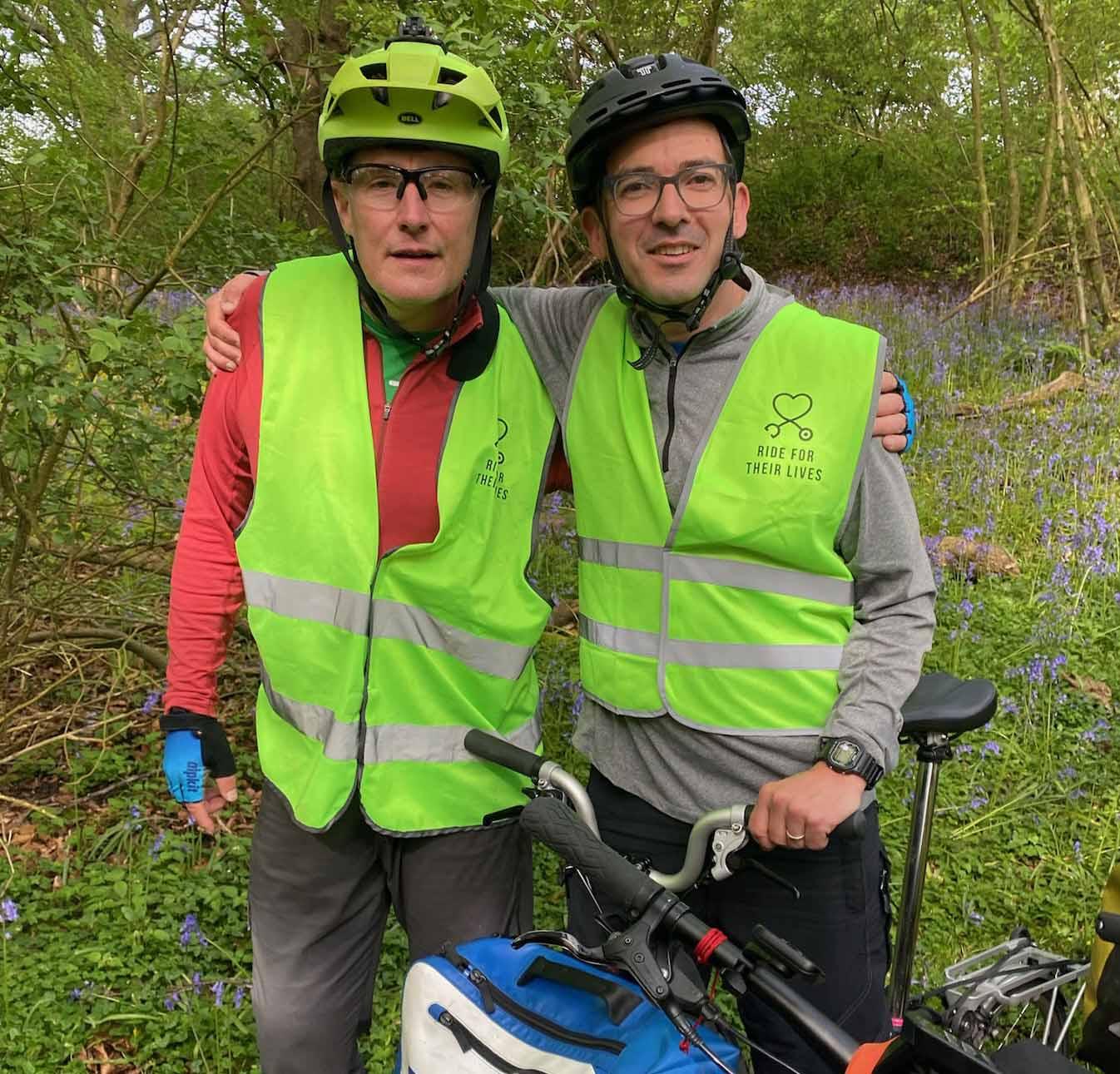
Dr Mark Hayden has been a consultant paediatric intensivist at Great Ormond Street Hospital for Children (GOSH) since 2015. Mark is a keen cyclist, a zealous campaigner for climate action and has a big plan for his forthcoming freewheeling ‘retirement’.
What made you want to get into medicine?
I wanted to be a vet initially because I loved nature but at around age 18, when I was looking at which university degree to do, I worried I needed three A’s to be a vet whereas medicine only needed three B’s. I wasn’t prepared to take the chance so took the easy option of medicine and I’m really glad I did as it's been a very rewarding job.
My first role out of university was a paediatric surgical house job. I decided paediatrics suited me, and in many ways, it wasn't too different from being a vet! Very young children can’t tell you what’s wrong – you must work out what's going on by other tricks of the trade.
Medicine has also been such a great job because you can work all over the world. I have worked in Australia and obviously back here in the UK too.
When did you first become passionate about the environment?
I would like to say that I was always as passionate about the environment, certainly about nature. I grew up in Africa initially and close to nature, but I think like many people in the middle of my life, I was consumed by career and family. This absorbed all my bandwidth and I didn't pay as much attention as I should have done to environmental concerns.
It was around the time of Extinction Rebellion starting in 2018 when I started to think that I needed to take action myself. I was considering whether I needed to go down a radical route, wondering if I needed to get arrested but my children said they’d prefer it if I didn’t! I realised
that Great Ormond Street Hospital is a famous hospital and there's a lot of people there who also want to do something so why don't I work within the organisation and use that platform.
Back in 2013, nine-year-old Ella Adoo Kissi Debrah died in London from an asthma attack. She was the first person in the UK to have air pollution listed as a cause of death. This prompted people to work to bring about The Clean Air Bill (or Ella’s Law) which is currently being debated in parliament.
The coroner’s report to prevent future deaths in 2021 criticised clinicians for not doing enough about air pollution or not telling Ella's mum about air pollution. So, in 2021, colleagues from the hospital organised a bike ride as part of the Ride for their Lives group that went from GOSH to Glasgow to coincide with COP26. We had around 70 healthcare workers riding to Scotland and we garnered a lot of press coverage for our clean air for health message.
Subsequently we managed to embed air pollution data into the medical record at Great Ormond Street. As far as we know, this was the first electronic medical record to do so and it’s since been replicated by other countries too. Most recently, we've managed to embed air pollution information into the app that patients use so they can see information directly whereas before it was limited to informing clinicians so that they could inform patients.
I’m pleased that choosing to do something within the environment that I work in and maintaining the trusted voice that doctors, clinicians and hospitals have has created positive change.
Are there other positive improvements happening?
The UK air quality is in fact gradually improving. It's not improving as quickly as it could (in the same way that climate change action isn’t happening as quickly as it needs to) but it's going in the right direction. And that's because some governments and individuals have acted. Like climate change the health and financial costs of inaction and delay vastly outweigh action but you wouldn’t know it from the prevailing narrative. That’s because inaction is very profitable for the fossil fuel industry and other vested interests.
The ULEZ is another example of action that clinicians have supported. There is no doubt that it has had a significant positive impact on air
pollution in London, and that has saved lives. In 2022, we organised another bike ride to support the ULEZ expansion, riding 250km around the proposed ULEZ boundary extension to drum up some rare positive news coverage at a time various councils were trying to block it in the courts.
Now, I am trying to look at other areas where things can be easily, and cost effectively achieved but perhaps people don’t yet understand the need. One very important one is wood-burning stoves. I have had these in the past and loved them. They give out a nice heat, they look good, and I thought I was doing the right thing by burning renewable dry wood from the local area. This is all a complete lie, sold by the industry, and they are very dangerous. I would go as far as saying that they are as bad as smoking in your house. This is an area which needs much more awareness especially in my social circles where most people have central heating as a vastly safer and more sustainable alternative.
You were recognised by the London Cycling Campaign (LCC) as an Active Travel Campaigner...
Sadly, one of our doctors from Great Ormond Street, Professor Maria Bitner-Glindzicz, was killed by a lorry while cycling to work in 2018. In 2021, a paediatrician, Dr Marta Krawiec, from the Evelina Children’s Hospital was killed on her bike at a junction in Holborn around the corner from GOSH. The London Cycling Campaign held a protest which blocked Holborn, and I gave a speech at that event. I think I received the award as a doctor putting their head above the parapet and speaking out about safety, maybe that was unusual, but it shouldn’t be.
That junction in Holborn has now been improved and finally, it has dropped off the top 20 most dangerous junctions on London LCC list. Action was taken and the junction was redesigned, it’s as simple as that.
There have been lot of benefits from working with the London Cycling Campaign since then, both in terms of creating climate safe streets and by improving cycle storage and facilities which increases the number of people who can cycle to Great Ormond Street to work.
And you will be cycling into retirement?
The retirement plan is to cycle home to Australia. If my son goes to university next year as planned, then there will be no reason for me to maintain a house in London. I'm going to stop doing
paediatric intensive care next year and cycle back to Australia over a year or two. Once there, I may find something else medically related to do or possibly something completely different. I still have a house in northern New South Wales from working there for around 20 years in total.
Is the ride planned in detail?
Well, it's planned in a sense that I've taught myself how to travel on a bike and I've gathered the equipment. I’ve done some practice wild camping runs on a few two-week trips. The thing that's not worked out is the route, because routes are quite difficult to plan. Oceans are always there, but wars come and go. My preferred route through Sudan isn't probably possible for example.
From bike packers I’ve listened to, I think it's quite important to not hold your route and your timings too rigidly because that just adds stress to the
situation that stops you enjoying the journey. My aim is to just meander through Europe, through Africa and then across Australia without too much planning other than where's the water? Where's the cake? Where am I going to sleep tonight?
Will you be using an e-bike?
I would never manage it without an e-bike – I’m not actually that fit – so as long as I can charge it, I should be fine. The main problem with e-bikes is not being able to take them on planes but they are fantastic for cycling further and for longer. I can now keep up with super fit, younger friends and it’s a very inclusive way to ride together, that doesn’t depend on the state of my coronaries.
The data shows that people who get e-bikes are not necessarily lazy – although we accept that people are allowed to call us lazy when we overtake them going up a hill – but that we
It is fairly commonplace for parts of the Budget to be leaked in the days and weeks preceding the big announcement but we are not often handed the entire speech. Now an investigation has been launched by the Office for Budget Responsibility and a cyber security expert tasked with looking into the ‘technical error’ which caused the Chancellor’s plans to be revealed too soon.
Christmas opening hours
It had already felt like the longest run up to a Budget. Not only did this fiscal statement come very late in the year (last year’s Budget was held nearly a month earlier) but the date was confirmed on 3 September. Back then we were still hoping for a burst of late summer temperatures and had not even faced autumn head on. Now we have one eye on festivities and, if you are an accountant, the other on processing many, many tax returns. Wading through the detail of new regulatory changes is certainly an added Christmas bonus.
Since the date was set, there has been a constant drip-feed of possible policies, debated at length and then denied. All of this has done nothing to improve spending (normally fairly frenzied at this time of year) as people question what might happen when the Budget finally arrives. Businesses and customers have been on standby for weeks.
A recent survey by the British Chambers of Commerce said business confidence had plunged
actually ride longer distances than people without e-bikes. I ride all the time – I probably only take the train into London three or four times a year. I commute a 30K round trip every day regardless of the weather or my mood when I set off. When I arrive I am always happy.
Is Australia further ahead than the UK in terms of environmental awareness? Actually, the UK is probably ahead – certainly in terms of CO2 emissions. The UK hasn't really produced many fossil fuels for years and we have a small amount of oil. Our electricity grid is well on the way to dumping fossil fuels. Australia is still mining and exporting coal and a lot of gas – but its grid is rapidly changing with a vast inexhaustible supply of cheap wind and solar. I will still be championing action for climate change when I get there, but I probably won’t plan on getting arrested. The Australian police carry guns!
to its lowest level since Trussonomics in 2022 due to ongoing leaks creating uncertainty and anxiety.
Perhaps an alternative is to implement the type of ‘purdah’ we see before elections but one which extends to politicians from any party being banned from talking about what may or may not be in a fiscal statement some 12 weeks later.
Should we also change the method of delivery? Giving the most important financial facts in front of a room of booing, cheering and hissing seems at odds with the gravitas of the content. It is difficult to imagine any other place of work allowing such antics. It may be a game to the politicians, but us ordinary folk would quite like to hear what is being said. Perhaps we should do away with the grand speech and just post it all online – not ahead of time of course.
Wishing you a peaceful end to the year and a prosperous 2026.
Our offices will be closed from 1pm on Wednesday 24th December 2025 and will reopen at 9am on Friday 2nd January 2026.