Transform your digital foundations to unlock the potential of your data and AI.
Transform your digital foundations to unlock the potential of your data and AI.
Transform your digital foundations to unlock the potential of your data and AI.
Download our complete guide to building the digital infrastructure you need.
Download our complete guide to building the digital infrastructure you need.
Download our complete guide to building the digital infrastructure you need.
Rethink your future
Rethink your future
Rethink your future
TEAM DATACENTERED
PUBLISHER
Dutch Data Center Association (DDA)
EDITOR IN CHIEF
Mels Dees
ART DIRECTOR
Asha Garib
MARKETING & PR
Zoë Derksen
Claire van der Bij Tijn Gerhards
CONTRIBUTORS
Michiel Eielts, Natascha Geraedts, Stijn Grove, Frederik de Haas van Dorsser, Pieter de Haer, Elisabeth Hankeln, Jasper Mattijssen (Stroomkr8), Nasim Mohamedajoeb (Stroomkr8), Niek van der Pas, Alberto Ravagni, Melissa Scholten, Vincent in ’t Veld, Arjan Westerhoff, Tijn Gerhards.
ABOUT
Datacentered is a publication of Dutch Data Center Association. No part of this publication may be reproduced and/or disclosed by print, photocopy, film or any other means without written permission from the publisher.
LOCATION
Dutch Data Center Association
Herengracht 342 H 1016 CG Amsterdam
The Netherlands
ADVERTISEMENTS
For inquiries about advertisements, please contact info@datacentered.net
Stay ahead in data centers and digital infrastructure, not only through our magazine but also with our Weekly Pulse newsletter.
Every week, we deliver clear, relevant, technical updates straight to your inbox, no noise, just the news you need. SCAN & SIGN UP NOW!
INTERVIEWS
36 AR THUR VAN DIJK COMM ISARIS VAN DE KONING (PNH)
38
“ WE NEED TO TELL THE STORY” ANNEMARIE BRANDSEN (DIGITAL REALTY)
52 THR OUGH THE EYES OF A PHYSICIST
BÉLA WALDHAUSER ON THE FUTURE OF DATA CENTERS
10 W HERE THE DATA LIVES AR CHITECTURE FOR AN INVISIBLE INFRASTRUCTURE
60
ENE RGY MARKET UPDATE STROOMKR8 (Q1 + Q2, 2025)
80
AI FACTORIES IN EUROPE
94
TEN YEARS OF DDA AN ANNIVERSARY CELEBRATION WITH SUBSTANCE
114 DATA CENTER SECTOR EVENTS
LIFESTYLE
72
POR TUGAL BUILDS THE GIGAWATT GATEWAY FOR AI
C ONSOLIDATION, CAPITAL & CRITICAL MASS
POWER PLAY IN THE E UROPEAN DATA CENTER INDUSTRY
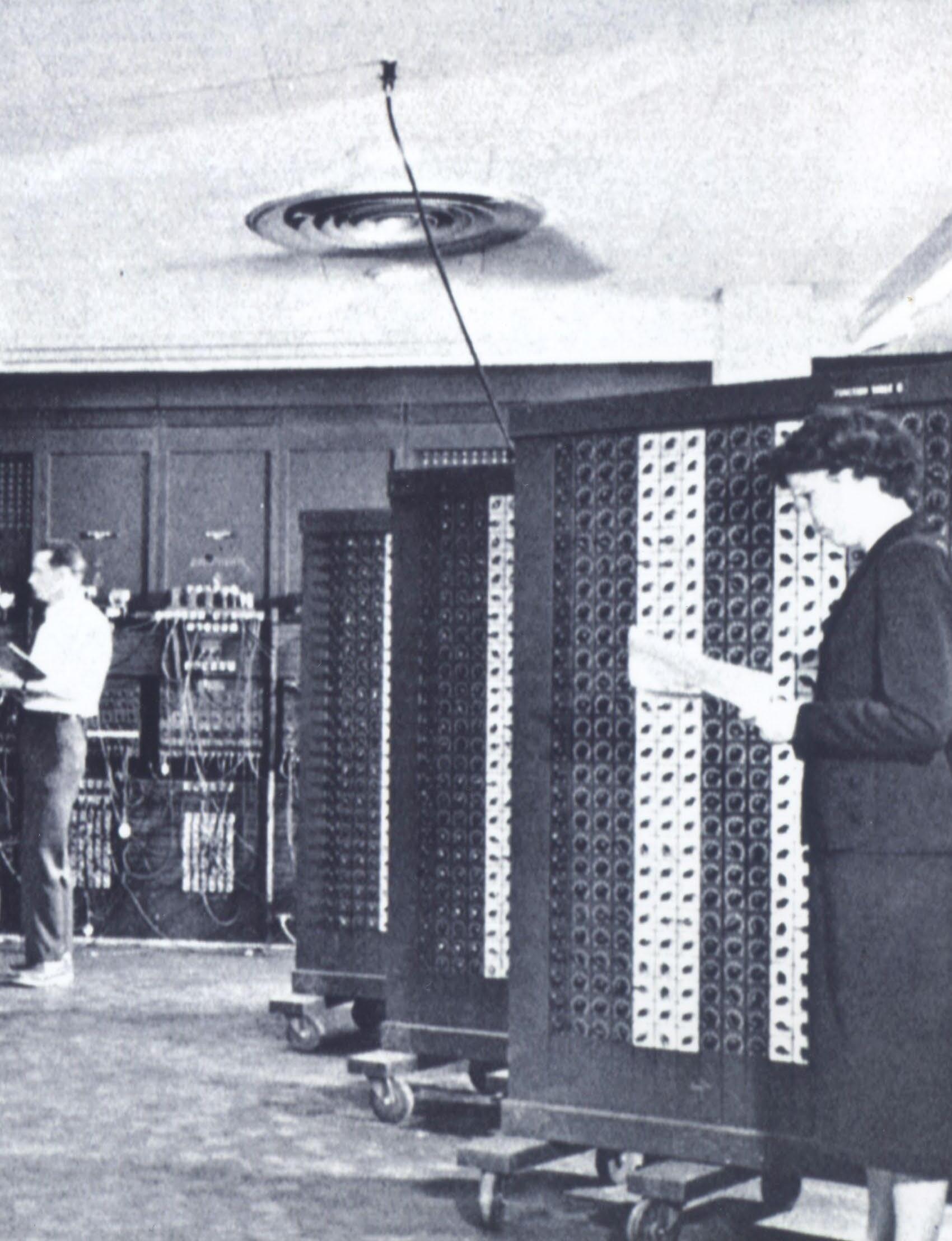
F ROM ENIAC TO THE DATA CENTER OF THE FUTURE
DATACENTERS AT THE FRONTIER
An anniversary is always a moment to pause and reflect. The Dutch Data Center Association is celebrating its tenth year, and it could hardly let the milestone pass without attention in this edition of Datacentered. And rightly so. This is not only a time to look back; it is above all an opportunity to look forward. That is why the theme of this edition is Back & Forth. When the editorial team explored that theme, art director Asha Garib quickly produced a mood board with one central reference point: the film Tron.
When Tron premiered in 1982, for most viewers it was pure science fiction. Kevin Flynn, a programmer who literally steps into a digital world, characters who live and act inside that world, battling across grids and racing on light cycles. Today we would call them avatars.
For me, and for a handful of fellow nerds, the film felt personal. Flynn was the kind of programmer we dreamed of being, while we were wrestling with BASIC on home computers late at night. Hours spent typing commands, debugging endlessly, trying to make machines obey: that was the reality of the early 1980s.
Disney did not use datacenters as we know them today. Instead, it worked with pioneering graphics studios like MAGI and Triple-I, each running its own mainframes and custom hardware. Programmers wrote in C and assembly, rendering frame by frame.
There is a striking paradox here: the film that imagined a centralized digital universe was built by distributed compute power scattered across different studios. What we might now call decentralized edge-datacenters together created the illusion of one seamless world. Only later would centralization and scale come to define the infrastructure we now depend on. That tension, the back & forth between imagination and reality, is precisely the theme of this issue. It connects Tron to our present.
Kevin Flynn captured it best in Tron: “The Grid. A digital frontier. I tried to picture clusters of information as they moved through the computer. What did they look like? Ships? Motorcycles? Were the circuits like freeways? I kept dreaming of a world I thought I’d never see. And then, one day… I got in.”
What was futurism in 1982 is business as usual today. Digital twins, AI systems, high-density datacenters: this is our grid, our frontier. We no longer dream of stepping inside: we are already in.
Digital twins make the back & forth tangible. A factory, a turbine or an entire city gains a digital mirror that moves in real time. Data flows into models, insights flow back into the physical world. It is not only reflection but prediction, not only prediction but control. AI sharpens this further, turning replicas into advisors.
And yet, none of it exists without datacenters. Where Tron’s visuals relied on scattered machines, today compute converges in vast, high-density clusters powered by renewable energy and ultra-low-latency networks. These are the infrastructures that turn theory into catalyst, vision into industry.
Flynn dreamed of a frontier he thought he would never see. We live in that frontier now. The difference is that we understand its foundation. It is not science fiction, but the datacenters we build and optimize every day.
“This is not only a time to look back; it is above all an opportunity to look forward.”
- MELS DEES
MELS DEES Editor-In-Chief
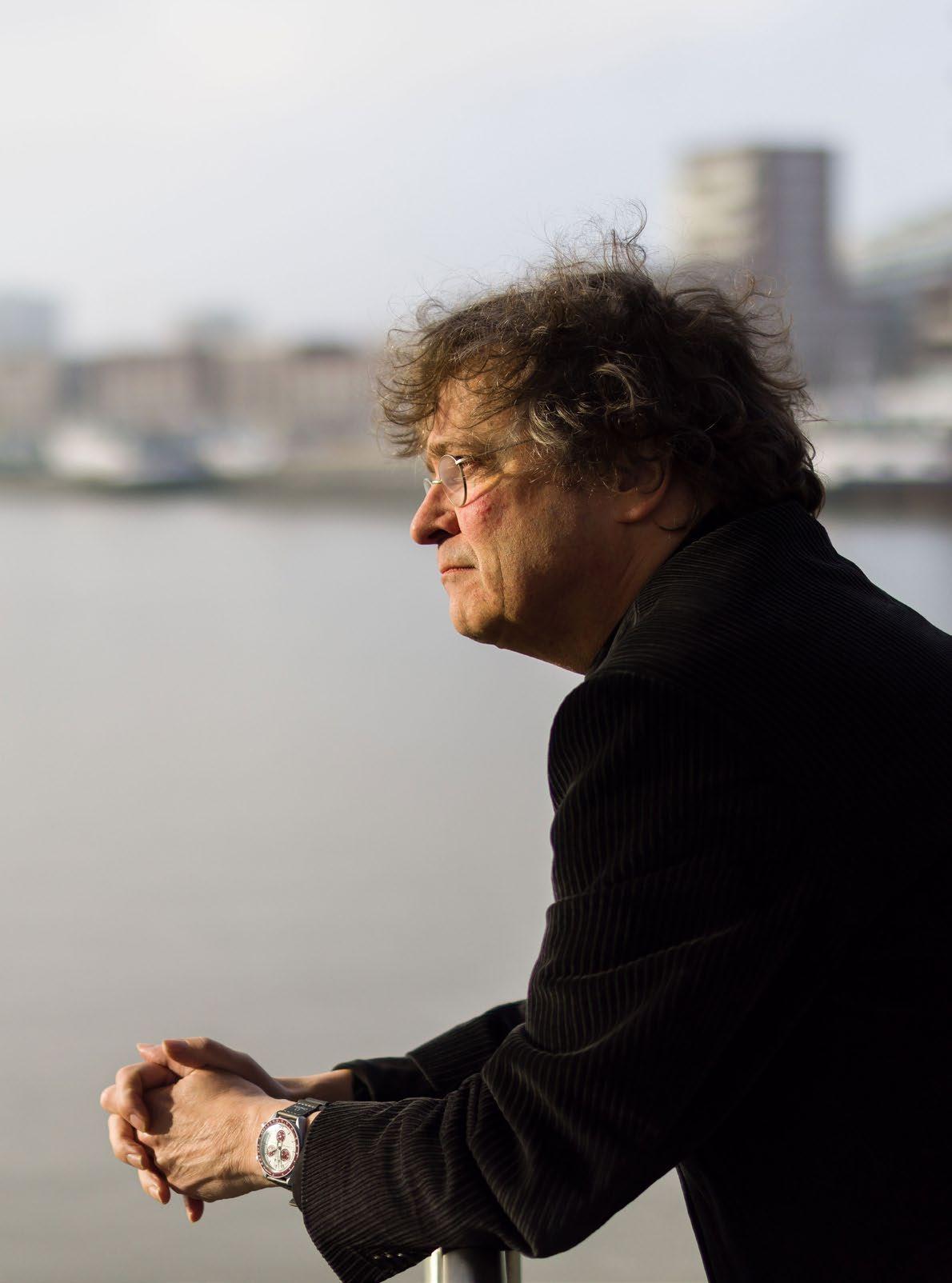
Photo: Paul Tolenaar
WHERE THE DATA LIVES: ARCHITECTURE FO R
AN INVISIBLE INFRASTRUCTURE
TEXT: MELS DEES
Data centers are everywhere, yet rarely visible. Their architecture is often reduced to technical necessity. Yet, it is precisely these buildings that embody the digital condition of our time and thus demand more than merely functional design.
At the end of the nineteenth and the beginning of the twentieth century, monumental stations, stadiums, and post offices arose around the world. These buildings were more than functional infrastructure; they embodied progress. Their arches, halls, and ornaments made visible that societies were modernizing, and that new forms of mobility and communication were taking center stage. The station was not merely a place to catch a train, but a cathedral of travel, the post office not merely a distribution point, but a temple of connection. Architecture made the technology of that time tangible and recognizable.
Today, we are in a similar transition. Data centers are the invisible stables of our digital society. They operate day and night and enable what we have come to take for granted: video calling, online shopping, artificial intelligence. Yet they usually appear as anonymous boxes in the landscape, buildings that seem to consume primarily energy and water. This loses an essential dimension: the architecture that confers meaning and demonstrates that data has a place in our living environment.
The German philosopher Martin Heidegger argued that technology is never neutral. Every technical object, every building, expresses a specific relationship to the world. A data center is therefore not merely an engine room of the digital economy, but also a spatial expression of our relationship to data, information, and connectivity. Architecture can make this meaning visible and tangible.
THE BOX VERSUS THE SCALE
Antti-Jussi Laine, Data Centre Business Lead at Sweco, points out that data centres need to evolve in their architectural expression. While they have traditionally often been simple, industrial boxes, today’s world calls for designs that are also visually and urbanistically appealing. He compares this to the development of waste-to-energy facilities, which have evolved from grey, power station–like buildings into architecturally striking projects, such as CopenHill in Denmark.
The Turkish data center project by Taci Yurtay, project architect at Sweco, demonstrates that things can be done differently. “We were given the space to go beyond the usual box,” he says, describing the freedom offered by the client. The data center was divided into five separate volumes, tailored to human scale and proportion. Offices, a restaurant, and even a hotel wing were located at the front. Patios, terraces, and greenery were integrated so that employees are not only among machines, but also in an environment that encourages interaction and socializing. Laine emphasizes that, in addition to hyperscale data centers, smaller forms also exist: “There are even micro-scale data centers, the size of a shipping container. Architecture can be a way to give the whole a more positive image, instead of
those threatening, gigantic sandwich-panel buildings.” He sees opportunities, particularly in smaller and more urban forms, to bring data centers closer to society and increase their practical benefits, such as heat reuse.
The choice of scale and form is not only aesthetic but directly affects the living environment. Laine points out that anonymous volumes not only disrupt the landscape but also affect the people who must live and work with them. “We need to understand how people feel. And I argue that when we make architecture more pleasing to the eye, it even benefits the health of the people who work there.”
Yurtay points to the peripheral location of many data centers, often in areas with little urban planning attention. “There is a significant risk that such places will degenerate into monotonous industrial enclaves, no-man’s-lands lacking quality.” The architect’s responsibility here is significant: infrastructure must not impoverish the landscape. Varied volumes, materials that feel natural and tactile, and landscape elements that break up the scale can ensure that a data center is part of an environment that also fosters human presence.
THE CLIENT’S SPACE
The architecture of data centers is largely determined by the client’s attitude. Yurtay emphasizes that the human scale in Turkey was only possible because the developer gave the architect freedom. “We were given the space to go beyond the usual box.” According to him, the client who thinks not only in terms of return, but also in terms of appearance, turns a data center into a calling card.
Laine also touches on this point, albeit from a different perspective. He argues that traditional construction processes limit the imagination because they often start with a fixed volume and only then flesh out the system. “We should first optimize the system itself to be as energy efficient as possible. Then we should adapt the building, instead of creating a framework that limits the imagination.” Only clients who are willing to give architects space beyond the standard box make innovation and sustainability possible.
The economic reality is that two-thirds of the costs of a data center go to installations. Architecture usually receives only a small portion of the budget. Yet, that is precisely why design is so important: a lot can be achieved with relatively modest resources. Laine also sees that public discussion often falls short. The focus is on energy and water consumption, and rightly so, but other aspects are overlooked. He emphasizes that data centers also offer social benefits: they enable working from home, digital learning, and virtual communication. While twenty years ago people had to take the car or train for simple administrative tasks, many things can now be done from home.
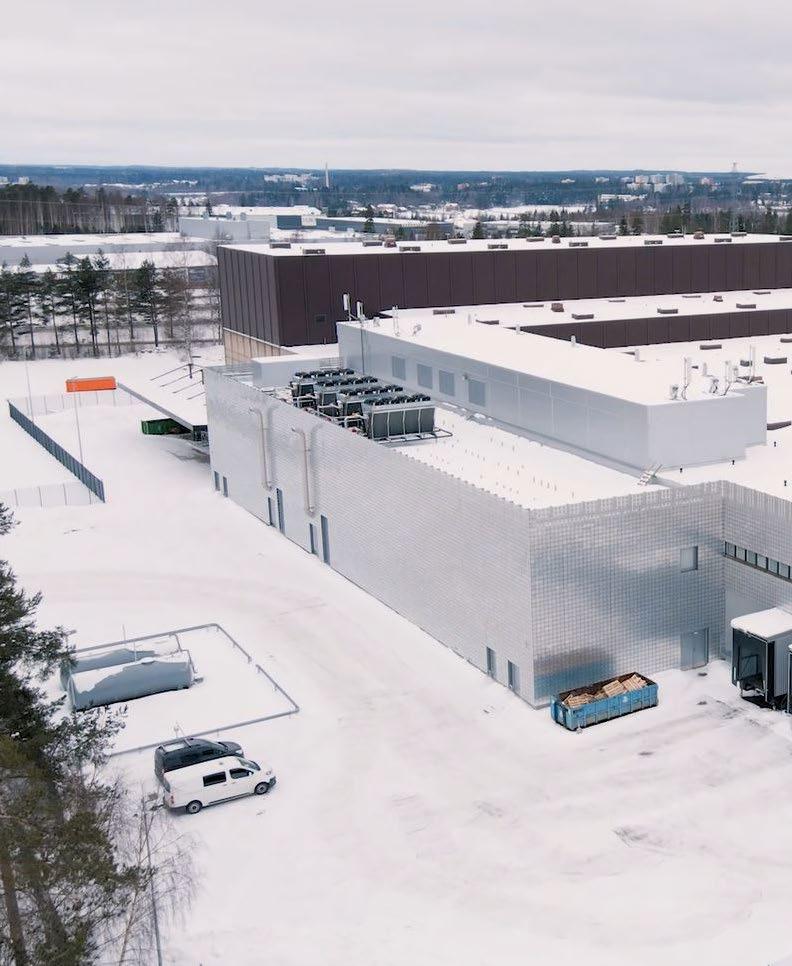
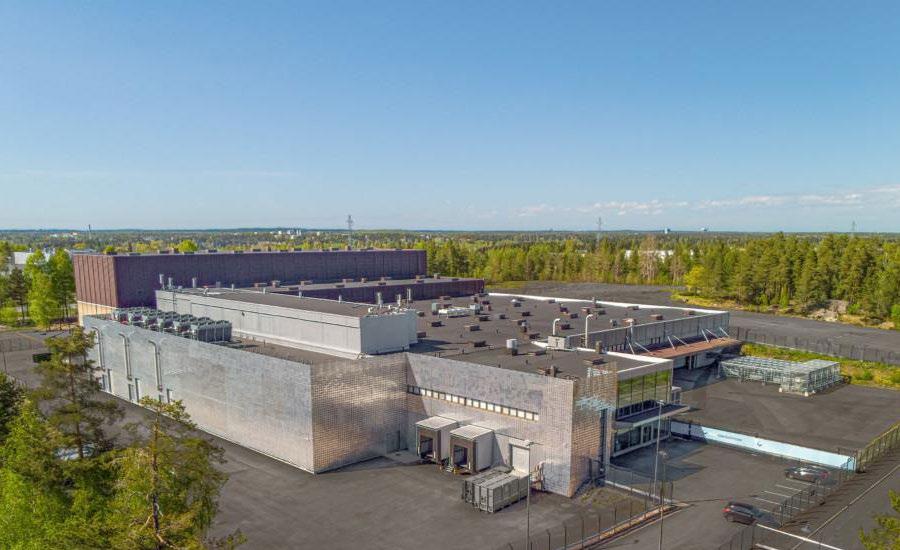
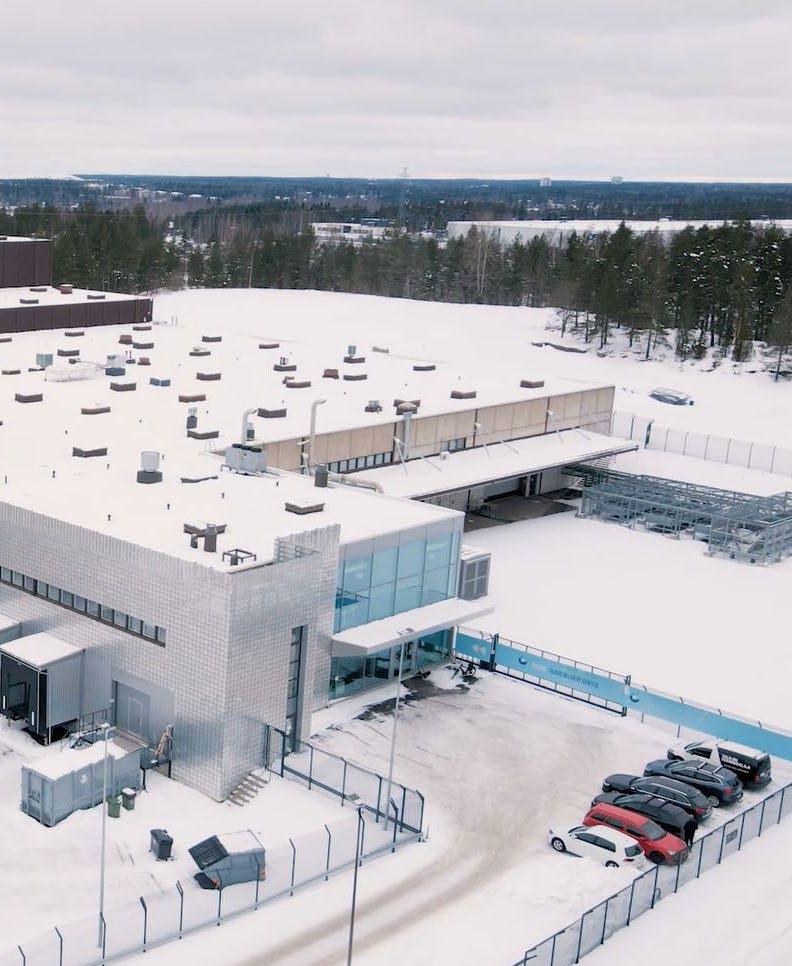
While in Turkey the human scale was paramount, in Finland the focus was on sustainability and technological innovation. The Air data center is a prime example. It is considered the first climate-neutral hyperscale data center in Northern Europe, with Sweco fully responsible for the architecture, construction, and installations.
The design optimally utilizes local conditions. The cold Finnish climate allows for outdoor air cooling almost year-round, largely eliminating the need for energyintensive compressors. The electricity is generated entirely by wind power, and the residual heat from the servers is fed back into Vantaa’s district heating network. Architecture thus becomes more than a
façade: it is the design of a system that is embedded in its surroundings and nourishes society.
The Air is not only unique because of its climate neutrality, but also because it was built within an existing industrial building. This makes it an example of brownfield development, where the old structure was expanded with a new concrete section. Past and future are combined in a single design.
The façade was intended to visualize values such as innovation and responsibility. The result is remarkable. The kinetic façade, constructed of aluminum panels, responds to its surroundings, and moves with the wind. Inside the building, the challenge also turned into an opportunity. A completely new steel structure was erected, acting as a kind of room-in-room solution that carries the heart of the data center. This resulted in a building that not only houses technology but also expresses architecture: breathing, responsive, and in dialogue with its surroundings.
DUTY TO SUSTAINABILITY
In Finland, the architect plays a formally central role in projects like The Air. Laine explains that the architect usually acts as the lead designer, overseeing the entire process. “Of course, it’s a joint effort between all our departments, and we have a separate, well-equipped sustainability department.”
Since January 1, 2023, a European requirement has also been in effect: every designer must calculate the carbon footprint of their design. Sweco was already prepared for this but went further: emissions from the construction site are also included. This fundamentally changes the role of architecture: no longer decoration, but the discipline that structurally and systematically integrates sustainability into construction.
This requirement is bringing about a cultural shift. Where architects previously focused primarily on form and appearance, they are now responsible for the calculable, measurable impact of their design. The facade is not just a skin, but a choice for material flows, energy intensity, and circularity. Architecture thus becomes instrumental in the transition to a climateneutral society. In addition to new construction projects, brownfields are playing an increasingly important role. These are often factories designed by national architects and therefore possess a certain cultural significance. Laine emphasizes that architects
CATHEDRALS OF THE DIGITAL AGE
When the voices of Yurtay and Laine are brought together, a broad perspective emerges. In Turkey, the emphasis is on human scale and social interaction, in Finland, on sustainability and ecological responsibility. Both projects showcase data centers that are more than neutral boxes. They confirm Heidegger’s idea that technology is never neutral: every data center reveals how we relate to the world, whether it concerns human scale, landscape, or climate.
Just as stations and post offices once symbolized the modernity of industrial society, data centers can evolve into recognizable beacons of the digital society. Architecture gives this infrastructure a face and prevents us from being swallowed up by soulless environments.
must be cautious in these situations: “You really have to be aware of what you can and cannot do, and still deliver a design that offers the best possible conditions for successful data center operations. We succeeded in doing that with The Air.”
This isn’t just about technical adaptation, but about a delicate balance between heritage and innovation. Converting a factory building into a data center means showing respect for the past while simultaneously creating an infrastructure for the future. Here, the architect demonstrates his ability to think holistically: to unite technology, culture, and society in a single design.
Laine looks ahead: “I’d love to see an urban data center concept. I believe architects are the best people there to determine how we embed this center for this specific location, so that we fulfill all the aesthetic values and make it an integrated part of that community.” His emphasis is not only on the environment, but also on the people who work there. “People must feel comfortable and healthy at work.” Data centers are not empty boxes full of machines. Thousands of people, think operators, mechanics, cleaners, and logistics personnel, work there daily. For them, a healthy and pleasant environment is crucial.
AI SOVEREIGNTY STARTS IN THE DATA CENTER
Whoever controls computing power sets the rules for innovation. And the beating heart of that power is the data center. Europe now stands at a crossroads: invest in AI infrastructure today, or watch others shape the future.
History shows that nations which invest early in the dominant infrastructure of their era secure longlasting economic and geopolitical advantages. In the 19th century, Britain built its railway network at record speed. After World War II, the United States poured resources into a national highway system. In the 1990s, South Korea developed a digital backbone that helped it become a world leader in semiconductors. Today, the strategic asset is large-scale, energy-intensive computing capacity.
This is not a new lesson. Ray Dalio, the American billionaire investor, founder of Bridgewater Associates, and author on economic cycles, has studied the rise and fall of world powers. The pattern is consistent: visionary nations build their infrastructure before the need becomes urgent. The Dutch example from the 17th century is a case in point. The VOC (Dutch East India Company) was far more than just a trading company; it was part of a broader ecosystem of ports, shipyards, financing models, and knowledge networks.
Without that foundation, Amsterdam would never have risen to become the global city it was. And even now, centuries later, the city would be far less relevant and far less developed than it is for so many people today.
This demonstrates how strategic investments in infrastructure echo across centuries and continue to shape prosperity long after their original purpose has faded. The lesson from history is that infrastructure defines power for generations, and in our own time this role is being taken up by digital and AI infrastructure.
AI RUNS ON PHYSICAL INFRASTRUCTURE
We are once again at a tipping point: the AI revolution. As with previous technological leaps, the real story is not only about the technology itself but about the foundation beneath it. “AI is not a marginal improvement; it is, as we now know, a fundamental productivity engine that will reshape industries, value chains, and geopolitical balances of power. Behind the abstractions of software and ‘the cloud’ lies a very concrete reality that this sector understands better than anyone: high-density data centers packed with AI chip clusters, linked by ultra-low-latency networks, and powered by stable, preferably renewable, energy. Without that base, as is increasingly clear, AI remains a theory rather than an economic catalyst.”
What may appear to be virtual is in fact deeply physical, and it is in this physical layer that nations are already competing. The countries that succeed in building this infrastructure first and at scale will not only accelerate their own economies, they will also dictate the rules of the global game.
That principle is already visible today. China has made the development of a fully sovereign digital and AI infrastructure a national priority, building everything from chips to supercomputers to entire AI ecosystems under its own control. In the United States, successive administrations have poured resources into compute capacity. Under President Trump the emphasis on strengthening domestic IT infrastructure became even sharper, with large-scale investment programs designed to ensure that American companies and institutions would never depend on foreign platforms for critical technologies. These countries understand that whoever controls the digital backbone controls the direction of future innovation.
Europe, by contrast, often remains stuck in regulatory debates. Important though regulation is, rules without resources create only the illusion of strength. It would be wrong, however, to say that nothing is happening. Individual countries have taken bold steps. France is investing billions in national AI supercomputers, and the United Kingdom is developing so-called AI Growth Zones that bring research, talent, and infrastructure together. What Europe lacks is not activity but scale and cohesion, and in the race for AI sovereignty those missing elements could prove decisive.
THE NETHERLANDS: STRONG ADVANTAGES, REAL RISKS
The Netherlands already has much going for it: a high-tech industrial base, global data links, a mature data center ecosystem, top-tier universities, and growing offshore wind capacity. But AI brings new, sharper demands. These include extremely low latency, a highly predictable energy supply, massive compute density, and scaling far beyond our current infrastructure.
Without coordinated leadership, we risk a ‘Nijmegen moment’. In 1865, the city of Nijmegen, located in the eastern part of the Netherlands, was the last Dutch city with more than 20,000 inhabitants to be connected to the national railway network. Its city council had failed to recognize the importance of rail transport and delayed the investment. In today’s context, that would mean waiting too long in the data center sector and ending up working with standards and infrastructures determined elsewhere.
We therefore need a long-term strategy that aligns policy, spatial planning, energy systems, and talent pipelines. That means answering some fundamental questions. Where should new data center clusters be located? How do we connect them sustainably to the energy grid? How do we ensure enough highly skilled technical talent? And how do we combine public and private investment at scale?
We must also face the reality of AI’s energy demands. Training cutting-edge AI models can require up to ten times more capacity than conventional workloads. That calls for investment in large-scale renewable energy, guaranteed supply, and intelligent load balancing.
THE OPPORTUNITY: AI-READY CAMPUSES AND DIGITAL SOVEREIGNTY
With the right choices, the Netherlands can develop AI-ready campuses where compute power, universities, startups, and energy hubs converge. Our geography makes us ideally placed to deliver low-latency AI services to the whole of Europe. A sovereign AI cloud would strengthen strategic autonomy and embed European values and ethics into AI systems.
That is why data centers should no longer be treated as a peripheral or even problematic industry. Too often they are scapegoated for energy or water consumption, while in reality they are among the most efficient infrastructures we have. This is a misplaced debate that distracts from the real systemic challenges we face in energy, water, and spatial planning. When we allow emotions and headlines to dictate policy, we end up regulating symbols rather than solving problems.
Data centers are not the enemy of sustainability; they are essential partners in achieving it. They make it possible to run cities more efficiently, to reduce waste in logistics, to accelerate scientific breakthroughs, and to enable the digital services that are already the backbone of modern healthcare, education, and finance. The workloads they handle, from climate simulations to medical AI, are not luxuries. They are tools that help us address the very crises some critics accuse them of causing. Other than that, data centers can strengthen the energy system by smart strategic placing, its onsite flexible power capacity, and its data-thermia.
This is why facts must guide policy. Training advanced AI models does indeed demand large amounts of energy, but data centers are already leaders in energy efficiency, water reuse, and the integration of renewable sources. Unlike many traditional industries, they measure and optimize every kilowatt and every liter, setting benchmarks for others to follow. Singling them out as the problem ignores both their progress and their potential.
Every sector will increasingly depend on this foundation. From healthcare that relies on AI diagnostics, to agriculture that uses predictive modeling, to finance that requires secure and scalable digital infrastructure, none of it functions without the computing backbone provided by data centers. To delay investment in this foundation is not just to postpone growth in the digital economy. It is to mortgage the broader prosperity and competitiveness of society itself.
I have long argued that sovereignty in the digital age is not an abstract ideal but something rooted in tangible assets. Just as roads, railways, and ports once defined the rise of nations, today it is the invisible but essential backbone of compute power that will determine who leads and who follows. Without it, Europe’s aspirations for autonomy risk collapsing into dependency. We cannot expect to shape AI’s trajectory if we rely on infrastructures, standards, and platforms built elsewhere.
The reality is that Europe is already lagging. While the United States and China scale their compute capacity at unprecedented speed, much of the European debate is still stuck in regulations and concerns rather than bold investment. Rules without resources are a hollow strategy. If we want European values to shape the future of AI, we must first ensure that Europe possesses the infrastructure on which that future will be built.
This is not just a technological issue but a strategic one, comparable to energy security or defense. No country would dream of outsourcing its entire energy supply or its military capability to foreign powers, yet in the digital realm we sometimes seem content to depend on external providers. That is a dangerous illusion. True sovereignty means building and owning the means of production, distribution, and security in the digital domain. Compute power is no less vital than oil, gas, or steel once were, and the stakes are just as high.
If Europe is serious about its geopolitical role, it must recognize compute capacity as critical infrastructure and treat it with the same urgency. Investments in renewable energy and resilient networks should go hand in hand with investments in data centers and AI clusters. It is not enough to regulate Big Tech. Europe must also build the
conditions to compete. Sovereignty cannot be declared. It must be constructed, brick by brick, rack by rack, cluster by cluster.
The responsibility does not lie with governments alone. Companies, universities, and research institutions all have a stake in this future. Publicprivate partnerships will be essential to create the scale that AI requires. Citizens, too, must understand that this is not about abstract digital clouds floating somewhere above our heads. It is about very real, physical infrastructures that determine their prosperity, security, and opportunities.
The question before us is simple: do we take ownership of our future, or do we outsource it? History offers a clear warning. Those who failed to invest in the dominant infrastructures of their time became dependent on others, paying a price in diminished influence and lost opportunity. The same pattern is unfolding today with AI. The nations that are building capacity now will set the pace of innovation for decades to come. Those that hesitate will have no choice but to follow.
Control over AI compute power is control over innovation itself. The real question is no longer whether to invest. The real question is how to move quickly and in a coordinated way. History tells us that those who wait are left behind. Will we act like Amsterdam in the era of the VOC, or like Nijmegen before the railway?
PORTUGAL BUILDS THE GIGAWATT GATEWAY FOR AI
TEXT: MELS DEES
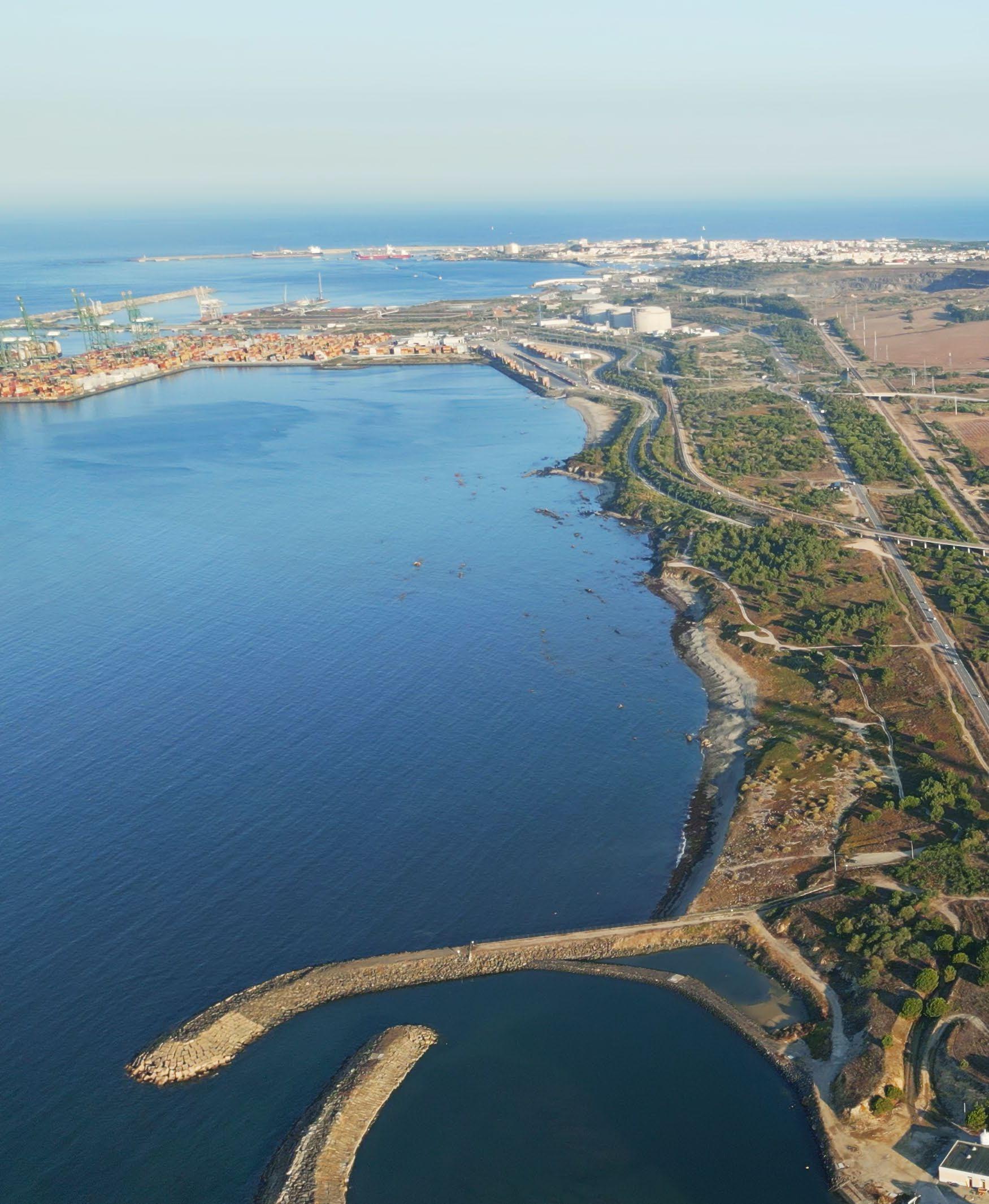
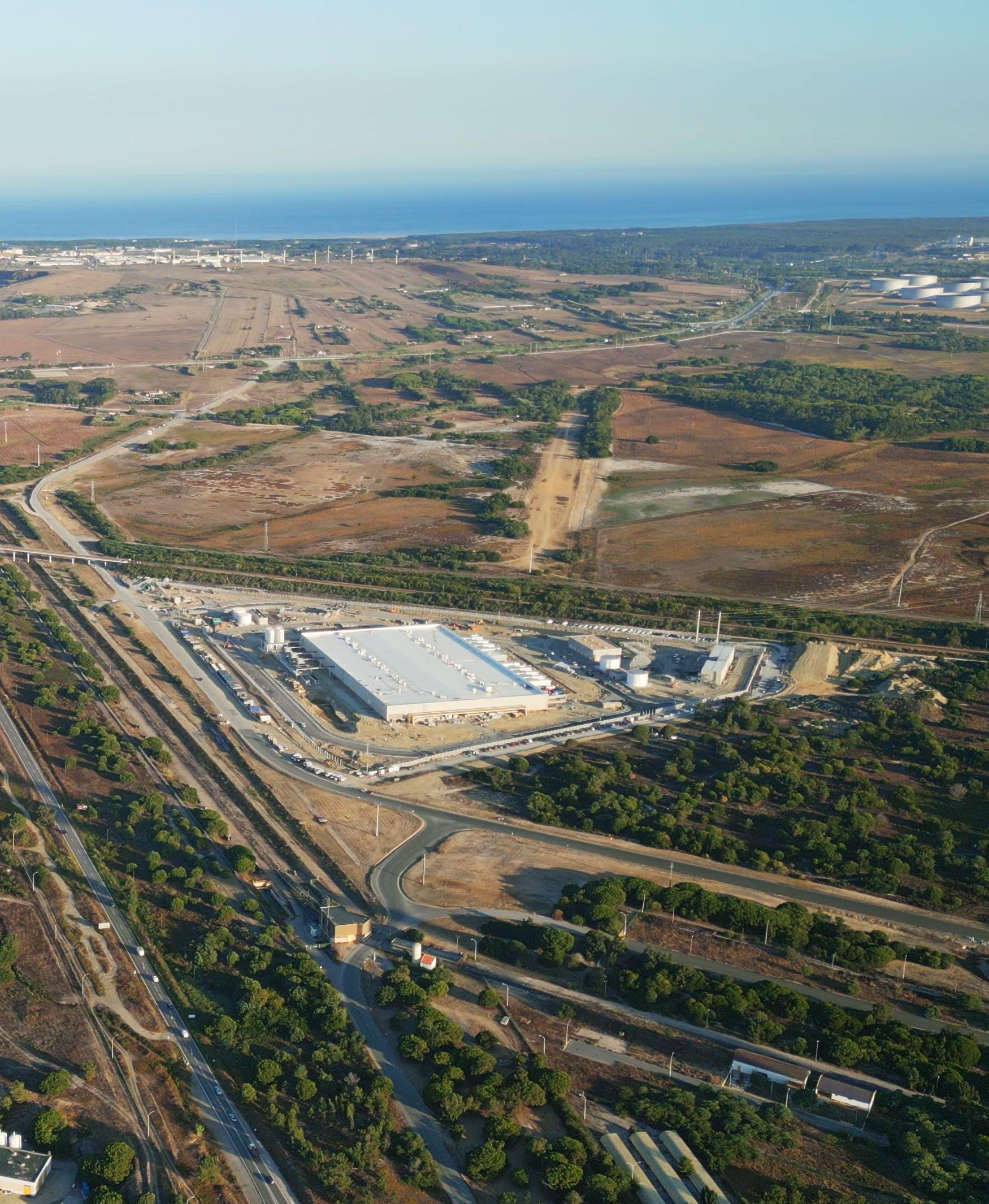
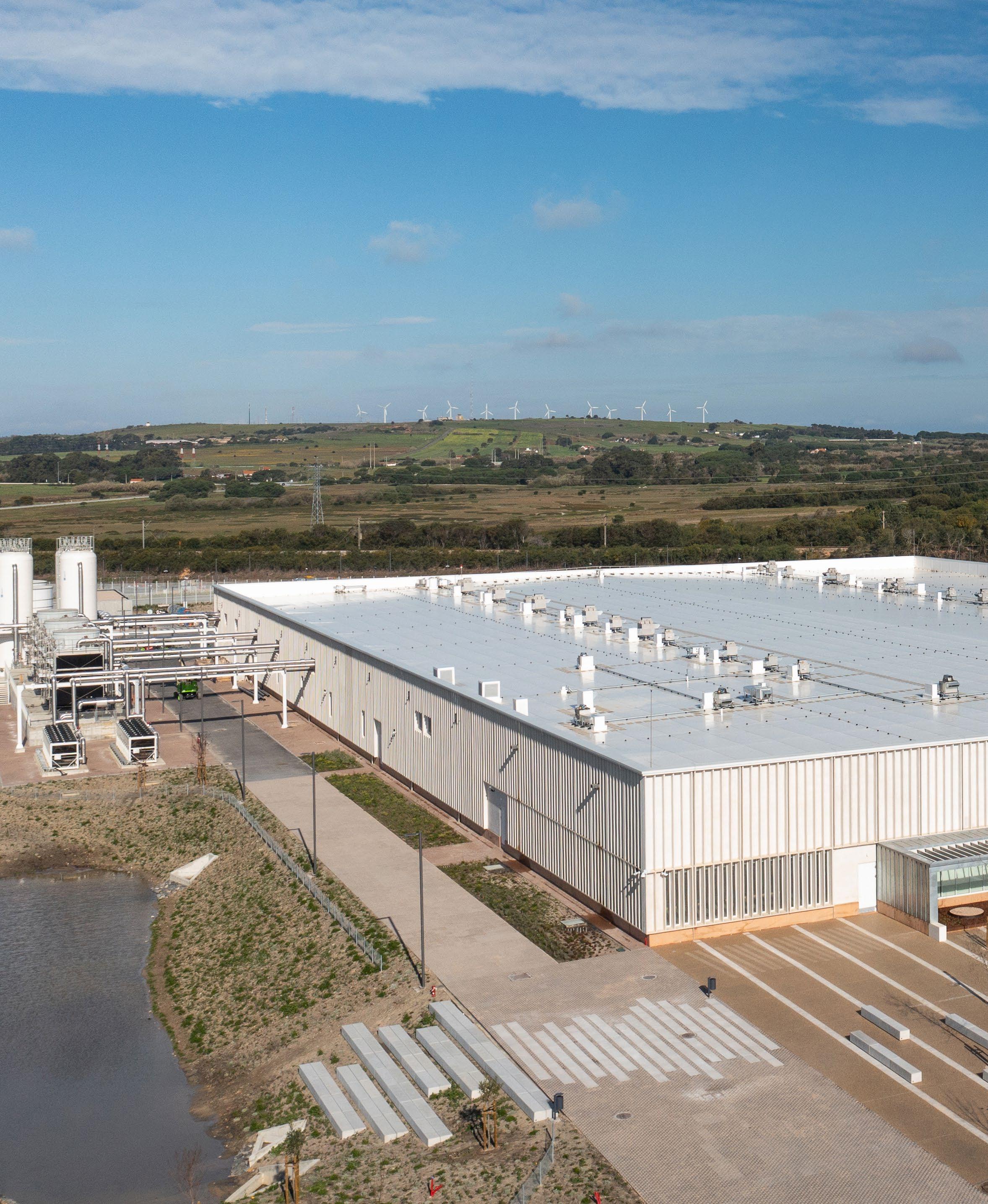
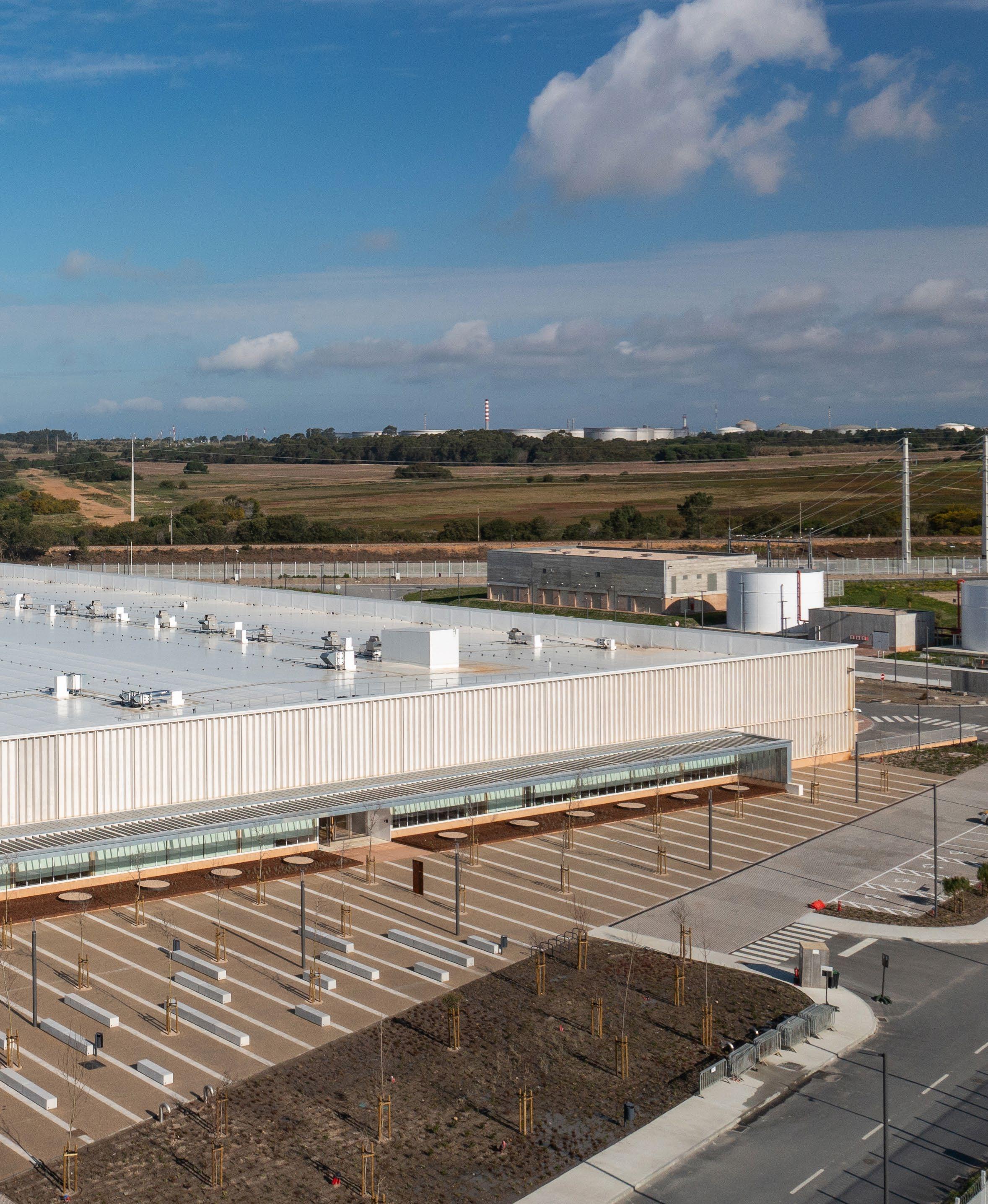
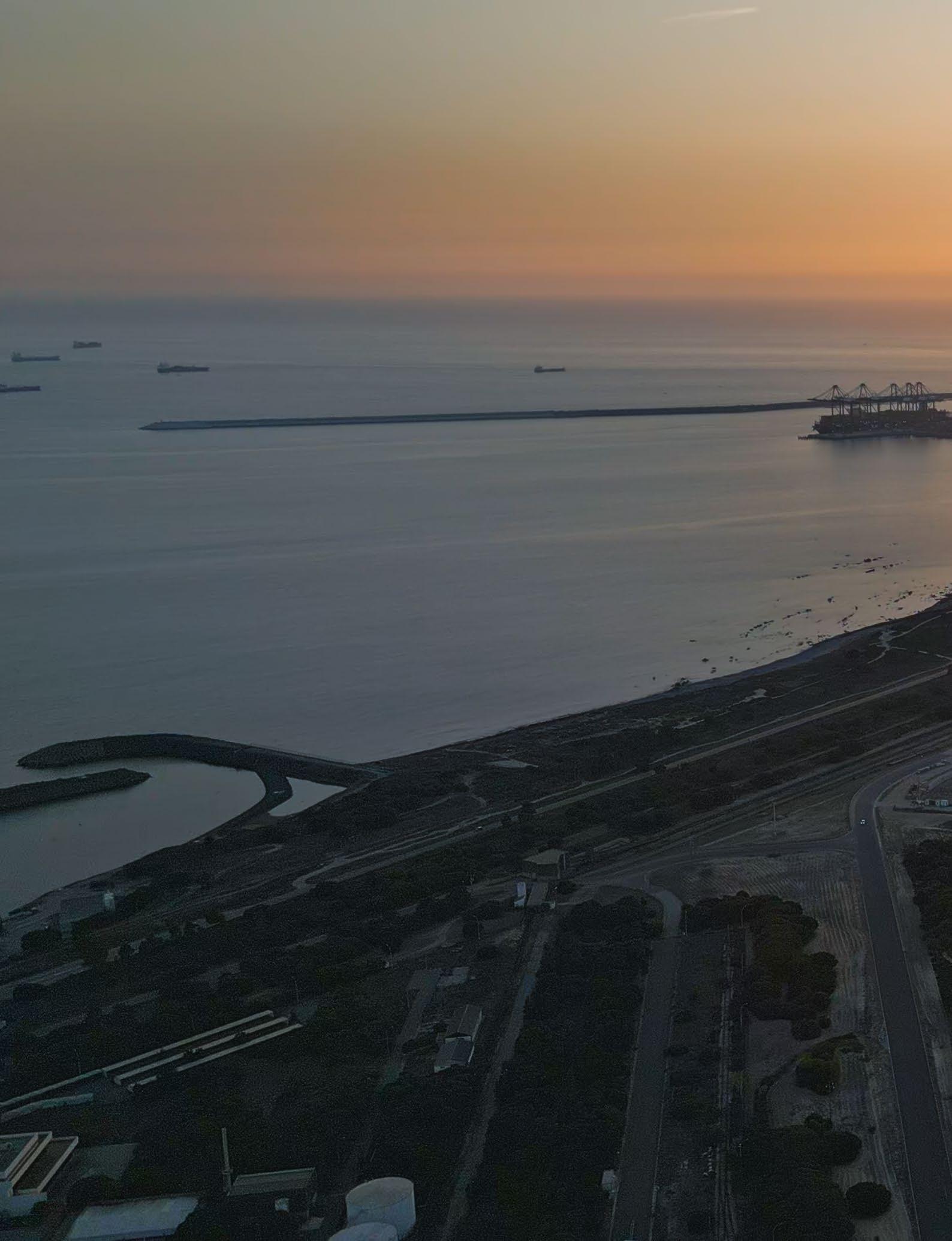
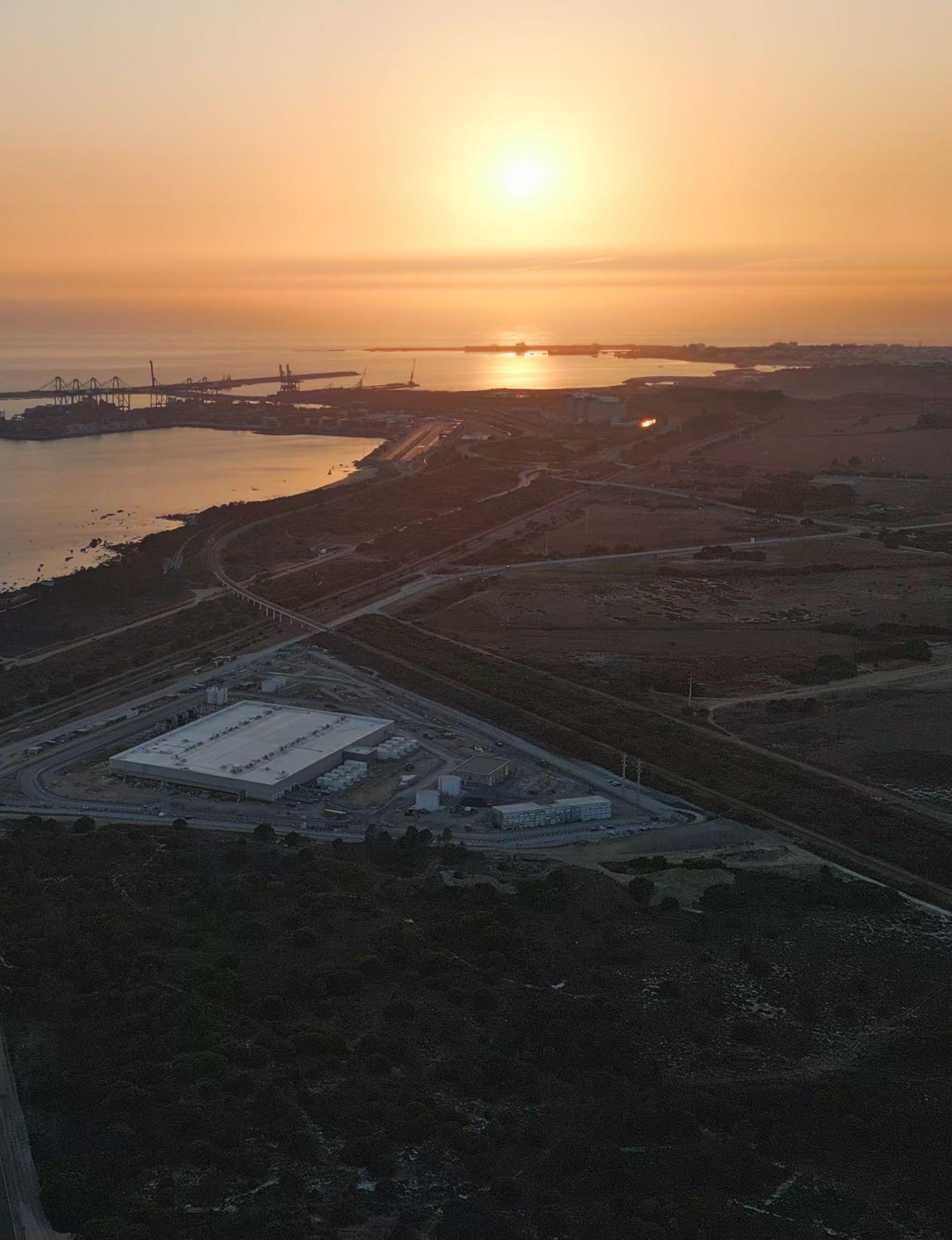
On the southwestern coast of Portugal, in the port city of Sines, one of Europe’s most ambitious digital infrastructure projects is underway: Start Campus. What began as a repurposing of an industrial site around a decommissioned coal plant is now evolving into a state-of-the-art data center campus with a planned capacity of 1.2 gigawatts.
The location plays a central role in the continent’s strategic data structure: access to subsea cables, low latency to the Americas, Africa, and Europe, and one of the most sustainable energy profiles in Europe. In a conversation with Omer Wilson, Chief Marketing Officer at Start Campus, and Pablo Ruiz-Escribano, SVP Secure Power & Data Center Business at Schneider Electric, it becomes clear this development is far more than just a data center project. It’s a new standard for AI-ready digital infrastructure.
According to Wilson, it all started with a rigorous selection process. “Our investors analyzed over fifty sites across Europe. Portugal stood out.” One of the decisive factors was the availability of renewable energy. “Portugal’s current energy mix is already 87% renewable. In five to six years, that’ll surpass 90%. That’s essential for us and our customers.”
COMPETITIVE ENERGY COSTS
The economic equation also added up. “Energy costs here are just above those in Scandinavia but still extremely competitive,” says Wilson. Price isn’t the only factor. Market stability also plays a role. “You have to be sure you can power a campus of this scale with clean electricity at all times.”
The site itself presented a unique opportunity. “We found a decommissioned coal power plant by the sea, which still had operational seawater intake infrastructure for cooling. We integrated that into our design.” The seawater cooling system operates on an open-loop basis. “The water flows past heat exchangers, indirectly cooling internal systems, and is then returned to the sea, at the right temperature and in full compliance with regulations.” This reduces the campus’s water consumption to nearly zero, making the project ecologically attractive as well.
According to Ruiz-Escribano, this kind of innovation was exactly what attracted Schneider Electric. “Start Campus aligns perfectly with our mission to combine sustainability and digitization. From the first conversation, we saw a shared vision: building infrastructure that is scalable, energy-efficient, and future-proof.”
EARLY-STAGE COLLABORATION
The partnership began long before the first construction phase. “We were involved more than two years before building started,” says Ruiz-Escribano. “In co-creation sessions, we discussed power profiles, cooling, backup systems, automation, and scalability. That allowed us to solve many challenges before the first cables were laid.”
The campus comprises six data center buildings, named SIN01 through SIN06. Schneider Electric partnered with Start Campus on the successful delivery of the SIN01 facility, the first data center of the 1.2GW campus.
SIN01 has been operational since late 2024, running at around 26 to 31 megawatts. The next buildings will each scale up to 180/220 megawatts each. The entire campus will be built in phases until 2030. Wilson: “We’re building for the future. AI power demand is enormous. One large client could potentially need 100 megawatts alone. That’s why we’re designing at that scale now.”
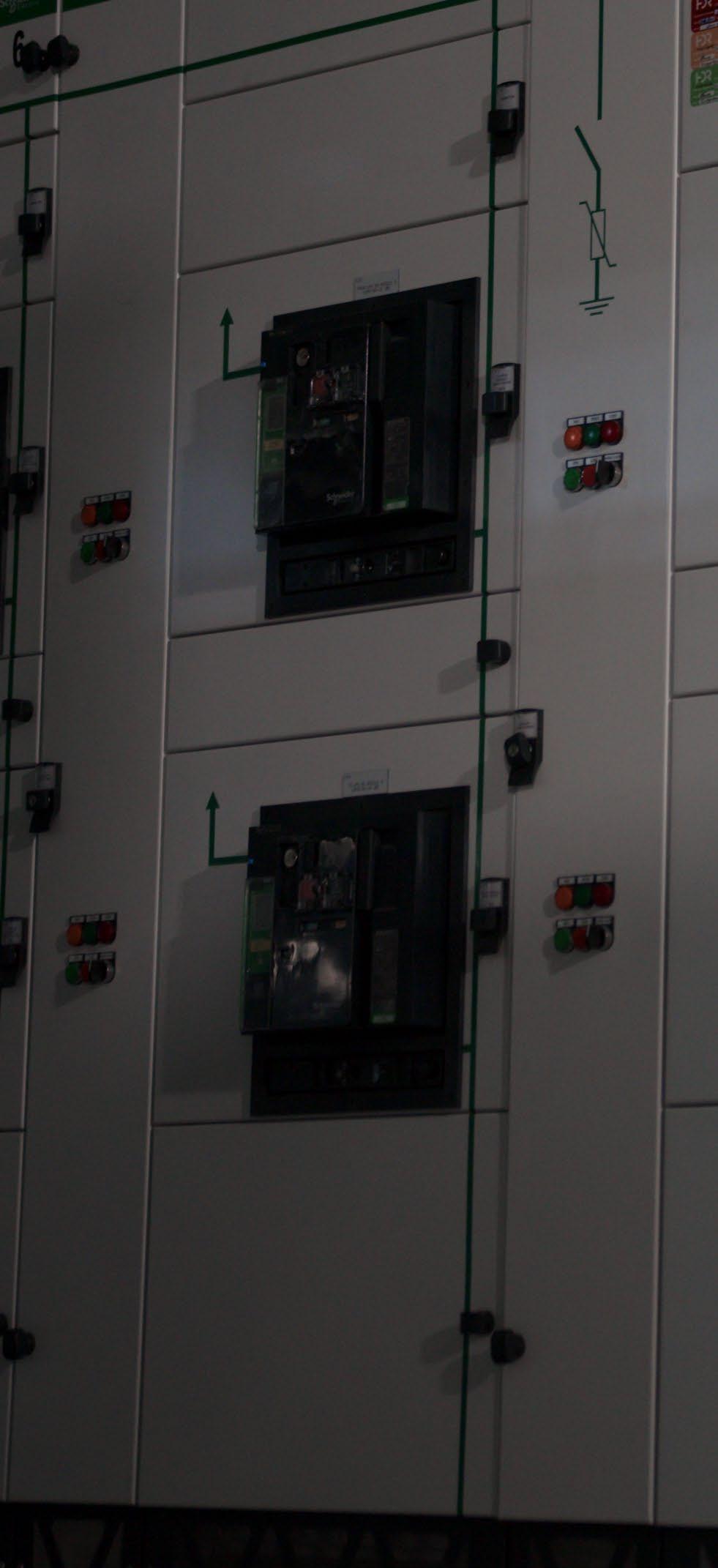
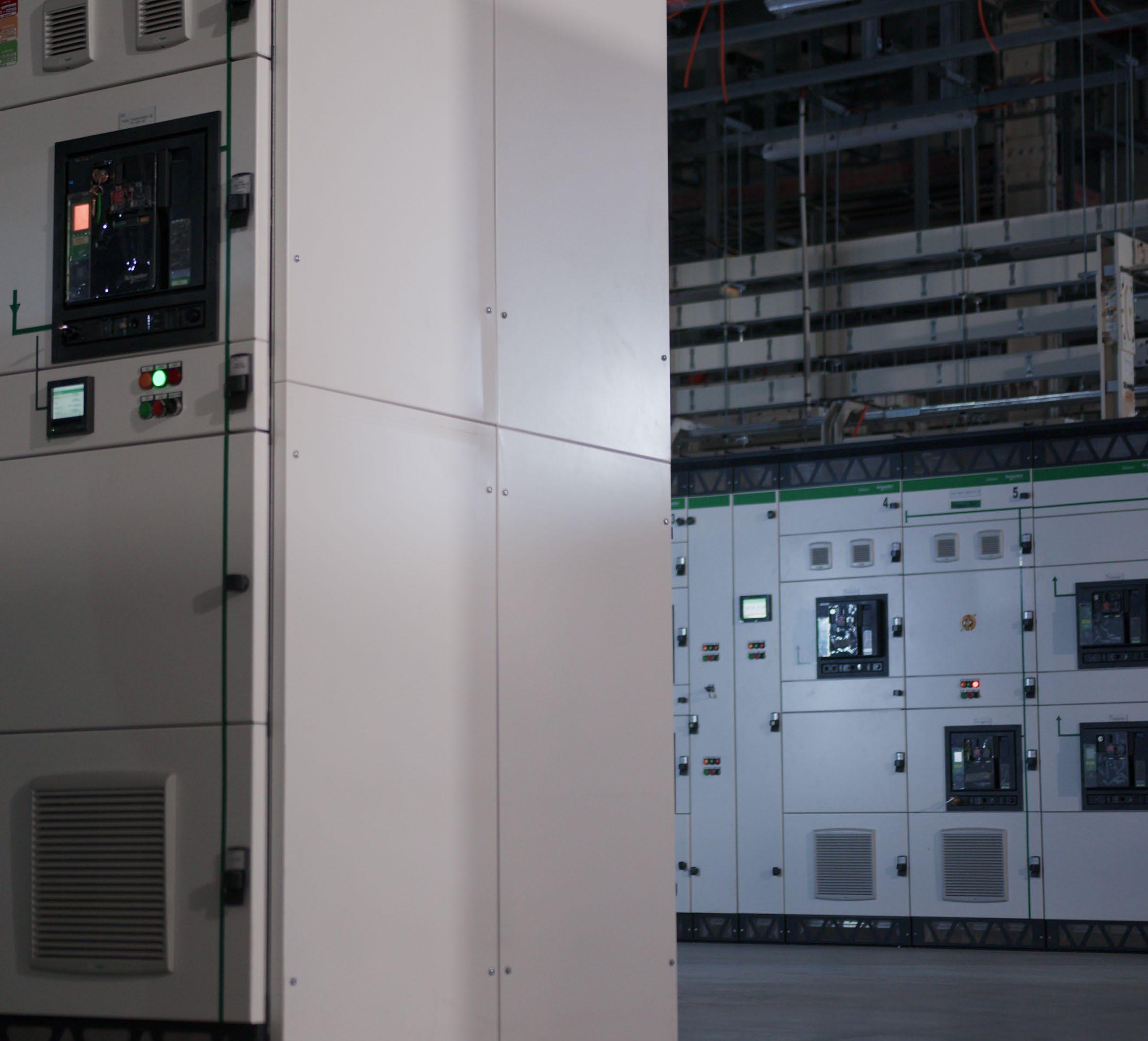
Ruiz-Escribano explains the technical implications: “Rack density is increasing dramatically. Where you used to see 1.5 megawatts in a suite, we now see up to 150 kilowatts per rack in SIN01. SIN02 is being designed for 700 kilowatts per rack.” These kinds of loads require a whole new infrastructure. “You need advanced power distribution, redundancy, thermal monitoring, and direct liquid cooling. Schneider Electric provides Galaxy VX UPS systems, SF6-free medium-voltage switchgear, modular low-voltage distribution with realtime monitoring, and complete digitization through EcoStruxure.”
The software layer is just as important as the hardware. “With our EcoStruxure solutions, we can monitor power, temperature, consumption, and performance down to the rack level. That enables rapid response and predictive maintenance. Everything is redundant and secure. And our systems are AI-ready to analyze that monitoring data.”
AI-READY AND HYPERSCALER - FOCUSED
That level of intelligence is essential given the type of customers Start Campus attracts. “We focus on hyperscalers, AI clusters and GPU-based workloads. These run 24/7. They demand zero downtime, low carbon footprints, and complete insight into their consumption,” Wilson explains.
With support from Schneider, Start Campus signed Power Purchase Agreements (PPAs) that guarantee 100% renewable energy. “We buy wind and solar power from the region through long-term contracts, so customers know exactly where their energy is coming from,” says Wilson.
Schneider Electric also provides on-site support. “We have a permanent team on campus. Our services
EUROPEAN DIGITAL GATEWAY
Sines’s strategic location offers more than sun and wind. The city lies on the Atlantic coast and connects to an increasing number of subsea fiber cables. “That’s crucial,” says Wilson. “Sines gives us direct connectivity to North America, Africa, and Latin America. This is not just a Portuguese project. It’s a European digital gateway.”
The economic impact is also significant. The total investment amounts to €8.5 billion. The Portuguese government has designated Start Campus as a Project of National Interest. “We estimate this project will contribute €1.2 billion annually to GDP,” says Wilson. “During construction, roughly 700 people are working on-site. Eventually, that will grow to over 9,000 direct and indirect jobs.”
The campus is also OCP Ready v2-certified. OCP stands for the Open Compute Project, a global initiative launched by Facebook (now Meta) in 2011 to promote more efficient, scalable, and energy-conscious data center hardware through standardized, modular designs.
include monitoring, asset management, incident response, and maintenance,” says Ruiz-Escribano. “At this scale, that’s non-negotiable. If something goes wrong, you need to resolve it in minutes, not hours.” Wilson elaborates: “With tens of megawatts per building and thousands of racks per hall, even a short disruption means thousands of CPU or GPU cores stop working. The economic impact of a single minute of downtime is exponentially higher than in traditional data centers. Everything here is about maximum availability. The service ecosystem must scale accordingly, with fast response, on-site spare parts, and redundancy in both people and systems. That only works if your partner is involved from the design stage.”
OCP Ready v2 certification means that a data center is fully equipped to support this open, vendor-neutral hardware directly, covering racks, power, cooling, cabling, access, and service processes. The latest version emphasizes sustainability, energy efficiency (such as low PUE), high power density, and support for liquid cooling.
For hyperscalers and cloud/AI providers, this is vital. It means they can deploy their own OCP-compatible equipment without custom configurations. SIN01 and SIN02’s OCP Ready status confirms that these facilities are built for the next generation of digital infrastructure. They are flexible, open, and designed to handle extreme workloads.
Ruiz-Escribano: “That certification proves we support open compute hardware, including AI accelerators and modular designs. That’s important for customers who want to scale using open standards.”
BEYOND THE HYPERSCALE
Wilson and Ruiz-Escribano agree that what’s being built here goes beyond hyperscale. “We’re creating the infrastructure layer for the AI-driven economy,” Wilson says. “Just as you need roads, ports, or power plants, you also need these facilities. But they must be sustainable, scalable, and reliable.”
They see data centers not as technical endpoints for storage, but as strategic hubs in a world increasingly dependent on digital processes. From AI models to cloud platforms and real-time analytics: nearly every sector relies on data-heavy applications that require immense compute power. The infrastructure enabling that must now be treated like a public utility. That requires more than just power and connectivity, it calls for resilient, energy-efficient, and adaptable facilities that can evolve with unpredictable technological shifts. Start Campus aims to lead in both capacity and approach.
The collaboration between the two companies is central to this goal. “Without Schneider Electric, we couldn’t have achieved this scale, speed, and quality on the SIN01 facility,” says Wilson. He emphasizes how well the technical teams aligned. “What I value is that we weren’t given cookie-cutter solutions. Everything was built around our challenges and ambitions. Whether it was power distribution, monitoring, or cooling strategies. It was always an open technical dialogue.”
That flexibility was key to building a data center from the ground up for workloads that are only just emerging. “We’re designing today for technologies still in development. That requires partners who are agile and technically bold,” says Wilson.
Ruiz-Escribano agrees: “And it goes both ways. Start Campus gave us the opportunity to showcase what our technology can do in a next-gen campus. This is a flagship project.”
To conclude, Wilson reflects on the future. “Can you still plan 30 years ahead in this sector?” he asks. And he answers himself: “Barely. The days of designing a campus with a three-decade lifecycle are over. Technology, regulations, demand. It’s all moving very fast.”
Just five years ago, a 50-megawatt data center was considered ‘large.’ Wilson: “Today, we’re building single buildings of 180 megawatts, and scaling the entire campus to one gigawatt.” That changes everything, from national infrastructure decisions to grid connections, water management, and even raw material planning. “But,” Wilson adds, “you can build in flexibility. And that’s what we’ve done. What we design today can be adapted tomorrow to support new workloads, cooling methods, or power densities. That adaptability is perhaps our greatest strength and essential for investing in this sector.”
[TECHNICAL OVERVIEW BOX]
SINES DATA CAMPUS (START CAMPUS)
BUILDINGS
6 data center buildings (SIN01–SIN06)
SIN01
Operational since Q4 2024, 26–31 MW IT capacity
RACK DENSITY
Up to 150 kW/rack (SIN01), up to 700 kW/rack (SIN02+)
ENERGY SOURCE
100% renewable via regional PPAs
WUE Near 0
MONITORING & SOFTWARE
EcoStruxure (EBO, PME, Planon)
INVESTMENT
€8.5 billion total
EMPLOYMENT
700 construction jobs, up to 9,000 total jobs
CAPACITY
1.2 gigawatts IT power (largest in Europe)
SIN02
Under pre-construction, planned up to 180 MW
COOLING
Open-loop seawater cooling; zero drinking water use
Direct access to subsea cables to the US, Africa, and Latin America
CONNECTING IS IN OUR DNA, EVEN DIGITALLY
TEXT: MELS DEES
ARTHUR VAN DIJK KING’S COMMISSIONER FOR THE PROVINCE OF NORTH HOLLAND
The Netherlands is a country built on connection. For centuries, we have constructed dikes, locks, roads, and ports to link trade, knowledge, and people. Today, we continue that tradition in the digital world. The data streams flowing through our country each day form the modern infrastructure of our economy. Without these flows, not only the internet but society itself would grind to a halt.
North Holland plays a key role in this. Thanks to its location, international cable connections, and innovative businesses, the province has become a digital hub within Europe. Here, networks converge, and new ecosystems of companies emerge that depend on fast, reliable connections. Data centers are a vital link in this process.
At the same time, we must continue to invest in knowledge, innovation, and collaboration. Digital infrastructure is not a goal, but a foundation for new applications, from artificial intelligence and medical technology to climate research. By connecting education, business, and government, we strengthen both the resilience of our economy and the quality of our society.
A STRATEGY FOR DATA CENTERS
Data centers require space, energy, and careful spatial planning. That is why the province adopted a dedicated data center strategy back in 2022. This strategy provides direction and prevents uncoordinated growth. We focus on clustering, sustainability, and spatial quality. In North Holland, we have identified three areas where data centers are concentrated: the Amsterdam Metropolitan Area, Hollands Kroon in the Kop van Noord-Holland region, and Haarlemmermeer. By focusing on these clear clusters, we maintain oversight, make better use of existing infrastructure, and protect the open landscape elsewhere.
We do this with an eye to the future. The demand for digital infrastructure continues to grow, but space and energy supplies are not unlimited. Grid congestion is a real challenge in parts of our province. In the Amsterdam region, the electricity grid is almost full, making expansion there difficult. In Hollands Kroon, where hyperscalers have established themselves, this is less of an issue: the required capacity was already planned in earlier stages. Those forward-looking decisions ensure that new data centers there fit better within the existing grid structure.
The challenge is to make innovation and sustainability go hand in hand. Data centers can contribute to the energy transition, for example, by supplying residual heat to residential areas or business parks.
Companies that already integrate such measures into their plans naturally have a head start. This creates a reciprocal relationship between the economy and the environment.
Aesthetics also deserve attention. Just as logistics companies increasingly invest in architecture and landscaping, the same applies to data centers. Large buildings, if well-designed, can blend into their surroundings or even enhance them. The era of anonymous boxes in green areas is over. Digitalisation can and should visibly contribute to an attractive, future-oriented landscape.
As a province, we have the responsibility to oversee the whole picture. North Holland has 44 municipalities, each with its own needs and boundaries. We ensure that all the pieces of the puzzle fit together: above, below, and on the ground. This is not always easy, but it is essential to maintain the balance between economic growth, liveability, and sustainability.
Our digital infrastructure has become as crucial to our prosperity as our ports, roads, and airports once were. North Holland stands at the heart of this development. Connecting is in our DNA and if we continue to act with the same vision and care as in the past, the Netherlands will remain a country that connects the world, both physically and digitally.
THE STORY WE NEED TO TELL
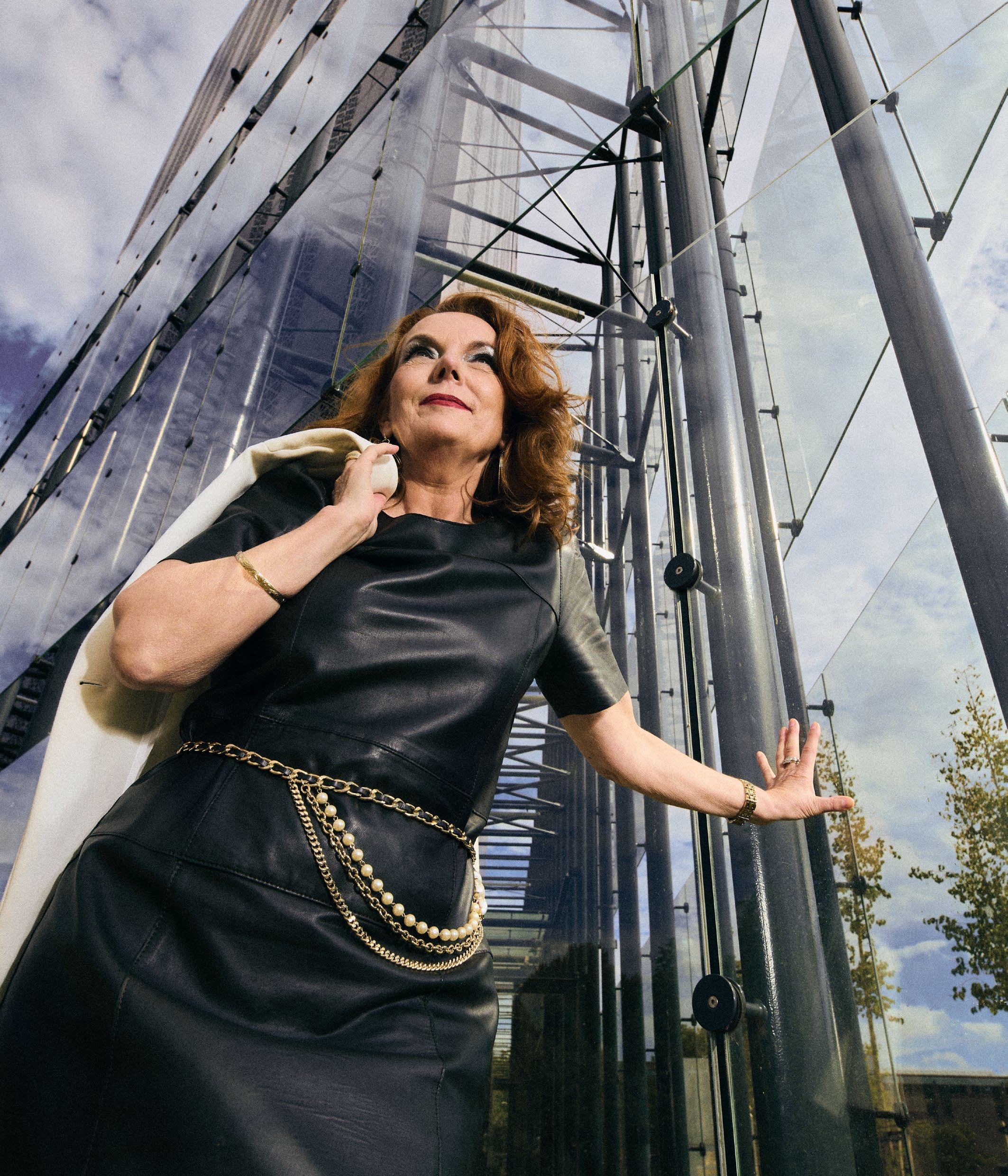
ANNEMARIE BRANDSEN
Digital Realty recently presented ANNEMARIE BRANDSEN as the new Director of Marketing Europe North. Based in Amsterdam, she leads the regional marketing team. Her mission: to further strengthen the Digital Realty brand and accelerate the company’s growth in Northern Europe. This is in a sector that is rapidly changing due to themes such as data sovereignty, sustainability, and AI.
Brandsen is no stranger to the IT world. She worked at Microsoft for over eight years, where she launched CRM Online and managed international teams. Later, at Cisco, she developed strategies for Account-Based Marketing and guided the rollout of global campaigns in the EMEA region.
We meet her at AMS17, Digital Realty’s data center at Amsterdam Science Park. The iconic building, with a floor space of over 11,000 square meters and a capacity of over 40 megawatts, is known for its modern architecture and strategic location in the heart of Amsterdam’s internet hub.
INTERVIEWER
BACK
FORTH
Melissa Scholten (MS): You’ve had an impressive journey: from Head of Marketing in the IT industry to leading a sub-regional marketing team at one of the largest data center companies in the world. Can you take us through that transition? What motivated you, and how has your background influenced your perspective on the data center market?
Annemarie Brandsen (AB): I don’t actually see the move to Digital Realty as a radical career shift. For me, it’s a logical continuation of what I was already doing. At Cisco, Microsoft, and KPN, I was already working on issues very closely related to the data center world. Of course, you could say that I was previously more involved in the software and hardware side of things, but ultimately, it always comes down to the same thing: how can technology strengthen a customer’s business?
MS: There are differences, too.
AB: Definitely. The difference is that in a data center, you directly touch the infrastructure. It’s not about an application or a piece of software, but about the foundation on which everything runs. AI, cybersecurity, cloud, latency: all these themes depend on where and how data is stored and processed. That goes to the heart of business operations.
So, for me, it didn’t feel like a leap into the unknown, but rather a deep dive into a domain I was already familiar with. Moreover, I’m someone who loves building. I’m always looking for growth markets where I can add value. And the data center industry is precisely such a market: growing rapidly, incredibly relevant, and full of challenges that demand effective marketing.
MS: So, you were already familiar with data centers before you took on this role?
AB: Absolutely. My first real experience was at Microsoft in Ireland. I got to see the inside of a data center there, and it was impressive. From the outside, it looks like a gray, anonymous building—nothing special. But inside, I felt that this was the core of everything we do digitally. The security level was bizarrely high: stricter than at some embassies. Even taxi drivers didn’t know where they were going. There was something almost mystical about it.
That moment made a lot clear: all those emails, those photos in the cloud, streaming movies, our everyday apps—they all run here, in such buildings. The fact that as an outsider you have no idea fascinated me. And that fascination has never really gone away.
MS: How does your previous experience help you better understand the complexities of data centers and apply that to your marketing strategy?
AB: A lot. At Cisco, Microsoft, and KPN, I was already accustomed to marketing revolving around the customer’s business needs. It’s never about the technology itself, but about what you solve with it. This is precisely the case for data centers.
I also recognize the dynamics of a partner model. In our sector, you not only work directly with customers but also with a broad network of implementation partners, system integrators, and consultants. This means your marketing strategy always has two tracks: communicating directly with major customers and equipping your partners with the right stories and materials.
What also helps me is my habit of thinking in ecosystems. Technology never works in isolation. Data centers are part of a chain where cloud providers, telecom companies, software vendors, and end customers are all interlinked. I incorporate this perspective into my approach.
And finally, I’ve always worked in growth markets. I love building something, motivating teams, and sharply positioning propositions. I feel this very strongly in the data center world. When I read the job posting, I really thought: this is me, this is my kind of person.
MS: At the same time, data centers sometimes have a less positive image in the public eye. They’re seen as “big boxes that consume a lot of energy.” How do you deal with that?
AB: I recognize that. I often hear: “You use so much power.” And yes, that’s true, a data center uses a lot of energy. But what people forget is that they themselves are users. Every app you open, every email, every photo in the cloud, every bank transaction: it all runs in a data center.
People only see the building, not the ecosystem. They don’t see that their Netflix series, their Uber ride, or their WhatsApp message depends on data centers. That’s why I always say that awareness is the first step. Without data centers, our digital society will collapse.
Step two is explaining what we’re doing to make it more sustainable. Because we take those concerns seriously. Huge innovations are underway: liquid cooling, more efficient cooling with a circular system without using potable water, AI for predictive maintenance that saves energy, and the reuse of residual heat. The image that data centers are only polluting is no longer true. We are leading the way in green innovation, and our global portfolio allows us to do this on a large scale.
ANNEMARIE BRANDSEN
MS: So, storytelling and awareness are important pillars of your strategy?
AB: Absolutely. Storytelling is crucial. If you explain that your hospital records, your bank account, and your favorite apps all depend on data centers, people get a different perspective. Moreover, it’s not just a “nice story” that we’re making things more sustainable. It’s not window dressing. It’s a fact. Data centers will be able to deploy technology for sustainable solutions on a large scale in the future. You have to make that visible. I see it as a social responsibility. We have to tell the story, but we also have to deliver on it. And fortunately, that’s happening.
MS: Back to your career. You’ve worked in various sectors and positions. How have those experiences shaped your professional perspective?
AB: I’ve always consciously made choices that would challenge and enrich me. I love constantly learning new things. That’s why I deliberately gained experience in a variety of marketing roles: media research, agency work, corporate marketing, and B2B. This breadth gives me a T-shaped profile as a leader: broad across the entire spectrum of marketing, but also deep in certain specializations. That’s important, because marketing is incredibly diverse. You have data analysis, content, PR, digital, events, partner marketing: it’s all interconnected.
Moreover, I see marketing as the intersection of art and science. On the one hand, you work with data, technology, and ROI accountability. On the other, it’s about creativity, emotion, and storytelling. Exactly what that combination makes it so fascinating for me.
MS: What do you think are the most important marketing challenges in the data center sector?
AB: The biggest challenge is reaching the right people, through the right channels, with the right message at the right time. The decision-making unit has grown enormously; actually, since the pandemic. Where six people used to participate in decisions, there are now sometimes fifteen or more. And it involves completely different disciplines: from the CIO to HR, from security to operations.
Moreover, you’re dealing with different generations. Younger generations don’t want sales pitches at all or leaving their information anywhere. They want to find their information online, make their own decisions, and only contact a company very late in the sales funnel. Older generations expect their information and contact in a different way. That requires a multichannel and multigenerational approach.
And finally, measurement has become much more important. You can spend tons of money on campaigns, but what’s the return? I grew up with a strong focus on ROI. I want to know: which investment yields which deal or customer relationship? We need to integrate that discipline much more strongly into B2B marketing.
MS: How do you see data and technology playing a role in this?
AB : A huge role. With data, you can target, segment, and personalize much more effectively. You can understand customer behavior, what information they’re looking for, and where they drop off.
But you have to do it smartly and ethically. In Europe, we have GDPR, and that’s a good thing. It keeps us on our toes. We must be transparent and handle data respectfully. That’s not just legislation; it’s also a matter of trust. I see data and technology as tools to be more relevant. Ultimately, it’s about adding value. No spam, no push, but content that truly helps the customer.
MS: You’re relatively new to this role. What are your main objectives with the marketing team?
AB: Firstly: smarter and more targeted targeting. Not spray-and-pray, but precisely the right message for the right target group. Secondly: collaborating more closely with our partner ecosystem. Partners are often already sitting at the client’s table. They know exactly what’s going on. By working together, we can add much more value. And thirdly: storytelling. We need to spread the word about data centers. Both their indispensability and their sustainability. This isn’t just a marketing task; it’s a social responsibility.
I’m looking forward to the future. I joined Digital Realty during a growth phase. With the many developments and issues in the field of data, data sovereignty, and AI, I see plenty of opportunities. For me, marketing isn’t a one-size-fits-all solution, but a strategic choice: what do we want to say, to whom, and especially why? Each target group and industry requires its own approach. I look forward to working with the team to further build our visibility and contribute to Digital Realty’s ambitious growth through targeted campaigns.
MS: How do you see the data center industry developing in the coming years? And how will you adapt your strategy accordingly?
AB: I think AI is a huge accelerator. In sectors like finance, you already see a lot of AI being used. In the near future, we might have a phone conversation with an AI agent instead of a human, for example.
This trend is only accelerating. On the one hand, because there’s a shortage of people, and on the other, because customer needs are changing. Nobody wants to wait ten minutes on hold anymore. Soon, you’ll have a choice: do you want to wait for a human or be helped immediately by AI that answers 99% of your questions? People will adapt faster than they think. This is also what happened with the introduction of the mobile phone at the end of the last century.
This has a significant impact on data centers: even more demand, even more capacity. For marketing, it means telling stories that clearly demonstrate what this means for companies and consumers, without the magic or fear.
MS: Finally, what advice would you give to professionals aspiring to a leadership role in the data center industry?
AB: Be open-minded. Stay curious. Keep your eyes open for technological and societal trends. Think from the customer’s perspective: what is their need, their challenge?
And keep learning. The biggest pitfall is clinging to what worked yesterday. This industry is changing rapidly. If you don’t keep pace, you’ll fall behind. Leadership here means building, learning, and connecting. And that’s precisely what makes this sector so exciting.
MATURITY AND PASSING THE WORLD TO A NEW GENERATION
The data center world is experiencing profound change. In only a short period, we have witnessed AI grow exponentially. ChatGPT, which amazed us recently, is now a natural extension of our daily searches. Where once we typed a keyword, we now ask complex questions and get coherent answers instantaneously.
This is the beginning of a transformation of historic scale. Demand for data center capacity to support AI is booming, along with concerns about whether resources can handle this data-hungry technology sustainably. Governments, media, and communities are asking questions about energy use and environmental impact. In a previous column, I wrote about an agreement with my daughter, a teacher: she helps her students stay sharp and not overdependent on AI, while I focus on making AI sustainable.
AI IS COMPARABLE TO AN INFANT
AI is like a baby taking first steps. It has moved from crawling to walking, but it still needs help and a supportive environment to grow responsibly. Similarly, AI workloads demand reliable, scalable, energy-efficient, and sustainable IT infrastructure. This is why developing a Maturity Model for Energy Management and Environmental Sustainability is critical if we want to guide AI’s growth rather than chase after it.
The upcoming ISO/IEC 22237-10 builds on CLC/TS 506005-1, itself derived from earlier work by The Green Grid and the EU Code of Conduct. This five-level model covers management practices, infrastructure and ICT systems. It provides a clear roadmap for organizations to evaluate and improve their sustainability practices step by step.
Over the past 15 years, we have developed a comprehensive set of tools to measure performance in data centers: KPIs
such as PUE (Power Usage Effectiveness), REF (Renewable Energy Factor), and others. These metrics allow us to understand efficiency, renewable energy usage, and environmental impact in a quantified way. Now we must apply this knowledge directly to AI workloads, defining the boundaries within which they can grow sustainably.
The EU’s new Cloud and AI Development Act requires sustainable infrastructure. To me, the logical next step is specifying the minimum level that AI facilities must meet. I propose aiming directly for the highest, Level 5, standard of the maturity model. Ambitious, yes, but necessary. As JFK said: “We choose to go to the Moon… not because they are easy, but because they are hard.” Making AI sustainable will not be easy, but it is possible. After all, we have already proven we can achieve the impossible.
FROM ONE GENERATION TO THE NEXT
It doesn’t feel easy, but I must face reality. I just saw the message on my company’s website that I am retiring. When you read this, I will have reached retirement age and decided to reduce my standardization work. My role as Convenor of ISO/IEC JTC 1/SC 39/WG 1 Resource Efficient Data Centers will be transferred in the coming year.
Much of my work on standards for sustainable data centers will be taken over by a new colleague, Julie Chenadec. Julie, from my daughter’s generation, has an impressive track record with Green IT Amsterdam and the Sustainable Digital Infrastructure Alliance. She represents the new wave of professionals who combine technical expertise with a strong awareness of social and environmental responsibility.
That gives me confidence. The baton is being passed, not dropped. With our combined knowledge and continued collaboration, it will be possible to pass on a better and more sustainable digital world to the next generation. And that, ultimately, is the responsibility we all share.
THROUGH THE EYES OF A PHYSICIST
BÉLA
WALDHAUSER ON THE FUTURE OF DATA CENTERS
TEXT: MELS DEES
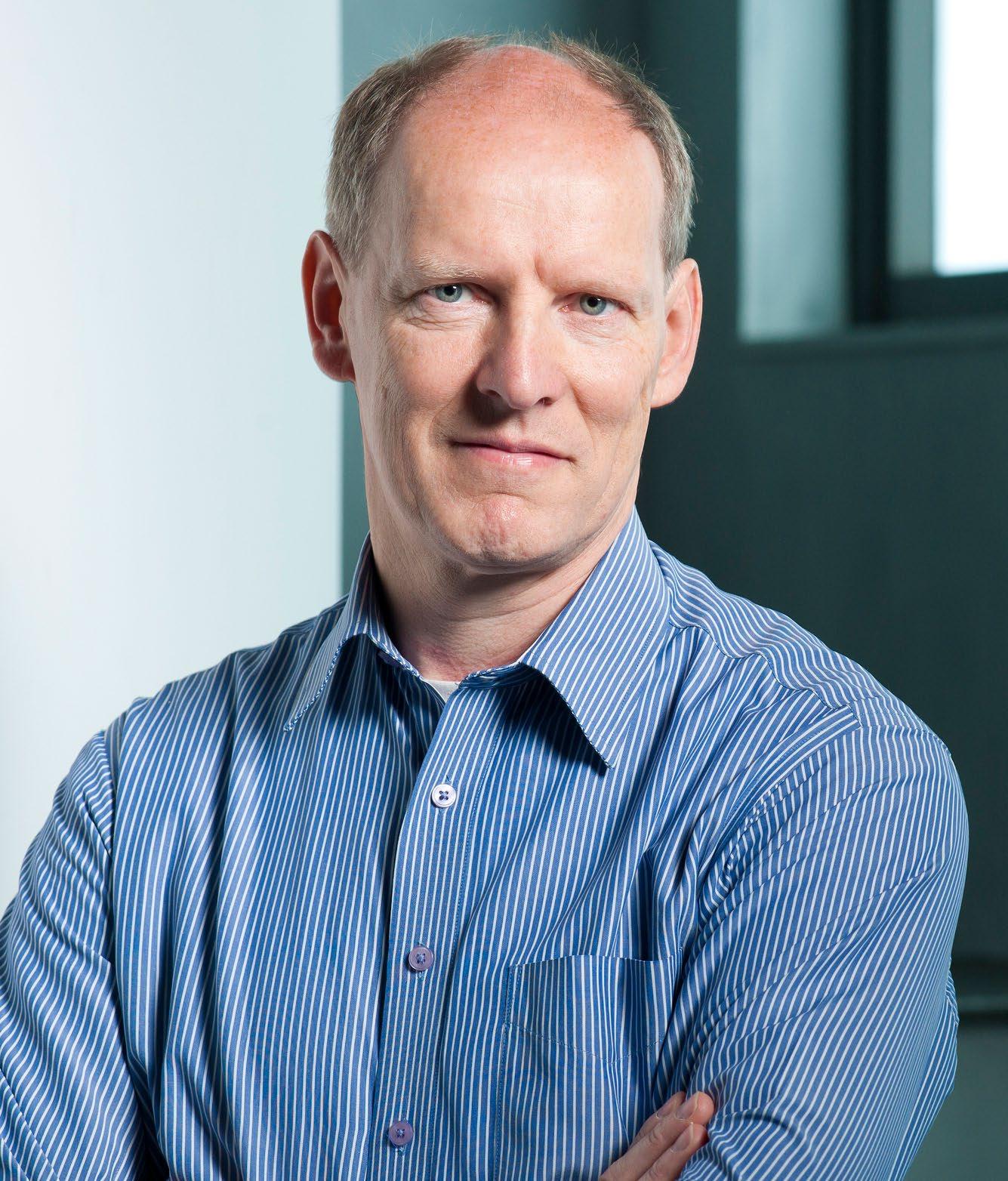
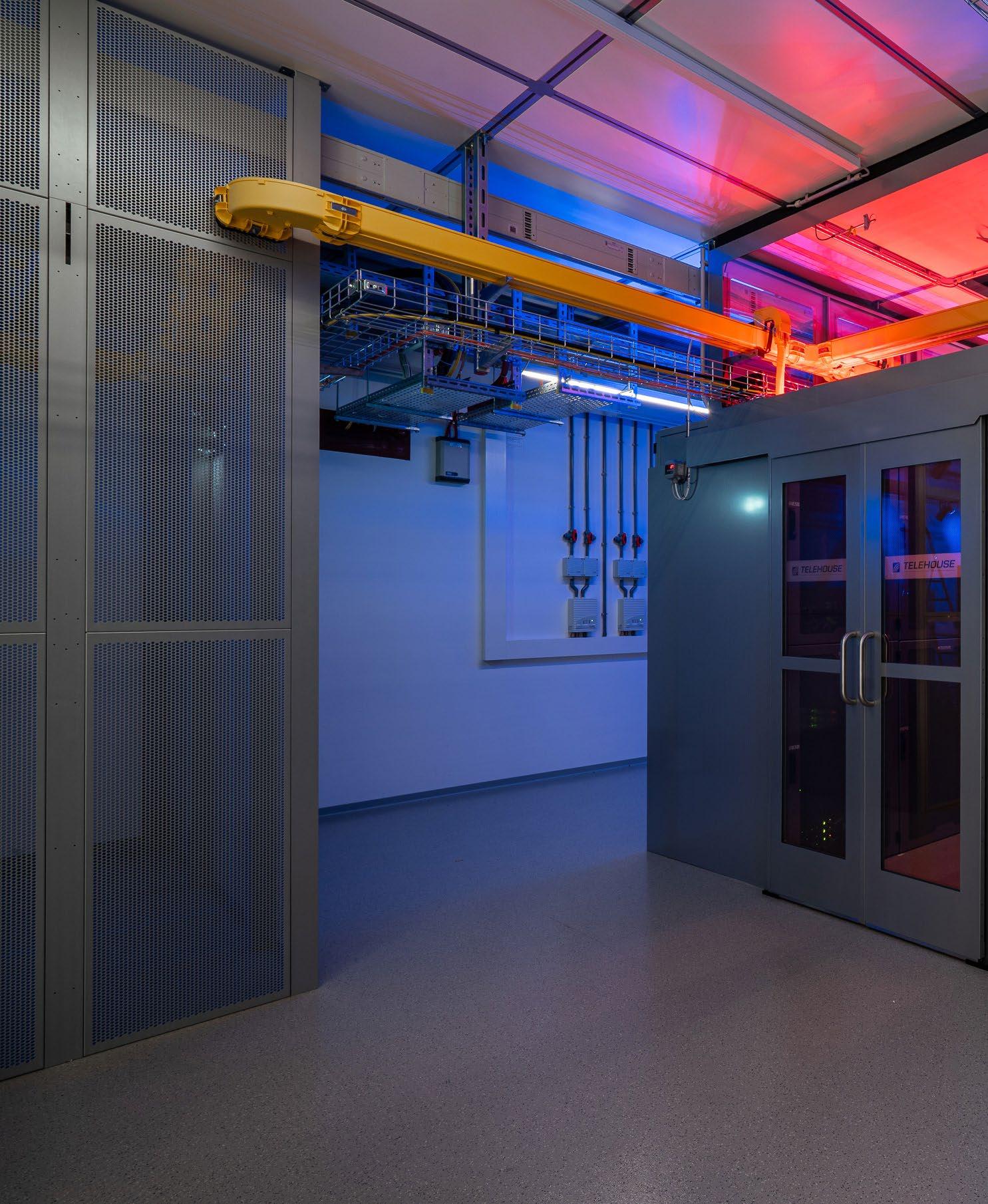
For more than 25 years, Dr. Béla Waldhauser has been one of the defining voices in Europe’s data center industry. Now the CEO of Telehouse Germany is preparing to hand over the reins. In just a few weeks he will step back from day-to-day management, though he intends to remain close to the sector as a board member and advisor. It’s the perfect moment to sit down with him and look at the big questions shaping the future of data centers: energy use, heat recovery, decentralization, workforce challenges, and the rise of specialized infrastructures.
From the first minutes of conversation, Waldhauser’s enthusiasm is unmistakable. A physicist by training, he dives into debates with the clarity of someone who understands both the numbers and the narratives. And one of his main frustrations is how public discussion reduces complex realities to simple headlines. “Everyone talks about electricity consumption,” he says, “but electricity is mistakenly equated with energy. From a physics standpoint, that’s simply incorrect.”
In Germany, only around 20 percent of total energy consumption is electricity. “So when we say data centers consume three to four percent of Europe’s electricity, that’s less than one percent in terms of overall energy,” he explains. And if half of all energy in Germany goes to heating and cooling buildings, the bigger question becomes obvious: how can digitalization help reduce that massive share? “If we seriously want to talk about efficiency, we need to ask how technology can cut into that 50 percent. The effect would be many times greater.”
BETWEEN HEADLINES AND REALITY
The media, he argues, rarely get that nuance across. “Bad news sells better than good news. The headline that data centers steal power from households is, of course, more attractive than the idea that they enable digitalization.” Yet our daily lives depend on them.
“If I send you a WhatsApp, it runs through five or six data centers. But many people believe the cloud is something abstract that has nothing to do with data centers.”
Even the efficiency debate tends to miss the mark. Modern facilities often reach PUE values of 1.3. PUE, or Power Usage Effectiveness, measures total facility
HEAT AS AN OPPORTUNITY
If there is one field where Waldhauser has taken a pioneering role, it’s heat reuse. “I started pushing this issue in Germany five years ago,” he recalls. Today, Telehouse supplies waste heat to a Frankfurt housing development that includes 1,330 apartments, childcare centers, restaurants and around 3,000 residents.
“That currently gives me an Energy Reuse Factor of two percent. But the more we expand, the harder it becomes to keep the ratio stable, because heat demand doesn’t grow indefinitely.”
The real bottleneck, he says, lies not in technology but in infrastructure. A recent meeting with Frankfurt’s network utility underlined the scale of the challenge. To reach climate neutrality by 2040, the city would need to dig up 100 kilometers of road every year to install cables and pipes for e-mobility, heat pumps, and district heating. “That’s completely unrealistic,” Waldhauser argues. “The traffic disruption, the cost, the materials, the manpower: it simply can’t be done.”
For him, much of the political discourse is built on illusion and dogma, while hard expertise is in short supply.
energy against IT energy. A score of 1.3 means that for every 100 units of electricity consumed by servers and storage, an extra 30 units are needed for cooling, backup systems, and infrastructure. “That means roughly 25 percent of the consumption is on us, the operators, while 75 percent comes from the customers’ IT. Hardly anyone talks about that,” Waldhauser points out. To him, it’s a sign of how responsibility is miscast: the weight of public scrutiny lands on operators, while the real driver of demand sits with the users.
EDGE, NEIGHBORHOOD, AND REGIONAL GROWTH
When talk turns to the future shape of the industry, Waldhauser insists on clear distinctions. True edge computing, he says, only makes sense where latency is critical, such as in industrial plants or smart city applications. “For autonomous driving, we’ll need containerized data centers, standardized units deployed in large numbers. Traditional buildings won’t play a role.”
He draws a line between those edge deployments and what he calls neighborhood data centers: regional facilities that keep services close to customers. Increasingly, enterprises no longer want to be confined to the big hubs of Frankfurt, London, Paris, or Amsterdam. “We have 750 million people in Europe. You cannot serve them all from five regions. That’s why we already see growth in Madrid, Milan, Zurich, Warsaw, and Vienna.”
At the same time, new classes of facilities are emerging to handle specialized workloads. Traditional enterprise clients may need just a few kilowatts per rack, while AI and HPC environments are pushing into 100–200 kilowatts per rack. “That forces us to develop different types of data centers for different needs. A one-sizefits-all approach no longer works.”
BUILDING NEW VS. RETROFITTING
Asked about converting old buildings into data centers, Waldhauser’s answer is pragmatic: “It depends.” Office blocks, with their weak floor loads and low ceiling heights, rarely qualify. “A rack can easily weigh a ton, plus generators, batteries, chillers. Without proper structural strength, it won’t work.” Old industrial sites, however, can sometimes be adapted.
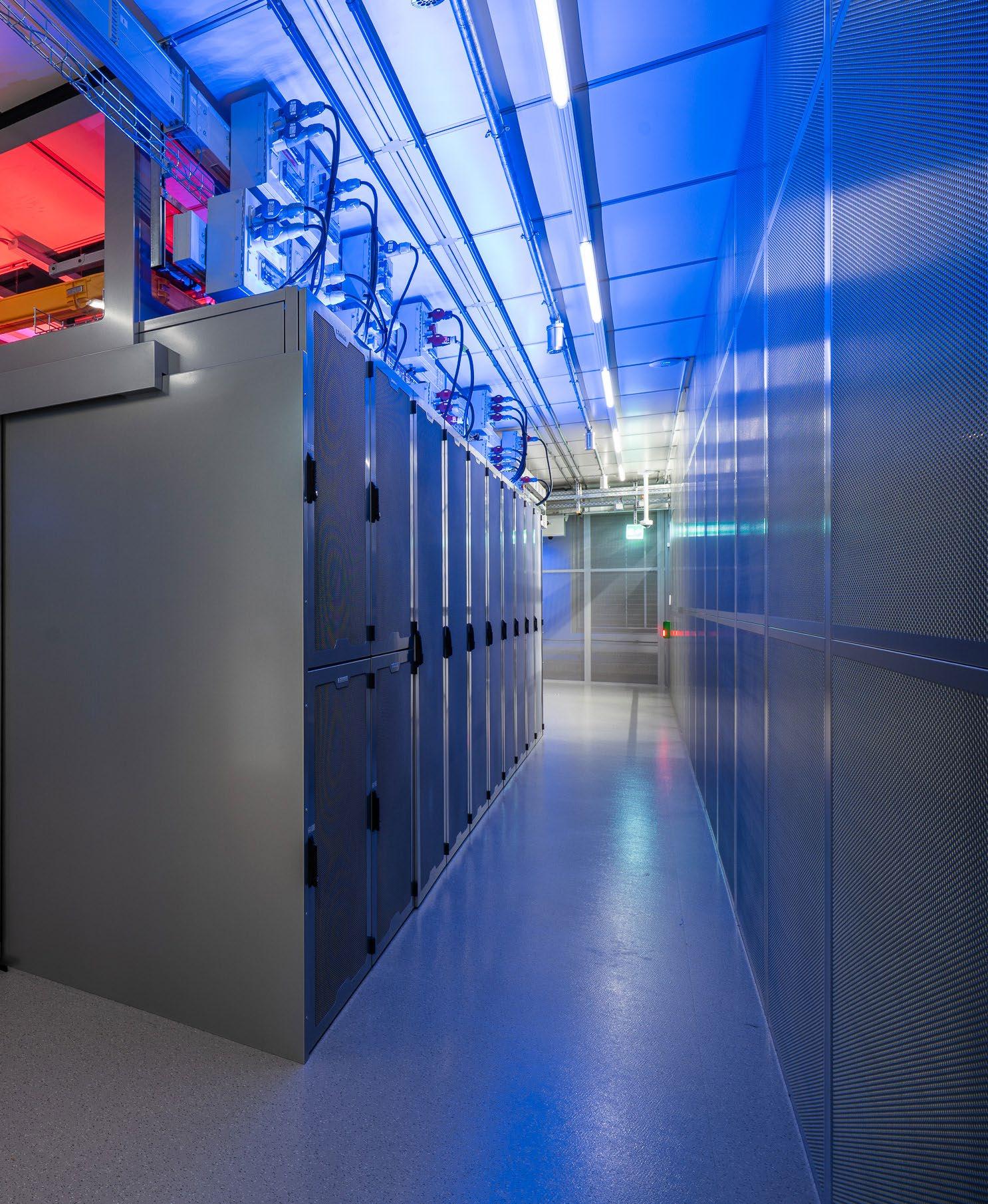
Still, he prefers newbuilds. Telehouse facilities feature mezzanine floors that carry power lines, cooling pipes, and ventilation ducts. “The result is clean, efficient, perfectly organized infrastructure. You won’t get that in a brownfield project.” That said, existing buildings do offer advantages in speed and cost. “Time-to-market is a strong argument, which is why brownfield remains a valid option.”
A CAREER OF PASSION
If there’s one theme that runs through the conversation, it’s Waldhauser’s enduring enthusiasm. “I’ve been managing in this industry for 25 years and never lost my passion. It’s a sensational business that keeps growing.” He’s lived through the dotcom crash and difficult years, but since 2005 the trend has been steadily upward. “We are highly profitable, we are growing, we can afford things, and we’re having fun.” Recently he even took his entire team to Mallorca for a four-day celebration.
Internationally, his expertise is sought after on boards in Belgium, Spain, and beyond. While stepping back from operations, he has no intention of leaving the field. “It’s simply a fantastic industry where I can help shape the future.”
PEOPLE AND POLITICS
Beyond technology, he is outspoken about two broader issues. First, the shortage of talent. Germany, he says, has trouble inspiring young women to pursue STEM careers. “Our school system fails to engage girls in math and science. In Bulgaria, Romania, or France it’s different, you see far more women engineers in the industry.”
Second, the political blind spot. “We’re often portrayed only as power guzzlers. But data centers are the foundation of the economy, whether in mechanical engineering, chemicals, or automotive. Without digital infrastructure, German industry simply wouldn’t function.”
LOOKING AHEAD
For Waldhauser, the next phase of data centers will be more diverse and more demanding than ever: energy efficiency, heat reuse, specialized architectures, and regional distribution will all play a role. At the same time, education, workforce development, and political recognition must be part of the conversation.
“I’ve lived through the ups and downs of this industry,” he reflects. “Today we’re in a better position than ever. But we must stop defining ourselves solely by electricity consumption. Data centers are not part of the problem, they are part of the solution.”
GERAEDTS NATASCHA
THE PARADOX OF DIGITALISATION & RESTRICTION
Looking back, it’s fair to say that the Dutch regulatory landscape for data centers has never been easy or simple. From the outset, developers always had to navigate strict spatial planning rules and environmental standards. In recent years things became even more complex. The Amsterdam and Haarlemmermeer moratoria in 2019 and the national moratorium on hyperscale data centers in 2022 have been a turning point, followed by the entry into force of the Planning and Environment Act in 2024. Adding increasing challenges of grid congestion and it is clear that a wish to develop in the Netherlands will demand more than just strong technical know-how. It requires agility, patience and strategic foresight.
Our Dutch government celebrates digitalisation and its economic promise. It also places evertighter constraints on the very infrastructure that enables it. The result? Developers face uncertainty, delays and a planning system that often feels more defensive than forward-looking.
And yet, there is no avoiding the fact that data centers are indispensable. AI, cloud, and digital services do not exist without them. The question is not if we build, but how. Luckily the future has become clearer in recent years. Developers that treat sustainability as a compliance exercise will not survive. Those that embrace it as their licence to operate – through heat reuse, smart water usage and renewable integration – are already shaping the industry’s next chapter.
In the past decade regulation has often been viewed as a barrier towards a successful and timely data center development. And for all the right reasons: competent authorities were struggling with implementing new (sustainability) regulations and were often experiencing lack of expertise which not only led to uncertainties but also to understandable frustration on the developers’ side. These previous struggles are no longer omni-present. Authorities have managed to create clarity and build trust and there is generally a positive trend towards embracing regulations.
When it comes to realization of a data center development, regulators, authorities, neighbours and other stakeholders expect openness, collaboration and a proof of positive impact. Partly due to requirements of participation as set out in the new Environment and Planning Act but it is fair to say that said aspects have become a sign of the times. Transparency and trust between stakeholders and all parties involved are nowadays as important as efficiency metrics.
If the past decade was about expansion, the next will be about integration — into energy systems, circular economies and local communities. In that sense it may well be a true “back and forth”: we have learned from where we have been while we move forward with confidence towards a more sustainable future.
ENERGY MARKET UPDATE
Stroomkr8 is an independent energy consultancy company. They support their clients on all kinds of energy sourcing activities, from strategic/conceptual matters to daily and operational practice. They buy and sell energy for their clients in 17 different countries with a team of highly experienced colleagues within both supply companies and consultancy.
More information: www.stroomkr8.nl
Energy is no longer just a utility, it’s become even more a strategic risk domain for data centers. Therefore we will share our view on the energy markets to help you understand the energy triggers and provide support to your procurement decisions. In a world of volatile prices, fragile supply chains, and shifting climate policy, the ability to understand and act on market signals can make or break your energy strategy. This report covers the most critical developments from January through August 2025 and looks ahead to Q4 and 2026. The central question:
HOW DO DATA CENTERS STAY IN CONTROL OF COST, RISK, AND CONTINUITY IN TODAY’S TURBULENT ENERGY LANDSCAPE?
The Dutch large-scale battery storage (BESS) market is gaining momentum. At the end of 2024, 350MW was installed, with a target of 5GW by 2030. High price volatility and opportunities related to congestion services make the market attractive. However, high transmission costs, the lack of a capacity market, and congestion are hindering growth. Further development requires confidence and supportive policies.
Renewable electricity is playing an increasingly important role in the Dutch electricity mix. In 2024, solar panels and wind turbines accounted for 45% of annual electricity production in the Netherlands. The Netherlands Environmental Assessment Agency (PBL) expects this to rise to 65% by 2030. To achieve this target, approximately 11.5 GW of wind turbines and 4 GW of solar panels must be added. For comparison, peak electricity demand in the Netherlands is approximately 19 GW.
In addition to rising imbalance prices, trading in this market has become riskier because regulation state 2 is increasingly common. Suppliers (BRPs) usually
only know after the fact whether regulation state 2 was present, rather than 0, -1 or 1. This means that the costs for BRPs (suppliers) are much higher in regulation state 2. Therefore, the more often regulation state 2 occurs, the higher the total costs will be on the passive imbalance market.
The Dutch economy shrank by 0.3 percent quarteron-quarter (q-o-q) in the second quarter, after also contracting in the first quarter (by 0.4 percent). According to the current definition, a recession occurs after two consecutive quarters of contraction. However, we do not expect a deep economic crisis with sharply rising unemployment, as we saw in 2008 and 2012. This is because the labor market remains very tight. In the second quarter of this year, for every 100 unemployed people, there were 122 vacancies. For the remainder of this year and next, we expect modest growth for the Dutch economy as a whole.
POWER MARKET
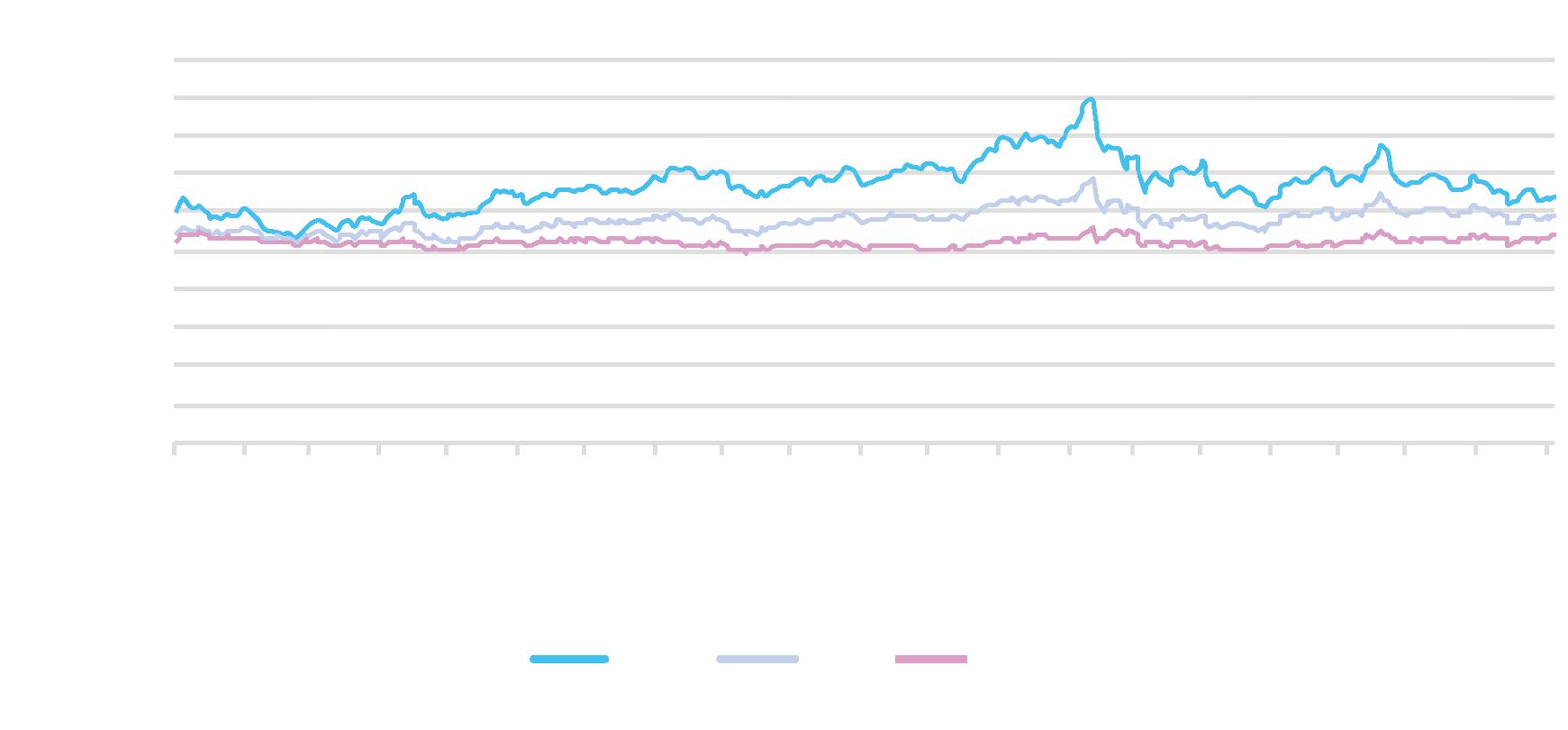
European electricity prices rose by 30–40% year-on-year in 2025, mainly due to tight gas supplies and reduced reserve margins, not because of massive new demand. Global electricity use continues to grow structurally, with projections of ~3% annual growth through 2050, driven by electrification, AI, and digital infrastructure. Data centers consume energy in a steady 24/7 baseload profile. But today’s market behaves like anything but steady. Midday lows, evening peaks, and imbalance penalties have become the new normal, demanding smarter procurement and hedging.
One of the measures to make the spot market more in sync with imbalance prices is the step to adjust the spot pricing from hourly to 15 minutes from October 1. The impact is not known yet but should have a positive effect on general pricing. With the high renewable impact the forecasting should benefit.
With the future market still in backwardation power prices still provide possibilities for long-term hedging. However with the current adjustment for 15 min. spot pricing the imbalance cost might drop and therefore it could be good to wait before contracting long term.
In general the driver for power has been the gas prices in 2025, where the stronger winter period kept the market constrained and rose to highs we had not seen in the last 12 months. For power the major disruption is the congestion situation in the Netherlands where grid operators struggle to adjust and expand the capacity for new development or growth, causing the net to be stretched to the maximum and outages could occur at some point locally.
Having a good outlook on the long-term usage forecast seems to be very important to all high-end off-takers in the market and to plan expansion programs well in time to not be stopped by grid capacity.
POWER FUTURES
Gas demand in Europe rose by +6.5% in H1 2025, yet supply remains stable. The main driver for the additional need has been the weather instead of growth. Storage levels are above average and LNG flows are steady, but the market reacts nervously to any disruption. As of Sept 3, 2025, the TTF spot price stood at €32.11/MWh, about 10% lower than the summer peak, but confidence remains fragile.
The gas market has had a turbulent development as reactions to the implementation of the U.S. tariffs adjustments, negotiations about those tariffs, and tension in the Middle East keep controlling the news. All not being clear in what direction the market can or should move as interpretation shifts and analysts are uncertain. With winter 25/26 approaching it seems most likely that gas prices will be under pressure for some time. Traders
are looking at weather reports for El Niño and La Niña indicators, as gas storage levels are on the same level as they were in the same period in 2021. At that time it was seen as being well below the needed level that drove gas prices to unseen highs. Current LNG flows from the U.S. keep traders at ease and they expect that with the European deal with the U.S. about energy imports we could be on the safe side for 2026.
Therefore it seems strange that the gas prices have not been higher, this could be because of expectations of a recession and in general a larger gas reduction need due to sustainability programs in Europe. Once again we could expect that the gas prices will jump at any time if supply chain problems (U.S. or Norway) occur. But the worstcase scenario would be if temperatures drop strongly in early November already.
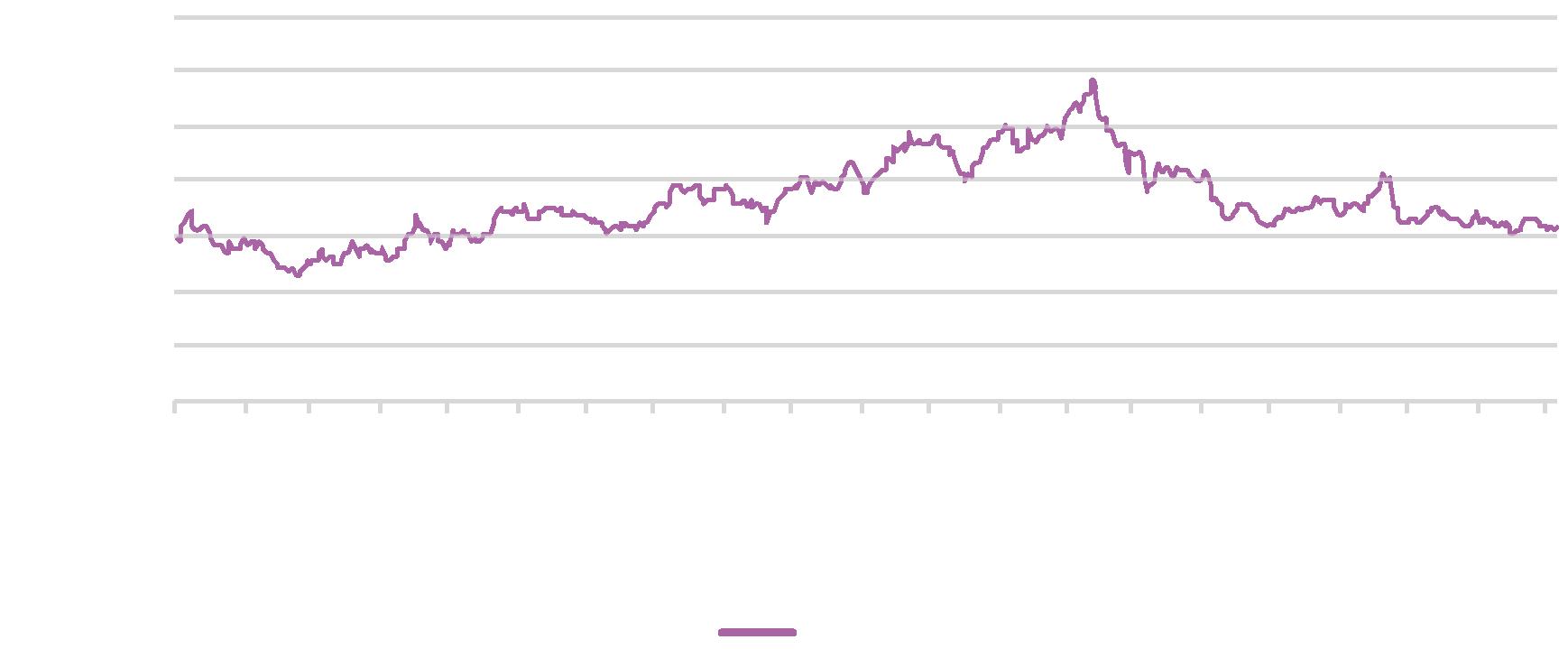
GAS & LNG
GAS IN STORAGE
TTF SPOT
GAS FUTURE
CARBON MARKET (EUAS)
BACK
IN THE SPOTLIGHT
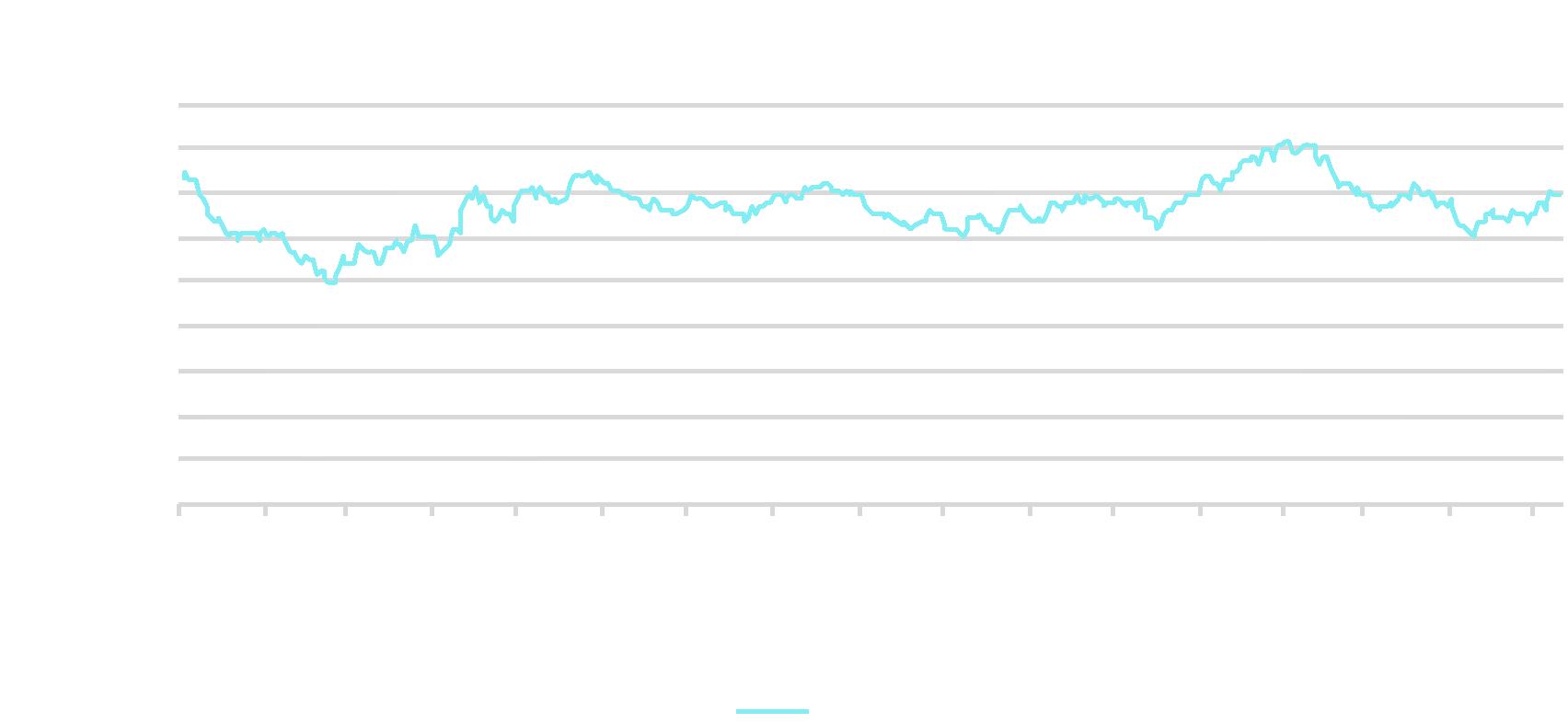
After a dip in 2024, carbon prices rebounded to €80/ton in Q3 2025. Drivers include ETS2 expansion, increased gas-fired generation, and renewed investor interest. Data centers must monitor Scope 2 emissions, as carbon costs increasingly impact supplier pricing and ESG transparency.
In Q1 EUAs reached their highest level, and from September trading began with renewed optimism. Several key technical resistance levels were broken after weeks of limited movement. Aggressive buying pushed the benchmark contract above €74, while strong volumes supported the rise, making it the busiest trading day since late June. Despite some profit-taking, prices closed sharply higher, indicating stronger market sentiment as traders emerge from the summer slump.
The rise was bolstered by energy markets, where both TTF Gas and German Power rose, supported by forecasts of warmer-than-average temperatures and lower wind
speeds. UKAs also followed the rally, with the December contract rising by more than 2% to £54.25, an eleven-week high. Trading was marked by sharp buying throughout the day, with prices continuing to rise to a peak of £54.50 late in the session. Despite some resistance, the UK market showed clear resilience after a slow summer and maintained its close correlation with the EU ETS.
Looking ahead, analysts expect increased trading activity as compliance deadlines approach and more participants return from vacation. While gas remains the main driver, regulatory developments and weather conditions could bring additional volatility. Some see room for a further rise towards €75–76, although there is caution about the rally’s staying power. The outlook remains highly dependent on macroeconomic signals and gas price dynamics, with the near-term likely to remain within the €70–75 range unless momentum continues to build.
GENERAL
ENERGY OUTLOOK
The U.S. remains resilient while China’s growth slows. U.S. manufacturing has been contracting, and tariffs add uncertainty for imported IT hardware. China focuses on AI and digital infrastructure but faces structural economic headwinds 02 INVEST IN REAL-TIME ENERGY MONITORING AND UPS/BESS INTEGRATION 01 DIVERSIFY PROCUREMENT MODELS (FIXED, FLEXIBLE, PEAK SHAVING) 03 SIMULATE IMBALANCE SCENARIOS AND FINANCIAL EXPOSURE
Europe needs to invest €3.7 trillion by 2035 to meet climate targets. With solar growth slowing and policy pressure increasing, data centers need to align with this shift. Q4 2025 fundamentals appear bullish, lower storage levels against previous years, uncertain LNG flows to Europe (Qatar, USA), but sentiment remains sensitive. Backwardation in 2026–2027 presents a hedging opportunity.
ENERGY IS NO LONGER “JUST ENERGY”
The market has reset. Volatility is structural. Those who act with agility and intelligence will lead in the next energy chapter. Energy is no longer a cost, it’s a strategic lever.
For a designed version of this report or to adapt it for internal briefings, contact your energy strategy advisor.
25 YEARS OF DATA CENTERS: FROM COWBOYS TO CARBON COUNTS
This month marks 25 years since I left school and entered the data center industry. The pace of change has been extraordinary. We’ve gone from basic server rooms to AIoptimized, globally distributed, and sustainability-driven infrastructure platforms. What began as an industry focused purely on keeping servers running now wrestles with edge computing, efficiency, and technologies unimaginable in 2000.
Originally, data centers were designed and managed for one thing: availability. That focus has remained, but alongside it, the industry has achieved major advances in sustainability, though there’s still untapped potential.
In the early days, it felt like a group of “cowboys” turning a hobby into something bigger. That hobby rapidly became a multibillion-dollar industry, fueled by internet infrastructure investments of the 2000s. Professionalization followed. Around 1999, the Uptime Institute introduced the TIER classification system, giving clear benchmarks for availability, the defining concern of the time.
By 2006, a new lens emerged: The Green Grid’s Power Usage Effectiveness (PUE). This metric, still relevant today, underscored the industry’s long struggle to reduce its carbon footprint while enabling an expanding digital economy. Over time, efficiency metrics matured further with ISO/IEC 30134, the global framework that standardized measurement and reporting. This framework has grown vital, informing EU directives, national legislation, and ESG reporting.
Thanks to these efforts, and drivers like cost pressure, competition, and sustainability commitments, efficiency improved dramatically. Where the early 2000s saw PUE averages of 2.5–3.0, today the average is 1.5–1.6, with best-inclass sites achieving 1.1–1.2. This progress is not just technical; it has reshaped how companies plan, invest, and communicate their environmental impact.
Yet true sustainability starts not with cooling systems, but with IT efficiency: maximizing useful work per watt consumed.
Virtualization, containerization, orchestration, and eliminating “zombie” servers all matter as much as optimizing power and cooling. The most sustainable data center is the one that delivers maximum business value per unit of energy.
Still, the rapid growth of digital services and AI workloads has brought new pressures on energy and water systems. Opportunities exist, like reusing excess heat from edge data centers in local communities, but we must never lose sight of the foundation on which this industry was built: availability.
Sustainability improvements are essential, but availability must never be treated as “just another metric.” Major cloud outages today can cripple thousands of businesses at once, evidence of how fragile our interconnected systems have become. The simple, more predictable infrastructures of the early 2000s have given way to exponentially complex platforms of microservices, automation, and software-defined everything. This sophistication brings flexibility, but also new failure modes.
Meanwhile, a generation of engineers has grown up in a culture of “move fast and break things,” often undervaluing reliability fundamentals. Many organizations assume cloud providers have solved availability and let their own disaster recovery planning slide.
I remember when “five nines” was the gold standard that dictated every design choice. Downtime was catastrophic and highly visible. Today, the conversation often shifts to carbon metrics and cost optimization, leaving reliability in the shadows. But without reliable systems, sustainability achievements mean little.
The industry needs a reset: availability-first design principles, rigorous testing, and measurement of uptime with the same seriousness we now apply to energy efficiency. Sustainability matters. Cost efficiency matters. But before optimizing everything else, let’s remember the baseline responsibility of our industry: keeping the lights on.
CONSOLIDATION, CAPITAL & CRITICAL MASS
POWER PLAY IN THE EUROPE AN DATA CENTER INDUSTRY
TEXT: MELS DEES
The European market for digital infrastructure is at a tipping point that is virtually unprecedented. For decades, the data center sector has experienced waves of consolidation and acceleration, but the intensity with which demand for capacity is growing today means that old comparisons fall short.
Whereas the cloud wave has been the driving force behind the sector over the past ten years, today it is primarily the rise of artificial intelligence (AI) that is shaping the market.
Analysts at CBRE recently predicted that 2025 will be a record year with nearly one gigawatt of new capacity, but immediately added that even that volume will be insufficient to keep up with demand (CBRE, 2024). Colocation and wholesale prices are rising, waiting times for grid connections are increasing, and investors are competing for scarce projects.
GEOGRAPHICAL SHIFTS
THE MAP IS BEING REDRAWN
We know that the five traditional centers of gravity (Frankfurt, London, Amsterdam, Paris and Dublin) have long been the safe haven. This is where networks converged, where the ecosystem of carriers and cloud providers was located, and where the bulk of the European roll-out took place. But it is precisely these hubs that are now reaching their limits.
In Dublin, the network operator imposed a de facto halt on new connections (CRU & EirGrid, 2023). Amsterdam introduced a moratorium in 2019, which later resulted in strict zoning rules and mandatory heat reuse (Municipality of Amsterdam, 2020). In 2023, Frankfurt adopted a master plan that pushes new projects to the periphery (City of Frankfurt, 2023). Paris and London are still managing to maintain their role as core markets to some extent, although London is struggling with scarcity in the West London submarkets.
The logical outcome: operators and investors are looking further afield. Madrid and Aragón are now the scene of large-scale campus developments, thanks in part to new undersea cables and cheap solar energy (NIBC, 2024). Portugal is positioning itself as a panEuropean hub via Sines, with almost half a gigawatt of capacity (Start Campus, 2024 – see the article in this issue). Milan is growing rapidly and offers shorter connection times than the traditional hubs. The Nordics are attracting hyperscalers that prioritize sustainability (CBRE, 2024), and secondary cities such as Brussels and Warsaw are benefiting from this trend (KevlinX, 2024).
Significance: the European infrastructure map is being redrawn. Location choice is no longer determined solely by connectivity, but by energy prices, licensing processes and public support. Whoever leads the way in this could become Europe’s new data hub.
CONSOLIDATION SCALE AS BOTH A WEAPON AND A RISK
Parallel to the geographical shift, a wave of consolidation that has characterized the sector for decades is accelerating. The merger of Digital Realty with Interxion was a milestone, and the acquisition of Proximus data centers by TINC and Cordiant shows that mediumsized assets also have strategic value (TINC, 2023).
Scale is crucial. Larger platforms have easier access to capital markets, finance mega-projects more quickly and have the purchasing power to conclude long-term sustainable energy contracts. Goodman, a traditional logistics developer, is converting its land positions into mega-campuses in Paris and Madrid (Goodman, 2023). Analysts at NIBC emphasize that innovative financing structures are needed to keep European operators competitive (NIBC, 2024).
But consolidation also has its downsides. In tight markets, it leads to higher prices. CBRE reports doubledigit increases in colocation rates in London, partly due to scarcity and construction costs (CBRE, 2024). In the cloud layer, the British regulator CMA sees even more fundamental problems: switching barriers, high egress costs (the costs that cloud providers charge when you move data out of their cloud environment) and lock-in risks (CMA, 2023).
Significance: scale enables projects, but concentration of power can be costly for end users. Regulators will therefore have to increasingly monitor the balance between efficiency and market power.
CAPITAL FLOWS DEPENDENCE OR EUROPEAN ROUTE?
The question is whether Europe can finance its digital future itself. Most of the capacity is in the hands of American listed players or private equity funds such as Digital Realty, Equinix, KKR and Brookfield (CBRE, 2025). European initiatives, such as OVHcloud, remain relatively small.
AWS announced a European sovereign cloud with a €7.8 billion investment, but the question is whether an American parent company can really operate outside American legislation (Clifford Chance, 2023). Meanwhile, new instruments are emerging: in 2024, the first euro-based securitization for data centers was realized – €640 million for Vantage Data Centers in Germany, led by Deutsche Bank and ABN AMRO (Vantage, 2024). This marks the professionalization of the sector, with ESG objectives explicitly built in (Deutsche Bank, 2024).
Significance: momentum is building for a European capital market around digital infrastructure. But the scale and speed of American investors remain leading for the time being. Europe must choose whether to rely on this or to accelerate the development of its own alternatives.
Another element is the role of public institutions. The European Investment Fund and CDP Equity are participating with PIMCO in a special European Data Center Opportunity Fund, focused on both greenfield and brownfield projects (EIF, 2025). This makes digital sovereignty not only a private agenda, but also a public one.
BROWNFIELDS THE UNDERESTIMATED ALTERNATIVE
Although greenfield campuses often make the headlines, attention is shifting to existing data center locations. Analysts have calculated that more than 70% of global capacity is already located in existing buildings, often inefficiently (Enabled Energy, 2025). Retrofits offer an opportunity: cheaper, faster and more sustainable.
Brownfields are interesting for investors because permits and grid connections are often more valuable than concrete and racks. Omdia expects brownfields to play a key role now that AI traffic is set to increase sixfold by 2028 (DatacenterDynamics, 2024). Recent deals, from Arjun Infrastructure to Apollo Funds, confirm this trend (CBRE, 2025).
Significance: brownfields could become Europe’s trump card: they deliver capacity faster and more sustainably, and fit in with investors’ ESG logic.
Another attractive feature of brownfields is that they are often strategically located near existing network hubs. For latency-sensitive applications, such as AI inferencing or financial transactions, this can be decisive. It is likely that this category of projects in particular will attract a disproportionate amount of
capital in the coming years, especially now that assetbacked structures make this type of portfolio easier to finance (Dentons, 2025). Limitations: grid, regulations, society.
Optimism is counterbalanced by practical limitations. Grid congestion causes waiting times of 7–10 years (NIBC, 2024). Transformers and cables are scarce. AI workloads require immediate availability. Regulations are becoming stricter: the Energy Efficiency Directive requires reporting, Germany imposes heat reuse (EnEfG, 2024), and non-compliance means no licence or financing.
On top of that, there is social resistance. Citizens and municipalities see data centers as space-consuming, energy-intensive “black boxes”. Dublin, Amsterdam and Frankfurt have tightened their rules or imposed construction bans (Eversheds Sutherland, 2023). For developers, the patchwork of national and local legislation leads to uncertainty.
Significance: technological innovations (liquid cooling, closed-loop systems) and compliance-by-design are inevitable. But public support will be at least as decisive.
THREE SCENARIOS FOR EUROPE
THE SECTOR IS AT A CROSSROADS
ONE
POSITIVE SCENARIO
Europe seizes the opportunity. New hubs in Southern Europe and the Nordics flourish, brownfields provide acceleration, and financing becomes more professional. Regulation stimulates sustainability without stifling growth.
THE RESULT
A strong and competitive ecosystem in which European players develop niches and hyperscalers consciously choose European locations.
TWO
BAD SCENARIO
Network congestion, regulation and resistance block growth. Capital and workloads move to the US or Asia. European governments respond reactively rather than proactively.
THE RESULT
Europe loses its grip on digital sovereignty and becomes dependent on foreign infrastructure.
THREE
REALISTIC SCENARIO
A hybrid path. Southern Europe, the Nordics and brownfields grow, but American players remain dominant. Europe gains time and develops expertise, but remains structurally dependent. Investments continue, but strategic autonomy remains limited.
The future of European Digital Real Estate is therefore a balancing act. On the one hand, there are unprecedented opportunities driven by AI, cloud and edge computing. On the other hand, there are real limitations in terms of energy, space, politics and public support.
The winners will be those markets where policy, capital and energy converge – Madrid, Milan, the Nordics and select secondary cities. The losers will be the hubs that get bogged down in congestion and social resistance. Consolidation is professionalising the sector, but requires close supervision. European independence is growing gradually, not abruptly. And capital flows will become more diverse, but American dominance will not be broken for the time being.
THE MESSAGE FOR INVESTORS, POLICYMAKERS AND OPERATORS
Today’s decisions will determine whether Europe can combine digital sovereignty, sustainable growth and return on investment – or remain at the mercy of global powers.
LIST OF SOURCES
GENERAL MARKET AND SECTOR REPORTS
• CBRE (2023/2024/2025). EMEA Data Center Outlook & Global Data Center Investor Intentions Survey.
• NIBC (2024). Digital infrastructure sector analysis.
• Goodman (2023). European data center projects.
• Tech Capital (2024). Interview with João Marques Lima.
PROJECTS AND OPERATORS
• KevlinX (2024). Project BRU01, Brussels.
• TINC (2023). Acquisition of Proximus data centers.
• Start Campus (2024). Development of Sines hub, Portugal.
FINANCING AND INVESTMENTS
• Vantage Data Centers (2024). Euro-based ABS transaction (€640 million), led by Deutsche Bank and ABN AMRO.
• Deutsche Bank (2024). TCFD reporting and sustainability strategy.
• Dentons (2025). Powering Tomorrow: Key Considerations in Data Center Financing.
• EIF & CDP Equity (2025). €200 million investment in PIMCO European Data Center Opportunity Fund.
LEGAL AND REGULATORY ANALYSES
• Clifford Chance (2023). Regulatory briefings on data centers and legislation.
• Eversheds Sutherland (2023). Legal updates on energy & data.
• CMA (2023). Cloud services market study.
BROWNFIELD AND RETROFIT
• Enabled Energy (2025). NextField strategy for brownfield assets, DataCenterDynamics.
• DCT Project Management (2024). Why retrofit could dominate data center builds this decade.
• DatacenterDynamics (2024). Analysis of AI inferencing workloads and brownfield strategies.
SPECIFIC
SOURCES PER CITY
• CRU & EirGrid (2022–2023). Grid connection constraints in Dublin.
• Municipality of Amsterdam (2020). Amsterdam data center strategy.
• City of Frankfurt am Main (2023). Masterplan Rechenzentren Frankfurt am Main.
FREDERIK
NIBC BANK
DE HAAS VAN DORSSER
EUROPE’S DATA CENTER MARKET: STILL HOT, BUT SHIFTING FOCUS
If you have been anywhere near the European data center market lately, you will know it is not cooling down. 2025 is shaping up to be another record year for new supply, yet demand continues to outpace it. Vacant IT load and data hall space are becoming harder to find across Europe, with the squeeze most visible in the FLAP-D hubs: Frankfurt, London, Amsterdam, Paris, and Dublin. This growing scarcity is pushing rents higher.
FLAP-D DYNAMICS
The FLAP-D hubs remain the anchor of Europe’s data center growth. Land and power constraints are keeping vacancy rates low and driving lease rates upward. London and Frankfurt are seeing some of the sharpest increases, fueled by higher construction costs and demand that far exceeds new deliveries. Meanwhile, operators with established footprints in the Netherlands, Germany, and the UK are pressing ahead with new investments. The business case remains strong, but securing each additional megawatt now requires significantly more effort. Access to power, permits, and suitable sites has become tougher than in the past.
TIER 2 AND 3 MOMENTUM
As Tier 1 markets tighten, tenants are shifting towards Tier 2 and 3 locations. Berlin, Madrid, and Milan are the standouts. Milan’s vacancy rate, for example, is trending toward notably low levels—a clear sign that demand is genuine rather than speculative.
THE NORDIC ADVANTAGE
The Nordics are exceptionally well-positioned, offering abundant renewable energy, a favorable climate, and supportive political and regulatory environments. Growing ESG requirements and the surging power needs of AI are drawing more operators north. Oslo and Stockholm continue to attract interest, but tenants are increasingly open to more remote regions with strong energy generation profiles. Notably, because local banks in the Nordics often focus primarily on renewables such as wind and district heating, international lenders are frequently the ones driving data center financing.
FINANCING IN MOTION
Financing structures are becoming more diverse. In addition to traditional bank loans, private credit, securitizations, and project finance are playing a bigger role. Recent structured deals have attracted new investors, and more issuance is expected as sponsors expand platforms and fund capital expenditures. Bank lending capacity may become more limited over time due to client concentration limits, meaning alternatives to bank financing are likely to appear more often.
Europe’s data center story is maturing at the core while accelerating at the edges. FLAP-D remains the anchor, but growth is radiating into Tier 2 cities and the Nordics, with funding tools evolving to match this shift. Overall, Western Europe continues to be a highly attractive market with significant growth ahead and NIBC is proud to be a financier of several key players driving this transformation.
AI FACTORIES IN EUROPE
Kajaani
BILLIONS FLOW INTO EUROPEAN DATA CENTERS FOR AI
Given the unstable global political situation, countries across the European continent (not only EU member states) are striving for greater digital autonomy. They also aim to close the gap with the United States and China in developing AI models. This ambition is driving massive investments in data centers dedicated to AI development and training.
Some of these data centers are being developed under the umbrella of the European Commission. Since 2024, the EU has been building a large-scale network of AI factories: regional hubs that combine supercomputers with specialized AI infrastructure. These facilities provide researchers, startups, and companies with access to powerful computing resources. The first round included seven sites in Spain, Luxembourg, Italy, Germany, Finland, Sweden, and Greece. A second round in 2025 added Austria, Bulgaria, France, Germany again, Poland, and Slovenia.
The program involves several billion euros in joint investments by the EU and its member states. Its goals are to accelerate innovation, strengthen Europe’s digital autonomy, and ensure that smaller players also gain access to high-quality AI capacity.
THE PLAN FOR GIGAFACTORIES
Beyond these hubs, the EU is preparing AI gigafactories under the InvestAI program. Between 2025 and 2030, several megacenters are planned, each with at least 100,000 AI processors. Around twenty billion euros has already been pledged. These facilities are designed to compete globally with the massive AI clusters in the United States and China.
The European Commission has already received 76 gigafactory proposals from 16 member states and 60 sites. The most concrete plans are shown on the accompanying map. Outside the EU, Norway is developing Stargate Norway near Narvik, a center running entirely on hydropower and expected to host 100,000 GPUs. Because Norway is not an EU member, this site is marked in a different color on the map.
NATIONAL-LEVEL PLANS
In addition to these EU-driven data centers, several countries are also working on their own national AI supercomputers. Private enterprises, meanwhile, are investing in so-called Industry Gigafactories to build the infrastructure necessary to scale up AI.
FROM ENIAC TO THE DATA CENTER OF THE FUTURE
In 1945, ENIAC, often described as the first data center, was the wonder of the technological world. It measured 26 meters in length, weighed 27 tons, and consumed 150 kilowatts of power. With 17,468 vacuum tubes, it could perform 5,000 additions per second. At the time, that was revolutionary, but it required an entire hall and an army of technicians.
Where ENIAC had barely any computing power and was highly inefficient, today’s data centers process billions of operations per second, with thousands of racks in hyperscale campuses, largely automated and increasingly powered by renewable energy.
In this edition of Datacentered, we look far ahead. The impact of AI on the data center sector is a recurring theme. That impact is already enormous. And it will only grow. That’s why we asked three AI models about the specifications of the data center of the future. In their answers, recurring key elements were CO₂-free energy, waste heat that warms cities, AI-driven optimization of cooling and workloads, and quantum encryption for ultimate security. They also predict digital twins. Drones and robots will largely take over operations, while photonics and edge computing provide speed and efficiency. The models even describe data centers under water, or partly built into caves.
Based on their answers (which we’ve shortened into specifications alongside the designs), we then asked those same models to create a visual impression.
On the following pages you’ll find the visions of GPT, Gemini, and Grok. As a counterpoint and fitting the Back & Forth theme of this edition, we also include a photo of ENIAC: a hall full of machinery that collectively performed less than the simplest mobile phone of 2025.
• Energy-efficient hardware and circular economy practices (reuse and recycling)
02. FLEXIBILITY, SCALABILITY, AND AGILITY
• Hybrid architectures combining central, regional, and local processing
Full automation of deployment, configuration, and monitoring
• Extensive use of virtualization, containerization, and software-defined infrastructure
03. ADVANCED TECHNOLOGIES AND AI INTEGRATION
• AI for predictive maintenance, energy optimization, workload distribution, and network tuning
• Growth of edge computing for low-latency, data-intensive applications (IoT, 5G, AR/VR)
• Photonics for faster, more energy-efficient data transmission
4. SECURITY AND RELIABILITY
• AI-driven threat detection and advanced access control
• Strong physical security and a robust cybersecurity culture
Comprehensive disaster recovery and redundancy for 24/7 availability
5. LOCATION AND INTEGRATION
• Strategic placement near renewable energy sources and heat reuse partners
• Clustering for shared infrastructure efficiency
• Architecturally integrated designs that blend with urban or natural surroundings
DATA CENTER OF THE FUTURE ACCORDING TO GPT-5
01. SUSTAINABILITY AND ENERGY
• Fully renewable energy sources
• Waste heat reused for purposes such as district heating and greenhouses
• Locations in cold climates for natural cooling
02. ARCHITECTURE AND SCALABILITY
• Hyperconverged and modular design
• EDGE COMPUTING
Smaller data centers closer to users for low latency
03. INNOVATIVE COOLING
• Immersion cooling
• Transparent cooling pipes visible in the design
4. AUTOMATION AND AI
• AI-driven load balancing, fault detection, and energy management
• Robots and drones for maintenance and inspection
• Digital twins for simulation and optimization
5. CONNECTIVITY AND SECURITY
• Quantum encryption and zero-trust architecture
• Biometric access control (iris scan, palm scan, facial recognition)
6. SERVER SPACE AND INFRASTRUCTURE
Transparent server racks with color-coded LED status lighting
• Sound-absorbing walls and dust-free overpressure systems
Reflective floors for light optimization
ABOUT THE NET ZERO INNOVATION HUB
The Net Zero Innovation Hub for Data Centers is a collaboration between Danfoss, Data4, Google, Microsoft, Schneider Electric and Vertiv to select, test, and accelerate the deployment at scale of advanced Net Zero solutions in the AI-era.
The Hub coordinates the joint efforts of data center operators and solution providers to address key challenges in a systematized methodology, to scale the solutions to the whole industry, thereby enabling data center growth and net zero transition.
HOW THE NET ZERO INNOVATION HUB CONNECTS GROWTH,
COMPETITIVENESS AND SUSTAINABILITY
As global priorities expand beyond growth and sustainability to include sovereignty, resilience, and competitiveness, I often hear the same question: DO WE NEED TO SACRIFICE NET ZERO TO ACHIEVE OTHER GOALS? The answer is simple: no
There can be no trade-off with sustainability. Either our transition pathways deliver on all prioritiesincluding Net Zero - or we risk failing on every front. At best, we would leave the next generation with problems too big to solve.
COMPETITIVENESS DEPENDS ON DIGITALIZATION - AND DATA CENTERS
Competitiveness today is built on digitalization, and digitalization relies on data centers: the factories of our digital economy. Meeting society’s growing demand for data requires a new way of accelerating innovation.
The challenge? Everyone needs innovation. But no one wants to take on the risk of building a data center just to test new technologies.
DE-RISKING INNOVATION, SCALING REAL SOLUTIONS
That’s where the Net Zero Innovation Hub comes in. We are building the collaborative ecosystem Europe needs to de-risk innovation and scale proven solutions to gigawatt-level deployments.
We are building Europe’s first coordinated network of testing sites where critical technologies can be validated at scale, including:
• Clean backup power and on-site generation
• Grid integration and flexibility
• Management power demand from AI-workloads
• Heat reuse
• Scope 3 emission reduction in construction materials
This isn’t just theory - it’s infrastructure in action.
REAL PROGRESS THROUGH NEW INNOVATION MODEL
Our first innovation call phases are complete, and initial pilot projects are underway. Members gain early access to tools and strategies that improve efficiency, sustainability, and competitiveness, from net-zero backup power pilots to heat reuse platforms.
The Hub is transforming one of the data center industry’s biggest challenges - power and grid constraints - into a springboard for innovation, benefiting both established players and start-ups.
POSITIONING DIGITAL INFRASTRUCTURE
AS
A POSITIVE CONTRIBUTOR
Data centers must be recognized not only as essential enablers of growth, sustainability, and technological advancement, but also as positive contributors to local communities and society at large.
Achieving this requires industry, policymakers, and energy providers to work together, supported by investment in grid modernization, renewables, and regulatory alignment.
The momentum is building quickly. For the first time, we are seeing a collaborative testing ecosystem that did not exist before, and it lowers innovation costs, accelerates implementation, and aligns with European directivessupported by demand from industry leaders and funding from the European Commission.
LOOKING AHEAD
No company can reach Net Zero alone. Join us as we build the tools and frameworks that will make Europe’s data center sector both resilient and net-zero
More results - including an exclusive interview - will be shared in the next issue of Datacentered. And if you’re heading to Kickstart 2026, let’s continue the conversation in-person.
TEN YEARS OF DDA: AN ANNIVERSARY CELEBRATION WITH SUBSTANCE
When you think of Amsterdam, you think of the AMS-IX internet hub and data centers. After all, Amsterdam is the “A” in the well-known abbreviation FLAP. Furthermore, DDA is located on one of the city’s most beautiful canals, and the whole world drinks Heineken beer.
It was therefore logical that DDA chose the historic Amsterdam Heineken Brewery to celebrate its tenth anniversary. A broad representation of the data center sector attended the event. On stage, Stijn Grove, Managing Director of DDA, and Michiel Eielts, Chairman of the Board of DDA, shared their vision of the past, present, and future of the organization and the industry.
They addressed the question of which developments will define the sector in the coming years. For Eielts, the answer was clear: innovation and the societal impact of technological acceleration. “If you look at current developments, it’s AI, robotics, and digital transformation that set the tone. Our sector must form the backbone for that.”
Grove stated that the sector is at a tipping point. Not only in the Netherlands, but across Europe. “While the world is changing at high speed, we risk standing still. But that also creates opportunities. We can now contribute constructively to accelerating the energy transition and to strengthening our economic earning power.”
Eielts then outlined DDA’s position: “In the past, the focus was mainly on sustainability and promoting the sector; now we face weightier issues. Take a topic like grid congestion. DDA must now make a real difference, by truly providing direction on how we can enable the future.” He emphasized the collective responsibility. “DDA cannot do this alone. As a sector, we must move forward together — not from the sidelines, but actively, shoulder to shoulder. Only then can we make a difference.”
Grove addressed digital sovereignty: “We do not want to be dependent on other countries. That means investing in our own digital infrastructure, but also daring to choose a long-term vision.”
Eielts and Grove looked ten years ahead. Eielts expressed his wish that by then, the sector will no longer have to fight for recognition, but will be naturally regarded as critical infrastructure. Grove shared that hope.“I would like it to be self-evident why we matter — that digital infrastructure automatically gets the attention and focus it deserves.”
* On the following pages, you will find an impression of the anniversary celebration and four written contributions from prominent DDA members.
DATA CENTERS AS THE DIGITAL BACKBONE OF SOCIETY
The data center industry in the Netherlands has grown and matured rapidly over the past ten years. Michiel Eielts, chairman of the Dutch Data Center Association (DDA) and managing director of Equinix Netherlands since 2009, reflects on how the sector has evolved, and shares his thoughts on where it’s headed next.
10 years ago, the DDA was founded to represent data centers in the Netherlands. How do you look back at the data center industry then and now?
“It is remarkable. The data center industry is so dynamic. Yet, you have the idea that the industry has not changed a lot while simultaneously a lot has indeed happened. The scale and speed in which developments are happening have increased. In 2015, the first cloud operators came to Europe and Everything as-a-Service became the new standard. In the years before, we experienced an era that was mostly focused on the rise of online content and social media. You could say that 2015 was the start of a new acceleration era. With the transition from mass consumer media services to the ‘as-a-Service’ model. This is something you only realize when you look back. Perhaps because then, challenges occurred day by day. Whereas now, daily challenges might be more difficult than ever. ”
Could you elaborate on these challenges today?
“If you wanted to build a data center in 2015, you were welcomed by municipalities because it increased employment in the region. Furthermore, innovation was key, since it was seen as the enabler of growth. Nowadays, the tables have turned. There is still some excitement, but the Netherlands has in many ways been restricted in recent years by legislation and other decisions that limit the growth of the industry.”
What was an important turning point in these recent years?
“The moratorium in Haarlemmermeer and the municipality of Amsterdam in 2019, was an important turning point. Before that, organizations were capable ofdeveloping and investing in their own plans. But since the moratorium, the DDA has become even more important in representing the data center industry and in changing the perception of data centers. Since last year, you see that this image has become more positive due to theDraghi-report that has come bout, about the future of European competitiveness. The Ministry of Economic Affairs has become more focused on the potential of AI and our digital infrastructure.”
But what is your vision on society’s perception of data centers?
“It is important to note that during the COVID pandemic everyone benefited from the excellent IT-infrastructure in the Netherlands. However, in some way, this has not resulted in a positive public image of data centers within society. This observation says something interesting about our country. We strive to be innovative, yet we often overlook the fact that this is not possible without data centers.”
What accomplishments are you most proud of?
“As DDA and industry, we must be proud of the fact that data centers and the digital ecosystem have brought us innovation and have increased consumers’ wealth. Furthermore, I am proud that since its foundation, the DDA has grown into a trade association that acts as a proactive spokesperson for our industry and has a significant impact on public affairs in the Netherlands. To be honest, I was a bit skeptical at first when the DDA was founded in 2015, but I am still grateful that Stijn (Grove, ed.) founded the association. Together with our peers, we have contributed to the maturation of the data center industry.”
DATA CENTERS SHOULD SHOW THEIR ROLE WITHIN SOCIETY
Data centers are playing an increasingly important role in our digital infrastructure. Elisabeth Hankeln, managing director of Eurofiber Cloud Infra, emphasizes: “Data centers need to make their societal role more visible, we are essential to vital processes.”
How would you describe the data center market of ten years ago?
“Back in 2015, we went from moving our on-premise servers to setting up our servers within a data center. This development marked the start of cloudification. In addition, companies shifted from CAPEX to OPEX models. In response to these two trends, hyperscale data centers began expanding their services.”
How are you anticipating the new challenges we face in this industry?
“When I started at Eurofiber Cloud Infra in September 2023, our perspective on regional data center operators was significantly different from what it is today. Two things changed this view: artificial intelligence (AI) and net congestion. AI brings new workloads into data centers and creates new customer segments, while net congestion can lead to an important role for regional data center operators in making capacity available on the grid.”
Let’s focus first on AI first, what will be the impact of AI in the upcoming years?
“AI is here to stay; we are now seeing enterprises implementing AI in their daily business processes. The role of regional data center operators is becoming more important, and not only because of latency. Here at Eurofiber Cloud Infra, we believe that we can handle the rising demand. However, the shift to AI is also accompanied by new requirements for the associated technology, which data center providers have to
meet, as well as existing and new partnerships that we facilitate. For instance, the deployment of liquid cooling requires capital from data centers and their partners. In an expanding industry, however, such investments are essential to ensure continued growth.”
And how can we as an industry become part of the solution for net congestion?
“It is a challenge we face together. At a training program twenty years ago, I was told about the future of net congestion and smart grids,and we are currently living out those predictions. As a data center operator, Eurofiber Cloud Infra has a major responsibility to demonstrate the vital importance of our role in society. Data centers are crucial to normal hospital operations, not to mention university research on new health technologies. We also need to make sure politicians are aware of the energy efficiency benefits of storing data at centralized locations. Finally, data center operators need to do everything we can to reduce our power consumption to support the grid more effectively.”
One way to reduce net congestion is data thermics: where data center operators redirect their heat load to benefit other facilities, such as residential heating and swimming pools. How could data thermics affect the future of our industry?
“It is important to note here that data thermics is a challenging process. First, the data center needs to be located at a place where heat grids are being constructed, and municipalities are actively working on this matter. At one of our facilities, we see that data thermics is a very good solution for the surrounding area. This concept is not a good fit for all locations, however, so it remains difficult.”
What other steps are data centers taking to increase sustainability?
“Working closely with suppliers, we are exploring how we can use more environmentally friendly cooling methods. Furthermore, there are initiatives to increase the use of hydrogen inside data centers.”
And finally, what will the data center market look like five years from now?
“I believe that private AI will shift to be located closer to clients, and that we will use liquid cooling as the primary source for cooling our data centers. Moreover, I expect that significantly more people will work in our industry and that more women will be working in data centers. As more diversity in our teams becomes increasingly important, and the pool of new professionals continues to grow, I believe many women will join our industry.”
A NEW PHASE FOR DUTCH DATA CENTERS
Vincent in ’t Veld, Managing Director of Digital Realty Netherlands and board member of DDA, has been at the heart of the digital infrastructure landscape for over 25 years. He reflects on the sector’s inflection points, challenges, and the road ahead for the Netherlands as a leading data center hub.
The development of the data center industry can be divided into three time frames: the early years at the beginning of this century, the increasing digitalization after 2010, and the present. Could you describe the development of the data center industry in these time frames?
“ The roots of our sector go back to the late 1990s, when telecom exchanges acted as early-stage data centers. At the time, infrastructure was still tightly tied to customer premises with small in-house server rooms and basic colocation setups dominating the landscape.
Between 2010 and 2015, everything shifted as cloud computing went mainstream, and hyperscalers entered the European market with their first regional deployments. That brought about a major change in both the scale and the complexity of what we as data center providers had to deliver.
From 2015 onward came a phase of rapid sophistication. Capacity grew exponentially, ecosystems expanded, and the expectations around resilience, compliance, and sustainability matured. Colocation data centers went from being a backroom consideration to having a paramount role in hosting mission-critical infrastructure.”
What has been the tipping point for the industry’s growth?
“One of the major inflection points came in the early 2010’s when cloud-native applications began to take over enterprise IT. Software companies, SaaS platforms, and managed service providers began looking for infrastructure that could scale securely and reliablyand that meant building or leasing serious capacity. The Netherlands, together with primarily Ireland, became one of the first logical cloud hubs in Europe due our geographical location, connectivity rich eco systems, access to reliable and affordable energy and access to renowned data center service providers who could deliver a short time to market solution.
Both the scale and business critical applications now being virtualized in datacenter facilities drove up the technical requirements, especially around uptime, connectivity, and security. The market matured fast, and with that maturity came visibility. Data centers were no longer an unknown hidden layer of the digital stack - they became a strategic enabler for both the enterprise IT market as well as the consumer media streaming model.”
To what extent have the requirements for data centers changed in recent years?
“Sustainability, performance, and resilience are at the core of the increasing requirements we’re seeing across the board.
On the sustainability side, metrics like Power Usage Effectiveness (PUE) and Water Usage Effectiveness (WUE) have become industry standards. Customers - and regulators - now expect transparency and continuous improvement. There’s no room left for inefficiency.
In terms of performance, high-density computing is the catalyst for many of the redefining the requirements of running a sustainable and reliable data center.
The rise of AI and GPU-powered applications is driving rack densities to levels we couldn’t imagine a few years ago. What was once maximum 5 kW per rack can now be as much as 150kW. Latest forecasts even indicate the ability to run 350kW or even 600kW racks. This demands AI-ready, ultra-dense, liquid-cooled HPC setups. That kind of leap was unimaginable a decade ago.
Our facilities have become a vital part of our customers’ value chain - and the bar keeps rising. In addition, our customers expect us ever more to provide runway for future growth as digitization of the economy and society continues. Therefore, it is key for the datacenter industry to provide outlook for growth, and ideally our customer in the same campus environment, allowing them to leverage their network infrastructure and human resource investments already made.”
What has been a major challenge within the industry?
“One of the defining challenges has been how we fund growth. Historically, investments in digital infrastructure were incremental and closely tied to demand. As cloud and AI adoption surged, data center development had to move faster and at far greater scale. That meant frontloading capital investments and adopting new financial models to stay ahead of the curve.
Another challenge is the fragmented expansion we’ve seen over the past decade. The Netherlands became a magnet for digital infrastructure thanks to its central location, strong R&D sector, and deep talent pool. That drew in global players eager to build wherever they could unlock applications and connectivity.
But growth outpaced many of the construction and energy planning frameworks in place. The question now is: how do we align infrastructure development with long-term national priorities? That means working more closely with governments, utilities, and
communities. We’ve reached a point where questions of growth, sustainability, and resilience can no longer be answered in silos. In order for the Netherlands to remain competitive and achieve economic growth, investment and further development of digital infrastructure is key. As sectors we like to grow in the Netherlands, such as Life Sciences and Technology, have a strong dependency on having access to data and computing resources.”
LOCAL DATA CENTERS: KEEPING UP WITH DEMAND
As the demand for digital infrastructure continues to grow, regional data centers have become a vital part of the Netherlands’ digital backbone. Previder, a regional data center operator, is celebrating its 15th anniversary, Pieter de Haer, Portfolio Manager at Previder, looks back at key developments over the years and shares his perspective on what lies ahead for regional players in a landscape shaped by cloud, AI, and sustainability.
How would you describe the data center industry in 2015?
“In 2015, we celebrated our 5th anniversary as we opened our first data center.. At that time, we experienced the switch from clients who went from on-premise to storing their data in co-location data centers. Moreover, in 2015 we started our own cloud platform because we indicated the growth of cloudification in the industry.
This cloudification led to the entrance of new hyperscale data centers in the Dutch market. At first, as a regional data center operator, we were a little bit worried about whether this would affect our growth. However, clients increasingly adopted a hybrid IT strategy, leveraging both regional data centers for low-latency and privacy-sensitive services next to hyperscale cloud platforms.”
What has been the impact of this cloudification?
“In the past two years, we’ve seen that end-users are more aware of their cloud usage and where they store their data and workloads. An important factor of this shift is the discussion on Dutch and European digital sovereignty. I believe that in the upcoming years, this will definitely lead to the growth of our industry and especially the position of regional data center operators.”
And how will Artificial Intelligence impact your position?
“I believe that AI is an opportunity for our data centers, but it comes with a lot of new challenges. For example, you need more high-density racks and need to re-evaluate your power- and cooling infrastructure. The question arises how we as Previder are going to implement this new infrastructure”.
You also need a lot of power to keep up with the demand for AI. How can we manage this?
“Yes. That is why the net congestion in the Netherlands will definitely be one of the largest challenges that the industry will face. Another challenge remains the public image of data centers. Therefore, the role of the DDA to continue to explain to society the value of data centers becomes more important in the upcoming years.”
Sustainability is also a large topic at Previder. Can you elaborate on this?
“Indeed. Last year, we created a two-way heat exchange solution with our neighbours from NX Filtration. A branch with a heat exchanger was added to the return circuit, allowing our residual heat to be transferred to their factory. As a by-product of NX Filtration’s production process, chilled water is generated, which is returned to our data center to cool our servers. Furthermore, we have constructed our own solar panel park with more than 1600 panels.”
What are you most proud of?
“One of the most important milestones is that our data center has received the highest BREEAM certificate. Furthermore, I am proud that companies outside the MRA region are also choosing us for hosting their IT. We believe that the growth we are currently experiencing will continue in the next five years.”