Download full Development of the cerebellum from molecular aspects to diseases 2nd 2nd edition hassa
Full download ebooks at https://ebookmeta.com
For dowload this book click link below https://ebookmeta.com/product/development-of-the-cerebellumfrom-molecular-aspects-to-diseases-2nd-2nd-edition-hassanmarzban/
More products digital (pdf, epub, mobi) instant download maybe you interests ...
Chemical kinetics : from molecular structure to chemical reactivity 2nd Edition Luís G. Arnaut
Development of the Cerebellum from Molecular Aspects to Diseases
Second Edition
Contemporary Clinical Neuroscience
Series Editor
Mario Manto, Division of Neurosciences, Department of Neurology, CHU-Charleroi, Charleroi, Belgium, University of Mons, Mons, Belgium, Charleroi, Belgium
Contemporary Clinical Neurosciences bridges the gap between bench research in the neurosciences and clinical neurology work by offering translational research on all aspects of the human brain and behavior with a special emphasis on the understanding, treatment, and eradication of diseases of the human nervous system. These novel, state-of-the-art research volumes present a wide array of preclinical and clinical research programs to a wide spectrum of readers representing the diversity of neuroscience as a discipline. The book series considers proposals from leading scientists and clinicians. The main audiences are basic neuroscientists (neurobiologists, neurochemists, geneticians, experts in behavioral studies, neurophysiologists, neuroanatomists), clinicians (including neurologists, psychiatrists and specialists in neuroimaging) and trainees, graduate students, and PhD students.
Volumes in the series provide in-depth books that focus on neuroimaging, ADHD (attention defcit hyperactivity disorder and other neuropsychiatric disorders, neurodegenerative diseases, G protein receptors, sleep disorders, addiction issues, cerebellar disorders, and neuroimmune diseases. The series aims to expand the topics at the frontiers between basic research and clinical applications. Each volume is available in both print and electronic form.
Hassan Marzban
Editor
Development of the Cerebellum from Molecular Aspects to Diseases
Second Edition
Editor Hassan Marzban Department of Human Anatomy and Cell Science
The Children’s Hospital Research Institute of Manitoba (CHRIM)
Max Rady College of Medicine
Rady Faculty of Health Science
ISSN 2627-535X
ISSN 2627-5341 (electronic)
Contemporary Clinical Neuroscience
ISBN 978-3-031-23103-2 ISBN 978-3-031-23104-9 (eBook) https://doi.org/10.1007/978-3-031-23104-9
This work is subject to copyright. All rights are solely and exclusively licensed by the Publisher, whether the whole or part of the material is concerned, specifcally the rights of translation, reprinting, reuse of illustrations, recitation, broadcasting, reproduction on microflms or in any other physical way, and transmission or information storage and retrieval, electronic adaptation, computer software, or by similar or dissimilar methodology now known or hereafter developed.
The use of general descriptive names, registered names, trademarks, service marks, etc. in this publication does not imply, even in the absence of a specifc statement, that such names are exempt from the relevant protective laws and regulations and therefore free for general use.
The publisher, the authors, and the editors are safe to assume that the advice and information in this book are believed to be true and accurate at the date of publication. Neither the publisher nor the authors or the editors give a warranty, expressed or implied, with respect to the material contained herein or for any errors or omissions that may have been made. The publisher remains neutral with regard to jurisdictional claims in published maps and institutional affliations.
This Springer imprint is published by the registered company Springer Nature Switzerland AG The registered company address is: Gewerbestrasse 11, 6330 Cham, Switzerland
Preface
This second edition is a revised and updated version of the original book entitled Development of the Cerebellum from Molecular Aspects to Diseases published in 2017. The overwhelmingly positive response to the frst edition exceeded our expectations and validated the signifcance as well as the broad reception of our work. In addition to recent advances in cerebellar neurodevelopmental science in health and disease, this encouraged us to provide an updated version, which includes new chapters and discusses the impact of COVID-19 on the cerebellum in related chapters. We believe this work will beneft both basic and clinical scientists in the feld.
All updated content and novel chapters were written and carefully reviewed by experts in the feld of cerebellar development. Chapters related to the cerebellum and disease, including new additions such as “The Role of Non-coding RNAs in Cerebellar Development,” “A Comparative View of Cerebellar Morphology and Diversity in Fishes,” “The Role of nNOS/NO on Cerebellar Development in Health and Disease,” and “Rehabilitation in Cerebellar Ataxia,” extensively cover epidemiology, clinical features, assessment, and management. Furthermore, the effects of COVID-19 on cerebellar pathobiology have been incorporated where relevant.
We greatly appreciate the continuous support and encouragement from peers in the basic and clinical scientifc communities, which greatly motivated us to compile a second edition of our initial publication to provide a reference work featuring the most recent developments in cerebellar science.
Winnipeg, MB, Canada
Hassan Marzban
The Development of the Cerebellum: From the Beginnings .
Jan Voogd
The Embryology and Anatomy of the Cerebellum .
Maryam Rahimi-Balaei, Farshid Ghiyamihoor, Azam Asemi Rad, Niloufar Ashtari, Mehnosh Toback, Hugo Bergen, and Hassan Marzban
Cellular and Genetic Programs Underlying Cerebellum Development
Andrew K. Lawton, Ryan Willett, and Alexandra L. Joyner
Early Purkinje Cell Development and the Origins of Cerebellar Patterning
Filippo Casoni, Laura Croci, Ottavio Cremona, Richard Hawkes, and G. Giacomo Consalez
Cerebellar Developmental Disorders and Cerebellar Nuclei
Hong-Ting Prekop, Alessio Delogu, and Richard J. T. Wingate
The Role of Non-coding RNAs in Cerebellar Development
Maryam Rahimi-Balaei, Miguel Ramirez, Ishita Gupta, and Daniel Goldowitz
Motor Circuit Abnormalities During Cerebellar Development
Elizabeth P. Lackey, Alejandro G. Rey Hipolito, and Roy V. Sillitoe
A Comparative View of Cerebellar Morphology and Diversity in Fishes
Benjamin W. Lindsey
The Role of nNOS/NO on Cerebellar Development in Health and Disease
Vasiliki Tellios, Matthew Joseph Elias Maksoud, and Wei-Yang Lu
Developmental Disorders of the Cerebellum and Neurotrophic Factors . . 193
Leila Pirmoradi and Shahla Shojaei
Apoptosis, Autophagy, and Unfolded Protein Response and Cerebellar Development
Amir Barzegar Behrrooz, Marveh Rahmati, Zahra Talaie, Niloufar Ashtari, Javad Alizadeh, Mohammad Hashemi, S. Zahra Bathaie, Mohammad Amin Moosavi, and Saeid Ghavami
The Ubiquitin–Proteasome System and Cerebellar Developmental Disease
Jerry Vriend and Xiaodan Jiao
Epigenetic Control and Cerebellar Neurodevelopmental Disorders
Mojgan Rastegar
Hormonal Regulation of Cerebellar Development and Its Disorders
Noriyuki Koibuchi
Infections of the Cerebellum 315
Kevin M. Coombs
Interrelation Between the Immune and the Nervous Systems in the Context of Cerebellar Development and Developmental Disorders
Primary Pediatric Brain Tumors of the Posterior Fossa: Part I
389 Kathleen Felton, Amanda Hogg, Lisa Liang, Christopher Aiken, Thomas Klonish, Frank van Landeghem, Tamra E. Werbowetski-Ogilvie, and David D. Eisenstat
Primary Pediatric Brain Tumors of the Posterior Fossa: Part II A Comprehensive Overview of Medulloblastoma
421 Lisa Liang, Stephanie Borlase, Christopher Aiken, Kathleen Felton, Amanda Hogg, Frank van Landeghem, T. Klonisch, David D. Eisenstat, and Tamra E. Werbowetski-Ogilvie
Can Cerebellar Neurodevelopmental Disorders Affect Behavioral Disorders or Vice Versa?
Razieh Mohammad Jafari, Amir Shadboorestan, Seyed Soheil Saeedi Saravi, and Ahmad Reza Dehpour
Neurodevelopmental Disorders of the Cerebellum: Autism Spectrum Disorder.
Mehnosh Toback, Azam Asemi Rad, Izuchukwu Azuka Okafor, Mohammad Allahtavakoli, Kambiz Zangeneh, Tabrez J. Siddiqui, and Hassan Marzban
Clinical Aspects of the Inherited Cerebellar Malformations
Asghar Marzban, Farshid Ghiyamihoor, Mohammad Vafaee-shahi, and Kamran Azarkhish
Clinical Features, Assessment, and Management of Patients with Developmental and Other Cerebellar Disorders
Michael S. Salman
Rehabilitation in Cerebellar Ataxia
Jennifer L. Millar and Meredith P. Drake
Epidemiology of Cerebellar Disorders
Shahin Shooshtari, Brenda M. Stoesz, Paria Kian, Soroush Kian, and Rosa Iranpour
Cerebellar Transplantation: A Potential Model to Study Repair and Development of Neurons and Circuits in the Cerebellum
Constantino Sotelo
The Development of the Cerebellum: From the Beginnings
Jan Voogd
Abstract Sotelo stated in his introduction for a consensus paper on cerebellar development (Leto et al. Cerebellum 15:789, 2015) that “The work done in the late nineteenth century until the late 1970s provided substantial and signifcant information; however, it was only descriptive and barely addressed the mechanisms involved.” Observations and their description, the nomenclature that evolved from these studies and the ideas they fostered, indeed, formed the basis for our understanding of the mechanisms that underlie the complex development of the cerebellum, to be reviewed in this volume. This chapter will highlight some of these early contributions to the origin of the cerebellum, its histogenesis, the migration of its neurons, the development of the longitudinal Purkinje cell zones, their target nuclei and their connections, and the folial pattern of the cerebellum.
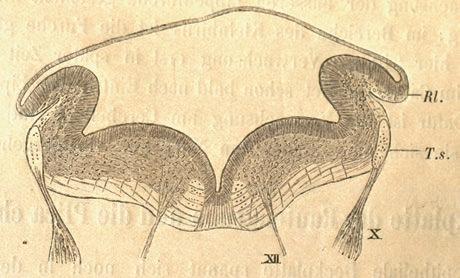
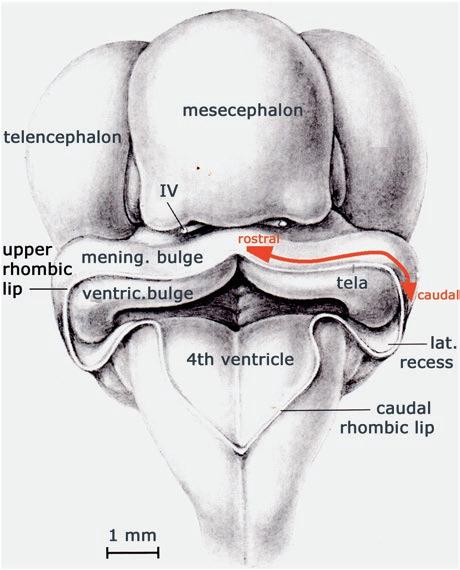
The study of cerebellar embryology begins with His’ (1888, 1891) description of his Rautenlippe (rhombic lip) in a human embryo. In the ffth week, the “dorsal rim (of the rhombencephalic alar plate) curves laterally and forms a fold which surrounds the entire rhombic cavity …” (Fig. 1) [1, 2]. His divided the rhombencephalon and its rhombic lip into rostral and caudal portions. The rostral (upper) rhombic lip will give rise to the cerebellum, the caudal (lower) rhombic lip to several precerebellar nuclei. The upper rhombic lip develops in two bilateral swellings connected
J. Voogd (*)
Department of Neuroscience, Erasmus Medical Center Rotterdam, Rotterdam, The Netherlands
H. Marzban (ed.), Development of the Cerebellum from Molecular Aspects to Diseases, Contemporary Clinical Neuroscience, https://doi.org/10.1007/978-3-031-23104-9_1
by a thin midline portion (Fig. 2). At the midline, the cerebellum increases in bulk by the development of the cerebellar commissures, and possibly by fusion of the intraventricular bulges. More recently, the term “upper rhombic lip” is restricted to the posterior rim or germinal trigone of the cerebellar plate, with its attachment of the epithelial roof of the fourth ventricle, that should be distinguished from the ventricular zone, the neuroepithelium that covers its ventricular surface (Fig. 3).
The general opinion was that the cerebellum originates from the dorsal portion of the frst rhombomere [3, 4]. Several papers used the quail-chick marker system to trace the origin of the cerebellum. Substitution of the mesencephalic vesicle in chickens with a quail transplant resulted in the replacement of Purkinje cells and ependyma in the rostral cerebellum by cells with the typical massed quail chromatin in their nucleoli. According to Martinez and Alvarado-Mallart (1989), these cells are present in a broad medial stripe, where labeled and non-labeled Purkinje cells occur together [5]. Labeling is also found of the granule cells. According to Hallonet et al. (1990), the labeled Purkinje cells are found in a V-shaped, rostral region reaching caudally to lobule VIII (Fig. 4) [6]. These authors denied the labeling of granule cells and concluded that these cells originate exclusively from the metencephalon, confrming the general opinion on this matter. Martinez and Alvarado-Mallart suggested that the rostral cerebellum might originate from the isthmic rhombomere, whereas its middle portion is a derivative of the frst rhombomere. Its caudal portion, including the auricle and part of the avian lateral cerebellar nucleus, is derived from the second rhombomere [7]. Sgaier et al. (2005) and Nieuwenhuys and Puelles (2016) pointed out that the cerebellar anlage rotates from an original rostrocaudal to a mediolateral position, due to the development of the pontine fexure (Fig. 2) [8, 9]. Purkinje cells produced by the ventricular zone maintain their mediolateral position in the adult cerebellum. Those produced by the most medial (presumably isthmic rhombomere-derived) ventricular zone become located in the future vermis, subsequently more lateral parts of the ventricular zone give rise to Purkinje cells of more lateral parts of the hemisphere [10]. Granule cells produced by the upper rhombic lip do not maintain their original mediolateral position in the adult, due to their lateromedial tangential migration in the external granular layer (EGL).
Fig. 1 The rhombic lip of a human embryo at the level of the greatest width of the fourth ventricle (Reproduced from His (1888) [1]). Abbreviation: R.l. rhombic lip, Ts. solitary tract, X, XII vagal and hypoglossal nerves
J. Voogd
Fig. 2 Cerebellum of a 15-week human embryo (Reproduced from Nieuwenhuys et al. (2008) [123]). Red arrow indicates position of rostrocaudal axis of the cerebellar anlage after the rotation of the cerebellar anlage due to the pontine fexure
Fig. 3 Diagram of a sagittal section, showing the division of the germinal zone of the early cerebellar plate into the ventricular zone that will give rise to inhibitory neurons and the upper rhombic lip that produces the excitatory neurons of the cerebellum. (Redrawn from Golgowitz and Hamre (1998) [124])
Histogenesis
The ventricular zone and the rhombic lip produce different types of neurons in successive waves. According to the autoradiographic studies of Miale and Sidman (1961) and Pierce (1975) in mice, using the incorporation of radioactive thymidine at their last mitosis, the large (glutamatergic) neurons of the cerebellar nuclei are born early at E10 and E11 in the ventricular zone; medium and small (presumably inhibitory inter- and nucleo-olivary neurons) between E11 and E17 [11, 12].
Fig. 4 Sagittal section through a chicken-chimera cerebellum. In the rostral region of the cerebellum, Purkinje cells (triangles) and ependyma (circles) are replaced by quail cells derived from the mesencephalon. (Modifed from Martinez and Alvarado-Mallart (1989) [5])
Purkinje cells are born during the same period (E11-13). Golgi cells in mice are produced by the ventricular zone in the 12- to 15-day embryo. After E15, dividing cells are present in the white matter throughout the cerebellum [11]. These cells give rise to Bergmann glia, astrocytes, oligodendrocytes, and basket and stellate cells of the molecular layer [13, 14]. In the rat, unipolar brush cells are born in the ventricular zone after the cessation of the production of the Purkinje cells. Lugaro cells develop in the same period as the Golgi cells [15]. Cells of the EGL arise from the caudal border of the cerebellar anlage (the upper rhombic lip) after E13. The EGL produces granule cells till well after birth (for similar data on the rat see [16], for the monkey [17], and for the chick embryo [18]). The more recent conceptual revisions of the origin of the neurons from the ventricular zone and the rhombic lip include the origin of the large glutamatergic neurons of the cerebellar nuclei from the rhombic lip and their inhibitory neurons from the ventricular zone (reviewed by Wingate in Leto et al. 2015) and the observation of Englund et al. (2006) that unipolar brush cells are produced by the rhombic lip [19, 20]. Inhibitory neurons of the cerebellum, therefore, are produced by the ventricular zone, excitatory neurons by the rhombic lip. Glutamatergic nuclear neurons and cells of the EGL are produced sequentially by the rhombic lip.
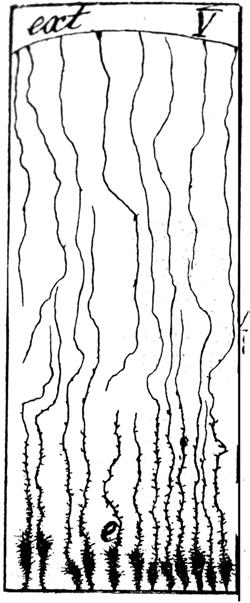
In their migration to the meningeal surface of the cerebellum, Purkinje cells are supposed to use the processes of the neuroepithelial cells whose conical endfeet form the external limiting membrane (Fig. 5). A map of these processes that would predict the paths of migrating Purkinje cells is not available. In mice, migrating Purkinje cells at E15 avoid the cerebellar nuclei; at E17, they pass across them [21]. In the rat, all Purkinje cells migrate through the more superfcially located transitory nuclear layer [22]. The clustering of the migrated Purkinje cells that will lead to the development of longitudinal Purkinje cell zones will be considered in another paragraph.
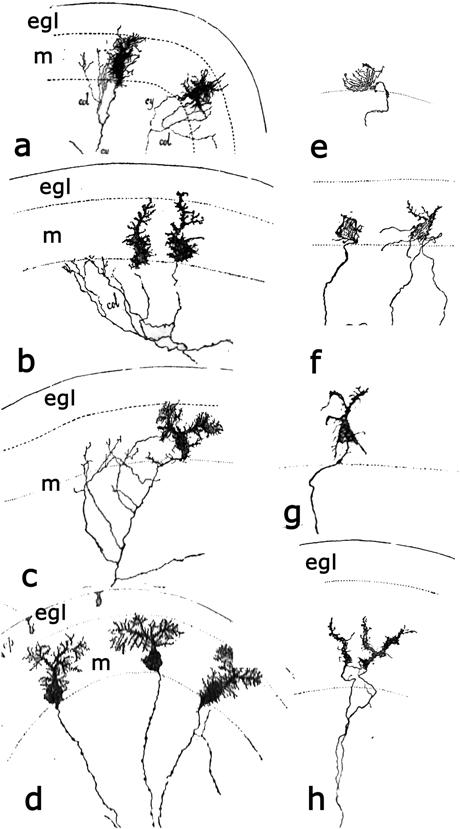
In his Golgi studies, Cajal (1890a, b, 1909–1911) and his followers (Athias 1897; Lugaro 1894; Popoff 1897) distinguished different phases in the development of the Purkinje cells (Fig. 6a–d) [23–28]. In the frst phase of the “disoriented
J. Voogd
Fig. 5 Neuroepithelial cells (Popoff’s spongioblasts) in a 1–1/4 cm. cat embryo.
Golgi method (Reproduced from Popoff (1897) [28].
Abbreviations: e ventricular zone, ext external limiting membrane)
dendrites,” multiple processes arise from all over the cell body. The axon, frst devoid of collaterals, enters the white matter. In the next stage, oriented and regular dendrites arise as a fattened tree from the upper pole of the cell. The axon emits multiple collaterals. Finally, the processes of the cell body are resorbed, the dendritic tree acquires its defnite shape, and many of the axonal collaterals are resorbed. Differentiation of the Purkinje cells is more advanced in the apices of the lobule. Purkinje cells of the rat mature early in lobules I, II, proximal V and VI, and IX and X and late in distal VI, VII and distal VIII [29, 30].
The development of the climbing fbers closely follows that of the Purkinje cell [23, 25, 28]. Cajal distinguished an early pericellular nest stage where the climbing fber forms an intracellular plexus (Fig. 6e), followed by outgrowth over the emerging dendrites, the place of the supranuclear capuchon, the stage of the young climbing fber arborization, and fnally, its adult form (Fig. 6h). The shift of the climbing fber synaptic connections with the flopodia of the Purkinje cell soma, to their position on stubby spines on the smooth proximal dendrites of the Purkinje cells and their replacement by the inhibitory synapses of the basket cell axons was documented in the electron microscopic studies of Larramendi (1969) and Morara et al. (2001) [31, 32]. Multiple innervations by climbing fbers of the Purkinje cell was noticed by Cajal and others (Fig. 6e, h). The elimination of redundant climbing
Fig. 6 Stages in the development of Purkinje cells (a–d) and climbing fbers (e–h). (Reproduced from Athias (1897) [26])
J. Voogd
fbers was shown much later in physiological studies, reviewed by Hashimoto and Kano (2005) [33].
The external granular layer (EGL) of the cerebellar anlage gives rise to the granule cells, although, during its history of more than 150 years it was supposed to contribute to each cell type of the cerebellum. The frst description of the EGL dates from Hess (1858), who illustrated it as the stratum granulosum periphericum in the cortex of a neonate dog (Fig. 7) [34]. Its cells are provided with radially oriented fliform processes. In due time, the layer disappears, leaving only a few cells near the pia mater. Obersteiner (1869) distinguished a superfcial, tightly packed, and a deep layer with loosely arranged rounded cells in the EGL (Fig. 8) [35]. Like Hess, radial processes in the molecular layer were found to originate from these cells. Later authors often referred to the EGL as “Obersteiner’s layer.” Schaper (1894) in
Another random document with no related content on Scribd:
Christian Europe. But meagre accounts of the manufactures and trade of Moorish Sicily have been transmitted to posterity. It is well known, however, that commercial relations existed between the principal ports of the island and the maritime nations of the Mediterranean. The merchantmen of its thriving seaports exchanged the products of the East and West in the harbors of Malaga, Alexandria, Constantinople. No people surpassed the Sicilians in the delicacy and beauty of their fabrics, and the silks of Palermo, interwoven with texts and devices in gold, were highly esteemed, and much sought after by the luxurious potentates and nobles of the Mohammedan world.
Of all the imposing palaces, baths, and mosques which once adorned the Moorish cities of the island, unhappily not a vestige now remains. Nothing but a few scattered and broken inscriptions has survived the violence of mediæval times, to attest the pomp and splendor of the Sicilian emirs. The architecture of no other people has suffered such complete and systematic annihilation. Two or three structures, erected during the rule of the Norman princes, but whose proportions and ornamentation, while remarkable, yet disclose unmistakably the decadence of architectural skill, are all we have upon which to found an opinion of the magnificence of Mohammedan Palermo.
It must not be forgotten that the advances of the Sicilian Moslems in the arts of peace were made under the most discouraging circumstances. War was the normal state of the country from the invasion by Asad-Ibn-Forat to the surrender of the last castle to the Normans. When the Saracens were not engaged in hostilities with the Christians, they amused themselves by cutting each other’s throats. In every instance, whether plundered by Greeks or persecuted by Moslems of an unfriendly sect, the husbandman and the merchant were always the sufferers. That agriculture and commerce could exist at all under such difficulties may well awaken surprise; that a civilization superior to that of any state of Christian Europe should have been developed and sustained in spite of these obstacles is an anomaly without precedent in the history of nations.
The administration of the laws by the dominant race was, of course, based upon the principles of Moslem jurisprudence. It was not unusual, however, for these laws to be either evaded or executed with a severity never contemplated by their author. Constant familiarity with bloodshed and habitual defiance of their authority by the populace had brutalized the rulers of Sicily. They affected a reserve characteristic of the worst forms of Oriental despotism. Their features were unknown to the great body of their subjects. From motives of caution, or to enhance the mysterious dignity investing their office, they gave audience and dispensed justice from behind a curtain which entirely concealed the throne. Like the most degenerate of the Persian Fatimites, they travelled unseen in litters, attended by the effeminate ministers of their vices. The few who attained to military distinction by active operations in the field died of disease; a large proportion of those who intrusted the conduct of campaigns to subordinates perished by the hand of the assassin.
In no part of the domain of Islam was the population of a more diversified character than in Sicily. Discord and disunion were the inevitable results of its composition. In the face of an enemy, the valor of its warriors was never questioned. In the excitement of a revolution, no man was safe from the dagger of his friend. Individuals deriving their origin from so many different countries naturally brought with them the experience, the arts, the industry, the accomplishments, the vices, of their respective nations. Under a dynasty of independent and resolute princes able to repress the outbreaks of tribal discord, Sicily would undoubtedly have risen to the most exalted rank in the scale of civilization. As it was, with all her serious impediments to progress, she had no rival excepting Spain among the kingdoms of Europe. Her armies wrested from the Byzantine Emperor one of the most valuable provinces of his dominions. Her navy for a considerable period enjoyed the maritime superiority of both the Adriatic and the Mediterranean. The country, in spite of civil commotion and the consequent insecurity, was densely populated. In 938 the inhabitants of the valley of Mazara
alone amounted to two million,—half of whom were Moslems. The elegant luxury of Palermo surpassed in taste while it equalled in splendor the barbaric pomp of Constantinople. The domestic and social conditions prevailing in Germany, Italy, France, and England were incomparably inferior in all the qualities by which the advancement and happiness of nations are promoted to those, defective as they were, by which society in Moorish Sicily was organized and controlled. In the province of letters the Sicilian Moslems seem to have merited distinction not inferior to that achieved by their Andalusian brethren. A long catalogue of authors, whose compositions, for the most part, unhappily have perished, indicate the esteem in which literature was held, as well as the prodigal liberality by which the efforts of its professors were rewarded.
The influence of Sicilian civilization upon the Normans exhibits the counterpart of that exercised by the decaying genius of Rome upon the fierce and untutored barbarians. But the minds of the former were far better fitted to receive the impressions imparted by association and example than were those of the followers of Alaric and Alboin. They were somewhat accustomed to the conveniences and the luxuries of life, and not entirely ignorant of the amenities of social intercourse. They had travelled far and had insensibly made comparisons between the usages of many nations. The architectural remains of the mighty empire of the Cæsars had awakened their admiration. They were familiar with the defaced, but still aweinspiring, monuments of Roman grandeur. Tradition, embellished with a thousand enchanting legends, had brought before them visions of the majesty and glory of the greatest powers of the ancient world. Intimate contact with the Greek colonists of Southern Italy, who still retained in a measure the graces and the refinement of their ancestors, gave them well-defined ideas of the civilization enjoyed by the original seat of literary superiority, of architectural perfection, of artistic excellence. Thus the Normans were ready, even eager, to receive from their Moorish vassals lessons in those elegant pursuits whose advantages they had long appreciated, but
had never enjoyed. The Moslems, as a rule, were granted every courtesy by their Christian neighbors, who quickly recognized their superior intellectual acquirements. They celebrated in public, and without molestation, the festivals of their religion. The rich freely indulged their inclination for splendid attire and imposing retinues. They had their own ministers of justice and of worship, their markets, mosques, and judicial tribunals. The majority of the merchants of Palermo under the Norman domination were Mohammedans.
Reluctant, perhaps unable, to discriminate, the invaders grew corrupt, and the evils characteristic of a sensual and luxurious race were insensibly adopted with the benefits which its culture afforded. After the Norman conquest, the spirit of Moorish civilization still remained paramount. The Saracens formed no unimportant part of the military establishment of their conquerors, maintained both for service and ostentation. At the siege of Amalfi, in 1096, twenty thousand of them served under the Norman standard. In 1113, when Adelaide, mother of Count Roger, went to Ascalon to marry Baldwin, King of Jerusalem, she presented him with a band of Moorish archers splendidly uniformed in scarlet and gold. The forms of government observed by the emirs were retained. Moslem ministers and magistrates directed the administration of the state, regulated the finances, dispensed justice. The Arabic tongue continued to be not only the recognized medium of communication between all classes of society, but the vehicle of public acts and edicts, and the official idiom of the courts of law. Over the gateways of palaces constructed by the princes of the family of De Hauteville are still to be deciphered legends whose sentiment is unmistakably Mohammedan. The Norman coins were stamped with sentences from the Koran and with the date of the Hegira. The dress, the manners, the etiquette of public audiences, the habits of private intercourse, became essentially Oriental. The umbrella, an emblem of royalty borrowed from the Fatimites of Egypt, was borne over the heads of the Norman kings on occasions of ceremony. The robes of distinguished personages were interwoven with Arabic texts, whose
characters and whose significance excited the pious horror of the orthodox. The regulation of the royal household was modelled after that of the emirate. The very titles of the public officials were Arabic. The education of youth was committed without reserve to learned doctors of the Mussulman or the Hebrew faith. In some of the harems of the Norman lords the inmates were all Mohammedans; in those of others, Christian damsels shared the favor and the affection of the licentious noble. No restrictions were imposed upon the religious prejudices of either, and it is related that the Christians, convinced by the arguments or the fascinations of their infidel associates, not infrequently became proselytes to the doctrines of Islam. Under the enlightened government of the Normans, persecution was unknown. Indeed, the vanquished people were regarded with such partiality that Count Roger absolutely forbade that any Moslem should, even by the most gentle means, be converted to Christianity. The clergy, unable to resist the prevailing influence, suffered their sacred edifices to be adorned with sentences from the Koran, whose monotheistic tendency accorded ill with the accepted maxims of patristic theology and the infallible edicts of ecclesiastical councils. From the balcony of the minaret and the tower of the cathedral the voice of the muezzin or the pealing of the bell called the pious to worship, and from the altars of every community arose in unison the praise of Allah and the invocation of the Triune God.
The traveller Ibn-Haukal and the geographer Edrisi have left us interesting and lively descriptions of the great Moslem cities of Sicily under Norman rule. Of these Palermo easily took precedence, not only on account of its being the metropolis, but by reason of the superior wealth, intelligence, and culture of its citizens. Of the number of its inhabitants no data have survived to enable us to form an approximate computation. They must have amounted, however, to several hundred thousand, as five hundred mosques were required for the worship of the Mussulmans, and, as a rule, the Christian population in every community equalled, if it did not exceed, that of the sectaries of Islam. Many of these structures were
superb temples, whose costly decorations attested the liberality of the prince or the devotion of the multitude. Some were of vast dimensions; the largest could accommodate with ease seven thousand worshippers. The vanity of private individuals, whose wealth permitted them to indulge their taste for ostentation and offer an exhibition of zeal not always above suspicion, possessed mosques of their own, from which all were excluded save their own relatives, dependents, vassals, and slaves. But not alone in their places of worship did the prodigal and luxurious citizens of Palermo emulate the magnificence of their neighbors. The palaces of the rich and the great were unsurpassed by those of any Moslem capital excepting Cordova. The skill and delicacy of the labor expended upon them corresponded with the rare and precious character of the materials of which they were composed. The walls were encased with variegated marbles, the floors were formed of mosaic, the ceilings exhibited a labyrinth of geometric tracery relieved by brilliant coloring and resplendent with gold. Rows of aromatic shrubs filled the court-yards with their fragrance. The predilection of the Arab for water—the greatest treasure of the Desert was everywhere manifested. Aqueducts composed of tiers of towering arches skirted the mountains in all directions. Canals traversed the plantations and gardens of the extensive suburbs. Fountains of classic design cooled the air of parks and promenades or quenched the thirst of the tired and dusty caravan. The city, from east to west, was intersected by the market-place, a wide street paved with hewn-stone and lined with shops filled with the most valuable commodities known to the commerce of the age. The central or older portion of the city was the seat of the court and the residence of the monarch. The suburbs almost entirely surrounded it, and contained the quays, the warehouses, the markets, the caravansaries, necessary to the traffic of a great maritime emporium. Like Cordova, Palermo was divided into five separate quarters, each of which was isolated from the others when the gates were closed. The houses were of blocks of polished stone put together with the greatest accuracy, the streets were lighted, the mansions of commanding height and symmetrical proportions, the habitations of the poor more commodious than the
dwellings of many of the wealthy burghers of Paris and London. In the time of Ibn-Jubair, who visited Palermo during the reign of William the Good, the costumes and the manners of the Christians were not distinguishable from those of their Moslem vassals. The ladies wore veils of different colors and garments of mingled silk and gold. Dainty slippers, embroidered in arabesques with the precious metals, protected their tiny feet, jewelled ornaments of exquisite patterns glittered upon their bosoms, and the aroma of costly essences which enveloped them revealed their passionate love of perfumes. The fusion of races was nowhere so apparent or so remarkable as in the unrestricted intimacy maintained, and in the refined courtesies reciprocated by the once hostile nationalities which composed the population of the Norman capital. The amenities of social intercourse required the practice of politeness and of self-restraint even among enemies. In the time of William the Good cruelty and rapine were stigmatized as Teutonic vices.
The noble and elevating pursuits of science were not neglected under the Moors of Sicily and their intelligent and progressive conquerors, the Norman princes. Geography, astronomy, chemistry, and medicine were studied with diligence and success. Edrisi, whose descent from the royal dynasty of Fez has been obscured by the eminent reputation he attained as a geographer and a philosopher, made for Roger II. a planisphere which represented at once the surface of the earth and the positions of the heavenly bodies. From the minarets of Palermo, the Arab astronomer observed the motions of the planets, the periodical recurrence of eclipses, the relative positions and general distribution of the stars in space, by the aid of instruments invented on the Guadalquivir and the Tigris, and of tables computed on the plains of Babylon centuries before the Christian era. The Moslem thus consecrated to the prosecution of scientific research the towers of his most sacred temples, at a time when from the cathedrals of Europe doctrines were promulgated which menaced, with the severest penalties that ecclesiastical malignity could devise, every occupation which in any way contributed to the emancipation of reason or the intellectual
progress of humanity. Astrology, that delusive study so flattering to the vanity of human nature, and so alluring to the imagination from the preternatural power supposed to be wielded by the charlatans who practised it, too often discredited the results of astronomical investigation; just as the vain and costly pursuit of the philosopher’s stone brought into disrepute at first the pre-eminently useful science of chemistry. The Sicilians were firm believers in the influence exerted by the heavenly bodies upon the actions and the destiny of man. The attempt to extract the precious metals from the most unpromising substances of nature had long engaged the attention of the Arab, and the cities of the island swarmed with impostors who cast horoscopes, interpreted dreams, and predicted future events by pretended communion with the stars, while the fires in the laboratory of the alchemist were maintained at the expense of innumerable dupes of their own credulity, whose hopes were sustained by mystery and fraud, while their purses were being systematically depleted. The superior intelligence of the higher classes afforded no immunity from these popular delusions; the noble embraced their principles with the same confidence and the same avidity as were displayed by the plebeian and the slave. The home of the alchemist was habitually frequented by the highest officials of the court, and the astrologer, with his peculiar garb, his long staff engraved with talismanic signs, his flowing beard, and his air of mysterious assurance, was the most welcome guest in the palaces of Palermo.
The Arabs of Sicily, with their brethren of Spain, owing to their extraordinary and thorough proficiency in medicine and surgery, were the most skilful practitioners in Europe. Their eminence in this profession was, to a large extent, shared by the Jews, who, as a race, were the recipients of royal favor and public confidence under the Norman as well as under the Saracen domination. The peer of the Moslem in every branch of scientific knowledge, the Hebrew brought to the study and application of the principles of the healing art the same keen perception and unerring tact which enabled him
in all ages to rise to the most commanding positions in the mercantile world.
In their acquaintance with the mechanical arts the Sicilians were not inferior to their most accomplished contemporaries. Their hydraulic system was provided with all the appliances which had been tested by those nations whose arid soil required the artificial stimulus of irrigation. Their mills dotted the banks of every stream whose current afforded sufficient motive power for the propulsion of a water-wheel. The products of their looms were famous for their exquisite patterns and the fineness of their texture. They seemed to have also excelled in the invention and manufacture of contrivances for the measurement of time. A clepsydra belonging to Roger II. has been commemorated by an inscription which would indicate that it equalled in ingenuity and perfection the famous one presented by Harun-al-Raschid to Charlemagne. The hours were marked off by automatons, which dropped a corresponding number of balls into a metallic basin, a not unworthy predecessor of the modern clock. A considerable number of the astrolabes, which, having fortunately escaped the effects of ecclesiastical fury wreaked upon them as magical instruments and devices of Satan, are now preserved in the museums of Europe, are of undoubted Sicilian origin.
Abu-Layth, an architect and engineer, who had been educated in the schools of Sicily, assisted in the completion of the great mosque of Seville, erected during the twelfth century, and the globes of gilded bronze which crowned the summit of the Giralda, whose extraordinary dimensions and perfect symmetry excited the wonder of all beholders, were cast and raised to their places under his supervision. The superiority of the Sicilian Moslems in the construction and management of military engines has been already referred to in these pages.
The court of Palermo for more than a century was no less distinguished for the literary acquirements of those who, attracted by its reputation and the character of its society, took up their abode in its precincts, than for the scientific studies pursued with such
ardor under the patronage of its sovereigns. During the Saracen rule, translations of those classical authors who wrote on philosophy and natural history were made; the perusal of the works of Aristotle, for whose doctrines the Moslems of the Middle Ages evinced such a remarkable predilection, was one of the favorite diversions of the learned; and the poems of Pagan Arabia were recited in the elegant idiom of the Desert, amidst the applause of believer and infidel alike, almost within hearing of the metropolis of Christendom. The prodigious stores of learning accumulated by the philosophers of the Alexandrian school, through the boundless munificence of the Greek dynasty of Egypt, enriched the libraries and cultivated the understanding of the scholars of Sicily. The writings of Hero, of Eratosthenes, of Euclid, and of Ptolemy were familiar to the students in attendance upon the academies and colleges of Palermo and Messina. The Syntaxis, the Geography, and the Optics of the latter have survived, mainly through the instrumentality of the Moors, the indiscriminate destructiveness of the barbarians and the calculating malice of the clergy, to convey to subsequent generations instructive and significant ideas of the philosophical attainments and mathematical knowledge of one of the most accomplished scholars of antiquity. The great work of Edrisi was compiled under the auspices of Roger II. The Arab was peculiarly fitted for the treatment of the comprehensive science of physical and descriptive geography. His information had been largely obtained by practical experience. He had served in campaigns conducted on the frontiers of civilization; in the capacity of a merchant he had traversed with the plodding caravan vast regions diversified with illimitable plains, lofty mountains, noble rivers; as a pilgrim he had performed his devotions at the cradle of the Moslem faith; in the tireless pursuit of learning he had prosecuted his researches over strange countries and among strange peoples; his features and his costume were familiar to the residents of the great European and Asiatic capitals; his peregrinations had extended from the Douro to the Indus, from the shores of the Baltic to the sources of the Nile. Thus endowed with especial qualifications, the Arab geographer was equally at home, whether recounting to a delighted audience the experiences of an
extended journey or explaining to an assemblage of students the physical features of the earth and the relative distribution of land and water as depicted on the surface of a terrestrial globe. The work of Edrisi is an imperishable monument to the intelligence, the industry, the criticism, of the compiler, whose studies were confirmed in many instances by personal observation, and the practical value of whose undertaking was established by his scientific attainments as well as by the copious erudition of the illustrious monarch by whose command it originated and was brought to a successful termination.
In the exact sciences the Arabs of Sicily attained to a proficiency unsurpassed by any nation since the glorious days of the Alexandrian Museum, and, in fact, they appropriated and absorbed much of the knowledge bequeathed to posterity by that immortal institution. Their geometers applied that knowledge to the improvement of hydraulic apparatus, to the increase in power and efficiency of military engines, to astronomical observations which facilitated the explorations of the navigator, to a thousand inventions which promoted the convenience and the happiness of domestic life. The leisure of the emirs and of the Norman princes was amused, and the literary ambition of their accomplished courtiers excited, by the recitations of famous bards, who, in a land which still cherished the memory of the incomparable poetic inspiration of Greece and Rome, competed for the applause of an audience in whose eyes ready improvisation and extravagant metaphors were infallible tokens of the highest excellence.
Of such a character were the material civilization, the scientific achievements, the intellectual culture of Moorish and Norman Sicily. Its glories have long since departed. Of the hundreds of palaces and mosques whose majestic and elegant proportions were the pride of the Moslem cities, not one has escaped the destructive touch of plebeian vandalism and ecclesiastical hatred. The Sicilian population, from being one of the most cultivated, has degenerated into the most ignorant of Catholic Europe. The suburbs of Palermo, once the abode of every science and of every art, are now so infested with brigands that they cannot be traversed in safety by the traveller
without the protection of an armed guard. For the medical experience and skilful offices of the surgeon have been substituted arduous penance and the application of suspicious, often spurious relics. Intellectual liberty and religious toleration have been supplanted by the repression of thought, by the discouragement of every noble impulse, by the tyranny of a superstition which degrades the mind and enfeebles every aspiration which can promote the material welfare of humanity.
The enterprising spirit of the Arabs which induced them to extend their conquests to all accessible points on the Mediterranean early suggested the occupation of the largest islands of that sea, whose importance as naval stations whence invading armies might be transported into Europe, and as bases for the equipment of piratical undertakings, was fully recognized by every nation. The Balearic Isles were a dependency of the khalifate of Cordova. They paid tribute to its sovereigns like other provinces of the empire, furnished troops for its armies, participated largely in its civilization, and, fortunate in their isolation, survived for nearly two centuries its overthrow. Sardinia, invaded by Musa in the first years of the eighth century, was never completely subjugated by the Saracens. The mountainous and barren interior of that island, sparsely inhabited by a barbarous and poverty-stricken peasantry, repelled them from a conquest whose doubtful advantages could not possibly compensate for the toil and danger necessary to secure it, and the coast with its harbors seemed the only territory worthy of their attention. For the space of seventy years the Moors retained a precarious foothold on the shores of that island, and the possession of a few insignificant seaports was disputed by the Franks and Italians with a pertinacity not unworthy of a contest involving the fate of an extensive kingdom.
In 722 the Saracens, having become familiar with the extensive traffic in relics carried on by the Catholic clergy and determined to turn to their own profit the superstitious credulity of the devout, entered into negotiations with Liutprand, King of the Lombards, for the sale of the body of St. Augustine, which had reposed in peace
for two hundred years in the metropolitan church of Cagliari. The transaction was betrayed by the arrival of the messengers of Liutprand, and the people, incited by the monks, rose in revolt. An unsuccessful attempt was made to rescue the ashes of the saint, the Arab garrison was called out to quell the tumult, and seven monks paid the extreme penalty of their zeal, and perhaps not wholly disinterested piety. In view of the precious character of these mementos and of the difficulties attending their transfer, the Arabs exacted, in addition to the price already agreed upon, the payment of three pounds of gold and twelve of silver; an amount which indicates the immense value of the original ransom. The grief of the devout inhabitants of Cagliari on account of their loss was somewhat alleviated by the remembrance that the vestments which had been torn from the bones of the saint in the struggle still remained in their hands, and the innumerable miracles wrought by these tattered garments, confirmed by the highest ecclesiastical authority, long attested the celestial influence and supernatural virtues possessed by the sacred relics of the deceased Bishop of Hippo.
Crete, captured by refugees from Spain, who, exiled from that country for treason during the reign of Al-Hakem I., were subsequently driven from Alexandria by the infuriated populace, whose hospitality they had abused, remained in the hands of the Moslems until 961, when it was reconquered by the Greeks. The Spanish Arabs about the year 806 descended upon the coast of Corsica. The timely aid of King Pepin prevented the immediate loss of that island, which, however, was occupied by the Saracens in 810. The despairing Corsicans, who had betaken themselves to the mountain solitudes, solicited the aid of Charlemagne, who sent a powerful fleet to their relief. The Moslems, after a series of sanguinary engagements, were absolutely exterminated by the ferocious warriors of the West; but the unfortunate Corsicans fared little better than their enemies, for it is stated by respectable authority that nine-tenths of the population perished within less than three years from the effects of the Saracen invasion. The shores of the island are still covered with ruins of extensive towns and cities
dating from that period, indicating the former prosperity of the inhabitants, as well as the frightful calamities which they must have endured at the hands of the truculent adventurers of Spain and Africa.
Malta, acknowledged in the Middle Ages, as now, to be the key of the Eastern Mediterranean, was for two hundred and twenty years an important dependency of the Sicilian Emirate. Taken by the Moslems in 870, it was occupied by the Norman troops, led by Count Roger in person, in 1090. The subjects of the Greek Emperor were put to death or enslaved, but for the native Maltese the Arabs manifested an unusual partiality. Their lot was far more tolerable than that of the tributary Christians of Sicily, their religion was unmolested, their taxes were moderate, the privileges conceded to them more favorable than those ordinarily accorded to infidels. The inhabitants of all these islands, except Sicily, which made war upon an extensive scale, subsisted by piratical depredations and by trade in slaves, in which reprehensible practices the Moors of Malta early obtained an undisputed and infamous pre-eminence.
In this chapter has been traced an incomplete outline of the origin, progress, and decline of the Moslem domination in Sicily, a subject which, if elaborated, would embrace many volumes. From this imperfect sketch, however, the reader may form an idea of a civilization centuries in advance of that of any contemporaneous people, with the single exception of the Spanish Arabs; a civilization which, fostered and perpetuated under the brilliant reign of the Emperor Frederick II., effected such a memorable revolution in the ideas and opinions entertained as indisputably correct by the devout and the credulous of many preceding ages.
CHAPTER XVI
THE PRINCIPALITIES OF MOORISH SPAIN
1012–1044
Immobility of the African Race Its Hostility to Civilization Its Pernicious Influence on the Politics of the Western Khalifate Character of Suleyman—Invasion of Ali He ascends the Throne His Tyranny He is assassinated Abd-al-Rahman IV. succeeds Him Yahya—Abd-al-Rahman V. Mohammed Hischem III. Organization of the Council of State Ibn-Djahwar, the Minister His Talents and Power Abul-Kasim-Mohammed, Kadi of Seville Berber Conspiracy The Impostor Khalaf is raised to the Throne as Hischem II.—Almeria—The Vizier Ibn-Abbas—Influence of the Jews at Granada—The Rabbi Samuel—Rivalry of Granada and Almeria—Abu-al-Fotuh—Motadhid ascends the Throne of Seville— His Cruel and Dissolute Character—His Collection of Skulls—Badis, King of Granada—-Increasing Power of Castile—Valencia and Malaga—Atrocities of the Christians at Barbastro.
From the earliest period mentioned in history, as has been remarked in a previous chapter, the spirit of the various tribes inhabiting the great continent of Africa has been constantly hostile to human progress. The ignorance, cruelty, and depravity of those nations whose territory did not touch the shores of the Mediterranean have always seemed impregnable to the beneficent and ordinarily irresistible influences of civilization. It is true that the northern extremity of that continent has been the seat of powerful empires, of great cities, of rich and enterprising centres of commercial activity. But this superior culture, confined to a narrow strip whose southern boundary was only a few days’ journey from the coast, was without exception exotic. The origin of the Egyptians, lost in the depths of a remote and unknown antiquity, has never been conclusively established. But it is almost certain that it was not African. The ethnical peculiarities which formerly distinguished, and are still noticeable in, the inhabitants of the Valley of the Nile had
nothing in common with the physical and mental characteristics of surrounding nations. The rigid seclusion that, as a principle of national policy, prevailed in ancient Egypt from time immemorial sufficiently precludes the existence of extraneous influence. Subsequently, under the enlightened empire of the Ptolemies, while the form of government and the religious ceremonial of ancient times were preserved, the traditions of the schools and the social atmosphere which surrounded the splendid court of Alexandria were entirely Grecian. Carthage was a Phœnician colony. The instincts of its citizens, their energy, their duplicity, their luxury, their vices, their political organization, their maritime enterprise, their architecture, and their gods were Tyrian, and consequently Asiatic. The prosperity enjoyed by the Latin colonies established after the Punic Wars, when the countries situated on the southern shores of the Mediterranean shared with Egypt the burden of providing sustenance for the slothful and turbulent populace of Italy, was due to the example, the policy, the institutions of Rome. The empire of the Edrisites, the magnificence of Fez and Kairoan, the wonderful cultivation of the Desert, the subjugation and control of the fierce tribesmen of the Atlas, were the work of princes of Arab blood. In all these glories of commerce, art, and opulence the Africans had no share. They served in the armies of the conqueror, but without loyalty, honor, or gratitude. Their insubordination wrought far greater injury to the cause of good government than their efforts promoted its advancement. They zealously preserved their malign and destructive instincts in the midst of the most refined and intellectual society of the age. Incapable of profiting by the civilization by which they were surrounded, their only aim seemed to be the obliteration of those evidences of mental superiority which they could neither appreciate nor enjoy. Nor have the benevolent and humanizing influences of the nineteenth century been able to remove the incorrigible barbarism of the African. The tribes of the Sahara are no further advanced in the arts of peace than when they yielded a sullen and reluctant obedience to the military genius of Musa. The lives of well-meaning sentimentalists have been vainly sacrificed to ameliorate the debased condition of the Negro. Even with the example of the most
polished nations of modern times before him, the advantages of education, rare opportunities for the accumulation of wealth, intimacy with the learned, participation in government, social privileges—all these blessings have served only to confirm and emphasize the inherent and irredeemable stupidity, malice, and bestiality of his nature,—characteristics transmitted by a savage, perhaps by a simian ancestry. Association with the Romans— degenerate as they had become since the glorious days of the Republic and the Empire—aroused in the minds of the Goth and the Vandal aspirations to, at least in some degree, imitate that excellence which made their own deficiencies the more conspicuous. They gradually discarded their savage customs. They adopted the salutary institutions of the vanquished. They emulated—often with little success, but with the most praiseworthy intentions—the heroic virtues of antiquity. By this means the immortal genius of Roman civilization in a measure survived, to exert its refining power upon subsequent ages. Not so, however, with the African. His proximity to and intercourse with the highly cultured nations of Europe produced no improvement in his domestic life, no stimulation of his intellectual faculties, no mitigation of his brutal and ferocious nature. He was the principal means by which the Ommeyade empire was both founded and annihilated. His native rudeness and repugnance to discipline were manifested even before the termination of the Conquest. From the hordes of the Atlas and the Sahara were recruited the ruthless soldiery by whom the disturbances that distracted the emirate were perpetuated. They formed an important but treacherous contingent of the armies of the khalifate. While nominally adherents of the Mohammedan faith, they continued to observe those idolatrous ceremonies which had provoked the maledictions of the Prophet. Obedience to the sovereign was always subordinated to reverence for the chieftain. They maintained under the most adverse circumstances the primitive traditions of their race. Their camp was the daily scene of savage rites, of the practice of divination, witchcraft, sorcery, and magic. In their civil organization, the patriarchal simplicity of the Desert prevailed, their military evolutions were the clamorous and irregular demonstrations of brave
but undisciplined barbarians. Their overpowering impulse was that of indiscriminating destruction. They viewed with stolid indifference the incomparable monuments of Saracen culture. The most exquisite works of art, in whose fabrication was exhausted the skill of the goldsmith and the enameler, were broken and melted for the sake of the precious metals they contained. The Berber was the very embodiment of cruelty, perfidy, disorganization, and ruin. In comparison with his boundless capacity for mischief, all the destructive agencies exerted by the hostile races composing the population of the Western Khalifate were insignificant. The inexhaustible numbers of the tribes of Numidia and Mauritania, whence were drawn alike the instruments of regal tyranny and of servile revolution, their prowess, their indomitable ferocity, their impetuous ardor, the persistence of their Pagan ideas and their social customs, rendered them most formidable impediments of civilization. To the incessant immigration from Africa, to the enrolment of Berber mercenaries in the armies of Mohammedan Spain, to the impolitic appeals for aid to the semi-barbarian princes of Al-Maghreb, are to be attributed far more than to the rivalry of Arab tribes or to the inherent defects of the Moslem constitution—serious as these undoubtedly were—the succession of disasters which overtook the empire of the Ommeyades, and the unspeakable crimes which stain the Moorish annals of the eleventh century, whose deplorable consequences were felt to the remotest corners of the Peninsula.
I have been led to the consideration of the topic discussed in the preceding pages by reason of the prominent part assumed by the African tribes during the closing years of the Moslem domination in Spain. While an apparent digression, it is in fact inseparable from a complete account of the events transpiring in the dominions once embraced by the khalifate of Cordova. The relations of Africa and Mussulman Europe had long been intimate. The jealousies of ambition and sovereignty had, except in infrequent and isolated cases, been subordinated to the offices of mutual kindness and friendship. No serious acts of hostility had as yet been permitted to interrupt the cordial intercourse which—facilitated by the short
distance separating the two continents—existed between nations acknowledging, at least in form, the same religion and governed by similar laws. Wealthy traders maintained commercial establishments at the same time in Almeria and Kairoan. The sons of sheiks of the Desert rose to high commands under the famous princes of the House of Ommeyah. The negro slaves of the Soudan were repeatedly chosen to guard the sacred person of the monarch. The erudition of the philosophers of Cordova had been exhibited to the astonishment, if not to the approbation, of the fanatical sectaries of Fez. Powerful princes of Mauritania had more than once rendered homage and paid tribute to the rulers of the mighty Khalifate of the West. They had submitted with a feeling of pride to the supremacy of one of the most renowned of those rulers, for they remembered that he was popularly reputed to be of the same origin and of kindred blood. During the administration of Al-Mansur, no African prince would have cherished the apparently chimerical hope that his dynasty was destined to influence, in a decisive way, the future of the Peninsula. The death of that great commander, who left no worthy successor, encouraged the aspirations of every ambitious chieftain to plunge the country into anarchy, a condition from which he might possibly emerge with the lion’s share of power and plunder. In less than forty years the Berbers obtained control of the most valuable portion of the rich inheritance of the Moslems of Spain; in less than a century and a half the magnificent empire of the Ommeyades, whose civilization had been the marvel of the age, its cities sacked and demolished, its fertile fields laid waste, its commerce annihilated, its industrious and thriving population massacred or condemned to painful servitude, had descended, from the exalted rank of a monarchy whose name was mentioned with respect and fear by the most distant and inaccessible nations, to the humiliating position of a dependency of the barbarous and illiterate sultans of Africa.
The jurisdiction of the self-designated Khalif Suleyman, who, as the head of the Berber faction, had acquired an appearance of regal authority by a frightful expenditure of blood, was confined to a
circumscribed extent of territory including only five populous cities, of which Cordova, whose possession implied the prestige and power of an imperial title, was, of course, the most important. At the first appearance of national discord consequent on the dismemberment of the khalifate, the military commanders who occupied the strongest fortresses proclaimed their neutrality or independence. The Eastern provinces of the Peninsula, whose territory had hitherto escaped the calamities which had so seriously afflicted the less fortunate regions of the West, preserved, by the freedom of their ports, the enterprise of their merchants, and the unmolested industry of their laborers, a prosperity of diminished extent and uncertain duration, but one which contrasted vividly with the miserable condition of the once flourishing centres of trade and agriculture, in happier days the pride of beautiful Andalusia. Here the Slave officers appointed under the nominal authority of the royal puppet, Hischem II., held their courts and displayed on a limited theatre all the luxurious magnificence and tyrannical caprices of Asiatic despotism. In the North, where the adherents of the Amirides abounded, the Berber princes of Saragossa and Toledo maintained an appearance of barbaric pomp and martial rivalry. From the latter, who, like the Slaves, had asserted their independence, Suleyman, although his troops were allied to their subjects by the closest bonds of nationality and relationship, could expect no support. He was therefore compelled to rely entirely upon his army, composed of soldiers of fortune, whose fidelity was wholly dependent on the willingness of their general to indulge their mutinous instincts and their love of rapine. Of these mercenaries, who, half Pagan and half Christian, served with singular inconsistency under the standard of a Moslem prince against sectaries of his own religion, the bitter enemies of both, the Berbers were the controlling element. They were regarded by the mass of the population of Moorish Spain, and especially by the Arabs of noble blood, with peculiar execration. The fact that under the very shadow of the noble mosques of the Andalusian capital they habitually practised heathen rites denounced by the Koran and abhorred by every Mussulman was notorious. The rich and flexible idiom of the Peninsula, the pride of the Arab, the
language spoken by the Prophet, the medium by which the learning of the scholars of the Moslem world had been communicated and preserved, was wholly unknown to them. Their uncouth manners and insolent bearing excited the disgust of a people proverbial for their native refinement and dignified courtesy. Every city, every hamlet, every plantation, bore ineffaceable marks of the blind ferocity of these detested foreigners. They had sacked the splendid metropolis of the West. They had transformed the unrivalled palace and suburb of Medina-al-Zahrâ into a heap of blackened ruins. Their violence had made of the most fertile portions of Andalusia an uninhabited and gloomy solitude. The towns swarmed with Berber robbers, who pursued their nefarious calling almost without hinderance; the country was unsafe on account of the organized bands of Berber outlaws that infested the highways. Crime of every description enjoyed immunity through the corrupt partnership of its perpetrators with the authorities, who greedily shared their booty. The confiscated spoils of noble families that traced their ancestry to the Companions of the Prophet were flaunted with the shameless impudence of legalized brigandage and irresponsible power in the faces of their former owners now reduced to penury. The beautiful wives and daughters of the Arab aristocracy were dragged from their homes to pine in the harems of brutal and half-savage Berber chieftains. The African prejudice against learning had caused the extermination of the philosophers of Cordova,—a deed whose atrocity was aggravated by the fact that the victims were noncombatants, a class protected by the soldiery of every generous and self-respecting nation. Not without cause did the poet lament that the wrath of Allah had unchained a legion of demons to afflict with unspeakable misery the imperial cities adorned with the triumphs of the august line of the Ommeyades.
The sovereign of these oppressors, through the circumstances of his position, had become a cruel tyrant. By nature he was inclined to peace. When untrammelled by the baneful associations which had corrupted his mind, and through whose influence he had risen to power, he exhibited the disposition of a generous and enlightened
ruler. He strictly observed the principles of humanity and justice. His decisions as a magistrate were characterized by a spirit of impartial equity. His temper was mild. He was a friend of letters, and disclosed in the poetic efforts attributed to him ability of no mean order. His greatest delight was in the familiar conversation of scholars, whose talents he appreciated and whose tastes he encouraged. He availed himself of every resource at his command to restore tranquillity and confidence in the communities terrorized by the excesses of his followers. It was only when the interests of the latter were directly involved that he remembered the instruments of his greatness, and sanctioned crimes that have left an indelible blot upon his name.
In spite of the pretensions of Suleyman and his occupation of the throne of the khalifs, the khotba, or public prayer, for Hischem II., whose death had not been established to the satisfaction of the people, was still, despite the entreaties and the protests of the usurper, recited in the Andalusian mosques. The corpse of the last of the Ommeyades had never been exhibited to the populace for identification. The presumption of his survival was in a measure confirmed by the strict seclusion in which he had passed his life. A generation of tutelage and imbecility had not entirely destroyed the prestige of that dynasty whose heroic achievements had reflected such lustre on the Moslem name. Pretenders to the supreme power, concealing their ambition under the specious pretext of liberating an imprisoned sovereign and avenging his wrongs, arose throughout the cities of the South. The ablest and most powerful of these was Khairan, governor of Almeria, an official who had stood high in the favor of Al-Mansur. Even in Africa the aspirations of enterprising generals were excited by the alluring prospect of a vacant throne, a prize which in the lottery of war might readily fall to a bold and fortunate soldier. The excellent qualities of Suleyman did not compensate in the eyes of the multitude for the unpopular methods by which he had risen to power. A leader was soon found who was disposed to profit by the universal discontent. Ali-Ibn-Hamud, at that time governor of Ceuta, had been one of the ablest officers in the armies of Al-Mansur and had served with distinction under that
commander. He traced his genealogy to the family of Mohammed. His ancestors, long domiciled in Mauritania, were, however, regarded by the Berbers as of common nationality with themselves. His instincts and associations led him to identify himself with their cause, although he claimed descent from the son-in-law of the Prophet. An understanding was established by the emissaries of their countrymen between the ambitious general and certain conspirators in Spain. Gifted with the astuteness of his race, he easily deceived the superstitious Khairan with a false account of an interview with Hischem, during which he alleged that the latter had appointed him his successor, proclaimed himself the champion of the persecuted Khalif, and, enlisting the sympathies of the innumerable malcontents who viewed with favor any plan promising the overthrow of Suleyman, soon found himself at the head of a formidable revolution.
Ali had hardly landed in Andalusia, before Amir-Ibn-Fotuh, governor of Malaga, whose attachment to the family of the dethroned Khalif had been recently strengthened by the appropriation of a part of his dominions by the Berbers, surrendered that important fortress, and, Ali having formed a junction with Khairan at Almuñecar, the allied army pressed forward without delay to attack the capital. Zawi, the governor of Granada, whose authority and resources equalled those of Suleyman himself, as soon as intelligence of the invasion reached him, announced his adherence to the cause of the insurgents. The times had never been more auspicious for the enterprise of a pretender. By the populace, too often disposed to hold the leader responsible for the delinquencies of his faction, Suleyman was regarded as a fiend incarnate. The soldiers despised him because they mistook his disposition to lenity for an indication of cowardice. The supporters of the ancient dynasty and the dependents of the Amirides, who attributed to his agency the persecution of which they had been the victims, never mentioned his name without a curse. The palace and the Divan were as usual on such occasions centres of intrigue. The army swarmed with traitors. In Cordova itself the mob, which had enjoyed for
centuries an unenviable reputation for inconstancy and turbulence, awaited with impatience the signal for revolt. The consequences of this political condition soon became evident. The detachments sent by Suleyman to check the insurgents were one after another put to flight. When the Prince himself appeared in the camp to take command in person, he was seized by his own troops and sent in chains to the enemy. A few days afterwards the wretched Suleyman received at the hands of the executioner, after the infliction of every insult, the last penalty of disaster and incapacity,—the usual fate of captive monarchs in that barbarous age. In spite of the diligent search instituted by the victorious generals, the missing Hischem could not be found, and, as previously related, although Suleyman had insisted that he was dead, the corpse exhumed as his and subjected to a superficial and insufficient identification was not accepted as genuine by those not interested in supporting a fraud, and the fate of the unfortunate son of Al-Hakem remains to this day an impenetrable mystery.
In compliance with an agreement in which he had taken advantage of the credulity of Khairan, Ali now assumed the royal insignia and authority, with the title of Al-Nassir-al-Din-Allah, and another usurper was invested with the uncertain and perilous dignity of nominal ruler of the dismembered khalifate.
Contrary to the expectations of his opponents, and to the infinite disgust of his partisans, who had counted upon indulgence in unbridled license, the beginning of the reign of Ali was marked by a display of moderation and justice for many years unknown to the unhappy people of Andalusia. Before his tribunal the distinctions of faction were no longer recognized, and the Spaniard, without regard to his political relations, received equal consideration with the African. The bandit propensities of the Berbers were mercilessly repressed. The fact that Ali had been reared among them, was connected with their race by ties of consanguinity, was familiar with no other tongue but theirs, and had been raised to the throne through their influence, afforded no security to the Berber malefactor. The slightest act of rapine was punished with instant
death. An incident is related by the Arab historians which conveys a significant idea of this summary administration of justice. As the Khalif was once passing through a gate of the capital, he encountered a mounted Berber with a quantity of grapes on the saddle before him. The royal cavalcade was instantly halted, and the Prince demanded of the horseman: “Whence hast thou obtained those grapes?” “I seized them like a soldier,” was the insolent reply. At a signal from Ali, the culprit was at once dragged to the roadside and decapitated. His head was then fastened upon the grapes, and the horse, with its ghastly burden, preceded by a crier, was led through the principal streets of the city as an example of the fate to be expected by all whose lawless inclinations, confirmed by former impunity, tempted them to violate the rights of person and property. In the forms of legal procedure the new ruler discarded the habits of seclusion and mystery affected by the later Ommeyades, and returned to the ancient and patriarchal simplicity which had characterized from time immemorial the unceremonious judicial tribunals of the Orient. On certain appointed days, attended by a slender retinue and with scarcely any tokens of his exalted rank, he sat at the gate of the palace to receive the complaints and redress the grievances of his subjects. At the bar of this court no offender could hope for immunity through pride of lineage, amount of wealth, or important tribal affiliations. Justice was meted out equally to all. The executioner was constantly in attendance, and infliction of the penalty, whether by scourging, imprisonment, or death, followed closely upon the sentence. As the Berbers constituted the majority of the delinquents, they soon began to denounce their sovereign as a political apostate and an enemy of his race. This exhibition of judicial severity was followed by the most satisfactory results. The irresponsible infliction of unusual punishments was replaced by the regular process of law. The Berbers submitted sullenly but completely to the disagreeable but wholesome restraints of discipline. The citizen and the peasant could now, without serious molestation, pursue their ordinary employments. The streets became safe for pedestrians. The highways were purged of banditti. Commerce began to revive. The partiality of Ali for the Andalusians,
who, as the more peaceable class of the population, were seldom arraigned before the magistrate to answer for violation of the laws, became daily more marked. Indeed, he had formed the commendable design of depriving his Berber subjects of the property they had acquired by the pillage of their neighbors, and of restoring to the latter the estates which had been confiscated without other warrant of authority than that conveyed by force during the lawless period which had followed the death of Al-Mansur. This plan was frustrated by the habitual inconstancy and ingratitude of the people, fomented by the discontent of a military leader, whose exaggerated estimate of his own abilities was in a direct proportion to his inordinate ambition.
For nearly two years Ali governed the states of his contracted kingdom with exemplary firmness and wisdom. But, while reluctantly acknowledging the benefits they enjoyed, the partisans of the House of Ommeyah could never forget the foreign origin and barbarian antecedents of the determined prince who had avenged their wrongs and tamed the ferocity of their savage oppressors. As for the Africans, they detested the ruler who owed his rank to their courage and treachery, and who repaid their devotion with a contumely and an impartial disregard of their claims which they did not hesitate to denounce as the most flagrant ingratitude. Thus the inflexible justice of Ali alienated his partisans, while the national prejudice against his race operated to his disadvantage in every other quarter. Aware of this feeling, Khairan, who felt aggrieved because he was not intrusted with a larger share in the government he had contributed to establish, organized a conspiracy to restore the Ommeyades to power. Al-Morthada, a great-grandson of Abd-al-Rahman III., was selected as the representative of the malcontents under the title of Abd-al-Rahman IV. The prestige investing the name of the illustrious family of the pretender, the hope of vengeance upon the Berbers, the prospect of revolution, so attractive to the Andalusian mind, brought many followers to his standard. Valencia declared for him. The governor of Saragossa espoused his cause and marched southward with a force of several thousand men. The services of
Raymond, Count of Barcelona, were secured, and he appeared in the rebel camp at the head of a squadron of Christian knights sheathed in complete armor. The popularity of the enterprise enlisted the sympathy of the peasantry, always prone to insurrection. In Cordova the presence of the soldiery alone prevented an outbreak, and it was problematical for how long a time the garrison would be able to overawe the populace, even if their own fidelity remained unshaken. Indignant that his efforts for the restoration and maintenance of public order should meet with such a recompense, Ali renounced the statesmanlike policy he had hitherto pursued. The Berbers again reigned supreme in the capital. Once more the streets rang with the tumultuous din of outrage and riot, with the groans of murdered men, with the shrieks of violated women. The tribunals, which for many months had dispensed justice with rigid impartiality, now refused to entertain a complaint against the military tyrants whose passions, exasperated by restraint, raged with redoubled violence. An army of informers was maintained by the government, and eminent citizens were daily consigned to dungeons on the false testimony of the vilest of mankind. This spirit of espionage was so general that it is remarked by a writer, who himself witnessed these scenes, that “one-half of the inhabitants was constantly employed in watching the other half.” The possession of wealth was of itself a powerful incentive to an accusation of treason. A convenient and effective method of replenishing the treasury was devised by causing the arrest of the rich upon fabricated evidence and then restoring them to liberty after payment of an exorbitant ransom. When the friends of the victims came to escort them to their homes, their horses were seized and they were forced to return on foot. It was not unusual for the houses of the nobles to be robbed in open day by the African guards of the Khalif. The few remaining palaces erected by the Ommeyades were destroyed; the known adherents of that faction were persecuted with unrelenting severity, and every conceivable insult was visited upon those whose prejudices against the party in power were assumed to exist by reason of their literary tastes or their superior erudition. The mosques, which heretofore, either from superstitious fear or from motives of policy, had been
exempt from forced contributions, were now subjected to the most vexatious extortion. Their ornaments were carried away. Their revenues were confiscated. The ministers of religion were taxed. Many of the finest temples of the capital were deserted or became the haunts of nocturnal marauders. Even the devout dared not assemble for the worship of God. The consciousness of the perfidious ingratitude displayed by his subjects so embittered the temper of the Khalif that he resolved upon the most extreme measures, and publicly announced his intention of razing to its foundation the city of Cordova. The accomplishment of this malignant design, which, in destroying the most splendid architectural monument of Moslem genius, would at the same time have inflicted an irreparable injury upon art and archæology, was fortunately frustrated by the assassination of the tyrant. Three of his most trusted slaves, animated by a desire to liberate their country from the evils from which it suffered, and, so far as can be determined, without the co-operation of others, killed Ali in the bath on the very day he was about to take the field against the enemy.
The murder of the usurper was far from producing the effect desired and expected by the revolutionists, who everywhere hailed it with the most extravagant demonstrations of rejoicing. The dreaded Africans still overawed the populace of the capital. The emissaries of Al-Morthada were unable to arouse the mob, in whose mind was still fresh the remembrance of the merciless vengeance of these barbarians. A council of chieftains was assembled, and the crown was offered to Kasim, the brother of Ali, at that time governor of Seville, who, a trusty lieutenant of Al-Mansur, had served with gallantry in many campaigns against the Christians.
While these events were taking place the cause of the Ommeyade party was declining. Its head, who had been proclaimed khalif under the name of Abd-al-Rahman IV., manifested too independent a spirit to please those who had expected to retain him in perpetual subjection. After the factitious enthusiasm of revolution had subsided, the ranks of the insurgents began to be seriously depleted by desertions. Recruits could not be enlisted for an enterprise which
now offered the unattractive prospect of much fighting and privation and but little plunder. The governors of important towns held aloof, or withdrew from an alliance which they had never heartily indorsed. Even the ardor of the leaders was visibly cooled. Khairan himself, whose treasonable propensities were incorrigible, now agreed with Zawi, governor of Granada,—before which city the revolutionary army was encamped,—to abandon the Ommeyade pretender during the first engagement. The perfidious compact was fulfilled to the letter. The traitors deserted in the heat of battle, the faithful adherents of Al-Morthada were overpowered and cut off to a man, and that unfortunate prince, having escaped with difficulty from the field, was followed and put to death by the horsemen of Khairan.
With the death of Ali had disappeared the last impediment to the undisputed ascendency of the Berber faction. The people of Cordova, who had taken no active part in the recent disturbances, submitted with scarcely a murmur to the government of a sovereign who, though trained in camps, evinced little inclination for scenes of bloodshed. The persecution of Ali had effectually broken the spirit of the Andalusian nobility. The wealthy were impoverished. The philosophers, the theologians, the faquis,—whose hypocrisy served as a convenient cloak for their ambition,—had been either exterminated or driven into exile. Thus, the elements of successful resistance having been paralyzed or entirely eliminated, a rare opportunity was afforded for the restoration of order and prosperity. In the very first dispositions of his reign, Kasim displayed a tact and a magnanimity which would have done credit to the most enlightened monarch. He suppressed the violence which had hitherto been tolerated, if not sanctioned, by representatives of the law. He granted an amnesty to the vanquished. The treason of Khairan was pardoned. Eminent supporters of the ancient dynasty were raised to important and responsible commands. Strenuous efforts were made to heal the wounds caused by generations of civil war and to reconcile, at least in appearance, the political dissensions prevailing even among individuals of the same family, and which constantly distracted the peace of every community. This patriotic