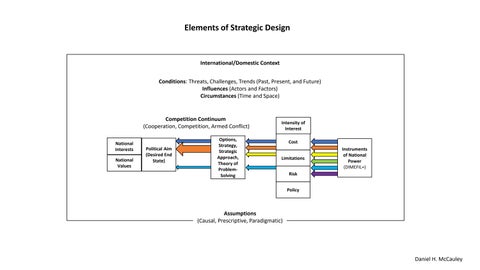
Elements of Strategic Design
International/Domestic Context
Conditions: Threats, Challenges, Trends (Past, Present, and Future)
Influences (Actors and Factors)
Circumstances (Time and Space)
Competition Continuum (Cooperation, Competition, Armed Conflict)
National Interests
National Values
Political Aim (Desired End State)
Options, Strategy, Strategic Approach, Theory of ProblemSolving
Assumptions (Causal, Prescriptive, Paradigmatic)
Intensity of Interest
Instruments of National Power (DIMEFIL+)
There are sixteen elements of strategic art and design.
1. The first element is national interest. Without understanding what your interests are then the other elements lack relevance. National Interests are qualities, principles, matters of self-preservation, and concepts that a nation or actor values and seeks to protect or achieve concerning other competitors. National interests refer to the goals, objectives, and priorities that a nation pursues to protect and promote its well-being, security, and prosperity.
2. Closely associated with national interests are national values. They help to determine principles, inform behaviors, set norms, and provide an impetus for how people view themselves and society. These values provide the amplifying context for the national interest and provide broad guidance on how a policy or strategy may be developed.
3. Conditions are those variables or factors of an operational environment or situation in which a unit, system, or individual is expected to operate and may affect performance. A component of the environment, conditions begin to describe the environment within which national interests are pursued and protected. When considered in the context of the national interests and national values, conditions begin to define what variables are working to enhance the nation’s interests and which one’s are working to undermine them. Conditions begin to inform you as to potential root causes, drivers, and theories of action.
4. An influence can be a human or non-human (such as a condition, trend, or circumstance) entity that has the power or capacity of causing an effect on interests, decision-making, and/or actions. Influences are a necessary component of the environment and are needed to drive change within the environment along with conditions. A theory of action will likely include an influencer n some way.
5. Circumstances are the sum of specific environmental factors, such as an event or situation with respect to time, place, manner, influencer, etc., that accompanies, determines, or modifies a fact or event. The third component of the environment, specific circumstances and the conditions and influences that enable influencers to change the environment that may or may not support or hinder your national interests. All three of these components are part of understanding the environment...lacking one component will likely keep the environment stable. A theory of action will likely try to change the circumstances in some way.
6. The political aim or purpose the desired end state of a national security strategy or plan. The political aim defines the outcome that the strategist believes will preserve, protect, and/or advance the national interest(s) at stake. The components of the environment and whether they support or hinder your national interests will determine your political aim or purpose.
7. Understanding the competition continuum and where actors reside within that continuum relative to specific issues helps to shape an actor’s approach, and associated risk mitigation efforts, as it pursues its national interests. The competition continuum is determined from the three environmental components.
8. The international and domestic context will determine whether one acts within the international environment, and if so, to what extent and for how long. The domestic context is directly related to the national interest and values. Conditions, circumstances, influences, and assumptions within both the domestic and international environments form the contextual framework within which strategic decisionmakers operate. It is the context that provides the necessary logic for action or inaction in complex adaptive environments.
9. Once a nation decides to act, then the appropriate instrument of national power must be considered. Instruments of national power are the means available to a government (or organization) in its pursuit of national objectives. Instruments of national power are usually expressed as diplomatic, economic, informational and military (DIME) or diplomatic, informational, military, economic, finance, intelligence, and law enforcement (DIMEFIL).
10. Directly related to national interests, there are four levels of intensity that help to frame their pursuit or protection: survival, vital, major, and peripheral. Properly identifying the intensity of interest enables strategic decision-makers to frame the extent of the problem, to develop the depth and breadth of the response, to allocate the appropriate resources, to determine the immediacy of action and the time necessary to execute successful operations, and to garner domestic and international support for the potential activity as needed. 11. Costs are the losses you expect to incur if the option, strategy, or plan is implemented. Costs can include deaths, resources, expenses, penalties, prestige, or missed opportunities (known as opportunity costs). An opportunity-cost is the forgone benefit that would have been derived from an option other than the one that was chosen. To properly evaluate opportunity costs, the costs and benefits of every option available must be considered and weighed against the others.
12. A limitation is an action required or prohibited by higher authority, such as a constraint or a restraint, and other restrictions that limit the strategic leader’s or commander’s freedom of action, such as diplomatic agreements, rules of engagement, political and economic conditions in affected countries, and host nation issues.
13. Risk is the probability and consequence of an event causing harm to something valued. It is the loss or losses you expect to avoid, but may not if the strategy or plan does not go as anticipated. Risk is generally discussed in terms of probability and potential consequence, and is classified within one of four risk levels; low, moderate, significant, or high.
14. A policy is the stated or historical position of the government and the interests and values that the policy serves. Policy typically provides the desired end state, assumptions, available resources, and any limitations for option or strategy development.
15. An option is something that may be chosen, such as an alternative course of action using one or multiple instruments of national power. Options are derived from different scenarios and potentially distinguished by different assumptions, termination criteria, and/or objectives. As strategic leadership considers the cost, intensity of interest, limitations, risk, and current and past policy, some instruments of power will be identified as unsuitable for the task. Once all of the options are considered, and a national approach is selected, the instruments of power most suitable are selected and the primary instrument or instruments are identified. The selected option, the instruments of power (primary and supporting), intensity of interest, cost, limitations, risk, and policy form the strategic guidance that is provided to strategists and planners.
16 . Finally, an assumption is a specific supposition of the strategic or operational environment that is assumed to be true and is essential for the continuation of strategy or plan development. They help define perceived threats to one’s own interests and the cause-and-effect of potential actions. Assumptions are made in the absence of evidence and represent general beliefs about the environment, other actors, and one’s self. They allow a nation to envision how the international environment will respond to its actions.