Sign up for our New Newsletter
Dairy St r Milk Break
Email andrea.b@dairystar.com to sign up.
DAIRY ST R “All dairy, all the time”™
Volume 20, No. 12
Retaliatory tariffs cause tension in dairy market Government aid may offer temporary relief By Jennifer Coyne jenn@dairystar.com
International trade is an essential part of the U.S. dairy market with the equivalent of one day’s worth of milk production each week sold as exported products. So when retaliatory tariffs from Mexico and China went into effect throughout the months of June and July, the markets quickly responded. Last month, Class III milk price dropped more than $1 per hundredweight (cwt.) from $15.57 per cwt. May 31 to $14.20 July 6, after Mexico implemented the most recent bout of tariffs against U.S. products, including dairy.
Turn to TARIFFS | Page 5
August 11, 2018
Klinkners overcome challenges to pursue dreams
AJCA Young Jersey Breeder Award fullls a goal By Danielle Nauman danielle.n@dairystar.com
VIROQUA, Wis. – Not being born into a dairy farming family did not dissuade Rob Klinkner from deciding dairy farming was the path in life he wanted to pursue. Rob and Gail Klinkner and their family – Reagan, 12, Garrison, 10, Rubi, 6, Ginger, 4, and Rylan, 1 – milk 55 head of registered Jerseys, Holsteins, Guernseys and Ayrshires on their Pine Prairie Farm outside of Viroqua, Wis. Their dedication to their herd earned them a National Young Jersey Breeder Award at the 2018 annual meeting of Turn to KLINKNER | Page 6
PHOTO SUBMITTED
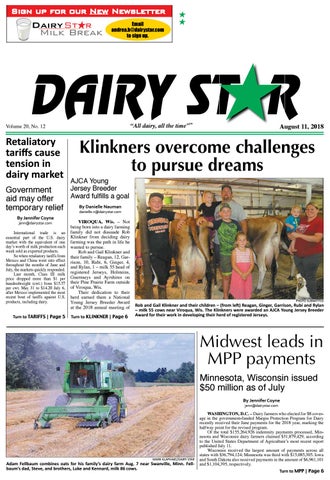
Rob and Gail Klinkner and their children – (from le�) Reagan, Ginger, Garrison, Rubi and Rylan – milk 55 cows near Viroqua, Wis. The Klinkners were awarded an AJCA Young Jersey Breeder Award for their work in developing their herd of registered Jerseys.
Midwest leads in MPP payments Minnesota, Wisconsin issued $50 million as of July By Jennifer Coyne jenn@dairystar.com
MARK KLAPHAKE/DAIRY STAR
Adam Fellbaum combines oats for his family’s dairy farm Aug. 7 near Swanville, Minn. Fellbaum’s dad, Steve, and brothers, Luke and Kennard, milk 86 cows.
WASHINGTON, D.C. – Dairy farmers who elected for $8 coverage in the government-funded Margin Protection Program for Dairy recently received their June payments for the 2018 year, marking the halfway point for the revised program. Of the total $155,264,926 indemnity payments processed, Minnesota and Wisconsin dairy farmers claimed $51,879,429, according to the United States Department of Agriculture’s most recent report published July 11. Wisconsin received the largest amount of payments across all states with $36,794,124; Minnesota was third with $15,085,305. Iowa and South Dakota also received payments in the amount of $6,961,101 and $1,104,395, respectively.
Turn to MPP | Page 6
Page 2 • Dairy Star • Saturday, August 11, 2018
DAIRY ST R www.dairystar.com
ISSN 020355 522 Sinclair Lewis Ave. Sauk Centre, MN 56378 Phone: (320) 352-6303 Fax: (320) 352-5647 Published by Dairy Star LLC General Manager/Editor Mark Klaphake - mark.k@dairystar.com 320-352-6303 (ofce) 320-248-3196 (cell) 320-352-0062 (home) Ad Composition Nancy Powell 320-352-6303 nancy.p@dairystar.com Amanda Thooft 320-352-6303 amanda.t@dairystar.com Consultant Jerry Jennissen 320-346-2292 Editorial Staff Andrea Borgerding - Associate Editor (320) 352-6303 • andrea.b@dairystar.com Krista Kuzma - Assistant Editor (507) 259-8159 • krista.k@dairystar.com Jennifer Coyne - Assistant Editor (320) 352-6303 • jenn@dairystar.com Ron Johnson (608) 874-4243 ron.j@dairystar.com Ruth Klossner (507) 240-0048 cowlady@centurylink.net Danielle Nauman (715) 245-6848 danielle.n@dairystar.com Maria Bichler - Copy Editor 320-352-6303 Advertising Sales Main Ofce: 320-352-6303 Fax: 320-352-5647 Deadline is 5 p.m. of the Friday the week before publication Sales Manager - Jeff Weyer (Northern MN, East Central MN) 320-260-8505 (cell) jeff.w@dairystar.com Mark Klaphake (Western MN) 320-352-6303 (ofce) 320-248-3196 (cell) Laura Seljan (National Advertising, SE MN) 507-250-2217 fax: 507-634-4413 laura.s@dairystar.com Jerry Nelson (SW MN, NW Iowa, South Dakota) 605-690-6260 jerry.n@dairystar.com Mike Schafer (Central, South Central MN) 320-894-7825 mike.s@dairystar.com Amanda Hoeer (Eastern Iowa) 320-250-2884 • amanda.h@dairystar.com Lori Menke (Southern WI) 563-608-6477 • lori.m@dairystar.com Megan Stuessel (Western Wisconsin) 608-387-1202 • megan.s@dairystar.com Deadlines The deadline for news and advertising in the Dairy Star is 5 p.m. Friday the week before publication. Subscriptions One year subscription $35.00, outside the U.S. $110.00. Send check along with mailing address to Dairy Star, 522 Sinclair Lewis Ave., Sauk Centre, MN 56378. Advertising Our ad takers have no authority to bind this newspaper and only publication of an advertisement shall constitute nal acceptance of the advertiser's order. Letters Letters and articles of opinion are welcomed. Letters must be signed and include address and phone number. We reserve the right to edit lengthy letters. The views and opinions expressed by Dairy Star columnists and writers are not necessarily those of the Dairy Star LLC.
The Dairy Star is published semi-monthly by Dairy Star, LLC, 522 Sinclair Lewis Ave., Sauk Centre, MN 56378-1246. Periodicals Postage Paid at Sauk Centre, MN and additional mailing ofces. POSTMASTER: Send address changes to Dairy Star, 522 Sinclair Lewis Ave., Sauk Centre, MN 56378-1246.
From the editorial team
Dairy Prole brought to you by your
North America dealers.
We know the depressed dairy market has not been easy for dairy farmers and can be downright discouraging to be in the industry at this time; however, during these tough times, we still see people who are trying to do and be the good in the world. One example is a dairywoman, Kristi Tveten, who is getting more dairy products into food shelves. (See photo and story in second section, pages 8-9.) Despite feeling the pinch of the low price on her family’s dairy, Tveten is encouraged to help those who may be low on food at certain times. Plus, she knows it could help the dairy community move some of its product. It’s a win-win for all parties involved. Oftentimes, food shelves, especially those in smaller towns, don’t get many dairy products as donations. It can be hard because they may not have the ability to take in much dairy because of cooling space or expiration date worries; but if regular donations are established, it could be a major blessing to families who need those staple items in their refrigerator. A recent online campaign boost efforts of bringing milk to food shelves. The 10-gallon challenge encourages people to buy one gallon of milk and pick up nine more to take to their local food shelf. We wonder what the impact of all these efforts would be if even a few people in each community stepped up to help. Imagine what would happen if small (or even large) companies decided to join? One person’s effort to help can snowball into something larger. All of it makes a difference. Despite these hard times, let’s look for people still trying to be and do good. Even if you can’t help nancially, maybe there are other ways to help, too. Talents are needed beyond the checkbook to help others. – The Dairy Star Editorial Team
SIMPLICITY. VERSATILITY. QUALITY.
SR 100 GII SERIES SPEEDRAKE ® WHEEL RAKES
• Adjust windrow widths independently to match crop pickup widths • Superior terrain following without the need for hydraulic float • Rear wheels raise last for cleaner windrow ends • Fast, easy switching between transport and field positions 8-, 10- and 12-wheel models 18'10" – 23'4" working widths
D & D Farm Supply Arcadia
Komro Sales & Service Durand
Cherokee Garage Colby
Lulich Implement Mason
Kalscheur Implement Cross Plains
Lindstrom Equipment Mondovi
INVEST IN QUALITY® KuhnNorthAmerica.com
East Side Farm Equipment Monroe Frontier Ag & Turf Osceola Turtle Lake
Steinhart's Farm Service Platteville Hwy 48 Farm Service Rice Lake Carl F. Statz & Sons Waunakee
Visit your local Wisconsin KUHN dealer today!
Dairy Star • Saturday, August 11, 2018 • Page 3
It’s all inside... Columnists Ag Insider
Pages 8-9 First Section
The Transition Pen
Alma Center
Gilman
Larson named 2018 National Milking Shorthorn Queen
Page 27 First Section
Kids Corner: The Hicks Family
Third Section: Pages 14 - 15
Third Section: Pages 10 - 11
Ramblings from the Ridge
Lyndon Station
Women in Jeans: Theresa Madland
Page 30 First Section
Polk
St. Croix
Denzer
4-H a tradition for members of sesquicentennial farm First Section: Page 23
Westby
Local creamery works with fairs to add value to milk
Pierce
Chippewa
Dunn
Buffalo
Country Cooking
Viroqua
Klinkners overcome challenges to pursue dreams
Marathon Clark
Eau Claire
Pepin
First Section: Pages 22, 25
Page 29 Second Section
Price
Rusk
Barron
Trempealeau
Pages 10 -11 Second Section
Sawyer
Taylor
Page 37 First Section
The “Mielke” Market Weekly
n Burnett
Say Wisconsin cheese
Iron Ashland
First Section: Pages 34 - 35
Page 32 First Section
Bayeld
Douglas
Vorwald nds niche in Milking Shorthorns
ur
Making Cents of Dairy
Turtle Lake
hb
Page 31 First Section
W as
Veterinary Wisdom
First Section: Page 36
Wood Jackson Adams
La Crosse Monroe
Madison
Juneau
Fond Du Lac
Vernon
First Section: Pages 1, 6-7
wford
Richland
Columbia
Sauk
Cra
Dane
Iowa
J
Zone 2
Lafayette
Green
First Section: Pages 12 - 13
on
rs
e eff
Grant
FROM OUR SIDE OF THE FENCE:
Dodge
World’s largest cheeseboard earns GUINNESS WORLD RECORDS® title
Rock
What are the most important things you have learned that helps preserve your silage?
Monroe
Green County cheesemaker opens major expansion
First Section: Pages 15 - 16
For additional stories from our other zone, log on to www.dairystar.com
First Section: Pages 10 - 11
Comfort and versatility unlike any other Upgrade your barn with GEA’s Single Beam Freestall Mounting System With easy installation and flexible designs,
durability for reduced freestall maintenance.
GEA’s Single Beam Freestall Mounting System
Cows enjoy unobstructed lunge space and lay
can seamlessly integrate with any new or
straighter for cleaner stalls and udders.
existing freestall barn. This state-of-the-art
Fully adjustable stall width and neck rail
mounting system features the patented
height gives you a customized system to fit
cushion cross clamp providing extreme
your herd.
Page 4 • Dairy Star • Saturday, August 11, 2018
A WINNING COMBINATION... PROVIDING THE ULTIMATE IN COW COMFORT THE INDUSTRY’S MOST PROVEN MATTRESS SOLUTIONS
COWCOON - THE HYBRID COW STALL • utilizes a flexible polyethylene tube across the bottom portion of the stall loop that acts as a shock absorbe
PASTURE MAT™ enjoyed by over 3 million cows worldwide
• reduces stress on the cow while continuing to ensure proper positioning
PACK MAT all the benefits of deep bedding while using up to 70% less sand
COMFORT MAT™ the undisputed best foam mattress on the market
Please contact us to learn more or to locate your nearest dealer. 1.888.337.6265 | sales@promatinc.com www.Promatinc.com
facebook.com/promatinc
@Promat_inc
2 Best Barriers on the Market! RESIDUAL KILL FOR HOURS! NonIodine!
Dual Germicide—Barrier Teat Dip
NPE FREE
(Fast & Long Lasting Kill)
Primary Germicide / Chlorine Dioxide - Fast Kill (6 Log / 15 Seconds)
Secondary Germicide / Heptanoic Acid
Iodine!
Less Tacky, Shorter Dry Time & Minimal Build-up!
PROTECTS AND CONDITIONS: Perfect for controlling mastitis in warm, wet, humid weather!
- Kills for hours Excellent Skin Conditioners Less Tacky (No Sticky Build-Up Left Behind) & Quick Dry Time Great Color Marking — Very Low Drip Rates
FOR MORE INFO - CONTACT ONE OF THESE DEALERS... Advanced Dairy Systems
9 State Rd. 29 • Spring Valley, WI 54767 (715) 772-3201
Anderson Dairy Systems, Inc. 1312 13 1/2 Ave. • Barron, WI 54812 (715) 537-3300
Athman Dairy Inc.
238 Main Street North • Pierz, MN 56364 (320) 468-2494
Champion Milking Systems
23218 350th Street • Albany, MN 56307 (320) 845-4156
D&D Ag Supply
133 Atlantic Ave. NE • Pennock, MN 56279 (320) 599-4466
Dairyland Equipment Services, Inc.
24260 Cty. Rd. 27 • Plainview, MN 55964 (507) 534-3161
Dairyland Services, LLC
2545 80th Ave • Woodville, WI 54028 (715) 698-4370
East Central Dairy Supply 2195 Hwy. 23 • Mora, MN 55051 (320) 679-1029
Eastern Iowa Dairy Systems 105 3rd Ave. NW • Epworth, IA 52045 (563) 876-3087
Fuller’s Milker Center, Inc. 423 U.S. 61 • Lancaster, WI 53813 (608) 723-4634
Gorter’s Clay & Dairy Equipment
Professional Dairy Systems
1449 Homecrest Ave. • Wadena, MN 56482 1400- 7th St. SE • Pipestone, MN 56164 (218) 632-5416 (507) 825-3271
Tri-County Dairy Supply, Inc. Lang’s Dairy Equipment, Inc. 4107 N US HWY 51 • Janesville. WI 53545 2337 Millennium Rd. • Decorah, IA 52101 (563) 382-8722
Mlsna Dairy Supply
1126 Front Street • Cashton, WI 54619 (608) 654-5106
608-757-2697
United Suckow Dairy
12687 Hwy 18 & 52 • Postville, IA 52162 (563) 864-7417
Dairy Star • Saturday, August 11, 2018 • Page 5
ConƟnued from TARIFFS | Page 1 “There were signals prices were recovering, then came the announcement of tariffs on dairy and the market reacted negatively,” said Mark Stephenson. “This all came at a bad time, being in our fourth consecutive year of low milk prices.” Stephenson is the director of dairy policy analysis at the University of Wisconsin-Madison. Throughout the summer, retaliatory tariffs have become commonplace since the United States placed tariffs on steel and aluminum imports from Canada and Mexico at the beginning of June, and then on nearly $34 billion worth of imports from China in July. “Trade is critical, and these retaliatory tariffs are very harmful to farmers and manufacturers of made-in-America foods,” Chris Galen said. “We want to see the pursuit of new trade deals, not the disruption of our existing markets.” Galen is the senior vice president of communications at National Milk Producers Federation. In years past, each country’s relationship with the United States in trade agreements has been critical. The U.S. tariffs and subsequent retaliatory duties have caused tension between the countries and created an uneasy feeling about the future standing with these nations. “The most recent trade data was published in May, and showed record high [dairy] exports,” Stephenson said. “The markets overreacted to the initial impact of these trade discussions, but it’s going to take a few months to fully know how the bottom line is going to be affected.” For many years, Mexico has been the United States’ No. 1 cheese market, importing $400 million worth of product last year, according to the International Dairy Foods Association. An additional benet to this relationship was the duty-free export of products under the North American Free Trade Agreement. “Mexico is far and away our most important export market, and a key piece of our advantage there has been our duty-free supplier status,” Galen said. With steel and aluminum tariffs enacted June 1, Mexico placed 10 to 15 percent duties on most U.S. cheese imports June 5. A month later, the retaliatory tariffs increased to 20 to 25 percent. Canada took similar actions July 1, enacting 10 percent tariffs on yogurt, pizza and quiche. Historically, there were no duties on pizza and quiche and up to 730,000 pounds of yogurt entering Canada. Yogurt surpassing that amount was charged a 237.5 percent tariff. China’s additional 25 percent tariff on cheese, milk powder, whey and other dairy products are also having a severe impact on the U.S. dairy market. The Asian country is the United States’ third largest export market, purchasing more than $576 million worth of
dairy products last year, according to IDFA. “China is second only to Mexico in importance to our dairy industry,” Galen said. “The 25 percent surcharge now being levied by China on U.S. dairy products makes our exports considerably more expensive than those from other suppliers.” Over the last two months, futures prices have changed drastically as a result of trade talks with the latest forecast around $14.80 per cwt. “Markets have begun to rm up again, but they’re not gaining,” Stephenson said. “These tariffs are directly affecting farmers in the Upper Midwest who are producing those products.” Galen agreed. “For the rst time in years, this fall was looking promising to restore dairy farmer margins,” Galen said. “However, that’s now evaporated. We’re at the point where we’re likely to see a loss of dairy producer income totaling $1.8 billion over the last six months of this year as a result of those shifts.” The federal government realizes this concern and announced a $12 billion assistance package for all farmers and processors affected by the trade wars July 24. The relief will be available Labor Day, according to a report published by the United States Department of Agriculture. While little is known about how the funds will be distributed, there is a three-pronged approach the USDA may take by issuing direct payments, purchasing commodities that would have otherwise been used in the export market, and developing additional foreign markets. If the entirety of the aid program put towards dairy, about $1.6 billion, were to be issued as direct payments, Stephenson estimates farmers would receive $0.70 per cwt., based on 2018 milk production. The purpose of purchasing commodities would be to raise the all milk price. “They’ve done this before, where products are purchased and given to food pantries and schools,” Stephenson said. “This will take longer to happen, but the distribution is noncompetitive with commercial sales.” The nal tier would create a long-term benet of developing new export customers. “We have a pretty mature domestic market base, so the only way to grow individual sales signicantly is to nd new trade partners,” Stephenson said. While the USDA program is promising some relief from the trade wars and welcomed by dairy organizations, many feel it may not be enough. “Farmers are concerned all the work that has been done to develop trade relationships is at risk,” Stephenson said. “They don’t want to lose it.” As NAFTA and other trade talks ensue, the U.S. dairy industry sits on edge waiting for a diplomatic solution on international trade.
PROTECT YOUR INVESTMENT WITH
THE ORIGINAL
COVER
For any size bunker or pile IN STOCK!
TAKE ADVANTAGE OF
90 DAYS NO PAYMENTS NO INTEREST
Falll Sa alee
10 0% Offf
THROUGH
FREE Shipping
www.bluelakeplastics.com
320-333-9255 Sauk Centre, MN
COMPLETE BARN SOLUTIONS WHATEVER YOUR DAIRY NEEDS
Autumnwood Dairy • Forest Lake, MN Remodeled tiestall barn, 2x8 Vertical Lift with GEA EzDe Detachers
Call us to help you make your dairy operation more efficient.
www.midwestlivestock.com
PINE ISLAND, MN • 800-233-8937 BEATRICE, NE • 800-342-5657 SIOUX FALLS, SD • 800-705-1447 MENOMONIE, WI • 715-235-5144 OWEN, WI • 715-229-4740
Page 6 • Dairy Star • Saturday, August 11, 2018
ConƟnued from KLINKNER | Page 1
Willmar, MN • 320.231.1470
EXPANDING OR REMODELING YOUR LIVESTOCK OPERATION? LANGE AG SYSTEMS SPECIALIZES IN:
Ŷ NEW FACILITIES
_
NO JOB TOO BIG OR TOO SMALL
Ŷ RETROFITTING & REMODELING Ŷ TURNKEY PROJECTS Ŷ BARN DESIGN Ŷ INSTALLATION, MAINTENANCE & REPAIRS
ƋƵŝƉŵĞŶƚ tĞ KīĞƌ͗ ͻ sĞŶƟůĂƟŽŶ &ĂŶƐ ͻ sĞŶƟůĂƟŽŶ ŽŶƚƌŽůƐ ͻ WŽƐŝƟǀĞ WƌĞƐƐƵƌĞ dƵďĞƐ ͻ ƵƌƚĂŝŶ ^LJƐƚĞŵƐ ͻ DĂƩƌĞƐƐĞƐ ͻ tĂƚĞƌĞƌƐ ͻ ^ƚĂůů ƋƵŝƉŵĞŶƚ ͻ ,ĞĂĚůŽĐŬƐ ͻ DŝƐƟŶŐ ^LJƐƚĞŵƐ
Lange Ag Systems is proud to offer Grain Bags, Silage Bags & Bunker Covers from Up North Plastics and Feed Fresh Silage Covers & Custom Size Bunker Covers from Raven!
t ^ >> E t Θ h^ 'ͳ ' Θ < >>z Zz E '' Z^
www.LangeAgSystems.com BUNKER SILO •• H-Bunks Fenceline
Bunks • 115 Bu. Steer Stuffer • Individual Yard Bunks Backed by over 40 years proven experience!
PRECAST SYSTEMS Hwy. 12, Darwin, MN 55324
1-888-693-8440 • www.darwinconcrete.com
Repair vs. Replace
Electronic Dairy Board Repair Service
Specializing in: WestfaliaSurge, BouMatic, & DeLaval pulsators & Takeoffs, circuit boards, Mueller milk tank circuit boards. Call: (c) 406-590-7764
www.circuitÀxer.wixsite.com/ boumaticboardrepair
Consultation & timely service to help reach your business’ full potential!
LIVESTOCK FACILITY DESIGN • Cow & Heifer Barn Design • Lagoon Construction • Manure Transfer - In-Barn, Discharge & Separation • J&D Barn Ventilation • Lighting Systems • Fiberglass Stalls and Gates • Barn Remodel & Redesign • Steel Frame Barn Construction
• Wood Frame Barn Construction • Automatic & Manual Curtains, Including Air Curtains • Barn Steel - Freestall & Headlocks • Calf barns - Group & Individual • Automated Feed Systems • Parlor Design & Layout • Barn Ventilation Retromt & New Tunnel Vent & Cross Vent
715-231-3168 E6091 578th Ave. • Menomonie WI 54751
the American Jersey Cattle Association (AJCA) last month in Canton, Ohio. “It’s something I’ve always wanted to try to accomplish,” Rob said of the award. “To actually achieve it is very humbling and moving.” The Young Jersey Breeder Award is given annually to active members of the AJCA who are between the ages of 28-40. At the age of 9, Rob began helping with chores on a daily basis on Steve and Annette Trescher’s dairy farm outside of Cashton, Wis. “Annette saw that I was interested in Jerseys, and she really worked to help that grow,” Rob said. “The Treschers let me show their animals at the Parish 4 Jersey Show and at the Monroe County Fair.” Rob saved up enough money to begin his own Jersey herd at the age of 13, with the purchase of Feniwis Peep T Perky at a dispersal sale. Gail grew up on her family’s registered Holstein farm outside of Westby, Wis., and was as passionate about the dairy industry and breeding registered Holsteins as Rob was about his Jerseys. The two met through 4-H and FFA-related activities. They each attended the University of Wisconsin-Madison Farm and Industry Short Course program, with Rob graduating in 2001. Gail graduated from the program in 2003, and they married later that year. Rob started working at the Fremstad’s Norse Star Jersey Farm, and the
desire to have his own farm continued to grow. In 2002, Rob worked out a rental agreement with a retired farmer located near Westby, Wis. “I had a 50-50 agreement with the landlord,” Rob said. “We worked together to harvest quality forages, and I purchased the rest of the feed and paid the electric. The landlord paid a percentage of any needed repairs, and we each received 50 percent of the milk check.” The original cows Rob purchased were purebred Jerseys. He joined the AJCA Registration, Equity, Appraisal and Performance Program to begin the registration process through the Genetic Recovery Program. Once Rob and Gail were married, her Holsteins moved to Pine Prairie to join the Jersey herd. Gail continued to work off the farm while Rob managed the dairy herd. They continued on the rented farm until October 2006 when the opportunity to purchase their current farm presented itself. “We picked the worst time of the year to move a dairy farm,” Rob said. “We had a lot of work to do right away getting the barn ready. We put pasture mats in right away. We had to install the milking system. The heifer facility needed some revamping to be ready for winter, and we had to pour some concrete. We had to get some of the basic machinery we needed but didn’t have.” Turn to KLINKNER | Page 7
ConƟnued from MPP | Page 1 “We signed up in April, knowing the payments would cover the premiums we paid in,” Dean Marshik said. “Now, we’ve pretty much been in the black with the program.” Marshik, who milks 130 cows near Pierz, Minn., has been enrolled in the program since its inception. He rst elected for coverage at $6.50, and has since maintained the minimum level needed to participate in the program. Like many farmers, Marshik reconsidered his coverage in 2018 when the program was restructured. Under the Bipartisan Budget Act of 2018, three drastic changes to MPP-Dairy were authorized. First, Tier 1 volume increased from 4 million pounds of production history to 5 million pounds. Then, indemnity calculations were calculated monthly rather than based on the previously established two-month average. The most notable change was the cost of Tier 1 premiums were signicantly reduced. With $8 coverage, farmers paid a premium of 14.2 cents per hundredweight, compared to the former 47.5 cents per cwt. “Choosing $8 was the best choice for our investment. … It was cheap enough to be justiable,” said George Bakeberg, who enrolled in March. “Our rst payment in April paid for the whole year’s premium.” Bakeberg and his family milk 220 cows near Waverly, Minn. The Bakebergs and Marshiks are two of 21,274 dairy operations that enrolled in MPP-Dairy for 2018. “That number is not nal and we do expect it to change,” said Wayne Maloney, USDA Farm Service Agency. In restructuring the program, FSA approved the coverage retroactive to cover all months in the 2018 calendar year. This allowed farmers who joined the program later to benet, as well. The nal day to enroll was June 8. Since the rst of the year, margins have been mostly favorable for farmers who elected for $8 coverage. While January’s margin was $8.11 and did not trigger payments, subsequent
months have, according to the USDA. In February, the margin value was noted at $6.88; $6.76 in March; $6.61 in April; $6.78 in May, and $7.36 in June. “We did receive payments for June’s milk, but it will be close in July,” Marshik said. Bakeberg agreed. “They payments are shrinking,” he said. “Our rst was $1.40 per cwt., and our last one was $0.63 per cwt.” As of Aug. 3, forecasted futures indicate possible payments yet in July and August before margins reach levels comparable to historic values, according to Dairy Markets and Policy. This projection is in line with earlier projections. In April, the then-current margins and forecasts indicated payments would be issued from February through July, and likely August, for dairy farmers who elected for $8 coverage. MPP-Dairy has been a suitable program for dairy operations enrolled in Tier 1. However, it still remains a band-aid for a larger issue in the dairy industry. “The payments help a lot, but it’s not a long-term cure,” said Bakeberg, who has beneted from the program in maximizing his Tier 1 coverage. Marshik agreed, mentioning the indemnity payments have made paying farm bills easier. “It’s better than what it was,” he said. “But it still doesn’t make for a better milk price.” A need for a more permanent subsidy program is growing as the end of the 2018 MPP-Dairy looms in the coming months with the end of the current farm bill. Revisions to the program are proposed in the Agriculture Improvement Act of 2018, which is being reviewed in conference by the House and Senate. If this farm bill is not signed into law by September, the industry is most likely to return to the Agriculture Act of 1949 with price support. “Only time will tell,” Bakeberg said. “I’d really like to farm without being subsidized by the government.”
Dairy Star • Saturday, August 11, 2018 • Page 7
ConƟnued from KLINKNER | Page 6 The Klinkners have had to be exible in their plans to navigate their way through nancial struggles. “In July 2010, we made the decision to downsize the herd,” Gail said. “We sold 40 cows and 20 heifers to pay down some debt. It kept us milking cows. I continued managing a local farm store, and Rob got a part-time job driving school bus.”
“We’ve tried to nd the most efficient number of cows to milk in our facility to maintain protable margins.” GAIL KLINKNER, DAIRY FARMER
By 2013, the barn was full again, and the Klinkners decided to pay off their remaining debt by having another sale in April 2014. They sold 40 cows and 10 bred heifers, leaving 20 cows remaining in the herd. Both Rob and Gail worked off-farm jobs during this time, while managing the farm. Since that time, the herd
PHOTO SUBMITTED
Rob Klinkner exhibits Pine Prairie Oliver Fiesta {5} in the junior 2-year-old class last fall at the All-American Jersey Show in Louisville, Ky. has grown back to its current size of 35 registered Jerseys and 20 registered Holsteins. There are two Guernseys their son Reagan owns and a couple of Ayrshires they house for a friend. “We’ve tried to nd the most efcient number of cows
Deluxe Chute
to milk in our facility to maintain protable margins,” Gail said. “It’s the key to the progress we’ve made, especially in the past three years.” The Klinkners try to ght burn-out from the burdens of dairy farming by having activities that get them out of the
Creep Feeder
Steer Feeder
$3,179
$2,695
on wheels
$4,179
Spanier Welding and Metal Fabrication
barn. “We try to be active in the community and in the dairy industry to give our kids the chance for experiences off the farm,” Rob said. Rob has served on the church board and as a caretaker for the cemetery. He has been
president of the Parish 4 Jersey Breeders for over 10 years and serves on the state Jersey board, as well as serving several terms on the Vernon-Crawford DHIA board. Gail has served on the Vernon County Holstein Breeders board and has worked to form the Vernon County Junior Dairy Club for youth interested in any breed of dairy cattle. Both Rob and Gail serve as dairy project leaders and have been on the Ribbon Sale Committee at the Vernon County Fair. “We believe in supporting the future of the dairy industry by providing fun and educational opportunities for the kids,” Gail said. The Klinkner family exhibits their animals at local, state and national shows. Both Rob and Gail grew up showing, and all of their children, except Rylan, already have some show ring experience. Gail has chaperoned for several years at the Wisconsin Junior State Fair, and this year, Reagan exhibited for the rst time. “We’ve been lucky to have some great friends and mentors along the way,” Rob said, crediting the Treschers, the Fremstad family and John Selin. “I hope we can be that person to someone else who has a passion for the breed.”
20’ Feed-Through Open Top Bunk
Paynesville, MN • 320-243-7552
$1,377
NEW OR USED WE’VE GOT YOU COVERED.. TRACTORS MF GC1705 w/60” deck ......................Just In MF 8735 ....................................................... Call MF 8650 CVT ..................................Coming In MF 8650 ............................................. $120,000 MF 7497 ................................................$95,000 MF 7624, lease return..........................Just In MF 6614 CVT w/ldr.................................... Call MF 1085 w/cab ..................................... $7,500 MF 492 w/ldr ..................................Coming In AGCO DT-220 ................................Coming In AGCO DT-200A ...................................$69,500 IH 1586 .....................................................Just In
IH 1066 .....................................................Just In IH 966 ........................................................Just In IH M Farmall........................................... $1,950 U-Moline, runs good .......................... $1,250 SKID STEERS & SPREADERS Gehl 5640E, 2600 hrs .................................. $24,500 Gehl 4640E ........................................................ Just In Gehl R220 .................................................. Coming In Gehl R190, only 79 hrs., ...................................SAVE Gehl R190, 280 hrs ...................................... $32,500 Gehl 6640E, cab/heat ................................. $24,500 Bobcat S650................................................... $21,500 Meyers 7400 spreader .................................. Just In
MISC. ITEMS JD 4995 Windrower................................ Coming In JD 2700 ripper .............................................. $19,500 JD 2700 5-bottom ..........................................$4,950 Case 700, 8 bottom ................................ Coming In IH 490, 32’ .......................................................... Just In Sunflower 4630-9 ripper ........................... $42,000 Sunflower 4610-9 ripper .............................. Just In Sunflower 4610 ripper .......................... Coming In Sunflower 4511-13 disc chisel ........... Coming In Sunflower 4511-15, low acres ................. $35,000 Krause 4900, 30’ disc......................................$9,500 Soil Pro Wilrich 9 shank ........................ Coming In
Gehl 700, 14 wheel rake ...............................$6,500 MF 2170XD baler .......................................$100,000 MF 1375 mower cond ................................ $17,500 MF 2270 non XD .......................................... $35,000 NH BB960, 3x4 ................................................. Just In NH HH 7450 13’ discbine .......................... $17,900 Vermeer 605SM Cornstalk ........................ $23,500 Vermeer MC3700 discbine, demo ...............SAVE Demco 1050 grain cart, carryover ...............Save! Demco 500 sprayer, 60’ boom ................... Just In Brandt Bale Shredder ............................ Coming In Haybuster 2650, used little ...................... $14,000 NI 5209 discbine .............................................$8,950
Veiw our full list of used equipment at www.VillardImplement.com
Villard Implement
•
Villard, MN
•
320-838-7010
©2018 AGCO Corporation. AGCO Parts,Massey Ferguson and Challenger are worldwide brands of AGCO Corporation. Challenger, Cat and Caterpillar are trademarks of Caterpillar Inc. and are used under license by AGCO. AGCO, AGCO Parts and Massey Ferguson are trademarks of AGCO. All rights reserved.
Page 8 • Dairy Star • Saturday, August 11, 2018
Milk price trapped in current range The dairy markets are doing well to hold steady dent Jim Holte said this program is only “temporight now, according to Ag Resource Company rary relief.” While the helping hand is appreciated, Economist Dan Basse. “We believe as we head into Holte said “farmers want trade, not aid.” the latter part of summer and start to see milk production increasing for seasonal A level of certainty Ag Insider reasons, we should see dairy producDairy farmers are seeing payments tion increase in prices still come down. from the revamped Margin Protection There’s no bullish outlook as we see it Program, which gives them hope for an at the moment unless we can solve some updated risk management program in of these trade issues that are surroundthe farm bill. Associated Milk Producing the dairy industry.” Basse says the ers Incorporated Vice-President of Pubgoal is to open up the China market, but lic Affairs Sarah Schmidt says dairy that could take time. “We all got to be farmers aren’t looking for a hand-out. patient and hope the Trump administra“It is about calming the volatile waters tion has a plan for this going forward, out there as price swings dairy farmers but we kind of see dairy trapped in a are having to contend with makes plan$12.50 to $16 market through the end ning like throwing darts. If we have a By Don Wick of the year.” program that allows dairy farmers to Columnist ensure a margin, specically being An upward trend in dairy exports the milk price minus established feed U.S. exports of nonfat dry milk, skim milk costs, that really does provide a level of certainty.” powder, dry whey and whey protein concentrate in- Schmidt hopes September is a really productive creased signicantly in the March-May time period. month for the farm bill. These products represent 80 percent of the milk solids exported during the rst ve months of the year, Duffy on farm bill conference committee pushing U.S. dairy exports to all-time highs. Trade The House-Senate farm bill conference comretaliation from Mexico and China began in June mittee is tasked with nding consensus on the veis expected to inuence that pace when the export year farm bill. The Senate has nine members, ve numbers are updated. In a joint report from Dairy Republicans and four Democrats. The House has 47 Management Inc. and the National Milk Producers individuals on the conference committee including Federation, the domestic inventory of dairy prod- Wisconsin Congressman Sean Duffy. During the ucts was already trending higher before the trade August recess, legislative staff members are workwar began. ing on the bill and conference committee members are expected to meet by phone. The goal is to comTrade, not aid plete the farm bill before the current legislation exThe Trump Administration’s $12 billion assis- pires at the end of September. tance package for farmers will include direct payments, food purchases and export promotion. One Lee-Booker amendment rejected of the commodities targeted for relief is the dairy Utah Senator Mike Lee and New Jersey Senaindustry. Wisconsin Farm Bureau Federation Presi- tor Cory Booker offered an amendment that would
PASTEURIZERS 20, 30, 40, 60 and 90 gallons FEATURES:
• Pump Agitation and Dispense System • Automated Pasteurization Cycles • Re-Heat & Pre-Cool Options Standard • Programs for Colostrum Pasteurization and Colostrum Thaw for Frozen Bags • Automatic C.I.P. System • Optional Peristaltic Chemical Pump • Large PLC Screen Provides Information Throughout Cycles • Electric Heating • 40 Gallon - 40 Amp 240 VAC 1 Phase 4-Wire • 60 Gallon - 50 Amp 240 VAC 1 Phase 4-Wire • 90 Gallon - 70 Amp 240 VAC 1 Phase 4-Wire
For larger dairies we offer 120,150, 250 or 250 gallon capacity. Call for details!
IN STOCK
have prevented the Food and Drug Administration from enforcing standards of identity for dairy products and other foods. That effort was rejected in the full Senate. Plant-based beverages often use the term ‘milk’ on their labels, which is a point of contention for the dairy industry. National Milk Producers Federation President and CEO Jim Mulhern issued a statement, saying this vote sends a message for food marketers. EU demands geographic indicators The European Union remains committed to its practice of protecting geographic indicators for foods like parmesan and asiago. This issue creates heartburn for the U.S. dairy industry and there is hope the trade talks between the U.S. and Europe would bring this issue to the table. The National Milk Producers Federation, U.S. Dairy Export Council and International Dairy Foods Association sent a joint letter to U.S. Trade Representative Robert Lighthizer to highlight the importance of this issue. Europe prevents imports of many dairy products based on geographic indicators and the U.S. dairy groups called that “one of the most detrimental actions against free commerce.” Land O’Lakes second quarter prots rise Land O’Lakes reported quarterly net sales of $4.2 billion, an increase from last year’s second quarter sales of $3.7 billion. Net earnings are $67.2 million in the second quarter, a decrease from last year’s $113 million. CEO Beth Ford says the cooperative is positioned to make steady progress despite the headwinds in the agriculture economy. There’s growth in Land O’Lakes crop protection volumes, but year-to-date earnings in crop inputs declined from late plantings. Dairy food earnings are higher with an improved product mix in Turn to AG INSIDER | Page 9
Dairy Star • Saturday, August 11, 2018 • Page 9
ConƟnued from AG INSIDER | Page 8
the branded butter portfolio. Animal nutrition business earnings were at compared with last year. Ford takes the reins at Land O’Lakes Beth Ford is the new President and CEO of Land O’Lakes, a farm cooperative based in Arden Hills, Minn. Ford will take over as President and CEO on Aug. 1. Ford replaces retiring CEO Chris Policinski. She is currently serving as the Chief Operating Ofcer of Land O’Lakes Businesses overseeing Wineld United, Purina Animal Nutrition and Dairy Foods business units. A world record cheeseboard Wisconsin began the month by creating the world’s largest cheeseboard. The new Guinness world record cheeseboard took over an entire street in downtown Madison. The custom board was 35 feet long and seven feet long. It included 145 different varieties of Wisconsin cheese.
#10GallonChallenge A social media campaign called #10GallonChallenge is designed to support dairy farmers and provide food to hungry families. In a Facebook video, Ohio farm broadcaster Ty Higgins encouraged consumers to purchase 10 gallons of milk and donate it to the local food shelf. In a matter of days, the video was viewed well over 100,000 times. Trivia challenge California leads the nation in alfalfa production. That answers our last trivia question. For this week, how much butter does the average American consume each year on a per-capita basis? We’ll have the answer in the next edition of Dairy Star. Don Wick is owner/broadcaster for the Red River Farm Network, based in Grand Forks, North Dakota. Wick has been recognized as the National Farm Broadcaster of the Year and served as president of the National Association of Farm Broadcasting. Don and his wife, Kolleen, have two adult sons, Tony and Sam, and ve grandchildren, Aiden, Piper, Adrienne, Aurora and Sterling.
“The milk pregnancy test and MUN tests have been useful in our breeding program.” Why is testing with DHIA important to your dairy? It can be very useful to see trends and make management decisions. How long have you been testing with DHIA? We’ve been testing with DHIA for almost 4 years. What are some of the DHIA tests you use? Which ones do you Ànd most useful? Our reports are mainly the somatic cell, MUN, and milk pregnancy tests. The milk pregnancy test and MUN tests have been useful in our breeding program and have brought us up to a 34% pregnancy rate and help us identify any possible issues right away. Why is testing with DHIA important to your dairy? We started testing with DHIA to see how many pounds of milk our cows produced. With milk prices so low, getting the milk pounds of every cow helps us adjust our feeding for each cow to cut costs as well as help determine what animals should be culled. Tell us about your farm. I farm with my wife and 4 children. We farm 150 acres and we milk mainly Jersey cows, but have one of every breed on the farm. We’ve been milking cows since 2006.
Alan Klejeski Sturgeon Lake, MN • 30 cows Minnesota Dairy Herd Improvement Association 307 Brighton Avenue South Buffalo, MN 55313 1.800.827.3442 www.mndhia.org
N10828 Cty Hwy O | Greenwood, WI 715.267.1416 | www.greenwoodsilo.com Email: sales@greenwoodsilo.com
SEALED SILO SERVICES: BOTTOM UNLOADERS: • CONSTRUCTION • MAINTENANCE • PRESSURE CHECKING • RESEALING • REPLACEMENT ROOFS
• GREENLINE UNLOADERS D-SERIES (FORAGE) B-SERIES (SNAPLAGE & GRAIN) • USED UNLOADERS • UNLOADER PARTS • FULLY EQUIPPED SERVICE CREW
SUPERIOR FEED VALUE THROUGH SEALED SILOS We are not affiliated with A.O. Smith Harvestore®, E.S.P.C. or C.S.T.
GO HARVESt Rewards
Offer August 1, 2018, through September 30, 2018. Offer August 1, 2018, through September 30, 2018.
SAVE INSTANTLY WHEN YOUINSTANTLY BUY TWO OR MORE SAVE WHEN YOU FIRESTONE AGMORE TIRES BUY T WO OR $25FIRESTONE off Destination Farm tires** AGradial TIRES with KLC Roasted Soybeans t nutritionis Ask your sted soybeans, roa for KLC le for substitutes. tt don’t se
Quality
Consistency
Our soybeans have what your dairy ration needs: • Energy • Protein • Amino Acids • Bypass Protein
KLC Farms Roasting, Inc. 1-877-738-2326 877 738 23 Visit www.roastedbeans.com Preferred By Bovines Everywhere
$100 off eligible radial and bias tires** $200 off eligible harvest AD2™* radial and flotation tires**
DALE’S FARM REPAIR INC. ON-FARM TIRE SERVICE
Hwy. 25 between Pierz & Genola
320-468-6886
Mon.-Fri. 8-5, Sat. 8-Noon Dale Saehr - Owner
*Advanced Deflection Design (AD2) **US Terms and Conditions CONSUMER: Coupon code may be redeemed for $25 off the purchase of any Destination Farm Radial Tires; OR $100 off eligible Radial and Bias Tires; OR $200 off eligible Harvest AD2 Radial and Flotation Tires (excluding DF). Qualifying purchase must be made between August 1, 2018, and September 30, 2018, from any Certified Firestone Ag Tire Dealer. To locate the nearest Certified Firestone Ag Tire Dealer, go to FirestoneAg.com and click on “Find A Dealer.” For a complete list of eligible tires, visit FirestoneAg.com or see your Certified Firestone Ag Tire Dealer. Valid in U.S. only. Retail customers only (excluding commercial fleet, fleet and group purchases; and adjustment and warranty claims). Must be 18 or older at time of purchase. Not to be combined with any other Bridgestone, Firestone or Certified Dealer, offer and not to be used to reduce outstanding debt. Coupon code has no cash value. The discount is on pre-tax price qualifying sales. Customer pays any sales (or other) tax. Discount given at the time of purchase. Minimum purchase of two (2) eligible Firestone Ag tires required; maximum purchase of 16 eligible Firestone Ag tires. Maximum savings of $3,200 per coupon code. Coupon code not valid on returns, exchanges, rain checks or prior purchases. Limit one (1) coupon code per qualifying purchase transaction. Coupon code void if copied, altered, transferred, sold/purchased, irregular or defective. Void where prohibited or restricted by law. Not to be combined with any other Bridgestone or Firestone offer.
Page 10 • Dairy Star • Saturday, August 11, 2018 Oslin Lumber Company
Building Plans?
We can help!
A friend of the farmer for over 60 years. Hwy. 23 East, Mora
320-679-1181
Green County cheesemaker opens major expansion
The next issue of the Dairy Star is published Aug. 25th. Advertising and news deadline is Friday, Aug.18th
Lindell Sales & Service 37236 County 56 Blvd., Cannon Falls, MN
651-258-4311 • Mark’s Cell 651-764-4084
We carry... HOULE
Stop by our Equipment Locations for Great Summer Savings! Tractors
Versatile 485 2009, Nice ........................................................... $148,000 $128,900 Versatile 936 1988 12sp. 4Hdy. 3pt. Consignment ................................... $30,000 J MF 4608 2013 Cab, MFWD, Loader ............................................ $39,000 $36,900 H McCormick CX105 2007 Cab MFWD 2500 Hours ................................... $33,900 H McCormick CX110 w/Loader ....................................................................... $39,900 H John Deere 9630T, 2010 ......................................................... $159,000 $149,000 H John Deere 8130 MFWD, 2006, 3500 Hours .......................................... $102,000 H Versatile 350 2013, Low Hours ............................................................................ Call J J
Hay and Forage
JD 3950 Forage Harvester Hay Pickup ........................................... $5,900 $2,900 L H&S 12 Wheel Rake DF12 HC ....................................................................... $6,500 L H&S 10 Wheel Rake ........................................................................................ $2,900 H NH BR 7090 Round Baler 4600 Bales ......................................................... $28,500 H H&S Bifold Rake 8 Wheel ............................................................................... $2,250 H New Holland 460 Baler with Cutter ............................................................ $31,800 J New Idea 5407 Mower .......................................................................................... Call Several new MF/Heston and Vermeer Mower/Conditioners ............................. Call Several new MF and Vermeer Disc Mowers .......................................................... Call Several new Vermeer and H&S Rakes .................................................................... Call H Vermeer 604 SuperM ................................................................................... $29,900 H H&S V-8 Rake ................................................................................................... $3,500 H Valmetal Tub Grinder ....................................................................................... $9,900 H Heston 4750 Big Square Baler ...................................................................... $21,900 H Case IH 8560 Big Square Baler ..................................................................... $18,900 H
Disks
CIH RMX 370 ................................................................................................... $28,900 L CIH RMX 370 28ft. ...........................................................................$31,900 $23,500 J JD 215 16ft. ....................................................................................................... $3,250 H Salford 4124 24ft. .......................................................................................... $46,000 J
Combines
Gleaner A75 with Heads ................................................................................ $110,00 Gleaner R76 ..................................................................................................$152,000 J MF 9795 .........................................................................................................$167,500 J MF 9560 .........................................................................................................$262,000 J J
Spreaders
Kuhn Knight 8141 .......................................................................... $37,000 $34,900 H Kuhn Knight 8118 ............................................................................ $12,900 $8,900 H Kuhn Knight 8118 ............................................................................. $12,000 $8,000 H Kuhn Knight 8150 ...........................................................................$36,000 $32,900 H Kuhn Knight 8150 ...........................................................................$36,900 $32,900 J Meyers 390 .......................................................................................... $9,000 $6,500 L H&S HY Push 550 .............................................................................$14,900 $13,500 L NI 3739 ................................................................................................. $8,900 $8,490 H
TMR
Knight 5073 ...................................................................................................... $12,500 Knight 142 ....................................................................................................... $34,500 Supreme International ......................................................................$14,900 $12,900 Patz V420 Sharp .............................................................................................. $19,900
PHOTO SUBMITTED
An automated producƟon line makes HavarƟ, brick and muenster cheese at Klondike Cheese Co. near Monroe, Wis. Six Wisconsin master cheesemakers, cerƟed by UW-Madison Center for Dairy Research, work at Klondike. By David Tenebaum
College of Agricultural and Life Sciences University of Wisconsin–Madison
Klondike Cheese Co. is expanding production as it enters its second century of cheesemaking, under the leadership of six Master Cheesemakers certied by UW–Madison’s Center for Dairy Research. Klondike now operates a highly automated production line at its plant west of Monroe. The robotic technology allows Klondike to raise production despite an extremely tight labor supply, says company president Ron Buholzer. The increased volume will still require hand labor in the packaging area, and Buholzer expects no reduction in total employment, which is now above 230. The new line will triple output of brick, muenster and havarti cheese, which are now mainly sold under customers’ labels. Klondike already runs an automated production line for feta, its major product, which it markets under its own label, Odyssey. The Buholzers, like many in Green County, trace their roots to Swiss immigrants, specically three brothers who settled in the area in the 1910s and almost immediately set to work making cheese. The third- and fourth-generation of the Buholzer family now operate a 240,000-square-foot plant along Wisconsin Highway 81 between Monroe and Argyle. In recent years, cheesemakers in “America’s Dairyland” have broadened from commodity cheeses like cheddar, Colby, mozzarella and Swiss to gourmet and niche cheeses.
Skid Loaders
Gehl CTL175 #4054 .............................................................................$24,900 J Gehl 5240E #1078 2286 hours ...........................................................$22,400 H Gehl 4240 #4053 4389 hours ............................................................... $9,900 H Gehl 5240 #3784 1249 hours .............................................................$24,900 L Gehl R135 #3952 3464 hours .............................................................$15,800 L Gehl 6640 #1071 2800 hours .............................................................$17,500 L Bobcat S550 #1057 ..............................................................................$24,900 L Bobcat S850 #1052 1300 hours .........................................................$37,500 L Bobcat S850 #1058 450 hours ...........................................................$43,900 L Bobcat S300 #1073 2950 hours .........................................................$24,500 L Bobcat S650 #4030 3400 hours .........................................................$23,500 L Bobcat S650 #3526 ..............................................................................$42,500 L Bobcat S590 #1815 1324 hours .........................................................$30,900 L Bobcat T590 #1975 ...............................................................................$32,900 H
H = Hamburg | J = Judson | L = Lafayette
PHOTO BY DAVID TENEBAUM
We have more units! Please call any of the locations listed below or check out our online inventory at: www.UFCfarmsupply.com Hamburg
16401 State Hwy 5/25 Hamburg, MN 55339 952-467-3111
Judson
110 Judson Fort Rd W Lake Crystal, MN 56055 507-947-3644
Lafayette
840 Pioneer Ave Lafayette, MN 56054 507-228-8224
Ron Buholzer, president of Klondike Cheese Company, is one of six at the Monroe-area rm with a master cheesemaker cerƟcaƟon from the UWMadison Center for Dairy Research.
That change has affected Klondike. “In the 1980s, we were making Colby and cheddar, but the margins were getting to be horrible, and we went looking for something else,” says Buholzer. “Dan Carter, our marketing chief, said why not look at feta, and I said, what in the hell is feta? So we went to Chicago and bought a pail to analyze its composition, and started some test batches.” To judge the new feta, Klondike consulted an Armenian couple who owned a restaurant in Monroe.
“In the 1980s, we were making Colby and cheddar, but the margins were getting to be horrible, and we went looking for something else.” RON BUHOLZER, PRESIDENT OF KLONDIKE CHEESE CO.
Automation is becoming a fact of life in large cheese operations. When Klondike started, the family lived above the factory. “I began in grade school doing Saturday chores, sweeping the cellar,” says Buholzer. Before class in junior high, he hauled a load of canned milk. “Back in those days, if you wanted spending money, you worked.” Changes in demographics and interests have propelled the move toward automation, says Buholzer. “Typically, there were large farm families around here, and the kids grew up having to work. Now, families are smaller. Farms are closing. Kids have activities after school, and so it’s more difcult for us to nd help.” Mastering the cheese market But if help is hard to nd, expertise is close at hand. Less than an hour up the highway, the UW– Madison Center for Dairy Research (CDR) is a worldrenowned institute concerned with all aspects of dairy products, most emphatically including cheese. CDR is almost entirely funded by state dairy farmers. In 1994 CDR, in conjunction with the Wisconsin Milk Marketing Board (now called Dairy Farmers of Wisconsin), opened the Master Cheesemaker’s Program as a way to broaden and deepen expertise in the state’s signature product. The growing complexity of cheesemaking technology, food-safety regulations and consumer prefTurn to KLONDIKE | Page 11
Dairy Star • Saturday, August 11, 2018 • Page 11
ConƟnued from KLONDIKE | Page 10
NEW EASYFIX flexible Free Stall designs now available.
PHOTO SUBMITTED
MaƩ Erdley and Ron Buholzer, the newest master cheesemakers, stand in front of the brine tank holding muenster cheese during processing. erences all contribute to the need for greater expertise, says Buholzer. “Plants have changed; they have become huge. In the day when I took over from my dad, you did everything, you knew about everything. You can’t know that much anymore.” The Master program is only open to Wisconsin cheesemakers with 10 years of experience, including ve in the one or two varieties that will be their focus. “The program requires a plant visit, when we go from start to nish through the cheesemaking process,” says Marianne Smukowski, program coordinator. “The candidate must also pass an oral exam with a board member present.” Even experienced cheesemakers quickly realize how much they have to learn during the cheese technology short-course, says Joanne Gauthier, the program’s administrative coordinator. “They tend to say ‘Things have certainly changed. There’s so much new information.’ Or ‘Oh my gosh, I understand now why cheese works as it does.’ There is not another program like this in the United States.” Each year, seven to 10 people en-
ter the program, which typically takes close to three years to complete. Klondike’s commitment to the master program is obvious. Like their brother Ron, David and Steve Buholzer attained the master certication years ago. More recently, Steve’s son Adam was certied, and this spring, Matt Erdley (Steve’s son-in-law) and Ron Bechtolt brought the company’s total to six – possibly a record for state cheesemakers. As a measure of the quality of Klondike’s cheese, the company took home 12 awards, including seven rst place ribbons, at the American Cheese Society’s annual competition recently in Pittsburgh. “UW-Madison and the CDR [Center for Dairy Research] have been instrumental to us, because they offer classes in cheesemaking and the science behind it,” says Erdley. “They helped in the initial phases of our yogurt plant, and we have used CDR many times over the years, not only to solve problems, but also to work out concepts. It’s a great relationship that will continue for years to come.”
LETTERS TO THE EDITOR
I do not miss the cows
I left dairying four years ago on Oct. 1 after being involved with agriculture for almost 25 years of my life. I do not miss the cows. I do not miss the injuries, however, the injuries are with me for good. My dairy career was good in the most part. I understood the industry was shrinking to the point of get big or get out. The folks getting bigger forget they still milk 40 cows at the end of the day. What I do not like about dairy is that everyone is to the point of no return. Some of the farmers I encounter never got to the big stage, some hate being that size and others just give up. My dairy career had some fun moments in them. Seeing cows do the impossible was the best part. Seeing a cow milk north of 175 pounds in a day. Seeing a cow get pregnant at 135 pounds a day brought a smile to my face. I left agriculture to discern a vocation to the priesthood. I am still discerning after a pastoral year and much growing up in the time afterwards. I know life is rich, and most of the time we are too poor to pursue the desire of the heart. I will never trash agriculture, but reforms are denitely needed. Reforms in work, in having help and in a general life overall. Will I ever return to agriculture? I very much doubt it will happen. I don’t like what I see out there. Life in the kitchen has given me things milking cows has not. It is nice to have insurance to go to the doctor. It is nice to have an IRA for retirement and life insurance for my burial. Farming is a hard life. I know. I have done it. Not all farmers miss the cows. I am one of those who is glad the barn is over and empty. Bob Suszka, Grand Forks, N.D.
LETTERS TO THE EDITOR
Dairy Star Newspaper welcomes letters to the editor. Every letter for publication must be 500 words or less, contain the author’s signature, address and telephone number. We reserve the right to edit for clarity and brevity. Letters can be mailed to Dairy Star, Letter to Editor, 522 Sinclair Lewis Ave., Sauk Centre, MN 56378 or e-mail: mark.k@dairystar.com.
EASYFIX Dream
Fixed Rubber Coupling Scratcher
Flexible Rubber Coupling
Free Stall Scratcher Rubber Loop
New Two Bend Design
Brisket Board
Cow Mattress
New One Bend Design
EASYFIX Spirit Free Stall for Deep Bed Systems
EASYFIX Siesta Sand Saver
Talk to us today about the latest EASYFIX Free Stalls and Cow Mattresses. • Flexible free stalls for superior cow comfort. • Stress free environment. • Increased lying times. • Higher performance.
NEW OFFICE NOW OPEN IN SIOUX FALLS, SD
CALL US TODAY Doug Goodale - Sioux Falls, SD
1-605-261-1508
Steve Bartlam - Minnesota
1-678-983-9192
www.easyfix.com
Page 12 • Dairy Star • Saturday, August 11, 2018
World’s largest cheeseboard earns GUINNESS WORLD RECORDS® title
Dairy Farmers of Wisconsin makes cheese lover’s dreams come true
Wisconsin makes un-brie-lievable history by creating the World’s Largest Cheeseboard, ofcially setting a new GUINNESS WORLD RECORDS® title on Aug. 1 in Madison, Wis.. The show stopper took over an entire street in downtown Madison, displaying over two tons of Wisconsin’s nest cheeses from across the state, topping the previous European record holder by over 1,000 pounds. Spanning 35 feet long and 7 feet wide, the custom board was ofcially adorned with 4,437 pounds and 145 different varieties, types and styles of Wisconsin’s unique specialty and artisan cheeses- including national and international award-winners. An enormous Henning’s 2,000 pound mammoth cheddar wheel was the grand centerpiece, surrounded by blue-veined and cave aged cheddars to fresh feta, squeaky curds and hand-rubbed wheels to pungent Brick and the 2017 U.S. Cheese Champion, Sartori Black Pepper BellaVitano®, to name just a few. “We wanted to showcase the amazing breadth of the award winning cheeses in Wisconsin and we thoughtwhat better way to do that than to create the world’s largest cheeseboard,” says Suzanne Fanning, Dairy Farmers of Wisconsin VP of Marketing Communications. “Wisconsin’s licensed chee-
PHOTO PROVIDED BY DAIRY FARMERS OF AMERICA
The World’s Largest Cheeseboard won the GUINNESS WORLD RECORDS® Ɵtle, featuring over two tons of Wisconsin’s nest cheeses Aug. 1 in Madison, Wis. semakers put the art in artisan, drawing from their rich European heritage, cheese making traditions and impressive innovations, and we’re thrilled to share their masterful creations with the world in a unique and fun way.” Chad Vincent, Dairy Farmers of Wisconsin did the honors cutting the ribbon as the GUINNESS WORLD RECORDS adjudicator made “The
World’s Largest Cheeseboard” ofcial and Suzanne Fanning, Dairy Farmers of Wisconsin VP of Marketing Communications proudly showed off the winning certicate; Photo Credit: Dairy Farmers of Wisconsin The gigantic cheeseboard was custom made to t inside a life-size, digitally fabricated barn, using CNC technology—a computerized process that’s
a cross between woodcutting and 3-D printing—by Better Block Foundation, a nonprot that uses urban design to foster community. The ultimate cheese lover’s fantasy was a true team efforttaking over 60 people to prep, transport, house, style and weigh all of the cheeses. Turn to CHEESEBOARD | Page 13
GOT SILAGE?
• For Hay, Silage and Haylage • Speeds up fermentation • Inhibits yeast and mold • Prevents heating BulletProofYourForage.com
Dairy Star • Saturday, August 11, 2018 • Page 13
Con�nued from CHEESEBOARD | Page 12
PHOTO PROVIDED BY DAIRY FARMERS OF AMERICA
Chad Vincent, Dairy Farmers of Wisconsin, does the honors of cu�ng the ribbon as the GUINNESS WORLD RECORDS adjudicator made “The World’s Largest Cheeseboard” official and Suzanne Fanning, Dairy Farmers of Wisconsin VP of Marke�ng Communica�ons, proudly shows off the winning cer�cate. Following the ofcial judging ceremony by a GUINNESS WORLD RECORDS adjudicator, a crowd of over 45,000 enamored attendees got to check out the mouth-watering board and the rst 2,000 guests in line, received a curated cheese plate to-go. In addition, no cheese went to waste. Specta-
tors entered a rafe to win full wheels of cheese with 100 percent of the proceeds going to the Great American Milk Drive and the remaining cheese was donated to the Second Harvest Foodbank of Southern Wisconsin, both beneting families in need.
Feed & Manure Alley Scrapers
CowScout™ can monitor:
(OPTIONAL) (OP ((O OP O PTIO TIIO TI ON NAL NA A ALL) IN INS NSSER N EERT RTT R INSERT IS LATED ISO IS ISOLATED
IMAGE Be everywhere and Eating time - know if she’s off feed Standing & lying time - know if she’s comfortable know everything Walking time & step count - know when she’s ready to breed
CATEGORY 4
“When switching from our stanchion barn to our parlor I wanted identification as well as heat detection. I chose the GEA CowScout from Fuller’s because it had the identification and heat detection all in one system. With the Cow Scout I do not chalk cows and use minimal synchronization. I trust the system for heat detection of all the cows in my herd.” SCOTT CRAPP • LANCASTER, WI • 125 COWS Installed GEA CowScout in December 2016
1-800-887-4634 (608) 723-4634 608-524-9958 www.forwardfarmlines.com
RUGGED, RELIABLE, and ECONOMICAL
LOOKING TO ADVERTISE? In Northern Wisconsin Call:
Megan Stuessel
608-387-1202 megan.s@dairystar.com
“The Best Choice! The Only Choice!” XCAP FORAGE BOXES FEATURE: • More Capacity • More Cross Members • More Uprights • More Height
In Southern Wisconsin & Northern Illinois Call: Lori Menke
563-608-6477 lori.m@dairystar.com
HEAVY DUTY MANURE SPREADERS 235 bushel through 660 bushel models feature a heavy duty frame with smooth poly or fiberglass coated floor, sides and endgate.
DAIRY ST R
Page 14 • Dairy Star • Saturday, August 11, 2018
2-5100 Bale King Bale Processors • Used to Process 6 1/2’ Round Bales • 1,000 RPM • Up to 60’ Discharge Distance • Ready To Go!
Selling At Dealer Cost!!
Get Done Faster When You Use a REM Grain Vac NEW!! In Stock
Spreading Excellence
IN STOCK
Manufactured by
• Dual Endgate Cylinders • High Lift End Gate • Poly Floor/Sides Won’t Rot or Rust • Inwnite Speed Adjustment • Heaviest Frame In The Business • Two Bolts Remove Beater Assembly • Replaceable 3/8” Beater Paddles • High Ground Clearance • Simple Hydraulics
SB Series
ion .
If y
h
ou
l
ut
SELF-PROPELLED BEDDING CHOPPER
This is, quite simply, the most advanced, bestbuilt manure spreader you’re ever going to see. Now, do you need one this tough? Well, that all depends on how often you like to buy them.
ding and Man e e ur tF s e e
Minnesota’s L
Save Time and Money!
9 Ft. Double Roller Mill Bagger
Silage Extension For SB & SBX Spreaders!! Your Spreader Can Be Used For More Than Just Manure!!
ing Dealer nd l Ha
Sizes Range From 285-550 Bu.
ar g
• VRX fan design lasts 25% longer over previous models. This translates into 80 more hours of working time for the average user.
R950MX
so wwave a a w.d barn, we have y.com airylandsuppl
SUPERCART VA FEED CART
Penta 4430
Penta Mixers... The Best Mixing, Heaviest Mixer You Can Buy Conventional C i l centrifugal if l pumps only
LIQUID MANURE PUMP
Ste Steerable Series Spreaders
Allows excellent Áow control of grains
have one discharge on the housing. By adding multiple outlets, the manure is able to get out of the housing faster, resulting in pumping greater volumes with less horsepower.
Exce Excellent e maneuverability and c nt on all types of terrain. co control
HAMMER MILL
EYS Separator: A Separator ahead of its time.
TThe EYS Screw Press Sep Separator easily separates solids from liquid portions of fibrous manure. It’s ideal for quickly and effectively turning manure into a valuable and marketable end-product.
Features include: • Quickly dewaters manure • Reduces lagoon maintenance • Increases lagoon storage capacity • Various configurations available for individual dairy requirements • Increases crop production by reducing solids on grass lands
SAUK CENTRE
LIQUID MANURE PUMPS AND AGITATORS
Available In Sizes From Lagoon Crawler 350 Cu. Ft. PUMPS To 1,660 10,000 GPM Quad port header Cu Ft. pump is able to move over 10,000 GPM!
Powerful PTO Pumps & Agitators To Handle Liquid Manure
ELECTRASTEER SPREADER LINE Steer angle is automatically reduced with faster travel speeds
OFF I-94 ON THE CORNER OF HWY. 28 & 71 SOUTH
Dairy Star • Saturday, August 11, 2018 • Page 15
From Our Side Of The Fence Tell us about your corn silage harvest process.
Mark Fehn St. Michael, Minn. Wright County 85 cows
Jeremy Mayer Monroe, Wis. Green County 50 cows
Mike Beltz Lake City, Minn. Wabasha County 85 cows
Doug Stangl Pierz, Minn. Morrison County 52 cows
What corn variety did you plant this year? How many acres? We plant 300 acres of corn; 240 of Pioneer and 60 of DeKalb.
What corn variety did you plant this year? How many acres? Dairyland HiDF-3808. We planted 60 acres this year.
What corn variety did you plant this year? How many acres? I planted a Pioneer triple stack Round up Ready 108-day variety. I planted all 100 tillable acres in corn.
What corn variety did you plant this year? How many acres? I planted LG5470RR, which is a 98-day corn variety. This year, I planted 160 acres of corn.
What percentage of your corn is dedicated to corn silage? About 75 percent is for corn silage. The rest is for shelled corn.
What percent of your corn is dedicated to corn silage? 20 percent.
When do you plan to start chopping? I think we’ll get started around the rst of September. How does this year’s anticipated harvest schedule compare to previous years? Early in September is usually when we get after corn silage. Tell us about your corn silage harvest process. Last year we had a guy with a self-propelled chopper open the eld, and I think we will do it again this year. Otherwise, we chop with a tworow chopper that we have. My dad, Ken, chops and my son, Alex, hauls the loads. We ll three silos and two bags. We don’t use any inoculants. What are the most important things you have learned that helps preserve your silage? We really try to put our silage up at the right moisture. Tell us about the most unique corn silage harvest you ever experienced. I remember 1986 most vividly. We couldn’t move anywhere in the elds. Across the road we had an IH 1066 on the chopper and on the front of that we had an IH 1468. We tried to split the eld and got half way in and buried both tractors, the chopper and the box. We ended up waiting and opening the elds with combines, but by then the silage was so dry. It was a bad year. Tell us about your farm. Alex and I own most of the farm. We are buying it from my parents, Ken and Barb. We milk 85 cows in a stanchion barn. We also farm 950 acres and plant corn, soybeans and alfalfa.
What percentage of your corn is dedicated to corn silage? One-third of our corn. When do you plan to start chopping? Sept. 15. How does this year’s anticipated harvest schedule compare to previous years? It’s on par for the ve-year average. But, a lot earlier than last year. Tell us about your corn silage harvest process. We hire a custom operator with a self-propelled chopper that pulls our wagons. We can usually complete harvest with two or three people. We’ll be storing our corn silage differently this year. We rebuilt a used silo this summer to store our corn silage. Previously, it was stored in silage bags. As far as inoculant, the rst half the silage will be treated with Vita Plus CropN-Rich® Buchneri 100; the second half will be treated with Vita Plus Crop-NRich® 500. What are the most important things you have learned that helps preserve your silage? It doesn’t matter if you have a dedicated bag pad, storage losses will be inevitable. Corn silage is too valuable of a feed to allow birds, wildlife and feedout losses to waste. Tell us about the most unique corn silage harvest you ever experienced. In 2012, during the drought year, we chopped our bottom corn for silage. Everyone thought we were crazy for chopping beautiful, high-yielding bottom corn. But, we didn’t have toxin issues and were able to buy clean elevator corn to feed our herd. Tell us about your farm. We milk 50 registered Brown Swiss and Holsteins. Cows are milked in our 1900 two-story dairy barn and housed in a bedded pack barn built in 2012. In addition to corn, we also grow alfalfa, soybeans and oats on 240 acres. I’m the fourth generation on this farm.
Don’tt let Don let your cows cows fall! Smith’s of Wisconsin
Serving the Midwest over 30 yrs. REFERENCES AVAILABLE UPON REQUEST
1-800-525-9364
Scabbling makes grooves in your concrete 2” wide and 3/16” deep so your cows A AYS have ALW ALWAYS traction.
How does this year’s anticipated harvest schedule compare to previous years? I think this year will be earlier. Last year, we didn’t get started with corn silage until the rst part of October. Even though it was a late start, it turned out to be a good crop. I usually get four bags, but last year I got ve. Tell us about your corn silage harvest process. I use Juers Farms as my custom operator. They have a John Deere self-propelled chopper with a processor. It is stored in 10- by 250-foot bags, and I use an inoculant. We can usually get the harvest done in 1.5 days. What are the most important things you have learned that helps preserve your silage? Inoculants have helped. In the past when I didn’t use them, I would sometimes see mold. Now I don’t see mold. Moisture level is also critical. I like to see it harvested in the mid to high 60s. It lls the bag better. When it drops below the 60 mark, I start seeing more sorting in the bunk. Tell us about the most unique corn silage harvest you ever experienced. I think it was 2013 when we didn’t start chopping until mid October. It was too dry and had already froze. We were having trouble with it. The silage was poor quality that year. Last year, we
MANCHESTER Livestock Auction, Inc.
(40 miles west of Dubuque, Iowa on 4 lane Highway 20)
2nd Fridays Monthly at 11:00 AM Selling 150 to 250 Head
Sheep and Goats sell at 9:30 AM
563-927-2540
www.manchesterauction.com
How does this year’s anticipated harvest schedule compare to previous years? Everything seems to be on schedule. I’m usually done with corn silage by Sept. 15-16. Tell us about your corn silage harvest process. I chop the crop with a John Deere 3955 and use a kernel processor. My wife, Brenda, helps me; and our son, Justin, is also able to help for a day. We use a liquid preservative and store the silage in an upright silo. What are the most important things you have learned that helps preserve your silage? I use a Kemin product, which is a liquid preservative, to enhance fermentation. I’ve used everything under the sun, but this seems to do the best job. I’ve used it for the past three or four years. Tell us about the most unique corn silage harvest you ever experienced. Last year it was so wet. It was a disaster area. With our friends’ help, we split open the elds using their propelled chopper. Then, we tried to get as much done as we could before it got too wet again. Tell us about your farm. Brenda and I milk 52 cows and feed out our dairy steers. I raise 160 acres of corn, 100 acres of soybeans, 50 acres of alfalfa and 10 acres of low grass hay. We stay too busy and are paid too little. Turn to OUR SIDE | Page 16
PREVENT YOUR COWS FROM DOING THE SPLITS PR
N FL O O AR
DAIRY SALES
When do you plan to start chopping? Hopefully, I’ll get started around Sept. 12.
R
Get your concrete scabbled and prevent an accident!
When do you plan to start chopping? I usually plan for later because of the custom harvest schedule. I am guessing it will be around the third week of September, although that could change depending on how the rest of the month goes.
B
What percentage of your corn is dedicated to corn silage? We plan to chop 60 of those acres for silage corn. Sometimes it’s more than that. It depends on the year.
AND
G
RO
OVIN
G
Holding Pens • Milk Parlors • Yards • Alleys • Free Stalls
• We Double Cut to Prevent Slippage in All Directions • Reasonable Rates We accept credit cards with no additional fees.
No job too big or small, I groove it all!!!
Visiti our website Vi b i at www.PandDBarnFloorGrooving.com P dDB • 608-225-3595 (Doug))
Page 16 • Dairy Star • Saturday, August 11, 2018
ConƟnued from OUR SIDE | Page 15 Charlie Hamilton Cuba City, Wis. Grant County 70 cows
Bob Pierce Darlington, Wis. Lafayette County 38 cows What corn variety did you plant this year? How many acres? Kussmaul 103LFS silage corn. Kussmaul bin buster 109day variety not stated. I planted about 16 acres for silage and 23 acres for ear picking. What percentage of your corn is dedicated to corn silage? About 40 percent is dedicated to forage. When do you plan to start chopping? Sept. 15. How does this year’s anticipated harvest schedule compare to previous years? With a shorter day corn, I am hoping the corn will be drier for the upright silo sooner this year. Last year, the 110-day silage corn took three weeks longer to dry down enough. But, it was still very green for the upright and to bag. Tell us about your corn silage harvest process. Our corn silage corn is a leafy hybrid from Kussmaul. We have found in the past it stays greener longer with very soft kernels. This gives us a longer window to harvest on our small, simple set up. We ll a 14- by 40-foot upright. Then, we also ll a 150-foot at sheet bag with a at sheet bagger system. I mainly ll the upright myself and have a friend help ll the bag. We use Case tractors and a Gehl chopper with a one-row belted head. The key to our system is low overhead to keep cost of feeding low and keep good margins for on the milk price. What are the most important things you have learned that helps preserve your silage? Get the silage put up with the proper moisture. Tell us about the most unique corn silage harvest you ever experienced. Last year chopping extremely rutted elds from the spring rains. We didn’t break any axles. We took our time. Tell us about your farm. I grew up on this 165-acre dairy in the southwest corner of Wisconsin. We milk about 35 head in a wood stanchion barn with surge bucket milkers. We ship milk to a small cheese factory. We raise corn for silage and ear corn to grind for cow feed. We also do round bales and small squares of an alfalfa-grass mix hay. I green chop sorghum Sudan grass to feed the milk cows. Our equipment is older. The idea is to keep it simple and easy to repair. I have a two-year technical degree in agriculture mechanics. Farming is hard, but enjoying what you do makes the time pass. Farming is a way of life, not a job.
DO YOU HAVE AN UPCOMING AUCTION? Advertise It In The
DAIRY ST T★R
Call (320) 352-6303 for more information. ormatio
What corn variety did you plant this year? How many acres? We planted 56 acres of corn for silage. We planted Mycogen BMR15B15 and Pioneer P0921AMXT. We planted the two varieties together in the eld to take advantage of some of the digestibility of the BMR variety and the agronomy traits of the conventional corn. What percentage of your corn is dedicated to corn silage? All of our corn acres will go towards corn silage this year. When do you plan to start chopping? We plan to chop between Aug. 25-Sept. 1. How does this year’s anticipated harvest schedule compare to previous years? This year will be one of our earliest harvests ever. We were able to get the seed in the ground fairly early this spring and then a warm, wet year has accelerated the growth of the corn. Tell us about your corn silage harvest process. This will be the third year we will have our corn silage custom harvested. The custom harvester uses a Class Jaguar chopper with a shredlage processor and supplies most of the harvest equipment. We will store the crop in three upright silos, as well as several silage bags. We will be lling at least two structures at once throughout the time we are harvesting. We use an inoculant supplied by the custom harvester and applied in the chopper. What are the most important things you have learned that helps preserve your silage? Getting the proper moisture is the biggest step. We always use an inoculant to help with the fermentation. Since we started having the corn custom harvested, we have been happy with having the kernels processed, as it seems to help the silage fully ferment faster and feed out better. With upright silos, packing the silage is never a concern as long as we can cap them or start feeding them right away, but making sure the bags are tightly packed and evenly shaped is critical to reducing losses. Tell us about the most unique corn silage harvest you ever experienced. These past two years, as we have been working hard to increase our silage production. This year will be only the second year we will be harvesting all our corn as silage. We went from wide to narrow rows, increasing our plant population by 18 percent. Tell us about your farm. We farm on 198 acres of rolling hills in southwest Wisconsin, with 120 tillable acres. We produce as much feed for our herd as possible, growing corn for silage and alfalfa. Our herd consists of 70 registered Holsteins, and we raise our youngstock. Our rolling herd average is over 32,000 pounds of milk with a 3.8 percent fat and 3 percent protein. We also take pride in breeding for a balance of type and production. Our herd has a BAA of 109.0, with six Excellent cows and over 40 percent of our rst lactation cows being scored Very Good.
Chris and Brenda Conley Neosho, Wis. Dodge County 60 cows What corn variety did you plant this year? How many acres? We planted Masters Choice MCT5663 3000GT and MCT535 GT. We usually plant about 45 acres of corn total. What percentage of your corn is dedicated to corn silage? About 60 percent goes towards corn silage and the rest goes for high-moisture corn. When do you plan to start chopping? We usually aim for mid-September. How does this year’s anticipated harvest schedule compare to previous years? As of right now, we are on track the same as last year. We’ve been getting the right amount of rain at the right time, so the crop is moving along great. Tell us about your corn silage harvest process. We used to chop it ourselves, but with no outside help, it would take us over a week to get it done. For the past four years, we have a friend come with his John Deere self-propelled chopper and his tractors with wagons/ trailers. Chris stays at the silo blower and unloads while two people run the tractors and wagons to the chopper and back. It now takes us about ve hours to ll a stave silo. Chris comes back a couple of days later when it settles to rell with our own chopper and wagons. The cost of having it custom chopped is worth having the best quality feed we can get. We also put inoculant on the silage as it is chopped. What are the most important things you have learned that helps preserve your silage? Consistency and having good working equipment. When it took so long for us to chop our own corn silage, we could tell we had lower quality feed. By also putting inoculant on the silage, we have seen a difference in spoilage. Tell us about the most unique corn silage harvest you ever experienced. The rst year we hired our friend, he was used to at elds. When he got on the hills, he didn’t know what to think or how to go about chopping. We’ve never had an accident, but he uses caution and takes his time. Tell us about your farm. We farm on Chris’s grandparents farm, High-Gem Holsteins & Normandes. We milk 52 cows with about 70 youngstock and crop 120 acres of the 174 acres on the farm. The farm is hilly, so whatever we can’t work, we pasture the cows on or is in woodland. We have registered Holsteins and registered Normandes. We are transitioning the herd to half Holsteins and half Normandes.
Your one-stop-shop for all agricultural building, welding, barn parts & equipment needs!
505 West Main Street Marshall, MN 56258
Phone: 806-346-2362 :HVW 0DLQ 6WUHHW
alan@stuhrenterprises.com
The Stuhr Transition-Nutrition Solution
Build with the Best!
320-836-2284 • 1-888-276-1751
29033 Co. Rd. 17 • Freeport, MN • In St. Rosa
www.strosalumber.com • www.arnzenconstructioninc.com
Both research and practical on-farm application demonstrate the consistent results producers see when feeding ANION BOOSTER™ and GLUCOSE BOOSTER™ in the pre-fresh and the early fresh cows. The Stuhr Transition- Nutrition Solution is proven at the University and on the dairy to provide a palatable source of anions and an effective source of glucose precursors to help prevent Hypocalcemia and Ketosis.
For More Information Contact: Alan Tessneer 806-346-2362
Dairy Star • Saturday, August 11, 2018 • Page 17
Ͳ
. × BOL=B×->× .;OE× CNS ×2C×
&DOO (PLO\ ZLWK TXHVWLRQV RU IRU GLUHFWLRQV WR WKH IDUP
Page 18 • Dairy Star • Saturday, August 11, 2018
Top Performers
Quality forages, cow comfort drive production at Molls’ dairy Steven Jr. and Jackie Moll Freeport, Minn. Stearns County 95 cows What is your current herd average, butterfat and protein? Milk is at 29,247 pounds, butterfat 1,148 and protein 965. How many times a day do you milk? We milk twice per day. Do you contract your milk? Has it been successful for you? We have never contracted
our milk. Describe your housing and milking facility. We milk in an 89-stall tiestall barn and bed with straw. What is your herd health program? We do herd health every other week. What does your dry cow and transition program consist of? We have one dry cow group. Cows are dried off at 60 days and heifers are introduced
MARK KLAPHAKE/DAIRY STAR
Jackie and Steven Jr. Moll, pictured with their children – (from leŌ) Payton and Morgan – have a rolling herd average of 29,247 pounds on their 95-cow dairy near Freeport, Minn.
MARK KLAPHAKE/DAIRY STAR
The cows are housed in large stalls with an ample supply of straw. The Molls aƩribute cow comfort as an important factor in their rolling herd average.
at about 30 days before calving. They are fed TMR consisting of custom protein mix, grass hay, corn silage and forage sorghum. What is the composition of
your ration? What has been one of your most recent changes that has been successful for you? We are feeding 15 pounds dry corn, 11 pounds custom protein mix, 58 pounds
corn silage, 26 pounds of haylage and 10 pounds BMR forage sorghum on an as-fed basis. This year, we added more corn Turn to MOLLS | Page 20
Fall is Around the Corner.. Let Farmer’s Co-op Creamery Help! We carry one of the largest selections in the area.
!
PLEASE BE SAFE
During the Fall Harvest Season
FOR YOUR SILAGE NEEDS POUR ON • DUST BAGS • CATTLE BACK RUBBERS • SPRAYS • TRAPS • BAIT • PROTEIN TUBS WITH FLY CONTROL • STRIPS IF WE DON’T HAVE IT - WE CAN ORDER IT!
ry We Car
and Ag Bags overs C Bunker
WE ALSO STOCK • Twine (sisal and plastic) • Hay Preservatives (liquid and dry)
READY TO USE AND CONCENTRATES IN MUTLTIPLE SIZES
We have fresh cheese and butter, farm fresh eggs, meats, pizza and ice cream!
MEETING YOUR ANIMAL FEED NEEDS & MORE! ALWAYS WELCOMING NEW PATRONS!
EVERYDAY DAIRY PRODUCTS
• Small square hay bales • Chopped straw and bagged shavings • Round Bale Feeders and Water Tanks
• Butter • Cheese • Meats • Bottled Milk
on t s e For
FREE STANDING & ASSORTED GATES BULK HYDRAULIC FLUID 15-40 Oil
JENKINS SKID STEER ATTACHMENTS Grapple buckets, bale spears, rock buckets etc.
FARMERS CO-OP CREAMERY
WE OFFER
Corn Drying & Corn Storage
Weigh Scales
YOUR ONESTOP SHOP CO-OP!
MEETING YOUR ANIMAL FEED NEEDS & MORE! FORES T ON, MN • 320-294-57 11 • M-F 8-5PM • S AT 8-NOON WWW.FORES TONCREAMERY.COM
Dairy Star • Saturday, August 11, 2018 • Page 19
Reddy Ag Service & Ross Soil Service Knowlegeable Professionals for each unique operation • Mineral and Protein Mixes • Nutrition and Management Services • Robot herd consulting and pellets
THE NO COMPROMISE FABRIC STRUCTURE DAIRY, MACHINERY & HAY STORAGE
Commercial Agri Buildings
• In-house Grain Merchandiser to locate and price bulk commodities WE ALSO SELL REPLACEMENT TARPS!
Single and Truss Arch available from 20’-120’ wide Flo-Coat® Galvanized Steel Tubing Supplied by Allied Tube & Conduit Heaviest gauge steel in the industry Pre-engineered truss buildings
NELSON’S AGRI STRUCTURES
Dean Nelson • Central and Northern Minnesota • Grove City, MN • 320-857-2633, Cell 320-699-3297
RIVERSIDE HOOP BARNS, INC.
US Hwy. 75 At IA/MN Stateline • Steen, MN • 507-392-2870 • Fred A. Tilstra & Sons
LANGE CONSTRUCTION & CONCRETE
Dan Hentrich 608-642-7334
Mark Brown 608-330-1331
Sam Enloe 608-778-8589
Dan Welch 608-426-1819
www.reddyagservice.com
Duke Lange • Swanville, MN • 320-290-0859
LAKESIDE HOOP STRUCTURES, LLC
Eastern Minnesota and Wisconsin • Harris, MN • 651-248-6302 • Craig Moline
ASK US ABOUT GOVERNMENT FUNDING FOR HAY STORAGE
“First 7 days after calving... faster milk response.” — Mike Wolfe
OVALTOP HOLSTEINS, The Wolfe Family, RICHFIELD SPRINGS, NEW YORK 2018 Robert “Whitey” McKown Master Breeder, NY Century Farm, NY Dairy of Distinction and NY Super Milk Award. Bred 170 EX, 427 VG. Milking 90 Holsteins 26,519M, SCC 160,000, BAA 110.3 The Wolfe family has been recognized as Premier Breeder and Exhibitor at the New York State Fair, New York Spring Red and White Show, New York International Spring Holstein Show and Pennsylvania All-American Red and White Shows. Shown (L to R) are: Doug, Mike, Howard, and Ginny Wolfe with 5-generation EX, 94-point, homebred 7-yr-old Ovaltop Gibson Naomi.
“We use Udder Comfort™ every day, from the beginning, changing from the lotion to the yellow spray for convenience,” says 5th generation dairyman Mike Wolfe. He and his brother Doug and parents Howard and Ginny operate Ovaltop Holsteins, Richfield Springs, New York, milking 90 Holsteins making 26,519 pounds of high quality milk. Selected 2018 McKown Master Breeder by the Klussendorf Memorial Assn., the Wolfe family will be recognized at the 52nd World Dairy Expo. They have bred over 170 EX and 427 VG, with 28 consecutive Progressive Breeder of Registry awards in New York, one Gold Medal sire, 8 GMD dams and 11 dams of merit. Their goal is “to make the best better, to watch a calf grow up and become an excellent cow.” Udder Comfort is part of that process, says Mike, “We stay with Udder Comfort. It definitely works best. We spray all fresh udders after each milking for the first 7 days after calving. This routine is one of the things that helped us reduce our herd SCC. We see fresh udders that are softer with faster milk response.”
Quality Udders Make Quality Milk
Keep the milk in the system 1.888.773.7153 1.613.652.9086 uddercomfort.com Call to locate a distributor near you. For external application to the udder only after milking, as an essential component of udder management. Always wash and dry teats thoroughly before milking.
Page 20 • Dairy Star • Saturday, August 11, 2018
ConƟnued from MOLLS | Page 18 silage to our ration and noticed a few extra pounds of milk. Through the years you’ve been farming, what change has created the biggest jump in your herd average? Going from a standard ovsynch to
double ovsynch program and lowering our voluntary waiting period. Getting more cows pregnant earlier in lactation and lowering days in milk has made it much easier for us to achieve high production.
MARK KLAPHAKE/DAIRY STAR
The Molls’ barn has eight 48-inch fans pulling air through the barn, which is important to keeping the cows cool. What role does genetics play in your production level and what is your breeding program? Genetics play a huge role in our production. Cows are mated yearly with ABS which has helped balance production with longevity. For our breeding program, we start the cows at 30-45 days on double ovsynch. Our heifers are started at 60 days on double ovsynch.
MARK KLAPHAKE/DAIRY STAR
Steven Moll Jr. stands near a corn eld on his dairy farm near Freeport, Minn. The Molls use a dual-purpose corn hybrid for silage.
What type of improvements would you like to make that would increase your rolling herd average even higher? The only improvement we would like to make at this time
would be to replace the cow mats in the barn. What would you say are the three most important factors for you that helped you attain your current herd average? Quality forage. We work hard at getting the most out of our feed. Hay is cut at 28 days or sooner unless Mother Nature throws a wrench into our plans. Then, it becomes heifer feed. Corn silage is harvested around 68 percent moisture and processed. We use a dual-purpose corn hybrid for silage and have never tried BMR. Cow comfort. We have large stalls and bed
with plenty of straw daily. Eight large fans keep the cows cool in the summer. Having a nutritionist that understands our goals. Tell us about your farm. In 2011, Jackie and I bought the cows and equipment from Steve’s parents, Steven Sr. and Barbara Moll. In 2017, we started to purchase the farm site. We run 260 acres. We are the second generation on this farm. Steve’s dad still helps on the farm daily and our children – Morgan, 9, and Payton, 6 – are starting to get more involved with daily chores.
Save the Date! Nature’s Best Field Day will be held
August 16 at 9:00 a.m.!
LOCATION: 2279 Ibex Ave., Doon, Iowa.
Directions: From Hwy 75 & 260th Ave, 2 miles east to Hickory Ave, 2 north to 240th, 1 mile east to Ibex, then 1.5 north on west side. From Hull, 5 north on Hickory Ave to stop sign, then 2 miles north to 240th St., then 1 mile east to Ibex Ave and 1.5 miles north on west side.
OUR PRESENTERS WILL INCLUDE: Rick Bednarek, NRCS Iowa State Soil Scientist Steve Gruhn, founder of Freedom Fertilizer Mike Henderson, NRCS Rain Simulator Rick Tamm, Byron Seed District Manager Mike Terpstra, Miller Hybrids Zach Wright, Nature’s Best Microbiologist Ben Samuelson, University of Nebraska-Lincoln
Don’t miss this opportunity to speak with industry professionals and find out what’s working, where things are headed, and what to look for in the future. The weather is looking great and we are excited to share the plot data with you!
Dinner and supper will be provided.
COME EARLY AND STAY FOR THE SOCIAL HOUR!
www.advanceddairy.com
Dairy Star • Saturday, August 11, 2018 • Page 21
LEASE OPTIONS ON STEEL DEAL COMBINES AVAILABLE See our complete inventory with pictures and descriptions at:
www.mmcjd.com
Visit one of our 17 locations in Central Minnesota! (1) = GLENCOE
L
EL
E ST
L
A DE
EL
E ST
L
A DE
EL
E ST
A DE
320-864-5571 4561 Hwy. 212
(2) = HOWARD LAKE 320-543-2170 5845 Keats Ave. SW
(3) = STEWART 320-562-2630 78412 Co. Rd. 20
(5) = GLENWOOD 320-634-5151 1710 N. Franklin
(6) = SAUK CENTRE 320-352-6511 1140 Centre St.
(7) = ALEXANDRIA 320-763-4220 5005 Co. Rd. 82 SE
(8) = PAYNESVILLE 320-243-7474 725 Lake Ave. S.
(9) = PRINCETON
763-389-3453 3708 Baptist Church Rd.
(10) = LITTLE FALLS 320-632-5469 16069 Hwy. 27 E.
(11) = WADENA 218-631-2311 62505 US Hwy. 10
(12) = AITKIN 218-927-2140 1120 2nd St. NW
(13) = BAXTER 218-829-5356 7045 Foley Rd.
(14) = ELBOW LAKE 218-685-4438 110 2nd St. NE
(15) = MORRIS 320-589-2011 23604 State Hwy. 9
(16) = BENSON 320-843-2610 380 Atlantic Ave.
(17) = MADISON 320-598-7575 516 1st St. E
COMPACT LOADERS 6 JD 304K, 2015, Cab w/ AC, 1.4 yd Bucket, 405/70R20, 408 hrs., #137480 ..................................................................................$64,900 6 JD 324K, 2016, 3 Spool, 405/70R20, Ride Control, 667 hrs., #143799 ..................................................................................$89,000 COMPACT TRACK LOADERS 10 JD 323D, 2013, Cab Enclosure, A/C, Foot Controls, Air Ride Seat, 2 Speed, Narrow Rubber Tracks, 76” Bucket, Reversing Fan, 904 hrs., #145718 ..................................................................................$34,900 8 JD 323E, 2017, Cab Enclosure, A/C, EH Controls, Air Ride Seat, Aux Hydraulics, 2 Speed, Self-Leveling, Narrow Rubber Tracks, 76” Bucket, Reversing Fan, 325 hrs., #140018 ..........................$51,900 14 JD 333E, 2015, Cab Enclosure, A/C, 2 Speed, Wide Track, 902 hrs., #144217 ..................................................................................$57,500 4 JD 333G, 2016, Cab Enclosure, A/C, Air Ride Seat, Hi-Flo, Ride Control, 2 Speed, Self-Leveling, Reversing Fan, 490 hrs., #143346 ........$71,900 13 JD 333G, 2016 ....Cab Enclosure, A/C, EH Controls, Air Ride Seat, Hi-Flo, Ride Control, 2 Speed, Self-Leveling, Wide Track, Reversing Fan, 470 hrs., #142414 ....................................................................$71,900 13 JD 333G, 2017, Cab Enclosure, A/C, Air Ride Seat, Hi-Flo, Ride Control, 2 Speed, Self-Leveling, Wide Track, Reversing Fan, 514 hrs., #150494 ..................................................................................$68,999 5 Bobcat T770, 2014, Cab Enclosure, A/C, Foot Controls, 2 Speed, Rubber Tracks, 1416 hrs., #148520...........................................$47,500 MOWER CONDITIONERS 7 JD 535, 2005, #139187 ...........................................................$14,000 12 JD 635, 2012, #150448 ...........................................................$18,500 10 JD 820, 1994, #150306 .............................................................$4,750 4 JD 946, 2008, #150133 ...........................................................$14,800 7 Massey Ferguson 1372, 2013, #141262...............................$19,900 10 NH 1475, 2002, #150695..........................................................$5,000 6 Case DCX-131, 2004, #150458 .................................................$7,500 10 NH H7450, 2012, #150023 .....................................................$22,500 17 NH H7460, 2013, #144344 .....................................................$23,900 RIPPERS 17 JD 510, 1996, #144444 ............................................................$7,900 9 JD 512, 2000, #141499 ...........................................................$13,875 9 JD 512, 2000, #142729 ...........................................................$11,500 14 JD 512, 2013, #150305 ...........................................................$37,500 1 Case IH 870, 2013, #146717 ..................................................$56,900 7 Case IH 875, 2014, #143832 ..................................................$76,900 15 Case IH 875, 2014, #143764 ..................................................$57,500 4 JD 2700, 2006, #130972 .........................................................$14,900 7 JD 2700, 2001, #150715 .........................................................$13,900 6 JD 2700, 2003, #143912 .........................................................$15,400 1 JD 2700, 2004, #140687 .........................................................$15,900 17 JD 2720, 2013, #144468 .........................................................$39,500 17 JD 2720, 2013, #144469 .........................................................$40,000 14 JD 2720, 2014, #144467 .........................................................$51,900 4 JD 2730, 2016, #143847 .........................................................$64,900 11 JD 2730, 2015, #143523 .........................................................$87,000 14 JD 2730, 2017, #145237 .........................................................$97,000 8 Kuhn 4855, 2015, #138368....................................................$49,900
EL
A DE
EL
E ST
137,500
JD S660, 2012, $ 1900 hrs., #133738
209,500
$
4 Wil-Rich 6600, #149195 ..........................................................$3,955 8 Case IH 730C, 2011, #135148 ................................................$21,900 5 Wil-Rich V957DDR, 2005, #143841.......................................$15,500 ROUND BALERS 11 JD 430, 1984, PTO: 540, Width of Bale: 4 Feet, #140203 ...........$5,900 12 JD 435, 1995, Twine and Surface Wrap, Width of Bale: 4 Feet #150628 ....................................................................................$6,595 10 JD 467, 2001, Pickup: Mega Wide, Twine and Surface Wrap, PTO: 540, Width of Bale: 4 Feet, #150711 ..................................$8,500 14 JD 467, 2005, Pickup: Regular, Twine Only, PTO: 540, Width of Bale: 4 Feet, #144341 ................................................$12,900 10 JD 567, 2004, Twine and Surface Wrap, PTO: 540, Width of Bale: 5 Feet, #150394 ................................................$17,000 14 JD 567, 2006, Pickup: Mega Tooth, Twine and Surface Wrap, PTO: 1000, Width of Bale: 5 Feet, #149896 ..............................$17,200 10 JD 568, 2010, Pickup: Mega Wide, Both Twine and Surface Wrap, PTO: 1000, Width of Bale: 5 Feet, #150484 ..............................$19,800 12 JD 568, 2010, Pickup: Mega Wide, Twine, PTO: 540, Width of Bale: 5 Feet, #149676 ................................................$25,500 6 JD 569, 2017, Pickup: Mega Wide, Surface Wrap, PTO: 1000, Width of Bale: 5 Feet, #143801 ................................................$38,000 8 JD 569, 2014, Pickup: Mega Wide, Surface Wrap, PTO: 1000, Width of Bale: 5 Feet, #148334 ................................................$35,500 4 Gehl 1465, Pickup: Regular, Twine, PTO: 540, Width of Bale: 4 Feet #150085 ....................................................................................$5,100 4 Massey Ferguson 2946, 2015, Twine and Surface Wrap, PTO: 540, Width of Bale: 4 Feet, #143367 ................................................$29,700 10 Claas 380 Variant, 2011, Surface Wrap, PTO: 540, Width of Bale: 4 Feet, #140005 ................................................$19,800 8 JD 569 Premium, 2014, Surface Wrap, PTO: 1000, Width of Bale: 5 Feet, #148146 ................................................$26,900 8 JD 569 Silage Special, 2016, Pickup: Mega Wide, Surface Wrap, PTO: 1000, Width of Bale: 5 Feet,# 148333..............................$40,900 12 NH BR7060, 2011, Twine Only, Width of Bale: 4 Feet, #150548 ..................................................................................$16,900 11 NH BR7060, 2008, Twine, PTO: 540, Width of Bale: 4 Feet #143774 ..................................................................................$15,000 5 NH BR7080, 2008, Twine, PTO: 540, Width of Bale: 5 Feet #140282 ..................................................................................$12,900 10 NH BR7090, 2008, Twine, Width of Bale: 5 Feet, #150694........$8,500 9 NH BR7090, 2008, Twine and Surface Wrap, PTO: 1000, Width of Bale: 5 Feet, #143259 ................................................$19,900 8 NH BR780, 2005, Twine and Surface Wrap, PTO: 1000, Width of Bale: 5 Feet, #140575 ................................................$17,500 WINDROWERS 6 JD 994, 2005, Conditioner: Steel, #145340 .............................$16,500 11 JD 4995, 2008, Head: Hay Head, Platform Size: 16, Conditioner: Impeller, 2064 hrs., #150123 ...............................$64,900 6 JD W235, 2014, Conditioner: Steel, 653 hrs., #135622 ........ $134,900 6 JD W235, 2014, 924 hrs., #140754 ...................................... $119,500 5 JD W235, 2014, Conditioner: Rubber/Urethane, 604 hrs., #134973 ............................................................................... $128,900 6 JD W260, 2014, Conditioner: Rubber/Urethane, 581 hrs., #140978 ............................................................................... $156,900
L
L
E ST
109,000
JD 4720, 2006, 90’ boom, 20” spacing, 1673 hrs., #130054
JD S670, 2015, $ 1325 hrs., #144307
Over 1200 items with pictures updated daily • Go to www.mmcjd.com
(4) = ST. CLOUD 320-252-2010 1035 35th Ave. NE
79,500
$
JD 9620T, 2005, 6191 hrs., #145278
STEEL DEALS
ARTICULATED 4WD TRACTOR 7 NH T9020, 2009, 335 hp., 2905 hrs., #142873 .......................$115,000 COMBINES 6 JD S550, 2012, 1130 hrs., 720 sep., #134811 .........................$135,000 6 JD S660, 2012, 1901 hrs., 1457 sep., #133738 ..................... $137,500 16 JD S670, 2016, 245 hrs., 128 sep., #144317 ......................... $269,500 2 JD S670, 2015, 935 hrs., 655 sep., #144305 ......................... $191,000 10 JD S670, 2015, 982 hrs., 675 sep., #144320 ......................... $190,000 16 JD S670, 2015, 1329 hrs., 731 sep., #144307 ....................... $209,500 4 JD S670, 2014, 1500 hrs., 873 sep., #144306 ....................... $168,500 15 JD S670, 2013, 1224 hrs., 864 sep., #144316 ....................... $180,000 10 JD 9770 STS, 2010, 2642 hrs., 1901 sep., #135046 .................$98,500 16 JD 9770 STS, 2009, 2327 hrs., 1690 sep., #144244 .................$98,700 14 JD 9770 STS, 2008, 2783 hrs., 1924 sep., #144242 .................$95,000 CORN AND ROW CROP HEADERS 14 JD 612C, 2010, #144255 .........................................................$39,500 6 JD 893, 1998, #133187 ...........................................................$13,900 DISKS 1 Krause 8200, 2013, #131061.................................................$24,000 11 Summers 9K4727, 2015, #129015........................................$65,000 3 Case IH 370, 2014, #137899 ..................................................$29,500 GRAIN CART 3 Brent 1594, 2011, #125547 ...................................................$52,900 RIPPERS 17 JD 2720, 2013, #144468 .........................................................$39,500 8 Case IH 730C, 2011, #135148 ................................................$21,900 ROW CROP TRACTORS 14 JD 6155R, 2016, 155 hp., 193 hrs., #144519........................ $122,000 16 JD 6155R, 2016, 155 hp., 225 hrs., #144517........................ $128,000 9 JD 6175R, 2017, 175 hp., 104 hrs., #134664........................ $147,000 SELF-PROPELLED FORAGE HARVESTER HEADS: ROTARY 6 JD 688, 2011, #140930 ...........................................................$23,500 6 JD 710, 2007, #115310 ...........................................................$33,000 SELF-PROPELLED FORAGE HARVESTERS 4 JD 5730, 1986, 4980 hrs., 4980 cu. hrs., #124367 ...................$25,000 6 JD 6710, 1993, 2116 hrs., #144011.........................................$37,000 6 JD 7300, 2003, 5093 hrs., 3640 cu. hrs., #140932 ...................$68,000 6 JD 7400, 2004, 4289 hrs., 2918 cu. hrs., #122051 ...................$99,000 4 JD 7450, 2009, 2523 hrs., 1748 cu. hrs., #145572 ................ $147,000 6 Claas 900, 2005, 3826 hrs., 3088 cu. hrs., #140408 ............. $145,000 SELF-PROPELLED SPRAYER 2 JD 4720, 2006, 1673 hrs., #130054...................................... $109,000 TRACK TRACTORS 16 JD 9560RT, 2014, 560 hp., 1009 hrs., #144560 .................... $249,500 7 JD 9620T, 2005, 500 hp., 6191 hrs., #145278 .........................$79,500 UTILITY TRACTORS 12 JD 6110M, 2017, 110 hp., 109 hrs., #134622..........................$83,900
L
A DE
EL
E ST
135,000
JD S550, 2012, $ 1130 hrs., #134811
L
A DE
EL
E ST
180,000
JD S670, 2013, $ 1224 hrs., #144316
A DE
95,000
JD 9770 STS, 2008, $ 2783 hrs., #144242
Page 22 • Dairy Star • Saturday, August 11, 2018
Auger Flighting for Ag or Industry Feeder Wagons Mixer Wagons Augers Grain/Transfer Fertilizer Salt Spreaders Food Handling
Underground Boring Mining Sludge Removal Anchors
Construction Snow Blowers Post Hole Digging Material Separators Elevators
Custom Sizes as Well as Annual Production Quantities
www.flightmfg.com 1-800-579-9978
Midwest Grooving We’re groovin’ for your cows’ safety
Barn alleys, freestalls, barn yards, holding areas specializing in diamond patter and diagonal grooves
M G
DAVE VANDEN BOSCH
Owner/Operator Kaukauna, WI
920-450-7246
Fairly good cheese made by fairly good cows
midwestgrooving.com midwestgrooving@gmail.com
DeLaval AcidiShine Outshines all others ™
Reduce time and expenses with a revolutionary new acid sanitizer that helps you enhance food safety, animal welfare, work efficiency and farm profitability.
PHOTO SUBMITTED
Packages of cheese curds are the result of the rst load of milk from the Monroe County Fair. The cheese curds sold out almost immediately.
Local creamery works with fairs to add value to milk By Danielle Nauman danielle.n@dairystar.com
Your partners in dairy production We offer a complete range of products to our customers. We service what we sell to help keep your farm in top shape. Our goal is to make you more profitable and more efficient through innovative equipment, aftermarket solutions, scheduled maintenance and 24 hour emergency services.
www.delaval.com
Contact one of the following dealers to learn more: IOWA Kramer Bros. Monticello, IA 319-465-5931 Prairie Land Ag Supply Inc. Rock Valley, IA 712-476-9290 United-Suckow Dairy Supply West Union, IA 563-422-5355 Postville, IA 563-864-7417
WISCONSIN Advanced Dairy/Bob’s Dairy Supply Spring Valley, WI 715-772-3201 Ederer Dairy Supply Plain, WI 608-546-3713 Joe’s Refrigeration Inc. Withee, WI 715-229-2321 Mlsna Dairy Supply Inc. Cashton, WI 608-654-5106 Professional Dairy Services Waunakee, WI 608-849-5043
Mondovi Dairy Systems Inc. Mondovi, WI 715-926-5777 West Salem, WI 608-769-2113 The Scharine Group Inc. Whitewater, WI 800 472-2880 Mt Horeb, WI 800-872-3470 MINNESOTA & SOUTH DAKOTA D&D Ag Supply Pennock, MN 320-599-4466
East Central Dairy Supply Mora, MN 320-679-1029 Genex Farm Systems Melrose, MN 320-256-3276 Watertown, MN 605-886-7401 Sioux Falls, SD 800-284-0015 S&S Dairy System LLC St. Charles, MN 507-932-4288 Professional Dairy Systems Wadena, MN 218-632-5416
is a registered trademark of Tetra Laval Holdings & Finance S.A. and “DeLaval” is a registered trade/servicemark of DeLaval Holding AB © 2018 DeLaval Inc. DeLaval, 11100 North Congress Avenue, Kansas City, Missouri 64153-1296. www.delaval.com
WESTBY, Wis. – Fair board members at the LaCrosse and Monroe county fairs were told by their previous buyers that they no longer had a market for the milk produced by the cows exhibited at their fairs. Simon Wells, a member of the Monroe County Fair Board, said one morning he received a call from the fair’s previous milk buyer. “He told me he had bad news for me … that they weren’t going to be able to take our milk anymore,” Wells said. The LaCrosse County Fair Board received a similar phone call. “I wasn’t completely surprised when our previous buyer told us they were no longer going to be taking our milk this year,” said Don Langrehr, a member of the LaCrosse County Fair Board. Wells did like most farmers would do and sought out an inventive solution to their problem. That solution happened to be Al and Sarah Bekkum’s Nordic Creamery, a family-owned business located in rural Vernon County, west of Westby, Wis. “I started contacting several plants in the area with no results and nally had the Nordic Creamery suggested to me,” Wells said. “Mr. Bekkum was very interested in working with us and said he’d had the idea in mind for a while.” While Wells was searching for a buyer for the milk, Al had something different in mind. Instead of purchasing the milk from the fairs, he offered the processing of the milk to add value, while giving the resulting cheese back to the dairy youth to sell as a fundraiser. “When we heard that Monroe County had approached Nordic Creamery with success, we contacted them as well,” Langrehr said. The Bekkums embarked on their cheesemaking venture 11 years ago, and the business has grown. They have raised their six children alongside them. “We started out renting plant space and then built this facility about eight years ago,” Sarah Bekkum said. “We buy the milk we use on an as-needed basis.” The family sold their milking herd two years ago to focus on being cheesemakers. In early July, the Bekkums were contacted by Wells about the Bekkums purchasing the milk produced at the Monroe County Fair, about 5,000 pounds. “We talked about it and decided that rather than buy the milk outright, we would process it into cheese, adding value to it, and return it to the fair exhibitors to sell,” Sarah said.
Turn to NORDIC CREAMERY | Page 25
Dairy Star • Saturday, August 11, 2018 • Page 23
All in the Zick family 4-H a tradition for members of sesquicentennial farm By Maria Bichler Staff Writer
DENZER, Wis. – Many 4-H youth across the nation look forward to county fair time for the chance to show their livestock projects. For one Wisconsin family, the children are no exception. At the Sauk County Fair, July 9-15 in Baraboo, Wis., eight grandchildren of the Zick family were exhibitors of 32 animals, both pigs and dairy animals. Donald and Karen Zick are the fourth-generation owners of a 160-cow dairy farm near Denzer, Wis. Donald and Karen have four children and nine grandchildren. Roland and Cori Zick and their three children: Brandon, 21, Brandi, 18, and Brett 16; Roxanne (Zick) and Daniel Small and their three children: Jordan, 17, Megan, 14, and Noelle, 10; Randy and Marie Zick; and the late Robert Zick and Beth Ann Patterson and their three children: Emma, 12, Natalie, 11, and Aubrey, 9. Randy will be acquiring ownership of the farm in September. And, the family farm was recognized for its 150year anniversary at the Wisconsin State Fairy Aug. 7. Brandon works at a neighboring dairy farm while Brett helps Randy milk the dairy herd – Jersey, Ayrshire and Holstein – in the farm’s tandem-5 parlor. Donald contin-
ues to help on the farm despite being retired. “You can never take the farm out of the farmer,” Roxanne said. Several of the granddaughters also help with milking. All the grandchildren but Brandon, who is now over the age limit to show, exhibited animal projects at the county fair this year, even competing in the ring next to siblings and cousins. During the Jersey fall heifer class, the three sisters – Jordan, Megan and Noelle – and two cousins – Brett and Aubrey – were showing side by side. “With that many showing this year, they gave the judge his worst nightmare: ve from one family in the same class,” Donald said. Despite the family show ring rivalry, the fair is an anticipated event. “They look forward to the fair every year even though sometimes things get a little hairy because they all become a bit tired,” Roxanne said. “They do work well together and are very grateful for such an awesome uncle who is so willing to help out.” Donald began showing in 4-H as a child with his Poland China hogs. “4-H meant a lot to me as I got to meet a lot of new
PHOTO SUBMITTED
Noelle Small (from leŌ), Natalie Zick and Jordan Small stand in front of the Sauk County Fair sign in Baraboo, Wis. The three exhibited animals through 4-H during the fair July 9-15.
friends showing at the county and state fair,” Donald said. Karen was not raised on a farm, rather she grew up in rural Wisconsin. The two were married in 1967. Donald and Karen served as 4-H leaders for many years, eventually getting their four children involved in 4-H as well. Rather than pigs, Roland wanted to show dairy animals. “It was something new for my dad as he always showed pigs,” Roxanne said of the change to exhibiting dairy animals. “It was a learning pro-
PHOTO SUBMITTED
Noelle Small (from leŌ), Aubrey Zick, Jordan Small, Megan Small and BreƩ Zick show their animals during the Sauk County Jersey fall heifer class. The Small girls are sisters and all the children are cousins.
cess for everyone.” The family started showing Holsteins. Because Holsteins seemed to be the breed of choice at the county fair at the time, Donald decided to try a color breed and settled on Ayrshire. “My dad went to a cattle sale and bought my brother and I each an Ayrshire,” Roxanne said. “He always goes for the two for one deal, a pregnant heifer or cow. My brother and I did do better [with Ayrshire], receiving reserved champion and champion.” Showing took the family from the Sauk County Fair to the Wisconsin State Fair and even World Dairy Expo in Madison, Wis. “Being a part of 4-H and showing animals is part of who our family became,” Roxanne said. Donald said 4-H has been an important learning experience for his grandchildren. “Six of the grandchildren live in town,” he said. “It gives those grandchildren who do not live on the farm a chance to see where their food comes from and how to work together. … They are expected to help out on the farm and to help take care of their animals by feeding them and cleaning out their pens.” To accommodate his grandchildren’s fair entries, Donald said four trailer loads of animals plus loads of feed and show equipment were hauled to the fair on entry day. “They learn how to get the animals ready and loaded, and you might even fall in [manure], but then to just get up
and say, ‘What’s next?’” Donald said. With so many family members involved during the county fair, the week does not go by without its challenges. “Fair week can be a bit of a challenge,” Roxanne said. … “The three older girls took it upon themselves to make arrangements with family living close to the fair to sleep over in their homes. It was eight children divided between two homes. It can also be a challenge for everyone to be nice to one another and get along for they are getting less than seven hours of sleep a night during the fair. Somehow the kids get a little better about it every year and make it work.” Roxanne said Robert was the one who used to work with the children to prepare their animal projects. Randy has since taken over his brother’s reigns in helping prepare the many dairy and hog entries. “They now, in Robert’s memory, give out a clipper every year at the fair to the best tted animal,” Roxanne said. “He was always willing to lend a hand to any of the 4-H children at the fair.” All the work has not gone without notice from the judges. Roxanne said all the older grandchildren have received reserve or grand champion honors during their showing career. This year, many red, blue and purple ribbons donned the family’s animal projects. “It truly becomes a family tradition of something that continues to be enjoyed by all,” Roxanne said.
Page 24 • Dairy Star • Saturday, August 11, 2018
" " " ! ! " " " !
#
!
"
!
"
"
!
"# """
Dairy Star • Saturday, August 11, 2018 • Page 25
ConƟnued from NORDIC CREAMERY | Page 22 The Bekkums took the milk from each fair and donated the processing to return the cheese back to the fair exhibitors. “We’re close to the fair; it’s a family tradition for us,” Sarah said of what drove her and Al to donate the processing. “Farm kids put a lot of time and effort into their animals; this is something we can do to help them add value to their fair experience, as well as fund-raising and gaining some marketing experience.” Without much time to plan prior to the LaCrosse County Fair, July 11-15 in West Salem, Wis., Sarah said the 3,000 pounds of milk from LaCrosse County was all made into cheddar cheese, yielding about 300 pounds of cheese. “We had hoped to have cheese curds made to use in our dairy baskets that we sell dur-
ing the livestock auction and to sell curds during the sale,” Langrehr said. “We didn’t have enough milk in our rst shipment, though.” Langrehr said the exhibitors who had cows at the fair will each be responsible for selling about 35 pounds of cheese and will then be reimbursed for the milk they produced at the fair. The cheese should be ready for sale in late September. Langrehr said if the Bekkums are interested in continuing the project next year, they are looking at tweaking their show schedule to ensure they have enough milk to produce curds to sell during their livestock auction. The Monroe County Fair, July 25-29 in Tomah, Wis., gave the Bekkums and the fair board more time to plan. “We got the rst shipment
DANIELLE NAUMAN/DAIRY STAR
Al and Sarah Bekkum operate Nordic Creamery near Westby, Wis. They recently partnered with the LaCrosse and Monroe County Fairs to add value to the milk produced at the fairs by making cheese, which they return to the junior dairy exhibitors to sell as a fundraiser.
DANIELLE NAUMAN/DAIRY STAR
During their 11 years of operaƟon, the Bekkums have been successful in cheese and buƩer compeƟƟons at both the naƟonal and internaƟonal level, making unique, high-quality products.
of milk from the Monroe County Fair on [July 27],” Sarah said. “We had the curds back to Tomah by 5 p.m. I heard they sold out pretty fast. Wells said the entire batch of Monroe County Fair cheese curds had been sold by early Saturday afternoon, less than 24 hours after it arrived on the fairgrounds. The remaining milk from the Monroe County Fair was made into cheddar cheese for the exhibitors to sell at a later date. In total, the Bekkums processed nearly 6,000 pounds of milk from the Monroe County Fair. The Bekkums were not the only ones to step forward to work
PREMIUM AUTOMATIC WATERERS
with the two county fairs. Dwyer Milk Transport, of Tomah, Wis., provided the trucking of the milk at no charge, and Belmark Labels, a company based in De Pere, Wis., donated the labels for the cheese. “Giving these kids the chance to learn about marketing their product is a great thing we can teach them,” Sarah said. “They can have a direct hand in marketing the milk they produced. … There are lots of small creameries around, and I hope that other fairs will be able to nd partners to work with to give their dairy youth this opportunity and to use the milk being produced at
their fairs.” At Nordic Creamery, Al is the head cheese and butter maker, and has held his cheesemakers license for nearly 30 years. The Bekkums have developed products from cow, goat and sheep milk. The Bekkums’ cheeses and butters have received awards at both national and international competitions. Their garlic and basil butter was named best of class at the 2018 World Championship Cheese Contest, and in 2017 they were awarded two gold and one silver medal at the contests.
Housing the Future When you buy Calf-Tel, you can be confident it will last a lifetime... and then some. For decades, Calf-Tel® has set the standard for superior durability and efficiency, making your investment in calf housing systems one that grows with each generation of calves it protects. Backed by success and people that know how to raise healthy calves, Calf-Tel promises – and delivers – a wise investment. Outdoor Hutches
Group Housing Indoor PensGroup
Indoor Pens
Group Housing
Housing
Ritchie manufactures a complete line of livestock watering products with the highest specifications in the industry. From a single horse Stall Fount to a fountain that waters up to 500 head, Ritchie fountains are top quality. Plus, every Ritchie fountain is backed by our 10 year limited warranty. For more information contact us at:
Carlson Wholesale - 800-669-4038 www.carlsonwholesale.net @carlsonwholesale
Dealer logo For more information, or the name of your nearestand dealer, call contact here
1-800-669-4038 or
tim@carlsonwholesale.net or chad@carlsonwholesale.net
Page 26 • Dairy Star • Saturday, August 11, 2018
Livestock losses
NUTRIENT DELIVERY BY THE BARREL
CRYSTALYXÂŽ USAGE CHART Dry Cows
Fresh Cows
Lactating Cows
Chelated Trace Minerals and Vitamins Anionic Salts, Chelated TM Chelated TM, Yeast Culture, B Vitamins Extra Buffer for Rumen Health
CONTACT THESE DEALERS TO LEARN MORE: GERKEN’S FEED & GRAIN Zumbrota, MN 507-732-7691
IOWA
B&G FEED SERVICE St. Donatus, IA • 563-773-8801
HOLDINGFORD MILL Holdingford, MN • 320-746-2281
ALBANY ROLLER MILLS Albany, MN • 320-845-2303
LEWISTON FEED & PRODUCE Lewiston, MN • 507-523-2196
CHS ChatÀeld, MN • 507-867-4311 CHS Kasson, MN • 507-634-7545 ext 5
ELROSA GRAIN & FEED Elrosa, MN • 320-697-5515 GERKEN’S FEED & GRAIN Wabasha, MN 651-565-2611
AGRI-TECH Watertown, SD • 605-882-7015
GLACIAL PLAINS COOP Kerkhoven, MN • 320-264-3831
AG-VENTURE FEED & SEED Watkins, MN • 320-764-9910
DOANE GRAIN SERVICE INC. Plainview, MN • 507-534-3165
AGRI-TECH Brookings, SD • 605-692-0955
GLACIAL PLAINS COOP DeGraff, MN • 320-843-5364
MINNESOTA
Farm Service Agency is an Equal Opportunity Lender. Complaints about discrimination should be sent to: Secretary of Agriculture, Washington, D.C. 20250. Visit the Farm Service Agency Web site at: www.fsa.usda.gov/ for necessary application forms and updates on USDA programs.
SOUTH DAKOTA
GLACIAL PLAINS COOP Benson, MN • 320-843-3999
WINCO FARM SUPPLY Calmar, IA • 563-562-3253
The Livestock Indemnity Program (LIP) provides assistance to eligible producers for livestock deaths in excess of normal mortality caused by adverse weather, disease and attacks by animals reintroduced into FSA News & Notes the wild by the federal government or protected by federal law. LIP compensates livestock owners and contract growers for livestock death losses in excess of normal mortality due to adverse weather, including losses due to hurricanes, ďƒ&#x;oods, By Ryan Brunn blizzards, wildďƒžres, Stearns Co. Exec. Dir. extreme heat or extreme cold. For disease losses, FSA county committees can accept veterinarian certiďƒžcations that livestock deaths were directly related to adverse weather and unpreventable through good animal husbandry and management. Due to an amendment in the Bipartisan Budget Act (BBA), for 2017, 2018 and subsequent livestock losses, eligible livestock owners must ďƒžle a notice of loss by the later of: - Thirty calendar days of when the loss is ďƒžrst apparent; or - Sixty days after the regulations governing LIP, including BBA provisions, are published in the Federal Register. Participants must provide the following supporting documentation to their FSA ofďƒžce no later than 90 calendar days after the end of the calendar year in which the eligible loss condition occurred. - Proof of death documentation. - Copy of grower’s contracts. - Proof of normal mortality documentation. USDA has established normal mortality rates for each type and weight range of eligible livestock, i.e. adult beef cow = 1.5 percent and non-adult beef cattle (less than 400 pounds) = 5 percent. These established percentages reďƒ&#x;ect losses that are considered expected or typical under normal conditions. In addition to ďƒžling a notice of loss, producers must also submit an application for payment by March 31, 2019. Additional Information about LIP is available at your FSA ofďƒžce or online at www.fsa. usda.gov.
LUXEMBURG FEED SERVICE St. Cloud, MN • 320-252-1513
OAK PARK CO-OP CREAMERY Oak Park, MN 320-968-7864 PRAIRIE FARM SUPPLY Belle Plaine, MN • 952-873-4234
ÂŽ
RESULTS BY THE BARREL
CENTERVILLE CO-OP Trempealeau, WI • 608-539-3311 FARMERS GRAIN, LLC Allentown, WI • (262) 629-4126 GARNAVILLO MILL INC. Garnavillo, IA • 563-964-2243
NELSON AGRI-CENTER TRUE VALUE Viroqua, WI • 608-637-2195 REDDY AG SERVICE Stitzer, WI • 608-943-8353
MILLVILLE FEED INC. Millville, MN • 507-798-2391
SUNRISE AG CO-OP Buckman, MN • 320-468-6433
WISCONSIN
Buyers & Feeders of damaged corn, soybeans, screenings, wet, hot, dry, ďŹ re and silo corn. Trucks available. Z BAR FEED YARDS - -
ROSS SOIL SERVICE LLC Mineral Point, WI • 608-987-3242 SCHMITT FARMS Waterford, WI 262-492-1131
TOP NOTCH FEED & PET SUPPLY New Glarus, WI • 608-527-3333
• Dairylyx.com or call 1-888-258-7422
Les Kuehl
Repair Service 20+ Years Experience
• Sealed silo parts & service • Stainless steel roofs • Feeders & conveyors • Stainless steel conveyor chains • Best chains on the market • Early maintenance service checks • Used and rebuilt unloaders Not afÀliated with the Harvestore brand
320-760-2909
Eve. 320-762-1827 No Emergency Charges--Ever!
tfn
Dairy Star • Saturday, August 11, 2018 • Page 27
Dreaming of a parlor at the fair The Transition Pen
By Laura & John Rosenhammer Father/Daughter Farming Duo The year was 2006. It was around the third week of June. Laura was about 13, Mary, 10 and Rebecca, 8. Very early in the morning we found ourselves headed to Owatonna for a state show not knowing where we were going. Laura had registered a few of our animals so we could attend, compete and, most of all, learn. Going down the old Highway 14, jumping on Interstate 35W and exiting safely seemed like a milestone. Finally, we found the fairgrounds. I was overwhelmed by the number of cattle trailers, the number of barns full of animals and the number of quality cows. I was in Heaven, because I love to see beautiful cows and visit with owners about sires and matings that are working so well. I even remember seeing Pine Shelter Cheyenne, the champion at Expo. This was quite a leap from our local county fair, but gave me ideas and goals to aim for in the future. I realized very quickly that our animals were over matched, but I wanted to bring an idea or two home that could help us in the future. Patty, I and the girls were in awe of the detailed, precision clipping of most exhibitors. I wondered why the animals stood so well getting their make-up on. This was our rst introduction to a clipping chute. I took measurements immediately, found a few ideas I liked and then made a few modications. As soon as I got home, I bought some metal, spent a few hours in the shop and made our own clipping chute for a fraction of the price. The amazing result is how well and easy it works. And, we have never gone to a show without it since. One of my main concerns taking cows was how were they going to get milked? At our county fair, there was a portable milking pump that needed a bucket and a prayer. One sunny day, I approached Mary Catherine about the idea of obtaining her milking equipment. I respectfully asked if any children were coming back, and she quickly said that would never happen. I entertained the idea of donating it to the fair. Now, I have a milk pump, a glass receiver jar, washing equipment and some pipeline. I am not short on help because several young dairy members helped install the pipeline. One thing I was very short on was money to pay an electrician, repair the milk pump and purchase lumber and tin for our milk room. Ask and you shall receive. We have all heard these words, and they became a reality at our 2007 Twilight meeting. We asked our local auctioneer, Rich Reiner, to help us raise money for the parlor project. We chose a service auction where two hours of service would be auctioned off for all of our 4-H dairy members. The need for money was explained and the 15 members averaged well over $100 to bring in a total of $1,700. I will never forget as Rich winked at me when we reached our goal. He donated his services and the generosity of the bidders that night was a moment I will never forget.
700-1100 Head Springing, Bred, Open Heifers On Hand At All Times. Excellen type Excellent LINUS KUENNEN LI
30842 P Avenue Fort Atkinson, IA 52144 For
Phone 563-534-7754 Ph Mo Mobile 563-422-8423
Fax 563-534-3042 F www www.kuennendairycattle.com
Now, we have money and help, but time is running short. We chose our milk house to resemble a hip roofed red barn. Every time there was a need for something, someone new came along to help contribute to the project. I wanted many 4-H kids, including my own kids, to help with the process. Some spent time with me tinning. Others cut out a 4-H clover and painted it. One artistic family drew a cat and chickens in the hay barn windows. I was short on pipeline and a neighbor donated that for us. Another neighbor donated stanchions to secure the cows. The local DeLaval dealer donated 10 feet of glass pipeline so viewers could watch milk ow to the receiver jar. A fair board member gave us his old house windows so people could view the inside of our milk room. A horse member donated the wash vat. Finally, an afternoon was set aside where three of my aunts came to paint the inside of the room so it was ready for inspection.
Another lasting memory was pouring the cement for the door and drain, and hearing the news of the Interstate 35W bridge collapse. Many unforgettable moments went into that parlor and many people had a hand in making it a reality. Anybody who knows me knows I love milking cows at the fair, and at our peak, our county had up to 23 cows that needed to be milked. Our fair begins on Wednesday, and I am always tickled when I have to have milk picked up on Friday because the tank is full. That dream parlor is lled with many memories from the past, and only God knows how many more in the future. John Rosenhammer farms with his daughter, Laura Scholtz, and brother, Greg, on Roseview Dairy near Sleepy Eye, Minn. They milk 200 Holsteins and run 580 acres of cropland.
Page 28 • Dairy Star • Saturday, August 11, 2018
Luciano Caixeta lcaixeta@umn.edu 612-625-3130 Hugh Chester-Jones chest001@umn.edu 507-835-3622 Gerard Cramer gcramer@umn.edu 612-625-8184 Marcia Endres miendres@umn.edu 612-624-5391 Sandra Godden godde002@umn.edu 612-625-8177 Joleen Hadrich jhadrich@umn.edu 612-626-5620 Les Hansen hanse009@umn.edu 612-624-2277 Brad Heins hein0106@umn.edu 320-589-1711 Kevin Janni kjanni@umn.edu 612-625-3108 Karen Johnson ande9495@umn.edu 320-484-4334 Claire LaCanne lacanne@umn.edu 507-332-6109 Brenda Miller nels4220@umn.edu 320-732-4435 Kota Minegishi kota@umn.edu 612-624-7455 Erin Royster royster@umn.edu Jim Salfer salfe001@umn.edu 320-203-6093 M. Scott Wells mswells@umn.edu 612-625-3747 Emily Wilmes krek0033@umn.edu 320-255-6169
www.extension.umn.edu/dairy
Avert disaster with a cost-effective mastitis screening program During difcult economic times, dairy producers look for ways to cut costs. Money spent on mastitis screening or diagnostic tests may be one area that comes under scrutiny, particularly if current bulk tank SCC is OK. If so, it is imperative to consider the purpose of testing and the risks of cutting back. The ultimate purpose of mastitis screening is to avert disaster, in the form of a mastitis outbreak. Most would agree an outbreak of contagious mastitis (caused by Staph aureus, Mycoplasma spp., Strep agalactiae, and maybe Prototheca spp.) is a serious problem that can result in signicant losses due to decreased milk production, diagnosis and treatment costs, culling and death. However, an outbreak of environmental mastitis can be just as dire if left By Erin Royster unchecked. U of M Extension A good screening program will alert you that a problem is present before it has time to grow into a disaster. There are multiple types of screening tests and ways to combine them into a screening program to protect your farm. A bulk tank SCC (BTSCC) can be a good herd-level indicator of how things are going, but may not be the most sensitive alarm system to alert you of potential problems, particularly in a large herd. For example, in a 100-cow herd, one or two cows infected with Staph aureus can have a big impact on BTSCC. When BTSCC jumps, that is your cue to look for infected cows. But in a 3,000-cow herd, it takes more than a few infected cows to drastically increase BTSCC, and the change will likely be slower, meaning you will have more infected cows to deal with by the time you realize you have a problem. Bulk tank culture tells you if specic pathogens, or pathogen groups are present in the bulk tank milk. For Mycoplasma spp. and Strep agalactiae, even a low count of those bacteria in the milk means you most likely have cows infected with those pathogens. For Staph aureus, a low count in bulk tank milk could be from bacteria on teat skin, but in moderate or high numbers means you have cows infected with Staph aureus. However, bulk tank culture is not a perfect alarm system either. The larger the herd, the less likely you are to be able to nd a pathogen that is shed in low numbers, or from only a small number of infected cows. Bulk milk samples should be collected for three to ve days in a row, frozen and then shipped for testing. Additionally, bulk tank cultures can be performed monthly or at least quarterly. The more often you test, the more likely you are to nd something. The second approach in large herds is to decrease the number of cows in each bulk milk sample by string sampling. Individual cow culture can be used a few different ways, depending on what tests are offered at the lab. The University of Minnesota Laboratory for Udder Health offers both diagnostic
Fly Problem?
Measures 121”L x 96” W x 72”H
The Solution?
ROL-OYL AND GLYCEROL.
Glycerol is gentle, made from vegetable oil and widely used in cosmetics, soap, hand lotion etc.
Each animal may lose up to 40 pounds blood due to uncontrolled pests.
Scratches them where they itch, oils them where they scratch!
GLYCEROYL LIVESTOCK LOTION
With your choice of insecticide. Proven successful for use in hog oilers to reduce the dust contaminants in hog conÀnement barns. PROUDLY GROWN AND PRESSED IN THE U.S.A.
Rol-Oyl Livestock Oilers
Box 21905, Lincoln, NE • 402-484-1315 • royl-oyl.net
cultures and screening cultures. Diagnostic cultures tell you exactly what organisms are present in a sample from an individual quarter. This is most useful for cows with clinical mastitis or high SCC when you want to know exactly what is causing the infection, for treatment or culling decisions, or to focus prevention efforts. Screening cultures cost less and only tell you if a contagious pathogen is present in a quarter or composite sample. This test may be done on cows with clinical mastitis, high SCC cows, fresh cows or some other group that is either high risk or convenient for sampling. Individual cow screening is more sensitive (better at nding pathogens) than bulk tank screening, but is costly and labor intensive. PCR is a newer test that can be used on bulk milk or individual cow samples. While culture detects living, viable organisms grown on a culture plate, PCR detects DNA (genetic material). This makes interpretation of the results challenging, particularly for environmental bacteria, as a small amount of DNA will result in a positive test. However, PCR is a good tool to detect contagious pathogens. Because of the cost relative to culture, laboratory PCR is not typically used as a routine screening tool for individual cows. The one exception where PCR has a signicant advantage over culture is in the detection of Mycoplasma spp. It takes ve to 10 days to culture Mycoplasma spp. because it grows slowly, but a PCR test takes a few hours. There is a PCR test kit for on-farm use which may be a good option for some farms. Each farm has a different set of risk factors that should dictate how aggressive the screening program should be. The higher the risk of a contagious mastitis outbreak, the more aggressive the screening program should be. The main risk factors to consider include introducing purchased cows without testing for contagious pathogens; commingling with youngstock from other herds; contact with animals from other herds, such as at county fairs; adult animals and youngstock housed under the same roof or shared airow; no antibiotic treatment for clinical mastitis; no antibiotic dry cow therapy, and not using an effective, germicidal teat dip. There are other risk factors as well, such as herd level stress and immunity that can make cows more or less susceptible to new infections. The most aggressive screening program would combine bulk tank surveillance with culture (or PCR) of individual fresh cows, cows with clinical mastitis and/or cows with high SCC. The least aggressive screening program would be monthly or quarterly bulk tank screening or screening cultures of individual cows. The selection of which individual cows to test depends on the herd, but the most common strategy is fresh cows and/or cows with clinical mastitis. Talk to your veterinarian if you do not have a screening program in place or if you want to review your program to make sure it is the most cost-effective strategy.
Bongards’ Creameries
Has been a quality market for MN dairy farmers for over 100 years. MN producers provide one of the country’s most distinctive brands of cheese that is still made using the same Old World craftsmanship and has been combined with cutting-edge technology to produce cheese that delivers unforgettable taste with unparalleled quality. MN Dairy farmers and Bongards, quality that stands the test of time. We offer a competitive base price, premiums, and the best Àeld representatives in the industry. 13200 Co. Rd. 51 Bongards, MN 55368 (952) 466-5521 Fax (952) 466-5556 110 3rd Ave. NE Perham, MN 56573 (218) 346-4680 Fax (218) 346-4684
Dairy Star • Saturday, August 11, 2018 • Page 29
Has the formula for dairy farm prot changed? We are in for a bumpy ride in milk prices for the remainder of 2018. This will be the fourth year in a row milk prices have not allowed most farms to make enough money to reinvest and provide for a reasonable return. It has been especially challenging since the middle of 2017. Looking at farm nancial records over the past 25 years, the most recent three years show a slightly different pattern for milk production by prot cohort than previous years (Figure 1). From 2001 to 2005, cows in the highest prot cohort produced over 1,900 pounds of milk more than the 20 to 40 percent prot cohort. The difference from 2015 to 2017 was only about 450 pounds. I compared milk production of several other ve-year periods going back to 1993, and the difference between the highest prot and the 20 to 40 percent By Jim Salfer cohort groups was between 1,600 and 2,000 pounds per cow. U of M Extension Historically, for every higher prot cohort, there was a linear increase in milk sold per cow. Does this mean milk production per cow has become less important to protability? Will this trend continue? The lowest prot cohort produced considerably less milk in both sets of years. This is consistent across all years going back to 1993. It will be interesting to see if this trend continues in the future. I believe the message is not that high milk production is not important (we can debate what that means), but rather that high milk production is maybe becoming the ante to play the game. On the other hand, maybe during periods of lower protability, focusing on cost control is more important than focusing all your efforts on achieving the highest milk production. If you look closer at the records (not shown), some interesting trends emerge. These include: - In every year, higher prot cohorts have a lower cost of production per hundredweight and often per cow. - There is no clear herd size advantage or disadvantage across the top four prot cohorts. - Each higher prot cohort produces higher value milk. This could be because of higher components, lower somatic cell count or other reasons such as lower hauling. - Each higher prot cohort has higher gross margin per cow. This is mostly driven by higher milk income per cow ($4,186 for the 20 to 40 percent, rising to $4,450 for the high prot group) and $174 per cow lower net replacement cost (cull cow value minus cost to bring in replacements) from the 20 to 40 percent vs. the high prot group. - Each higher prot cohort has lower direct costs. Direct costs are $480 lower for the high prot cohort compared to the 20 to 40 percent cohort group. About half ($245) of this is because of lower feed cost per cow. A couple of reasons may be less feed shrink and better forage quality. - Overhead costs by cohort are more random and do not follow a linear trend. Why might the rules have changed? Farmers have been rapid to adopt technologies that increase productivity per cow. Here are some practices that have been adopted to improve productivity and protability over the decades: - 1960s and ‘70s: Hard work, silo unloaders, gutter cleaners and connement housing. - 1980s: Forage quality. - 1990s: Milk quality. - 2000s: Comfortable stalls and heat abatement. - 2010s: Reproductive technologies. What will be the focus of protable farms in the future? I believe farms that excel at labor efciency and business acumen are likely to be the high prot farms of the future. Family cost of living and hired labor costs are rising rapidly, and there is no reason to believe this will change in the near future. This can be accomplished by: - Focusing on capital investments that improve cow productivity and labor efciency. Use partial budgets and cash ows for these new investments.
- Developing a well-trained, engaged and organized work force with written protocols (family or hired). - Designing facilities that facilitate easy cow handling with minimal labor. - Designing feed centers that facilitate labor efcient mixing and delivery of feed. - Partnering or sharing equipment to spread the cost over more acres and cows. - Focusing on production systems that promote labor efciency and take advantage of the farm’s natural resource base and manager’s skills. These might include sensors, robots or grazing. Many of these choices require balancing a larger capital investment with improved labor efciency. This information shows milk production may not be as important as in the past for protability. However, every farmer needs to develop a strategy for his or her farm to improve protability. Figure 1. Milk sold from 2001 to 2005 and from 2015 to 2017 by prot cohort1
Finbin, University of Minnesota
1
Farmland leasing, land values workshops offered in NE Iowa More than half of Iowa farmland is rented. In some Iowa locations, as much as 70 percent of the land is farmed by farmers who don’t own the land. In Northeast Iowa, the result is many conversations and negotiations between farmland owners and producer-tenants to determine what makes sense for farmland leases and cash rental rates – both xed rent and exible arrangements. Strong landlord/tenant relationships are important for the long-term viability of Iowa’s farming communities. These are just a few reasons why Iowa State University Extension and Outreach offers workshops designed to answer questions that land owners and tenants have about farmland leasing and land values. These workshops will be held across northeast Iowa counties starting August 6
through August 21. Melissa O’Rourke, ISU Extension Farm & Agribusiness Management Specialist will present a wide range of topics related to farmland values and leasing. Workshop attendees will receive a comprehensive workbook packed with information about land values, leasing and different types of farm lease arrangements. A registration fee of $20 per person is charged to cover costs and includes a 100-page workbook. Pre-registration is preferred by calling the local County Extension ofce hosting the meeting. Walkins may attend for a $25 fee at the door. Locations, dates and more information about this and other farmland leasing meetings in Iowa can be found at ISU Extension’s Ag Decision Maker website: www.extension.iastate.edu/agdm
NOW AVAILABLE AT KBS
HEADLOCK BOTTLE FEEDING
Perfect Solution for Group Calf Feeding Applications
• • • • •
All galvanized heavy duty components Completely adjustable Simple to install Universal bottle holder, accommodates 2 qt, 3 qt and 4 qt bottles Adjustable face shield limits face to face contact while drinking
(507) 534-3855 WWW.KBSCOMPANIES.COM
Page 30 • Dairy Star • Saturday, August 11, 2018
Small squares of memory We nished up our third harvest of hay one week ago. We did our normal chopping, but for this crop, we also saved some back to bale into round bales for the fresh cows and calves. Dad and Peter also made small square bales. They t so nicely in the haymow and are easier to throw down the chute to use for the weaned calves in the barn below. What once was looked on as a dreaded task when we were younger becomes a novelty. We do not make thousands of bales; we only unloaded ve full loads all said and done. Far less than many other farms. For Ira, Dane, Oliver and Henry (Finley opted out of the fun) it was an exciting challenge. For Peter, Stacy and I, it was a trip back in time to the years we used to spend days unloading these little square muscle makers. The rst load was not too bad. I was fairly optimistic my body would have some deep seeded memory of how
this worked and not cry from lack of use in this manner later. Most days I do not feel that old, but I am not quite as young as I used to be. My internal voice kept nagging me to bend with my knees, and some of the time I obliged. Bending straight over was a teeny bit faster it seemed. Stacy and I worked on the wagon, leaving Peter and Jose Luis to sweat it out in the mow together. I think one of the most crucial things when unloading hay is to develop a rhythm. I love the repetitive sound of the bale crashing to the elevator to hitch a ride up into the depths of the mow. We set up a bale at the prime location to be a rest and grab spot. Then we took turns grappling the bales from the end of the wagon to the bale, setting it down on top and making it easier for the person putting them on the elevator. With our system, the person putting them on the elevator did not have to bend to pick up a new bale; turn, grab, turn, thunk
...it i was a trip i b back k iin time i to the years we used to spend days unloading these little square muscle makers.
Every year marks a new journey for you and your silage. Mother Nature, molds, mycotoxins and other spoilage agents cause plenty of twists, turns and bumps in the road. Using proven Sil-All® forage inoculants can help you maintain the course and shift your silage quality into cruise control.
Sil-All® forage inoculants feature bacteria that: • Enhance the ensiling fermentation process • Maximize nutrient retention and dry matter recovery from preserved feeds You’ve got a lot of ground to cover – get total bunker control with Sil-All®.
FOR MORE INFORMATION ON SIL-ALL® FORAGE INOCULANTS, CONTACT YOUR LOCAL LALLEMAND ANIMAL NUTRITION REPRESENTATIVE
on the elevator. Of course, some of the bales had much more thunk than others, and they occasionally jumped off to the other side due to overzealous tossing. I stopped keeping track of how many missed their mark when I was putting them on. The guys came out of the mow, dripping with Ramblings from the Ridge sweat, yet smiling with the knowledge of a job well done. There is a specic summertime cologne that can only be brought on by the combination of throwing freshly baled alfalfa on a day well past 80 degrees. We were all ripe with it. That, and we had a good case of the itches from the oating By Jacqui Davison hay chaff that secured itself at the nape of our Columnist sweaty necks. Stacy and I had the added bonus of hay-lled boots due to wearing our air-conditioned blue jeans and overalls. The rst load was considered a warmup. The bales in that load were the perfect weight to make us feel like we were professionals at this. Over the course of the next three days, we unloaded four more loads. Each one was progressively heavier. Dew-laden bales were made in haste just in case the rain came. They desperately needed another drying day. That was not to be had. Peter and I worked on one load, with no one on the receiving end, to empty the wagon for the next load. When all that was left on the wagon was the loose slabs, we headed to treat the pavilion calves. The bouncing movements of a near empty hayrack have not changed over the years. However, the spots that jiggle on a 38-year-old’s body who has had four babies are far more numerous than I remember from the last time taking this ride. I kicked the hay off and listened to the pufng of the shiny exhaust from the Farmall 200. Then I thought about how riding the hay wagon while it was moving was the fun job when we were young. The problem with emptying a wagon with no one in the mow is you make the same mess in the mow that you had on the wagon. We waited until the following day when we had a brute force crew of Ira, Dane and Oliver with us. They pushed and unearthed bales with us. Though too heavy for them to carry, they could roll and pack them into their appropriate pattern in the haymow. For Ira, stacking hay in the mow was proof he was getting stronger. I remembered that feeling of power, knowing you could pitch a bale to the next guy. That feeling was there for the rst few loads; then was replaced by exhaustion and rubber arms. All of the balance Oliver and Dane have perfected from climbing trees was put to good use as they knocked bales down for Stacy and I to put on the elevator. We shouted instructions above the clatter of the elevator, no doubt the same ones we were given eons ago. Don’t kick a bale without telling us. Make sure we are looking. We do not want to get hit in the head. Not so far back. Start in the front. Henry made it on the wagon with only a few bales left, and all four of the boys nished with sweaty brows and accomplished smiles. As Peter and I ipped the switch for the last load, he asked why no one else was coming down to help us. Then, without missing a beat, answered himself as he grinned at me. “Guess they wanted to give you writing material.” Indeed. Indeed. Jacqui and her family milk 800 cows and run 1,200 acres of crops in the northeastern corner of Vernon County, Wis. Her children, Ira (11), Dane (9), Henry (4) and Cora (adventurous crawler), help her on the farm while her husband, Keith, works on a grain farm. If she’s not in the barn, she’s probably in the kitchen, trailing after little ones, or sharing her passion of reading with someone. Her life is best described as organized chaos – and if it wasn’t, she’d be bored.
ABRAHAM’S FARM REPAIR
©2018. SIL-ALL IS A REGISTERED TRADEMARK OF LALLEMAND ANIMAL NUTRITION. Not all products are available in all markets nor are all claims allowed in all regions.
r Call us fo & New ts s U ed Par
WE CAN REPAIR YOUR SILOS AND UNLOADERS
Bill Abraham - Over 20 years experience
LALLEMAND ANIMAL NUTRITION www.lallemandanimalnutrition.com
SPECIFIC FOR YOUR SUCCESS
320-864-6821 Leave message
Dairy Star • Saturday, August 11, 2018 • Page 31
The slow fan
While I was waiting for cows to return to a pen about every aspect of your operation from animal and presenting it in a simple way. For most farms, today, a fellow came into the pen with a belt and a health to crops to employee management. this is probably the best way to record events. In ladder. Once you have decided on which KPIs to our veterinary practice we keep a spreadsheet for “Broken belt on a fan?” I said. monitor, the next step is dening the monitoring our farms on regular herd visits. We update the “Just one running slow,” he said. “The system. That means there has to be a way to notice spreadsheet when we are on the farm and send it belt stretches and then it slips and the fan runs the problem, but then also to record the problem back to the producer and any other interested parties slow.” This is a top-notch dairy, so it Veterinary Wisdom in such a way that the particular KPI identied by the farmer. There are about 40 KPIs on is unsurprising they have a system to can be monitored easily. For example, there, but one can look over the entire sheet in a few replace fan belts when fans get slow. incidence of calf pneumonia might be minutes to nd those slow fans. In fact, they have systems in place all an important KPI for your farm, but The next step is to develop standards or goals. over the farm to x other slow fan-like you cannot monitor it unless individual To get standards and goals we need to know what problems, and that is one of the reasons cases are somehow counted over is possible. Some standards are easily available. they are so top notch. time, which usually involves writing For example, the Dairy Calf and Heifer Association Every dairy has slow fans. How something down or entering data into Gold Standards list KPIs for calf pneumonia and do the best ones x these problems? a computer. In the feedlot industry, scours, survival rates, growth rates and reproductive The answer is that they have systems. producers may choose different drugs performance. Other standards are hard to nd. It isn’t just that someone happened to treat pneumonia because they have Your veterinarian is often a source for health and to notice a slow fan. And, someone data that show lower relapse rates for production targets; your nutritionist for production happened to tell someone else. And, some drugs used in their feedlots. On targets, and your nancial advisor is a source for By Jim Bennett someone happened to have a belt in dairy farms, calf pneumonia often is nancial targets. Top farms do not use their cadre Columnist inventory. And, someone just happened not properly recorded. On those farms, of consultants to do technical work, but instead to have time that day that the fan got the opportunity to examine treatment use their expertise to examine farm performance xed. Success is seldom determined by chance or response or otherwise change prevention or against standards and goals and then help develop luck. treatment practices may be lost. action plans The rst thing needed to x problems is a After dening what to measure and how to Many readers may nd all of the above to be detection system. For example, perhaps adult record it, one needs a simple system to get the obvious. If you feel so, then great work. However, cow death rate is a slow fan on your dairy. How data in a format where it this is not the case on every farm do you know this? Well, rst you must have a way is easy to examine results. or on every non-farm business to count deaths. Not counting means you are not Farms often create weekly E may be one of the reasons Every d dairy i h has slow l ffans. and noticing them. Maybe you have too many heifers or monthly summary why so many businesses fail. In in inventory because your heifer pregnancy rate reports. These may be How do the best ones fix addition, almost any business is only 20 percent, but if you do not know what as simple as a form that these problems? can improve their methods to your heifer pregnancy rate is, you are not noticing has a few things written x slow fans. Successful dairy the problem. These examples may sound silly, but in boxes every week, or businessmen and women know in my experience not knowing the farm’s annual it might be a spreadsheet that luck is for winning the death rate or the heifer pregnancy rate is not all that on the computer in the ofce that has 50 different lottery, not for xing problems. uncommon today. Part of dening the detection things recorded every day or every week. The Jim Bennett is a dairy veterinarian at Northern system for problems is identifying which problems point is to make reports easy so you do not have Valley Dairy Production Medicine Center in to look for. We might call those key performance to plow through a stack of papers or data every Plainview, Minn. He and his wife, Pam, have four indicators, or KPIs. Dening the KPIs is not always time you need to evaluate a slow fan on your dairy. children. Jim can be reached at bennettnvac@ easy, but it is important. KPIs can be developed for Fortunately, computers are great for compiling data gmail.com with comments or questions.
87º Ambient Temperature 84º Bed Temperature
DCC WATERBEDS OFFER A COOLER SUMMER LYING SURFACE CE THAN ALL OTHER MATERIALS.
Ask us. We have the pictures to prove it.
SUMMER SIZZLER
$5 Rebate per bed for purchases from May 1 through August 31, 2018! For complete offer terms and conditions, visit www.DCCWaterbeds.com/ 2018summer
With a cool, concrete base DCC Waterbeds distribute and dissipate the cow’s body heat, offering better cooling while the she’s lying in the stall.This image shows a DCC Waterbed through a thermal camera.You’ll see the cool, dark colors represent cooler temperatures. All other products — sand, manure solids, compost, and foam-based mats can’t offer this.
www.DCCWaterbeds.com/heatstress Contact a DCC Waterbeds dealer near you:
Eastern Iowa Dairy Systems - Epworth, IA Livestock Systems - Charles City, IA K&R Equipment - Fountain, MN Dairyland Equipment - Plainview, MN Leedstone - Melrose, MN & Glencoe, MN
Midwest Livestock Systems Komro Sales & Service Inc. - Durand, WI & Whitehall, WI - Pine Island, MN & Sioux Falls, SD Preston Dairy - Sparta, WI United Development LLC- Brookings, SD RLS Vinyl & Farm Supply - Hager City, WI Bob’s Dairy Supply - Dorchester, WI Scharine Group - Whitewater, WI Field’s - Mount Horeb, WI Lindstrom Farm Systems - Menomonie, WI Fuller’s Milker Center Inc. - Lancaster, WI
www.DCCWaterbeds.com | (608) 709-2693 Advanced Comfort Technology, Inc. © 2017
Page 32 • Dairy Star • Saturday, August 11, 2018
Good neighbor policy
I serve on our county’s planning and generally wants to be a livestock friendly county, zoning board, which approves or denies new or so many decisions are based on two things. If you expanding livestock facilities. We also make move from the city into the country, be prepared decisions on major dirt moving projects and to have some wonderful smells at times, and if business development outside the city limits of you do not like that move back to the city, and the respective towns in our our rules will give you a county. Many decisions smell-free zone around To me iit means going i the h are quite easy if all the T that city. setbacks are met with extra mile to keep neighbors Every approval of regard to the site plan of new facilities, livestock the facility. For example, happy. or commercial, comes a new 2,400-head pork with a condition called nishing facility must be a a good neighbor policy. half mile from the nearest non-involved residence Other conditions are things like dead animal or a mile from the nearest city limit. containment or controlling weeds on the site. But Many times variances are requested. Some the good neighbor policy is a real gray area. The variances are granted and some are not, depending permit comes with the condition that the applicant on a variety of circumstances. Our county must adhere to the good neighbor policy. I have
Don’t Bench Her. Drench Her. with The winning formula to help her
KNOCK IT OUT OF THE PARK.
PowerPak is the perfect solution to give cows the instant and residual energy to quickly return to peak production. And that’s a home run for the health of \RXU KHUGřDQG \RXU SURƓWDELOLW\ In fact, PowerPak is the only drench ZLWK HIIHFWLYH DPRXQWV RI ERWK • Calcium, shown to increase treatment success rate1
• Alfalfa, an excellent source RI QXWULHQWV IRU UXPHQ EXJV1
never seen a description of that policy. To me it means going the extra mile to keep neighbors happy. I know I have failed in that many times. Some items that should be considered in the policy would be help with snow removal. Making Cents of Dairy Dairies have bigger equipment than most rural dwellers. Use it and do it for free with a smile. When you see the neighbor’s tree laying across their driveway, bring the payloader and move it. When someone needs a telehandler to By Dave Vander Kooi put shingles on their house, let them borrow Columnist it, but do not volunteer to help shingle. Let kids use a calf or two or three to bring to the county fair. I could go on and on, but by now you get the idea. While serving on the board, we once had an applicant who told us he did not care what his neighbors thought, and he expected his township to clear his road by 4 a.m. so the feed truck could get in early. This information was veried by several neighbors and township ofcials speaking against the application. The application passed by a vote of 5-2. I voted against it because I felt he had violated the good neighbor policy with his previous barn. We as a board did not adequately do our homework before the meeting, and all of us realize that going forward we need to do more pre-meeting site inspections. When I look back at my own life and being a good neighbor I can say I did OK in most of those things mentioned above. Where I have totally failed is when it comes to visiting neighbors who are down or ghting some terrible disease like cancer. My dad would not be proud of me. He was the best at visiting the sick and people down on their luck. I have a cell phone with a zillion numbers in it, but I use it to make happy calls and business calls. I need to use it more to call those who are hurting. Even when I do not know what to say, just say something nice. My closest neighbor is ghting for his life right now. We were good friends for a long time, but then we had a few minor disagreements over water. We are good friends once again. Never let a quarter mile of drainage tile keep you from being a good friend and neighbor. Vander Kooi operates a 1,800-cow, 4,500 acre farm with his son, Joe, and daughter-inlaw, Rita, near Worthington, Minn. Send him feedback at davevkooi@icloud.com. Follow him on Instagram, @davevanderkooi.
DAIRY STAR E-EDITION Buy 10 treatments* of PowerPak Drench Mix and get a FREE baseball cap!
FREE www.dairystar.com See details and sign up at advancedagri.com.
*Available in 4.5 lb bags (1 treatment) and 50 lb bags (10 treatments). Reference: 1. Currin J. Fluid therapy for sick cows: to pump or not to pump. Dairy Pipeline. Virginia Tech. October 2007;28(8):2. Available at: http://www.sites.ext.vt.edu/newsletterarchive/dairy/2007-10/Oct07.pdf. Accessed: July 19, 2017. © 2018 Advanced Agri Solutions, LLC
FOR SALE:
200 good quality Holstein heifers, 6-8 months bred, for sale at all times, shots & trucking included.
MILLER CATTLE 612-201-1613
Grateful for mentors
For quite a while now, I have been a writer who does not write, except for countless thoughts that never make it to the page. I do my best thinking when going about the day-to-day tasks of caring for 25-35 calves, cooking or doing endless yard work. Prior to being full time on our family’s dairy farm, I had written for various publications as an agricultural journalist. I Come Full Dairy Circle started as staff writer with Dairy Herd Management in 1984, then wrote for Holstein World and did freelance writing for other newsletters and magazines. Since that has been a few years ago, I am excited for this opportunity to write once again about topics I hope will be of interest to others who are readers and thinkers about all things dairy. I have been thinking about dairy for nearly 40 years. When I attended the National 4-H Dairy Conference in Madison, Wis., as a senior in high school surrounded by other dairy kids I found my passion for this industry. I had been involved in 4-H and FFA, junior breed associations, By Jean Annexstad showing and judging dairy, but that trip made it click that dairy was what I truly loved. Columnist After college at the University of Minnesota and a degree in agriculture journalism, some other jobs and several years away from dairy farming, my husband, Rolf, and I joined his family’s dairy operation in 1992 near St. Peter, Minn. We farmed with his parents, Carl and Lois, and his brothers, Mike and Eric. The dairy is now managed by Mike, Rolf and I, with Eric doing custom cropping for the dairy. We milk 200 Holsteins and farm 650 acres of alfalfa, corn, peas and sometimes small grain or soybeans. Our children are Emily, 20, Matthias and Leif, both 18. All three will be attending the University of Minnesota this fall. Mike, Rolf and I will be busy doing all of the chores. However, we will be less busy attending sporting events and other activities. It will be a big transition for our family. Emily serves as 64th Princess Kay of the Milky Way. She has been detailing her many and varied activities in a monthly Dairy Star column. Our sons have been busy graduating from high school, lling out scholarships, choosing a college, going to orientation and the list goes on. All of these great things going on for our family have yielded reection on my past and our children’s future in the industry. I cannot help but realize how many people in the dairy industry have mentored me and now mentor my children. There are many examples when I stop to ponder all who have inuenced me. There is the 4-H leader who encouraged me to ll out records, try out for the judging team and drove us to Junior Holstein Winter Campouts. There is the chaperone of the dairy conference trip who is now an agricultural lender at our bank. There are people I have reconnected with at fairs and shows I have attended this summer as I have gone with Emily to some of her Princess Kay events or at Holstein shows when helping the boys with the lunch stand. It is easy for any dairy farmer to stay home and work (and of course, it is often necessary), but if you can steal away even for a few hours to sit on the bleachers at a show, attend a farm tour or stroll through a county fair, it is so worth it to chat with an old friend or to make a new one. Mentors for my children are family, neighbors and friends. Others are FFA advisors/4-H staff/leaders who encourage and guide them through contests, events and conventions. So too are coaches and teachers, and now college professors, advisors and others. Each dairy group has supportive individuals who reach out and give good advice. Mentoring others is fullling. You can reach out to younger dairy farmers who look for guidance. We lease dairy animals for 4-H members to show and help them connect with our industry. I appreciate the people who have been good friends and advisors to me and to my family. You all have them in your life, too. Do not forget to thank them and to take time to reconnect. The dairy circle is a strong and resilient one. It is lled with people who care, want to see others succeed and want to simply do the best job possible every day with our cows, land and people we work with. Jean dairy farms with her husband, Rolf, and brother-in-law, Mike, and children, Emily, Matthias and Leif. They farm near St. Peter, Minn., in Norseland, where she is still trying to t in with the Norwegians and Swedes. They milk 200 cows and farm 650 acres. She can be reached at jeanannexstad@gmail.com.
Dairy Star • Saturday, August 11, 2018 • Page 33
WHICH BARN IS BEST FOR YOUR HERD?
Birds just love this barn. The webs in these trusses are easy nest areas for birds. They also restrict air flow which leads to poor ventilation and moisture buildup in the building.
Starwood Rafters Uses Pole Sheds • Free Stalls Riding Arenas Pavilion Shelters Machinery Storage
The arched rafters create a more open barn allowing better ventilation. Also since there are no open webs in the trusses, there are no places for birds to nest.
• Spans up to 72 ft. • Up to 12’ spacing depending on the load you desire • Bird nesting control • Better ventilation & visability • No feed alley post obstruction • Additional ceiling height
Starwood Rafters Lam-Ply Truss
ANOTHER QUALITY PRODUCT FROM STARWOOD RAFTERS
STARWOOD RAFTERS, INC. 715-985-3117
W24141 Starwood Ln. • Independence, WI 54747 Website: www.starwoodrafters.com
888-525-5878
Sign up for our New Newsletter
Dairy St r Milk Break Email andrea.b@dairystar.com
Equipment Specials!
09 JD 7850, 2817 eng. hrs, 1987 cutter hrs., PRWD. KP, Field Ready
$169,900
07 Krone Big X 650, 2500 eng hrs. 1900 cutter hrs., 4wd, kp, field ready
$152,500
Servicing All Your Insurance and Financial Needs
Farm • Auto • Home • Business • Commercial • Life Retirement • Estate/Business Continuation
WHERE WE: Focus on your goals Observe your needs Understand the endgame Resolve to succeed
We offer multiple companies to get you the best coverage at the best price.
07 Krone Big X 650, 4wd, kp, hay chute, serviced and field ready
$145,900
07 Krone V12, exc. cond., 780 hp, 4wd, kp, and hay chute. 1594 eng. hrs. - $165,000
Let us build you a customized package for all your family and/or business needs.
866-841-1819 or 712-753-4757
1809 240th St. • Inwood, IA
605-753-8650
CONTACT US FOR A COVERAGE AND RATE COMPARISON TODAY.
605-221-6256 insure@4qig.com
07 Krone Big M II,
2854 eng hrs., 1850 cutter hrs. Completely serviced and ready to go - $118,900
www.fabersfarm.com
443 Pheasant Ridge Drive Watertown, SD
Page 34 • Dairy Star • Saturday, August 11, 2018
An afnity for Milking Shorthorns
Vorwald nds niche with dairy breed By Jennifer Coyne & Mark Klaphake Staff Writers
TURTLE LAKE, Wis. – Kelsey Vorwald’s life as a dairy farmer is simple. It is a lifestyle she would not change for the world. “I dairy farm by looking back at the past with an eye to the future,” Vorwald said. “I believe in keeping things simple.” Vorwald milks 32 registered Milking Shorthorns, Holsteins and crossbreds at her farm, Reection Acres, near Turtle Lake, Wis. Every morning, Vorwald milks her herd in the farm site’s original 22-stall tiestall barn. As Vorwald makes her way through the barn, she often pauses and peers out two large doors that frame a nearby pond. “That’s my favorite picture,” said Vorwald of the view. “I look outside and see this perfect scene with every season.” While there are daily oc-
currences Vorwald savors as a dairy farmer, she is most proud of her Milking Shorthorns – a herd Vorwald has spent her lifetime developing. “Every cow in the pasture is broke to lead,” Vorwald said. “You can put a halter on all of them.” Vorwald and her late husband, Stephen, rst started dairy farming in the 1980s, but delved into the colored breed many years later when their sons started showing dairy cattle. “We had a few hours to kill before a nephew’s graduation and there was a Milking Shorthorn sale,” Vorwald said. “Before, we were milking registered and grade Holsteins.” The dairywoman immediately found an interest in the breed, particularly with their gentle disposition and reliable health traits. “I think they’re easy for women to work with,” Vorwald said. Vorwald has a family history of dairy farming, but it was not until she started a
MARK KLAPHAKE/DAIRY STAR
Kelsey Vorwald milks 32 registered Milking Shorthorns, Holsteins and crossbreds at her farm, RelfecƟon Acres, near Turtle Lake, Wis.
family when she and her husband seriously considered milking cows for a living. “I have a degree in accounting and pre-vet medicine, but when we started having kids, it was too hard to nd a sitter,” said Vorwald of how she began milking cows.
“Through 43 years of marriage, and being a caretaker for 15 of those years, farming has been, and still is, in my blood.” Vorwald’s father milked a mixed breed herd, including some beef. The dairywoman brings
TRACTORS
Cow comfort is our priority during these hot summer months!
72” Mega Torque
Sprinkler Systems
Barnstormer
Curtains
W4666 State Hwy 85 | Durand, WI | 715.672.4263 36275 Tower Drive | Whitehall, WI | 715.538.1495 www.komrosales.com
D JD 9460R, 2013, 2160 hrs ..................$209,900 SOL JD 9330, 24 spd., bareback, 2500 hrs .$149,900 JD 8285R, IVT, 1333 hrs ....................$159,900 JD 8235R, 2013, 1983 hrs ..................$134,900 JD 8235R, 2012, 2416 hrs ..................$129,900 JD 8235R, 2012, 2213 hrs ..................$129,900 JD 7210R, 20/20, AQ, ILS, Duals ......$149,900 JD 7210R, 20/20, AQ, MFWD, Duals $139,900 JD 6175R, 20/20, AQ, MFWD ...........$114,900 JD 6170R, w/loader ............................$104,900 JD 6170R, IVT ......................................$99,900 JD 6155R, 2016, MFWD, Loader.......$119,900 JD 6145R, 2016, MFWD, Loader.......$114,900 JD 6145M, 2016, loader, MFWD .........$89,900 D MFWD........................$74,900 JD 6140M, SOLcab, JD 6130R, 2016, loader, MFWD ..........$94,900 JD 5100M, cab, buddy seat ...................$51,900 JD 5065M, loader, cab, MFWD ...........$42,900 JD 2755, open station, 2 wheel, clean...$12,900 JD 4320, cab, 1971................................$14,900 LD JD 2750,SO 2-wheel ..................................$13,900 NH T8030, front duals ..........................$79,900 Case 1570, cab, duals, PS, trans ...........$10,900 Case 1070, cab ........................................$9,900
in her herd off the farm’s 178 acres of pastureland at 9 a.m. every day to begin milking. “I run the milk barn more like a at parlor even though it’s truly considered a barn,” Turn to VORWALD | Page 35
COMBINES
JD S670, 2012, 1756 hrs .....................$169,000 JD S660, 2014 .....................................$239,900 JD S660, 2014, 870 hrs .......................$214,900 OLD RWA, clean, 1000 hrs $159,900 JD 9670,S2010, JD 9660, 2006, RWA.............................$99,900 JD 9660, ‘04, 2 wheel ...........................$84,900 JD 9560, 2004, 2WD ............................$79,900 JD 9600, singles, clean..........................$29,900 JD 9500, 2001, 2WD ............................$23,900 Many heads to choose from ....................CALL
HAY EQUIPMENT
JD W235, 2014, rubber .......................$129,900 JD W235R, 2016, tri lobe, 64 hrs .......$139,900 JD 569 Premium ...................................$29,900 3) JD 569, surface wrap, big tires............................ Starting at $29,900 JD 568, twine ........................................$16,900 JD 566, surface wrap.............................$10,900 JD 530, twine ..........................................$4,500 JD 469 Premium, 2014 .........................$36,900 2) JD 469 SP, wrap, big tires Starting at $31,900 JD 459 w/wrap ......................................$28,900 JD 335 round baler ..................................$5,500 2) Vermeer 605SM, 2006, RWA ...........$25,900 SOLDwrap................................$12,900 NH BR780A, NH 330 Big Square, 2013 ....................$84,900 JD 3955, 2007 .......................................$12,900
Inventory changing daily at miesoutland.com 1947-2018 71 Years of Excellent Service!
Watkins, MN
320-764-5310
1-800-324-8269
Dairy Star • Saturday, August 11, 2018 • Page 35
ConƟnued from VORWALD | Page 34
Professional Products & Services Company Specializing in blending custom premixes, through the guidelines of independent nutritionists to meet the needs of a variety of animals in various stages of growth and/or lactation. We inventory a variety of products such as: milk replacer, calf starter, grower, copper sulphate, salt, & salt blocks. The aforementioned only names a few of the numerous products we have to offer. Feed/forage testing through a contracted laboratory is available with prompt results sent to you! We strive to please our customers with our service. If we do not stock what you are looking for, with advance notice we can special order it just for you!
CALL OR EMAIL TODAY!
MARK KLAPHAKE/DAIRY STAR
Kelsey Vorwald pets one of her Milking Shorthorn-Holstein crossbreds July 17 at her farm near Turle Lake, Wis. Vorwald said. Once the cows are done milking and let on pasture, again, Vorwald nishes chores by feeding the calves and taking care of youngstock. “I’ve never been a morning person, so I do things at my own pace,” Vorwald said. Calves and youngstock not yet ready to be halter broke are housed at Vorwald’s home, where her mother and father used to farm. The milking herd and youngstock being broke are located at the farm site Vorwald and her late-husband managed for many years. “My cattle can cross under Highway 8 [in Turtle Lake, Wis.],” said Vorwald, whose milking herd is housed outside all year-round and
“I love being outside, and I’d much rather milk a herd of cows than clean dishes.” KELSEY VORWALD, DAIRY FARMER
brought into the barn only for milking. While Vorwald is able to accomplish many of the day-to-day tasks on her own, she has close friends and two grown sons who also lend a hand. “I will rake and bale, while my neighbor, Travis Peterson, cuts,” said Vorwald of her 250-acre hay harvest. The hay harvest supplements Vorwald’s ration for her milking herd. The cows receive dry hay and grain in addition to their ample supply of forages from pasture. Particular management of the farm has led Vorwald to develop an elite herd of registered Milking Shorthorns. Over the years, Vorwald has bred
and raised animals that scored Excellent, Very Good and Good Plus in classication, and were awarded reserve junior all-American. She has also had both bulls and cows make the national TPI list and sent a few young bulls across the state of Wisconsin. “It’s a lot of work to get that exposure,” said Vorwald, whose family has shown at international shows like World Dairy Expo and were named genetic merit winners three years in a row in Madison, Wis. As Vorwald was developing her herd and name in the Milking Shorthorn breed, she purchased and sold many animals in state sales. “The nancial structure of the farm allowed us to be able to do what we do … sell calves and show cattle,” Vorwald said. For a period of time, she also crossbred the Milking Shorthorns and Holsteins to develop a hardier animal like the Milking Shorthorn, but with production often found in Holsteins. “The Milking Shorthorns have longevity and the temperament I’m looking for,” Vorwald said. “They can take a Holstein out to pasture any day and are easy going. Not to mention, the vet bills are lower.” While Vorwald has not regretted crossbreeding some of her herd, she is looking forward to redeveloping more purebred animals. In time, she also plans to further her dairying career by following more sustainable farming practices and becoming a certied organic operation. “There’s something so instantly gratifying about farming,” Vorwald said. “The cattle are variable income and taking care of them is good healthy exercise. I love being outside, and I’d much rather milk a herd of cows than clean dishes.”
Excellent delivery service at reasonable rates!
608-643-8621 or 608-546-4040 Fax: 608-644-9211 professionalproducts10@gmail.com
Distribution throughout the Midwest!
025( 237,216
12: :,7+
THAN EVER!
Lester Buildings Dealer
■ Dairy Buildings
■ Dairy Buildings
We now offer more options with both wood frame and now steel frame buildings. We specilize in a variety of dairy projects, and have built facilities that ranged in size from small to large.
■ Cattle Sheds
Give Us A Call Today And Let Us Bid Your New Expansion Dairy Facility! ■ Confinements
■ Hog Buildings
514 Main St. • Hull, IA 51239 www.hoksdsconst.com HOKSBERG Phone 712-439-1101 & DE STIGT Dennis:712-470-3147 HOKSBERGEN Fax: 712-439-1116 CONSTRUCTIO & DE STIGTER hoksdsconst@yahoo.com CONSTRUCTION, INC.
USED WRAPPERS IN STOCK
Anderson RB9000 $15,900
Ag Wrap 3 pt Wrapper Rounds - $8,500
Anderson Hybrid X 2016 Farm King Combo ......................................... $27,900 Anderson Hybrid X 2013 Farm King Combo .......................................... $24,900 Like new H&S Wrapper, round and square bales ................................. $19,900
USED BALERS
NH 7090, round w/crop cutter, 6300 bales ...$19,900 NH 7300, round w/crop cuter, 7300 bales.....$19,900
2018 Anderson Wrappers IN STOCK
Call Us At (715) 223-3361 MARK KLAPHAKE/DAIRY STAR
Kelsey Vorwald’s milking herd grazes in a pasture July 17 at her farm near Turtle Lake, Wis.
Or visit us on-line at www.cloverdaleequip.com N13835 County Rd. E - Curtiss, WI 54422
Page 36 • Dairy Star • Saturday, August 11, 2018
Compeer Financial is proud to sponsor
Women In Dairy Theresa Madland Lyndon Station, Wis. Juneau County 500 cows
Family: My parents, Troy and Sandy; my brother and sister-in law, Garrett and Dominique, and their son Ivan, 4 months; my younger sister Johanna; and my boyfriend, Eric Schulenburg. Tell us about your farm. I farm with my parents and older brother at Lyndell Dairy. We milk 500 registered Holsteins and some Jerseys in a double-10 DeLaval herringbone parlor. We raise our youngstock and bull calves to 600 pounds. We crop 1,900 acres spread over 14 miles. I’m a Jill of all trades: calf feeding, milking, herd health, hay cutting and lawn mowing. What’s the busiest time of day for you? Early evening. It’s always a challenge to get done with afternoon eldwork and milk the hospital cows. There always seems to be a new calf or two to process. When you get a spare moment what do you do? I’m a huge fan of naps. I also like to spend time with my nephew and go for 4-wheeler rides. Tell us about your most memorable experience working on the farm. While feeding calves one December night, I noticed a large group of milk cows were all running loose. I dropped the bottles I was feeding and with no gloves on I took off
to try and divert them from running towards the manure pit. Two hours later, we were still slip sliding our way to getting everybody back in the barn. Needless to say, it was a long night and my hands were numb by the end of it. What have you enjoyed most about dairy farming or your tie to the dairy industry? Getting to see the calves I raised grow up and turn into good, strong milk cows, I think that’s very rewarding. Getting the opportunity to meet a lot of different people. Before I came home to farm, I worked as a herdsman at Luck-E Holsteins. While working there I got to work alongside interns from around the world.
Your hopes and dreams. WE’RE READY.
How do you stay connected with others in the industry? Social media. It’s the best way to keep up with the newest dairy trends, tried and true advice, and keep in touch with all the people I’ve had the opportunity to meet in the dairy industry.
Introducing Compeer Financial.™ )_;|_;u o Ľu; u mmbm] |_; =-ulķ u-bvbm] |_; hb7v ou 7obm] 0o|_ķ ; m7;uv|-m7ĺ -m o= o u |;-l l;l0;uv -u; |ooĺ m7 ;Ľu; _;u; =ou o b|_ |_; u;vo u1;vķ hmo Ѵ;7]; -m7 ; r;uঞv; |o _;Ѵr l-h; o u _or;v -m7 7u;-lv ;u ķ ;u u;-Ѵĺ
Who is someone in the industry who has inspired you? My parents. They are rst-generation farmers. It was always my dad’s dream to be a dairy farmer and after getting married, my mom took part in that dream. Throughout many years of hard work, they built what we have today all while raising three kids. I admire their drive and passion for the industry in good times and in bad, and I thank them for instilling that same drive and passion in me. If you could give a tour of your farm to a prominent woman in today’s society, who would it be? Ellen DeGeneres. I know she’s a big animal lover and wouldn’t be able to resist all of our cows and especially the calves. She reaches so many people every day. She could do a great job shining a positive light on all things dairy.
$_u;; -ul u;7b| 1oor;u-ঞ ;v mb|;7 |o v;u ; u u-Ѵ l;ub1- Ѵbh; m; ;u 0;=ou;ĺ
1st Far Farm m Credit Credit Ser Service vices, s, AgSta AgStarr Financ Financial ial Serv Services ices,, Badger Badgerland land Fin Financi ancial al and and Compe Compeer er Finan Financial cial are tra tradema demarks rks of Compe Compeer er Finan Financial cial,, ACA. Com Compeer peer Fin Financi ancial, al, ACA is an an Equal Equal Cred Credit it Oppor Opportuni tunity ty Lende Lenderr and and Equal Equal Oppo Opportun rtunity ity Prov Provider ider.. ©2017 ©2017 All righ rights ts reser reserved. ved.
What is the best vacation you’ve ever taken? In March, my boyfriend and I went on a cruise to the Bahamas. We got to go parasailing and snorkeling which are two things I have always wanted to do, so that was a dream come true for me. It was also interesting to learn about Island life. On the trip back, we made a pit stop in Nashville to celebrate my 24th birthday. What are some words you like to live by? Faith, hope, love and farming.
Spiro-Mix TMR & Trailer Mixers
712-722-3626
• Spiro p reel and auger g provide true end-to-end mixing • Stainless steel in critical areas • Optional p hayy knives to process hay and straw
ale Dell for r Ca iesest yoInurqucliros !! me oer elcal Wde
Powered Feed Carts • Stainless steel feed box • Heavy-duty drive
Conveyors
SERVICE AFTER THE SALE Q-Catch 8500V Vet Squeeze Chute
Belt
Bottom & Top Delivery
E. Rissler Mfg. LLC
All Poly & Treated Wood
2794 Brumbaugh Road, New Enterprise, PA 16664 • 814-766-2246 all: Maki Farm Service Curtis, WI Podevels Sales & Service MarshÀeld, WI
Or C
Reinke Sales Green Bay, WI Swiderski’s Antigo, WI
Easy Cattle Handling
Cowpower 1050 hyd. chute
Dairy Star • Saturday, August 11, 2018 • Page 37
Say Wisconsin cheese
I have been talking about cheese with folks on farm visits since I started giving tours over 20 years ago. Cheese is something everyone loves, and I have learned many people crave it. Just by saying there are well over 600 varieties of cheese made in Wisconsin makes me so proud to be a dairy farmer and part of the love that people search for. I am always amazed when we are talking cheese to kids. They love cheese, too. Cheese pizza is a favorite. There are plenty of places to have Wisconsin cheese on pizza. Our local favorites are Topper’s and Rocky’s. Nationally, people watch for Wisconsin cheese used on pizzas. Four out of ďƒžve of the fastest growing pizza chains feature Wisconsin cheese. Also, frozen pizza is an easy meal for kids to make themselves, with Tombstone and Jacks using Wisconsin cheese. I love to give the kids a cheese quiz. What kind of cheese has holes in it? What kind of cheese goes on pizza? What kind of cheese do you pull apart with your teeth? What kind of cheese was ďƒžrst pressed with a brick? What kind of cheese is named after a town in Wisconsin? What kind of cheese is a color? What kind of cheese do we shake on spaghetti? By Tina Hinchley Farmer & Columnist What kind of cheese is only made in Wisconsin that is super stinky? What kind of cheese has peppers in it? What kind of cheese is orange and white? What kind of cheese do I love to eat with peaches, pineapple or even chives? What kind of cheese squeaks when you chew it? If they do not know that answer is cheese curds, chances are they are not from Wisconsin. So many people do not know what cheese curds are. Many have never heard of them or even popped a curd into their mouth to listen for the squeak. What an adventure they have in store for themselves, going to ďƒžnd cheese curds. I give out cheese maps to nearly every family that visits our farm. They come to Wisconsin for a variety of reasons, but while they are here they want to milk a cow and eat cheese. Not just any cheese, but Wisconsin cheese. The many who know what cheese curds are have experienced them through Culver’s restaurants that have franchised in other states. Deep fried cheese curds are something everyone needs to try. Culver’s and A&W have done a lot for getting Wisconsin cheese curds into the mouths of hungry people. Along with Wisconsin cheese curds and cheese on I am h helping l i get the h word d the burgers and sandwiches, Culver’s has sold over 9 out about Wisconsin cheese million pounds of cheese and through promotions done used over 1 million pounds of butter since 2011. A&W with checkoff funds. restaurants have increased sales of cheese curds over 69 percent. That is a lot of cheese. I am helping get the word out about Wisconsin cheese through promotions done with checkoff funds. The Dairy Farmers of Wisconsin is able to create partnerships with popular restaurants and large food organizations. This helps increase both consumption and demand of Wisconsin dairy products. Simple as that. Cheese. Just saying the word makes everyone smile. Is not that why we say it when we take photos. Say, “Cheese.â€? I request the saying be, “Say Wisconsin cheese.â€? And, the smiles are from ear to ear. Tina Hinchley, her husband, Duane, and their daughters, Anna and Catherine, milk 135 registered Holsteins and farm 2,500 acres of crops near Cambridge, Wis. They have been hosting farm tours for over 20 years.
4 quick tips for managing heat stress in livestock
6$8. &(175( 01 ZZZ PPFMG FRP
³Â§à ŒâoĂ”oĂ˜Ă˘ Â’ÂŚAÂŚ\’Œ† ĂťA’›AR›oc Ă? <oAĂ”Ă˜
8600, 2016, 785 Hrs, RWA, Warranty ......$359,000 8600, 2015, 436 Hrs, RWA, Warranty ......$349,000 8500, 2016, 665 Hrs, RWA, Warranty ......$329,000 7780, 2014, 1301 Hrs, RWA .....................$239,000 7750, 2011, 2020 Hrs, RWA .....................$175,000 7580, 2013, 610 Hrs, RWA .......................$259,500 7580, 2013, 1176 Hrs, RWA .....................$195,000 7950, 2012, 694 Hrs, RWA .......................$274,900 7850, 2008, 1600 Hrs, RWA .....................$179,500 7550, 2012, 1825 Hrs, RWA .....................$205,000 7550, 2008, 1359 Hrs, RWA .....................$189,500 7450, 2010, 2985 Hrs, RWA .....................$139,000 7350, 2008, 2950 Hrs, RWA .....................$149,000 7250, 2012, 556 Hrs, RWA .......................$195,000 7800, 2007, 1885 Hrs, RWA .....................$159,500 7700, 2007, 1570 Hrs, RWA .....................$169,500 7500, 2005, 2423 Hrs, RWA .....................$135,000 7500, 2003, 3100 Hrs, RWA .....................$128,000 Steel Deal 7450, 2009, 1748 Hrs, RWA .....................$147,000 Pricing Steel Deal 7300, 2003,3637 Hrs, RWA ........................$68,000 Pricing 6850, 1999, 3120 Hrs, RWA .......................$79,500 6750, 1999, 2839 Hrs, RWA .......................$74,000 6710, 1995, 2908 Hrs, RWA .......................$68,500 5830, 1991, 3700 Hrs, RWA .......................$39,900
Claas 970, 2008, 3000 Hrs, RWA ............$175,000 Steel Deal Claas 900, 2005, 2848 Hrs ......................$145,000 Pricing
(includes headers)
Claas 890, 2002, 2290 Hrs, RWA ............$129,000 All hours listed are “cutter hours�.
7500 $
2005, 2423 Hrs, RWA, KP, Autolube, Field Ready
135,000
@™™ à Šd@Ăž {ŠÒ dmĂ @Â?™Ö Š¤ ŠÍÒ @Ă–ĂžÂ? m@Ă–m |¤@¤ZÂ?¤„y $âÂ?oĂ” ÂĄA\Â?Â’ÂŚoĂ˜ AĂťA’›AR›o }ÂŤĂ” ›oAĂ˜o AÂ›Ă˜ÂŤĂ‚ 0ĂR™o\â ⍠\Ă”of’â AŸŸÔÝA›Â A›› }ÂŤĂ” foâAÂ’Â›Ă˜Ă‚
The new DeLaval VMS V300 milking robot ™
99.8% Attachment rate
By Emily Wilmes
University of Minnesota Extension
All summer long, farmers hear about heat stress and heat abatement. There’s a lot to keep track of, so here are four quick tips to make summer easier on your livestock: 1. Increase available water. As the temperature approaches heat stress levels, adding extra water sources is a must. Animals will increase their consumption in these conditions and crowding can occur further driving heat stress issues. If the resources are available, also consider adding sprinklers. 2. Improve air ďƒ&#x;ow. Particularly inside barns, adequate air ďƒ&#x;ow can be sparse. Increasing air ďƒ&#x;ow is necessary to decrease the effect of heat on your herd. Adding fans and opening the sides of barns (adding nets or curtains) are two simple ways to increase air movement to your livestock. 3. Provide shade from direct sunlight. If animals are grazed or pasture-based, and no buildings or trees are available for shade, constructing a netted area to block the sun can be a viable option. In addition when shade is provided over the feeding area, it is easier to maintain proper feed intake during hot summer days. 4. Control insects. Biting insects, such as ďƒ&#x;ies can further stress livestock and interrupt their cooling. If housing or pastures tend to draw insects to animals during times of heat stress, provide proper insecticides or consider removing the herd from the area. It’s important to keep in mind that each farm is different; so make sure your heat stress abatement plan ďƒžts your operation and your herd. If not handled properly, heat stress can have multiple physical and economic effects on your livestock.
3KRQH $VN IRU 5DOSK RU 6WHYH
Up to
7500 lbs milk per day
Up to
50% faster attachment time
10
%
Higher capacity
Ederer Dairy Supply LLC Plain, WI (608) 546-3713
Professional Dairy Services Waunakee, WI (608) 849-5043
www.delaval.com is a registered trademark of Tetra Laval Holdings & Finance S.A. and “DeLaval� is a registered trade/servicemark of DeLaval Holding AB Š 2018 DeLaval Inc. DeLaval, 11100 North Congress Avenue, Kansas City, Missouri 64153-1296. All facts and figures are the result of more than two years of data collection from more than 20 test and pilot farms, actual results may vary and are not guaranteed. www.delaval.com
Page 38 • Dairy Star • Saturday, August 11, 2018
WE’VE MADE THE BEST EVEN BETTER
SILO-KING
®
COOLER FORAGE
• 30,000 more calories • 96.8 lbs. more milk • ROI +8:1
7HPSHUDWXUH R)
6LOR .LQJ‹ WUHDWHG IRUDJHV ZHUH R) ORZHU DW SHDN WKDQ WKH FRPSHWLWLRQ $W GU\ PDWWHU WKDW PHDQV
CORN SILAGE TEMPERATURE (OF ) vs DAYS ENSILED
SILO-KING
*Per ton of forage fed
BETTER DIGESTIBILITY
• Improved ruminal digestion • Greater nutrient absorption • More available energy • Better animal performance
'D\V
IVDMD OF CORN SILAGE TREATED WITH SILO-KING®
,9'0'
'LJHVWLELOLW\ RI PHGLXP TXDOLW\ FRUQ VLODJH LQFUHDVHG ZKHQ WUHDWHG ZLWK 6LOR .LQJ‹ 0RUH GLJHVWLEOH IRUDJHV PHDQ
&RPSHWLWRU
®
Day 4
Day 10
Day 14
Day 21
ͺͲͲǧͶ͵ͷǧͻͷ͸Ͳ AGRIKING.COM
Central Minnesota Regional Manager 5LFK /DXHU 3$6
East Stearns Co., Minn. 'XVWLQ 9DQGHUP\GH
Dakota, Houston, Rice, LeSueur Co., Minn./Buffalo, Dunn, Pepin, Pierce Co., Wis. .\OH %DUWVFK 5$6
Winona and Wabasha Co., Minn. $DURQ /HH
ULFK ODXHU#DJULNLQJ FRP
N\OH EDUWVFK#DJULNLQJ FRP
GXVWLQ YDQGHUP\GH# DJULNLQJ FRP
DDURQ OHH#DJULNLQJ FRP
South/SW, West, and North/NW Minn. 'DOH 2PPRGW &&$ 5$6 GDOH RPPRGW#DJULNLQJ FRP
Houston Co., Minn./ Buffalo, La Crosse, Jackson and Trempealeau Co., Wis. -RKQ .LHVH 5$6 MRKQ NLHVH#DJULNLQJ FRP
NE Neb., N.D. and S.D. 5RJHU )ULHOHU 5$6
NW Iowa .HQWRQ :LWW 3$6
NE Iowa /RUL .LQW]OH %6 3$6
URJHU IULHOHU#DJULNLQJ FRP
NHQWRQ ZLWW#DJULNLQJ FRP
ORUL NLQW]OH#DJULNLQJ FRP
Fillmore Co., Minn./ Allamakee, Howard and Winneshiek Co., Iowa 0DUN +ROWKDXV 5$6
La Crosse, Monroe and Vernon Co., Wis. 6WHYHQ 6HQGHOH
Barron and Polk Co., Wis. -RVK &]HNDOVNL
PDUN KROWKDXV#DJULNLQJ FRP
VWHYHQ VHQGHOH#DJULNLQJ FRP
MRVKXD F]HNDOVNL#DJULNLQJ FRP
Dairy prole
Dairy Star • Saturday, August 11, 2018 • Page 39
sponsored by
Corey Hodorff Eden, Wis. Fond du Lac County 1,150 cows How did you get into farming? I was born and raised into it and have been working with my family on our farm, Second Look Holsteins, LLC. my whole life. What are your thoughts and concerns about the dairy industry for the next year? My concerns include low milk prices and the number of family farms exiting the industry. I’m hoping to see this trend turn around. What is the latest technology you implemented on your farm and the purpose for it? We switched from DairyComp to BoviSync three years ago which allows us and our employees to access real time data on electronic devices. We are also using GPS in our tractors to save on gas and seed costs. What cost-saving steps have you implemented during the low milk price? We talked with our suppliers to re-evaluate prices on all products we use and lock in a lot of our feed inputs. We also continue to make efciencies with labor on the farm. How do you retain a good working relationship with your employees? Training is very important for us to ensure our employees possess the skills they need to excel at their job. To achieve this, we work with a consultant who assists with bilingual training and employee development. We value open conversations with them about what they need and our expectations. Tell us about a skill you possess that makes dairy farming easier for you. I work with our consultants, especially the nutritionist and veterinarian, to see what we can do better. I also like seeing what works for other farmers and
thinking about how we could use different ideas on our farm.
we put in our existing parlor footprint 10 years ago has allowed us to milk 12 more cows in the same size space.
What are your plans for your dairy in the next year and ve years? In the next year, we’d like What do you enjoy most about to maintain efciencies to help dairy farming? Working with control costs. Five years from now, the cows and with my kids on a What has been your biggest ac- we want to position our farm to daily basis to instill in them the complishment while dairy farm- bring the next generation into the work ethic I have learned over ing? Keeping family interested family business. the years. To me, this is a unique and involved in our operation. thing that dairy farmers get to do. From having our kids show inter- How do you or your family like est in coming back to the farm to to spend time when you are not What advice would you give oth- having my brother, Clint, join us doing chores? We enjoy going to er dairy farmers? Stay positive again three years ago, keeping the local, state and national shows, and help each other out. Be there family and the next generation in- where we exhibit our cattle as a to support each other when you volved is important to us. Also, family. Our girls also participate can. breeding the Junior All-American in sports, and we like to attend Red and White Fall Calf a few those events. What has been the best purchase years ago was big for our farm. you’ve ever made on your farm? The double-16 parallel parlor that
Star Blends is a full service feed manufacturing facility. We provide custom complete feeds, supplements and minerals. We utilize modern technology to produce your needed products on demand with the highest quality feeds at the best cost. We also offer a wide selection of commodities, ingredients and additives. We are focused on dairy, efficiently delivering to farms in Western Wisconsin. Give us a call, we’d be happy to discuss our commodities or custom products and services with you and your nutritionist.
1919 Riley Road Sparta, WI 54656 | 800.462.4125
Page 40 • Dairy Star • Saturday, August 11, 2018
LED light improves teat visibility
(Ä?HFWLYH SURSULHWDU\ FKORULQH GLR[LGH VROXWLRQ
$QWLPLFURELDO EUXVKHV LQKLELW EDFWHULDO JURZWK
A brush with greatness FutureCowÂŽ Prep System: the most consistent cow prep for any herd size. The future of your herd’s milk quality starts with consistency. Prep each cow the same way at every milking session with the FutureCowÂŽ Prep System from GEA. With the lightest brush on the market, FutureCowÂŽ provides optimal teat cleaning, stimulation and mastitis prevention. Whether it’s the ďŹ rst hour of milking or the very last, ensure greatness in one easy step with the FutureCowÂŽ Prep System.
Your Local GEA Milking Equipment Dealers Advanced Dairy Solutions Centre Dairy Equipment Richland Center, WI Sauk Centre, MN 608-647-4488••800-342-2697 800-772-4770 320-352-5762 Centre Dairy Equipment Eastern Iowa Dairy Systems, Inc. Sauk Centre, MN Epworth, IA • 563-876-3087 320-352-5762 • 800-342-2697
Fitzgerald, Fitzgerald,Inc. Inc. Elkader, IA • 563-245-2560 Elkader, IA • 563-245-2560 Fuller’s Milker Center, Inc. Lancaster, WI • 800-887-4634
Leedstone, Inc. Monroe WestfaliaSurge Sioux Dairy Equipment, Inc. Midwest Livestock Systems Fuller’s Milker Center, Inc. Melrose, MN Monroe, WIRock • 608-325-2772 Valley, IA Menomonie, WI • 715-235-5144 Lancaster, WI • 800-887-4634 320-256-3303 • 800-996-3303 712-476-5608 • 800-962-4346 Owen, WI • 715-229-4740 Sioux Dairy Equipment, Inc. Colton, SD Glencoe, MN Pine Island, MN • 800-233-8937 J. Gile Dairy Equipment, Inc. Rock Valley, IA Service 800-944-1217 320-864-5575 • 877-864-5575 Cuba City, WI • 608-744-2661 Sioux Falls, MN • 800-705-1447 712-476-5608 • 800-962-4346 Edgerton, MN Beatrice, NE • 800-742-5748 Midwest Livestock Systems Colton, SD Chemical Sales 507-920-8626 Leedstone, Inc. Menomonie, WI • 715-235-5144 Service 800-944-1217 Melrose, MN Monroe WestfaliaSurge / Tri County Dairy Supply, Inc. Owen, WI • 715-229-4740 Edgerton, MN Koehn, Inc. 320-256-3303 • 800-996-3303 Janesville, WI • 800-822-7662 Monroe, WI • 608-325-2772 Glencoe, MNPine Island, MN • 800-233-8937 Chemical Sales 507-920-8626 320-864-5575 • 877-864-5575 Sioux Falls, MN • 800-705-1447 Preston Dairy Equipment Beatrice, NE • 800-742-5748 Sparta, WI 608-269-3830 • 1-888-863-0227