ARTI JAIN, ANANYA KARTHIK, DANIYA SIDDIQUI, AND JAMES WAN Senior Reporters and Staff Reporters
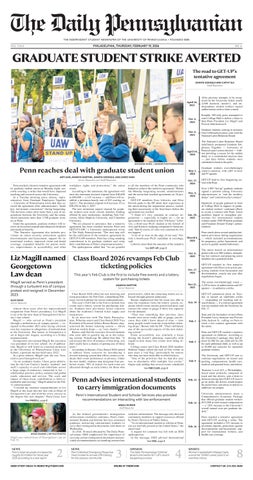
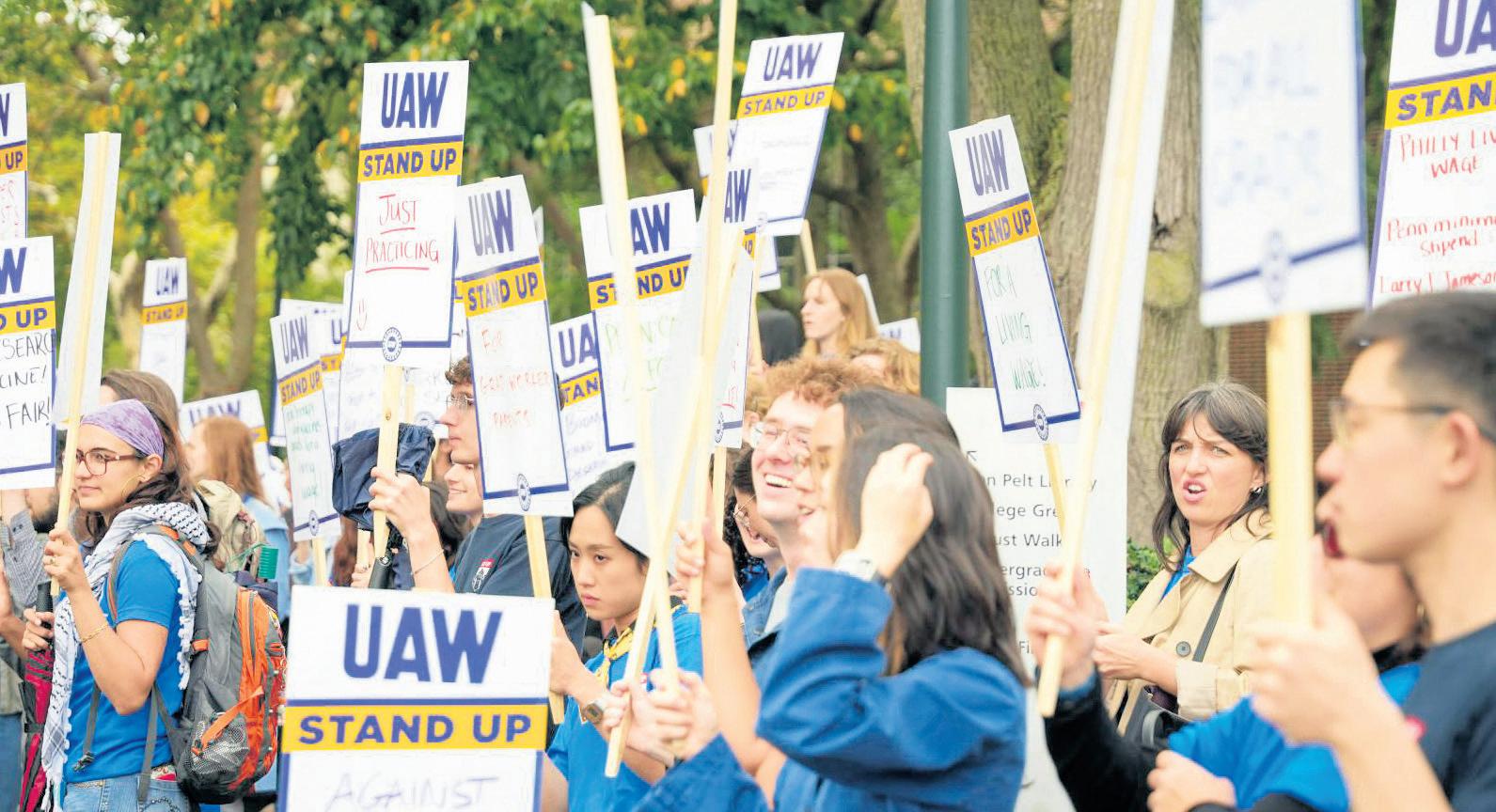
Penn reached a historic tentative agreement with its graduate student union on Monday night, narrowly averting a strike that would have impacted teaching and research across the University.
In a Tuesday morning press release, representatives from Graduate Employees Together — University of Pennsylvania wrote that they secured the agreement after administrators “made key, last-minute concessions” during bargaining. The decision comes after more than a year of negotiations between the University and the union, which represents more than 3,700 graduate workers at Penn.
Under the agreement, graduate workers will receive an increased stipend and enhanced childcare and medical benefits.
“The Tentative Agreement also includes provisions on union security, protections against discrimination and harassment, support for international workers, improved vision and dental coverage, expanded benefits for parent workers, improvements to accessibility, and other
Liz Magill named Georgetown Law dean
Magill served as Penn’s president through a turbulent era of campus protest and resigned in December 2023
ALEX DASH Senior Reporter
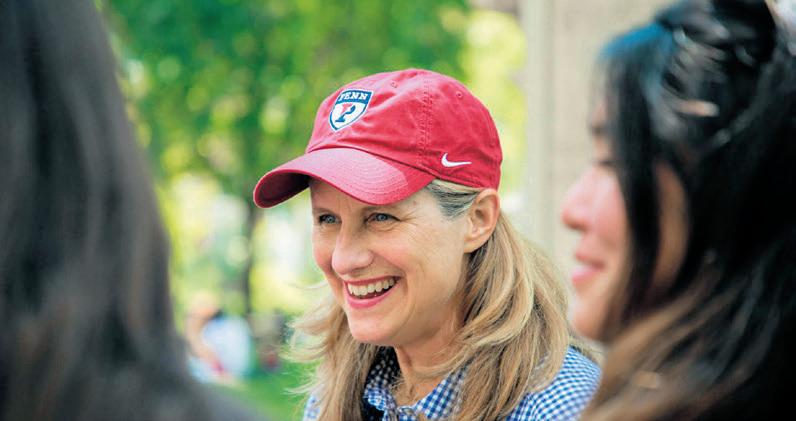
Almost three years after her unprecedented resignation from Penn’s presidency, Liz Magill is set to be the next dean of Georgetown University’s law school.
Magill — who served as Penn’s president through a turbulent era of campus protest — resigned in December 2023 after facing criticism over her response to allegations of antisemitism at the University. Her tenure at Georgetown is set to begin this August, according to a Friday announcement.
Georgetown also named Magill the executive vice president of its law school. As of publication, Magill is still listed as a tenured professor at the University of Pennsylvania Carey Law School, a position she has held since 2022. In a press release, Magill said she was “honored to join Georgetown Law.”
“As an academic leader, I have great admiration for the Law Center’s faculty, students’ and staff’s capacity to excel and contribute across a large range of endeavors connected to law — scholarship, practice, policy, national and global reach, education and service. The scale and impact of these many contributions is both remarkable and exciting,” Magill added in the Feb. 13 announcement.
“I extend my warmest congratulations to Liz Magill as she steps into her new role as Dean of Georgetown Law, and wish her every success as she begins this new chapter,” Penn Carey Law
See MAGILL , page 2
workplace rights and protections,” the union wrote.
According to the statement, the agreement will raise the minimum doctoral stipend from $40,608 to $49,000 — a 21% increase — and Penn will establish a minimum hourly rate of $25 starting on April 1. The minimum stipend will increase 3% to $50,470 on July 1, 2027.
The new minimum annual stipend for graduate workers now more closely matches funding offered by peer institutions, including Yale University, Johns Hopkins University, and Columbia University.
“We are pleased to announce that a tentative agreement has been reached between Penn and GETUP-UAW,” a University spokesperson wrote to The Daily Pennsylvanian. “The next step will be the ratification of the tentative agreement by GETUP-UAW members. Penn has a long-standing commitment to its graduate students and value their contributions to Penn’s important missions.”
The spokesperson added that “we are grateful
to all the members of the Penn community who helped us achieve this tentative agreement.” Before the Monday bargaining session, administrators and the union had reached agreements on 26 proposals.
GET-UP members Ezra Lebovitz and Elise Parrish spoke to the DP about their experience in the union during the negotiation process, including their uncertainty in the final hours before the agreement was reached.
“I think it’s very common in contract negotiations — especially in higher ed — for an agreement to be reached in this 11th hour,” Lebovitz, a third-year Ph.D. student at the School of Arts and Sciences studying comparative literature, said. “But of course, it’s also very common for it to not happen.”
“A lot of us were on the edge of our seat,” Parrish, a fourth-year Ph.D. candidate in sociology, said.
Lebovitz described the outcome of the tentative
See GET-UP, page 3
Class Board 2026 revamps Feb Club ticketing policies
This year’s Feb Club is the first to include free events and a lottery system for purchasing tickets
ANANYA KARTHIK Senior Reporter
Class Board 2026 rolled out new ticketing and event procedures for Feb Club, a monthlong February social tradition for senior undergraduates.
This year’s Feb Club is the first to include free events and a lottery system for purchasing tickets. Students have previously raised concerns about the tradition’s limited ticket supply and steep prices.
In an interview with The Daily Pennsylvanian, Wharton senior and Class Board 2026 Vice President of External Affairs Bruno Basner characterized the former ticketing system — which relied on weekly drops — as “very chaotic.”
Basner said that the structure favored students who were able to quickly log on to the ticketing system, TicketLeap. He added that that, “if you missed the first 10 minutes of that drop, you don’t really have a chance of getting any of those spots.”
According to Basner, Class Board 2026 aimed to address those concerns by introducing a revised ticketing system that allows seniors to indicate their event preferences in advance. Under the new model, students may designate four preferred events. 70% of tickets for each event are allocated through an early lottery for those who
prioritized it, while the remaining tickets are released through general admission. Basner emphasized that his team was able to take the responses from the lottery system, examine which events seniors prioritized most, and contact the venue to gauge if there was capacity for the demand.
“That was something that previous class boards were never really able to gauge, just because they didn’t know ahead of time — how many people would want the event before ticketing drops,” Basner told the DP. “That’s definitely one of the successful aspects of this new ticketing system.”
Event accessibility was similarly a focus during the board’s planning, especially with regard to how many free events were being offered.
College senior and Class Board 2026 member
Shikhar Gupta called the lack of free events in past years a “red flag,” particularly for seniors who may not have been able to afford tickets.
“One of the priorities that we had this year was to absolutely offer multiple free events,” Gupta said, adding that several events scheduled See FEB CLUB, page 2
Penn advises international students to carry immigration documents
Penn’s International Student and Scholar Services also provided recommendations on interacting with law enforcement
ANJALI KUMAR Staff Reporter
As the federal government’s immigration enforcement crackdown continues, Penn’s International Student and Scholar Services reiterated guidance instructing international students to carry their immigration documents with them on Wednesday.
In a Feb. 18 email obtained by The Daily Pennsylvanian, ISSS emphasized the importance of carrying certain immigration documents and provided recommendations on handling interactions
with law enforcement. The message also directed community members to support resources offered by Penn’s Division of Public Safety.
“As an international student or scholar at Penn, you are lawfully present in the United States,” the email read.
A request for comment was left with an ISSS spokesperson. In the message, ISSS advised international See ISSS, page 2
April 24, 2023
Oct. 4, 2023
Oct. 6, 2023
April 14, 2024
May 3, 2024
Oct. 17, 2024
Dec. 4, 2024
Jan. 28, 2025 March 6, 2025
8, 2025
17, 2025
After previous attempts to be recognized by the University failed, nearly 2,000 doctoral, master’s, and undergraduate student workers signed authorization cards to form a union.
Roughly 300 rally goers attempted to enter College Hall to deliver a letter to then-Penn President Liz Magill and Provost John Jackson Jr.
Graduate students seeking to unionize filed 3,000 authorization cards with the National Labor Relations Board.
The National Labor Relations Board indefinitely postponed Graduate Employees Together — University of Pennsylvania’s union election — without providing a reason for the sudden delay or a rescheduled election date — just days before students were scheduled to head to the polls.
Graduate workers overwhelmingly voted to unionize, with 1,807 in favor and 97 against.
GET-UP held its first bargaining session with Penn.
Over 1,300 “fed up” graduate students signed a petition asking University administrators to “end the needless delays” and “commit to a fair contract.”
Hundreds of people gathered in front of College Hall in support of graduate student workers’ continued efforts to secure a contract with Penn. Union members hoped to strengthen protections for international student workers under 1968 Wharton graduate and President Donald Trump’s administration.
Penn struck down several antidiscrimination provisions during negotiations — which included accommodations for pregnancy, police harassment, and access to gender-neutral bathrooms.
The union hosted an informational picket with over 500 workers, demanding fair contracts and preparing union members for a potential strike.
GET-UP reached its first tentative agreement with Penn on an article protecting students from harassment and discrimination, exactly one year after negotiations began.
The union overwhelmingly voted — 2,229 in favor of authorization and 187 against — to authorize a strike.
14
3
5
9
12
13
16
GET-UP announced plans on Tuesday to launch an indefinite strike — suspending all teaching and research duties — if a contract agreement was not reached with the University by Feb. 17.
State and city lawmakers wrote to Penn President Larry Jameson and Provost John Jackson Jr., calling on Penn to reach a fair contract agreement with the union.
Penn and GET-UP reached a tentative agreement on childcare. According to the University’s package, they had offered $2,500 for one child and $1,250 for each additional child, as well as up to $5,000 per semester for stipended graduate workers
The University and GET-UP met to continue negotiations on transit and parking, compensation, health care, medical and parental leave, and tuition.
Teamster Local 623, a Philadelphiabased union primarily composed of truck and bus drivers, sent a letter to Jameson stating that if GET-UP were to go on strike, the drivers would respect the picket lines and refuse to deliver to addresses on campus.
University administrators share a Comprehensive Economic Package that offered graduate student workers $115,506 in total annual compensation — a “20% increase in the University’s overall annual costs per graduate student.”
Penn reached a tentative agreement with GET-UP, averting a strike. The agreement included a 21% increase in minimum stipends, protections against discrimination and harassment, support for international workers, and health care coverage.
WEINING DING | SENIOR PHOTOGRAPHER
DANIYA SIDDIQUI AND CATHY SUI Staff Reporters
JESSE ZHANG | DP FILE PHOTO
was named dean of Georgetown Law on
The numbers behind Penn’s postgraduate fellowship scene
The Daily Pennsylvanian analyzed Penn’s matriculation to a selection of nine major programs alongside the statistics of peer universities
ARIEL ZHANG Staff Reporter
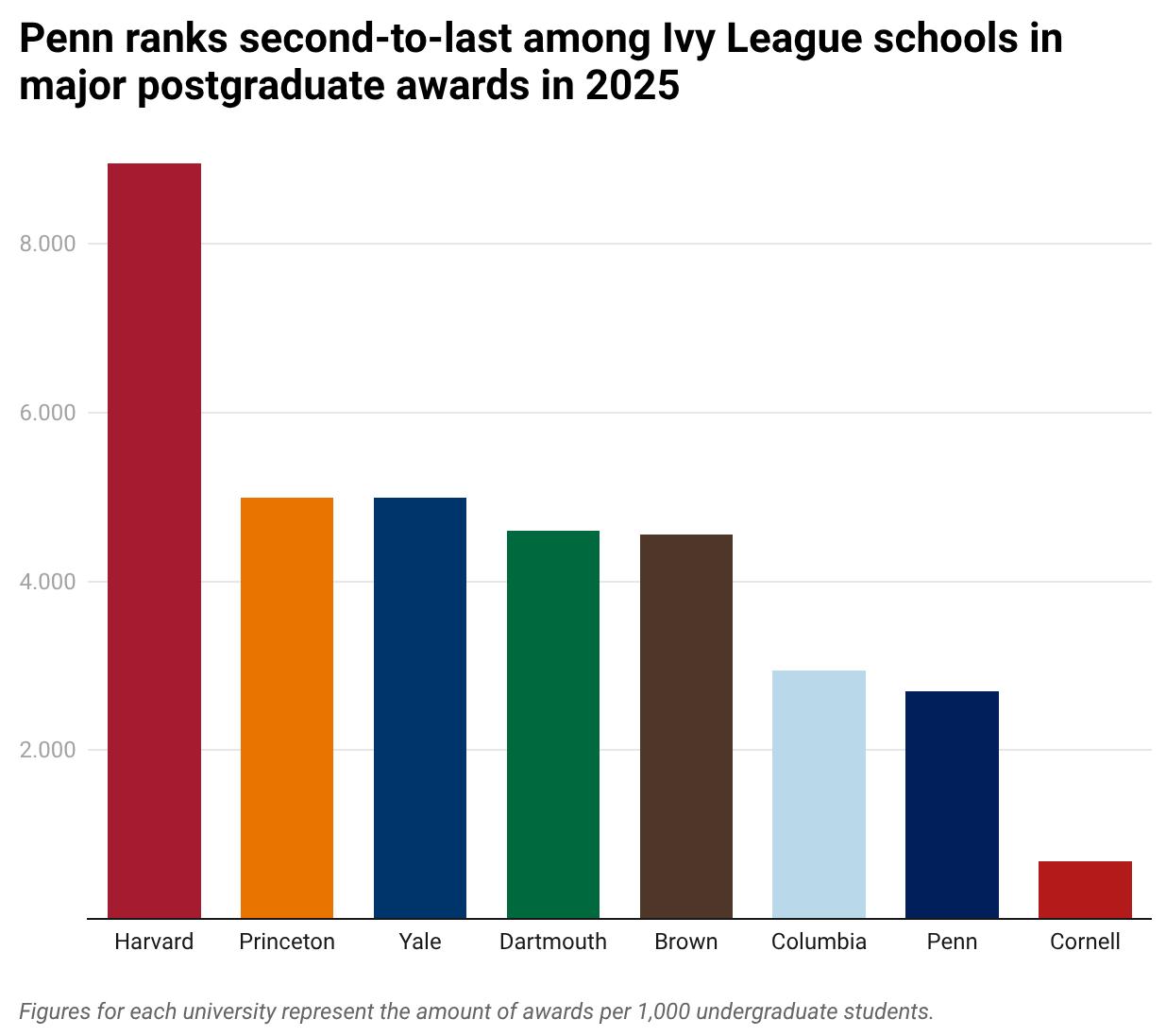
Penn has the second-lowest rate of students earning prestigious graduate fellowships among Ivy League schools.
After consulting Penn’s Center for Undergraduate Research and Fellowships, The Daily Pennsylvanian’s analysis accounted for nine programs: the Rhodes Scholarship, the Marshall Scholarship, the Gates Cambridge Scholarship, Schwarzman Scholars, the Harry S. Truman Scholarship, the Churchill Scholarship, the United States Fulbright Student Program, Knight-Hennessy Scholars, and the Luce Scholars Program.
According to previous fellowship data analyzed by the DP, Penn ranks second only to Harvard University in the total number of student recipients of these awards. However, when adjusted for the size of its undergraduate population, the University falls near the bottom of the list. In 2025, 27 Penn undergraduates received fellowships from the selected programs, compared with 31 at Harvard. For awards received per capita, Penn places second-to-last in the Ivy League — ahead of only Cornell University. The DP analyzed data from 2011 to 2025, representing 15 years of scholarship cycles. Not all scholarships were offered every year. The Schwarzman Scholarship, which sends students to Tsinghua University in Beijing, was first awarded in 2016, and the Knight-Hennessy Scholarship to Stanford University was first awarded in 2018. Selection for the Mitchell Scholarship, which funds graduate study in Ireland, was paused in 2024. Penn demonstrated a trend of slight growth
Penn reports increase in revenue, University assets
A Feb. 6 document indicated a $1.5 billion increase in revenue and a $1.3 billion increase in expenditures
MISHAL GEORGE Staff Reporter
Penn’s total net assets increased by roughly $2.9 billion in fiscal year 2025, according to a recently released financial report.
The Feb. 6 document indicated a $1.5 billion increase in revenue, a $1.3 billion increase in expenditures, and a nearly 400-student increase in enrollment.
The theme of this year’s report — “Illuminating the Endowment” — comes as a new federal tax on University endowments is scheduled to take effect in July. Compensation and benefits accounted for the largest share of spending — at just over $9 billion — which the report attributed to wage adjustments and staffing costs. Spending on compensation increased by nearly $621,000,000 in FY25.
“Penn’s largest expense category reflects one of its greatest assets: the faculty, staff, researchers, and clinicians who propel our mission every day,” a Division of Finance spokesperson wrote to The Daily Pennsylvanian. “The 7% increase in compensation expenses was driven primarily by rising employee healthcare
benefit costs and market-based salary adjustments within the Health System – trends we’re seeing across higher education and healthcare more broadly.”
The spokesperson emphasized proactive steps taken by the University to “moderate expense growth,” which included a “staff hiring freeze and reducing non-compensation expenses by 5% in Spring 2025.”
Penn ended the fiscal year with an $857 million increase in net assets from operations, which Executive Vice President Mark Dingfield wrote inspired the report’s theme.
“As we move from a year of financial strength into a period that requires ever-more-careful planning and navigation, it has never been more important that the University shed new light on the endowment’s structure as well as our strategy,” the report read.
The largest source of revenue growth was the University of Pennsylvania Health System, which marked an 8% increase in net patient service revenue “due to
permanent residents carry a copy of their green card.
higher patient volume and the addition of Penn Medicine Doylestown Health,” according to the Division of Finance spokesperson.
Other sources of revenue included philanthropy — which saw a 10% year-over-year increase — and tuition revenue — which the spokesperson described as “steady.”
Over FY25, federally sponsored research awards declined 4%, a change the spokesperson attributed to federal policy shifts.
Penn set a 5% spending target to “offset both annual spending and inflation.” The report described the target rate as “a balance between current and future needs.”
“Informed by long-term market returns and inflation, this rate aligns with the endowment’s investment strategy and the goal of preserving its purchasing power over time,” the document read.
The report’s focus on the endowment comes ahead of a 4% federal excise tax on endowment income set to begin July 1 — a move that University officials previously warned may significantly hinder Penn’s ability to support student financial aid, faculty research, and capital growth.
The 4% tax bracket applies to schools with a student-adjusted endowment between $750,000 and $2 million. Penn’s current endowment tax is derived from the 2017 Tax Cuts and Jobs Act, which only places a 1.4% tax on private universities with endowments of more than $500,000 per student.
Over FY25, the endowment returned 12.2% and grew to $24.8 billion. According to the spokesperson, the endowment follows a “5% annual spending policy designed to smooth short-term market volatility and preserve long-term purchasing power.”
The report explained that around 90% of individual endowment funds are donor-restricted. This means the use of those funds “must support the purpose designated by the original donor.”
Penn’s balance sheet showed total assets increased to approximately $44.19 billion, while liabilities increased to about $10.28 billion. Net assets grew to around $33.9 billion at the end of FY25, compared to the $30.95 billion the year prior.
Per the Division of Finance spokesperson, key areas of focus for the University in the future include rising costs, changes to student loan programs, evolving visa policies, federal research funding “uncertainty,” and the upcoming endowment tax.
Last month, Penn ordered all schools and centers to make a 4% reduction to certain expenditures, citing “uncertainty about how evolving federal policy changes might impact.”
“As we move forward, we do so with a clear understanding of the challenges ahead and with confidence in the foundations that support us,” Dingfield wrote.
or abroad.”
students and scholars traveling within Philadelphia to carry photocopies of relevant documentation, including an “unexpired passport biographical page,” a visa page, and up-to-date paperwork such as the I-20 and I-94 forms.
The email advised students on OPT — a temporary work authorization allowing F-1 visa students to work in the United States after graduating — to carry digital copies of their “EAD Card and OPT I-20,” and if applicable, a USCIS approval notice. ISSS also recommended that
The email specified that international students traveling outside Philadelphia should carry originals — not photocopies — of their immigration documentation.
The message also recommended international community members “remain calm, respectful and responsive” to requests if approached by law enforcement officers.
The email instructed international students to memorize and save the Division of Public Safety’s number and assured them that those services are “available at any time, on or off campus — including while traveling within the United States
ISSS also reminded students to be aware of immigration-related scams, specifically those that “demand payment” or request “personal information.”
“If a call feels suspicious, hang up and contact DPS,” the email read.
The recommendation is the latest in a series of guidance issued by ISSS amid a shifting immigration policy landscape.
In June 2025, the U.S. instituted a travel ban restricting entry for individuals from a dozen countries. At the time, Penn ISSS urged students located in countries affected by the ban to return to the U.S. as soon as possible.
over the 15-year period, with slight fluctuations from year to year. The Fulbright Program makes up the largest share of scholarships awarded to Penn students each year. On average, the program accounts for roughly half of the total fellowships awarded. In 2025, the Fulbright Program alone awarded 146 scholarships across the Ivy League, which is more than the other eight major scholarships combined. The Fulbright Program is a worldwide program supporting both graduate study and teaching positions in over 160 countries. Some scholarships fund study at a specific institution, while others support study within a particular country or region, including the Marshall Scholarship in the United Kingdom and the Luce Scholars Program in Asia.
CURF is responsible for advising Penn students interested in applying to these fellowships. In many cases, applicants must meet with a CURF advisor and undergo an internal nomination process before they can be selected as program finalists.
“CURF serves as the University of Pennsylvania’s information hub and primary support office for Penn students and alumni considering applying for major grants and fellowships,” a CURF spokesperson wrote to the DP. The spokesperson added that “CURF aims to demystify these opportunities, providing resources available to all undergraduate and graduate students and alumni.” Senior reporter Jack Guerin contributed reporting.
MAGILL , from front page
Dean Sophia Lee wrote to The Daily Pennsylvanian.
Of the several university presidents who resigned following campus unrest in fall 2023 — including at Penn, Harvard University, and Northwestern University — Magill is the first to return to a position of leadership in higher education.
Magill’s resignation from Penn came after mounting criticism over her remarks during a December 2023 congressional hearing on antisemitism on college campuses, where she testified alongside other university leaders.
When asked by Rep. Elise Stefanik (R-N.Y.) whether “calling for the genocide of Jews” violated Penn’s code of conduct, Magill responded that such speech would be “context dependent.” Her answer sparked a national outcry from donors, lawmakers, and members of the public.
“My testimony in Congress left people distressed, and it particularly did that for Jewish students back on the Penn campus,” Magill told Politico on Friday. “I take very seriously the response that people had to my testimony, and I regret that I conveyed a lack of compassion and care and good sense to those people.”
Earlier that fall, Magill also faced backlash after allowing the Palestine Writes Literature Festival to proceed on campus, which critics said included speakers with antisemitic views. She ultimately resigned from her role alongside then-University Board of Trustees Chair Scott Bok on Dec. 9, 2023.
“This is great news for Liz but even better news for Georgetown and the entire legal profession,” Bok wrote in a statement to the DP. “So many constitutional rights that we took for granted are now in question. At Georgetown she can play an important role both in important legal scholarship and in training the next generation of lawyers.”
Magill’s career in higher education spans multiple institutions. In addition to her Penn presidency, she has served as dean of Stanford Law School and provost of the University of Virginia. Nine months after resigning from Penn, she joined both Harvard and the London School of Economics and Political Science for research. In March 2025, she was appointed as a volunteer fellow at Branford College, one of Yale University’s residential colleges.
In December 2025, ISSS issued guidance to students affected by expanded federal restrictions on entry into the U.S., urging students to avoid nonessential international travel and to consult advisors before leaving the country.
Last month, hundreds of people gathered in Center City to protest the deployment of U.S. Immigration and Customs Enforcement officers to Minneapolis. Days later, Philadelphia councilmembers introduced legislation to limit the activities of federal immigration agents in the city.
“For non-emergency questions, contact your ISSS advisor,” the email read. “For urgent concerns, call DPS first.”
throughout the month do not require tickets.
Gupta, who described the month as an opportunity for students to “celebrate the end of their time at Penn with their friends,” highlighted that this year’s goal was to ensure there would be “no barrier to experiencing at least one Feb Club event.”
The board also increased the number of events with capacities exceeding 500 attendees, according to Basner.
“One of the difficult things for any class board is you’re servicing 2500 people, all with differing preferences, so we really tried our best when coming up with events,” he said. “Our intent is to give people the highest chance possible that they can attend Feb Club events and then try and make it as fair as possible.”
Gupta and Basner both pointed to policy
revisions with the goal of improving communication. Basner told the DP that a new Feb Club website was created to centralize event information, schedules, and ticketing information. The board also created a chat on the messaging app GroupMe to facilitate ticket resales between seniors.
Basner said that even if students originally failed to procure tickets, it is “not unthinkable” to purchase a ticket from the resale. He mentioned that the ability to still attend events after the conclusion of general admission was “one of the things that we were most concerned about well before we even started brainstorming.”
One senior — who requested anonymity for fear of retaliation — said her “frustration” this year stemmed from the difficulty of attending events with friends under the new ticketing system. She told the DP that the ticketing structure often required students to “pick and choose between the major events that every single person would want to go to.” While the senior called the free events “so
cute” — referencing a “Puppy Party” and an arts and crafts event — she clarified that the large events are what “every person … want[s] to go to.” She suggested that future Feb Club organizers should prioritize fewer large-scale events with broader access rather than daily programming.
“We get the concept of having an event every single day, but we would rather have a few really good events that every single person or majority of people would be able to have access to,” she said.
Gupta said expanding accessible feedback channels for seniors will be a key area of focus moving forward, while Basner suggested future class boards could continue exploring ways to increase access and capacity.
“We’ve definitely made steps in the right direction, but there’s always, always ways to improve that,” Basner said. “I challenge next year’s class board to figure out a way to make it even more accessible and have people have even more fun during Feb Club.”
JEAN PARK | DP FILE PHOTO
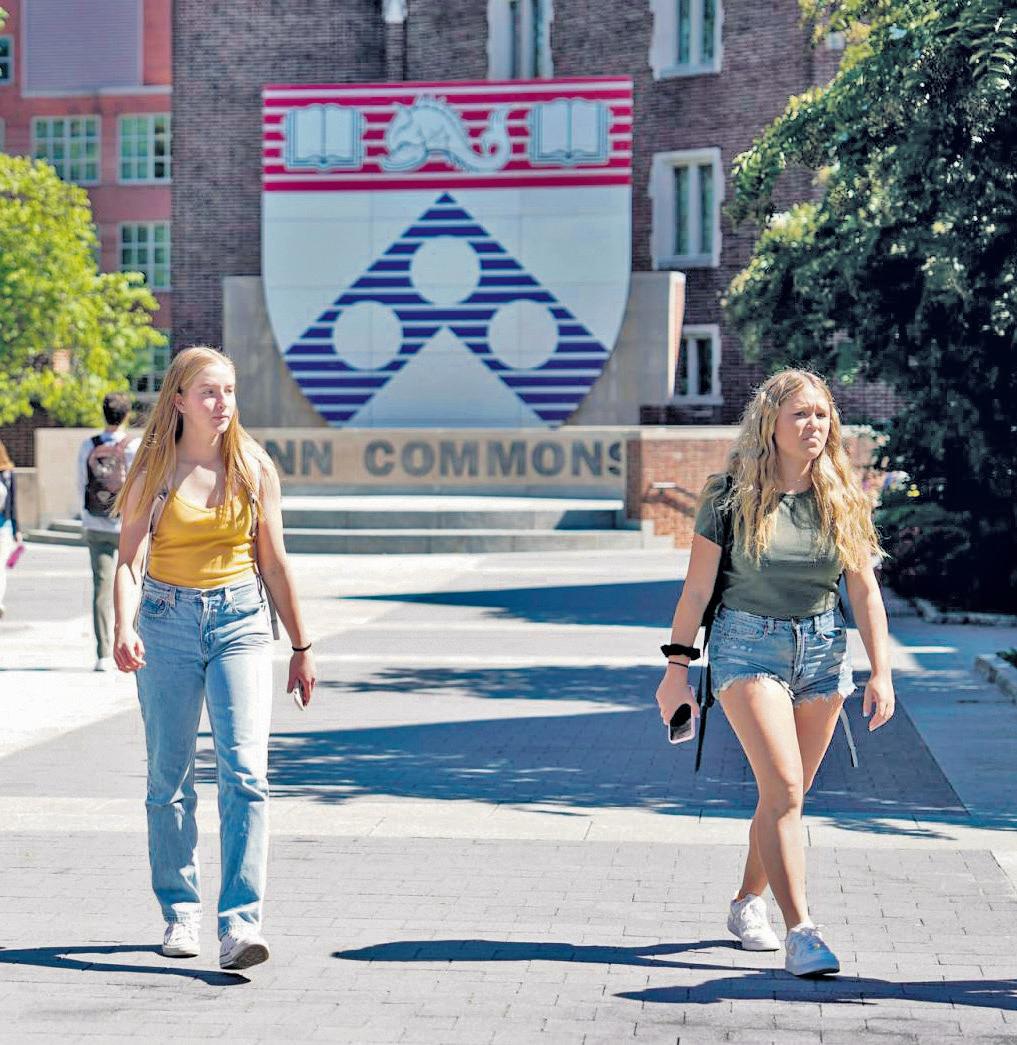
Penn Commons pictured on Feb. 25, 2025.
FEB CLUB, from front page
ISSS, from front page
ANA GLASSMAN | DP FILE PHOTO
Students pictured walking around Penn’s campus on Sept. 14, 2022.
Penn MERT hosts annual campus CPR training
The initiative expanded beyond the University for the first time, drawing over 1,000 attendees
IRENE
ANTÓN PIOLANTI Staff Reporter
Penn’s Medical Emergency Response Team hosted its fourth annual campus-wide CPR training event on Sunday.
MERT members held “rapid five-minute trainings” where students, faculty, and staff could learn how to perform hands-only CPR at 14 locations across Penn’s campus. The Feb. 15 initiative expanded beyond the University for the first time and exceeded last year’s reach with a record participation rate of over a thousand attendees.
In an interview with The Daily Pennsylvanian, MERT Chief Raymond Tabak explained that these quick CPR trainings can “triple the chances of someone being resuscitated.”
“The chance of someone surviving an out-of-hospital cardiac arrest without any sort of intervention is very, very low,” Tabak said. “This quick five-minute training can save somebody’s life, not only here, but all over the world.”
Josh Glick, the medical director of MERT and the mobile CPR project — and a professor of Clinical Emergency Medicine at the Perelman School of Medicine — told the DP that cardiac arrest occurs when the heart malfunctions and stops beating unexpectedly as a result of factors such as “overdose, trauma, drowning, or the complications of other medical conditions like liver disease.”
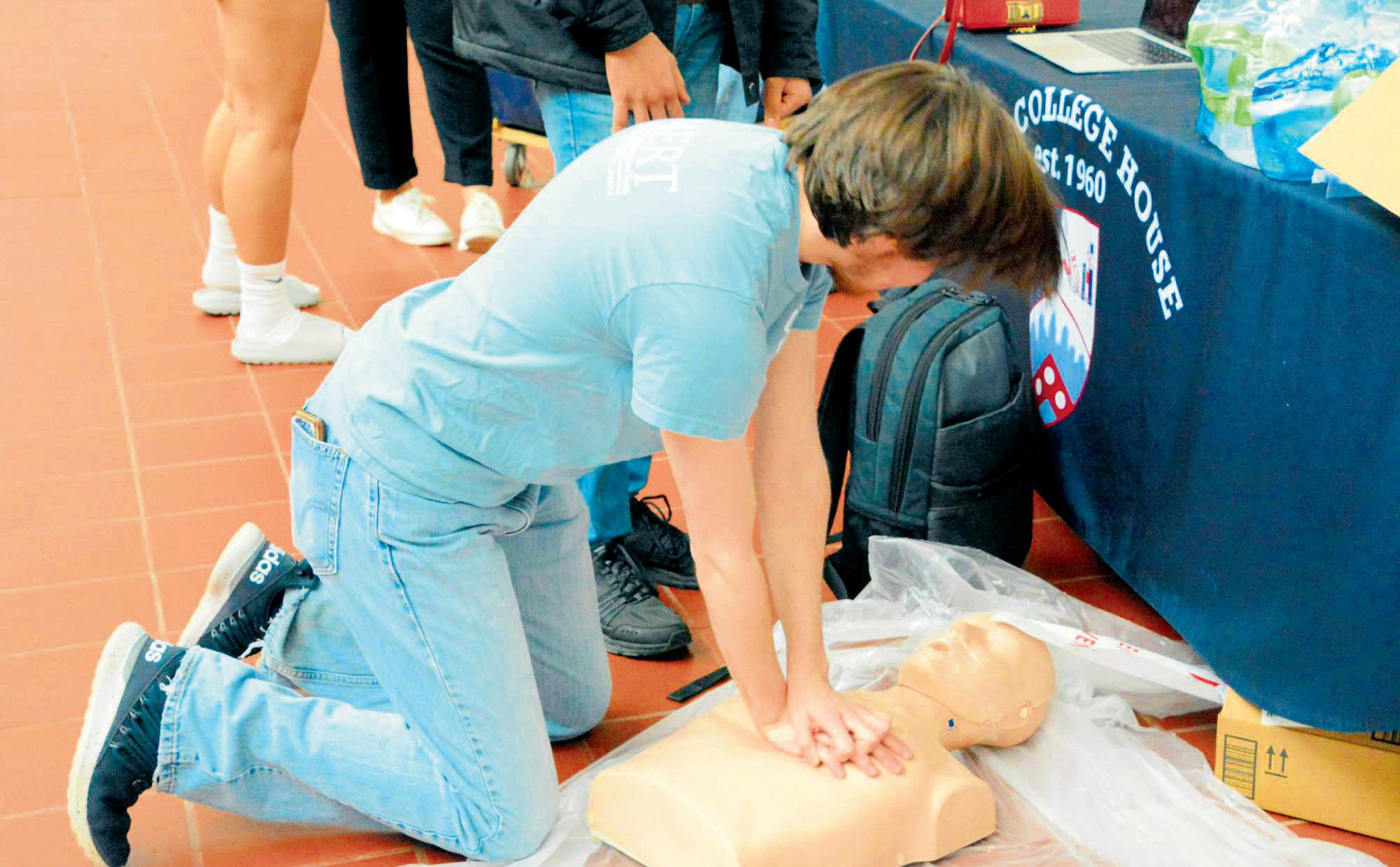
At the event, attendees were taught how to perform compressions — at a speed of 100 to 120 beats per minute — using a mannequin to simulate an unconscious individual.
“Three things: push hard, push fast, in the center of the chest,” Glick said. “If you can remember those three things, you are already doing CPR fairly effectively.”
College junior José Méndez Cruz, MERT’s scheduling officer, explained that the team — alongside many other
CPR training programs — uses the “memorable” song
“Stayin’ Alive” by the Bee Gees to help students match the necessary CPR rhythm.
Méndez Cruz spoke about his motivation for joining MERT and gaining exposure to the medical field.
“A few weeks before the application, one of my friends was diagnosed with a congenital heart defect, and they had to perform CPR on him,” he said, adding that this experience motivated him to “learn about emergency medicine and techniques.”
College junior and MERT co-CPR officer Ananya Madhira explained that students were initially reluctant to stop by the training sessions but became “very excited to learn about” CPR once they came to the stations and heard “a little bit about why it’s important.”
College senior JoAnna James, who completed the program’s short training at 1920 Commons, described her experience simulating an emergency.
“I would check for their pulse and if they’re breathing,” she said. “Then I pretended to request for someone to call 911 and to bring over an AED.”
College junior David Kerendian, who had experience with CPR training from high school, said he was glad to have a “refresher” after his workout at Pottruck Health and Fitness Center — where one of the MERT trainings was held.
“It was incredibly accessible,” he said. “The people staffing the CPR were very friendly and very welcoming.”
Glick explained that the amount of people who experience cardiac arrest and receive CPR from a bystander is only 28% in Philadelphia — which is less than the national average of about 40%.
This year, in collaboration with the American Heart Association, MERT expanded the event beyond Penn’s
New federal funding bill offers ‘stability’ for Penn Medicine
The legislation, signed into law earlier this month, offers temporary reassurance to biomedical researchers by preserving pandemic-era flexibilities
NORA GARG Staff Reporter
Congress passed a federal appropriations bill this month extending Medicare telehealth coverage and prolonging hospital-at-home programs — a move that reiterates the federal government’s commitment to supporting biomedical research, according to administrators at Penn Medicine.
House Bill 7148, signed into law on Feb. 3, offers temporary reassurance to biomedical researchers by preserving pandemic-era health care flexibilities. Still, experts told The Daily Pennsylvanian that broader funding questions remain amid ongoing federal budget negotiations.
In a statement to the DP, Perelman School of Medicine Dean Jonathan Epstein wrote that the bill “provides welcome stability” for the biomedical research community and “reinforces the longstanding federal commitment to scientific progress.”
He added that the bill “allows investigators here at Penn, and across the country, to move forward with greater confidence in the near term.” Epstein also cautioned about uncertainty surrounding federal research funding amid “ongoing budget and policy discussions,” stating that is “why continued engagement and advocacy are essential.”
One of the bill’s most immediate effects is the extension of Medicare telehealth flexibilities first introduced during the COVID-19 pandemic. Under the legislation, Medicare will continue reimbursing telehealth visits for a broader group of patients, including many living in urban and suburban areas who previously did not qualify.
Christina O’Malley — Penn Med’s head of digital and emerging care transformation — told the DP that the extension helps prevent patients from losing access to care.
“The telehealth waivers that were extended are actually allowing Medicare to continue paying for telehealth visits in an expanded capacity,” O’Malley said.
Prior to pandemic-era changes, Medicare generally limited telehealth coverage to patients in designated rural areas or those physically located in medical facilities.
According to O’Malley, Penn Med had been preparing for what she described as a potential “telehealth cliff” if Congress failed to act.
“If that funding were to go away, most Medicare patients — anyone that’s just at home in the suburbs or in the city — would not have been able to have access to a telehealth visit,” O’Malley said. At Penn Med alone, telehealth has scaled dramatically since 2020 to “two and a half to three million patients served,” according to O’Malley.
The appropriations bill also extends the federal
Acute Hospital Care at Home waiver, which would allow hospitals to deliver inpatient-level care in patients’ homes using remote monitoring and inperson visits.
O’Malley said the longer timeline is already influencing institutional strategy.
“Now that we have seen this extension through 2030, it’s really supercharged our ability to launch with confidence,” she said.
Penn Med is currently planning to launch its hospital-at-home program in April. Previously, the health system had delayed implementation due to “continued ambiguity around the hospital at home waiver.”
“The model could also expand system capacity,” O’Malley added.
“It’s definitely increasing access to care, because we’re actually adding more net beds to our health system availability,” she said. “That means less patients waiting, more patients getting fast access to care.”
The appropriations package also includes provisions targeting pharmacy benefit managers, the intermediaries that negotiate prescription drug prices.
For research institutions like Penn, Epstein emphasized that predictability in federal support remains critical for long-term planning.
Epstein emphasized that Penn Med is “proud to be among the nation’s top recipients of federal research support year after year,” but the “breakthroughs,” including CRISPR gene therapies and personalized cancer treatments, will require “sustained, predictable support that our teams can rely on as they plan their studies, hire teams, and conduct clinical trials.”
In February 2025, the NIH proposed a funding cut that could cost the University $240 million. While a judge temporarily halted the changes after Penn and 12 other universities brought a lawsuit against the NIH, the cap on indirect costs left the future of federal funding at Penn uncertain.
The following month, the Perelman School of Medicine paused institutionally funded pilot grants. The grants ranged between $25,000 and $200,000 and were designed to help researchers gain preliminary data to establish the importance of their field of inquiry before gaining more substantive funding.
O’Malley also expressed that the extended programs could eventually become permanent.
“I’m really optimistic,” O’Malley said. “With additional years and additional data, there’s going to be more knowledge available to draw from and more enthusiasm to pass a permanent bill.”
campus to multiple locations across Philadelphia and hopes to push it farther in 2027. Partnering universities — including West Chester, Villanova, Temple, and Drexel — joined in a broader effort to “train as many people on as many campuses as possible,” according to Glick.
The Fire and Emergency Services unit, which is a part of the Division of Public Safety, supported MERT in this
GET-UP, from front page
agreement as “tremendously exciting,” adding that union members were “stunned.”
“This is one of those things that makes a really material and concrete difference in people’s lives,” he said.
According to GET-UP’s website, a strike would have meant that graduate workers holding teaching and research positions would suspend their work responsibilities — including grading, leading recitations, holding office hours, and conducting certain research activities.
Workers with research appointments would have also refrained from starting new experiments and attending lab meetings for the duration of the strike.
The agreement follows mounting pressure on the University from local politicians, faculty, and students to finalize a contract before the Tuesday strike deadline.
Members of the City Council — along with the Pennsylvania House of Representatives and Pennsylvania Senate — urged the University to meet the union’s demands in letters to Penn President Larry Jameson and Provost John Jackson Jr. The lawmakers argued that Penn, as the city’s largest private employer, has the responsibility to treat its
employees with “respect” and “dignity.”
Councilmember Nina Ahmad, who signed a Feb. 10 letter, wrote that Penn should prioritize “a fair contract” and “good-faith bargaining,” in a statement to the DP.
“As a former graduate student at the University of Pennsylvania, I understand firsthand the essential work graduate student employees do every day to keep classrooms, labs, and research moving,” Ahmad added.
Councilmember Jamie Gauthier, whose district includes University City, also publicly supported the union. In a statement to the DP after the announcement of the tentative agreement, Gauthier wrote that she was “glad” the union “will now receive the fair contract every worker deserves.”
A collection of undergraduate students and Penn’s chapter of the American Association of University Professors similarly expressed solidarity with GET-UP.
Representatives from GET-UP overwhelmingly authorized a strike in November 2025, giving union leadership the authority to call a work stoppage if negotiations failed. Last month, the union announced it would suspend all teaching and research duties if the University did not reach a contract agreement by Feb. 17.
The agreement is subject to a ratification vote by graduate workers next week. If the agreement is ratified, it will serves the contract for graduate employees at Penn until its expiration on June 1, 2028.
HANNAH KANG | STAFF PHOTOGRAPHER
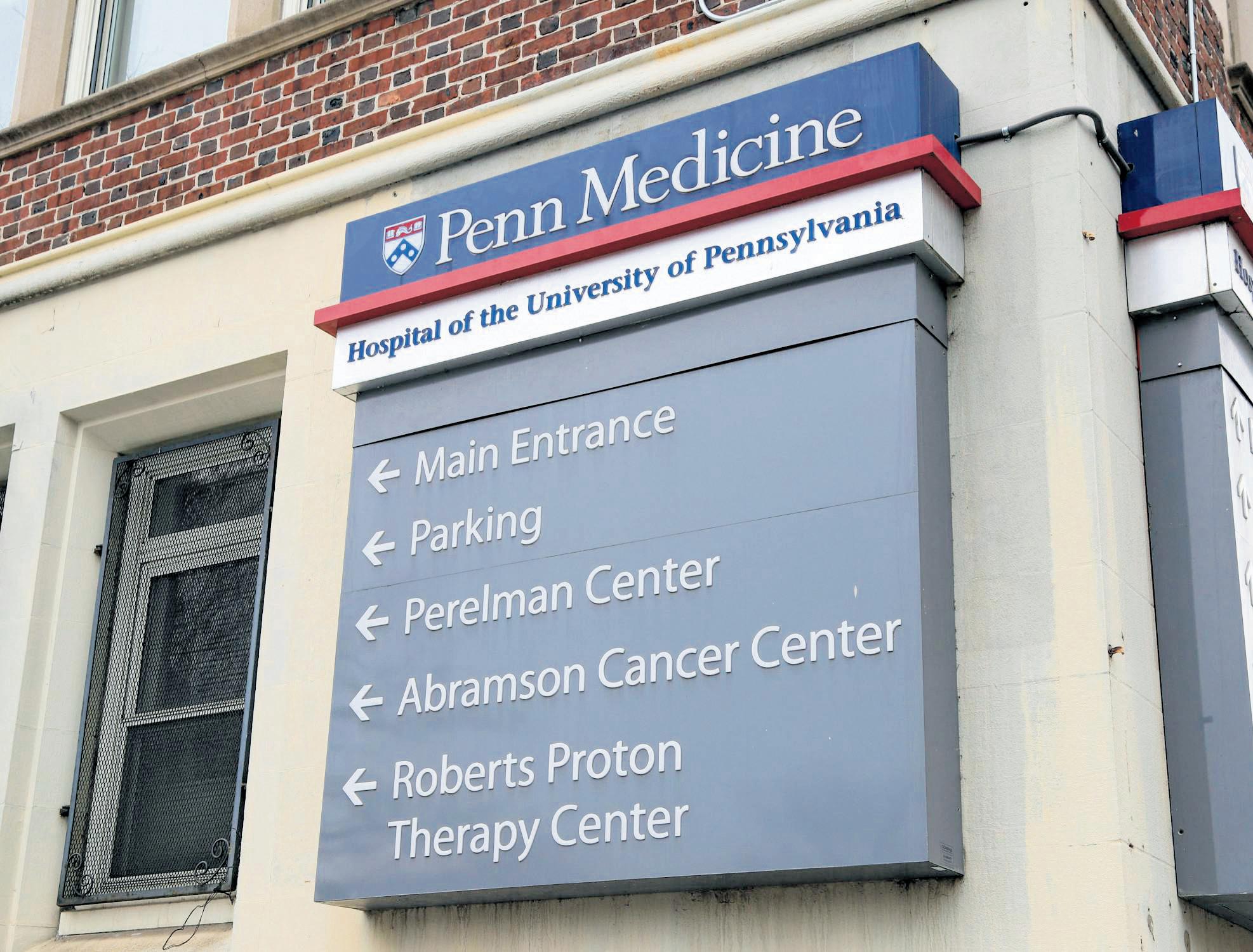
The Hospital of the University of Pennsylvania pictured on Feb. 10.
SYDNEY CURRAN | SENIOR PHOTOGRAPHER Students participated in CPR training on Feb. 11, 2024.
training initiative.
“We’ve been involved with the MERT since the beginning, since 2006,” Eugene Janda, chief of Fire and Emergency Services at Penn, said. “We support them in every way we can — it’s a great bunch of young students that I have always admired personally because of what they give to the campus.”
Editorial
Late into Monday night, Penn’s graduate student workers entered the final hours of negotiations with the University administration, working to reach compromises on several unresolved demands. Minutes before the Feb. 17 strike deadline, the two parties reached a tentative agreement. Penn made compromises on the key issues of compensation, health insurance, and union security, sparing the University from a strike that would have severely disrupted daily activities across our campus. This victory for Graduate Employees Together — University of Pennsylvania is a victory for all of us. In their tireless efforts to achieve the contract they deserve, GET-UP showed us the power of solidarity and collective bargaining. This agreement didn’t come easily. It follows 17 months of bargaining, 46 meetings, and hundreds of proposals exchanged between GET-UP and the University. At the end of it all, we are thrilled that our fellow students have secured the benefits necessary to make such essential contributions to our campus. But this agreement does not erase Penn’s initial attempts to quell GET-UP’s activism, nor its troubling history of unionbusting.
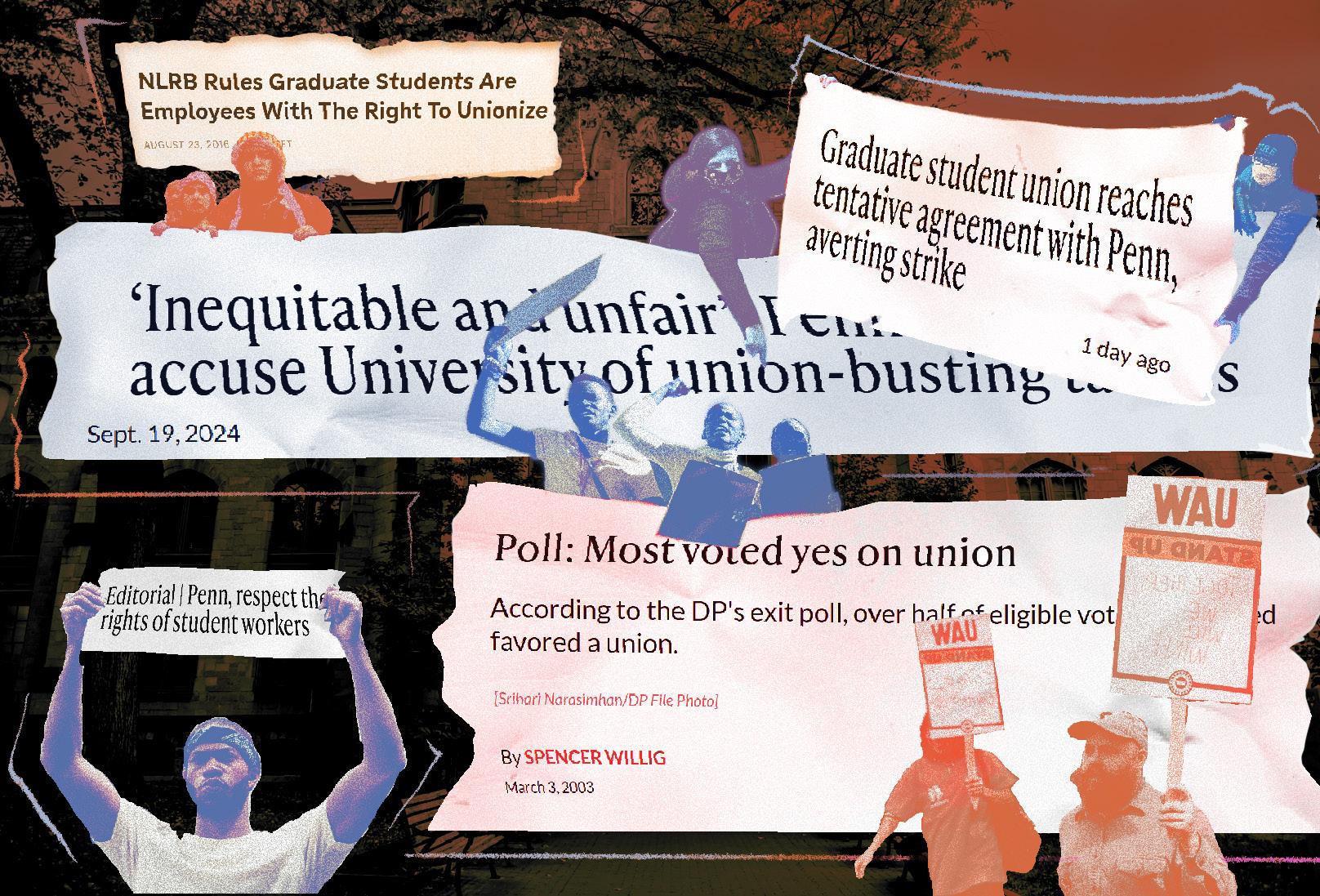
GET-UP first held a vote to unionize in 2003, and The Daily Pennsylvanian reported that 60% of voters favored forming a union. But soon after, Penn filed an appeal with the National Labor Relations Board, arguing
There comes an inevitable point in every student’s career when you find yourself enrolled in the most mind-numbing lecture of your life. It is almost always at 8 a.m., in the dingy basement that is Meyerson Hall, with a professor methodically clicking through slides that seem to have been untouched for at least a decade. At some point, more out of boredom than rebellion, you decide to upload the slides into ChatGPT.
“Here are comprehensive notes, organized as an interesting story!” the bot writes back enthusiastically. In front of you lie the key concepts, practice questions, and even analogies tailored specifically to you.
The discovery feels almost illicit. Here is a way to learn in 20 minutes what the registrar has scheduled 90 to deliver. You have optimized for efficiency and succeeded. Next Monday morning, you could sleep in. Maybe even grab the new banana shortbread latte at Stommons instead. When the “efficient” strategy delivers the same 4.0, the guilt dissolves quickly under the sweetness of caffeine and an extra hour in bed.
At several points during my time at Penn, I have hit this crossroad. For a long time, I felt guilty. Here I am at a university that prides itself on world-class academic excellence, yet I find myself calculating whether the classroom is the highest return on my time. On this campus, time is treated like capital, best deployed towards research, recruiting, or the next internship.
When a lecture begins to feel like a lowyield investment for the same outcome, this calculation feels harder to ignore. Penn professors, like many across higher education, have attempted to respond. In the College of Arts and Sciences and the Wharton School, timed attendance codes are now common which is the first time any of us learn collaborative teamwork. One of my classes recently even implemented location tracking precise enough to confirm my physical presence in the room. These systems enforce bodies
| GET-UP’s victory was long overdue
that the election never should have been authorized, and indefinitely sealing the results until a decision could be made. In 2004, a newly majority-Republican NLRB ruled that graduate students were not to be considered employees. Through this litigation, Penn had effectively subdued graduate student unionization. The movement remained dormant for a decade until the NLRB decision was reversed in 2016. Graduate student workers reignited the fight for union recognition, but Penn made every attempt to delay a vote. Administrators even sent emails to graduate students discouraging them from voting in favor of unionization. Graduate students finally won their right to unionize in 2024, a year after Penn refused to recognize them voluntarily.
In recent months, Penn administration has attempted to intimidate graduate students as they fight for a contract. The Office of the Provost’s FAQ page warned that striking may affect graduate students’ academic standing, federal aid, or even visa status for international graduate students. These statements were ripped right from the anti-union playbook, working to convince graduate student workers that it would be in their best interest not to organize.
The University also emphasized that in the event of a strike, undergraduates would be expected to attend class, even if that meant
crossing a picket line. The vice provost’s Teaching Continuity Plan also encouraged faculty to take over the responsibilities of teaching assistants during a work stoppage.
Some departments even attempted to recruit undergraduate students as strikebreakers. While Penn eventually made the right call, they tried to subdue a strike in many ways besides simply meeting GET-UP’s demands.
These anti-union tactics are not unique to GET-UP’s struggle. Over the past decade, the University has consistently fought against the collective bargaining efforts of its employees. In 2021, Penn Museum workers filed to form a union, claiming they had been subjected to unsafe working conditions and unfair wages. In response, Penn sent out a slew of emails to museum staff encouraging them to vote against the union. In 2023, Penn Medicine launched a similar campaign against the unionization of its residents and fellows. Around the same time, the University also worked to delay a union election for resident advisors. Now, almost three years later, we can finally applaud the fact that our University has met the demands of its employees and is taking steps toward a more equitable campus. Still, Penn is not the reason we got this outcome. That credit belongs to all those in the Penn community who spearheaded a campaign of collective action unlike anything the University has seen in years.
in seats. They do not answer the more uncomfortable question: Why are students evading lecture in the first place?
It’s tempting to blame it on generational laziness or shrinking attention spans. The harder truth is far more utilitarian. For centuries, lectures have relied on an antiquated method in which information was scarce and professors were its primary gatekeepers. But today, large language models have not just made information abundant but also increasingly personalized. If a lecture simply regurgitates what can be read off slides or in the textbook, rational students will do what markets train them to do: optimize. The question then becomes: Is it feasible to create lectures chatbots cannot replace?
Last spring, I took professor Philip Gehrman’s three-hour-long Introduction to Experimental Psychology course. By any measure, a large evening class should have tested my TikTok-conditioned endurance.
But on the first day, Gehrman asked more than 200 students to write personal introduction notes and later responded to each one individually. Instead of projecting slides, he filled chalkboards, interfacing research on memory and learning directly into the way he taught. He would pause mid-lecture and force us to wrestle with a question before clarifying the answer. I left those evening lectures arguing about the implications of memory reconstructing or recording experience, thinking longer than any artificial intelligence summary would have required. ChatGPT never crossed my mind as a substitute because the lecture was doing something fundamentally irreplaceable. More than just teaching me psychology, it was teaching me how to think about psychology.
This spring, I have felt this intellectual friction yet again in AI In Our Lives: The Behavioral Science of Autonomous Technology with professor Stefano Puntoni. He intersects his research directly into
Faculty and staff extended unwavering support to GET-UP, with hundreds pledging not to take up the responsibilities of striking graduate students in the event of a work stoppage. Undergraduate students signed an open letter to administration, urging them to agree to a fair contract. The support even extended citywide, with local politicians authoring statements of support urging Penn to meet GET-UP’s demands. We hope this agreement marks a new chapter in Penn’s engagement with and in response to campus unions. At the same time, we encourage our entire community to remember what led to this historic moment. Remember the many protests and actions led by graduate student workers. Remember Penn’s strong attempts to silence them and their stronger pushbacks. While it might have been the University that made the final call in this decision, it was all of the members of our community that forced its hand.
Editorials represent the majority view of members of The Daily Pennsylvanian Editorial Board who meet regularly to discuss issues relevant to the Penn community. This body is led by Editorial Board Chair Jack Lakis and is entirely separate from the newsroom. Questions or comments should be directed to letters@thedp.com.
his teaching, bridging historic underpinnings with contemporary findings. Our assignments require us to reflect on how we prompt artificial intelligence rather than simply use it. Guest speakers contextualize the theory within real industries. I always leave the lecture with a notepad scribbled not with copied bullets, but with questions I’d previously not known how to formulate.
Both these lectures have affirmed to me that the problem is not the lecture as a concept. Rather, it is in its execution. To truly serve as purposeful now, lectures should be metacognitive frameworks on how to think and ask questions in the first place, while capitalizing on the increased modern-day value of in-person collaboration. What Penn and its fellow Ivy league universities must do now is serve as the frontier of this academic remodeling. We need to invest in our professors, not confining them to research excellence but empowering them to develop modern, experimental forms of lecture pedagogy. Models like the United Kingdom’s Teaching Excellence Framework or the University of British Columbia’s Teaching track can serve as useful formal blueprints. This would enable us to build curricula developing the interdisciplinary thinking and human judgment needed from the next generation.
If we make students genuinely excited to enter the lecture hall, if we engage them with research and the experience of thinking in real time with others, we will not need location tracking to keep them in their seats. They will choose to be there because the classroom is offering an experience that cannot be optimized away. This is the only way we can keep universities alive in the age of artificial intelligence.
DIYA CHOKSEY is a College sophomore from Mumbai, India studying cognitive science. Her email is dchoksey@sas.upenn.edu.
JULIA WANG | SENIOR DESIGNER
SANJANA JUVVADI | SENIOR PHOTOGRAPHER
Senior columnist Diya Choksey argues that if a chatbot can outperform a lecture, the problem is not AI but the design of the modern lecture hall.
Penn is scamming its nursing students
THE VITAL SIGNS | Why Penn should subsidize clinical travel
responsible for arranging their own transportation to and from their clinical site and for covering the cost of travel.
While the University does offer some exceptions to this policy, it’s only for select clinical sites, and they only subsidize the Lyft cost for students traveling in groups of two or more. If students can’t abide by Penn’s strict criteria, they have to foot the bill themselves.
The out-of-pocket costs for Penn nursing students are already exceptionally high. Students are expected to pay for a stethoscope, a wristwatch with a second hand, and multiple pairs of scrubs, embroidered with their name and the Penn Nursing logo, all on their own. Layering transportation costs onto these required expenses feels less like necessity and more like neglect.
to continue going to our schooling,” she shared. “What about people who are low-income? Having to pay for transportation, whether that be Uber or even SEPTA, makes it harder.”
While SEPTA does offer transit to some clinical sites, it is widely known to have significant reliability issues. Only about three-quarters of SEPTA bus routes meet the agency’s own standard of arriving on time at least 80% of the time. With clinical rotations having strict arrival times and fees totaling hundreds of dollars for showing up late, students literally cannot afford to take the inconsistent SEPTA and risk being late to clinical. And when it comes to safety, do you really want to take SEPTA at 5:30 a.m.? Yeah, me neither.
nursing students themselves can’t even choose their clinical placement site. Regardless of the clinical site distance — whether as far as Einstein Medical Center or as close as Pennsylvania Hospital in Center City — transportation to and from clinical sites should be funded by Penn. Without proper funding, Penn is taking advantage of nursing students’ finances, when all they are looking for is an education.
undergraduate years. While some sites are conveniently located right next to campus, such as the Hospital of the University of Pennsylvania or the Children’s Hospital of Philadelphia, other clinical placements have students traveling 10 miles over 20 minutes away, as early as 5:45 a.m., to promptly arrive for their 6:30 or 7 a.m. rotation.
While it’s no issue for registered nurses to commute early or far once they’re finally working, shouldn’t nursing students — who are already paying upwards of $90,000 per year in tuition — at least have their travels to and from clinical paid for by the University?
The Nursing School explicitly states that students are
Many nursing students echo this sentiment. Regarding transportation to and from clinical, Nursing junior Yiwen Zhan stated, “I don’t understand why we have to pay for transportation. We already have to pay for scrubs, textbooks, and stethoscopes, so the transportation fee just makes it worse.”
The costs of these needed items can easily exceed hundreds of dollars: a price all nursing students are expected to shoulder. Penn prides itself on professional preparation, yet fails to ensure that preparation is financially accessible to all.
Nursing junior Endy Huynh added to this, arguing that subsidizing transportation would greatly improve the clinical experience. “I think there should be reimbursements overall, no matter how far or close the location is, because it makes it more accessible for us students
The prices of transportation to and from clinicals are not just one-time purchases, either. Nursing junior Claire Zhou says her average Uber ride just one way to her clinical at Belmont Behavioral Health is $20, which totals to around $40 for a single day of clinical. With senior nursing students having clinicals twice a week, that’s over $1,000 at the end of the semester that Penn won’t reimburse.
Perhaps Penn funding clinical transportation for every single nursing student is too much of an ask. I mean, surely a $24.8 billion endowment is way too little to accommodate nursing students’ travels, right? While I am not necessarily suggesting that it’s unreasonable for students within one clinical group to share an Uber or Lyft to their site together, it’s unacceptable for Penn to pick and choose which destinations are worthy of subsidies when
Penn needs a service requirement
FOR PETE’S TAKE | Where Penn falls short of its founding vision
Penn’s curriculum is intended to train students to take part in the world rather than admire it from a distance.
Whether shaping markets, building systems, treating patients, arguing cases, or imagining the future, Penn pushes its students to turn knowledge into real-world impact. Benjamin Franklin himself was adamant in his belief that students’ instruction should focus on the “useful” knowledge, building practical skills for fields such as commerce, medicine, and law. But usefulness, as Franklin understood it, was never meant to end at individual career success. His vision for Penn — and
education more broadly — also stressed the importance of cultivating strong community members and upstanding citizens.
If Penn is to fully honor Franklin’s vision, community engagement must be treated as a core part of the undergraduate experience — not an optional add-on.
Despite Penn’s emphasis on community engagement, undergraduate participation in community service is surprisingly sparse. According to the Netter Center for Community Partnerships, just over 1,800 students across all of Penn’s campus report participating in community-service-focused coursework.
It’s not as though community service isn’t valued by Penn students, either. Admissions data from the Class of 2029 suggests that nearly all Penn students (a whopping 93%) partook in some type of community service during their high school years.
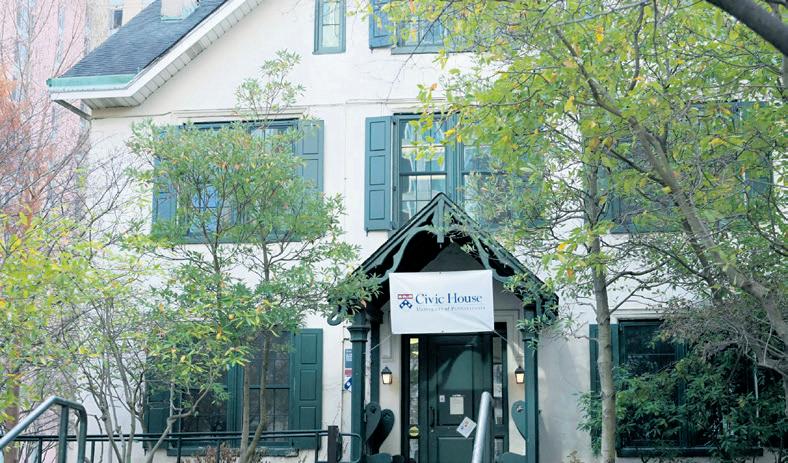
This decline in community engagement is not the result of a lack of opportunity. Each semester, Penn offers dozens of service-focused ABCS courses in a variety of disciplines. The University also coordinates numerous service-focused programs, hosts formal organizations such as the Netter Center and Civic House that foster community engagement, and supports dozens of student-led community-service-oriented clubs.
Instead, participation in community service wanes as students navigate an undergraduate experience shaped by demanding coursework, time-intensive extracurricular involvements, and accelerated recruiting timelines.
Together, these pressures push students down a path that too often relegates community service — particularly when optional — to an afterthought. In order to address this gap, Penn must implement a graduation requirement that ensures all undergraduates engage in meaningful community service during their time on campus.
Regardless of your undergraduate school, all Penn students are required to complete a critical writing seminar, explore the liberal arts, and complete coursework in quantitative reasoning. These requirements exist because Penn believes they are essential to our development as students, thinkers, and engaged citizens.
Community service should be treated in the same way: a core component of the undergraduate experience.
Implementing such a requirement would be far from unprecedented — Penn’s graduate and professional schools already mandate similar commitments.
The University of Pennsylvania Carey Law School requires all J.D. candidates to complete 70 hours of pro bono work prior to graduation, while students at Penn’s Perelman School of Medicine must fulfill a community engagement requirement before earning their degrees. Penn clearly recognizes the academic and professional value of service-based learning. There’s no reason undergraduate education has to be treated differently.
Beyond fostering civic and professional skills within students, a mandatory community service requirement would help give back to Philadelphia. Considering
JOSHUA DAUGHERTY is a Nursing sophomore from Farmington, Conn. His email address is joshuacd@nursing.upenn.edu.
Penn’s tax-exempt status, the contributions of roughly 10,500 undergraduates could “help” offset the $90 million in annual revenue the city forgoes. Service learning also has measurable personal benefits for students themselves. Research finds that students engaged in service learning often build stronger relationships with faculty, report higher college satisfaction, and are more likely to graduate than peers who aren’t involved. Service learning is also linked to improved academic performance and increased self-confidence. If Penn mandates coursework in writing, quantitative reasoning, and the liberal arts because they strengthen student outcomes, community service should be treated no differently. Penn is an institution steeped in history, with a founding that predates the United States itself. As Quakers, we have a duty to honor Franklin’s vision for an education that shapes not just professionals, but engaged, responsible citizens. A mandatory community service requirement for all undergraduates would fulfill that vision, ensuring all students give back to the city and a community that sustains us while cultivating the skills and values Franklin intended.
PETER KENNEDY is a College first year from West Chester, Pa. studying history and philosophy, politics, and economics. His email is kenned29@sas.upenn.edu.
UMA MUKHOPADHYAY | SENIOR PHOTOGRAPHER Columnist Peter Kennedy argues that a mandatory community service requirement for undergrads would help realize Benjamin Franklin’s vision for Penn.
HANNAH KANG | STAFF PHOTOGRAPHER Columnist Joshua Daugherty argues that Penn should fund nursing students’ transportation to and from clinical sites.
Women’s swimming and diving rides into Ivy Championships
The team reset 16 pool records and five program records during the regular season
VALERI GUEVARRA Senior Reporter
The Quakers are ready to rumble.
After a historic regular season, Penn women’s swimming and diving is full of momentum heading into the 2026 Ivy League women’s swimming and diving championships in Providence, R.I. held from Feb. 18-21. The Quakers finished the regular season third in the Ivy League with impressive 10-2 overall and 5-2 conference records. The team notably notched an undefeated home record — triumphantly defending their new Sheerr Pool. Sophomore butterfly/freestyle specialist Kayla Fu christened the Quakers’ new home with a pool record in the season’s first dual meet, and the team kept rewriting the history books as the season progressed — resetting 16 pool records and five program records across the regular season.
Heading into Ivies this weekend, Penn women’s swimming and diving’s strong roster are ready to
BASKETBALL , from back page
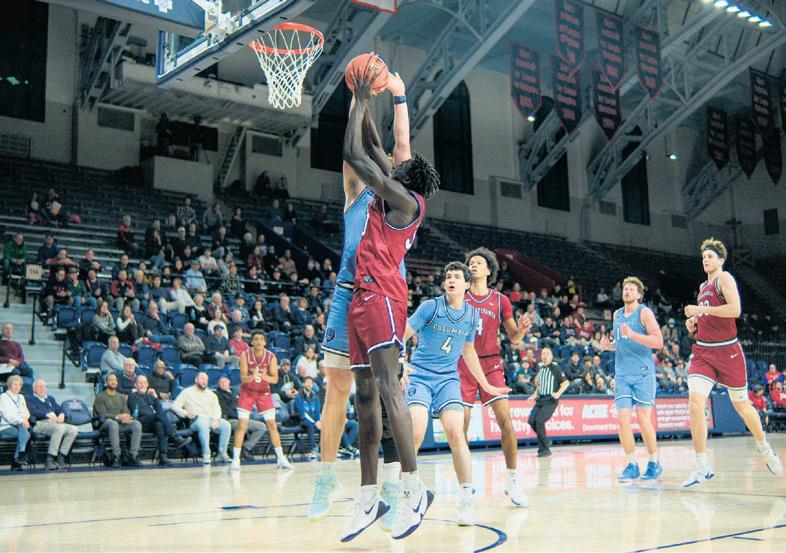
Offensively, Penn saw solid performances from a few familiar faces — senior guard/forward Ethan Roberts had a welcome resurgence, scoring 12 points in the final three minutes. Against Cornell, junior forward TJ Power notched 17 points on 50% shooting.
But the breakout star of the weekend was freshman guard Jay Jones, who scored a career-high 17-point performance against the Big Red that showcased a new degree of offensive polish.
Coach Fran McCaffery sings Jones’s praises nearly every chance he gets, and for good reason — as far as rookie guards go, it’s rare to find one as comfortable dictating the offense as Jones. He’s also unique in his ability to impact the game in multiple ways. At 6-foot-4, Jones is a plus-defender, an impact rebounder for his position (he’s averaged 4.75 boards per game during Penn’s current win streak), and he rarely makes mistakes (one turnover in the last four games).
On Saturday, Jones paired his scoring with his
continue that success on the conference stage and book tickets to NCAA Division I championships with the new NCAA qualification standards, which give automatic berths to conference champions who hit the national qualifying time standard at the meet.
“We are all super excited for this week! We are coming off one of our best dual meet season performances ever and are ready to keep that going this week,” senior distance freestyle specialist Sydney Bergstrom wrote in a statement to The Daily Pennsylvanian.
Bergstrom and senior captain and distance freestyle specialist Anna Moehn will lead the charge this weekend, headlining the Quakers’ historically dominant distance freestyle group. For the past three editions of Ivies, Penn has had either two swimmers on the podium or swept it entirely. In their final seasons, Bergstrom and Moehn will
playmaking. While nine of Jones’ points came from the free throw line, Jones’ slashing ability, particularly in the first half, was pivotal for a Quakers offense that shot just 3-of-20 from three. Penn’s general size advantage over the Big Red was a major factor in its ability to generate offense — the Quakers finished the game with 41 attempts from the charity stripe.
Here, Jones’ full skill set was on display. His length and defensive effort helped force a turnover on Cornell’s Cooper Noard, then he pushed into transition, stayed in the air and converted a gnarly and-one lay-in through contact.
“The coaching staff has done a great job of giving me a bunch of confidence,” Jones said. “You’ll see me looking at the coaching staff after I shoot my first [shot] all the time, just seeing what they’re saying, because I’ve got a lot of trust in them.”
Jones was not the only Quaker to recorded a career high against Cornell. Sophomore forward Lucas Lueth scored 11 points on 4-of-5 shooting, part of a banner weekend for the Kirkwood transfer that saw him leave major fingerprints on both ends of the court.
Lueth’s role in the rotation has ebbed and flowed throughout the season — he played single-digit minutes against Dartmouth, Harvard, and Yale before not seeing
look to notch their second and third berths, respectively, to NCAAs this weekend either via the new conference winner format or the rankings system.
Bergstrom is seeded first and sixth in the 1650-yard free and 500 free, while Moehn is seeded second and fourth at this week’s championships.
“I would love to see a third NCAAs … If it doesn’t happen, it doesn’t happen. That’s okay,” Moehn said on the Quaker Nation podcast in December. “But being there for a third time … and capping off my senior year that way would be really special.”
Another star set to shine is Fu, who is the reigning Ivy League champion in the 100 free. The three-time program record holder is seeded fourth in the 50 free and 100 fly and third in 100 free. Last year, Fu persevered through an illness during the last two days of the meet, including during her victorious pursuit of a championship in the 100 free. It will be exciting
the floor at all in Penn’s first matchup with Columbia. But after this weekend, it’s difficult to see that happening again. Lueth’s athleticism makes him a major difference-maker — his lateral speed helped him stay in front of Columbia and Cornell’s drivers, while his vertical leap helped him nab two blocks against the latter. Plus, the fastbreak slams don’t hurt.
That said, Lueth’s hustle is an even greater strength. He runs the floor like a maniac, never gives up on a play, and defends with energy. His injection into the lineup was a major swing against the Lions — after an 8-0 Columbia run that put the Lions ahead by double-digits in the second half, Lueth keyed a 10-0 counter-run by Penn, hitting a timely three and converting a putback.
Here, Lueth engineers a second-chance basket off effort alone, getting down the court and tipping in a missed layup by senior guard/forward Michael Zanoni.
“His length, his athletic power, he’s on the glass,” McCaffery said of Lueth. “He can guard the point guard, he can guard the center, everything in between. But his activity and his feel is so impactful.”
“Those two guys [Jones and Lueth] are the epitome of what character is,” McCaffery said. “They’re new to our program and new to our system, but they’re both really smart, and they prioritize winning. They do the things that are necessary for a team to impact winning.”
When asked what overall aspect of the team’s play he was most pleased with over the course of the weekend, McCaffery’s answer was simple: “our defense.” While the Quakers allowed a combined opponent field goal percentage of 47.9% against the Lions and Big Red, they shined in another key area: generating takeaways.
Penn, which has forced the most turnovers in the Ivy League since the start of conference play, showed why in both weekend wins. The Red and Blue created 20 turnovers against Columbia and 16 against Cornell, resulting in 22 and 23 ensuing points, respectively.
Against Cornell, Lueth said that “heating [Cornell] up,” was a fundamental part of Penn’s game plan, and that was evident in the way it defended the pace-pushing Big Red — the Quakers sent significant pressure at Cornell’s on-ball actions, surrendering some buckets on the back end (Penn
DUPONT, from back page
“Coach Dupont recruiting me to Penn changed the trajectory of my life. He leads with a rare mix of toughness and genuine care, pushing us to become better men on and off the field,” Watson said in the same release. “I’m grateful for his impact and excited for the future of Penn Sprint Football under his leadership.”
More recently, former linebacker John Lista has been a star under Dupont. The three-time All-Ivy honoree spent 2.5 seasons as a starter, and in fall 2025 led Penn with 78 tackles — program’s highest single-season total since 2019 — while ranking sixth in the Ivy League in tackles and 12th nationally in solo tackles per game. He transferred to Connecticut for his final year of eligibility.
During the 2022 season — when Penn football finished first in the conference — the defense had quite a year, ranking top 15 in the FCS in eight categories: No. 2 in rush defense (89.2 yards per game), No. 4 in sacks (3.4 per game), No. 4 in fourth-down defense (28.6%), No. 4 in first downs (176), No. 6 in red zone defense (69.7%), No. 6 in scoring defense (19.7 points per game), No. 12 in tackles for loss (7.5 points per game) and No. 13 in total defense (322.8 yards per game).
“[Dupont] has developed meaningful relationships with student-athletes and high school coaches during his career, is a skilled tactician, and has significant institutional knowledge from his 20 years on the Penn football staff,” Director of Athletics and Recreation Alanna Wren said in the release. “He will bring energy and enthusiasm as he tackles this new challenge with sprint football, and we look forward to increased competitiveness within the CSFL under his leadership.” Dupont wore many hats with Penn football, serving as as the coaching staff’s liaison to admissions and financial aid, strength and conditioning, and NFL scouting. Before arriving in West Philadelphia, Dupont had coaching stints at Trinity and Worcester Polytechnic
tute. His experience with the
to see Fu’s ceiling at the championships if she’s fully healthy. The 100 fly is a deep event, with junior fly/backstroke specialist Kate Levensten, freshman fly/ backstroke specialist Brianna Cong, and senior fly/ freestyle specialist Amber Smith just behind Fu seeded in eighth, tenth, and 11th, respectively. Levensten, though, will be one to watch in the backstroke events after lowering the 100 back pool record three times this season and breaking program records in both back events. The Lower Merion, Pa. native, who is also a former DP staffer, has made an impressive drop of over a second in less than a year to move into the record books. Her previous best was 54.10 set at last year’s Ivies. This weekend, Levensten is seeded third in the 100 and 200 back. Penn’s depth shines here as well, with sophomore free/breaststroke specialist Amy Qin and Cong right behind seeded in sixth and eighth respectively.
“The girls are just absolutely working so hard every day, which is just so cool and so inspiring. I think it just goes back to that for the team [and] for the love of Penn mindset. We really try to be excellent in all that we do when it comes to practice,” Moehn said on the Quaker Nation podcast about the team’s depth this year. “I think it has made a pretty big impact.” Junior back/free/individual medley specialist Katya Eruslanova was also a big history maker this season. To kick off 2026, the versatile upperclassman broke the pool records in 200 back, 200 free, and 200 IM in a tri-meet against Yale and Dartmouth. After finishing in fifth and sixth in the IM events last
allowed 48 points in the paint) but creating enough chaos to make up for it. No player authored more of those takeaways than sophomore guard AJ Levine, who is making a legitimate case for the Ivy League’s Defensive Player of the Year award with his game wrecking on the ball. Levine tallied a staggering 11 steals over the two games — six on Friday and five on Saturday — including a stretch of three straight in the final minute against the Lions that essentially won the game for the Quakers.
“We knew who [Columbia was] gonna go to — they were going to their guy [guard Kenny Noland],” Levine said. “And that was my assignment. ... I knew that I couldn’t separate from him at all. So just being as attached to him as possible and understanding what they were trying to do, I was able to anticipate and make a couple plays.”
Hard-nosed defense was Levine’s calling card when he arrived at Penn last season, but as he’s taken up a larger offensive role under McCaffery, it’s been easy to overlook his impact as a point-of-attack stalwart. There was no overlooking his play this weekend. Levine is a highly physical defender who uses his hands and body to probe opposing ball-handlers for the slightest opening. When it comes, he pounces, using excellent timing and instincts to wreak havoc. Even when he doesn’t secure a steal, he’s liable to cause major disruption — look no further than his poke-away against Princeton guard Dalen Davis that preceded a game-sealing stop last weekend.
“He’s a game-changer, and an elite competitor,” Roberts said of Levine. “Having that at point guard is amazing. You definitely don’t want to go against him.”
Penn has a major road date with Yale next week that will speak volumes about the Quakers’ Ivy League title potential. But after seventh-place finishes in 2024 and 2025, the Red and Blue are unquestionably one of the conference’s top teams, and this weekend showed why.
YAELLE DE OLIVEIRA | STAFF PHOTOGRAPHER
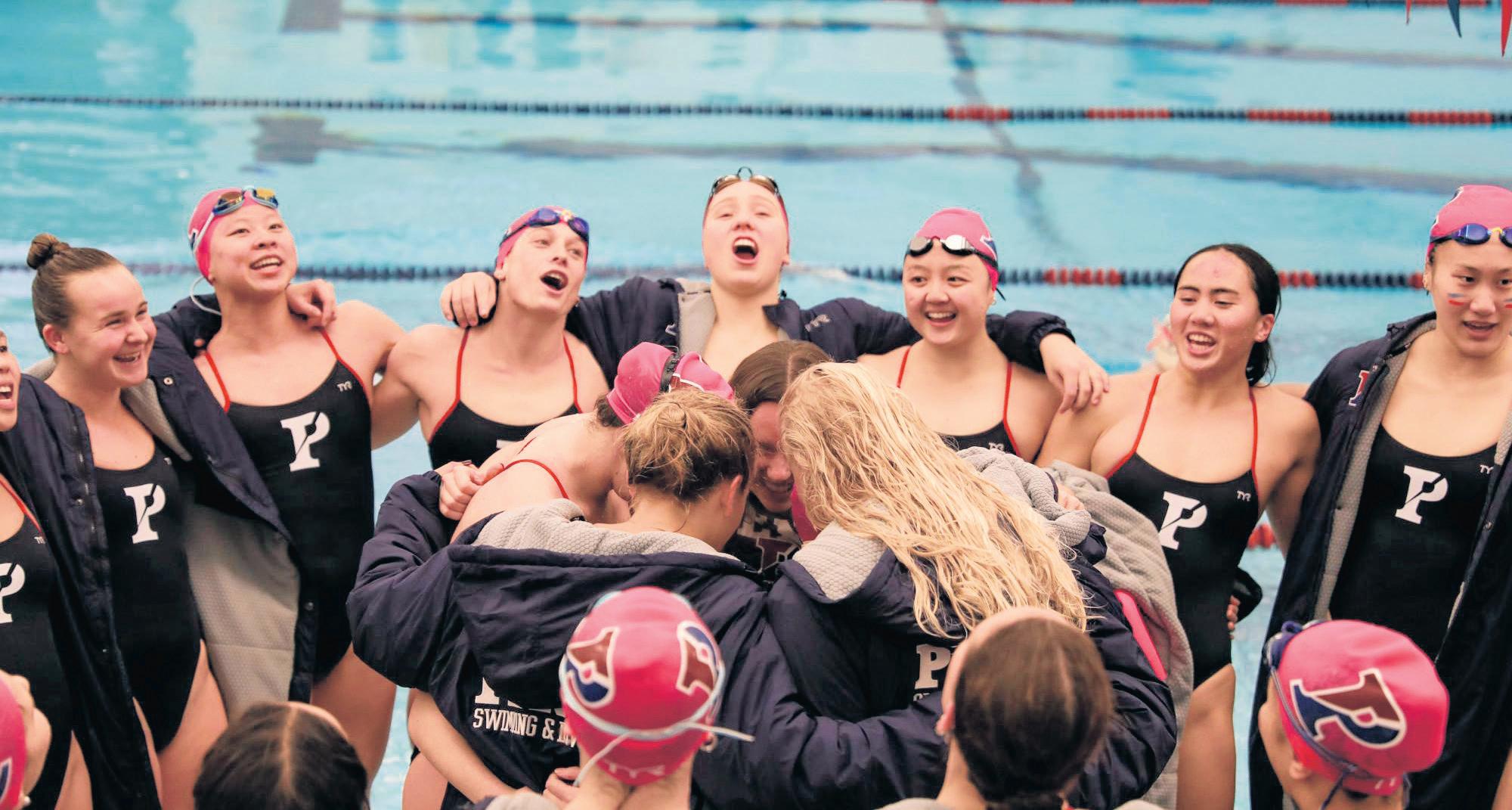
Penn women’s swimming and diving team pictured huddling on Nov. 1, 2025.
COURTESY OF PENN ATHLETICS
Jon Dupont pictured on Feb. 16, 2026.
WALKER CARNATHAN
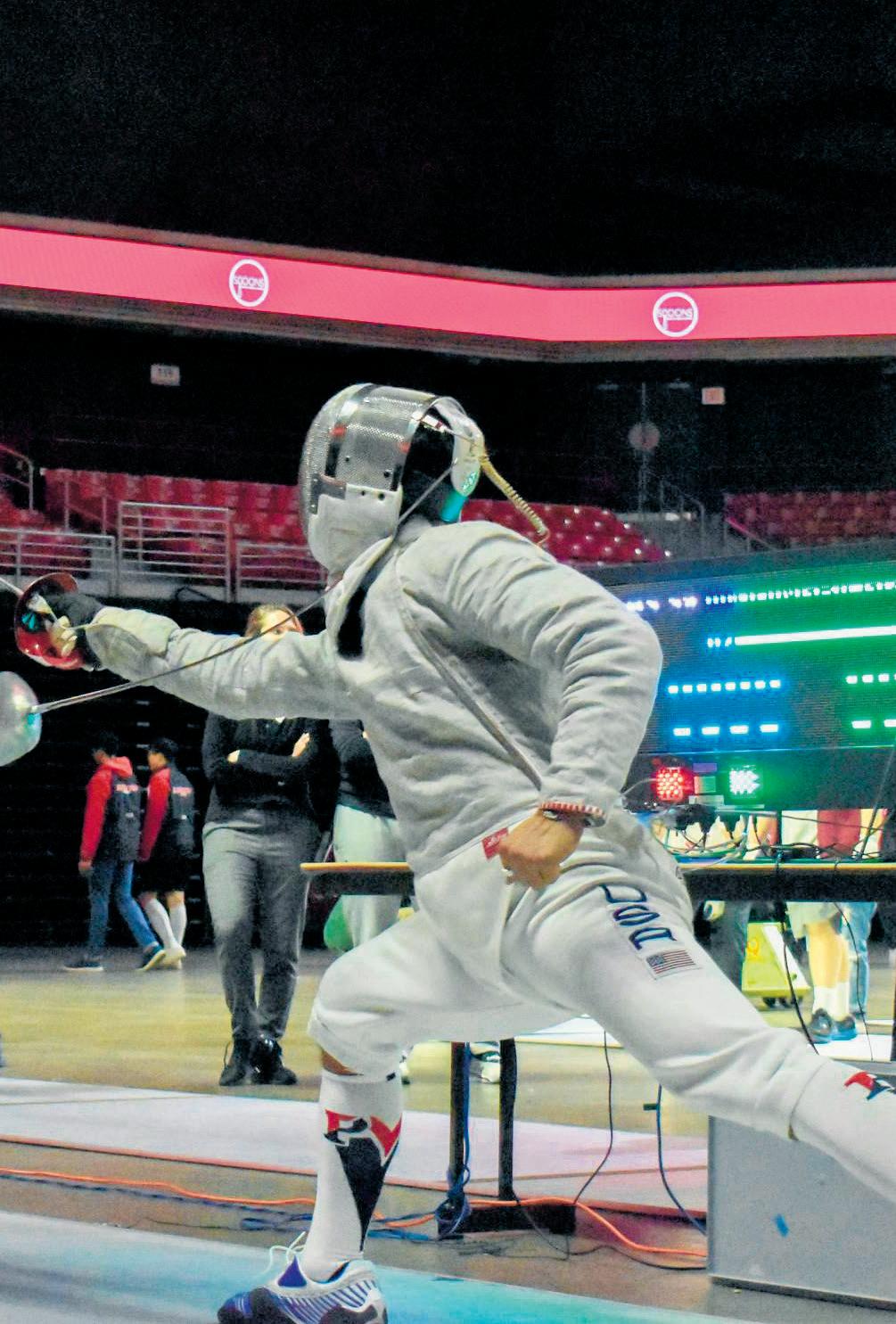
Fencing lands 5th place at Ivy League Championships
Simon Lioznyansky and Joseph Wu notched All-Ivy honors
ELLIE CLARK Deputy Sports Editor
Penn fencing couldn’t convert metals to medals. Last weekend, Penn fencing faced the best of the conference and came up short at Ivy League Fencing Championships. Both squads walked away with a fifth-place finish — last on the men’s side, while the women outperformed their sixth-place seed.
Penn women’s fencing
The No. 8 Quakers entered competition eager to prove themselves after a season of contentious non-conference matches with key victories over No. 10 Penn State and No. 9 Yale.
On Saturday, the women faced an onslaught of defeats from the top four seeds in the Ivy League tournament, losing to Princeton (6-21), Columbia (9-18), Yale (11-16), and Harvard (10-17). Despite the team losses, junior epeeists Grace Hu and Victoria Kuznetsov led the charge in the epee, creating narrow margins of victory against Columbia and Yale. The Quakers also picked up an event victory in the saber against Harvard.
Trailing 0-4, Penn women’s fencing entered the final day of the Ivy League tournament eager to put some points on the board. Strong performances in the saber and epee supported the Quakers’ journey to back-to-back victories against Cornell (19-8) and Brown (18-9). Foil proved to be the weakest blade across the tournament, as the Quakers only picked up a victory against Brown in their final match of the tournament.
Although no one from the women’s team took home All-Ivy accolades, Hu and Kuznetsov tied for seventh place in the epee, while freshman saber
Lila Paul finished ninth overall in the saber. Freshman foilist Kimberley Jang finished the highest of the foil specialists, going 7-11 to tie for 11th place.
“Competing at Ivies was super thrilling, the energy that every school was putting in was insane, and it was definitely a lot of fun to compete at such a high level,” Hu wrote in a statement to The Daily Pennsylvanian. “Everyone poured their hearts out and cheered as hard as they can for one another, and I think the mutual support was definitely a strength on our team.”
Penn men’s fencing
The No. 7 Penn men’s fencing team settled for
the bronze at last year’s Ivy League tournament. After a successful regular season campaign, it seemed like the Quakers were primed to take the conference title. However, fate had other plans. The Quakers suffered a narrow 10-17 defeat against No. 5 seed Princeton to open competition on Saturday. Each blade was decided by two points or less, with the Tigers ultimately prevailing 5-4 in the foil and 6-3 in both the saber and epee.
Upsets and defeats followed the Quakers to the end of the tournament, where they finished 0-4 with losses against Columbia (8-19), Harvard (1116), and Yale (10-17).
“Everyone had their own stresses showing up to the tournament, and it didn’t result in the best performances from most,” freshman standout epeeist Simon Lioznyansky wrote in a statement to the DP. “I truly believe we could’ve won as a team, but we were just lacking in strength, both mentally and physically, I think.”
Although the Quakers suffered narrow defeats against most of their opponents, they picked up 5-4 victories in the saber against Harvard and the epee against Yale. These individual victories translated to All-Ivy accolades for two of the Quakers’ finest.
Lioznyansky earned first-team All-Ivy honors with his third-place finish in the epee, posting an 8-4 record over the course of the tournament.
“The energy was super hype,” according to Lioznyansky. “I got to fence a lot of strong opponents, and that’s always a good time … It was honestly really cool to make first team All-Ivy honors.”
Junior epeeist Joseph Wu earned second-team All-Ivy honors for the second time in his career, finishing fifth in the epee behind Lioznyansky. The Quakers will conclude the regular season across the Schuylkill River at the Temple Invitational on Feb. 22. But the biggest meet of the season so far — NCAA Regionals — lurks just around the corner.
“I am really excited for the second half of the year,” senior captain Simon Kushkov wrote in a statement to the DP. “The team has transformed into a well-oiled machine since my freshman year. I believe we laid down the groundwork for the generations of Penn fencing to follow and succeed in the long run.”
FU, from back page
And she was like, ‘Yep.’”
In Fu’s stellar freshman season, one thing quickly became clear — in a sport that is focused on individual performances, she is the biggest team player. She puts pressure on herself to win for her team, not for herself, and even credits her teammates for her success at Ivies last year.
Ivies to maximize the number of points she can collect for the team standings.
SEEFELDT, from back page morning and said, ‘Are you coming here or not?’
“It just kind of showed me how special the sport of wrestling is to me and the world in general,” Seefeldt said. “It’s a bond the sport of wrestling can have despite language barriers, especially because at the end of the day, it was all respect.”
That connection through wrestling was also fostered on social media. In just over a year, Seefeldt accumulated over 9,000 followers on Instagram and over 5,000 followers on TikTok through frequent short-form videos. Almost all of his content is centered around wrestling or the Ivy League student-athlete experience.
“I feel like I’m doing something special,” he said, “I want other people to see that and feel like they can do something special in their lives.” And even if reels depicting blueberries and bananas on ground beef or artificial-intelligence-generated images of wrestling through the ages might not be inherently revolutionary, Seefeldt and fellow teammate Kelly Dunnigan’s social media presence has changed Penn wrestling.
“At a couple [of] tournaments this season, there [have] been a couple younger kids who asked for pictures and tell me they love my stuff,” Seefeldt said. “It’s really inspiring to
“Her motto is ‘For the team.’ She definitely puts everyone else before her,” Qin said. “I do think a lot of the pressure she puts is from herself.”
Never has this been more visible than right now. Earlier this season, Fu dislocated her knee. Where most would take the season off to fully recover, she has been pushing through the pain and is competing at this year’s Ivies, which take place Feb. 18-21. Her main goal? Making the top three as a team. She even changed her event lineup for
“I got sick on my second day of Ivies, and I really wanted to give up. So I think my team really saved me. They were the ones who encouraged me to come back the next day and still give it a shot,” Fu said.
see this kind of stuff because they’re younger wrestlers and their generation kind of looks up to me.”
It’s not only younger wrestlers. People back home, even those he hasn’t spoken to in a while, watch his videos and “they’re loving it and telling me to keep up with it.”
“We talked to high schoolers; everyone knows Kelly [Dunnigan] and Sean,” Valenti said. “And the best part about it is, this isn’t just a ‘curated for social media’ thing. This is truly who these guys are.”
At the end of the day, Seefeldt still holds the same passion and interest in the lifestyle wrestling as he did when he was a little kid.
Off the mat, Seefeldt is guided by his faith and “just boulin’ it” — an inside joke-turned personal philosophy about “taking everything as it comes.”
Attending church every Sunday as a kid strengthened Seefeldt’s resolve. Although his relationship with God and wrestling has changed over the years, he’s come to realize that no matter what happens, it happens for a reason. Even through injuries, dropped matches, shifting weight classes, or taking a gap year, behind all of his decisions, there’s no pressure for Sean Seefeldt — just faith.
“Sean is somebody who has grown so many ways here at Penn,” Valenti said. “And I mean that literally and figuratively — Sean came in as a lightweight … [now] he’s nationally ranked at 165 pounds.”
“Everything I do is for my team. The stress that I feel is because I want my team to win,” Fu said.
She puts it on her own shoulders to always support and push her teammates. In practice, she will challenge Qin to race her, so that they both continue to improve. Above all, Fu loves watching her teammates succeed.
“I get the same amount of happiness seeing them win as if I was also winning,” Fu said.
Despite her team-first mindset, there is still one individual goal on her mind. This one, too,
came from watching someone else. Captain and senior distance freestyle specialist Anna Moehn has qualified for NCAA Division I championships twice in her college career, and after arriving at Penn, the same thing became one of Fu’s goals. This year, a rule change could make this easier than ever before: If swimmers win their conference title and hit the national qualifying time standard, they get an automatic berth to NCAAs. Still, there is no doubt that the main reason Fu is even swimming at Ivies this year is for the team — and to help it achieve its first top-3 finish since 2022.
GRACE HU | DP FILE PHOTO
Junior Gian Dhingra pictured lunging in a bout against Temple on Nov. 5, 2023.
BEYOND THEMSELVES
For Kayla Fu, swimming is about the team
Deputy Sports Editor
Kayla Fu is someone who absolutely hates losing; who chooses the harder set in practice every time; who obsesses over details; who always thinks she’s not fast enough; who has kept swimming this season despite an injury that causes her pain, just to help her team.
“I try not to put a lot of pressure on myself,” sophomore butterfly/freestyle specialist Fu said.
“I’m someone who gets satisfied very easily.”
When Fu speaks about swimming, it can often seem like she is not quite aware of her own greatness. She won two Ivy League titles her freshman year and holds three individual and five relay program records. For reference, there are 21 events that the swimming and diving team competes in. She is undoubtedly already one of the best swimmers to ever compete for Penn.
As is the case with many of the greats, it’s the small things that set Fu apart. Her boyfriend and junior individual medley specialist Peter Whittington spoke about her attention to detail. Her roommate and sophomore freestyle/breaststroke specialist Amy Qin described how she is 100% present in everything she does. Fu herself mentioned her “delusional” faith that she will win every race. She doesn’t even remember when she first learned how to swim. The sport has always been a part of her life — at home in Sugar Land,
Carnathan | Breaking down men’s basketball’s 2-0 weekend
Wins over Columbia and Cornell have put the Quakers in the driver’s seat for an Ivy Madness bid
WALKER CARNATHAN Senior Reporter
its longest in conference play since 2023. The stretch also has the Quakers in sole possession of third place in the Ancient Eight, putting them firmly in the driver’s seat for a bid to Ivy Madness. Some models have Penn’s tournament chances as high as 93%.
Texas, every community had access to at least one 50-meter pool. Fu started out smaller than that.
“We have a pool in our backyard, and so my parents would always throw me in there, and I would swim in there. And so, I guess I just started from there,” she recalled.
Like any respectable younger sibling, once Fu’s older brother started taking swimming more seriously, she followed along. At first, she tried the less intense summer league, which ignited her love for the sport. Later, she pivoted to club swim, getting a first taste of a more competitive environment.
“I think the easiest way I get motivated is looking at others, because in the end, there’s always someone faster than you, and so I think I’m constantly trying to play catch up,” Fu said about her mindset when competing. “And my goals are to meet … what this person does.”
The same thing applied to college: Once her older brother, senior butterfly/breaststroke specialist Alex Fu, committed to Penn, she started working to achieve the same feat.
Coach Mike Schnur describes Kayla Fu as “possibly the easiest recruit we’ve ever had.”
“We basically called her on June 15, after sophomore year,” Schnur said. “I called her that
See FU, page 7
For Sean Seefeldt, wrestling is about connection
When Sean Seefeldt brought home a Strongsville Wrestling Club flyer during first grade, no one could’ve predicted he’d take home the Ohio High School Athletic Association Division I state title 11 years later. Now a junior wrestler at Penn, Seefeldt boasts a national No. 19 ranking in the toughest weight class in college wrestling.
“I[’ve] never looked back since,” Seefeldt said. “[I] just kind of fell in love with it.”
Everyone from the Greater Cleveland area knows that if you’re an athlete, St. Edward’s High School is the place to be. Even before becoming an Eagle, Seefeldt grew to love Ed’s through hit local documentary “Pinned,” which depicts a David and Goliath wrestling tale of Ed’s crosstown rival school. “It really kind of just got me fired up and excited to wrestle,” he said.
So, for a wrestler beginning to make a name for himself on the national stage, the choice was obvious: Ed’s or nowhere.
“St. Ed’s is obviously an incredibly storied high school wrestling program,” Penn wrestling coach Matt Valenti said. “Through the years I’ve wrestled with, I’ve known, [and] I’ve recruited wrestlers out of St. Ed’s, and one of the great things about that program is the type of people, the type of character you’re getting
when you recruit from that program.”
In other words, Sean Seefeldt isn’t an ordinary D-I wrestler.
Seefeldt has changed weight classes with every season, growing into his body and taking down the competition with him. The Strongsville, Ohio native has competed collegiately in five of the NCAA’s 10 weight classes, and his biggest jump — entering Penn at 125 to competing as a junior at 165 — has been by far the most successful.
Despite his success on the mat, Seefeldt remains humble and grateful every step of the way. According to Valenti, the choice to appoint Seefeldt as the wrestling team’s sole junior captain was a no-brainer. But for Seefeldt, it was not just about the title. The true honor was the opportunity to wrestle alongside his best friends. After all, as iron sharpens iron, teammate sharpens teammate. As captain, Seefeldt gets to do what he truly loves — pushing his teammates while improving because of them.
Penn wrestling has also opened Seefeldt up to new possibilities, like traveling abroad for the first time to train with the Japanese national team. He learned that sharing a language isn’t the only way to connect with strangers.
See SEEFELDT, page 7
Mataya Gayle reaches 1,000 career points
She became the 27th player in program history to reach the milestone
ELLIE CLARK Deputy Sports Editor
Last call for junior guard Mataya Gayle’s hype train.
Gayle achieved a career-defining feat Friday night as she achieved her 1000th career point in an overtime victory against Cornell. The 2024 Ivy League Rookie of the Year is the first to achieve this monumental feat since former teammate and 2025 Wharton graduate Stina Almqvist did so last February.
“This is hard to do at any level, to score 1000 points, especially at this level, and [to] do it in her junior year,” coach Mike McLaughlin said. “There was a lot of stress on her out there [today]. She’s forced to do a lot of things with the ball in her hands, at times possessions get away from her … but she’s a competitor, and she competes.”
The Woodstock, Ga., native immediately made an impact when she joined the Quakers, starting in all 28 games her freshman year and earning a national Rookie of the Week nod from the USBWA after a career-high 28point performance against Maine. Her scoring efforts late in the season propelled the Quakers to an Ivy Madness
berth, where she made the all-tournament team.
Gayle’s sophomore season was even stronger, as she assumed primary point guard duties. She finished second on the team in scoring, averaging 12.3 points per game, as well as third in the conference for assists per game, putting up a career-high nine assists three times throughout the season. Gayle totaled 341 points in the 2024-25 season.
Her junior year brought a captain’s role and increased Gayle’s responsibilities on the court, but she took it in stride. Gayle’s been an integral part of a Quakers team vying for Ivy Madness contention amidst particularly competitive conference play, with multiple 20-point performances this season. She notably put up 24 points against No. 4 Texas in a November contest and notched 23 points against Cornell on Friday.
Even if the Quakers don’t make it to Ivy Madness tournament play, it’s safe to say that the Quakers got a first-team All-Ivy contender on their hands.
Jon Dupont named sprint football head coach
After 19 seasons as an assistant coach with Penn football, Dupont will now lead Penn’s sprint football program
VALERI GUEVARRA Senior Reporter
Jon Dupont will be the next head coach of Penn sprint football, Penn Athletics announced Monday.
Dupont is no stranger to Franklin Field, having served as an assistant coach for Penn football for the past 20 years as well as recruiting coordinator for the past two seasons. He will replace Jerry McConnell, who was dismissed last month after five seasons at the helm of Penn sprint football and 18 seasons on the staff. “I am honored and grateful for the opportunity to serve
as the next head sprint football coach at Penn,” Dupont said in a release. “Penn sprint football has a proud and historic tradition, and I am incredibly excited to build upon that foundation. I look forward to leading our student athletes as we pursue competitive excellence on and off the field.” Dupont first joined the Quakers as defensive backs coach in 2006 and then moved to work with the linebacker squad in 2013. He was not retained under new Penn football head coach Rick