Penn unveils draft open expression guidelines for community input
Once approved, the guidelines will mark the most drastic change to Penn’s open expression policies in over three decades
ANVI SEHGAL Senior Reporter
After nearly two years of internal review, Penn published its first draft of its revised Guidelines on Open Expression, outlining initial proposals for the procedures that will govern campus demonstrations and protests.
Last week, Provost John Jackson Jr. announced that Penn will seek feedback on the draft throughout this semester, before presenting a final version of the updated policies at a University Council meeting on Sept. 9. Once approved, the guidelines will mark the most drastic change to Penn’s open expression policies in over three decades.
The newly proposed guidelines — published in the University Almanac on March 31 — are separated into three sections: the University’s principles on open expression, the implementation of those principles, and specific policies to support those measures.
Penn issued temporary guidelines in 2024, following a year of heightened activism and tension on campus, including a 16-day Gaza Solidarity Encampment on College Green.
At the time, Penn announced the formation of a task force to provide recommendations to the Committee on Open Expression, which would then present proposals to the University Council and the president.
Both Penn’s temporary guidelines and the University’s new draft policies give priority to University-related events when allocating campus space. The documents diverge, however, in how they handle events unrelated to official “education, research, and patient care.”
Penn currently requires at least two weeks’ notice to plan non-academic events taking place on Locust Walk and in other “VPUL spaces.” The draft
See DRAFT, page 3
Court paves way for federal government to collect list of Jews at Penn
ARTI JAIN, LAVANYA MANI, AND LUKE PETERSEN Senior Reporter and Staff Reporters
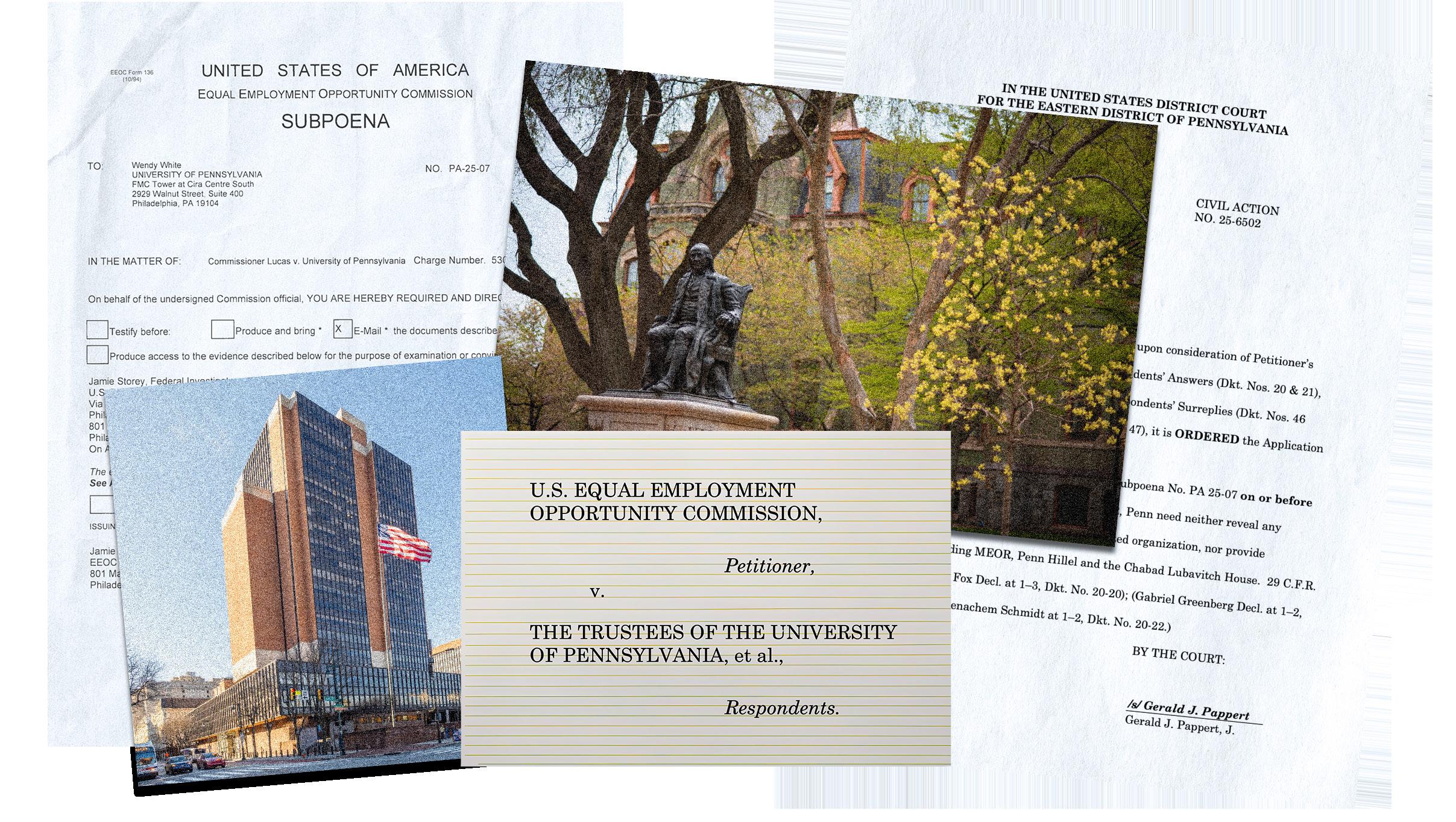
A judge has ordered Penn to comply with a federal subpoena seeking information about Jewish students, faculty, and campus groups.
The Tuesday order marks the culmination of a months-long legal battle between Penn and the United States Equal Employment Opportunity Commission over the agency’s authority to enforce a subpoena first issued in July 2025. A University spokesperson told The Daily Pennsylvanian that Penn intends to appeal the ruling.
Penn has until May 1 to respond to the subpoena’s requests, but will not be required to “reveal any employee’s affiliation with a specific Jewishrelated organization.”
An EEOC spokesperson wrote that “the agency has no comment at this time,” and referred the DP to U.S. District Court Judge Gerald Pappert’s opinion.
“For their legal arguments, respondents contend the charge of discrimination is invalid and
Penn Engineering launches $200 million fund to support faculty research, local start-ups
The Futures Fund Partnership for Innovation will provide monetary support for projects across a variety of research frontiers
SAMEEKSHA PANDA Senior Reporter
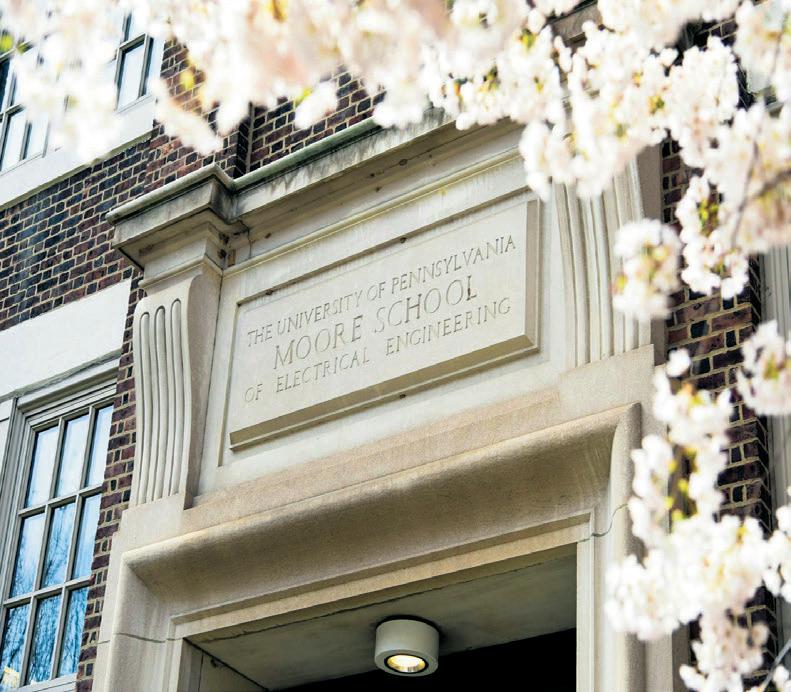
The School of Engineering and Applied Science announced a new $200 million fund to support faculty research and startups in areas impacted by federal funding cuts.
The fund — titled the Futures Fund Partnership for Innovation — provides $200 million in monetary support to various projects across human health, sustainable infrastructure, and physical intelligence research frontiers. It will receive funding from several philanthropic partners, including Penn Engineering alumni and industry leaders.
The Futures Fund seeks to enable faculty to “provide timely, flexible support for leading-edge research and educational advancements over the next five years,” according to the press release. It will support faculty efforts to secure external grants, launch startups, and develop research collaborations.
“If we are to generate the resources necessary to lead in technology and innovation, drive meaningful social impact, and help shape the future, we must take matters
into our own hands,” Penn Engineering Dean Vijay Kumar wrote in a statement to The Daily Pennsylvanian.
The effort to support research comes after a series of federal policy moves in 2025 that led to widespread funding cuts, including a 15% cut to National Institutes of Health funding projected to cost Penn $240 million.
Kumar told the Philadelphia Business Journal that he “saw the writing on the wall” as a result of the cuts. He added that Penn Engineering’s reliance on research funding meant that the impacts across the school were drastic.
One contributor to the fund is 1984 Wharton and Engineering graduate, University Trustee, and Chair of Penn Engineering’s Board of Advisors Rob Stavis, who is also a partner at Bessemer Venture Partners.
Stavis wrote in the press release that funding for earlystage research projects can be “the hardest to find and the highest in impact,” heightening the impact of federal constraints. The Futures Fund aims to fill that gap by providing
See FUND, page 3
Musab Chummun, Moe Mansour elected to lead UA
Musab Chummun and Moe Mansour — who both ran unopposed — will serve as the body’s next president and vice president
the subpoena violates the United States Constitution in various ways,” Pappert wrote in a March 31 memorandum filed alongside the order. “But the charge is valid and the constitutional claims are easily dispensed with.”
He added that Penn — along with other campus groups involved in the litigation — “significantly raised the dispute’s temperature by impliedly and even expressly comparing the EEOC’s efforts to See EEOC, page 2
Penn releases regular decision results for Class of 2030
According to the announcement, over 61,000 students applied through the regular decision process this year
ANANYA KARTHIK AND CHRISTINE OH Senior Reporters
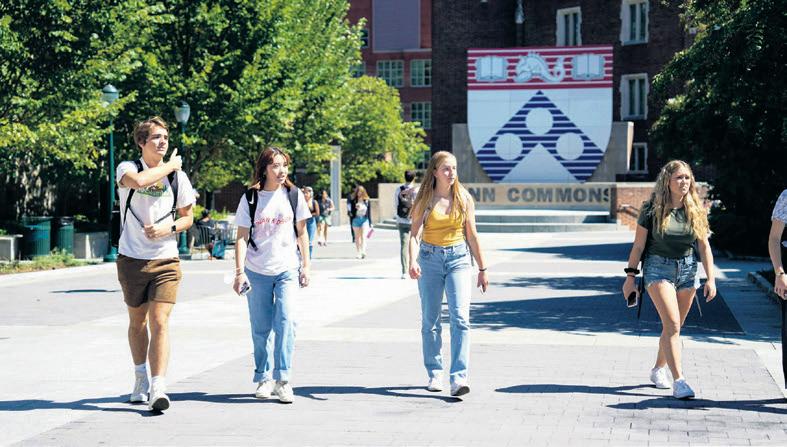
Penn released regular decision results for the Class of 2030 last Thursday, wrapping up the University’s first admissions cycle since reinstating its standardized testing requirement.
According to the Penn Admissions announcement, over 61,000 students applied to Penn this year, marking a decrease from last year’s applicant pool of over 72,000. Results were released to students on March 26 at 7 p.m.
Penn did not disclose a regular decision acceptance rate, continuing its policy of withholding detailed admissions results since 2022.
“Each year, I’m inspired by the thoughtfulness, curiosity, and sense of purpose students bring to the application process,” Vice Provost and Dean of Admissions Whitney Soule wrote in a statement to The Daily Pennsylvanian. “The Class of 2030 reflects not only exceptional academic preparation, but a genuine commitment to engaging and improving the world around them.”
The performance is set to take place at Penn Park on Friday, April 17
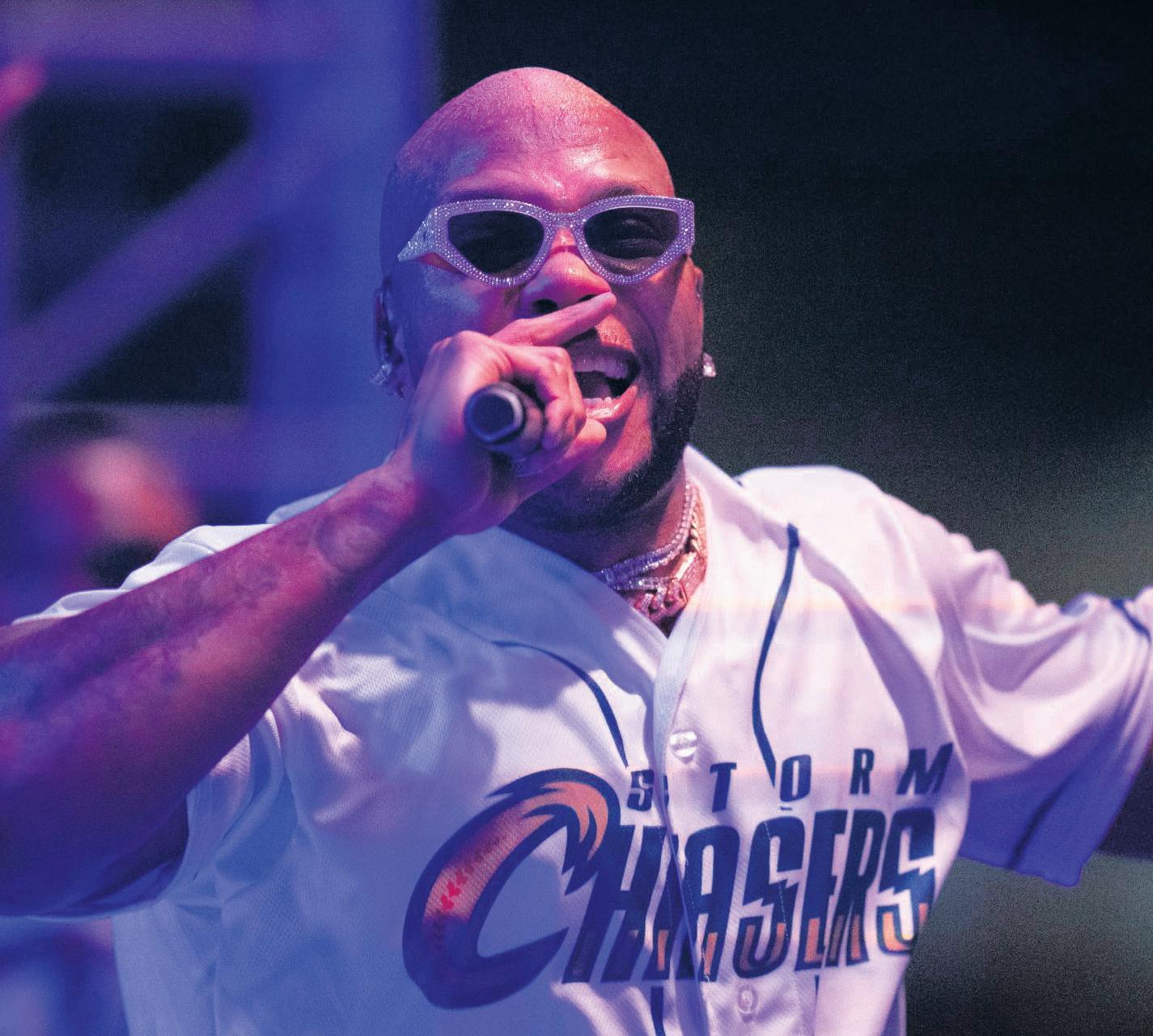
Thousands of students will flock to Penn Park next month to watch rapper and singer Flo Rida perform at this year’s Spring Fling concert. The event is set to take place at 7:30 p.m. on Friday, April 17, followed by a Daytime Fling carnival the next day. The show’s opener has yet to be announced.
Penn’s Social Planning and Events Committee
See FLING, page 3
CHRISTINE OH Senior Reporter
College juniors Musab Chummun and Moe Mansour have been elected as the Undergraduate Assembly’s next president and vice president.
Chummun and Mansour — who both ran unopposed — received 1,241 and 1,246 votes, respectively. The Nominations and Elections Committee announced the results on March 29 at 9 a.m. after voting closed on March 28 at 9 p.m.
In a written statement to The Daily Pennsylvanian, Chummun reflected on his past year serving as UA Vice President, writing that the UA tackled “big goals by putting students in the room where
decisions are being made.”
“Among other initiatives, we advocated against Trump’s Compact, fought against DEI cuts, pushed for clarity on ICE policies, and put more money back in students’ pockets,” Chummun wrote.
“After this past year, running for UA President felt like a natural next step to help make student life better on campus.”
In a statement to the DP, Mansour echoed Chummun’s sentiments, pointing to his own tenure as UA treasurer and his role in guiding this year’s
See UA , page 2
According to the announcement, the Class of 2030 includes students from over 87 countries and all 50 states. The cohort also features the largest number of admitted students from Philadelphia in Penn’s history.
“This collective breadth of experience is one of the things that makes the Penn community so dynamic, shaping students’ experiences in ways they may not yet anticipate,” the press release read. The Class of 2030’s admissions cycle is the University’s first with a test-mandatory application since 2020, when Penn introduced a test-optional policy in response to the COVID-19 pandemic.
Penn’s reinstatement of its SAT or ACT scorereporting mandate in 2025 came as several peer institutions — including Harvard University,
See DECISIONS, page 2
CHENYAO LIU | SENIOR PHOTOGRAPHER
The Engineering School on March 26, 2024.
Ben Shapiro in talks to speak at Wharton club event
The speech is scheduled to take place at the Penn Museum on April 14
JAMES WAN Staff Reporter
Conservative political commentator Ben Shapiro is in talks to speak at an on-campus event this month.
According to second-year Wharton MBA student Colin Duffy, who serves as president of Wharton’s Adam Smith Society chapter, the talk is scheduled to take place at the Penn Museum on April 14. Duffy wrote to The Daily Pennsylvanian that Shapiro and his team are “fully confirmed.”
“The Adam Smith Society has been working with University Life, DPS, and the MBA Office of Student Life as part of the University’s established process for planning campus events and obtaining contract signatures,” a University Life spokesperson wrote to the DP. “The scope of the proposed event has changed several times, each of which requires a new review to ensure appropriate planning and resource allocation.”
The statement continued that “the group has not completed the required steps to obtain a cost estimate and move the event forward.”
“The contract has been ready on our end for some time,” Duffy explained in a statement to the DP.
Duffy added that the Adam Smith Society — an association for MBA students and professionals — has been “working with Penn administration since the fall” to organize the event and accused the University of putting up “roadblocks” to the process.
“Penn’s attempt to mandate uncapped, vague security fees without providing clear criteria, estimates, or precedent is an opaque and inconsistent approach that raises concerns about fairness,” Duffy wrote.
He added that the Adam Smith Society would “not agree” to such fees.
Duffy wrote that the event — which the Adam Smith Society is co-hosting with the nationwide
DECISIONS, from front page
youth conservative organization Young America’s Foundation — will include a speech by Shapiro and a live question and answer session.
Duffy added that the event will include discussions of “ideas promoted by The Adam Smith Society.” According to the society’s website, the organization aims to “promote debate and discussion around the moral, social, and economic benefits of capitalism.”
According to Duffy, Penn initially tried to “block” recordings of the event and imposed “limitations on access, live streaming, and the potential for open-ended security fees tied to anticipated protests.”
He added that “for the sake of moving the event forward,” the organizers agreed that the event would only be open to members of the Penn community and not the public at large.
“We intended to open the event to the public to advance Penn’s mission of open inquiry and intellectual diversity while reinforcing Penn’s stated commitment to combating antisemitism by hosting a prominent Jewish public intellectual
Brown University, Yale University, and the Massachusetts Institute of Technology — similarly restored requirements. Penn was the sixth Ivy League institution to return to the policy.
The 2025-26 admissions cycle also signaled the end of Penn’s non-evaluative alumni conversations, which previously allowed applicants to connect with a member of the Penn Alumni Ambassador Program. Soule announced the removal of the conversations last July.
These results come months after Penn released early decision results for the Class of 2030 in December 2025. Over 7,800 students applied to Penn through the Early Decision Program.
Penn also welcomed 112 students to the Class of 2030 through the QuestBridge National College Match program, which allows low-income students to apply early to selective institutions at no cost. This cycle’s QuestBridge cohort includes
in an academic setting,” Duffy wrote in a statement.
The event — which Duffy said will take place in the Harrison Auditorium, the Penn Museum’s highest-capacity theater — is expected to occur just days after conservative commentator Steven Crowder is scheduled to appear in a debate organized by Penn Live Arts.
The debate with Crowder raised safety concerns among PLA staff, who worried the event would spread “hate, bigotry, and ignorance.”
Two staff members — who were granted anonymity due to fear of retribution — told the DP that there was an initial possibility that the event with Shapiro would also take place at PLA.
Duffy wrote that the Adam Smith Society had been in touch with “venue partners such as Penn Live Arts and the Penn Museum” and “evaluated multiple venues and dates” before settling on the Harrison Auditorium.
A request for comment was left with the Penn Museum.
Shapiro is known for hosting the podcast “The Ben Shapiro Show,” aired by The Daily Wire. He co-founded the conservative media company in 2015.
Shapiro has previously spoken at college campuses in tours affiliated with Young America’s Foundation. In 2024, he visited Yale University, the University of California — Los Angeles, Cornell University, and Vanderbilt University.
The structure of those events was similar to what Duffy described for the Penn event. In previous speeches, Shapiro addressed topics such as the Israel-Hamas war, campus protests, freedom of speech, and the 2024 presidential election.
“With the help of Young America’s Foundation, we are working tirelessly to make this event happen,” Duffy wrote. “The Penn community deserves real ideological diversity.”
83 first-generation college students.
This year represents the third full application cycle at Penn since a 2023 United States Supreme Court ruling declared race-conscious admissions unconstitutional, barring the University from considering race in its admissions decisions.
According to a September 2025 admissions report, 21% of last year’s admitted class — the Class of 2029 — are first-generation students, 24% are from historically underrepresented backgrounds in higher education, and 57% identify as students of color.
At the time, Soule told the DP that the admissions trends reflect the University’s broader goals for future classes at Penn.
“We are excited to welcome a group of students who will learn from one another, challenge each other, and contribute meaningfully to the Penn community,” she wrote on the Class of 2030.
Hundreds of students celebrate Holi on College Green
UA budget reallocation.
“Through that work, I saw firsthand what students actually need: not just advocacy, but execution. Not just ideas, but results,” Mansour wrote. “That’s the mindset I’m carrying forward into my role as Vice President. I want to take the same practical and collaborative approach I brought to the budget and apply it to the broader issues that shape student life.”
This spring’s election also decided leaders for the 2027, 2028, and 2029 Class Boards. Wharton junior Steven Li, College sophomore Eddie Mukalazi, and College first-year Daniel Kim were elected as the presidents of the 2027, 2028, and 2029 Class Boards, respectively.
Chummun and Mansour ran on the platform “A Penn That Prioritizes You,” emphasizing their prior experience as student government leaders. Their messaging contained multiple pillars, including “fixing” student funding, fostering community, responding to “threats from the federal government,” increasing transparency and trust in student governance, and improving quality of life. The students’ platform pointed to “recent federal uncertainty around DEI initiatives, ICE presence in Philly, open expression, and school funding,” emphasizing that “students and faculty alike have become unsure of where Penn’s priorities lie.”
“It is critical to uphold our principles and ensure every student feels understood, respected, and represented,” their campaign document read. Looking ahead, Chummun wrote that his shared goal with Mansour is “to make Penn truly prioritize students.”
“I have no doubt we’ll make an even more tangible impact next year through a UA that is efficient, bold, and student-oriented,” he added. Both Chummun and Mansour expressed gratitude for the support they received from Penn’s student body.
“I’m incredibly grateful for everyone who has supported us, and I’m excited to continue this work on a larger scale,” Mansour wrote.
Following live performances from several Penn dance teams, students threw colored powder to celebrate spring’s arrival
CAN DOGA BOLUKBASI Staff Reporter
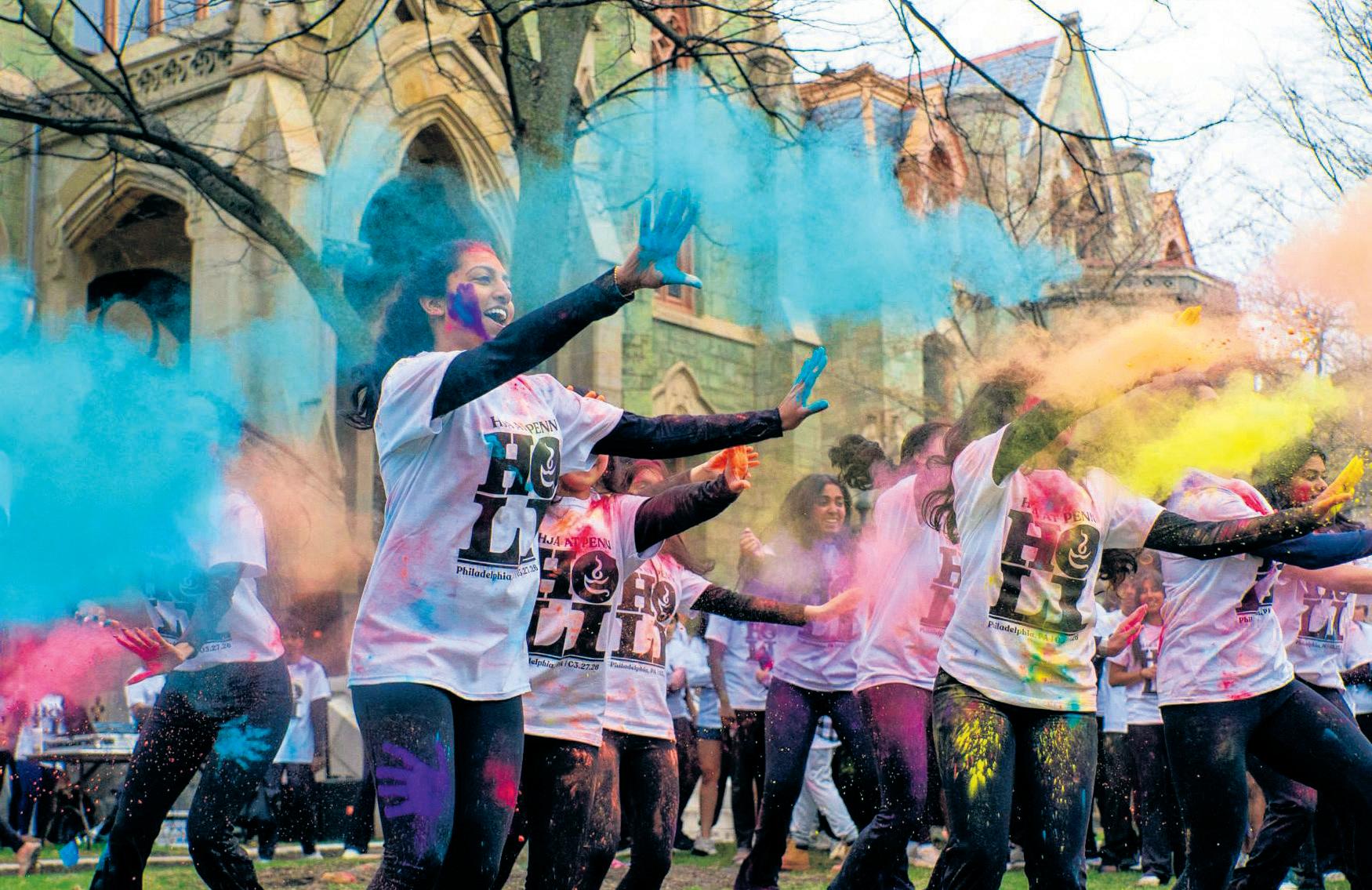
The Penn Hindu and Jain Association hosted its annual Holi festival at College Green on Friday.
The March 27 event was organized in collaboration with Penn’s Spiritual and Religious Life Center to celebrate the Hindu festival and was open to all students. Holi featured live performances from several Penn dance teams, included a DJ, and involved students throwing colored powder to celebrate the arrival of spring.
In an interview with The Daily Pennsylvanian, College sophomore and HJA Vice President Nikhil Pochana expressed the importance of “celebrating things that you did growing up with people who you met at Penn.”
“One of the biggest things about Penn is its diversity, and this gives one of the perfect opportunities for us to showcase our culture with people who are not necessarily from that background,” he said.
The more than two-hour event began with free Tshirt distributions to Penn undergraduates, followed by an introduction to the event by HJA. Five dance groups — Penn Raas, PENNaach, Penn Dhamaka, Penn Masti, and Hype Dance Crew — performed before bags of colored powder were distributed to attendees.
Pochana noted that the use of the colorful powder is meant to give “homage to the springtime” because the festival is celebrated during Spring Equinox. He also explained that Holi — which is traditionally celebrated among friends and family — is “celebrated by people of different faiths” and is “more of a cultural thing rather than religious.”
SPARC Director Stephen Kocher described Holi
from front page
protect Jewish employees from antisemitism to the Holocaust and the Nazis’ compilation of ‘lists of Jews.’”
“Such allegations are unfortunate and inappropriate,” Pappert wrote.
“While we acknowledge the important role of the EEOC to investigate discrimination, we also have an obligation to protect the rights of our employees,” a University spokesperson wrote in a statement to the DP. “We continue to believe that requiring Penn to create lists of Jewish faculty and staff, and to provide personal contact information, raises serious privacy and First Amendment concerns.” They added that Penn maintains no such list, and remains “committed to confronting antisemitism and all forms of discrimination, and have taken multiple steps to prevent and address these despicable events.”
Since Tuesday, multiple student leaders, professors, and campus organizations have spoken out against Pappert’s decision.
College senior Jake Zubkoff — who formerly served on Penn Hillel’s executive board — described the ruling as “a major violation of privacy as a student.”
as “something that can raise the visibility of our Hindu and Jain populations on campus,” adding that “it’s such a welcoming activity.”
Wharton senior Mansi Patel, the former president of HJA and current senior advisor, framed Holi “as
While he described experiencing a “massive uptick in antisemitic incidents and hate crimes against Jews” since Oct. 7, 2023, Zubkoff asserted a “tendency especially among leaders currently on the right to try to score political points by claiming the mantle of defending Jews.”
According to Zubkoff, the EEOC is “jeopardizing those Jewish community members with their rhetoric and with their policies.”
Religious Studies professor Steven Weitzman, the director of the Katz Center for Advanced Judaic Studies, also told the DP that “there have been cases in the past where information compiled by the government has been used to support discrimination against Jews.”
“I don’t think it’s his place to tell Jews what they can and cannot be anxious about,” Weitzman said.
“To release the names and contact information for the people who participated in those sessions is a serious ethical breach, and I need to do everything within my power to prevent that breach from happening.”
Penn Hillel similarly criticized the recent order in a Tuesday social media statement, stating that allowing the government to make lists of Jews at Penn carries “a dark historical resonance.”
“We maintain that the University’s previous proposal — inviting individuals to contact the EEOC voluntarily — offered a effective and respectful alternative that prioritized privacy,” the post read.
both celebratory but also educational.” She added that HJA hopes to “honor the cultural context, rather than just reducing it to a party.”
“The cultural significance is rooted in themes of not just connection, but also renewal, joy, and
On Wednesday, Penn Hillel Executive Director
Rabbi Gabe Greenberg announced an online information session taking place on April 6 to “help provide clarity” and answer questions about the case.
“We understand that the idea of government-assembled lists based on religious identity is deeply concerning to many,” Greenberg wrote. “We want to ensure you have the most accurate information and a space to learn about these developments together.”
Wharton School professor Amanda Shanor, who represents a group of intervening organizations in the case, also wrote to the DP that Pappert’s decision could set a precedent for the government collecting information about any minority group.
“Whether the government has the power to demand lists like this should be important to every American, no matter their faith or political ideology,” Shanor wrote.
Chemical and Biomolecular Engineering professor Lorena Grundy — vice president of Penn’s chapter of the American Association of University Professors — echoed Shanor’s comments about the ruling’s implications.
“This is a really important opportunity to draw a line in the sand — to protect not only the Jewish community at Penn, not only the Jewish community at other employers, but also the privacy and safety of other groups,” she said. She added that she was “disappointed in the
ultimately the triumph of good over evil,” Patel added.
Kocher, who has worked at the Office of the Chaplain at Penn since 2008, noted that HJA has planned “some of the biggest and I think best attended events that happen on campus”.
“It’s been really fun to watch this grow … from a small community gathering to this big celebration,” Kocher added.
He emphasized the importance of HJA’s partnerships with student government, along with funding from Penn’s Programs for Religious, Interfaith, and Spiritual Matters.
Patel, who was involved in planning HJA’s 2025 Holi celebration, explained that “safety was key” when coordinating the event.
Safety measures included purchasing nontoxic powders and with working with campus administration and organizations — such as Penn’s Medical Emergency Response Team and the Division of Public Safety.
According to Patel, these collaborations helped “to make sure the event was sustainable and repeatable year after year.”
“It makes me happy that I’m able to see campus in a way that feels both fun and intentional, because Holi is more than just throwing colors,” she added.
“It’s about creating a moment where people can step out of their routines and connect with each other.”
HJA has several other activities throughout the year to promote Hindu and Jain culture, including regular weekly programming and other large events in the fall, including festivities for Garba and Diwali.
ruling” but that it “is not the end of the fight.”
The campus criticisms come as U.S. Sens. Dave McCormick (R-Pa.) and John Fetterman (D-Pa.) jointly expressed support for the EEOC.
“We have long spoken out against the despicable treatment Jewish students and faculty have faced since October 7, including on University of Pennsylvania’s campus,” their April 1 statement read. “We fully support the EEOC investigations into Title VII discrimination.”
The two senators added that “no student or faculty member” should encounter “illegal discrimination based on race, gender, religion, or national origin.” The officials explained that their priorities were “ensuring privacy protections are upheld” and ensuring that the “perpetrators of illegal discrimination are brought to justice.”
Earlier this month, Pappert heard oral arguments in the case. At the beginning of the trial, he emphasized that his role was solely to determine whether the EEOC had a valid charge, not to debate the merits of the agency’s charges. He repeated the point several times during the threehour-long proceedings.
In November 2025, the EEOC filed a lawsuit alleging that Penn failed to comply with the agency’s requirements. At the time, a University spokesperson told the DP that Penn “cooperated extensively” with the EEOC but would not provide “personal and confidential” information of students and employees without their consent.
PHOTO BY GAGE SKIDMORE, CC BY-SA 2.0 Shapiro pictured speaking at AmericaFest in 2024.
EBUNOLUWA ADESIDA | SENIOR PHOTOGRAPHER
Student performers at Penn’s Holi celebration on March 27.
UA , from front page
PHOTO COURTESY OF ERICA WIGUNA Chummun and Mansour pictured in front of the Philadelphia skyline.
ANA GLASSMAN | STAFF PHOTOGRAPHER Penn released regular decision results for the Class of 2030 on March 30. EEOC,
Penn Museum quietly lays off three employees
A museum employee attributed the decision to the University’s ongoing hiring freeze
CANDICE FELDERER Staff
Reporter
The Penn Museum laid off three employees last month amid ongoing financial insecurity.
The museum’s assistant registrar, head of photography studio, and interpretative planner were all informed that their positions had been discontinued, a Penn Museum employee — who requested anonymity due to fear of professional retaliation — told The Daily Pennsylvanian. The employee attributed the decision to the University’s ongoing hiring freeze.
A request for comment was left with a Penn Museum spokesperson.
“Budgetary pressure forces decisions to cut good people, good employees who add so much value to programs and the overall learning environment at Penn, with repercussions that can’t be completely calculated,” the employee said. “It’s very disruptive to the operations of the place and to everyone’s morale to find out that your coworkers are gone.”
The layoffs come weeks after the Penn Museum announced the indefinite suspension of its anthropology summer camp. A Penn Museum webpage also attributed the decision to eliminate the youth summer program — which ran for nearly three decades — to
FLING, from front page
revealed the concert lineup — along with the “retro” theme for the Daytime Fling event — at a launch party in Houston Hall on Friday afternoon. The party featured a student DJ competition, in which attendees voted on a student performer to open Spring Fling.
Flo Rida first rose to fame after releasing his 2007 debut single “Low,” which reached No. 1 on the Billboard Hot 100 chart. Since then, he has sold over 80 million records worldwide and collaborated with various artists, including will.i.am, Lil Wayne, and Lady Gaga.
Nia Katarina, a junior in the College and the vice president of SPEC, told The Daily Pennsylvanian that her team has been “working tirelessly for five months” to coordinate with various stakeholders and University departments — including Penn’s Division of Public Safety and the Medical Emergency Response Team.
“We’ve been working with Gotham, which is the talent agency that linked us up to the managers of the talent,” she said. “We also work with athletics for Penn Park.” SPEC hosts the annual event each spring but canceled the concert in 2020 due to the COVID-19 pandemic. Across 53 iterations of the event, SPEC has brought several performing artists to take center stage at Penn —including Metro Boomin, Chance the Rapper, Flo Milli, and Kesha. Last year, rapper and singer Sexyy Red headlined the concert alongside singer-songwriter Jay Sean.
In 2024, the performance drew over 10,000 students to Penn Park, where some attendees reported safety concerns due to inadequate crowd control. Tickets are available to anyone age 18 or older. Penn students can attend for $30 with a University ID, while public tickets are priced at $45. According to Katarina, students who are part of the Penn First Plus community will have the opportunity to receive subsidized tickets.
guidelines cut that timeline in half, requiring applications to be submitted “seven business days in advance.”
The draft also leaves room for exceptions, stating that select events may receive “more immediate attention” on a “case-by-case basis.” Under the proposed guidelines, an expedited timeline is generally not granted to events requiring a security assessment from Penn’s Division of Public Safety.
While the 2024 policies explicitly banned encampments on campus, the draft specifies that erecting structures — such as tents or encampments — requires “a permit or other permission from the Vice Provost for University Life or authorized University personnel.”
Section four of the draft guidelines formally outlines the University’s policy on inviting speakers to campus, an extension of procedures first introduced as part of interpretive guidelines adopted by the members of the 2014-15 Committee on Open Expression.
“By allowing a specific speaker to speak or a group to organize and invite a speaker or hold an event, the University does not necessarily endorse that speaker’s or event organizer’s content or viewpoint,” the draft guidelines read. “Rather, it affirms the value of creating a robust marketplace of ideas and fostering reasoned debate, disagreement, and discourse.”
They also note the “denial of a timely request for venue or related services” must not “be based on the substance or nature of the views expressed.”
The proposed guidelines, if approved, would mark a shift in the Committee on Open Expression’s function and purview on campus. Under the newly proposed guidelines, the Committee on Open Expression jointly reports to both the provost and the tri-chairs of the Faculty Senate.
The committee was previously considered relatively autonomous, serving as a standing committee of the University Council in an advisory role to the vice provost for University life and members of the University community “regarding interpretations of the guidelines.”
Earlier this month, Penn’s chapter of the American Association of University Professors published a letter alleging that under the current guidelines “the Vice Provost for University Life (VPUL) holds exclusive power to interpret and enforce the Guidelines, while the Committee on Open Expression (COE) has been relegated to a purely advisory role.”
In the revised guidelines, the committee is tasked with general oversight of matters involving open expression on campus. Its responsibilities will include reviewing Penn’s open expression policies “every 10 years, or as needed” and working to support open expression across the University’s schools and centers.
The committee will now comprise of 13 members, rather than the 17-member body outlined under the existing policy.
Seven of the 13 members are University faculty nominated by the Faculty Senate Executive Committee. Unlike previous iterations of the guidelines, these members are subject to “consideration by the Provost.” Currently, committee members are tasked with
the University’s ongoing hiring freeze.
College junior Izzy Feinfeld, a student exhibition intern at the Penn Museum, told the DP that the interpretative planner had been involved in three exhibits this year. Before the employee’s dismissal, the two had collaborated on the project Feinfeld is currently working on — a student-curated exhibition for contemporary Indigenous art titled “Between Worlds/Entre Mundos: Visions of the Wixaritari.”
Feinfeld explained that the interpretive planner did “an immense amount of work” for the student curators.
“That’s why I was so surprised to hear this news,” Feinfeld said. “She worked day in and day out to support this project.”
“I can say with full confidence that if she were not on this exhibit, it would have turned out much worse, it would have taken much longer, and we would not have had the same quality of information that we ended up with,” he added.
The Penn Museum’s funding structure has seen significant changes in recent years. In March 2025, the Institute of Museum and Library Services — which serves as the primary source of federal funding for
The free Daytime Fling event on April 18 will include giveaways, food, and student performances.
College junior and SPEC President David García described the planning process for the daytime activities as “a really fun experience,” adding
museums, libraries, and other educational institutions across the country — was dismantled. In fiscal year 2024, the institute awarded Penn over $1 million in funding.
Last April, after a wave of constraining measures from 1968 Wharton graduate and President Donald Trump’s Department of Government Efficiency, the Penn Museum also received notice that its grants would no longer be paid out by the institute and the National Endowment for the Humanities.
Another student employee at the museum — who requested anonymity for fear of professional retaliation — told the DP that their former colleagues were “always on top of things” and described the terminations as a “blow.”
“I couldn’t imagine doing it without her there,” the student said, reflecting on their collaboration with an employee whose position had been eliminated. “I was really shocked when that happened.”
The student described feeling “left in the dark” about the layoffs, especially because their colleague “worked so closely with us on this project and everything that everyone is going to see … is going to be a
that “our main constraint is trying to fit everything on the field.”
Katarina also highlighted that “none of the volunteers, or even us, are getting paid.”
“We’re all doing this all because of passion,” she said.
“mediating in situations that involve possible violations of the Guidelines” and able to act on behalf of the committee to “advise the responsible administrative officials and any other person with respect to the implementation of the Guidelines.”
In the proposed policy, the committee would no longer be responsible for addressing possible open expression policy violations. Instead, all reports of “potential violations” should be referred to the executive director of open expression — a new role established by the revised guidelines.
The director, like the committee, will report to the provost. According to the draft, they will also “have a dotted line report to the Faculty Senate Tri-Chairs.”
Alongside mediating potential violations, the director is tasked with leading a new Open Expression Observer Program established under the revised guidelines.
The program is intended to “ensure that speech and expression align with the University’s commitment to support the free exchange of views by enabling community members to interact freely, to share their ideas, and to listen to each other.”
Observers are assigned to events, demonstrations, and meetings “based on the likelihood of disruption as determined by the EDOE without regard to viewpoint.”
In addition to changing the reporting structure behind the Committee on Open Expression, the draft guidelines outline several forms of speech, conduct, and behavior considered violations of open expression policies.
A new provision in the drafted guidelines also lists “speech or conduct that is threatening, harassing, severe, or pervasive such that it limits or denies a Penn community member’s ability to participate in or benefit from their education or work” as a violation of the proposed open expression principles.
“Such speech or conduct will be considered more severe if it targets individuals or groups on the basis of a characteristic or class protected by the University’s Equal Opportunity Policy and Nondiscrimination Statement, or federal, state, or local law, or other related Penn policies,” the draft document reads.
No similar provision exists under the previous policy. In the past, Penn’s Committee on Open Expression continuously declined to regulate the content of speech hosted at the University.
lot of her work and a lot of her input and a lot of her care.”
“Knowing that I’m going to be in a field like this and just being in the humanities in general, things can be very capricious and uncertain, and that’s just kind of scary,” the student added. “It makes going into this field seem a little less stable.”
According to a strategic institutional plan the museum released in May 2024, ongoing operations and several programs are funded “by a combination of University support, existing budgetary resources, grants, and gifts from individuals and foundations.”
The plan outlines 10 museum-wide goals to be achieved by 2027, as well as two Signature Initiatives of building and transforming existing galleries and repatriation work that advance the museum’s “core mission areas of research, collections stewardship, education, interpretation, and audience experiences.”
“Our communities are not satisfied to passively absorb the content we create for them but rightfully expect to be partners in its creation,” the plan read. “Students are not content to simply sit in lecture halls; they seek hands-on, engaging, and experiential learning and training.”
“I think that one of the strengths of the Penn Museum is that it’s really involved with undergraduate research and allows undergraduates to be immersed in the museum working environment,” Feinfeld said. “To have a student exhibition supports the mission of the museum to explore the inquiry of humanity, and I really think that [the interpretive planner’s] firing compromises this mission.”
Student 1.5* Minute Climate Lectures are a highlight of Climate Week at Penn
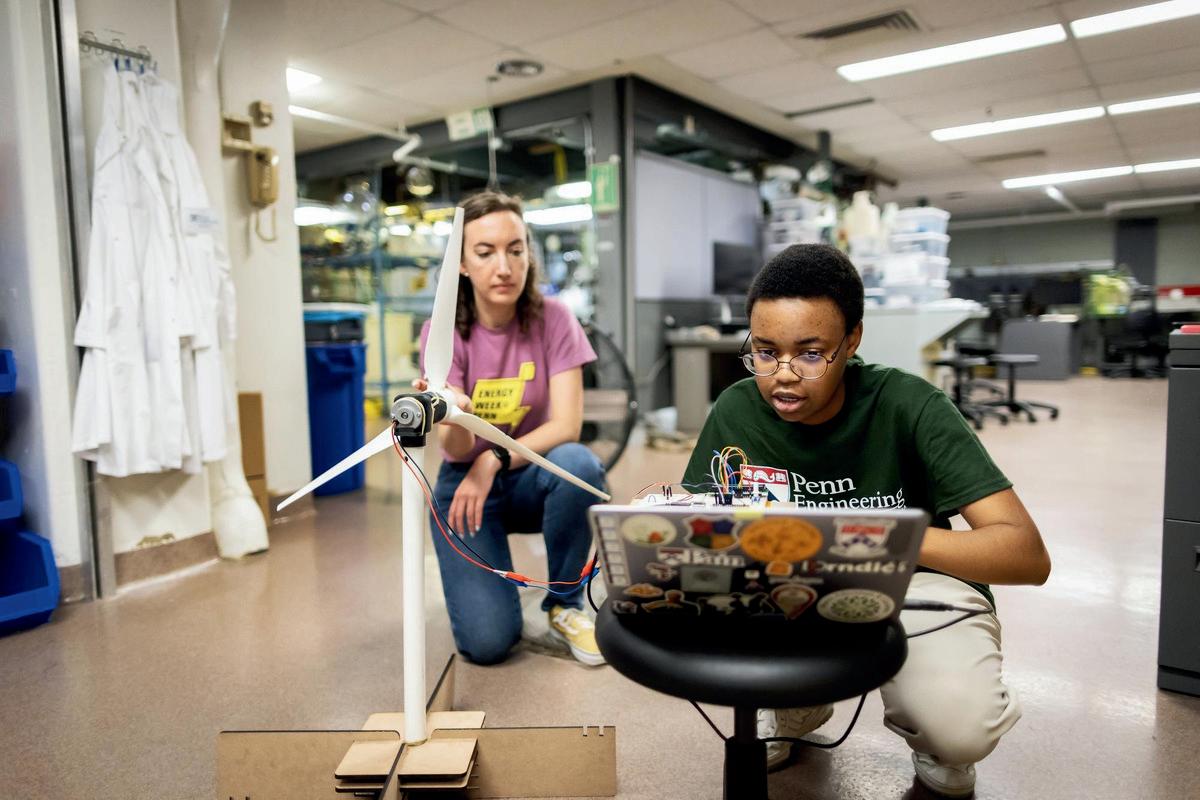
Mechanical engineering student Ngaatendwe Manyika works with Penn Engineering Prof. Lorena Grundy.
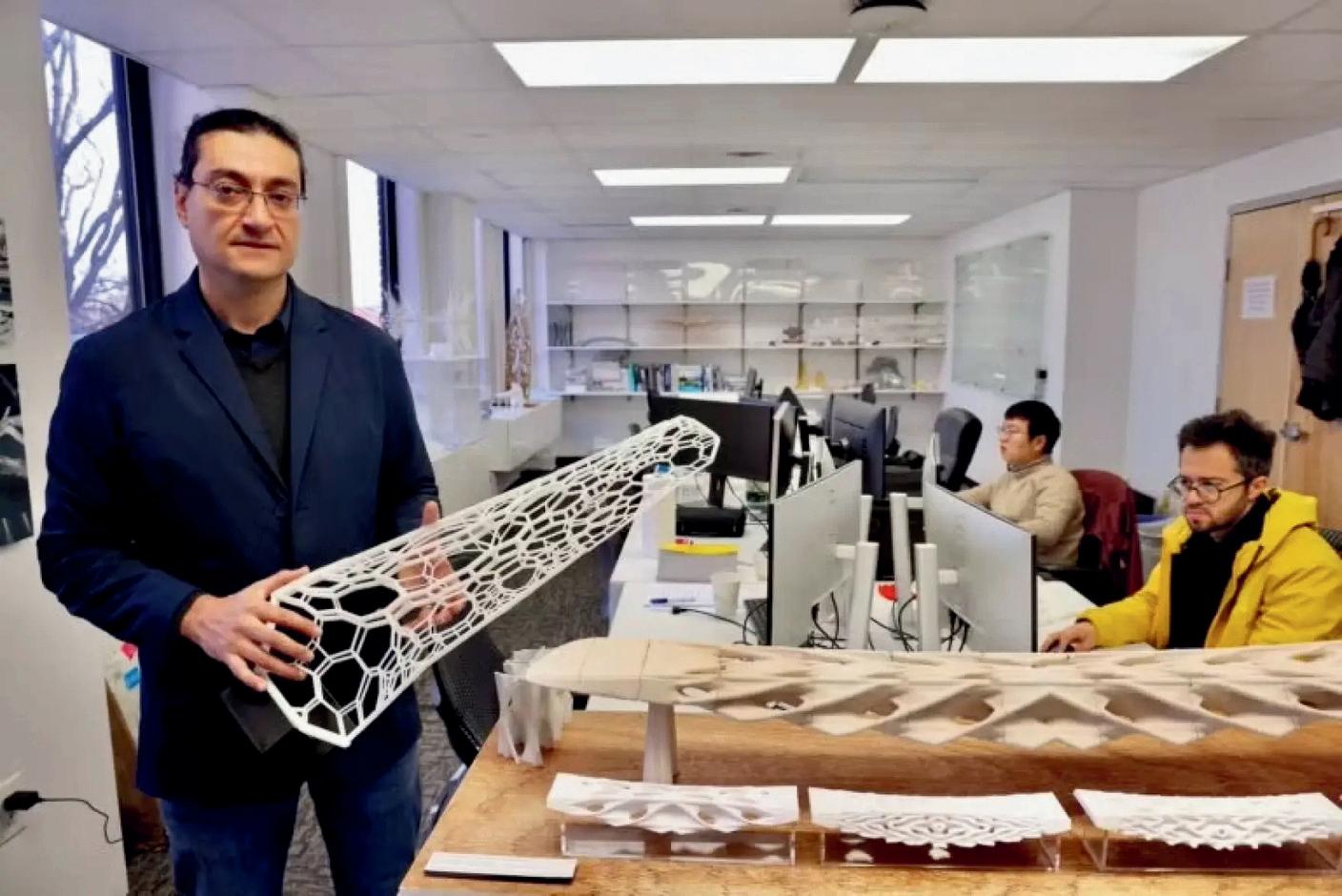
Weitzman Prof. Masoud Akbarzadeh pushes the boundaries of architecture in his research on structures.
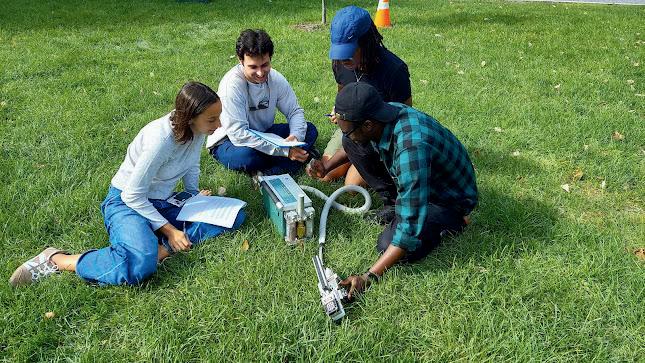
Students from Prof. Alain Plante’s Fall 2025 Biogeochemistry course measuring and collecting data on photosynthesis and respiration in Shoemaker Green.
PHOTO COURTESY OF MINDA HAAS KUHLMANN
Editorial | The UA budget failed to deliver
Last week, the Undergraduate Assembly finalized its annual budget, which allocated over $3 million in funding for the 2026-27 academic year. The spreadsheet itself is both unassuming and convoluted, completely incomprehensible to anyone unfamiliar with UA procedure. But the actual numbers — and the lengthy process through which they were decided — should be incredibly concerning to Penn students.
The UA is responsible for directly funding all Penn Student Government branches, along with other essential services, like Penn Labs and Penn’s Medical Emergency Response Team.
About half of the budget is usually allotted to the Student Allocations Commission, which funds all other student organizations. This year, the UA made a point to publicize the fact that it increased SAC’s budget. It was less forthcoming about the fact that, simultaneously, it gutted other vital student operations.
Perhaps the most egregious cuts were to the Student Committee on Undergraduate Education, the advocacy arm of PSG, which collects, synthesizes, and reports student data every year. SCUE’s overall budget was reduced by 40% — from $14,200 to $8,600. A large portion of the lost funding was a 33% cut to its survey incentive fund, which is used to offer free food to students in exchange for their responses to surveys about their academic experiences. These findings are then published every five years in a white paper that is presented to administrators in order to advocate for changes to University-wide policy. This data collection is SCUE’s essential function.
With such a large cut to its incentive program, it is limited in its capacity to capture the reality of the Penn academic experience. At the same time, the UA cut social spending across the board for PSG. This means no social events, retreats, or merchandise for any of the branches. According to the UA, these costs “were identified as the least essential to maintaining core organizational operations and mission-driven programming.” But costs for social events are essential for these groups. As highlighted in a joint budget amendment filed by representatives from the non-UA branches of PSG and Penn Labs, the costs deemed “social” are necessary to build community and support members while they work on valuable projects. The students who spend hours planning events, coding apps, and collecting data, all to make the Penn experience better for us all, deserve funding to make that hard work feel fun.
In cutting subsidies for social events, the UA also risks excluding PSG members who cannot afford to pay their own way for retreats, formals, and other events. Just because Penn isn’t paying for these events does not mean they won’t happen. It eans students without disposable income will not be able to attend them. By cutting social funding for all PSG branches, the UA solidified one thing: student government is a rich kids club. So where did all this extra money from the cuts go? A large portion went to airport shuttles, which received a 700% increase this year, as the UA lost external funding for the service. But
these shuttles are only used twice a year, and generally only sell between 500 and 600 tickets each semester. Given how few students use the service, there is no reason for the UA to waste $4,000 on the service, let alone spend an additional $1,000 to advertise it. Airport shuttles are not an essential service, especially when students can pay $8.75 for a regional rail ticket straight to the airport. Public transit is also more environmentally friendly, which the UA might have taken into account given that its cuts to printing were justified by a “broader sustainability initiative.”
A good chunk of money from PSG cuts was also redistributed to SAC. In their amendment, other PSG branches — including SAC itself — requested that $4,000 from SAC be reallocated back to social and operational costs that had been cut. While the UA argued that this funding was necessary to support student groups broadly, it actually only translates to an additional $5 for each of the 781 clubs recognized by SAC. Meanwhile, PSG received massive and unprecedented cuts that will severely inhibit its operations in the coming years. The very nature of the budget process is inherently adversarial. The budget is finalized over the course of three meetings, all of which are entirely led by the UA, which makes initial allocations, debates amongst themselves, agrees with each other, and then votes to pass its own budget. In this year’s first budget meeting, UA leaders encouraged members to “fire questions” at other PSG branches defending their budgets and to act as if their meeting was a “congressional hearing.” UA members essentially
filibustered the second meeting, making three separate motions to recess within the last 30 minutes, until Houston Hall closed and they were forced to vacate the room. In the third meeting, they killed the PSG reallocation amendment within the first 20 minutes, without hearing justification from any of the co-signing branches.
Perhaps this is all unsurprising. Only around 15% of Penn students bother to vote in UA and Class Board elections. Even worse, this year, for the first time in recent memory, a single candidate was running for both UA president and UA vice president. How can we expect them to take accountability if their victories were guaranteed?
Despite being the largest elected branch of student government, the UA may be the least representative. Its members design a budget, control any amendments, and approve that budget, with no obligation to any other body. They don’t publish reports on our needs. They don’t host the annual events students look forward to. At the end of the day, the biggest impact they have on our campus experience is they come up to us in Stommons and ask for our signature to get them on the ballot.
Editorials represent the majority view of members of The Daily Pennsylvanian Editorial Board who meet regularly to discuss issues relevant to the Penn community. This body is led by Editorial Board Chair Jack Lakis and is entirely separate from the newsroom. Questions or comments should be directed to letters@thedp.com.
Our athletes deserve better from their fans FOR PETE’S TAKE | What the Penn Band’s viral chant says to our athletes (and potential recruits)
Hot off their Ivy Madness win, the Penn men’s basketball team lost to the No. 3 seed, the University of Illinois, by a score of 105-70 in the first round of the NCAA Tournament. During the late stages of the game, as Penn trailed Illinois, members of the Penn Band directed a now-viral cheer towards the Fighting Illini, which garnered millions of views and significant backlash. The social media pile-on was swift. Headlines called the behavior “despicable” as
commenters called the cheer “classist,” “arrogant,” and the distilled essence of “Ivy League entitlement.”
As expected, the social media uproar has largely died down. The University of Illinois has moved on. The Penn Band’s executive board has issued a formal apology. However, what matters is not the opinion of opposing fans or outside commentators, but what this moment says to the nearly 900 varsity athletes who chose Penn — and to the recruits who might.
The Penn Band’s response was the move of a sore loser. Not entirely because the chant itself was offensive, but because it opted out of competitive spirit entirely. In our loss, rather than acknowledging a hard-fought season, cheering on our team in one of its most highprofile games this season, or respecting a better opponent, the response was to redirect our focus to future earnings and employment — as if our classmates competing on that court didn’t matter. Even if it was intended to be a joke directed at our opponents, the cheer was ultimately an insult to our very own athletes.
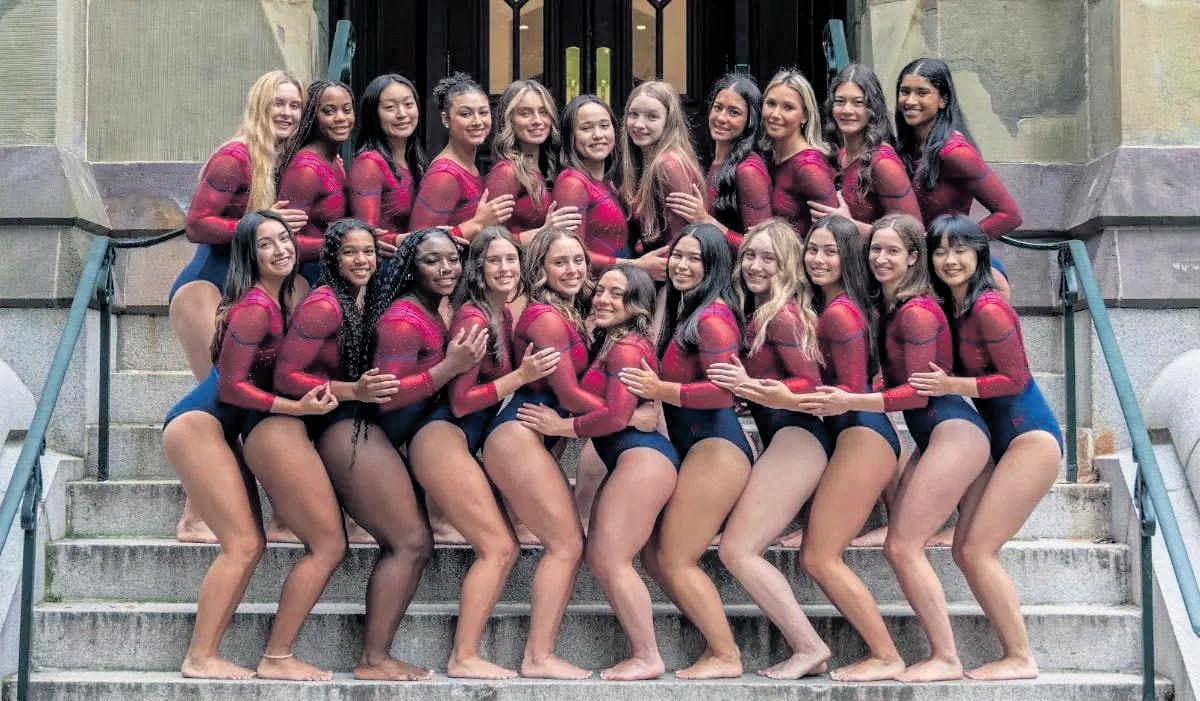
Consider what Penn men’s basketball managed to accomplish. Under firstyear head coach Fran McCaffery, the team won back-to-back overtime upsets against Harvard University and Yale University, securing the Quakers’ first March Madness berth since 2018. On top of that, these are student-athletes who chose to attend Penn, where they balance the academic rigor of one of the world’s greatest research universities with the demands of NCAA Division I athletics. Our athletes deserve a fanbase that stands by them, not one that completely abandons the competitive spirit of the game the moment things get difficult and simultaneously overshadows their very success. I would be foolish to stop with men’s basketball. This year, Penn gymnastics won its fifth consecutive GEC Championship title. Last year, Penn men’s squash recorded a perfect regular season and won the College Squash Association’s Potter Cup. And across all 33 programs, the Quakers consistently achieve athletic success — not despite
being hardworking students, but because of it. The scholar-athlete model is core to Penn’s identity. This brings me to the question that should concern us far more than any viral moment: What does a chant like that say to the potential Penn recruits? For elite student-athletes, choosing a school is as much about athletic culture as it is about academics. A recruit wants to know their fanbase will show up in both victory and defeat. Athletes don’t want to represent a student body that drowns out their accomplishments in controversy and retreats behind a diploma when the game gets hard. When Penn’s viral moment is a chant that treats athletics as if they’re irrelevant, we fail to project the pride we all hold in our teams. We tell recruits: When you lose, we won’t stand with you; instead, we’ll hide behind a veil of simply not caring, as if we’re somehow suddenly “above” sports entirely. That mentality does not represent Penn. Now that the controversy has largely blown over and the appropriate apology has been issued, it’s right to move on. But this incident serves as an important reminder about sportsmanship, about how Penn and the Ivy League as a whole is perceived from the outside, and most importantly, about how we as fans appear to our fellow Quakers and those we hope to welcome to our community in the future.
PETER KENNEDY is a College first year studying history and philosophy, politics, and economics from West Chester, Pa. His email is kenned29@ sas.upenn.edu.
KENNY CHEN | SENIOR PHOTOGRAPHER
Columnist Peter Kennedy argues that the band’s March Madness cheer is not just a bad look for Penn, but ultimately a greater insult to our very own student-athletes.
JULIA WANG | SENIOR DESIGNER
What a surprise: You want to transfer to Wharton
CHARLOTTE’S WEB | So why did you apply to the College of Arts and Sciences?
Last Thursday was Ivy Day, when Penn released its regular decision results, offering admission to the bright-eyed and eager future students whose tour groups on Locust Walk bring back memories of our own applications and eventual acceptances. The weeks spent crafting personal statements, carefully detailing our honors and awards, and lining up to secure the perfect letter of recommendation were all in the hope that we would receive that confettifilled email. But that process, rewarding as it was, pales in comparison to the application we really seem to care about: transferring into the Wharton School.
On April 1, the application to internally transfer to Wharton will open, and hundreds of students who wrote about how perfect the College of Arts and Sciences was for them will suddenly realize their divine passion for business. Of course, every once in a while, a student will apply to the College, get in, and then genuinely have a change of heart about their future career what they need to achieve it, or decide they want to work toward earning an innovative dual degree. That’s exactly who the Wharton internal transfer was designed for.
But more often than not, the application portal is flooded with students applying for all the wrong reasons: students who only applied to the College to then transfer to Wharton, students applying for an uncoordinated dual degree program just to drop the College degree, or students applying for the name and not the actual resources of Wharton. These people not only take away from all that the College has to offer, but they also take away opportunities from genuine and passionate applicants.
The College provides an interdisciplinary education for a reason — you’re supposed to explore programs, classes, and even academic minors in other schools. What’s so versatile about the College is that you can major in biochemistry or cinema studies while taking classes at Wharton, rushing business fraternities, and joining preprofessional clubs to get that additional business experience and perspective. The College isn’t a barrier preventing you from achieving your consulting dreams — it’s an education that encourages you to look at those goals from a different angle. In reality, you have access to Wharton classes, clubs, and programs, all while reaping the benefits of attending the College. So what it really comes down to is whether you applied to transfer to Wharton for the resources or the name.
Other than its access to other schools, the College itself is known around the world for its education, and tens of thousands of prospective students apply each year in desperate hope that they could get the experience that many dismiss. What’s so ironic about students applying to the College just to apply to transfer to Wharton a semester later is that the College has the same acceptance rate as every other school. It’s a complete misconception that the College is easier to get into than Wharton — it’s not the easy way into Penn. People from every state and over 87 countries apply for the academics, resources, and opportunities provided by the College. Similarly, the uncoordinated dual degree program at Penn offers another gateway into Wharton, one that is abused beyond its intended purpose. Students often opt to complete two separate degrees
What does opportunity cost?
between schools instead of the straightforward transfer. However, there is nothing stopping students from dropping one degree (usually the College one) by not finishing the requirements and then graduating with just the Wharton degree. This undermines the innovative and dedicated purpose of a dual degree, and once again takes opportunities away from genuine applicants.
It’s not a problem of wanting to be in Wharton. It’s not a problem of wanting to concentrate in finance or management. It’s not even a problem of wanting to go into consulting. It’s a problem of hundreds, if not thousands, of qualified and passionate College applicants getting rejected so that a student whose main goal is to transfer to Wharton can take their spot. The College is its own institution with its own purpose, and that purpose is not to be a placeholder for those who want to sidestep into Wharton.
Why did you choose to apply to the College? More importantly, why did you choose to apply to Penn? Frankly, it would be ridiculous to pretend Wharton wasn’t a draw for all of us; its resources and reputation precede it. But there’s so much more to Penn that not only deserves recognition but also deserves to be experienced by passionate students.
Applying to the College in hopes of just transferring to Wharton within a year undermines the education Penn is meant to provide you. Nothing can undo what’s done — you can’t be unaccepted into the College. But you can begin to see the College for what it actually offers and not just as a stepping stone to Wharton: a highly prestigious interdisciplinary education that has brought hundreds of thousands of dedicated students to success.
DEW TELL | Opportunity has come knocking for the Class of 2030. Should they answer?
Buried in my mom’s camera roll is a video of me from last April, doe-eyed, donning my newly-purchased apparel and officially committing to Penn. “Are you sure you want to go there?” my mom asks half-jokingly. “Yes,” I respond. “The opportunities are endless.”
“Opportunity,” in all of its vague, grandiose glory, was my reason for trading tropical California for frigid Philadelphia. After a year here, what does that opportunity look like? Pure carnage. In fact, it almost resembles the Roman Colosseum where gladiators (first-year students) clad in armor (trench coats) duel one another relentlessly for their lives (a spot in Wharton Undergraduate Consulting Club).
The rumors about Penn’s competition are unequivocally true. Upon arriving here, you’d be wise to heed urban legends of club acceptance rates lower than that of Penn itself. As an addendum to the first-year-ofcollege aphorism “say yes to everything,” at Penn you must also “apply to everything.” In the cacophony of this competition, you’ll find that religious career obsession is just downstream. At the beginning of the year, don’t be surprised if your friend invites you to a BlackRock information session before dinner. And don’t be alarmed if by spring you overhear two best friends politely fighting over who landed the better internship. Rapidly and even unintentionally, we accept hypercompetitiveness as the law of the land. In context, opportunity has become a relentless, all-consuming pursuit. But does it need to be this way?
“C’est la vie,” or “that’s how the world works,” one might say. And mostly, they would be right. The arduous battle of landing any position at Penn is not dissimilar to the very real job market, where even 100 applications can be insufficient to secure full-time work. The lessons you learn while vying for a club spot — leveraging your network, presenting yourself, and prioritizing your goals — translate quite well into avoiding unemployment. Given these parameters, how does opportunity really manifest itself for incoming students? Not necessarily how I had expected — not like jobs, clubs, and resources ready for the taking. It’s more meta than that. The true opportunity is the chance to pursue opportunity. That’s to say that honing your networking skills and perfecting your personal brand often proves more valuable than the content of the resulting resume filler. The process of trying to get into a club or seeking a resource is often more applicable (and productive) than the work of the club or the value of the resources themselves.
The optimist in me thinks this outlook emphasizes the journey over the destination, even when the destination is a six-figure job after graduation. But my inner cynic would say that this perspective makes Penn culture self-involved, insidious, and overly corporate, where every passing conversation feels like the other party is making a career move. The realist in me knows it’s a mixture of both. Penn students, for all of our complaining and catastrophizing, have an appreciation for the hard work that our career prospects require of us. At the same time, as any jaded upperclassmen will tell you, acquiring opportunity usually comes with the trade-off of connection or fulfillment.
I don’t need to lecture new admits on the moral bankruptcy of popular fields like consulting and finance or caution them against career funneling; that sentiment is pervasive enough. Instead, I want to offer that at Penn, the details matter, maybe more than they’re worth at face value. Sometimes it’s for the better, highlighting the unsung aspects of a given job. Oftentimes, though, it amplifies the anxiety surrounding each step toward a goal. In the pursuit of opportunities within the Penn bubble, each choice feels uncharacteristically huge. Hierarchies surrounding clubs, Greek organizations, and even individual people, can turn interaction into a Machiavellian
game of strategy. Perhaps this is a symptom of unfulfillment. The fast pace of corporate pursuits makes it easier to zero in on the next step than to zoom out over the (mostly dull) big picture. Regardless, this commitment to the “nitty gritty” colors our view of opportunity.
Ultimately, I think Penn’s culture surrounding opportunities will continue to be as it is, for the most part at least. Success within the walls of Penn will ask that you suspend your disbelief to accept the complex oddities of a new language and a strict pecking order. But turning that Penn success into real-world success will require you to think more broadly about your place in society. The connections and social capital that seem so valuable on this side of the Schuylkill River might be less valuable than the skills you learned while acquiring them.
To incoming students, I encourage you to take what resonates from Penn’s culture and insert it into your existing view of the world. Opportunity is everywhere, in the fine details and the big picture.
DEW UDAGEDARA is a College first year studying neuroscience from Long Beach, Calif. His email is dewdunu@sas.upenn.edu.
CHARLOTTE PULICA is a College first year studying communications and consumer psychology from Enoch, Utah. Her email is cpulica1@sas.upenn.edu.
CHENYAO LIU | SENIOR PHOTOGRAPHER Senior columnist Charlotte Pulica argues that applying to the College just to transfer to Wharton disregards everything the College has to offer and is unfair to genuine applicants.
Bergstrom, Moehn take home All-American honors at NCAA swimming and diving championships
The distance freestyle duo joins an elite group of only two other All-American swimmers in program history
VALERI GUEVARRA Senior Reporter
Senior
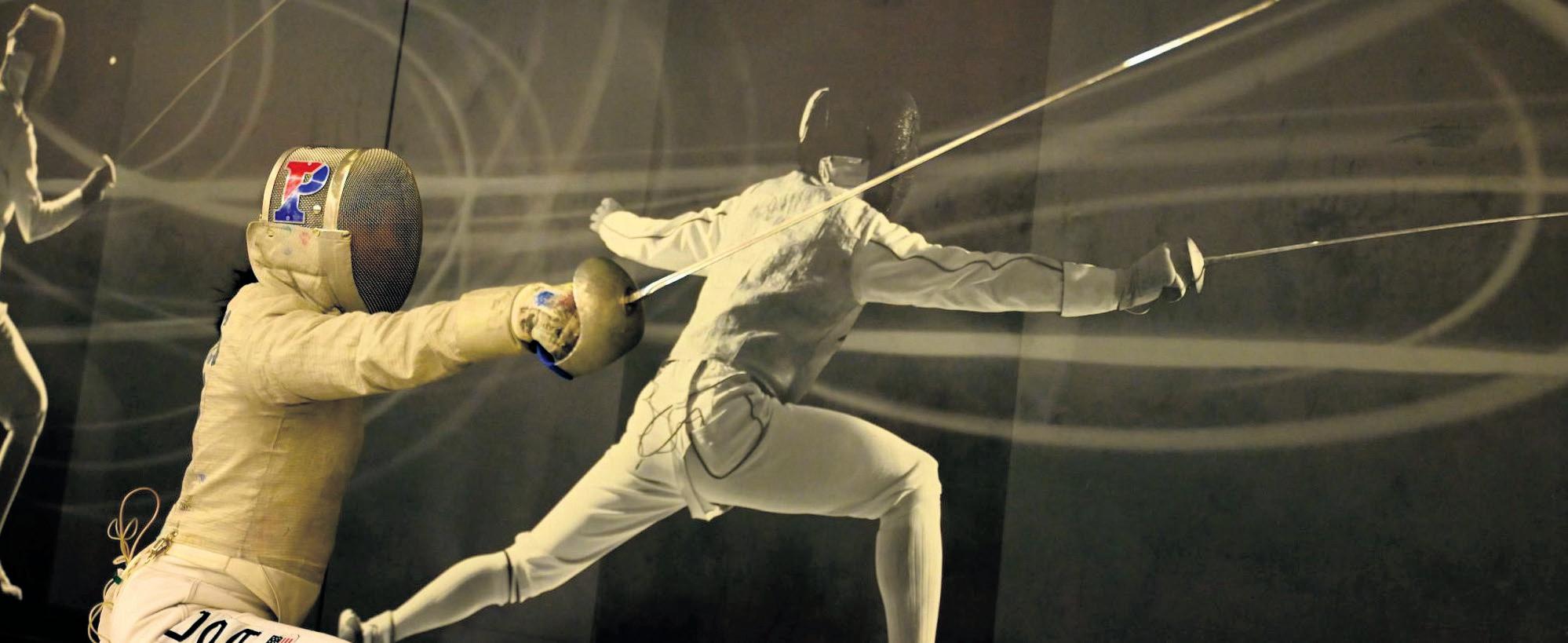
FENCING, from back page
at the tournament, earning second-team All-American honors in the first year of his collegiate career. Fellow épéeist junior Joseph Wu finished 24th overall after a string of defeats on the final day of competition.
The saber specialists had split trajectories throughout their respective tournaments.
Sophomore saber specialist Antonio Heathcock entered the pool rounds with momentum as the 2026 Mid-Atlantic Region saber champion. He went 4-3 in the first round of round-robin bouts with a streak of victories. The Beijing native would go on an eight-bout win streak during the second and third pool rounds but finished 14-9 overall following some tough losses on the second day.
Two of Heathcock’s narrow defeats on the first day of competition came at the hands of eventual saber champion Ahmed Hesham from Notre Dame, and his own twin brother Colin Heathcock, who fences for Harvard.
Although fellow sophomore saber specialist Jaesun Yun suffered a slow start to the competition, he entered the final day ready to ascend the ranks. During the first pool round on the second day, Yun went 4-for-4 while limiting his opponents to two touches or less. He would carry that momentum to the final pool round of the day, pulling off another perfect round.
By the end of the competition, Yun catapulted himself
from 12th place to sixth place to earn his first career AllAmerican honor. Antonio Heathcock stood on the podium beside Yun, finishing eighth overall in the saber for his second career All-American honor.
Captains held it down for women’s fencing squad
The Quakers showed up and showed out at the inaugural NCAA women’s fencing championship.
Penn women’s fencing took a seasoned squad into this historic tournament, including junior épéeist Victoria Kuznetsov, who earned a bronze medal at NCAA MidAtlantic Regionals, and junior captain épéeist Grace Hu.
Kuznetsov and Hu faced off early in the tournament, with Kuznetsov pulling off the victory. Hu had a rough start to the competition, only notching two victories across the first two pool rounds, but she ended the day on a threevictory streak.
Hu went undefeated during the final pool rounds. She limited all but one of her opponents to three touches or less and climbed the ranks to crack the top 10 and earned All-American honors for the second time in her career.
Kuznetsov also landed her first career All-American honors, finishing 11th overall for an honorable mention.
“I am really happy with the result, [I] think this season’s training and hard work culminates to NCAAs so being able to perform as best as I can and place in the top 10 was very rewarding,” Hu wrote in a statement to The Daily Pennsylvanian. “I think this year was especially special since it was my first year both leading the team as captain to improve collectively, but also competing for myself
A historic end to a historic season.
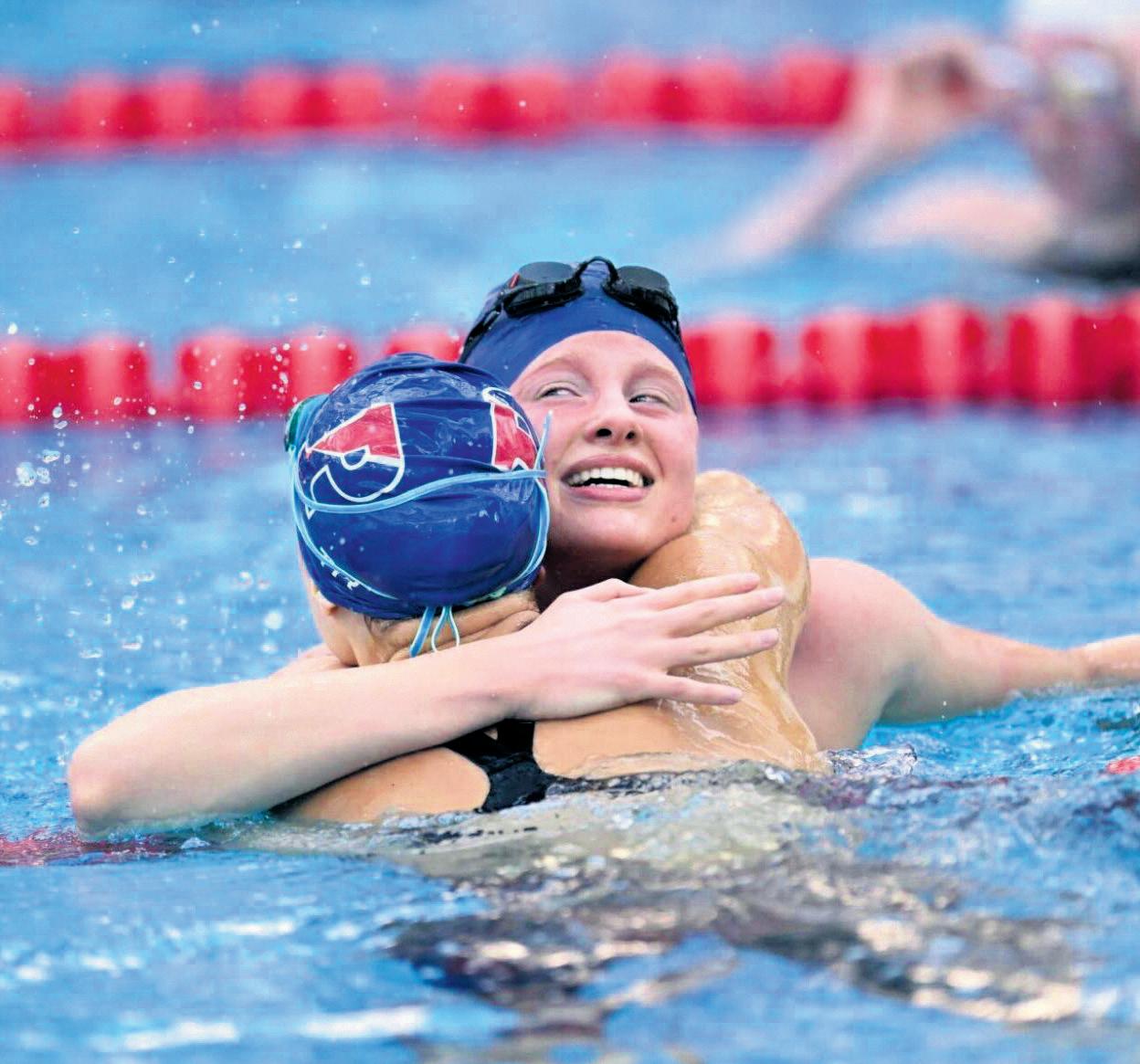
Last week, senior distance freestyle specialists Sydney Bergstrom and Anna Moehn competed at the 2026 NCAA Division I women’s swimming and diving championships at Georgia Tech. In the 1650yard freestyle, Bergstrom touched the wall in 12th while Moehn was just behind in 16th to claim secondteam All-American honors in the final meet of their collegiate careers.
This is Bergstrom’s second appearance on the national stage. The Swarthmore, Pa. native made impressive strides this season, improving from 36th last year to a 12th-place finish in the mile with a time of 16:04.94.
To get to NCAAs, Bergstrom dropped over five seconds for a career-best in the event to claim the crown in the 1650 freestyle at this year’s Ivy League championships, with Moehn completing the 1-2 finish. Moehn also shined at NCAAs — improving her 21st finish from 2025 to 16th in her third appearance at the championships.
With their top-16 finishes, the two join an elite group of four swimmers in program history to earn All-American honors — alongside former teammates and fellow distance freestyle specialists: Anna Kalandadze and Catherine Buroker.
“I feel like [Moehn and I] both have been in this together for so long, and so it was really nice that our last mile ever, we were able to achieve something like that,” Bergstrom said.
The Quakers have a rich legacy of distance freestyle dominance. This marks the seventh-straight season that at least one distance freestyle swimmer donning the Red and Blue has competed at NCAAs.
The legacy goes back beyond recent memory. 2018 College graduate Virginia Burns claimed four-straight Ivy League championships in the 500-yard freestyle, and 2014 College graduate and 7-time Ivy League individual champion Shelby Fortin was inducted to Penn
Athletics Hall of Fame for her winning versatility across freestyle events.
Coach Mike Schnur has frequently told stories about Burns and Fortin to Moehn and Bergstrom. Now, the two seniors have etched their names into history, leaving stories to be passed down to the next generation.
“To keep contributing to this legacy, I hope it inspires other people as it did to me when I first came here,” Bergstrom said. “I’m really proud to have been able to do that, especially in my last season.”
It’s been quite a journey also for Moehn, who didn’t expect to swim any distance freestyle when she came to Penn. She now leaves Sheerr Pool having medaled in the 500 and 1650 freestyle at Ivies in each of her seasons.
There’s a lot of history, specifically in the Georgia Tech pool, for the Quakers. 2016 Wharton graduate Chris Swanson claimed Penn swimming and diving’s first NCAA title in 2016 in the 1650 free. The journey to the national championships is never easy. Bergstrom and Moehn trained without coaches during their first week of NCAA preparation as the men’s team competed at Ivies, and the rest of the team either completed their season or was
the team placed second — the highest finish in program history.
WEINING DING | STAFF PHOTOGRAPHER Penn Fencing Center on Feb. 14, 2024.
and focusing energy on my individual performance. [I’m] really honored to have had the opportunity to both lead this team and also represent [Penn] on the national stage.”
Freshman foil specialist Kimberley Jang had a strong showing at her first collegiate national meet, going 9-6 on the first day of competition in a particularly deep field. Jang ultimately finished 10th overall in the foil, earning her first career All-American honors.
“I enjoyed the collegiate fencing season. I feel like it was very hype and I didn’t have a lot of pressure on me,” Lioznyansky wrote. “I got to just fence for fun with friends a lot of the time.”
“[T]his past season, [I]’ve learned a lot about what it means to lead and how to shift our culture towards one that will be most effective for us,” Hu wrote. “[N]ext season [I] hope to make the most of my senior year, leave my mark on this team and keep trying to help my team make lifelong memories.”
Although the 2025-26 collegiate fencing season has officially concluded, a number of Penn fencers have transitioned into their professional seasons. Lioznyansky represented the United States at the Epée World Cup in Kazakhstan last weekend, while Heathcock fenced for Team USA at the Men’s Saber Grand Prix in Hungary.
Clark | You should be watching Penn track and field
Two freshmen first team All-Americans highlight a program ready to dominate
ELLIE CLARK Deputy Sports Editor
A sea of Irish paraphernalia and excited whispers about junior forward TJ Power’s 44-point performance lit up Locust Walk on St. Patrick’s Day.
Although some students were anxiously preparing for midterms or consulting coffee chats, an unusual air of athletic excitement permeated Penn’s campus last week. Basketball content creators from near and far predicted that Power would usher in a new era for Ivy League athletics, similar to Princeton’s Sweet 16 campaign in 2023. Early bracketology even seemed to support a burgeoning Cinderella storyline.
Amid the pomp, circumstance, and unusual attention to student athletics on campus, some performances went overlooked. Freshman distance runner Joseph “Tiago” Socarras placed fourth in the nation in the 800-meter run at the NCAA Division I Indoor Track and Field Championships. Fellow freshman shot put thrower Jessica Oji dominated on the mound, finishing seventh overall at the NCAA Indoor Championships as the only underclassman in the field.
Excellence on a national level should be celebrated, but flagship sports dominate the conversation.
Socarras’ monumental finish has been the talk of the track world, earning him a national No. 16 ranking among all NCAA Division I distance runners, but the writing’s on the wall. No one seems to care about Ivy League track and field outside of the teams and running fanatics.
Penn’s track and field team has consistently stood out from its in- and out-of-conference competitors.
Senior high jumper Kampton Kam broke a 30-year medal drought for Singapore in the Southeast Asian Games last December. In just her third competition representing Nigeria, Oji broke the African shot put record with an 18.5-meter throw at Ivy League Heptagonal Championships.
Quaker talent lasts far beyond their Franklin Field days. Last winter, 2024 College graduate Isabella Whittaker broke the U.S. record in the 400-meter run while representing the University of Arkansas at the 2025 NCAA Indoor Championships. Whittaker crossed the line in a blistering 49.24 seconds — the second-fastest indoor 400-meter time in world history. 2020 Nursing graduate Nia Akins qualified for the 2024 Olympics alongside Whittaker after capturing the 2024 USATF outdoor title in the 800-meter run.
Everyone knows who Usain Bolt is because he is a
character in “Temple Run.” Sha’Carri Richardson’s 2021 Olympic disqualification due to tetrahydrocannabinol usage and arrest for speeding in 2026 made international headlines. High school senior Quincy Wilson made waves after becoming the youngest male Olympic gold medalist in the in track and field history. Although the sport has waxed and waned in popularity over the years, road running has evolved from a niche sport to global phenomenon since the pandemic. As of November 2023, 28.76% of active runners began running during quarantine. The Abbott World Marathon Majors plans to add three new marathons to its circuit by 2027 due to increased popularity of elite long-distance road racing. Charities and shoe companies have begun sponsoring celebrity “athlete” fields in these elite competitions, despite controversy over qualifying marks. Penn students have caught on to the distance running trend as well. Students have even offered to sell their entries for the Love Run Philadelphia sponsored by Saucony — a half-marathon and a 7-kilometer race that draws over 15,000 runners. The 7K race has been sold out since January. Growing interest in the sport isn’t reflected on the oval. The Jane and David Ott Center, which was completed in November 2024, was supposed to mark a new era for Penn indoor track and field. Although the Ott Center for Track and Field attracted international attention after the Atlanta Track Club broke the indoor 4x800-meter world record last February, rarely any outside spectators showed up for Penn track and field’s
record at the Circuit Philadelphia meet at the end of February. People should show up to support Penn track and field. We tend to fixate on track and field on four-year cycles, following the sport with a circadian rhythm. Every time the summer Olympics and Paralympics conclude, the sport retreats
COURTESY OF PENN ATHLETICS
distance freestyle specialists Sydney Bergstrom and Anna Moehn at the 2026 NCAA swimming and diving championships.
Nguyen, Whittington compete at NCAA swimming and diving championships
For the first time since 2016, multiple Quakers competed at the men’s NCAA tournament
VALERI
GUEVARRA Senior Reporter
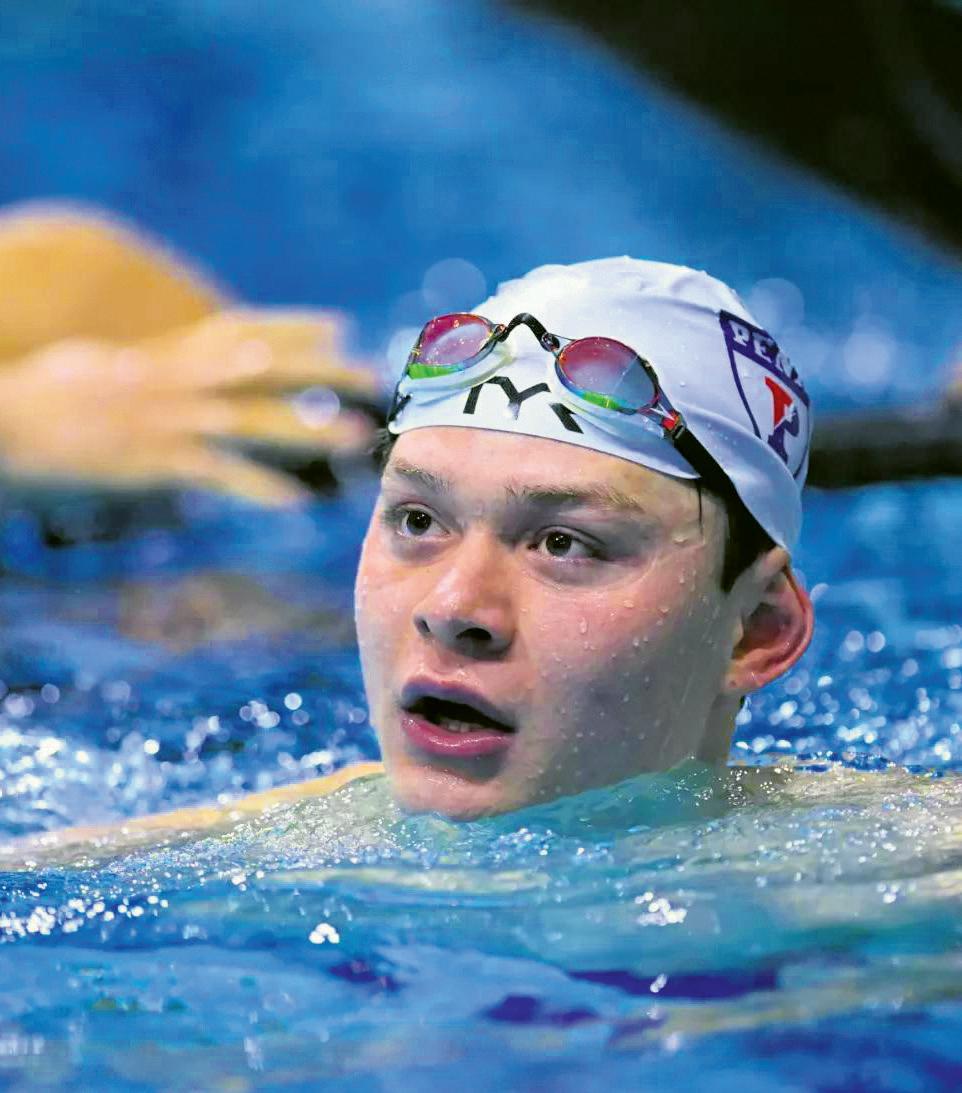
and 26th in the 100-yard and 200-yard breaststroke, respectively, while Whittington placed 23rd and 31st in the 200 breast and 400 individual medley. The two are the first Quakers not named Matt Fallon to swim at the championships since 2019. This year’s NCAAs were also the first since 2016 to have multiple Quakers compete at the national championships.
“[Peter and I] train very hard, and we’re at it every single day, and we’re going to do our best to have a better result next year and represent Penn way better next year,” Nguyen said.
Nguyen qualified for the championships via this year’s new qualifying system, where conference champions automatically receive a berth to the NCAA championships. He swept the breaststroke events at the 2026 Ivy League men’s swimming and diving championships to head to his first-ever appearance on the national stage.
Whittington qualified for the championships with his speedy time of 1:52:10 at Ivies, which was runner-up to Nguyen. He was able to compete in the 400 IM as well. The two upheld Penn’s strong reputation in the breaststroke events. Fallon represented the Quakers in both breaststroke events for the last four seasons at NCAAs.
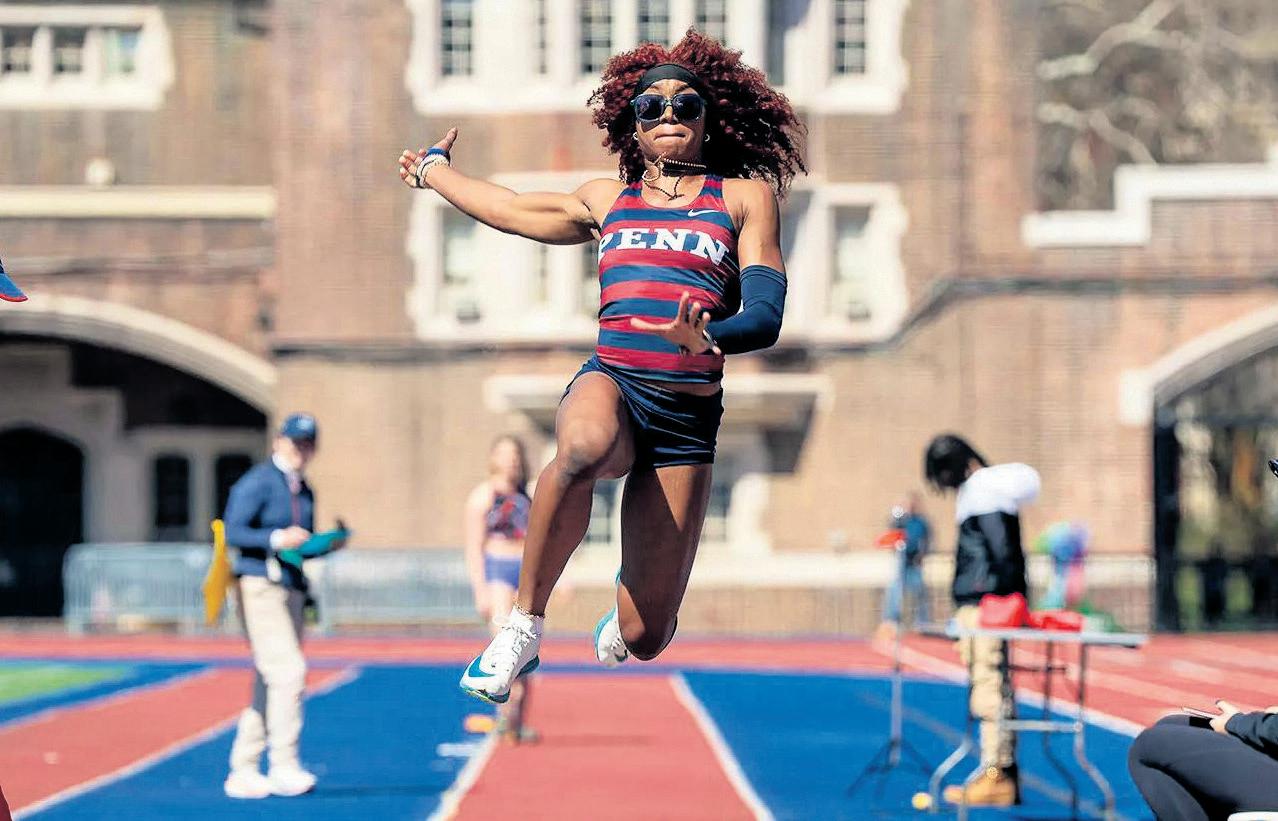
field when she went to primary and secondary school in Nigeria. Like most beginners, Agbo began her journey as a sprinter on the oval.
While Agbo wasn’t a weak sprinter — she even donned the Red and Blue for short sprints last spring — her high school coaches recognized her potential as a jumper shortly after moving back to the United States in 2019.
Agbo spent the rest of her high school career learning to love jumping, all while staring down the Morris County triple jump and long jump records set by three-time Olympian Keturah Orji. In 2016, Orji became the first American woman since 1996 to make an Olympic triple jump final. It’s safe to say that Agbo had big shoes to fill.
“People would tell me ‘you’re right under an Olympian, that’s such a great thing,’” Agbo said of being compared to Orji.
“‘You’re going in the right place. You’re going in the right direction.’ And even on days where I didn’t compete my best, or I just didn’t have the best day, it would be a reminder that, as I mentioned before, people have done this before me. Greatness has been here before me.”
Agbo has evolved from a standout athlete into a strong leader on the jumps squad, showing up for others the way she would have wanted as an underclassman new to collegiate athletics. As always, Agbo gives credit to those who came before, but now it’s up to her “to learn from those experiences … and move forward building.”
Relying on her support system has always been a source of strength for Agbo, and her best friend and teammate, junior jumper Paris Ivery, has been there since she first stepped on Locust Walk. Ivery and Agbo consistently support each other despite competing against each other, taking turns cheering on whoever’s next on the runway. At the end of the indoor season, the two stood on the Ivy League Indoor Heptagonal Championships podium together, finishing 4th and 5th in the triple jump.
“She understands when things in my personal life might not be going well, and during those moments, it’s a blessing to have someone who can give me that extra push and motivation to get through practice,” Ivery wrote in a statement
Leading up to the NCAAs, training is not the easiest as it occurs with a smaller group during spring break, with the rest of the Penn community off and a tight turnaround to taper and rest ahead of the meet.
Nguyen, though, enjoyed the intimate and individualized atmosphere of the NCAA training group, which included now All-American senior distance freestyle specialists Anna Moehn and Sydney Bergstrom.
“It’s just great because I know we’re all putting in the work,” Nguyen said, “Then you have Mike, who gives you all the attention, so he’s writing sets specifically for you.”
As for the meet itself, even with Nguyen’s experience at large-scale meets like the World Aquatics Junior Swimming Championships or the United States Open, the NCAA championships had a unique atmosphere with the crowds of fans for the powerhouse state programs.
“It’s the most elite people from the top, these top state schools like Texas, Cal, Florida, and there’s so much energy because all the parents are coming out and supporting their kids,” Nguyen said. “This is definitely the most high-energy meet I’ve been to.”
The high energy and big stage came with a lot of pressure, to which Nguyen attributed his less-than-ideal performance at the meet, finishing in 28th and 26th in the 100 breast and 200 breast with times of 52.05 and 1:54.07, respectively — off of his best times set less than a month ago at Ivies.
“We were racing some very good people,” Nguyen said, “It’s a lot and a lot of pressure.”
to The Daily Pennsylvanian. “Being able to train with her is something I don’t take for granted, it’s a real blessing.”
“Being able to celebrate those wins with someone you’ve struggled with, grown with, and battled through tough moments with makes it that much more meaningful,” Ivery added.
Throughout all her triumphs and failures, one factor has remained a constant for Agbo: her faith. Understanding that God has a plan for her has kept her rooted and focused on her goals, whether that be in athletics or academics.
“If it’s meant to be, it will be, and if it’s not meant to be, then God has bigger and better plans for me at a different time,” Agbo said.
A psychology major, Agbo remembers struggling in chemistry, eventually dropping the class in her freshman spring. But she was able to overcome the anxiety and pass CHEM 1012 and 1022 over the summer with A’s. Her strong grounding spans further than her athletic pursuits, a strength she will carry into her future career as a pediatric psychiatrist.
Agbo’s trust in God has quieted her anxiety and nerves during tough times, improving her mentality on the oval and making her into the athlete we see today. Her fear became background noise, as Agbo reminds herself that she “could do all things through the Lord who gives me strength” as she continues to the next goal.
What is her next goal? Breaking the outdoor triple jump program record – the only women’s track and field program record from the 20th century.
With the Penn Relay Carnival around the corner, Agbo has the potential to win a title on her home turf. She also has her eye on an even bigger goal: the Los Angeles Olympics in 2028.
No matter what challenges she may face down the road, there’s no doubt Agbo will persevere, feeling blessed for the experience.
“On and off the track, she brings so much love and positive energy. Being around her just feels good — she has a way of lifting your spirit without even trying,” Ivery wrote.
“Everything she does comes from a real place, and you can feel that. She doesn’t just talk about being supportive, she lives it. And to be able to experience that kind of friendship and energy every day is honestly a blessing.”
However, just competing at NCAAs for both Nguyen and Whittington was a great accomplishment, as the two were among the first swimmers left off the qualifier list last year in their events. This year, the two finally made the cut.
Looking to the future, the two will get back to training soon for the long course season. Nguyen is looking forward to breaking down the film of his races to analyze and make adjustments to be better when next season rolls around.
In the longer term, the two are exploring paths to achieve every swimmer’s dream: qualifying for the Olympics. Whittington is originally from Hong Kong and has represented China on the international stage at World Juniors.
Growing up in Texas, Nguyen has done the same, but he just recently acquired dual citizenship between the United States and Vietnam to explore the opportunities of representing Vietnam in international competition, which could include the Olympics. The U.S. Olympic swim team is notoriously the most competitive in the world.
“I’m going to go to some meets in Vietnam and to see how I enjoy the experience and if I feel like that’s something I really want to continue in the future,” Nguyen said. “I think about the swimming, but outside of that, it’s more of a question of ‘Am I being true to myself?’”
The Quaker duo wouldn’t be the first Ivy League swimmers of recent memory to navigate that path. After deciding to swim professionally instead of starting his finance career post-graduation following a breakout
RACING, from back page
battery to power the car.
“Mechanical can get the wheels on the ground,” Sharma says. “But electrical actually gets the wheel spinning.” As for his team of operations, Sharma handles the business and cost scenario events in competitions, procuring materials, and the team’s media.
Over the season, the team faced challenges with custom-printed circuit boards. The circuit boards are essential to the race car and help manage its battery and distribute power.
“We always run into a ton of issues,” Engineering junior and hardware co-lead Oscar Qu said. He worked closely with rookies and guided them through the process of designing circuits. Approaching his third year with the club, he knows it is common for mistakes to happen. Even so, he remains optimistic about these setbacks, saying that “running into these mistakes allows us to constantly learn and improve from them.”
A key approach this year with the rookies in the electrical team has been the “ground-up” mentality. Rather than ordering pre-made materials for the racecar, Qu emphasizes to his team that everything they make must be custom-built.
“The way we do things is everything is completely custom and from the ground up,” he said. “It’s kind of in the nature of this club, not only on the electrical team, but also from software, operations, and mechanical.”
With that, the team has seen improvements not only in the pacing of their work but in the quality as well. “Our weight has dropped significantly,” Sharma said. “Our aerodynamics and our suspension subsystems are working to provide the car with more grip, more traction, and an overall better performance.”
For their next step forward, they are going all out on reliability. The team has been putting
GYMNASTICS, from back page
Vault Sophomore Sienna Zuccaro led off the rotation with a beautiful stick and a beautifully laid-out position in the air, garnering a 9.775. Lassiter performed a strong Yurchenko layout full and squeaked past her teammate with a 9.800.
Murphy, on a roll, followed in her teammates’ footsteps and also stuck her landing. Fofana had great power coming off the vault table, displaying straight legs and pointed toes while in the air. Fofana contributed the best score of the rotation — a 9.850 — to tie for the vault title.
Barrow rounded out the rotation with a near stick and a 9.825. The Red and Blue finished their penultimate rotation with a 48.850.
Bars
Lassiter wowed the crowd with a seamless release from the bars and a strongly stuck landing, scoring 9.825 to tie her career-high set just one week earlier at
REV11 through rigorous trials to evaluate its performance under different conditions. While the new race car has a top speed of 80 mph, they are focused on identifying its weak points and making sure the car is fully functional for the competition in June.
“In the world of electronics, anything that can go wrong, will go wrong,” Qu said.
“The time window from now to June is just really, ‘How can we validate the car?’” Sharma said. “How can we ensure that there’s no failures in our cars, that nothing goes wrong in competition?”
“You can build a car, but that’s only half of the equation,” he continued. “What really takes it to the final stages is testing it and validating it.”
One of the major criteria that the team gets scored on during the Formula SAE Electric competition is the car’s reliability, also known as the “endurance score,” where the car’s robustness and efficiency will be tried through a 22-kilometer driving test that it must complete without stopping or exceeding energy consumption limits. The team didn’t compete in this category last year, but it are ready to take on the challenge this June.
“We’re really looking to max everything out this year,” Chen said.
The team has worked hard and built a community through long nights, dumpling socials, and go-karting to make it happen. But it also dream beyond this summer, hoping to build a four-wheeldrive car next year.
Sharma said, “You can draft these ideas up on paper, but what matters is you need to have a team that’s committed to do that, right? And I think that this year we had a super cool, very motivated group of people, and I’m happy to see that Rev11 is driving.”
Penn Electric Racing doesn’t just want a car that can drive, though. When asked what the team’s goal in June was, Chen didn’t hesitate.
“Win.”
Sports Editor Hannah Chang contributed to reporting.
Cal. Lassiter secured her second medal and the first title of the night with her performance, sharing the gold with Brown’s Liza Marcus. Fletcher had beautiful lines on both the high and low bars and only a small step on her landing, contributing a solid 9.775. Junior Sophia Paris, effortless as always, capped off a beautiful routine with a floating double back dismount. Sophomore Luci Toczydlowski exhibited an impressive level of control as she sailed through the air on the bars. Barrow finished out the rotation yet again, with a score of 9.725.
Accounting all events, the Quakers came out on top once again with a 195.025 total score, finishing four-tenths of a point above Yale. Barrow was awarded GEC Gymnast of the Year, and coach Kirsten Becker was honored with Coach of the Year.
“I’d say our GEC performance was probably the meet this season where we showed the most grit,” Werlen said. “We work so hard during the year, and we showed true determination to still end with the result we came there for despite not having a perfect meet.” While the rest of the Penn gymnastics team will enjoy the offseason, Barrow and Lassiter will travel to Arizona at the beginning of April to compete at the NCAA Tempe Regional.
COURTESY OF PENN ATHLETICS
Penn gymnastics won its fifth straight GEC title on March 21.
THE INDEPENDENT STUDENT NEWSPAPER OF THE UNIVERSITY OF PENNSYLVANIA • FOUNDED 1885
PHILADELPHIA, THURSDAY, APRIL 2, 2026
Penn Electric Racing gears up for its next competition
The club’s newest car, REV 11, is ‘built on the fastest timeline in team history’
Gymnastics captures fifth consecutive GEC Championship title
Junior Jordan Barrow was named Gymnastics East Conference Gymnast of the Year
CATHERINE ELLIS Staff Reporter
The crown stays home.
On Saturday, Penn gymnastics traveled up to Ithaca to compete in the Gymnastics East Conference Championships against competitors: Yale, Brown, Cornell, Bridgeport, West Chester, Southern Connecticut State, and William & Mary. Although the Quakers competed in the second session alongside their Ivy League rivals, all schools had to fight through a cutthroat competition, where getting points on the board wasn’t as seamless as it looked. Despite some setbacks, Penn was able to top the podium for the fifth year in a row.
“This team had big goals for this year and winning another GEC title was one of them,” senior team captain Alisha Werlen said, “so I feel incredibly proud to have been able to contribute and witness this team’s success.”
Beam Freshman Ruth Whaley began the rotation confidently, landing tumbling and leaps with ease.
Next, sophomore Maggie Murphy had a gorgeous flight series of a back handspring back layout and a perfectly stuck dismount. Murphy had an incredible meet on the road at Cal two weeks ago, where she scored a career high 9.925 on beam. She followed up on that momentum with a 9.875 score at GECs, good for second overall in the event.
Normally a rock-solid performer, sophomore Manama Fofana unfortunately had a fluke fall on the beam, but recovered, returning to the event and finishing her routine with usual precision. Werlen suffered the same fate as Fofana, after coming off the beam during her routine. Both scored a 9.125, one of which counted towards the team score.
Junior Jordan Barrow was able to shake the nerves and executed a solid front toss and a picture-perfect stuck landing. Rounding out the event, sophomore Mimi Fletcher stunned with an exemplary routine, scoring a career-high of 9.950 to tie the program beam record. Fletcher beat out the rest of the field by almost a point to secure the individual beam title. The team earned a 48.350 score in total, which puts them in third behind Cornell’s 49.075 and Brown’s 48.700, but the Quakers finished ahead of their biggest competitor, Yale.
Floor Senior Alyssa Rosen started the floor sequence with a season-high 9.800 score, carrying an exciting energy to the floor with a routine inspired by Latin dance. Murphy lit up the arena as well with a hip-hop-inspired routine, capturing crowd’s cheers and matching Rosen’s score. Following Murphy, freshman Ava Hooten displayed an air of confidence during her more classical routine, topping previous competitors with a 9.825. Fofana showed out again, matching her career-high 9.900 score that was set just one meet ago at Cal. She entertained the crowd with nostalgic moves from the ’90s and early 2000s. Senior Marissa Lassiter came off the floor emotional, after what was likely her last collegiate floor routine but did herself proud with a career-high 9.900. Fofana and Lassiter tied for second overall in the event.
The Quakers bounced back from their challenging first rotation to earn a 49.225 on the floor, demolishing competitors by over eight-tenths of a point.
“Being there for each other and remaining a unit has been the biggest contributor to our success, and we had so much fun along the way,” says Werlen.
suspension. After giving it one last bounce, they stepped back. For the first time, REV11 rested fully on its wheels, completing what was the fastest build in team history — finishing 72 days
“Honestly, it was very surreal,” Chen said.
“Seeing the car on the ground is very surreal. It’s
“This is the most tested, the most validated car yet of Penn Electric Racing,” College and Engineering sophomore and operations lead Arjun
Following last year’s results at the Formula SAE
Electric competition, including a first-place finish in cost efficiency among 80 teams, the group has been back at it to prepare for the upcoming competition in Brooklyn, Mich., in June. For eight months, members designed and manufactured the components of the car, and put together circuit boards and wrote software to build the electric systems. Unveiled on March 27 and just under 430 lbs., REV11 is the lightest car the club has ever built. With a 0-to-60 mph time of 2.6 seconds, it runs faster than a Porsche 911 and will enter the competition as one of the lightest and fastest vehicles. By June, the car will have logged 150 miles, more than double the mileage of any previ-
Adannia Agbo has faith in the bigger picture
From podium finishes to program-record performances, Agbo stays humble and happy
ELLIE CLARK AND ALISON FRAZIER Deputy Sports Editor and Staff Reporter
Junior jumper Adannia Agbo feels blessed to be here.
It’s a word that’s constantly associated with her and, for good reason. She acknowledges even the smallest victories and setbacks with grace and a smile on her face.
Every step Agbo takes down the runway is propelled by those who have been there before — her Nigerian immigrant parents, revered triple-jump legends, and even her teammates. Above all, her faith made the blind leap into collegiate athletics a simple hop, skip, and jump into a stuck landing.
“If I’m having a bad day, I just remember, I’m here for a reason,” Agbo said. “It’s not the end of the world and someone did it before me. So it gives me the power and encouragement and just a reminder that it will be fine and I’m doing everything [that] I’m doing for a purpose.”
Although Agbo is grounded by those who came before,
she’s making history in her own right. Last December, she broke the indoor triple jump program record at the season opener with a phenomenal 13.05-meter (42 feet, 9.75 inches) leap. That mark sent Agbo to the elite triple jump invite section of the Tiger Paw Invitational on Valentine’s Day, where she faced off against reigning Olympic champion Thea LaFond.
“I can say that that experience made me realize how much I’ve grown mentally, physically, and that even to be put in a box or put in that type of scenario with her, just proves that I am greater than I think,” Agbo said. “I’m doing better than I think, and it’s only a matter of time before I’m exactly where I feel like I need to be in terms of athletics and competing.”
Although she spent most of her track career competing in the United States, Agbo was first introduced to track and
Men’s and women’s fencing finish fifth at NCAA fencing championships It’s the Quakers’ highest team finish in over 30 years
ELLIE CLARK Deputy Sports Editor
Go blade or go home. Both Penn fencing squads earned their highest finish in over 30 years at the NCAA fencing championships hosted by Notre Dame. Each squad finished fifth overall in the first edition of the tournament that saw men’s and women’s titles being awarded individually, as opposed to the combined, coed system of years prior.
The Quakers had five men and five women qualify for nationals after strong performances at NCAA regionals over spring break. Of those 10 qualifiers, six came away from the tournament with All-American honors.
“The competition was insanely tough and I’m proud of the way I fenced in a lot of bouts,” freshman épéeist and newly minted All-American Simon Lioznyansky wrote in a statement to The Daily Pennsylvanian.
“[I’m] slightly disappointed that I was a win away from the top four but will try to be back next year to win,” he
added. Let’s break down how Penn fencers fared in the Hoosier State.
Underclassmen lead the way on the men’s side
During the first pool round, Lioznyansky faced stiff competition in 2024 Olympic bronze medalist Mohamed El-Sayed, who competes collegiately for Long Island University. The freshman handled business with ease, limiting the Olympian to two touches. Lioznyansky would go on to win nine more matches on the day, sitting in fifth after the first day of competition.
“I won against an Olympic medalist and lost to future Olympians,” Lioznyansky wrote. “The level was very high and brought out some of my best fencing.” Lioznyansky would ultimately finish eighth overall
Over the years, Penn Electric Racing has racked up 41 trophies and 11 cars — each version called REV for “Revision” — and boasts over 123 members from across all schools except the School of Nursing. And though this year the team built an improved car in record time, Sharma is quick to note that “REV11 would not be possible without the innovation that previous years at Penn have done. … We started with a very rudimentary software base back in the day and then now we’re basically making a Tesla.”
“I’ll walk through Towne first floor, and I can literally see on the walls of Towne that there’s murals of PER,” he continued, “So walking in a building that has already reflected the club’s legacy and working to collaborate and create something new and inspiring has been something that’s been super cool for not only me but the entire team.”
Last fall, if you strolled down Locust Walk during the Student Allocations Commission fair, it would take five seconds to spot a race car parked on the lawn. Though the team kicked off its season back in June and already started designing over the summer, the recruitment cycle in August defined one of the most crucial aspects of the season. The rookies in the club mostly consist of incoming freshmen, sometimes sophomores, who join the team to build a fully electric race car. They are split into three subteams: operations, mechanical, and electrical, with the latter two being the largest. The mechanical team builds the car’s musculoskeletal system to give structure and movement, while the electrical team controls the car’s nervous system by wiring sensors and controlling the
Men’s wrestling finishes AllAmerican at NCAA championships
Senior CJ Composto and junior Cross Wasilewski placed seventh in their respective weight classes ANGEL GALLARDO AGUILAR Staff Reporter
This past weekend, Penn men’s wrestling competed in the NCAA championships in Cleveland, delivering standout results as two Penn wrestlers earned top 10 finishes and All-American honors. Prior to the NCAA tournament, 6-of-9 Quakers placed in the Ancient Eight tournament to earn bids to the NCAA championship. Junior Jude Swisher, at 157 pounds, was the only Quaker to capture an Ivy League title against defending champion Meyer Shapiro from Cornell, who was ranked No. 2 in the nation at the time. He handed Shapiro his only loss of the season.
The Red and Blue also sent four Ivy League runner-ups in freshman Davis Motyka, junior Evan Mougalian, senior CJ Composto, and sophomore Cross Wasilewski, as well as third place Ivy finisher junior Sean Seefeldt.
The Quakers began day one in the Rocket Arena, facing a 32-man bracket across all six of their respective weight classes with the fiercest competition across the nation. Penn’s most notable performances came from wrestlers Composto and Wasilewski.
Composto competed in what would be his last collegiate tournament. After an early setback in the championship bracket against Ivy League rival and No. 6 Vince Cornella of Cornell, Composto battled through the consolation rounds with three consecutive decisions over ranked opponents from North Carolina, Penn State, and Minnesota in the 141-pound weight class. In his seventh place placement match, Composto pinned Lock Haven’s No. 13 Wyatt Henson in around four minutes to secure a seventh-place finish and All-American honors. Composto now is a three-time All-American.
Alongside Composto, Wasilewski at 149 pounds joined him on the podium. Entering as No. 6, Wasilewski reached the quarterfinals before falling in the consolation bracket. He clinched a seventh-place finish with a 5-2 decision over Oklahoma State wrestler and No. 8 Casey Swiderski, utilizing a critical first-period takedown to control the match. Wasilewski earned the first All-American honors of his career.
While Composto and Wasilewski led the way, the rest of the team faced a gauntlet in Cleveland. Swisher, still hot from his Ivy League championship, showed the form that won him the title at 157 pounds. Entering the tournament at No. 6 in his weight class, he breezed through the first rounds before falling in the second round to No.11 Ty Watters of West Virginia. In the consolation rounds, he continued his run by picking up wins over Iowa State and Virginia Tech before falling in the fourth round of consolations. Mougalian at 133 pounds also contributed to the team score, securing a fall over Southern Illinois’ Marcel Lopez in the consolation bracket before being eliminated in a narrow 6-5 decision by Northern Iowa. At 165 pounds, Sean Seefeldt battled through tough opponents as the No. 24 seed and earned a hard-fought 4-1 match over Virginia Tech. Penn finished in 19th place out of the 70 teams at the NCAA championships. The Red and Blue closed their season with a 7-4 dual record and a third place team finish