As ICE agents face little accountability for violent abuses, our columnist argues public apathy is immoral and dangerous.
O • ICE dangerous impunity Page 9
C • Public palette Syracuse University’s public art on campus, a collection of 27 statues and murals, represents its rich art history.
S • Finally Home
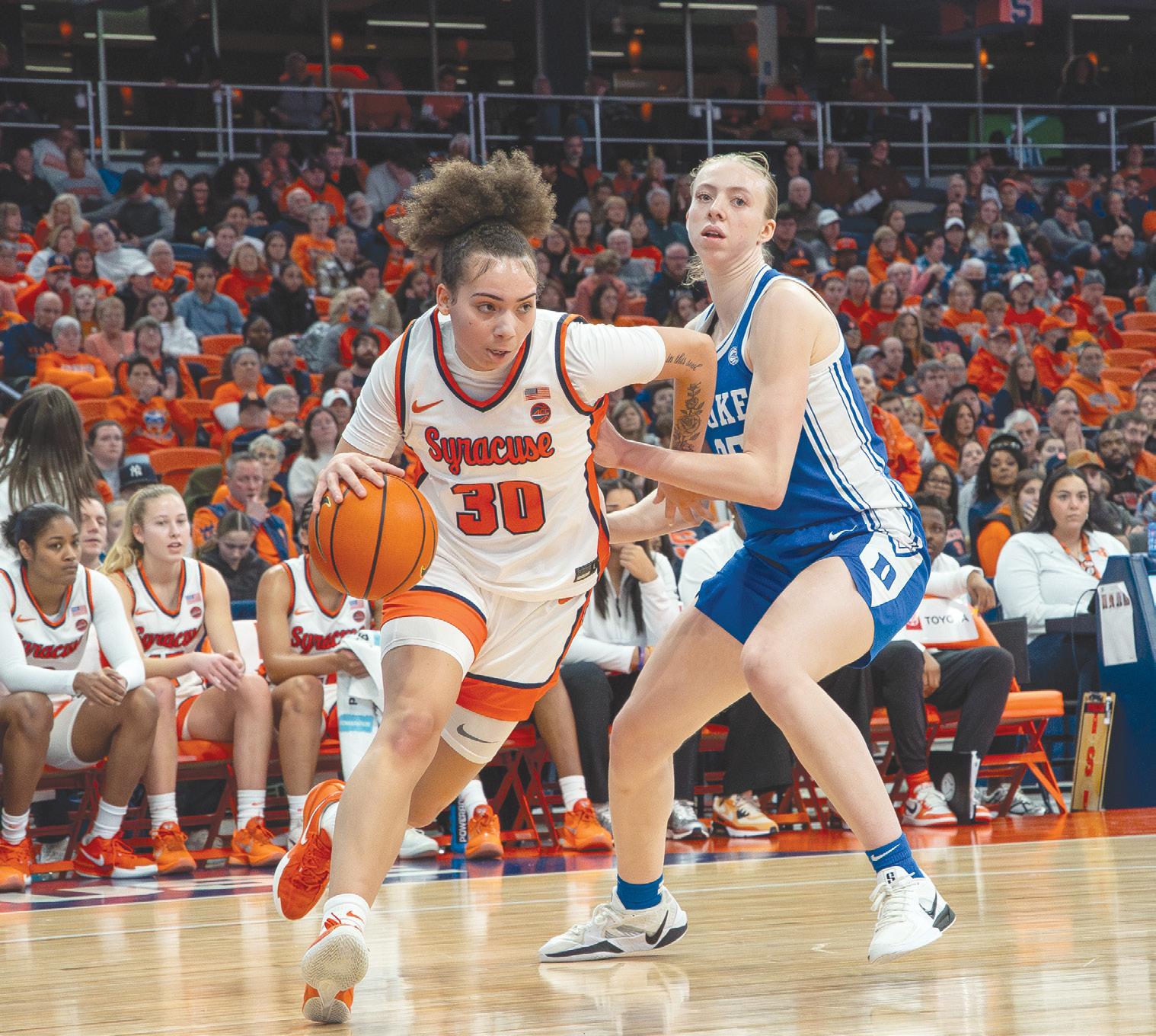
Dominique Darius barely played in four seasons at UCLA and USC. After transferring to Syracuse, she’s finally a star.
Page 16
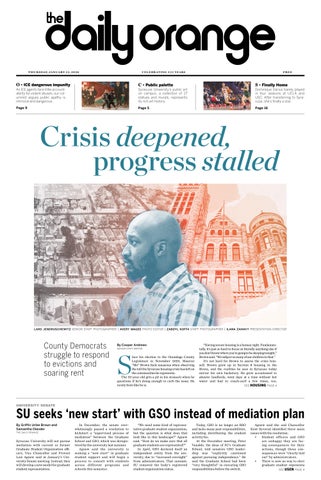
Crisis deepened,
progress stalled
County Democrats struggle to respond to evictions and soaring rent
By Cooper Andrews senior staff writer
Since his election to the Onondaga County Legislature in November 2023, Maurice “Mo” Brown feels nauseous when observing the toll the Syracuse housing crisis has left on the communities he represents.
The 33-year-old gets a pit in his stomach when he questions if he’s doing enough to curb the issue. He rarely feels like he is.
“Having secure housing is a human right. Fundamentally, it’s just so hard to focus on literally anything else if you don’t know where you’re going to be sleeping tonight,” Brown said. “We subject so many of our children to that.” It’s not hard for Brown to assess the crisis himself. Brown grew up in Section 8 housing in the Bronx, and the realities he sees in Syracuse today mirror his own backstory. He grew accustomed to abusive landlords, went days at a time without hot water and had to couch-surf a few times, too.
see housing page 4
SU seeks ‘new start’ with GSO instead of mediation plan
By Griffin Uribe
Syracuse University will not pursue mediation with current or former Graduate Student Organization officers, Vice Chancellor and Provost Lois Agnew said at January’s University Senate meeting. Instead, they will develop a new model for graduate student representation.
In December, the senate overwhelmingly passed a resolution to kickstart a “supervised process of mediation” between the Graduate School and GSO, which was deregistered by the university last summer.
Agnew said the university is seeking a “new start” in graduate student support and will begin a process to consult with students across different programs and schools this semester.
“We need some kind of representative graduate student organization, but the question is what does that look like in this landscape?” Agnew said. “How do we make sure that all graduate students are represented?”
In April, GSO declared itself an independent entity from the university, due to “increased oversight” from administrators. That summer, SU removed the body’s registered student organization status.
Today, GSO is no longer an RSO and lacks many past responsibilities, including distributing the student activity fee.
At the December meeting, Peter Vanable, the dean of SU’s Graduate School, told senators GSO leadership was “explicitly cautioned against pursuing independence.” He said the Graduate School had been “very thoughtful” in executing GSO responsibilities before the switch.
Agnew said she and Chancellor Kent Syverud identified three main issues with the resolution:
• Student officers and GSO are unhappy they are facing consequences for their actions, though those consequences were “clearly laid out” by administrators.
• There is now no way to elect graduate student representa see usen page 4
university senate
Brown and Samantha Olander the daily orange
lars jendruschewitz senior staff photographer | avery magee photo editor | zabdyl koffa staff photographer | ilana zahavy presentation director
Editor@dailyorange.com
News@dailyorange.com
Opinion@dailyorange.com
Culture@dailyorange.com
Sports@dailyorange.com
Digital@dailyorange.com
Design@dailyorange.com
Photo@dailyorange.com
BUSINESS 315-443-2315
how to join us
The Daily Orange is an independent, nonprofit newspaper published in Syracuse, New York. The editorial content of the paper — which started in 1903 and went independent in 1971 — is entirely run by Syracuse University students.
The D.O., a 501(c)(3) nonprofit, is editorially and financial
ly independent from SU, and the paper receives no funding from the university. Instead, The D.O. relies on advertising revenue and donations to sustain operations.
This fall, the paper will be published Thursday when SU classes are in session.
The D.O.’s online coverage is 24/7, including while SU is on break.
To show your support to The D.O.’s independent journalism, please visit dailyorange.com/donate. Donations are tax deductible.
If you are a Syracuse University or SUNY-ESF student interested in contributing to The D.O. on either its advertising or editorial teams, please email editor@dailyorange.com.
corrections policy
The D.O. strives to be as accurate in our reporting as possible. Please email editor@dailyorange.com to report a correction.
letter to the editor policy
The D.O. prides itself as an outlet for community discussion. To learn more about our submission guidelines, please email opinion@dailyorange.com with your full name and affiliation within the Syracuse community. Please note letters should not include any personal information pertaining to other people unless it is relevant to the topic at hand. All letters will be edited for style and grammar.
SU, Southside Connections partner to form Salt. program
By Sean Harrington contributing writer
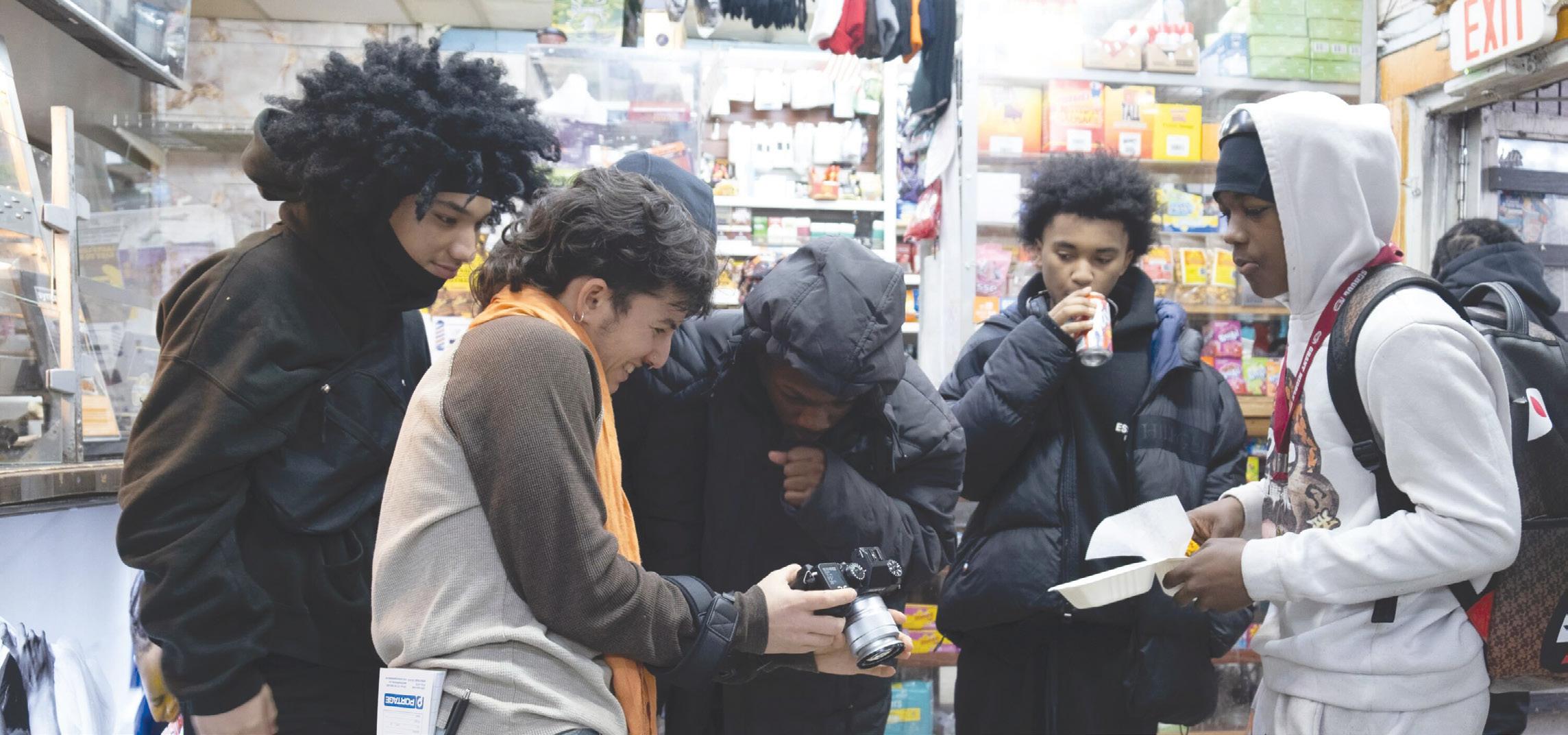
Regular customers walking into Ze Mart on South Salina Street are immediately greeted with faces pictured along the walls and ceiling, displayed similarly to a grandmother’s refrigerator. These details showed Destinyi Fernadez, a junior at Syracuse University, how Syracuse residents feel welcomed in their community.
“They feel seen and (represented), just because the South Side is a place where not a lot of people are represented,” Fernandez said.
Fenandez took photos at the convenience mart through the Engaged Humanities Network’s Salt. program. Salt. is a partnership with Southside Connections and SU, is a visual storytelling program that couples community members with SU’s resources and industry professionals.
In the program, Syracuse community members of all ages receive “top-class” training with professional photographers and filmmakers, to create products like photo essays, short films and data visualizations, Brice Nordquist, EHN’s director, said.
Participants engage in hands-on photoshoot sessions, review and post-production with two photographers: Amy Toensing, a former Newhouse School of Public Communications instructor, and Syracuse alum Matt Moyer. The two worked for National Geographic’s Photo Camp for over 20 years.
Toensing said her goal with the program is to create a system of mutually beneficial relationships alongside Southside Connections that will lead the program into becoming selfsufficient, community-led and self-driven.
“We hope that people, the folks that we’re training right now become the trainers,” Toensing. “And that mentorship, that tiered mentorship, starts to build on itself as we make our way through.”
Through this incipient period, trainees are shown techniques and are given instruction, then brought to sites to create and hone their skills.
“(Salt.) is really giving community members the tools, training, kind of setting to
explore the power of visual storytelling and then… applying it to their own community,”
Toensing said.
Through this process, Toensing explained those in the program will use their new multimedia skills to teach future participants.
Nordquist echoed this and said he hopes to expand the program in the near future, specifically to Syracuse’s Northside.
“We want to move Salt. from neighborhood to neighborhood,” Nordquist said. “South Side now, the North Side next through existing relationships.”
For Syracuse’s Southside neighborhood, visibility has long been a challenge. Salt.’s mission is for its members to be seen, so the program has taken notes from the community.
Southside Connections, a network of over 30 community organizations in the Southside neighborhood, has been essential in making Salt. a reality, Nordquist said. The program
aims to build a “stronger, more connected community,” according to the CNY Community Foundation website.
Sandra Oduro, a doctoral student at SU who works with Southside Connections, said it’s important to have a network devoted to the community.
“No one is an island. No human being can live on their own… if you are able to see that there is this organization that I can fall on or I can lean on,’ it makes your work so much easier,” Oduro said.
For Salt., the scene for a story can be anywhere — a South Side boxing gym, a Ze Mart or Brady Farm’s produce at the Valley Farm Market, Nordquist said. Yet, Toensing said the stories are far from random, adding the project is very important work for “maintaining democracy in Syracuse and beyond.”
Nordquist believes the program is a key to rewriting stereotypical narratives of the neighborhood.
“If the story is ‘don’t go to the South Side, it’s dangerous,’ behavior follows that story,” Nordquist said. “If the story is ‘the South Side is rich in culture and community,’ behavior shifts, inside and outside the neighborhood.”
The program is gaining a foothold in the Southside community with trainees across all ages, backgrounds and stories, Toensing said. Working alongside individuals from high school to community elders, Toensing said she aims to depict a “beautiful diversity” within Syracuse, giving the program the potential to have lasting effects on the community.
Salt. has plans to promote visibility and allow more individuals the opportunity to be seen.
“Visibility is very important, if we are able to increase this awareness, sensitize them through social media, it goes a long way to help the South Side community,” Oduro said.
sharri43@syr.edu
SU color guard members face sanctions after hazing incident
By Laura Lemgruber asst. copy editor
Members of the Syracuse University color guard faced sanctions including probation and education over winter break following a hazing incident in August, according to SU’s Hazing Awareness Hub.
During an off-campus initiation-style event on Aug. 31, members reportedly participated in marching, alcohol consumption and “pole-hit” activities, the report states.
Although involved members were charged in December and faced disciplinary action, the greater organization was not charged, according to the report.
SU’s color guard did not respond to The Daily Orange’s request for comment.
The hazing report is the first incident posted on the university’s new Campus Hazing
Transparency Report. As of July 1, 2025, the university will post information regarding any hazing violations by student organizations to the page in compliance with the Stop Campus Hazing Act, according to the website. Hazing violations will remain on public record for at least five years after the incident.
However, the website will only include reports where organizations are officially found responsible of violating the Student Conduct Code and the University’s AntiHazing policy.
The Hazing Awareness Hub also lists other organizations currently banned from operating at SU due to previous hazing incidents, including several Greek life organizations and club sports teams.
Students can access hazing report forms and other resources through the website.
lalemgru@syr.edu
Onondaga County granted $2.5M for emergency communications
By Chloe Fox Rinka asst. news editor
Onondaga County received $2,548,800 through state funding to strengthen emergency communications, New York State Sen. Christopher Ryan announced in a Wednesday press release.
The funding is provided by the Targeted Grant Program through the Statewide Interoperable Communications Grant and will support 911 operations’ emergency communications systems and first responders. The Targeted Grant Program is intended to develop and enhance statewide emergency communications systems, according to the release.
“Every second counts in an emergency, and this investment will help ensure that when someone in Onondaga County calls 911, our first responders can communicate clearly, reliably and without interruption,” Ryan said in the release.
The funding will go toward police officers, EMTs, firefighters and dispatchers’ emergency response systems. More than $38 million was awarded to 17 counties and New York City in support of emergency communications projects, such as new equipment installation and system upgrades.
Onondaga County will be able to expand the capability of first responders to communicate directly across different jurisdictions, improve countywide coverage and coordination during critical incidents with the Targeted Grant Program, the release said.
The grant program is distributed by the New York State Division of Homeland Security and Emergency Services to close gaps in emergency communications infrastructure, improve system resilience and implement operating procedures that support seamless communication for public safety defenders. cfrinka@syr.edu
Members of the Syracuse University Color Guard faced sanctions over winter break following an off-campus hazing incident on Aug. 31. zoe xixis asst. photo editor on campus
SU’s engaged humanities network is partnered with Southside Connections to form Salt., a visual storytelling program that pairs community members with SU’s resources. courtesy of matt moyer
Onondaga County was awarded $2,548,800 in funding to support emergency communications systems and first responders. leonardo eriman senior staff photographer
It’s what compelled his return to the city of his alma mater, Syracuse — to serve those living in one of the nation’s worst housing markets.
Yet, the young Democrat’s first two years on the job saw little progress — housing remains unaffordable and new developments are scarce.
When Brown visits the neighborhoods he serves, he said he sees despair, confusion, unchecked landlords, broken families and innocent children forced to live on the mend.
He said what drives his policymaking decisions is securing rights for Onondaga County and making sure Syracuse’s city government echoes that agenda.
Despite this, little has changed.
As one of the few Democratic leaders in Onondaga County who centers their messaging around passing laws that solve the housing crisis, Brown — the county’s 15th District representative — said he’s appalled by how far Syracuse has fallen behind on this issue.
Central New York’s homelessness rate has increased by 150% between 2019 and February 2025, Central Current reported. Syracuse’s rent prices ballooned by 22% in 2024 alone, with nearly half of all central New Yorkers spending one-third of their annual earnings on rent.
As a result, many are being displaced from their homes. Alex Lawson, housing policy manager for CNY Fair Housing, said Syracuse landlords have “overpowering” control over their tenants and use discriminatory tactics to evict families from their homes.
“We didn’t end up becoming one of the most economically and racially segregated communities in the country by accident,” Lawson said. “And we’re going to have to want to undo that to actually get to a better place.”
Local Republicans have repeatedly blocked legislation, such as Good Cause Eviction laws, that could improve discriminatory removals. This past local election season, though, Democrats won big in Syracuse and Onondaga County, paving the way for their fair-housing legislation to be passed.
The average cost of a home in Syracuse is $203,874, up 4.7% from last year, and the city features little low-income affordable housing.
Although Brown has tried to spur change from his position in the county legislature, it’s ultimately up to the city to enact worthwhile solutions.
Those in power fighting to end this crisis believe time is running out — even with Syracuse Mayor Sharon Owens a few weeks into what fellow Democrats say will be a term that sees major change.
Bill Kinne, who represented Onondaga County’s 15th District before Brown, said pessimism is giving way to faith in the future.
“We do have a severe housing crisis in this community, but from what I know of what Mo is thinking, it’s just not realistic,” Kinne said. “Now, however, since the Democrats are in charge of the legislature, they might be able to get something passed that could help.”
And many agree that urgency is necessary.
“We don’t have any choice,” Charles E. Garland (D), Onondaga County’s 16th District legislator, added about solving the housing crisis. “Now we have to do something. If people don’t have a sense of impending doom, then they’ve got a problem.”
The Daily Orange spoke to county legislators, housing experts and Syracuse citizens for insight into the ongoing realities of the housing crisis.
• tives to the Senate that is aligned with the senate bylaws.
• The term “graduate students” ignores the “diversity and breadth” of student experiences and perspectives at SU, thus the need for a “new start.”
“These do not have to be mutually exclusive,” said Crystal Bartolovich, an English associate professor. “There can be the mediation that we voted for overwhelmingly, and this broader initiative, which I support.”
She added Ph.D. students are now represented by a collective bargaining unit, which she said must be considered in future models of graduate student representation — later echoed by Syverud.
Van Gulick described the administration’s response to the resolution as “a rebuke to the senate,” citing last month’s vote, which explicitly called for a mediation process.
Committee presentations
Senators PJ DiPietro and Coran Klaver gave a presentation on efforts from the Committee on Intersectional Equity for Race, Ethnicity, Sexuality, Gender Identity and Disability.
They said the committee is working on assessing the processes of salary appeals and bias incidents at SU, while contributing to the Office of People and Culture’s data collection initiatives.
Correspondence and confusion
Bettie Graham, a resident of Syracuse’s University Neighborhood and CEO of The Determination Center, sees the danger the housing crisis poses.
Through her organization, which assists at-risk youth in Syracuse, Graham has helped children and families who have been evicted from their homes, which is not an uncommon occurrence in a city that has the fourth-highest child poverty rate in the nation at 40.9%.
While she believes grassroots organizations are helping curb the housing crisis, she thinks politicians are, by and large, ignoring the issue.
“I’ve been doing this for 20 years. All I’m trying to do is help our youth, save our youth, make a way for our youth, have a safe environment for our youth,” Graham said. “And my thing is, you can extend the hand, extend the olive branch, but it’s up to (the government) to also grab it. I can only extend it for so long. How long am I going to extend it before someone grabs hold?”
Garland recommended The D.O. speak with Graham about times when Graham has spoken with Brown about potential solutions to the housing crisis, saying that she “provided him with the key perspective of a community leader.”
However, upon interviewing Graham and following up with Brown, the two claim they have never communicated before.
If you’re going to point fingers, make sure you’re pointing fingers at the right people.
Charles Garland onondaga county legislator
Brown told The D.O. he was unaware that Garland, his Democratic colleague, gave Graham his personal number — claiming he didn’t know Graham. After learning who Graham is, Brown told The D.O. that Graham can reach him anytime via cell phone or email, adding he has never received any communication from her.
Graham said she had reached out to Brown before, though she did not provide physical evidence of her attempts to contact Brown after The D.O. requested proof of a phone call history.
Graham said she has been agitated for a while about Syracuse’s housing situation, a problem she blames on government entities and officials.
“You try to reach out and nobody seems to want to do anything,” she said.
Who’s to blame?
Lawson, who works by speaking directly with elected officials about fair housing practices, has seen the highs and lows of the city’s housing market. He said the housing crisis didn’t become such a popular issue until recent years.
“It wasn’t broadly felt. Most people were pretty happy here,” Lawson said. “We weren’t lagging behind some of these higher-cost metro areas on the coast where housing (is an issue). In the last few years, that’s changed.”
What has escalated the city into a crisis is discrimination, Lawson said. CNY Fair Housing investigates unfair evictions and aims to hold landlords across New York state accountable.
Lawson, who used to investigate instances of housing discrimination, spoke of Black families who were kicked out of their apartments for
Members of the committee also emphasized the need to support vulnerable students amid “federal policy shifts and external scrutiny.”
“Our committee noted changes like the removal of BIPOC references from the Intercultural Collective website in January 2025, and the need to support both students directly and the institutional framework serving them,” Klaver said.
Student athlete senator Ruben Rojas Betanzos and Department of Sport Management professor John Wolohan said college athletics are in a “period of flux,” unlike other areas of higher education.
Wolohan said under the House v. NCAA settlement, SU can directly contribute or share up to $20.5 million in revenue with athletes. The committee is also looking into how SU generates the funds for the multimillion-dollar revenue-sharing pool, and whether it is all sourced from the Athletics fund.
“The question the committee would like to ask the athletic department is, where is that money going?” Wolohan said. “How is it being distributed? Is it going to football (and) basketball? Is it going to the women’s and Olympic sports?”
Wolohan said the committee has been trying to meet with university leadership, including Syverud and athletics director John Wildhack, to better understand how revenue will be allocated and if certain sports could be left behind.
simply being Black. He also recalled an elderly couple who were evicted from a two-story house after complaining about the stairs.
These instances happen because landlords often leverage immense costs to force lowincome residents out, Lawson said.
Sharon Sherman, the Executive Director of the Greater Syracuse Tenants Network, said not just discriminatory landlord practices, but exorbitant prices that taint the low-income housing market. Housing opportunities are scarce, and those available are too expensive for average-income families, Sherman said.
“It’s very shocking if you look at how much fair market rent has gone up in the past five years,” Sherman said. “People just can’t afford it.”
When it comes to the Syracuse Housing Crisis, Sherman said the city government is the entity that can create the most worthwhile change. A close friend of Owens, she believes the mayor could be the right person to lead Syracuse out of its current housing rut.
Sherman also supports former Mayor Ben Walsh’s key development projects — such as one to completely remodel Springfield Gardens — a Section 8 property across from Le Moyne College — and his effort to refurbish McCarthy Manor, an apartment complex in Syracuse.
However, McCarthy Manor still hasn’t received city financing for its renovation, Sherman said.
Sherman, Lawson, Garland and Brown all stressed building more housing in the city, whether it comes from private equity or citybacked projects. Right now, Garland said he hasn’t seen enough action from the city in recent years.
“If you’re going to point fingers, make sure you’re pointing fingers at the right people,” Garland added, referencing the Syracuse city government.
Garland said Syracuse and Onondaga County as a whole will face dangerous consequences from the county’s $100 billion deal with Micron to build semiconductor plants.
Because of this and rising property taxes, investors have become entirely noncommittal to new housing projects and residents have moved away or have been evicted from their homes due to rising costs, Lawson and Garland both said.
Developers are also scared to build new housing in the areas because it’s too expensive, Garland said.
“I like to call it the Micron effect,” Garland said. “Anybody who was even thinking about building housing, especially affordable housing, it wasn’t cost-effective.”
However, Sherman said Onondaga County will reap more benefits than negatives from the chip manufacturer, providing higher-income jobs to grow the economy.
Brown, however, has tried to advocate for the enactment of multiple housing laws over his tenure as county legislator, yet has been repeatedly denied.
Despite his efforts to campaign for it, the city of Syracuse has not yet adopted Good Cause Eviction — a New York state law that guarantees tenants the right to renew their lease if they so choose and bans no-fault evictions.
Brown called it an abomination, citing the unnamed DeWitt family who say they were evicted when they requested repairs after a household injury caused by a broken staircase.
“It was the textbook reason for why we need Good Cause Eviction,” Brown said.
For now, it’s a blame game between all parties involved. Brown fiercely blamed county Republicans for what he feels is inaction, saying they are quicker to fund the million-dollar Aquarium project rather than provide help.
Garland, said GOP legislators, who have controlled the Onondaga County Legislature since the 2000s, consider themselves stewards of taxpayers’ money.
When we’re talking about county legislators, some of them have this myopic view on life, like ‘I’m in the city, my primary concerns are here,’’’ Garland said. “But you have to be aware that we represent more than half a million people throughout all of Onondaga County.”
Onondaga County Executive Ryan McMahon introduced the Onondaga County Housing Initiative Program in 2023, which distributed $10,000,000 in grants to nonprofit and private housing investors to construct new units in the county.
McMahon’s office did not respond to The D.O.’s request for comment.
Moving forward
Precious seconds are being wasted as the city of Syracuse and Onondaga County continue to stall on creating worthwhile housing legislation.
That’s what goes through Brown’s head each day.
As he recounts turbulent childhood memories of low-income housing, he can’t subdue the emotion he feels when he sees the same issues prevalent today. Especially when he talks to local families who tell horror stories about children who are being forced to hop from sofa to sofa at their friends’ place because their family got kicked out of their home.
But despite the current severity of the housing crisis, there’s light at the end of the tunnel.
Lawson thinks that the last two years saw little demand for housing in Syracuse due to disparaging prices.
However, the city’s updated infrastructure has led Lawson and CNY Fair Housing to believe there will be higher demand to build affordable housing in Syracuse going forward — which hopefully, Lawson said, would be affordable multifamily housing that can be integrated into existing neighborhoods rather than replacing them through gentrification.
It’s an opportunity the city must seize in the near future, Lawson warned. To Garland, solving the issue isn’t rocket science; just eternal political gridlock he can’t fix alone.
He advocated for the city simply buying more land, hiring private contractors to finish the projects it committed to when he was first elected to the county legislature.
One in four Syracuse children will leave the city before the end of the school year. One in 10 children in Syracuse is experiencing homelessness.
Brown is driven by those statistics.
“I don’t have time to explain to people why we’re falling so far behind,” Brown said of the housing crisis.
Now a legislator, the same child who once lived in a shelter said he regrets not doing more to help kids facing the same hardship.
“Our children are supposed to be the next generation and supposed to save us from all of this? And we’re treating them like this?” Brown said. “Every day that thought makes me sick to my stomach. I just feel like I’m not doing enough to help them.”
ccandrew@syr.edu
Rojas Betanzos said the committee is also examining how to better integrate student athletes into the broader student body, particularly as the ACC’s expansion to the West Coast has increased travel and time away from campus.
Agnew provided an update to the ongoing portfolio review process, which requires each dean to submit a report for their college. The deadline for deans to submit their reports was moved from Jan. 1 to Jan. 23.
The deadline for A&S deans to submit portfolio review reports, which were originally due at the end of the year, was extended to Jan. 23. solange jain senior staff photographer
In plain sight
Statues and murals on SU’s campus let students engage with history and art
By Tara Binte Sharil asst. culture editor
Photos By Avery Magee photo editor
When Syracuse University senior Gabriela Peniston spent her summer on campus last year, she and her friend Brennan Finder took advantage of the empty campus to record a TikTok tour of SU. They showcased their favorite spots, including a segment on the amount of statues they noticed.
The video amassed 35,000 views, reaching Taylor Westerlund, Communications & Outreach Specialist at the Syracuse University Art Museum. The TikTok reminded him of the resonance SU’s public art scene holds on students to this day.
“In that way, I think this generation of students is taking ownership of the public art on campus,” Westerlund said. “Making (public art)
see statues page 7
MakerSpace remains a flourishing center after year on Marshall St.
By Claire Zhang asst. digital editor
Public Communications. He first heard about 3D printers and was intrigued to buy
one. Makerspaces and think tanks were just starting to pop up, and an IT director approached John with the idea to make SU’s own.
“He says, ‘Hey, listen, I think I could get some money, would you like to build a place that we can do this stuff?’” John said. “And I’m like, ‘yeah sure, I can finally get my dream job.’” Now, MakerSpace has multiple printers, sticker machines, laser engravers and other appliances. The
and media
a large role in the layout and organization. see makerspace page 8
move to Marshall Square Mall meant a bigger, more central location. Freshman Sarah Klemmer visited MakerSpace last semester; since it’s in one of the busiest spots on campus, she’s more inclined to return, she said. When designing the new space, Gianna Mangicaro, MakerSpace’s associate director for learning environments
production, played
SU alum, ‘internet older sister’ Quincy Whipple stays authentic
By Charlotte Price social media editor
College wasn’t the best four years of Quincy Whipple’s life. Neither was the year she spent postgrad at her lifelong dream job. But, both of those experiences are OK with her — a lesson she communicates candidly to her over 255,500 TikTok followers as of Wednesday evening.
“My dreams are constantly changing and I’m reevaluating what’s possible for me because I feel like every day something new changes,” Quincy said.
Quincy, who graduated from Syracuse University in 2024, describes herself as an internet older sister, mirroring her own relationship with three younger siblings. The Maine native studied advertising at SU and moved across the country to Los Angeles postgrad to work as a copywriter at an advertising agency.
In October, Quincy quit her full-time job to pursue modeling and social media. Quincy’s motivation has always been her creativity, and she didn’t have enough opportunities to express that at her ad agency job.
Quincy said she falls somewhere between a fashion influencer and a lifestyle influencer. Her account’s staples include her multiple outfits throughout the day, running content and her nighttime routine of cooking a healthy meal and sticking to an early bedtime (sometimes before 8 p.m.).
A unifying thread of Quincy’s videos is her advice and wisdom, her younger sister Chloe Whipple said.
“She’d give the same advice to me that she’d give to her followers,” Chloe said. “Which feels really authentic to me because if I see a video of hers, it’s like I’m literally just talking to my sister, I don’t even need to text her to ask her something because I can just get the honest answer.”
Being an older sister is like being the “original influencer,” Quincy said. Seeing her sisters follow her lead is the biggest compliment. Chloe started her own social media page following Quincy’s example. Now, the two live in LA and book modeling jobs together as the Whipple sisters.
Fans sometimes post videos of their own Quincy, Chloe and Macey Whipple inspired outfits with a tag like WWTWSW (what would the Whipple sisters wear). In August, Quincy posted a video about the trend, joking that the same standard goes through her head as she gets dressed.
Quincy also identifies her older sister voice in her willingness to speak out about political topics on her platforms — the older sister is usually
the one at the dinner table starting a debate with older relatives, she said.
Heather McClure, Quincy’s friend from SU and Chloe’s current roommate, said Quincy’s content resonates with her audience, and McClure herself, so well because it isn’t forced.
“None of it is like those New York City influencers who do things just to post them,” McClure said. “Chloe and Quincy very much do things and just record 24/7 and what resonates, resonates.”
Quincy said she sometimes finds it difficult to work with brands or management agencies because she is reluctant to post links on her social media pages. Multiple management agencies have let Quincy go because she’s picky about the brands she’s willing to work with, she said. For her, social media is a “fun job;” she doesn’t want to include things in it that she doesn’t want to do.
Despite how confident Quincy’s voice may be now, that wasn’t always the case. In high school, Quincy struggled with “crippling” social anxiety that often prevented her from attending school. People knew her as the “anxious one” and often assumed she was judgemental for not attending social events, Quincy said.
Social media was Quincy’s curated escape from that anxiety, she said. Starting with posts on VSCO and Instagram, she crafted her ideal persona based on the best parts of herself: the parts that could easily talk to people and wear cool outfits. Social media pushed her out of her shell as she learned to be more like that person.
“I created this person who was colorful and bright and not scared, and then when they actually met me, it made it easier to be that person
because they were already expecting me to be that person,” Quincy said.
Quincy’s process of growing, from being reserved and self-conscious to confidently chasing her dreams, makes her the most deserving recipient of her success, Chloe said.
Quincy began posting on TikTok during her freshman year, making outfit videos from the Lawrinson Hall dorms. The top comment on a video said she looked just like Phoebe Bridgers, boosting her to virality.
Quincy recalls the surreal feeling of hitting 8,000 followers on Instagram — nearly the same number as the population of her hometown in Yarmouth, Maine.
The summer after her freshman year, Quincy said she posted just about everything about her life. By the time she got back to school, she had around 20,000 TikTok followers. It was fun to feel like a bit of a celebrity at school, she said, so she kept posting.
“I just had no idea what I was doing,” Quincy said. “A brand like Microsoft would ask me for my rate, and I was like, ‘I don’t know, $100.’ It’s like, no, that’s Microsoft. You can ask for way more.”
Quincy hired a manager her senior year of college.
Though Quincy enjoyed college, she was ready to leave after graduation, she said. Quincy didn’t enjoy drinking, and Syracuse’s party culture was always hard for her to buy into, she said. Since Quincy graduated, she’s only become more herself, Chloe said. The authenticity that has become Quincy’s online trademark also guided her career change.
A few months into her job at the agency, Quincy started to realize it didn’t allow for as much creativity as she had hoped. She didn’t want her boss’ job, she said.
“Sitting at that ad agency, it felt like I was just wasting my time,” Quincy said. “I did like it there, but sitting there and realizing that I was gonna be here for potentially the rest of my life scared me so much more than quitting my job and taking a risk did.”
Quincy said she still felt like social media was her “fun job” — a creative outlet that she didn’t want to feel like work. That’s part of why she pursued modeling instead of being an influencer full time.
Though Quincy had begun venturing into the modeling world while still working in advertising, she reached a crossroads when a modeling shoot conflicted with a work trip back to Syracuse. That situation made the choice feel clear, she said.
“If it keeps coming down to me picking between these two things, I’m gonna choose social media, working for myself, and being this creative every single time rather than going back to Syracuse, New York,” she said.
Quincy said she felt lucky her family was so supportive of the choice. Chloe told her it was about time — she’d been encouraging her sister to model for a long time.
Chloe said Quincy often tells her the only way to accomplish your goals is by just doing things — take the scary step to pursue a dream. When Chloe asked Quincy how to get into running, another common subject of Quincy’s videos, she said all it takes is putting on your running shoes and going.
“I feel like (Quincy and Chloe) have really taught me that anything is possible, which I know sounds so freaking corny, but they also have a mindset of nothing is unattainable,” McClure said.
Though college and postgrad weren’t the best years of her life, neither is Quincy’s debut into modeling. She feels like she’s only just getting started, she said. Quincy truly believes every year will be better than the last.
“I learned so much and I’ve met so many amazing people, and because of that, I know how to make next year even better than that,” she said. “And then next year I’ll learn so much more, and then that’ll help me make the year after that better.”
Disclaimer: Charlotte Price is a member of Syracuse University’s chapter of Delta Gamma. Her experience did not affect the content of this story.
cprice04@syr.edu
Tillie’s Touch provides ‘more than just soccer’ for underserved youth
By Ava Demcher staff writer
When Syracuse resident Dale Johnson became sober in 2007, he wanted to look for something to fill the gap in his life. After watching a segment on ESPN about a fallen soldier’s foundation that sends soccer balls to children in Iraq, Johnson was inspired to make a change in his own community.
“I was looking to fill my life without booze and drugs,” Johnson said. “I found much more than I could ever expect.”
In 2009, Johnson founded Tillie’s Touch, a program that brings soccer to children under the poverty line in central New York.
Named after Johnson’s daughter, the organization originated as a donation program, collecting used soccer balls for children in the community. Located in North Syracuse, Tillie’s quickly grew into a soccer coaching organization, and he gravitated toward coaching the kids because of their passion for the sport, Johnson said.
Johnson realized that many of the children playing soccer in the area were missing essential equipment. He decided to create a free space for players to practice the sport and grow as students, too. In 2025, Tillie’s introduced a Khan Academy English language arts and mathematics program to hold players accountable for their grades as well as their athleticism.
Daniel, an 18-year-old senior in high school, has been attending Tillie’s since he was 11. He said growing up in the program encouraged him to pursue higher education, something he was unsure about before. Now, as a coach and tutor, he hopes to provide that same help to other players.
“The kids may not have these resources at home,” Daniel said. “We are able to take it at their pace, and make sure that school is as important as soccer.”
Eleven-year-old Mohammad, one of Daniel’s mentees, has been attending Tillie’s since last
year. The program has allowed him to make friends and play his favorite sports, soccer, cricket and tennis. But, working with the Khan Academy program also made him want to pursue more, he said. His dream is to become a doctor, just like his sister, and a famous soccer player, he said.
“It gave me a lot of confidence,” Mohammad said. “Playing soccer is my motivation to do well in school. Everything in my life is just soccer, but first, I want to get my education.”
Tillie’s features free recreational and travel sports teams, serving hundreds of kids in the program. Despite their successes in games and tournaments, their proudest accomplishment is that every student in the academic program graduates from their high schools, Johnson said.
They even reward students with up to $100 per semester for good report cards.
“Around 45% of the children in Syracuse live under the poverty line,” Johnson said. “The reward money helps with essentials — some kids even buy clothes for their siblings. If we can incentivize hard work, I’m happy to support them.”
Gradus, 14, found Tillie’s shortly after he moved to the United States two years ago. He started playing soccer when he was seven, so Tillie’s was a place he could call home, he said. It was also a place where he could sharpen his English, which isn’t his first language.
“When I came to the United States, my English was terrible,” Gradus said. “Meeting new
people and our coach, Dale, not only improved my English, but also shaped me as a person. It’s more than just soccer for us.”
Like Daniel, Gradus has since transitioned into coaching and tutoring at Tillie’s. When Gradus arrived in Syracuse, soccer was his one familiarity in a new place. Watching kids like him grow up in the program is a full-circle moment for Gradus.
“I think of myself as a kid and how I felt before I got to Tillie’s Touch,” Gradus said. “I found a family and so many opportunities here, and now I get to help young men find the same joy I did.”
Being a part of a team has helped Mohammad make so many new friends, he said. Going into middle school next year, he isn’t scared of changing schools; instead, he is ready for what’s to come, he said.
“(Tillie’s Touch) cares about me and my education,” Mohammad said. “I know I can make friends now, and that I can do well in middle school.”
Tillie’s expands past the traditional role of a sports team, Johnson said. In August, the center held its annual school supplies drive, handing out almost 400 backpacks of school essentials. During the holiday season, they sponsored over 300 local children, providing them and their families with necessities and gifts. Johnson said their community sponsors are essential to the organization.
Johnson’s biggest aspiration for Tillie’s is to “break the poverty chain.” He continues to expand the services that the organization provides, whether that be continuing Khan Academy for students or purchasing new vans to pick up and drop off kids at school and the Tillie’s recreational center.
“The ultimate goal is that the kids don’t live in poverty,” Johnson said. “We don’t want them to bring their kids back. They’ll be the ones making the donations.” ahdemche@syr.edu
quincy whipple started using social media in high school as a way to combat her social anxiety. photo by micheal woolery | courtesy of quincy whipple
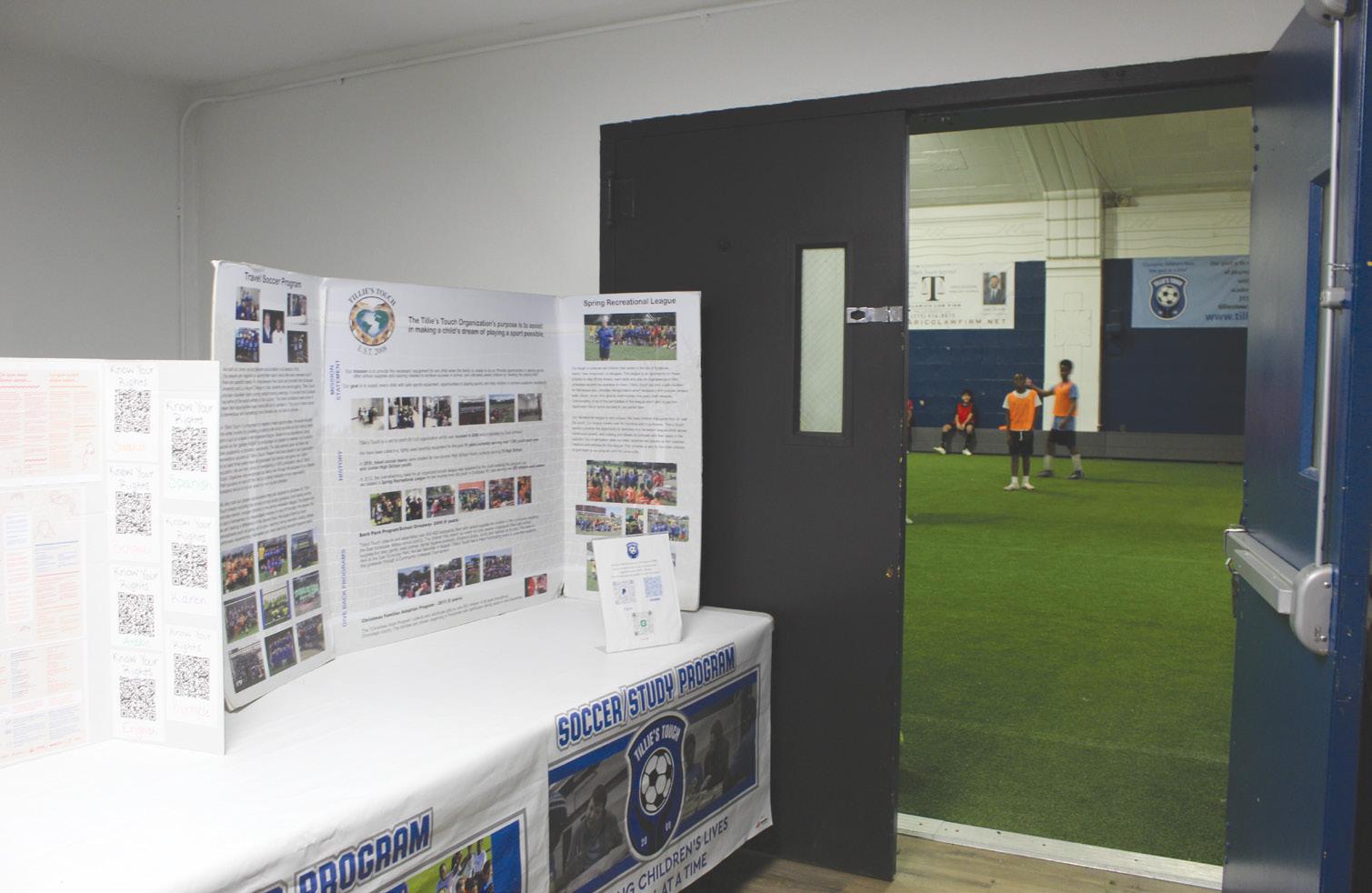
Tillie’s Touch’s Khan Academy program has sharpened students’ English skills and even helped them make new friends. courtesy of emma shay
beyond the hill
‘In Memoriam’ series pays homage to passed stars
By Joel Pelachik asst. copy editor
Each year, the Academy Awards feature a remembrance segment, pausing the show for a brief, somber moment to honor late visionaries who paved the way for future Hollywood stars. This month, Manlius Cinema will replicate a similar sentiment with its new “In Memoriam” series.
“We’re going into awards season here,” longtime Manlius Cinema patron Thomas Hitchcock said. “(It’s great) to show that these famous directors and stars have been contributory all these years to such great films.”
Manlius Cinema’s “In Memoriam” series, which began Jan. 21 and runs through Jan. 29, celebrates the work of legendary actors and directors who died in 2025 through a curated film lineup. The series includes Diane Keaton’s “Annie Hall,” Gene Hackman’s “Unforgiven” and Robert Redford’s “The Sting.”
Though each film only has one screening, Manlius Cinema will be showing “The Princess Bride” from Jan. 30 to Feb. 5. A fan favorite, the movie will be an extension to the series in honor of director Rob Reiner, alongside his film “This Is Spinal Tap,” which was already set to be featured.
The 107-year-old cinema — which was a silent theater before adding sound in 1931 — started by screening new releases. However, over the last several decades, the theater has worked to incorporate an eclectic mix of films by including lesser-known independent and foreign films, including Tatsuya Nakadai’s “Yojimbo,” a classic Japanese samurai movie that will also be featured in the series.
Hitchcock said the theater’s attendance has improved compared to past years, and he thinks the “In Memoriam” series is a great way to increase Manlius Cinema’s attendance.
With a variety of movies to choose from for each actor and director, Derek Walter, Manlius Cinema’s general manager and series programmer, had dedicated customers, like Hitchcock, in mind when selecting the films, he said.
“It’s really stepping back and recognizing the type of people that have been loyal and supportive patrons of ours and really trying to honor what I know they’re going to like,” Walter said. “But also thinking forward and with the intention of always wanting to grow and reach out to new people.”
Hitchcock is most excited to see director David Lynch’s “Mulholland Drive,” a film he first watched at the Manlius Cinema over two decades ago.
their own, giving it their own inside jokes, letting it be part of their lives, whether they realize it or not.” Westerlund was tasked to compile a self-guided and audio tour of different public art pieces on campus last May. Launched a few months later, the Public Art @ SU Self-Guided Tour on Bloomberg Philanthropies’ website spotlights all 27 works of art on SU’s campus, including Jean-Antoine Houdon’s George Washington sculpture and Malvina Hoffman’s Elemental Man sculpture. Now, students have another avenue to engage with the statues and murals on their campus.
When creating the tour, Westerlund said his main challenge was finding information on certain pieces that have been copied throughout the years, like the “Winged Victory of Samothrace,” which has lived on the second floor atrium of Crouse College since 1905. The original sculpture, now located in the Louvre Museum, has appeared in Audrey Hepburn’s 1957 “Funny Face.”
The statue has become well known among students, something that doesn’t surprise art and architectural history professor Romita Ray.
“It’s also very boozing,” Ray said. “It commands your attention. She’s a huge and beautiful sculpture.”
Plastic cast sculptures like the “Winged Victory of Samothrace,” which was made in 190 B.C.E., were not based on an actual human figure. Therefore, artists required a thorough understanding of human anatomy and foundational drawing skills, Ray said.
The need to nail these essential skills reflects SU’s long history in preparing aspiring artists for the real world, SU Art Museum curator Melissa Yuen said. In 1873, SU was the first institution in the United States to offer a baccalaureate degree in Fine Arts. This initiative continued through the 1970s, when university leaders sought to establish SU as one of the leading centers for the study of American art, Yuen said.
When Ray first arrived at SU in 2006, she said she was impressed by the diverse range of sculptures the school featured. Uncommon on other college campuses, SU featured sculptures from the late 19th century to the modern era.
One of the sculptures that caught Ray’s attention was Anna Hyatt Huntington’s “Diana,” which was previously housed in Bird Library and
The Liverpool resident has made trips to the theater since the mid-1990s, praising its “quaintness,” personality and welcoming environment.
“I’ve never really had much to do with the Village of Manlius, except the Manlius theater, and now it keeps me going back more than ever,” Hitchcock said. “It’s a wonderful cultural building and a cultural activity to go to, and it does promote cultural discussions.”
Hank Chapman, the Village of Manlius’ newly elected mayor, recalled a business owner telling him that Manlius transformed from a passthrough community to a charming destination; Chapman credits the Manlius Cinema as a “big part” of that change, allowing other arts and entertainment establishments to open in the area.
“It’s really, honestly, a cornerstone in our village right now. It’s kind of the centerpiece on our main drag,” Chapman said. “A couple of years ago, we deemed that block our Arts & Entertainment District, and obviously that’s largely because of the Manlius Cinema.”
Chapman, who grew up in Manlius, has been watching movies at his local cinema for over 50
now lives in Carnegie Library. Upon encountering the statue, Ray said she was immediately made aware of the long art legacy at SU.
Though SU’s version is a copy, the statue was a gift from Huntington and her husband, Archer.
“Diana” stands as a more intriguing sculpture compared to other statues, Ray said. When Huntington was sculpting this piece, her own background as an elite member of society materialized. An ancient Roman goddess, Diana is depicted in a modern way instead. Diana is seen shooting an arrow — a leisurely sport among elite women during Huntington’s time — and is sporting a flapper girl haircut as she stands next to her greyhound, Ray said.
“Diana” has sparked a long tradition with SU students. During finals season, students would rub the greyhound’s paw for good luck. The marked spot on the paw has become a more polished spot than the rest of the sculpture from wear, Westerlund said. The tradition connects students to the art on their campus, he said.
History assistant professor Britt Tevis said she was stunned when she first saw a mural of Ben Shahn’s 1967 “The Passion of Sacco and Vanzetti,” on campus.
Tevis was first drawn to Shahn’s work when she was in graduate school, relating to his roots as a Jewish immigrant who was deeply involved in social justice and creating art during the New Deal. Before starting at SU in August 2024, Tevis was looking for her new office in the Maxwell School of Citizenship and Public Affairs with her family, when she stumbled upon the mural on the right side of Huntington Beard Crouse Hall.
“When I encountered this mural on campus, it was just a sign that I had landed a job at the exact right place, because here was this mural by this artist who I love. I was just completely tickled,” Tevis said.
“The Passion of Sacco and Vanzetti” was originally a painting by Shahn from 1931 to 1932. The painting revolves around the sentencing and execution of Nicola Sacco and Bartolomeo Vanzetti in Massachusetts in 1927. During a time of xenophobia in the country, the two men were sentenced to the death penalty for murder and armed robbery despite a lack of evidence.
The outcome sparked national and international outrage, which prompted Shahn to paint his perspective of the case. This resulted in creating a 23-piece series, which is now scattered
years. He even said he remembers going there to see “Willy Wonka and the Chocolate Factory” 17 times with his best friend as a kid.
Like Hitchcock, Chapman thinks creative events — like the “In Memoriam” series — keep the theater distinct and exciting, still drawing in patrons after many decades.
This won’t be the last film series shown at the Manlius Cinema in 2026, with the “Strides Toward Democracy” lineup debuting in February. In collaboration with the Onondaga Historical Association, the series examines principles of democracy with a focus on films about central New York.
But, during this awards season, the Manlius Cinema’s “In Memoriam” series gives customers a chance to say goodbye to legendary auteurs and stars, Walter said.
“When you get a theater full of people, and they’re all just having a great time, and for how stressful the world is, they forget their worries for a couple hours and just enjoy cinema,” Walter said. “There’s no better feeling for me in the world.” jdpelach@syr.edu
across the country in the Whitney Museum, Museum of Modern Art and the Harvard Art Museums. The mural is adapted from the original series.
For Tevis, it feels like a privilege to be surrounded by historical pieces like “The Passion of Sacco and Vanzetti,” which speak to the larger, current events in the country.
“It’s also interesting to think about how these symbols change and how these pieces don’t necessarily have a fixed meaning,” Tevis said. “They may mean something to the artist and the people who live through these events, and they mean something different, possibly for us now.”
As a University 100 tour guide, junior Hannah Fuchsberg, shares historical public art pieces like “The Passion of Sacco and Vanzetti” with prospective students.
“It’s a nice way to make the tour more personable and makes Syracuse different from other tours. There’s a lot of similarities between all these colleges and programs,” Fuchsberg said. “But it’s something that can make the tour a little different by showcasing a little more into our history and culture on campus.”
Though presenting these public art pieces on SU’s campus exhibits the school’s prior commitment to art, it not only gives the campus an aesthetic charm, but to also be part of something larger in SU, Fuchsberg said.
Since making the TikTok, Peniston has learned more about the nearby statues and murals through her social media pages. Now, she pays attention to the rich public art scene around her when walking around campus to get between classes or meetings.
For Yuen, who has been a curator for the SU Art Museum since 2021, having physical art pieces enriches the student experience, since engagement with art now often happens through screens. With initiatives like Public Art @ SU, art is combined with technology, making public art on campus more accessible.
“I’s really valuable for everyone on campus to have these artworks that we can look at in person, because, like, some things, some details are lost,” Yuen said. “And so with these sculptures, we can also walk around the work. We also get to see the difference and we get to experience the work from different perspectives.”
tabintes@syr.edu
Blizzard of Bars
Presented by Watts Music Group and The Bridge Upstate, Funk ‘n Waffles brings the Blizzard of Bars to Syracuse. The event features 10 different artists, including Ivan Da Great and Big Sexy and is hosted by Zak G and DJ Ease One.
WHEN : Friday, doors open 7 p.m., show begins 8 p.m.
PRICE: $13.07
WHERE: Funk ‘n Waffles
BRAHMS
& DEBUSSY
Part of the Syracuse Orchestra’s Masterworks series, Saturday’s concert will perform symphonic instrumentals inspired by Johannes Brahms and Claude Debussy. The orchestra will play pieces like “Pagodes” by Debussy and Brahms’ Symphony No. 2.
WHEN : Saturday, 7:30 p.m.
PRICE: $24
WHERE: The Oncenter Crouse Hinds Theater
Coldfront + See Through Faded
Middle Ages Brewing Company brings ColdFront, a central New Yorkbased modern rock band, and See Through Faded, a ‘90s cover band, to Syracuse. See Through Faded covers ‘90s rock songs by Green Day, the Red Hot Chili Peppers and more.
WHEN : Saturday, doors open 6 p.m., show begins 7 p.m.
PRICE: $12.88
WHERE: Middle Ages Brewing Company
Stella Nesci
Singer-songwriter Stella Nesci, who is based in Syracuse, will debut her first EP, “Violently Aspiring,” which was released in November. For the debut, she’ll be performing at The Song & Dance, alongside Chloe Danes.
WHEN : Saturday, doors open 7 p.m., show begins 8 p.m.
PRICE: $19.26
WHERE: The Song & Dance
Lettuce Cook World Tour
Six-person band, Lettuce, will stop in Syracuse while they go on tour for their new album “Cook” that debuted in early December. The album meshes funk, soul, jazz, rock and hip-hop.
WHEN : Sunday, doors open 6 p.m., show begins 8 p.m.
PRICE: $53
WHERE: The Westcott Theater
From Jan. 21 to Jan. 29, Manlius Cinema’s “In Memoriam” series honors directors and actors who died in 2025 through a curated film lineup. tara deluca asst. photo editor
Sit-down Erma’s Bistro aims to set Jamaican food standard
By Alex Rice asst. copy editor
After emigrating to Syracuse from Jamaica when she was 20 years old, Latoya Ricks landed her first job as a fry cook at a McDonald’s on Erie Boulevard. While working long hours at McDonald’s, Ricks said she struggled to find food that reminded her of home.
“It was around that time that I realized I had to do something different,” Ricks said. “I wanted to introduce my food to people here and also get something that I enjoyed eating rather than, ‘Oh I just have to eat this because it is available.’”
Years later, in 2021, she opened Erma’s Island, a vendor in Salt City Market. In December, that small, six-dish stall expanded into a sit-down Jamaican restaurant. Ricks opened Erma’s Bistro, a fine dining restaurant, in the heart of Armory Square on Dec. 19, hoping to expand customers’ familiarity with Jamaican cuisine.
I want this place to feel like a home. I want it to feel warm and welcoming.
“Twenty years ago it was the dream to have a sit-down,” Ricks said.
Around seven years ago, Ricks and her mother applied for a stall at the Salt City Market in downtown Syracuse. Out of nearly 200 applicants, they were one of the seven original vendors at the market.
Toward the end of the process for officiating their spot in the market, Ricks’ mother decided she did not want to continue assisting with the restaurant. But, Ricks knew they hadn’t “come this far for nothing,” she said. She opened the stand by herself. Erma’s Island still operates in the market today; Ricks now runs both the stall and bistro.
At the time of the move, MakerSpace was gaining more traction, with around 3,300 work orders. They ended 2025 with almost 5,000 projects, a testament to the new central location’s accessibility, Gianna, John’s daughter, said.
John said in the past, when he told friends who worked on campus about MakerSpace, they never visited because they didn’t know where it was. Now, they’re there all the time.
The move also allowed MakerSpace to have a fresh start organizationally. Gianna planned the layout of the machines strategically, with 3D printers grouped together and textile equipment all in one spot. Due to the increased activity, she also developed a queuing system to streamline work orders.
But, despite the location change, the values MakerSpace was built on stayed the same, said Gianna.
MakerSpace is built to be a place for collaboration — it’s somewhere students, faculty and staff can go to conceptualize their ideas, Gianna said. With the new space, that goal has gone further than just 3D printing.
Music has always been an important part of John’s life; he spent two years on tour playing the drums with a band. So, since he first started MakerSpace, he always wanted to incorporate a music studio. He asked for it for six years, and finally, just before leaving the Kimmel location, he received the money to do it.
In the new location, they built two cubicles on the far end that became music studios, equipped
“Everyone think of 2 truths and a lie, and make them good, because that will be the only thing we remember about you.”
Growing up, Ricks’ grandfather was the go-to chef for events in her community in Jamaica, from church gatherings to graduation parties. As the oldest grandchild, Ricks would often follow her grandfather to these events and watch him cook traditional Jamaican food, some of the same dishes she would someday feature in her own restaurant.
Both the bistro and vendor are named after Ricks’ grandmother, who she wanted to honor because of the way she always cared about and loved people, Ricks said.
Kennedy Morey, a bartender at Erma’s Bistro, has been helping Ricks with the process of opening her restaurant. At the soft opening on Dec. 19, the entire room gave Ricks a standing ovation, Morey said.
“There was so much love in one room, and you could really feel the support that her friends and family were giving her,” Morey said.
The restaurant’s goal is to change the narratives around Jamaican dining, Ricks said. The menu features traditional Jamaican dishes with modern spins, such as their jerk chicken burrito and rasta pasta.
People often assume Jamaican food won’t be sold in sit-down, elevated restaurants, Ricks said. She said her ultimate goal is to be an example of a fine dining Jamaican restaurant that changes people’s assumptions.
“I’m hoping to bring awareness to the culture and to show it’s not just something we pack in a box to go or a styrofoam plate,” Ricks said.
The menu features fusion of other cuisines with Jamaican staples, which Ricks said she hopes will expand customers’ understanding of Jamaican food. She has been working to curate a good balance of variety on the menu. Ultimately, she has noticed people enjoy her breaking the food down to the customer’s level.
“I try to blend all the spices, blend all the things that people may know or not know. So you will find a lot of fusion and a lot of creativity on the menu,” Ricks said.
Morey has past experience in the restaurant industry but never with a brand-new location. Getting to help curate the menu has given her a lot of creative direction, an opportunity she’s never been given before, she said.
with guitars, a drum set, a keyboard and other instruments. People can come in to play together, but it’s hooked up to headphones, so there’s no live sound. Students can also record and mix with the advanced software the space offers.
John said this addition reflects what MakerSpace is for: a place where anyone can come together to create. Some students come in to play and ask John how to find other musicians. He said he hopes MakerSpace can begin to incorporate other ways for people of similar interests to find one another.
“There’s a lot of people that just want to sit and play, and if we can find a vehicle for these kids to network, you’ll see a lot more production,” John said.
Gianna said MakerSpace is a great way for students from all majors and schools to collaborate. When she was a student, MakerSpace was one of the only places she could meet people not in her specific program, she said.
The connection that happens between students happens organically, through working on projects together, which is always cool to see, Gianna said.
The student staff at MakerSpace is proof of the connection it fosters, John said. While John sometimes looks for students with some knowledge of software, his staff often know nothing about the machines before starting out — John “throws them in the fire,” he said.
Junior Jack Cofer has worked at MakerSpace since his freshman year, at both locations. As a geography major, MakerSpace gives him the opportunity to gain experience in fields that interest him outside of academics, he said.
Morey said she and Ricks have been learning from and supporting each other throughout the process.
“Women in the industry that is male-dominated, especially in the kitchen, it’s a learning curve, but it’s been a great experience for everybody that works here,” Morey said.
Fantasia Reid, Ricks’ niece and an Erma’s Bistro hostess, said she has seen the outward support for her aunt’s restaurants. She often recognizes Erma’s Bistro customers as the regulars from their stall in the Salt City Market. Ricks said she hopes to continue working on growing her restaurant’s community and establishing it further.
“I came in knowing nothing, then over the course of now three years, I’ve learned the ins and outs of all of it,” Cofer said.
As a supervisor of the student-led team on site, Cofer spends a lot of time problem-solving with his peers, both those who come in to do a project or his coworkers. The team is constantly plugged in to new developments in the tech world, as well as hearing what students want to see, Gianna said.
John recalled when one of his students approached him, showing him a new high-resolution 3D printer. Within a month, they were able to purchase it for $50,000, when it typically goes for $200,000.
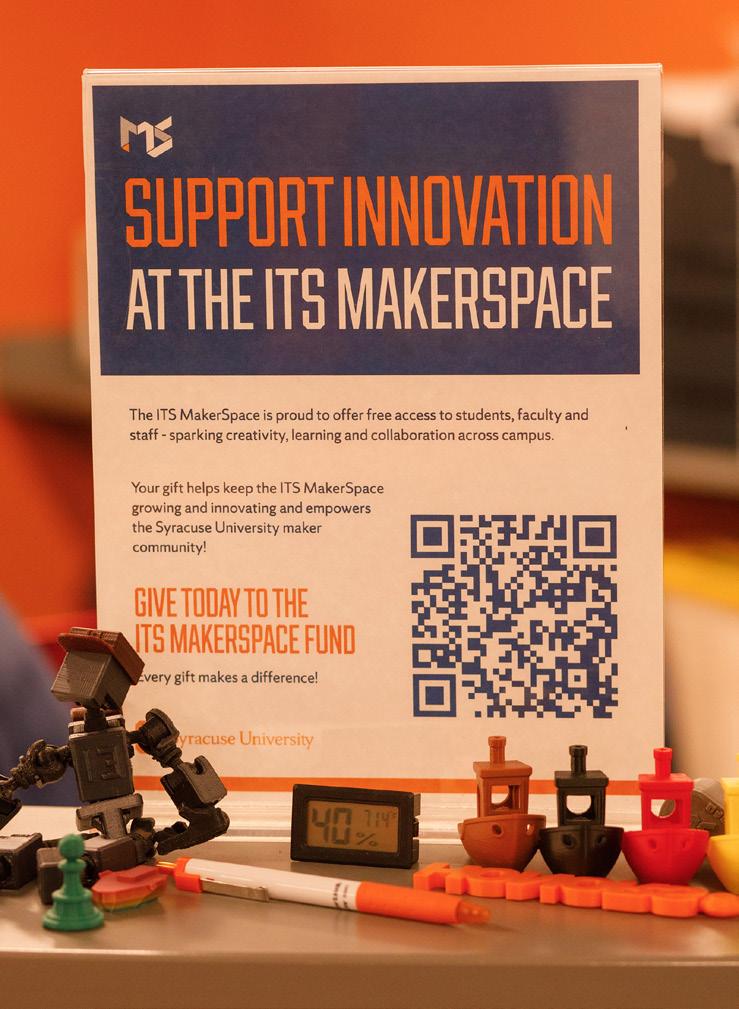
MakerSpace receives funds through the university and fundraising efforts like Giving Day. MakerSpace is free for students and staff to use, something that sets them apart, Cofer said. Mangicaro said that while students in fields like architecture and engineering may have their own studios, MakerSpace is for those who don’t.
To access the space, SU students just need to swipe their SUID, and equipment is free to use within usage limits.
“We’re here for people who don’t have that resource,” he said. “We accommodate everybody, we have more equipment than any other place on campus.”
While MakerSpace houses high-tech projects, it’s also a spot for people to have fun, Cofer said. Klemmer’s visit to MakerSpace meant 3D printing a Clash Royale crown for someone in her professional fraternity. Having a space where students can do tech-related activities but also make random gag gifts is a great asset, she said.
“I want this place to feel like a home,” Ricks said. “I want it to feel warm and welcoming.” arice19@syr.edu
Moving forward, MakerSpace remains a hub for creativity and learning. With the constantly evolving tech world, John hopes they can smartly incorporate advancements like AI to make their processes more efficient. But at its core, MakerSpace is a center for development.
“We’re here to help students bring their ideas to life, to fail forward,” Gianna said. “To make mistakes and learn.”
cmzhang@syr.edu
MakerSpace created almost 5,000 projects in 2025. avery
latoya ricks opened her new Jamaican restaurant, Erma’s Bistro, with the goal of changing common stereotypes about Jamaican dining. eli schwartz asst. photo editor
Latoya Ricks
erma’s bistro owner
OPINION
Apathy toward ICE’s abuse is immoral, poses threat to Americans
By Valeria Martinez-Gutierrez
columnist
Photos by Cassie Roshu senior staff photographer
On New Year’s Eve, American citizen Keith Porter Jr., a 43-year-old father of two girls, was shot and killed in front of his apartment door by an off-duty U.S. Immigration and Customs Enforcement agent in Los Angeles. Although the Los Angeles Police Department claimed to be investigating the accident, Porter’s family and the wider LA community have been met with silence. Few locally elected officials have spoken out, no arrest has been made and the state attorney general insinuated he doesn’t plan to take action.
On Jan. 7, Renee Good, a mother of three, was fatally shot by a federal immigration agent in Minnesota while calmly trying to turn away in her vehicle. Vice President JD Vance defended the agent, incorrectly claiming the Department of Homeland Security backed an entitlement to “absolute immunity.” DHS Secretary Kristi Noem accused Good of engaging in “domestic terrorism,” seemingly excusing her murder.
On Jan. 13, in Houston, ICE violently placed 10th grader Arnoldo Bazan, a U.S. citizen, in a chokehold. The agent also took his phone, which was later found sold to a used electronic vending machine near a detention facility. Houston police haven’t interviewed the agents, telling Bazan’s sister they can’t help.
On Jan. 14, ICE agents racially profiled a disabled woman, smashed her car window, cut her seatbelt and violently pulled her from her vehicle as she shouted that she was disabled in Minneapolis. As 2,000 federal agents flood the area in the “largest immigration operation ever,” school districts in Minnesota have had to cancel school for tens of thousands of students to ensure safety.
I hope that violence doesn’t epitomize what the new year has in store for us, but it’s hard not to when violent power breaches are
synonymous with our current regime. BIPOC communities can’t afford to be apolitical when our identities are policed and politicized.
Noem unleashed ICE to target the “worst of the worst” — DHS officials even baselessly claim that 70% of people arrested by ICE have criminal convictions or charges; but, The Cato Institute shows that nearly 73% of detainees in ICE custody had no criminal conviction.
Public safety is nothing but a pretext to criminalize immigrants, make a profit out of their detention, militarize communities and desensitize the public to the atrocities our government is capable of inflicting if not in accordance with their agenda.
According to the American Immigration Council, the U.S. Supreme Court has left almost no way to sue federal officers for violating individuals’ constitutional rights. Local and state law enforcement can be sued under 42 U.S.C. Section 1983, but no similar statute exists for federal agents.
The Supremacy Clause largely protects federal officers from state prosecution, with some limitations. In Good’s murder case, the FBI’s control of the investigation has reportedly blocked state investigators from accessing key evidence. Qualified immunity protects officers from many civil lawsuits, and while federal prosecutors can pursue criminal cases for “deprivation of rights under colour of law,” they must prove willful intent, which is often subjective and requires a high legal bar to win.
In 1971, the Supreme Court ruled in “Bivens v. Six Unnamed Known Agents of the Federal Bureau of Narcotics” that individuals could sue federal drug agents for violating his Fourth Amendment rights through unlawful search and arrest. It’s been almost eviscerated since.
Even in fatal cases, such as the border patrol who fatally shot a teenager across the U.S.Mexico border, the Supreme Court has made clear that lawsuits against federal officers are generally barred, except under the narrow circumstances of Bivens and two additional outdated cases. While efforts to codify Bivens
haven’t progressed in Congress, they could gain more traction as people mobilize against federal law enforcement overreach.
It’s possible to sue for damages, as individuals retain the right to sue the federal government under the Federal Tort Claims Act for injuries caused by federal employees. While financial compensation cannot undo the harm caused by deaths or serious injuries at the hands of federal employees, it can at least promote accountability by symbolizing a functioning legal framework and deterring future rights abuses.
One thing remains clear: The system is working as designed. It protects the compliant and racially privileged, with the DHS embracing white, nationalist online content, including a recruitment message using a neoNazi anthem, “We’ll Have Our Home Again,” in an ICE ad. This post fits a broader pattern of the federal government’s blatantly racist social media presence, infantilizing their violent rampage while desensitizing the public to their bizarre tactics and widening the thresholds of our own moral litmus tests.
Trump said it was immigrants who were “poisoning this country,” yet the stench of foul play traces back to his own government’s hands.
Criminal impunity for federal agents is especially terrifying given the lack of verification in the hiring process, as investigative journalist and veteran Laura Jadeed tested. After a six-minute interview at a Texan job fair, to which Jadeed brought her resume but didn’t sign any paperwork and was just a Google search away from her articles opposing the Trump administration, Jadeed was emailed a tentative offer days later. Without a background check, she later discovered she’d been listed as being hired on the portal.
The combo of fast money — including a $50,000 on-the-spot hiring bonus during economic regression — weak screenings for ICE agents to meet a $75 billion budget surge,the criminal impunity DHS limboes within and exploits on social media is nothing
short of a recipe for another Holocaust. Seventy-three thousand people are currently in detention centers. Rapid expansion has forced rushed infrastructure, ranging from small county jails to inhumane tent facilities holding up to 5,000 people. If citizens’ rights aren’t being respected, the reality behind bars is much worse.
In 2025, 32 people died in ICE custody, the highest number in more than 20 years, and four more died in the first 10 days of 2026. Rather than addressing serious public health and safety threats, the government spends billions on mass detention to pressure innocent people, as being undocumented is a civil offense, not a felony, to accept deportation without due process. Mass raids around the country have already resulted in preventable deaths, a consequence of an immigration enforcement system operating with a bigoted lack of oversight and accountability.
If citizens, children and peaceful towns are being terrorized by the government, we must question who the real threat to public safety is. Everyone has a role to play, skills to exploit and privilege to leverage. These blatant breaches of power and the impunity that has been blanketed onto unscreened agents pose a threat to all. The worst thing we could do is stand idly by.
It’s a moral imperative to get involved. Non-governmental organizations need graphic designers and artists of all mediums to freelance or volunteer. Immigration Alliances and groups like the Eastern Farmworkers Association need translators and even computer engineers can fill technological voids necessary for apps or websites.
If human rights permeate for some, they’ll never be absolute for all.
Valeria Martinez-Gutierrez is a senior majoring in geography, sociology and environment, sustainability and policy. Her column appears bi-weekly. She can be reached at vmarti10@syr.edu.
Relieving student debt would strengthen economy, Trump refuses
By Sam Jacob columnist
Late last year, the United States Department of Education announced that student loan borrowers in default will see their wages garnished to repay their student loans in early 2026. Over 1,000 were supposed to receive notice of wage garnishment the week of Jan. 7.
On Jan. 16, though, the Education Department announced that this process would be temporarily delayed. While this gives borrowers in default some breathing room, it ignores the root of the problem of student loan debt and doesn’t actually translate into aid forgiveness.
Delays like this one are just stopgaps. Without substantive forgiveness, borrowers remain trapped in debt and President Donald Trump administration’s approach continues to prioritize ideological opposition over economic reality.
This debate isn’t new, either. I first grappled with it in high school, just months after the Supreme Court struck down former President Biden’s student loan debt forgiveness program. I frequently encountered the neoconservative viewpoint that federal student loan debt forgiveness is unfair to college graduates who have paid off their debt and forces non-college graduates to pay for debt forgiveness.
This line of thinking is not only outdated but incorrect. Federal student loan debt is held by the government, and forgiving it doesn’t burden taxpayers in the way this argument suggests. Claiming that student loan forgiveness is unjust because some borrowers have already paid off their debt is like arguing that we shouldn’t take medicine when we get the flu because our ancestors had to combat it without treatment.
Despite this logic, the neoconservative position on student loan debt forgiveness has gained new traction in government policy following the start of President Trump’s second term. Project 2025, a Heritage Foundation political initiative, was co-authored by one of the strongest critics of student loan debt forgiveness and has been incorporated into much of the Trump administration’s agenda.
Project 2025 has been rightfully criticized for proposals that include abolishing federal Diversity, Equity, Inclusion and Accessibility practices and eliminating many of Biden’s policies on LGBTQ+ rights. Far less attention has been paid to the project’s provisions targeting federal student debt forgiveness, even as those policies have already begun to be implemented by the Department of Education.
Federal student debt forgiveness is often misconstrued as overly expensive and unjust, ignoring basic economic reality. Over the past 40 years, the average cost of attendance at U.S. colleges and universities has doubled, driving total student loan debt to $1.8 trillion nationwide, while the salaries of recent graduates have risen by just 14%. This widening gap has resulted in a damaging debt crisis for younger Americans, limiting their ability to fully participate in the economy.
At Syracuse University, the median federal student loan debt is $26,000 for borrowers who completed their undergraduate degree. This debt has resulted in many SU graduates delaying buying a house, purchasing a car or starting a business. Federal student loan debt stunts economic activity among younger generations, especially at SU, one of the most expensive schools in the country, concentrating economic influence among older generations, such as baby boomers.
Federal student debt forgiveness can pragmatically exist, yet the Trump administration has chosen not to pursue it, continuing a historical pattern of undermining higher education.
The roots of the student debt crisis date back to the 1960s, when neoconservative politicians such as former California Governor Ronald
Reagan were alarmed by the counterculture brought on by baby boomers. To fight back against campus activism, Governor Reagan slashed the University of California’s budget, forcing the school to increase its costs to make up for the lost funds. Following this, many states cut funding for their public universities, which directly impacted college affordability.
By 1978, American college students owed $224 million in student loans – a figure that exploded to $1.6 billion by 1988 and grew exponentially ever since, driven largely by continued cuts to higher education. At the same time, enrollment increased, placing greater demand on university funding.
Private universities have also raised tuition in response to funding cuts and growing enrollment. Without government oversight, these increases have been much steeper, making private universities some of the most expensive in the nation.
College ranking systems also drive rising tuition. Highly ranked schools can use their ranking to justify higher costs and their popularity pressures many high school students to enroll despite the price. Many of these “top universities” offer limited aid, forcing students to take on significant debt and further fueling the crisis.
With the option to defer payment, many students take on more debt than they can manage, resulting in widespread defaults. Carrying significant student loans at a young age overburdens Americans and limits their ability to participate fully in the economy.
As numerous publications have highlighted the crushing reality of student loan debt and its impact on young Americans, the Trump administration continues to enact policies that make repayment significantly more difficult. Federal student debt forgiveness is an absolute necessity to ensure financial stability for millions of Americans and strengthen the economy. Forgiving student loan debt allows college graduates to gain economic mobility and expand opportunities for others through increased employment and greater spending.
Federal student debt is held primarily among low-income, first-generation, female and minority borrowers – groups that often lack the resources of the upper class to pay off student loans. For these groups, repaying student loans is a steep uphill battle, and forgiveness helps level the playing field with economically prosperous Americans.
As college students, we need to do more to fight for loan forgiveness. Student movements have been majorly influential in U.S. history, from anti-Vietnam to anti-apartheid protests, shaping foreign and domestic policy along the way.
Protesting the Trump administration’s handling of federal student debt is important, as many SU students could face crippling debt that burdens them for decades. Now more than ever, protests are receiving extensive media coverage, drawing national attention to the issues at stake. Without forgiveness, the U.S. is choosing an economic future where younger Americans are financially insecure while wealth remains concentrated among older, upper-class Americans. This is a preventable future, but there needs to be greater public action in order to prevent it from becoming an ingrained part of America.
While student debt forgiveness increasingly seems unlikely, protesting or speaking out about experiences with the unaffordability of college and the burden of student loan debt draws greater attention to issues in higher education. Public opinion can sway decisions made on any policy. Student debt forgiveness, even under an administration that opposes it directly, can still be swayed into enactment.
Sam Jacob is a freshman majoring in political science and international relations. He can be reached at stjacob@syr.edu.
RFK Jr.’s vaccine overhaul endangers Americans, students
By James Reed columnist
On Jan. 5, the Department of Health and Human Services announced an unprecedented overhaul of the U.S. childhood immunization schedule. The change dropped the number of universally recommended vaccinations from 17 to 11. Immunizations against illnesses such as hepatitis, influenza and meningitis are no longer recommended for all children.
The revised schedule, modeled after Denmark’s inoculation recommendations, has sparked backlash from health care organizations and experts alike. Institutions such as the American Public Health Association and the American Academy of Pediatrics are fighting to block these changes in court.
These adjustments come at a time of widespread distrust of both vaccines and modern medicine; fewer parents than ever agree with the CDC vaccine schedules, citing political influence as a primary factor. This alteration is meant to quell those fears, allowing increased parental control. But, applying the vaccine guidelines from a country like Denmark, whose population is only a fraction of the U.S., is a great risk.
Although the effects of the new vaccine schedule aren’t clear yet, we can examine the devastating impact of lower vaccination rates for other diseases.
The measles, mumps and rubella vaccine, known as MMR, is an immunization given to children in two doses: the first at ages 12 to 15 months, and the second at ages 4 to 6. Two doses are 97% effective against measles, and widespread vaccination was a primary factor in the elimination of the disease in 2000.
Today, there is an alarming decline in MMR immunization rates. During the 2024-2025 school year, 16 states reported kindergarten vaccination rates below 90%, far short of the Healthy People target of 95%.
As parents exempt their children from the MMR immunization, measles cases have surged. In 2025 alone, the U.S. reported more than 2,000 cases, a terrifying jump from 285 in 2024. MMR doses have saved more than 90 million people globally. The increase in measles cases we see today must be taken as a warning sign.
Students on college campuses are also at risk. Students in primary school and secondary education often struggle with spats of illness due to the extreme number of shared spaces. Viruses such as influenza spread swiftly through schools and removing these recommendations can downplay the severity of these diseases that can often be deadly.
Hepatitis, influenza and meningitis outbreaks have all been curbed by widespread vaccination, and the idea that America is over-vaccinated and over-medicated is a fallacy based on misinformation from groups such as Make America Healthy Again and Children’s Health Defense.
The slow yet consistent shift in public opinion spells a dangerous road ahead. Robert F. Kennedy Jr., the figurehead of the MAHA initiative, has made his stance on vaccinations in America clear: Americans are over-vaccinated and vaccines directly contribute to autism.
“After an exhaustive review of the evidence, we are aligning the U.S. childhood vaccine schedule with international consensus while strengthening transparency and informed consent,” Kennedy said.
These changes didn’t go through the traditional review, bypassing the requisite evaluation by health experts and skirting public debate held by ACIP.
The irony of RFK Jr.’s comment shouldn’t be lost on anyone, as the man spreading medical misinformation pledges transparency to the American people. This has become an issue that has risen above the left versus right mindset we seem unable to escape. It has become a matter of public safety, with diseases previously deemed eliminated finding their way back into
the modern world at a time many consider the golden age of vaccine development. These immunizations are an extraordinary and necessary development in modern medicine. Childhood vaccinations, in particular, save more than 2 million lives annually. Immunizations reduce infant deaths by 40% globally and have played an essential role in increasing life expectancy.
As misinformation continues to plague our social media apps and internet forums, vaccination rates will continue to plummet. We must take into account where our healthcare
advice is coming from. Figures, such as RFK Jr., who lack professional healthcare experience are not trustworthy; taking their advice at face value could be detrimental to the entire country.
This administration has proved its indifference to the American people, and without change, we will continue to see rising infant mortality rates and the resurgence of once contained diseases.
maria masek contributing illustrator
So ditch your to-do list, step away from your desk. more picturesque. Trade the grind for things
Explore VPA Warehouse Gallery
Explore Syracuse University Art Museum
As Cooper, a 6-foot-1 high school sophomore, dribbled up the court, Legette-Jack recognized the little things. She appreciated the hustle plays and the moments where Cooper exhibited her “energy control.” With little hesitation, LegetteJack made her move.
That was all Emelian needed to hear. She instantly pushed for SU, reminding Cooper that — unlike other coaches, who “jumped on the bandwagon” — the Orange’s head coach was Cooper’s “day one.”
nephew had been diagnosed with cancer. As he fought through treatment and Cooper’s family adjusted to their new reality, the two families relied on each other for support.
Megan said spending time with Cooper and her family was a distraction from visiting the hospital. Cooper formed a “sisterhood” with Keith and Megan’s daughter Kaydance, who was Cooper’s age. The two families spent hours together at Keith’s parents’ house.
The top floor of the home was empty, allowing Cooper’s family, the Derbas and their MCW Starz teammates to take it over. There were three twin beds, and Megan would set up air mattresses. She said it felt like “a slumber party every weekend.” After exhausting their energy upstairs, everyone would move outside to the swimming pool.
You
just understand the system, do your part, control the controllables.
Cooper said Legette-Jack viewed college recruiting through a “holistic” lens. She was committed to her development as a player, student and young woman.
“She got on the phone and was like, ‘I wasn’t even coming to recruit you. You stopped me,’” Cooper remembers of her conversation with Legette-Jack. “I was like, ‘Wow, I’ve never heard a coach be so honest with me.’”
Legette-Jack’s transparency made Cooper’s recruitment easy. But the rest of her life hadn’t always been so straightforward.
Before she turned 1, Cooper’s biological father and Emelian split up. Emelian described the 13-year relationship as “abusive.” Once Cooper was born, Emelian realized she couldn’t put her daughter through the pain she’d endured. Emelian hit a low point after kicking out Cooper’s father, yet Cooper “saved” her.
Although Cooper lacked a present father, Emelian “dedicated her life” to her girls. Emelian, who grew up without a mother, promised herself she’d be the mother she never had.
Emelian spent years chauffeuring Cooper to basketball practices and games on Massachusetts’ South Shore. She took Cooper and Mackenzie on annual trips to Disney World, which they recognized as an “escape from home.”
Everything was going swimmingly. Then their home was set ablaze. The fire jeopardized the family’s 2014 trip to Florida, which was scheduled for a week later. But most importantly, it derailed their entire life.
“That was a very, very difficult time,” Emelian said. “It’s something I don’t wish on anyone.”
Cooper reacted to the fire the same way she approached basketball. No emotion. No expression. She didn’t let things get to her head — or at least show they were. She viewed it as a plus in her game, but some of her coaches couldn’t stand it.
They’d often approach Emelian and insist Cooper wasn’t having a good time. She’d reassure them that Cooper loved what she was doing. Her “old soul” and reserved demeanor were just who she was.
“My strengths will show, my weaknesses will be seen,” Cooper said. “But being able to not get distracted and not listen to the outside noise really helped me stay solid as a player and teammate over the years.”
As Cooper grew up, she still longed for a father figure. When Keith Derba, Cooper’s coach at MCW Starz, helped the family find a new place in Easton after the fire, he effectively filled that gap.
The Derbas were also grappling with devastating news. Keith and his wife Megan’s
Virginia Tech led 54-53 at the 6:54 mark. VT got it from Ben Hammond, who finished with a game-high 24 points.
First, he got inside for a teardrop floater that gave the Hokies a three-point lead. On the ensuing possession, Avdalas picked Sadiq White’s pocket, which led Hammond to convert a transition and-1. After he made the free throw, Virginia Tech led 59-53 with 5:50 remaining — its thenlargest lead of the game.
The turnover was SU’s seventh of the second half after coughing up the ball five times in the first half. The Orange finished with 14 turnovers one game after Autry said “18 turnovers is crazy.” George’s first made field goal cut the score to 59-55, but the Hokies extended their lead to
“The memories we created really stand out the most,” Megan said. “Bonding with (Cooper and her family) was a lifesaver for us. They stole our hearts.”
The feeling was mutual. Cooper said Kaydance was “the person for her.” Keith embraced his new role as her father figure, setting Cooper up with “a fabulous trainer.” Soon enough, Cooper considered Keith her dad, Megan her second mom and their daughters her sisters.
“(I just gave) her positive attention that any young girl deserves. Making her feel loved,” Keith said. “I wouldn’t say going above and beyond, I’d just say treating her like she was any other one of my daughters.”
After winning a state championship as a sophomore at Oliver Ames, legendary head coach Laney Clement-Holbrook retired. It seemed like the right time for Cooper to start anew. With Easton’s relative racial homogeneity and Cooper growing up alongside Emelian and Mackenzie — both white — she wanted to explore a school with more diversity.
Schools had already reached out to Cooper before her freshman year. She’d even applied to Noble and Greenough — a five-day boarding academy located about 30 minutes from her Easton home — but was waitlisted, which Emelian called a “kick in the gut.” She wanted it so bad. Now, she was ready to try again.
This time, Emelian told Cooper to “not put all her eggs in one basket.” So, she applied to three schools, yet Nobles remained her top choice. She got accepted into all three.
After lengthy conversations with Emelian, Megan and Keith, Cooper dissected the pros and cons. The pros included Nobles’ historic basketball program, its demanding academics and its close location. The cons were she’d be away from her friends, homecooked meals and her own bed. It would be a fresh start, the most exciting part for Cooper. The pros won out.
“Selfishly, I wanted Jasmyn to stay,” Megan said. “But I said, ‘I really do think you would benefit and be more fulfilled going to (Nobles).’ Without a doubt, she chose the right one.’”
Cooper spent her final summers before college putting up shots in Nobles’ gym. She formed a close relationship with her coach and felt comfortable on the campus, since she’d played there for years for MCW Starz.
Cooper racked up many accomplishments across her three seasons at Nobles. But the one she values most came on graduation day.
For six months, Cooper carried the secret. She talked it through with Emelian, went through the court process and made it official, “a tribute, a thanks, a seal-the-deal” to the second family that stepped in when nothing was guaranteed.
By graduation day, “Derba” sat beside Cooper’s name on her high school diploma. Cooper didn’t need to search the crowd to see Keith and Megan’s reactions.
After years of adversity, this was one moment she controlled. The choice was finally hers, and knowing they heard it was enough.
@JordanKimball_ jordankimball28@gmail.com
62-55 after a Lawal made free throw and Avdalas got inside for 2 with 3:26 remaining. That was the Orange’s last field goal before the score was out of reach with under a minute remaining.
Despite the loss, Syracuse was in control for most of the game behind its hot shooting start from deep. Kingz drained a triple for its first points, which was one of seven first-half 3s the Orange made before making just three in the second half.
While the Hokies imposed their will inside early, scoring their first 10 points from near the rim, a Freeman 3 — one of his season-low three made field goals en route to 10 points — tied the score 10-10 at the under-16 timeout.
Backed by another Kingz triple and a corner 3 from Betsey, SU went on a 10-3 run to take a 20-13 lead, which forced VT head coach Mike Young to take a timeout. Out of the break,
White drained SU’s fifth 3-pointer, giving it a 23-13 lead.
Despite taking a 10-point lead, the Orange failed to extend the advantage, taking a 37-30 lead heading into the locker room. Beyond shooting 7-of-12 from the 3-point line — against a Hokies defense that was the 10th-best nationally defending the 3 entering Wednesday — SU had nine assists on 13 made field goals while turning the ball over just five times. Meanwhile, William Kyle III was the Orange’s only player with 10 points at the break.
The beginning of the second half saw Virginia Tech cut its deficit to four, but a Kingz triple before the under-16 timeout helped SU retain a seven-point lead at 44-37. However, that was Syracuse’s last made field goal for over five minutes. During that span, the Hokies went on a 9-1 run to take a 46-45
lead before White ended the drought with an alley-oop slam dunk.
After playing a season-low five minutes against Boston College, White finished Wednesday with 11 points across 15 minutes. The freshman’s dunk gave SU a 49-48 lead with 8:39 remaining.
Though the Hokies took a 51-49 lead over the next minute, another White dunk tied the score 51-51. The teams then traded free throws from Hammond and Starling to tie the game 53-53 with 7:15 remaining. However, that was as close as SU got to the lead for the rest of the game.
The season is still far from over, even with a loss. But in a potential make-or-break year for Autry, the hot seat is only getting hotter.
jasmyn cooper faced countless challenges growing up. But through basketball and family, she fought her way to Syracuse. matthew crisafulli contributing photographer
courtesy of jaime emelian
Jasmyn Cooper syracuse forward
Dominique Darius named USBWA National Player of the Week
While SU’s head coach was at Buffalo in 2021, she recruited the Blair Academy (New Jersey) product. But at that point, Darius was too big a catch for Legette-Jack’s Mid-American Conference squad to reel in.
Instead, Darius set her sights on the West Coast. Growing up between Florida and New Jersey, Darius wanted a change of scenery, so she committed to UCLA.
Darius played in 16 games as a freshman for the Bruins but never consistently broke into the rotation. Her most volume came as a sophomore, when she appeared in 27 games and started seven.
That same year, Darius got the first glimpse at what she could become, she said. In a Feb. 16, 2022, clash against Oregon, she ignited for 16 points in 14 minutes. Darius loved the feeling of being a contributor, but she said she “was just never consistent” again.
Still, Darius searched for that high. After playing in just six games in the 2023-24 season, she thought she’d find it elsewhere. So, Darius transferred to USC mid-year in January 2024.
Things weren’t much different 20 minutes east. Again, Darius showed flashes, but the consistency never materialized. She played just 8.7 minutes a game for the Trojans in the 2024-25 campaign.
Entering her senior season, Donovin — a former SU football All-American — said they sensed “(USC) was trying to move on.” Darius encountered a difficult situation.
“There were many times I felt like I wasn’t good enough, and I felt like I wasn’t deserving, and felt like I would never reach my full potential,” Darius said. “I think that’s one of the scariest feelings, not just as an athlete, but as a person.”
“That was really challenging to sit with, but I knew in my gut, if I did what I was supposed to do, and really embraced the uncomfortable parts of me, then I could overcome that challenge,” she added.
So, Darius had to do something unusual.
Donovin encouraged her to consider redshirting her senior year at USC. She could train with the team and get her diploma while leaving open the possibility of transferring to another program for her final season.
It was an unprecedented ask, especially having already played the bulk of a four-year collegiate career. Nonetheless, Darius approached USC head coach Lindsay Gottlieb about redshirting. Gottlieb agreed.
I’m amazed that the other coaches didn’t understand what they had on their team. She is so gifted.
Felisha Legette-Jack su head coach
From that point on, it was go time. Darius vowed to make the most of the opportunity.
She led USC’s scout team, which practiced against the eventual NCAA Tournament No. 1 Seed. Darius defended Naismith Player of the Year JuJu Watkins every day in practice. When Darius had the ball in her hands, she had to learn how to score on guard Kennedy
By Jordan Kimball asst. sports editor
Syracuse guard Dominique Darius was named the U.S. Basketball Writers Association National Player of the Week, the organization announced Wednesday. Darius hit a game-winning 3 over Cal Thursday and dropped a career-high 26 points in SU’s win over Stanford Sunday. The award is Darius’ first national honor of her fiveyear career.
The Jacksonville, Florida, native started the week similarly to her prior three Atlantic Coast Conference games. Against Virginia, Virginia Tech and Wake Forest, Darius combined for 13 points, her lowest mark over a three-game stretch this season.
Darius’ troubles continued early against Cal. In the first half, she scored just two points on 1-of-3 shooting along with two assists. The second half wasn’t much better, with the USC transfer dropping six points of 2-of-6 shooting. As SU’s 20-point lead dwindled, though, Darius was given 15 more minutes to shine. She didn’t let it go to waste.
With Laila Phelia, Darius’ backcourt partner, sidelined with a lower-back injury, Darius turned in 11 points across three overtime periods to finish with 19, one of four Syracuse players in double figures. With the game tied at 87-87 with 3.5 seconds left, Darius drained a deep isolation 3, which head coach Felisha Legette-Jack crowned “her moment.”
Three days later, Darius remained ablaze. Phelia’s injury carried over to the clash with Stanford, leaving Darius to take the reins. She dropped 26 points on 6-of-13 shooting and added four assists. It was Darius’ most efficient outing since Syracuse’s 106-40 win over Mercyhurst on Dec. 19, 2025.
Through 19 games, Darius ranks second on the Orange with 12.7 points per game and first with 3.4 assists. Though Phelia is expected to return for Syracuse’s matchup with North Carolina Sunday, Darius will remain a mainstay in its starting backcourt.
@JordanKimball_ jordankimball28@gmail.com
Smith, whom Darius called one of the best defenders in the country. While the Trojans reached the Elite Eight, Darius challenged them at every step.
Even though she was wearing a practice jersey, Darius was finally playing with freedom and increasing her self-confidence. It also allowed her to compile film to send to schools when she hit the transfer portal, Donovin said.
“Playing against them every day, learning from them, it was so special,” Darius said. “I can’t really put a price tag on having an experience like that.”
Darius’ other focus was teaching herself to be mentally and intellectually tough. She said her lack of mental strength contributed to her previously not breaking into the rotation.
So, Darius started reading affirmations to herself every day. She listened to motivational podcasts and books, like “The Mel Robbins Podcast” and James Clear’s “Atomic Habits.” Darius even began meeting with a mental coach this summer. She said, to be the best athlete she can be, she constantly needs to challenge her mind.
By the time she entered the transfer portal in March 2025, she felt she’d grown tremendously. And a familiar face — and place — was there waiting for her.
Legette-Jack built a bond with Donovin from their time at SU in the 1990s. Legette-Jack, then an assistant for the Orange, and Donovin, a safety for the football team, were lightly acquainted and stayed in touch on social media through the years. Legette-Jack even offered to
have Donovin speak to her teams at Buffalo in the 2010s, he said.
Darius knew Legette-Jack had a relationship with her father, but when she first entered the portal, she wanted to learn more about Syracuse’s fourth-year head coach. After all, Donovin said her first priority was finding a coach who would support her — name, image and likeness revenue didn’t even come up.
To learn more about Legette-Jack, Darius called Dyaisha Fair. She picked the former SU star’s brain about what it’d be like to play for Legette-Jack. Fair said she’s the kind of coach that “would run through a wall for you.”
Since committing in April, Darius has felt that support every day.
Darius described Legette-Jack as “an angel in my life.” Legette-Jack said, aside from her husband, Darius is the person she texts and calls the most. That also means Darius is probably the player she yells at the most in practice, but both know her ultimate goal is to prepare her to be the best point guard she can be.
Legette-Jack said Darius is the type of cool-headed player she needs in her life. One that can take criticism and “tough love” while remaining calm.
“I’m just like, ‘Gosh, where have you been all my life?’” Legette-Jack said. “She’s just a great, cerebral point guard.”
Legette-Jack’s faith in Darius has been on full display all year. Before the season, she said Darius has “the keys to the Mercedes.” Despite
playing as a wing for most of her collegiate career, she’s started every game at point guard for the Orange. Legette-Jack has even looked to her in the team’s biggest moments.
In the final seconds of a triple-overtime thriller against Cal Jan. 15, the ball was finally in Darius’ hands. She isolated at the top of the key, sized up a defender, crossed over to her right, then her left, then back to her right. She stepped back and uncorked a 3-pointer that struck nothing but nylon.
When she made her way to the bench, LegetteJack wrapped her arms around the fifth-year point guard. Darius’ eyes got watery. LegetteJack looked past the tears and told her: “This is your moment.”
Legette-Jack saw it as a symbol of her point guard’s resiliency.
“ It’s like waking up from a dream and realizing that your dream is your reality,” Donovin said. “Her dream has always been to have this opportunity. To be on a team, have a coach that embraces her, have teammates, have an institution that’s given her the opportunity to shine. That’s what (Syracuse) has done.”
Darius spent five years being told no. But she always trusted her work. At Syracuse, her promise to herself is finally fulfilled.
“I can look back and say, it didn’t work out the way I wanted it to,” Darius began.
“But it worked out the way it was supposed to.”
After averaging 3.3 points per game before this season, Dominique Darius is averaging a career-high 12.7 this year with SU. courtesy of usc athletics
Syracuse’s Dominique Darius was named USBWA National Player of the Week after scoring 45 points in wins over Cal and Stanford last week. tara deluca asst. photo editor
DESIGN THE FUTURE OF HOW PEOPLE LEARN
Curious about how people actually learn—and how you can make that process smarter, efficient, and more engaging?
Syracuse University School of Education’s one-year residential or online master’s degree program in Instructional Design, Development, and Evaluation can transform your existing skills into a career that shapes how people learn across industries.
In our January 23 information session, you’ll learn how instructional design …
3 Enhances almost any undergraduate degree
3 Transforms your skills and passions, ready for the growing knowledge economy
3 Provides graduates with a high sought-after, well-paid credential
3 Embraces new tech and explores how users adopt them If you’ve ever thought, “I could teach this better” or if you love making complex ideas click, the IDDE master’s degree program might just be your next move!
ONLINE INFORMATION SESSION
One-year residential or online M.S. in Instructional Design, Development, and Evaluation
JAN. 23, 2026 | 3:30 PM ET
5 questions surrounding SU men’s lacrosse’s 2026 season
By Zak Wolf senior staff writer
Syracuse men’s lacrosse is preparing for its most consequential season in recent memory. Coming off their first Final Four appearance in over a decade, the Orange retained the core of their roster.
Joey Spallina, Michael Leo, John Mullen and Billy Dwan III are some of the key pieces of SU’s squad, who have a shot at winning the Orange’s first national championship since 2009. That brings expectations. Despite last season’s success, this program isn’t judged on Championship Weekend appearances. It’s judged on national titles.
Though, like any team, Syracuse has its flaws, which opposing teams will try to exploit.
With just over a week before No. 2 Syracuse’s season opener, here are the five biggest questions surrounding it in 2026:
Who replaces Owen Hiltz’s production?
Owen Hiltz was one of Syracuse’s most productive players over the past several years. In four seasons, the attack registered a point in each of his 64 career appearances with SU. He finished with 239 total points (137 goals, 102 assists) and increased his productivity each year with Syracuse, totalling a career-high 73 points in 2025.
Syracuse needs to find a way to replace that production this season. It won’t be easy.
Spallina and Finn Thomson’s places in the attack are cemented. The third spot remains a mystery. With Trey Deere reportedly out for the season, that spot likely belongs to sophomore Payton Anderson. When Thomson missed seven weeks last season with a broken arm, Anderson and Deere split the reps. Deere started three games early on, but, in Atlantic Coast Conference play, Anderson got the nod on four occasions.
Anderson is a dynamic offensive threat, with speed, power and 6-foot-2, 228-pound frame that allows him to be a nuisance as a dodger. That threat can help the Orange create more favorable matchups.
A wild card option is Michael Leo, who played attack in high school. Though if Gait wants firepower coming out of the box, he’ll keep Leo at midfield, so Anderson seems like the most logical option at the moment.
When will Joey Spallina break SU’s all-time points record?
Spallina is on the verge of making history. With 246 points in 52 games, the senior is 61 points away from passing Mikey Powell to become Syracuse’s all-time points leader. At this point, it’s not a question of if Spallina will become SU’s all-time points leader, but when.
The worst output of Spallina’s career came as a freshman, where he had 68 points in just 15 games. Spallina has averaged 4.7 points per game over his first three seasons, a slight rise from his 4.5 as a freshman.
Barring any major injuries, Spallina will break Powell’s record. If he keeps his current pace, it’ll take him around 13 games to do so. Syracuse’s 13th game of the season is against Virginia on April 11. Even if he doesn’t break the record by the Virginia game, he’ll likely attain it in mid-to-late April.
Who knows? Spallina could break it even sooner than that. It’s not crazy to say he can average at least five points a game, which will bring the celebration a little quicker.
men’s basketball
The pressure on Spallina has been constant since arriving at SU. Wearing the No. 22 attracts that. But when Spallina does the inevitable, all that will separate himself from Orange greats like the Gaits and the Powells will be winning a national championship.
But we’ll get there when we get there. Is there enough depth at short stick midfield?
Looking at the Orange on paper, their weakest position group is short stick defensive midfield.
Carter Rice was Syracuse’s unsung hero in 2025. His play wasn’t flashy, but his defensive work was important for the Orange, as he earned honorable mention honors for Inside Lacrosse’s All-American teams. SU’s midfield will also be missing Sam English this season.
The do-it-all midfielder never seemed to run out of energy for Syracuse, playing both offense and defense last season. Syracuse has plenty of offensive firepower, but his loss will be most felt defensively.
As of now, SU has three shortstick defensive midfielders listed on its roster: Ryder Ochoa, Dante Bowen and Jayden Kittelberger. Ochoa is the only one with experience playing for Syracuse. Bowen appeared in 18 games across four years at Ohio State and Kittelberger — an incoming freshman — was a four-star recruit in the class of 2025, according to Inside Lacrosse.
Jake Spallina and Vincent Bolognino also played shortstick midfield last season, especially when senior Nate LeVine’s season ended following a knee injury. But compared to the rest of Syracuse’s roster, they lack experience.
for Ohio State until appearing in 12 for the Buckeyes in 2025. If he can be a solid piece, then Syracuse might not have to worry about its short stick midfield group. If not, it’ll remain a concern.
Can John Mullen hit another level of dominance?
John Mullen had a ridiculous sophomore campaign. His 63% faceoff win rate was the highest of any Syracuse player across a full campaign since Ben Williams won 67% in 2015. It might be a tough ask, but, considering last season was Mullen’s first as a starter, he can potentially elevate his play to become the best faceoff man in the country.
Last season, Mullen had the sixth-best faceoff win percentage in the country. Brady Wambach (64%) was the only player from the Big Ten, ACC or Ivy League ahead of him. Henry Dodge — who led the country with a 70.9% mark — is now at Maryland, but played against lesser competition at Vermont.
What makes Mullen special is his goalscoring threat. He finished with five goals, three assists and 14 shots on goal (20 total) in 2025. Meanwhile, Wambach had four goals, no assists and 10 shots, with five on goal. Mullen can kickstart instant offense for Syracuse because of how quickly he wins clamps, which sometimes gives SU a man-up advantage if he gets upfield instantly.
Sometimes it feels like Mullen toys with his counterparts. In his second season as a starter, he could push the Orange to great heights. Will the Orange survive their gauntlet schedule and win it all?
The question everyone’s been waiting for. If Syracuse is going to win a national title, this is the season to do it. Its recruits from the highlytouted 2022 class are all seniors, and the Orange have the pieces to win it all.
Before talking about May, we have to make sure Syracuse even gets there. The Orange’s schedule has plenty of tests. They will take on eight teams from last year’s NCAA Tournament, including four from the quarterfinal (Princeton, Maryland, Notre Dame and Georgetown). Even programs that didn’t make the tournament in 2025 — like Virginia, Johns Hopkins and Boston University — will be tough matchups.
To put it lightly, there are no layups on Syracuse’s slate. Gait has loaded SU’s schedule in the past, but he took that to the extreme this season. It includes a six-game road stretch where the Orange don’t play a home game for over a month. Two of those games — against Denver and Air Force — will be at high altitude as well.
Bowen is the true wild card. He never played in more than three games in a season
SU’s attacking brand fits Mullen. Even if the Orange fall behind, Mullen can win enough possessions to make a comeback. Just look at Syracuse’s NCAA Tournament First Round win against Harvard last season, where Mullen won 24 of 28 faceoffs. The Orange played make-it-take-it, coming back from a six-goal second-half deficit.
Syracuse falls 76-74 to Virginia Tech, drops
By Justin Girshon senior staff writer
There’s a fine margin for error when trying to make the NCAA Tournament. However, pretty much every Syracuse game offers a chance to boost its tournament resume. Even if the Orange’s record can’t escape their slate unscathed, they could still receive a high seed come tournament time.
What’s that saying? To be the best, you have to beat the best. It seems like Gait took that to heart this offseason.
@ZakWolf22 zakwolf784254@gmail.com men’s
to .500 in ACC play
Adrian Autry put his head down, walked toward the end of Syracuse’s bench and stood motionless for a few seconds. While Neoklis Avdalas missed the second free throw of what would’ve given Virginia Tech a four-point lead with five seconds, SU failed to corral the offensive rebound that would’ve given it a chance to tie the game.
Instead, the Hokies’ Tobi Lawal got the board before getting fouled and made two more free throws to close the game.
Following an 18-turnover Quad 3 loss to Atlantic Coast Conference bottom-feeder Boston College, Syracuse (12-7, 3-3 Atlantic Coast) dropped its second consecutive game with a 76-74 loss to Virginia Tech (15-5, 4-2 Atlantic Coast) Wednesday. The defeat drops the Orange to .500 in ACC play, and their schedule only gets more challenging with seven of their remaining 13 games being Quad 1 matchups.
Even with the loss, SU had plenty of chances to overcome its nine-point deficit in the final minute. While seven straight points from Tyler Betsey and Donnie Freeman cut the score to 70-67 with 32 seconds remaining, VT successfully inbounded the ball before Lawal made two free throws.
J.J. Starling then quickly got inside for an easy deuce, and the Hokies’ second turnover in the final minute regained SU possession. Trailing 72-69, the Orange dialed up a clean 3-point look for Nate Kingz with 15 seconds remaining, but it missed the mark. VT got the ensuing rebound before Avdalas split his attempts from the freethrow line.
Starling then raced inside for another easy 2, making the score 73-71 with 7.5 seconds to go. SU wouldn’t score again until Naithan George knocked down a 3 to beat the buzzer and end the game 76-74.
The real gut punch, though, came when both programs were looking for a lift while
Syracuse men’s lacrosse enters a pivotal 2026 season after reaching the Final Four last year. Our beat writer has five major questions surrounding SU. jacob halsema staff photographer
Looking to bounce back from a loss to Boston College, Syracuse instead dropped its second consecutive game, falling 76-74 to Virginia Tech. eli schwartz asst. photo editor
TIME TO SHINE
Dominique Darius was overlooked for 5 years. At Syracuse, she’s finally a star.
By Harris Pemberton asst. sports editor
The summer before her senior year at Southern California, Dominique Darius made herself a promise.
The 5-foot-10-inch guard thought she was nearing the end of her basketball career. She’d just finished her fourth season of college hoops, and — for the fourth year in a row — didn’t make the impact she’d hoped.
Entering her senior season at USC, Darius knew she wouldn’t play much. She expected to appear in a few games early, burn her year of eligibility, earn her degree and “be done with basketball.”
But deep down, she didn’t want it to end that way. She felt she still had — as her father, Donovin, put it — “some light at the end of the tunnel.” So, she decided to redshirt for another year of eligibility. But if she was going to play one final season, she had to be all-in.
That meant making a devout commitment. “My future self is going to be grateful for the Dom today,” Darius told herself. A year and a half later, after a redshirt season and transferring to Syracuse, she’s finally the star she always knew she could be.
Darius, a former four-star recruit, couldn’t carve out a significant role in five years of college basketball on the West Coast. Between four seasons at UCLA and USC, Darius started just eight games and averaged 3.3 points per contest. But after electing to redshirt her final year with the Trojans, Darius transformed both her mind and her game.
While she joined Syracuse unproven, Felisha Legette-Jack’s faith has helped her evolve into a star for the Orange. The fifth-year is averaging career highs in minutes (24.9), points (12.7), assists (3.4) and steals (1.9) per game. After nailing a game-winning 3-pointer over Cal Jan. 15 and scoring a career-high 26 points against Stanford Sunday, Darius was named United States Basketball Writers Association Player of the Year Wednesday.
“A lot of people in my position would’ve given up a long time ago,” Darius said. “I’m grateful that I never gave up on myself, and I’m grateful that (Legette-Jack) gave me another opportunity to show what I know I’m capable of doing.”
“I’m amazed that the other coaches didn’t understand what they had on their team. She is so gifted,” Legette-Jack added. “She’s shown every day she’s going to continue to get better, and we’re going to continue to get better because Dominique Darius is on our team.”
Legette-Jack, who hailed herself a “coach of second chances,” waited years to coach Darius.
women’s basketball
Change is hard. SU’s Jasmyn Cooper learned to live with it.
By Jordan Kimball asst. sports editor
Jasmyn Cooper didn’t hear the fire alarms. She was just down the road, shooting hoops at the Salem, Massachusetts YMCA. When her mother, Jaime Emelian, reached her, their family home — which they had owned for decades — was already on fire. By the time Cooper understood what was happening, there was nothing left to save.
“I was just completely dumbfounded,” Emelian said. “My kids
didn’t have anything, just the shirts on their backs.”
Emelian, Cooper and her sister, Mackenzie Emelian, lived on the upper floor of a two-story home. The tenants below were normally careful, but this late October day, their Halloween decorations sat too close to an open oven, and everything engulfed in flames within moments.
A fundraiser had to replace the girls’ clothes and essentials. For more than two years, Cooper and her family bounced between a hotel, her grandmother’s home and an apartment.
Basketball was Cooper’s one constant.
“Jasmyn just kept going,” Emelian said. “That’s who she is. Basketball is her happy place.”
Nothing about Cooper’s path was stable, but she pushed forward anyway.
Her perseverance drove an illustrious five-year career at Oliver Ames High School and Noble and Greenough School, which culminated in over 1,000 points and a Massachusetts state championship. Cooper became the 24th-best recruit in the class of 2025, per ESPN HoopGurlz, gathering 20-plus Division I
offers. Her commitment to Syracuse on July 7, 2024, marked fourth-year head coach Felisha Legette-Jack’s highest-ranked recruit.
In 14 appearances for SU, Cooper has averaged 2.8 points, 2.1 rebounds and 0.6 assists across 9.2 minutes. She started three straight games in midNovember against Wagner, Utah and No. 7 Michigan. But in Syracuse’s last three games, she hasn’t appeared.
“Change is hard. I’ve been put in positions where I’m forced to change, which is something I’ve gotten comfortable with and adapted to well,”
Cooper said. “You just understand the system, do your part, control the controllables. When your time comes, your time comes.”
That mindset didn’t develop overnight, though. In high school, Cooper wasn’t initially on LegetteJack’s radar.
That changed at a tournament in Ohio, shortly after COVID-19. Cooper was out of playing shape and wore a mask in front of a restricted crowd, Emelian said. But that’s not what Legette-Jack noticed. see cooper page 12
dominique darius struggled to carve out a role during her time at UCLA and USC.She’s evolved into Syracuse’s starting point guard.