Ilia Malinin’s recent struggles and Alysa Liu’s mindful return show burnout can shake even Team USA Olympians.
Page 10
C • Student spins Cycle instructors at Barnes Center at The Arch provide energy, motivation and cardio for fellow students.
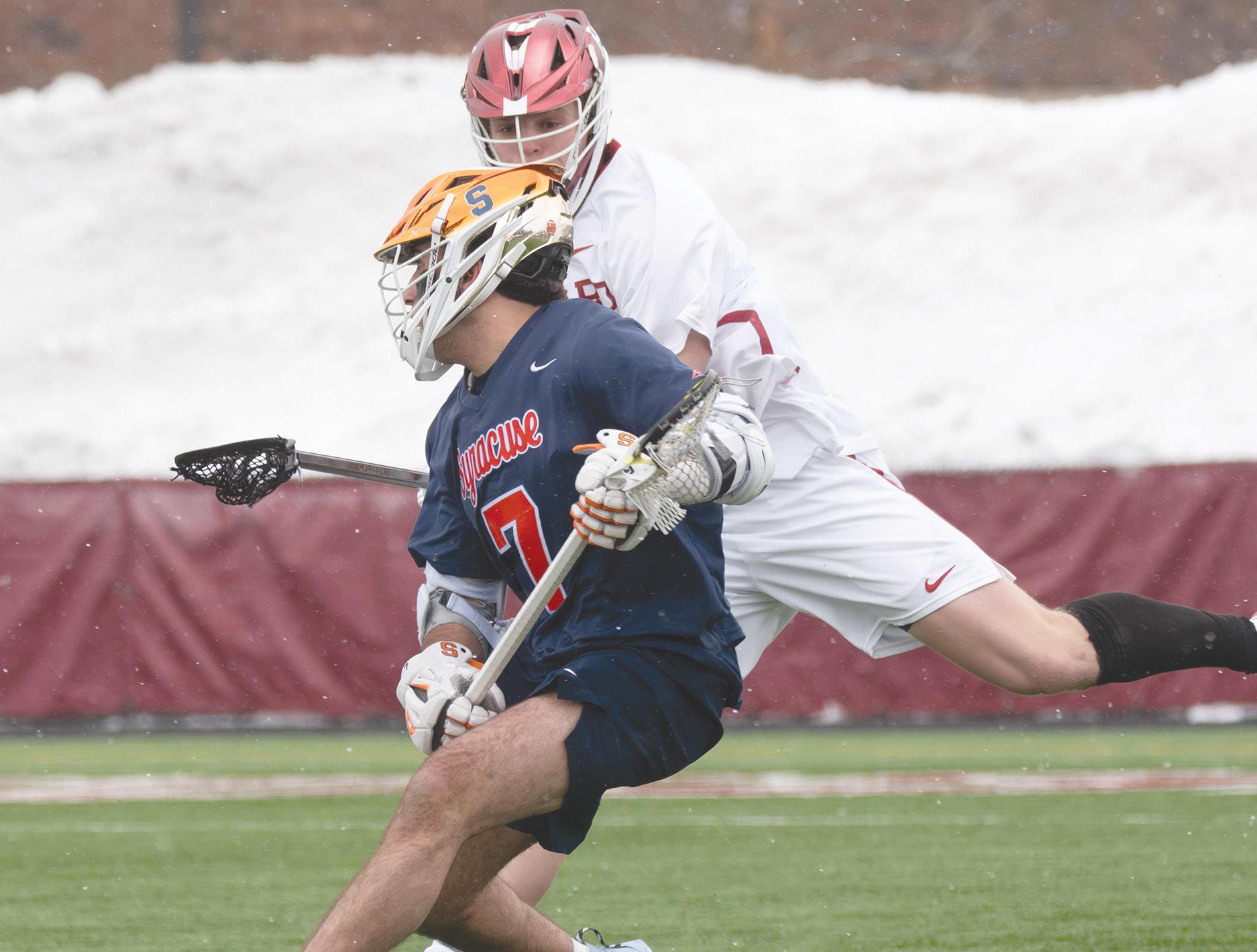
S • Positionless threat
Syracuse senior Michael Leo has evolved into a star in multiple positions as the Orange chase a national title.
Page 16
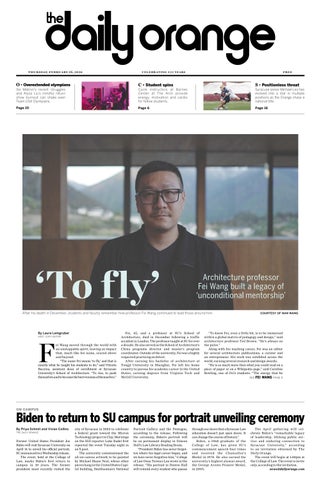
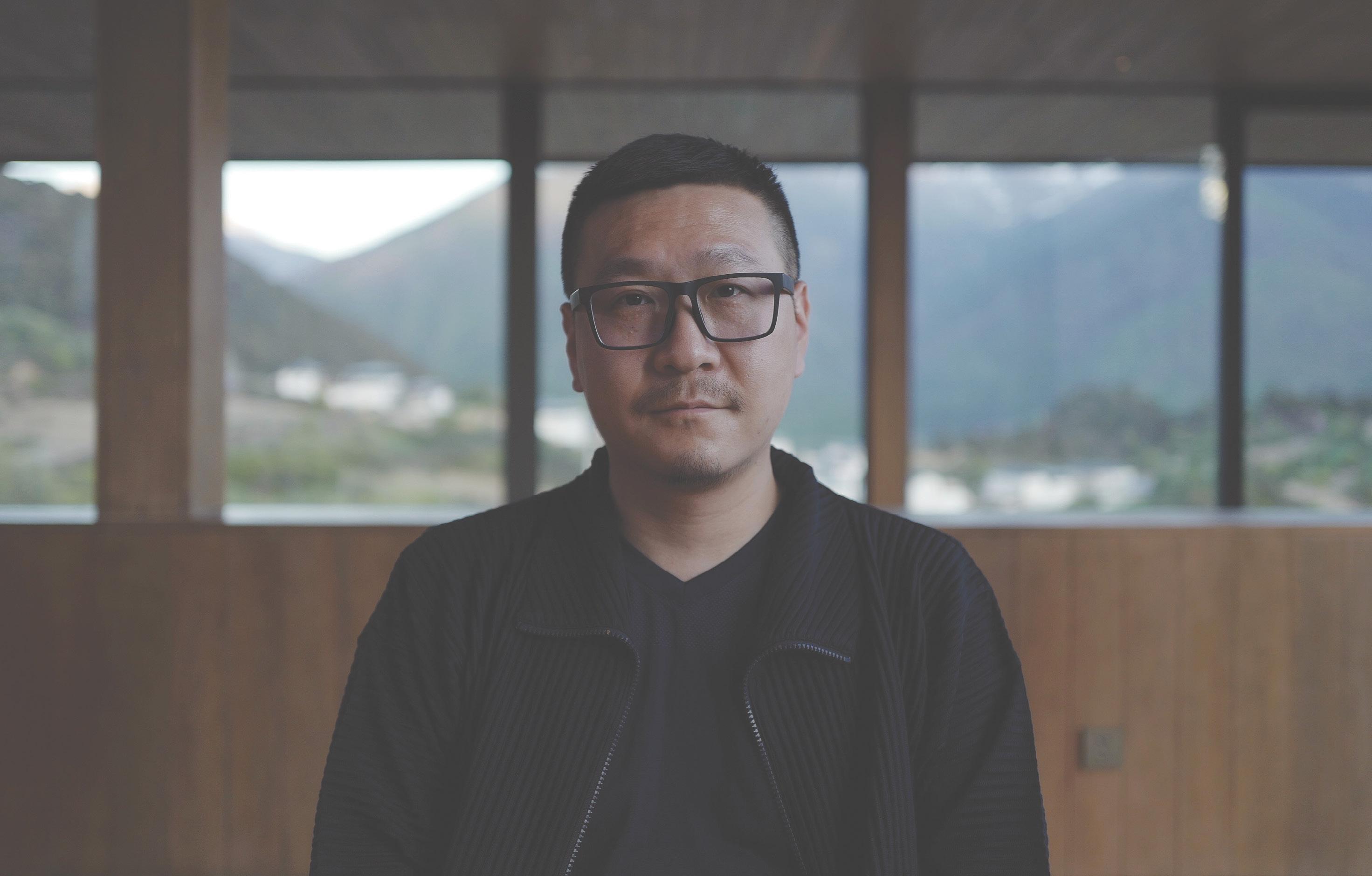
‘To fly’ Architecture professor Fei Wang built a legacy of ‘unconditional mentorship’
By Laura Lemgruber asst. copy editor
Fei Wang moved through the world with an unstoppable spirit, leaving an impact that, much like his name, soared above and beyond.
“The name Fei means ‘to fly,’ and that is exactly what he taught his students to do,” said Vittoria Buccina, assistant dean of enrollment at Syracuse University’s School of Architecture. “To rise, to push themselves and to become the best versions of themselves.”
Fei, 45, and a professor at SU’s School of Architecture, died in December following a traffic accident in London. The professor taught at SU for over a decade. He also served as the School of Architecture’s China programs director and master’s program coordinator. Outside of the university, Fei was a highly respected practicing architect.
After earning his bachelor of architecture at Tongji University in Shanghai, Fei left his home country to pursue his academic career in the United States, earning degrees from Virginia Tech and McGill University.
“To know Fei, even a little bit, is to be immersed within a global matrix of pedagogy and design,” said architecture professor Ted Brown. “He’s always on the pulse.”
Along with his teaching career, Fei was an editor for several architecture publications, a curator and an entrepreneur. His work was exhibited across the world, earning several research and design awards.
“He is so much more than what you could read on a piece of paper or on a Wikipedia page,” said Caroline Bowling, one of Fei’s students. “The energy that he see fei wang page 5
Biden to return to SU campus for portrait unveiling ceremony
Portrait
the event Tuesday night in an X post.
commissioned the
and the
according to the release. Following the ceremony, Biden’s portrait will be on permanent display in Dineen Hall’s Law Library Reading Room. “President Biden has never forgotten where his legal career began, and we have never forgotten him,” College of Law Dean Terence Lau wrote in the release. “His portrait in Dineen Hall will remind every student who passes
through our doors that a Syracuse Law education doesn’t just open doors. It can change the course of history.” Biden, a 1968 graduate of the College of Law, has given SU’s commencement speech four times and received the Chancellor’s Medal in 1974. He also earned the university’s highest alumni award, the George Arents Pioneer Medal, in 2005.
The April gathering will celebrate Biden’s “remarkable legacy of leadership, lifelong public service and enduring connection to Syracuse University,” according to an invitation obtained by The Daily Orange.
The event will begin at 1:00pm at the College of Law. The event is invite only, according to the invitation. news@dailyorange.com
After his death in December, students and faculty remember how professor Fei Wang continued to lead those around him.
courtesy of nan wang
By Priya Schmit and Vivian Collins the daily orange
Former United States President Joe Biden will visit Syracuse University on April 14 to unveil his official portrait, SU announced in a Wednesday release.
The event, held at the College of Law, marks Biden’s first return to campus in 10 years. The former president most recently visited the city of Syracuse in 2024 to celebrate a federal grant toward the Micron Technology project in Clay. Mornings on the Hill reporter Luke Radel first reported
The university
oil-on-canvas artwork to be painted by Michael Shane Neal, whose other pieces hang in the United States Capitol building, Smithsonian’s National
Gallery
Pentagon,
Editor@dailyorange.com
News@dailyorange.com
Opinion@dailyorange.com
Culture@dailyorange.com
Sports@dailyorange.com
Digital@dailyorange.com
Design@dailyorange.com
Photo@dailyorange.com
BUSINESS 315-443-2315
how to join us
The Daily Orange is an independent, nonprofit newspaper published in Syracuse, New York. The editorial content of the paper — which started in 1903 and went independent in 1971 — is entirely run by Syracuse University students.
The D.O., a 501(c)(3) nonprofit, is editorially and financially independent from SU, and the paper receives no funding from the university. Instead, The D.O. relies on advertising revenue and donations to sustain operations.
This spring, the paper will be published Thursday when SU classes are in session. The D.O.’s online coverage is 24/7, including while SU is on break.
To show your support to The D.O.’s independent journalism, please visit dailyorange.com/donate. Donations are tax deductible.
If you are a Syracuse University or SUNY-ESF student interested in contributing to The D.O. on either its advertising or editorial teams, please email editor@dailyorange.com.
corrections policy
The D.O. strives to be as accurate in our reporting as possible. Please email editor@dailyorange.com to report a correction.
letter to the editor policy
The D.O. prides itself as an outlet for community discussion. To learn more about our submission guidelines, please email opinion@dailyorange.com with your full name and affiliation within the Syracuse community. Please note letters should not include any personal information pertaining to other people unless it is relevant to the topic at hand. All letters will be edited for style and grammar.
The forecast for this upcoming week, per The Weather Channel.
BASKETBALL LACROSSE
saturday, february 21
64,
sunday, february 22
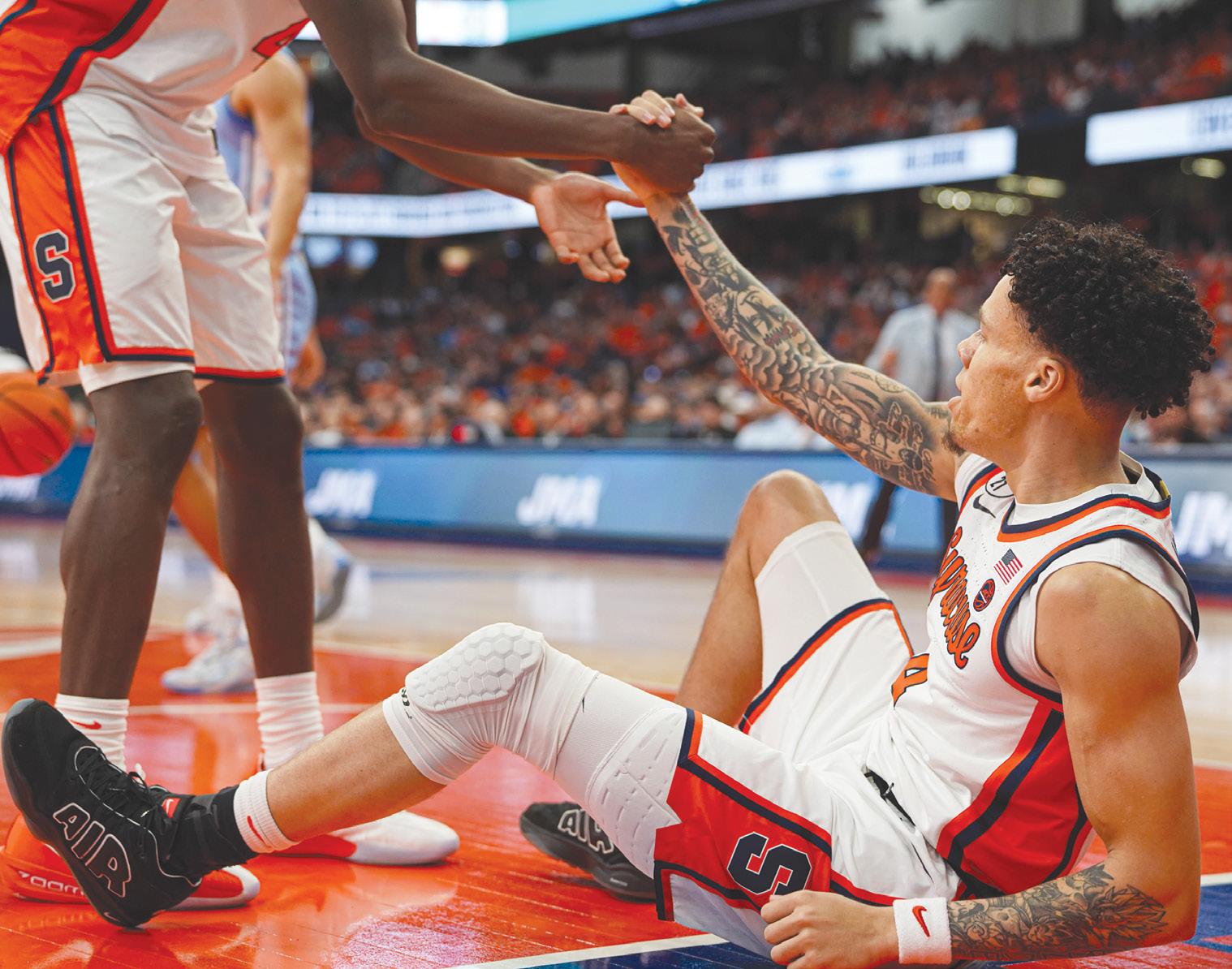
SYRACUSE 69, NC STATE 82
saturday, february 21
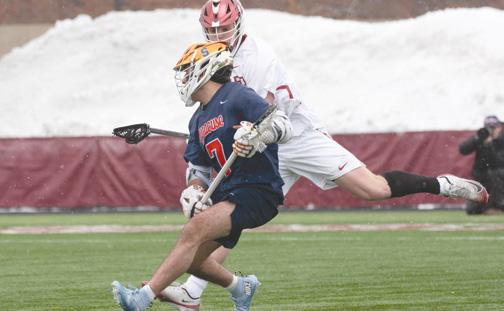
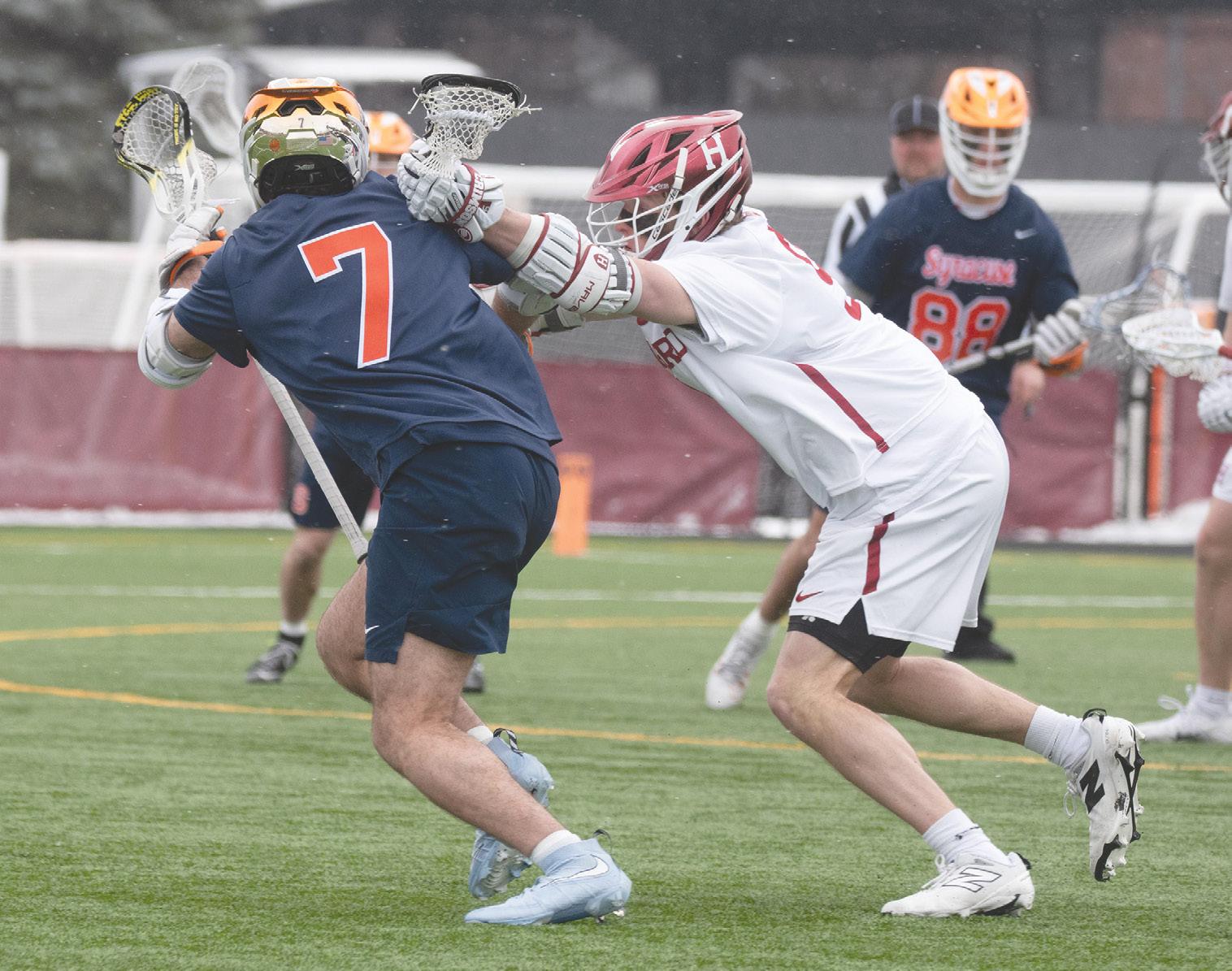
SYRACUSE 12, HARVARD 13
tuesday, february 24
SYRACUSE 15 LOYOLA 7
pistachio and toast day
Send tips and story ideas 2. We want to hear what you think about our content. Email editor@dailyorange.com or send us a message on social media. Share feedback. 1.
Help us report on stories that matter to you. Email editor@dailyorange.com with your ideas. Tips may be shared anonymously.
a member.
Help us produce meaningful coverage by making a monthly tax-deductible donation at dailyorange.com/donate. You can receive a spot on our digital donor recognition wall.
Kendall Luther EDITOR-IN-CHIEF
Rosina Boehm
Griffin Uribe Brown
university senate University senators move to reevaluate ‘Idea’ language
By Samantha Olander enterprise editor
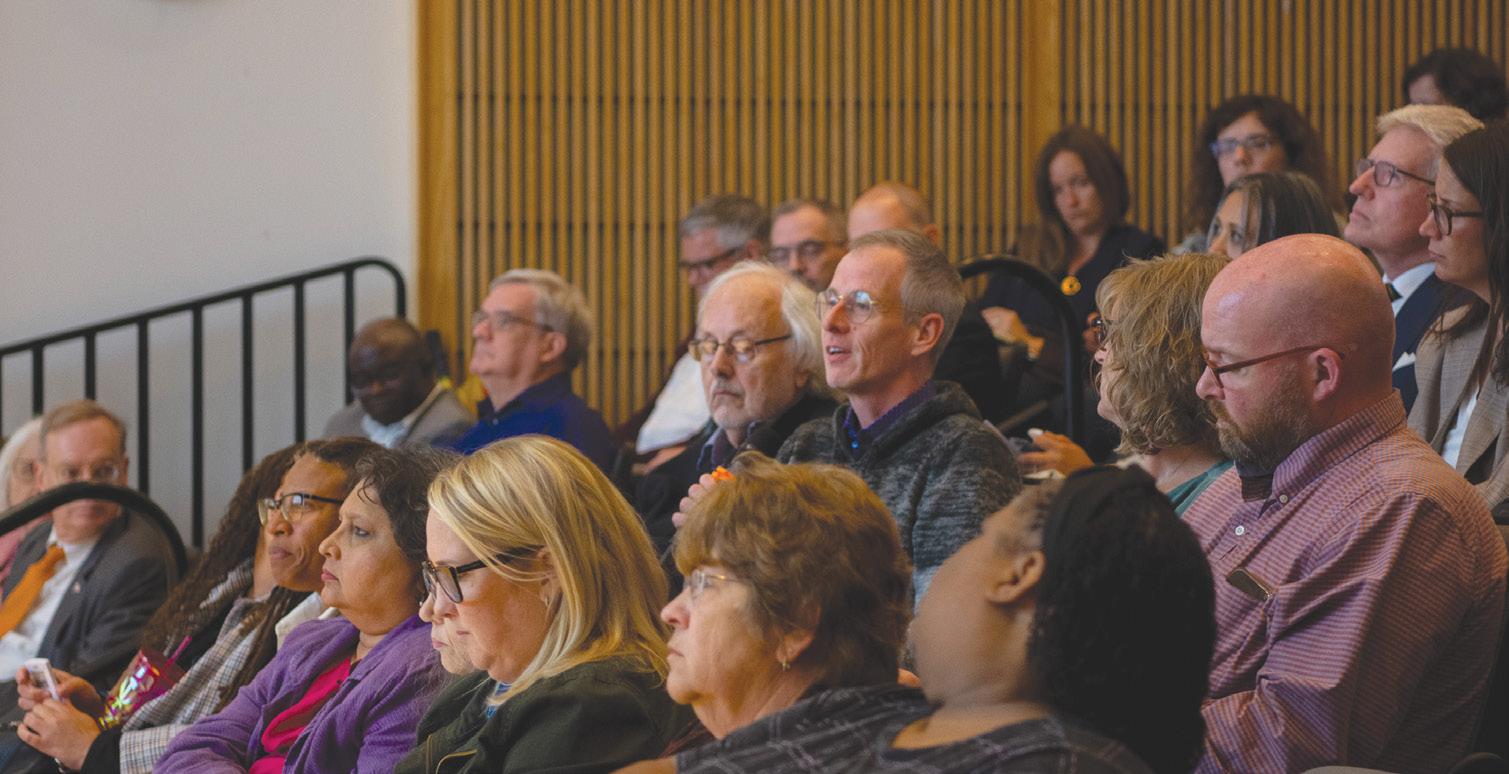
Syracuse University senators introduced a motion calling for revisions to the “Idea,” formerly “IDEA,” requirement to be formally reviewed and approved by the University Senate at its regular monthly meeting.
The motion, brought forward by humanities professor Harvey Teres and history and political science professor Margaret Susan Thompson, calls for changes to be submitted to the senate for debate and a vote.
Over the summer, the university removed more than 160 words from the IDEA course description and revised its “shared competency” language, eliminating explicit references to diversity, equity, inclusion and accessibility. SU also changed the requirement’s title from “IDEA” to “Idea” in the course catalog.
This change followed the closure of SU’s Office of Diversity and Inclusion, as well as efforts from President Donald Trump’s administration to eliminate DEIA language in higher education.
Administrators previously said the changes did not affect students’ course obligations, learning experiences or outcomes. At Wednesday’s meeting, Teres said the proposal centers on governance rather than the substance of the revisions.
“The merits or the limitations of the changes are not at issue in this motion,” he said. “What is at issue is whether the senate has the right to debate them.”
The proposal argues the revisions are “curricular in nature” and therefore fall under senate jurisdiction and the formal review process required by shared governance.
The motion cites SU’s inclusion of the American Association of University Professors’ 1940 Statement of Principles on Academic Freedom and Tenure in its faculty manual, stating academic freedom “requires the faculty’s collective authority over the curriculum.”
Thompson told The Daily Orange Wednesday night the senate has not yet received the official vote email, emphasizing that members typically have several days to a week to respond.
Provost Lois Agnew told the senate the administration changed the requirement’s catalog description, not the requirement itself. She added that because the Provost’s office drafted the original language, her office took the lead on the revisions.
Teres disagreed with the distinction.
By Brenne Sheehan news editor
Officers from United States Immigration and Customs Enforcement reportedly detained a person near Syracuse University campus early Wednesday morning, according to the Syracuse Immigrant and Refugee Defense Network.
Officers arrested the person near University Avenue, Madison Street and Harrison Street around 7:30 a.m., the report states. When SIRDN confirmed the detention on Instagram around 10 a.m., they reported that the federal agents had left the area.
A spokesperson for SU’s Department of Public Safety referred The Daily Orange to the Department of Homeland Security because the incident occurred off campus.
As of Wednesday night, no law enforcement agencies have confirmed the sighting. The Syracuse Police Department and the ICE Enforcement and Removal Operations Buffalo Field Office Outreach, whose area of responsibility includes Syracuse, did not immediately respond to The D.O.’s request for comment.
This post will be updated with additional reporting online.
brennesheehan@dailyorange.com
“Anybody who looks at the old version of the Idea requirement and the new version will see substantive changes,” Teres said. “To suggest that the course catalog description is not actually the requirement is bewildering to me.”
Senator Sam Gorovitz said the revision should be understood within the broader context of recent university changes, including adjustments to shared competency language and other academic restructuring decisions.
“This specific change is a change that would convey a very different impression to prospective students and to parents about what the university cares about and is up to,” Gorovitz said, noting families often use the course catalog to understand SU’s curriculum.
During discussion, Teres accused the administration of revising the requirement “in response to the Trump administration’s threats and extortion,” saying the university “acted to protect SU” but that the senate should still have been involved in the process.
“What faculty teach and how they teach it … must be determined by educational goals alone, as determined by both faculty and administration working conjointly,” he said. “Not by outside economic or political interests that may pressure university administration to sometimes overstep their legitimate authority, even with the best of intentions.”
Thompson, who co-chairs the senate’s Academic Affairs Committee, said faculty are capable of making difficult academic decisions but must be allowed to do so through established governance.
“We’re interested largely in process,” Thompson said, adding that elected faculty bodies, not only administrators or council chairs, should engage in curricular decisions.
The formerly titled “IDEA” requirement was developed in 2019 by a University Senate Ad Hoc Committee following the #NotAgainSU movement and was later approved by the senate after consultation across schools and colleges, Teres said. It is embedded in more than 100 courses listed in the university’s course catalog.
Agnew urged senators to consider the Idea discussion within broader institutional pressures, citing declining international student enrollment, rising costs and increased scrutiny of higher education.
“Change is hard,” Agnew said. “We don’t need to interpret change as an existential threat. It is, in fact, part of how academic institutions have survived and flourished across centuries.”
The Wednesday discussion centered on shared governance, academic freedom and faculty authority over curriculum.
The Committee on Curriculum and Instruction moved to approve the entirety of its Feb. 25 curriculum report. The report included 204 new courses, 175 course revisions, 53 course inactivations, two new programs and 63 program revisions for the 2026-27 academic year. The senate voted to pass it.
Senator Tom Barkley, co-chair of the committee, said it is also revisiting the Idea course review process. A subcommittee is examining whether oversight of the requirement should remain within Academic Affairs or be moved elsewhere.
The group has recommended forming an ad hoc committee to conduct a five-year review of Idea and determine which unit should oversee it going forward.
Another curriculum-focused subcommittee is reviewing how schools and colleges handle program changes — including new programs, revisions, pauses and closures — to assess whether procedures are consistent across units.
Concerns about faculty authority were echoed in a report from the Academic Freedom, Tenure and Professional Ethics Committee.
Co-chair Amy Kallander said SU’s ability to address concerns amid “overall threats to academic freedom nationwide” is limited by its “weakening of shared governance.” She cited an “overly punitive approach” to allegations and ongoing coordination challenges with the
Office of Equal Opportunity, Inclusion and Resolution Services.
The committee reported 13 investigations this year involving academic freedom, tenure rights and discrimination complaints. After the committee makes recommendations, the administration may accept them in full, reject them or accept portions of them, Co-chair Tom Perrault said.
Questions about faculty representation also surfaced in leadership searches.
Thompson raised concerns about the absence of faculty members on the search committee for a new athletic director and urged that faculty be included in future searches, including for a new dean of Hendricks Chapel. Chancellor Kent Syverud said SU will solicit faculty input and include faculty on the chapel search committee. He said he expects a new chancellor to be announced next month and in office no later than June.
Throughout the meeting, senators repeatedly returned to questions of shared governance and faculty input, particularly in the debate over the IDEA revisions.
“What is essential for faculty governance is that the senate weigh in on the substance of the requirement being implemented,” Teres said. “Our motion seeks faculty-administration collaboration that has unfortunately diminished these past few years. Many of us see a disturbing pattern of unilateral action by the administration — unprecedented in its scope and ambition.” saolande@syr.edu
By Remi Turner asst. copy editor
Every day at noon in 2016, Rev. Jennifer “Jo” VonRue would stand in the town square of Wilkes-Barre, Pennsylvania with her clergy collar on and a “Black Lives Matter” sign in hand. Even as residents drove by throwing two different hand signals with opposite meaning, others joined in on her peaceful protest.
Since her move to Syracuse to become a minister at May Memorial Unitarian Universalist Society, VonRue continues her interwoven min-
istry and activism. VonRue has led her ministry at MMUUS for the past eight years, focusing her work on social justice, caring for her congregants and community engagement.
“The reason I came to Syracuse specifically is because they had the most work to do on racial justice,” VonRue said. “I felt called to this church, one, because I knew they loved each other and I knew that they could have hard conversations, and two, because I felt a real calling to work in racial justice.”
She recently spent three days in Minneapolis to witness protests against United States Immi-
gration and Customs Enforcement following the killings of Renee Good and Alex
Since her return in January, VonRue said she’s worked her experiences into her sermons.
Responding to ministry calls for social justice isn’t a new pursuit for VonRue. In 2016, she traveled to Standing Rock Sioux Reservation after receiving an invitation to “stand in solidarity” with protests against building a crude oil pipeline.
“There’s so much sh-t going down in the world. There’s so much to be scared of,” VonRue
see reverend page 5
Pretti.
SU senators introduced a motion to require the administration’s revisions to the idea requirement to be reviewed and approved. christian calabrese staff photographer
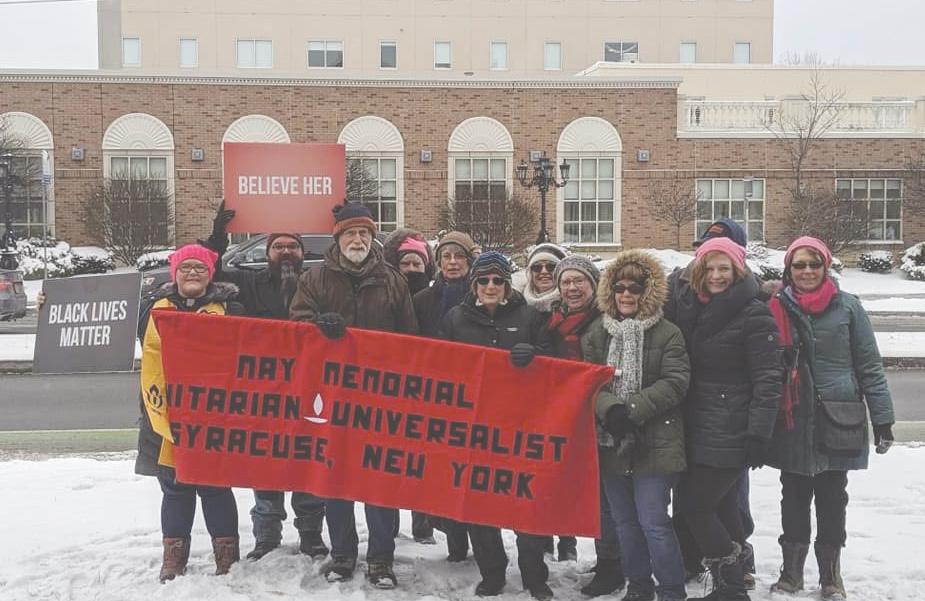
Rev. Jo VonRue became a minister at May Memorial Unitarian Universalist Society in 2018. courtesy of rev. jennifer vonrue
SU backs Graduate School council, SGA supports GSO
By Chloe Fox Rinka asst. editor
Since Syracuse University deregistered its Graduate Student Organization last summer, members of student government and administration have sought alternative ways to represent graduate students.
While SU’s Student Government Association introduced a resolution Feb. 10 that “emphasizes support” for graduate students to receive university support, the university has moved to allocating the graduate student activity fee through its new Graduate School Advisory Council.
SU established the council late last semester to bring together graduate student representatives from each school, Graduate School Dean Peter Vanable wrote in a statement to The Daily Orange. The council is intended to maintain a liaison between students and Vanable. This ensures that student perspectives can still influence the “graduate experience,” according to SU’s website.
Representatives for GSAC are selected through a nomination and review process, with the inaugural members chosen late last fall, Vanable wrote in a statement to The D.O.
The council identifies priorities for the student activity fee, provides feedback to graduate school programs and raises awareness of issues affecting graduate students. The council held its first meeting in January and helps allocate the graduate student activity fee.
“Its role is consultative, but its influence is significant—including providing input on academic policies, community-building initiatives, and ways to enhance the overall graduate student experience, including professional and career development support,” Vanable wrote in the statement.
In the December University Senate meeting, the Student Life Committee presented a resolution that would allow GSO to have a “supervised process of mediation.” Vanable said in the meeting that GSO leadership was previously advised against independence, and that the graduate school has been “very thoughtful” with administering the student activity fee since the summer. In January, Provost Lois Agnew said SU would pursue a “new start” in graduate student support,
beginning a new process to consult with students across the university.
SGA’s resolution followed the December mediation process resolution passed in USen.
SGA Speaker Pro-Tempore Max Lachut, who presented the resolution at the Feb. 10 meeting, said the “biggest issue” with GSAC is how much money is in the hands of the university rather than graduate students themselves.
“We haven’t really been given a timeline. This was essentially just some additional pressure on the university, because we do
support our graduate student counterparts and their right to shared governance,” Lachut said. “Right now, they have no means by which they’re able to do that. And that’s essentially why this all transpired.”
GSO President Roger Rosena said GSAC was introduced in an email in the fall, yet it still remains unclear who is part of the advisory council or what its status is.
Ethan Jackson, GSO director of external affairs, said he applied to the council but never received any communication regarding
a rejection or acceptance. The council minimizes graduate students’ ability to help their classmates through rules that limit their chances to gain expertise, Allison Hellman, GSO comptroller, said.
“There are term limits,” Hellman said. “But it’s not like the GSO where someone could really fully understand the needs of graduate students.”
SGA sent their resolution to Agnew last week to be reviewed for next steps.
cfrinka@syr.edu
Syracuse diocese announces trust fund for sexual abuse victims
By Owen Smith asst. digital editor
The Roman Catholic Diocese of Syracuse will establish a “Victims Trust Fund” for survivors of sexual abuse within the diocese, it announced in a press release Wednesday.
The announcement comes after Wendy Kinsella, Chief U.S. Bankruptcy Judge for the Northern District of New York, approved a final decree closing the Diocese’s Chapter 11 case, which sought bankruptcy protection to compensate survivors of sexual abuse, according to a Wednesday release.
The legal journey began on June 19, 2020, after over 100 sexual abuse lawsuits were filed against the Diocese.
The trust fund totals $176.1 million, which will be awarded to survivors by an independent arbiter.
The judge’s issued reorganization plan utilizes a channeling injunction, making it that all claims against the Diocese are resolved through the shared trust fund instead of individual legal actions.
The Diocese said they are training and conducting criminal background checks on 52,000 people to “ensure the safety of those who interact with ministries.”
In a letter addressed to the “Diocesan Family,” Bishop Douglas Lucia expressed a “profound” and “heartfelt” apology to those who suffered harm at the hands of those who were abused by members of the Diocese.
“Words cannot adequately express my feelings and sorrow regarding such heinous behavior,” Lucia said.
He also acknowledged the “significant burden” the Diocese’s bankruptcy placed on those who filed claims and were awaiting relief. The Diocese, which serves seven counties in central New York, stated it remains “ever vigilant” in its resolve to ensure future generations do not experience the same hurt.
Although the legal journey has officially ended for the Diocese, Bishop Lucia said the “promise to protect” and “pledge to heal” remain ongoing responsibilities.
Bishop Lucia invited the community, survivors and their families to a special mass at the Cathedral of the Immaculate Conception on April 26, at 2 p.m. Known as “Blue Sunday,” the event coincides with National Child Abuse Prevention Month and serves as a “day of prayer for those affected by abuse.”
owensmith@dailyorange.com
New chancellor announcement expected ‘next month,’ Syverud says
By Griffin Uribe Brown digital managing editor
Syracuse University Chancellor Kent Syverud expects the committee searching for his replacement will make an announcement “next month,” he told the University Senate Wednesday. The Chancellor Search Committee was assembled last fall after Syverud announced he would leave his role at the end of the academic year. Syverud previously recused himself from the search process and accepted the University of Michigan presidency in January.
Syverud said the next chancellor will take office “no later than next June” during the meeting.
“I’m committed to doing everything in my power in the next couple of months to … set up the new chancellor for success in the years ahead,” Syverud said.
Syverud also provided updates on the search for a new athletics director after John Wildhack’s July 1 retirement announcement earlier this month.
The chancellor said the AD search committee hired a consultant — although Syverud
is also recused from that process due to his impending departure.
Syverud credited Wildhack, who was hired in 2016, with navigating an ever-changing college athletics environment and for “transforming” SU’s athletics facilities. He said the process should move “quickly” and in coordination with the chancellor search, given the competitive AD market.
“John has been an outstanding partner to receive change in intercollegiate athletics,” Syverud said. “I point out that he’s been a particularly excellent leader in
focusing on the academic achievement of our student athletes.”
During the Q&A portion, one senator pointed out that no faculty members are serving on the search committee.
Finally, Syverud said he expects there will be a search for a new dean of Hendricks Chapel “announced shortly.” The chapel’s current interim dean, Rebecca Reed Kantrowitz, stepped into the role after former Dean Rev. Brian Konkol left SU at the turn of the new year. gbrown19@syr.edu
Following the Graduate School Organization’s deregistered status at SU, the graduate student activity fee will now be allocated through the Graduate School Advisory Council. charlie hynes staff photographer
city
After over 100 lawsuits, Syracuse’s Roman Catholic Diocese gained approval for a $176 million victims’ trust fund. avery magee photo editor
that many people have faced,” Issac VonRue said. “She wants to make the world a better place for everybody.”
brought into his space, and the passion … that’s much more of a measure of who he is.”
Known for his “unconditional mentorship,” Fei’s dream was to change the world through education, his husband and business partner Nan Wang wrote to The Daily Orange.
Students said Fei’s dedication to helping them was unlike that of a regular professor. They recall him staying on calls late into the night, assisting them with their projects, taking the time to send other work to reference and connecting them to working architects.
“His relationship with students didn’t feel like that between an elder and a child,” Nan Wang wrote. “It felt more like a friendship. He liked helping friends.”
Fei could have a sharp tongue and stern critiques — but his students agreed that his feedback pushed them to become better. They appreciated his honesty, and when he praised their work, they knew it was something to be proud of.
“He was always thinking about his students and what might be helpful for them and their growth,” said architecture student Marley McDonough.
McDonough said every time she spoke with Fei about her work, his advice pushed her projects further than she could’ve ever gone without his guidance.
His commitment to his students was evident during the COVID-19 pandemic. When Chinese international students weren’t able to come to campus, Fei was instrumental in creating three in-person architecture studios in China, connecting SU professors to students across the globe.
During a memorial service held by SU’s Hendricks Chapel in January, Fei’s students and colleagues shared their memories of the professor. Furui Sun, one of Fei’s former students, said Fei’s belief in him was pivotal during a semester where he was struggling and felt unsure about his career.
“Fei noticed the things you thought were invisible,” Sun said during the service. “The way you hesitated before speaking, the way you rushed when you were unsure … in my hardest moments, it was his faith that told me I could do it.”
For some students, Fei played a role in their college careers before they even attended SU. His “persuasive” character and “remarkable charisma” helped ease parents’ concerns when deciding where their children should study.
“During admissions, many parents chose Syracuse Architecture because Fei himself was teaching there,” Nan Wang wrote. “They trusted him and relied on him.”
Fei understood many of the worries his students encountered at school. Yifan “Ivan” Shen, a member of the COVID-19 cohort, first
met Fei in the pandemic-era studios in China during his first year at SU. When he found himself struggling during his fourth year on SU’s campus, he said Fei would share his own struggles from his time as a student adjusting to life in the U.S.
But outside of those deeper conversations, Shen also sought advice on all kinds of questions. Fei advised him on where to find a local Asian market, what dorm life looked like and how to use Uber.
“He’s the kind of person that goes out of (his) way to take care of your visa questions,” Shen said.
Although his work “took up most of his life,” Fei’s husband said he enjoyed watching relaxing movies when he was off the clock, his favorite being “Love Actually.”
Fei, who always seemed to be travelling, loved to explore. Last year, Fei and Nan Wang did not waste a second after buying a car. They immediately began exploring nearby waterfalls and national parks. His travels and the remarkable architecture and places he’d seen were a point of pride for Fei — and something Nan said he often brought up in conversation.
Despite numerous projects to take pride in, Fei did not just measure his success by awards, but by the accomplishments of those around him.
“There is also something else I believe he was proud of—things related to me,” Nan Wang wrote. “When I taught my first class at Syracuse Architecture or gave my first lecture, he was extremely happy.”
Always working to connect students, graduates and professionals, Fei developed an “informal network” between Chinese alumni. Through organizing panels and information sessions, Fei played an essential role in forming a bridge between his students and the professional world.
Bowling, who also attended SU’s memorial service, said even after his death, Fei was able to continue bringing people together in his circle. They said they grieved with faculty members they had never met before.
“To continue to facilitate connecting people, even after he has gone,” they said, “(is) a very uniquely Fei thing to be able to.”
Shen said he hopes to work with SU to establish an official Chinese alumni association, carrying on the community Fei fostered through his informal network. Shen also wants to organize mentorship events to continue Fei’s legacy.
Although Buccina’s longtime friend is gone, during his memorial she said she believes his spirit will remain in “every studio, every journey and every student” he mentored.
“His mark on the world of architecture will endure, and so will our gratitude for having known him,” Buccina said. “He taught us how to fly.” lalemgru@syr.edu
said. “There’s fires burning, and my congregation gives me so much hope.”
The reverend witnessed the protests with her then internship mentor, Rev. Douglas Taylor of Unitarian Universalist’s Binghamton congregation. Taylor said he was inspired by VonRue’s immediate response to the call.
“(There was) learning about civil disobedience, learning about solidarity, learning about decolonization. It was very much led by Jo and her energy,” Taylor said. “She really has that sense of heart that what we’re doing as ministers is building a certain kind of community where people can grow into their best selves.”
VonRue has traveled near and far to promote social justice efforts. Two years ago, she went to San Diego to protest the construction of border walls. She’s also attended local CNY Pride events, “No Kings” rallies and several Black Lives Matter protests.
Although social and racial justice is a virtue of VonRue’s life, she wasn’t always cognizant of her “privilege” growing up in Troy, Ohio, she said.
Raised in a poor household, VonRue said she recognized the facade her town was attempting to put on as a well-to-do community. It wasn’t until she learned about implicit bias during a class at Morehead State University in Kentucky that VonRue realized her responsibility to “shift the system” she was “complicit” in. “Racism was alive and well everywhere in Troy. I didn’t know any people that had a skin color that wasn’t white,” VonRue said. “I learned a lot along the way, and I just felt like I needed to do what I could to dismantle the systems of oppression that I helped to build every single day.”
Her husband, Isaac VonRue, said he thinks her ministry work and passion for social justice stem from her childhood.
“She definitely came from a family that struggled, so she understands the challenges
Around the same time Jo VonRue stood in Wilkes-Barre every day, she also started a Black Lives Matter Facebook page. She later received a NAACP award for her dedication to “working quietly in the background” and organizational efforts.
Her recent social justice efforts at MMUUS focus on responding to ICE tactics in the U.S. by collaborating with local organizations like CNY Solidarity Coalition and the Syracuse Immigrant and Refugee Defense Network.
The Democracy Action Team, which VonRue helped create, promotes the eighth universalist unitarianism principle, which calls for the dismantling of racism and oppression. DAT regularly hosts worship services, events and discussions to “facilitate” the eighth principle work of the society.
Today, a “Black Lives Matter” banner hangs in front of MMUUS. It wasn’t until VonRue ensured her ministry had “actually done the work” in support of racial justice that she allowed the banner to be installed, she said.
MMUUS congregant Mardie Ninno is on the personnel committee for the DAT. As a congregant of MMUUS for over 37 years, Ninno has seen the work of multiple ministers. But what she appreciates about Jo VonRue’s leadership is her commitment to pastoral care and community outreach.
When Ninno’s husband was undergoing two back surgeries last year, VonRue knew what he needed — jokes to lift his spirit. At least three times a week, VonRue sent Ninno’s husband jokes via email, Ninno said. VonRue also visited Ninno’s husband in the hospital multiple times during recovery.
“She makes sure that people who need to be taken care of are taken care of,” Ninno said. “I think she really gets people. She isn’t a one size fits all. She gets what people need and want…and she does that.”
Ninno said she felt proud when VonRue announced she’d be traveling to Minneapolis.
“Her being brave and doing the right thing is something that has helped me to be a little more brave,” Ninno said. “I’m never going to be as brave as she is.”
Along with VonRue’s bravery and her ability to not “be afraid to speak up,” Nonno said she’s also developed an appreciation for her “youthful enthusiasm” and fashion style — especially the bright colors she wears.
“Everybody always looks at her shoes,” Ninno said. “She’s just fun, and she talks about it, she talks about her curly hair.”
And if it’s not her shoes being noticed, it’s her red-framed cat eye glasses with polka dot accents.
When she’s not leading a sermon or doing social justice work directly in the community, VonRue is practicing one of her many hobbies from quilting to hiking with her dogs Eleanor
and Denali. More recently, VonRue picked up powerlifting, currently her most “time-consuming” passion. She will compete in the New York State Championship later this month.
“I celebrate my fat body and powerlifting is a way that I can push back on society that says I am worthless and that my body is worthless,” VonRue said.
Beyond the power lifting mat, VonRue said she is also excited to put her energy into researching and conducting anti-ICE work, especially MMUUS’s partnership with Sam’s United Methodist Church in downtown Syracuse.
“I walk through this world with so much hope in my heart and in my head because I know that we’re going to overcome whatever this is … love is always stronger,” VonRue said.
rturne03@syr.edu
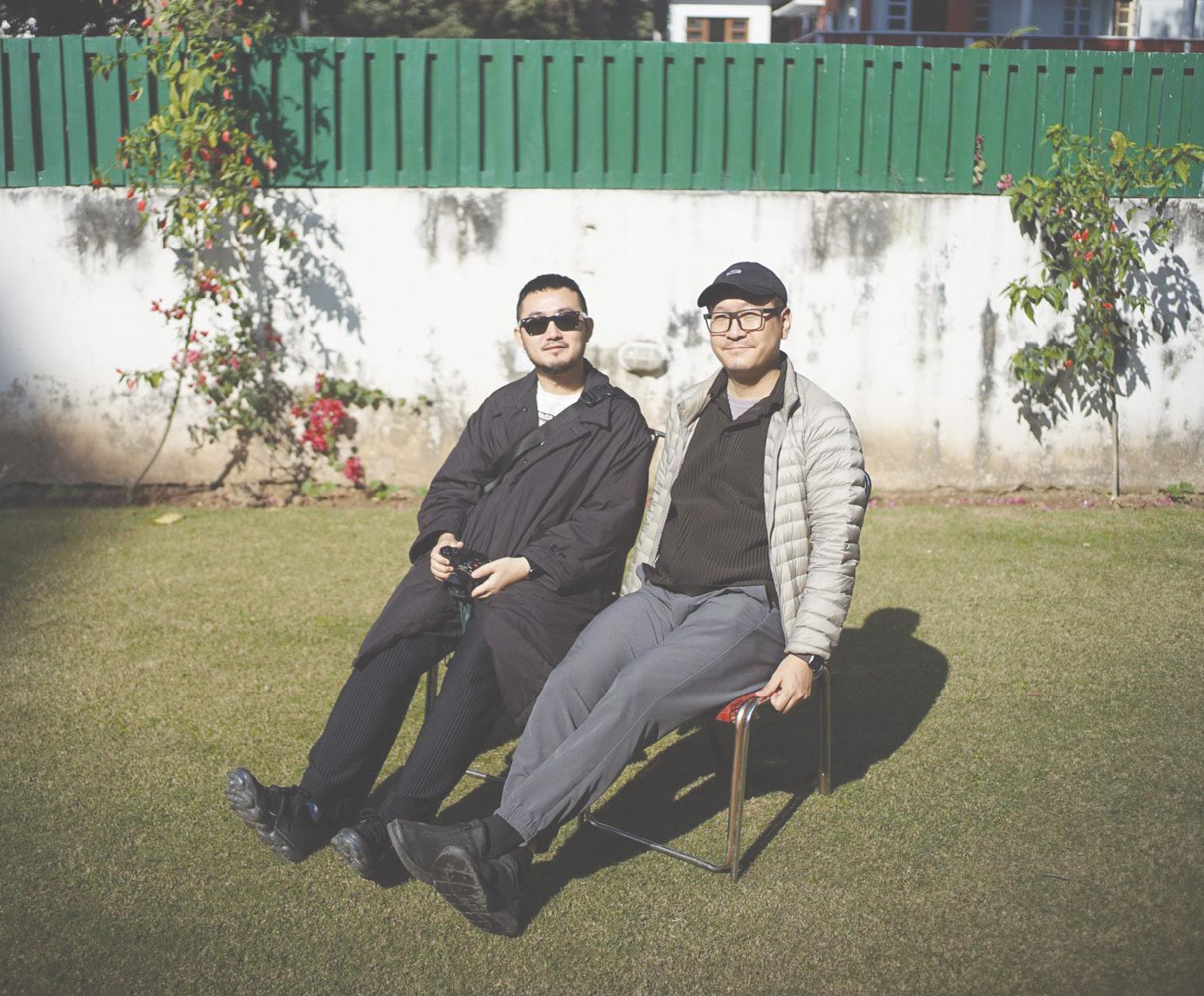
Fei and his husband, Nan Wang, were together for over 11 years. “I feel that a part of my being belongs to him,” Nan wrote. courtesy of nan wang
Rev. Jo VonRue and the MMUUS gather often to advocate for different causes. She also helped create the Democracy Action Team. courtesy of rev. jennifer vonrue
Fei poses for one of his classic selfies on a trip to Arizona with his studio class last fall which his students now cherish. courtesy of caroline bowling
CULTURE
Barnes bikers
In the studio, student cycling instructors become hype coaches, personal DJs and motivators
By Alex Rice asst. copy editor
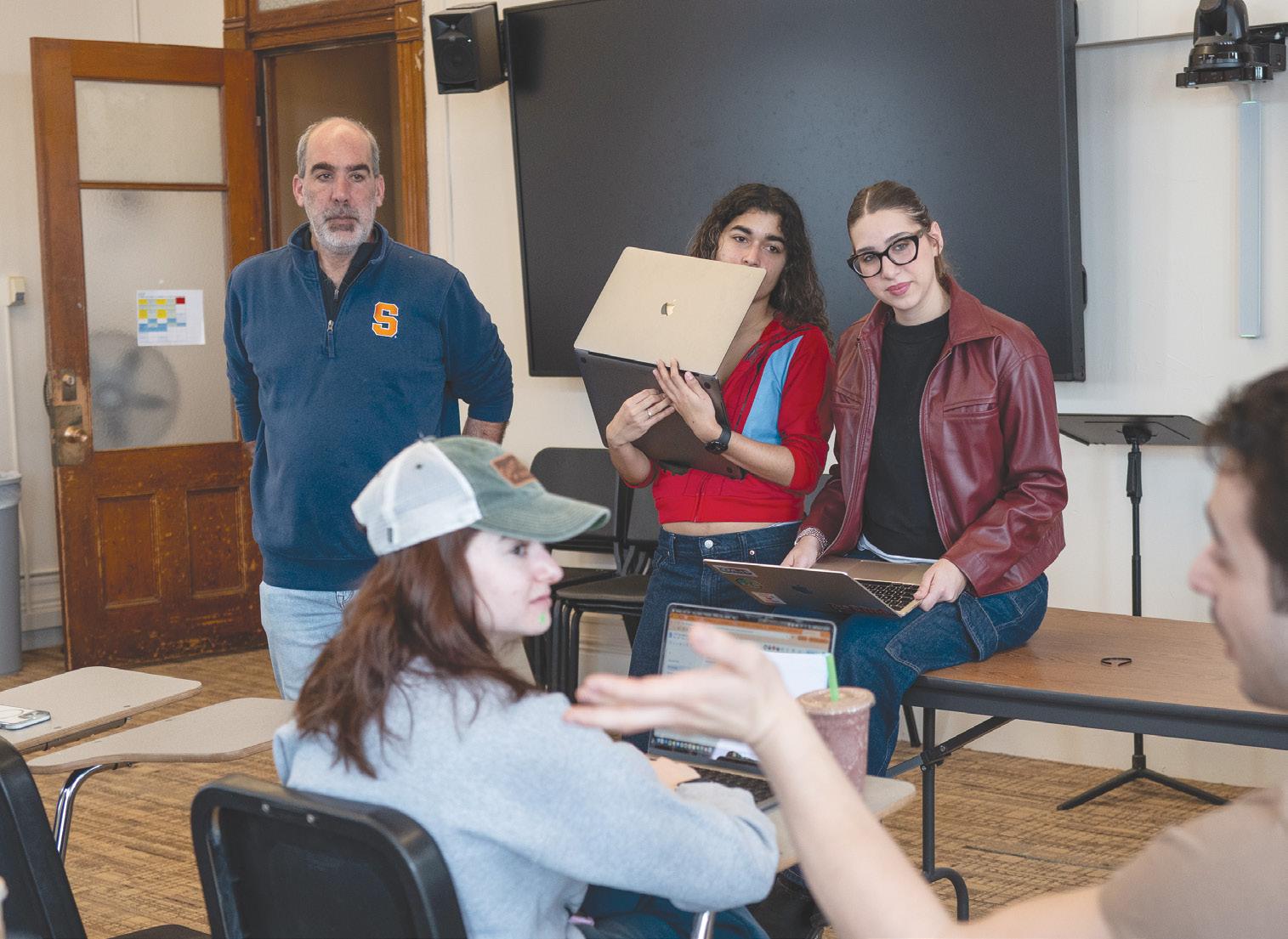
They seem like other college students — juggling classes, coursework and extracurriculars. But when the studio lights dim, the speakers start blaring and the sweat begins to pour, Syracuse University student cycle instructors become hype coaches, personal DJs and motivators for 45 minutes.
“For me, (the goal) is always that the rider walks out feeling successful,” said Julia Seitz, an SU graduate student and a cycle instructor.
“The goal is just to have people feel good about themselves and be like OK ‘I did that and at least I tried it for five seconds.’”
SU’s Barnes Center at The Arch allows students to work as fitness instructors for a range of classes, including cycling. There see cycle instructors page 9
SU Records gains traction, puts emerging artists ‘on
know much when I started. I entered the class, and the professor explained it to us and I was like, ‘Wait, this is actually super cool and we need to be on the map,’ because this
gives a lot of hands-on experience if you lock in,” Nalon said. This semester, SU Records partnered with Labelcaster, a Swedish music distribution service and The Orchard, a subsidiary of Sony Music Entertainment. Both companies reached out unprompted to SU Records. They offer lectures to the class, one-on-
By Joel Pelachik
Teaching cycle classes at Barnes Center at The Arch has become second nature to some Syracuse University student instructors. These workouts are a way to exercise while making money. eli schwartz asst. photo editor
@cusegirlscarryingsh-t turns random items into whimsy
By Charlotte Price social media editor
Sofia Self was carrying only the necessities. She balanced a Nalgene waterbottle, a sugar-free Red Bull, three Slim Jim’s, a bag of caramel creams and her phone between the five fingers of her right hand.
“I always find myself being way too stubborn to put things in my pocket or grab a bag,” Self said.
The Syracuse University junior studio arts major’s precarious moment is immortalized on the Instagram account cusegirlscarryingsh-t, alongside over 30 other posts. Each post depicts a girl juggling whatever items they had on hand — without the help of pockets or purses.
“Women’s clothing is not made with enough pockets, which could have led to this phenomenon,” Self said. “But it really just seems like there’s a worldly stubbornness that we all have.”
The account is SU’s version of the girlscarryingsh-t Instagram account, which has about 1,000 times the fame but bears the same mission-statement-style bio. The SU rendition reads “after thousands of years without pockets, non-men have evolved a superior grip to carry our shit.”
Founders of the account’s Syracuse version, SU juniors Ellyana Perosi and Amelia Brubaker, said they were inspired by the bigger Instagram account. Perosi said she’s been following the account since high school.
The two first thought of creating their own account when they lived in Booth Hall together as sophomores, lugging their groceries into their dorm from the street. They figured there had to be other girls in Syracuse carrying things around, too, Brubaker said.
Many of the Instagram posts revolve around nightlife, Perosi said, with “some sort of inhalable flash drive looking device” almost always present. Some of her favorite posts feature mundane items like phones and wallets alongside some that come completely from left field, like a baby doll or a half-eaten burger.
Each post includes a photo cropped to focus on the subject’s hand, with a caption giving the figures’ first name and a list of the items in the picture. Friends often interact in the comments below. Brubaker’s favorite collection features a girl carrying ranch dressing, her phone, a Geek Bar, a chicken nugget and a burger.
“How fun is that? Burgers are one of my favourite foods,” Brubaker said. “Who doesn’t love ranch dressing? Who doesn’t love chicken nuggets?”
The point of the account is to be random, Perosi said.
“We did not go in with an intended message in mind,” Perosi said. “We just kind of wanted to
have fun, but I guess the subconscious message that you sent is, ‘fashion industry, lock in and make better pants to fit our pockets.’”
However, Perosi isn’t in too much of a rush for more pockets in her clothes. She appreciates the art that comes out of carrying random assortments of items, and covets the “leg up” women gained because of the creativity they’ve developed while carrying their possessions pocketless.
Self said “sheer willpower” drives her to carry her items by hand instead of grabbing a bag.
Brubaker and Perosi have been friends since childhood. They’ve always bounced ideas off of each other, she said, creating a metaphorical “junk drawer” of concepts. The ‘Cuse girls account is one of the ideas that made it out of the drawer.
Living a 10 minute drive away from each other last semester already felt like a “long distance relationship,” Brubaker said. Now, the two are studying abroad in different countries. But receiving more submissions than ever has helped them stay connected with each other and with the SU community, she said.
Brubaker and Perosi often post on the account’s story, encouraging people to send in pictures through DMs to be posted in their feed. The account has never denied a submission.
Self said when she submits snapshots of her day, it gives her an excuse to chat with Brubaker. Though the founders’ close friends are sometimes the ones to submit pictures, Brubaker said she’s often able to get to know new people through what they carry.
“When I look at our account, it’s just a beautiful collage of women and girls and lovely ladies just hanging out and carrying stuff throughout their days,” Brubaker said.
There’s nothing “political or deep” behind the Instagram page, Brubaker said. She likes to think of it as a safe place where girls can share a sense of play, fun and whimsy amid the negativity that populates the internet.
The account is a way of finding little silver linings in life’s inconveniences, Perosi said.
“I really like how it takes a part of life that you would kind of deem to be inconvenient and transfers it into something funny and positive,” Perosi said. “That’s kind of like why we started the account, just for our own enjoyment.”
cprice04@syr.edu
‘Melt ice and freeze the devil’: Concert fundraises for immigrants
By Mirren Grimason contributing writer
Heads swayed and fists thrusted in the air as around 100 Syracuse community members sang “melt the ice and freeze the devil” together, expressing solidarity with their neighbors affected by the United States Immigration and Customs Enforcement.
“I am here because my neighbor was picked up by ICE and taken to a detention center,” said Amy Zamkoff, a Syracuse resident who attended the event alone. “I feel very strongly about immigration and I feel embarrassed about what is happening right now.”
On Wednesday night, the May Memorial Unitarian Universalist Society hosted “Songs of Hope and Resistance,” a benefit concert donating to the Workers’ Center of Central New York and the Syracuse Immigrant and Refugee Defense Network. The event raised $5,240 for the organizations.
ICE presence in Syracuse has ramped up in the first year of Trump’s second term, with more than 150 people arrested in Onondaga County, Syracuse.com reported in December.
A total of five performers, performing solo and in groups, collectively put on a show of 12 songs. Most of the set was made up of folk songs, including ones like “Many Waves,” “Time For a Change” and “The Greater Love,” all written by the performers.
Some songs were specifically aimed at ICE while others were more general, but all the pieces performed carried undertones and messages of resistance, resiliency and community. Before each performance, the singers spoke to the audience about what the song meant to them and why they decided to include it in Wednesday’s show.
“I really wanted to do something, some kind of resistance concert to raise money and to offer these songs of resistance,” event organizer Colleen Kattau said.
As an organizer and performer of the event, Kattau has helped plan similar events for movements, such as anti-fracking and women’s rights. She said she enjoys using music as a form of protest.
On Wednesday, Kattau performed a song she wrote about abolishing ICE, based off a Spanish song about femicide in Mexico, which she translated and altered to reflect the issues surrounding ICE.
SIRDN, a sector of WCCNY, supports immigrants in the Syracuse area through advocacy and support resources, as well as promoting community solidarity.
On stage, multiple protest signs were set up, written in bold letters. Some provided information on SIRDN and others had anti-ICE proclamations written on them. One sign read “ICE OUT, for Good!” while another said “Coming Soon! Regular ICE Report Info Sessions.”
One event organizer, Elizabeth Hilliard, has volunteered with SIRDN for over three years. She said she works to train people on how to
report ICE sightings effectively, so they can be tracked and verified. When reports are vague, it’s especially important to try to verify them, she said.
“I’ve been trying to kind of get out into the community and spread the word so that people can give us reports,” Hilliard said. “So that we can actually verify it, investigate and help out if needed.”
Marc Alessi works in multiple subgroups of SIRDN, and said that their mission was personal to him.
“Making sure that every resident in the city of Syracuse can live a dignified life. I think that’s really important,” Alessi said. “People have built a large, significant portion of their lives and they’re suddenly being kidnapped and deported to places they haven’t been to, in some cases in decades.”
While the concert mostly included songs, one performer, Victor Maria Chaman, shared immigrant stories from his collection “¡PA´LANTE!” which includes 49 stories of mostly undocumented Latino immigrants. Chaman focused his speech on one story, about a man’s experience coming of age through music in Guatemala.
The show concluded with the five performers singing onstage together, performing “Freedom Is A Constant Struggle,” and encouraging others to join.
The use of music at a fundraising concert was an intentional choice, Kattau said. She wanted to unite people in this fight through song.
“People may not remember the specifics of the movement, but they always remember the songs,” Kattau said. “Music is just an amazing, galvanizing force, bringing people together, seeing collectively.”
msgrimas@syr.edu
On Wednesday night, the May Memorial Unitarian Universalist Society hosted “Songs of Hope and Resistance.” The event raised over $5,000. charlie hynes staff photographer
Wake Up Coffee serves bánh mi, encouragement
By Caroline Erskine asst. digital editor
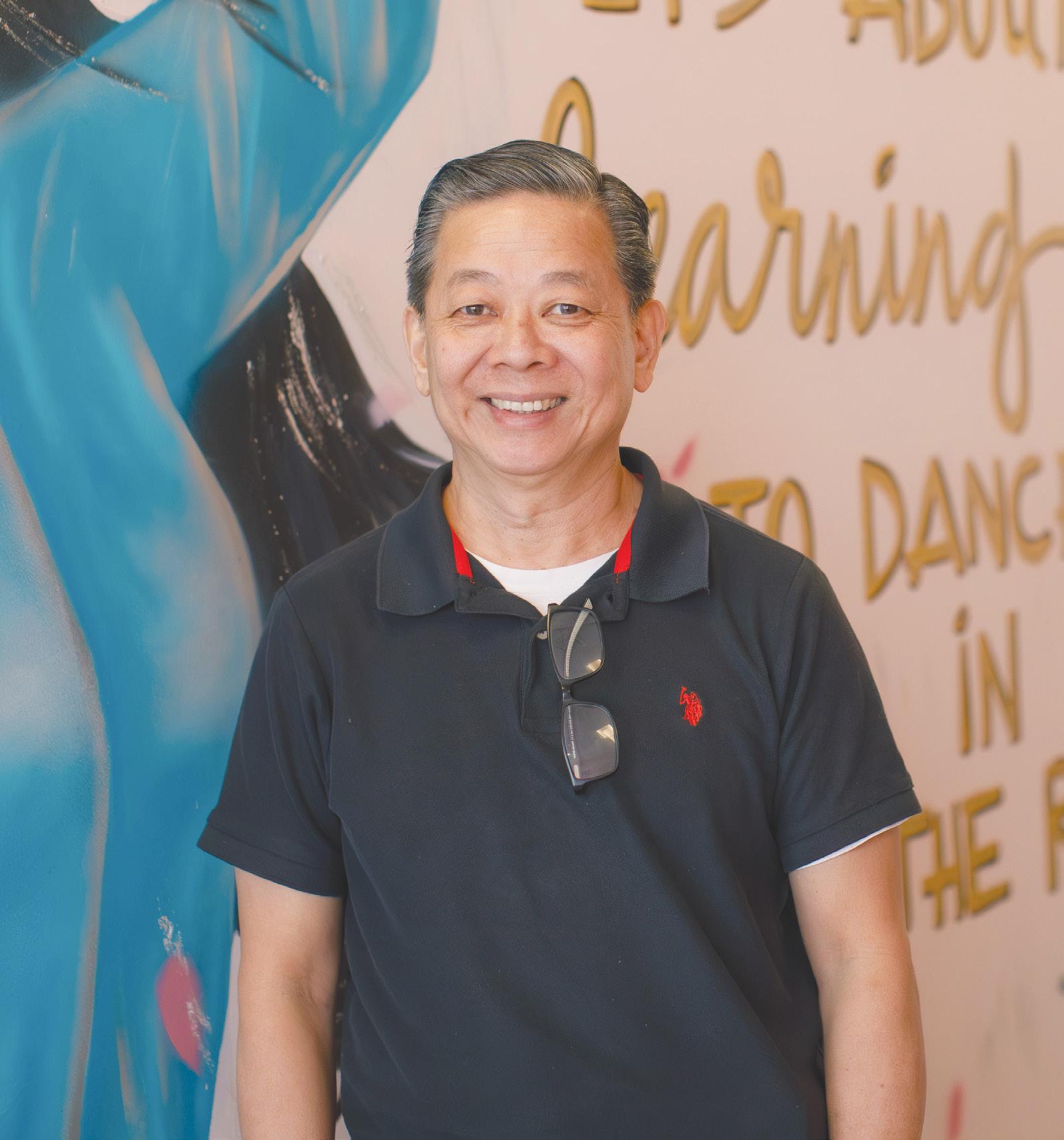
When you step off of Water Street into Wake Up Coffee and Sandwiches, a large wall features a dancing girl surrounded by: “Life isn’t about waiting for the storm to pass, it’s about learning to dance in the rain.”
It’s not just a mural — it’s the cafe’s central message.
“Everybody has a bad day sometimes, but I want them to come in, look around and say, ‘Hey, not that bad. Life is not that bad. We can handle this,’” cafe owner Thoi Trang said.
Trang opened Wake Up Coffee last Tuesday, which offers traditional Vietnamese coffee and bánh mi sandwiches.
But, Trang is no stranger to the Syracuse food scene. In 2000, he opened New Century, a sit-down restaurant with an expansive menu of Vietnamese food.
Most Syracuse customers are not used to the cafe’s kind of coffee, Trang said. Wake Up Coffee uses an extremely dark roast and brews it using a traditional Vietnamese phin filter, a slow-drip method that produces a single pitcherful over the course of several hours.
“We extract all of the flavor out of the coffee,” Trang said. “I always say darker, darker than dark.”
The result: a concentrated, intensely flavored coffee that Trang said requires sweet condensed milk, the hallmark of a traditional Vietnamese iced coffee.
The cafe’s bánh mi recipe is as authentic as the coffee, Trang said. Trang described what he calls the “traditional combo” — butter, mayo, pate, pickled vegetables, cucumber, cilantro and a pepper for heat — and is firm about what makes his sandwich authentic.
“If you make a sandwich without those things, then no way, no how, you call it a bánh mi,” Trang said.
campus life
Trang said his family was central to the opening of the coffeeshop. His eldest daughter, Annie, originally had the idea. But the food has always been second to a bigger mission: spreading kindness and inspiration.
“The main thing is not about the sandwich and the coffee,” Trang said. “The main thing is that we can use this place to send out a message to the younger generation.”
This message is important to him because Trang said he watched his eldest daughter struggle through college and wanted to make a space where students could locate quiet encouragement that is hard to find in a busy semester.
“We want everybody coming here to feel good when they come and feel welcome, and when they walk out, they feel good about themselves,” Trang said.
That ethos extends to the staff. Employees are instructed to hand back receipts and accept payment with two hands, a gesture of respect rooted in Vietnamese custom.
Seventeen-year-old barista Kayla Dinh said the familial environment has made her look forward to going to work.
“I’m not thinking, ‘Oh my gosh, I have to go to work again,’” said Dinh, who has known Trang since childhood. “It’s like, ‘Oh yeah, I get to go to work!’”
For some customers, Wake Up Coffee fills a gap that has long existed in the city. Joyce Chen, a Le Moyne College student and multi-time customer of the new cafe, said authentic Vietnamese food is harder to find in a “really white dominant” area.
Chen said places like Wake Up Coffee are especially important given the current cultural climate — pointing to recent social media trends of non-Asian users claiming to identify with Chinese culture without understanding its complexity.
“A couple years ago there were a lot of xenophobic events happening, and now it’s just a complete switch,” Chen said. “And they’re not even understanding the complexity of the different ethnicities.”
Chen said she visited New Century before Wake Up Coffee opened and was eager to see what Trang would do with a new concept. The cafe’s opening comes at a moment when Asianowned small businesses are still rebuilding visibility lost during the pandemic, she said.
“It’s so important to have authenticity and Asian-owned small businesses, especially in Syracuse,” Chen said.
The grand opening last Tuesday drew more customers than Trang anticipated. By noon, the cafe sold out of bánh mi. Because one of the bánh mi ingredients takes five to six hours to prepare fresh each day, there was no way to restock. Trang said this was a problem he was glad to have.
For now, Trang said his focus is simple: keep the coffee brewing and the messages on the walls.
“We just keep telling each other, Trang said, “just keep dancing.” cberskin@syr.edu
Bodyfide blends passion for science with identity
By Bailey Dunn staff writer
SUNY ESF senior Catherine Genao always had a love for science. As a child, she was found playing in the yard mixing dirt with leaves and was fascinated by explosions and living creatures.
Now, her passion for the subject has inspired an engineering career path and the creation of her two self-run brands, Hairified, and most recently, Bodyfide.
“I felt myself loving chemical engineering because I was able to create things to help people, my main passion is to help people,” Genao said.
Genao began brainstorming Bodyfide during her sophomore year of college and the beauty brand officially launched this month. Genao had extensive experience in chemistry and wanted to experiment with creating natural products. So far, Bodyfide has officially announced body oils in two scents, Velour Violet and Icey Lee.
Bodyfide grew out of her earlier company, Hairified, which she started in middle school and still runs. The hair and nail service got her foot in the door to entrepreneurship, Genao said. At ESF, Genao set up a lab in her dorm where she makes sure her products are well sanitized and curated.
For Genao, her love for science and her dedication to create her brand were shaped by both her identity as an Afro-Latina and her home in Harlem, New York City, she said. The community she grew up in often suffered from health struggles due to poverty and a lack of strong food and medicine systems, Genao said.
Genao’s products depend on all natural ingredients, reflecting the importance of health, Genao said. In addition to pursuing medicine in the future,
CONCERTS THIS WEEKEND
Genao hopes to grow the scope of her brand, with the ultimate goal of displaying her own products in Ulta.
“I always wanted to just be my own company, because I felt like, if I worked under a company and tried to share my voice, it wasn’t going to be advocated or spoken out the correct way I want to,” Genao said.
I don’t want to be the image, I want to be on the sidelines. I want the people who buy it as the image.
Catherine Genao bodyfide founder
Genao’s mother died when she was 10 years old. Genao said she tries to “see the light in everyone” like her mother did. Growing up, her older sister served as an important role model, Genao said. Both these relationships played a big part in her desire to help others, she said.
“That’s what gave me that passion to find a resource for my people and my community, to find hope,” Genao said. “Society kind of benefits from us, I wanted to change that with something.”
Genao wanted to create change and make something of her own, she said. Through this, she aimed to represent all people and those who looked like her. This outlook sparked the launch of her two brands.
ESF senior Venuri Atulugama, Genao’s friend since freshman year, has been following Genao’s work for quite some time. She has been getting her hair and nails done through Hairified for three years. When Bodyfide was introduced, Atulugama immediately followed the account on Instagram. Knowing her as a person also contributed to Atulugama’s trust in the brand, she said.
“She’s the type of person that makes everyone feel comfortable in their own skin and body,” Atulugama said. “She really tries to empower others by being a Black-owned beauty brand.”
Genao approached ESF senior Brianna Simone and asked her to be a model for Bodyfide’s first campaign. Simone said she felt seen by the body oil product and overall brand. It’s nice to be a part of a product everyone can use, Simone said.
Despite her customer’s varying backgrounds, Genao aims to send messages of inclusivity and makes it her mission to make sure everyone can relate to her products. Bodyfide’s motto is “embracing the authentic body.” No matter who the customer is, everyone is included in the target audience for the brand, Genao said.
Rather than centering Bodyfide around appearance or beauty standards, Genao builds it around people, using her background in science and engineering to guide the way she formulates and designs each item.
“I don’t want to be the image, I want to be on the sidelines. I want the people who buy it as the image,” Genao said. “Each product I create is based on a life story of that someone, so that they relate to the product.”
bdunnhollis@gmail.com
Thursday marks The Westcott Theater’s first DJ competition. DJs representing Syracuse University’s Greek life chapters will battle in a friendly competition.
WHEN : Thursday, 7 p.m.
PRICE: $13
WHERE: The Westcott Theater Syracuse DJ Competition
Jimkata w/ Annie in the Water
Join alternative music band Jimkata and indie-rock band Annie in the Water for a night of music at Middle Ages Brewing Company. Enjoy original songwriting and strong instrumentals.
WHEN : Friday, 7 p.m.
PRICE: $24.95
WHERE: Middle Ages Brewing Company
Whether you are an avid-R&B listener or just want to explore the genre, I Love R&B will be a celebration for anyone, including different emcees and music from many eras of R&B. You must be 21 or older to attend.
WHEN : Friday, 9 p.m.
PRICE: $41.98
WHERE: The Westcott Theater I Love R&B Syracuse
Hosted by After Dark Presents, Emo Night Syracuse will include dancing, singing and non-alcoholic beverages. Whether you’re dancing along to My Chemical Romance or Fall Out Boy, it will be a night filled with emo hits.
WHEN : Saturday, 9:30 p.m.
PRICE: $14.11
WHERE: The Song & Dance Emo Night Syracuse
Join Syracuse-based musician Soberdose and Rochester-based Jerry Big’s World Famous Band for a show full of indie punk and alternative rock sounds on Saturday night.
WHEN : Saturday, 7 p.m.
PRICE: $20.54
WHERE: Funk ‘n Waffles SoberDose
Wake Up Coffee and Sandwiches specializes in traditional Vietnamese coffee and street sandwiches, known as bánh mi. avery magee photo editor
instructors
are around 16 cycling classes each week. The instructors are paid and every prospective instructor must complete the NETA, a selfpaced fitness certification course.
Growing up, Seitz said she was not much of an athlete, but that changed during her senior year of high school, when her brother encouraged her to join a cycling class with him. Her only intention was to survive the class and never go back.
“I remember the instructor was incredi`ble and so motivating. I had never heard someone talk to anyone like that before,” Seitz said. “It was so uplifting and it was all about positive self-talk and all this stuff and I was like ‘Oh my gosh I didn’t even know I could do this, I didn’t even know I could think like this.’ It changed everything for me.”
Other SU student instructors were initially drawn to similar class mantras. SU senior Maddie Hurlbert began cycling with the free stationary bikes in Barnes Center gym and attended her first spin class with friends her sophomore year.
“The energy of everybody in the class always just kinda gets me through,” Hurlbert said. “In the middle of my class, if I was in a bad mood
works closely with the label and their artists on promotion and release strategy.
“It’s kind of intimidating because they don’t act like they’re doing us a favor. They see us as equals that they’re working with. But, I feel like it’s been really rewarding,” Vice President Sofia Quintero said. “We’ve put a lot of work into just making a name for SU Records and our artists, so it’s nice to see it being rewarded with these opportunities.”
A year ago, many Setnor School of Music students weren’t familiar with SU Records. Now, the label has gained traction across campus, Quintero said.
“It’s like introducing a whole new crowd of people to what SU Records is as well within the music school, because we made such a big name for it,” Quintero said.
Five artists, who are current students and SU alums, are signed with SU Records; Nancy Dunkle and Passing grade initially signed in the fall, and Grace Ferguson, Katie Lee and BEN SCOTT signed this semester. Because the artists are in various stages of their careers, SU Records helps them in different ways.
SCOTT, a musician who combines alternative rock, indie and folk, receives marketing and promotional help from SU Records, Quintero said. The Los Angeles-based artist and SU alum’s cover of “The Bug Collector” has nearly 10 million streams on Spotify.
SU Records is helping Lee, who’s in an early stage of her music career, become an established artist by creating her Spotify and Apple Music pages, Quintero said.
“Everybody’s very dedicated to pushing SU Records to get known and our artists to get known. We have a lot of amazing artists, and I can’t say that I’m above them,” Nalon said. “That’s one of the most amazing things about SU Records, is that we all support each other, help each other and believe in each other.”
Henry Powers, an SU senior studying music industry, is both a staff member of SU Records and a signee. Powers is the lead singer and bassist of Passing grade, an Albany-based indie rock band that he started with his high school friends in 2022. Like SU Records, the band was going through its own rebrand this fall, so it made sense to send an audition to the label, Powers said.
Powers grew up playing instruments — piano, trumpet and Irish penny whistle — and began practicing bass during his senior year of high school. He originally applied to SUNY ESF to become a park ranger, but deferred his acceptance for a year and eventually decided to apply to the Setnor School of Music at SU.
The label has helped Passing grade with marketing, by creating posters and social media
that day, I’d be like, ‘Guys, my day has completely turned around.’”
Soon, she found herself attending classes once or twice a week. During her junior year, Hurlbert impulsively decided she wanted to start teaching and signed up to learn.
Teaching keeps me in this creative flow. It’s so good for me and I don’t ever want to lose that.
Jasmine Padilla su junior, cycle instructor
The 45- to 50-minute classes attract student instructors because they’re an opportunity to make money while getting in their workout for the day, Hurlbert said.
“Who doesn’t want to get paid to do cardio?” SU sophomore and cycle instructor Jack Spies said.
For some student instructors, teaching cycle classes has become second nature,
SU junior Jasmine Padilla said. While she is studying abroad in London, Padilla said she is “going crazy” without regularly teaching spin classes at Barnes Center.
“Teaching keeps me in this like creative flow. It’s so good for me and I don’t ever want to lose that,” Padilla said.
While every instructor is different, there are some aspects that tend to stay true. Most cycle classes contain a variety of phases, usually starting out with a warmup, then increasing levels of tension in the “climbs” as the class ramps up and ending with an “out-of-saddle” sprint.
To match this format, most instructors curate their own playlists for students to follow along, playing songs from all genres anywhere from reggaeton to country, Padilla said. They ride the bikes according to the song’s beats per minute.
Spies said teaching classes allows him to give other people the “great feeling” he gets when he works out. An instructor’s biggest superpower is to be honest and vulnerable because there is someone else in the room who is inspired by their hustle and determination, Spies said.
Spies got certified to teach at the Barnes Center in December 2024. He said he appreciates that they don’t tell the instructors how to structure their classes. He was always looking for a
class that had a happy medium focus on metrics and riding along with the music.
When Padilla was preparing to teach her first class in August of last year, she would head to her hometown gym’s cycling room at night. She spoke out loud to practice her instruction — as if a class was there.
“I was so nervous for my first class, but I had already done that exact playlist like 10 times over back home,” Padilla said.
For some student teachers, cycle classes have brought structure and routine but also a confidence boost, Hurlbert said.
When Hurlbert began teaching, she was worried people wouldn’t take her seriously because she didn’t fit the traditional “influencer fitness model” stereotype. But Hurlbert soon realized that typecasting wasn’t necessary for her to teach a good workout class.
Some student instructors plan to continue teaching classes, Seitz said. After her graduation in May, Seitz expects to keep cycling; it’s one of those things she is always going to make room for, she said.
“I want to teach as long as I physically can,” Seitz said. “I’ve never done something for so long in my life.”
arice19@syr.edu
posts, which helps Powers focus more on the music, he said. SU Records frees him up for songwriting and practice, Powers said.
When the whole band is on campus — Powers is the only member attending SU — they play shows in the area. Last semester, the band spent a weekend recording in the Belfer Audio Archive studio on campus.
Powers said it’s “clutch” to be in the class in case the label has any pressing questions for his band.
“The SU Records thing is certainly helping with visibility because we’ve got shows that we have to do every semester. We have to post every semester,” Powers said. “Gabi’s been really good at turning heads to this thing.”
Primarily through social media outreach and live events, the label now draws more attention across campus and even inside VPA, Nalon said.
SU Records has partnered with Z89 radio station for interviews with their artists to promote their work. The artists also perform their own “Tiny Desk”-inspired acoustic concert sets in partnership with the Reel Talk Agency, which records the performances. This Friday, Lee, Ferguson, Dunkle and Powers will perform these stripped-down sets. Since SU Records doesn’t have any formal funding, all the revenue from their events goes toward artist promotion and publicity, Nalon said.
All five SU Records artists will have new singles out by the end of the semester, Nalon said.
SCOTT released “Say My Name” on Tuesday, and Passing grade’s “Madrid” releases March 28.
“Music is something that connects deeply with everybody. People have different genres
that they like, but they will connect somehow,” Nalon said. “Music helps people, no matter what time they’re going through it, if you’re happy, if you’re sad, if you’re angry, music helps.”
Quintero said many SU Records members forget it’s a class because they’re in it for “the
love of the game.” Nalon and Quintero both said their biggest goal is for the artists to succeed.
“I’ve always seen it as about the artist, and I hope they see it as such too and that they feel like SU Records has been helping them grow,” Quintero said.
jdpelach@syr.edu
Every time SU Records meets, the students treat it as a staff meeting. The class runs more like an organization. courtesy of asia lising | tara deluca asst. photo editor
rené vetter cartoonist
julia english cartoonist
Burnout doesn’t spare college students — or US Olympians
By Ally Price columnist
Last week I skipped class. Sorry, Mom.
I didn’t skip to clean my room or tackle the assignments that have been sitting open on my computer for a week. Instead, I sat on my couch and doomscrolled on TikTok. Video after video blurred together until one caught my eye: a live reaction to Ilia Malinin falling during his final skate at the 2026 Milan Cortina Winter Olympics.
Malinin, a figure skater representing Team USA, was projected to win gold by an extreme margin. Before his 2026 Olympic run, he carried a two-year winning streak and two consecutive world titles in men’s figure skating. He is also the only figure skater to have successfully landed a quadruple axle — a feat that earned him the nickname “Quad God.”
Heading into the final skate, Malinin was en route to gold, sitting in first place with a hefty lead. Then everything unraveled. He fell twice, and several jumps were downgraded. By the end of the performance, he had dropped to eighth place, falling off the podium entirely.
After the shocking performance, Malinin began reposting videos on social media with concerning messages that he has since removed. One read, “Your little boy is tired, Mom.” He later shared his own post, “When I get home and step into my room and my eyes start watering because no one knows how hard I’m truly trying.” This is just a glimpse into the weight elite athletes carry behind the scenes.
This story is not a rare one. Alysa Liu, another American figure skater, retired at just 16 years old after her run in the 2022 Beijing Winter Olympics. Liu began skating at 10 years old and, by 13, she became the youngest champion in the competition’s history, winning the U.S. Figure Skating Championships.
But after the 2022 Winter Olympics, Liu announced in an Instagram post that she was retiring from competitive skating. She wrote she felt “trapped” and “stuck” through the rigorous training process, fading passion and limited control over her programs. She also pointed to the extreme expectations placed on her at such a young age. For Liu, stepping away from skating was the only way she felt she could regain a sense of freedom and control over her own life.
Surprisingly, Liu came back for the 2026 Milan Winter Olympics to compete for Team USA. This time, though, she declared that she was coming back on her own terms — taking days off as needed, having creative input and being in control of her nutrition and exercise plans.
Liu ended up winning gold last Thursday — both with Team USA and women’s figure skating — and did so with zero regrets.
“Quitting was the best decision I ever made … and coming back was the best decision I ever made. I don’t make bad decisions,” Liu said.
These struggles are not unique to Olympians. Being on a college campus, we are consistently exposed to high-stress situations and the pressure to always look ahead. Too often, we don’t allow ourselves grace and appreciation for all that we have overcome to get here.
As we head into midterms under the familiar grey, gloomy skies of Syracuse, the fatigue intensifies. Work starts to pile up, and every activity seems to demand more energy to complete than it did just a few months ago.
Yet, there is still so much stigma around the idea of taking a break, especially when it comes to school.
We are taught that stopping or setting a boundary is a sign of weakness. That you have
to keep trekking along toward a finish line that keeps inching away, until you finally fall to the ground from exhaustion.
But this doesn’t have to be the case.
For our society to be more accepting and willing to allow people to take a muchneeded break, it has to begin on an individual level. We have to recognize when a break is needed and give ourselves permission to take one. Otherwise, we contribute to this toxic ideology just as much as we are harmed by it.
So yes, I skipped class. You could argue that tuition is too expensive to miss even a single lecture, that by staying home, I essentially threw away a portion of what I paid to be here. But honestly, it’s not about any of that.
Life is not a zero-sum game. Every decision you make will have a consequence, but you’re
the only one who gets to decide whether that consequence is worth living with.
Whether you’re Ilia Malinin taking some time for himself after losing out on an Olympic gold medal over a few falls, Alysa Liu taking a two-year break to rediscover her love for the sport or just some college kid sitting on their couch watching TikTok, remember that you’re the only one who can decide where you need to be in this moment. That’s OK.
Maybe don’t skip every class — there, Mom, that’s my redemption — but skipping one won’t kill you.
Don’t be afraid to take time for yourself, especially when it’s gloomy outside or the world just feels too loud. Also, never apologize for skipping class to doomscroll on TikTok.
Ally Price is a sophomore political science major. She can be reached at aprice09@syr.edu.
inaccessible party scene doesn’t live up to its reputation
By Emalie Vera essayist
Like many students, I went to college expecting the social scene I had seen in the movies. Growing up, Hollywood sells it as the best four years of your life, especially when it comes to parties. I imagined packed houses or fraternity parties with hundreds of people, blaring music and red solo cups everywhere.
It’s no secret that Syracuse University has a reputation as a party school, ranked No. 7 party school in America by Niche. From house parties on Euclid Avenue to fraternities and bars, there are plenty of options for a Friday night out. But, over the past few months, the party scene has significantly died down.
From what I’ve experienced, the first few weeks of the new school year feel completely different from the middle or winter. Back then, it seemed like there was always somewhere to go. Now, with freezing temperatures and mountains of snow, house parties are rare and options shrink fast.
Just because you’re a student here doesn’t mean the party scene will be fair to you either. During Welcome Week, I was shocked when I went to my first party and saw several Venmo QR codes taped to the side of the house, where only guys had to pay. To get into a majority of the parties here, men have to cover fees ranging from $5 to more than $20, depending on how early or late they arrive. Women are always welcomed in for free.
Even the choices that do exist aren’t accessible to everyone. My friends and I can’t go to bars because we’re underage,
so we usually stick to fraternity parties or the occasional house party on Euclid. After months of going to the same exact places and doing the same thing over and over, going out becomes rather boring. Problems like this make it difficult to go out as a full group. Some of my male friends would
rather stay in than pay just to walk in the door. Spending money every weekend for a few hours out adds up fast. It’s also a part of the reason many students rush fraternities, so they don’t have to pay to actually have a good time.
During my first week here, I would see and hear people on my floor going out every night. I
didn’t have many friends at the time and often felt like I was missing out by not getting ready and going to parties.
While attending a party school can be very enjoyable, it can also reveal the underlying risks to party culture.
During my first semester here, I felt a steady pressure to go out, drink and party to feel like I belonged. It seemed like having fun meant saying yes to everything, even when I wasn’t fully comfortable. Over time, I realized how easily that pressure can push you toward habits that linger longer than one semester. I was making choices that didn’t quite feel like my own. With newfound freedom away from home, it’s natural to want to step out of your comfort zone and test your free will.
Going out every weekend to enjoy the party scene is perfectly okay, as long as it doesn’t stem from pressure or the expectation to live out what Hollywood portrays.
SU isn’t a bad party school. Its social scene is simply held back by structural issues that make it difficult for some groups to fully participate and feel welcome. Moving forward, I hope to see a more inclusive environment and more spaces where I can hang out with all of my friends, not just select groups.
In order to strengthen the party scene and live up to our reputation, students must be willing to open their doors and throw parties with accessibility for all, free of charge.
Emalie Vera is a freshman majoring in english
abigail aggarwala design editor
kendall thompson contributing illustrator
system for three years now, it kind of makes it easier for me just to go back and forth. I’ll just do whatever the offense needs to succeed.”
That might mean starting the offense up top. It might mean drifting to the backside and waiting for a skip pass. It might mean drawing the second slide and never getting credit. Leo thinks in terms of six men on offense moving as one.
Spallina has known Leo since the sixth grade, when they were just kids at a lacrosse tournament on Long Island. Spallina’s team may have “killed” Leo’s, but he still stood out.
“He was the only guy on their team who was scoring or doing anything,” Spallina recalled.
Once the lopsided game ended, Spallina approached Leo. Their two parents — Mike Leo and Joe Spallina — also struck up conversation.
The interaction set the stage for what occurred years later. In their last two years of high school, Leo and Spallina joined forces with Joe’s acclaimed Team 91 at the club level. It was a preview for their time at Syracuse — and teased Leo’s adaptability.
Before joining Team 91 — and for much of his time with the club — Leo was a left-sided attack. But when he committed to Syracuse, the Orange already had Owen Hiltz occupying the position. So, Joe began deploying him as a midfielder to prepare him for his anticipated role in central New York.
And that chemistry with Spallina? They’ve trained together on Long Island and have been roommates since their freshman year at SU. Spallina admits lacrosse is a relationship-based sport, and his relationship with Leo is a “pretty good one.”
On Long Island, Leo honed his game working with Premier League Lacrosse midfielder Tom Schreiber — a fellow St. Anthony’s High School product. Schreiber started training Leo through group workouts in seventh grade. Frequent attendees included Harvard’s Jack Speidell and Jackson Greene, and Georgetown’s Liam and Rory Connor, Schreiber said. The training was “high intensity, high reps” and featured “a lot of feedback.”
The sessions aimed to deepen Leo’s “bag of tricks” as a playmaker and refine his right-handed shot, Schreiber said.
As he adjusted to his new position, Leo sought Schreiber’s advice. Schreiber admitted Leo was always a talented shooter, but he pushed him to improve as a dodger to
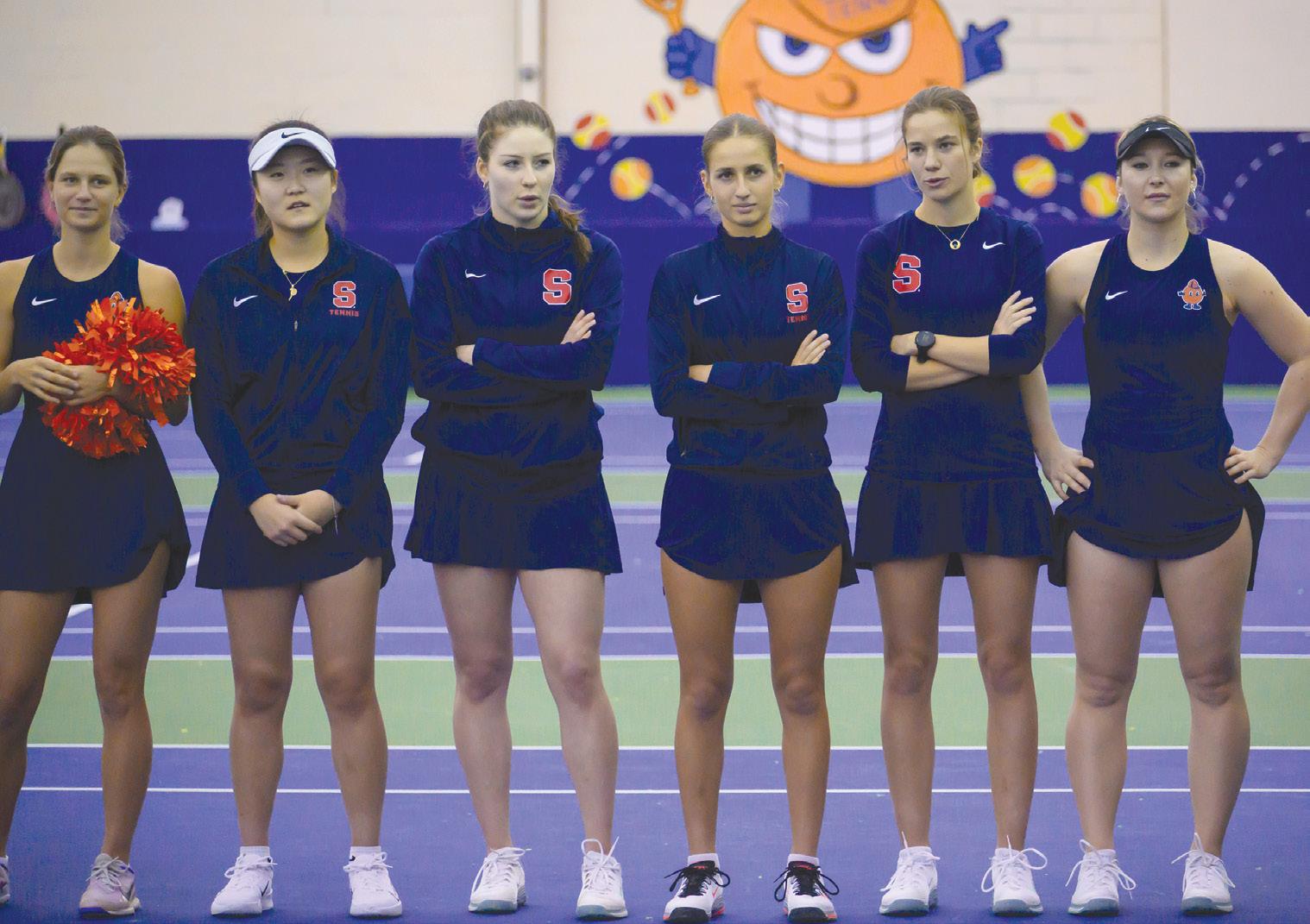
allowed the team to be a support system for each other. Shastova said the team is “a single unit.”
With all six international players being at least a seven-hour flight from home, the team has a familial atmosphere. Several players said their teammates became their chosen family.
“They spend a lot of time together off the court,” Limam said. “It really makes our jobs easier as coaches, because we don’t have to do a lot of building chemistry.”
Limam says that chemistry starts with some of the conversations the team has during dinners. Different cultures and backgrounds lead to shared experiences among the players as they transition to not just college, but the U.S. as a whole.
“They have it in common, where they’re very far from home,” Limam said. “They can relate to each other about it.”
Their diverse backgrounds also make an impact on the court. The players grew up playing different styles of tennis on different
first among ACC freshmen and third nationally among freshmen. Somfai, meanwhile, is shooting just 40.4%, which is the fourth-best mark in Stanford’s starting five alone.
On the flip side, Somfai undoubtedly has a leg up over Izoje on the glass. Yes, Izoje is one of the top rebounders in college basketball, but Somfai has shown glimpses she could become the best rebounder in D-I in a few years. Izoje corralled a career-high 17 boards against Florida State on New Year’s Day. Somfai has eclipsed the mark twice, including a 23-rebound effort against Pitt on Feb. 5.
Somfai and Izoje’s long-anticipated clash in mid-January lived up to the billing. Stanford’s 6-foot-3 center finished with a then-careerhigh 17 points on 53.8% shooting and eight boards in 39 minutes. Meanwhile, Izoje posted her eighth double-double of the year with 12 points and 10 rebounds in 34 minutes, propelling SU to a 69-58 win.
hurt defenses in multiple ways. His training focused on enhancing his right hand — complementing his already-deadly left — and getting comfortable dodging in different situations on the field to carry the ball deeper into opposing defenses.
At Syracuse, that dodge shows up when possessions stall. Leo said he thrives in what he calls the “gray area.”
“When something’s not working, Coach March lets us kind of be our own player and create our own opportunities,” Leo said.
If the Orange face an air-tight defense, Leo is often the answer. March called him the most reliable downhill dodger. And, per his high school coach at St. Anthony’s, Keith Wieczorek, he doesn’t stop shooting.
“I always use the analogy, Carmelo Anthony could be 0-for-20, but he’s gonna take the next 10 shots. And if they fall, he’s the hero,” Wieczorek said. “So, I think shooters have to shoot. And Michael, as he matured, got into that. I think that was a big part of his game.”
At Virginia last season, he scored three goals in a game Syracuse needed to win, combining his
surfaces. Some players, like Levivier, spent their time on clay courts and had to adapt to playing on the hard surfaces that pervade the U.S.
“Having players that grew up playing on those different surfaces helps us, because we play all our home matches indoors, but almost all our road matches outdoors,” Limam said. “Having the ability to adjust on different surfaces makes the transition easier.”
With SU’s players having different styles of play, players often coach each other on different techniques and surfaces.
“I learn a lot from watching my teammates,” Levivier said. “We usually accept the advice they give us.”
Transitioning to college sports is difficult for everyone. Even more so when that transition entails moving across an ocean, as is the case for many of Syracuse’s players. All of them lean on each other to adjust to their new lives, and to find their footing on the courts of Drumlins Country Club.
“We know how hard it is to be far from home,” Levivier said. “That makes us a lot closer.”
jwood20@syr.edu
@JackWood_55
Theresa Hagans Jr., Pitt, guard In between Izoje and Somfai on the list of the ACC’s top freshman scorers sits Theresa Hagans Jr., a 5-foot-9 guard from Utica, New York. Hagans has been playing her best basketball lately.
Hagans has scored in double figures in each of her last six games, including a 33-point outing in Pitt’s one-point loss to SMU on Feb. 15. What makes her less likely to be crowned the award is the Panthers’ atrocious season. Pitt is 8-21 overall and 1-15 in conference play, placing 17th out of 18 ACC squads.
Yet, Hagans is a diamond in the rough. She’s led the Panthers in scoring in 12 contests, including their last six, and averages 12.5 points per game, which is a half a point off Pitt’s team-high. Her playmaking doesn’t get as much credit, though she’s logged a team-high assist tally in 21 games.
Hagans earned her lone ACC Rookie of the Week award after averaging 23 points, 5.5 assists and 3.5 steals in the Panthers’ losses to SMU and Syracuse. She became the fifth Pitt player to win the weekly honor and the first since the 2019-20 season.
catch-and-shoot prowess and dodging ability. A reactive, quickfire blast in traffic. A fake shot, drive and dispatch. A clean look he capitalized on. A 6-4 third-quarter deficit flipped into an 8-6 Syracuse lead, courtesy of Leo’s three scores. Afterward, former SU midfielder Sam English spoke to Leo’s spark.
“He’s an animal,” English said. “And we can trust him no matter what. When we needed him most he got it done today.”
His 1.68 goals per game average spoke for itself last year, but Leo defines a “good game” differently. It’s not just scoring. Really, it comes down to “dodging hard to the goal, drawing slides, hustling, giving effort.”
That mindset carries into tight goals. As a freshman against North Carolina, with 12 seconds left and the game tied 14-14, Leo took the reins. He beat his defender down the alley, went airborne, then coolly deposited his shot home close range. Game over. There’s Leo, unfazed as ever.
“No moment’s really too big for me,” Leo said. “When it gets in crunch time, I just focus on executing and making the next simple play.”
At St. Anthony’s, Wieczorek saw that same tendency to take the game by the scruff of the neck. But Gait added Leo’s just as happy to take a back seat rather than take over a game.
“He’ll do anything for this team,” Gait says. “If it means not scoring two or three goals and we win, he’s all in. Being willing to play attack one day, midfield the next, whatever it is.”
Leo’s adaptability can also translate to Premier League Lacrosse, where rosters are smaller, and he can fill multiple positions.
“Could he play attack? Could he play midfield? Could he kind of beat short sticks? Could he beat poles? I think he can do a lot of that stuff,” Schreiber said. “And guys who can put the ball in the back of the net tend to figure out a place to play.”
But Leo doesn’t want to focus on the pro level yet. He’s keyed in on his senior season. He knows the standard at SU doesn’t afford room for complacency.
“Every team still definitely still wants to beat Syracuse,” Leo said. “We can be ranked 20, 13, whatever, but we’re always going to have a target on our back.”
The Orange got hit squarely in the back on May 19, 2024. Towson, Maryland. NCAA Tournament Quarterfinals. Syracuse’s first trip to the tournament since 2021. A season-ending 10–8 loss to No. 5 seed Denver.
At the postgame press conference, Leo sat at the podium with a white towel over his head, eye black smeared across his face, the sting still fresh. He didn’t hide his devastation or his optimism.
“We’re going to be on top next year, for sure,” he said that day.
The prediction was slightly off — SU fell in the 2025 Final Four. But Leo doubled down following SU’s surmounting of then-No. 1 Maryland Feb. 13.
“We were always chasing to be No. 1 for three years,” Leo said following the UMD win. “So now, we’re actually being chased.”
One week later, Harvard caught up and hit the target. But Leo keeps looking forward. The season is young, and the goal of a national championship remains alive. On its road to the Memorial Day mountaintop, keep looking for how Leo disentangles SU because there’s only one way Leo wants people to look at his vaunted 2022 class.
“Hopefully, when they look back at me and my class, we have a national championship,” Leo said. njalumka@syr.edu @nalumkal
Against the Orange, Hagans’ two-game run of 19-plus points was stymied. She turned the ball over six times and scored just 13 points on a putrid 28.6% shooting performance. Yet, her consistency in dropping 15-plus points still thrives over Somfai and nears Izoje.
Hagans has reached that mark on 11 occasions, a considerable leap ahead of Somfai’s eight, but still behind Izoje’s 13.
Arianna Roberson, Duke, center
This final spot is a toss-up between Duke’s Arianna Roberson and Wake Forest’s Milan Brown. Roberson’s likely ahead because the Blue Devils are miles better than the Demon Deacons, and the last nine honorees have been on teams that finish above .500.
Roberson is more than just the woman spotted next to Cooper Flagg when the Syracuse men’s basketball team played Duke and the sister of former NBA forward Andre Roberson. She’s also averaging 9.0 points and 6.1 rebounds per game as one of the No. 12 Blue Devils’ most valuable bench assets.
Roberson was ranked No. 17 in the 2024 class and was supposed to pair with Toby Fournier
— the 2024-25 ACC Rookie of the Year — in the frontcourt last season, but she missed the entirety of the campaign with a knee injury. Her impact’s been most apparent this year when Duke’s in need of a late-game stop or an offensive board. Through 24 games, Roberson has led the Blue Devils in scoring twice and rebounding five times. She’s scored in double figures nine times and notched three double-doubles. Her one-point performance in Duke’s loss to Clemson this past weekend certainly didn’t do her any favors in the race, but she’s shown potential with two games of 20-plus points, including a 22-point, 16-rebound double-double against SMU on Feb. 8. Like Somfai, Roberson also matched up with Izoje and helped the Orange’s highly-touted frontcourt look pedestrian. She grabbed a game-high 12 rebounds and blocked three shots, while Izoje had one of her worst performances of the year, fouling out with just eight points and four boards. lizzie hart.
jordankimball28@gmail.com
Syracuse tennis’ national diversity ranges across eight countries and four continents, including its head coach. charlie hynes staff photographer
michael leo has been deployed at attack and midfield for Syracuse this season, boosting his professional prospects. jacob halsema staff photographer
Everything to know about Princeton before Syracuse rematch
By Zak Wolf senior staff writer
Syracuse is undefeated no more. After establishing itself as the team to beat in college lacrosse, SU floundered, falling 13-12 to then-No. 14 Harvard. The Orange were never expected to go undefeated — mostly due to their mammoth schedule — but Saturday’s result was a letdown.
The week before, SU finally vanquished its Maryland demons with an 11-9 win over the topranked Terrapins. However, its hard work was undone with the loss in Cambridge.
After trailing by three goals in the third quarter, Syracuse rattled off five straight, taking a 12-10 lead with six minutes left. Harvard — which beat SU in last year’s regular season, before the Orange returned the favor in the NCAA Tournament — scored the final three goals to claim its first-ever win over a No. 1 team.
For the second straight week, Syracuse is tasked with defeating a team out for revenge. Next up is Princeton, which SU defeated in the 2025 NCAA Quarterfinals in an all-time classic. The Tigers will be hungry after also beating Maryland last week. It was a big result for Princeton, which started the season with a disappointing loss to Penn State.
Here’s everything to know about the No. 7 Tigers (1-1, Ivy) ahead of their matchup with No. 6 Syracuse (3-1, Atlantic Coast):
All-time series
Syracuse leads 22-9
Last time they played
Everything was on the line when Syracuse and Princeton met at James M. Shuart Stadium last May. SU was looking to clinch its first Final Four appearance since 2009, while Princeton hoped to make its second since 2004. The Orange came out on top 19-18 in an absurd back-and-forth affair.
The contest had 10 ties and nine lead changes. Princeton led by three early, but Joey Spallina exploded with three straight goals in the second quarter. Still, the Tigers led by one at halftime.
Though Syracuse scored the first six in the third quarter and seemingly had the game won, Princeton stormed back, scoring seven of the
men’s basketball
Syracuse will look to bounce back from its first defeat to Harvard last weekend versus No. 7 Princeton Friday.
next eight goals to lead 18-17 with 4:54 left. SU responded with strikes from Michael Leo and Owen Hiltz to put it over the top.
Spallina delivered a signature performance with four goals and four assists, while Leo and Hiltz both recorded hat tricks. Chad Palumbo’s six goals led Princeton, but it wasn’t enough.
The Tigers Report
Princeton returned a large portion of its roster that lost to Syracuse last May, with its biggest departure being Coulter Mackesy. The attack finished as the Tigers’ all-time leading scorer (165 goals) and second all-time points leader (241). They also lost long pole Colin Mulshine, who got shredded as the primary defender on Spallina in last year’s meeting.
Mackesy is a big subtraction for a team that averaged 13.76 goals per game last season, but even without him, the Tigers might have the best offense in the country. Their depth is exceptional, and they can hurt opponents in many ways. Palumbo leads Princeton with just six points in
two games, one of five players with at least four. Peter Buonanno is a creative finisher around the crease, while Colin Burns and Tucker Wade are skilled downhill dodgers. The best of the bunch might be Nate Kabiri, who can fire laser beams from deep like Mackesy did. Any one of them can explode at any time.
Princeton started slowly in its season opener versus Penn State. It scored one goal in the first quarter — and seven total, its fewest since 2024 — and trailed by six goals. The Tigers turned it up a notch against Maryland to pull off an upset.
Defensively, Princeton is held down by goalie Ryan Croddick. The senior has had a rough start to his campaign, saving just 43.2% of the shots he’s faced. Yet he’s still a solid netminder, finishing with a 56.6% save rate last year.
How Syracuse beats Princeton Because Princeton’s offense is so explosive, Jimmy McCool must have a big day. McCool was solid against Harvard with 13 saves, but at times, was let down by poor defending. Last year, the
goalie struggled against the Tigers, saving just 40% of their shots, but came up with a couple of big saves late.
On the other hand, John Mullen has to have a better game than he did against Harvard. It sounds weird, considering he still won 52% of his attempts, but last year he won 88% across two meetings with the Crimson. Mullen will be up against Andrew McMeekin, who got the better of him last year, but McMeekin has had a rough start to 2026. He’s won just 39% of his faceoffs, albeit against two tough units in Maryland and Penn State. If Mullen consistently earns possession for Syracuse, its offense will take care of business.
Stat to know: 23
It’s been 23 years since Syracuse won an outdoor game in February. The stat sounds preposterous, but it’s true. However, the Orange have only played four games outside in February since defeating Army 15-7 on Feb. 22, 2003. Because SU plays in a dome, it can withstand Syracuse’s frigid weather.
Still, going without an outdoor win in February for over two decades is shocking. SU detractors typically accused it of being a different team away from the JMA Wireless Dome. The Orange have a chance to change that narrative this season with eight road games, including their current six-game stretch. Friday gives SU another chance to break its February road woes.
Player to watch: Nate Kabiri, attack, No. 2
Princeton’s offense is as slick as it gets, and Kabiri is a big reason why. His pinpoint shooting is on par with anyone in the country. Through two seasons, he’s been extremely productive for the Tigers. He had 56 points as a freshman and bested that with 61 (32 goals, 29 assists) in 2025. In the NCAA Quarterfinals, he was held to just one goal and two assists, while Palumbo and Buonanno exploded. Kabiri had a relatively slow start to his junior campaign, with just four points in two games. He was held to one assist against Maryland but remains a big threat versus Syracuse.
zakwolf784254@gmail.com
@ZakWolf22
Previewing Syracuse men’s basketball’s road test at Wake Forest
By Aiden Stepansky senior staff writer
Syracuse’s disappointing third regular season under Adrian Autry is nearing its end. With just three games to go before the Orange trek to Charlotte for the Atlantic Coast Conference Tournament, SU is in position to play in the competition’s opening round, where it’ll have to run the table to keep its season alive.
Everyone knows what’s on the line, and what the results mean for Autry’s future. SU recently had two more Quad 1 opportunities against Duke and North Carolina, but squandered both.
“We haven’t made the plays that we needed to make,” Autry said Monday. “The plays in the margin have been the difference in our season.”
Syracuse kicks off its final road trip of the season against Wake Forest. The Demon Deacons are right in the mix for similar seeding with the Orange, and beat possible NCAA Tournament teams, Virginia Tech and Clemson, at home already.
Here’s everything to know about Wake Forest (14-14, 5-10 ACC) before it faces Syracuse (15-13, 6-9 ACC) Saturday in Winston-Salem.
All time series Syracuse leads 11-5.
Last time they played Syracuse’s last matchup with Wake Forest came back in 2024 on New Year’s Eve, where the Orange opened their home ACC slate with a double-digit loss. In the contest, guards Kyle Cuffe Jr., Lucas Taylor and Jaquan Carlos combined for 46 points, but it wasn’t enough to overcome Eddie Lampkin Jr. and Donnie Freeman combining for a lackluster 15. J.J. Starling didn’t play due to a hand injury.
The Orange trailed by two at halftime and went cold from 3 in the second half, making only 1-of-10 attempts from beyond the arc. Meanwhile, guard Hunter Sallis played from wire to wire and dropped a game-high 23 points on 18 shots to lead the Demon Deacons to victory. Their win over SU began a six-game winning streak.
KenPom Odds
Syracuse has a 36% chance of winning, with a projected score of 74-78.
The Demon Deacons report
In its sixth season under head coach Steve Forbes, Wake Forest is trending in the wrong direction. After two 20-plus-win seasons in a row, the Demon Deacons are fighting to stay above .500 this year and are 0-10 in Quad 1 games, slightly worse than SU’s 2-8 mark.
Wake Forest’s best win came on the road against Florida State. Other top wins include a neutral-site victory over West Virginia and multiple home victories over ACC foes. Last season, the Demon Deacons earned the No. 4 seed in the conference tournament, but fell in the quarterfinals to North Carolina after two byes.
Out are Sallis and Cameron Hildreth. In are Juke Harris, Myles Colvin and Tre’Von Spillers. Harris and Spillers have moved into bigger roles after returning to Wake Forest for their second seasons, while Colvin transferred in from Purdue to become a focal point.
Harris is one of the top guards in the ACC, dropping 21.1 points per game and possessing a 3.92 Offensive Bayesian Performance Rating, per EvanMiya. And senior guard Nate Calmese is close behind him, checking in at a 3.42 mark.
The Demon Deacons sit middle of the pack in most statistical categories, but rank fourth in the ACC points allowed per game (77.2). They also rank dead last in total rebounds, averaging just 32.8 per game.
How Syracuse beats Wake Forest Despite Wake Forest’s faulty resume, the Orange still have a glaring weakness. Syracuse is just 2-5 on the road this year, and 4-14 over the last two seasons. First, SU must overcome its road woes in an arena where the Demon Deacons are 23-9 over the last two years.
Once the Orange step on the court, they must take advantage from inside the arc. Syracuse, though having an entire week to reset, enters the matchup off its worst 3-point shooting game of the year. SU sank just one shot from deep in the first 36 minutes against North Carolina, and only hit 3-of-17 shots from 3.
Wake Forest ranks 305 in the country against 2-pointers, as opponents have crafted a 55.1%
Syracuse is just 4-14 on the road the last two seasons, a stark difference from Wake Forest’s prolific 23-9 home record. zoe xixis asst. photo editor
mark. If it drives to the basket and gets to work from midrange, Syracuse might finally break its road curse.
Stat to know: 48.4%, 2.8
Freeman has struggled amid one of Syracuse’s toughest stretches in ACC play. In SU’s last three games, Freeman is shooting 48.4% from the field and averaging 2.8 fouls per game. Frustration boiled over for the forward against then-No. 16 North Carolina, when Freeman was ejected in the final minutes following a second technical foul and fifth overall.
Freeman, the former No. 15 recruit in the 2024 class, was supposed to be the savior for the Orange after missing most of his freshman season. After missing more time at the beginning of 2025-26, he’s still averaging 16.7 points per game with seven rebounds. He’ll need his performance against Wake Forest to resemble those numbers.
Player to watch: Juke Harris, guard, No. 2
Harris has emerged as a star in his second year with the Demon Deacons, scoring 25 points or more in 10-of-28 games this season. It’s a stark contrast from his freshman campaign, where Harris averaged only 6.1 points in less than 20 minutes per game. This year, Harris has also played 38 minutes or more in 10 games.
A four-star prospect out of Salisbury, North Carolina, Harris uses his 6-foot-7 frame to create mismatches and rebound at a high clip. He chose Wake Forest over offers from top programs like Kansas, Tennessee and Houston. For Syracuse, Nate Kingz will likely take on the challenge of trying to slow down one of the ACC’s most prolific guards. amstepan@syr.edu @AidenStepansky
jacob halsema staff photographer
men’s lacrosse
Recapping Syracuse’s all-time classic vs. Princeton last year
By Zak Wolf senior staff writer
On paper, Syracuse’s meeting with Princeton in last year’s NCAA Tournament Quarterfinals was mouthwatering. The offensive firepower was undeniable on both sides. Goals were expected, though nobody could’ve predicted what happened.
Thirty-seven goals, 93 total shots, 10 ties and nine lead changes. The expectations were blown out of the water in an all-time classic.
Syracuse escaped with a 19-18 victory to seal its first Final Four appearance since 2013. Every SU fan held its breath during the action-packed thriller. Once Joey Spallina knocked the ball from Michael Bath’s stick in the final seconds, it was Orange ecstasy.
Spallina capped off the afternoon by telling ESPN sideline reporter Morgan Uber, “But hey, I mean, I guess I can’t dodge anybody or beat anybody,” after an ongoing narrative he couldn’t show up in big games.
On Friday, Syracuse rematches Princeton for the first time since that manic-filled meeting — a familiar spot for SU. Last week, the Orange took on Harvard, which had its season ended by them in the first round of the NCAA Tournament. The Crimson got their revenge, winning 13-12. Princeton will look to do the same.
But first, here’s a look back on No. 6 Syracuse’s (3-1, Atlantic Coast) win over No. 7 Princeton (1-1, Ivy) in last year’s NCAA Tournament Quarterfinals:
Turning point: Michael Ippoliti’s stint in goal sparks a 6-0 run
Disaster struck for Syracuse at the end of the first half. Chad Palumbo tied the game at 10 with 16 seconds left in the first half. Andrew McMeekin won the ensuing faceoff, and Jackson Green fired a shot, which Jimmy McCool popped into the air. McCool tried tracking the ball down outside the crease but missed and collided with Coulter Mackesy. While blowing up Mackesy as he scored, McCool was hit with a two-minute fulltime penalty, putting backup Michael Ippoliti into the game.
John Mullen won the ensuing faceoff with a second left. Because of the penalty, Syracuse would start the second half with the ball, so it bled the penalty clock down to 40 seconds before Princeton gained possession. A cold Ippoliti was the Tigers’ perfect target. But when Mackesy fired from distance, Ippoliti rejected it. When Billy Dwan III couldn’t handle a long pass on the next clear, another Princeton possession began.
Once again, the Tigers didn’t take advantage. Nate Kabiri fired high, and Ippoliti had the backup. Following a successful clearance, McCool returned to the game.
“(It gave us an) infinite amount of juice,” McCool said of Ippoliti’s time in net. “He is an absolute spark plug. He’s bringing all the energy on the sidelines. You hear him all game. So I was really excited for him to get in there just to show what he can do.”
Syracuse went on to score the next six goals, taking complete control of the contest.
Sam English and Payton Anderson scored a pair of unassisted goals, while Spallina set up Michael Leo and Finn Thomson to put SU
women’s basketball
in front 14-11. Owen Hiltz added two more scores, and the Orange were seemingly cruising to the Final Four.
The game was won when: McCool denied Tucker Wade with 30 seconds left
After leading by five goals, Princeton scored seven of the next eight goals to grab a one-goal lead with 4:54 remaining. Syracuse responded with scores from Leo and Hiltz. With two minutes remaining, SU wound down the clock, but a turnover gave Princeton possession with a minute left. One more stop, and the Orange would be heading to Gillette Stadium.
Mackesy initiated the offense and got a short stick switched onto him, forcing a slide from Chuck Kuczynski. Mackesy gave the ball up to Tucker Wade, who tried to escape Michael Grace. Wade tried creating leverage by lowering his shoulder and nearly gained an angle on Grace. However the defender’s stick remained wedged on the attack’s. When Wade got a shot off, Dwan gravitated over, which forced a weak effort stopped by McCool.
McCool didn’t have his best afternoon, saving 12 shots on 30 attempts, but he came up big when it mattered most. He also delivered a clutch stop on Kabiri in transition late in the fourth quarter. McCool’s final save allowed Syracuse to run the clock out and win its first quarterfinal game since 2013.
Quote of the day
“These guys believe in each other and believe they can win any game,” Syracuse head coach Gary Gait said. “If they continue that play, who knows what will happen?”
SU’s victory over Princeton put it two wins away from reaching the peak of college lacrosse for the first time in well over a decade. Gait’s comments showed the Orange were dreaming big. However, SU’s dreams would be dashed a week later by Maryland in the Final Four.
Player of the game: Joey Spallina
Like any other No. 22 at Syracuse, Spallina is under a microscope. Any bad personal or team performance gets ridiculed. It’s been a cycle throughout Spallina’s entire tenure with SU. He was held without a point for the second time in his career in Syracuse’s quarterfinal loss to Denver the previous season.
This time was different. For once, he shut up all the haters. Spallina poured in eight points (four goals, four assists) against Princeton. It was the signature moment of his time at SU.
Spallina dominated his matchup with Colin Mulshine, beating him with simple speed dodges on several occasions. He also set up teammates four times, including Hiltz’s gamewinner with 3:50 remaining.
The performance had extra weight considering the venue. Hofstra’s James M. Shuart. The home of the Long Island Lizards — a former Major League Lacrosse franchise — which Spallina’s father, Joe, coached. He grew up watching legends like Paul Rabil and Rob Pannell duke it out on numerous occasions.
On that day, Spallina shaped his own legacy.
“To do it on a field that I pretty much grew up on is crazy,” Spallina said postgame.
Stat of the game: 6
As brilliant as Spallina was, Palumbo might’ve
been just as good. He finished with a gamehigh six goals and matched Spallina’s eight points. Throughout his career, Palumbo had never scored more than five goals or recorded more than six points in a game.
Although on that day, Palumbo possessed. While some of Princeton’s supplemental scorers — like Kabiri, Wade and Colin Burns — struggled to get going, Palumbo certainly didn’t.
Top storyline for the rematch: How does Syracuse respond after its first loss?
Syracuse suffered its first loss of the year last week against then-No. 14 Harvard. The Crimson, like Princeton, had their season ended by SU in 2025. For the second straight week, Syracuse’s opponent will be looking for revenge.
The Tigers started the season with a poor showing against then-No. 14 Penn State before bouncing back with a win over then-No. 2 Maryland. Princeton’s win in College Park sets up an intriguing dynamic Friday.
The Orange will look to bounce back and not let the Harvard defeat linger. Last season, their first loss came to Maryland, followed by a shocking defeat to Harvard. After that, Syracuse went on a six-game winning streak. However, it ended the regular season with three straight losses.
How SU responds after losing to Harvard will be key. With how difficult its schedule is, two early-season losses could be costly. Though if the Orange perform to their standard, they should take care of business.
zakwolf784254@gmail.com @ZakWolf22
Analyzing 3 players battling Uche Izoje for ACC Rookie of the Year
By Jordan Kimball asst. sports editor
Felisha Legette-Jack still remembers when she first picked up Uche Izoje at the Syracuse Hancock International Airport. Izoje was on a delayed flight from California, coincidentally with her teammate Madeline Potts, but she didn’t know it. In fact, she didn’t know anything awaiting her.
A few months later, everything’s changed. Syracuse women’s basketball has embraced Izoje, and it’s nearly impossible for the 6-foot-3 center to go unnoticed.
“She’s a winner,” Legette-Jack said of Izoje after SU’s loss to NC State Sunday. “She rises to the challenge. She is a kid that came here with the idea she could be something significant under our tutelage. And she has walked into that situation time and time again.”
“Something significant” is an understatement to describe Izoje’s first year. The woman who touched down in the United States for the first time just months ago has taken Division I basketball by storm, averaging 14.7 points, 9.2 rebounds and 2.6 blocks per game.
She’s flourished into the star big SU lacked last year, was added to the Naismith Defensive
Brook. “She’s one of the best players in the conference, arguably in the country.”
Izoje has repeatedly proven she can compete against the best frontcourts in the nation, earning seven ACC Rookie of the Week honors. She’ll likely be named to the All-ACC First or Second Team. With that resume, she’s well-positioned to be Syracuse’s second-ever ACC Rookie of the Year recipient after Kamilla Cardoso won in 2021.
But in the case she falls short, here are three players who could take it instead:
Lara Somfai, Stanford, forward
The most probable candidate to steal Izoje’s accolade is Lara Somfai, a 6-foot-3 forward from Adelaide, Australia. Somfai spent her high school days at IMG Academy in Bradenton, Florida, and was ranked a five-star recruit by ESPN.
She’s justified that hype, averaging 10.3 points, which ranks third among ACC freshmen, and 9.2 rebounds, the fourth-best overall mark in the ACC. She’s also recorded seven double-doubles, lifting her to four ACC Rookie of the Week honors.
Izoje has the main edge in pure efficiency. Syracuse’s phenom is shooting 55.1% from the field, good for fourth in the conference, first
Player of the Year Watch List and ranks first in the Atlantic Coast Conference in blocks and top five in boards. But Legette-Jack knew it’d happen from the get-go.
“She’s special,” SU’s head coach said after its season-opening win over Stony
Syracuse stormed back from an 18-17 deficit to Princeton in the waning moments of the 2025 NCAA Quarterfinals to advance to the Final Four. jacob halsema staff photographer
With just two regular-season games left, Uche Izoje has made a strong case to be the ACC Rookie of the Year. zoe xixis asst. photo editor
ADAPT & ATTACK
Michael Leo’s dodging, adaptability liberates SU offense in title search
By Nicholas Alumkal sports editor
Look, there’s Michael Leo in Syracuse’s midfield, weaving through the forest of Maryland defenders like the cones he navigated on an otherwise-deserted field on Long Island. Finishing with his deadly left hand once he reaches the crease. Extending SU’s lead to two against the then-No. 1 Terrapins — the Orange’s kryptonite — 13 days ago.
Look again. Now Leo’s lining up at attack, receiving a crossfield pass from Joey Spallina — someone Leo competed against and then played with on The Island. There he is with the ball, sticking it into the top left corner of the net in the Orange’s seasonopener against then-No. 17 Boston University. Look. No, seriously. When you watch Syracuse lacrosse, a team chock-full of stars, Leo wants you to watch his movement. Where he pops up, when he pulls SU out of a mire, it’s offensive coordinator Pat March’s job to watch and coach Leo.
“We use Michael a lot to initiate the offense,” March said. “He’s able to make decisions. He’s able to feed the ball when he needs to, and he’s able to finish shots on the backside. I would say he’s a pretty complete player.”
Complete isn’t always flashy. Leo arrived in a vaunted 2022 recruiting class that included 10 top 100 players, according to Inside Lacrosse. Leo was the seventh-highest commit in SU’s class that year, while being the nation’s 26th best recruit.
And his impact is undeniable now. In his senior year, the Preseason Inside Lacrosse First Team All-American has seven goals and six assists thus far, shifting between attack and midfield. More broadly, he liberates Syracuse’s offense. Leo’s career Offensive Expected Goals Added is in the 98th percentile nationally, according to Lacrosse Reference.
“Coach March and Coach (Gary) Gait have done just a really good job of making the offense sort of a positionless offense,” Leo said. “Playing in the see leo page 12
He’ll do anything for this team. If it means not scoring two or three goals and we win, he’s all in. Being willing to play attack one day, midfield the next, whatever it is.
Gary Gait syracuse men’s lacrosse head coach
International roots representing 8 countries unite SU tennis
By Jack Wood staff writer
Throughout the Mays and early Junes of her childhood years, Constance Levivier spent her afternoons at Stade Roland Garros. French Open tickets were cheapest on Wednesdays, so those were the days Levivier sat at the very top of the stands with her brother, dreaming about what it would be like to one day play on the storied clay of Philippe Chatrier Court.
As the day wore on, Levivier and her brother would dart through the complex, watching matches on the outer courts and sneaking close to the clay to get a glimpse of her idols.
“It was a great motivation for me,” Levivier said. “To see stars playing
right in front of you at that age makes you want to be like them and play on those courts.”
Eventually, Levivier did and made the semifinals in the Roland Garros Junior Championships in 2022. That passion sparked her tennis career, and in 2023, it led her to the United States to play Division I tennis at Syracuse.
In addition to Levivier, hundreds of other international players have followed that same path, too. There are currently 25,000 international student-athletes across all NCAA divisions. Women’s tennis has one of the highest rates of international participation, with around 60% of players coming from outside the U.S., making it one of the few truly global college sports.
Syracuse tennis’ 10 members represent seven nations, from the U.S. to France, Russia and South Korea. Each player brings their own style of play to the Orange, and it shapes their identity as a team.
“Tennis is a lot more global than a lot of other college sports,” Limam said. “We are trying to build the best roster we can, and that means looking at other parts of the world.”
Syracuse attracts global talent because of two main factors. One is the allure of playing in the Atlantic Coast Conference, a top conference in college tennis. The ACC features North Carolina, the two-time reigning national champions, as well as six of the top 25 teams in the ITA rankings.
The other factor is Limam. Hailing from Morocco, SU’s head coach uses his international background to help attract talent to the Orange. He said he can relate to the transition to American collegiate athletics, and he’s also built a multitude of connections to evaluate and recruit talent.
“It’s getting a lot more competitive,” Limam said about global recruiting. “But we have a good foundation to compete.”
Levivier and Serafima Shastova — who hails from Russia — are two key examples of that.
After moving to the U.S. to play, Shastova was Jacksonville State’s No. 1 singles player and dominated the Atlantic Sun conference in her first
season of college tennis. But she said she knew she wanted to chase the dream of playing professionally. When Limam called her about transferring to SU, she figured it’d be best to chase it with the Orange.
“It was a risk,” Shastova said. “But I wanted a more competitive atmosphere.”
Shastova has had a major impact for the Orange since joining in 2024. She has continued to thrive as Syracuse’s No. 1 singles player, with a record of 33-13 in singles play since joining Syracuse.
Shastova, like many of her teammates, has leaned into SU’s international atmosphere. She said being so far away from home has
see global page 12
michael leo’s dodging and adaptability have powered Syracuse’s offense as it aims to reach the national championship. jacob halsema staff photographer
Leo’s career Offensive Expected Goals Added is in the 98th percentile nationally, according to Lacrosse Reference.