3
SU HAS A POINT GUARD PLAYING QUARTERBACK. CAN HE DO IT?
4 CAN BURNING A SHOE REVIVE A TEAM? IT WORKED FOR COACH MAC.
6


3
SU HAS A POINT GUARD PLAYING QUARTERBACK. CAN HE DO IT?
4 CAN BURNING A SHOE REVIVE A TEAM? IT WORKED FOR COACH MAC.
6


ART JONES SPURNED THE NFL DRAFT TO RETURN TO SYRACUSE With a new coach and celebrity quarterback, Syracuse

A GRAND EXPERIMENT SYRACUSE AGAIN
greg Paulus returns to football after a four-year basketball career at duke.
new head coach doug marrone has brought back traditions of old to inspire the orange.
l AST MEN STANDING after losing a slew of potential starting linebackers, SU is rallying around who it has left.
DoESN’ T ADD UP the Big 10 already has 11 teams. But does 12 make more sense?
2009 TEAM RoSTER a look at who will be on the field this season for Syracuse.
W ho’S NEXT ? after losing Pat White, the Big east waits for a new ambassador.
A NEW ERA Pullout schedule and position previews inside.
bl ESSING IN DISGUISE
art Jones’ faith guided him back to Syracuse. an injury proved he made the right choice.
bEAT WRITER PREDICTIoNS Jared diamond, tyler dunne and matt ehalt deliver their insight.
bIG EAST PRE v IEWS a team-by-team breakdown of all eight squads.
Special thanks to Sue Edson, Pete Moore and SU athletic communications



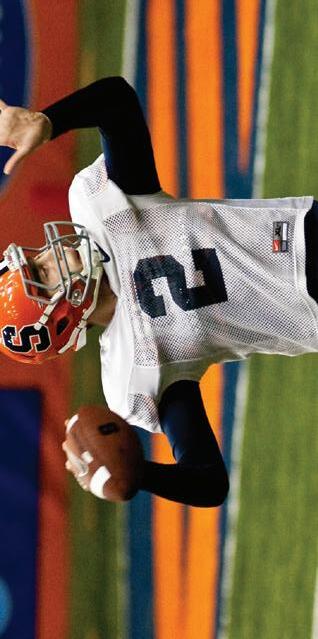
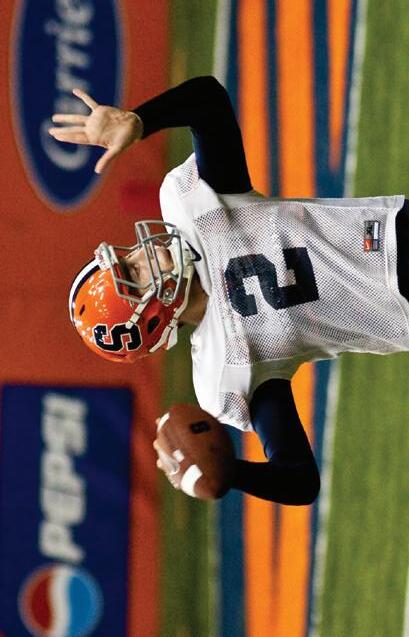
Greg Paulus shook his basketball past. Now he needs to shake his doubters.

BY TYLER DUNNE STAFF WRITER
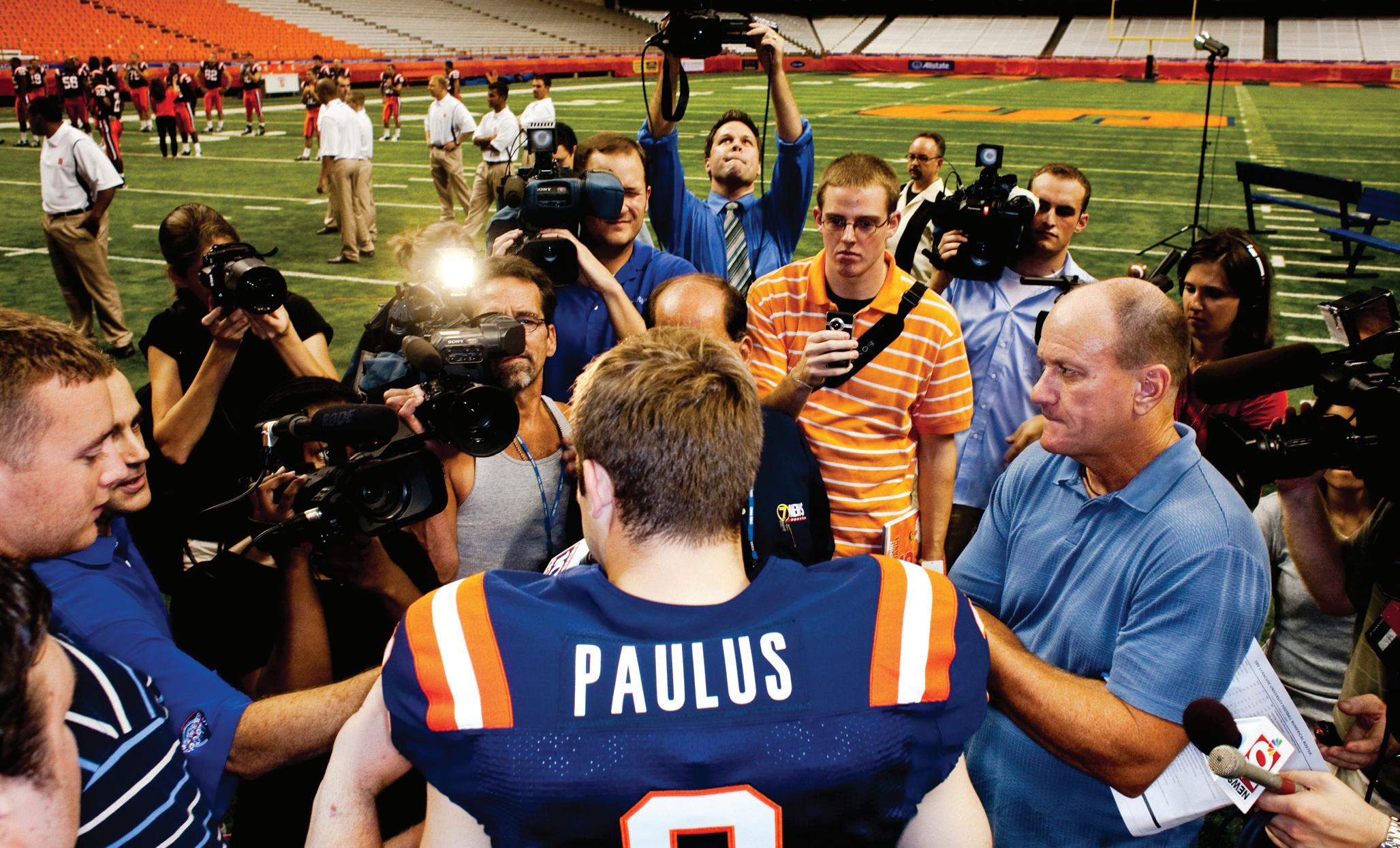
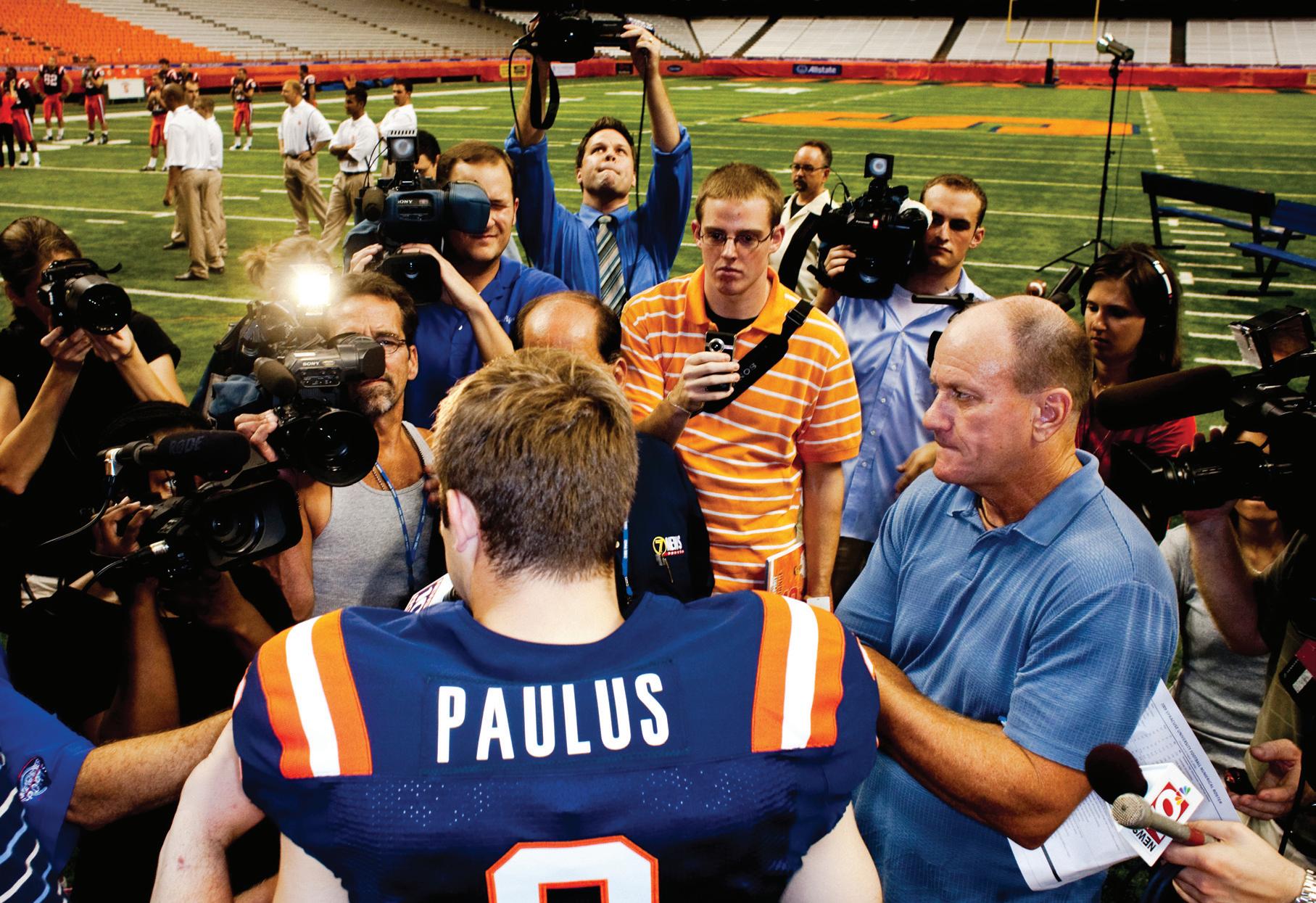
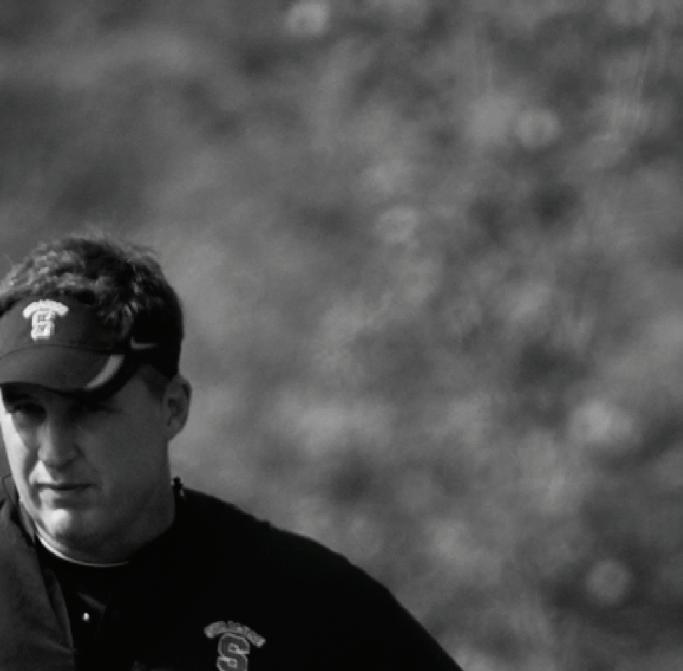
Hands on his hips, Greg Paulus shook his head slowly and coldly. His blissful complexion turned pale. That GQ-charm faded. No, Paulus did not pay attention to those verbal grenades from Big East coaches.
“I don’t hear or see many things,” said Paulus, suffocated by recorders and cameras. “This is a big commitment right now with camp and double sessions.”
One anonymous coach said in an ESPN.com report that he wished Syracuse was fi rst on his schedule. Another said Paulus will struggle reading defenses. And yet another hinted that Paulus’ presence at SU

Syracuse, N.Y./Christian Brothers Academy 6-foot-1, 195
Quarterback
Led CBA to 42-3 record in four years, including a 13-0 mark and state championship his senior year. …Won the championship game MVP, throwing for 376 yards and three touchdowns. …Won Gatorade National High School Player of the Year in 2004. … Threw for 43 touchdowns and a state record 3,677 yards. …Earned All-America honors as a senior. … Named the New York State Player of the Year in football and basketball in 2004-05. …Earned the National High School Coaches Association Senior Athlete of the Year award.
Point guard

is more about the turnstile than the win column. Not exactly a welcome mat.
Paulus insists he’s locked in tunnel vision. But deep inside, Paulus’ brother knows Greg feeds off hate.
“He wants to stick it back into peoples’ faces who don’t think he can do it,” said Mike Paulus, a quarterback at North Carolina.
Nobody knows if those Big East coaches are right or wrong. Because nobody knows Greg Paulus the college football player. About five years ago, high school scouting aficionado Tom Lemming compared him to Joe Montana. But Paulus chose basketball. Four years at Duke later, he’s returning to football. Back in Syracuse. Five minutes from his high school.
Averaged 8.6 points and 3.4 assists per game in a four-year career at Duke. …Finished his career ninth on the all-time Blue Devils list with 139 games played. …Ranks in the top 10 on the all-time Duke record lists for assists (9th, 468), 3-point field goals made (8th, 210) and attempted (9th, 527), and 3-point field goal percentage (T-6th, .398). …Averaged 9.1 points and 2.6 assists per game in 18 postseason contests. … court hathaway | staff photographer

Maybe this wild experiment combusts in ugly fashion. Maybe it wakes up a program that’s been sedated for half a decade. Either way, a fragrance of mystery stalks Syracuse this fall. And that’s the allure. Paulus’ hyperactive transition to college football has been a mysterious work in progress. He wasn’t around for spring ball. Paulus is one giant unknown.
Those around him — his teammates, his coaches and family — know what’s brewing behind the curtain.
“People are thinking, ‘This kid has never played quarterback. Is this going to work?’” said Dave Paulus, Greg’s father. “This kid is a hell of a quarterback, and they are going to see here very shortly.”
‘It






BY CONOR ORR ASST. SPORTS EDITOR

It was “early as hell,” Nico Scott recalled, on that March morning after a 6 a.m. agility workout. That’s when he saw fi re engines in the parking lot and a blaze rising on the practice field.
About 120 yards from the football wing at Manley Field House assembled a circle of football players around the flames about to experience their first shoe burning, a onceforgotten page in a once illustrious Syracuse football history book.
“We had no idea” Scott, a senior cornerback said. “We knew somethin’ freaky was going on.”
And so newly crowned head coach Doug Marrone handed the fi rst player a single cleat, with a set of simple instructions: Take your miseries, grievances and personal burdens of seasons past and transfer them to the shoe. Then, pass it on.

After each player willed the collective woes of a team in its worst stretch in program history, the man who employed the tradition when Marrone was a player — former SU head coach Dick MacPherson — turned his back to the flames and cast the shoe into the inferno. The metaphor was complete. Life was set to begin anew for this program.
“It felt like a baptism by fi re,” junior center Jim McKenzie, said. “It was a really special time for us. We just got rid of all the frustration that had built up from all the previous seasons of the strife and hardship.”
With his return to Syracuse football - fi rst as a player under MacPherson and now as a coach - Marrone is trying to do more than turn a team around. By readopting the traditions and attitude of past Syracuse teams, the coach has his sights set on cultural overhaul.

Gone are the days of Greg Robinson, the West Coast offense and the search for a new identity. Back are the ideals of “Coach Mac,” the desire to play smash-mouth football and the quest to reclaim glory.
“I think it’s my philosophy,” Marrone said. “I’ve heard, ‘Ah, well the players these days, they don’t understand tradition, they don’t know tradition.’ Well, myself now as the head coach, it’s my responsibility to teach these players about the traditions of this school — it’s part of the process.”


Born in Old Town, Maine, and fresh off a coaching gig with the Cleveland Browns, Dick MacPherson wasn’t exactly grounded in Syracuse tradition.
But after his predecessor, Frank Maloney, won just 32 games in seven seasons (1974-1980) and members of the school’s only national championship team called for his resignation, MacPherson didn’t have a choice — he needed to step in and win over his new city.



By JAred diAmond SportS editor
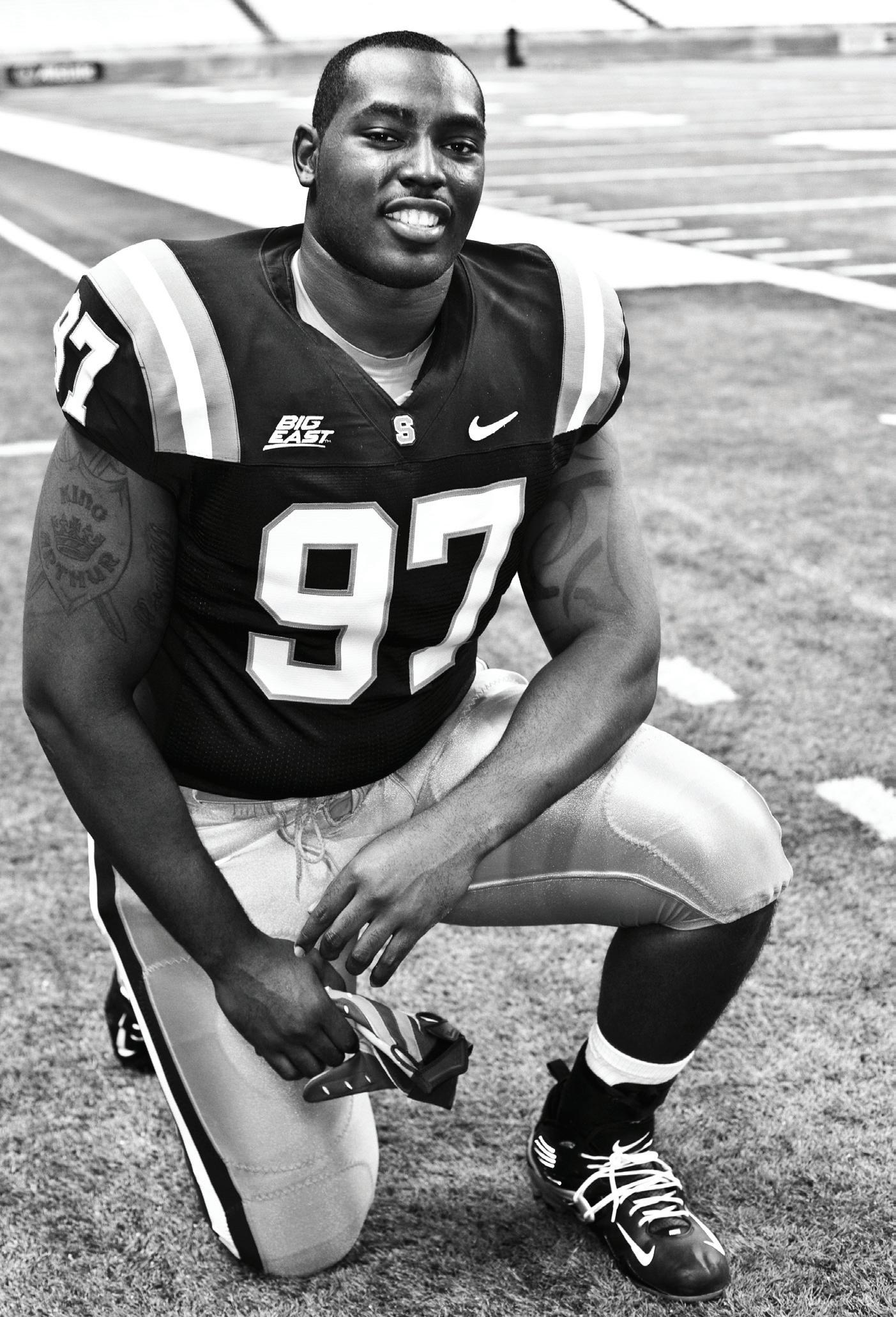
Art Jones’ life philosophy revolves around a simple phrase: Everything happens for a reason. It’s a cliché, but one that has guided Jones through life’s toughest times, including the death of his sister when he was in the eighth grade. This mantra provides Jones with undying faith in the world, for he profoundly knows that an unseen higher power has a master plan. For the son of a pastor, spiritual belief provides a backbone, a foundation.
For a brief moment one fateful February day, this core value was challenged. About two months had passed since Jones decided to forgo the NFL Draft and return to Syracuse for his senior season. He may have been a secondround pick, which likely would have led to a substantial payday.
Jones was in the weight room with his brother, Chandler, nearby. On each side of Jones rested five 45-pound discs — 450 pounds in total of sheer resistance to bench press. “I was trying to lift the whole weight room,” said Jones, Syracuse’s star defensive tackle.
He tried one rep too many. He felt a pop in his chest. At first, Jones thought it was just a charley horse. Then he looked down and knew it was something more. It was a torn pectoral muscle that required surgery — a diagnosis severe enough to provoke thoughts of doomsday for any athlete. But then he remembered his time-tested chorus.
“I believe God has a plan for me, and everything happens for a reason,” Jones said. “If that happened right after the season or right around the combine, I could have gone seventh round to free agent. So it definitely was a blessing.”
Jones is healthy now, back to lead the Orange’s defensive line. Instead of bolting for the allure of professional football, Jones chose to stay in school and instantly becomes one of the best players in the Big East. As he rehabbed from his injury for six long months, he couldn’t help but consider how lucky he really was. Quickly, Jones’ faith was restored.
The decision to remain at Syracuse was far more complicated than Jones likes to let on. He was already a hot commodity after the 2007 season, when he burst onto the scene with 17.5 tackles for loss. His performance on one of the grandest stages in the sport only proved his value. He exploded for 15 tackles in SU’s stunning 24-23 win at Notre Dame last year. Suddenly, the entire country knew Art Jones’ name.
From that day on, Jones’ phone wouldn’t stop ringing. Everybody wanted a piece of him. The NFL seemed like the best option. His stock may never have been higher. “After the Notre Dame game, I had at least one foot really out the door,” Jones said.
The Ar T ful Do D ger
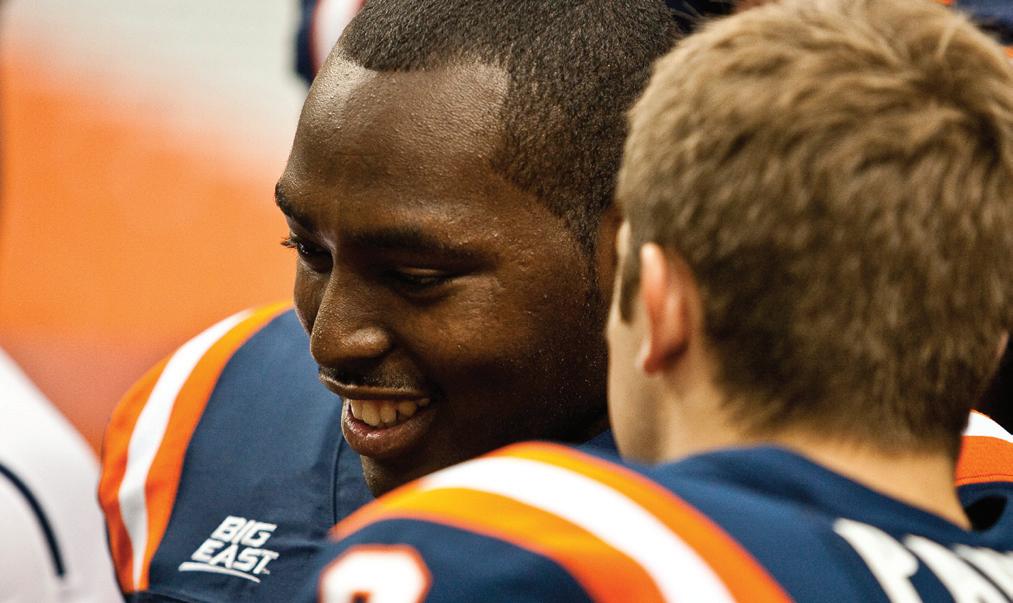
Yet he remained conflicted. Jones tried to hide it, but everybody knew it. Fellow defensive lineman Jared Kimmel said he sensed the magnitude of the decision weighing on Jones’ mind. Chandler Jones, a redshirt freshman on SU’s defensive line, felt it but wasn’t always sure what to say. He wanted more than anything the experience of playing alongside his brother, but didn’t want to deny Art of his lifelong dream and the potential to earn millions of dollars. And as much as Jones coveted the chance to play in the NFL, the possibility of playing with Chandler presented a certain appeal and made leaving a year early that much tougher.
see jones page 9

After four years of nothing but suffering, why not a little optimism? Doug Marrone has this group looking and sounding like a real college football team, which is more than anyone could say about Greg Robinson’s squads. Offensively, Syracuse should rely mostly on its trio of solid running backs, which will significantly take the pressure off Greg Paulus. There are still questions about the offensive line and linebackers, but maybe it’s just fun for once to drink the Kool-Aid.

Greg Paulus isn’t the next messiah. Don’t expect a Big East title in Doug Marrone’s first year. But look for the unlikely QB-coach duo to take a big step toward respectability this season. With SU’s rough non-conference schedule, five wins would be a major moral victory. Remember, last year’s offensively challenged team hung with Pittsburgh and West Virginia. Look for a few of those games to tilt in SU’s favor this fall.

With Greg Paulus, there is the unknown. He was great in high school, but will he be able to make the same reads this many years later? Will the same keen awareness needed as a quarterback still be there? Can he throw a deep ball with a linebacker breathing down his neck? Those questions will be answered this year, but I tend to think they won’t be favorable ones. This team is moving in the right direction under Doug Marrone, but is still a year or two away from a run at .500.

By Tony olivero ASST. Copy ediTor
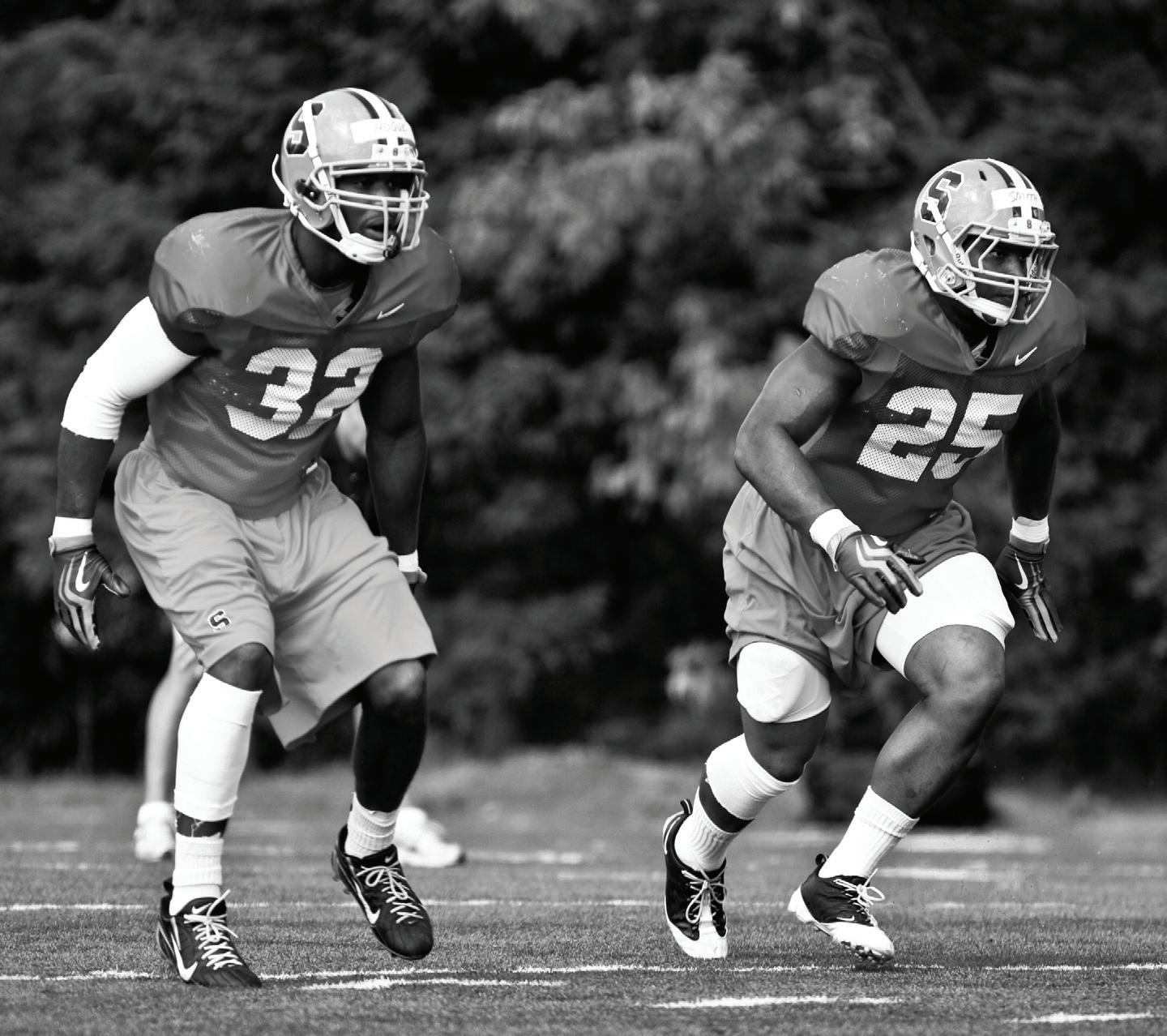
hathaway | staff photographer doug hogue (left) and derrell smith each moved from running back to linebacker during their time at Syracuse. The duo has since formed a relationship which they hope will help bolster the linebacking unit.
For some time now, Derrell Smith has been eagerly anticipating the start of the 2009 football season. A season Syracuse’s top returning linebacker hopes will be a fresh start for a unit that was dismal under Greg Robinson last year.
Leading up to the start of August camp, every time the junior ventured to the football meeting room, he felt the same could be said about Derek Hines, a 6-foot-1 JUCO transfer from California. After all, almost every time Smith strolled into the room, he was either joined by, or stumbled across Hines, who seemed to be readily preparing mentally for his likely starting role at weakside linebacker.
But Hines abruptly left the team on Aug. 14, leaving an already depleted group at linebacker in further disarray. With only nine players remaining within the unit, Smith — who
Recruit E.J. Carter commits to play for the Orange
29, 2008
Senior linebacker and team captain Jake Flaherty plays in the last game of his career, a 30-10 loss to Cincinnati.
had 73 tackles last year — and the rest of the gang are hoping they can weather the lack of depth throughout the season. Aside from Smith, the rest of the remaining linebackers made just four tackles combined last season.
“You really couldn’t tell he was going to quit, we got along well,” Smith said. “We just came back in the morning, and it was like, ‘Derek quit? Huh? For real?’”
Hines, who said he left the team due to a loss of passion for the sport, was the latest among a slew of players to transfer into, out of, or within a linebacker group, which has seen a tremendous amount of turnover since last season. Receiverturned-linebacker Dan Sheeran transferred to Massachusetts along with starting linebacker Mike Mele. Parker Cantey left the team in spring ball, and linebackers Chad Battles and Brandon Sharpe were both moved to defensive end.
The group that now forms the starting linebacking trio is comprised of players completely new to their roles. Smith, who played some outside linebacker last season, is penciled
in as the starter at middle linebacker. Former running back Doug Hogue will man the strongside, and due to Hines’ departure, sophomore Ryan Gillum and freshman E.J. Carter will split time, with Gillum earning the starting nod.
The chance at the starting job for Carter is surprising, considering where the unheralded recruit from Orlando was mere months ago — a situation Smith can relate with.
“I wasn’t a big recruit either, so you just come in with a chip on your shoulder,” Smith said. “I think E.J. plays with a chip on his shoulder and is proving that he is worthy of starting.”
Once Hines departed, it was assumed Carter would be given the starting job, but Gillum (who in linebacker coach Dan Conley’s eyes has been the biggest surprise this August), has pushed him. Yet, the competition between the two hasn’t been all that bitter, as the two have formed a tight brother-like relationship since the start of camp.
“Ryan, man, he’s like a big brother to me, he’s been more
see linebackers page 12
Linebacker Dan Sheeran leaves team; eventually transfers to Massachusetts.
JUCO linebacker Derek Hines transfers to Syracuse m A y 4, 2009 m A rch 25, 2009 j AN 25, 2009
Outside linebacker Chad Battles moves to defensive end. Wide receiver Dan Sheeran and running back Doug Hogue move to linebacker. Outside linebacker Derrell Smith moves to inside linebacker.
Projected starting linebackers Parker Cantey and Mike Mele leave the team. Mele transfers to UMass.
11, 2009 Walk-on Adam Harris participates in first practice Aug. 14, 2009
Projectedstarting linebacker Derek Hines leaves football team
Freshman linebacker Brandon Sharpe moves to defensive end Aug. 12, 2009
Hogue, Smith and Gillum listed atop Syracuse’s final depth chart at linebacker
31, 2009
would be to Syracuse’s defense this season. The Orange had its star back.

“One thing I said to him is that it is going to be a unique opportunity to play with your brother,” defensive line coach Derrick Jackson said. “It’s going to be pretty neat, whether it’s game one or game 12, sometime down the line, you and Chandler are going to be on the field together. And at some point hopefully, we have a meeting of the two Jones brothers at the quarterback, so they can say, ‘Jones and Jones on the tackle.’”
It was an interesting notion, and a prospect that undoubtedly began alleviating Jones’ confusion. Meeting new head coach Doug Marrone was the final convincing he needed.
“There are certain looks (Marrone) gives you, things that he does that just shake you,” Chandler Jones said. “When he put that look on us when we went through that door, Art just knew he had to come back, because he just knew this guy was for real.”
Jones announced his decision at a press conference less than two weeks after Marrone was hired. Marrone called Jones the first recruit of his tenure as the Orange’s new coach. First, Jones phoned Chandler and told him he was coming back to help the program. Chandler could not contain his happiness.
Throughout the summer Marrone has maintained that he is not the reason Jones decided to stay, and he did not try to sway Jones’ decision. Jackson, too, stressed that while he offered himself as a resource, he did not try and convince Jones one way or the other.
Not like either of them were complaining with Jones’ choice. They may not have said it then, but they knew just how important Jones



“When he told me he was coming back, I had as big a smile as you could have,” Jackson said. “Well, I don’t know if it was me or coach Marrone — we both had pretty big smiles on our faces.”
Jones didn’t stay to suffer through another long year of misery and disappointment. The novel concept of winning brought him to the weight room in February, trying to bench 450 pounds.
Kimmel said that when Jones chose to remain at SU, the one thing he feared was an injury. Of course, he suffered an injury. Jones said it was the only time he ever questioned his decision.
When Jones heard the prognosis, though, it all made sense. The doctors realized quickly that the muscle tear was not career threatening, that Jones would be back on the field by training camp. The doctors cleared Jones to play on Aug. 9, one day before the first summer practice. He thought back to when he was struggling with his decision, realizing what his fate would have been if he got hurt after leaving Syracuse. The great NFL career he planned could have been derailed before ever beginning.
Now Jones has a chance to improve his status even further. Another strong season could propel him into the first round of the draft, again proving he made the right choice. And if that happens, he’ll once again look to his faith and that magical phrase that continues to guide Jones through life.
It has not steered him wrong yet.
“The NFL isn’t going anywhere, and this was a blessing in disguise,” Jones said. “It’s humbling for me. It shows this childhood game can be taken away that quick. It makes me appreciate football. I always say that everything happens for a reason.”
jediamon@syr.edu
















Here’s a look at Syracuse’s schedule, which includes eight home games and a trip to State College, Pa., for a matchup with storied rival Penn State.








helping than anything,” Carter said. “We’re both really competing but in a positive way. We are so hungry right now we don’t care who starts. We just want to compete and make it to a bowl game.”
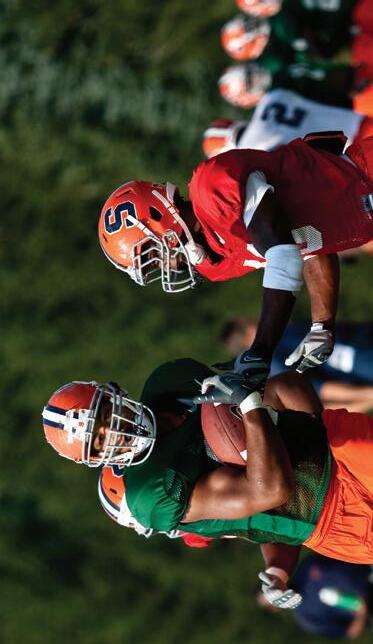
Smith and Hogue, have formed a tight relationship as well. They each made the move from running back to linebacker - Hogue this year and Smith two years ago.
“He sees the little consistent things that I would do when I was at running back, and he kind of teases me because he used to go through that type of thing,” Hogue said.
“I know what he’s feeling right now, and we are able to connect because of that,” Smith said. “I mean running backs get all of the glory, but defense wins championships.”
Team chemistry aside, and despite the endless setbacks, the surrogate group at linebacker has seemed to steadily improve and commit to Conley and head coach Doug Marrone’s system.
Hogue especially has developed a newfound confidence under defensive coordinator Scott Shafer’s system.
“I think after the scrimmage we feel better about Doug Hogue,” Conley said during the last week of camp. “It feels like he’s got a little bit of a swagger going now. I wish like heck I would have had him last year. I don’t know where he’d be today if I had him then.”
Heading into the season-opener against Minnesota on Sept. 5, the group at linebacker, in its entirety doesn’t yet have a distinct swagger, but it has certainly meshed to a point of cohesion. The mentality now, after all of the turmoil, is one of complete unity. Players from senior Mike Stenclik to the freshman Carter realize they will need to sacrifice and play multiple linebacker positions frequently throughout the year.
“People are saying we have a lack of depth, but I don’t see that as being a problem,” Stenclik said. “There are just more opportunities to step up and play.”
“We are more focused on being leaders as a whole group, as a group among the team, we
“We are more focused on being leaders as a whole group, as a group among the team. We strive to be the strongest area of the whole team every day. Each one of those guys is well capable of filling other roles.”
E.J. Carter su freshman linebacker
strive to be the strongest area of the whole team every day,” Carter said. “Each one of those guys is well capable of filling other roles.”
There is no denying, though, that another setback or injury within the unit would most likely be incurable, as there have simply been too many defections from the unit to seriously rely on the second team as a whole.
“As long as we stay healthy, I feel good about the guys we have,” Conley said. “But do I wish I had more guys? Yeah.”
Until that first game against the Golden Gophers rolls around, all Smith, Hogue, Gillum and company will need to do is open their locker doors to remind themselves of all they have been through and all they hope to accomplish together. For inside it lies what they hope to do this year. As a unit.
Taped up inside each linebacker’s locker will be a list of Syracuse’s schedule. Next to each opponent they will check off who they think they will defeat, and who they don’t. Below the markings, each backer will list out his goals for the year.
It’s the same exact thing former SU head coach Dick MacPherson had Conley do two decades ago.
Said Conley: “So I guess after all of this, at the end of the season that’s what they’ll look at to see how far we’ve come.”
BY MEREDITH GALANTE MANAGING EDITOR
Eleven teams make no sense to former Syracuse Athletic Director Jake Crouthamel. He can explain 10, because the conference is called the “Big Ten.” Twelve teams make sense, too — it would be a great revenue source.
But 11? That doesn’t make sense.
Since Crouthamel’s time at Syracuse, starting in 1978 and ending in 2005 to give way for current AD Daryl Gross, he’s advocated for Syracuse to join the Big Ten. For any team to join the Big Ten, for that matter. Back in Crouthamel’s day, the Big East was in its infancy and struggling. The Big Ten provided more fi nancial support to its teams and a higher level of competition.
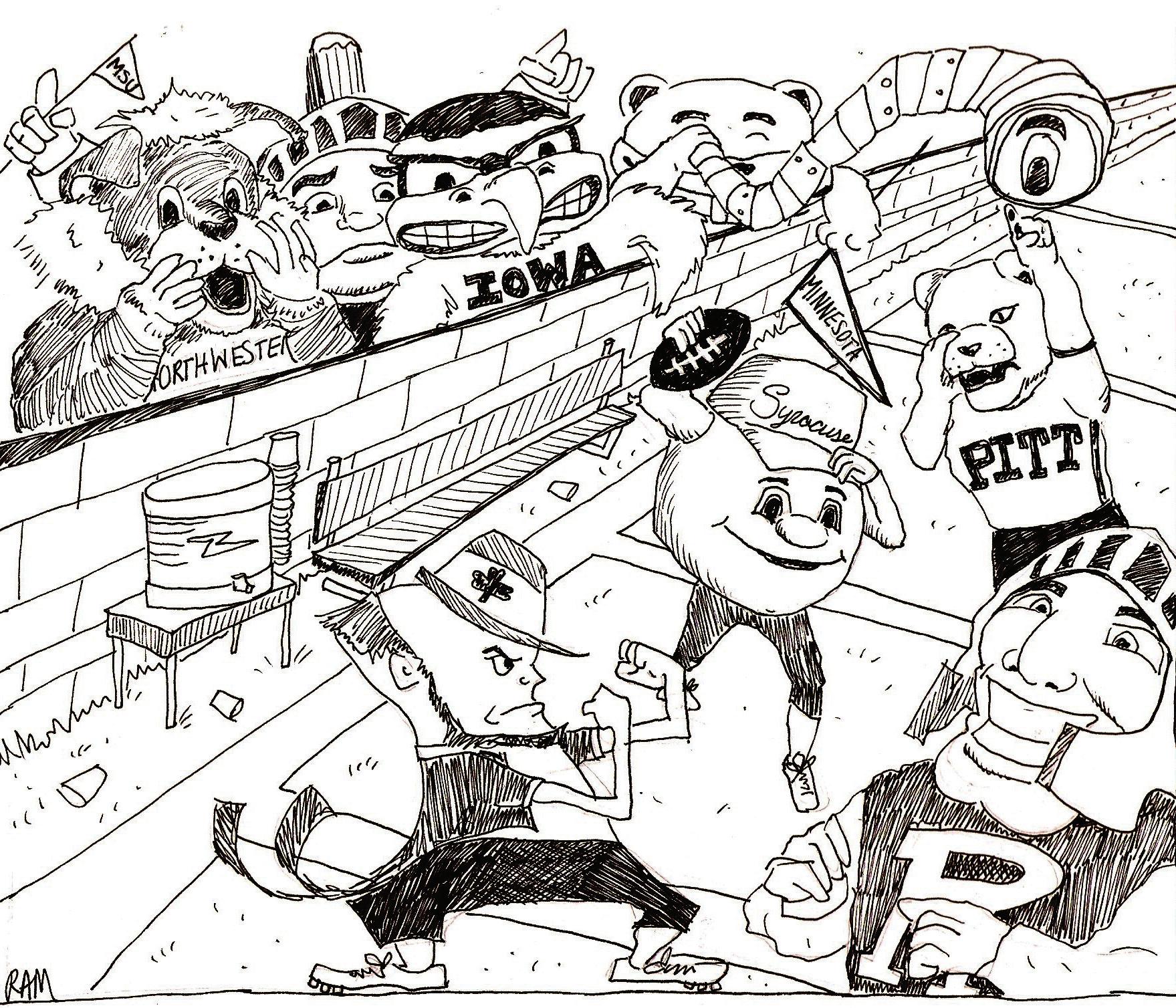
For now, the Big Ten consists of 11 schools, one more than its name suggests and one short of giving the conference the ability to split in half and conclude each season with intraconference playoffs. Big East teams like Syracuse, Pittsburgh and Rutgers are mentioned as possible expansion teams for the Big Ten.
“All conferences are expanding, the Big Ten is no different,” Crouthamel said. “Ten, 11, doesn’t make sense. Twelve, going to 12 makes sense. Follow suit.”
Penn State head football coach Joe Paterno has openly talked about his desire to expand the conference for years with a team like the Orange or the Panthers, but specifically not Notre Dame.
Mark Abbott, the assistant athletic director at Iowa who
schedules the Hawkeyes’ opponents, said he looks for teams that play in areas that Iowa recruits in, and Big East opponents fit that bill — making them an ideal pool of applicants for expansion.
“I don’t think we take into consideration that these current Big East schools could be potential conference foes in the future,” Abbott said. “We look to schedule a BCS conference opponent in an area we recruit.”
Iowa just fi nished a two-year series with Syracuse and is slated to play another series with Pittsburgh starting next season. Michigan also scheduled a Big East team, playing 2008 conference co-champion Connecticut in 2010.
The Big Ten schools might not be trying to schedule prospective conference rivals, but if the Big Ten contained 12 teams, the conference would split evenly. Playoffs could be held for two different divisions and then a larger Big Ten championship game. Other major conferences like the Big 12 and Southeast Conference have a playoff system in place. Playoffs and conference championship games provide extra revenue. “It just makes sense,” Crouthamel said.
“We’d entertain the possibility of increasing conference games if our peers also considered it and it fit well for everyone,” Abbott said about the future of the current Big Ten.
But creating playoffs could potentially diminish the lure to the Rose Bowl for the Big Ten. The Rose Bowl, the oldest bowl game in college football, created in 1902, traditionally has Pacific 10 and Big Ten conference tie-ins and is highly coveted by Big Ten teams.
Adding a playoff system within the Big Ten would change











year SU went undefeated and tied Auburn in the Sugar Bowl — it appeared as though MacPherson’s vision had been realized.
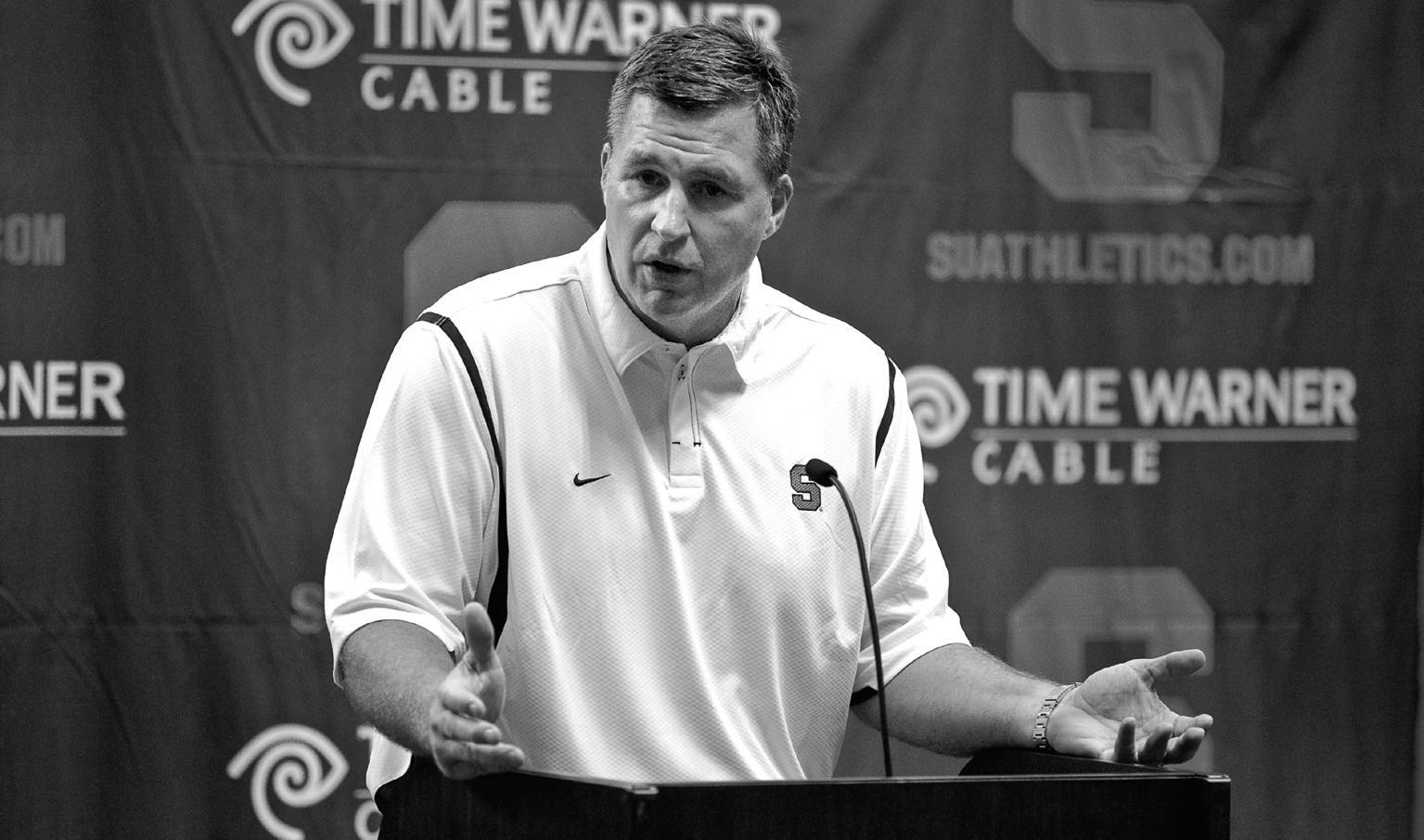
comed Marrone’s throwback philosophies.
No way was a scout from the Green Bay Packers on line one. This had to be a prank call.
Smiling inside his office at Duke, Chris Collins played along. The Blue Devils’ assistant basketball coach listened to the so-called Packers scout, jotted down some information and called Paulus. The Packers, supposedly, wanted to give the point guard a workout. They both laughed.
“He hadn’t taken a snap since high school,” Collins said. “We didn’t know if it was a joke, if someone was pulling a prank on us.”
Collins did his homework. The scout was legit. So Mike grabbed a couple of his receivers and the Paulus brothers went to work. Eight miles apart, they traveled back and forth to Duke and UNC. Nothing too serious. Mostly
“to at least look decent,” Mike joked.
A funny thing happened, though.
“The passion and the itch came back,” Greg said. “I started to make certain throws and thought, ‘Maybe we can do this.’”
For added pressure, he had to fill a brand new 50,000-seat domed stadium with a team that had won just one bowl game in the last two decades, and his most feared offensive weapon was a 5-foot11 South African kicker named Gary Anderson.
Needless to say, the fans that did show up during the early years didn’t have very high expectations, MacPherson remembers.
“There were times when they’d come to the games when I was coaching, and they’d wear bags over their heads,” MacPherson said. “I said I didn’t mind that so much, but they didn’t even cut out the eye holes so they could see the game! They just put the bags over their heads.”
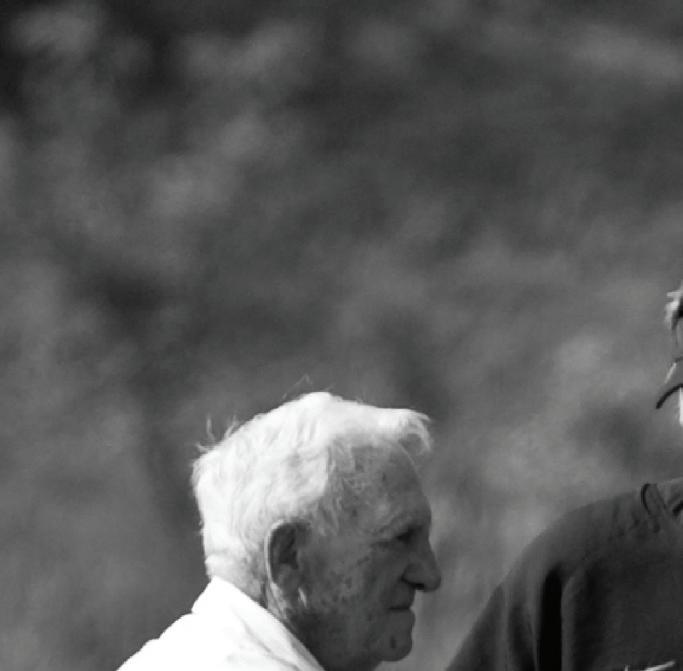
In his corner, though, he had the go-to source for Syracuse football tradition — Ben Schwartzwalder. Like Marrone has MacPherson, MacPherson had the legendary coach of the 1959 national championship team there to remind players exactly what they were working toward.
Sporting a well-cropped plot of gray hair and a pair of thick-rimmed glasses, Schwartzwalder would visit with MacPherson’s players during practice. Though he insisted upon not staying long, he would come and recount stories of Ernie Davis, the old Archbold Stadium and the ‘59 national championship team to the impressionable young Orangemen.
“I started thinking about how I learned tradition,” Marrone said. “And when it came to Syracuse University, I was fortunate enough to have a great coach in Dick MacPherson who taught us the tradition, and then he’d have Ben (Schwartzwalder) come back and tell us about the teams he had.”
Though the visits were short, it was easy to see the effect it had on the players. Because of Schwartzwalder, they had perspective. Because of MacPherson, they began to understand what it took to take their program to the next level.
By MacPherson’s third year at the helm, the Orangemen began to rise again.
In 1984, the team shocked the college football nation with a 17-9 win over top-ranked Nebraska in front of more than 47,000 at the Carrier Dome. A year later, it rattled off a five-game winning streak through October and part of November to earn a Cherry Bowl berth. And by 1987 — the
And through it all sat Marrone. Fighting through MacPherson’s practices with his scuffed Bike football helmet, No. 78 green practice jersey and grimy practice pants with the hip pads jutting out the sides, he was living through the same overhaul he would one day have to emulate.
Then, his dreams were different. Ones of NFL glory. But now, as he’s taken his dream job, he can’t remember a more helpful source then the days of “Mac and Ben.” He couldn’t find a better standard to abide by in his drive to bring back SU football.
“I’ve been fortunate to have coach Mac,” Marrone said. “To see the correlation within the programs from coach Schwartzwalder to coach Mac to coach P (Paul Pasqualoni), the relationship of the different types of programs that were run here during times when they’ve been successful, and that’s one of the things I’ve been studying quite a bit.”
and the fire trucks drove away on that March morning, Manley Field House became a different place.
Per venerable tradition, it was once again like a place of business. Players dress differently: a clean-cut look with attire only suitable in a professional atmosphere, linebackers coach Dan Conley said.
No clothing with beer slogans or inappropriate sayings, no excessive facial hair, no earrings, no hats indoors and no long hair are allowed, Conley said. Player photos were taken in shirts and ties — the same outfits that they’ll wear boarding airplanes to away games from now on. Last season, their headshots were taken in uniform.
Just like during the days of Mac, Marrone and his coaches had a “cut your hair” meeting the first day of camp in August.
“I brought four people in after the first day of camp and said, ‘You have until 12 o’clock noon to get your hair cut,’” Conley said.
Conley, who played two years under MacPherson and another four under his successor Pasqualoni before joining the staff under Robinson in 2008, has been tutored in Syracuse tradition for nearly his entire career and wel-
“I was a part of the staff (under Robinson), and I saw how the program had changed,” Conley said. “And when they hired coach Marrone to come in, we sat down that Friday night and I can’t tell you how excited I was — not only to be retained — but to see his vision of the program going back to the way coach Mac and coach (Pasqualoni) ran the program.”
But the collective visions of “Mac and Ben” aren’t just present in the locker room under Marrone. On the field, during spring ball and throughout summer camp, Syracuse tradition was upheld.
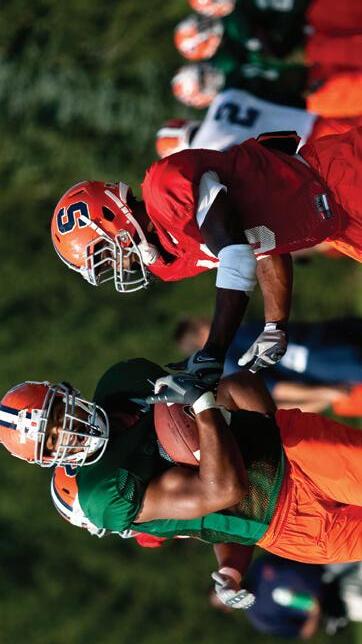
Just like when Marrone was in college, practices are a battleground. More contact, more competition, more conditioning.
“It’s a lot more intense,” junior defensive tackle Andrew Lewis said. “There’s a lot more hitting. It reminds me a lot of high school when you really don’t have any limitations — a lot more physical. It’s more of what a camp should be and not that kind of NFL-type camp thing.”
In the spring and summer, packs of Orange football players lined the long blue Gilman pads that marked the “Syracuse drill,” where a defensive and offensive player battle in a full-contact slugfest for supremacy.
After each bone-crushing hit, the surrounding players let out a battle cry, waiting to call out their next opponent.
“Everything we do now, we have to do as hard as we can, and that’s expected out of us,” McKenzie, the junior center, said. “Just like coach tells us, we’re not being punished. More is being demanded of us.”
Through it all, Marrone is watching his players in Manley and on the practice field to see how they’re fitting into his plan. He’s admitted that he has too much work to do to stop and absorb the significance of it all and how his Syracuse roots are affecting this downtrodden program.
But for the players, coaches and fans who have been waiting for the revival of Syracuse football, it couldn’t feel any better. Whether it’s the burning of the shoe or simply the way a player looks a coach in the eye and calls him “Sir,” the days of old are back.
“It feels like it used to,” Conley said. “It feels like Syracuse again.”
ctorr@syr.edu
The Packers never offered a contract. But they gave Paulus a platform to reintroduce himself as a football player — they made the transition realistic. Suddenly, 15-to-20 schools were calling. And these were no pranks. Paulus visited Michigan, Nebraska and Syracuse in search of the best chance to start.
On his trip to SU, Paulus meandered through the halls of the S.I. Newhouse School of Public Communications with head coach Doug Marrone at his hip. Students gawked as Paulus’ tour guide Carolyn Davis, a Ph.D student, showed him broadcasting equipment he had never seen at Duke.
The awkwardness she typically buffered as a tour guide was nonexistent here. A rapport was forged.
“It seemed like they knew each other really well,” Davis said. “You know how you act when you’re around a professor? It wasn’t like that.”
And the opportunity to start was clear.
“From a quarterback situation, it’s a lot harder to walk into Nebraska and start than it is at Syracuse,” Mike Paulus said. “That’s not a diss on the program. That’s just realistic. They needed help, especially at that position.”
So with an offer from a European basketball team on the table — and a slew of agents ready to represent him — Paulus did a 180. Instead of living halfway around the globe, Paulus made a pilgrimage home. Behind a squint-tosee NCAA rule that allows four-year college athletes to compete in another sport if they haven’t redshirted, Paulus chose to enroll as a graduate student at SU on March 14.
Paulus never felt constricted to the status quo. He knew football could pop up again. After all, he was the Gatorade National High School Player of the Year at Christian Brothers Academy, throwing for 11,763 yards and 152 touchdowns as a four-year starter.
Right now, he’s Syracuse’s starting quarterback. After that, who knows?
“Broadcasting is an option. Coaching is an option. Football is an option,” his dad said. “And if he wanted to go to Europe to play basketball, that’s an option.”
Maybe someday Paulus will slide next to Mike Krzykewski on the bench like so many former Dukies. This football experiment hasn’t derailed that dream. If anything, it enhances it. Collins said Paulus hopes to help the Orange’s basketball team in a graduate assistant type of role.
But that’s months from now. His basketball is safely stashed away. Paulus’ new teammates beg him to slip into Manley Field
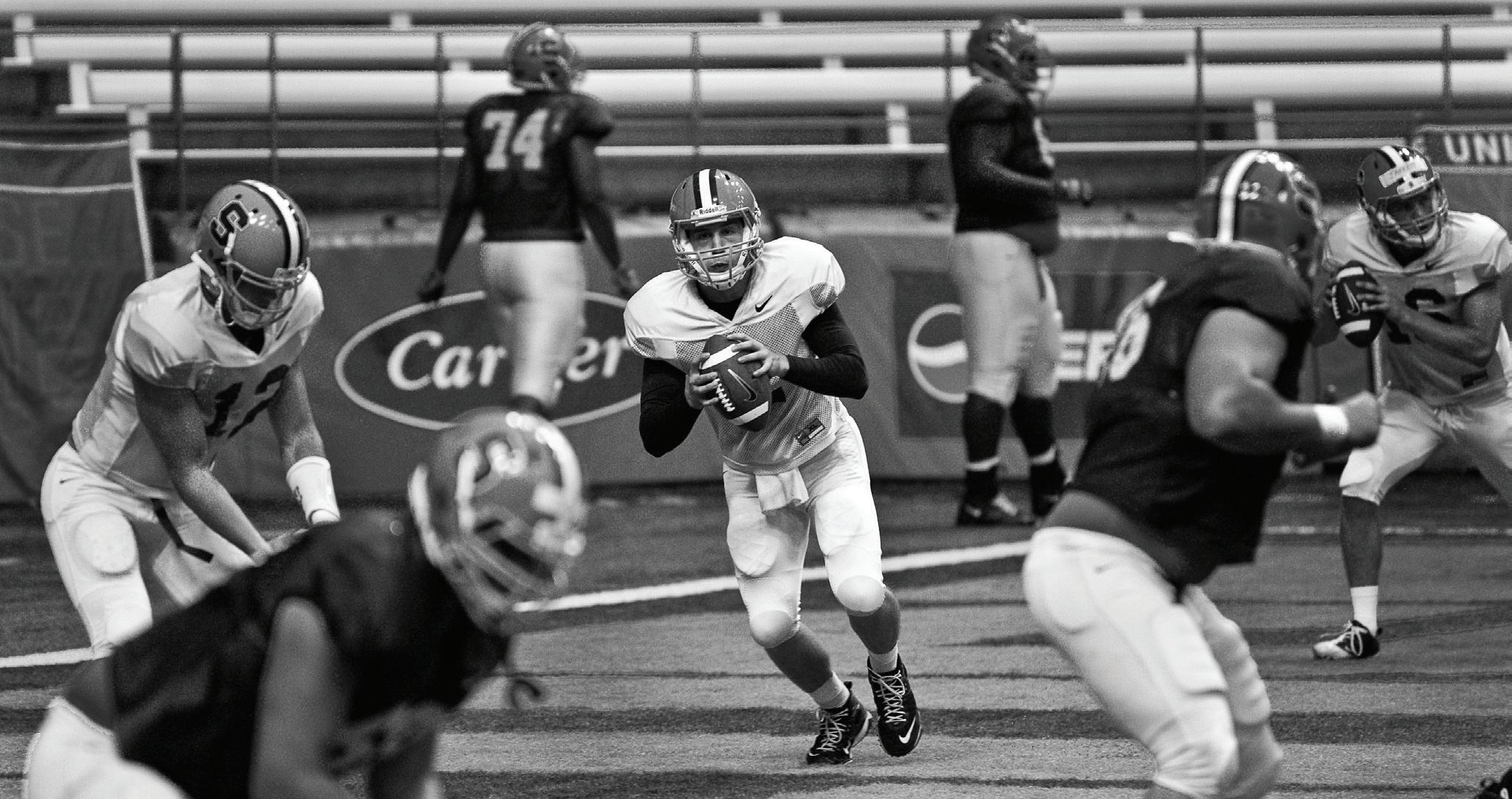
House for a quick pickup game. He declines. At each interview with the media, Paulus instinctively repeats that football — and only football — is his 6 a.m. to 11 p.m. obsession.
Collins texted Paulus all August. Like everyone, he wanted a sneak peak. In return, Paulus provided 100-character peepholes into what’s cooking behind closed doors. Each successive text was a tad brighter than the last.
“I can sense the excitement going back and forth,” Collins said.
He’s been sheltered all preseason. In pads, but untouched. Syracuse’s coaches don’t let the quarterbacks get hit.
So when guys are foaming at the mouth to smack Paulus for the first time since 2004, he’ll need a safety valve. A trusty tight end. A friend in times of danger. He’ll need diehard North Carolina fan, Mike Owen.
SU’s starting tight end has followed UNC since fifth grade. He was part of steaming Tar Heels Nation when Gerald Henderson struck Tyler Hansbrough with a nasty elbow that drew a faucet of blood. So he had to ask.
“How were those games man?” he asked Paulus. “There were blood and fistfights. That’s intense.”
Arguably no position in sports is as polarizing as the Duke point guard. Paulus was a bull’s eye for four years, blasted with obscene spam every night. Though his football game was cryogenically frozen for years, Paulus boasts an unprecedented resume for a college quarterback.
When referred to as one of the most hated players in sports after an August practice, Paulus cracks a wide grin, rewinds old memories for a moment and chuckles.
“Yeah, that was a good time,” he said.
Like the guaranteed “Mike is bet-terrr!” chants in Chapel Hill. Or the countless pictures students held of players skying over Paulus for dunks. And the time West Virginia’s Cam Thoroughman took a below-the-belt postgame
shot for the ages. After the Blue Devils — and their eight McDonald’s All-Americans — were blindsided by the Mountaineers in the second round two years ago, Thoroughman asked a reporter if Paulus was one of those eight.
The reporter acknowledged he was and a shocked Thoroughman responded, “Oh, my God. Are you kidding?”
It’s part of his job description at Duke. You’re forced to lead as America’s Most Wanted.
“There’s no better feeling than keeping people quiet with a big shot or a big play,” Paulus said.
This is how he was able to command respect immediately from his SU teammates. Paulus barely touched a football the last four years, playing catch with Mike in the backyard sparingly.
Teammates, like critics, were unsure if Paulus could handle football at first. They knew he could handle pressure.
“The competition, the fight, the hunger,” Owen said. “He brings that mentality here.”
Paulus and Owen haven’t debated the Henderson/Hansbrough incident quite yet. Touched on it, but haven’t dove into it. Green-lighting such discussion is like triggering a healthcare debate. There’s a time and place. No use risking quarterback-receiver hostility in August.
But the time will come.
“Come January, February, whenever the season starts and it’s Duke-Carolina, we’ll butt heads then,” Owen said.
After inheriting a new offense and a new set of quarterbacks, Rob Spence kept it simple. He didn’t need a howitzer arm. He didn’t need a tuck-and-run dazzler. Last spring, Syracuse’s new offensive coordinator insisted he needed a brainy “point guard” in the cockpit.
Spence was being metaphorical. The answer was literal.
“(Paulus) has a good feel and a very high athletic I.Q.,” Spence said. “He’s very, very intelligent and a natural leader.”
Spence isn’t one for leaking details of his
complex, multi-receiver offense from Clemson. But he is quick to say there have been no shortcuts in Paulus’ growth. Familiarity helped. At CBA, head coach Joe Casamento employs a high-school version of Spence’s offense.
“You’d be surprised how similar the game is whether you’re talking about the pro level, college level or high school,” Casamento said.
A year and a half ago, Casamento and another high school coach from Kentucky visited Spence for a week in Clemson to pick Spence’s brain. It’s a common trip. NFL, college and high school coaches all visit Spence for knowledge, Casamento said.
So Casamento doesn’t see today’s Paulus as any lesser than the golden boy that generated full-ride offers to Notre Dame and Miami (Fla.) as a football player.
“When he was a senior, 18-year-old kid, everybody thought he was great,” Casamento said. “Now he’s a 23-year-old man and everybody wonders if he can do it. I think all those people are crazy.”
This summer, with Paulus thirsting for reps and SU’s coaches prohibited from working with players per NCAA rules, his inner circle at CBA lent a hand. Blasts from the past, former Orange safety Bruce Williams and current Orange wideout Lavar Lobdell, ran routes for Paulus regularly. Casamento stood nearby as Paulus’ football occupational therapist, helping him recapture his old self throw by throw.
The rust accumulated in Paulus’ velocity. He wasn’t driving the ball with his hips and legs enough. With daily reps, Casamento helped fix this. Marrone sees a polished product.
“When something breaks down, he can see the field,” Marrone said. “He can make quick decisions.”
To catch up tactically, Paulus used his younger brother. Together, Greg and Mike studied film of Mike’s Tar Heels playing three schools Greg will face this fall — Rutgers, Connecticut and West Virginia.
“So I could say, ‘These guys do this and these guys do that,’” Mike said. “At Carolina, we game-planned for them, too.”
After UNC plays UConn Sept. 12, Mike plans to mail his playbook from that week to Greg. The accelerated preparation injected quiet confidence to the unknown. Coaches liken Paulus to Drew Brees, Marrone’s former pupil as offensive coordinator of the New Orleans Saints. Whether Paulus’ sixth sense in the pocket, surgeon precision and Duke-tested leadership truly makes him Drew Brees Lite won’t be revealed until this weekend.
But Paulus promises that coulda-made-thatthrow-back-in-the-day doubt hasn’t crept into his mind.
“I haven’t had that thought for one second,” he said.
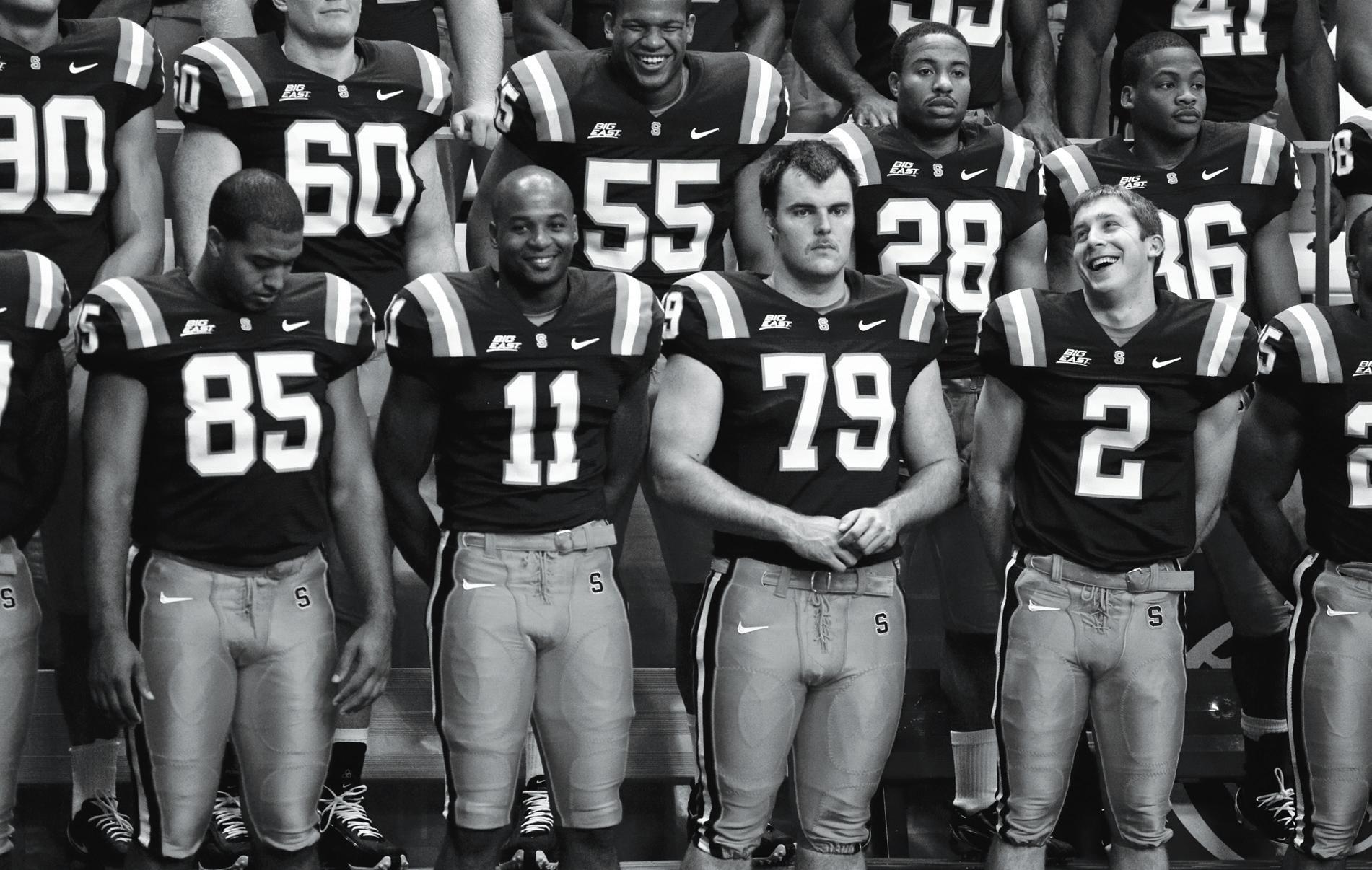
A booming thunderstorm blasts the roof of the Carrier Dome as Greg Paulus takes his place in the first row of Syracuse’s team photo at media day. Three players to his right is Owen, gazing and grimacing at the Dome top. He’s a little nervous. His car windows are rolled down.
Paulus also looks up at the storm. Wearing this odd, new shade of blue, he slowly spins around in place for a panoramic view. This is his new home.
He could struggle. Who should start under center may erode into a season-long debate. This is only a one-year fling that could delay the maturation of redshirt freshman Ryan Nassib or true freshman Charley Loeb.
With his hands lounged on his V-neck of his shoulder pads, Paulus soaks up the moment in too-good-to-be-true or what-did-I-get-myself-into pause. All eyes are on him this fall. He knows this. He’s had to answer the same questions every day, most of which are packaged in different words with the same meaning - “Are you nuts?”
The mystery is finally revealed Saturday.
“They’ve kept things really low key and I think that’s a good element of surprise,” Dave Paulus said. “Because I think people are going to be surprised here very soon.”
thdunne@syr.edu
Tamarac, Fla./Saint Thomas Aquinas School
27 Averin Collier RB 5-10 195 RF Rochester, N.Y./Churchville-Chili HS
28 Nico Scott CB 5-10 179 Jr. Greenbelt, Md./Eleanor Roosevelt
29 Antwon Bailey RB 5-8 193 So. Washington, D.C./St. John’s College High School
30 Rishard Anderson FS 6-0 180 Fr. Miramar, Fla./American Heritage
32 Doug Hogue LB 6-2 223 Jr. Yonkers, N.Y./Roosevelt
33 Dan Vaughan LB 6-2 208 RF Gibsonia, Pa./Pittsburgh Central Catholic HS
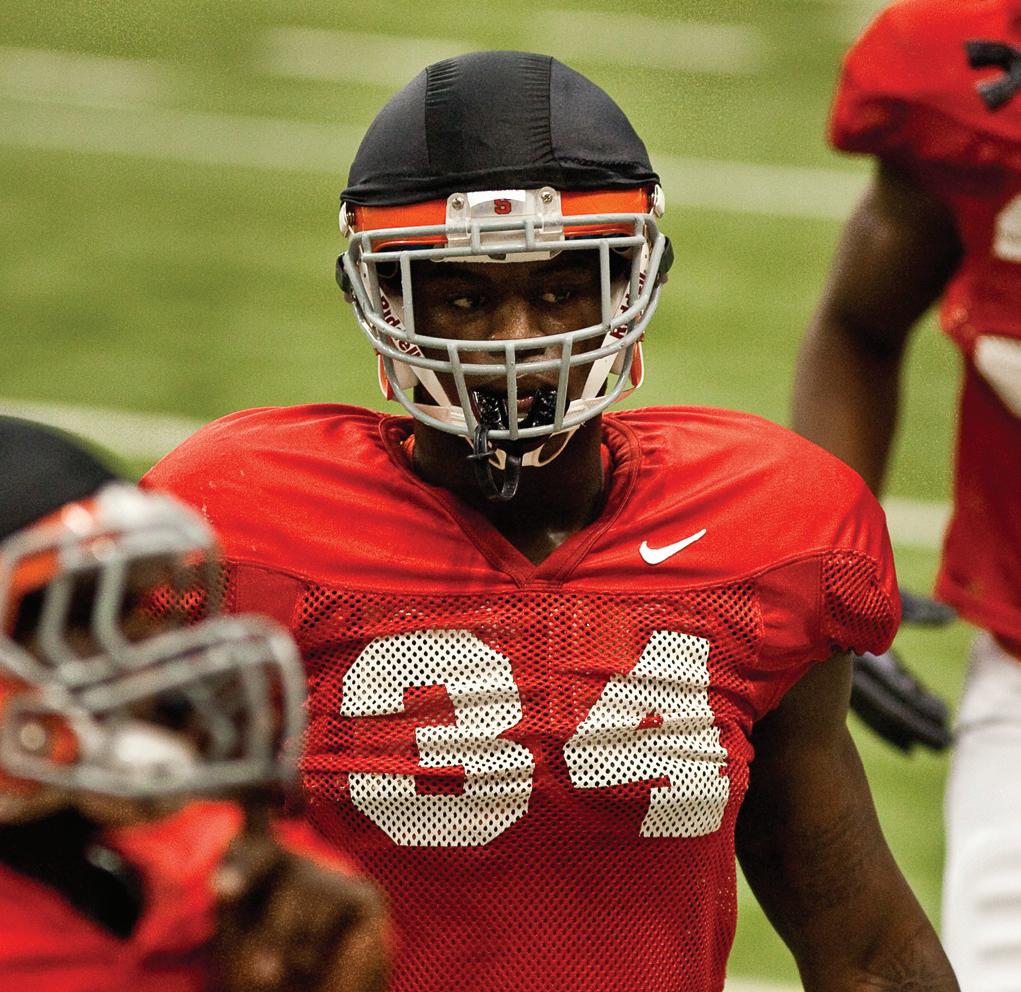
34 Earl Carter Jr. LB 6-0 222 Fr. Orlando, Fla./Dr. Phillips
35 Michael Holmes FS 5-11 184 Jr. Jacksonville, Fla./Mandarin
36 George Mayes CB 5-10 185 Sr. Roselle, N.J./Seton Hall Prep
37 Mike Jones RB 5-11 202 RF Middletown, Pa./Bishop McDevitt HS
38 Ryan Ahern FS 6-2 194 Sr. Agoura Hills, Calif./Roger Williams University/Oaks Christian
39 Lonnie Johnson DB 5-10 206 Fr. Liverpool, N.Y./Liverpool
40 Jake Smith K/P 6-2 180 Fr. Elkins Park, Pa./Cheltenham HS
41 Ryan Gillum LB 5-11 216 So. Youngstown, Ohio/Liberty
43 Shamarko Thomas CB 5-10 196 Fr. Virginia Beach, Va./Ocean Lakes
46 Robert Nieves FB 6-0 214 Sr. Rye, N.Y,/Rye
47 Rob Long P 6-4 184 Jr. Downingtown, Pa./Downingtown West
48 Carl Cutler TE 6-2 234 RF Norwich, Vt./Hanover (N.H.) HS
49 Adam Harris LB 6-2 239 So. Towanda, Pa./Towanda Junior Senior
51 Andrew Lewis DT 6-3 273 Jr. Centreville, Va./Centreville
52 Ollie Haney NT 6-3 278 So. Clark, N.J./A.L. Johnson
53 Chad Battles DE 6-3 228 So Newport News, Va./Heritage
54 Mikhail Marinovich DE 6-4 234 So. San Clemente, Calif./JSerra Catholic
55 Anthony Perkins DT 6-4 269 Jr. Washington, D.C./DeMatha
56 Cory Boatman DT 6-2 256 RF Olney, Md./Our Lady of Good Counsel HS
57 Maximilian Leo LS 5-11 206 Sr. Clay, N.Y./Bishop Grimes
58 Mike Stenclik LB 6-0 224 Sr. Webster, N.Y./Webster-Schroeder
60 Jim McKenzie C 6-4 284 Jr. Springfield, Pa./Saint Joseph’s Prep
62 Andrew Phillips OT 6-6 276 Fr. Phoenix, N.Y./Christian Brothers Academy
66 Andrew Tiller OT 6-5 382 Jr. Brentwood, N.Y./Nassau Community College/Central Islip
68 Justin Pugh OG 6-5 280 Fr. Holland, Pa./Council Rock South
70 Ryan Bartholomew OG 6-3 288 Jr. Mitchellville, Md./DeMatha
71 Adam Rosner OG 6-6 305 Jr. Depew, N.Y./Depew
72 Nick Lepak C 6-4 328 So. Auburn, N.Y./Auburn HS
73 Jonathan Meldrum OT 6-5 314 Jr. Boise, Idaho/Hargrave Military Academy/Landstown
74 Nick Speller OT 6-5 299 RF Baltimore, Md./Edmondson-Westside
75 Zack Chibane C 6-5 307 Fr. Paramus, N.J./Paramus
76 Ian Allport OT 6-4 301 RF Pulaski, N.Y./Pulaski Central
77 Tucker Baumbach OT 6-5 317 Jr. Middletown, Pa./Bishop McDevitt
78 Josh White OT 6-5 272 So. Salisbury, Md./Wicomico
79 Dalton Phillips LS 6-3 266 Sr. Clancy, Mont./Carroll College/Helena HS
80 Nick Provo TE 6-5 232 So. West Palm Beach, Fla./John I. Leonard
81 Cody Morgan WR 5-8 166 Fr. Cohasset, Mass./Boston College
82 Van Chew WR 6-1 161 So. Manassas, Va./Centreville
83 Ollie Taylor WR 6-0 184 Fr. Harvard, Mass./Lawrence Academy
84 Michael Acchione WR 5-11 168 RF Solvay, N.Y./Solvay
85 Mike Owen TE 6-4 255 Sr. Riverhead, N.Y./Riverhead
86 David Stevens LB 6-4 220 RF Short Hills, N.J./Millburn HS
89 Thomas Trendowski TE 6-2 225 So. Syracuse, N.Y./Westhill
90 Jared Kimmel DE 6-6 252 Jr. Harpursville, N.Y./Harpursville Central
91 Brandon Sharpe DE 6-2 227 Fr. Virginia Beach, Va./Ocean Lakes
92 Shane Kimmel LB 6-1 229 RF Ivyland, Pa./Council Rock HS
93 Jarel Lowery NT 6-4 281 RF Paterson, N.J./Paterson Catholic HS
94 Bud Tribbey DT 6-0 274 Jr. Richmond, Va./Varina
95 Torrey Ball DE 6-3 250 So. Athens Ga./Georgia Military College/Cedar Shoals
97 Arthur Jones NT 6-4 293 Sr. Endicott, N.Y./Union Endicott
99 Chandler Jones DE 6-5 246 RF Endicott, N.Y./Union Endicott


BY MATT EHALT STAFF WRITER
Bill Stewart still remembers those magical Thursday nights.
The nationally televised wins over Pittsburgh, Maryland, Louisville and Auburn. They were a major part of the foundation for stamping West Virginia as a Big East powerhouse over the past four years.
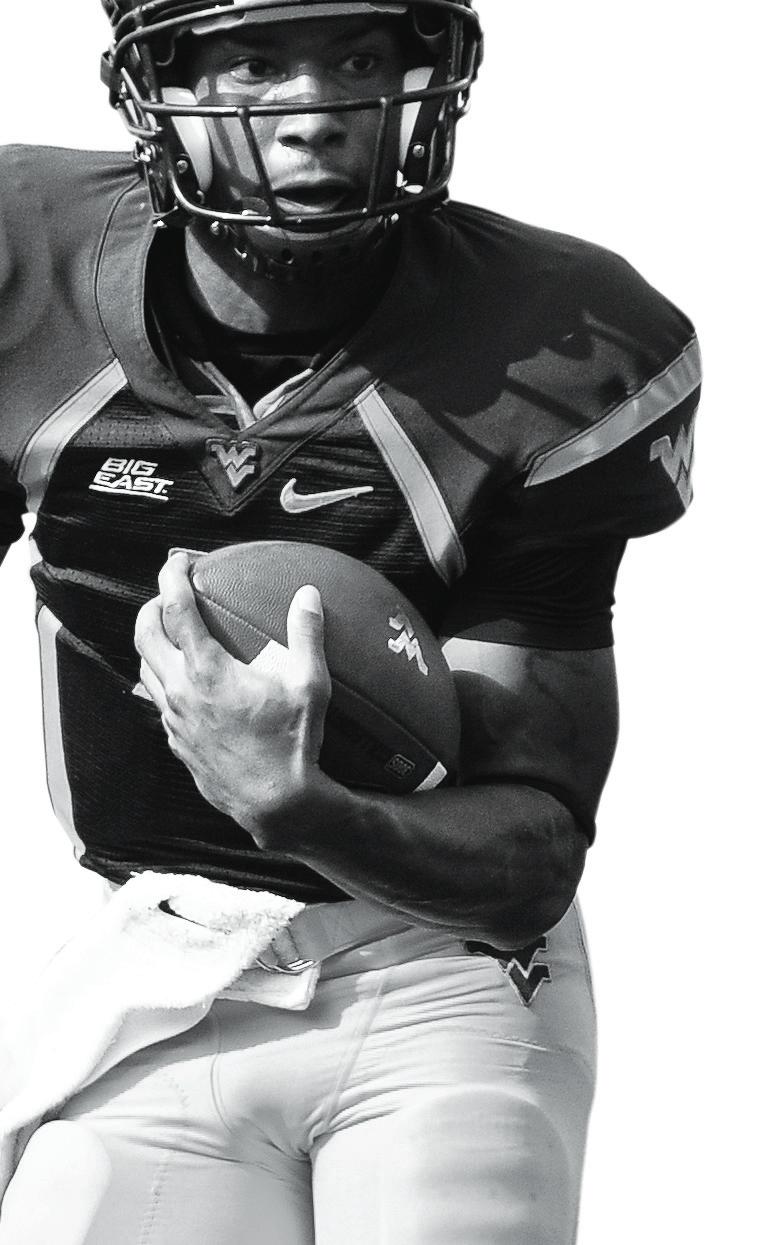
Such sweet memories, all fueled by a fleet-footed quarterback who broke a slew of records in his four superb years in Morgantown.
“Patrick White was a shining knight in each one of those games,” Stewart, the Mountaineers’ head coach, said. “This guy just made plays. It started with his redshirt freshman year against Louisville and every time he was the spotlight, center stage, he played the highest he could possibly play. That was pretty special.
“He brought a lot not to just West Virginia University but to the conference itself. I think the conference will miss him, but life has to go on, and other leaders have to step up and take over.”
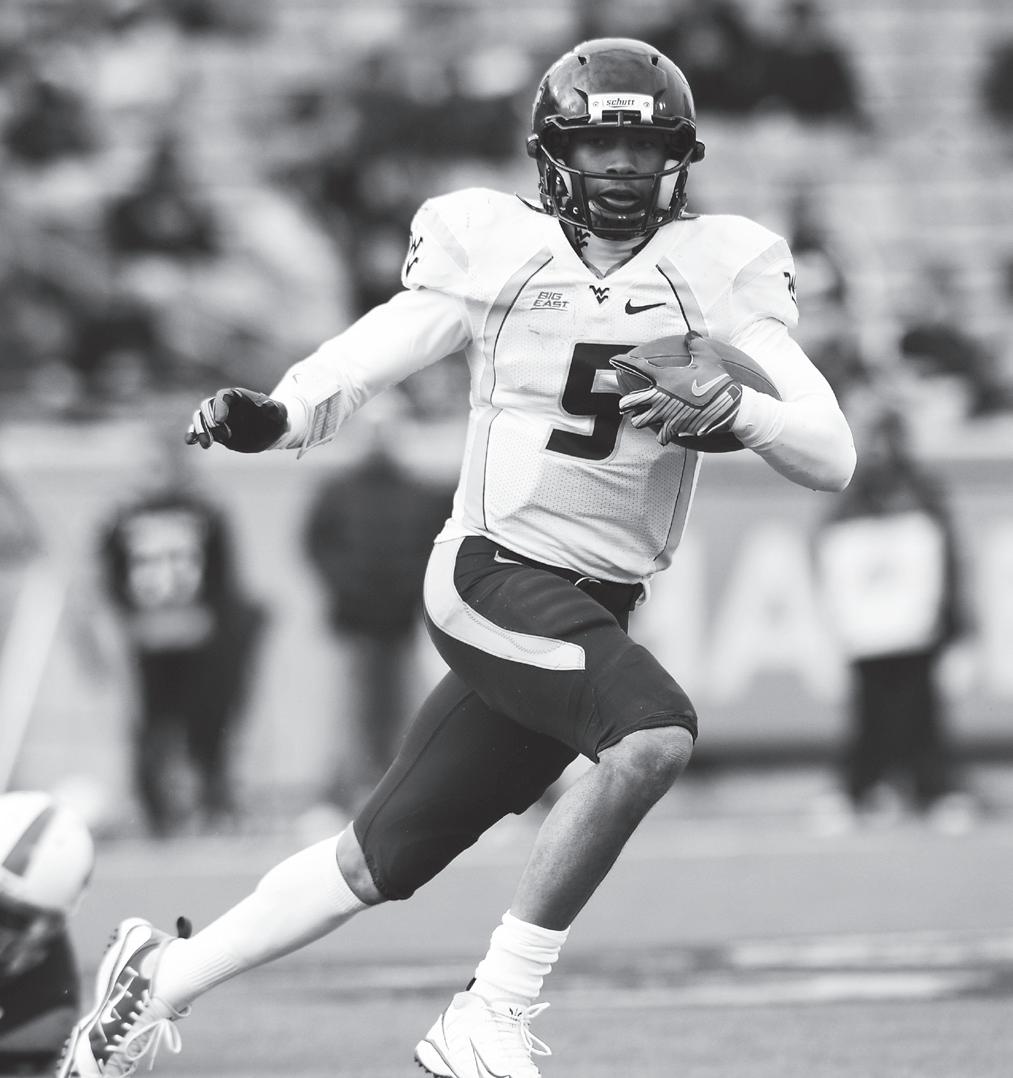
After four years of White’s dazzling performances, record-breaking numbers and uncanny ability to produce in the clutch, the Mountaineers and the Big East face the unenviable task of trying to replace him. Jarrett Brown is expected to take over at quarterback for White, but will be hard-pressed to make the Mountaineer faithful forget his nimble predecessor. Within the conference, there is varying opinion on who can step up to be the face of the Big East, as White was in his time.
“Patrick White is the greatest winner in college football,” Stewart said. “I think the guy’s going to be a Super Bowl winner someday at quarterback. It’s been a blessing, it’s been a thrill and it’s been an honor to watch this kid play because he’s been great. But he’s graduated, so we gotta go in a different direction now.”
“Winner” is the best word to describe White’s years with the Mountaineers. He set 25 Big East, West Virginia and NCAA records in his four years. These include:
■ Most career rushing yards gained by a quarterback (4,480 yards)
■ Most touchdowns responsible in Big East and for WVU (103)
■ Most yards in a single game for WVU (424)
■ Most yards in a career for Big East and WVU (10,529)
■ Best completion percentage at WVU (64.8 percent)
And those are just his individual statistics.
There’s also the 34-8 career record in games he started at West Virginia that included two Big East championships, two BCS bowl victories and a perfect 4-0 record in bowl games with three MVP awards, making him the only quarterback in history to go undefeated in four bowl games.
“I think Pat White will certainly go down as one of the best, if not the best player in Big East conference history,” Big East associate commissioner Nick Carparelli Jr. said. “And I think the timing of Pat White’s
SEE WHITE PAGE 19

2008 Record: 11-3 (6-1 Big East, 1st)
Postseason: Orange Bowl (20-7 loss to Virginia Tech)
Key players: QB Tony Pike, DB
Aaron Webster, WR Mardy Gilyard
Season outlook: Cincinnati won the Big East last season but is picked to finish third in the preseason poll this year, despite tying Pittsburgh for most first-place votes. The Bearcats season-opener at Rutgers on Sept. 7 could go a long way in their pursuit of a second-straight title. Quarterback Tony Pike is back after a strong season last year, while the defense will have a new coordinator and 10 new starters, which could prove to be the downfall for Cincinnati.

2008 Record: 8-5 (5-2 Big East, T-2nd)
Postseason: Papajohns.com Bowl (29-23 win over North Carolina State)
Key players: C Ryan Blaszczyk, OL Anthony Davis, CB Devin McCourty
Season outlook: Rutgers was voted fifth in the preseason media poll, but plays all four of the teams ahead of it (Pittsburgh, USF, WVU and Cincinnati) at home, which could prove to be pivotal for the Scarlet Knights. Rutgers has won three consecutive bowl games, and will look to qualify for a fifth straight this season. RU will have to replace quarterback Mike Teel and wide receiver Kenny Britt, but should have enough depth to do so.

2008 Record: 8-5 (3-4 Big East, 5th)
Postseason: International Bowl (38-20 win over Buffalo)
Key players: LB Scott Lutrus, RB Andre Dixon, CB Jasper Howard
Season outlook: The Huskies have qualified for two straight bowl games, but might have trouble extending that streak this season. Four Huskies were drafted in the first two rounds of the 2009 NFL Draft, including All-American tailback Donald Brown (selected No. 27 overall by the Indianapolis Colts). Cody Endres and Notre Dame transfer Zach Frazer will battle for the starting quarterback job to replace the graduated Tyler Lorenzen. Andre Dixon will look to anchor the running game.

2008 Record: 8-5 (2-5 Big East, 6th)
Postseason: Magicjack St. Petersburg Bowl (41-14 win over Memphis)
Key players: QB Matt Grothe, DE George Selvie, OL Terrell McClain
Season outlook: Since starting the 2007 season 6-0, USF has gone just 11-9 and will now look to move to the top of the Big East. Matt Grothe is arguably the conference’s best quarterback and is on pace to break several conference records. USF has received some first-place votes in the preseason poll and should do well in the Big East. Games against Florida State and Miami will determine whether the Bulls get recognized on a national stage.
Z WR Marcus Sales Lavar Lobdell
A WR Alec Lemon Donte Davis
LT Nick Speller Josh White
LG Ryan Bartholomew Justin Pugh
C Jim McKenzie Ryan Bartholomew
RG Tucker Baumbach Adam Rosner
RT Jonathan Meldrum Andrew Tiller
Y TE Mike Owen Andrew Robinson
U TE Nick Provo Cody Catalina
QB Greg Paulus Ryan Nassib
RB Delone Carter Antwon Bailey
X WR Mike Williams Van Chew
2008 Record: 5-7 (1-6 Big East, T-7th)
Postseason: Did not qualify
Key players: LB Jon Dempsey, RB
Victor Anderson, WR Doug Beaumont
Season outlook: Louisville has fallen on hard times under head coach Steve Kragthorpe. The Cardinals are just 11-13 in Kragthorpe’s two years and have failed to qualify for a bowl game. Juniors Adam Froman and Justin Burke are battling for the starting quarterback job, but neither has started a Division I game in their respective careers. Sophomore running back Victor Anderson was named conference Rookie of the Year last year and may see a bulk of the offensive load.

2008 record: 3-9 (1-6 Big East, T-7th)
Postseason: Did not qualify Key players: QB Greg Paulus, NT Art Jones, WR Mike Williams
Season outlook: Syracuse ushers in new head coach Doug Marrone after four awful seasons under Greg Robinson. Marrone, a Syracuse alumnus, will have some work ahead of him to turn the program around. His starting quarterback, Greg Paulus, has not played football in four years and will certainly spice things up for the Orange this season. A non-conference schedule with three Big Ten teams does not help, so it could be a long year for SU.
DE Mikhail Marinovich Jared Kimmel
NT Arthur Jones Bud Tribbey
DT Andrew Lewis Anthony Perkins
DE Chandler Jones Torrey Ball
SLB Doug Hogue Dan Vaughan
MLB Derrell Smith Mike Stenclik
WLB Ryan Gillum E.J. Carter H Kevyn Scott John Mark Henderson
SS Max Suter Phillip Thomas FS Mike Holmes Shamarko Thomas
Nico Scott Rishard Anderson

Postseason: Brut Sun Bowl (3-0 loss to Oregon)
Key players: DL Greg Romeus, TE Nate Byham, RB Dion Lewis
Season outlook: Is this the year Pittsburgh finally wins the Big East under head coach Dave Wannstedt?
The media seems to think so, picking the Panthers to win the conference. Quarterback Bill Stull returns to anchor the offense, and it will fall upon a committee of running backs to replace second-round draft pick LeSean McCoy. Pitt’s defensive line is strong with All-Big East pick Greg Romeus returning. Games at West Virginia and Rutgers will ultimately determine where Pittsburgh finishes.

2008 Record: 9-4 (5-2 Big East, T-2nd)
Postseason: Meineke Car Care Bowl (31-30 win over North Carolina)
Key players: QB Jarrett Brown, RB Noel Devine, DL Scooter Berry
Season outlook: West Virginia has lost two prolific players to the NFL Draft in the past two seasons: Steve Slaton and Pat White. Without Slaton and White this season, it will be interesting to see how the Mountaineers move forward. Filling White’s shoes will be fifth-year senior Jarrett Brown, who appears to be up to the task. West Virginia is picked to finish second in the media poll, but a Nov. 27 home game against Pittsburgh could determine its fate.
K Ryan Lichtenstein Jake Smith
P Rob Long
LS Max Leo
SS Dalton Phillips
Holder Rob Long
PR Donte Davis
KR Mike Jones
performances on the football field at a time when the Big East was rebuilding played a major part in our resurgence as one of the big six conferences in the country.”
Beyond all the victories, league coaches often mention how White served as an ambassador for the league both on the field and off it. At Big East media day in July, Pittsburgh head coach Dave Wannstedt noted how White helped recruit players for the Big East.
“I think when we’re all out there talking about our conference and we’re all promoting our conference on a national stand point, I think it was a great situation to have a player nationally like Pat White to use as a reference,” Wannstedt said.
But those days are over. With White now a Miami Dolphin after being selected with the No. 44 pick of the 2009 NFL Draft, the search for his replacement has begun. At WVU, it leads to Brown, a fifth-year senior who has served as White’s backup for the past three seasons. In his limited time on the field, which included a 17-6 victory over Syracuse last year, Brown has thrown five touchdowns and four interceptions.
To take the immense pressure off Brown’s shoulders, Stewart handed Brown a football in front of the entire team during spring practice and told him it was his team. Stewart said he has told Brown that he should focus on his own abilities and not try to be another White. Brown, though, said he is ready to pick up where White left off.
“There’s a little pressure, but I can use that pressure, all that energy and go in and watch film, things like that,” Brown said. “The guys around me, they can take all the pressure off me with
(tailback) Noel (Devine) in the backfield and my receivers. We’re out there playing for each other and that relieves a lot of pressure off me.”
Though WVU might have someone to replace White in the lineup, filling White’s role in promoting and advancing the conference is not falling upon one player. There seems to be a bevy of opinions about who can step up, though most are non-committal. “There are so many good players in the league” has become a popular refrain.
Syracuse defensive tackle Art Jones thinks he can be that man. South Florida defensive end George Selvie said USF quarterback Matt Grothe, who is just 287 yards away from breaking White’s career record for yards gained in the Big East, can step up. Pittsburgh defensive end Greg Romeus threw out the names of Cincinnati quarterback Tony Pike and Brown as potential replacements.
Yet when it’s all said and done, there might not be anyone who can replace White’s value to the Big East and West Virginia. That’s why Stewart is telling Brown to simply be himself. And if the league finds a replacement, it might be someone the conference or WVU would have never expected.
“Pat Whites only come around so many times and they’re few and far in between,” Connecticut head coach Randy Edsall said. “You don’t ever replace a guy like that, and I think when you try and replace a guy like that, that’s when you run into trouble. We lost (running back) Donald Brown, more people have to step up for us.
“You lose Pat White, more people have to do things, and what I think happens is when you have people like that, sometimes you see other people step up because there’s more of an opportunity for them to do things.”
mrehalt@syr.edu
the landscape of college football, Crouthamel said. In order to expand the Big Ten, it would have to steal teams from other conferences.
Transferring conferences could help and hinder teams that might consider the move. The Big Ten could fi nancially benefit teams with its stronger postseason presence, Crouthamel said. But with the bigger conference comes stronger opponents.
“With a quality upgrade comes quality competition,” Crouthamel said. “Who is prepared for that upgrade? That’s not a put-down on the Big East, but I don’t think top to bottom the Big East can compare with the Big Ten.”
This season’s Top 25 boasts Big Ten powerhouses, where the Big East is invisible. Ohio State leads the Big Ten with a No. 6 preseason ranking, followed by Penn State at No. 9. Iowa rounds out the list at No. 22.
So, for a conference with no teams in the Top 25, it’s difficult to fi nd a team that could handle the upgrade.
For Syracuse nose tackle Art Jones, leaving the Big East would mean disbanding the traditional opponents the Orange has a rich history with.
“It’s a smaller conference, the Big East,” Jones, a senior, said. “It would be sad to see us leave.”
Crouthamel and Abbott both agreed an
“With a quality upgrade comes quality competition. Who is prepared for that upgrade? That’s not a putdown on the Big East, but I don’t think top to bottom the Big East can compare with the Big Ten.”
Jake Crouthamel FORMER SU ATHLETIC DIRECTOR
expansion in the near future is unlikely because of how the expansion would affect the rest of college football. But if the Big Ten could expand, the most likely suitor may not even be in the Big East.
“The main school out there that the Big Ten would want to recruit at any time of course is
Notre Dame,” Crouthamel said. “In my lifetime we won’t see that happen. Notre Dame will stay independent.”
But Paterno disapproves of Notre Dame joining. Right now, the Big Ten teams are relatively equal in media exposure and fi nances. Notre Dame’s strong alumni base and deal with NBC
Universal for football games puts the Fighting Irish on a different playing field.
“Notre Dame brings a whole different environment,” Crouthamel said. “With their own TV network (NBC) and its alumni base, it transcends everything in terms of loyalty and giving fi nancially. Notre Dame is delighted to be in the Big East for its other sports without football - not many other major conferences would have done that.”
Abbott said he doesn’t give expanding the conference too much thought and just tries to schedule teams for Iowa. There’s too much politics to know what’s truly going on.
“I don’t have answers to if the Big Ten will ever expand,” Abbott said. “Fans give this stuff a lot of thought, much more than anyone else.” mkgalant@syr.edu