Gameday
VIDEO /Mokyr 15 questions with a

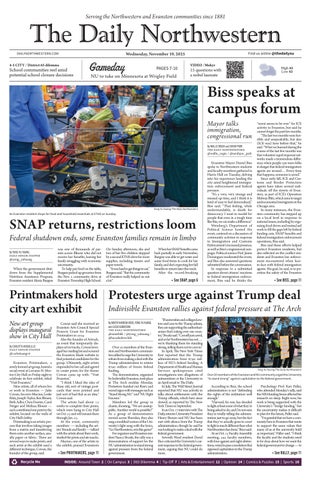
An Evanston resident shops for food and household essentials at ETHS on Sunday.
VIDEO /Mokyr 15 questions with a
An Evanston resident shops for food and household essentials at ETHS on Sunday.
By YONG-YU HUANG daily senior staffer @yong_yahuang
By WALLIS ROGIN and SARAH PARK the daily northwestern @wallis_rogin / @sarahjoo_park
Evanston Mayor Daniel Biss spoke to Northwestern students and faculty members gathered in Harris Hall on Tuesday, delving into his experience leading the city amid heightened immigration enforcement and federal pressure.
“It’s a very, very strange and messed up time, and I think it is kind of easy to feel demoralized,” Biss said. “That feeling, while understandable, is death for democracy. I want to model for people that even in a tough time like this, we can make a di erence.”
“worst seems to be over” for ICE activity in Evanston, but said he cannot forget the past few months.
“ e last two months were horrible and unspeakable, but also (ICE was) here before that,” he said. “What we learned during the course of the last few months was that volunteer rapid response networks made a tremendous di erence when people can warn folks in danger that federal immigration agents are around… Every time that happens, someone is saved.” Since early fall, ICE and Customs and Border Protection agents have taken several individuals o the streets of Evanston, as part of ICE’s Operation Midway Blitz, which aims to target undocumented immigrants in the Chicago area.
When the government shutdown froze the Supplemental Nutrition Assistance Program, Evanston resident Alexia Burgess was one of thousands of parents across Illinois who did not receive her bene ts, leaving her family struggling with economic uncertainty.
On Sunday a ernoon, she and two of her ve children stopped by a second ETHS drive for more supplies, including tissues and paper towels.
To help put food on the table, Burgess picked up groceries from the Nov. 2 community drive at Evanston Township High School.
By CARLOTTA ANGIOLILLO daily senior staffer
@carlo aang76
Evanston Printmakers, a newly formed art group, hosted a social event at Lorraine H. Morton City Hall on Friday night to celebrate its rst exhibit, titled “Visit Evanston.”
Nine artists, all of whom live or work in Evanston — Julie Cowan, Socorro Mucino, Leslie Riley, Joseph Taylor, Ben Blount, Beth Adler, Chris Froeter, Carol Neiger and Melissa Blount — each contributed one print to the exhibit, located on the walls of City Hall’s lobby.
Printmaking is an artistic process that involves taking images from a matrix and transferring them onto another surface, usually paper or fabric. ere are several ways to make prints, and each artist at the exhibit used a di erent technique, Cowan, the founder of the group, said.

Cowan said she received an Evanston Arts Council Special Projects Grant for Evanston Printmakers in 2024. Also the founder of Artruck, an event that temporarily displays art in trucks, Cowan leveraged her mailing list and scoured the Evanston Made website to nd potential candidates for the group. Ultimately, eight artists responded to her call and agreed to create prints for the theme Cowan came up with: “Visit Evanston.”
“I think I liked the idea of these old, sort of vintage postcards that were printed and just sort of had that as an idea,” Cowan said.
The artists had about 12 weeks to complete their prints, which were hung in City Hall on Oct. 23 and will remain there through Jan. 23.
At the event, community members — including the artists’ friends and family — talked with the artists about their work, studied the prints and ate snacks. Mucino, one of the artists in the exhibit, praised Evanston’s
“It was hard to get things to eat,” Burgess said. “But the community of Evanston really helped us out a lot.”
By NINETH KANIESKI KOSO YONG-YU HUANG
LUCAS KUBOVCHIK
and
the daily northwestern @ninethkk / @yong_yuhuang / @lucaskubovchik
Over 20 members of the Evanston and Northwestern communities rallied to urge the University to refrain from making a deal with the Trump administration to restore $790 million of frozen federal funding.
e demonstration, organized by Indivisible Evanston, took place at The Arch midday Monday. Protestors handed out yers and waved signs with messages such as “Stand Strong NU” and “NU Fight Fascism.”
Members led the group in chants, shouting, “We are unstoppable. Another world is possible!”
As a group of demonstrators moved across Sheridan, they also sang a modi ed version of the University’s ght song with the lyrics, “Go Northwestern, win this game!”
For organizer and Evanston resident Nancy Bruski, the rally was a demonstration of support for the NU administration to stand strong against pressure from the federal government.
When her SNAP bene ts came back partially in early November, Burgess was able to get water and some food items to cook for her family, and she’s expecting her full bene ts to return later this week.
After the record-breaking
» See SNAP, page 6
“If universities and colleges kowtow and cave to the Trump admin, they are supporting the authoritarianism that’s taking over our country,” Bruski said. “Cornell just caved, and so far Northwestern has not … we’re thanking them for standing strong, telling them not to cave in.”
In April, e New York Times first reported that the Trump administration froze $790 million of NU’s federal funding. A Department of Health and Human Services spokesperson cited investigations into allegations of antisemitism at the University in an April email to e Daily.
In July, e Wall Street Journal reported that NU was actively in talks about se lements with the Trump o cials, which have since slowed, as reported by e New York Times in September.
In an Oct. 17 interview with e Daily, interim University President Henry Bienen said NU has been met with silence from the Trump administration, though he said he was looking to make a deal with the federal government.
Seventh Ward resident David Bice criticized the University’s current response to the federal government, arguing that NU could do more.
Weinberg’s Department of Political Science hosted the event, centered on a discussion of community activism in response to Immigration and Customs Enforcement’s increased presence, as well as Biss’s congressional campaign. Political science Prof. Jaime Dominguez moderated the event, and Biss also answered questions submi ed before the conversation.
In response to a submitted question about citizens’ reactions to federal immigration enforcement, Biss said he thinks the
In many instances, the Evanston community has stepped up on a local level in response to national issues, including by organizing food drives and mutual aid work to ll the gaps le by federal funding cuts, SNAP bene ts and federal immigration enforcement operations, Biss said. Biss said these e orts helped protect Evanston residents, but also re ected on the con ict residents and Evanston law enforcement encountered when faceto-face with federal immigration agents. His goal, he said, is to prioritize the safety of the Evanston
» See BISS , page 11

According to Bice, the school administration is not “defending the rights of the institution well enough.”
“Harvard, for one, has decided to ght at least some of what they’re being asked to do, and I’m not sure they’re totally telling the administration just to go away, but the fact that they’ve actually gone to court to ght is much di erent than what Northwestern has done,” Brice said.
At an Oct. 15 Faculty Assembly meeting, 595 faculty members, with four against and eight abstentions, voted to pass a resolution that opposed capitulation to the Trump administration.
Psychology Prof. Ken Paller, who a ended Monday’s rally, said the NIH funding freeze a ected his research on sleep. Right now, his work is being supported with the University’s “bridge funding,” but the uncertainty makes it di cult to plan for the future, Paller said.
“I’m grateful that we have a community here in Evanston that wants to support the same values that many of us at the university hold as important,” Paller said. “I think the faculty and the students need to be clear about how we want the federal government to change — to
By SIDDARTH SIVARAMAN daily senior staffer @sidvaraman
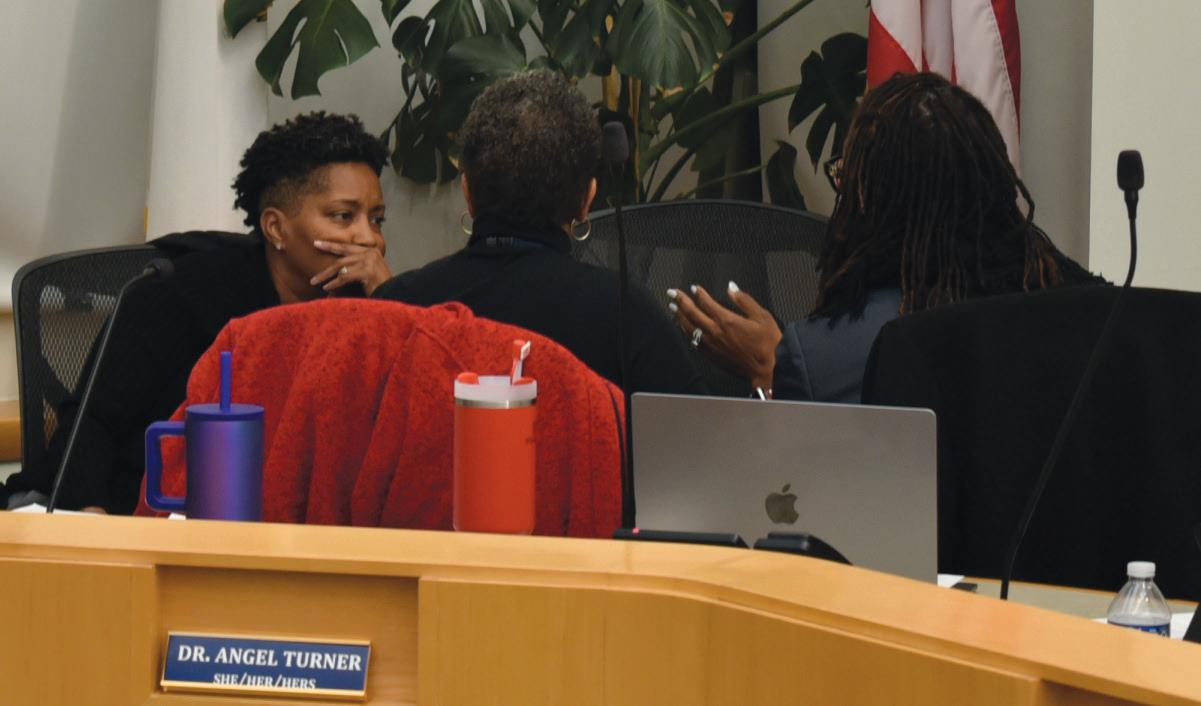
e Evanston/Skokie School District 65 Board of Education forgot to vote on one school closure scenario, stalemated on two and rejected a fourth at its Monday meeting.
With former board member Omar Salem’s seat vacant, the board split over whether it should close one or two schools in addition to Dr. Bessie Rhodes School of Global Studies before the 2026-27 school year. Although it unanimously rejected a proposal to close Kingsley and Willard Elementary Schools, scenarios that would close Kingsley and Lincolnwood Elementary School or just Kingsley both tied 3-3.
District administrators had presented those three scenarios and a fourth, which would close Lincolnwood alone, at a Nov. 3 board meeting. A majority of board members in a endance at that meeting — albeit three of ve, without board members Maria Opdycke or Salem — indicated a preference for the scenarios that would close two schools.
However, the district’s legal counsel told administrators the informal poll was not enough to eliminate the one-school scenarios from consideration, Superintendent Angel Turner explained Monday.
Still, legal counsel and administrators forgot to include the Lincolnwood-only scenario in the Monday night agenda. Because agenda items must be public for at least 48 hours before a vote, the board will vote on that scenario at a special meeting ursday, Turner added. According to the district’s legal counsel, District 65 will automatically default to zero additional school closures for the 2026-27 school year if the board does not reach a consensus on any of the four scenarios, Turner said.
“I think it was just an oversight on our end to say that we shouldn’t have had (the Lincolnwood-only scenario) as well,” she said.
Whatever the board decides, it will have to implement its choice next summer alongside its plan to open the new Foster School and close Bessie Rhodes. e meeting prolonged a chapter that began on Sept. 29, when administrators unveiled scorecards for each elementary school in the district and plans for how the district could shu er up to four schools
before the 2026-27 school year. e board began with 33 scenarios, and although the board has revisited old scenarios and some members have proposed new ones, the Monday night meeting was intended to ocially choose at least one scenario to advance further. e closures and program consolidations are part of Phase 3 of the district’s Structural De cit Reduction Plan, which will involve $10.9 million to $14.85 million in budget cuts before scal year 2030. In collaboration with a group of planning subcommi ees sta ed by community members, the district used
ve criteria to score scenarios from least to most impactful.
e district’s e ort to set a course for long-term nancial stability comes as former Superintendent Devon Horton faces a federal criminal trial on 17 counts of embezzlement, wire fraud and tax fraud.
e board will hold closed-door sessions Dec. 2, 4 and 9 to discuss and review candidates to ll Salem’s seat, Board Vice President Nichole Pinkard said. e district published the application for the seat on Nov. 11.
Opdycke asked the rest of the board Monday if it had any criteria to evaluate candidates.
“We have to gure that out together,” Pinkard said. s.sivaraman@dailynorthwestern.com
» For more on the DISTRICT 65 DILEMMA , see pages 4-5



By GLORIA NGWA the daily northwestern
As Garrett-Evangelical Theological Seminary prepares to relocate to the southern part of Northwestern’s campus in fall 2027, its over 170-year relationship with NU — shaped by a shared history and an independent mission — continues to evolve.
Garrett is a private seminary and graduate school affiliated with the United Methodist Church. The seminary offers programs to train leaders in theology, ministry and public service, and maintains a Methodist approach to education.
The seminary was founded in 1853 by Methodist leaders who aimed to create a community where faith and learning reinforced one another, according to Garrett President Javier Viera. The leaders sought to educate clergy for the church and citizens for a growing democracy, with NU shaping civic leaders and Garrett shaping religious leaders, according to Viera.
Though located on NU’s campus, Garrett remains independent.
In a written statement to The Daily, Viera said that the seminary’s founders created two distinct institutions to pursue separate missions, but with the intention to “strengthen and serve a burgeoning nation.”
“What we’re doing today — transferring our current campus to Northwestern while relocating to new facilities on NU’s campus — is a contemporary expression of that founding partnership,” Viera wrote.
In past decades, Garrett offered joint degrees with the Bienen School of Music, Medill School of Journalism, School of Education and Social Policy and Kellogg School of Management, according to Viera. Garrett’s Center for the Church and the Black Experience previously partnered with NU’s Black House, and the seminary previously worked with the University’s Religious and Spiritual Life staff, according to Viera.
Second-year Master of Divinity student Medomfo Owusu said she uses NU’s library resources and has seen NU students using Garrett’s library. Owusu said she has intentionally built community at NU through her involvement in Bienen, the Northwestern Community Ensemble and the Black House.
“When I have reached out, those Northwestern communities have been very responsive and receptive
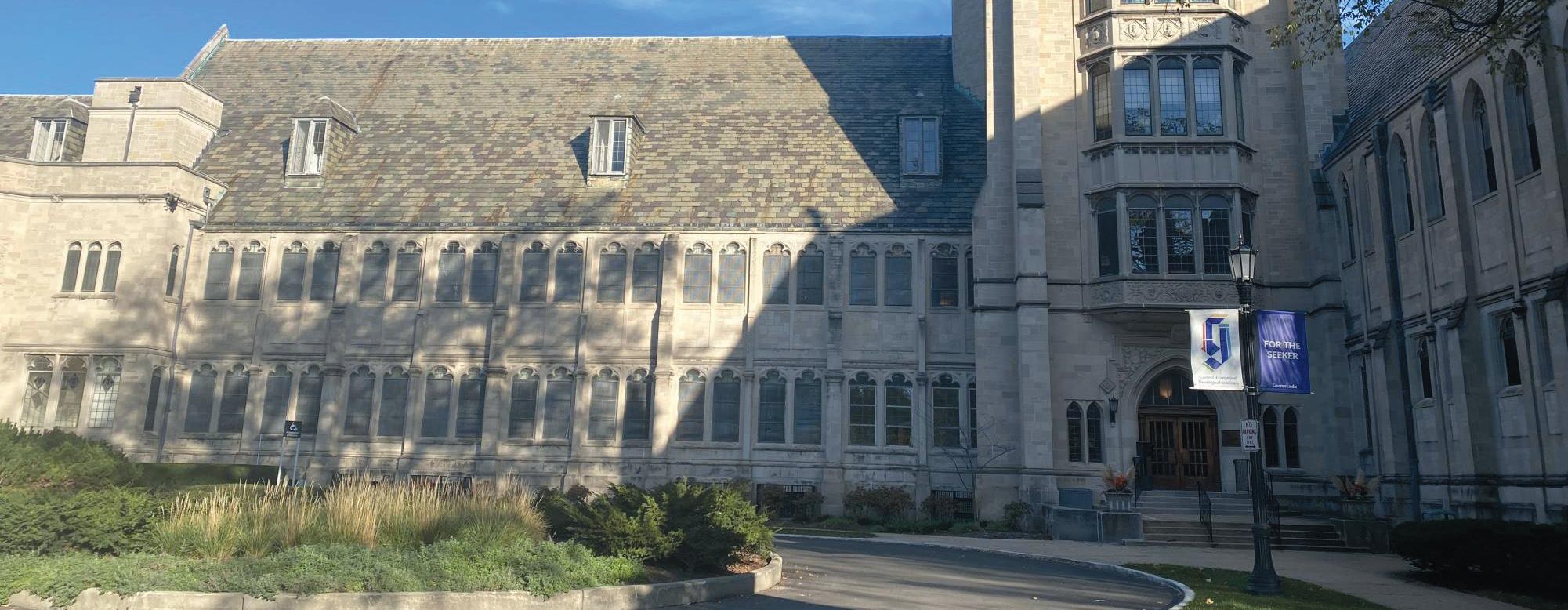
Garrett-Evangelical Theological Seminary will relocate to Northwestern’s South Campus in fall 2027.
to my presence and have made me feel very welcomed,” Owusu said.
Third-year Master of Divinity student Lauren Canary said Garrett’s strong sense of community stems from peers spending time together both in and outside of school. She said that, especially since most Garrett students are online, they have less opportunities to travel off-campus socially.
“Our students and peers are also our best friends here because they’re the people we know in this community,” Canary said.
Viera wrote that the balance between Garrett’s independence and its shared mission with NU reflects both institutions’ Methodist heritage, which is “grounded in education that forms both mind and spirit, intellect and conscience.”
He wrote that this original vision continues to shape Garrett’s mission in forming theologically grounded leaders for a complex society.
“We believe that religious literacy (regardless of religious belief and practice) is also an important skill for good citizenry and sound public leadership,” Viera wrote. “That commitment grows out of our shared Methodist legacy, which compels us to remain engaged with the intellectual life of the university.”
Third-year Master of Divinity student Eui Jin Shin said Garrett’s teachings on contextual theology encouraged her to appreciate both her own and other communities.
Shin said Garrett is a very diverse community with many international students and said the tight-knit
community facilitates student connections.
“I gained an interest in other backgrounds, and I earned a lot of interest in marginalized minorities,” Shin said. “So being heard and being recognized in my own context allowed me to recognize others.”
Canary said Garrett’s presence enriches the Evanston community: Its curriculum includes field education, in which students go out to work at local nonprofits, churches, food kitchens and other organizations in the Chicago area.
Shin said Garrett students strive to move beyond the classroom, engaging with the wider community to express what they’ve learned through their actions.
“We’re aiming to express the deepening of God, and we should express that to the world and not just keep it to ourselves,” Shin said.
Viera wrote Garrett’s presence reflects a commitment to moral reflection, spiritual depth and social responsibility within both the University and city. He wrote the seminary can be a resource for NU students exploring purpose, ethics, public service or vocation, regardless of religious affiliation.
“Northwestern strengthens Garrett through its vast resources; Garrett enriches Northwestern by contributing theological insight, ethical reflection, and spiritual imagination at moments of moral crisis,” Viera wrote. “Together, we can prepare leaders who are not only smart but wise, not only skilled but compassionate, not only well-prepared but courageous.”
gloriangwa2028@u.northwestern.edu
The Daily Northwestern www.dailynorthwestern.com
Editor in Chief Emily Lichty eic@dailynorthwestern.com
General Manager Stacia Campbell stacia@dailynorthwestern.com
Holly and John Madigan Newsroom Phone | 847.491.3222
Campus desk campus@dailynorthwestern.com City desk city@dailynorthwestern.com
Sports desk sports@dailynorthwestern.com
Ad Office | 847.491.7206 spc-compshop@northwestern.edu
The Daily Northwestern is printed each Wednesday during the academic year, except vacation periods, the two weeks preceding them and once during August, by Students Publishing Co., Inc. of Northwestern University, 1999 Campus Drive, Evanston, IL 60208. All news is published 24/7 online at Dailynorthwestern.com.
First copy of The Daily is free, additional copies are 50 cents. All material published herein, except advertising or where indicated otherwise, is Copyright 2025 The Daily Northwestern and protected under the “work made for hire” and “periodical publication” clauses of copyright law.
POSTMASTER: Send address changes to The Daily Northwestern, 1999 Campus Drive, Evanston, IL 60208. Subscriptions are $100 for the academic year. The Daily Northwestern is not responsible for more than one incorrect ad insertion.
Check out DAILYNORTHWESTERN.COM for breaking news


















































By EMILY DISSANAYAKE
the daily northwestern
A er the Evanston/Skokie School District 65 board failed to pass a single school closure scenario at Monday’s school board meeting, the future of the closure scenarios seems to hang in limbo.
Ever since the district introduced scorecards for each school on Sept. 29, the school community has been absorbed by Phase 3 of the district’s Structural De cit Reduction Plan, which aims to cut between $10.9 to $14.85 million from the budget before scal year 2030. Over the course of almost two months, the board narrowed 33 scenarios down to three. Two of them involved two school closures – Lincolnwood and Kingsley or Willard and Kingsley – while the third scenario involved a Kingsley-only closure.
Monday’s meeting was supposed to be the culmination of the SDRP Phase 3 process, which included the creation of advisory Facilities, Finances and Student Programming subcommi ees made up of community members.
e board unanimously voted against the Kingsley and Willard scenario, one of the two-school closure scenarios. However, both the Lincolnwood and Kingsley scenario and the Kingsley-only scenario ended in 3-3 ties, preventing the two motions from moving forward. e recent resignation of former board member Omar Salem on Nov. 4 made the stalemate possible. e vacancy leaves the board with only six members.
Right before the vote on the nal scenario, the board realized it forgot to add a Lincolnwood-only scenario to Monday’s agenda. e board adjourned for a veminute recess so members could consult with the district’s legal counsel about how to proceed.
What now?
According to district policy, every agenda item must be posted at least 48 hours in advance, Superintendent Angel Turner said, so the board’s immediate next step is to hold a special board meeting on ursday to vote on the Lincolnwood-only scenario.
Prior to the Kingsley-only closure vote, Turner said that if no consensus on any of the scenarios is reached, the board would automatically default to zero school closures for the 2026-27 school year.
“It really depends on how you come out on this vote, because a er this, is nothing,” Turner said.
In an update posted on the District 65 website on Tuesday, Turner said the board will continue to discuss how to return District 65 to “ nancial sustainability.”
According to the district’s Phase 3 School Closures Hub page, in the case that there are no school closures, the board will only save $50,000 from the Foster School net savings as opposed to about $2 million with one school closure and over $4 million with two school closures.
e deadlock also raises unknowns about how the district will balance the de cit if it were to proceed with a zero school closure scenario.
During public comment, many parents in support of a two-closure scenario expressed concern that a oneschool closure would force funding cuts to districtwide programs, including the Structured Teaching Education Program, Two-Way Immersion program and African Centered Curriculum.
“If we close one or zero schools, where would we cut programs and support sta ?” Facilities subcommi ee member Dan Whiteley said. “A school building without these things is a shadow of what it could be. A vote to only close one school is a vote to diminish the education of every single child in this district.”
Other parents believed that there were too many unanswered questions to go through with a two-school closure and that doing so would deepen divisions within the community. Some also pointed out that closing one school would ultimately result in a twoschool closure, referencing the board’s 2024 decision to close the Dr. Bessie Rhodes School of Global Studies a er the 2025-26 school year.
Community members also brought up the D65: Invest in Neighborhood Schools’ alternative proposal, which calls for only one school closure and has over 2,000 signatures in support, as well as other solutions submi ed by various community groups.
“Now more than ever, you have an engaged, passionate community ready to invest a mountain of time, energy, knowledge and heart in helping our schools turn the page on the past and achieve a brighter future for all of Evanston,” Lincolnwood parent Michael Dice said. “Support all of Evanston and vote for a one-closure scenario.”
New board member appointment
e board is in the process of choosing a new board member to replace its vacant seat. Applications for the position close Nov. 19, and an appointment is set for mid-December.
Closed-door sessions will be held Dec. 2, 4 and 9 for members to review applicants.
At Monday’s meeting, board member Maria Opdycke questioned the board’s planned appointment process and emphasized the importance of transparency and trust.
“Why would we conduct an open process with people that were unve ed by the community so close to an election, when we’re dealing with so many difcult problems?” Opdycke asked.
Board member Andrew Wymer disagreed, instead suggesting that following current board policy is the best practice to ensure transparency.
Both Wymer and Opdycke won two of four available board seats in the April election against a eld of 12 contenders.
In response to Opdycke, Board Vice President Nichole Pinkard added that board members may give more credit to individual applicants, but divisions within the board would prevent it from using a standard criteria.
“As such a split board, there’s no consensus of how we would do that,” Pinkard said.
emilydissanayake2029@u.northwestern.edu
April 2017: Voters passed a referendum to raise local property taxes by about $450 annually for the average Evanston property owner in an e ort to combat increasing educational costs. e increased tax revenue aimed to secure the district’s nancial future, then-Superintendent Paul Goren said at the time. e April election also brought new board members to the district, including Joey Hailpern, who served on the board until May 2025.
June 2020: Devon Horton was named superintendent of District 65.
March 2022: e District 65 board unanimously approved the building of a K-8 school in the city’s historically Black 5th Ward.
October 2023: e District 65 board learned that its 5th Ward school was projected to cost $65 million, a price tag $25 million over the allocated budget. One week later, the board decided to make the 5th Ward school a K-5 school.
February 2024: e district’s nancial advisor, Rob Grossi, sent the board a memo stating that the district was projected to have growing operating de cits, but no matching expenditure reductions.
April 2024: e district announced its proposed Phase 1 cuts as part of its Expenditure Reduction Plan, which would later become the Structural De cit Reduction Plan. In Phase 1, the district cut $6.5 million in spending and reduced sta ng by 39 full-time employees.
July 2024: e 5th Ward school was named Foster School at a groundbreaking ceremony to begin construction.
September 2024: e district announced a projected $13.2 million de cit for its scal year 2025 budget.
November 2024: Seventh and eighth grade students who want to stay at Bessie Rhodes to nish classes until the end of the 2024-25 school year would be able to, the district wrote in an email to families. e classrooms would be sta ed under a modi ed sta ng plan, according to the email.
January 2025: e board unanimously passed $13.3 million in spending reduction for scal year 2026. e cuts included the elimination of 73 full-time equivalent positions.
June 2025: e three SDRP subcommi ees shared their criteria for school closure considerations, on which the district based scorecard dra s for each school.
September 2025: e district released its initial 33 school closure scenarios, ranging from closing zero to four schools. e board agreed to close three schools, but did not decide which ones.
November 2025: Board member Omar Salem resigned from the board, citing a “unique opportunity,” taking his family out of Evanston for several months. With only six members, the board failed to pass any of its school closure scenarios — to shu er Lincolnwood and Kingsley, Willard and Kingsley or just Kingsley — and forgot to add a fourth scenario, which would only close Lincolnwood, to the agenda. e board will vote on the scenario to only close Lincolnwood at a special board meeting ursday. If the board can’t pass on any of the four scenarios, Turner said that, according to the district’s legal counsel, District 65 defaults to closing zero schools in addition to Bessie Rhodes before the 2026-27 school year.


As Evanston/Skokie School District 65 prepares to vote on its nal school closure scenario, e Daily took a look back at some of the key events and leadership changes that play a role in the district’s current nancial and in astructure predicament.
June 2019: Goren resigned from his position as superintendent.
April 2021: Board members Soo La Kim, Biz Lindsay-Ryan and Hailpern kept their seats on the board and were joined by newcomer Donna Wang Su.
July 2023: Horton le District 65 to become superintendent of DeKalb County School District in Georgia.
January 2024: e District 65 board voted 4-2 to begin the closure process for Dr. Bessie Rhodes School of Global Studies, the district’s only wall-to-wall Two-Way Immersion school.
March 2024: Angel Turner was named superintendent of District 65.
June 2024: e District 65 board voted 5-2 to o cially close Bessie Rhodes a er the 2025-26 school year.
August 2024: In Phase 1.5 of the SDRP, the district announced a hiring freeze and its goal to reduce non-essential budget items for scal year 2025.
October 2024: Turner sent an email to Bessie Rhodes families announcing the closure of seventh and eighth grade classrooms due to sta ng di culties, set to go into e ect in mid-November.
December 2024: e district announced its goals for the three phases of the SDRP, including cu ing about $13.2 million in spending in Phase 2 and $15 million in spending in Phase 3.
April 2025: Four new members — Patricia S. Anderson, Andrew Wymer, Nichole Pinkard and Maria Opdyke — were elected to the board. Incumbents Hailpern, LindsayRyan, Kim and Su did not run for reelection.
e district also began work on Phase 3 of its SDRP, including meeting with three subcommi ees of community members to address issues with the district’s nance, facilities and student programming.
August 2025: e district announced it had ended scal year 2025 with a $710,000 de cit, a signi cant decrease from the originally projected $13.2 million de cit.
October 2025: Horton was indicted on 17 counts of embezzlement, tax fraud and wire fraud for alleged actions during his time at District 65. He pleaded not guilty to all of the counts.
Following the indictment announcement, then-Board President Sergio Hernandez stepped down, and current Board President Anderson was unanimously voted into the role. e board also reached a consensus to explore two-school closure plans and named Lincolnwood, Kingsley and Willard Elementary Schools as potential closure candidates.
By SIDDARTH SIVARAMAN and SOPHIE GARDINER the daily northwestern @sidvaraman
For Lincolnwood Elementary School parent Katie Armistead, it was “too easy” to find alternatives to school closures.
Armistead and fellow Lincolnwood parent Liz Wolens lead D65: Invest in Neighborhood Schools, a coalition pushing to close only one school and pull other financial levers. With a task force of around 30 parents across the district, the group presented an alternative proposal at the Nov. 3 board meeting, which has garnered over 1,000 signatures in support.
“We didn’t even have to go out and find people. They just came to us,” Armistead said. “We talked to so many people who were like, ‘This is my expertise. How can I help?’”
The proposal calls on the district to prove its capacity to successfully close Dr. Bessie Rhodes School of Global Studies and open Foster School so that the transition’s impact on the deficit and community can be fully assessed. It also asks the district to preserve programs like Two-Way Immersion and the Structured Teaching Education Program.
To cut costs and raise revenues, the proposal lists 20 ideas from selling underutilized district

At first, Katie Hauser didn’t want to send her children to Willard Elementary School.
Children on her side of her 5th Ward street, nicknamed “Willard Island,” must make the 2.3mile drive or bus ride to Willard. Across the street, children travel 1.5 miles to Orrington Elementary School, and children living in the next block over walk just four blocks to Dewey Elementary School.
When Hauser’s daughter reached kindergarten age in 2020, she applied for a permissive transfer to send her to Dewey. It was denied.
Today though, she said Willard is like a “second home” for her family. On the third day of her son’s kindergarten year, one of his classmates was shot and killed. The classroom of kindergarteners became tightly-knit over the year, helping each other process their trauma, she said.
While her son is now in third grade, Hauser said she is planning a holiday party for families from that
on a quest for clarity. Her oldest child, a fifth grader, is on the autism spectrum, so she is enrolled in Lincolnwood’s
Structured Teaching Education Program. The program equips three schools — Lincolnwood in the northwest, Lincoln Elementary School in the southeast and Nichols Middle School, centrally — with staff and dedicated facilities, like enclosed playgrounds and sensory rooms, to support students with special needs. From her home near Evanston Township High School, she knows she will have to drive north to drop off her younger daughter and east to drop off her older daughter at Nichols next year. Because of District 65’s persistent difficulties with transportation infrastructure, she said she gave up on busing her children long ago.
Lincolnwood would close under one remaining scenario, and its STEP program would move to Dewey Elementary School. Powell said he wondered how the district plans to equip Dewey with the facilities and staff necessary to take on the program.
“You’re having these kids restart in a different
Content warning: This story contains mentions of gun violence.
When the Evanston/Skokie School District 65 Board of Education voted on which school closure
facilities to initiatives that aim to increase enrollment. The task force prioritized reaching long-term financial sustainability, preserving Title I schools and minimizing equity impact, walkability, engaging with teachers and finding a long-term vision, Armistead said.
Wolens said the district could accept more permissive transfers while drawing walkable boundaries to balance the short-term priority of keeping existing school communities together, as well as the long-term goal of maximizing the number of students that live within a walkable distance of their school.
Members on the task force — some who could lose their school and others whose school has never been threatened — have put the district’s needs above their own, Armistead said.
“We love Evanston, but we have never loved Evanston more than in the last six weeks,” Wolens said.
scenarios to advance Monday night, several school communities and parent groups watched with bated breath. The Daily asked stakeholders from seven parent groups and school communities before the Monday
Kingsley Elementary School parent and former District 65 school board candidate Peter Bogira described Kingsley’s road to closure as a “slowmotion car crash.”
The underpopulated school is about 0.5 miles from the Foster School site, he said. Despite the rationale for closing Kingsley, though, Bogira said parents have received little outreach from the administration to provide their insight into how the district could best implement the closure.
“One week ago, Kingsley families got a onequestion survey to weigh in about our thoughts on how new boundaries should be drawn,” he said. “I think it’s really tough to do that kind of outreach this late in the game because the board is expected to weigh in on a scenario to move forward on, 10 days after that survey was sent out.”
The administration presented revised school boundaries for two scenarios that would close Kingsley — one that would also close Lincolnwood Elementary School and another that would close Willard Elementary School — at its last board meeting Nov. 3. In an effort to avoid splitting up the Kingsley community, the administration proposed sending all Kingsley students to Orrington Elementary School.
Bogira said the recommendation would force
meeting what they believed the district should do. s.sivaraman@dailynorthwestern.com sophiegardiner2029@u.northwestern.edu

too many children to cross Green Bay Road, which would be a traffic hazard. It would not preserve the Kingsley community, he added, because some of the school’s families living in the 5th Ward would have no choice but to attend Foster.
Drawing an unorthodox boundary to keep a current school community together may not make sense for new students in the long term, he said. Instead, he said the district should draw “natural boundaries” that keep geographic neighborhoods together.
He also advocated for a moratorium on school closures after Phase 3 of the SDRP to force the district to commit to cost-cutting measures that avoid closing schools or programs.
“The (Kingsley) community is sort of at peace with the prospect of a closure,” Bogira said. “It’s more understanding how we’re going to smooth the landing as much as possible — not just for Kingsley, but for everybody.”
When District 65 asked community members to volunteer for three SDRP subcommittees, Haven Middle School and Lincolnwood Elementary School parent
in devel-
kindergarten class.
“This is like a bedrock of our community now,” she said. “These are our people.”
Next year, “Willard Island” will be no more as Foster School’s boundaries swallow the smorgasbord of school assignments in the 5th Ward. The district promised to let 5th Ward families choose not to move their children to Foster — but with Willard recommended for closure in one remaining scenario, Hauser’s husband, David Hauser, said he felt the district may walk back that commitment.
The Hausers emphasized that they want the district to let 5th Ward families choose to keep their children at their current schools when Foster opens.
A school community is built on strong relationships and trust, Katie Hauser said. She added that although those bonds may be easier to build when walking to school, her family has invested time and resources into their connections at Willard.
That social stability is especially important for young children, she added.
“We want Foster to be successful. We want it to be a community hub the same way Willard has been that for us,” Katie Hauser said. “I think that can only be done if it’s opened slowly and with thoughtfulness over time.
environment, and you’re going to see regression,” she said. “It’s a transition, and it’s been known that transitions are hard for children that are on the spectrum.”
Powell, a single mother, said she started organizing with other parents and writing to the board after her children came home worried that their school was going to close. Since Powell moved to Evanston — largely because of the STEP program — her child has had the same teacher, who she called her child’s “best friend.”
As her fifth grader moves to Nichols and her fourth grader may be forced to leave Lincolnwood, Powell said her children are nervous that they’ll lose the teachers and friends they have grown up with.
“I guess I want clarity on how I can best prepare my kids for something that we know is about to happen,” she said.
Impact Evaluation was too pressing to participate in local advocacy.
That was until the district administration released its scorecards and scenarios. The more he studied the district’s underlying data, the more questions he had, he said.
His digging pushed him to voice his concerns about the district’s data at the District 65 board meeting on Oct. 14. After his comments, he was approached by Washington parent and epidemiologist Kelly McCabe.
“I just kind of blindly trusted that the district was making good decisions and using good data for those

Jason Orloff, a Nichols Middle School parent and member of the Structural Deficit Reduction Plan’s Finance Committee, said he doesn’t know “what the school closure is about.”
According to Orloff, there is more room for cost reductions in staffing and administration before buildings need to be closed. The district should reassess how it allocates resources and identify what changed during the pandemic years, he said.
In particular, Orloff said he was disturbed by the “bloat in administration.” Although student enrollment has declined by around 25% since 2018, the total number of full-time employees in the district has risen, according to data from the Illinois State Board of Education.
Orloff said he has not seen a concerted effort
Erika Crowther moved to Evanston because of Willard Elementary School’s Two-Way Immersion program.
As a bilingual Latina whose husband speaks six languages, Crowther said instilling multilingualism in her children through the program’s English and Spanish curriculum was very important to her.
But now, the Willard TWI strand is recommended for closure in every scenario to be considered by the board Monday. If it does close, Crowther will either have to send her children to the Foster School or give up TWI and keep them at Willard.
Spanish speakers on the northwest side of Evanston focus on finding homes and resources near Willard because of its TWI program, she said.
“They want to be able to retain the culture and the language and (give) their kids a walkable neighborhood school,” she said. “They certainly didn’t buy homes at Willard to then bus their kids two miles away.”
The Willard TWI community was “blindsided” on Sept. 29 when district administrators unveiled their recommended scenarios, she said. Board members Maria Opdycke and Sergio Hernandez have visited Willard since then, she added, but no one from the
decisions,” McCabe said. “It wasn’t until it became quite clear that I did not feel that way anymore that (I jumped) in.”
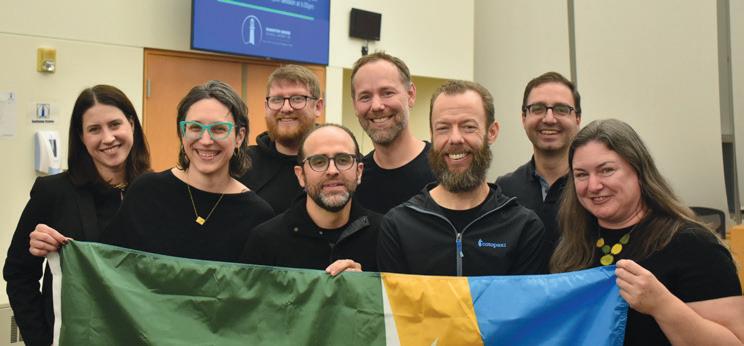
She told Quiñones she shared his concerns, and from then on, she became part of the Legion of Data Nerds. Sporting black shirts to represent neutrality and highlight the “black box” obscuring how the district sourced its data, the group has spoken at the last two board meetings.
The district’s data tables were published as PDFs, and it was clear that work had been done “behind the scenes” to produce the scorecards, data scientist and fellow “Nerd” Lauren McNamara said. McCabe added that the subcommittees did not represent groups like the Two-Way Immersion community, and Quiñones
to reduce staffing or other expenses he views as unnecessary. He also questioned the motive for pursuing school closures in the first place.
“It wasn’t ‘what could we do?’” Orloff said. “It was ‘which two are we going to close, and how do we adjust?’”
Charles Dan, another SDRP Finance Committee member and District 65 parent, said he wants to challenge the board to see whether funding is spent prudently.
“District 65 has among the highest budget per student out of any other school district in the area,” Dan said. “There are plenty of resources already available to do everything we could possibly want for the students in D65 and have one of the best school districts in the country.”
In an Oct. 10 letter to the District 65 Board of Education, members of the Finance Committee wrote that the school-closure scenarios presented to the board did not reflect their input and were based on incomplete data.
“Evanston’s brand has been spectacular for education,” Orloff said “Dr. Horton’s administration destroyed that. But all we have to do is turn it back on.”

administration had reached out to her to gather data. Instead, Crowther started collecting her own data. The Foster TWI program — which would incorporate students from Willard, the 5th Ward and Bessie Rhodes — would be over 90% capacity in three grades, she said. Through a survey sent to Willard TWI families, she also found that about half of the strand’s families prefer to stay at Willard over moving to Foster.
The administration’s modeling reassigned all TWI students to the strand closest to them, she said. The administration also scored the school based on equity impact without factoring in Willard TWI closing, she said.
“(Students) need to be given the choice: If they want to stay with their classmates and their community, or if they want to move to the neighborhood TWI program closest to them,” Crowther said.
said the data weighted concerns with facilities too heavily while discounting educational outcomes in the classroom.
The group has sent four letters to the board and administration outlining its concerns, and on Nov. 12, it published a memo proposing financial alternatives to closing schools. Although he is “cautiously optimistic” ahead of Monday’s meeting, Quiñones said he plans to continue helping in the long term.
“It’s very energizing to be amongst all of these different groups of people that care really deeply and also have such brilliant ideas,” McCabe said. “I feel like Evanston is rich in so many ways and has so many opportunities to build on what has already begun.”
43-day government shutdown ended the night of Nov. 12, the Illinois Department of Human Services announced Friday that SNAP bene ts would return to state residents in full by Nov. 20.
However, food insecurity has also intersected with other community concerns in Evanston.
ETHS teacher Amy Moore sponsors the Students Without Borders club at ETHS, which supports immigrant and undocumented students. Many of those families have been a ected by the presence of Immigration and Customs Enforcement agents in the community, leaving them unable to work out of fear over the past month, Moore said.
“ at’s impacted how much income they have and their ability to buy food, among other things,” Moore said.
In her ten years of teaching at ETHS, Moore has never seen so many community members asking for support until this year, when students have come up to her asking if she knew where they might turn to for assistance.
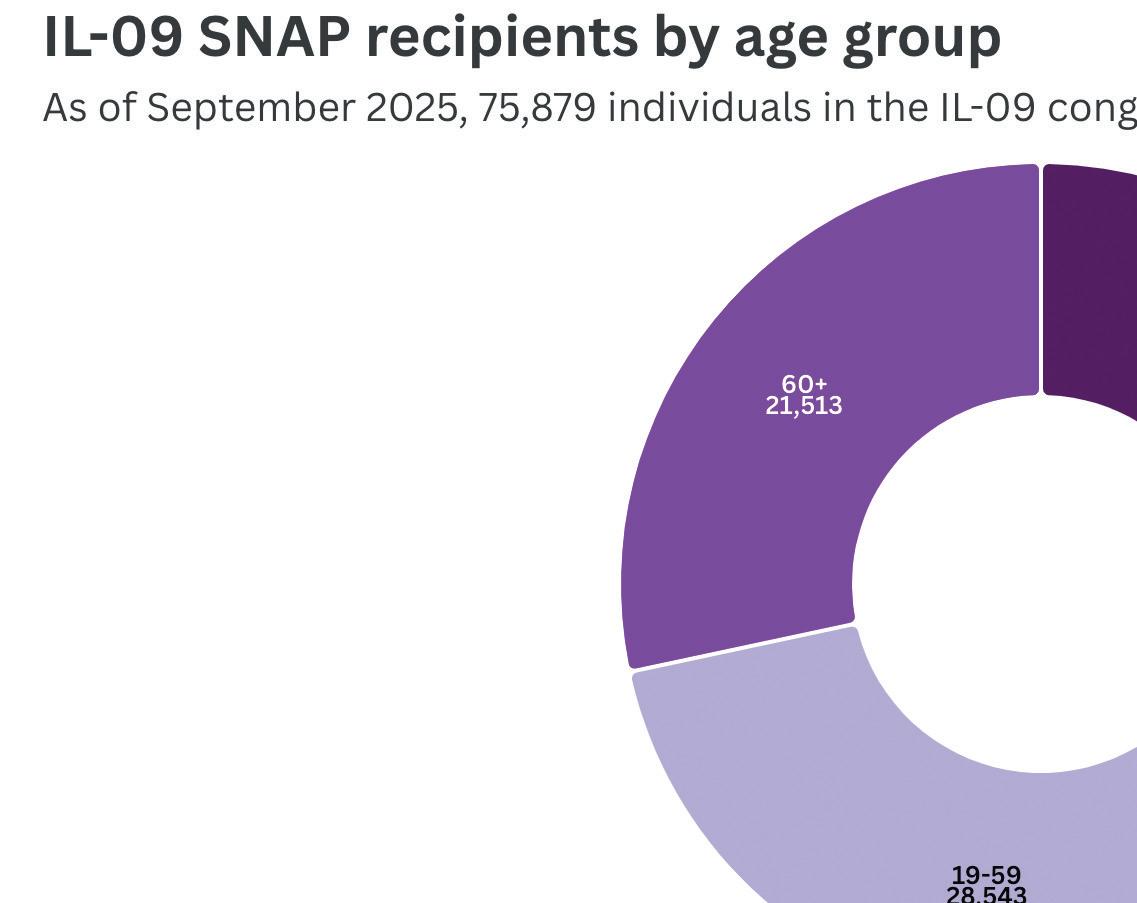
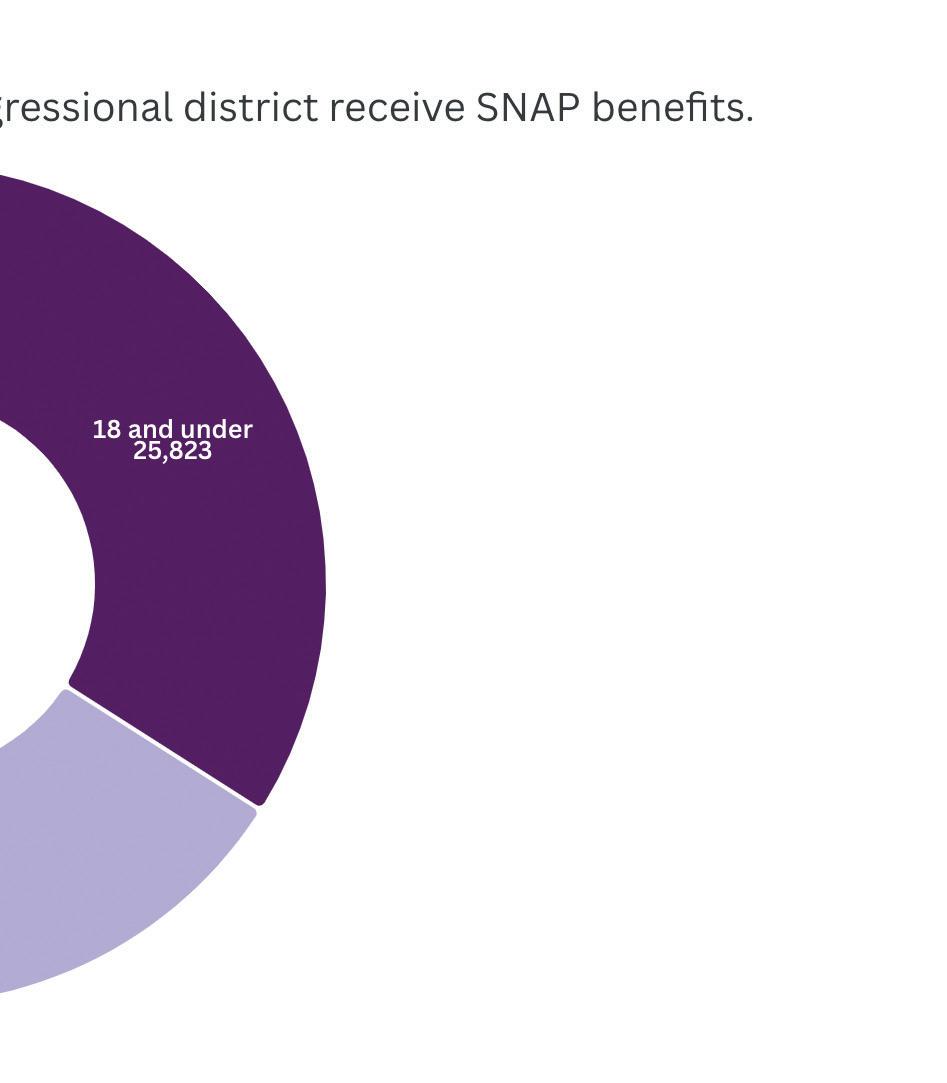
Data from the Illinois Department of Human Services shows that food insecurity was already a signicant issue in Evanston and surrounding areas before the shutdown. As of September 2025, more than 25,000 people aged 18 and under across Illinois’ 9th Congressional District receive SNAP bene ts.
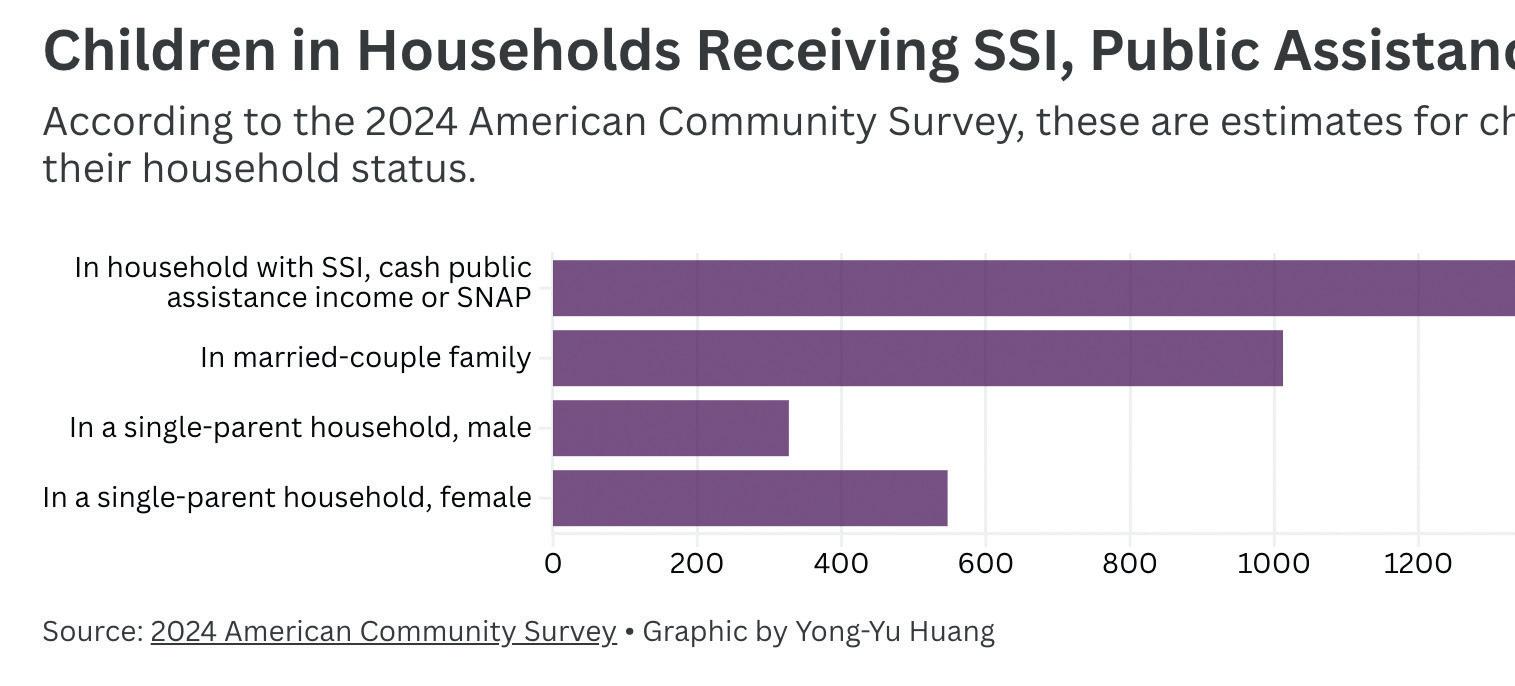
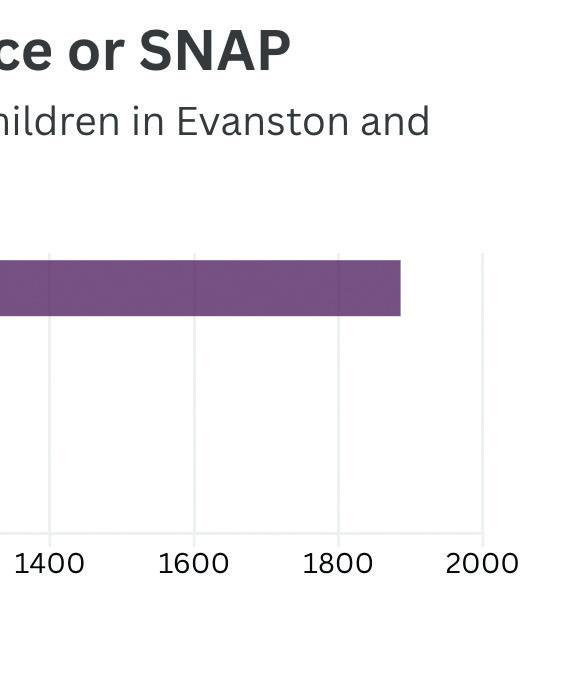
According to the 2023 American Community Survey, 13% of Evanston residents under 18 lived in households receiving Supplemental Security Income, public assistance or SNAP.
Community organizer Valerie Kahan said roughly 3,000 families in the Evanston/Skokie School District 65 and Evanston Township High School District 202 communities have been identi ed through their schools as needing assistance.
At the Nov. 10 City Council meeting, Kahan, a founder of the newly established Evanston Community Cares Fund, secured city funding to support Evanston residents facing nancial and food insecurity.
Kahan cautioned against thinking that the return of bene ts will solve the community’s food security problems.
“As we move into where SNAP bene ts are fully restored, we have to remember that there are new regulations that are going into e ect, which require people to work or volunteer 80 hours a month,” she said.
New requirements for SNAP recipients
In July, the Trump administration passed the One Big Beautiful Bill Act. Among its provisions are new
eligibility requirements for SNAP recipients, which go into e ect on Dec. 1. In order to be eligible for SNAP bene ts, individuals aged 18 to 64 must “work or volunteer a minimum of 80 hours per month” or complete “certain training or education,” according to the OBBBA. ese requirements can be met through activities including paid or unpaid work, vocational training and community service.
Prior to the bill, the federal government de ned Able-Bodied Adults Without Dependents as adults aged 18 to 54 with no children under 18 and no disabilities, according to the Illinois Department of Human Services.
The bill has now modified the definition of ABAWDs to include veterans, 55-64 year-olds, homeless individuals and ABAWDs with children aged 14 or older. Exceptions may be made, including for individuals who are pregnant or those responsible for the care of an incapacitated household member.
ABAWDs who fail to meet the requirements or qualify for an exemption “may only receive bene ts for three months during a three-year period,” beginning Feb. 1, 2026, although this is “subject to further action by the courts,” the statement read.
OBBBA also imposes additional restrictions on immigrant eligibility. ose granted o cial humanitarian protections, such as refugees, asylees and certain victims of human tra cking or violence and torture, are no longer eligible, according to the IDHS.
“Trump’s budget bill is designed to systemically prevent Americans and Illinoisans from receiving assistance through the SNAP program by implementing new requirements that burden states and individuals who rely on this 100 percent federally funded resource,” an IDHS spokesperson wrote in a statement to e Daily.
e new requirements could impact about 340,000 Illinois residents, according to IDHS. If no changes are made to the legislation, individuals could lose bene ts starting May 1, the department added.
Local community mobilizes to support families
On Nov. 16, organizers distributed around 300 boxes of food and supplies collected at the Nov. 2 ETHS food drive to District 65 families at 2100 Ridge Ave., the site of the city’s old Civic Center.
According to event volunteer and 8th Ward resident Jennifer Woodrum Hogg (Bienen ’00, ’02, ’22), people were “lined up out of the parking lot” half an hour before the event even started. Volunteers also delivered some boxes to families who were unable to leave their homes, she said.
In a Nov. 3 statement, Superintendent Angel Turner

told district sta and families that changes to SNAP bene ts or participation in the program would not a ect students’ ability to receive free meals. e district also encouraged families to reach out to the Nutrition Services team if they were unsure whether they qualied for free or reduced meals and provided links to additional resources.
“Participation in SNAP or changes to SNAP bene ts will not, in any way, a ect your child’s ability to receive school meals,” Turner wrote. “No D65 student will go without access to food at school.”
Nearly 1,200 students in District 65 receive SNAP bene ts, a District 65 spokesperson wrote in a statement to e Daily.
In recent weeks, Evanston Vineyard Church’s pantry has served around 100 to 200 households each week, according to Pastor Keva Green. Each household ranges from one to ten people, she said.
“What I’ve been aware of is less senior citizens and more families over the last couple of months. We have a steady amount of seniors, but the folks who are coming towards us are either parents or grandparents of children that need food that were impacted by the SNAP
bene ts,” Green said.
e church’s main concern, Green added, is that they can’t feed those who visit more than twice a month.
ETHS community service coordinator Erin Claeys pointed out that although food insecurity is not a new issue in the city, recent events have brought more a ention to the issue, “especially in places like Evanston, which a lot of people perceive to not have a lot of need.”
According to Claeys, parents have contacted them to ask how their children can be connected to food resources at school.
ETHS teachers have also contacted them to ask on behalf of their students, Claeys added, especially educators who serve students who are multilingual or those newly arrived in the U.S. “ ere’s still a lot of shame around students needing food,” Claeys said. “So right now, we’re working on trying to gure out ways that are maybe more discreet, more private, for students to be able to collect food without them having to put themselves out there.”
y.huang@dailynorthwestern.com












By ANNA WATSON daily senior staffer
When he watches football games, former St. Rita of Cascia High School football coach Todd Kuska finds it interesting to keep an eye on his former players turned NFL coaches on the sidelines.
Sometimes, he catches a glimpse of his former Northwestern quarterback Mike Kafka, who played for him in the mid-2000s. What Kuska sees mirrors what he saw when Kafka was just a teenager: a man bristling with a poised and controlled manner.
“You see him on the sidelines go over and talk to a quarterback, go over and talk to an offensive group, and it’s the same type of mentality he had as a player, of, ‘Hey, let’s just sit down and talk about it,’” Kuska said. “Obviously, he’s a fiery guy too, when he needs to be.”
Last week, Kafka’s winding journey — which has included stops with St. Rita, Northwestern and various NFL teams — reached its summit when he was named interim head coach of the New York Giants.
Now with a game at MetLife Stadium under his belt, Kafka is continuing to exhibit the same traits his former coach said made him a star in Chicago.
“I think the best head coaches I’ve been around are guys that are confident, poised, have a direction, have a plan, and then go execute the plan,” Kafka told reporters on Nov. 12. “If something goes just a little bit differently, then you go back and you adjust.”
Kafka’s rise to the top isn’t so surprising for Kuska.
When Kafka first started playing with St. Rita’s varsity team during his junior year, he was a selfless player, according to Kuska. Kafka played wide receiver and quarterback at times that season. In his senior year, he was the starting quarterback and a team captain.
Kuska said that his quarterback’s skill set allowed him to put different things in the offense. Specifically, his athletic ability, intelligence and football IQ were standout attributes.
“I knew he had a football mind way back when in high school, meeting with him and talking to him and having him work some of my youth camps as an assistant coach himself with the younger guys,”
Kuska said. “I could always tell that he would be a great coach.”
Kafka’s understanding of why the team did certain drills and plays was greater than that of others. Kuska said that if there were mistakes in a play, his quarterback would be able to help correct his teammates diplomatically.
The same reasons why Kafka was a good high school player will lead to success in his new role, Kuska said.
“I think that’s something that is very often overlooked when you talk about the teams in the NFL,” Kuska said. “You still got to build a relationship. These guys are professionals, but deep down, it’s a game. They’ve got to have that desire to follow the guy that’s leading them. I think his ability to connect with guys will undoubtedly get him to get the most out of them and get them to play at their highest level.”
The tools Kafka cultivated at St. Rita made their way to NU for Kafka’s college career. He redshirted his first year in 2005 and waited until the 2009 season to really show what he was capable of.
That year, as a senior, Kafka led the Big Ten in passing yards, total offense, completions and completion percentage. The season culminated in a 38-35 overtime loss to Auburn in the Outback Bowl, where Kafka completed 47-of-78 pass attempts for 532 yards, four touchdowns and five interceptions.
His influence extended to off-field matters. In 2008, kicker Steve Flaherty, who also attended St. Rita, enjoyed his first season as a member of NU’s football program.
Flaherty said he did not know Kafka well in high school, but that they formed a stronger relationship in Evanston.
“As a little nervous freshman joining the Northwestern locker room, Mike took me under his wing as a fellow St. Rita grad in the Southside of Chicago,” Flaherty said. “He was really helpful in that way and was a great example throughout my Northwestern time.”
This sentiment manifested itself when Kafka invited Flaherty to events outside of football and went out of his way to say hi to him. According to Flaherty, a lot of guys wouldn’t care too much about going to the same high school, but Kafka took pride in there being another St. Rita graduate in the locker room.
Preston Stone 159-of-273, 1,706 yards 6.2 YPA, 11 TD, 9 INT Dallas
190-of-307, 1,881 yards
6.1 YPA, 11 TD, 6 INT Fayetteville, Arkansas
Kafka was also one of the hardest workers, according to his high school and collegiate teammates. Even when he was biding his time as a backup, he worked like he was a starter, spending extra time in the film room and the weight room.
The other thing that stood out to Flaherty was his former teammate’s composure.
“Probably what makes him a good coach now is having that calm demeanor under pressure,” Flaherty said. “That’s something that made him a good leader during his playing time, and I’m sure helps his players as a coach to keep them organized and focused when things can get tough.”
Kafka took his talents to the NFL after being drafted in the fourth round under then-coach Andy Reid of the Philadelphia Eagles in 2010, but it was not long before he returned to NU in 2016 to serve as an offensive graduate assistant.
The next year, Kafka jumped back to the NFL and reunited with Reid as an offensive quality control coach in Kansas City. His start with the Chiefs coincided with someone else’s — quarterback Patrick Mahomes.
After one season, Kafka was promoted to quarterbacks’ coach, where he was tasked with coaching the group during Mahomes’ first season at the helm. As history would best denote, the pairing must have worked well.
“Mike Kafka has played the position in the offense, so he knows and is another good guy to spend hours with,” Reid told reporters in September of 2018. “Mike was his personal coach last year. He did everything with him, now he is his coach in this spot… Mike was working heavy with Patrick.”
At the tail-end of the 2018 season, Mahomes earned his first MVP award, First-Team All-Pro nod and Pro Bowl honor. He also led the NFL in passing touchdowns. The 2019 season saw the Chiefs win the Super Bowl, and Kafka earned an additional title of passing game coordinator for 2020.
2022 brought a new opportunity to become the offensive coordinator — and also the assistant head coach a few seasons later — of the Giants under Brian Daboll. Even after Kafka moved on, Mahomes spoke highly of him, calling him a special person and coach.
“I spent a lot of hours with coach Kafka, where he was teaching me the playbook and teaching me how to become a quarterback in the NFL,”
Mahomes told reporters in 2023. “That continued for a long time. I knew right when he left here, he was going to be a head coach somewhere soon.”
Mahomes was right, although maybe not in the way he thought he would be.
Some Giants players had tough times with the news of Daboll’s Nov. 10 firing, but they also expressed support for Kafka. Wide receiver Darius Slayton, who has been with the Giants since 2019, told reporters that he thinks Kafka is a good play caller who will do a good job as the interim head coach.
When asked about his personality, Slayton’s answer shouldn’t come as a shock.
“In a football setting, whether that be in a meeting or on the sideline, I definitely think he has some fire and passion in him,” Slayton told reporters on Nov. 12. “But at the same time, he’s probably naturally a little bit more of a calmer personality, so to speak.”
Similarly, quarterback Jameis Winston, who was in Bible study when he found out Daboll was fired, said Kafka’s poise on the sideline gives him confidence that his interim head coach can lead the team.
In a press conference following his interim promotion, Kafka told reporters he was excited to lead the group. His supporters share that sentiment.
“I think it’s a testament and a credit to the caliber of young men that come out of this football program and what they go do with their lives beyond their playing career,” said NU coach David Braun at his weekly press conference Monday. “...We’re excited for him. We’re rooting for him. He is a rising star in the coaching profession.”
Back in Chicago at St. Rita, Kuska has reflected on the person his former quarterback has become and memories like attending Kafka’s wedding. For Kuska, it is awesome for him to have played a small part in Kafka’s ascension.
With six regular-season Giants’ games remaining, Kafka has a chance to prove he is made for the role.
“I know he’s been waiting on this moment, not waiting, but preparing for this moment to be a head football coach,” Winston told reporters on Nov. 12. “And I know he’s going to do the best that he possibly can.”
annawatson2027@u.northwestern.edu
By ALEX BOYKO daily senior staffer @aboyko_nu
In the days of football past, the nickel was a team’s third-best cornerback, only deployed to match the o ense when it brought extra receivers onto the eld. ose days are long gone.
Popularized by former Alabama coach Nick Saban, the star position, as it is sometimes referred to, is an entirely di erent role, one o en characterized by its complete lack of specialization altogether. e h defensive back — hence the original nickel name — takes the place of a linebacker, bringing extra range in coverage, without sacri cing physicality in the run game.
For these reasons, the hybrid role is o en dubbed one of the hardest to succeed in. Two of Northwestern’s own experts on the ma er — coach David Braun and nickels coach Drew Gray — both agree.
“Playing slot man coverage is a hard enough task as it is, so you go a have someone who’s athletic enough to do that. And then also he’s go a be in the run t. He’s go a go tackle people in the B gap and in the A gap. It’s such a versatile position, with the zone drops, the man coverage and then the run ts. ere’s a lot of stu involved,” Gray said a er practice Tuesday.
Braun previously came to the same conclusion, calling it one of the most di cult positions to play in college football ahead of the USC game.
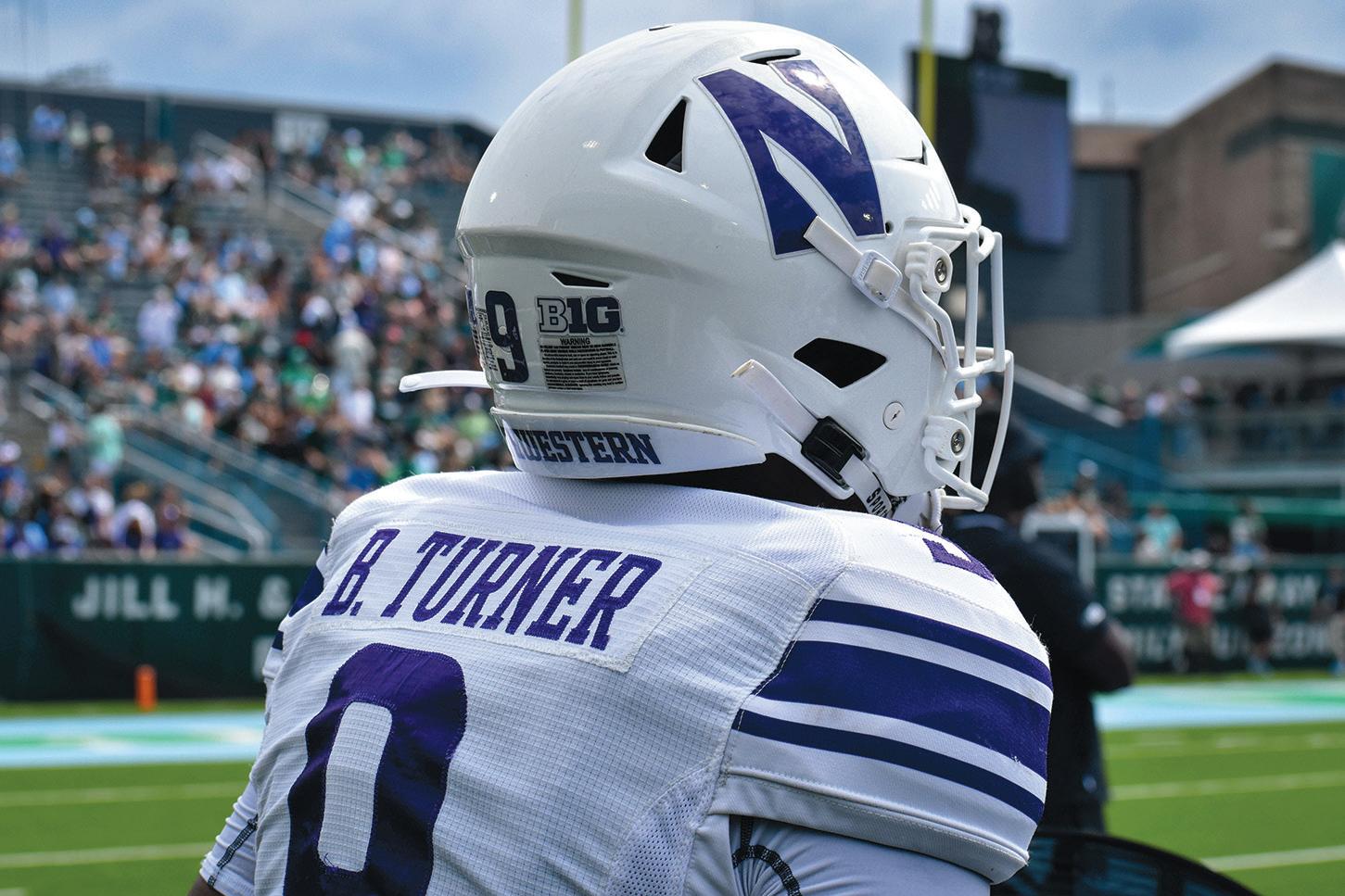
eir man slo ed for the di cult task this year is redshirt junior defensive back Braden Turner, who has emerged as a playmaker on the backend for the ’Cats with an expanded role this season.
e Mobile, Alabama native played exclusively on the boundary during his high school days at McGill-Toolen Catholic, and it was there that he rst captured the a ention of his current position coach.
During the 2021 season, Gray was an assistant coach at Samford University, a few hours north of where Turner grew up, and he evaluated the thenhigh schooler’s tape. Gray said that his athleticism came across in that rst impression and that he understood the potential he had at the next level.
A few years later, the two met at an important crux. Gray was brought in ahead of the 2024 season to ll the nickels coach role in Braun’s rst full o season with the program, and Turner made the move inside for the rst time a er primarily playing on special teams the prior year.
“(In) high school, I strictly played corner and a li le punt return,” Turner said. “Maybe some Wildcat QB, but never in the nickel position. So it was something new that they wanted me to try out, and I’m glad they wanted me, and showed that they thought I had the ability to do it.”
So far, Turner has excelled at the position, garnering praise from both coaches and the national media as of late. Following a standout performance against Michigan, he was named to PFF’s Big Ten Team of the Week for the second time this season.
Turner has been the ’Cats’ primary starter inside for the entire season, but following a Yannis Karla is’ season-ending injury against Louisiana-Monroe, the defensive back has seen his role continue to grow, as Braun and his sta have elected to start ve in the secondary — and Turner — in each game since.
“Like they say, next man up,” Turner said about the injury. “It was hard to have Yanni out for the season, but it was an opportunity for me to embrace that role and come in with the team needing me, and just doing what I can.”
In the rst game a er Karla is went down, Turner tallied a career-high seven tackles and his e ort helped propel NU’s defense to new heights in its upset win over Penn State. e following week, he hawked down a Purdue receiver and a textbook peanut punch turned what would’ve been a 48-yard gain at his behest into teach tape.
“You can solve a lot of issues with just incredible e ort. at was a special play,” Braun had to say following the game.
Since then, Turner has shown a propensity for making a big play when his team needs him most, and the incredible e ort his coach noticed has become a hallmark for his brand of football.
Against Nebraska, Turner got the right hook to land again, punching one out of quarterback Dylan Raiola’s hands on a 4th-and-1 deep in ’Cats’ territory to keep the Cornhuskers o the board.
the added reps.
“I feel like last year, I was still kinda guring the position out, and now I’ve gained that con dence in myself,” Turner said. “He’s helped me grow a lot… He’s learning as well, coaching me up and making sure that I can get the coaching points I need. I’m here because of him. Every day, we just keep balling and keep ge ing be er.” e two have formed a strong relationship and have been able to use their connection to a region outside of the Chicago area to bolster it.
Gray’s ancée hails from the Birmingham area, and coupled with his own time at Samford, he says that his knowledge of Alabama has helped in developing their bond.
With that connection, the two have put in the work in practice and in the lm room, and Turner says he’s seen the biggest improvement in his own game with the mentality he brings to approaching the run.
Gray mentioned he’s seen strides in his tape across the board, but pointed to his work in man coverage as his personal favorite to break down.
“I enjoy watching him just being locked up oneon-one,” Gray said. “Like he knows he’s one-on-one and it’s a critical situation — just watching him compete one-on-one, man oh man I enjoy that.”
Regardless of where he’s grown the most, Gray said that Turner’s hunger to learn and improve is striking, even distracting at times.
“He always has a growth mindset. He’s gonna come up immediately when he makes a mistake and he’s gonna look right at me. He knows he made that mistake, and sometimes I go a tell him ‘Hey man, quit looking at me. Go play the next play, quit looking at me,’” Gray said.
















Met with an eerily similar situation versus Michigan on Saturday — 4th-and-1 from NU’s 24-yard line — he crashed down in run support and got to be on the receiving end of a fumble, corralling an errant hando from the Wolverines’ quarterback Bryce Underwood and notching his second takeaway of the quarter, a er nabbing his rst career interception two drives prior.
Adding an added edge of physicality to his game to be more sound in the run game was an emphasis for Turner this past o season, and it’s been a coaching point between him and Gray.
Turner cited Gray as a key in uence for his development playing the position and noted that he feels more comfortable in the role this year with





While that mindset may not be easy for those not a ending practice to see, the growth certainly is. Stu ng the stat sheet in recent weeks helps with that, but Braun’s admiration of him is the clearest indication.
“We’re asking a lot out of BT,” Braun told reporters during his weekly press conference. “Whether it be in coverage, whether it be in run ts, whether it be asking him to play against 12 personnel. We’re asking a lot out of him, and he’s answered that challenge.”
Alexander Kim contributed reporting.
alexboyko2026@u.northwestern.edu
By AUDREY PACHUTA daily senior staffer @audreypachuta
Before No. 18 Michigan turned the ball over five times in a Saturday matchup with Northwestern, an early fumble took place, not on the gridiron, but rather over the Wrigley Field loudspeakers.
As the two teams huddled on their respective sidelines during a late first-quarter timeout, the prevailing presence of the visiting Maize and Blue faithful looked antsy. A missed field goal on the Wolverines’ opening drive? A strong early showing from the Wildcat defense?
At the time, the score was 0-0, but the game already had the makings of one that would ultimately go all the way down to the wire, ending in a 24-22 Michigan win.
Wolverine fans expecting a sure-fire victory as part of their Chicago weekend getaway didn’t seem fond of the suspense.
Just then — in a low-stakes moment with Michigan driving at midfield — a familiar tune graced the ears of the out-of-towners.
“It started out with a kiss, how did it end up like this?” they sang along.
A near-worship hymn sung on Saturdays in stadium seating rather than Sundays in pews, The Killers’ “Mr Brightside” is a staple of Wolverine home games at the Big House, one that reminds them not just of Ann Arbor, Michigan, but of the winning culture that’s long lived there.
Within 10 seconds or so, the 2003 pop hit abruptly cut out and in its place, Rick Astley’s “Never Gonna Give You Up” took over. The crowd — overwhelmingly composed of fans chanting “Go Blue” rather than “Go ’Cats” — had been Rickrolled.
While kudos are owed to the NU disc jockey and the cunning creativity behind the musical whiplash, to me, the moment served as a shocking auditory reminder of something already visually apparent: Even with purple-painted endzones, this

was no Wildcat home game.
Prior to Saturday’s showdown, the ’Cats had stumbled in each of their five “home” games played at the iconic baseball stadium since they first utilized the ballpark in 2010. On each occasion, visiting fans from across the Midwest arrived in droves, unwilling to pass up the opportunity to watch college football in the unusual venue.
And yet, despite the lessons in losing he’d been taught by history, coach David Braun waltzed to the corner of Addison and Clark streets on Saturday with an unfounded sense of confidence.
“This isn’t some outlier,” Braun said at his weekly press conference before the Michigan game.
“We’ve played here before. Obviously, this season we’ll play at Wrigley again. This is a home game, and this team has been good at home, so it’s time

By ANDREW LITTLE
At Big Ten Football Media Days ahead of the season, coach David Braun had conflicting thoughts about Northwestern’s tight end room, calling it “unproven,” but “deep” with a multitude of skillsets. Over the first half of the season, the Wildcats (5-5, 3-4 Big Ten) trotted out their tight ends in different combinations and packages. The longesttenured player in the room consistently flashed in the receiving game and saw his snaps rise as the season progressed.
Against Michigan on Saturday, graduate student tight end Hunter Welcing put his talent on full display, leading the ’Cats with a career-high four catches for 81 yards.
Welcing arrived at NU in 2020 as a three-star recruit from Lake Zurich High School, just an hour drive away from Evanston. Battling through injuries and experienced counterparts earlier in his career, Welcing’s climb up the tight end depth chart did not happen overnight.
He eventually earned a consistent special teams
role in 2023 and 2024, but even when healthy, was buried on a deep and experienced tight end depth chart.
As a redshirt junior in 2024, Welcing played in all 12 games and caught his first collegiate pass against Eastern Illinois. Now in his sixth season with the ’Cats, Welcing has emerged as an offensive starter and playmaker in the passing game.
“In the modern day of college football, stories like Hunter’s are super unique,” tight ends coach Paul Creighton told The Daily on Tuesday. “A guy that waits six years to get to the position he’s at now at the same school is almost unheard of. Show me another guy that’s been through what he’s been through and stuck it out and stayed.”
He entered the 2025 season with just one career reception. Now, Welcing has caught a pass in nine of NU’s ten games so far this year, including his first career touchdown in Week 2 versus Western Illinois.
Welcing’s role in the offense has continued to grow since then, culminating in a performance against Michigan that earned him Pro Football Focus Big Ten Team of the Week honors.
“Knowing the road was so long to get to this point makes those moments a little bit bigger, a
for us to lean into that.”
Over the past three years, with Braun at the helm, the team’s results at The Friendly Confines have been particularly excruciating.
Hosting Iowa in 2023, a plethora of punts gave way to a 10-7 loss by way of a late Hawkeye field goal. In 2024, an electric start for then-quarterback Jack Lausch devolved into the inevitable: a grueling defeat before a crowd so decked out in red and white, onlookers could have suspected it took place in Columbus, Ohio at first glance. Then, during that same season: a 10-point stumble to NU’s in-state rival, Illinois.
Now, most recently, the ’Cats forced five Michigan turnovers and came away with absolutely nothing to show for it. To summarize Braun’s emotional postgame press conference: There are no moral
victories.
Of course, there are in-game explanations for the squad’s last-minute loss, but opposing chants drowning out the comparatively insubstantial NU student section couldn’t have helped.
Barstool Sports founder Dave Portnoy even posted on X, albeit misspelled, “not a Northwestern fan in site” during Fox Sports’ “Big Noon Kickoff” show outside the stadium. Of course, attendees clad in purple were sprinkled throughout the clip, but beside the abundance of Michigan fans, their presence paled in comparison.
A week removed from the morale-deflating defeat, the ’Cats will take on Minnesota and play what is likely to be their final Wrigley home game for a long, long time Saturday.
Good riddance.
There are plenty of reasons to get excited about the completion of the around $850 million new Ryan Field construction. For me, one of the most compelling things is that NU will no longer have to hand one or two home games per year over to an opposing fanbase.
While next season’s dates, locations and weekby-week conference opponents aren’t finalized quite yet, it’s safe to assume that, by virtue of having the most expensive stadium in the sport’s history, the University won’t concede any chance to bring fans to their new Evanston abode.
Pregaming at Wrigleyville bars may be fun for fans willing to make the short trip, but you know what’s even better? Watching winning football — seeing “Chicago’s Big Ten Team” make a bowl game for the second time in Braun’s short tenure, perhaps.
This weekend, the ’Cats will have one more ballpark battle against the Golden Gophers, with their best chance to ensure a .500-or-better campaign and pocket a postseason game bid ahead. But if the team’s trend at Wrigley holds true in its final marquee matchup, don’t hold your breath waiting for a win.
audreypachuta2027@u.northwestern.edu
Hunter Welcing caught four passes for 81 yards against Michigan Saturday.
Cayla Labgold-Carroll/The Daily Northwestern
little more emotional,” Welcing said.
From 2022 to 2024, former NU tight ends Thomas Gordon and Marshall Lang played a majority of snaps at the position. Both players have spent time on NFL training camp rosters and practice squads since graduating from NU after last season. After spending years in the tight end room with Gordon and Lang, Welcing said his former teammates continue to be great resources thanks to their experience both in college and professionally.
The ’Cats entered the 2025 campaign with question marks at tight end after losing their two mainstays and had a crowded room of players with limited Big Ten experience. This season, Welcing is one of four tight ends to have played 100-plus snaps, along with graduate student Lawson Albright, redshirt junior Blake Van Buren and graduate student Alex Lines.
Within that rotation, Welcing has become a reliable receiving target for graduate student quarterback Preston Stone. He eclipsed 40 snaps for the first time in Week 7 against Penn State and has led NU tight ends in snaps in every game since then.
Since arriving on campus at 220 pounds, Welcing has bulked up to 250 pounds to deal with Big Ten physicality, seeing lots of development as
a run blocker over the years.
Braun lauded Welcing’s consistency throughout the offseason, allowing him to make an impact as a pass catcher and blocker this year in an increased role.
“He’s given us no choice but to position him for not only more opportunities to be on the field but more opportunities in the passing game,” Braun told reporters during his weekly press conference Monday.
As the ’Cats head into their final two regularseason games of the year seeking to clinch a postseason bid, Welcing has become a player opposing defenses cannot ignore. The veteran is NU’s thirdleading receiver with 239 receiving yards and is tied for third on the team with 20 receptions.
Although Welcing’s path to playing time has been a long road, he said that the adversity he has faced has only made him more appreciative of his time at NU.
“I came here when I was 17, so it’s been a long journey…” Welcing said. “Being a starting tight end here has always been the goal, so it’s been cool to achieve that goal in my last year.”
andrewlittle2028@u.northwestern.edu
community, but immigration enforcement complicated this objective.
“We’ve presided over a record decrease in violent crime, and what they are doing is, number one, assaulting people and abducting them. That’s a public safety threat. Number two, they’re creating all these problems that distract our police resources from what they would otherwise be doing,” Biss said. “They’re just systematically making us less safe.”
Students also asked questions about the mayor’s congressional campaign and how his experience in Evanston politics has prepared him for a congressional role.
support science and to support universities.”
Mary Jo Barrett (Weinberg ’76), a 7th Ward resident, said emphasis should be placed on what students are taught on a systematic level. She explained that this
art community for providing many opportunities for artists to meet and connect. Cowan contributes to that dynamic, Mucino said.
“She’s really wonderful,” Mucino said. “She’s just someone who has a real passion for bringing artists together here in Evanston.”
Mucino’s piece for “Visit Evanston” fuses bright, warm colors with various abstract shapes. She said she was inspired by the sun and Evanston’s natural environment.
She wasn’t planning on putting the sun in her piece, she said, but needed to “give it a punch.”
“It was very intuitive, the way I worked,” Mucino said. “I like working with shapes and colors and patterns, and so I would say that that is reflected in my work.”
Cowan created a print of Abraham Lincoln with a multicolored background and the text “Lincoln slept here” at the top.
the record straight
Biss is running to succeed U.S. Rep. Jan Schakowsky (D-Evanston), who will retire at the end of her term.
“Everything you do, every person you come in contact with, every experience you have, teaches you something about the world, and I want to carry that with me to Congress,” Biss said. “I feel like I’ve learned a lot about how to find ways to collaborate with people who I deeply, viscerally, emotionally disagree with on other things.”
Dominguez said students should use Biss’s political experience to learn about the inner workings of governance. Through these conversations, he said, students can seek out knowledge about elected officials to stay informed on political happenings.
Pushing for a more informed citizenry is something
is what impacts students’ intrinsic values.
“I think the kind of people we’re trying to create (at Northwestern) are people who are generous and kind and believe in all human beings,” Barrett said. “If they give money or take money or fold to being paid by the oligarchy, I, for one, will never give a dime to the school again.”
During the pandemic, she completed an artist residency about Lincoln through the University of Illinois Springfield. Through her research, she said she learned that Lincoln slept in Evanston for one night.
Juelle Daley, Evanston’s arts and cultural engagement specialist, said she loved how each artist communicated their relationship with Evanston in a unique way.
“I have this tagline … that I had since I arrived here in Evanston: ‘Something dope is happening in Evanston,’” Daley said. “The artist community is creating incredible work, whether it’s visual work, like the work that we’re creating here, but also dancers, musicians, actors.”
Cowan said she hopes Evanston Printmakers will eventually grow beyond the original artists and develop into a larger community of printmakers. There’s no concrete plans for future events, she said, but she does hope to do more with the group.
c.angiolillo@dailynorthwestern.com
Dominguez said he has always advocated for.
“You can exercise your right to petition the government,” Dominguez said. “Learn about what people like Daniel Biss and others are doing to help students, be able to further contextualize and assess the situation, so you can have a resolution for your interests.”
Weinberg senior and Glenview resident Sarah Ordway said she came to hear from Biss because he will be on her ballot in the next primary election. When she sees politicians successfully respond to questions on the fly, Ordway said she feels more confident in their ability to lead.
Although Ordway wants to be more politically involved, she said she often falls into the trap of making excuses like being too busy or not having enough resources.
McCormick Prof. Michael Peshkin attended the rally, holding a sign that read “No ‘Deal’ With Fascists.”
In a speech to the group, he said it was important and gratifying to see the community coming out, instead of letting NU treat this as a University-only issue.
“We have a responsibility that is more than just securing our funding,” Peshkin said to the group. “We
“As I’ve gotten older, I’ve realized when you’re an adult, you have more resources, but you have even more responsibilities,” Ordway said. “It is not as good of an excuse as I thought it was.”
NU in itself, as a part of the Evanston community, is a student resource for civic engagement, Biss said. What makes up Evanston’s unique culture comes directly from being a college town, he said.
“It’s having so many scholars and people engaged in deep inquiry, asking hard questions and not accepting easy answers, and through that process, creating a kind of intellectual and social community that we are here in Evanston,” Biss said.
wallisrogin2029@u.northwestern.edu
sarahpark2029@u.northwestern.edu
have a responsibility to academic freedom, we have a patriotic responsibility to supporting and defending democracy.”
n.kanieskikoso@dailynorthwestern.com
y.huang@dailynorthwestern.com
lucaskubovchik2029@u.northwestern.edu
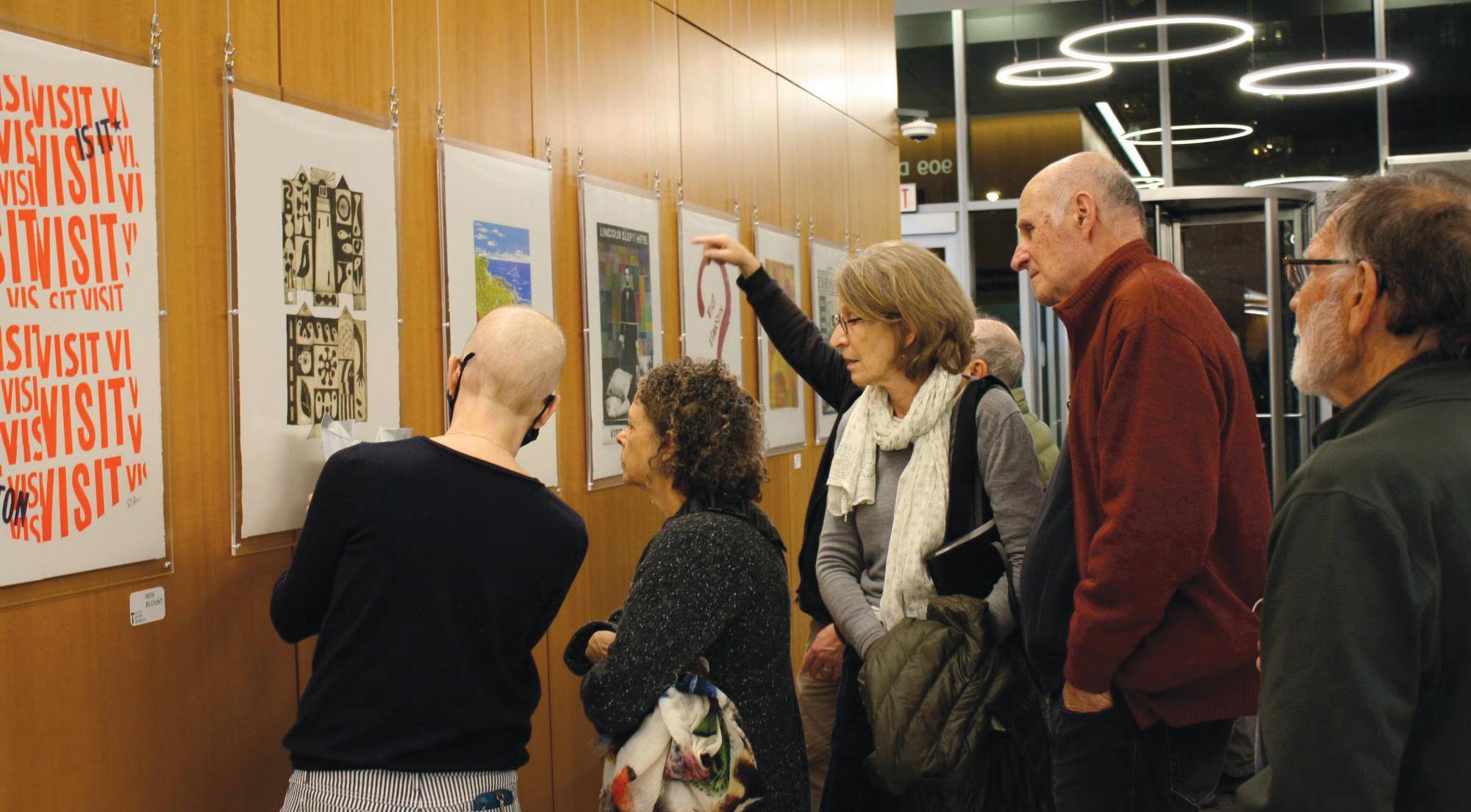
An article published in Wednesday’s paper titled “Klineman: Dems must earn, then spend political capital,” inaccurately stated that Ghazala Hashmi was the first Muslim to be elected to any statewide office. Hashmi is the first Muslim woman to be elected to any statewide office. The Daily regrets the error.
A headline in last week’s issue of The Daily misrepresented which religious views feel the most uncomfortable sharing their political views on campus and in classes. The Daily regrets the error.





























By CLARA MARTINEZ daily senior staffer @claramart1nez7
If you were to ask any member of Refresh Dance Crew, Fusion Dance Company or Boomshaka which of the group’s collaborative shows you should have attended over the weekend, they almost certainly would have told you to go to the Saturday night closing show at 10 p.m.
“We give it our all,” said Fusion dancer and Communication sophomore Indigo Hubbard-Salk. “It’s our last show, the last show for the seniors on the team. And we’re like, ‘We’re gonna go out with a motherf—king bang.’”
With a sold-out crowd of 1,000 in Cahn Auditorium, ReFusionShaka united three of Northwestern’s top dance groups: Fusion, Refresh and rhythm ensemble Boomshaka.
Each performance also featured two or three guest groups.
Every November, ReFusionShaka draws thousands of students and alumni to Cahn for a two-hour set highlighting each group individually with a few
full company dances.
The show kicked off with all three teams performing “Uproar” by Lil Wayne ft. Swizz Beats.
Boomshaka member and Communication sophomore Ellie Kim said ReFusionShaka was the first time she has played the drums on stage. Kim said it was initially intimidating to see a fully packed audience Saturday, but nerves quickly turned into excitement as the dancers fed off the crowd’s energy.
“All of the rows were completely filled, and everyone was screaming,” Kim said. “Some Boom alumni were there, and they jumped out of their seats when we came out. It was crazy.”
SESP sophomore Sharmel Gibson attended the late show on Saturday and compared the show to how, in a typical performance, the audience is encouraged to be quiet. At ReFusionShaka, however, the crowd was cheering loudly and singing along.
“It was encouraged to be a part of it and really, step into it,” Gibson said. “I think that just made it so much more fun.”
Ranging from femme to hard-hitting to groovy substyles of hip hop, Hubbard-Salk said ReFusionShaka highlighted the range of talent in each group.
In preparation for ReFusionShaka, Hubbard-Salk said rehearsal time amps up throughout the quarter. Usually, they practice three nights a week for a couple of hours. In the week leading up to the show, the performers practiced every night for upward of five hours.
Hubbard-Salk said she also appreciates students’ ability to participate in different groups across a range of styles.
“There’s actually a lot of overlap,” she said. “It’s really cool to see all my close friends who are on Fusion perform in Refresh and in Boomshaka.”
Hubbard-Salk said she wanted to join Fusion as a freshman because of the immense amount of talent and individuality each dancer brought to the group.
That said, being a part of Fusion is more than just being in a dance group for Hubbard-Salk. She said that since joining Fusion, she has discovered a diverse, close-knit group of friends. One of their traditions for successful auditionees is for each new member to be adopted by a family lineage of returning members.
“It’s such a close and supportive space,” she said. “Everyone wants to be there, everyone loves it, and everyone’s friends with each other.”
Refresh operates slightly differently from Fusion and Boomshaka: Rather than auditioning to be on the team, any dancer can audition for up to four of the pieces per quarter. As such, some dancers performed with multiple teams.
Yet, Kim said that despite it being her first year in a group, she became familiar with a much larger faction of NU’s dance community. She said the social chairs for the different teams set up a buddy system across the different groups, so every performer was able to interact with new people.
“A lot of people got to know each other that they didn’t know before, which is really nice and cool to see,” she said. “It’s just a really cool environment, and everyone brought so much good energy.”
While Gibson said she went to the show to support her friends, she said she was shocked by the number of people she recognized who had never mentioned their dance ability.
“You see this person like, ‘Oh, you’re a physics major, and yet you’re also part of this amazing dance group on campus,’” she said. “It’s fun to see how varied people’s interests are.”
claramartinez2028@u.northwestern.edu
‘The Moors’ is everything and moors at Shanley Pavillion
By KATE POLLOT daily senior staffer
Over the weekend, Vibrant Colors Collective transformed Shanley Pavilion into a Victorian mansion on the English moors for four shows on Friday and Saturday. VC2 chose Jen Silverman’s play “The Moors” for its fall retelling slot, in which a BIPOC cast and crew “retells” a show that typically features white actors.
“The Moors” begins with two sisters (Agatha and Huldey), their dog and their maid awaiting the arrival of a new governess named Emilie, played by Communication sophomore Dora Zuo.
When Emilie arrives, she is confused by the absence of both Master Branwell, the man whom she has corresponded with via letter up until her arrival, and the child she is supposed to take care of.
In a shocking twist, Agatha eventually reveals that she has trapped her brother Branwell in the attic upstairs, giving him only enough food to keep him alive, and that she is the one who wrote romantic letters to Emilie.
Her ploy? Use Branwell’s sperm to impregnate Emilie and then raise the child with her, carrying on their family line.
“The Moors” includes some truly dark and Gothic moments, setting it apart from any show I’ve seen at Northwestern. The cast doesn’t shy away from these uncomfortable themes, giving it their all in every scene.
Communication sophomore Clarisa Gomez Rodriguez oozes confidence and charisma as Agatha. A less skilled actor may have portrayed this character as cartoonishly evil and hypersexual, but Gomez Rodriguez knew exactly when to hold back and when to go all out. And go all out, she did. The romantic tension between Gomez Rodriguez and Zuo was
so intense at times that it left audience members blushing.
As Emilie allows Agatha to seduce and corrupt her, the other characters also become more depraved.
Outside the mansion, the mastiff (Communication sophomore Nigel Swinson) befriends an injured moorhen (Communication freshman Beatrice Biello). The charming and comedic Biello soared in her first production at NU, while Swinson won the audience’s sympathies as the sad, lonely family pet.
Even the dog, though, could not escape the corruption present in the show. When Swinson walked onstage with his eyes full of regret and the moor-hen’s blood smeared around his mouth, I gasped; it was tragic to see a character that was initially so sympathetic become so cruel.
But not every character waits to become cruel. Communication sophomore Tvesha Gupta, as the maid, was terrifying and intimidating from the start.
She persuades the naïve, fame-seeking Huldey
(Communication sophomore Sophia Yen) to kill Agatha, and, in what is without a doubt the show’s best moment, Huldey does.
Enraged when Agatha calls her boring, Huldey tackles her sister to the ground, choking and beating her. Once she realizes Agatha is dead, Huldey announces to the audience that she will sing a song.
The ridiculously campy number about Huldey’s sororicide, complete with a rap and a dance break, hits the audience like a truck. Yen’s performance was so incredible that I had to resist the urge to give a standing ovation in the middle of the second act.
The team’s willingness to lean hard into every aspect of the show, from the gothic to the tragic to the camp, made it better than I could have imagined.
“The Moors” was a well-selected show that allowed its young cast members to display their range and left me excited for whatever VC2 does next.
katepollot2024@u.northwestern.edu
By OLIVIA MA and KAYLYN NGUYEN
the daily northwestern
The Wirtz Center sold out all seven shows for its production of “The Addams Family – A New Musical Comedy,” which premiered Nov. 14 and has four more showings scheduled, Thursday
through Sunday.
The musical comedy follows the titular characters as it navigates a dinner with the family of the smitten Lucas Beineke (Communication junior Rowan Sharma), Wednesday Addams’ boyfriend.
The twist? Wednesday (Communication sophomore Ava Chen) has asked her father, Gomez (Communication senior Lucca Silva), to keep her
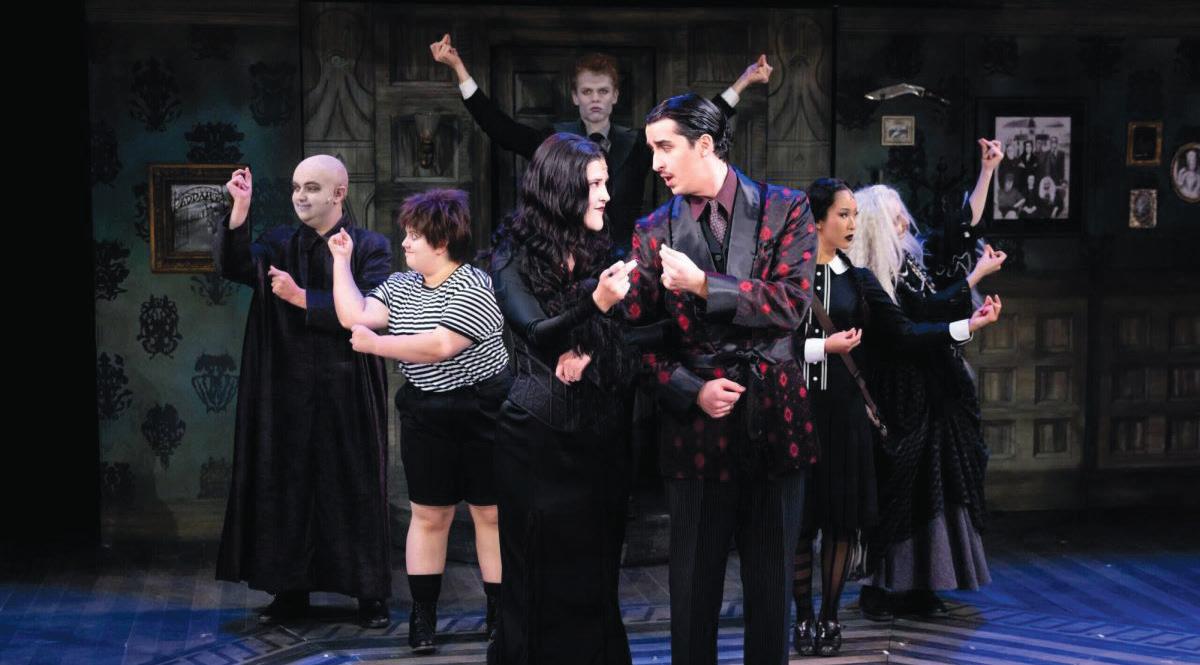
engagement to Lucas secret from her mother, Morticia. Gomez struggles to balance his relationship with his wife with his promise to his daughter, all while the kooky Addams family attempts to appear normal to the Beinekes.
“In every other iteration, the Addamses may have conflict with other people, but not within themselves,” Director Christopher Llewyn Ramirez said. “Getting to explore that… allowed us to give the audiences all the similar tropes that they’ve come to expect but then giving them a little bit more of the human aspect.”
Ramirez said he wanted to “respect the iconography” of the Addams family’s looks as he brought the nostalgic characters to life. While the main characters remained their eccentric selves, Ramirez said, he wanted to amplify the Addams ancestors’ role in the story, expanding on themes of those from previous generations guiding their descendants.
Communication senior Nora James Eikner played Morticia. “The Addams Family” is her first Wirtz production and biggest role at NU yet, she said, and explained that being cast as Morticia came as a surprise to her, as she had auditioned for the completely different role of Alice, Lucas’ mother. Eikner said Ramirez saw aspects in her that she did not think she had.
“(Morticia) just has so much power to her, and she’s so confident in a way that I as a person feel like I’m not,” said Eikner. “(She) is just never ashamed and also loves her family and her husband and everyone so much. She’s always herself, and I just
love that about her.”
But the role did not come without its challenges. Playing Morticia didn’t just mean getting into costume and applying makeup, Eikner said, but being extremely bold and self-assured.
Melissa Phillips, a teacher at Gemini Middle School in Niles, brought her family, including her “Addams Family” superfan daughter, to the show after receiving a printed flyer in the mail.
“The combination of humor and singing and dancing, it just really blew me away to the point where I feel like I would like to take my family again,” she said.
Phillips said that, during the show, she was already thinking about who to recommend it to. Aside from her party of nine, she said, she wanted to share the show with her students, friends and neighbors.
For Eikner, the production’s value extends beyond the fun she had with the cast and crew and the anticipation she held for each and every rehearsal; she emphasized the importance of involving the audience in the story.
“When you come to the show, we’re performing it for you, and you are as much a part of it as everyone on stage,” Eikner said. “All of us onstage just really love each other, and the Addams family (is) an emblem of love and truth. That’s what the show is all about.”
oliviama2025@u.northwestern.edu
kaylynnguyen2029@u.northwestern.edu
By CARMEN GASKIN and EMERSON LEGER the daily northwestern @sla3cwy
Finals week hasn’t landed yet, but for Weinberg freshman and rapper Zhaire Easley — known musically as ZYNITH — the pressure is building. Easley has kept busy by turning a dorm-room hobby into an opportunity to redefine the college rap aesthetic with his original compositions.
Easley began writing songs at 16, and by the age of 17, he was recording. He released his first track the same year, discovering his distinct sound. Influenced by legends like Drake and J. Cole, Easley’s storytelling mirrors hybrids of pop-rap, R&B and neosoul genres.
“Hearing someone mix R&B and rap together always impressed me,” Easley said.
Born and raised in Philadelphia, Easley said his hometown shaped his outlook on the music industry as a whole.
Easley said he makes music to give back to the Black community, his family, his friends and the city that raised him. He hopes to return to his hometown one day and play for the Xfinity Center in Philadelphia or Madison Square Garden in New York City, he said.
“My hometown is very important to me,” Easley said. “It did provide me with the experiences that ultimately shape who I am today.”
In addition to drawing influence from his hometown, Easley keeps a notebook with him, jotting
‘Proving
By SOL THOMAS
down song ideas or just single lines to develop later.
It takes around two weeks for Easley to write a song because he returns to the music repeatedly, rewriting until he feels like the lyrics match the idea in his head, he said.
“I’m always nitpicking lyrics,” he said. “(I’m) trying to make sure I’m making a clever-sounding song.”
When he came to Northwestern, Easley said he had to adjust to being a full-time student and still pursuing a rap career.
Easley wanted to grow in his sound and his fanbase at NU, he said. One “meet-and-greet” following an A&O Productions concert with A Boogie Wit Da Hoodie changed everything.
What began as a joke with his friends turned into a crowd event of fans eager to meet the “ZYNITH” they’ve seen plastered across social media.
“Some people printed out pictures of me. I did end up giving autographs,” Easley said.
Before coming to NU, Easley wrote an original song with his hometown friend Kyle Scott.
Working with Scott on their song, “Do Not Disturb,” allowed Easley to practice blending styles and collaborating with another artist.
“I am more of a sing-y rapper. I like to be more melodic, while he is really bar-heavy,” Scott said.
“I learned there are many ways to express yourself musically, and he had a totally different perspective, which was cool to see.”
While at NU, Easley has continued to find different ways to express himself and even found a producer.
Bienen freshman Andrew Schreiber met Easley during Wildcat Welcome. They create, record and produce songs in Schreiber’s dorm room together.
“Zhaire will send me a word or a feeling that he wants a new track to center around, then we just see what ideas come into his head and how the sound can contribute to the flow,” Schreiber said.
Schreiber owns his own production equipment, which the duo used to create their first song together. Their song “NONCHALANT” was released on Nov. 14.
While Easley chooses to integrate rap and R&B instrumentals into his music, Schreiber’s background is in jazz music. Schreiber said he hopes to bring a new sound to Easley’s discography, including the usage of real instruments.
With the release of each song, Easley said he has learned quickly that success does not come without long nights, criticism and a willingness to push through uncertainty.
Schreiber said the dynamic between him and Easley has only strengthened due to this mindset, developing a space where ideas are nurtured naturally and each lyric steps towards something larger than itself.
“There really is no shortcut to being good at what you do and getting better,” Schreiber said. “The only way you’re going to be a better musician is if you lock yourself in a room and practice.”
carmengaskin2029@u.northwestern.edu
emersonleger2029@u.northwestern.edu

Northwestern Opera Theater sold out Ryan Opera Theater from Thursday to Sunday with four performances of “Proving Up,” a production based on the eponymous short story by Karen Russell (Weinberg ’03).
Written by composer Missy Mazzoli and librettist Royce Vavrek, “Proving Up” was first performed by the Washington National Opera at the Kennedy Center in 2018. The third collaboration between Mazzoli and Vavrek, the show was commissioned by the Kennedy Center through its American Opera Initiative to support opera promoting American themes.
The show follows a family that settles in
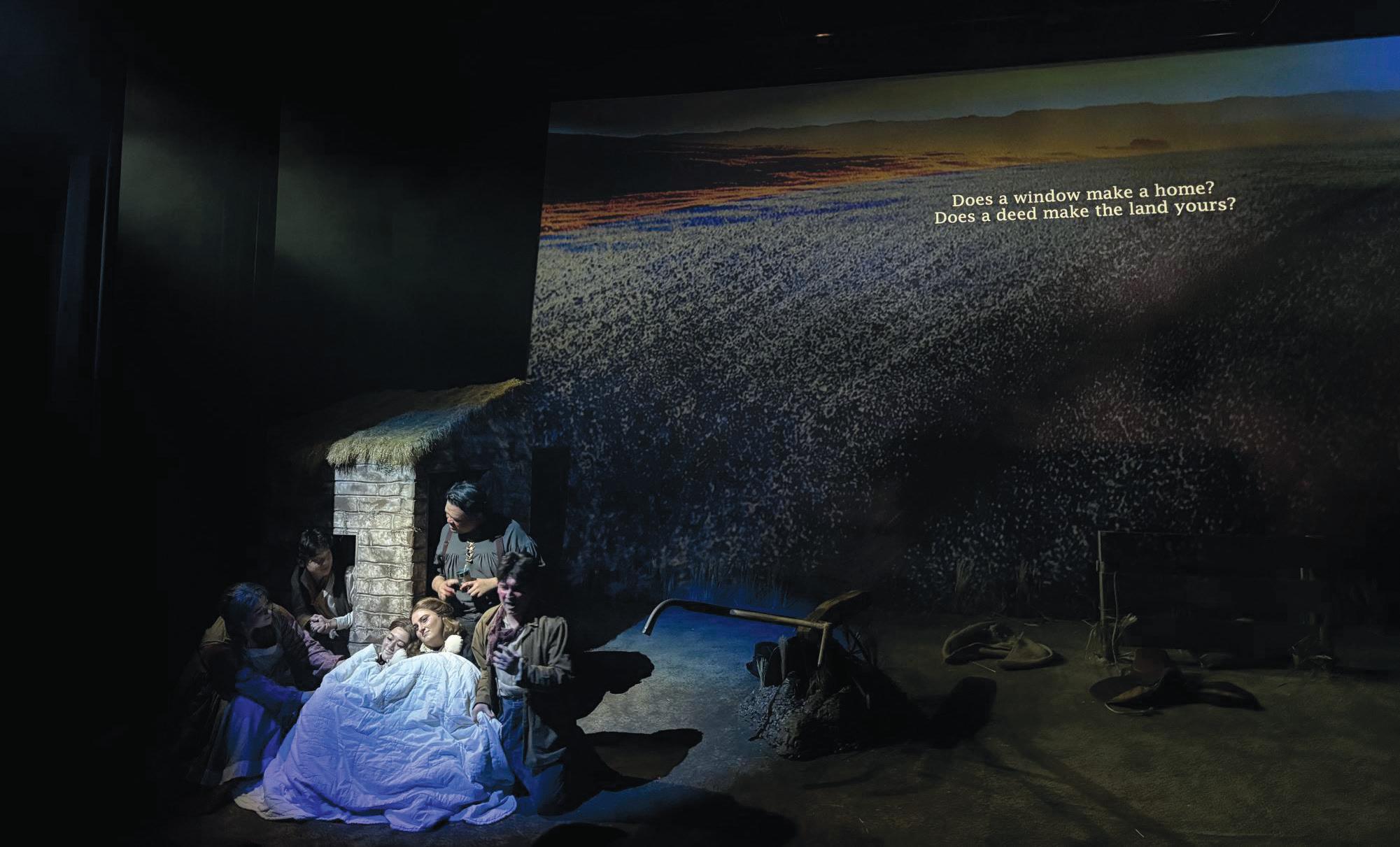
Nebraska in search of a new life after the Homestead Act of 1862 made it possible for American citizens to claim 160 acres of land if they “proved up” by cultivating the land for five years, among other requirements. The opera questions whether the American dream is attainable. By some estimates, under 40% of settlers “proved up” in Nebraska, and many died in the process.
Second-year Bienen master’s student Alec Fore, who played the family’s younger son, Miles Zegner, described the opera as a good springboard for performers.
“I think some pieces are very molecular, and some are wide open,” Fore said. “This work really kind of hits that sweet spot where it guides you to telling that story but leaves enough for you to bring what you have to it as well.”
NU performs a small chamber opera each fall.
Director Joachim Schamberger said these shows give voice students the opportunity to work on contemporary works in an intimate space.
Mazzoli and Vavrek were also directly involved in the rehearsal process, specifically helping actors learn their characters. Mazzoli, who is one of the most popular modern-day opera composers, remained in town as the shows ran over the weekend. In an industry that relies heavily on pieces written hundreds of years ago, Mazzoli said, having access to a living composer can be very influential for young singers.
As the operatic art form shifts to meet the demands of a changing industry, Mazzoli said, she believes opera will continue to thrive.
“Twenty years ago, when I graduated from
college, there was not this thriving American opera community,” said Mazzoli. “And then this scene kind of came up, like in the late aughts, certainly where I was in New York City, and all of a sudden everyone was kind of writing these kinds of operas.”
“Proving Up” combines Americana style with Mazzoli’s distinctive atonal style, complete with a foreboding, sinister texture to the music. Mazzoli opens the show with the line, “Uncle Sam is rich enough to give us all a farm,” taken from a real song in the 1860s that promoted westward expansion. This phrase is repeated as a mantra throughout the production.
The show closes with an unsettling tableau: The character who personifies death stands pointing at the audience in his top hat as an unmistakable Uncle Sam — who, in fact, did not give everyone a farm. Three of the family’s children lie dead, with no title for their land. The backdrop projections distort into an upside-down American flag, with a graveyard of bones representing the white stars. Mazzoli said she purposely left the viewer to consider modern-day parallels for themselves. Schamberger elaborated on some of those potential comparisons.
“There’s certainly a contemporary question to this altogether, like, how does this work?” he said. “Yes, some people are the winners in this game. But in order for there to be winners, by definition, there will have to be losers, and their story we don’t hear so easily.”
solthomas2028@u.northwestern.edu
gym 74,449 times this year, according to Mary Liz Jayne-Ballard, Senior Associate Director of Recreation, pu ing the average daily number of gym-goers at more than 1,000.
Consider this my love le er to Planet Fitness. Arriving at Northwestern, one of the things I was most excited about (besides a world-class education, of course) was having access to a high-quality gym. As a gym-goer with humble origins, I found the prospect of a facility built for serious li ers to be a major draw. Unfortunately, the images of Henry Crown Sports Pavilion I saw online prior to move-in didn’t quite show the whole picture: one where students have to build an additional 20 minutes into their li s to account for waiting time.
It doesn’t take very long to diagnose the issue with Crown Sports Pavilion: ere are too many people and not enough equipment.
e 7,000-square-foot tness center is open to all NU undergraduate and graduate students and faculty, as well as Evanston community members. Currently, approximately 680 Evanston residents have memberships, and as of Wednesday, people a liated with the University have swiped into the
But use of NU’s Walter Athletics Center, which has two sports performance facilities, is restricted to the approximately 500 varsity athletes on campus.
Beyond the sheer number of people using the tness center at Crown Sports Pavilion, the equipment itself — or the lack thereof — is another source of grievances. e tness center is only equipped with one lat pulldown machine, one seated row machine, one pec y machine, one leg extension and one seated leg curl. ese machines are foundational in many workout routines, and consequently, two or three people are o en waiting to use them at any given time.
Additionally, the downstairs area contains only one of certain types of cable a achments, like the straight bar and close grip handles. Truthfully, this makes me feel like the resident gym villain when I move them from the machines they’re most conventionally used for.
With that being said, the tness center has a lot of positive aspects. e facility is kept clean and the sta are all very kind and helpful. It is just a
frustrating experience when I have to cut a workout short because I did not build in enough time to stand around and wait for machines to open.
NU seems very concerned with promoting the mental wellbeing of its students, providing ample opportunities to access mental health services and resources. However, physical health is an important dimension of overall wellness that cannot be forgotten. When the process of going to the gym becomes a hassle, people may be inclined to neglect their physical health.
Ultimately, NU should invest more in its students’ physical health — especially considering how much money the school puts into athletics.
e last renovation of the tness center was in 2014, where the University spent $300,000 on new strength training and cardio equipment. is is approximately 0.1% of the amount of money that went into Walter Athletics Center and Ryan Fieldhouse, whose 2019 renovation cost $270 million.
If NU was to put even one-270th of what it spent on Walter Athletics Center into Crown Sports Pavilion, it could make serious improvements to students’ workout experiences.
I am certainly not quali ed to present entirely eshed-out solutions, but I do believe there are
things that can be done to be er the tness center. e most obvious and simple x would be to add more equipment, which could be done by recon guring the upstairs area. For example, if Crown Sports Pavilion was to get even one more lat pulldown machine or leg extension, wait times would be signi cantly reduced and people would be able to have more productive and ful lling li s.
Another possibility would be to expand the tness center, perhaps cu ing into existing hallway space. During the busiest hours at the gym, I almost feel like I’m breathing down people’s necks because of how packed it is. Adding square footage would create a calmer atmosphere.
Henry Crown Sports Pavilion has the potential to be a great gym. With more equipment and space, it could be er serve the NU and Evanston communities. Whether or not it will ever beat my hometown Planet Fitness, though, is another story.
Eliza Goldwasser is a Medill eshman. She can be contacted at elizagoldwasser2029@u.northwestern.edu. If you would like to respond publicly to this op-ed, send a Le er to the Editor to opinion@dailynorthwestern.com. e views expressed in this piece do not necessarily re ect the views of all sta members of e Daily Northwestern.
JONATHAN BELL
OP-ED CONTRIBUTOR
Senior year is tough. Hours upon hours spent every week on the job hunt grind. Hundreds of LinkedIn job applications. Round a er round of technical interviews.
My experience has been exactly the opposite. I applied to just one company for a full-time position. A single 90-minute behavioral interview was scheduled almost immediately. A few days later, I got the job: nuclear engineering at a reputable rm in downtown Chicago — all by week two. Now, I can kick back and ride the rest of senior year to graduation. And no, my dad is not the company CEO. Struggling to nd a job? Maybe consider energy. Historically, the energy industry has received lackluster reviews. It’s perceived as a steady-going, business-as-usual sector. Many associate it with Big Oil and ecological destruction.
As an electrical engineering student with three energy internships under my belt, let me paint a clearer picture. Each summer, I had the privilege of working alongside some of the most intelligent, green-minded and hardworking people I have ever


“DEFEAT THE BLANK PAGE!”
In bold, all-caps le ers, the phrase shouts back at me. It’s printed on an otherwise empty page in the book cupped in my hands: “ e Friend” by Sigrid Nunez. For a moment, it feels as though the author is challenging me — no, daring me — to do the thing I keep avoiding: Write. My favorite novel for as long as I can remember, “ e Friend” isn’t about writer’s block. And yet, every time I return to my steadfast literary companion, I nd myself resonating with the narrator’s paralyzing struggle to write. For her, it happens around three-quarters into the book. For me, it happens every few pages.
What do you do when writer’s block hits so hard it’s become the norm?
As a journalism student, I pride myself on my ability to write. Whether it be in my journal, on my laptop or a shiny tabletop in Fisk Hall, I always have words swirling in my mind — words I’m simply dying to etch on a page.
When my friends and I argue about which is easier — solving problem sets or writing essays — I’m the rst to jump up and declare the la er as the beautifully obvious choice. But o entimes, my one and only pride — the thing I tell myself I am supposed to be good at — becomes harder than ever.
So, here we are: Writer’s block and I.
I like to tell myself I’m simply uninspired or that I haven’t read anything lately that’s worth reacting to. I dismiss ideas as derivative; too controversial,
met. e industry is full of solar farm developers, market economists and computer scientists who get out of bed every day to make our energy more reliable, a ordable and resilient.
ey taught me how to run power ow simulations. ey guided me through dense regulatory documents. ey gave me tours of some of the most valuable powerhouses in the world. But most importantly, they made me fall in love with the electric grid. e American power grid is a vast network of wires, regional markets and consumers like you and me. It’s a mind-bogglingly complex machine that has evolved for over a century. It’s a wild story, penned by a million and one authors: industrious tycoons, Ph.D. theorists and whistleblower journalists. Electricity is one of the few inventions that became so powerful, so pervasive, that it’s become nearly invisible. We rely on it every day without thinking.
Today, it’s in trouble. Our insatiable hunger for arti cial intelligence has led to an explosion in data center construction. Just one of these data centers can consume as much energy as 100,000 homes, and we’re building more of them every day. at alone would be enough to stress America’s geriatric grid. But add the climate crisis-driven imperative to transition to renewables — which are critical but can’t produce electricity at the drop
of a hat — and we may nd ourselves in a national energy crisis within a decade. Too much demand and not enough supply. e energy industry, in other words, can no longer be about “business-as-usual.”
What if you could get paid to o er your electric vehicle as a backup power source when needed? What if a nuclear power plant could t in the back of a pickup truck? What if, because of faster algorithms, wind farms could be built sooner? ese are all gamechanging questions that incumbent conglomerates and hotshot startups are working to answer right now. ese, and countless more, are questions we needed to answer yesterday. Energy employers are rushing to nd candidates. e clean energy job market grew at a rate three times the national average last year — the industry’s slowest year since 2020. e world desperately needs more new graduates to choose energy. And not just engineers. Energy companies need management students to design the next generation of talent acquisition programs. Economics majors to build nancial products that don’t exist yet. Law students to establish the legal structures on which our new electric grid will rest. It’s true that the industry is far from perfect. e gender gap is generally wider than in other elds. Many of the biggest players are regulated monopolies that can be slow to adopt new technologies. Fossil
fuels still make up the majority of electricity generation in the United States.
But the tides are most de nitely turning. Major utilities like Duke Energy are investing in startups that use AI to prevent wild res. Silicon Valley in uencers like Sam Altman are be ing big on safe, small nuclear. Employee resource groups are proliferating across the industry. is is a trendline that may wobble, but it will certainly outlast any one presidential administration.
Sometimes, I’d have a tough day at the internship. A bug I couldn’t seem to x. An article of legislation I struggled to understand. In those moments, my coworkers helped me step away and close my eyes. It was hazy, but at the end of the path I could see the start of a new day. On that day, I’d turn on the lights, sit down at the kitchen table and tell my future kids where the electricity comes from. A place that uses the natural rhythms of the sun, the wind and the waves. en I’d open my eyes and get back to work. Much work is le to be done. Come join me.
Jonathan Bell is a McCormick senior. He can be contacted at j.bell@u.northwestern.edu. If you would like to respond publicly to this op-ed, send a Le er to the Editor to opinion@dailynorthwestern.com. e views expressed in this piece do not necessarily re ect the views of all sta members of e Daily Northwestern.
too trivial; too much work or, hilariously, too li le.
I always manage to nd the perfect excuse to let the blank page win.
en, my friends start ring well-meaning but unbearably pointed questions: What am I working on right now? Anything of mine they can look up?
I should send them my next article — they’ll denitely read it. Am I seeing “Bugonia” this weekend? Maybe I should write about that.
I thank them and say that everything is going great. I’ve been swamped with work, but I’ll be sure to let them know when I publish anything new.
I pretend I haven’t deleted ve dra s with semiwri en introductions and endless bullet points moved to a “word trash” section. To me, the blank page doesn’t exist if I never commi ed to it to begin with.
But eventually, one has to straighten their tie and face their fear.
I won’t pretend I have the answer to defeating writer’s block. In fact, while writing this, I deleted and re-typed the same sentence ve times as I watched my cursor mockingly ash at me. But I did realize one thing: Much like any other sport, hobby or activity — writing takes practice.
I made myself write even though I didn’t want to. I started typing words that slowly ate up the white emptiness of my laptop screen. In some cases, the writing didn’t make sense. In most cases, it made a bin-worthy dra . But I was nevertheless making it happen.
Margaret Atwood, beloved author of “ e Handmaid’s Tale,” said that you aren’t really a writer if you’re not writing. My initial reaction to this was, “Okay, Margaret, you’re just trying to sell your Masterclass.” But once I got over myself, I knew she was right. If I were a basketball player, I’d have to actually
throw hoops to call myself one.
So, I open the blank page and start scribbling. What’s something I’ve noticed on the street? Who did I see today? Why am I irritated as the holiday season is coming up? Did Mariah Carey really just sneak a Sephora ad into her annual Christmas video? Why did that New York Times article irk me? And just what is it about those Starbucks teddy bear coffee cups that makes them so appealing?
Eventually, the writing comes. Maybe not inspired by any of the prompts I forced myself to blabber about, but it’s there. In an oxymoronic way, here I am: Defeating writer’s block by writing about it. When we feel stuck, it’s easy to get caught in a whirlwind of anxiety. e mobility and control we lack in tough situations make us feel afraid to even try to get out. Maybe, instead of constantly se ing mountainous goals for ourselves, we can break them down into smaller pebbles of achievement.
For me, this looked like staring at the blank page for hours and then copying a quote from my favorite book. Sometimes, that rst step towards coming out of the Kansas-esque tornado may just be taking a breath and trying — even in the li lest way.
Besides, as my dearest TV fashionista Carrie Bradshaw once said: “Computers crash, people die, relationships fall apart — the best we can do is breathe and reboot.”
And start typing on that blank page, of course.
Alexia Sextou is a Medill sophomore and author of “Margin Notes.” She can be contacted at alexiasextou2028@u.northwestern.edu. If you would like to respond publicly to this op-ed, send a Le er to the Editor to opinion@dailynorthwestern.com. e views expressed in this piece do not necessarily re ect the views of all sta members of e Daily Northwestern.
Managing
Audrey Pachuta Sarah Serota Hannah Webster
Opinion Editor Aidan Klineman
Assistant Opinion Editor Alexia Sextou
LETTERS TO THE EDITOR may be sent to 1999 Campus Drive, Evanston, IL 60208, via fax at 847-491-9905, via e-mail to opinion@ dailynorthwestern.com or by dropping a letter in the box outside THE DAILY office.
Letters have the following requirements:
• Should be typed and double-spaced
• Should include the author’s name, signature, school, class and phone number.
• Should be fewer than 800 words They will be checked for authenticity and may be edited for length, clarity, style and grammar.
Letters, columns and cartoons contain the opinion of the authors, not Students Publishing Co. Inc. Submissions signed by more than three people must include at least one and no more than three names designated to represent the group.

Nathaniel Foster is a student at the School of Professional Studies and writer of Ducks Dan and Dave. He can be contacted at nathanielfoster2027@u.northwestern.edu or @duckscomics. Lia Kim is the illustrator for Ducks Dan and Dave and is not associated with Northwestern. The views expressed in this piece do not necessarily reflect the views of all staff members of The Daily Northwestern.
By Ivy Frater
By DOV WEINSTEIN ELUL daily senior staffer
@dov_w_elul
When the race clock struck 20:46.3 at the NCAA Midwest Regional, no runner on No. 11 Northwestern had finished yet.
Coach Jill Miller’s team had traveled to Stillwater, Oklahoma with hopes of a top-two finish that would guarantee it a spot in the NCAA Cross Country Championships on Nov. 22. Four Oklahoma State runners and three Iowa State runners, the only two regional teams ranked above NU, had already finished.
Over the next .4 seconds, however, three ’Cats had crossed the checkered flag in a nearly in-sync finish, securing 15th, 16th and 17th places.
Of the next three racers to finish, two of them were also for NU, completing an epic team effort that secured the team second place and punched its ticket to the NCAA Championships.
Oklahoma State took home first with 55 points and also landed themselves a seat at the championship race, while Iowa State fell to third with 108 points.
NU was led by veteran graduate student Ava Earl, who finished first for the ’Cats in a time of 20:46.4. Redshirt junior Skye Ellis finished second just 0.2 seconds later. Junior Jackie Holman finished just 0.1 seconds after that. Senior Maddy Whitman was the next finisher in the race, coming in two seconds later at 20:48.7.
Graduate student Holly Smith finished 20th in 20:54.4. Anna Hightower was the last NU racer to finish in a time of 21:08.6, netting her 28th out of 229 finishers.
The five first NU finishers earned United States Track & Field and Cross Country Coaches Association AllRegion honors.
Redshirt sophomore Ava Criniti, who has thus far had a breakout season and turned into a star of the team, did not finish the race. She led the Wildcats at the 4000 meter split in 12th place. The team will have a week to rest before heading to Columbia, Missouri for the NCAA Championships. This will be its final event of the season and a chance for the ’Cats to tie a bow on what has already been a record-breaking season.
dovelul2028@u.northwestern.edu
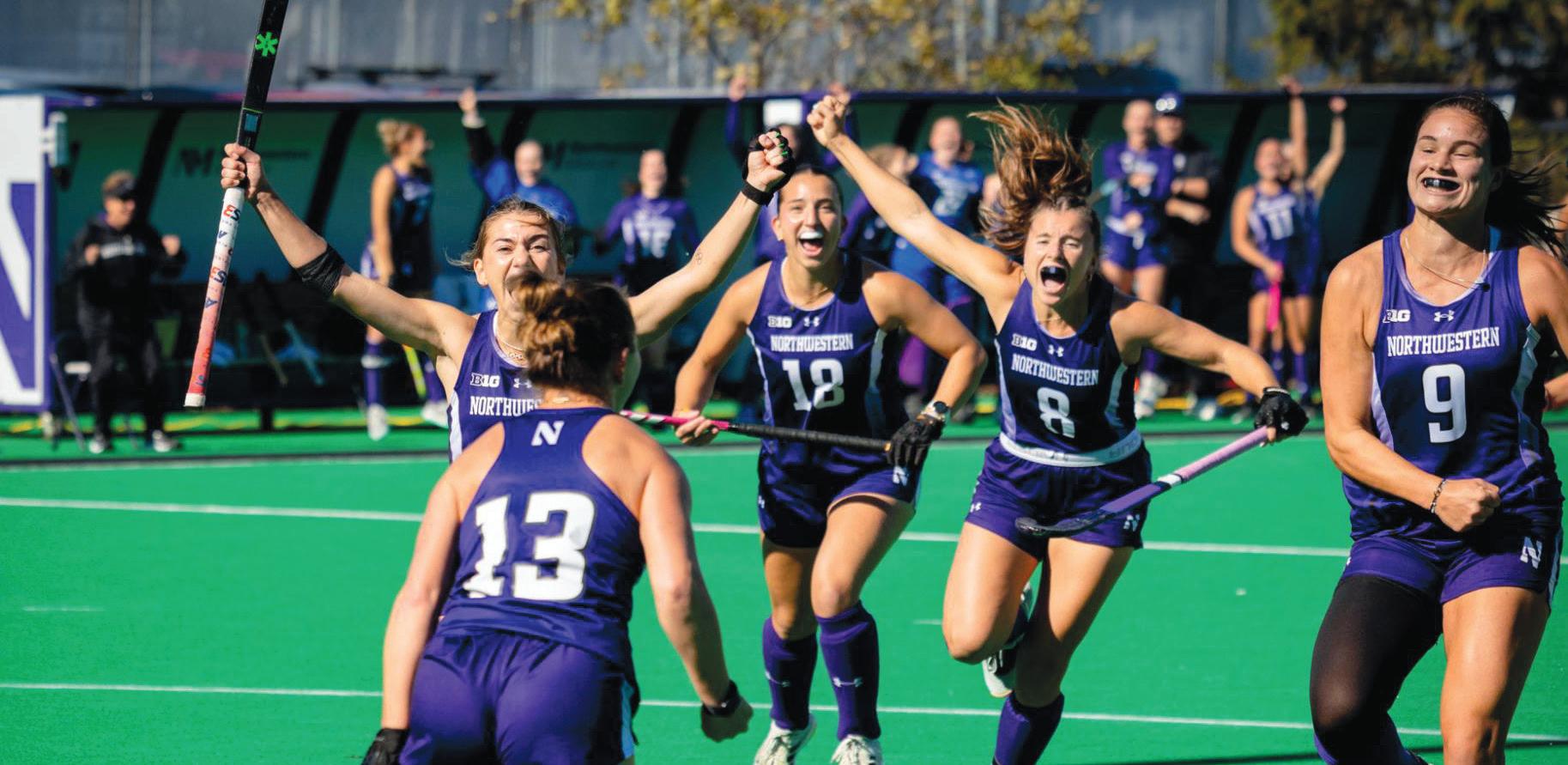
By JONAH MCCLURE daily senior staffer @jemccl125
When graduate student forward Grace Schulze received a pass near the backline, less than two minutes remained between No. 2 Northwestern and No. 12 Miami (Ohio). The score sat at 2-2, the same as it had 43 minutes of game time earlier.
Schulze dropped to her knees and fired a shot, beating three diving defenders and clearing the goalline for the score. She gave her squad a 3-2 lead, and 100 seconds later, it became a 3-2 win.
The Wildcats (20-1, 8-0 Big Ten) are headed back to the Final Four for the fifth straight time.
After beating the RedHawks (16-5, 8-1 Mid-American) 5-1 earlier this season, NU claimed a 3-2 postseason victory after a gritty battle that took nearly every minute to find a winner.
The ’Cats faced two teams in historic games, beating Yale in its first NCAA Tournament game and now Miami (Ohio) in its first quarterfinal appearance.
NU didn’t score until the end of the second quarter against the Bulldogs on Friday, and it looked to nab an early lead against the highest scoring team in the country on Sunday.
Halfway through the first quarter,
the ’Cats earned the game’s first penalty corner, with Schulze to insert. She found graduate student midfielder Maddie Zimmer, who controlled the ball for sophomore midfielder Laura Salamanca. Salamanca fired a shot into the left side of the net for the goal.
When facing a team with a highpowered offense like Miami, a one-goal lead was far from safe.
The RedHawks earned two penalty corners over the next few minutes, unable to convert on the first but took advantage on the second. Similar to NU’s goal, Miami sent the ball to the top of the shooting circle, and it was zipped into the net by defender Kylie Coughlin.
After the goal, Zimmer looked to take back the lead on the ensuing possession, but her shot went wide. The ’Cats kept the pressure on, and with under a minute remaining in the quarter, they took another penalty corner. The first shot, which came from senior defender Maja Zivojnovic, was blocked, but junior midfielder Ella Kokinis controlled the rebound and snuck a shot into the goal.
The quarter came to a close with NU leading 2-1. It outshot the RedHawks 4-2 during the period, and both teams drew two corners.
Miami got moving quickly to start the second quarter, and after a foul in front of the goal, it earned a penalty shot. Midfielder Malena Sabez took
the attempt and fired it to the left of redshirt freshman goalkeeper Juliana Boon, tying the game at 2-2.
During the remainder of the quarter, the ’Cats outshot their opponent 5-1 but were unable to regain the lead. The contest went into halftime in a 2-2 stalemate.
Each squad possessed the ball inside the shooting circle during the first half of the third quarter, but neither logged a shot attempt and the score held.
The RedHawks logged the first shot attempt of the quarter around the eightminute mark, and NU followed it up with two of its own just two minutes later, but none of them found the back of the net. The latter of the ’Cats’ shots came off the stick of junior forward Ashley Sessa after she forced a turnover at the top of the shooting circle, and it was saved off the pad of goalkeeper Nicky Sjouken.
NU earned consecutive corners and attempted three shots in a 15-second span, but Miami’s defense held strong.
The third quarter came to a close with the score still showing 2-2. The top-five offenses had gone silent after a back-and-forth first half.
Two minutes into the fourth quarter, a player on each squad was given a green card, keeping the teams at even numbers. The ’Cats earned the first corner of the quarter, but they could not convert on their proceeding shots.
With under five minutes remaining
in the contest, Schulze drove down the far side and maneuvered past her defender. She sent the ball to the front of the goal, but junior forward OliviaBent Cole was unable to deflect the ball into the goal.
Schulze had another opportunity for the go-ahead goal when she earned a penalty corner with under two minutes remaining. She slotted the ball to Zimmer, leaving it for junior defender Ilse Tromp, who sent it back to Schulze. She sent a shot past multiple defenders, finally giving NU the lead.
A video review confirmed that the ball did, in fact, cross the line, and the ’Cats bunkered down on defense, preparing for the final minute. They controlled possession and didn’t allow the RedHawks to attempt a shot.
As the clock hit triple-zeros, NU stormed the field, celebrating its victory and return to the tournament semifinals.
Schulze tallied one goal and one assist, and the former was her sixth game-winning goal of the season. Salamanca and Kokinis each scored their second goals of the season. Boon recorded one save while allowing two goals.
The ’Cats will venture to Durham, N.C., for the Final Four, where they will take on No. 1 North Carolina on Friday. Start time is to set for 1:30 p.m. jonahmcclure2028@u.northwestern.edu
By ELI KRONENBERG daily senior staffer @elikronenberg
As the minutes ticked down in Northwestern’s NCAA Tournament first round clash with eighthseeded Alabama on Friday night, the Wildcats (9-48, 4-2-5 Big Ten) held on to a precious 2-1 lead. Junior winger Megan Norkett had put the ’Cats ahead in the 74th minute with a cracking near-post finish, and they were just over five minutes away from sealing their first tournament win since 2022. Instead, the sun set on NU’s season in gutwrenching fashion.
Alabama forward Maddie Padelski equalized with a bullet header in the match’s dying embers, goalkeeper Coralie Lallier played hero with three saves in the penalty shootout after two scoreless extra time periods, and the Crimson Tide (11-8-2, 4-6-0 SEC) advanced to the second round with a 2-2 (3-1 on penalties) triumph.
After failing to qualify for the sport’s biggest stage in back-to-back seasons, the ’Cats re-emerged
in the limelight in Tuscaloosa, providing a good account of themselves in a match that could easily have gone their way. Yet, coach Michael Moynihan’s side will fly home to Evanston bitterly disappointed that it could not finish the job, falling at the first hurdle after a season that promised much in its embryonic moments.
The Crimson Tide started the match on the front foot, rattling off four attempts at goal in the opening seven minutes, but NU did well to get bodies in the way on three of those occasions.
After absorbing early pressure, the ’Cats flipped the script, fashioning five shots of their own in a seven-minute period and eventually making Alabama pay.
In the 28th minute, sophomore right back Ava Goodin glided inside from the right into the penalty area, where her attempted cross took a fortuitous bounce into the path of sophomore forward Kennedy Roesch. NU’s top-scorer lashed at it with her right foot just behind the penalty spot, sending it slicing away from Lallier into the right side netting and bagging her 10th of the season.
The ’Cats took a 1-0 lead into halftime, but
Alabama continued to pile pressure on in search of a way back into the game. It found just that eight minutes past the hour mark.
Crimson Tide forward Larkin Thomason picked up the ball on the left side of the penalty area off a quick throw in and sat senior center back Brooke Miller down with a chop-back, opening up space for a shot. Thomason’s right-footed strike deflected off a sliding senior midfielder Caterina Regazzoni, taking the sting out of the effort and looping it over the helpless freshman goalkeeper Nyamma Nelson.
Pegged back after holding a lead for forty minutes, NU did not take long to regain its advantage.
Just over five minutes after Alabama equalized, Goodin again found herself at the center of the ’Cats’ attack, crossing for senior forward Hayley Newman, who unselfishly nicked it on into the path of Norkett on the left. From seven yards out, Norkett took one touch and thumped it in at the near post, giving Lallier no chance.
For the next 10 minutes, NU held firm at the back and appeared on the verge of advancing to the second round. But, as Padelski crashed the box and got on the end of a whipped cross from the right to
head past Nelson, Alabama broke Wildcat hearts. With the score knotted at 2-2 at the end of the 90 minutes, the game entered two 15-minute, goldengoal extra-time periods. Alabama looked the more likely to deal a dagger blow throughout extra time, out-shooting the ’Cats 9-2, but failed to convert on its superiority.
The match would be decided from 12 yards out.
Roesch got the shootout started on the right note, sending Lallier the wrong way and calmly slotting home. But, from there, things unraveled quickly.
Lallier burst down to her left to stop Regazzoni on NU’s second spot-kick, and then held firm up the middle to deny freshman forward Liz Cardwell on its next one. After Alabama converted each of its first three penalties, Norkett stepped up to the spot needing to score to keep the ’Cats alive. Denied. At the end of a long night full of triumphs and tribulations, NU walked away empty-handed, rueing the lead it let slip at the death.
elikronenberg2027@u.northwestern.edu