The Daily Iowan MONDAY, NOVEMBER 29, 2021
DAILYIOWAN.COM
THE INDEPENDENT NEWSPAPER OF THE UNIVERSITY OF IOWA COMMUNITY SINCE 1868
50¢
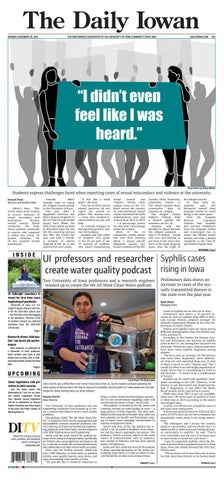
“I didn’t even feel like I was heard.”
Illustration by Molly Milder
Students express challenges faced when reporting cases of sexual misconduct and violence at the university. Hannah Pinski Opinions and Amplify Editor Editor’s Note: This article makes brief mention of several instances of sexual misconduct and harassment. Because several sources feared retribution, The Daily Iowan granted anonymity to sources who requested it within this article. To protect identities, the DI has assigned several pseudonyms.
INSIDE
Amanda didn’t initially want to report her alleged sexual assault to the University of Iowa. One year after it happened, however, she filed a formal complaint to the UI Title IX and Gender Equity Unit. When The Daily Iowan asked Amanda to described what the she felt the reporting process was like, she closed her eyes and took a breath. A moment of silence lingered in the air as she selected her next words.
“It felt like a mind game,” she said. Two out of three sexual assault survivors do not report the assault to police. The reasons vary — some fear retaliation, others believe no one will help. As Amanda engaged in the reporting process, she, too, felt helpless. Amanda and four other UI students who spoke to the DI are part of the 13 percent of students who report experiencing
sexual assault and violence during their college career in the U.S. Rates across the country of nonconsensual sexual contact increased for both undergraduate men and women from 2015 to 2019 — 1.4 percentage points for men and 3 percentage points for women. Much of the UI community reeled earlier this year after learning about a sexual assault allegation against two former members of the Phi
Gamma Delta Fraternity, commonly known as FIJI, which spurred three consecutive days of protests on campus. The alleged victim, Makéna Solberg, filed a lawsuit against the members on Oct. 26. Amanda said she decided to report because the alleged assailant — also a UI student —would call, text, and attempt to get close to her when they were in the same program space after the night of
UI Fulbright awardees to travel for first time since beginning of pandemic
bring a science based, interdisciplinary perspective to our conversations regarding water and environmental issues in Iowa,” Secchi said. The podcast, co-hosted by Secchi, Jones, and Cwiertny, focuses on water quality in Iowa — a large portion of their expertise. The show published its first episode in October. Now, there are four episodes on Spotify and Buzzsprout ranging in topics from emerging contaminants to manure management plans. Secchi said that, so far, the podcast has received a lot of positive feedback from listeners and the show’s popularity has grown. The podcast’s Twitter account, which is the main source of communication with its audience, was created in February and has since gained nearly 550 followers. Jones said that, while the focus of the podcast is about opening discussion on the issues surrounding clean water, it is also an effort to educate the public on what is occurring in Iowa.
Cases of syphilis are on the rise in Iowa. Preliminary data shows a 75 percent increase in cases of syphilis from 2020 to 2021, said George Walton, program manager for sexually transmitted diseases at the Iowa Department of Public Health. Walton said syphilis cases are rising among different demographics than the disease typically presents in. According to the Centers for Disease Control and Prevention, the majority of syphilis cases in the U.S. are among men who have sex with men. Within the state, Walton said there have been more syphilis diagnoses among women. “We have seen an increase, for the persons that have been diagnosed, more individuals that are self-reporting drug use, so that is likely a factor as well,” Walton said. “But I would say there is no one single population or single factor that is contributing by itself to the increase — it seems to be a combination of factors.” Syphilis can be cured with antibiotic treatment, according to the CDC. However, if the disease is not discovered and diagnosed before it progresses, it can affect the heart, blood vessels, brain, and nervous system. While data from 2021 is not yet available, there were 140 more cases of syphilis in Iowa in 2020 than in 2019, according to the state’s surveillance data. In 2020, over 80 percent of syphilis cases in the state were among men. Walton said national data for 2020 and 2021 rates of STD’s have not yet been released, but anecdotally, cases seem to be rising nationwide. “My colleagues and I across the country speak to one another, and everybody that I’ve spoken with in other states are seeing increases, particularly in syphilis,” he said. “That’s very noticeable, but the rate of increase here in Iowa seems to stand out a bit more.” Cases of congenital syphilis, when the disease is passed from a pregnant person to their fetus, have also spiked dramatically this year, Walton said. “The increases we’ve seen this year in Iowa, for that, have been historic, to be honest about
PODCAST | Page 2
SYPHILIS | Page 2
Research shows ‘side hustles’ can boost job performance New research, co-authored by a University of Iowa professor, finds workers who have a side hustle such as Uber, Lyft, or Airbnb perform better at their full-time jobs. Page 3
UPCOMING Larry Phan/ The Daily Iowan
State legislators talk pri.Silvia Secchi uses a Britta filter in her home in Iowa City on Nov. 22. Secchi created a podcast explaining the orities in 2022 session water quality of the Iowa River and how to improve its sanitation. Secchi’s goal is to “make people see how bad
dailyiowan.com
Preliminary data shows an increase in cases of the sexually transmitted disease in the state over the past year. Rylee Wilson Managing Editor
University of Iowa U.S. Fulbright Program winners will travel for the 2021-2022 school year — the first time since the begging of the pandemic. Thirteen of the 22 student winners are deferred awardees from the 2020-2021 school year. Page 7
Watch for campus and city news, weather, and Hawkeye sports coverage at
REPORTING | Page 5
UI professors and researcher Syphilis cases create water quality podcast rising in Iowa Two University of Iowa professors and a research engineer teamed up to create the We All Want Clean Water podcast.
Join the Daily Iowan this Wednesday at 7 p.m. for our Johnson County Legislative Forum. Four Johnson County legislators will be in attendance to discuss higher education and other topics at the Iowa City Public Library, in Meeting Room A.
her alleged assault. As time went on, Amanda said she distanced herself from program events to avoid being in the same space. After the program director expressed concern that Amanda had become withdrawn from the program events and encouraged her to report the alleged sexual assault, she filed a formal complaint to the Title IX and Gender Equity Unit.
things are...doing nothing keeps our water polluted.”
Natasha Keicher News Reporter Two University of Iowa professors and one engineering researcher have teamed up to create a podcast that dissects Iowa’s water quality problems. The podcast, titled “We All Want Clean Water,” is hosted by Silvia Secchi, geographical and sustainability sciences associate professor; David Cwiertny, civil and environmental engineering professor; and Chris Jones, researh engineer with IIHR-Hydroscience and Engineering. Secchi said the team started the podcast because of the amount of people online, specifically on Twitter, who encouraged her and Jones to do so, to discuss in depth the environmental issues they talked about on their social media accounts. Jones uses his Twitter account, which has over 2,500 followers, to tweet links to research articles, water quality reports, news stories, and more surrounding water quality in Iowa. “We just felt that it would be important to
2 NEWS
THE DAILY IOWAN | DAILYIOWAN.COM | MONDAY, NOVEMBER 29, 2021
The Daily Iowan
Marinelli wins the Hunt
VOLUME 154 ISSUE 34
STAFF
Jerod Ringwald/The Daily Iowan Iowa’s No. 1 ranked 165-pound Alex Marinelli and Army’s Christian Hunt grapple during a wrestling meet between No. 1 Iowa and Army at Carver-Hawkeye Arena in Iowa City on Sunday. Over 14,000 fans attended the meet. The Hawkeyes defeated the Black Knights 36-7.
Publisher | 335-5788 Jason Brummond Executive Editor | 335-6030 Caleb McCullough Managing Editors Rylee Wilson, Josie Fischels Managing Digital Editor Kelsey Harrell Asst. Digital Editor Molly Milder Senior Print Editor Rachel Schilke News Editors Eleanor Hildebrandt, Sabine Martin Politics Editor Natalie Dunlap Arts Editors Maddie Johnston, Jenna Post Opinions & Amplify Editor Hannah Pinski Sports Editor Austin Hanson Asst. Sports Editor Chloe Peterson Pregame Editor Robert Read Copy Editor Katie Ann McCarver Photo Editors Jerod Ringwald, Grace Smith Films & Documentary Director Jenna Galligan DITV News Director Elisabeth Neruda DITV Asst. News Director Julia Richards DITV Sports Director Destinee Cook
BREAKING NEWS
Phone: (319) 335-6030 Email: daily-iowan@uiowa.edu
CORRECTIONS
Call: 335-6030 Policy: The Daily Iowan strives for accuracy and fairness in the reporting of news. If a report is wrong or misleading, a request for a correction or a clarification may be made.
PUBLISHING INFO
The Daily Iowan (USPS 143.360) is published by Student Publications Inc., E131 Adler Journalism Building, Iowa City, Iowa 52242-2004, Mondays and Wednesdays during the fall and spring semesters (plus Fridays of football game weekends) and Wednesday during the summer, except legal and university holidays, and university class breaks. Periodicals postage paid at the Iowa City Post Office under the Act of Congress of March 2, 1879.
SUBSCRIPTIONS
Email Juli Krause at daily-iowan-circ@uiowa.edu Subscription Rates: Iowa City and Coralville: $30 for one semester, $60 for two semesters, $5 for summer session, $60 for full year. Out of town: $50 for one semester, $100 for two semesters, $10 for summer session, $100 all year. Send address changes to: 100 Adler Journalism Building, Iowa City, Iowa 52242-2004
BUSINESS STAFF Business Manager | 335-5786 Debra Plath Advertising Director/Circulation | 335-5784 Juli Krause Production Manager | 335-5789 Heidi Owen
iStock
A syphilis test is shown.
SYPHILIS Continued from Front it,” Walton said. “We’ll finish the year with at least 10 that meet the case definition, which may not seem like a lot, but just to put that in perspective, last year we had one, and in 2013, we had three, and that was a big, high number. So, to have 10 in a single year is significant.” Cases of congenital syphilis have risen nationwide as well, accord-
ing to the CDC. In 2020, more than 2,000 cases were reported, the highest level since 1994. Kathryn Edel, a health educator for Johnson County Public Health, said cases of syphilis have increased in the county as well. Johnson County Public Health offers rapid syphilis testing, which is now available for anyone who wants to be tested, Edel said. “It used to be that we were only able to offer rapid syphilis testing to
Last year we had one, and in 2013, we had three, and that was a big, high number. So, to have 10 in a single year is significant. — George Walton, STD program manager at Iowa Department of Public Health, on the rate of congenital syphilis
PODCAST Continued from Front “It’s a lot for the average person to get their head around, and so the podcast is an effort to inform the public on what’s going on,” Jones said. According to an Iowa Department of Natural Resources water quality assessment, a total of 585 waterbody segments were impaired in Iowa in 2020. An impairment is when a body of water doesn’t meet water quality standards or designated uses due to pollutants. Cwiertny said most of the water quality issues in Iowa stem from a lack of regulations in the agricultural industry. The main issues are overusing pesticides and nutrients, such as nitrates, and ineffective manure management. “We have to change our approach to how we think about water quality and agriculture in the state,” he said. “And we should expect that regulation is going to be necessary to make meaningful progress.” Nutrient pollution in Iowa’s rivers is largely due to the agricultural
industry. When nitrogen and phosphorus are used to fertilize a crop, the excess chemical that is not absorbed by the plant gets washed into water bodies when it rains, according to the Iowa Environmental Council. Jones said the podcast aims to create a space where factual discussion of water quality issues and solutions can be discussed without politics playing a factor. One of the most important things was providing listeners with solutions, he said. Cwiertny said one of the issues that occurs when water quality problems are discussed is urging people who believe there are no solutions to water problems to open their minds. A lot of the solutions that are proposed take voluntary practices in the agricultural industry and make them regulated practices. “That’s not popular, but that doesn’t mean that that’s not a solution and that doesn’t mean the solution should be ignored,” Cwiertny said. Secchi said the political discourse surrounding water problems in the country is what in-
We have to change our approach to how we think about water quality and agriculture in the state. — David Cwiertny, UI professor of civil and environmental engineering
select folks, so folks who were showing symptoms or had a potential exposure,” she said. “Now, we’re able to open that eligibility requirement up and offer syphilis testing to everyone, and that’s because of what our state is experiencing in terms of syphilis rates.” Johnson County Public Health takes walk-in appointments for STD testing, Edel said, adding that the testing program is free and doesn’t require ID or insurance. “So now would be a great time to receive syphilis testing,” she said. Rates of chlamydia and gonorrhea, other sexually transmitted diseases, have increased in the state as well, with rates of gonorrhea doubling over the last five years, along with chlaspired the name of the podcast. “It’s meant ironically, because we all say we want clean water, but we don’t actually act as if we wanted clean water,” Secchi said. “If we all did want clean water in Iowa, it would look a lot cleaner than it does.” Cwiertny said he hopes the podcast inspires listeners to learn more about their water and want to help make it better. “What we want to do is keep being a trusted source so people can come and learn about the issues, the science behind them, and keep getting more people to care about water quality,” he said.
natasha-keicher@uiowa.edu
mydia, Walton said. “We typically see increases in chlamydia every year,” he said. “That’s one that is very often asymptomatic, so we often say the more successful you are at testing, the more individuals you’ll diagnose.” Walton said the De-
partment of Public Health is encouraging more routine testing for the disease. The current CDC guidelines for syphilis testing are that anyone who has symptoms of syphilis, or a partner who has been recently diagnosed with the disease should be tested, in addition to routine testing pregnant women, and men who have sex with men. “As we’ve seen in-
creases in Iowa and we’ve seen increases in other parts of the U.S., we’re trying to promote and encourage testing further, because … there’s additional populations that have not been as affected in the past who are affected now,” Walton said. “Essentially, we’re trying to promote that being more of a routine test for folks who are sexually active.”
rylee-wilson@uiowa.edu
Iowa City’s Original OG Pipe Shop 106 S Linn Street www.thekonnexion.com M-W 10am-9pm Th-Sat 10am-10pm Sun 12pm-6pm
in Customer Service and American Glass GLASS PIPES, WATER PIPES, RIGS AND SMOKING ACCESSORIES
NEWS 3
THE DAILY IOWAN | DAILYIOWAN.COM | MONDAY, NOVEMBER 29, 2021
Groups lose funding as domestic violence deaths rise Domestic violence survivor advocacy groups are impacted by funding cuts as domestic violence deaths match their 2020 total in just 10 months. Sam Knupp News Reporter The number of domestic violence homicides in Iowa in 2021 has matched 2020’s yearlong total in 10 months, coinciding with cuts in federal funding for advocacy programs. There were 17 domestic violence homicides in all of 2020, a figure matched by October of this year. There were 10 domestic violence homicides in 2018 and 15 in 2019. Sandi Tibbetts-Murphy, director of the Crime Victim Assistance Division at the Iowa Attorney General’s Office, said advocacy services are key in preventing domestic violence homicides. “Research has shown that, when victims have access to advocacy, they are much less likely to end up in a situation where they’re murdered, and so that’s the significant issue here,” she said. “And of course, we are at a time where those grant funds for those programs have been dramatically decreasing over the last few years.” Kristie Fortmann-Doser, executive director of the University of Iowa’s Domestic Violence Intervention Program, said the program will receive around 25 percent less federal funding this year, meaning it will be able to serve 600 fewer victims than in the previous year. On top of reduced funding for advocacy groups,
Tibbetts-Murphy said gun laws have also played a part in the increase in domestic-violence homicides. “Guns are the number one weapon in domestic violence killings in the United States,” she said. “And in fact, just owning a firearm makes an abuser five times more likely to take a partner’s life. So they are in and of themselves an inherent danger.” Tibbetts-Murphy said the decrease in funding comes from a reduced amount of money going into the federal Crime Victims Fund. All fees, fines, and penalties from federal criminal prosecutions are typically deposited into the Crime Victims Fund. Tibbetts-Murphy said those funds can then be used for programs established by the 1984 Victims of Crime Act. This includes national programs such as the National Network to End Domestic Violence and the Rape, Abuse, and Incest National Network, and local programs such as the Iowa Coalition Against Domestic Violence and the Domestic Violence Intervention Program. “The problem is that, over the years, there have been fewer actual prosecutions,” Tibbetts-Murphy said. “There was more of a practice of diverting, and those funds from diversionary agreements [were] not being deposited into the Crime Victims Fund.”
Tibbetts-Murphy said the funding cuts will directly lead to less availability among advocacy groups to support survivors of domestic violence. According to a letter from the Iowa Coalition Against Domestic Violence, the Iowa Coalition Against Sexual Assault, and the Iowa Coalition for Collective Change, federal funding for state grants through the Victims of Crime Act fell by 35 percent in fiscal 2021. To mend the lack of funding, the three organizations asked Iowa Gov. Kim Reynolds to direct $20 million in funding from the American Rescue Plan. The organizations’ letter cites the federal cuts and the hardships brought on by COVID-19 as reasons for needing more money. Tibbetts-Murphy said, despite the decrease in funding, lawmakers are taking steps to provide adequate support to crime victims. During the summer 2021, Congress passed the Victims of Crime Act Fix, with the goal of taking money from diversionary agreements and putting it into the Crime Victims Fund. Tibbetts-Murphy said while this is a step in the right direction, it is still going to take time to build the funds back up. “It’s going to take a good two or three years before that overall fund amount grows back up to a level that it was, say four or
Grace Smith /The Daily Iowan Executive Director of Domestic Violence Intervention Program Kristie Fortmann-Doser poses for a portrait in her office at the Iowa City DVIP location on Nov. 18. Fortmann-Doser explained that the thought process for DVIP’s funding is to diversify funds and not rely on state or federal funding. “It’s gonna be hard but we’re gonna do it,” she said. five or six years ago,” Tibbetts-Murphy said. “So, we are going to continue to see reduced grant funds available over the next couple of years until that can catch up.” Lindsay Pingel, director of community engagement for the Iowa Coalition Against Domestic Violence, said the Iowa Crime Victim Service Delivery Network — which the Iowa Coalition Against Domestic Violence is a part of — will take a hit because of funding cuts. “When we are looking at funding cuts at the federal level, we are looking
at loss of employment,” Pingel said. “We are looking at agencies that are closing their doors. We know that some of our programs who have offices in smaller communities have already closed their doors to keep staff.” Fortmann-Doser said the rise in domestic violence homicides can be largely attributed to the COVID-19 pandemic. “We have seen a 28 percent increase in crisis line calls and a 76 percent increase in our costs for sheltering,” Fortmann-Doser said. “… We also saw a significant increase in the
number of people that we serve in fiscal year 2021, just in Johnson County, an additional 300 people, which is about a 25 percent increase.”
Resources for victims of domestic violence Domestic Violence National Hotline: (800) 7997233 Domestic Violence Intervention Program: (800) 373-1043 Iowa Coalition Against Domestic Violence: (515) 244-8028
samuel-knupp@uiowa.edu
Research shows ‘side hustles’ can boost job performance Workers with side hustles such as Uber and Etsy shops performed better in their full-time jobs. Ryan Hansen News Reporter New research, co-authored by a University of Iowa Tippie College of Business professor, found that working “side hustles” can boost performance at an individual’s full-time job. The research was driven by workers who participate in a side hustle — an alternate way of making money outside their main job. Workers participated in activities in the food delivery industry, arts and crafts, and property rental services, while also looking at a range of different full-time industries, including teachers and nurses. Jennifer Nahrgang, a professor of management and entrepreneurship at Tippie, said the research demonstrates the value of having a side hustle. “Contrary to what most people would think, that side hustles detract from full-time performance, we actually found that engaging with side hustles on a dayto-day basis generated some positive emotions [and] positive energy that helped boost performance in your full-time work,” Nahrgang said. Nahrgang defined side hustles as any income-gen-
erating work done outside of full-time work commitments in the study. She said “moonlighting,” or holding a second job, has become more commonplace in the gig economy — where freelance or short-term contract jobs are the norm. Companies like Uber, Fiverr, and Etsy, she said, provide a platform for workers to make extra money. Nahrgang said the obvious benefit is a second source of income, but the research suggests that companies’ views of workers who have side hustles should shift, given that there are more positive results than negative ones. “There are benefits to side hustles that we probably didn’t think about before,” Nahrgang said. “The fact that [employees] feel empowered by them, they feel engaged, and they see positive benefits to their work performance hopefully gives organizations more leeway in encouraging employees to have side hustles.” The research determined a boost in performance, Nahrgang said, by surveying multiple participants’ coworkers and asking whether the employee was carrying out the core parts of their job well. Hudson Sessions, Uni-
versity of Oregon assistant professor and co-author of the study, admitted the findings were not completely positive, but the positives certainly outweigh the negatives. “We found that there is a positive symbiosis to a side hustle and a full-time job,” Sessions said. “A caveat to that is that we found they’re a bit more distracted in their full-time job. That positive experience of empowerment, people kind of get hung up on that a little bit.” The coworker surveys used in the research, Sessions said, were conducted over the course of a few weeks to provide a large data set to make generalizations about the data. “We were able to compare what the coworkers said about the employee throughout the whole study period,” Sessions said. “We found that employees performed better on the days that followed those empowering side hustle experiences.” While Sessions said he would not recommend making gig work such as Airbnb and Lyft into a full-time job, he said a good balance between the two can be positive for worker output. “I would say that side hustles have been stigma-
Dimia Burrell /The Daily Iowan
Photo Illustration by Dimia Burrell. tized purely as a distraction,” Sessions said. “I think this opens avenues to consider the fit between the two, that it can be a positive thing. People need to keep their health insurance, they want the stability of a full-time job, but these side hustles can add something.” Sessions said he was in-
terested in conducting this research because of the proximity and societal prevalence of gig work. One of his friends, he said, bought a car and paid it off simply by working for Uber. “I’m participating in so many of these things,” Sessions said, citing side hustles such as DoorDash, Lyft, and
Airbnb. “I’m really curious about the people behind those services. A big part of the story of those people is that they are full-time employees elsewhere and this is just a side hustle for them, and there’s a lot more to their work lives.”
ryan-m-hansen@uiowa.edu
4 NEWS
REPORTING Continued from Front
Amanda said she first met with the investigator to tell her side of the alleged assault. After the meeting, she said she received notice that the investigation needed to be postponed for medical reasons cited by the respondent — the label given to the party that the formal complaint is made against. When the investigation resumed, Amanda said she was brought in for a second interview to talk about the respondent’s version of the story and asked to clarify points that the respondent disagreed with in her story. As time went on, Amanda said she felt like the investigator leaned in favor of the respondent. Amanda said she brought up in her last meeting with the investigator that none of the provided witnesses who could speak on the night of respondent’s behavior were interviewed. After Amanda asked why witnesses weren’t interviewed, she said the investigator responded, “It sounded like you’re reading from a prepared statement,” and that the investigator didn’t feel like the witnesses could give an accurate account of the night of the alleged assault. When she was called in by the Title IX and Gender Equity Unit to have the outcome of the investigation, Amanda’s heart dropped. She said the investigator had found no policy violation and decided the case to be a “regretted sexual encounter,” meaning that the investigator believed that she had consented to engage in sexual activity, but regretted it afterward. “The takeaway from the report was that I was a cocktease that got what was coming toward them,” Amanda said. “‘I played with fire, and I had sex that I didn’t want ultimately and that it’s my fault,’ that’s how the report read.” Amanda said she not only felt shocked by the outcome, but also by how the investigator interpreted the report. In the report, both Amanda and the respondent said she had said “no” and “stop” during the sexual encounter. According to the UI definition of consent, “Consent can also be withdrawn once given, as long as the withdrawal is reasonably communicated that, if there is confusion as to whether anyone has consented or continues to consent to sexual activity, the participants must stop the activity until each consents to it.” Amanda said the report, however, made it seem like the words were used in a flirtatious context and egged the respondent on. In the report, the respondent was never asked if the respondent gave consent, Amanda said. Per university policy, the exact text of the report was unable to be shared with the DI. Additionally, in the section about credibility, Amanda said the report stated that both parties were credible. She said that from her perspective, the respondent lied about some details that the investigator didn't look into. For example, the respondent stated that their roommate was out of town the night of the alleged assault, however, Amanda claimed the respondent didn't have a roommate at the time. Meanwhile, she felt “hammered” with questions, including, “Were you asking for it?” and “Are you in the habit of texting men at night?” After the investigation, Amanda said she regretted buying into what she called “propaganda” that the UI cares about issues such as sexual misconduct and violence. “This really messed with my head for a long time when I realized not a single person was in my corner,” Amanda said.
“I was so disillusioned after. It’s no wonder why nothing happens and it never gets reported.”
THE DAILY IOWAN | DAILYIOWAN.COM | MONDAY, NOVEMBER 29, 2021
UI procedure for alleged violations of policy on sexual harassment and misconduct When a report arrives at the Title IX and Gender Equity Unit, the first step is to explore options and determine if the alleged miscondudct falls within the scope of the Interim Policy on Sexual Harassment and Misconduct.
Step 1: Initial Assesment
Title IX Coordinator initiates a formal complaint
Complainant decides to make a formal complaint
Report arrives at Title IX and Gender Equity Unit which provides...
formal complaint is made
-Confidential resources -Supportive measures -Resolution Options
Complainant doesn’t make a formal complaint
Title IX Coordinator decides to initiate a formal complaint
formal complaint is made
Key Notes -The Title IX and Gender Equity Unit is not a confidential office. Information from a report may be shared with others in the university’s response process. -Even when the Title IX coordinator initiates a formal complaint, participation in the resolution is optional for complainants and respondents.
Process A occurs when the alleged behavior falls under Title IX or if the alleged behavior, if true, would likely result in a student respondent’s suspension or expulsion.
Process A Investigation report is issued
No complaint or action is taken
Hearing takes place and a hearing adjudicator makes a final determination based on the preponderance of evidence standard
Policy violation is found
No policy violation is found
Key Notes and Roles -Defintion of preponderance of evidence: “Burden of proof is met when the party with the burden convinces that there is greater than 50 percent chance that the claim is true.” (Source: Cornell Law) -Hearing Adjudicator: Facilitates hearing preparations, conducts the hearing, and assesses the credibility of parties and witnesses. -Sanctioning administrator: Makes a sanctioning decision and writes letter for inclusion with notice
Adaptable Resolution
Key Notes
Because the UI receives federal funding, it also has to follow Title IX policy for addressing sexual assault and misconduct. In higher-education institutions, Title IX applies to a variety of areas like recruitment, admissions, and athletics. However, the protocol for sexual assault and harassment policy has caused issues for students who follow through with the reporting process. When Riley, a UI graduate student, went into their initial meeting with the Title IX and Gender Equity Unit to report alleged
“I almost wish I had gone in expecting less so I wasn’t let down at the end of it.” —Riley
“Law enforcement agencies do this in order to make sure the victim/ survivor does not have to tell their story multiple times as that process can be traumatizing, and we all want to serve our community in a way that is traumainformed,” Bruce wrote. At the UI, the Title IX and Gender Equity Unit — formerly known as the Office of Sexual Misconduct and Resource Center — handles investigations for sexual harassment, assault, and misconduct. The office changed its name this year when it merged with the Division of Diversity, Equity, and Inclusion. Before, the unit was under the Division of Student Life. There are three processes , Process A, Process B, and the Adaptable Resolution, that a formal complaint can follow. Processes A and B are meant to determine if there has been a UI policy violation, and the adaptable resolution is meant to address resolution aims to address harm, said UI Title IX coordinator Monique DiCarlo.
sexual harassment, they felt optimistic. Riley ended up leaving the meeting upset and angry because they said they were discouraged from filing a formal complaint of their sexual harassment case. After encountering uncomfortable experiences that seemed like sexual harassment from a fellow student in their department, Riley said they wanted to voice their concerns. Riley spoke to a trusted faculty member in the department who put them in contact with the Title IX and Gender Equity Unit. Riley didn’t reach out to the office at first, they said, because they weren’t sure that they wanted to report and didn’t know if the behavior counted as sexual harassment. A year later, however, Riley contacted the office after learning that the student had made other students in the department uncomfortable. A meeting was set up between Riley and the Title IX and Gender Equity Unit to figure out if they wanted to file a formal complaint. First, Riley was asked
Formal grievance process is followed
The Adaptable Resolution Process requires a formal complaint. It may be requested by either the complainant or respondent and may be initiated during the complaint process, or any time prior to a final determination.
Parties reach an agreement
-The goal is to address harm instead of finding a policy violation -A succesful Resolution Agreement is a voluntary written agreement reached by both parties. -Each party may choose to stop the process and return to the formal grievance process
When a UI student reports sexual assault or misconduct to the police, it goes through the law enforcement agency that has jurisdiction for its investigation. The UI Department of Public Safety investigates any crime that occurs on campus. Hayley Bruce, UI assistant director of media relations, wrote in an email to the DI that if a person reports an assault on campus and calls the Iowa City police, they will likely be directed to UI police to report because UI police have the jurisdiction to investigate the crime.
Appeal can be submitted by either party
Title IX coordinator issues notice of outcomes
Parties do not reach an agreement
Both parties agree to engage in the adaptable resolution process
Formal complaint is made
Sanctioning decision is given by sanctioning administrator
torecount why they wanted to file a formal complaint. After they explained the interpersonal experience that made them uncomfortable, Riley said that they were “encouraged not to report because the office said there wasn’t enough evidence and didn’t believe a policy violation would be found if filed.” Riley claimed that they were asked if their decision to pursue an investigation was made to seek revenge against the student. After being asked that question, Riley said they recalled feeling taken aback after hearing that question. “I just kind of sat there and thought about it for a minute and let the silence hang in the air,” Riley said. “[Wanting to report] wasn’t out of vengeance or anger. I just didn’t want them to do that behavior again.” Additionally, Riley said they were asked to consider the respondent’s emotions. “They asked me to consider his feelings and emotions because [the person] was just having a bad day and was mentally unwell and having a difficult time,” Riley said. DiCarlo said that an alleged behavior has to fall within the policy that is prohibited under section 4.14 of the Sexual Harassment and Sexual Misconduct Operations Manual. If the allegation doesn’t fall under the prohibited behavior, the formal complaint may be dismissed. "Something can be hurtful, crude, sexist, and fall outside the policy," DiCarlo said. "It doesn't mean that it's OK, but it does mean we would likely have a different way of addressing that behavior separate from a formal complaint." In 2019, 521 reports were made to the Title IX and Gender Equity Office for sexual harassment, misconduct, and violence
Resolution agreement is signed
— 158 for sexual assault, 177 for sexual harassment, 105 for dating/domestic violence, 136 for stalking, and 36 for sexual exploitation/intimidation. Of the 521 reports, the UI opened investigations into 44 of them. Of those, 21 cases were found to include policy violations; 22 were found to possess “no policy violations;" and one ended with a closed case, meaning the respondent withdrew before a finding was issued or the reporting party requested to cease the investigation. “I almost wish I had gone in expecting less so I wasn’t let down at the end of it,” Riley said. “It’s a huge let down to tell someone all this unsettling stuff that has happened to you and then get asked if you are telling because you’re mad at them and want vengeance.” While they were aware of the potential problems of sexual misconduct and the reporting process for it on campus, Riley said it was eye-opening to experience it first-hand. “It is a completely different experience yourself versus just hearing about it,” they said. “I was so disillusioned after, it’s no wonder why nothing happens and it never gets reported.”
“I would’ve liked them to be more realistic about what happens at the end of the process, because I got my hopes up.”
After the initial assessment and if a formal complaint is made, the next step is to determine if a case of sexual misconduct or violence meets Title IX regulations. If it meets the regulations, the case follows Process A, in which the
respondent can be expelled or suspended if they are found to be guilty of a policy violation. If not, the case follows Process B. However, a case that does not meet Title IX regulations still has the ability to follow Process A, if sanctions could still result in suspension or expulsion, according to offcampus behavior policy. In 2020, the Trump administration and former Education Secretary Betsy DeVos released new changes to Title IX on how schools can handle sexual assault and harassment. The administration policymakers felt like too many schools inadequately responded to sexual assault and harassment reports and claimed the new policy was meant to protect all students — including those who are falsely accused. These changes sparked outcry across the nation, with the opposition claiming that Title IX fails to protect the group it is supposed to help: survivors. The first concern noted by opposition was the change in the definition of sexual harassment. Under the 2011 definition, sexual harassment was broadly defined as “an unwelcome conduct of sexual nature.” However, the new policy reflected a much narrower definition, indicating such harassment was now defined as “unwelcome conduct that a reasonable person would determine is so severe, pervasive, and objectively offensive that it denies a person access to the school’s education program or activity.” Other concerns included the new requirement of cross-examinations during hearings. In an opinion piece, two University of Michigan professors and a doctoral student called crossexaminations irresponsible because research has proven that it is a poor measure of truth when evaluating cases. Now, President Joe Biden's
NEWS 5
THE DAILY IOWAN | DAILYIOWAN.COM | MONDAY, NOVEMBER 29, 2021
Step 2: Formal Grievance Process Title IX Regulations apply
Investigation begins
The formal grievance process requires a formal complaint. The process begins with the appointment of an investigator who gathers information and assesses and synthesizes the relevance of evidence, and compiles the information into a report and file of directly related evidence.
Process B
Title IX Regulations don’t apply
Key Notes
Process A is followed
- The complainant and respondent can have up to two advisors of their choosing. Advisors provide support and advice throughout the process, and they may attend all meetings where the party is entitled to be present.
Sanctions can result in suspension or expulsion
Process A is followed
Sanctions could not result in suspension or expulsion
Process B is followed
Policy violation is found
Sanctioning decision is given by sanctioning administrator
No policy violation is found
Title IX coordinator issues notice of outcome
Title IX coordinator issues notice of outcome
Investigator issues an investigation report and makes a final determination based on preponderance of evidence
Appeal can be submitted by either party
Process B occurs when the alleged behavior does not fall under Title IX, but does constitute prohibited conduct within the Interim Policy on Sexual Harassment and Misconduct, and if true, would not result in a student respondent’s suspension or expulsion. adminitration is working to dismantle and rewrite the policies the Trump administration and DeVos put in place, with a focus on eliminating barriers to address sexual harassment and encouraging students to come forward. The Department of Education is planning to release proposed rule changes in May 2022. Lily, a UI graduate student who engaged in Process A and a subset of it called the Adaptable Resolution Process, called the reporting process draining and frustrating. When Lily believed she’d experienced stalking from a fellow student, she first went to the Office of the Ombudsperson and was forwarded to the Title IX and Equity Unit. Lily said she felt overwhelmed by the process during her first meeting with the Title IX and Gender Equity Unit, in which reporting options were discussed. She decided to file a formal complaint that would follow Process A, however, because she felt like it was the only way to resolve the issue. “I felt like if I wanted anything else to happen, I needed to go through this whole traumatic process,” Lily said. “But I was not really aware of that, and it was a lot in an already difficult time.” After filing the formal complaint, Lily said she met with the investigator to recount the experience
Both parties must agree to the process, and a successful Adaptable Resolution happens when both parties reach a voluntary written agreement. Common resolutions include going through educational programs and mental health counseling, DiCarlo said. After making the decision to engage in the Adaptable Resolution, Lily said she was contacted by a negotiator from the office to draft a resolution of what harm was caused and what she wanted. Lily, a negotiator, and an advocate from the Rape Victim Advocacy Program, met weekly to work on the resolution, which took about a month to complete. In the resolution, the respondent was asked to attend mental health programs and to exit extracurricular activities they were in with Lily. Because both parties must reach a voluntary written agreement, the respondent has the opportunity to negotiate the terms that the complainant lays out. Lily said the respondent initially refused to the terms. During the negotiation phase, the negotiator meets separately with the respondent and complainant to determine what each party wants. Lily said the negotiator would just report what the respondent would agree or not agree to, and they would have to redraft the resolution until both parties agreed to the terms. Lily said the negotiation
It just seemed like they wanted it to go away more quickly.”
— Lily
and provide names of people who witnessed the behavior. Before reaching the live hearing portion of the investigation, Lily said the investigator encouraged her to switch to the Adaptable Resolution process. She said she was told that the process would be faster, less involved than Process A, and give her options for resolutions that she was looking for. “They said one option would be ‘We could ask this person to receive help,’ and I was like, that sounds wonderful because that’s what [they need], and that’s what I thought would help solve this issue in the future,” Lily said. “But that didn’t end up happening.” Lily added that she felt pushed into trying out the process. “It felt a little bit like they didn’t want anything more serious to happen in regards to the reporting process,” Lily said. “It just seemed like they wanted it to go away more quickly.” DiCarlo said the goal of the Adaptable Resolution Process is not to find if Title IX policy was violated, but instead to address harm.
lasted five months before she finally signed the agreement. The resolution determined that the respondent would exit only one of the extracurricular activities, and that they did not agree to enroll in any mental health programs. In the end, Lily said she felt defeated. “It just seemed like he got a ton of stuff, and I didn’t get anything out of it, which wasn’t the point,” she said. “The point was for it to be done in a way where he could get help and stuff, but it didn’t end up happening that way.” Lily said she didn’t have much hope in the process to begin with, and wished that it was more transparent. “I would have liked more transparency about what was possible under the Adaptable Resolution Process, so instead of promising me we could do this, or ask [the respondent] to do this, none of that happened,” Lily said. “I would’ve liked them to be more realistic about what happens at the end of the process, because I got my hopes up.”
“I didn’t even feel like I was heard.”
During the reporting process, UI undergraduate student Jordan said they didn’t feel like they were being listened to throughout the investigation. When Jordan met with the Title IX and Gender Equity Unit, the unit laid out the options for filing a formal complaint. Their situation, however, was unique. At the time of the alleged assault, the complainant and respondent were undergraduate students at the UI. When Jordan reported, the respondent was a graduate student and employee. After months of figuring out where the formal complaint would be investigated, Jordan said it was decided their complaint would be investigated by the Office of Student Accountability. First, Jordan had an initial meeting with the Title IX Coordinator and the investigator. They were asked to recount what happened the night of the alleged assault. Jordan said the basis of the alleged assault was that consent was never given. Although Jordan said they were drinking, it was not to the point of intoxication or incapacitation. Jordan said, however, the investigator seemed fixated on the idea of them drinking and kept asking questions about whether they were incapaticiated or not. The next meeting Jordan said they were called into was a redo of the initial meeting because there was a new Title IX coordinator on the investigation. Jordan said it was retraumatizing to go through another meeting where they had to describe the alleged assault. After the second meeting, the investigator met with the witnesses and the respondent. Jordan was then invited into a third meeting, where they were asked more specific questions, including more regarding their alcohol consumption. After the third
meeting, Jordan said they became frustrated over how long the investigation was taking and felt like it was working in opposition to them. They said they felt like they weren’t being listened to because the office kept circling around the idea of alcohol consumption, even though it wasn’t the basis of the complaint. After the third meeting, Jordan was called back into the unit about two months after the third meeting, and was told there was no policy violation found because the unit couldn’t identify if consent was given. Jordan said, according to UI policy at the time, the first person to make physical contact must ask for consent, and if they didn't, it would violate policy. Jordan said the first person that initiated physical contact was the respondent, but they never asked for consent when it was initiated. “At no point in this fact finding do they include them asking for consent,” Jordan said. “So that means in both my testimony and theirs, there was no consent, and they agreed that there was no consent ever asked for, but they still found no policy violation.” After consulting with a lawyer about the final determination, Jordan decided to appeal their formal complaint, believing the office didn’t follow its own policy. While both parties have the opportunity to appeal the outcome of an investigation, DiCarlo said the ability to change the outcome is narrow. In 2019, 14 out of the 44 resolved investigations were appealed. No decisions or sanctions were overturned or modified. Jordan’s appeal didn’t change the outcome, and they were told if they wanted to pursue further action, they would have to go through the state Board of Regents. They decided not to go before the regents because they wanted to be done with the process. Jordan said they felt very angry and upset because the reporting process felt like a traumatizing experience. To this day, they still feel like they haven't felt like they haven't processed it, they said. “I felt like I gave up a lot of my life to go through this, and I got nothing in return,” Jordan said. “I didn’t even feel like I was heard, so it was difficult.”
Other reporting avenues also present complications
Although there are other ways at the university to pursue complaints against sexual misconduct and harassment besides the Title IX and Gender Equity Unit, there were still complications for Sam, a UI undergraduate student. When Sam decided to file a complaint against a faculty member for harassment and misconduct, they first went to the Title IX and Gender Equity Unit. Sam said they were told, however, that if they were to pursue a Title IX case, it would most likely be found with no policy violation. Sam decided not to file a formal complaint and instead decided to go through the UI Ombudperson. At the first meeting, Sam and the Ombudsperson talked about what Sam wanted, which was for the faculty member to step down from their service appointment. After the first meeting, the Ombudsperson sent an email to the faculty member, who agreed to have a facilitated conversation with Sam. Before the meeting , Sam asked if they would be able to have a support person. The Ombudsperson told Sam that if they showed up with someone, the faculty member had the right to leave, so Sam decided not to bring someone. When Sam met the Ombudsperson and faculty member on Zoom, they said they were frustrated by the nature of the meeting. Sam said the faculty member and themself were supposed to address each other by first name, which made them uncomfortable. Sam said they were also misgendered, despite correcting the faculty member several times and having their pronouns in their name on Zoom. Sam said the meeting was difficult because they felt like the faculty member was insincere. The meeting lasted about an hour and a half, and Sam said they didn’t get the outcome they wanted. While they wanted the faculty member to step down from their service position, the faculty member said they were unable to do so and could only step down if found in policy violation. Instead, the Ombudsperson offered the resolution that if the faculty member needed to contact them, an email would be facilitated with
another individual. After pondering the resolution, Sam ultimately felt uncomfortable with this solution and decided to search other avenues to file a complaint. Sam said that the process was emotionally taxing, and felt it was very easy to get “lost in the system.” While they felt like individuals wanted to help them, policies made it difficult to give the help that they wanted. “I feel like there’s very limited benefits for reporting through the university system,” Sam said. Concerns about reporting sexual assault and violence are also echoed in the U.S. justice system, where prosecutors often hesitate to take on sexual assault cases, particularly where victims knew the accused or if they had consumed alcohol. In eight out of 10 cases, the victim knows the person who sexually assaulted them. Additionally, at least 50 percent of student sexual assaults involve alcohol. Peter Hansen, an Iowa City trial lawyer told the DI that drinking has not been a major roadblock in his experience with sexual assault cases. Most of his clients deal with situations where the victim and accused know one another. Hansen said the decision to take on a case depends on individual prosecutors’ standards and oftentimes varies from office to office. The system is also very complex, as victims often confuse the differences between the prosecutor and lawyer. “Prosecutors don’t represent the complainant, they represent the people of the state of Iowa,” Hansen said. “They aren’t supposed to make a decision based on personal feelings. They’re supposed to go by facts. If they can believe they can prove a case beyond reasonable doubt, they are almost required to file the trial information and pursue it.”
Campus calls for change and resources for survivors
Across the campus community, many members have called and addressed the need for change in the sexual misconduct and reporting process. Students on campus, such as the organization Cops off Campus, have demanded changes including removing the UI Police Department from the sexual assault reporting process and providing public access to view stages of a sexual assault allegation. This year, the UI released a new Anti-Violence Plan that outlines around 40 recommendations in prevention, education, and policy changes. Recommendations included: • I n c r e a s i n g accessibility and understanding of resources like Title IX support and where to report sexual misconduct • Create a tiered education program for fraternity and sorority life members and a men’s peer program for fraternity members, and a men’s peer program for fraternity members. • Using technology and apps to raise awareness of violence and provide resources In addition to from the Title IX and Gender Equity Unit, there are other resources, including confidential ones, to address sexual misconduct and violence that students can contact for assistance. Resources Rape Victim Advocacy Program: (319) 335-6000 Iowa Sexual Abuse Hotline: (800) 284-7821 Women’s Resource and Action Center: (319) 3351486
hannah-pinski@uiowa.edu
6
THE DAILY IOWAN | DAILYIOWAN.COM | MONDAY, NOVEMBER 29, 2021
COLUMN
Opinions
Increase sustainability education
As issues like climate change become more pressing, we need more sustainability education in K-12 schools.
Alyssa Skala /The Daily Iowan The Office of Sustainability and the Environment partnered with UI Libraries to distribute plants and raise awareness surrounding sustainability outside the Main Library on Aug. 31.
Sophia Meador Opinions Columnist In elementary school, we learned about beehives, rocks, metamorphosis, and color wheels.
After bees and butterflies, we studied photosynthesis, the solar system, and basic anatomy in middle school. In high school, we learned more complex science, like biology, chemistry, and physics. The science taught in schools is essential for students to understand the world around them. Yet, this education often does not address many of the most urgent crises facing the world today:
climate change, famine, renewable energy, and public health. Science education is necessary in schools, but sustainability-focused education is just as important. We need sustainability-focused curriculum in K-12 schools in order to address the crisis that threatens the future. Though 86 percent of teachers believe climate change should be taught in the classroom, 55 percent
DOCTOR IS IN
Get the COVID-19 and influenza vaccine this holiday season As we come up on year two of the pandemic, it is important to receive the flu and COVID-19 vaccines to keep yourself and your loved ones protected from both viruses. For nearly two years, the COVID-19 pandemic has been at the center of everyone’s lives. With COVID-19 taking up most of the spotlight, it can be easy to forget that the flu season is upon us. Considering the recent approval for COVID-19 booster vaccines, it is still important to receive your yearly flu vaccine. There have been some misconceptions circulating the web regarding the safety of taking these two vaccines together. The short answer is both vaccines are safe to take together, but we hope this article will clear this up.
Do I need a flu shot this year? Yes, the Centers for Disease Control and Prevention still recommends receiving a flu shot this year. Last year showed historically low transmission for influenza around the world. Individuals were less likely to get sick with the flu due to social distancing, wearing masks, increased hand washing, and heightened awareness of sanitizing commonly touched surfaces. Despite these favorable trends last year, the CDC reported that the number of detections of influenza virus reported by public health laboratories has in-
creased in recent weeks. Peak flu season is usually between December and February. Receiving the flu vaccine before then will ensure that you can protect yourself and those around you from severe illness.
Can I get my flu and COVID-19 vaccines at the same time? Yes, the CDC recently gave the green light for people to take the flu vaccine along with the COVID-19 vaccine at the same visit. When the COVID-19 vaccine was first distributed, officials recommended that the shot be separated from other vaccines by two weeks. However, the CDC now has enough experience with the COVID-19 vaccine to show that it is safe to give together with the flu vaccine. It has been shown that the immunity that our bodies generate are similar when vaccines are given with other vaccines versus when given alone. If you are to receive both vaccines on the same day, the CDC encourages that they be given in different arms to prevent excess muscle soreness in any one limb.
Where can I get my flu and COVID-19 shots at? There are several plac-
es to receive the flu and COVID-19 vaccines. Your local pharmacy is a convenient option for anyone wanting to receive these vaccines. Make sure you call the pharmacy and ask them what vaccines they have available and if they are taking walk-ins or appointments. In addition, UI student health is offering flu vaccines at the main Westlawn clinic and at the Iowa Memorial Union. Students can walk into the IMU Nurse care clinic in the lower level IMU (by Java House) without an appointment to get their flu vaccine. Hours are 8:30 a.m. to 5 p.m., Monday through Thursday and 9:30 a.m. to 5 p.m. on Friday. The clinic is closed 1- 1:30 p.m. daily. Another option is to call 319-335-8394 to schedule a vaccine appointment in the main clinic at Westlawn, or call your doctor’s office for potential vaccine appointment dates. It takes 14 days for full immunity to develop from a flu vaccine so before traveling for winter break, consider receiving both your influenza and COVID-19 vaccines. This will ensure that you and your family can remain protected and have a safe holiday season.
-Tyler Wempen, fourth-year University of Iowa Pharmacy student, Class of 2022
STAFF Caleb McCullough, Executive Editor Hannah Pinski, Opinions Editor Yassie Buchanan, Peyton Downing, Dylan Hood, Shahab Khan, Luke Krchak, Ally Pronina, Sophie Stover, Columnists COLUMNS, CARTOONS, and OTHER OPINIONS CONTENT reflect the opinions of the authors and are not necessarily those of the Editorial Board, The Daily Iowan, or other organizations in which the author may be involved. Caleb McCullough, Rylee Wilson, Josie Fischels, Hannah Pinski, Shahab Kahn, Sophie Stover Editorial Board EDITORIALS reflect the majority opinion of the DI Editorial Board and not the opinion of the publisher, Student Publications Inc., or the University of Iowa.
of teachers do not cover the topic. Of those teachers, 65 percent do not teach climate change because it is outside their subject area. This means sustainability education is not present in most classrooms. Though sustainability courses are not offered in most schools, many students understand sustainbility’s importance. The University of Iowa recognizes interest in sustainability among incom-
ing students. The UI has made an effort to mobilize sustainability education. In 2021, the UI integrated sustainability into graduation requirements for the College of Liberal Arts and Sciences starting next summer. Additionally, the UI created a Master of Science in Sustainable Development Program. “Now what we’re seeing is students are starting off in those majors” UI Sustainability Program Manager Blake Rupe told the Iowa City Press Citizen, “So, it’s like, they have a certain level of information, education and awareness about the world when they come on to our campus.” Among young people, sustainability is a primary concern. In a global study released by Bath University in September, 83 percent of respondents said they believe people have failed to care for the planet. Nearly 60 percent of people surveyed felt very or extremely worried about climate change. The best way to combat issues of sustainability is to confront them head on and work to solve them. That is why we need more sustainability education in all K-12 schools. Sustainability issues include social justice in climate transition, improving labor and working conditions, transitioning to a sustainable food model, and urban development and mobility. Not only does sustainability touch every subject, but all sub-
jects are necessary in solving these issues. That is why sustainability education needs to be apparent and abundant in K-12 education. The future depends on the actions we take now. Education is key to encouraging people to change their attitudes and behavior. Teaching young people about sustainability is the best hope for creating sustainable living. Though the work the UI has done for sustainability is commendable, this education needs to start before college. We need to teach topics of sustainability to younger students. This includes subjects like recycling, the food system, how a changing climate hurts the poor, problems of sanitation, and the importance of clean air and water. We need to teach how to solve these problems to middle school and high school students. Classes like biology, chemistry, anatomy, and environmental science are all part of sustainability. So, we need to move education from the classroom and into the real world. This should happen in all classes: world language, social studies, English, and math. Ignoring issues of sustainability will only make crises worse. We need to act now because the future depends on it. That is why schools need a sustainability-focused curriculum.
sophia-meador@uiowa.edu
GUEST OPINION
IC RED calls attention to the HIV/AIDS epidemic
The president of IC RED writes on the importance of awareness and education to help defeat HIV/AIDS. When I joined IC RED — a University of Iowa student organization dedicated to raising awareness, erasing stigmas, and defeating HIV/AIDS — in 2019, I knew I had joined the right organization where I could use my voice to make a big impact. As a Global Health Studies major, I was exposed to the gravity of the HIV/AIDS epidemic and its tragic history on humanity. Now, I am honored to lead IC RED to initiate conversations about HIV/ AIDS that strive to improve education, identify resources, and promote prevention through sexual health and safety. When the COVID-19 pandemic hit in 2020, it seemed like every health care-related issue was overshadowed, including the existing HIV/AIDS epidemic. However, as the world begins to open up and life
and 680,000 AIDS-related deaths across the globe in 2020 alone, according to UNAIDS. UNAIDS also reports that, as of 2020, approximately 36.7 million people lived with HIV/AIDS worldwide. In the U.S., an estimated 1.3 million people are infected, with about 13 percent of people unaware of their status because they are going undiagnosed due to a lack of access to testing services, and the five-year asymptomatic period of HIV. In Iowa, there are more than 3,000 people currently living with HIV/ AIDS, according to the Iowa Department of Public Health. And the 2015 outbreak in Scott County, Indiana — with a population of just 24,000 — is a devastating reminder that this is still a public health emergency. While there still is no cure for HIV/AIDS, glob-
All people, no matter if you are an “at-risk” population, have the right to be aware of preventative, diagnostic, and treatment resources. resumes to normalcy, it is important now more than ever to return the focus back to HIV/AIDS. Despite COVID-19, the HIV/AIDS global epidemic rages on with more than 1.5 million new HIV infections
al infection rates have dropped dramatically thanks to increased knowledge about the illness and education. This progress encourages us to continue with two of our principal goals:
raising awareness and erasing stigmas. The more open and honest conversation occurs about the problem, the more progress is made. All people, no matter if you are an “at-risk” population, have the right to be aware of preventative, diagnostic, and treatment resources. On the 33rd anniversary of the first World AIDS Day on Dec. 1, IC RED is dedicated to refocusing attention on the HIV/AIDS global epidemic. Starting on Nov. 29 through Dec. 3, IC RED is hosting RED Week, a week of events in commemoration of World AIDS Day. Community members are encouraged to participate in the range of events during this week. A full schedule can be found on our Facebook page. Research is funded when there’s a push for a cure. Awareness and education are essential for this issue to gain attention and improve health outcomes. As progress continues, we move toward our third and final goal as an organization: to defeat HIV/AIDS. I encourage you to start talking, keep talking, know your status, and join us in IC RED Week in our fight to defeat HIV and AIDS.
-Sarah Luke, IC RED 20202021 President
EDITORIAL POLICY THE DAILY IOWAN which has been serving the University of Iowa, Johnson County, and state of Iowa communities for over 150 years, is committed to fair and accurate coverage of events and issues concerning these areas. The DI is committed to correctly representing the communities it serves, especially those most underrepresented or marginalized. The DI welcomes any input on how our coverage can be improved to better serve our audience. LETTERS TO THE EDITOR may be submitted via email to daily-iowan@uiowa.edu (as text, not attachments). Each letter must be signed and include an address and phone number for verification. Letters should not exceed 300 words and may be edited for clarity, length, and style.
GUEST OPINIONS must be arranged with the Opinions Editor at least three days prior to the desired date of publication. Guest opinions are selected and edited in accordance with length, subject relevance, and space considerations. The DI will only publish one submission per author per month. No advertisements or mass mailings, please. READER COMMENTS that may appear were originally posted on dailyiowan.com or on the DI’s social media platforms in response to published material. Comments will be chosen for print publication when they are deemed to forward public discussion. They may be edited for length and style.
NEWS 7
THE DAILY IOWAN | DAILYIOWAN.COM | MONDAY, NOVEMBER 29, 2021
25 Fulbrighters headed abroad The University of Iowa is sending 22 students and three faculty abroad for their Fulbright awards for the 2021-22 academic year. More than half the awardees were carried over from last year after the pandemic paused university travel. Cooper Worth News Reporter The University of Iowa U.S. Fulbright Program scholars will travel abroad, after candidates were deferred last year because of the pandemic. In total, 22 students and three faculty members from the UI will study abroad for their 2021-22 Fulbright awards. Thirteen of the 22 student winners are deferred awardees from the 2020– 21 academic year. The Fulbright program provides grants for research projects and English teaching assistant programs to take place during one academic year in a participating country outside the U.S. Fulbright recipients are selected on the basis of academic or professional achievement, as well as demonstrated leadership potential in their fields. The program spans over 160 countries worldwide. Russell Ganim, associate provost and the dean of UI International Programs,
The word gets out that if you’re from Iowa, you have maybe a 50/50 chance of actually getting one of these awards. — Russell Ganim, dean of International Programs said it is great that recipients are finally allowed to travel again. “Because of COVID, there were some instances where the awardees had to put off their travel for 18 months, and now they’re finally getting a chance to go,” Ganim said. The UI was named a top producer of Fulbright students nationally for the sixth year in a row for the 2020-21 academic year. Ganim said this recognition has led to increased applications from students and alumni. “The word gets out that if you’re from Iowa, you have maybe a 50/50 chance of actually getting one of these awards,” he said. “Fulbright at the University of Iowa remains quite popular, and this is an option that students and alums see as quite viable if they want to pursue a career or further study in a global
space.” UI Fulbright winner Sarah Schlosser will travel to India in spring 2022, where she will live for nine months. She said she will work with artisans in the area to document the processes of natural dyeing, and take these processes to the Kumarappa Institute of Hand Paper Making in Rajasthan to build the best practice guide for preserving this tradition. Schlosser said a print exchange during her first semester is what inspired her to submit a Fulbright application. “I had no access to equipment, but I had a bunch of handmade paper and was like, okay, if I figure out how to naturally dye it, then I can still be a part of this print exchange,” Schlosser said. Schlosser said she got some turmeric and then
stumbled across a high school science experiment that found if you change the turmeric’s pH levels, the plant will change color, which led to a yearlong research project. “As I was going through this process, there were a lot of discrepancies that kept coming up in western research where I would look at a craft manual and the crafts work is not reflective of the science,” she said. “So after hitting a frustrating wall, I was like, I think I just need to go to India, and then my professor started helping me apply for the Fulbright.” Schlosser, who received an MFA in book arts from the UI in May, said it feels surreal to be recognized with a Fulbright after how much time she put in preparing her application. “My application had gone through so many revisions because the staff at UI is so great at helping those who want to apply [and] create
contributed. Fulbright 2021 scholar Sarah Schlosser poses for a portrait. Schlosser will travel to India in spring 2022 and live there for nine months.
Puzzle solutions on page 2
No. 1025
Down
Across 1 5 9 14 15 16 17 19 20 21 23 24 30 32 33 34 37 40
Wood strip Circus animal balancing a ball on its nose Cook, as vegetables Farmland measure ___ Major (the Big Dipper) Issue to discuss Former CNN anchor with a true-crime series on the Investigation Discovery channel Apple tablets Shrimp dish On the ocean German article Places where kids can feed goats and sheep College entrance exams “Approximately speaking” Obsolescent TV hookup Annoying Round trips? Classic Nintendo character named after F.
Scott Fitzgerald’s wife 43 Like Mr. Spock’s ears 44 Failed epically 45 Hoppy quaff, in brief 46 Body part that a Manx cat lacks 48 Western lily 52 Warsaw currency 57 Neighbor of Syria: Abbr. 58 ___ (the Jet) Walker, Basketball Hall-of-Famer 59 Long-haired, pot-smoking 1960s stereotype 61 Eyelashes 64 So simple … like 17-, 24-, 40- and 52-Across? 67 Ballpark purchase in a bun 68 Study, study, study 69 Tennis great Arthur 70 Overhang 71 Eyelid affliction 72 Warty fly-catcher
1 2 3 4 5 6 7 8 9 10 11 12 13 18 22 25 26 27 28 29 31 35 36 38 39 40 41 42 43 47 49 50 51 53 54 55 56 60 61 62 63 65 66
Unwanted gaps Thorny tree School skipper Captain’s post “The World of ___ Wong” Timeline segment Wood for a baseball bat Hawaiian porches Larsson who wrote the “Millennium” trilogy November birthstone Smog-monitoring org. Lend a hand Ones making introductions, in brief TikTok, Instagram or Google’s Find My Device Kind of alarm often activated in the morning Puff from a pipe or cigarette It’s hoisted on a brig in high winds “Ars Amatoria” poet Twice tetraMany takers of 30-Across: Abbr. Whirl or twirl Sinus doc Grim Reaper’s implement Big retailer of outdoor gear Three-ingredient sandwiches, for short Law officers, in slang Iranian money Normandy battle site in W.W. II Backup singer for Gladys Knight Montezuma’s people Only major Texas city on Mountain Time Performer in a kimono Did as directed Sweet cake topper Malted, e.g. Spice whose name consists of two consecutive pronouns Bark like a lap dog Fuel from a bog North-of-the-border sports org. Fury Young fellow Good name for a museum curator? “___ what?”
the best application that they can,” she said. “They kept moving me forward through each round, and I kept just being so stunned because I know it’s a competitive application.” Professor Christopher Merrill, director of the UI International Writing Program, traveled to Russia on a Fulbright grant in 2018 and was recently awarded a
with colleagues at Adam Mickiewicz University in Poznan to attempt creating a program similar to the UI Writers’ Workshop and both the nonfiction and international writing programs. Merrill said he hopes to inspire new work on his second Fulbright trip. “I hope to have the kinds of experiences that will in-
My application had gone through so many revisions because the staff at UI is so great at helping those who want to apply [and] create the best application that they can. — Sarah Schlosser, Fulbright scholar
second grant to live in Poland for six weeks. “It’s really nice,” he said. “The opportunity to spend a concentrated period of time working with younger undergraduate students is very exciting for me.” Merrill said he will work
spire new ways of thinking about how we write in this complicated moment in history, and to make some new friends,” Merrill said. “That’s really what you look for in a Fulbright.”
cooper-worth@uiowa.edu
8 SPORTS
WEST
Continued from Page 10 on Oct. 9. Iowa completed a fourth-quarter rally to take down the Nittany Lions, 2320, and rocket to No. 2 in the nation. But, after their biggest win since 1985, the Hawkeyes tumbled. Iowa suffered back-toback losses to unranked Purdue and Wisconsin on Oct. 16 and Oct. 30, respectively, falling as low as No. 19 in the AP Poll. Hawkeye starting quarterback Spencer Petras also injured his shoulder in the loss to Wisconsin. Sitting at 6-2, the Hawkeye coaching staff decided
CHAMPIONS
Continued from Page 10 to the conference title game. For a while, this seemed like another season destined to fall just short of any Big Ten championship goals. After a stellar start to the season, the Hawkeyes appeared to be crumbling. Just two weeks ago, ESPN’s power index only gave Iowa a 15.7 percent chance of winning the West, while Wisconsin was the overwhelming 62.2 percent favorite. Would this be like the 2019 season, where a loss at Wisconsin cost Iowa a
B1G
Continued from Page 10 unpredictable teams this season. So, what’s the most chaotic thing the Hawkeyes could do next week that would impact the very fabric of this year’s college football landscape? They could beat the Michigan Wolverines. Michigan is 11-1 and likely the only Big Ten team with any chance of making the 2021 College Football Playoff. If Iowa beats Michigan, the Wolverines will have two losses on their résumé. No two-loss team has ever made the College Foot-
THE DAILY IOWAN | DAILYIOWAN.COM | MONDAY, NOVEMBER 29, 2021 to make a change under center. Petras started the Hawkeyes’ next game against Northwestern, but only completed three drives before backup QB Alex Padilla finished the contest, leading Iowa to a 17-12 victory in Evanston Padilla started the Hawkeyes’ next three games against Minnesota, Illinois, and Nebraska, with Petras watching from the sidelines. Petras said his shoulder was 100 percent and he was ready to go against Illinois but backed up Padilla against the Fighting Illini. “He was really supportive,” Padilla said of Petras following the Minnesota victory on Nov. 13. “He was
giving me a whole bunch of tips. You know, having an experienced starter who can see stuff from the sidelines was really helpful. He suggested a lot of great plays for us. I’m super thankful for him. He helped me all the way.” Padilla started against Nebraska in Lincoln on Black Friday but didn’t finish. Petras took his first snaps since Nov. 6 when he relieved Padilla in the second half, leading the Hawkeyes to their 10th victory of the season. On Sunday, Ferentz declined to comment on whether Petras or Padilla will start the Big Ten Championship Game. “Really, overall, been
pleased with both guys,” Ferentz said. “I think both of them have really performed well during the course of the year. I’ve seen improvement from both guys. And, you know, we go into this week feeling good about our situation there.” Going into Week 13 of the college football season, Iowa’s fate was in Wisconsin’s hands. Two things needed to happen for Iowa to win the Big Ten West outright: A Hawkeye victory over Nebraska, and a Wisconsin loss to Minnesota. Iowa rallied from a 21-6 deficit to beat Nebraska, 28-21, on Friday. While the Hawkeyes watched from Iowa City, unranked Minnesota took down Wisconsin,
23-13. Now, the Hawkeyes will take on Michigan in the Big Ten Championship Game on Dec. 4 at 7 p.m. The game will take place in Lucas Oil Stadium in Indianapolis. “It seems like every time we go to a bowl game or a game like this, we’re underdogs,” Ferentz said. “So, we’re a little bit used to that. And one thing I tell our team every August is that every season is going to bring its own set of challenges. It’s going to have opportunity, but also its set of challenges.” This is Iowa’s second appearance in the Big Ten title game as the Hawkeyes were Big Ten West champions in 2015. Iowa lost to Michigan State in the conference cham-
pionship game that year. “I feel like we earned it,” junior center Tyler Linderbaum said. “We played our hearts out this entire year, and we’re a resilient team. We never quit.” Michigan will record its first-ever appearance in the conference championship game since its inception in 2011. The Wolverines are 11-1 on the season, with their only loss coming to Michigan State. “This is the championship game, this week,” head coach Jim Harbaugh said. “We’re playing against a great Iowa team in Indianapolis. And this week, it’s for all the marbles.”
chance at Indianapolis, or similar to last season, when back-to-back defeats prevented the Hawkeyes from winning the West? I guess not. “It’s all about how you finish,” Ferentz said on Friday. “It’s about staying with what you’re doing and then dealing with whatever challenges come your way.” Iowa’s win over Nebraska pretty much sums up how the Hawkeyes have won this entire year. The otherwise poor offense had one timely drive (that ended with a game-winning quarterback
sneak for a touchdown) despite quarterback controversy (we still don’t know if Spencer Petras or Alex Padilla will start next week, by the way.). The defense scored points and forced a much-needed turnover. And the special teams were, well, special. You have four clutch field goals from Caleb Shudak, a punt from Tory Taylor that was downed at Nebraska’s 7-yard line, and a blocked punt that was returned for a touchdown as the latest example of that. And above all else, the Hawkeyes didn’t fold when
adversity was presented. Iowa finished off its third victory of the season in a game in which it came back from a double-digit deficit. The Hawkeyes didn’t quit in any of those instances when the odds weren’t in their favor, just like they didn’t quit when the West seemed just out of reach. “You’ve got to focus on the next game,” Linderbaum said Nov. 2. “A lot of things can play out in the Big Ten … First, you’ve got to worry about winning your games that are in front of you, and let other stuff take care of itself.”
Well, Iowa’s next game is its biggest of the season against by far the best team it has played all year. The program’s first Big Ten title since 2004 (and first outright conference championship since 1985) is on the line. And so is a possible trip to the Rose Bowl. Don’t get too caught up in that right now, though. Let the surreal nature of even being in this game wear off first. I picked Wisconsin to win the West a couple weeks ago and was nearly finished writing my story about Nebraska beating Iowa when I had to delete the entire
thing. I still can’t quite believe this is happening. Iowa’s players had an idea, I guess. “If we do get the chance to go to the Big Ten Championship,” running back Tyler Goodson said Friday, “we plan on winning that, too.” That seems improbable, too. Michigan opened as a 10.5-point favorite over Iowa, and just thumped Ohio State. At this point, after what we’ve seen over the weekend, a Big Ten title may be improbable, but it is no longer impossible.
I ever am,” Harbaugh said. “To win the championship. To beat Ohio. [Win] our rivalry with Michigan State and [beat] everybody. That’s what we’re trying to do. And we’re going to do it — or die trying.” Well, the Wolverines are still alive. Michigan upset rival Ohio State, 42-27, to earn a spot in the Big Ten Championship Game. Iowa snuck in after Minnesota’s upset of Wisconsin. So much for a Badgers-Buckeyes title game. Neither Iowa nor Michigan was necessarily expected to be here in recent weeks. But here we are. Hawkeye fans should be thrilled. Things like this don’t happen to the Iowa City faithful all that often. Savor this feeling. Because
Michigan is going to win the Big Ten title next Saturday. Iowa has overcome obstacles all season on its way to winning the West outright. But this is an entirely different challenge. The Wolverines are by far the best team the Hawkeyes have played this year — Much better than Wisconsin or Iowa State or Penn State or whichever team currently holds that title. If you watched any of The Game on Saturday, you already knew that. This is definitely Harbaugh’s best Michigan team. The Wolverines have a more than competent quarterback in Cade McNamara, and one of the best rushing attacks in the nation. Defensively, the Wolverines are also
elite. Defensive end Aidan Hutchinson has the single-season Michigan record for sacks and had 15 quarterback pressures against Ohio State. Hutchinson, a darkhorse Heisman hopeful, is going to feast on an Iowa offensive line that has struggled to protect the passer at points this season. Michigan, who may be ranked as high as No. 2 in the College Football Playoff poll this week, may even have a better defensive unit than the Hawkeyes. And believe it or not, their special teams unit may be just as good. Enjoy this surreal feeling, Hawkeye fans. It may not last very long once Saturday comes around.
ball Playoff. An Iowa win would probably vault the Hawkeyes to the Rose Bowl and eliminate the Big Ten from College Football Playoff contention because the Wolverines are the league’s only one-loss team left standing. A College Football Playoff without a Big Ten team? That’s as chaotic as it gets. So, I expect the Hawkeyes to send the College Football Playoff Committee and the nation into a frenzy with a win over Michigan on Saturday.
austin-hanson@uiowa.edu
Robert Read Pregame Editor
Michigan Michigan head coach Jim Harbaugh had an interesting response at Big Ten Media Days in July when he was asked about his team’s goal for the season. “I’m here before you as enthusiastic and excited as
chloe-peterson@uiowa.edu
robert-read@uiowa.edu
robert-read@uiowa.edu
THE DAILY IOWAN | DAILYIOWAN.COM | MONDAY, NOVEMBER 29, 2021
Jerod Ringwald/The Daily Iowan Iowa defensive back Henry Marchese blocks a punt during a football game between No. 16 Iowa and Nebraska at Memorial Stadium in Lincoln, Nebraska, on Friday.
SPORTS 9
Jerod Ringwald/The Daily Iowan Iowa special teams coach Levar Woods hugs defensive back Henry Marchese after Marchese blocked a punt during a football game between No. 16 Iowa and Nebraska at Memorial Stadium in Lincoln, Nebraska, on Friday, Nov. 26. Iowa punter Tory Taylor and long snapper Austin Spiewak joined in the celebration.
Jerod Ringwald/The Daily Iowan Iowa celebrates a touchdown from Spencer Petras after a quarterback sneak during a football game between No. 16 Iowa and Nebraska at Memorial Stadium in Lincoln, Nebraska, on Friday. Petras scored one touchdown after relieving Alex Padilla in the second half.
28 - 21 HAWKEYES
CORNHUSKERS
Iowa defeated Nebraska, 28-21, at Memorial Stadium in Lincoln, Nebraska, on Friday. Iowa clinched the Big Ten West Division title outright after Minnesota upset No. 14 Wisconsin, 23-13, on Saturday. Iowa will face Michigan in the Big Ten Championship Game this Saturday at Lucas Oil Stadium in Indianapolis.
Jerod Ringwald/The Daily Iowan Iowa kicker Caleb Shudak kicks a field goal during a football game between No. 16 Iowa and Nebraska at Memorial Stadium in Lincoln, Nebraska, on Friday. Shudak went 4-of-4 on field goals and 2-of-2 on extra points.
Hawkeye fans celebrate Iowa’s win after a football game between No. 16 Iowa and Nebraska at Memorial Stadium in Lincoln, Nebraska, on Friday.
Grace Smith/The Daily Iowan
Postgame THE MOST COMPLETE HAWKEYE SPORTS COVERAGE IN IOWA
MONDAY, NOVEMBER 29, 2021
DAILYIOWAN.COM
Iowa - 28 Nebraska - 21
How the West was won
The Iowa football team took a winding road to the outright Big Ten West Division championship.
Grace Smith/The Daily Iowan Iowa defensive lineman Zach VanValkenburg lifts the Heroes Trophy after a football game between No. 16 Iowa and Nebraska at Memorial Stadium in Lincoln, Nebraska on Friday. The Hawkeyes defeated the Cornhuskers, 28-21.
Chloe Peterson Assistant Sports Editor Iowa football is heading to the Big Ten Championship Game. And for the Hawkeyes,
it was a winding road to get there. “Certainly, it’s been a special season for us and this is a really special team,” head coach Kirk Ferentz said on
a Zoom call with reporters Sunday. “ … One thing about this team, it’s clearly a group of players and coaches that really like each other, they trust each other. And
they’ve worked through adversity together. So, it’s been really fun to be part of this.” Iowa started the season with back-to-back ranked wins over then-No. 17 In-
diana and then-No. 9 Iowa State. Following the matchups, both Indiana and Iowa State suffered losing streaks and fell out of the AP Top 25. The Hawkeyes improved
HAWKEYE UPDATES COLUMN
Getting to know Michigan football
The 10-2 Iowa football team will face off against 11-1 Michigan on Dec. 4 at 7 p.m. for the Big Ten Championship Game. The Hawkeyes and the Wolverines will represent the West and the East Divisions of the Big Ten, respectively, as they match up at Lucas Oil Stadium in Indianapolis. The Hawkeyes won the west division on Saturday after Minnesota upset Wisconsin, 23-13. Before Week 13 action, Iowa and Wisconsin were tied in the Big Ten West standings. If the Badgers had won the game, they would have traveled to Indianapolis to represent the West division. Michigan won against Ohio State, 42-27, for the first time since 2011 on Saturday to punch its ticket to the conference championship game. The Wolverines’ only loss this season is to Michigan State. The 2021 edition of the conference championship game will be Michigan’s first appearance. The Hawkeyes will notch their second appearance after they lost, 16-13, to Michigan State in the Big Ten Championship Game in 2015. Jim Harbaugh has been the Wolverines’ head coach since 2015. Harbaugh was 0-5 against rival Ohio State before Michigan beat the Buckeyes on Saturday. Wolverine senior running back Hassan Haskins rushed for five touchdowns against Ohio State on Saturday, racking up five of Michigan’s six touchdowns. Haskins’ five-touchdown feat was a record in the Michigan-Ohio State rivalry. As the Wolverines’ first-string running back, Haskins has 244 carries for 1,232 yards and 18 touchdowns in 2021. Wolverine quarterback Cade McNamara has propelled Michigan to a Big Ten-leading 92.45 percent red zone conversion rate in 2021. McNamara has been the Wolverines’ starting quarterback throughout the 2021 season, accumulating 2,301 yards on 183-of-284 passing. The junior has recorded 14 passing touchdowns and three interceptions.
QUOTE OF THE DAY “We plan on winning that, too.” — Iowa running back Tyler Goodson on the Big Ten Championship Game
STAT OF THE DAY
2
Conference championship game appearances for Iowa football since 2011
to 5-0 and No. 3 in the nation before their highly anticipated top-five matchup with then-No. 4 Penn State WEST | Page 8
POINT/COUNTERPOINT
An improbable division title Will Iowa or The Hawkeyes winning the division seemed like an impossible scenario to imagine in recent weeks. Turns out, it was only improbable.
Michigan win the B1G? DI Pregame Editor Robert Read and Sports Editor Austin Hanson debate which team will win the Big Ten Championship Game. Iowa
Austin Hanson Sports Editor
Championship Game. Well, help was what Iowa got. Minnesota, who had lost 16 of its last 17 games against Wisconsin, upset a Badgers team that had won seven consecutive games and needed to make it eight to win the division. In that moment, Iowa (10-2 overall, 7-2 Big Ten) didn’t just hold a share of the West title, it had won it outright. “Proud of how we fought all year,” Iowa center Tyler Linderbaum said on Friday. The Gophers played Wisconsin’s signature “Jump Around” as Minnesota fans stormed the field in Minneapolis. Wisconsin’s celebratory T-shirts and trophy, unlike Iowa’s, were escorted away from the stadium after its loss. Iowa won its final four games of the regular season, all by 10 points or less, and got the unlikely assist from its northern rival to do something the program hasn’t done since 2015: go
Press Poll. After its 6-0 start, Iowa was blown out in back-to-back games by Purdue and Wisconsin. In those games, the Hawkeyes only scored 14 points. Since their loss to the Badgers Oct. 30, the Hawkeyes have rattled off four consecutive wins over Northwestern, Minnesota, Illinois, and Nebraska. During that stretch, two quarterbacks have played for Iowa: Sophomore Alex Padilla and junior Spencer Petras. Padilla played in relief of Petras against Northwestern and started versus Minnesota, Illinois, and Nebraska. Petras then relieved Padilla at halftime against Nebraska. Despite all of that, the Hawkeyes still won the Big Ten West Division outright — thanks to a 23-13 Minnesota win over No. 14 Wisconsin. The Badgers shared the west division lead with the Hawkeyes before Week 13 action began. Wisconsin held the tiebreaker over Iowa because the Badgers beat the Hawkeyes head-tohead. The Badgers’ loss haphazardly launched the Hawkeyes into an outright Big Ten West title and a league championship game appearance. In college football, chaos tends to spread from program to program like a communicable disease. Iowa has been one of the nation’s most
CHAMPIONS | Page 8
B1G | Page 8
Grace Smith/The Daily Iowan Iowa defensive backs Jack Koerner and Dane Belton celebrate with Jamari Harris after Harris’ interception during a football game between No. 16 Iowa and Nebraska at Memorial Stadium in Lincoln, Nebraska on Friday.
Robert Read Pregame Editor Iowa football players posed for pictures with the Big Ten West Division trophy and proudly paraded to postgame interviews in “Big Ten West Division Champions” T-shirts minutes after their comeback victory over Nebraska on Friday. “That probably wouldn’t have been very smart to print them up four weeks ago,” Iowa head coach Kirk Ferentz quipped after the game. No kidding. The Hawkeyes winning the division seemed like an impossible scenario to imagine in recent weeks. Turns out,
it was only improbable. The last month or so has been full of reasons to believe Iowa wouldn’t win the West. But the Hawkeyes, with a little help, won it anyway and will play Michigan next weekend in the conference championship game. Hawkeye fans are headed for Indianapolis. Well, at least the ones who didn’t sell their tickets and cancel their hotel rooms will be at Lucas Oil Stadium on Saturday. But can you blame anyone who didn’t think this was going to happen? There were the back-to-back double-digit losses to Purdue and Wisconsin after starting the season 6-0 and reaching as high as No. 2 in the Associated Press Poll. As recent as around 2:30 p.m. on Friday, Iowa trailed a three-win Nebraska team by 15 points in the third quarter. Even after the Hawkeyes scored the final 22 points of that game to win, 28-21 and clinch at least a share of the West, they still needed help to go to the Big Ten
Iowa football’s 2021 campaign has been chaotic from the moment it started, to say the very least. The Hawkeyes rattled off six victories in a row to start the season, rising as high as No. 2 in the Associated