The Daily Free Press
Year xliv. Volume lxxxvi. Issue XXXVI
LATE TRAINS First weekend of latenight MBTA service successful, page 3.
[
Monday, March 31, 2014 The Independent Student Newspaper at Boston University
]
www.dailyfreepress.com
STILL PERFECT
APP SNACK
Women’s lax remains undefeated in league play, page 8.
Apps deliver food, alcohol to your front door, page 5.
WEATHER
Today: Rain/High 40 Tonight: Snow showers/Low 32 Tomorrow: 49/33
Data Courtesy of weather.com
Student Government Elections 2014 TrueBU
BU’s Push To Start
COURTESY OF TRUEBU
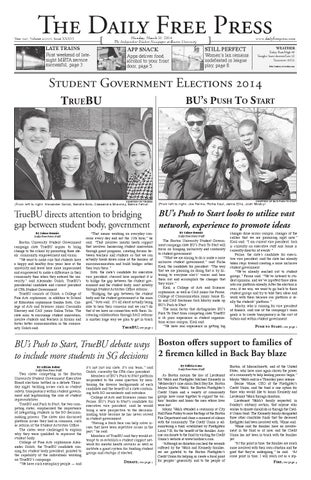
(From left to right: Alexander Golob, Sandra Soto, Cassandra Shavney, Salma Yehia)
COURTESY OF BU’S PUSH TO START
(From left to right: Joe Ferme, Richa Kaul, Jamie Ellis, Josh Mosby)
BU’s Push to Start looks to utilize vast TrueBU directs attention to bridging gap between student body, government network, experience to promote ideas By Jaime Bennis Daily Free Press Staff
Boston University Student Government campaign slate TrueBU aspires to bring change to the school by promoting three ideals: community, empowerment and vision. “We want to make sure that students have a happy and healthy four years here at the university and leave here more impassioned and empowered to make a difference in their community than when they entered the university,” said Alexander Golob, TrueBU’s presidential candidate and current president of CFA Student Government. TrueBU consists of Golob, a College of Fine Arts sophomore, in addition to School of Education sophomore Sandra Soto, College of Arts and Sciences junior Cassandra Shavney and CAS junior Salma Yehia. The slate aims to encourage student innovation, involve students and teachers in forums and foster better communication in the community, Golob said.
“That means working on everyday concerns every day and not the 11th hour,” he said. “That involves mental heath support that involves harnessing student innovation through grant programs, creating forums between teachers and students so that we can actually break down some of the barriers of miscommunication and build bridges rather than burn them.” Soto, the slate’s candidate for executive vice president, stressed how important it is to bridge the gap between the student government and the student body, most notably through Student Activities Office reforms. “Bridging the gap between the student body and the student government is the main goal,” Soto said. It’s all about actually being able to hear their concerns and we can’t do that if we have no connection with them. Increasing collaboration through SAO reforms is another huge way we plan to get in touch
TrueBU, see page 2
By Jaime Bennis Daily Free Press Staff
The Boston University Student Government campaign slate BU’s Push To Start will focus on bringing inclusivity and continuity to student government. “What we are aiming to do is make a more inclusive student government,” said Richa Kaul, the candidate for president. “The way that we are planning on doing that is by listening to everyone else’s’ voices and hear them out and accomplish the changes that they voice.” Kaul, a College of Arts and Sciences sophomore, as well as CAS junior Joe Ferme, College of Communication junior Jamie Ellis and CAS freshman Josh Mosby make up BU’s Push to Start. The main factor that distinguishes BU’s Push To Start from competing slate TrueBU is its prior experience in student organizations across campus, Kaul said. “We have real experience in getting big
changes done across campus, changes of the caliber that we are promising right now,” Kaul said. “I am current vice president, Josh is currently on executive staff and Jamie is currently director of events.” Ferme, the slate’s candidate for executive vice president, said the slate has already taken steps toward creating a more inclusive student government. “We’ve already reached out to student groups,” Ferme said. “We’ve listened to student opinions, and we’ve inputted those ideas into our platform already. After the election is over, if we win, we want to go back to those student groups and try to take their ideas and work with them because our platform is really the students’ platform.” Mosby, who is running for vice president of finance, said one of the campaign’s main goals is to create transparency in the cost of tuition and within student government.
Push to Start, see page 2
BU’s Push to Start, TrueBU debate ways Boston offers support to families of to include more students in SG decisions 2 firemen killed in Back Bay blaze By Adrian Baker Daily Free Press Staff
Two slates competing in the Boston University Student Government Executive Board elections battled in a debate Thursday night, tackling issues such as student safety, transparency within student government and legitimizing the role of student representatives. TrueBU and Push to Start, the two competing slates, emphasized the importance of integrating students in the SG decisionmaking process. The slates also discussed platform issues they had in common, such as reform of the Student Activities Office. The slates were challenged to explain why they were qualified to represent the student body. College of Fine Arts sophomore Alexander Golob, the TrueBU candidate running for student body president, pointed to the capability of the individuals working on TrueBU’s campaign. “We have such exemplary people — and
it’s not just our slate, it’s our team,” said Golob, currently the CFA class president. Members of BU’s Push to Start platform responded to the same question by mentioning the diverse backgrounds of each candidate and the benefit of a slate containing both SG incumbents and outsiders. College of Arts and Sciences junior Joe Ferme, BU’s Push to Start’s candidate for executive vice president, said he would bring a new perspective to the decisionmaking table because he has never served in student government. “Having a fresh face can help solve issues that have been repetitive issues in the past,” he said. Members of TrueBU said they would attempt to re-establish a student support network for mental health services as well as institute a grant system for funding student groups and startups if elected.
Debate, see page 2
By Felicia Gans Daily Free Press Staff
As Boston mourns the loss of Lieutenant Ed Walsh and Firefighter Michael Kennedy in Wednesday’s nine-alarm Back Bay fire, Boston Mayor Martin Walsh, the Boston Firefighter’s Credit Union and a variety of community groups have come together to support the victims’ families and honor the men whose lives were lost. Mayor Walsh attended a ceremony at City Hall Plaza Friday to raise the flags of the Boston Fire Department and share a moment of silence with the community. The Credit Union is administering a fund, established by Firefighters Local 718, for the benefit of the families. Anyone can donate to the fund by visiting the Credit Union’s website at www.bosfirecu.com. “Although no donation can heal the wounds suffered by the Walsh and Kennedy families, we are grateful to the Boston Firefighter’s Credit Union for helping us create a focal point for peoples’ generosity, and to the people of
Boston, of Massachusetts, and of the United States, who have once again shown the power of a community to help healing process begin,” Mayor Walsh said in a Thursday press release. Bernie Winne, CEO of the Firefighter’s Credit Union, said the fund is one option for those who would like to honor Kennedy and Lieutenant Walsh through donation. Lieutenant Walsh’s family requested, in Sunday’s obituary section, that anyone who wishes to donate should do so through the Credit Union fund. The Kennedy family designated three other charitable funds that the deceased firefighter had been involved with, Winne said. Winne said the families have no involvement in the fund as of now, and the Credit Union has not been in touch with the families yet. “At this point in time, the families are much more involved with their own situation and the grief that they’re undergoing,” he said. “At some point in time, I will reach out as a rep-
Fire, see page 4
2
Monday, March 31, 2014
Slate sets sights to forge more Students divided between experience, new ideas legitimate student government Debate: From Page 1
Push to Start: From Page 1
“We are going to try to work with administration and try to figure out where money is really going and see what we can do to make it more visible to the students,” Mosby said. Mosby said he hopes BU’s Push To Start will be able to make student government a truly legitimate and representative group that people can turn to for help. “The ultimate mission is definitely inclusivity and bringing more people together and making student government legitimate and not necessarily just another student group — which is how a lot of people see it — but really a representative body that people can go to,” Mosby said. Ellis, the slate’s candidate for vice president of internal affairs, said their platform features longterm and short-term goals. One of their long-term goals is to create a database of cabinet directors and
talent that will be accessible for everyone at the university. “Our platform definitely includes easy initiatives that we feel confident we can accomplish immediately during our term, but we also are trying to implement programs and different ways to keep those goals alive within student government year to year even after we are done,” Ellis said. “A really good example of this is that we are trying to design a system for cabinet directors to pass along their experiences and their work.” Ferme said BU has given him countless opportunities and now he wants to be able to give back to the BU community. “BU has given me so many opportunities and I really just want to try to give back even half as much as it has given to me,” he said. “Being able to represent the students and listen to them and try and make changes that they want to see is just going to be so special to me.”
BU’s Push to Start candidates said they aimed to identify how tuition is utilized through conversations with BU administration and to expand career resources for international students. Both slates touched on the issue of student safety. BU’s Push to Start candidates said they would cooperate with the BU Police Department to expand the security escort service to students living off campus. Candidates from TrueBU said they aimed to establish safe havens by developing an app for students to locate each other during late night hours. CAS sophomore Richa Kaul, the current SG executive vice president and the presidential candidate for BU’s Push to Start, said the slate was pleased with its performance in the debate. “We were all really happy to have the chance to challenge their [TrueBU’s] platform and have our platform challenged by them,” she said. “We were able to show everyone … that we know how to get things done, that we have
those connections, that experience.” Golob said he was confident TrueBU conveyed its core messages in the debate. “We had a very stimulating conversation where we really talked about issues such as building a community and empowering students,” he said. “Our experience shows legitimacy. We need to create a culture and spirit that fosters community.” Members of both slates said though the format of a debate is not conducive to exploring every issue, students can better understand their platforms through the slates’ social media campaigns. Students who attended the debate voiced concerns about issues with Student Health Services, financial aid reform and the rising cost of tuition. Austin Kruger, a College of General Studies sophomore, said he supports BU’s Push to Start due in part to the team’s experience. “Richa Kaul really understood the whole ideas behind tuition transparency,” said Kruger, CGS
class president. “I feel like she’s been fighting for that for a year after listening to what she just said.” CAS freshman Hamilton Millwee, a senior staffer for the TrueBU campaign, said he supported TrueBU because of their approach to including the student body in SG decisions. “They gave better specifics and they illustrated how there was a change that needed to happen in student government,” he said. “They continually talked about the community that needs to be fostered, and that’s definitely how to start.” Caley Van Brunt, a CAS junior, said the debate enabled her to better understand the slates’ policies and become familiar with their members. “I gained some knowledge on what both slates stand for, and it also allowed you to see the candidates’ personalities,” Van Brunt said. “I don’t think it’s a personality contest or anything like that, but it’s great to see how passionate they are about the issues.”
that is particularly difficult to secure,” he said. “Any time an attack occurs, the instinct is to assess blame. Might there have been better information sharing? Absolutely. But the only parties to blame are Tamerlan and Dzhokhar Tsarnaev, those who provided them with the technical knowledge they used to construct their bombs, those who abetted their attempt to flee and those who inspired them to conduct such an atrocity.” Several residents said continual improvement on counterterrorism strategies is useful, but blaming people for what happened in the past is not. “Hindsight is 20/20, so of course it all seems cut and dry when they go back and look at everything,” said Denise Kane,
52, of Boston. “But I’m sure that everything they’re pointing out now wasn’t as obvious before everything happened. They should use this information to be better in the future, but make sure not to blame anyone, that’s not fair.” Richard Liou, 46, of Brighton, said no one could have known what was going to happen, but said more action should definitely have been taken. “It’s complicated, because on one hand, we shouldn’t point fingers, but on the other hand we need to learn from the past and make sure to take action no matter how small the evidence is against a person,” he said. “If [the bombings] could have somehow been prevented, we need to make sure to take those steps in the future.”
Despite outcome of SG election, slate members to remain active Resident: Marathon events unforseeable, complicated TrueBU: From Page 1
with students and get them communicating with one another.” Shavney, who is running for candidate for vice president of internal affairs, said getting all BU students involved in student government is a key piece to achieving their goals as a unified student community. “It’s really important for students to know that if you go to BU, you are in student government,” she said. “That’s a really big part of our community aspect. We want every student to feel like we are there for them and there to support them.” Shavney said regardless of the outcome of the election, TrueBU still intends to implement their campaign agenda. “We are so committed to this,” she said. “We know that even if we don’t make it into office that we are still going to work on all of this. These aren’t just goals that can just be done through student government. They are things we are already working on and we will continue to work on.” Yehia, candidate for VP of fi-
nance, said one of TrueBU’s goals is to use their connections with the administration to effect change. “It starts with a mentality change,” Yehia said. “It’s not us versus them. It’s us working with them, and we already have so many connections with the administration. We pride ourselves on that because we are able to communicate in their mindset.” Golob said as student body president, he would ensure that no student feels that he or she is not a valued member of the student community. “To me it’s making sure that no one is left behind,” he said. “I had a very tough childhood and I experienced something that I don’t think anyone should have happen to them, which is being left behind by their friends, by teachers, by the community. I eventually became CFA president. The difference between wanting to do good and making sure that no one is left behind and having the same goals and the same vision and having that leadership position is immense.”
Marathon: From Page 3
es on how evidence of the alleged bombers’ intent to carry out a terrorist act were shared between local, state and federal agencies, and how in certain tragic instances, critical opportunities were overlooked,” McCaul said. “Following through on the report’s recommendations is critical to fixing serious gaps in our counterterrorism efforts.” Looking back, those signs pointing to Tsarnaev may not have been as obvious before the bombings occurred. Anthony Amore, lecturer of homeland security at Fisher College, insists that the bombings could not have been foreseen. “The Tsarnaev brothers pulled off their evil attack at an event
Online feature recognizes notable COM history COM: From Page 3
pen in 2014. So that will probably come out in early-to-mid 2015.” The efforts to celebrate the college’s 100th birthday, led by COM Dean Thomas Fiedler, Relick, and COM’s PR Lab team, kicked off this week with the publication of COMtalk 100, COM’s alumni magazine. The online magazine’s interactive timeline lists “100 Reasons to Celebrate COM”. Among the list of significant moments in COM’s history is Carol Hills earning the country’s first master’s degree in public relations at BU, Howard Stern being fired from the student radio station WBTU in 1973 and the founding of The Daily Free Press in 1971. While these events are remarkable, Relick said the most signifi-
cant aspect of COM’s history is its audacity to break tradition in communication education. “There are a lot of firsts here at COM,” Relick said. “There were only a few universities in the country at the time [1914] who felt the fields of advertising and journalism were worthy of higher education and academic study. The nation and the country certainly did not look at these fields as having an area of expertise.” An issue regarding the celebration of 100 years of COM is the general lack of student knowledge surrounding the event, Relick said. “The truth is, students didn’t know about [the celebration],” Relick explained. “They didn’t realize that the seeds of this college were sown 100 years ago in 1914. And they also didn’t know a
lot of the famous people to come out of here.” In order to spread the news, COM has hired the student-run public relations agency PR Lab, who is helping promote the celebration on social media. Student involvement is vital to the success of the celebration in giving COM the recognition it deserves, said PR Lab Account Executive Joseph Barto. “We want students to get involved and participate in the many social media contests we are going to run as well as share their COM memories with us,” Barto, a COM junior, said. “We will be giving away great prizes, including a special COM 100 Tshirt. For students to participate and have a chance to win, they should follow @COM100Years and use the hashtag #COM100.”
Only pick up The Daily Free Press tomorrow if you like to laugh. Special April Fools’ edition coming your way
Campus & City Column
THE URBAN PARK RANGER
This Little Light of Mine
I never thought I’d say this, but my double situated in a South Campus brownstone is too large. I have way more space than I need and I often find myself having the issue of deciding where to put things because there are just too many options. And for the record, I’m not being sarcastic. Despite my woes, the sun enters the two win- JENNIFER dows in my room RUTH at a perfect angle and at times, I feel like I’m sun tanning on Miami Beach. But once it hits nighttime, my room becomes a cavernous abyss. The pitiful ceiling light in the center of the room isn’t powerful enough to illuminate the entire room. It actually conveniently lights up the center portion of the room that is unmarked territory. So, I’ve introduced two more lights into my corner of the room so that I can actually see. My roommate has done the same. If the ceiling light in my room didn’t have the capacity of a headlight in dense fog, then we wouldn’t have to waste all of the excessive electricity that we do on a daily basis. Or perhaps, having a slightly smaller room size could alleviate this issue. It’s not rocket science why Nelly Furtado sang a song about turning off the lights. It’s a cool thing to do. After all, electricity is empowering (cue rimshot, please). Upon walking into the environmental student lounge on the fourth floor in the College of Arts and Sciences this past week, my hand automatically reached for the light switch. To my surprise, there was a guard over it. The switch could only be accessed from the sides of a plastic guard. My mind gravitated toward the little note underneath the light switch. “Do you need electricity to see? Are the blinds up? Cut your electrical use by only using lights when you really need them.” People have become so accustomed to turning on lights when they walk into a room that it is almost second nature. It’s almost how people say, “How are you?” while they pass you on the street. After thinking twice about turning on the light, I decided to keep it off. I put the blinds up and caught some rays of sunshine while I lounged. According to Sustainability@BU’s webpage, Boston University consumed 204,007,645 kWh of electricity in 2013. I get that Boston University is a huge institution, but this is still a giant number. On Saturday, an event created by the World Wide Fund for Nature called Earth Hour took place, in which millions of people across the planet switched off their lights from 8:30 p.m. - 9:30 p.m. Of course, you might be thinking “oh boy, here’s another ploy by the crazy environmentalists to bring us into the dark ages,” but I assure you that #EarthHour isn’t as drastic as you think. Iconic landmarks such as the Eiffel Tower, Sydney Opera House and the Hong Kong skyline participated in this event, so surely, your non-essential lights can as well. There are little ways that we can reduce our electricity use while still making a big spark in the realm of sustainability. After all, in the darkness, we shine brightest.
Monday, March 31, 2014
MBTA late-night service off to good start Geena Davis
honored for acting, activism
By Kelsey Newell Daily Free Press Staff
After much anticipation, the Massachusetts Bay Transportation Authority is providing users with the long-awaited and requested late-night bus and train service, which runs until 2:30 a.m. on Friday and Saturday nights and 1:00 a.m. Sundays through Thursdays. These extended hours apply to the subway and the 15 most popular bus routes, including the 57, running up and down Commonwealth Avenue. The late night service began on Friday, and many Boston residents took advantage of the safe and easy way to get home. “It’s something that we’ve been hearing from customers as well as business leaders and members of the community,” said Kelly Smith, an MBTA spokesperson, to The Daily Free Press earlier this month. “Boston is one of the most vibrant, young and innovative cities in the country and the world. One of the things that has been a complaint about the city is that we close early and are not that conducive to nightlife and the social aspect of it.” The MBTA’s daytime operations will not change. This will be a one-
By Stephanie Pagones Daily Free Press Staff
any of them, the report outlines four areas in which these agencies can improve to prevent future terrorist attacks. The report suggests increasing cooperation between federal and local law enforcers, including granting local law enforcement access to the FBI’s terror database and providing means for easier and more efficient sharing of terrorist information between the federal and local levels, could be one way to prevent a similar situation from occurring. The policy regarding screening the travel records of suspicious persons needs to be altered so screening is more thorough and the information obtained is shared. Additionally, the public needs to be provided more in-depth information on what is truly going on with terrorism, according the report. Finally, intelligence and law enforcement agencies need to be continually exploring terrorist threats and actively combating them to ensure the feasibility of prevention. “This bipartisan report focus-
Boston University Alumna Geena Davis was awarded the Bette Davis Lifetime Achievement Award Friday for her efforts to empower women and her success in film and television. “I not only had unshakeable faith that I was going to realize my dream, but I am so lucky … to actually see my dream become a reality,” said Davis, who graduated from BU in 1979. “I have only played very powerful roles that inspired girls.” More than 600 people attended the ceremony, hosted in the Metcalf Ballroom by the Bette Davis Foundation and the Howard Gotlieb Archival Research Center. The ceremony featured extensive collections of both Bette and Geena Davis’ work. Vita Paladino, the director of the Gotlieb Archival Research Center Director spoke at the ceremony. Chairwoman of CBS Entertainment and Davis’ former BU roommate Nina Tassler and Bette Davis’ son and representative of The Bette Davis Foundation Michael Merrill also gave speeches. The Bette Davis Lifetime Achievement Award honors individuals who use their prominence in film and television to inspire positive change. “The Bette Davis Foundation presents this award only every so often,” said Danielle Klaussen, the Gotlieb Archival Research Center’s public relations consultant. “Geena Davis has a career dedicated to gender studies in media and believes that there are not enough programs for women.” Geena Davis starred in several acclaimed films and programs, including The Accidental Tourist, Thelma & Louise and Commander in Chief, a show in which she played a female president. Davis, who has won a Golden Globe and an Academy Award during her acting career, has devoted much of her time to the women’s empowerment movement and the crusade against gender inequality in film and television. “In addition to being a fine actress, she is a voice for women and she has what we call television quotient, which means she can get her cause heard front and center,”
Marathon, see page 2
Davis, see page 4
EMILY ZABOSKI/DAILY FREE PRESS STAFF
Late-night weekend service on the MBTA subway and 15 key bus routes began Friday night by operating 90 minutes longer.
year trial program, after which the MBTA will decide if ridership was high enough and if it is monetarily possible to continue. The goal is to better assist service industry workers in getting to and from their latenight shifts while also providing safe transportation for those enjoying the nighttime social scene. “Our customers are always asking for more service, and I am happy that we are able to bring extended weekend hours to them beginning on March 28,” said MBTA General Manager Beverly Scott in
a Friday release. “From students to entrepreneurs to service employees, late-night service will allow a wide cross-section of our vibrant population to better travel home from both work and play.” The extended hours are estimated to cost approximately $16 million, but the MBTA has partnered with local businesses, including the Boston Globe, the Boston Red Sox, Dunkin’ Donuts, Suffolk Construction and the Massachusetts Restaurant Association, to help cover the
MBTA, see page 4
Marathon bombing preventable, report suggests By Kelsey Newell Daily Free Press Staff
A vastly expository congressional report released by the U.S. House Committee on Homeland Security revealed law enforcement agencies dismissed information that Tamerlan Tsarnaev was a threat to the United States in the years leading up to the bombing. “Last April, the nation saw terror strike on Boylston Street, and since then we have all witnessed the resilience and strength of the Boston community,” said Committee Chairman Michael McCaul in a Wednesday release. “Over the past year, the Committee has investigated how this could have happened, and what can be done to prevent a tragedy like this from happening again.” The report provides a history of Tsarnaev, his travels to Caucasus, his possible connections to terrorist networks and his travels to Russia. It claims this information was known before the bombings, but adequate action was not taken. According to the report, Russia’s intelligence agency wrote
3
letters to the FBI with biographical information on Tsarnaev and his family and stated he had previously wanted to go to Palestine to wage jihad. The Joint Terrorism Task Force opened an investigation, but due to small complications, it did not result in any extra screening of the suspect. The report details how closer inspection of this information on Tsarnaev and more careful screening of his travels could have possibly prevented the bombings from ever happening. “Given his interest in jihadist materials, it is possible [customs] officials might have found something in his possession that would have revealed the threat he posed,” said the report. “This lack of communication represents a failure to proactively share information that could potentially save lives. Indeed, any further scrutiny upon Tamerlan Tsarnaev’s return from Russia might have prevented the bombing if it revealed evidence of his radicalization or of ties to terrorism.” After highlighting the mistakes law enforcement agencies made, without directly blaming
BU College of Communication commemorates 100-year anniversary By Brogan Calkins Daily Free Press Staff
After a century of educating students in media, Boston University’s College of Communication will celebrate its 100th birthday with a collection of campaigns and celebrations in 2014. “We’re commemorating the roots of COM, not it’s founding,” said Kim Relick, head of strategic marketing and communication at COM. “The first courses in advertising and public relations were taught here at BU in 1914. We’ve planned a year of special events and social media campaigns to involve the college, the BU community and our many alumni worldwide.” The festivities are going to take place over the course of Jennifer Ruth is a College of 2014, with two main celebrations Arts and Sciences junior. She can be open to all COM students, Relick reached at jenruth@bu.edu.
said. “The first part is this spring, around commencement, we’re planning a party, a lawn party for seniors, one that celebrates COM’s 100 year legacy,” she said. “And then we’ve planned the second part of the celebration for next fall, and that is when the alumni come back again, so [they] will also be able to celebrate … Students are planning an interactive part between students and alumni, so they can come together, which doesn’t usually happen at alumni weekends.” Other projects include a commemorative exhibition of the history if COM and a book detailing the history of communication education at BU, Relick said. “The dean has also commissioned a special video be made for the commencement and the alum-
MAYA DEVEREAUX/DAILY FREE PRESS STAFF
2014 marks the 100th birthday of Boston University’s College of Communication, as public relations courses were first offered in 1914.
ni weekend, to be shown to both the graduating class of 2014 and returning alumni,” she said. “We also hope to commission a book about the history of COM. That
we’ll be working on throughout the year because we wanted to include what happened or will hap-
COM, see page 2
4
Monday, March 31, 2014
Archivist: Work of Davis inspiring for students CEO: Community can show support by donating to fund Davis: From Page 3
said Diane Gallagher, an archivist at the Gotlieb Archival Research Center. Paladino said Bette and Geena Davis, both New England natives, had strong similarities. “They enrich our lives through their art and activism,” she said. Davis founded the Geena Davis Institute on Gender in Media and See Jane, programs that work to prevent gender stereotyping and inequality. Davis started her career at BU, which Gallagher believes should inspire BU students and provide an example for what they can accomplish. “BU has always been a leader in good causes,” Gallagher said. “Students need to realize that they have the ability and the responsibility to take action.”
By awarding Geena Davis with the Lifetime Achievement Award, BU demonstrates its support for equality, said BU Academy’s Director of College Counseling Jill Atkinson, who attended the ceremony. “It is a noteworthy honor for her to be given,” she said. “It sends a strong message that diversity and equality are two things that Boston University values.” Several students said Davis’ career and activism inspired them. “This event shows BU students that we can do something big,” said Annabel Sanchez, a College of Arts and Sciences sophomore. “It is so great to see alumni doing such great things with their lives, especially because Geena Davis uses her fame and celebrity status for a progressive movement.” Brian Fleming, a College of
Communication sophomore, said he was impressed by Davis’ ability to use her fame empower women. “In my sexism class we’ve been discussing the importance of giving a proper voice to women and women’s rights,” he said. “Ms. Davis is a good role model not only for women, but for men.” Janée Johnson, an employee at the research center graduating from the School of Law this year, said while many forget their alma mater after graduating, Davis has been back to Boston University on more than one occasion. “It’s nice to have someone who honors BU and honors her education,” she said. “It’s good for BU students to see someone from BU who is an example of what can be done with an education — just like she did, students can succeed.”
Fire: From Page 1
resentative of the credit union but this just isn’t the time to be thinking about financial matters. Winne said he will offer the families of the deceased any available services that the Credit Union can offer to them, but for now, the fund will serve as a way for the commu-
nity to show support to the families and honor Kennedy and Lieutenant Walsh “Those families have a very difficult week ahead of them,” he said. “They’ve had a very difficult week behind them. They’re dealing with the struggle of watching a young vibrant person go off to work in the morning and not come home.”
Resident worried about potential for tax increase MBTA: From Page 3
costs. Additionally, the Future Boston Alliance has begun a grassroots crowd-funding effort, with a goal of raising $20,000 to contribute to sponsoring the late-night service. The rest will need to be brought in through ridership. “We’re presenting it not as a permanent change in service but as a pilot program,” Smith told The Daily Free Press in early March. “We’ll do it for one year and if it’s viable, we’ll continue it. Ridership is really the only benchmark. If people aren’t using it, we lose even
more money. We hope it’s popular and that people use it but it really is ridership, which translates into revenue as well.” Many residents said they are very pleased with this new option for transportation and took advantage of it on Friday. “When people are out drinking and partying on the weekends, it’s definitely smart of the city to provide them a safe, and affordable, way to get home,” said Paige Costa, 33, of Dorchester. “Who knows, something like this could save lives by preventing drunk driving.” Abdul Aziz, 29, of Fenway, said he appreciates the easier late-night
transportation, but said it may not be worth the cost. “This will definitely be helping a lot of people out,” he said. “But $16 million seems very extreme. As long as it’s not resulting in higher taxes for those who don’t utilize it, then I guess I’m okay with it.” Jared Pruett, 36, of Boston, said he used the late-night service on Friday night and it was refreshing to not have the hassle of finding an alternate way home. “I used it the first night it was available,” he said. “Usually you have to pay $20 or more for a taxi, so it was definitely nice … a lot of people will use it.”
TUFTS SUMMER SESSION 2014 prepare. eXpaND. Develop. school of arts and sciences | school of engineering
Three sessioNs: May 21–JuNe 27 | July 1–augusT 8 | May 21–augusT 8
go.tufts.edu/summer
Follow us:
College and Pre-College Programs Day & Evening Classes Affordable Tuition Outstanding Tufts Faculty Online Courses
EARN 6 CREDITS IN 6 WEEKS SUMMERSESSIONS 2014 Stony Brook’s Summer Sessions are the most productive way to spend your summer break.
» More than 500 courses from which to choose, including those that meet core requirements » Online courses now offered » On-campus housing available » Easy enrollment for visiting Summer students
stonybrook.edu/summer
Stony Brook University/SUNY is an affirmative action, equal opportunity educator and employer. 13120688
in Delivery: Not just for pizza anymore
Shopping, delivery apps let students use phones to bring the goods Olivia Deng
I
t is Friday and you have just returned from a grueling day of work. The refrigerator in your apartment is completely devoid of food, except for that leftover Chinese takeout from the week before. You are hosting a party in a few hours and need to serve food and alcohol to a large guest list. Most individuals are subject to budget and time constraints and can only manage to accomplish so many tasks. Enter realtime delivery services. Real-time delivery services have expanded in popularity in major metropolitan areas such as Boston and have increased efficiency for many. The dreaded weekly grocery trip may no longer be part of your routine, thanks to Instacart. The hassle of placing a restaurant order via phone may be solved with Foodler. The burden of hauling cases of wine to your apartment may be alleviated by using Drizly or DrinkIn. These companies are innovating in the space ecommerce behemoths such as Amazon have not yet touched. Instacart is a service that allows users to order groceries from local retailers using their computer or smartphone. Its services were made available to Boston residents since December, according to Heather Wake, general manager of Instacart. “We are a same-day grocery delivery service,” Wake said. “We are the only service that can deliver groceries from multiple stores to customers within an hour, two hours, same day or future days, so customers in Boston can choose and mix items from multiple stores in one order.” Working with local retailers, Instacart provides customers with personal shoppers to fulfill their needs, Wake said. “Currently we are delivering from Shaw’s, Market Basket, Costco and Whole Foods in Boston so customers can order from any one of those stores all in one order,” she said. “And really, what we are offering to customers is the ability to have the convenience of ordering groceries online and getting it delivered to them by one of our personal shoppers. That’s really what we’re doing for customers, really make their experience in grocery shopping different.” Using Instacart to place an order is a streamlined process. Customers simply access Instacart online or through a mobile app and they have the ability to choose and mix items from stores in one order, said Wake. “So once the customer places an order on either their app or website, we have a smartphone app for our personal shoppers, so once the customer places an order the personal shopper gets a notification that there’s an order available for them,” Wake said. “The notification tells them what stores to go to. Once they’re in the store, the app will tell them which aisle and shelf each item is located. Sometimes shoppers will work on several orders at once, usually two. The shopper is fulfilling the customer’s order in the store. They’re going through the store, picking items that the customer has chosen and get the delivery to them in the allotted time frame. So the
inBusiness Staff
PHOTO BY SARAH FISHER/DAILY FREE PRESS STAFF
Gone are the days of waiting in a grocdery line for those willing to pay a premium. Delivery services are bringing you everything from groceries to alcohol.
app the personal shopper is using is what is guiding them through the store and they also get suggestions to deliver it to their customers.” Orders of 15 items or less are eligible for a one-hour delivery for a fee of $14.99. Should the customer want his or her groceries at a later time, the delivery fee is $3.99. Instacart also mandates a minimum $10 order, according to Wake. Though the experience is efficient, it also manages to be personalized. “Sometimes they may want to add an additional item to their order,” Wake said. “So if they want to add an additional item after they have placed their order, they can actually simply go back online to our website or app and add items to their order through that before the shopper has started to shop. And once the shopper is in the store shopping for items, they may find items that are out of stock, or not good quality so they are reaching out to customers and asking the customer and giving suggestions for replacements and making sure the customer is OK with it. The customer also has the opportunity to talk to the shopper about any other concerns they may have,” Like Instacart, Foodler is a service that enables users to order to their home online or via a mobile app. Launched 10 years ago, Foodler currently services 500,000 users in the United States and Canada, said John Jannotti, cofounder of Foodler. “We have a strong presence in cities, so large metropolitan areas, probably a total of maybe 400 to 500 cities if you were to count Somerville and Cambridge and different cities in Boston,” Jannotti said. “So there’s hundreds of cities. We’re strongest in the eastern half of the country, eastern half of the U.S. And most large metropolitan areas, we have 100 to 200 restaurants, at least.” Coordinating deliveries for approximately 600 restaurants in Boston with the help of services such as Dash, Foodler has
an especially strong presence with college students, who comprise half of the Foodlerusing population, said Jannotti. Foodler is a very different company today than it was in 2004, when it launched. Jannotti said that he initially founded Foodler with the intention of simply replacing a traditional menu. “Early on, at first, we wanted to replace a paper menu. So instead of a paper menu, you go to Foodler and see what’s available. But over time, we realized that the nice thing about online service or electronic service is that you can actually build something that’s better than a paper menu,” Jannotti said. “For example, you can keep track of what you ordered before. We can suggest foods that you might like because of the things you have ordered before. We can show you what the most popular items are. We can keep track of ratings. I think the main thing is that we constantly try to figure out ways to make the experience better. “So over time, that’s what we try to figure out. Which restaurants you see on the screen on Foodler, that’s based on all sorts of criteria like how far away they are from you, what the rating is, what cuisine, so doing that kind of stuff is the biggest difference, the realization that we can do better than a paper menu rather than just replacing one.” If you need a drink to go with all of that food, Drizly and DrinkIn aim to provide a user-friendly experience for ordering alcohol. Drizly, a mobile app that launched in winter 2013, recently received $2.25 million in seed funding and is growing at a rate of 30 to 50 percent every month and offers services in Boston and New York City, said Nick Rellas, cofounder of Drizly. Like Instacart and Foodler, users can receive their delivery in less than an hour. But unlike Foodler, Drizly’s main customer segment is not college students, Rellas said.
“What you will see on the app is that it’s skewed toward a higher-end clientele, and so you won’t find Natty Light on the app,” he said. “The average user is 29, 29 to 31 years old. It’s split 50-50 male to female and on average, orders over $60 worth of alcohol. It’s pretty evenly split for us, 40 percent liquor, 30 percent beer and 30 percent wine.” Rellas emphasized the importance of being compliant in a highly regulated industry. “We set up a system to help you get your alcohol and then of course, while I can’t speak exactly to what’s going on in other places, Drizly has a compliant model. That’s a huge value added. When you’re ordering, you know it’s happening legally,” Rellas said. “We don’t touch the three tiers of alcohol, the brand, the distributor, the retailer. We are going to provide value for everybody. Especially as a young entrepreneur, it’s important to understand that these are sophisticated business owners. They are savvy with what they do. Bringing in technology to this highly regulated industry, we needed to do that in a way that made everybody comfortable — regulators comfortable, stores comfortable. We have taken a thoughtful approach. It’s not shoot first, questions later.” Another entrepreneur seeking to innovate in the alcohol industry is Pablo Bello, founder of DrinkIn. “I was passing by a liquor store and thought, ‘liquor really has not changed,’” Bello said. “So looking back, it’s been the same. Now, after I left Rest Devices, my first startup, I thought that it could be a space where there could be a lot of disruption, more so than a simple ecommerce site.” DrinkIn launched its beta in October to test the market and see if bike delivered booze was something Boston wanted. “We partnered with a store in Cambridge, in Central Square, and told them that we were almost a gateway … Drizly’s model is more about working with liquor stores — they’re doing the delivery. That’s sort of what we wanted to do but we’re doing the deliveries. We wanted to see what it was like; it was a bit of learning. We just did beta real quick. We completely bootstrapped all the way till now, and we didn’t feel that was disruptive enough,” Bello said. Though DrinkIn received 250 users within the span of three or four days, Bello said he closed the beta at the end of December, halting DrinkIn’s alcohol delivery services with bikes. “That was for us to do a test and earn from the space and work with liquor stores and see what users care about, we talked a lot to users,” he said. “Really what we felt was that we weren’t being disruptive enough. We didn’t want to work with liquor stores to have them do the delivery or even us. So, for us, it’s to get our own license and control our own inventory and really try to innovate in the logistics side and create the best website and app for that so the focus right now is on our website.”
6
Opinion
Monday, March 31, 2014
The Daily Free Press
The Independent Student Newspaper at Boston University 44th year F Volume 86 F Issue 36
Sarah Kirkpatrick, Editor-in-Chief Brian Latimer, Managing Editor
Rachel Riley, Campus Editor
Alice Bazerghi, City Editor
Andrew Battifarano, Sports Editor
Trisha Thadani, Opinion Editor
Heather Goldin, Multimedia Editor
Maya Devereaux, Photo Editor
Brooke Jackson-Glidden, Features Editor
Emily Hartwell, Layout Editor
Shakti Rovner, Office Manager The Daily Free Press (ISSN 1094-7337) is published Monday through Thursday during the academic year except during vacation and exam periods by Back Bay Publishing Co.,Inc., a nonprofit corporation operated by Boston University students. No content can be reproduced without the permission of Back Bay Publishing Co., Inc. Copyright © 2014 Back Bay Publishing Co., Inc. All rights reserved.
The price for peace
As part of a long-term effort to combat violence in the City of Boston, last week Mayor Martin Walsh launched The Piece for Peace Program, a new gun buyback program. In exchange for a $200 Visa gift card, residents can now turn in their working handguns to designated spots around Boston. Even if a resident turns in a gun that was unlawfully obtained or possessed, they will not be questioned or prosecuted. Each weapon will be tested to ensure it was not used or suspected in a crime, and if they are cleared, they will be destroyed. This buyback program currently has $125,000 in donations from the Boston Police Athletic League, the City of Boston Credit Union and the Boston Police Runners Club. As long as the program is within its budget and donations persist, the program will continue. Since the program started last week, 75 guns have been taken off the street, according to the Boston Police Department. Over the next couple of weeks, Boston Police Department Commissioner William Evans said the program is aiming to collect around 1,000 guns. The Piece for Peace Program is a good way to finally get the ball rolling on gun control in the City of Boston. In theory, it will help people feel safer by knowing 75 handguns have been taken off the streets of Boston in the last week. Although relative to the amount of guns that most likely exist in Boston, both legally and illegally — it is
still 75 less guns nonetheless. The program gives us a chance to see visible and tangible results in the effort to combat gun violence in the city. Now residents of Boston have a material way to account for the amount of guns that aren’t being used, rather than the ones that are. However, in reality, this program will not do much to stop people from using guns. Although dozens of people have returned their guns through this program — some obtained illegally — they still found a way to get them in the first place. Although they may not be the ones looking to buy them again after handing them in, the fact that they had them still proves that obtaining these guns is possible without authorities finding out. Additionally, although people know they won’t be prosecuted for handing in an unlawfully obtained gun, no one will want to turn in a gun that they have used in a crime or are planning on using in a crime. This program is reliant on people being honorable and trustworthy in their actions, and when it comes to the issue of guns, “trust” is hard to come by. Although the Piece for Peace Program has honorable intentions, it won’t do much more than rewarding people for giving up the guns they no longer plan on using. This program would be more effective if the police department were more active in getting assault rifles and AK-47’s off the street, rather than just helping remove the clutter of guns from people’s basements.
LETTER TO THE EDITOR: The International Monetary Fund
While approving assistance to Ukraine this week, Senate Democrats tried and failed to include an agreement to changes in the International Monetary Fund. Adding unrelated “riders” to legislation is not always the best practice, but in this instance it reflects the United States’ embarrassing inability to agree to these crucial reforms. The IMF promotes international cooperation on economic issues and bails out countries in financial crisis, such as Greece. It has long been dominated by Europe and the United States, drawing complaints about unfair representation from growing countries like China and Brazil. To preserve its legitimacy as a global institution, in 2010 the IMF’s Executive Board recommended a set of reforms to fix this problem, essentially by giving these countries more votes and requiring that the Executive Board be fully elected (at present, the U.S. and four other countries get an automatic seat). It would also double the amount of money the IMF has on hand to bail out countries. Virtually every member of the IMF has approved these reforms, but they cannot take effect until the United States agrees. House Republicans have resisted ratifying these reforms for years because they fear that they would reduce American influence, encourage risk-taking by
countries counting on an IMF bailout and waste taxpayer money. These claims are specious. First, the United States would retain its “veto power” to block any decision it didn’t like, ensuring that it would always be represented on the Executive Board. Second, IMF bailouts come with infamously tough requirements that no country would enjoy. Keeping the IMF small in a growing global economy will not discourage risktaking, but it will encourage countries to build other financial defenses, subsequently reducing influence from the IMF and America Finally, the $63 billion asked from the United States is a small price to preserve our ability to shape global economic decisions. Continuing to reject these reforms will damage IMF and American credibility, but for a fraction of one year’s defense budget, the United States can secure its influence in this vital institution for years to come. The complexity of the issue has so far shielded Republicans from political pressure, but the answer is simple: call your representative and urge them to ratify IMF reform. James Sunquist is a senior in the College of Arts and Sciences. He can be reached at jsund@bu.edu .
Third time’s a charm
The stories of others Sofiya Mahdi When I was young, I had a strong obsession with ancient Egypt. I loved the stories I learned about in school, I loved the hieroglyphics and I loved the legend of Tutankhamun. When Howard Carter, the man responsible for the excavations, and Lord Carnarvon, his financier had thought all was lost, Carter discovered a hidden staircase that led to a mysterious corridor. The site showed signs of theft, so the explorers were sure that the site had already been looted for all of its wealth. Carter famously reported, “At first I could see nothing, the hot air escaping from the chamber causing the candle flame to flicker, but presently, as my eyes grew accustomed to the light, details of the room within emerged slowly from the mist, strange animals, statues and gold — everywhere the glint of gold.” I still remember presenting my papyrus leaves to my teacher, which had my report written delicately on the sheets tied together by ribbon. There was a certain romance in the idea of Egyptology — the idea that stories untold were still buried under the earth, waiting to be discovered and pieced together. I believe that is when my passion for writing first began. I wanted to tell stories, but I wanted to tell other people’s stories. I always envisioned myself travelling the world and feeling inspired by communities and human experiences so different to my own. Perhaps it’s all a huge cliché, but being the instrument for someone to share his or her life seemed like the most exhilarating job in the world. For travelling journalists and international correspondents, this exhilaration is the job. Unfortunately, while the media has evolved significantly since coverage of Tutankhamun was headline news, journalists who work in areas of conflict, or countries where communication to the outside world about state of affairs is crucial, are still putting themselves firmly in harm’s way. On Saturday, two Spanish journalists landed in Madrid after being held hostage in Syria for six months. According to BBC, Javier Espinosa, a correspondent for El Mundo and Ricardo Garcia Vilanova, a freelance photographer, were recently set free and handed over to the Turkish military after being held hostage by militants linked to Al-Qaeda, captured near the Turkish border in September. Since many areas dominated by rebels are too dangerous for journalists to work in, these are the areas where information is scarce. Reporters Without Borders has already named Syria the most dangerous country for journalists in the world
today. Even though two journalists have been rescued, 17 others are still believed to be hostages, with 20 or more domestic Syrian reporters also in danger. More than 110 news providers have died doing work in Syria since March 2011. Now, excavating the ancient tombs of Egypt and risking falling victim to the rumoured ‘mummy’s curse’ seems significantly less dangerous. Marie Colvin, an award-winning American journalist who worked for The Sunday Times in Britain, once said, “The next war I cover, I’ll be more awed than ever by the quiet bravery of civilians who endure far more than I ever will.” She lost sight in one eye covering unrest in Sri Lanka in 2001. She later died covering the siege of Homs, a city in Syria. Why could she not give up war reporting? In a piece by the Lowell Sun, she explained, “We send home that first rough draft of history. We can and do make a difference in exposing the horrors of war and especially the atrocities that befall civilians.” Colvin’s spirit has not left with her, and is one that I believe we can assume many correspondents around the world hold close to their hearts while on assignments. There are people who may say, so what? All they do is jot down notes on pieces of paper, or film the environment around them and submit it to an editor at a desk. Some may say media coverage in conflict zones verges on sensationalist, inaccurate and irresponsible material. Yes, there are many instances where someone gets it wrong, it would be naïve to believe the news does not have its faults along with its merits. Nevertheless, today, I take a minute to think of the correspondents who report helplessly as the civilians suffer. I take a minute to think of the 76 journalists who died while on assignments in 2013. I think of how, perhaps like me, those men and women who go to these conflict zones probably sat in their homes as young children, dreaming about telling the stories of the world around them. Amidst all the noise, all of the politics involved with news coverage, in there are brave people doing amazing work. Despite the danger associated with the tasks at hand, one powerful truth remains: the storytellers I look up to still exist, and they’re still willing to go down untapped corridors in search of that glint of gold. Sofiya Mahdi is a senior in the College of Arts and Sciences and a former managing editor at The Daily Free Press. She can be reached at sofiya218@gmail.com.
The opinions and ideas expressed by columnists and cartoonists are their own and are not necessarily representative of the opinions of The Daily Free Press.
APRIL 3
Monday, March 31, 2014
7
Benedykciuk: Unionizing will change landscape of college athletics Benedykciuk: From Page 8
equate compensation. The concern then shifts to student-athletes not participating in academics. A prime example just recently occurred at the University of North Carolina. An athlete turned in a final paper that consisted of four sentences and about a dozen grammatical errors, and received an Agrade. So, a new question arises: What good is an academic-based scholarship to someone who doesn’t want the education in the first place? Many athletes run into very serious financial troubles as they age. These particular athletes live posh, lavish lifestyles for the duration of their career. After retirement, however, when their supply of income dwindles immediately
to nothing, they are left with extraordinarily high mortgages and car loans It is in the best interest of newly recruited athletes out of high school to go to college. It seems cliché, but in order to be financially stable past the age of 50, all athletes must have at least an introductory class in career management, just to familiarize themselves with key monetary concepts. Additionally, maybe a fraction of one percent of the hundreds of thousands of college athletes in America will ever play at a professional level. Those who don’t make it pros (the 99 percent) will need their degree they earn to help their job hunt out of college. To the skeptics who say that the NCAA should continue to pour money into minimizing brain injury risks, I direct your attention to
how strong the efforts have been on a collegiate and professional level to reduce the occurrence of injuries. Despite countless research and development initiatives, various improvements to helmets and innumerable penalty additions to increase player safety, injuries have occurred, occur now and will continue to occur for the entire foreseeable future. I truly am concerned with injuries. The stars of today and tomorrow alike are all at great risk. But, it has become far too obvious that despite the efforts made by the NCAA, athletes are still going to get hurt. The fact that every collegiate level athlete can have his or her career ruined at any given second on the field is a harsh reality. Every athlete at any level willingly takes a health risk to play any particular sport. In a letter to the editor of the Daily North-
western (NU’s newspaper), Norman C. Wang, an alumnus of the McCormick School of Engineering and Feinberg School of Medicine, wrote fiercely against student-athletes becoming employees. “The day that student athletes become recognized as employees … is the last day I will care about college athletics.” Dr. Wang, that day appears to be upon us. The intentions of unionizing are good; clearly, Northwestern University is only pressing for unionization to protect its athletes. And I truly understand the plea for protecting college athletes, as they are always at very high risk. However, unionizing college sports programs will be far too complicated a system. It is not the right path of action that needs to be taken.
Carson-Banister registers 12 saves in loss Men’s Lacrosse: From Page 8
first lead of the game at the 11:40 mark. BU would respond when freshman midfielder Cal Dearth capitalized on a Navy turnover, ripping a shot past goalkeeper John Connors. Immediately after Dearth’s goal, Navy got its first man-up opportunity when freshman defender Jake Dansey was given a penalty for pushing. Navy almost pulled ahead on an attempt on goal from Voumard, but Carson-Banister made a save to keep the score tied at three. From there, the Terriers transition midfield began to break down. Talkow, who came into the contest with the best draw control in the Patriot League, struggled in the second quarter, going 1-for-6 at the faceoff X. Navy would go on to score four unanswered goals in the half’s last five minutes, all in transition, to end the half up 7-3. Following the break, BU got its first manup opportunity of the half thanks to a Navy pushing penalty. Freshman attack Clay Phillips could not convert his shot on goal however, and Navy was able to kill the chance. But, on the next BU possession, when the Terriers were given another man-up chance, Johnston scored at the 10:23 mark to cut the Navy lead to 7-4. In the last 10 seconds of the quarter, attack Sam Jones first scored on a diving shot off a Terrier turnover. After Talkow won the faceoff, Tenney fired a quick shot to bring the score to 9-5. In an almost repeat of the play that ended the third, the fourth quarter started on another Tenney goal directly off of the faceoff. Tenney’s hat trick was the second of his career and third in program history.
“All week we sort of put in a new set for fast breaks coming down off the faceoff and I just got in the right spot,” Tenney said after the game. “Talkow made some great passes to me and we were lucky enough to finish the ball.” BU coach Ryan Polley was nothing short of complimentary when talking about Talkow’s play. “Sam shot it very well,” Polley said. “We’d been struggling to score in transition so to get a couple of transition goals was nice. They got a back-breaking goal at the end of the third quarter and we came right back and scored to make it a game so that was encouraging.” At the 10:57 mark, Dearth scored his second goal of the contest to bring the Terriers to within two goals. That would be the closest that BU would get though, as Navy ended the game with three unanswered goals to secure the win. “I think we’re proud of the team effort as a whole,” Tenney said despite the loss. “We worked hard from start to finish and we just have to come out and get the win next time.” Carson-Banister, who made 12 saves throughout the contest, had similar sentiments. “We really battled hard to the end, we never gave up,” Carson-Banister said. “We just need to work on our execution and learn about the little things, because the little things are what are gonna win us games moving forward.” Speaking about his defense, Carson-Banister had nothing but praise for his unit. “[The defense’s] effort was great,” Carson-Banisrter said. “We played great 6-on-6. We held them to stall warnings, which is our goal… We had a couple of slip-ups, but our effort as a whole was fantastic.”
Hynes, Akers hit hard, allow 9 runs Softball: From Page 8
After Hynes was taken out, her replacement, freshman pitcher Makinna Akers, ran into trouble in the same inning. She allowed three additional runs to score, which were charged to Hynes’ total. “They’re a very disciplined team,” Gleason said. “They’re disciplined yet aggressive and very solid defensively. They’re a really solid team.” In the bottom of the sixth inning, Army continued the attack when senior April Ortenzo hit a two-run home run, her first of the season. In the loss, senior catcher Amy Ekart continued her stretch of impressive play with a two-RBI single. The only other BU run came on an error by Army right fielder Rachel Dehlinger on a fly ball hit by junior second baseman Emily Felbaum that allowed senior shortstop Brittany Clendenny to score. In the second game of the doubleheader BU looked to right the ship, and took a 2-1 lead into the fourth inning. However, play was halted in the fourth inning of the game due to heavy sustained rain Prior to the weather getting in the way of things, junior outfielder Mandy Fernandez led
off the top of the second inning with a solo home run, her third of the year. The home run added to the impressive season Fernandez is having. Her .316 average is a huge difference over her past career-high average of .211. She also already has more runs scored, hits and doubles than she had in any other previous season. “Mandy’s been great for us all year but its been a team effort,” Gleason said. “We just got to keep our energy and confidence up and the teams done a tremendous job with that all season.” BU’s other run came on a two-out RBI single from senior outfielder Jayme Mask. The senior has continued to thrive with two-out and is hitting .476 with five RBI in that situation. The makeup games Monday coupled with the team’s first home game on Tuesday will test the Terriers’ stamina, something that Gleason is optimistic the team can handle. “This is why we play,” Gleason said. “We prepare from September on for this part of the season and we’ll be ready for it. We know it’s not going to be easy and that we’re going to be playing every other day, but that’s why we’re here.
Terriers rally in 2nd half to prevail Women’s Lacrosse: From Page 8
Terriers, whose second half play has often left much to be desired this season. After rallying on the road, however, BU will remain confident in its ability to play from behind going forward.
“[The team doesn’t] get rattled,” Robertshaw said. “I think it’s easier for us to lose focus when we get too far ahead. We’re extremely comfortable playing from two goals behind or two goals ahead.”
MICHELLE JAY/DAILY FREE PRESS STAFF
In the Terriers’ loss to Navy, Cal Dearth tallied four points on two goals and two assists.
Aggressive offense leads to BU turnovers Defense: From Page 8
ated some transition for them … We gave them two runs because we turned it over, and they took advantage of that.” The Terriers average 19 turnovers a game, the most in the Patriot League, while their opponents give up 14.67 per contest. The turnover issue was at the forefront again this Saturday. “Sometimes it’s just a lack of focus,” Polley said of the team’s turnover tendency. “We try to get our defensive personnel on the field and, potentially, they might be trying to get off when they should stay. Today they just made a couple mental mistakes that really gave Navy some opportunities, and they took advantage of it, to their credit.” Another part of the problem, Polley said, is the midfielders have a penchant to play further up the field on offense. When a turnover occurs, all that is left on the other end of the field is the defense and the goalkeeper. Twelve of the team’s 19 turnovers against the Midshipmen came from midfielders.
“[The transition midfield today was] average at best,” Polley said. “I really think we didn’t do a great job of matching up in transition, and Navy is strong in the transition game and they hurt us. “[The midfielders] have got to take a little bit more pride in their defense. They’re offensive midis by name, but they’re midis, and they’ve got to play two ways.” Freshman goalkeeper Christian CarsonBanister, who registered 12 saves on the day, praised BU’s effort up-and-down the field and added that fixing lot of the team’s issues will come down to executing better. “We come out really hot, we start to execute, take care of the little things, we’re in it, and then I think we start losing a little bit of those little things as the game goes on, and then we reestablish ourselves,” CarsonBanister said. “Our goal is to be consistent and work and play a consistent game. I think as we’ve gone through the year, our consistency has gotten better. However, it’s not where it needs to be at to win games.”
“
“
Quotable
We prepare from September on for this part of the season and we’ll be ready for it. -BU coach Kathryn Gleason on getting
prepared for the next three games.
paGE 8
The Blue Line
Sports
SARAH FISHER/DAILY FREE PRESS FILE PHOTO
Senior Becca Church tallied four goals in BU’s win over Lafayette. By Justin Pallenik Daily Free Press Staff
The Boston University women’s lacrosse team continued its unblemished Patriot League play with a 9-8 road victory over Lafayette College Saturday afternoon. The Terriers (5-5, 4-0 Patriot League) came into the contest red hot, having won four straight games. In those four victories, BU played stifling defense, holding opponents to an average of 7.5 goals per game. While BU entered Saturday’s game with momentum on their side, Lafayette (4-8, 0-5 Patriot League) embodied the other end of the spectrum, having lost five of its previous six matchups, including all five of its Patriot League contests. The only flicker of light for the Leopards was their most recent game versus Central Connecticut State University, a 12-7 win on the road. BU started out strong offensively, dropping five goals in the first 16 minutes of play. Senior midfielder Becca Church and sophomore midfielder Jill Horka each scored two goals apiece during this flurry, while
Softball @ Army, 1 p.m., 2 p.m.
sophomore attack and leading scorer Mallory Collins assisted on two goals as well. “[Church and Horka] were fantastic,” said BU coach Liz Robertshaw. “They were completely fearless on both sides of the ball. They accounted for eight of our nine goals and they played great one-on-one defense at the same time. “They were playing the kind of games that I wish all of our players could play every single time out on the field.” In an unexpected shift, however, the Leopards came roaring back, posting seven of the next eight goals in the game. Midfielders Laura Kleiber and Ana White, Lafayette’s top two scorers at 36 points apiece, both put two balls into the back of the net during this span. Following the final goal from Kleiber with just over 26 minutes remaining in the game, the Leopards took an 8-6 lead. “We gave up a few soft goals in the first half, and I think we got frustrated,” Robertshaw said. “We were really letting the refs get in our heads.
So at the half I told them to just settle down and play our game. We knew that we needed to be more aggressive on cage, even if we didn’t play that way to start the half.” Robertshaw’s team remained calm and collected, refusing to panic and let the game escape them. It took 11 minutes, but Church came up big once again, scoring two goals in a little more than a minute to knot the game at eight with 13:44 remaining. Finally, after assisting on Church’s third goal of the day, Horka netted her 12th goal of the season and her fourth of the game to give BU its first lead since the 23-second mark of the first half. The Terriers buckled down defensively to end the game, holding the Leopards scoreless for the last 12:38 to preserve the 9-8 win. Once again, the Terriers’ goalkeeping came up big down the stretch as freshman Caroline Meegan and senior Christina Sheridan combined to limit the Leopards to just two free-position conversions out of nine. Meegan started the game, logging 33 minutes of game action and five saves, while Sheridan played the role of closer. Sheridan made three crucial saves in the final minutes, including a stop on a free-position chance for Lafayette with 37 seconds remaining in the game. “I changed goaltenders because Sheridan looked good in warm-ups, not because Caroline was playing badly,” Robertshaw said. “It’s been a challenge for Christina after getting injured in the first game, but she’s done a great job of remaining positive. “I promised her she would be a vital part of the team after she got hurt, and she’s really embraced her leadership role. She wants to see this team succeed as much as anyone, and it’s apparent.” Saturday’s victory marks the first comeback win of the season for the
Playing in its first Patriot League series of the year, the Boston University softball team could not beat the weather, as the final two games of its series against the U.S. Military Academy were postponed until Monday. In the first game of the set, BU fell by a score of 9-3. “We’ve actually played in bad weather all year,” said BU coach Kathryn Gleason. “From South Carolina to Santa Clara we’ve been dealing with the weather. [The team is] used to that. They’re softball players so this is something we deal with all the time. Our strategy just stays the same.” In their first conference game Saturday morning, the Terriers (14-12, 0-1 Patriot League) could not get the offense and pitching they needed to come out victorious. The Black Knights (12-15, 2-2 Patriot League) sent one of their best pitchers to the mound in freshman Caroline Smith. The freshman has had a strong first season, pitching 73 innings while holding an ERA of 3.26, good for second on the team. Smith continued her strong ways and ended up tossing a complete game, only allowing five hits. Her win increased her season total to eight and also brought her complete-game total up to a team-high six. Sophomore pitcher Lauren Hynes could not contain the Black Knights in her 2.1 innings of work, allowing six earned runs. Hynes was replaced in the bottom of the third after freshman Tyler McKinney laid down a successful bunt single to advance two base runners.
WoMen’s LaCrosse, see page 7
soFtbaLL, see page 7
back final 2 games of series By Michael Joscelyn Daily Free Press Staff
Terriers fall short versus Navy Transition defense hinders BU By Jacklyn Bamberger Daily Free Press Staff
Seeking the program’s first-ever home victory, the Boston University men’s lacrosse team put up a strong fight, but was ultimately outmanned by the U.S. Naval Academy Saturday, falling 13-7. Both the Terriers (1-8, 1-4 Patriot League) and the Midshipmen (4-5, 3-3 Patriot League) played staunch defense in the opening minutes, not allowing opponents any room to shoot. As was the case in the Terriers’ last matchup at Bucknell University, the team got on the scoreboard first thanks to a man-up goal from freshman attack Ryan Johnston at the 6:05 mark. It was Johnston’s 10th goal of the season and would extend his point streak to five games. After the goal, with 2:52 remaining in the quarter, senior Austin Heneveld swung the ball past freshman
The Bottom Line
Monday, March 31
Monday, March 31, 2014
Women’s lacrosse collects 4th PL victory Weather pushes
Mike Benedykciuk
beneDykCiuk, see page 7
KIDS
The BU women’s lacrosse team scored three unanswered goals to come out on top over Lafayette, P.8.
[ www.dailyfreepress.com ]
NCAA unions
On Wednesday, college sports changed forever. The Chicago National Labor Relations Board deemed Northwestern University’s football players employees of the University. As such, they are eligible to form the first collegiate athlete’s union in history. Peter Sung Ohr, regional director of Chicago’s NLRB, made the controversial ruling, declaring that college athletes are athletes first and students second. The NCAA has stated for its entire 104-year existence that collegiate level athletes are students first and athletes second. So, Ohr’s ruling has the potential to overturn a quintessential NCAA mandate. The effects of the movement to unionize are immediate at Northwestern. The NLRB has directed an election for scholarship football players who have not exhausted their eligibility only. Excluded from the election, rather ironically, is the union movement’s leader and former NU quarterback Kain Colter. Northwestern accepts the ruling made by the NLRB, but plans to appeal it. NU is an institution that believes that student-athletes are students, not employees. “This ruling would potentially be the end of the NCAA as we know it,” said Seth Borden, a lawyer representing employers in labor relations for McKenna Long & Aldridge LLP. Unfortunately, I couldn’t agree more. The NCAA will never be the same. College athletes work incredibly hard for their respective sports. The Northwestern football team, for example, spends at least 50 hours a week training during the offseason, and at least 40 per week during the regular season. They make each and every decision during any given day with their football schedule in mind. These particular athletes certainly deserve to be compensated for their tremendous work ethic and drive. To me, though, the education received while playing at the collegiate level is more than adequate compensation. Northwestern’s cost of attendance for the 2013-14 academic year is about $63,000. If we multiply that number by four, ignoring inflation and annual increases to tuition, we discover that a four-year scholarship to NU would be worth over a quarter of a million dollars. I’d say that’s ad-
CARDIAC
The Daily Free Press
Tuesday, April 1 Softball vs. UConn, 4 p.m.
goalkeeper Christian Carson-Banister to tie up the score. Freshman midfielder Sam Talkow won the ensuing faceoff and dished it to redshirt freshman attack Sam Tenney who put the ball in the back of the net to give BU a 2-1 advantage. With eight seconds left in the quarter though, midfielder Gabe Voumard tied things up on a shot from the right side of the crease. Navy received the first possession of the second quarter thanks to a faceoff violation called against Talkow. But the Midshipmen turned the ball over, giving BU the ball. The Terriers could not get an open look at net and were called for a 30-second clock violation. On the next Navy possession, Carson-Banister faced three shots in quick succession before senior Erik Hoffstadt put one in to give Navy its
Men’s LaCrosse, see page 7
Wednesday, April 2 W. Lacrosse vs. UNH, 4 p.m
By Judy Cohen Daily Free Press Staff
In its first home game back from a two-game road swing, the Boston University men’s lacrosse team fell victim to turnovers and issues with transition defense, losing to the U. S. Naval Academy at Nickerson Field on Saturday afternoon, 13-7 . The Terriers (1-8, 1-4 Patriot League) battled with the Midshipmen (4-5, 3-3 Patriot League) and kept themselves in the game for the majority of the tilt, but turnovers and transition problems eventually did the home team in. BU ended the first quarter of the game in a 2-2 knot with Navy, but the second quarter was where Navy began to pull away. The “settled defense,” according to BU coach Ryan Polley, was not the problem for BU on Saturday. As a whole, the defense managed to keep Navy at bay for much of
Thursday, April 3 Softball @ Boston College, 4 p.m.
the tilt, forcing the Midshipmen to five 30-second clock warnings, two in the first quarter and three in the fourth. BU, however, allowed Navy to pot four unanswered goals in the second, three of which were the direct result of a turnover, and take a 7-3 lead into the half. In total, seven of Navy’s 13 goals were off a turnover immediately into transition. The problem in the contest had more to do with transition goals that stemmed from turnovers by the Terriers, rather than defensive lapses. A mistake in the attack area would result in a turnover and a fast break down the field for the Midshipmen, while BU was stuck trying to recover. “We were a little sloppy today,” Polley said. “We failed a bunch of clears, turned the ball over and cre-
DeFense, see page 7
Friday, April 4
M. Lacrosse vs. Army, 12 p.m. Softball vs. Lehigh, 12 p.m., 2 p.m. W. Lacrosse vs. Lehigh, 3:30 p.m. Track @ Stanford Invitational, All Day