
Long Beach current
1250 Bellflower Blvd., LA4-203
Long Beach, CA, 90804
Editorial Office
Phone (562) 985-8000
Dante Estrada
Multimedia Managing Editor multimedia@lbcurrent.com
Grace Lawson
Community Engagement Editor community@lbcurrent.com
News Editor
Arts & Life Editor
Opinions Editor
Sports Editor
Design Editor
Chief Copy Editor
Photo Editor
Social
Media Editor
Video Editor
Podcast Editor
News Assistants
Arts & Life Assistants
Opinions Assistants
Sports Assistants
Design Assistants
Copy Assistants
Photo Assistants
Social Media Assistants
Video Assistants
Podcast Assistants
Khoury Williams Editor-in-Chief eic@lbcurrent.com
Isabella Garcia
Managing Editor managing@lbcurrent.com
Annette Quijada news@lbcurrent.com
Delfino Camacho arts@lbcurrent.com
Leyna Vu opinions@lbcurrent.com
Timothy Hessen sports@lbcurrent.com
Rebecca Lavond design@lbcurrent.com
Angela Osorio copy@lbcurrent.com
Charlotte LoCicero photo@lbcurrent.com
Erinna Lam socials@lbcurrent.com
Skylar Stock video@lbcurrent.com
Gianna Echeverria podcast@lbcurrent.com
Ethan Brown Jayden Sandstrom
Josephine Robinson
Joshua Flores
Nasai Rivas
Ni Baliness
Jason Green
Lila Mukasa
Joseph Lee
Monica Garcia
Christian Robledo
Alexys DeMaria
Monica Badolian
Xavier Constantino
Brianna Apodaca
Alan Ibarra
Junior Contreras
Brooke Williams
Gabrielle Lashley
Nhi Ho
Leyla Crail
Sasha Marantz
Josephine Kim
Joshua Min
Diego Perez
Eddy Cermeno
Rehansa Kulatilleke
Jorge Hernandez
Ethan Cohen
Valentina Villarreal
Alejandra Guerra
Mikaela Perez
Kiara Fillingim
Eli Vice
Kristyn Ward
Bryan Viteri
Ava Richards
Brandon Rodriguez
Crow Vides
Business
Creative Director
Web & Technology Director
PR & Marketing Manager
Distribution Manager
editors assistants advisers
Design Adviser
Content Adviser
Advertising & Business Adviser
Alicia Taylor creative@gobeach.media
Tasneem Iqbal web@gobeach.media
Erika Lacy pr@gobeach.media
Seiana Spencer-Kendrick distribution@gobeach.media
Gary Metzker
Barbara Kingsley-Wilson
Jennifer Newton
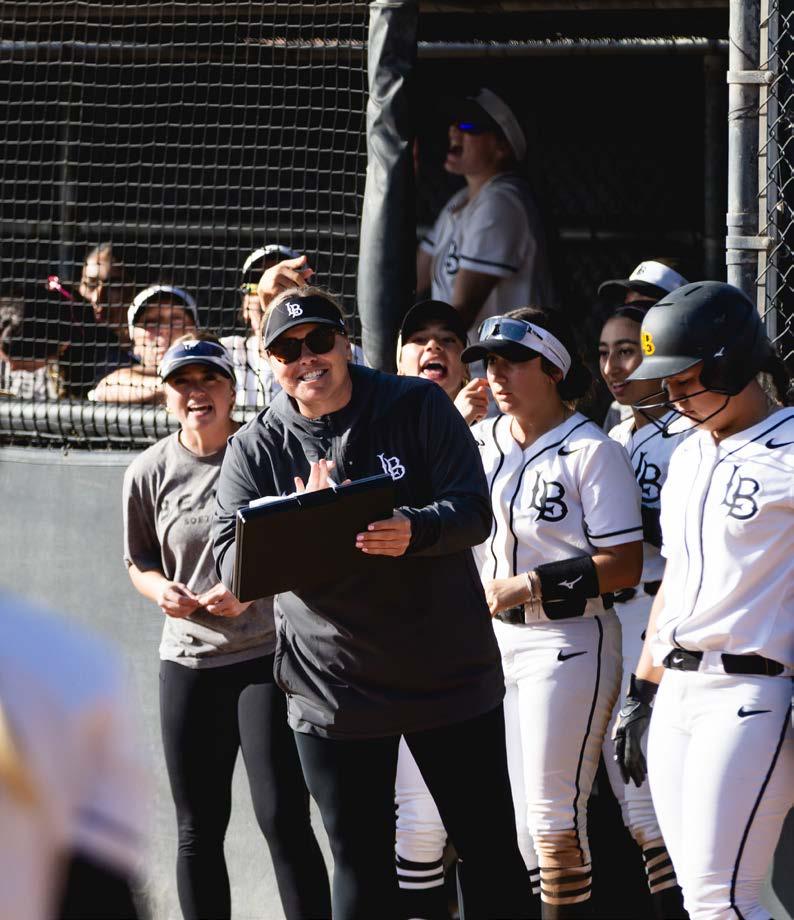
Photo courtesy of LBSU Athletics/KAT ACOSTA
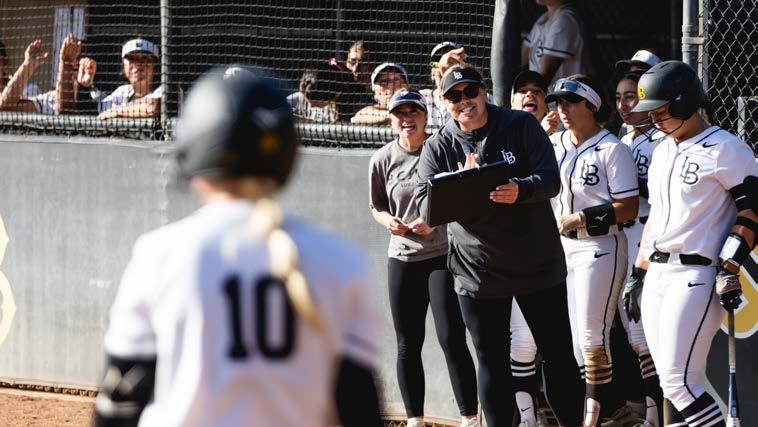
LBSU head coach Kendall Fearn has made an immediate impact in her first season at the helm of the program, leading The Beach to a major upset over No. 4 Oklahoma on Feb. 21.
Haley Lopez Business Manager business@gobeach.media Monday, March
Backpack, computer and earplugs... more noise incoming
BY JUSTIN STOCK Contributor
The University Student Union, currently being renovated as part of the Future U Project, is expected to see an increase in noise in March.
Lisa Salgado, Capital Projects Program Manager at Beach Building Services, said that last semester included the removal work phase, in which they were extracting hazardous materials from the USU. The majority of the work was tearing down the inside of the building, leading to the noise being contained within.
Since then, she said that the sound from the construction site has definitely increased.
This semester has begun to see the demolition of the University Dining Plaza, which is within earshot of the Friendship Walk stairs connecting lower and upper campus.
Salgado said to expect the noise to keep increasing throughout the semester, especially in March. During the month, they will continue with demolition of the UDP as well as the small buildings behind it. Work will also be done to prepare the soil for additional foundations that will be in the new marketplace.
According to Salgado, the giant slabs of stone that can be seen when taking the staircase next to the construction site will be used for erosion control. It will help the rain divert and flow safely and
land acknowlEdgmEnt ON
properly, and is currently being studied by the geology department.
The hours of construction, following Long Beach ordinance, are 7 a.m. to 7 p.m. on weekdays, and 9 a.m. to 6 p.m. on Saturdays.
Salgado said they plan to do the noisiest work in the evenings, so most students will not have to be subjected to it while on campus if they commute.
When asked if there had been any complaints over noise or the USU construction in general, Salgado said that the staff has been made aware of complaints both on social media and being emailed in.
Salgado said she expects complaints to increase as the noise increases from the construction. Michelle Ramos, a second-year environmental science major, has noticed a noise increase but said, “I don’t really pay attention to it.”
Paul Kim, a first-year kinesiology major, had a similar reaction to the noise, saying that while walking past construction, he is usually listening to music, so he doesn’t really hear it.
For faculty and professors who want silence during exams, Salgado said that if they work with BBS and call in advance, they can work to move construction to a different part of the site. However, Salgado said the big dollar impact of the construction does not guarantee that they can accommodate every professor.
Click here for the full story.
Here at the Long Beach Current we acknowledge that the school we report on is located on the sacred site of Puvungna, “the gathering place.” We are on the land of the Tongva/ Gabrieleño and the Acjachemen/Juaneño Nations who have lived and continue to live here.
We also acknowledge the Gabrieleño/Tongva (pronounced: GABRIEL-EN-YO/TONG – VAH) and Acjachemen/Juaneño (pronounced: AH-HACH-AH-MEN/JUAN-EN-YO) as the traditional custodians of the Los Angeles region along with the Chumash (pronounced: CHOO-MOSH) to the north and west, and the Tataviam (pronounced: TAH-TAH-VEE-YUM) and Cahuilla (pronounced: KAH-WEE-YAH) Nations to the east.
We respect and value the many ways the Tongva/Acjachemen cultural heritage and beliefs continue to have significance to the living people and remind us about the sacred and spiritual relationship that has always existed here at what we now call California State University Long Beach.
Editorials:
Editorials: All opinions expressed in the columns, letters and cartoons in the issue are those of the writers or artists. The opinons of the Long Beach Current are expressed only in unsigned editorials and do not necessarily reflect the opinions of the journalism department or the views of all staff members. All such editorials are written by the editorial board of the Long Beach Current.
lEttEr Policy

lEttEr Policy: All letters and emails must bear the phone number of the writer and must be no more than 300 words. The Long Beach Current reserves the right to edit letters for publication in regard to space.
Civil rights expert addresses nationwide rise of hate groups
BY JUSTIN STOCK Contributor
Civil rights expert Lecia Brooks took to the stage during the annual Confluence Rising Conference to speak on the rise of far-right hate groups in the U.S. following the 2024 election of President Donald Trump at The Grand in Long Beach on Feb. 27.
The conference, held for alums of Building Bridges Camp, is a three-day camping retreat at Pilgrim Pine Camp Center in Yucaipa, CA, with two different retreats: Gender Justice Camp and Racial Justice Camp.
The experience offers students a multicultural and interfaith environment, providing a safe space for youth to learn about and process social justice issues at a young age.
The Confluence Rising Conference also offers networking opportunities, social justice workshops and the chance to build community among both camp alumni and the broader Los Angeles County area.
The keynote speaker, Brooks, an alumna of Building Bridges Camp, spoke of the positive impact attending had on her life.
Brooks is the chief of staff at Southern Poverty Law Center in Montgomery, Alabama. SPLC’s mission is to provide relief and advocate for civil rights
in the deep South of the United States, with the broader goal of combating hate groups and far-right extremism on a national level.
In her speech, she underscored the growing threat of hate groups targeting marginalized communities, including Jewish, Muslim, LGBTQ+ and more communities.
Brooks warned that many of these groups “traffic in conspiracy theories” and that Dominionists are “the biggest threat because it unites all of the others.”
She also spoke of finding unity and solidarity amongst the attendees, specifically during the rise of white Christian nationalism and the era of the Trump Administration.
“If you count yourself as a Christian, you need to reclaim this banner and turn it around,” Brooks said.
During an interview with the Long Beach Current, Brooks said her most fulfilling experience during her time at Building Bridges was that it was the place she “came into my own as a woman,” and that it gave her a “space to talk about and uncover my identities,” as a queer Black woman.
When asked about the three times she testified to Congress following the Jan. 6 riots in 2021, she said it’s one of the hardest things that she’s ever done.
“You’re not allowed to engage in conversation or dialogue, you know; they want to set you up, get their sound bite
and say what they want to say,” Brooks said. “So it’s a matter of trying to make sure that I get my soundbite in and say what I need to say.”
When asked what she would say to her younger college self, Brooks said to embrace all the things outside academia.
“To learn from the experiences of other people and what they’re doing. That learning doesn’t just take place in the classroom,” Brooks said.
During the event, Long Beach Mayor Rex Richardson spoke about his grandfather’s struggles, who went from being a sharecropper to a landowner.
He also shared stories about his grandmother’s life, who grew up under segregation, and sent her seven-year-old daughter to school in Alabama.
Reflecting on the material ways equity is achieved, he focused on community building and passing legislation and policies that would help the City of Long Beach become a fair, multicultural city.
He ended by celebrating the fact that Long Beach had its first full year of no officer-involved shootings and said, “justice can’t live only in statements.”
Other speakers:
Megan Kerr, a council member in the City of Long Beach representing District 5, also spoke briefly during the event.
For the last 3 years, she has worked on the board chair at Confluence Rising.
Kerr said the conference is a perfect
introduction to the greater Long Beach community and a place where people can hear from voices they don’t normally have the opportunity to hear.
Irish Barnes, 16, a Renaissance High School student who was on the youth panel of the event, said she got involved as a youth speaker at Confluence Rising because her parents met at the camps and conferences.
Barnes spoke about the different ways at camp that they helped marginalized children, which led to processing the discrimination they had faced.
One of the ways Barnes helped the camp attendees was by grouping them and having them write down the derogatory names they had been called.
She explained it was to help them process that they are just words, and to go against stereotypes and be around people with different cultures and identities from their own.
For students hesitant to attend an event as large as Confluence Rising, Barnes encouraged them to embrace the experience, emphasizing its potential for personal growth and connection.
“I think, just show up like you might be surprised how much you’re gonna like it, and meet new people and just learn so many new things and grow as a person and grow in your voice,” Barnes said.
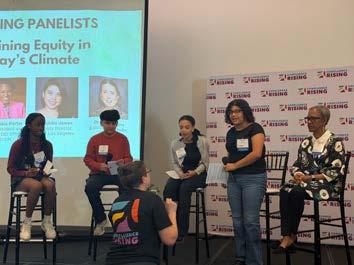
JUSTIN STOCK/Long Beach Current
A group of young panelists (from left) Zachi Ozoude, Jesus Torrez, Agustin Cazares, and Irish Morgan-Barnes sit with Keynote speaker Lecia Brooks as they receive instruction by Jessy Needham before the Confluence Rising speeches begin at The Grand in Long Beach on Feb. 27.
Interim police chief focuses on balancing enforcement with empathy
BY ETHAN BROWN News Assistant
Carol Almaguer, the interim police chief of the University Police Department at Long Beach State, is a busy woman. Busy, along with her team, keeping The Beach safe, building trust and open communication with the campus community.
After giving an extensive tour of the UPD station across from the Student Recreation and Wellness Center, Almaguer sat down in a chair at the meeting table in her office and exhaled.
“Not all issues on campus need solutions involving a show of force, or anything more than a display of common sense,” Almaguer said. “We prefer to solve problems at the lowest level.”
Almaguer is highly motivated to ensure safety and comfort on all fronts, from the new, “soft” questioning room at the station to the back wall in the detectives’ office, where pictures hang of those with a warrant out for their arrest and the inability to set foot on campus.
When she was sworn in as interim chief of police in late January, Almaguer said the position was “not just a new title, promotion or a raise in pay.” Almaguer called it a “responsibility.”
After serving at the Orange County Sheriff’s Department for 21 years, Almaguer came to CSULB in 2021 and started building a network of connections. She now pulls on as the leader of the UPD, a small but tight-knit, efficient squadron.
Almaguer has put the physical and mental health of her team of 25 – including lieutenants, officers, dispatchers, detectives and more – at a premium.
Almaguer said all members of her team are accountable for upholding the law, exercising common sense, respecting and showing humanity, in addition to demonstrating dignity.
“Praise in public, punish in private,” Almaguer said.
Almaguer has just the right mindset for an individual in charge of such a vital operation. However, there is a human aspect she seeks to bring to the campus police force and to dispel the illusion that police officers are unapproachable.
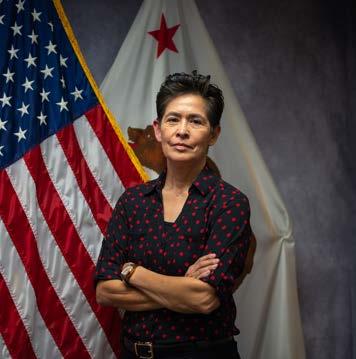
DIEGO PEREZ/Long Beach Current
Having joined CSULB in 2021, Carol Almaguer is appointed as Interim Chief of Police of the CSULB Police Department.
A recent post on the CSULB police official Instagram account evidenced this focus on connecting with the very students they serve. The humorous video cautioning against driving while distracted has 21.8 million views, 1.9 million likes and 449,000 shares.
Almaguer credits former Police Chief John Brockie for allowing her to lead in her own style, enabling a seamless transition when she replaced him at the beginning of 2026.
“The biggest gift he [Brockie] ever gave me was the opportunity and space to grow,” Almaguer said, growth that has her in charge of a police force team with 313.5 years of combined experience.
With a new police chief likely to be chosen this year, Almaguer is still undecided whether she will enter her name into the running.
Jeff Cook, Chief Communications Officer at CSULB, said the search for a permanent chief will start in the fall.
“It’s likely a successful candidate will be identified by the end of the calendar year,” Cook said. “The interim chief will serve until a permanent chief can as-
sume the role.”
The position reports to Scott Apel, the associate vice president for Administration and Finance, and a search committee will be announced soon.
“We want to work with students, while also making sure they know that the bad guys will be put in jail,” Almaguer said. “If we see a car with expired plates in the parking lot, although we have the jurisdiction to tow, we’ll give you a warning – we know college students can’t afford that.”
In the same vein, when students approach Almaguer to ask what the UPD is doing to make the campus a safer place, she always gives the same answer.
“What are you doing to make the campus safer?” Almaguer said. “We work 24/7 to ensure campus safety, but you can always help us with your eyes and ears, and with common sense.”
A truck driver overcame homelessness. Now, he’s helping fellow LBCC students with his own club
BY NELSON GODFREY Contributor
When Edgar Rosales lost his 20-year career as a truck driver in a series of layoffs, he never imagined that he would become a nationally recognized student advocate.
Rosales, then 40, became homeless during his first semester as a public health major at Long Beach City College and entered the college’s Safe Parking Program, which provides students who live in cars a secure location with amenities to spend the night.
Rosales had not known about the program, and the discovery made him realize he could help more people access resources. He started by organizing breakfasts for students in the Safe Park-
ing Program, and it rapidly grew into a multifaceted campus support organization founded in October 2025.
Now, four months later, Rosales continues helping students access resources through an official LBCC club, working to bring washers and dryers to campus and planning to collaborate with government resources such as CalFresh. He attended a statewide conference on student resources in February, returning with important knowledge about how to establish new resources.
Rosales founded Voz as a student club that is not subject to bureaucratic limitations. He decided to pursue this as an individual instead of joining an official program so he could connect students to any available resources, unrestrained by departmental boundaries. He maintains contact with many LBCC
resources, including Adult Learners, Justice Scholars and First-Year Experience.
He visits these programs regularly to talk with staff, find out what students need and help them meet those needs.
“The reason I started the club was to find more resources for the students,” Rosales said.
Basic needs insecurity is a common issue among community college students. According to a 2025 survey by the Community College League of California, two out of three California community college students experienced some form of struggle with basic needs.
So far, Rosales has encountered only cooperation upon reaching out to various programs.
“Everybody says yes,” Rosales said. “I’ve been lucky.”
By the end of the 2025 fall semester,
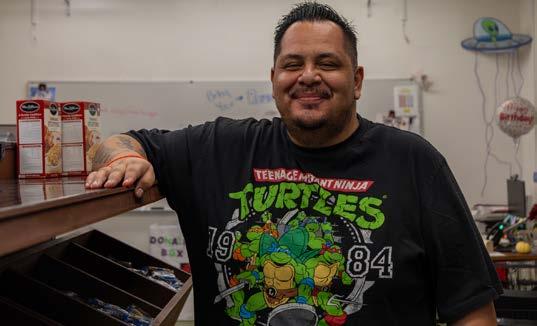
Edgar Rosales, a 40-year-old Long Beach City College student, inside the Viking Vault food pantry at LBCC on Feb. 3. Rosales founded Voz, a student-led group that helps LBCC students who are unhoused and have low income. He was selected as a 2025 honoree of The Courage project, a national recognition given to 12 people or organizations, for his leadership and commitment to helping students.
EDDY CERMENO/Long Beach Current
the club had about 15 regular attendees at its monthly meetings and successfully collaborated with several LBCC departments. In December, Rosales received an award from The Courage Project, a nationwide initiative based on public nomination that recognizes community empowerment. He intends to use this momentum to continue broadening Voz’s scope. His team is currently in talks with LBCC’s Associated Student Body to install washers and dryers on campus so that students who lack access to laundry machines can have clean clothes. When the club resumes its meetings in March, it aspires to provide students with compact sewing kits and organize a sewing class to teach them how to fix their clothes.
In mid-February, Rosales traveled to Sacramento for the California Higher Education Basic Needs Alliance conference, with a mission to discover more resources and bring back information about them to share with students at LBCC. He was pleasantly surprised by how much he learned about the extensive research that goes into demonstrating student need for resources, which enables programs to secure funding.
Click here for the full story.
Funding cuts, Olympic preparations displace Los Angeles youth programming
BY ALEXYS DEMARIA Opinions Assistant
The Cabrillo Beach Youth Waterfront Center was once a hub for environmental youth programs, serving over 17,000 youth alone from 2024 to 2025.
In December 2025, the Greater Los Angeles Area Council of Scouting America vacated the Cabrillo Beach Youth Center in San Pedro, leaving organizations like Boys and Girls Club of America, Los Angeles Unified School District and local swim teams without this longstanding facility.
The closure of the youth center due to the 2028 L.A. Olympics preparation represents another hit to L.A. youth’s access to environmental programs.
“I was [a student] in L.A. Unified, so we would go to the Cabrillo Marine Museum…that area, that programming was always very special to students in the area,” said Elaine Bernal, a lecturer in the Chemistry and Biochemistry Department at Long Beach State. What happened to the Cabrillo Beach Youth Center?
The waterfront property offered day, overnight and weekend use to Scouting L.A., formerly known as the Boy Scouts of America, along with other community programming since 1946.
The Greater L.A. Area Council oversaw Scouting L.A. activities at the center, and received a termination notice of their land lease on Dec. 1, 2025, from the Port of L.A., who owns the land. Scouting L.A. had until the end of the year to leave the facility.
In 1982, two years before the L.A. Summer Olympics, Scouting, Port of L.A. and L.A. city leadership coordinated on a 30-year lease, and a subsequent monthto-month tenancy between Scouting L.A. and the port. The youth center building was dedicated in 1987, funded by over $3.6 million of contributions.
The Amateur Athletic foundation, later known as the LA84 Foundation, granted $500,000 of surplus Olympic
funds to the youth center project in 1987 according to a document provided by Robert Scoular, an officer of the Greater L.A. Council.
The property not only includes access to the Long Beach waterfront—host to multiple 2028 Olympic events, including coastal rowing—but the Olympic-sized pool, campgrounds and boathouse as well.
Now, two years before the next L.A. Olympics, the Cabrillo Beach Youth Center sits empty.
“The Port of Los Angeles has stated it is going to use the premises to support sailing activities of the 2028 Olympics,” Scoular said in an email statement. “Following the Olympics, GLAAC (the council) hopes to regain occupancy and resume its programs.”
Conversely, the futures of the youth center and Scouting America’s programming are uncertain. Scoular said the council hopes to deliver “at least some” programming from the Cabrillo site, while the facility supports the Olympic sailing program. The extent of the programming is not yet known.
“When these types of programs go away, then we lose early science learning opportunities and sort of like informal, low stakes everyday opportunities for kids just to experience science,”Kim Kelly, chair of the Human Development Department at CSULB, said. “We’re losing out on opportunities to feed into our scientific community and our scientific economy later on. So I think it’s a great investment that we can make as a community to support these spaces.”
As Scouting America wasn’t guaranteed the Cabrillo Youth Center after the Olympics, they may have to compete for the facilities.
Scouting America noted that after the Olympic training facility’s lease of the property concludes after the Olympics, the Port “plans to then offer the site to various organizations, presently unknown, in requests for proposals.”
This potential loss of scouting facilities represents a risk for future L.A. youth, continuing a pattern of disinvestment of L.A. youth programs.

ALEXYS DEMARIA/Long Beach Current Windows at the Cabrillo Beach Youth Center appeared to be boarded up on Jan. 29, as the facility awaits transformation into a sailing training center for international Olympic teams. The nonprofit organization “Pathway to Podium LLC” will operate the facility following the termination of Scouting America’s lease.
Long Beach-focused environmental engagement
Bernal, a lecturer at CSULB, served as the co-primary investigator of the Steam Ecosystem Expansion Demonstration program at the Long Beach Public Library, educating Long Beach middle school youth while training, coaching and mentoring pre-service teachers from CSULB to facilitate STEM learning opportunities to students.
SEED’s programs included working on a local urban farm, walking architectural tours of downtown Long Beach and field trips to design firms. “We framed the programming and the curriculum around design thinking and also environmental justice within that community context here in Long Beach,” Bernal said.
Environmental education’s supplemental benefits
“I think it’s vital to have community programming, STEM programming, like SEED, like a creativity lab, because the
way I see it, it creates that connection between the classroom and then the community,” Bernal said.
Kelly said programs like SEED and the Cabrillo Beach Youth Center are important for social and emotional development, but it also “connects to children’s and youth’s ultimate development of environmental stewardship.”
“We do know from research that these spaces help youth build confidence and belonging and even emotion regulation,” Kelly said. “The ability to take risks as a young person is very important for our tolerance to discomfort and adverse experiences, in later adulthood, in later life.”
Click here for the full story.
Fish freak-out at The Beach: 2026 grunion runs return next week
BY ALEXYS DEMARIA Opinions Assistant
“It was kind of like a miracle that we [even] walked into it accidentally,”
Serena Logan, a 24-year-old Marketing Analytics Long Beach State graduate student, said.
Logan accidentally discovered the California Grunion spawning on the shores of Inspiration Point in Newport Beach while visiting the beach around 10 p.m. while on a date.
“I’ve never witnessed something like that before,” she said.
Female grunions wriggle up the beach during high tides to lay their eggs into shallow sandy nests, male grunions follow to fertilize the nests. After fertilization, grunion eggs “hatch about 10 days later, during the next high tide series, when they are inundated with sea water and agitated by rising surf,” ac-
cording to the California Department of Fish and Wildlife.
“I keep trying to go back, and try to experience the same thing again,” Logan said.
The department expects the first grunion runs of 2026 next week during these hours:
• Tuesday, March 3, 9:35 p.m. to 11:35 p.m.
• Wednesday, March 4, 10 p.m. to midnight
• Thursday, March 5, 10:25 p.m. to 12:25 a.m.
• Friday, March 6, 10:50 p.m. to 12:50 a.m.
The California Department of Fish and Wildlife’s predictions are for Cabrillo Beach, but spawning can occur anywhere within their range in Southern California, their usual range extends to Punta Abreojos in Baja California.
Individuals over 16 years old with a

Graphic by ALEXYS DEMARIA/Long Beach Current Grunions, the sardine-seized, silvery fish, are famous for their unique spawning practices which involves thousands swimming onto Southern California beaches to lay and fertilize eggs in the sand. These “grunion runs” are set to return next week.
California fishing license are permitted to collect 30 fish daily by hand during open season in March, July and August. Biological Sciences Ecology and Evolutionary Biology of Reef Fishes professor Darren Johnson considered using grunion as a study species for some “scientific questions” after watching them
spawn on a late night beach walk with his dog. He later used California Grunion as a model species to understand the process of ocean acidification with students, conducting research with a mobile laboratory.
Click here for the full story.
Pop. Art. Critique: Let’s get physical, books that is
BY DELFINO CAMACHO Arts & Life Editor
Do you read?
Well, not you specifically.
Of course, you read. You’re reading this (I hope).
I’m broadly asking if people still read in general; and I don’t mean online posts – more like popular fiction, magazines, articles, etc.
The answer is reading levels are way down, with one study finding that reading for pleasure has fallen 40% over the last 20 years.
The National Endowment for the Arts reports a steady decline in adults reading literature, with fiction at historic lows. More pessimistically, other stats
show the number of kids who read “every day” is dismal.
Leading explanations hover between too many screens and not enough time.
For some, more tech is the solution.
Over the past 20 years, e-readers and tracking apps have, to some extent, boosted the book economy, but at what cost? Reading, once solitary, has become oddly public with profiles, “BookTok,” and challenges.
Goodreads helped build that culture, but its Amazon ownership complicates and politicizes things (then again, what isn’t these days?).
Created in 2019 by software engineer Nadia Odunayo, a Black woman from the U.K., The StoryGraph is a more user-centric reading app some people see
as a less-problematic fix to popularize literacy. Users love the personalized stats, curated suggestions, and lack of corporate overlords.
My only critique: it still leans on AI more than I would like (then again, what doesn’t these days?).
Call me “unc,” but I still prefer reading the old-fashioned way – on the remains of dead trees. Jokes aside, there’s something genuinely enjoyable about a tangible book: the crisp paper on my fingertips, that distinct smell.
“Unc” or not, Gen Z is also adopting physical media – at times even hauling “dead” tech back from the grave. Beyond the vinyl revival (which survived the millennial trend), Gen Z has begun craving DVDs, cassettes, film cameras and – yes – even books and old magazines.
Ask young collectors why and they give similar refrains: infinite choice is exhausting, digital renting does not equal ownership and social feeds flatten taste.
Maybe the point isn’t nostalgia, it’s taking back control.
In a time when companies can snatch back movies, games, even books you “bought” but really only digitally rented; a record, a DVD disc and even a dog-eared paperback is a promise: One of ownership and enjoyment at your own pace.
In “Dune”, the 100-year Butlerian Jihad violently outlawed machine minds. For some in Gen Z, their tech rebellion is more of a quiet revolt: Own the thing, finish the thing and let your attention belong to you again.
ARTS & LIFE
The songs that shaped these Long Beach love stories
BY SUZUNOSUKE IDA
Contributor
Music often plays a major role in strengthening personal connections between people who are falling in love, whether it’s a song that represents their partner’s personality or a goofy song they both enjoy.
Here are three campus couples who connected through music.
1) Madison and Matt
This Long Beach State couple met in the world’s most wonderful and romantic place – Costco.
Madison Ross, a fourth-year communication studies student, started working at Costco in 2022.
There she met Matthew Gutierrez, a sociology alumnus, working in the merchandising department.
One day, Gutierrez asked Ross to help him carry boxes of chips.
“I kind of figured out he liked me … chips are made of air. He did not need my help,” Ross said.
Gutierrez claims he was not flirting, but that he genuinely “wanted to protect [Ross’s] back.”
Regardless, Gutierrez knew one thing for sure and that was the moment when Ross recommended a song to him, “Freaking Me Out” by The Frights.
“She kind of exactly nailed what my music tastes [are] as though she understood my train of thought,” Gutierrez said.
To this day, the song is a reminder for
Gutierrez about Ross’s ability to understand his feelings and calm him down.
“I think the singer sings it a different way but I choose to interpret the words however I want,” Gutierrez said.
On the other hand, Ross’s association of Gutierrez to the song “Pyjama Pants” by Cavetown is more true to the lyrics’ original intentions.
The song is about a person who is upset and crying, to the thought of, “I’m afraid you won’t love me.” But later, the lyrics go “He comes ‘round anyways. Holds my face, says, ‘it’s okay,’” reassuring the person who is upset and crying.
“Matt makes me feel OK to show my emotions and I know he’ll always be there for me,” Ross said.
Ross and Gutierrez celebrate their four year anniversary this June.
2) Melina and David
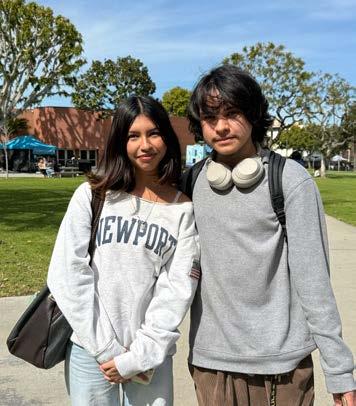
Melina Lopez, a second-year public health student, and David Gonzalez, a second-year electrical engineering student, met all the way back in seventh grade history class.
Their relationship started with a similar taste in music.
In ninth grade, they started listening to pop punk songs together such as Blink-182.
In 10th grade, they started dating.
Gonzalez said “Story of a Lonely Guy” by Blink-182 is the song that will always remind him of Lopez.
“It used to be her favorite song at the time,” Gonzalez said.
For Lopez, “Let the Sun In” by Wallows is what reminds her of Gonzalez.
“All of it. Every single lyric, I kind of relate to it,” Lopez said, describing the
song as cheesy yet romantic.
4 years later, they don’t listen to the same music anymore. Lopez now listens to pop artists like Harry Styles and Gonzalez listens to metal artists like Metallica.
But even with their evolving taste, they still play Blink-182 songs once in a while, to remind them of how their relationship started.
3) Roxie and Marceline
Roxie Drummond, an alumnus in marine biology, and Marceline Salazar, a fourth-year art studio student, grew up in the valley and even shared a mutual acquaintance. However, they first met at the campus LGBTQ+ Resource Center.
They share an appreciation for the songs and music they recommended to each other.
For Drummond, “Kicker” by Alex G specifically reminds them of Salazar. “‘Kicker’ is there because it was by
an artist that she really likes, who I should’ve gotten into sooner,” Drummond said.
For Salazar, it’s a whole genre of Midwest emo like “Apartments” by Modern Baseball that reminds her of Drummond.
Sharing these interests helped them understand each other better, they said. Drummond said that while she is a low-energy person, Marceline is full of energy and their personalities complement each other.
There’s one more song they both associate with their relationship: “Kiss Me” by Sixpence None the Richer.
They found the song stupid and hilarious, but the song helped Drummond realize Salazar was the one when she recorded herself dancing to it in front of the student bookstore and posted it on Instagram.
“That was the moment,” Drummond said. “That song is stupid but super cute.”
SUZUNOSUKE IDA/Long Beach Current Long Beach State students and couple Melina Lopez (left) and David Gonzalez first met in middle school.
Closing the gap: CSULB students help boost stem cell donor diversity
BY RILEY MURRAY
Contributor
For patients with blood cancer, a stem cell and bone marrow donation can mean the difference between life and death. However, whether they can receive that donation often depends on something they cannot control: their ethnicity.
The National Marrow Donor Program is a nonprofit organization that connects patients diagnosed with blood cancers and other blood disorders to matches who provide life-saving stem cell and bone marrow donations.
According to the NMDP, white patients have roughly a 79% chance of finding a fully matched donor.
For people of color, the likelihood of finding a match ranges from 29% to 60%.
At Long Beach State, the members of the university’s NMDP chapter are working to help increase those odds.
“The national organization facilitates stem cell and bone marrow donations for people suffering from blood cancer as a way to treat them and save their lives,” said Sophia Jobson, a thirdyear student and president of the CSULB chapter.
While a nationally operating nonprofit, the Beach’s student-led chapter focuses on recruitment and awareness.
On campus, the members host events and educate students about how stem cell therapy works and why matching is so complex.
The program’s university chapter, now in its second semester as an official student organization, is working to save lives by diversifying the national stem cell and bone marrow donor registry.
The group had previously partnered with other campus organizations before establishing a formal chapter.
“CSULB is an Asian American, Native American, Pacific Islander and Hispanic-Serving Institution,” Jobson said.
Their goal is to leverage the campus’s large, diverse student population to increase the number of potential matches in the registry.
“Another important factor to add into the registry is age group,” said Valentina Veal, a third-year molecular cell biology & physiology major and secretary of the CSULB chapter.
Younger donors are preferred because their transplants are associated with better patient outcomes, she said.
Unlike blood type matching, stem cell matching is far more detailed.
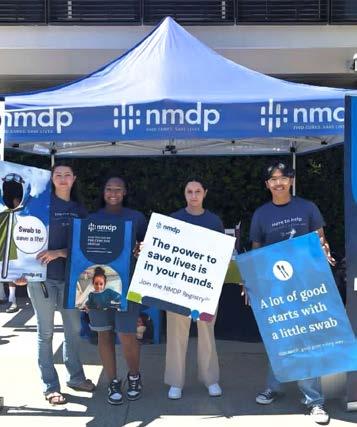
During Week of Welcome, members of the Long Beach State National Marrow Donor Program chapter hosted their first campus tabling event on Upper Campus on Sept. 4 and 5.
It is often described as “very difficult to match,” Jobson explained, “because in order to have a higher chance that the cancer patient survives based on this treatment, they need to have ideally a full match.”
The chapter often partners with the Student-Athlete Advisory Committee, which represents all 19 athletic teams on campus.
“They bring fabulous energy and recruit lots of people,” Jobson said.
In addition to working with the SAE fraternity, the chapter hosts an annual event with Tzu Ching, a Taiwanese Buddhist organization.
This semester, the chapter plans to collaborate with the Divine Nine, which represents the nine historically Black fraternities and sororities on campus.
How can students join?
Students can join the registry by completing a short health questionnaire and providing a cheek swab to determine whether they could be a match.
“It’s a great opportunity to learn more and potentially save a life, and the commitment is very low,” said Veal.
The chapter posts updates on upcoming events on its Instagram page
The organization hosts general meetings on the first Tuesday of each month at 6 p.m. in LA2-105.
They try to host at least one volunteer and social event each month for students who want to help grow the registry.
Photo courtesy of Valentina Veal
ARTS & LIFE
Learn a language… or 3: students embrace multilingualism
BY JASON GREEN Arts & Life Assistant
Students who walked into the psychology building courtyard in the morning would see a question on a whiteboard: “How do you say ‘Hello’ in your mother language?”
From morning to late afternoon, more than a dozen students wrote on the whiteboard in various languages in a belated celebration of International Mother Language Day on Thursday, Feb. 26.
The holiday, annually observed on Feb. 21 since 1990 by the United Nations, is meant to highlight languages of the world and multilingualism in general.
The Linguistics Student Association hosted the event alongside various language departments, clubs and associations such as American Sign Language Club, Asian and Asian American Studies
Department and the German Studies Student Association.
“Languages are interesting because we learned one of the most impressive things we ever get to do in our lives is, we learn our first language and humans learn that language without thinking about it,” linguistics department chair Michael Ahland said.
Language is a fundamental part of an individual’s identity as language forms the consciousness, Ahland said.
Ahland, whose work lies in western Ethiopian languages, said for people in the United States, learning a language usually takes place in a classroom setting, and not everyone has the ability to learn in that kind of environment
However, in Africa for example, it is normal to learn four languages through social settings.
While the United States is one of the
most diverse countries with hundreds of languages spoken, the majority of the population is monolingual, with English as their first language
“But I assure you, every human can learn multiple languages in a social setting,” Ahland said. “We’re built for it.”
Samia Sayed, co-president of the Linguistics Student Association, said that it is important to celebrate language because of the current political climate of the United States with “general discrimination against people who are of different cultures or merely speak other languages… when being multilingual is not something to be ashamed of, it is something to be celebrated”
Since the founding of the United States, the country did not have an official language for almost 250 years until March 1 of last year when President Donald Trump signed an executive order
that designated English as the country’s official language.
“It is an incredible test of the human spirit to want to communicate and want to be able to connect with other people regardless of what language they speak,” Sayed said.
Throughout the event, there were a variety of presentations that showcased the diverse realm of languages; such as how a certain language works, chanting performance and poetry.
Graduate linguistics student Hansana Jinasena highlighted her language, Sinhala, one of the official languages of Sri Lanka and Sinhalese peoples.
She wrote out her name in Sinhalese script, displaying what the writing system looks like. She asked for attendees to volunteer to have their names written.
For her master’s thesis, Jinasena is focusing on the language’s syntax which refers to the language’s word order and arrangement. Jinasena analyzes, for example, the way people use suffixes in the language. The grammar of the language is a complicated system as the language does not have a strict word order.
Click here for the full story.
GRAD GRAMS


Artist talk with June Edmonds, Silence anwers questions from the audience regarding to her presentation on the painting she has published to the public located at Carolyn Campagna Kleefeld Contemporary Art Museum on Feb. 25.
CHARLOTTE LOCICERO/ Long Beach Current
Artist June Edmonds’ ‘Silence’ sparks racism dialogue at Kleefeld museum
BY LILA MUKASA Arts & Life Assistant
Dominated by pastel tones of blue, pink and purple that resemble candy confectionery yet carrying deep meanings of racism and trauma, artist June Edmonds’ acrylic work “Silence” was a subject of discussion at Carolyn Campagna Kleefeld Contemporary Art Museum during the museum’s Artist Talk event on Feb. 25.
Edmonds, a featured artist in Kleefeld Contemporary’s main gallery, Up Close: New Acquisitions, spoke to an audience of students, faculty and community members about the symbolism and meanings found in the piece, which depicts what she described as a candy-coated Confederate flag.
“It’s terrible to and for African Americans,” she said of what the Confederate flag represents. “It’s just so triggering, the thought and belief of a time when white supremacy was the supreme law of
the land, when enslaving was the law of the land.”
These traumatic impacts continue to be minimized, she said. The pastel tones were used to add a sense of lightness to a devastating history.
When asked about the meaning behind “Silence,” Edmonds said, “I liken it to just being silent about racism and institutions of racism, sort of an analogy for that.”
Edmonds created the piece in the days following George Floyd’s murder.
She drew from the racism she experienced following Floyd’s murder, having been approached by white people who seemingly expected her to absolve them of the guilt they were experiencing about police brutality affecting Black communities.
“Silence” acknowledges the racial trauma that has been carried by African Americans for generations, and continues to be a part of everyday life, she said.
The work is part of Edmonds’ larger
flag collection, which comprises works that allude to Black patriotism.
“Black people, I think, are the most patriotic people ever in America,” Edmonds said. Across generations, Black Americans have “believed in this American ideal,” despite continued broken promises.
Describing her style as formalist, Edmonds was especially focused on the composition of “Silence,” which was a key part of the piece’s spirituality.
She finds that the balance in the piece can evoke a sense of inner safety in the viewer, fostering a deeper connection to their spirituality.
The event included a Q&A session in which audience members shared the impact the artwork had on them and delved deeper into its themes with Edmonds.
Fourth-year psychology student Stephanie Lymon found the work moving on both a cultural and spiritual level.
“It really challenged me to think critically about how I perceive culture, as
well as other people’s creations,” Lymon said.
She said the event encouraged her to embrace the legacies of those who came before her.
The meaning of “Silence” is largely up to viewers’ interpretation, Edmonds said, but she also hopes it leads people to recognize their power to speak out against injustice and demand change, what the work ultimately fights for.
Themes discussed during the event are relevant to students, said Cristal Guzman, curator of academic programs and community learning at Kleefeld Contemporary, who organized the event.
“That artwork, I think, is extremely important to talk about and to also provide context for visitors,” she said. “And there’s only one person who can really do that best, which is the artist.”
Here are the 2 most anticipated games of 2026
BY KHOURY WILLIAMS Editor-in-Chief
Gamers can point to rare, electric years when greatness doesn’t arrive alone; instead, multiple “Game of the Year” contenders collide within the same calendar window to reshape the medium in real time.
In 2017, almost 10 years ago, a historic lineup of games was headlined by “The Legend of Zelda: Breath of the Wild,” which went on to claim multiple Game of the Year honors. The momentum carried into 2018, where titans such as “God of War” and “Red Dead Redemption 2” dominated the conversation. Recently, 2023 delivered another landmark moment, crowned by “Baldur’s Gate 3,” a generational release that swept Game of the Year awards across the industry. 2026 is already shaping up to be a generational year for the gaming industry. With the first quarter drawing to a close and major titles beginning to roll out, the Long Beach Current has compiled a list of the two most anticipated video games of the year.
2. “Marvel’s Wolverine”
Release Date: Sept. 15
Base Price: Unknown (Likely $69.99)
Platform: PS5
Developed by: Insomniac Games
Published by: PlayStation Studios
Despite being the only entirely new title on this list, “Marvel’s Wolverine”

brings one of Marvel’s most legendary “X-Men” to center stage — and its shared universe with Insomniac’s “Marvel’s Spider-Man” hints at exciting crossover possibilities.
One thing that sets “Wolverine” far apart from “Spider-Man” is the brutality. Paying homage to his comic book roots, the upcoming “Wolverine” video game emphasizes the characters ultra-violent nature, featuring lots of blood, gore and strong language.
While the beloved James Logan Howlett has lived a complex life and is nearly 200 years old, “Marvel’s Wolverine” acts as an origin story for the character in this universe. According to the developers, Logan’s memory has faded and the game is about discovering his painful past to become the renowned “X-Men” character we know him as today.
Featuring appearances from iconic villains, such as Mystique, Omega Red and the towering Sentinels, “Marvel’s Wolverine” is bound to be filled with many more surprises when the game launches worlwide in September.
1. “Grand Theft Auto VI”
Release Date: Nov. 19
Base Price: Unknown
Platforms: PS5 and Xbox Series X|S
Developed and published by: Rockstar Games
This game’s spot as our top pick might have been predictable, but as one of the largest entertainment properties to be released in the modern era, “Grand Theft Auto’s” relevance cannot be denied. There’s a reason why its highly anticipated release has become one of the biggest memes of the 2020s.
“GTA VI” marks the eighth mainline game in the franchise and the 13th game in the entire series. Set in the fictional state of Leonida — modeled after Florida — “GTA VI” features the romantic duo of Jason Duval and Lucia Caminos. Often described as the “Bonnie and Clyde” of the “GTA” universe, the website depicts both characters as wanting to seek a life outside the chaos they’re surrounded by, yet they’re constantly drawn back into the criminal life.
There is both very little and a great deal known about “GTA VI.” While official details remain scarce, the franchise’s history makes one thing clear: players can expect a sprawling open-world experience that blends action and life simulation, allowing them to carry out elaborate heists, build criminal empires, commit grand theft auto and more.
Rockstar Games’ latest release in 2018’s “Red Dead Redemption 2” expanded its focus on life-sim and role-playing mechanics beyond what “GTA” is traditionally known for. Those features have since carried over into “Grand Theft Auto Online,” through its “odd job” system, which added firefighter, forklift operator and newspaper carrier jobs — offering a glimpse of what could be possible in “GTA VI.”
While rumors continue to circulate about its features, fans worldwide will finally get to experience one of the most anticipated games in history when “GTA VI” releases this November.
As amazing as these two games are shaping up to be, they barely scratch the surface of what’s to come in 2026. This year features a full slate packed with highly anticipated releases — including “Crimson Desert,” “007 First Light,” “Fire Emblem: Fortune’s Weave,” “Gears of War: E-Day,” “Halo: Campaign Evolved,” the afermentioned “Forza Horizon 6” and many more — 2026 is shaping up to be yet another landmark year for gaming.
Photo courtesy of ROCKSTAR GAMES
The romantic duo of Jason Duval (front) and Lucia Caminos are set to take the fictional state of Leonida by storm when “Grand Theft Auto VI” releases on Nov. 19.

Did you survive the BTS ticket war?
BY KIMBERLY ROSS Contributer
“KIM NAMJOON, KIM SEOKJIN, MIN YOONGI, JUNG HOSEOK, PARK JIMIN, KIM TAEHYUNG, JEON JUNGKOOK, BTS!”
Are you ready, ARMY? BTS is coming back from mandatory conscription with a new album and their comeback world tour to fulfill their five-year promise to ARMYs (BTS fans worldwide): that they would return upon completing military service.
Many ARMYs showed their preparation for “the ticket war,” which is when there’s a huge rush to get tickets for popular concerts or events.
There are many Reels and Stories on Instagram about the ARMY’s experience with Ticketmaster, with many being un-
able to purchase tickets.
Influencers, such as YouTuber JoseOchoaTV, posted a video titled “GETTING BTS ARIRANG CONCERT TICKETS! | my experience buying.” The video showed his initial spot for the El Paso concert at 13,512, but it quickly dropped to 6,109.
My own sister, while at work, was able to secure VIP floor seats even during her shift for concerts in Las Vegas, Chicago and LA.
“I was with my other coworkers, trying on our phones and laptops to get on Ticketmaster, and we were panicking and silently screaming in our office as we got the tickets,” my sister said.
I personally attempted to wait in the Ticketmaster queue, following other ARMY’s social media posts and my own sister’s. I eventually gave up because I was moved to the regular sale date, and most of the tickets were above $1,000, which
exceeded my budget.
The fan club membership has benefits, but its effectiveness in stopping bots and scalpers is middling.
Membership grants early access to presale, which theoretically limits bots by restricting who can enter.
However, many fans were unable to get tickets despite having a membership, suggesting that this system doesn’t fully prevent tickets from ending up on the secondary market at inflated prices. The membership felt more like a necessary hurdle than a guaranteed spot.
Based on my experience, not only with the BTS membership but also with other K-pop subscriptions, I was able to get concert tickets even if they weren’t the closest seats; closer seats mean more money, and I usually try to find a reasonable price.
On a subreddit, some users argued that BTS hasn’t truly sold out and that, outside major cities, sales might be weaker than expected.
Some claim that if the demand was so massive, tickets would’ve been sold out instantly, unlike the presale queue in locations like El Paso and Foxborough.
The long awaited return of BTS has arrived and ticket selling websites like Ticketmaster are being overloaded with fans trying to get a front-row-seat as quickly as possible.
Graphic by VALENTINA
VILLARREAL/Long Beach Current
It’s almost like the hype around the BTS world tour might not reflect “real-world” sales outside the hardcore fanbase. At the end of the day, some were unable to secure tickets even when they arrived on time for the queue and were prepared with their membership.
Because of the millions of people getting on Ticketmaster at the same time, the logic is that a faster internet connection can improve your chances, but that’s not always the case.
Based on my experience, many tickets drop in price near the concert date, or even before it starts. When I went to two ENHYPEN concerts with a few of my friends, someone we met in line was able to buy a closer seat.
I attempted to buy these tickets myself, but eventually gave up due to the long queue. Additionally, my sister ended up getting me a ticket, which I appreciate.
With all things considered, the entire ARMY may get a chance to see our beloved BTS as a group or even doing their own solo activities. They never stated this would be their last tour; maybe it’s just the beginning.
OPINIONS
The performative studying epidemic and how to solve it
BY JUSTIN STOCK Contributor
You came to the library to lock in for an exam and posted a quick Instagram story with the caption “The grind never stops!” Of course, this was before scrolling through TikTok and refreshing your Instagram feed for three hours to see how many people viewed your “hard work.” Congratulations, my friend; you just engaged in performative studying.
According to Urban Dictionary, performative studying is when, instead of actually studying, you post about it on social media to obtain the recognition of being a good student, while not doing any of the work to become a true academic weapon.
Basically, it is the phenomenon of
a student putting more effort into appearing to be learning the material than actually retaining or engaging with the subject matter.
Why are we like this? Did students lose the ability to take their schoolwork seriously?
According to the Washington Post, grade inflation could explain what seems to be an era where students want the grade without doing the work.
Schools and universities lowered standards and testing requirements to make it seem as though American students were not falling behind, especially post-pandemic. The University of California (UC) system eliminated standardized testing altogether when admitting students.
Because of the lack of standards, UCSD had to “redesign its remedial math program to create a class that fo-
cused entirely on remediating elementary school and middle school math” in 2024.
With standards being lowered so much that the UCs are teaching their students mathematics meant for children going through puberty, and a study reporting that a survey of 65,000 students in college are using social media apps up to 16 hours a week, will students ever get out of this cycle of unlearning?
We all want to be viewed as smarter than we actually are. It is a very human inclination. But relatability isn’t going to give students their degree. I went to the University Library to get advice from CSULB students on how to help their peers break out of this vicious cycle of aesthetic learning.
Third-year marine biology major Sophia Carlin said that instead of posting on social media to seek validation from
strangers, students should seek accountability from those who actually know them.
“I told them I’m doing it,” she said. Carlin explains that she texts her mom how long she is going to be studying for, “so I kind of have to do it.”
Ben Hendricks, a third-year aerospace engineering major, recommends making a review sheet. Writing down important information is vital, as you can scan something throughout the day to keep your brain refreshed.
Will these tips help you break out of the vicious cycle of performative studying?
Aidan Helfant, in a Medium article, suggested that the only way to improve your study habits is to become “indistractable.”
Click here for the full story.
Waves of Wisdom: How do I elevate my style?
BY LEYNA VU Opinions Editor
Q: I wanna up my style, but I’m having trouble knowing what looks good on me. Any tips?
- Not-So-Style-Savvy
A: There’s so much advice online talking about the importance of knowing your body type, skin tone, ideal colors, etc. But in my opinion, if you feel like something doesn’t look good on you, then you simply didn’t love it enough! You are in control of what you wear, not the other way around.
With that said, I find that experimentation is the best way of knowing what you like and dislike about fashion. Personally, I was able to find my style through cosplay. For those unfamiliar, cosplay is short for “costume play.” In cosplay, you emulate the look of your favorite characters from your favorite media. One is likely to see cosplay at anime or comic conventions. While I’m partial to cute looks, I’ve been experimenting with cooler outfits lately, which I’m loving a lot. Cosplayer or not, anyone can push the limits of
what they think looks good, but the opportunity, the setting and the why help when struggling to stay motivated.
Another important part of exploration is going out and hunting for the outfit. Even if you don’t buy anything at the outlets, boutiques or department stores, taking time out of your schedule to physically be at the mall does wonders for your style.
Everyone starts from somewhere, so trying things on and mixing and matching pieces will help you build a sixth sense for fashion. I find this method to be infinitely more worthwhile than online shopping, as you would be looking at clothes on a model and not yourself.
Ultimately, the beauty of fashion lies in the arts. When it comes to developing an aesthetic appreciation of any art form, it takes practice, yes, but it also requires the thoughtful consumption of media. By viewing spreads, perusing digital archives and staying current with what’s trending, you train your eyes to look for colors, patterns and mediums.
Adding to the art form that is an outfit is makeup. It can complement anything you come up with. Howev -
er, never feel like you have to spend a disproportionate amount of time on your makeup to make yourself look prettier. You should feel pretty regardless of makeup or clothing; they are only there to add to your beauty. At the end of the day, no one has one sense of style, and aesthetics kill the fun of trying. While I like to dress a certain way outside of school, when I’m on campus, I’m partial to modest looks; I’m talking cashmere sweaters, non-fitted pants and square glasses. Dressing for an aesthetic not only prevents you from elevating your style, but it also hinders you from enjoying the clothes you wear. To start small, I encourage that you try something different the next time you make a small adjustment to your appearance and try not to stick within the confines of what others deem to be “aesthetic.”
Fashion is a skill; no one is born with it. Inevitably, you will put together an outfit you’ll hate as you develop your sense of style. However, that in itself is part of the fun of trying new things. While daunting, there is indubitably a method to the madness.
Hopefully, this column gave you the push to try something new this week, to make small changes and see what makes you feel good!

LBSU sweeps Concordia Irvine in dominant fashion
BY MONICA BADOLIAN Sports Assistant
Despite missing two key players, Long Beach State men’s volleyball did not skip a beat on Feb. 28, sweeping Concordia University Irvine 25-17, 25-23, 25-21 at the LBS Financial Credit Union Pyramid.
With senior opposite Skyler Varga and sophomore outside hitter Alex Kandev out of the lineup, The Beach leaned on depth and efficiency and a strong presence at the net to secure the straight-set victory. With Varga and Kandev out, freshman outside hitter Myles
Jordan made his collegiate debut.
LBSU set the tone immediately in the first set with a block from freshman middle blocker Jackson Cryst and redshirt freshman setter Jake Pazanti on the opening point.
LBSU senior outside hitter Connor Bloom followed up with the first kill of the night, while Cryst added a service ace as The Beach found an early rhythm.
The offense flowed through freshman outside hitter Wojciech Gajek, who finished with 12 kills on an efficient .786 hitting percentage. Bloom added 10 kills with zero errors, while Cryst contributed five kills and played a key role in an 8-3 LBSU blocking advantage in the contest.
“[Assistant coach McKay Smith] takes great pride and ownership, especially with our blocking defense,” LBSU head coach Nick MacRae said. “To watch the film, to have his game plan… his voice and his work that he put in helped ensure that these guys were freed up to execute the job.”
The Beach continued to apply pressure to keep Concordia off balance.
Senior middle blocker Ben Braun delivered multiple off-speed tip kills, and Bloom added in smart touches at the net to stretch the defense.
Jordan added a confident tip kill late in the first set as LBSU pulled away for a 25-17 win.
Jordan continued to grow into the match in set three, recording multiple kills. LBSU sophomore middle blocker Braedon Marquardt also made his presence felt late with a block assist alongside Gajek and a kill to help create separation.
Concordia stayed close and cut the lead to 19-18, but service aces from Cryst and Pazanti changed the game. Marquardt’s last kill made it 25-21 and finished the sweep.
Senior outside/opposite hitter Connor Bloom played a pivotal role in LBSU’s 3-0 sweep of Concordia Irvine with 10 kills on 16 total attempts on Feb. 28 at the LBS Financial Credit Union Pyramid.
DIEGO PEREZ/Long Beach Current
“We were flexing our depth,” MacRae said. “We have plenty of guys that can go out there and show the same level of volleyball, so we’re not worried about two guys being out.”
LBSU hit nearly .600 in the first set and .650 in the second, showing strong offense even without two starters. The Beach also played good defense at the net and slowed down the Golden Eagles, despite Concordia senior opposite Logan Whitaker’s 15 kills.
“His tempo was slower, and so we were able to get there every time and just focus on finding contact with our middle unit and sealing that line to try and take him out of the game,” Cryst said on LBSU’s approach in defending Whitaker.
LBSU will face Penn State in its next matchup on Saturday, March 7 at the LBS Financial Credit Union Pyramid.
LBSU’s new softball coach instills winning culture in first season at The Beach
BY XAVIER CONSTANTINO Sports Assistant
When Kendall Fearn joined Long Beach State softball last summer, she was not just stepping into a new role, but instead into one of the sports more distinguished programs.
Fearn became just the fifth head coach in program history, and only the third in the last 42 years, succeeding Kim Sowder, who spent 19 seasons building one of the most respected softball programs in the Big West.
The weight of that legacy is not lost on her. After a few months into her first season leading The Beach, what stands out the most is not the pressure of the new position, it is the fight in the team.
“They don’t care who’s in their dugout,” Fearn said. “They’re just
gonna compete every pitch, and they’re never out of it. If there’s a strike left on the board, an out left, we have a chance.”
That mentality has quickly become the team’s identity. Through early non-conference play, LBSU (12-8) has already turned heads, including a victory over No. 4 University of Oklahoma in which The Beach put up six runs against one of the nations premier pitching staff.
“These non-conference games, they’re awesome because these are teams that you see in the postseason,” Fearn said. “You go to that later on in the season, and you think about, ‘Oh, I remember that one time that I did this.’ That’s how you build confidence.”
Fearn comes to The Beach from San Diego State, where she was the top assistant and recruiting coordinator for three seasons. Before that, she built her resume at the University of Nevada, Las Vegas, Georgia Southern University, Marshall University and Indiana University.
Now in her first head coaching role, the Southern California native says she has not tried to reinvent herself. Her approach remains
rooted in student-athlete empowerment
“I haven’t really changed who I myself as somebody who’s empowering push them, but also support them them.”
The biggest adjustments to the small ones: managing pitching matchups Miller and the art of navigating umpires.
But none of it has felt overwhelming, inherited.
“I couldn’t be more fortunate for made the transition really easy for Fearn wasted no time establishing gathered input from every player to let the roster vote on its own leadership who have since become the program’s
Photo courtesy
LBSU head coach Kendall Fearn has made an immediate impact in her first season at the helm of the program, leading The Beach to a major upset over No. 4 Oklahoma on Feb. 21.

Right: LBSU player scores a run for The Beach against the Oregon State Beavers at the LBSU Softball Complex on Feb. 6.
Below: LBSU sophomore Audree Mendoza hits the ball toward the left center field against the Oregon State Beavers, The Beach won with a 4-3 walkoff win at the LBSU Softball Complex on Feb. 6.
CHARLOTTE LOCICERO/ Long Beach Current


empowerment and development.
am,” Fearn said. “I want to present empowering and gonna help develop them, them and provide some confidence in
new role, she admits, have been the matchups with pitching coach Shelby umpires.
overwhelming, largely due to the team she
for this group,” Fearn said. “They’ve me.” establishing the culture she envisioned. She to shape the team’s core values, then leadership — landing on four captains program’s anchors.
Fearn singled out junior infielder Avery Weisbrook for her relentless “one pitch” mentality on both sides of the ball, sophomore catcher Audree Mendoza for her steadiness behind the plate and her ability to keep pitchers present and confident, junior outfielder Malayna Terrones for her consistency and leadership at the plate and senior pitcher Isabella Alonso for her competitiveness and the way she helps the younger pitchers learn the ropes.
“Those four have been identified by their peers as people they look to,” Fearn said. “They’ve done an excellent job.”
Junior infielder Lina Apodaca, who has seen the program through a coaching transition, says Fearn’s impact was felt immediately.
“She did a great job of getting everybody together and learning our ways,” Apodaca said. “We had not only new coaches but almost a whole new team. So the connection and the togetherness, that’s what she brought.”
Apodaca described Fearn’s coaching style as one driven by data,
process and high standards.
“She has a pretty high standard for us,” Apodaca said. “Just going out there and getting after it every day, the preparation, expecting nothing but the best. And if something doesn’t go our way, we learn from it right away and get back up.”
Fearn doesn’t shy away from the goals she set for the program. She wants 30-plus wins, 18-plus conference victories and a Big West Tournament championship.
Her non-negotiables for getting there are simple: be a great teammate, communicate at a high level and give your best effort every day.
“I don’t expect perfection,” Fearn said. “I want people not feel like they are walking on eggshells in this program. We need diversity, and we need people to be free when they walk in the door.”
Dirtbags’ comeback falls short in 9–7 loss to Washington State Cougars
BY JUNIOR CONTRERAS Sports Assistant
Long Beach State’s baseball team tried to pick up offense after their pitching gave up nine to the Washington State University Cougars, as five runs over three-straight innings was just short of enough to complete a four-run deficit comeback, resulting in The Dirtbags losing 9-7 on March 1 at Bohl Diamond at Blair Field.
Trailing 7-3 in the bottom of the sixth after five runs in back-to-back innings from the WASU (5-6) offense, LBSU (47) freshman catcher Damon Valdez hit a 2-RBI single up the middle, cutting the lead to two after being benched in the second inning of yesterday’s game.
LBSU sophomore shortstop Trotter Enright scored the third-straight run for The Dirtbags after fighting off an inside
pitch for a RBI bloop single into center field before LBSU tied the game in the seventh off a wild pitch, allowing LBSU sophomore infielder Jake Evans to score, tying the game at seven.
After coming from behind four to tie the game, The Dirtbags’ bullpen let down the offense as Long Beach native WASU senior infielder Ryan Skjonsby gave the Cougars back their lead after a 2-RBI single up the middle to put WASU ahead 9-7.
The Dirtbags were able to respond in every inning the Cougars scored except the eighth before being sat down in order in the ninth, losing twice to WASU in two days.
“We get into bad counts and we can’t play defense, so when you combine those two things, it’s a recipe to get your butt kicked, unfortunately,” LBSU head coach TJ Bruce said.

JORGE HERNANDEZ/Long Beach Current LBSU freshman catcher Damon Valdez strikes the ball on the bottom of the sixth inning against Washington State on March 1. Despite losing 9-7 against the Cougars, Valdez batted the ball to center field to secure a RBI single for the Dirtbags.
Pitching has been a struggle for LBSU all season, as they have given up five or more runs in nine of the 11 games this season.
“We’re looking for anybody that can pick up the ball and anybody that can throw strikes and get ahead in counts,” Bruce said.
Both teams went hitless in the first two innings before WASU redshirt sophomore outfielder Dustin Robinson opened up the scoring with a first-ca-
Catching The Wave:
reer RBI triple in front of a loud crowd of friends and family, as Robinson, from Brea, attended Cypress Community College before transferring to WASU. Robinson later scored off an RBI single into left field from WASU freshman outfielder Mason Pirello, who had himself a day at the plate, going three for four with three RBI’s as the Cougars led 2-0.
Click here for the full story.
Once you go pro, you can’t come back
BY TIMOTHY HESSEN Sports Editor
The structure of college sports and its role as a training ground for professional sports is crumbling before our very eyes.
With the rise of NIL, which has allowed athletes to make a profit off of their name, image and likeness while still in college, there is a growing list of professional basketball players who are now looking to go back.
The first domino to fall in this saga came in November, when three former NBA G-League players, the official minor league of pro basketball, were granted college eligibility by the NCAA.
NCAA President Charlie Baker stated in December that the threshold for ineligibility was an athlete specifically signing an NBA contract, despite the fact that the G-League is a paid, professional league.
Following that same logic, the NCAA cleared Baylor James Nnaji to play this season despite the Nigerian center having been the 31st pick in the 2023 NBA Draft. However, because Nnaji never officially signed to a team, he was granted eligibility.
But the case of University of Alabama center Charles Bediako, who signed a two-way NBA contract with the San Antonio Spurs in 2023, took it a step further.
Bediako sued the NCAA for denying his request to return to college basketball and was able to play in five games for the Crimson Tide before a judge finally denied his request on Feb. 9, ending his attempt at a return.
But now that the threshold for college ineligibility is being pulled and stretched thin, more pro players are trying to fight their way back to the NCAA.
Former UCLA guard Amari Bailey was a second-round pick by the Charlotte Hornets in 2023, and played in 10 NBA games before failing to catch on in the G-League and was eventually cut.
Bailey has hired an agent and a lawyer to fight for his eligibility, as his case threatens to further change the fabric
of college basketball.
This trend where players can jump back and forth from the NBA to NCAA is problematic for the future of high school athletes across the country.
If the NCAA is treated and conducted like its own separate professional league rather than a feeder system for the pros, then there is not a place for the up and coming high schoolers who need opportunities to develop.
With the case of Bailey’s eligibility up in the air, the NCAA needs to take a stand and officially ban any athlete who has played professionally or been drafted from having college eligibility.