
long BEach currEnt
1250 Bellflower Blvd., LA4-203 Long Beach, CA, 90804
Phone (562) 985-8000
Grace Lawson
Community Engagement Editor
Khoury Williams
Isabella Garcia
Dante Estrada Editorial Office Business Manager
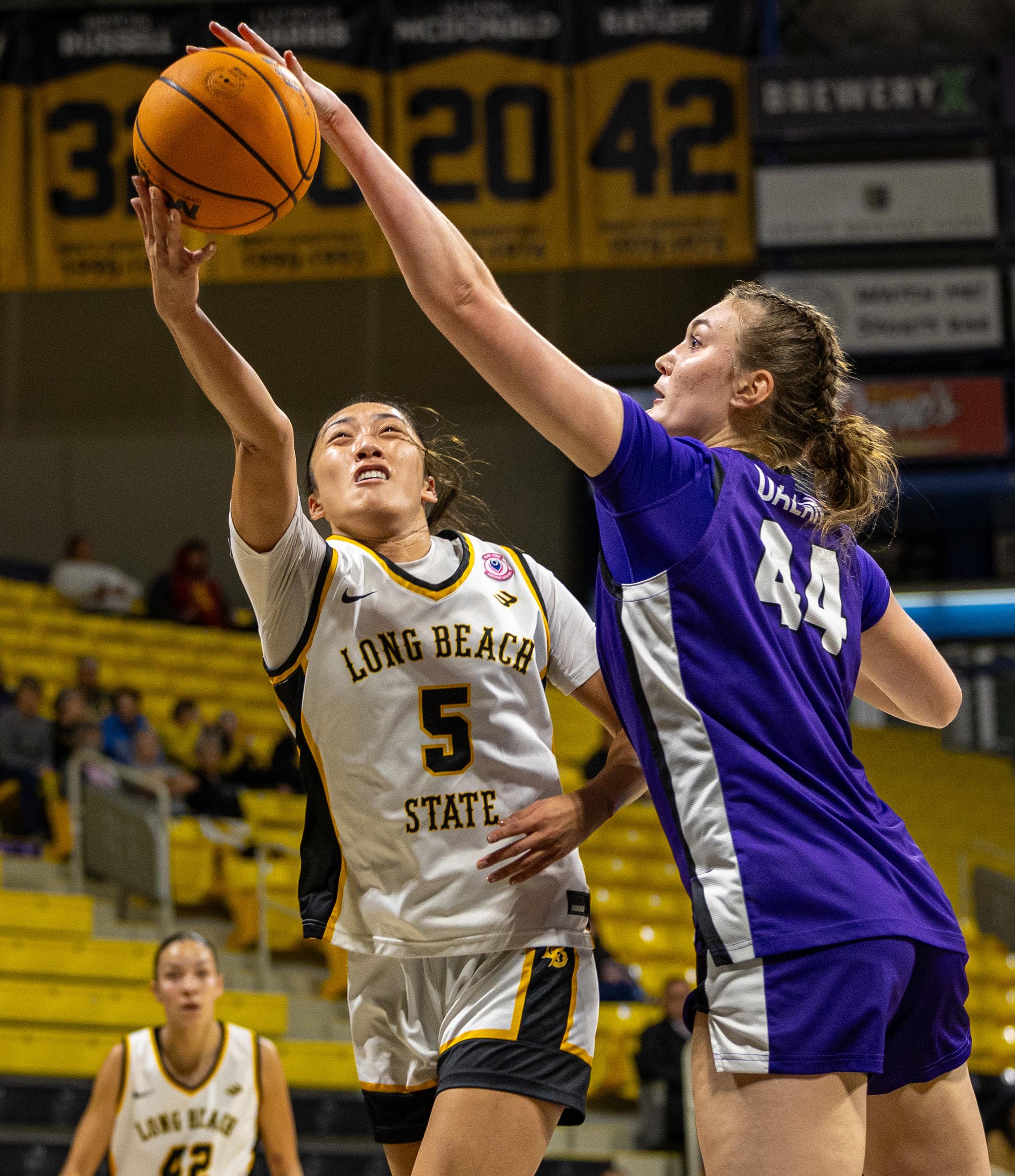
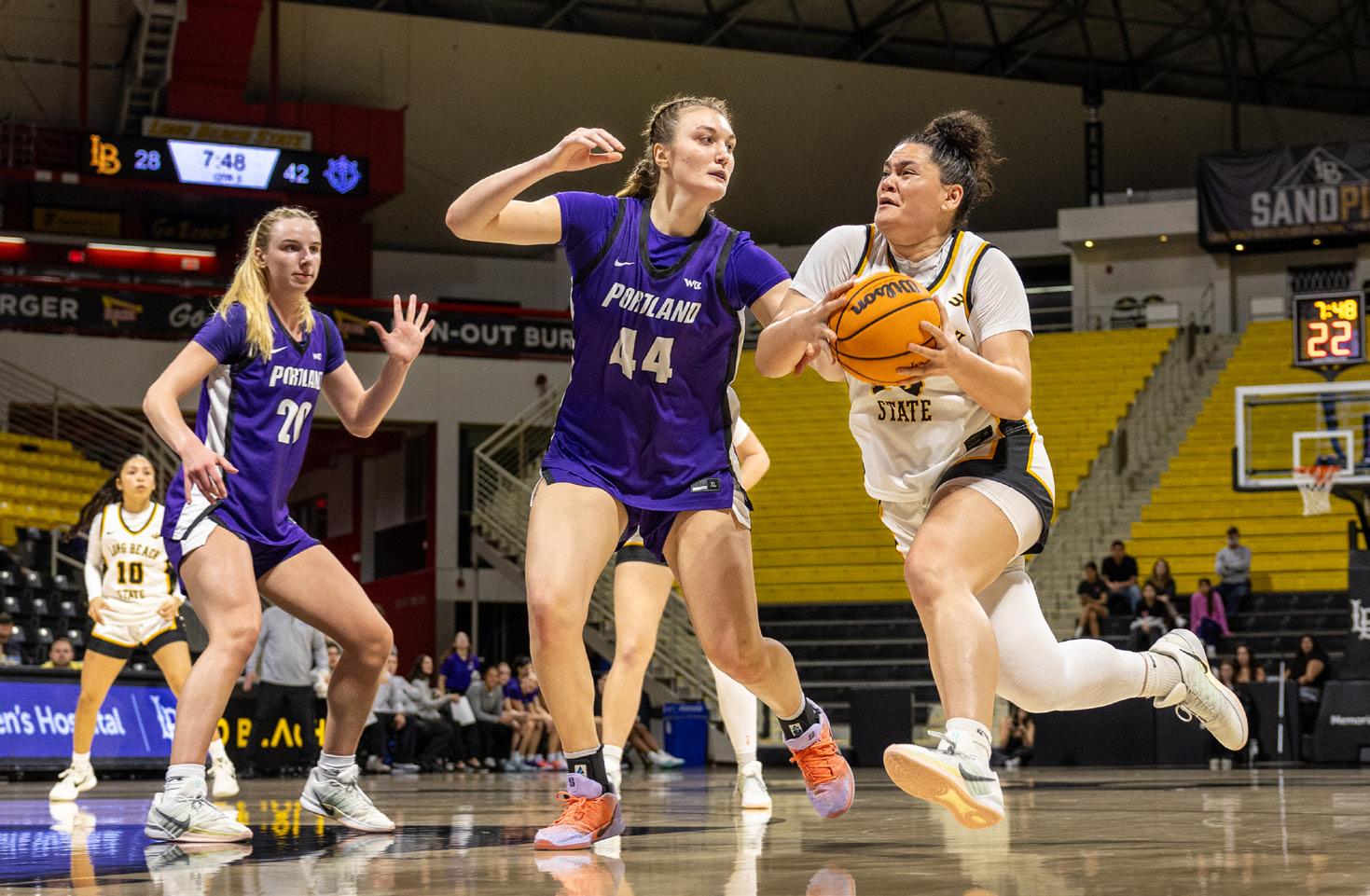
COHEN/Long Beach Current LBSU junior forward Kennan Ka (left) gets a shot bocked by freshman center Julia Dalan during a home game at the LBS Financial Credit Union Pyramid on Dec. 11. LBSU lost to Portland with a final score of 58-94.
Managing Editor Editor-in-Chief
Haley Lopez
Multimedia Managing Editor business@gobeach.media managing@lbcurrent.com eic@lbcurrent.com community@lbcurrent.com multimedia@lbcurrent.com
Editors
News Editor
Arts & Life Editor
Annette Quijada news@lbcurrent.com
Delfino Camacho arts@lbcurrent.com
Leyna Vu opinion@lbcurrent.com Opinions Editor
Sports Editor
Design Editor
Chief Copy Editor
Photo Editor
Social Media Editor
Video Editor
Podcast Editor
Timothy Hessen sports@lbcurrent.com
Luis Castilla design@lbcurrent.com
Angela Osorio copy@lbcurrent.com
Charlotte LoCicero photo@lbcurrent.com
Erinna Lam social@lbcurrent.com
Skylar Stock video@lbcurrent.com
Gianna Echeverria podcast@lbcurrent.com
assistants
News Assistants Ethan Brown
Anna Kuchison
Jayden Sandstrom
Joshua Flores
Nasai Rivas
Arts & Life Assistants Ni Baliness
Jason Green
Lila Mukasa
Opinions Assistant Joshua Min
Sports Assistants Monica Badolian
Xavier Constantino
Brianna Apodaca Alan Ibarra
Junior Contreras
Design Assistants
Brooke Williams
Rebecca Lavond
Leyla Crail Copy Assistants
Sasha Marantz
Photo Assistants Diego Perez
Eddy Cermeno Rehansa Kulatilleke
Jorge Hernandez
Ethan Cohen
Social Media Assistant Valentina Villarreal
Video Assistants Mikaela Perez
Podcast Assistants
Kiara Fillingim
Bryan Viteri
Victor Alcocer
Ava Richards
Brandon Rodriguez
BusinEss
Campus officials expand student aid amid rising food costs
BY JOSHUA FLORES News Assistant
Long Beach State’s food resources continue to provide students with food and groceries, amid an influx of students coming to campus pantries for the first time due to government benefit changes and price increases.
“A challenge that we had was that we really had to hit the ground running for the month of November. At the end of October, we did see a growth as people were preparing for the federal government shutdown,” Assistant director of Pantry Programs Christina Limon said. “So we did have a lot of newer students who were on CalFresh and they were preparing for the shutdown of learning where we were.”
With increased student demand, Associated Student, Inc. took in feedback and decided to set up a small pantry separate from the main one on lower campus, in Peterson Hall Room 213, at upper campus.
While “The Mini” beach pantry is smaller in scale, with mostly grab-and-go items, than the one on lower campus, it has become a popular destination for students despite just opening Dec. 2.
The ASI pantry, renamed the Laurén Chalmers ’83 Beach Pantry in 2024, opened in September 2016 to provide enrolled students with free food, toiletries and supplies.
Students reliant on government aid have used this service more in recent months. The pantry serves over 2,200 students a month.
The prospect of a government shutdown led the pantry to make decisions, such as increasing the number of items students can take and sending out its mobile unit between eight and 10 times a week, up from five.
“We’ve just really tried to build creative and innovative services and make sure that we are focusing on feeding our students,” Limon said. “Helping students focus on learning and not being worried about hunger or whether they’re getting their next meal.”
Despite the government reopening after the shutdown, there is some fallout regarding government assistance.
With new SNAP requirements changing who is eligible for benefits, students’ reliance on the pantry will persist, especially during the holidays.
The Future U construction project temporarily moved the pantry from the University Student Union to Room 115 in Student Health Services.
“It’s a very small area, but they can grab a cup of noodle, there’s microwaves right downstairs by the vending machines, granola bars, and fruit,” Limon said. “So it’s more of a grab-and-go location, if they want to continue to get groceries and items like that, the [big pantry] would be the main location to visit.”
land acknowlEdgmEnt
“I mean, for the most part, the space is about the same size,” Limon said. “It was kind of like a growing for us to get back to our numbers, but we are about the numbers that we were serving [students] at the USU.”
Here at the Long Beach Current we acknowledge that the school we report on is located on the sacred site of Puvungna, “the gathering place.” We are on the land of the Tongva/Gabrieleño and the Acjachemen/Juaneño Nations who have lived and continue to live here.
Alicia Taylor Creative Manager
Web & Technology Manager
Anita Demirci
Ericka Lacy PR & Marketing Manager
Seiana Spencer-Kendrick Distribution Manager
Josephine Kim distribution@gobeach.media pr@gobeach.media web@gobeach.media creative@gobeach.media
Brendan Nelson Advertising Manager advertising@gobeach.media
We also acknowledge the Gabrieleño/Tongva (pronounced: GABRIEL-EN-YO/TONG – VAH) and Acjachamen/Juaneño (pronounced: AH-HACH-AH-MEN/JUAN-EN-YO) as the traditional custodians of the Los Angeles region along with the Chumash (pronounced: CHOO-MOSH) to the north and west, and the Tataviam (pronounced: TAH-TAH-VEE-YUM) and Cahuilla (pronounced: KAH-WEE-YAH) Nations to the east.
We respect and value the many ways the Tongva/Acjachemen cultural heritage and beliefs continue to have significance to the living people and remind us about the sacred and spiritual relationship that has always existed here at what we now call California State University Long Beach.

advisErs
Gary Metzker Design Adviser
Barbara Kingsley-Wilson Content Adviser
Jennifer Newton Advertising & Business Adviser
Editorials: All opinions expressed in the columns, letters and cartoons in the issue are those of the writers or artists. The opinions of the Long Beach Current are expressed only in unsigned editorials and do not necessarily reflect the opinions of the journalism department or the views of all staff members. All such editorials are written by the editorial board of the Long Beach Current.
lEttEr Policy: All letters and emails must bear the phone number of the writer and must be no more than 300 words. The Long Beach Current reserves the right to edit letters for publication in regard to space.
Losing the USU: How students navigate campus construction
BY SKYLAR STOCK Video Editor
The University Student Union once connected a campus bigger than Disneyland.
Now, construction on the 53-year-old building, scheduled for completion in 2028, impedes many students’ daily routines.
With a student body of over 42,000, Long Beach State is not shy about its accolades. Two sections, known as upper and lower campus, make up the massive 322-acre campus where students trek to their classes.
The USU opened in 1972 to a campus population of around 10,000 students.
Fifty years later, the closure of the Union has now forced a quadrupled student population to develop a different relationship with the school.
The Future U project, a $315 million undertaking, aims to address the USU’s outdated infrastructure and growing campus population to create a more successful, long-term student hub.
Before the fall 2025 semester, the USU was viewed as the heart of campus, home to games, food and leisure. It was also the anchor for many student organizations and resources, including Basic Needs, Associated Students, Inc. and even the esports club.
In addition to its amenities, a major draw of the USU was its location, perched in the middle of upper and lower campus, creating a point of connectivity for students.
The two campus locations now face a distance that is cemented by ongoing construction.
“I feel like people are very scattered now,” Anthony Cadiente, a third-year mechanical engineering major, said.
He thought back to previous years, when the midway point of the USU was filled with people of all majors and interests. Cadiente used it as a place to relax and study in between classes.
“It’s created a crazy divide. I only see people in our major for the most part,” Third-year mechanical engineering major Lila Arrasjid said. She now spends more time around the engineering buildings now that the USU is closed.
With the USU’s closure, Peterson Hall 1 on upper campus became the

temporary new hub, as most school-run organizations and resources have set up shop there.
Rerouted class paths have shown some of the most visually apparent effects. This is especially prominent on the west side of campus, where the escalator route used to be.
In its place is a large incline that is a “hassle” to go up, according to Jose Garcia, a third-year psychology major.
While he enjoys the extra exercise, he said that between the dual foot and car traffic, the area can easily get congested.
Garcia was given a heads-up about the construction by a friend, but was still taken aback by its magnitude.
“I came my first semester and, like, half the school’s closed down,” Garcia said.
This was a common concern from first-year and transfer students, as many felt ill-informed after their Student Orientation, Advising and Registration process.
Jossain Landeros, a first-year aerospace engineering major, found out
about the construction during the first week of classes.
“I was sad because I was really looking forward to the bowling alley,” he said.
ASI sponsors free bowling events at Bowlero in Cerritos, but the location is around 10 miles from CSULB.
Landeros added concerns over food.
“Upper campus doesn’t really have that many places to be at other than the grass area,” Landeros said. “So all the food options are down here [lower campus].”
The Nugget Grill & Pub closed unexpectedly in September ahead of its scheduled winter departure, due to “failing infrastructure.”
Since its closure, the Nugget has been relocated to lower campus, where it lives in a food trailer setup. ASI communications manager Shannon Couey said the current location of the Nugget Grill Express was chosen because it offered the best conditions for running the trailer.
The only permanent food spot on upper campus is the Caffeine Lab. Upper campus also has a large supply of
rotating food trucks, as well as a newly opened Subway station, which was originally in the USU.
The Outpost Bar & Grill remains open and active on lower campus, and many food services, including the previously USU-based Coffee Bean, have set up shop.
The farmers’ market has been upgraded from two to four times a week, according to ASI President Sonny Ciampa. A new café, Coastal Coffee, debuted near the College of Business the day after fall break.
“I understand the frustration,” Kim Nguyen, ASI vice president of finance, said. “If I hadn’t realized that the USU would only be under construction for three years, then obviously it’d be super upsetting. I do miss the USU that I had for three years being on campus, but it’s not going to be permanent.”
According to Nguyen, the new USU will have eight permanent food vendors.
In the meantime, students who walk past the USU will only see the newly constructed Friendship Walk and some benches.
“There’s physically nothing stopping you from going from lower to upper campus, but there’s no point to go to that halfway point,” Cadiente said.
To support the project, students pay a $504 USU fee per semester. According to Couey, this fee will continue for future students and will be adjusted for inflation in 2028.
The upgraded USU is projected to be completed in August 2028. For any questions regarding the Future U project, reach out to ASI or visit the Future U website.
SKYLAR STOCK/Long Beach Current
Students pass through the Friendship Walk stairs that are adjacent to the active construction site of the University Student Union on Dec. 4.
The days after: Student’s look into police procedures after encounter with a voyeur reveals more questions than answers
BY MONICA GARCIA Contributor
The Student Orientation Advising and Registration workshop at Long Beach State felt like a staged play.
It began with an open door to opportunity, and ended with a police report and many unanswered questions.
I remember my skin dampening under a restless July sun, an ache in my shoulder beneath an overweight bag, begging for refuge in the Liberal Arts 5 building restroom.
Out of the many experiences that day, being the victim of a voyeurism crime was the last one I expected.
The incident replays like an act in my head. The light steps trailing behind me, an uneasy silence outside the stall. I was followed into the women’s restroom and recorded with a cellphone from beneath the stall.
The intruder was gone in an instant, as if it had never happened.
I reported the incident to the University Police Department, but the only recollection I had of the intruder’s appearance was a pair of sneakers. I was relying completely on the police department’s investigation.
I remember a numbness gnawing at
my initial shock as the officer at the scene told me that some of the cameras in the area may not have been working. He said I would receive a call if there were any updates.
That was the last I would hear from the investigation.
The search for evidence was halted by UPD’s outdated reporting procedures and limited public data. As records requests were met with policy restrictions, it was clear that there is room to improve victim support services at CSULB.
The frequency of related crimes on campus could be linked to the operational condition of security cameras. There was a possibility that crime investigations would continue to be halted or
remain unresolved for other victims. Through the looking glass: campus surveillance
The Current’s staff reached out to Beach Building Services about the functionality of campus cameras and was redirected to campus police.
Lieutenant Johnny Leyva said security cameras are generally a valuable tool used for investigations.
“If I learned that any camera is temporarily offline, we do make every effort to address it, to find out what’s going on and to resolve that problem too,” Leyva said.
University Police Chief John Brockie said as a matter of practice and safety, UPD does not publicize the locations of
MONICA GARCIA/Long Beach Current
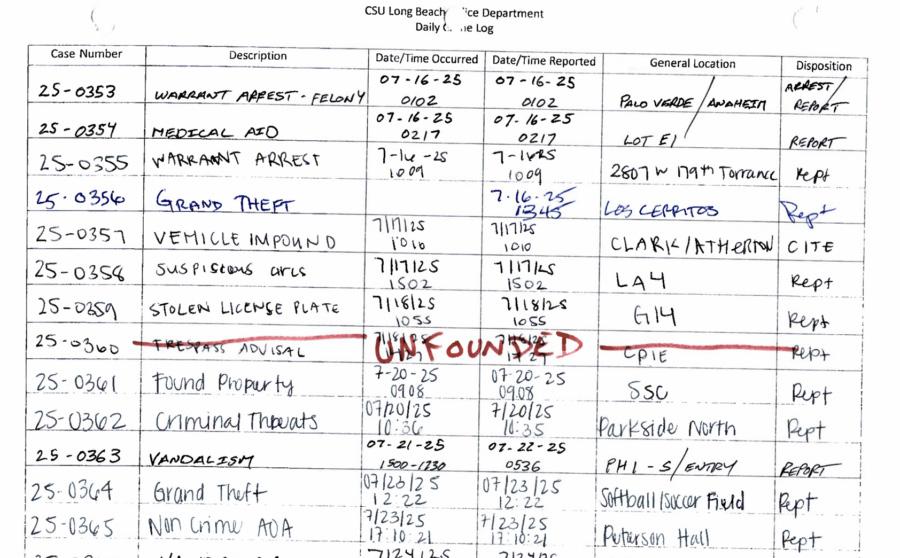
Scan of daily crime logs filled out by university police.
cameras or their operational condition.
Since the department couldn’t disclose information on camera operations, The Current requested reports on the surveillance budgets and maintenance records through the university.
As UPD operates in a separate division represented by the CSULB cabinet, Jamarr Johnson, director of public records at CSULB, said the school does not hold responsive contracts used by the police department.
Johnson forwarded a link to the CSU systemwide police department policies. The policies include the department’s general operations and procedures, but do not contain security camera maintenance logs.
Johnson also provided the CSULB security camera policy, but there was no summary data to indicate how often security cameras are used during investigations.
According to the policy, UPD may approve a written request by the president, vice presidents or administrators responsible for overseeing police, human resources officials and other certified faculty members to review camera footage data.
A different approach
A California Public Records request for a list of similar reports from the most recent five years and the arrest logs tied to the offenses listed was met with numerous scanned copies of UPD’s handwritten daily crime log.
Johnson said the police department was unable to filter out the specific incidents because there were no electronic daily crime logs.
The scanned logs contained every crime reported from 2020 to 2025—over 30 pages per year.
According to Chief Brockie, the previous electronic log experienced several crashes within the software interface and UPD defaulted to the handwritten log instead.
“I haven’t seen a software product that does it correctly,” Brockie said. “I’ve looked at other ones, and it’s twice as much as what we spend right now for that software.”
Other CSU campuses, such as Cal State Northridge, Cal Poly Pomona, Cal State Fullerton and Cal State San Bernardino, have electronic daily crime logs available to the public online. CSULB has a record identifier chart listed online, but no electronic crime log.
In the logs received, it was unclear whether other reports were similar to mine, since the description on my report said “suspicious circs.” Four other incidents noting “suspicious circs” were reported between June and July 2025.
CHARLOTTE LOCICERO/Long Beach Current
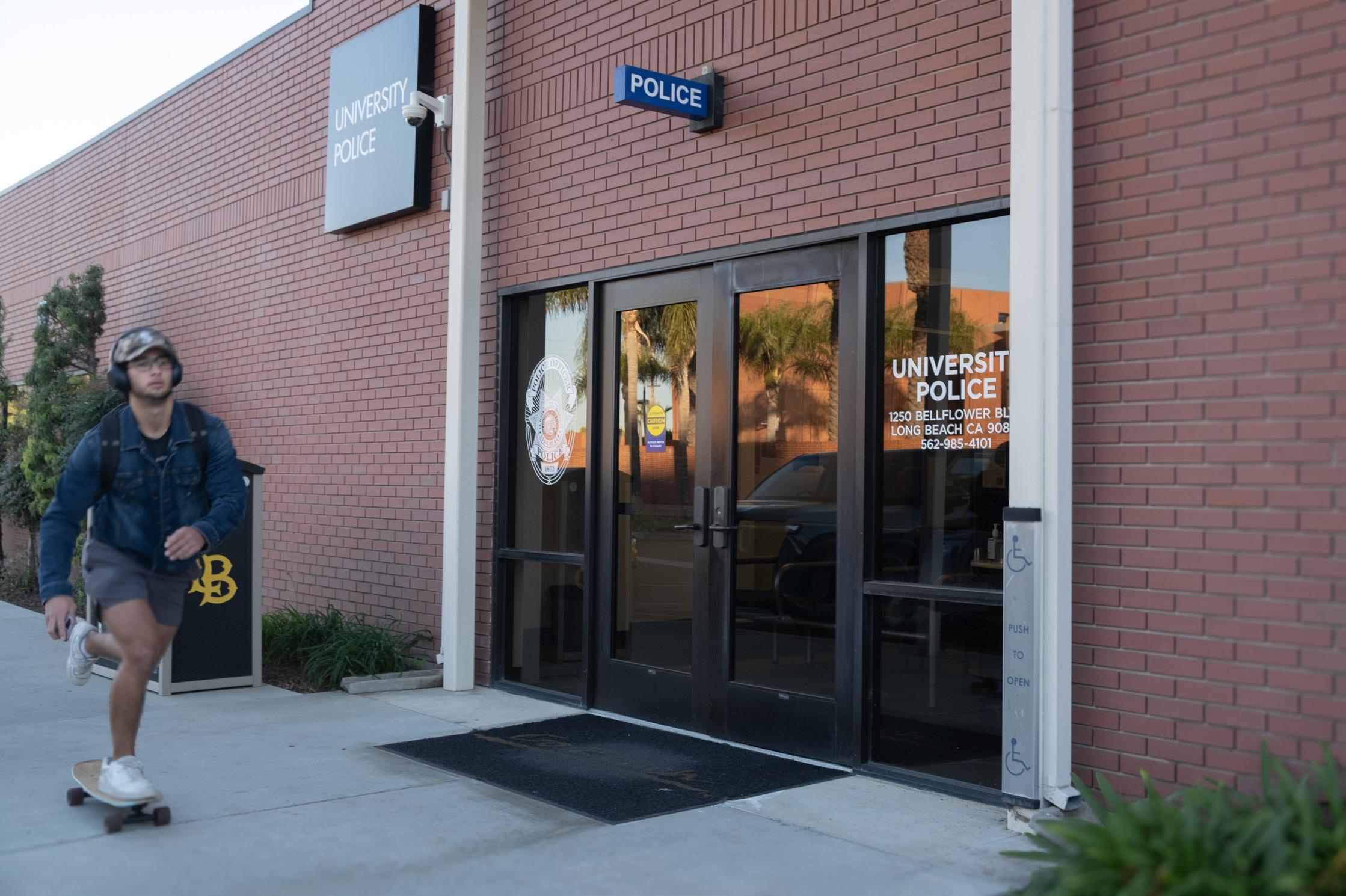
The University Police Department building, pictured on Dec. 10, remains open and accessible to the CSULB community 24 hours a day.
According to Brockie, this stands for suspicious circumstances, noted in the log for brevity. Brockie said my particular case should have been updated with a specific code, but it wasn’t until later.
According to the Jeanne Clery Campus Security Act, new information and dispositions to cases must be updated on the log no later than two business days after they become available.
“The dispatcher didn’t know the specific section at the time … They’re not expected to look up a crime code and go, ‘OK, well, it sounds like it might be this, so I’m going to look up a crime code for it,’” Brockie said.
As part of UPD practice, dispatchers use a computer-aided dispatch system to determine a response upon receiving a call. The officer at the scene then provides more information into UPD’s records management system, separate from the dispatcher system.
“So then the report was written, the correct heading was in the records management system, and it didn’t get converted over,” Brockie said.
In addition to the scanned logs provided by UPD, there was no information on the arrests related to the offenses requested.
How does CSULB rank in its Title IX support services?
Master of Fine Arts researcher Andrea Perez at Cal State University, Sacramento, conducted a statistical examination in 2024 to compare sexual assault and violence statistics in the CSU system.
Perez reviewed Title IX webpages for all 23 CSUs and the availability of resources to victims of related crimes.
Overall, CSULB received 26 out of 40 potential points on the rubric for Title IX webpage support services.
Perez ranked the universities’ Title IX webpages based on 10 questions, each with a score range of one (poor) to four (very good).
The rubric was used to detect absent information that would hinder a victim’s likelihood to report abuse, such as a lack of counseling service information in the Title IX pages.
CSULB received a “good” score for having accessible information on how to file a report on its Title IX page.
It ranked “poor” in the webpage’s accessibility to procedures following a report of sexual harassment or assault. This score indicated that the universi-
ty did not provide information on what would happen after a student filed a report.
Open investigations
At the time of publication, there have been no updates to the report filed during the SOAR workshop at CSULB. There is no public information regarding the functionality of security cameras or their maintenance records.
Chief Brockie said California’s Public Records Act has limitations on obtaining electronic crime reports for investigative purposes, including UPD’s records management system.
“The daily crime log is always available,” Brockie said. “The Public Records Act doesn’t require an agency to create documents.”
Whether it be faulty security cameras or outdated reporting systems, student support services could benefit from a redirection of funds within the campus police department.
Given that other CSU campuses have provided the public with the means to filter electronic daily crime logs, CSULB may be sitting on the sidelines of open investigations while victims seek answers.
CSULB aims for sustainable USU construction with recycling, waste reduction
BY JOSH GENTLE AND MARIANA RAMOS Contributors
Fresh paint, shiny new plumbing and parts of a 50-year-old building will complete the brand new University Student Union set to open in 2028.
The Future U project, which began construction this summer, is a three-year renovation meant to reuse a majority of the original foundation built in 1972.
According to Melissa Soto, manager of Capital Program Development at Beach Building Services, approximately 90% of the USU’s original foundation will remain.
One of the few areas slated for demolition and replacement is the University Dining Plaza. Additionally, the 1972 plumbing and electrical systems will be replaced.
“It’s a really great opportunity to upgrade everything just to make the building function well and to reorganize,” says Soto.
A study from the Environmental Protection Agency found that around 600 million tons of construction and demolition debris were generated nationwide in 2018.
To avoid adverse environmental impacts, the Future U project seeks to re-
duce waste and source sustainably. According to Soto, furniture and building materials will be sourced within the U.S.
“Most new student unions are built new from the ground up, which means they require entirely new materials,” said Lisa Salgado, the Capital Projects Program manager at Beach Building Services, in an email exchange with the Current.
By using the majority of the 1972 foundation, BBS seeks to maintain the vision of the original building’s architect, Edward Killingsworth.
The student union is eligible but not yet registered for the National Register of Historic Places and the California Register of Historical Resources, which work to preserve the cultural and artistic integrity of historic buildings and artifacts.
By preserving key historic elements of the original USU, such as the terracotta flooring and vintage tiles, the student union will remain eligible. Because of this, maintaining the USU’s mid-century modern style is important for the university.
According to Salgado, material reuse will reduce the carbon footprint of Future U and expedite construction.
Currently, the building is undergoing abatement, a process in which hazmat crews will conduct a complete sweep for hazardous materials, including asbestos, lead and more.
According to BBS’s 2024 Design Stan-
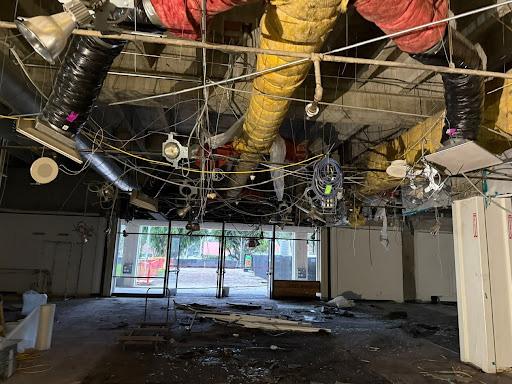
A section of the second-floor Food Court in the University Student Union was blocked off by caution tape due to a lead hazard on Oct. 27.
dards Manual, 95% of post-abatement waste will be sent to construction recycling centers. The 5% of ineligible materials will be sent to landfills.
Some materials are sent to special disposal sites where they have to be treated further, Soto said.
California State law required the CSU system to divert 75% of all solid waste from landfill disposal by 2020 through source reduction, reuse, recycling and composting programs.
The Future U project is maintaining these rates. 75% of the waste produced by the Future U project will be recycled or salvaged, according to Salgado.
“There’s construction waste recycling centers…that we take the material to where it gets recycled just as you would recycle your cans,” Soto said.
BBS is confident in the original structure’s strength – despite it being over 50 years old – and is implementing construction techniques to reinforce it.
“We do type one construction, where the interior is concrete,” Soto said. “We’re trying to build these really strong, long-lasting things.”
Type one construction uses non-combustable materials such as reinforced concrete and protected steel.
According to the National Fire Protection Association, Type I construction offers the highest level of fire protection and projects are considered noncombustible.
The original USU foundation is also
being reinforced to meet modern-day seismic standards. An evaluation of the building was conducted to assess its ability to withstand earthquakes.
“There’s certain areas in the building that we do need to strengthen seismically, but it’s really not a lot, which is really exciting,” Soto said.
That gives BBS less work and allows them more time to make good on their promise of a 2028 opening.
In addition to the strong infrastructure, Future U will also introduce over 80 low-volatile organic compound materials into the new design.
VOCs are human-made chemicals that may pose short and long-term health risks. VOCs are emitted as gases from solid or liquid materials and are present in many common building materials.
“Low-VOC materials will keep the air healthy so all visitors can focus, socialize, and thrive,” Salgado said in an email exchange with the Current.
Many of the low-VOC materials listed in the Future U “Low-VOC Material Tracker” spreadsheet include paints, carpets and wall panels.
While the Future U project is still three years from completion, the renovation is necessary and will be worth it in the long run, Soto said.
“It’s lasted fairly well for 50 years,” she said. “Our goal is that we don’t have to touch [it] again for another 50 years.”
Photo courtesy of BEACH BUILDING SERVICES
Pro-life activist’s campus visit sparks student debate
The founder of Students for Life Action and president of Students for Life of America spoke to CSULB students and Turning Point USA members on Dec. 9, advocating for an end to abortion.
BY JOSHUA FLORES News Assistant
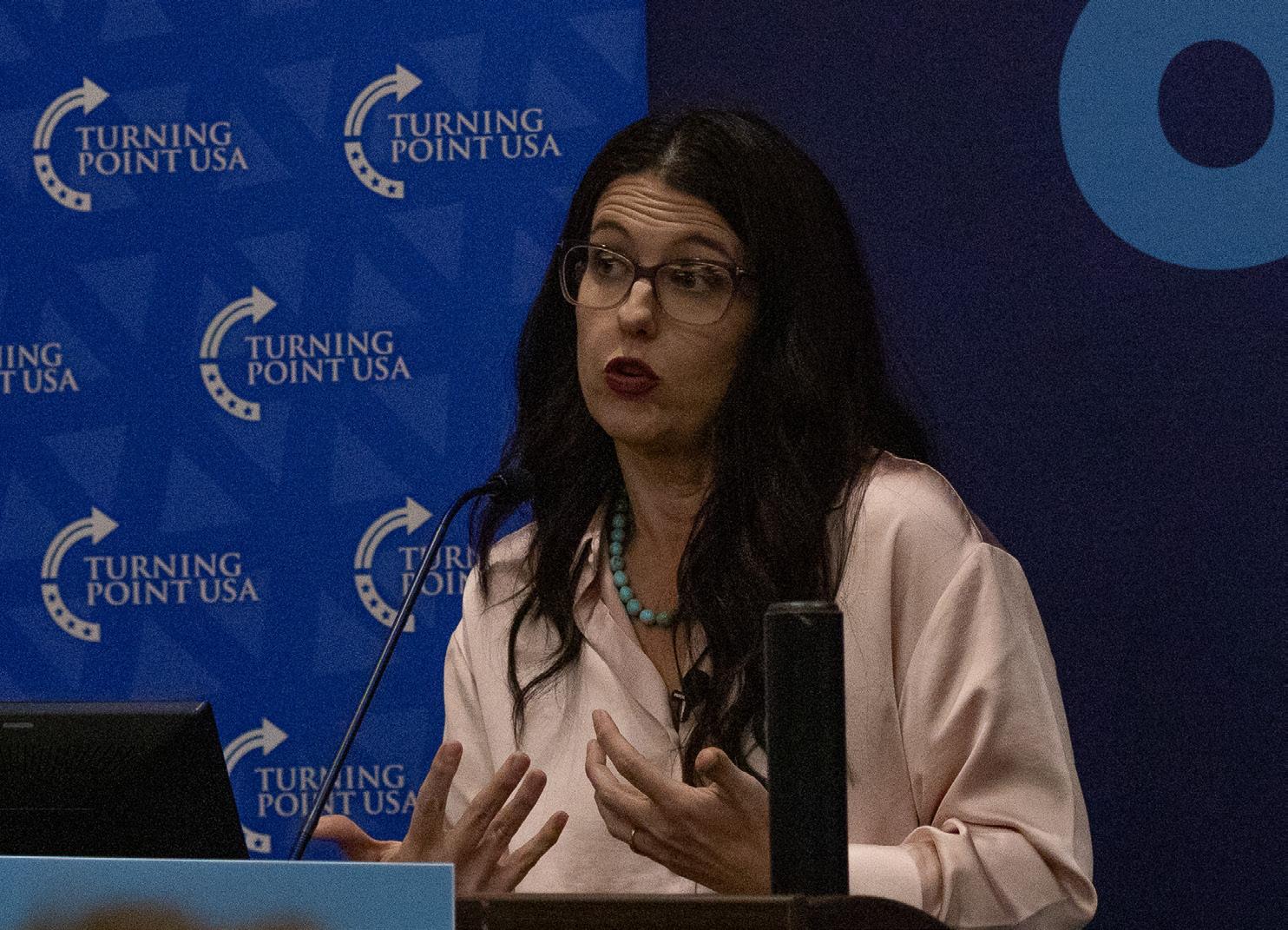
Flanked by a dozen security guards, both private and campus police, pro-life activist Kristan Hawkins spoke on campus during her Dec. 9, “Women Don’t Need Abortion” event hosted by the Turning Point USA chapter at Long Beach State
During the event, which was part of her “Abortion is Oppression” national tour on college campuses, Hawkins discussed religion, women’s rights and birth control. Then, she answered questions from the audience and invited attendees to the podium to take a picture.
Taking place at the Student Engagement Center on lower campus, the event required an RSVP to attend and participants were screened through a metal detector before entry.
Hawkins began by asking if there were any pro-choice attendees, because she wanted them to speak first during the question portion. One man raised his hand, whom Hawkins welcomed.
She retold the moment when she found out her friend, TPUSA founder Charlie Kirk, was shot and killed while she was speaking at the University of Montana. Kirk, who was assassinated Sept. 10 while speaking at Utah Valley University, previously visited CSULB as a part of his “American Comeback Tour.”
“I told the students I had been speaking with, what had happened, that Charlie Kirk has just been shot on the campus and we talked,” Hawkins said. “I’ll never forget their demeanor … many students started laughing … couples started dancing … one student to the left of me put his fist in the air and shouted, ‘This is war.’”
Hawkins said she has seen a change in political discourse among people with conflicting beliefs.
“I think in that moment, I clearly saw a soul of the generation that’s been taught to celebrate violence,” Hawkins said. “As long as it’s directed to the ‘enemy.’”
The conversation then transitioned toward the main topic: abortion. Hawkins shared her views that a fetus in the womb is just as valuable as any other human life.
“Why can’t I kill you? It’s because each of us is valuable, that each of us was made in the image and likeness of our creator, of a God who spoke the universe into existence,” Hawkins said. “And that baby is just like us.”
As the speaking portion wrapped up, a young man sprang up from his chair and burst into a rant against Charlie Kirk.
“Charlie Kirk said that [if his] 10-year-old child got ‘raped,’ he would keep the child,’’ the man, who the Current was unable to identify, said loudly. “You have [Charlie Kirk’s] photo there, you endorse his message.”
The crowd grew loud and aggravated against the man, but Hawkins insisted
he was allowed to speak. However, police quickly escorted him out of the room and away from the event.
“Well, at least he didn’t shoot me … it’s interesting because he couldn’t handle a minute more, why?” Hawkins said. “Because I was speaking words that are true.”
Following the outburst, Hawkins ended her speech and moved on to the Q&A, where she engaged the attendee who had raised his hand at the start: fourth-year finance major Alejandro Cabrera.
Cabrera said he didn’t want people to “think of this as a debate,” and mentioned two friends, both religious, who had abortions.
Cabrera, who identifies as Catholic, said he spoke with two priests at his church and asked them about the church’s view on abortion, to which he got conflicting answers.
He said both priests eventually told
him it was not a sin, after one changed their answer.
Hawkins was quick to inform him that the Catholic church has a firm anti-abortion stance and sees abortion as a form of murder.
Cabrera disagreed, and the two got into a 25-minute debate over Scripture and church tradition.
The crowd began shouting “next” at Cabrera, wanting a different person to speak. After the shouting, Cabrera went outside, where other Catholic attendees questioned his denial of church tradition.
“You’re saying that babies don’t have a soul,” second-year philosophy major Richard Johnson said. “What is the soul … are you willing to change your position … if I can define a soul as something analytically possessed by fetuses, then you would have to admit per that definition a fetus has a soul.”
Cabrera told Hawkins and Johnson that he believes fetuses possessed no soul until they were born, citing Old Testament scripture to justify his stance. Cabrera conceded that he is personally pro-life, in part because it is legally allowed.
The Current attempted to interview members of the chapter; however, they declined all requests.
Hawkins called on more audience questions, the remainder of which were from pro-life individuals.
One was a pro-life atheist who, while not religious, believed human life was valuable. Hawkins and the crowd encouraged him to find God. Hawkins also challenged his belief of where human value comes from.
Hawkins wrapped up the event after a few more questions and stayed behind to take pictures with attendees and members of the TP USA chapter.
“Because you think [fetuses] have value, where does it come from? That’s the question I ask atheist staff members to answer, and that’s the question they can never answer,” Hawkins said to the pro-life atheist.
JASON GREEN/Long Beach Current
Kristan Hawkins, president of Students for Life of America and Students for Life Action, having a Q&A session with the audience on Dec. 9.

FADE TO BLACK
A look back at CalRep's fall 2025 season
BY DELFINO CAMACHO Arts & Life Editor
The final curtain draw on the Dec. 7 stage production of “Stupid F##ing Bird” that took place at Long Beach State’s Studio Theater also served as an official end to CalRep’s fall season.
“Stupid F##ing Bird,” directed by CSULB lecturer Robert Prior and originally written by Aaron Posner, is an adaptation of Anton Chekov’s “The Seagull,” one of the most famous plays in theater.
The play’s final scene, where lead character Conrad confronts the audience and their expectations for him to kill himself (as his mirror character famously does in Chekhov’s origi-
nal play), was an appropriate sendoff for the season as a whole – which explored adaptations or reinterpretations of previous works.
Department of Theatre Arts chair Ezra LeBank said the decision to focus the entire season on “updates” of prior works – both classic and modern – was not necessarily a conscious choice but rather one that came naturally and was not realized by the committee that finalizes seasons until after the fact.
The fall season began with the definition of a modern adaptation.
“RADIO PLAYS LIVE”
Premiering in September and co-directed by LeBank and CSULB lecturer Josh Nathan, “Radio Plays Live” was a stage adaptation that gave visuals to classic genuine radio scripts, meant to be audio only.
With the use of actors, musicians and a live foley artist, CSULB theater students and staff brought two real radio scripts to life, written by accomplished American writer Lucille Fletcher: “The Hitchhiker” (1941) and “Sorry, Wrong Number” (1943).
“SOMETIMES THE RAIN, SOMETIMES THE SEA”
In early October, a whimsical re-exploration of Hans Christian Andersen’s “The Little Mermaid,” titled “Sometimes the Rain, Sometimes the Sea,” served as the second show of the season.
The show starred Japanese-born actress Himika Kaku and actor Aryan Chhabra, who was also in “Stupid F##ing Bird.” The design-heavy production made Andersen a fourth wall-breaking character.
“CARRIE: THE MUSICAL”
Just in time for Halloween and directed by Daniel Nakawatase, “Carrie: The Musical” splattered onto the University Theater in late October.
The terror-and-tune-filled adaptation of American horror writer Stephen King’s debut novel about a terrorized high school girl who develops telekinesis featured impressive and intricate special practical effects, including exploding lightbulbs, floating books and falling blood.
“STUPID F##ING BIRD”
The season ended in early December with “Stupid F##ing Bird.”
The dense character and performance-centric production focused on a group of dysfunctional artists struggling to love one another and failing. The postmodern adaptation ups the ante by introducing meta commentary where characters con-
ARTS & LIFE

Left: The character of Conrad, as played by Finn Holmgren (center) addresses the audience directly and muses the pros and cons of his suicide during the Nov. 18 dress rehearsal of “Stupid F##ing Bird” produced by CalRep at CSULB. The scene is a comment on the normally established plot point in Anton Chekov’s “The Seagull” (which the play is an adaptation) in which a lead character does use a gun to kill himself.
Left: The characters of Conrad, as played by Finn Holmgren (right), and Nina, played by Christina Du Chene (left), embrace at the start of the “Stupid F##ing Bird” Nov. 18 dress rehearsal. While largely a cast ensemble production, Holmgren and Du Chene play the “doomed” lead couple in the play which is itself an adaptation of Anton Chekov’s “The Seagull.”
front their actions and the audience directly, in addition to experimental musical interludes.
While some students unfamiliar with Chekov might benefit from a Sparks Notes refresher before the show, the CalRep production featured an impressive ensemble that felt genuinely lived in by the end, with stand out performances from Chhabra and Amelia Priestley.
Thus ends another CSULB theater season, but stage fans need not fret as another season starts when spring 2026 does.
EXIT STAGE LEFT.

Above: Himika Kaku portrays “Little Cloud” during an especially “magical” sequence during the “Sometimes the Rain, Sometimes the Sea” Sept. 30 dress rehearsal. Director Alana Dietze said Kaku’s personality was a good fit for the cloud character, who is not-humanly optimistic.
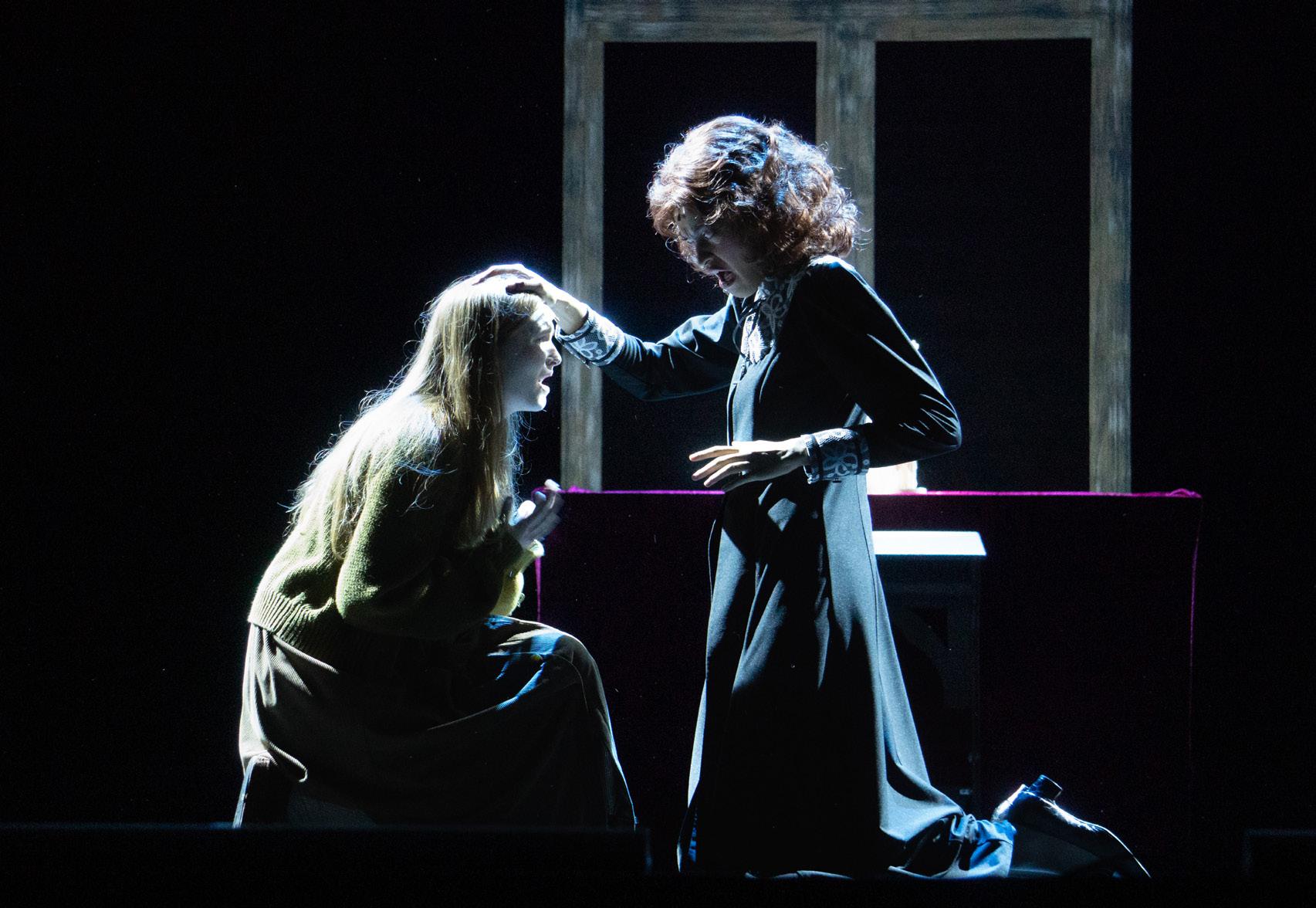
Above: Fourth year theater performance major Bobby Brannon as Margret White roughly orders Natalie Quinn, who plays her telekinetic daughter Carrie White to pray for her sins during an Oct. 21 tech and dress rehearsal for Carrie: The Musical.
Photos by DELFINO CAMACHO/Long Beach Current.
ARTS & LIFE
Pop singer brings soothing tones to The Beach
BY JASON GREEN Arts & Life Assistant
At 11 years old, when she was still in middle school, Chloé Caroline became ill.
It was during this time that Caroline taught herself guitar using YouTube. Keeping busy, she also began journaling, writing poetry and posting videos on Facebook to connect with others.
Caroline, now 31, has a rising pop singing career and has performed at several events. Adding to her achievements, Caroline performed at Long Beach State for Beats at the Beach on Tuesday, Dec. 9.
Her performance on campus was a career first, as she never performed at a university previously. Although student attendance was low, the Manhattan Beach native acknowledged this period of life.
“When you’re in college, you’re at such a pivotal point in your journey, and I hope that I can kind of share some of my stories with you today,” she said.
She played acoustic versions of her original songs, “Boyish,” “Another Best Friend,” and “94.”
She played the song “Lifeline” live for the first time, which she wrote about being in a toxic relationship and the feeling of going in circles to get out of it.
Contrasting the song, she also

JASON GREEN/Long Beach Current Pop singer Chloé Caroline is poised to perform original music at Beats at the Beach on Dec. 9. She previously opened for Sixpence None The Richer at the Troubadour in December of last year.
performed her 2023 release “TWINFLAMES,” which is about how she fell back in love.
During the acoustic set, she sang alongside guitarist Mike Clairmont.
“To play full band, it’s pretty expensive, but also it’s just, it’s a lot,” Caroline said. “You’re dealing with a bunch of different people’s schedules and stuff like that, and so it tends to just be a little bit easier to play acoustically.”
One of her most recent and successful releases, “You Don’t Love,” was not performed because the song needed a band, she said.
Included in her CSULB setlist were several cover songs. Caroline sang “Kiss
Me” by Sixpence None the Richer, a connection to how she opened for the band last December at the Troubadour.
Since first releasing music in 2015, Caroline’s sound has shifted from country to pop. She was in Nashville, Tennessee, for university, where she eventually pursued a career in country music, but she felt sonically limited.
She noticed singers like Ed Sheeran and Shawn Mendes played acoustic instruments or had organic instruments in their production, but were not classified as country. This was her inspiration for getting into the pop genre.
“It was really just living in Nashville,” Caroline said. “Sometimes there’s just ev -
erybody kind of wants to end up doing a lot of the same sound, and country radio tends to have a little bit of a constraint on what you can do production-wise.”
The next goal for her career is to obtain a recording contract.
Lindsay Fellows, Caroline’s father and music supervisor, has confidence in her.
“... We’ve really tried to build it from the ground up,” he said. “I’ve worked with a lot of artists over the years who would get signed to a record agreement, have a song come out, have a single come out, but they were really unprepared for the next step, which is really when the work begins, when you have a hit song.”
Campus reaction: Students share mixed experiences as Beach Pantry expands
BY MONICA BADOLIAN AND MARITSSA AGUILAR Sports Assistant and Contributor
As food insecurity continues to affect college students nationwide, Long Beach State’s Beach Pantry is expanding its services to meet growing demand.
A new “mini pantry” on upper campus has opened with mobile pantry popups to increase access to food for students.
However, students report mixed experiences with availability, long wait times and limited variety, even as the pantry expands its services and adds additional locations.
Second-year psychology major Keira Wallace, a student assistant at the pantry, said traffic through their doors remains consistent and high as they try to keep students fed.
“Per month, it’s around 2,000 [students] that we serve in total, including all of our services,” Wallace said. “We restock, we table, we keep the environment positive, anything to support students who come in.”
For many students, the first introduction to the Beach Pantry came from peers or campus programming.
Third-year criminal justice major Mya Miranda first came across it through an Instagram post advertising free sandwiches.
“It was easy to sign in with my cam-
pus ID,” she said. “And it’s easy to find, it’s in the middle of everything.”
She appreciated the ready-to-eat items.
“The free sandwiches were nice for lunch. I also liked the frozen bagels; helpful for something quick in the morning,” Miranda said.
Despite this, she noted that the pantry she used at Santa Ana College had a more consistent selection of essentials.
Fourth-year construction management major Vincent Chung previously attended Long Beach City College and Mt. San Antonio College.
“The waiting time is too long, and the items here are limited,” Chung said. “LBCC’s pantry is larger and more flexible. Students just grab what they need, no checking in and out.”
Before entering the Beach Pantry, students must enter their student ID number and then again to check out with selected items.
“It complicates and slows down the whole process,” Chung said. “They want to help students, not let us stand here waiting, feeling stressed.”
Chung typically picks up the basics like protein, grains, and vegetables when available, but many staples disappear early. “If you want eggs or milk, they don’t have it,” he said.
According to Chung, fresh produce, such as fruits and vegetables, is hard to get.
“You have to be super early or get lucky. If you’re ten minutes late, every -
ARTS & LIFE
thing’s gone,” he said. “They give out 10 bags first, and once people grab them, that’s it.”
Students are allowed three visits per week to the main pantry. The mobile pantry, a table-style setup that appears at different campus locations, does not count towards that limit, allowing more flexibility for students.
First-year public health major Kathleen Rodriguez heard about the pantry from her friends who live in the campus dormitories. She commutes roughly an hour and said the pantry’s limited hours can create challenges.
“I had to wait like an hour because they close at 3 p.m.,” she said.
This fall, the pantry introduced its newest addition, a mini pantry inside Peterson Hall 1, Room 213, open Monday through Thursday, 3 to 5 p.m.
The new location fills the service gap when the main pantry closes between 3 and 5 p.m. each day.
Beach Pantry program coordinator Christina Limon said student feedback, especially in the wake of the USU construction, directly shaped the decision.
“We really want ASI to keep students first,” Limon said. “Students told us this location was far from their classes, so the mini pantry gives that space closer to campus with grab-and-go items, fresh fruit and microwavable food.”
Unlike the main pantry’s grocery-style layout, the mini pantry is designed for speed, offering snacks, bars, cup noodles, fruit and quick meals that
students can eat in between classes.
According to Limon, the Beach Pantry originally opened in 2016 after research from CSULB professor Rashida Crutchfield found that 25% of CSU students were food insecure, and 1 in 10 faced homelessness.
“We continue to grow,” she said. “We did see a small dip recently, but made up for it by expanding our mobile pantry.”
The pantry now serves 300-400 students per day. However, that number changes depending on the donations and inventory received. Availability of certain items changes daily, as the pantry is over 90% donation-based.
Fresh produce, donated by partners like Grow Beach Garden and Long Beach Organic, typically arrives on Mondays and Tuesdays and is stocked immediately.
“We try to have items that last students a couple of meals,” Wallace said.
“You might come one day and it looks empty, then the next day we get a huge donation. We never know what’s coming in,” Limon said.
Key partners include:
• Latter-Day Saints food distribution program
• Temple Baptist Church
• Food Finders
• Long Beach Organic
• Student Lunch Box (run by a CSULB alum)
• Local farmers markets
• Community food drives
• Amazon Wish List donors
JORGE HERNANDEZ/Long Beach Current
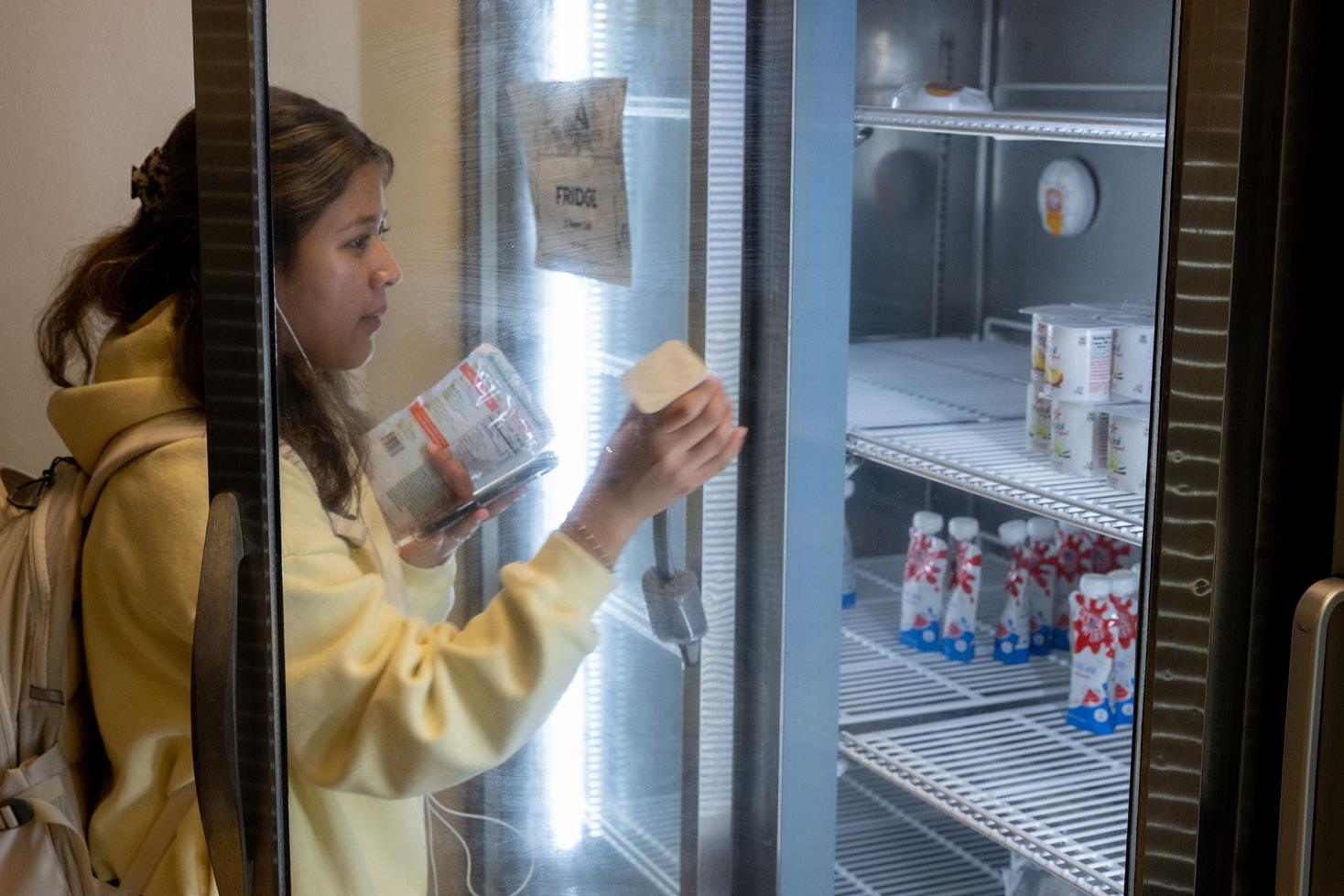
Aero Space Engineering Freshman Nalini Rodriguez picks up a cup of yogurt from fridge available at the Beach Pantry on Nov. 4.
ARTS & LIFE
First Wednesdays’ welcomes walrus expert in latest aquarium lecture
BY JOSHUA MIN Opinions Assistant
Even after spending all day at a seafood buffet, no human can ever come close to consuming the daily nutritional intake of a walrus’s diet.
That’s because they eat 4,000 to 6,000 clams per day.
Even after adjusting for body mass, no human could sustainably eat 5% of their body mass on a daily basis, but that’s how much walruses eat.
“In addition to being a really interesting and iconic species, Pacific walruses are also a really important indicator of Arctic marine ecosystems,” Karyn Rode, a research wildlife biologist for the U.S. Geological Survey, told the crowd during her lecture.
Pacific walruses were the focal point of the Aquarium of the Pacific’s latest presentation in their First Wednesdays lecture series, hosted at the Honda Pacific Visions Theater on Dec. 10.
Rode, whose work mainly centers on nutritional and physiological ecology and the effects on wildlife biology, was the guest speaker for the lecture. The researcher has authored over 90 scientific publications, and has worked with the following groups:
IUCN Polar Bear Specialist Group
American Zoological Association’s
Polar Bear Research Council
Science/TEK working group of the US Fish and Wildlife Service
Polar Bear Recovery Team
Eskimo Walrus Commission
The lecture focused on the lifestyle of walruses that inhabit the waters of Alaska and range over into Russia.
“The Arctic Ocean is the most shallow ocean in the world so it’s a unique place that provides the habitat needed for Pacific walrus and walrus in the Atlantic and the Laptev as well,” Rode told the audience.
A benefit of the region is the sea ice, which minimizes their commute to important foraging areas as it also provides a resting habitat. However, sea ice has retreated from nearly all the Chukchi

Sea Shelf in 15 of the past 17 years, a new dynamic worth monitoring.
Walruses also prefer those shallow waters because that is where those delicious clams reside – and they feast on about 4,000 to 6,000 per day.
“They use their flippers and their very agile mouths to get into clams and then they have a really strong sucking mechanism,” Rode said during her lecture. “If you ever have the opportunity to go to SeaWorld and do a behind-thescenes tour, you can see how well they suck their food and that’s how walruses feed in the wild.”
During the Q&A portion of the lecture, Rode reiterated the amount of consumed clams for a curious audience member and joked that walruses are expensive for humans to take care of due to their luxurious diet.
After the Q&A, attendees were invited to the lobby for cocktails, crafts and
conversation.
Frequent visitors Mike Ferguson and Alison Dice had no problem waiting for one of the craft tables to open up.
“(Dice) follows all of the First Wednesday events so when she finds something really interesting, she lets me know about it,” Ferguson said. “We’ll just come out together for an event.”
Dice said they enjoy the animal-related lectures most but will show up if the topic either piques their interest or is something they don’t know much about.
“Both of us are pretty interested in the way things are changing with the environment and everything like that,” Ferguson said. “Sometimes you don’t know what to ask until you hear something about it so it’s a fun place to be for something like that.”
Melody Wolfarth, visiting from Utah, showed up after seeing an Instagram ad, wanting to meet fellow marine biology
fans.
“It adds a sense of community and getting to know the people who come here, which was also another reason why I wanted to come to one of these,” Wolfarth said. “See what brought them here as well and get to know other people.”
This was Rode’s second time as a guest speaker at the aquarium. She said she enjoys the audience Long Beach brings.
“This is obviously a great venue,” Rode said after the lecture. “We got a lot of people and they’ve got a really wonderful staff up here for us to be able to share information so it’s a really good partnership that we can provide public information through the aquarium.”
Wednesday’s lecture was the final one of the year, but the aquarium will resume Jan. 7 to discuss whales. Tickets are available at the Aquarium of the Pacific website for $5 pre-sale and $10 at the door.
JOSHUA MIN/Long Beach Current
Karyn Rode, a research wildlife biologist for the U.S. Geological Survey whose work centers on nutritional and physiological ecology, was the guest lecturer for the First Wednesdays lecture series on Dec. 10 at the Aquarium of the Pacific.
BY DAIMEL GARCIA DEL BUSTO Contributor
When I think about the origins of giving gifts to teachers, my mind goes straight to Pinocchio. Not because I lied to my teachers as a kid— though, I’m sure I did—but because the classic “apple-for-a-teacher” imagery is a nostalgic story we tell ourselves more than a real tradition.
According to the Smithsonian, in rural communities, teachers were mostly paid directly by families, who would send their children to class with whatever they could offer: often food, and most commonly, an apple.
In the late 1800s, early films and children’s books helped popularize the

image of students presenting an apple to their teachers, including the story of Pinocchio, which later made its way to screen adaptations. Over time, gifts evolved from treats to small keepsakes such as pens or wallets.
Many children grew up giving teachers presents at least once a year. Some countries even designate a national holiday to honor educators’ work. In the United States, we celebrate Teacher Appreciation Week, created by the National Parent Teacher Association, which is observed during the first week of May.
The dedication and seemingly endless patience of educators are rewarded with certificates, cards, themed events and social media tributes.
I remember when potted plants were a good gift idea for educators in my childhood. My mom once wrote a card that probably said something like “thank you for helping me grow” and attached it to a plant for my teacher.
Flowers were a perfect gift by sixth
grade until I thought of her house mirroring a hospital room.
Trying to be original when picking a gift for a teacher is not a priority for most kids, and it’s often difficult for busy parents. Today, those problems are solved by a much more common and convenient present: the gift card! The modern-day equivalent of the apple.
As we move into higher education, the childhood tradition of recognizing a professor’s hard work fades for many of us, often leading us to take the people who help shape our intellectual growth for granted.
Some colleges celebrate faculty through events like Faculty Development Day, where workshops, panels and recognition ceremonies replace the usual academic routine.
However, the original spirit behind honoring educators is much simpler: to take a moment and remember that professors are human beings too. What do they like? What colors do they prefer?
What small gesture would brighten their day?
Now, as adults, we can pick our own gifts and pay for them with our own money.
The last gift I gave a teacher was about a month ago. She loves cats; I know because of how often cat memes would make their way into her lecture slides.
I came across an adorable cat keychain; although cheap, it still brought a smile to her face, a way to reciprocate the smile she gave me with her cat memes every week.
A thoughtful gift, no matter how small, can remind instructors that their effort is seen not only in how they lecture but also in the compassion and love they put into each lesson every day.
A simple apple once was a good payment for education. Today, a simple gesture like a “thank you” note holds the same value of appreciation.
OPINION
Craving jingle brews? Add this cafe to your winter to-do list
BY ALISSA PAVANA Contributor
Heading into the winter season means holiday movies, hot drinks and comfy pajamas. If only the weather reflected the season.
If you’re craving hot coffee, tea, or maybe something refreshing during the holidays, Ground Hideout Coffee is the place to go.
The family-owned coffee shop located on the corner of Elm Avenue and Fourth Street, known for its house-made syrups, recently released its holiday
menu, “Winter Series.”
As a fourth-year college student –especially with finals approaching – it was evident I had discovered a cozy place with quality caffeine.
Now, to give a tasteful review, it was pretty much a given to try more than one drink. It’s the holidays after all; why not splurge a little?
When I first saw the menu, I found “Grinch’s Brew” to be the most festive and enticing. As listed, it’s an “unsweetened matcha latte, [with] white chocolate sauce peppermint cold foam, topped with sugar sprinkles.”
And wow, was it delicious. The matcha was silky smooth, definitely whisked to perfection. I’d say it made my heart
grow three sizes.
I’ve had matcha before. Grainy, watered down, too sweet — you name it.
So, having unsweetened matcha, I thought to myself: Wouldn’t it be a little bitter? Nope, not at all.
The white chocolate sauce peppermint cold foam gave it the right amount of sweetness with a minty aftertaste.
Next, the real showstopper for me was the “Spiced Gingerbread Latte.”
For my fellow coffee lovers out there, this espresso-based drink included “house-made gingerbread syrup, topped with whipped cream and nutmeg.”
The holiday drink made the perfect pairing for the winter season and semicool weather.
The blend of ginger and orange zest in the house-made syrup balanced the drink to a tee, avoiding the intensity of too much nutmeg.
I had questioned the idea of orange, nutmeg and espresso together, but truly, the combination created a flavorful winter drink.
Sometimes, holiday drinks can be a hit or miss, but Ground Hideout Coffee truly hit the mark.
The holidays are only here for a short time, but I guess that’s the point – so we can savor it while it lasts.
If you find yourself in Downtown Long Beach sometime soon, add Ground Hideout Coffee to your list. You’ll want to taste it while you can.
CHARLOTTE LOCICERO/Long Beach Current
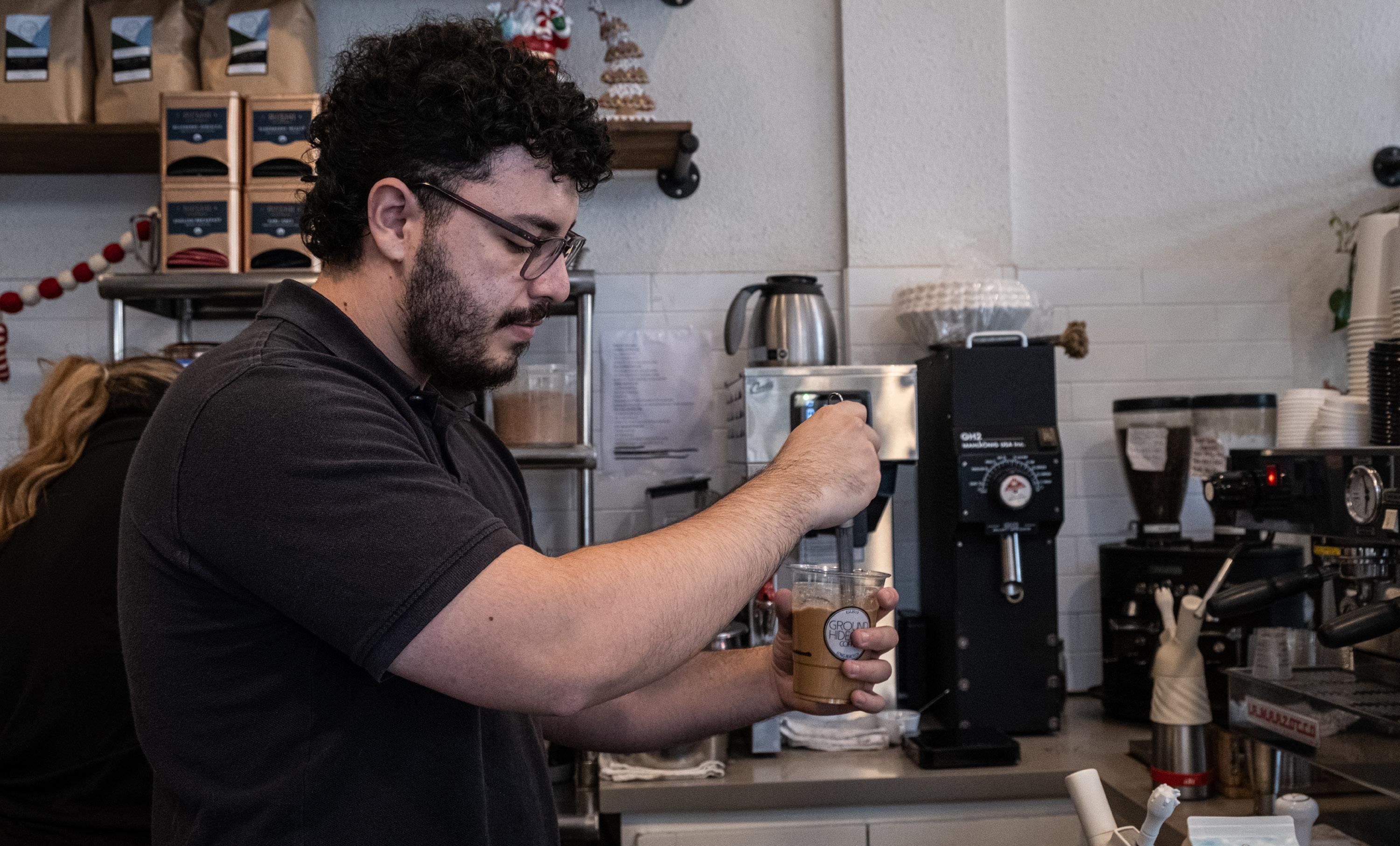
Alexander Bonilla, one of the family members who owns Ground Hideout Coffee shop located in Downtown Long Beach, serves up fresh iced coffee on Dec. 12.
What is happening to concert culture in 2025?
BY EMELY DE HARO Contributor
Ihave been going to concerts since 2018, and it’s my favorite thing to do: creating outfits, guessing what the artist will put on their setlist and screaming every lyric off the top of my lungs.
Lately, I have been noticing a darker side to concerts over the last couple of years, including a spike in ticket prices, declining concert etiquette and performative fans.
In recent years, ticket prices have risen sharply due to resellers. Even the process of buying tickets has become increasingly difficult, leaving many without them in the end.
Ticketmaster, one of the largest ticket sellers in the nation, gradually introduced “dynamic pricing” in 2011, which set ticket prices based on tour demand.
Dynamic pricing became a central talking point when Taylor Swift announced “The Eras Tour” and refused to use Ticketmaster’s pricing model to allow more fans to attend her shows, but Ticketmaster did not keep its promise. Ultimately, fans were left waiting in long queues, resulting in many not getting tickets.
Ticketmaster also hasn’t done enough to discourage resellers, resulting in tickets going from hundreds to thousands of dollars.
In 2024, the U.S Department of Justice sued Live Nation Entertainment and Ticketmaster for “monopolization and other unlawful conduct that thwarts competition in markets across the live entertainment industry.”
As stated in a press release from the Department of Justice, this was a violation of Section 2 of the Sherman Act. This federal law bans anticompetitive business practices such as monopolies and price-fixing.
Fast forward to 2025—more artists are calling out Ticketmaster for their prices and advocating for their fans.
“The secondary ticket market is an exploitative and unregulated space and we as an industry have a responsibility to protect people and our community,” Olivia Dean, a British pop singer, said on her Instagram page.
Aside from the stress of ticket prices, attending a concert should be fun. Unfortunately, it’s not, and I blame “Stan culture.”

Concerts, what happened to the shows we love? Concerts have been on the rise with social media, but what happens when social media and newer generations of fans are damaging the enjoyment for others?
The word “Stan” is slang for an extreme or excessively enthusiastic and devoted fan, made famous by the 2000 Eminem song.
Going to a concert today, you will see many people recording with their phones.
Of course, recording at a concert is not a bad thing. People want to have the memory of hearing their favorite song live by the artist they love, but it becomes too much when they record the whole concert and don’t enjoy the actual event.
Filming videos so that they can later post on social media for others to see is all these new fans care about. They are not doing it for themselves. They are often not even moving a muscle to sing or dance, all because they don’t want to ruin their video.
Social media has a major effect on these types of fans because they are only concerned with posting the right video. It has become more of a bragging right to attend concerts than actually to enjoy the concerts they paid to be at.
Shows have even become dangerous to attend, with constant fights from being under the influence and fans wanting to get the artist’s attention on stage by doing anything to disrupt the show, like throwing things at the artist.
In 2023, artist Bebe Rexha had a phone thrown at her during a show in New York, which resulted in a bruised eye and a cut near her nose. Video shows Rexha getting hit by the phone and immediately dropping to the floor.
27-year-old Nicolas Malvagna of New Jersey was arrested by police and
charged with two counts of assault in the third degree, one count of harassment in the second degree, one count of aggravated harassment in the second degree and one count of attempted assault in the third degree.
According to the Manhattan District Attorney’s office, Mr. Malvagna confessed to throwing the phone and told a police officer at the scene, “I was trying to see if I could hit her with the phone at the end of the show because it would be funny.”
This shows the lack of care people have for concert etiquette, and when combined with rising ticket prices and intense “Stan culture,” concerts today feel much more like a chore rather than an experience to enjoy with other fans of live music.
EMELY DE HARO/Long Beach Current
Star setter breaks out during sophomore season at The Beach
Enduring the loss of her father, an injury and having to switch her position, Madi Maxwell persevered to help lead LBSU to the semifinals of the Big West Championship Tournament.
BY TIMOTHY HESSEN Sports Editor
Ahead of her sophomore season with Long Beach State women’s volleyball, Madi Maxwell and her family suffered a tragic loss.
Maxwell’s father and volleyball coach in her youth, Gerrit Maxwell, died in January at the age of 52. Maxwell, who was rehabbing a significant injury at the time that forced her to miss a large part of the team’s offseason, questioned whether it was right for her to continue to pursue volleyball during such a difficult time for her and her family.
However, what drove Maxwell to return to The Beach was her love for her teammates, whom she calls a “second home.”
“There were a lot of moments that I wanted to quit and give up and just be at home with my family, but I love this sport, and I love this [team], and that’s who I do it for,” Maxwell said.
Persevering triumphantly through grief and injury, Maxwell blossomed into a star in her sophomore season. As the team’s starting setter, she finished third in the Big West in assists per set, putting her on the path to earning All-Big West Second Team honors.
In a thrilling five-set victory at home against Cal State Bakersfield on Oct. 25, Maxwell recorded the first triple-double in program history since 2012, and then doubled up that performance with another triple-double in the same week.
Despite her gaudy numbers, playing setter was not actually her most natural position.
As a freshman, Maxwell played opposite hitter, a position she played at Hart High School, where she finished her career with a whopping 1,206 kills. Maxwell excelled in her role, racking up 142 kills, and was awarded a spot on the 2023 Big West All-Freshman Team.
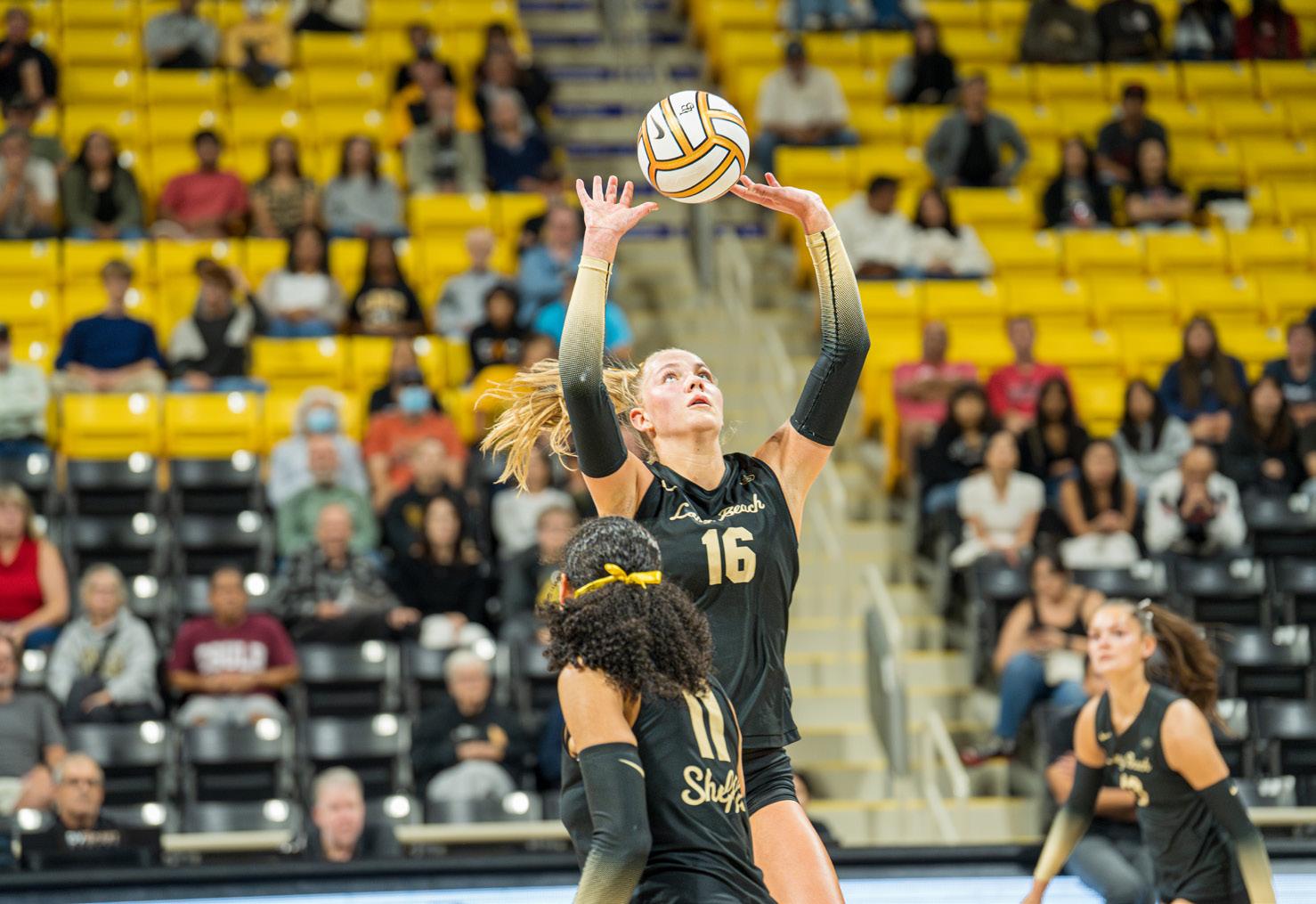
With LBSU head coach Natalie Reagan having 10 new roster additions to manage this past offseason, she and her coaching staff approached Maxwell about moving her to the setter position. The request seemed daunting to the Newhall native.
“It can be a little suspicious with all these freshmen coming in and [the coaching staff] being like, ‘We want you to play this other position,’” Maxwell said. “But the trust they have in me to be a volleyball player is so great, and I’m so appreciative of it.”
Maxwell looks back on her offseason position switch as a “fever dream.”
The star setter was asked to change her role on the team entirely while still recovering from injury. What made it work out for Maxwell and her teammates was the sophomore’s intense dedication to being involved in any capacity she could, according to Reagan.
“That’s a pretty difficult role for a leader to be in, but she did a really good job of connecting with her teammates off the court and being in practice all the time, and showing that dedication when injured means so much to your fellow teammates,” Reagan said.
As the setter responsible for orchestrating Reagan’s unique, fast-paced style of offense, which led the Big West in kills per set this season, Maxwell had to take command of the team quickly.
LBSU fans got very familiar with the sight of Maxwell emphatically celebrating and slapping hands with teammates after setting them up for kills, which she did 1,113 times this season.
According to her head coach, what drives her to the level of success she has seen in her young career is her relentless work ethic and volleyball IQ.
“[Maxwell] has done a great job of doing the work behind the scenes,
whether that’s watching film or training or skill acquisition, that’s something she is really passionate with,” Reagan said. “I really see it as a partnership being able to run an offense together, and there’s no one I’d rather do it with.”
Years before arriving at The Beach, Maxwell’s volleyball journey began at a very young age.
The 6-foot-2 dual-position player comes from a family of athletes. Her mother, Wendy, played volleyball at Cal State Los Angeles, while her father, Gerrit, played football at Cal State Northridge.
Maxwell’s first love in sports was soccer, but she found a new passion when she went to a volleyball camp with her best friend at 7 years old.
After falling in love with volleyball, both Wendy and Gerrit coached her during her club volleyball days.
After Maxwell went on to star for LBSU, and Maxwell’s younger brother Parker began to make a name for himself playing football at Hart High School, their parents put a bow on their coaching careers.
“My parents are the most sacrificing parents ever,” Maxwell said. “They stopped coaching so they could support me and my brother in our sports; they dropped everything to support us and our family vacations became volleyball tournaments and football games.”
Days after LBSU was eliminated from the semifinals of the Big West Championship Tournament, a round further than the team finished a year prior, Maxwell reflected on the emotional, resilient season she had.
While coming to The Beach was initially about furthering her volleyball career as a star high school athlete, Maxwell has found a family at LBSU that she plans to lead for years to come.
“It’s more than a game,” Maxwell said. “No matter what you’re going through, injury, grief, loss, whatever it is, it’s just a joy to be with the people you love every day.”
DIEGO PEREZ/Long Beach Current
LBSU sophomore setter Madi Maxwell sets up senior middle blocker Rhiann Sheffie for one of her 1,113 assists this season.
Turnovers doom LBSU in blowout loss to Portland
BY DEREK ELLIS Contributor
Despite a strong first-half performance and a second-quarter buzzer-beater from sophomore guard JaQuoia Jones-Brown, Long Beach State women’s basketball fell short 94-58 in its matchup against Portland University at the LBS Financial Credit Union Pyramid on Thursday, Dec. 11.
In pursuit of their first win of the season, the winless Beach fell to 0-9 after a defensive battle with the Pilots, who forced 22 turnovers in their road victory. Both teams looked to create pressure on the defensive side of the ball to begin the contest, as both teams combined for five turnovers in just the first five minutes of play. The Beach had their hands full early with the Pilots’ full-court press.
LBSU sophomore Brynna Pukis made a heads-up play by stripping the ball and delivering a dime pass to Jones Brown for a layup to give The Beach an early 6-5 lead.
The Pilots started to pull ahead early in the second quarter as graduate guard Nicole Anderson made two long-range threes to go up 22-16.
However, The Beach stormed back with Jones-Brown hitting a last-second
mid-range jumper at the buzzer to trim the deficit to 31-28 at halftime.
LBSU’s leading scorer in all but one game this season, Jones-Brown not only led The Beach at halftime with 12 points, but also led the team with seven rebounds.
“That’s a shot I work on all the time with our coaches,” Jones-Brown said. “I saw I had a mismatch inside and just thought to myself, give me the ball and let me do the rest.”
In the third quarter, LBSU hit a wall as the Pilots again went to a full-court press, with more success after the break.
The Pilots created three straight turnovers that resulted in three consecutive Portland scores and ultimately started a 19-2 run in the first six minutes of the third quarter.
“They switched some stuff up on the full-court press, our two inbounders were locked out from getting the ball and our two frontcourt forwards needed to come up and help but stood still,” LBSU head coach Amy Wright said. “It’s going to take five people to beat the press, not four, not three, five. It’s going to take five people on every possession and they will start to see results”.
LBSU eventually stopped the run with a highlight-reel worthy pass by junior Kennan Ka to Jones-Brown for an easy two-point bucket, which halted the
ETHAN COHEN/Long Beach Current
LBSU senior guard Khylee Pepe drives the ball to the basket against Portland during a home game at the LBS Financial Credit Union Pyramid on Thursday. Pepe had seven points in the loss.
Portland run.
However, Portland’s size difference in the full-court press had The Beach struggling, ultimately causing five turnovers and eight second-chance points for the Pilots in the 3rd quarter alone.
Jones-Brown would have another big night for Long Beach State, grabbing 25 points and nine rebounds on 8-for-21 shooting.
“I was talking to coach [Wright] before the game and she told me, ‘Tonight I want you to score. I don’t want you to be a distributor,’” Jones-Brown said. “I just know I have to get my teammates
involved.”
Ultimately, things would get out of hand in the fourth quarter as Portland’s freshman center, Julia Dalan, would take over the second half.
Dalan had 13 points, 12 rebounds and four blocked shots to help Portland secure 50 points in the paint and beat LBSU 94-58.
The Beach has a tough road ahead of them as they continue the search for their first win of the season on the road against the No. 4 UCLA Bruins on Saturday, Dec. 20.
Catching the Wave: Sports staff pick their favorite fall semester games
BY LONG BEACH CURRENT SPORTS STAFF
The world of sports at Long Beach State has seen many electric battles across several programs throughout the fall semester.
As we put a bow on the first semester of “Catching the Wave,” this week’s column takes a look back at the most exciting contests covered by the Long Beach Current sports staff this fall.
Timothy Hessen:
Covering this year’s women’s volleyball team at The Beach was the most thrilling part of my first semester as Sports Editor.
A nine-game win streak that had LBSU at the top spot of the Big West standings was the peak of the season, as The Beach had established themselves as a major threat to take the conference crown.
LBSU ultimately fell in the semifinals of the Big West Championship Tournament to eventual conference champion and NCAA Tournament Cinderella story team Cal Poly San Luis Obispo. But the back-andforth 3-1 thriller was the highest level of volleyball that graced the Pyramid all season, and was a joy to cover.
Alan Ibarra:
My favorite game I covered this year was the men’s water polo Big West Championship final against UC Davis on Nov. 23.
Despite the loss in the final, the team played their hearts out until the last second.
While covering the No. 8-ranked team in the nation throughout the year, getting to know the players and coaches made me realize how much they do for the team and their sport.
Xavier Constantino:
The best event I covered this semester was heading to UC Riverside early in the morning for the UCR Invitational on Sept. 27, where LBSU’s cross country teams ran great races, with the men’s team finishing runner-up and the women’s team in 18th place.
A highlight of the invitational for me was LBSU junior Levi Taylor making history with the eighth-fastest 8K time in LBSU cross country history.
Junior Contreras:
My favorite sports game this year that I covered was the LBSU men’s basketball season opener against San Diego State on Nov. 4.
This game was my favorite because the press had to
enter the beautiful Viejas Arena through the backside entrance, and it felt like you were an NBA player entering an NBA arena.
Viejas is the nicest college basketball arena I’ve visited, and it provided a very engaged student section.
Monica Badolian:
I covered many exciting games this year, but my favorite has to be club hockey’s game against Chapman University on Oct. 17.
Even though it’s a club sport, it ended up being the most fun for me to cover because hockey is my favorite sport. The game itself made it even better.
It was a fast, intense battle with The Beach pulling out a thrilling 5-4 win.
Brianna Apodaca:
My favorite game I covered this year was women’s volleyball’s 3-1 victory over San Diego State on Sept. 13.
The match was special to me because it was the first game I covered being on the Current. I was able to not only get the feel for covering sports while at Long Beach, but it was also the early start of women’s volleyball’s strong winning streak this season. The sets were nail-biters, but ended up being a great match and a great story to be a part of.
SPORTS
A leader’s comeback for LBSU women’s hoops
BY SEAN BOWEN
Contributor
Every injury threatened to derail Kennan Ka’s career – but none of them broke her resolve.
In the season opener of what should have been her sophomore season in 2023, Ka suffered a season-ending injury. After returning from injury the next season, Ka played in only 20 games and was an Academic All-Big West selection.
Now, in 2025, the veteran junior guard has worked her way back from multiple injuries to record career-highs in points per game with 5.7 and rebounds with 3.9.
Not just a competitor on the court, Ka sets high standards for herself off the court as well, earning her bachelor’s degree in just three years.
“It took a lot of time management and the ability to balance academics and basketball,” Ka said.
Currently in her master’s studies for Business Administration, she aims to finish with a 4.0 GPA.
Away from the hardwood and the classroom, the San Diego native enjoys being outside, spending time at the beach surfing and paddle boarding. She also enjoys cooking, with too many dishes to choose from as her favorite to prepare.
As a teammate, the former Mission Hills High School standout understands the key element to her role.
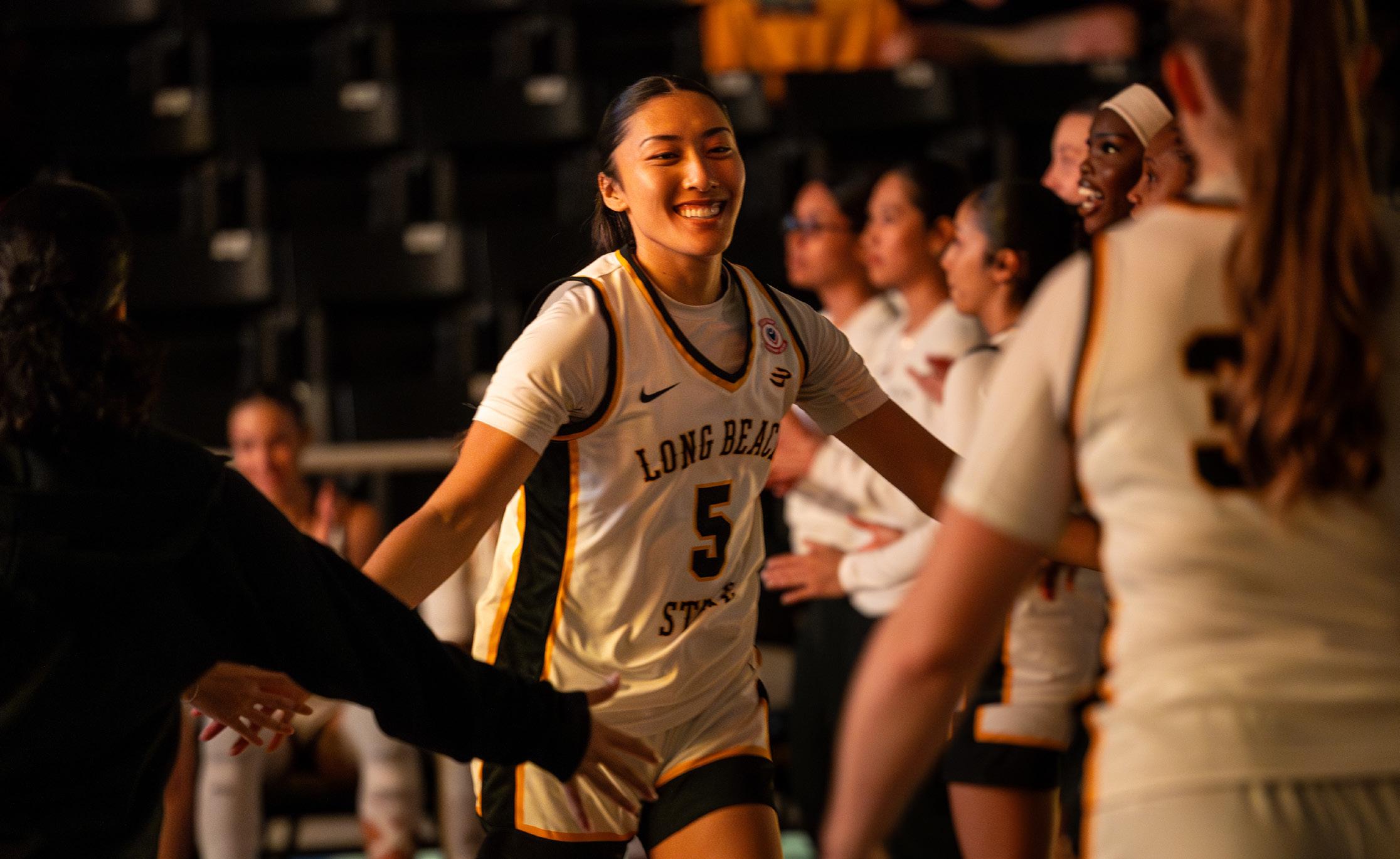
Long Beach State junior forward Kennan Ka high fives teammates as her
called
against Portland on Thursday, Dec. 11, at the LBS Financial Credit Union Pyramid.
“[To] be the best leader I can be for my team and do whatever my team needs to be successful,” Ka said.
The athlete’s determination and willingness to compete at a high level started in her early childhood years.
Just two years into her high school career, Ka set her sights on coming to Long Beach State.
“Long Beach State means a lot to me; I committed here as a sophomore in high school,” Ka said. “So it’s always been something special to me. The community means a lot, and there’s a lot of support for athletics.”
Ahead of the 2025 season, Ka’s resilience as a leader would be recognized when she was named a Kay Yow Servant Leader Award winner.
Given out by the Kay Yow Cancer Fund, the award celebrates 64 women’s basketball athletes nationwide who epitomize leadership and selflessness.
As a starter in every game, Ka has maintained a positive outlook that the team will turn things around, despite their current record of 0-9.
“Let hard work be the driving force in everything that you do,” Ka said. “That will allow you to push through adversity and find joy in the game.”
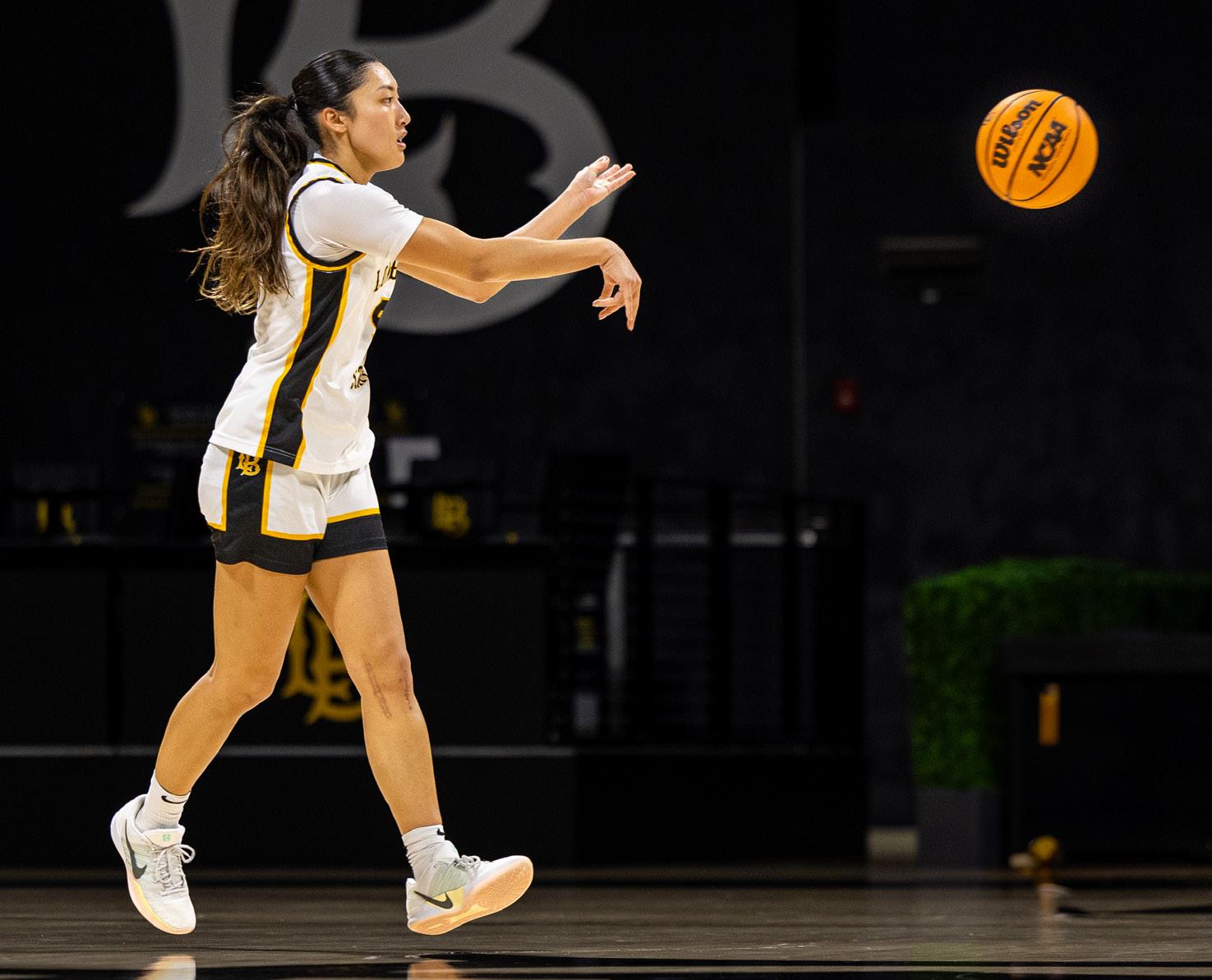
Long Beach State junionr forward Kennan Ka passes the ball to a teamate during a home game against Portland on Thursday, Dec. 11 at the LBS Financial Credit Union Pyramid.
Photos by ETHAN COHEN/Long Beach Current
name is
during the beginning of a home game