FOUR TRAILBLAZING WOMENTHEIR STORIES
We feature personal stories of four women who effected social change, two taking the political route and two by way of community mobilization. There were advocates and activists before these titles were fashionable. Two were from privileged backgrounds and two responded to the realities around them.
What were the factors in their lives that compelled their deepseated commitments to addressing imbalance for human rights and dignity? Where did their will and belief in self come from?
I ALWAYS KNEW I WAS SOMEBODY
• First woman of colour elected to the United States Congress
• First woman to seek the nomination for President of the United States from one of the two major political parties
Shirley was born on 30 November 1924 in the USA and lived in Barbados between 1929 and 1933, the early period of The Great Depression (USA) and prior to the labour riots in the Caribbean. These socio-economic periods have been well documented.
HOME AND FAMILY
We are shaped by the combined values of home, family and society. Shirley would have had a very dynamic home and family life during her formative years. Granny was a Carib Indian working her land at Vauxhall, Christ Church but “was a feminist before there were feminists … she did not allow me hang my head and mumble … she made me open my mouth and speak up.” Home in a low-income New York neighbourhood was a place of Caribbean cultural values with a Barbadian mother who worked as a seamstress and domestic help, a factor worker Guyanese father who migrated to the USA via Cuba, and Puerto Rican playmates.
Education was and remains a ticket out of poverty and Shirley’s desire to learn was formed in Granny’s strict household where there was homework every night whether set by the teacher or not. She was reading at four years-
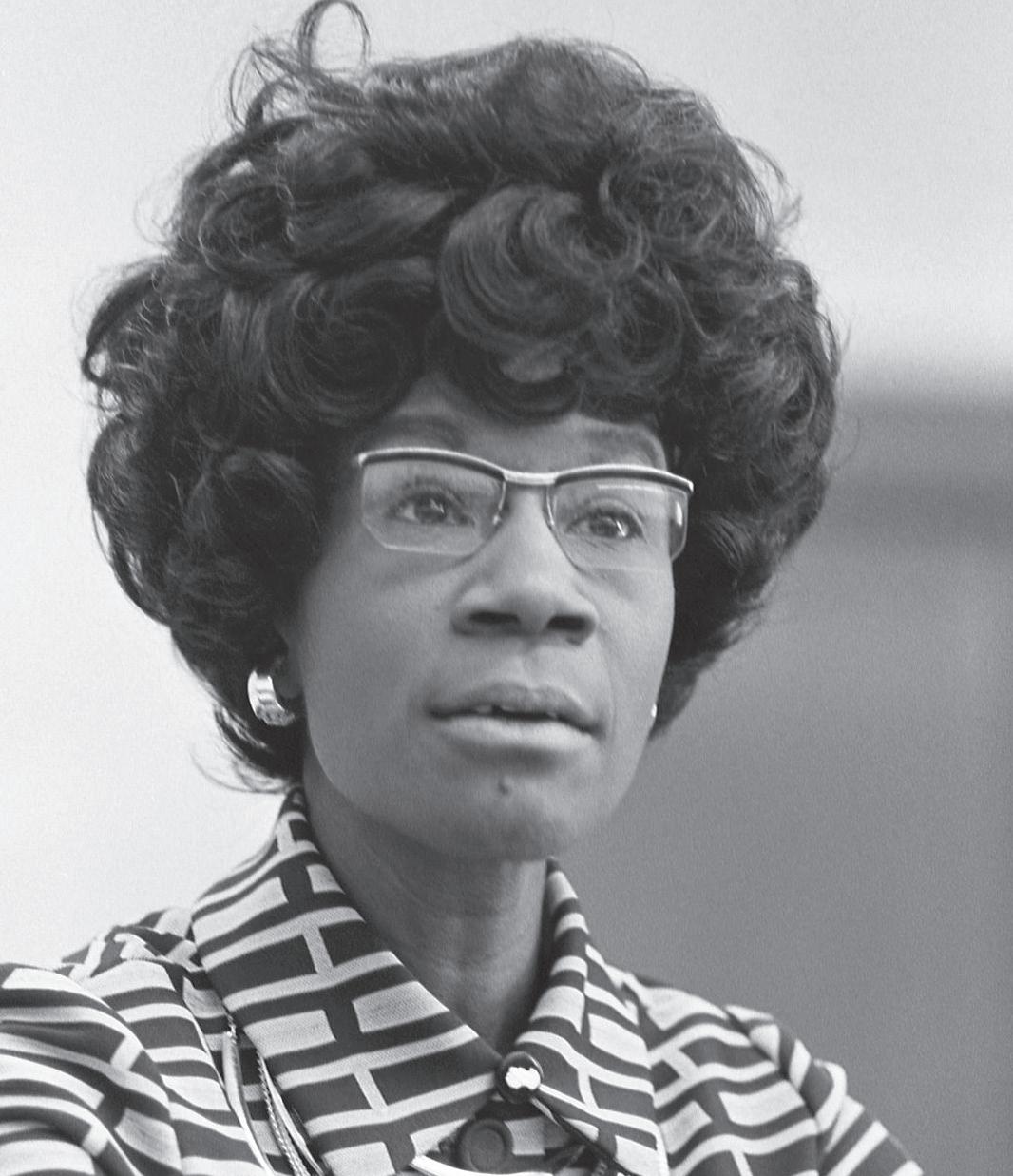 Shirley Anita Chisholm
old, not from the efforts of the US kindergarten system, and in Barbados comprehension, composition and oration were fostered. Shirley got as many ticket opportunities as she could, some formal, some informal but overwhelmingly by observing and interrogating the life experiences of her communities.
LESSONS FROM BARBADOS
It would have been impossible for Shirley to grow up in colonial Barbados and not have a religious grounding. In the days when one went to church three times on Sunday, Shirley had both Methodist and Quaker experiences, religions without creeds that had provided education for the enslaved. Later she settled with the Quakers perhaps because they hold both sexes equal, opposed war and gave women the right to
speak at public meetings.
Another lesson Shirley took from Barbados was to accept the things she cannot change, not in a negative and subservient way, not as burdens, but as inner sources of strength. “As a catalyst for change you have to take the insults when you go against tradition”, she said in a 1973 interview. She could not change that she was Black. She could not change that she was woman. Therefore, let these unchangeable attributes not stand in the way. “Granny gave me strength, dignity, and love. I learned from an early age that I was somebody. I didn’t need the black revolution to tell me that.”
She kickstarted her career as an educator when as a pre-teen she traded English lessons for Spanish lessons to expand her learning horizon. In reflection she acknowledged the advantage of her early education in Barbados. “Years later I would know what an important gift my parents had given me by seeing to it that I had my early education in the strict, traditional, British-style schools of Barbados. If I speak and write easily now, that early education is the main reason.”
POLITICAL AWARENESS AND ACTION
Political awareness grew from discussions at home with dad, and an awareness of the daily struggles and insecurities of the African American

and Puerto Rican communities to live another day. She would have been acutely aware of poverty, inadequate housing and schools, racial prejudice and discrimination, the exploitation of women in domestic help who were not included in the 1935 Social Security Act, the lack of health and safety regulations at the factories, and of the mismanaged social relief programmes. She knew these conditions were not right, not through fault of the citizens but by political actions and inactions.
She made up her mind to change the circumstances around her and did not look others for approval. Knowing where the power of change laid, she set about learning the ropes of political operations, did not like what she found and dared to challenge and change those also. Her political platform was for the basic rights of all citizens, for freedom and equality of opportunity. Her agenda was poverty, hunger, ignorance, healthcare and their underlying foundation, racism. She was committed to humanity and stood against the politics of expediency.
LESSONS FOR THE YOUTH
Shirley was a woman of high ethics and morals, independent, articulate, courageous, tenacious, advocate and activist, not afraid to dream, not afraid to dare. She returned to Continued on Page 4
5
CREATED AS PART OF THE EXHIBITION EXPERIENCE
FAMILY IS THE FOUNDATION OF SOCIETY
• First woman Minister of Government
• First woman Deputy Prime Minister
• First woman Chairman of a political party
Mummie, Mildred Mariam Miller (nee Lashley) never knew her parents. Like so many West Indian children, she was a “left-behind” when they emigrated to Canada. She was 10 years old when they could send for her but she had already strong bonds with Dear Aunt and cousin Gwen so she remained in Barbados. She grew up in St Elizabeth Village, St Joseph.
Daddie, Frederick Edward Miller, was one of eleven children born to Mama and Paps (Antoinette Caroline and Luther Gordon Miller). The story of Mama and Paps is quite a Hollywood love story. Mama’s parents were Methodists but identified with the mission of the Salvation Army when it arrived in 1889. They didn’t quite approve of Paps coming around their daughter, so they arranged for her to go to New York to study/work with the Salvation Army. Little did they know that the two lovebirds also made arrangements because Paps was on the next boat to New York. He didn’t have an address so he knocked on every Army hostel until he found her. They married and had three children in New York before returning home to escape the cold and damp that aggravated his health and lived right next door to the Salvation Army.
HARD WORK AND HUMANITY
Paps was a dairy farmer, entrepreneur and Vestryman. Their children knew the value of hard work as they were out of bed at 4 o’clock every morning to tend the cows – the girls milking and delivering, and the boys mucking out and feeding.
In early 20th century Barbados, poverty was rampant, hunger was real for most people, especially for city dwellers. Every day Mama retained a bucket of milk for the breastfeeding mothers and weaning children in the district. When I started to canvass for the 1976 by-election, I learnt of Mama’s generosity and
benefited from it. On my first canvass in Chapman Lane, I was greeted with, “You Mrs Miller granddaughter?” On my affirmative answer the lady said, “You don’t have to canvass here, we have you covered. We will take care of this area for you. Go into the other districts.” This was not an isolated response.
MUMMIE AND DADDIE
Daddie courted Mummie from the Nightengale Nursing Home where nurses at the General Hospital were required to live. Under colonial governance women had to giveup their job and income when they married, and there was no gratuity, no pension. Our first home was the building on Baxters Road that became Sermac Laundry where Elizabeth Thompson came to live when her family relocated from England – we both lived upstairs the family business. I was the first of their six children, so Mummie became a homemaker and assisted Daddie in the business, writing with her green ink pen. At the age of 43 she died of breast cancer.
DADDIE
Daddie was born in 1910, electricity came to Barbados in 1911. When he left Combermere he went to work at Central Foundry where he, in his own words, “met a lathe for the first time.”
From thereon electronics was his life work. He subscribed to electrical and electronic magazines and by 1948/49 he had designed and built
Miller Brothers Ice Factory. One of my most treasured possessions is the first regulator he built.
Daddie was an entrepreneur, inventor, businessman and eventually a politician, but he always put family first. Our home was one of family, education, church, and work. He worked very long days in business and politics but was always at home for breakfast and supper at the dining table he built; and around that dining table family was emphasised and nurtured. And of course, politics. Oh! What lively discussions we had. From my single-digit years I was learning about politics as I was canvassing and attending political meetings with him and Mummie. As a seven-year-old I accompanied them for his first sitting in Parliament.
LIFE IS EDUCATION
I had wanted to study in the social sciences but Daddie steered me towards law. When “I hung my shingle” there was no such thing as family law providing for the welfare of women and children. By default family law became my area of practice, exposing me to the domestic and employment insecurities of the majority of Barbadian women and their children. When I entered Parliament in 1976 with Prime Minister Tom Adams the welfare of women and children became my focus. I piloted legislative changes to benefit women and children including the Employment of Women (Maternity Leave) Act and the Medical Termination of Pregnancy Act.
A COMMON MISSION
Daddie became a Member of Parliament in 1951 and was made Minister of Health and Social Services
in the Grantley Adams Government. When he was courting Mummie he became very familiar with the deplorable conditions at the General Hospital and was determined to improve the health care of Barbadians who could not afford the private Woodside Hospital and Bailey’s Clinic.
He was the Minister of Health who built the Queen Elizabeth Hospital and I recall looking at the plans he and engineer Captain Tomlin studied at the dining table. When the Barbados Labour Party lost the 1966 elections, plans for the National Insurance Scheme (NIS) were at an advanced stage on his desk. On the other hand, one of my first actions as Minister of Health and National Insurance was to burn down the horrid, dilapidated leper shed at Lazaretto and moved the few residents into a place of dignity –the Matron’s House.
FAMILY
Family is the foundation of society. The Miller clan is very close due to the foundation laid by Mama and Paps and reinforced by our mothers and fathers, uncles and aunts, siblings and cousins. We were taught service, right action and to work towards excellence. I come from a political family – Paps a Vestryman, Daddie a Member of Parliament and other relatives in various capacities including Ann Cools in Canada, the first Black woman senator in North American history. I have nurtured several generations of female political aspirants beginning with Mia Mottley from when she was fifteen years-old sitting on a stool in my kitchen. There is still much work to be done and there is more service in me to give.
Source: Conversations with Dame Billie Miller.
2
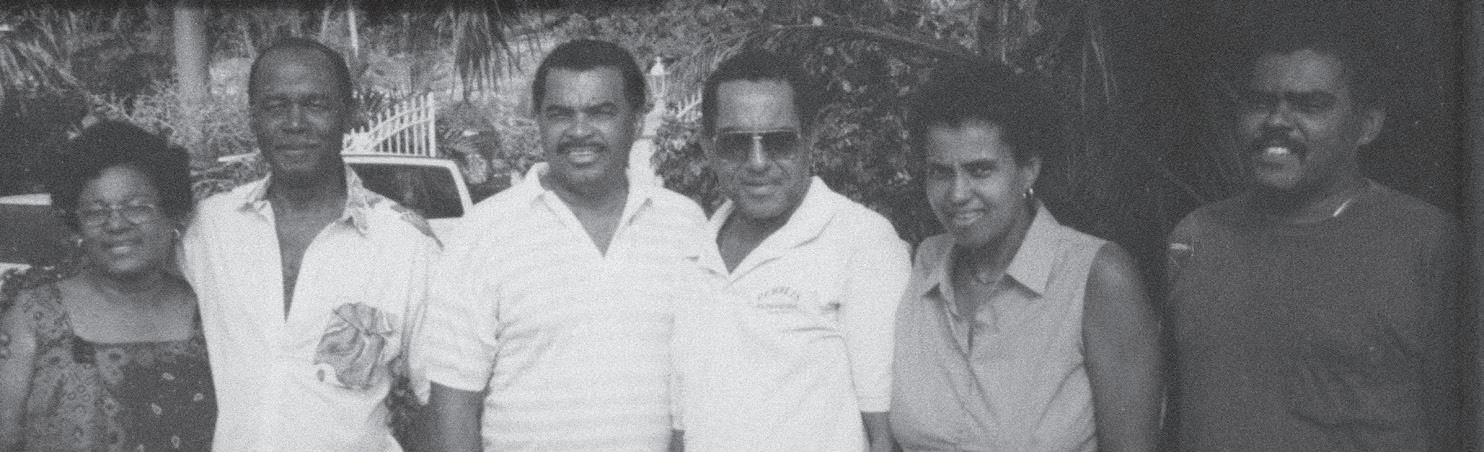
Billie Miller and siblings
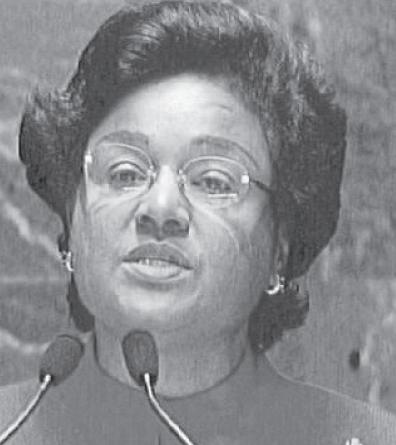
Billie Antoinette Miller
AN INVISIBLE PRESENCE MADE PRESENT
• First woman appointed to the Legislative Council
• First woman member of either House.
Muriel was a highly intellectual woman constrained by the traditions of the era in which she lived. She gained a triple in Latin, mathematics and music at Cambridge but received no degree because of her gender; and though her family was wealthy and she did not have to “earn a living”, laws of the day barred her, as a married woman, from paid employment. One can only image the struggle she had!
INDEPENDENT ACTION
Nevertheless, she put her mathematical and logical brain to work on the health statistics dutifully and meticulously collected by the Colonial Office and, alarmed by the high infant mortality rate established the correlation between income, knowledge and malnutrition - mothers and children need better nutrition and health care. Also, living at Eagle Hall, a major suburban intersection with a Sunday market, she would have seen the daily struggles of the poor.
Muriel took action. In 1921, together with Florence Browne, a doctor’s widow, she formed the Child Health
Committee, also known as the Baby Welfare League, to provide nutritional support and medical care for infants in the area. Using her own resources she purchased powdered milk and distributed it from her home Bosvigo. She succeeded Browne as President of the Baby Welfare League after Browne’s death in 1933.
SERVICE AND RECOGNITION
In the 1920s and 1930s, she was also President of the Family Welfare League and the Naval Welfare League, and Vice-President of the Women’s Social Welfare League. She also
assisted with the Red Cross and the Poppy League.
In 1928, she was rewarded the MBE for her work with the Naval Welfare League when she organized the hospitality and entertainment for the non-commissioned personnel of the Royal Navy ships which were visiting Barbados. From 1928 to 1945 she served on the Governing Body of the St. Michael’s Girl’s School and was an active member, organizing fundraising events.
TENANTRY LAND
Muriel’s husband died in 1937 and she fully inherited the vast property at Eagle Hall. Land for housing in this suburban area was scarce, so Muriel sectioned a portion of the property for “house spots” and allowed families to build their homes. As she was ahead of her time with mother-child welfare, so she was with tenantry holdings.
It was Muriel’s request that the “house spots” at Bosvigo be titled to the occupants and considering that Muriel died in 1971 and the Tenantries Freehold Act was passed in 1980, Muriel Hanschell perhaps foresaw that tenantries in Barbados would one day be regularized and that the right to purchase tenantry lots would finally be permitted.
Her granddaughter Carol Hanschell who was only eleven years-old at the time of her death, honoured her grandmother’s request. She studied to be an attorney and spent many
years assisting residents of Bosvigo and other tenantries at Eagle Hall, Thornville and Greaves Land, to complete the legal documentation required to achieve ownership of their “house spots.”
MADE PRESENT
In 1948, four years after women achieved the right to vote in Barbados, Muriel was appointed to the Legislative Council. She therefore became the first female member of either House, serving the full term of five years “with some distinction.” The author of her obituary observed that “it was her mere presence and not her outlook on social changes which prevented her male colleagues from brushing aside many of the muchneeded reforms of the day”.
FORWARD LINEAGE
Muriel’s influence extends to other grandchildren. Christopher Hanschell spent nine years at Teen Challenge and Verdun House assisting substance abuse addicts. He worked as a Counsellor and engaged with corporate Barbados to provide opportunities for reformers to reintegrate back into society. John Atkinson works in youth health and health promotion in Canada where he was born.
Sources: Advocate-News: “Obituary: Mrs. Muriel Hanschell”, 30 May 1971; Patricia Symmonds (1993), “Longer Lasting than Bronze”; Conversations with Carol Hanschell (granddaughter).
Shirley Chisholm continued from Page 1
teaching after 25 years in politics to “give others what I learned”. Her message to young people was, “to make up your mind what you want to do and drown yourself in it, get a good education, look neither to the east nor the west, but plod on looking only to God and your conscious for whatever you do, not man.” This is a timeless message.
There are plans to rename Vauxhall
Primary School the Shirley Chisholm School.
Her books, “Unbought and Unbossed” and “The Good Fight” are still in print. Her third book, “Shirley Chisholm: The Illusion of Inclusion” was not completed.
Sources: Shirley Chisholm’s books and interviews.
3
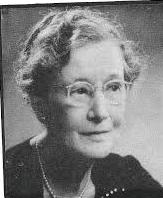
Muriel Hanschell
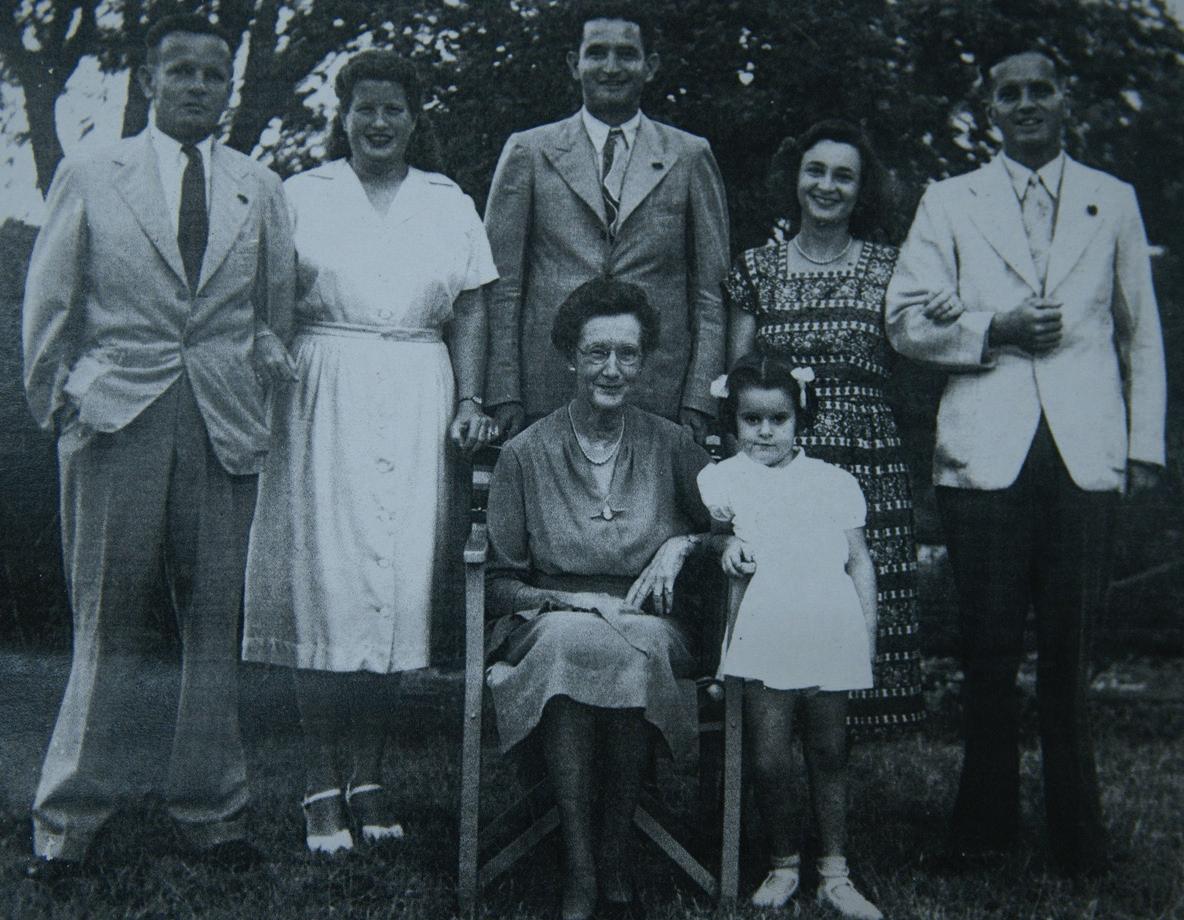
Muriel Hanschell and family

THE INDEPENDENT ACTIVIST
• Leader in Public and Community Activism
From the 1950s until her death in 2011 at the age of ninety-three Olga Lopes-Seale, Auntie Olga as she was familiarly known, dedicated her life to addressing the basic needs and education of the poor and underprivileged in her native Guyana and adopted Barbados. As a broadcaster and newspaper columnist, she mobilized her community to support the various humanitarian programmes and fundraising ventures which positively impacted social change that is still sustained today.
GUYANA
Born in 1918 in British Guiana (now Guyana) she was an improvised and sickly child, the last of nine children born to Portuguese indentured field labourers, six of whom died prior to her birth. Often missing school due to her sickness, she left “with the bare basics and without a single certificate”, started a career in theatre as a singer and went on to become the first female broadcaster at Radio Demerara.
She started the Demerara Needy Children’s Fund in 1953 when a simple radio appeal for assistance for five children mushroomed into an overwhelming response that highlighted even greater needs. For her humanitarian work and commitment to that country she was awarded Member of the Order of the British Empire (MBE) in 1961.
AUNTIE OLGA
1n 1963 she relocated here with her Barbadian husband Dick Seale and started work as a broadcaster at Barbados Rediffusion. In 1965 she established the Rediffusion Needy Children’s Fund. Her children’s radio
show (Children’s Party Pageant of Youth) provided an outlet for our youth to channel their skills and talents that inadvertently became the nursery from which many of Barbados’ well know entertainers emerged, up until present day. Later she became a newspaper columnist at the Nation Newspaper, the agony aunt offering advice, comfort, encouragement and hours of inspirational words and moral guidance.
Auntie Olga’s affinity for the less fortunate was influenced by her personal situation as a sickly child. In a 2009 interview she shared that her difficult childhood has some bearing on her interactions with children in the Needy Children’s Fund …” Yes, I believe my childhood circumstances were a blessing because I knew what it was like to carve attention … Every child needs praise and I always find something good to say about each of them.” Thus, her Children’s Party
Pageant of Youth addressed not only their immediate basic human needs but was an avenue to educate, inspire, praise and uplift their spirits and instill self-esteem and pride.
A COMMITTEE OF ONE
Olga worked independently with remarkable organizational skills. Describing herself as “the most organized disorganized person”, she accomplished her mission without any formal business structure and prescribed system of financial management. There was no nongovernmental organisation (NGO) with irrelevant corporate titles and multiple committees to get in the way of delivering basis human needs for children and their parents to have moments of dignity and pride.
She used “the Olga system”, an inhouse method of checks and balances for her charities, fund raising and donations, that allowed her to keep track of what was received and how it was allocated or disbursed. “I cannot see myself operating with this committee and that committee”, she said. “I’ve been doing what I can in the way I can.”
No one doubted her or her system. What she can and did do was obtain commitments to an estimated $90,000 annually, officially help as many as 1500 children per year and many more unofficially. Her impact in the lives of ordinary people is evidenced in her personal papers by numerous letters and cards of gratitude from families in both countries.
In one expression of gratitude a parent whose child had the proper uniform and school materials reported, “Thanks to Auntie Olga … my child loving school. She is just full of confidence and doing very well.
Looking and feeling as smart as the rest of the children is a big part of her success.”
Her access to the media by way of her job was her tool for raising and mobilizing awareness and funding. Dame Olga’s altruism, generosity and loving spirit was a beacon to others whom she influenced and recruited to her causes. Her ethics and integrity begat confidence that businesses gave and formal charities and associations raised funds for her including the Syrian Lebanese Association, the Indian Women’s Association and the Multi National Women’s Group. Her apolitical approach, lack of formal education and ideology, and absence of formal operating structures defying the academic models for activism and community organisation.
LEGACY
Her legacy is The Variety Club of Barbados which she helped establish. She bequeathed to it the resources from her Needy Children’s Fund to continue her work with children. The Auntie Olga Memorial School Aid Programme provides uniforms and educational materials with an annual average spending of $40,000. In 2021 it supported 124 families with 300 school-aged children.
For her humanitarian work in Barbados, she was the recipient of numerous awards at local, regional and international levels, the most prestigious being Dame of St Andrew in 2005.
Source: Valerie Clarke, “Community Activists and Social Change: Dame Olga Christine Lopes-Seale”, The Journal of the Barbados Museum & Historical Society, Volume LXVII: December 2021; Conversations with Anne Bancroft (granddaughter)
© Publication of Barbados Archives Department for Genealogy Marketplace 2022. All rights reserved.
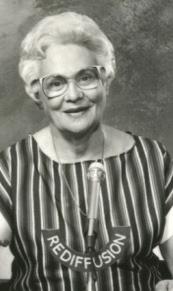
Olga Christine Lopes-Seale
