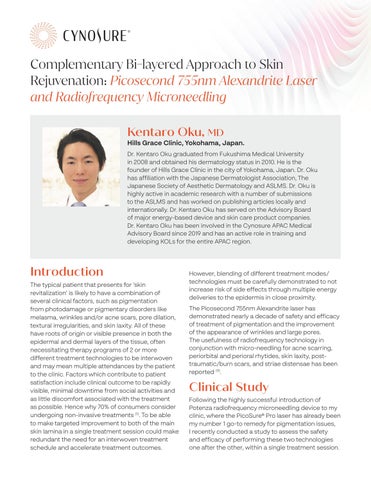
Complementary Bi-layered Approach to Skin Rejuvenation: Picosecond 755nm Alexandrite Laser and Radiofrequency Microneedling Kentaro Oku, MD
Hills Grace Clinic, Yokohama, Japan. Dr. Kentaro Oku graduated from Fukushima Medical University in 2008 and obtained his dermatology status in 2010. He is the founder of Hills Grace Clinic in the city of Yokohama, Japan. Dr. Oku has affiliation with the Japanese Dermatologist Association, The Japanese Society of Aesthetic Dermatology and ASLMS. Dr. Oku is highly active in academic research with a number of submissions to the ASLMS and has worked on publishing articles locally and internationally. Dr. Kentaro Oku has served on the Advisory Board of major energy-based device and skin care product companies. Dr. Kentaro Oku has been involved in the Cynosure APAC Medical Advisory Board since 2019 and has an active role in training and developing KOLs for the entire APAC region.
Introduction The typical patient that presents for ‘skin revitalization’ is likely to have a combination of several clinical factors, such as pigmentation from photodamage or pigmentary disorders like melasma, wrinkles and/or acne scars, pore dilation, textural irregularities, and skin laxity. All of these have roots of origin or visible presence in both the epidermal and dermal layers of the tissue, often necessitating therapy programs of 2 or more different treatment technologies to be interwoven and may mean multiple attendances by the patient to the clinic. Factors which contribute to patient satisfaction include clinical outcome to be rapidly visible, minimal downtime from social activities and as little discomfort associated with the treatment as possible. Hence why 70% of consumers consider undergoing non-invasive treatments (1). To be able to make targeted improvement to both of the main skin lamina in a single treatment session could make redundant the need for an interwoven treatment schedule and accelerate treatment outcomes.
However, blending of different treatment modes/ technologies must be carefully demonstrated to not increase risk of side effects through multiple energy deliveries to the epidermis in close proximity. The Picosecond 755nm Alexandrite laser has demonstrated nearly a decade of safety and efficacy of treatment of pigmentation and the improvement of the appearance of wrinkles and large pores. The usefulness of radiofrequency technology in conjunction with micro-needling for acne scarring, periorbital and perioral rhytides, skin laxity, posttraumatic/burn scars, and striae distensae has been reported (9).
Clinical Study Following the highly successful introduction of Potenza radiofrequency microneedling device to my clinic, where the PicoSure® Pro laser has already been my number 1 go-to remedy for pigmentation issues, I recently conducted a study to assess the safety and efficacy of performing these two technologies one after the other, within a single treatment session.
My experience with these two leading devices suggested that I could do this to take advantage of the therapeutic outcomes of each separate mode of action in a compressed treatment timescale for the patient without increased risk of the patient experiencing unwanted treatment effects. In that study, 15 Asian female patients were treated with 3 individual sessions of sequential treatment with the PotenzaTM radio-frequency microneedling device and the PicoSure Pro 755nm laser with 6-week intervals between each treatment appointment. In the first stage of the treatment a single pass of the full face was made with Potenza RF microneedling, using the FusionTM Tip (CP-21), which is exclusive to the Potenza device and brings a triplex of treatment effects to the skin; 1. Mechanical effect by microneedle insertion, 2. Coagulation by Radio Frequency energy, and 3. Enhanced penetration of applied topicals. This therapy is immediately followed by treatment with the PicoSure Pro laser, using the Zoom handpiece first to address localized pigments and then the 8mm Flat optic for one pass to address the full face. Digital photographs and UV images taken before the first treatment and 4-weeks post the final treatment identified: • R eduction of visible age-related pigmentations and post-inflammatory hyper-pigmentation (PIH) • Wrinkle reduction on the peri-orbital areas • I mproved firmness of the skin* • P ore reduction on the cheek and a brightening effect on the full face An independent external evaluator correctly identified the pre and post treatment images in 93% of cases and graded the treatment outcome as excessively improved, very improved or improved in 100% of cases using a global aesthetic improvement scale (GIAS). Patients undertook a dermatology life quality index (DLQI) evaluation at the first and last visit and the overall group improvement score change was statistically significant at 7.9±4.6 before treatment, and 5.7±3.2 after treatments (p<0.01). No unexpected side-effects from the cumulative treatments were experienced than those already widely recorded for each of the separate treatment options. These side effects included: • G eneralized erythema which lasted typically an average of 12 hours (up to 48 hours in some cases) • E dematous erythema lasting up to 72 hours
In less frequent cases: •
Intradermal petechiae, especially around the more delicate tissue around the eyelid for 5-7 days
•
Acne outbreak 2-3 days post treatment, for up to 10 days
•
Post inflammatory pigmentation, occurring 2-3 weeks post treatment and lasting up to 3 months
This study demonstrated that visible outcomes and patient satisfaction is high when both the Potenza RF microneedling and PicoSure Pro laser devices are used in the same treatment session without causing undue side effects other than those that might be expected from either device.
Creating a Refined Treatment Procedure Following on from this study, I have continued investigation of this complementary minimallyinvasive treatment method to refine the protocol for practitioners with these two unique technologies: Energy Blending of the Potenza Fusion tip and 755nm alexandrite picosecond laser Picosure Pro. This new treatment in partnership with Cynosure is called CynoGlowTM. Introducing the CynoGlow skin treatment –a fivein-one, efficacious treatment personalized for patients’ skin to tackle pigmentation, texture, pores and wrinkles. With just 3 short, minimally invasive treatments your patients can remove the unwanted pigmentation, rough texture and enhance the true good in your skin’s collagen so you can quickly be back to portraying your best self. CynoGlow combines the power of 2 of our best products:
PicoSure Pro/
is the latest generation of the PicoSure laser system, the first commercial picosecond laser to be released to the medical aesthetic market and the only picosecond device with a 755nm alexandrite wavelength. PicoSure Pro is the only picosecond laser FDA-cleared to treat melasma pigment, nevus of ota and hori’s nevus. It resurfaces your skin so that it is noticeably brighter and even toned. The PicoSure technology won the 2021 and 2022 New Beauty award for “Best Multitasking Device for Addressing Multiple Needs.” The 755nm wavelength has a much higher melanin to blood absorption ratio compared to other
common picosecond wavelengths, such a 1064nm, meaning it is much more specific to treatment of melanin without damaging nearby blood vessels and causing the associated unwanted side effects that come with that (10).
treatment procedure for patients with any or a mix of the following issues:
Potenza/
• P hoto-damaged skin with sunspots on the face/ neck/decolletage
is the only radiofrequency micro-needling device to offer both mono and bi-polar radiofrequency at 1MHz and 2MHz frequencies. The Potenza device, our most advanced radiofrequency microneedling solution which tightens your skin, stimulating the activation of collagen and elastin. It has a suite of 10 types of treatment tips; Tiger TipTM Technology (semi-insulated), Insulated and the new Fusion Tip which gives me flexibility to customize treatments for each of my patients. The Fusion Tip, while also delivering thermal energy into the dermis with its associated clinical benefits, also has an exclusive dual chamber design which can enhance penetration of any topical product present on the skins surface during treatment by up to 67% compared to a standard insulated radio-frequency micro-needling tip (11). This gives me the opportunity to use applied topicals during treatment as I might deem it beneficial for an individual patient’s prescriptive needs. CynoGlowTM – remove the bad, enhance the good. Uncover perfect, glowing skin.
CynoGlow Treatment Procedure
I use the CynoGlow (in partnership with Cynosure)
• Visible dilated pores • Acne scars with/without PIH
• Dyschromia (including melasma) • Tightening of the skin on the face/neck Since my patient demographic is an Asian skin type, I am always cautious of the risk of generating post-inflammatory hyper-pigmentation, especially when using many laser or light-based systems. For that reason, I use Potenza with the Fusion Tip as the first stage of my treatment procedure, this gives me the opportunity to deliver the thermal effect of the radio-frequency energy into the dermis as well as boost the penetration of chosen topical agents.
Treatment Settings Prior to commencing treatment, I recommend the use of a topical anesthesia as per normal instruction for its use and then clean the skin of any residue of this before commencing the energy treatments. After the Potenza treatment, gently cleanse the skin with gauze and normal saline to remove any remaining topical substances or pinpoints of blood that might have been caused by the needle insertion before starting treatment with the PicoSure Pro laser.
TREATMENT STAGE
DEVICE
TREATMENT TIP/HANDPIECE
SETTING RANGE
#PASSES OF TREATMENT AREA
1
Potenza
Fusion Tip (CP-21)
1 MHz Monopolar 5 Pulses per Pulse (20ms ON – 5ms OFF) Depth: 1.25-1.75mm Impact Level: 7 6W (600mJ/Pulse)
1 pass
2(a)
PicoSure Pro
755nm ZOOM: 3.7-4.0mm
550ps (Turbo ON) 2.5Hz 1.57 J/cm2 – 1.31 J/cm2
1-3 pulses on local pigments*
2(b)
PicoSure Pro
755nm FLAT: 8mm
550ps (Turbo ON) 10Hz 0.33 J/cm2
1-2 passes
*Excluding melasma
With these treatment parameters, which err on the conservative energy side of the parameters often utilized when these devices are delivered on their own, I can ensure effective results for my patients while limiting unwanted side effects. Those side effects that are experienced are no more severe than the patient might have expected when having monotherapy with one or the other treatment.
This second case is of a 49-year-old patient before and after 2 treatment sessions:
Treatment Results In this first case we have a 27-year-old who has suffered with chronic PIH with scarring from acne and enlarged pores. Two CynoGlow treatments have provided an outcome that the patient is thrilled with.
Final case, 56-year-old patient before and after 2 treatments:
PicoSure Pro is the only picosecond device with an FDA cleared indication specifically for pigmentation due to melasma pigment as well as Nevi of Ota and Hori. The greatest advantage of this treatment is that it can simultaneously improve coexisting skin problems such as dilated pores, acne scars, and fine lines and wrinkles while treating pigmented lesions, the most common target in Asian aesthetic medicine. In addition, the number of treatments can be reduced, and the total treatment period can be shortened compared to the mono therapy using PicoSure Pro Laser and Potenza RF microneedling device, thus maintaining high patient compliance. Patients will notice an improvement in their skin in a shorter period of time after treatment, which will increase their confidence in the practitioner and clinic and encourage them to continue treatment, which is a major advantage for both the patient and the clinic.
References: (1) MEDICAL AESTHETICS MARKET -GLOBAL FORECASTS TO 2025 Downloaded from https://www.marketsandmarkets. com/Market-Reports/ (2) C. Cheshunt, J. Deihl, G. Lask, Treatment of nevus of ota with a picosecond 755-nm alexandrite laser. Dermatol Surg. 2015; 41(4): 508-536. (3) JC. Chan, SY. Shek, T. Kono, CK. Yeung, HH. Chan. A retrospective analysis on the management of pigmented lesions using a picosecond 755-nm alexandrite laser in Asians. Lasers Surg Med. 2016; 48(1): 23-29. (4) EM. Tanghetti. The histology of skin treated with a picosecond alexandrite laser and a fractional lens array. Laers Surg Med. 2016; 48(7): 646 .
(5) S. Khetarpal, S. Desai, L. Kruter, H. Prather, K. Petrell, J. Depina, K. Arndt, JS. Dover. Picosecond laser with specialized optic for facial rejuvenation using a compressed treatment interval. Lasers Surg Med. 2016; 48(8): 723-726 (6) Y. Ge, L. Gho, Q. Wu, M. Zhang, R. Zeng, T. Lin. A prospective split-face study of the picosecond alexandrite laser with specialized lens array for facial photoaging in Chinese. JDD. 2016; 15(11): 1390-1396. (7) YT. Chen, ET. Lin, CC. Chang, BS. Lin, HM. Chiang, YH. Huang, HY. Lin, KY. Wang, TM. Chang. Efficacy and safety evaluation of picosecond alexandrite laser with a diffractive lens array for treatment of melasma in Asian patients by VISIA imaging system. Photobiomodul Photomed Laser Surg. 2019; Aug 14 Epub ahead of print
(8) S. Hu, CS. Yang, SL. Chang, YL. Huang, YF. Lin, MC. Lee. Efficacy and safety of the picosecond 755-nm alexandrite laser for the treatment of dermal pigmentation in Asians - a retrospective study. Lasers Med Sci. 2020. Lasers Surg Med. 2020; 30(6): 1377-1383. (9) TS. Alster, PM. Graham. Microneedling: A review and practical guide. Dermatol. Surg. 2018; 44(3):397–404. (10) SL. Jacques. Optical properties of biological tissues: a review. Phys. Med. Biol. 2013; 58(11): R37-61 (11) C. Dierickx. The Potenza Fusion Tip: Enhanced penetration of topical products. White paper, Cynosure 2021.
©2022 Cynosure, LLC. All rights reserved. Cynosure, LLC owns exclusive rights to photography. Use of photography without written permission of Cynosure is prohibited. Cynosure, Tiger Tip, PicoSure and Platinum focus lens are registered trademarks and trademarks of Cynosure, LLC. Potenza is a trademark of Jeisys Medical, Inc. PicoSure Pro 755 with the Flat Lens is FDA cleared to treat pigmented lesions in skin types I-VI. PicoSure Pro 755 with the Platinum Focus Lens is FDA cleared to treat acne scars and wrinkles in skin types I-IV. Patient results will vary. The Potenza radiofrequency microneedling device is intended for electrocoagulation and hemostasis of soft tissue for dermatologic conditions. Potential side effects include temporary redness, temporary tingling, and burning sensation while receiving treatment. Like all medical procedures, not all patients are suitable for the treatment. A qualified practitioner is solely responsible for evaluating each subject’s suitability to undergo treatment and for informing those being treated about any risks involved with the treatment, pre-and postoperative care, and any other relevant information. Individual results may vary and are not guaranteed. Model(s) for illustrative purposes only and are not real patients. PRD-0130