The Staff

Carly Sax, writer
Kayla Phitsamay, photographer
Vu Huynh, designer
Hope Cox, writer
Patrick Pugh, writer
Alex Littman, co-creative director
Hondo Acosta-Vega, photographer
Tyler Diltz, co-editor in chief
Keaton Weyers, co-editor in chief

ON THE COVER
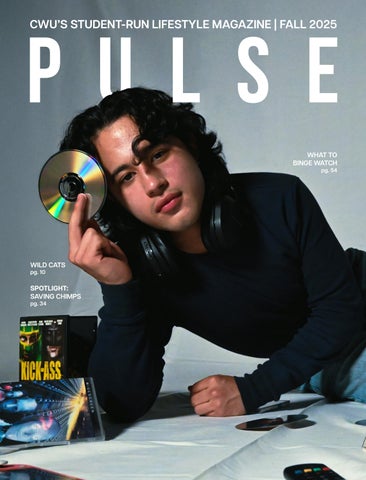
History Education major Javier Rodriguez strikes a pose for What to Binge Watch (pg. 54).

Fae
photo by Tyler Diltz and Keaton Weyers design by Katrina Nolan
Taylor Downard, designer
Tressa Teeter, writer
Isamar Sotelo, writer
Blake Kjellesvik, editor
Charlotte Zombro, associate editor
Katrina Nolan, co-creative director
Laura Allen photographer
Johnson, lead designer
Jennifer Green, faculty advisor
photo by Kayla Phitsamay design by Alex Littman
by Laura Allen design by Katrina Nolan


LETTERS FROM THE EDITORS
story by Tyler Diltz and Keaton Weyers
While this is our fourth quarter at PULSE, this is our first quarter of Editors-in-Chief. Sadly, some of our previous staff have moved on, and much like the change in weather experienced over this fall quarter, our current staff have embraced and weathered the change as well. We aim to maintain the high standards and award-winning work that has come out of PULSE in the past and we couldn’t be more proud of our team and the work they have done for this edition.
In this issue of

PULSE you will get to see what it is like to put on your boots and belt buckle and spend a day at the Ellensburg Rodeo in “Rodeo: Get Roped In!” on pg. 28. The article highlights the rodeo that happens every summer here in the ‘Burg, as well as its cultural connection to the people of the Yakama Nation.
Our other spotlights are perfect for animal lovers as we dive into the lives of some of our closest relatives, chimpanzees. In “Saving Chimps” on pg. 34, you can read the origins of some quirky cousins nearby. After that, you’ll explore the buzz about bees on campus
photo and design by Katrina Nolan
in “What’s the Buzz? (The Bees Are Back)” on pg 40. You’ll find out how our campus is connected to these lovely creatures, and the importance of both.
You might realize this issue is slightly shorter than in the past. Our goal is to prioritize quality over quantity while dealing with the burden of budget cuts. However, if you are wanting more from some of our stories, you are in luck! Go to our online issue of PULSE, where you will be able to find the extended versions of some stories, as well as some that might not have made it into the print version. Thank you to all our readers out there, PULSE wouldn’t be possible without each and every one of you.
MONUMENTAL: PULSE GOES TO MEDIAFEST 2025


Above: Signs and attendees during the No King’s protest on October 18, 2025
Above: (left to right) Brandon Mattesich, Kyley Glenn, Tyler Diltz, and Katrina Nolan receiving awards from MediaFest (photo courtesy of Jennifer Green)
story by Tyler Diltz
photo by Tyler Diltz and Katrina Nolan design by Katrina Nolan
Living in the small town of Ellensburg, there are some things that we just don’t get to experience during our day-to-day routines. But visiting a large city recently gave us some monumental memories.
This October, staff from both PULSE and The Observer ventured across the continent to Washington D.C. to attend MediaFest25, a national college journalism convention that draws students from campuses across the United States. Sessions and presentations filled up the majority of our dayto-day there. Organizations like the Associated Collegiate Press (ACP), the College Media Association, the Society of Professional Journalists, the Student Press Law Center (SPLC) and more hosted training panels on a variety of topics and conceded awards to recognize the work of student journalists.
PULSE and its sister publication Observer both earned recognition. PULSE placed second place in the nation for magazine cover design (our Baile Folklórico cover from Winter 2025), second place in the nation for
multimedia story of the year (Snoqualmie Tunnel), and fifth place “best in show” at the convention for feature magazine. Observer placed fifth for “best in show” for their website. PULSE and Observer students also shared a finalist award for Courage in Journalism from the SPLC, recognizing our advocacy on behalf of student media last spring when we faced being defunded.
Outside the walls of the combined hotel and convention center, we explored the expansive city of Washington D.C. Here are some photos from that experience.
From one Washington to another Washington, we had an experience worth remembering.


Above: Jim Rodenbush, former Indiana University Director of Student Media and adviser, who was fired for standing up to censorship receives a standing ovation at MediaFest25.
Above: Award certificates from the Associated Collegiate Press for Best of Show - Fifth Place, Multimedia Story of the Year - Second Place, and Magazine Cover - Second Place


design by Fae Johnson story by Charlotte Zombro
photo by Keaton Weyers
Imagine: you’re going on a late night McDonald’s run; backroads only, too many red lights on Main and Canyon. You come to a screeching halt on Ruby Street behind the Les Schwab, waiting for a small and ragged cat to dash across the street, a small and ragged cat that was almost under your tires.
Now, imagine you are the cat instead. You see the headlights in the dark and you feel the fear. But you cannot come close to picturing what life is truly like for a feral cat on the streets of Ellensburg. The cars, the fights, the weather, the struggle for food and shelter: our furriest friends also happen to be some of our most overlooked, underserved and misunderstood.
There are a lot of misconceptions surrounding feral cats, according to Marla Pugh, director and founder of Josie’s Misfit Ranch. “A lot of people think feral cats are any cat that lives outdoors,” says Pugh. “But actually a feral cat is a cat that is not socialized, that is difficult to have human contact with because they have never been socialized properly with humans.”
If you got out of your car to approach the feline, you would likely find it to have vanished into thin air, hidden by a blanket of darkness. If you look closer, you may see a few pairs of eyes staring back at you from the shadows, frightened and watchful.
If you believe the cat distribution system to be working properly, you have just found yourself as a colony caretaker. While these are not your pets (and they likely never will be), they are your responsibility.
So… what now? With all of the cats fearful and none of them spayed or neutered, how can you help?
Watch and Learn
According to Pugh, the first step is observation. “See if the cats are friendly or not, because that makes a lot of difference in how easy they are to help,” Pugh says. “So do the cats run if you come up to them, or will they come up to you? That’s information that a rescue is going to want to know.”
During this step, it is paramount that your intention is to help, not simply to disrupt or dismantle the colony. “Some people think cats are feral and they actually do have a
home. So it’s important not to just grab a cat, say they’re feral, and then get them help,” Pugh explains. “It’s important to wait and have an expert reach out and make sure they don’t belong to anyone.”
The younger the cats look, the more important this observational step becomes. When you see a group of starving and battered cats, it will be most tempting to get the tiny kittens out first, but this is a misplaced kindness that will only further complicate the process of

getting the colony population under control.“Mamas will go away for hours,” says Andrea Wing, president of Kittitas County Friends of Animals (KCFOA), a nonprofit organization that specializes in animal rescue.
Pugh seconds the practice of not scooping up lone kittens. “If it’s a very tiny cat, don’t just take the kitten because the mother could still be around. Little kittens have a 50% less chance of survival without their mom,” she explains. “Be sure to make sure that their mom isn’t around, and that’s also something that a rescue can help you figure out.”
With an extensive observation period, you will know whether or not the mother was indeed going to come back for those kittens. According to Wing, this observation is all about, “taking the time to just kind of step back, assessing the situation, determining if it really is truly a stray or not and then coming up with a plan of action before your heart gets it and you just want to jump in and save it.”
Craft Your Cat-Loving Support System
Now that you’ve done your observation, you should have a little more knowledge about your new feline friends, particularly whether they are friendly or feral, and in turn what the next best steps for them should be.
For feral cats, this step will often be to begin the TNR process. “TNR” stands for trap, neuter, return and it is typically regarded as the best, most humane practice for controlling the breeding and population of feral cat colonies. “TNR is trap, neuter, return,”
explains Wing, “It’s going to, let’s say, a colony of cats that you’ve been monitoring, trapping those cats within the colony, getting them altered, vaccinated, getting them healthy and then returning them to that colony.”
It may seem counterintuitive to simply return the cats back to the situation you found them in, especially when seeing them living on the streets is precisely what brought you to the desire to help,

but Wing explains that this is what is best for their routines and survival.“They’re going to be used to foraging, looking for their own food supply and basically living in the wild, as if a wild cat,” Wing says. “They’re used to being outside, they’re used to surviving on their own in harsh conditions and avoiding predators, and so they’re going to be very skittish and scared and defensive and potentially mean, but that’s to survive.”
Truly feral cats will likely be unable to be rehomed safely. The odds are slim that they will ever be an indoor lapcat like you might want. So while they may appear “homeless” to the untrained eye, their home is simply outdoors. They have routines and communities, they return to the same spaces over and over again for food and shelter– to take them out of this situation would only bring about further struggle to their already difficult lives.
So you decided you want to help these cats, but now acronyms like TNR and words like “trap” are being thrown around and you’re getting a little skittish, feeling like maybe you weren’t ready for this process. Well, lucky for you, you’ve already done the first step of TNR: observation.
That’s right! You’re already in it. You could choose to stop now, to pass it on to a shelter or organization that you feel is more qualified to handle the situation, and there is nothing wrong with that. Organizations such as Wing’s KCFOA and Pugh’s shelter are here for exactly this reason: to help animals and the people who care about them. The next step in TNR, in being the person who helps, is to ask for help yourself.
Make no mistake: these cats need your help. No man (or animal rescue organization) is an island. Shelters are overrun with animals and understaffed with humans, they cannot possibly do it all themselves. However, neither can you. Participating in the improvement of animal welfare is an act of community, both between humans and animals. By reaching out to your community and asking for guidance, you are already onto the next step of TNR.
The animal rescue community Ellensburg is already very interconnected, with Pugh recommending KCFOA to those looking for help with TNR. “They can call them, they can call the shelter to get other resources,” explains Pugh, “and just try to give them as much information as possible so they know how to deal with the situation.”
TNR Tips, Tricks and Snips
Kayla Moznette, a volunteer with Josie’s Misfit Ranch who specializes in TNR, explains how she goes about trapping cats. After scheduling vet appointments and acquiring traps from somewhere like KCFOA, you might find your feline friends less than curious, perhaps even fearful. Moznette offers trap training as a way around this.
“I use bungee cords, and I just bungee cord the front of the trap open so it’s securely opened and if they step on the trip plate it’s not gonna close,” says Moznette. “I put food in the back of the trap and then that way that cat can get associated with going in and eating food and just leaving, and then the day before the surgery, you can set the trap and then it’ll close so they are comfortable with it.”
Moznette recommends securing a vet appointment prior to trapping, or else you risk having to house uncomfortable and likely angry feral cats indefinitely. After she traps, she takes the collection of kitties to low cost spay and neuter clinics to get their reproductive organs snipped, their ears tipped and any other medical care they might need.
After their spay or neuter, they are typically released back to their colonies fairly quickly. Moznette
says, “Sometimes they do need a little bit more time to recover, but as long as they don’t have any complications or anything like that, they do go back home the day after.”
Once you’ve successfully retrieved your precious cargo from the vet, safely release them right back where you found them. Congrats! You have successfully TNRed your first cat! However, your job as a colony caretaker is not done.
How To Keep Caring
Simply by spaying or neutering these cats, you have made a serious improvement to their quality of life. Make no mistake, it is still an incredibly difficult life for a feral cat. “They have to survive through the winter, they have to survive through the summer heat, they have to live through cars and different wild animals,” says Moznette. “There’s a lot of different dangers that are out there for them. Their lifespan is not as much as it is for indoor cats, and unfixed ones are even more endangered.”
While you may have
Moznette recommends that everyone get their cats fixed, “Even if you have a pet cat, get your cat fixed, because cats breed so fast. The colony that I’m working on went from one to I think probably 80-90 in three years.”
This is a sentiment echoed by Pugh, who says, “Spaying and neutering is very important. If people want to get a cat they need to understand that their responsibility is to get that cat spayed, neutered and vaccinated.”
“One pair of cats that aren’t spayed and neutered can lead to 7,000 unwanted cats in five years, and that’s what’s happening right now. The problem’s never been as bad as it is now. I’ve talked to people who’ve been in rescue for over 20 years and the problem is just getting worse and a lot of it is irresponsible people.”
Pugh urges any cat owners out there to start prioritizing the wellbeing of their cats as well as those out on the streets. Pugh emphasizes, “It’s very important that if you’re gonna commit to an animal, you have to commit to their

The average student’s day begins and ends with a screen. Somewhere between a blaring alarm in the morning and midnight deadlines, how do students find space to log off? CWU students admit to spending between three and 12 hours a day on their phones. For some, that’s more than half their waking hours. With those hours bombarding your mind with rings and pings, the question arises: how is constant connection affecting your mind, and what would happen if you logged off?
Some CWU students are questioning whether the convenience of online learning is actually hindering their well-being. While technology has become a necessity for engaging with life, there are ways to carve out time for yourself intentionally, give your brain a break, and discover yourself offline.
Quentin Kemp, a 1st-year Film major, commented on the increase in Canvas usage, “I feel it’s a lot easier for me to just push the work out of my mind if it’s on my computer.” Students are becoming increasingly engrossed in their screens, not just for doomscrolling on social media, but also for schoolwork.
With the Canvas renaissance, many students are required to do homework via a screen. Now students have an increasing number of midnight deadlines, online homework and class announcements to add to their schedules. Some students enjoy the transition, while others see adverse effects. Flynn Alston, a 3rd-year music major, enjoys the convenience of online assignments, saying, “But everything else has been constantly online, so it’s been great to have the alerts of ‘Oh, this is due!’”

Other students, however, have noticed some drawbacks to this new tech classroom approach. Albany Rushton, a 1st-year Music Education major, reflects on their struggle to stay focused, saying, “ I really don’t like it. I so prefer writing it on paper and handing it to a person. I feel it’s harder to forget it exists and easier for my brain to compute.” and later reiterated, “it’s hard for me to focus when I’m on the computer.”
Technological advances have revolutionized classroom convenience. No more papers getting lost in your backpack or forgotten deadlines, and for busy college students, this added level of convenience is just what they need for academic success.
design by ALEX LITTMAN
photo by KEATON WEYERS
story by TRESSA TEETER
THE GUIDE TO DIGITAL DETOX
Many students reported struggling to pay attention when completing online assignments.
This phenomenon is sometimes referred to as ‘Brain Drain’. This refers to the inability to fully focus on a task at hand when your smartphone is near, even when you’re not actively using it. A 2017 study titled Brain Drain: The Mere Presence of One’s Own Smartphone Reduces Available Cognitive Capacity published by The University of Chicago Press, asserted, “the mere presence of one’s own smartphone may occupy limited-capacity cognitive resources, thereby leaving fewer resources available for other tasks and undercutting cognitive performance.” This coincides with what Kemp had to say: “It’s a lot easier to open a new tab and just do whatever I want, whereas if I’m looking at the paper, that’s all I can really do.”
The effect of screens goes far beyond online homework. Some studies have shown that increased smartphone usage affects mental, cognitive, and physical health. A 2023 article titled The Hazards of Excessive Screen Time: Impacts on physical health, mental health, and overall wellbeing from the National Library of Medicine showcases some of those effects, saying, “adolescents who spend more than five hours per day on digital devices are 70% more
likely to have suicidal thoughts or actions than those who spend less than an hour a day.”
The article continues: “Excessive screen time can reduce attention span, decrease creativity, and limit problem-solving abilities.” With the average adult spending 7-11 hours a day on their phones, this is cause for concern. Experts recommend limiting screentime to 2 hours, but how can students possibly unplug when so much of their time is spent being constantly online?
From entertainment to work, we are connected. Students have already begun to see the detrimental effects on work-life balance, whether personally or through loved ones. Eban Ingersoll, a 3rd-year molecular cell biology major, recounted, “ It sounds like it would affect my work-life balance. I know that my mom had to deal with that; she was always on call, so she always went to work and stuff.” With boundary lines being blurred, this adds another obstacle to logging off.
HOW TO DIGITAL DETOX
So, the question is, how do you create a buffer between yourself and digital noise? One way is to allow yourself a few hours of digital detox a week, or even an entire day if you have the ability to do so. Plan these hours into your schedule and let friends and family know you will be unreachable. Next, turn your phone off and tuck it away. Now you can enjoy some tech-free, serotoninboosting activities.
Some tech-free activities favored by CWU students are: reading,
drawing, comic books, walking, journaling, picnicking, peoplewatching, playing instruments and spending time with friends. Don’t like any of those? Don’t worry, some extra examples include: knitting, cooking, puzzles, sports, LEGO sets, board games, cleaning, meditation and countless others. The world is really your oyster. But if you still don’t find yourself drawn to any of these suggestions, then let yourself be bored. Boredom is a creative powerhouse. Allow your mind to wander; that may be just what your brain needs to recuperate from the hundreds of notifications it receives throughout the day.
If you don’t have a few hours a week to spare, some other ways to limit your screentime, or at least make phone time less hectic, are to declutter your phone. You can do this by deleting and unsubscribing from email lists, deleting old messages and contacts and going through and deleting photos. Delete unused apps and turn off unnecessary notifications. And lastly, set a screen time limit for apps you catch yourself doomscrolling on. This ensures that you will be bombarded with less phone noise throughout the day.


DORM DECOR Making a Place Your Space

Fairy Lights
Posters
Stuffed Animals
DECOR Space

You’re heading home from winter break, and you know that you’ll eventually have to go back to your bland dorm room that has nothing on your bedroom at home. With winter quarter fast approaching, what can you do to make your dorm feel like home while still having a productive place to get your work done? Between the struggles of hanging stuff up and coming to joint decisions with your roommate, decorating your dorm can be difficult, and making sure you’re set up for success can be even harder.
Some students are minimalists who like their room to have clean walls and few distractions, while others like to cram as many trinkets and posters into their room as possible in an effort to make it feel more like home. No matter your preferences, CWU students from dorm halls both new and old have weighed in and shown off their dorms, describing what works best for them.
After interviewing nine CWU students from the Bassetties to Barto to one who lives in offcampus student housing, it was apparent that most of the effort of designing their rooms went into making it feel more comfortable, rather than setting themselves up for academic success. Multiple students say that they try not to study in their dorm rooms if they don’t have to, maintaining separate spaces for work and relaxation. Hayden Swartsel, a Barto Hall resident and EMS paramedicine major graduating in 2029 says, “I make it a goal to get out of the house when it’s time to study, and usually I’ll pick the library or some other public space like that, where I can just go and focus.
Even when I lived at home, I found that there’s too many distractions about being in my own space to be that productive.”
But if you like to study in your dorm, there are options for you too. Two roommates from Barto Hall, Kamryn Boudet, a freshman majoring in public health prenursing and Allison Hill, freshman majoring in hospitality, tourism and event management, have different methods. Kamryn Boudet says, “Most of the time when I study, I study on my bed ... because it’s very comfortable. … It’s great. I actually get a lot done.” Although this contradicts the idea of separating work and relaxation areas, different methods work for different students, and this method might end up working for you. Hill, on the other hand, has a different approach, saying, “I put [my desk] in front of my bed. So I study, and then I look at my bed, and I’m like, oh, I could be sitting there, but I need to get my work done.” Both options are unconventional to say the least, but finding ways to motivate yourself to focus in a space where you also relax, whether it be with those thoughts of relaxation or something else, is a great way to get work done. Obviously, there are many different ways to maximize your dorm’s design to find the right studying strategy for you, so try something new if you find that what you’re doing isn’t working.
Challenges
When it comes to decorating these dorm rooms, there can be challenges that come about. For undecided first-year Beck Hall resident, Samuale Welch, one of the biggest challenges was hanging things, saying, “Hanging things
Madison Craffey , she/they pronouns, sophomore majoring in Psychology, lives in Sue Lombard Hall.
story by Blake Kjellesvik
design by Taylor Downard
photo by Kayla Phitsamay


on the brick wall is a little harder. Push pins, of course, don’t work, and you have to get certain clips and command strips. … I would have liked to put some more posters up, but then I realized it was brick.”
Affordability usually comes to mind for most students when they think about buying anything. Hope Cox, PULSE reporter and senior professional and creative writing major currently living in an on-campus student-living apartment, prioritizes affordability, saying, “There’s some decorations that are from Walmart. Some are from thrift stores, yard sales and Amazon.” If you want to decorate your room to the best of your ability without breaking the bank, targeting deals and budgeting is a safe option. While Walmart and Amazon can be great for getting
the essentials, it’s also a good idea to wait and check for discounts and sales such as Prime Day or clearance sections. There’s no shame in saving money in this economy. Another way to save money on items is to talk to your roommate about pitching in when looking at buying shared items. Although, this could bring up a whole new issue for you that many try to avoid: making joint decisions with your roommate.
Creating a comfortable relationship where you make decisions with your roommate can be difficult which is why good communication is so important. Asking your roommate about a new design choice is always a good idea because, at the end of the day, they live there too. Some considered themselves lucky because their roommate didn’t care about the

decor and they had full reign over the design of the room. Others said differently. “I collect a lot of things,” explains Destiny Cranshaw, a Barto Hall resident and freshman majoring in mechanical engineering. He says, “[My roommate is] kind of a minimalist, so it was sort of jarring for him.”
“We talked it over,” he continues, “and I agreed that I would do my best to try and keep my space to myself and vice versa.” It doesn’t have to be difficult. It’s all about communication when it comes to living in close quarters with someone and making sure that you’re both comfortable with what’s going up on the walls, shelves and anywhere else.
Decor & Favorites
It’s important to note the decor and some of the students’ favorite things about these rooms. It isn’t all about productivity. Undecided first-year Nathan Davidson’s room is still quite minimalistic as he just moved into Beck Hall this year, but he says, “It’s pretty good in here; I got room to do my schoolwork, got a bed– it’s kind of all I need.” That’s something that ended up being a trend among a lot of students: they love their bed. A whopping 40 percent of the people interviewed said that their bed was their favorite part of their dorm room, earning comfort and relaxation a point over studying and focus.
Most students expressed just choosing their favorite color or bringing whatever they had from home when deciding their color scheme or dorm layout. Of course, it’s hard to go wrong with either
of those two options. One item that seemed to repeat itself among many different individuals were pictures from home. Rita Guerrero, a freshman accounting major living in Beck Hall who doesn’t have much in the way of decorations, conveys a need to add to her dorm saying she wants more pictures from her family. It becomes more obvious after going from dorm to dorm that reminders of home are important to all the students here at CWU, as it helps keep them going while away at college.
Along with the pictures and beds, students expressed an interest in posters, paintings, tapestries, flags, stuffed animals, figurines, drawings, trinkets and more. While some had specific reasons for their decorations, most expressed, once again, the goal of giving their dorm room a feeling of home and comfort.
Dorm rooms can be tricky. Deciding between creating a space that feels more homey or a space where you can be more productive is a challenge most students face. Finding a healthy balance of relaxation versus focus can be even harder, although now you know some tricks. No matter if you’re a minimalist or want your walls covered end to end in Taylor Swift posters, it might be time to think about whether or not your dorm is suited to your needs.


A, B, F - Barto Hall, Allison Hill, Freshman - Hospitality Major.
C - Barto Hall, Hayden Swartsell, Freshman - EMS Major.
D - Barto Hall, Destiny Cranshaw, Freshman - Mechanical Engineering Major.
E, H - Wahle Apartments, Hope Cox, Senior - Professional and Creative Writing Major.
G - Barto Hall, Kamryn Boudet, Freshman - Public Health Major.
I - Beck Hall, Rita Guerrero, Freshman - Accounting Major.
F G H
These Flags Won’t Fly
Brenda Garcia International & Intercultural Communication major and Languages minor, 3rd year
Q: Do you believe everyone has a red flag of their own?
A: Of course! Everyone’s not perfect. Everyone has something that affects them and how they grew up. Just because they’re not perfect doesn’t mean that they have to hide those red flags. The people who take those red flags and build on them, even when they can’t change them, are the strongest people in my mind.
Q: What are your top green flags in a person?
A: One of them is boundaries. When someone knows you well enough to see when you need space or support. Another green flag is understanding each other. Not just seeing of someone as your romantic partner, but as an individual. It’s important to recognize who they are as a person. And another green flag is honesty. I value people who don’t sugarcoat things and tell you the truth, even if it might hurt your feelings, because honesty is always better.
Brenda’s emphasis on honesty and understanding reflects how many students approach relationships, valuing communication and emotional awareness over perfection.

In this Q&A, CWU students, and a professor share how they define red and green flags in relationships. Their perspectives reveal how communication, self-awareness, and respect help students recognize what they truly deserve and what behaviors they shouldn’t overlook.
For many students, recognizing red and green flags is tied to their upbringing and the lessons they’ve learned over time.
College
culture can
blur the line between red and green flags
Luis Mogollan
Construction Management major and Business minor, 3rd year
Q: Do you think college culture normalizes certain red flags?
A: Definitely. It depends on the university, but college culture definitely normalizes certain behaviors that shouldn’t be accepted. The excuse is often, “Oh, I was in college,” as if that justifies bad behavior. Growth shouldn’t happen after college, it should happen during college.
Q: Do you think recognizing flags and others also help you understand like yourself better?
A: Yes. Recognizing flags in others also helps you identify behaviors that make you uncomfortable. You start noticing your own boundaries and beliefs, and calling those out helps solidify who you are.
Luis’s insight shows how reflecting on others’ behavior can also deepen self-awareness and strengthen one’s sense of identity.
story by Isamar Sotelo photo by Keaton Weyers design by Vu Huynh

Red flags aren’t just in dating—they show up in friendships too
Abel
Manuel Roduarte Business major and Digital Marketing minor, 3rd year
Q: Have you ever overlooked a red flag before? What made you ignore it at that time?
A: Yes, I have. I once had an ex-roommate who made a very non-inclusive remark early in the year. I decided to ignore it, thinking maybe he didn’t mean it. But by the end of the year, he made more remarks, and it caused a big drift in the friend group.
Q: What’s one red flag that’s a deal breaker for you?
A: Communication. If you’re not able to communicate how you feel with someone you should be comfortable with, that’s a problem. Communication is tough, but if you can’t express your feelings, how are you going to expect a person to know how you feel?
Abel’s experience highlights how communication and respect are key not only in romantic relationships but also in friendships.
Dr. Duane Dowd Associate Professor, Department of Child Development and Family Science
Q: What are examples of strong green flags that students should look for or try to show themselves?
A: One of the strongest qualities in a partner is someone who can listen and empathize. Someone willing to set aside what they want in the moment to connect with you, to help you feel understood. That sense of being heard and supported is what we’re all really craving in relationships. Beyond attraction or social status, what we need most is to develop intimacy. We need a connection and a closeness with somebody that gets us as a person, and finding that somebody who takes the time to understand you without judging is truly golden.
Why empathy and communication matter more than perfection
Q: What are some common red flags or warning signs you notice among young adults or college students in their relationships?
A: Many red flags are indications of immaturity or inexperience in their relationship development. Some students haven’t yet learned the skills that help relationships last, like empathy, sacrifice, and adaptability. It’s something that develops over time through experience. However, when you see controlling behavior or someone who doesn’t care about your perspective, those are serious warning signs. Red flags often reflect insecurity or a lack of emotional awareness, and those are patterns you should steer clear of.
Professor Dowd’s perspective connects what students experience emotionally to the psychology behind relationships, showing that many red flags stem from immaturity and can improve as people learn and grow.
Across every conversation, one theme stood out: relationships require communication, empathy, and self-awareness. From Brenda’s belief in honesty and boundaries, to Luis’s thoughts on self-reflection, to Abel’s reminder about respect, and Professor Dowd’s insights on emotional growth, each perspective reinforces that recognizing flags isn’t just about judging others. It’s about understanding yourself, growing from experience, and building healthier, more intentional connections.
BLEEDING THROUGH THE STIGMA.
story by Hope Cox and Carly Sax
According to UN Women, in the US, “1 in 4 teens and 1 in 3 adults struggle to afford period products, especially teens of colour and lower-income households.”
Part of this issue arises from the heavy stigma that surrounds menstruation, which affects access to products and education. Normalizing menstruation is essential in combating these issues. To do so, PULSE interviewed students and experts about their experiences and tips to make menstruation more comfortable.

design and illustration by Fae Johnson

Lack of Education: Why it Matters
Kim Rosas, founder of the company Period Nirvana, says a lack of education can complicate how women handle menstruation. “Some people just have to fumble through it because they don’t have a caregiver or parent to teach them what to use or how to use it.” She suggests many people aren’t using the right product for their flow, which can be an issue. Not knowing what works for you can mean more leaks, pain or discomfort, Rosas explains. “Often, they’re using a product that maybe just isn’t meant for their anatomy and they’ve had discomfort or pain their entire lives.”
How to know what product to use
“The more you know about your body, the better your chances of finding something that works for you the first time,” Rosas says. Taking that time to know your body is helpful, not only for finding menstrual products that work for you but also for making sure you are maintaining good hygiene. Using the descriptions of menstrual products provided here, some questions you should ask yourself before deciding what product works for you are:
Do you have an IUD?
If the answer is yes, you shouldn’t be using cups. Cups stay in place inside the vaginal canal by utilizing pelvic floor strength and suction. Using a cup increases the risk of IUD expulsion for this reason. An alternative option in this case is a disc, which has no suction, or a tampon. You can also use pads or period underwear.
Do you know your cervix height?
“Get to know your cervix height,” Rosas says. “Measure on the first day of your period and the last day.” She explains that the lowest height of your cervix is the length your menstrual cup should be. Anything larger than that can cause discomfort.
How heavy is your flow?
You should be buying products that reflect your flow – heavy, light or medium. Most tampon and pad companies sell products in multiple sizes to ensure you are getting the coverage you need. Many people experience heavier flow days at the start of their period and lighter flow days near the end, meaning you can have multiple sizes of pads or tampons. Many brands of tampons have boxes with more than one size to ensure the most coverage.
Do internal products cause you pain or discomfort?
If your tampon, cup or disc causes pain when you attempt to insert it, something isn’t right. Take a deep breath. Being stressed out causes the body to tense up, and this can make it more uncomfortable. A way to make it easier is by inserting your product of choice at an angle pointed towards your tailbone or back. You can also try shifting your position; if standing isn’t working, try squatting or sitting. Stop if the pain or discomfort persists – do not force it. Maybe pads or period underwear would be a better choice for you, and that is ok!
Do pads cause you irritation or discomfort?
Sometimes pads or period underwear can cause itching or
discomfort in places you really would prefer not to itch. Nothing is more awkward than shifting awkwardly in your seat in class over and over again because your body itches. If this is the case, maybe you should try an internal product like a tampon, cup or disc.
What is your budget?
Disposable menstrual products can be expensive, especially if you need to get more every couple of months. If that is the case, maybe a reusable menstrual product is for you.

Menstrual Hygiene
Practicing proper hygiene during menstruation is a key aspect of maintaining good health. The U.S. Centers for Disease Control and Prevention (CDC) has tips for maintaining good menstrual hygiene on their website. These tips promise to help reduce the chances of infections and bad odors and increase personal comfort. They include advice about washing hands and body parts, changing products regularly, wearing loose, breathable clothing and using unscented paper and products, among others.
It’s essential to keep your products clean. Menstrual cups and discs have a different process for retaining cleanliness than your average disposable pad or tampon. During your period, when you remove your cup/disc, the best choice is to briefly rinse it in the sink or wipe it down with a fragrance-free soap. Once a month after your period, you can steam or boil your cup/disc to ensure it is sterile and bacteria-free. The simplest way to do so is to boil it over a stove, but for college students on campus, a steam sanitizer or a collapsible silicone cup sanitizer are options. “You put your cup or disc inside of it, close the lid, and it steams it in five minutes,” Rosas says.
When to Worry
Symptoms of concern regarding menstruation include bleeding for more or fewer days than your personal average (typically 3 to 7 days) or going for an extended length of time without having a period. Other concerning signs can be spotting between cycles, unusually painful periods, drastic changes in mental health or signs of a vaginal infection.
Many people who menstruate can have a variety of symptoms associated with their cycles, differing in intensity from person to person. Some suggested ways to relieve symptoms, from Healthline, include ibuprofen or acetaminophen, heating pads or hot bottles, exercise, birth control (consult your doctor), orgasms, herbal tea and avoiding trigger foods and drinks such as dairy, spicy foods, sugar, alcohol and caffeine.
Where to Find Resources on Campus
The campus student health clinic is a great resource for menstruating students, as is Planned Parent in town. Campus stores sell some menstrual products, but this is limited to around one to two sizes for pads and tampons; you will also see some liners available. Grocery stores in town have significantly more options, including some alternative, less expensive brands. The bathrooms on campus should be stocked with free pads and tampons as well.
The Wildcat Pantry is another on-campus resource for free menstrual products. The staff stock tampons, pads and panty liners of various sizes through bulk orders via Amazon and Costco. Charles Johnson, Wildcat Pantry coordinator, says they accept donations of disposable and reusable menstrual products. “We try to make sure that when we are getting these products generated, that they are in unopened boxes just because it’s such a personal product,” he says.

Menstral Products
Cups
“A menstrual cup is like it sounds. It’s a bell-shaped internal product. It seals inside the vaginal canal and it sits below the cervix,” Rosas explains. Cups can be kept internally for up to 12 hours. To insert a cup, you have to fold the silicone to fit inside the body where it will open, “and they stay in place with a combination of suction and your pelvic floor toneness,” Rosas says. To remove a cup, you can sit, squat, or stand and prop up your leg to reach and pinch the base of the cup to break the seal. From there, you lightly pull it out and dump its contents.
Price: $20-40
Discs
Similar to a cup, a menstrual disc is typically made with silicone (or bodysafe polymers) and needs to be folded to insert into the body (there are both reusable and disposable options). Rosas describes discs as being, “a flat fit type product. It sits higher in the body in an area called the vaginal fornix, which is under the cervix.” She also explains that discs, “look like a bowl instead of a cup.” Discs can also be left inside the body for up to 12 hours before you need to remove them to empty their contents. To remove a disc, you can sit, stand with a leg propped up or squat. You slide a finger inside your vaginal opening until you can feel
the disc. From there, you hook your finger under the rim of the disc and slowly pull out, doing your best to keep it parallel to the floor. For some people, it can be easier to deal with in the shower. Some discs come with a tab or silicone string you can pull on to make removal easier.
Price: $20-30
Tampons
A tampon is a menstrual product that is used internally to absorb blood. It is important to note that you should not keep a tampon in for longer than eight hours (some professionals advise only keeping one in for around four hours at most) due to possible but rare TSS (toxic shock syndrome). Tampons are removed by pulling lightly on the string.
Price: $8-20
Pads
Pads are placed on the inside of the user’s underwear and absorb menstrual blood through absorbent material. There is a very wide range of sizes and absorbencies to fit all kinds of menstrual flows. Pads should be removed every four to eight hours.
Price: $7-15
Period Underwear
Period underwear looks just like your regular pair of underwear and is worn the same way, but with an added absorbent layer that
essentially acts as a built-in pad. Period underwear can come in many styles, including thongs, bikinis and boyshorts. Rosas explains that, “If you aren’t comfortable using internal products, they’re good.” This is especially true if you want to utilize more sustainable, planet friendly options throughout your cycle while also avoiding the discomfort of inserting a product into yourself.
Price: $9-40
Reusable Pads
Similar to a one-time use pad, reusables are worn inside the user’s underwear. These pads are typically made from cotton or flannel and don’t have that plastic adhesive backing that disposable pads do. These make for a wonderful option if you want to get something similar to everyday pads, which you are used to.
Price: $15-20
Panty Liners
Panty Liners are not always meant for your period, although you can pair any insertable product with a liner for extra protection in case of leaks. Liners are often used for spotting, light menstrual flow and discharge. Similar to a pad, they are placed inside the underwear and worn for about four hours at most.
Price: $1-15
GUT FEELINGS

Microbes are taking over, and for good reason. Whether your focus is gut or mental health, we can all benefit from a little fermentation.
Ever wanted to create life, but without all of the commitment? From sourdough starters to kombucha, many of our kitchens are transforming into our very own science fairs. This once niche corner of the wellness world has bubbled up thanks to online content creators preaching ‘gut health.’ Big brands in grocery stores can’t help but put probiotic labels on everything from soda to prunes. So why is the wellness world suddenly so interested in consuming bacteria?
Fermentation is nothing new – in fact, it has been a staple in many diets across the world. Korean kimchi, Indonesian tempeh and Greenland’s kiviak are just a few examples. You may even recognize a few familiar household staples such as yogurt, pickles and salami. Despite dabbling in fermentation, the West has seen a surge of interest in gut health driven by social media and recent scientific research.
“You gotta trust your gut, and there’s actually a lot of merit to that because there are so many neurons inside our gut, and these bacteria are producing things like neurotransmitters and stuff,” says Alexandra Wilson, a first-year grad student in nutrition at CWU. “That’s actually communicating with our brain.”
The Basics
What exactly is fermentation? Fermentation is an ancient process that involves sourcing primary ingredients such as tea for kombucha, cabbage for sauerkraut or milk for Greek yogurt. Then, by creating an environment ideal for bacterial growth, the fermentation process can begin. During the fermentation process, yeast and bacteria eat the sugar from the primary ingredient and convert it into alcohol and carbon dioxide.
Yummy.
Hundreds of living microorganisms pre-digest your food for you, so why have these microbes taken over the wellness industry? Recent studies have traced a multitude of health issues, from the obvious gastrointestinal to the
story by Tressa Teeter
design by Taylor Downard photo by Hondo Acosta-Vega

SCOBY, SCOBY Do!
Another solution to grocery store troubles is to make your own fermented foods at home. To make kombucha from store-bought kombucha, first, you need to grow what is called a SCOBY. A SCOBY is a symbiotic culture of bacteria and yeast used to kickstart fermentation.
• Begin by brewing four cups of your favorite tea, preferably green or black.
• While the tea is still hot, add 3/4 cup of cane sugar and stir until dissolved.
• In a 1-litre jar, add your bottle of flavorless storebought kombucha and the room-temperature tea.
• Cover with a cloth and secure it in place with a rubber band.
• Place the jar out of the sunlight in a warm room.
• Now you just have to wait.
The SCOBY can take anywhere from a week to a month to grow. Once your SCOBY has grown, you can make your own kombucha. There are countless flavors and recipes to try online. Just remember not to drink the SCOBY batch’s tea, as it will be very vinegary. If that all sounds like too much work, you can also buy SCOBY and starter tea sets from various online health stores.
less obvious mental, all back to your gut. So yes, your gut controls more than you think.
To Gut Health and Beyond
Gut health goes beyond our gut, according to Wilson, “If you’re somebody who is depressed or you have anxiety or you have even other harder mental disorders, such as schizophrenia, even your microbiome is going to look very different from somebody who does not have those ailments.”
A 2023 study titled The Role of Gut Microbiota in Anxiety, Depression, and Other Mental Disorders as Well as the Protective Effects of Dietary Components, published in the National Library of Medicine, reinforces this idea, saying, “The gut microbiota could produce and regulate neurotransmitters, such as serotonin, dopamine, and glutamate, which play important roles in neurological and immunological activities in the brain.”
There are countless benefits to improving your microbiome, but it is essential not to overload yourself. Going from a microbeless diet to one full of organisms
may cause gastrointestinal upset. Starting slow and finding foods that you enjoy are all great ways to transition to a healthier lifestyle.
With gut health trending on social media, it is no surprise that big companies are eager to turn a profit. There has been a rise in probiotic products lining the shelves at our favorite grocery stores from sodas to sauerkraut. But not all of these products are created equal, Wilson warns, “Because they want the shelf life of that product to be much longer, and they don’t want to have as many costs, they’re going to actually sterilize their products.”
To still market these foods as probiotic, Wilson explains that, “They take a single strain of bacteria, like in a powdered form. They add it to the kombucha.” It is vital to research the companies you buy from to ensure the food you pay a premium for actually has the nutrition the packaging promises. One tip Wilson added was to look for products that say ‘unpasteurized’ or ‘wild.’
While kombucha is not a magic cure-all, it can significantly improve your gut health, especially when combined with a diverse, healthy diet.
RODEO: Get Roped In!


Just over a century ago, the people of the Yakama Nation sold their land to the local ranchers of Ellensburg who decided to use it in part to host a rodeo every summer. Today, it is a fun,
family-friendly event held every Labor Day weekend. You can enjoy delicious fair foods while watching the bucking broncos hurl their riders onto the dusty floor. Even though Ellensburg is
just one stop on the rodeo circuit, many of its participants call it one of the top rodeos they look forward to each season. Here’s a visual look back at the 2025 Ellensburg Rodeo.
story and photo by Tyler Diltz and Keaton Weyers design by Katrina Nolan
Richmond Champion competing in the Bareback Riding competition.


Outside of the rodeo’s arena you can walk through stalls that contain pigs, sheep, horses and dogs that compete for their own awards in the youth 4H categories. The four H’s stand for head, heart, hands and health. These are fantastic qualities to teach the youth that get involved, and even as an adult it is definitely what you want to have in abundance when you are in the arena clinging on like your life depends on it, while a fifteen hundred pound bull tries to throw you off its back. That’s exactly what happens round after round in the Xtreme Bulls event at the rodeo. Stetson Wright ended up heading home as winner of this event at the Ellensburg rodeo with his best ride of the evening scoring a 91.5 and a combined score of 179 points.


left: (top to bottom) Tristen Hutchings, Wacey Schalla, Coltron Byram and Trsiten Mize competing in the Xtreme Bulls competition.

Stetson Wright setting a new world record [inset record title] and claiming the championship title.


6-7. Competitors of the Breakaway Roping event where Martha Angelone (seen in #7) tied for first in the
1 Sam Petersen competing in Bareback Riding on a bucking bronco.
2-5 People of the Yakama Nation sharing their culture as they demonstrate different types of traditional dancestduring their performance at the Kittitas Fair.
event.
Not too far from Ellensburg, about 30 minutes down the road, sits something you’d never expect. A vast acrage of land just outside of Cle Elum is home to over a dozen chimpanzees, and maybe even a few of your classmates.
No, your peers are not chimpanzees, but they are primates and they might be student volunteers at Chimpanzee Sanctuary Northwest (CSNW), where many students both inside and out of CWU’s Primate Behavior and Ecology program choose to intern.
CSNW is, very simply, a safe space for captive chimpanzees to live out the remainder of their lives. “It’s a home to chimpanzees that have previously been treated by humans in ways that we don’t agree with,” says volunteer manager Anna Wallace, “and so we give them the best life we can.”
FROM RESEARCH TO REFUGE
For the 16 chimpanzees residing at CSNW, every aspect of life at the sanctuary was an improvement. From a life of constant poking and prodding, lonely concrete floors and ceilings, to acres of grass and a whole new community of like-minded chimpanzees, there has been a steep learning curve for many of them.
“TOXICOLOGY RESEARCH… IS HISTORICALLY HOW THEY WERE USED.”
“Most chimps in the United States have come from biomedical research,” says Dr. Mary Lee Jensvold, senior lecturer at CWU and Associate Director at the Fauna Foundation in Quebec. “There are some that have come from entertainment and some were former pets and some coming from roadside zoos or zoos that are

not accredited by the American Zoological Association. But really, if you look at the demographics, most of them are coming from laboratories.”
If hearing “biomedical research” in this context makes you a little queasy, you’re on the right track. Many of our closest living non-human relatives were purposefully infected with diseases such as HIV and hepatitis C in the hopes of gaining medical insight, to varying degrees of ‘success,’ if you can call it that. Jensvold describes the specific kind of testing done, explaining, “They were used in toxicology research, other infectious diseases besides HIV. Originally they were used in the space program, so what happens if their body endures impacts? That is… historically is how they were used.”
story by Charlotte Zombro
photo by Tyler Diltz
design by Vu Huynh
Jensvold describes the pain and isolation many of the animals went through in that environment, sharing the story of Sue Ellen, a chimp currently residing at the Fauna Foundation. Jensvold describes how, according to her medical records, Sue Ellen had undergone invasive procedures almost weekly for an entire year.
“They were doing something called a punch liver biopsy, where it’s like cord drilling into your liver,” says Jensvold. “She would be put under anesthesia, which is not a pleasant experience, and then they would use a large gauge needle to basically just punch into her liver and pull out tissue to see what was going on in her liver.”
If the pain of frequent biopsies wasn’t enough, the chimpanzees involved in medical testing were often housed in solitude, maybe catching a passing
glimpse at another chimp once or twice a day. “It can be really hard to integrate chimps that come from those backgrounds,” explains JB Mulcahey, Co-Director of CSNW, “because chimps learn things through their cultures like we do, so when you live alone, there’s no culture to learn from and those chimps have a really hard time adapting.”
BEGINNINGS AND PERSONALITIES
A group of ragtag rescued primate patients was exactly what got CSNW started 17 years ago, and they have been adjusting to meet the ever changing needs of their residents ever since.
“We started in 2008 with the rescue of a group of chimps from a biomedical

research facility in Pennsylvania, and since then have taken in 11 more chimps from various failed facilities and roadside zoos,” says Mulcahey. With 16 chimpanzees, three cows and plenty of employees and volunteers, there is a lot of personality to be found at CSNW. Each chimpanzee has a story and each caretaker is eager and ready to share that story with anyone who is willing to listen. One chimpanzee with a particularly interesting story and unique set of quirks is Foxie, a rather introverted chimp with a love for dolls.
“Chimps, similarly, they kind of get used to the concrete and the steel and things like that, and then when they’re brought to a sanctuary, they’re nervous about things like stepping on grass, sky overhead without bars.”

“Foxie was an incredibly institutionalized chimp, and when we rescued her, we would give the chimps all these fleece blankets at night to make these nests, but she would push them all out of the way just to make a bare spot on the concrete floor. That’s all she wanted was just to be by herself on the concrete floor,” Mulcahey continues.
“Then a couple months later, we put out just a random assortment of toys for the chimps and she picked up a doll, and it’s been about 17 years now that she has had a doll with her at all times. Sometimes she has them in both hands, both feet, one on the back.”
PULSE got the honor of visiting CSNW and seeing Foxie and her dolls in the flesh, and it is exactly as Mulcahey describes. Foxie can be seen casually milling about the grassy hill, dragging a small doll behind her or slinging it right up onto her back, just behind her head to keep it in place as she goes about her day.
Foxie isn’t the only chimp with a big personality at CSNW. Our reporters got a warm welcome from quite a few of the sanctuary’s residents. April Binder, the director of CWU’s Primate Behavior and Ecology program, has many things on her mind when visiting CSNW, her footwear not least of all. “Whenever I get to go to the sanctuary, I know that Jamie loves shoes. So I always put a thought process into what shoes I might wear for the visit so that I can see if she’s interested, if they get the Jamie approval or not,” she says.
That’s right. While you do need some strong footwear to navigate the rugged terrain of the hillside sanctuary, you also need to take style into consideration, lest you end up on chimpanzee Jamie’s worst dressed list. Jamie herself stared down one of our reporters expectantly, until Mulcahey revealed what she wanted: “She wants to see your shoes.”
After a brief fashion show and a resounding “meh” from Jamie, we moved along.
“THE MOST CHARMING CHIMP EVER.”
GEORGE AND NEGRA: TWO LIVES, TWO GENERATIONS
The newest arrival to CSNW is a young chimp named George. “We had known about George for over a decade,” says Mulcahey. “He was held at a roadside zoo in southern Oregon.”
“When he was young he was on a television show in Germany, so he was in the entertainment industry, taken from his mom early on,” he continues. “When he was done being used as an entertainer, he was sold to this roadside zoo and he lived with one older female chimpanzee there, which is not a large enough group to satisfy a chimp’s social needs. When Daphne, that other chimp, died, he lived alone for a year and a half.”
“Earlier this year we got word that the zoo was going to be raided and that the animals would be confiscated by the government, and they asked if we would be able to take George. So we thought about it for about an hour, and then said, ‘of course we’ll find a way to take him.’”
“He has been here since May. He’s 21 years old. He is the most charming chimp you’ll ever meet. He’s got all of the energy and enthusiasm of a young chimp, so he’s loud, he’s boisterous, but he’s also incredibly gentle and sweet.”
Mulcahey explains the danger of integrating rescued chimpanzees from the very unchimplike environments they were brought up in. He says, “It’s a big risk… when one chimp is joining a group. Especially if they don’t have social skills, they can get ganged up on and beat up pretty bad,
but so far he is navigating all of this much better than we thought he would.”
While 21 year old George is living out his partying years at CSNW, many of the other chimps are entering their golden years excited to finally have some rest and relaxation.
Negra is the oldest chimpanzee at the sanctuary at around 52 years old. She has had her fair share of struggles, some of which may be relatable to many human readers.
“She was actually wild caught. Up until the mid 1970s, it was legal to capture chimpanzees in Africa and then ship them off to various countries; Japan, European countries, Canada, the US specifically, often for research or for entertainment,” says Mulcahey.
“In those cases, you can’t just go out into the forest and take a baby chimpanzee, the [chimpanzee’s] community won’t let you. So in many cases, the adults, including the mom, are killed to capture the infants and juveniles, so we actually don’t know anything about her early history. All we know is that she ended up in biomedical research when she was young and spent the better part of 35 years in cages, about three feet by five feet.”
“She was very impacted by that isolation and those conditions. She came to us very withdrawn. We actually had a study done, a primatologist and a psychologist actually worked together to look at signs of PTSD and depression in chimps using the DSM criteria and limiting it to observable behavior.”
“Negra fit the classification for depression, so she’s very withdrawn. She would stay in bed all day, she’s very overweight, lethargic; and she’s still slow, overweight, does things at her own speed, but she’s really come out of her shell. She’s a really interesting case.”
HEALING AND CONNECTION
At CSNW, there is a shining light for struggling chimps like Negra. Those who enter the sanctuary fearful and downtrodden are able to find a space to roam, to feel the grass beneath their feet, as foreign as that feeling may be.
With a two and half acre enclosure to explore, it takes some time for the chimpanzees to see all that it has to offer, and Negra is no different. “We first built a variation of this enclosure in 2011,” says Mulcahey, “and it wasn’t until just a couple years ago that she went to the very top of it. So it took her a decade to either find the courage or just develop an interest in going that far from the building.”
As Mulcahey gears up to take our reporters on the same walk that took Negra a decade to make, he claps his hand by a tunnel leading from the building to the grass enclosure. Suddenly, a male chimp eagerly climbs through the tunnel, leading the way up the hillside. It’s Burrito, a chimp with a dark past as a test subject and a bright future as a tour guide as he walks in tandem with Mulcahey and company, patiently waiting as we stop to talk.
“THEIR DEEP BROWN EYES BRING ABOUT A SENSE OF KINSHIP, OF SHARED EXPERIENCE.”
There is something very profound in walking in step with an ancient relative. The connection weighs heaviest in the shared glances from chimpanzee to human; their deep brown eyes bring about a sense of kinship, of shared experience. While their backstories are tragic and by all means unrelatable, unfathomable, their personalities and quirks are entirely too familiar.
PULSE’s visit was not solely a deep reflection on humanity and our not so distant ancestors. Our reporters also gotdown and dirty, leaving the sanctuary covered in spit and stink, thanks to a particularly playful chimp.

“Honey B over here, she’s kind of mischievous,” says Wallace. “Sometimes she likes to make sure people know that she’s in charge, so she’ll summon the bottom of her stomach and put that all over you. And while it’s uncomfortable to happen, you just know how smart she is. So those kinds of things are always both kind of funny and kind of tragic for those poor caregivers that have to go through it.”
Poor caregivers indeed. Honey B was eager to talk to our reporters and was not about to miss out on her five minutes of fame, launching a mouth full of water onto one and some real, verified, smelly chimp spit onto another. Honey B might as well replace Wallace as volunteer manager seeing as she has a real talent for weeding out those who simply can’t hack it, and we at PULSE are decidedly not cut out for this work.
The chimpanzee sanctuary’s shiny metal structure stands home to 16 chimpanzees, and facilities to help care for the them.
Cy a member of the “Lucky Six” and current alpha, stands watch as PULSE staff tour the enclosure.

Carved out of volcanic basalt, a statue commemorating CSNW’s late chimpanzee Jody, who passed away in 2023, stands outside the facility.

THE CARETAKERS
It takes a special person to do this work at all, in fact. If you have any empathy for those working in childcare, maybe think about extending it to these volunteers who dedicate their time and effort to caring for these animals, reminiscent of big hairy children themselves.
The volunteer duties that Binder describes are not unlike many domestic, housekeeping tasks you might perform on the day to day.
“Really what you’re doing is washing fruits and vegetables, chopping fruits and vegetables, getting their food ready for the day, helping to do laundry,” says Binder. “There’s a lot of laundry unfolding and organizing, making different enrichments for the animals and getting things ready for them so that they can be used.”
These housekeeping tasks that often fade into the background of our day to day life are the very backbone of CSNW, allowing it to function as it should and give these chimps the life of comfort they have earned after so much hardship at the hands of humans. This makes the job of caretaking volunteers and interns paramount to the success of the sanctuary.
“They help us so much,” says Wallace. “You have a hard day and you’re exhausted, but, you know, ‘oh, I’ve got an intern coming in and they’re gonna help me pick up some slack.’ We really need some extra help, just heavy lifting and making sure those little details are taken care of, so it’s always super helpful to have them.”
If there was one thing to be gained from the COVID-19 pandemic, CSNW gained a lesson in gratitude.
The sanctuary made use of student volunteers from the very start, just as its predecessor (the Chimpanzee Human Communication Institute) had before them. When Covid hit, everything shut down, and the staff at CSNW found themselves overwhelmed with tasks that had previously been delegated to their devoted volunteers.
“With the pandemic we had to very quickly and abruptly shut down our intern and volunteer program because of the risk of transmitting COVID to the chimps,” Mulcahey explains, “and suddenly it was just the staff.
“We could barely get things clean and get the chimps fed. We didn’t have the resources to do all of the extra stuff; putting together food puzzles, enrichment, and the things that really keep them from getting bored day to day.”
Caring for the chimpanzees wasn’t the only thing made more difficult by the pandemic; the lack of community and communication hindered change, progress and the implementation of new practices and ideas.
“We also just realized that suddenly there weren’t as many ideas being tossed around, and so we got less creative,” Mulcahey explains. Now, the volunteers are back and more passionate than ever.
KINDRED SPIRITS
Anyone who has spent a winter in Ellensburg understands the changes in needs and routine that come along with the shift in weather, and it is no different for the chimpanzees at CSNW and their caretakers.
“YOU ARE JUST HERE TO CARE FOR THESE SPECIAL PEOPLE THAT NEED THAT EXTRA LOVE.”
“They’ve got a lot of very similar traits to us, and now as winter comes, everyone likes extra blankets to wrap up in, chimpanzees and us,” Binder explains. Next time you snuggle up in your bed at home, just know there could be a chimpanzee just a few miles away doing the exact same.
This similarity is precisely what draws these caretakers in. CSNW and the world of chimpanzee conservation as a whole is particularly enticing to the most empathetic among us, those who cannot bear to watch a living creature with such intelligence and life struggle to survive.“They’re just so smart. It’s just such a unique animal to get to know,” says Wallace.
She explains that with the chimps’ displays of personality and their propensity for community, it is hard not to see them as people, just like you and me. “They’re amazing people, so you learn to know them as individuals. You are just here to care for these special people that need that extra love.”
As a whole, CSNW is a place for chimpanzees that need some extra kindness and care, as well as the humans with the capacity to give them that.
“Its so important that they have that piece of caregiving,” explains Jensvold, “I think it teaches compassion and consideration in research, and so for me, it’s really wonderful that my students can go up there. I’m glad that we have that resource for them that’s close by to Ellensburg now.”
Just a few miles outside of Ellensburg you can find something the likes of which you may never have seen before: a close knit family of dedicated staff caring for an even closer family of animals, and these animals need all the care they can get.
Terry, calls for J.B. Mulcahy’s attention as they extend their hands to each other.


If you skipped middle school science class, you might not recall that bees are particularly important, given they are one of the main species responsible for cross pollination. That’s when flowers use another vector, like an animal or the wind, to pollinate with each other, according to the US Forest Service. Pollination is important because it allows flowers to produce seeds and create offspring.
Here at CWU, bees have been a presence since the beginning at Wildcat Farm & Community Garden, the campus site which provides produce to Dining Services and allows a place for student and faculty experimentation. In fact, according to Wildcat Farm Manager Kaitlyn Flesher, without bees, there would be no farm.
“The biggest function that [bees] serve is pollination,” Flesher says. “If we don’t have those pollinators out here, we simply don’t have crops. Things like our tomatoes, our peppers, our cucumbers, all of our squash, both summer and winter squash, rely on those pollinators to produce fruit. So if we did not have those pollinators, our yields would be significantly lower.”
the buzz on campus
Wildcat Farm used to have bee hives completely under their care, but as Flesher explains, it didn’t go well. “The bees would die over winter,” says Flesher. “They weren’t healthy. They were diseased and just not thriving. One of the biggest threats to bee populations, both domesticated bees, like honey bees that we have here, and

especially native bees, is poorly maintained beehives.”
While they wanted to be “good stewards” they simply didn’t have the expertise required to properly maintain them over the winter, she adds, causing them to step back from using any onsite beehives in 2023.
Still needing bees to help grow their crops, CWU Auxiliary Services – which oversees the Farm – reached a deal in 2024 with the Ellensburg Bee Company, a local organization that houses non-migratory hives and collects and sells their honey locally.
Ellensburg Bee Company owner Brian Bodenmen described the agreement in a January story on CWU’s website: “I provide pollinators for The Farm to increase crop production, the bees produce honey that is sold in the

Wilcat Farms (squash harvested from bee pollen)
Ellensburg Bee Co. Honey (Honey used from Wildcat Farms)
Wildcat Shop, and I have a new location in Ellensburg to place my hives.”
The loaned bee hives add, “something like 100,000plus bees” to the farm to help pollinate, Flesher says. Because of that, there’s a much higher concentration of bees foraging and spreading pollen around than if they relied solely on wild bees, leading to a larger yield of crops.
honey out of those frames with the beekeeper, so they received firsthand experience and training.”
“One thing we want to continue working on and working towards is providing more education opportunities,” says Flesher, “not just for students that work at the farm, but for students on campus that are interested in beekeeping and learning about it, as well as community members that are interested.”
Wildcat Farm hopes to continue their relationship with Ellensburg Bee Company as they have firsthand experience. Without those bees, they wouldn’t be able to grow nearly as much.
“One of the big benefits of this partnership is the potential for education opportunities for students,” Flesher says. “The student employees that we have at the farm actually got to have a really big hand in the honey harvest. So they were out there in a full bee suit, you know, with the funny hats and the screens, and they were harvesting


Each day you walk across campus, the jangle of swaying, rustling metal catches your ear. The shiny glint of gemstones draws your eye. You look down at your drab attire and wonder how to elevate your wardrobe like your fashionable peers. PULSE spoke with fashion and gemstone experts to help you figure out exactly how to enhance your closet with precious stones and jewels.
HISTORY OF GEMSTONE FASHION
Gemstone fashion has been around for centuries, and its popularity continues to grow. Harkening back to ancient civilizations, gemstones were used as adornments and as goods to trade and barter. According to Andrea Eklund, program coordinator and professor of Apparel, Textiles and
story
by HOPE COX AND CARLY SAX
design
ALEX LITTMAN
Merchandising, cultures attribute meanings to particular stones. “Many cultures really have a lot of meaning placed on specific stones, and it’s usually stones that are native to their area where they’re located,” Eklund says.
GEMSTONES AND GENDER
Gender roles have also played a part in the way we have accessorized for centuries. One example is the way men’s clothing has shifted and evolved since the Renaissance. Elkund mentions how, during that time period, men’s clothing was significantly more elaborate but has trended more towards functionality over time. She also mentions how over the course of the last 15 years, we’ve seen a massive shift in menswear regarding accessories.

As trends in the fashion world continue to change, there has been a shift in the way we design clothing towards a more gender neutral style, Eklund says. “It’s: if you like it; this is for you, no matter how you identify, this clothing is for everybody.”
HOW TO STYLE
To the untrained eye, styling gemstones may seem like a daunting task, but thankfully, there are no right or wrong ways to begin. Sophomore graphic design major Emmalee Falter gives her fashion tips for styling gemstone fashion. “I go to my jewelry and see what I can wear. Oftentimes, I am wearing jewelry that I’ve made, and it makes it all more personal,” Falter says.
One of the biggest aspects of ensuring you look good is wearing things that make you feel
by
photo by HONDO ACOSTA-VEGA
good. As Eklund puts it, “People should wear what speaks to them, what makes them feel good, what gives them confidence. That’s the most important thing, and being true to yourself.” Eklund also highlights a few accessories that are beginner-friendly ways to add more gemstone fashion into your closet, such as hair accessories, bracelets, necklaces and earrings.
JEWELRY MAKING
From friendship bracelets to in-depth metalworking, jewelry making can come in many different forms. Grace Pearsons, the campus activities program manager, makes jewelry in her free time and gifts it to friends. Asked what inspires her about jewelry making, she says, “I love all things shiny, and it makes me really happy to see things that represent people within gems.”
Falter also makes jewelry as accessories to wear and sells some of the pieces through her online store and markets. “From start to finish, it’s usually pretty

hectic, and there’s a lot that goes into it. It’s a lot of tedious work that requires precision,” she says, but she loves it anyway.
HOW TO BEGIN MAKING JEWELRY
Falter suggests looking into classes if you’re interested in making jewelry. “I think it’s very beneficial to learn from other people who know more than you and to take their critiques,” she suggests. CWU offers jewelry classes with experience in soldering, casting, enameling, etching, electroplating, polishing and drawing.
If you don’t have the room in your schedule for another class, there are also jewelry-making events on and around campus. One fall event that did well among students was Sparkle and Shine: Design and Make
Your Own Jewelry! Run by Pearsons, this event had a turnout of around 200 students. “This is the kick-off into jewelry for us. So we’re just getting started, but I’d love to see it grow and become something really special,” Pearsons says.
SUSTAINABLE CRAFTING
One of the best ways to get into sustainable crafting while also staying within your budget is through upcycling. Eklund suggests, “Go to an estate sale and see what you can find there second-hand. I think that’s an amazing way to dabble in the trend, and usually you can find some really cool stuff.” She also mentions thrifting as another economical and sustainable way to enjoy gemstone fashion and crafting.
Pearsons often upcycles materials for her projects from thrift stores such as Goodwill. “I typically make things with recycled materials,” she says, “using old

toys like Calico Critters and turning them into a necklace or a keychain.” She says she also likes getting the big jars of jewelry from Goodwill to use for her projects.
ETHICS IN GEMSTONE FASHION AND MATERIAL SOURCING
Eklund advises consumers to research pieces of gemstone fashion and jewelry before purchasing, especially if the piece has cultural ties. In addition, she recommends consumers buy from local craftsmen. Being mindful of where you are sourcing your jewelry is extremely important. It is also important as an artist to ensure you are not appropriating the styles you recreate.
Falter considers the cultural significance of a piece before starting a new project. “I will either do the research on it and make sure that I’m appreciating the art and not appropriating the art, or I will maybe steer it in a different direction that’s more comfortable for me,” she says.
Falter also considers the ethics of a project when sourcing the materials. She mentions Shipwreck Beads and Rio Grande Jewelry Supply as a few of her
go to locations, but she advises staying away from supplies sold at mass-produced stores such as Hobby Lobby.
While ethics and cultural or historical meaning are important, the overarching theme of gemstone fashion is creativity and personality. Don’t be afraid to put yourself out there and spice up your wardrobe. As Eklund puts it, wear whatever speaks to you.


WILDCAT PRIDE


Cheering, shouting, booing, student chants and fight songs. These are the sounds you might hear at any CWU sports game. At the heart of this lively atmosphere are the school colors, worn with pride by students, relatives, alumni and staff alike. Sporting these colors plays an important role in fostering community and healthy competition, supporting student athletes and boosting school spirit. Here is a look at how Wildcats show off their school pride.


design by Fae Johnson
photo and story by Laura Allen photo by Kayla Phitsamay
Football Game, October 4th.
Football Game,
Volleyball Game, October 9th.


Football Game, October 4th.
4th.
Volleyball Game, October 9th.
COLOR SEASON
Have you ever picked up the same pretty pastel purple shirt as your friend, but when you both come out of the fitting room, your friend’s eyes pop and their skin glows, while you look rather sickly, almost jaundiced? In this case, you may be an Autumn or Spring while your friend is a Summer or Winter.
Pick up that warmer, more reddish purple and notice how you light up, while your friend washes out.
Color season analysis may have hit its cultural peak in the 1980s, but trends tend to always cycle back, and does looking good ever really go out of style? PULSE thinks not.

IF A PASTEL PURPLE MAKES YOU LOOK A LITTLE GREEN, YOU MIGHT BE AN AUTUMN, OR EVEN A SPRING. AND IF THIS SOUNDS LIKE A RIDDLE, FEAR NOT MY FRIEND,
YOU WILL HAVE ALL YOUR ANSWERS BY THIS STORY’S END. FOR YOU SHALL HAVE ALL OF THE KNOWLEDGE AND REASON TO RECOGNIZE AND IMPLEMENT YOUR OWN COLOR SEASON.
WHAT IS COLOR SEASON ANALYSIS?
Popularized by Carole Jackson’s 1970 book, “Color Me Beautiful,” color season analysis consists of analyzing your features, undertones and natural colorings in order to find out which colors compliment you best. There are four categories (seasons) you can fall into after doing this analysis: Summer, Autumn, Winter, or Spring. If all goes to plan, you will know you are and what to wear by the time you finish reading.
story and poem by Charlotte Zombro
photos by Hondo Acosta-Vega
design by Vu Huynh
STEP 1: UNDERTONES
The first thing you want to know is whether you have a warm or cool undertone to your skin. If you have a warm undertone, you may have noticed that gold jewelry looks better on you. If you find that silver is always your go to, and maybe that gold washes you out, you are likely cool toned. Another way to find out is to find a pure white piece of fabric and hold it up around your face; those with cool undertones will look very vibrant and lively, while warmer undertones will have an almost green tint cast on their faces. Those with lots of freckles are also more likely to be warm toned.
STEP 2: CONTRAST

DRESS BY YOUR SEASON
So what does this mean for your wardrobe? Many people have broken down the seasons even further, usually adding ‘true,’ ‘bright’ and ‘soft’ subcategories to each. The good news for the laziest among us who don’t want to read (or write) any more about this, you don’t have to!
Now that you’ve narrowed it down to two seasons, take a picture of yourself with good lighting, and put a black and white filter on it. Do your eyes and hair stand out strong in contrast to your skin? Or is it a similar grade all across your features? This will help you identify the level of contrast in your coloring.
Autumn is a low contrast season, so if your hair is roughly the same shade as your eyes and your skin, you might be an Autumn. Spring and Summer are both medium contrast seasons, both have features that contrast each other, but neither have especially dark contrast. Winter is a high contrast season, meaning that if your eyes or hair are extraordinarily dark compared to your skin or vice versa, you might be a Winter.
STEP 3: DETAILS
While you may feel more confident about which season you are now, here are a few more distinctions to get you dialed in.
Do you have natural highlights in your hair? You’re likely either an Autumn or a Spring. Do you have icy blue or grey eyes? You might be a Summer or a Winter. If you have cool undertones, you are either a Summer or a Winter. If you have warm undertones, you are either an Autumn or a Spring.
While further analyzing your season might get you to a smaller, more fine tuned color palette, all colors in your season should be in line with your natural coloring, and are all but guaranteed to make you look lively and glowing.

design by Vu Huynh photo and story by Kayla
Over the years, energy drinks have always been a popular choice among students, supplying them with a quick caffeine boost in a sweet and sugary beverage. But what if caffeine isn’t for you? Well, lucky for you, there is a delicious alternative to these drinks: Smoothies!

Go Bananas!
- 1 Banana
- 2 tbsp Peanut or Almond Butter
- ½ cup Dairy or Plant-Based Milk
- 1 tsp Honey
Sunshine Orange
- 1 cup Orange Juice
- ½ of a Carrot
- 1 Banana
- ½ cup Greek Yogurt
Choconana
- 1 Banana
- 1 cup Dairy or Plant-Based Milk
- 2 tbsp Chocolate Syrup
- ½ tbsp Peanut or Almond Butter
That’s Berry Cool
- 1 cup Mixed Berries (blueberries, raspberries, strawberries, etc.)
- ½ cup Greek Yogurt
- ½ cup Oat Milk (or Dairy Milk)
- 1 tsp Honey
Phitsamay
With a wide variety of smoothie flavors to explore, finding a recipe can be a bit overwhelming, which is why we’ve decided to compile some of our favorite recipes and share them with anyone who may be curious about the smoothie making world. Feel free to customize or fine tune any recipes to your liking and enjoy the refreshing taste of a smoothie.
Faux-lada
- 1 cup Pineapple
- 1 Banana
- ½ cup Mango
- 1 cup Coconut Milk
Green Thumb
- 1 cup Kale
- 2 Kiwis
- ½ cup Greek Yogurt
- ½ cup Dairy or Plant-Based Milk
Strawberry Creamery
- 1 cup Strawberries
- 1 Banana
- ½ cup Heavy Cream
- ½ cup Honey Yogurt
Matcha Heaven
- 1 cup Spinach
- ½ of a Banana
- 2 tsp Matcha Powder
- 1 cup Dairy or Plant-Based Milk
- 1 tsp Honey
Cyris Chour, Sophomore - Business Administration: Finance
The Office, on Netflix
, 4th
Ember Leonard, 1st Year - Undecided
Gilmore Girls, on Netflix
Natahlea Rivadeneyra, Freshman - Political Science
Johnny Test, on Netflix and YouTube
My Little Pony on Netflix
Billy and Mandy on YouTube
Taralynn Perkins, 4th Year - Anthropology and Psychology
NARUTO, on Netflix and Hulu
Carter Stafford, 1st Year - Music Education
The Office, on Netflix
Brooklyn Nine-Nine on Hulu
Korynn Roberts, 2nd Year - Art Education
CSI, on Amazon Prime and Paramount Plus
Felix Potter, 1st Year - Music Education: Choral and Jazz
House MD, in “my nightmares” and on Peacock and Hulu


WHAT To BINGE WATCH
Aman Sterling, 1st Year - Data Science
Breaking Bad, on Netflix
Isaac Darlington, 5th Year - Computer Science And Japanese
Alice in Borderland, on Netflix
Dexter on Hulu and Paramount Plus
Ray Green, 1st Year - Biology
Arcane, on Netflix
Did you know that Netflix alone releases around 700 titles a year? That includes documentaries, tv shows, and films. And that’s only on Netflix; that’s not counting other streaming services like Amazon Prime, Hulu, or Disney+. With all that content coming out, it’s no wonder so many people have a hard time finding out what to binge when they have the time.
To solve this crisis that has eluded the greatest of minds for years, many students at CWU were asked what shows they believe are worth bingeing.
Junior Kagarabi, Freshman - General Business
The Fresh Prince of Bel Air, on Hulu
The Starting Fives, on Netflix
The Neighborhood, on Paramount Plus
Alexia Morrissey, Sophomore - Musical Theater
Cameron Hagen, 2nd Year - Construction Management
Family Guy, on Hulu
Garrett Marrs, Freshman - Business And Marketing
Scream Queens, on Disney Plus and Hulu
Dancing with the Stars, on Disney Plus and Hulu
Kickin’ It, on Disney Plus and Hulu
Liv and Maddie, on Disney Plus and Hulu
Jessie, on Disney Plus and Hulu
Charlie Burton, Freshman - Social Studies Education
House of Cards, on Netflix


story by Patrick Pugh
photo by Kayla Phitsamay design by Katrina Nolan


PULSE’s Criterion Closet Picks
We at PULSE have an enlightened view when it comes to film, and film criticism. So, we’ve decided to grace you, the reader, with our refined choices of movies that others should watch, sure to be the best list of films in the whole magazine.


story by Patrick Pugh photos by Laura Allen design by Katrina Nolan


ACTION: A1. Charlotte Zombro (4th year Professional and Creative Writing), A2. Hondo Acosta-Vega (5th year Secondary Education and Professional Creative Writing, Comparative Religion minor), A3. Isa Sotemlo-Ramirez (Senior Public Relations), A4. Vu Huynh (4th year Graphic Design) | COMEDY: C1. Hope Cox (Senior Professional and Creative Writing), C2. Taylor Downard (Senior Graphic Design), C3. Alex Littman (4th year Graphic Design), C4. Keaton Weyers (Senior Film), C5. Blake Kjellesvik (4th year Creative Writing), C6. Laura Allen (Senior Graphic Design) | DRAMA: D1. Carly Sax (Junior Professional and Creative Writing) | HORROR: H1. Tressa Teeter (Junior English Literature), H2. Fae Johnson (5th year Graphic Design, Art History minor), H3. Katrina Nolan (Senior Graphic Design and Art History), H4. Kayla Phitsamay (4th year Film) \ THRILLER: T1. Tyler Diltz (4th year Film), T2. Patrick Pugh (Senior
The Truman Show Porco Rosso
Film, Journalism minor)
To The Broken Mirror

Cheers to the beauty
Amidst all these cracks
Bulges of bone or flesh
Scars like permanent tattoos of strength
Marks that stretch as long as the years of pain
Standing here with a glass poured tall
What did you expect to see?
Because the mirror isn’t broken, Only the way we look at it
design by Fae Johnson
poem and photo by Keaton Weyers


Paper Flowers
design by Taylor Downard


You will need: Scissors, and Glue/Brass Paper Fasteners.
Instructions
1. Cut out the flowers
2. Curl the edges with a pencil
3. Layer the flowers in any way
4. Glue or Fasten the center


story by BLAKE KJELLESVIK design by ALEX LITTMAN
photo by HONDO ACOSTA-VEGA
IHOP... AT NIGHT.
Pancakes... at night. French toast, waffles, bacon, eggs, hash browns... at night. Four big, beautiful letters that shine bright all night long: IHOP. The question I am here to answer for you is, “What is the experience of IHOP... at night?”

Being the only 24/7 dine-in restaurant in Ellensburg is a big deal, but who better to hoist that title than IHOP itself? Between the availability, food, vibes and 10 percent student discount, it’s hard to beat the late-night monopoly that IHOP holds over our college town. But what’s important is the experience, and luckily for you, PULSE is here to give you the scoop.
FIRST ARRIVAL
On the night of Friday, Oct. 10th at 11:50 p.m., I entered the doors of Ellensburg’s very own IHOP. The aroma of bacon and syrup kindly shoved themselves into my nostrils. I was greeted at the entrance by upbeat Lead Server Abby Watson, who later gave me some interesting insight into what
the night experience here was all about. She was kind and sat me quickly, taking my order almost immediately. First impressions were pretty good so far, but I had a long night ahead of me, so I strapped in and began surveying my surroundings to feel the place out.
The building was clean and largely empty, other than the 30-person party in the side room. They seemed to be enjoying themselves, as did the kitchen: both filled the restaurant with boisterous laughter and conversation. Although I was alone, it was hard to deny that the vibes were up.
OPINIONS & THOUGHTS
As I waited for my food, I decided to step outside to see if I could get some interviews from guests. Luckily, Cami Miller, a member of the 30-person party, had stepped out too, and painted me her picture of the night-vibe as, “Pretty low key. There’s not a lot of staff, and there’s usually not a lot of people, so we can hang out, talk and do whatever.” This wasn’t as much new information but more of a confirmation of what I thought I already knew – they were doing whatever they wanted and there were not a lot of staff or people. She went on, claiming others should give it a try, “For the plain and simple fact that there’s not a lot of options. … So, if you want to go somewhere and chill, IHOP’s great.”
SURPRISES
Moments later, another member of that group, Patrick Smith, kindly stepped out to shiver with me in the cold while he awaited his meal. “I just think that people should come here and try different things and see how it is, and it doesn’t have to be pancakes. They changed up their menu a little bit … to cater to different people, so it’s not just pancakes anymore,” he says.
As I sat down after coming back inside, “Sweet Dreams” by Eurythmics was playing in the lobby. Vibe check: immaculate. It was around 12:30 a.m. at this point, and my food hadn’t arrived yet, but that is to be expected. It’s late, and giving lenience at this time of night is important. After all, you are that person ordering food at midnight or later. As I was told by Server and CWU Law and Justice Major Alondra Castro, “by 11:00 p.m., there’s
only one cook, and he is … the only server.” Patience is a virtue, they say.
Obviously, with my assumptions in hand, I dug a little more to get a better understanding of how the college crowd really acts, making sure I wasn’t being fooled, but I got an even more shocking answer from the lead server, Watson, describing them as overall respectful. “You would expect college kids to be a little rowdy, [but] almost every college group I’ve ever had has tipped me amazingly, has had amazing service, all that kind of stuff. Honestly, college kids can be my favorite types of customers,” she says. She also added that the drunk crowd, specifically, are, “a hoot.” I have to give it to you, Central, you surprised me with that one.
Oh yeah: the food. My food arrived at about 1:00 a.m., roughly an hour after I ordered. That may sound like a long time, but considering a massive group had arrived just before me, and with only one cook, I think we cut them a little slack. My tres leches pancakes were fantástico as always (I may or may not have a go-to order), and the hospitality of the servers was wholesome and unexpected. Also, the 10 percent student discount I got for showing my student I.D. definitely didn’t hurt either.


CONCLUSIONS
Overall, my late-night experience at IHOP was surprisingly relaxing and fulfilling. With a little bit of patience, a night out at IHOP can be a lot of things. It can be a chill place to go get some food, even if you’re all by yourself. It can also be a place for large groups or, surprisingly respectful, drunk college kids. In the end, it’s a place where you can enjoy a fat stack of pancakes smothered in syrup whenever the hell you want.