

81.6% 81.6%

![]()


81.6% 81.6%

Three students came forward to The Observer in the last month to allege a “systematic failure” of the Title IX process at CWU, involving cases they had personally been involved with and claims ranging from prolonged investigations to miscommunication from the Title IX office. The Title IX Director Responds.
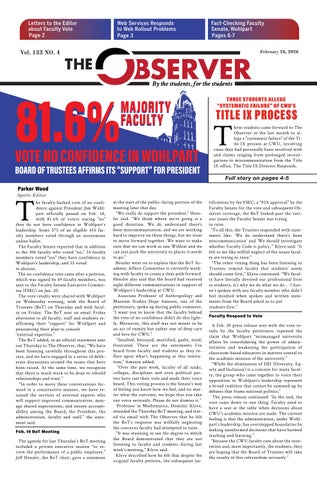
The faculty-backed vote of no confidence against President Jim Wohlpart officially passed on Feb. 18, with 81.6% of voters stating “no” they do not have confidence in Wohlpart’s leadership. Some 375 of an eligible 455 faculty members voted through an anonymous online ballot.
The Faculty Senate reported that in addition to the 306 faculty who voted “no,” 34 faculty members voted “yes” they have confidence in Wohlpart’s leadership, and 35 voted to abstain.
The no confidence vote came after a petition, which was signed by 49 faculty members, was sent to the Faculty Senate Executive Committee (FSEC) on Jan. 20.
The vote results were shared with Wohlpart on Wednesday evening, with the Board of Trustees (BoT) on Thursday and with faculty on Friday. The BoT sent an email Friday afternoon to all faculty, staff and students reaffirming their “support” for Wohlpart and announcing their plan to consult “external expertise.”
The BoT added, in an official statement sent out Thursday to The Observer, that, “We have been listening carefully throughout this process, and we have engaged in a series of deliberate discussions around the issues that have been raised. At the same time, we recognize that there is much work to be done to rebuild relationships and trust.”
“In order to move these conversations forward in a constructive manner, we have retained the services of external experts who will support improved communication, manage shared expectations, and ensure accountability among the Board, the President, the administration, faculty and staff,” the statement said.
The agenda for last Thursday’s BoT meeting included a private executive session “to review the performance of a public employee.” Jeff Hensler, the BoT chair, gave a statement
“SUPPORT” FOR PRESIDENT
at the start of the public-facing portion of the meeting later that day.
“We really do support the president,” Hensler said. “We think where we’re going is a good direction. We do understand there’s been miscommunication, and we are working hard to improve on those things, but we want to move forward together. We want to make sure that we can work as one Wildcat and we can just push the university to places it needs to go.”
Hensler went on to explain that the BoT Academic Affairs Committee is currently working with faculty to create a clear path forward. Hensler also said that the board had received eight different communications in support of Wohlpart’s leadership at CWU.
Associate Professor of Anthropology and Museum Studies Hope Amason, one of the petitioners, spoke up during public comment. “I want you to know that the faculty behind the vote of no confidence didn’t do this lightly. Moreover, this stuff was not meant to be an act of enmity but rather one of deep care and love for CWU.”
“Insulted, betrayed, mortified, gaslit, tired, frustrated. These are the sentiments I’ve heard from faculty and students as they reflect upon what’s happening at this institution,” Amason added.
“Over the past week, faculty of all ranks, colleges, disciplines and even political parties have cast their vote and made their voice heard. This voting process is the Senate’s way of letting you know how we feel, and no matter what the outcome, we hope that you take our voice seriously. Please do not dismiss it.”
Professor in Mathematics, Dominic Klyve, attended the Thursday BoT meeting, and stated via email with The Observer that he felt the BoT’s response was willfully neglecting the concerns faculty had attempted to raise.
“It was stunning to see the degree to which the Board demonstrated that they are not listening to faculty and students during last week’s meeting,” Klyve said.
Klyve described how he felt that despite the original faculty petition, the subsequent jus -
tifications by the FSEC, a “92% approval” by the Faculty Senate for the vote and subsequent Observer coverage, the BoT looked past the various issues the Faculty Senate was trying to raise.
“To all this, the Trustees responded with statements like: ‘We do understand there’s been miscommunication’ and ‘We should investigate whether Faculty Code is policy,’” Klyve said. “It felt to me like willful neglect of the issues faculty are trying to raise.”
“The other vexing thing has been listening to Trustees remind faculty that students’ needs should come first,” Klyve continued. “We faculty have literally devoted our professional lives to students, it’s why we do what we do … I haven’t spoken with any faculty member who didn’t feel insulted when spoken and written statements from the Board asked us to put students first.”
A Feb. 20 press release sent with the vote results by the faculty petitioners repeated the claim that Wohlpart “mismanaged university affairs by consolidating the power of administration and weakening the participation of classroom-based educators in matters central to the academic mission of the university.”
“While the elimination of DEI (Diversity, Equity and Inclusion) is a concern for many faculty, the group who came together to voice their opposition to Wohlpart’s leadership represent a broad coalition that cannot be summed up by debates that frame national politics.”
The press release continued: “In the end, the vote came down to one thing: Faculty need to have a seat at the table when decisions about CWU’s academic mission are made. The current feeling is that the administration, under Wohlpart’s leadership, has overstepped boundaries by making uninformed decisions that have harmed teaching and learning.”
“Because the CWU faculty care about the institution and, most importantly, the students, they are hoping that the Board of Trustees will take the results of this referendum seriously.”
LDear Trustees,
I write to you as a former Chairman and member of the Board of Trustees at Central Washington University, a graduate of the University and a native son of Ellensburg. During my tenure on the board, I developed friendships with several faculty members which have continued after my service at the University. Consequently, I am aware of the recent Vote of No Confidence in President Wohlpart and the gravamen of the complaints at the heart of the no confidence petition. I also follow and read the student newspaper, The Observer, and am aware of student concerns. A copy of a recent Observer editorial is attached.
to leadership. Titles and stations do not confer leadership. Nor does gratuitous language.
I know the Board of Trustees takes the Vote of No Confidence seriously. As fiduciaries we owe the institution all the care we can muster when weighing the risks it faces from a Vote of No Confidence and student concerns. There are real risks including accreditation, student, faculty and administrator recruitment, morale, public and legislative perception and more. In crafting a way forward, it will be wise to engage the faculty leadership in the form that path will take. Use shared governance to discover the best path.
E D I T O R T O
E T T E R T H E
In my conversations with faculty friends I know they view their complaints very seriously and they have not taken their actions lightly. I was stunned to learn that the Vote of No Confidence obtained over 82% participation from eligible faculty voters and 81.6% indicated that they have no confidence in President Wohlpart’s leadership. These results create serious liability for the institution.
Shared governance must be genuine. During my tenure we had meetings between Trustee and Faculty Senate leadership in unfettered sessions that were open, honest, direct and supported by the then President. There is no substitute for that approach. Executives who are uncomfortable with genuine shared governance can make no claims
To the Editor,
I would like to share my reflections on this article
[“Wohlpart accused of ‘authoritarian’ leadership”The Observer, Feb. 12] in light of Thursday’s Board of Trustees meeting. It is my understanding that the BOT had already received the results of the vote of no confidence.
The tone and level of camaraderie displayed among the Board, members of the administration, and President Wohlpart conveyed an atmosphere of unwavering support that seemed to overlook the gravity of the concerns brought forward by faculty. The lightheartedness and jocular remarks directed toward the audience appeared to signal a dismissal of the very real issues raised by those who feel unheard, unrepresented, and unsupported.
Many faculty continue to shoulder increased
In addition to taking the actions expected of strong board leadership you should also ask yourselves how the current state of affairs reached this level without your awareness. The University President bears that responsibility. In my view, you, not a third party, need to explore any ethical violations or violations of policy that have been asserted by the petitioners. The buck stops with the Board of Trustees on those issues.
Thank you for your service and your thoughtful consideration of this serious matter.
Ronald P. Erickson Attorney at Law
workloads and responsibilities with little acknowledgment of their ongoing dedication to the university and its students. Given the posture demonstrated during the meeting, there is little reason to believe that those who remain aligned with President Wohlpart will make any meaningful effort to engage with faculty or work collaboratively toward a constructive path forward.
I appreciate The Observer’s continued coverage of this situation and hope that future reporting will help illuminate the experiences and perspectives of the faculty who are striving to uphold the mission of CWU amid these challenges.
Kelly Zakel-Larson Administrative Assistant


Ethan Kennedy Scene Editor
n the fall quarter of 2023, CWU’s Web Services released a newly implemented website, completely overhauling the previous design. The website originally faced multiple dead ends and nonfunctioning pages.
The recent Faculty Senate Executive Committee (FSEC) justifications supporting a vote of no confidence against President Wohlpart cited the website rollout in 2023 as an example of administration not meaningfully engaging in shared governance.
“The FSEC notes that the new website was implemented in fall 2023 prior to the resolution of several functionality concerns raised by faculty, including the absence of a functioning directory, hindering faculty and staff from locating essential personnel information and raising concerns that students, both prospective and current, were unable to obtain the information they needed.”
“When the website directory launched later that fall, it displayed multiple, redundant profiles for some individuals, prompting concerns that viewers would be confused and potentially miss important information,” the petition continued. “During summer 2024, almost a year after the website rollout, multiple administrative applicants for the provost position mentioned that they were unable to locate basic organizational information about CWU while researching the institution.”
The Observer interviewed Web Services Director, José Romero, who led the rollout process, about the design and challenges faced during its implementation. The following is the Q&A, edited for length and clarity:
Q: When implementing the new website in 2023, what improvements were made to ensure a more efficient rollout? What were the criteria, if any?
A: During the 2023 website implementation, several improvements were made to ensure a more structured and efficient rollout process. The focus was on communication, stakeholder engagement, content preparation, and defined migration criteria. Key milestones were communicated throughout the rollout process to ensure visibility and reduce uncertainty. These updates helped clarify timelines, expectations, and upcoming changes.
Prior to the 2023 rollout, the website ecosystem contained over 130,000 indexed pages and files, including orphaned pages, outdated documents, and legacy assets. Since the rollout, large volumes of unused and outdated content have been removed or consolidated. The digital footprint of the website is now less than 15,000 published pages and files. This has reduced institutional risk, improved search accuracy, and created a cleaner and more manageable web presence.
Q: What were some challenges you faced leading up to the website’s launch in fall 2023? Were there reasons in particular that the directory was not fully functional?
A: At the time of launch, the directory did not exist in its current integrated and structured form. The previous directory operated as a static table-based listing that displayed name, position, department, email and phone/contact information. The September 2023 modernization effort did not migrate these manual table structures directly into the new environment. Instead, the directory was restructured into a centralized location on the website.
By October 2023, the directory was updated to allow content managers to include faculty and staff directories within their own websites using standardized components. Subsequent improvements, including alignment of faculty and staff listings with institutional systems of record, have been rolled out on a quarterly basis. The primary challenges leading up to launch were scale, legacy technical debt, system integration dependencies, and architectural modernization. The directory was rebuilt rather than migrated in its prior form to support long-term stability, accuracy, and maintainability.
Q: Following the alleged premature launch of the new website in 2023, faculty reportedly asked for any form of acknowledgement and were denied for long periods of time. What will the approach be surrounding web changes moving forward, will faculty be consulted, and can they rely on open communication about these changes?
A: Some have expressed concerns about the timing and communication surrounding the 2023 website launch. The launch itself was a significant operational transition, and while the distributed governance model did not change, the scale of the update highlighted areas where communication could have been clearer and more consistent.
Since that time, Web Services has strengthened how we communicate changes and how faculty and staff can engage with us. Moving forward, faculty can expect advance notice of significant changes, clear explanations of what is changing and why, ongoing opportunities to ask questions, and direct access to Web Services through meetings, email, and Teams. Web Services is committed to open communication, transparency, and continued improvement in how we manage and support the CWU website.
Q: Could there have been any sort of miscommunication between faculty in regards to the titles and labels set on the staff directory occasionally providing misinformation?
A: Yes, it is possible that miscommunication or data discrepancies contributed to instances where titles or labels in the staff directory did not align with current roles. The staff and faculty directory relies on various data sources. In most cases, job titles and position information originate from institutional systems of record.
Q: Has the cost/efficiency for the new website improved from the previous website?
A: Yes, the current website environment is more operationally efficient and sustainable than the prior environment. The previous site was hosted on-premises and required local server maintenance, infrastructure management, and ongoing hardware support.
The new website is hosted in a secure cloud environment, eliminating physical server costs, reducing internal maintenance demands, and improving scalability and reliability ... Overall, the current model is more secure, more resilient, less resource-intensive, and better aligned with long-term sustainability goals.


Brandon Mattesich Editor-In-Chief
Due to the ongoing nature of the three students’ Title IX cases and/or respective legal situations, which could be negatively affected or nullified by their names being shared in this story, at their request and at our own discretion, The Observer has granted all three anonymity.
Three students came forward to The Observer in the last month to allege a “systematic failure” of the Title IX process at CWU, involving cases they had personally been involved with and claims ranging from prolonged investigations to miscommunication from the Title IX office.
The Title IX office at CWU is responsible for handling cases and investigations “prohibiting sex-based discrimination,” including sexual harassment, sexual violence and gender-based discrimination.
All three students, here labeled Students A, B and C, said they are involved in cases revolving around sexual harassment, violence and/or abuse, and have been in active investigations with the Title IX office following their own reports. They provided in-person evidence to The Observer to substantiate their claims.
“No one has had an experience where they felt fully supported by the university … [and] situations where rape allegations weren’t being taken seriously,” Student A alleged. “I have met a lot of women who said that. I feel as if they took my situation seriously because it was so extreme.”
Despite differences in their investigations and timelines, the students each independently shared the same main grievances with the Title IX process: prolonged cases, communication failures, a lack of support and understaffing.
Public allegations against the ability of CWU’s Title IX office to effectively handle cases date back to 2022, when various student experiences led to the creation of a student-run advocacy group, Cats Against Assault, which remains active today.
In 2023, the university created the Gender-Based Violence Prevention Workgroup: CWU SAFE, a working group to address Cats Against Assault’s complaints.
In an email interview with The Observer, CWU’s Director of Civil Rights Compliance and Title IX, John MacArthur, addressed some of the allegations against the Title IX office and took responsibility for others, stating that Title IX at CWU is “immediately” looking to improve their communications.
“I do want to acknowledge, and take responsibility, for long wait times between communications, and this has been an issue that I am working hard on improving immediately,” MacArthur said in the email. “On top of the large caseload our office deals with, and the vacant position that increased workloads on existing staff in our office, CWU recently switched to a new case management system. As a result, I have not been able to adequately track cases and [inform] parties of delays and updating them on the status of their
case while we are adjusting to the transition and setting up new processes.”
“I want the campus community to know that I am committed to doing better, and I believe our new case management system will actually help us address those issues,” MacArthur continued.
Student A stated that she was in a situation in which she was physically, sexually and emotionally abused by a past partner, while she was underage. She claimed that she submitted photo evidence to Title IX of child sexual abuse material (CSAM) that she had found on the accused’s phone.
Further, Student A said she reported the CSAM immediately to PATH, a campus office which provides confidential advocacy and support for students who have experienced sexual harassment, stalking, intimate partner violence, domestic violence or sexual assault. She said PATH put her in contact with the police and the Title IX office. “I am still in an ongoing investigation with Title IX since November, over someone who has committed felony charges and is now waiting on prosecution,” Student A said.
Student A added that she felt the police handled her case really well but noted that “legal repercussions and academic repercussions are two separate entities.” Student A claimed that so far there have not been nearly the same academic repercussions against the individual as there have been legal repercussions. “The most disciplinary action that did come out of this was a suspension,” Student A said. “But they [CWU] have yet to decide if an expulsion even makes sense, which, for me personally, I don’t think it is reasonable to allow pedophiles to not be expelled.”
All three students who came forward with their stories alleged that they had faced prolonged Title IX cases in which resolutions were not provided in a timely or “supportive” manner.
“All of the other women I’ve talked to who have also had Title IX cases, it is the consensus that it is completely unfair how much time we [CWU] take to conduct these investigations, especially when there’s explicit evidence,” Student A said. “I had screenshots of all of the things I have found and even with that, it was not substantial for the university to conduct an expulsion yet, which is so ridiculous.”
Another student involved with Title IX, Student B, said, “With my case, because there was such a gap in communication, I didn’t hear anything until late January, after the report was initially filed in November.”
Due to the alleged 2.5-month delay in communication, Student B said, their situation escalated and what they originally reported to Title IX as a fear became a reality, with their case progressively getting more severe as they awaited support from the Title IX office. Student B claimed harassment from their stalker increasingly got more aggressive over the time of the alleged pause in communications.
“It shouldn’t have had to escalate, because the whole reason that I filed the report was to prevent exactly what ended up happening from happening, but because it took so long to get back, the entire reason that I filed the report ended up
happening anyways,” Student B continued. “[It’s] not that I expected an immediate fix or conclusion, I knew it was gonna take some time, but to even just get the process started, two and a half months is just a crazy wait time for any kind of correspondence.”
Student A shared a similar sentiment, stating that her problem wasn’t just with the timeline of their case, but with the lack of action being taken by CWU’s Title IX department.
“The reason I wanted to speak about my story is the fact that they [Title IX] haven’t taken nearly as much action as they should have,” Student A stated. “This person [the accused] had, I think, six other Title IX cases against them that I had no idea about when I was in the relationship with them, and the fact [is] that each case was getting progressively worse and worse until my situation, [which] was when the university took initiative. So my issue isn’t with being heard, it’s with taking action.”
MacArthur responded to the allegations about prolonged cases, stating, “Our goal for Title IX cases for the entire investigation and resolution process is 90 calendar days. For non-Title IX discrimination cases, the investigative timeline is 20 working days for student complaints and 30 working days for employee complaints.”
“However, the length of the investigation often depends on the complexities of the case,” MacArthur continued. “We try to give some flexibility for complainants, respondents and witnesses to have the opportunity to participate with their schedules … but we have recently made the decision to enforce more strict deadlines for parties to participate to reduce the amount of time in the interview phase. We must always balance being prompt with being thorough.”
All three students alleged a lack of communication, or ineffective or inaccurate communication, from the Title IX office that led them to feel unsupported by the process.
“They [Title IX] are supposed to notify me when said person does go on campus, and also the other people who have Title IX cases with this person,” Student A said about the accused in her case, but “they haven’t alerted us properly when he is and isn’t on campus.”
“He was on campus sometime about three months ago, and he had contacted Central police to escort him around, but with his suspension, Title IX is supposed to reach out to all of us and let us know that he will be on campus as he has committed such violent acts against so many people,” Student A continued. “They only notified us a week after he had been on campus … and they apologized in their notification to all of the Title IX holders against this person saying, ‘Oh, we apologize. We did not let the people know who needed to know. That was a failure on the university’s part.’ But it did feel like they were sweeping it under the rug that they had just made a mistake.”
Student B and another student with an active Title IX case, Student C, cited similar scenarios.
“The exact same thing happened to me as well,” Student C said. “We were supposed to be notified of this person who had been trespassed from campus for being a dangerous individual. [The person had] submitted a request through Housing to clean


out their apartment, and I was notified about it a few days after it had happened, not before it had happened. So if I had been on campus at that time, I may have encountered this person just out and about, even though they were technically not supposed to be on campus.”
MacArthur commented on a lack of communication and potential miscommunications. “Students who are currently involved in a case are often still attending classes on campus. If a student were to be trespassed, they are required to contact the university and receive approval to come on campus and would be accompanied at such time by university staff and/or CWUPD.”
“Regarding the claim about conflicting information being provided by different members of the Title IX office, this is difficult to address without knowing the specifics,” MacArthur continued.
“Our office follows, and is guided by, our campus policies and procedures, and we make a point of walking parties through both so they are fully informed about their rights and options throughout our processes.”
All three students shared similar sentiments about what they deemed a lack of support from the Title IX office, stating they did not feel that their cases were taken seriously as quickly as they should have been, and asserting that they’ve spoken to people with less extreme cases who have faced similar struggles having their cases taken seriously.
“I’d like other women to be heard, first and foremost, to have their stories taken seriously again,” Student A said. “Had stories been taken seriously before it got to me, [my case] wouldn’t have been as severe as it was. And I’d like more academic disciplinary actions … If they were only willing to do a suspension for a case as severe as mine, I could only imagine how less taken seriously everyone else is.”
Student C echoed this sentiment about their own personal case, stating that in the beginning it felt like there was almost nothing they could do to have their situation taken seriously. “It legitimately felt like the only way to get them to take my case seriously would be for him to shoot me in the face in a public place,” Student C said. “I was reporting him going to my work trying to get me fired from my jobs, harassing me, defaming me online, recording all of those things, being like, ‘I do not feel safe.’ I have had to get a taser. I’ve had to get a security camera. I can’t walk home alone at night. And they [the Title IX office] were just like, ‘Dang, that’s crazy.’”
Student B also shared that they felt there was a lack of empathy throughout the whole process which left them feeling uncomfortable and nervous to continue their case. “I understand that when investigations are initially happening and
Kyley Glenn News Editor
Resources for reporting crimes locally
CWU Police
1211NWildcatWay,Ellensburg,WA98926
509-963-2959(thisnumberisfornonemergencies)
Confidential Resources
Studentscanseekconfidentialsupportthrough campuscounselingservices,whichdonotrequire reportingtotheTitleIXcoordinator.
the process is getting started, remaining impartial is important,” Student B said. “But also people who are making reports, that’s a lot for them, and that’s a big process … To just go in there and feel like you’re being interrogated … it’s just a very big lack of support.”
“People going through Title IX especially, that’s messed up stuff, especially to the point where they felt like they needed to go and report it,” Student B continued. “And it feels like there’s just a lot of hoops that you have to jump through, so many different meetings to go to, just to get very basic answers for anything. And that’s just answers, not even a solution.”
All three students alleged that the understaffing of the Title IX office, including vacant positions, led to their feelings that the Title IX process had “failed” them.
“Understaffing has been a huge issue,” Student B said. “It sucks because it’s rarely a specific person’s fault. You can’t pinpoint blame on anyone. It’s just really a part of a bigger systematic failure from the school, because clearly, something’s up if they can’t keep staff.”
Student A stated that the most help they were able to get was through PATH, which, according to Student A and Student C, is also understaffed.
“I definitely think that more resources should be given to the Title IX case team,” Student A stated. “The only person who interacts with students on campus is just one person who works at PATH, and she is wonderful and lovely, but because they are understaffed and under-resourced, they don’t have the amount of support that they need for their students. And if anything, more resources should be put that way to get more staff on PATH’s team.”
Student C also said that they hope the Title IX office will get a bigger staff, along with better training and a better understanding of how it feels to be a victim in these situations. Specifically, Student C said that they should train Title IX employees on “how to speak to victims and what they’re going through, and help them have a bit more empathy for the situation.”
In his email response, MacArthur said, “The investigation timelines are not an uncommon problem for Title IX offices, both locally and nationally… However, I want to be clear that it is still our responsibility to ensure that our cases are resolved as promptly as possible, that our office is aware of the investigative lengths, and that we are doing our best to reduce the time it takes for the formal resolution process.”
“Unfortunately, our office has a vacant Civil Rights Investigator position that resulted in more workload on existing staff, which has ultimately resulted in longer resolution times,” MacArthur continued. “Thanks to President Wohlpart’s commitment to ensuring our office has the nec -
Resources for receiving support
CWU Counseling services
509-963-1391
Domestic Violence/Sexual Assault Helpline
1-800-562-6025
Crisis Line (Central Washington Comprehensive Mental Health)
509-925-9861or509-925-4168
National Crisis Hotline
1-800-799-7233
essary resources to address the university’s needs, the Office of Civil Rights Compliance is very well staffed compared to similar Title IX offices (some only include a single Title IX coordinator) … We have also contracted with external investigators as needed to help with any additional workload.”
All three students expressed that they still have hope for change within the Title IX process, but that they have never heard a positive experience come out of the current system.
“I have never spoken to another person on campus who has been through a Title IX investigation at Central and had basically anything positive to say about how they handled their case,” Student C said. “It feels like an overwhelming amount of the weight of getting anything actually done with the investigation is put on the victim, and absolutely none of it is put on the person being investigated.”
Student B agreed. “There’s just so much pressure put on the victims, and they’re already in such a pressing situation that so many people end up just dropping the case entirely or dropping from school because they just can’t handle it.”
“It’s way too common of something to be happening for every single one of them [the cases] to be handled as poorly as they are,” Student B added. “Not a single person [I’ve talked to] has had anything exceptional to say about the process.”
Both Students B and C stated that if they did not have so many friends, clubs and activities tying them to CWU that they would have dropped out or transferred universities, and that they know people who have done so allegedly because of a mishandling of Title IX cases.
“If I didn’t end up getting moved [away from the accused], I fully intended on transferring at the end of the quarter, which sucks, because I love this school,” Student B said. “I’m really glad that I’m here, but there’s a lot of things where you’re making it really hard to love this school as much as we do. Especially being really involved on campus, … you see the absolute best, and then you also see the absolute worst when you’re involved with stuff like this.”
Student C offered advice for others in similar situations. “If someone is reading this article and they’ve had something happen to them, I don’t want this to be a deterrent for them to report something. If you feel like that is going to be something that will help you, especially if you are actively in a position where you don’t feel safe, report it. Once you get to the people you need to be with, they will do their best to help you. It’s just wading through the bureaucracy of everything that can be really difficult, but there are resources like ASPEN (Abuse Support and Prevention Education Now) and PATH.”
Planned Parenthood of Central WA
312NPine,Ellensburg (509)925-7113
Aspen Victim Advocacy Services offered by Comprehensive Healthcare in Kittitas County
707NPearlSt,Ellensburg,WA98926 901E11thAve,Ellensburg,WA
Anonymous Reports
S tudentsmaysubmitanonymousreportsvia theConcernandSupportformfoundonlineat CWU’sofficialwebsite.

Brandon Mattesich Editor-In-Chief
President Jim Wohlpart’s Feb. 10 email to all CWU faculty disputed several of the justifications for the no confidence vote laid out by the Faculty Senate Executive Committee (FSEC). These contradictory claims involved procedural practices and administrative decision-making at CWU.
The Observer broke down the contradictory allegations by both Wohlpart and the FSEC by working through the referenced meeting minutes and available public documents in an effort to fact-check each body’s claims surrounding the vote of no confidence.
Minutes were consulted from all Board of Trustees (BoT) meetings in May, July and October 2025 and Faculty Senate minutes starting May 2025. Additional emails from the BoT, Wohlpart and strategic communications were reviewed, as were relevant CWU policies and past Observer coverage.
The online version of this story addressses additional claims by Faculty Senate petitioners alleging an "effort to marginalize faculty governance."
In their justifications, the FSEC cited multiple allegations pertaining to the creation of the 2025 Shared Governance document that was later used to rationalize the changing of the faculty code.
The FSEC alleged that the document was created with “limited faculty representation and without meaningful consultation” and further claimed that it was created without Faculty Senate approval.
Wohlpart directly responded to these claims in his email to all faculty, stating that “the original committee (in the first two years) was composed of both faculty and administrators in equal numbers … The largest majority of Shared Governance Committee members were faculty.”
He went on to state that “as with vision and mission statements, Faculty Senate does not have the authority to approve a document like the Shared Governance document, though the faculty members on the committee did, in fact, consult with Faculty Senate to get their feedback, which was then incorporated into the final document.”
According to the Shared Governance Committee’s official webpage, at least by the end of the creation of the new document, faculty members made up the majority of the membership of the Shared Governance Committee.
In their initial justifications for the faculty petition, faculty members at CWU alleged that Wohlpart had attempted to marginalize faculty governance and representation at the university through a process of revising the faculty code under policy put in place by the new Shared Governance document.
“This effort to marginalize faculty governance is also evident in the development and approval of the recent 2025 Shared Governance document which President Wohlpart advanced through a committee with limited faculty representation and without meaningful consultation with faculty or approval by the Faculty Senate,” the petition states. “Although the document was created outside established shared governance processes,
Additionally, the Faculty Senate’s official meeting minutes from their March 5, 2025, report indicate that a 20-minute time slot was allotted for the presentation and discussion of what was at the time a draft of the Shared Governance document that would later be implemented by the BoT.
In the BoT and Faculty Senate meeting minutes reviewed, details surrounding the implementation strategy of the new Shared Governance document were largely undefined, especially in its relation to faculty code. The Shared Governance document also forwent a Senate floor vote, which was not mandatory for the process to be authorized but was a formal option for the creation of the document that the administration chose to forgo.
Wohlpart's broader claims about majority representation and authority are both supported by the publicly available meeting minutes and policy guides at CWU, meaning that no technical procedures were violated in the creation of the new Shared Governance document.
That said, it does appear that Faculty Senate consultation surrounding the new Shared Governance document was limited in time and nature, as faculty membership on the committee is distinct from direct Faculty Senate consultation, giving credence to the FSEC’s claim that “meaningful” consultation might have been “limited.”
and despite explicit assurances that it would not replace the faculty code, President Wohlpart now asserts that existing policy and Code must conform to the new document.”
Wohlpart responded to these claims directly in his email response, stating, “In the July 2025 Board of Trustees (BoT) meeting, when the trustees reviewed their evaluation of my performance and provided me with goals for the upcoming year, the BoT stated that the Shared Governance document would be used to review and revise all of our structures, systems, policies and practices, and they repeatedly stated that we should do this work collaboratively. This was not an assertion that I made, but a goal and directive that they gave me in their public meeting.”
Further, the FSEC stated in their justifications that Wohlpart had repeatedly asserted that a committee consisting of three faculty members and three administration members was to be
created and tasked with the revision and creation of the new faculty code in accordance with the Shared Governance document. The FSEC alleged that Wohlpart stated that the creation of this committee was a directive given to him by the BoT, but the FSEC detailed that they were unable to locate that directive themselves.
The Board of Trustees did issue a broad directive to Wohlpart in their July 2025 meeting minutes, which state that “in the coming year, we are tasking the President with making this [Shared Governance] document a living document across the university, considering all administrative, staff, faculty and student practices, policies, and procedures, as well as writing new documents based on what is stated in the shared governance document.”
In the original faculty-backed petition, the FSEC claimed that “the President indicated that his unilateral changes to the University’s mission and vision statement in early 2025, which lacked robust and representative faculty consultation, were not necessitated by changes in federal politics, but later claimed that was in fact the reason.”
This specific allegation is used as an example of the larger complaint shared by the faculty petition, that “President Wohlpart has abandoned his responsibility to lead the University community. His tenure has been marked by a lack of transparency, inefficient communication and stagnation.”
Wohlpart also directly responded to some of the allegations surrounding his changes to the Mission, Vision and Values (MVV) statement in 2025, stating in his response email that “The only entity that has the authority to approve vision and mission statements is the Board of Trustees; they did so at their May 2025 meeting.”
“The committee that worked through the changes to the vision and mission was composed of all our shared governance groups, including the Faculty Senate Chair, who were responsible for communicating with and gathering feedback from their constituencies,” the email continued.
Wohlpart then went on to describe the different approaches the university took in the creation of the MVV statement in 2022, compared to the revision of the statement in 2025. “In 2021-22, the committee, which included faculty representation, studied those practices, learned how to write meaningful and impactful vision statements, and then spent a great deal of time in open forums educating the rest of the university community and gathering feedback on what should be the focus of our own
The BoT later explicitly clarified in an email sent out Jan. 30 that the new Shared Governance document would be used to align faculty code with its new values and policies.
However, the original July 2025 BoT meeting minutes never mention the new Shared Governance document’s ability to change policy in the “faculty code” specifically. The minutes broadly mention that the Shared Governance document will be used in relation to “faculty” across the university. The specific clarification that the Shared Governance document was to be used to revise faculty code directly was provided in a subsequent email by the BoT in late January, six months later.
Additionally, neither the July nor October 2025 BoT meeting minutes ever explicitly mention a directive to Wohlpart advising the creation of a committee composed of three faculty and three administrative members to
aspirational vision statement,” Wohlpart stated in his response email.
“All of this learning was part of the process we used to update our vision statement in 2025,” the email continued. “We did not need to review best practices or gather extensive feedback from the community because we were able to build on the work and learning that had already been completed.”
In the May 2025 BoT meeting minutes, it is detailed that the BoT did approve the changes to the MVV statement following proposed revisions created through a Shared Governance Committee created specifically to revise the MVV statement.
That committee also did retain the membership of the Faculty Senate chair, according to two university-wide emails sent out by Wohlpart on March 18, 2025, and April 4, 2025, which detail the membership of the group and outline the goal of making changes to the MVV statement.
Also contained in the numerous emails detailing the revision process of the MVV statement in early 2025 are differing rationales for why changes were being made. The most frequent reason given was due to changes to policy at the federal level, specifically following the federal prosecution of other colleges in which funding was withheld following acts of protest or references to “DEI (Diversity, Equity and Inclusion)” language.
While the faculty petition claimed that Wohlpart's changes to the university’s MVV statement were “unilateral,” it is clear from the
written record of meeting minutes and emails that the changes were facilitated through a committee that worked together to review and provide changes to the document, and were subsequently approved by the BoT.
It is also clear that the changes responded, at least in part, to regulation and policy shifts at the federal level. As Wohlpart told The Observer for a March 13, 2025 article on changes to federal policy, “What’s in the Dear Colleague letter and the FAQ that came out afterward is taking a certain interpretation of federal law and court cases that is different from what has happened in the past. So we are being very thoughtful in gathering people together to think deeply about all that stuff and have a conversation about what changes we might make.”
Wohlpart's own response to the faculty petition disputes the FSEC’s claims that changes to the MVV statement represented an example of "his authoritarian nature." However, the petition uses the MVV changes to exemplify a "lack of transparency" and "inefficient communication," which Wohlpart's email does not address.
The faculty petition’s claim that the changes to the MVV statement lacked “robust and representative faculty consultation” would seem to be supported by the public documents detailing the committee's process and timeline of creating and implementing the MVV statement’s changes. This can primarily be seen in the committee’s top-down representational structure, in which the burden of direct consultation is placed on members of the committee, and not on Wohlpart or other administration, which led to limited discussion at Faculty Senate meetings, as shown in their March 2025 and subsequent meeting minutes.
revise the faculty code. If this specific group's creation was a directive from the BoT, it was not one expressed in BoT meeting minutes.
Conclusion: Truth to Both Claims
Based on the available meeting minutes from the October and July 2025 BoT meetings and their respective agendas, it is clear that Wohlpart did receive a broad objective from the BoT to create a new Shared Governance document. In operationalizing this broad directive from the BoT, Wohlpart then appears to have used his executive authority to bypass traditional Faculty Senate review guidelines, which mandate that any changes to the faculty code must go through a formal, faculty-led consultation and voting process, and began the process of realigning faculty code with the new Shared Governance document.
Due to the broad nature of the BoT’s initial directive delivered to Wohlpart, it is likely that using the loose authority granted by the directive to implement the new Shared Governance document to create a committee whose goal it was to revise faculty code was done in line with BoT approval. It was also a step outside traditional Faculty Senate processes that was never explicitly outlined in the BoT’s public directives, leaving limited access to members of the Faculty Senate to understand or review the new processes, as they claimed in their petition.
The creation of a 3-to-3 ratio group of faculty to administration that would be used to revise the faculty code was also never directly outlined in the BoT’s public directives during either the October or July 2025 meeting minutes, which puts into question the origin of this objective under the public BoT’s guidelines.


compete and guys who could help the team,” Richardson said. The coach spoke on the 29-athlete turnout, stating, “we have more guys here, like this was an awesome turnout. We’re super excited and happy with it.”
Power and Richardson both gave their thoughts on the performances of the different positional groups. “I was impressed by some of the defensive line numbers,” Power said. “Normally the bigger people are harder to find. We wound up with a pretty good turnout, linebacker wise.” Richardson gave praise to “all skill guys, between defensive backs and wide receivers.”
Many athletes of different sizes came together from different areas with the common goal of joining the GNAC champions. Among the athletes was Kaden Thompson, a freshman majoring in applied mathematics trying out for the Defensive Line. The 6-foot-4 South Hill native tried out “to play football and have a brotherhood.” At the end of the tryouts, Thompson felt confident in his performance. “I think I did all right. Just out here trying to glorify God with my body … But if not, then that’s how it goes,” Thompson said.
receiver, having experience from playing at Renton High School. An athlete in both football and track and field, Le took time between High School and College to train with different athletes. That time gave Le insight and inspiration to show up to tryouts.
people from CFL, NFL, it inspired me to just get out there and just play football,” Le said. Speaking on his performance at the tryouts, Le said, “I gave it my all. I could be better, but I gave it my all and let it all out on the field.”
looking for “guys that love football and want to be a part of our program. If there’s someone here that has a chance to make our team better, and there’s a lot of ways to make the team better, but that’s what we’re looking for, an opportunity for us to improve.” The former CWU Defensive Coordinator turned Head Coach led the athletes in stretches before overseeing the rest of the tryouts.
Richardson agreed with Power’s sentiment on what they were searching for. “It was looking for guys who want to be Wildcats, who came out to
Another hopeful athlete was freshman Yesser Arteaga Cruz. A Major in Business, Arteaga Cruz plays forward for the men’s Rugby club and tried out for linebacker and defensive end, but is willing to jump to any position that the team needs. Arteaga Cruz tried out because “my friends and I really want to play on this football team.” On his performance, the 6-foot-tall Bellevue native said he felt nervous, but that he thought he performed well.
Steven Le, a Business Admin Major, also tried out, but on the offensive side of the ball. The Sophomore worked out as a wide

tryouts, Power gathered all the athletes together, sharing that even if not everyone comes back as an athlete, there are always ways to help the team.

Meisner Dunlap Staff Reporter
This past year, Ellensburg has faced flooding, smoke and extreme heat hazards. The Ellensburg Environmental Commission won Tree City USA and Growth Awards, but it continues to generate ideas for making its community more environmentally friendly.
The commission met on Wednesday, Feb. 18, at 5:15 p.m. to update each other on recent sustainability successes and upcoming improvement plans.
The Arbor Day Foundation created Tree City USA 50 years ago to promote trees in communities. Erin McGowan, the water and storm program coordinator for the city of Ellensburg, said her town was the first Tree City in Washington.
“We’ve started this larger urban forestry project that’s grant-funded, and we’re working on an urban forest management plan and updating our tree ordinance,” McGowan said. “That involves a lot of public outreach.”
The Growth Award recognized Ellensburg’s success in going above and beyond the Arbor Day Foundation’s Tree City USA requirements, McGowan stated.
“All of the trees within the city limits of Ellensburg make up the urban forest, no matter where they are,” McGowan said. “What we’re looking at is mostly the trees in the public right of way, so street trees and then trees in parks and city facilities.”
Additionally, the Environmental Commission promotes planting trees on private property in appropriate locations and circumstances.
The commission frequently updates its recommended tree list for urban planting. Creating the list involves identifying trees that thrive in arid climates such as Ellensburg.
The city of Ellensburg completed many projects that helped it earn its Arbor Day Foundation awards. For example, the Environmental Commission honors Bike Month every May to encourage citizens to drive their cars less and ride their bikes more.
“The League of American Bicyclists promotes it nationwide, and they promote Bike Month,” Nancy Lillquist, the council liaison to the Environmental Commission, said. “Ellensburg has been a bicycle-friendly community since 2015.”
“There’s a process that you go through that you have to show that you encourage biking, and Bike Month is one way that we meet that requirement [and] to maintain our silver-
level status as a bicycle-friendly community,” Lillquist continued.
The Environmental Commission will host its annual Bike Month event on Saturday, May 30. “Our goal is to become a gold-level community, and part of that is through education and outreach, which is what this event is mostly focused on, to provide safety equipment that’s free to the community,” Commissioner Brenda DeVore said. “We do helmet donations to kids and other riders, but also fit the helmets and provide bag bells and lights and good safe riding practices through educational materials.”
As part of its contract with Waste Management, the Environmental Commission hosts a collection and education-based recycling event every year. This year, the event will occur on Saturday, May 2, from 10 a.m. to 1 p.m., headquartered at City Hall.
“The idea of that event is to reduce the amount of garbage that’s going into the waste stream by giving people an opportunity to bring things that are hard to recycle and also receive education of how they can maximize the services that we do have in the community, so that they can be part of that diversion goal,” DeVore said.
According to Rebecca Springer, the water resources manager for the city of Ellensburg, the Environmental Commission, in partnership with Waste Management, collects “singlestream recyclables like plastic bottles and jugs and cardboard, aluminum cans, tin cans.”
“There will also be shredding services for secure document shredding,” Springer continued. “We will also be collecting professional clothing for reuse, for people who need it for interviews.”
Despite all its successes, the commission recognizes the need for further improvements to decrease the severity of Ellensburg’s various climate hazards.
“We’re in a valley, so we have a lot of streams running,” Springer said. Lillquist added that those streams naturally flood, meaning that any homes near them can easily get flooded.
Moreover, “we can provide spaces for people to go in extreme heat,” Lillquist said. “If there’s smoke and they don’t have a house that’s resistant to that, we can open Hal Holmes [Community Center] as a place to shelter.”
The Kittitas County Hazard Mitigation Plan includes an annex specific to the city of Ellensburg. Springer stated those plans guide the commission’s practices as they further operate the city.
“When arid climates with warmer temperatures are drier, that leads to more wildfires and more smoke hazards,” Springer said about the importance of understanding Ellensburg’s climate hazards. “If we understand the hazards, we can adjust our practices to live amongst those hazards yet remain safe and sustainable.”

February is the one month where Black voices, culture and pain are explored and amplified.
For some, it is just a regular month filled with mundane tasks and responsibilities, but for the Black community it is the time for celebration and liberation.
We have come so far since the days we were made to be slaves, and I’ve heard people start to question the validity of this month, stating “Do we really need it?” I say yes, because even though we have come so far, we are not finished in our fight against racism and prejudice.
This month is so important because it gives space for Black excellence to shine. I think our college has done a great job of hosting events showcasing the many milestones of Black entertainers, activists, and the power of Black art. A notable event that I’ve personally been to here on campus in light of Black History Month was the “Sinners” movie night. I think Central choosing that movie to showcase was very important, as “Sinners” in my humble opinion is a great representation of the Black experience.
Another event that was great this month was the speaker event with Jennifer King. Highlighting her voice was a wonderful thing to do, and having her speak here on campus was truly an amazing decision as it introduced more people to her that were maybe not familiar with who she was before and put her achievements on full display.
We have definitely come far in our journey toward peace and equality. Slavery was abolished, and there is no more legal separation, but when taking a look at our world, I still see injustice everywhere. Which is why months like these are still so important.
This month gives space for history to be reflected upon and for the Black community to grieve what our ancestors had to deal with and how we can make sure we never go through that again. Black History Month is the gateway to healing and overcoming the struggles we face as African Americans in today’s age. By having a month that specifically highlights the struggles as well as the accomplishments of Black people, we are opening up healthy conversation for all to join in.
Black History Month is more than just a month. It’s a statement, a testament to the ones who struggled before us. It’s an opportunity for us to educate the ones who are hateful and to invite in the ones who stand with us. Black History Month will always be important because racism and prejudice will always exist.
This world will always need educating, and that is what this month was created for. To educate and bring unity and peace into a world that is desperately needing it. As I stated before, we have come a long way, but the fight is far from over. Until the world has true equality and acceptance, this month will always be an essential one to pay attention to and celebrate.


