

![]()


different departments around CWU.
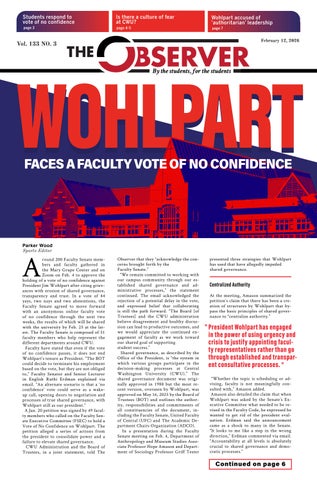
Faculty have stated that even if the vote of no confidence passes, it does not end Wohlpart’s tenure as President. “The BOT could decide to terminate his employment based on the vote, but they are not obliged to,” Faculty Senator and Senior Lecturer in English Ruthi Erdman explained via email. “An alternate scenario is that a ‘no confidence’ vote could serve as a wakeup call, opening doors to negotiation and processes of true shared governance, with Wohlpart still as our president.”
A Jan. 20 petition was signed by 49 faculty members who called on the Faculty Senate Executive Committee (FSEC) to hold a Vote of No Confidence on Wohlpart. The petition alleged a series of actions from the president to consolidate power and a failure to elevate shared governance.
CWU Administration and the Board of Trustees, in a joint statement, told The
Observer that they “acknowledge the concerns brought forth by the Faculty Senate.”
“We remain committed to working with our campus community through our established shared governance and administrative processes,” the statement continued. The email acknowledged the rejection of a potential delay in the vote, and expressed belief that collaborating is still the path forward. “The Board [of Trustees] and the CWU administration believe disagreement and healthy discussion can lead to productive outcomes, and we would appreciate the continued engagement of faculty as we work toward our shared goal of supporting student success.”
Shared governance, as described by the Office of the President, is “the system in which various groups participate in the decision-making processes at Central Washington University (CWU).” The shared governance document was originally approved in 1988 but the most recent version, overseen by Wohlpart, was approved on May 16, 2025 by the Board of Trustees (BOT) and outlines the authority, responsibilities and commitments of all constituencies of the document, including the Faculty Senate, United Faculty of Central (UFC) and The Academic Department Chairs Organization (ADCO).
In a presentation during the Faculty Senate meeting on Feb. 4, Department of Anthropology and Museum Studies Associate Professor Hope Amason and Department of Sociology Professor Griff Tester
presented three strategies that Wohlpart has used that have allegedly impeded shared governance.
At the meeting, Amason summarized the petition’s claim that there has been a creation of structures by Wohlpart that bypass the basic principles of shared governance to “centralize authority.”
President Wohlpart has engaged in the power of using urgency and crisis to justify appointing faculty representatives rather than go through established and transparent consultative processes. “ ”
“Whether the topic is scheduling or advising, faculty is not meaningfully consulted with,” Amason added.
Amason also detailed the claim that when Wohlpart was asked by the Senate’s Executive Committee what needed to be revised in the Faculty Code, he expressed he wanted to get rid of the president evaluation. Erdman said the announcement came as a shock to many in the Senate. “It looks to me like a step in the wrong direction,” Erdman commented via email. “Accountability at all levels is absolutely crucial to shared governance and democratic processes.”
Continued on page 6

This week was a lot of work from everyone on the team, and I want to thank each and every Observer staff member for all the contributions they put into this issue. As I’m sure you can tell, we put a lot of last minute effort into this week’s issue with how recent and ongoing many of the stories we covered are. It’s always a team effort putting together this weekly product, but this week especially called for all hands on deck and I couldn’t be happier with how it all turned out.
Outside of our issue this week, I have found this time of year to be particularly stressful, especially with midterms actively taking place in many of my classes, as I am sure they are for you all as well. Our story on seasonal affective disorder this week served as a good reminder for me to take some time for self care, and I’m always happy to get some stories like that in our paper.
News this week, as I talked about above, focused primarily on the Faculty Senate’s proposed vote of no confidence against President Jim Wohlpart, and the various allegations shared within their petition. We have coverage ranging from allegations of fear, intimidation, authoritari-


as
responses and a brief history of the
Scene and Sports were relatively brief this week, with coverage about S.A.D. (seasonal affective disorder) and how to combat the winter blues, as well as coverage of the historic Super Bowl win by the Seattle Seahawks. Both stories are about things that I enjoyed reading and think most other students will too! We also have a short review about “Iron Lung,” a film by none other than Markiliper himself.
Design this week was phenomenal, with our team really clocking in the hours to get these last minute stories and some truly amazing and uniform last minute designs. We had a lot of text and a lot of information to get across in our stories this week, and conveying that information effectively and efficiently is no small task for our team, but our team took it all in stride.


Brandon Mattesich Editor in Chief Ethan Kennedy Scene Editor
The Observer released a survey to collect students’ opinions of the Faculty Senate’s decision to hold a vote of no confidence against President Jim Wohlpart, and with Wohlpart’s leadership to date. The survey was shared both on The Observer’s Instagram and in person around campus. It received 53 total anonymous student responses. At the end of the survey, there was an open box for comments. These are the student responses:
Based on your own knowledge, how strongly would you say you’ve agreed or disagreed with Wohlpart’s Leadership?
The CWU Faculty Senate recently approved the holding of a vote of no confidence against President Wohlpart. Do you agree with the Faculty Senate’s decision?
“We need better leadership, someone that cares for the new generation of students.”
“It is genuinely disappointing to have an authority figure that we as students are supposed to trust to have our best interests at heart not even value the opinions of faculty. If he won’t listen to staff the next thing is students. In all, he would have nothing if not for the existence of students and staff, and his decisions need to mirror that.”
“Based on every single thing I’ve learned about him, he hasn’t done this university any good in the few years that I’ve been here. The major decisions that he’s made for this school have only negatively impacted the students.”
“As a creative writing student the choices he has made have really hindered my ability to be successful.”
“President Wohlpart talks each year about our school values, but I never see action taking place. If faculty do not feel confident in him, then something is clearly wrong”
“I think that Wohlpart’s ability to effectively lead has been declining. It absolutely appears that he does not hold the school’s best interests as a priority. I definitely think it’s time he either prioritize the school and increase the different departments’ budgets or step down and give the position to someone else who will.”
“I’m really disappointed with how Wohlpart has handled staffing, and how every time a staff or student group is laid off, it’s always followed by a bonus for him. As a student worker, I get nervous at the thought that some of the budgeting choices and attrition may affect my job and its security.”
If a vote of no confidence was held against Wohlpart for students to respond to, how would you vote?
“Wohlpart is using the excuse of shared governance to consolidate power and pretend like he cares about the opinion of others. Faculty know best how the school should be run, not administrators who aren’t present in classrooms.”
“He’s failed the World Languages and Cultures department and needs to step down so someone better equipped can take charge.”
“I have stated this to the Dean of my department; ‘I promise to unenroll from CWU if Wohlpart and the administration’s scheduling changes are implemented.’ Students need to be aware of their rights and that Wohlpart is not advocating for them (students), he is advocating for himself: image and legacy. He is copying a method of leadership that is based on authoritarianism: no shared governance, fear, installing friends in positions of power, etc. Wohlpart claims to want student enrollment? Well, maybe he should think of the students first, like the Faculty has done since the beginning.”

“INTIMIDATION,
Brandon Mattesich Editor-In-Chief
In this editorial, I share various stories that I have either discussed or witnessed in my six quarters reporting for The Observer, many of which would contain sensitive information about employees of the university if attributed. To protect their identities, at their request, and at my own discretion, any details of the stories which could lead to the exposure of their identities have been omitted.
In its justification for the vote of no confidence last week, the Faculty Senate Executive Committee claimed that President Jim Wohlpart “governs by intimidation, fear and retaliation.” This culture is something I have heard described many times, firsthand, during my time as Editor-InChief of The Observer.
Over a dozen members of the CWU staff, faculty and student bodies, across nearly every side of campus, have shared with me these two consistent and similar sentiments: they are scared of speaking up, and they are scared of retaliation.
During these conversations I’ve had people point me toward, and sometimes verbatim tell me, questions they’d like me to ask administration at Central.
Oftentimes, the questions weren’t things I thought people would be scared to ask, things I wouldn’t consider hard questions. They tend to fall along the lines of ‘how will x affect y,’ an example being, ‘How will lower enrollment affect my department?’
When I asked these people why they didn’t feel comfortable asking the questions themselves, I was struck by a pattern of fear regarding retaliation and exclusion. Staff have questions they want to ask, but they are too scared to do so.
I wrote my first draft of this editorial in spring quarter of 2025, and I have been sitting on it and attempting to flesh it out since. What kept me from publishing it originally, was my own fear that I might be misrepresenting opinions at CWU. However, after the latest developments within the Faculty Senate, the contents of this article, to me, have been substantiated.
Prior to the official decision to hold a vote of no confidence against Wohlpart, 49 faculty members signed a petition and submitted it to the Faculty
Senate Executive Committee. The petition expressed the various opinions of the faculty that led to a vote of no confidence, with a key reason cited being a culture of fear created by Wohlpart at CWU.
The petition openly described the climate of fear and intimidation that I have heard described repeatedly by various staff and faculty members, stating, “faculty report a leadership climate in which disagreement is met with intimidation, personal grievance and retaliatory behavior, creating a chilling effect on open communication.”
I met with them in private again last spring to talk about the situation, and they were visibly fearful the entire interaction, constantly looking around to make sure nobody saw them talking to me. To this day they fear speaking their mind, and even more so speaking with student media. One staff member echoed a sentiment about a fear of retaliation in an interview I had with them for an article about policy at Central. “It’s very hard to prove retaliation, but a lot of staff share the same sentiment. It is widely known not to speak up.
Staff prepare for backlash even just to speak up in interviews,” they said.
I have had multiple staff and faculty members describe their fear as not being part of the “united front” that Central has asked them to participate in. Oftentimes, their concepts of retaliation are abstract, just the loose idea that by sharing their thoughts, they would be open to potential punishment, whatever it may be.
The most common fear I’ve heard expressed is what I would describe as career stagnation. The idea being that by speaking out they would lose future career potential at Central, never being able to achieve promotions and while not having been directly punished, they would effectively be stagnating themselves to whatever position they currently hold.
A fear of retaliation is, almost every time, the reason people cite when I ask them why they are afraid of speaking their mind about any given subject at Central. Before I go into the various ways in which CWU staff and faculty have shared with me why they fear potential retaliation, I want to talk about an instance where I myself have seen what I would consider retaliation, and its effects.
Earlier in my time here, there was someone who spoke up about what I would consider to be a minor campus issue. After they did, I didn’t hear from them for quite some time. I later found out, while reporting on an unrelated incident, that it was because they had been effectively barred by both their boss and a member of university administration, with the threat of transfer or termination, from ever speaking out again.
I’ve also had staff describe retaliation to me as increased scrutiny on their departments. For example, one person described how the buildings they work on started to get more inspections, and the inspections got harsher in their assessments. In turn, their inspection scores went down. Because of that the university can give the staff warnings, eventually write ups, and then they can terminate them for cause.
Staff have also described other forms of retaliation they say they could envision happening to them at CWU, such as being transferred to a non-unionized position, or having their hours either reduced or moved to situations that no longer work for them.
I reached out last spring and fall to various staff and faculty who originally shared these experiences with me about commenting on this story, but unanimously they expressed that their fears of retaliation outweighed their want to talk about this topic that has caused them strife. Despite their personal fears, they affirmed to me that this story is something they would like to see published.


A key question that has come up again and again in my conversations is when did this perceived culture of fear originate at CWU? Staff that have been with the university for longer periods of time have alleged to me that a culture of fear is not new at Central, but that it has gotten worse in recent years.
One staff member in a management role alleged to me that when Central went online during the pandemic, there were weekly HR meetings hosted virtually where staff, faculty and students could ask questions anonymously in the chat box. During those meetings, anonymous staff would share “hard” questions that they had wanted to ask but never felt they could. Eventually, CWU changed the rules of the virtual meetings so that questions could no longer be posted anonymously, and after that change was made, according to the staff member I spoke to, almost all of the hard questions stopped rolling in.
If people in the CWU community seemed hesitant to speak out, their concerns were reinforced by an email that was sent out Jan. 24, 2025 by previous Vice President Andrew Morse. It asked anyone speaking to any media to go first through David Leder, associate director of strategic communications at Central. The email was a reminder of Central’s university relations policies, and in it he stated their goal was to ensure “that everyone speaking on behalf of the university is disseminating information that is both accurate and consistent.”
Since that email was released, our reporters have consistently faced challenges in scheduling
interviews and I personally have heard from a few different professors that the email reaffirmed their preexisting fears of speaking out, and furthered fears of retaliation.
This is not to say, however, that CWU’s media relations department has made it harder for us to get sources. In fact, both David Leder and Rune Torgersen, marketing and communications coordinator writer, have consistently worked to make themselves available to us as needed, coordinate interviews and help with the progress of stories.
In the fall of 2025, and again following the recent Faculty Senate vote, I asked both Leder and Torgersen to comment on this editorial, and Torgersen offered the following responses to my questions. “First, I think it’s important to note that, as a university, we are by necessity a very complex institution … This means that my experience of what people feel they can and cannot speak out about will be drastically different from that of someone employed elsewhere on campus,” Torgersen stated in the email.
“In my time with CWU, I have never once felt compelled to silence through fear or intimidation. I’ve taken concerns and frustrations straight to the head of my department, where they’ve been met with an open mind and a listening ear, often resulting in change taking place,” Torgersen continued. “My perception is that CWU, as an employer, is keenly interested in learning and growing, and to that end, welcomes honest feedback at every level.”
However, the previously discussed sentiment of fear and retaliation only grew stronger in my conversations with various staff and faculty
about commenting on university issues. I’ve had experiences asking staff questions about simple, localized issues at Central that they didn’t feel comfortable answering because of the chance someone might not like their opinion about it.
Two staff members and one faculty member have also denied or ignored interview requests in their school emails, only to then reach out personally, off school channels, to talk to me about how much they want to say but that they feel they never could because of how it might affect their careers at the university.
When I started writing this editorial two quarters ago, I was working solely off the conversations and experiences I have had during my time as Editor-In-Chief of The Observer. But now, the recent grievances cited by the Faculty Senate have underscored what I have heard directly from faculty, staff and students.
You can contact The Observer at cwuobserver@gmail. com. You can also personally reach me at bmattesichoc@ gmail.com, and if you wish to speak anonymously, we remain open to hearing new perspectives. As stated in the Society for Professional Journalists Code of Ethics, we “reserve anonymity for sources who may face danger, retribution or other harm, and have information that cannot be obtained elsewhere.” When we grant anonymity, we will always explain why it was granted.
Kyley Glenn News Editor
The Central Washington University Faculty Senate consists of faculty representatives from each department and the library. According to the Faculty Senate homepage, “The Faculty Senate is composed of elected faculty representatives who provide a forum for deliberation, advise the administration on academic matters and contribute to the development and review of academic policy and curriculum.” Records show active involvement in policy development and faculty welfare.
In 1946, the Faculty Council was created with eleven members total. At the time, administration members were considered faculty, as such, every vote regardless of position was equal. The following year the “Code of Personnel Policy and Procedure” was created then changed to the “Faculty Code of Personnel Policy and Procedure.”
The Faculty Council was officially changed to the Faculty Senate in 1963.
According to the Faculty Senate’s webpage the Senate, “is the primary means by which faculty collectively share in the governance of Central Washington University (CWU) by shaping the university’s academic environment.”
The Faculty Senate has only ever called for a vote of no confidence once before in their 63-year history. The vote took place in the fall of 1998 on then President Ivory V. Nelson with a successful 218-81 vote.
Professors at the time cited issues with Nelson’s distribution of money, overusing part-time faculty members to replace retiring professors, among other issues. Faculty Senator and Senior Lecturer in English Ruthi Erdman, who was on the faculty during the 1998 vote of no confidence, stated that Nelson “set little value on Arts & Humanities (Philosophy, Literature, Music…) and tried to run CWU as a business whose purpose was to churn out students to be cogs in America’s economic machine.”
Nelson also denied faculty requests for a union, which 74 per cent of professors endorsed earlier in the year. Three months after the vote, Nelson announced he would retire, stating that the vote had no role in his decision to retire.
The Associate Dean of Education, Virginia Erion, was also voted no confidence in 2015. The voting ballot contained six concerns, including a pattern of inadequate leadership and lack of transparency, faculty/department coercion and intimidation, failed collaboration and consensus building, advocating for some departments to the detriment of others, privileged communications with one department and the exclusion of affected departments and inability to reduce and eliminate incivilities amongst faculty and students
As of 2006, administration is no longer considered part of the Faculty Senate.

“The Faculty Senate of CWU acts for and on behalf of the university’s faculty with respect to all academic matters and issues related to the intellectual life of the university.”
- Faculty Senate Mission Statement
Executive Committee Chair and Associate Professor of Theatre Arts Natashia Lindsey explained in an interview that the evaluation is more feedback for the president rather than a true evaluation, though the president has been trying to get rid of the faculty feedback system. “We don’t have the authority to evaluate the president, only the Board of Trustees,” Lindsey told The Observer. “We, at least on the executive committee, have known for a while that President Wohlpart doesn’t like the faculty version of those [evaluations] and really wants the Board of Trustees to be the ones that solely evaluate him.”
Weakening Participation
The petitioners at the Feb. 4 meeting argued that Wohlpart and his administration have consistently been separating themselves from the Faculty Senate along with weakening its position. In the fall of 2025, Wohlpart announced to the Senate that he would no longer be attending the monthly Faculty Senate meetings to go on the road more, raising more money from the legislature. Following recent actions from Wohlpart, however, some senators stated that they began to doubt that rationale.
Along with Wohlpart’s decision to step away from Faculty Senate meetings, Amason mentioned the sacrifices the Faculty Senate has had to make in the name of collective scarcity. Amason brought up the fact that the Faculty Senate has gone without a full-time administrative assistant for two years and has given administration control of faculty-centered spaces on campus.
“Faculty Senate has made sacrifices,” Amason said. “But a representative body cannot withstand further cuts to its resources and remain a healthy shared governance partner.”
According to Amason, Wohlpart and the BOT have plans that more cuts will come, resulting in a smaller Faculty Senate with fewer standing committees, taking more power from the Faculty Senate.
Performative Consultation
Amason and the petitioners said they lost confidence in Wohlpart’s ability to successfully run the university due to the lack of transparency with faculty about the shared governance document’s role at CWU and the way it was produced outside of the shared governance process.
In order to create the new shared governance article, faculty were appointed to a group. That group would meet over the course of a few years to discuss the new article and to create an understanding. According to Amason, when faculty were allowed to ask Wohlpart questions on Jan. 23 he “failed in communicating with faculty who were appointed to the shared governance working group.”
“He never mentioned to [the faculty] his intention of the shared governance document to supersede faculty code,” Amason said.
An email sent by Wohlpart to the Faculty Senate’s Executive Committee one day before the vote requested they delay the vote, citing a piece about mediation in the Faculty Code as the main reasoning, with Wohlpart stating he believed in productive mediation.
According to the Faculty Code, “Methods of conflict resolution reasonably available … should have been exhausted before bringing a motion for a vote of no confidence to the Senate.”
Lindsey explained in an interview that the piece in the Faculty Code that mentions mediations offers mediation as an example, not as a necessity. “There are multiple ways of which you can try to work through these issues,” Lindsey said. “The petitioners, the 49 who signed the document, felt like they had already done everything that they could … The Executive Committee reviewed what they wrote, and based on our experiences too, agreed.”
Amason addressed Wohlpart’s letter during an interview, stating, “There was a whole week to raise that concern. Where was that? … That’s part of what I’m pointing out here is that it’s a timing issue.”
In his official email response to all faculty on Feb. 10, Wohlpart stated that “as I only received the petition from Faculty Senate two days before the Senate vote, I have not been given the opportunity to respond to its contents or been consulted on its accuracy.”
Another senator, History Professor Marilyn Levine, shared a similar sentiment to Amason, at the meeting, stating, “I will say, the faculties are the heart of the campus, and unfortunately, we have a president who doesn’t even want to be this. It is three years too late. We should not allow reasonable trepidation and a not so subtle attempt at intimidation to depress from doing the right thing.”
Separately, Senator and English Professor Anne Cubilie said she was “appalled” at lack of communication by administration regarding the neo-Nazi posters found around campus in early February. “I was appalled I didn’t know about this until I found The Observer article last Thursday,” Cubilie said. “I was equally appalled that the administration, outside from noting no crime has occurred, had no comment on the issue.”
Student Government Response
ASCWU Student Body President Hondo Acosta-Vega appeared at the Senate meeting to represent ASCWU in lieu of Student Senate Speaker Aylin Parrazol Bravo. During his statement, Acosta-Vega made it clear that the student government body will be staying out of the conflict between the university president and the Faculty Senate.
“We would not want the Faculty Senate to tell us how to do our jobs, and we don’t want to tell you how to do your jobs,” Acosta-Vega said. “And so ASCWU will not be taking a side in this, nor making any kind of statement on the matter other than a complete state of neutrality.”
Amason and Erdman both expressed positive positions on ASCWU’s decision, with Erdman stating that the decision is “a good move” and Amason claiming they’re “doing the right thing.”
Wohlpart’s Response
Wohlpart sent out an email to all CWU faculty this past Tuesday afternoon, detailing his response to the various allegations shared in the faculty petition and by the FSEC.
In the email, Wohlpart stated that he had not been given a chance to comment on the contents of the petition, and that the petition, as he reported, contained various inaccuracies. “Please note that I could have responded to the petition when the Faculty Senate received it on Jan. 20 if it had been shared with me at that time,” the response stated. “Even though it was rejected by the Faculty Senate Executive Committee, this offer [mediation] remains open, as my focus has always been, and continues to be, on listening and building bridges.”
He further dedicated the second half of his email response to pointing out “inaccuracies” in the faculty petition, writing, “I suggest that much of the information that you have received is inaccurate or incomplete, including the many unverified and unsubstantiated claims in the petition.”
Finally, he closed the email with his official response on the vote of no confidence, and its potential impacts on the university. “A vote like this does great damage to a university. Likely effects include a further decline in enrollment, loss of reputation in the state with legislators and state agencies, a negative impact on our comprehensive campaign and, most importantly, damage to our students and their success,” he stated.
“The damage cannot be unwound and will impact the future of the university for many years to come. Our nation is currently driven by a politics of fear, misinformation, and division. We should reject this kind of discourse in our university community and come together with open minds and open hearts, curious about how we can evolve our work to put students first,” his email continued. “I believe we can do better than that [spreading misinformation]. Our future depends on it.”
Desire for Real Dialogue
Erdman noted, “I haven’t talked to anyone who dislikes President Wohlpart personally. No one I know thinks he’s a bad person.”
Amason agreed with this sentiment. “I believe every person deserves another chance,” Amason said. “I don’t want to speak for 49 people. Myself, I like President Wohlpart as a person … I know that there are people who say they cannot trust President Wohlpart anymore. I’m not one of those people, but I believe people can change.”
However, Amason still showed hesitation on whether Wohlpart could come to the table for a real dialogue. “I don’t know [the outcome of all this],” Amason said in an interview. “I don’t feel like I really know him. The person I thought I knew when he first came, it’s just not the person who he has become, at least in the eyes of faculty … I don’t know who he is anymore.”
Lindsey shared her thoughts on the outcome of the vote and if Wohlpart could sway the votes of the petitioners. “I don’t think so,” Lindsey said. “That doesn’t mean we can’t try and continue on with mediation. We can try mediation, even as the vote is happening. We still have that option.”
Lindey continued, “I hope that the outcome is that we can figure out, as a university community, how to come together, how to come together and move forward so that we can keep together, and students can keep learning, creating.”
Erdman commented on the potential vote results, “Whichever way the vote comes out, many of us hope that the outcome will be a renewed commitment by the president and the BOT to engage in real dialogue with the faculty and show a genuine respect for the shared governance processes we already have in place.”
“I don’t feel like I really know him. The person I thought I knew when he first came, it’s just not the person who he has become, at least in the eyes of faculty ... I don’t know who he is anymore.”

Brandon Mattesich Editor-In-Chief
In their justification for proposing a vote of no confidence against President Jim Wohlpart, the Faculty Senate Executive Committee (FSEC) has alleged in a detailed 35-page document that Wohlpart “has adopted an authoritarian rather than collaborative leadership approach, violating the spirit of shared governance and the established processes for meaningful faculty consultation.”
The document, signed by 49 faculty members, details five areas of problematic actions, from claims of unilateral decision-making and consolidated personal authority, to mismanagement, obstructed communications and a climate of intimidation.
“A recent illustration of this pattern occurred when President Wohlpart proposed removing the Faculty Code from Senate authority and replacing it with administrator-controlled guidelines,” the petition states. “This is particularly problematic since eliminating this decades-old, faculty-governed document would consolidate unprecedented authority in the President’s Office and position CWU as an outlier among public institutions.”
“Consolidating his personal power”
In the document, the faculty allege that Wohlpart “prioritizes consolidating his personal power and authority rather than focusing on student success or the long-term sustainability of the institution.”
They go on to describe that Wohlpart has consistently worked in the interest of reducing “meaningful faculty participation in the governance of the institution.” The FSEC cites an example of this type of action in Wohlpart’s “severe” limitation of the Faculty Senate’s ability to communicate with the Board of Trustees (BOT), having enforced a policy that requires all faculty leadership communication with the BOT to include “administrative involvement.”
The faculty petition reports that Wohlpart “has also made a unilateral decision to move the Faculty Senate out of his division and substantially reduced the Senate budget, without clear rationale or explanation.”
Despite claims of limited communication, the faculty petition emphasizes that even when communications do occur with Wohlpart, he “regularly emphasizes his unilateral authority to make decisions. While he does have authority over most areas of the University, his focus on his own power and authority undermines trust and relationship building.”
The petition repeatedly makes reference to instances in which Wohlpart worked against shared governance in the process of attempting to change the Faculty Code, whether through direct or indirect action. These actions, the faculty claim, “are enacted without clear rationale or justification, other than the consolidation of his power and authority.”
“Condescending, defensive and closed to feedback”
The petition also describes various concerns and alleged instances in which Wohlpart has promoted a culture of fear, defensiveness and limited communication.
In their justifications, the FSEC describes how the agenda for their upcoming quarterly meeting with the BOT has been pre-set, and in a breaking of historical precedent, all room for questions or concerns has been removed. Instead, they claim, “The FSEC has been directed to talk about AI within the curriculum, streamlining program curricula and eliminating low-enrolled programs. An agenda that does not allocate any time for FSEC concerns is unprecedented.”
Faculty describe a leadership climate created by Wohlpart wherein “disagreement is met with intimidation, personal grievance, and retaliatory behavior, creating a chilling effect on open communication.”
The faculty claim that while they have attempted to raise their concerns with Wohlpart, they have consistently been met with interactions that are “condescending, defensive and closed to feedback” and that no meaningful engagement has been possible.
“Disagreement is met with intimidation, personal grievance, and retaliatory behavior, creating a chilling effect on open communication.”
Claims in the document go on to allege that faculty are “especially concerned about his interactions with women and faculty of color.”
Statements about lack of transparency and communication can be found throughout the document. The faculty allege that some of the stagnation in communication has been part of an active effort by Wohlpart to separate administration from the Faculty Senate and limit direct communication.
“President Wohlpart has also isolated himself from faculty voices and perspectives,” the petition claims. “He no longer attends Faculty Senate meetings to share reports and answer faculty questions. Faculty leaders have consistently encouraged him to hold office hours or open forums to listen to faculty concerns and he refuses to.”
The FSEC provided justifications for much of the language in the faculty-backed petition, sharing specific examples in which Wohlpart’s limited communication efforts were perceived by the FSEC.
One example provided was the elimination of regular one-on-one meetings between the Senate Chair and Wohlpart. The document asserts that due to this change, opportunities for direct communication with Wohlpart were further limited.
Another example detailed in the FSEC’s justifications describes recent concerns surrounding communications within shared governance. “These concerns focus on clarity, consistency and shared understanding in how information related to governance processes has been conveyed.”
The concerns, they allege, follow assertions made by Wohlpart that during summer 2025 the Senate Chairs “agreed to a Faculty Code rewrite outside of the established Senate process.”
“These assertions are inconsistent with the experiences of the Senate Chairs and their notes from
the summer conversations,” the FSEC write in their justifications. “They are also inconsistent with Chair [Natashia] Lindsey’s official Senate reports given throughout the fall, as well as the FSEC’s repeated requests to meet with BOT members to express concern and seek clarity.”
“Funding Constraints”
The FSEC also repeatedly acknowledged the broader economic strain being put on the University due to lower state budgets and various other factors, but stated that limited transparency about university budgets “make it difficult to assess how funding constraints have been distributed across areas of the institution.”
They go on to describe how limited transparency in communication has affected staff members at the university as well. “The FSEC notes ongoing faculty concerns related to academic staffing and administrative support and emphasizes the importance of clear communication and transparency regarding how budget decisions align with institutional priorities and shared governance principles.”
“CWU’s fundraising shortfalls and high administrator, staff and faculty turnover suggest the consequences of this leadership approach are already occurring,” the faculty petition states. “By contrast under previous presidents, most recently President Jim Gaudino, faculty and administration collaborated on major initiatives, faculty were included early in decision-making through clear and regular partnership with Faculty Senate and the university was stronger both fiscally and in overall morale.”
Wohlpart’s Response
Wohlpart responded to some of the many allegations shared within the faculty petition in an email response that was sent to all CWU faculty this past Tuesday. The email primarily focused on “illustrating” various “inaccuracies” that Wohlpart alleged were contained within the petition.
“The petition references my ‘unilateral changes to the University’s mission and vision statement in early 2025 …’ as an example of my authoritarian nature. The only entity that has the authority to approve vision and mission statements is the Board of Trustees; they did so at their May 2025 meeting (this information is public and is included in their meeting minutes),” Wohlpart stated in the email. “The committee that worked through the changes to the vision and mission was comprised of all our shared governance groups, including the Faculty Senate Chair, who were responsible for communicating with and gathering feedback from their constituencies.”
His email continued to assert that the Faculty Senate “does not have the authority to approve a document like the shared governance document” but that the Faculty Senate was consulted with for their feedback regardless. He also stated that their feedback “was then incorporated into the final document.”
“This consultation took place at a Senate meeting and can be found in the Faculty Senate minutes,” he stated.


Meisner Dunlap Staff Reporter
Many CWU students experience Seasonal Affective Disorder (SAD), also known as Seasonal Depression, during the winter quarter. But according to Licensed Mental Health Counselor Associate Kelsey Sullivan, many resources on campus and in Ellensburg can help them cope with it.
Sullivan said that campus resources include “Student Counseling Services for therapy and Student Health for doctors and medication if needed. Then, to help with education on mental health or substance use, you have the Office of Health Promotion. Then, in movement and socialization, you have the recreational center and SLICE [Student Leadership, Involvement, & Community Engagement] and the Multicultural Center to help build community.”
Sullivan recognized that college students are at a higher risk of developing SAD because the university is such a stressful environment.
“I’m sure you got a lot due all the time, so you constantly feel these academic pressures,” Sullivan said, addressing the typical college student. “Your schedules are always changing, so your routine is changing, throwing you off balance, which can make it really difficult to uphold.”
Music and secondary education student L. Ferguson said that they have faced the effects of seasonal depression before.
“My younger brother is a cancer survivor and his diagnosis was in December [2005],” Ferguson said. “Even though I don’t really remember being told that he was sick, my body remembers that it was a thing that happened that day. So in December, I’m throwing off the whole month.”
However, college students are not the only Ellensburg residents impacted by seasonal depression. Deputy Title IX Coordinator Laura Brant-Hoefer said that she also often experiences SAD in January.
According to Brant-Hoefer, the Employee Assistance Program is a helpful benefit for CWU and Ellensburg employees affected by seasonal depression.
“Counseling is one of the things that you have access to as an employee,” Brant-Hoefer said. “If you do experience severe depression during this time of year, or even are just struggling, there are resources that can help that are more accessible to employees. And it’s a confidential resource for employees.”
Brant-Hoefer also said that Kittitas Valley Healthcare (KVH) likely has some additional resources. She recommended that Ellensburg community members ask their primary care provider and other medical staff for more information about the disorder and for a possible diagnosis.
Brant-Hoefer stated that the limited sunlight that Washington receives during the winter causes her seasonal depression.
“[I’m] thinking about last week, where we didn’t see the sun for a whole week,” Brant-Hoefer said. “It’s really hard to feel motivated. I don’t want to get out of bed in the morning. And then, it’s darker later in the day and it also gets darker earlier in the day. It’s a really rough time of year.”
Licensed Clinical Social Worker Sara Stubbs agreed that the cold, dark weather gives many people in the community the winter blues.
“There’s a lot of people who experience a dip in mood and I think that probably has to do with reduced light and cold,” Stubbs said. “We’re not hanging out on the quad in front of our dorm or walking to Safeway.”
“We tend to bump into loose social connections less, and those are an important part of feeling connected,” Stubbs continued. “We tend to exercise less because we’re walking outside less. We tend to get less fresh air. And for me, when I look at it as a mental health provider, those are things that are very important to most people’s well-being.”
However, Stubbs emphasized that SAD is not the same as the winter blues. “Lots of people experience a dip in mood and motivation in winter,” Stubbs said. “Not all of those people would meet the criteria for seasonal affective disorder. Seasonal affective disorder is a clinical diagnosis, whereas winter blues or winter dip in mood, those are slightly different things.”
Sullivan stated that various symptoms of SAD negatively impact the performance and well-being of college students in different ways.
Ferguson admitted that they always had the worst grades during their winter quarters. They said their GPA is typically about half a point below their quarterly average during the winter.
Brant-Hoefer said she uses various coping skills to cope with her depression. She stated that she believes those mechanisms may also help CWU students and employees.
“I would recommend a happy lamp if you can afford or find one because

I do think they make a big difference,” Brant-Hoefer said. “Even if you can do 10 to 30 minutes in the morning when you get up, especially when it is so dark out in the mornings, I think it is helpful.”
According to Brant-Hoefer, a happy lamp is a light source that mimics the impact that sunlight has on humans.
As an experienced mental health counselor, Sullivan listed some more self-care options.
Student Counceling Services
Student Health
Office of Health Promotion
Recreational Center
SLICE
Multicultural Center
courtesy of Adobe.

509-963-1881
509-963-1881
509-963-3213
509-963-3512
509-963-1850
509-963-2127

Ethan Kennedy and Parker Wood Scene Editor, Sports Editor
After more than a decade, the Seattle Seahawks claimed victory and took revenge on the New England Patriots ending the game 29-13. This marks the Seahawks’ fourth appearance at the Super Bowl and caps off the franchise’s 50th season with a second Super Bowl win. Their last appearance also being against the Patriots, resulting in a loss to New England with a score of 24-28 (Seahawks-Patriots).
After their win against the Los Angeles Rams in the NFC Championship, the Seahawks placed first out of the
ing a spot in the 60th Super Bowl. Not only did they secure #1 seed, Seattle went on an absolute tear this season. The team has broken multiple franchise records, most notably Jaxon Smith-Njigba for single-season receiving yards and receptions with 1,793 yards; this was previously held by DK Metcalf in 2020. This record breaking performance earned Smith-Njigba the NFL Offensive Player of the Year award, the first by a Seahawk since 2005’s Shaun Alexander.
Kicker Jason Myers scored 206 points throughout the entirety of the 2025 season, an NFL record for most points scored in both the regular season and postseason. During the 2025 season, Myers would also pass Kicker Norm Johnson for most career points in Se -

themselves during the 2025-2026 season as well, crowning themselves “The Dark Side.” The team ended the season with 47 sacks, with Defensive End Leonard Williams and Defensive Tackle Bryon Murphy II each having seven. Ernest Jones IV single handedly secured 126 tackles, along with five out of the team’s 18 interceptions.
The last time the Seahawks made the Super Bowl was also against the Super Bowl, in one of the most devastating losses in Seahawks history. One of the last plays, Malcolm Butler’s goal line interception, was ranked second in the NFL’s Super Bowl plays.

The Seahawks also topped the franchise record for most points in a season, exceeding well over 470 points. The team tied with the Denver Broncos and New England Patriots for most wins this season with a 14-3 record. The Patriots secured their spot in the Super Bowl, winning against the Broncos with three points, ending the
Seattle set a record for themselves as well for most wins in a season; their previous record being set in the 2014 season, that season also ending against the Patriots. Additionally, the Seahawks won nine games in a row leading up to the Super
The Seahawks’ defensive lineup has proven
During the first quarter of the 60th Superbowl, only the Seahawks were able to land points on the board with a field goal, putting the score at 3-0 (Seahawks-Patriots) until the second quarter. Seattle’s kicker Myers ended the second quarter with 9-0, kicking off the halftime show hosted by Latino artist, Bad Bunny. Myers would make all five of his field goals, setting a record for most field goals in a Super Bowl.
Tight End AJ Barner would go on to secure the first touchdown of the game at the beginning of the fourth quarter. After some pushback from the Patriots, putting the score to 22-7, defensive linebacker Uchenna Nwosu intercepted a throw by Patriots quarterback Drake Maye, running 45-yards for a defensive touchdown, raising the score to 29-7.
Running Back Kenneth Walker III would go on to have his arguably best rushing performance of his season, rushing for a season high 135 yards on 27 attempts and 2 receptions for 26 yards. The former Michigan State Spartan would take home Super Bowl MVP, being the first running back to hold the title since Tarrell Davis in 1999 during Super Bowl XXXIII. Quarterback for Seattle, Sam Darnold, is being referred to by fans as “Ginger Jesus.”


Brandon Mattesich & Robin MacArthur Columnists
“Iron Lung” is probably the biggest upset the movie industry has seen in recent years, and even Ellensburg hasn’t been immune to the massive hype train behind the film. Some of The Observer’s staff attended the film on opening night, and the following are their reviews.
easy task, especially not for someone so new to the artform.

Brandon’s Review
The most impressive part of “Iron Lung” is what is happening beyond the screen. I can not recall a single time in my life where I have seen an indie film receive such wide viewership and commercial success. I think in a large part, the legacy of this film will be solely defined by its success, and less by what happened on the screen.
I say this because what happened on the screen was pretty solid, but not at all groundbreaking. The film is just over two hours long, and it could have greatly benefitted from cutting at least 30 minutes early into the film.
If you’re looking at this story through the lens of a game, you can call the first hour of the movie the “tutorial level,” which every game needs, but the best games know how to make engaging and concise. This film’s tutorial level was just a bit too long for my liking, but once you finally get to the meat of the “gameplay,” that’s when this film really picks up its pace.
Markiplier gave himself an incredible challenge for his directorial debut, as shooting a feature entirely contained within a literal “Iron Lung” is no

Keeping this challenge in mind makes the execution all the more impressive, as although the beginning is tediously slow at parts, the cinematography, climax and overall storytelling throughout held my attention and never once did I want the movie to end.
Speaking of the climax, the third act of this film was phenomenal, with blood to spare and some seriously good acting from Markiplier himself. This dystopian hellscape of a planet was sold with a sincerity I was not expecting going in, but found myself pleasantly surprised with as I left the theatre.
If you have any interest at all in this film, I highly suggest you go check it out, it’s truly a visually flooring and overall fun piece of indie art that we should all feel lucky to support!
To Brandon’s point, the prospect of adapting a game as short and punchy as “Iron Lung” is a massive challenge to take on, and I feel like Markiplier and co. did just about as good of a job as they could at it.
The very abstract storytelling of the movie was a risky but appropriate creative decision. In the original game, the storytelling is very implicit and indirect, and the player has to go out of their way to see it. In that sense, I think this aspect was adapted very well.
There were some smaller details that I really enjoyed, like the condensation on the walls and the main character, Simon, complaining about how hot it was in there. Somehow I had never thought about how humid and stuffy it would be in the submarine, and that detail added to the sense of discomfort the film gave me.
I will say, however, although the scene where he takes his shirt off makes sense given the context of the temperature, it’s a little hard to take seriously, especially since he’s wearing it again in the next scene anyway. But regardless, I also really liked how much the movie made you question what was actually happening and what was just in Simon’s head, and how effective it was at invoking that feeling. The movie is very good at putting the viewer in Simon’s shoes.
I think a big reason why “video game movies” tend to turn out poorly is because the filmmakers often have little to no respect (let alone understanding) for the source material. It often feels like, “hey, let’s take this concept from an inferior art form and adapt it to a REAL art form.”
Conversely, I think this movie worked so well because it clearly had nothing BUT respect for the source. Personally, I’m a big advocate for video games as an art medium, and clearly Markiplier agrees. That respect shone through every creative decision in this film and is what really made the difference in overall quality.
It’s not perfect, I’d even say it’s pretty rough in some places (such as pacing), but it was made with so much genuine care for both the craft of filmmaking and for its original inspiration, and that is what makes it stand out to me.


Designed
by
Z Morris Divined
by
Ethan Kennedy
Aries (March 21 - April 19): Grab a basket, slap together some sandwiches and find your nicest plaid blanket. Your date idea: Picnic at the park.
Taurus (April 20 - May 20): Tune in to 88.1theburg’ and go for a nice late-night drive out under the night sky. After about 20 minutes, take a moment to slow down and enjoy the fresh air. Your date idea: Late-night lookout.
Gemini (May 21 - June 20): There’s no need to spend money, stay inside and grab some cozy blankets. Turn on your favorite movie and find your favorite snacks. Your date idea: Stay-in date.
Cancer (June 21 - July 22): From a peaceful walk through the forest, to a moment of serenity atop a ginormous hill, anywhere outside is your element. Your date idea: Hiking date.
Leo (July 23 - Aug. 22): You don’t have to be Italian to enjoy a nice meatball. Throw in some top-notch pasta sauce and you’ve got destiny past a. Your date idea: Spaghetti Dinner.
Virgo (Aug. 23 - Sep. 22): Look at you being all fancy with that $60 wine bottle! Grab a blank canvas and let your ideas run wild. Your date idea: Non-alcoholic sip & paint.
Libra (Sep. 23 - Oct. 22): Hope you’ve got a good budget… yikes. That’s going to leave a dent. I wish the best for you. Your date idea: Shopping date.
Scorpio (Oct. 23 - Nov. 21): Hope you like thrash metal. Get ready for some head banging and a serious mosh pit. Your date idea: Concert.
Sagittarius (Nov. 22 - Dec. 21): This is a once in a lifetime experience, take it. Just make sure you aren’t playing ranked… Your date idea: Video game date.
Capricorn (Dec. 22 - Jan.19): Time to book that plane ticket, doesn’t matter where. Hope you’re not afraid of heights. Your date idea: Vacation.
Aquarius (Jan. 20 - Feb.18): After a sunny day, hit the boardwalk and take a dip in the water. The waterfront looks amazing during sunset. Your date idea: Beach date.
Pisces (Feb. 19 - March 20): Maybe it’s best to grab the ice-cream. Your date idea...


