The Observer, Winter 2026 – Issue 1

Page 1


CLIMATE CHANGE HITS CWU CAMPUS page 4

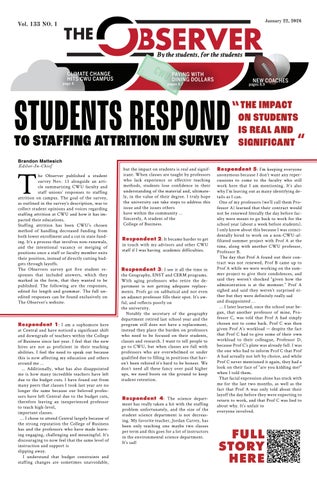
STUDENTS RESPOND TO STAFFING ATTRITION IN SURVEY

The Observer published a student survey Nov. 13 alongside an article summarizing CWU faculty and staff unions’ responses to staffing attrition on campus. The goal of the survey, as outlined in the survey’s description, was to collect student opinions and voices regarding staffing attrition at CWU and how it has impacted their educations.

Staffing attrition has been CWU’s chosen method of handling decreased funding from both lower enrollment and a cut in state funding. It’s a process that involves non-renewals, and the intentional vacancy or merging of positions once a staff or faculty member exits their position, instead of directly cutting budgets through layoffs.

The Observers survey got five student responses that included answers, which they marked in the form, that they wanted to be published. The following are the responses, edited for length and grammar. The full unedited responses can be found exclusively on The Observer’s website.

Respondent 1 : I am a sophomore here at Central and have noticed a significant shift and downgrade of teachers within the College of Business since last year. I feel that the new hires are not as proficient in their teaching abilities. I feel the need to speak out because this is now affecting my education and others around me …

... Additionally, what has also disappointed me is how many incredible teachers have left due to the budget cuts. I have found out from many peers that classes I took last year are no longer the same because our beloved professors have left Central due to the budget cuts, therefore leaving an inexperienced professor to teach high-level, important classes.

… I chose to attend Central largely because of the strong reputation the College of Business has and the professors who have made learning engaging, challenging and meaningful. It’s discouraging to now feel that the same level of instruction and support is slipping away.

I understand that budget constraints and staffing changes are sometimes unavoidable,

but the impact on students is real and significant. When classes are taught by professors who lack experience or effective teaching methods, students lose confidence in their understanding of the material and, ultimately, in the value of their degree. I truly hope the university can take steps to address this issue and the issues others have within the community … Sincerely, A student of the College of Business.

Respondent 2 : It became harder to get in touch with my advisors and other CWU staff if I was having academic difficulties.

Respondent 3 : I see it all the time in the Geography, ENST and CERM programs. With aging professors who retire the department is not getting adequate replacements. Profs go on sabbatical and not even an adjunct professor fills their spot. It’s awful, and reflects poorly on the university.

Notably the secretary of the geography department retired last school year and the program still does not have a replacement, instead they place the burden on professors who need to be focused on their students, classes and research. I want to tell people to go to CWU, but when classes are full with professors who are overwhelmed or under qualified due to filling in positions that haven’t been rehired it’s hard to be honest. We don’t need all these fancy over paid higher ups, we need boots on the ground to keep student retention.

Respondent 4 : The science department has really taken a hit with the staffing problem unfortunately, and the size of the student science department is not decreasing. My favorite teacher, Jordan Carrey, has been only teaching one maybe two classes per term and this goes for a lot of instructors in the environmental science department. It’s sad!

Respondent 5 : I’m keeping everyone anonymous because I don’t want any repercussions to come to the faculty who still work here that I am mentioning. It’s also why I’m leaving out as many identifying details as I can.

One of my professors (we’ll call them Professor A) learned that their contract would not be renewed literally the day before faculty were meant to go back to work for the school year (about a week before students). I only know about this because I was coincidentally hired to work on a non-CWU-affiliated summer project with Prof A at the time, along with another CWU professor, Professor B.

The day that Prof A found out their contract was not renewed, Prof B came up to Prof A while we were working on the summer project to give their condolences, and said they weren’t shocked “given how the administration is at the moment.” Prof A sighed and said they weren’t surprised either but they were definitely really sad and disappointed …

… I later learned, once the school year began, that another professor of mine, Professor C, was told that Prof A had simply chosen not to come back. Prof C was then given Prof A’s workload — despite the fact that Prof C had to give some of their own workload to their colleague, Professor D, because Prof C’s plate was already full. I was the one who had to inform Prof C that Prof A had actually not left by choice, and while Prof C never mentioned it again, they had a look on their face of “are you kidding me?” when I told them.

That facial expression alone has stuck with me for the last two months, as well as the fact that Prof A was only told about their layoff the day before they were expecting to return to work, and that Prof C was lied to about why. It’s unfair to everyone involved.

Brandon Mattesich

Confusion

between the Faculty Senate , The Board of Trustees and President Wohlpart

Gates

LETTER from the EDITOR

Hey Wildcats,

When the Safdie brothers split up I thought to myself “I wonder which brother had the sauce.” So far it has turned out, they both do. I now find myself without my longtime EIC partner, Jackson Roberts, and praying the answer is the same. It’s definitely a new experience taking on this thing as a solo EIC, and Jackson’s assistance and partnership will be sorely missed.

However, I am very very excited for what this quarter holds, as we have a much larger design team, and a great group of new and returning writers that I’m positive are going to keep it fresh and deliver the news to you guys the best way possible. So yeah it’s just me now, but I’m very inspired and coming into this quarter fresh and ready for what’s to come.

Issue 1 Recap

I’m keeping our recaps brief here from now on, as we have a lot to fit on this lovely little page with our new bi-weekly printing schedule. We have a heavy issue this week with news ranging from attrition to dining dollars and rent to national memorials. There’s a lot going on both on campus and around the country right now, so this issue offers a bit of information on it all.

At the same time, scene and sports both boast great spreads this week, with stories about new coaches and a metalworking art gallery taking this issue head-on. We also have amazing design and opinion this issue, with a couple new designers joining us and bringing a breath of fresh air to this week’s issue!

Brandon expressing his love for pinball. (Photo courtesy of Marlene Veveris)
Nothing Has Been Stopping
Music AI and Holograms Movement
(Photo courtesy of Pexels)
(Photo courtesy of Capital Records)
(Photo courtesy of CWU)
(Photo courtesy of Pexels)
Bythestudents,forthestudents

Rent at CWU explained: What goes into an increase?

The CWU board of trustees voted to raise rent by 4% for students living in on-campus housing, during the summer of 2025.

An example of this increase can be seen in the Student Village Apartments, where rent for a standard two-bedroom apartment increased from $750 per month to $785 per month.

Executive Director of Housing Services, Tricia Rabel, said that expected enrollment is a main factor in deciding rent on campus. According to Rabel, the determination is to ensure there will be plenty of resources to meet the needs for student housing, residence life, apartment maintenance and dining.

“We make a concerted effort to keep our lowest cost offerings as affordable as possible for students,” Rabel said. “The current rate for our double room in a standard hall is less than what it was three years ago. In addition, we’re proposing a slightly lower rate for those rooms for next academic year.”

Each year, proposed housing rates for the coming academic year are presented to the Residence Hall Association at a public meeting. These meetings are open to all students. During the meetings students are welcome to ask questions. Housing also provides detailed information on what housing funds are used for.

Campus Resources

Anyone who has struggled to make due with rent is well aware of the CWU eviction notice policy, a policy that gives students a specific date to deliver the owed rent before the actual eviction transpires. There is a rent assistance service for students at CWU, but students have to have been served the eviction notice and meet the criteria to qualify.

When asked if there are any alternative resources for students to meet their monthly rent, Rabel stated, “When a student is having trouble paying their housing or tuition bills, we strongly encourage them to call us as soon as they think they’ll have trouble paying. We can often move students to a lower-cost housing option to help with their payments.”

“We always encourage students to contact Financial Aid if their income or their family’s income situation has changed,” Rabel said. “Often, aid documents can be updated and financial need reassessed.” A different off-campus option is Hope Source; a resource that offers students support in options for grants along with other resources.

Rabel shared one possible option for students facing financial uncertainty as future rates begin to be released. “Approved housing rates for AY 2026-2027 will be made public by the beginning of Spring quarter. Any student who has concerns about the financial commitment of living on campus is welcome to reach out to Housing for additional options. We are happy to help students move to a location with a price point that is most comfortable for them,” Rabel said.

CWU students host a celebration of life for Renee Good S

econd year students at CWU, Abigail Daily and Alyanna Ayala, hosted a celebration of life at McConnell Hall for 37-year-old Minneapolis woman Renee Good.

“The idea came to us over the course of the week after watching what happened in Minneapolis and we felt really inspired to speak up against what happened, but also to hold a space for people to come together to process everything,” Daily said.

On Jan. 7, ICE officer Jonathon Ross shot his weapon at least three times, fatally striking Good in her vehicle. Good was partially covering traffic while motioning for the unmarked government vehicles to pass before attempting to drive off herself, according to expert analysis from the New York Times.

Rebecca Good, Renee Good’s wife, said in a statement to Minnesota Public Radio, “...we stopped to support our neighbors. We had whistles. They had guns.”

In response to the incident, Minnesota and two cities within the state are seeking legal action in the vein of suing the federal government.

“I feel like coming together as a community with the school and the Ellensburg community, bridging that gap with bringing people together, it really is going to drive the point home that this is not okay,“ Daily said.

The two students were able to organize the memorial with apps like Canva and Fizz to create and promote the event to other students and community members.

The event asked the public to bring stuffed animals in honor of Good’s 6-year-old child.

About 60 people were in attendance at the Ellensburg memorial. Members of local groups like Ellensburg Indivisible and Ellensburg Democrats were in attendance. A few vehicles honked while passing by. The celebration of life remained peaceful.

“And while this is a nonpartisan event, we cannot ignore the fact that her death is inherently political, but this is supposed to be a space of unity and compassion and holding space for grief,” Ayala said. “Her story is especially impactful because she’s just like any of us. She was driving her car. She had just dropped her kid off at school. She was a US citizen, too.”

At the end of the event, the hosts along with local guitarists played “This Land is Your Land” by Woody Guthrie with the attendees.

Kyley Glenn News Editor Memorial display for Renee Good. (Photo by Kyley Glenn)
The Village apartments on campus. (Photos by Alistair Hennessey)

Climate Change has hitWashington : Low

snowfall and high flooding statewide

Several areas in Washington, especially near coasts and rivers, experienced a major flooding event in Dec. 2025, as the planet’s warming surface continues to cause the state to have less snow and more rain.

Typically, the Cascade Mountains accumulate sufficient snow during the winter to provide water for the agricultural lands of Ellensburg and other rural areas. However, due to climate change, rain has become the primary source of precipitation on the mountains this winter instead of snow.

Professor of Geological Sciences Susan Kaspari stated that changes in how Washingtonians receive their precipitation are “definitely a climate changedriven signal in terms of this specific event of flooding and atmospheric rivers.”

Kaspari recognizes that Ellensburg’s economy is largely based on agriculture; therefore, she said, “we really rely on this natural snow pack to store water through the winter and then to slowly melt going into the spring and to release that.”

A lack of snowfall this season could lead to water shortages and reduced crop production in the spring, potentially hurting the overall economy of Ellensburg and of Eastern Washington in general.

According to Kaspari, the decreasing snowfall and increasing rainfall cause the mountains to build up much less stored precipitation during the springtime.

Carey Gazis, a professor in the geology department and environmental science program, acknowledged that humans have made five reservoirs that hold some of the water needed for farming, but Gazis argues that the reservoirs “can’t hold enough water, all the water that we need. That snow pack in the mountains is storing water that will get released into the reservoirs later. That’s why we want it in Ellensburg.”

Atmospheric rivers and their effects on flooding

Kaspari stated that climate change is not the only factor that caused the major flooding event this winter.

“The atmospheric rivers, those are common, and they happen more often going into winter, when

there’s just a lot of precipitation coming off of the Pacific Ocean and it stalls out and can drop large amounts of rain,” Kaspari said. “It’s not uncommon for places in Washington to get a large amount of their annual precipitation in fairly short periods of time, but that was an event that was definitely record-setting in lots of locations in the state.”

Megan Walsh, the department chair and a professor in the geography department, agreed with Kaspari that atmospheric rivers coming from the Pacific Ocean typically occur every winter, often causing rainstorms.

Walsh defined an atmospheric river as “a really strong band of very moist air that usually comes from fairly far south in the Pacific Ocean, from the Hawaii area.”

She added, “because that air is really warm, it can hold a lot of moisture in it, and then the jet stream helps ship that warm, moist air up here to the Pacific Northwest, and brings it all up along our coast, and then it also hits the mountains, which causes orographic lifting, which then just causes all of that moisture to dump out of those clouds and just rain and rain.”

How changes in climate lead to changes in jet stream patterns

One possibility that Walsh noticed was that the atmospheric rivers and their jet streams followed different paths and patterns this winter than they normally do, possibly due to climate change.

“The other thing that the warming is doing is changing the tracks of some of those storms. And so it could be that many of the storm tracks that should have stayed further south from us are now moving northward,” Walsh said. “Eventually, a lot of our winter storms will actually move up toward Alaska. And actually, Alaska is having a crazy snowy winter because of so many of the storm tracks going further north.”

The floodings impacts on CWU students

Over winter break, the flooding hit many CWU students and their childhood friends while the students visited their families for the holidays.

“I live near a river, so it overflowed some of the neighborhoods that I live near,” psychology student Ava Duropan said about her family’s home in Maple Valley. Duropan said that she had friends in those neighborhoods impacted by the flooding.

“[My friends] said that they lost their older cars that were vintage, and they lost their home, so they had to move out,” Duropan said.

The flooding did not directly impact Duropan because her family lives on higher ground. But, according to Duropan, the impact the flooding took on her friends did impact her mental health over the break.

Business administration student Aiden Blanco experienced a similar situation while visiting his family in Kent. He only caught a glimpse of the flooding in his hometown, but he concluded from seeing a helicopter footage of 272nd Street that the event was pretty major.

A section of 272nd Street between West Hill and East Hill was closed for a few days, making it hard for Blanco to drive from Ellensburg to Kent.

“We have a lot of farmland there. We had our annual pumpkin patches there, a lot of corn, a lot of lettuce and greenery was grown there,” Blanco said. “Seeing how the flood took over all of that farmland and left a lot of crops dead and withering away was really sad to see because I grew up in that area, and I’ve traveled it so many times when I was younger.”

Campus on a foggy day.
(Photo by Alistair Hennessey)
Meisner Dunlap Staff Reporter
Branches after rainfall.
(Photo by Alistair Hennessey)

FERROUS: Renee Adams metalworks gallery offers something for everyone

Picture this: It’s the grand opening of the FERROUS exhibition and attendees are packing Randall Hall room 117 to the absolute brim, resulting in people gathering in the aisles, settling in on the classroom floor or waiting in the hallway while discussing the metalwork of the gallery inside.

That was the scene last Thursday for Renee Adams first full showing of FERROUS, an exhibition shaped around a variety of themes and artists; hosted in the Sarah Spurgeon Gallery. The collection is a limited-run exhibit open Jan. 15 - Feb. 7, which foregrounds feminine and non-binary perspectives to blacksmithing and metal arts, challenging the crafts traditionally historical themes of masculinity.

The exhibition hosts contributions from the City of Ellensburg Arts Commission, Society of Inclusive Blacksmiths, the CWU Women’s Gender and Sexuality Studies Program along with the private donors Brian and Elizabeth Frederick, all of whom worked together to make it possible to “bring the art world outside of the school into the school,” according to arts education and art history major Sophia Svarthumle. Each piece in the gallery portrays its own innovative theme and meaning welded into it; yet, it is the fiery-eyed diversity of the selected artists that truly sparks the gallery to life.

The unique backgrounds, creative methods and passionate heat offer meaningful academic value to those within the community and to students across campus, helping to hammer away the impurities of this long-lasting art form that for many centuries belonged only to men.

One fabrication artist, Leah Gerrard, explained that the exhibition isn’t just for people studying art, but rather the community of Ellensburg as a whole. “It’s not going to be what you think,” Gerrard said. “Go see it with open eyes.”

Renee Adams and Designer Amanda Johnson, had to overcome many challenges such as the transportation of artwork from other states and for one artist across a border, to organize the display. On top of that, the artists that accepted Adams invitation had to overcome their own barriers, investing time, labor and the persistence it takes to bring these wrought sculptures to life.

The art displayed is both old and new, and with every ambitious artist involved in supporting Adams in conveying this ever changing art form, it’s been a learning experience for them all.

Adams will also be inviting some of the other artists that are further away to a panel discussion called If I Had a Hammer on campus in Black Hall on Jan. 29 from 3:30 p.m. - 5 p.m. which will be led by a founding board member of the Society of Inclusive Blacksmiths, Lisa Geertsen.

The panelists will be presenting their thoughts and ideas of metalwork, the new sense of diversity that is being illuminated and the varying techniques that have been projected towards the Ellensburg community and its students. Adams said she is absolutely delighted with the opening of the Gallery and the support that was shown from her friends, students that had attended, CWU faculty members and the art enthusiasts in town.

Jade Marsden Staff Reporter
“Crossing Guard” by Anne Bujold. (Photo courtesy of Stephen Funk)
“Gather and Grow: Blueberry” by Margaret Jacobs. (Photo courtesy of Stephen Funk) ADVERTISEMENT

PAYING WITH DINING YOU MIGHT BE PAYING

Using Dining Dollars at the C-Store or other on-campus markets or cafes could cost, on average, 114% more than paying with USD.

Dining Dollars at CWU can be used in two separately priced areas around campus. The first areas around campus are the dining locations, such as Lion’s Rock or El Gato. The second being at on campus markets or cafes, such as Cat Trax East or the C-Store.

The main difference between the two areas is the percentage price reduction included on each purchase: dining locations offer a 65% price reduction and markets or cafes offer a 25% price reduction.

Calculating this price reduction together with the cost of Dining Dollars reveals the 114% price increase in on-campus markets and cafes.

How do meal plans at CWU work?

CWU’s meal plan system is based around Dining Dollars, with each meal plan tier offering a different cost and amount of Dining Dollars rewarded.

Because there is a direct relationship between USD spent and Dining Dollars (DD) received, a conversion rate can be calculated for the two currencies. Meal Plan B costs an annual total of $7,550 USD, and over the course of the year, provides 2,643 DD in return. Therefore, $1 USD is equivalent to 0.35 DD, and conversely, one DD is equivalent to $2.86 USD.

CWU Dining describes the system’s purpose on their webpage, stating, “CWU’s Residential Meal Plans are a high value, highly flexible option for students to self-manage their diet and nutrition on campus.”

The page goes on to describe how the conversion works, and that the bulk of the payment is for overhead, with students only using the DD to cover the ingredient costs later on. “The meal plans

operate in two phases. First, at the start of every quarter, Dining Services collects the Overhead Costs portion of your Meal Plan,” the webpage states. “Think of this money as an investment - by collecting it upfront, Dining Services is able to ensure that all students are supported and provided with everything they need to succeed for the duration of the quarter.”

The site continues by explaining what the Dining Dollars are then used for, stating, “Dining Dollars are spent at dining locations, and as the Overhead Costs have already been accounted for, students on a meal plan paying with Dining Dollars only pay for the cost of the ingredients. This means a 65% reduction in the list price at dining locations, and a 25% reduction at the campus café and market locations.”

The hidden 114% price increase

The Observer decided to investigate the cost effectiveness of Dining Dollars (DD) in their two different proposed uses, the first being their usage at dining locations, factoring in the 65% price reduction, and the second being their use at on-campus markets, which provide a 25% price reduction.

At dining locations, their cost effectiveness is good and most purchases break even, meaning the cost in DD is about the same as it would be in USD. For example, purchasing a Lion’s Rock classic cheeseburger through the Grubhub app costs about $8.96 USD with tax. Purchasing that same burger with DD costs about 2.89 DD total, which converts exactly to $8.26 USD. In most cases, purchasing from dining locations with DD saves a few cents, or costs nearly the same as it would cost in USD.

At campus markets however, the story is different. Because campus markets only offer a 25%

price reduction for using DD at their locations, the conversion math is vastly different. For example, purchasing an Almond Hershey’s bar with USD at the C-Store on campus costs $2.99 not including tax. Purchasing that same bar with DD costs about 2.24 DD, which taking into account that each DD is equivalent to about $3 USD, means that purchasing that Hershey’s bar with Dining Dollars is the same

“On an individual level, dining dollars weaker buying other tender C-Stores specifically.”

-Trent Bucy, CWU auxiliary enterprises

as paying $6.41 USD. That’s a hidden price increase of 114.8%.

Trent Bucy, CWU’s auxiliary enterprises financial manager, commented on the conversion rate in an email exchange with The Observer. “The math is correct,” Bucy wrote. “On an individual transaction level, dining dollars do have weaker buying power than other tender types at C-Stores specifically.”

“I lost my beauty and I realized that beauty never came from what you look like, it’s always who you are from the
-Jackie Cruz
C Store USD vs DD Prices. (Figure 1)

DINING DOLLARS?

PAYING DOUBLE

“This is because meal plan dollars are designed to support a broader residential dining program, not just individual transactions at the register. When students use meal plan funds, those purchases help cover a range of costs that go beyond the wholesale price of an item,” Bucy added in his email. “Cash prices reflect a more direct retail transaction and do not carry the same programmatic costs associated

individual transaction dollars do have buying power than tender types at specifically.”

enterprises financial manager

with operating a comprehensive residential dining system. Meal plan pricing, by contrast, helps sustain services that benefit the residential community as a whole—such as guaranteed access to food options throughout the academic year, even during periods when foot traffic or sales are lower.”

Price Comparison, DD vs USD

Upon finding this conversion, The Observer conducted a survey in which 17 items were randomly selected from the C-Store and price compared with their costs in USD and DD. They were then further price compared with the USD costs of the same items at Fred Meyer (See Figure 1).

The main finding was that across all 17 items surveyed, when comparing their price in USD to their converted prices in DD, an average price increase of 114% was found. This means that on average, paying with Dining Dollars at the C-Store on campus could be costing each student more than double what they would be paying if they used traditional USD for the purchase.

The 25% price reduction on DD also applies to the on-campus cafes, which indicates that more likely than not, paying with DD at Cafes on campus could be costing students double what they would be paying if they just paid with USD instead of purchasing meal plans. For example, a medium hot chocolate from Cat Trax West costs $4.82 USD including tax. The same medium hot chocolate, when purchased with a meal plan, costs 3.34 DD, or if converted, $9.54 USD. That’s a price increase of 97.93%.

The results of the survey also indicated that on average, items at the C-Store cost about 26% more than the same items at Fred Meyer. Dean Masuccio, director of dining services, explained what goes into pricing items at the C-Store, stating, “Prices are based on target margins by retail category (snacks, beverages, health and beauty, etc.). We use the actual cost paid to our C-Store/Market distributor as a base and then apply our target margin to determine the suggested retail price for the item/s

sold. Packaged/manufactured items carry much higher costs than made-to-order dining items, which drives pricing in markets higher than dining operations.”

The Results Explained

So what does all of this mean? In basic terms, if a student only uses their meal plan at on-campus dining locations and steers clear of on-campus markets or cafes, they are likely to break even or even save a few dollars over the course of the year. However, the second a student starts to use their meal plan to make purchases at any on-campus markets or cafes, the prices of the items they are buying are potentially doubling in price, through a system of conversions and hidden price increases only visible through price conversion.

If weighing the direct value of a meal plan’s cost effectiveness on an individual level, it is possible that over the course of a year, a student could lose hundreds of dollars in value through seemingly normal purchases at on-campus markets and cafes, in which the value of their dollar is potentially dropping by 114% on average.

All calculations for this article used Meal Plan B as their exchange rate example, based on the idea that most freshman students choose this plan to start their college experience. Different meal plans do offer slightly different conversion rates of USD to DD, but changes are near negligible.

C-Store USD vs DD Prices. (Graphic by Brandon Mattesich)
the C Stores 4.75oz bag was compared to Fred Meyers 7.5oz bag)
Jalapeno vs 7.5 oz)
Tims Original (4.75 vs 7.5 oz) Hawaii Luau (4.75 vs 7.5 oz) Hersheys Almond Kinder Joy Kinder Bueno
Butterfinger Tims Salt/Vin Think! Lemon

Meet Scott Power , CWU’s New Football Head Coach

CWU said goodbye to Football Head Coach Chris Fisk, as Fisk accepted a job as division 1 program Portland State’s Head Coach in Dec 2025. Coach Fisk leaves CWU after 10 years, filling the role of Head Coach for the last six of them. Fisk leaves behind a 48-22 overall record and a 38-7 conference record. In his stead, Scott Power has been named the new football program head coach.

Coach Power first arrived at CWU before the 2016 season to become the school’s defen sive coordinator. Power’s influence was im mediately felt as CWU jumped to the top of national defensive stats and built a physical run stopping defense. During his last year at CWU, Power helped lead the 2017 Wildcats to an undefeated regular season record. Since then, Power has jumped from program to pro gram, helping build defenses across both the Football Championship Subdivision (the sec ond highest division in college football) and the Football Bowl Subdivision (the highest di vision in college football).

Power has shown no fear stepping into his first Head Coaching job, taking the reins from Fisk. “I’m more interested in just trying to do the best job we can for the players that we have,” Power said. “Anytime you step into one of these jobs, we expect we win, we know what we sign up for. Central Washington has won for a really long time.”

As a first time Head Coach, Power has “plans to be more involved in the offense. From being able to sup port those guys and to be able to give them some insights on what people are doing to defend them.” He also plans on being more involved with special teams, helping with attack in the kicking game, while still maintaining high expec tations for how the defense plays. Power ended with “I would like to be able to con tribute in all areas of the program.”

When asked about using what he could use from the former Head Coach, Power recalled coming into the program in 2016 the same day as Fisk, living together on Brook Lane. “We stayed in a little spot over there … so we know each other well. We have similar thoughts on how the game should be played and how the programs should run,” Power said. “Just being here for those two years, I have an idea of the culture that was put in place, I know some of the systems that are already in place.”

Power spoke on any potential changes made to the offense and defense, stating a goal of a “balanced offense” that is a strong run game

while being able to stretch the defense down the field. When it comes to the defense, not a lot of changes will be made. “Our identity will remain the same. The system has never really left ever …” Power said, bringing up CWU’s history of Defensive Coordinators and the success they’ve had. “I think there’s a pretty clear identity of how we want to play defense.”

Power went on to state that what they’ve evolved at other programs he’s been at, he will bring back to CWU.

So far into this offseason, CWU has lost a number of athletes to the transfer portal, including Punter Wyatt Redding and Lone Star Conference (LSC) 2025 sack leader Tyler King to University of Montana along with LSC First-Team All-Conference Defensive Lineman Mikaio Edwards to Boise State University. When Power came back to Central, he made it clear to everyone on last year’s team that they were welcome to come back and the team is still building relationships and connecting with players.

When discussing players who have left in the transfer portal, Power said “we’re trying to make sure that we thank them for what they’ve done for CWU

football in the past, and our eyes are looking ahead and looking forward to being able to build the best 2026 that we can.”

In the face of any student body or student athletes that doubt the new coaching regime, Power stated that “Central Washington has a long history of tradition and success on the football field. Our goal is to be able to build off of what’s been done here in the past, and to be able to help this program go from good to great.” Power also touted his “proven track record of success”, along with other coaches coming on board.

Power offered thanks to President Wohlpart and Director of Athletics Dr Dennis Francois for the opportunity to come back to the program as a head coach, expressing excitement to work with the players and reconnect with all the alumni. The new head coach also touted Ellensburg as a “great place to live” and Central “a great place to work. We’ve got a beautiful place, a beautiful facility to work in … We’re just excited to be back.”

Parker Wood Sports Editor
Scott Power at CWU in 2016 (Former defensive coordinator).
(Photo courtesy of Brian Myrich)

CWU Volleyball alum Lauren Herseth steps into Head Coach role

The former Assoc. Head Coach looks to continue Mario Andaya’s success

Right before winter break, CWU’s Director of Athletics Dennis Francois announced that after 30 years, longtime Volleyball head coach Mario Andaya will step down from his position of head coach to assume the role of CWU’s Deputy Athletics Director. Andaya leaves behind an overall record of 489-315, the winningest volleyball head coach CWU has seen. Taking his spot is former Volleyball Associate Head Coach Lauren Herseth.

Head Coach Herseth was a former athlete for CWU, competing from 2011-2014, and has worked with Andaya on the staff since joining in 2020. Herseth started as Assistant Volleyball Coach before transitioning to Associate Head Volleyball Coach before the 2025 season. Now in 2026, she starts her first year as head coach. According to Herseth, this path to the head coach position was always the plan. “It wasn’t a matter of if, it was just a matter of when, and this opportunity came up for Mario, and we felt I was ready for this as well,” Herseth said. “The stars kind of aligned.”

The Olympia native spoke on learning under Andaya both as a student athlete and as an Assistant head coach, stating “having been with Mario [Andaya] the last six years, I played for him, I know the ins and outs of

the program, and there’s pressure for sure,” Herseth said. “But I think pressure is a good thing, and we have a lot of talent coming back in, a really good group of kids, and they’re hungry to compete, and they’re hungry to keep getting better.”

Herseth went on to speak about the current roster and her experience with some of them so far as the assistant head coach. “[bright spots] off the top of my head are our current freshmen, Kailey Wilsey and Brooklyn Parker, who had phenomenal seasons. And the fact that I get to be a part of their journey, start to finish, is something that I’m super excited about,” Herseth said. “On top of that, leaders like Ellie Marble, Kennedy Webb, KayleighShay Chang, those guys have been with me the last few years, and so for them to trust me as the leader of the program moving forward is not something I’ll ever take for granted.”

When it comes to changes made in the head coach change, Coach Herseth told the athletes “things are going to be different, but nothing’s going to change.” There won’t be any major changes made to the team but there are “tweaks and twists” that Herseth plans to add to try to keep the team at the top level.

Speaking of doubts and pressure coming into the job, Coach Herseth said “CWU is a place that I believe you can win … You pair

that with the talented roster that we have and the fact they believe in me to do this, and I believe in them, it’s just the perfect combination. I’m trying not to worry about or stress about outcomes. I’m just really enjoying the process with them right now.”

For Winter Quarter, the current plan is to “layer things and level up.” Coach Herseth is appreciative of the overflowing support that the student body has shown for her. “It’s been really cool, just people across campus and other student athletes, students on campus stopping me to say ‘congrats’ because it’s a cool deal,” Herseth said. “Wildcats nation shows up for us, which is amazing, and I hope that continues moving forward.”

Mario Andaya and Head Coach Lauren Herseth meeting with team against Montana State.
Head Coach Lauren Herseth on the sideline.
(Photo courtesy of Shayden Hoopai-Waikoloa)
(Photo courtesy of Jacob Thompson)

OPINION SECTION

ONFORMIT GATE C Y GATE C WHAT FANS WILL DO TO COPE WHAT FANS WILL DO TO COPE

The Stranger Things series finale left fans in psychosis, ending a near decade old franchise with an episode that left some people wanting more. Some fans of the show would go on to create theories and rumors of a secret “ninth episode,” leading to the creation of the collective theory, “Conformity Gate.”

Written and created by Matt and Ross Duffer, also known as the Duffer brothers, Stranger Things has had a strong presence in the media since July 15, 2016. With years of build up and following these characters’ journeys, fans were expecting an ending that would knock their socks off. Out of the five season finales, season five had the lowest IMDB rating at 7.6/10.

Die-hard fans were pushing the idea of “Conformity Gate” and would create several videos on social media, picking apart plot holes, inconsistencies and claiming the narrative and characters were conforming to stereotypes, hence the name. Some inconsistencies seemed almost purposeful, given the budget for each episode ranged from approximately $40million-$50million per episode according to Cosmopolitan. A side theory among fans titled, “Divorce

Gate” surfaced due to Ross Duffer’s divorce from Leigh Janiak early 2024, Janiak having her own background in directing and screenwriting, though does not have any writing credits for Stranger Things. With season five production wrapping in September of 2025, there was quite enough evidence for speculation.

After the show ended, Netflix, home to Stranger Things, had put the words “I Believe” in their Instagram bio, which alluded to the last lines of dialogues spoken by the main group of characters. This line of dialogue was also in response to a theory about the main character’s fate, which was left somewhat ambiguous.

Though many fans were hopping on board the “Conformity Gate train,” the Duffer Brothers had not outright debunked the theory until two weeks after the release of the final episode. Management and Leadership Professor, Dr. James Avey, noted, “It’s all about ad money and subscriptions. So, it would make sense to me that they would leave kind of a weird ending… because of the idea of salience. The show is over and here we are talking about it, people are upset about it and people are posting about it.”

Netflix would go on to release a documenta-

ry 12 days after the finale. Titled, “One Last Adventure: The Making of Stranger Things 5,” the documentary showcased the Duffer brothers’ process and behind the scenes of the season. However, when looking a little deeper, some fans made shocking revelations and were not pleased with what they found.

Many influencers voiced their opinions on what was revealed through the documentary. Media personality, SammyJ, posted his thoughts and breakdown on TikTok shortly after its release.

“I’m convinced this is damage control by Netflix, pointing the finger at the Duffer Brothers … They went into the finales’ production without a finished script … People have been pointing out that there are three tabs, of them writing the script, with ChatGPT open, if you zoom in and enhance, that looks like open AI to me. All allegations, no proof, but where there’s smoke, there’s fire.”

Shortly before the release of the fifth season, when asked about the ending of the show, the Duffer Brothers claimed, “it was the one thing we had planned from the start. We always knew what we were working towards … we built the whole season around the final scene.”

In the documentary, as the crew is talking about the behind the scenes for the final episode, Key Production Assistant, Montana Maniscalco admits, “We are shooting episode eight, which isn’t completely written out yet, spoiler alert. So, we don’t even know what’s going on here.”

Ratings for each season finale on IMDB

Season 1 Episode 8: 9.3/10

Season 2 Episode 9: 9.3/10

Season 3 Episode 8: 9.3/10

Season 4 Episode 9: 9.2/10

(Series Finale) Season 5 Episode 8: 7.6/10

“Stranger Things” cast. (Photo courtesy of BBC)

Designed by Z Morris Divined by Ethan Kennedy

Aries (March 21 - April 19): You represent loyalty and stubbornness. But if you mess with the bull, you get the horns. Your dog: Bulldog.

Taurus (April 20 - May 20): Oh boy! Go and say hi to Leroy! Maybe get him a toy! Your dog: Borzoi.

Gemini (May 21 - June 20): I bet you grew up playing little league. Every morning you need to get energy out, so you go on a run. You need to always be chewing something, so you carry gum in your back pocket too. Your dog: Golden Retriever.

Cancer (June 21 - July 22): You might come off as a big and burly type, but deep down you’re just a big softie. Do you by chance sit at the top of your driveway…? Your dog: St Bernard.

Leo (July 23 - Aug. 22): You’re the type of person who loves rainy days, smooth jazz and heated blankets. Claws out! Your dog: Cat.

Virgo (Aug. 23 - Sep. 22): Imagine a loaf of bread, now give it four legs, now give the loaf of bread a face on one side. There ya have it! Your dog: Pug.

Libra (Sep. 23 - Oct. 22): You are the fiercest, most valiant warrior in all the land. With great might, you grit your teeth, puff up your chest and let out the loudest battle cry you can. Your dog: Chihuahua.

Scorpio (Oct. 23 - Nov. 21): I bet you think you’re “all that,” I bet you call yourself “Great.” Well guess what, you are! Don’t let anyone tell you differently. Your dog: Great Dane.

Sagittarius (Nov. 22 - Dec. 21): It may take you 10 years to react to anything, but that will never stop you. Hey, I may have brought some ketchup with me…my bad. Your dog: Dachshund.

Capricorn (Dec. 22 - Jan.19): Sometimes you can be bossy, but lowkey it’s for the better. People really need to start conforming to you. Your dog: Pomeranian.

Aquarius (Jan. 20 - Feb.18): Once you set your mind to something, you can’t stop yourself, even if it’s self-destructive. Invest in getting a gold chain. Your dog: Beagle.

Pisces (Feb. 19 - March 20): Everything you do, you must repeat 100 more times… totaling for 101 continuous repetitions. Life isn’t always blac k or white though. Your dog: Dalmatians.

National Fish Taco Day
Events Compiled By Brandon Mattesich
Created By Rieley Iverson

Turn static files into dynamic content formats.

Create a flipbook