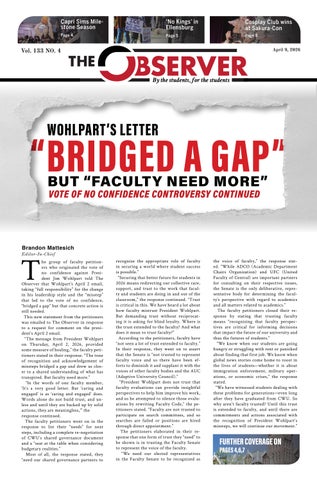
The group of faculty petitioners who originated the vote of no confidence against President Jim Wohlpart told The Observer that Wohlpart’s April 2 email, taking “full responsibility” for the change in his leadership style and the “misstep” that led to the vote of no confidence, “bridged a gap” but that concrete action is still needed.
This new statement from the petitioners was emailed to The Observer in response to a request for comment on the president’s April 2 email.
“The message from President Wohlpart on Thursday, April 2, 2026, provided some measure of healing,” the faculty petitioners stated in their response. “The tone of recognition and acknowledgement of missteps bridged a gap and drew us closer to a shared understanding of what has transpired. But faculty need more.”
“In the words of one faculty member, ‘It’s a very good letter. But ‘caring and engaged’ is as ‘caring and engaged’ does. Words alone do not build trust, and unless and until they are backed up by solid actions, they are meaningless,’” the response continued.
The faculty petitioners went on in the response to list their “needs” for next steps, including a complete re-negotiation of CWU’s shared governance document and a “seat at the table when considering budgetary realities.”
Most of all, the response stated, they “need our shared governance partners to
recognize the appropriate role of faculty in securing a world where student success is possible.”
“Securing that better future for students in 2026 means redirecting our collective care, support, and trust to the work that faculty and students are doing in and out of the classroom,” the response continued. “Trust is critical in this. We have heard a lot about how faculty mistrust President Wohlpart. But demanding trust without reciprocating it is asking for blind loyalty. Where is the trust extended to the faculty? And what does it mean to trust faculty?”
According to the petitioners, faculty have “not seen a lot of trust extended to faculty.” In their response, they went on to assert that the Senate is “not trusted to represent faculty voice and so there have been efforts to diminish it and supplant it with the voices of other faculty bodies and the AUC (Adaptive University Council).”
“President Wohlpart does not trust that faculty evaluations can provide insightful perspectives to help him improve his work, and so he attempted to silence those evaluations by rewriting Faculty Code,” the petitioners stated. “Faculty are not trusted to participate on search committees, and so searches are failed or positions are hired through direct appointment.”
The petitioners elaborated in their response that one form of trust they “need” to be shown is in trusting the Faculty Senate to represent the voice of the faculty.
“We need our elected representatives in the Faculty Senate to be recognized as
the voice of faculty,” the response stated. “While ADCO (Academic Department Chairs Organization) and UFC (United Faculty of Central) are important partners for consulting on their respective issues, the Senate is the only deliberative, representative body for determining the faculty’s perspective with regard to academics and all matters related to academics.”
The faculty petitioners closed their response by stating that trusting faculty means “recognizing that faculty perspectives are critical for informing decisions that impact the future of our university and thus the futures of students.”
“We know when our students are going hungry or struggling with rent or panicked about finding that first job. We know when global news stories come home to roost in the lives of students—whether it is about immigration enforcement, military operations, or economic crises,” the response stated.
“We have witnessed students dealing with these problems for generations—even long after they have graduated from CWU. So why aren’t faculty trusted? Until this trust is extended to faculty, and until there are commitments and actions associated with the recognition of President Wohlpart’s missteps, we will continue our movement.”
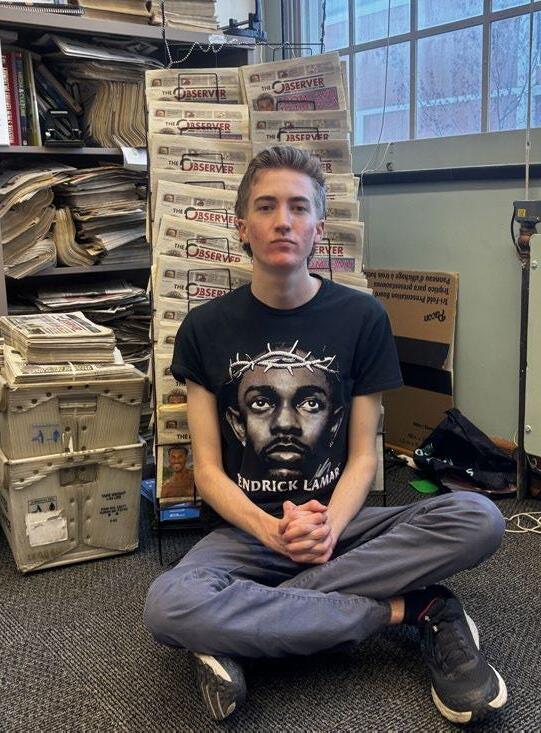
Brandon Mattesich
LETTER from the EDITOR
Howdy all,
Welcome back to The Observer. I have very high hopes for this quarter, as we have what seems to me to be a very strong team taking shape. This week’s issue is our editors only issue, and I think our coverage this week will have just a little bit of content for everyone. I’m genuinely very excited for what’s to come, and I couldn’t be happier with the team we currently have, so I hope you’ll all stick with us as we continue to put out weekly stories this quarter!
Also, if you’re reading this, then first of all, thank you, but second, that means you really read the paper. And if you enjoy reading this paper, and want to support our product, then I want to encourage you to check out our Give Central campaign (QR code at the top of this page). We work very hard to create this product with a reduced budget (which has led to every-other-week printing) to back it up, so every donation we get this Give Central season would go a long way to helping keep student media alive and publishing. To anyone who donates, or considers donating, I want to thank you genuinely, it means a lot to all of us who do this work.
Issue 1 Recap
We’ve got a good bit of news in this week’s issue, a majority of it recapping the latest on the vote of no confidence! We also have a fantastic center spread this week, covering the latest protests in Ellensburg both on and off campus through writing and photojournalism alike.
Our scene section this week also hosts a good variety of stories, touching on student activities all across campus. CWU’s Cosplay Club and Film program are both boasting awards this week, both on campus and off! Additionally, we have a profile on Tommy Skaggs, General Manager of 88.1 the ‘Burg.
We also have a sports story this week, chronicling the historic success of our own Capri Sims. Sims just crossed the 1,000 point threshold, a rarity in CWU basketball history. If you want to hear about Sims’ historic season, you can read all about it on the next page!
Brandon.
(Photo courtesy of Kyley Glenn) News Editor Gunner Stuns
Jade Marsden Gabriel Genzel Noah Lovell Jackson Lawler Staff Reporters
Capri Sims Passes Millennial Mark:
CWU Forward Scores 1000 Career Points
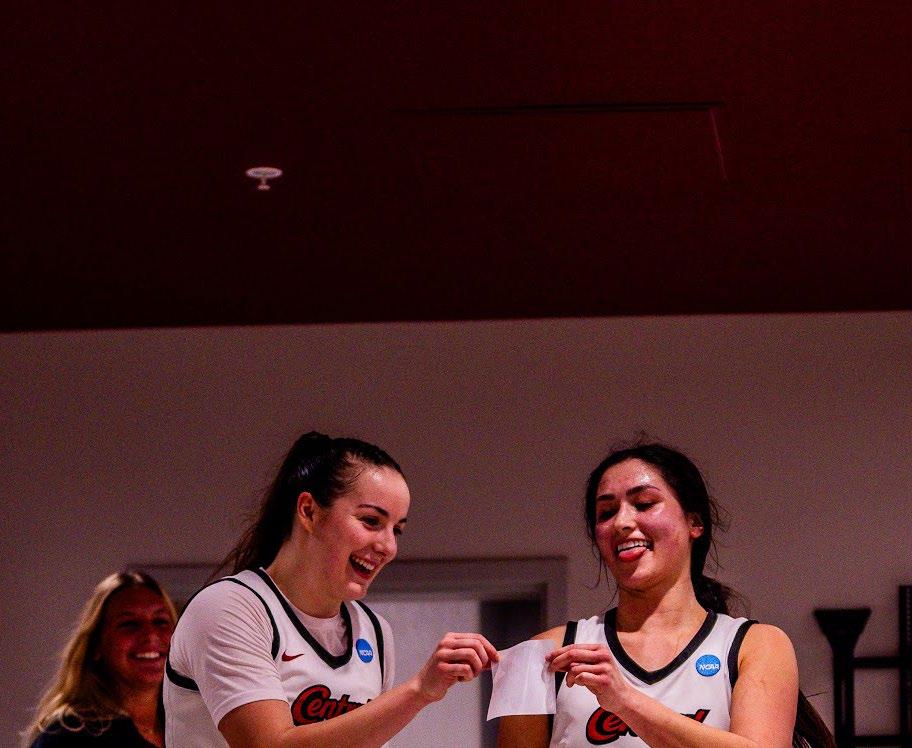
Law and Justice student Capri Sims, who plays Forward for the CWU Women’s Basketball (WBB) team, reached a milestone of over 1,000 points throughout her college athletic career. She also won the Second Team Great Northwest Athletic Conference (GNAC) award during the 2025-26 basketball season.
Sims, a junior at CWU who came from Post Falls, Idaho, reached the 1,000-point milestone during the first Sweet 16 game, which took place at CWU’s Nicholson Arena on Friday, March 13.
The Observer interviewed Sims to spotlight her achievements.
Q: I want to start out by asking about your 1,000-point milestone. How did you feel about that?
A: I didn’t really realize the milestone I reached. But it was really special reaching that with my team, and especially during a game like that. It was such an improvement and a great thing for our team. I think that made it all the better.
Q: How did you work to get that milestone?
A: By showing up every day. I stayed over summer, so working with my teammates and coaches.
Q: I also heard that you got a Second Team award with GNAC. Can you tell me about that?
A: That’s something they do at the end of every season, and it was another cool accomplishment
that I got. But honestly, I have to give all the credit to my coaches and teammates because I wouldn’t have been able to achieve that without having the culture and love that we have for each other.
Q: What do you like about your coaches and teammates?
A: I love that they’re nice people. I love who they are on the court. They push me in everything that I do. They are really, really great people on and off the floor.
Q: Any fun memories throughout your basketball career?
A: There’s honestly too many. Last year, making it to regionals for the first time was a pretty special thing. That was a blast. This year, the first half of the season was really fun. Ultimately, I think this last little stretch at the regional tournament was very fun with the team. It was obviously not the outcome that we wanted, but I think those first two games were really special.
Q: How did you feel about coming in second place in the regionals?
A: It was disappointing, definitely something that we could have prevented from happening. So, that was hard, especially making it to regionals last year and then being in the same spot, just having to take that one extra
step and not being able to take that extra step was disappointing.
Q: How do you think you, as an individual and as a team, can improve so you could possibly win regionals next year?
A: I think by, once again, showing up every day with having that in mind and knowing that when we show up to practice and when we show up to weights and when we show up to games, it’s all going to be toward the end goal, which is making it right back there and punching our ticket.
Q: What do you think were your biggest successes this season?
A: We faced a lot of adversity. The first half of the season went really well. In the second half, we faced a lot of adversity, which ultimately I was proud of our team for coming together in certain moments and challenging that adversity. So I think that was a success in a way.
Q: Can you name one specific challenge you had and how you overcame it?
A: One specific challenge we had was losing the corporate championship on our home floor. Going into that next week and still fighting for it, we had a great practice that week. I think that was a huge step in the right direction towards overcoming.
CWU vs Vanguard-62
Asher Cai (Right) and Capri Sims (Left)
(Photo courtesy of Alistair Hennessey)
'NO SAFETY, NO PEACE'
STUDENTS MARCH AGAINST NEONAZI FLYERS, TURNING POINT USA AND NO-CONFIDENCE VOTE
Gunner Stuns News Editor
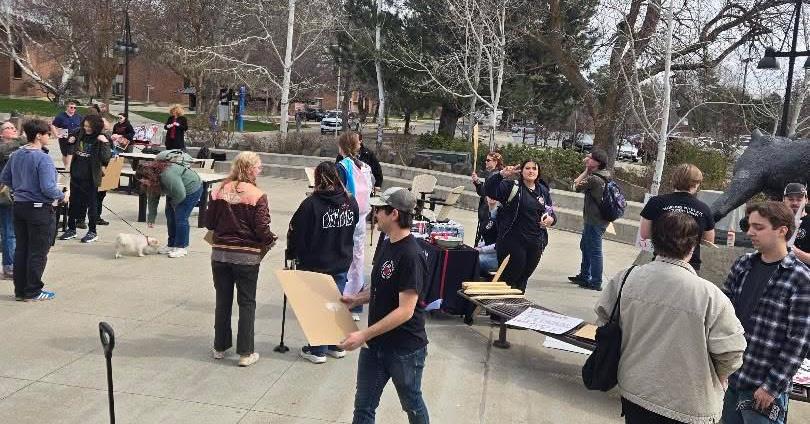
An estimated 30 students gathered Tuesday in front of the SURC and marched through campus to protest the lack of action taken by CWU administration regarding neo-Nazi flyers on campus, the establishment of Turning Point USA as an official student organization and the faculty vote of no-confidence against President Wohlpart.
The protest, hosted by the Working Wildcats Union, began at noon on the first day of spring classes. The goal was to create a place for students to safely share their feelings about “these horrible acts,” according to Alexander Matheson, a junior Law and Justice major and member of the Working Wildcats.
“We need to have a student-focused mindset, and when the student body is reacting to something like this, and the university has nothing to address it, we need to be the ones to be that megaphone for people,” Matheson said.
The protest yielded several chants by the marchers, including “no safety, no peace” and “stand with students, stand with us,” the latter of which was used during the Services & Activities Committee (S&A) budget protest that took place in the spring of 2025. Some protestors also carried picket signs, some of which read, “know your rights” and “make your voice heard!”
Matheson delivered a speech at the onset of the protest, detailing the various reasons that the Working Wildcats felt the safety of students and staff at CWU was under threat. He began with CWU’s lack of action regarding the neo-Nazi posters that turned up on poles across campus in January.
“The students made their voices clear, we made our anger clear, whether that was online, in-person or otherwise, we drew the line ourselves,” Matheson said. “What did the university do? Did they bring it up? Did they promise to do better in the future? No, they stayed silent. They proved that language like that was acceptable here on campus. If you can't draw the line at Nazis, where are you going to draw the line?”
Matheson also detailed the “bad habit of double standards” at CWU around the allocation of student funds regarding the recognition of political groups as registered student organizations. In particular, he referred to Turning Point USA, a “far-right group” that allegedly “enforces a ‘Professor Watchlist’ which encourages harassment against faculty,” according to the flyer handed out by protest organizers.
“What kind of message does it show when organizations like Turning Point USA are allowed clear entry into our campus, when actual Centralmade organizations and political groups are deadlocked for months, if not
years, for being in too much of a gray zone politically?” Matheson asked. “If an organization with an active faculty hit list is not a gray zone, then none of us are.”
Matheson also spoke about the Faculty Senate vote of no confidence against President Wohlpart. The event started in February and has been ongoing as both Wohlpart himself and CWU’s Board of Trustees continue to respond. The vote alleged that Wohlpart had engaged in decisions that undermined the Faculty Senate’s role in the academic mission of CWU.
“Our own teachers, our professors, our faculty, have noticed this issue, and you know what they did? They yelled, they screamed, they told anybody who would listen that this was a problem because they saw how our own president was not listening to them, he was not listening to the alumni, he was not listening to the faculty, he was not listening to his staff and he was especially not listening to the students,” Matheson said. “Today, we stand in solidarity with our faculty, with our professors, with our teachers.”
During the march, The Observer also spoke with students who were willing to share their reasons for participating in the protest and what they believed should change at CWU.
“There was a lot of talk about neo-Nazis on campus, I saw some posters firsthand,” Biology major Salem Czerwinski said. “I'm also a student worker. I've seen my co-workers go through injustices. I've had things happen to me that have not been fair in my opinion and when I tried to talk to people about it, I was very often dismissed as though it was normal.”
Czerwinski added that events like the protest make them feel as though the voices of himself and his peers are being heard, because taking action is how conversations about change begin.
“Inaction, in itself, is an action you are choosing, you're choosing to be silent,” Czerwinski said. “Going out and doing things like this is just so important to me, specifically, but I think in general, it is very important to make our voices heard, because at the very least it starts a conversation.”
Another student who expressed their concern was August Johnson, a middle-level education major.
“There are Nazi posters going around and jack shit being done about it,” Johnson said. “I want them expelled. They're pro-killing people. They need to go and if we are not listened to, then we will continue to fight. We will continue to be loud because we are tired. I am tired and I want change.”
Students gather in front of the SURC before the start of the protest. (Photos courtesy of Working Wildcats)
'NO KINGS' PROTEST
RETURNS TO ELLENSBURG
Kyley Glenn Lead Reporter
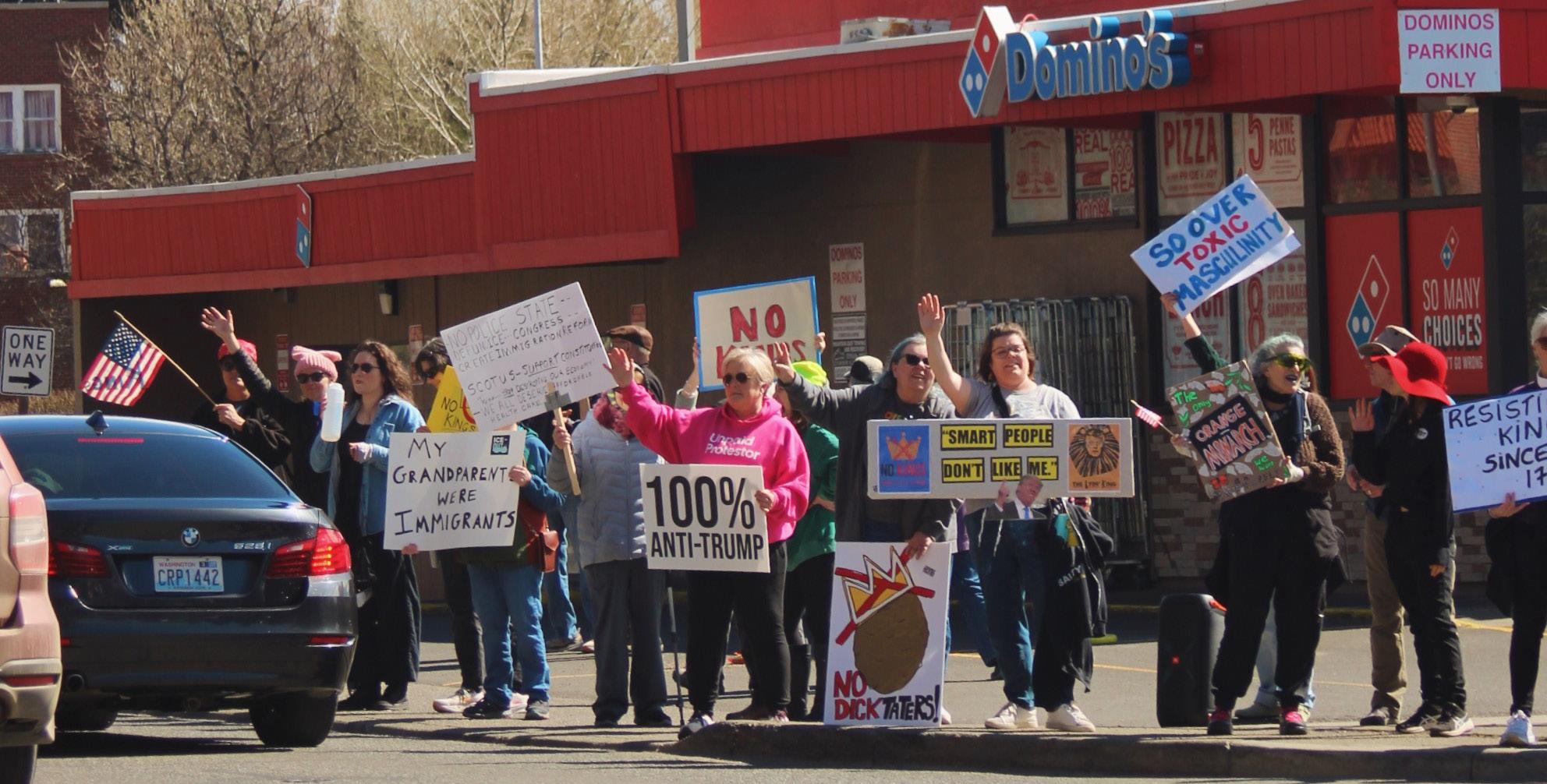
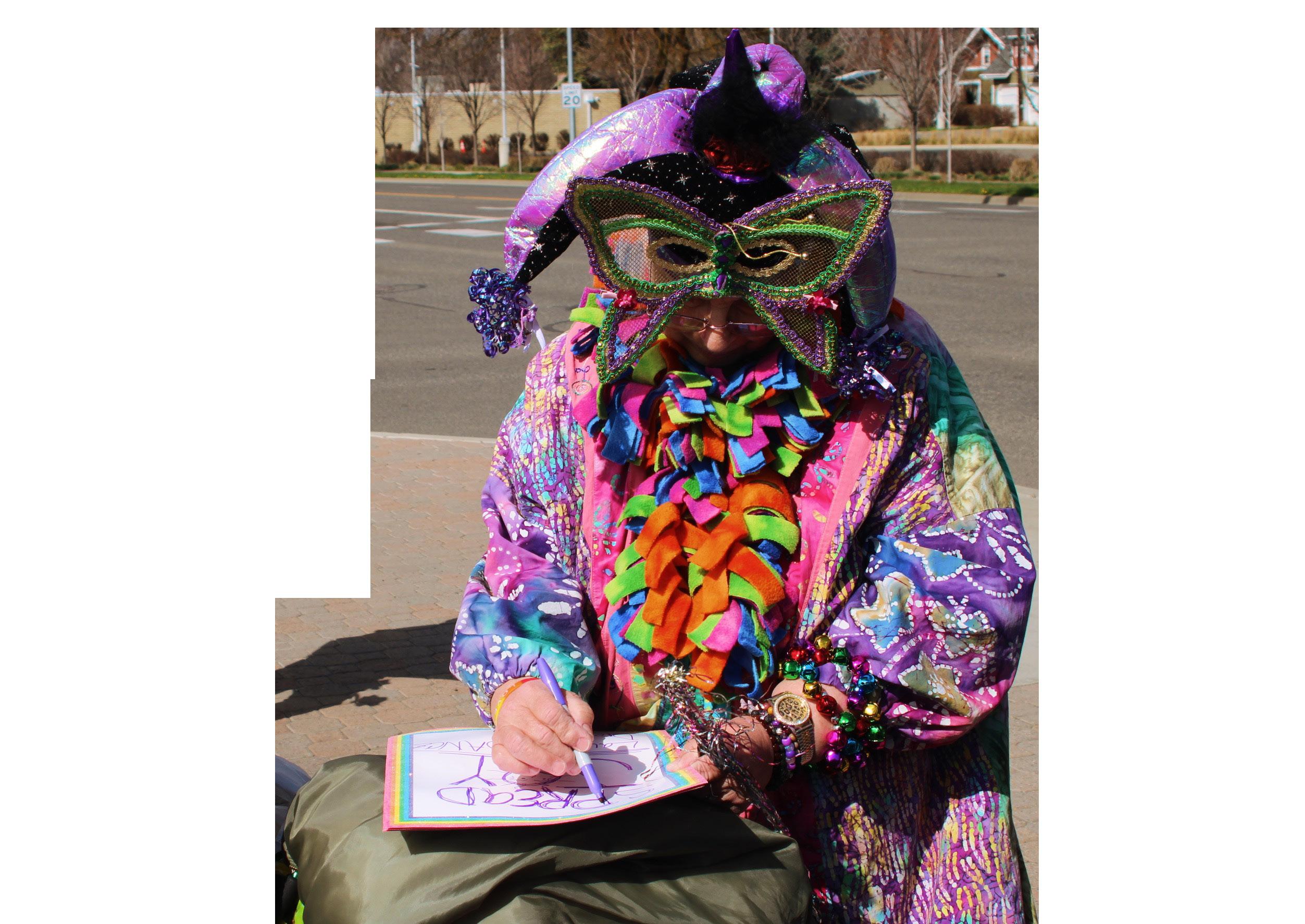
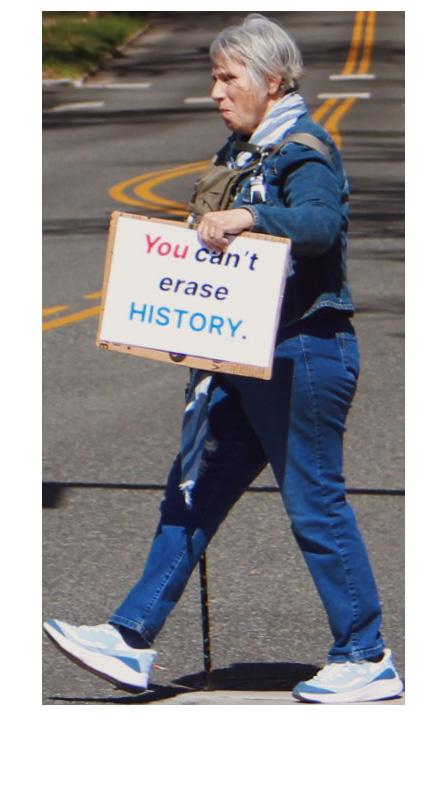
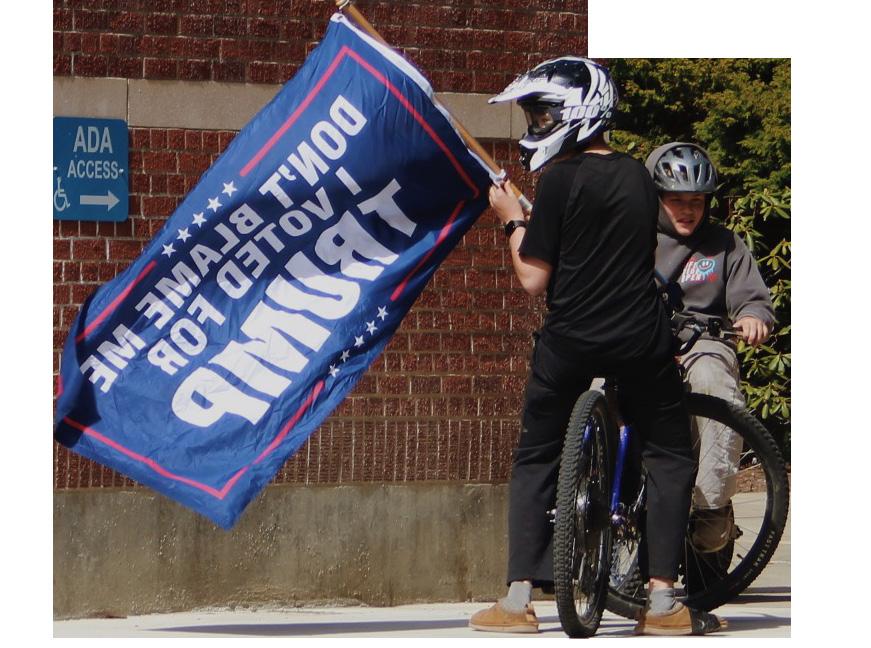
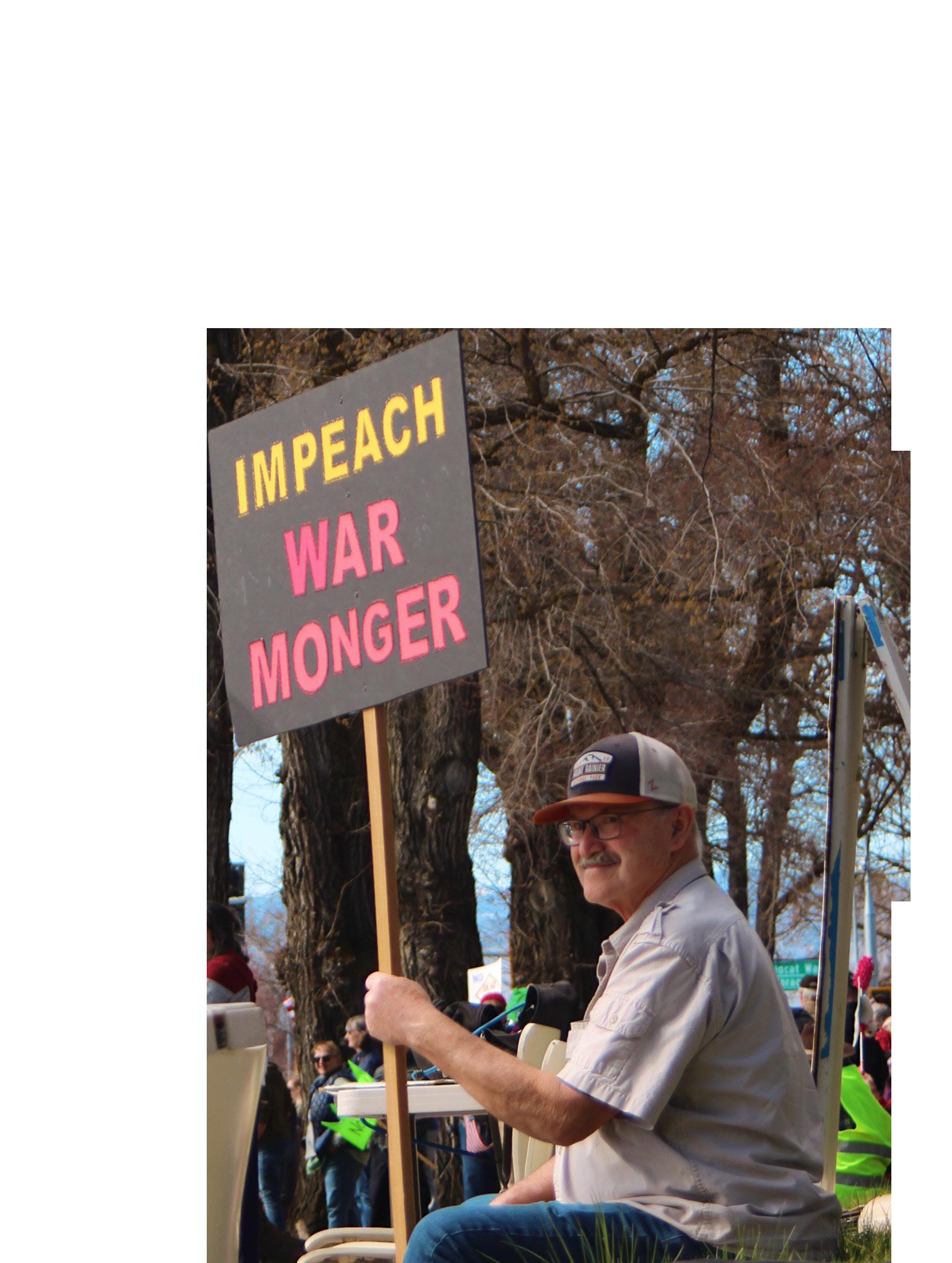
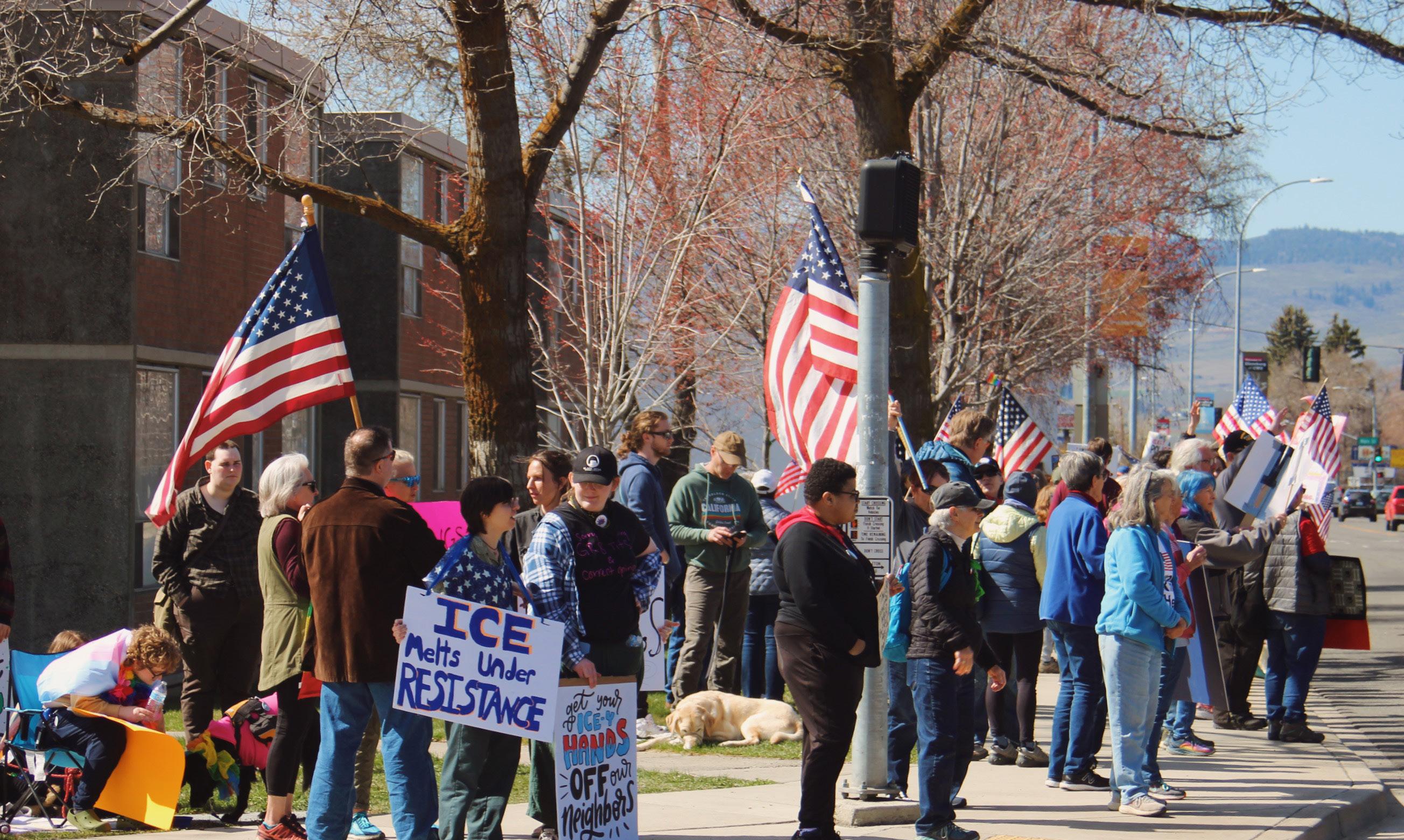
The nationwide series of ‘No Kings’ Protests made a return to Ellensburg on March 28 with over 1,000 attendees, according to The Daily Record. Two groups in attendance were Ellensburg Indivisible and the League of Women Voters of Kittitas County. Both were offering informational resources.
Charli Sorenson, a member of the League of Women Voters, said, “National gave us the green light to participate and/or organize for today's event, because nationally, the League is really concerned that democracy is under threat, and so they felt it was really important that the League be present at these to show that we understand democracy is under threat and we want something done about it.”
CWU students were also present at the event, and one stated that it wasn't their first. “I have been to several protests and organized walk-outs. In high school, I helped organize a walk-out that was widely successful and even got news media coverage,” second-year Elementary Education major Hannah McCulley said.
“I’ve seen ‘No Kings’ all over my social media and news feeds, and figured I would get involved locally. It’s really important to me to be involved with something where people can come together and support one another, especially in a primarily conservative area such as Ellensburg. It’s nice to know there are people that have the same ideologies as you,” McCulley continued.
Outside of the occasional middle finger out of a vehicle window, there were only two noticeable counter-protesters on the scene. One was a man holding a flag with a photo of Trump on a military tank with fireworks and an American flag, who walked down the sidewalk past the “No Kings”
(Photos by Kyley Glenn)
WOHLPART, B oT AND FACULTY RESPOND TO
MARCH 26: THE BoT HOLD OPEN MEETING, DISCUSS NEXT STEPS
The CWU Board of Trustees (BoT) held an open meeting from 4:15 to 5 p.m. on March 26, where they discussed ideas about moving forward and rebuilding trust at CWU. The meeting was held both in person and on Zoom, with all BoT members participating virtually. The Zoom was attended by 100 CWU community members, BoT members and Wohlpart.
The BoT outlined during the meeting that they are currently in the process of submitting requests for proposals from “neutral third parties” that will be employed at CWU to review shared governance practices and build trust moving forward.
They stated that their goal is to interview “at least three” organizations before moving forward.
Specific details surrounding the “neutral third parties” remained vague during the meeting, and faculty concerns about where the funding for bringing outside review would come from were not addressed.
Outside of discussion surrounding the "neutral third party,” the first half of the meeting consisted
of further discussions around rebuilding trust, engaging more consistently and directly with faculty and student groups and looking at best practices moving forward, all of which ended up summarized in a follow-up March 27 email.
The second half of the meeting was spent primarily on discussion around culture and conversation centered on the BoT reaffirming their gratitude toward administration and the “hard work” everyone had done so far.
“I've been on the board 12 years, and these conversations around lack of trust and really the sense of a wall or silos have been around since I've been on the board,” Trustee Erin Black said. “It seems to me that we cannot go through something like this and not really think intentionally about how we shift our culture so that people feel safe, so that people can start to build trust.”
Trustee Jeff Hensler stated, “We're going to be in a good spot. I think we've all learned a lot from this and will continue to learn a lot over
these coming months and quarters. And I really want Central to come out of this in a better spot, where we look back 12 months from now and go, ‘I'm glad that happened. We moved forward as an institution, and we're a better institution because of it.’”
One trustee, Gladys Gillis, stated that she has never seen this lack of hope on campus before. “I've never been on campus or around campus and seen the lack of hope before, and it's been interesting to observe it over the last few weeks, but I do agree that the initiatives we have had in place for the last three to five years are exciting and important initiatives.”.
“They'll be moving forward and this plan, I hope that everyone finds themselves in this plan, and sees that it's a hopeful forward motion that we're making,” Gillis continued. “I also am so pleased that this Board of Trustees has learned so much through this process, and I think that it will make us even better at what we are supposed to do.”
MARCH 20-26: FACULTY RESPOND DURING PUBLIC COMMENT AT THE BoT
Faculty responded to the BoT’s deliberations and communications during the public comment sections at both the March 20 and 26 BoT meetings.
Griff Tester, professor and chair of the Sociology Department, shared frustrations with the BoT’s response to the vote of no confidence during public comment at the March 26 meeting, stating that the vote was “not symbolic” and that it reflected “deep, sustained concerns about leadership, transparency, shared governance and a severe decline in morale across campus.”
“Since the vote, neither the Board of Trustees nor the President has meaningfully acknowledged these concerns or taken responsibility for the conditions that led us here,” Tester continued. “The absence of accountability is itself part of the problem. This moment is not about broader challenges facing higher education, shifting student demographics or external financial pressures; those realities are well understood. This vote is about internal leadership, a lack of transparency, actions experienced as retaliatory and the erosion of shared governance and persistent low morale.”
Tester called on the BoT for accountability, in themselves and in administration, and then went on to address statements from the BoT directly. “I also want to address the statement that the Board was disheartened by the timing and manner of the vote. If there is disappointment, it should prompt reflection and power and accountability at the Board level,” Tester stated.
Dominic Klyve, professor in Mathematics, shared a similar sentiment about the BoT’s "surprise" at the vote of no confidence in an email to The Observer in which he stated that “I don't know about you, but many people I talked to over the last year suspected a vote of no confidence was probably coming soon.”
“I had people not at the university asking me last summer why it hadn't happened yet,” Klyve continued. “Members of the Ellensburg business community and people who used to be involved in university governance all seemed to know that the President was wildly unpopular and that faculty and staff morale was spectacularly low. The only explanation I can think of is that
the President has managed the information the Board receives so completely that he could hide obvious truths from them.”
Jeff Hensler, chair of the Board of Trustees, originally shared the sentiment of "surprise" in the March 20 BoT meeting, the public portion of which lasted only nine minutes. He stated, “The timing and manner of the vote of no confidence came as a surprise to the board, as we had hoped additional avenues could be exhausted before we got to the spot we are [at] today.”
Kara Gabriel, professor of Psychology at CWU, was the first to speak during public comment at the March 20 meeting. She spoke as president of the United Faculty of Central, sharing concerns with shared governance practices at CWU and their implementation into policy.
Allyson Rogan-Klyve, chair of the Science and Mathematics Education Department, was the second to speak during public comment. “Last time I spoke before the Board, I shared some of the amazing work of students and faculty in my department,” Rogan-Klyve said. “However, when we insist on only hearing the positive such sentiments, it feels like, at best, a denial, and worst, a repudiation of the lived experiences of many students on campus.”
“There are too many powerful stories of student challenges to relay in my two minutes, but I assure you, they're very real and share many common themes,” Rogan-Klyve continued. “The reduced number of faculty has resulted in many students reporting an insufficient number of sections of courses being offered, resulting in potentially delayed graduation.”
Rogan-Klyve closed their comment with a reflection of the feelings they had faced during Wildcat Preview Day, stating, “For the first time, I found myself wondering whether I can, in good conscience, enthusiastically recommend students come here. We no longer have sufficient faculty in my department or many other departments to offer the courses they need, and should they experience any sort of financial health or wellness vulnerability, I don't think we could meet their needs. Please make the necessary changes to correct our course.”
Following the March 20 meeting, in an email exchange with The Observer, Rogan-Klyve spoke further about faculty response to the BoT’s rhetoric and whether faculty concerns were being adequately addressed. “I certainly don't and can't speak on behalf of all faculty, but those that I have spoken to feel incredibly demoralized and angry,” Rogan-Klyve said. “It is disheartening to continue to advocate for students, staff and faculty on campus only to be essentially told by the board that they plan to continue with business as usual despite knowing the negative impact it is having on so many folks.”
“At this point, I remain skeptical of the potential efficacy of mediation,” Rogan-Klyve continued. “If all entities recognized the depth of the challenges and were using a similar value system to address the problems, I think mediation could be used to reach consensus solutions. However, at this point at least, I don't think we are in a position to benefit from mediation without some radical changes in underlying beliefs and values.”
Hope Amason, an associate professor for the department of Anthropology and Museum Studies, also gave her opinion on the Board's continued support for Wohlpart in an email exchange with The Observer before the meeting on March 26. “I am deeply disappointed in the BoT members. And frankly, I’m not sure if they truly understand the division that exists on this campus,” Amason said. “How are we to move forward with a leader who has lost the confidence of the vast majority of faculty? How are we to trust someone who we know has lied to faculty?”
“I am taking comfort in the collective care of my colleagues. We are here for each other,” Amason continued. “And we are making plans to make sure our voices are heard in spring quarter.”
TO VOTE OF NO CONFIDENCE: A TIMELINE
MARCH 26: FACULTY PETITIONERS STATE, “THINGS ARE NOT OKAY IN CENTRAL WASHINGTON”
The 49 original faculty petitioners who came together to write and back the petition that led to the overwhelming vote of no confidence against President Wohlpart put out a press release on March 26 titled "Things are Not Okay in Central Washington.”
The release follows one key idea throughout, which is that as a result of mounting divide, environmental pressures and deep internal strain at CWU, “people are not okay.”
“This isn’t about personality or minor grievances," R. Shaffer Claridge, senior lecturer in the department of Law and Justice, said in the release. “Administration often misreads low morale as faculty negativity. But that’s not what’s happening.”
“I suffer low morale because my students are suffering,” Claridge continued in the release. “Some feel hopeless, and sometimes I’m the only adult they can turn to.”
The release stated that in “a single academic term, Claridge reports working with students facing profound challenges: a parent deported, disclosures of sexual assault, food and housing insecurity, and ongoing frustrations with university systems including financial aid, housing, Title IX processes and campus employment. Other faculty report interactions with students facing similar challenges.”
“These experiences underscore a central concern voiced by faculty: student success depends not only on academic effort, but
on meaningful, sustained relationships with instructors, relationships that are under strain because of a lack of leadership at the top,” the release continued.
“What comes next is up to us,” Hope Amason, department of Anthropology and Museum Studies associate professor, said in the press release. “There are more of us than them. And we have the collective knowledge and skills to push for meaningful change.”
MARCH 27: BoT OUTLINES “CRITICAL MOMENT” IN EMAIL
The BoT sent out a campuswide email on March 27, which addressed many of the ideas discussed at the March 26 BoT meeting and outlined potential next steps for “coming together around our shared vision for CWU’s future.”
The email indirectly addressed possible criticism in the opening, stating, “The direction we have outlined for CWU’s future may not align with all members of the CWU community.” However, the email does not address any specific faculty questioning shared in public comment at either of the prior public BoT meetings.
The email went on to outline a plan for increased collaboration and communication between the BoT and students, staff, faculty and administration at CWU, stating that, “the Board and the university community will continue to prioritize a students-first agenda in all decisions and initiatives,” and that ASCWU will be consulted in further shared governance review.
The email also stated that “the Board’s Academic Affairs Committee will continue meeting every two weeks to address faculty concerns and to advance the committee’s ongoing academic affairs work, through the end of the academic year (end of June).”
Faculty will also be consulted in the review of shared governance practices at CWU, according to the email, as well as a revision of the Faculty Code. Additionally, the email stated that “the Faculty Senate chair will be invited to provide a report, share updates on initiatives, and respond to Trustee questions at each regular meeting of the Board of Trustees.” This open invitation will be continued beyond the end of the school year, according to BoT discussion from the March 26 open meeting.
According to the email, ASCWU and staff will be provided the same opportunity at future BoT meetings.
“We recognize that meaningful progress will require sustained effort and engagement from all members of the CWU community,” the BoT email stated. “While perspectives may differ, we have a shared commitment to the well-being of the institution and the success of our students.”
The email ends with further support for Wohlpart, stating, “The Board of Trustees is confident in the university’s ability to advance key institutional priorities, and we continue to affirm our full support of President Wohlpart. The Board believes in the CWU community’s ability to work collaboratively in support of a strong and successful future, and we welcome the opportunity to work with all of you to identify and implement solutions that will strengthen CWU for many years to come.”
APRIL 2: WOHLPART ADDRESSES VOTE IN LETTER, STATES HE IS “LISTENING, LEARNING, AND REFLECTING”
President Wohlpart sent out a campus-wide email on April 2 in which he shared personal reflections on the vote of no confidence following time spent “meeting with and listening to a wide range of individuals across our university to gain a deeper understanding of the events and activities that have shaped where we are today.”
In the email, Wohlpart directly addressed faculty complaints directed toward his change in leadership style and recent decisions surrounding the Faculty Senate and shared governance.
“The most important takeaway from these sessions has been regarding the change in my leadership you experienced this past year,” Wohlpart stated in the email. “For instance, the robust, engaged, and participatory experience that occurred during the initial drafting of our vision and mission statements was not the same type of experience that occurred with the revision process.”
“I also heard a great deal about our conversations around shared governance and how the document we created should be regarded within our university community,” Wohlpart continued in the email. “While the Board of Trustees stated in their May and July 2025 public meetings that we would use this document to rethink all of our processes, systems, and structures, the original intent of the document and how that revision process would unfold should have been a more inclusive and transparent conversation, similar to the types of thoughtful and engaging processes we used in the past. One of my failures was that I moved more quickly than I should have without allowing the community to be more integral to the process.”
The email goes on to describe how these changes in leadership style and process led to feelings of “frustration, loss and grief,” which Wohlpart stated built up to the vote of no confidence.
“What I have heard in the petition, the vote, the forum and the conversations and listening sessions that have occurred since then is a sense that I have devalued and diminished the faculty’s voice and the role of Faculty Senate,” Wohlpart stated in the email. “Rather than listening, taking ownership and recalibrating, I continued down a similar path in my email to the university community and in the open forum.”
Wohlpart closed the email by taking “full responsibility” for the change in his leadership style and “misstep” that led to the vote, and to the “perception that I was not caring or engaged.” In line with recent BoT discussion about moving forward with third-party consultation, Wohlpart stated in the email that he is “committed to participating in this work, while continuing to listen, learn and find ways to build a community where everyone’s voice is heard, respected and valued.”
Editor in Chief
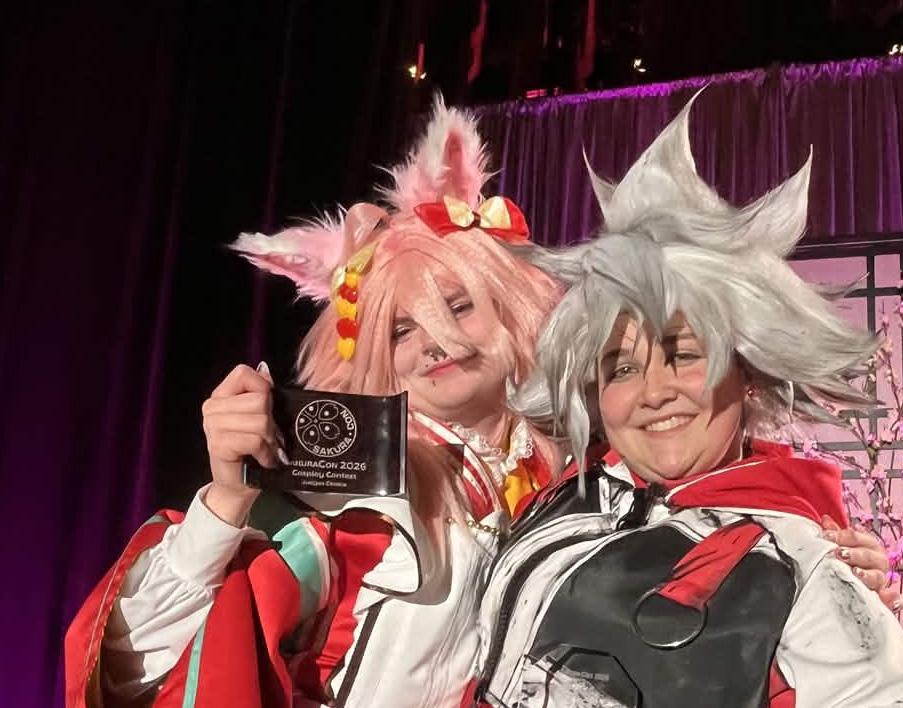
Members of the CWU Cosplay Club made the trip over the pass this past weekend to attend the largest anime convention in the Northwest, Sakura-Con, where they would end up winning two individual cosplay awards.
Ethan VanAmburg, the Cosplay Club Treasurer, left the Convention (Con) with a judges’ choice for his cosplay as Tori Himemiya from “Ensemble Stars,” and Kylie Copeland, the club president, left with an award for Best Original Design for her cosplay as Rudo from “Gachiakuta.”
Copeland, a senior Professional Pilot major double-minoring in Robotics and Automation/Aviation Management, has been a member of the club for all four years of their time at CWU.
“My experience in the club has been nothing short of my favorite thing about Central. Everyone is super personable and it doesn’t matter what background you come from, whether or not you make or buy your costumes, or even if you cosplay at all, everyone is kind and welcoming,” Copeland said. “I’ve been running the club for three of those four years with my main goal being welcoming more people into our community, and we’ve grown to become one of the largest clubs on campus.”
Cosplay, as an art form, requires hours of hard work and preparation, according to Copeland. She and VanAmburg spent over 120 hours working on their cosplays, which the competition required to be handmade.
“My experience at Sakura-Con this year was unbeatable,” Copeland said. “I got to meet so many new people backstage at the cosplay contest as well as see my members show off their hard work. My favorite part about our trip has always been seeing the smiles on all our members’ faces as I hand them their room keys.”
“If I had to pick one of my favorite overall experiences, it would be when the cosplay competition judges called out my treasurer’s name for a judges’ choice award because we were Con-crunching together, and getting to see his hard work pay off was so special,” Copeland continued. “And then for me to get to join him on stage just a short time later was such icing on the cake.”
A first-time club member, Hannah Capua, a transfer Actuarial Science major and Art minor, also described her experience at Sakura-Con this year. “It was amazing, definitely the best convention I’ve ever been to,” Capua said. “Being able to go with my friends and embrace our interests is so much fun.”
“Some of my favorite parts of cons in general are when I get to have really fun conversations with strangers over shared interests like cosplay, art or media,” Capua continued. “And being in the cosplay club really inspired and motivated me to cosplay at the convention, which makes it even more fun.”
The Cosplay Club hosted a panel at Sakura-Con this year called “Cosplay Family Feud,” which was open to all attendees of the convention. Quin Moriarty, a Theatre Design and Production major, was at the panel.
“We then [after surveying cosplayers] challenged groups of cosplayers and friends at the convention to come on by and guess what the most common answers were,” Moriarty said. “There was a great turnout and we were able to offer prizes to everybody who participated, not just the winners! We had a great time and it seemed like there was a large amount of interest from other congoers to see a similar panel hosted by CWU Cosplay Club in subsequent years!”
VanAmburg, a second-year Clinical Physiology major, said the club meets once a week, offering a chance for its members to learn about cosplay, hang out, craft, watch movies and make friends.
“Someone should join if they have any interest in cosplay or costuming or making things,” VanAmburg said. “It is a great way to meet friends with similar interests.”
Nym Felix, a 5th year majoring in Apparel, Textiles and Merchandising, said that the club has been the best way for them to find community at CWU. “I would say if you’re really nerdy or want to be really nerdy, you should join this club!”
Cosplay Club members holding award.
(Photo courtesy of Cosplay Club.)
IMMISCER
CWU FILM STUDENT GURDIL DARDI FINDS FESTIVAL SUCCESS
Gurdil Dardi, a junior majoring in Film Production, has seen success at festivals nationwide for his short film “Immiscer.”
Since its release, “Immiscer” has earned five official festival selections, including a selection at Lift-Off Global Network. Dardi’s work on the project has sparked recognition locally, sparking a front-page article from The Ellensburg Daily Record.
Dardi credits a lot of his success to the Film program at CWU, stating that the people and the instructors are what make it so special. “The resources and opportunities that the film program and its faculty have provided me have been genuinely transformative,” Dardi said. “I have been able to learn so much during my time here, not just technically, but creatively and professionally as well.”
“What makes CWU’s Film program especially meaningful to me is the community it has built. I have been in the same classes with the same group of classmates since my very first year, and now heading into the end of my third year. Those people have become some of the closest and most trustworthy individuals in my life,” Dardi continued. “We have grown together as directors and producers, collaborated on each other’s projects, pushed each other to be better, and supported each other through every step of the process.”
“Immiscer” was a completely student made production, with the cast and crew working together across various CWU departments. CWU student
Nathan Rupp worked as the project’s cinematographer, and students Loralyn Lenz, Jayden Hades and Shaynne Sather worked as the main cast.
Following the success of “Immiscer,” Dardi is hard at work on his latest project, “To God,” which is about to enter production.
But according to Dardi, his time as a film director didn’t start at CWU; it started at home. “My journey into directing and producing actually started before I even arrived at CWU,” Dardi said. “Back in high school, I was always looking for ways to get ahead, so I took summer classes at Tri-Tech Skills Center… I started in Video Game Design and quickly discovered that coding was not my strength. I moved into Cyber Security and ran into the same wall. Then I found the Digital Arts and Filmmaking program and everything changed.”
“I had already been making videos since middle school, recording and editing funny videos to show my friends and posting them on YouTube. I had a natural love for it without even fully realizing it. The moment I stepped into that filmmaking program, it all clicked,” Dardi continued. “What really sealed it for me was the reaction from other people. Seeing people smile, hearing them laugh when they watched something I had created, that feeling was
unlike anything else I had experienced.”
Following his time at Tri-Tech Skills Center, Dardi enrolled at CWU, where he has continued his education in film for the past three years. According to Dardi, if there’s anyone to credit for his recent success, it’s Philip DeRise, professor of Film at CWU. “Professor DeRise has been our professor across countless classes and he has consistently gone above and beyond what most professors do,” Dardi said. “What sets Professor DeRise apart is that he genuinely cares about where his students end up. He has consistently encouraged us to keep improving our craft, to think beyond the classroom and to envision a future for ourselves in the film industry that extends well beyond our time at Central Washington University. He has willingly invested his time, knowledge, and energy into our growth in a way that has made a real and lasting difference. He is one of the most important mentors I have had in my life.”
Brandon Mattesich Editor in Chief
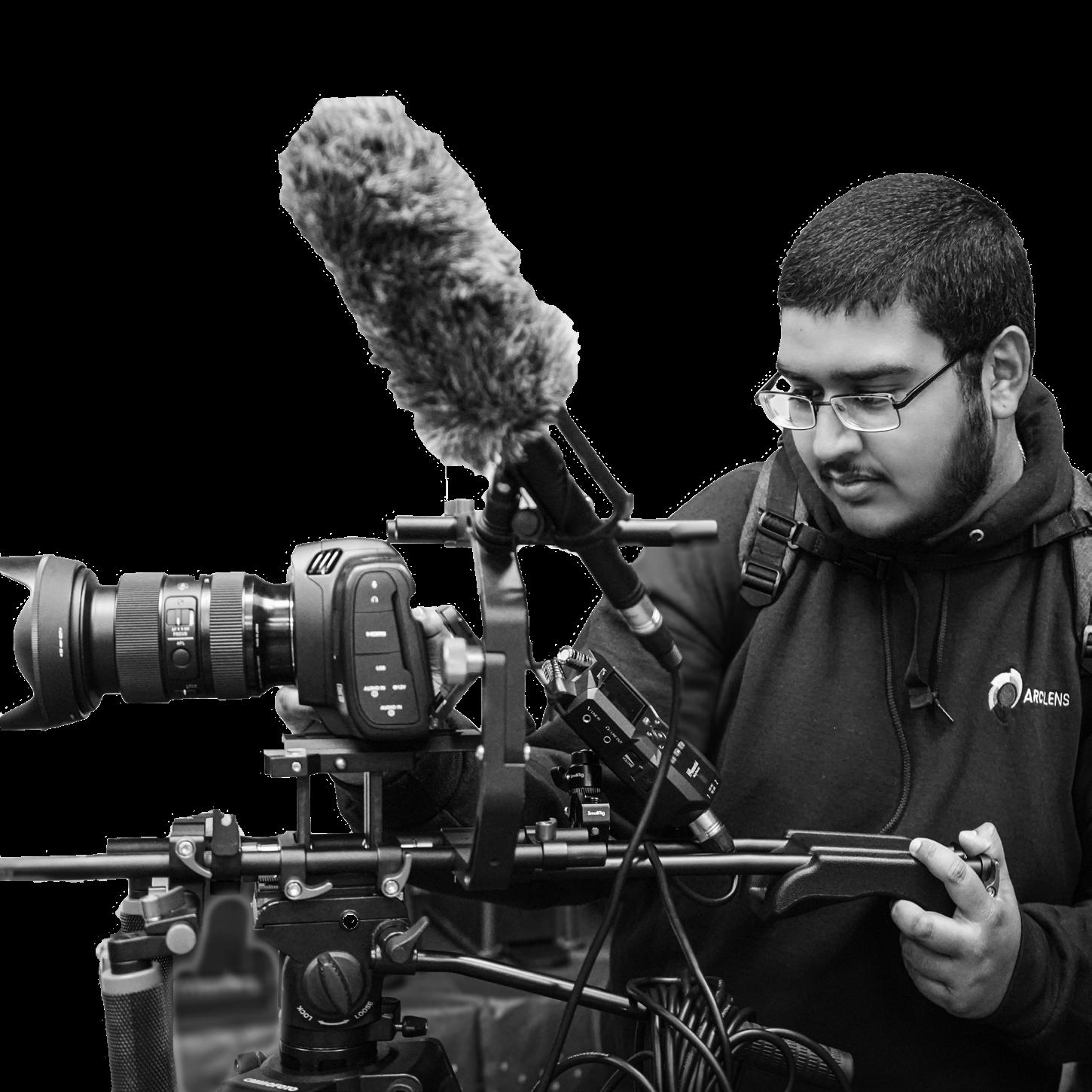
Dardi Filming. (Photo courtesy of Gurdil Dardi)
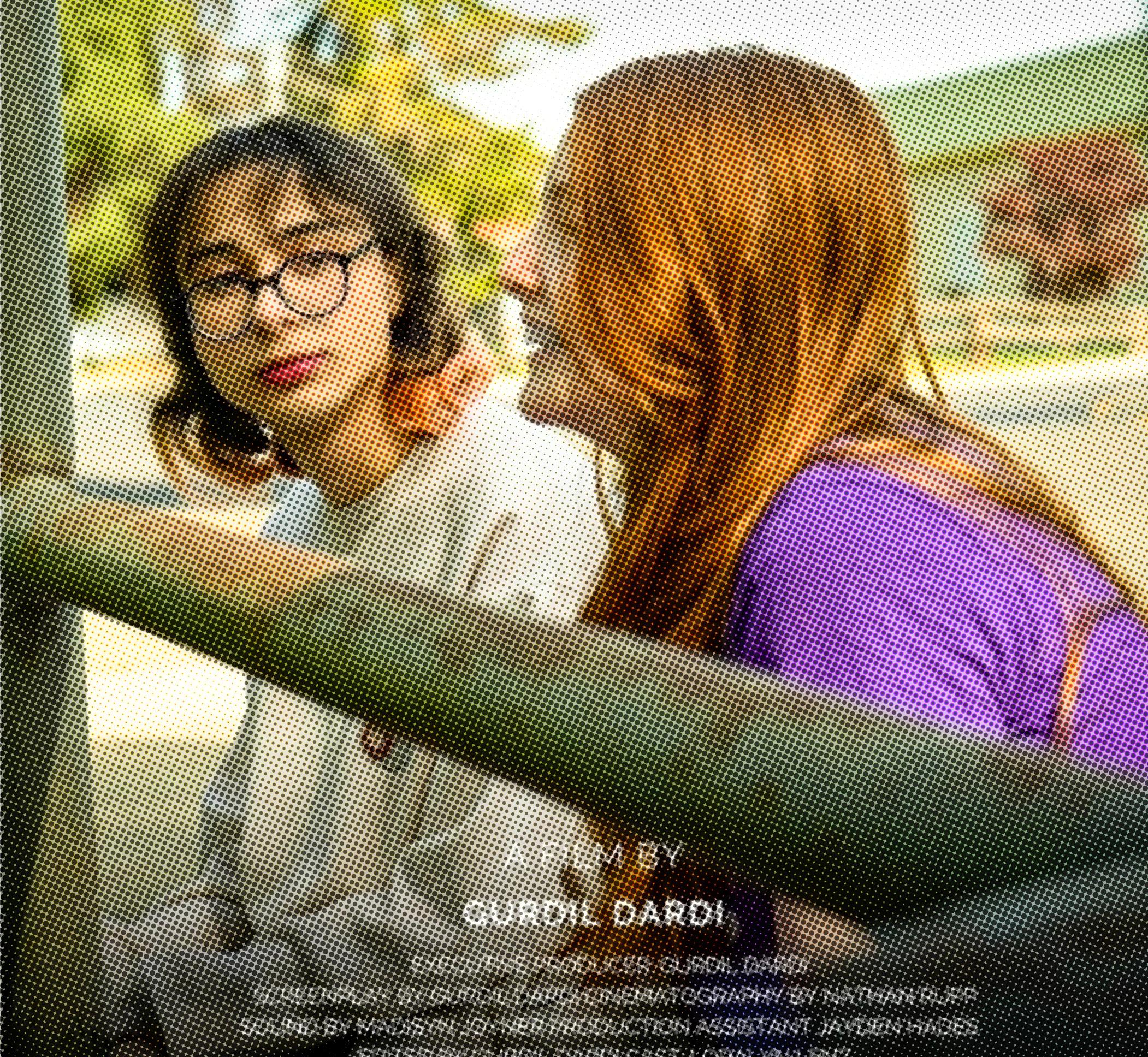
“Immiscer” movie poster. (Photo courtesy of Gurdil Dardi and Team.)
Tommy Skaggs: Tommy Skaggs: A History On-Air and a love for
Ethan Kennedy Columnist
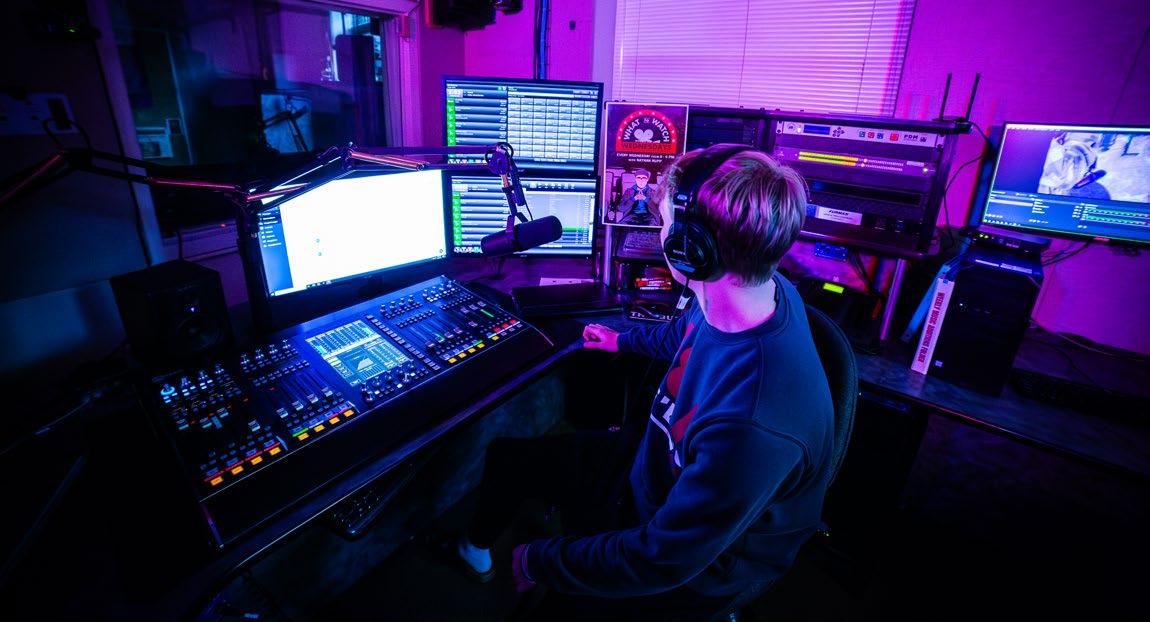
For over five years, Tommy Skaggs has been making connections, adjustments and building up 88.1 The ‘Burg. Skaggs was a communications major at CWU and graduated in 2006. He would go on to start his career at the radio station in 2021, where he would take the position of General Manager.
During his time in high school, Skaggs had the opportunity to host a radio show on Voice of Vashon alongside friends. According to Skaggs, this pushed his love for radio to the top, and when coming to CWU, joining the radio station was a priority. Before his time as General Manager at 88.1 The ‘Burg, he went on to host two shows on site, titled “Weekly Geek” and “The Expansion Pack.”
When Skaggs was a student, he was on staff as Music Director. During his time in that position, he listened to CDs so he could find songs to add to the station.
“I had a music rotation show. Back then you had to play the music that they gave you that was off of CDs ... the Music Director had to review the entire CD, even if they only wanted one track off it,” Skaggs said. “I had a couple of nerd-out talk shows as well. It was definitely fun, flipping through the library and seeing the physical media.”
Since Skaggs became General Manager, the station has undergone several changes. Going from CDs and physical media to digital ended up opening more opportunities.
“Originally, you had to do a rotation show (playing music/talking at specific times), but you don’t have to do that anymore. You could come in and do exactly the type of show that you want to do. We have so many specialty shows and students really get to take ownership of their time,” Skaggs said.
The ‘Burg works with organizations and clubs as well. Representatives can sign up to either go through the training process or have a professional at The ‘Burg control the soundboard for the showtime. Departments and clubs such as the Career
Center, the Mariachi club and MEChA (Movimiento Estudiantil Chicane de Aztlán) all currently have shows weekly at The ‘Burg.
“If organizations and clubs want to come talk about their club on radio, they can do that,” Skaggs said. “If someone doesn’t want to go through the full (training) process, we can just run the board for them. They are able to do a one-off show and get a taste. Any student, any major is welcome to have a show on the station.”
As manager, Skaggs oversees the general operations of the station, with the help of Nicholas Elliot as IT (Information Technology) and Engineering Manager, and Andreina Delgado as the Project and Outreach Supervisor. The rest of the staff positions, such as trainers, brand team, DJ’s and News team, are all student employees. The ‘Burg is student-run with the help of supervisors.
“I make sure that all of the departments are operating and if there’s any gaps, I find ways to fill those gaps,” Skaggs said. “I’m really focused on setting up our budget for next year, making sure that we’re in good shape there. Just setting the general direction of the station and providing as much support as I can to both our paid student staff and our student volunteers.”
Signing up to have one’s own hour on the ra dio is as easy as walking into the station and simply asking. The train ing process consists of four scheduled sessions. Each is an hour long, going through the rules and regulations, then learning the tech. After having two successful practice shows, Skaggs works with future radio hosts to find
a time for their show. Once they do find a time, they are on air.
The ‘Burg currently has 48 on-air shows, with all recorded shows being pushed out on the station’s website. The radio station also collaborates with CWU events regularly, providing music, sports commentary and an occasional appearance of The ‘Burg’s very own mascot, Burgfoot.
Skaggs noted CWU alumni who have worked for The ‘Burg and have delved into careers in radio. Former Project and Outreach Supervisor, Kajal Lang, now works for iHeart Studio. Austin Smith, former Music Director and DJ, is currently at Northwest News Radio. Former Sports Broadcaster (and former Observer co-Editor-in-Chief) Jackson Roberts is now working at Cheney Stadium, where the Rainier baseball team plays.
Along with CWU events, the station often partners with T-Mobile Park, connecting to the stadium’s speakers and DJ-ing for CWU Mariners Night. Notable partnerships include local Ellensburg band CobraHawk and Ryan Lewis at Mariners Night.
“Our numbers are growing, involvement is growing … When I was a student, the best memories I had were from the station. We have a lot of people that go through this and decide to do
Tommy Skaggs. (Photo courtesy of CWU)
HELP WELLINGTON FIND HIS CHEESE
THE OBSERVER’S TV SHOW CROSSWORD
Designed by Z Morris Divined by
Ethan Kennedy
Aries (March 21 - April 19): Feel the burn! Feel the rage! Axe in one hand, other axe in the other hand, third axe strapped to your back. RAHHHHH. Your D&D class: Barbarian.
Taurus (April 20 - May 20): What kinda potions ya make eh? You got some nice robes there. HEAL ME HEAL ME! Your D&D class: Cleric.
Gemini (May 21 - June 20): Play me your finest tune, then pull some magic out of your ass cause I guess musicians got the power. Your D&D class: Bard.
Cancer (June 21 - July 22): I don’t know how, but please figure out a way to turn into a dragon. Pleaseeeee? If not, can I at least see an Owl Bear? Your D&D class: Druid.
Leo (July 23 - Aug. 22): Dodge, wave, sneak attack. WTF? I can’t believe you stole my gold, I thought we were in this together? Thought you were fam but nahh. Your D&D class: Rogue
Virgo (Aug. 23 - Sep. 22): That’s it, time to shave it all off, all of your hair. Breathe in, and breathe out. Your D&D class: Monk.
Libra (Sep. 23 - Oct. 22): Alright Harry Potter, I hope you expecto patronum, hehe. Cast ye spell, do fireball. Cast fireball. Can you do fireball? Your D&D class: Yer a Wizard.
Scorpio (Oct. 23 - Nov. 21): Call upon your heritage and bloodline, Van Helsing will be yo main mannn. Friggin monster hunter. Your D&D class: Ranger.
Sagittarius (Nov. 22 - Dec. 21): Jab, cross, RIGHT HOOK! But for real, what weapon do you want? Your D&D class: Fighter.
Capricorn (Dec. 22 - Jan.19): Aight Voldy. You’re like a Wizard but kinda dark, you got some dark and spooky magic, just real spooky. What are you gonna do, Necromany me? Your D&D class: Warlock.
Aquarius (Jan. 20 - Feb.18): You have been cosmically chosen to bear the burden of possessing the most complex and intricate power system… you’ re welcome. Your D&D class: Sorcerer.
Pisces (Feb. 19 - March 20): Sworn by the sword and wearing the armor of your kingdom. Whip out a lil magic here and there though. Your D&D class: Paladin.