Women’s soccer to compete in second NCAA Championship
On Monday, the women’s soccer team received an invitation to play in the NCAA Division III Championship. This is the second time in program history that a Case Western Reserve University soccer team has ever gotten this far. The women’s team will play their first game this Friday against Wooster College in Wheaton, Illinois. The announcer on the NCAA website said that this year’s women’s team is the strongest offensive team in the program’s history.
In their last game of the regular season, the CWRU men’s and women’s soccer teams took on Carnegie Mellon University at home, with both teams dropping their senior day games, the women fell 3-1 and the men 4-0.
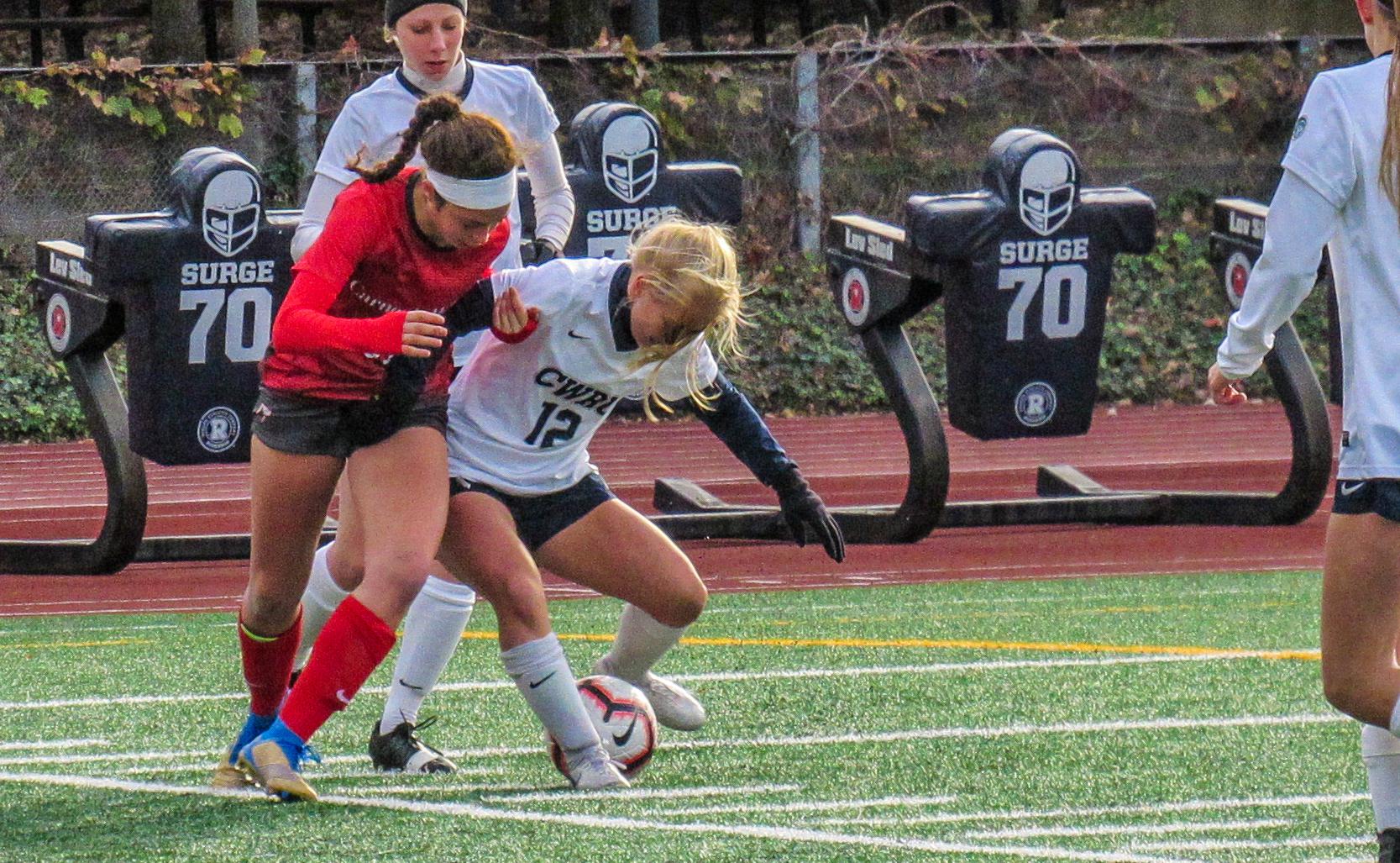
Even though the Spartans did not score a goal, the team led by 19 attempted shots, with seven on goal compared to Carnegie Mellon’s 13 attempted shots. CWRU dominated possession of the ball in the start of the game, taking the first four shots and setting up three corners to try to score. The Tartans of Carnegie Mellon drew first blood by scoring off a corner at the end of the first half and kept going in the second, as the ball was close in the box with not enough defenders back off a fastbreak.
Fourth-year forward Zachary Senft, who led the team with seven shots attempted, relentlessly continued to attack but did not convert a goal. Carnegie Mellon scored back to back goals in the 72nd minute, and the Spartans took six goals in the next six minutes to end the season on a high note. However, half of the goals were saved by the opposing goalie. Besides Senft, the fourth-year players were led by midfielders Brian Woo and Garrett Win -
ter, followed by defender Nicholas Bertrand, defender Kyle Lewis and midfielder Chas Novitsky.
For the women’s team, the Tartans came out aggressive to start the game, with fourth-year keeper Lauren Unterborn notching four saves in a two minute span. However, the Spartans were caught off guard when the ball was suddenly stolen and the opposing striker zipped it into the goal. Unterborn continued to be a defensive anchor for the game, saving three shots before the end of the second half.
the second half, attempting the first six shots, but Carnegie Mellon managed to score off the rebound of a blocked shot by Unterborn. Fourthyear forward Kimberly Chen scored the Spartan’s only goal from the edge of the box in the last minute from the game with the assist from fourth-year Jennifer Markley. Besides Chen, Unterborn and Markley, the team also celebrated defender Mary Kate Ford and student coach Isabel Kazour.
Jennifer Simonetti on the team’s performance. “Soccer is a game where anything can happen, and we [could] compete against some of the top 25 ranked teams in the country … and UAA [teams] that are competitive top to bottom.”
The women’s team had earned a bid for the NCAA Division III Women’s Soccer Championship tournament and will play Wooster College.
“I don’t know if it was the stress, emotions from senior day or the physical aspect [of the season] but it was rough,” commented Head Coach
Simonetti said, “Refocusing as a team, I feel grateful for the opportunities we were granted and earned. I believe we have the technical skill to compete in the NCAA tournament.”
Club Sports tries to re-group after failed referendum
Last year, students at Case Western Reserve University were asked to vote on whether Club Sports should become a member of the Student Presidents’ Roundtable. After much confusion and miscommunication as to what membership would actually entail and how it would affect other organizations— such as the Class Officer Collective (COC) and University Media Board (UMB)—students voted to not pass the referendum. Now, almost a year after the referendum was first introduced, what has Club Sports done in the wake of the failed referendum?
According to Gareth May, fourthyear student and president of Club Soccer, the original goal of the referendum was to increase the control Club Sports had over their finances and to be able to have a set percentage of funds that did not decrease year to year. In response to questions about Club Sports’ reaction when the referendum failed to pass,
The Spartans counterattacked in May said, “The council was disappointed. Typically when something benefits you and it is not passed there is disappointment. That would be the average reaction.”
So why didn’t the Club Sports referendum pass?
According to May, “The goals of the person that spearheaded what became the referendum included a few loftier aspirations that are not necessary.”
With that in mind, this year’s Sport Club Presidents’ Council has changed direction, instead looking to become an Undergraduate Student Government (USG) Ad Hoc Committee. But what exactly does that mean?
According to USG’s website, “USG Ad Hoc Committees are USGrecognized committees who receive a portion of USG’s funding each semester. These ad hocs are comprised of people both within and outside of USG and are focused on specific is -
sues on-campus.”
USG currently recognizes three ad hoc committees: the Commuter and Off-Campus Organization, Health and Wellness and the Student Sustainability Council.
Hunter Stecko is a third-year dual major in electrical engineering and computer science and is the current Vice President of the USG Finance Committee. He explained, “Currently, we are in the process of coming to an agreement on what Club Sports should look like as an ad hoc committee, including monetarily.”
When asked why Club Sports decided to try to become an ad hoc committee rather than trying to pass an updated referendum with feedback they received from the student body, May said, “In meeting with a few people, this was discussed as a path that would provide the simplest path toward [the goal of being financially independent].”
Stecko commented that, “the
range of impact could vary widely,” meaning that becoming an ad hoc won’t increase the amount of money allocated to Club Sports. Instead, the money will be “more effectively distributed.”
If Club Sports is voted in as an ad hoc committee, they would be given a particular budget, which Stecko explained “would be free to allocate as they choose.” Additionally, rather than a vote that goes out to the entire school, only USG representatives would vote to pass them as an ad hoc or not.
While not much has been made public concerning Club Sports after the referendum failed to pass last year, much has been happening behind the scenes—though it appears several questions have yet to be worked out. In the coming weeks, USG and Club Sports will continue to discuss next steps.
According to May, their plan for the future is “to keep working.”
1 opinion observer.case.edu Observer the News: KSL and think[box] stop printing student posters (pg. 3) friday, november 15, 2019 volume LI, issue 12
Despite a loss against Carnegie Mellon, CWRU women’s soccer team qualifed for the second NCAA tournament in the program’s history. Naji Saker/The Observer
David Chang Staff Reporter
Anna Giubileo Staff Reporter
SPR asks CWRU Public Safety for clear, accessible Safe Ride Policy
 Veronica Madell & Matt Hooke Staff Reporter & Executive Editor
Safe Rides are a constant presence on campus, shepherding students across campus when they feel unsafe walking for any reason. However, due to reports of students not being allowed in Safe Rides because of intoxication, many are concerned that Safe Rides are failing in their duty to keep students from walking in dangerous areas on cold nights. On Thursday, Nov. 7, the Student Presidents’ Roundtable (SPR) drafted a letter to the Case Western Reserve University Executive Director of Public Safety Frank Demes, to ask the administration to address the concerns.
The letter, written in collaboration with the Undergraduate Student Government (USG) and Residence Hall Association (RHA) Executive Committees, hopes to increase transparency. While trying to draft the letter, SPR was faced with how little information is available about Safe Ride’s policy involving drunk students. Each member of SPR spent half an hour searching for the policy online, yet no one was able to find anything. For Holly Sirk, President of Panhellenic Council, not having a policy accessible to students is as good as not having one.
The first step for SPR is getting these policies written out.
“The big problem is that we’re try -
ing to change policy when we’re not even aware of what the policy is,” said SPR secretary Arland Zatania Lojo.
A main point of debate was around the policy’s definition of an intoxicated student who would be denied service. If drivers have complete discretion over what the definition of drunk is, then a student’s status is going to depend entirely on the individual driver instead of a systematic approach.
This leads into the intentions behind Safe Ride’s policy. Are drivers refusing students because they believe they will vomit in the car or because they believe the students need medical intention? Marin Exler, USG president, is concerned that the policy, when left up to the drivers discretion, is not in favor of the safety of the student.
“Are we making sure students are safe or are we making sure we are not spending money on cleaning Safe Rides because of vomiting?” said Exler.
Without a clear policy outlining Safe Ride’s definition of intoxication, Exler’s question is impossible to answer.
Sirk is looking for a written policy to address concerns around training. The Greek community has many quick reference guides that give con -
crete signs of when students should call emergency medical services (EMS), and similar guides could be used for Safe Ride drivers. For Sirk, training on levels of dangerous intoxication is key to ensuring that drivers consider the safety of students they deny service to and call EMS.
“Training does not take long,” said Sirk. “You can get a lot of good information in a half hour, hour.”
If this training was included in the policies, there would be at least some level of uniformity among drivers.
Another concern is about what happens when Safe Ride calls EMS. During the meeting, a volley of rhetorical questions were asked around the table: Does the driver have to wait with the student? Will this significantly delay Safe Ride times? Primarily, will police be called with EMS?
Demes provided an answer to The Observer after the meeting, saying drunk students are allowed to take Safe Rides. If the student is having difficulty walking, is vomiting or is incoherent, the driver will radio a CWRU security officer to assist them. In most cases, EMS will be asked to provide medical care.
Many students feel unsafe around law enforcement, so Safe Ride drivers calling for EMS or CWRU police when they suspect their passengers
are intoxicated could lead to students avoiding the free service.
“I honestly feel very unsafe around police just in general,” said University Program Board (UPB) president Atirola Omilabu in the meeting.
Omilabu is not alone in feeling unsafe around campus police.
“I was talking to a student who was a DACA [Deferred Action for Childhood Arrivals] recipient and she was at a party that the cops got called on, and she was terrified because even if Case police are not going to hurt you, there is a general threat,” said Exler.
Omilabu pointed out that alternatives to Safe Ride, such as Uber, create a cost barrier for students who need safe transportation, especially because Uber charges a fee if a rider pukes in a vehicle.
“If we’re asking drunk people to not take a Safe Ride and just call an Uber, not everyone is in the financial situation to pay $250 if they do puke,” said Omilabu.
Outside of the status of drunk students, SPR discussed how more Safe Rides might be necessary during the winter months since the campus becomes less walkable as temperatures drop.
Exler sent the letter to CWRU head of security Demes on Nov. 12. By press time they had not yet received a response.
news
Illustration by Lily Armstrong
Decrease in poster printing options harms students
Surita Basu Staff Reporter
As gray winter days start to set in, there is always one reliable source of color on campus: posters hang everywhere, from the freshman dorms to the railings of Nord Hall. The posters advertise the myriad of campus organizations and events, to catch the attention of otherwise busy students.
Unfortunately, it has become increasingly difficult for student organizations to have their events advertised. Previously, poster printing was available in think[box], Kelvin Smith Library (KSL) and the FedEx location at Thwing. Now, KSL and think[box] have changed their policy, prohibiting poster printing and leaving many students at a disadvantage.
The change in policy has left the FedEx at Thwing as the only on-campus location available for poster printing.
“In terms of specific effects on the student body, what concerns us in USG a lot is now the only option for poster printing is FedEx in Thwing,” explained Alex Gould, vice president of public relations for the Undergraduate Student Government (USG). “With their monopolization of poster printing on campus, they control all pricing, and now the two more affordable poster printing options are not available”
Many students are unable to pay for posters for their classes or for research presentations like ShowCASE and Intersections. Gould explained that USG has been receiving concerns from students that the change may have created a discriminatory policy for the financially disadvantaged on campus.
When asked about the change in policy, Ian Charnas, director of innovation and technology at
think[box], explained that generally existing services are not discontinued. However, the change was taken because “poster printing did not fit well into [our] mission, and upon review, we discovered that it was an unusually labor and cost intensive service to provide. By discontinuing poster printing at think[box], we can focus more of our time and resources on services, equipment, tools and programs that think[box] alone is uniquely positioned to offer on-campus.”
A similar reasoning was found at KSL, where Vice Provost and University Librarian Arnold Hirshon explained that “after a thorough examination of the functions of the Freedman Center for Digital Scholarship, the printing process was not a function that fit into the center’s core mission and purpose. We continue to provide services on how to select, organize and display digital data, but the printing function is better suited to those who are best equipped to provide this as a production service”.
Charnas expressed awareness of the situation some students were left in, “It’s rare that we need to discontinue a service, and we do sympathize with students affected. Fortunately poster printing is still available in the Student Activities Office and also at the FedEx location in Thwing.”
In both cases, the elimination of poster printing seems to have been collateral damage that resulted from both institutions’ resources and services being overstretched. Poster printing may not fit under the visions of either KSL or think[box], however,
Sen. Harris proposes school day bill
Maryam Iqbal Staff Reporter
Last week, Sen. Kamala Harris introduced a bill titled “Family Friendly Schools Act.” The bill aimed at creating a pilot study in 500 schools, ultimately aligning school days with work days in working class communities. School days would end at around 6 p.m., following the 5 p.m. end for working days. Co-sponsored by Ohio Sen. Sherrod Brown, the bill would increase the regular school day with extracurricular activities and extended day care.
Speaking on her personal experiences for the inspiration of the bill, Sen. Harris said, “My mother raised my sister and me while working demanding, long hours. So, I know firsthand that, for many working parents, juggling between school schedules and work schedules is a common cause of stress and financial hardship. But, this does not have to be the case. My bill provides an innovative solution that will help reduce the burden of child care on working families. It is time we modernize the school schedule to better meet the needs of our students and their families.”
For Harris, opportunities to provide struggling families with daycare options to reduce the stress of juggling school pick ups was crucial in the formation of the bill. Talking about the bill’s afterschool programming, she stressed that teachers’ working hours would not be increased. Instead, the grant money would fund newly created programs appropriate for each level and implement them.
Harris’s bill covered comprehensive afterschool care in three main aspects. First, a system of five-year grants of up to $5 million for school districts that serve a high number of low-income families would be created to transform elementary schools into Family Friendly Schools. This would, initially, be a pilot study. Secondly, building upon that, the bill would require the Department of Education to publish and analyse a report on lessons learned from the pilot schools at the end of the five-year grant period. Lastly, the bill would also authorize an additional $1.3 billion annually for 21st Century Community Learning Centers to fund child access summer programming.
Open Auditions
for the 2020 Spring Semester drama productions in Eldred Theater
Cry Baby
Book by Thomas Meehan, Mark O'Donnell
Music and Lyrics by Adam Schlesinger, David Javerbaum
Based on the Universal Pictures film written and directed by John Water
Directed by David Vegh
February 14, 15, 21, and 22 at 7:30 p.m.
February 16 and 23 at 3 p.m.
Bus Stop
by William Inge
Directed by Christopher Bohan
April 10, 11, 17, and 18 at 7:30 p.m.
April 12 and 19 at 3 p.m.
• Open to all members of the CWRU community.
• Sign-up sheets are posted in Eldred's 1st floor Gallery. Please sign-up in advance for audition time.
• Theater majors: prepare monologue of your choice, not to exceed 2 minutes.

Monday November 25th
Brought out last week, the legislation was additionally sponsored by U.S. Sens. Kirsten Gillibrand (D-NY), Richard Blumenthal (D-CT), Jeff Merkley (D-OR), Sherrod Brown (D-OH) and Michael Bennet (D-CO), and supported by wellrespected organizations, including the American Federation of Teachers, the Center for American Progress, the National Association of Elementary School Principals and the National Summer Learning Association.
Speaking about the impact of the bill on children, Elizabeth Short, a professor in Case Western Reserve University’s Department of Psychological Sciences, expressed her enthusiasm for the bill. Short said that it was high time to have a framework like that for working parents and low income households. She mentioned that although children would have a longer day than before, there were serious benefits since alternative arrangements still cause them to have unstructured time away from parents until the end of the work day. This policy would help erase many of the problems associated with finding alternative care and help women in their roles as primary caregiver.
• Prepare a one minute long (16 bars or slightly longer) cutting of a song in either a 1950's rock/rockabilly style OR a selection from a classic 1940's or 50's musical.
• Actors should provide their own sheet music.
• Non-majors will be provided sides at the audition.
Questions?
Call 216-368-6140 or email jerrold.scott@case.edu
Other reactions have been varied. Whoopi Goldberg expressed her disappointment with the bill, warning that the proposal could lead to “institutionalizing” of schoolchildren, since not all schools have gymnasiums or spaces for children to escape classrooms. On the other hand, Catherine Brown, a senior fellow at the Center for American Progress, has said, “The misalignment between school and work schedules puts working families through unnecessary financial stress–a burden we know is disproportionately shouldered by Black and Latinx families and families with low incomes. Sen. Harris’ proposal would better support families in arranging child care and their work schedules, enabling more parents—largely mothers—to work, advancing educational equity and providing a needed boost to our economy.”
3 news observer.case.edu
theater.case.edu CO LLE GE OF AR TS AND SC IENC ES
6:00
2nd floor theater in Eldred Hall - 2070 Adelbert
Case quad behind Millis
- 8:30 PM
Rd.(on
Science Center)


observer.case.edu fun page | 7 fun Aries Hip-hop Taurus Electronic Gemini Free jazz Cancer Reggaeton Leo Classic rock Virgo Prog rock Libra K-pop Scorpio Classical Sagittarius Pop Capricorn Easy listening Aquarius Bebop Pisces Tango Horoscopes Horoscopes as music genres KenKen Easy Hard Sudoku 4789 547 231 357 7432 389 623 516 7285 Puzzle1(Easy,difficultyrating0.33) Generatedbyhttp://www.opensky.ca/sudokuonWedNov1300:34:352019GMT.Enjoy! Easy 67924 8956 57 427 65 679 83 3972 21396 Puzzle1(Medium,difficultyrating0.54) Generatedbyhttp://www.opensky.ca/sudokuonWedNov1300:36:202019GMT.Enjoy! Medium 15 9713 56 45623 7346 32974 71 9723 24 Puzzle1(Hard,difficultyrating0.65) Generatedbyhttp://www.opensky.ca/sudokuonWedNov1300:34:032019GMT.Enjoy! Hard Do you have ideas for horoscopes? Email us at observer@case.edu to send us suggestions 487 8763 378 731 8329 931 485 2157 849 Puzzle1(Veryhard,difficultyrating0.76) Generatedbyhttp://www.opensky.ca/sudokuonWedNov1300:33:132019GMT.Enjoy! Very Hard
arts & entertainment
Review: uISA’s Diwali Dinner is a monument to one-dimensional ethnic
campus events
Shreyas Banerjee Staff Reporter
Before arriving at the Thwing ballroom for the undergraduate Indian Student Association (uISA)’s “Diwali Dinner,” I had high expectations. With uISA being one of the largest cultural clubs, and clubs period, on campus, they had a reputation for fun events filled with flavor and culture.
In fact, their Navratri Garba earlier this year, which I had previously written about, was a fun, accessible experience, allowing Indian students and non-Indian students alike to partake in the festivities of the holiday and provided the Case Western Reserve University community a taste of authentic Indian culture, whether it be through dance, stories, food and music.
Diwali, also known as Deepavali, is one of the Indian subcontinent’s largest holidays, where people light up their home, engage in fun traditions, tell mythical tales and spend time with family to celebrate the victory of good over evil.
However, you wouldn’t know any of that if you visited last Saturday’s “Diwali Dinner,” held from 6 to 8 p.m.
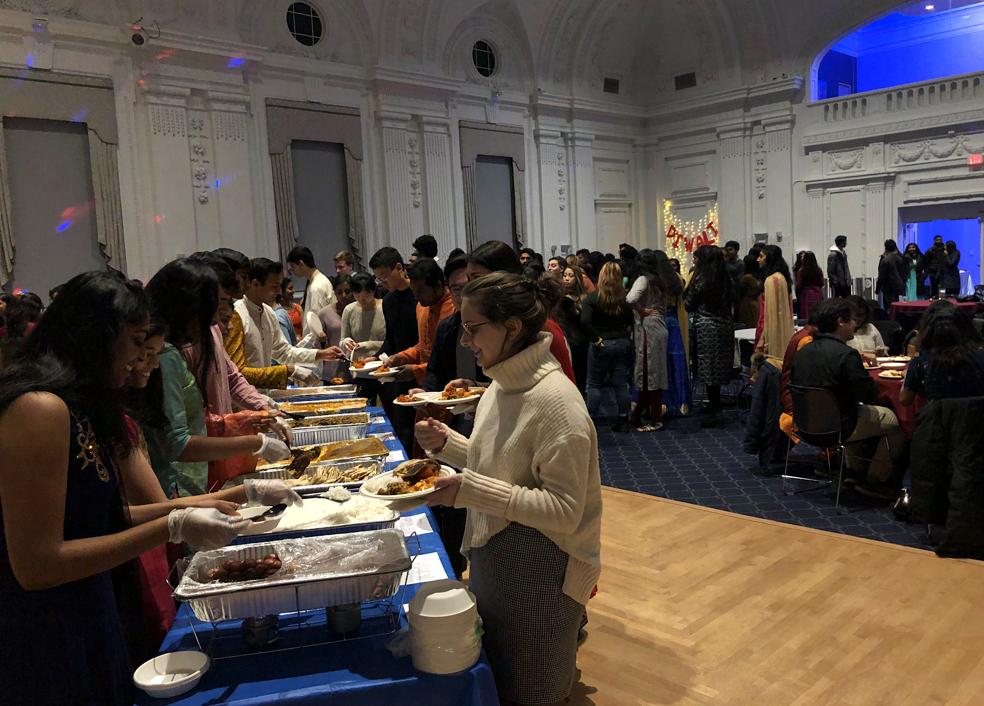
Walking into the event, I was first struck by the lack of cultural cheer in the room. Outside of a few tea lamps on the tables and a small string of lights in the back with the word “Diwali” on it, few decorations were present.
If it weren’t for the people wearing colorful, traditional Indian clothing like saris and kurtas, you wouldn’t have even known that it was an Indian event, especially for a festival centered around, well, lights. But that really wasn’t a big deal. As long as the spirit of the holiday was in place, then it wouldn’t have been an issue.
However, the realization dawned on me that this was a Diwali event in name only, trading cultural authenticity for blandness. After entertain-
ing performances by campus favorite Dhamakapella, a Bollywood fusion a cappella group, and Kismat, an Indian fusion dance team, the club’s first-year representatives gave a brief presentation about the cultural significance of Diwali.
Missing were any mentions of cultural legends that form the basis of Diwali, the diversity of celebrations across the multiple religions and regions of the subcontinent, or any of the activities or traditions done.
Instead, audience members were left with the impression that the holiday is solely about food.
Often, cultural events have an overreliance on using food as a central focal point of their events as a means to draw people in, but as a result, the event solely becomes about food instead of an encapsulation of the holiday itself, creating a one-dimensional essence.
While the celebration could’ve been a place to educate non-Indians about holiday customs, such as with an activity like colorful powder patterns called rangoli, as is traditionally done around Diwali, or by enabling participants of the event to partake in Indian dancing, it instead just becomes a place to get cheap food.
Funnily enough, one of the few activities present was a poster where people could stick on their favorite Diwali traditions, most of which were missing.
Some traditional celebrations, like the lighting of fireworks and sparklers were understandably missing; as uISA co-president Shilpa Namala noted, “The school doesn’t allow us to do that.” However, the overall genuineness and cultural feeling in the event were lacking.
Other attendees had similar feel-
ings. “The event was decent and a change in normal routine, but I felt like it was lacking,” first-year student Surbhi Nandikolmath said. “Also, if they were going to make a presentation about the origins of Diwali, I would expect it to have actual content.”
When asked about the intentions of the event and the decisions made, Shilpa elaborated that “the event is bringing everyone together … giving people the opportunity to meet people they don’t know ... It’s a place for everyone to gather.”
Well, gather they did, with all 150 tickets sold out, so perhaps the trade off of authenticity for cheap Indian food was worth it.
In the end, my main confusion was the purpose of the event. Outside of the ostensible reason of gathering people together around food, why label it a Diwali dinner? If it was an educational event to teach non-Indians
about Diwali, it was unsuccessful in that regard, as the only takeaway was food, leaving no accurate representation of the holiday in their minds.
However, more egregiously, if this event and uISA as a whole meant to provide students of Indian origin a place to celebrate their culture and holidays when they are unable to do so otherwise, being away from home and family, then it was also unsuccessful as it was unable to effectively encapsulate the feelings and values of the holiday for the sake of increasing accessibility, especially when that accessibility wasn’t even helping people properly understand the festival.
Well, there’s always another uISA event, and I can only hope that Andaaz, uISA’s cultural showcase of Indian dance to be held on Nov. 23, can properly convey the essence and authenticity this Diwali event was missing.
To some students, uISA’s Diwali Dinner sold out in more ways than one. Shreyas Banerjee/The Observer
CWRU Performance Showcase dazzles prospective students
For hopeful students dreaming of going to Case Western Reserve University, there is no greater experience than the Diversity Overnight program. A chance to meet real students and live life as a college student for a day is one of the best ways to discover all that CWRU has to offer.
The Office of Undergraduate Admissions works hard to show the best of what CWRU has to offer with events hosted by campus clubs such as Club Soccer, Camp Kesem and the Black Student Union. While most people are often excited about the traditional ice cream social offering free Mitchell’s Ice Cream, the crowning jewel of the program is the CWRU Performance Showcase.
While the showcase is hosted by the Office of Undergraduate Admissions, events like these are a great way for current students to take a break and enjoy
all that our student groups have to offer.
According to fourth-year Student Coordinator Parv Sud, “turnout for the event was higher than expected,” with almost all of the prospective students on campus attending, an increase from previous years.
Another fourth-year student, Igor Tutelman, found the showcase to be a “great opportunity for CWRU performance groups to showcase their talent.”
And unlike other more traditional performances, students had the opportuwnity to “meet with some of the performers after the show” and get to know more about the CWRU community, according to one prospective student.
The showcase took place on Sunday, Nov. 10 and featured some of the most popular student performance groups on campus. IMPROVment took the stage with their trademark brand of audienceinteractive comedy, followed by acts
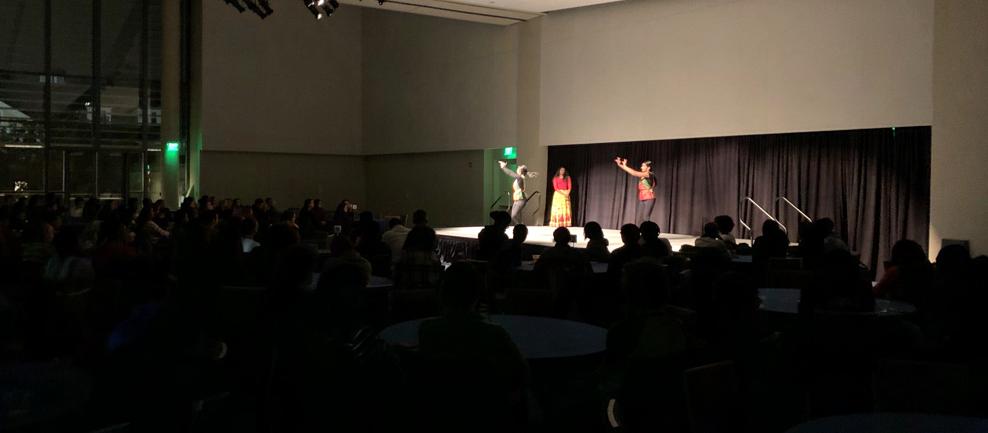
like the Spartan Bhangra team and Dhamakapella. The full lineup consisted of groups showcasing students’ diversity and talent to impress the prospective students.
Programming like this is what Sud finds to be the most amazing part of acting as a student coordinator with the
Office of Admissions. “Being able to facilitate relationships between hosts and prospective students” and show the best of CWRU has been extremely rewarding for Sud. After all, that is what CWRU is all about: making connections and discovering all that the world has to offer.
Emily Young Development Editor
Student groups like the CWRU Nritya performed for prospective students at Tinkham Veale University Center. Courtesty of Parv Sud
Players’ Theatre Group performs “Revolt. She Said. Revolt Again.” at the Eldred Black Box
Lewis Nelken Staff Reporter
Light and shadow cascaded over six college thespians in a struggle to change the perception of women in the new age last weekend, Nov. 8 and 9, at the Eldred Black Box Theater.

“Revolt. She Said. Revolt Again.” was an hour-long series of vignettes that left the audience in a stupor, switching from scene to scene and recycling actors to create an abundance of diverse characters.
Directed by fourth-year student Giuliana Conte as a part of the Players’ Theatre Group (PTG), this production by award-winning playwright Alice Birch was a hit. The cast of theater veterans—Harper Case, third-year student Morgan McCommon, secondyear student Alex Wienner, fourthyear student Richard Pannullo, Natalie Perry and Nicole Coury—condensed weeks of hard work into an explosive performance that shocked the audience.
“I picked the show because it would be a challenge,” said Conte after the closing night. “I wanted to show people eclectic, weirder things … it was a
risk, I just wanted to jump into it.”
The performance was prefaced with a soundbite of a woman speaking about the importance of defeating the heteropatriarchy, a system that has oppressed women for centuries and now faces rightful extinction with the evolution of society. The tone of the show was “tired, exhausted [and] livid,” capturing the audience with images of the subjugation and self-empowerment of women in everyday life.
Moments of frustrated passion followed one after the other, forcing the audience to reflect as they listened. At times, the drama got so hectic, it felt like a fever dream. Characters stormed around each other, screaming, “Who’s this man mowing the lawn? His feet are bleeding!” Audience members did not know whether to laugh or cringe.
“I’m honored to be in this show because of how misbehaved and thoughtprovoking it is,” said Perry, a fourthyear student who had only done two other productions with PTG.
Coury, a fourth-year theater major and president of the PTG was a leader
for the group, having convinced Perry to join the troop just a year ago. Well known in the Case Wastern Reserve University theater department for her acting, Coury accomplished one of the greatest feats of acting this past weekend: subtlety. For both nights, she was imperceptibly debilitated by illness, but true to tradition, the show went on, and she matched the grace of her peers.
“I wish I had been healthy enough to let it rip,” said Coury, “but I just trusted my cast and let the adrenaline carry me.”
The black box setting was perfectly suited for the exhibition. The entrance is a short descent from the ground level on the Case Quad, which steeps you into the shape-shifting atmosphere. The setting was minimalist, with black wood cubes and a foldable table decorated to look like a fancy dinner being the extent of prop usage.
The lights and sound added tremendously to the effect, confusing and re-orienting the audience in sequence with the transition of acts. The
Drake booed offstage at Camp Flog
Chris Heermann Photo Editor
By now, you’ve likely seen the headlines, which at first glance appear to be common clickbait. I, for one, just scrolled past when I first saw headlines like, “Drake gets booed off stage at Tyler, the Creator’s festival” or “Fiasco at Camp Flog” on the top of my Snapchat Discover page.
But, lo and behold, Snapchat may yet be a haven for reputable news coverage, because Drake was indeed booed off the stage last Sunday night at Tyler, the Creator’s Camp Flog Gnaw Festival.
Fans had been anticipating the night for weeks leading up to the event. Tyler has a history of bringing out surprise guests and theorists were certain that this would be the year that he would finally bring out fan-favorite Frank Ocean, but this did not come to fruition. In his place was the world-renowned musical artist, Drake.
The night started out with Tyler asking the crowd “Can I bring a couple friends out? And we can just party and have a good time for the next hour?” To
which the crowd responded with a resounding roar of approval.
The first surprise guest? A$AP Rocky. For the uninitiated, Rocky and Tyler have a long history together. The two are good friends and the set they performed, while only two songs long, was exactly what the crowd wanted from an opener. The next guest, Lil Uzi Vert, known for his high-energy songs, hyped up the crowd even more with his short performance.
The audience was ready. The first two guests, while both fantastic artists and performers, were not Ocean.
Tyler then brings out Drake, who was welcomed with thunderous applause. Drake interacts with the crowd, telling them how he’s playing some of his older hits because Tyler requested them. Where he began to lose the crowd was when he asked if he could “stay up here and turn up with you for a little longer tonight.”
While this was met with another round of cheers, it had the unfortunate
element of leading some members of the audience to assume that there would be a final guest. After performing a few more of his many hits, Drake asked the question again. This time, however, the crowd changed their tune.
Believing that Ocean would come out once Drake finished his set, the onlookers turned on the Canadian singer. They began to chant their support for Ocean, so Drake asked again, and suddenly the mob mentality set. Their response was a forceful NO!
The mob began to boo him off the stage in hope that Ocean would magically appear onstage. Drake gave the crowd another chance before leaving the stage, the concert now over.
In the aftermath of the concert came a series of angry tweets from Tyler addressing his fans. He called their behavior “f-ing trash,” among other things. When the dust settled, Drake also spoke on Twitter, but had a good-natured humor about the whole affair.
In hindsight, it’s easy to see that
Conan Gray takes on the House of Blues
Aimee Wiencek Staff Reporter
This past Saturday, Nov. 9, Conan Gray took center stage at Cleveland’s famous House of Blues venue. Cleveland was lucky enough to be one of the stops on the 20-year-old singer’s “The Comfort Crowd” tour, which includes 26 stops across the United States and Canada. The doors opened at 7 p.m., opening with rhythm and blues singer UMI at 8 p.m. Shortly after, Gray appeared on stage at 9 p.m.
Gray, originally from Texas, came to fame from a YouTube channel he formed in 2013. With currently 1.57 million subscribers, Gray posts a variety of content such as his own music, covers of songs, vlogs and clips of his art. After posting many original songs on his channel, he officially released
them on his debut EP, “Sunset Season,” in 2018 under Republic Records.
Republic Records describes Gray’s music as a “unique style of dreamy alternative pop. Bedroom pop tinged with raw, high school nostalgia—songs about kids grappling with regular life.”
It is with no doubt that Gray’s music, as well as his vibe in general, emulates this description. From the minute that Gray stepped onto the stage, he captivated the audience. His stage presence was unmatchable, with him dancing and jumping around to the beat of the music.
The crowd was incredibly receptive to Gray, singing along and matching his energy. His constant engagement, as well as his amazing live vocals, made the concert a real crowd-pleaser.
Gray performed many of his hit songs, including “Generation Why,” “Idle Town,” “Grow,” “Comfort Crowd,” “Crush Culture” and his newest hit “Maniac.” He took the time between each song to describe the story behind writing it and what the lyrics meant to him. His vulnerability allowed the audience to connect with him on a deeper level.
Despite Gray only being on stage for a little over an hour, the audience was definitely able to get its fill. As a surprise addition to his setlist, Gray performed a cover of the Jonas Brothers’ “Burnin’ Up” and sang a new, yet-to-be-released song from his upcoming debut album.
“[Gray] was such a fun and highenergy performer and I think he really
Again.” Courtesy of Paulina Martz cast used this mixture to their benefit, bringing the focus to their intricate body language and pungent dialogue.
“You’d never see something like this in the theater department,” said Case, a fourth-year theater major. “The Players’ Theatre Group is awesome … with student design, directing and all the other artists on campus, it was better than with faculty.”
Drake was the headlining guest, him being one of the biggest artists in the world. But in the moment, it’s also easy to see how the anticipation for Ocean, combined with the strange way Drake pretended to extend his set, could have led the audience to expect another artist.
So was this a case of confused fans who thought Drake was taking time away from Ocean? Or, was this a case of ungrateful kids thinking they were cool for booing Drake off stage?
Media coverage favors the latter, as the headline is easier and more attractive. The truth of the situation lies somewhere in the middle, as is generally the case.
But the fact remains that a crowd did boo Drake off stage. If Ocean were there, would he have even wanted to come out to a crowd like that? Hopefully this is a one-time event and not indicative of a change in festival culture to where an audience feels comfortable booing renowned artists for simply performing their set.
interacted well with the audience and made the performance really personal,” second-year student Maeve Slife said. “I like that he sings about his real feelings and doesn’t sugarcoat difficult situations in his songs!”
The relaxed and nostalgic atmosphere of the House of Blues, in addition to Gray’s amazing stage presence, made the “dreamy alternative pop” truly come to life. The concert was dwefinitely a night to remember and made the crowd, along with myself, even more excited to hear Gray’s new and upcoming album.
Although he is still a relatively small artist, within a few more years, I have no doubt that he is going to become huge.
6 a&e 11/15/19
Natalie Perry and Richard Pannullo in a scene of “Revolt. She Said. Revolt
What am I listening to?
(Bad music)
Jackson Rudoff Director of Web & Multimedia

Chamber of Reflection–Mac DeMarco
My roommates would groan at this one.
This song has been my most played on Spotify for, I think, three years in a row. Now, I recognize the meme status that comes with being a white boy who’s too into Mac DeMarco, but this is truly one of those songs I will never see myself growing tired of. It’s not too overproduced, samples a classic vaporwave melody and features cryptic yet nostalgia-inducing lyrics and vocals.
Okay Okay–Pino D’Angio
“Master of None” fans might recognize this one. Italian disco-rap may not be a popular genre, but it really should be. Apparently, my Spotify algorithm thought it was something I would enjoy (it was right), which meant I stumbled upon this on in my Discover Weekly Mix.
This is one of those songs that is really fun to walk to class while listening to. The funky production and quick-spitting vocals employed by D’Angio really get you into a bouncy mood, which makes your next step that much quicker. Sometimes when I listen to this while studying, I’ll start doing that slight shoulder-sway dance in my chair.
This song’s power certainly doesn’t lie in its relatability. I don’t speak Italian, and wasn’t born in the ‘80s … in Italy. It soars with its replayability, which is why it’s still in my regular rotation after four months.
Midnight in Peckham–Chaos in the CBD
Back in the day, I used to roast people who listened to deep house, or lo-fi music, or any kind of minimal “club” music. Yet, here I am a few years later, a fan of such artists like Ross From Friends, Project Pablo and of course, Chaos in the CBD.
“Midnight in Peckham” has a unique relaxing effect on me. It’s got a very spacious and clean sound, which contrasts with many other tracks in the genre. I can turn this one on when I’m sitting on my balcony at night, laying on my couch or catching up on some reading. It’s versatile, and has quite quickly entrenched itself as a favorite of mine.
Charming Flow–Balue
We’re back to songs that I can’t really relate with. Except for the lead singer’s mediocre timbre. That I can relate with on a deep level.
For this one, we’ve got a hard-hitting indie-pop song that reminisces on growing up, perhaps more rapidly than one would like. Balue’s vocalist laments his past inadequacies, but also the way he has overcompensated for them by getting in too deep with a drug-fueled underground scene. Amidst all of this, there’s this weird sense of triumph that allows me to turn to it for all sorts of moods.
Violin Concerto in D Minor, Op. 47: III. Allegro, ma non tanto–Composer Jean Sibelius, Performed by Jascha Heifetz, Chicago Symphony
I’m not gonna waste time just spitting superlatives for Heifetz, perhaps the greatest violinist there ever was … okay so I had time for one.
Regardless, this recording is immaculate. For its recording date, the fidelity is incredibly strong. But the playing, man, that is what makes this movement sing. Heifetz takes tempos that legitimately no other would dare to attempt through the record. While this makes the second movement less memorable, it makes the third my favorite performance of any movement of any piece. He blows through ricochets and runs and makes the backing orchestra keep up, although their sound is also an incredibly important factor in this recording’s greatness. This was also one of the first concertos that, when I heard it live, left a legitimate impression on me. Partially because of the piece’s awesome themes, but also the theme of the third movement kind of sounds like the main theme from “The Rescuers Down Under.”
Hitmen Will Suffocate the City–Trenchmouth
I literally like this song for one reason: Fred Armisen is the drummer and he does a really good job. The guitar’s good, too, I guess.
UCCtoberfest attracts large crowd
Yvonne Pan A&E Editor
Oktoberfest, an annual beer festival held in Munich, Germany, is the largest festival celebrating beer in the world. The 16- to 18-day festival brings more than six million people to Munich for parades, food, music and of course, beer.
In Cleveland, a city that Cleveland SCENE called “a town built on beer,” it’s no surprise that numerous local breweries have introduced their own version, giving Clevelanders yet another excuse to drink.
Residence Hall Association’s (RHA) Upperclass Community Council (UCC) put its own twist on the popular event by hosting its annual UCCtoberfest last Saturday, Nov. 9, an event that goes back more than half a dozen years.
Although Oktoberfest is traditionally held in late September or early October, UCCtoberfest was held last week, and around this time last year as well, because of all the planning that goes into it.
“We require every council to have a first event that introduces them to the community, and typically this takes place in late September or early October,” third-year student and Executive President of RHA Doug Spizarny said. “After planning that event, UCC moved into planning UCCtoberfest. Since a lot of planning goes into it, including a large order of supplies and food, it makes it difficult to have a quick turnaround on the event.”
It was this thorough planning that moved the event up an hour earlier, from 8:30 to 11 p.m. last year, to 7:30 to 9:30 p.m. this year, as turnout last year was lower than previous years.
Lured by the offer of a stein glass from each of the first 100 attendees,
a line snaked across the house, even before 7:30 p.m.
In all, more than 200 students attended the event, a slight increase from the expected turnout of 175 people.
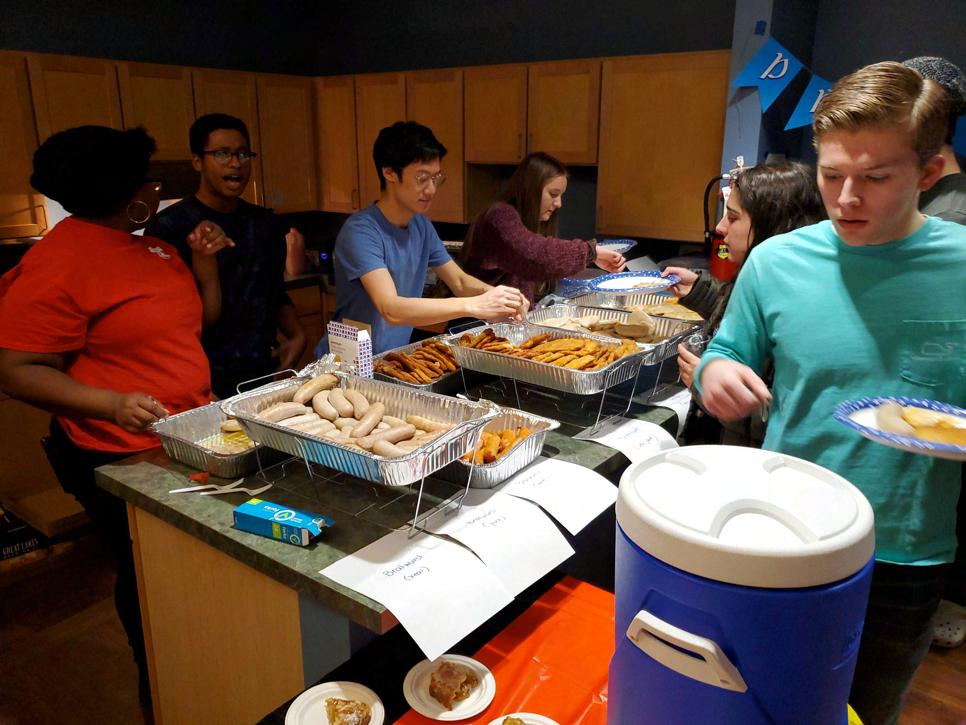
The stein glasses were a huge hit and UCC ran out of them about an hour into the event. For attendees who came in after the initial rush and missed the giveaway, UCC provided schnitzel, bratwurst, pierogies, beer (for those of age), cider, and apple and pumpkin pie, with some of it catered from Das Schnitzel Haus and Hofbräuhaus.
“The food was really great—I especially liked the pumpkin pie,” third-year student Kate Haering said. “Overall, a really fun way to bring German culture to campus.”
The event did not come without issues, however. A few restaurants canceled orders, so council members had to choose food on the day of. “Also when people showed up to pick up food, the caterers were sometimes unready, which delayed the pickup a lot,” Spizarny said.
Still, the event proved to be a great educational experience for many students, as well as a social event. UCCtoberfest took place in the Village at 115th’s House 4 Great Room, a central location in the Village.
Other RHA events coming up include Carlton Road and Murray Hill Community Councils’ Fresh Fruit Friday on Nov. 22 from 8 to 10 a.m. at the corner of Murray Hill and Adelbert, and Cedar Community Council’s Cedar Coffee House event on Nov. 22 from 6 to 8 p.m. at The Spot, featuring free food and community performances.
7 a&e observer.case.edu
Want to find new oncampus events? Write for The Observer! Find out how at observer.case.edu
UCC’s ode to German culture featured schnitzel, bratwurst, pierogies and beer. Courtesy of Doug Spizarny
EDITORIAL
The questions we must ask about club sports initiatives
Editorial Board
The Club Sports referendum has recently resurfaced after failing last spring. In April, undergraduate students voted to decide whether club sports should join the Student Presidents’ Roundtable. Had the referendum been supported, an Intercollegiate Club Athletics Board would have been established, funded by 6.5 percent of the total student activity fee fund. However, the referendum did not receive the necessary votes— with 766 votes in the affirmative and 889 in the negative—and Club Sports seems to be trying again this semester, instead as an ad hoc committee of University Student Government (USG).
Club sports can be beneficial. Requiring no recruitment and significantly less of a commitment, club sports are supposed to be open to any student interested in joining a group based around a specific physical activity. They offer a community, incentive to exercise and are typically cheaper and easier to join than either varsity
sports or programs at a local gym.
As every student pays $202 every semester for an activity fee—allocated to help fund clubs and programs on campus that are open to all students—it is important that we carefully consider referendums that determine how our money is used.
The transition from referendum to a USG ad hoc committee does not affect students nearly as much as redistribution of the activity fee.
However, the destiny of this transition does seem cloudy at best as USG and Club Sports try to negotiate a solution.
What should be maintained as the process continues, however, are efforts to offer club sport opportunities to all students, and prioritize them at the same level as other club programs.
Among the problems with the original referendum, the two most blaring were how it may have disproportionately supported the “ultra-competitive” club sports and defunded other non-athletic clubs. These ultra-competitive sports include crew, ultimate frisbee, cycling and
hockey, which have more equipment, travel and additional expenses.
While there is a belief that the sports who perform better should subsequently receive more funding, there may be more to this seemingly-surface argument. For instance, are these clubs really available to all students, or is prior experience necessary? And if the latter is the case, this may mean having been able to pay hundreds of dollars—if not more—for equipment and training while in high school. Requiring such experience undeniably marginalizes students based on their socioeconomic status, predominantly offering opportunities to those who are more financially secure.
Additionally, we must ensure adequate funding is distributed to other club programs, including those which may be more humanities-related, such as the University Media Board (UMB) and the Class Officer Collective. Including nearly a dozen organizations, the UMB supports radio, journalism, music, photography and political ini-
tiatives.
While it is disappointing that Club Sports did not start with the petition to become a USG ad hoc committee and instead challenged the student activity fee allocation, the new proposal may be more successful in helping them achieve their desired raise. Furthermore, the embarrassing lack of transparency in the spring referendum should still be addressed before club sports receive additional funding. That is, a failure to accurately present how the increased funds would be distributed both among the different club sports and how each specific sport would use the money.
Like many other things happening on campus, and in our community, it is important that we ask for the details to make an informed decision and ensure we are supporting—both financially and socially—initiatives that provide opportunities for students to pursue interests, may they be major-related or otherwise, across all disciplines.
Rossy: #TeamTrees takes on climate change using social media
Aura Rossy Copy Editor
With the copious amounts of social media campaigns and influencers hounding on the issue of climate change, you might begin to ask yourself—just how much of an impact can one more initiative have, and are we really taking action or are we just spewing words into the invisible universe created by technology? Lately, this concern has been raised to the generation whose lives seem technology driven and dependent. Are the words and concerns we are expressing online really getting anywhere past the platform, or are they doomed to a graveyard with all our hopes and dreams of action?
Recently, I learned of #TeamTrees, a collaborative fundraising campaign started by YouTuber MrBeast, that uses the video platform as its primary source of advocacy. The initiative began in May 2019 when MrBeast reached 20 million subscribers and was challenged to donate the same amount of trees as subscribers to commemorate the achievement. The challenge was not taken on single-handedly, however. MrBeast teamed up with fellow YouTuber Mark Rober, and the pair collaborated in the development and organization of the campaign, which launched publicly on Oct. 25. For every dollar donated, the Arbor Day Foundation— one of the largest and longest-running tree-planting non-governmental organizations—has committed to planting a tree in a forest deemed high in need.
After all this new information brewed in my brain for an indefinite amount of time, I decided to visit the website and spare a few dollars for the cause. What’s the loss of an amount equaling an expensive cup of coffee going to cost a student who shouldn’t even be spending that money to begin with? I went ahead and made the $5 donation.
Receiving a confirmation email minutes later expressing gratitude for my commitment to the cause, two points caught my attention. One—the letter of gratitude explicitly points out the magnitude of planting 20 million trees, which in the grand scheme of things is not much (at least not on its own). Second—I thought back to what initially raised my curiosity about the campaign, which was someone else’s excitement for the cause and their belief in the large impact social media campaigns can have.
On the #TeamTrees website, they explain to readers why they are choosing to plant trees as a method of combating climate change, rather than only preserving trees that already exist. They argue that by contributing to this natural, proven climate solution that everyone can partake in through donations, they are becoming a part of the large-scale solution. Additionally, with donations coming from people of all walks of life—from students to CEOs like Tobias Lütke, Elon Musk
The Observer is the weekly undergraduate student newspaper of Case Western Reserve University. Established in 1969, The Observer reports news affecting students and provides an editorial forum for the university community. Unsigned editorials are typically written by the opinion editor but reflect the majority opinion of the senior editorial staff. Opinion columns are the views of their writers and not necessarily of The Observer staff. For advertising information, contact The Observer at (216) 302-4442 or e-mail observer-ads@case.edu.
LETTERS TO THE EDITOR should be e-mailed to observer@case.edu or submitted on our website at observer.case.edu. Letters can be mailed to Thwing Center 11111 Euclid Avenue, Suite 01, Cleveland, Ohio 44106. For policy and guidelines related to the submission of Letters to the Editor, refer to observer.case.edu/submit-a-letter.
The Observer is a proud member of CWRU’s University Media Board. Follow The Observer on Facebook, Twitter and Instagram @cwruobserver.
and Marc Benioff—the initiative is putting out a message of care for the alarming situation before us and is fostering community. Regardless of our backgrounds, we can come together to voice our concern for something as critical as the future of the generations that will come after us.
This signal of community concern is evident as a force in other recent movements, including the efforts of 16-year-old Swedish climate activist Greta Thunberg. The international effects of her activism, including her recent speech in front of the United Nations, have coined the term the Greta Thunberg effect. Post global climate strike that began on Sept. 20, the Sept. 29 legislative elections in Austria resulted in a tripling of support for the Green Party, who scored 14 percent of the vote. This shift is only one occurrence in Europe that could be reflecting an early sign of significant carbon emission regulations passing in the future.
Sally Benson, co-director of the Precourt Institute for Energy at Stanford University, described Thunberg’s impact in an interview with NBC News, “We’re seeing more grassroots action, and she’s creating a movement where young people are pushing communities, cities, states and corporations and saying ‘We’re not going to wait.’”
With these efforts in mind, the payoff is clear. Regardless of the projected
speed of policy changes and any tangible results that can be observed from voicing concerns on social media, the indirect impact of community creation is what will propel my and other generations to continue acting and pressing onward regardless of pushback from others, whether they be people in the local community or national leaders. Regarded as one of the largest YouTube collaborations of all time, the #TeamTrees initiative is capitalizing on social media to create a community determined to change the course of our future environmentally.
In an interview with Public Radio International, Destin Sandlin, creator of the YouTube channel Smarter Every Day and a #TeamTrees collaborator, commented on the campaign by saying, “It’s not limited to the younger generation. This is everybody. We want no boundaries, no borders on this at all. It’s all ‘we and us,’ and we’re all planting trees, which is awesome.” To join the #TeamTrees campaign is to join an effort which uses our generation’s technology in a simple way to make a worldwide appeal for climate action.
#TeamTrees has set their deadline for 20 million trees by Jan. 1, 2020. If you wish to contribute, donations are accepted through the #TeamTrees website, MrBeast’s YouTube channel using the donate button, Arbor Day’s Facebook fundraiser or the #TeamTrees Tiltify fundraiser.
8 opinion 11/15/19 opinion
sports editor MEDHA NAYAK the observer established
of
western reserve university executive editor & publisher MATT HOOKE news editor GRACE HOWARD a&e editor YVONNE PAN copy editors AURA ROSSY CHRIS MARKHAM & SARA KHORSHIDI opinion editor JORDAN REIF director of web & multimedia JACKSON RUDOFF directors of print WON HEE KIM & NATHAN LESCH photo editor CHRIS HEERMANN accounts manager SHIVANI GOVANI advertising manager JUSTIN HU web editor PRESTON WILLIS marketing manager BRADLEY SCHNEIDER layout designers LESLIE SERN & TARUN SEPURI director of business operations SARAH PARR development editor EMILY YOUNG social media editor DEEKSHA GOLLAMUDI
in 1969 by the undergraduate students
case
How capitalism has failed us
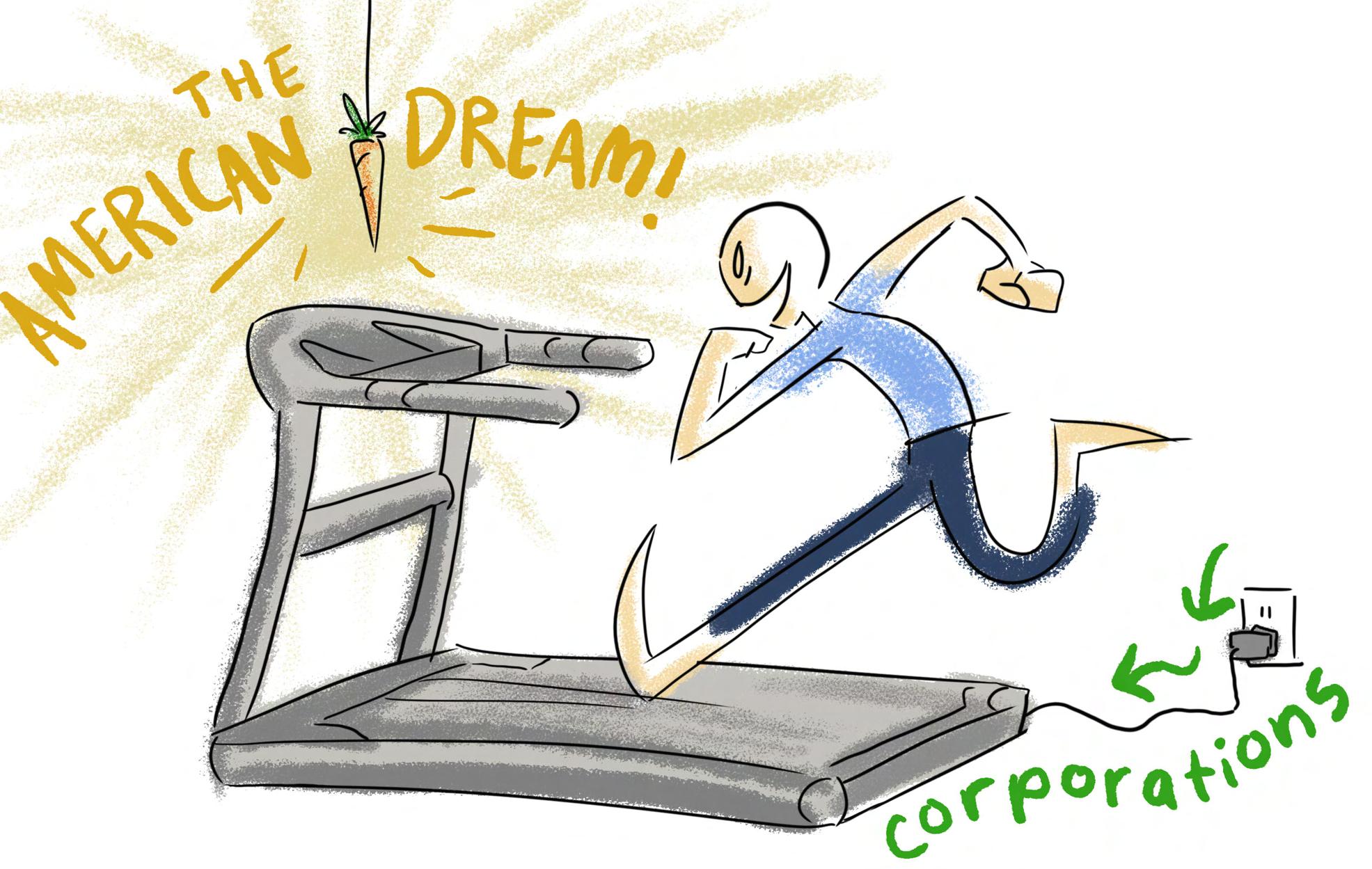
While the U.S. has the highest gross domestic product of any nation, in 2017, 78 percent of Americans were living paycheck to paycheck. Six in 10 Americans did not have enough capital to survive without a job for three months.
Of course, not every American lives that way. A small portion of Americans qualify as the uber-rich, or the one percent. The richest three people of this one percent own more wealth than the bottom 50 percent combined. And this gap has steadily increased since the massive tax cuts imposed by the Reagan administration in the 1980s.
The income gap perpetuates inequality in the U.S., affording some the opportunity to fundamental rights such as health care and education while forcing others to work several jobs to merely scrape by. Placing a higher wealth and income tax on the top one percent could be one step towards leveling the playing field.
Understanding the players in the system furthering inequality is necessary to understand how we can rectify the problem. The top one percent is generally made up of two types of people: old-money billionaires and supermanagers. Old-money billionaires are people whose families have accumulated capital for generations, receiving income without actually producing any wealth by renting out real estate or stocks and bonds. The term supermanagers refers to CEOs and CFOs of large companies who earn billions of dollars without producing any wealth.
The inherent problem with supermanagers is that there is no way to accurately quantify how much they
are worth to their companies. Additionally, as they often set their own salary, supermanagers tend to estimate their worth generously. CEOs of most major companies make, on average, 300 times the salary of their average employee. This is a 2,000 percent increase from 50 years ago. What makes Tim Cook worth 283 Apple employees?
The massive concentration of wealth held by supermanagers and old-money billionaires ensures two things: that the rich get richer and that the poor get poorer. Tax breaks and our market-based system, which emphasizes capital over people, will continue to perpetuate this cycle of poverty until the one percent holds even more of the wealth while the rest of the country struggles to survive.
Financial security, or lack thereof, intimately affects all areas of life. Those with money have the capital to invest, not only in things of direct monetary value that can provide immediate returns such as real estate or stocks but also in their children’s education. Impoverished and lowincome children have significantly lower literacy rates, more limited vocabularies and higher high school dropout rates, coupled with a greater incidence of severe mental illnesses. All of these factors combine to make it more difficult for people to improve the circumstances they were born into and better their children’s future.
A capitalist, market-based system inherently sustains the income gap. The ideas that people will always be able to produce better products, innovate and receive recognition and that merit will always win out are
severely flawed. The phrase “pull yourself up by your bootstraps” perfectly encapsulates this flawed logic of capitalism. It is not possible to simply work and reach the same level as other people due to the roadblocks created by the system, not to mention the different starting points and opportunities given to different people.
Even Silicon Valley start-ups have had a hard time earning enough income and wealth to challenge those old-money billionaires.
Prejudice also plays a role in perpetuating the cycle. Minority groups, including women, people with disabilities and the LGBTQ community, feel the effects of the income gap more strongly. Members of these groups are simply not given the same opportunities, despite our strongly held belief that anyone can achieve the American Dream if they work hard enough. However, working three jobs is apparently not enough to even earn fundamental rights such as health care in this country . Really, it’s only the land of opportunity for the wealthy, white, straight, cis males.
The reality of a capitalist system coupled with prejudice and dramatically different starting points for each individual are just a few of the causes of the wealth and income gaps in the U.S. The Gini Index is used to measure income disparities. A zero in the index indicates perfect equality, and one indicates perfect inequality. It is important to note that the Gini index usually only refers to income inequality and not wealth inequality, as the latter is much more difficult to measure. In 2018, the U.S. had a Gini index of
.49. After reporting the lowest index of 0.35 in 1965, the U.S. Gini index has been steadily rising over the past four decades, spiking up after the Reagan tax cuts.
We’ve seen this sort of massive income and wealth gap before, just prior to the Great Depression. When there is no capital circulating for the lower and middle classes to spend, the upper class cannot make any money, and the entire economy stagnates. To prevent this, we need to reinstate a high income and estate tax on the one percent, decreasing the amount of wealth that stagnates in the hands of a few individuals. Now, I’m not saying that we need to return to FDR’s 90 percent income tax and 70 percent estate tax instituted under the New Deal. That’s extreme, and thankfully, our economy has not yet stagnated to the point where that is necessary.
Instead, an increase of eight or nine percent on the top tax bracket would help to not only reduce our national debt but also relieve the strain on our economy placed there by the income and wealth inequality. The money gained from these taxes could be used to further stimulate the economy by providing government jobs improving national infrastructure such as fixing the highway systems, providing green alternatives for transportation and increasing the amount of clean energy available. The money could also be used to better our nation in the long term by improving school systems and providing universal health care. To put a long story short: capitalism has failed America. In order to put our economy on the right track, a more progressive income tax is necessary.
9 opinion observer.case.edu
Want your art featured? Email us at observer@case.edu to learn how
Emerson McGinnis Contributing Columnist
Illustration by Sunny Rae Podbelsek
Richards: Be your own student ambassador
Jason Richards Staff Columnist
Often times throughout your life, you may find your voice squashed in the expansive structure of an organization or large group. Whether it be your academic, personal or professional life, your contributions may go unnoticed or your opinions swept under the rug.
Sometimes you make it through half the battle. You try to capitalize on the opportunity to initiate great change—whatever that may be—but you’re simply directed to an evergrowing box of suggestions or feedback that probably will prevent your efforts from coming to fruition. You spend time reflecting and composing a solution only for it to be shot down, and sometimes the motivation to work toward change and improvement is extinguished with it.
You might find yourself in this situation in your first internship, co-op or job. A new person in an organization, especially if they are young or a person of color, is often overlooked when they try providing feedback and direction for improvement. You wonder if answering a survey will really initiate proper change. Does your feedback get noticed, your voice heard?
It does here. It does at Case Western Reserve University—as long as
you know how to make your voice heard, that is.
At CWRU, it’s often underestimated how much of an effect students can have on a significant problem or issue.
Sure, we students get our fair share of surveys sent to our inboxes where we can write optional comments and fill in bubbles about the meal plan or how useful your advisors are, but often some of the most important issues requiring attention aren’t the subject of a survey. Problems that would otherwise go unnoticed or are underrepresented benefit the most from your voice and diverse student input.
Most importantly, you don’t need to be a part of an organization pushing for change to necessarily provoke change.
I recently wrote in The Observer about the unreliability of WEPA printers on campus. As a result, I was pointed in the direction of John Landers, director of IT service management for University Technology ([U]Tech), who set up a meeting with me where we discussed changes being conducted in partnership with the Undergraduate Student Government (USG) to improve the reliability and accessibility of the wēpa print net-
work. He also offered my suggestions to USG for new printer locations.
Similarly, I wrote about the Student Information Systems (SIS) my sophomore year, requesting that change be initiated from its then outdated user interface and counterintuitive design. I was subsequently contacted by Stacy Mitchell, associate director of SIS, who was looking for volunteers to join small discussion groups seeking input on the new SIS, which was in development at the time. I joined and offered suggestions and feedback.
As a writer for The Observer, it’s easy for me to say “just reach out and you’ll be heard.” I can throw out whatever concerns I have on an issue and may or may not receive an email discussing change going on in that realm and perhaps even an invitation to help with that change.
But my most influential changes happen beyond my articles. Expressing an opinion is one thing, but having one with a presentable solution and communicating with the right people is another. It’s the biggest step in initiating change. Sometimes, you just need to start small, clear up some questions you may have and find out where you can join in ongoing efforts, if anyplace.
A couple of weeks ago I noticed an issue with the wireless internet connectivity in one of my classrooms. The network was slow and hindered my ability to use my laptop, and with course materials and notes being referenced online in most classes now, I knew I was not the only one dealing with this problem. At first, I thought this would be a problem I’d just have to deal with, but then I wondered if anyone had even tried to solve it. I sent in a [U]Tech service request and, lo and behold, there were supposed to be internet access points located in that room that were not there. In just two weeks, three access points were installed in the room and the problem was solved.
You can make the change that solves problems other people are being affected by. Be your own student ambassador. Don’t wait for organizations or groups with more recognition to solve problems you see, because there’s no guarantee they see it too. Take the initiative and be heard.
Jason Richards is a third-year computer science major. He enjoys programming, biking and spending his money on Chipotle.
Zhu: Why I feel awkward when you speak Chinese to me
Caroline Zhu Staff Columnist
For years, I’ve admitted I’m uncomfortable when foreigners try to speak Chinese to me. Even though I don’t take offense at it, something about these interactions feels hollow and awkward. I know that I’m not the only one to feel it, but voicing these discomforts is often met with confusion and defensiveness. Is it that I don’t like to share culture? To say that is fundamentally untrue; I am the daughter of immigrants and of a Californian community built upon a variety of cultural backgrounds. However, in examining the scenario, there are real issues underlying these discomforts that go beyond the surface of what seems like a refusal to share culture.

To start with an oft-cited issue, I and many other Asians are often prone to what I call “greet-cycling,” or when someone tries to greet us using an Asian language greeting, only to use the wrong language. What makes it worse is the inevitable follow-up of a cycle through several other Asian language greetings, until you give in and force a smile to try and end the conversation. This issue stems from the need to be congratulated when one says hello in a foreign language and a false equivalency of different Asian cultures. However, in the moment, drawing attention to the issue makes you overly sensitive, and it becomes easier to ignore the issue or to play along at the expense of your dignity.
From saying hello to trying to hold a rudimentary conversation, these interactions are uncomfortable at best. Many people respond and try to defend themselves for doing just this; why do I feel uncomfortable when they are trying to speak to me in my language? What if they’re learning and trying to improve? To this I say, what of the reverse? Why must I cater to the needs of others without being asked? Why must I become the ambassador of a culture because someone has decided they want to project their image of China upon me?
Ultimately, it is a matter of assumption and communication. I don’t speak for the entire Asian community by any means, but these issues involving the assumption of cultural identities and the willingness of others to converse in a different language are still universal. Although I’d
like to offer the blanket statement of the Golden Rule as a solution to the problem, therein lies another fundamental problem in the discussion: There are few cultural equivalencies between Asian and Western cultures. It’s not easy to ask people to treat others as they would expect to be treated when we refer to speaking a different language in a widely monolingual society.
When others defend themselves by saying, “I wouldn’t mind if it happened to me!,” my response is that they can’t speak to that. The false equivalency under discussion is between foreigners speaking English to an American in their own foreign nation and Americans trying to speak a different language to someone in America. English is the most studied foreign language in a variety of countries, from Europe to Asia. Speaking English in another nation isn’t a way to reach out to a marginalized community or misplaced exoticism, it’s a Tuesday.
To point out another major issue in this discussion, let’s talk about exoticism. Although the issue seemed largely confined to the fetishization of Asian women as the archetypally demure and submissive, with the increasing popularity of K-pop groups across the world, “yellow fever” affecting both men and women has now become a significant issue in talking about exoticism. Once again, many people hear this and become defensive. Can’t people just have types? However, looking at the fetishization of entire cultures, members of those cultures become desirable objects rather than individual people. It is fundamentally disrespectful, and to try and pull the defense that “we can’t know what’s in the minds of others” is weak—we know when we’re being treated as representatives of a culture rather than individual people.
Again, I can’t speak for the entire Asian community. I can say, though, that these are real issues that many people face. We must start valuing the opinions and emotions of marginalized communities in these culturally-rooted issues over the feelings of people who are not in these communities. This issue is too large and too complex to explore beyond the surface level in a single article, but a general rule to follow is to just ask before making
any assumptions about what you should and should not say to others. When in doubt, not speaking until you know the outcome works for everyone and guarantees that you’ll always be fine.
Caroline Zhu is a second-year computer science and English major with a deep and abiding love for Shakespeare. She is currently asleep and cannot take any messages.
10 opinion 11/15/19
Illustration by Gillian Martin
Cavaliers continue rebuilding effort
Ishan Kulkarni Contributing Reporter
With a new October comes a new season of Cleveland Cavaliers basketball. Over the summer, the Cavaliers further emphasized the rebuild of the ongoing roster by picking up key rookies. With the fifth overall pick, the Cavaliers selected sharpshooting guard Darius Garland from Vanderbilt. They then added another shooter in Dylan Windler, a forward from Belmont, and traded for rookie Kevin Porter Jr. with the Detroit Pistons. Porter Jr. had shown high potential with a high ceiling during predraft workouts and throughout college at the University of Southern California.
During free agency, the team let go of older veterans such as J.R. Smith, Channing Frye and Nik Stauskas, further committing to their rebuild. The Cavaliers also parted ways with Head Coach Larry Drew. To replace him, the University of Michigan Head Coach John Beilein was hired. Beilein is a first time NBA head coach, and he is known to be an offensive guru.
With the current roster, Beilein was handed the reins to develop the Cavaliers’ young players and maximize their potential. The two key young stars would be sophomore Collin Sexton and rookie Darius Garland, with Cedi Osman also being a star on the rise. With stars Kevin Love and Tristan Thompson being key veterans on the team, the emphasis of the Cavaliers has shifted towards player development in order to build a strong core to lead the team in the future.
After the first eight games of the regular season, the Cavaliers stand at 10th place in the Eastern Conference with a 3-5 record. Beilein has given his young players such as Sexton,
Osman and Garland an opportunity to grow by giving them big minutes. With an upset over the Pacers and a win over the Washington Wizards, the young players have shown flashes of brilliance.
In the win over the Wizards, Sexton and Garland has 15 and 16 points respectively with Garland also having a team high six assists. Sexton has been a spark for the Cavaliers, averaging 18.7 points per game and shooting 39.6 percent from three point territory. Love is one of the leaders on the Cavaliers in points, rebounds and assists per game, and he continues to be a consistent performer for the team. Veteran Thompson has also been a dependable performer for the team averaging about 17 points and 11 rebounds a game, making him a hustle player that every team needs.
The Cavaliers’ next four games include two games on the road against the New York Knicks and Philadelphia 76ers, followed by two games at home against the Miami Heat and the 76ers. The game against New York is winnable as both these teams are young and developing. The Knicks are at the bottom of the conference, a win behind the Cavaliers. The Heat and the 76ers are two of the top five teams in the Eastern Conference, and these games will be an uphill challenge. The Heat have a 7-3 record, with rookies Tyler Herro and Kendrick Nunn along with All-Star Jimmy Butler leading the charge. The 76ers will also pose a challenge for the Cavaliers, with Joel Embiid, Ben Simmons and Al Horford looking to dominate against the smaller Cavaliers.
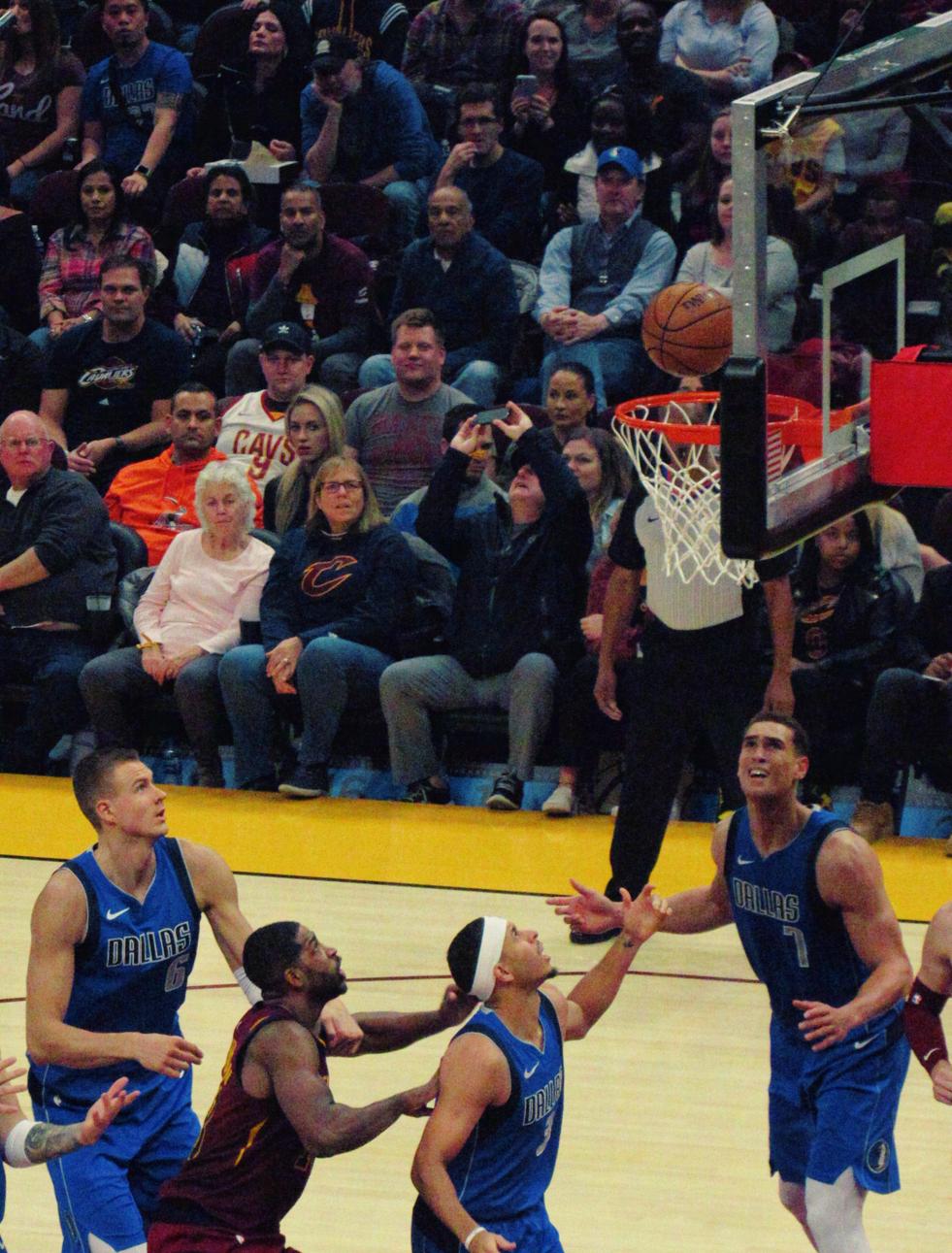
Even though the season has just started, the goal of the Cavaliers has
Trey Razanauskas
Christopher Heermann Photo Editor
I knew we had a great team, so many returners, a great incoming class. The expectation was always to make nationals, and our goal was top 10. I think we’re coming along nicely with training, we’re right on pace with postseason peaking.
Who do you expect will be the team’s toughest competition at regionals/nationals?
been clear. This is a team that will focus on rebuilding. Winning now will not be a priority; developing their young players and gaining assets to win in the future will be the point of emphasis this season. While
the team may not win many games immediately, a new young core is starting to take shape and could possibly lead this team back to the playoffs in a weaker Eastern Conference soon.
Trey Razanauskas transferred to Case Western Reserve University in 2018 and is now a third-year. He is one of two captains of the cross country team and is majoring in both economics and philosophy. He also holds the school record in the 5k (indoor and outdoor) and 8k races.
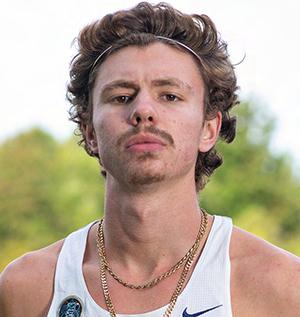
What were your expectations coming into this season?
At the regional level, John Carroll, Otterbein and Calvin. All three teams are in the same position right next to us. Nationally, the other UAA teams and North Central. As well as MIT, Calvin, Johns Hopkins, who are all around the No. 10 spot. We are ranked 20th, but I believe we can finish top 10 based on our training and how we peak postseason.
What is your favorite part of being on the track and cross country team? Why?
I came as a transfer last year, and the best part was how everyone ac -
cepted me right off the bat. I came in with no expectations and everyone accepted me for who I was before they knew what kind of runner I was. It really made me love the team knowing I was able to just be myself.
Do you have any meets that you remember being particularly special? Why?
Oberlin this year was awesome. It was the first time I ever won a cross country race, and was also the fastest 8k time ever recorded at Case. Overall it was a really solid day for the team too, everyone did really well.
Do you feel any pressure during competition?
When the pressure is on me, that’s when I’m going to perform my best. I love competition because I like testing myself, and that’s the only way to know how you’re going to perform is in actual competition.
What are your favorite free time activities? Why?
Probably thinking of funny tweets and eating at Leutner. Tweets are hilarious, and I love Leutner. I love the food there, really just spending time there. Today I was there at least an hour just talking to friends and hanging out.
What is your favorite quote or what inspires you?
I find Muhammad Ali inspirational, pretty much any quote of his is amazing. He was the ultimate confidence guy who always bet on himself. He inspires me to have confidence in everything that I do.
What was the hardest part of the season?
Coming back from injury was the toughest part. I was antsy and wanted to get going with workouts and races, but I had to take it easy and recover. There were good takeaways too; sitting out the first three competitions put a chip on my shoulder, gave me something extra to think about when I finally came back.
11 sports observer.case.edu
ATHLETE SPOTLIGHT
The Cavaliers, shown here playing the Mavericks, are trying to recover from the loss of older veteran players. Winston Delk/The Observer
Learn how at observer.case.edu
in the
Want to sit
press box?
Courtesy of CWRU Athletics
CWRU water polo team makes a name for themselves
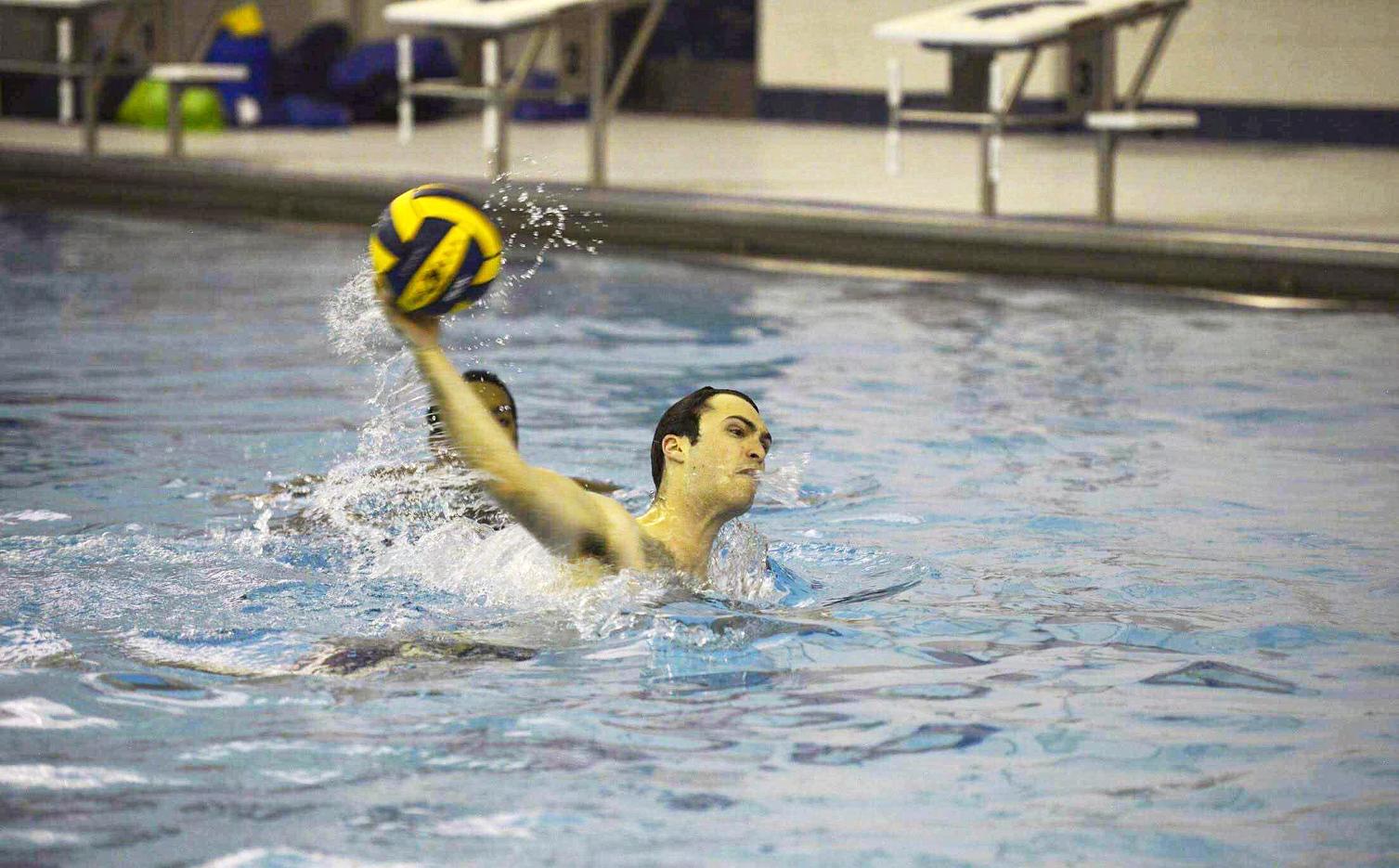 Cecelia Zielke Contributing Reporter
Despite the recent onset of cold, the Case Western Reserve University Club water polo team is just getting their 2019 competition season started. The members of the team are ready to take on frozen hair and dry skin after they leave the pool three times a week.
The CWRU Club Water Polo team had their season openers this weekend in an away tournament at a high school in Indiana. Posting a final record of 2-1, the team had a successful weekend. After losing the first game versus Oakland University, the team came back in their next match to beat Ball State University with a final score of 14-1. Finally, the team finished off the day strong in a third game against the University of Indianapolis. The final score of game three was an overwhelming 18-1, a victory that makes the team feel strong coming into their next tournament this coming weekend. For CWRU, the leading scorer was first-year Grant Holmes.
First-year Kalista Tapas, an experienced high school water polo and former Illinois High School water polo state champion, commented on the team’s performance this past weekend, “As a team I think we played well. Once we got used to playing and all warmed up after the long car ride, we really did well.” Tapas also noted that CWRU had a lot of new players who played in their first games at the tournament and did “phenomenally.”
Henyah Dardir, a first-year student
at CWRU and one of the newer players, says that her favorite part of joining the team is “being in the water and knowing she’ll have fun because of how awesome everyone on the team is.” Enjoyment is paramount for CWRU water polo. The team aims to foster an environment that is fun, educational, challenging and filled with high quality water polo. And the suc -
cess in doing so is clearly reflected in their top-notch performance.
CWRU’s Club Water Polo team will host their annual home tournament this coming Saturday, Nov. 16. Games will take place in the Veale Natatorium at 11:30 a.m. versus Oakland University, 12:20 p.m. against Ball State University, 4:10 p.m. ver-
sus UAA-rival University of Chicago and 6:40 p.m. against the University of Akron. It’s your only chance to see the team play at home this semester, so don’t miss it!
If you are interested in joining the team, visit the CWRU Club Water Polo Facebook page for more information.
Volleyball closes season with 5th place finish at UAA Championship
Andrew Ford Staff Reporter
In their final action of the 2019 season, the Case Western Reserve University volleyball team secured a fifth place finish at the UAA Championship tournament, ending with a 13-16 record.
The Spartans opened the tournament with a tough first-round matchup against Washington University in St. Louis. CWRU, who entered as the sixth seed, lost in three sets to their third-seeded rival.
Against the Bears, the Spartans’ defense held up decently well, totaling nine block assists. However, the offense couldn’t put together an efficient game, accounting for a mere 0.063 kill percentage. Fourth-year middle hitter Haley Sims led the team with seven kills.
The rest of the weekend went much more smoothly for CWRU. The same day, they faced Brandeis University and swept them in straight sets.
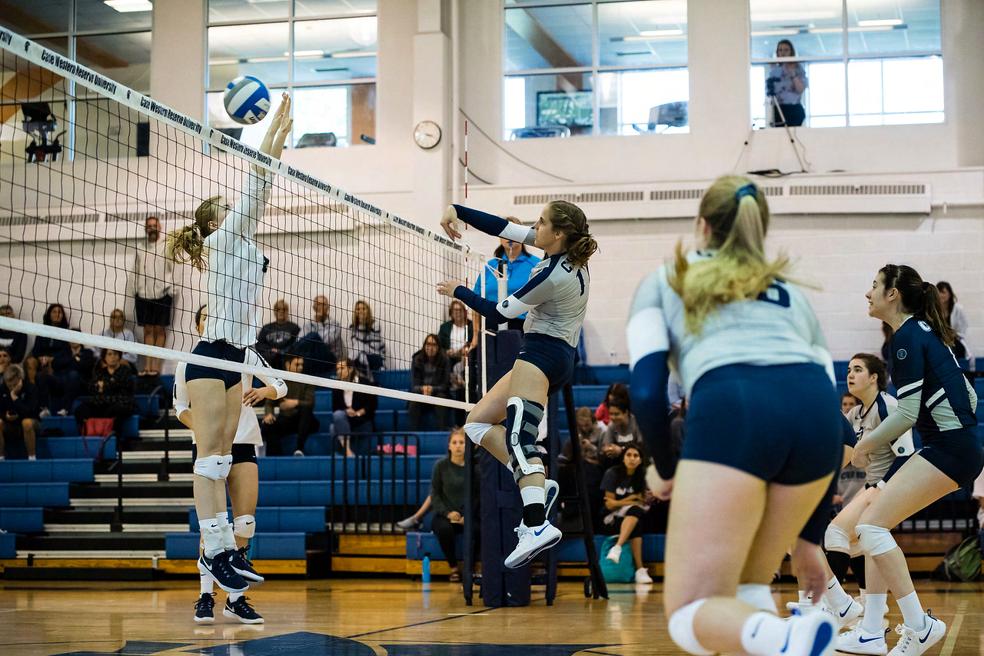
Sims had an excellent game: she notched 10 kills on 15 attempts, good for a .667 kill percentage.
First-year setter Sara Rogers led the team with 20 assists, and she added seven digs to her stat line as well.
Defensively, the team combined for 16 block assists in this match.
In the concluding game of the season, the Spartans won a competitive match over New York University, 25-23, 25-16 and 29-27. Sims again recorded 10 kills, and fellow fourth-year outside hitter Brianna Lemon ended her career on a high note with 11 kills. Third-year right side hitter Jana Giaquinto had a solid game with 18 digs.
Although the team did not live up to their preseason expectations, Head Coach Karen Farrell was not disappointed with her team.
“The season overall was an uphill climb with early season injuries and losing so many five-set matches,” she said, “but the team never gave up trying to improve and players approached practice each day with a positive outlook.
With this season coming to a close, the Spartans will begin preparing for the 2020 season in the coming months. Although they will lose key players Sims, Lemon, fourth-year outside hitter Karley King and fourthyear setter Faith Ellis, they will return a solid core of players. Moreover,
third-year libero Anna Jaskoviak will return from injury, adding a spark to the back row defense.
“We have a lot of work to do to move the program forward and compete with the top teams in the region and in the UAA in nine short months,”
Farrell said. “There will be many opportunities to earn spots in the rotation for returning players who improve their competitive levels and for incoming players who demonstrate a high level of consistency and execution in their play.”
sports
The Spartans won matches against Brandeis University and New York University at the UAA Championship tournament. Naji Saker/ The Observer
CWRU Club Water Polo will host their annual tournament on Nov. 16 starting with a game against Oakland University. Courtesy of CWRU Water Polo
