The End of Phil Berger’s Reign – 8


Waiting After Helene – 18
NORTH CAROLINA'S MAGAZINE ON PLACE AND POWER
NORTH CAROLINA'S MAGAZINE ON PLACE AND POWER









The End of Phil Berger’s Reign – 8
Waiting After Helene – 18
NORTH CAROLINA'S MAGAZINE ON PLACE AND POWER
NORTH CAROLINA'S MAGAZINE ON PLACE AND POWER





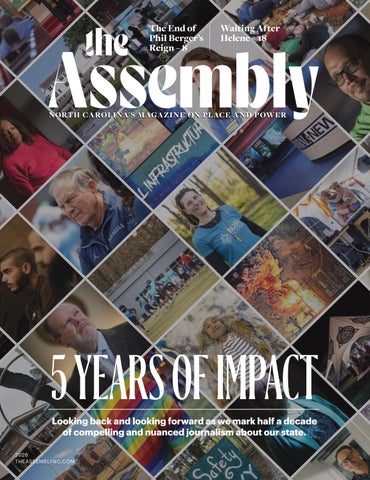
Looking back and looking forward as we mark half a decade of compelling and nuanced journalism about our state.













MamaRa� b� Wangechi Mutu redefines what it means to enter a museum.
Experience her in the Sculpture Garden at the Nasher Museum of Art at Duke Universit�. Free admission for all.
Wangechi Mutu, MamaRa�, 2020. Bronze, edition 1/3, 65 × 144 × 192 inches (165.1 × 365.76 × 487.68 cm). Collection of the Nasher Museum of Art at Duke Universit�, Durham, NC. Gift of Mike and Joan Kahn in honor of Douglas and Stefanie Kahn (Lauren ’11, Michael ’13, Daniel ’20). Commissioned b� the Nasher Museum of Art at Duke Universit�, 2020.18.1.











II thought I knew North Carolina pretty well when I set out to launch The Assembly. But it turns out you can discover a lot more about your home state in five years of deep reporting.
Since founding The Assembly in 2021, I’ve learned about the absurdity of the state’s approach to selling booze; the fight to grow our seaports along with our economy; and more than I ever wanted to know about the intricacies of municipal annexation.
I’ve deepened my (admittedly shallow) understanding of NASCAR and been fascinated by the acrimonious church divisions. I’ve been chagrined at the mismanagement of some beloved institutions, puzzled at leaders’ decisions, and disturbed by the allocation of taxpayer money with no public discussion.
I’ve also been blown away at the strength of neighbors when the water rises and the world is cut off. I’ve been moved by the beauty of human resilience and creativity. And I’ve marveled at the sheer joyful breadth of a state that boasts BBQ joints, cricket championships, muscadine wine, and cheddar biscuits with equal enthusiasm.
This magazine began because this is a damned interesting place. It continues because we’re getting bigger and more interesting by the day. Over the past five years we’ve published 1,300 stories. Some have been intensely reported investigations. Others are slice-of-life dispatches that tell you something new about people and places that are already familiar. Every one of those stories has made me smarter about this marvelous, complicated place I call home. I hope it’s done the same for you. In the months to come, we’re going to double down on that mission. Every community needs a team of people who wake up every day asking curious and skeptical questions. Our best stories come when we make that extra phone call, take an uncertain source meeting, or dig into something that just seems off. They’re stories that would otherwise go unreported.
That work takes time. It’s not something AI, or even a human reporter working on a two-hour deadline, can replicate. But it’s the work we’re committed to doing. Without the help of readers like you who pitch in each month to keep us here, this idea would fade away. Thanks for making this possible. We’re grateful.

Kyle
CEO, The Assembly kyle@theassemblync.com
CEO
Kyle Villemain
Executive Editor
Kate Sheppard
Chief Operating Officer
Jed Williams
Director of Audience and Product
Elizabeth Walters
Statewide Editors
Emily Stephenson, Emily McCord, John Drescher
Regional Editors
Sarah Edwards, Matt Hennie, Joe Killian, Sarah Nagem, Jane Porter, Sarah Willets
Staff Reporters
Bryan Anderson, Jeffrey Billman, Chloe Courtney Bohl, Carli Brosseau, Morgan Casey, Korie Dean, Lena Geller, Matt Hartman, Michael Hewlett, Justin Laidlaw, Ren Larson, Sayaka Matsuoka, Gale Melcher, Rachel Heimann Mercader, Chase Pellegrini de Paur, Heidi Perez-Moreno, Johanna Still, Dasia Williams, Paul Woolverton
Creative Director
Nicole Pajor Moore
Graphic Design and Production
Annette Winter
Editorial Operations Manager
Valeria Cloes
Copyeditors
Sara Abrons, Michael Coons, Katie Kosma, Leah McCann, Iza Wojciechowska
Audience and Growth
Drew Hill, Mathias Marchington, Grace McFadden, Sarah Day Owen Wiskirchen
Business and Operations
James Amato, Lauren Boyle, Dawn Denham, John Hurld, Caitlin Malson, Sharon Moyer, Talmadge Rogers, Chelsey Varela
$99.99/year. For subscription inquiries or questions, please email info@theassemblync.com.
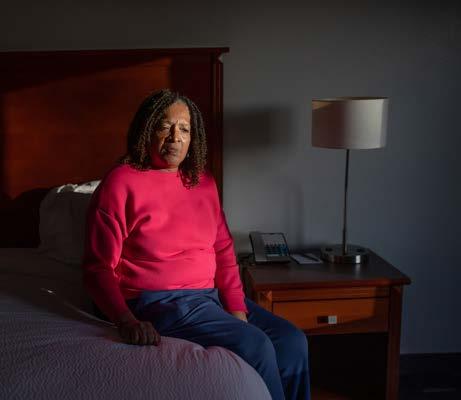
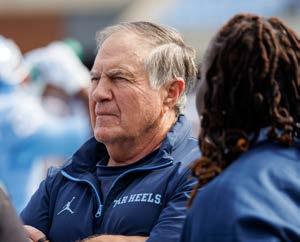
PHOTO BY
8
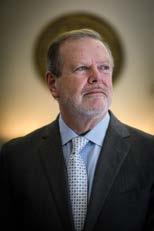
The Berger King
Phil Berger was North Carolina’s most powerful politician for more than a decade. Here’s how that reign came to an end.
18 As Helene Survivors Wait for State Help, Some Victims of Earlier Hurricanes Are Still Out of Their Homes
North Carolina created a new housing recovery program to avoid the delays and cost overruns that plagued rebuilding efforts after hurricanes Florence and Matthew.
26
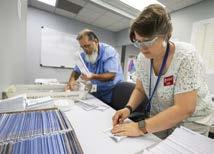
Longtime N.C. Voters May Have Their Ballots Wrongfully Tossed in Supreme Court Race
Our investigation revealed the flaws in a list of so-called never residents, changing the course of a highly contentious state Supreme Court race.
30
I’ve Seen How the Neo-Nazi Movement Is Escalating. You Should Worry.
After he committed to unmasking extremist groups in North Carolina and beyond, a reporter got a firsthand look at how the “militant accelerationism” movement operates.
40
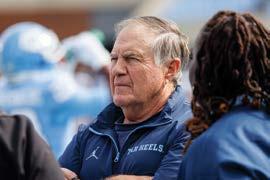
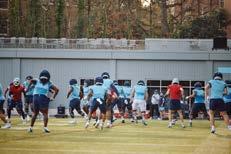
UNC’s Risky Belichick Math
UNC-Chapel Hill transferred $21 million from other funds to the athletic department—and that was before it hired football coach Bill Belichick.
48
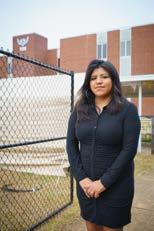
If You Build It, Will They Come?
New charter schools in North Carolina are struggling to enroll enough students to stay solvent. One High Point school’s implosion shows the consequences for families.
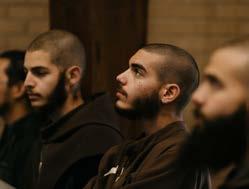

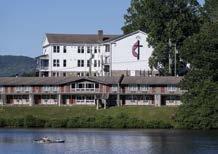
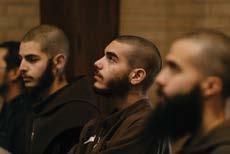
A religious order following a lifestyle St. Francis of Assisi established in 1223 is building a new home in the woods of Western North Carolina. Not everyone is happy to see them.
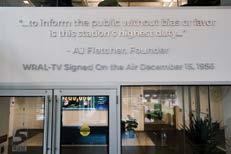
Television viewership and advertising revenue are down nationally, and locally owned stations are fading. Jimmy Goodmon, the fourthgeneration president of WRAL-TV and Capitol Broadcasting, confronts a precarious future.
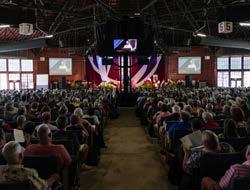
Inside the United Methodist Church’s acrimonious split over gay marriage and ordination.
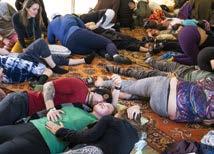
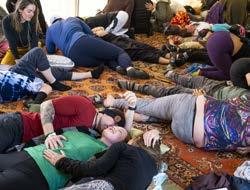
When it comes to sex, some say a “Magnolia Curtain” hangs over the South. This festival sought to open minds and spice things up.
Looking back and looking forward as we mark half a decade of producing compelling and nuanced journalism about our state.
The Assembly launched in February 2021 as two unpaid editors working with experienced freelancers across the state to publish a handful of consequential stories each month.
In the last five years, we have grown to 46 staffers statewide, including reporters, editors, and the creative, audience, and business teams necessary to support our work.
As we celebrate five years of The Assembly, we are looking back at some of our stories with the biggest impact and at how we’ve grown to become the premier network of journalism outlets in North Carolina.

N.C. Lt. Gov. Mark Robinson at his campaign kickoff event. (Credit: Cornell Watson)
Mark Robinson’s Past Louis Money and his band, Trailer Park Orchestra, released a music video for the song “The Lt. Governor Owes Me Money” in August 2024. Money claimed he’d worked in several of Greensboro’s windowless, 24-hour video-pornography stores in the 1990s and early 2000s, and among his frequent customers was Mark Robinson.
It was a rumor we could have ignored about the Republican nominee for governor. Most outlets did. But throughout his short career in politics, Robinson had painted himself as a man who’d turned his life over to Jesus. His controversial barbs frequently targeted anyone who doesn’t subscribe to his conservative interpretation of Christianity or share his views on sexuality and gender issues. We decided to dig in and found five other former employees or customers who attested on the record that they’d seen Robinson at these stores, too.
Our reporting was cited in numerous national outlets, including The New York Times, The Atlantic, Semafor, and The Late Show with Stephen Colbert. Two weeks later, CNN had
its own explosive report detailing comments Robinson had allegedly made on online pornography sites claiming, among other things, that he is a “black Nazi,” expressing support for slavery, and calling himself a “perv.” The story directly referenced our prior reporting.
Robinson went on to lose the governor’s race by more than 14 points. He also filed, and then dropped, a defamation lawsuit against CNN and Money.

By the time UNC-Chapel Hill launched the School of Civic Life and Leadership, or SCiLL, in the fall of 2024 at the behest of the Board of Trustees and the state legislature, it was already many years in the making.
But it has been mired in controversy from the outset. Critics said it was a Republican attempt to force the university to hire more conservatives, especially after a trustee described the school as a “remedy” to the liberal lean of campus. Few might have guessed in the early days that the school’s problems would largely come from the inside.
Matt Hartman’s reporting through public records and numerous interviews revealed that there had been nearconstant upheaval within the school over faculty recruitment and hiring. That turmoil was a leading factor in the surprise resignation of Provost Chris Clemens, who in turn filed a lawsuit accusing the university’s Board of Trustees of “systematically hiding matters of grave public concern” and calling out SCiLL explicitly.
Chancellor Lee Roberts also announced the university would bring in outside counsel to investigate SCiLL, thanks to reporting from The Assembly and other outlets. “This kind of coverage is obviously troubling,” Roberts said at a September 2025 faculty council meeting. “It’s not what anybody would want.”
The law firm hired to investigate SCiLL concluded its work in early 2026, but UNC-Chapel Hill wouldn’t release the report, information about its findings, or what it has done in response.
The decision to become The Assembly Network was born out of our belief in collaboration. Newsrooms across the state and country are struggling, shrinking, and in many cases, folding altogether. INDY in Durham and CityView in Fayetteville were both established newsrooms deeply committed to local reporting. Acquiring them in 2023 and 2024, respectively, allowed us to align resources, strategy, and editorial support to nurture their growth and success, while maintaining their distinctive voices.
We also launched The Thread in Greensboro in 2024 to provide coverage of local government and the issues facing the city, and that team now has three journalists. In early 2025, we welcomed Border Belt Independent in southeastern North Carolina into the fold, while also adding The Line to cover western Wake County later that year.
These teams offer tremendous value to our statewide audience while giving local readers a deeper understanding of how their cities and towns operate and both informing and empowering residents. They know, through carefully vetted reporting, who is running for local and state government, the results, and why those races matter. When dangerous weather threatens residents’ safety, our teams bring critical information and connection. Beyond the daily headlines, we produce stories that demystify and uplift the people, history, and places that make these communities distinct.
Our network connects the dots. In 2022, after alleged abuses of power at the Columbus County sheriff’s office, our teams worked together to make records requests, and when we were denied, we worked with lawyers to demand transparency. When cities around the state were considering the use of the gunshot detection technology ShotSpotter, our reporters worked together to highlight community concerns about cost and reliability. And in 2024, these teams partnered on our explosive investigation into gubernatorial candidate Mark Robinson, fundamentally changing the course of that race.
As our network continues to grow, so does its commitment to serving the people of North Carolina. It demonstrates the critical need for collaboration to support a thriving news ecosystem, and shows how robust local journalism benefits our communities.
• Winner of two 2025 Edward R. Murrow Awards, including Overall Excellence
• Winner of two 2025 Society of Professional Journalist Green Eyeshade awards
• Winner of 36 North Carolina Press Association Awards in 2025, including top honors in higher education reporting, the Freedom of Information Award, and photography
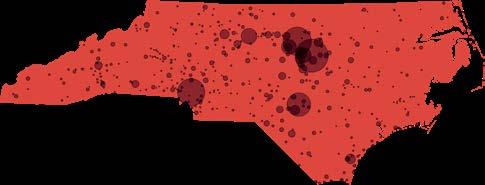
In 2021, the General Assembly allocated $97 million in pandemic recovery funds to the UNC System to create Project Kitty Hawk, an online learning platform leaders promised would be “really groundbreaking for many, many years to come.”
Set up as a nonprofit, the project was designed to help UNC campuses run online degree programs for the state’s working adults. Leaders initially predicted it would have 30,800 students by 2028, the equivalent of adding another campus to the state system.
But as Pam Kelley reported, within a few years, the project had spent millions, slashed enrollment projections, and was having trouble even getting off the ground. There were also questions about how CEO Wil Zemp was spending funds. After more than two years and $72 million in spending, the program had just 639 students in 11 online programs.
Two weeks after our first story ran, Zemp submitted his resignation. A state audit following our investigation found the UNC System had violated “federal and state laws, rules, and regulations” that require it to monitor the nonprofit. Project Kitty Hawk was also required to return $102,000 in federal grant money for payments covering a five-star hotel stay and other unallowable expenses.
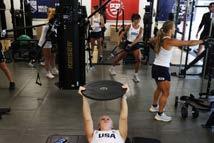
The USA field hockey team uses the U.S. Performance Center in Charlotte. (Credit: Travis Dove)
In August 2024, reporter Ren Larson revealed that Charlotte’s U.S. Performance Center and its affiliated nonprofit had been given $55 million in non-competive state grants, with little oversight.
The funding for the center, which was co-founded by a well-connected businessman, was meant for capital projects like fields and facilities and intended to attract Olympic governing bodies to the area. While none have relocated, Larson found that they were spending lavishly on other things, including more than $9.8 million for its own consulting services, $2.9 million on salaries and benefits, and $4.5 million on outside consultants.
Our reporting prompted the Office of State Budget and Management to expand an audit of the grants. Larson later broke the story that the review concluded USPC had misspent nearly $1 out of every $4.
PUBLISHING PARTNERS
STATEWIDE STORIES IN 2025
PAID SUBSCRIBERS
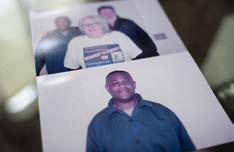
Charles McNeair was just 16 when a white woman accused him of rape. He accepted a plea deal because he thought his life was on the line, and he remains in jail 46
NEWSLETTER SUBSCRIBERS
READERS ACROSS THE STATE 500K+
ENGAGED MINUTES ANNUALLY 8.3M
years later—despite his claims of innocence and the fact that a similar plea would sentence him to a maximum of 10 years today.
Michael Hewlett started reporting on McNeair’s story in 2023 and has continued revealing more concerning details. He found that the Lexington police had likely destroyed McNeair’s case file and that the state innocence commission had not examined the original investigative records when it took up his case. After these first stories, the Lexington city council passed a resolution asking the governor to examine his case and for others to come out in support of McNeair.
In 2025, Lexington’s current police chief made an astonishing request: that the governor consider clemency, based on our reporting. “We have no documentation of the investigation that led to Mr. McNeair’s life sentence,” the chief wrote. “The limited materials we do have do not present a coherent narrative and do not pertain to the offense in question.”
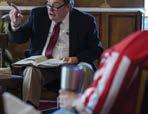
Phil Berger was North Carolina’s most powerful politician for more than a decade. Here’s how that reign came to an end.
BY JEFFREY BILLMAN | PHOTOGRAPHY BY ANDREW CRAFT
Phil Berger has been the state’s most dominant politician for 15 years, but the cracks were beginning to show last year. In this July 2025 article that foreshadowed a serious challenge to Berger’s hold on power, Jeffrey Billman showed how the state Senate leader, who’d always run a disciplined chamber, was losing his grip on his empire.
FFew noticed when the state House passed a bill to “Restore Flounder/Red Snapper Season” in May. It wasn’t the kind of legislation that generates headlines, let alone draws angry protesters to Raleigh.
But one sentence inserted into the Senate version on June 17 changed all that. The amendment, by Sen. David Craven, banned shrimp trawling within a half-mile of the shoreline, which threatened a $14-million-a-year industry in an effort to protect juvenile fish habitats.
For Sen. Bobby Hanig, a Currituck County Republican who favors bow ties and flamboyant sports coats, the issue wasn’t just what the amendment did, but how it came to be. He wasn’t told about it beforehand, he says. Neither were most Republican senators, including others who represent coastal communities.
Instead, Hanig believed that Craven—a third-term Republican from Randolph County, about 200 miles from the coast—had done the bidding of Senate leader Phil Berger and his top lieutenant, Sen. Bill Rabon.
“You know as well as I do that you don’t scrape a pimple off a gnat’s ass without Bill Rabon and Phil Berger’s permission in the North Carolina Senate,” Hanig told The Assembly
In response, Hanig did what almost no Republican has done since Berger became the Senate’s president pro tempore in 2011: He fought back, publicly and aggressively, lashing out at what he called “sleazy politics at its worst.”
When Hanig failed to derail the legislation on the Senate floor, he used a parliamentary tactic to delay its passage for several days. After the Senate finally approved it—only Hanig and three other coastal Republicans opposed the bill—he helped rally hundreds of shrimpers and their supporters at the legislature. The show of force convinced House Republicans to kill the Senate’s bill.
Hanig’s brazenness stunned many observers.
Under Berger, the Senate GOP has been a disciplined political machine. Few leaks emerged from closed-door meetings. Disagreements remained private. And almost no one openly defied leadership—let alone attack them personally.
This spring, however, a few small cracks began to form. Hanig cast a lone Republican vote against the Senate’s budget after his amendment to preserve free ferry rides failed. Another Republican senator criticized Berger’s allies for their hardball tactics. House Republicans, meanwhile, refused Berger’s budget demands, leading to an acrimonious standoff.
Hanig’s rebellion brought to the surface a question that had been the subject of furtive whispers: Is Berger, now in his 15th year as the state’s most powerful politician, losing his grip on the legislature?
“I hope that my colleagues see now that they’re not invincible,” Hanig said.
In an interview last week, Berger argued that these “isolated” incidents didn’t signify anything larger. The fact that a few disagreements spilled out into the open doesn’t mean he’s lost support.
Hanig’s comments say “more about Sen. Hanig than about anything else,” Berger added.
This article is based on conversations with more than two dozen legislators, lobbyists, and political operatives over the last three months. Most were granted anonymity to speak candidly.
Many insiders said it’s no coincidence that Berger’s difficulties arose as he gears up for the first real test of his electoral power in decades. Next March, he’ll face a primary challenge for his state Senate seat from Sam Page, Rockingham County’s MAGA-aligned seven-term

sheriff. Page has sought to capitalize on Berger’s failed push to legalize commercial casinos in 2023, a rare political misstep.
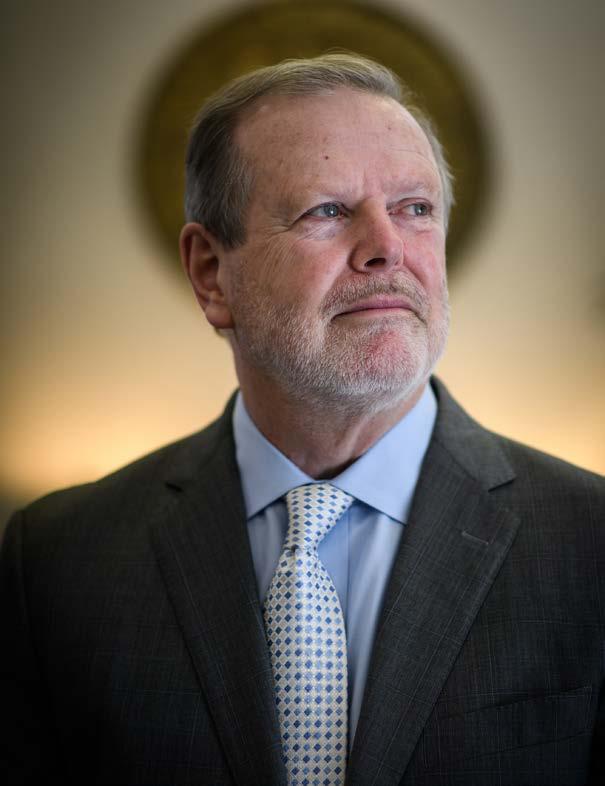
The 72-year-old Berger is arguably the state’s most influential Republican since Jesse Helms. But as the General Assembly reconvenes this week from a summer recess, he finds himself at a crossroads, fighting for political survival against an opponent who says his long record of conservative accomplishments isn’t conservative enough. His long tenure leading the Senate is, for the first time, showing signs of strain.
How Berger handles the next few months could define his legacy.
The Boss
Berger lost his first bid to become the leader of the Senate Republicans.
In April 2004, Sen. Patrick Ballantine, then the minority leader, resigned to run for governor. (He lost that fall to Democrat Mike Easley.) Berger, a lawyer from Eden, sought to replace him.
Though only in his second term, Berger said he’d
quickly realized he couldn’t accomplish much with Democrats in control. “I looked at it, and I said, ‘Well, you know, I can do that job, and I’ve got some ideas on how we can build on where we are and hopefully get to a majority,’” he told The Assembly
The caucus instead chose Sen. Jim Forrester, a social conservative best known for his opposition to gay marriage. (Forrester died in 2011.)
President George W. Bush won the state that fall, but Democrats gained seats in the General Assembly. Berger was frustrated.
“We should have been able to get to a majority at that point,” he said. “I just felt like we didn’t put our best foot forward.”
“I hope that my colleagues see now that they’re not invincible.”
After the election, Berger again ran for minority leader. This time, he prevailed. But his victory generated few headlines; at that point, the Senate GOP had been in the minority for more than a century. Still, Berger’s colleagues saw potential.
“Phil was just seen as a natural leader, well-liked by
The people of Rockingham County want, need, and deserve to be heard on this matter. We’ve been left in the dark far too long.
– Sam Page, Rockingham County sheriff
the caucus, respected by the Democrats,” said Richard Stevens, a Wake County Republican who served in the Senate from 2003 to 2012.
Berger wanted the GOP to improve its political fundamentals, especially fundraising. Senate Democrats had long taken advantage of a state law that allowed them to pool their resources more effectively; before Berger, Republicans hadn’t. Better fundraising made it easier to recruit quality candidates.
Over the next few years, Berger hammered Democrats for taxing too much and spending frivolously, and he accused them of being soft on criminals and unauthorized immigrants. He also promised that, if given power, Republicans would govern transparently, a contrast with Democrats then mired in corruption scandals.
Weighed down by Bush’s unpopularity, state Republicans had little success in 2006 and 2008. But in 2010, a Tea Party wave swept them into the majority, and Berger was elected president pro tempore. He’s held the position ever since. (His Democratic predecessor, Marc Basnight, led the Senate for 18 years, a state record.)
Few modern politicians have wielded power as effectively. Berger guided the statehouse from a Democratic stronghold into a conservative laboratory. Republicans cut taxes, regulations, and unemployment benefits, which they argued was necessary to pay off debt.
Their reforms have led to economic growth and a better business environment, Berger says.
Republicans also passed a far-reaching school voucher program and curtailed abortion rights. They stripped authority from Democratic governors, seized control of the UNC System, and aggressively redistricted to entrench Republican power.
“What Republicans saw as an opportunity in 2011 was to fundamentally shift the dynamics of a state that they did not have control over for over 100 years,” said Michael Bitzer, a professor of political science at Catawba College. “I think [Berger], serving as the leader in the Senate, was the true gatekeeper.”
Many moves were controversial. Republicans faced widespread backlash over the “bathroom bill,” which the legislature eventually repealed, and cuts to public school funding. They fought in court over gerrymandering
and voter ID. Their political appointees occasionally embarrassed the state’s higher education system. In 2023, they acquiesced to then-Gov. Roy Cooper’s calls to expand Medicaid after years of dogged resistance.
(With President Donald Trump’s recent Medicaid cuts threatening that expansion, which has provided health insurance to about 600,000 residents, Berger argues his skepticism was justified: “I think the decision I made, each decision was the right decision at that time.”)
Time and time again, Berger emerged from these battles unscathed. But his push to bring commercial casinos to North Carolina has been a different story.
As minority leader, Berger opposed establishing a lottery to fund education. He also voted to ban video poker machines and Internet sweepstakes games.
But in 2023, Berger embraced gambling. The General Assembly legalized sports betting, and Republicans proposed legislation to bring back video gaming machines. Most controversially, Berger backed legislation to let one company open three casinos on nontribal land in rural Anson, Nash, and Rockingham counties.
Berger said the difference was that 20 years ago, North Carolina had no gaming. Since then, three casinos have opened on tribal land, and two more just across the Virginia state line—including one in Danville, a half-hour’s drive northeast of his hometown. He figured the horse had left the barn.
Proponents pitched the casinos as economic stimuli for struggling areas. But there was another possible motivation. Some economic forecasts have suggested that scheduled tax cuts—a cornerstone of Berger’s agenda—could lead to billion-dollar deficits by the end of the decade.
Berger has downplayed those claims, insisting that the state’s growth will more than make up for any shortfalls. But if there is a hole, gaming revenues could help patch it.
Legislators unveiled the casino legislation in July 2023. By then, the wheels were already in motion.
In 2022 and 2023, executives at the Maryland-based Cordish Gaming Group donated to the campaigns of Berger and other key Republicans and hired lobbyists linked to
He spent a lot of time, not in Rockingham County dealing with the crime problem, but down at the border getting his picture made with his hat on.
Berger and his former chief of staff. A politically connected nonprofit commissioned a report that estimated that gambling could produce as much as $1.4 billion a year in new tax revenue.
In March 2023, Rockingham County officials—including Commissioner Kevin Berger, the Senate leader’s son— flew to Maryland for a symposium the casino company hosted. That June, a Cordish-linked company asked Rockingham County to rezone 192 acres of agricultural land to a designation called highway commercial. Less than a week later, the county planning board voted to allow casinos in highway commercial zones—if state lawmakers legalized them.
County officials “kept denying they knew what [the land] was going to be,” said Doug Isley, a former Rockingham School Board member who led the anti-casino effort. He said he learned of the officials’ meeting with Cordish through a public records request.
In September 2023, Rockingham County commissioners approved Cordish’s rezoning despite opposition from an overflow crowd of hundreds of residents. Eighteen speakers pleaded with them not to allow casinos in their community.
One of them was Page, the longtime sheriff. “The people of Rockingham County want, need, and deserve to be heard on this matter,” he said. “We’ve been left in the dark far too long.”
The legislative deal to legalize casinos soon collapsed because it lacked Republican support in the House. But the fallout continued to dominate Rockingham County politics.
One of the three county commissioners up for reelection in the March 2024 Republican primary lost to a casino opponent. The other two incumbents, including Kevin Berger, narrowly escaped the same fate.
Weeks before the election, GOPAC—a national organization that seeks to elect “a new generation of Republican leaders”—paid $25,000 for mailers attacking candidate Craig Travis, according to a defamation lawsuit Travis filed after the election. (It was dismissed in May 2025.) According to the lawsuit, the money was passed through a nonprofit run by a GOP donor and sent to one of Phil Berger’s political advisers, who printed the mailers.
Berger sits on a GOPAC advisory board.
Kevin Berger, who’d easily won his first three campaigns, won by just three votes.
In December 2023, a group calling itself the North Carolina Conservative Project released a poll that sent shockwaves through political circles. It found that if Page challenged Phil Berger in the 2024 primary, the sheriff would win by 30 points.
There were reasons to be skeptical of the poll. The group behind it wasn’t registered with the secretary of state, the IRS, or the State Board of Elections, making it impossible to tell who conducted or paid for the survey.
State Supreme Court Justice Phil Berger Jr., another of Phil Berger’s sons, blamed Patrick Sebastian, a political operative and partner in the polling company Opinion Diagnostics. Berger Jr. told Axios Raleigh at the time that he had recently fired Sebastian as a consultant to him for being part of an effort to recruit a challenger to his father.
Sebastian, a nephew of former Gov. Pat McCrory, declined to tell Axios Raleigh whether he’d been involved. (He denied that he was Berger Jr.’s employee, or that Berger Jr. fired him.) But two sources familiar with the recruitment told The Assembly that Sebastian and other GOP politicos, including former U.S. Rep. Mark Walker, approached a Greensboro business executive in 2023 about challenging Berger. (The executive, who declined to comment, didn’t live in Berger’s district.)
Page also confirmed that “there was interest” in him running against Berger in 2024. But he said he’d already decided to run for lieutenant governor. He placed fifth in that primary.
Unchallenged in his own primary, Berger was re-elected by a 13-point margin over Democrat Steve Luking, a Reidsville physician. It was a comfortable win, but also Berger’s weakest showing since he took office in 2001; he ran 18 points behind Trump in Rockingham.
Just three months later, Page announced he would run against Berger in 2026.
Page will be a formidable opponent, especially in Rockingham. Since being elected in 1998, he’s never lost a precinct in a primary or general election. Page is

also optimistic about his chances in Guilford County, where Senate District 26 wraps around Greensboro. He easily won the most votes in the lieutenant governor primary there.
Page has spent years bolstering his law-and-order bona fides and projecting toughness on immigration. Often photographed in a cowboy hat, Page has taken frequent trips to the southern border and appeared in conservative media. He also tied himself to Trump, leading the group Sheriffs for Trump in 2016 and serving as Trump’s North Carolina campaign chair in 2020.
Page casts himself as a plainspoken conservative who hasn’t forgotten his roots, while arguing that Berger has sold out to lobbyists. Page said Berger’s handling of casinos was revealing.
“A lot of this is about corporate instead of the people,” Page said. “And we need to be thinking about the people that we serve, and not just corporate interests and the big dollar.”
Berger said that, as far as he’s concerned, casinos are “in the past.”
“I saw that proposal, vetted the proposal,” he said. “Turns out, folks didn’t want to do that.” He added, “The only person that’s really talking about gambling at this
time is Sam Page.”
Berger speaks of Page in a tone like an audible eye roll.
“Sam Page is someone who is trying to get out of the sheriff’s office because that office has been mismanaged for so many years,” he said. “So, he ran for lieutenant governor. He spent a lot of time going to political rallies to try to ingratiate himself with political candidates in the hopes of getting an appointment to something. He spent a lot of time, not in Rockingham County dealing with the crime problem, but down at the border getting his picture made with his hat on.”
Even so, Berger has treated Page like a threat.
This spring, Berger began rolling out high-profile endorsements from law enforcement and some of the state’s best-known Republicans, including U.S. Sen. Ted Budd. He also became the lead sponsor of seven bills, an unusual display for a typically behind-the-scenes operator.
Several addressed red-meat issues like immigration, DEI, and gun rights.
“I don’t think there’s any question that people that have known me for a long time will tell you that I’ve never sought the limelight,” Berger told The Assembly. But with

the primary looming, “it was important for me to make sure that folks understood what it meant for me to be in the position I’m in.”
That marked an important shift in Berger’s focus, said longtime lobbyist Brian Lewis, who co-hosts the Do Politics Better podcast. He’s “recognized that there’s a populist movement in North Carolina,” Lewis said. “Sam Page is riding that populist train right now, and, of course, it’s going to have an effect on Sen. Berger.”
Berger has long prioritized maintaining the Senate’s Republican majority, which has sometimes meant looking out for vulnerable members instead of ideological interests.
Berger is the only sitting Republican senator who served in the minority. He watched Democrats squander their majority and learned from their mistakes. (Berger said he thinks Democrats’ failure to budget for economic downturns caught up with them after the Great Recession.)
But his long incumbency also presents challenges. Some top enforcers—both staffers and trusted legislators—have left, while the next generation of lawmakers includes ambitious climbers. And as Berger acknowledged, Republicans have prevailed on many of the overarching issues that unite the caucus. Splits over how
far to push, and how to go about it, are almost inevitable. Berger faced other complications this year. Federal cuts and economic uncertainty created an unfamiliar environment for lawmakers accustomed to boom times. And an emboldened state House wanted to assert itself under new speaker Destin Hall.
The result was a tense, escalating budget stalemate.
The House’s proposal directed funding to Hurricane Helene relief instead of a planned children’s hospital that some House members viewed skeptically as a Berger legacy project. It raised pay for teachers by 8.7 percent and state employees by 2.5 percent over two years, compared with the Senate’s respective 3.3 percent and 1.5 percent increases.
More importantly, it could cancel scheduled tax cuts. In 2023, the General Assembly locked in three income tax reductions over the next decade, each conditioned on the state bringing in enough revenue. Despite potential shortfalls, the Senate budget eliminates the next two socalled revenue triggers. The House’s budget, on the other hand, increases the trigger amounts.
Senate leaders viewed that as a betrayal.
Senators perceived the House approach “as tantamount to a tax increase,” Berger said. “And, you know, there’s
When someone bullies another person, especially at the elected level, openly like that, it does nothing more than solidify that House caucus together through a united enemy, which is the Senate leadership.
– Sen. Vickie Sawyer
certain things that Republicans don’t do.”
The Club for Growth, a national conservative organization, lashed out, threatening that any Republican who voted for the House budget “should expect to be held accountable” and could “kiss their political future goodbye.”
House Republicans were furious at what many viewed as intimidation on the Senate’s behalf. (Political consultant Jim Blaine, Berger’s former chief of staff, has previously worked with Club for Growth.)
The threat backfired. House Republicans unanimously approved their budget. (So did most Democrats, with the tacit blessing of Gov. Josh Stein.) They then struck back at Berger, stripping his name from a key energy bill he sponsored. The legislature recessed at the end of June with no deal in sight.
“When someone bullies another person, especially at the elected level, openly like that, it does nothing more than solidify that House caucus together through a united enemy, which is the Senate leadership,” state Sen. Vickie Sawyer, a Mooresville Republican, said on her May 23 podcast.
Her comments caught insiders’ attention. As one put it, the problem wasn’t what she said. It was that she aired the caucus’ dirty laundry.
Sawyer did not respond to requests for comment for this article.
For his part, Berger admitted that negotiations this year have been “different.” But when asked how, he said, “I don’t know that I can speak to that.”
Since Page announced his campaign, rumors have swirled that big-money donors with grievances against Berger will invest in the primary. A long list of names has been floated.
One is Raleigh businessman and Republican donor Robert Luddy, who wrote in an email to prominent conservatives in September 2023 that, following the casino debacle, “Berger needs to be out of leadership.
His time has passed.”
A month before sending that email, Luddy donated $6,400 to Berger’s campaign committee, according to state records; he hasn’t given to Berger since. In 2024, he gave $6,000 to Travis, the Rockingham County candidate who challenged Kevin Berger. Luddy did not respond to requests for comment.
But no name has surfaced more often—especially among Berger’s allies—than Harry Smith, a former Berger appointee to the UNC System Board of Governors. The two fell out after Smith left the board in 2020. According to a source with direct knowledge of the effort, Smith participated in the 2023 call with Walker aiming to recruit a Greensboro executive to challenge Berger.
Smith has denied funding Page or being involved with his campaign, and no direct evidence indicates otherwise. But the suspicions of some around Berger might have already had repercussions.
Smith’s private equity firm, Rise Capital, owns the hemp company Asterra Labs, whose president is state Rep. John Bell, the chairman of the powerful House Rules Committee. Legislative sources say Smith’s employment of Bell has contributed to distrust between the state House and Senate this year.
As of the end of June, Page’s campaign had raised only about $17,100, according to campaign finance records. But Page and his allies will likely have plenty of cash to make their case over the next seven months.
“I know for a fact that there are a bunch of major donors who are going to write checks for Sam Page,” said Jim Womack, chair of the Lee County Republican Party and a Page supporter. “I’m not at liberty to [name] them, and I’m not sure if they’re going to do it through a PAC or do it directly to his campaign, but there’s a bunch of major donors that are interested in seeing Sam win that seat.”
Womack, who is best known as an “election integrity” activist, said that one donor had approached his dormant political action committee, the Conservative Coalition of NC, about relaunching to support Page. (He said this person was not Smith or Luddy.) “We said,
I hope that my colleagues see now that they’re not invincible.
– Bobby Hanig, state senator
‘Well, we can’t coordinate with the Page campaign if we’re going to do that, but we certainly are interested in seeing Sam Page elected.’”
The PAC did not raise money from 2021 to 2024. Its donations for the first half of 2025 had not been posted to the State Board of Elections’ website at the time of publication.
“The question is, are they supporting him because they think he’s the best candidate, or because they think he’s not me?” Berger said. “If you’re in a position to either make decisions or influence decisions, there are folks who are perceived as not-winners. They tend not to be fans of the person who was influential in making the decisions.”
Berger will have millions of dollars at his disposal, too. As of June 30, his campaign had more than $1.8 million on hand. The N.C. Senate Majority Fund, which helps Republican candidates, raised almost $10 million in 2024. While most of that money is typically allocated to vulnerable candidates in swing seats, it could aid Berger, too. In addition, Citizens for a Better North Carolina, an independent expenditure committee aligned with Berger, raised almost $7 million last year.
“It feels like it’s two titans at the local level setting up to do the equivalent of the Battle of the Bulge,” said Bitzer, the political scientist. “When you have an incumbent-versusincumbent dynamic—meaning, both are extremely wellknown in the community—money could be a major factor and will likely be highly negative in nature.”
Berger has potential avenues of attack against Page. Last year, for example, the insurance company Travelers dropped the Rockingham County Sheriff’s Office following 11 deaths in the county jail, including five suicides and three drug overdoses. The sheriff’s office also fired one detention officer for allegedly having sex with inmates and another who was arrested for sexual battery.
County commissioners, including Kevin Berger, criticized Page for what they described as a lack of transparency.
In May, the county settled a federal lawsuit from Disability Rights NC, which monitors how jails accommodate people with mental health issues. The group said officials had illegally refused it access to the jail and inmates for more than a year.
Berger has also criticized Page for supporting restrictions on the state’s voucher program, which Page has argued is necessary to increase the pay of public school teachers. Berger “has increased teacher pay consistently for 15 years and supports the Trump School Choice Plan,” Berger’s campaign posted on X.
Page, meanwhile, likely will paint Berger as out of step with the party’s base on casinos and other issues.
Page said Berger caved to corporate pressure when the General Assembly repealed HB2 and hadn’t pushed hard enough to expand gun rights. He criticized a law the legislature passed in 2013 that allowed temporary farmworkers to stay employed longer without undergoing a background check.
Page also pointed to the public records exemption that lawmakers carved out for themselves in 2023, which he said showed disdain for accountability.
More than anything else, voters’ perception of the candidates’ loyalty to President Trump has proven decisive in primaries like this, Bitzer said. Page is likely to highlight Berger’s decision not to endorse Trump (or any other Republican) in the 2024 presidential primary.
A recent poll, first reported by The Assembly and Axios Raleigh in June, showed that Berger could be vulnerable to that line of attack. That survey, conducted by Sebastian—the pollster said to have conducted the 2023 poll that showed Page 30 points ahead—found Page with an 18-point lead.
“Berger’s unwillingness to endorse President Trump when it mattered costs him with primary voters,” Sebastian wrote in a memo describing the poll.
Sebastian said he had not coordinated with Page’s campaign, and Page told The Assembly he had not previously seen the poll. It was unclear who commissioned it.
On April 29, 2025, a Senate committee amended a technical corrections bill that the House had passed in March, adding a $3.2 million grant to the Stokesdale Fire Department for a new building and allocating $700,000 to Rockingham County for fire department grants. (The town of Stokesdale, in northwest Guilford County, lies in Berger’s Senate district.)
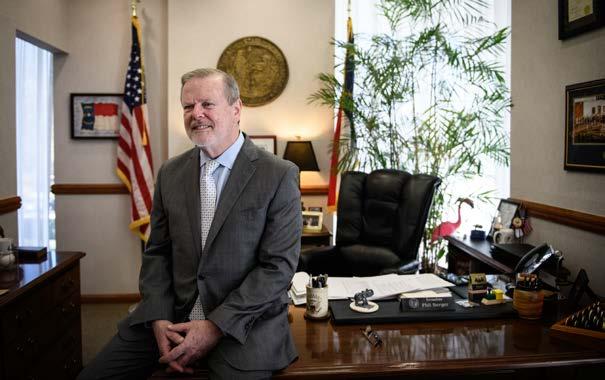
Berger has served as the Senate President Pro Tempore since 2011.
The same section of the bill, which Gov. Josh Stein signed into law in May, doled out $100,000 to the Alamance County Sheriff’s Office for “equipment.” Three weeks earlier, Alamance County Sheriff Terry Johnson had endorsed Berger.
If there was any doubt about who orchestrated those payouts, it was resolved at a Rockingham County commissioners meeting on June 2.
“There was $4 million that was not spent elsewhere in the state of North Carolina,” Kevin Berger told his fellow commissioners. “There’s only two people in the state that really have the ability to move that money where they want it to go. One is the speaker of the House, and the second is the president pro tem of the Senate. It’s not a position you are able to just walk into. It’s something that, lucky for us, my father’s been in that position for a number of years.”
The implication wasn’t subtle. The commissioners voted 5-0 to call the funds the “Phil Berger Volunteer Fire Grant.”
Berger told The Assembly that whatever tension exists between his role as Senate leader and representing District 26 is dwarfed by the benefits. That’s a key part of his reelection pitch, in fact.
“For the longest time, the Triad area has been the
redheaded stepchild, if you can say that nowadays, of the state,” he said. “Having the leader of the state Senate represent that area has brought a focus to that part of the state. And I dare say that a freshman senator who can’t do his current job would be nowhere near as effective on any of those issues as I have been.”
With reporting by Lucille Sherman and Joe Killian.
Editor’s Note: Richard Stevens was previously a member of The Assembly’s board of directors.
Jeffrey Billman covers politics and the law for The Assembly and is the former editor-in-chief of INDY in Durham.
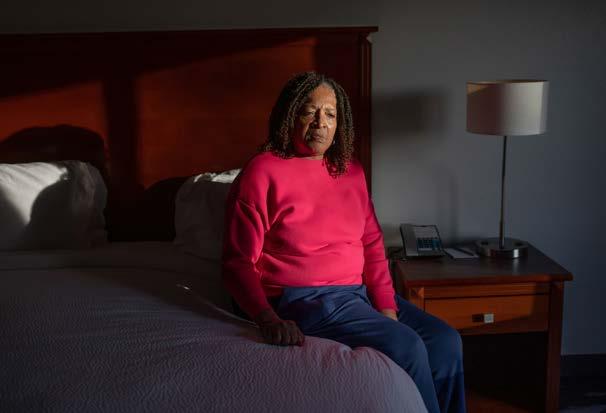
North Carolina created a new housing recovery program to avoid the delays and cost overruns that plagued rebuilding efforts after hurricanes Florence and Matthew. The Assembly and ProPublica have found that similar problems are starting to surface.
BY REN LARSON | PHOTOGRAPHY BY MADELINE GRAY
This article was produced for ProPublica’s Local Reporting Network in partnership with The Assembly Larson spent a year following the flow of money after 2024’s Hurricane Helene, documenting who has received rebuilding funds and whether the state and federal response is meeting the demand. This story looked back at previous storms, examining what went wrong with recovery and how the state might change it in the future.
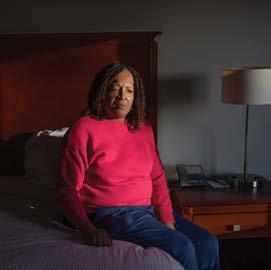
IIn the 459 days that Willa Mae James spent living in a Fairfield Inn in eastern North Carolina, her footsteps wore down paths in the carpet: from the door to the desk, from the bed to the wooden armchair by the window, her favorite place to read the Bible.
The 69-year-old retired dietitian had been sent there in July 2024 by North Carolina’s rebuilding program after Hurricane Florence ravaged her home and many others in 2018. The state had promised to help thousands of people like her rebuild or repair. But it had taken the program years to begin work. James spent nearly six years living in her damaged house in Lumberton, where floodwaters had turned the floorboards to pulp, causing her floors to sink and nearly cave in.
Of the more than 10,000 families who applied, 3,100 were still waiting for construction five years after the storm. Thousands of others had withdrawn or been dropped by the program. As of November, more than 300 families were still waiting to return home.
And James was the last of more than 100 displaced homeowners staying at the hotel.
“It’s like being in jail,” James said. “Everybody else done moved back home in their houses, enjoying it, except me.”
On the other side of North Carolina, nearly 5,000 homeowners find themselves waiting for the state government to help them rebuild after 2024’s Hurricane Helene. Gov. Josh Stein created a new program, Renew NC, promising to learn from the problems of the previous program that left James and thousands of others hanging for years.
Renew NC is just getting off the ground; the program began accepting applications in June and has completed work on 16 of the 2,700 homes it plans to repair and rebuild. But through public records and interviews with homeowners, The Assembly and ProPublica have found that some of the same problems that plagued the earlier program are surfacing in the Helene recovery.
That earlier program, which has the similar name ReBuild NC, was set up after Florence decimated a region that had been hit by Hurricane Matthew two years earlier. ReBuild NC was designed to help low- and moderateincome homeowners restore their homes by hiring and paying contractors to complete the work.
But the North Carolina Office of Recovery & Resiliency, which runs the program, failed at nearly every step, according to reports by outside consultants, journalists
and auditors. It struggled to manage its $779 million budget and couldn’t keep track of expenses. It rarely held contractors accountable for delays that dragged out projects and drove up costs for temporary housing and storage. ReBuild NC provided only limited resources to understaffed local governments that couldn’t handle the volume of permit and inspection requests.
At the same time, the agency was laden with “administrative steps, paperwork, and procedures” to comply with federal regulations, according to a state auditor report. And rigid rules meant the agency spent money rebuilding homes that needed less expensive repairs, some homeowners said.
“The response from North Carolina to hurricanes Matthew and Florence was a disaster,” state Auditor Dave Boliek said in a statement after releasing a report on ReBuild NC in November.
The auditor’s office consulted with the former administrator of the Federal Emergency Management Agency under the Obama administration, Craig Fugate, who noted that ReBuild NC officials “spent a tremendous amount of time on process, when their job was swinging hammers.”
Bridget Munger, a spokesperson for the North Carolina Office of Recovery & Resiliency, said the office welcomed the report. “NCORR remains committed to serving those affected by hurricanes Matthew and Florence and any insight that supports that mission is valuable,” Munger said in a statement.
State leaders set out to manage Helene recovery differently. Among Stein’s orders on his first day in office in 2025 was to lay the groundwork for a new home rebuilding program with fresh leadership in a different department. The state would again pick and pay contractors to repair and rebuild homes of people who applied, but this time, it would scrutinize contractors more to ensure quality. Stephanie McGarrah, who oversees Renew NC, pledged “robust financial oversight” and a willingness to work with stakeholders who “identify challenges and gaps in funding.”
But again, homeowners are encountering rules that steer them toward demolition and reconstruction when less expensive repairs would do. Some counties are struggling to get the staff and inspectors to handle all the required permits. Many residents will be out of their homes without a plan from the state to pay for temporary housing or storage during construction.
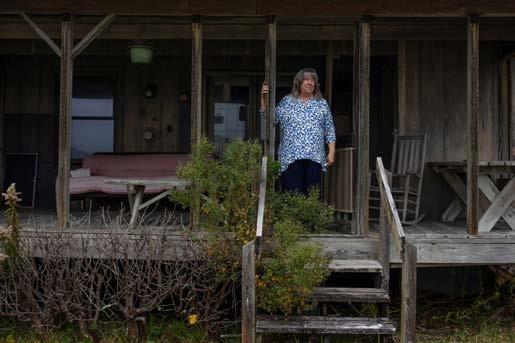

Above:
There’s this perception that you can figure out what all the problems are going to be, and you can figure them out at the beginning.
– Stephanie McGarrah, Renew NC
McGarrah, a deputy state commerce secretary, said that every disaster is different and that the agency is learning as it goes and has already revised policies to allow more homes to be eligible for repairs. “There’s this perception that you can figure out what all the problems are going to be, and you can figure them out at the beginning,” she said.
The Helene recovery program set an ambitious goal to finish all homes before June 2028, but the long waits of James and others in eastern North Carolina serve as a warning for what might happen next.
Behind the Scenes of the Disaster
North Carolina had just begun rebuilding homes Matthew destroyed in 2016 when Florence hit two years later, bringing up to 2 feet of rain in some inland counties.
Damage from the two storms totaled an estimated $22 billion spread across half of North Carolina’s 100 counties, among the costliest storms in U.S. history. After FEMA’s short-term disaster assistance ended, the state received applications from more than 10,000 homeowners still in need of repairs.
But progress was slow. The state’s homebuilding program trailed others after 2018 hurricanes, according to a 2022 Government Accountability Office report. North Carolina had completed 0.4% of the homes it set out to repair and rebuild after Florence while South Carolina had completed 22%.
ReBuild NC’s management problems are most apparent in the time people like James spent in hotels waiting for construction. One of the reasons it took so long is that ReBuild NC hired two administrative contractors, one to manage construction and another to handle temporary relocation.
Although the agency denied it, contractors told the legislature that ReBuild NC discouraged its relocation vendor from speaking directly with the construction vendor, requiring them to communicate via a spreadsheet that was supposed to track construction. The approach delayed repairs as the vendors were unable to line up move-out dates with construction start dates. Among the 766 families who spent at least a year out of their homes during construction, more than 500 didn’t have damage that required them to move out early.
Such problems contributed to the roughly $100 million ReBuild NC spent on temporary relocation services, like hotels and portable storage pods, for 3,800 families.
The program required families to move out before construction was ready to begin. James was moved into the Fairfield Inn nine months before her assigned construction company filed for demolition and construction permits. A large part of the delay was caused by ReBuild NC pausing “notices to proceed” for four months as it ran low on funds and sought more money from the legislature. While the local government OK’d the permit applications within days, it took another two months for the contractor to pay for the permits and begin reconstruction. P.H. Lowery, the general contractor for James’ home, did not respond to calls or text messages seeking comment about the delays. The nonprofit news organization NC Newsline found that ReBuild NC never fined contractors for missing deadlines during the program’s first years.
Other families faced delays because ReBuild NC failed to coordinate rebuilding efforts with local governments or because the homeowners came up against the program’s rules. The state had a set number of home designs that homeowners could choose from. Sometimes, the state’s plans proposed homes that were too big for properties or didn’t account for septic systems.
Kath Durand encountered such problems when she sought ReBuild NC’s help after Florence’s deluge seeped through the roof, saturated the walls, and collapsed part of the ceiling of her home in Atlantic Beach. She applied to ReBuild NC in 2020, hoping to finish an estimated $20,000 in repairs after she ran out of money to fix the home herself.
But under ReBuild NC’s rules, wood-frame homes like hers had to be above a certain level to avoid flooding before the program would pay for repairs, and the program wouldn’t pay to elevate houses. The home was just shy. So ReBuild NC would only pay to demolish the home and build a new one—a more expensive undertaking.
It took four years for the agency to offer Durand a floor plan, but none of the designs fit her 1/6-acre lot. One plan placed part of the home in the street easement, which


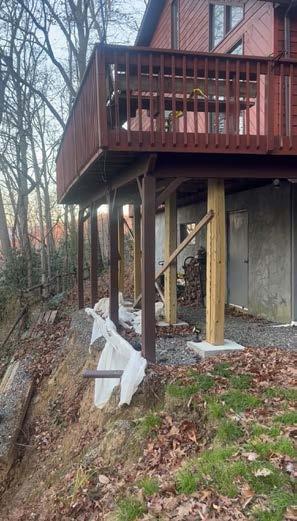
After Helene, Chuck Brodsky’s home sits on a cliff with a 150-foot drop. Renew NC says it can’t repair the land without tearing down his house. (Credit: Ren Larson)
utility companies need to access. A second placed the home in the tidal zone, effectively putting her home in a canal. A third covered the septic field, which could have destroyed the system that breaks down sewage. All those things would have been cause for rejected permits, she said, making her question ReBuild NC.
“I would like to get in a room and talk to them about ‘what were you thinking?’” she said. Durand said she settled for a smaller home, but at the end of December, ReBuild NC withdrew her from the program, saying it didn’t have houses available for the size of her lot.
Munger, ReBuild NC’s spokesperson, said the program has the ability to develop custom building plans to fit challenging lots, but doing so in every case “would have exponentially increased project costs and greatly reduced the number of families helped by the program.”
Such delays and complaints from homeowners led to years of legislative scrutiny, after which ReBuild NC’s two top leaders left the agency.
In 2022, the agency’s chief program delivery officer, Ivan Duncan, resigned after he was accused of giving preferential treatment to a construction vendor, NC Newsline reported. Then, after several legislative meetings questioned oversight of the program, his boss, ReBuild NC director Laura Hogshead, abruptly left the agency in 2024.
Duncan said in an interview that the allegations were unfounded. He said he cooperated with the investigations, was not asked to resign, and left for a higher-paying job.
Hogshead did not respond to requests for comment. At a 2024 legislative hearing, she listed several things the program would do differently if it were put in charge of the Helene recovery but noted that rebuilding thousands of older homes across a wide area came with challenges.
Behind the scenes, ReBuild NC struggled to hold contractors accountable to timelines, paid invoices without verifying work, and spent money on things auditors couldn’t track, according to reports by disaster recovery consultant SBP and the state auditor and an internal audit.
Opposite top: Lumberton homes and businesses are shown surrounded by floodwaters from Hurricane Matthew in October 2016.
(AP Photo/Chuck Burton, File)
Opposite bottom: Less than two years after Matthew, Hurricane Florence caused the Lumber River to overflow its banks and flood many more homes.
(AP Photo/Gerry Broome)
For James, the wait was especially hard as her husband, Christopher, was in treatment for bone cancer. She remembers Christopher questioning whether the home would ever be done. “Baby, them people might never get to you,” he’d told her. When he died in 2021, she was left to fight alone for the home to be rebuilt.
James said a neighbor who applied for ReBuild NC died days after moving into the hotel. She knows others who are still staying with friends or family as they wait on ReBuild NC to finish their homes.
She hopes Western North Carolina residents have better experiences.
It’s like being in jail. Everybody else done moved back home in their houses, enjoying it, except me.
–
Willa Mae James,
“I pray that they don’t go through what we did, I sure do,” James said.
Under pressure from the legislature and homeowners to not repeat these problems with the Helene recovery, the new state program, Renew NC, made a number of reforms.
ReBuild NC had been criticized for locating its office almost 100 miles from the epicenters of the disaster zones. Renew NC’s office is in Asheville, in one of Helene’s hardest-hit counties. A bipartisan group of legislators, business leaders, activists, and government officials meets across Western North Carolina to publicly advise on challenges and assist with recovery.
To avoid the problem of having different vendors administer the construction and relocation, Renew NC has hired one vendor to manage the housing recovery program.
Despite the reforms, the Stein administration has already faced questions from lawmakers over potential conflicts of interest. His first Helene recovery adviser, Jonathan Krebs, had been a partner at the company administering the housing program and contributed heavily to Stein’s campaign and a Democratic political committee in the year before receiving his job.
Kate Schmidt, a spokesperson for the governor, said Krebs “was hired because of his decades of experience working on nearly every major disaster recovery since Katrina” and noted that the State Ethics Commission found no conflict of interest. Krebs said at a legislative meeting last year that while he helped draft the request for proposal and scoring criteria for an $81 million contract that was awarded to Horne, his former employer, he viewed his past employment not as a conflict but as an asset.
“They’ve got to have somebody in the room that knows what’s going on and what has to happen to get houses built. I was that person,” said Krebs, whose temporary role has ended. Krebs echoed those sentiments in an interview, noting that he supported Stein as a candidate who was “trying to be practical and help people.”
The state did not renew Horne’s Florence and Matthew recovery contract amid complaints over slow application processing. BDO, an accounting and consulting firm that
homeowner
has since acquired Horne, referred questions to the state.
A state official said in contracting documents that the decision to not renew was mutual and acknowledged that “problems continued” after the state took over case management.
As South Carolina did after Florence, Renew NC has avoided the high costs of temporary housing and storage simply by not paying for them, except under “extreme circumstances,” though it is common for disaster recovery programs to pay for such costs. That has left homeowners to cover the costs themselves.
The lack of coverage for temporary housing concerns Vicki Meath, a local housing advocate working on the recovery.
“When I think about survivors that have been impacted and would apply to this program that are below 60% of the area median income, they don’t have a lot of resources,” she said. “They don’t have another place to live.”
In an interview, McGarrah noted that her agency is discussing policy changes to help make temporary housing more affordable but will need local partners to identify places families can live.
“We’re seeing some slowdowns in our pipeline because people don’t have places to go,” she said.
Local governments in Western North Carolina, like those on the other side of the state, are struggling with a lack of staff and resources. Dennis Aldridge, a commissioner in Avery County, northeast of Asheville, said the county’s 18,000 residents face a shortage of environmental inspectors who certify well and septic systems, on which homes in rural counties overwhelmingly rely. Aldridge said he reached out to the state for assistance, but there aren’t enough inspectors in North Carolina—an issue that’s been known for years.
“It’s taking right now about six to nine months to get a well and septic permit because we don’t have the people,” Aldridge said in September.
Danny Allen, inspections director in Madison County, north of Asheville, said he’s worried his department will face backlogs on building permits with about 75 local homeowners actively applying for the state program.
“They’re feeling it now, but it’s really going to be six months from now that the pressure is going to build,”
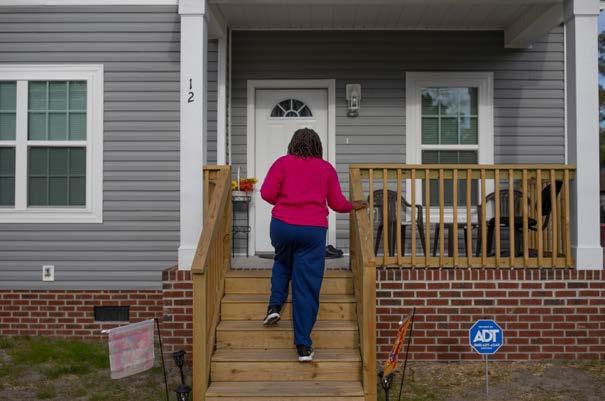
said Aimee Wall, dean of the University of North Carolina’s School of Government.
The number of people waiting for inspections could increase if homeowners who applied for repairs learn they need to have their homes rebuilt because damages exceed the state’s threshold of $100,000 for woodframe homes. The amount is intended to avoid costly repairs, as homes could have additional issues like termite damage that aren’t immediately visible. But it doesn’t cover all scenarios.
That’s what Chuck Brodsky, a folk musician and songwriter, encountered after two landslides wiped out much of the Asheville mountainside that supported his home. His two-story house survived Helene unscathed, but it’s now perched on a cliff that drops to a road 150 feet below.
Two construction companies quoted him about $200,000 to stabilize the mountainside and keep his home from falling over the edge. He couldn’t afford it, so he began the application for help from Renew NC to repair his storm-impacted property in September.
But the agency told him under the program’s rules, to
fix the mountainside, it would have to tear down his home and rebuild. It can’t just repair the land.
The agency told him he could appeal, but he worries he’ll receive the same answer. McGarrah noted that the region had over 3,000 landslides, and the agency will evaluate properties affected by them case by case.
“It would cost them way more to demolish the house and rebuild the house than repair the landslide,”
Brodsky said. “The whole thing is just preposterous.”
Ren Larson is an investigative reporter for The Assembly. She previously worked at The Texas Tribune and ProPublica

Our investigation revealed the flaws of a list of so-called never residents, changing the course of a highly contentious state Supreme Court race.
BY BRYAN ANDERSON | PHOTOGRAPHY BY MATT RAMEY
Our reporting dominated coverage of the monthslong legal battle over the 2024 state Supreme Court race, but this was the definitive story. In April 2025, we revealed that a number of people whose ballots were at risk of being thrown out were actually legitimate voters—a finding eventually referenced in the judge’s order that effectively ended the election.
IIt didn’t take long to find a Greensboro voter at imminent risk of having their ballot discarded from last year’s Supreme Court election. And for some, the issues can’t be corrected.
Vidyaranya Gargeya is a retired professor who taught at UNC-Greensboro for 30 years who, according to the school, has visited every college in the state. He’s paid property taxes at the same suburban Guilford County home he’s owned since 2003, according to public records. And voting records show he voted in-person on Election Day eight times without issue, and has voted in every midterm and presidential general election since 2006. He appears to have cast an overseas mail-in ballot for the 2024 election.
But a protest filed by Republican Court of Appeals Judge Jefferson Griffin labeled Gargeya as a “never resident.”
On Friday, the state Supreme Court directed the State Board of Elections to promptly remove 260 neverresident ballots without any opportunity for remedy or discussion, including Gargeya’s.
A 4-2 decision written by Republican Supreme Court Justice Trey Allen and joined by justices Paul Newby, Tamara Barringer, and Phil Berger Jr., labeled these people as "overseas voters who have never lived in North Carolina and have never expressed an intent to live in North Carolina.” Those ballots should be immediately removed from the count, they ruled.
On Saturday, this reporter visited 30 households across Greensboro to try to reach impacted voters. When approached at their front door, parents, siblings, and spouses answered. Many were confused as to why their loved one’s vote was on Griffin’s protest list. That confusion quickly shifted to frustration, curiosity, and a sense of helplessness.
Nobody answered Gargeya’s front door, but his nextdoor neighbor, Jimmy Donahue, confirmed Gargeya still lives there, adding that their families recently had dinner together. Efforts to reach Gargeya by phone and email over the weekend were unsuccessful.
Also on the list of “never residents” is Josiah Young, a Jackson County voter who was raised in Webster, played basketball for Jackson County Early College, and runs a drone photography business based in western North Carolina. Young didn’t immediately respond to a request for comment.
Gargeya, Young, and several others The Assembly identified appear to have, in fact, lived in North Carolina. Even for those included on the count that have not lived in the state, their removal would occur despite no evidence that they acted unlawfully.
A 2011 measure, passed unanimously by the General Assembly allowed certain military and overseas voters to cast a ballot for state-level races. The State Board
of Elections also adopted a rule last year, which went through the Republican-controlled Rules Review Commission without issue. In December, the state elections board reached a unanimous decision to reject Griffin’s protest of these voters.
Gerry Cohen, a member of the Wake County Board of Elections who has more than 40 years of experience in state and local government, said the “never residents” were given that label by Griffin’s campaign if a voter checked a box on a Federal Post Card Application that read, “I am a U.S. citizen living outside the country, I have never lived in the United States.” Cohen said voters may have very well checked the box in error.
A data review of the voters at issue further complicates matters.
Of the 260 “never residents,” 57 are also included in a separate protest over military and overseas ballots that lack photo ID. In its ruling, the Supreme Court also extended the cure period for military and overseas voters from 15 business days to 30 calendar days after the mailing of notice to voters. But this raises questions of whether the 57 voters on both lists should be entitled to a 30-day window, too.
“We are in a very large gray legal area as to which category these folks fall into,” said Michael Bitzer, a Catawba College political scientist. “When you’ve got this kind of cross-listing occurring, it only poses further legal mystery and confusion.”
Bitzer, Western Carolina University political scientist Chris Cooper, and research fellow at the conservative John Locke Foundation Jim Stirling reviewed and agreed with the assessment of the data, which was provided through a public records request with the State Board of Elections.
‘They’re
Driving around Greensboro’s Bluffs neighborhood, there’s no shortage of families Griffin’s protest of military and overseas voters has affected—people who were explicitly advised by state elections officials last year that they didn’t need to provide photo ID.
On nearly every street, there is someone at those voters’ permanent addresses infuriated to learn that their family member is on the list. Many of those voters are still abroad for some combination of school, work, or military service.
In Guilford, 1,409 voters may soon have a mere 30 days to show such documentation if they want their votes to count. So could 4,000 additional voters from Buncombe, Durham, and Forsyth counties.
Barry Cantrell, a 59-year-old creative director from Greensboro, was surprised when this reporter knocked on the door on Saturday to inform him that his daughter, Condie, is at risk of having her vote removed from the
count if she doesn’t meet a 30-day response deadline. But she is currently teaching in Japan.
“It’s bullshit,” Cantrell said. “She voted, she followed the rules, she did everything she was supposed to do. And now, they’re discounting her vote. It’s completely political.”
He said he and his daughter both voted for Democratic Supreme Court Justice Allison Riggs. He sees the effort to remove his daughter’s vote as a “political ploy” by Republicans to overcome Griffin’s 734-vote defeat.
“They are trying to get their conservative person elected, so if they didn’t get enough votes, they’re trying to steal the votes or trying to rob the votes away from the people who voted rightfully,” Cantrell said.
Indeed, Griffin’s supporters prioritized populous, heavily Democratic counties in their protests. A data review of Griffin’s remaining protests show registered Democrats and unaffiliated voters are five times more likely than Republicans to be at risk of having their ballots removed from the count.
A spokesperson for the North Carolina Republican Party didn’t immediately respond to a request for comment. Paul Shumaker, a spokesman for Griffin’s campaign, said the campaign won’t have any further comment “until there are any substantial developments.”
“It is no small thing to overturn the results of an election in a democracy by throwing out ballots that were legally cast consistent with all election laws in effect on the day of the election,” Democratic Supreme Court Justice Anita
Earls wrote in a partial dissent on Friday. “Some would call it stealing the election, others might call it a bloodless coup, but by whatever name, no amount of smoke and mirrors makes it legitimate.”
Republican Justice Richard Dietz also worried about the precedent his colleagues created. “The door is open for losing candidates to try this sort of post-election meddling in state court in the future,” he wrote. “We should not allow that.”
Riggs recused herself from the case, but expressed disappointment with the court’s ruling. Her campaign didn’t provide immediate comment on what its next steps would be to safeguard impacted voters, including those who appear wrongly labeled as “never residents.”
The State Board of Elections is now awaiting guidance from the North Carolina Court of Appeals before implementing a 30-day “cure” period for voters like Condie Cantrell to provide a photo ID. Riggs’ campaign appealed the order to a federal judge, who then directed the State Board of Elections to proceed with the Supreme Court’s order but hold off on certifying the election results.
Barring a federal appeals court stepping in, the presumed next step would be for county elections officials to notify people like Cantrell that her ballot will only be counted if she provides some form of photo identification within the 30-day period.
Since she’s in Japan, that raises questions as to whether 30 days will be enough time for her to receive official notice from North Carolina, let alone respond to it. Her family isn’t the only one concerned.
Olivia Seeger is a Meredith College alum who was completing a PhD in marine biology at the time of the election and remains in Australia. She’d have little time to correct any concerns over her ballot.
“I don’t like the 30-day shot clock because it might take two weeks to get the information over to Australia if you mail it,” said Chuck Seeger, Olivia’s father.
Seeger said he’s particularly disturbed that servicemembers are in danger of having their votes removed from the count. While he supports photo ID laws to ensure legitimate votes are counted, he said such barriers for members of the military are unnecessary.
“They’re in the military,” Seeger said. “They couldn’t get a ballot if it’s not through the military. They already have ID.”
Erik Stubbs, who is living in Canada, is also among the voters Griffin is challenging. His father, Clyde, jokingly extended an offer for Griffin to meet him in a boxing ring to decide the fate of his son’s vote. “They messed with the wrong…,” he said, pausing for a moment, “...caring person.”
Thomas Espinola, a professor at Guilford College whose son, Benjamin, is on the list of challenged voters, said he’s frustrated with what he sees as a broader threat Republicans are posing. Attempts to reach the son before publication were unsuccessful.
“It is disturbing to have what is basically an attack on democracy,” Espinola said.
Voters and their families will need clarity from the North Carolina Court of Appeals and state and local elections officials over how to proceed. Even so, any forthcoming guidance could ultimately get undercut by the Fourth Circuit Court of Appeals.
Representatives for the State Board of Elections and North Carolina Court of Appeals Judges Fred Gore and John Tyson didn’t provide immediate comment on what the next steps will be for voters and who exactly is still subject to Griffin’s protests.
Graham Wilson, a spokesman for the court system, said in an emailed statement to The Assembly, “The Court of Appeals opinion and Supreme Court order speak for themselves.”
On Saturday afternoon, U.S. District Judge Richard Myers ordered the State Board of Elections to disclose the number of potentially affected voters and the counties where those ballots came. The Trump-appointed judge gave the state elections board a Tuesday deadline.
Myers also said the state Supreme Court race couldn’t be certified until he ruled on the dispute, which wouldn’t
happen until April 28 at the earliest.
In the meantime, the North Carolina Court of Appeals must revise its initial ruling and follow the state Supreme Court’s guidance that 60,273 voters who lacked a driver’s license number or last four digits of their Social Security number on a voter registration database should be allowed to have their ballots stand.
Democrats and Republicans alike also await clarity as to whether there are 1,409 or 5,509 military and overseas voters subject to the 30-day deadline. Griffin initially contested the ballots of 1,409 Guilford County voters. He then sought to have an additional 4,000 from Buncombe, Durham, and Forsyth counties removed from the count. It remains unclear which subset of voters are subject to the Supreme Court’s order and initial Court of Appeals ruling.
The State Board of Elections didn’t immediately respond to a request for comment as to how many outstanding ballots remain in dispute for military and overseas voters. But it has voiced uncertainty as to what happens next.
“The State Board understands there may be further proceedings in federal court before this matter is fully resolved,” the NCSBE said in a statement, adding that elections staff “will provide instructions for county boards of elections and affected voters on how to comply” with incoming court orders.
It could be anywhere from a few days to several months before the next state Supreme Court justice is determined.
At minimum, the Supreme Court’s latest order would impact 1,654 North Carolinians—the 260 “never resident” voters from across the state, and 1,394 Guilford County military and overseas voters who aren’t also in the “never resident” category.
If those figures hold, Riggs would almost assuredly hold her lead over Griffin. Griffin would need more than 72.2 percent of those voters to have cast a ballot for Riggs—a statistical improbability, according to Stirling, the conservative research fellow.
But if the state Supreme Court’s order encompasses the additional 4,000 military and overseas voters in Buncombe, Durham, and Forsyth counties, Griffin could plausibly overcome his deficit.
Bryan Anderson is a politics reporter for The Assembly. He previously covered elections, voting access, and state government for WRAL-TV, The Associated Press, and The News & Observer

After he committed to unmasking extremist groups in North Carolina and beyond, a reporter got a first-hand look at how the ″militant accelerationism″ movement operates.
BY JORDAN GREEN | ILLUSTRATIONS BY JACK SNYDER
Green has relentlessly covered right-wing extremism over the last decade. That came to a head at home in N.C. when someone shot two electrical substations in Moore County, launching Green on a "singular, obsessive quest to uncover who was responsible." It also set him and his family up for their own terrifying encounters with these groups.
TThe hours crawled as my family and I spent Saturday afternoon in a third-floor room at the Hampton Inn & Suites in downtown Greensboro.
It was February 2024, and these forced weekend getaways were becoming routine for us. We were only about three miles from our house in the leafy, inner-ring suburbs of the city’s west side. My 10-year-old daughter was hunched on one of the queen beds staring intently at her tablet, as her 5-year-old sister jumped from one corner of the bed to the other. My wife switched on an episode of Bluey to try to settle her.
I perched over a narrow desk looking down on McGee Street, but my attention was focused on my cell phone, where I toggled between apps for our two separate security systems. It seemed as though the afternoon might pass without incident.
Then, just before 5 p.m., the cameras registered something. At first, it looked like shadows flitting behind the leaves of the large magnolia tree in our front yard. Then six human figures came into focus.
A minute later, the deer cam we’d fastened to a tree registered the five men standing shoulder to shoulder. I recognized the man in the middle: Sean Kauffmann, a notorious neo-Nazi leader from Tennessee.
Kauffmann held a placard, though I couldn’t read what it said from that angle. Three of the men grasped lit emergency flares in their left hands, while extending their right arms in Hitler salutes.
Another angle showed one of them was wearing a black long-sleeve shirt with a Totenkopf skull and the words “Support your local Einsatz Kommando,” a reference to Nazi Germany death squads.
I recognized him, too: Jarrett William Smith, a former U.S. soldier who had served roughly two years in federal prison for distributing bomb-making instructions on the internet and suggesting to a contact who turned out to be an FBI informant that he should car-bomb a congressman.
Three months earlier, I reported that Smith was part of a squad of masked Nazis who’d tried to intimidate patrons at a drag show in Sanford.
I recognized two of the other men as well. David William Fair had attended the January 6 riot at the U.S. Capitol with his mother and founded the Southern Sons Active Club, a white nationalist group that openly endorses violence.
Dressed in a T-shirt and black balaclava and carrying a camera was Kai Nix, then an enlisted soldier at Fort Bragg and active Patriot Front member. Nix was the apparent operator of an encrypted Telegram channel called Appalachian Archives that doxxed journalists and other perceived enemies.
About 15 minutes after they showed up on my security camera, the Appalachian Archives account posted a photo of Kauffmann, Smith, Fair, and the two other men
giving Hitler salutes on my lawn.
“Opposition move Freely when they feel immune,” read the caption. “Remove That Privilege.”
Kauffmann’s sign, now visible, bore a similar message: “Freedom of press ≠ freedom of consequence.”
They had gone to some trouble to organize this photo op. Kauffmann lived eight and a half hours away in southwestern Tennessee; Smith, three hours and 15 minutes near Myrtle Beach; Fair, two hours and 20 minutes from the Midlands region of South Carolina; and Nix from West End, about an hour away.
According to their postings, they then made a pilgrimage to the historic marker commemorating the 1979 Greensboro Massacre, in which Ku Klux Klan members and neo-Nazis fatally gunned down five members of the Communist Workers Party who had been building a multiracial movement to organize textile workers in the city.
A photo published on the Appalachian Archives shows Fair in a skull mask and two of the other men grasping the sign pole in a celebratory pose. The caption for the photo highlights the body count and the fact that the Nazi and KKK defendants successfully claimed self-defense to beat their charges in both state and federal trials.
The message was unmistakable: They believed they could silence critical reporting—through violence, if necessary—with impunity.
The avalanche of events that had culminated in this display are the result of my singular, obsessive quest to uncover who was responsible for shooting two electrical substations in Moore County in December 2022. I’m a reporter who covers right-wing extremism, particularly the most violent segment of the white power movement, across the United States, and here was an incident making national headlines right in my home state.
The attack shut off power for 40,000 customers across most of the county for five days. An 87-year-old woman who depended on an oxygen machine died. The medical examiner ruled her death a homicide, and logic dictates that if the perpetrator(s) are caught, they will be charged with murder.
The attack took place amid protests of a drag show at a historic theater in downtown Southern Pines that was attended by members of the Proud Boys, the fascist street gang that led the siege on the U.S. Capitol on January 6.
This attack had the hallmarks of a strain of white power violence known as “militant accelerationism.” Its adherents promote a militant vanguard committed to terrorism and insurrection as a means of bringing about a white ethno-state.
Vandalism at the Duke Energy West End substation in Moore County, N.C. included this downed gate. (John Nagy/The Pilot via AP)
Examples of neo-Nazis targeting the power grid are plentiful: In October 2020, the FBI disrupted a terror plot involving two former Marines assigned to Camp Lejeune who officials said intended to cause widespread blackouts and then carry out an assassination campaign in hopes of sparking a race war. And only two months after the Moore County substation attack, the co-founder of the neo-Nazi terror group Atomwaffen was arrested and later found guilty of plotting to carry out a series of coordinated strikes against substations in Maryland to “lay waste to the city of Baltimore.”
After the Moore County attack, the Australia-based antifascist research outfit White Rose Society reached out to me to flag two Telegram channels as potentially of interest in my pursuit.
A Telegram user nicknamed “BTC” had forwarded a post from one channel to another celebrating the power outage.
“Last night’s magnificent sabotage attack on Moore County’s electrical grid marks a beautiful escalation,” the post read, adding that it sent “a terrifyingly clear message to the LGBTQ+ community.
“The consequences will vary, but they will be severe,” the post warned.
BTC posted what appeared to be a damage assessment: “The area is experiencing increased emergency calls due to the lack of power,” adding that “auto accidents have occurred because traffic lights are out. People who rely on oxygen have placed emergency calls. … ”
BTC also posted a PDF of Militant Accelerationism, a publication from the neo-Nazi propaganda outfit known
as the Terrorgram Collective that provided tutorials for carrying out mass shootings.
I later learned “BTC” was Matthew Robert Allison, a 36-year-old disc jockey from Boise, Idaho and one of the Terrorgram Collective’s two U.S. leaders. In September 2024, he was indicted on multiple felony charges, including solicitation of hate crimes, solicitation of murder of federal officials, and distribution of information relating to explosives and destructive devices. The U.S. State Department now designates Terrorgram as a global terrorist organization.
Allison’s lawyer declined to make his client available for comment.
On Telegram, speculation immediately erupted about who was responsible for the Moore County attack.
One user mentioned that the National Socialist Resistance Front had a presence in North Carolina. Less than two weeks after the attack, someone hung a banner off a Moore County highway overpass advertising the group’s Telegram address and slogan, “Bring it all down.”
About a week before Christmas, I reported for Raw Story, where I have been a staff writer since 2021, that the National Socialist Resistance Front was seeking to exploit the Moore County attack for propaganda purposes. The group mocked the story in its Telegram channel without exactly denying involvement in the attack, writing, “Just one banner drop, and we’re blamed for all sorts of misdeeds. The next time that we do one, they’ll probably blame us for the OKC bombing.”
No specific evidence has emerged to tie any members to the attack, though my attempt to sift through the Telegram chatter yielded a tip that would forever change my life.
As a result of my reporting, an antifascist researcher known as “Chirp” alerted me about Kauffmann’s interest in accelerationism and harassment tactics. (I know Chirp’s real identity, but have pledged to maintain their anonymity. Like a handful of other sources, Chirp scours digital communications of violent extremists, and sometimes infiltrates chats with pseudonymous accounts.)
Kauffmann was the leader of the Tennessee Active Club and the most prominent figure in the Tennessee neoNazi scene. He also has a history of domestic violence. In 2020, he and three other neo-Nazis were charged with disorderly conduct for attempting to assault Black Lives Matter protesters. The charge was ultimately dismissed. Kauffmann responded to a request for comment for this story by saying, “Go fuck your mother, before I do.”

Around the time of the Moore County attack, the Tennessee Active Club Telegram channel featured a video of Kauffmann burning a BIPOC trans flag as someone offscreen screamed, “Fuck you, tranny fucks. Get superAIDS and fucking die.”
In late November 2022, Kauffmann appeared at a Christmas toy drive outside of Knoxville hosted by an LGBTQ+ group and screamed in the faces of local antifascists who’d come to protect attendees, according to a video I reviewed.
In January 2023, Kauffmann protested a drag show at a brewpub in Cookeville, Tennessee, throwing a Hitler salute as he arrived and unfurling a swastika flag, which both his group and antifascist activists documented online.
After leaving the protest, the Cookeville police stopped Kauffmann’s Honda Civic because the front-seat passenger, a Proud Boy-turned-Nazi named Robert Bray, threw a stink bomb. The officers let the men go with a warning. Body-camera video captured the officers telling the men they could have been charged with aggravated assault, a Class D felony. One of the officers expressed concern that enforcing the law would only turn the neoNazis “hostile” and “make them want to retaliate and
make it even bigger.”
Kauffmann later told a friendly interviewer that he decided to display the swastika flag in Cookeville because “the point of us being there was essentially to intimidate them.” “Them” being “the antifascists, the child groomers, the homosexuals.”
That summer, I started trying to conceive a project that would take bits and pieces of information I’d gathered in the aftermath of the Moore County substation attack to reveal connections between the disparate groups and figures in the white power movement.
One name kept coming up time and again: Blood and Soil Crew, better known online as 2-1-19— the alphanumeric code for its acronym—and also by the name Revolutionary White Brotherhood, which it briefly rebranded as in 2023. The group had first caught my attention around the time of the Moore County attack through posts in the Telegram chats celebrating the blackout. I kept coming across the group in graffiti shown in news reports and online boasts.
In early August 2023, local news outlets in Pensacola, Florida described a 17-day vandalism spree that targeted two synagogues and a mosque, among other locations.
The message was unmistakable: They believed they could silence critical reporting—through violence, if necessary—with impunity.
Four teenagers were arrested. Some of the graffiti included the initials “RWB.” The group later claimed responsibility for antisemitic graffiti in New Hampshire and vandalism of a Martin Luther King Jr. monument in Concord, North Carolina.
At that point, I had yet to contact any of the group’s members. But I had written about Kauffmann’s run-in with the police and his friends’ efforts to instigate conflict at drag shows.
The Appalachian Archives Telegram channel appeared on August 13, 2023. One of its first moves was to dox me: my professional headshot, bio, street address, and photos of my house, as well as my wife’s name and our phone numbers.
Another early post provided a mission statement for the channel: “To provide Tools of Privacy, Safety and Knowledge to the Activists and Operator. To expose those that attack our people from the Dark, bring them Forth to the Light. We will make it Dangerous for the Reporter to Report Freely.”
The following month, the channel also posted the Terrorgram Collective’s list of “high-value targets” for assassination, which includes a U.S. senator, a federal judge, a U.S. attorney, mayors, and scientists involved in vaccine research.
At the end of August, my wife and I celebrated our anniversary in Asheville. We had a lovely lunch at a café, floated down the French Broad River in a kayak, and checked into our Airbnb in a mountainside neighborhood of winding streets.
The next morning, we were headed out for a day of exploring chocolatiers and bookshops when I got a frantic phone call from another trusted antifascist researcher, “Arel.”
Arel had received an email from an anonymous source who purported to be attempting to infiltrate Nazi circles, but whom they suspected was an actual Nazi playing double agent to expose antifascist researchers.
Arel’s source, whose email username was “Just1onKali,” wrote that Tennessee Active Club was “currently under federal investigation due to the leader ‘Boog’ [one of Kauffmann’s nicknames] ordering a younger member, youth, to commit a drive-by on a reporter’s house that was investigating them.”
Four months earlier, there had been a drive-byshooting committed at the home of a Tennessee journalist. Kauffmann had posted the names of the journalist and his wife, along with their home address just two days later in yet another neo-Nazi Telegram chat.
And while Just1onKali’s motives might be dubious, I believe the tip about a federal investigation was accurate, though no one from Tennessee Active Club, including Kauffmann, has been charged. Months later, I received a copy of a federal grand jury subpoena from the same email account that supported the claim. The FBI Nashville Field Office declined to confirm or deny the existence of any investigation to The Assembly
But Arel had more: Just1onKali claimed Kauffmann had also attempted to persuade a North Carolina associate to kill me, but the associate declined. (Kauffmann called the allegation “unsubstantiated rumors with zero validity” in response to a request for comment.)
I probably should have been more alarmed. But my way of dealing with such threats is to keep digging.
One week before Thanksgiving 2023, I was pulling into my driveway with my daughters in the car and spotted a woman sitting in a parked car across the street. She opened the door and walked toward my driver’s side window. I assumed she was having car trouble, but as soon as I stopped the car, I chided myself for compromising our safety by engaging with a stranger.
“I’m with the FBI,” the agent said, giving me her card. She told me that she was obligated under “duty to warn” to inform me that I had been doxxed. She confirmed to me that the dox had been issued by Appalachian Archives.
My older daughter seemed shaken. Why was the FBI at our house? Was I in trouble?
No, I tried to reassure her, the agent is here to make sure we’re safe.
I harbored strong reservations about talking to the FBI beyond seeking information in my capacity as a reporter. I was not ignorant of the history of the agency looking the other way when vigilante violence was perpetrated against Black civil rights activists and leftists.
But at that point, I didn’t think I had much choice but to hear the agent out and take in any information that might help keep my family safe.

Four days after the FBI agent’s visit, a new dox targeting me appeared on the Appalachian Archives channel. The more recent Appalachian Archives dox had been posted the day before, and this one included screenshots of reporting inquiries I had sent to Jarrett William Smith and David William Fair.
“Jordan Green has recently gone on a harassment campaign where he’s harassed individuals’ families and personal friends, either via telephone or confronting them at their occupations,” the post said. “The harassment of our people will not go unnoticed.”
The 2119 channel—the group I’d gotten interested in because of its prominence in neo-Nazi graffiti—reposted the dox with an administrator’s appreciation: “The bastard above has been found out to be harassing our boys. 2119 will not stand for this system proxy to go unnamed.”
As my reporting project intensified in the following weeks, our family began an episodic peregrination, staying in one hotel for a couple days, and then relocating to another, or staying a couple nights with family members. We might book a hotel for a day or two when I planned to contact hostile sources or publish a story,
while other times the decision would be prompted by a threatening voicemail message or online chatter. My editors and Raw Story leaders never hesitated when I asked for reimbursement.
On one such night, I picked my 10-year-old up from after-school and informed her that we would be staying at a hotel again. As we drove home to pack our bags, she burst into tears: “Why do you have to write these stories that make Nazis want to kill us?”
I believed both then and now that it’s important to set an example of courage and integrity for our children. That meant doing the right thing—in this case telling the truth—even when it’s hard. The obvious trauma my daughter was going through as a direct result of my vocation tested that conviction.
She was starting middle school the next year, and the acceptance of her peers was becoming increasingly important to her. Being a target of violent Nazis was not a positive mark of distinction. I sensed that the aggression directed at us was degrading her sense of self-worth.
But my belief that we were onto bigger connections between these online groups and their offline activities continued to grow. Over the summer of 2023, Chirp
To provide Tools of Privacy, Safety and Knowledge to the Activists and Operator. To expose those that attack our people from the Dark, bring them Forth to the Light. We will make it Dangerous for the Reporter to Report Freely.
– mission statement for Appalachian Archives Telegram channel
began comparing notes with another group of antifascist researchers known as the “Appalachia Research Club.”
The group had helped me identify a handful of local 2119 members, including Noah Houran, a 17-year-old who lived with his parents in coastal North Carolina and claimed to have been a Nazi since age 13.
Houran had started his own Telegram channel, where he circulated terrorist manifestos and military tactical manuals, including Terrorgram publications. BTC even made an appearance.
At that point, BTC’s identity was still unknown, though I wasn’t the only one trying to figure out who he was. ProPublica’s James Bandler described BTC as “the white whale of the Terrorgram Collective.” Pierre Vaux, an investigator in London, described him as “a superspreader” of white power propaganda. The U.S. Department of Justice was also tracking the man they’d later describe as the co-leader of “a transnational terrorist group.”
After church on the first Sunday of 2024, I heard a knock at the front door. Odd, I thought, because we don’t get a lot of visitors, and my wife had been planning to go grocery shopping.
A smiling man dressed in a Domino’s uniform held out a box. We hadn’t ordered pizza. I told him there must be a mistake. He pulled out the receipt and read my name. I reiterated that we hadn’t ordered it and weren’t going to accept the delivery.
My wife came to see what was going on.
“You shouldn’t have opened the door,” she said, panic rising in her voice.
“Get a picture of the car,” she added.
Twenty minutes later, I received an email from Just1onKali, the same source who’d warned that Kauffmann had tried to put a hit out on me: “I did hear that 2119 just sent a pizza to your house.”
I made a note in my security log and transferred the photo of the delivery driver to a folder on my laptop. Then my phone rang. The voice on the other end, muffled and strange, identified herself as the FBI agent I’d met in my
driveway. She asked me if I was at home.
After everything that had happened, I was becoming deeply distrustful of everyone. I asked her to tell me something that would prove that it was actually her and not someone spoofing her number. She texted a photo of her badge, and explained she was recovering from a case of laryngitis.
She had an update for me: Appalachian Archives was circulating a photo of my license plate on Telegram.
“We hope it’s just chatter,” she said, “but these guys have done drive-bys before.”
A couple minutes later, the agent called back and asked if a pizza had been delivered to my house that I didn’t order.
Yes, I confirmed.
“Get somewhere safe,” she said.
My wife was at the grocery store by then, and she’d driven my car. I called her and told her not to come home; meet us at the American Airlines counter at Piedmont Triad International Airport instead. We weren’t planning to leave town; I chose the airport because it was a well-lit public place with surveillance cameras in the event that someone tried to follow us.
The girls and I threw on winter coats, but I can’t remember if we had the time or presence of mind to grab toothbrushes or clothes. I double-filled the dogs’ food and water bowls, not sure when we’d come home. My older daughter cried as we walked out the backdoor. Would we be safe? she asked. What about the dogs?
We booked a room at a boutique hotel that pays homage to Greensboro’s textile legacy, and got takeout from Outback Steakhouse.
The next day, a 2119 member known as Saint posted a photo of me peering warily from the front door on Telegram.
I could tell from the angle that the photographer had been staking out our house from about two doors down the street.
My security footage showed a black Toyota Tacoma pickup parked in that location for 20 minutes that departed just before the delivery driver returned to his car. Antifascist researchers helped trace the license plate to Nix, the soldier at Fort Bragg.

It was clear that the young man driving the black pickup was someone who carried a camera with a zoom lens. Whoever had been operating the Appalachian Archives channel—since renamed “American Archives”—had previously posted photos from one of Kauffmann’s marches in Nashville, and a self-defense training that Fair’s group hosted in South Carolina. Each of the photo collections included captions stating that Appalachian Archives “was invited to document” the events, establishing that the operator of the account was not just a doxxer, but also a documentarian for the movement. (Reached by phone for comment, Fair said: “Not today. I do not believe in talking to journalists. I wish the best for you.”)
Roughly a month after the pizza stunt came the photoop on my front lawn. That photo was taken at 4:59 p.m. Minutes later, it appeared on the American Archives channel. All of this circumstantial evidence convinced me and the other researchers that Nix was running American Archives.
Nix was arrested in August 2024 on federal charges unrelated to trying to intimidate me. Nix is currently confined to home detention while awaiting trial on
charges of allegedly selling stolen weapons to an FBI informant and lying on his armed services application by failing to disclose his membership in “a group dedicated to the use of violence or force to overthrow the United States government.”
Last month, Judge Terrence Boyle agreed to continue the case into the August term as Nix and the government negotiate a possible resolution before trial. (Neither Nix nor his lawyer responded to requests for comment for this story.)
In early 2024, a Telegram user named Unitate, who had come up in my research into 2119 and appeared to be an American teenager living abroad, attempted to communicate with me—or what he thought was me.
Chirp often used pseudonymous accounts to join semi-private Nazi chats. The 2119 members had become suspicious that the account was me, and kicked it out. Then, they started sending direct messages to the account. Despite Chirp insisting that they were not me, the Nazis refused to believe it.
“Hello journo faggot, please kill yourself,” Unitate
If you have your family in your house from this point on it is a big danger for them.
– message sent to reporter’s newsroom
messaged on January 26, 2024.
“I’m sorry, who are you again?” Chirp asked.
“Agent Hitler, FBI,” Unitate replied. He asked how my wife was doing, using her first name.
“I’m heading to Greensboro soon and we planned a girls night together,” he taunted.
It was ugly, and I figured my wife was already traumatized enough, so I didn’t tell her. I filed it in a folder on my laptop among a bulging collection of digital threats, and didn’t give it any more thought for more than a year.
Then, on March 28, 2024, my editor alerted me to a threatening message received at Raw Story’s email inbox for corrections.
The anonymous sender said they were delivering “a warning for the workers of the Raw Story,” and that they belonged to “another group with an international team.” Thanks to 2119’s efforts, they had my personal information.
“We live in a time when it is easy to obtain documents online for the creation of devices that cause harm,” the sender wrote. “We however do not want to hurt the family of Jordan Green as they have no part in his work. Therefor we consider as something that we would like passed on to him. If you have your family in your house from this point on it is a big danger for them.”
The message continued: “The groups that you have undermined in the past are just young people who are bored. We are different. Thanks to the wars happening, many of us, including those in our North America division, are war trained and know how to use weapons.”
The emailer signed off with four letters: AAST.
I didn’t know what that meant. But months later, TinaDesiree Berg, an extremism reporter in Los Angeles, reached out to let me know my personal information was circulating in a Telegram chat.
Outside of management at Raw Story, few people knew about the threat email. But as we compared notes on the shadowy users in neo-Nazi Telegram chats, Berg reminded me about some of her previous reporting on online child exploitation networks. Some of the teenagers involved in the child exploitation network had splintered into smaller groups that embraced militant accelerationism, taking cues from Terrorgram. One of these groups was called AAST.
I scoured my archives of chats frequented by 2119 members and their associates for references to AAST.
The group came up in a June 2024 chat called Esoteric Frog Bunker, when the chat’s owner disclosed that Unitate was also in the AAST general chat.
As to Unitate’s actual involvement in AAST, it’s hard to say whether it was real or just a posture. There was little reporting or academic research on the group, beyond Berg’s previous story.
But AAST came up again later that year, when the Italian National Police announced that they’d placed two young men, ages 18 and 20, under house arrest. They were accused of being part of the Russian accelerationist network known as AAST. They were accused of recruiting others to harass Muslims and other targeted groups by slashing their tires and promoting the use of homemade explosives.
Why am I telling this story? If personal considerations were the only imperative for committing the story to posterity, I wouldn’t be telling it. Revealing my vulnerability or giving the Nazis the satisfaction of knowing the toll that this has taken on our family would hardly be worth it.
Here’s the reason: Ultimately, whatever the cost, I believe with all my being that the world needs to understand the threat of militant accelerationism.
Just from the breadth of people who have harassed my family—not all of them are even captured in this account—and their associates who have been implicated in various crimes, it should be clear by now that teenage boys and young men don’t wake up one day on their own and decide to hurl a brick through a synagogue window or menace people at a drag show. And there’s plenty of evidence it can get far worse: The Terrorgram Collective has claimed credit for a mass shooting at a gay bar in Slovakia in October 2022.
None of these actions take place in a vacuum. Nazis with accelerationist tendencies are part of a larger community of people with shared beliefs and goals who are goading each other to commit ever more brazen acts of intimidation. They are part of a transnational community linked through the internet whose members
exchange racist jokes and gore videos as part of a program of a sustained desensitization effort to lower their inhibitions toward violence.
Militant accelerationists instinctively distrust the political process, and for the most part seem wary of Trump (who, after all, is an ardent supporter of Israel and whose daughter is married to a Jew). But now their movement is taking place alongside a more mainstream drift toward fascism in the United States as media figures like Tucker Carlson endorse the white supremacist “Great Replacement” conspiracy theory, and Elon Musk and Steve Bannon give Hitler salutes, and Vice President JD Vance embraces Germany’s “extremist” Alternative for Deutschland party. At the very least, militant accelerationists are now operating in a more permissive environment.
“We have seen a clear and intentional obfuscation of the nature of the domestic terrorism threat from the administration,” Jon Lewis, a senior researcher at George Washington University’s Project on Extremism, told me. “That does not make us safer.”
Lewis pointed to similarities in language between a recent Truth Social post by President Trump and the manifesto of Payton Gendron, the white supremacist mass shooter who deliberately targeted and fatally shot 10 African Americans in a Buffalo, New York grocery store in 2022.
Here’s Trump: “Biden let 21 million unvetted, illegal aliens flood into the country from some of the most dangerous and dysfunctional nations on earth—many of them rapists, murderers, and terrorists. The tsunami of illegals has destroyed Americans’ public schools, hospitals, parks, community resources, and living conditions. They have stolen American jobs, consumed billions of dollars in free welfare, and turned once idyllic communities, like Springfield, Ohio, into Third World nightmares. … Polling shows overwhelming public support for getting the illegals out, and that is exactly what we will do.”
Here’s Gendron: “Mass immigration will disenfranchise us, subvert our nations, destroy our communities, destroy our ethnic ties, destroy our cultures, destroy our peoples. … We must crush immigration and deport those invaders already living on our soil.”
Language emanating from the White House “would not be out of place in a mass shooter manifesto,” Lewis said. “These things matter. The weight that is given by the media to an official press release that is openly white supremacist, all of that creates a permissive environment. All of that is the thing that eventually pushes another person to carry out an act of targeted violence.”
Meanwhile, the militant accelerationist threat is rapidly evolving, with a dizzying array of new groups popping up along a spectrum from nihilism to national
socialism. It’s urgent that we understand the threats to date, simply to have a workable baseline to assess what might unfold tomorrow.
The events of this story largely transpired before Donald Trump won the 2024 election and returned to the White House. I worry that the months of harassment and fear my family and I endured are a glimpse into what might lie ahead for others.
After we had cycled through a series of hotels in February 2024, my bosses concluded that it wasn’t a sustainable path and found an apartment for us on the northwest outskirts of Greensboro through a corporate housing service where we ended up staying for three months.
It felt oddly comforting to be in a place where we lived among strangers. The apartment complex sat in the flight path of the airport, and I enjoyed watching the planes as they began their descent to the runway. Many of the vehicles in the parking lot bore out-of-state plates, and I suspected many were recent arrivals seeking temporary lodging or people on extended stays for business. Transients, like us.
On the last Sunday of May, the girls and I took advantage of the apartment complex pool.
As the warm glow of late-afternoon sunlight bathed the pool, I felt like I could finally exhale. Both of my daughters have always loved the water, and it felt good to give them an hour or two of carefree release.
Despite the fact that she hadn’t learned to swim, my youngest daughter bounded toward the pool. I scrambled to pull my shoes off as I watched her step into the deep end and sink beneath the surface. I dashed into the water and lifted her by her torso into the air. She grinned, completely unfazed. She was delighted as I bounced her up and down.
My older daughter bobbed in the water, pushing her toes off the bottom of the pool and propelling herself forward, gliding through the water graceful as a seahorse.
It seemed that we might be free, if only for a fleeting moment.
Jordan Green is an investigative correspondent for Raw Story. He is based in Greensboro.
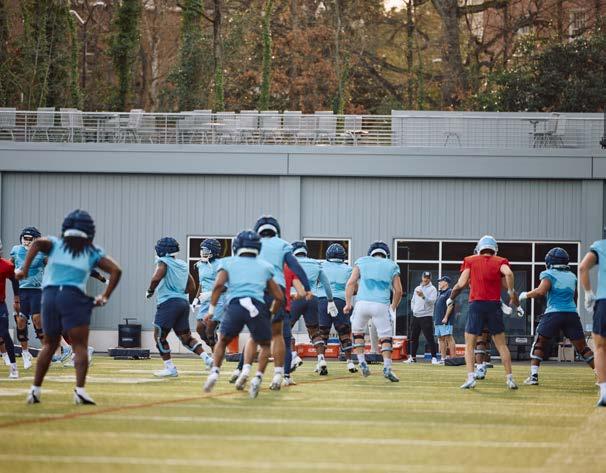
UNC-Chapel Hill transferred $21 million from other funds to the athletic department—and that was before it agreed to spend millions of dollars more on coach Bill Belichick and his football staff.
BY ZACHERY EANES AND MATT HARTMAN | PHOTOGRAPHY BY TYLER NORTHRUP
We revealed that UNC-Chapel Hill had been transferring millions of dollars from the university to bolster its athletic programs even before committing major funds to Bill Belichick and the football team. The story paved the way for other revelatory reporting on how the school is trying to pay for athletics.
WWhen the University of North Carolina at Chapel Hill hired Bill Belichick as head football coach, everyone seemed to notice his $10 million salary.
Add $3.5 million in potential bonuses, $10 million to hire assistant coaches, $1 million for strength and conditioning staff, and $5.3 million for other support staff, and UNC-CH was declaring a new era for football.
The team’s $40 million budget will increase by at least $8 million, not including the $13 million that’s been pledged to compensate football players or the $7 million the school budgeted in severance pay to outgoing coach Mack Brown and his staff over the next two years.
But even before it ramped up its football ambitions, the university had already been shoring up its athletics budget by transferring millions of dollars from other institutional funds to support varsity sports.
UNC-CH provided $21.4 million to support athletics last year between direct payments, services, debt payments, and rental fees, according to its annual financial report to the NCAA. That figure doesn’t include student fees that go to athletics, which totaled more than $8 million last year.
Such transfer payments are the norm at many universities, but not in Chapel Hill. Between 2011 and 2022, the university provided less than $2 million a year in services to athletics, but no direct payments or facilities payments.
UNC-CH transferred the money as a new economic model for college athletics has taken root. Players can more easily move between schools and can sign licensing deals to monetize their name, image, and likeness (NIL) rights. When a series of lawsuits are settled, as soon as next month, universities will begin paying athletes directly.
UNC-CH Athletics Director Bubba Cunningham acknowledged that his department had begun receiving university funding in a public letter last November, saying the university’s increased financial support of athletics began during the COVID-19 pandemic.
“With the changing financial model in college athletics, the University has committed to supporting our mission and providing some of the funds needed for the new revenue share,” he wrote.
But UNC-CH’s new financial model for sports goes beyond transferring money to its athletic department. It once prided itself on operating differently than universities in the football-crazy Southeastern Conference.
When then-Chancellor Holden Thorp fired coach Butch Davis in 2011 after a scandal involving improper benefits and academic misconduct and bought out Davis’ contract for $2.7 million, Thorp emphasized that
the money would not come from the academic side of the university.
“We thought we were different from Auburn,” he told The Charlotte Observer, “but now we know that we’re not. That’s a hard thing for some people to absorb.”
Now, many at UNC-CH are looking at Auburn University and other SEC schools as a model to emulate. They see the increased investment in football as a necessity if UNC-CH is to maintain its all-around athletic excellence; after the fall sports semester, the Tar Heels took the lead in the Learfield Directors’ Cup, a nationwide competition of overall sporting success.
“Consistent with our peer institutions, the University is investing some general funds to the athletic department on an annual basis,” UNC-CH spokesperson Kevin Best said in an email, emphasizing that the funds do not come from state appropriations or tuition dollars. “This reflects the evolving business model nationwide and highlights the importance of athletics to our institution, our brand and our overall success.”
UNC-CH’s athletic department had $164 million in revenue in 2024, but the increase in football spending as well as expected new payments to players add significant new costs. If it wants to maintain its increased spending without additional institutional support, UNC-CH would need to increase athletic revenue by about $50 million next year.
“This institutional support of Athletics has particularly benefited Olympic Sports as the college athletics funding model continues to evolve,” Best wrote.
If UNC-CH can’t generate enough new revenue, the university will have to continue diverting other funds to athletics, or some of the Tar Heels’ prized nonrevenue sports may be on the chopping block.
“We're taking a risk,” Cunningham told Inside Carolina “We're investing more in football with the hope and ambition that the return is going to significantly outweigh the investment.”
That risk is too high for some in the university, who see the investment as a shift in priorities.
Athletics should remain a “side story of the university,” Conghe Song, chair of the geography department, told UNC-CH Chancellor Lee Roberts at a January faculty council meeting. Song noted the low salaries paid to grad students ($20,600 per school year) and that offices in Carolina Hall had minimal heating during the winter.
“If you go all over the world, and I'm sure most of you have seen this firsthand, you'll see people wearing our colors and our logo, and they’re doing that mostly because of our sports teams, not because of our political science department,” Roberts responded.
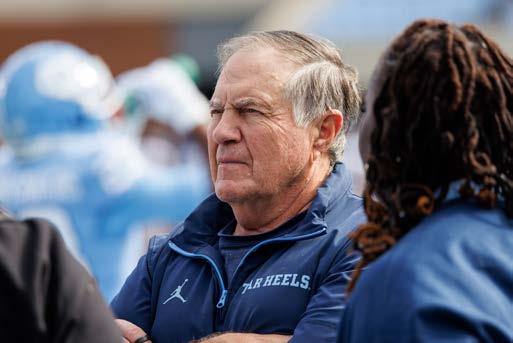
While it’s true that other universities are supporting athletics with institutional funds, UNC-CH’s level of support already outstrips some football powerhouses.
The $21.4 million that Tar Heel teams received from the university last year nearly doubled the $11 million Auburn spent in direct and indirect support on its athletics programs, though it hasn’t quite reached the $28 million Auburn paid in 2023.
Clemson University, a football juggernaut in recent years, transferred $13 million in 2024. The most successful football school of modern times, the University of Alabama, moved just $3 million to its sports department.
The “public Ivies” that UNC-CH has traditionally measured itself against show diverging trends. The University of California, Los Angeles has boosted athletics at even higher levels than the Tar Heels, putting in $30 million last year. The University of Virginia, on the other hand, spent $9.5 million, “almost entirely due to a one-time non-operating contribution” made to its
endowment, the school explained in a statement. The University of Michigan contributed less than $200,000.
North Carolina’s other flagship school, N.C. State University, provided $14.5 million in indirect support to its athletic department, but it explained in a statement that those were internal loans for capital projects. Without them, N.C. State’s support was only $3,768.
In his letter last November, Cunningham told Tar Heel fans that his department would have to “adjust the way we have operated in order to generate more revenue” to create a solid financial footing in the new world of college sports.
The historic NCAA settlement will transform the economics of athletics. The three lawsuits leading to it have already enabled players to sign endorsement deals with private companies.
Universities are expected to pay damages to former athletes who weren’t allowed to sign similar deals, which Cunningham estimated would cost UNC-CH between $1 million and $2 million a year. Schools will also be able to pay athletes a portion of their revenues.
10M 5M 4,837,927 10,000,000 10,000,000 8,305,764 5,201,745 6,300,000 18,347,460 26,300,000
Head Coach
Assistant Coaches
The initial revenue-sharing pool will be up to $20.5 million per school.
In addition to cutting nonessential costs and increasing university funding, Cunningham listed five new revenue streams to offset the cost of paying UNC-CH athletes.
For example, Cunningham said UNC-CH would introduce alcohol sales at indoor events. (It began selling alcohol at outdoor events in 2019.) But a December 2023 audit showed that the university earned $125,000 from alcohol sales at a 2023 football game against the University of Minnesota. If UNC-CH earned the same revenue per visitor with sold-out crowds at each of the men’s basketball team’s 15 home games this year, it would earn only an additional $907,000.
Cunningham also mentioned hosting special events, like the soccer match between U.K. teams Wrexham and Chelsea that brought a sold-out crowd to the 50,500seat Kenan Stadium in 2023. But an athletics official told Triangle Business Journal the school made “well below $500,000” from the event.
UNC-CH will also increase ticket prices. If the school
Other Staff (incl. General Manager)
Total Salaries
follows the University of Tennessee, which added a 10 percent talent fee to ticket sales in addition to a general price increase of 4.5 percent, for all athletics tickets, it would net an additional $4.5 million. (Tennessee only added the talent fee to football season tickets.) UNC-CH removed about 10,000 seats from Kenan Stadium in 2018, and it won’t be able to sell dramatically more tickets than it’s sold in recent seasons.
Those revenues leave the Tar Heels well short of the $20.5 million they would need to fund revenue sharing, much less the additional cost of Belichick and his staff or returning to a self-sustaining athletics program.
Ultimately, the Belichick bet will turn on the last two options Cunningham identified: donations and corporate sponsorships. UNC-CH leaders’ hope is that the excitement around Belichick, who won six Super Bowls as head coach of the New England Patriots, will boost both.
“Football plays an increasingly significant role in college athletics, with all of our peer institutions making substantial investments in the sport,” Roberts said in a statement. “To compete at the highest level, we brought
Using 2023-24 NCAA finance report data
Direct
$14,000,000
$10,010,346
$13,373,784
$14,521,063
$30,060,000
$7,474,521
in one of the greatest coaches of all time, Bill Belichick, to lead our team. There is tremendous excitement within our program, across the state and throughout the country about Coach Belichick and Carolina football.”
Both Belichick and his general manager Michael Lombardi have been frequent guests on national sports media, and the hype has grown enough that ESPN has already committed to airing UNC-CH’s 2025 season opener in primetime.
Media rights are the key economic driver of college athletics, and football dwarfs every other sport.
With a recent Atlantic Coast Conference settlement changing the payment structure next year to further reward schools with big media footprints, the increased viewership will pay off even more. ESPN reported that top-earning ACC programs could see an additional $15 million a year.
Lombardi also publicly discussed plans to feature UNCCH’s football team on HBO’s documentary series Hard Knocks. Though that deal fell apart, CBS Sports reported that the team is exploring other options. In addition to any direct revenue from those deals, the exposure makes UNC-CH more attractive for advertisers who Cunningham said will begin placing their logos on UNC-CH’s fields, courts, and uniforms.
However those deals work out, though, UNC-CH will still heavily depend on the Rams Club, its official athletics booster. The organization received $76 million in contributions and paid out $61 million in scholarships and other financial assistance to UNC-CH in 2022, the last year for which tax information is available.
“Through The Rams Club, we plan to increase the number of full scholarships we offer next year,” Cunningham said in an emailed statement.
We thought we were different from Auburn, but now we know that we’re not. That’s a hard thing for some people to absorb.
– Holden Thorp, former UNC-CH chancellor
But the Rams Club and its donors will also have to contribute heavily to any increase in NIL funding. Though UNC-CH helps facilitate those deals, they officially are organized through a private company, Old Well Management, which works with the Rams Club to fund them.
The focus on bringing in more athletics revenue places a burden on UNC-CH’s 26 nonrevenue sports.
Some inside the university worry that investing heavily in football and basketball could harm the longstanding pride in and funding for acclaimed Tar Heel programs like women’s soccer, field hockey, and other Olympic sports, like track and field and wrestling.
Once final, the revenue-sharing settlement will bring big changes to nonrevenue sports. The NCAA currently limits the number of scholarships that each school can award, but not the number of athletes each team can have. The settlement will instead include roster limits, which many believe will reduce the number of walk-ons and partial scholarship spots—something that could hurt Olympic sports more, Yahoo reported.
Cunningham said last year that UNC-CH offers the equivalent of 330 scholarships to 530 of its 850 athletes. (Some students receive partial scholarships.) Under the settlement, UNC’s number of athletes would fall to 735.
Cunningham said he’s committed to protecting the 28 sports programs at UNC-CH and to increasing the number of athletes covered by athletic scholarships. That’s the third-highest number of varsity sports in the ACC behind newcomers Stanford (36) and the University of California, Berkeley (30).
“Carolina has long been committed to providing opportunities through a broad-based athletics program, and continuing to support as many championship opportunities as possible is important not only to our Department of Athletics but also to our University,” Cunningham said in a statement, noting sports attract more than a million visitors to Chapel Hill every year. But UNC-CH’s 26 nonrevenue sports lost $23.2 million
last year. That’s one reason most major football schools maintain far fewer teams than the Tar Heels. Michigan is comparable, but Texas and Auburn have only 17 varsity teams, Clemson 19, and Alabama 16.
And the cost of nonrevenue sports will only grow. As realignment has brought teams from Texas and California into the ACC, conference competitions mean flying the 101 members of the Tar Heel men’s and women’s track and field teams across the country instead of busing them around the southeast.
“I’m a big supporter of athletics, and I think you would lose a great deal if you diminish opportunities,” said Art Padilla, a former UNC System vice president who worked for President William Friday, co-founder of the Knight Commission on Intercollegiate Athletics. “It’s a question of the scale of it. If you have an intramural swim club or an extramural swim club, many of the same benefits would be there.”
Football isn’t the only sport for which alumni and trustees have called for UNC-CH to increase its investment. The basketball team’s relative struggles on the court this season and up-and-down roster construction during the NIL era have led to growing concerns that the historically elite program is on the decline.
“The old model for Carolina basketball just doesn’t work,” coach Hubert Davis said on his radio show in early February. “It’s not sustainable. It has to build out because there’s so many things in play with NIL, the transfer portal, agents, international players. You just need a bigger staff to be able to maintain things.”
Since then, the university has also pledged to increase its investment in that team, hiring Jim Tanner, a UNCCH alum and a sports agent for NBA players, to be the basketball program’s first general manager. His salary is reportedly more than $1 million, and he is expected to hire several staff members.
Many people have pointed to the SEC’s dominance of this year’s college basketball season as proof that a rising tide in football will lift other sports as well. But there are concerns that basketball could suffer at UNC-CH if football gets more institutional support.
Internal tensions between basketball and football supporters occur “at every school,” Thorp, the former chancellor, told Axios and The Assembly. “But it’s much more acute at a basketball school, and probably more so at North Carolina than almost anywhere I can think of.”
At the same time, the university is contemplating the future of the Dean E. Smith Center, the 21,750-seat basketball arena that opened in 1986 and is showing its age. The university is considering several options, from extensive renovations to building a new arena, potentially on property near the old Chapel Hill airport, which has room to build a mixed-use development much like what’s planned around the Lenovo Center in Raleigh.
Roberts told the Triangle Business Journal in February that renovating the existing building might be too expensive, with a replacement roof alone costing somewhere between $80 million and $100 million.
“So, you start looking at what it would cost to address those issues in the existing building versus what it would cost to build something new,” Roberts told the outlet. A new arena could cost around $375 million, the price tag for the University of Texas’ Moody Center, which was built in 2022.
But not everyone believes now is the time for the school to invest a huge sum in creating a new basketball complex off campus, including former basketball head coach Roy Williams.
“I love the Smith Center. It’s on campus where I think it should be, and we can make it better, so let’s make it better,” Williams told Axios in February. “We’ve got enough problems financially in college athletics. Let’s not be looking for other ways to need money.”
While Thorp may have once wanted to distance his university from any comparison to Auburn, the SEC has become an attractive goal for many within the UNC-CH community.
The conference has leveraged its dominance in football into financial windfalls for its members and an increasing number of applicants.
It’s not among the schools to which UNC-CH typically compares itself, but many in Chapel Hill point to the University of Alabama as an example of how football can boost a campus.
The school’s football success has not only increased applications to the university but also attracted students with a higher academic profile. That has come from a surge in out-of-state students—a segment that UNC-CH caps at 18 percent of the student population, though there are discussions about raising it. Around 55 percent of Alabama’s students are not state residents.
“There's a virtuous circle for these top-tier
universities,” Brad Briner, a former UNC-CH Board of Trustees member and current state treasurer, said of football’s impact across the South.
He said he and his daughter, a high school senior, had recently taken stock of schools she might apply to. “I hadn't done that in 30 years,” he told Axios and The Assembly. “It is unbelievable how some of the flagship universities in the South have changed their stature.”
“And you have to ask yourself the question, ‘Why is that?’” he added. “There’s a virtuous circle that honestly starts with football, that leads to more applications, that leads to higher quality students, it leads to better professors, it leads to more money to the university, which leads back to better football. And I would love if that weren’t exactly the case, but I think there’s no denying that it is the case.”
If that investment has worked out so well for those schools, “I don't know why it wouldn’t for UNC,” he said.
Football is an excellent way to engage alumni for donations, current UNC-CH trustee Jennifer Lloyd argues.
“What we know is, in order to fundraise, you need engagement, and you need alums who have a vested interest in what’s happening here at the university,” Lloyd said after Belichick’s first press conference. “And we know that our sports programs are the front door of that. So, it all works together.”
However, several academic studies have shown the return on athletics to be fleeting, including one from Smith College that concluded, “Investing in creating a national championship basketball or football team entails very high risk for rather ordinary returns.”
In addition, unlike many of those flagship schools that have seen success in conferences like the SEC and Big Ten, UNC-CH's student body and alumni base are smaller.
The university has 20,681 undergraduate students. That’s thousands of students fewer than schools like Alabama (33,400 undergrads), Michigan (33,700), Florida (34,900), and UCLA (33,000).
UNC-CH is trying to close that gap. Roberts has noted that the school used to enroll around 5 percent of North Carolina's graduating high school students. That number has fallen to around 3.5 percent.
He’s put forward a proposal to increase UNC’s undergraduate population by 5,000 over the next decade.
But even if UNC were to expand its alumni base, it remains disadvantaged financially to some competitors because the ACC’s television deal is worth less than the SEC’s and Big Ten’s.
The average SEC school received a distribution of $52.5 million last year, mainly fueled by its television contract with ESPN. In comparison, the ACC’s average distribution came in around $44.8 million—though its distribution model is changing.
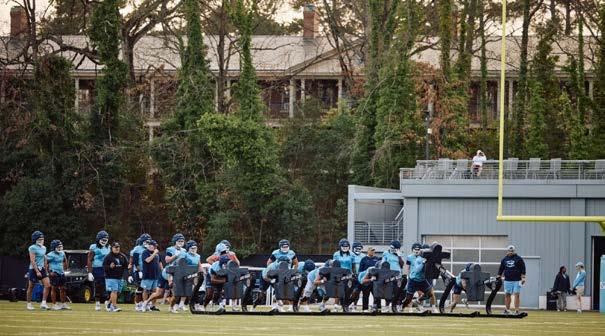
The football team trains at the Koman Practice Complex.
Of the school finances tracked by USA Today, UNC-CH’s revenue from athletics trails every SEC school but one: Mississippi State.
While Florida State and Clemson were public with their attempts to leave the conference, UNC-CH has been more muted. But the school was also exploring its options, The Athletic reported, and it hired the powerful law firm Skadden, Arps, Slate, Meagher & Flom LLP to advise it.
Many believe that UNC-CH will be an attractive recruitment option for either the Big Ten or the SEC despite its smaller alumni base, primarily because of its presence in one of the country’s largest and fastestgrowing states, its national brand, and its academic reputation. Despite all of its growth, for instance, Alabama sits 144 spots below UNC-CH in U.S. News' annual rankings of universities.
And UNC-CH is likely motivated by a fear that if it doesn’t join one of those two leagues, it could be left behind financially, said Charles Clotfelter, an emeritus professor at Duke University who wrote the book BigTime Sports in American Universities.
“There has been a jump in the degree to which the major conferences have consolidated,” Clotfelter said, noting the moves have been driven by television contracts and a desire to create a “mini-NFL.”
“It’s like, if you’re not a member of one of the two dominant leagues, you’re going to fall by the wayside,” he
added. “Those forces might pull UNC into one of the other mega conferences.”
But the long-term success of UNC-CH’s investment into football might still depend on Belichick turning the football team into a national contender. SEC football’s finances might help Alabama; it’s less clear that it helps Mississippi State (2024 record: 2-10). High ratings and excited donors tend to follow success.
“Part of football success is winning games, which is a zero sum game by definition,” Briner said. “Not everybody can be Alabama, it turns out.”
Zachery Eanes is a reporter with Axios Raleigh, where he covers everything from statewide business and economic trends to local politics.
Matt Hartman is a higher education reporter for The Assembly and previously spent nearly a decade working in higher ed communications.
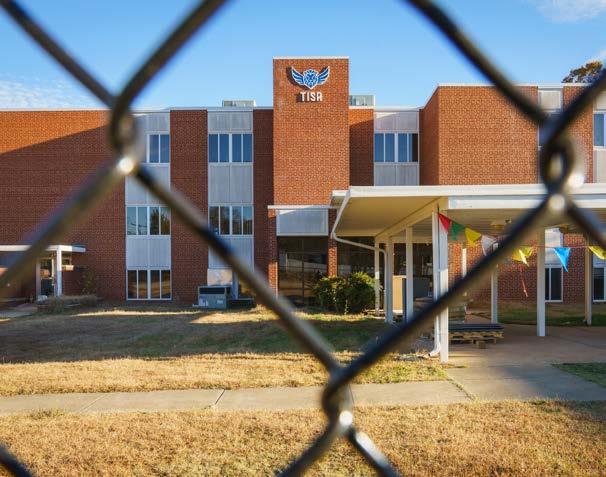
New charter schools in North Carolina are struggling to enroll enough students to stay solvent. One High Point school’s implosion shows the consequences for families.
BY CARLI BROSSEAU | PHOTOGRAPHY BY CAROLYN DE BERRY
In 1996, North Carolina was among the first states to permit privately run, publicly funded charter schools. There are now 221 charters across the state, but many of them close each year for reasons such as insufficient enrollment, untenable finances, and poor academic performance. This story took us inside what went wrong at one school.
LIn spring 2025, Dulce Garcia heard about a soon-to-open school that would offer students immersion in both Spanish and Chinese. There was no other in High Point like it, and the tuition was free. It seemed like a way for Garcia, a restaurant worker, to give her children a longterm advantage.
She decided to enroll her 6-year-old daughter, Aracely, in Triad International Studies Academy (TISA). In its first year, the school would serve preschool through second grade. She planned to enroll her 9-year-old son, Joel, when the school expanded to higher grades.
Aracely flourished at TISA. Garcia marveled that her daughter was soon counting in both Spanish and Chinese, and credited her swift academic progress and close friendships to TISA’s small class sizes. Aracely’s first-grade class had only 12 students; the entire school had only 45. “I think she does better in that type of environment,” Garcia said.
While the school’s modest enrollment seemed like a benefit to Garcia, it set off alarm bells in Raleigh. Charter schools like TISA—privately run, but publicly funded— must have 80 or more students under North Carolina law.
Most state funding is awarded on a per-pupil basis, and real estate costs—not covered by a state allocation—can be hefty, making it difficult for even charter schools with more students to remain solvent.
TISA seemed at risk of buckling under the financial pressure, facing an acute version of the challenges that have begun to slow growth in the once-booming charter school sector. At the same time, its management was pushing the bounds on conflicts of interest.
After learning about TISA’s low enrollment, the state Charter School Review Board summoned school leaders to their October 6 meeting. The board has the responsibility to shut down schools that fail to meet the state minimum, but broad leeway to set terms and make exceptions.
TISA’s board chair, Chaowei Zhu, fielded the state board members’ questions. He largely blamed construction delays.
The plan to renovate a former church and install modular classrooms on the property had hit one obstacle after another, said Zhu, who is assistant dean for global initiatives at Wake Forest University’s Graduate School of Arts and Sciences. By mid-August, school leaders were on Plan C: putting all the kids in the auditorium until the renovations were finished. Two days before the start of the school year, parents arrived at an open house and found the parking lot a muddy mess. Zhu said that while he was directing traffic that rainy evening, he overheard parents saying that the school wasn’t ready.
Zhu’s wife, Junlan Li, a veteran educator and TISA’s principal, also told the board that an incident inside the
main school building during the open house did perhaps even more damage. A child with autism hit several other students, she said. The child’s parents had not disclosed the child’s needs, so the school was unprepared.
TISA had projected 144 students in its first year. Roughly 90 attended the open house, but only about half that showed up on the first day.
Zhu and Li tried several arguments to persuade the Charter School Review Board to let their school stay open. They pointed out that state law allows the board to grant exemptions from the minimum enrollment if there is a “compelling reason.” In this case, TISA’s leaders said, the reason was the school’s “unique student population”—almost a third of students had a disability or other need for specialized education.
Zhu described aggressive marketing plans and a commitment from the school’s landlord to defer rent, which would allow them to break even with just 50 students. He requested that the board delay closing the school until summer 2026 even if a waiver was ruled out. “If there's any way you think we can continue, we'd love to give it a try,” Zhu said.
Bruce Friend, the charter board’s chair, said he was skeptical that TISA could boost enrollment substantially so far into the school year. “I'm just gonna be honest with you,” said Friend, who is head of school at Pine Springs Preparatory Academy, one of North Carolina’s largest charter schools. “Your track record doesn't suggest that that's going to happen.”
Friend moved to revoke the school’s charter, effective at the end of December 2025. The board, made up largely of people with experience founding or operating charter schools, voted unanimously in support.
Garcia hadn’t considered TISA’s financial viability when she was selecting a school. She chose it for its programming and schedule. Seeing Aracely so happy, she imagined the school a staple of her family’s life for years to come. She didn’t expect to have to find another one just weeks into the school year.
North Carolina was among the first states to permit privately run, publicly funded charter schools. In its 1996 authorizing law, the General Assembly laid out its aims: to provide more choice for parents, more educational opportunities for gifted and at-risk students in particular, and new professional opportunities for educators.
The proposition was more freedom to experiment in exchange for more accountability. Rules on how money could be spent and what lessons could be taught were looser. But if the schools failed to meet student performance standards, they could be shut down. Some level of instability was built into the system.
I’m just gonna be honest with you. Your track record doesn’t suggest that that’s going to happen.
– Bruce Friend, chair of the Charter
At first, no more than 100 charter schools were allowed across the state. Legislators removed the cap in 2011 after Republicans gained majorities in both chambers. The number of charter schools doubled over the next decade. Then growth began to slow down. After hitting a peak of 211 in 2023, the number of charter schools fell for the first time ever. But the climb resumed this year. There are now 221 charter schools across the state, including virtual academies.
Even during the height of the boom, schools were regularly closing. Most years, there was at least one; some years, as many as 10. Regulators forced 38 charter schools to close between 1998 and 2024 for reasons that included insufficient enrollment, untenable finances, and poor academic performance. Over the same period, 32 other schools chose to voluntarily give up their charters—three in their first operating year. Another two dozen approved charters never materialized as schools.
While established schools continue to expand, pushing overall charter school enrollment ever higher, new schools are struggling. Every one of the seven that opened in North Carolina this school year came up short of their enrollment projections. Liberty Charter Academy, also in High Point, projected 500 students, but had only 172 enrolled as of the beginning of October. Three other new schools reported October 1 enrollment under 100.
Ashley Logue has noticed new schools facing evergreater headwinds over the eight years she has worked in the state Office of Charter Schools. In that time, three firstyear schools had their charters revoked for failing to meet the state’s minimum enrollment requirement; two were in the past two years.
She also saw other signs of escalating distress: More boards with approved charters were delaying their school’s opening by a year or more or deciding to give up their charter before the school ever opened. New schools were, on average, missing their targets by higher percentages.
National trends have been following a similar trajectory, according to a report published this summer by the National Center for Charter School Accountability that asked, “Has the charter movement reached its saturation point?”
Logue, who is now the director of the Office of Charter Schools, said the pandemic shifted how many
parents thought about school, and in subsequent years alternatives to traditional public schools multiplied. “Post COVID, parents are much more understanding of the options and also more willing to say, ‘OK, this option that my child had—whether it was a district school or something else—is not working. What are my other options?’”
The alternatives include abundant variants of homeschooling, magnet schools run by public school districts, and private schools ranging from tiny churchrun operations to opulent college preparatory academies. Since 2023, the General Assembly has made a massive investment in subsidizing private school tuition—families of any income now qualify for Opportunity Scholarships, though not all private schools accept the vouchers.
Meanwhile, birth rates in many parts of the state are declining, and high housing prices have changed where families with children live. The combined effects have been hard for schools of all stripes to predict.
The problem is perhaps most acute for novice independent charter school operators, who are, almost by definition, optimistic. By the time their school is about to open, they have been working toward that goal for years, sometimes racking up significant debt in the process. TISA said in its application that it planned to take out a $210,000 loan with a five-year term and a 7% interest rate to fund its planning year.
Real-estate and financial constraints can have a strong influence on the enrollment projections that operators submit to Logue’s office and the Charter School Review Board. Friend, now the board’s chair, said that was his personal experience when he was preparing his application back in 2015.
He was trying to project enrollment two years out in one of the state’s fastest-growing communities, Holly Springs. “The truth of the matter is my projections were largely based on what the size of my facility was going to be, and the size of my facility was going to be largely based on how much money I could secure,” Friend said.
The board of every school that Logue has warned about low enrollment has come before the oversight board promising that they will make their numbers. “I call it unrealistic optimism,” she said. “There's a lot of things that we've seen over the last couple of years that you wouldn't want to happen to your school.”
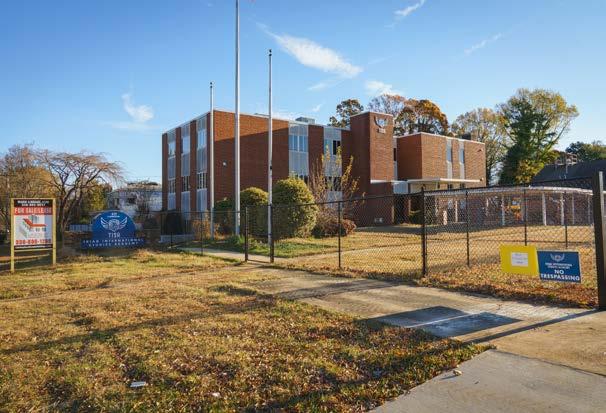
In response, the North Carolina Association for Public Charter Schools has begun organizing new training for schools in the year-long, state-mandated planning period that follows a charter award. First-year schools will also be allowed to participate. “Having names on a list and people telling you they're going to send their kid—that doesn't mean much these days,” the association's Executive Director Rhonda Dillingham said. “We've got to make sure that the new schools that are opening understand that and do everything in their power to market the school.”
Dillingham’s group also recently received a $53 million federal grant to help charter schools build out career development; science, technology, engineering, and math; artificial intelligence; and career and technical education programming. Some of that funding will go to new schools.
Logue has proposed several changes to the state’s oversight of charter schools to try to prevent closures that leave families scrambling for a new school for their child in the middle of the school year.
“TISA,” she said, “was a worst-case scenario.”
TISA’s plans were exuberantly bullish from the start.
Its application for a charter describes dual-language immersion programs in four different languages by the school’s fifth year in operation.
The school would start by serving kindergarten through second grade and add one grade per year until it was a full K-8 school. More than 900 students were expected at full enrollment.
The application named three model schools—East Point Academy in Columbia, South Carolina, and East Voyager Academy and Elbert Edwin Waddell High School, which are both in Charlotte. But only the latter offers multiple languages, and it is a magnet school within the public school district, rather than an independent charter.
Mike Lally, the head of school at East Point, said in an interview that the prospect of running a school offering multiple languages was “scary.” “It's difficult enough with HR and personnel to do Mandarin immersion,” he said. “I couldn't imagine trying to manage that with multiple languages.”
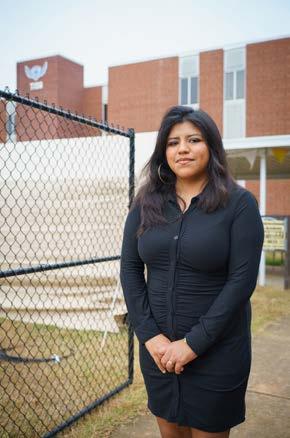
The candidate pool for language-immersion teachers is small and would be smaller still if fluency in multiple languages was required, Lally said. On top of that, there is often extra administrative work related to immigration for those teachers.
Renee Mathews, the CEO and principal of East Voyager, was the founding principal of East Point and said the two schools had very different growth trajectories. The South Carolina school grew quickly, she said, because there was little competition at the time. The Charlotte charter school, facing more competition, has grown steadily, but much more slowly. It offers Spanish in addition to Mandarin, but only introductory classes that are limited to middle schoolers.
Li worked at both East Point and East Voyager, but consulted neither Matthews nor Lally as she prepared to open TISA, they said. Neither did Zhu, who was on the committee that helped to open East Voyager. One
member of East Voyager’s board of directors was on TISA’s board for a time, but he declined an interview through Mathews.
In their charter application, TISA leaders cited the success of the charter school movement in the state as one reason to think their enrollment projection was sound. “While some may view this as a concern for too much competition, TISA's case is different,” the application said. “If approved to open, TISA will be the only public school in Greensboro offering multilanguage immersion programs in Chinese, Japanese, French, German, and/or Spanish under the same roof. ... TISA's program is unique, innovative, and difficult to replicate. Therefore, competition should not be a concern in TISA's case.” They indicated their break-even number was 138.
After school leaders couldn’t find acceptable property in Greensboro, they shifted their sights to High Point.
The former church they settled on required a special use permit, which meant school leaders had to plead their case before the city council.
What city leaders most wanted to know during the March hearing was how many students TISA was expecting.
“We just want to build a very small school,” Zhu told them. “Because that’s always my dream. At a small school, teachers get to know everybody, give them individualized care, and particularly help them to learn the language.”
High Point’s planning staff recommended that the special use permit restrict the school’s enrollment to 250. TISA was arguing for up to 390 students, with a plan to have students arrive on a staggered basis each day to minimize traffic.
Pressed for first-year numbers, Zhu said they had almost 100 students registered, but it was hard to know how many would show up. He estimated no-shows at 30 to 40 percent.
Minutes from a TISA board meeting three days earlier indicate the school had sent out acceptance notices to 76 families. Enrollment wasn’t meeting expectations, Li told the board. She noted that another new charter school, Liberty Charter, was also opening in High Point.
The families with children enrolled at TISA learned about the Charter School Review Board’s vote to revoke the school’s charter the following evening, on October 7.
“Please know that our staff and leadership team are fully committed to ensuring a smooth, supportive transition for every student and family in the coming months,” Li, the principal, wrote in the email, which said the school would close at the end of December.
Garcia was shocked. To her, the information “came out of nowhere.”
It’s difficult enough with HR and personnel to do Mandarin immersion. I couldn’t imagine trying to manage that with multiple languages.
– Mike Lally, head of school at East Point Academy
She had no idea that board members were discussing a shortfall of $58,000 in September or that state charter school regulators had advised against TISA’s management structure.
A deeper look at public records tied to the school might have prompted additional questions about ethics and finances. TISA Board Chair Zhu is also a partner in LinguaVista, the for-profit company that owns the school’s property and holds its management contract. Additionally, he is president of TISA Child Care Center, a for-profit company with a contract to run the on-site preschool.
TISA said in its 2023 charter application that it “does not foresee any existing relationships that could pose actual or perceived conflicts if the application is approved.” Zhu was identified as the board chair, and Li was identified as the likely principal candidate. It made no mention of the fact that they are married.
North Carolina law allows charter schools to hire relatives of board members as long as the conflict is disclosed, and TISA’s board meeting minutes indicate that Li and Zhu left the room for certain discussions due to a conflict of interest.
But the minutes and a financial journal shared with some board members in February also show Zhu had deep involvement in managing the school’s finances— including scheduling $40,000 in payments to JunChao Consulting, a company registered to his wife, for “supporting in planning year” and “writing charter.”
The board had also experienced high turnover. The only members named in the application that were still involved by late 2024 were Zhu and Hua Qin, who is described in the application as a certified public accountant. Records from the CPA oversight boards in North Carolina and South Carolina list no one by that name. (The Assembly tried to reach a Forsyth County resident by that name, but did not receive a reply.)
It’s not clear from the minutes how seriously the board considered contracting with companies unconnected to Zhu. Neither Li nor Zhu provided copies of full board packets and contracts in response to multiple requests from The Assembly. Li declined
an interview; in response to detailed questions, Zhu provided a written statement that said TISA complied with all state disclosure requirements and followed the conflict-of-interest policy its board approved. Other board members either declined to speak with The Assembly or did not respond.
“Without subpoena powers, it is very difficult to figure out what is going on financially” at a charter school, particularly one with a for-profit management company, said Tom Kelley, a law professor at the University of North Carolina at Chapel Hill who has written about charter schools and nonprofit law. While there are federal and state legal doctrines intended to prevent self-dealing, investigations are rare, he said.
The second email Garcia received about TISA’s closure really shocked her. That email, sent about 24 hours after the first, retracted many of Li’s previous assurances that school would continue as normal through the end of the year.
“Effective immediately,” there would be no more breakfast or lunch service, no transportation, and no before- or afterschool care.
The Department of Public Instruction had invoked its power to put charter schools showing signs of insolvency in “financial noncompliance status,” freezing their access to funds.
Garcia attended an emergency board meeting the following evening. Parents gathered in the school cafeteria to encourage the board to appeal.
Lisa Noda, an attorney who drove her children from Davidson County to attend TISA, went first. She told the board that her second-grade daughter, who has dyslexia, now loves to go to school and wants to read. Her younger daughter, who is in the preschool program and advanced academically, is also happy at TISA, Noda said. “Please consider appealing and allow students to finish.”
Breanne Kraft said the teachers were so patient as her daughter, who has autism, processed her father leaving the family. “She does not want to leave. It hurts her and it hurts me,” Kraft said. “We both cried.”
Cailey Oates said, “To us, TISA is more than a school; it is a community.”
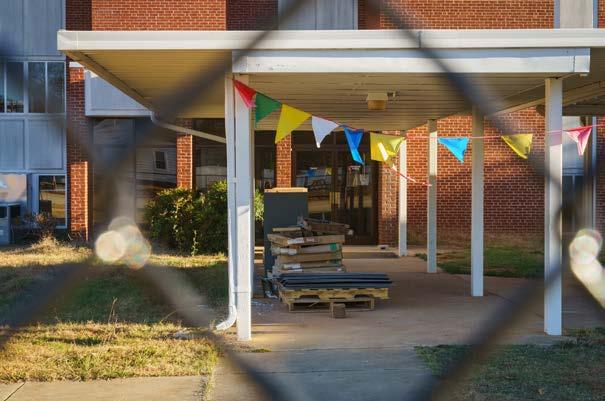
October 15, 2025, was students’ last day at TISA.
When it was her turn to speak, Garcia suggested things she could personally do to try to boost enrollment. She could hand out flyers and spread the word among Spanish speakers.
But Zhu told the parents that he did not see much of a chance to reverse the Charter School Review Board’s decision. “We told them everything, but it did not change their mind,” he said. “I am the saddest person. I sold my house to build the school.” (County records indicate the house listed on the school’s charter application is still owned by Zhu and Li.)
After a half-hour closed session, the board voted unanimously not to appeal.
The following week, the board held another meeting, voting unanimously to relinquish the charter. TISA would not keep operating through December as state regulators allowed; instead, October 15 would be students’ last day.
Amanda Cook, a former public school teacher who served on the High Point City Council, immediately
started to coordinate a meeting to help the families left in the lurch.
“I felt like with the number of kindergarteners that they had, there were a lot of families that had never been part of the school system before, so they hadn’t been through the process,” said Cook, who has since been appointed to the state House to replace Rep. Cecil Brockman.
On the day TISA closed, Guilford County Schools held an event at one of the district’s two Spanish-immersion schools, Kirkman Park Elementary School, to introduce parents to other local options.
Teachers and other staff were available to translate, Cook said. The district also brought people to answer questions about transportation, enrollment, exceptional children’s services, and English language support. As of mid-November, 18 former TISA students have enrolled in district schools, a spokesperson for Guilford County Schools said.
Garcia learned at the open house that she could send Aracely to Northwood Elementary School, where a weekly Chinese class was offered. There was also a spot
Please know that our staff and leadership team are fully committed to ensuring a smooth, supportive transition for every student and family in the coming months.
– Junlan Li, TISA’s principal
for her son and room for both children in the afterschool program. She enrolled them the next day, but Garcia was still out of work for the better part of a week.
Noda lost much more work time getting her daughters resettled. She felt that Davidson County schools did not have the resources to do right by her daughter with autism and dyslexia, so she looked into private options.
“My older child was out of school for a month where we were trying to find something, and she did trials at different schools that did not accept her because of the needs that she has,” Noda said.
She ultimately enrolled her older daughter at another school in High Point, The Piedmont School, which serves children with attention deficit disorder and dyslexia, and received some state funds toward the private school’s tuition. Her younger daughter now attends a private pre-K program.
Zhu and Li received a bill from the state the same day the board voted to relinquish the charter. TISA had received state funding based on its projected enrollment; charter schools that end up enrolling fewer students have to give a proportional amount of money back. TISA now owes the state $112,789.
LinguaVista, the for-profit company that owns the school property, is facing legal action for another apparently unpaid bill. In late November, Dobbins Electric Company Inc. filed a claim of lien against the school property, asserting that it’s owed $68,351.86.
In mid-December, after repeatedly reminding Li that the school is obliged to disclose public records, The Assembly received an email from the address tisabankruptcyperiod@tisanc.org. The email, signed “TISA Board of Trustees,” said the board was “in transition and in the process of retaining bankruptcy counsel.” No public records requests would be fulfilled in the meantime.

Carli Brosseau is a K-12 education reporter for The Assembly. She previously worked at The News & Observer, where she was an investigative reporter and a ProPublica Local Reporting Network fellow.
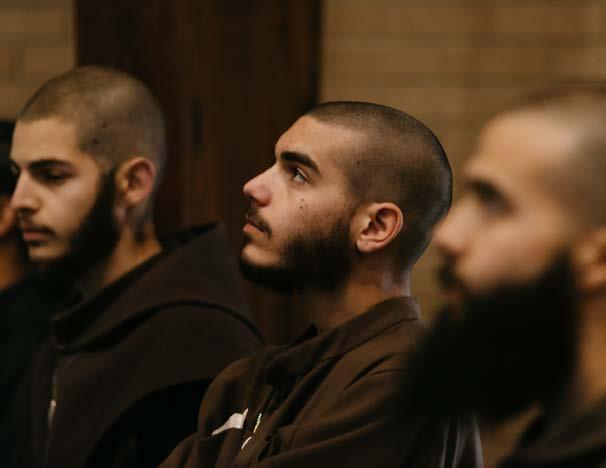
A religious order following a lifestyle St. Francis of Assisi established in 1223 is building a new home in the woods of Western North Carolina. Not everyone is happy to see them.
BY DANIEL WALTON | PHOTOGRAPHY BY JESSE BARBER
As part of our mission to cover the people and places that make our state unique, we delved into the daily life of a group of friars building a home here, as well as the lure the order has for young men. The story also looks at tensions with the mainstream church, which has focused on modernity as a way to attract the next generation of Catholics.
TThe midmorning sun streams through a wall of windows, filling the hilltop retreat with light just as the men’s voices join in solemn chorus. Eleven “alleluias” rise, richly resonant with tenor and baritone depth. Interlocked in harmony, their sound creates a structure as sturdy as the massive logs that frame the airy room.
Western North Carolina is used to musical expressions of old-time religion, but perhaps none quite this old. The practicing choir are all members of the Marian Friars Minor, a religious order following a lifestyle St. Francis of Assisi established in 1223. Each wears close-cropped hair, a simple robe of thick brown cloth, a white rope tied around his waist, and a pair of sandals, an outfit that hasn’t changed in centuries.
Under the guidance of the group’s founder, Friar Anthony Serviam Maria, the men are living out their faith in the heavily Protestant mountains between Burnsville and Spruce Pine. Most of their prayers are in Latin, following rubrics laid down before the Roman Catholic Church’s widespread adoption of English and other changes through the Second Vatican Council in 1962. They are not ordained, so on Sundays they seek out parishes that offer traditional Latin Mass.
While their way of life may be old, the friars themselves are not. All except Friar Anthony, a vigorous Gen Xer with a greying beard, are in their 20s and 30s. Even as professions to religious life are in decline across most of the church, the Marian Friars Minor have attracted new vocations since Anthony started the group in 2018, with 14 currently in the community.
He’s also established a thriving Third Order—a cohort of Catholic laypeople who choose to observe similar rules of prayer and fasting while living out in the world. That group has grown to more than 450 members across the world, the majority of them young men with families. (Women can join the Third Order but cannot become friars.)
Anthony says young people often find the friars’ traditionalist approach to be more spiritually fruitful than what they find in other Catholic institutions. And research supports his observation that religiosity is growing among the youth: According to the General Social Survey, Gen Z was the only American cohort in which more people identified as religious in 2022 than in 2020.
“They see the activity that has been so important for the last 50 years—just be active, do all this stuff— and it’s not leading to anything. They don’t feel like they’re becoming holy,” he says. “The Zoomers, most particularly, are very much attracted to a life of prayer and holiness.”
Yet the same practices that have attracted youthful energy have also put the friars in awkward tension with the mainstream of the church. Catholic authorities have been trying to modernize the faith, limit the use of Latin
in liturgy, and engage with popular culture, particularly since the election of Pope Francis 13 years ago. In a 2021 letter to bishops, Francis connected older forms of worship with the rejection of current church authority, urging those Catholics to adopt the contemporary liturgy “in due time.”
Liturgical differences have complicated Anthony’s path in religious life and were a major reason he led his group to the mountains of North Carolina from Covington, Kentucky. The tension arose again in January, when Bishop Michael Martin, leader of the more than 530,000 Catholics in the Diocese of Charlotte, published a letter in the Catholic News Herald stating that the friars are operating in the region without his permission and should not be allowed to speak or serve anywhere in the diocese.
“Please be advised that this group is not an officially recognized religious community,” he wrote, adding that the community “in no way represents the Roman Catholic Church (regardless of what they may claim).”
The friars are unperturbed. They continue to build up a presence on 70 wooded acres near Burnsville, where they are building a timber-framed friary, a lodge to host group retreats, and private cabins for visitors. They’ve raised roughly $800,000 toward a $2 million goal for the effort so far, even as the diocese closes one of its own retreat sites in Maggie Valley due to financial concerns.
Donations have covered land payments and heavy equipment, but the materials and labor are largely the work of the friars. Necessity has made them skilled at harvesting trees, running a sawmill, and putting the beams together with handmade pegs; much of their work happens under the gaze of a statue of St. Joseph, the patron saint of carpenters.
“As Franciscans, we’re supposed to give good example,” Anthony said of the effort, which he regularly updates supporters about via video. “Hopefully, people get inspired to just do something good. Our idea is that we can build this beautiful place, but we’re going to do it ourselves.”
The friars’ business office sits beneath their main meeting room, with a sliding door to a lower deck and an expansive view of the Black Mountains. Young men pop in and out, some wearing orange vests and beanies over their habits against the February mountain chill, admitting the dull whine of power tools.
The noise didn’t distract Anthony from talking about the path that led him to religious life. A native of Cincinnati, he grew up practicing what he describes as “a normal, kind of mediocre” Catholicism, going through the motions while not really understanding the heart of the faith.
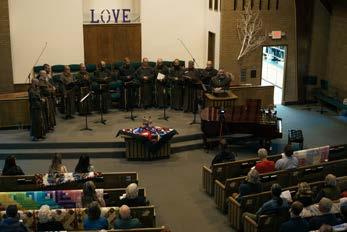



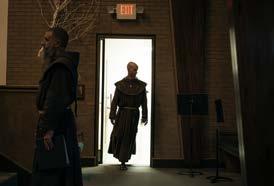
Top left: The Marian Friars Minor perform at the First Baptist Church in Burnsville on March 1.
Top right: Friar Anthony stands on the porch of the first timber-frame house the friars built at the Holy Annunciation Monastery.
Middle left: A religious image posted at the sawmill. Middle right: Laundry and beehive boxes outside the Holy Annunciation Monastery.
Left: The friars enter the First Baptist Church in Burnsville for their March 1 concert.
As he earned degrees in recreation and sports sciences from Ohio University, specializing in therapeutic recreation for people with disabilities, he attended Mass but also began studying Indigenous survival skills and Earth-centered spirituality. “My mom always told me, ‘You go to church; we’re Catholic.’ I tried to do that, but I was reading books on shamanics,” he said. “I didn’t know that’d be contradictory in any way.”
His relationship with religion grew much more serious after moving to Idaho in 2003 to work for an adaptive adventure sports program. There, he became close with two Catholic men who encouraged him to pray regularly and took him to a traditional Latin Mass every week. At first, Anthony said, he didn’t like the unfamiliar rites and inscrutable language, but kept going out of respect for his friends.
“Finally, I got sick of it because I had no idea what was going on. I just picked up the little red book that they would have there at Latin Mass, and I started reading it,” said Anthony, referencing an explanatory booklet often used at Latin parishes. “It was talking about St. Michael the Archangel, the Blessed Virgin, St. Joseph. I thought, ‘This is beautiful.’ It just all started to click, and then I understood that our Lord was present in the Blessed Sacrament. From that moment on, I was looking for a way to get out of the world.”
Feeling an urgent call, Anthony began visiting different religious orders. But he was carrying $30,000 in student loan debt, which most orders told him he needed to resolve before he could join. The response was different when he talked with the vocations director of the Franciscan Friars of the Immaculate in New York.
“He said, ‘You have to have faith! Our Lady can take care of all this,’” Anthony recalled. “‘She has all the money in the world.’” The Fund for Vocations paid off his debt and allowed him to join.
In 2008, he professed his final vows, swearing poverty, chastity, and obedience. He also received his new name: Anthony in honor of St. Anthony of Padua, a 13th-century Franciscan venerated as the patron of lost things; Serviam, which is Latin for “I will serve”; and Maria, in recognition of the Virgin Mary.
As a bell rings throughout the friary, Anthony cuts his recollections short. He and the other friars walk reverently into their chapel, stopping at the door to dip their fingers in a small font of holy water, for midday prayer.
The chapel is a converted garage, but it bears few obvious traces of its past life. There’s a red-and-gold canopy above the altar, icons of Mary and the saints, and the soft glow of candlelight. The friars form a horseshoe around the altar, chanting psalms and responses in Latin.
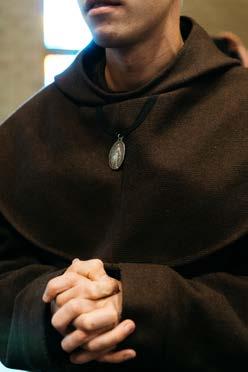
The Catholic breviary, or book of prayers used for these rituals, was updated after the Second Vatican Council, but the friars use a version from before those alterations. Anthony believes it’s critical to preserve as many ancient traditions as possible; unnecessary changes to the practice of the faith, he believes, can amplify into changes in the faith itself.
“Liturgy comes to us down from the apostles, and we have to ensure its authenticity,” he said. “Lex orandi, lex credendi: The law of prayer is the law of belief. If you change the law of prayer, you can change the law of belief.”
Perhaps paradoxically, these older views are gaining traction with younger generations, both here and the church at large. A 2022 survey from the Catholic University of America found that over 80 percent of priests ordained since 2020 describe themselves as theologically conservative or orthodox. The Charlotte Latin Mass Community, a diocesan group of the faithful devoted to traditional liturgy, has grown from about 50 families in 2011 to nearly 1,200 today.
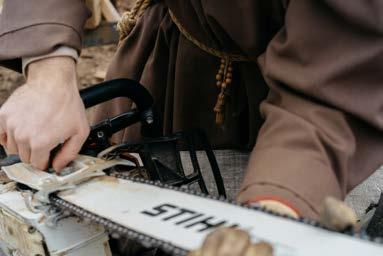
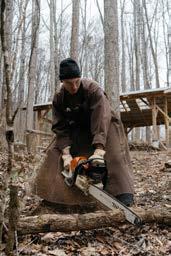



Top left: Friar Bernard preps a chainsaw.
Top right: Friar Bernard cuts a locust post for the gardens at the Holy Annunciation Monastery.
Middle left: Friar Aloysius walks through the piles of milled lumber at the Holy Annunciation Monastery.
Middle right: Friar Charles preps logs for the sawmill at the Holy Annunciation Monastery.
Left: Friar Bernard piles wood debris on a fire.
It felt authentic, it felt ancient; it also felt heroic and demanding.
Among those attracted to tradition is Friar Bernard Joseph, a 20-something with a broad smile. In college, he’d begun exploring a vocation to religious life with another group of Franciscan friars, but its focus on being part of the modern world seemed out of step with his own connection to the faith. Through a mutual friend, he was introduced to Friar Anthony, and after two visits to the friary in Covington knew he’d found what he was looking for.
“He told me, ‘If you want to be a religious contemplative, go somewhere that’s going to make you a saint,’” Bernard said. “It felt authentic, it felt ancient; it also felt heroic and demanding.”
Beyond their daily routines of prayer, Bernard continues, the friars work to meet many of their own needs through traditional skills, in keeping with their dedication to poverty and simplicity. They tailor their own habits, tend bees for honey and mead brewing, bake their own bread, and raise chickens for eggs.
Those eggs find their way into a hearty scramble for lunch, served alongside bread, a tangy vegetable slaw, and a thick tomato soup. After more Latin prayers of thanksgiving, the friars eat without talking at long tables as an audiobook of the first chapter of the Gospel of John reverberates through the room.
“‘Who are you? Give us an answer to take back to those who sent us. What do you say about yourself?’” the narrator reads. “John replied in the words of Isaiah the prophet, ‘I am the voice of one calling in the wilderness, “Make straight the way for the Lord.”’”
Friar Anthony has spent his own time in the proverbial wilderness. In 2012, the Vatican placed the Franciscan Friars of the Immaculate under scrutiny due to disagreements among its members about the use of the Latin Mass.
Pope Francis then revoked their permission to use the traditional liturgy, a key element of what had attracted Anthony to the community, shortly after taking office in 2013. The incident drew international attention in Catholic circles, particularly among traditionalist critics of the new pope.
After four years of uncertainty, Anthony received approval to leave the group and again sought direction from God. He decided to make a pilgrimage on foot between the historic mission churches of California, setting out from San Diego with little more than a water bottle, a couple of prayer books, and a change of clothes. He trusted that God would provide for his needs.
Fifty days and nearly 800 miles of walking later, he emerged with a newly unshakable confidence in divine providence.
“I was putting faith in His promise, and He never let me down,” Anthony said. “It was a beautiful experience, and it’s what gave me the inspiration for this.”
Shortly after that pilgrimage, Anthony met with the former bishop of the Diocese of Covington in Kentucky, who encouraged him to establish the Marian Friars Minor as a new community. Word spread among networks of traditionalist Catholics and online, where Anthony posted his preaching on YouTube. His talks with titles like “The Problem with Worldly Catholics” and “A Way to Crush the Devil’s Head Daily” racked up tens of thousands of views. Interest started to grow.
Ross McKnight joined the friars’ Third Order—the lay group for which Anthony offers spiritual guidance—a few years after its formation, at the suggestion of some friends from his congregation in rural Louisiana. He and his young family had started attending a traditional Latin Mass parish full-time after many other Catholic churches suspended services in response to the COVID-19 pandemic, and he had been looking for a community that shared his seriousness about the faith.
“As you’re looking at your interior life and seeing where you’re lacking, it’s very appealing to have a rule of life that’s been tried and true for centuries,” McKnight said. “It’s a means of growing spiritually and trying to be more regimented about it.”
Yet the friars were asked to leave Kentucky in May 2022 by Bishop John Iffert, who had taken over the Diocese of Covington in 2021. Both Covington officials and Anthony declined to get into the details of the situation.
However, Iffert’s subsequent actions in the case of another Covington-based Catholic group, the Missionaries of St. John the Baptist, show him at odds
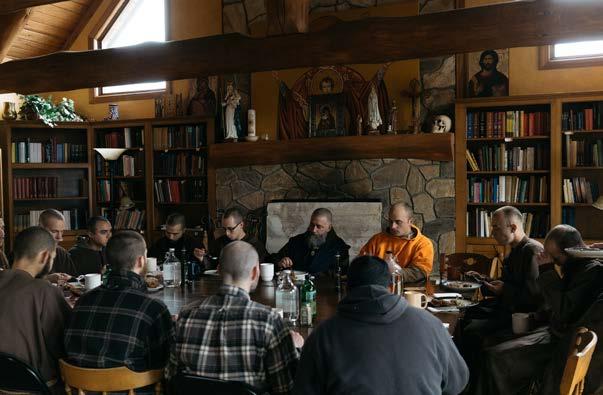
The friars gather for their midday meal, saying prayers before and after they eat.
with traditionalist perspectives. After one of the group’s priests preached that the modern liturgy was “irrelevant” and contained “literally nothing of the old,” Iffert removed them from their parish and forbade them from conducting public ministry.
In what Anthony regards as another example of providence in action, shortly before the Marian Friars Minor were asked to leave Covington, he’d been connected with the abbot of a California-based Ukrainian Greek Catholic group that had recently acquired a retreat in Western North Carolina. At the abbot’s invitation, the friars moved in and began calling the house the Holy Annunciation Monastery. On some Sundays, they started attending services at Ukrainian parishes like St. Basil the Great in Charlotte.
As guests of the Ukrainian church, an Eastern branch of Catholicism governed by a separate clerical hierarchy under the pope, the friars didn’t reach out to the Diocese of Charlotte after arriving here. The diocesan bishop at the time became aware of their presence, Anthony said,
but didn’t raise any concerns.
He says the first communication he received from current Bishop Martin came last September, shortly before Hurricane Helene arrived, knocking out power and communications across the region.
Well-equipped with construction tools, the friars launched into action after the storm. Social media posts show the friars with chainsaws and an excavator, clearing downed trees, mud, and even a washed-out house from local roadways.
Although they hadn’t interacted much with the community before Helene, the storm response made them fast friends with their neighbors, Anthony said. Since then, the group has performed a concert of hymns in Burnsville and added a general store to the vision for their property, where the friars could connect with neighbors more consistently.
“One of the locals came to me—he was actually tearyeyed—and he said, ‘We were always wondering who these Catholics were,” said Anthony. “And he just said, ‘Now we know.’”
Diocesan authorities in Charlotte had been wondering
the same. Spokesperson Liz Chandler said the diocese had received “questions and concerns” from both parishioners and clergy about the friars’ status in the church, and reached out to them but got no response. That spurred the diocese to investigate further.
“Upon further review, we have determined that this group is not affiliated with any recognized Franciscan community and not recognized by the Roman Catholic Church,” Chandler wrote in an email to The Assembly “There are protocols for an organization such as this to receive recognition by the Church, and the diocese will certainly consider any new information if and when it comes to us through appropriate channels.”
Anthony regards the diocese’s position as an unfortunate misunderstanding. He says the Ukrainian abbot reached out to the diocese last year. And last month, the friars became a formal affiliate of the Ukrainian monastery. He points to a similar arrangement adopted by a Benedictine group that went under Ukrainian Catholic authority while continuing to follow many of their own traditions.
The friars’ current online presence does not go into this level of detail. Although Anthony published a YouTube update on the developments March 1, their website bills the friars as “traditional Franciscans” without any note of affiliation to the Ukrainian church. Anthony says he’s currently revising the website and plans to add a statement “that expresses our juridical affiliation” with the Ukrainian monastery.
Anthony didn’t expect to end up here, in the Western North Carolina woods under the wing of a Ukrainian abbot, when he first felt the call to religious life two decades ago. But he finds the situation appropriate for a follower of St. Francis, a man who contemplated the goodness of God in nature and sought a universal Catholic faith.
Anthony is fond of citing former Pope Saint John Paul II, who called for the church to “breathe with her two lungs.” That metaphor, he says, references the need for all Catholics to be informed by the traditions of both the Western and Eastern churches like the Ukrainians.
As gravel crunches under the tires of a grey pickup truck, Anthony drives beneath the heavy, timber-framed gate to the friars’ future retreat center. Much work remains to be done; post-Helene demand has led to delays in obtaining rock to build roadways, he said, so heavy equipment has not been able to access the site. Although the friars have completed a retreat house, a graded site and part of a foundation are all that stand of the planned friary for now.
Anthony stands beneath the forest, the late winter

wind rustling his robe. He doesn’t know where the friars will find the remaining funds for the project or how the situation with the Diocese of Charlotte will unfold.
But he doesn’t doubt that things will work out.
“I really do think He wants me to do this; I can risk everything on it, because that has to do with God,” Anthony says. “Our job is to serve God, not serve our own needs, and you do that through providence.”
Daniel Walton is an Asheville-based freelance reporter covering science, sustainability, and political news. He was previously the news editor of Mountain Xpress
Television viewership and advertising revenue are down nationally, and locally owned stations are fading. Jimmy Goodmon, the fourth-generation president of WRAL-TV and Capitol Broadcasting, confronts a precarious future.
BY CHLOE COURTNEY BOHL | PHOTOGRAPHY BY MATT RAMEY
Outsiders have long admired WRAL’s innovative news operation, and employees cherished the cozy feel of the family-owned company. But visionary CEO Jim Goodmon has largely stepped aside, and his oldest son, fourth-generation president Jimmy Goodmon, faces challenges from the outside and the inside.
PPosted above the double-door entryway to WRALTV’s Raleigh headquarters is a quote from founder A.J. Fletcher: “To inform the public without bias or favor is this station’s highest duty.”
Behind those doors is a warren of conference rooms, studios, control rooms, and a large, open-plan newsroom. James Goodmon Jr., the fourth-generation president of WRAL and its family-owned parent company, Capitol Broadcasting, strides down hallways filled with plaques and memorabilia commemorating the station’s impact on local journalism.
Inside the main control room, he looks on as a group of producers seated before an array of 15 monitors speak calmly but rapidly into their headsets, executing the complicated, minute-by-minute choreography that is the 4 p.m. news. Next door in the studio, he watches as a pair of anchors prepare to go live, a “Breaking News” banner scrolling across the screen in front of their desk.
A few minutes later and one floor down, Goodmon Jr. sits at a long conference table and absentmindedly rakes his hands across his face, pushing his rectangular glasses onto his forehead.
“I’m really proud of what you saw up there, and I don’t really care if other people think that or not,” he says, letting out an exhale somewhere between a wry laugh and an expression of defiance.
He speaks about the family business in epic terms:
“This is a war,” he told The Assembly in a recent interview. “This is a big battle that we’re fighting every day.”
Goodmon Jr. is battling for advertising dollars against bigger, richer competitors. He’s fighting to hold his

audience’s attention amid stiff competition from social media, streaming services, and AI-generated Google search results. And he’s in a race against time, trying to predict the next trends and technological advancements in media to keep his station profitable and relevant.
Much has been written about the death of print news in the digital age, but the business model for local TV news is breaking, too. Viewership has steadily decreased since 2016, according to data from the Pew Research Center, and advertising revenue has trended down as well, notwithstanding bumps from political ads during election years.
Profit margins are slimmer than they were 30 years ago, to the point where the vast majority of local stations have been bought up by a handful of corporations. Of the local ABC, NBC, and CBS affiliates in the nation’s top 25 biggest media markets (Raleigh is No. 22), NBC affiliate WRAL is the only one that isn’t owned by a corporate parent like Sinclair, Tegna, Nexstar, or Disney.
The last five years have thrown additional hurdles in WRAL’s path, including a transition to a new chief executive and a string of high-profile departures from the newsroom and anchor desk.
There have been casualties in Goodmon Jr.’s “big battle”—longtime employees who say they were laid off or offered steeply reduced contracts, and others who left the station abruptly and without explanation. They say WRAL is losing some of the family culture that distinguished it from corporate-owned competitors and helped keep viewers loyal.
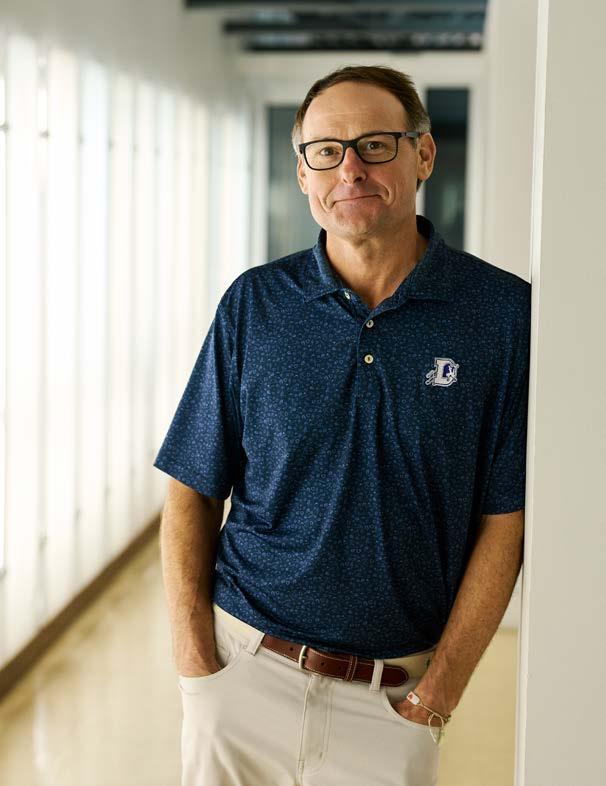

Asked about the departures, Goodmon Jr. said some staffers had been resistant to change.
“This isn’t a kindergarten,” he said. “In order to succeed, you gotta adapt, you gotta change. And you can either embrace that and become curious … which is what we want to do, or you can resist it. We’ve probably been overly considerate as it relates to overlooking those that have been resistant over time.”
In spite of the headwinds, WRAL is still relatively wellpositioned. It has a newsroom staff of 143 and a host of profitable companies under the Capitol Broadcasting umbrella to cushion the TV station against financial stumbles. The station does consequential political and investigative reporting, and it regularly wins coveted regional Emmy and Murrow awards. Its role as a public good has never been clearer as other local news sources shrink and disappear.
WRAL makes its own decisions and, to some extent, controls its destiny. Sinclair and Nexstar recently told their more than 60 ABC affiliate stations (including WXLV in Winston-Salem and WCTI in New Bern) not to air Jimmy
Kimmel Live! after the host’s comments about Charlie Kirk’s death; Goodmon Jr. has no faraway corporate boss to answer to. (Sinclair and Nexstar said Friday that they were bringing Kimmel back.)
“WRAL is—both in terms of its record through the years doing news and its economics—atypical of the whole universe of local stations,” said Rick Edmonds, a media business analyst for the Poynter Institute, a nonprofit journalism organization. “Very few are that dominant in a market, and very few have as big a commitment, at least historically, to doing some pretty ambitious news.”
The business model may be changing underfoot, but Goodmon Jr., 48, who’s better known around the station as Jimmy, is sanguine about WRAL’s prospects.
“I really want Capitol Broadcasting to be doing local news in Raleigh 100 years from now,” he said. “I don’t know what that means. I don’t know what device it’ll be on. I don’t know if it’ll be here or Mars. But … at the end of the day when the dust settles, if we’re not here, they’ll find me with my knuckles broken.”
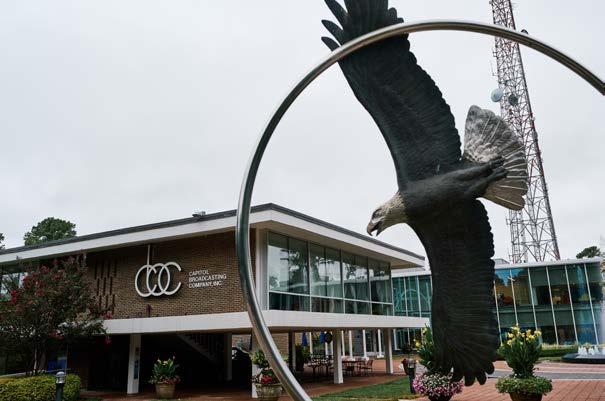
Fletcher, who founded Capitol Broadcasting Company (CBC), was Goodmon Jr.’s great-grandfather. He began amassing local media properties in the 1930s with the purchase of an AM radio station. In 1956, he branched into television, securing the license to Channel 5 and founding WRAL-TV.
By the time of Fletcher’s death in 1979, CBC also owned the Tobacco Radio Network, the North Carolina News Network, Capitol Publications, Capitol Broadcasting Network, and Seeburg Music Library, Inc. Fletcher also had an eponymous charitable foundation and a slate of broadcasting awards to his name.
He was succeeded as CBC president in 1966 by his eldest son, Fred, who in addition to serving as president of CBC until his retirement was a community fixture in Raleigh: He was elected to the city council and chaired various Wake County parks boards for decades.
James Fletcher Goodmon Sr., Fred’s nephew, took over as president of Capitol Broadcasting in 1975. Goodmon Sr. made prescient bets on emerging technologies: WRAL
was the first TV station in North Carolina to get a news helicopter (1979) and a satellite truck (1984); the first in the Triangle to launch a website (1996); and the first in the world to air an all-high definition newscast (the 5 p.m. news on October 13, 2000).
“They were possibly the leading station in the entire country, certainly one of a handful, that was very aggressive in moving to digital outputs,” said Lee Meredith, an adjunct instructor at the University of North Carolina at Chapel Hill’s Hussman School of Journalism and Media, and former general manager of several television stations around the Southeast.
WRAL’s early move to digital involved a substantial investment that Goodmon’s corporate counterparts— motivated by their bottom lines—were reluctant to make.
“Back then, every local TV station … just made money hand over fist and tried not to give any to their employees if they didn’t have to,” recalled Ed Crump, who joined WTVD/ABC11 as a reporter in 1984 and stayed for 37 years.
The calculus was different for WRAL, Meredith said.
“One of the biggest pros of local ownership is a focus on
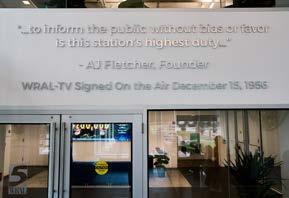

serving this local community,” he said. “They can decide how much profit they’re going to make and how much service they’re going to provide. In a big company, that’s not going to be a local decision.”
The investments paid off: Under Goodmon Sr., the station was widely lauded as the best in the region, beating out its neighbors WTVD/ABC11 (owned by Disney) and WNCN/CBS17 (owned by Nexstar).
“We may have been breaking the same story, but more people were watching [WRAL], and that was a fact,” said Dwayne Ballen, a sports anchor for Channel 11 in the 1980s and ’90s.
Also during Goodmon Sr.’s tenure as CBC president, the company bought the Durham Bulls minor league baseball team, sprouted a real estate division, and redeveloped Durham’s abandoned American Tobacco factory campus into a multiuse district. Jimmy’s brother, Michael, runs the company’s real estate and sports divisions.
The elder Goodmon wanted Jimmy to learn every part of the broadcasting business he would one day lead. So in the 1990s, Jimmy started working as a camera operator for WRAL’s 5 a.m. newscast. He was 16 years old.
From there, Goodmon Jr. bounced between different areas of CBC’s increasingly vast network of businesses, managing a handful of radio stations, acquiring new properties for the company, and leading CBC’s New Media Group. In 2017, he became president and COO of CBC. This May, he officially took over the CEO title from his father, who continues to serve as chairman of CBC’s board of directors.
“Dad, to me, is the GOAT,” Goodmon Jr. said, using the
acronym for Greatest Of All Time. “Everything I learned about what we’re up to comes from him. … He sort of lives rent-free in my mind and heart all the time.”
But Goodmon Jr. is operating in a different media landscape than his father. The generation of TV watchers who tuned in like clockwork for WRAL’s evening news is aging. Younger people are much more likely to get their news from websites, apps, and social media than television, according to Pew data.
“Our audiences are changing so fast,” Goodmon Jr. said. “It's definitely become a more complex business in order to serve those needs.”
In 1995, WRAL broadcast four hours of local news each weekday. Today, that number has ballooned to 11 hours across WRAL and WRAZ, the local Fox affiliate that Capitol Broadcasting also owns. Then there’s WRAL News Plus, a 24/7 streaming channel that provides continual news and weather updates. Not to mention the mobile app, website, and multiple radio stations pumping out their own feeds of local news.
More local news sounds great on its face, but there are a couple of potential problems with this strategy. For one, WRAL is still an advertising-based company, and digital advertising is far less profitable than TV advertising— Meredith called it “trading analog dollars for digital dimes.”
Plus, WRAL doesn’t seem to have expanded its reporting staff in proportion to its new multiplatform endeavors. The station would not tell The Assembly how staffing levels have changed in the last decade, but former employees say they watched their departments shrink even as they were asked to produce more.


Goodmon Jr. pushed back against the idea that recent departures at WRAL are anything more than the usual churn all companies experience: “We’ve had a lot of people who have left in my tenure. How I would compare that to now is, it’s the exact same as it’s always been,” he said.
Former staff tell a different story. The Assembly spoke to several longtime employees who said they were laid off or offered steeply reduced contracts. Others said they saw the writing on the wall and left of their own accord for new opportunities. They said the station feels less like a family and more like a business than ever before—nothing irregular in the competitive world of local broadcasting, but a departure from the WRAL of decades past.
Earlier this month Laura Leslie, WRAL’s capitol bureau chief, announced she was leaving the station to become the new editor at NC Newsline, a Raleigh-based nonprofit news site. Leslie spent nearly 15 years at WRAL and became one of North Carolina’s most authoritative voices on state politics.
She declined to comment to The Assembly about why she decided to make the move, but wrote in an announcement that “at a time when so many traditional media outlets are shrinking, [NC Newsline’s parent] States Newsroom is expanding its coverage of policy debates that affect readers’ everyday lives.” She added that she’s “grateful to WRAL for the opportunity the station gave me and the many skills I learned during my time there.”
Following Leslie’s announcement, WRAL news director Mike Friedrich told the News & Observer she “has been an
important contributor for several years, but we are proud of our NC Capitol Team already in place.” Some WRAL veterans considered that disrespectful to Leslie.
Leslie is not the only recent high-profile departure. In March, visual design director Shan Zhong, a 37-time regional Emmy award winner, left after almost 19 years. He did not respond to a request for comment.
Enterprise executive producer Ashley Talley also left in March; she, too, declined a request for comment. Talley oversaw Murrow- and Emmy-award winning work during her nearly six years at WRAL and now works for Tegna.
Anchors Julian Grace and Aaron Thomas both departed the station abruptly this summer after each worked there for six years. Thomas did not respond to a request for comment, but has taken an anchor/reporter job at WLWT in Cincinnati. Grace told The Assembly that when his contract with WRAL ended in June, he decided to take a break from journalism to promote his new book.
News anchor Debra Morgan, a 32-year newsroom veteran, also left WRAL this summer and did not respond to The Assembly’s inquiries about why and what’s next for her.
Beloved lead anchor David Crabtree, 19-year news director Rick Gall, politics reporter Travis Fain, reporting veteran Amanda Lamb, and general manager Joel Davis all moved on for new opportunities or retired within the last two years. Although they left by choice (Crabtree was 72 years old when he left to become CEO at PBS North Carolina), their colleagues said the loss of institutional memory is a blow for the station, whose staff is leaning younger and less experienced.
I felt like I had done all the right things, worked through the ranks, paid my dues … and then all of a sudden, boom, the rug is pulled out.
– Jeff Gravley, former WRAL sports anchor
Gilbert Baez reported from Fayetteville for 17 years until late 2024, when he was told his contract wasn’t being renewed.
“They had every right to do that. I had 17 great years with them,” Baez said. “I’m sure WRAL and WTVD and WNCN, everyone is making adjustments right now. That may seem shocking, but it really shouldn’t be.”
Arri Woodhouse, an associate producer who started at WRAL in 2023, resigned in April 2024 to take a broadcasting job in Charlotte at Queen City News (WJZY).
“In all the newsrooms that I’ve ever worked in,” she said, “you will see somebody one day, and then you’ll come in the next day, and there’s an email saying, ‘This person is no longer with the company.’”
Still, Woodhouse found the departures at WRAL jarring.
“They got rid of all of our administration at the front desk,” she said. “And a few other people that I wasn’t exactly close with, but it was definitely felt when they left, because their responsibilities fall on other people. … It definitely led to people being overworked.”
Six former employees requested anonymity to speak candidly with The Assembly. Almost universally, they acknowledged that WRAL is up against the same headwinds as the entire TV news industry and that turnover is normal, but they expressed discomfort that longtime employees were leaving against their will or, in some cases, without giving any explanation to the staff.
Asked about the departures, Goodmon Jr. was adamant that “we haven't made any mistakes” and that the few times WRAL has terminated a contract, it was for cause. He also said that the news team has grown compared to 10 years ago.
“We compete with Disney right next door, and Sinclair, and then there’s little old redneck Capitol Broadcasting Company,” he told The Assembly. “And what do you think [the others] are doing? They’re cutting without reinvestment.”
Jeff Gravley spent most of his three-decade journalism career at WRAL. He started in 1985 as an intern and
worked his way through the ranks to become a sports photographer, then a reporter, and finally a sports anchor.
For a long time, it was a dream job. He covered ACC tournaments, Final Fours, two Super Bowls—the station even sent him to Rio de Janeiro for the 2016 Olympics. His coworkers, many of whom he’d worked with for decades, felt like family. Together, they were producing some of the most-watched, highest-quality local news and sports coverage in the Triangle. Gravley was named WRAL’s lead sports anchor in 2008 and racked up seven regional Emmy awards.
In summer 2019, he was called into a meeting with the station’s general manager and news director. They told Gravley they were terminating his contract early and offering him a new one at half his previous salary. There were no issues with his performance, Gravley remembers them telling him during the meeting. This was purely a financial decision.
Gravley ended up turning down the new contract and leaving WRAL—and journalism—later that year. He now works for the N.C. State athletics department.
He believes he got out at the right time: His early years on the job coincided with WRAL’s financial and ratings heyday, but by the time he left, things weren’t so rosy. The sports staff was traveling less, getting less air time, and had shrunk considerably.
“It was a gut punch,” Gravley recalled. “It happens in business. But when it happens to you at a place with a reputation like WRAL, it kind of hits different. I felt like I had done all the right things, worked through the ranks, paid my dues … and then all of a sudden, boom, the rug is pulled out.”
When The Assembly visited WRAL recently for a newsroom tour, rain was slanting down in sheets outside. Severe weather means a busy day of breaking news (WRAL has seven meteorologists) and live updates for the news team, and the building was humming with activity.

Goodmon Jr., dressed unfussily in khakis and a navy Durham Bulls-branded polo shirt, traded greetings with camera operators and producers as he loped down long corridors past banks of monitors.
He stopped to point out a shiny new piece of tech: an automatic teleprompter that learns individual anchors’ speech patterns and customizes the pace of its scroll. Back in the day, Goodmon Jr. used to operate a manual version of the teleprompter during live newscasts.
“That position that I was in isn’t here anymore. We don’t have a teleprompter operator anymore,” he said. “But think about all the things that we’re doing now that we weren’t doing.”
In one studio space, a reporter in a suit and a teenage camera operator in a headset were filming a traffic report. After they finished, Goodmon Jr. ambled up to the operator and started ribbing him. “It looked a little bit shaky in the last shot,” he teased.
The young camera operator was none other than Goodmon Jr.’s eldest son, Fletcher, who is 16. The
presumptive heir to the Capitol Broadcasting empire blushed as his dad leaned in for an awkward forehead kiss.
“There’s nobody who wants things not to change more than me,” Goodmon Jr. said later that day. “However, I also realized very early in my life, that’s like talking about unicorns. Everything is going to change.”
Jane Porter contributed reporting.
Chloe Courtney Bohl
Chloe Courtney Bohl covers Wake County for INDY
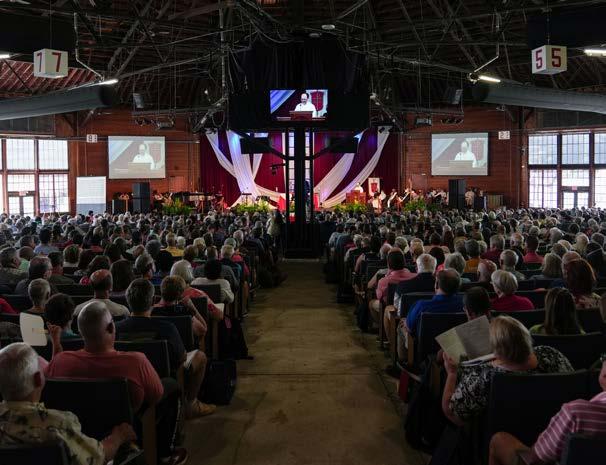
Inside the United Methodist Church’s acrimonious split over gay marriage and ordination.
BY BARRY YEOMAN | PHOTOGRAPHY BY JULIA WALL
N.C. has more Methodists than any state other than Texas. When long-simmering tensions over gay marriage and ordination came to a boil, we looked at how it was affecting churches here at home. By the time the UMC moved forward with a more progressive stance in 2024, 36 percent of congregations here had decided to depart.
TThe Rev. Chris Fitzgerald walked out of Wesley Memorial United Methodist Church in Statesville feeling like he was about to explode.
He drove home, poured himself a glass of tea, and tried to calm himself with deep breathing. Then he reached for the blood-pressure monitor that he keeps on a nearby table.
Chris, this is stroke territory, the 65-year-old pastor said to himself as the black numbers flashed against a gray background. He thought about his plans for retirement: hunting deer, fishing for flounder, traveling to disaster zones in a tiny camper to volunteer his labor. A debilitating stroke, he feared, could take all that off the table.
Fitzgerald knew the reason his blood pressure had spiked: a meeting that afternoon in the church fellowship hall that exposed his congregation’s longstanding but unspoken divisions. What began as a one-way “information session” had turned into a jagged debate over the issue that has consumed Methodists everywhere.
For decades, the United Methodist Church (UMC), America’s largest mainline Protestant denomination, has taken a hard line against same-sex marriage and the ordination of noncelibate lesbians and gay men. The UMC reaffirmed and even toughened that stance in 2019. But a sizable number of clergy and laypeople rejected the position as harmful and un-Christlike, and the long-running dispute has triggered church trials, civil disobedience, and mass arrests. Each side has accused the other of dishonesty and political maneuvering—a cycle of mutual recrimination.
As the rancor dragged on, it became evident that one side needed to leave. A group of traditionalists made the break this spring, launching a new denomination called the Global Methodist Church.
Congregations like Fitzgerald’s now need to pick a side. Or they can choose not to decide, and remain in the UMC by default. For theologically homogenous churches, the direction might be clear. But Wesley Memorial’s 400 members span the gamut, the minister said, “from almost flaming progressive to dang near fundamentalist.”
They are, in other words, a cross-section of Methodists, bracing for a high-stakes conversation that they managed to avoid until 2022. “I’ve got those who are adamant about, ‘I don’t want to be a part of an apostate church, and right now I feel like I am,’” Fitzgerald said. “And I’ve got those that are just as determined, saying, ‘I will not be a part of a traditional orthodox congregation. And if we do not stay United Methodist, then I will be leaving.’”
He wondered that Sunday, as he wonders often, how long his flock will continue to worship in the same building—how long the “United” in their name will hold.
The Methodist movement is sometimes called “America’s church” because of how closely it mirrors the fault lines and contradictions that permeate our culture. Its moral trajectory has been a zigzag. It cleaved over slavery; opposed sweatshops and child labor; sparred over desegregation (the U.S. Church is 94 percent white); and condemned America’s involvement in Vietnam as a “crime against humanity” while supporting both resisters and enlistees. It has steadfastly opposed the death penalty and maintained a “reluctant” support for abortion rights, peppered with caveats.
“Sometimes it’s prophetic,” said the Rev. Amelia StinsonWesley, pastor at Memorial United Methodist Church in Charlotte. “And sometimes it’s just 40 years too late.”
No modern issue has roiled the Church so much as homosexuality, which Methodists started debating at their 1972 legislative session, the General Conference. That year, a committee floated a measure affirming the “sacred worth” of gays and lesbians and advocating for their civil rights. Some delegates, responding to popular stereotypes, reacted with outrage. “If this in any way gives them a license to continue in their activities of preying upon the young men of our community,” said one, “I want it eliminated.”
The conference did pass the measure, but only after adding a statement calling homosexuality “incompatible with Christian teaching.” That language remains in effect today.
The debate kept resurfacing—every four years at the General Conference, and in local skirmishes, too. One of the earliest played out in North Carolina, home to 1 out of every 13 U.S. United Methodists—the nation’s secondlargest population after Texas.
In 1988, the Rev. Jimmy Creech, who is straight, marched in Raleigh’s Pride Parade, and the ensuing conflict cost him the pulpit at Fairmont United Methodist Church. Creech moved to Nebraska, underwent two church trials, and was defrocked in 1999 for co-officiating a same-sex holy-union ceremony in Chapel Hill.
Over time, attitudes changed. In 2007, a Pew Research Center survey showed that 51 percent of U.S. Methodists believed homosexuality should be accepted. That figure rose to 60 percent by 2014. Two years later, when the Rev. Valerie Rosenquist married two men at Charlotte’s First United Methodist Church, she survived a battery of complaints without losing her pulpit or her credentials.
But with the rising belligerence of American politics, the battle has only escalated.
“As our country became more divided, us-and-them politically, outside of the Church, that creeps into the Church,” says the Rev. Lory Beth Huffman, a district superintendent in the UMC’s Western North Carolina
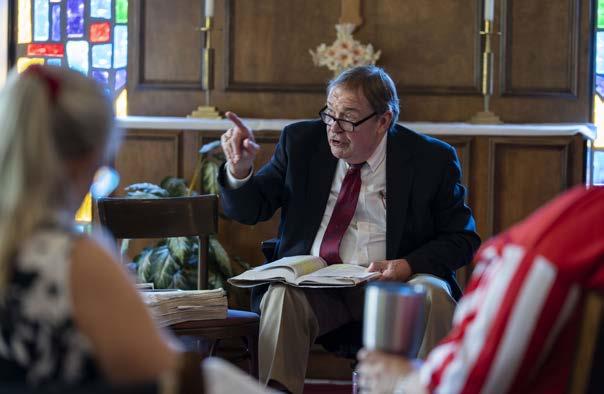
Conference and an advocate for more inclusion. “Instead of being able to have honest conversations—to wrestle with, ‘What is God saying here? What is Scripture saying here?’ in our Methodist way, ‘What is our experience telling us here?’—it became, ‘Oh, you’re either a Biblebelieving Scripture follower or you’re not. You are of the culture, and you are not being faithful.’”
There was talk of the Church splitting, but that wasn’t so easy. Each congregation owns its property in trust for the larger denomination. If a congregation leaves, it risks forfeiting its building and other assets.
At the 2016 General Conference, delegates introduced more than 100 resolutions related to human sexuality. Rather than take them up, the denomination asked a task force to review all sexuality-related church law. That was supposed to produce a practical solution. Instead, it accelerated the conflict.
Meanwhile, Chris Fitzgerald was settling into his new job at Wesley Memorial.
All Flavors of Belief
Fitzgerald knew where he stood on LGBTQ issues. A
self-described “dinosaur of a preacher,” he’s the 15th Methodist minister in his family—“a genetic defect,” he calls it—and has been preaching for 43 years.
“It’s not just a job,” he told me. “My sister said, years ago, ‘You have a mistress,’ and I said, ‘I do not.’ She said, ‘Yes, you do. It’s your church.’” He paused, then added, “Guilty.”
He arrived in Statesville in 2015 from First United Methodist Church in High Point, where a lesbian couple had asked him to baptize their twins. “Incredibly nice, loving people,” he said of the women. “Both in the health care profession. Both the kind of person that you would really want taking care of you.” But he also believed heterosexual marriage was essential to God’s plan, and flouting that plan was a sin.
“Regardless of what you may want to believe, ‘male and female He created them,’” he said, quoting from the book of Genesis. “And that was for a reason. That’s part of the created order, and Jesus upheld that.”
Fitzgerald agonized for weeks, and talked with colleagues, before declining the request. “It’s not about the babies,” he said. “Those babies are as innocent as can
be.” Nor was it based on a conviction that the mothers were going to hell. “Oh, gosh, that’s way beyond my pay grade,” he said. “I am not the one who makes that call.” But the baptism ceremony would have required the women to vow to repent their sins, and he knew they weren’t about to forswear their intimate relationship. (After he left High Point, he said, his cousin took over the job and immediately baptized the children.)
The pastor knew the irony: He is divorced, and that too is a sin in his faith. In fact, he noted, Jesus said nothing about same-sex marriage, but plenty about divorce.
“Then how do you dare do that, Chris?” he asked. “You throw yourself on the altar and say, ‘Lord, I never intended to go through this. But I did. And having gone through it, I’ll try and live the rest of my life single and celibate.’”
Self-denial, he said, can be grueling: “When I see certain women, I go, ‘My lands! She is fearfully and wonderfully made.’ And if I’m not careful, my mind will go to all sorts of places. And I have to reel that in.”
When he was reassigned to Statesville, Fitzgerald understood he’d be leading a congregation with “all flavors” of belief. One of 41 United Methodist churches in Iredell County—which flanks Interstate 77 from the Charlotte exurbs north to the edge of Appalachia— Wesley Memorial runs two distinct Sunday services. There’s contemporary worship in the fellowship hall, with electric guitars and T-shirts and cardboard cups of Starbucks; that’s followed by a more formal service in the A-frame sanctuary, with robes and sashes and chimes.
During the break, adult Sunday school classes teach competing theologies. When I attended one class, it was reading Robin R. Meyers’ Saving Jesus from the Church, which advocates a faith that uplifts compassionate action over condemnatory words. Members of that class were pooling funds to give to an LGBTQ support group.
Members arrive each Sunday with different life experiences—all those losses and traumas—that in turn have produced different values, different interpretations of Scripture, and different understandings of how knowable God’s intentions are.
“The issue was settled before I was alive,” said Seth Dufault, a 36-year-old who works in wastewater maintenance and who considers homosexuality a sin. “We don’t have to have this back-and-forth. God settled it … I’m just here to do his bidding.”
“You could put on a head of a pin, probably, what the whole human race knows about God, in relation to what God is,” said Sara Thompson, a retired high school English teacher who favors more inclusiveness. “In my heart, nothing trumps human kindness.”
Shortly after his arrival, Fitzgerald said, he told the leadership team that Wesley Memorial would need to reckon with the larger Church debate over
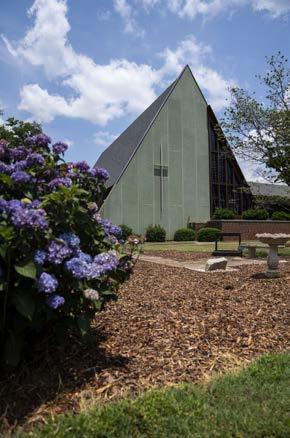
The A-frame sanctuary at Wesley Memorial United Methodist Church in Statesville hosts a formal service each Sunday morning, which differs dramatically from the earlier contemporary service in the fellowship hall.
homosexuality. But he was reluctant to push the issue before he needed to.
“There’s enough chicken in me that wants to avoid conflict, wants to avoid seeing a congregation split, that the most tempting thing is just to push it all under the rug,” he said. “Well, it’s not going away. It’s really not.”
The task force that came out of the 2016 General Conference developed three separate proposals. The front-runner had the support of the UMC’s Council of Bishops, a body of senior clergy who oversee different geographic regions. It was called the One Church Plan, and it envisioned a diverse denomination in which individuals could act out of their own consciences.
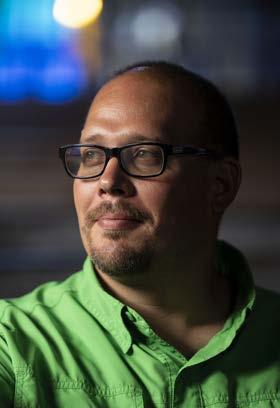
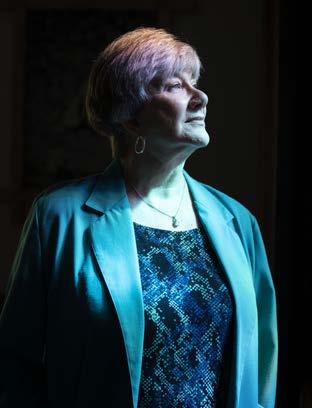
Ministers could choose to marry same-sex couples, but no one would be forced to. Local bodies could develop their own ordination standards. And for the first time since 1972, the language of incompatibility would disappear.
The UMC called a special off-year General Conference in 2019. To the surprise of many, the One Church Plan lost. U.S. conservatives teamed up with the growing international delegations—particularly from Africa, where the Church is having a heyday—to kill the big-tent legislation. Instead, they passed something called the Traditional Plan, which kept the restrictions in place and toughened enforcement. A minister officiating at a same-sex wedding would now be suspended without pay for a year. After a second wedding, they would be stripped of their credentials.
The decision sparked protests, bribery allegations, and questions of voting irregularities. Some advocates of inclusion felt blindsided. “It was a targeted, wellplanned, well-executed flashback that many of us did
not expect,” said the Rev. Mary John Dye, interim pastor at Triplett United Methodist Church in Mooresville. “It was a takeover. It was a planned takeover.”
Even some conservatives were caught off-guard. “I was shocked, but I was also relieved and happy,” said the Rev. Angela Pleasants, a former UMC minister in Charlotte who now works for the breakaway Global Methodist Church. “But then there was also a part of me that said, ‘Oh, boy, this is not going to be good, because now it’s going to be amped up even more, this hostility back and forth.’ And sure enough, it did happen.”
Four months later, Methodists from Western North Carolina, including Iredell County, gathered at their mountain retreat center at Lake Junaluska for the region’s annual conference. Advocates of inclusion were in the majority, and they passed a statement of dissent by a 63-37 margin. “We commit to resist evil, injustice and oppression in all forms,” it said. “We reject the Traditional Plan approved at General Conference 2019 as inconsistent with the gospel of Jesus Christ and will
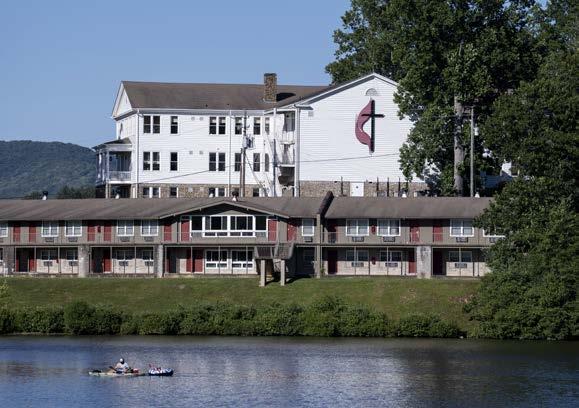
resist its implementation.”
Then the Western North Carolinians elected their delegates to the 2020 General Conference—a nearsweep of pro-inclusion candidates. “Everybody who was elected is not a wide-eyed liberal,” said Dye, the Mooresville pastor. “Not by a long shot. But conservatives were not going to be elected. They were no longer trusted.”
Fitzgerald was at Lake Junaluska and felt the lack of trust. “Never have I been at an annual conference … where there was so much enmity, meanness, strife, backbiting, accusatory events from the top down,” he said. “It was such a clear display of progressive agenda, almost to the point of, ‘Why don’t you other people just die and get out of the way?’”
On the drive home, he said, he cried all the way down Old Fort Mountain.
Western North Carolina wasn’t an outlier. Regional bodies across the United States rejected the Traditional Plan. “That sent a huge signal to the denomination
that we’re getting ready to break,” said Huffman, the district superintendent, who had co-sponsored the Lake Junaluska resolution. “People are not going to uphold the Traditional Plan. Bishops, boards of ordained ministries—they were not going to abide by that. Which meant church trials were going to abound. Which meant it was going to be chaos.”
With a split inevitable, the UMC brought all sides to the negotiating table. Kenneth Feinberg, the attorney who helped broker the 9/11 and BP oil spill compensation funds, served as a neutral mediator. (He is Jewish.) Together, they hammered out a separation plan called the Protocol of Reconciliation and Grace through Separation. The UMC agreed to donate $25 million to launch a new, traditionalist Methodist denomination. Congregations could vote to leave the UMC and keep their property if they joined another Methodist group. Before taking effect, the plan needed to be ratified by the 2020 General Conference.
“And then COVID just wrecked it all,” said Huffman.
When you become a Christian … you surrender yourself. What you feel morally is right and wrong has to be adjusted with what God tells you is right and wrong.
– Seth Dufault, congregant
The General Conference got postponed to 2021. And then again to 2022. And then to 2024. The Protocol never got ratified. Traditionalists grew impatient. This May, they launched the Global Methodist Church without waiting for the formalized agreement (or the $25 million). “We’ve already seen that there’s not going to be a way that we can do this together in an amicable way,” said the Global Methodists’ Pleasants.
Under temporary rules, a church that cannot abide by the UMC’s direction on homosexuality may disaffiliate and keep its property. It needs to pay an exit fee, ranging from tens of thousands to more than a million dollars, to cover obligations like unfunded clergy pensions.
At Wesley Memorial, the two sides were about to have the conversation they had long deferred.
‘You Surrender Yourself’
Fitzgerald, anticipating the schism, finally wrote a sermon earlier this year about homosexuality. He showed it to some people he trusted. “I had a music staff person say, ‘If you do this, you’re going to tear the music program apart. I’m going to lose some of my main singers,’” he said.
He decided to shelve it, at least for the time being. He did call a pair of meetings, with different speakers, to discuss the tensions within the denomination. The first would take place after services May 1, the same day the Global Methodist Church launched.
That morning, Sara Thompson, the retired teacher, attended the formal service, as she has for 50 years. Her views of LGBTQ people had been shaped by a series of personal encounters—“like lampposts lighting me to my decision,” she said. There was the high school friend who always took her out on their shared birthday, and who she later learned died of AIDS. The gay student who got taunted by two other boys inside her classroom until he finally shouted, “Leave me alone!” The hairdresser who waited for years for the right to marry his husband, only to be widowed shortly afterward.
“Marriage is church,” said Thompson. She and her husband had married at Wesley Memorial, “not because I
thought it would be less legal if I went to the courthouse, but because it meant something spiritual to me to commit to somebody. Why should anybody not have that if that’s what they want?”
At the same service, Rebecca Hitch put on a red robe and sang in the choir, as she did back when her husband was the pastor. She was thinking that day about her gay nephew, whose kindness, she said, was evident since childhood. When her mother had dementia, he would sit with her and answer the same questions over and over, never losing patience.
The nephew was raised United Methodist, and she believes that, as a young adult, he could have used the love of a congregation. “With a policy like the Methodist Church has now, how can you feel that they love you?” said the retired school human-resources professional. “It’s got to impact your faith.”
Seth Dufault, the maintenance worker, attended the contemporary service that day. As a teenager, Dufault drifted from the church that had looked down on his family after his parents’ divorce. Then he, too, suffered a nephew’s death, which shook up his priorities. He returned to faith in his 20s, he said, and worked on humbling himself before God.
This was, and remains, hard for someone who considers himself an “alpha male,” but he said he recommits every day. “When you become a Christian … you surrender yourself,” he said. “What you feel morally is right and wrong has to be adjusted with what God tells you is right and wrong.”
Dufault read the Bible cover to cover. As he worked to discern its meaning, he arrived at the Sermon on the Mount, in which Jesus said, “One jot or one tittle shall in no wise pass from the law.” This, to him, acknowledged the continued relevance of Old Testament law, including the prohibition on homosexual acts. “Now, I don’t think they need to be put to death,” he told me. (In fact, he supports civil marriage for his gay friends, following Jesus’ directive to “render to Caesar the things that are Caesar’s.”) “But at what point am I a servant of God? Or do I assume that I know better than God?”
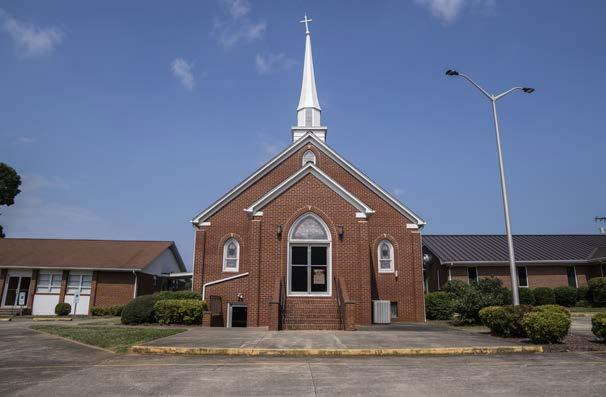
From across the theological divide, about 100 people arrived at the fellowship hall on that day in May. They sat at round white banquet tables and waited to hear a stranger make the case for leaving their denomination.
That stranger was the Rev. Cliff Wall, pastor at Clarksbury United Methodist Church in rural Harmony, near Statesville. A firebrand at the lectern, Wall has criticized his colleagues for “dithering” over sexual morality—even as, in his view, a defiant U.S. clergy and leadership have undercut the UMC’s strict rules.
“We have to be honest about where we are,” he told the members of Wesley Memorial. “The United Methodist Church is becoming more and more ungovernable. … You are actually now being asked to celebrate and accept the LGBTQIA+ spectrum, which does include drag queen, cross-dressing ministries in the local churches. And if you haven’t caught on yet, this is a total abandonment of the teaching of Jesus.”
The parishioners were directed to listen quietly and write
their questions on notecards. Mostly, they did. But an hour in, Sara Thompson felt herself getting physically agitated.
“You are sensationalizing,” she said. “Jesus never spoke on homosexuality. He never spoke on it.”
“He did speak indirectly about it,” Wall said.
“Not indirectly,” Thompson replied. “He never spoke on it. And it was well known in his time.”
With the silence lifted, Rebecca Hitch chimed in. “I’m divorced, OK? According to the Ten Commandments, plus what Jesus said about marriage, I’m an adulteress.” Even so, she continued, “I can still pastor a church in the United Methodist Church. True or false?”
“Yes, that is true,” Wall said. “In the Global Methodist Church”—the new denomination—“if there’s repentance and contrition, we’re not going to teach that it’s the unforgivable sin.”
Then why exclude gay men and lesbians? “He never said anything specifically about homosexuality that I’ve ever read,” Hitch said. “True or false?”
“There’s a lot of things that Jesus never explicitly speaks about,” Wall said.
– Sara Thompson, congregant
Hitch asked for one last statement. “I don’t want to get emotional here,” she said, her voice cracking. “My sister’s older son, three years ago at the age of 27, shot himself. He was gay.” (He didn’t leave an explanation for the suicide.) “So, yes, I am biased in this area, as far as what I believe about homosexuality and whether or not it’s a choice, and whether or not you can go through some kind of conversion therapy and be cured of it. I don’t believe any of that, and so you can call me biased. I am laying it on the table here. But—”
“I understand,” Wall said.
“—I don’t think that I am less of a Christian person because I believe like I believe.”
A minute later, Wall asked the audience to imagine a polyamorous couple applying for membership. “What do you tell the couple when they say they want to join the church, but they’re not willing to give up that lifestyle?” he asked. “And, in fact, they think it’s such a great lifestyle that they want to start a swingers’ club at the church?”
“Has that ever happened in your career?” Thompson asked.
“Not in my career,” Wall said. “But—”
“I cannot imagine it happening,” Thompson said.
“It is happening,” Wall insisted.
“We do not screen people that come to church here,” said another member. “We’re not going to kick them out because we don’t like their lifestyle. That’s not for us to judge.”
“I’m sorry,” Wall said. “But was she saying that we would allow just anybody with any behavior?”
“You’re judging,” Thompson said. “You’re judging people, when literally the Bible says, ‘Judge not, lest you be judged.’”
“Hold on, hold on,” said Seth Dufault. “What does the rest of the Scripture say?” That chapter from Matthew, as he understands it, teaches how to judge, not not to judge: to take the plank from your own eye before removing the speck from your brother’s.
Two weeks later, when the UMC’s Huffman came to offer a counterpoint, Dufault stayed home. Upset as he was by how argumentative the other side had become, he was concerned that, with the roles reversed, he might do the same.
Some Methodist churches are ticking along without having this wrenching conversation. I attended one of them in mid-June: Monticello United Methodist Church, just outside Statesville city limits. Joining me was one of its members, a 56-year-old lesbian named Donna England.
England is an Army veteran who runs a business cleaning and beautifying graves. Her volunteer résumé is exhaustive: a literacy camp, a homelessness ministry, a reentry program for former inmates, noncontact boxing classes for people with Parkinson’s disease. She lives on a cul-de-sac with her partner of 23 years, Sherry Morgan, and two elderly dogs. They have an adult daughter and two grandchildren.
This conventional life was not where England was headed. She had grown up hearing her family disparage a gay cousin, and for years tried to deny her own orientation. She drank and took drugs, and blamed the inebriation for her same-sex attractions. “I would always laugh it off,” she said. “‘You’re drunk; you’ve smoked too much pot; you took too many pills.’ There was always this excuse.”
In the military, England was raped and became pregnant as a result. When she decided to have an abortion, she thought her path was sealed. “I believed that God hated me, that my name had already been scratched out of the Book of Life,” she said. “And so, hell with it. If you’re telling me I’m going to hell, all right, look out, because I’m gonna have a good time going.”
Then, in her late 20s, England entered rehab. She got sober, but the attractions remained. It felt like a hole that she could never dig out of, and in her despair she attempted suicide several times. “What do you do when you’ve been told, at your core, you’re an abomination?” she said. After waking from one overdose, “I remember lying there thinking, ‘I’ve gotta pee.’ And it was like, ‘Fuck, I gotta pee. I didn’t die.’”
What pulled her out of that hole, she said, was prayer. What kept her out was an LGBTQ-inclusive church that she started attending in the Hickory area, where she was living at the time. She came out to family members, who proved more welcoming than she had expected. She and her partner moved home to Statesville. There, she sought out a mainstream church. “I didn’t want to be all in the

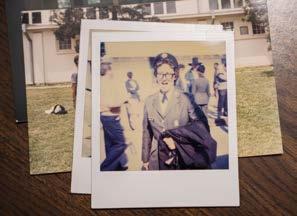
gay business,” she said. “I wanted to be as much a part of society as I could possibly be.”
In 2012, England went to a funeral at Monticello, to which generations of her family had belonged. It felt like homecoming to her. A few weeks later, she reached out to the Rev. Jill Rhinehart, the pastor at the time, and asked if she’d be welcome as an open lesbian. “Listen, I don’t need to be prayed over,” she remembers telling the minister. “I’m completely fine with where I’m at today.”
England recalls Rhinehart laughing. “You’re more than welcome,” the pastor said. “If anybody gives you any trouble, let me know, and we’ll have some education.”
To Rhinehart, who now preaches at Central UMC in Albemarle, this was not a conundrum. “It just boils down to love,” she said. “The Scriptures back up my belief that all people have value. God tells us to love God with our heart, our soul, and body, to love our neighbors as we love ourselves. And Donna is my neighbor.”
England threw herself into her new church. She shared her story and befriended other members. Within months, she was elected a church trustee. “It was interesting to watch this older group of people come to understand the struggle that this wonderful lady had gone through,” Rhinehart said. Homosexuality became
Sometimes it’s prophetic. And sometimes it’s just 40 years too late.
more than an abstraction to them: “It was a name with feelings, and a person that needed to be loved and accepted, just like us all.”
The Sunday that England took me to church, a lay leader was preaching on a Father’s Day theme. The sermon was peak North Carolina: an Andy Griffith Show video clip, an anecdote from the Cracker Barrel, quotes from the late evangelist Billy Graham and the late N.C. State Wolfpack basketball coach Jim Valvano.
Afterward, we were invited to stick around for muffins. England made the rounds through the sanctuary. Everyone wanted to talk with her, to put an arm around her. Before we left, England took me into a small chapel built from material salvaged from Monticello’s old building. There were the wooden pews her forebears had sat in. The stained glass they’d looked at during services. England has not married her partner, because a church wedding matters to her, and she’s waiting for the denomination to come around.
When that day arrives, this is where she plans to say her vows.
“I really believe that the things that we touch— physically, mentally, and spiritually—we leave parts of ourselves with,” she told me. “And I feel like there’s parts of my family in that chapel.”
Four Sundays after the tense meeting at Wesley Memorial, Fitzgerald donned a black robe and white sash and stood in front of the sanctuary during the formal service. He talked about Christ’s ascension, and how afterward his believers “all continued with one accord.”
Being of “one accord,” Fitzgerald preached, doesn’t mean agreeing on everything. In the New Testament Book of Acts, Paul and Barnabas couldn’t agree on whom to take with them on a mission trip—so they split up and traveled to different places. “They didn’t speak evil of one another,” he said. “And they did not argue after their initial difference. They went their separate ways as friends.”
And that decision, he said, paid off: “Twice as many people were reached.”
After the benediction, Fitzgerald stood at the exit and
greeted members. His thoughts returned to the sermon. “Is there a message implicit to the congregation?” he asked me. “Sure, there is. We can disagree without being disagreeable.”
He knew, of course, that the disagreeability was already happening. “I think part of what is so grievous,” he said, “is that the world looks at Christians and churches rent asunder by conflict and they go, ‘That’s Christianity?’”
It remains unclear whether, or when, Wesley Memorial will vote on leaving the United Methodists. On August 14, the church’s administrative council will vote on a motion to initiate the disaffiliation process. If the council votes “yes,” that will trigger a process that can take two to six months. It will culminate in a churchwide meeting and a vote of those members present. The bar for disaffiliation is high: A two-thirds supermajority must approve. Under the current rules, churches that want to keep their property needed to leave before the end of 2023.
So far, disaffiliations have been a trickle—no surprise, as the Church intentionally makes the process cumbersome. At Western North Carolina’s annual conference in 2025, just 18 out of the region’s almost 1,000 congregations withdrew.
Angela Pleasants of the Global Methodist Church insists that those low initial numbers don’t reflect what’s coming. She said she’s receiving an “overwhelming” number of applications to join the new denomination, though she won’t say how many. “If it wasn’t so contentious, we would be more transparent,” she said. “But we’re trying to protect, as much as we can, the clergy.”
At Wesley Memorial, members are already anticipating the choices they’ll need to make. Some remain on the fence. “I know it’s time to pick a side,” said Danny Stafford, who has attended for almost half his 76 years and favors the current restrictions. “But most of us are elderly. We don’t want to change churches. We don’t want to move. Our friends are there—or at least mine used to be. I lost four friends because of this.”
If the church remains United Methodist, Stafford said, “I’m going to wait until they do something dastardly to Wesley Memorial,” like assign a gay minister there. “And then I’m going to walk out the door.”
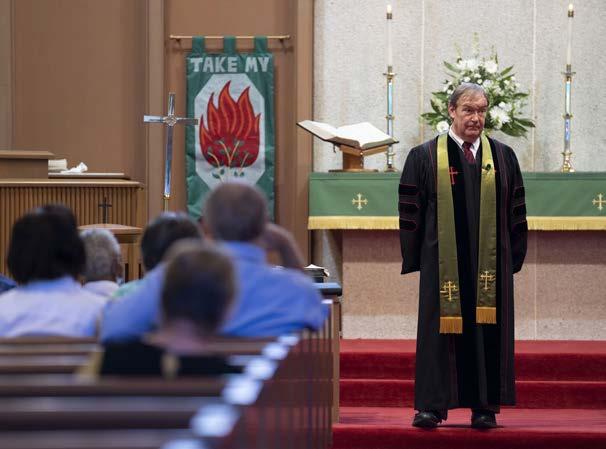
Others have made up their minds. Seth Dufault has declared that he will leave Wesley Memorial if it stays in the UMC. “I will go and find a church that wants to believe the Bible,” he told me. “We’re all looking at this as a terrible, terrible thing. Right? But if we get two churches out of this, and two people get reached instead of one, it’s still a positive.”
“Like Paul and Barnabas,” I said.
“Right,” he said. “Sad, but, hey, if we split, I know a great place I can put a church. There’s an old K&W up there. All the people know where it’s at.”
Likewise, if Wesley Memorial affiliates with the Global Methodists, Sara Thompson will likely leave. “I just might think my church days are over,” she said. “Because, and I’ve told ministers this, the real church is in your heart. I don’t need anybody to serve as an intercessor between me and my God.”
We were sitting on the screen porch at her home. It was breezy and quiet, with a tranquil view of her backyard. “This,” she said, “is a perfect chapel right here.”
Note: This article mentions suicide. If you or someone you know is having suicidal thoughts, call the Suicide & Crisis Lifeline at 9-8-8.
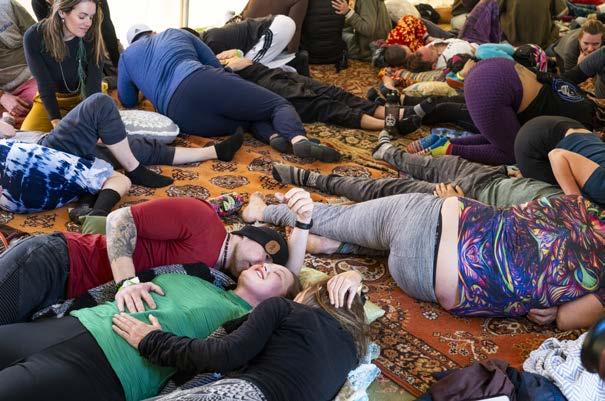
Strangers shed shame at the Unleash the Beast workshop.
When it comes to sex, some say a ′Magnolia Curtain′ hangs over the South. This festival sought to open minds and spice things up.
BY BILLY WARDEN | PHOTOGRAPHY BY BRYAN REGAN
This delightful, colorful romp about an April 2024 festival that tried to loosen those bow ties a little captures our desire to tell real, quirky, and unexpected stories about our state.
TThere will be nudity, the workshop’s online description makes clear. Also touching—consensual, of course. And there will be information designed to enhance not only human pleasure, but connection. A sensual seminar with soulful intent.
Not surprisingly, the workshop billed as “Oral Grad School” is among the most buzzed about at the first-ever Bliss Boogie festival, three days of music and interactive classes on everything from yoga and inner peace to the erotic uses of ropes, paddles, and kitchen utensils. All snuggled down a dirt lane in the swaying woods of a private campground in Chatham County.
As a thumping dance band wraps up its concert on the event’s second night, smiling seekers stream into the 2,000-square-foot tent for said master’s workshop. It’s unseasonably shivery for April, but these revelers tend to run hot.
“Can you imagine a sex-positive event like this happening here 10 years ago?,” marvels volunteer Chris Holt, 46, of Durham. “Or not even 10 years?”
By most reckonings, North Carolina has never seen anything quite like the Bliss Boogie. It may never again, depending on how the debut fares. While sex-positive events and kink happenings—think bondage, polyamory, etc.—are available in most major metros, they generally are not as carefully curated, publicized, or accessible to lay people as this one was meant to be.
Organizers have arranged for glamping tents, food trucks, and vendors hawking flowing frocks, charms, and adult toys. They’ve set up guardrails (like forbidding alcohol) to ensure a safe, supportive zone for exploring. And they’ve booked 45 workshop leaders, some jetting in from the West Coast.
With its mix of fresh air, consciousness-raising, and pleasure-seeking, the festival feels like a burst of California sunshine peeking over Cackalacky’s horizon.
Into the tent sweeps Reid Mihalko, Oral Grad School’s instructor, outfitted in Care Bears boxers and fur boots. The Oregon-based relationship counselor, presenter, and vlogger completes his distinctly nonprofessorial look with a T-shirt bearing his catchphrase: “Sex Geek.”
He is followed by a lean and limber woman wearing a crown of snakelike dreadlocks. With a lupine gaze, Kai Baylis—the festival’s Raleigh-based founder, avatar, and cosmic mother—assesses the capacity crowd of about 125 before folding onto the floor with everyone else.
Near her, a middle-aged former state employee in neon tangerine leans into the sturdy frame of a 50+ horticulturalist she only recently met. Across the tent, a tangle of 20-something couples sporting loose, earthtoned gear and manicured facial hair chat and laugh loudly.
Corralling the mixed and mirthful throng’s attention, Holt opens with ground rules: “If you take out your mobile phones, you’ll be spanked … OR, depending on what you’re into, you won’t be spanked.”
The crowd cheers. For the workshop that’s about to unfurl, yes. But also for the festival that many hope will peel back the so-called “Magnolia Curtain.”
Even for a seasoned therapeutic massage practitioner, the stretch of putting together a multiday festival hurts. Far from feeling transcendent, Baylis, 44, finds herself herding logistics.
“I’m striving to be fully alive, and at the same time dealing with porta potties,” she says in her cheery quick clip. “Did I get the right licenses for them? Are they coming to clean the porta potties often enough?”
Assisting Baylis is an eclectic core team that includes gray-bearded Georg Kluzniok, an events veteran from Santa Cruz; Wayne Hall, a burly former Army special operations officer; and marketing maven Tobi Bowen. They have also signed up around 75 volunteers.
When the universe first tapped Baylis on the shoulder about Bliss Boogie, it didn’t mention the myriad management details. Or the approximately $90,000 of Baylis’ own money it would take to pull off the event. She didn’t know how many people would show up, though at one point she hoped to sell as many as 600 tickets.
Two years earlier, she’d had an epiphany at SoulPlay, a northern California festival that invites revelers to “get grounded in our bodies and feel the immense love that is all around us … filled with transformational workshops, celebration, dancing, connection, and play.”
After 20 years of building the “body work and holistic wellness” practice The Living Room Raleigh, Baylis envisioned bringing together not just her wide variety of clients, but the array of communities pursuing wellness, desire, and pleasure in North Carolina, free of shame and disdain. Everything from communication skills and stress reduction to tantric sex practices (breathing, touching, and other techniques designed to increase connection and sexual energy) and BDSM (bondage and discipline, sadism, and masochism).
“These things are in people’s heads and hearts,” Baylis says. “It’s better for them to explore with integrity and in safety, so they don’t flounder at home. So they don’t have to go to a shady space. So they don’t have to deal with negativity.”
While such events thrive on the West Coast and in Europe among other hot spots, they are less common in the South.
Can you imagine a sex-positive event like this happening here 10 years ago?
– Eric Marlowe Garrison, author and sexologist
“The ‘Magnolia Curtain’ describes a mentality below the Mason-Dixon line,” says Richmond, Virginia-based author and sexologist Eric Marlowe Garrison. “If you bring up sex, the reaction is to clutch the pearls and say, ‘Lord, child, we don’t talk about these things!’ Not necessarily because of religion, but because it’s our culture. You could be a southern Christian, Jew, Muslim, or atheist behind the Magnolia Curtain.”
Which is not to say people don’t get their kink on in the Bible Belt. Founded around 2011, Durham-based PUSH hosts hundreds at its spring and fall extravaganzas billed as the “ultimate fetish party … the largest multipurpose kink/BDSM event in North Carolina.”
In Black Mountain, the Dancing Shiva Tantra Monastery debuted a two-day intimate and instructive retreat dubbed The Pleasure of Conscious Kink in fall 2023 for 15 customers and reprised the event May 3-5, 2024. Asheville is likewise home to get-togethers, tantric experts, cuddle parties, and other opportunities to explore. Some in the Triangle prefer to get kinky in Asheville, a Bliss Boogie attendee named Kate told me, because it’s a couple of hours drive and “they just feel more comfortable away from home.” (She declined to give a last name, presumably for similar reasons.)
Nev also requested a degree of anonymity, despite playing an outsized role in festivities at Bliss Boogie, where she presided over an Impact Play workshop, cracking whips and smacking kitchen spoons on the mostly naked body of a live model. “People have lives, careers, custody issues, family situations,” says the Sanford resident. “This is all still a coming-out story. We’re working on it, but there’s a lot of people who aren’t yet out.”
Because many of these events are not widely advertised or are held in private homes, it can be hard for the curious to investigate. So Nev, 58, discreetly publicizes and hosts small gatherings in public places throughout central and eastern North Carolina for people to ask questions and network.
“We saw a big influx right after COVID-19,” she said. “It was like what happened after Fifty Shades of Grey hit. People had more time to search things on the Internet and refocus on what they really want in life.”
Still, many remain in the dark. Nev and other attendees see Bliss Boogie as a potential answer: a brightly lit lifestyle-sampler and all-embracing celebration.
“The thing about this festival is it’s well-publicized,” says Garrison. “It has an inviting website, volunteers, online registration, sponsors, food, music stages. All at a sex-positive event. To some it may seem like Sodom and Gomorrah. To others it will be as comfortable as Dorothy going back home.”
For those arriving on opening day, Bliss Boogie begins with a proposition. “Would you like to be saged?” asks a volunteer greeter in a purple poncho. “It clears your energy.”
Consent received, the young woman swings a smoldering bundle of herbs around willing bodies of festival-goers one by one. The frosty forest air now flavored with notes of musk and pepper, another volunteer lays out the rules.
“Your ‘no’ is as sexy as your ‘yes,’” she announces. A “sanctuary tent” complete with therapists is available for anyone feeling triggered. As for those feeling frisky, “no oral or penetrative sex is allowed in public, but is fine in private tents.”
Wristbands offer insight on how approachable others might be. Red indicates someone who’d rather not be bothered—no thanks, on a private journey. Yellow means the bearer might want to engage, but please approach with tact and sensitivity. Green means, yep, let’s talk. In each public tent, bowls brim with free samples proffered by event sponsors Champ condoms and Überlube.
Ryan Taylor, 26, caught an ad for the festival on Instagram and rumbled up from Myrtle Beach solo in his used Mazda 6—grabbing a tiny pup tent from Walmart along the way. “I’d like to find someone on my wavelength,” he says, the breeze tugging at his long dark hair. “Someone sexually confident, not judgmental.”
Down a wooded slope from Taylor is an amiable young married couple from Germany by way of Raleigh—selfdescribed “vanillas” who nonetheless are “curious.” They smile in a slightly embarrassed way, as if they’ve shown up to a sneaker convention in wingtips.
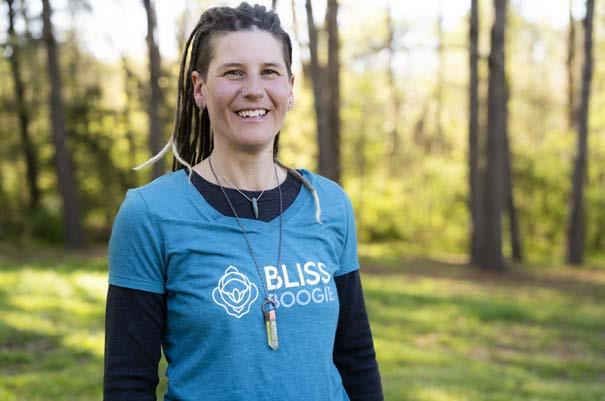
Fresh-faced enthusiasts of Ecstatic Dance—a playful, unrestrained, improvisational musical movement—ease through the hills in a grinning gaggle, collapsing into what one amused observer describes as a “cuddle puddle” on the plush rugs of the communal Chill Tent.
Perched outside her campsite, Stacey Carachure, glitter streaked across her cheeks, takes it all in—here at last. As a life coach, she advises clients on achieving their goals. “Watching them find happiness,” she says, “I realized it was time I find my own happiness.”
North Raleigh-based Carachure had long wanted to attend some kind of retreat, a place to learn and explore. At 47, she wondered, “When? With who? Will I have to go out of state? Am I too old?” Then a friend mentioned the Boogie; coming up soon, right around the corner and chock full of classes from the sensual to the spiritual.
Carachure invited her longtime boyfriend, who couldn’t make it. So she lit out with a pal as well as her son, Seth. The 19-year-old identifies as LGBTQ and explains he “just kind of woke up one day and realized I don’t want to be scared of the world anymore.”
Over the weekend, he eagerly masters the mechanics of knots in the ropes class and grooves in the grass to the bands.
“Honestly, I didn’t realize there were so many other people who share the same interests and culture as me,” he says, awed there’s a place where everyone “is so authentic and unapologetic.”
The online description promised nudity, and it did deliver. In the Saturday night session of Oral Grad School, Mihalko demonstrates how breathing techniques and judiciously applied pressure to the upper body enhance the experience of April, his live model (and fellow educator).
But most of the workshop’s information—including a move known as The Inverted Vulcan—is delivered through larger-than-life props representing male and female parts. And, as advertised, there is touching. Consenting partners practice applying the aforementioned pressure to each other’s clothed bodies.
If you bring up sex, the reaction is to clutch the pearls and say, ‘Lord, child, we don’t talk about these things!’ Not necessarily because of religion, but because it’s our culture.
– Eric Marlowe Garrison, author and sexologist

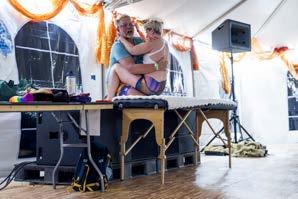



Carachure, who came into the workshop unsure she’d like it, is satisfied. “Talking about the body mechanics, engaging the pelvic floor, that was so interesting,” she says. “I learned so much about myself.”
Sitting in the crowd, Baylis reclines against her wife, real estate agent Mechelle Fuquay. The two married six years ago and share a suburban home in East Raleigh with a trio of canines, one of whom hobbles gamely on only three legs. In the broader kink and sex positive community, Baylis describes herself as “conservative.” Some of what she sees isn’t for her.
Which, she says, is exactly the point of the Boogie: “What works for you?”
The following day, the finale of the festival dawns with a camper inadvertently tripping her car alarm and a groggy voice from a nearby tent grousing, “Not sexy!”
The weekend drew fewer than Baylis and the team had hoped. The count on ticket-buyers stalled at 299. There’s talk of a GoFundMe campaign to help Baylis recoup costs, but she says she’d rather figure out how to sell more tickets next time. No one raises a peep about abandoning Boogie. The vibe is victorious.
“The baby is born!” proclaims Kluzniok, stretching out his arms as if bestowing a benediction.
More important than ticket sales or other typical measures, Baylis says, is the event’s impact on
participants. On that count, she notches the inaugural Bliss Boogie a success. She, too, has at moments known the gloom of feeling “alone and isolated” behind the Magnolia Curtain. After making “juicy connections” with Bliss-goers, she feels “1000% differently.”
Chatting with admirers, Mihalko pauses to assess the festival from the perspective of a well-traveled pro. “An act of creation like this is brave … and what’s happening here feels very important,” he says, wrapped in a rainbow-striped pajama onesie with his “Sex Geek” logo embroidered across the rear end.
“We may still feel weird, but not so alone. Being weird and alone is very different from being weird, loved, and with friends.”
Perhaps a step closer to something like bliss.
Billy Warden is a writer, journalist, TV producer, and marketing executive as well as two-time TEDx speaker.
8 hospitals
8,000 skilled professionals more than 1,000 physicians with one focus, our patients

Cape Fear Valley Health
• 1,000,000 patient visits annually
• 8 hospitals, including a large academic teaching hospital
• 1,000+ physicians throughout our growing health system
• 9,500 skilled professionals providing exceptional care
• Among Top 200 health systems nationally
• Among Top 20 busiest EDs nationally
• U.S. News & World Report best regional hospital
The Joint Commission
16 Disease Specific Certification
American College of Cardiology
Chest Pain Center Accreditation
American College of Surgeons
Cancer Center Accreditation
Breast Care Center Accreditation
Level Three Trauma Designation